Review

A Bibliometric Review of Research Progress on Carbon Emissions in Recycled Concrete

1
School of Civil Engineering, Hunan City University, Yiyang 413000, China
2
School of Management, Hunan City University, Yiyang 413000, China
*
Author to whom correspondence should be addressed.
Buildings 2026, 16(14), 2710; https://doi.org/10.3390/buildings16142710
Submission received: 8 June 2026 / Revised: 1 July 2026 / Accepted: 3 July 2026 / Published: 8 July 2026

Abstract

Against the backdrop of China’s “Dual Carbon” strategy—the national strategic goal of achieving carbon peaking by 2030 and carbon neutrality by 2060—and the accelerated improvement of the solid waste governance system specified in the 15th Five-Year Plan, the low-carbon recycling of construction waste has become a core research topic for the sustainable development of the construction industry. To systematically reveal the evolutionary laws, research hotspots and frontier trends regarding the life-cycle carbon emissions of recycled concrete (this study defines its accounting scope clearly for the first time, covering three parts: ① direct carbon emissions generated in the stages of recycled aggregate recovery, processing, transportation and concrete mixing; ② indirect carbon emissions reduced by replacing the exploitation of natural aggregates with recycled aggregates; ③ potential carbon sequestration benefits brought by carbonation curing during the service phase of recycled concrete), the literature published from 2015 to 2025 retrieved from the CNKI and Web of Science Core Collection databases was selected as the research sample. Standardized data preprocessing was carried out: intra-database duplicate literatures were removed based on titles, authors and publication years, cross-database duplicate records were manually eliminated, and non-academic documents including news, editorial notes and conference abstracts were screened out. A total of 1340 valid publications were finally obtained to form the analysis dataset. Bibliometric tools CiteSpace and VOSviewer were adopted to quantitatively analyze the annual publication trends, national and institutional distribution, keyword co-occurrence clustering and temporal evolution characteristics in this research field. The results show that the annual publication volume concerning the life-cycle carbon emissions of recycled concrete presents a continuous upward trend, and the research development can be divided into three stages: initial exploration, rapid expansion and steady growth. China, the United States and Australia act as the core research forces in this field. Current research hotspots mainly focus on recycled aggregate modification, life-cycle assessment, carbon emission accounting, durability performance optimization and low-carbon preparation technologies, while research frontiers are gradually shifting toward multi-source data fusion, machine learning-based carbon emission prediction and low-carbon path optimization. Based on the quantitative bibliometric results, this study puts forward targeted priorities for future research: establishing a unified localized specification system for life-cycle carbon accounting, developing data-driven optimization models for the low-carbon mix proportion design of recycled concrete, and promoting the large-scale engineering demonstration and application of high-value resource utilization technologies, to facilitate the full life-cycle low-carbon transformation of construction waste recycling.

1. Introduction

The construction industry constitutes a major energy consumer and carbon emitter, and the delivery of its emission reduction targets is critical to the attainment of China’s Dual Carbon goals, which aim to peak carbon emissions by 2030 and achieve carbon neutrality by 2060 [1,2]. As one of the most widely applied construction materials, concrete generates substantial carbon footprints across its full life-cycle, covering raw material extraction, cement manufacturing, transportation, on-site mixing and curing processes [3,4]. With the continuous advancement of urban renewal and infrastructure construction, the annual output of construction waste keeps rising, which exacerbates the pressure of natural aggregate exploitation and solid waste disposal simultaneously. China’s annual total generation of solid waste has exceeded 11 billion tons, with a comprehensive utilization rate of industrial solid waste hovering around 60%, while a huge volume of historical solid waste stockpiles remains unresolved [5]. Under the 15th Five-Year Plan, the national solid waste governance strategy is transforming from passive end treatment to a systematic governance framework featuring source reduction, whole-process supervision, resource recycling and collaborative utilization [6]. A series of policy deployments, including the mandatory annual utilization quota for bulk solid waste, green procurement schemes for recycled building materials, and the incorporation of construction waste recycling into national carbon accounting systems, jointly highlight the urgent practical demand for synergistic research integrating construction waste resource recovery and carbon emission mitigation.
Recycled concrete replaces partial or all natural aggregates with recycled aggregates crushed from waste concrete, bricks and other construction waste, which can effectively curtail the consumption of natural mineral resources and reduce landfill-bound construction waste. Under appropriate technical conditions, it also mitigates the environmental burdens induced by the production and transportation of traditional building materials, thereby emerging as a core technical route to facilitate the low-carbon transformation of the construction sector and accelerate the development of a circular economy [7]. Nevertheless, the life-cycle carbon emissions of recycled concrete are not merely determined by the replacement ratio of natural aggregates. A suite of influencing factors, including recycled aggregate quality, crushing and screening technologies, concrete mix design, cement dosage, mineral admixtures, transport distance, curing approaches, long-term service environment and carbon sequestration effect, jointly dominate its overall carbon balance [8]. Such multi-factor coupling characteristics impose stringent requirements on research frameworks, multi-source datasets and standardized environmental evaluation indicators for relevant low-carbon investigations.
Recent advances in life-cycle assessment (LCA), carbon emission quantification, aggregate modification and durability reinforcement have greatly promoted low-carbon research concerning the life-cycle carbon emissions of recycled concrete [9]. Existing experimental and thematic reviews have systematically verified the carbon abatement potential of recycled concrete from three dimensions: mechanical and durability performance, full-life environmental impacts and practical engineering applications. Current scholarship has gradually focused on the interactive coupling relationships between recycled aggregate pretreatment, low-carbon supplementary cementitious binders, CO2 mineral carbonation curing and long-term structural service reliability [10]. However, targeted bibliometric systematic reviews centering on the life-cycle carbon emissions of recycled concrete remain scarce. Most existing scientometric studies have focused on broad research fields such as energy systems, industrial carbon flows, urban ecological carbon balance and general sustainable building materials, rather than the niche interdisciplinary domain of recycled concrete carbon accounting and low-carbon evolution [11]. Even a small number of existing bibliometric works related to recycled concrete suffer from prominent data limitations; they generally adopt only a single international database such as Web of Science or Scopus, and rely merely on basic bibliometric indicators including publication volume and total citations, lacking any integrated analysis of the Chinese domestic literature and multi-dimensional evaluation metrics [12]. Such data and methodological constraints prevent horizontal comparisons of cross-national disparities in research output, institutional collaboration patterns and knowledge architecture between China and Western developed countries, as well as the dynamic tracking of thematic hotspot evolution and emerging technical frontiers over the past decade. As a typical interdisciplinary research subject covering material science, environmental assessment and civil engineering, the low-carbon development trajectory of recycled concrete cannot be comprehensively interpreted by unidirectional experimental reviews or narrow technical summaries; a dual-database, dual-tool visual bibliometric framework is urgently required to map the complete knowledge evolution landscape of this field.
Current relevant reviews and bibliometric investigations can be generally categorized into three types: comprehensive reviews focusing on the material mechanical and durability performance of recycled concrete, broad-scale scientometric analyses of construction waste recycling or low-carbon concrete, and methodological summaries of life-cycle carbon assessment frameworks [13,14,15]. The majority of these previous studies are restricted to a single literature database, fail to conduct horizontal comparative analysis between Chinese and international research systems, and seldom target the interdisciplinary intersection of recycled concrete and full-life carbon emission quantification. In addition, most prior bibliometric research adopts only one visual analytical tool and interprets research progress simply by relying on publication quantity and total citation frequency, without constructing a multi-dimensional quantitative evaluation system integrating network topological indicators, average citations per paper and the h-index. In view of the above research gaps, the marginal contributions and academic novelty of the present study are elaborated as follows. First, this study integrates the literature retrieved from both the CNKI and Web of Science Core Collection from 2015 to 2025; systematically compares domestic and international disparities in publication trends, core journal distribution, academic collaboration networks and research hotspots; and supplements the latest frontier research outcomes under the carbon neutrality policy context up to 2025. Second, this research strictly delineates the research boundary to the life-cycle carbon emission field of recycled concrete instead of generalized low-carbon building material or solid waste recycling research, filling the research gap of targeted bibliometric sorting for this emerging interdisciplinary niche. Third, this study leverages the complementary strengths of CiteSpace 6.4.R1 and VOSviewer 1.6.20 to construct multi-layered knowledge maps covering cross-country, institutional and author collaboration networks, as well as keyword co-occurrence and temporal evolution diagrams. Fourth, multiple quantitative indicators including network density, betweenness centrality, average citations per paper and the h-index are introduced to realize objective multi-dimensional evaluation of global research forces, avoiding one-sided qualitative judgments solely based on annual publication volume. Fifth, this paper distinguishes the differentiated research orientations between domestic engineering-oriented investigations and international LCA-dominated research and proposes localized developmental recommendations combining China’s Dual Carbon strategic deployment and the 15th Five-Year solid waste governance policies, which cannot be obtained from universal global bibliometric reviews. Compared with the existing literature, this study features wider data coverage, more precise research boundaries, diversified quantitative evaluation indicators, complementary dual-tool visual analysis and localized policy-oriented prospect analysis, which can provide systematic and targeted theoretical references for subsequent research on the life-cycle carbon emissions of recycled concrete.
Bibliometrics adopts mathematical statistics and visual analytical methods to systematically explore author collaboration relationships, institutional spatial distribution, international academic cooperation, keyword co-occurrence rules, thematic clustering frameworks and emerging research frontiers within large-scale literature datasets [16]. CiteSpace excels in identifying burst keywords, emerging research frontiers and knowledge evolutionary pathways, while VOSviewer is advantageous in visualizing collaboration networks, keyword co-occurrence associations and thematic clustering structures. The joint application of these two complementary tools enables multi-perspective mapping of the field’s knowledge landscape and effectively mitigates analytical bias caused by single-tool dependence [17]. Different from traditional empirical hypotheses in quantitative experiments, the predictive conjectures of this bibliometric study are defined as a set of expected research tendencies. Driven by the Dual Carbon strategic goals and solid waste recycling policies, research on the life-cycle carbon emissions of recycled concrete has gradually evolved from early-stage material property tests and single-factor correlation analyses toward life-cycle environmental assessment, multi-factor coupling mechanism exploration, data-driven carbon prediction and low-carbon engineering demonstration applications. Meanwhile, prominent divergences exist between domestic and international research in core research priorities and technical development routes.
To verify the above predictive conjectures and systematically sort out the overall research progress of this field, this study retrieves the relevant literature regarding the life-cycle carbon emissions of recycled concrete published from 2015 to 2025 from CNKI and the Web of Science Core Collection and conducts comprehensive bibliometric visual analysis via CiteSpace and VOSviewer. The core research tasks are specified as follows:
  • To clarify the developmental stage of this field by statistically analyzing annual publication trends and reveal the global spatial distribution of research capacity by identifying high-yield countries, research institutions and representative scholars;
  • To extract core research hotspots and knowledge clustering characteristics through keyword co-occurrence, cluster analysis and burst detection and further compare thematic differences between domestic and international research systems;
  • To track the dynamic evolutionary path of research themes and identify emerging technological frontiers via keyword timeline visualization;
  • To summarize existing research bottlenecks and limitations in this field and propose targeted future research directions combining national policy frameworks and practical engineering demands.
The analytical results indicate that the annual publication volume of the relevant literature maintains a continuous upward trend, with China, the United States and Australia serving as the dominant research forces. Current research hotspots concentrate on recycled aggregate modification, life-cycle assessment, standardized carbon emission accounting, structural durability optimization and low-carbon concrete preparation technologies, while emerging research frontiers are gradually oriented toward multi-source data fusion, machine learning-based carbon emission prediction and whole-industry low-carbon pathway optimization [18,19,20].

2. Materials and Methods

2.1. Data Source and Literature Screening

To systematically explore the global research status, evolutionary trends and thematic differences regarding the life-cycle carbon emissions of recycled concrete, this study collected the literature from two mainstream databases, namely the China National Knowledge Infrastructure (CNKI) and the Web of Science (WOS) Core Collection. The retrieval period covered 1 January 2015 to 31 December 2025, and all the literature retrieval and export procedures were completed on 31 December 2025. This timeline ensured full coverage of all officially indexed publications in 2025, guaranteeing the integrity and timeliness of the established dataset.
For CNKI retrieval, core keywords included “recycled concrete” and “recycled aggregate concrete”, combined with supplementary terms related to carbon reduction and life-cycle evaluation, such as “carbon emissions”, “carbon reduction”, “life cycle”, “mix design” and “low-carbon evaluation”. Only peer-reviewed journal articles and review papers were retained, while dissertations, conference proceedings, news reports and other non-academic gray literature were excluded. A total of 113 valid Chinese documents were initially acquired.
For WOS retrieval, a topic-based Boolean search formula was applied: TS = (“recycled concrete” OR “recycled aggregate concrete”) AND TS = (“carbon emission” OR “carbon reduction”) AND TS = (“life cycle assessment” OR “mix ratio” OR “low-carbon evaluation”). The search scope was restricted to disciplines including civil engineering, materials science, environmental science, energy engineering and sustainable development. Consistent screening criteria were adopted, retaining only article and review publications and excluding conference abstracts, book chapters and short communications, yielding 1227 preliminary English records.
To compensate for the limited coverage of fixed keyword combinations and avoid literature omission, a two-stage manual screening was conducted. Considering that international low-carbon studies widely adopt extended terms such as embodied carbon, carbon footprint, greenhouse gas emissions, and construction and demolition waste recycling, we manually checked the title, abstract and keywords of each retrieved record. Relevant studies focusing on whole-life carbon accounting and low-carbon waste recycling were manually supplemented, effectively improving the comprehensiveness of the final dataset.
Standardized data cleaning and deduplication were implemented to ensure statistical accuracy. First, intra-database deduplication was performed for CNKI and WOS datasets based on titles, authors and publication years. Second, cross-database screening was conducted to remove bilingual duplicate publications with identical research content, eliminating potential repetitive counting in subsequent analysis. After excluding duplicates and topic-irrelevant literature, all remaining records were processed with unified metadata normalization.
Prior to visualization analysis, comprehensive data standardization was conducted to eliminate structural inconsistencies between CNKI and WOS datasets. Author names were unified in surname/initial format, and Chinese scholars’ English information was standardized using unified pinyin to distinguish homonymous researchers via institutional affiliations. All institutional entries were revised to official full English names, with branch campuses merged and accurately labeled by country. Chinese keywords were translated into standardized English academic terms, and synonymous or abbreviated keywords were integrated to avoid fragmented clustering results.
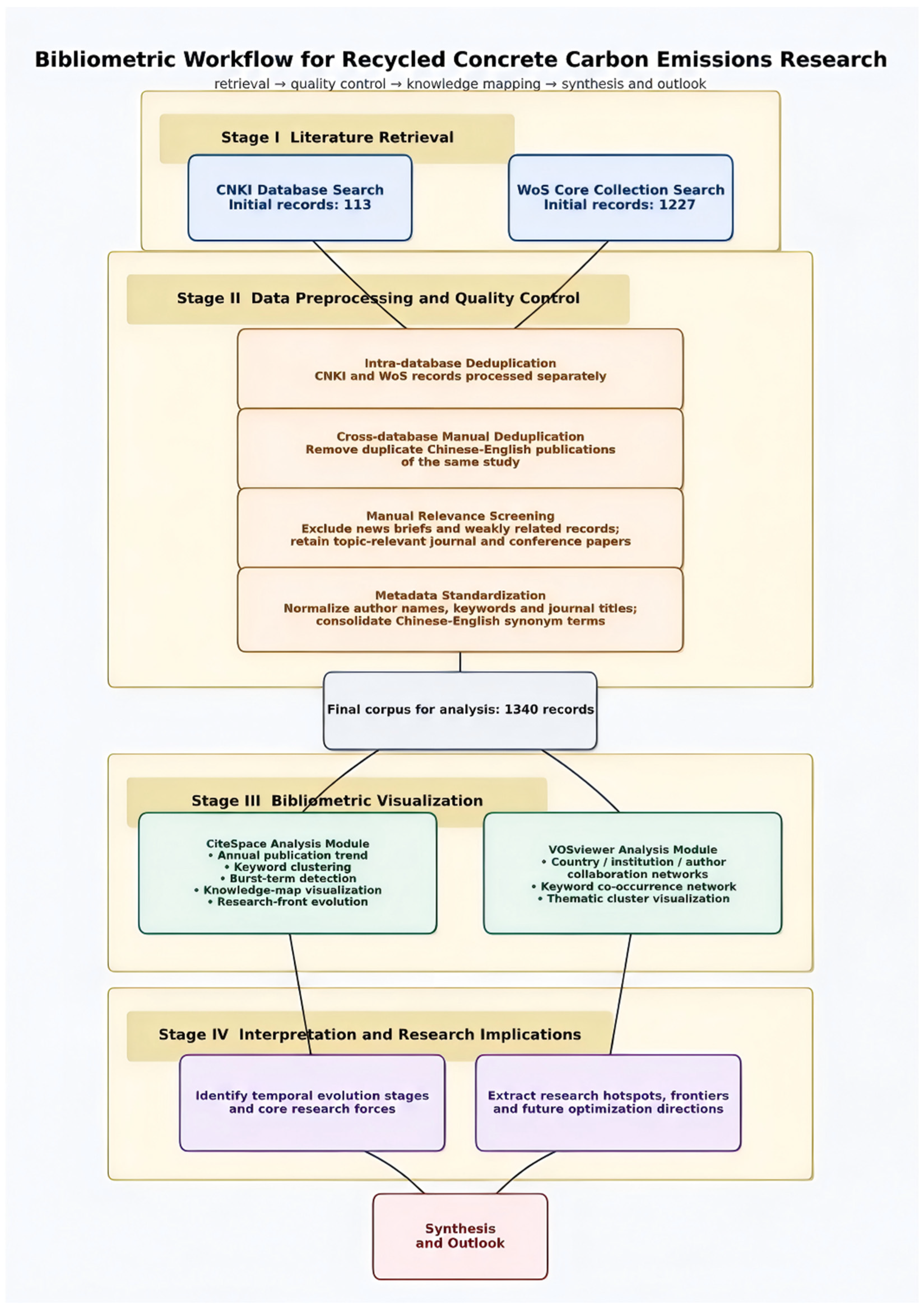
Following a rigorous PRISMA-compliant screening pipeline, including database retrieval, document type filtering, relevance verification, intra- and cross-database deduplication, manual supplementation and metadata standardization, a final dataset of 1340 valid Chinese and English publications was determined. This standardized and high-quality dataset was imported into CiteSpace and VOSviewer for multi-perspective bibliometric and visual analysis, ensuring the reliability, comparability and comprehensiveness of the research findings.
No laboratory instruments were used in this bibliometric study; therefore, company names and addresses of instruments are not applicable. Bibliometric visualization and network analysis were performed using CiteSpace (version 6.4.R1, Chaomei Chen, Drexel University, Philadelphia, PA, USA; https://citespace.podia.com/) and VOSviewer (version 1.6.20/1.6.21, Centre for Science and Technology Studies, Leiden University, Leiden, The Netherlands; https://www.vosviewer.com/). Data cleaning and tabulation were conducted using Microsoft Excel 2021 (Microsoft Corporation, Redmond, WA, USA). No experimental testing standards were involved in this study.

2.2. Bibliometric Analysis Framework and Methodological Settings

Knowledge graphs serve as fundamental visual and analytical tools in bibliometric research, enabling quantitative assessment of academic correlations and dynamic evolutionary patterns within a specific disciplinary domain. By visualizing interactive relationships among publications, authors, research institutions, and thematic keywords, knowledge mapping effectively decodes the inherent developmental logic, multi-scale collaborative structures, and thematic evolution characteristics of academic fields [21]. This study adopted a standardized bibliometric workflow compliant with the PRISMA statement to ensure the integrity and reliability of the literature screening and quantitative analysis.
Figure 1 presents the full research procedure, which consists of two core stages: standardized dataset establishment and multi-dimensional visual quantitative analysis. In the data preprocessing stage, rigorous and unified operations were sequentially implemented, including intra-database deduplication, cross-database removal of bilingual duplicate publications, two-round thematic manual screening supplemented with synonymous literature retrieval, and standardized metadata normalization for authors, research institutions, and keywords. After systematic dataset calibration, two functionally complementary tools (CiteSpace and VOSviewer) were jointly employed to conduct comprehensive bibliometric analyses, covering annual publication trend monitoring, national and institutional collaborative network mapping, author productivity evaluation, keyword co-occurrence clustering, burst keyword detection, and thematic timeline evolution identification. This integrated analytical framework facilitates the systematic interpretation of core research hotspots, intrinsic knowledge architectures, and emerging research frontiers in the field of life-cycle carbon emissions of recycled concrete.
To guarantee result reproducibility and analytical robustness, unified parameter configurations were strictly implemented for all visualization and clustering analyses. For VOSviewer-based analysis, the time window covered the full period from 2015 to 2025, and the full counting rule was adopted to calculate network link strength. A minimum keyword occurrence threshold of three was set to filter low-frequency and invalid keywords, while the built-in clustering algorithm with a resolution of 1.0 was applied to partition distinct thematic clusters. All synonymous terms, abbreviations, and lexical variants were uniformly normalized prior to visualization to eliminate analytical bias. As a core network metric calculated by VOSviewer, total link strength (TLS) was introduced to quantitatively evaluate node collaborative characteristics. Specifically, TLS refers to the cumulative strength of all direct cooperative connections between a target node and all other nodes in the network, where pairwise link strength is defined as the number of co-authored publications based on the full counting criterion. Different from publication volume that merely reflects research productivity, TLS objectively characterizes the external collaborative embeddedness and academic connection intensity of countries, institutions, or individual authors; a higher TLS value corresponds to more extensive cooperative relationships and a more central hub position within the global research network.
For CiteSpace analysis, the time slice was set as one year across the entire research period, and the top 50 high-frequency keywords per year were extracted for network construction. Pathfinder network pruning was adopted to eliminate redundant connections and optimize network legibility. Spectral clustering was performed on the keyword co-occurrence matrix, yielding a modularity Q of 0.712 and a silhouette coefficient S of 0.836, which quantitatively verify the high robustness and clear partitioning of the clustered thematic groups. Kleinberg’s algorithm was further utilized for burst keyword detection to capture dynamic research frontiers. Consistent keyword cleaning and normalization standards were implemented throughout all analytical procedures to maintain a unified statistical caliber.
Based on the standardized dataset and unified parameter settings, this study conducted bibliometric analysis from macroscopic and microscopic dimensions. Macroscopically, core bibliometric indicators, including annual publication trends, source journal distribution, and spatial distribution of national and institutional research forces, were analyzed to clarify the overall developmental context and core academic layout of the research field. Microscopically, keyword co-occurrence clustering, co-citation analysis, and keyword timeline evolution were integrated to systematically reveal the spatial aggregation rules of mainstream themes and the phased temporal shifts of research priorities.
Distinct from simple descriptive statistics of publication quantity, the proposed framework integrates basic bibliometric statistics, multi-scale collaborative network exploration, and knowledge graph visualization to achieve multi-perspective quantitative evaluation. Co-citation clustering excavates implicit citation correlations among high-impact publications, thereby revealing the disciplinary theoretical basis and knowledge inheritance lineage of existing research. Keyword co-occurrence analysis characterizes the spatial aggregation pattern of mainstream research topics, while keyword timeline analysis dynamically reflects the temporal evolution of research focus. The complementary advantages of the above multi-dimensional visualization methods systematically sort out core literature clusters, dominant research hotspots, and longitudinal developmental trajectories, providing a solid methodological foundation for interpreting the dynamic progress and predicting future evolutionary trends of recycled concrete life-cycle carbon emission research [22,23].

3. Results and Discussion

3.1. Posting Trends

3.1.1. Annual Publication Volume Trends

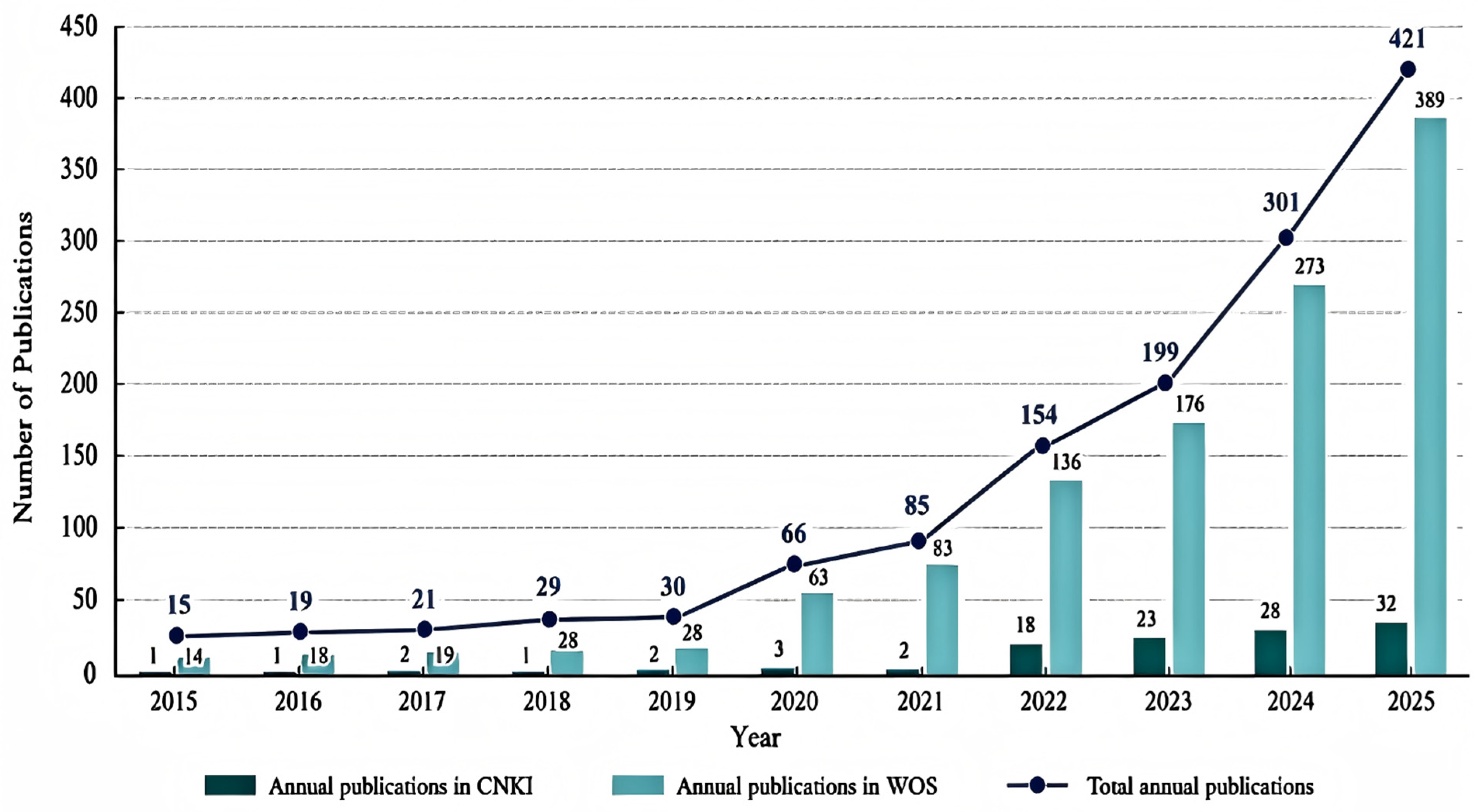
The annual publication output serves as a foundational bibliometric metric to quantify sustained academic focus and objectively demarcate the staged maturity of a disciplinary field [24]. Figure 2 illustrates the year-by-year publication changes for research addressing the life-cycle carbon emissions of recycled concrete, combining the literature records extracted from CNKI and the Web of Science Core Collection spanning 2015 to 2025. The temporal fluctuation of publications reveals three distinct, logically sequential developmental phases, each accompanied by identifiable disciplinary limitations and evolving research priorities, rather than merely reflecting superficial output growth.
During the initial exploratory phase (2015–2019), annual publications remained persistently low, with marginal year-on-year increments. This restrained output trajectory is not merely a sign of limited academic interest, it also signals two core structural bottlenecks constraining early scholarship. First, unified standardized frameworks for whole-life carbon boundary definition and inventory compilation had not yet been established, resulting in inconsistent evaluation calibers across scattered experimental studies. Second, the research scope was narrowly restricted to isolated material performance tests without any integrated linkage between aggregate characteristics and holistic carbon balance calculation. The absence of cross-institutional collaborative networks further fragmented the scattered exploratory work, preventing the formation of cohesive, systematic theoretical systems for recycled concrete carbon accounting.
A sharp upturn in annual publications emerged from 2020 to 2022, marking the rapid expansion phase, which is closely tied to the formal rollout of China’s top-tier low-carbon policy documents in 2021: Opinions on Fully, Accurately, and Comprehensively Implementing the New Development Philosophy and Effectively Advancing Carbon Peaking and Carbon Neutrality and the Action Plan for Carbon Peaking Before 2030 [20,21]. Beyond a simple policy-driven output surge, this growth reflects a clear methodological shift within the field. National dual carbon targets created a unified practical demand for quantitative carbon assessment of construction waste recycling, prompting researchers to move beyond single-factor material experiments toward preliminary whole-life-cycle assessment (LCA) frameworks. Nevertheless, the rapid expansion also exposed prominent research gaps during this stage: most LCA models adopted generalized foreign inventory parameters without localized correction for domestic raw material transportation, waste treatment and construction scenarios, weakening the engineering applicability of acquired carbon emission results.
The period 2023–2025 constitutes the steady maturation stage, with a total of 421 relevant papers recorded in the dataset (389 WOS English articles and 32 CNKI Chinese papers). A critical methodological caveat must be acknowledged: a database indexing lag at the retrieval date means newly released 2025 manuscripts are not fully archived, introducing minor incomplete bias within the statistical dataset. The release of the white paper China’s Actions on Carbon Peaking and Carbon Neutrality further refined industrial green transformation governance systems [25], driving two targeted improvements to existing research paradigms. On the one hand, localized carbon factor calibration began to replace universal foreign inventory data; on the other hand, emerging data-driven tools such as machine learning were gradually incorporated to resolve multi-factor coupling challenges in carbon prediction. Even so, unresolved technical barriers persist in this mature phase, including the unstable carbon sequestration efficiency of carbonation curing and insufficient quantitative coupling analysis between long-term structural durability and cumulative carbon footprints.
Collectively, the three-stage publication trajectory does not only document rising academic attention but also exposes a clear iterative evolution of disciplinary knowledge architecture and methodological capability. The field has transitioned from disjointed single-dimensional material exploratory tests toward systematic multi-objective research integrating material modification, standardized carbon accounting and engineering-oriented low-carbon optimization. The synchronized advancement of publication volume and policy iteration also highlights an enduring structural research gap: existing studies still lack unified domestic carbon accounting specifications tailored to regional construction waste characteristics, creating persistent inconsistency in comparative carbon reduction results across independent case studies.

3.1.2. Journal Source Distribution

Statistical analysis of source journals can quantitatively decode the disciplinary layout, knowledge differentiation and hidden research limitations of life-cycle carbon emission research on recycled concrete rather than merely identifying mainstream publication channels and superficial academic influence of journals [26]. This section systematically sorts out the top 10 productive journals indexed in the WOS Core Collection and CNKI, and incorporates total citation metrics into both journal statistical tables to enable the multi-dimensional evaluation of publication platform value; all proportional indicators are calculated based on the full valid dataset to ensure statistical objectivity. Considering the divergent statistical dimensions of periodicals and academic institutions, domestic research outputs are separately presented in two categorized tables: high-yield journals and prolific universities.
Table 1 summarizes the top 10 journals in the WOS dataset containing 1227 valid English papers. The cross-disciplinary distribution of high-output journals across civil engineering, materials science and environmental science is not only a surface reflection of multi-field participation but also exposes an inherent knowledge structure characteristic: international research has formed an integrated analytical paradigm that links material performance tests with environmental impact quantification. Construction and Building Materials ranks first with 204 papers (16.63%), followed by the Journal of Cleaner Production (121 papers) and the Journal of Building Engineering (106 papers). Resource-circulation interdisciplinary journals obtain far higher total citations than single engineering journals, which implies that studies establishing standardized life-cycle assessment (LCA) systems and multi-scale aggregate modification theories have formed the field’s foundational knowledge base. By contrast, pure construction journals mainly accommodate applied experimental research, revealing a clear methodological division in global academia: theoretical carbon accounting innovation and engineering performance verification exist as two relatively independent research branches with insufficient cross-integration between them.
Table 2 lists the top 10 journals from the 113 valid CNKI papers. Domestic journal distribution is highly scattered with narrow gaps in publication volume among leading titles, which reflects two obvious disciplinary deficiencies. First, Chinese research lacks dedicated interdisciplinary platforms for construction waste carbon evaluation, so relevant results can only be scattered in conventional civil engineering and building material journals. Second, few domestic studies conduct systematic LCA theoretical innovation; most published work remains confined to material laboratory tests. Concrete and Cement Products and the Journal of Architectural Science and Engineering tie for first place with three papers each (2.65%). Almost all domestic high-yield journals are specialized engineering periodicals, indicating that domestic research prioritizes on-site construction practicability but pays insufficient attention to unified, universal carbon emission calculation frameworks, creating a gap between domestic technical exploration and international standardized evaluation systems.
Table 3 takes all 113 CNKI documents as the statistical benchmark to sort out the domestic top 10 productive universities, among which Tongji University leads with eight papers. The concentration of domestic research output in civil engineering universities demonstrates that domestic carbon emission research relies heavily on university laboratory platforms, while industrial institutions and design institutes rarely participate in systematic quantitative carbon assessment. Such a participation imbalance restricts the localization correction of carbon inventory parameters based on real construction project data, forming a long-standing research bottleneck that laboratory parameters cannot match to actual engineering scenarios.
The horizontal comparison of journal layouts across two databases clarifies a core divergence in disciplinary development paths. International research relies on cross-disciplinary journals to realize the organic combination of carbon accounting theory and material mechanism analysis, yet few studies propose regionally adjusted evaluation frameworks tailored to specific waste raw materials [27]. Domestic research closely matches China’s dual carbon industrial policies and construction waste treatment demands, but its overemphasis on discrete material experiments leads to fragmented research results without unified technical specification output [28]. Even though a complete publication channel system has taken shape globally, two prominent research gaps remain unaddressed: insufficient cross-regional collaborative research to form unified carbon accounting standards, and weak international dissemination of China’s localized waste recycling low-carbon technologies.
Beyond journal-level citation profiling, this paper further implements targeted bibliometric evaluation of highly cited articles to excavate the field’s core knowledge lineage and unresolved technical constraints. Citation metrics serve as objective markers to distinguish foundational landmark papers from marginal experimental records [29]. Statistical classification of top-cited works identifies three mutually correlated core knowledge modules: standardized full-life carbon accounting boundary systems, recycled aggregate durability modification mechanisms, and mineral carbon sequestration low-carbon binder technologies. The keywords extracted from these influential papers (life-cycle assessment, carbon footprint, embodied carbon, recycled aggregate, durability, carbon neutrality) align perfectly with the hotspot clusters extracted in subsequent keyword analysis, confirming that these three modules constitute the field’s dominant knowledge framework. In-depth reading of the high-citation literature reveals universal methodological defects shared by existing foundational studies: most LCA models adopt fixed generic inventory data without dynamic adjustment for regional raw material differences; the performance–carbon emission trade-off relationship is only qualitatively described rather than quantitatively modeled; carbonation curing sequestration efficiency lacks long-term structural service verification. These unresolved technical and methodological defects become the key breakthrough directions for follow-up frontier research and also explain why emerging data-driven keywords such as machine learning continuously gain attention in recent publications.

3.2. Research Capabilities

3.2.1. International Research Collaboration Analysis

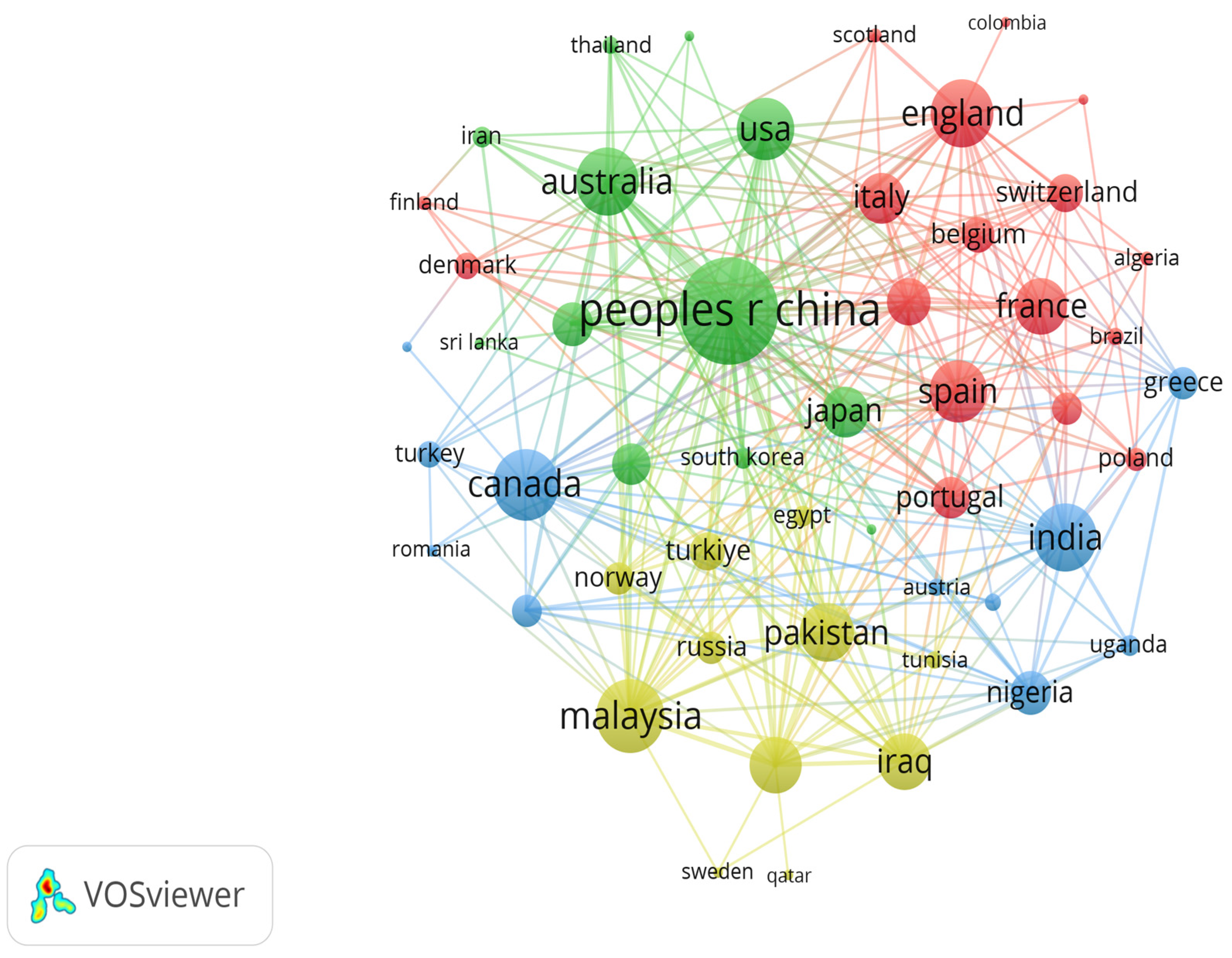
The country-level collaboration graph generated by VOSviewer visualizes the cross-border knowledge exchange pattern of research on the life-cycle carbon emissions of recycled concrete, which not only displays superficial cooperative connections but also reflects hierarchical differences in disciplinary knowledge output capacity, methodological innovation capacity and transnational knowledge diffusion efficiency [30]. Figure 3 demonstrates the topological layout of global academic cooperation, and Table 4 quantifies multi-dimensional bibliometric indicators of the top 10 productive countries for comparative analysis. In this network, node size corresponds to national total publication volume, and linking lines represent cross-border co-authorship ties; color-grouped clusters divide geographically adjacent regional research communities with consistent research orientations. The formed global network confirms the transition from single-country independent experiments to transnational joint research, while moderate overall network density exposes two structural defects in the existing global knowledge ecosystem. First, cooperative resources are highly monopolized by a small number of core countries, and most medium and small research economies are excluded from mainstream cross-border collaborative frameworks. Second, intra-cluster regional cooperation is far more frequent than inter-cluster long-distance collaboration, hindering the cross-regional circulation of differentiated research methodologies and localized carbon accounting data. China, Australia, the United States, India and the UK possess high betweenness centrality and act as critical bridging hubs linking discrete regional clusters, yet the uneven distribution of collaborative links restricts the full integration of global multi-scenario research data.
Table 4 further interprets the internal differentiation of knowledge contribution among major research nations through publication quantity, citation metrics, total link strength and average citations per paper. China tops the global ranking with 475 publications, 14,134 total citations and a total link strength of 110, paired with the highest betweenness centrality across all samples. This composite advantage illustrates that China undertakes the largest volume of engineering-oriented recycled concrete research and serves as the primary international platform for exchanging construction waste recycling experience under domestic dual carbon policies. Nevertheless, its relatively low average citation per paper (29.76) reveals a prominent disciplinary gap: most domestic studies focus on localized material performance tests, while universally applicable standardized life-cycle carbon accounting frameworks and quantitative coupling models for long-term durability are insufficient, limiting the global recognition of domestic theoretical innovations. By contrast, the United States records the highest average citations per paper (46.74), followed by the UK (40.33) and Germany (39.00). This metric gap indicates that developed countries dominate theoretical and methodological breakthroughs such as unified LCA boundary definition, generalized carbon footprint inventory systems and carbon sequestration mechanism simulation, whose research outcomes form the foundational theoretical basis widely cited by global scholars. Australia maintains a balanced performance across all indicators, functioning as a vital mediator connecting Asian and European research clusters and producing balanced outputs covering both material experiments and environmental evaluation theories. Although India, the UK, Japan, Malaysia, Saudi Arabia, Germany and South Korea have lower total publication volumes, their measurable betweenness centrality proves they carry regional research characteristics. Most focus on regional solid waste disposal schemes tailored to local raw material conditions, yet their research systems lack universality and cannot be widely replicated across diverse construction scenarios.
Synthetic analysis of the network topology and quantitative indicators identifies a clear tiered global collaborative ecosystem with inherent developmental bottlenecks. High-betweenness core nations control the dominant channels of transnational knowledge dissemination, yet two irreconcilable research divides persist within this hierarchical structure. On the one hand, there exists an obvious split between engineering-oriented regional research (represented by China and Southeast Asian nations) and theory-oriented standardized evaluation research (represented by North America and Europe), with insufficient cross-reference and mutual optimization between the two technical routes. On the other hand, peripheral countries can only participate in geographically limited regional cooperation, lacking access to shared global carbon inventory databases and multi-country joint verification platforms, which restricts the universality of their carbon emission calculation models. To address these structural deficiencies, future transnational research should deepen multilateral joint projects among core countries to integrate engineering practical experience and standardized evaluation theories. Meanwhile, open shared international carbon accounting databases and cross-regional joint verification programs should be established to incorporate peripheral research economies, eliminating the current imbalance between localized engineering exploration and universal theoretical innovation in recycled concrete low-carbon research.

3.2.2. Research Institution

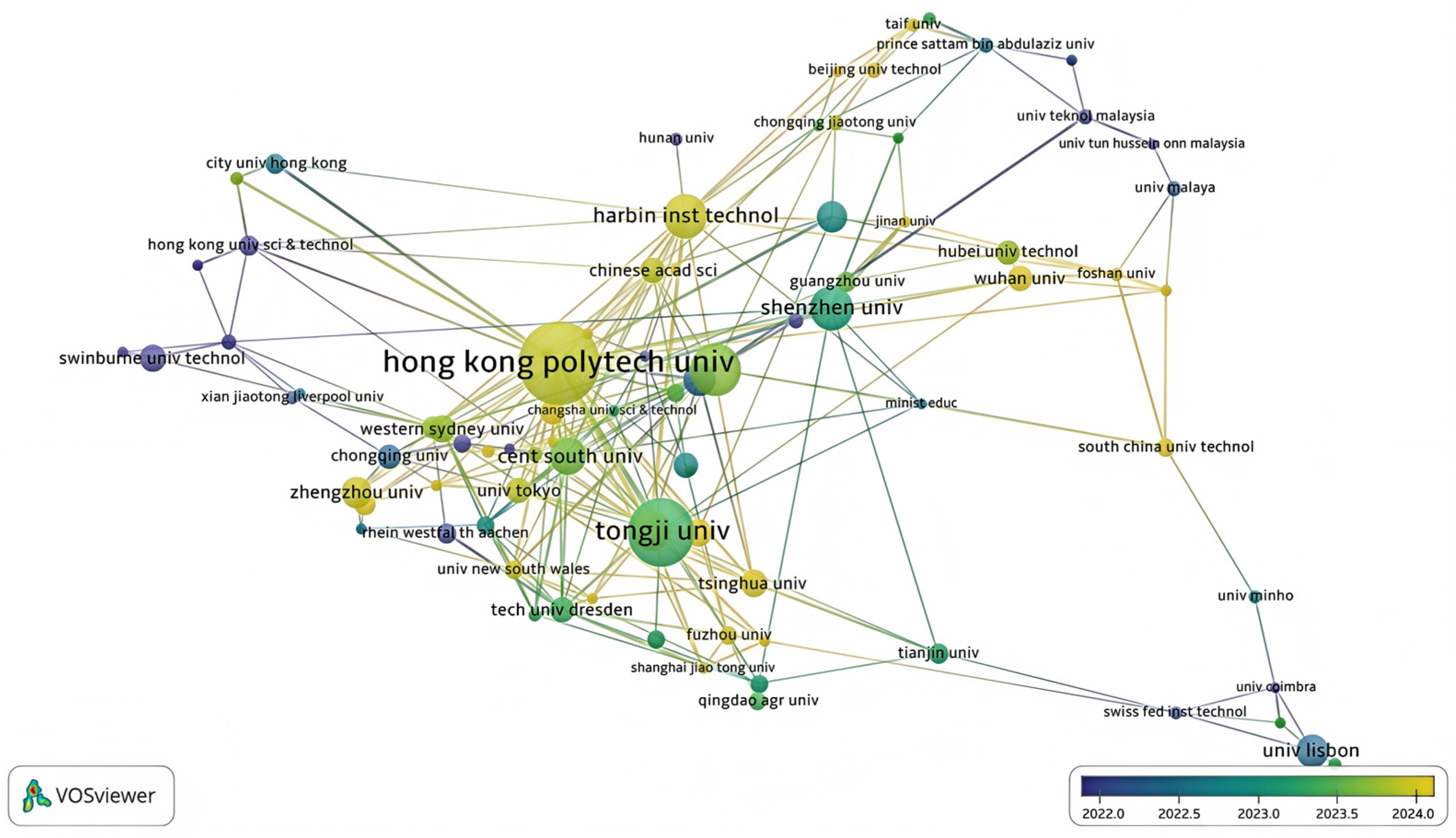
Figure 4 visualizes the institutional collaboration network for life-cycle carbon emission research on recycled concrete, where node size corresponds to institutional publication output and connecting lines denote inter-institutional co-authorship ties [31]. Merely observing node scale and link density cannot fully interpret the disciplinary implications of this topological pattern; the concentrated large nodes and intensive links of The Hong Kong Polytechnic University, Tongji University, Shenzhen University and Central South University reveal an imbalanced distribution of core research capacity rather than simply proving their outstanding productivity. These leading institutions form closed local collaborative clusters with stable internal cooperation but maintain sparse cross-regional partnerships with overseas universities. The overall network composition dominated by Chinese academic institutions reflects a distinctive domestic research layout driven by China’s Dual Carbon policy and abundant construction waste research resources, yet it also exposes an obvious structural limitation: cross-border institutional communication remains superficial, with few long-term joint projects targeting unified carbon accounting standard formulation or cross-regional engineering case verification.
Table 5 further quantifies the publication volume of top-tier research bodies to unpack differentiated research positioning and methodological tendencies among core institutions. The Faculty of Construction and Environment at The Hong Kong Polytechnic University takes the lead with 50 publications, with its Civil and Environmental Engineering department also ranking high in output. This dominant status stems from its long-term integrated research covering LCA theoretical frameworks, recycled aggregate modification and cross-border comparative carbon assessment, which explains why it acts as the primary international exchange hub within the institutional network. Tongji University’s School of Civil Engineering (38 papers) and Department of Structural Engineering (25 papers) focus more on domestic engineering-oriented tests, concentrating on the performance optimization of recycled materials under Chinese construction scenarios. Other high-output domestic institutions, including Shenzhen University and Central South University, similarly prioritize laboratory material experiments and regional solid waste disposal schemes, forming a research community biased toward localized engineering practice.
International institutes such as the National University of Singapore, Instituto Superior Técnico and the University of Lisbon occupy non-dominant but indispensable positions in the network. Their research output centers on generalized sustainable evaluation models rather than region-specific waste treatment technologies, creating an obvious knowledge divide between Chinese engineering-dominated institutions and overseas theory-oriented universities. This institutional layout featuring clustered Chinese core universities and scattered overseas participants demonstrates that current inter-university collaboration mostly stays at the level of occasional co-authored papers, lacking systematic joint research addressing two key disciplinary gaps: the absence of unified regional carbon inventory calibration standards and insufficient joint verification of long-term carbon sequestration performance across different waste raw materials. Such fragmented institutional cooperation restricts the integration of localized engineering data and universal LCA theories, hindering the formation of globally recognized technical specifications for recycled concrete low-carbon utilization [32,33].

3.2.3. Author Collaboration Network Analysis

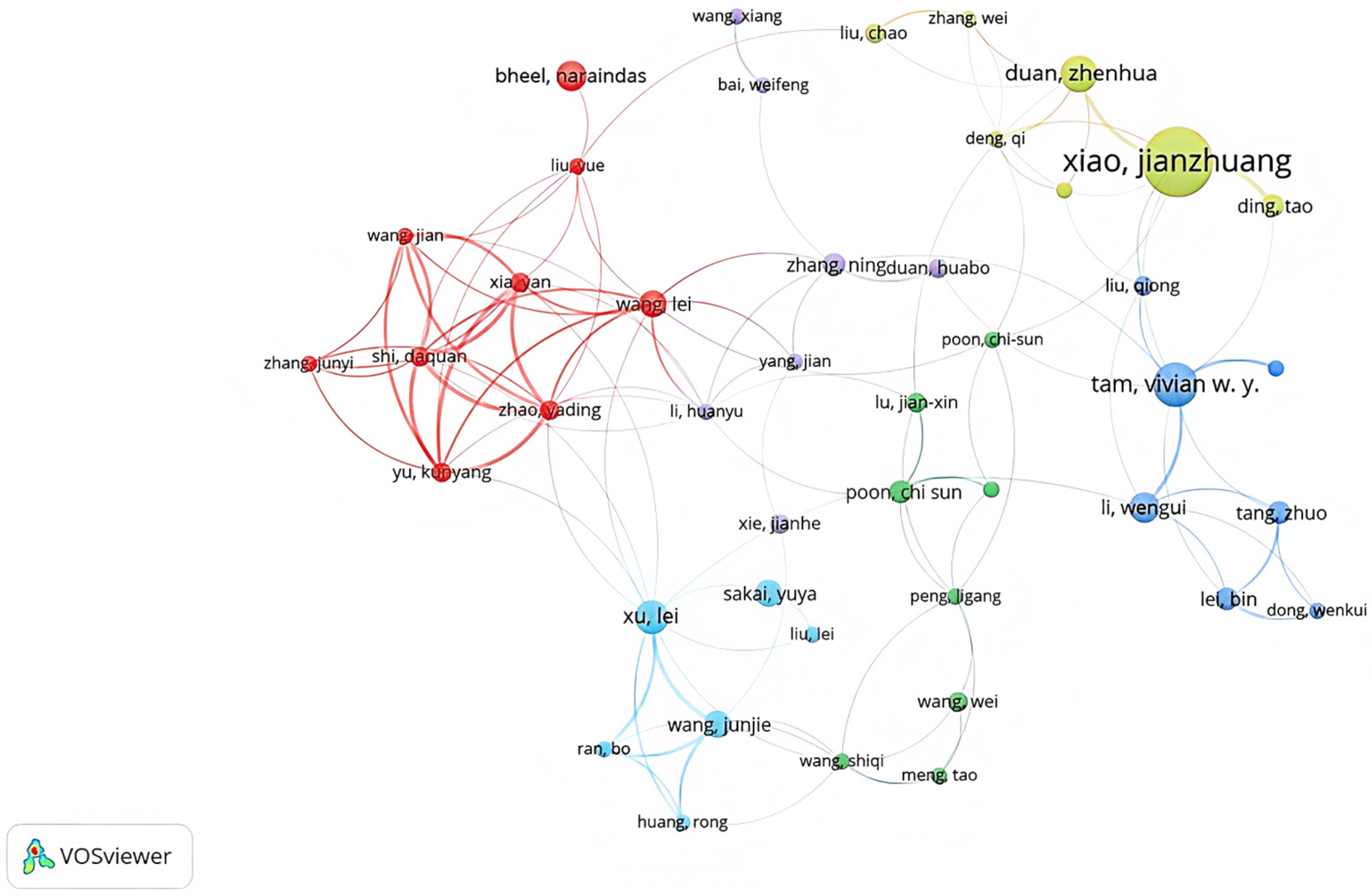
Author co-occurrence mapping quantifies the grouping structure of academic teams and reveals the implicit barriers to knowledge communication within the field of life-cycle carbon emissions of recycled concrete rather than merely identifying high-output scholars and surface cooperative relations [34,35]. Figure 5 displays the topological layout of author collaboration networks, where the node scale denotes individual publication yield and inter-node lines represent co-authorship partnerships. Color segmentation divides the whole network into multiple geographically isolated research clusters, which exposes a core structural flaw in the field’s knowledge circulation mechanism. Although scholars including Xiao Jianzhuang, Tam Vivian W.Y., Wang Lei, Poon Chi Sun and Xu Lei hold large, high-weight nodes reflecting long-term stable research output, the globally low overall network density proves that knowledge exchange is heavily confined to closed internal team cooperation. Cross-cluster communication between independent research teams is rare, leading to segmented knowledge systems; each cluster tends to develop its own experimental parameters, carbon accounting boundary settings and material modification schemes without mutual comparison or unified standardization. Such fragmented team cooperation hinders the formation of consensus on universal evaluation frameworks and restricts the cross-validation of technical paths across different research groups.
Table 6 integrates publication count, total citations, average citations per paper, h-index and total link strength to differentiate multi-dimensional academic influence of top productive authors, which further unpacks the differentiated contribution types and existing methodological gaps among core scholars. Ranking first with 25 publications, 1412 total citations, an average citation of 56.48 and an h-index of 15, Xiao JZ maintains comprehensive advantages in output scale, theoretical influence and cross-team connectivity. His high average citation and h-index demonstrate that his series of studies centering on recycled aggregate performance and whole-life carbon balance have become widely cited foundational references, yet most of his work targets domestic engineering scenarios and lacks generalized LCA models adaptable to multi-regional waste raw materials. Ranking second with 17 papers, Wang J achieves the field’s highest average citation (81.41) and an h-index of 12 despite moderate total link strength. This extreme citation premium indicates his unique contribution to standardized carbon footprint quantification, filling the gap of unified parameter calibration methods that most experimental-oriented teams overlook. Poon CS and Liu Y produce steady medium-impact outcomes with moderate average citations, whose research systems focus on regional waste treatment schemes but seldom carry out cross-scenario comparative analysis of carbon emission models.
Tam VWY’s 14 publications deliver an average citation of 71.93 and an h-index of 12, confirming the high recognition of her team’s systematic research on mineral carbon sequestration curing. In contrast, Wang L also publishes 14 papers but only gains an average citation of 23.5. The obvious disparity in citation performance under equivalent output volume implies that his studies are limited to discrete laboratory material tests without systematic carbon accounting mechanism exploration, resulting in limited long-term disciplinary inheritance value. Xu L, Liu C, Wang JJ and Duan ZH form the secondary productive cohort. Notably, Wang JJ attains the maximum single-paper average citation (85.17) with a smaller total output, signifying that his small batch of landmark works on data-driven carbon prediction fill the frontier research blank of intelligent evaluation, a direction ignored by most traditional experimental teams.
Synthetic interpretation of the network topology and multi-indicator author table outlines a tiered team development pattern accompanied by persistent disciplinary bottlenecks. The current field is dominated by several closed core research groups with tight internal collaboration but weak cross-cluster knowledge flow. Core scholars can be classified into three distinct contribution types: large-output engineering experimental teams, high-citation theoretical standardization pioneers, and small-volume frontier intelligent analysis innovators. However, the isolation between these three types of research groups creates long-standing unresolved gaps: experimental teams rarely adopt unified carbon calculation frameworks proposed by theoretical scholars [36,37], while intelligent prediction research lacks sufficient multi-source engineering verification data accumulated by material laboratories. Breaking the closed cluster structure and promoting cross-team joint research integrating material experiment, standardized carbon accounting and data-driven optimization will be essential to eliminate fragmented knowledge development in recycled concrete low-carbon research.

3.3. Research Highlights

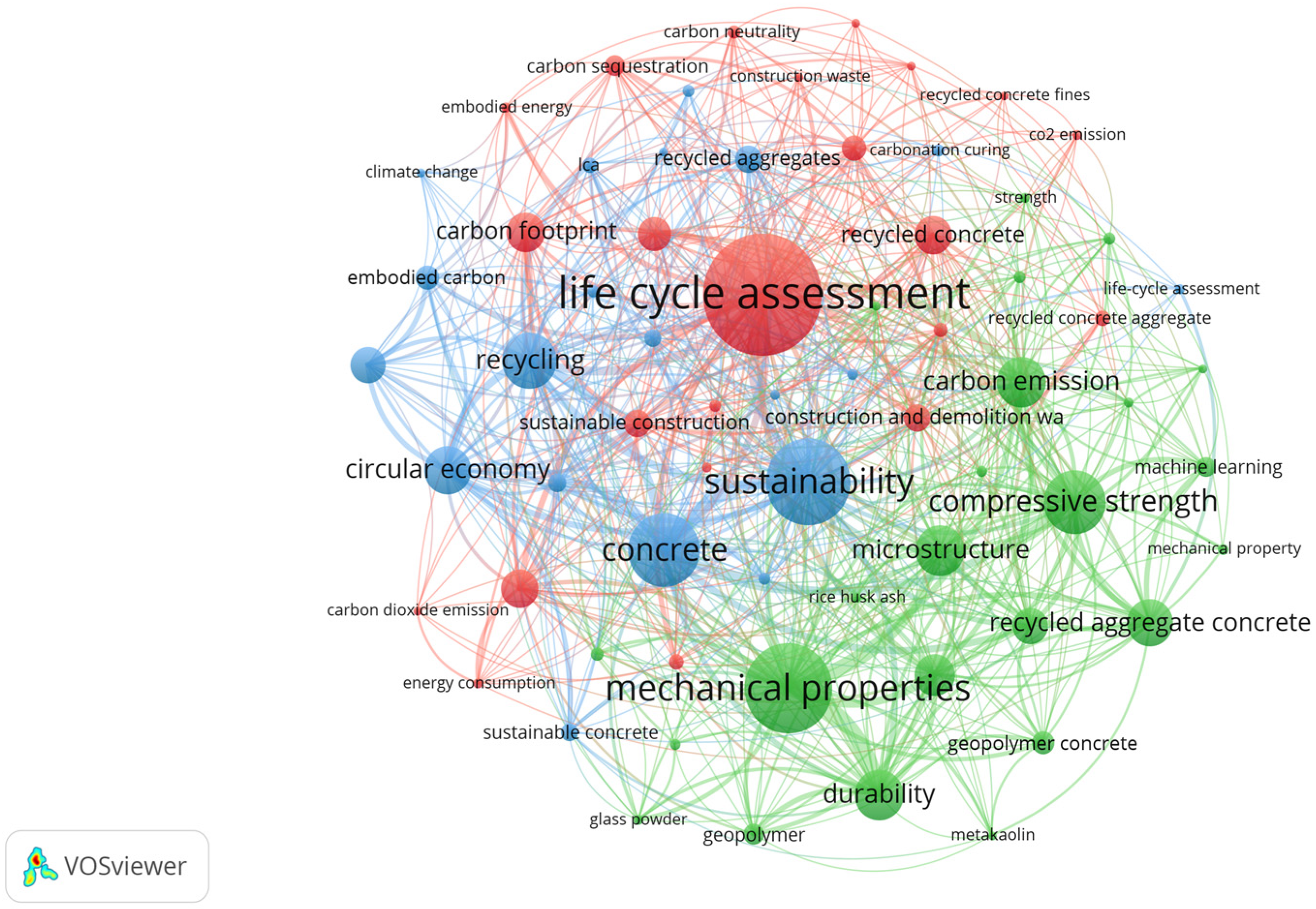
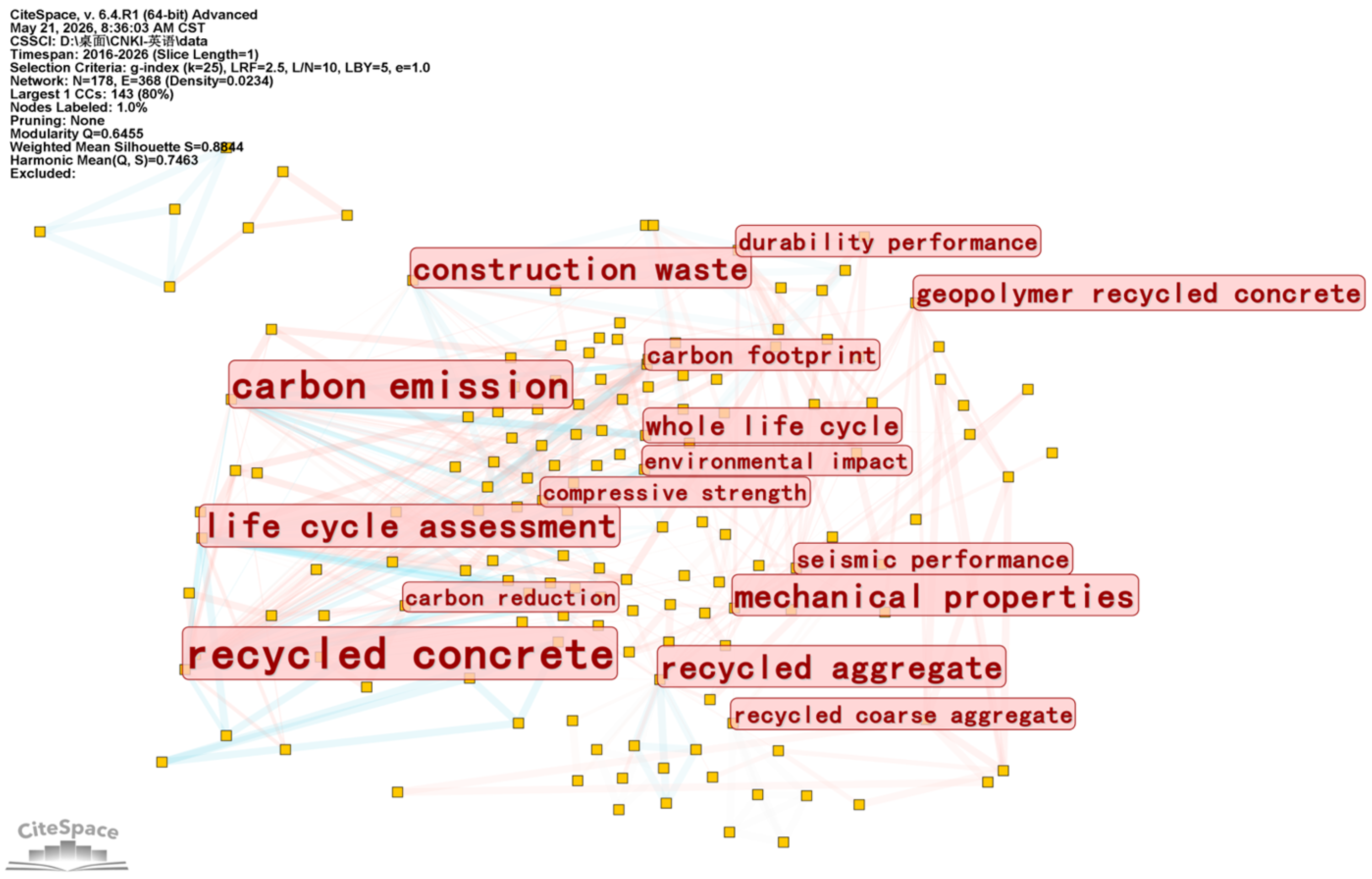
Keyword co-occurrence networks excavate the inherent knowledge architecture, methodological differentiation and persistent disciplinary gaps of life-cycle carbon emission research on recycled concrete rather than merely extracting superficial thematic hotspots based on term frequency [38,39,40]. Figure 6 and Figure 7 separately map keyword correlation topological diagrams for WOS and CNKI datasets, where node scale corresponds to term occurrence frequency and line thickness denotes co-occurrence correlation intensity.
The WOS keyword network (Figure 6) takes life-cycle assessment (LCA) as the absolute core hub, tightly interlinked with sustainability, recycled concrete, carbon emission, mechanical properties and durability [30]. This centric layout is not only a reflection of mainstream international research themes but also exposes a mature yet biased global knowledge framework: overseas academia has formed a complete closed research chain covering standardized carbon accounting, material performance testing and sustainability evaluation. Meanwhile, emerging high-correlation nodes, including carbon footprint, embodied carbon and carbon neutrality, prove that international methodologies prioritize universal quantitative evaluation systems oriented to full building life-cycles [41]. Machine learning acts as a fast-growing emerging keyword cluster [42], which reveals a clear methodological evolution trend: foreign scholars actively introduce multi-source data algorithms to resolve multi-factor coupling puzzles in carbon prediction, yet few studies calibrate LCA inventory parameters for regional construction waste raw materials, forming a universal research defect of weak localized adaptability in existing international evaluation models.
The CNKI keyword network (Figure 7) clusters around recycled concrete, recycled aggregates, carbon emissions, mechanical properties and durability, maintaining basic thematic consistency with international research [43,44,45]. Nevertheless, obvious structural divergence exists in domestic knowledge construction. Domestic high-frequency terms such as construction waste, aggregate resource utilization and compressive strength highlight that Chinese research revolves around practical solid waste disposal demands under the Dual Carbon strategy, but also reveal a prominent disciplinary imbalance: most domestic studies stay at the stage of material performance testing and on-site waste treatment exploration, with insufficient investment in unified, cross-scenario LCA specification formulations [46,47]. Though carbon footprint, environmental impact and carbon reduction have gradually gained research attention in recent years, relevant domestic quantitative evaluation systems remain fragmented without unified accounting boundaries and regional inventory databases.
Horizontal comparison of two keyword networks verifies the shared core developmental logic of “material performance improvement—environmental impact quantification—low-carbon engineering implementation” for domestic and overseas research, while simultaneously identifying two long-standing interdisciplinary divides. First, international research builds systematic, generalized LCA theoretical systems but lacks targeted correction mechanisms for waste raw material differences in various regions. Second, domestic research accumulates abundant engineering test data of local construction waste, yet fails to form standardized, replicable carbon evaluation frameworks, resulting in poor cross-study comparability of domestic carbon emission results. The separation between international theoretical standardization and domestic localized engineering data creates a persistent research blank; future integrated cross-regional research is required to combine universal LCA methodologies with China’s unique solid waste recycling scenarios to establish regionally adaptive whole-life carbon accounting specifications.

3.4. Research Topic Evolution

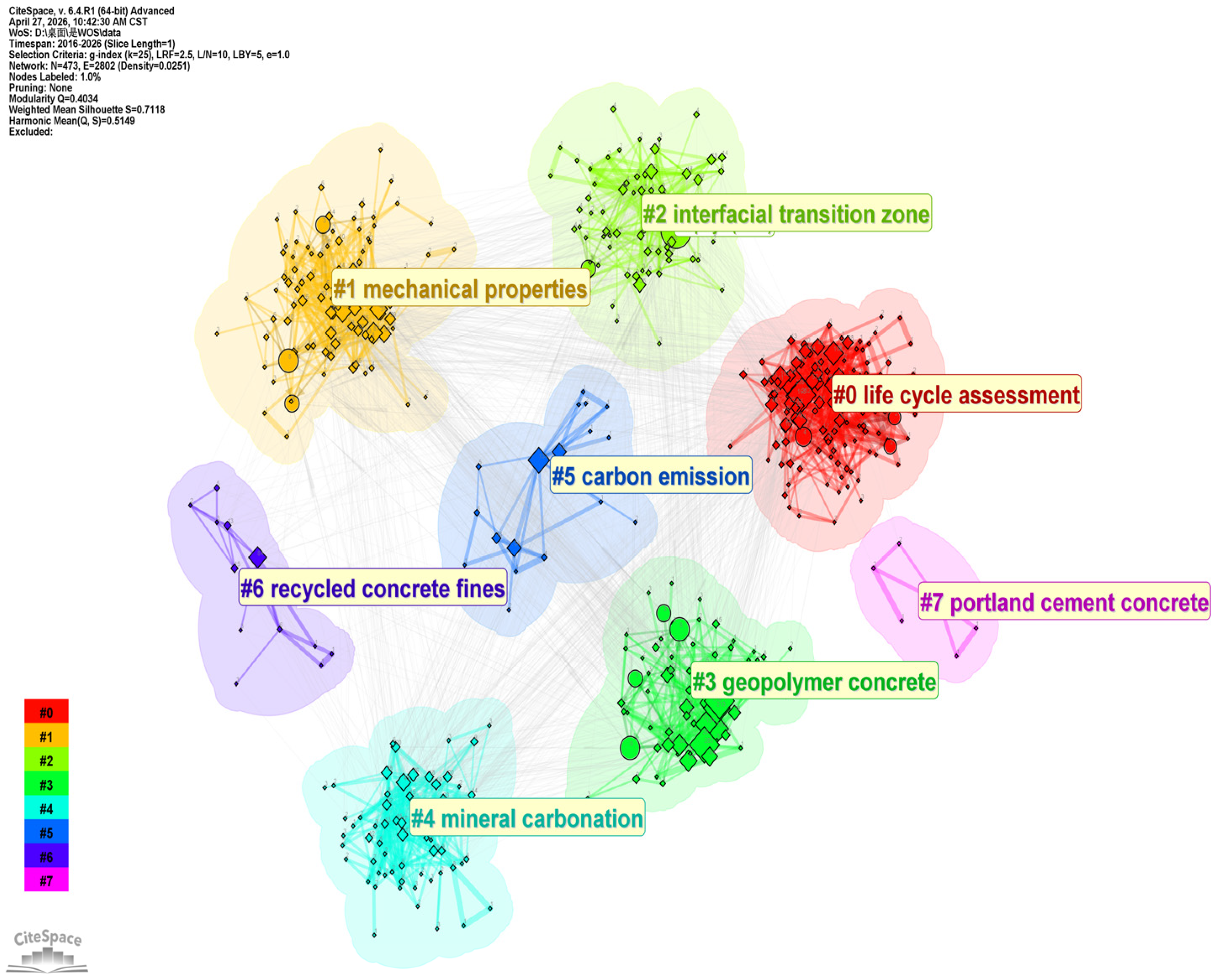
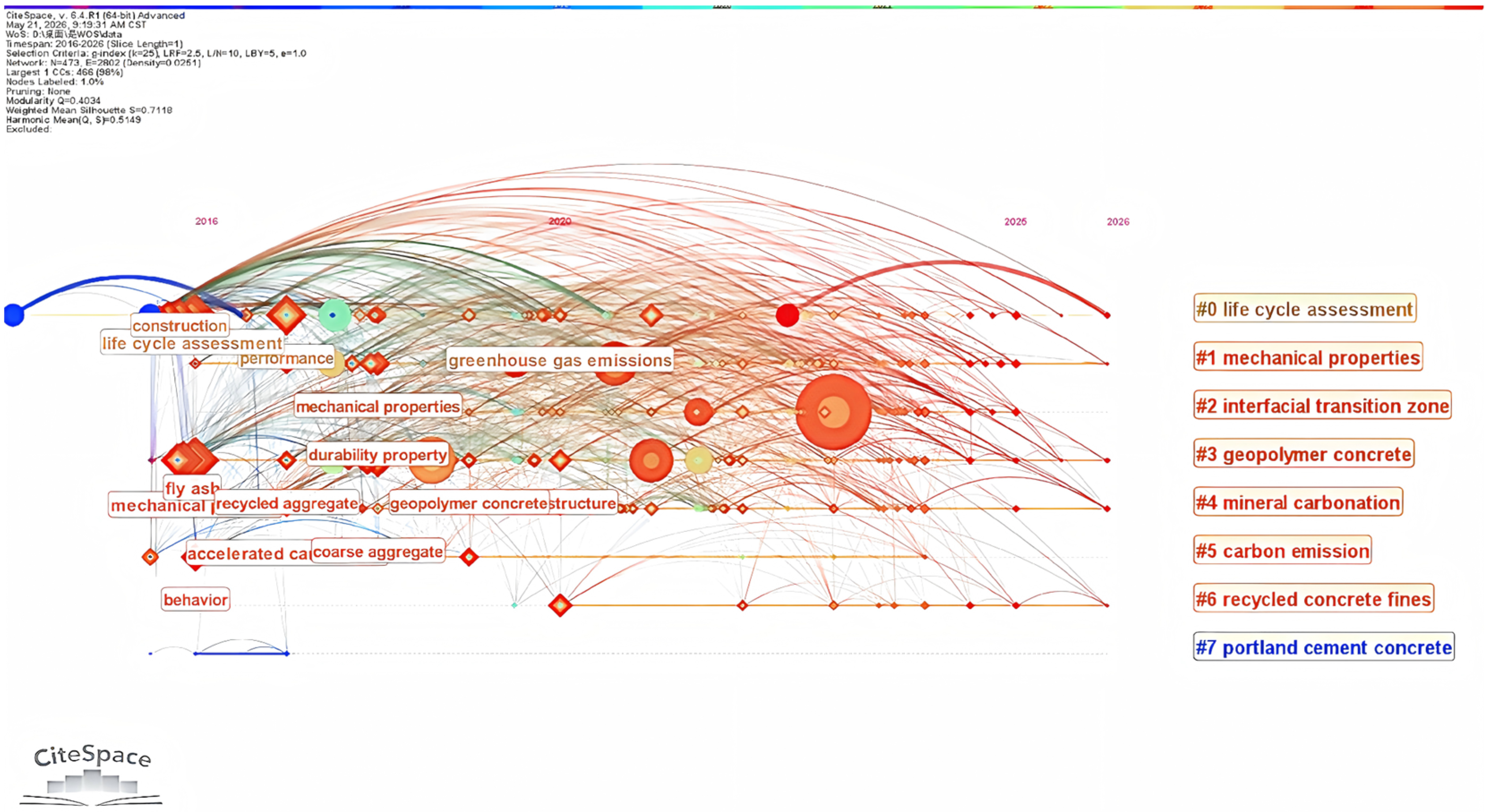
Keyword clustering and timeline mapping are capable of unpacking the internal knowledge hierarchy, staged methodological evolution and persistent disciplinary bottlenecks of life-cycle carbon emission research on recycled concrete rather than merely outlining superficial thematic frameworks and chronological shifts [48,49]. The WOS keyword cluster graph and timeline diagram (Figure 8 and Figure 9) partition international scholarship into eight stable thematic groups: life-cycle assessment, mechanical properties, carbon emissions, geopolymer concrete, mineral carbonation, recycled concrete fines, interfacial transition zone and Portland cement concrete. The long-standing dominance of life-cycle assessment and mechanical property clusters signals that global academia has formed a mature dual-track knowledge system built upon material lab testing and generalized carbon accounting theories. Nevertheless, this dual development pattern brings an inherent disciplinary split: most existing studies separate material performance characterization from whole-process carbon balance simulation, lacking integrated multi-objective optimization models that simultaneously coordinate mechanical durability and carbon reduction benefits. The independent emerging clusters of geopolymer concrete and mineral carbonation reflect the field’s attempt to seek low-carbon binder alternatives and in situ CO2 sequestration pathways, yet current mechanism research remains confined to laboratory small-scale tests, with insufficient systematic verification under actual engineering multi-scenario conditions. From a temporal perspective, international research has gradually transferred its core focus from single-factor durability experiments to refined carbon footprint calculation, low-carbon material modification and machine learning-based predictive analysis. Such a shift exposes a clear methodological upgrading tendency, while also revealing an obvious research gap: universal LCA frameworks proposed overseas rarely embed region-specific waste raw material parameters, resulting in limited practical adaptability for local construction projects worldwide.
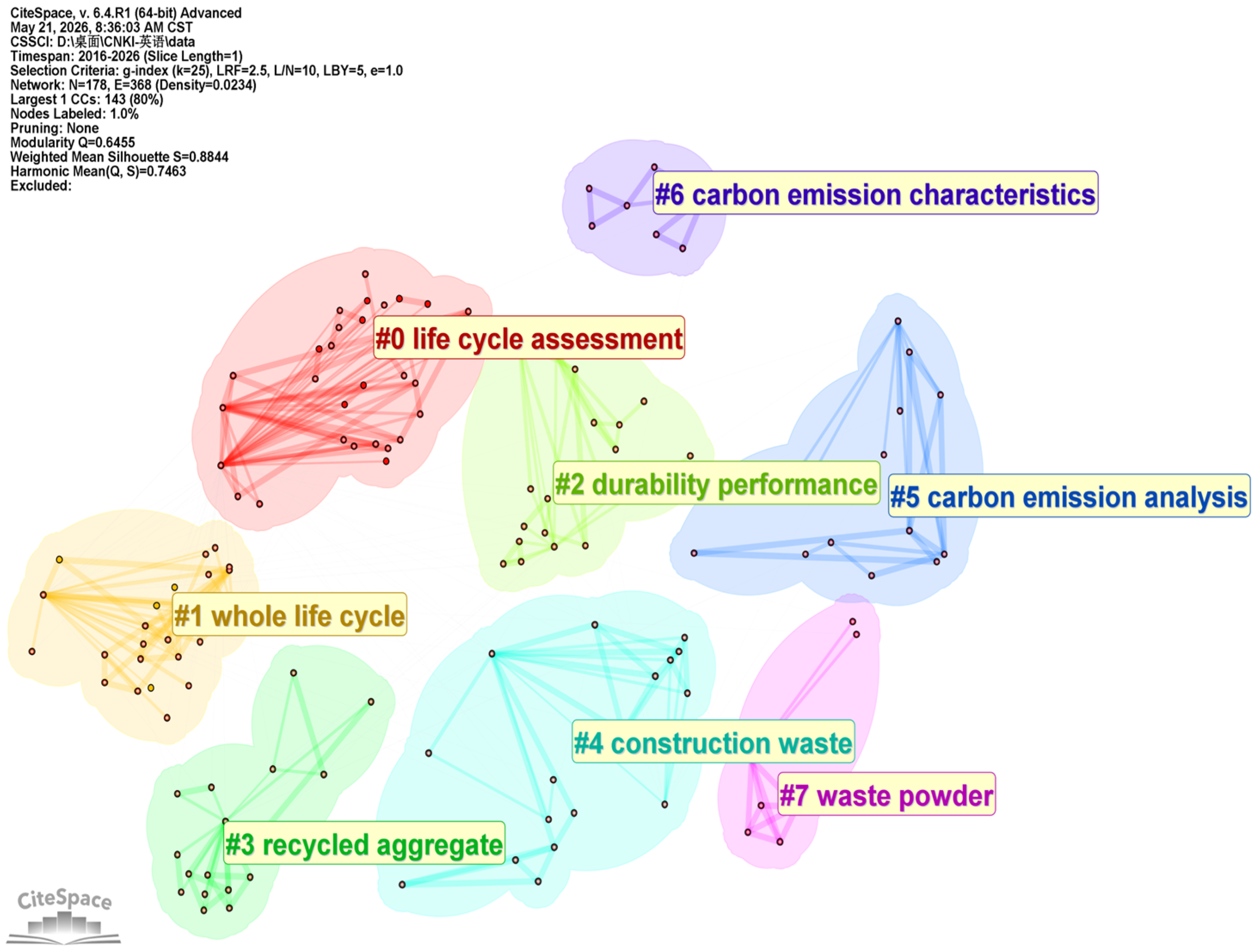
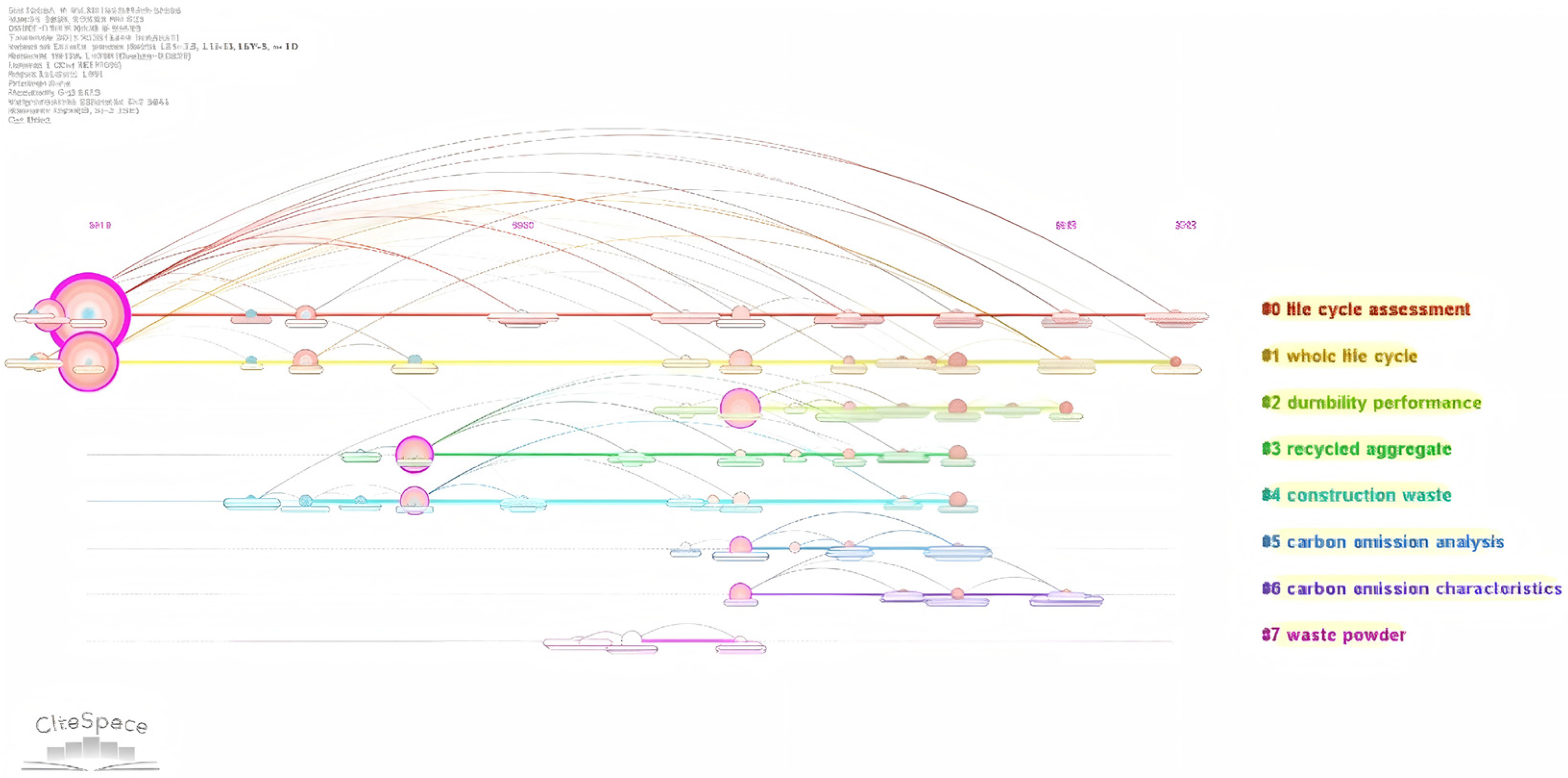
The CNKI keyword clustering and timeline visualization (Figure 10 and Figure 11) also identify eight core domestic thematic clusters: life-cycle assessment, whole life-cycle evaluation, durability performance, recycled aggregate utilization, construction waste recycling, carbon emission analysis, carbon emission characteristics and waste powder. Domestic thematic evolution is strongly driven by China’s Dual Carbon policy and domestic solid waste disposal pressure, thus centering heavily on applied engineering solutions [50,51]. Early domestic work was limited to simple recycled concrete performance optimization and basic LCA application; recent years have witnessed growing attention to refined carbon measurement and large-scale waste recycling engineering scheme. This staged evolution illustrates that domestic research advances closely follow industrial practical demands, yet it also highlights a prominent methodological deficiency: few localized unified carbon accounting specifications have been formed, and experimental data generated from various laboratories cannot be mutually referenced due to inconsistent statistical boundaries.
The horizontal contrast of dual-database keyword visualizations confirms that domestic and overseas research share the same general developmental logic of “material test → carbon evaluation → low-carbon engineering”, while adopting two distinct developmental paradigms that create long-term incompatible barriers. International studies devote major efforts to exploring material internal mechanisms and establishing cross-border standardized evaluation systems but neglect parameter localization correction; domestic research accumulates abundant engineering test data targeting Chinese construction waste characteristics but fails to extract universal theoretical frameworks from scattered experimental results [52,53,54]. Combined with the cross-country and institutional collaborative disparities analyzed in previous sections, such thematic divergence explains why transnational joint carbon accounting verification projects remain scarce. It should be noted that the comparative analysis herein is qualitatively interpreted based on cluster topology and timeline distribution, without quantitative measurement of keyword burst intensity and cumulative frequency, which restricts the depth of differentiation law interpretation. Follow-up quantitative statistics on burst metrics and term weight can further quantify the degree of divergence between domestic and international research routes and systematically remedy the current ambiguous understanding of unresolved technical contradictions such as mismatched carbon inventory parameters.

3.5. Evolutionary Logic and Future Research Frontiers

By synthesizing the staged publication output trend, cross-border collaborative topology, keyword co-occurrence network and thematic timeline clustering results, this section delivers a comprehensive critical interpretation of the evolutionary trajectory, structural defects and unresolved bottlenecks of life-cycle carbon emission research on recycled concrete rather than simply recounting superficial chronological changes [55,56,57]. The 2015–2019 preliminary exploratory phase is marked by scattered laboratory tests dominated by single-factor material performance experiments and rough carbon emission estimation. This fragmented research paradigm was not merely a product of limited academic attention, it stemmed from two fundamental disciplinary deficiencies: there existed no unified definition of whole-life carbon accounting boundaries, and researchers lacked standardized inventory databases to quantify a holistic carbon balance. As a result, early experimental conclusions could hardly be cross-referenced, forming disjointed knowledge fragments without systematic theoretical support. Driven by global carbon neutrality initiatives and China’s dual carbon industrial policies after 2020, the field entered a rapid expansion period with sharply rising publications. The sharp growth in studies targeting life-cycle assessment, carbon footprint accounting and construction waste recycling reveals a clear methodological upgrade, yet this expansion also exposed a lasting research divide: international teams prioritized generalized LCA theoretical frameworks while domestic scholars focused on localized waste treatment experiments, with rare cross-referencing between the two technical routes. The research scope expanded from isolated material tests to full-process carbon calculation covering raw material production, construction and demolition, but most models failed to integrate dynamic carbon sequestration generated during a long structural service life, leading to incomplete carbon balance evaluation logic [58,59].
Recent keyword burst detection and timeline clustering further expose the root causes driving frontier methodological shifts after 2022. Machine learning and multi-source data fusion emerged as high-intensity burst keywords and formed independent cross-database clusters, which directly addresses the long-standing limitation of traditional static LCA methods that cannot disentangle multi-factor coupling effects on carbon emissions [60,61,62,63,64,65,66]. Mineral carbonation maintained stable co-citation connections with aggregate modification research throughout 2020–2025, indicating that in situ CO2 capture has become a recognized technical breakthrough, yet existing research remains confined to laboratory accelerated curing tests without long-term on-site structural validation [67]. Dense co-occurrence around low-carbon pathway optimization after 2023 reflects the growing demand for engineering-oriented integrated design, but current schemes seldom incorporate economic cost indicators alongside carbon reduction benefits, creating a disconnect between theoretical optimal formulas and actual construction implementation. Collectively, multi-dimensional bibliometric evidence proves that the field’s knowledge system is evolving toward mechanism quantification and intelligent decision support, while three core unresolved technical gaps persist: insufficient coupling of long-term structural durability and cumulative carbon footprint, lack of cost–carbon balance multi-objective optimization, and scarcity of verified field-scale carbon sequestration data.
From a forward-looking perspective, future research needs to tackle inherent technical and methodological barriers to realize the coordinated optimization of structural performance, carbon reduction efficiency, economic returns and construction feasibility [68]. At the material technical level, unstable aggregate quality, weak interfacial transition zone performance and continuous durability decay constitute persistent bottlenecks restricting large-scale engineering popularization. Current modification and carbonation curing technologies only improve single material indicators; few systematic material design frameworks are established to synchronously balance mechanical stability, service life extension and carbon sequestration gain. At the methodological level, inconsistent accounting boundaries, heterogeneous inventory parameters and weak regional adaptability plague existing carbon evaluation systems. The absence of unified domestic standardized specifications makes carbon emission results from different case studies incomparable, severely limiting the repeatability of low-carbon design schemes.
Traditional static experiments and conventional LCA models can only supply static baseline data, lacking the capacity to simulate complex variable engineering environments and predict long-term performance evolution [69,70]. The boom of data-driven frontier keywords identifies a viable solution to this methodological limitation. Future research can integrate lab test data, real-time engineering monitoring records and regional waste inventory statistics to build dynamic carbon prediction and low-carbon mix optimization models [71,72,73]. Introducing uncertainty quantification can eliminate bias brought by fixed generic parameters, clarifying the nonlinear interaction between raw material composition, transportation distance and service-period carbon sink; this provides quantitative decision basis that static evaluation methods cannot offer.
There remains a structural mismatch between domestic and international research orientations in practical application research. Domestic scholarship is policy-driven and centered on domestic waste disposal projects, yet most evaluation models adopt foreign inventory datasets without localized correction for regional waste characteristics, supply radius and carbon emission factors. This creates a prominent research blank: localized assessment frameworks tailored to China’s construction industry are still absent. International academia has built mature LCA and low-carbon material theoretical systems, yet few cross-regional joint verification projects are launched to calibrate universal parameters for diverse waste raw materials. Deepened global cooperation on shared carbon databases, unified accounting standards and joint engineering demonstrations can bridge the gap between localized engineering data and generalized theory [74,75,76,77,78].
Taken as a whole, the field is shifting from scattered single-material low-carbon trials to integrated whole-life low-carbon construction systems, yet its long-term development is restrained by three interrelated deficiencies: insufficient interdisciplinary integration of materials, environmental informatics and civil engineering; absence of globally recognized unified carbon accounting specifications; and underdeveloped intelligent prediction tools capable of multi-objective collaborative optimization. Future disciplinary progress must rely on breaking these three bottlenecks simultaneously.

4. Conclusions

This study demonstrates that research on the life-cycle carbon emissions of recycled concrete maintained a sustained upward publication trend from 2015 to 2025, evolving progressively through initial exploration, rapid growth, and stable development stages. Based on bibliometric visual analyses conducted via CiteSpace and VOSviewer using CNKI and Web of Science datasets, the disciplinary research focus has transitioned from early investigations centered on recycled aggregate substitution, mechanical performance calibration, and durability evaluation toward systematic life-cycle carbon accounting, carbon footprint quantification, and the integrated optimization of low-carbon technologies and engineering applications. China, Australia, and the United States dominate global research in this field, among which China exhibits outstanding comprehensive competitiveness in terms of publication volume, citation performance, and international collaboration intensity. Core institutions, including The Hong Kong Polytechnic University, Tongji University, and Shenzhen University, together with key scholars such as Xiao Jianzhuang, Poon Chi Sun, and Tam Vivian W.Y., occupy pivotal hub positions and sustain stable academic influence in the collaborative network. Current research hotspots mainly cover life-cycle assessment, modified recycled aggregates, construction waste recycling, low-carbon cementitious materials, and carbonation curing, forming a coherent disciplinary development logic of “material performance enhancement—environmental impact assessment—low-carbon engineering implementation”. Future research should further standardize carbon accounting boundaries, life-cycle inventory databases, and regional evaluation parameters, and strengthen technical innovations regarding aggregate modification, recycled micro-powder high-value utilization, and low-carbon binder substitution. Moreover, the integration of machine learning, multi-source data fusion, and uncertainty analysis is essential to improve the accuracy of carbon emission prediction and the rationality of low-carbon scheme design, thereby promoting the transformation of recycled concrete research from discrete material-level low-carbon substitution to systematic whole-life low-carbon construction. Nevertheless, this bibliometric study still presents several inherent limitations. First, to ensure data uniformity and analytical robustness, only peer-reviewed journal and review articles published during 2015–2025 were retrieved from CNKI and Web of Science, whereas conference papers, dissertations, book chapters, and other grey literature were excluded. In addition, database indexing delays may cause incomplete inclusion of the latest 2025 publications, potentially omitting cutting-edge research outcomes. Second, this study focuses on macroscopic quantitative profiling of publication trends, collaborative networks, and keyword evolution, without in-depth qualitative comparison of detailed experimental parameters, accounting frameworks, and mechanistic interpretations across representative studies. Third, only the Chinese and English literatures were included, which may limit the comprehensive reflection of research progress in non-English-speaking regions. Accordingly, future work can expand the literature coverage by incorporating multi-language resources and the grey literature, and adopt systematic content analysis to further explore technical evolution paths, academic discrepancies, and standardization barriers in this domain, to achieve more comprehensive and in-depth understanding of disciplinary development.

Author Contributions

Conceptualization, X.W. and L.Z.; methodology, Q.Y. and J.Z.; software, L.Z. and Q.Y.; validation, Y.S. and B.Z.; formal analysis, X.W. and L.Z.; investigation, L.Z.; resources, X.W.; data curation, L.Z.; writing—original draft preparation, L.Z.; writing—review and editing, X.W.; visualization, L.Z.; supervision, X.W.; project administration, X.W.; funding acquisition, X.W. All authors have read and agreed to the published version of the manuscript.

Funding

This research was funded by the Hunan Provincial Natural Science Foundation of China under Grants 2026JJ80428, 2026JJ80436 and 2025JJ70394; its Regional Joint Fund under Grants 2024JJ7170 and 2026JJ80436; and the Key Scientific Research Projects of Hunan Provincial Department of Education under Grants 25A0538 and 23A0559.

Data Availability Statement

Data supporting the reported results can be found in the Web of Science Core Collection and CNKI databases.

Conflicts of Interest

The authors declare no conflicts of interest.

References

  1. Feng, X.H.; Li, Y.; Wang, S.Y.; Yu, E.; Yang, J.Y.; Wu, N.J. Impacts of Urban Form on Carbon Emissions Under the Goal of Carbon Emission Peak and Carbon Neutrality: A Case Study of the Yangtze River Economic Belt. Environ. Sci. 2024, 45, 3389–3401. [Google Scholar] [CrossRef] [PubMed]
  2. Zhong, J.Q.; Guo, J.X.; Wang, J.J.; Liu, N.; Ren, D.D.; Zhang, L.Y. Analysis of Factors Influencing Carbon Emissions at the Provincial Level and Trend Prediction Under the “Dual Carbon” Goals: A Case Study of Shandong Province. Environ. Sci. 2025, 46, 6757–6769. [Google Scholar] [CrossRef] [PubMed]
  3. Yu, X.H.; Li, X.L.; Ma, R.; Sun, H.D.; Su, Z.P. Study on Carbon Emission of Assembled High Ductility Recycled Powder Concrete Structure Based on LCA Theory. Mater. Rep. 2024, 38, 23070172. [Google Scholar] [CrossRef]
  4. Guo, B.B.; Chu, J.; Wang, Y.; Niu, D.T. Life Cycle Assessment of Environmental Impacts of CO2-Cured Concrete. Mater. Rep. 2024, 38, 23070186-10. [Google Scholar] [CrossRef]
  5. Liu, Y.T.; Zhang, Q.; Yuan, X.H.; Xie, W.H. Carbon Emission Reduction Potential before and after “Zero-Waste City” Construction in Chongqing. Environ. Sci. 2025, 46, 88–99. [Google Scholar] [CrossRef] [PubMed]
  6. Ni, H.F.; Lin, S.J. Development Environment, Trends and Major Issues Facing the 15th Five-Year Plan. Soc. Sci. Beijing 2025, 7, 38–50. [Google Scholar] [CrossRef]
  7. Niu, C.G.; Zhu, L. Key Technologies for Green and Low-Carbon Transformation of the Construction Industry. China Constr. Met. Struct. 2024, 23, 133–135. [Google Scholar]
  8. Li, Y.L. Study on Life Cycle Carbon Emissions of Recycled Concrete from the Perspective of Carbon Neutrality. Master’s Thesis, Dongbei University of Finance and Economics, Dalian, China, 2024. [Google Scholar] [CrossRef]
  9. Xiao, J.Z.; Deng, Q.; Xia, B. Evolution and Prospects of Low-Carbon Concrete Preparation. J. Archit. Civ. Eng. 2022, 39, 1–12. [Google Scholar] [CrossRef]
  10. Liu, Q.W. Study on Workability and Mechanical Properties of Fiber-Reinforced Recycled Geopolymer Concrete and Evaluation Method for Carbon Emission Reduction. Master’s Thesis, Shijiazhuang Tiedao University, Shijiazhuang, China, 2025. [Google Scholar] [CrossRef]
  11. Xu, C.G.; Zhang, S.M.; Zhang, H.M. Study on Development Planning Strategies of Low-Carbon Eco-City Guided by Carbon Balance. J. Anhui Jianzhu Univ. 2020, 28, 58–64. [Google Scholar]
  12. Zhang, T.H.; Duan, G.N.; Fang, C.Y.; Li, X. Bibliometric and Knowledge-Map Analysis of Carbon-Emission Efficiency Assessment in the Construction Industry Based on CiteSpace. Shanghai Energy Conserv. 2024, 3, 435–446. [Google Scholar] [CrossRef]
  13. Zheng, H.Z.; Weng, L.Q.; Liu, L.L. Research Progress on the Enhancement of Mechanical and Durability Properties of Recycled Concrete. J. Liaoning Teach. Coll. Nat. Sci. Ed. 2018, 20, 91–94. [Google Scholar]
  14. Xu, Y.G.; Chen, X.R. Optimization of Construction Waste Recycling Network Based on Carbon Emissions. Ecol. Econ. 2018, 34, 35–39. [Google Scholar]
  15. Yan, H.C.; Sun, P.R.; Han, X.L.; Hu, J.L. Progress and Application Prospects of Methods and Tools for Dynamic Life Cycle Assessment of Buildings. Heat. Vent. Air Cond. 2025, 55, 1–11+180. [Google Scholar] [CrossRef]
  16. Qiu, Y.X.; Fu, Q. Influencing Factors of Carbon Emissions in the Construction Industry Based on CiteSpace. Energy Conserv. 2025, 44, 151–155. [Google Scholar]
  17. Yao, Y.L.; Liu, X.; Huang, C.R.; Cai, G.Z.; Hong, B.N. Knowledge Base and Hot Topics of Recycled Aggregate Concrete Research: Knowledge-Map Visualization Analysis Based on CiteSpace and VOSviewer. J. Shaanxi Univ. Technol. Nat. Sci. Ed. 2023, 39, 79–86. [Google Scholar]
  18. Dai, R.H. Long-Term Performance Prediction of Steel–Recycled Concrete Composite Beams Based on Machine Learning. Master’s Thesis, Shenyang Jianzhu University, Shenyang, China, 2025. [Google Scholar] [CrossRef]
  19. Zheng, J.K. Optimization Design Method for Recycled Concrete Mix Proportion Based on Machine Learning. Master’s Thesis, Guangdong University of Technology, Guangzhou, China, 2023. [Google Scholar] [CrossRef]
  20. Liu, B. Strength Prediction and LCA–LCC Eco-Efficiency Assessment of Recycled Concrete Based on Machine Learning. Master’s Thesis, Beijing Jiaotong University, Beijing, China, 2021. [Google Scholar]
  21. Yao, Y.; Hong, B. Evolution of Recycled Concrete Research: A Data-Driven Scientometric Review. Low-Carbon Mater. Green Constr. 2024, 2, 16. [Google Scholar] [CrossRef]
  22. Wu, Q.Q.; Wang, W.; Hu, C. Visual Analysis of Life-Cycle Research on Buildings in China Based on Knowledge Graph. Hous. Sci. 2023, 43, 50–55. [Google Scholar] [CrossRef]
  23. Wei, H.R.Y.; Chen, Y.; Li, L.; Wang, Z. Knowledge-Map Visualization Analysis of Carbon Emission Research in the Construction Industry. J. Henan Univ. Technol. Soc. Sci. Ed. 2022, 38, 28–35. [Google Scholar] [CrossRef]
  24. Singh, V.K.; Singh, P.; Karmakar, M.; Leta, J.; Mayr, P. The Journal Coverage of Web of Science, Scopus and Dimensions: A Comparative Analysis. Scientometrics 2021, 126, 5113–5142. [Google Scholar] [CrossRef]
  25. The State Council Information Office of the People’s Republic of China. The State Council Information Office Releases the White Paper “China’s Actions for Carbon Peaking and Carbon Neutrality”. China Foreign Investig. 2025, 21, 6. [Google Scholar]
  26. Guo, K.H. Knowledge-Map Analysis of Carbon Emission Research Based on CiteSpace. Shanghai Energy Conserv. 2024, 4, 641–652. [Google Scholar] [CrossRef]
  27. Nian, T.; Li, Y.; Jin, X.; Wang, Z.; Wang, M.; Wang, Y. Toward Carbon Balance in Life Cycle: The Carbon Emission Assessment for the Recycled Coarse Aggregate Concrete. Adv. Civ. Eng. 2025, 2025, 9184976. [Google Scholar] [CrossRef]
  28. Chen, R.; Xie, Y.; Wang, D.; Jiang, Y.; Yan, L. Life-Cycle Energy Consumption and Carbon Emission Assessment of Construction Waste Resource Utilization. Fujian Archit. Constr. 2022, 2, 22–27. [Google Scholar]
  29. Ni, C.; Ye, L.; Huang, J.; Wang, K. Study on Global Carbon Neutrality Technology Development Trends Based on CiteSpace. Environ. Sci. Manag. 2023, 48, 17–22. [Google Scholar]
  30. Duan, H.X.; Zeng, W.H.; Chen, J.J. Research on Carrying Capacity of “Ecology, Environment and Resources” Based on Visualization Analysis. China Environ. Sci. 2023, 43, 5031–5040. [Google Scholar] [CrossRef]
  31. Wang, J.; Deng, Y.R.; Li, D.A.; Huang, Z.; Zhang, X.; Han, F.; Li, Z. Application of Artificial Intelligence Data Mining in Soil Environmental Science: Analysis Based on Literature Knowledge Graph. Chin. J. Soil Sci. 2023, 54, 1248–1260. [Google Scholar] [CrossRef]
  32. Li, S.X.; Gu, X.Y.; Liao, C.Y. Technical Pathways and Application Barriers of Low-Carbon Concrete. Sichuan Build. Mater. 2025, 51, 38–41. [Google Scholar]
  33. Xiao, J.; Shuai, J.; Deng, W.; Liu, L.; Wang, P.; Li, L. Low-Carbon and Green Materials in Construction: Latest Advances and Prospects. Buildings 2025, 15, 1508. [Google Scholar] [CrossRef]
  34. Dong, R.; Yu, H.; Lu, J. Progress and Prospect of Solid Waste Utilization in Construction Industry: A Bibliometric Analysis Based on CiteSpace and VOSviewer. Buildings 2025, 15, 1044. [Google Scholar] [CrossRef]
  35. Feng, L.Q.; Niu, C.L.; Zhang, X.B.; Wu, X. Research on Indoor Air Pollutant System Based on CiteSpace Knowledge-Map Analysis. Gansu Sci. Technol. 2020, 36, 46–49. [Google Scholar]
  36. Yang, L.; Zhang, B.; Li, L.P. Constructing a Unified and Standardized Product Carbon Footprint Accounting Standard System. Environ. Econ. 2025, 1, 58–61. [Google Scholar]
  37. Ministry of Ecology and Environment of the People’s Repubilc of China. Establishing a Unified and Standardized Carbon Footprint Management System. Resour. Econ. Environ. Prot. 2024, 6, 151. [Google Scholar]
  38. Zhang, Y.; He, L.; Zhu, G.Z.; Zhao, P.; Xu, E. Progress and Analysis of Building Carbon Emission Assessment Based on Bibliometrics. Value Eng. 2024, 43, 159–162. [Google Scholar] [CrossRef]
  39. Guo, L.; Zou, M.Y. Visual Analysis of Carbon Emission Research Based on CiteSpace. Econ. World 2020, 2, 25–31. [Google Scholar]
  40. Hu, J.; Dong, J.; Xu, D.; Yang, Q.; Liang, J.; Li, N.; Wang, H. Trends in Global Agricultural Carbon Emission Research: A Bibliometric Analysis. Agronomy 2024, 14, 2617. [Google Scholar] [CrossRef]
  41. Staehr, E.R.; Stevik, T.K.; Houck, L.D. Adaptability in the Building Process: A Multifaceted Perspective Across the Life Cycle of a Building. Buildings 2025, 15, 1119. [Google Scholar] [CrossRef]
  42. Wang, M.; Du, M.; Jia, Y.; Chang, C.; Zhou, S. Carbon Emission Optimization of Ultra-High-Performance Concrete Using Machine Learning Methods. Materials 2024, 17, 1670. [Google Scholar] [CrossRef] [PubMed]
  43. Liang, Z.Y.; Yu, B.; Cai, S.Y.; Xie, W. Optimization Design Method for Low-Carbon Concrete Mix Proportions Based on Minimization of Material Cost and Carbon Emission Cost. Mater. Rep. 2025, 39, 89–94. [Google Scholar]
  44. Xuan, Y.; Li, L.J.; Xie, W.P. Life-Cycle Carbon Emission Calculation of Recycled Concrete. Guangzhou Archit. 2025, 53, 58–63. [Google Scholar]
  45. Wei, M.Z.; Lin, M.Q.; Xie, Q.; Hu, Z.; Yu, Y. Analysis and Calculation Method Model of Life-Cycle Carbon Emissions of Recycled Aggregate Concrete. Concrete 2025, 5, 12–16+21. [Google Scholar]
  46. Yu, M.; Wang, P. Research on the Application of Recycled Concrete Based on Life-Cycle Assessment and Multi-Objective Optimization. J. Eng. Manag. 2022, 36, 54–59. [Google Scholar] [CrossRef]
  47. Xu, J.J.; Wu, C.H.; Wang, H.; Chen, J. Carbon Emission Assessment and Grey Parameter Sensitivity Analysis of Recycled Concrete Green Buildings. J. Xi’an Univ. Archit. Technol. Nat. Sci. Ed. 2020, 52, 396–403. [Google Scholar] [CrossRef]
  48. Wang, Y.; Zhang, Y.J.; Nie, Y.; Liu, Z. Research on Carbon Emissions in the Construction Industry Based on Digital Technology: Bibliometric and Visual Analysis. Ind. Constr. 2023, 53, 32–37. [Google Scholar]
  49. Zhu, Y.Y.; Bu, N.S.; Zhang, Z.; Li, Y. Research Status of Carbon Emissions Based on Bibliometric Analysis. Environ. Prot. Circ. Econ. 2017, 37, 60–66. [Google Scholar]
  50. Sun, X.P.; Zhang, P.L. Research on the Application Status and Development Trend of Recycled Concrete in Engineering Under the “Dual Carbon” Background. China Build. Mater. Sci. Technol. 2025, 34, 8–11. [Google Scholar] [CrossRef]
  51. Yu, C.J. Application of Green Building Materials in Civil Engineering Under the Dual-Carbon Goals. Constr. Sci. Technol. 2023, 4, 98–100. [Google Scholar] [CrossRef]
  52. Lira, J.S.; da Silva, E.A. A Systematic Literature Review of Dynamic Life Cycle Assessment in Buildings: Challenges and Guidelines. J. Build. Eng. 2025, 111, 113503. [Google Scholar] [CrossRef]
  53. He, C.Y. Research on Urban Green Construction Waste Treatment and Development and Utilization Technology from a Low-Carbon Perspective. Environ. Sci. Manag. 2025, 50, 5–8. [Google Scholar]
  54. Cheng, L.F. Exploration of Construction Waste Emission Reduction and Resource Utilization Paths Under the “Dual Carbon” Goals. Dev. Guide Build. Mater. 2025, 23, 121–123. [Google Scholar] [CrossRef]
  55. Oshodi, O.S.; Awuzie, B.O.; Akotia, J.; Ademiloye, A.S.; Ngowi, A. A Bibliometric Analysis of Recycled Concrete Research 1978–2019. Built Environ. Proj. Asset Manag. 2020, 10, 725–736. [Google Scholar] [CrossRef]
  56. Wang, Y.; Li, X.; Liu, R. The Capture and Transformation of Carbon Dioxide in Concrete: A Review. Symmetry 2022, 14, 2615. [Google Scholar] [CrossRef]
  57. Adebanjo, A.U.; Shafiq, N.; Taiwo, O.T.; Adejumo, D.F.; Kumar, V.; Olutoki, J.O.; Das, B.; Singh, P.; Yaro, N.S.A. Carbon-Capturing Concrete: Current Status and Future Directions for Development. Innov. Infrastruct. Solut. 2025, 10, 566. [Google Scholar] [CrossRef]
  58. Guo, X.W.; Qu, C.S.; Xu, D.Y. Current Status and Prospects of Carbon Emission Accounting Systems Under the Dual-Carbon Background. J. Environ. Eng. Technol. 2025, 15, 819–832. [Google Scholar]
  59. Marlowe, J.; Clarke, A. Carbon Accounting: A Systematic Literature Review and Directions for Future Research. Green Financ. 2022, 4, 71. [Google Scholar] [CrossRef]
  60. Sun, C.; Yu, S.L.; Zhang, Y.J. Research on Prediction Model of Carbon Emissions in the Embodied Stage of Building Concrete Structures. Shanghai Build. Mater. 2025, 6, 29–32. [Google Scholar]
  61. Kong, X.Q.; Zhang, M.L.; Kang, R.; Wang, C. Research Progress on Machine Learning for Predicting Concrete Properties. Sci. Technol. Eng. 2025, 25, 1764–1773. [Google Scholar]
  62. Wang, Z.Q.; Ren, J.G.; Han, S.; Li, W. Prediction of Carbon Emissions in the Embodied Stage of Buildings Based on Explainable Machine Learning. J. Saf. Environ. 2024, 24, 2454–2466. [Google Scholar] [CrossRef]
  63. Thilakarathna, P.; Seo, S.; Baduge, K.K.; Lee, H.; Mendis, P.; Foliente, G. Embodied Carbon Analysis and Benchmarking Emissions of High and Ultra-High Strength Concrete Using Machine Learning Algorithms. J. Clean. Prod. 2020, 262, 121281. [Google Scholar] [CrossRef]
  64. Al-Fakih, A.; Al-Wajih, E.; Saleh, R.A.; Muhit, I.B. Ensemble Machine Learning Models for Predicting the CO2 Footprint of GGBFS-Based Geopolymer Concrete. J. Clean. Prod. 2024, 472, 143463. [Google Scholar] [CrossRef]
  65. Zhang, B.; Pan, L.; Chang, X.; Wang, Y.; Liu, Y.; Jie, Z.; Ma, H.; Shi, C.; Guo, X.; Xue, S.; et al. Sustainable Mix Design and Carbon Emission Analysis of Recycled Aggregate Concrete Based on Machine Learning and Big Data Methods. J. Clean. Prod. 2025, 489, 144734. [Google Scholar] [CrossRef]
  66. Shahrokhishahraki, M.; Malekpour, M.; Mirvalad, S.; Faraone, G. Machine Learning Predictions for Optimal Cement Content in Sustainable Concrete Constructions. J. Build. Eng. 2024, 82, 108160. [Google Scholar] [CrossRef]
  67. Wang, X.P.; Zu, Z.H. Carbon Capture and Sequestration Strategy Combining Low-Temperature Amine Absorption and Mineral Carbonation. Cement 2020, 2, 1–5. [Google Scholar] [CrossRef]
  68. Qian, H. Research on Ultra-Low Emissions and Energy Efficiency Improvement in the Cement Industry Under the Background of Carbon Emission Reduction. China Build. Mater. Sci. Technol. 2025, 34, 417–423. [Google Scholar] [CrossRef]
  69. Yu, M.; Zhang, J.B.; Chen, C.L.; Ma, X. Assessment of Construction Solid Waste Utilization and Carbon Reduction Benefits During the Construction Period of Highway Engineering Based on Life Cycle Assessment. Qinghai Transp. Sci. Technol. 2024, 36, 58–65. [Google Scholar]
  70. Ek, K.; Mathern, A.; Rempling, R.; Brinkhoff, P.; Karlsson, M.; Norin, M. Life Cycle Sustainability Performance Assessment Method for Comparison of Civil Engineering Works Design Concepts: Case Study of a Bridge. Int. J. Environ. Res. Public Health 2020, 17, 7909. [Google Scholar] [CrossRef] [PubMed]
  71. Cadenazzi, T.; Dotelli, G.; Rossini, M.; Nolan, S.; Nanni, A. Life-Cycle Cost and Life-Cycle Assessment Analysis at the Design Stage of a Fiber-Reinforced Polymer-Reinforced Concrete Bridge in Florida. Adv. Civ. Eng. Mater. 2019, 8, 128–151. [Google Scholar]
  72. Gao, J. Research on Life-Cycle Carbon Emission Accounting and Carbon Reduction Strategies for Prefabricated Concrete Buildings. Master’s Thesis, Anhui Jianzhu University, Hefei, China, 2024. [Google Scholar] [CrossRef]
  73. Zhang, S.K. Carbon Footprint Accounting and Emission Reduction Path Design for the Whole Life Cycle of Engineering Construction Projects. Jiangxi Build. Mater. 2025, 9, 214–216. [Google Scholar]
  74. Yan, J.; Lu, Q.; Tang, J.; Chen, L.; Hong, J.; Broyd, T. Digital Tools for Revealing and Reducing Carbon Footprint in Infrastructure, Building, and City Scopes. Buildings 2022, 12, 1097. [Google Scholar] [CrossRef]
  75. Andersen, O.; Tangen, G.; Ringrose, P.; Eiken, O.; Bøe, R.; Nazarian, B. CO2 DataShare: A Platform for Sharing CO2 Storage Reference Datasets from Demonstration Projects. In Proceedings of the 14th Greenhouse Gas Control Technologies Conference, Melbourne, Australia, 21–26 October 2018. [Google Scholar]
  76. Xu, J.; MacAskill, K. Carbon Data and Its Requirements in Infrastructure-Related GHG Standards. Environ. Sci. Policy 2024, 162, 103935. [Google Scholar] [CrossRef]
  77. De Wolf, C.; Pomponi, F.; Moncaster, A. Measuring Embodied Carbon Dioxide Equivalent of Buildings: A Review and Critique of Current Industry Practice. Energy Build. 2017, 140, 68–80. [Google Scholar] [CrossRef]
  78. Meng, X.K.; Shi, H.Y.; Wang, C.L.; Bao, Y. Comparative Study on Carbon Emission Accounting in China Based on Typical Domestic and Foreign Carbon Databases. J. Inn. Mong. Norm. Univ. Nat. Sci. Ed. 2025, 54, 480–486. [Google Scholar]
Figure 1. Workflow of the bibliometric analysis of carbon emissions in recycled concrete research.
Buildings 16 02710 g001
Figure 2. Statistics on the amount of the published literature from 2015 to 2025.
Buildings 16 02710 g002
Figure 3. Cooperation network of countries.
Buildings 16 02710 g003
Figure 4. Cooperation network of institution.
Buildings 16 02710 g004
Figure 5. Collaborative network knowledge graph of the study authors.
Buildings 16 02710 g005
Figure 6. Keyword co-occurrence knowledge graph of WOS database.
Buildings 16 02710 g006
Figure 7. Keyword co-occurrence knowledge graph of China National Knowledge Infrastructure database. Note: CST denotes China Standard Time; CiteSpace is bibliometric visualization software for citation analysis; China National Knowledge Infrastructure (abbreviated as CNKI) is the mainstream Chinese academic resource database.
Buildings 16 02710 g007
Figure 8. Knowledge graph of keyword clustering in the WOS. Note: CST stands for China Standard Time; CiteSpace is bibliometric visualization software dedicated to citation analysis.
Buildings 16 02710 g008
Figure 9. Timeline map of keywords from the Web of Science (WOS) database. Note: CST refers to China Standard Time; CiteSpace is bibliometric visualization software for citation analysis; WOS is the abbreviation for Web of Science, a globally used academic citation database.
Buildings 16 02710 g009
Figure 10. Keyword clustering knowledge graph based on China National Knowledge Infrastructure (CNKI) data. Note: CST refers to China Standard Time; CiteSpace is a bibliometric visualization software for citation analysis; CNKI stands for China National Knowledge Infrastructure, the primary Chinese academic database.
Buildings 16 02710 g010
Figure 11. Timeline map of keywords from the CNKI database. Note: CST denotes China Standard Time; CiteSpace is a bibliometric visualization software for citation network analysis; CNKI stands for China National Knowledge Infrastructure, the primary Chinese academic literature database.
Buildings 16 02710 g011
Table 1. Top 10 journals by publication volume in recycled concrete carbon emission research (WOS).
RankJournalPublicationsProportion5-Year Avg. IFTotal Citations
1Construction and Building Materials20416.63%6.88265
2Journal of Cleaner Production1219.86%11.010,239
3Journal of Building Engineering1068.63%8.13219
4Sustainability625.05%4.21744
5Materials524.23%3.5736
6Case Studies in Construction Materials433.50%6.7859
7Buildings322.60%3.6406
8Resources Conservation and Recycling231.87%13.41091
9Cement Concrete Composites171.38%13.41117
10Scientific Reports161.30%4.8332
Table 2. Top 10 journals by publication volume in recycled concrete carbon emission research (CNKI).
RankJournalPublicationsProportion5-Year Avg. IFTotal Citations
1Concrete and Cement Products32.65%0.9522
2Journal of Architectural Science and Engineering32.65%1.20150
3New Building Materials21.76%-17
4Construction Technology21.76%-28
5China Building Materials Science & Technology21.76%-24
6Concrete21.76%-23
7Sichuan Building Materials21.76%-8
8Journal of Tongji University (Natural Science Edition)21.76%1.8541
9Heilongjiang Science21.76%-0
10Journal of Environmental Engineering Technology10.88%-0
Table 3. Top 10 prolific research institutions from CNKI.
RankOfficial English Institution NamePublicationsProportion
1Tongji University87.07%
2Yangzhou Vocational University43.54%
3Nanchang University21.76%
4Guangxi University21.76%
5Zhejiang University21.76%
6Beijing University of Technology21.76%
7Northeast University of Finance and Economics21.76%
8Southeast University21.76%
9Jiangsu University21.76%
10Chongqing Jiaotong University21.76%
Table 4. Top 10 countries by publication volume of recycled concrete research.
RankCountryPublicationsCitationsAverage Citations per PaperTotal Link Strength
1China47514,13429.76110
2Australia99373837.7665
3India71178125.0812
4United States66308546.7437
5England45181540.3331
6Japan3273422.9431
7Malaysia32120637.6918
8Saudi Arabia3276623.9418
9Germany30117039.0021
10South Korea30102234.0711
Table 5. Top 10 institutions with the most publications on carbon emission research of recycled concrete.
RankInstitutionCountryPublicationsPublication
Proportion
1The Hong Kong Polytechnic University Faculty of Construction and EnvironmentChina504.04%
2The Hong Kong Polytechnic University Department of Civil and Environmental EngineeringChina423.39%
3Tongji University College of Civil EngineeringChina383.07%
4Tongji University Department of Structural EngineeringChina252.02%
5Shenzhen University College of Civil and Transportation EngineeringChina221.77%
6Central South University School of Civil EngineeringChina201.61%
7National University of Singapore College of Design and EngineeringSingapore181.45%
8Instituto Superior TecnicoPortugal161.29%
9Southeast University School of Materials Science and EngineeringChina161.29%
10University Of Lisbon Department of Civil Engineering Architecture and GeoresourcesPortugal161.29%
Table 6. Top 10 authors by publication volume of research on carbon emissions of recycled concrete.
RankAuthorPublicationsTotal CitationsAverage Citations per Paperh-Index
1Xiao JZ25141256.4815
2Wang J17138481.4112
3Poon CS1566644.48
4Liu Y1473252.2911
5Tam VWY14100771.9312
6Wang L1432923.59
7Xu L1349938.389
8Liu C1229824.837
9Wang JJ12102285.179
10Duan ZH1135932.648
Disclaimer/Publisher’s Note: The statements, opinions and data contained in all publications are solely those of the individual author(s) and contributor(s) and not of MDPI and/or the editor(s). MDPI and/or the editor(s) disclaim responsibility for any injury to people or property resulting from any ideas, methods, instructions or products referred to in the content.