2.1. Green Concert Hall Design Perception and Residents’ Well-Being
The concept of “green concert hall design perception” is a contextualized concept developed based on research into user perception in green buildings, architectural environmental psychology, and the experience of public cultural buildings. Drawing on Bitner’s theory of service spaces, the physical environment within architectural spaces influences users’ cognition, emotions, and evaluations [
19]. Wakefield and Blodgett further note that spatial layout, environmental ambiance, and aesthetic elements in recreational service settings influence perceptions of place quality [
20]. Related research on green buildings also indicates that users’ evaluations of buildings depend on green certifications, but are also influenced by factors such as environmental quality, spatial experience, and psychological perceptions [
21,
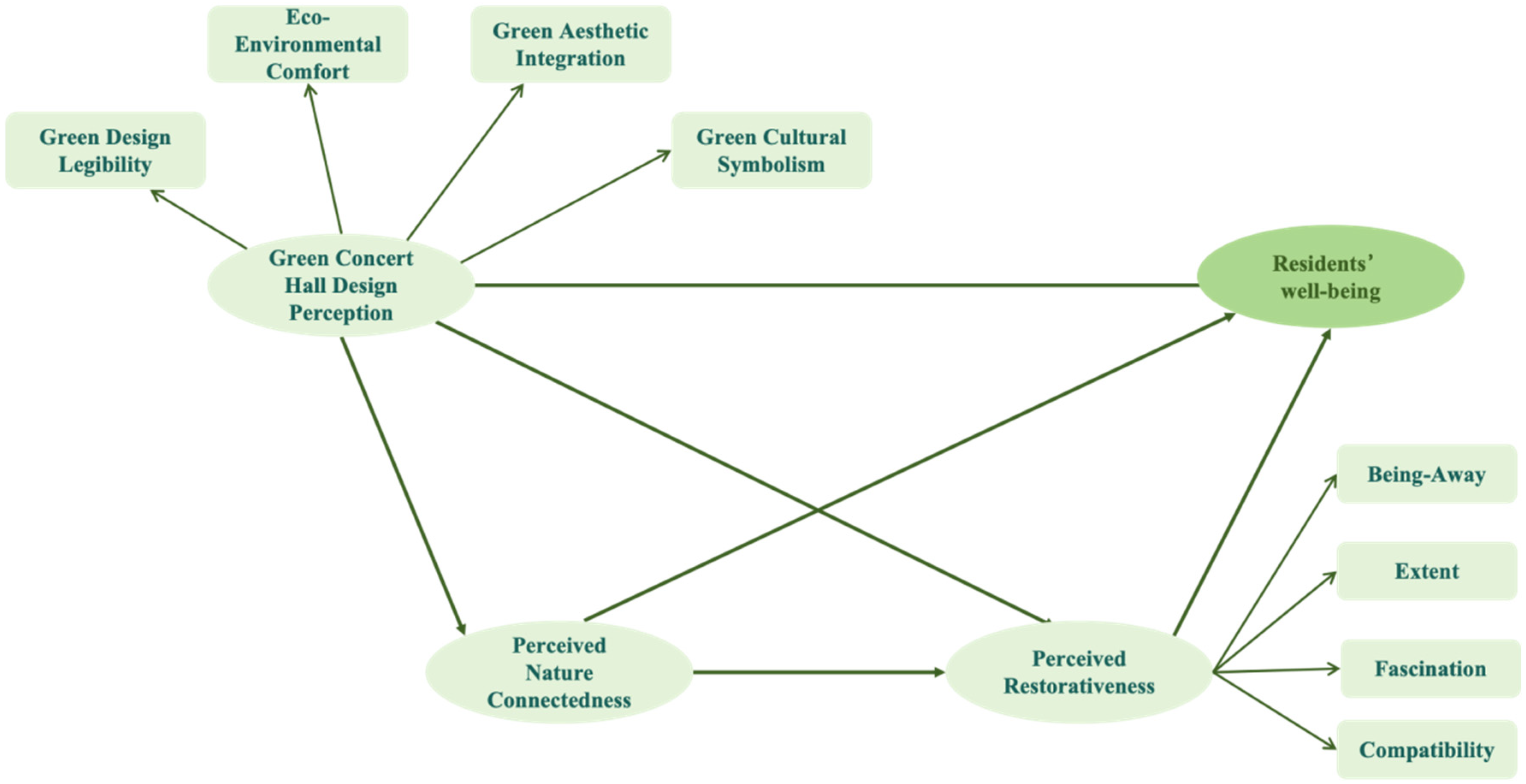
22]. Drawing on theories of biophilic design, post-occupancy evaluation studies, and prior research on public cultural buildings, this study conceptualizes Green Concert Hall Design Perception as a second-order construct comprising four first-order dimensions: green design legibility, eco-environmental comfort, green aesthetic integration, and green cultural symbolism. The selection of these four dimensions is based on the specific characteristics of green concert halls as both green buildings and public cultural spaces. Green design legibility captures whether users can recognize and understand visible green design cues; eco-environmental comfort reflects users’ perceived comfort in relation to environmental conditions such as light, acoustics, ventilation, and air quality; green aesthetic integration emphasizes the harmony between ecological elements and the artistic atmosphere of the concert hall; and green cultural symbolism reflects whether the building conveys broader meanings related to sustainability, urban culture, and ecological values. Other possible aspects of green buildings, such as energy consumption, construction technology, operational management, and material life-cycle performance, were not included as dimensions of this construct because they are mainly technical indicators and are not always directly perceived by ordinary residents during a concert-going experience. Therefore, the four selected dimensions are intended to capture the perceptible, experiential, aesthetic, and cultural aspects of green concert hall design from the user’s perspective. Green design legibility refers to residents’ recognition and understanding of design cues such as natural lighting, green materials, and ecological landscapes; its theoretical foundation is derived from research on architectural legibility [
23]. Environmental comfort encompasses the physical and psychological well-being derived from environmental conditions such as noise, light, temperature, and air quality; relevant studies indicate that indoor environmental quality is a key factor influencing the comfort and satisfaction of building occupants [
24]. The integration of green aesthetics reflects the harmony between natural elements, eco-friendly materials, and the artistic atmosphere of the concert hall, embodying the fusion of natural expression and spatial aesthetics in biophilic design [
25]. The symbolic aspect of green culture refers to the extent to which a concert hall conveys urban culture, public values, and a sense of local identity through its architectural form, ecological imagery, and spatial expression [
26]. Therefore, the green concert hall design perception can be understood as the comprehensive subjective evaluation formed by residents regarding the spatial environment of the concert hall; its connotations encompass the recognizability of green design, environmental comfort, and aesthetic harmony, as well as the perception of cultural significance. This construct also responds to a gap in the existing literature. Previous studies on green buildings have mainly focused on technical performance, certification standards, indoor environmental quality, and post-occupancy satisfaction, while studies on public cultural spaces have more often emphasized cultural participation, service experience, and spatial use. However, limited research has integrated the green attributes, cultural functions, public nature, and user psychological pathways of public cultural buildings into a unified explanatory framework. In this sense, Green Concert Hall Design Perception is not simply a direct extension of existing green building evaluation indicators. Rather, it is a context-specific construct that shifts attention from technical evaluation to residents’ perceptual and psychological experience in a green public cultural setting.
Residents’ well-being generally refers to residents’ overall assessment of their living conditions, emotional experiences, and psychological functioning [
27]. Diener defines subjective well-being as an individual’s overall assessment of life satisfaction, positive emotions, and negative emotions, emphasizing that well-being has a distinctly subjective evaluative nature [
28]. Ryff further noted that well-being is not merely a matter of happiness and life satisfaction, but also encompasses psychological states such as a sense of control over one’s environment, positive relationships, life goals, and personal growth [
29]. Therefore, residents’ well-being is defined in this study as the overall assessment of life, positive emotional experiences, and perceptions of psychological functioning that residents form through their daily lives and experiences in public spaces. Existing research indicates that residents’ well-being is closely linked to the urban environment and public spaces in which they live. Keyes proposed that individual well-being also encompasses social dimensions such as social integration, social acceptance, and social participation, suggesting that experiences of interaction and participation in public spaces influence residents’ well-being [
30]. Urban environmental studies have also found that green spaces and high-quality public spaces can enhance residents’ well-being by providing opportunities for recreation, social interaction, and mental recovery [
31]. In the field of cultural spaces, Fancourt and Finn note that engagement with art and culture helps promote health and well-being [
32]. These studies suggest that, as a public space that combines ecological and cultural functions, the Green Concert Hall may contribute to residents’ well-being through both the spatial environment and cultural engagement, as well as by fostering positive emotions.
Research on the built environment indicates that spatial design features can influence residents’ well-being through their perception of the environment. Mouratidis notes that the urban built environment can affect residents’ subjective well-being through channels such as leisure activities and social relationships, suggesting that spatial design features can become part of residents’ daily life experiences and further influence their assessment of well-being [
33]. In their research on public spaces, Cattell et al. found that urban public spaces designed for lingering, observing, and socializing not only support individual relaxation and social interaction but also serve as important environmental resources for promoting residents’ well-being [
34]. Furthermore, Cuypers et al. found that participation in cultural activities is significantly associated with well-being indicators such as life satisfaction [
35]. Taken together, these studies indicate that a concert hall combining the attributes of green architecture, public space, and cultural services may enhance residents’ well-being by improving the spatial experience, promoting emotional recovery, and fostering a sense of cultural engagement—provided that the design features of the concert hall are perceived by residents as clear, comfortable, aesthetically pleasing, and culturally meaningful. Based on this, the following hypothesis is proposed:
H1. Green concert hall design perception has a positive impact on residents’ well-being.
2.2. Mediating Mechanisms and Research Hypotheses
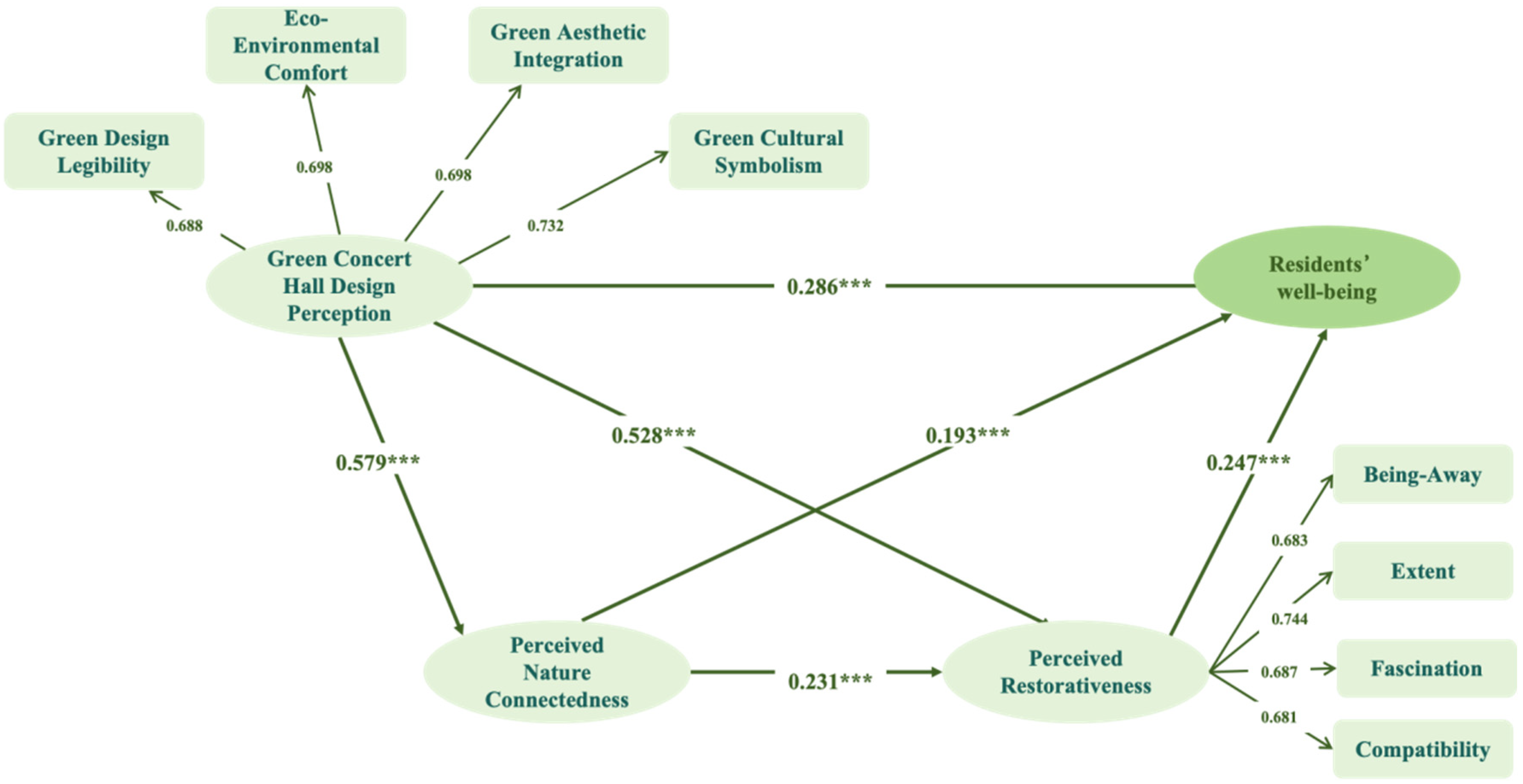
The following hypotheses are developed within a unified mediation framework rather than as separate and unrelated assumptions. H1 examines the direct association between Green Concert Hall Design Perception and residents’ well-being. H2 and H3 further explain two psychological mechanisms through which this relationship may occur, namely perceived nature connectedness and perceived restorativeness. H4 extends these two mechanisms by proposing a sequential pathway in which green design perception first enhances residents’ perceived nature connectedness, which then strengthens perceived restorativeness and ultimately relates to residents’ well-being. In this way, the hypotheses are theoretically connected and collectively explain how green concert hall design may be linked to residents’ well-being through both direct and indirect psychological pathways.
The concept of “perceived nature connectedness” stems from research on connection to nature and typically refers to an individual’s subjective sense of connection, closeness, and belonging to the natural world. Mayer and Frantz developed the Nature Connection Scale to measure individuals’ emotional connection to the natural world, illustrating that this concept emphasizes the subjective experience of the relationship between humans and nature [
36]. In subsequent research, Schultz further explained the connection with nature from the perspective of “self-nature inclusion,” arguing that the relationship between humans and nature encompasses cognitive connection, emotional care, and behavioral commitment [
37]. Capaldi’s research further demonstrates that there is a consistent positive relationship between connection with nature and well-being, suggesting that people’s subjective experiences of their relationship with nature can translate into positive psychological outcomes [
38]. Based on the above research, perceived nature connectedness is defined in this study as the subjective sense of closeness to nature that residents experience when interacting with a green concert hall, arising from design cues such as green landscapes, eco-friendly materials, and the ambient atmosphere. This variable emphasizes how green concert halls stimulate residents’ psychological experience of a relationship with nature through perceptible natural elements.
Design elements such as natural light and natural materials in the built environment can foster a psychological connection between people and nature. Richardson and Butler note that the core of biophilic design lies in promoting the connection between people and nature through the built environment [
39]. From this perspective, if residents can clearly perceive the green design features of the Green Concert Hall, it may enhance their sense of closeness to and connection with nature. Furthermore, experimental research by Mayer et al. found that exposure to nature can enhance individuals’ sense of connection to nature, positive emotions, and reflective capacity, and that this sense of connection to nature partially mediates the relationship between exposure to nature and positive psychological outcomes [
40]. A study by Liu et al. based on residents of Guangzhou, China, confirmed that connection with nature is a stronger predictor of psychological well-being than exposure to nature alone, and plays a role in the relationship between exposure to nature and mental health [
41]. In the context of a green concert hall, residents’ positive perceptions of green design, the ecological environment, and natural imagery first strengthen their perceived nature connectedness, thereby enhancing their positive emotions, sense of life’s meaning, and overall well-being. Based on this, the following hypothesis is proposed:
H2. Perceived nature connectedness serves as a bridge between the green concert hall design perception and residents’ well-being.
Perceived restorativeness stems from research on restorative environments and the theory of attentional recovery; it generally refers to the extent to which an individual subjectively perceives that a particular environment can alleviate mental fatigue, restore attentional resources, and regulate emotions [
42,
43]. The Attention Restoration Theory posits that certain environments have restorative effects because they reduce the cognitive load associated with sustained directed attention and promote attention restoration through environmental characteristics such as flexible attraction, distance from daily stressors, spatial extent, and alignment with individual needs. It should be noted that “Being Away,” “Fascination,” “Extent,” and “Compatibility” are restorative environmental characteristics derived from the Attention Restoration Theory, and subsequent scales for perceived restorativeness and empirical studies have largely operationalized these concepts based on this framework. Recent studies indicate that natural environments play a supportive role in attentional recovery, but their effectiveness is influenced by exposure methods, measurement indicators, and specific attentional processes; therefore, perceived restorativeness must be understood in the context of specific environmental situations [
44,
45]. Further research on urban public spaces has found that factors such as spatial design and sensory elements—which contribute to the perceived quality of the environment—can influence users’ evaluations of a space’s perceived restorativeness [
46]; Research on urban public spaces also suggests that restorative experiences in urban environments with a high degree of naturalness can similarly be perceived by residents as places of restorative power [
47]. In addition, research on green office spaces has found that factors such as the proportion of indoor greenery and color complexity can predict perceived restorativeness, suggesting that green design and the visual environment within a building can also enhance the restorative experience [
48]. Based on the above research, perceived restorativeness is defined in this study as the comprehensive subjective experience of psychological resource recovery, mental relaxation, and emotional regulation that residents experience when interacting with a green concert hall, resulting from natural lighting, ecological landscapes, green materials, a comfortable acoustic, lighting, and thermal environment, and the overall spatial ambiance.
Green concert hall design perception primarily reflects residents’ evaluations of green elements, ecological quality, aesthetic harmony, and cultural significance within the architectural space. In a study of university campuses, Hipp et al. found that a partial mediating relationship exists between students’ perceptions of campus greenery and their assessments of quality of life, indicating that green environment perception and evaluations of well-being involve users’ subjective experiences of perceived restorativeness [
49]. Akpınar’s study on the perceptual dimensions of urban green spaces further illustrates that when environmental features are perceived by individuals, they often result in experiences such as relaxation, stress relief, and psychological recovery [
50]. In their study on green spaces on campus, Malekinezhad et al. further analyzed the perceived restorativeness by positioning it between the perceived environmental quality and the restorative experience, pointing out that there is a continuous relationship among spatial perception characteristics, restorative evaluations, and psychological restorative experiences [
51]. Extending this to the context of a green concert hall, if residents perceive the hall’s green concert hall design as clear, comfortable, harmonious, and culturally meaningful, this spatial evaluation may further manifest as restorative experiences such as relief from daily stress, relaxation of attention, and emotional soothing; these restorative experiences, in turn, are linked to residents’ positive evaluations of their own well-being. Therefore, perceived restorativeness can be understood as a crucial psychological component in the relationship between the green concert hall design perception and residents’ well-being. Based on this, the following hypothesis is proposed:
H3. Perceived restorativeness mediates the relationship between green concert hall design perception and residents’ well-being.
The concept of “green concert hall design perception” refers to residents’ overall perception of natural lighting, ecological landscapes, and sustainable materials. As residents experience the clarity, harmony, and comfort of these elements, they are likely to develop a subjective sense that “nature is present within the architectural space” and that “they are closer to nature.” Relevant research indicates that biophilic design and the experience of proximity to nature are both associated with individuals’ sense of perceived nature connectedness and residents’ well-being, suggesting that natural elements in the built environment can translate into psychological experiences that enhance the relationship between humans and nature [
52]. Building on this, a sense of connection with nature encompasses cognitive identification with nature, as well as a sense of closeness, belonging, and emotional engagement. When residents experience this connection with nature in the Green Concert Hall, the space may also be perceived as an environment that offers relaxation, comfort, and psychological support. Research by Samus et al. has found that the naturalness and wildness of urban green spaces are associated with perceived nature connectedness and positive emotional experiences, suggesting that this sense of connection can further transform the natural features of the environment into positive psychological experiences [
53]. Furthermore, restorative experiences emphasize the individual’s subjective sense of being free from stress, experiencing mental relaxation, and emotional relief within a given environment. Research on indoor natural environments has shown that there is a correlation between the sense of connection to nature and perceived restorativeness across indoor settings with varying levels of natural density, suggesting that the experience of connecting with nature can further correspond to the perception of an environment’s restorative potential [
54]. Extending this to the context of green concert halls, residents’ positive perceptions of green design features may initially manifest as an enhanced sense of closeness to and belonging with nature, subsequently leading to an increased sense of spatial restoration, and ultimately linking to their assessment of residents’ well-being. Based on this, the following hypothesis is proposed (The proposed model is shown in
Figure 1):
H4. Green concert hall design perception is positively associated with residents’ well-being through the chain mediation of perceived nature connectedness and perceived restorativeness.
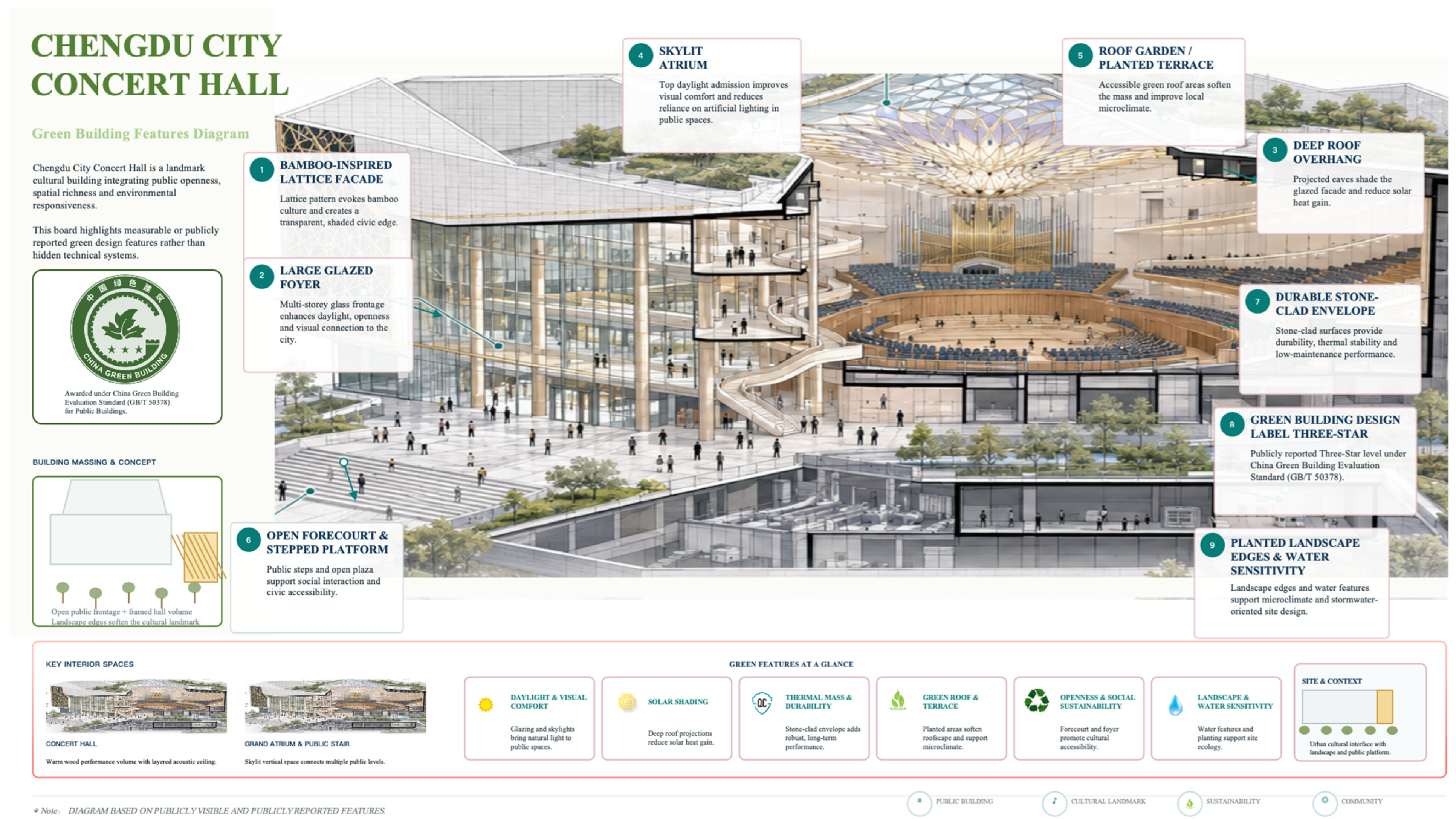
To provide a more concrete visualization of the green design features of the Chengdu City Concert Hall,
Figure 2 summarizes its representative green strategies across building massing, key interior spaces, roofscape, and site context, including daylight admission, green roof, deep overhang shading, planted landscape edges, and open forecourt. This diagram helps ground the measurement of green concert hall design perception in the actual architectural evidence. For the visual presentation in
Figure 2, we employed ChatGPT (GPT-5.5, OpenAI) as a rendering assistant. The author crafted all textual prompts, determined the compositional structure, and rigorously reviewed the final output for scientific accuracy. All intellectual content and narrative interpretations remain the sole responsibility of the author.