What Drives Megaproject Social Responsibility Behavior? A Qualitative Study in China
Abstract
1. Introduction
2. Literature Review and Theoretical Background
2.1. MSR Behavior
2.2. Drivers of MSR Behavior
2.3. MOA Framework
3. Methodology
3.1. Research Scope
3.2. Purposive Sampling
3.3. Data Collection
3.3.1. Text Materials
3.3.2. Interview Materials
3.4. Data Analysis
4. Extraction of Drivers
4.1. First-Order Coding
4.2. Second-Order Themes
4.3. Aggregate Dimensions
5. Findings and Discussion
5.1. Ability Analysis
5.1.1. Innovation Ability
5.1.2. Collaboration Ability
5.2. Motivation Analysis
5.2.1. Instrumental Motivation
5.2.2. Moral Motivation
5.3. Opportunity Analysis
5.3.1. Resource Support
5.3.2. Regulatory Pressure
5.3.3. Social Responsibility Culture
5.4. Contextual Influences and Transferability of MSR Behavior Drivers
6. Conclusions
6.1. Theoretical Implications
6.2. Practical Implications
6.3. Limitations and Future Research
Supplementary Materials
Author Contributions
Funding
Data Availability Statement
Conflicts of Interest
References
- Flyvbjerg, B. What you should know about megaprojects and why: An overview. Proj. Manag. J. 2014, 45, 6–19. [Google Scholar] [CrossRef]
- Cottafava, D.; Corazza, L.; Shams Esfandabadi, Z.; Torchia, D. Megaprojects from the lens of business and management studies: A systematic literature review. J. Public Aff. 2024, 24, e2937. [Google Scholar] [CrossRef]
- Zani, C.M.; Denicol, J.; Broyd, T. Organisation design in megaprojects: A systematic literature review and research agenda. Int. J. Proj. Manag. 2024, 42, 102634. [Google Scholar] [CrossRef]
- Gil, N.A. Cracking the megaproject puzzle: A stakeholder perspective? Int. J. Proj. Manag. 2023, 41, 102455. [Google Scholar] [CrossRef]
- Zheng, X.; Chen, J.; Xia, B.; Skitmore, M.; Zeng, S. Understanding the megaproject social responsibility network among stakeholders: A reciprocal-exchange perspective. J. Constr. Eng. Manag. 2023, 149, 04023105. [Google Scholar] [CrossRef]
- He, Q.; Xu, J.; Wang, T.; Chan, A.P.C. Identifying the driving factors of successful megaproject construction management: Findings from three Chinese cases. Front. Eng. Manag. 2021, 8, 5–16. [Google Scholar] [CrossRef]
- Zeng, S.X.; Ma, H.Y.; Lin, H.; Zeng, R.C.; Tam, V.W.Y. Social responsibility of major infrastructure projects in China. Int. J. Proj. Manag. 2015, 33, 537–548. [Google Scholar] [CrossRef]
- Lin, H.; Zeng, S.; Ma, H.; Zeng, R.; Tam, V.W.Y. An indicator system for evaluating megaproject social responsibility. Int. J. Proj. Manag. 2017, 35, 1415–1426. [Google Scholar] [CrossRef]
- Ma, H.; Lv, K.; Zeng, S.; Lin, H.; Shi, J.J. Climbing the pyramid of megaproject social responsibility: Impacts of external stakeholders and project complexity. J. Constr. Eng. Manag. 2022, 148, 04022116. [Google Scholar] [CrossRef]
- Yang, D.; Li, J.; Peng, J.; Zhu, J.; Luo, L. Evaluation of social responsibility of major municipal road infrastructure—Case study of Zhengzhou 107 Auxiliary Road Project. Buildings 2022, 12, 369. [Google Scholar] [CrossRef]
- He, Q.; Chen, X.; Wang, G.; Zhu, J.; Yang, D.; Liu, X.; Li, Y. Managing social responsibility for sustainability in megaprojects: An innovation transitions perspective on success. J. Clean. Prod. 2019, 241, 118395. [Google Scholar] [CrossRef]
- Ma, H.; Sun, D.; Zeng, S.; Lin, H.; Shi, J.J. The effects of megaproject social responsibility on participating organizations. Proj. Manag. J. 2021, 52, 418–433. [Google Scholar] [CrossRef]
- Wu, Y.; Zhou, Z.; Xie, L.; Xia, B.; Huang, M. A Bayesian network model of megaproject social responsibility behavior and project performance: From the perspective of resource-based theory. Buildings 2024, 14, 1143. [Google Scholar] [CrossRef]
- Ma, L.; Musonda, J.; Ali, A. MSR influence on environmental & ecological balance: Mediating effect of environmental regulations & strategies. J. Clean. Prod. 2023, 386, 135817. [Google Scholar] [CrossRef]
- Ma, H.; Liu, Z.; Zeng, S.; Lin, H.; Tam, V.W.Y. Does megaproject social responsibility improve the sustainability of the construction industry? Eng. Constr. Archit. Manag. 2019, 27, 975–996. [Google Scholar] [CrossRef]
- Ali, A.; Ma, L.; Shahzad, M.; Hussain, S. Managing stakeholder pressure for megaproject success and green innovation: The key role of social responsibility. Eng. Manag. J. 2024, 36, 366–377. [Google Scholar] [CrossRef]
- Aga, D.A.; Beyene, B.B. The effect of megaproject external social responsibility on community acceptance: The mediating role of public trust. Int. J. Manag. Proj. Bus. 2025, 18, 1–25. [Google Scholar] [CrossRef]
- Wang, G.; He, Q.; Meng, X.; Locatelli, G.; Yu, T.; Yan, X. Exploring the impact of megaproject environmental responsibility on organizational citizenship behaviors for the environment: A social identity perspective. Int. J. Proj. Manag. 2017, 35, 1402–1414. [Google Scholar] [CrossRef]
- Ahmed, M.; Abdelrehim, R.; Elshalkany, M.; Abdrabou, M. Impacts of the Grand Ethiopian Renaissance Dam on the Nile River’s downstream reservoirs. J. Hydrol. 2024, 633, 130952. [Google Scholar] [CrossRef]
- Zeng, S.; Chen, H.; Ma, H.; Shi, J.J. Governance of social responsibility in international infrastructure megaprojects. Front. Eng. Manag. 2022, 9, 343–348. [Google Scholar] [CrossRef]
- Xie, L.; Xu, T.; Han, T.; Xia, B.; Chen, Q.; Skitmore, M. Influence of institutional pressure on megaproject social responsibility behavior. J. Civ. Eng. Manag. 2022, 28, 177–195. [Google Scholar] [CrossRef]
- Xie, L.; Ju, T.; Xia, B. Institutional pressures and megaproject social responsibility behavior: A conditional process model. Buildings 2021, 11, 140. [Google Scholar] [CrossRef]
- Lin, H.; Sui, Y.; Ma, H.; Wang, L.; Zeng, S. CEO narcissism, public concern, and megaproject social responsibility: Moderated mediating examination. J. Manag. Eng. 2018, 34, 04018018. [Google Scholar] [CrossRef]
- Zhai, W.; Ling, F.Y.Y.; Ding, J.; Wang, Z. Impact of institutional pressures on socially responsible collective action behaviors for major water transfer projects. Water Resour. Manag. 2023, 37, 4253–4269. [Google Scholar] [CrossRef]
- Wang, G.; He, Q.; Xia, B.; Meng, X.; Wu, P. Impact of institutional pressures on organizational citizenship behaviors for the environment: Evidence from megaprojects. J. Manag. Eng. 2018, 34, 04018028. [Google Scholar] [CrossRef]
- Wu, X.; Chong, H.-Y.; Wang, G. The influence of social capitalism on construction safety behaviors: An exploratory megaproject case study. Sustainability 2018, 10, 3098. [Google Scholar] [CrossRef]
- Xie, L.; Ju, T.; Han, T.; Hou, L. A meta-network-based management framework for megaproject social responsibility behaviour in China. Eng. Constr. Archit. Manag. 2022, 30, 4415–4434. [Google Scholar] [CrossRef]
- Xie, L.; Luo, Y.; Ju, T.; Li, D.; Zhao, X.; Chen, Y. Investigating the driving mechanism of megaproject social responsibility behavior: A system dynamics approach. IEEE Trans. Eng. Manag. 2025, 72, 3109–3122. [Google Scholar] [CrossRef]
- Busoi, G.; Ali, A.; Gardiner, K. Antecedents of emotional labour for holiday representatives: A framework for tourism workers. Tour. Manag. 2022, 89, 104450. [Google Scholar] [CrossRef]
- Lin, H.; Nie, S.; Wu, P.; Yuan, M.; Yu, M.; Tam, V. Megaproject responsible innovation: Concept, framework, and governance. Front. Eng. Manag. 2025, 12, 653–668. [Google Scholar] [CrossRef]
- Sun, G.; Sun, J.; Li, F. Influencing factors of early termination for PPP projects based on multicase grounded theory. J. Constr. Eng. Manag. 2022, 148, 04022120. [Google Scholar] [CrossRef]
- Rothschild, M.L. Carrots, sticks, and promises: A conceptual framework for the management of public health and social issue behaviors. J. Mark. 1999, 63, 24–37. [Google Scholar] [CrossRef]
- ISO 26000; Guidance on Social Responsibility. International Organization for Standardization: Geneva, Switzerland, 2006.
- Aguinis, H.; Glavas, A. What we know and don’t know about corporate social responsibility: A review and research agenda. J. Manag. 2012, 38, 932–968. [Google Scholar] [CrossRef]
- Campbell, J.L. Why would corporations behave in socially responsible ways? An institutional theory of corporate social responsibility. Acad. Manag. Rev. 2007, 32, 946–967. [Google Scholar] [CrossRef]
- Nguyen, M.V. Barriers to corporate social responsibility performance in construction organizations. Eng. Constr. Archit. Manag. 2024, 31, 1473–1496. [Google Scholar] [CrossRef]
- Mao, H.; Sun, W.; Deng, X.; Sadeghi, M.; Antwi-Afari, M.F. Linkage between critical indicators and performance outcomes of corporate social responsibility in the construction industry: A review of the past two decades (2004–2024). Buildings 2025, 15, 823. [Google Scholar] [CrossRef]
- Kim, M.; Seo, W.; Kang, Y. Assessment of quantitative environmental, social, and governance indicators and their relationships with corporate financial performance in construction companies. J. Manag. Eng. 2026, 42, 04025062. [Google Scholar] [CrossRef]
- Alqershy, M.T.; Shi, Q.; Anbar, D.R. Analysing the interplay of isomorphic pressures, perceived benefits and top management support on social responsibility performance of Belt and Road megaprojects. Eng. Constr. Archit. Manag. 2025, 32, 4074–4099. [Google Scholar] [CrossRef]
- Ma, H.; Zeng, S.; Lin, H.; Chen, H.; Shi, J.J. The societal governance of megaproject social responsibility. Int. J. Proj. Manag. 2017, 35, 1365–1377. [Google Scholar] [CrossRef]
- Li, L.; Wang, S.; Zeng, S.; Ma, H.; Zheng, R. Unveiling the social responsibility factors in new infrastructure construction. Eng. Constr. Archit. Manag. 2025, 32, 2272–2298. [Google Scholar] [CrossRef]
- Li, Y.; Ouyang, L.; Zheng, X.; Liu, Y.; Zhu, L. Value exchanges within stakeholder networks throughout a megaproject’s lifecycle. Int. J. Proj. Manag. 2024, 42, 102585. [Google Scholar] [CrossRef]
- Zhu, L.; Li, Y.; Wang, Y. Unveiling broader societal networks for megaprojects through mass-media evidence. J. Constr. Eng. Manag. 2026, 152, 4025268. [Google Scholar] [CrossRef]
- Fu, H.; Ma, L.; Wang, L. The contagion effect of corporate environmental responsibility in megaprojects: Analyzing underlying processes. Sustain. Prod. Consum. 2023, 40, 590–601. [Google Scholar] [CrossRef]
- Young, S.L.; Makhija, M.V. Firms’ corporate social responsibility behavior: An integration of institutional and profit maximization approaches. J. Int. Bus. Stud. 2014, 45, 670–698. [Google Scholar] [CrossRef]
- Mirzaee, A.M.; Martek, I. A framework for utilizing “social responsibility” behaviors in resolving conflicts arising in megaprojects. Eng. Constr. Archit. Manag. 2025, 1–22. [Google Scholar] [CrossRef]
- Zhai, W.; Ling, F.Y.Y.; Ding, J.; Wang, Z. Boosting stakeholders’ intention to participate in socially responsible collective action in megaprojects: Perspectives of mega water transfer projects in China. Eng. Constr. Archit. Manag. 2024, 31, 3727–3747. [Google Scholar] [CrossRef]
- Wang, G.; Locatelli, G.; Zhang, H.; Wan, J.; Chen, Y. Playing the cards right: Exploring the way leadership influences organizational citizenship behavior for the environment in megaprojects. Eng. Constr. Archit. Manag. 2023, 30, 623–646. [Google Scholar] [CrossRef]
- Xie, L.; Huang, M.; Xia, B.; Skitmore, M. Megaproject environmentally responsible behavior in China: A test of the theory of planned behavior. Int. J. Environ. Res. Public Health 2022, 19, 6581. [Google Scholar] [CrossRef] [PubMed]
- Zhai, Z.; Gao, S.; Shan, M. Exploring environmentally responsible behavior of megaproject contractors using an extended theory of planned behavior. Sci. Rep. 2025, 15, 22428. [Google Scholar] [CrossRef] [PubMed]
- MacInnis, D.J.; Jaworski, B.J. Information processing from advertisements: Toward an integrative framework. J. Mark. 1989, 53, 1–23. [Google Scholar] [CrossRef]
- Appelbaum, E. Manufacturing Advantage: Why High-Performance Work Systems Pay Off; Cornell University Press: Ithaca, NY, USA, 2000. [Google Scholar]
- Blumberg, M.; Pringle, C.D. The missing opportunity in organizational research: Some implications for a theory of work performance. Acad. Manag. Rev. 1982, 7, 560–569. [Google Scholar] [CrossRef]
- Tuuli, M.M.; van Rhee, H. How ability, motivation, and opportunity drive individual performance behaviors in projects: Tests of competing theories. J. Manag. Eng. 2021, 37, 04021070. [Google Scholar] [CrossRef]
- Lockström, M.; Schadel, J.; Harrison, N.; Moser, R.; Malhotra, M.K. Antecedents to supplier integration in the automotive industry: A multiple-case study of foreign subsidiaries in China. J. Oper. Manag. 2010, 28, 240–256. [Google Scholar] [CrossRef]
- Siemsen, E.; Roth, A.V.; Balasubramanian, S. How motivation, opportunity, and ability drive knowledge sharing: The constraining-factor model. J. Oper. Manag. 2008, 26, 426–445. [Google Scholar] [CrossRef]
- Fishbein, M. The role of theory in HIV prevention. AIDS Care 2000, 12, 273–278. [Google Scholar] [CrossRef] [PubMed]
- MacInnis, D.J.; Moorman, C.; Jaworski, B.J. Enhancing and measuring consumers’ motivation, opportunity, and ability to process brand information from ads. J. Mark. 1991, 55, 32–53. [Google Scholar] [CrossRef]
- Hughes, J. The ability-motivation-opportunity framework for behavior research in IS. In Proceedings of the 40th Annual Hawaii International Conference on System Sciences (HICSS’07), Waikoloa, HI, USA, 3–6 January 2007; p. 250a. [Google Scholar] [CrossRef]
- Wu, Y.; Balasubramanian, S.; Mahajan, V. When is a preannounced new product likely to be delayed? J. Mark. 2004, 68, 101–113. [Google Scholar] [CrossRef]
- Boyd, J.; McMillan, B.; Easton, K.; Delaney, B.; Mitchell, C. Utility of the COM-B model in identifying facilitators and barriers to maintaining a healthy postnatal lifestyle following a diagnosis of gestational diabetes: A qualitative study. BMJ Open 2020, 10, e037318. [Google Scholar] [CrossRef] [PubMed]
- Sabnis, G.; Chatterjee, S.C.; Grewal, R.; Lilien, G.L. The sales lead black hole: On sales reps’ follow-up of marketing leads. J. Mark. 2013, 77, 52–67. [Google Scholar] [CrossRef]
- Lam, H.K.S.; Yeung, A.C.L.; Lo, C.K.Y.; Cheng, T.C.E. Should firms invest in social commerce? An integrative perspective. Inf. Manag. 2019, 56, 103164. [Google Scholar] [CrossRef]
- Chai, K.-H.; Baudelaire, C. Understanding the energy efficiency gap in Singapore: A motivation, opportunity, and ability perspective. J. Clean. Prod. 2015, 100, 224–234. [Google Scholar] [CrossRef]
- Zhang, X.; de Vries, W.T.; Li, G.; Ye, Y.; Zheng, H.; Wang, M. A behavioral analysis of farmers during land reallocation processes of land consolidation in China: Insights from Guangxi and Shandong provinces. Land Use Policy 2019, 89, 104230. [Google Scholar] [CrossRef]
- Aguinis, H.; O’Boyle, E., Jr.; Gonzalez-Mulé, E.; Joo, H. Cumulative advantage: Conductors and insulators of heavy-tailed productivity distributions and productivity stars. Pers. Psychol. 2016, 69, 3–66. [Google Scholar] [CrossRef]
- Feng, L.; Liu, J.; Wang, Z.; Hong, Y. Navigating compliance complexity: Insights from the MOA framework in international construction. Eng. Constr. Archit. Manag. 2025, 32, 6068–6094. [Google Scholar] [CrossRef]
- Yee, R.W.Y.; Miquel-Romero, M.-J.; Cruz-Ros, S. Why and how to use enterprise social media platforms: The employee’s perspective. J. Bus. Res. 2021, 137, 517–526. [Google Scholar] [CrossRef]
- Ajzen, I. Understanding Attitudes and Predicting Social Behavior; Prentice-Hall: Englewood Cliffs, NJ, USA, 1980. [Google Scholar]
- Ajzen, I. The theory of planned behavior. Organ. Behav. Hum. Decis. Process. 1991, 50, 179–211. [Google Scholar] [CrossRef]
- Eisenhardt, K.M. Building theories from case study research. Acad. Manag. Rev. 1989, 14, 532–550. [Google Scholar] [CrossRef]
- Yin, R.K. Case Study Research and Applications; Sage: Thousand Oaks, CA, USA, 2018. [Google Scholar]
- Gioia, D.A.; Corley, K.G.; Hamilton, A.L. Seeking qualitative rigor in inductive research: Notes on the Gioia methodology. Organ. Res. Methods 2013, 16, 15–31. [Google Scholar] [CrossRef]
- Patton, M.Q. Qualitative Research and Evaluation Methods, 3rd ed.; Sage Publications: Thousand Oaks, CA, USA, 2002. [Google Scholar]
- Bell, E.; Bryman, A.; Harley, B. Business Research Methods, 6th ed.; Oxford University Press: Oxford, UK, 2022. [Google Scholar]
- Thurmond, V.A. The point of triangulation. J. Nurs. Scholarsh. 2001, 33, 253–258. [Google Scholar] [CrossRef] [PubMed]
- Adair, J.G. The Hawthorne effect: A reconsideration of the methodological artifact. J. Appl. Psychol. 1984, 69, 334–345. [Google Scholar] [CrossRef]
- Yang, D.; He, Q.; Cui, Q.; Hsu, S.-C. Organizational citizenship behavior in construction megaprojects. J. Manag. Eng. 2018, 34, 04018017. [Google Scholar] [CrossRef]
- Foley, G.; Timonen, V.; Conlon, C.; O’Dare, C.E. Interviewing as a vehicle for theoretical sampling in grounded theory. Int. J. Qual. Methods 2021, 20, 1609406920980957. [Google Scholar] [CrossRef]
- Creswell, J.W.; Poth, C.N. Qualitative Inquiry and Research Design: Choosing Among Five Approaches; Sage Publications: Thousand Oaks, CA, USA, 2016. [Google Scholar]
- Gioia, D.A. A systematic methodology for doing qualitative research. J. Appl. Behav. Sci. 2021, 57, 20–29. [Google Scholar] [CrossRef]
- Corbin, J.; Strauss, A. Basics of Qualitative Research: Techniques and Procedures for Developing Grounded Theory; Sage Publications: Thousand Oaks, CA, USA, 2014. [Google Scholar]
- Eisenhardt, K.M.; Graebner, M.E. Theory building from cases: Opportunities and challenges. Acad. Manag. J. 2007, 50, 25–32. [Google Scholar] [CrossRef]
- Magnani, G.; Gioia, D. Using the Gioia methodology in international business and entrepreneurship research. Int. Bus. Rev. 2023, 32, 102097. [Google Scholar] [CrossRef]
- Xu, Q.; Jia, G.; Hu, Y.; Wang, X. Boundary spanning behavior and performance in major project networks—The mediating effects of project capability. Soft Sci. 2022, 36, 9–15. [Google Scholar] [CrossRef]
- Brockmann, C.; Brezinski, H.; Erbe, A. Innovation in construction megaprojects. J. Constr. Eng. Manag. 2016, 142, 04016059. [Google Scholar] [CrossRef]
- Fu, H.; Zeng, S.; Liu, Z.; Shi, J.J. A panoramic innovation paradigm for eco-sustainability in infrastructure megaprojects. IEEE Eng. Manag. Rev. 2022, 50, 127–146. [Google Scholar] [CrossRef]
- Chen, H.; Jin, Z.; Su, Q.; Yue, G. The roles of captains in megaproject innovation ecosystems: The case of the Hong Kong-Zhuhai-Macau Bridge. Eng. Constr. Archit. Manag. 2020, 28, 662–680. [Google Scholar] [CrossRef]
- Zhu, Y.; Zhang, J.; Gao, X. Construction management and technical innovation of the main project of Hong Kong–Zhuhai–Macao Bridge. Front. Eng. Manag. 2018, 5, 128–132. [Google Scholar] [CrossRef]
- Amirkhanyan, A.A. Collaborative performance measurement: Examining and explaining the prevalence of collaboration in state and local government contracts. J. Public Adm. Res. Theory 2009, 19, 523–554. [Google Scholar] [CrossRef]
- Liu, Z.; Wang, L.; Sheng, Z.; Gao, X. Social responsibility in infrastructure mega-projects: A case study of ecological compensation for Sousa chinensis during the construction of the Hong Kong-Zhuhai-Macao Bridge. Front. Eng. Manag. 2018, 5, 98–108. [Google Scholar] [CrossRef]
- Xue, F.; Chen, G.; Huang, S.; Xie, H. Design of social responsibility incentive contracts for stakeholders of megaprojects under information asymmetry. Sustainability 2022, 14, 1465. [Google Scholar] [CrossRef]
- Wang, A. Megaproject crisis management study based on social responsibility. Contemp. Econ. Manag. 2015, 37, 13–17. [Google Scholar] [CrossRef]
- Anscombe, G.E.M. Modern moral philosophy. Philosophy 1958, 33, 1–19. [Google Scholar] [CrossRef]
- Barauskaite, G.; Streimikiene, D. Corporate social responsibility and financial performance of companies: The puzzle of concepts, definitions and assessment methods. Corp. Soc. Responsib. Environ. Manag. 2021, 28, 278–287. [Google Scholar] [CrossRef]
- Kundu, O.; James, A.D.; Rigby, J. Public opinion on megaprojects over time: Findings from four megaprojects in the UK. Public Manag. Rev. 2023, 25, 1015–1038. [Google Scholar] [CrossRef]
- Zhu, L.; Cheung, S.O.; Gao, X.; Li, Q.; Liu, G. Success DNA of a record-breaking megaproject. J. Constr. Eng. Manag. 2020, 146, 05020009. [Google Scholar] [CrossRef]
- Tuzzolino, F.; Armandi, B.R. A need-hierarchy framework for assessing corporate social responsibility. Acad. Manag. Rev. 1981, 6, 21–28. [Google Scholar] [CrossRef]
- Aguilera, R.V.; Rupp, D.E.; Williams, C.A.; Ganapathi, J. Putting the S back in corporate social responsibility: A multilevel theory of social change in organizations. Acad. Manag. Rev. 2007, 32, 836–863. [Google Scholar] [CrossRef]
- Yang, D.; He, Q.; Cui, Q.; Hsu, S.-C. Non-economic motivations for organizational citizenship behavior in construction megaprojects. Int. J. Proj. Manag. 2020, 38, 64–74. [Google Scholar] [CrossRef]
- Xing, X.; Chalip, L. Marching in the glory: Experiences and meanings when working for a sport mega-event. J. Sport Manag. 2009, 23, 210–237. [Google Scholar] [CrossRef]
- Turner, T.; Pennington, W.W. Organizational networks and the process of corporate entrepreneurship: How the motivation, opportunity, and ability to act affect firm knowledge, learning, and innovation. Small Bus. Econ. 2015, 45, 447–463. [Google Scholar] [CrossRef]
- Shen, C.-W. Factors of data infrastructure and resource support influencing the integration of business intelligence into enterprise resource planning systems. Int. J. Intell. Inf. Database Syst. 2015, 9, 1–14. [Google Scholar] [CrossRef]
- Zhai, Z.; Ahola, T.; Le, Y.; Xie, J. Governmental governance of megaprojects: The case of EXPO 2010 Shanghai. Proj. Manag. J. 2017, 48, 37–50. [Google Scholar] [CrossRef]
- Yun, L.; Wan, J.; Wang, G.; Bai, J.; Zhang, B. Exploring the missing link between top management team characteristics and megaproject performance. Eng. Constr. Archit. Manag. 2020, 27, 1039–1064. [Google Scholar] [CrossRef]
- Linnenluecke, M.K.; Griffiths, A. Corporate sustainability and organizational culture. J. World Bus. 2010, 45, 357–366. [Google Scholar] [CrossRef]
- Galbreath, J. Drivers of corporate social responsibility: The role of formal strategic planning and firm culture. Br. J. Manag. 2010, 21, 511–525. [Google Scholar] [CrossRef]
- Lin, M. Building the world-class mega sea-crossing: Management innovation of Hong Kong-Zhuhai-Macao Bridge Island-Tunnel Project. J. Manag. World 2020, 36, 202–212. [Google Scholar] [CrossRef]
- Sun, Y. Valuable exploration of building ecological environmental protection type railway of plateau. Environ. Prot. 2005, 3, 5–9+27. [Google Scholar] [CrossRef]
- Corazza, L.; Cottafava, D.; Torchia, D.; Dhir, A. Interpreting stakeholder ecosystems through relational stakeholder theory: The case of a highly contested megaproject. Bus. Strategy Environ. 2024, 33, 2384–2412. [Google Scholar] [CrossRef]
- Li, W.; Fang, D.; Zhang, H.; Li, G.; Liu, H. Strategies to address ethical risks in megaprojects: A care ethics perspective. Proj. Manag. J. 2026, 57, 81–96. [Google Scholar] [CrossRef]
- Alqershy, M.T.; Shi, Q.; Zhang, F. Exploring governance mechanisms in megaprojects: A mixed-methods systematic review. Eng. Manag. J. 2025, 37, 90–113. [Google Scholar] [CrossRef]
- Dasí, À.; Pedersen, T.; Barakat, L.L.; Alves, T.R. Teams and project performance: An ability, motivation, and opportunity approach. Proj. Manag. J. 2021, 52, 75–89. [Google Scholar] [CrossRef]
- Jiang, K.; Takeuchi, R.; Lepak, D.P. Where do we go from here? New perspectives on the black box in strategic human resource management research. J. Manag. Stud. 2013, 50, 1448–1480. [Google Scholar] [CrossRef]
- Bouwmans, M.; Runhaar, P.; Wesselink, R.; Mulder, M. Stimulating teachers’ team performance through team-oriented HR practices: The roles of affective team commitment and information processing. Int. J. Hum. Resour. Manag. 2019, 30, 856–878. [Google Scholar] [CrossRef]


| Author | Research Focus | Theory | Method | Drivers | Findings |
|---|---|---|---|---|---|
| Xie et al. [21] | MSR behavior | New institutional sociology | Structural equation model | Institutional pressure | Regulatory pressure significantly influences MSR behavior, while normative and cultural cognitive pressure have no significant effect on MSRB. |
| Lin et al. [23] | MSR practices | Upper-echelons theory | Regression analysis | CEO narcissism | CEO narcissism inversely affects MSR, with the CEO’s social responsibility cognition mediating and public concern moderating. |
| Zheng et al. [5] | MSR practices | Stakeholder theory | Stakeholder Value Network | Stakeholder network of MSR | Strengthening ties with the government and general contractors can boost MSR success for the owner organization. |
| Ma et al. [9] | Climbing process of MSR | Stakeholder theory | Regression analysis | External stakeholders | As the MSR pyramid ascends, the positive impact of external stakeholders and the negative effect of project complexity intensify. |
| Zhai et al. [24] | Socially responsible collective action in major water transfer projects | Institutional theory | Structural equation model | Institutional pressure | Mimetic pressure had a positive effect, whereas coercive and normative pressure had no significant effect. |
| Zhai et al. [47] | Socially responsible collective actions in megaprojects. | Social influence theory | Structural equation model | Social influence process | Subjective norms, group norms and social identity could increase stakeholders’ intention to take socially responsible collective action. |
| Wang et al. [18] | Organizational citizenship behaviors for the environment in megaprojects | Social identity theory | Structural equation model | Project participants’ perceptions | Project participants’ perceptions of internal stakeholder practices had a positive effect on behavior, while those on external stakeholder practices had minimal impact. |
| Wang et al. [25] | Organizational citizenship behaviors for the environment in megaprojects | Institutional theory | Structural equation model | Institutional pressure | Mimetic and normative pressures significantly influenced the behavior, while coercive pressure had no notable effect. |
| Wang et al. [48] | Organizational citizenship behaviors for the environment in megaprojects | Leadership theory/social identity perspective | Partial least squares modeling and hierarchical regression | Leadership styles (transformational and transactional leadership) | Both transformational and transactional leadership effectively motivate OCBEs through environmental commitment; power distance moderates the relationship between transformational leadership and OCBEs. |
| Xie et al. [49] | Environmentally responsible behavior in megaprojects | Planned behavior theory | Structural equation model | Subjective norms, attitudes, and perceived behavioral control | Subjective norms, attitudes, and perceived behavioral control all have a positive influence on the behavior. |
| Zhai et al. [50] | Environmentally responsible behavior of megaproject contractors | Extended theory of planned behavior | Partial least squares structural equation modeling | Moral identity, corporate green culture, attitudes, subjective norms, perceived behavioral control | All identified factors positively influence ERB; the extended TPB model demonstrates superior explanatory and predictive power over the basic TPB model. |
| Wu et al. [26] | Megaproject safety behaviors | Social capital theory | Exploratory case study | Social capital | The structure, relationship, and perception of social capital all positively influence behavior. |
| No. | Title | Author |
|---|---|---|
| A1. The South-to-North Water Diversion Project | The South-to-North Water Diversion Project Construction News Collection 2004 Volume~ The South-to-North Water Diversion Project Construction News Collection 2008 Volume [1] | General Office of the South-to-North Water Diversion Project Construction Committee Office of the State Council |
| The South-to-North Water Diversion Project Construction News Collection 2013 Volume~ The South-to-North Water Diversion Project Construction News Collection 2015 Volume [2] | ||
| The China South-to-North Water Diversion Project Construction Yearbook 2005~ The China South-to-North Water Diversion Project Construction Yearbook 2018 [3] | Edited by the Compilation Committee of The China South-to-North Water Diversion Project Construction Yearbook | |
| The South-to-North Water Diversion Middle Route Project [4] | Wen Dan | |
| A2. The Qinghai–Tibet Railway | Across the roof of the world Qinghai–Tibet railway construction news report 2004–2005 selection [5] | The Qinghai–Tibet Railway Construction News Report Selection and Editing Committee |
| The Qinghai–Tibet Railway [6] | Ren Xigui | |
| The Qinghai–Tibet Railway Comprehensive Volume [7] | The Writing Committee of the Qinghai–Tibet Railway | |
| The Qinghai–Tibet Railway Science and Technology Volume Environmental Protection [8] | ||
| The Qinghai–Tibet Railway Project Management Volume [9] | ||
| The Qinghai–Tibet Railway Operation Management Volume [10] | ||
| The Qinghai–Tibet Railway Health Security Volume [11] | ||
| A3. The Three Gorges Dam | The Three Gorges Project in One Hundred Years—An Anthology of 1919~1992 News about the Three Gorges Project [12] | Edited by the Three Gorges Project Construction Committee of the State Council |
| The Three Gorges Project in One Hundred Years—An Anthology of 1993~2003 News about the Three Gorges Project [13] | ||
| The Three Gorges Project in One Hundred Years—An Anthology of 2004~2009 News about the Three Gorges Project [14] | ||
| The Yangtze River Three Gorges Project [15] | Ji Changhua | |
| A Symphony of Dreams and Reality—Documentary of the Three Gorges Project [16] | Sun Ronggang |
| No. | Position | Industry Experience (Year) | Project | Investment (Billion) | Type | Time (min) |
|---|---|---|---|---|---|---|
| B1 | Project Manager | 18 | Yiwu Mall Avenue and Surrounding Supporting Construction | 1.29 | Comprehensive Pipe Gallery Project | 84 |
| B2 | Technical Chief Engineer | 15 | 77 | |||
| B3 | Project Chief Economist | 11 | 71 | |||
| B4 | Deputy Project Manager | 31 | 65 | |||
| B5 | Executive Vice President | 10 | Hangzhou Metro Line 3 Phase II Project | 1.03 | Rail Transit Project | 63 |
| B6 | Project Manager | 15 | 68 | |||
| B7 | Deputy Chief Engineer | 33 | Guangzhou Baiyun International Airport Phase III Expansion Project | 7.56 | Comprehensive Transportation Center and Surrounding Facilities Support | 65 |
| B8 | Deputy Project Manager | 5 | 70 | |||
| B9 | Owner’s Representative | 7 | 71 | |||
| B10 | Technical Chief Engineer | 6 | Shenzhen-Zhongshan Bridge | 5.86 | Large-scale Bridge Projects | 81 |
| Original Data | Conceptualization | First-Order Concept |
|---|---|---|
| A1: By swiftly and rigorously addressing quality concerns, substantial enhancements have emerged. Last year, through a combination of interviews, admonishments, notifications, and clear out of the field (interviewed and admonished the head of all 208 partaking subjects, issued notices of criticism to 36 partaking subjects, retained 3 units for probation, cleared 4 units out of the field...), a high-pressure environment was established. This approach effectively turned passivity into proactivity, leading to a significant improvement in project quality. | Notification of criticism Clear out of the field | Accountability and punishment |
| B3: Our unit annually signs the responsibility letter with the general contractor, encompassing quality and safety control commitments, among others. | Sign the responsibility letter | |
| A2: If the construction fails to comply with environmental protection standards or violates environmental protection regulations, the Qinghai–Tibet Railway Construction General Command will impose penalties according to the severity of the case. | Penalties | |
| A2: The introduction of environmental supervision has brought environmental management into normal procedures during the construction period, strengthened the protection of soil erosion and wild animals and plants, and can provide timely feedback on the discovered environmental problems, so that the environmental problems during the construction process can be controlled. | Environmental Supervisor | Supervision and inspection |
| A3: The Three Gorges Project enforces five levels of quality control, in contrast to the typical three levels for general projects. The construction, supervision, and project departments constitute the three basic levels. Additionally, the State Council oversees quality through the Quality Director’s Office and the Three Gorges Inspection Team. Rigorous inspection sets the Three Gorges Project apart, ensuring scrutiny at each level and stage unlike other projects. | Quality Director’s Office Inspection Team | |
| B2: These contract requirements related to social responsibility are formulated on the premise of national laws and regulations, plus some requirements of local governments. The specific implementation content will be checked through the quality inspection station and the security inspection station. | Laws and Regulations | Laws and Regulations |
| B4: Our behavior is governed by three primary factors, namely contracts take precedence, followed by the national laws and regulations, and industry norms. | Laws, Regulations, and Norms | |
| B9: Policies and regulations have an impact on social responsibility, such as the protection of cultivated soils, the protection of basic farmland and greening relocation. | Policies and Regulations | |
| B1: Another consideration for us to fulfill our social responsibility is our corporate image, which is intangible. | Corporate Image | Organizational reputation |
| B6: More important than the cost–benefit drive is the corporate reputation. | Corporate Reputation | |
| B8: When the project is penalized, the unit will increase the penalty for the project management team, and the project must not discredit the enterprise. | Cannot be discredited | |
| B9: Construction project works, state-owned enterprises need to consider profits on the one hand, and reputation on the other. | Fame | |
| B6: When we arrive in a new place, fulfilling our social responsibility will help open up the market here. | Open Market | Organizational Survival and Development |
| B6: Only when all projects are carried out according to the company’s benchmarks can the company’s image be improved to get more projects. Companies that do poorly will be pulled into the bad reputation list. | Get more projects | |
| B10: There are megaprojects that do not necessarily earn money, but doing well on the project at hand can have an impact on subsequent performance, such as engineering bids. | Follow-on Business | |
| B10: A unit that does not perform well on such a megaproject will jeopardize its future bids. Since megaprojects offer abundant resources and possibilities, wasting them will make the bidders question the unit’s competence and dedication to accomplish the expected results. | Future Bids |
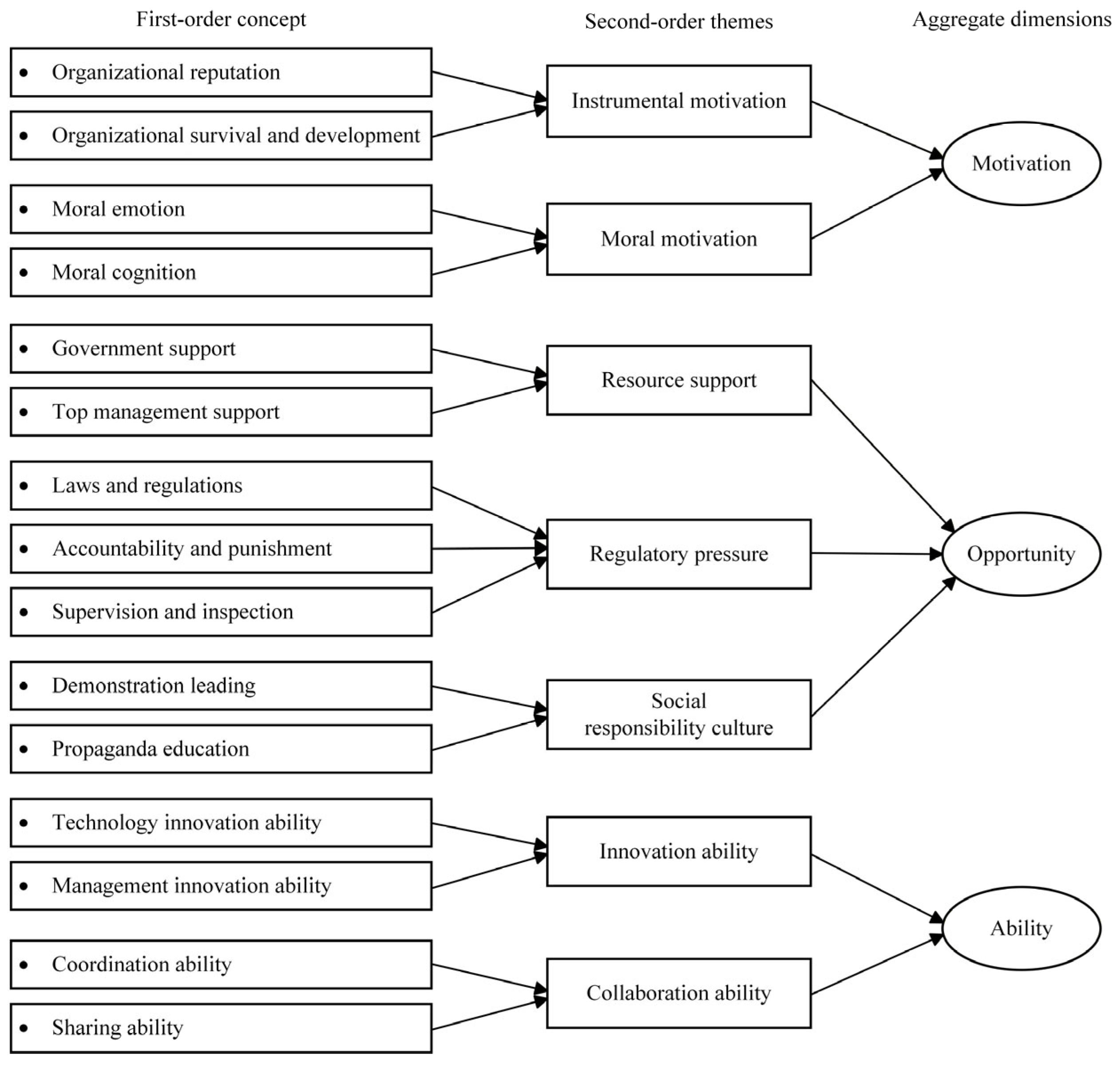
| Second-Order Theme | First-Order Concept | Connotation |
|---|---|---|
| Resource support | Government support | Government fosters a conducive external environment for MSR behavior through measures such as providing policy subsidies. |
| Top management support | Top managers provide resources and safeguards for MSR behavior, such as developing strategies and setting incentives. | |
| social responsibility culture | Propaganda education | Promote MSR values and norms to all megaproject members to increase their awareness and responsibility. |
| Demonstration leading | Illustrate the practical impact and significance of MSR behavior through exemplar role models and proactive leadership. | |
| Regulatory pressure | Laws and regulations | Megaprojects must adhere to laws and regulations on safety and quality, environmental protection, and social welfare, etc. |
| Accountability and punishment | The partaking subjects that fail to fulfill MSR will be investigated and may face consequences such as fines, criticism, and business restrictions. | |
| Supervision and inspection | Supervisory bodies regularly monitor and inspect the MSR fulfillment of partaking subjects of megaprojects. | |
| Innovation ability | Technology innovation ability | The partaking subjects have the ability to improve technical methods, programs, and processes, etc. |
| Management innovation ability | The partaking subjects have the ability to improve management concepts, methods, and rules, etc. | |
| Collaboration ability | Coordination ability | The partaking subjects are able to effectively coordinate their objectives, plans, and actions to prevent conflicts. |
| Sharing ability | The partaking subjects have the ability to effectively share information and resources. | |
| Instrumental motivation | Organizational reputation | The partaking subjects implement MSR behavior to enhance their image and reputation in society. |
| Organizational survival and development | The partaking subjects implement MSR behavior to scale their operations and improve efficiency. | |
| Moral motivation | Moral emotion | Members of partaking subjects seek emotional satisfaction through their actions. |
| Moral cognition | The cognitive beliefs of members, including values, codes of conduct, and ethics, guide their understanding of what is considered right and proper. |
Disclaimer/Publisher’s Note: The statements, opinions and data contained in all publications are solely those of the individual author(s) and contributor(s) and not of MDPI and/or the editor(s). MDPI and/or the editor(s) disclaim responsibility for any injury to people or property resulting from any ideas, methods, instructions or products referred to in the content. |
© 2026 by the authors. Licensee MDPI, Basel, Switzerland. This article is an open access article distributed under the terms and conditions of the Creative Commons Attribution (CC BY) license.
Share and Cite
Xie, L.; Luo, Y.; Qiu, Y.; Ju, T. What Drives Megaproject Social Responsibility Behavior? A Qualitative Study in China. Buildings 2026, 16, 2680. https://doi.org/10.3390/buildings16132680
Xie L, Luo Y, Qiu Y, Ju T. What Drives Megaproject Social Responsibility Behavior? A Qualitative Study in China. Buildings. 2026; 16(13):2680. https://doi.org/10.3390/buildings16132680
Chicago/Turabian StyleXie, Linlin, Yifei Luo, Yinchao Qiu, and Tianhao Ju. 2026. "What Drives Megaproject Social Responsibility Behavior? A Qualitative Study in China" Buildings 16, no. 13: 2680. https://doi.org/10.3390/buildings16132680
APA StyleXie, L., Luo, Y., Qiu, Y., & Ju, T. (2026). What Drives Megaproject Social Responsibility Behavior? A Qualitative Study in China. Buildings, 16(13), 2680. https://doi.org/10.3390/buildings16132680