Article

Configuring Governance Mechanisms to Improve Resilience in Construction Projects

1
School of Economics and Management, Tianjin Chengjian University, Tianjin 300072, China
2
School of Business, East China University of Science and Technology, Shanghai 200237, China
3
Built Environment and Engineering (BEE) Program, College of Sport, Health and Engineering (CoSHE), Victoria University, Melbourne, VIC 3011, Australia
4
Institute for Sustainable Industries and Liveable Cities (ISILC), Victoria University, P.O. Box 14428, Melbourne, VIC 8001, Australia
*
Author to whom correspondence should be addressed.
Buildings 2026, 16(13), 2668; https://doi.org/10.3390/buildings16132668
Submission received: 28 May 2026 / Revised: 25 June 2026 / Accepted: 1 July 2026 / Published: 6 July 2026
(This article belongs to the Special Issue Advances in Engineering, Construction and Architectural Management)

Abstract

Resilience is critical for construction projects to cope with diverse risks and uncertainties. Inter-organizational relationship governance has been widely recognized as an important means of strengthening project resilience. However, existing research has paid limited attention to how different governance mechanisms interact and combine to enhance resilience in construction projects. Drawing on a configurational perspective, this study examines how contractual, hierarchical, and network governance jointly contribute to construction project resilience. Based on survey data from 289 practitioners, fuzzy-set qualitative comparative analysis (fsQCA) is employed to identify the governance configurations associated with high project resilience. The results reveal three configurational pathways leading to high resilience: (1) relational–structural network governance coupled with contractual governance; (2) a combination of contractual, hierarchical, and network governance; (3) relational–cognitive network governance coupled with contractual governance. These findings offer important theoretical and practical implications for understanding the role of hybrid governance in the resilience of construction projects. Theoretically, this study extends resilience research by demonstrating that contractual, hierarchical, and network governance do not operate in isolation but jointly enhance project resilience through distinct configurations. Practically, these findings offer guidance for project stakeholders to optimize and integrate governance mechanisms, thereby improving their capacity to anticipate, respond to, and manage internal and external crises.

1. Introduction

Large-scale construction projects, particularly those in the building sector, are widely recognized as important drivers of global economic growth, with their scale and operational performance increasingly regarded as key indicators of national core competitiveness [1,2]. Against the backdrop of globalization and volatility, uncertainty, complexity, and ambiguity (VUCA), construction projects are increasingly exposed to complex risk environments and diverse challenges. For instance, Typhoon Matmo in October 2025 disrupted construction projects in several coastal cities in South China, causing schedule delays and safety risks. Similarly, the 2024 Guangdong rainstorms caused extensive damage to buildings, roads, bridges, and power facilities. The volatility of the external environment and the occurrence of multiple accidents have exposed large-scale construction projects to substantial uncertainties and dynamic complexity [3,4]. Under such turbulent condition, the development of resilience capacities provides an effective means for construction projects to cope with multiple adverse factors.
Construction project resilience refers to the capacity of stakeholders to collectively develop and mobilize resources and capabilities to prevent, respond, and recover from unexpected challenges, thereby enabling functional adaptation and maintaining performance in turbulent environments [4]. Construction projects typically involve multiple independent stakeholders embedded in complex inter-organizational networks [5], which makes the examination of resilience at the inter-organizational project level particularly important. To achieve such resilience, organizations must coordinate collaborative relationships and facilitate resource flows across organizational boundaries to respond effectively to crises at all stages [6]. The presence of independent stakeholders and the emergence of inter-organizational networks underscore the importance of examining how stakeholder relationships can be governed to foster resilience in construction projects.
Although prior studies have demonstrated that governance mechanisms constitute important antecedents of project resilience, existing research has paid limited attention to how different types of governance mechanisms interact to foster resilience in construction projects. Large construction projects involve various governance mechanisms. First, contracts established among participants in construction projects create contractual governance relationships among them [7,8,9]. Meanwhile, the simultaneous involvement of the parent group and its subsidiaries results in a bureaucratic organizational structure within the project. For example, owners of large-scale construction projects in China often designate group companies as prime contractors and their subsidiaries as subcontractors [10]. Researchers widely recognize formal hierarchical governance as a stable model for organizational management. Yun et al. [11] contend that project control fundamentally depends on an authoritative hierarchical structure and clear managerial instructions. To cope with external uncertainties and achieve project performance targets, it is crucial to maintain the stability of the organizational management structure [12]. Furthermore, a construction project can be viewed as a typical network-based organization, in which multiple participants serve as nodes, and their interactions represent edges. As the social impacts of construction projects become increasingly significant, the extensive involvement of the public, the media, and nonprofit organizations has gradually expanded the scope of construction project social networks. Under such circumstances, the role of network governance in developing construction project resilience capabilities has become increasingly prominent, particularly by facilitating resource sharing and exchange across organizational boundaries.
While prior research has recognized the importance of governance mechanisms in cultivating resilience capability in construction projects, the complex relationships between governance mechanisms and resilience remain underexplored. Although Wang et al. [4] empirically confirmed the positive effects of contractual and relational governance on construction project resilience in infrastructure projects, they did not investigate the interactive, substitutive, or complementary roles these governance modes may play under crisis conditions. Furthermore, hierarchical governance was entirely excluded from their regression model. Liu et al. [13]. Identified multi-dimensional governance factors affecting PPP resilience and analyzed their hierarchical correlations; however, their research merely mapped static factor linkages and did not capture the dynamic interactive synergy among contractual, relational, and institutional governance under external risk disruptions. Wu et al. [14] tested the linear moderating effect of the institutional environment on the relationship between contractual-relational governance and supply chain resilience. However, their model relied on isolated single-path moderation and did not incorporate a systematic framework to account for the interactive joint effects of multiple governance mechanisms under compound risk scenarios. Prior research has extensively examined the effects of individual governance mechanisms on construction project resilience. However, most studies treat contractual, hierarchical, and network governance in isolation, overlooking their mutual interplay in real-world engineering contexts. In practice, these three governance forms rarely operate independently; rather, they interact dynamically and collectively shape the risk resistance and recovery capacity of construction projects. This fragmented perspective gives rise to a notable gap: few studies have unpacked the synergistic effects generated by the integrated deployment of multi-dimensional governance arrangements. To address this gap, the present study poses the following core research question: How do combinations of contractual, hierarchical, and network governance enhance construction project resilience? To address the research question, this research aims to identify the configurational pathways through which three types of governance mechanisms contribute to construction project resilience by employing fuzzy-set qualitative comparative analysis (fsQCA).
This study is structured as follows. Section 2 reviews the theoretical foundations of construction project resilience, contractual governance, hierarchical governance, and network governance. Section 3 describes the research methodology, including instrument development, sampling, and data collection, and the assessment of reliability and validity. Section 4 introduces the results of the configurational analysis. Section 5 discusses the findings and highlights their theoretical and practical implications. Finally, the study summarizes its main findings and presents the conclusions.

2. Theoretical Background

2.1. Resilience in Construction Projects

Resilience is derived from the Latin words “resilire”, meaning a rebound or bounce [6,15]. Early studies on resilience focused primarily on ecology and psychology. In 1973, Holling [16] introduced the concept of resilience into ecological studies, defining it as the capacity of a system to absorb changes and disturbances while maintaining its original state. In contrast, psychological research focused on the mechanisms through which children cope with adversity [17]. As research advanced, Meyer and Rowan [18] introduced resilience into the field of organizational management, laying the foundation for research on construction project resilience.
Research on construction project resilience in management has grown rapidly over the past two decades [19,20]. This growth reflects increasing scholarly attention to unpredictable risks, such as terrorism and climate change, within socio-economic systems in the post-9/11 era [20]. In the management literature, it is commonly conceptualized through two distinct lenses: static and dynamic perspectives [21].
From a static perspective, resilience is often conceptualized as an organizational capacity or stable attribute that enables organizations to anticipate and adapt to environmental uncertainty, particularly under conditions of effective crisis leadership [22,23]. It is reflected in well-established social networks among members, high levels of mutual trust, and effective collaboration, all of which help mitigate losses during adverse events. In contrast, the dynamic perspective conceptualizes resilience as an ongoing process. From this perspective, resilience involves the ability to anticipate potential disruptions, respond rapidly, recover promptly after crises, and ultimately learn and grow from these experiences [24,25]. Static resilience is associated with proactive strategies adopted in the pre-disturbance phase to prepare for unexpected events, whereas dynamic resilience is associated with reactive strategies implemented in the post-disturbance phase to cope with and recover from uncertainty.
Currently, considerable attention has been devoted to exploring construction project resilience from a governance perspective in the domains of business management, human resource management, and logistics and supply chain management. For example, in the field of supply chain management, Wu et al. [14] investigated the impact of contractual and relational governance on supply chain resilience, as well as the mediating and moderating roles of supply chain collaboration and the institutional environment in the relationship between inter-organizational governance and supply chain resilience. Using survey data from 396 members of social entrepreneurial teams, Mai et al. [26] revealed that team learning serves as a mediator between relational governance and construction project resilience.
Beyond permanent organizations such as firms and supply chains, scholars have increasingly recognized the need to examine how governance mechanisms influence the resilience of temporary inter-organizational projects. For example, Yang et al. [27] explored how stakeholder relationships, including established ties and inter-organizational governance, contribute to the enhancement of project resilience through specific mechanisms. Wang et al. [4] demonstrated that contractual and relational governance are both critical antecedents of project resilience and that resource reconfiguration serves as a mediator in these relationships. Although increasing attention has been paid to the development of resilience in project contexts from the perspective of governance mechanisms, the specific types of governance mechanisms involved in contemporary projects remain insufficiently analyzed, and their interactive effects on resilience enhancement have not been fully explored.

2.2. Governance Mechanism in Construction Projects

The term governance derives from the Latin term gubernare, meaning “to steer”, and originally referred primarily to the steering of the state [28]. Governance theory examines the coordination, adaptation, and safeguarding of economic exchanges among diverse participants. Its theoretical foundations are drawn from a loosely integrated body of economic theories, including agency theory [29], transaction cost economics [30], property rights and incomplete contract theory [31], and relational contract theory [32,33].
Within project management research, early scholarship on governance theory mainly focused on project governance, understood as the establishment of shared rules that all project stakeholders are required to follow throughout the project life cycle [34]. Existing research has explored the positive role of project governance in achieving project success. For example, Abednego and Ogunlana [35] developed the concept of good project governance, arguing that it serves as a means of achieving appropriate risk allocation. Sirisomboonsuk et al. [36] developed the concept of good project governance, arguing that it serves as a means of achieving appropriate risk allocation. Some scholars conceptualize project governance as an organizational governance mechanism that uses both explicit and implicit structures to manage responsibilities across multiple levels [37]. Cooperative cost estimation, mutual risk and benefit allocation, and design coordination serve as measures of the former, whereas leadership, teamwork, workshops, and communication systems are used to assess the latter. Some scholars have attempted to categorize the dimensions of project governance mechanisms. For example, Lu et al. [38] examined governance mechanisms from the perspectives of contractual governance and trust. In complex procurement contexts, Caniëls et al. [39] classified governance mechanisms into contractual incentives, competence-based mechanisms, and relational governance. Similarly, Olsen [40] identifies contractual mechanisms based on rewards, competency, and trust. Project governance has traditionally focused on contract-based, market-oriented transactional relationships among project participants, whereas contemporary research increasingly examines multiple types of relationships among participants and the governance mechanisms associated with them [41,42].
Contemporary large-scale construction projects involve multiple stakeholders embedded in different types of relationships, including market, hierarchical, and social network relationships. These relationships facilitate the implementation of diverse governance mechanisms, methods, and practices that align stakeholder interests and promote progress toward shared objectives. Consequently, contractual, hierarchical, and network governance mechanisms are all present in construction projects.
Contractual governance refers to formal contracts and arrangements established among project participants in principal–agent relationships, such as clients and contractors [10]. Its core characteristics are reflected in three dimensions, including adaptability, which refers to the flexibility to adjust contracts in response to project changes [43], and completeness, which indicates the extent to which contractual terms clearly specify the rights, responsibilities, and interests of each stakeholder [44], and enforceability, which refers to the degree of legal protection for contract execution and accountability for contractual breaches [45]. Contractual governance comprises the national legal framework, mandatory contracts among project participants, and related statutory provisions [46]. Functional market-oriented reforms, public service procurement, public–private partnership (PPP) models, and contract outsourcing constitute specific manifestations of contractual governance [47]. This governance model can be quantitatively assessed through risk sharing and benefit distribution [48].
Administrative affiliation relationships are also present among participants in large-scale construction projects. In China, for instance, some main contractors in construction projects assign part of the project work to their subsidiaries through formal subcontracting agreements [10]. Hierarchical governance refers to authority-based relationships among project stakeholders [49]. The core of this concept lies in two key dimensions, one of which is centralized decision-making, defined as the concentration of decision-making authority at the superior or headquarters level, with lower-level units executing instructions within their delegated scope [50], and decision formalization, which refers to the regulation of decisions and actions through explicit rules, procedures, and formal authorization mechanisms [51]. Hierarchical governance refers to the process through which authorized decision-makers direct others to carry out activities within clearly defined boundaries [52]. Formal hierarchical governance is underpinned by top-down organizational directives and control, whereas informal hierarchical governance is based on social norms and interactions between dominant and subordinate parties. In construction projects, hierarchical governance is manifested in the control exercised by general contractors over subcontractors. Formal and informal management practices are closely associated with construction project costs, project duration, and injury risks [53]. Formal tier governance contains mechanisms such as strategic control, financial control, and personnel control [54,55,56]. Project participants can enhance management effectiveness and responsiveness through a coherent strategic design, thereby reflecting formal hierarchical governance [57]. In contrast, informal hierarchical governance encompasses social interdependence among project participants [58]. A high degree of mutual dependence between parent groups and their subsidiaries enables synergies through shared values, intellectual resources, and technologies [56]. The organizational interdependence resulting from such synergies can generate significant cost savings and facilitate risk sharing throughout the construction project management process.
Construction projects involve not only numerous internal stakeholders, including owners, contractors, subcontractors, and suppliers, but also a range of external stakeholders, such as government agencies and the public. Collectively, these stakeholders form a temporary network-based organization. Network governance is particularly suited to such multi-actor collaborative contexts. Its core features are reflected in three dimensions, including network density, which denotes the closeness of connections and the frequency of interactions among participants [59], and relational intensity, which denotes the number and breadth of actual relationships established among parties within the network [60]; and shared vision, which refers to shared value orientations, goal alignment, and willingness to collaborate among all parties [61]. Network governance is characterized by informal and spontaneous cooperative and resource-sharing relationships among project participants [41]. The theoretical foundations of network governance can be traced to three main perspectives: transaction cost economics, social network theory, and the resource-based view [62]. Network governance constitutes a self-organizing form of governance grounded in shared goals and mutual coordination, distinguishing it from contractual governance based on voluntary exchange and hierarchical governance based on command and control. Fedorowicz et al. [63] highlighted the importance of network governance capabilities in managing stakeholders and information construction. Network governance emerges as a response to environmental uncertainty and task complexity, relying on relational mechanisms to coordinate exchanges and safeguard transactions, thereby reducing transaction costs [64]. The interactive and coordinated network system emphasized by network governance helps prevent the monopolization of resources and decision-making power by a single actor, reduces the likelihood of decision-making errors, and encourages the participation of diverse actors.
In summary, prior research has thoroughly investigated the characteristics of contractual, hierarchical, and network governance mechanisms, as well as their effectiveness in project execution. However, insufficient attention has been paid to the combined effects of these three governance mechanisms. This paper examines how these three types of governance mechanisms jointly influence construction project resilience.
In terms of the coordination logics of the three governance mechanisms, hierarchical governance operates through a top-down, codified authority system that standardizes decision-making, clarifies rights and responsibilities, and imposes behavioral constraints. Network governance, in contrast, emerges from bottom-up relational ties among autonomous participants, with information sharing as its foundational logic. Contractual governance, as a formal legal instrument, relies on binding written agreements to specify the rights and responsibilities of all parties, risk allocation rules, and baseline cooperation conditions. Although excessive hierarchical control may suppress the flexibility and spontaneity of network governance, overly informal relational coordination may weaken the clarity of formal authority and accountability. Nevertheless, these three governance mechanisms can coexist because they address different coordination problems. Hierarchical governance provides authority and accountability, network governance enables trust-based communication and flexible adaptation, and contractual governance sets formal boundaries and baseline safeguards. In this way, formal mechanisms reduce the ambiguity and potential opportunism of informal networks, while informal networks compensate for the rigidity of formal hierarchies and contracts.

2.3. The Configurational Model of This Study

Contractual governance, hierarchical governance, and network governance can each contribute to construction project resilience, enhancing it through distinct pathways. Firstly, contractual governance underscores the importance of formal rules and contractual agreements in transactions [65]. It facilitates information sharing during crises and enables rapid organizational responses, thereby enhancing construction project resilience by ensuring clarity and enabling swift coordination under disruptive conditions. Secondly, transaction cost theory suggests that governance structures shape the behavioral choices of participating parties [66]. Williamson [67] further argued that hierarchical governance lowers transaction costs by reducing behavioral uncertainty. In construction projects, such governance strengthens resilience by establishing clear authority and control mechanisms that stabilize actions and expectations during disruptions. Thirdly, a central tenet of network governance is that no single actor can unilaterally steer the governance process [68]. This is particularly relevant in construction projects, where success depends on close collaboration and coordinated efforts among all stakeholders. Network governance contributes to resilience by fostering flexibility, trust, and collective problem-solving among interdependent actors.
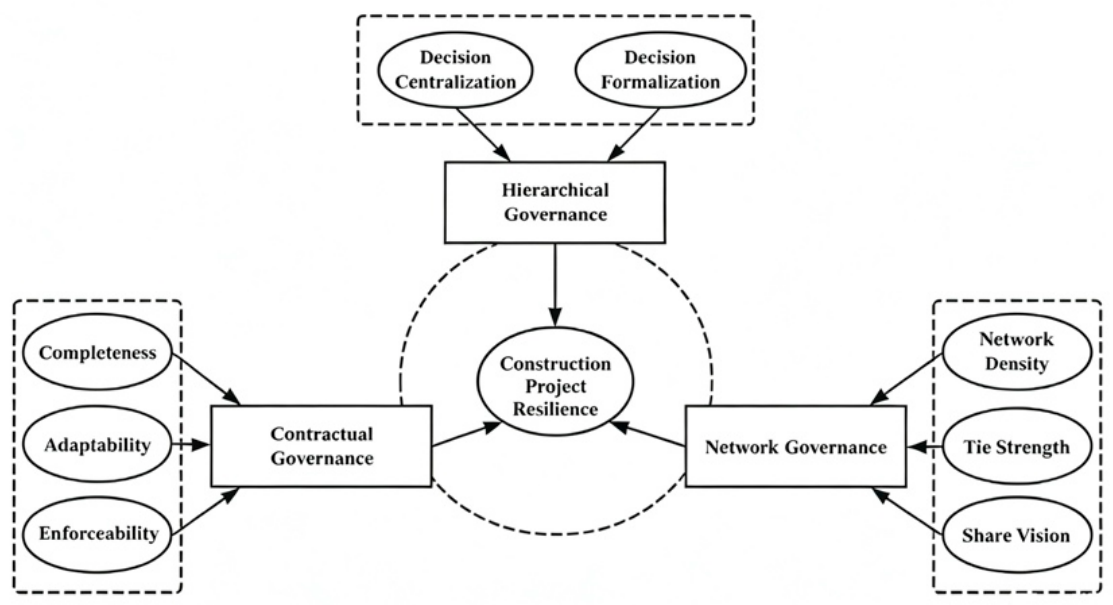
More importantly, the three types of governance mechanisms can jointly improve construction project resilience through their interaction and complementarity. Rather than operating independently, contractual, hierarchical, and network governance are likely to interact in complementary ways. A coordinated alignment of formal contracts, hierarchical authority, and cooperative networks can create a more robust governance framework, enabling construction projects to better anticipate, absorb, and adapt to disruptions. Therefore, it is necessary to examine the influence of governance mechanisms on construction project resilience from a configurational perspective, as this approach enables a systematic analysis of the causal interactions among multiple governance mechanisms in enhancing construction project resilience. Figure 1 presents a bounded configurational model of governance mechanisms for construction project resilience. The model does not claim to provide an exhaustive typology of governance arrangements; rather, it focuses on hierarchical, contractual, and network governance as distinct yet complementary mechanisms relevant to sustained inter-organizational collaboration in construction projects. Accordingly, the model focuses on governance mechanisms operating within continuing collaborative relationships, rather than on mechanisms primarily characterized by discrete, price-oriented transactions.

3. Methodology

3.1. Instrument Development

Data were collected through a questionnaire survey. The measurement items were developed through a three-stage process. First, an initial set of items was developed in English based on a comprehensive literature review. These items were then translated into Chinese by scholars specializing in construction project research with extensive academic experience. Subsequently, to ensure cross-linguistic consistency and validity, independent translators conducted a back-translation into English [69]. Second, to refine the items and contextualize them for construction projects in China, an expert interview was conducted with three practitioners with more than 15 years of experience in the field. Finally, a pilot test was administered to 15 respondents, each with more than ten years of experience in construction projects, and the items were revised based on their feedback. The detailed description of the constructs in the questionnaire is shown in Table 1, and the final items are indicated in Appendix A.
Contractual governance was operationalized as a second-order construct comprising three first-order dimensions: completeness, adaptability, and enforceability. The measurement of three dimensions of contractual governance was adopted from Wang et al. [70], Lv et al. [71], and Quanji et al. [45]. Hierarchical governance was modeled as a second-order construct consisting of two first-order dimensions: decision centralization and decision formalization. The measurement of two dimensions of hierarchical governance was adopted from DeHart et al. [72], Primorac et al. [51]. Network governance was conceptualized as a second-order construct comprising three first-order dimensions: network density, tie strength, and shared vision, which reflect the structural, relational, and cognitive dimensions of inter-organizational network characteristics, respectively. The measurement of two dimensions of network governance was adopted from Howell [73], Omar et al. [74], Bühler et al. [75]. Project resilience was measured from both the static and dynamic perspectives, using the measurement items adapted from Zhang [76] and Yan [77].
Table 1. Constructs and items.
Types of Governance MechanismsConstructDescription
Contractual GovernanceCompleteness [70,78,79]The comprehensiveness and precision of contractual clauses in construction projects in specifying the rights, obligations, risk allocation, and interest claims of all cooperating parties.
Adaptability [71,80,81]The adaptive capacity of contractual mechanisms in construction projects to respond to uncertainties in the external environment and dynamic changes within the project.
Enforceability [45]The binding force and enforceability of contractual clauses in construction projects.
Hierarchical GovernanceDecision Centralization [72]The degree to which decision-making authority in construction projects is centralized within high-level entities or core departments of the hierarchical system.
Decision Formalization [51]The degree to which decision-making processes, criteria, procedures, and outcomes in construction projects are standardized, documented, and institutionalized.
Network GovernanceNetwork Densit [73,82,83]The extent of connections among actors in the inter-organizational project network.
Tie Strength [61,74,84]The extent of closeness, frequency and reciprocity of social ties among actors in the inter-organizational project network.
Shared Vision [75]The degree of consensus among participating entities in an construction project governance network regarding the project’s core objectives, value orientation, and long-term development direction.

3.2. Sampling and Data Collection

To mitigate potential bias, this study employed a phased data collection approach. Before data collection, all participants were informed of the study’s purpose, and their confidentiality was ensured. To enhance data accuracy and response rates, and given the professional background of the participants, an electronic five-point Likert scale was employed to construct the questionnaire (1= “strongly disagree”, 5 = “strongly agree”). The questionnaire was administered through Wenjuanxing, a professional online survey platform, and distributed via WeChat. Data were collected in two stages: the first stage yielded 150 valid responses, and the second stage, conducted one week later, yielded 139 valid responses. Overall, the sample demonstrates considerable diversity and representativeness, thereby meeting the basic requirements for statistical analysis. The descriptive statistics of the sample are presented in Table 2.

3.3. Reliability and Validity Measures

Before conducting detailed analyses of the survey data, an internal consistency test was performed to assess the reliability of the measurement scales. Internal consistency, a standard indicator of reliability in management research, assesses the homogeneity of items within each measurement scale. This study employed Cronbach’s alpha coefficient to assess internal consistency reliability, with values above 0.70 generally considered indicative of satisfactory construct reliability [85]. Table 3 presents the Cronbach’s alpha coefficients for the eight variables, calculated using SmartPLS 4.1.1.4. All coefficients exceeded the threshold of 0.70, confirming that the constructs in this study meet the reliability requirements.
Validity refers to the extent to which measurement items accurately capture their intended constructs, encompassing convergent validity and discriminant validity [86]. This research employed the equally weighted arithmetic mean method to aggregate the measurement items for each variable. Before variable calibration, descriptive statistics of the raw aggregated variables were calculated, including the mean, standard deviation and skewness, as reported in Table 4. The absolute skewness values are below 1.0, suggesting that the raw data distributions are approximately symmetric and do not exhibit severe ceiling or floor effects. Moreover, the standard deviations suggest that the responses were not overly concentrated, indicating that the data retain sufficient empirical variation for the subsequent calibration process. Factor analysis is a critical tool for assessing convergent validity. When established measurement scales are used, confirmatory factor analysis (CFA) is generally sufficient. The CFA assessment in this study included standardized factor loadings (SFL), composite reliability (CR), and average variance extracted (AVE). Convergent validity is considered satisfactory when each item’s standardized factor loading (SFL) exceeds 0.50, each construct’s composite reliability (CR) exceeds 0.70, and each construct’s average variance extracted (AVE) exceeds 0.50 [86,87]. As shown in Table 2, the standardized factor loadings (SFLs) for all items exceeded 0.50, indicating strong item representativeness. The composite reliability (CR) values for all constructs exceeded 0.70, indicating good internal consistency among the items. Furthermore, the average variance extracted (AVE) values for all constructs exceeded 0.50, confirming satisfactory convergent validity. Thus, the measurement data meet the criteria for convergent validity.
To assess discriminant validity, the square root of the average variance extracted (AVE) for each variable was compared with the correlation coefficients among variables. If the square root of the average variance extracted (AVE) for each variable is greater than its correlation coefficients with other variables, the variables are considered to exhibit good discriminant validity [87]. As shown in Table 4, the measurement data met the criteria for discriminant validity.

4. Data Analysis and Results

4.1. Data Analysis Procedures

Qualitative Comparative Analysis (QCA), developed by sociologist Ragin [88], has been widely used in management, sociology, and political science to examine complex causal relationships [89]. This approach integrates the strengths of qualitative and quantitative methods and is suitable for small-, medium-, and large-N studies, thereby enhancing its theoretical and practical relevance.
QCA is particularly suitable for examining conjunctural causation, equifinality, and causal asymmetry among antecedent conditions. These characteristics are consistent with the objective of this research, which intends to explore the combination of various governance mechanisms to improve resilience in construction projects. Therefore, QCA provides an appropriate configurational approach for identifying distinct pathways for project resilience improvement [90]. Given the gradational nature of the survey-based variables, fsQCA was employed because it can capture varying degrees of membership and conduct a configurational analysis of governance mechanisms that enhance construction project resilience.

4.2. Data Results

This study selected eight first-order factors to represent contractual, hierarchical, and network governance, including completeness, adaptability, enforceability, decision centralization, decision formalization, network density, tie strength, and shared vision. A configurational analysis was carried out in three stages using the fsQCA software.
The first step involved calibration. This study employed the direct calibration method, which is commonly recommended because it relies on predefined calibration thresholds and makes the assumptions underlying the transformation of raw scores into set-membership scores explicit, transparent, and reproducible. Direct calibration was employed because it makes the assumptions underlying the transformation of raw scores into set-membership scores explicit, transparent, and reproducible [91]. Each condition and the outcome were calculated as the mean score of its corresponding items measured on a five-point Likert scale.
In fuzzy-set analysis, membership scores are represented on a continuous scale ranging from 0 to 1. After calculating the mean values of continuous variables (e.g., completeness, adaptability), following the recommendation of Ragin [92], three calibration anchors were established: full membership (fuzzy score = 0.95), the crossover point (fuzzy score = 0.5), and full non-membership (fuzzy score = 0.05). The exact raw-score anchors and their corresponding fuzzy-set membership scores are presented in Table 5. Each variable was calculated by averaging the scores of its corresponding measurement items. Empirical quantiles were used to locate the calibration anchors within the observed distributions, while the substantive interpretation of the anchors was based on membership in the respective target sets. The raw composite scores of the eight conditions and the outcome across the 250 cases were transformed into fuzzy-set membership scores using fsQCA 4.1.
The second step involved a necessity analysis, which aimed to determine whether any antecedent condition constituted a necessary condition for the outcome. According to Ragin [93], a condition is considered necessary if its consistency level exceeds 0.90. In this study, none of the conditions met this threshold, indicating that no single condition was necessary for the outcome. More precisely, sustainable performance does not depend on any single antecedent condition. The interdependence among conditions suggests that their combined effects warrant further investigation. Table 6 presents the results of the necessity analysis.
The third step involved a sufficiency analysis implemented using the truth table algorithm. A sufficient condition is defined as an antecedent condition, or a configuration of conditions, that can produce the outcome. The fsQCA 3.0 software was employed for the analysis, which constructed a truth table with 2^k rows (where k equals the number of antecedent conditions), each representing one possible configuration of conditions. Before constructing the truth table, the frequency and raw consistency thresholds were determined. Although the minimum consistency threshold is generally accepted to be 0.75 [94], this study applied a more stringent threshold of 0.85 [92] to enhance reliability. Additionally, the PRI consistency threshold was set at 0.7 [95], and the frequency threshold was set at 2.
fsQCA produces three types of solutions for sufficiency analysis: complex, parsimonious, and intermediate solutions. The complex solution has limited interpretive value, whereas the parsimonious and intermediate solutions are useful for distinguishing core conditions from peripheral conditions. Core conditions are key determinants that appear in both parsimonious and intermediate solutions, whereas peripheral conditions are supplementary and appear only in the intermediate solution [89,91]. The results are presented in Table 7.
The results are presented using standard fsQCA notation. In the table, the distinction between core and peripheral conditions is indicated by the size of the circles: a large filled circle (⬤) indicates the presence of a core condition, while a small filled circle (●) indicates the presence of a peripheral condition; a large crossed-out circle (⊗) indicates the absence of a core condition, and a small crossed-out circle (⨂) indicates the absence of a peripheral condition. Blank cells denote irrelevant conditions, that is, conditions that do not influence the outcome. Each column in the table represents a unique causal configuration.
Among the configurations leading to high construction project resilience, three distinct pathways are identified: S1a, S1b, S2a, S2b, and S3. Here, S1a and S1b, as well as S2a and S2b, represent second-order equivalent configurations because they share identical core conditions. The overall solution consistency reaches 0.933, exceeding the 0.85 threshold for individual configurations, indicating that 93.3% of cases consistent with these three configurations exhibit a high level of Construction project resilience. Furthermore, the overall solution coverage is 0.564, meaning these three configurations collectively explain 56.4%of the instances of high Construction project resilience in the studied cases.
To enhance the robustness of our findings, we performed two complementary tests. First, we adjusted the consistency threshold to 0.8 and re-ran the analysis; the resulting configurational pathways were consistent with the original solution. Second, we increased the case frequency threshold from 1 to 2, and the configurations thus obtained retained a subset of the original configurational pathways. As summarized in Table 8, these checks confirm the robustness of our results.

5. Discussion and Implications

5.1. Discussion

Five distinct configurations (S1a, S1b, S2a, S2b, and S3) were identified. The presence or absence of core and peripheral conditions in each configuration is detailed in the table above. By synthesizing the distribution of core conditions across the three types of governance mechanisms, the five configurations were further categorized into three configurational pathways for achieving high construction project resilience. These configurational pathways are: (1) relational–structural network governance coupled with contractual governance; (2) a combination of contractual, hierarchical, and network governance; (3) relational–cognitive network governance coupled with contractual governance.

5.1.1. Relational–Structural Network Governance Coupled with Contractual Governance

The core logic of this configurational pathway can be expressed as: CO*AD*ND*TS. This configuration suggests that, in large-scale construction projects, a contractual structure characterized by high completeness and adaptability, combined with strong relational ties and network density, can significantly enhance construction project resilience. These latter two factors represent the relational and structural dimensions of network governance, respectively. On the one hand, highly complete contracts clearly delineate the rights, responsibilities, and interests of multiple stakeholders. (e.g., owners, designers, contractors, supervisors, and material suppliers), Thereby effectively preventing blame-shifting and internal conflicts when crises occur. Highly adaptable contracts, on the other hand, provide flexibility for adjustment in dynamic environments, helping ensure uninterrupted project progress. Concurrently, a densely connected network structure indicates that many participating entities interact frequently, while strong relational ties among participants reflect trust, mutual benefit, and reciprocity developed through long-term cooperation. These two governance mechanisms interact synergistically to foster construction project resilience.
On the one hand, highly complete contracts clarify the rights, responsibilities, and interface requirements of multiple project participants. From a behavioral-mechanism perspective, clear contractual terms reduce information asymmetry among participants, thereby reducing perceived cooperative risks, curbing opportunistic tendencies, and reducing opportunities for blame-shifting and internal conflicts when disruptions occur. Meanwhile, adaptable contracts provide room for adjustment under changing project conditions, preventing rigid contractual provisions from constraining emergency response efficiency, helping maintain construction continuity, and further stabilizing cooperation expectations while strengthening participants’ willingness to engage in continuous communication and joint problem solving. On the other hand, the risk-mitigating effect of formal contractual governance further enhances the operation and development of informal network governance. Specifically, once complete contracts reduce cooperation uncertainty, they lower barriers to information exchange and resource flows among multiple stakeholders, facilitating the formation of dense interorganizational networks. Simultaneously, a low-risk and stable cooperation environment helps foster mutual trust and reciprocal norms, strengthening robust relational bonds. In this configuration, formal contractual governance plays a foundational risk-buffering role that enables structural and relational network governance to function more effectively. Formal institutional constraints and informal relational networks thus form a mutually reinforcing behavioral interaction mechanism, ultimately jointly contributing to the enhancement of project resilience.
A representative example is the Shenzhen Metro Line 13 project, in which Shenzhen Metro Group coordinated with the public authorities and project contractors through coordination and communication mechanisms [96]. The contracts explicitly specified standards for construction safety, responsibilities for mitigating impacts on surrounding communities, and requirements for interface coordination among specialized engineering packages. Simultaneously, networked collaborative relationships among multiple entities ensured immediate emergency responses to emergent incidents and facilitated the timely updating of risk information and data on a shared platform, thereby laying the groundwork for subsequent risk monitoring and response.

5.1.2. Combination of Contractual, Hierarchical, and Network Governance

The foundational logic of this configurational pathway is expressed as: CO*DC*DF*ND. This configuration indicates that, in large-scale construction projects, a highly complete contractual structure, coupled with a centralized and formalized hierarchical system and supported by a high-density network structure, can significantly enhance construction project resilience. First, highly complete contracts provide detailed definitions of the rights, responsibilities, and benefits of multiple stakeholders, such as government agencies, construction units, contractors, and suppliers. They also explicitly specify core clauses related to schedules, quality, costs, and dispute resolution mechanisms, thereby institutionally preventing potential conflicts. Simultaneously, decision centralization and formalization establish a core entity as a unified decision-making hub that coordinates resources across the project to ensure strategic alignment and operational synergy, thereby enabling the efficient top-down dissemination and execution of directives. Furthermore, a high-density network structure creates extensive connections among upstream and downstream enterprises, research institutions, and cross-regional collaborative units, facilitating the rapid deployment of critical resources such as technology, equipment, and labor.
The Yichang–Fuling high-speed railway project provides a representative example. Through the synergistic interaction of contractual, hierarchical, and network governance mechanisms, this project significantly strengthened its resilience capabilities to withstand disruptions. In terms of construction contract design, the project established a highly complete contractual framework centered on a master contract, supplemented by multiple specialized contracts. These contracts clearly allocated the core rights and responsibilities among the project owner, contractors, and supervisory agencies. At the same time, the project fostered a tightly knit collaborative network encompassing diverse stakeholders. This configuration fully demonstrates the organization’s comprehensive construction project resilience in the face of complex risks.

5.1.3. Relational–Cognitive Network Governance Coupled with Contractual Governance

The fundamental logic of this configurational pathway is expressed as: CO*TS*SV. This configuration demonstrates that the synergy among a high degree of contractual completeness, robust inter-organizational relationships, and a shared vision significantly enhances construction project resilience in large-scale construction projects. The latter two factors represent the relational and cognitive dimensions of network governance, respectively. First, highly complete contracts precisely define the rights, responsibilities, and benefits of multiple stakeholders throughout the project life cycle, including construction, acceptance, operation, and maintenance. This clarity helps prevent blame-shifting and collaboration inefficiencies when sudden disruptions, such as extreme weather events or equipment failures, occur. Second, strong relationships among participants foster stable and frequent interactions, facilitate efficient information sharing, and enable the organization to proactively identify risks, thereby strengthening its anticipatory construction project resilience. Third, a shared vision integrates the disparate goals of various parties into a unified strategic direction, establishing a consensus-based decision-making framework for responding to major emergencies and ensuring smooth project progress.
A representative example is the Tianjin Metro Line 6 (TML6) project. As a primary loop line in Tianjin’s rail transit network, TML6 is a representative megaproject comprising four subprojects, with a total investment of approximately RMB 2.5 billion. The construction project contractor is a joint venture comprising five companies, several of which are subsidiaries of China Railway Construction Corporatio [10]. The project delineated implementation boundaries to avoid overlapping construction activities, cultivated a strong relational network to create a collaborative ecosystem for risk sharing, and aligned the objectives of the government, social capital investors, and participating units under the shared vision of “building a smart metro to serve urban development”. These concerted efforts collectively contributed to enhancing construction project resilience.
The present study employs fuzzy-set qualitative comparative analysis (fsQCA) to investigate how hybrid governance influences the resilience of construction projects. The configurational analysis results indicate that the three functions of contractual governance, the two dimensions of hierarchical governance, and the three dimensions of network governance are not individually necessary conditions for enhancing construction project resilience. The study identifies three distinct configuration types, revealing the combinatorial effects of hybrid governance elements.

5.2. Implications

5.2.1. Theoretical Implications

First, this study advances research on construction project resilience by examining its enhancement pathways from the perspective of inter-organizational governance. Moving beyond the dominant view that frames large-scale construction projects as purely engineering-technical systems and assesses their resilience through quantitative indicators such as safety and quality, this study adopts an organizational perspective. By conceptualizing construction projects as temporary network-based organizations composed of multiple stakeholders, this study opens a novel avenue for investigating resilience enhancement pathways through the governance of stakeholder relationships. Furthermore, examining construction project resilience from the perspectives of contractual, hierarchical, and network governance introduces new theoretical entry points for understanding hybrid governance in complex project settings.
Second, this study reveals the synergistic logic of different governance mechanisms in improving construction project resilience in large-scale construction projects. This study demonstrates that contractual, hierarchical, and network governance mechanisms are not competing forces; rather, they exhibit significant mutual reinforcement and complementary effects. Most existing studies on project resilience have sought a single universal pathway for enhancement, largely overlooking the principle of causal equifinality. In contrast, this study demonstrates that multiple differentiated governance configurations can equivalently achieve high project resilience. By clarifying the core and peripheral conditions of each pathway, our findings extend the theoretical understanding of equifinal configurations in the engineering resilience literature. The finding challenges simplistic single-mechanism explanations and provides a more nuanced understanding of hybrid governance. It suggests that construction project resilience derives not from any single governance mode alone but from the synergistic combination of multiple governance mechanisms, thereby deepening the theoretical understanding of how governance complexity contributes to organizational robustness.
Third, this study extends theory by identifying multiple pathways to high levels of construction project resilience from a configurational perspective. Through fsQCA, this research identifies three distinct configurational pathways in which different dimensions of contractual, hierarchical, and network governance jointly contribute to achieving high construction project resilience. These empirically grounded configurations demonstrate the principle of equifinality, indicating that multiple effective combinations of governance mechanisms can lead to high levels of construction project resilience. This finding provides a more precise and actionable theoretical framework by specifying how different governance archetypes can be strategically assembled to foster construction project resilience in megaprojects.

5.2.2. Practical Implications

First, this study offers important practical implications by calling for a fundamental shift in how stakeholders perceive crises and build resilience in large-scale construction projects. By conceptualizing these projects as temporary organizations rather than purely technical systems, this study extends the understanding of construction project resilience beyond traditional engineering metrics. It underscores that construction project resilience is not solely about the reliability of technical indicators or cost minimization, but rather about the collective capacity of multi-stakeholder organizations to anticipate, respond to, and manage crises. By adopting a hybrid governance perspective, this study offers stakeholders a more comprehensive understanding of the organizational dimensions of construction project resilience, thereby strengthening early warning systems and the capacity to manage both internal conflicts and external disruptions.
Second, this study translates theoretical insights into actionable guidance by pinpointing specific governance levers that project managers and stakeholders can strategically deploy to reinforce project resilience. In clarifying the intrinsic link between governance configurations and resilience outcomes, the study moves beyond abstract principles to identify concrete, practicable pathways. It demonstrates that resilience can be systematically enhanced through deliberate adjustments to governance structures—for instance, by improving the clarity and fairness of responsibility allocation among partners, ensuring centralized and decisive decision-making during crises, and reinforcing a shared project vision to sustain alignment under pressure. Collectively, these mechanisms equip project leaders with a practical toolkit for proactively mitigating risks and uncertainties.
Third, this study provides stakeholders with a practical roadmap for safeguarding their collective and individual interests by adopting a configurational approach to governance. The finding that multiple governance configurations can lead to high project resilience enables project participants to tailor their strategies to their specific contexts. Rather than offering general management suggestions, the fsQCA results show that different projects may require different governance strategies depending on their specific conditions and resource constraints. For instance, projects operating under tight budgetary and resource limitations should prioritize strengthening interorganizational relationships, developing a shared vision, and improving contractual completeness, as suggested by Path S3. In such contexts, establishing a dense network governance structure may not be the most efficient priority. By contrast, large-scale projects with sufficient resource endowments may adopt the comprehensive hybrid governance portfolio (Path S2), integrating contractual, hierarchical, and network governance to build multi-layered risk defense and response capabilities. Meanwhile, medium-sized projects involving long-term collaboration and relatively stable partners may rely on the matching of structural network ties and complete adaptive contracts (Path S1) to stabilize daily operations and respond to moderate external disruptions. Therefore, this research enables stakeholders to strategically assemble governance combinations that best fit their project-specific challenges. Such tailored governance arrangements can help align resilience-enhancing measures with project objectives, thereby supporting project continuity and protecting the legitimate interests of all participating parties.
In broader contexts, although the three configurational pathways were identified based on the data from Chinese practitioners, the findings have implications beyond the Chinese context in terms of analytical generalisability. The research framework was developed based on established theories of governance mechanisms and project resilience, rather than assumptions unique to China. Therefore, the identified configurations may provide useful reference points for integrating governance mechanisms and enhancing resilience capabilities.

6. Conclusions and Limitations

6.1. Conclusions

This study employs fsQCA to examine the joint effects of contractual, hierarchical, and network governance on construction project resilience, with the aim of addressing the core research question: How do hybrid governance portfolios enhance project resilience? The configurational analysis reveals that no single governance mechanism constitutes a necessary condition for improving resilience; rather, resilience is fostered through the interaction and coordination among multiple governance mechanisms. Three typical configurational pathways are identified, and their practical operation scenarios in real-world construction projects are elaborated as follows:
(1)
Relational–structural network governance coupled with contractual governance. This configuration may be particularly relevant to medium-sized projects involving stable long-term partners. Complete contractual provisions clarify baseline rights and obligations, while dense formal communication networks create structural ties. Together, these mechanisms help mitigate routine cooperation problems, stabilize resource supply, and buffer against moderate external fluctuations and operational disruptions, thereby supporting steady project operations.
(2)
Combination of contractual, hierarchical, and network governance. This comprehensive hybrid configuration is more applicable to large-scale, complex projects with multiple stakeholders. Clear contracts standardize transaction rules, centralized hierarchical management enables rapid emergency decision-making, and multi-party network relationships facilitate resource sharing and information exchange. These three mechanisms coordinate with one another to address severe risks, such as supply chain interruptions, safety incidents, or major technical uncertainties, forming a multi-layered defense system that underpins high project resilience.
(3)
Relational–cognitive network governance coupled with contractual governance. This configuration may be especially relevant to small- and medium-sized or innovation-oriented projects. Formal contracts define basic cooperation frameworks, while relational trust and cognitive shared vision foster a common understanding of project goals and risks among partners. Relying on mutual trust and aligned project goals, participants can flexibly adjust construction schemes under unpredictable disturbances and jointly cope with the impacts of unexpected disruptions.
These findings reveal the inherently combinatorial nature of hybrid governance mechanisms and offer clear on-site interpretations of how distinct governance portfolios operate to enhance project resilience. Further analysis indicates that, among the constituent elements of the three governance types, contractual necessity, network density, and tie strength serve as core conditions driving resilience enhancement. These three elements appear as core conditions in most high-resilience configurations, acting as indispensable foundational supports for all effective hybrid governance modes in practice.

6.2. Limitations and Future Research Directions

Although this study offers both theoretical and practical contributions, several limitations remain, providing opportunities for future research. This study employed WeChat as the primary channel for questionnaire distribution. While this approach offers considerable convenience, it also introduces certain biases. First, WeChat was used for questionnaire distribution. Although this approach was convenient for obtaining the empirical data, it may introduce social-network-based sampling bias. Respondents recruited through WeChat may be concentrated within existing professional or social networks, and respondents who are less active on this platform may be underrepresented. Hence, future research can be conducted by involving more diverse collection channels. Furthermore, the research context and data are drawn from China. Although this research provided three basic configurational pathways for enhancing resilience from the perspective of governance mechanisms, their transferability should be interpreted cautiously. Differences in cultural characteristics and economic structures may yield different combinations of governance mechanisms for resilience improvement. Future research can explore the joint effect of multiple governance mechanisms on resilience from a cross-cultural perspective and compare how governance configurations for resilience enhancement vary across different cultural contexts. Future research can explore the joint effect of multiple governance mechanisms on resilience from a cross-cultural perspective and compare how governance configurations for resilience enhancement vary across different cultural contexts. Second, this research uncovers the interaction and coordination among multiple governance mechanisms for construction project resilience improvement. However, due to the long duration of contemporary large-scale construction projects, resilience may evolve dynamically throughout the project life cycle. Future research could adopt a longitudinal approach to explore how governance mechanisms should be configured to enhance resilience across different project stages. Finally, this study does not examine moderating effects; factors such as project uncertainty and complexity may influence the observed outcomes. Future research should incorporate these variables into theoretical models for further investigation.

Author Contributions

Conceptualization, P.Y., Z.H. and S.L.; methodology, P.Y. and Z.H.; software, Z.H.; validation, P.Y., Z.H. and S.C.; investigation, P.Y., Z.H. and S.C.; writing—original draft preparation, Z.H.; funding acquisition, P.Y. All authors have read and agreed to the published version of the manuscript.

Funding

This work was supported by the Tianjin Philosophy and Social Science Planning Project (No. TJGL25-10).

Institutional Review Board Statement

Ethical review and approval were not required for this study in accordance with relevant national legislation, as this study involved an anonymous questionnaire survey and did not include any intervention or collection of identifiable personal data.

Informed Consent Statement

Informed consent for participation was obtained from all subjects involved in this study. Participation was voluntary, and all responses were collected anonymously via an online questionnaire.

Data Availability Statement

The data presented in this study are available on request from the corresponding author. The data are not publicly available due to privacy.

Conflicts of Interest

The authors declare no conflicts of interest.

Appendix A. List of Items

(1)
Hierarchical governance
Decision Centralization
Item NumberItem
DC1 Decisions on key matters are made by the parent company or corporate headquarters
DC2 Senior leaders at the parent company or corporate headquarters hold ultimate decision-making authority over organizational operations.
DC3 Important decisions made by subsidiaries are subject to approval by corporate headquarters.
Decision Formalization
Item NumberItem
DF1 Organizations are required to comply with extensive internal rules and policy documents.
DF2 The organization relies on extensive formal documentation and administrative procedures in its work processes.
DF3 Organizational operations are subject to strict supervision by the parent company or corporate headquarters.
(2)
Contractual governance
Completeness
Item NumberItem
CO1 The contract clearly defines the roles and relationships of the cooperating parties.
CO2 The contract explicitly specifies the rights, responsibilities, and interests of the cooperating parties.
CO3 The contract specifies in detail the authority and obligations of the cooperating parties.
Adaptability
Item NumberItem
AD1 The contract provides at least one communication plan that specifies channels for information sharing and feedback.
AD2 The contract specifies guiding principles for addressing unexpected situations.
AD3 The contract provides alternative solutions for addressing potential future contingencies.
Enforceability
Item NumberItem
EA1 The contract establishes clear evaluation indicators and accountability mechanisms for managing the cooperating parties.
EA2 The evaluation indicators and accountability mechanisms specified in the contract enhance the motivation and effort of the cooperating parties.
EA3For work beyond the contractual scope, the cooperating parties will enter into a new agreement before commencing such work.
(3)
Network governance
Network Density
Item NumberItem
ND1 The closeness of the cooperative relationship between the owner and other project participants.
ND2 The closeness of the cooperative relationship between the contractor and other project participants.
ND3 The closeness of the cooperative relationship between the designer and other project participants
ND4 The closeness of the cooperative relationship between the consultant and other project participants.
ND5 The closeness of the cooperative relationship between the public and other project participants
ND6 The closeness of the cooperative relationship between the supplier and other project participants.
ND7 The closeness of the cooperative relationship between the financial institution and other project participants.
ND8 The closeness of the cooperative relationship between the government department and other project participants.
ND9 The closeness of the cooperative relationship between the subcontractor and other project participants
Tie Strength
Item NumberItem
TS1 Our organization greatly appreciates the support provided by project partners.
TS2 In this project, our staff maintains close and frequent communication with personnel from partner organizations.
TS3 Our organization and other project parties have established mutually satisfactory relationships.
TS4 Our organization looks forward to continuing cooperation with the participants in this project in the future.
Shared Vision
Item NumberItem
SV1 In our work, our organization and project partners share a common vision and aspiration.
SV2 Our personnel actively pursue the overall common goals and mission of the project in their work.
SV3 In our work, our organization and project partners share common values.
(4)
Construction project resilience
Item NumberItem
Static Resilience
OR1The project team is able to continuously monitor risk sources during project execution.
OR2The project organization maintains a clear awareness of the risks it faces
OR3The project organization can take rapid action when confronted with a crisis.
OR4The project organization is able to formulate solutions in a timely manner when facing a crisis.
OR5The project organization remains vigilant to changes in the environment.
OR6The project team can effectively evaluate the potential impact of risks within the project.
OR7During the project planning phase, the project team has developed corresponding response measures for the identified risks
OR8In the project, the relevant parties jointly determine the implementation plan.
OR9When specific project agreements require adjustment, the relevant parties are able to make decisions collectively.
OR10When difficulties arise, the relevant project parties are able to respond jointly.
Dynamic Resilience
OR11The project team can recover from emergencies or risk events at a relatively low cost.
OR12Following an emergency or risk event, the project team is capable of mitigating the resulting losses.
OR13The project can quickly resume normal operations after a crisis.
OR14The project organization can learn from crises and accumulate relevant experience.
OR15Following the occurrence of unexpected risks or unforeseen events, the project team is able to recover within a short period.
OR16After unexpected risks or unforeseen events occur, the project team is capable of mitigating the resulting losses.
OR17The project team can adapt relatively easily to the consequences of unexpected risks

References

  1. Flyvbjerg, B. What you should know about megaprojects and why: An overview. Proj. Manag. J. 2014, 45, 6–19. [Google Scholar] [CrossRef]
  2. Shi, Q.; Hertogh, M.; Bosch-Rekveldt, M.; Zhu, J.; Sheng, Z. Exploring decision-making complexity in major infrastructure projects: A case study from China. Proj. Manag. J. 2020, 51, 617–632. [Google Scholar] [CrossRef]
  3. Wang, A.; Pitsis, T. Identifying the antecedents of megaproject crises in China. Int. J. Proj. Manag. 2020, 38, 327–339. [Google Scholar] [CrossRef]
  4. Wang, L.; Yang, X.; Zhu, F.; Klakegg, O. How governance of interorganizational projects develops resilience: Mediating role of resource reconfiguration. J. Manag. Eng. 2023, 39, 04022076. [Google Scholar] [CrossRef]
  5. Ambulkar, S.; Blackhurst, J.; Grawe, S. Firm’s resilience to supply chain disruptions: Scale development and empirical examination. J. Oper. Manag. 2015, 33, 111–122. [Google Scholar]
  6. Williams, T.A.; Gruber, D.A.; Sutcliffe, K.M.; Shepherd, D.A.; Zhao, E. Organizational response to adversity: Fusing crisis management and resilience research streams. Acad. Manag. Ann. 2017, 11, 733–769. [Google Scholar] [CrossRef]
  7. Chen, L.; Manley, K. Validation of an instrument to measure governance and performance on collaborative infrastructure projects. J. Constr. Eng. Manag. 2014, 140, 04014006. [Google Scholar] [CrossRef]
  8. Deng, J.; Deng, X.; Yan, L. A study of the institutional innovation of public project agent incentives: An empirical analysis of key governance factors. J. Forecast. 2013, 32, 57–62. [Google Scholar]
  9. Lu, P.; Guo, S.; Qian, L.; He, P.; Xu, X. The effectiveness of contractual and relational governances in construction projects in China. Int. J. Proj. Manag. 2015, 33, 212–222. [Google Scholar] [CrossRef]
  10. Wang, Y.; Tian, P.; Chen, D. Contract, network or hierarchy? Selecting governance mechanisms in megaprojects from the perspective of contractor alliances. Prod. Plan. Control 2025, 36, 1664–1682. [Google Scholar]
  11. Yun, S.; Jung, W.; Han, S.; Park, H. Critical organizational success factors for public private partnership projects–a comparison of solicited and unsolicited proposals. J. Civ. Eng. Manag. 2015, 21, 131–143. [Google Scholar] [CrossRef]
  12. Levander, E.; Engström, S.; Sardén, Y.; Stehn, L. Construction clients’ ability to manage uncertainty and equivocality. Constr. Manag. Econ. 2011, 29, 753–764. [Google Scholar] [CrossRef]
  13. Liu, Z.; Wang, N.; Du, Q. The governance of PPP project resilience: A hybrid DMATEL-ISM approach. Systems 2025, 13, 277. [Google Scholar] [CrossRef]
  14. Wu, Q.; Zhu, J.; Cheng, Y. The effect of cross-organizational governance on supply chain resilience: A mediating and moderating model. J. Purch. Supply Manag. 2023, 29, 100817. [Google Scholar] [CrossRef]
  15. Van Der Vegt, G.; Essens, P.; Wahlström, M.; George, G. Managing Risk and Resilience. Acad. Manag. J. 2015, 58, 971–980. [Google Scholar] [CrossRef]
  16. Holling, C.S. Resilience and Stability of Ecological Systems. Annu. Rev. Ecol. Syst. 1973, 4, 1–23. [Google Scholar] [CrossRef]
  17. Bonanno, G. Loss, trauma, and human resilience: Have we underestimated the human capacity to thrive after extremely aversive events? Am. Psychol. 2004, 59, 20–28. [Google Scholar] [CrossRef] [PubMed]
  18. Meyer, J.W.; Rowan, B. Institutionalized organizations: Formal structure as myth and ceremony. Am. J. Sociol. 1977, 83, 340–363. [Google Scholar] [CrossRef]
  19. Hillmann, J.; Guenther, E. Organizational resilience: A valuable construct for management research? Int. J. Manag. Rev. 2021, 23, 7–44. [Google Scholar] [CrossRef]
  20. Linnenluecke, M. Resilience in business and management research: A review of influential publications and a research agenda. Int. J. Manag. Rev. 2017, 19, 4–30. [Google Scholar]
  21. Chen, R.; Liu, Y.; Zhou, F. Turning danger into safety: The origin, research context and theoretical framework of organizational resilience. IEEE Access 2021, 9, 48899–48913. [Google Scholar] [CrossRef]
  22. Sincorá, L.A.; Oliveira, M.; Zanquetto-Filho, H.; Ladeira, M. Business analytics leveraging resilience in organizational processes. RAUSP Manag. J. 2018, 53, 385–403. [Google Scholar] [CrossRef]
  23. Wicker, P.; Filo, K.; Cuskelly, G. Organizational resilience of community sport clubs impacted by natural disasters. J. Sport Manag. 2013, 27, 510–525. [Google Scholar] [CrossRef]
  24. Lengnick-Hall, C.A.; Beck, T.E.; Lengnick-Hall, M. Developing a capacity for organizational resilience through strategic human resource management. Hum. Resour. Manag. Rev. 2011, 21, 243–255. [Google Scholar] [CrossRef]
  25. McCarthy, I.P.; Collard, M.; Johnson, M. Adaptive organizational resilience: An evolutionary perspective. Curr. Opin. Environ. Sustain. 2017, 28, 33–40. [Google Scholar] [CrossRef]
  26. Mai, Y.; Wu, Y.; Wang, Y.-M. How does entrepreneurial team relational governance promote social start-ups’ organizational resilience? Int. J. Environ. Res. Public Health 2022, 19, 6677. [Google Scholar] [CrossRef] [PubMed]
  27. Yang, X.; Wang, L.; Zhu, F. Prior and governed stakeholder relationships: The key to resilience of inter-organizational projects. Int. J. Proj. Manag. 2022, 40, 64–75. [Google Scholar] [CrossRef]
  28. Li, Y. Interactions Among socio-economy Systems, Urban Green Spaces, and Ecological Corridors: A Case Study of Kunming Using Entropy Weight and Coupling Coordination Models. E3S Web Conf. 2026, 683, 02012. [Google Scholar] [CrossRef]
  29. Eisenhardt, K. Agency theory: An assessment and review. Acad. Manag. Rev. 1989, 14, 57–74. [Google Scholar] [CrossRef]
  30. Williamson, O. Transaction-cost economics: The governance of contractual relations. J. Law Econ. 1979, 22, 233–261. [Google Scholar] [CrossRef]
  31. Hart, O.; Moore, J. Property Rights and the Nature of the Firm. J. Political Econ. 1990, 98, 1119–1158. [Google Scholar] [CrossRef]
  32. Baker, G.; Gibbons, R.; Murphy, K. Relational Contracts and the Theory of the Firm. Q. J. Econ. 2002, 117, 39–84. [Google Scholar] [CrossRef]
  33. Evan, W. Non-Contractual Relations in Business: A Preliminary Study: Comment. Am. Sociol. Rev. 1963, 28, 67–69. [Google Scholar] [CrossRef]
  34. Ahola, T.; Ruuska, I.; Artto, K.; Kujala, J. What is project governance and what are its origins? Int. J. Proj. Manag. 2014, 32, 1321–1332. [Google Scholar] [CrossRef]
  35. Abednego, M.P.; Ogunlana, S. Good project governance for proper risk allocation in public–private partnerships in Indonesia. Int. J. Proj. Manag. 2006, 24, 622–634. [Google Scholar] [CrossRef]
  36. Sirisomboonsuk, P.; Gu, V.C.; Cao, R.Q.; Burns, J. Relationships between project governance and information technology governance and their impact on project performance. Int. J. Proj. Manag. 2018, 36, 287–300. [Google Scholar] [CrossRef]
  37. Biesenthal, C.; Wilden, R. Multi-level project governance: Trends and opportunities. Int. J. Proj. Manag. 2014, 32, 1291–1308. [Google Scholar] [CrossRef]
  38. Lu, P.; Cai, X.; Wei, Z.; Song, Y.; Wu, J. Quality management practices and inter-organizational project performance: Moderating effect of governance mechanisms. Int. J. Proj. Manag. 2019, 37, 855–869. [Google Scholar] [CrossRef]
  39. Caniëls, M.C.; Gelderman, C.J.; Vermeulen, N. The interplay of governance mechanisms in complex procurement projects. J. Purch. Supply Manag. 2012, 18, 113–121. [Google Scholar] [CrossRef]
  40. Olsen, B.E.; Haugland, S.A.; Karlsen, E.; Husøy, G. Governance of complex procurements in the oil and gas industry. J. Purch. Supply Manag. 2005, 11, 1–13. [Google Scholar] [CrossRef]
  41. Wang, L.; Müller, R.; Zhu, F. Network governance for interorganizational temporary organizations: A systematic literature review and research agenda. Proj. Manag. J. 2023, 54, 35–51. [Google Scholar]
  42. Yan, L.; Wang, Y.; Ning, Y. Configuring governance mechanisms to improve the engineering consulting project performance. J. Constr. Eng. Manag. 2025, 151, 04025070. [Google Scholar] [CrossRef]
  43. Luo, Y. Partnering with foreign firms: How do Chinese managers view the governance and importance of contracts? Asia Pac. J. Manag. 2002, 19, 127–151. [Google Scholar] [CrossRef]
  44. Zhang, T.; Qian, L. Investing in IT: A new method for improving the efficiency of contract governance in interfirm relationships. Ind. Manag. Data Syst. 2020, 120, 1245–1262. [Google Scholar] [CrossRef]
  45. Quanji, Z.; Zhang, S.; Wang, Y. Contractual governance effects on cooperation in construction projects: Multifunctional approach. J. Prof. Issues Eng. Educ. Pract. 2017, 143, 04016025. [Google Scholar] [CrossRef]
  46. Cheung, S.O.; Wong, W.K.; Yiu, T.W.; Kwok, T. Exploring the influence of contract governance on construction dispute negotiation. J. Prof. Issues Eng. Educ. Pract. 2008, 134, 391–398. [Google Scholar] [CrossRef]
  47. Cao, Z.; Lumineau, F. Revisiting the interplay between contractual and relational governance: A qualitative and meta-analytic investigation. J. Oper. Manag. 2015, 33, 15–42. [Google Scholar]
  48. Luo, L.; Yang, Y.; Zheng, J.; Xie, J. Measuring project governance of mega infrastructure in China: A scale development study. Sustainability 2022, 14, 593. [Google Scholar] [CrossRef]
  49. Liu, C.; Cao, J.; Wu, G.; Zhao, X.; Zuo, J. Interenterprise collaboration network in international construction projects: Evidence from Chinese construction enterprises. J. Manag. Eng. 2022, 38, 05021018. [Google Scholar] [CrossRef]
  50. Duy, P.N.; Tuan, P.A.; Nguyen, N. Conceptual model of spatial level structure for developing multi-functional parks to reduce urban flood risk: A case study in Ho Chi Minh city. City Environ. Interact. 2025, 28, 100247. [Google Scholar]
  51. Primorac, V.; Domljan, I. Organizational structure and organizational culture–case study of Bosnian and Herzegovinian company. E–Zb. Electron. Collect. Pap. Fac. Civ. Eng. 2022, 12, 29–46. [Google Scholar] [CrossRef]
  52. Weber, M. Wirtschaft und Gesellschaft; JCB Mohr (P. Siebeck): Tübingen, Germany, 1925. [Google Scholar]
  53. Castillo, T.; Alarcón, L.F.; Pellicer, E. Influence of organizational characteristics on construction project performance using corporate social networks. J. Manag. Eng. 2018, 34, 04018013. [Google Scholar] [CrossRef]
  54. Chang, S.J.; Hong, J. Economic performance of group-affiliated companies in Korea: Intragroup resource sharing and internal business transactions. Acad. Manag. J. 2000, 43, 429–448. [Google Scholar] [CrossRef]
  55. Liao, Y. Business strategy and performance: The role of human resource management control. Pers. Rev. 2005, 34, 294–309. [Google Scholar] [CrossRef]
  56. White, R.E.; Hoskisson, R.E.; Yiu, D.W.; Bruton, G. Employment and market innovation in Chinese business group affiliated firms: The role of group control systems. Manag. Organ. Rev. 2008, 4, 225–256. [Google Scholar] [CrossRef]
  57. Hoffmann, D.; Ahlemann, F.; Reining, S. Reconciling alignment, efficiency, and agility in IT project portfolio management: Recommendations based on a revelatory case study. Int. J. Proj. Manag. 2020, 38, 124–136. [Google Scholar] [CrossRef]
  58. Noorderhaven, N.; Harzing, A.-W. Knowledge-sharing and social interaction within MNEs. J. Int. Bus. Stud. 2009, 40, 719–741. [Google Scholar] [CrossRef]
  59. Abe, H.; Tsujinaka, Y. Network Governance and Intragroup Cohesion: Explaining Public Policy Satisfaction in Japan: Explaining Public Policy Satisfaction in Japan. J. Confl. Integr. 2017, 1, 114–137. [Google Scholar] [CrossRef]
  60. Battaglia, D.; Pohlmann, C.; Moura, J.B.; Borchardt, M.; Pereira, G. Leveraging elements to small business strategic networks: The perception of business partners. Int. J. Bus. Excell. 2017, 12, 83–101. [Google Scholar] [CrossRef]
  61. Parmaksiz, K.; Bal, R.; Van de Bovenkamp, H.; Kok, M. From promise to practice: A guide to developing pooled procurement mechanisms for medicines and vaccines. J. Pharm. Policy Pract. 2023, 16, 73. [Google Scholar] [CrossRef] [PubMed]
  62. Wei, Y.; Huang, W.; Cao, J.; Bai, W.; Tong, S. Research on the basic theoretical issues of smart metro construction. Sci. China Technol. Sci. 2019, 62, 2038–2051. [Google Scholar] [CrossRef]
  63. Fedorowicz, J.; Sawyer, S.; Tomasino, A. Governance configurations for inter-organizational coordination: A study of public safety networks. J. Inf. Technol. 2018, 33, 326–344. [Google Scholar] [CrossRef]
  64. Jones, C.; Hesterly, W.S.; Borgatti, S.P. A general theory of network governance: Exchange conditions and social mechanisms. Acad. Manag. Rev. 1997, 22, 911–945. [Google Scholar] [CrossRef]
  65. Yan, L.; Zhang, L. Interplay of contractual governance and trust in improving construction project performance: Dynamic perspective. J. Manag. Eng. 2020, 36, 04020029. [Google Scholar] [CrossRef]
  66. Williamson, O. The vertical integration of production: Market failure considerations. Am. Econ. Rev. 1971, 61, 112–123. [Google Scholar]
  67. Williamson, O. Comparative economic organization: The analysis of discrete structural alternatives. Adm. Sci. Q. 1991, 36, 269–296. [Google Scholar] [CrossRef]
  68. Jacobson, D. How and why network governance evolves: Evidence from a public safety network. Electron. Mark. 2016, 26, 43–54. [Google Scholar]
  69. Zhou, K.Z.; Poppo, L. Exchange hazards, relational reliability, and contracts in China: The contingent role of legal enforceability. J. Int. Bus. Stud. 2010, 41, 861–881. [Google Scholar] [CrossRef]
  70. Wang, L.; Wang, L.; Zhang, M. How do managerial ties affect contractual governance in interfirm cooperation? J. Bus. Ind. Mark. 2023, 38, 1852–1864. [Google Scholar]
  71. Lv, L.; Chen, C.; Wang, Z. Resource and cognitive perspectives: Unraveling the influence mechanism of project governance on organizational resilience in infrastructure projects. Buildings 2023, 13, 2878. [Google Scholar] [CrossRef]
  72. DeHart-Davis, L.; Dickerson, K.; Jiang, Z. Does bureaucracy diminish inclusion? Evidence from a county government. Public Pers. Manag. 2023, 52, 498–520. [Google Scholar] [CrossRef]
  73. Howell, B. Beyond infrastructure: Internet ecosystem resilience and the public good. Telecommun. Policy 2025, 49, 102998. [Google Scholar] [CrossRef]
  74. Omar, S.S.; Higgs, M.; Wei, C.S.; Ali, M. Network ties’ governance in entrepreneurial networking of SMEs: Cases of the owner-managers in the southern region of Malaysia. Asian Acad. Manag. J. 2020, 25, 85–101. [Google Scholar] [CrossRef]
  75. Bühler, M.M.; Jelinek, T.; Nübel, K.; Anderson, N.; Ballard, G.; Bew, M.; Bowcott, D.; Broek, K.; Buziek, G.; Cane, I. A New Vision for Infratech: Governance and Value Network Integration Through Federated Data Spaces and Advanced Infrastructure Services for a Resilient and Sustainable Future; Policy Brief; Think20 (T20) Italy 2021-Task Force 7: Infrastructure Investment and Financing; ISPI: Milan, Italy, 2021. [Google Scholar]
  76. Zhang, S.; Zhang, F.; Xue, B.; Wang, D.; Liu, B. Unpacking resilience of project organizations: A capability-based conceptualization and measurement of project resilience. Int. J. Proj. Manag. 2023, 41, 102541. [Google Scholar] [CrossRef]
  77. Yan, P.; Zhang, F.; Lin, S.; Dang, P. Project organizational resilience to unforeseen challenges: Scale development and empirical validation. Eng. Constr. Arch. Manag. 2025, 33, 6489–6513. [Google Scholar] [CrossRef]
  78. Deng, H.; Duan, Y.; Zhao, Y. Technology adoption and contractual arrangements under credit constraints: Evidence from apple growers in rural China. Front. Sustain. Food Syst. 2025, 9, 1650651. [Google Scholar] [CrossRef]
  79. Pfaff, Y.M.; Birkel, H.; Hartmann, E. Supply chain governance in the context of industry 4.0: Investigating implications of real-life implementations from a multi-tier perspective. Int. J. Prod. Econ. 2023, 260, 108862. [Google Scholar] [CrossRef]
  80. Yordanova, Z.; Bogdanova, M.; Panteleeva, I.; Todorova, L. Balancing structure and flexibility: A framework for understanding formal and informal innovation networks. J. Open Innov. Technol. Mark. Complex. 2025, 11, 100550. [Google Scholar] [CrossRef]
  81. Wang, T.; Han, L.; Yang, Z.; Jia, Y. The effect of cultural differences on the relationship between contract governance and opportunism. Eur. J. Mark. 2023, 57, 2974–3004. [Google Scholar] [CrossRef]
  82. Li, X.; Qiu, Y.; Lin, C. Spatial network structure characteristics and dynamic evolution mechanisms of carbon emissions in the construction industry: An empirical study of East China coastal cities. Sustain. Cities Soc. 2025, 130, 106625. [Google Scholar] [CrossRef]
  83. Wang, K.; Han, H.; Tan, C. The Evolution of Urban Environmental Governance Networks: Evidence from China. Sustainability 2025, 17, 6345. [Google Scholar] [CrossRef]
  84. Zeng, H.; Cao, J.; Fu, Q. Unpacking the “black box”: Understanding the effect of strength of ties on inter-team conflict and project success in megaprojects. Buildings 2022, 12, 1906. [Google Scholar] [CrossRef]
  85. Gefen, D.; Straub, D.; Boudreau, M.-C. Structural equation modeling and regression: Guidelines for research practice. Commun. Assoc. Inf. Syst. 2000, 4, 7. [Google Scholar] [CrossRef]
  86. Hair, J. Multivariate Data Analysis with Readings; Wiley Online Library: Hoboken, NJ, USA; Prentice Hall: Paramus, NJ, USA, 1995. [Google Scholar]
  87. Chin, W.W. The Partial Least Squares Approach to Structural Equation Modeling. In Modern Methods for Business Research; Psychology Press: Hove, UK, 1998; pp. 295–336. [Google Scholar]
  88. Ragin, C.C. The Comparative Method: Moving Beyond Qualitative and Quantitative Strategies; University of California Press: Oakland, CA, USA, 1987; p. 185. [Google Scholar]
  89. Ragin, C.C.; Strand, S. Using qualitative comparative analysis to study causal order: Comment on Caren and Panofsky (2005). Sociol. Methods Res. 2008, 36, 431–441. [Google Scholar] [CrossRef]
  90. Fiss, P. A set-theoretic approach to organizational configurations. Acad. Manag. Rev. 2007, 32, 1180–1198. [Google Scholar] [CrossRef]
  91. Fiss, P. Building better causal theories: A fuzzy set approach to typologies in organization research. Acad. Manag. J. 2011, 54, 393–420. [Google Scholar] [CrossRef]
  92. Ragin, C.C. Redesigning Social Inquiry: Fuzzy Sets and Beyond; University of Chicago Press: Chicago, IL, USA, 2009. [Google Scholar]
  93. Ragin, C.C. Fuzzy-Set Social Science; University of Chicago Press: Chicago, IL, USA, 2000. [Google Scholar]
  94. Ragin, C.C. Set relations in social research: Evaluating their consistency and coverage. Political Anal. 2006, 14, 291–310. [Google Scholar] [CrossRef]
  95. Greckhamer, T.; Furnari, S.; Fiss, P.C.; Aguilera, R. Studying configurations with qualitative comparative analysis: Best practices in strategy and organization research. Strateg. Organ. 2018, 16, 482–495. [Google Scholar] [CrossRef]
  96. Shenzhen Metro Group Co., Ltd. Anmual Report on Corporate Bonds of Shenzhen Metro GroupCo., Ltd. (2020). 30 March 2021. Available online: http://static.cninfo.com.cn/finalpage/2021-03-30/1209484216.PDF (accessed on 1 December 2025).
Figure 1. Configurational model of contractual, hierarchical, and network governance to enhance construction project resilience.
Buildings 16 02668 g001
Table 2. Descriptive statistics results of demographic characteristics.
CharacteristicsCategoryNumberPercentage (%)
GenderMan16456.94%
Woman12443.06%
Company role in the projectOwner4415.28%
Contractor6020.83%
Designer3512.15%
Consulting firm2910.07%
Supplier144.86%
Financial Institution134.51%
Others8529.52%
Subcontractor82.78%
EducationAssociate Degree or Below7425.69%
Bachelor’s Degree13647.22%
Master’s Degree6221.53%
Doctoral Degree165.56%
Work Experience (Years)<5 6923.96%
6~10 years4214.58%
11~15 years4615.97%
16~20 years4716.32%
21~25 years289.72%
>25 years5619.44%
Age<30 years old5920.49%
30~39 years old (inclusive)7626.39%
40~49 years old (inclusive)8128.13%
>50 years old 7225%
Ownership type of the companyState-Owned Enterprise13747.57%
State-Controlled Enterprise5218.06%
Foreign-Funded Enterprise217.29%
Joint Venture237.99%
Private Enterprise5519.1%
Number of Projects1~3 projects10536.46%
4~6 projects8529.51%
7~9 projects4716.32%
>10 projects5117.71%
Project typeGeneral Building Projects10536.46%
Oil & Gas Projects248.33%
Transportation Construction Projects4415.28%
Power Generation Projects258.68%
Water Conservancy
Projects
175.9%
Industrial Plant Projects248.33%
Project size≤300 million12744.1%
300~600 million11539.93%
600~1.5 billion279.38%
1.5~3 billion134.51%
>3 billion62.08%
Project Contract TypeUnit Price Contract8629.86%
Lump Sum Contract13948.26%
Cost-Plus-Fee Contract6321.88%
Table 3. Measures of reliability and validity assessment.
ConstructSFLAVECRCronbach’s Alpha
Decision Centralization (DC)0.8730.9050.7610.843
0.872
0.873
Decision Formalization
(DF)
0.870.8910.7310.816
0.846
0.848
Completeness
(CO)
0.8910.910.770.851
0.899
0.888
Adaptability
(AD)
0.8890.9220.7970.873
0.853
0.887
Enforceability
(EA)
0.880.9080.7680.849
0.897
0.855
Construction Project Resilience
(CR)
0.8110.9430.6600.931
0.756
0.812
0.809
0.813
0.775
0.836
0.797
0.829
0.806
0.802
0.835
0.801
0.862
0.836
0.838
0.802
Network Density
(ND)
0.8580.9460.6630.936
0.787
0.836
0.838
0.822
0.79
0.802
0.795
0.796
Tie Strength
(TS)
0.8260.8990.6910.851
0.802
0.854
0.841
Shared Vision
(SV)
0.8510.8860.7220.809
0.837
0.861
Table 4. Comparison between the correlation matrix and the square root of AV.
MeanSDSkewNDCRTSSVDCDFEAADCO
ND3.9930.678–0.851
CR4.0680.590–0.7300.467
TS4.0540.665–0.5210.3590.416
SV4.0890.678–0.4460.3150.3670.351
DC4.0140.729–0.7930.3830.4220.4080.443
DF4.0420.693–0.7790.4460.5040.4530.4910.562
EA3.9930.750–0.8900.2150.2390.1530.220.2820.286
AD4.0000.754–0.8540.3560.3840.3190.3010.4620.4620.355
CO4.0810.749–0.8790.4190.4290.3250.3220.470.5510.3880.593
Table 5. Results of variable calibration.
ConditionFull
Membership
Crossover PointFull
Non-Membership
High COs5.004.174.00
High ADs5.004.003.67
High EAs5.004.003.33
High DCs5.004.003.93
High DFs5.004.003.67
High NDs5.004.113.89
High TSs5.004.003.75
High SVs5.004.053.92
CR5.004.124.00
Table 6. Analysis of the necessity of conditions. Source: own study.
ConditionHigh Construction Project Resilience
ConsistencyCoverage
CO0.7680.744
~CO0.4120.291
AD0.7450.586
~AD0.4520.384
EA0.7620.643
~EA0.4610.364
DC0.7560.629
~DC0.4420.355
DF0.7620.623
~DF0.4430.362
ND0.8260.792
~ND0.4280.304
TS0.8480.655
~TS0.3790.328
SV0.8340.766
~SV0.4110.302
Table 7. Configurations for high construction project resilience.
Causal ConditionsHigh Configurational Resilience
S1aS1bS2aS2bS3
CO
AD
EA
DC
DF
ND
TS
SV
Raw Coverage0.9660.9630.9770.9700.865
Unique Coverage0.4600.3650.3400.3900.112
Consistency0.1140.0330.0180.0380.007
Solution Coverage0.564
Solution Consistency0.933
Notes: A large filled circle (⬤) indicates the presence of a core condition; a small filled circle (●) indicates the presence of a peripheral condition; a large crossed-out circle (⊗) indicates the absence of a core condition.
Table 8. Robustness test for raising case frequency threshold.
Causal ConditionsHigh Configurational Resilience
S1S2S3
CO
AD
EA
DC
DF
ND
TS
SV
Raw Coverage0.4380.3810.395
Unique Coverage0.1080.0510.065
Consistency0.9550.9680.973
Solution Coverage0.554
Solution Consistency0.945
Notes: A large filled circle (⬤) indicates the presence of a core condition; a small filled circle (●) indicates the presence of a peripheral condition.
Disclaimer/Publisher’s Note: The statements, opinions and data contained in all publications are solely those of the individual author(s) and contributor(s) and not of MDPI and/or the editor(s). MDPI and/or the editor(s) disclaim responsibility for any injury to people or property resulting from any ideas, methods, instructions or products referred to in the content.