


Abstract
This study examines whether the spatial configurations observed in Edo middle–lower-class samurai residences can be interpreted as a recurrent spatial genotype. Previous studies have repeatedly identified the structural centrality of the Ura (裏・ウチ: family-living domain), but have not examined whether this tendency co-occurs with the consistently high control role of the entry court as a recurrent boundary-control anchor. A space syntax analysis of 77 Edo middle–lower-class samurai residences yields a mean Base Difference Factor (BDF) of 0.86, indicating a relatively dispersed integration distribution rather than a concentration around a single dominant space. Accordingly, a conventional single-maximum integration value classification produces 16 apparent single-maximum types without a dominant pattern. By combining the top 10% upper-integration-band criterion, a justified graph distribution analysis, and a control value analysis, this study identifies the entry court as a recurrent boundary-control anchor coexisting with Ura family-living integration centrality. This recurrent relationship is interpreted as a Boundary-Regulating Genotype. The genotype is expressed in three configurational states. In the Double state (24 cases), the boundary/access zone and the Ura family-living domain are both involved in the upper integration distribution. In the Deep state (42 cases), the upper integration field is oriented toward the Ura domain, while the entry court remains a boundary-control anchor. In the Shallow state (11 cases), integration shifts toward boundary/access spaces. This relational genotype provides a basis for reconsidering Sekkyaku-honi as a boundary-centered access-regulation logic linking the public road, entry court, Omote (表: formal reception) domain, and Ura family-living domain.
1. Introduction
Space syntax analysis has been applied extensively to the identification of spatial genotypes in traditional residential architecture [1,2,3]. Building on the foundational study of Hillier, Hanson, and Graham [3], which demonstrated that recurrent spatial configurations in Normandy farmhouses could be extracted through integration value analysis, subsequent research has identified the genotypical patterns in traditional Turkish houses [4,5], Korean apartment complexes [6], Korean urban-type Hanok (韓屋) [7], Chinese traditional rural houses [8], Tibetan rural houses [9], and Iranian courtyard houses [10], among others. In Hillier et al.’s study [3], genotype identification was supported by the repeated emergence of the salle commune as the most integrated functional space within a sufficiently differentiated spatial system. In many subsequent studies, genotype classification has similarly relied, either explicitly or implicitly, on the assumption that one space or a limited set of spaces can be distinguished as the dominant integration center. This method, however, rests on an implicit assumption: that the corpus being studied is sufficiently differentiated for one space to stand out as the clear integration center. Where this assumption does not hold, where the integration values are distributed relatively uniformly across spaces, the single-maximum criterion may not reliably identify a recurrent genotypical structure. This methodological limitation becomes particularly consequential when the corpus under study is characterized by high structural homogeneity. The study by Lei and Li [9], which identified four genotypes from only twelve traditional Tibetan dwellings in Ganzi Prefecture (甘孜藏族自治州), China, further exposes this limitation. Although the sample was small, the analysis produced multiple genotype categories, suggesting that single-dominant-feature classification may amplify typological fragmentation rather than reveal an underlying recurrent spatial structure.
Middle–lower-class samurai residences (中下級武士住宅) constructed during the Edo period (1603–1868) occupy a canonical position in the history of traditional Japanese residential architecture, and are widely regarded as structural precursors of the modern Japanese urban detached house [11,12]. Their spatial organization has long been interpreted through the framework of Sekkyaku-honi, which treats the formal reception sequence of the Omote, proceeding from the Genkan (玄関: formal entry) through the Tsuginoma (次の間: a sequential room near the Genkan) to the Zashiki (座敷: formal reception room), as the primary organizing principle of the plan [12,13]. This interpretation has shaped the broader discourse on spatial inheritance in modern Japanese housing, with the Washitsu (和室: traditional tatami room) and associated reception configurations frequently cited as evidence of spatial continuity across historical periods [14,15]. More recent research has questioned whether this reception-centered framework adequately accounts for the structural role of the family-living domain, the Ura, in the configurational organization of these residences [13,16,17]. Two recent studies by us provide the empirical and methodological basis for the present study. The study reported in [16] applied a Multiple Carrier Space (MCS) analytical model to 77 Edo middle–lower-class samurai residences and demonstrated that these residences formed a configuration with a high degree of connectivity to exterior spaces. It also identified liminal elements, such as Doma (土間) and Engawa (縁側), as layered boundary interfaces mediating between the public exterior and the domestic interior, rather than as neutral thresholds subordinate to the reception sequence. The study reported in [17] reexamined the Sekkyaku-honi (接客本位: reception-oriented planning) thesis from a space syntax perspective, and consistently positioned the Ura domain, particularly the Ima–Chanoma (居間-茶の間) and Daidokoro–Chanoma (台所-茶の間), as highly integrated nodes across the corpus, regardless of plan type or Zashiki orientation. These findings established that the spatial organization of Edo middle–lower-class samurai residences cannot be adequately understood through the reception domain alone. However, neither study formally tested whether the observed Ura-centered tendency constitutes a recurrent cross-case configurational pattern, nor which boundary/access spaces, if any, participate in that pattern through access-control relations. These unresolved questions arise directly from the spatial condition identified in [16]: Edo middle–lower-class samurai residences are not only interior-oriented systems. The exterior and threshold spaces are subdivided within residential plots and are organized in relation to the Omote reception domain and the Ura family-living domain. For this reason, boundary/access spaces are included in the analysis as possible participants in the recurrent configurational structure.
Addressing these questions requires confronting a structural characteristic of the Edo samurai residence corpus that distinguishes it from the traditional housing types in which spatial genotypes have been most clearly identified.
A previous space syntax analysis of the same 77-case corpus reported a mean BDF value of 0.86, indicating that the integration values are distributed relatively uniformly across the spatial system rather than concentrated around a dominant node [16]. This degree of configurational homogeneity places the Edo samurai residence corpus in a different analytical position from several housing corpora studied through space syntax. The traditional Turkish houses examined by Orhun, Hillier, and Hanson [4,5] display more structurally segregated configurations, with key spaces embedded at greater topological depths from the public exterior, generating clearer integration gradients. Similarly, the traditional rural houses analyzed by Xu et al. [8] and the urban-type Hanok examined by Kim and Kwak [7] exhibit more pronounced spatial depth hierarchies that allow the dominant integration cores to be identified through ranking alone. By contrast, the high BDF value of the Edo middle–lower-class samurai residence corpus suggests that integration may be shared across several spaces rather than concentrated in one, raising the further possibility that the meaningful configurational structure of these residences may extend to exterior boundary/access spaces located at the interface of the public road, plot boundary, and domestic interior. Such roles are not adequately captured by single-maximum analysis. These characteristics raise a methodological problem for genotype identification. In a corpus with high configurational homogeneity, the space with the highest integration value may vary across cases without forming a stable recurrent pattern. As a result, single-maximum classification may generate apparent typological diversity rather than reveal an underlying spatial genotype. To address this limitation, this study shifts the operational unit of genotype discrimination from a single-maximum-ranked space to the upper tier of the case-level integration distribution, defined here as the top 10% upper integration band. The analytical robustness of this criterion is subsequently examined through a threshold sensitivity analysis. This approach is combined with a control value assessment in order to examine whether recurrent co-presence patterns among Ura family-living spaces, boundary/access spaces, and intermediary spaces are accompanied by a consistent boundary-control role within the corpus.
This structural condition has a direct theoretical implication. Hillier and Hanson [1] argue that domestic space is organized through the relational logic of the inhabitant–visitor interface: the spatial system must regulate encounters between the inside world of inhabitants and the outside world of visitors. From this perspective, the socially meaningful structure of a dwelling is not reducible to the functional identity of a single room, but may also be generated through the spatial regulation of access, transition, and boundary crossing. In a corpus where integration is not strongly concentrated in one dominant space, such an interfacial logic may be expressed through the recurrent relationship between spatial zones rather than through a single integration maximum. Boundary/access spaces located between the public exterior and the domestic interior therefore become theoretically relevant candidates for genotype-forming roles. In Edo middle–lower-class samurai residences, this interfacial condition is distributed across boundary/access spaces that mediate the public road, the formal reception domain, and the Ura family-living domain.
The central hypothesis of this study is therefore as follows. The 77-case corpus of Edo middle–lower-class samurai residences can be interpreted as a recurrent spatial genotype not through the dominance of a single integration-maximum space, but through the co-structural relationship between Ura family-living integration centrality and boundary/access control. This hypothesis would be supported if three conditions are met: first, if a single-maximum integration value classification produces a fragmented-type distribution rather than a dominant pattern, indicating that an alternative criterion is required; second, if the upper integration field reveals recurrent co-presence of Ura family-living spaces, boundary/access spaces, and intermediary spaces; and third, if a specific boundary/access space consistently occupies a high position in the control hierarchy across different upper-integration distribution states. Conversely, the hypothesis would be weakened or rejected if no boundary/access space consistently maintains a high control position across the corpus, or if the three states are distinguished primarily by the presence or absence of boundary/access control rather than by shifts in the integration position of the boundary/access zone.
RQ1. In a structurally homogeneous corpus of Edo middle–lower-class samurai residences, does a single-maximum integration value classification adequately identify a dominant spatial genotype, or is an alternative analytical criterion required?
RQ2. Do the recurrent co-presence patterns among Ura family-living spaces, boundary/access spaces, and intermediary spaces provide an analytical basis for interpreting a spatial genotype?
RQ3. If a recurrent configurational pattern is identified, through what states is it expressed across the corpus, and what implications does this carry for the interpretation of Sekkyaku-honi as a spatial planning principle?
The study advances scholarship in three respects. Methodologically, it introduces a top 10% upper-integration-band co-presence analysis and control value assessment as an approach to examining genotypical patterning in spatially homogeneous residential corpora. Empirically, it examines whether the repeated co-presence of Ura family-living spaces, boundary/access spaces, and intermediary spaces within the upper integration band, together with boundary-control diagnostics, provides a cross-case configurational characterization that prior studies of this corpus have not provided. Theoretically, it reconsiders Sekkyaku-honi not only as a reception-oriented planning principle, but also as a possible boundary-centered access-regulation logic in which the regulation of movement across the reception–domestic gradient may play a central role in maintaining the functional stability of the plan.
2. Literature Review
This section establishes a theoretical framework for identifying spatial genotypes in Edo middle–lower-class samurai residences by critically engaging with four bodies of scholarship. Section 2.1 examines the conceptual origins of the genotype in biology and its subsequent application in architectural research, distinguishing between computational and configurational approaches to genotypical analysis and establishing the analytical definition operative in this study. Section 2.2 reviews the conventional interpretation of Edo samurai residence spatial organization through the framework of Sekkyaku-honi, identifying the interpretive assumptions that prior scholarship has sustained and the gaps that have consequently remained unaddressed. Section 2.3 surveys space syntax-based genotype identification studies, critically assessing their methodological premises, their reliance on single-maximum integration classification, and the limitations of this approach when applied to spatially homogeneous residential corpora. Section 2.4 positions the present study within this body of literature by identifying three analytical gaps that correspond directly to the three research questions outlined in Section 1.
2.1. Spatial Genotype in Residential Architecture: Conceptual Foundations
The term genotype originates from biology, where it denotes the heritable genetic constitution of an organism that determines its fundamental structural characteristics, in contrast to the phenotype, which refers to observable traits arising through the interaction of genetic endowment with environmental conditions. While the phenotype is subject to variation across contexts, the genotype represents a stable and relatively invariant foundation that changes slowly if at all over time. This distinction between a persistent underlying structure and its variable surface expressions has proven productive in disciplines beyond biology, including the social sciences, architecture, and urban studies. Within architecture, the genotype concept has been applied in two distinct registers that, while related in their biological metaphor, differ substantially in their analytical purpose. In the first register, the genotype serves as the basis for computational design optimization, in which genetic algorithms simulate evolutionary selection processes to generate efficient structural solutions or to evaluate design alternatives. Studies operating in this mode have employed genetic algorithms to optimize three-dimensional steel frame configurations [18], to develop predictive cost estimation models for building projects in early planning stages [19], and to construct generative design systems in which performance-based feedback iteratively refines the spatial outcomes through evolutionary processes [20].
In the second register, the genotype is treated not as a computational procedure but as a substantive object of spatial inquiry: a recurring configurational logic embedded in a built form that can be empirically identified, compared, and theoretically interpreted across cases. The present study operates in the second register, drawing on a tradition of spatial analysis in which the genotype refers to the enduring relational properties of the built environment. A foundational theoretical basis for this approach is provided by Rapoport’s theory of domestic space, which argues that residential environments are not merely physical containers but material expressions of cultural values and social practices [21]. Rapoport distinguishes between fixed-feature elements, which remain structurally stable over long periods, and semifixed-feature elements, which undergo gradual transformation in response to shifting cultural conditions. The former category corresponds to what this study designates as genotypical attributes: durable spatial properties embedded in the organizational logic of a dwelling rather than in its surface form or decorative repertoire. Rapoport’s framework suggests that these properties can be identified by examining what features recur consistently across cases over time and what socio-cultural values they encode.
The Korean Ondol system illustrates this dynamic clearly: originally constituting a core spatial element organized around floor-based, seated domestic activity, it has been transformed by changes in fuel sources and everyday life patterns; yet, its underlying spatial logic has persisted across successive housing forms [22,23]. A comparable case is found in the transformation of traditional Islamic residential settings, where the spatial distinction between family and reception domains has been maintained through hybrid arrangements that combine traditional floor practices with modern furniture, demonstrating how cultural core elements survive the disruption of surface forms [24,25]. Hillier and Hanson’s foundational work in space syntax provides a more analytically precise formulation of the architectural genotype [1,2].
Rather than treating the genotype as a symbolic residue of cultural tradition, they define it as a reproducible configurational structure: a set of relational properties among spaces that recurs systematically across cases and that expresses an underlying social or cultural logic through the topological form. Genotypical attributes, in this account, are not equivalent to cultural universals or general design preferences, nor are they reducible to surface pattern matching. They must be derived through systematic empirical analysis of structural properties that remain stable across multiple cases, and they must be shown to reflect a generative relational principle rather than a coincidental formal resemblance. It is important to note, further, that genotypical attributes in this sense pertain to the spatial structure, understood as the underlying relational logic among spaces, rather than to normative evaluations of any particular housing type. This structure can be analyzed through the physical organization of both interior and exterior spaces, including boundary zones, entry areas, and the interfaces between the dwelling and the public domain. Accordingly, genotypical attributes must be derived from features that consistently recur across multiple cases, remain stable over time, and constitute evidence of an enduring configurational logic rather than surface coincidence. In the context of the present study, such attributes are sought in the reproducible co-presence of Ura family-living spaces, boundary/access spaces, and intermediary spaces within the upper integration band, together with the boundary-control diagnostics across the 77-case corpus.
2.2. Sekkyaku-Honi and the Spatial Organization of Edo Middle–Lower-Class Samurai Residences
Edo middle–lower-class samurai residences have long been regarded as the foundational typology of modern Japanese urban residential architecture, widely understood to have transmitted their spatial logic to successive housing forms through both direct inheritance and adaptive transformation [11,12,26,27,28,29,30]. The interpretive framework through which this typology has most consistently been analyzed is Sekkyaku-honi, a planning principle that treats the formal reception sequence as the primary organizational axis of the residential plan. The systematic scholarly foundation for this interpretation was established through Ooka and Aoki’s foundational study of samurai house planning [12], which identified the sequential arrangement proceeding from Genkan through Tsuginoma to Zashiki as the structural core of the Omote (表: reception domain). Their subsequent series of studies tracing the development of urban independent residences across Japanese cities from the Meiji era through the postwar period demonstrated that this reception-centered logic was repeatedly inherited, albeit in transformed configurations, across modern detached urban house plans [31,32,33,34,35]. These findings positioned Sekkyaku-honi not merely as a historical observation but as a transhistorical spatial principle with generative continuity (see Figure 1 and Figure A1 and Figure A3).
Figure 1.
Formal protocol for receiving guests and seating configuration in the Omote domain of Edo samurai residences. (a) Formal protocol for receiving guests (接客作法) in Omote; (b) Formal protocol for receiving guests (接客作法) and Space configuration in Doma (土間)∙Shikidai (式台); (c). Seating arrangement example for a Buddhist ceremony (法事); (d). Typical floor plan of a Edo middle-lower samural residence [28].
Within this interpretive tradition, the residential plan is organized through a hierarchical dichotomy between Omote, encompassing the formal reception sequence, and Ura (裏・ウチ: family-living domain), encompassing the everyday domestic interior centered on spaces such as Ima–Chanoma (居間-茶の間) and Daidokoro–Chanoma (台所-茶の間). The Omote domain, anchored by the Zashiki, has been treated as the spatially and symbolically dominant zone, while the Ura domain has been interpreted as secondary and functionally subordinate. This hierarchical reading has been reinforced by the broader discourse on spatial continuity in modern Japanese housing, in which the persistence of Washitsu (和室: traditional tatami room) configurations and their reception-associated functions have been taken as evidence of the structural durability of Omote-centered planning [14,15]. The internal coherence of this interpretation was, however, called into question from within the same research lineage. Ooka’s seventh study in the series [13] challenged what he termed the “erroneous theory” of excessive reception emphasis, arguing that prior analyses had overstated the organizational primacy of the reception domain and that the actual spatial logic of traditional urban residences could not be reduced to Sekkyaku-honi alone. This critique opened a productive analytical question: if reception-centered planning does not adequately account for the full configurational structure of these residences, what alternative organizational principle might better explain the spatial logic of the plan? Despite the significance of Ooka’s challenge, subsequent scholarship has largely addressed it through descriptive and typological means, examining floor plan variations and room-use patterns rather than through systematic configurational analysis. Boundary/access spaces, including the entry court positioned at the interface between the public road and the Genkan entry vestibule, have received little analytical attention, despite their structural position as the primary spatial boundary between the public exterior and the domestic interior. More fundamentally, while the Omote–Ura dichotomy has been widely used as a descriptive framework, the question of which domain constitutes the topological center of the spatial system, and whether the entry court plays a co-structural role in organizing that system, has not been addressed through quantitative configurational analysis. It is precisely this analytical gap that the present study is designed to fill.
2.3. Identifying Residential Spatial Genotypes Through Space Syntax Analysis
One of the earliest and most rigorously designed attempts to identify spatial genotypes in residential architecture through space syntax is found in the seminal work of Hillier, Hanson, and Graham [3]. The study is grounded in the ethnological framework of Cuisenier, who characterized Norman farmhouses through three core spatial principles: orientation, frontalité, and latéralité. Among these, Hillier et al. concentrated on latéralité, which refers to the lateral ordering of social functions within a dwelling based on the positional relationships among the living zone, the work zone, and the master domain. Cuisenier treated this principle as a spatial expression of social hierarchy, in which left–right distribution symbolically encodes differentiated roles and authority. Rather than accepting this interpretation as a given, Hillier et al. subjected it to empirical verification using space syntax methodology, integrating a set of quantitative indicators into a structured analytical sequence (see Figure 2). Their investigation was organized around four foundational questions: where is the central space within a house; whether living and working spaces are mutually segregated; whether a dominant genotype can be formally demonstrated; and whether a second genotype exists and can likewise be demonstrated. To address these questions, Hillier et al. developed a three-step analytical procedure. The first step identified the most integrated space in each farmhouse through a justified graph analysis, on the premise that spatial centrality is determined not by geometric placement or symbolic designation alone but by the functional role a space occupies within the overall configurational system.
Figure 2.
Analytical framework of Hillier et al. [3]: Spatial verification of laterality and genotype through space syntax analysis.
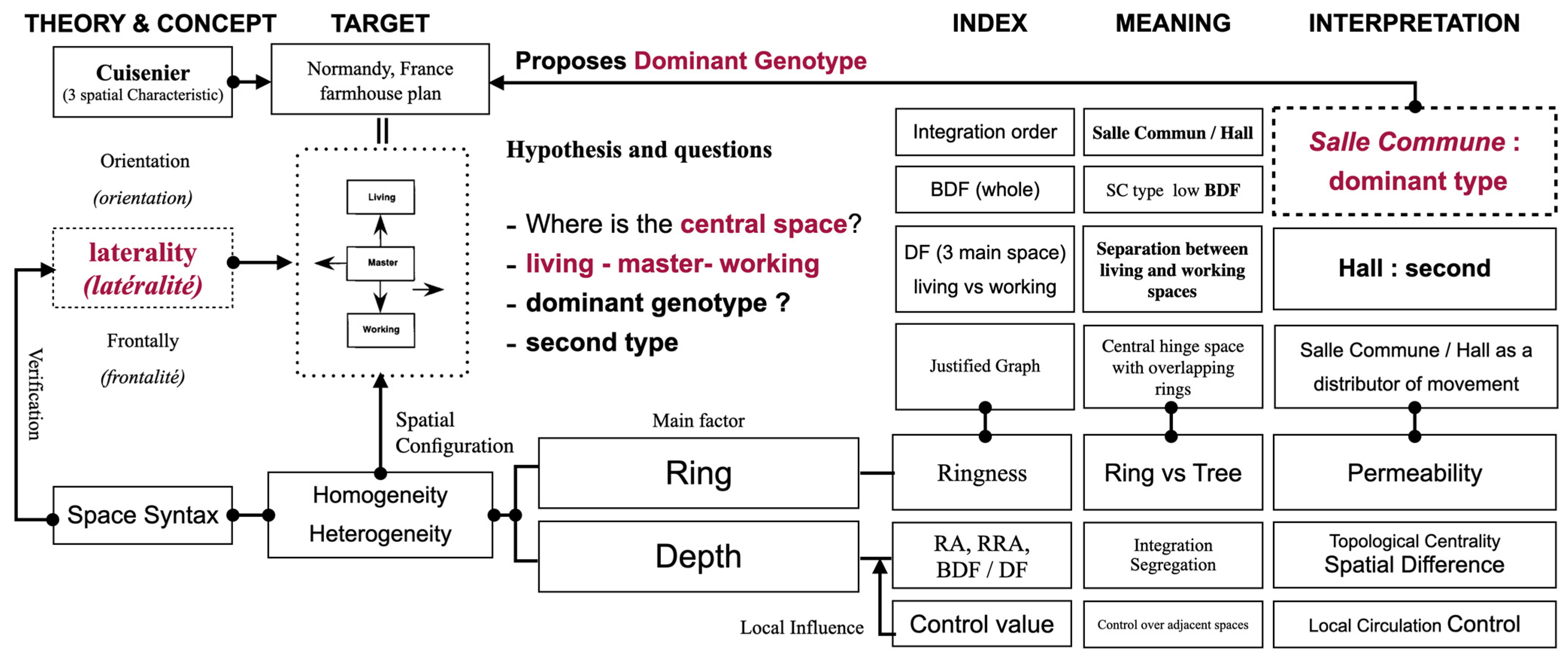
The analysis revealed that the central space was not the master’s room, as Cuisenier had proposed, but the salle commune, a shared space used for cooking, heating, and family gathering. The second step assessed the overall structural inequality of the spatial system by calculating the DF (H*: relative difference factor), which measures the degree of uniformity in spatial connections. Consistently low DF values were observed in cases where the salle commune emerged as the central space, confirming that this space exercised concentrated control over access and movement throughout the system. The third step classified the spaces into functional categories—living, working, and salle—and compared the DF values across these groups to examine their structural relationships. This analysis demonstrated that latéralité operates not as a symmetrical lateral division but as a functional separation mediated through the central salle commune, with living and working zones connected through this hub while remaining spatially distinct from one another. Synthesizing the integration order, BDF, ring structure indicators (SLR, RC, RD), real relative asymmetry (RRA), and control values, Hillier et al. identified two genotypes: a dominant salle commune type, in which the everyday family-living space constitutes the integration center between living and working zones; and a secondary Hall type, in which a transitional corridor space performs the distributional function [3].
A particularly significant finding is that the salle commune, while constituting the structural core of the dwelling, was typically the domain of women. This directly contradicts Cuisenier’s attribution of spatial centrality to the male master and reveals that the core of domestic life is organized around caregiving, labor, and family interaction, thereby reconfiguring the meaning of latéralité from a symbolic male-centered hierarchy toward a spatial logic grounded in everyday practice. By presenting this empirical evidence, Hillier et al. demonstrate that spatial centrality in residential architecture is not inherently linked to authority but may emerge from the structural logic of family life.
Accordingly, the significance of this methodology lies in its underlying logic: space syntax is employed as a means of verifying a socially grounded spatial hypothesis rather than as a pattern detection tool applied to floor plan data, establishing a foundational precedent for space syntax-based genotype identification. Table 1 summarizes thirteen post-Hillier space syntax studies of residential spatial genotypes organized along three analytical axes: the presence of a prior theoretical hypothesis, the application of a DF diagnostic prior to integration core classification, and the relationship between the corpus scale and the number of genotypes identified.
Table 1.
Review of existing research on genotype discovery in domestic spatial configurations.
These axes are selected because they correspond directly to the three methodological conditions under which Hillier et al.’s classification procedure was originally validated: an explicit socio-spatial hypothesis grounded in the concept of latéralité, a prior structural diagnosis confirming that the corpus displayed sufficient integration inequality to sustain a single-maximum classification, and a corpus-to-genotype ratio consistent with statistical recurrence. Mapping the subsequent studies along these axes reveals a systematic pattern of methodological drift that neither invalidates the individual studies nor diminishes their empirical contributions, but exposes a set of unverified assumptions that have accumulated within the tradition.
Group A—Methodological Extension: The studies extending genotype identification across cultural and geographical contexts—Orhun et al. [4,5] on traditional Turkish houses, Kim and Kwak [7] on 1930s Korean urban hanoks, Zolfagharkhani and Ostwald [10] on Yazd courtyard houses, Xu et al. [8] on Chinese rural farmhouses in Zhejiang Province, and Lei and Li [9] on Tibetan vernacular dwellings in Ganzi County—share a common analytical architecture while adapting it to diverse residential forms. The most significant methodological contribution within this cluster is Orhun et al.’s introduction of the deep core and shallow core distinction [4,5], which demonstrated that genotypical differentiation can be grounded in the structural relationship between the integration core and the spatial boundary rather than in the identity of the single most integrated space alone; this reframing remains the most influential extension of Hillier et al.’s framework within the tradition. The subsequent studies in this cluster confirmed that persistent underlying spatial logics operate beneath surface typological variations across cultural contexts. However, as Table 1 indicates, none applied a prior DF/BDF diagnostic to the distributional properties of the corpus under analysis, retaining the ranking procedure as a default assumption rather than as a validated methodological choice.
Group B—Diachronic and Social Genealogy: Hanson [2], Hillier and Hanson [36], and Bustard [37] extended genotype analysis into diachronic comparison, demonstrating that spatial configurations evolve in a systematic correspondence with transformations in social organization. Hanson’s analysis of 47 Banbury yeoman farmhouses identified four historically sequential plan configurations corresponding to the changing structures of family authority [2]. Hillier and Hanson’s comparison of working-class and middle-class London terraced houses identified class-differentiated genotypes within an architecturally uniform shell [36]. Bustard’s study of Chaco Canyon room blocks traced progressive spatial compartmentalization as evidence of the shift from residential to ritual function [37]. The collective insight of this cluster was that spatial genotypes are not static formal categories but historical configurations: what constitutes a genotype at one period may be superseded by a structurally distinct configuration as the social conditions generating it change. The analytical implication is that genotype identification requires not only cross-case comparison within a synchronic corpus but also attention to the generative social principle that the configuration materializes—a requirement that brings the question of prior hypothesis into sharp relief.
Group C—Socio-normative Encoding: Byun [6], Seo [38], and Elizondo et al. [39] approached genotype identification from an explicitly normative orientation, treating spatial configurations as materializations of cultural ideology embedded in built form. Byun’s large-scale analysis of 4859 Korean apartment floor plans identified the living room as the dominant integration center across nearly five decades of construction, interpreting this centrality as the spatial successor of the Daecheong hall in traditional hanoks [6,40]. Seo demonstrated that the binary distinction between floor levels constitutes a persistent genotypical code in Seoul domestic architecture, governing the organization of social conduct, bodily practice, and spatial hierarchy across diverse residential types [38]. Elizondo et al. showed that spaces associated with care and reproductive labor are consistently positioned at the configurational periphery in Mexican middle-class housing, materially encoding patriarchal norms that would otherwise remain culturally invisible [39]. As Table 1 indicates, none of these studies stated an explicit prior hypothesis; the interpretive frameworks were developed post hoc from the observed configurational patterns. This does not diminish the significance of the findings, but it does mean that the genotype claims advanced in these studies are interpretive rather than verifiable against a prior theoretical condition in the strict sense defined by Hillier et al.’s procedure.
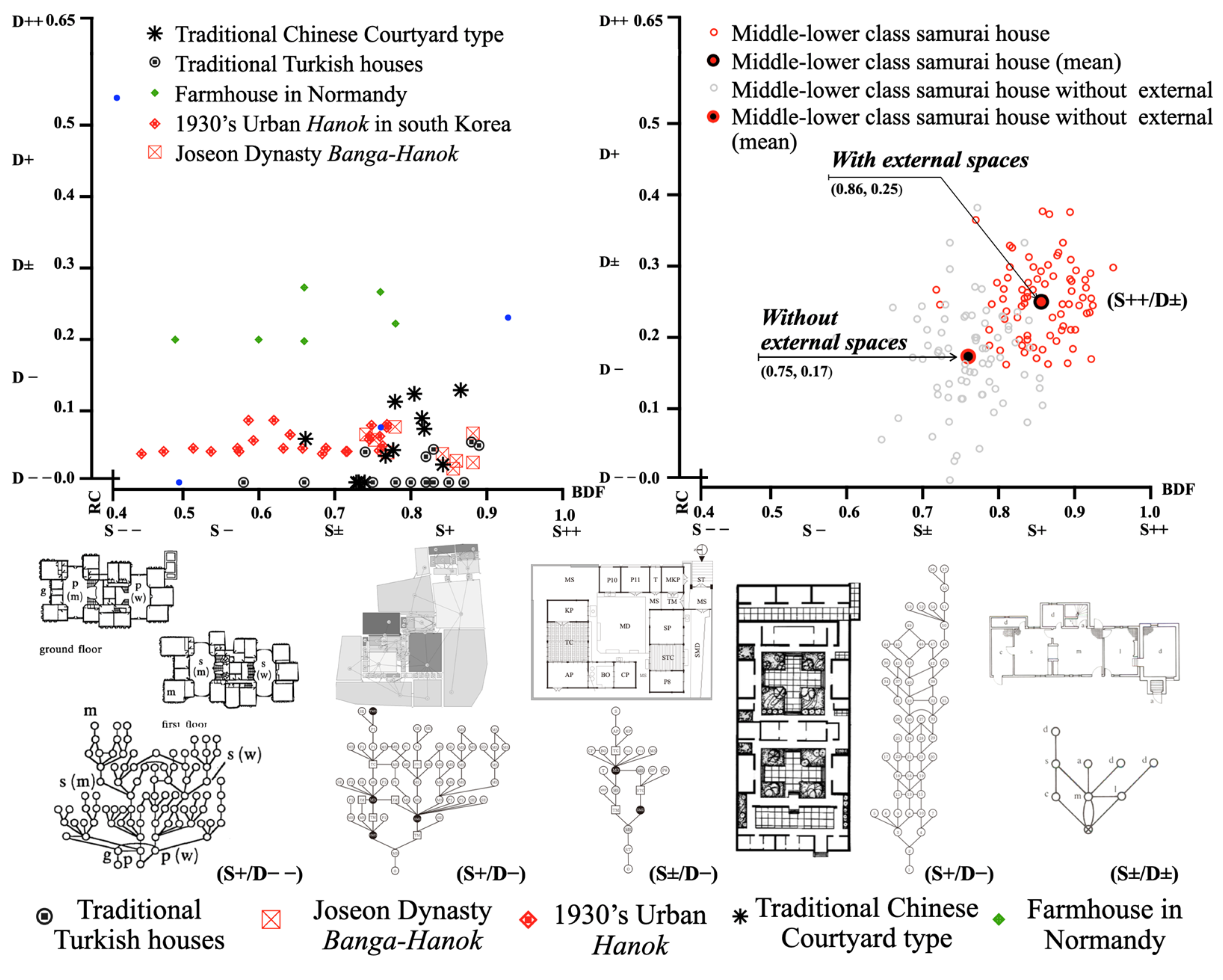
The two studies most directly relevant to the present investigation analyzed the same 77-case corpus of Edo middle–lower-class samurai residences. The study reported in [16] applied a Multiple Carrier Space (MCS) analytical model to the corpus, incorporating exterior boundary elements into the configurational analysis. The results identified liminal elements, such as Doma and Engawa, as layered boundary interfaces mediating between the social exterior and the familial interior, and demonstrated that Edo middle–lower-class samurai residences formed a configuration with a high degree of connectivity to exterior spaces, a structural characteristic that single-maximum integration analysis is not designed to capture. The study reported in [17] reexamined the Sekkyaku-honi thesis from a space syntax perspective, applying justified graphs, integration values, and relative depth analysis to all three plan types in the corpus. The results consistently positioned Ura spaces, primarily Chanoma and Ima, as the most highly integrated nodes, with Zashiki retaining symbolic but not configurational centrality, confirming that Ura-centered integration constitutes a structurally consistent cross-case tendency independent of plan type or Zashiki orientation (see Figure 3).
Together, these studies established that the configurational core of Edo samurai residences is located in the family-living sector rather than in the reception domain. However, as Table 1 indicates, neither study determined whether this tendency constitutes a recurrent spatial genotype defined by the co-occurrence of Ura integration centrality and boundary/access control values, and neither applied an explicit top 10% upper-integration-band co-presence analysis appropriate to the distributional properties of the corpus. The gap between demonstrating a structurally consistent tendency and identifying a recurrent genotype forms the direct analytical point of departure for the present study. A critical reading of Table 1 reveals three methodological conditions that recur across this body of work and directly inform the analytical design of the present study. The first is the systematic absence of a prior theoretical hypothesis: as Table 1 shows, the majority of studies proceeded without a stated hypothesis and generated interpretations post hoc from observed configurational patterns, representing a progressive departure from Hillier et al.’s procedure, in which space syntax was applied specifically to test whether latéralité as a social principle was realized through spatial configuration. The second condition is the omission of a BDF diagnostic prior to applying single-maximum integration ranking: in the foundational procedure, the BDF confirmed that the corpus displayed sufficient structural inequality to sustain a dominant-node classification; its systematic absence in subsequent studies converted a context-dependent validating step into an unjustified default assumption. The third condition is typological over-classification in small corpora: the identification of four genotypes from twelve cases in [9] yielded a corpus-to-genotype ratio incompatible with a claim of statistical recurrence, since each rank-order variation in the highest integration space produced a new apparent category rather than a confirming instance of an underlying type, generating typological fragmentation rather than convergence. The present study addresses all three conditions by formulating an explicit hypothesis grounded in a prior distributional diagnosis of the corpus, employing a top 10% upper-integration-band co-presence analysis calibrated to the corpus’s structural properties, and defining the genotype through the co-occurrence of multiple configurational features rather than through rank ordering alone.
Figure 3.
Comparative configurational position of Edo middle–lower-class samurai residences within prior space syntax-based residential genotype studies, based on BDF and RC values.
2.4. Positioning of the Present Study
The review conducted in Section 2.1, Section 2.2 and Section 2.3 identifies a convergent analytical gap in the space syntax literature on residential genotypes. Although Hillier and Hanson’s genotype framework has been extended to diverse residential corpora, genotype identification in structurally homogeneous corpora remains methodologically unresolved. The single-maximum integration-ranking criterion is most effective when a corpus displays sufficient configurational differentiation to sustain a dominant integration center. Where this condition is not met, rank ordering may generate apparent typological variation rather than reveal an underlying recurrent spatial structure.
The analytical context of the present study corresponds precisely to this condition. The 77-case corpus of Edo middle–lower-class samurai residences has a mean BDF of 0.86, indicating a relatively homogeneous configurational structure. Previous studies using the same corpus have already confirmed Ura/Chanoma-centered integration as a repeated cross-case tendency, but they have not determined whether this tendency constitutes a recurrent spatial genotype. Because the present study builds on these previous studies, Table 2 clarifies which elements are reused from [16,17] and which elements are newly introduced here.
Although the present study draws on the same corpus analyzed in [16,17], it constitutes a distinct analytical investigation rather than a replication of those studies. The study in [16] focused on the structural role of carrier spaces and exterior boundary elements within the configurational system. By applying a Multiple Carrier Space analytical model, it demonstrated that Edo middle–lower-class samurai residences formed a configuration with a high degree of connectivity to exterior spaces. The study in [17], by contrast, examined the cross-case consistency of Ura-centered integration and reexamined the Sekkyaku-honi thesis from a space syntax perspective. Together, these studies established that the spatial organization of Edo middle–lower-class samurai residences cannot be adequately understood through the reception domain alone, and that Ura-centered integration constitutes a repeated structural tendency.
Table 2.
Reused elements and new contributions in relation to the previous studies.
However, neither study determined whether this tendency can be identified as a recurrent genotype, particularly under the condition that the corpus exhibits higher configurational homogeneity than many traditional housing corpora examined in previous genotype studies. The present study is designed to address this gap directly. The analytical point of departure is a possibility suggested, but not tested, by the findings of [16,17]: that the integration structure of these residences may not be organized around a single dominant node, but may instead involve the recurrent co-presence of multiple highly integrated spaces.
Building on this observation, the present study extends the conventional single-maximum approach by adopting a top 10% upper-integration-band criterion and co-presence analysis. This criterion, grounded in the genotype identification framework of Hillier and Hanson and in the analytical use of integration cores in space syntax research, identifies the upper tier of integration across each plan rather than a single maximum-ranked space, enabling co-presence patterns to be detected without privileging any one space by identity.
This procedure is combined with a control value assessment of boundary/access spaces in order to examine whether the recurrent relationships among Ura family-living spaces, boundary/access spaces, and intermediary spaces within the upper integration band are accompanied by consistent boundary-control diagnostics. The methodological procedures through which this question is operationalized are detailed in Section 3. The contribution of the present study lies in reexamining the spatial logic of Edo middle–lower-class samurai residences at the level of recurrent configurational structures. By testing whether a recurrent genotype can be identified through upper-integration-band co-presence and boundary/access control across the corpus, the study aims to clarify the underlying spatial organization of Edo middle–lower-class samurai residences and to reconsider the Sekkyaku-honi interpretation in configurational terms. This question is addressed through the empirical analyses presented in Section 4 and Section 5.
3. Materials and Methods
3.1. Corpus: Case Selection and Spatial Scope
This study examines a corpus of 77 Edo middle–lower-class samurai residences. The focus on this residential stratum follows previous studies that have regarded middle- and lower-class samurai houses as a foundational typology in the spatial formation of modern Japanese detached urban housing [11,41,42,43,44]. Ooka and Aoki [12] define middle- and middle–lower-class samurai residences as broadly corresponding to households with stipends of approximately 50 to 150 koku (石), and note that houses in this stratum typically shared a basic spatial sequence connecting the public road, the estate entrance, the Genkan (玄関: formal entry vestibule), and the Zashiki (座敷: formal reception room). This observation indicates that the spatial structure of these residences was not confined to interior room arrangement but was articulated through the relational configuration of the public road, plot boundary, exterior threshold spaces, and formal reception domain. The corpus was constructed from two complementary sources. Among the 77 cases, 34 were reconstructed from historical plan materials, while 43 were documented from extant remains, restored residences, or field-surveyed (red number) buildings (see Figure 4 and Figure 5).
Figure 4.
Regional distribution of the analytical corpus.
The historical materials (blue number) were drawn from prior studies on Edo middle- and middle–lower-class samurai residences [12,13,31,32,33,34,35]. From these published sources, only plans that clearly indicated the plot boundary, exterior spatial divisions, principal room functions, and room-to-room permeability relations were included; plans lacking sufficient information on exterior zones, access relations, or functional room labels were excluded. The case selection followed four criteria applicable to both source types: (1) the boundary of the residential plot must be identifiable; (2) the exterior spaces, including the entry court, front garden, and other threshold zones, must be sufficiently legible; (3) the functions of major interior spaces, including Zashiki, Tsuginoma, Chanoma, Ima, Daidokoro, and service-related rooms, must be identifiable from labels, records, or spatial context; and (4) the permeability relations among rooms and between the interior and exterior spaces must be reconstructable for the production of convex maps and justified graphs. For the 43 cases based on extant remains or restored buildings, systematic field visits were conducted between 2017 and 2021. For each case, architectural drawings were produced or verified on site, photographs were taken, and the spatial relationships among connected units were recorded in detail. Particular attention was given to the entrance sequence; the spatial divisions of the exterior zone; the relationship between the plot boundary and the main building; and the permeability relations among the interior, intermediate, and exterior spaces. In cases involving restoration or partial reconstruction, inclusion was limited to examples in which the spatial structure relevant to the analysis, including the plot boundary, entrance sequence, and room-to-room access relations, could be confirmed through on-site observation and available documentary records.
Figure 5.
Analytical plan corpus of 77 Edo middle–lower-class samurai residences.
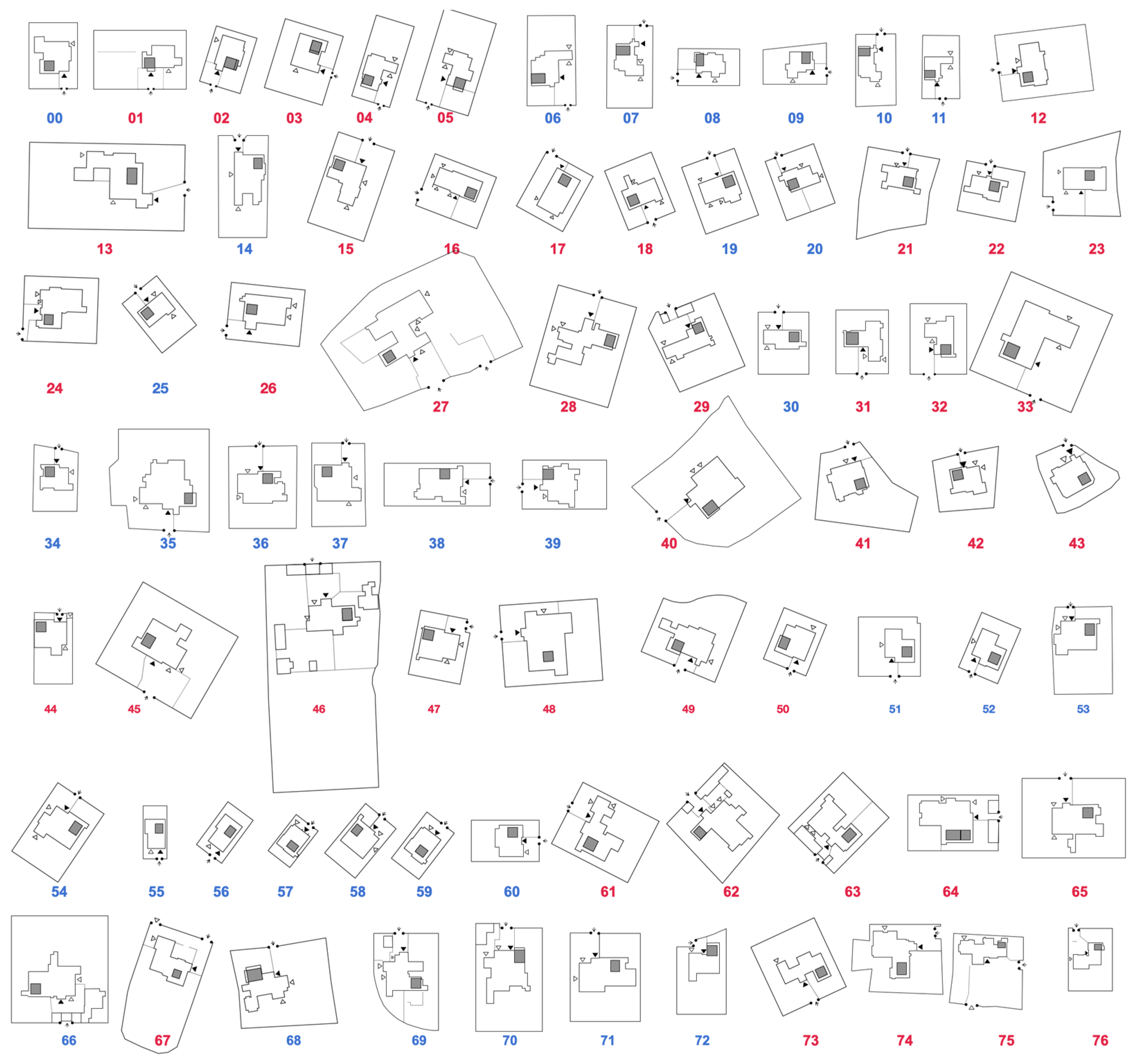
The 77 cases are geographically distributed across multiple domains and prefectures, spanning northern, central, western, and southern Japan. This geographical breadth demonstrates that the configurational patterns examined in this study are not region-specific phenomena but reflect a planning logic consistent across the diversity of Edo-period samurai residential culture. The corpus is not intended to support a regional typology; rather, it provides a comparative basis for examining whether a recurrent configurational structure can be identified across a historically and geographically varied set of cases. For the purposes of syntactic analysis, the spatial scope of each residence is organized into three categories.
The exterior spaces include the public road, entry court, front garden, rear garden, and other open areas within or immediately adjacent to the plot boundary. The intermediate spaces include transitional elements, such as Engawa (縁側: veranda) and Doma (土間: earthen-floor space), which mediate between the exterior and interior domains. The interior spaces include reception rooms, family-living rooms, service spaces, and other enclosed domestic rooms. The public road is included as the analytical root of each justified graph, following the carrier space modeling approach established in [16], on the premise that access regulation for these residences begins at the interface between the public domain and the plot boundary. Each of the 77 cases is standardized into a syntactic model on the basis of these spatial categories, applying consistent principles of spatial segmentation, functional labeling, and permeability reconstruction.
This modeling strategy provides the analytical foundation for examining whether the distributional properties of the corpus require an alternative criterion to conventional single-maximum integration value classification, a question addressed in the following section.
3.2. Syntactic Modeling and Analytical Workflow
Each of the 77 cases was converted into a convex spatial model following a four-stage analytical workflow: floor plan documentation, convex map preparation, syntactic index calculation using DepthmapX (v0.8.0), and justified graph construction (see Figure 6). The convex map for each case was prepared using a modified spatial model that incorporated exterior spaces as discrete analytical units alongside interior rooms. This modification extends the conventional interior-only convex map by including the public road, entry court, front garden, rear garden, Engawa, and Doma as separately delineated convex spaces (see Figure A3).
Figure 6.
Workflow of space syntax analysis.
The inclusion of these exterior and intermediate spaces followed the carrier space modeling principle established in [16]: the access structure of Edo middle–lower-class samurai residences originates at the public road and extends through a sequence of threshold spaces before reaching the domestic interior, and this structure cannot be fully captured by the interior room relations alone. Syntactic indices were calculated for all convex spaces in each model using DepthmapX software. The measures computed include the integration (I(i) = 1/RRA_i), control value, mean depth (MD), relative asymmetry (RA), real relative asymmetry (RRA), and relative connectedness (RC). The degree of integration differentiation within each case was assessed using two related measures. The BDF (Base Difference Factor) was calculated as the DF for the minimum integration value, the arithmetic mean integration value, and the maximum integration value of all convex spaces in each case, providing a system-level index of the available range of configurational differentiation. The DF (H*: relative difference factor) was calculated as an entropy-based measure of the degree of difference among the integration values of three specified functional spaces within each case, with lower values indicating stronger differentiation and values approaching 1 indicating near-uniform integration among those functions. The formula definitions follow Hillier and Hanson [1,2] and are reproduced in Figure 6 for reference. Two parallel datasets were produced for each case: one including all spaces with exterior carrier spaces, and one excluding them. The comparison of these two datasets supported evaluation of whether the boundary/access spaces contributed independently to the configurational structure of each residence. Justified graphs were constructed for all 77 cases using the public road as the analytical root, consistent with the procedure applied in [16,17]. The convex space segmentation followed Hillier and Hanson’s principle of identifying the “fewest and fattest” convex spaces, while adapting this rule to the spatial conventions of traditional Japanese houses. For interior spaces, rooms defined by fusuma (襖), shoji (障子), columns, floor divisions, ceiling lines, and sliding tracks were treated as separate convex spaces and were not merged simply because movable partitions could be opened. Built-in storage (押入れ) elements, such as closets and Tokonoma (床の間), were excluded, whereas Nando (納戸) and Engawa (縁側) were segmented as independent spaces when they functioned as habitable, storage, circulation, or intermediary spaces. For exterior spaces, the same “fewest and fattest” principle was applied, but visually continuous exterior areas were divided when low fences, planted screens, light architectural elements, level differences, or distinct entrance routes indicated separate boundary/access zones (see Table 3).
Table 3.
Convex space segmentation criteria.
Each convex space was represented as a node, each direct permeability connection as an edge, and the topological depth from the public road defined the vertical axis. The resulting combination of integration values, control values, BDF, and justified graph distribution patterns provided the syntactic basis for the genotype identification procedure described in the following section.
3.3. Genotype Discrimination Diagnosis and the Top 10% Upper-Integration-Band Criterion
Hillier, Hanson, and Graham’s analysis [3] of Normandy farmhouses established a foundational procedure for identifying residential spatial genotypes. Their classification combined a justified permeability graph analysis with an integration order analysis, and defined the dominant genotype through four co-occurring conditions: the most integrated space was the principal living space, the salle commune; this space was shallow from the exterior; it laid on all non-trivial circulation rings; and it mediated between living and work-related functions. Table 4 summarizes the contrast between the genotype and non-genotype groups derived from this procedure. In the genotype group, the integration peak is occupied by the salle commune, a functional living space. In the non-genotype group, by contrast, the most integrated space shifts toward transitional spaces, such as the vestibule. This indicates that the distinction between the two groups is not based simply on the numerical rank of integration, but on whether a specific functional space consistently occupies the most integrated position and performs a recurrent configurational role. This distinction is further supported by the BDF–DF relationship shown in Figure 7. The BDF, calculated from the minimum, mean, and maximum integration values of each case, expresses the system-level degree of configurational differentiation. The DF, by contrast, is calculated from three selected functional spaces and therefore indicates how far this system-level differentiation is actually expressed through functional assignment. In Hillier et al.’s analysis, the genotype cases show a lower DF mean, indicating stronger differentiation among the selected functional spaces, whereas the non-genotype cases show a higher DF mean, indicating weaker differentiation and a tendency toward functional homogenization (see Figure A2).
Table 4.
Diagnostic summary of genotype and non-genotype cases in previous study [3].
Figure 7.
Diagnostic assessment of configurational differentiation using BDF and DF [3].
This diagnostic logic is useful for the present study, but it cannot be directly transferred into a classification criterion. In the 77 Edo middle–lower-class samurai residences, the BDF values are already concentrated mainly between 0.83 and 0.90.
This means that the overall integration distributions of the cases are highly compressed, and that the system-level potential for producing sharply differentiated functional spaces is limited. Although the BDF is not a mathematical lower bound for all possible three-space combinations, it provides a baseline indication of the differentiation available within the graph before specific functions are selected. Therefore, unless the selected three functional spaces occupy highly polarized positions in each case, their DF values are unlikely to fall into a strongly differentiated range. Accordingly, a genotype classification based solely on the DF of three predefined functional spaces would have limited discriminatory power in this corpus.
The problem is not that the Edo samurai residences lack recurrent spatial structures, but that their spatial centrality is not organized around one clearly dominant functional room. Rather, integration tends to be distributed across a set of closely ranked spaces. For this reason, the present study shifts the unit of genotype discrimination from a single maximum-ranked functional space, or a three-space DF comparison, to the upper tier of the case-level integration distribution.
To address this limitation, the present study replaces the single-maximum classification with a top 10% upper-integration-band criterion. Rather than identifying a single maximum-ranked space in each case, this criterion extracts the subset of spaces occupying the upper tier of the case-level integration distribution. The concept of the integration core, and the use of proportional thresholds to operationalize it, are established conventions within space syntax methodology. Hillier defines the integration core as the set of most-integrating spaces in a system, and explicitly identifies the top 10% of axial lines as constituting the integration core in building scale analysis. Hillier and Hanson further specify that analytical thresholds of 10%, 25%, or 50% of the most integrated spaces may be applied depending on the system size and analytical purpose [1]. Klarqvist formalizes this convention in definitional terms, stating that the 10% most integrated spaces are normally referred to as the integration core [45,46,47]. The configurational character of this core, including whether it penetrates throughout the system or remains locally concentrated, and whether it forms a wheel-like structure with a central hub and radiating spokes or a spine-like linear axis, constitutes a fundamental property of any spatial layout [1,45].
On this basis, the present study adopts the top 10% threshold as the primary operational criterion. Two considerations support this choice. First, residential buildings occupy a substantially smaller spatial scale than the urban districts and settlement grids for which broader thresholds, such as 25% or 50%, were originally developed. In previous studies, broader thresholds, such as the top 40% of integrated spaces, have been used to identify deep core and shallow core patterns in traditional courtyard houses [4,5]. Applying a wider threshold to a spatially compact corpus risks incorporating a large proportion of the spatial system within the defined core, thereby reducing its discriminatory capacity. This concern is particularly relevant to the Edo middle–lower-class samurai residences examined here, which exhibit a relatively homogeneous and dispersed configurational structure, as indicated by the high mean BDF value and the distributed ring structure shown by the RC (Figure 3). Second, the 10% threshold represents the most conservative operational definition available within the existing literature, and is therefore appropriate as a primary criterion in a corpus where spatial differentiation is comparatively limited. To assess the stability of the resulting classification, a threshold sensitivity analysis was conducted across the nominal upper integration bands from 5% to 40%.
Therefore, a stricter and more selective threshold is required. The top 10% upper-integration-band criterion captures the most integrated tier of each spatial system without reducing the analysis to a single maximum-ranked node. This makes it possible to compare recurrent co-presence patterns among Ura family-living spaces, boundary/access spaces, and intermediary spaces across cases. This integration-order criterion is then combined with a control value analysis of boundary/access spaces. The control value measures the degree to which a given space controls access to its immediate neighbors relative to the total connectivity of those neighbors [1,2]. In the present study, the control value is used to examine whether any boundary/access space consistently performs a boundary-control role across the 77 cases.
Figure 8 presents the integrated analytical framework of the present study, linking the theoretical reexamination of Sekkyaku-honi to the three research questions and their corresponding syntactic indicators. The integration order and BDF address the methodological limit of single-maximum classification in a structurally homogeneous corpus. The top 10% upper-integration-band co-presence analysis examines whether recurrent relational patterns emerge among Ura family-living, boundary/access, and intermediary spaces. The justified graph distribution analysis identifies how these relational patterns are expressed as configurational states. Finally, the control value analysis assesses whether a specific boundary/access space functions as a recurrent boundary-control anchor. Through this sequence, the study tests whether the observed configurational regularities can be interpreted as a Boundary-Regulating Genotype.
Figure 8.
Framework for extracting spatial genotypes.
4. Analysis Results
This section presents the empirical results in relation to the three research questions. Section 4.1 evaluates the limitation of single-maximum integration value classification by examining the BDF distribution of the 77-case corpus and the resulting fragmentation of highest-integration type. Section 4.2 applies a threshold sensitivity analysis and top 10% upper-integration-band co-presence analysis to examine whether recurrent relational patterns emerge among Ura family-living spaces, boundary/access spaces, and intermediary spaces. Section 4.3 then examines how these patterns are expressed as configurational states in justified graphs rooted at the public road, and tests whether the entry court functions as a recurrent boundary-control anchor across those states.
4.1. Limits of Single-Maximum Classification
To answer RQ1, the conventional single-maximum integration value classification was first applied to the 77-case corpus. In this procedure, each house was assigned to the spatial type corresponding to the convex space with the highest integration value. The aim of this step was deliberately limited. It was not intended to establish a definitive genotype, but to test whether the conventional highest-value criterion could generate a stable and dominant type distribution in a corpus characterized by high configurational homogeneity.
As summarized in Table 5 and visualized in Figure 9a,b, the single-maximum classification produced sixteen apparent single-maximum types. The most frequent type is K, corresponding to Ima–Chanoma in the Ura domain, which appears in 19 cases, or 24.7% of the corpus. The second most frequent type is A, the entry court, with 13 cases, or 16.9%, followed by J, Daidokoro–Chanoma, with 10 cases, or 13.0%. Together, these three types account for 42 cases, or 54.5% of the corpus. However, the remaining 35 cases, or 45.5%, are dispersed across thirteen minor types, each appearing in only one to five cases. No single type accounts for even one quarter of the corpus, and the distribution lacks a clearly dominant configurational center. This result suggests that the single-maximum criterion captures local rank differences among closely positioned spaces rather than a stable genotype. In a corpus where integration values are relatively evenly distributed, the highest-ranked space may shift from case to case without indicating a fundamental difference in spatial organization.
Although the frequent appearance of K and J confirms the importance of family-living spaces within the Ura domain, and the appearance of A suggests that boundary/access spaces may also occupy high integration positions in some cases, the overall result is fragmented.
Table 5.
Summary of apparent single-maximum types in 77 Edo middle–lower-class samurai residences.
Figure 9.
Fragmentation of single-maximum integration types and their BDF distribution. (a) Frequency distribution of sixteen single-maximum integration types; (b) BDF distribution by type.
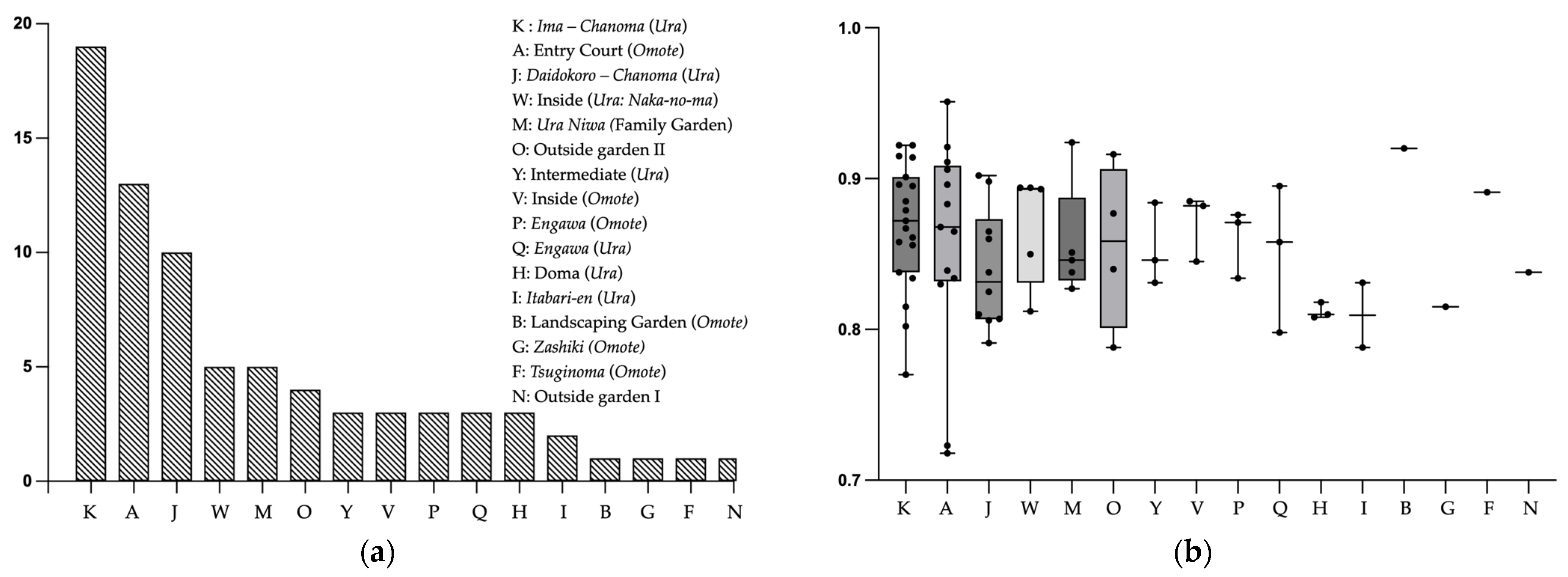
The classification produces a broad range of apparent types rather than a stable recurrent pattern. This suggests that the single-maximum criterion is highly sensitive to small rank differences among spaces with similar integration values. The BDF is therefore used only as a diagnostic measure to examine whether this fragmentation is associated with weak differentiation among the integration values. In the present study, the BDF is calculated for each case from the minimum, arithmetic mean, and maximum integration values of all convex spaces in the spatial system. The overall mean BDF of the 77 cases is 0.86, and the three most frequent single-maximum types also show high mean BDF values: K = 0.869, A = 0.862, and J = 0.840. These values indicate that integration is not strongly concentrated in a single dominant node, but is distributed relatively evenly across each spatial system. However, the BDF is not treated here as an independent genotype classifier. Rather, it is used as a supplementary diagnostic index that clarifies why the single-maximum classification is unstable in this corpus.
This point is important because the fragmentation observed in Figure 9a, together with the frequency distribution summarized in Table 5, should not be interpreted as evidence of sixteen distinct genotypes. Rather, it reflects the methodological limitation of applying a single-maximum criterion to a structurally homogeneous corpus. In other words, when several spaces have relatively similar integration values, the identity of the highest-ranked space may vary from case to case without necessarily indicating a fundamental difference in spatial organization.
Table 6 further provides descriptive syntactic indicators for the sixteen single-maximum types, showing that these apparent type labels are not accompanied by clearly separated spatial scale or differentiation profiles.
Table 6.
Descriptive statistics of spatial types based on syntactic indicators.
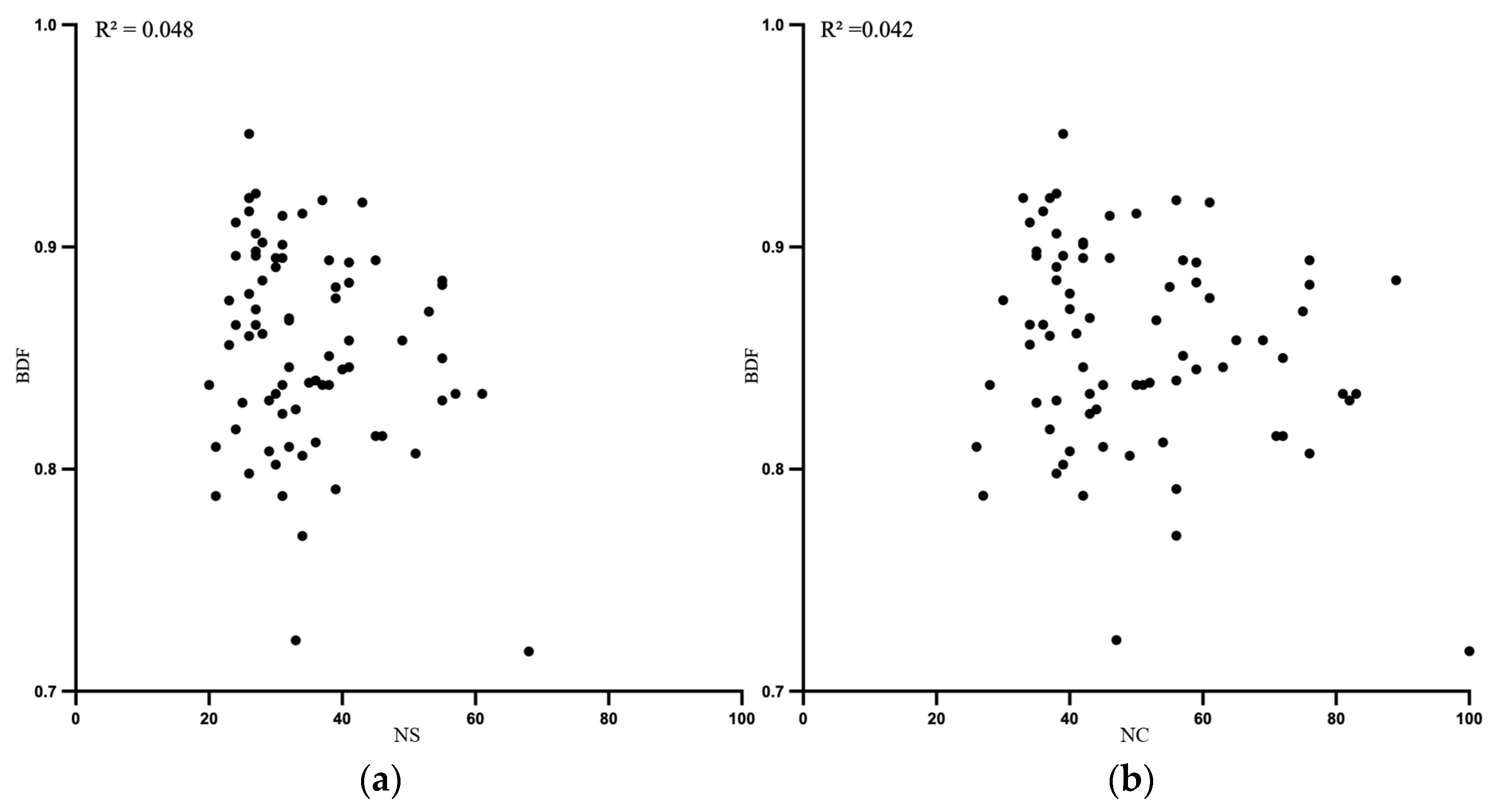
The relationship between the BDF and the basic spatial scale further supports this interpretation. As shown in Figure 10, the BDF shows only a weak relationship with both the number of spaces and the number of connections, with very low explanatory values (R2 = 0.048 and R2 = 0.042, respectively). This indicates that the high BDF values are not simply a by-product of house size or network density, but reflect the relatively homogeneous distribution of integration within each spatial system.
Therefore, the single-maximum classification captures local rank differences, but it does not adequately reveal the underlying recurrent configurational structure. These results answer RQ1 in a deliberately limited way. The 77-case corpus does not support the identification of a dominant spatial genotype through single-maximum integration value classification. The principal evidence for this conclusion is the fragmentation of the maximum-integration types into sixteen apparent patterns, none of which dominates the corpus. The BDF results support this interpretation only as a diagnostic indication of weak differentiation among the integration values. The following section therefore applies the top 10% upper-integration-band co-presence analysis in order to examine whether recurrent relational patterns can be identified beyond the instability of single-maximum-value ranking.
Figure 10.
Relationship between BDF, spatial scale, and connectivity. (a) Number of spaces and BDF; (b) number of connections and BDF.
4.2. Recurrent Co-Presence Patterns in the Upper Integration Band
The preceding section showed that the single-maximum integration criterion fragments the 77 cases into sixteen apparent single-maximum types. This result does not necessarily mean that the corpus lacks recurrent configurational regularities. Rather, it suggests that such regularities may not be adequately captured by identifying only the single most integrated space in each case. Therefore, this section extends the analysis from the highest-ranked space to the broader upper integration band. The aim is not yet to define final genotypical states, but to examine whether recurrent co-presence patterns can be detected among the highly integrated spaces.
For this purpose, a threshold sensitivity analysis is conducted across the nominal upper integration bands from 5% to 40%. Table 7 presents the frequency with which each space code appears within each nominal band. The values in Table 7 indicate the number of occurrences of each space code, not the number of cases. This distinction is necessary because the same space code may appear more than once within a single case.
Table 7.
Space code occurrence frequencies across nominal upper integration bands.
The table shows that Ura family-living spaces are consistently prominent across the thresholds. K, corresponding to Ima–Chanoma, appears 30 times even at the 5% band and rises to 67 at the 40% band. J, corresponding to Daidokoro–Chanoma, also increases from 21 to 57. These results confirm that the Ura family-living domain repeatedly occupies a high position within the integration hierarchy.
At the same time, Table 7 shows that boundary/access and intermediary spaces are also repeatedly involved in the upper integration band. A, corresponding to the entry court, increases from 15 at the 5% band to 53 at the 40% band, while B, corresponding to the Omote-side landscaping garden, increases from 9 to 50. Intermediary spaces, such as H, M, W, Q, P, and Y, also show marked increases as the threshold expands. In particular, W and Q rise sharply at broader thresholds, suggesting that intermediary and edge spaces become increasingly incorporated into the upper integration field. By contrast, some Omote-side formal spaces, such as G and E, remain relatively weak at the narrowest bands. This indicates that the upper integration band is not simply dominated by the formal reception domain, but is repeatedly structured around Ura family-living spaces, boundary/access spaces, and intermediary interface spaces.
However, the frequency of individual space codes alone does not explain whether these spaces form recurrent relational patterns. Therefore, Table 8 examines the co-presence motifs across the same nominal upper integration bands. Unlike Table 7, the values in Table 8 indicate the number of cases in which each motif appears. The motifs are not mutually exclusive; a single case may satisfy more than one motif condition at the same threshold. The intermediary spaces are grouped as H/M/W/Q/P/Y. The purpose of Table 8 is therefore to identify the recurring combinations within the upper integration band, rather than to classify each case into a single type.
Table 8.
Sensitivity of co-presence motifs across nominal upper integration bands.
The results show a clear difference between the narrowest band and the broader upper integration bands. At the 5% level, K/J family-living spaces are present in 40 cases, while intermediary spaces are present in 46 cases. However, the co-presence of A/B and K/J is limited to only six cases, and the combined motif of A/B, K/J, and intermediary spaces appears in only two cases. Moreover, these two early cases are mediated by B rather than A, meaning that the motif is formed through an Omote garden boundary rather than through the stricter entry/access space. Thus, at the 5% level, the upper integration band mainly captures isolated integration peaks or exceptional garden-boundary variants, rather than a general boundary/access–intermediary–Ura family-living structure.
The pattern changes substantially at the 10% band. K/J appears in 55 cases, A/B in 34 cases, intermediary spaces in 66 cases, and exterior spaces in 40 cases. More importantly, the A/B + K/J motif increases from 6 to 24 cases, while the A/B + K/J + intermediary motif increases from 2 to 17 cases. The K/J + intermediary motif also rises sharply from 22 to 47 cases. These increases suggest that the 10% band begins to reveal a recurrent relational field in which boundary/access spaces, Ura family-living spaces, and intermediary spaces are jointly involved. In this sense, the upper integration band begins to shift from isolated highly integrated spaces to recurring co-presence motifs. From 15% to 25%, these motifs become more stable.
The A/B + K/J motif increases from 27 to 39 cases, and the A/B + K/J + intermediary motif increases from 25 to 39 cases. At the same time, uncoupled motifs gradually decline. K/J-only cases decrease from 30 at the 15% band to 26 at the 25% band, while intermediary-only cases fall from 9 to 1.
This indicates that, as the threshold expands, isolated family-living or intermediary spaces are increasingly absorbed into broader co-presence structures. The repeated association of K/J, A/B, and intermediary spaces therefore suggests a candidate configurational motif linking the Ura family-living domain with boundary/access and intermediary spatial fields.
Figure 11 visualizes this transition as a heatmap of selected major co-presence motifs. The heatmap shows that intermediary spaces are already widespread in the narrowest bands and become almost saturated after 20%. Therefore, the analytical focus is not on the mere presence of intermediary spaces, but on whether they co-occur with both boundary/access spaces and Ura family-living spaces. At the 5% band, boundary–family and boundary–intermediary–family co-presence remain weak. Around the 10% band, however, these relational motifs begin to increase visibly. Between 15% and 25%, the coupled motifs continue to grow while the uncoupled motifs decline. After 30%, most co-presence motifs rise sharply.
Figure 11.
Motif sensitivity heatmap.
For example, A/B + K/J reaches 52 cases at 30% and 63 cases at 40%. At these broader thresholds, the A/B + K/J + intermediary motif reaches the same values, indicating that once both boundary/access and Ura family-living spaces are included in the expanded upper integration band, at least one intermediary space is almost always absorbed as well. This convergence should therefore be read as evidence of saturation in the broader upper integration field, rather than as an additional discriminating motif. Therefore, the upper-band co-presence analysis provides two findings. First, the fragmentation observed in the single-maximum classification does not mean that the corpus lacks recurrent spatial regularities. Recurrent motifs do appear within the upper integration band, especially among Ura family-living spaces, boundary/access spaces, and intermediary spaces. Second, these motifs do not by themselves define the final genotypical classes. Because the motifs overlap and are sensitive to the selected threshold, a frequency-based co-presence analysis remains insufficient for determining a stable configurational type. The next section therefore examines the threshold sensitivity together with the graphical connectivity in order to determine whether these candidate motifs form a more stable spatial structure.
4.3. Threshold Selection and the Identification of Three Configurational States
4.3.1. Threshold Selection and Upper-Integration Distribution Patterns
Figure 12.
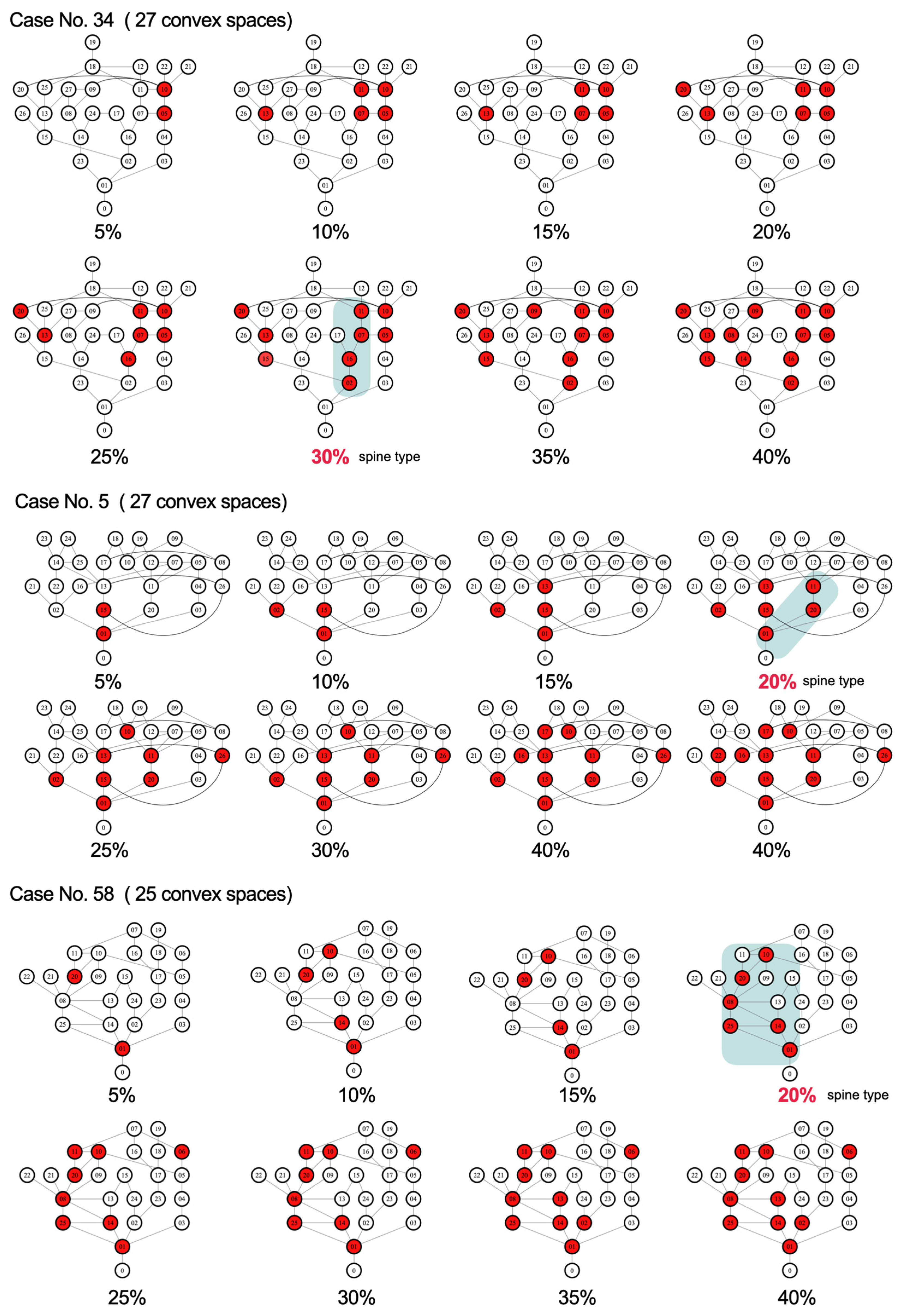
Threshold sensitivity of upper-integration distribution patterns.
The co-presence analysis in Section 4.2 shows that boundary, intermediary, and Ura family-living spaces repeatedly appear together within the upper integration band. However, frequency-based co-presence does not by itself explain how these spaces are spatially arranged within the justified graph. Nor does it determine the threshold at which a co-presence motif becomes morphologically legible. A broader threshold naturally increases the number of selected spaces, but it may also obscure the distinction between a configurational core and a general upper integration field. Therefore, this subsection shifts from frequency counts to a graphical sensitivity analysis, focusing on how highly integrated spaces change from isolated points into spatially readable configurations as the nominal upper integration band expands.
Figure 12 illustrates the threshold-based changes in the upper-integration distribution patterns through three representative cases: No. 34, No. 05, and No. 58. These cases are not introduced here as predefined configurational states, but as examples that show three contrasting distributional tendencies. They also have comparable system sizes: No. 34 and No. 05 each contain 27 convex spaces, while No. 58 contains 25 convex spaces. This comparison reduces the possibility that the observed differences are simply caused by system size, and instead directs attention to the relative position and distribution of highly integrated spaces within each graph.
The threshold sequences in Figure 12 show that the upper integration band does not expand in a single uniform way. In No. 34, the selected spaces tend to extend toward the deeper Ura family-living side. In No. 05, they remain closer to the boundary and exterior side. In No. 58, they form a more dual distribution, linking the boundary/access side with intermediary and family-living spaces. At the 5% band, however, these tendencies are only weakly legible because the selected nodes appear mainly as isolated high-integration points. As the threshold expands, these points begin to form more continuous distributional patterns. In No. 05 and No. 58, a spine-like distribution becomes legible around the 20% band, whereas in No. 34 it becomes clearer around the 30% band. This indicates that the three examples show different tendencies in the positional distribution of upper integration spaces, rather than a single uniform pattern of expansion.
Figure 13.
Threshold expansion in case No. 47.
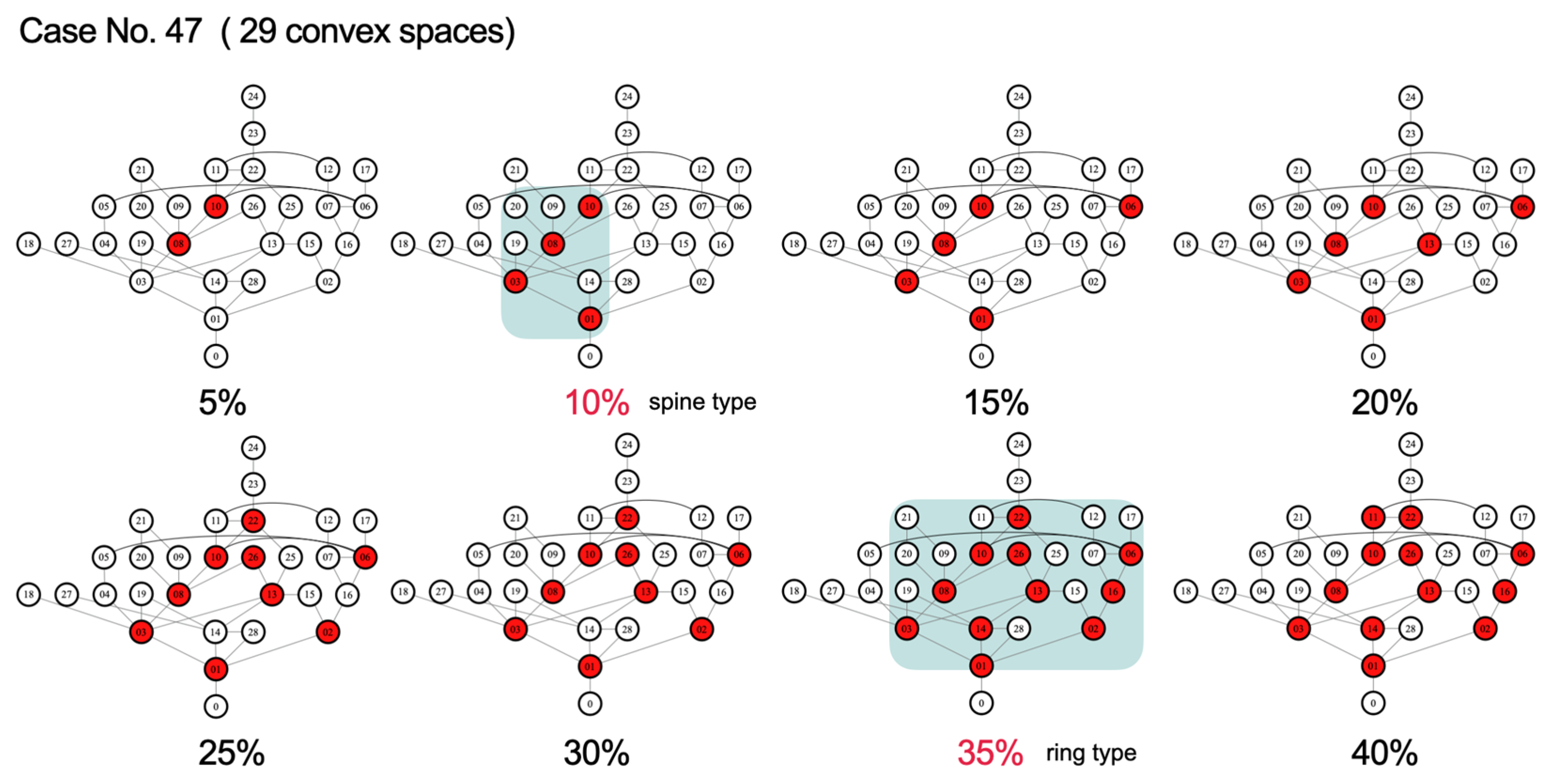
Figure 13 examines the threshold sensitivity more closely through Case No. 47 (06, 63, and 65). This case is used not as representative of a single distributional tendency, but as a methodological example for identifying the threshold at which the upper integration points first become readable as a spatial distribution pattern. At the 5% band, the selected spaces remain largely isolated. At the 10% band, however, they begin to form a spine-like distribution, allowing the upper integration field to be interpreted as a minimal spatial pattern rather than as a set of isolated peaks. As the threshold expands further, the selected field becomes thicker, and around the 35% band it develops into a broader ring-like distribution. This ring-like pattern connects the boundary, intermediary, family-living, exterior, and boundary/access spaces in a wider cyclical field. Although this broader ring is useful for understanding the expansion of the upper integration field, it is too extensive to serve as a conservative classification threshold.
Table 9 summarizes the graphical interpretation of the threshold sequence. The 5% band is too narrow because it mainly captures isolated high-integration points. The 10% band is not the threshold at which all cases become fully readable; rather, it is the earliest conservative lower-bound threshold at which a minimal chain-like distribution begins to appear in the tested sequence. The 15–25% bands provide a supportive range in which this initial distribution becomes thicker and more stable across more cases through the incorporation of adjacent or intermediary spaces. By contrast, the 30–40% bands begin to approach a broad upper integration field and, in some cases, produce ring-like distribution patterns.
Table 9.
Threshold-based interpretation of upper-integration distribution patterns.
This graphical sensitivity analysis clarifies the role of the 10% threshold. The 10% band is not selected because it maximizes the frequency of co-presence motifs. Rather, it is selected as the most sensitive graphical threshold at which upper integration spaces first begin to form a readable distribution pattern before the selected field becomes overly broad. The 5% band is too narrow, whereas the 30–40% bands are too broad.
The 10% band is therefore used as a conservative graphical threshold for the subsequent examination of configurational states. The frequency sensitivity observed around the 10% range in Section 4.2 further supports this decision, showing that boundary/access–intermediary–family co-presence begins to emerge as a recurrent motif within the same early upper integration range.
4.3.2. Identification of Three Configurational States at the 10% Threshold
Section 4.3.1 establishes the 10% upper integration band as a conservative graphical threshold. At the 5% band, the selected spaces may already indicate an initial positional tendency toward the Ura family-living side, the boundary/access side, or both. However, because this band usually consists of only one or two isolated high-integration points, it tends to under-represent relational distribution patterns, particularly the co-presence of boundary/access and Ura family-living spaces. The 10% threshold is therefore selected not as a frequency-maximizing cut-off, but as the earliest conservative lower-bound threshold at which the upper integration field can begin to be read as a minimal spatial distribution without becoming excessively inclusive. On this basis, the present subsection classifies the 77 cases according to the distribution pattern of spaces included in the 10% upper integration band. This step is necessary because the single-maximum criterion produces a fragmented typology.
When only the single most integrated space is considered, the 77 cases are divided into sixteen apparent types. However, these types do not necessarily represent distinct configurational logics. A case in which K is the single most integrated space may still involve boundary/access spaces within the upper integration field, while a case in which A is the single maximum may also be linked to the Ura family-living side through intermediary spaces. The analytical unit must therefore shift from the identity of the highest-ranked space to the broader distribution of highly integrated spaces. Table 10 defines the three 10% upper-integration distribution states used in this study. The Double distribution refers to cases in which both the boundary/access zone and the Ura family-living domain are active within the 10% upper integration band. Its primary criterion is the simultaneous involvement of A/B and K/J. Intermediary spaces are not mandatory for the assignment of this state, but they are useful for interpreting how the two domains are spatially linked. The Deep distribution refers to cases in which the 10% upper integration band is oriented toward K/J or the Ura family-living domain, while A/B is absent, weak, or delayed at the conservative threshold. The Shallow distribution refers to the opposite tendency, in which the boundary/access or exterior-side domain is dominant, while K/J is absent, weak, or delayed. Applying these criteria to the 77 cases produces 24 Double, 42 Deep, and 11 Shallow distributions (see Supplementary Materials).
Table 10.
Operational definition of three 10% upper-integration distribution states.
The Deep distribution is therefore the most frequent state at the conservative 10% threshold. This result indicates that the upper integration field of Edo middle–lower-class samurai residences is most often oriented toward the Ura family-living side when only the narrowest graphically readable band is considered. However, this should not be interpreted as evidence for a separate Deep type. Rather, the three states should be understood as different conservative expressions of the upper integration field. As shown in the threshold sensitivity analysis, broader thresholds increasingly incorporate boundary/access, intermediary, exterior, and Ura family-living spaces into the same relational field. In this sense, the Double distribution is analytically significant not because it is numerically dominant at 10%, but because it most clearly reveals the boundary–family coupling toward which the upper integration field may expand.
Figure 14.
Alluvial mapping from sixteen single-maximum types to three 10% upper-integration distribution states.
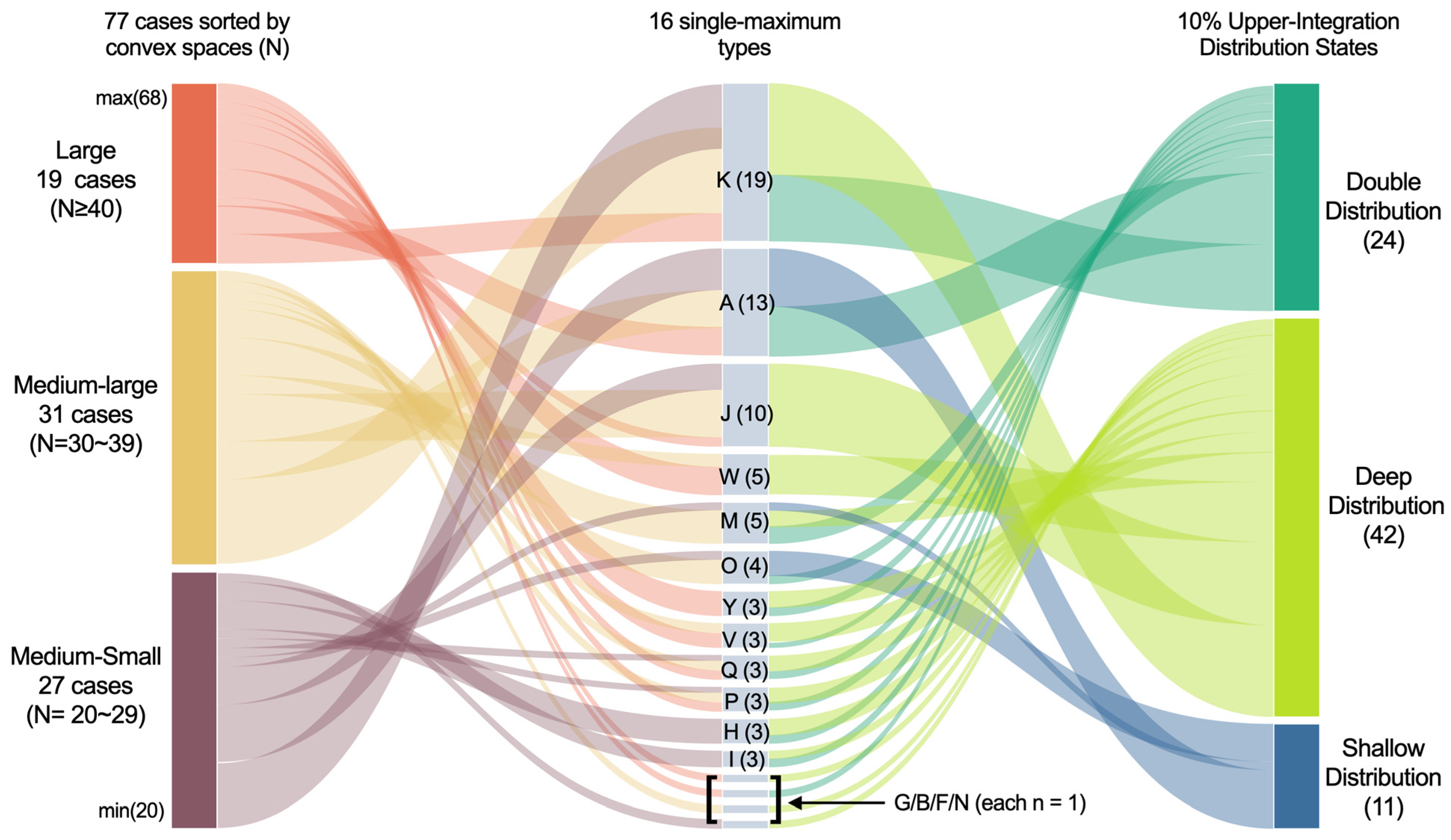
Figure 14 visualizes this reorganization process. The first column arranges the 77 cases by the number of convex spaces, the second column shows the sixteen single-maximum types, and the third column shows the three 10% upper-integration distribution states. The figure demonstrates that the sixteen single-maximum types are not final spatial types. Instead, they are apparent types generated by a one-space maximum criterion. When the 10% upper integration distribution is considered, these fragmented types are folded into three broader distribution states. The figure also shows that the final states do not correspond one-to-one with specific single-maximum labels. K-dominant cases do not all become Deep distributions, and A-dominant cases do not all become Shallow distributions. The final state depends on the relational distribution of the upper integration band, rather than on the label of the single most integrated space.
A possible methodological objection is that the 10% upper integration band includes a larger absolute number of spaces in larger houses. If this were the case, larger houses might be more likely to include both A/B and K/J within the selected band and thus be classified as Double. To address this concern, Table 11 tests whether the three-state classification is associated with graph size or connection structure. The results show no significant differences among the three states in NS, NC, NC/NS, or relative ringiness. The Kruskal–Wallis tests indicate that system size, connection count, connection density, and size-normalized ringiness do not significantly differ among the Double, Deep, and Shallow cases. The chi-square test also shows no significant association between the size band and state classification. These results indicate that the three-state classification cannot be reduced to a simple size effect or connection-count effect.
Table 11.
Tests of system-size and graph-density effects on the three-state classification.
Figure 15 provides representative examples of the three distribution states. In the Double distribution, the boundary/access zone and the Ura family-living domain are both included in the upper integration field, forming a coupled boundary–family configuration. In the Deep distribution, the upper integration field is concentrated toward the Ura family-living side, while the boundary/access zone remains outside or peripheral to the conservative 10% band. In the Shallow distribution, the boundary/access or exterior-side domain dominates the upper integration field, while the Ura family-living domain is delayed. These examples clarify that the three states are not merely statistical categories, but correspond to distinct positional tendencies within the justified graph.
Figure 15.
Representative examples of Double, Deep, and Shallow 10% upper-integration distribution states.
The results of this subsection establish an intermediate interpretive step between the single-maximum analysis and the genotype argument. The sixteen single-maximum types are not rejected, but reinterpreted as fragmented surface outcomes of a narrow maximum criterion. At the 10% upper integration level, they are reorganized into three distribution states: Double, Deep, and Shallow.
These states are not yet, by themselves, proof of a single genotype. They show how the upper integration field is differently positioned within the corpus. Whether these three states can be interpreted as different expressions of a shared boundary-regulating genotype is examined in the following subsection through the control and integration properties of A.
4.3.3. Testing the Boundary-Regulating Genotype: Control Persistence and Integration Position Shift of A
The purpose of this subsection is to examine whether the three upper-integration distribution states identified through the threshold sensitivity analysis can be interpreted as different expressions of a shared spatial genotype. Previous work [17] has already shown that the Ura family-living domain tends to occupy relatively integrated positions in Edo middle–lower-class samurai residences.
The present threshold sensitivity analysis extends this finding by showing that the upper integration field repeatedly contains a minimal distributional structure linking the boundary/access zone, intermediary spaces, and the Ura family-living domain. However, this structure was identified primarily through the graphical observation of distribution patterns. The role of the boundary/access and intermediary zones cannot be sufficiently validated by integration values alone.
The integration describes the global accessibility of spaces, while the BDF evaluates the degree of system-level differentiation. These measures are therefore useful for identifying global configurational tendencies, but they are not sufficient to capture the local boundary-control role of the entry court and related intermediary spaces. For this reason, a control value is used here as a supplementary local diagnostic to examine how the boundary/access and intermediary zones operate across the three distribution states. If A consistently occupies a high position in the control hierarchy while its integration position shifts by state, the Double, Deep, and Shallow states can be interpreted not as separate spatial types, but as different configurational expressions of a shared boundary-regulating genotype.
Figure 16.
Control persistence of A across the three distribution states.
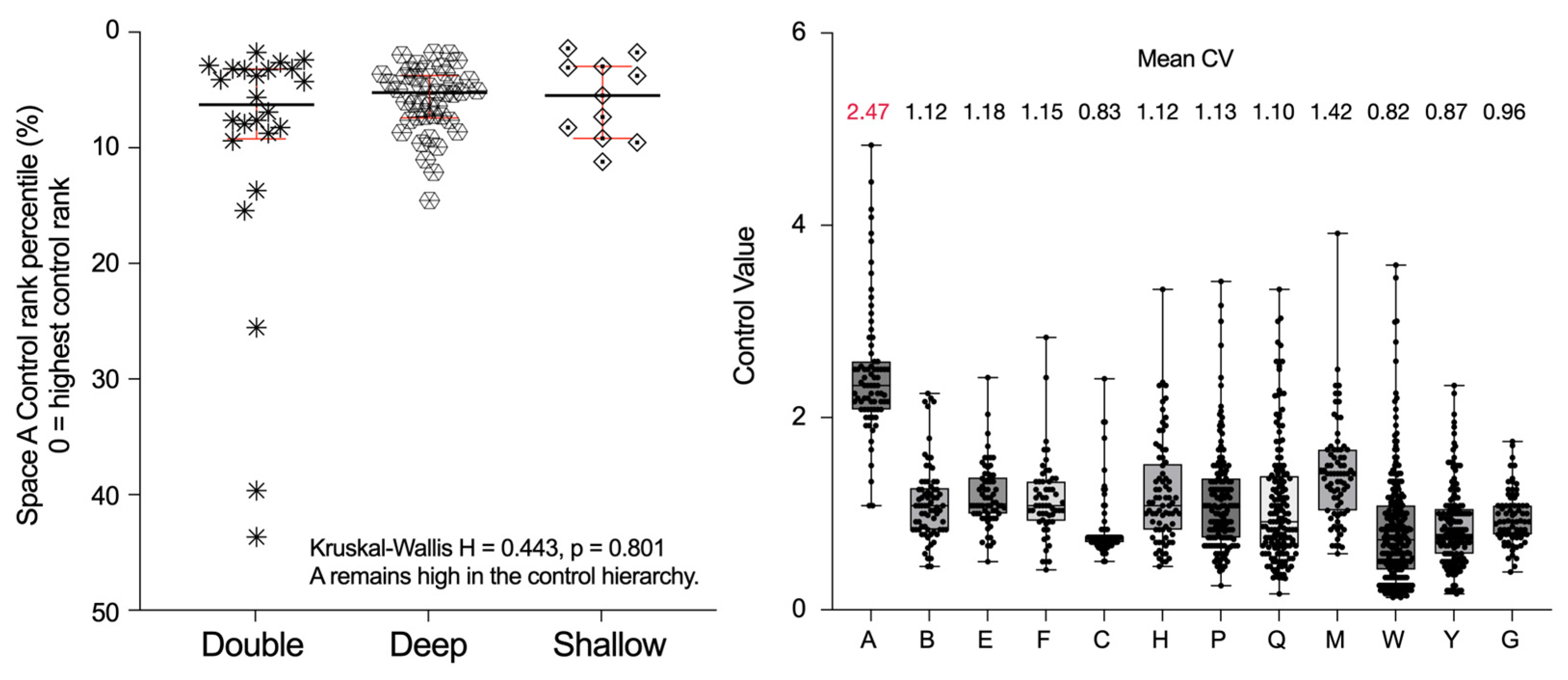
Figure 16 (left) shows the control rank percentile of A across the three distribution states. Lower percentile values indicate higher positions in the control hierarchy. Although the absolute control value of A differs significantly among the three states, A remains consistently positioned near the top of the control hierarchy. This indicates that the role of A is not limited to a particular state, nor is it reducible to the distinction between Double, Deep, and Shallow distributions. Rather, A repeatedly functions as a high-control boundary/access node across the corpus.
Figure 16 (right) further compares the control value distribution of A with those of other boundary, threshold, and intermediary spaces. A has the highest mean control value among the compared spaces, with a mean CV of 2.47. The corresponding mean values of the other spaces are substantially lower: B = 1.12, E = 1.18, F = 1.15, C = 0.83, H = 1.12, P = 1.13, Q = 1.10, M = 1.42, W = 0.82, Y = 0.87, and G = 0.96. This comparison indicates that A is not simply one transitional or hinge space among others. Rather, it occupies a distinctive position as a recurrent boundary-control node within the spatial configuration.
Table 12 summarizes these diagnostics. The absolute control value of A shows a statistically significant difference among the three states (Kruskal–Wallis H = 6.201, p = 0.045), indicating that the raw control values are not identical across states. However, A’s control rank percentile does not significantly differ by state (Kruskal–Wallis H = 0.443, p = 0.801), indicating that A’s relative position within the control hierarchy remains stable across the three states.
In 65 of the 77 cases, A is ranked within the top three control nodes, and in 73 cases it is ranked within the top five. In addition, A exceeds the mean control level of inter-mediary spaces in 76 of the 77 cases. These results show that A is not always the single strongest control node in every case, but it is almost always located within the upper control hierarchy and generally exceeds the average control level of intermediary spaces.
Table 12.
Diagnostics of A as a boundary-control anchor across three states.
The relationship between A’s control and graph-scale variables was also examined. Because the analysis relies on boundary and exterior-related variables, a source-type bias check was also conducted. The 77 cases were divided into field-surveyed cases (n = 43) and literature-derived cases (n = 34). No significant association was found between the source type and the three distribution states (χ2 = 1.826, df = 2, p = 0.401; Cramér’s V = 0.154). A’s control value also did not differ significantly between the field-surveyed and literature-derived cases (Mann–Whitney U = 749.0, p = 0.857). The same was true for A’s control rank percentile (U = 577.5, p = 0.116). These results suggest that the boundary-control diagnostics are not driven by source type or reconstruction bias.
The second diagnostic concerns the integration position of A. As shown in Table 13, A’s integration rank percentile differs strongly among the three states (Kruskal–Wallis H = 43.442, p < 0.001). A is frequently included in the 10% upper integration band in the Double state (14/24 cases, 58.3%) and the Shallow state (7/11 cases, 63.6%), but never in the Deep state (0/42 cases). The A–K/J rank gap also differs significantly among the three states (H = 38.406, p < 0.001), indicating that the relative position of the boundary/access zone and the Ura family-living domain changes by state.
Taken together, these results suggest that the three states are not distinguished by the presence or absence of A’s boundary-control role. A functions as a recurrent boundary-control anchor across the corpus.
Table 13.
Integration position shift of A across the three states.
What differs is the degree to which A is incorporated into the upper integration field. In the Deep state, the Ura family-living domain is integration-dominant, while A remains delayed from the upper integration band. In the Shallow state, A is more directly incorporated into the upper integration field. In the Double state, the boundary/access zone and the Ura family-living domain are both involved in the upper integration distribution. Therefore, the Double, Deep, and Shallow states can be interpreted as different configurational expressions of a shared boundary-regulating genotype.
5. Discussion
5.1. Methodological Implications: Genotype Identification in a Homogeneous Corpus
The results of this study first clarify the methodological difficulty of identifying spatial genotypes in a structurally homogeneous residential corpus. The conventional single-maximum integration value classification produced sixteen apparent single-maximum types across the 77 cases. This result does not indicate the presence of sixteen independent genotypes. Rather, it reveals the instability of a classification procedure that depends on the identity of a single maximum-ranked space when integration values are relatively evenly distributed across a spatial system.
This interpretation is supported by the BDF diagnosis. The mean BDF value of the corpus, 0.86, indicates that the spatial systems examined in this study do not display a strong concentration of integration around a single dominant node. In such a condition, small differences among highly integrated spaces can shift the highest-ranked position from one case to another, producing apparent typological diversity. The weak relationship between the BDF and basic spatial-scale indicators further confirms that this pattern cannot be reduced to house size or network density. The fragmentation observed in the single-maximum classification is therefore better understood as a methodological effect of applying a single-node criterion to a homogeneous corpus, rather than as evidence of fundamentally different spatial organizations.
This finding answers RQ1 in a negative but methodologically productive way. A single-maximum integration value classification does not adequately identify a dominant spatial genotype in the Edo middle–lower-class samurai residence corpus. However, this failure does not mean that the corpus lacks recurrent spatial regularities. It indicates that the relevant regularities are not sufficiently captured by the single most integrated space alone.
The top 10% upper-integration-band co-presence analysis partially resolves this limitation by shifting the analytical focus from a single space to a set of highly integrated spaces. This procedure reveals recurrent co-presence patterns among Ura family-living spaces, boundary/access spaces, and intermediary spaces. Ima–Chanoma (K) and Daidokoro–Chanoma (J) repeatedly appear within the upper integration band, confirming that the Ura family-living domain is not merely an occasional highest-ranked space but a recurrent component of the upper integration structure. At the same time, boundary/access spaces and intermediary spaces are also repeatedly incorporated into the same upper integration field.
However, the co-presence analysis does not, by itself, fully define a genotype. Although recurrent motifs appear across the threshold bands, these motifs overlap and remain sensitive to threshold selection. Frequency-based co-presence therefore provides an analytical basis for identifying candidate configurational regularities, but it is insufficient for determining a stable genotype on its own. This finding answers RQ2 conditionally: recurrent co-presence patterns provide evidence of an underlying relational structure, but they must be interpreted together with justified graph distribution patterns and control value diagnostics.
The methodological contribution of this study therefore lies in demonstrating the need for a relational approach to genotype identification in homogeneous corpora. In a corpus where integration is not strongly concentrated in one space, a genotype cannot be reliably defined by the single most integrated node. It must be identified through repeated relationships among spaces, tested across several diagnostic levels. In the present study, this required combining a BDF diagnosis, top 10% upper-integration-band co-presence analysis, justified graph distribution analysis, and control value assessment. Together, these procedures make it possible to distinguish between apparent type fragmentation and recurrent configurational structure.
5.2. Configurational Implications: Boundary-Regulating Genotype as a Relational Structure
The configurational analysis in Section 4.3 provides the basis for resolving the ambiguity left by the frequency-based co-presence analysis. When the upper integration band is examined through justified graphs rooted at the public road, the 77 cases are reorganized into three upper-integration distribution states: Double state, Deep state, and Shallow state. These states differ in the position of the upper integration field. In the Double state, the boundary/access zone and the Ura family-living domain are both involved in the upper integration distribution. In the Deep state, the upper integration distribution is oriented toward the Ura family-living domain. In the Shallow state, integration shifts toward boundary/access or exterior-side spaces.
These three states should not be interpreted as separate genotypes. Their difference lies in the position of the upper integration distribution, not in the underlying spatial logic itself. Across the corpus, the recurrent relation is formed between two structural components. The first is the integration centrality of the Ura family-living domain, especially spaces such as K and J. The second is the boundary-control role of the entry court A, which regulates access between the public road, exterior boundary/access spaces, and the domestic interior. The genotype identified in this study is therefore not defined by a fixed spatial center, but by the recurrent relationship between internal integration and boundary control. The control value results are crucial for this interpretation.
The entry court A does not always appear within the top 10% upper integration band. In the Deep state, A is absent from the upper integration band, yet it remains highly positioned within the control hierarchy. The absolute control value of A shows a statistically significant difference among the three states, indicating that the magnitude of local control varies across states. However, A’s control rank percentile does not significantly differ by state, indicating that its relative position within the control hierarchy remains stable. In addition, A is ranked within the top three control nodes in 65 of the 77 cases and within the top five in 73 cases. Persistence therefore refers to A’s repeated maintenance of a high relative position within the control hierarchy, rather than to equality in its raw control magnitude.
The integration position shift of A provides the second diagnostic condition. A is frequently included in the 10% upper integration band in the Double and Shallow states, but not in the Deep state. This means that the three states are not distinguished by the presence or absence of A’s boundary-control role. Rather, they are distinguished by the degree to which A, and more broadly the boundary/access zone, is incorporated into the upper integration field: in the Double state, the boundary/access zone and the Ura family-living domain are both involved in the upper integration distribution; in the Deep state, A remains outside the upper integration band while the Ura domain is integration-dominant; and in the Shallow state, A or other boundary/exterior-side spaces are more directly incorporated into the upper integration field.
These results provide the basis for evaluating the central hypothesis of the study. The first support condition is met: a single-maximum integration value classification produces a fragmented-type distribution rather than a dominant genotype. The second support condition is also met, although with a qualification: the recurrent co-presence of Ura family-living spaces, boundary/access spaces, and intermediary spaces appears within the upper integration band, but frequency-based co-presence alone is insufficient to define the genotype. The third support condition is met through the control value diagnostics: A, the entry court, is identified as the boundary/access space that consistently occupies a high position in the control hierarchy across the three upper-integration distribution states. The rejection conditions stated in the introduction are not met. The hypothesis would have been weakened if no boundary/access space had maintained a consistently high control position across the corpus, or if the three states had been distinguished primarily by the presence or absence of boundary/access control. However, A repeatedly ranks in the upper control hierarchy across the corpus, and the state distinction concerns the integration position of the boundary/access zone rather than the presence or absence of boundary/access control itself.
On this basis, the Boundary-Regulating Genotype hypothesis is supported with qualification. It is not supported by the dominance of a single integration maximum, nor by frequency-based co-presence alone. It is supported by the combined evidence of single-maximum fragmentation, recurrent upper integration co-presence, three distribution states, and the persistent control role of A. The Double, Deep, and Shallow states can therefore be interpreted as different configurational expressions of a shared boundary-regulating genotype.
This interpretation reframes the meaning of configurational centrality in the corpus. Centrality is not simply a matter of which room has the highest integration value. It is produced through the relationship between spaces that organize everyday domestic life and spaces that regulate access across boundaries. K and J mark the integrated family-living domain of the configuration, while A operates as a recurrent boundary-control anchor. In this sense, the Boundary-Regulating Genotype is relational rather than center based: it is expressed through different upper-integration distribution states, but defined by a consistent relationship between Ura family-living integration centrality and entry court boundary control. The relational character of this genotype has implications for interpreting the configurational conditions under which social access, privacy regulation, and territorial separation can be spatially supported.
From a configurational perspective, this relational structure can be interpreted as an asynchronous interface in the sense discussed by Orhun, Hillier, and Hanson [4,5]. Here, the inhabitant–visitor interface provides the theoretical bridge between the syntactic evidence and broader issues of domestic territoriality, privacy regulation, and socio-spatial control. In the present corpus, the entry court and related boundary/access spaces do not demonstrate actual household behavior by themselves, but they provide a spatial condition through which visitor access to the formal reception route could be separated from the continuity of the Ura family-living domain.
This interpretation is supported at the level of planning logic by Ooka and Aoki’s account of Edo samurai residence planning [12], in which the reception sequence from the public road through the estate entrance, entry court, Genkan, Tsuginoma, and Zashiki is organized as a formal access route. Their discussion also indicates that where an entry court was absent or underdeveloped, the separation between the reception and family-living domains became spatially weaker. In this sense, the entry court can be understood as a configurational interface that regulated visitor access without requiring direct penetration into the Ura family-living domain.
This interpretation should not be read as direct behavioral evidence of actual household practices. Rather, it identifies the configurational conditions under which such regulation of access and domestic continuity could have been spatially supported.
The results therefore answer RQ3 by showing that the recurrent configurational pattern is expressed through three states rather than through a single fixed plan type. These states do not contradict the genotype; they demonstrate its flexibility across different plan configurations. In this sense, Sekkyaku-honi can be reconsidered not only as a reception-oriented planning principle centered on the Omote domain, but also as part of a broader boundary-regulation logic linking the public road, entry court, Omote reception domain, and Ura family-living domain.
6. Conclusions
This study examined whether the spatial configurations of Edo middle–lower-class samurai residences can be interpreted as a recurrent spatial genotype. The analysis showed that conventional single-maximum integration value classification does not adequately identify a dominant genotype in this corpus. Instead, the 77 cases are fragmented into sixteen apparent single-maximum types, reflecting the instability of single-node classification in a structurally homogeneous corpus. By combining a BDF diagnosis, top 10% upper-integration-band co-presence analysis, justified graph distribution analysis, and control value diagnostics, this study identified a recurrent relational structure defined by the integrated Ura family-living domain and the entry court as a boundary-control anchor.
The central finding of this study is that the spatial configurations of Edo middle–lower-class samurai residences support the interpretation of a Boundary-Regulating Genotype. This genotype is not defined by the dominance of a single integration-maximum space, nor by the symbolic primacy of the Omote reception domain alone. Rather, it is defined by the recurrent relationship between Ura family-living integration centrality and the boundary-control role of the entry court. Spaces such as Ima–Chanoma (K) and Daidokoro–Chanoma (J) mark the integrated family-living domain, while the entry court A repeatedly occupies a high relative position within the control hierarchy.
The Double, Deep, and Shallow states should therefore not be interpreted as separate genotypes. They are better understood as different configurational expressions of the same boundary-regulating logic, distinguished by the degree to which the boundary/access zone is incorporated into the upper integration field. These findings call for a reconsideration of the conventional interpretation of Edo middle–lower-class samurai residences through an Omote-centered and reception-oriented framework. This does not mean that the Omote domain, Zashiki, or the formal reception sequence lacked architectural or social significance. Rather, the results suggest that these elements should be repositioned within a broader configurational structure organized around boundary regulation. From this perspective, Sekkyaku-honi should not be understood simply as a planning principle that privileges reception spaces. It can also be reconsidered as a spatial logic that regulates access across the threshold between the public road, the entry court, the Omote reception domain, and the Ura family-living domain.
The broader implications of this finding are methodological as well as historical. The spatial transformation of Japanese housing should not be examined only through interior room arrangements, the survival of Zashiki or Washitsu, or the southward relocation of family-living spaces. It should also be examined at the scale of the residential plot as a whole, including exterior approach spaces, entry courts, gardens, intermediary spaces, and their topological relationship to the domestic interior. In this sense, the present study provides a basis for reexamining Japanese housing transformation through the configurational relationship among boundaries, access, exterior spaces, and domestic integration.
This point is especially relevant to the early-modern transformation of Japanese urban housing. As Ooka’s critique of excessive emphasis on Sekkyaku-honi suggests [12,13,31,32,33,34,35], modernizing residential layouts increasingly repositioned family-living spaces toward the south side of dwellings, often accompanied by the formation of south-facing gardens and a stronger emphasis on everyday domestic life. However, the presence of such changes does not necessarily imply the disappearance of earlier boundary-regulating spatial logic. It raises a further question: whether the relationship between the public road, entry space, reception domain, and family-living domain was preserved, reduced, internalized, or reconfigured under modern planning conditions.
Figure 17 illustrates this question as an analytical framework for future research. In early twentieth-century official residences [48] and early-modern urban detached houses, the Ura family-living domain may have shifted toward the south side and became associated with a south-facing garden, while the entry court or approach space may have continued to mediate between the road and the domestic interior.
This figure is not presented as evidence of direct continuity from Edo-period samurai residences to modern urban housing. Rather, it visualizes a hypothesis for subsequent investigation: that the internal composition of dwellings may have changed while the boundary-regulating relationship among road, entry space, reception domain, and family-living domain may have been reconfigured in a transformed form.
Figure 17.
Analytical framework for examining possible transformations of boundary-regulating spatial logic in early twentieth-century official residences and early-modern urban detached houses [13,35,48].
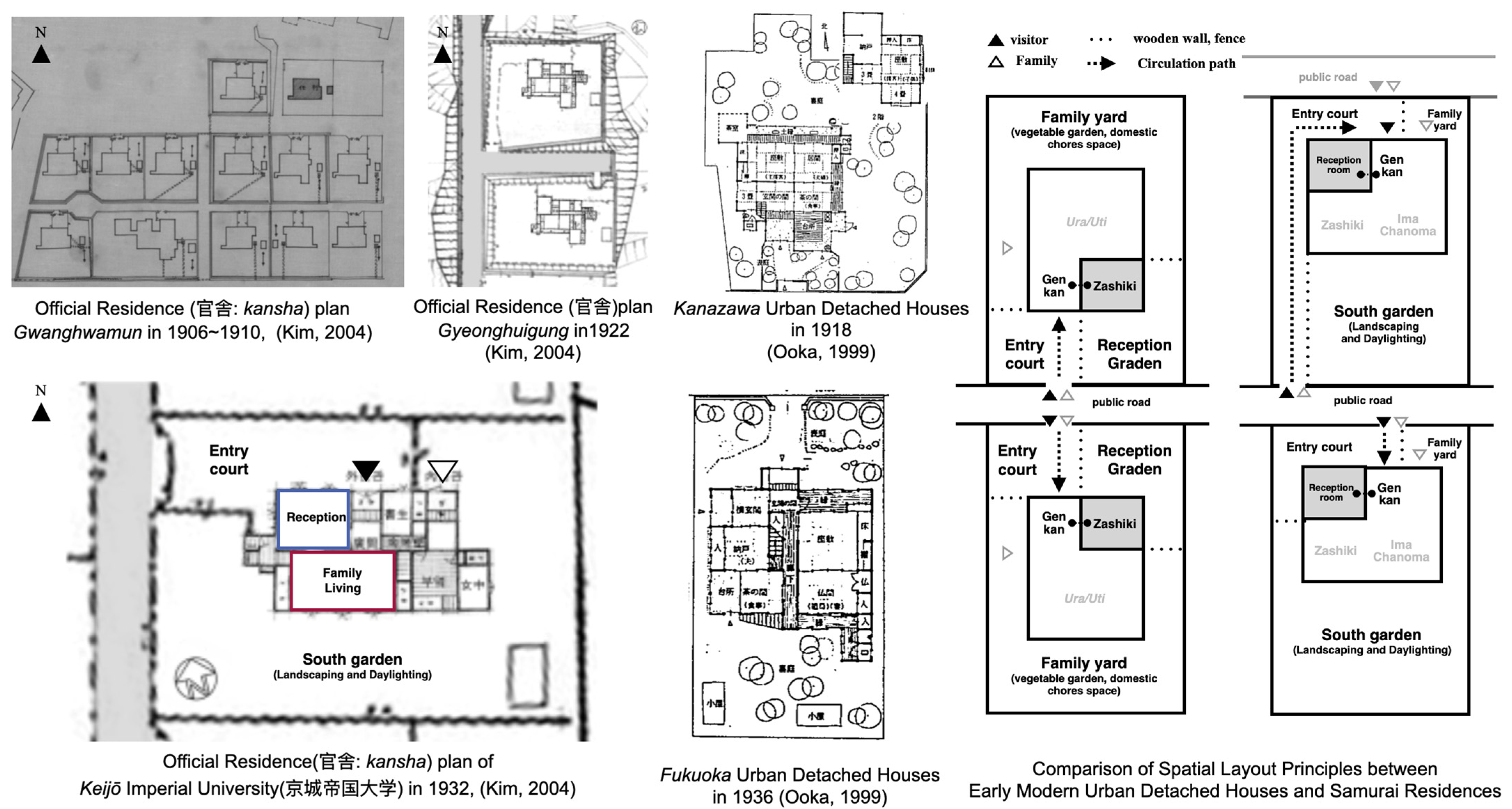
The main limitation of this study is that its empirical analysis is confined to the 77-case corpus of Edo middle–lower-class samurai residences. Although the Boundary-Regulating Genotype provides a configurational basis for reconsidering later housing developments, the continuity or transformation of this logic in early-modern urban housing has not been systematically tested in the present study. The figure presented above should therefore be understood as a research framework rather than a demonstrated historical conclusion.
Future research should extend this analysis to colonial official residences, early twentieth-century official residences, and early-modern urban detached houses (Figure A1). Such work should examine not only interior room arrangements, but also the entire residential plot, including road access, entry courts, exterior gardens, intermediary spaces, and the relationship between reception and family-living domains. By combining a space syntax analysis with historical plans, design manuals, residential regulations, and evidence of actual dwelling practices, future studies can test whether the boundary-regulating logic identified in this study persisted as a latent configurational rule, was transformed under modern planning norms, or was displaced by new forms of domestic organization.
In sum, the spatial inheritance of Japanese housing should not be reduced to the visible survival of Zashiki, Tsuzukima, Tokonoma, or Washitsu. It should also be examined through the recurrent organization of boundaries, access, exterior spaces, and domestic integration. The Boundary-Regulating Genotype identified in Edo middle–lower-class samurai residences provides a basis for rethinking the historical transition from traditional samurai residences to modern urban housing as a process in which boundary-regulating spatial logic may have been reconfigured across changing social, institutional, and architectural conditions.
Supplementary Materials
The following supporting information can be downloaded at: https://www.mdpi.com/article/10.3390/buildings16132619/s1, Table S1. Integration order of all convex spaces for each case, Table S2. Control order of all convex spaces for each case.
Author Contributions
Conceptualization, J.K.; Methodology, J.K.; Software, J.K.; Formal analysis, J.K.; Investigation, J.K. and N.W.; Resources, N.W.; Data curation, J.K. and N.W.; Writing—original draft, J.K. and N.W.; Writing—review and editing, J.K.; Funding acquisition, J.K. and N.W. All authors have read and agreed to the published version of the manuscript.
Funding
Scientific Research Fund of Zhejiang Provincial Education Department [No. Y202354121], Teaching Reform Projects of Zhejiang Province [No. JGBA2024157].
Data Availability Statement
The Supplementary Data provides the case-level integration order and control value order for all 77 cases. Additional data are available from the corresponding author upon reasonable request.
Conflicts of Interest
The authors declare no conflicts of interest. The funders had no role in the design of the study; in the collection, analyses, or interpretation of data; in the writing of the manuscript; or in the decision to publish the results.
Appendix A
Figure A1.
Historical evolution of Japanese urban housing types and spatial principles from the Edo period to the Heisei era. The diagram traces the major typological transitions, including the shift from reception spaces to family layouts, and the growing separation of public and private spatial domains across periods.
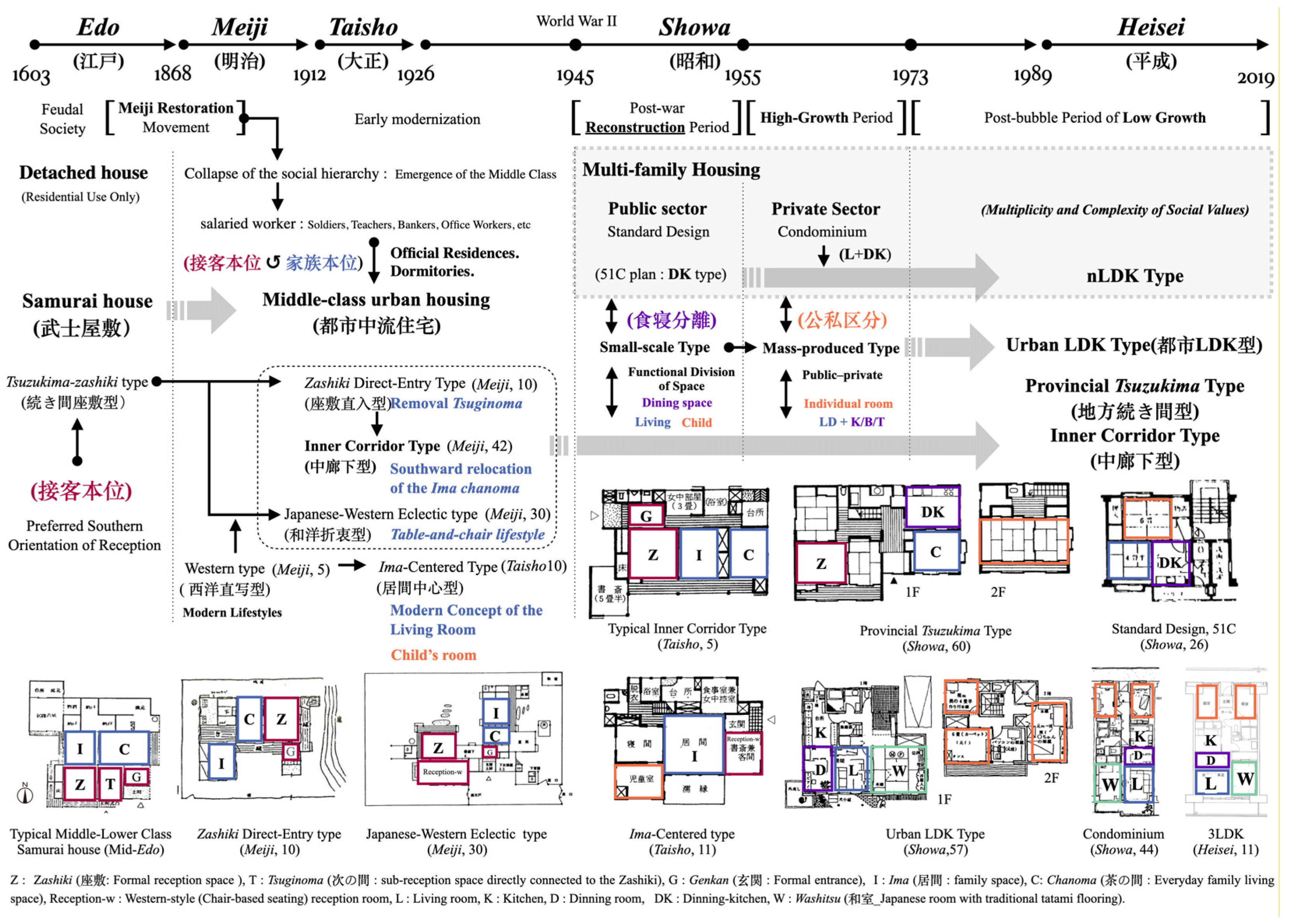
Figure A2.
Comparative distribution of morphological house types and syntactic genotype references [1,2,3,49].
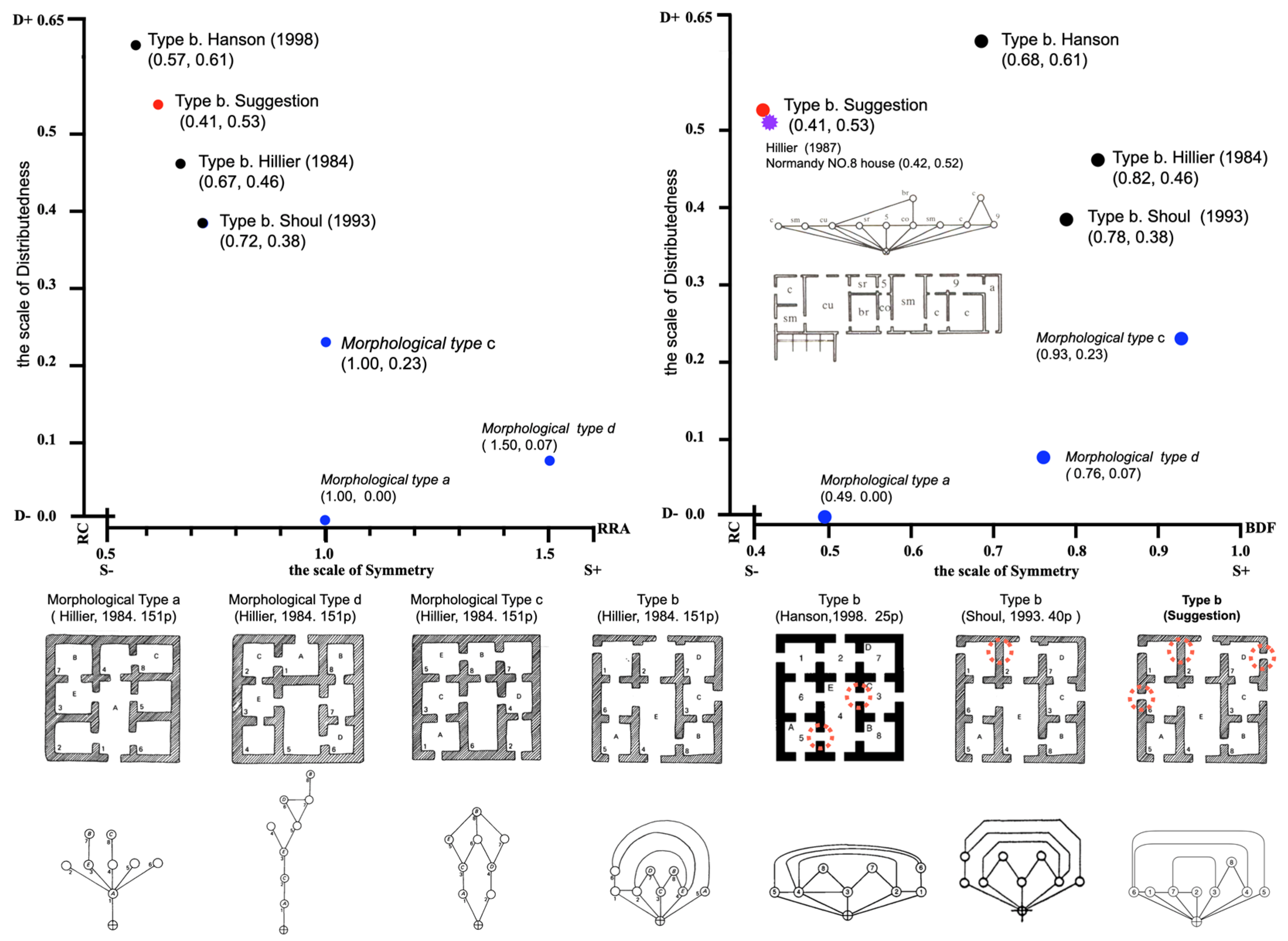
Figure A3.
Functional zoning and spatial roles in Edo samurai houses.
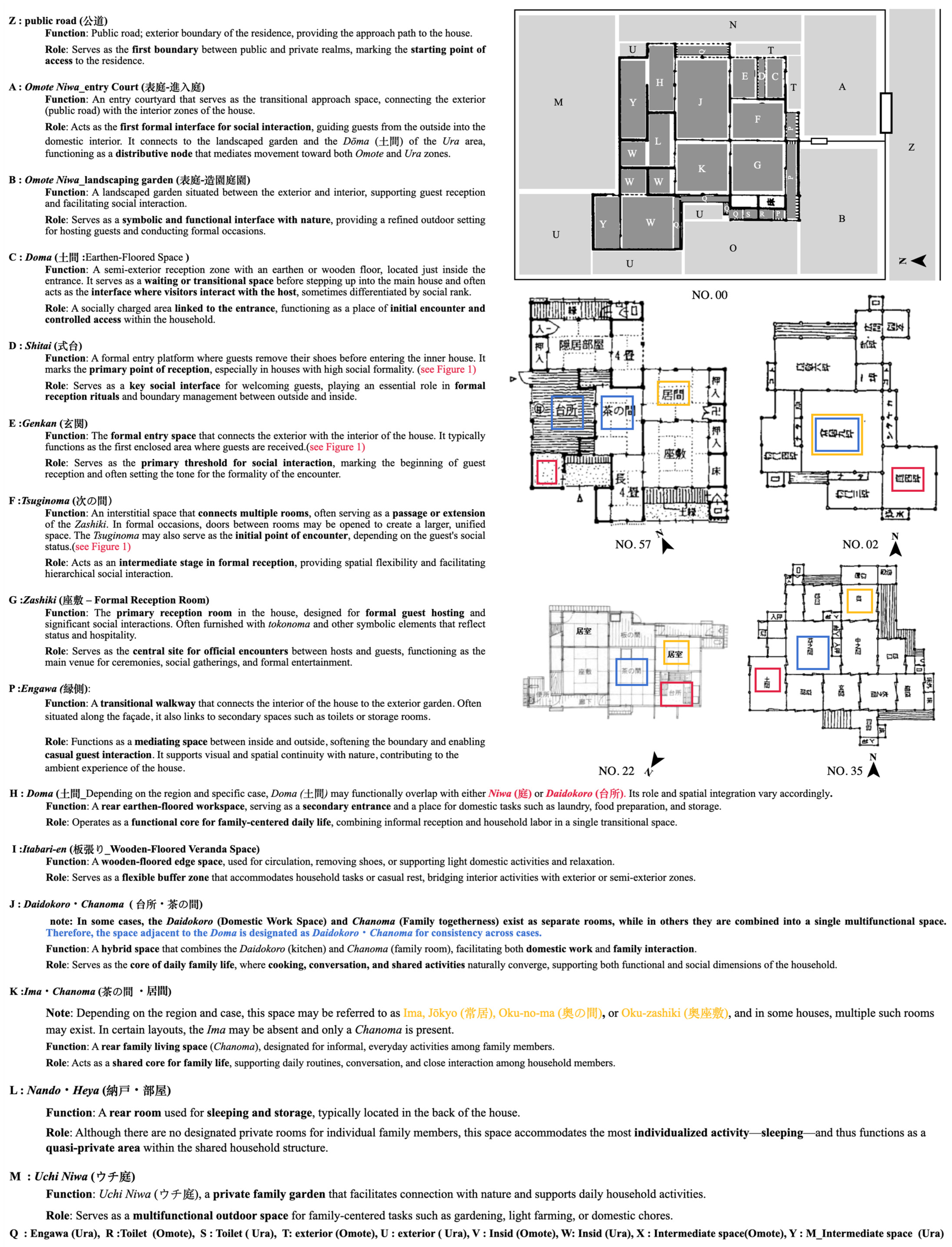
Figure A4.
Double state justified graph (0, 4, 6, 7, 16, 17, 19, 22, 23, 25, 29, 31, 33, 46, 47, 51, 58, 63, 65).
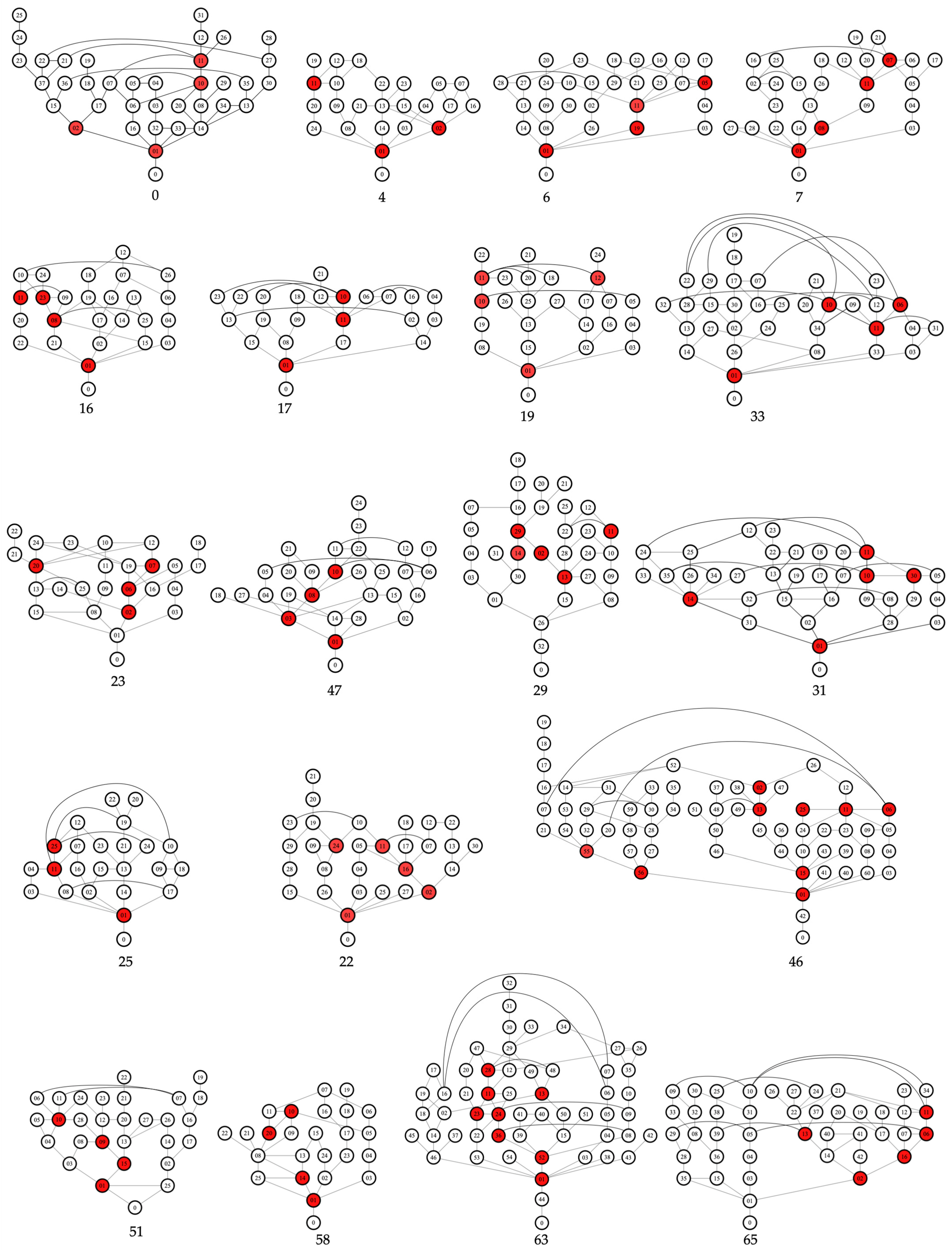
Figure A5.
Double state justified graph (67, 71, 73, 74, 75).
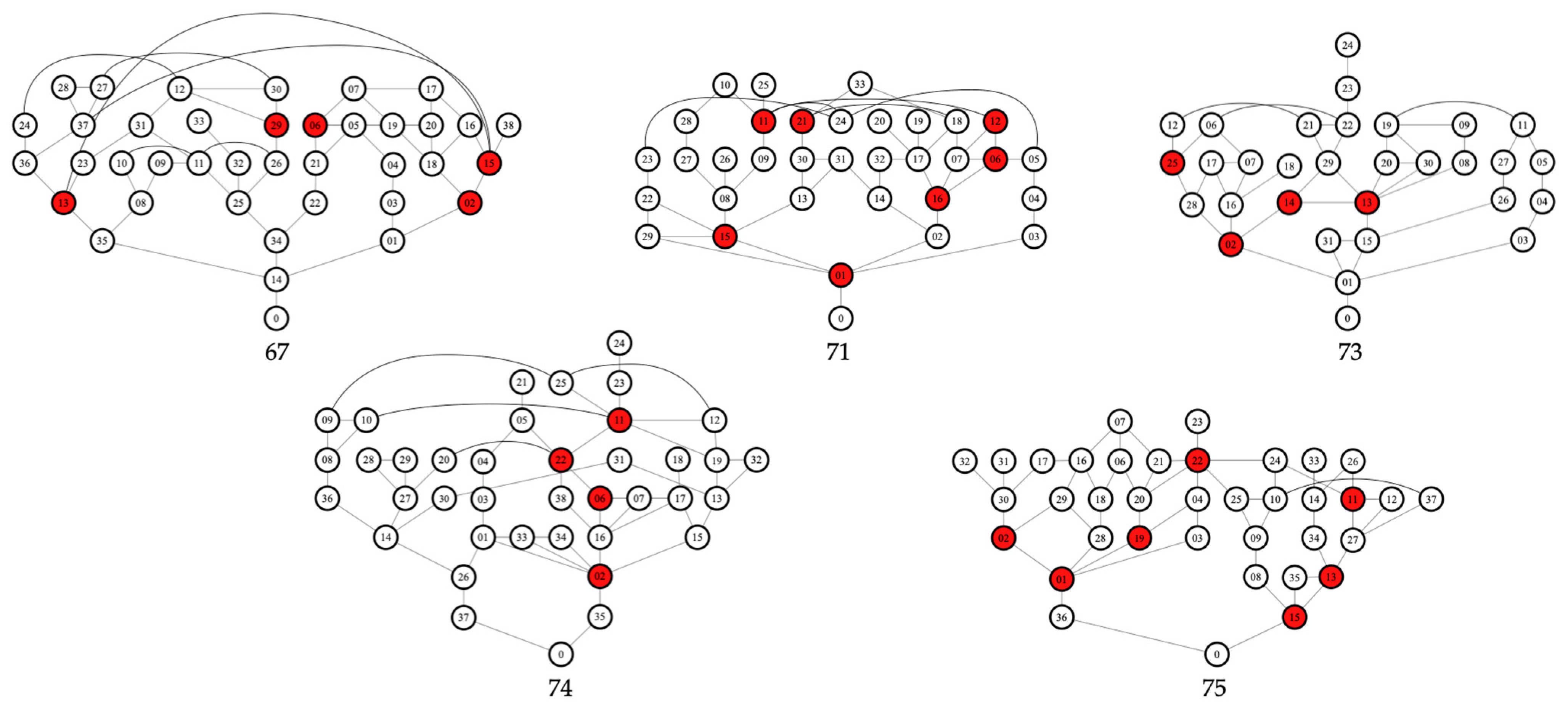
Figure A6.
Deep state justified graph (1, 2, 3, 8, 9, 11, 12, 13, 14, 15, 18, 20, 21).
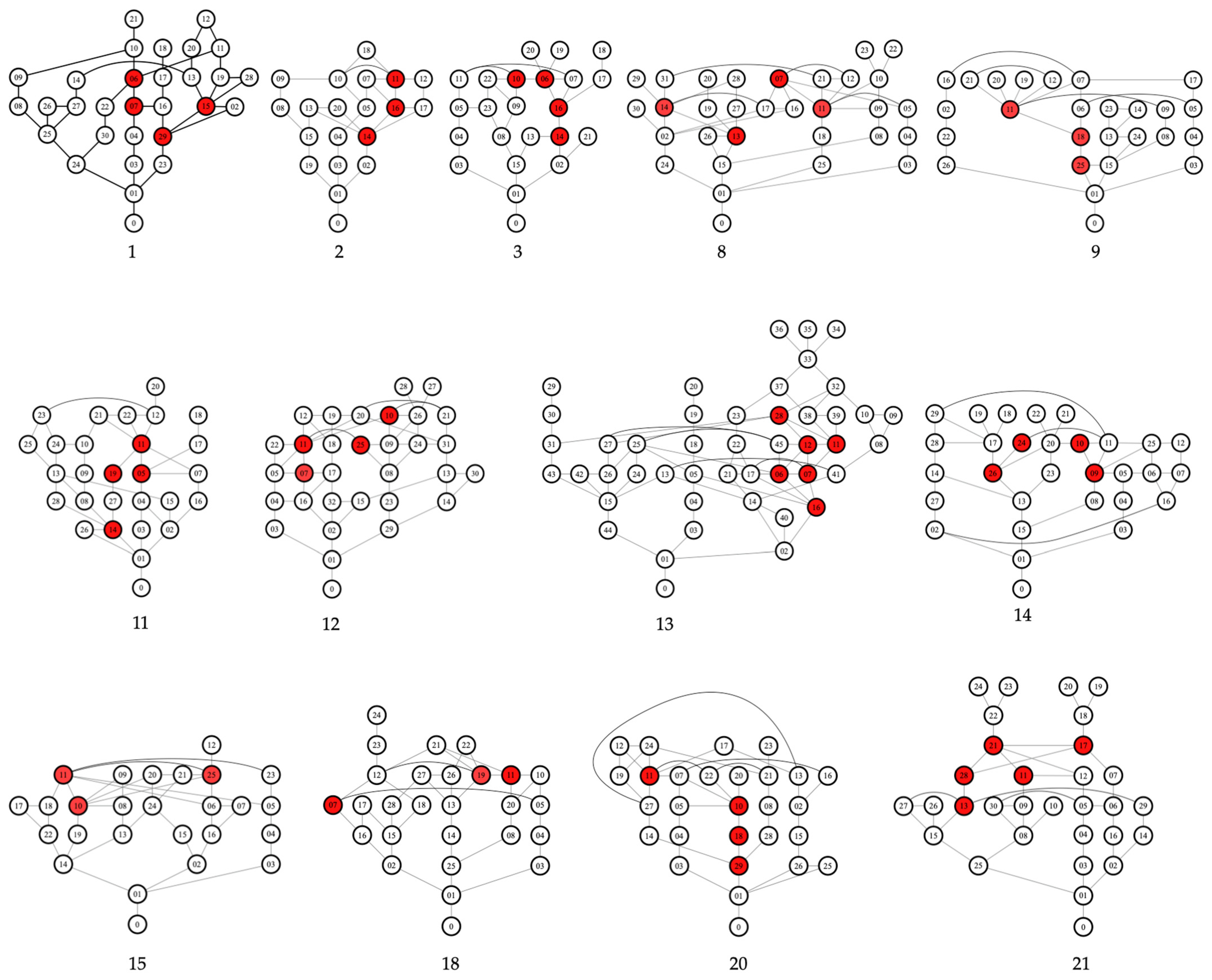
Figure A7.
Deep state justified graph (24, 27, 28, 34, 35, 36, 37, 38, 39, 40, 41, 42, 43, 44, 48, 49).
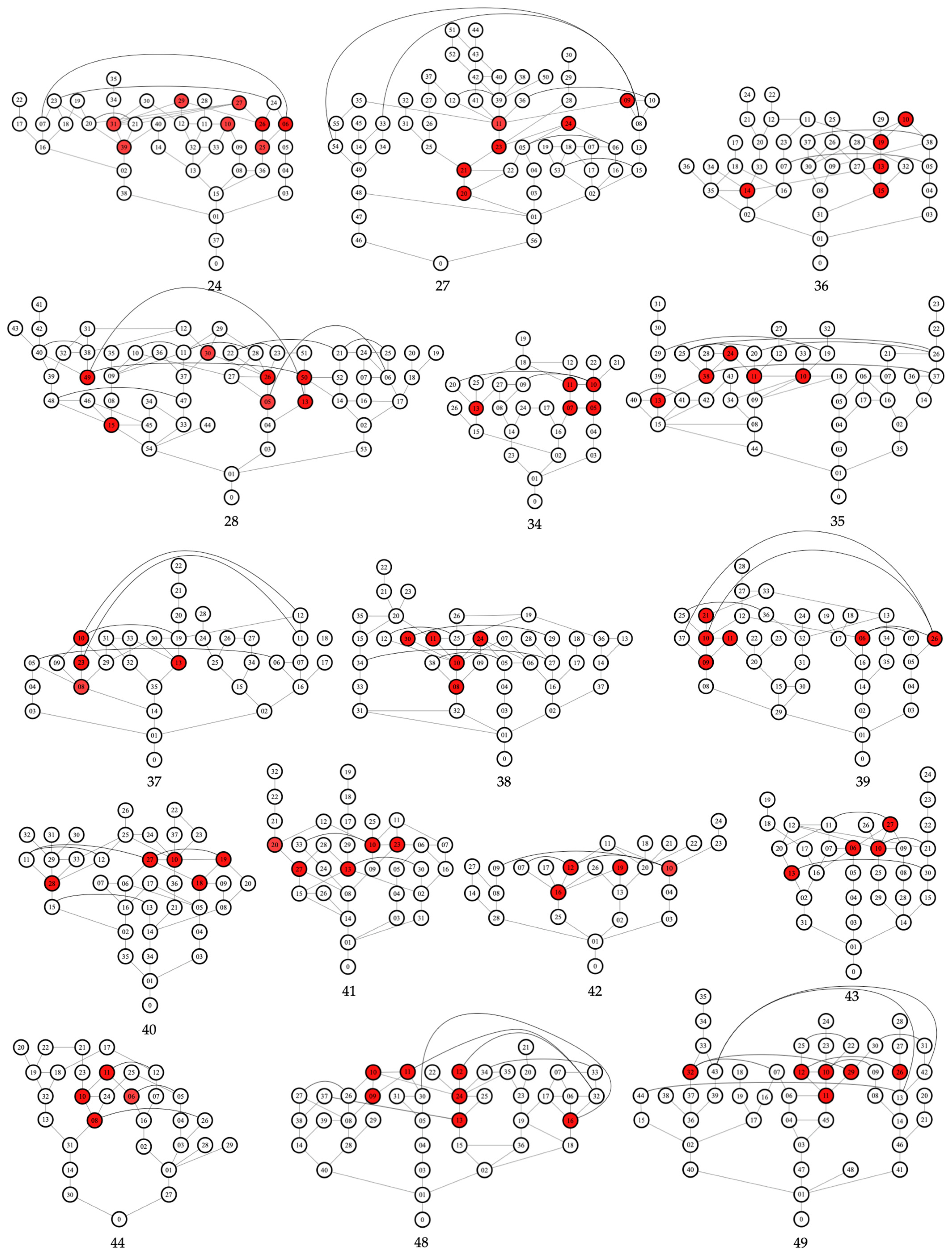
Figure A8.
Deep state justified graph (50, 52, 53, 54, 55, 56, 60, 61, 62, 64, 68, 69, 70).
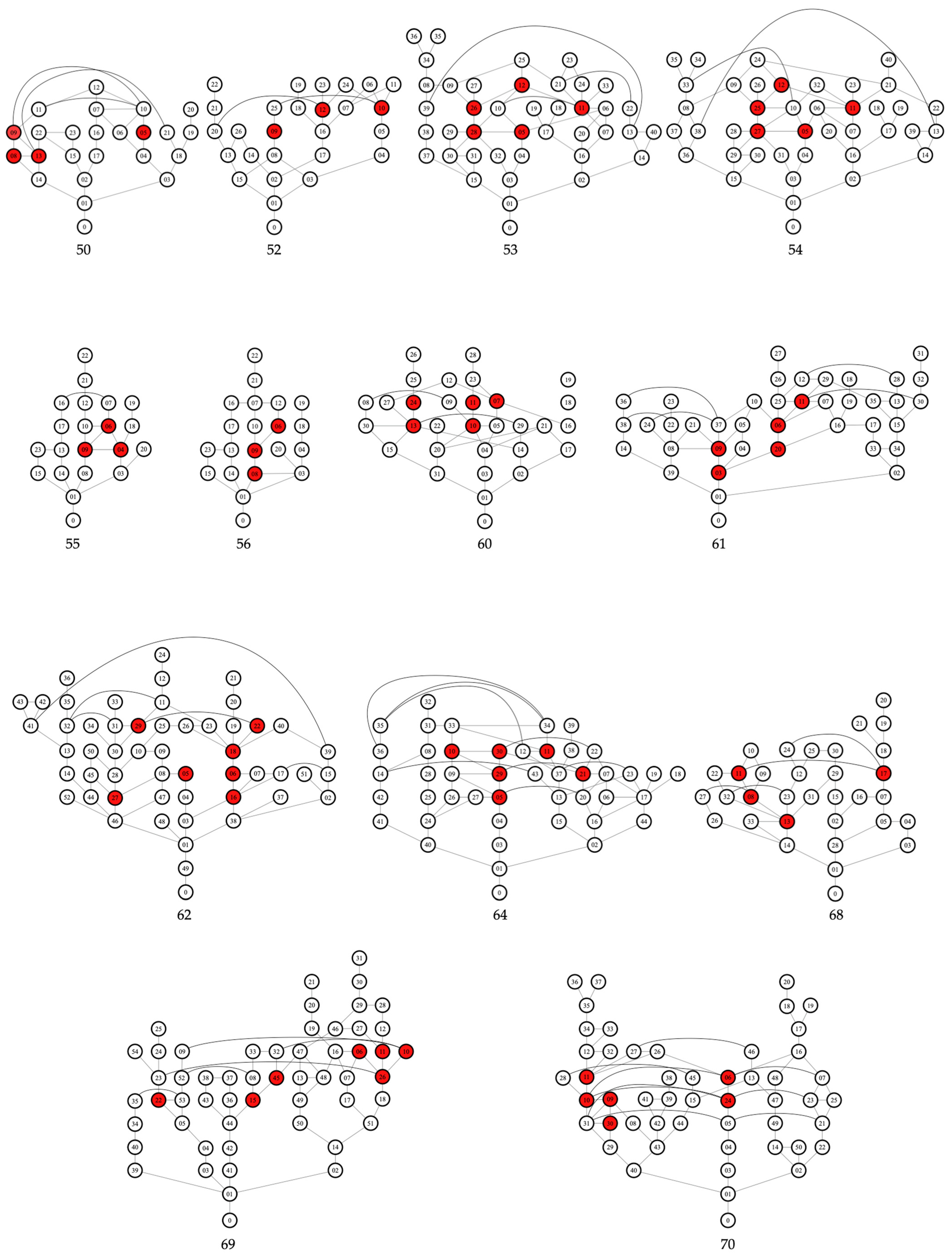
Figure A9.
Shallow state justified graph (5, 10, 26, 30, 32, 45, 57, 59, 66, 72, 76).
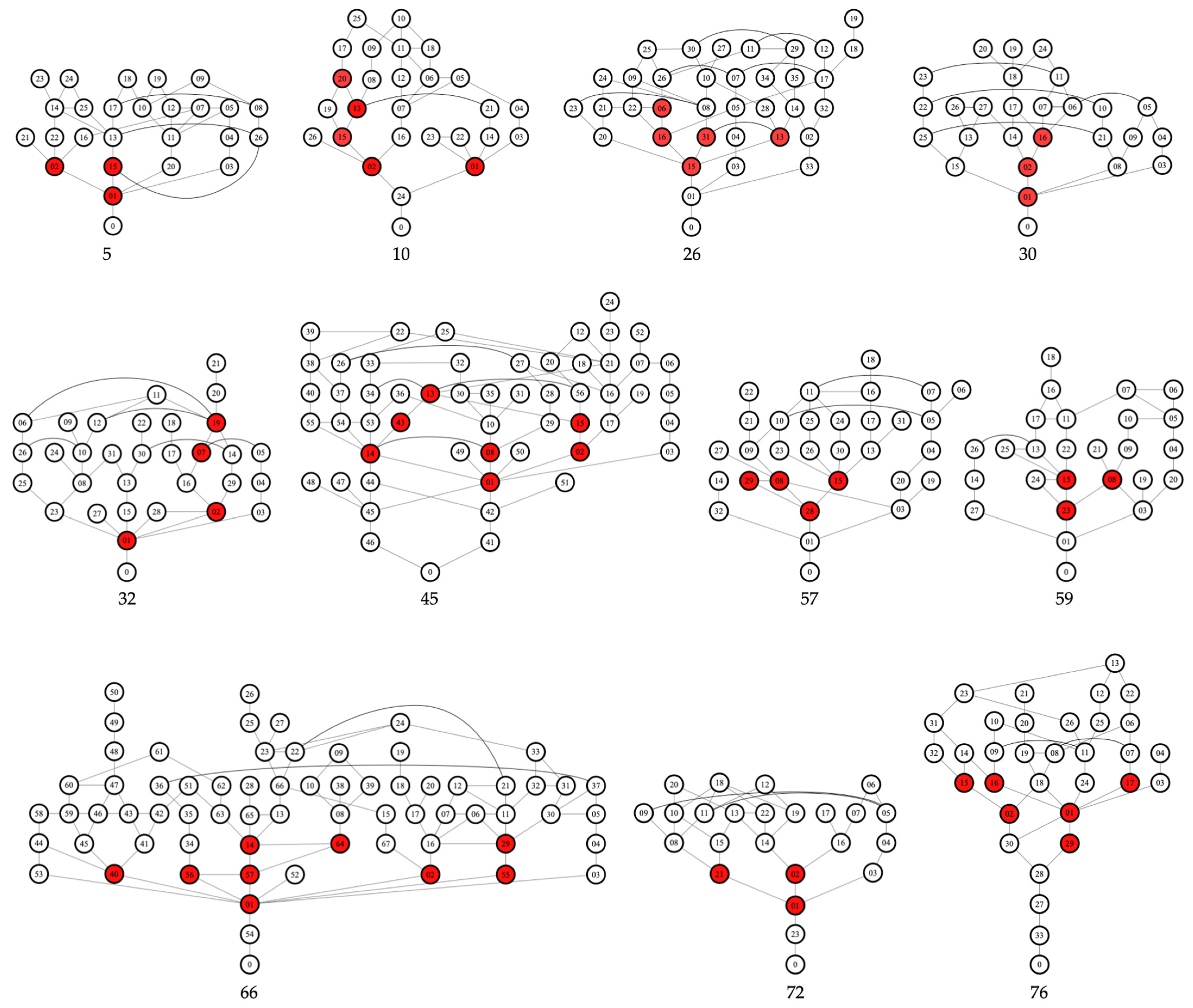
References
- Hillier, B.; Hanson, J. The Social Logic of Space; Cambridge University Press: London, UK, 1984. [Google Scholar]
- Hanson, J. Decoding Homes and Houses; Cambridge University Press: Cambridge, UK, 1998. [Google Scholar]
- Hillier, B.; Hanson, J.; Graham, H. Ideas are in Things: An Application of the Space Syntax Method to Discovering House Genotypes. Environ. Plan. B Urban Anal. City Sci. 1987, 14, 363–385. [Google Scholar] [CrossRef] [Scilit]
- Orhun, D.; Hillier, B.; Hanson, J. Spatial Types in Traditional Turkish Houses. Environ. Plan. B Urban Anal. City Sci. 1995, 22, 475–498. [Google Scholar] [CrossRef] [Scilit]
- Orhun, D.; Hillier, B.; Hanson, J. Socialising Spatial Types in Traditional Turkish Houses. Environ. Plan. B Urban Anal. City Sci. 1996, 23, 329–346. [Google Scholar] [CrossRef] [Scilit]
- Byun, N. Genetic Characteristics Found in Spatial Structure of the Korean Apartment Complexes and Unit Plans. Ph.D. Thesis, Seoul National University, Seoul, Republic of Korea, 2014. [Google Scholar]
- Kim, J.; Kwak, D. Extraction of spatial genetic characteristics and analysis of 1930s Korean Urban Hanok based on application of space syntax. J. Asian Archit. Build. Eng. 2021, 20, 197–210. [Google Scholar] [CrossRef] [Scilit]
- Xu, K.; Chai, X.; Jiang, R.; Chen, Y. Quantitative Comparison of Space Syntax in Regional Characteristics of Rural Architecture: A Study of Traditional Rural Houses in Jinhua and Quzhou, China. Buildings 2023, 13, 1507. [Google Scholar] [CrossRef] [Scilit]
- Lei, Z.; Li, J. Genotype Extraction of Traditional Dwellings Using Space Syntax: A Case Study of Tibetan Rural Houses in Ganzi County, China. npj Herit. Sci. 2025, 13, 13. [Google Scholar] [CrossRef] [Scilit]
- Zolfagharkhani, M.; Ostwald, M.J. The Spatial Structure of Yazd Courtyard Houses: A Space Syntax Analysis of the Topological Characteristics of the Courtyard. Buildings 2021, 11, 262. [Google Scholar] [CrossRef] [Scilit]
- Suzuki, S. Jūbunka no jizoku to hen’yō: Keikaku no tachiba kara mita Nihon jūkyo gendaishi [住文化の持続と変容: 計画の立場からの日本住居現代史]. Annu. Rep. Hous. Res. Found. JUSOKEN 1989, 15, 29–48. [Google Scholar] [CrossRef] [PubMed]
- Ooka, T.; Aoki, M. The principle of planning in the samurai house: A study on the principle of planning in the urban detached house Part 1. J. Archit. Plan. (Trans. AIJ) 1994, 59, 37–46. [Google Scholar] [CrossRef] [Scilit] [PubMed]
- Ooka, T. Erroneous theory that consideration for the guests were too much: A study on the principle of the arrangement of houses and rooms in detached13 urban residences (Part 7). J. Archit. Plan. (Trans. AIJ) 1999, 64, 101–108. [Google Scholar] [CrossRef] [Scilit] [PubMed]
- Yokoi, H.; Suzuki, Y. Re-evaluation of the influence of Western-style room additions on the modernization process of Japanese houses. J. Archit. Plan. (Trans. AIJ) 2023, 88, 3205–3214. [Google Scholar] [CrossRef] [Scilit]
- Miyazaki, N. A study on the theory for floor planning of the central living-room type house in modern ages of Japan: In the case of the pamphlet presented by the union for the improvement of living conditions in 1921. J. Archit. Plan. (Trans. AIJ) 2010, 75, 551–558. [Google Scholar] [CrossRef] [Scilit]
- Kim, J. The Issue of Carrier Space and the Spatial Configuration of Edo Middle-Lower Samurai Residences from a Space Syntax Perspective: Reinterpreting Spatial Evolution in Modern Japanese Urban Housing. J. Asian Archit. Build. Eng. 2025. early access. [Google Scholar] [CrossRef] [Scilit]
- Kim, J. A reexamination of Sekkyaku-honi (接客本位) in Edo middle-lower samurai residences from a space syntax perspective: Reinterpreting spatial evolution in modern Japanese urban housing. J. Asian Archit. Build. Eng. 2025. early access. [Google Scholar] [CrossRef] [Scilit]
- Park, H.; Lee, J.; Park, S. A study of optimized three-dimensional steel frame design based on the improved genetic algorithm. J. Archit. Inst. Korea Struct. Constr. 2001, 17, 19–26. [Google Scholar]
- Kim, G.; Kang, K. A study on model of neural networks training by genetic algorithms for predicting cost estimates of apartment projects at the early project stage. J. Archit. Inst. Korea Struct. Constr. 2003, 19, 133–142. [Google Scholar]
- Kim, E.; Lee, H. A study on evolution design model based on genetic algorithms. J. Archit. Inst. Korea Struct. Constr. 1995, 11, 51–61. [Google Scholar]
- Rapoport, A. House Form and Culture; Prentice-Hall: Englewood Cliffs, NJ, USA, 1969. [Google Scholar]
- Lee, S.; Park, Y. A study on the transformation process of the organization of dwelling space in terms of the conversion of domestic fuel. J. Archit. Inst. Korea Struct. Constr. 1997, 13, 61–71. [Google Scholar]
- Lee, S.; Park, Y. A study on the change of living pattern by the conversion of domestic fuel. J. Archit. Inst. Korea Struct. Constr. 1997, 13, 75–83. [Google Scholar]
- Choi, J.; Park, C.; Choi, Y.; Kang, J. The study on the continuity of Iraq traditional culture and spatial elements appeared in the modern apartment. J. Archit. Inst. Korea Plan. Des. 2014, 30, 33–40. [Google Scholar] [CrossRef] [Scilit]
- Ince Guney, Y.; Wineman, J. The evolving design of 20th-century apartments in Ankara. Environ. Plan. B Urban Anal. City Sci. 2008, 35, 627–646. [Google Scholar] [CrossRef] [Scilit]
- Kobayashi, H. Ibasho to Shite no Sumai (居場所としてのすまい); Shin-yo-sha: Tokyo, Japan, 2013. [Google Scholar]
- Yuasa, H.; Suzuki, Y.; Oka, T.; Kirihara, M. Periodical comparison of planning on the detached house in the term of diversification: The requirement of residents for planning of detached house in Japan, Part 1. J. Archit. Plan. (Trans. AIJ) 2013, 78, 1723–1732. [Google Scholar] [CrossRef] [Scilit]
- Aoki, M.; Takeshita, T.; Isogai, M.; Tomokiyo, T.; Ootsu, H.; Nakazono, M.; Miyazaki, N.; Oka, T.; Kawashima, H.; Kawasaki, M. Modern Housing Research and Promotion Fund Annual Report: Chūryū Jūtaku no Heimenkōsei ni Kansuru Kenkyū (1) [中流住宅の平面構成に関する研究 (1)]; Housing Research Foundation JUSOKEN: Tokyo, Japan, 1984. [Google Scholar] [CrossRef] [PubMed]
- Aoki, M.; Takeshita, T.; Tomokiyo, T.; Isogai, M.; Miyazaki, N.; Oka, T.; Kawano, Y.; Kawashima, H.; Kawasaki, M. Modern Housing Research and Promotion Fund Annual Report: Chūryū Jūtaku no Heimenkōsei ni Kansuru Kenkyū (2) [中流住宅の平面構成に関する研究(2)]; Housing Research Foundation JUSOKEN: Tokyo, Japan, 1985. [Google Scholar] [CrossRef] [PubMed]
- Aoki, M.; Takeshita, T.; Tomokiyo, T.; Miyazaki, N.; Oka, T.; Kouno, H.; Suehiro, K.; Fujita, Y.; Isogai, M. Modern Housing Research and Promotion Fund Annual Report: Chūryū Jūtaku no Heimenkōsei ni Kansuru Kenkyū (3) [中流住宅の平面構成に関する研究(3)]; Housing Research Foundation JUSOKEN: Tokyo, Japan, 1986. [Google Scholar] [CrossRef] [PubMed]
- Ooka, T. Development of urban independent residences in Fukuoka City from Meiji era through the before WW-II of Shouwa era: A study on the principle of the arrangement of houses and rooms in the urban independent residences (Part 2). J. Archit. Plan. (Trans. AIJ) 1996, 61, 103–112. [Google Scholar] [CrossRef] [Scilit] [PubMed]
- Ooka, T. Development of urban independent residences after the World War II in Fukuoka City: A study on the principle of the arrangement of houses and rooms in urban independent residences (Part 3). J. Archit. Plan. (Trans. AIJ) 1997, 62, 111–116. [Google Scholar] [CrossRef] [Scilit] [PubMed]
- Ooka, T. Development of urban independent residences from Meiji era through Showa (before World War II) in Tsuyama City: A study on the principle of the arrangement of houses and rooms in urban independent residences (Part 4). J. Archit. Plan. (Trans. AIJ) 1998, 63, 45–52. [Google Scholar] [CrossRef] [Scilit] [PubMed]
- Ooka, T. Development of urban independent residences from Meiji era through Showa (before World War II) in Hirosaki City: A study on the principle of the arrangement of houses and rooms in urban independent residences (Part 5). J. Archit. Plan. (Trans. AIJ) 1998, 63, 85–92. [Google Scholar] [CrossRef] [Scilit] [PubMed]
- Ooka, T. Development of urban independent residences from Meiji era through Showa (before World War II) in Kanazawa City: A study on the principle of the arrangement of houses and rooms in urban independent residences (Part 6). J. Archit. Plan. (Trans. AIJ) 1999, 64, 123–130. [Google Scholar] [CrossRef] [Scilit] [PubMed]
- Hanson, J.; Hillier, B. Domestic Space Organisation: Two Contemporary Space-codes Compared. Archit. Comport. Hum. Behav. 1982, 3, 5–28. [Google Scholar]
- Bustard, W. Space, evolution, and function in the houses of Chaco Canyon. Environ. Plan. B Urban Anal. City Sci. 1999, 26, 219–240. [Google Scholar] [CrossRef] [Scilit]
- Seo, K. DNA of the House. Home Cult. 2012, 9, 77–97. [Google Scholar] [CrossRef] [Scilit]
- Elizondo, L.; Garnica-Monroy, R.; Martín López, L. Concealing Reproductive Tasks: An Inequality Genotype for Middle-Income Housing in Mexico. Nexus Netw. J. 2025, 25. [Google Scholar] [CrossRef] [Scilit]
- Choi, J. A Diachronic Analysis of the Unit Plan Changes in the Context of Space Syntax Model for the 4LDK Apartment Unit Plans in Metropolitan Seoul Area. J. Archit. Inst. Korea 1996, 12, 15–27. [Google Scholar]
- Aoki, M. Meiji ikō no jū yōshiki no henka hatten ni kansuru ichi kōsatsu [明治以降の住様式の変化・発展に関する一考察]. Annu. Rep. Hous. Res. Found. JUSOKEN 1986, 12, 13–61. [Google Scholar] [CrossRef] [PubMed]
- Ooka, T.; Takeshita, T.; Aoki, M. A study of typification and ground plans for index of space for receiving guests and living space: A study on the plans for Japanese contemporary middle-class housing. J. Archit. Plan. Environ. Eng. (Trans. AIJ) 1988, 383, 64–73. [Google Scholar] [CrossRef] [Scilit] [PubMed]
- Koyanagi, S.; Suzuki, S.; Hata, T.; Hatsumi, M.; Aritsuka, R.; Tomoda, H.; Nagasawa, S.; Sone, Y.; Kasamune, T.; Tobe, S.; et al. Gendaigata jūkyo no kaishaku: (Zoku) Taiken-kiroku ni motozuku Nihon jūkyo gendaishi to jūkyoron [現代型住居の解釈:(続)体験記述にもとづく日本住居現代史と住居論]. Annu. Rep. Hous. Res. Found. JUSOKEN 1991, 17, 105–114. [Google Scholar] [CrossRef] [PubMed]
- Suzuki, S.; Koyanagi, S.; Hata, T.; Hatsumi, M.; Aritsuka, R.; Tomoda, H.; Nagasawa, S.; Sone, Y.; Kasamune, T.; Tobe, S.; et al. “Kata” no hōkai to seisei: Taiken-kiroku ni motozuku Nihon jūkyo gendaishi to jūkyoron [「型」の崩壊と生成:体験記述にもとづく日本住居現代史と住居論]. Annu. Rep. Hous. Res. Found. JUSOKEN 1989, 15, 85–96. [Google Scholar] [CrossRef] [PubMed]
- Klarqvist, B. A Space Syntax Glossary. Nord. J. Archit. Res. 1993, 6, 11–12. [Google Scholar]
- Peponis, J.; Zimring, C.; Choi, Y. Finding the building in wayfinding. Environ. Behav. 1990, 22, 555–590. [Google Scholar] [CrossRef] [Scilit]
- Peponis, J.; Wineman, J.; Bafna, S.; Rashid, M.; Kim, S. On the Generation of Linear Representations of Spatial Configuration. Environ. Plan. B Urban Anal. City Sci. 1998, 25, 559–576. [Google Scholar] [CrossRef] [Scilit]
- Kim, M. A Study on the Official Residences of the Government General in Seoul of the Japanese Colonial Period. Master’s Thesis, Seoul National University, Seoul, Republic of Korea, 2004. [Google Scholar]
- Shoul, M. The Spatial Arrangements of Ordinary English Houses. Environ. Behav. 1993, 25, 22–69. [Google Scholar] [CrossRef] [Scilit]
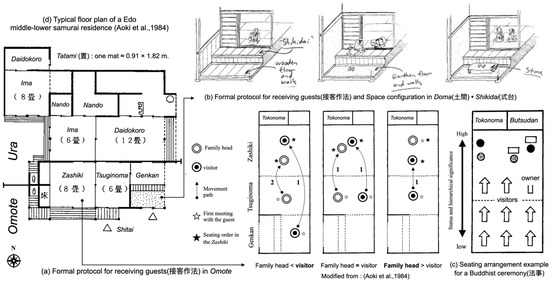
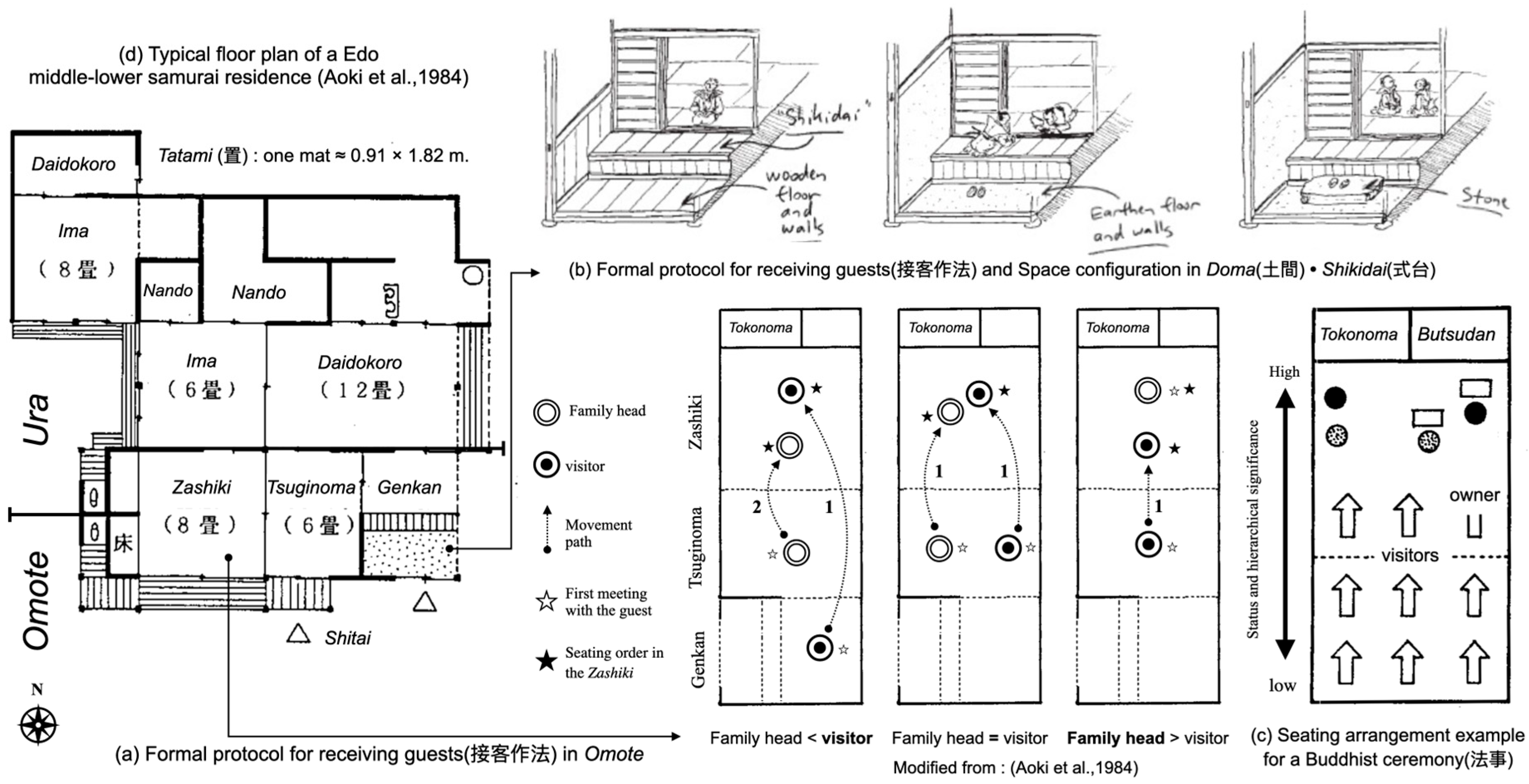
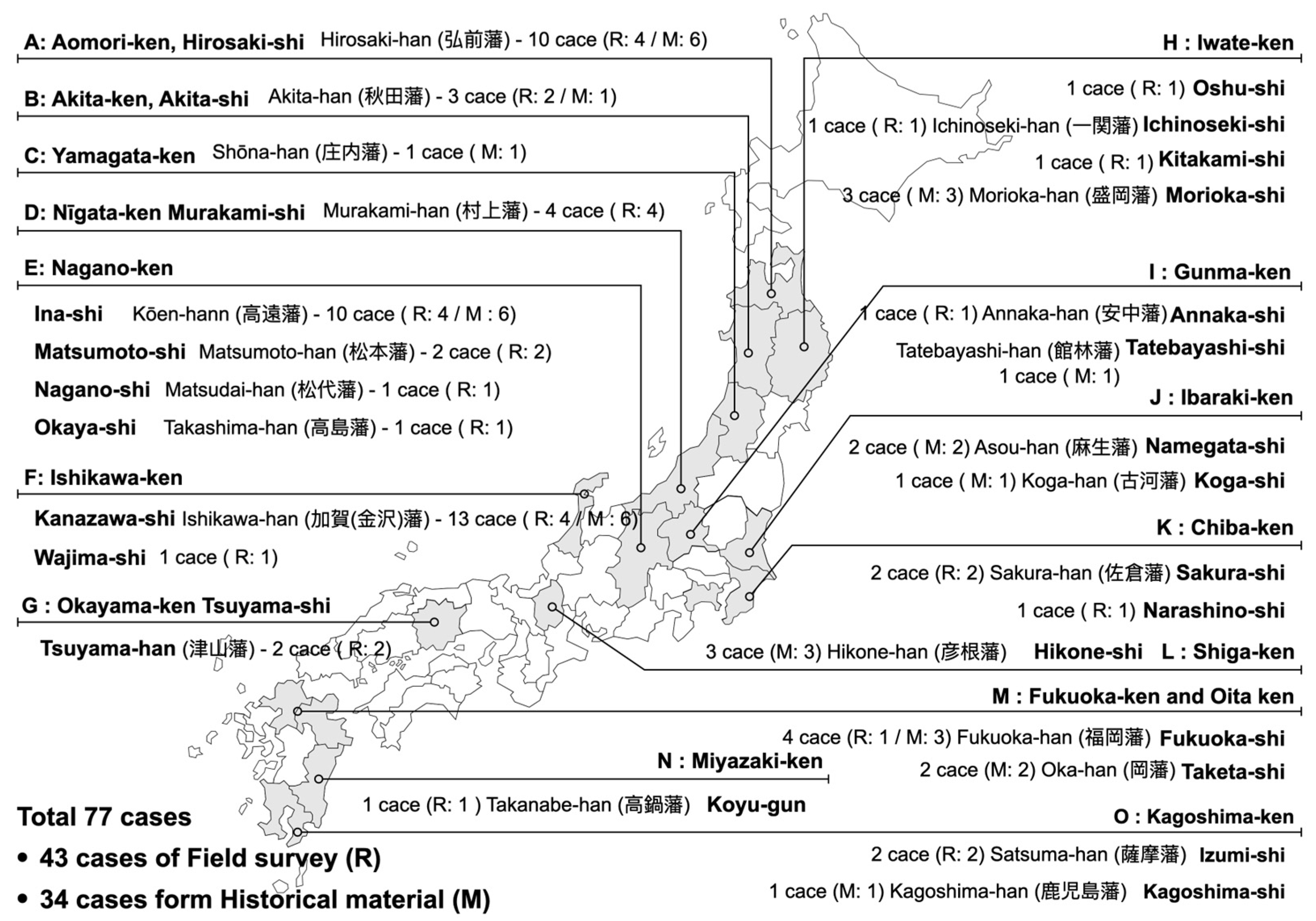
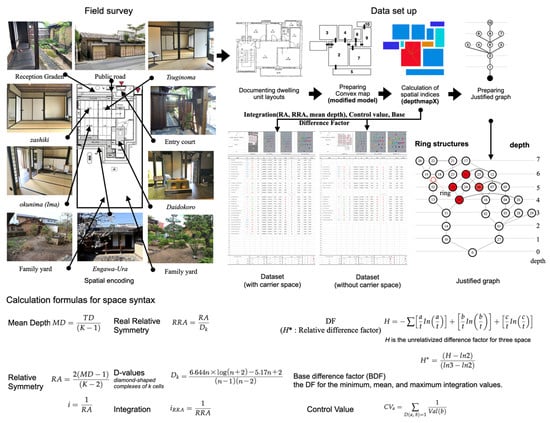
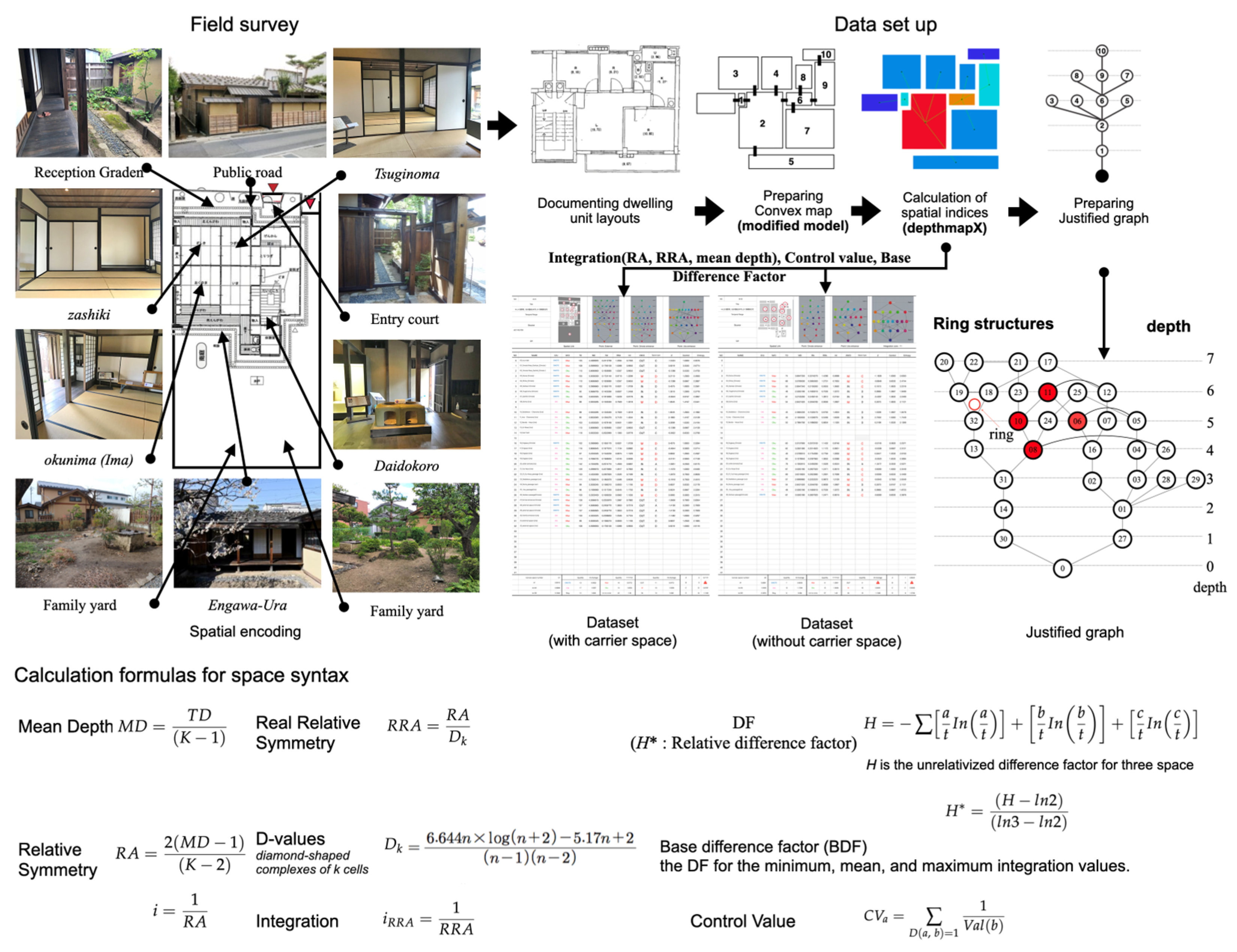
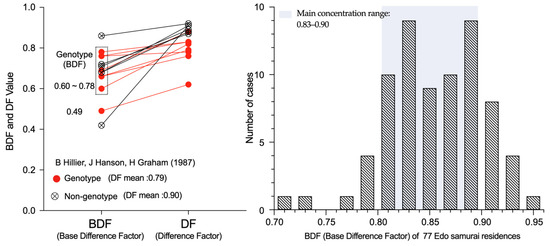
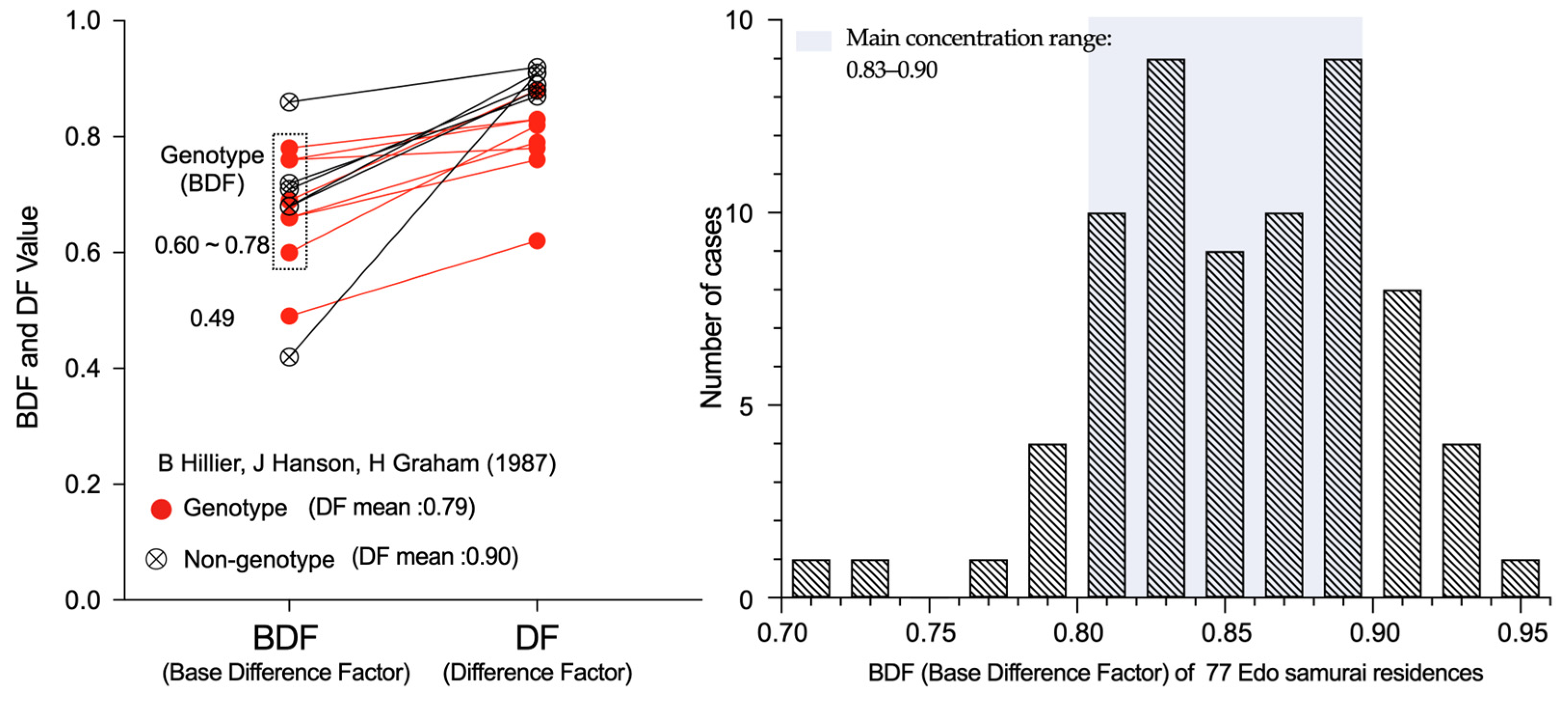
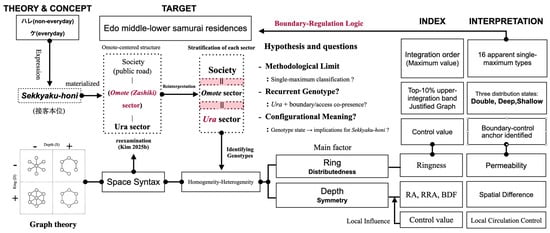
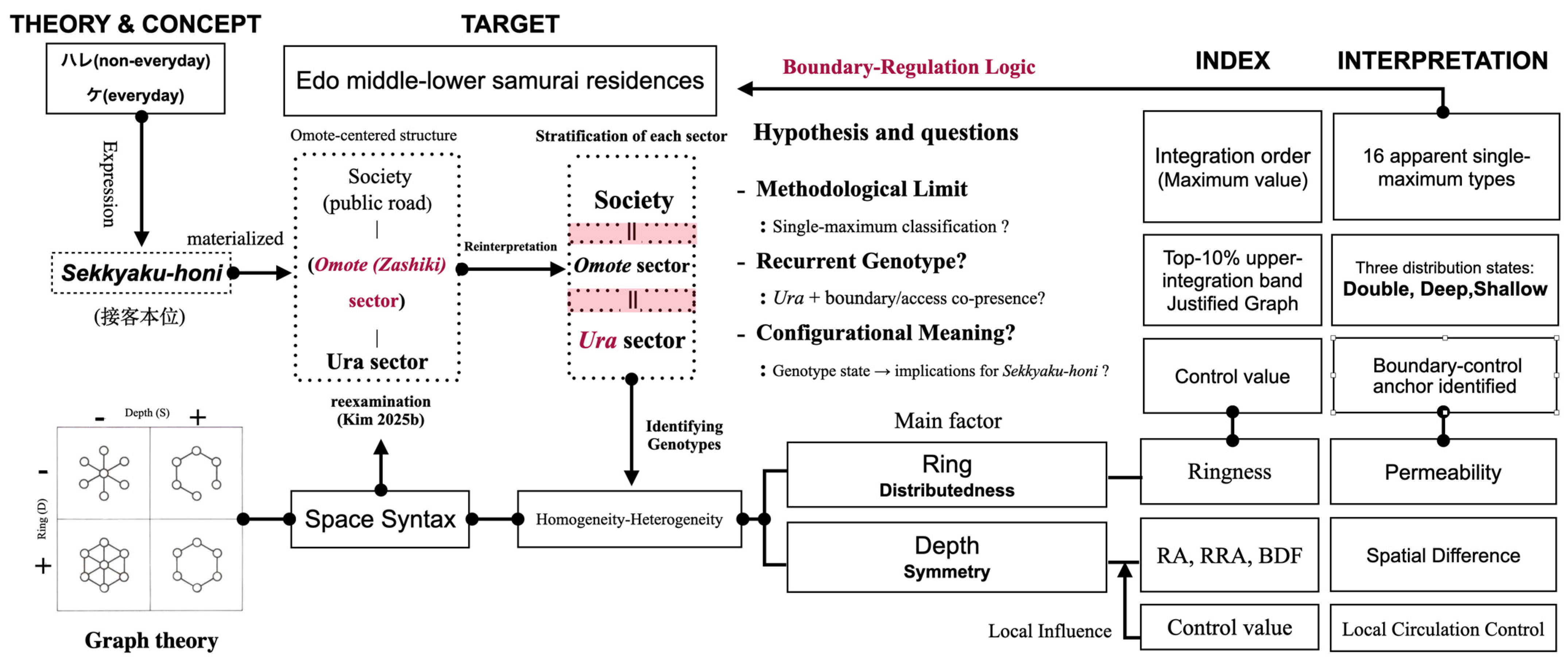
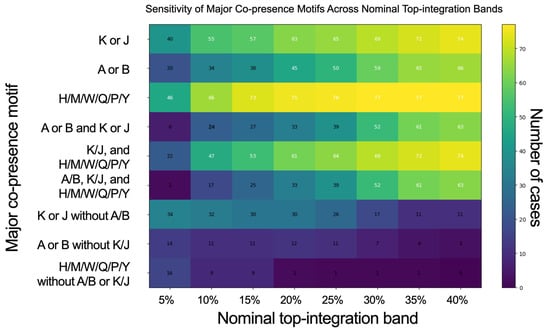
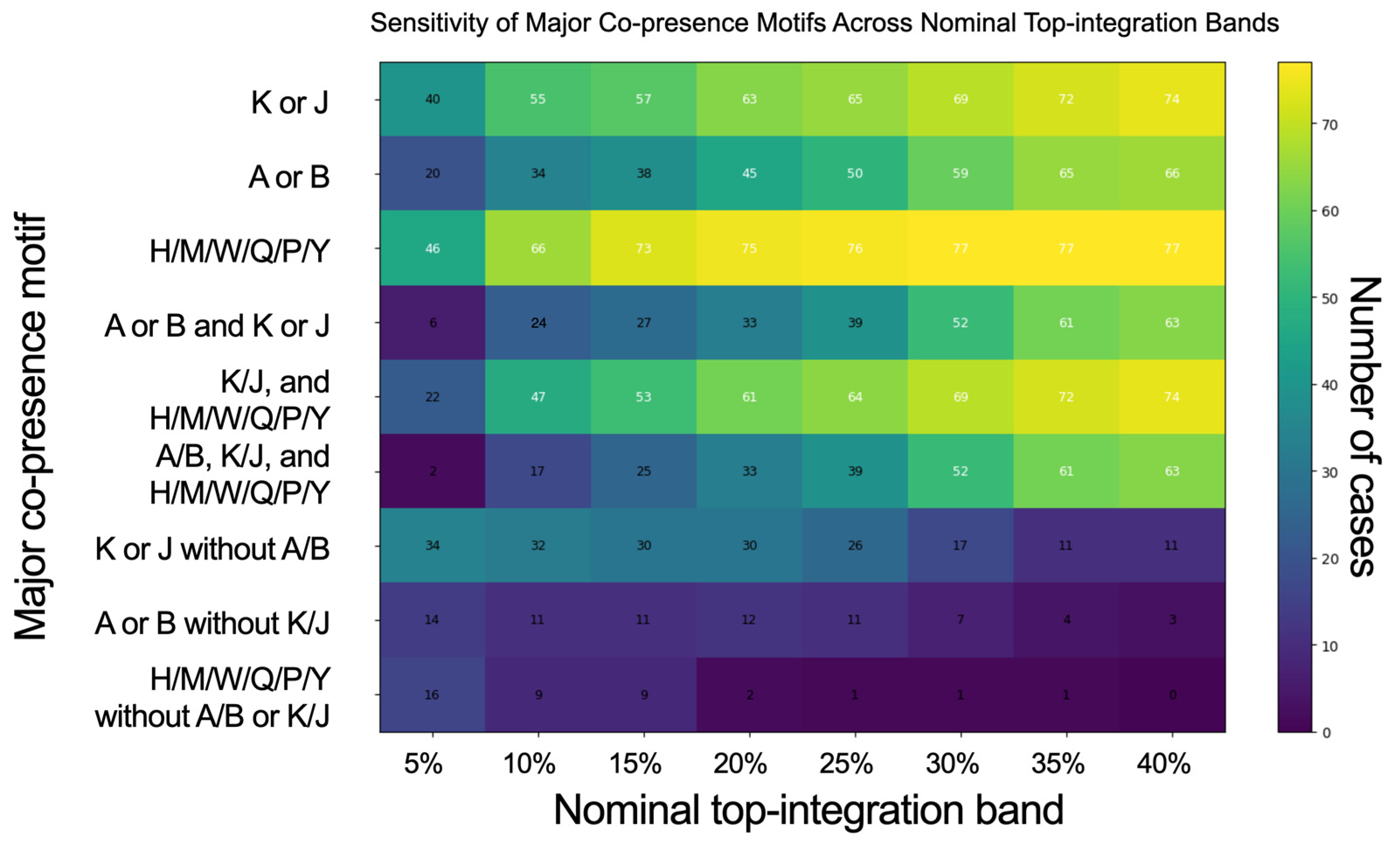
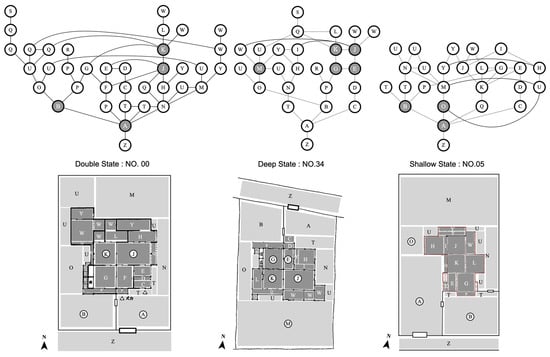
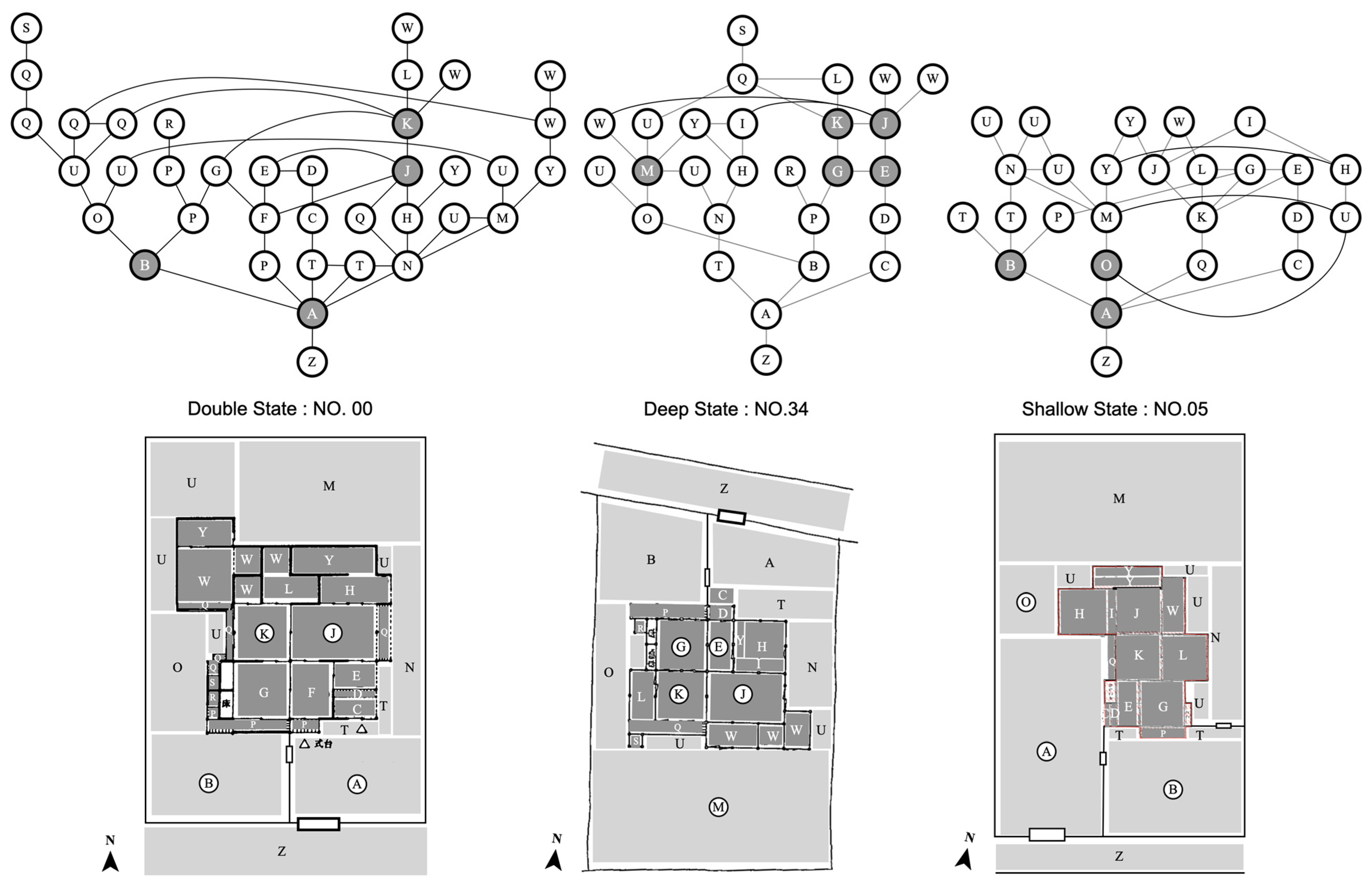

Disclaimer/Publisher’s Note: The statements, opinions and data contained in all publications are solely those of the individual author(s) and contributor(s) and not of MDPI and/or the editor(s). MDPI and/or the editor(s) disclaim responsibility for any injury to people or property resulting from any ideas, methods, instructions or products referred to in the content. |
© 2026 by the authors. Licensee MDPI, Basel, Switzerland. This article is an open access article distributed under the terms and conditions of the Creative Commons Attribution (CC BY) license.