Article

Seismic Performance Criteria for the Rocking and Overturning Behavior of Freestanding Contents in Buildings

1
School of Engineering, The University of Manchester, Manchester M13 9PL, UK
2
Department of Civil Engineering, Keimyung University, Daegu 42601, Republic of Korea
*
Author to whom correspondence should be addressed.
Buildings 2026, 16(13), 2541; https://doi.org/10.3390/buildings16132541 (registering DOI)
Submission received: 30 May 2026 / Revised: 20 June 2026 / Accepted: 25 June 2026 / Published: 26 June 2026

Abstract

During a severe earthquake, the violent shaking causes freestanding non-structural elements to sway and overturn, potentially injuring occupants or causing the elements themselves to break apart. This study investigates how freestanding contents (FSCs) in buildings respond to various earthquake intensities, detailing their movement through extensive analysis of dynamic performance. The stability of the FSCs on each floor varies depending on the earthquake’s intensity, the building’s structural mode shape, the FSCs’ geometry, and the chosen performance assessment method. A series of multi-level seismic excitation assessments of FSCs were conducted using 30 earthquake records, classified into 50%, 10%, and 2% probabilities of exceedance in 50 years. The floor’s responses, including absolute peak floor acceleration and relative peak floor velocity from both elastic and inelastic analyses, provided the seismic demand. The Ishiyama criterion made it difficult to evaluate FSCs’ seismic capacity because of the ambiguous distinction between rocking and overturning movements. A new criterion, specifically developed to differentiate between rocking and overturning of FSCs, has been proposed to address this issue. The results translate into practical guidance for design and protection: because the demand-to-capacity ratios for overturning are governed by the floor level, content slenderness, and the elastic-versus-inelastic modeling assumption, the proposed criterion identifies which floors and which content geometries are genuinely at risk, allowing anchorage, restraint, or relocation measures to be targeted where they are most needed rather than applied uniformly. This supports more reliable and economical seismic protection of non-structural building contents.

1. Introduction

The study of earthquake effects on non-structural elements and the resulting damage seeks to reduce unavoidable losses and enhance resident safety [1]. Poor seismic designs sometimes result in widespread damage to both structural and non-structural building elements, creating significant vulnerability [2]. Sometimes, damage to non-structural elements is much more significant than structural damage, particularly to hospitals, libraries, semiconductor plants, data centers, telecommunication control towers, and nuclear power plants [3], etc. Classification of non-structural elements into acceleration-sensitive and displacement-sensitive is achieved by examining engineering demand parameters that induce sensitive actions such as sliding, rocking, and overturning under earthquake excitation [4]. Acceleration-sensitive non-structural elements, such as ceiling-mounted mechanical, electrical, and plumbing systems, and floor-based furniture, equipment, and contents, are classified based on how they are attached. The damage to the elements is attributed to the inertia forces that act on their base [5]. Meanwhile, damage to displacement-sensitive non-structural elements such as windows, partitions, and exterior materials is caused by the building’s swaying during an earthquake, resulting in noticeable inter-story drifts. The interaction between dry friction and sliding–rocking motions drives both rocking and overturning phenomena [6]. The rocking motion of rigid blocks becomes more accurate with smaller time-steps in ground motion [7]. These facilities are singled out because the functional contents they house—medical and life-support equipment, archival and server racks, broadcast and switching units, and safety-critical instrumentation—must remain operational immediately after an earthquake; their loss of function or overturning can endanger occupants, interrupt essential services, and cause economic losses that exceed the repair cost of the structure itself. Regarding modeling resolution, “smaller time-steps” refer to the integration time increment of the time history analysis: because rocking is governed by sharp impacts and rapid reversals of angular velocity at each base rotation, a coarse time-step smears these impacts and misrepresents the motion, so a sufficiently small step (here of the order of the record sampling interval) is required for the rocking and overturning response to converge.
Methodologies employed in studies assessing the seismic-induced sliding, rocking, and overturning of non-structural contents exhibit significant variation due to the inherent complexity of the involved interactions. The floor response spectrum, derived from both single-degree-of-freedom (SDOF) and multiple-degrees-of-freedom (MDOF) analyses, serves to not only characterize the structural response but also predict the behavior of non-structural elements on the floors [8,9,10,11]. In accordance with building codes, Berto et al. [12] employed the floor response spectrum method to establish ultimate and damage limit states, and they then examined the peak responses on each floor, using 30 different horizontal ground acceleration records. Meanwhile, fragility approaches were used in some studies to investigate the prediction of rocking and overturning limits based on peak ground acceleration (PGA) and peak ground velocity (PGV) [13,14,15]. Also, the efficiency of PGA and PGV has been evaluated as alternative intensity measures to predict the rocking and overturning capabilities of rigid blocks [16]. Beyond the method, Berto et al. [12] showed that floor-spectrum demands amplify strongly toward the upper stories and that conventional provisions can markedly mis-estimate the overturning risk of freestanding items; the present study builds on this by quantifying the same floor-wise amplification for rocking and overturning and by replacing the conservative capacity estimate with a refined criterion. More recent work continues in this direction: Liu et al. [17] extended overturning-fragility analysis of freestanding contents to bidirectional horizontal floor motions, while the state-of-the-art review of Ahmad et al. [18] synthesizes current vulnerability-assessment and life-cycle approaches for non-structural elements and confirms that a reliable, less conservative rocking/overturning criterion remains an open research need. The present work is positioned within this recent landscape.
In this study, the seismic vulnerability of non-structural contents in a 12-story reinforced concrete structure is assessed by analyzing peak floor accelerations (PFAs) and peak floor velocities (PFVs) as seismic demands. Meanwhile, the seismic capacity was determined using the Ishiyama criterion, a recognized method for evaluating the dynamic behavior of freestanding contents (FSCs). The Ishiyama criterion, however, provides an unclear boundary between rocking and overturning, causing a refined criterion for more accurate motion limits in FSCs. Finally, this study proposes a robust instability criterion capable of classifying motion into three categories: no rocking, rocking without overturning, and overturning after an initial rocking motion. Briefly, the Ishiyama criterion is a shaking-table-calibrated rule that predicts, from block geometry alone, the minimum floor acceleration needed to initiate rocking and the minimum floor velocity needed to cause overturning. Peak floor acceleration (PFA) and peak floor velocity (PFV) are adopted as the seismic-demand parameters precisely because they are the quantities in which these capacity thresholds are expressed: acceleration governs the onset of rocking (an inertia-driven action) and velocity governs overturning (an energy/momentum-driven action). PFA and PFV enable a direct comparison of demand and capacity per floor, establishing the engineering basis for the evaluation.

2. Target Structure and Seismic Analysis

A precisely constructed model of a 12-story reinforced concrete building, which has been developed in the inelastic dynamic analysis program Ruaumoko [19], was used to investigate the phenomenon of rocking and overturning of freestanding objects. The model provided a precise way to study the relationship between the building’s response to external forces and the stability of its stored items. This 12-story, two-bay reinforced concrete frame was adopted because it is a representative regular mid-rise RC building typical of the institutional and public construction (for example apartment and office buildings) in South Korea that houses the freestanding contents of interest. Meanwhile, thirty earthquake records, characterized by their diverse ground motion intensities and frequencies, were employed in a series of time history analyses to evaluate multi-level seismic hazards.

2.1. Structure Model

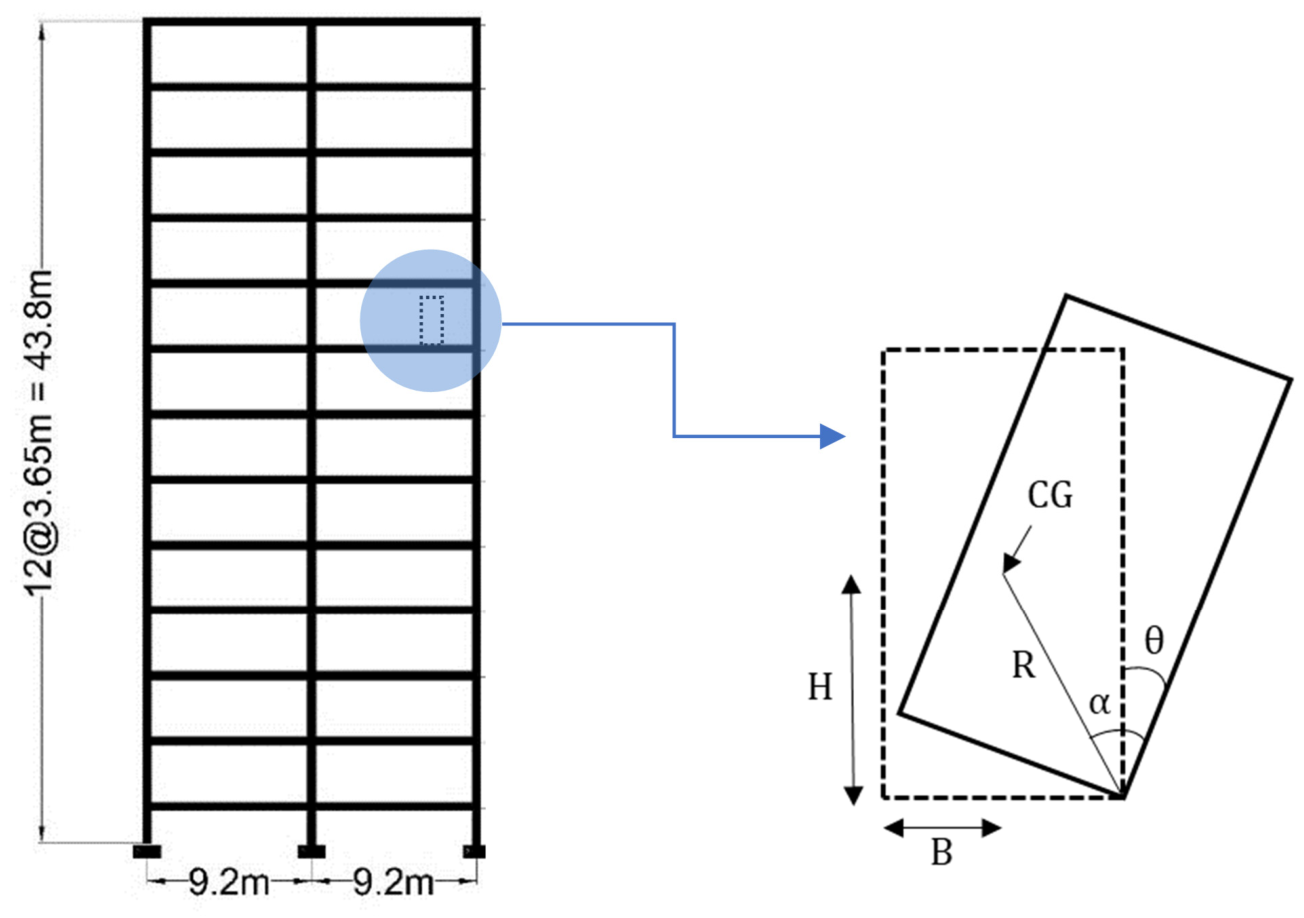
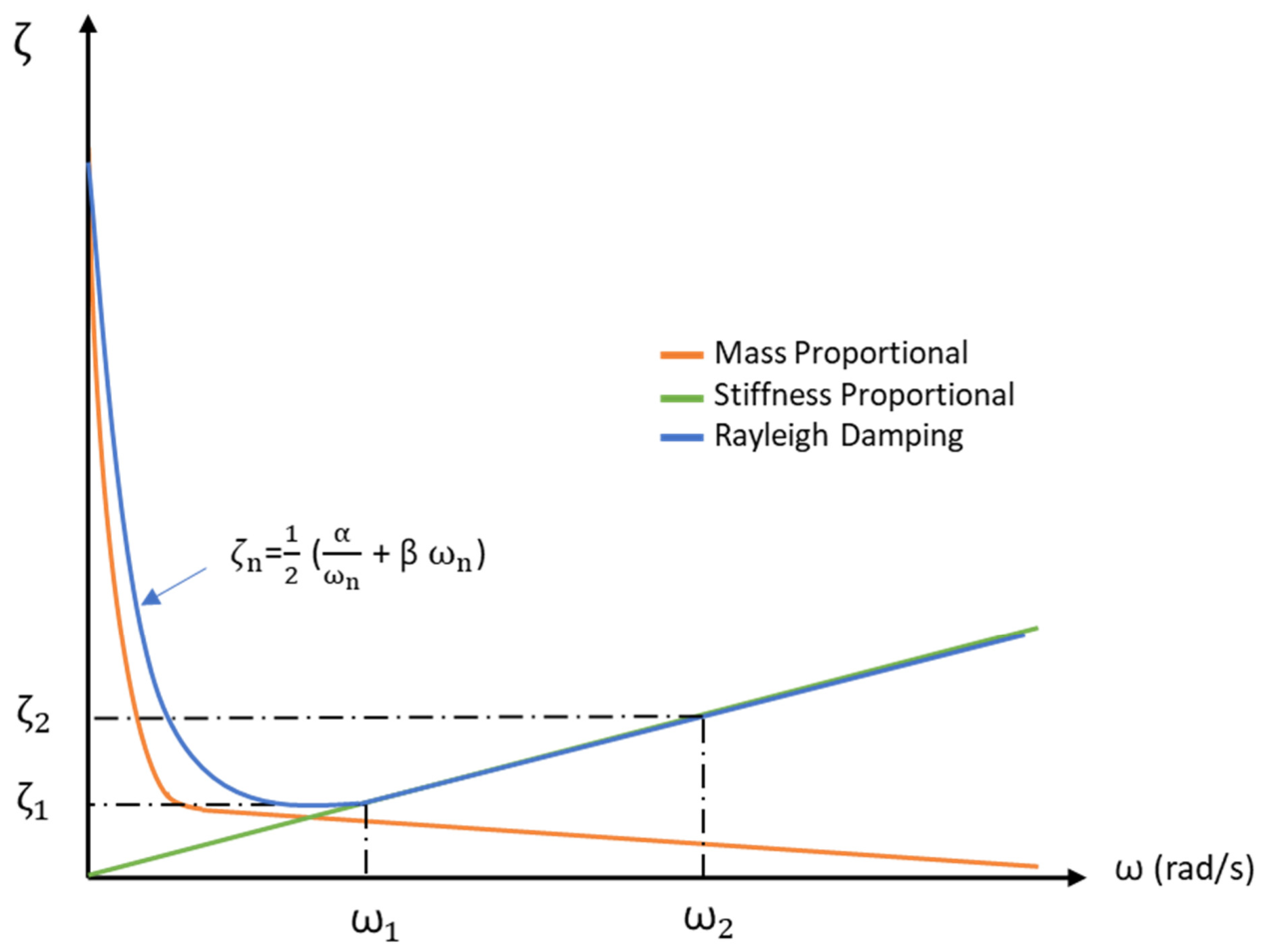
A 12-story reinforced concrete building, with a natural period of 1.88 s, was selected to evaluate how freestanding items on each floor would perform during an earthquake, as shown in Figure 1. The fundamental period of 1.88 s places it in the range where upper-floor acceleration amplification is significant, making it a meaningful yet reproducible benchmark rather than a site-specific case study. The inter-story height of the building is 3.65 m, and the span of each bay is 9.2 m. Lumped mass matrix is considered, which is as node masses without rotational degree-of-freedom or diagonal terms with three translational degrees of freedom at each end of the member. The hysteresis properties of building members are assigned as the modified Takeda hysteresis model, which is more complex than bilinear hysteresis; however, it gives more reliable results for inelastic/nonlinear time history analysis. For the damping model, Rayleigh or proportional damping is adopted since it requires only two coefficients (α and β) for the desired viscous damping levels at two different frequencies [19,20]. The damping increases linearly with the increase in frequency, as shown in Figure 2. The structure is idealized as a two-dimensional (2D) plane frame and analyzed with the finite-element program Ruaumoko2D [21], using a lumped-mass formulation. Material nonlinearity is represented by a lumped-plasticity (concentrated plastic-hinge) approach at member ends, in which the moment-rotation response follows the modified Takeda degrading-stiffness hysteresis. The representative story weight and nodal loads are listed in Table 1, and the resulting modal properties (periods and modal participation factors of the modes) in Table 2. Freestanding contents were treated as rigid freestanding blocks placed, in turn, on every floor so that the full height-wise distribution of demand could be assessed; their mass is small relative to the floor mass and was therefore taken as non-interacting with the structural response.
The dynamic time history using Newmark constant average acceleration (β = 0.25) is applied for both elastic and inelastic analyses. Studies [22,23] show that linear time history analysis overestimates structural response compared to nonlinear time history analysis. Jun et al. [24] stated that the distribution of PFAs along the floors is reduced by structural nonlinearity, which lengthens its natural period. Petrone et al. [25] estimated the accuracy of seismic demand acting on acceleration-sensitive non-structural contents through dynamic nonlinear analysis. The enhanced seismic response in elastic models relative to inelastic models is clear in structures with longer fundamental periods [26]. Based on the results of previous studies, inelastic response characteristics are also used in this study to present effective and realistic results for predicting the real seismic performance of FSCs under corresponding earthquake records. The Rayleigh (proportional) damping coefficients were obtained by assigning a target viscous damping ratio of 5% at two anchor frequencies corresponding to the first and third translational modes (1.88 s and 0.38 s), giving α = 0.3095 s−1 and β = 0.0022 s. This choice keeps the damping ratio close to 5% across the modes that contribute most to the floor response while avoiding the over-damping of high modes that a first-mode-only anchoring would produce.

2.2. Selected Earthquake Records

The acceleration time history records used in this study are the records at the SAC Phase II Los Angeles site having 50%, 10% and 2% of the probabilities of exceedance in 50 years, representing low, medium and high suites (Table 3) [27]. For each suite, various magnitudes, distances, and peak ground accelerations were recorded and simulated at rock site conditions, and were modified to site class D to match the target response spectrum. The fault mechanisms are strike-slip, oblique, and thrust for all suites except for Kern (1952) which was recorded on the reverse fault. These three SAC suites were selected because they constitute a well-documented, code-consistent set in which the records of each suite are already scaled to a common probability of exceedance (50%, 10% and 2% in 50 years), so that the low, medium and high suites represent serviceability-, design- and maximum-considered-level hazards respectively. This lets the floor demands and the rocking/overturning assessment be reported on a consistent multi-level-hazard basis. In Table 3, “Distance (km)” is the closest distance to the fault rupture, “Duration (sec)” is the total length of the processed record, and the listed “PGA (g)” is the peak of the single horizontal component used as input after scaling to site class D; the vertical component was not used.
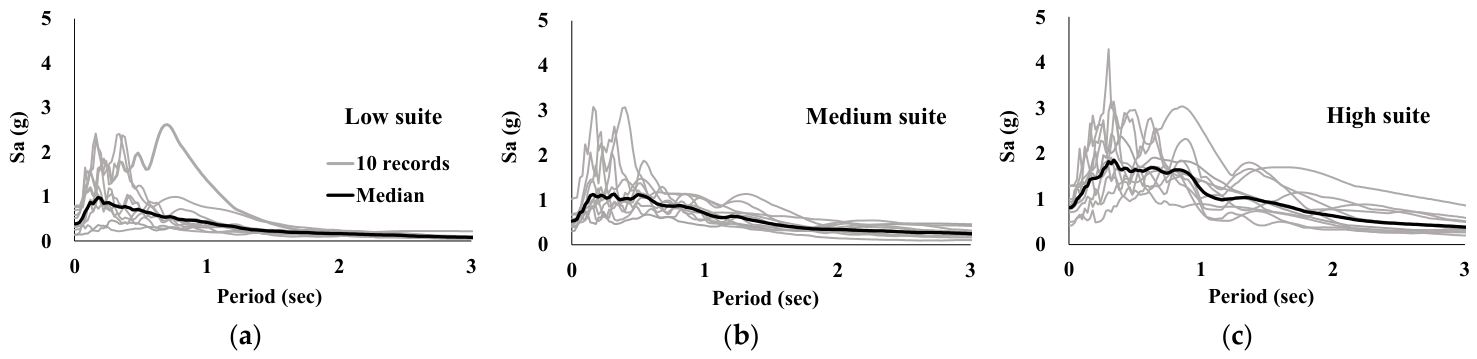
Getting a reliable assessment of structural response is critical for predicting the response of non-structural elements on the floors, attached to the ceiling and other structural elements [28]. To account for the random nature of seismic excitation, log-normal statistical tools were used to quantify the variability in single-degree-of-freedom (SDOF) seismic responses when subjected to three different suites of probabilistic earthquake records. Using the exponential log-normal distribution [29], each suite of 10 acceleration records is matched to a target median response spectrum. From the log-normal median-matched spectrum, the spectral accelerations at zero period are 0.384 g, 0.527 g, and 0.812 g for low, medium, and high suites, respectively, as depicted in Figure 3.
Although individual records inevitably depart from the target design spectrum at some periods (Figure 3), this is expected and intentional: the records are matched only in the median sense over each suite, so that the suite reproduces the target spectrum on average while retaining the natural record-to-record variability of real ground motions. The structure’s first-mode period (1.88 s) and the dominant periods of the contents fall in the range where the median match is good, so the deviations of single records do not bias the median floor demands; rather, they are precisely the dispersion that the log-normal treatment is intended to capture. The results are therefore reported as suite medians and should be read together with the variability noted below.
The median response quantities (50th percentile) from a suite of earthquakes are combined by calculating this value across all earthquakes in the suite, based on a log-normal distribution.
x ^ = e x p [ 1 n i = 1 n l n x i ]

2.3. Peak Floor Responses (Seismic Demands)

The seismic performance of freestanding contents is evaluated by using the geometric parameters of rigid blocks, and their motions are defined as sliding, rocking, and overturning states. Housner [30] notes that early investigations into the dynamic motion of rigid bodies, specifically rocking and overturning, assumed no sliding between the body’s base and the supporting floor. In describing the seismic behavior properties of rigid blocks on specific floors, the PFA serves as a critical indicator that can lead to considerable structural damage or building collapse [31,32]. Consistent with this classical assumption, the present study addresses the rocking and overturning regime only: sliding and bouncing are precluded, which is equivalent to assuming that the coefficient of friction at the content–floor interface is large enough (μ > B/H) to prevent base slip for the slenderness ratios considered, and that contact is maintained during rocking. The contents are treated as rigid homogeneous blocks of uniform density; their mass therefore enters only through the geometric capacity terms and the moment of inertia, and not through any frictional or impact-sliding mechanism. This scope is stated explicitly so that the results are understood as rocking/overturning limits rather than combined sliding–rocking limits.
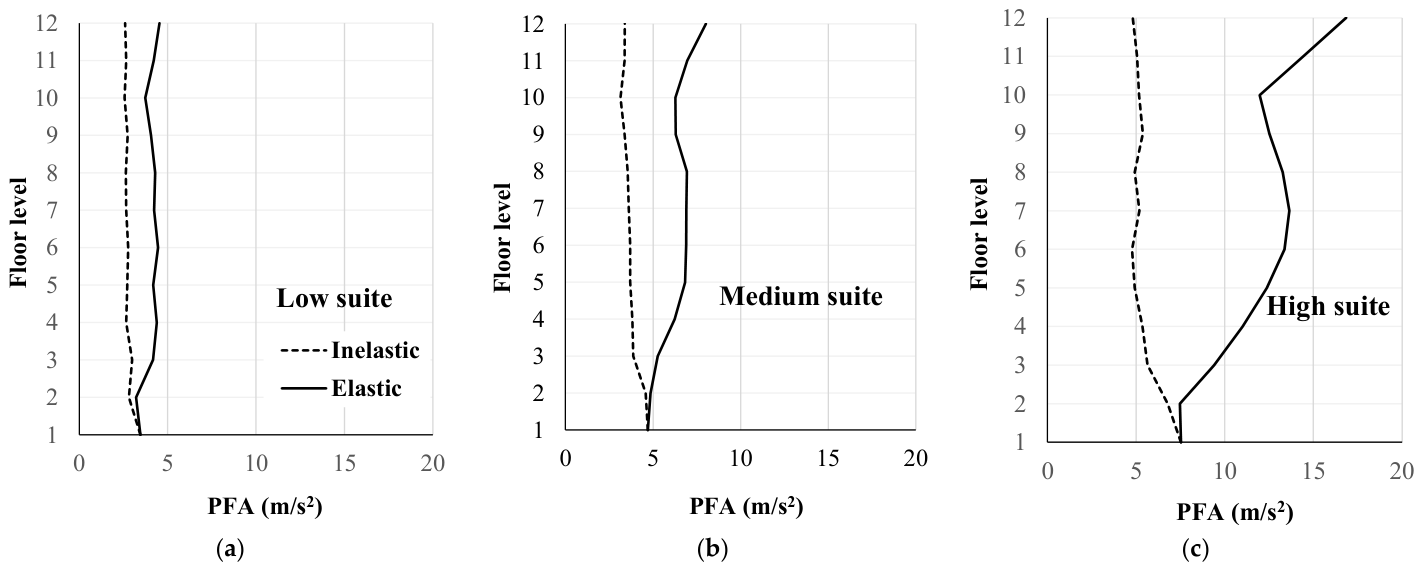
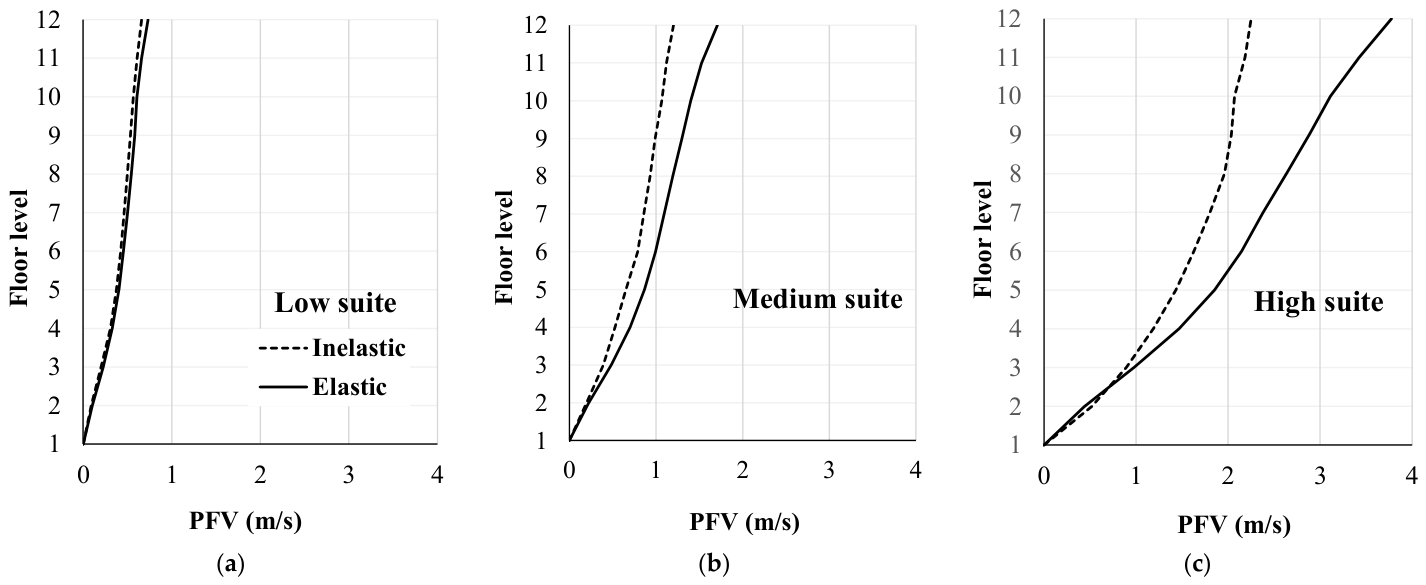
The peak floor responses, obtained from Dynaplot [33], a post-processor of the Ruaumoko2D program [21], are represented as median floor responses for each suite of ten acceleration records, comprehensively depicted in Figure 4 and Figure 5. For all floors, elastic structural responses are more significant than inelastic ones and overestimate seismic demands because nonlinear hysteretic behavior considers the inelasticity of structural members and deformed shapes regarding lateral force. The stiffness matrix is not as constant as in linear analysis. In addition to the median, the record-to-record dispersion of the floor demands was quantified by the log-normal standard deviation (β). Across the floors the dispersion of PFA and PFV was of the order of β = 0.2 − 0.35 for the low and medium suites and rose to about 0.35–0.45 for the high suite, reflecting the stronger nonlinearity and larger record-to-record variability at high intensity. The corresponding nonlinear response state of the frame was light (mostly elastic, isolated minor hinging in the lower stories) for the low suite, moderate (distributed flexural yielding concentrated in the lower third of the height) for the medium suite, and pronounced (widespread yielding and period elongation) for the high suite. This progression of damage is consistent with the reduction in PFA from elastic to inelastic analysis discussed below.

3. Stability Criteria

The study by Berto et al. [34] evaluated the vulnerability of freestanding blocks via four criteria (Ishiyama, Lam–Gad, kinematic linear and nonlinear) and correlated these with the outcomes of two experimental evaluations, under Eurocode 8 guidelines, to generate overturning stability charts. Comparisons with analytical and experimental findings confirmed the reliability of the Ishiyama criterion [35], revealing its conservative nature in predicting overturning stability.
To investigate the oscillation characteristics of rigid blocks, this study revisits the Ishiyama criterion, established from extensive shaking table tests with various earthquake excitations and geometric parameters, as shown in Figure 1. To determine the acceleration that triggers the FSCs’ rocking motion, Ishiyama’s overturning criterion is employed, establishing the lowest threshold for the blocks’ peak acceleration as below. This threshold is given by Equation (2), in which the minimum horizontal floor acceleration that initiates rocking is expressed:
a r = B H g
where B and H are the horizontal and vertical distances from the center of gravity, and g is the gravitational acceleration.
Likewise, the FSCs’ state of being overturned corresponds to the minimum peak velocity, which occurs when the rigid block’s resting potential energy is balanced by the kinetic energy generated by the rotation at its base edge. For rectangular and slender freestanding blocks, the velocity which triggers overturning is equal to:
v o = 0.4 4 g B 2 3 H
The frequency sweep tests, both simulated and experimentally conducted, show that predicting the body’s overturning requires the horizontal acceleration and velocity acting on the floor to exceed the maximum lower limits defined in Equations (2) and (3). Equation (3), which gives the minimum overturning velocity for slender rectangular blocks, is likewise taken from the Ishiyama formulation and is reproduced here as the reference (conservative) capacity against which the proposed criterion is compared.
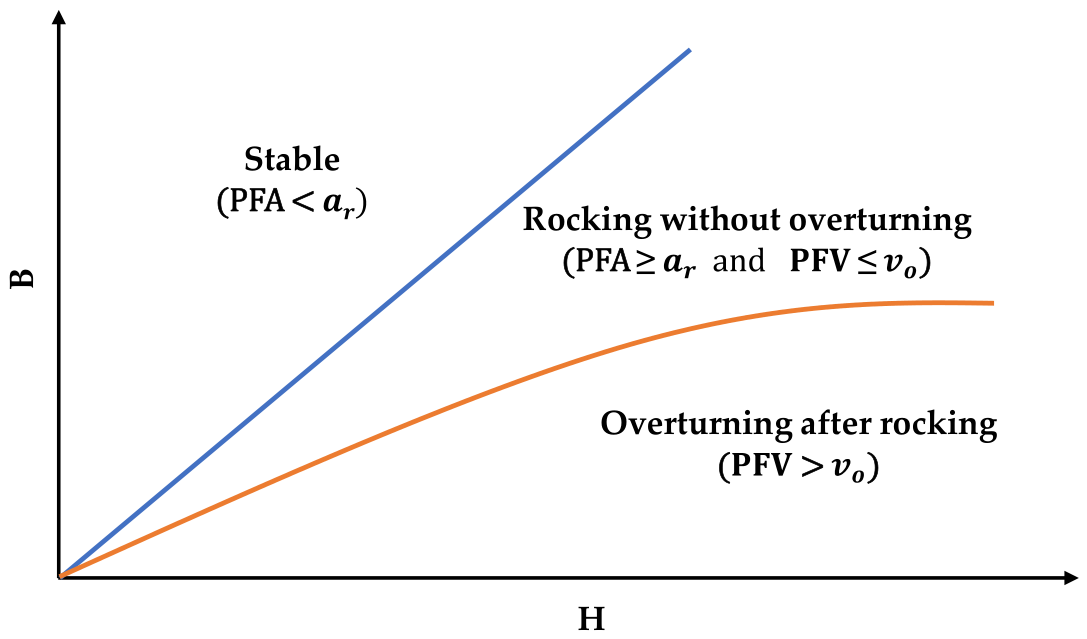
The stability chart of the Ishiyama criteria is presented in Figure 6. The blue line illustrates the derived rocking limit of freestanding contents based on the acceleration ( a r ). The rocking of freestanding blocks without continuing the overturning state is defined by the right portion of the line. The orange line represents the threshold for triggering overturning, showing the minimum velocity ( v o ) required for freestanding blocks to topple after excessive rocking. Summarizing the stability chart, three different states of motion can be categorized as: (1) no rocking, (2) rocking without overturning, and (3) overturning after excessive rocking.
With seismic input, however, Ishiyama himself acknowledged that his overturning criterion is excessively conservative, resulting in direct overturning with no rocking motion. Thus, the Ishiyama criterion does not reflect the practical motion behaviors of independent FSCs exposed to a range of seismic excitations, particularly when ‘demand/capacity’ ratios are comparatively high. This constraint can be overcome by employing a more practical overturning criterion that effectively addresses the sensitivity of overturning motion in contents, even when subjected to various seismic intensities.
In this study, a modified overturning criterion is newly suggested, considering the laws of conservation of energy and angular momentum to define the relatable motions of contents under all suites suggested [36,37,38,39,40]. The potential energy stored in the contents is converted into kinetic energy according to the law of conservation of energy when the contents rock ( α   >   θ ) to the overturning state   ( α   =   θ ) .
θ α M g R   s i n   ( α θ )   d θ = 1 2   I θ ˙ 2  
where M is the mass of freestanding content, R is the radial distance from the center of gravity to the rotation edge, α is the radial angle of R with a vertical line of content, θ is the rotation angle (rotational displacement), θ ˙ is the angular velocity and I is the mass moment of inertia of the content. In detail, Equation (4) equates the rotational kinetic energy of the block at the instant it leaves the floor, (1/2)·I·ω2, to the gain in potential energy required to raise the center of gravity from the rest position to the unstable equilibrium position at the critical angle alpha, namely m · g · R · (1 − cos α) as Equation (5). Equation (5) follows directly by writing this potential-energy gain in terms of the geometric angle α = tan−1 (B/H) and the radial distance R = √(B2 + H2)/2, and Equation (6) is then obtained by introducing the small-rotation (slender-block) approximation cos α ≈ 1 − α2/2, which is accurate for the slenderness ratios used here (B/H ≤ 0.5, i.e., α ≤ 26.6°) and linearizes the energy balance without materially affecting the threshold.
M g R ( 1 cos α ) = 1 2 × 4 3   M R 2 θ ˙ 2
θ ˙ 2 = 3 g α 2 4 R
Considering the law of angular momentum, Equation (7) imposes conservation of angular momentum about the impacting edge at each half-cycle of rocking. This is the step that introduces energy dissipation into the model. The claim that energy dissipation is neglected applies only to the (secondary) material and aerodynamic damping during the free-rocking phases between impacts, which is conservatively omitted; the dominant impact dissipation is retained through Equation (7).
I θ ˙ = m V R   c o s   α
Substituting Equation (7) to Equation (6), the lowest maximum velocity required to overturn the content can be obtained regarding the geometric parameters of the content.
v m = α 4 g R 3

4. Assessment Results

The rocking and overturning of FSCs are effectively evaluated in terms of accelerations and velocities computed by geometric parameters and are defined as seismic capacities. Correspondingly, they are compared with seismic demands, PFAs and PFVs from input earthquake excitations to establish rocking and overturning stability charts. Ishiyama overturning criterion and modified overturning criterion are compared in both inelastic and elastic analyses. The sizes of FSCs used for the rocking and overturning assessment are listed in Table 4; the typical sizes of bookshelves in Keimyung University library are considered. The frequency parameter of the contents (p) was calculated as described by Karam and Tabbara [41].
p = W R I o = 3 g 4 R
A key aim of this study is to redefine the limits of rocking and overturning stability on floors, expressed as the ratio of seismic demand to seismic capacity, which are subjected to low, medium, and high earthquake suites reflecting multi-level seismic hazards. The FSCs start rocking motion when the seismic demands (PFAs) equal or surpass the seismic capacity ( a r ). The overturning response is also observed when the seismic demands (PFVs) are at least equal to or larger than the seismic capacities ( v o , v m ).
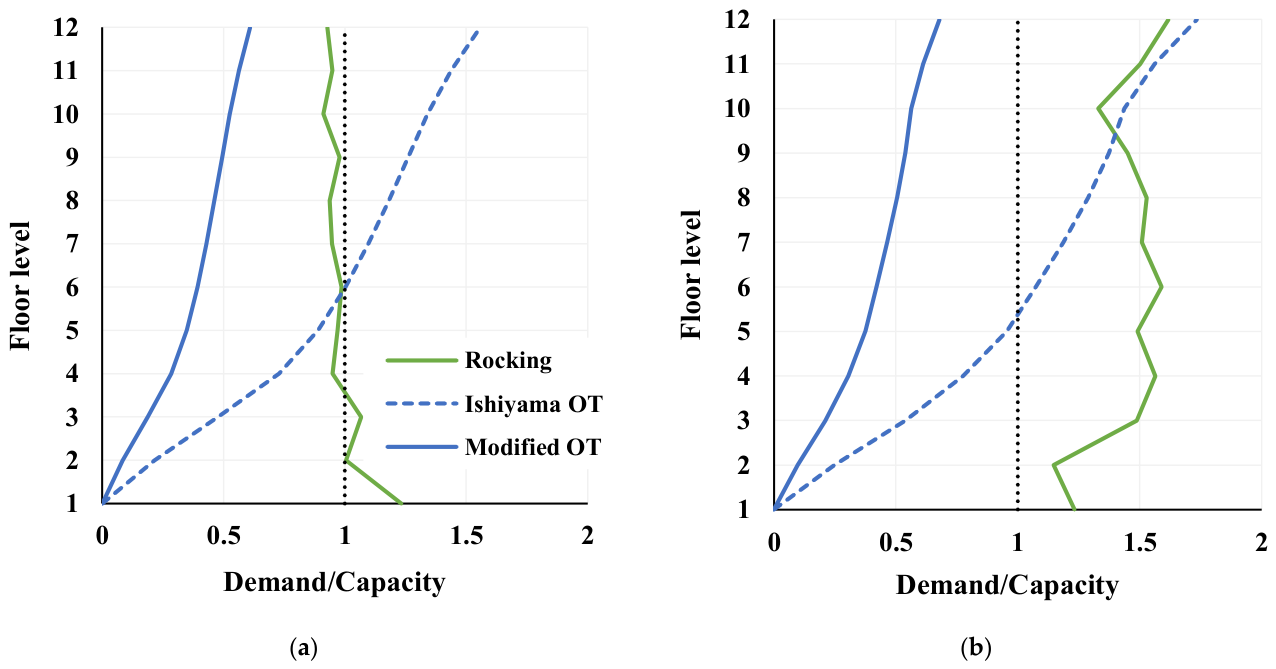
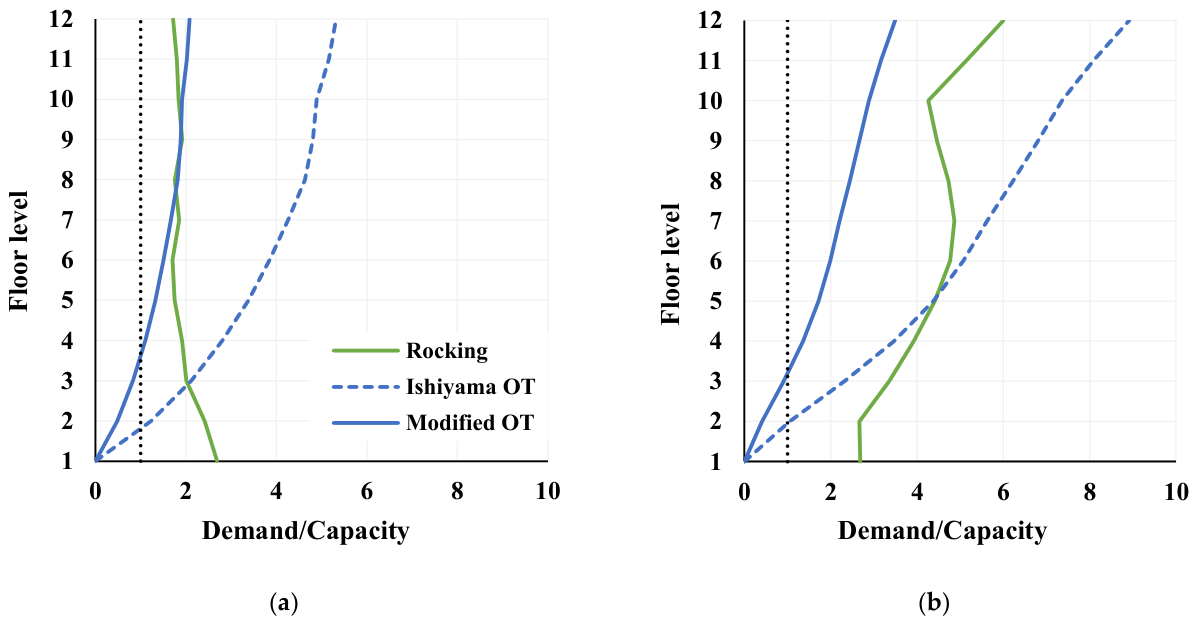
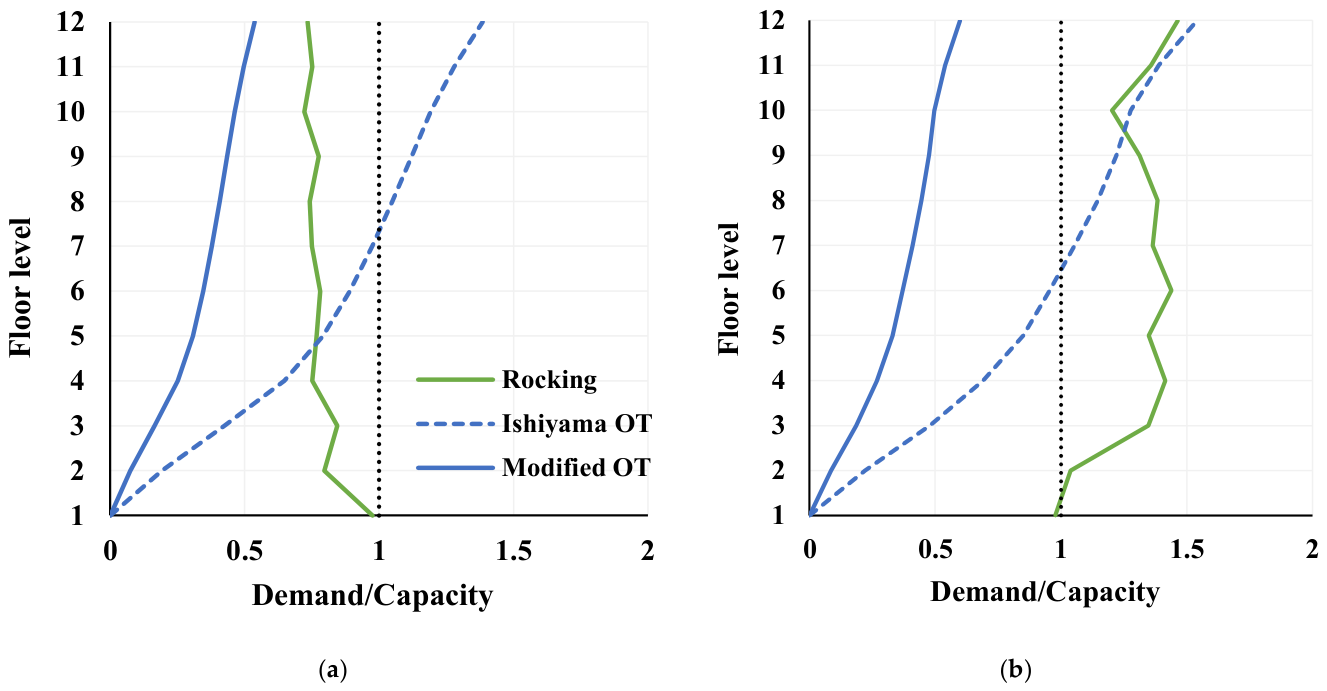
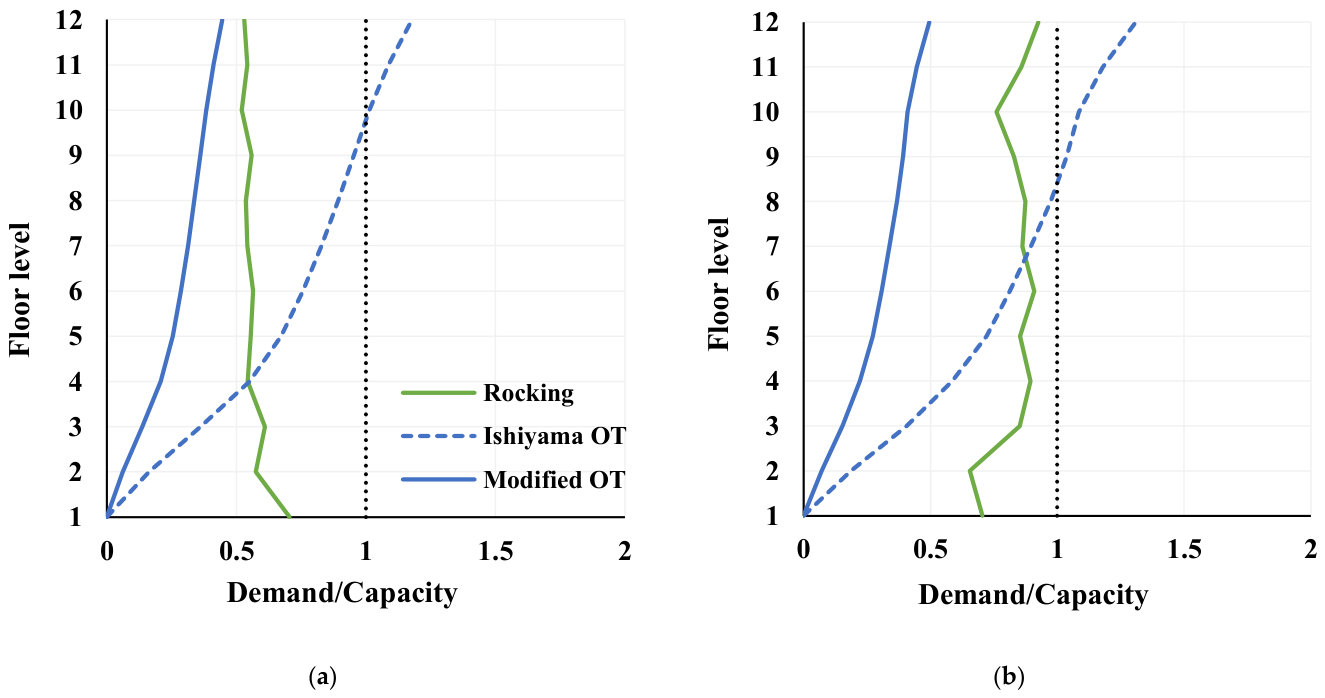
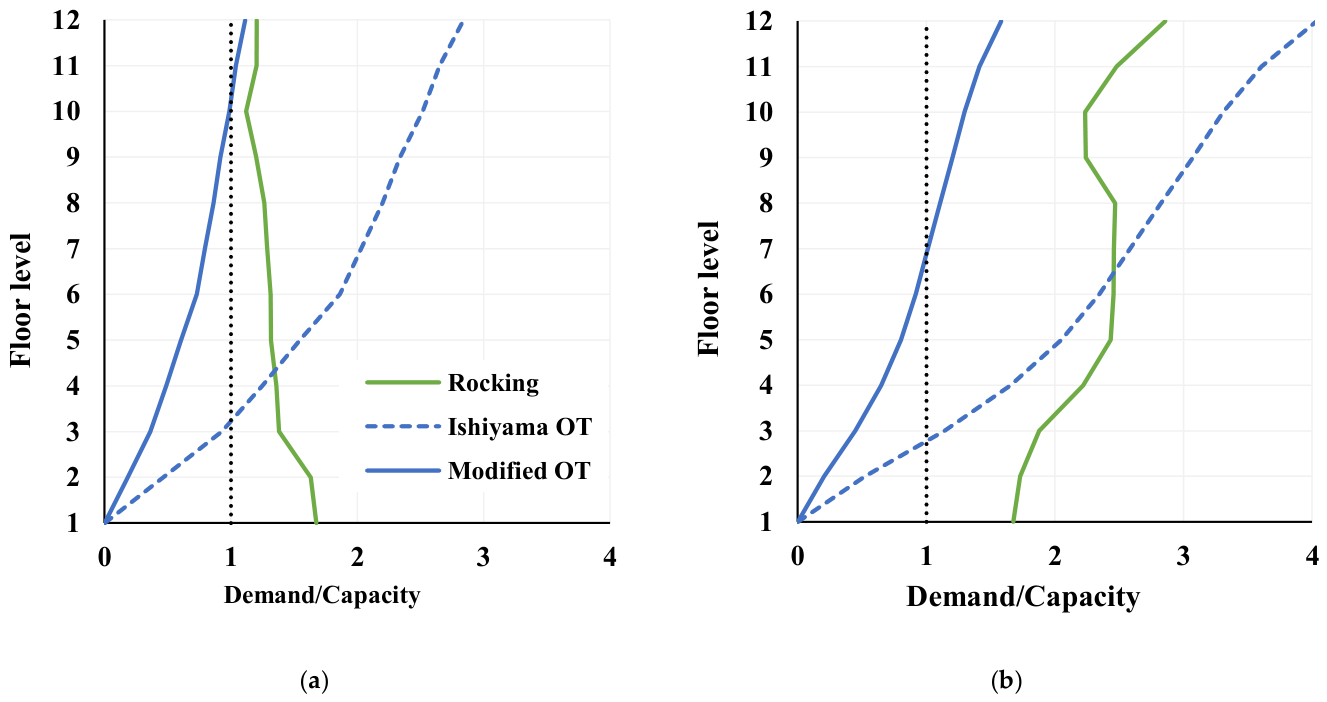
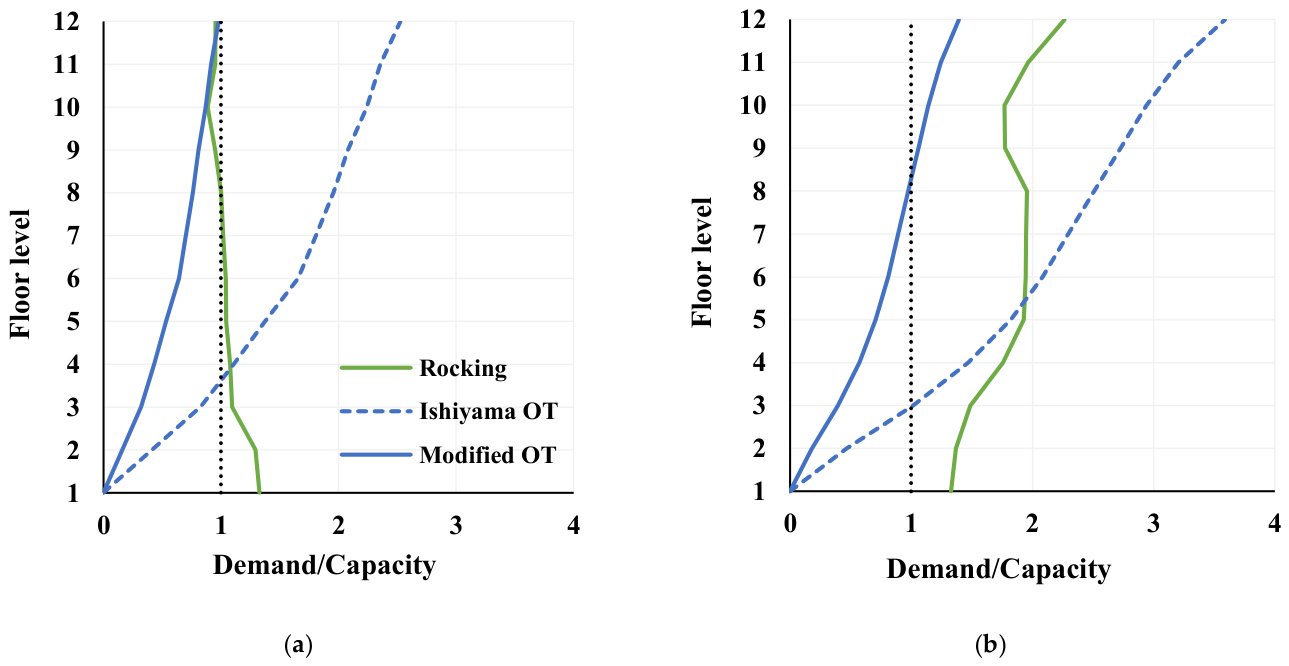
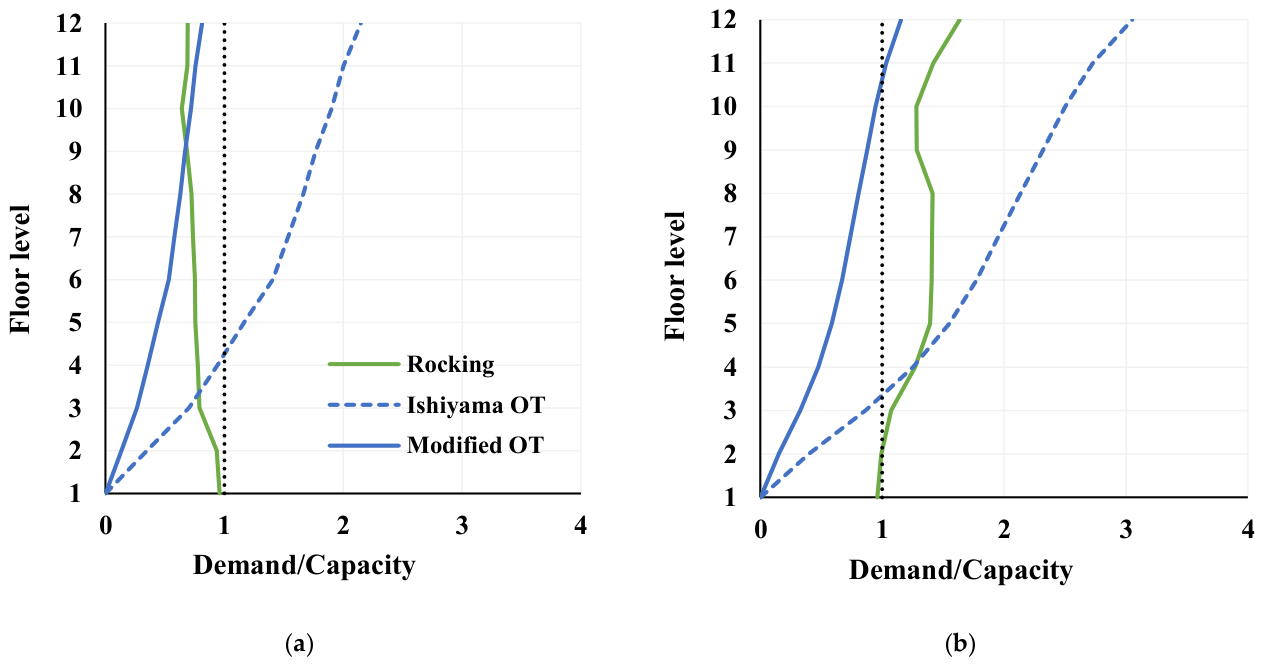
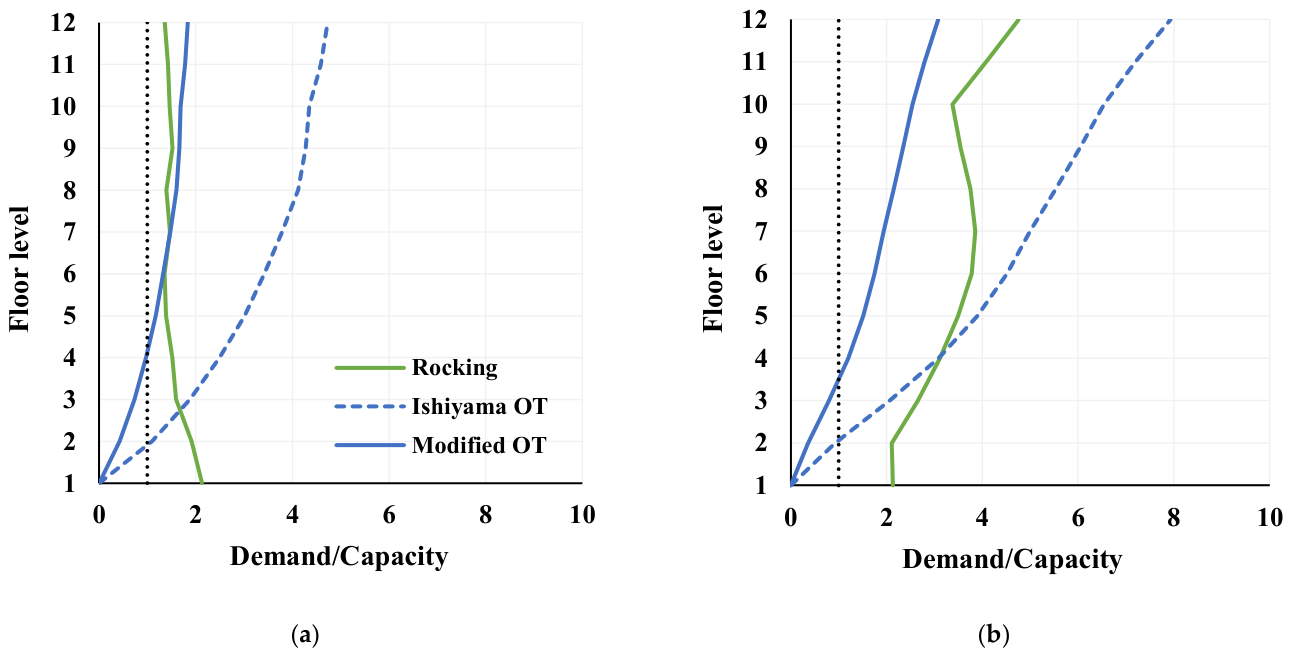
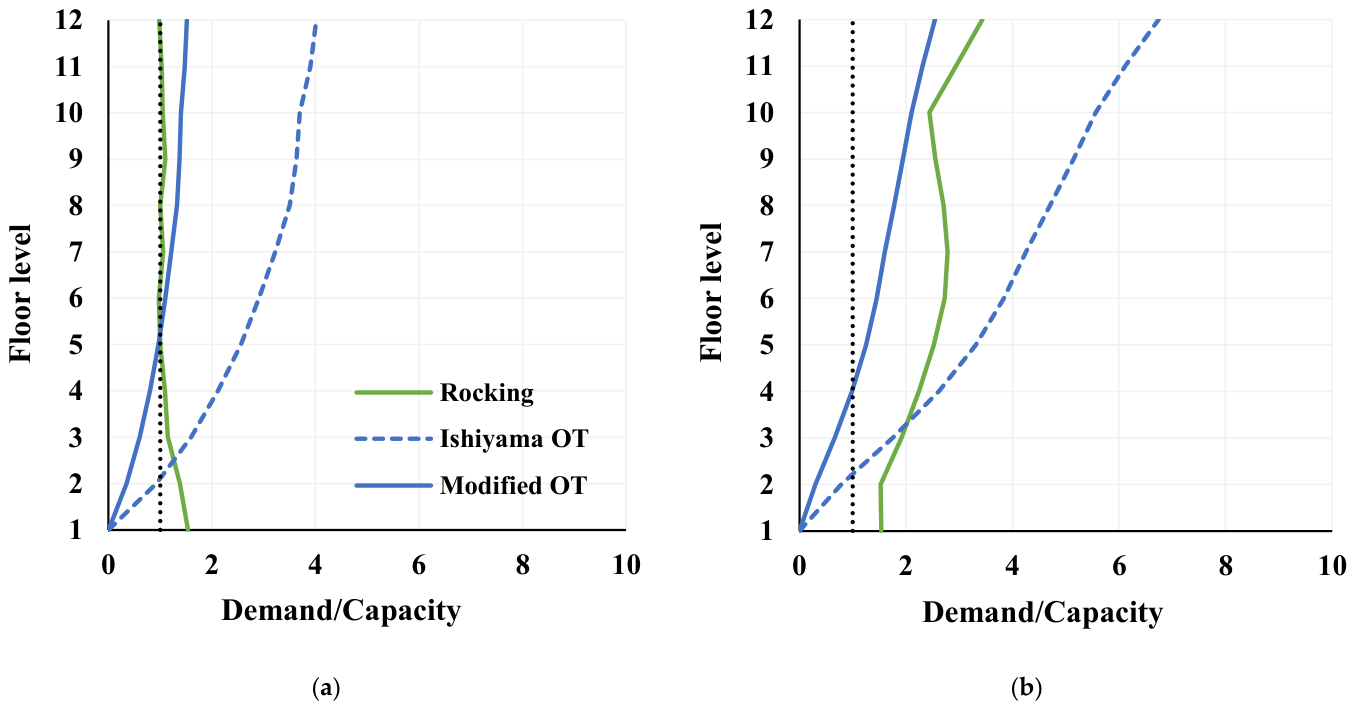
Figure 7, Figure 8, Figure 9, Figure 10, Figure 11, Figure 12, Figure 13, Figure 14 and Figure 15 present the practical assessment outcomes for the rocking and overturning behavior of FSCs with three different slenderness ratios (B/H) used for the 12-story two-bay reinforced concrete framed structure under three different earthquake suites. The graphical findings show the comprehensive stability attributes concerning the rocking and overturning of the FSCs across every story level. To the left of the vertical dotted line, there are no rocking or overturning behaviors, as this line signifies the lowest threshold for such actions. The contents’ rocking motion is shown by the green solid line. Ishiyama’s and the modified overturning behaviors are represented by the blue dashed and solid lines, respectively. Thus, the behavior can be confirmed by observing whether each line passes through the vertical dotted line. The ratio of demand to capacity for rocking and overturning, which are close to or away from the stability limit line, represents the intensity of rocking and overturning. The higher the ratios, the higher the risk of the overturning of contents discovered under the corresponding excitation on a particular floor.
Overall, the elastic responses of FSCs are more significant than the inelastic responses for all suites because the elastic analysis overestimates the response of the structure by assuming that the stresses of building elements remain in the linear state and the stiffnesses remain constant. The most significant difference between the two analyses can be seen in the rocking behavior, since the acceleration responses are much larger than the velocity responses. The higher the earthquake intensity, the larger the differences that can be seen in floor responses. Although the inelastic analysis is more realistic, the rocking and overturning motions do not correlate with each other according to the parametric configurations of Ishiyama criteria. Quantitatively, moving from elastic to inelastic analysis reduced the median PFA by roughly 25–40% and the median PFV by roughly 15–30% over the building height, with the largest reductions at the upper floors and under the high suite. This reduction is driven primarily by two coupled mechanisms: yielding of the lower-story members lengthens the effective fundamental period (period elongation), shifting the structure away from the high-frequency range that amplifies floor acceleration; and hysteretic energy dissipation lowers the floor response amplification. Stiffness degradation under the modified Takeda model accentuates both effects at higher intensity. Because acceleration (rocking) demand is more sensitive to the high-frequency content than velocity (overturning) demand, the elastic-to-inelastic difference is largest for rocking, which explains why the gap between the two analyses widens with earthquake intensity.
The rocking behavior remains stable across the building’s height under the low suite (Figure 7, Figure 8 and Figure 9), with demand/capacity less than 1, except for the first three floors at a 0.286 ratio. However, direct overturning occurs from the 6th to 12th floors with no rocking under the Ishiyama criterion. The ratios of 0.361 and 0.500 for the Ishiyama criterion also showed direct overturning, with the former occurring from the 8th to the 12th floor and the latter from the 10th to the 12th floor. However, the modified overturning responses deliver more practical and realistic findings, presenting much lower values compared to Ishiyama’s.
Within the medium suite, the Ishiyama criterion experienced a direct overturning at slenderness ratios of 0.361 and 0.500, affecting the 9th to 12th floors and the 5th to 12th floors, respectively. While all floor contents at a 0.286 ratio showed rocking responses, the Ishiyama criterion experienced overturning across the 4th floor to the 12th floor. In particular, the modified overturning criterion shows a lack of overturning, excluding the highest two floors, which have a ratio of 0.268. Figure 10, Figure 11 and Figure 12 give the corresponding medium-suite charts for B/H = 0.286, 0.361 and 0.500.
Under the high suite, all the rocking behaviors can be found along the height because of the high intensity of the earthquake adopted, so there is no direct overturning without rocking. The valuable adaptation of the modified criterion is clear, shown by the considerable disparity in results between the Ishiyama and modified overturning calculations. Evidently, the modified overturning responses under low, medium, and high suites are all reduced. Figure 13, Figure 14 and Figure 15 give the high-suite charts; the divergence between the Ishiyama and modified overturning lines is widest here.

5. Conclusions

The seismic performance of FSCs is explored in this study through an examination of the geometric characteristics of their contents, which are key to their seismic capacity. To understand the dynamic responses of FSCs to varying seismic hazards, a 12-story, two-bay reinforced concrete structure was employed. The seismic response of absolute accelerations and relative velocities of the building floors were adopted as seismic demands for crucially determining the states of rocking and overturning of the FSCs. Based on the practical inelastic results described, the following conclusions can be drawn.
The Ishiyama criteria emphasize that rocking and overturning responses are independent due to distinct geometric parameters for seismic capacity, leading to inaccurate and unrealistic FSC motions that exhibit direct overturning with no rocking. Thus, a revised overturning criterion has been proposed to reduce the vulnerability to overturning and ultimately enhance the practical seismic resilience of FSCs.
Rocking behavior occurred rarely in the low suite, but occurred on most floors in the medium and high suites, except for the medium suite with low slenderness ratio content. In addition, for all suites and slenderness ratios, the lower stories exhibit relatively higher rocking behavior compared to the upper stories. For design, this height-wise trend implies that restraint of acceleration-sensitive contents is most critical on the lower stories, where rocking demand is highest, whereas on the upper stories overturning (velocity-governed) becomes the controlling action; the mitigation strategy should therefore differ with floor level rather than being uniform over the height.
Employing the Ishiyama criterion revealed that the calculated seismic capacities of the FSCs were considerably lower than the values determined by the modified overturning criterion, consequently exhibiting substantially greater overturning behaviors for all suites. According to the modified criterion, the demand-to-capacity ratios were roughly 2.57 times smaller than those from the Ishiyama criterion, thereby improving the stability of FSC performance. Therefore, the overturning behavior derived using the new criteria provides a more realistic and economical basis for evaluating FSC performance. In engineering terms, a demand-to-capacity ratio about 2.57 times smaller means that a content predicted to overturn by the Ishiyama criterion is, under the same floor motion, predicted only to rock (without overturning) by the proposed criterion on many floors. This directly reduces the number of floors and content geometries that would require restraint, with corresponding savings in mitigation cost. However, the direction and magnitude of this reduction align with experimental and analytical evidence showing the Ishiyama criterion is conservative, as Berto et al. [34] found Ishiyama over-predicts overturning compared to shaking-table tests, and the proposed criterion adjusts predictions accordingly. Formal experimental validation of the criterion, comparing predictions to shaking-table tests, is beyond this study’s scope but a priority for future work.
The conclusions are based on a single 12-story two-bay RC frame analyzed as a 2D plane model; consequently, the stated dependence of content stability on the building mode shape, although physically expected, is not parametrically demonstrated here and should be confirmed by analyzing structures of different height, stiffness and irregularity.

Author Contributions

Conceptualization, K.K. and M.-H.C.; methodology, K.K. and M.-H.C.; software, K.K.; validation, K.K. and M.-H.C.; formal analysis, K.K.; investigation, K.K.; resources, M.-H.C.; data curation, K.K.; writing—original draft preparation, K.K.; writing—review and editing, M.-H.C., V.M. and S.-H.J.; visualization, K.K.; supervision, M.-H.C. and V.M.; project administration, S.-H.J.; funding acquisition, M.-H.C. All authors have read and agreed to the published version of the manuscript.

Funding

This research was supported by the National Research Foundation of Korea (NRF) grant funded by the Korea Government (MSIT), grant number 2019R1F1A1062711. The APC was funded by Keimyung University, University of Manchester and Daegu Science High School.

Data Availability Statement

The article contains the study’s original contributions; for additional questions, contact the corresponding author.

Conflicts of Interest

The authors declare that the research proceeded with no commercial or financial associations that could be perceived as potential conflicts of interest.

References

  1. Pardalopoulos, S.I.; Pantazopoulou, S.J. Seismic response of non-structural elements attached on multistorey buildings. Earthq. Eng. Struct. Dyn. 2014, 44, 139–158. [Google Scholar]
  2. Cogurcu, M.T. Construction and design defects in the residential buildings and observed earthquake damage types in Turkey. Nat. Hazards Earth Syst. Sci. 2015, 15, 931–945. [Google Scholar] [CrossRef]
  3. Zito, M.; Nascimbene, R.; Dubini, P.; D’Angela, D.; Magliulo, G. Experimental seismic assessment of non-structural elements: Testing protocols and novel perspectives. Buildings 2022, 12, 1871. [Google Scholar]
  4. Perrone, D.; Filiatrault, A.; Monteiro, R. Guidelines for Non-Structural Elements Survey and Inventory; Deliverable DE3; ITERATE Project Consortium: Pavia, Italy, 2018. [Google Scholar]
  5. Rashid, M.; Dhakal, R.; Sullivan, T. Seismic design of acceleration-sensitive non-structural elements in New Zealand: State-of-practice and recommended changes. Bull. N. Z. Soc. Earthq. Eng. 2021, 54, 243–262. [Google Scholar]
  6. Kounadis, A.N. On the rocking-sliding instability of rigid blocks under ground excitation: Some new findings. Soil Dyn. Earthq. Eng. 2015, 75, 246–258. [Google Scholar]
  7. Thomaidis, I.M.; Camara, A.; Kappos, A.J. Simulating the response of free-standing rocking rigid blocks using Abaqus/Standard. In Proceedings of the 2017 SIMULIA UK Regional User Meeting, Cheshire, UK, 17–18 October 2017. [Google Scholar]
  8. Filiatrault, A.; Sullivan, T. Performance-based seismic design of non-structural building elements: The next frontier of earthquake engineering. Earthq. Eng. Eng. Vib. 2014, 13, 17–46. [Google Scholar]
  9. Wang, T.; Shang, Q.; Li, J. Seismic force demands on acceleration-sensitive non-structural elements: A state-of-the-art review. Earthq. Eng. Eng. Vib. 2021, 20, 39–62. [Google Scholar]
  10. Merino, R.J.; Perrone, D.; Filiatrault, A. Consistent floor response spectra for performance-based seismic design of non-structural elements. Earthq. Eng. Struct. Dyn. 2020, 49, 261–284. [Google Scholar]
  11. Nikfar, F.; Konstantinidis, D. Shake table investigation on the seismic performance of hospital equipment supported on wheels/casters. Earthq. Eng. Struct. Dyn. 2016, 46, 243–266. [Google Scholar] [CrossRef]
  12. Berto, L.; Bovo, M.; Rocca, I.; Saetta, A.; Savoia, M. Seismic safety of valuable non-structural elements in RC buildings: Floor response spectrum approaches. Eng. Struct. 2020, 205, 110081. [Google Scholar] [CrossRef]
  13. Petrone, C.; Di Sarno, L.; Magliulo, G.; Cosenza, E. Numerical modelling and fragility assessment of typical freestanding building contents. Bull. Earthq. Eng. 2017, 15, 1609–1633. [Google Scholar]
  14. Bakhtiary, E.; Gardoni, P. Probabilistic seismic demand model and fragility estimates for rocking symmetric blocks. Eng. Struct. 2016, 114, 25–34. [Google Scholar] [CrossRef]
  15. Dhakal, R.P.; Pourali, A.; Tasligedik, A.S.; Yeow, T.; Baird, A.; MacRae, G.; Pampanin, S.; Palermo, A. Seismic performance of non-structural elements and contents in buildings: An overview of NZ research. Earthq. Eng. Eng. Vib. 2016, 15, 1–17. [Google Scholar] [CrossRef]
  16. Pappas, A.; Sextos, A.; Da Porto, F.; Modena, C. Efficiency of alternative intensity measures for the seismic assessment of monolithic free-standing columns. Bull. Earthq. Eng. 2017, 15, 1635–1659. [Google Scholar]
  17. Liu, P.; Xue, W.; Pang, H.; Zhang, Y.-M.; Chen, H.-T.; Yang, W.-G. Seismic overturning fragility analysis for freestanding building contents subjected to horizontal bidirectional floor motions. Soil Dyn. Earthq. Eng. 2022, 161, 107414. [Google Scholar] [CrossRef]
  18. Ahmad, Z.; Ahmed, H.A.; Shahzada, K.; Li, Y. Vulnerability of non-structural elements (NSEs) in buildings and their life cycle assessment: A review. Buildings 2024, 14, 170. [Google Scholar] [CrossRef]
  19. Carr, A.J. Ruaumoko Manual, Volume 1: Theory; University of Canterbury: Christchurch, New Zealand, 2007. [Google Scholar]
  20. Chey, M.H. Passive and Semi-Active Tuned Mass Damper Building Systems. Ph.D. Dissertation, University of Canterbury, Christchurch, New Zealand, 2007. [Google Scholar]
  21. Carr, A.J. Ruaumoko Manual, Volume 2: User Manual for the Ruaumoko2D; University of Canterbury: Christchurch, New Zealand, 2007. [Google Scholar]
  22. Chey, M.H.; Chase, J.G.; Mander, J.B.; Carr, A.J. Aseismic smart building isolation systems under multi-level earthquake excitations: Part I, conceptual design and nonlinear analysis. Front. Struct. Civ. Eng. 2015, 9, 286–296. [Google Scholar] [CrossRef]
  23. Soroushian, S.; Maragakis, E.M.; Zaghi, A.E.; Rahmanishamsi, E.; Itani, A.; Pekcan, G. Response of a 2-story test-bed structure for the seismic evaluation of non-structural systems. Earthq. Eng. Eng. Vib. 2016, 15, 19–29. [Google Scholar]
  24. Jun, S.C.; Lee, C.H.; Bae, C.J.; Kim, S.Y. Evaluation of equivalent-static floor acceleration for seismic design of non-structural elements. J. Archit. Inst. Korea Struct. Constr. 2020, 36, 121–128. [Google Scholar]
  25. Petrone, C.; Magliulo, G.; Manfredi, G. Seismic demand on light acceleration-sensitive non-structural elements in European reinforced concrete buildings. Earthq. Eng. Struct. Dyn. 2015, 44, 1203–1217. [Google Scholar]
  26. Mate, N.U.; Bakre, S.V.; Jaiswal, O.R.; Sayyad, K.K. Elastic and inelastic response of structural systems in seismic pounding. Open J. Civ. Eng. 2016, 6, 50–73. [Google Scholar]
  27. Somerville, P.; Smith, N.; Punyamurthula, S.; Sun, J. Development of Ground Motion Time Histories for Phase 2 of the FEMA/SAC Steel Project; Report No. SAC/BD-97/04; SAC Joint Venture: Sacramento, CA, USA, 1997. [Google Scholar]
  28. Baker, J.W. Conditional mean spectrum: Tool for ground-motion selection. J. Struct. Eng. 2011, 137, 322–331. [Google Scholar] [CrossRef]
  29. Chung, Y.I.; Kim, K.C.; Chey, M.H. A property of seismic response with log-normal distribution at SDOF structure. J. Korea Converg. Soc. 2019, 10, 303–308. [Google Scholar]
  30. Housner, G.W. The behavior of inverted pendulum structures during earthquakes. Bull. Seismol. Soc. Am. 1963, 53, 403–417. [Google Scholar] [CrossRef]
  31. Choi, K.S.; Yi, W.H.; Yang, W.J.; Kim, H.J. A study on evaluation of floor response spectrum for seismic design of non-structural elements. J. Earthq. Eng. Soc. Korea 2013, 17, 279–291. [Google Scholar]
  32. Lin, K.Y.; Lin, T.Z.; Lin, Y. Real-time seismic structural response prediction system based on support vector machine. Earthq. Struct. 2020, 18, 163–170. [Google Scholar]
  33. Carr, A.J. Ruaumoko Manual, Volume 4: User Guide to Associated Programs; University of Canterbury: Christchurch, New Zealand, 2007. [Google Scholar]
  34. Berto, L.; Rocca, I.; Saetta, A. Vulnerability assessment methods for rocking and overturning of free standing elements. Soil Dyn. Earthq. Eng. 2018, 110, 121–136. [Google Scholar] [CrossRef]
  35. Ishiyama, Y. Motions of rigid bodies and criteria for overturning by earthquake excitations. Bull. N. Z. Soc. Earthq. Eng. 1984, 17, 24–37. [Google Scholar] [CrossRef]
  36. Makris, N. The role of the rotational inertia of free-standing rocking columns and articulated frames. Bull. Seismol. Soc. Am. 2014, 104, 2226–2239. [Google Scholar]
  37. Casapulla, C.; Giresini, L.; Lourenco, P.B. Rocking and kinematic approaches for rigid block analysis of masonry walls: State of the art and recent developments. Buildings 2017, 7, 69. [Google Scholar] [CrossRef]
  38. Čeh, N.; Jelenić, G. Rocking motion of a single rigid rectangular block—Analysis of the block slenderness assumption. In Proceedings of the 8th International Congress of the Croatian Society of Mechanics, Opatija, Croatia, 29 September–2 October 2015. [Google Scholar]
  39. Dimitrakopoulos, E.G.; DeJong, M.J. Revisiting the rocking block: Closed-form solutions and similarity laws. Proc. R. Soc. A Math. Phys. Eng. Sci. 2012, 468, 2294–2318. [Google Scholar] [CrossRef]
  40. Homma, S.; Nabeshima, K.; Takewaki, I. Explicit overturning limit of rigid block using triple and pseudo-triple impulses under critical near-fault ground motions. Front. Built Environ. 2021, 7, 731670. [Google Scholar] [CrossRef]
  41. Karam, G.; Tabbara, M. Rocking blocks stability under critical pulses from near-fault earthquakes using a novel energy based approach. Appl. Sci. 2020, 10, 5924. [Google Scholar] [CrossRef]
Figure 1. A 12-story, two-bay reinforced concrete framed structure (left) and a rectangular content expressed with geometric parameters (right).
Buildings 16 02541 g001
Figure 2. Rayleigh or proportional damping model.
Buildings 16 02541 g002
Figure 3. Spectral acceleration from (a) low, (b) medium, and (c) high suites.
Buildings 16 02541 g003
Figure 4. Peak floor accelerations from (a) low, (b) medium, and (c) high suites.
Buildings 16 02541 g004
Figure 5. Peak floor velocities from (a) low, (b) medium, and (c) high suites.
Buildings 16 02541 g005
Figure 6. Ishiyama stability chart for freestanding blocks.
Buildings 16 02541 g006
Figure 7. Rocking and overturning assessment (B/H = 0.286, low suite). (a) Inelastic. (b) Elastic.
Buildings 16 02541 g007
Figure 8. Rocking and overturning assessment (B/H = 0.361, low suite). (a) Inelastic. (b) Elastic.
Buildings 16 02541 g008
Figure 9. Rocking and overturning assessment (B/H = 0.500, low suite). (a) Inelastic. (b) Elastic.
Buildings 16 02541 g009
Figure 10. Rocking and overturning assessment chart (B/H = 0.268, medium suite). (a) Inelastic. (b) Elastic.
Buildings 16 02541 g010
Figure 11. Rocking and overturning assessment chart (B/H = 0.361, medium suite). (a) Inelastic. (b) Elastic.
Buildings 16 02541 g011
Figure 12. Rocking and overturning assessment chart (B/H = 0.500, medium suite). (a) Inelastic. (b) Elastic.
Buildings 16 02541 g012
Figure 13. Rocking and overturning assessment chart (B/H = 0.268, high suite). (a) Inelastic. (b) Elastic.
Buildings 16 02541 g013
Figure 14. Rocking and overturning assessment chart (B/H = 0.361, high suite). (a) Inelastic. (b) Elastic.
Buildings 16 02541 g014
Figure 15. Rocking and overturning assessment chart (B/H = 0.500, high suite). (a) Inelastic. (b) Elastic.
Buildings 16 02541 g015
Table 1. Masses and external vertical loadings of the framed structure.
LevelWeight (kN)Nodal Loads (kN)
Ext. NodeInt. NodeExt. NodeInt. Node
01319−25.0−37.0
1434757−298.5−485.1
2434757−298.5−485.1
3434757−298.5−485.1
4434757−298.5−485.1
5434757−298.5−485.1
6434755−298.5−485.1
7427743−293.9−475.9
8427743−293.9−475.9
9420731−289.2−468.5
10420731−289.2−468.5
11420731−289.2−468.5
12409717−266.2−439.5
Table 2. Dynamic properties of the framed structure.
ModeNatural Frequency
(Hz)
Effective Mass
(kN-s2/m)
Modal Damping
(%)
Participation
Factor
10.5321.514 × 1035.0001.366
21.5332.527 × 1022.674−5.321 × 10⁻¹
32.7567.408 × 102.812−2.752 × 10⁻¹
43.8537.899 × 10−293.3213.064 × 10−16
53.8853.596 × 103.338−1.700 × 10⁻¹
64.5255.6163.694−9.368 × 10⁻²
75.1311.944 × 10−284.051−4.722 × 10⁻¹⁶
85.2792.056 × 104.141−1.436 × 10⁻¹
96.6521.548 × 105.000−1.118 × 10⁻¹
Table 3. Characteristics of the earthquake records.
Record (year)Magnitude
(Mw)
Distance
(km)
Scale
Factor
Duration
(Sec)
PGA
(g)
Probability of exceedance—50% in 50 years (low suite)
Coyote Lake (1979)5.78.82.2826.860.585
Imperial Valley (1979)6.51.20.4039.080.143
Kern (1952)7.71072.9278.600.144
Landers (1992)7.3642.6379.980.338
Morgan Hill (1984)6.2152.3559.980.319
Parkfield (1966)6.13.71.8143.920.780
Parkfield (1966)6.18.02.9226.140.693
N. Palm Springs (1986)6.09.62.7559.980.517
San Fernando (1971)6.511.3079.460.253
Whittier (1987)6.0173.6239.980.768
Probability of exceedance—10% in 50 years (medium suite)
Imperial Valley (1940)6.9102.0139.380.461
Imperial Valley (1979)6.54.11.0139.380.393
Imperial Valley (1979)6.51.20.8439.080.300
Landers (1992)7.3363.2079.980.421
Landers (1992)7.3252.1779.980.520
Loma Prieta (1989)7.012.41.7939.980.665
Northridge (1994)6.76.71.0359.980.678
Northridge (1994)6.77.50.7914.950.533
Northridge (1994)6.76.40.9959.980.569
N. Palm Springs (1986)6.06.72.0759.981.019
Probability of exceedance—2% in 50 years (high suite)
1995 Kobe (1995)6.93.41.1559.981.282
Loma Prieta (1989)7.03.50.8224.990.418
Northridge (1994)6.77.51.2914.950.868
Northridge (1994)6.76.41.6159.980.926
Tabas (1974)7.41.21.0849.980.809
Elysian Park 17.117.51.4329.991.296
Elysian Park 27.110.70.9729.990.779
Elysian Park 37.111.21.1029.990.992
Palos Verdes 17.11.50.9059.980.711
Palos Verdes 27.11.50.8859.980.500
Table 4. Parameters of freestanding contents used.
B (cm)H (cm)B/Hp (Hz)
301050.2862.596
30830.3612.887
30600.5003.312
Disclaimer/Publisher’s Note: The statements, opinions and data contained in all publications are solely those of the individual author(s) and contributor(s) and not of MDPI and/or the editor(s). MDPI and/or the editor(s) disclaim responsibility for any injury to people or property resulting from any ideas, methods, instructions or products referred to in the content.