1. Introduction
With the expanding scale of urban river-crossing transportation infrastructure construction, river-crossing shield tunnels have become the primary construction method for urban expressways and river-crossing projects owing to their high construction efficiency, minor disturbance to ground traffic, and strong adaptability to complex geological environments [
1,
2]. Especially with the rapid development of large-diameter slurry balanced shield tunneling, the outer diameter of shield machines has been increasing continuously, leading to an expanded construction disturbance range and more severe stratum response. For river-crossing shield tunnels, construction generally covers onshore sections, dike sections and riverbed sections. Distinct differences exist among these sections in terms of stratum composition, boundary load, water pressure conditions and deformation control requirements [
3]. Accordingly, the stratum response induced by shield tunneling presents prominent sectional characteristics.
Existing studies have shown that stratum deformation induced by shield tunneling is mainly affected by multiple factors including face support pressure, cutterhead torque, total shield thrust, tunneling speed, shield tail void, and synchronous grouting [
4,
5,
6]. In soft soil strata, construction disturbance is generally manifested as ground surface settlement, deep soil displacement and stress redistribution. Numerous studies have been conducted by scholars on river-crossing shield tunneling across dike or onshore sections, focusing on the settlement law of embankments, settlement trough distribution, deformation contribution during construction stages and deep soil displacement [
7,
8,
9,
10]. It is pointed out that the settlement trough at embankment top mostly presents a V-shaped distribution during single-tunnel excavation, while it may evolve into a W-shaped distribution after the superposition effect of double-line construction. Deep soil near the grouting layer usually exhibits more complicated settlement and horizontal displacement responses. Lu et al. found in their research on the embankment section of the East Genshan Road River-Crossing Tunnel that the maximum settlement of the embankment top was 8.7 mm during the undercrossing of the single left tunnel, and the maximum settlement increased to 12.2 mm after the completion of double-line tunneling. Meanwhile, the periods during and after shield passage were critical stages for rapid settlement development, which together contributed approximately 66% of the total settlement. This indicates that the construction disturbance in the onshore embankment section presents obvious staged characteristics and superposition effects [
11].
Nevertheless, compared with the onshore and embankment sections, the construction environment of shield tunneling in the riverbed section is far more complicated [
12,
13,
14]. On the one hand, the riverbed section is generally characterized by high water pressure and saturated soft soil strata, featuring high soil compressibility, low soil strength and strong disturbance diffusion. On the other hand, construction parameters serve as a vital link between the operating state of shield machines and stratum disturbance response. Their variation laws and sensitivity are of direct engineering significance for construction control. Cutterhead torque, total shield thrust and tunneling speed not only determine the cutting efficiency and advancing performance of the shield machine, but also further regulate surrounding soil deformation by affecting face stability, shield tail void development and the time-dependent effect of synchronous grouting. Although existing studies have discussed the influences of individual parameters on shield tunneling performance [
15,
16], systematic analysis on the evolution characteristics of construction parameters in different environmental sections of river-crossing double-line shield tunneling remains relatively insufficient. In particular, the combined discussion of measured construction parameters, section-dependent ground conditions and stratum response characteristics in river-crossing double-line shield tunneling remains insufficient. Therefore, based on field monitoring and measured construction parameters combined with numerical simulation, analyzing the differences in stratum response among different sections and further identifying the influence laws of key parameters on deep soil deformation in the riverbed section are of great significance for improving the construction control theory of river-crossing shield tunneling and guiding similar engineering practices [
17,
18,
19,
20,
21].
Accordingly, taking the East Genshan Road River-Crossing Tunnel project as the engineering background, this paper analyzes the measured construction parameters, section-dependent stratum response characteristics and numerical deformation responses of the onshore and riverbed sections during double-line shield tunneling using field monitoring data, construction records and three-dimensional finite element simulation. Firstly, based on actual construction data, the variation laws and correlation of cutterhead torque, total shield thrust and tunneling speed in different sections are analyzed. Subsequently, a three-dimensional numerical model of the onshore section is established according to practical engineering data and verified by measured settlement data. On this basis, a numerical model of the riverbed section is further constructed to study the longitudinal displacement evolution of soil at different buried depths, the distribution characteristics of transverse settlement troughs, as well as the response differences between the onshore and riverbed sections. Finally, taking the riverbed section as the typical working condition, sensitivity analysis is carried out on cutterhead torque, total thrust and tunneling speed to explore the influences of different construction parameters on the settlement response of deep soil. The objective of this study is to reveal the evolution law of stratum response in different environmental sections during river-crossing double-line shield tunneling, clarify the control characteristics of deep soil deformation under high water pressure and saturated soft soil strata, and identify the key construction parameters affecting stratum response in the riverbed section. The results can provide a theoretical basis for the design and construction management of double-line shield projects under similar high-water-pressure soft soil geological conditions.
2. Site Study
2.1. Project Overview
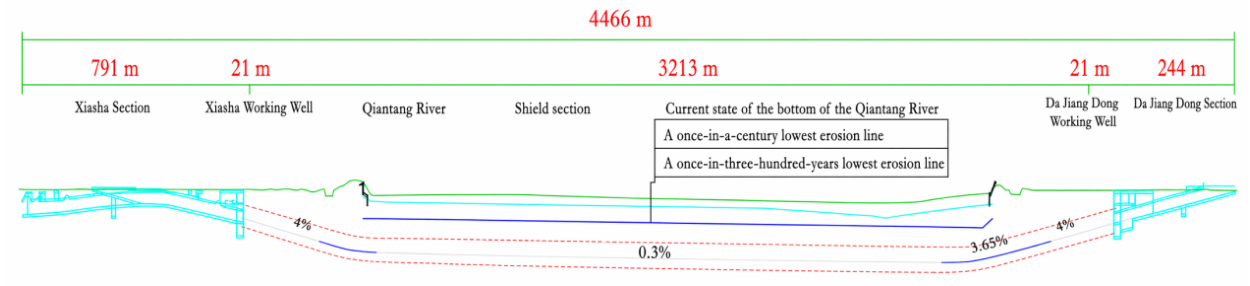
The Gen Shang East Over-the-River Tunnel Project is an important part of the urban expressway system. The construction content mainly includes the cross-river tunnel, the comprehensive pipeline corridor, the ground connection line and related ancillary supporting projects. The total length of the tunnel is approximately 4575 m, and the shield tunneling segment spans approximately 3160 m. The river-crossing segment is constructed using a large-diameter shield tunneling method. The tunnel is excavated from east to west as a whole. It passes beneath the Qiantang River and successively traverses the land section on the east bank, the embankment section, the riverbed section, and the related sections on the west bank. It has typical characteristics of underwater shield tunnel construction (as shown in
Figure 1).
The shield tunnel adopts a segmented assembly-type single-layer lining structure. Based on the engineering design documents and the author’s previously published research. The tunnel has an outside diameter of 14.5 m, an inside diameter of 13.3 m, a segment thickness of 0.6 m, and a ring width of 2.0 m. Each ring of segment adopts a “9 + 1” segmental configuration, totaling 10 segments, belonging to a double-sided wedge-shaped universal segment ring, with a wedge value of 40 mm. Segment concrete with a strength grade of C60 and a waterproofing grade of P12 is made from high-strength waterproof reinforced concrete. The assembly method is staggered joint assembly, with tongue-and-groove joints set at the longitudinal seams, and diagonal bolts are used for connection, to enhance the overall load-bearing performance and waterproofing capability of the lining.
From the construction section perspective, both the left and right shield tunnels pass through the pre-embankment section, the east bank dike section, the river-crossing section, the west bank dike section, and other subsequent sections. The segment ring ranges corresponding to different tunnel sections are summarized in
Table 1. Among them, the land section and the embankment section are mainly located within the range from the start of the shield tunnel to the time before it enters the river. The riverbed section mainly corresponds to the area where it passes through the main riverbed of the Qiantang River. From this, the shield tunnel alignment encompasses two typical operating conditions: land/dike sections and riverbed sections. The land section is significantly affected by additional loads from the dike structure, surface boundary conditions, and the superimposed construction of double tunnels. The latter is located in a high-pressure, saturated soft soil layer and an underwater environment. After being disturbed, the soil is more prone to experiencing continuous settlement and deep deformation. Therefore, conducting research on the differences in stratum response during shield tunneling under various environmental conditions based on this project holds practical significance.
2.2. Geological
The shield tunneling area of this project is predominantly composed of soft soil strata, with complex and spatially variable layer distribution, including sandy silt, silt, silty clay and clay. The sections near the land area and the embankment mainly exhibit an alternating distribution of sandy soil and clayey soil. Local areas are significantly influenced by the overlying embankment and the surface boundary conditions. The construction disturbance is not only controlled by the properties of the underlying soil layer, but also superimposed with the combined effects of the additional load of the embankment body and the temporal and spatial effects of the double-line construction. Therefore, the response of the stratum is more likely to manifest as local characteristics dominated by surface and embankment top deformation.
In contrast, the riverbed section lies beneath the Qiantang River, where the strata mainly consist of sandy silt, silty clay and saturated soft soil. It is characterized by a high groundwater level, large hydraulic head pressure, and long-term saturated soil conditions. Meanwhile, the soft soil features high compressibility and low shear strength, making it more prone to displacement diffusion under the disturbance of shield excavation. Furthermore, the interactions among excavation face support, tail voids and synchronous grouting are coupled under high water pressure, resulting in more complex stratum responses in the riverbed section than in the onshore section. Overall, the onshore section tends to exhibit localized surface responses, whereas the riverbed section is more likely to show holistic response characteristics with a larger influence scope, wider settlement trough, more significant deep soil deformation and longer stabilization duration.
2.3. Monitoring Scheme
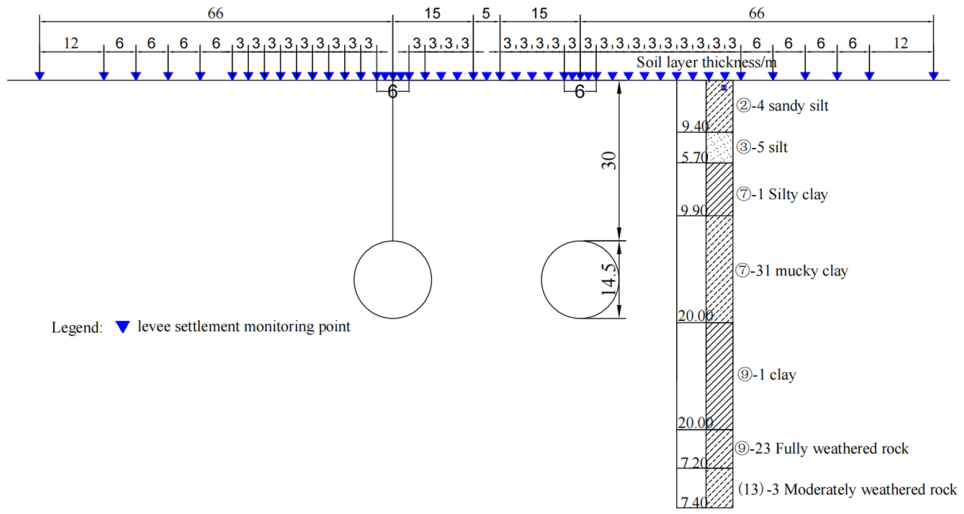
To understand the stratum and structural deformation characteristics throughout the entire shield tunneling process, monitoring points were arranged at appropriate locations on the embankment, surrounding ground surface, and river-bottom shield section of this project (as shown in
Figure 2). The monitoring items mainly include ground surface settlement, embankment crest settlement, and deformation responses of soils at different burial depths, which are used to reflect the impacts of construction factors such as excavation disturbance, shield tail voids, and synchronous grouting on the surrounding soils and surface structures during shield advancement.
Surface and embankment crest settlements are observed by leveling surveying using a precision level, with a measurement accuracy of 0.1 mm and a monitoring frequency of twice per day. The monitoring period covers the entire process from shield launching to the completion of tunneling construction. For data processing, the deformation variation in monitoring points between adjacent survey periods is analyzed by comparing the maximum deformation value with the maximum measurement error (adopted as twice the mean square error). If the deformation value is smaller than the maximum measurement error, the monitoring point is considered to have no or insignificant deformation during the two periods. For multi-period deformation monitoring results, if the deformation between adjacent periods is minor but an obvious variation trend is observed across multiple monitoring stages, the monitoring point should be judged to have undergone effective deformation.
The deep horizontal displacement monitoring of the embankment mainly includes the following aspects.
For the deep horizontal displacement monitoring of soil mass, inclinometer pipes are embedded in the soil outside the shield tunnel. Holes are drilled using an XY-100 engineering drilling rig manufactured by Xuzhou Xugong Construction Machinery Group Co., Ltd. (Xuzhou, China), equipped with a Φ127 drilling tool manufactured by Changsha Geological Equipment Co., Ltd. (Changsha, China), with the hole inclination controlled within 1°. The burial depth is implemented in accordance with the design requirements. During pipe assembly, the guide grooves are strictly aligned, and the pipe bottom and joints are fully fixed and sealed with PVC adhesive and screws. When the pipes are slowly lowered into the drilled holes, one pair of guide grooves is kept perpendicular to the advancing direction of the shield tunnel at all times. After the inclinometer pipes are positioned in place, the annular gaps around the pipes are backfilled and sealed with medium-sized stones.
Inclinometer pipes are pre-embedded at monitoring points to measure the inclination angles of the pipes at different depths using a portable inclinometer, and the horizontal displacements at various soil depths are calculated and compared accordingly.
During measurement, a sliding inclinometer manufactured by Jiangsu Ruicibai Measurement Technology Co., Ltd. (Changzhou, China) is used. The instrument host is connected to the inclinometer probe via a cable. The guide wheels of the probe are placed into the measuring guide groove of the inclinometer pipe and slowly lowered to the pipe bottom. After the temperature of the probe is consistent with the internal pipe temperature, the horizontal offset angles induced by wall displacement are measured at an interval of 1 m from the bottom to the ground surface. Subsequently, the probe is rotated by 180°, and the above measurement process is repeated to eliminate the inherent error of the inclinometer.
The horizontal offset values of the retaining structure at different depths are calculated, and the displacement values of each measuring point are obtained through superposition calculation. The cumulative horizontal displacement is defined as the difference between the daily monitoring value during construction and the initial value, while the incremental displacement refers to the difference between the current measurement and the previous measurement.
Two to three repeated measurements are conducted within 2 to 3 days before the shield tunnel passes through the embankment. After the stability of the inclinometer pipes is confirmed, the average value of repeated measurements is taken as the initial value for subsequent formal monitoring.
One deep soil displacement monitoring borehole is arranged outside the outer contour of the left and right tunnel lines on both banks, respectively. All monitoring boreholes are set at a distance of 5 m from the outer edge of the tunnel. This reasonable layout distance fully considers potential construction deviations to prevent damage to monitoring facilities. The depth of each borehole extends 7 m below the tunnel base. The monitoring period lasts from shield launching to the completion of tunneling construction.
3. Measured Analysis of Shield Tunneling Parameters
During shield tunneling, key construction parameters such as cutterhead torque, total thrust, and tunneling speed are not fixed; instead, they are dynamically adjusted according to variations in soil conditions, burial depth, water and earth pressures, and construction control objectives. The rationality of parameter setting not only directly affects shield tunneling efficiency and equipment operating status, but also determines the degree of disturbance to surrounding soils and the development pattern of stratum deformation. Especially for a river-crossing shield tunnel, shield construction must successively pass through the onshore section, embankment section, and riverbed section. Since these sections differ significantly in boundary conditions, stratum composition, and groundwater environment, the variation patterns of tunneling parameters exhibit strong section-dependent characteristics.
To analyze the evolution characteristics of shield construction parameters in different sections and provide a basis for subsequent numerical simulation of stratum response, this paper selects measured data from the section before crossing the embankment, the embankment section, and the middle river section of the shield tunnel, and conducts a comparative analysis of cutterhead torque, total shield thrust, and tunneling speed. Among them, the section before crossing the embankment and the embankment section are regarded as typical working conditions of the onshore section, while the middle river section represents the working conditions of high water pressure and saturated soft soil stratum at the river bottom. By investigating the variation laws of each parameter and their interrelationships, the internal correlation between shield parameter regulation and stratum disturbance under different construction environments can be further revealed.
3.1. Variation Law of Cutterhead Torque
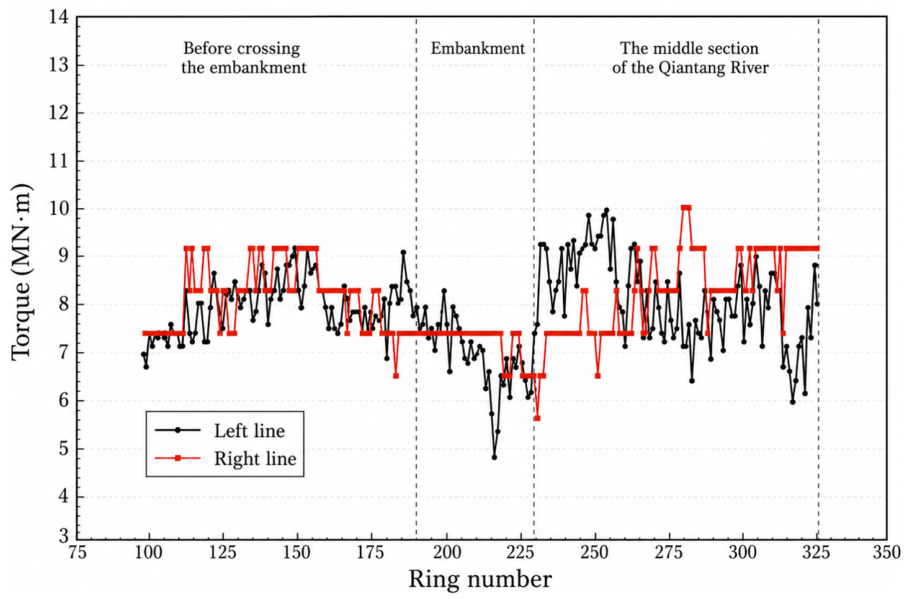
Cutterhead torque is an important parameter reflecting the cutting resistance of the cutterhead and the friction characteristics at the cutterhead–soil interface. Its variation is jointly controlled by factors such as burial depth, stratum particle composition, soil strength, and moisture content conditions. The measured results are shown in
Figure 3. In the section before crossing the embankment, the cutterhead torque of the left tunnel bore mainly ranges from 5.7 to 9.2 MN·m with relatively small overall fluctuations. The torque of the right tunnel bore mainly lies between 6.0 and 11.0 MN·m and shows a slight decreasing trend with increasing burial depth. The stratum at this stage is dominated by sandy silt, clay, and silty sand. Although the burial depth increases gradually, the variation in soil properties is relatively limited, so the cutterhead torque generally remains within a relatively stable range.
After entering the embankment section, the cutterhead torque of the left line ranges approximately from 4.0 to 7.5 MN·m, while that of the right line is about 5.0 to 7.0 MN·m. Both generally show a gradual decreasing trend with increasing burial depth. This is mainly because, as the shield advances, the sand content in the stratum gradually decreases and the proportion of cohesive soil increases, resulting in reduced interface friction between the cutterhead and the soil. Consequently, the cutterhead torque does not increase correspondingly, even though the burial depth continues to rise. This indicates that in the onshore section and the embankment section, cutterhead torque is governed not only by burial depth but also more significantly by variations in soil particle composition.
In the river-crossing section, the cutterhead torque of the left line mainly ranges from 5.5 to 10.0 MN·m, showing a variation pattern of initial increase followed by stabilization; the torque of the right line is mostly distributed between 6.0 and 10.0 MN·m with a relatively gentle overall trend. The increase in torque at the early stage is mainly attributed to the rise in face earth pressure and cutting resistance caused by the increasing overburden depth. After entering the deep riverbed, the stratum is gradually dominated by saturated silty clay with low sand content and weakened friction effect, resulting in a gentle growth trend of torque. Overall, the cutterhead torque is not controlled solely by overburden depth, but is jointly governed by the overburden effect and stratum properties, indicating that the characteristics of cutterhead cutting resistance in the riverbed section differ to some extent from those in the onshore section.
3.2. Shield Total Thrust
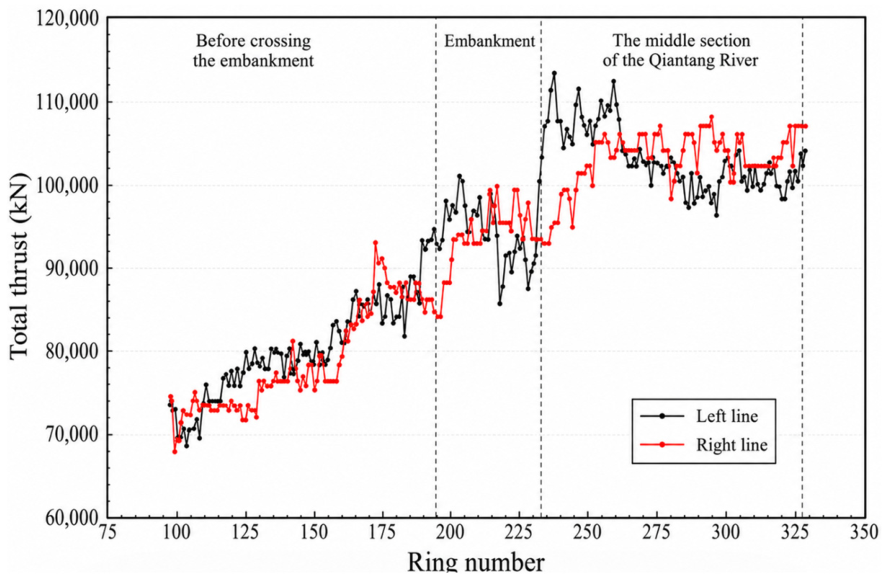
Shield total thrust is an important parameter reflecting the variation in thrust resistance of the shield machine. It is mainly used to overcome the face resistance at the excavation surface, the friction resistance between the shield skin and the surrounding soil, the friction resistance between the shield tail and the segments, as well as the additional resistance generated during attitude adjustment. The measured results are shown in
Figure 4. In the section before crossing the embankment, as the shield advanced downward continuously, the total thrust of both the left and right lines showed an overall increasing trend. The total thrust of the left line increased from approximately 66,000 kN to around 100,000 kN, while that of the right line rose from about 66,000 kN to roughly 95,000 kN, indicating that with the increase in overburden depth, the face earth pressure and the restraining effect of the surrounding soil on the shield machine were gradually enhanced.
After entering the embankment section, the total thrust of both the left and right lines exhibited a certain decreasing trend. Although the overburden depth continued to increase during this stage, the rise in clay content and reduction in sand content of the soil layer decreased the friction between the cutterhead, shield skin, and the surrounding soil, thereby lowering the total thrust required for advancement. This indicates that during construction in the embankment section, the variation in total thrust was not controlled solely by overburden depth, but was also significantly affected by changes in soil properties.
In the river-crossing section, the total thrust of both the left and right lines generally shows a pattern of initial increase followed by a decrease. The increase in total thrust in the early stage is mainly related to the continuous growth of overburden depth. In the later stage, as the shield enters the saturated silty clay layer, the soil has high moisture content and obvious soft plasticity, resulting in a relatively low friction between the cutterhead, shield skin and the surrounding soil, so the total thrust gradually decreases. Overall, the total thrust of the shield is a combined result of the overburden effect and stratum properties. Compared with the onshore section, the riverbed section exhibits more pronounced friction weakening characteristics under high water pressure and saturated soft soil conditions.
3.3. Tunneling Speed
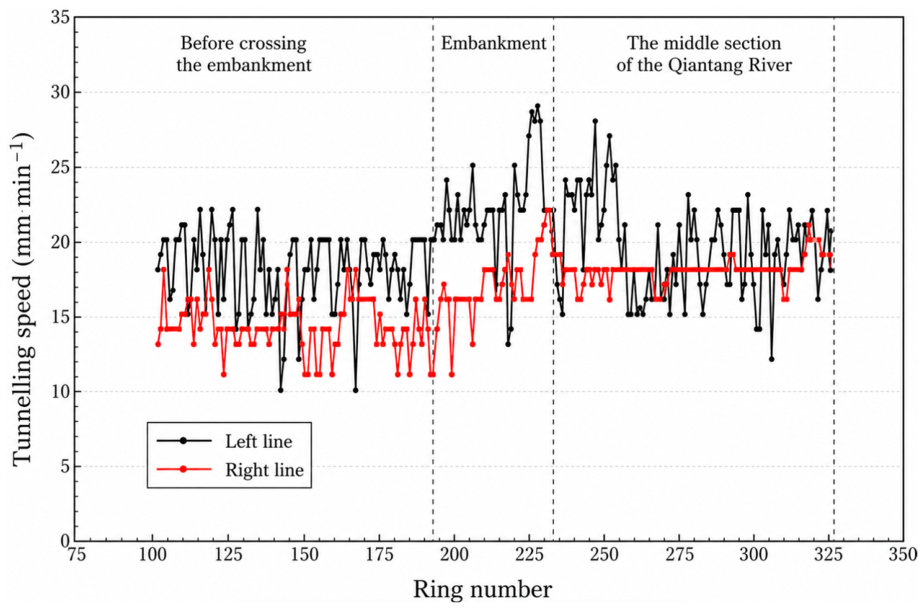
Tunneling speed is an important parameter reflecting the efficiency and advancing rhythm of shield tunneling. Its variation is usually jointly influenced by multiple factors such as the hardness of the ground, construction organization, segment erection efficiency, and the coordination of synchronous grouting. The measured results are shown in
Figure 5. The tunneling speed curves indicate that the left-line shield generally shows a higher tunneling speed than the right-line shield in the selected sections. This observation is further supported by the Mann–Whitney U test in
Section 3.6, where statistically significant differences in tunneling speed are identified between the two lines.
In the section before crossing the embankment, the stratum is dominated by sandy silt, clay and silt, and the shield advance speed is generally maintained at a relatively stable level. After entering the embankment section, owing to the relatively uniform and generally soft soil layers, the shield tunneling can maintain a relatively stable advancing state, resulting in a relatively high tunneling speed.
In the river-crossing section, affected by the increasing overburden depth and the high-water-pressure saturated soft soil environment, the tunneling speed tends to decrease overall and maintains a relatively stable trend. This is mainly because the construction in the riverbed section imposes higher requirements on the stability of the excavation face, compensation for synchronous grouting, and construction safety control. The advancing speed has to be adjusted more cautiously to avoid excessive ground loss or lagging subsequent processes caused by overly rapid advancement. Overall, the tunneling speed not only reflects the differences in construction efficiency among different sections, but also embodies the balance between safety control and advancing efficiency in shield tunneling.
3.4. Analysis of Relationships Among Parameters
During shield tunneling, the construction parameters do not vary independently, but exhibit a certain coupling relationship under the combined effects of geological conditions, overburden depth changes, and construction control requirements. Among them, cutterhead torque, total shield thrust, and tunneling speed reflect the shield tunneling status from three aspects: cutting resistance, thrust resistance, and construction efficiency, respectively. Therefore, it is necessary to conduct a comprehensive analysis of the variation laws among these parameters to further reveal the inherent relationship between construction parameter regulation and ground disturbance in different crossing sections.
From the perspective of the relationship between cutterhead torque and total shield thrust, the two parameters generally exhibit favorable synchronous variation characteristics. In the section before crossing the embankment, both cutterhead torque and total thrust remained at relatively high levels with increasing overburden depth, indicating that the cutting resistance of the cutterhead and thrust resistance of the shield were both affected by the increased overburden depth and enhanced soil restraint at this stage. After entering the embankment section, both parameters showed a certain decreasing trend, which suggests that the interface friction between the cutterhead and soil as well as the friction around the shield skin were weakened due to the increased clay content and reduced sand content in the stratum. Upon entering the river-crossing section, both cutterhead torque and total thrust again presented a variation pattern of first increasing and then stabilizing or decreasing. This demonstrates that under the conditions of high water pressure and saturated soft soil at the riverbed, although the increase in overburden depth raises the face earth pressure, the high water content and low friction characteristics of soft soil weaken both cutting resistance and thrust resistance, resulting in more pronounced coupling characteristics in their variations.
From the perspective of the relationship between tunneling speed, cutterhead torque and total shield thrust, the three parameters show certain coordinated control characteristics. Generally speaking, high cutterhead torque and total thrust indicate that the shield is subjected to greater soil resistance. In such cases, the advancing speed usually needs to be properly controlled to ensure the stability of the excavation face and the smooth connection of subsequent construction procedures. When the torque and total thrust are relatively stable or decrease, the tunneling speed can be appropriately increased to improve construction efficiency. Field measurements of this project show that in the embankment section, the tunneling speed is relatively high while the cutterhead torque and total thrust decrease, indicating that the soil conditions in this section are favorable for the stable advancement of the shield. In the river-crossing section, despite the fact that the torque and total thrust did not increase significantly in some stages due to the more complex construction environment, the tunneling speed was still maintained at a relatively cautious level. This reflects the higher requirements for safety and ground disturbance control in the riverbed construction.
3.5. Statistical, Correlation and Regression Analysis of Shield Operating Parameters
To strengthen the measured shield operating parameters, statistical analysis was conducted for the section before crossing the embankment, the embankment section and the riverbed section. The calculated indicators include the mean value, minimum value, maximum value, standard deviation and coefficient of variation (COV) (
Table 2). The statistical results show clear section-dependent characteristics of shield operating parameters. In the section before crossing the embankment, the mean cutterhead torque, total shield thrust and tunneling speed are 7.61 MN·m, 81,253 kN and 18.42 mm/min, respectively. Their COV values are 0.093, 0.093 and 0.149, indicating that cutterhead torque and total thrust remain relatively stable, while tunneling speed exhibits a slightly higher fluctuation. In the embankment section, the mean cutterhead torque decreases to 6.47 MN·m, whereas the mean total thrust and tunneling speed increase to 95,160 kN and 21.65 mm/min, respectively. The COV of cutterhead torque reaches 0.180, suggesting that torque is more sensitive to local stratum variation in this section. In the riverbed section, the mean cutterhead torque, total shield thrust and tunneling speed are 7.77 MN·m, 102,448 kN and 19.48 mm/min, respectively. The COV of total thrust is only 0.034, indicating that the thrust control in the riverbed section is relatively stable, whereas tunneling speed shows a higher COV of 0.163, reflecting the need for flexible adjustment under high-water-pressure and saturated soft-soil conditions.
Correlation and regression analyses were further conducted to quantify the relationships among cutterhead torque, total shield thrust and tunneling speed, and the results are summarized in
Table 3. In the section before crossing the embankment, the correlation between cutterhead torque and total thrust is weak, with a Pearson correlation coefficient of −0.144, indicating that the two parameters are not strongly coupled during this stage. In contrast, the embankment section shows a strong positive correlation between cutterhead torque and total thrust, with a coefficient of 0.859, suggesting that an increase in cutting resistance is closely accompanied by an increase in thrust demand. In the riverbed section, cutterhead torque and total thrust also show a clear positive correlation, with a coefficient of 0.703. Meanwhile, tunneling speed exhibits moderate positive correlations with cutterhead torque and total thrust in the riverbed section, with coefficients of 0.308 and 0.403, respectively, indicating that tunneling speed is affected not only by mechanical resistance but also by construction control requirements.
Regression analysis was then performed to further describe the relationship between cutterhead torque and total shield thrust. The regression model is expressed as (F = aT + b), where (F) is the total shield thrust, (T) is the cutterhead torque, and (a) and (b) are regression coefficients. In the riverbed section, the regression equation is (F = 2525.90T + 82,880.64), with a coefficient of determination (R2 = 0.495), indicating that approximately 49.5% of the variation in total shield thrust can be explained by cutterhead torque. The remaining variation may be related to burial depth, soil-layer variation, hydraulic boundary conditions, shield attitude adjustment and synchronous grouting effects. Based on the above statistical analysis, the representative parameters used in the numerical simulation of the riverbed section were selected according to the measured mean-level operating state. The base-case values of cutterhead torque, total shield thrust and tunneling speed were set as 7.5 MN·m, 102,000 kN and 18 mm/min, respectively. These values are close to the statistical mean values of the riverbed section and represent typical engineering control values during stable shield advancement. Therefore, they were adopted as the baseline parameters for the numerical simulation and subsequent sensitivity analysis.
3.6. Quantitative Comparison Between the Left and Right Tunnel Lines
To further examine whether the differences in shield operating parameters between the left and right tunnel lines are statistically meaningful, the cutterhead torque, total shield thrust and tunneling speed of the two lines were compared in each construction section. The results are expressed as mean ± standard deviation, and the Mann–Whitney U test was adopted because the measured construction parameters do not necessarily follow a normal distribution. A significance level of 0.05 was used.
The test results are summarized in
Table 4. For cutterhead torque, no statistically significant difference is observed between the left and right lines in the section before crossing the embankment, the embankment section or the riverbed section, with
p-values of 0.593, 0.782 and 0.611, respectively. This indicates that the cutting resistance experienced by the two shields is generally comparable in the selected sections. In contrast, total shield thrust shows statistically significant differences between the two lines in all three sections, with
p-values lower than 0.05. This suggests that thrust demand is more sensitive to line-dependent factors such as shield attitude adjustment, local soil resistance and machine operation control.
Tunneling speed also shows significant differences between the two lines in all sections. The left-line tunneling speed is higher than that of the right line in the section before crossing the embankment, the embankment section and the riverbed section, with p-values lower than 0.001. These results indicate that left-right line differences exist mainly in thrust control and tunneling speed, whereas cutterhead torque shows no significant line-dependent difference in the selected sections.
4. Establishment and Validation of Numerical Model for the Onshore Section
4.1. Numerical Model Establishment
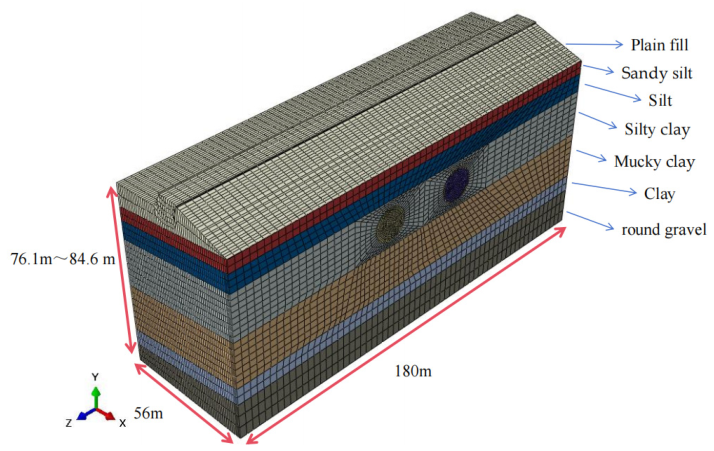
To reflect the stress and deformation characteristics of the surrounding strata and structures when the shield tunnel passes through the onshore section, especially the embankment section, a three-dimensional numerical model is established in this study using the ABAQUS 2020 finite element software. The model takes the construction process of the double-line shield tunnel as the research object. The synchronous grouting material in the shield tail gap is simplified into a uniform and equal-thickness grouting layer to simulate the supporting and compensating effect of shield tail grouting on the surrounding soil during shield advancement. In the model, the shield thrust was converted into an equivalent uniform normal pressure acting on the excavation face according to the area-equivalence principle. The grouting effect was represented by an equivalent uniform grouting layer and staged load activation, rather than by explicitly simulating the full grout diffusion process. Solid elements are adopted to simulate the surrounding soil, segment lining, grouting layer, and embankment body, so as to comprehensively reflect the soil-structure interaction mechanism during shield construction. According to the actual engineering conditions, the numerical model is 56 m long along the tunnel longitudinal direction, 180 m wide in the transverse direction, and 76.1–84.6 m high in the vertical direction. The model is divided into 140,208 elements and 148,071 nodes in total, as shown in
Figure 6.
The Mohr-Coulomb elastoplastic model is adopted for the soil to reflect the strength and deformation characteristics of different soil layers under shield disturbance. The grouting layer and segment lining are both simulated using elastic models. Material parameters are listed in
Table 5. Parameter values are mainly derived from the geological investigation report. The strata mainly include sandy silt, silt, silty clay, mucky clay, clay, completely weathered rock, and moderately weathered rock, with relevant values determined according to actual engineering geological survey data. The top surface and embankment surface are set as free boundaries to allow free deformation of the ground surface and embankment crest under construction disturbance. Displacement constraints in the X, Y, and Z directions are applied at the model bottom to restrict overall rigid-body displacement of the foundation. Lateral displacement constraints are imposed on the side boundaries of the model to simulate the lateral support effect of the surrounding soil against shield-induced construction disturbances. The working conditions of the onshore section model are mainly determined with reference to three key factors: cutterhead torque, total shield thrust, and tunneling speed. In the section before crossing the embankment, the cutterhead torque is approximately 5.7~9.2 MN·m, the total thrust is about 66,000~100,000 kN, and the tunneling speed remains generally stable. After entering the embankment section, the cutterhead torque decreases to 4.0~7.5 MN·m. Based on the above measured variation laws, this study realizes step-by-step excavation, ring-by-ring support, and staged application of grouting loads in the numerical model, so as to comprehensively represent the disturbance intensity and advancing characteristics at different construction stages.
For the saturated soft soil in the river-crossing tunnel, an undrained condition was adopted to represent the short-term response during rapid shield advancement. According to the measured groundwater level at the site, the initial pore-water pressure was assigned following a hydrostatic distribution. A water-head boundary of 14.5 m was applied to represent the river water level. It should be noted that the hydraulic condition was mainly represented by the initial pore-pressure field and the water-head boundary. The present model does not fully reproduce construction-induced excess pore-water-pressure generation, spatial pore-pressure dissipation or long-term consolidation of saturated soft soil. Therefore, the hydraulic effect should be interpreted as an equivalent representation of the groundwater condition rather than a complete hydro-mechanical coupling analysis.
In the numerical simulation of shield tunneling, the cutterhead torque T (kN·m) is not applied to the soil as a single concentrated moment. According to the interaction mechanism between the cutterhead and soil, the total torque is decomposed into cutting resistance, frictional resistance and soil chamber stirring resistance. These components are further converted equivalently into distributed shear loads on the excavation face, circumferential frictional shear stress, strength reduction in soil in the disturbed zone, or kinematic boundary conditions. This method can truly reflect the mechanical effects and disturbance induced by cutterhead rotation on the soil in ABAQUS.
For soft soil strata, the total cutterhead torque consists of the following components: (1) Front frictional torque (T1): circumferential frictional resistance between the cutterhead panel and the filter cake/soil; (2) Peripheral frictional torque (T2): frictional resistance between the outer side of the cutterhead edge and the surrounding soil; (3) Soil chamber stirring torque (T3): shear and stirring resistance generated by cutterhead openings, spokes and mixing arms acting on the soil inside the chamber; (4) Cutter cutting torque (Tc): shear resistance when cutting edges penetrate into the soil.
T1 acts on the circular contact interface (radius
R) between the cutterhead panel and soil, and is converted into radially linearly distributed circumferential shear stress
τ. Tangential surface loads are applied on the circular excavation face at the front of the soil. The shear stress equals zero at the center and reaches the maximum at the edge, which reproduces the actual characteristic that the frictional force is larger at the outer edge during cutterhead rotation.
T2 acts on the annular zone at the outer edge of the cutterhead with width
B and radius
R, which is converted into uniform circumferential shear stress
τ. The circumferential shear stress is applied on the annular surface at the front of the shield shell. The friction coefficient is taken as (
µ = 0.1~0.2), which conforms to the friction characteristics of the interface between soft soil and steel.
T3 is mainly consumed by shearing, kneading and disturbing the soil inside the soil chamber, and it does not act directly on the excavation face. In ABAQUS, a disturbed zone of the soil chamber with diameter D and a length ranging from (0.5D) to (1.0D) is defined, and the material parameters within this zone are reduced for strength.
In soft soil strata, (Tc) is relatively small. It can be incorporated into (T1) or represented by local weakening of small elements on the excavation face, and is generally not applied separately.
For the overall application scheme of torque in ABAQUS, a hybrid equivalence method combining concentrated moment and distributed shear stress is widely adopted in engineering simulations: (1) Create a reference point (RP) at the center of the cutterhead; (2) Establish distributed coupling constraints between all nodes on the excavation face and the RP to enable the transmission of forces and moments without imposing rigid body rotation; (3) Apply the total torque T (concentrated moment) about the tunneling axis on the RP to maintain overall force equilibrium; (4) Simultaneously apply distributed circumferential shear stress on the excavation face to reflect the spatial distribution of frictional torque; (5) Adopt the combination of strength reduction and angular velocity boundary for the disturbed zone of the soil chamber to reproduce the stirring effect.
4.1.1. Rationality of the Simplification of Grouting Layer
In this study, the grouting layer is simplified as a uniform elastic layer with constant thickness. The main research objective is to investigate the stratum response and construction parameter sensitivity of the river-crossing shield tunnel, rather than the grout diffusion and time-varying hardening behavior. This simplification effectively reduces the model scale and calculation difficulty while ensuring the overall simulation accuracy. For the actual project, the shield tail void is regular, the construction parameters are stable, and the grout loss is well controlled, leading to slight variation in the grouting layer in macroscopic mechanical properties. The time-dependent hardening and construction lag effects of grout are indirectly reflected by adjusting material parameters and element activation sequence. Therefore, this simplification is reasonable and applicable to the research scope of this paper.
4.1.2. Clarification of Numerical Simulation Details
Tunnel excavation procedures: The simulation is carried out in strict accordance with the on-site construction sequence: soil excavation, segment installation and tail grouting. Element birth and death: The soil elements to be excavated are deactivated in advance. During tunneling, corresponding soil elements are deactivated sequentially to simulate soil removal. Segmental lining installation: The segment elements are activated immediately after soil excavation, and tie constraints are adopted to realize coordinated deformation between segments and surrounding media. Activation mechanism of grouting layer: Considering the construction lag effect, the grouting elements are activated after a certain delay following the activation of segments. Ring-by-ring tunneling procedure: Taking a single ring as the basic unit, the simulation circulates excavation, segment installation, grouting and load application until the whole tunneling process is completed.
4.1.3. Equivalent Load Representation of Shield Thrust and Grouting Pressure
In engineering practice, shield thrust and grouting pressure are distributed loads acting on the excavation face and the shield-tail region. In this model, the shield thrust was converted into an equivalent uniform normal pressure acting on the excavation face according to the area-equivalence principle. The grouting effect was represented by an equivalent grouting layer and staged load activation. This simplified treatment preserves the overall loading effect while avoiding unnecessary complexity in simulating detailed grout diffusion and time-dependent hardening.
4.2. Quantitative Validation of the Onshore-Section Numerical Model
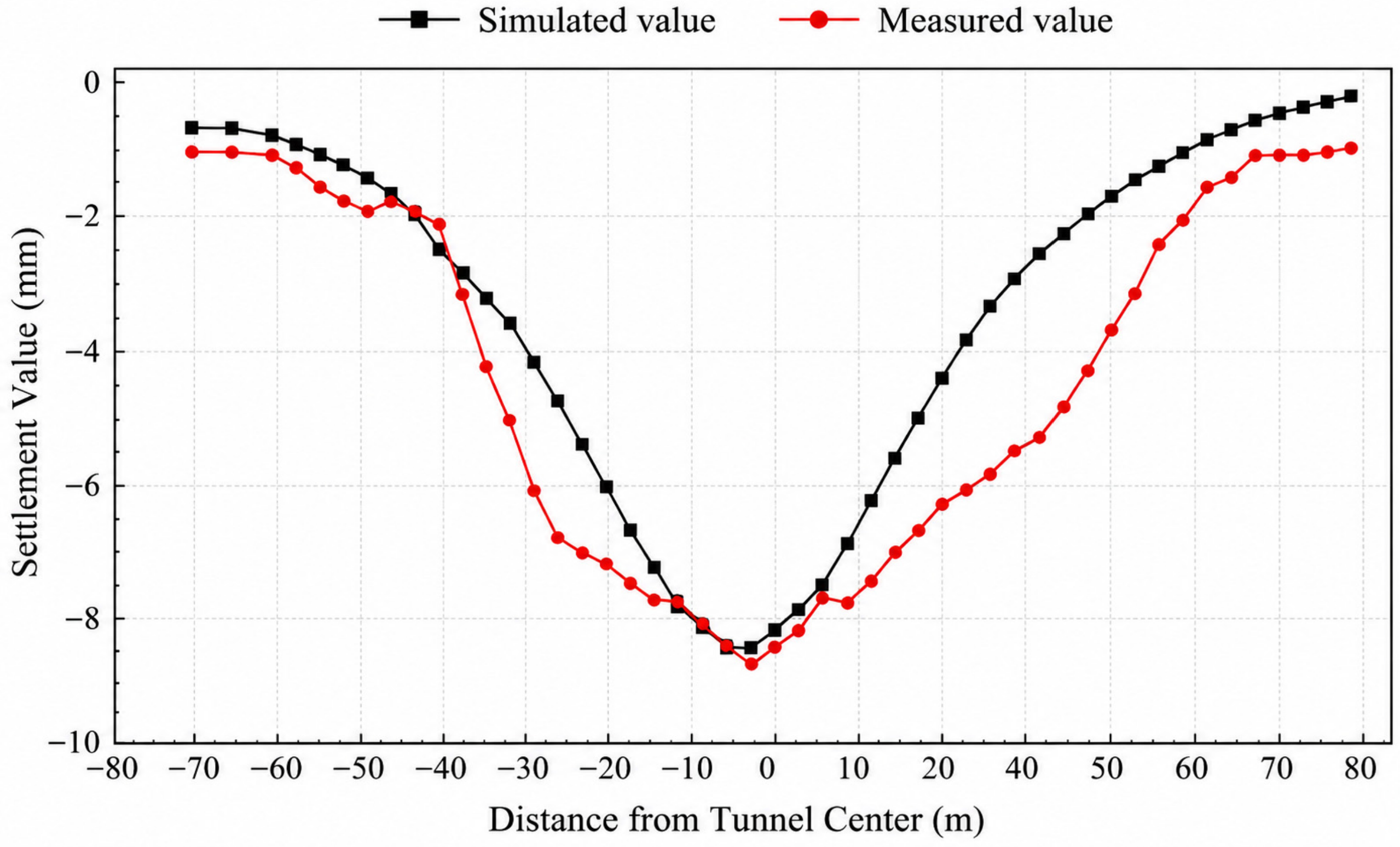
To verify the rationality of the established numerical model, the monitoring results of embankment crest settlement and ground surface settlement were selected for comparative validation, as shown in
Figure 7. The quantitative validation results are summarized in
Table 6. The simulated maximum settlement is approximately 8.50 mm, while the measured maximum settlement is about 8.70 mm, corresponding to a relative error of 2.30%. The RMSE and maximum absolute error between the simulated and measured settlement curves are 1.47 mm and 3.00 mm, respectively. In terms of settlement peak location, both the simulated and measured maximum settlements occur near the tunnel centerline, and the peak position deviation is 0 m. These results indicate that the numerical model can reasonably capture the settlement magnitude and peak position of the onshore section. It should also be noted that certain differences remain in the far-field attenuation range of the settlement trough. The measured curve shows a wider lateral influence range than the simulated curve, suggesting that the model may slightly underestimate the far-field propagation of shield-induced settlement. This discrepancy may be related to local soil heterogeneity, spatial variability of construction parameters, uncertainty in synchronous grouting diffusion and the simplified representation of the grouting layer in the numerical model.
The measured curve in
Figure 7 represents the ground surface settlement above the tunnel during single-tunnel construction. The obvious asymmetric characteristic of the measured settlement curve can be attributed to the differences in soil layers on the left and right sides of the tunnel. Compressible weak soil layers are distributed on the left side, inducing greater soil settlement, whereas no weak soil layers exist on the right side, resulting in relatively smaller settlement. In addition, the actual stratum is not horizontally distributed and presents a stratum dip angle. Therefore, asymmetric surface settlement occurs above the two sides of the tunnel during shield construction.
However, in the marginal areas on both sides of the settlement trough, the simulated values are generally slightly larger than the measured values, and the simulated curve recovers relatively more gently, whereas the measured curve shows a faster attenuation trend. This discrepancy may be attributed to factors such as the local heterogeneity of the actual strata, dynamic fluctuations of construction parameters during advancement, spatial dispersion of the compensation effect of synchronous grouting, and on-site monitoring errors. Nevertheless, overall analysis indicates that the simulated results are in good agreement with the measured results in terms of settlement trough shape, peak position, and settlement magnitude. This demonstrates that the numerical model established in this paper can effectively reflect the stratum deformation characteristics induced by shield tunneling in the onshore section and can serve as a basis for the subsequent finite element modeling of the riverbed section.
To quantitatively characterize the differentiated features of W-shaped settlement troughs induced by twin-line tunnels at onshore and riverbed sections, five core indicators including the maximum settlement, settlement trough width, spacing between double settlement peaks, intermediate settlement between two tunnels and far-field settlement attenuation distance are extracted for comparative analysis (as shown in
Table 7). All transverse settlement curves were extracted from the final calculation stage after the completion of double-line tunneling, providing a consistent basis for comparing the onshore and riverbed sections.
The comparison results reveal that the peak-to-peak spacing of settlement at the two sections is basically identical, demonstrating that the spatial layout of twin tunnels dominates the distribution pattern of double settlement peaks. Under the coupled section-dependent conditions of the riverbed section, the overall ground disturbance of the riverbed section is markedly larger than that of the onshore counterpart. Compared with the onshore section, the maximum settlement and intermediate central settlement of the riverbed section rise by 15.5% and 19.6%, respectively, the total width of the settlement trough expands by 17.6%, and the far-field attenuation distance increases evidently. Such variations reflect that the high-water-pressure soft stratum is featured with a wider disturbance scope, more prominent consolidation settlement and stronger hysteresis of ground deformation. In contrast, the onshore section presents more concentrated settlement, faster settlement attenuation and a limited disturbed range, with superior overall stratum stability relative to the riverbed section.
5. Establishment and Response Analysis of Numerical Model for the Riverbed Section
5.1. Establishment of Numerical Model for the Riverbed Section
Based on the numerical modeling framework calibrated and checked using the onshore-section monitoring data, a three-dimensional numerical model for the riverbed section was further established to analyze the stratum response characteristics induced by shield tunneling under high water pressure and saturated soft soil conditions. It should be noted that the riverbed-section model was not independently validated using riverbed monitoring data because continuous settlement, subsurface displacement, and pore-water-pressure measurements in the underwater riverbed zone were not available during the construction period. Therefore, the riverbed-section simulation is mainly used for comparative and mechanistic analysis rather than for deterministic prediction of absolute field deformation.
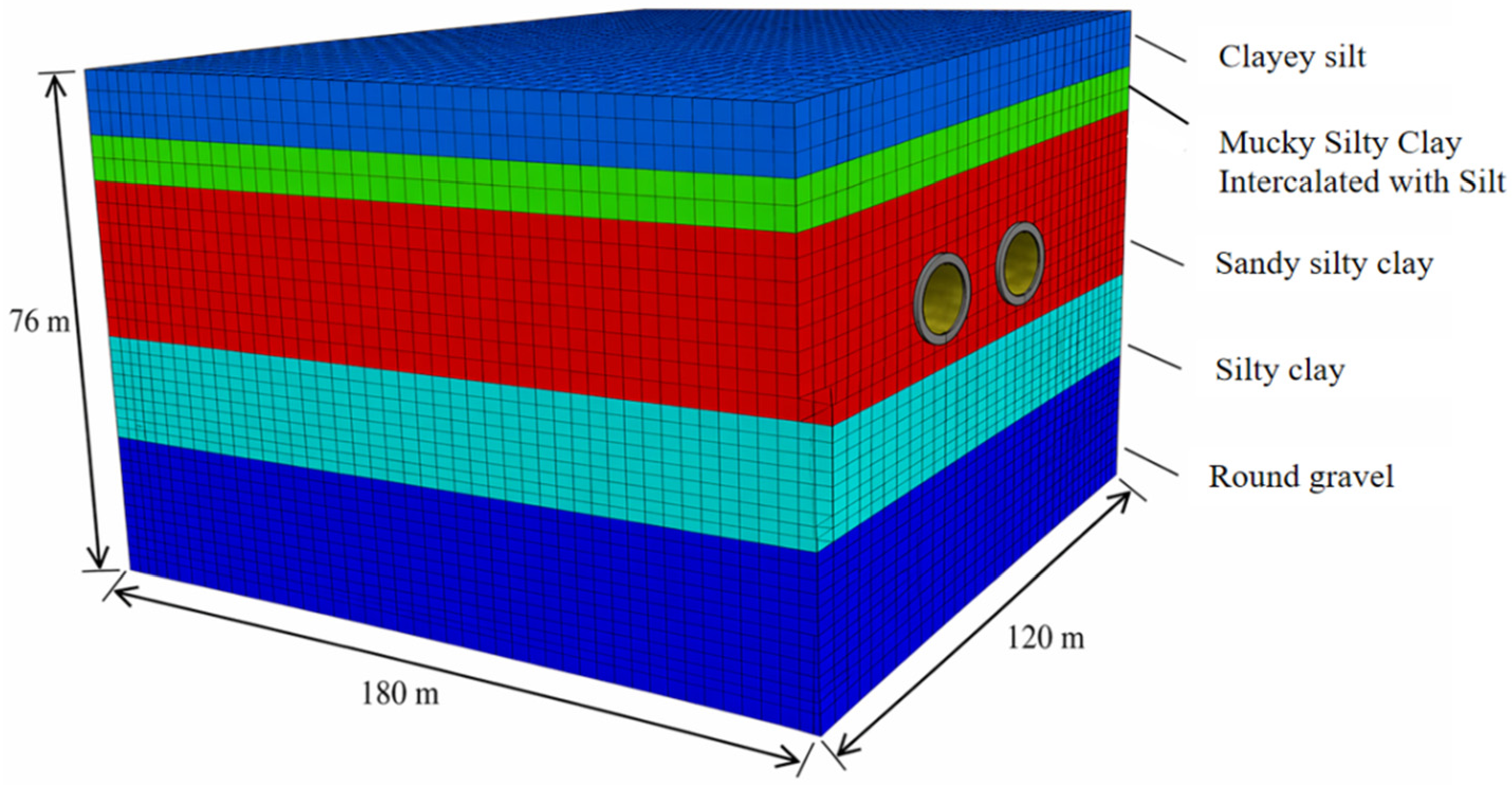
To improve the reliability of the model extension, the riverbed-section model adopted the same excavation simulation procedure, lining–grouting representation, constitutive framework and parameter-selection principle as the checked onshore-section model. Meanwhile, the stratum parameters, hydraulic boundary conditions and overburden conditions were modified according to the geological investigation data and the measured shield operating parameters of the river-crossing section. According to the engineering conditions of the riverbed section, the model height is set to 76 m, the tunnel overburden depth is 23 m, the excavation length along the tunnel longitudinal direction is 180 m, and the transverse width is 120 m. The model is meshed into 161,400 elements and 169,320 nodes (see
Figure 8). For boundary conditions, horizontal normal constraints are applied to the front, rear, left, and right boundaries of the model, and vertical displacement constraints are imposed on the bottom boundary to restrict overall rigid-body displacement. A water head boundary of 14.5 m is applied on the upper surface of the model, and pore water pressure conditions following hydrostatic pressure distribution are imposed on the side boundaries. The tunnel excavation boundary and excavation face are set as impermeable boundaries to reflect the hydraulic boundary characteristics of shield tunneling under the high water level environment of the riverbed. The excavation length for each step is set as one segment ring, and the whole shield tunneling process is simulated in a ring-by-ring advancing manner.
In terms of constitutive model and parameter selection, the Mohr-Coulomb elastic-plastic model is still adopted for soil mass in the river-crossing section to reflect the strength and deformation characteristics of different soil layers under excavation disturbance. The segment lining and grouting layer are simulated by the elastic model. As the tunnel alignment transitions gradually from the land section to the riverbed section, distinct differences exist in stratum composition and hydrogeological conditions. Accordingly, the specific stratum division and parameter values are determined separately according to the actual geological survey data of each section. The strata in the riverbed section mainly consist of clayey silt, mucky silty clay intercalated with silt, sandy silty clay, silty sand and round gravel. Their physical and mechanical parameters are presented in
Table 8. Regarding construction parameter selection, the representative riverbed-section condition was determined based on the statistical analysis of measured shield operating parameters presented in
Section 3.5. The base-case values of cutterhead torque, total shield thrust and tunneling speed were set as 7.5 MN·m, 102,000 kN and 18 mm/min, respectively. These values are close to the mean-level operating state of the riverbed section and represent typical engineering control values during stable shield advancement. Therefore, they were adopted as the baseline parameters for the numerical simulation and subsequent sensitivity analysis.
5.2. Evolution Law of Longitudinal Displacement
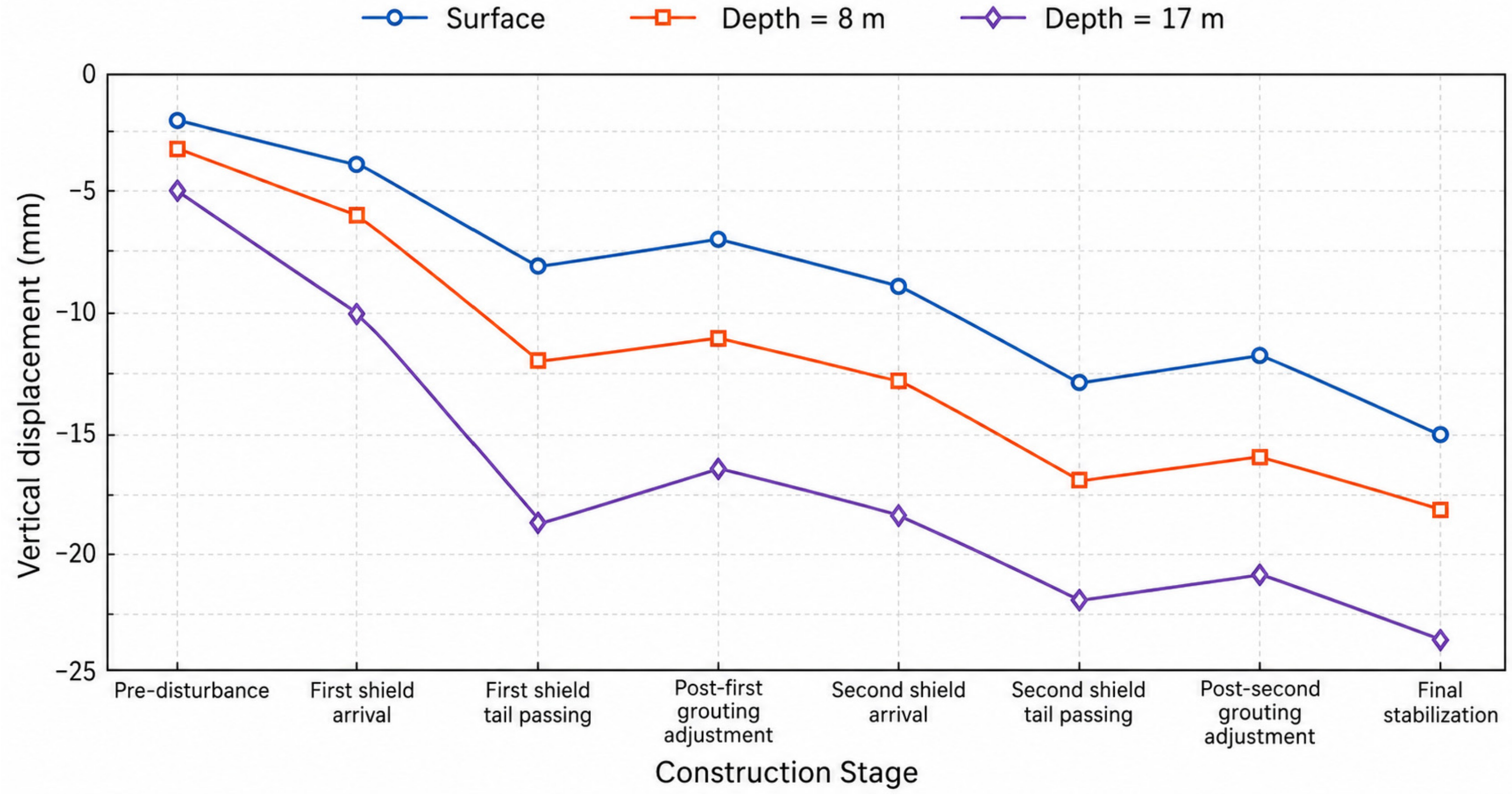
To reveal the longitudinal displacement evolution characteristics of soils at different burial depths during shield tunneling in the riverbed section, three representative positions: the ground surface, a burial depth of 8 m, and a burial depth of 17 m, are selected for analysis. The variation laws of their longitudinal vertical displacement are shown in
Figure 9. It can be seen from the figure that the vertical displacement of soils at different depths gradually increases with the advancement of the construction process, but obvious differences exist in their growth rates and response amplitudes. The closer the burial depth is to the tunnel vault, the more sensitive the soil response to construction disturbance and the more significant the vertical displacement growth. Although the displacement amplitude of the surface soil is relatively small, it also shows a continuous development trend, indicating that the shield construction disturbance can gradually transfer from deep strata to shallow strata.
From the analysis of the construction process of the left-line shield machine, during the pre-disturbance stage, the vertical displacements at the ground surface, 8 m depth, and 17 m depth are approximately 1.9 mm, 2.8 mm, and 4.7 mm, respectively. This indicates that before the shield arrives at the monitoring section, the soil ahead has already undergone a certain degree of pre-settlement under the disturbance of the excavation face. When entering the stage where the left cutterhead reaches the section, the three displacements increase to 4.0 mm, 5.9 mm, and 9.8 mm, respectively. Subsequently, during the passage of the left tail skin, they further rise rapidly to 8.4 mm, 12.0 mm, and 18.6 mm, showing that the passage of the left shield tail and the void formation behind the tail are key stages for the rapid development of stratum settlement. Upon entering the left-line grouting adjustment stage, the displacements at the three positions all decrease slightly to 7.9 mm, 11.2 mm, and 17.1 mm, respectively, demonstrating that synchronous grouting exerts a certain compensation effect on the surrounding soil.
From the analysis of the construction process of the first shield machine on the right line, after entering the stage when the right-line cutterhead arrives, the vertical displacements at the ground surface, 8 m depth, and 17 m depth increase to 9.2 mm, 12.9 mm, and 18.8 mm, respectively. During the passage of the right-line shield tail, the three values further reach 12.8 mm, 16.7 mm, and 22.4 mm, indicating that the right-line construction produces an obvious secondary settlement effect on the already disturbed soil. Subsequently, in the right-line grouting adjustment stage, the displacements at the three positions slightly decrease again to 12.2 mm, 15.9 mm, and 21.0 mm, respectively, reflecting that the second synchronous grouting also exerts a short-term compensation effect on the soil around the tunnel. As the construction enters the final stabilization stage, the vertical displacements at the ground surface, 8 m depth, and 17 m depth finally stabilize at 14.6 mm, 18.4 mm, and 23.8 mm, respectively. It can be seen that under double-line shield construction, the longitudinal displacement evolution in the riverbed section generally exhibits typical staged characteristics: pre-disturbance—rapid settlement increase in the left line—grouting recovery in the left line—secondary settlement increase in the right line—grouting adjustment in the right line—final stabilization.
Further comparison of the deformation development laws at different burial depths reveals that the soil at a burial depth of 17 m exhibits the largest displacement response at all stages, indicating that the deep soil near the tunnel periphery is most sensitive to excavation unloading, shield tail void formation, and synchronous grouting. The displacement variation at 8 m depth lies between that of the deep layer and the ground surface, reflecting its obvious characteristic as a transition layer during the propagation of construction disturbance from the deep to the shallow strata. Although the surface displacement is relatively small, it continues to increase in the later stages, suggesting that the shallow soil is affected by construction disturbance with a longer time effect. It can be concluded that the longitudinal displacement evolution in the riverbed section presents obvious layered transfer characteristics and spatiotemporal hysteresis. The deep soil responds rapidly first, then the deformation gradually diffuses to the shallow layer, and completes redistribution and final stabilization under the dissipation of grouting pressure and soil consolidation.
5.3. Evolution Law of Transverse Settlement
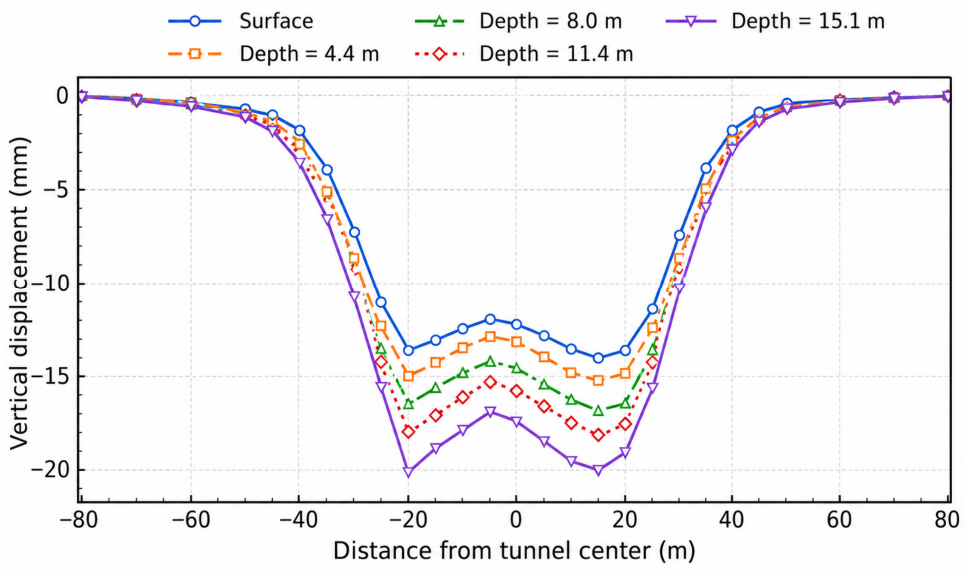
As shown in
Figure 10, after the completion of double-line shield construction, the transverse settlement trough in the riverbed section generally exhibits a typical wide and gentle W-shaped distribution. The two main settlement peaks are located near the axes of the left and right tunnels, respectively, while obvious settlement also occurs in the area between the two lines, although its amplitude is slightly lower than the peaks on both sides. This indicates that under double-line construction conditions, the cross-sectional deformation is no longer controlled by a single excavation face, but results from the combined effects of excavation unloading, shield tail void formation, and synchronous grouting in both the left and right lines. The peak surface settlement near the left and right lines is approximately 13.6~13.7 mm, and about 11.8 mm in the middle zone. This shows that two dominant settlement centers form above the double-line tunnels, while the soil between the two lines is simultaneously regulated by the soil arching effect and grouting compensation from both sides, so its settlement value is generally lower than that above the tunnel axes. Consequently, a W-shaped trough with double peaks is formed, and the middle region represents a secondary settlement trough after the superposition of disturbances.
The shape of the settlement trough is significantly intensified with increasing burial depth. At a burial depth of 4.4 m, the peak values near the left and right lines are approximately 15 mm at 8.0 m, they increase to about 16.5 mm at 11.4 m, they further rise to roughly 18 mm and at 15.1 m, the peaks reach their maximum value of around 20 mm. This pattern indicates that the closer to the tunnel periphery, the greater the disturbance imposed on the soil from excavation unloading, shield tail voids, and grouting pressure, resulting in more concentrated deformation and higher peak values. In contrast, although the shallow soil has a smaller settlement amplitude, its settlement trough is wider and gentler, showing that construction disturbance gradually diffuses as it propagates upward and manifests as a broader influence range under the free deformation condition of the ground surface boundary. In addition, the far-field attenuation of the settlement trough in the riverbed section is relatively slow, with a significant influence range of about 45~50 m. This is related to the geological conditions of the riverbed section, characterized by high water pressure and saturated soft soil. Due to the high compressibility and low shear strength of saturated soft soil, construction disturbance propagates more easily within the soil mass. Meanwhile, the processes of pore water pressure redistribution and grouting pressure dissipation delay the attenuation of deformation, allowing the transverse settlement trough to retain a certain tail response in the far field. Therefore, the transverse settlement in the riverbed section is characterized by wide and gentle diffusion in shallow layers, concentrated and intensified deformation in deep layers, and slow attenuation in the far field. It can be concluded that in high-water-pressure, saturated soft soil strata, double-line shield construction not only enhances the local settlement response of soil near the tunnel periphery but also significantly expands the propagation range of transverse disturbance.
5.4. Comparison of Longitudinal Displacement Evolution Characteristics Between the Onshore Section and the Riverbed Section
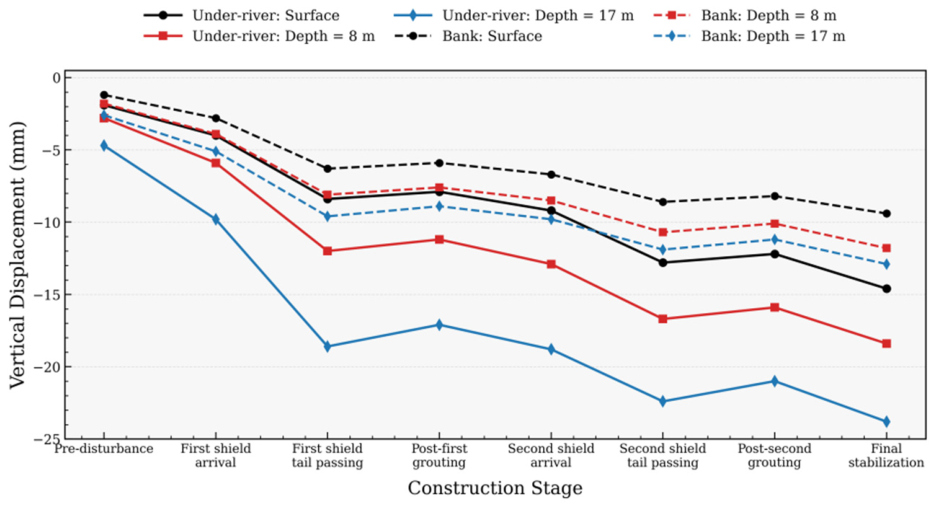
As shown in
Figure 11, the longitudinal displacement evolution induced by shield tunneling in both the onshore section and the riverbed section exhibits obvious staged characteristics, namely typical processes including pre-disturbance, rapid settlement increase after shield tail passage, grouting adjustment, and final stabilization. It can be seen from the figure that the curves of all strata in the riverbed section are located below the corresponding curves in the onshore section, and the absolute vertical displacement in the riverbed section is generally larger than that in the onshore section. This difference can be attributed to the fact that the onshore and riverbed sections also differ in burial depth, soil-layer distribution, mechanical parameters, boundary conditions and overburden characteristics. Therefore, the larger cumulative displacement in the riverbed section should be interpreted as the combined response of multiple section-dependent factors. The high-water-pressure and saturated soft-soil environment may amplify the disturbance diffusion and deformation accumulation, but its isolated contribution cannot be quantitatively separated based on the present comparative analysis.
From the analysis of surface response, it can be seen that the surface displacement of the onshore section gradually develops from approximately 1.2 mm at the pre-disturbance stage to about 9.4 mm at the final stabilization stage. In contrast, the surface displacement of the riverbed section increases from about 1.9 mm to 14.6 mm. Both sections show obvious settlement increase during the shield tail passage stages of the left and right lines, but the riverbed section maintains continuous growth after the right-line construction, indicating more significant additional deformation in the later period. For soil at a burial depth of 8 m, the final displacement of the onshore section is about 11.8 mm, while that of the riverbed section reaches 18.4 mm. For soil at a burial depth of 17 m, the final displacement of the onshore section is approximately 12.9 mm, whereas that of the riverbed section further increases to 23.8 mm. It can be observed that the difference between the riverbed section and the onshore section widens with increasing burial depth, indicating that deep soil near the tunnel periphery is most sensitive to environmental differences between the two sections. Moreover, both sections exhibit the common characteristic of “surface < middle layer < deep layer”, meaning that the displacement response becomes more significant closer to the tunnel periphery. However, compared with the onshore section, the spacing between curves of different burial depths in the riverbed section is larger, indicating more prominent stratification differences. In particular, deep soil in the riverbed section shows the largest increment during the shield tail passage stages of both the left and right lines, whereas the deep-layer curve of the onshore section, though also below the surface curve, displays a relatively gentle overall variation. This indicates that construction disturbance in the onshore section is mainly characterized by a concentrated response under local control conditions, while the riverbed section presents a diffused response gradually transmitting from deep to shallow layers in high-water-pressure, saturated soft soil strata. The longitudinal displacement evolution of the onshore section is dominated by local rapid response and quick stabilization, whereas the riverbed section is characterized by cumulative enhancement throughout the process, stronger deep-layer response, and slower later stabilization.
5.5. Comparative Analysis of Transverse Settlement Trough Morphology Between the Onshore Section and the Riverbed Section
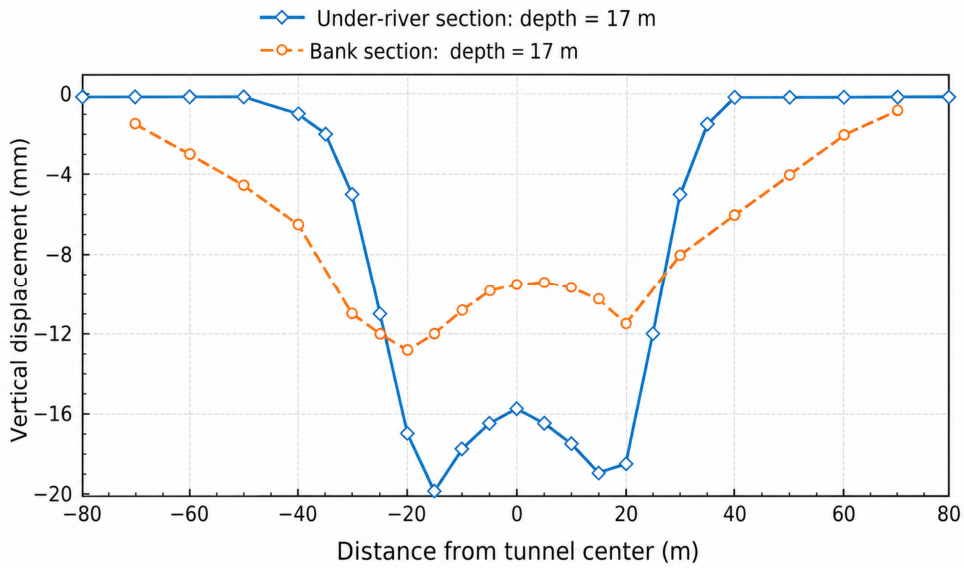
To further compare the differences in transverse settlement response of deep soil between the onshore section and the riverbed section, this paper selects a representative deep position at 17 m, which is comparable in relative position to the tunnel structure in both sections, for comparative analysis. The results are shown in
Figure 12. It can be seen from the figure that the deep transverse settlement troughs of both the onshore section and the riverbed section exhibit obvious double-peak distribution characteristics, indicating that under double-line construction conditions, the main settlement peaks of deep soil appear near the axes of the left and right tunnels, while the middle area forms a secondary settlement valley due to the superposition of disturbances from the two tunnels. The two sections are consistent in trough type, but obvious differences exist in settlement amplitude and trough steepness. Deeper settlement peaks form near the left and right lines in the riverbed section, with a maximum settlement of approximately 20 mm, whereas the maximum settlement of the onshore section is about 12 mm, indicating that the local settlement response of deep soil in the riverbed section is significantly stronger than that in the onshore section. Meanwhile, the curve of the riverbed section changes more steeply near the left and right peaks and has a deeper central valley, reflecting that construction disturbance is more concentrated in the area near the tunnel periphery under high-water-pressure and saturated soft soil conditions. From the perspective of the mechanical mechanism, although the deep soil of the onshore section is close to the tunnel structure, its upper part is jointly controlled by embankment load and surface boundary. Soil disturbance is restrained to some extent during propagation, so the settlement peak is relatively limited and the trough shape recovers quickly. The deeper and sharper settlement trough in the riverbed section is associated with several coupled differences between the two sections, including greater burial depth, different soil-layer distribution, lower stiffness and strength of local soft soils, hydraulic boundary conditions and the absence of a free ground-surface boundary comparable to the onshore section. Therefore, the observed trough difference should be regarded as a section-dependent response rather than the effect of a single factor.
6. Single-Factor Parametric Analysis of Shield Operating Parameters
This section presents a single-factor parametric analysis rather than a full global sensitivity analysis. In each case, only one shield operating parameter was varied while the others were kept unchanged. Cutterhead torque, total shield thrust and tunneling speed were selected because they were continuously recorded during construction and can reflect the shield operating state and disturbance intensity. As the riverbed section shows stronger longitudinal displacement, wider transverse settlement and more obvious deep-soil response than the onshore section, it was selected as the representative case for the parametric analysis, as listed in
Table 9.
In the finite element model, total shield thrust was converted into an equivalent uniform normal pressure acting on the excavation face according to the area-equivalence principle, rather than being treated as a single nodal force. Cutterhead torque was represented as an equivalent circumferential shear disturbance on the excavation face to reflect cutterhead-induced rotational disturbance. tunneling speed was not treated as a direct mechanical boundary condition because the Mohr-Coulomb model is rate-independent. Instead, the V1-V3 cases were interpreted as simplified construction-stage scenarios related to disturbance duration and grouting-support timeliness.
It should be noted that synchronous grouting parameters, such as grouting pressure, grouting volume, grout hardening time and grout diffusion range, are also important factors controlling shield-induced settlement. However, complete grouting records and reliable time-dependent grout parameters were not available for the riverbed section. Therefore, these grouting-related factors were not included in the present analysis. The results should be interpreted as the single-factor influence of selected shield operating parameters, while the coupled effects of synchronous grouting are discussed as a limitation and future research direction.
6.1. Cutterhead Torque Sensitivity Analysis
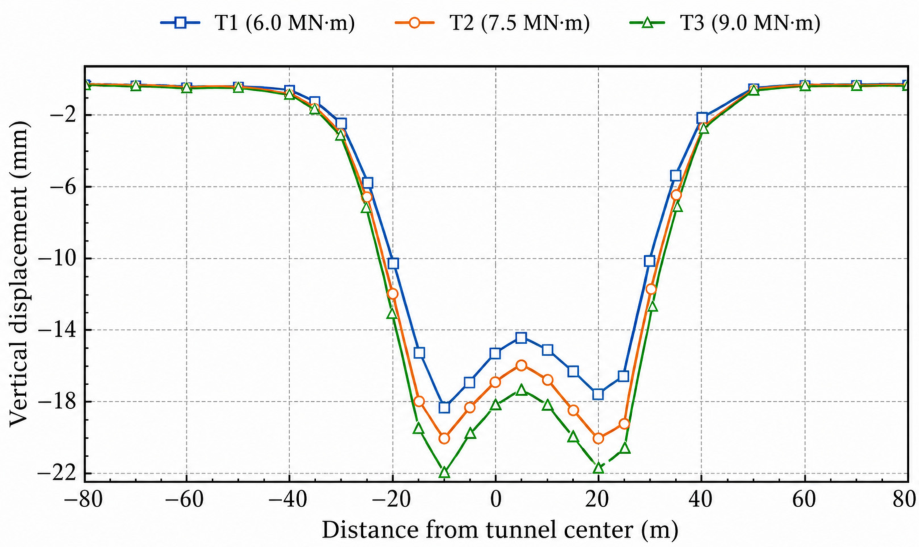
To analyze the influence of cutterhead torque variation on stratum response in the riverbed section, three groups of cases T1, T2 and T3 set in
Table 4 are adopted for analysis, with the results shown in
Figure 13. It can be seen from the figure that under different cutterhead torque conditions, the transverse settlement trough at a buried depth of 17 m all presents a typical double-peaked W-shaped distribution. The main settlement peaks of deep soil always appear near the axes of the left and right tunnels, while the area between the two tunnels forms a secondary settlement valley due to disturbance superposition. Under cases T1, T2 and T3, the maximum settlements near the left and right lines are 18.4 mm, 20.0 mm and 21.8 mm, respectively, and the valley value in the middle area of the settlement trough gradually increases from 14.4 mm in T1 to 15.3 mm in T2 and 16.8 mm in T3. A comparison of settlement curves shows that, compared with T1 and T2, the settlement trough under T3 drops more steeply on both sides and features sharper double peaks, indicating that enhanced cutterhead cutting disturbance concentrates stratum deformation more intensely within the vicinity of the tunnel periphery. This reflects that when the cutterhead torque is low, the disturbance to the surrounding soil caused by shield excavation is relatively weak, and stress release around the tunnel is relatively gentle, resulting in a relatively small settlement peak. With the increase in cutterhead torque, both the cutting action of the cutterhead and the soil interface friction increase simultaneously, which intensifies stress redistribution in front of the excavation face and in the near-tunnel zone, thereby forming a more pronounced settlement concentration zone near the left and right tunnel axes. Since the riverbed section is located in a high-water-pressure, saturated soft soil environment with high compressibility and low shear strength, cutting disturbance from the cutterhead tends to concentrate and release more easily in deep soil. Therefore, changes in cutterhead torque can significantly amplify the transverse settlement response of deep soil near the tunnel periphery.
6.2. Sensitivity Analysis of Total Shield Thrust
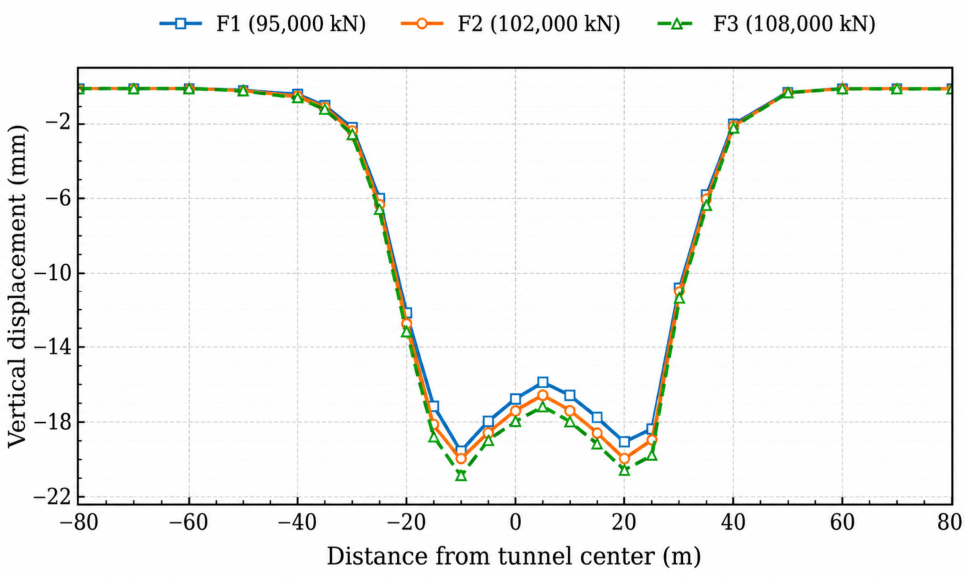
To analyze the influence of total shield thrust variation on stratum response in the riverbed section, three groups of cases F1, F2 and F3 specified in
Table 4 are adopted for analysis, with the results shown in
Figure 14. It can be seen from the figure that the transverse settlement troughs maintain consistent characteristics as described above under different total thrust conditions. Under cases F1, F2 and F3, the maximum settlements near the left and right lines are approximately 19.1 mm, 20.0 mm and 20.9 mm respectively, and the valley value in the middle of the settlement trough gradually increases from 14.7 mm in F1 to 15.3 mm in F2 and 15.9 mm in F3. A comparison of the settlement curves reveals that with the increase in total thrust, the settlement trough as a whole shows a slight downward trend, with both the peak settlements near the left and right lines and the central valley value increased, while the spacing between the three curves is relatively small. This indicates that the variation in total thrust does not change the dominant mode of transverse deformation of deep soil under double-line construction, but mainly acts to magnify the settlement magnitude. Specifically, the peaks near the left and right lines under case F3 are slightly deepened, and the overall curve is lower than those of F1 and F2, suggesting that under higher total thrust, shield advancement imposes a stronger disturbance on the soil ahead and the near-tunnel zone, leading to further increased deep soil settlement. In contrast, under case F1, the settlement trough has smaller peaks and a higher overall curve, reflecting relatively slow stratum stress release and limited deep soil deformation under lower total thrust. When the total thrust is low, the thrust exerted by the shield on the soil ahead is relatively weak, resulting in gentle stress redistribution at the excavation face and in the near-tunnel zone, hence the relatively small deep settlement peak. With the increase in total thrust, the squeezing effect of shield advancement on surrounding soil is enhanced, intensifying the front earth pressure and stress release around the tunnel, thereby forming a more prominent settlement concentration zone near the left and right tunnel axes. As the riverbed section is located in a high-water-pressure, saturated soft soil environment with high compressibility and low shear strength, the deep soil near the tunnel periphery is more prone to additional compressive deformation as total thrust increases, leading to a certain degree of increase in both the peak and valley values of the settlement trough.
6.3. Sensitivity Analysis of Shield Tunneling Speed
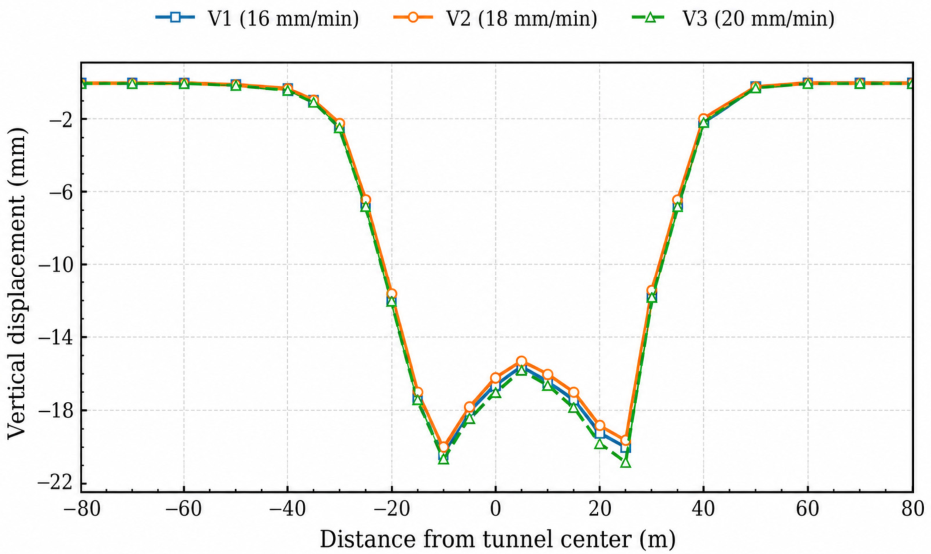
To analyze the influence of tunneling speed on the stratum response in the riverbed section, three cases, V1, V2 and V3, specified in
Table 4, were adopted, with the results shown in
Figure 15. Under different tunneling speeds, the transverse settlement troughs maintain a similar double-peak W-shaped distribution. Under cases V1, V2 and V3, the maximum settlements near the left and right tunnel axes are approximately 20.3 mm, 20.0 mm and 20.8 mm, respectively, while the corresponding central valley settlements are about 15.6 mm, 15.3 mm and 16.1 mm, respectively. Compared with the medium-speed case V2, the peak settlement increases by 0.3 mm under the low-speed case V1 and by 0.8 mm under the high-speed case V3. This indicates that the influence of tunneling speed on deep soil settlement is nonlinear rather than monotonic, and that both excessively low and high tunneling speeds may be unfavorable for deformation control within the investigated range.
From a construction-mechanics perspective, the larger settlement under low-speed tunneling may be related to the longer duration of disturbance imposed on the same soil zone. When the shield advances slowly, the soil around the excavation face and shield tail remains under continuous disturbance for a longer period, which may promote additional deformation accumulation in saturated soft soil. In contrast, high-speed tunneling may reduce the time available for synchronous grouting compensation, segment support mobilization and shield attitude adjustment. As a result, the compensation effect of grouting may lag behind the disturbance induced by excavation and shield tail void formation, leading to larger settlement. Therefore, the medium-speed case shows relatively better deformation-control performance within the investigated range.
It should be noted that this interpretation is based on the numerical response trend and general construction mechanism. The present model does not explicitly simulate real-time grouting lag, grout hardening, or the coupled interaction between tunneling speed and synchronous grouting. Therefore, the nonlinear influence of tunneling speed should be regarded as a preliminary finding from the single-factor parametric analysis. Further verification using field records of grouting pressure, grouting volume, shield attitude and advance rate is required.
6.4. Comparative Evaluation of Single-Factor Parameter Effects
To provide a more quantitative comparison of the influence of different shield operating parameters, a single-factor response amplitude index was introduced. This index is defined as the difference between the maximum and minimum settlement responses within the investigated parameter range:
where (
RA) denotes the response amplitude, and (
S_{max}) and (
S_{min}) represent the maximum and minimum peak settlements obtained under different levels of a given parameter.
The calculated results are summarized in
Table 10. Within the investigated single-factor parameter ranges, cutterhead torque produces the largest settlement response amplitude. As the cutterhead torque increases from 6.0 MN·m to 9.0 MN·m, the peak settlement increases from 18.4 mm to 21.8 mm, corresponding to a response amplitude of 3.4 mm. The influence of total shield thrust is smaller, with the peak settlement increasing from 19.1 mm to 20.9 mm and a response amplitude of 1.8 mm. Tunneling speed shows the weakest settlement response amplitude among the three investigated parameters, with the peak settlement varying from 20.0 mm to 20.8 mm and a response amplitude of 0.8 mm. These results indicate that, within the selected one-factor parameter ranges, cutterhead torque causes the largest absolute change in deep soil settlement, followed by total shield thrust and tunneling speed.
7. Discussion
The stratum response induced by double-line shield tunneling exhibited clear section-dependent characteristics. Both the onshore and riverbed sections showed similar staged deformation processes, including pre-disturbance before shield arrival, rapid settlement development after shield tail passage, partial recovery during grouting adjustment, and gradual stabilization after double-line tunneling. However, the simulated results indicate that the riverbed section generally showed larger cumulative displacement, stronger deep-soil response and a wider transverse settlement influence range than the onshore section. These findings suggest that deformation control in the riverbed section should receive particular attention, especially for deep soil near the tunnel periphery and for the superimposed disturbance induced by the second tunnel excavation.
It should be emphasized that the comparison between the onshore and riverbed sections does not represent a single-factor controlled comparison. The two sections differ in burial depth, soil stratification, mechanical parameters, hydraulic conditions, surface boundary constraints and overburden loading. Therefore, the larger deformation response in the riverbed section should be interpreted as the result of coupled section-dependent conditions, rather than being attributed solely to high water pressure or saturated soft soil. In the present study, high water pressure and saturated soft soil are regarded as important environmental characteristics of the riverbed section, but their individual contribution cannot be quantitatively separated based on the current comparative analysis.
The single-factor parametric analysis shows that the investigated shield operating parameters mainly affect the magnitude and concentration degree of deep soil settlement, rather than changing the basic double-peak settlement trough pattern induced by double-line tunneling. Within the investigated parameter ranges, cutterhead torque produced the largest absolute settlement variation, followed by total shield thrust and tunneling speed. However, this result should be interpreted as a preliminary single-factor comparison, because only one parameter was varied at a time and the interaction effects among cutterhead torque, total thrust, tunneling speed, face pressure, grouting parameters and ground parameters were not considered. Several limitations should be acknowledged. First, the longitudinal length of the onshore-section model was 56 m, approximately 3.8D for the 14.5 m diameter tunnel, which is shorter than the commonly recommended 5~6D distance from the disturbance source to the longitudinal boundary. Therefore, possible longitudinal boundary effects on the simulated displacement evolution cannot be fully excluded. This issue should be regarded as a limitation of the present numerical model, and future studies should adopt an extended model or conduct boundary-sensitivity checks to further reduce boundary effects. Second, independent field validation of the riverbed-section model could not be performed because continuous settlement, subsurface displacement and pore-water-pressure monitoring data in the underwater riverbed zone were not available. Therefore, the riverbed-section results should be interpreted primarily as comparative and mechanistic evidence, rather than as fully field-validated predictions of absolute deformation. Third, the Mohr-Coulomb model simplifies the time-dependent behavior, consolidation response and nonlinear mechanical characteristics of saturated soft soil. Fourth, the synchronous grouting layer was simplified as a uniform equal-thickness layer, and the effects of grouting pressure, grouting volume, grout hardening time and grout diffusion range were not explicitly quantified. Future studies should incorporate extended model dimensions, boundary-sensitivity checks, riverbed monitoring data, refined grouting simulation, hydro-mechanical coupling and multi-parameter sensitivity methods to improve the predictive reliability of numerical modeling for river-crossing shield tunneling.