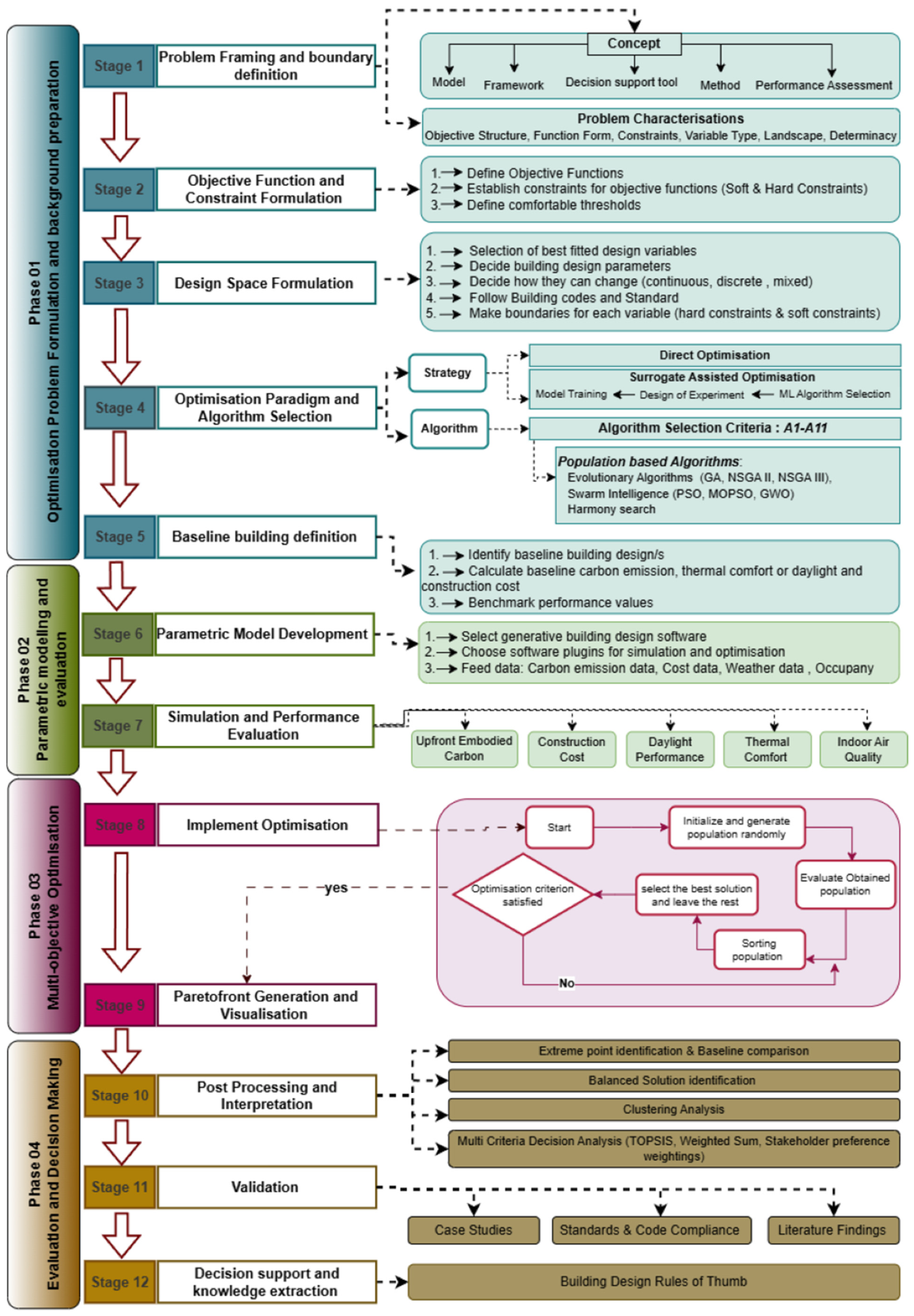
An Integrated Conceptual Framework for Low-Carbon and Cost-Effective Building Design Optimisation
 , , and
Abstract
1. Introduction
2. Materials and Methods
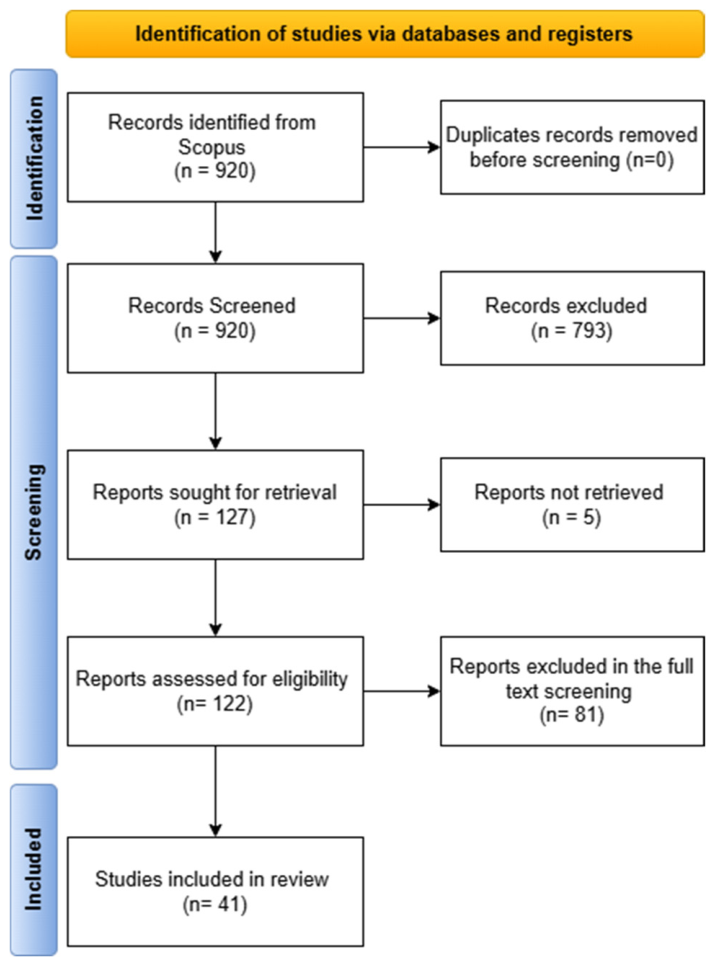
2.1. Stage 1: Systematic Literature Review
- RQ1: How are optimisation problems formulated, and how are carbon and cost objective functions integrated within BDO studies?
- RQ2: What design variables and constraints are adopted in optimisation-based building design studies, and how do they influence carbon–cost trade-offs?
- RQ3: What end-to-end optimisation workflows, tools, and simulation environments are used to support carbon- and cost-driven building design optimisation?
- RQ4: What optimisation strategies are employed in BDO, and what criteria are adopted for selecting suitable optimisation algorithms?
- RQ5: How are Pareto-optimal solutions evaluated, validated, and translated into decision-support outcomes?
- RQ6: What methodological challenges are encountered in BDO studies?
2.2. Stage 2: Conceptual Framework Validity
3. Results
3.1. Concept of the Study

| Category | Description | References |
|---|---|---|
| Optimisation Framework Development | Studies proposing structured optimisation workflows integrating modelling, optimisation, and evaluation | [1,2,3,6,8,9,10,11,28,31,36,37,38,39,40,41,42,43,44,45,46,47] |
| Optimisation Methodology Development | Studies introducing or improving optimisation algorithms or hybrid optimisation techniques | [7,29,48,49,50,51,52] |
| Optimisation Model Development | Studies developing surrogate or machine-learning models for building performance prediction within optimisation workflows | [5,8,30,53,54] |
| Performance Assessment | Studies evaluating optimisation results or benchmarking performance of optimisation algorithms | [32,33,55,56,57] |
| Decision-Support Tool Development | Studies translating optimisation results into tools supporting designer decision-making | [34,35] |
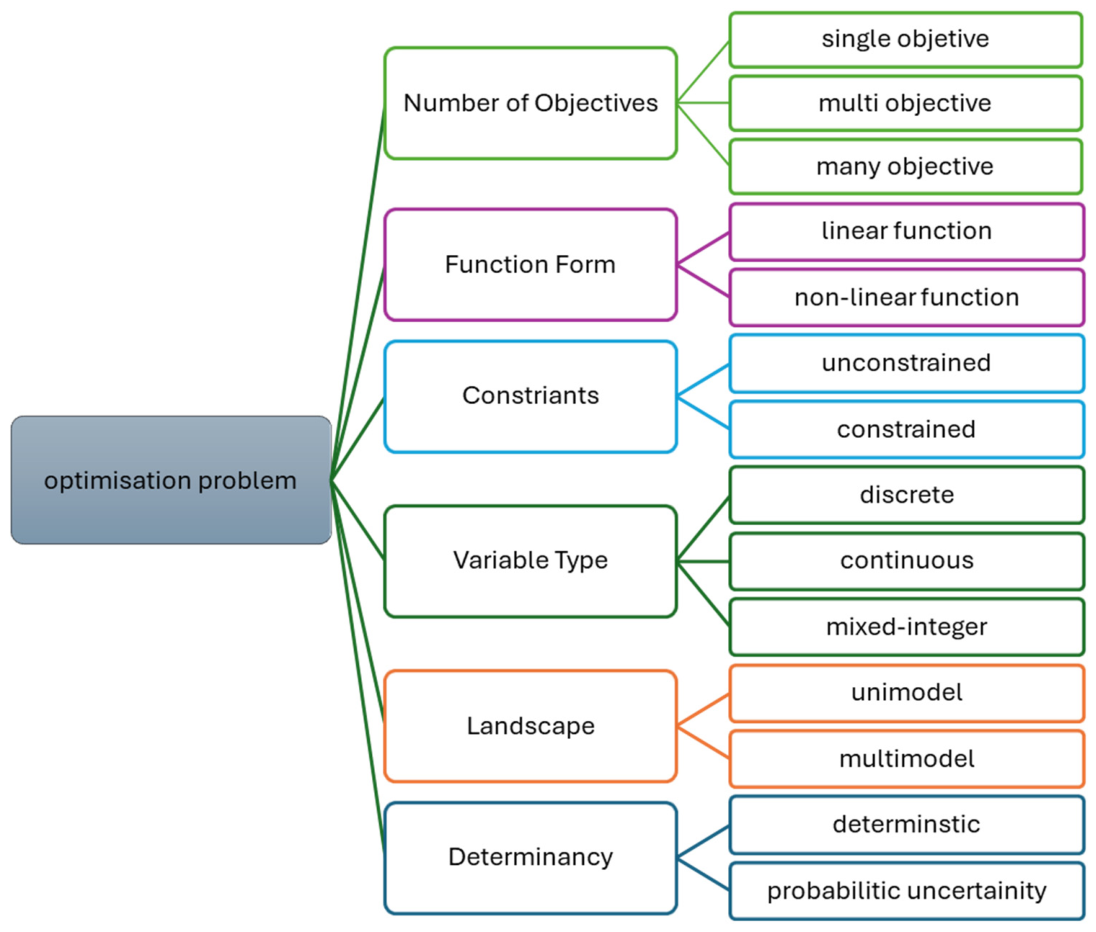
3.2. Optimisation Problem Characterisation
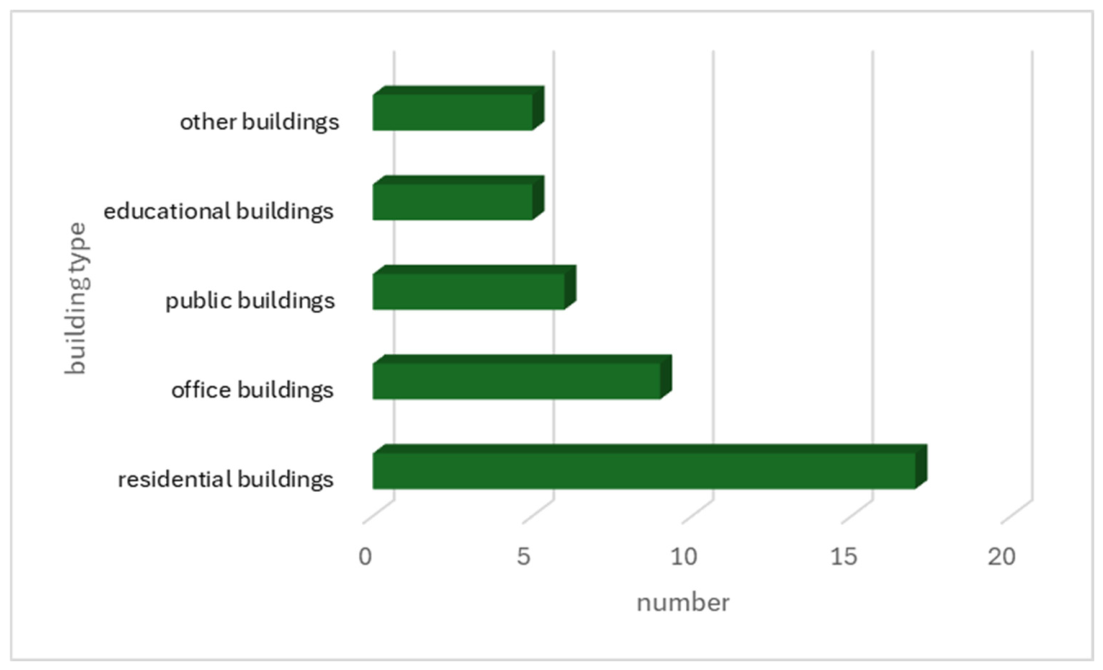
3.3. Building Function
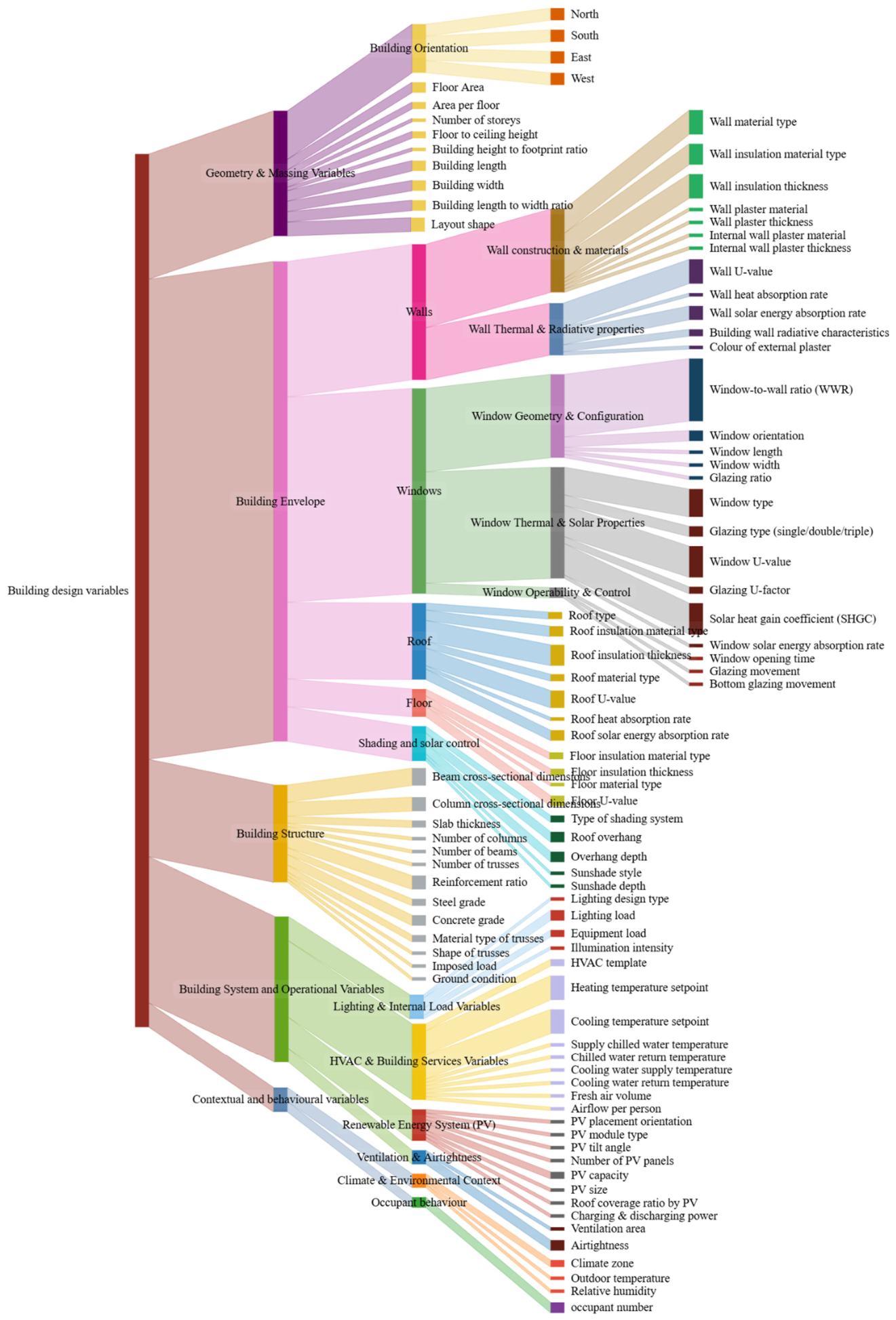
3.4. Building Design Variables
3.5. Objective Functions
Objective-Driven Mapping of Optimisation Parameters and Building Design Variables
3.6. Constraints
3.7. Standards and Codes
3.8. Optimisation
3.8.1. Optimisation Strategies
- Single Algorithm optimisation Strategy
- 2.
- Surrogate-Assisted Optimisation Strategy
3.8.2. Optimisation Results Evaluation and Validation
Results Evaluation
- Pareto front generation and trade-off exploration: Depending on the number of objective functions considered, Pareto fronts are visualised in two- or three-dimensional objective space to provide an initial understanding of the trade-off structure between competing objectives. This stage commonly employs visual Pareto-front inspection, formal Pareto dominance definitions, and non-dominated sorting with crowding distance to identify the Pareto set and qualitatively examine objective conflicts.
- Pareto-set quality, convergence, and robustness assessment: To ensure that the identified Pareto front is reliable and well-converged, several studies evaluate solution quality using hypervolume indicators [10,29,34] and multi-run robustness and stability checks [6,28]. These analyses verify convergence behaviour, diversity, and consistency of the solutions, thereby preventing premature interpretation of incomplete or unstable fronts.
- Extreme-point identification and baseline comparison: At this stage, extreme or anchor solutions such as minimum-carbon or minimum-cost designs are extracted from the Pareto set to define performance bounds and support objective-specific decision scenarios. Hong et al. [30], Kang et al. [41] and Lin et al. [49] further compared these extreme points against baseline or reference designs to quantify achievable performance improvements and contextualise optimisation benefits.
- Balanced or compromise solution identification: To identify efficient trade-off solutions within the Pareto set, ref. [11] adopted distance-to-ideal (utopia-point) methods, whereby objectives are normalised and the Pareto solution with the minimum distance to the ideal point is selected. Alternatively, adopting a fitness function, the Pareto front solution in its original order is shortened [1,30,36].
- Design-variable influence assessment: To improve the interpretability of optimisation outcomes, sensitivity and correlation analyses are frequently conducted on Pareto solutions to identify influential design variables and sensitive parameters [1,10,37]. This stage provides insight into the underlying drivers of optimal performance and supports knowledge extraction beyond numerical optimisation results.
- Solution-space reduction: When Pareto sets are large or high-dimensional, solution-space reduction techniques are applied to improve interpretability. Li et al. [65] and Shi et al. [28] employed K-means clustering to group non-dominated solutions and select representative alternatives closest to cluster centroids using Euclidean distance. Adopting the elbow criterion, supported by reductions in the sum of squared errors and peak silhouette coefficients, the number of clusters in both studies was evaluated. While this unsupervised approach improves interpretability and enables identification of representative design archetypes, its effectiveness remains sensitive to the predefined cluster number and distance metric, potentially overlooking extreme or stakeholder-preferred solutions.
- Decision support and stakeholder-oriented selection: Selection of a preferred design alternative is carried out under stakeholder preferences and practical constraints. This stage commonly employs multi-criteria decision-making (MCDM) techniques, including TOPSIS [6,10], equal-weighted or modified TOPSIS with correlation-based weighting [2], stakeholder-defined weighting schemes, and Weighted Sum Method [56] to rank Pareto solutions and identify final design candidates.
Results Validation
3.9. Tools and Software
3.10. Critical Dimensions Affecting Low-Carbon and Cost-Effective Building Design Optimisation
4. Discussion
4.1. Optimisation Algorithm Selection Criteria
4.2. ICCO-BD Framework: Integrated Carbon–Cost Optimisation Framework for Building Design
4.3. ICCO-BD Framework Validation
4.4. Limitations of the Proposed Conceptual Framework
5. Conclusions, Limitations and Future Directions
Author Contributions
Funding
Institutional Review Board Statement
Informed Consent Statement
Data Availability Statement
Conflicts of Interest
Abbreviations
| ANN | Artificial Neural Network |
| ASHRAE | American Society of Heating, Refrigerating and Air-Conditioning Engineers |
| BDO | Building Design Optimisation |
| BIM | Building Information Modelling |
| BIPVs | Building-Integrated Photovoltaics |
| CC | Construction Cost |
| EC | Embodied Carbon |
| ECE | Embodied Carbon Emission |
| ELM | Extreme Learning Machine |
| EMs | Evolutionary Metaheuristics |
| EN | European |
| EPD | Environmental Product Declaration |
| GA | Genetic Algorithm |
| GB | Gradient Boosting |
| HVAC | Heating, Ventilation, and Air Conditioning |
| ISO | International Organisation for Standards |
| LCA | Life Cycle Assessment |
| LCC | Life Cycle Cost |
| LCCE | Life Cycle Carbon Emission |
| ML | Machine Learning |
| MOO | Multi-Objective Optimisation |
| MOPSO | Multi-Objective Particle Swarm Optimisation |
| NSGA | Non-dominated Sorting Genetic Algorithm |
| OC | Operational Carbon |
| PESA | Pareto Envelope-based Selection Algorithm |
| PSO | Particle Swarm Optimisation |
| RF | Random Forest |
| SAO | Surrogate-Assisted Optimisation |
| SBMs | Swarm-based Metaheuristics |
| SHGC | Solar Heat Gain Coefficient |
| SLR | Systematic Literature Review |
| SPEA | Strength Pareto Evolutionary Algorithm |
| SVM | Support Vector Machines |
| TRNSYS | Transient System Simulation Tool |
| WWR | Window to Wall Ratio |
References
- Khidmat, R.P.; Hiroatsu, H.; Kustiani. Design Optimization of Hyperboloid Wooden House Concerning Structural, Cost, and Daylight Performance. Buildings 2022, 12, 110. [Google Scholar] [CrossRef]
- Zhong, Y.; Qin, Z.; Feng, R.; Liu, Y. Low-Carbon Design: Building Optimization Considering Carbon Emission, Material Utilization, and Daylighting. J. Clean. Prod. 2024, 434, 140087. [Google Scholar] [CrossRef]
- Gia, T.T.; Dang, H.-A.; Dinh, V.-B.; Tong, M.Q.; Nguyen, T.K.; Nguyen, H.H.; Nguyen, D.Q. A Simulation-Based Multi-Objective Genetic Optimization Framework for Efficient Building Design in Early Stages: Application for Vietnam’s Hot and Humid Climates. Int. J. Build. Pathol. Adapt. 2022, 40, 305–326. [Google Scholar] [CrossRef]
- Teng, Y.; Pan, W. Estimating and Minimizing Embodied Carbon of Prefabricated High-Rise Residential Buildings Considering Parameter, Scenario and Model Uncertainties. Build. Environ. 2020, 180, 106951. [Google Scholar] [CrossRef]
- He, L.; Wang, W. Design Optimization of Public Building Envelope Based on Multi-Objective Quantum Genetic Algorithm. J. Build. Eng. 2024, 91, 109714. [Google Scholar] [CrossRef]
- Ascione, F.; Bianco, N.; Mauro, G.M.; Napolitano, D.F. Building Envelope Design: Multi-Objective Optimization to Minimize Energy Consumption, Global Cost and Thermal Discomfort. Application to Different Italian Climatic Zones. Energy 2019, 174, 359–374. [Google Scholar] [CrossRef]
- Cauteren, D.V.; Ramon, D.; Stroeckx, J.; Allacker, K.; Schevenels, M. Design Optimization of Hybrid Steel/Timber Structures for Minimal Environmental Impact and Financial Cost: A Case Study. Energy Build. 2022, 254, 111600. [Google Scholar] [CrossRef]
- Tian, Y.; Chai, K. Building Design and Operation Multi-Objective Optimization: Energy Costs vs. Emissions. Energy Build. 2025, 329, 115225. [Google Scholar] [CrossRef]
- Samarasinghalage, T.I.; Wijeratne, W.M.P.U.; Jing Yang, R.J.; Wakefield, R. A Multi-Objective Optimization Framework for Building-Integrated PV Envelope Design Balancing Energy and Cost. J. Clean. Prod. 2022, 342, 130930. [Google Scholar] [CrossRef]
- Li, M.; Zhao, S.; Yao, S.; Huo, Q.; Yuan, J.; Li, Y. A Performance-Responsive Generative Design Framework Integrating Multi-Objective Optimization for the Layout of Residential Buildings Oriented towards Low-Carbon Emission: A Case Study of Tianjin in China. J. Build. Eng. 2025, 108, 112805. [Google Scholar] [CrossRef]
- Zeng, Z.; Lu, D.; Hu, Y.; Augenbroe, G.; Chen, J. A Comprehensive Optimization Framework for the Design of High-Performance Building Systems. J. Build. Eng. 2023, 65, 105709. [Google Scholar] [CrossRef]
- Calzolari, T.; Genovese, A.; Brint, A. Circular Economy Indicators for Supply Chains: A Systematic Literature Review. Environ. Sustain. Indic. 2022, 13, 100160. [Google Scholar] [CrossRef]
- Hettiarachchi, I.; Rotimi, J.O.B.; Shahzad, W.M.; Kahandawa, R.; Hettiarachchi, I.; Rotimi, J.O.B.; Shahzad, W.M.; Kahandawa, R. Bridging Sustainability and Performance: Conceptualizing Net-Zero Integration in Construction Supply Chain Evaluations. Sustainability 2025, 17, 5814. [Google Scholar] [CrossRef]
- Chadegani, A.A.; Salehi, H.; Yunus, M.M.; Farhadi, H.; Fooladi, M.; Farhadi, M.; Ebrahim, N.A. A Comparison between Two Main Academic Literature Collections: Web of Science and Scopus Databases. Asian Soc. Sci. 2013, 9, p18. [Google Scholar] [CrossRef]
- Meho, L.I.; Rogers, Y. Citation Counting, Citation Ranking, and h-Index of Human-Computer Interaction Researchers: A Comparison of Scopus and Web of Science. J. Am. Soc. Inf. Sci. Technol. 2008, 59, 1711–1726. [Google Scholar] [CrossRef]
- Tetteh, M.O.; Darko, A.; Chan, A.P.C.; Jafari, A.; Brilakis, I.; Chen, W.; Nani, G.; Kwame Yevu, S. Scientometric Mapping of Global Research on Green Retrofitting of Existing Buildings (GREB): Pathway towards a Holistic GREB Framework. Energy Build. 2022, 277, 112532. [Google Scholar] [CrossRef]
- Mazher, K.M. A Semi-Automated Systematic Review of Literature Reviews in Construction Engineering and Management Research. Front. Built Environ. 2025, 11, 1582475. [Google Scholar] [CrossRef]
- Madushika, U.G.D.; Lu, W. Green Retrofitting Application in Developing Economies: State of the Art and Future Research Directions. Energy Build. 2023, 301, 113712. [Google Scholar] [CrossRef]
- Panchalingam, K.; Rasheed, E.O.; Rotimi, J.O.B. Cost-Related Drivers and Barriers of Passivhaus: A Systematic Literature Review. Sustainability 2024, 16, 6510. [Google Scholar] [CrossRef]
- Tong, N.; Domingo, N.; Le, A. Decision Support Tool for Designing out Waste: A Conceptual Framework. Smart Sustain. Built Environ. 2024. [Google Scholar] [CrossRef]
- Ranasinghe, N.; Domingo, N.; Kahandawa, R. Enhancing Building Material Circularity: A Systematic Review on Prerequisites, Obstacles and the Critical Role of Data Traceability. J. Build. Eng. 2024, 98, 111136. [Google Scholar] [CrossRef]
- Paul, J.; Lim, W.M.; O’Cass, A.; Hao, A.W.; Bresciani, S. Scientific Procedures and Rationales for Systematic Literature Reviews (SPAR-4-SLR). Int. J. Consum. Stud. 2021, 45, O1–O16. [Google Scholar] [CrossRef]
- Wijewickrama, M.K.C.S.; Rameezdeen, R.; Chileshe, N. Information Brokerage for Circular Economy in the Construction Industry: A Systematic Literature Review. J. Clean. Prod. 2021, 313, 127938. [Google Scholar] [CrossRef]
- Zhang, Q.; Hao, S. Developing a Mechanism of Construction Project Manager’s Emotional Intelligence on Project Success: A Grounded Theory Research Based in China. Front. Psychol. 2022, 13, 693516. [Google Scholar] [CrossRef] [PubMed]
- Braun, V.; Clarke, V. Using Thematic Analysis in Psychology. Qual. Res. Psychol. 2006, 3, 77–101. [Google Scholar] [CrossRef]
- Saunders, M.N.K.; Lewis, P.; Thornhill, A. Research Methods for Business Students, 9th ed.; Pearson Education Limited: London, UK, 2023. [Google Scholar]
- Vergara, R.; Castillo, T.; Herrera, R.F. Performance Evaluation System for Design Phase of High-Rise Building Projects: Development and Validation Through Expert Feedback and Simulation. Buildings 2025, 15, 2976. [Google Scholar] [CrossRef]
- Shi, Y.; Yang, Z.; Zheng, S.; Gao, D.; Yang, X. Multi-Objective Optimization of Embodied Carbon Emission, Energy Consumption, and Daylighting Performance of Educational Building in the Schematic Design Stage. J. Build. Eng. 2025, 106, 112594. [Google Scholar] [CrossRef]
- Negrin, I.; Kripka, M.; Yepes, V. Multi-Criteria Optimization for Sustainability-Based Design of Reinforced Concrete Frame Buildings. J. Clean. Prod. 2023, 425, 139115. [Google Scholar] [CrossRef]
- Hong, T.; Kim, J.; Lee, M. A Multi-Objective Optimization Model for Determining the Building Design and Occupant Behaviors Based on Energy, Economic, and Environmental Performance. Energy 2019, 174, 823–834. [Google Scholar] [CrossRef]
- Rizehbandi, S.; Taghaddos, H.; Sadatnya, A. An Integrated Machine Learning and Optimization Framework for Enhancing Sustainable Building Design. Energy Build. 2026, 353, 116900. [Google Scholar] [CrossRef]
- Dunant, C.F.; Drewniok, M.P.; Orr, J.J.; Allwood, J.M. Good Early Stage Design Decisions Can Halve Embodied CO2 and Lower Structural Frames’ Cost. Structures 2021, 33, 343–354. [Google Scholar] [CrossRef]
- Canbolat, A.S.; Albak, E.İ. Multi-Objective Optimization of Building Design Parameters for Cost Reduction and CO2 Emission Control Using Four Different Algorithms. Appl. Sci. 2024, 14, 7668. [Google Scholar] [CrossRef]
- Kanyilmaz, A.; Tichell, P.R.N.; Loiacono, D. A Genetic Algorithm Tool for Conceptual Structural Design with Cost and Embodied Carbon Optimization. Eng. Appl. Artif. Intell. 2022, 112, 104711. [Google Scholar] [CrossRef]
- Schwartz, Y.; Raslan, R.; Korolija, I.; Mumovic, D. A Decision Support Tool for Building Design: An Integrated Generative Design, Optimisation and Life Cycle Performance Approach. Int. J. Archit. Comput. 2021, 19, 401–430. [Google Scholar] [CrossRef]
- Liu, Y.; Li, T.; Xu, W.; Wang, Q.; Huang, H.; He, B.-J. Building Information Modelling-Enabled Multi-Objective Optimization for Energy Consumption Parametric Analysis in Green Buildings Design Using Hybrid Machine Learning Algorithms. Energy Build. 2023, 300, 113665. [Google Scholar] [CrossRef]
- Ascione, F.; Bianco, N.; Mauro, G.M.; Vanoli, G.P. A New Comprehensive Framework for the Multi-Objective Optimization of Building Energy Design: Harlequin. Appl. Energy 2019, 241, 331–361. [Google Scholar] [CrossRef]
- Negarestani, M.N.; Hajikandi, H.; Fatehi-Nobarian, B.; Majrouhi, J. Design-Optimization of Conventional Steel Structures for Realization of the Sustainable Development Objectives Using Metaheuristic Algorithm. Buildings 2024, 14, 2028. [Google Scholar] [CrossRef]
- Satoła, D.; Houlihan-Wiberg, A.; Gustavsen, A. Global Sensitivity Analysis and Optimisation of Design Parameters for Low GHG Emission Lifecycle of Multifamily Buildings in India. Energy Build. 2022, 277, 112596. [Google Scholar] [CrossRef]
- Ji, Y.; Lv, J.; Li, H.X.; Liu, Y.; Yao, F.; Liu, X.; Wang, S. Improving the Performance of Prefabricated Houses through Multi-Objective Optimization Design. J. Build. Eng. 2024, 84, 108579. [Google Scholar] [CrossRef]
- Kang, Y.; Zhang, D.; Cui, Y.; Xu, W.; Lu, S.; Wu, J.; Hu, Y. Integrated Passive Design Method Optimized for Carbon Emissions, Economics, and Thermal Comfort of Zero-Carbon Buildings. Energy 2024, 295, 131048. [Google Scholar] [CrossRef]
- Chen, C.; Zhang, L.; Zhang, Y.; Huang, J.; Ye, H. Multi-Objective Optimization for Intelligent Low-Carbon Building Design Considering Urban Hybrid Islands. Energy Build. 2025, 349, 116591. [Google Scholar] [CrossRef]
- Jung, Y.; Heo, Y.; Lee, H. Multi-Objective Optimization of the Multi-Story Residential Building with Passive Design Strategy in South Korea. Build. Environ. 2021, 203, 108061. [Google Scholar] [CrossRef]
- Huan, Y. Research on Energy-Efficient Building Design Using Target Function Optimization and Genetic Neural Networks. EAI Endorsed Trans. Energy Web 2025, 12, 12. [Google Scholar] [CrossRef]
- Moroni, G.; Forcael, E. Structural Shape Optimization for Reducing Embodied Carbon by Integrating Optimization Processes at the Early Stages of Truss Structural Design. Buildings 2025, 15, 877. [Google Scholar] [CrossRef]
- Mishra, A.; Biswal, S.; Nanda, B.; Patro, S.K. Design of Structural Elements for Residential Buildings Utilizing Non-Linear Multi-Objective Optimization and Interpretable Data-Driven Learning. Struct. Mutltidiscip. Opt. 2026, 69, 20. [Google Scholar] [CrossRef]
- Zhang, X.; Zhang, X. Design of Low-Carbon and Cost-Efficient Concrete Frame Buildings: A Hybrid Optimization Approach Based on Harmony Search. J. Asian Archit. Build. Eng. 2023, 22, 2161–2174. [Google Scholar] [CrossRef]
- Aburabi’e, M.; Bataineh, K.; Al-Kabaha, Y. Multi Objective Design Optimization of Residential Buildings: Energy Consumption, Life Cycle Cost and Thermal Discomfort Based on NSGA-II. Innov. Infrastruct. Solut. 2025, 10, 354. [Google Scholar] [CrossRef]
- Lin, Y.-H.; Lin, M.-D.; Tsai, K.-T.; Deng, M.-J.; Ishii, H. Multi-Objective Optimization Design of Green Building Envelopes and Air Conditioning Systems for Energy Conservation and CO2 Emission Reduction. Sustain. Cities Soc. 2021, 64, 102555. [Google Scholar] [CrossRef]
- Xue, Q.; Wang, Z.; Chen, Q. Multi-Objective Optimization of Building Design for Life Cycle Cost and CO2 Emissions: A Case Study of a Low-Energy Residential Building in a Severe Cold Climate. Build. Simul. 2022, 15, 83–98. [Google Scholar] [CrossRef]
- Zhang, X.; Zhang, X. Sustainable Design of Reinforced Concrete Structural Members Using Embodied Carbon Emission and Cost Optimization. J. Build. Eng. 2021, 44, 102940. [Google Scholar] [CrossRef]
- Jalali, Z.; Noorzai, E.; Heidari, S. Design and Optimization of Form and Facade of an Office Building Using the Genetic Algorithm. Sci. Technol. Built Environ. 2020, 26, 128–140. [Google Scholar] [CrossRef]
- Elsayed, A.M.; Elanwar, H.H.; Marzouk, M.; Safar, S.S. Sustainable Layout Design of Steel Buildings through Embodied Energy and Costs Optimization. Clean. Eng. Technol. 2021, 5, 100308. [Google Scholar] [CrossRef]
- Accorsi, R.; Bortolini, M.; Gamberi, M.; Manzini, R.; Pilati, F. Multi-Objective Warehouse Building Design to Optimize the Cycle Time, Total Cost, and Carbon Footprint. Int. J. Adv. Manuf. Technol. 2017, 92, 839–854. [Google Scholar] [CrossRef]
- Sadeghi, D.; Ahmadi, S.E.; Amiri, N.; Marzband, M.; Abusorrah, A.; Rawa, M. Designing, Optimizing and Comparing Distributed Generation Technologies as a Substitute System for Reducing Life Cycle Costs, CO2 Emissions, and Power Losses in Residential Buildings. Energy 2022, 253, 123947. [Google Scholar] [CrossRef]
- Shao, T.; Zheng, W.; Cheng, Z. Passive Energy-Saving Optimal Design for Rural Residences of Hanzhong Region in Northwest China Based on Performance Simulation and Optimization Algorithm. Buildings 2021, 11, 421. [Google Scholar] [CrossRef]
- Gagnon, R.; Gosselin, L.; Decker, S. Performance of a Sequential versus Holistic Building Design Approach Using Multi-Objective Optimization. J. Build. Eng. 2019, 26, 100883. [Google Scholar] [CrossRef]
- Yang, D.; Ren, S.; Turrin, M.; Sariyildiz, S.; Sun, Y. Multi-Disciplinary and Multi-Objective Optimization Problem Re-Formulation in Computational Design Exploration: A Case of Conceptual Sports Building Design. Autom. Constr. 2018, 92, 242–269. [Google Scholar] [CrossRef]
- EN 15978; Sustainability of Construction Works. Assessment of Environmental Performance of Buildings. Calculation Method. British Standards Institute: London, UK, 2011.
- Snyman, J.A.; Wike, D.N. Practical Mathematical Optimization: Basic Optimization Theory and Gradient-Based Algorithms, 2nd ed.; Springer Nature Link: Cham, Switzerland, 2018. [Google Scholar]
- Snyman, J.A. (Ed.) New Gradient-Based Trajectory and Approximation Methods. In Practical Mathematical Optimization: An Introduction to Basic Optimization Theory and Classical and New Gradient-Based Algorithms; Springer: Boston, MA, USA, 2005; pp. 97–150. [Google Scholar]
- ISO 14040/44; Environmental Management. International Organization for Standardization (ISO): Geneva, Switzerland, 2006.
- EN 15804; Sustainability of Construction Works—Environmental Product Declarations. European Committee for Standardization: Brussels, Belgium, 2019.
- Li, M.; Wong, B.C.L.; Liu, Y.; Chan, C.M.; Gan, V.J.L.; Cheng, J.C.P. DfMA-Oriented Design Optimization for Steel Reinforcement Using BIM and Hybrid Metaheuristic Algorithms. J. Build. Eng. 2021, 44, 103310. [Google Scholar] [CrossRef]
- Li, G.; He, Q.; Lin, B.; Wang, M.; Ju, X.; Xu, S. Accelerated Inverse Urban Design: A Multi-Objective Optimization Method to Photovoltaic Power Generation Potential, Environmental Performance and Economic Performance in Urban Blocks. Sustain. Cities Soc. 2025, 120, 106135. [Google Scholar] [CrossRef]
- Cao, Z.; Miao, C.; Du, F.; Zhu, D.; Teng, T.; Xue, Y. A Bifurcation Dynamical Analysis of a Non-Darcy Seepage System in Post-Failure Rock Based on a Novel Truncated Spectral Method. Processes 2026, 14, 1468. [Google Scholar] [CrossRef]
- Xue, Y.; Wang, L.; Liu, Y.; Ranjith, P.G.; Cao, Z.; Shi, X.; Gao, F.; Kong, H. Brittleness Evaluation of Gas-Bearing Coal Based on Statistical Damage Constitution Model and Energy Evolution Mechanism. J. Cent. South Univ. 2025, 32, 566–581. [Google Scholar] [CrossRef]
- ISO 14025; Environmental Labels and Declarations. International Organization for Standardization (ISO): Geneva, Switzerland, 2006.


| Stage | Exclusion Criteria |
|---|---|
| Searching | Books, review papers, and editorials Articles in press Articles not in the Engineering domain Articles not published in the English language Articles not published between 2015 and 2026 |
| Title and Abstract Screening | Articles focused on natural hazards Articles that do not address building design optimisation Articles focusing on material-level studies Articles focusing on industries other than buildings Articles focusing on building retrofitting |
| Full-Text Screening | Articles that could not be retrieved Articles in which the objective functions do not include embodied carbon reduction or cost minimisation |
| Participants | Position | Type of Organisation | Years of Experience in the Construction Industry | Years of Experience in Building Design | Years of Experience in Optimisation | Education Degree |
|---|---|---|---|---|---|---|
| A | Building Designer | Architecture & Design | 10 | 10 | 3 | BArch, MArch, PhD |
| B | Architect | Architecture & Design | 6 | 6 | 5 | BArch, MSc |
| C | Researcher in building energy optimisation | Tertiary Education | 8 | 8 | 6 | BSc, PhD |
| D | Research expert in BDO | Tertiary Education | 2 | 2 | 2 | BSc, MSc, PhD |
| E | Architect | Architecture & Design | 15 | 15 | 3 | BArch, MSc |
| F | Researcher in building energy optimisation | Tertiary Education | 7 | 7 | 4 | BSc, MSc, PhD |
| G | Cost Manager in the design team | Contractor | 5 | 5 | 2 | BSc, PhD |
| H | Researcher in BDO | Tertiary Education | 8 | 5 | 3 | BArch, March, PhD |
| Objective Function | Optimised Parameters | Design Variables |
|---|---|---|
| Energy Performance (heating energy demand, cooling energy demand) | EUI (Energy Use Intensity) | Geometry & massing Envelope thermal properties Fenestration & glazing Shading & solar control HVAC systems & controls Lighting & internal loads Airtightness & ventilation Renewable energy systems |
| Daylighting | UDI (Useful Daylight Illuminance) SDA (Spatial Daylight Autonomy) Illuminance | Geometry & massing Fenestration & glazing Shading & solar control Lighting control systems |
| Thermal Comfort | PMV (Predicted Mean Vote) PPD (Predicted Percentage of Dissatisfied) DH (Discomfort Hours) Operative Temperature and RH (Relative Humidity) | Envelope thermal performance Fenestration & shading HVAC systems & controls Geometry & massing Airtightness & ventilation |
| Indoor Air Quality | Indoor CO2 concentration | Ventilation systems Fenestration operability Envelope airtightness HVAC system |
| Carbon Emission | Embodied Carbon (kgCO2e) | Structural system & sizing Geometry & massing Building Envelope size and materials |
| Operational Carbon (kgCO2e) | Envelope thermal performance Fenestration & shading HVAC systems Renewable energy systems Airtightness & ventilation | |
| Cost | Material Cost Investment Cost Construction Cost | Geometry & massing Structural design Material selection Envelope systems |
| Global Cost Energy Cost | Envelope thermal performance HVAC systems & controls Lighting systems Renewable energy systems | |
| Structural Safety | Weight Displacement Capacity Ratio | Structural system configuration Structural member sizing Material grades Imposed loads |
| Layer 1: Optimisation Strategy | Layer 2: Surrogate Model | Layer 3: Optimisation Algorithm | Layer 4: Algorithm Family | No. of Studies | Average No. of Objectives | Average No. of Design Variables | References |
|---|---|---|---|---|---|---|---|
| Single-algorithm optimisation | – | NSGA-II | EM | 15 | 2.8 | 9.5 | [3,9,28,30,33,34,35,41,44,45,48,49,55,56,57] |
| – | NSGA-III | EM | 1 | 3 | 9 | [41] | |
| – | MOGA | EM | 3 | 3 | 15 | [6,37,51] | |
| – | GA | EM | 2 | 2 | 10 | [1,53] | |
| – | MOQGA | EM | 1 | 6 | 11 | [5] | |
| – | MOPSO | SBM | 1 | 3 | 11 | [55] | |
| – | Harmony Search | EM | 1 | 2 | 6 | [47] | |
| – | HypE | EM | 1 | 2 | 4 | [39] | |
| – | SPEA2 | EM | 1 | 7 | 15 | [39] | |
| – | PSO | SBM | 1 | 3 | 9 | [41] | |
| Surrogate-assisted optimisation | ANN/BPNN | NSGA-II | EM | 4 | 2.5 | 16.3 | [10,40,44,50] |
| ANN/BPNN | GA | EM | 1 | 3 | 13 | [2] | |
| DNN | NSGA-II | EM | 1 | 2 | 9 | [42] | |
| GAN | NSGA-III | EM | 1 | 2 | 44 | [8] | |
| Random Forest | NSGA-II | EM | 1 | 3 | 8 | [36] | |
| RF + GB | GA, RBFOpt, CMA-ES, NSGA-II, RBFMOpt | EM | 1 | 4 | 10 | [31] | |
| SVM | NSGA-II/III | EM | 1 | 3 | 12 | [41] | |
| ELM/ENR | NSGA-II | EM | 1 | 3 | 8 | [46] | |
| Kriging | NSGA-II | EM | 1 | 3 | 12 | [43] | |
| Kriging | NSGA-II, NSGA-III, PESA-II, SPEA2 | EM | 1 | 3 | 29 | [29] |
| Validation Approach | References | |
|---|---|---|
| Case Study | Single case study | [1,2,3,5,8,9,10,28,29,30,31,33,35,36,37,38,39,40,42,43,46,47,48,49,50,51,52,54,55,57] |
| Multiple case study | [6,7,11,32,34,41,45,56] | |
| Hypothetical case study | [53] | |
| Literature comparison | [33,34,52] | |
| Building codes compliance | [44,46,48] | |
| Category | Challenge | References |
|---|---|---|
| Computational & Algorithmic Dimension | High computational cost of simulation-driven optimisation | [3,8,10,11,30,37,38] |
| Risk of local optima in GA-based methods | [5,10,41] | |
| Large and mixed-variable design spaces | [37] | |
| Algorithm scalability limitations | [10] | |
| Convergence uncertainty | [10,57] | |
| Problem Formulation & Modelling Dimension | Conflicting objectives (energy–carbon–cost–comfort) | [2,3,5,8,36] |
| Constraint handling and code compliance | [40] | |
| Weak or non-intuitive objective correlations | [2] | |
| Limited lifecycle boundaries (operational-only focus) | [8] | |
| Difficulty in integrating professional tools (LCA, cost, simulation) | [35,57] | |
| High expertise requirements for simulation and optimisation model setup | [52] | |
| Objective and performance-metric inconsistencies | [31] | |
| Data & Knowledge Dimension | Limited localisation of embodied-carbon data | [53] |
| Limited availability of data | [8,44,49] | |
| Uncertainty of the quality of data | [8,44,49] | |
| Early-stage uncertainty in assumptions related to model performance | [31,40] | |
| Uncertainty in tariffs, emission factors, and service life | [36] | |
| Black-box nature of ML-based optimisation | [8,42] | |
| Deficiencies in software tool configurations | [31] | |
| Decision-Making & Practice Integration Dimension | Difficulty selecting solutions from Pareto fronts | [8] |
| Stakeholder preference articulation | [11,39] | |
| Constructability and practicality of optimised designs | [45,57] | |
| Limited reusability of findings or developed frameworks/models | [1,45] | |
| Tool integration and fragmented workflows | [3,57] | |
| Limited accessibility of optimisation workflows for non-technical stakeholders | [31] | |
| Policy, Adoption & Socio-Technical Dimension | Lack of interest in industry adoption | [44] |
| Socio economic uncertainty | [31] | |
| Resistance to integrated design practices | [52] | |
| Toolchain bias and software dependency | [34] | |
| Limited interoperability across software ecosystems | [44] |
| No | Selection Criteria | Brief Explanation | References |
|---|---|---|---|
| A1 | Problem Complexity and Non-Linearity | Building simulation outputs are often non-linear, discontinuous, and multi-modal. Derivative-free evolutionary and heuristic algorithms are better suited to such problems, as they are robust to irregular search landscapes and capable of escaping local optima. | [37] |
| A2 | Computational Cost and Efficiency | When optimisation is coupled with time-intensive simulation engines, algorithms must balance solution quality with computational efficiency. Metaheuristic algorithms generally outperform exhaustive or sequential search methods under constrained computational budgets. | [8,9,11,31,34,37,40,46,56] |
| A3 | Ability to Maintain Pareto Solution Diversity | In MOO, generating a well-distributed Pareto front is essential for informed decision-making. Algorithms with explicit diversity-preservation mechanisms enable broader and more meaningful exploration of trade-off solutions. | [8,10,34,41] |
| A4 | Scalability with Number of Design Parameters | Scalability describes how algorithm performance changes as the dimensionality of the design space increases. Evolutionary algorithms generally exhibit superior scalability and reliability compared to swarm-based or sequential methods in large-scale optimisation problems. | [1,9,36] |
| A5 | Robustness and Convergence Performance | Robustness refers to an algorithm’s ability to consistently produce high-quality solutions across multiple runs, while convergence performance reflects the speed and reliability of approaching optimal solutions. These properties are commonly evaluated using indicators such as hypervolume. | [29,57] |
| A6 | Availability of Data | Data availability influences algorithm selection, particularly for surrogate-assisted optimisation. When training data are limited, suitable optimisation algorithms are required to extract reliable solutions from sparse or incomplete datasets. | [48] |
| A7 | Number of Optimisation Objectives | Optimisation algorithm performance is strongly influenced by whether a problem is single-objective, multi-objective, or many-objective. Multi- and many-objective problems require algorithms capable of generating Pareto-optimal solution sets to explicitly represent trade-offs among conflicting objectives. | Author synthesis |
| A8 | Type of Design Variables | Building design problems involve continuous, discrete, and mixed-integer variables. Gradient-based methods struggle with non-differentiability and discontinuities, whereas evolutionary algorithms can robustly handle mixed variable types without requiring derivative information. | Author synthesis |
| A9 | Compatibility with Simulation and Modelling Tools | Practical applicability depends on seamless integration with commonly used simulation and parametric modelling platforms. Algorithms that readily interface with tools such as EnergyPlus, GenOpt, and Rhino–Grasshopper enable efficient end-to-end optimisation workflows. | Author synthesis |
| A10 | Flexibility and Ease of Implementation | Algorithms requiring fewer control parameters and less problem-specific tuning are easier to implement and adapt across diverse optimisation contexts, particularly in interdisciplinary design environments. | Author synthesis |
| A11 | Potential for Hybrid Optimisation Approaches | Hybrid optimisation strategies that combine global and local search methods or integrate surrogate models can improve convergence accuracy and reduce computational burden in complex, simulation-based optimisation problems. | Author synthesis |
| Validation Category | Respondent | Mean | Median | SD | IQR | |||||||
|---|---|---|---|---|---|---|---|---|---|---|---|---|
| 1 | 2 | 3 | 4 | 5 | 6 | 7 | 8 | |||||
| Overall structure of the framework is well-organised | 5 | 4 | 5 | 5 | 4 | 5 | 5 | 5 | 4.75 | 0.46 | 5 | 0.25 |
| Framework content is logical and coherent | 5 | 5 | 4 | 5 | 5 | 5 | 5 | 5 | 4.88 | 0.35 | 5 | 0 |
| Process flow is clear and easy to follow | 4 | 4 | 5 | 5 | 4 | 4 | 5 | 5 | 4.5 | 0.53 | 4.5 | 1 |
| Framework captures all essential stages of BDO | 4 | 4 | 5 | 4 | 5 | 4 | 5 | 5 | 4.5 | 0.53 | 4.5 | 1 |
| Integration of carbon and cost considerations is appropriate | 5 | 4 | 4 | 4 | 5 | 5 | 5 | 5 | 4.62 | 0.52 | 5 | 1 |
| Framework is applicable to real-world building design practice | 5 | 4 | 4 | 5 | 5 | 4 | 5 | 5 | 4.62 | 0.52 | 5 | 1 |
| Framework is suitable for early-stage design decision-making | 5 | 4 | 4 | 5 | 4 | 5 | 5 | 4 | 4.5 | 0.53 | 4.5 | 1 |
| Framework can support low-carbon and cost-effective design outcomes | 5 | 4 | 4 | 5 | 4 | 4 | 5 | 5 | 4.5 | 0.53 | 4.5 | 1 |
Disclaimer/Publisher’s Note: The statements, opinions and data contained in all publications are solely those of the individual author(s) and contributor(s) and not of MDPI and/or the editor(s). MDPI and/or the editor(s) disclaim responsibility for any injury to people or property resulting from any ideas, methods, instructions or products referred to in the content. |
© 2026 by the authors. Licensee MDPI, Basel, Switzerland. This article is an open access article distributed under the terms and conditions of the Creative Commons Attribution (CC BY) license.
Share and Cite
Raigama Acharige, D.P.; Domingo, N.; Aquino, D.H.; Atapattu, C.; Le, A. An Integrated Conceptual Framework for Low-Carbon and Cost-Effective Building Design Optimisation. Buildings 2026, 16, 2380. https://doi.org/10.3390/buildings16122380
Raigama Acharige DP, Domingo N, Aquino DH, Atapattu C, Le A. An Integrated Conceptual Framework for Low-Carbon and Cost-Effective Building Design Optimisation. Buildings. 2026; 16(12):2380. https://doi.org/10.3390/buildings16122380
Chicago/Turabian StyleRaigama Acharige, Dinithi Piyumra, Niluka Domingo, Diocel Harold Aquino, Chinthaka Atapattu, and An Le. 2026. "An Integrated Conceptual Framework for Low-Carbon and Cost-Effective Building Design Optimisation" Buildings 16, no. 12: 2380. https://doi.org/10.3390/buildings16122380
APA StyleRaigama Acharige, D. P., Domingo, N., Aquino, D. H., Atapattu, C., & Le, A. (2026). An Integrated Conceptual Framework for Low-Carbon and Cost-Effective Building Design Optimisation. Buildings, 16(12), 2380. https://doi.org/10.3390/buildings16122380