1. Introduction
Building exterior walls are subjected to cumulative fatigue driven by repetitive environmental actions and structural loads throughout the building lifecycle, making degradation and geometric deformation inevitable [
1,
2]. Particularly in high-rise structures, if minor initial construction errors or subsequent deformations are not detected in a timely manner, the verticality deviation and geometric alignment of the exterior wall can undergo progressive changes. Consequently, a quantitative assessment of the geometric state of building exterior walls is critical for both construction quality control and structural maintenance [
3,
4,
5].
To preemptively mitigate these issues and systematically manage the geometric quality of exterior walls, various standards and criteria have been established. For instance, DIN 18202 defines dimensional tolerances and flatness requirements for building surfaces [
6], while ASTM E2270 and ASTM E2841 formalize systematic procedures for exterior wall inspections [
7,
8]. Additionally, ACI 117-10 provides millimeter-level allowable thresholds for exterior wall verticality and surface flatness. These standards collectively emphasize that the geometric quality control of building exterior walls is treated as a paramount factor in both construction quality and long-term maintenance [
9,
10,
11].
Nevertheless, the evaluation methods currently deployed in practical maintenance fields fail to sufficiently reflect these quantitative criteria [
12]. Although conventional exterior wall inspection technologies have advanced from manual measurements to optical instruments, they still possess inherent limitations in quantitatively evaluating the geometric state of the entire exterior wall morphology. Traditional manual approaches relying on straightedges and measuring tapes are confined to localized verifications and depend heavily on the subjectivity of the inspector [
13,
14], while contact-based methods such as the sounding test lack consistency and reliability in judgment [
15]. Image-based techniques facilitate rapid scanning over large areas; however, their reliance on 2D information restricts their capacity to precisely quantify 3D geometric deformations on building exterior walls [
16,
17,
18]. Furthermore, while total stations offer high coordinate accuracy, their point-based measurement nature makes it challenging to continuously capture the full geometry of the exterior wall surface. In field applications, measurements are selectively restricted to discrete points, introducing the critical risk of discontinuously interpreting the overall shape or overlooking major deformations occurring in unmonitored regions [
19,
20,
21]. Consequently, conventional methods interpret the exterior wall as fragmented point information rather than a continuous surface, presenting distinct limitations in evaluating the geometric state based on spatial distribution [
22,
23].
Recent efforts to overcome these limitations have actively adopted LiDAR-based scanning technologies to leverage point cloud datasets [
24,
25,
26,
27,
28,
29,
30,
31]. However, these studies remain heavily focused on small-scale structural components or restricted zones, leaving a significant gap in the quantitative evaluation frameworks required for full-scale exterior walls in actual maintenance environments [
12,
23,
32,
33,
34]. While some researchers have attempted to project 3D point cloud data onto 2D planes to optimize processing efficiency, such approaches are fundamentally constrained in accurately capturing subtle 3D deformations on building exterior walls [
35,
36]. From the perspective of maintenance and geometric state assessment, it is vital to transcend mere shape visualization and quantitatively interpret both the magnitude and spatial distribution of surface deviations directly from the point cloud dataset.
To address these challenges, this study presents an integrated workflow that utilizes Terrestrial Laser Scanning (TLS)-based point cloud data to define a single exterior wall aspect as a continuous surface, thereby evaluating both the magnitude and spatial distribution of geometric deviations via signed-depth calculations relative to a reference plane. By integrating established components—reference plane estimation, signed-depth calculation, grid-based spatial aggregation, cumulative distribution analysis, and high-deviation cluster analysis—into a unified exterior wall surface-based evaluation protocol, this framework comprehensively characterizes the deviation magnitude, spatial distribution range, concentration, and continuity across the entire exterior wall, features that were previously difficult to fully explain using localized measurement techniques or visualization-oriented point cloud analyses.
2. Related Works
Early studies aimed at evaluating the geometric state of building exterior walls predominantly relied on manual measurement tools, such as straightedges, measuring tapes, and sounding tests. Ajith et al. (2022) demonstrated that human error introduced during these manual inspection processes accounts for approximately 30% of the total measurement variance, serving as a primary factor that undermines the reliability of verticality and flatness assessments [
37]. Furthermore, because flatness measurements using straightedges are generally restricted to localized regions within approximately 3 m, they possess a fundamental limitation in capturing cumulative vertical displacements along the entire height of a building or global geometric deformations across the full exterior wall. That is, these traditional approaches are subject to structural constraints that facilitate the identification of local geometric features but fail to provide continuous spatial information [
13,
15].
With advancements in image-based technologies, photogrammetry techniques leveraging telescopes and high-magnification cameras were introduced in attempts to reconstruct exterior wall shapes in three dimensions [
17]. Nevertheless, image-based methods face critical limitations in precise quantification due to geometric distortions caused by lens aberration and variations in shooting angles; particularly for irregular exterior wall profiles, capturing 3D curvature or torsion accurately remains challenging [
18]. To address these limitations, subsequent research introduced optical measurement instruments, such as the Total Station (TS), proposing approaches to evaluate construction accuracy by extracting key coordinates and comparing them against design drawings [
19]. However, due to the discrete nature of point-based datasets, these methods still lack continuous geometric information between measured points, leaving a persistent challenge in analyzing full-exterior wall geometric deformations and resulting in a deficiency in global geometry interpretation [
20,
21].
To overcome the boundaries of conventional methodologies, point-cloud-based exterior wall shape evaluations utilizing Terrestrial Laser Scanning (TLS) have actively been conducted in recent years [
38,
39]. Bosché [
40] proposed an automated registration approach between 3D point clouds and 3D CAD models to calculate construction errors and visualize them as deviation maps; however, this method exhibits limitations in absolute geometric displacement interpretation due to the lack of a clear definition for the reference coordinate system. Subsequently, Li et al. [
41] suggested a technique to detect exterior wall surface defects by extracting geometric boundaries from point cloud data and performing morphological analysis, yet this approach remains focused on local surface defect detection, restricting its capacity to quantitatively interpret continuous displacement distributions across the entire exterior wall. In addition, Tan [
42] proposed an algorithm linking LiDAR and BIM to automatically evaluate exterior wall flatness and verticality, but this framework relies heavily on a predefined reference model (BIM), which limits its capability to independently analyze irregular displacements or global shape distortions occurring under actual construction conditions.
In parallel with these exterior wall shape analysis efforts, related research has been conducted to advance point cloud data processing and analytical techniques. An approach leveraging the DBSCAN algorithm for density-based clustering was proposed to extract valid data and evaluate the overall dimensional features of exterior wall panels; however, that study focused primarily on capturing shape contours, leaving limitations in precisely reflecting the spatial distribution of subtle displacements [
25]. Furthermore, Lu et al. conducted a study to improve the processing efficiency of large-capacity point clouds through scanline-based data reduction and plane fitting and to integrate heterogeneous sensor data utilizing GCP- and ICP-based registration techniques. However, as this approach mainly focuses on improving data processing efficiency and registration accuracy, it still has limitations in quantitatively analyzing complex 3-dimensional displacements across the entire surface of an exterior wall and utilizing this as an evaluation index [
24,
36].
While these conventional point-cloud-based studies have contributed significantly to accurately acquiring and visualizing exterior wall geometry data, they have mostly focused on dimensional verification against BIMs, localized flatness assessments of specific components, or the visual identification of surface deviations on exterior walls. In contrast, from a practical maintenance perspective, it is vital to treat the entire exterior wall as a single continuous surface and simultaneously interpret not only the magnitude of the deviation relative to a reference plane but also the spatial concentration, continuity, and area ratio of high-deviation zones. These aspects are systematically summarized in
Table 1. Accordingly, this study presents an integrated workflow system that quantitatively and spatially interprets the relative geometric state of exterior wall surfaces utilizing a TLS-based signed-depth field.
3. Methodology
3.1. Overall Framework
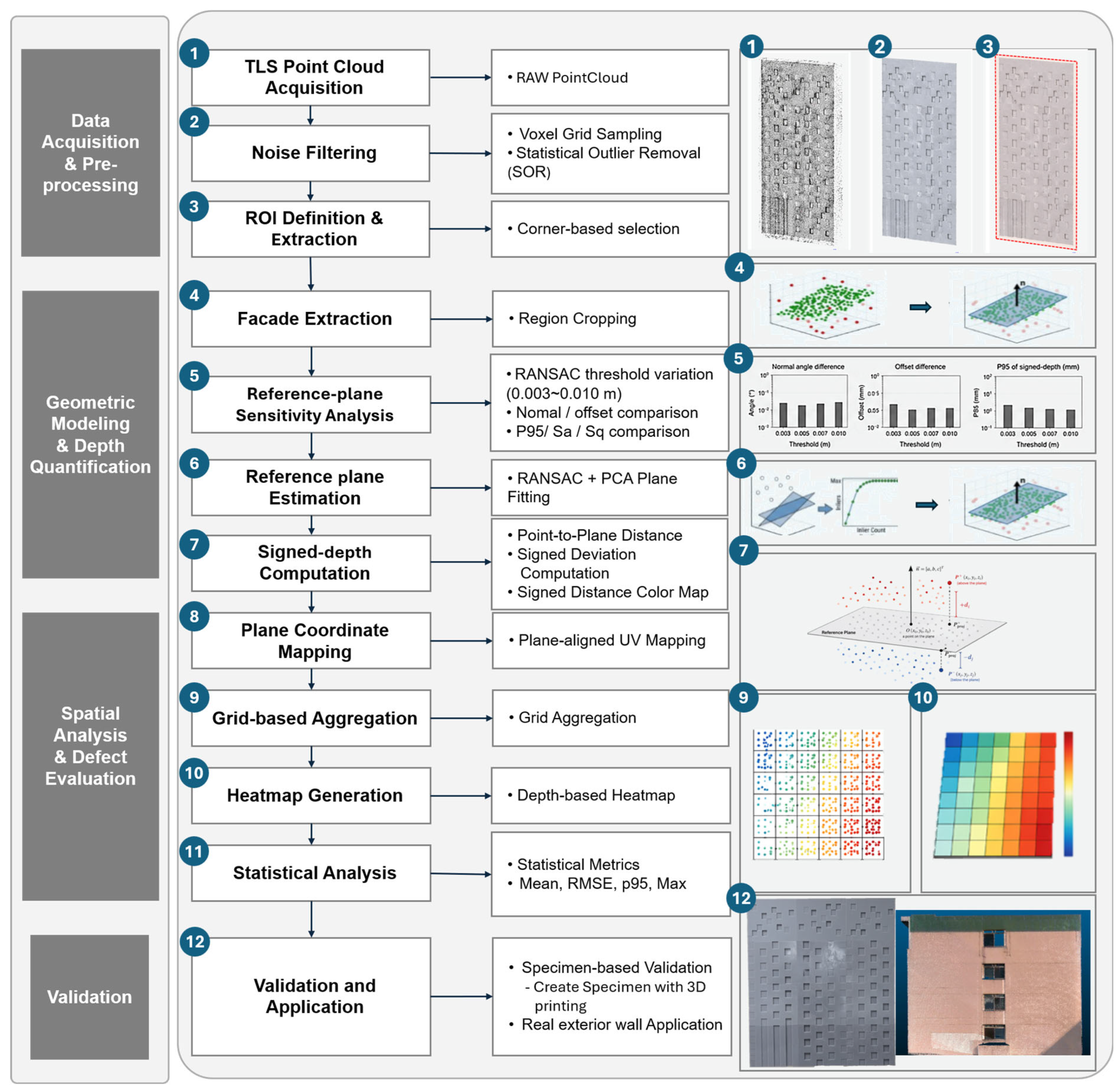
In this study, we propose an integrated workflow utilizing Terrestrial Laser Scanning (TLS)-based point cloud data to quantitatively evaluate the relative geometric deviations of building exterior walls. The proposed framework establishes a continuous evaluation procedure encompassing data acquisition and preprocessing, reference-plane-based geometric modeling, signed-depth calculation, spatial distribution analysis, specimen-based quantitative validation, and actual field application.
First, high-density point cloud data of the exterior wall or specimen are acquired via TLS, and noise is mitigated through voxel grid sampling and statistical outlier removal. Subsequently, a Region of Interest (ROI) is defined to delineate the analysis domain, and the target surface area of the wall or specimen is extracted as necessary. For the extracted ROI point cloud, a reference plane is defined using RANSAC and Principal Component Analysis (PCA)-based plane estimation techniques. Furthermore, a reference-plane sensitivity analysis is performed to examine the stability of the estimated reference plane against variations in the RANSAC distance threshold.
Once the reference plane is established, the relative geometric deviations of the wall surface are quantified by calculating the signed depth, which represents the signed perpendicular distance from each point to the reference plane. In this study, the signed depth is defined such that inward deviations relative to the reference plane yield positive values, whereas outward deviations yield negative values. The calculated signed-depth values can thus be interpreted as a continuous deviation field across the entire exterior wall of the exterior wall.
Thereafter, the signed-depth data are transformed into a plane-aligned coordinate system, and a heatmap along with a cumulative distribution are generated via grid-based spatial aggregation. In addition to statistical metrics such as Mean Absolute Error (MAE), Root Mean Square Error (RMSE), and the 95th percentile P95 error, spatial metrics—including the area ratio of high-deviation zones, the number of clusters, and the maximum cluster ratio—are computed. This allows for a concurrent analysis of both the magnitude of the deviations and their spatial concentration and continuity.
Finally, to verify the quantitative reliability of the proposed workflow, a validation is conducted using a 3D-printed specimen with known ground-truth depths. The identical procedure is then applied to real building exterior wall data to examine its field applicability. Consequently, the experimental component of this study is categorized into two distinct phases: a specimen-based test to verify depth calculation accuracy under conditions where a ground truth exists, and a field application to evaluate the practical applicability and spatial interpretation capabilities on real-world structural data. The overall architecture of this approach is illustrated in
Figure 1.
3.2. Data Acquisition and Preprocessing
In this study, high-density point cloud data were acquired using Terrestrial Laser Scanning (TLS) with a Trimble X7 terrestrial laser scanner (Trimble Inc., Westminster, CO, USA) to precisely capture the global geometric shape of the exterior wall. Although TLS can provide continuous shape information for large-scale structures with millimeter-level precision, the resulting point clouds may contain noise such as reflection artifacts, range errors, and surface-material-dependent anomalies depending on the scanning environment. Furthermore, the point cloud density is often unevenly distributed due to variations in scan distance and incidence angles, which can introduce errors during subsequent plane estimation and displacement calculations; thus, a rigorous preprocessing pipeline was executed.
First, Statistical Outlier Removal (SOR) was applied to eliminate outliers based on the distance distribution relative to neighboring points. Subsequently, voxel-grid-based downsampling was performed to balance the point cloud density and ensure computational efficiency. To isolate the evaluation domain, a Region of Interest (ROI) was strictly defined. The ROI was established based on the corner points of the exterior wall or specimen, thereby excluding unnecessary background elements and extracting only the target analysis surface. This preprocessing stage serves as a foundational step to guarantee the mathematical stability of the subsequent reference plane estimation and signed-depth calculations [
47].
To ensure the reproducibility of the experiment, the primary acquisition and processing configurations utilized in this study are summarized in
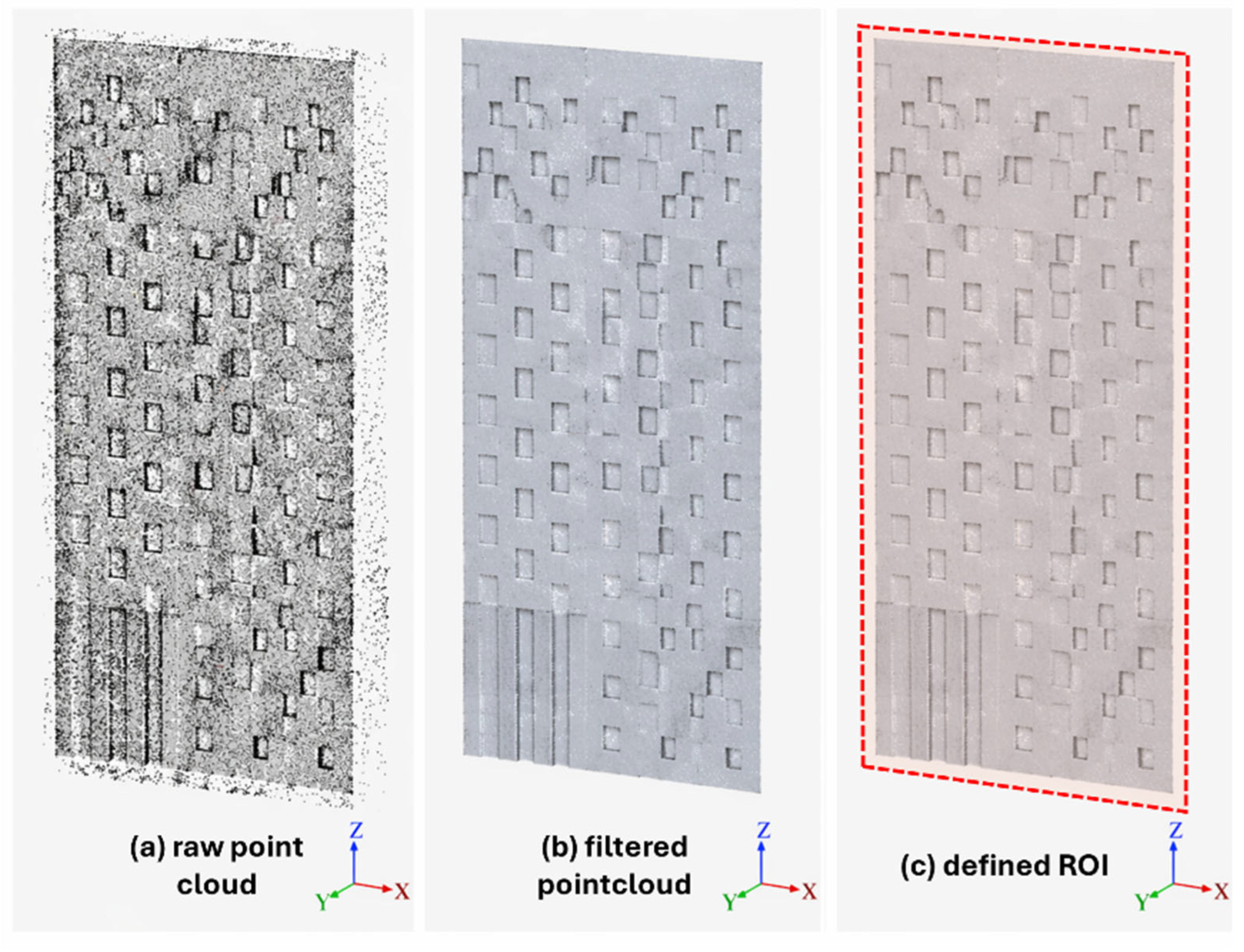
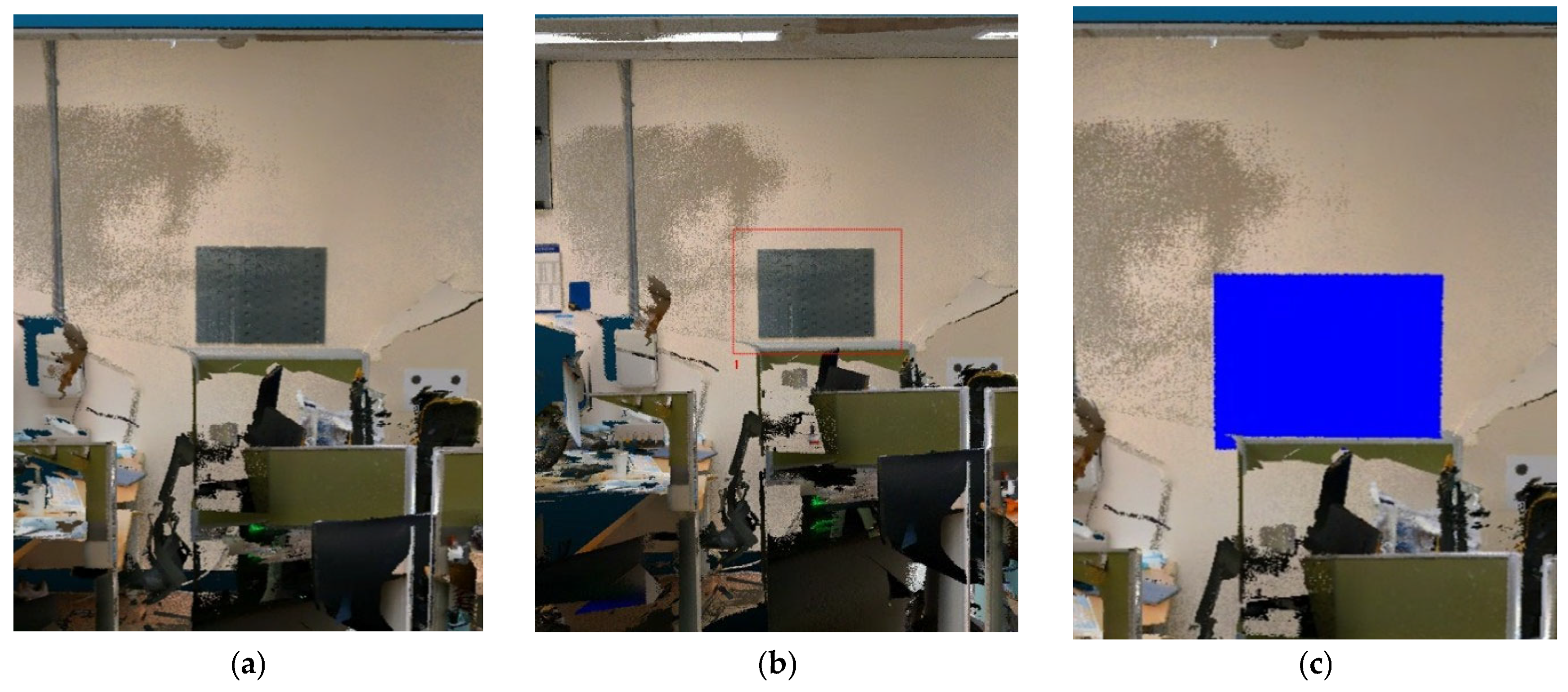
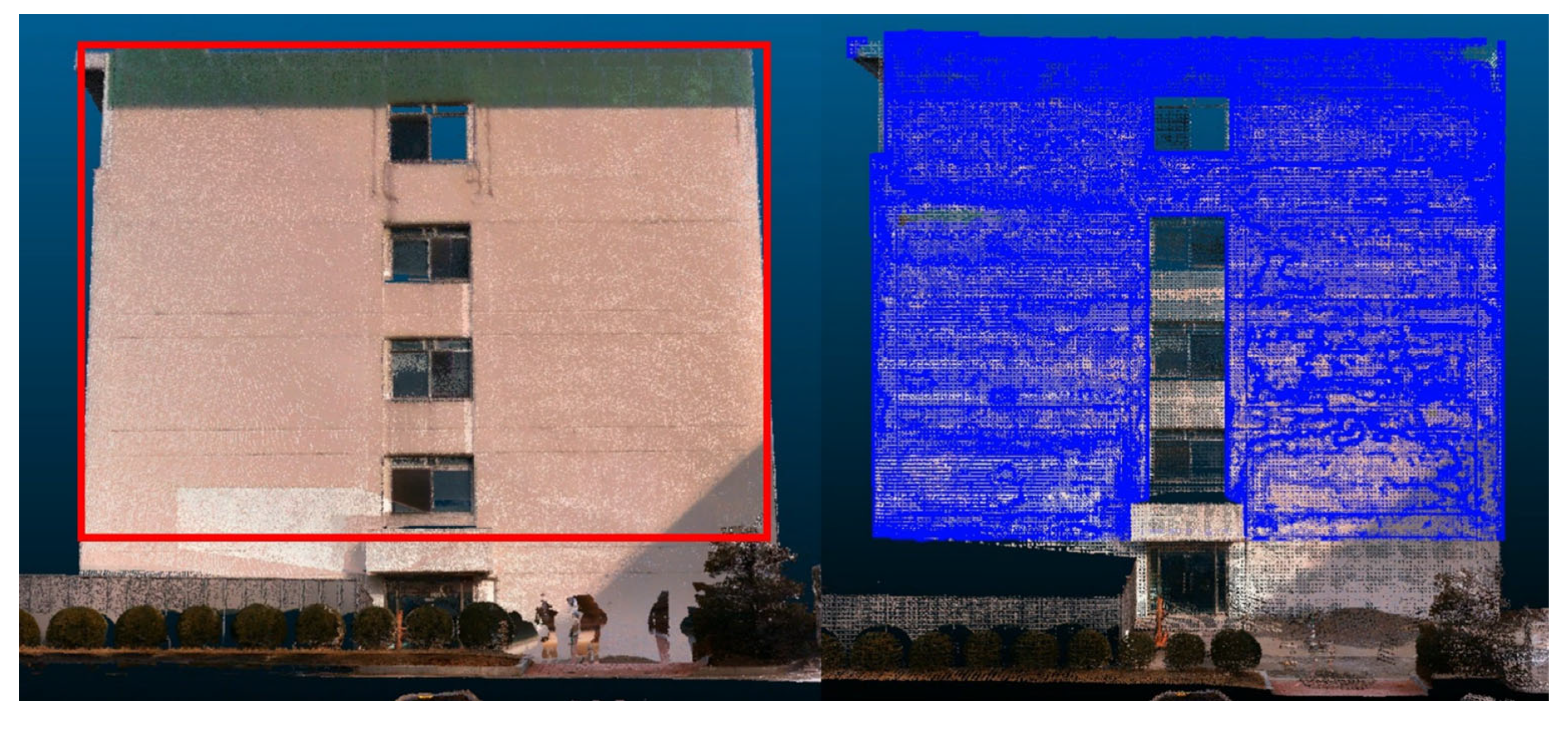
Table 2. The point cloud data for both the specimen and the real exterior wall were acquired using TLS at a scanning distance of approximately 3 m. For the real-world exterior wall, the data were aggregated from a total of four scanning positions into a single, unified point cloud. The target ROI was then extracted from this integrated dataset to serve as the baseline for reference plane estimation and signed-depth calculation. An illustrative example of the extracted ROI is presented in
Figure 2. According to the manufacturer’s specifications for the Trimble X7, the range accuracy is 2 mm, and the 3D point accuracy is rated at 2.4 mm at 10 m, 3.5 mm at 20 m, and 6.0 mm at 40 m. Given that the acquisition distance in this study was maintained at approximately 3 m, the data were obtained within an optimal operational range well-suited for millimeter-level surface shape analysis.
3.3. Geometric Modeling and Depth Quantification
To quantitatively evaluate the geometric deviations of an exterior wall surface, defining a baseline reference plane is essential. In this study, the representative plane of the exterior wall was estimated based on the point cloud within the pre-defined ROI, and the deviation of each individual point was calculated relative to this baseline.
Because real exterior wall surfaces inevitably exhibit localized non-uniformities caused by construction tolerances, surface roughness, and defects, Random Sample Consensus (RANSAC)-based plane segmentation was applied to achieve robust plane estimation resilient to outliers [
48,
49]. Subsequently, Principal Component Analysis (PCA) was applied to the extracted inlier point cloud to stably estimate the normal vector of the plane, thereby defining the orientation of the reference plane.
To ensure the reproducibility of the reference plane estimation, a maximum of 100,000 points from the point cloud within the ROI were sampled using a fixed seed (42) prior to executing the RANSAC algorithm. The baseline RANSAC distance threshold was set to 0.005 m, and the maximum number of iterations was specified as 2000. Following this initial segmentation, a Huber-weighted robust refinement was applied to mitigate the influence of localized noise and residual non-planar points. Furthermore, to address reviewer comments regarding dependence on the reference plane, a sensitivity analysis was additionally performed by systematically varying the RANSAC distance threshold under the identical strict ROI condition. The primary parameters utilized for the reference plane estimation and signed-depth calculation are summarized in
Table 3.
The estimated reference plane is expressed by the following general plane equation:
where
,
, and
are the coefficients constituting the normal vector of the plane, and
is a constant indicating the position of the plane.
Once the reference plane was defined, the signed distance to the plane for each
was calculated as follows:
In this equation, the numerator represents the relative spatial relationship between the point and the reference plane, while the denominator serves as a normalization term based on the magnitude of the normal vector. The resulting value is defined as the perpendicular distance to the plane, representing the geometric deviation of the exterior wall surface relative to the reference plane.
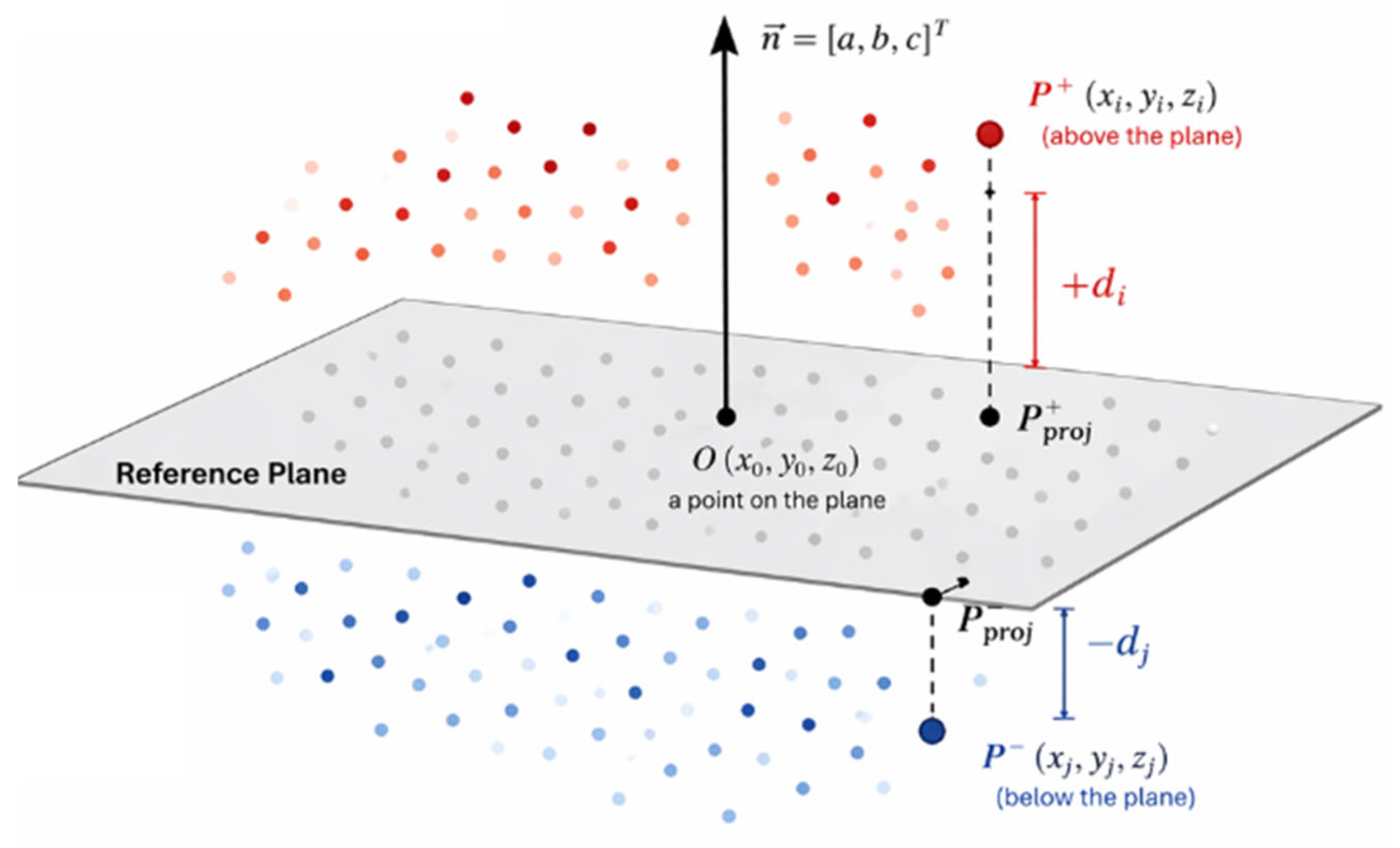
To consistently interpret the specimen defect depths and real exterior wall deviations, the sign convention for the signed depth was unified. Deviations occurring inward relative to the reference plane were defined as positive (+) signed depths, whereas deviations protruding outward were defined as negative (−) signed depths. This inward-positive convention was identically applied to the heatmaps, statistical metrics, and cumulative distribution interpretations for both the specimen validation and the real exterior wall application. The conceptual definition of the signed-depth and the point-to-plane relationship are illustrated in
Figure 3.
To examine the influence of the reference plane estimation conditions on the signed-depth results, a sensitivity analysis based on the RANSAC distance threshold was additionally performed. The threshold was systematically varied to 0.003, 0.005, 0.007, and 0.010 m, with the 0.005 m condition utilized in the primary analysis designated as the baseline. By applying the identical strict ROI and sampling conditions across all configurations, we compared the specific effects of threshold variations on the normal vector of the reference plane, the plane offset (d), and the resulting signed-depth statistics. The comprehensive findings of this sensitivity analysis are presented separately in the Results section.
3.4. Spatial Analysis and Defect Evaluation
Geometric deviation needs to be interpreted based on its spatial distribution rather than as discrete values at individual point levels. To achieve this, the calculated signed distances were transformed into a 2D coordinate system aligned with the reference plane, and a grid-based spatial analysis was subsequently performed.
Two unit vectors,
, orthogonal to the normal vector
of the reference plane and to each other, were defined. Each point
was then projected onto the plane to transform its coordinates as follows:
where
is the reference point on the reference plane, and
denotes the dot product. Through this transformation, the 3D point cloud data can be aligned into a plane-based 2D coordinate system.
Subsequently, the analysis area was partitioned into a grid of a specific size based on the transformed coordinates, and the signed distances of the points contained within each cell
were aggregated.
where
is the number of points contained within the corresponding cell, and
is the signed-depth value of the
-th point. Through this grid-based aggregation, the influence of point-level noise was mitigated, allowing for a stable representation of the localized deviation distribution on the exterior wall surface.
Based on the aggregated signed-depth values, a heatmap was generated to visualize the deviation distribution across the entire exterior wall of the exterior wall. Additionally, the cumulative distribution of the signed-depth values was analyzed to characterize how the deviations are distributed across the total surface area. For the specimen validation, Mean Absolute Error (MAE), Root Mean Square Error (RMSE), and the 95th percentile P95 error were utilized to compare the errors between the designed depths and the estimated depths. For the real exterior wall application, the level of relative geometric deviation against the reference plane was quantified using the mean, median, P95, and maximum values.
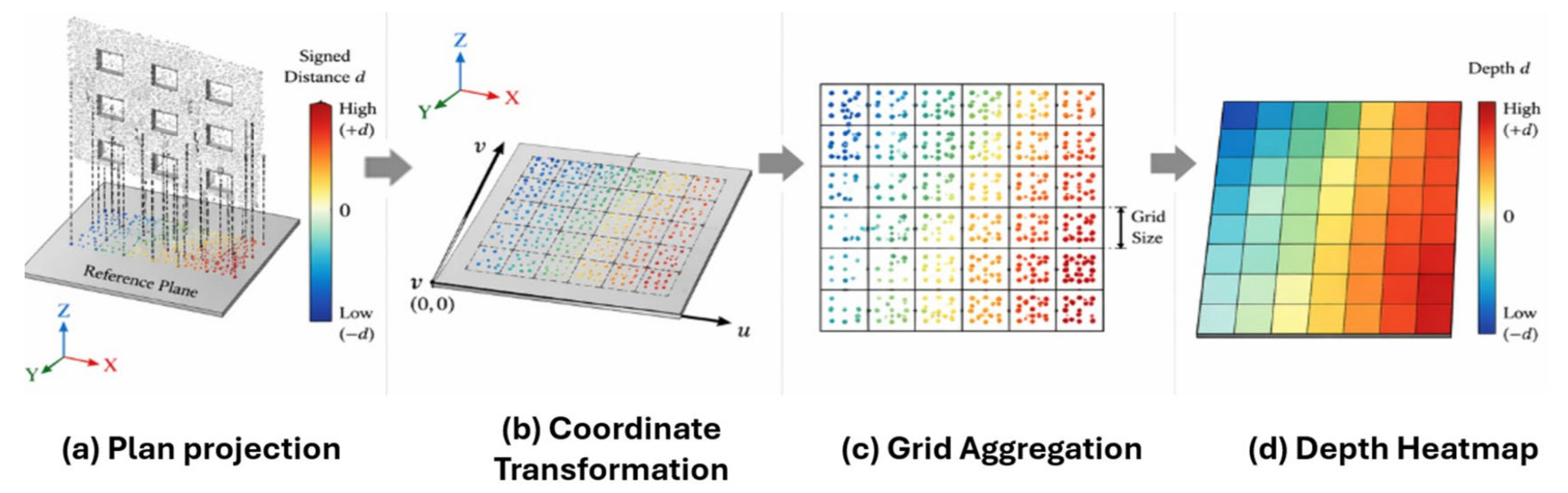
Furthermore, because heatmaps and cumulative distributions alone are insufficient to fully characterize the spatial concentration and continuity of high-deviation zones, additional spatial metrics were formulated in this study. Specifically, grid cells with a centered signed depth exceeding a designated threshold were defined as high-deviation cells. Subsequently, the exceedance area ratio (the ratio of the high-deviation area to the total valid analysis area), the number of connected clusters, the largest cluster area, and the largest cluster ratio were calculated. Through this approach, the visual interpretation of the signed-depth heatmap was rigorously complemented by area- and cluster-based quantitative spatial analysis. The comprehensive process of this spatial analysis and the generation of the signed-depth field are illustrated in
Figure 4.
3.5. Validation and Real-World Application
To validate the accuracy of the defect depth quantification method proposed in this study, an artificial defect specimen with known ground-truth dimensions was utilized. The specimen was fabricated to incorporate artificial defects with design depths of 1, 3, 5, and 7 mm, with each design depth serving as the baseline reference value. Subsequently, the specimen point cloud acquired via TLS was subjected to the identical procedure used for the real exterior wall analysis: reference plane estimation, signed-depth calculation, and representative depth estimation for each defect ROI. The estimated defect depth was determined based on the representative value of the signed depths within each specific ROI, which was then compared against the design depth to evaluate the depth quantification performance.
Quantitative accuracy was evaluated using Mean Absolute Error (MAE), Root Mean Square Error (RMSE), and the 95th percentile P95 error. The MAE represents the average absolute depth error of the effectively evaluated defects, while the RMSE serves as a metric that is more sensitive to larger individual errors. The P95 error denotes the absolute error range that encompasses approximately 95% of the evaluated defect ROIs, serving as a supplementary indicator to confirm the maximum error bound within which most valid defects were estimated. Furthermore, to examine the error characteristics relative to the magnitude of the defect depth, the dataset was categorized into 1, 3, 5, and 7 mm depth groups, and the error distributions among these groups were compared.
The relationship between the estimated depths and the design depths was analyzed using a scatter plot, and the consistency of the depth quantification performance was examined based on deviations from the ideal reference line (y = x). In conjunction with this, a signed-depth heatmap was utilized to visually verify the spatial distribution and shape reproducibility of the defect zones. This enabled a comprehensive review that addressed not only simple numerical discrepancies but also how consistently the defect locations and geometric patterns were captured within the point-cloud-based analysis.
To examine the dependence of the workflow on the reference plane estimation, a sensitivity analysis based on the RANSAC distance threshold was additionally performed on both the specimen and real exterior wall datasets. The threshold values were set to 0.003, 0.005, 0.007, and 0.010 m, with the 0.005 m condition from the primary analysis defined as the baseline. By applying the identical strict ROI and sampling configurations across all conditions, the isolated effects of RANSAC threshold variations on the reference plane estimation and the resulting signed-depth statistics were compared. This allowed for an evaluation of how stably the reference plane estimation—a critical phase of the proposed workflow—holds up against modifications in its primary parameter.
Finally, the depth quantification procedure validated through the specimen-based test was applied to the point cloud of a real building exterior wall. However, because an independent ground truth could not be secured for the real-world structure, the field application results were interpreted as a case study to demonstrate the practical field applicability and spatial interpretation capabilities of the proposed workflow, rather than as a strict accuracy validation.
4. Results
4.1. Quantitative Validation Using Specimen Data
This section presents the validation results using specimen data with designed defect depths to evaluate the quantitative performance of the proposed signed-depth-based shape analysis method.
4.1.1. Specimen Design and Ground Truth
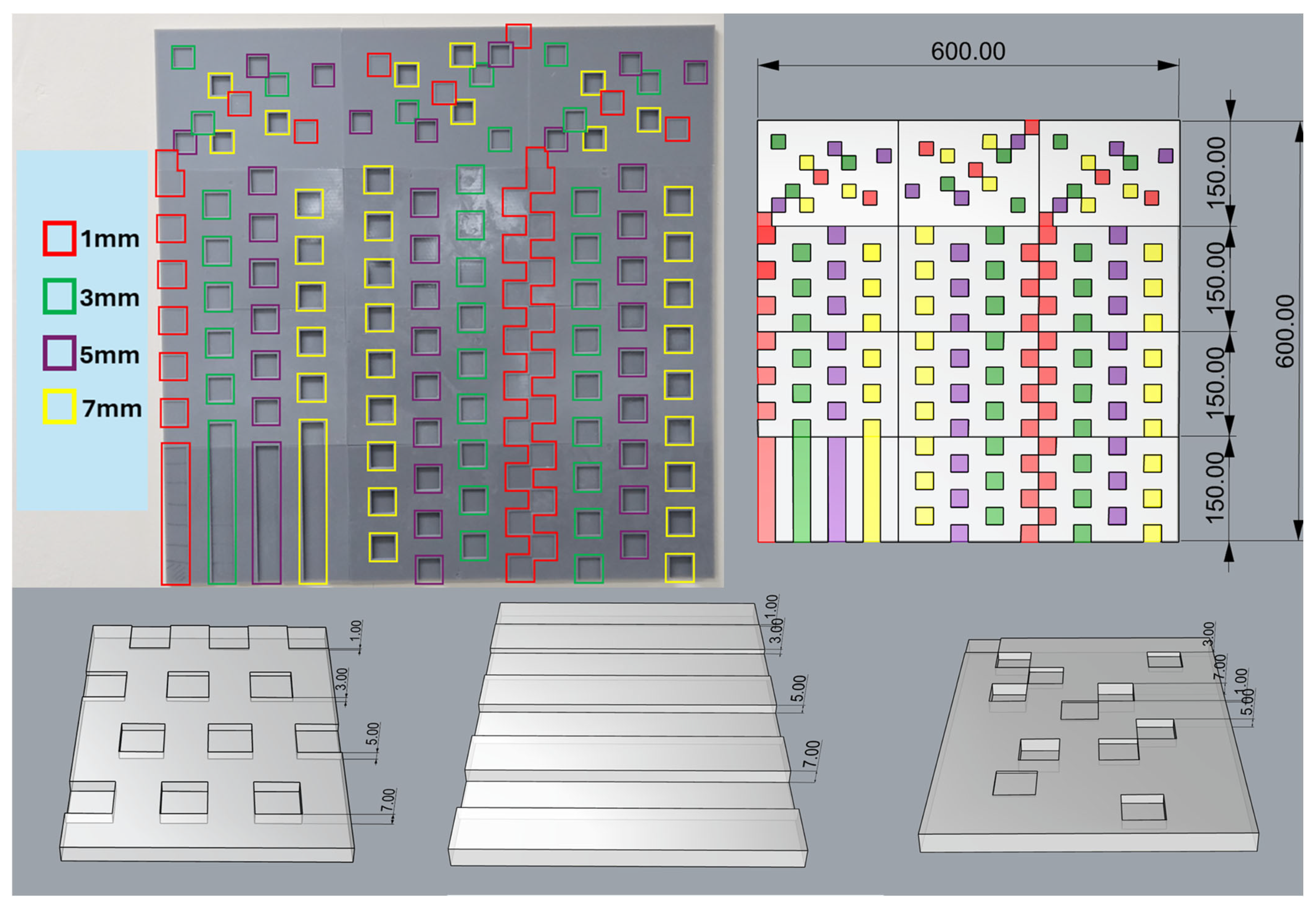
For the quantitative validation, an artificial defect specimen fabricated via 3D printing was utilized. The specimen was designed to simulate the localized surface irregularities and depth variations that typically occur on actual Facades, incorporating defects with four specific design depths: 1 mm, 3 mm, 5 mm, and 7 mm. To ensure statistical reliability, 34 defects were repeatedly arranged for each depth condition, resulting in a total of 136 designed defects, with the design depth of each defect established as the ground truth. Furthermore, in addition to the repetitive defects of identical geometry, the specimen included step-like patterns and scattered defects to evaluate the performance of the signed-depth calculation under various geometric configurations.
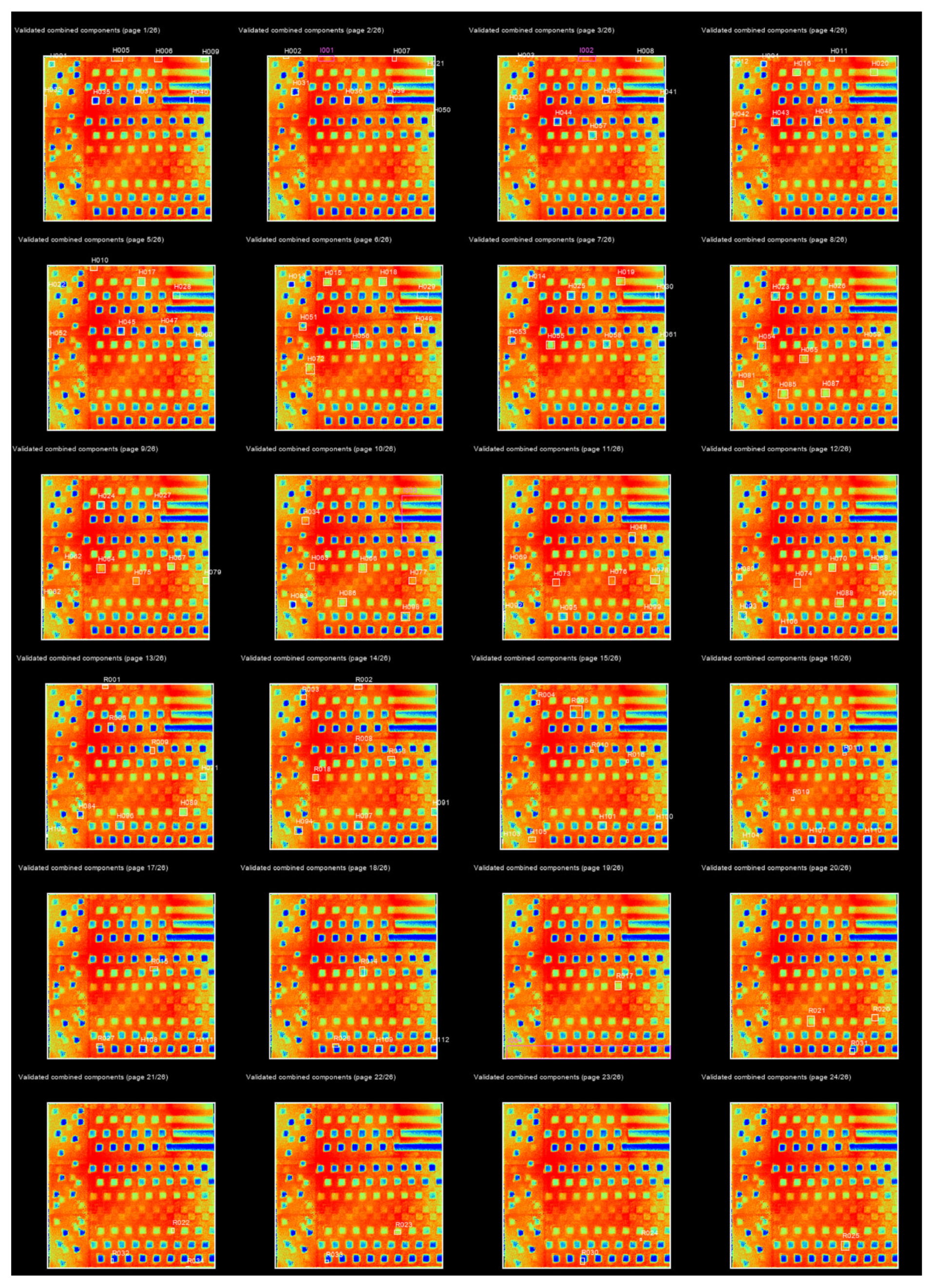
Figure 5 illustrates the overall configuration of the 3D-printed specimen used for quantitative validation, along with the depth distribution of the designed defects.
4.1.2. ROI Definition and Preprocessing
The specimen point cloud data acquired via TLS contains non-planar regions and measurement noise originating from the specimen boundaries and panel joints. Because these factors can induce biases in the reference plane estimation, an ROI definition and preprocessing step were conducted prior to the analysis. In this study, the ROI was defined by selecting four corner points based on a geometrically stable planar region, thereby explicitly constraining the target analysis area.
Figure 6 illustrates the result of the ROI definition.
The raw specimen point cloud initially consisted of a total of 101,263,090 points, which was downsampled to approximately 51,843 points to verify the reference points and the overall geometry. Subsequently, a strict ROI was directly extracted from the original high-density point cloud, successfully securing a final evaluation dataset of 15,096,742 points for the specimen analysis area. For the reference plane estimation, considering both computational efficiency and representation accuracy, 100,000 points were sampled from the cloud within the ROI using a fixed random seed of 42.
As the specimen consists of multiple combined panels, certain panel joints and localized non-planar features could inevitably remain even within the strictly defined ROI. To prevent these unsuitable boundaries and irregularities from biasing the reference plane estimation, a secondary ROI refinement process was performed.
Figure 7 illustrates the outcome of this ROI refinement, which established the final region used for both the reference plane estimation and the subsequent signed-depth computation. It should be noted that this process was not designed to eliminate the defect zones themselves, but rather to ensure that the reference plane was stably and robustly estimated from the true planar substrate.
4.1.3. Reference Plane Estimation and Depth Computation
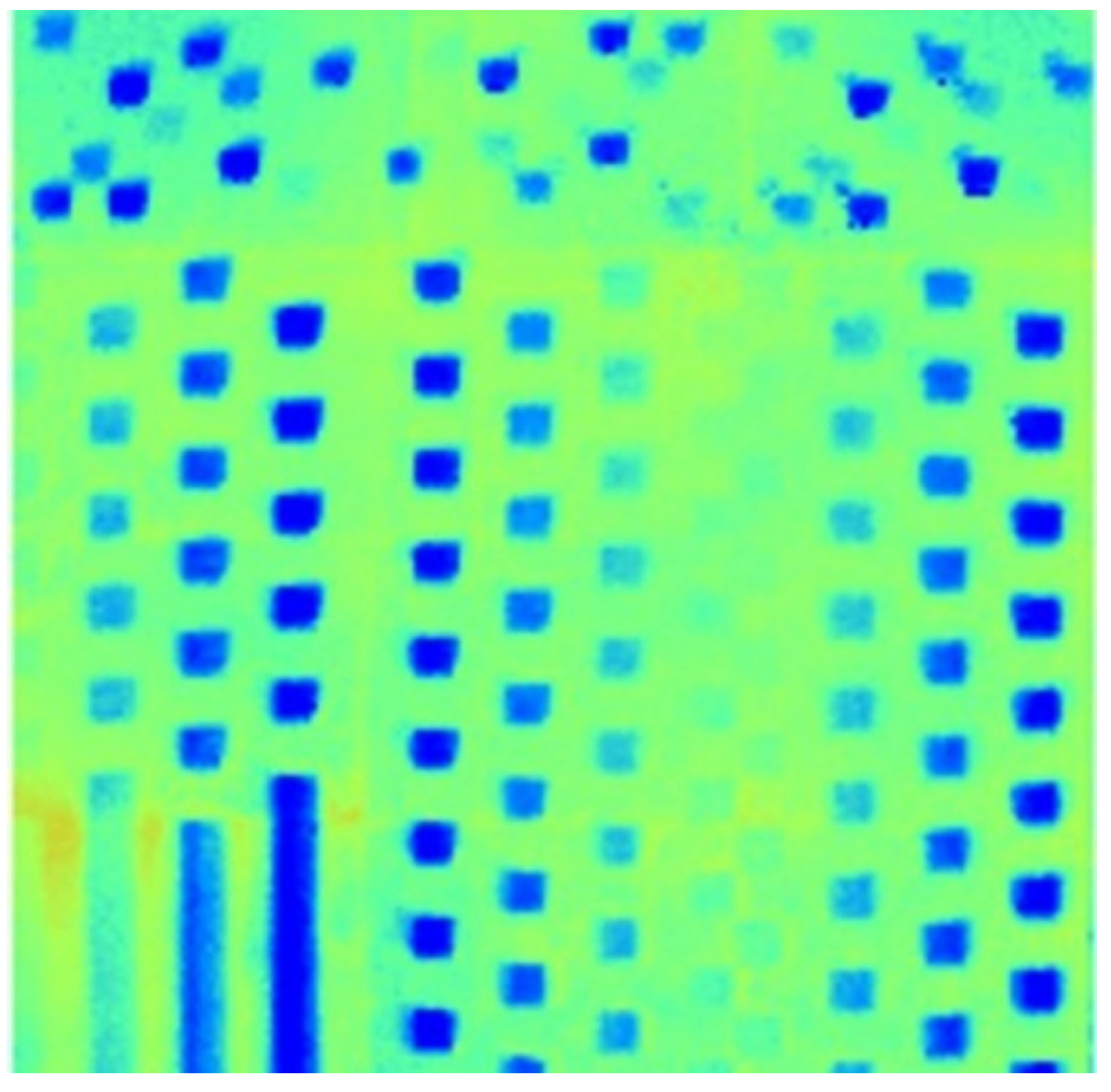
The reference plane was estimated based on the refined ROI point cloud, and the signed depth relative to this reference plane was computed for each point. Specifically, after an initial estimation of the reference plane via RANSAC, its normal vector was robustly defined using Principal Component Analysis (PCA). The point cloud was then transformed into a 2D coordinate system aligned with the reference plane, and a grid-based aggregation was performed to map the spatial distribution of the signed depths across the specimen surface.
Figure 8 illustrates the calculated signed-depth distribution on the specimen surface relative to the reference plane. While the signed-depth values were uniformly distributed across the planar substrate, localized and distinct depth variations were prominent within the defect zones. Notably, the repeatedly arranged square defects were clearly distinguished by consistent depth patterns. This demonstrates that even when identical defect geometries are distributed across disparate locations, the signed-depth-based analysis can yield highly reproducible and consistent depth profiles. Furthermore, continuous depth gradients were also confirmed in the linear and irregular defect regions located in the lower-left section, verifying that the proposed workflow can effectively capture signed-depth distributions across a wide variety of defect morphologies.
To ensure a consistent interpretation of the defect depth direction, the inward direction relative to the reference plane was defined as a positive (+) signed depth. Consequently, positive values in
Figure 8 represent recessed regions indented inward from the reference plane, serving as the benchmark for direct comparison with the designed defect depths of the specimen.
4.1.4. Evaluation Strategy and Metrics
To evaluate the quantitative performance of the proposed depth estimation method, ground-truth mapping was performed on a total of 136 defect ROIs with designed depths of 1, 3, 5, and 7 mm. Each defect ROI was labeled to precisely correspond with its respective design depth and was isolated as an independent ROI to prevent any geometric overlap between adjacent defects.
Figure 9 illustrates the labeling results of the defect ROIs mapped to their corresponding ground truth.
Among the total of 136 designed defects, 123 were identified as ROIs that could be effectively mapped to the ground truth, resulting in a valid evaluation rate of approximately 90.4%. By depth category, 28 ROIs from the 1 mm group, 30 from the 3 mm group, 32 from the 5 mm group, and 33 from the 7 mm group were utilized in the final error computation. The 13 remaining ROIs that could not be validly mapped were excluded from the final error calculation due to factors such as low depth contrast, ambiguous defect boundaries, insufficient valid point density within the ROI, or ground-truth mapping mismatches.
Consequently, the MAE, RMSE, and P95 error reported in this study should not be interpreted as detection accuracy for the entire set of 136 designed defects, but rather as depth estimation accuracy specifically for the 123 ROIs validly mapped to the ground truth. That is, these results necessitate a clear distinction between defect detection performance and depth estimation performance; the implications of the excluded ROIs are further addressed in the Discussion section.
Furthermore, the reported 123/136 result represents an evaluation based strictly on the GT-mapped defect ROIs directly matched with the designed defects. In contrast, the component-level summary generated in subsequent analyses is the outcome of grid-based connected component labeling and publication-level filtering; as a result, a single designed defect may be segmented into multiple components, or adjacent defects may be merged into a single component. Therefore, the number of components does not correspond to the number of designed defects on a one-to-one basis, and the accuracy evaluation in this study was conducted based entirely on the GT-mapped ROIs.
The MAE, RMSE, and P95 error presented in
Table 4 are all absolute error-based metrics calculated in millimeters, representing the discrepancies between the designed depths and the estimated depths. For the entire set of 123 valid ROIs, the MAE was 0.795 mm, and the RMSE was 1.168 mm, indicating that an average depth estimation error of approximately 1 mm occurred among the validly evaluated defect ROIs. The P95 error was 2.511 mm, which means that approximately 95% of the 123 validly evaluated ROIs exhibited an absolute depth error of 2.511 mm or less. In other words, it can be interpreted that the depth of most valid defect ROIs was estimated within an error margin of approximately 2.5 mm.
Looking at the results by depth category, the 1 mm defect group exhibited the smallest MAE at 0.377 mm; however, because the design depth itself is so small, even a minor absolute error can translate into a relatively high error rate. This implies that shallow defects are inherently more sensitive to TLS measurement uncertainties, surface roughness, and reference plane estimation errors. In contrast, the 5 mm and 7 mm defect groups showed MAE values of approximately 1 mm, indicating that while the absolute error increased slightly, the relative impact of the error with respect to the total defect depth decreased. Consequently, this study interprets the performance of the defect depth estimation focusing on the absolute error in millimeters rather than the percentage-based error rate.
4.1.5. Sensitivity Analysis of Reference Plane Estimation
Since the reference plane serves as the baseline for all signed-depth calculations, any significant variation in the results driven by the estimation conditions could undermine the reliability of the depth quantification. Therefore, in this study, a sensitivity analysis was performed to investigate the impact of variations in the RANSAC distance threshold on the final signed-depth results. The thresholds were set to 0.003, 0.005, 0.007, and 0.010 m, with the 0.005 m condition utilized in the primary analysis defined as the baseline. To ensure that the comparison isolated the effects of the RANSAC threshold variations rather than geometric discrepancies in the region of interest, the identical strict ROI and sampling configurations were applied across all conditions.
The analysis revealed that as the threshold increased, the inlier ratio encompassing potential reference plane candidates expectedly increased. Specifically, the inlier ratio rose from 51.20% to 87.34% for the specimen dataset, and from 25.87% to 65.03% for the actual facade dataset. However, following the Huber-weighted robust refinement, the final reference plane models under all threshold conditions converged identically to the baseline. Consequently, key signed-depth statistics—such as the median, P95, and Sq remained consistent across all threshold configurations.
Therefore,
Table 5 should not be interpreted as an evaluation of the depth estimation accuracy itself, but rather as a stability analysis demonstrating the degree to which the reference plane estimation conditions influence the final signed-depth outcomes. In conclusion, within the strict ROI conditions established in this study, variations in the RANSAC threshold exerted a negligible impact on the final reference plane and the subsequent signed-depth statistics. This provides supplementary validation that the depth estimation accuracy results presented in
Section 4.1.4 were not overly dependent on a specific threshold configuration.
In
Table 5, the inlier ratio denotes the proportion of points included as reference plane candidates under each respective threshold condition. Although an increase in the threshold expectedly incorporated a larger volume of points as inliers, the final reference plane model remained entirely consistent with the baseline following the robust refinement process. In this context, the designation “Same as baseline” indicates that both the normal vector and the plane offset of the final reference plane converged identically to those of the baseline configuration. Furthermore, the median represents the central tendency of the signed-depth distribution, P95 indicates the upper bound of the deviation magnitude, and Sq signifies the root-mean-square deviation of the signed-depth values. The fact that these metrics remained constant across all evaluated threshold configurations demonstrates that the signed-depth results obtained in this study are remarkably stable and not overly sensitive to variations in the RANSAC threshold.
4.2. Application Results on the Real Exterior Wall
Following the validation of the signed-depth-based depth estimation protocol through the specimen test, the identical workflow was applied to the point cloud data of a real building exterior wall. Given that independent reference measurements were not acquired for the real exterior wall data, the results presented in this section were interpreted not as a verification of absolute accuracy, but rather as a case study to evaluate the field applicability and spatial interpretability of the proposed workflow. Consequently, the high-deviation zones identified on the real exterior wall do not directly signify structural damage; instead, they should be interpreted as potential candidate regions for supplementary inspection, exhibiting relatively large geometric deviations relative to the estimated reference plane.
4.2.1. ROI Definition and Reference Plane Setup
Since real building exterior wall data can incorporate various interfering elements—such as background objects, openings, construction joints, and surface roughness—the evaluation area must be explicitly constrained to achieve a robust geometric assessment. The raw exterior wall point cloud captured in this study initially comprised a total of 163,476,468 points. First, a 0.02 m voxel-based downsampling was conducted to verify the positions of the selected corner points and the structural alignment of the exterior wall surface, reducing the point cloud size to 3,711,613 points. This downsampled point cloud served as supplementary data exclusively for validating the ROI reference points and reviewing the global geometry. For the actual shape analysis, rather than relying on the downsampled data, the strict ROI was extracted directly from the original high-density point cloud. The analysis boundaries were established based on regions across the exterior wall that exhibited relatively continuous planarity, thereby eliminating background objects and unnecessary peripheral zones. The final extracted strict ROI consisted of 29,933,332 points, which subsequently served as the definitive dataset for reference plane estimation and signed-depth distribution calculations.
Figure 10 illustrates the defined ROI and the final evaluation area within the real exterior wall point cloud.
Unlike the specimen experiment that directly detected discrete defects, the full-scale exterior wall analysis in this study treated the entire defined ROI as a single continuous surface to interpret relative deviations relative to the reference plane. To achieve this, the ROI point cloud was transformed into a coordinate system aligned with the reference plane and aggregated on a grid basis to construct the signed-depth field across the full exterior wall. The depth map of the real exterior wall was generated at a spatial resolution of 0.00621 m, thereby ensuring both computational efficiency and spatial interpretation stability for the large-scale exterior wall dataset.
4.2.2. Signed-Depth Distribution and Spatial Pattern Analysis
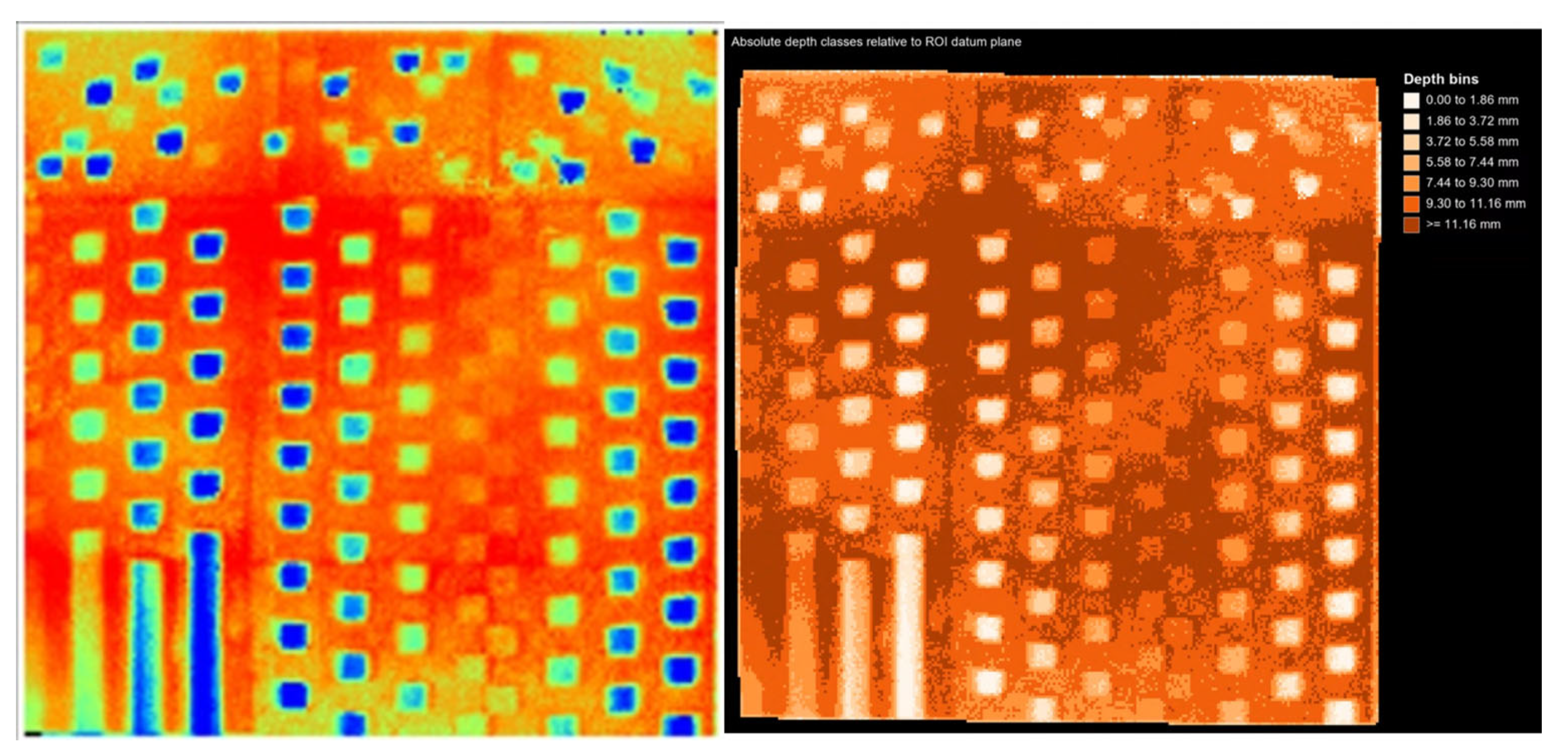
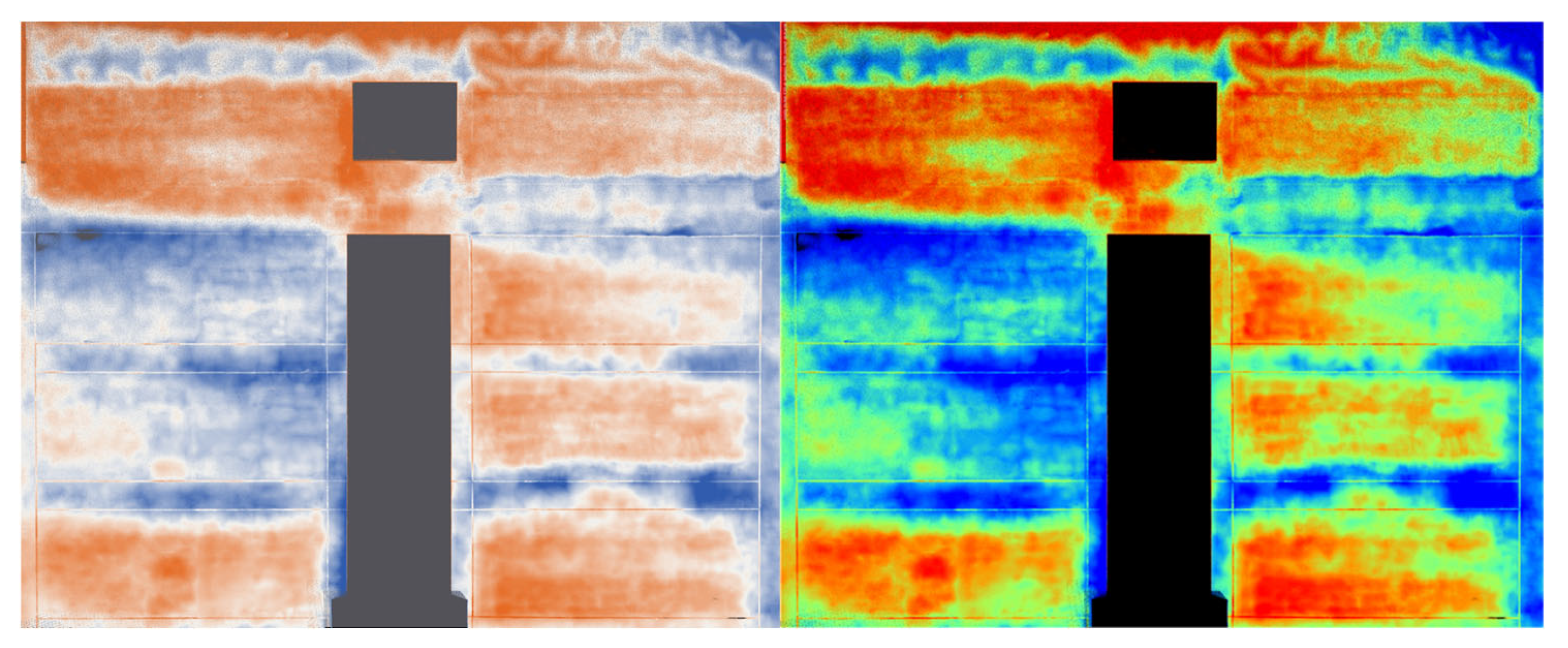
Following the estimation of the reference plane based on the defined ROI, the signed-depth distribution across the exterior wall surface was computed.
Figure 11 illustrates the spatial distribution of the signed-depth values generated for the real building exterior wall ROI. Globally, the exterior wall surface exhibited a continuous depth distribution centered around the reference plane, with specific regions demonstrating relatively pronounced deviations compared to their surroundings. These findings emphasize that rather than describing the geometric state of a real exterior wall using a single aggregated mean value, it is essential to simultaneously interpret both the magnitude and spatial distribution of deviations relative to the reference plane.
In the generated heatmap, relatively distinct depth contrast was observed around openings and within horizontal, band-shaped sections. These high-deviation patterns can be attributed to various compounding factors, including opening boundaries, horizontal joints, surface finish conditions, scan incidence angles, and localized variations in point density. Consequently, rather than directly classifying these regions as structural damage, this study interprets them as potential candidate zones for supplementary inspection that exhibit relatively large relative geometric deviations from the reference plane.
Furthermore, a trend where similar signed-depth values were continuously distributed was identified in several sections. This implies that the exterior wall surface deviations do not merely manifest as random noise from individual points, but rather formulate distinct patterns characterized by a certain degree of spatial continuity. Therefore, the signed-depth heatmap serves as a robust tool for intuitively identifying the locations and distribution modes where deviations concentrate across the entire exterior wall, providing a definitive foundational dataset for subsequent quantitative spatial metric analysis. These characteristics are systematically visualized in
Figure 11.
4.2.3. Quantitative Geometric Evaluation of the Real Exterior Wall
To quantitatively evaluate the geometric state of the real exterior wall, key statistical metrics were computed based on the signed-depth distribution within the defined ROI.
Table 6 presents the statistical summary of the signed-depth values relative to the reference plane for the real exterior wall ROI. The analysis revealed a mean of 2.448 mm and a median of 2.691 mm, confirming that the central tendency of the deviations across the exterior wall ROI is distributed relatively close to the reference plane. However, the RMSE and P95 were calculated as 9.956 mm and 17.121 mm, respectively, both of which are markedly higher than the mean and median, while the maximum value reached 90.827 mm. This discrepancy indicates that even though the global exterior wall geometry is predominantly distributed around the reference plane, pronounced signed-depth values exist within certain localized segments. Consequently, the geometric state of a real building exterior wall cannot be adequately characterized by mean values alone; rather, it necessitates an evaluation that simultaneously accounts for the upper bounds of the distribution and localized high-deviation zones.
To further elucidate these distribution characteristics, the centered signed depth, which shifts the baseline relative to the representative exterior wall surface, was additionally calculated. The centered signed depth serves as an indicator demonstrating the relative extent to which each region deviates from the global representative baseline of the exterior wall. The resulting mean and median for the centered signed depth were −0.473 mm and −0.231 mm, respectively, verifying that the representative exterior wall surface itself is well-aligned with the reference plane. Conversely, the P05, P95 and P99 metrics were determined to be −16.323 mm, 14.200 mm, and 21.341 mm, respectively, indicating the persistence of substantial deviations within both the lower and upper bounds of the distribution. These findings underscore that the geometric state of a real exterior wall cannot be fully captured by a single mean metric, highlighting the critical importance of evaluating both the distribution width and the upper tail deviations.
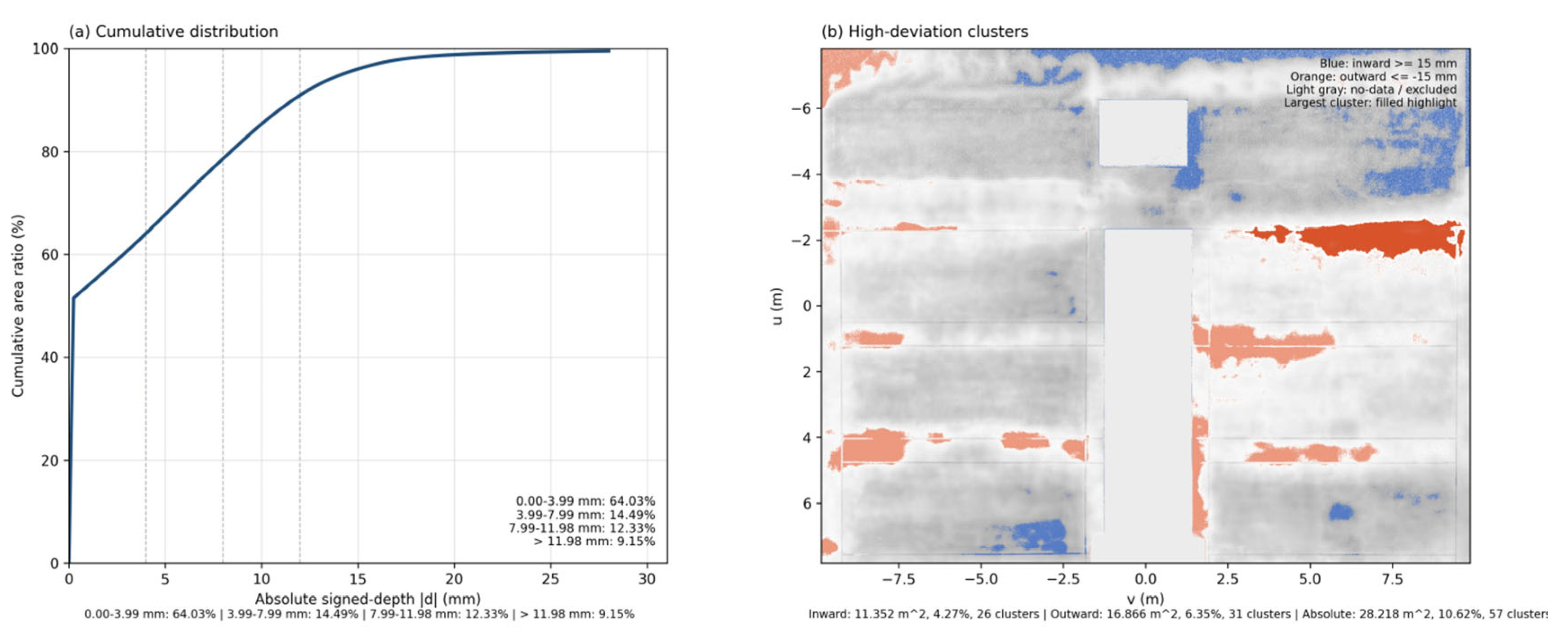
Figure 12 visually summarizes these quantitative evaluation results. Specifically,
Figure 12a displays the cumulative distribution of the absolute signed depth, illustrating the proportion of the area occupied by each deviation level across the entire exterior wall surface.
Figure 12b depicts the spatial distribution of the high-deviation zones and connected clusters extracted based on the centered signed depth, demonstrating how these extreme deviation zones are geographically distributed across the exterior wall. The specific area ratios corresponding to each depth range in
Figure 12a are summarized in
Table 7, and the spatial metrics categorized by color for the high-deviation zones in
Figure 12b are detailed in
Table 8.
Table 7 categorizes the absolute signed-depth intervals from
Figure 12a into four distinct classes and details the respective area ratios occupied by each interval within the entire exterior wall ROI. Class 1, spanning the 0.00–3.99 mm range, accounted for the largest proportion at 64.03% of the total area, which confirms that low-level deviations are predominantly dominant across the real exterior wall ROI. The intervals for Class 2 (3.99–7.99 mm) and Class 3 (7.99–11.98 mm) constituted 14.49% and 12.33%, respectively. Conversely, Class 4, which encompasses the range exceeding 11.98 mm, represented 9.15% of the area, verifying the persistence of relatively pronounced geometric deviations within specific sectors of the total exterior wall surface. Consequently, these cumulative distribution results successfully complement the spatial patterns visualized in the heatmap by providing a quantitative breakdown of the area ratios corresponding to each deviation magnitude.
Considering that the upper and lower bounds of the centered signed depth were determined to be 14.200 mm P95 and −16.323 mm P05, respectively, the high-deviation zone was defined as any region where the absolute value of the centered signed depth equaled or exceeded 15 mm, regardless of the deviation direction. Under this criterion, the blue zones in
Figure 12b denote the inward-directed high-deviation regions where the displacement recedes by 15 mm or more, whereas the orange zones represent the outward-directed high-deviation regions protruding by 15 mm or more. Furthermore, the scenario encompassing both the blue and orange zones was defined as the absolute deviation. To mitigate the influence of isolated data noise, clusters with an individual spatial footprint of less than 0.01 m
2 were systematically excluded from the cluster-level summary.
Table 8 summarizes the total area, area ratio, cluster count, and maximum cluster scale for each high-deviation zone color-coded in
Figure 12b. The inward-directed high-deviation zone denoted in blue covered an area of 11.352 m
2, accounting for 4.27% of the total effective evaluation area, and manifested as 26 discrete clusters. The outward-directed high-deviation zone highlighted in orange extended over 16.866 m
2, constituting 6.35% of the total effective evaluation area, and was verified across 31 clusters. Under the absolute deviation criterion, which aggregates both the blue and orange zones, the total high-deviation area amounted to 28.218 m
2, representing 10.62% of the overall effective evaluation area of 265.789 m
2. Additionally, a total of 57 high-deviation clusters were identified under the absolute deviation baseline, with the maximum individual cluster size spanning 4.213 m
2, which accounts for 14.93% of the total high-deviation area. These findings demonstrate that the geometric deviations are not concentrated within a single massive sector but are instead distributed across multiple discrete clusters, while simultaneously formulating spatially continuous patterns within certain structural segments.
In
Table 8, the “Color” column directly corresponds to the color-coded high-deviation zones illustrated in
Figure 12b. “Area” and “Ratio” denote the absolute surface area and the respective percentage proportion that each color-coded high-deviation zone occupies within the entire real exterior wall ROI, while “Clusters” indicates the number of spatially connected regions into which the high-deviation zones are segmented. Furthermore, “Largest area” and “Largest ratio” represent the dimensional scale of the maximum single high-deviation cluster and its relative weight within the total high-deviation area, respectively. Consequently, rather than providing a mere visual representation, these spatial metrics facilitate a rigorous quantitative interpretation of the TLS-based signed-depth results from the multi-dimensional perspectives of color-coded directional displacement, area ratios, and clustering characteristics.
5. Discussion
This study presents an integrated framework designed to quantitatively and spatially evaluate the relative geometric state of building e exterior walls utilizing TLS-based point cloud data. The core contribution lies in unifying reference plane estimation, signed-depth calculation, grid-based spatial aggregation, specimen-based validation, and full-scale exterior wall application into a single continuous evaluation protocol. Unlike conventional approaches that rely on localized measurements or mere deviation visualization, this framework interprets the entire building exterior wall as a single continuous surface, enabling a simultaneous analysis of deviation magnitudes and their corresponding spatial distributions.
In the specimen-based validation, millimeter-level depth estimation performance was confirmed for defect ROIs that were validly mapped to the ground truth. Notably, the acquisition of MAE and RMSE values approximately 1 mm apart demonstrates that the proposed workflow is capable of effectively quantifying defect depths relative to a reference plane under controlled specimen conditions. However, these findings should be interpreted specifically as the depth estimation accuracy achieved within the validly mapped ROIs, rather than as the automated detection performance for all nominal defects. The exclusion of certain ROIs from the final error metrics can be attributed to influencing factors such as low depth contrast in shallow defects, ambiguous defect boundaries, insufficient localized point density, or spatial mapping misalignments with the ground truth. Particularly for the 1 mm defect group, because the defect depth itself lies within a scale comparable to TLS measurement uncertainty, surface roughness, and reference plane estimation errors, even identical absolute errors can manifest as disproportionately high relative error rates. Consequently, this study deliberately evaluated defect depth estimation performance based on absolute depth errors in millimeters rather than relative error percentages.
Since reference plane estimation serves as the baseline for signed-depth calculations, the stability of the reference plane directly governs the reliability of the proposed workflow. In this study, a sensitivity analysis was performed by varying the RANSAC distance threshold under identical strict ROI and sampling configurations to review variations in the reference plane models and the subsequent signed-depth statistics. The analysis revealed that while the inlier ratio expectedly shifted in response to threshold variations, the final reference plane models and key signed-depth statistics remained remarkably stable following the Huber-weighted robust refinement. This confirms that within the strict ROI conditions established in this study, variations in the RANSAC threshold exerted a strictly limited impact on the final signed-depth interpretation.
The application results on the real building exterior wall demonstrate that the proposed workflow successfully facilitates the spatial interpretation of relative geometric deviations even when deployed on raw field data. The mean, median, P95, maximum value, and spatial metrics derived from the real exterior wall must be interpreted as indicators of relative shape deviations relative to the estimated reference plane. The empirical results showed that while the mean and median yielded relatively small values, the P95 and maximum value were markedly higher. This discrepancy indicates that even if a predominant portion of the exterior wall surface is distributed close to the reference plane, severe geometric deviations can persist within localized segments. Therefore, the geometric state of a real exterior wall cannot be adequately judged by a single mean metric alone; it requires a comprehensive assessment that simultaneously considers both the upper tail of the distribution and the exact geographic locations of high-deviation zones. To complement this interpretation, this study utilized the centered signed depth as a baseline to calculate spatial metrics, including the area ratio, cluster count, maximum cluster area, and maximum cluster ratio of high-deviation zones. Although a heatmap provides an intuitive visual representation of where deviations concentrate, it lacks the capacity to quantitatively explain the exact footprint of high-deviation zones, whether they condense into a single massive anomaly or disperse across multiple discrete clusters. By leveraging these spatial metrics concurrently, the high-deviation zones observed on the real exterior wall were rigorously interpreted from the multi-dimensional perspectives of area ratios and spatial continuity rather than as simple visual patterns. This approach holds significant practical value for screening potential candidate regions that require prioritized inspection from a facility maintenance perspective.
Compared to conventional exterior wall geometry evaluation methodologies, the distinct divergence of this study lies in extending point-based or localized assessment frameworks into a continuous surface-based evaluation protocol. While manual measurements, total stations, and local flatness tests are effective for verifying deviations at specific discrete points, they are fundamentally limited in interpreting the broader distribution and continuity of errors across the entire exterior wall. Furthermore, while BIM/CAD-model-based dimensional inspections are effective for compliance checks against design models, their application can be constrained when a predefined design model is unavailable or when the actual surface condition is highly complex, as is often the case for aging structures undergoing maintenance. In contrast, this study establishes a continuous signed-depth field relative to a reference plane and couples it with grid-based statistics and spatial metrics, thereby facilitating a highly continuous and robust interpretation of the relative geometric state across the entire exterior wall surface.
Despite these contributions, several limitations persist in this study, and the scope of result interpretation must be explicitly bounded. First, although the specimen was fabricated via 3D printing, fabrication tolerances and inherent TLS measurement uncertainties may have influenced the data interpretation, particularly within the shallow 1 mm defect group. Second, because the field application on the real building exterior wall was conducted without independent ground-truth measurements, these real-world results must be interpreted as a validation of field applicability rather than an absolute accuracy verification. Furthermore, because the high-deviation zones identified on the real exterior wall can be actively influenced by a combination of diverse factors—including openings, horizontal joints, surface finish textures, scan incidence angles, point density variations, and multi-scan registration processes—it is inappropriate to directly equate these deviations with structural damage or formal compliance/non-compliance judgments. Given that allowable tolerance standards such as DIN 18202 and ACI 117-10 dictate varying application conditions based on the measurement span, structural member type, construction phase, and project-specific criteria, it is most reasonable to treat the signed-depth metrics proposed in this study as supplementary indicators for capturing the relative shape state of exterior wall surfaces and deriving candidate zones for follow-up inspections. Third, the reference plane sensitivity analysis in this study focused exclusively on RANSAC threshold variations under identical strict ROI conditions, without fully encompassing the effects of shifting ROI boundary constraints or varying surface complexities. Future research should prioritize field validation utilizing independent reference baselines, repetitive experiments under diverse scan distances and incidence angles, and robustness evaluations across varying surface materials and occlusion conditions. Additionally, further sensitivity analyses regarding ROI boundary configurations and reference plane estimation methodologies should be performed, and multi-reference planes or region-adaptive reference surface estimation techniques should be explored to mitigate the dependency on a single reference plane.
6. Conclusions
This study presented an integrated workflow utilizing TLS-based point cloud data to evaluate the relative geometric deviations of building exterior walls through reference plane estimation and signed-depth calculations. By unifying reference plane estimation, signed-depth quantification, grid-based spatial aggregation, cumulative distribution analysis, and spatial metric extraction into a systematic protocol, the proposed framework comprehensively interprets the deviation magnitude alongside its spatial concentration and continuity across the entire exterior wall surface. The primary contribution of this research lies not in the development of an isolated point cloud processing algorithm, but in establishing a consistent analysis workflow and spatial interpretation framework for surface-based exterior wall geometric assessments.
In the specimen-based validation, 123 out of 136 nominal defects with designed depths of 1, 3, 5, and 7 mm were validly mapped to the ground truth. Within these valid ROIs, the workflow demonstrated millimeter-level depth quantification performance, yielding an MAE of 0.795 mm, an RMSE of 1.168 mm, and a P95 error of 2.511 mm under controlled specimen conditions. However, these findings must be interpreted specifically as the depth estimation accuracy within validly mapped ROIs rather than the automated detection rate for all nominal defects.
For the real-world application, the signed-depth geometric assessment was performed on a strict ROI consisting of 29,933,332 points extracted from a raw dataset of 163,476,468 points. The signed-depth analysis relative to the reference plane yielded a mean of 2.448 mm, a median of 2.691 mm, an RMSE of 9.956 mm, a P95 of 17.121 mm, and a maximum value of 90.827 mm. Furthermore, based on the centered signed-depth metric, the high-deviation zones deviating by 15 mm or more in either direction spanned a total area of 28.218 m2, accounting for 10.62% of the total effective evaluation area, and manifested as 57 distinct connected clusters. These empirical outcomes reinforce that the geometric condition of a real exterior wall cannot be adequately characterized by a single mean metric or simple heatmap visualizations alone; rather, it requires a comprehensive assessment that simultaneously integrates deviation magnitudes, area ratios, and clustering features.
The sensitivity analysis investigating the dependency on the reference plane revealed that while the inlier ratio shifted in response to variations in the RANSAC distance threshold, the final reference plane models and key signed-depth statistics remained remarkably stable following the Huber-weighted robust refinement. This provides supplementary validation that under the strict ROI conditions established in this study, the signed-depth outcomes do not exhibit excessive dependency on specific RANSAC threshold configurations.
Crucially, the results from the real exterior wall application must be interpreted strictly as an evaluation of the field applicability and spatial interpretability of the proposed workflow, rather than as a formal structural analysis or damage assessment. Consequently, the identified high-deviation zones should be treated as potential candidate regions requiring prioritized follow-up inspections rather than definitive structural damage or defects. Future research should systematically advance the field robustness of the proposed workflow through field validations utilizing independent reference baselines, extensive sensitivity analyses regarding shifting ROI boundary conditions, and repetitive experiments across diverse scan distances, incidence angles, surface materials, and occlusion conditions.