Article

Resilience in the Built Environment of the Industrial Community in Response to Factory Bankruptcy: A Case Study on Shanxi Knitting Factory, Taiyuan, China

School of Architecture and Planning, University of Auckland, Auckland 1010, New Zealand
*
Author to whom correspondence should be addressed.
Buildings 2026, 16(11), 2278; https://doi.org/10.3390/buildings16112278
Submission received: 14 March 2026 / Revised: 30 May 2026 / Accepted: 2 June 2026 / Published: 5 June 2026
(This article belongs to the Section Building Energy, Physics, Environment, and Systems)

Abstract

Industrial communities in China were historically organised as highly integrated socio-spatial formations combining production and residence. Since China’s economic transformation, many factory bankruptcies and relocations have rapidly dismantled production systems and industrial landscapes, accelerating the reorganisation of industrial communities within cities. However, limited attention has been paid to how different spatial units within the same industrial community respond to abrupt changes in factory operations. Drawing on resilience thinking in the built environment, this study explores the Shanxi Knitting Factory in Taiyuan, China, as a case of factory bankruptcy. This study identifies resilience capacities in the built environment and considers their social implications by integrating a quantitative assessment of heterogeneity in the built environment with qualitative interviews. The findings show that: ① The factory area exhibited transformability through land restructuring and functional replacement, whereas the residential area showed persistence by maintaining basic living functions but experienced weakening adaptability as adjustment remained limited following factory bankruptcy. ② Residents generally perceived these physical changes negatively and associated them with unfavourable social experiences. ③ The combined finding suggests that resilience in the built environment should not be understood only through morphological changes, but also through its capacity to support residents’ everyday needs and social life.

1. Introduction

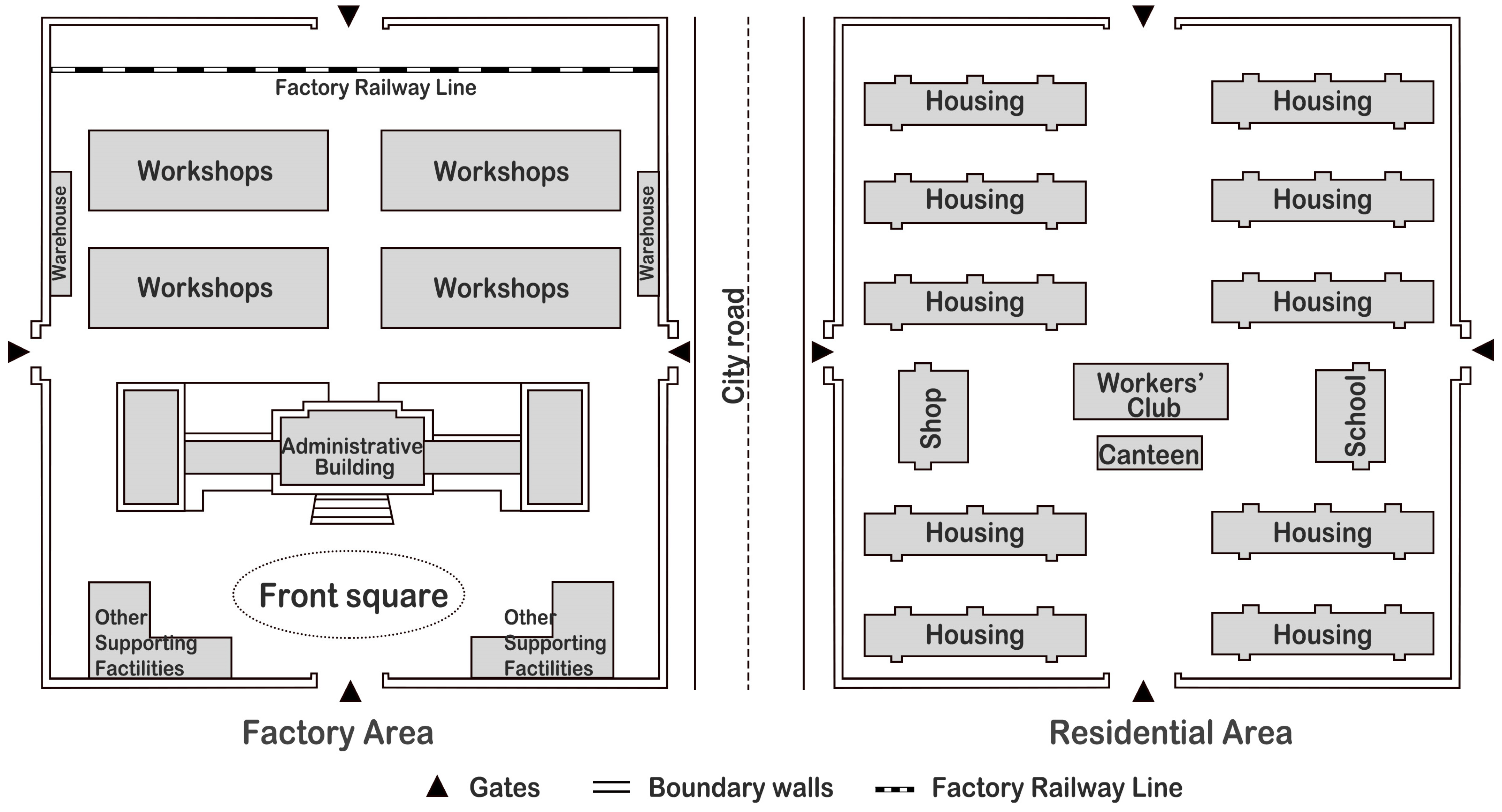
In the early socialist period in China (1950s–1970s), industrial communities emerged as distinctive socio-spatial formations under the danwei system, which constituted a fundamental institutional basis for urban life [1,2,3]. Within this system, employment, housing, welfare, daily services and political administration were integrated within state-owned enterprises. As can be seen in Figure 1, industrial communities were therefore typically organised around factories and residential areas for workers in close proximity, with factories serving not only as places of production but also as centres through which residence and everyday life were integrated [2,4,5].
Since the economic transformation of the 1980s, factory-centred industrial communities in China have gradually weakened. Reform of state-owned enterprises and the marketisation of urban land pushed many factories into bankruptcy or relocation, while rising land values accelerated the redevelopment of former factory land [6,7]. Former factories thus became arenas of intervention and negotiation among the state, local governments, state-owned enterprises and developers [8]. Meanwhile, the danwei system that had shaped industrial communities gradually eroded [3,9]. Social responsibilities such as housing, healthcare and education were progressively shifted from factories to local governments, residents’ committee and private service providers, especially after the housing reform of the late 1990s [10,11]. Although factories lost much of their control over residential areas, they continued to shape the functioning of industrial communities through employment provision, existing spatial structures and social ties. Existing studies have mainly explored the long-term physical [5,12] and social changes [13,14,15] in industrial communities in Chinese cities since the 1980s. However, less attention has been paid to how abrupt changes in factory operations, such as bankruptcy or relocation, reshape the built environment across factory and residential areas within the same industrial community. This highlights the need for a new analytical perspective on changes in the built environment during major shifts in factory operations.
Resilience thinking provides a useful lens for understanding how the built environment changes under disturbance. Originally developed in ecology, resilience refers to the capacity of a system to absorb disturbance and reorganise while undergoing change so as to retain essential functions and structures [16,17]. As resilience thinking has increasingly been extended to urban studies, it has become relevant to understanding how built environments respond to uncertainty, disruption and long-term transformation [18,19,20,21]. In the built environment, resilience is understood as the capacity to persist, adapt, or transform in response to shocks and stresses while sustaining essential functions [22]. Industrial communities thus provide suitable empirical cases for analysing dynamic changes of the city at the microscale through a resilience perspective. This is because they were shaped by China’s prolonged socio-economic context and diverse but continuously changing built environments.
In this context, disruptive changes in factory operations can be understood as key disturbances because factories have long played a central role in organising production and shaping the landscapes of industrial communities. However, this does not mean that factory relocation or bankruptcy is treated as the sole cause of all changes in the built environment, as industrial communities were also shaped by longer-term demographic change, population ageing and the gradual decline of old neighbourhoods. Instead, factory relocation or bankruptcy is used as an identifiable turning point for identifying how factories and their residential areas changed differently before and after major shifts in factory operations. Compared with the broader and more gradual process of economic transformation, such events often occur at clearer time points and may produce more immediate effects on industrial lands, building functions and spatial structures. On this basis, this study develops an analytical framework based on resilience thinking to analyse how these two spatial units respond to shifts in factory operations through changes in the built environment.
This study takes the Shanxi Knitting Factory (SKF) in Taiyuan, China, as a case of factory bankruptcy and explores how the two spatial units responded to the same disturbance. It addresses one main question: to what extent do different spatial units within a single industrial community demonstrate resilience in response to factory bankruptcy? To answer this question, the study adopts a mixed-method sequential explanatory design. Section 2 reviews the relevant literature and develops the analytical framework. Section 3 introduces the case, research design and methods. Section 4 presents the quantitative results and qualitative findings. Section 5 discusses the interpretation of the resilience capacities identified in both spatial units and the social implications of the residential area based on the integrated quantitative and qualitative findings. The final section summarises the main findings and outlines the contributions and limitations of the study.

2. Literature Review

2.1. ICs and Their Built Environment

There is no universally accepted term in the literature for this type of socio-spatial formation, which organises production and living functions within a single place [11]. In this study, they are termed “industrial communities” to emphasise that enterprises organised production and labour while also providing housing, welfare and daily services [4,9]. Their formation was often linked to limited government provision or market failure, which meant that enterprises had to assume responsibility for the reproduction of labour power and for maintaining community cohesion [23]. Their continued existence, therefore, depended heavily on the stable operation of production.
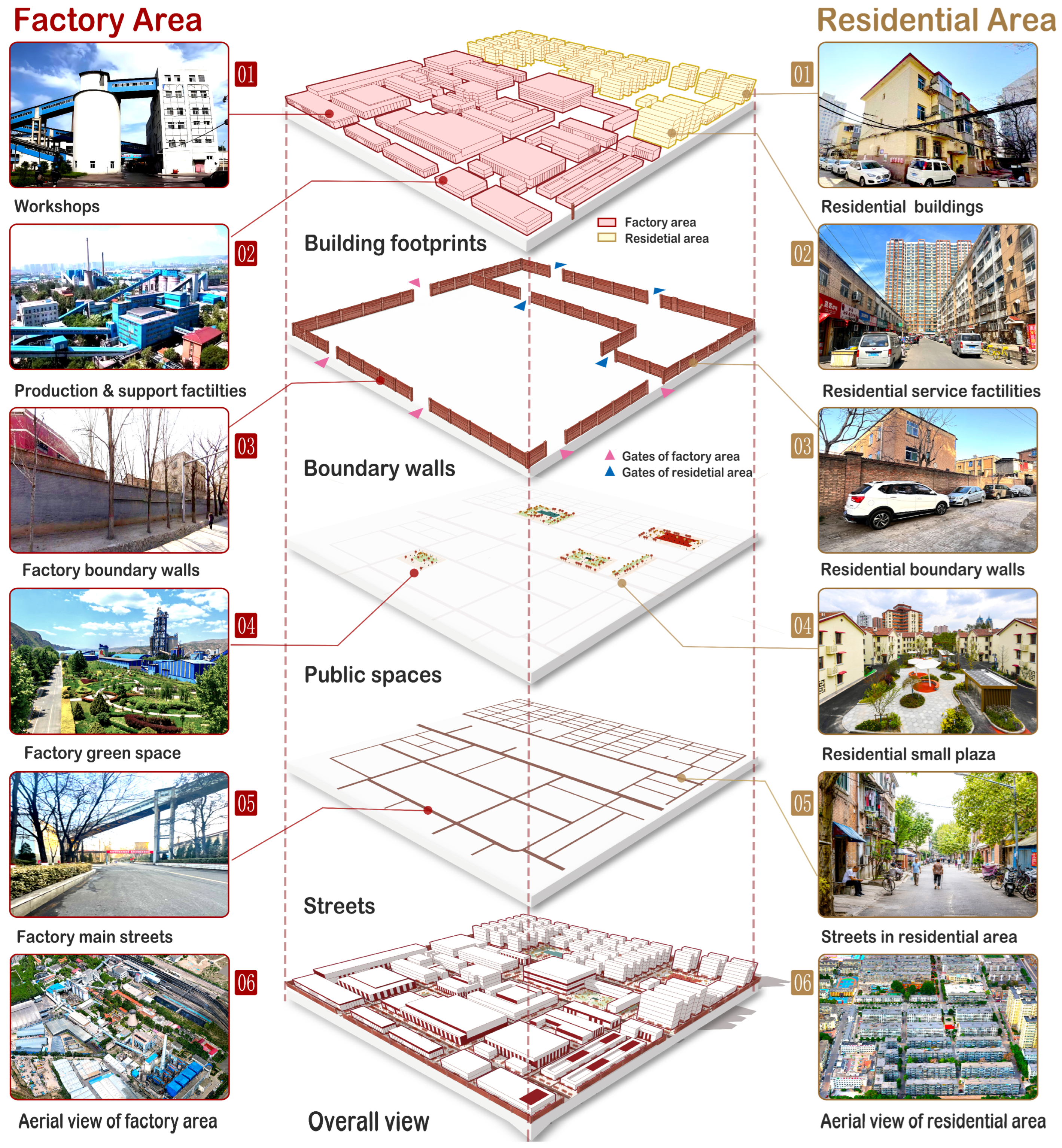
In China, the danwei system gave rise to industrial communities, whose institutional arrangements strongly shaped their landscape [2,4]. Their built environment can be understood through several interrelated key components, including building footprints with diverse functions, public spaces, streets and boundary walls (Figure 2). These components capture the basic spatial organisation of industrial communities: building footprints and building functions reflect the distribution of built forms and uses, while public spaces, streets and boundary walls indicate the organisation of collective space, accessibility and degree of enclosure. Factories and residential areas were usually located close to one another and enclosed by walls and gates [1,5,11]. Workshops and warehouses sustained industrial production, service facilities such as schools, canteens, shops and clinics supported residents’ daily needs [9,12], while public spaces served both social interaction and political mobilisation [4]. This socio-spatial formation embedded individuals in a “state-danwei-individual” structure in which work and daily life overlapped, thereby fostering collective awareness, neighbourhood cohesion and attachment to place [24]. Since the economic transformation of the 1980s, however, the built environment of industrial communities in China has changed markedly. In many cases, factory bankruptcy or relocation led to the rapid decline of industrial landscapes, as production spaces were demolished or converted to other urban uses [6,8]. By contrast, residential areas have changed more gradually. Boundaries blurred as walls were removed or replaced by fencing, green belts or commercial outlets [1,3,11], internal roads were absorbed into the wider urban street network, and service facilities became more commercialised and varied [9]. Public spaces also shifted towards recreation and neighbourhood interaction [12]. These changes suggest that the most representative and widely distributed elements of industrial communities are also key dimensions for understanding how their built environment changed in the context of economic transformation. In addition, sociological studies have explored changes in the social fabric in industrial communities [13,14,15].
Existing studies have mainly explored the long-term physical and social changes experienced by industrial communities in Chinese cities since the 1980s. However, although they recognise the central role of factories in shaping the spatial organisation of these communities [1,2,4], they have paid less attention to how abrupt changes in factory operations, such as bankruptcy or relocation, reshape their built environment.
More specifically, previous research has often focused either on industrial heritage reuse [25] and land restructuring [6,7] in former factory areas or on gradual morphological changes in residential areas [3,10,11,12], with these two spatial units typically examined separately rather than as interconnected parts of industrial communities. These limitations highlight the need for a perspective that examines how shifts in factory operations reshape the built environment across different spatial units within the same industrial community.

2.2. Resilience in the Built Environment

Current research on resilience in the built environment is grounded in the ecological resilience paradigm [18,19,20]. Since Holling [16] introduced ecological resilience to explain the non-linear dynamics of ecosystem change, resilience has been interpreted through engineering, ecological and evolutionary perspectives [26]. Engineering resilience emphasises return to equilibrium after disturbance [27], whereas ecological resilience focuses on the system’s capacity to absorb disturbance before moving into an alternative stable state [28]. Recent work drawing on complexity theory and adaptive systems thinking has increasingly treated resilience as a dynamic process in which systems absorb disturbance, adjust to changing conditions and reorganise when existing structures become untenable. In this context, persistence, adaptability and transformability have become three key capacities for understanding how systems change over time [17,29,30] (Table 1). Adaptive cycle theory further complements this perspective by illustrating how such capacities may unfold across recurring phases of change [31].
The resilience perspective has become increasingly relevant to the built environment because it shares key characteristics with complex adaptive systems. Early studies identified similarities between urban and ecological systems in both their organisation and their responses to change [32]. In urban form, morphological elements are structured across multiple scales, change during recurring processes of development and redevelopment, and remain shaped by historical trajectories and past states [19,33]. Morphological change is spatially interconnected, as the geometry and positioning of elements influence both how they change and how they relate to surrounding elements [18]. Through interactions between slower and faster dynamics across multiple levels, change in the built environment is inherently cross-scale and non-linear [19,34]. These characteristics make resilience thinking useful for understanding changes in the built environment under disturbance and uncertainty. This perspective is particularly useful for analysing China’s industrial communities, whose built environment has been shaped by long-term economic transformation but also disrupted by more abrupt changes in factory operations. Under such conditions, different spatial units within the same industrial community may exhibit different resilience capacities in response to the same disturbance.

2.3. Discontinuity, Heterogeneity and Resilience

Discontinuity provides an important lens for understanding the cross-scale organisation of complex adaptive systems. Holling’s [35] Textural Discontinuity Hypothesis (TDH) suggests that complex systems are usually shaped by a few dominant processes operating at specific scales. Through entrainment, these processes generate aggregations of elements associated with similar scales, while discontinuities mark the scale breaks between them, thereby producing lumpy patterns [36]. Discontinuities are therefore not random, but manifestations of hierarchical organisation that make cross-scale structure identifiable. However, Allen et al. [37] emphasise that a greater number of aggregations, or a deeper hierarchy of scales, may or may not correspond to a more resilient system. Instead, the relevance of discontinuity analysis to resilience lies in how the functions performed by system elements are distributed within and across the scales identified by discontinuities. This is because resilience depends not on the identity of particular elements, but on the roles those elements perform and the way such functional patterns are distributed across scales [37]. Therefore, systems with within-scale functional diversity and cross-scale redundancy are considered more resilient because they are more likely to absorb shocks and reorganise after disturbance [38,39].
These ideas have gradually been extended to urban systems. Research on discontinuities in city size distributions suggests that urban growth is organised by dominant processes operating across scales [40]. Extending this perspective to the urban built environment, Garcia [34] argues that urban landscapes can be examined as complex systems whose heterogeneity reflects the structural organisation of physical elements across scales. By identifying aggregations and discontinuities in built environment elements, this approach allows changes in the structural organisation of an urban landscape to be identified before and after disturbance. He further links heterogeneity to resilience by arguing that more complex and heterogeneous urban landscapes may have greater robustness in responding to unpredictable change, while a significant loss of heterogeneity within a short period may indicate the collapse of landscape complexity. Garcia & Vale [41] also suggest that this approach can be extended beyond structural elements to include land use and building functions.
As resilience cannot be observed and measured directly, existing studies often rely on observable attributes that may influence how systems respond to disturbances [42,43]. Heterogeneity is one such attribute that has been widely discussed in resilience research, as homogenisation and simplification are commonly linked to reduced resilience, whereas greater heterogeneity may support the capacity of a system to cope with disturbance while maintaining key functions [44,45,46,47]. However, higher heterogeneity should not be assumed to automatically indicate stronger resilience. The relationship between heterogeneity and resilience capacities is theoretically mediated by both functional and response diversity, namely whether different elements perform distinct roles within the system and can respond differently to disturbance. When this logic is transferred to the built environment, heterogeneity is treated in this study not as a direct measure of resilience outcomes, but as an empirical basis for interpreting resilience capacities through changes in the number of categories and the distribution of structural and functional elements over time.
In industrial communities, the built environment consists of multiple structural elements operating across scales, making it possible to identify discontinuities within and between scales. In addition, because industrial communities historically integrated production, residence and everyday services, building functions are also important for understanding how the uses and roles of spaces are reconfigured over time. Factory bankruptcy or relocation can be understood as a major disturbance to industrial communities, and its built environment effects can be examined through changes in structural and functional heterogeneity. Thus, quantifying heterogeneity provides an empirical basis for interpreting resilience capacities in the built environment of industrial communities in terms of persistence, adaptability and transformability. These heterogeneity patterns do not by themselves demonstrate resilience outcomes, but should also be interpreted by considering the roles that different elements perform within the industrial community and the ways in which these elements change in response to altered factory operations.

2.4. Analytical Framework

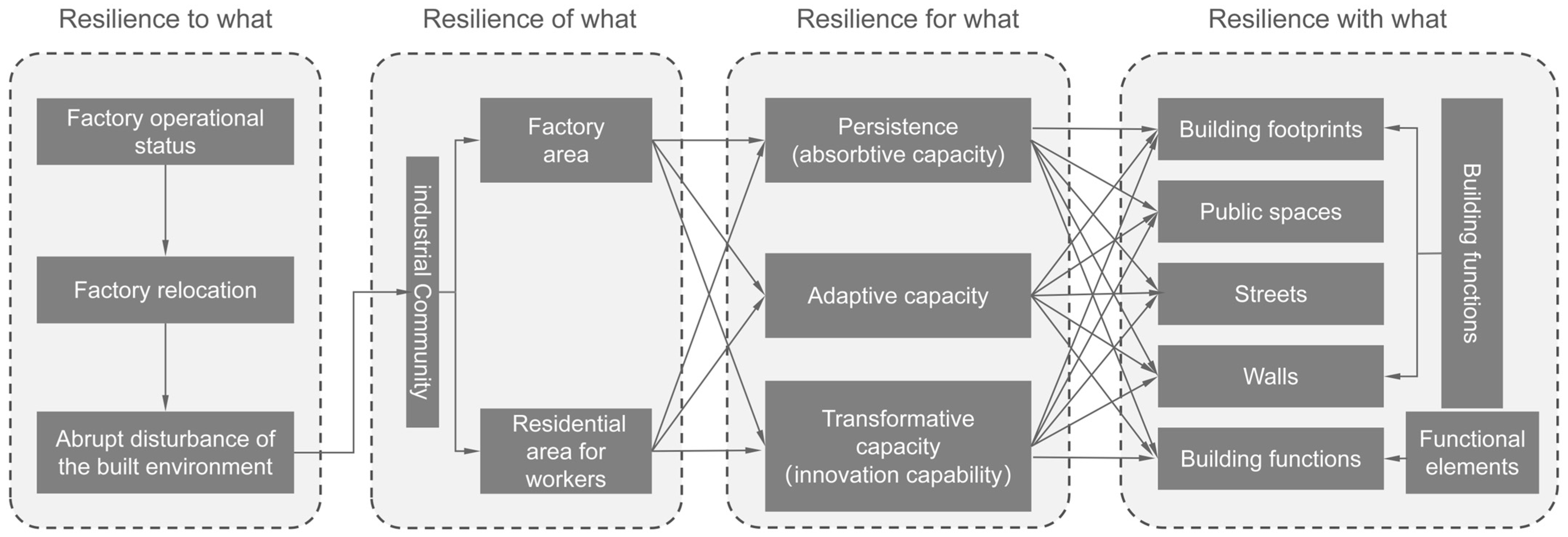
This study develops an analytical framework based on the prior literature, drawing on the work of Sharifi & Yamagata [48], who organise resilience analysis around four questions: resilience to what, of what, for what, and with what. Figure 3 shows the analytical framework used to assess resilience in the built environment, connecting disturbance, spatial units, resilience capacities and assessment dimensions. The factory and the residential area are the two spatial units. Persistence, adaptability and transformability are used to identify resilience in the built environment. Four key elements are used to identify heterogeneity within and across scales in the structural dimension, while building functions are analysed in the functional dimension to capture functional changes. Together, these dimensions show how the built environment responds to disturbance and provides a basis for the subsequent qualitative analysis.

3. Materials and Methods

3.1. Research Design

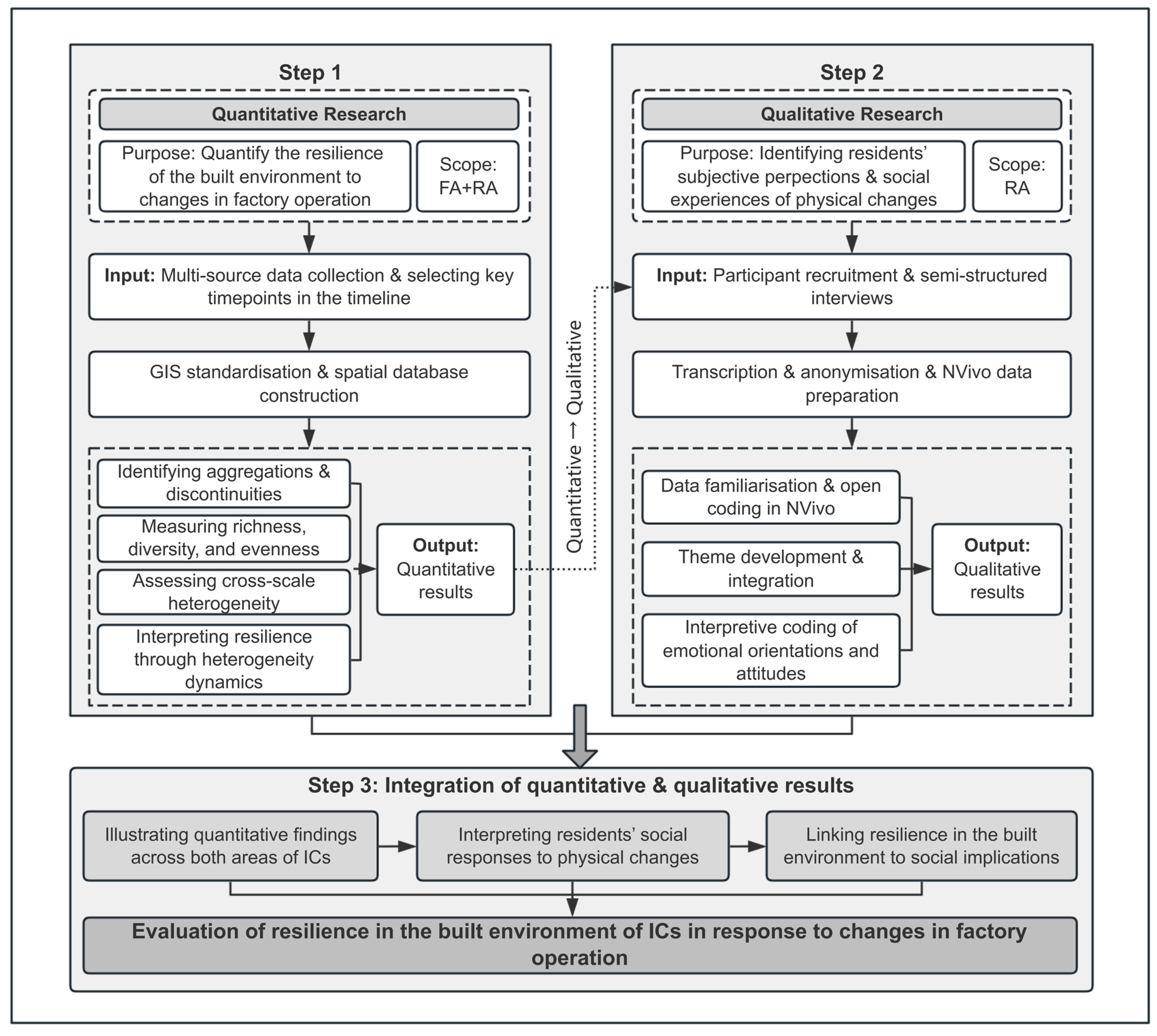
This study employs a mixed-method sequential explanatory design to examine resilience in the built environment in response to drastic changes in factory operations. The research consists of three stages: (1) quantifying structural and functional heterogeneity in two spatial units within the industrial community to provide empirical evidence for interpreting resilience capacities in the built environment in response to the disturbance; (2) conducting semi-structured interviews in the residential area to explore how residents perceived and experienced the physical changes identified through the quantitative analysis following the disturbance; and (3) integrating the quantitative and qualitative results to interpret the social implications of the quantitatively identified resilience of the built environment in the residential area (Figure 4).

3.2. Case Study Introduction

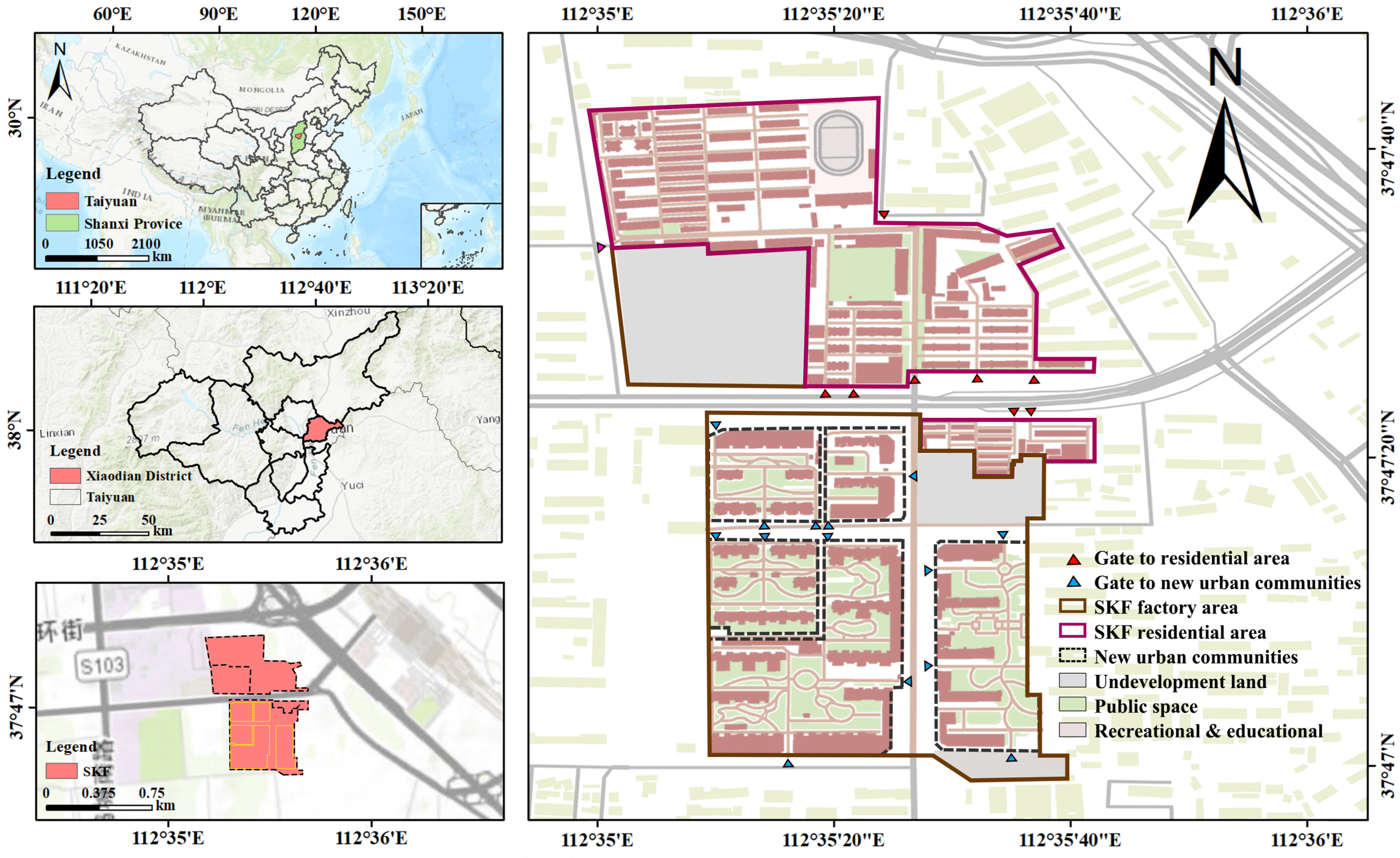
Shanxi Knitting Factory (SKF), established in 1960, was a typical industrial community in Taiyuan, China. Taiyuan was one of China’s major industrial cities that was shaped by early socialist industrialisation, and it contained many industrial communities formed around state-owned factories. SKF was one typical case because its built environment combined production space with workers’ housing and everyday service facilities. As shown in Figure 5, it consisted of two closely related spatial units: the factory area and the adjacent residential area. Since the economic transformation, many factories in these industrial communities have undergone major operational changes, such as bankruptcy or relocation. SKF ceased production in 1999 and declared bankruptcy in 2007, leaving nearly 5000 workers unemployed. After bankruptcy, the factory site was rapidly demolished and gradually redeveloped for new urban uses, while the residential area continued to function as a living space. This divergence makes SKF a suitable case for assessing resilience in the built environment by combining a quantitative evaluation of physical changes with a qualitative analysis of residents’ subjective perceptions and social experiences under the same disturbance.

3.3. Data Collection

To assess dynamic changes in the built environment of SKF over time, six time points were selected: 1979, 1989, 1999, 2007, 2015 and 2025. Their selection was based on two considerations: the availability and comparability of historical spatial data, and their relevance to different stages of development of SKF before and after the factory bankruptcy. The year 1979 represents the early formation of the SKF, when the spatial structure of the factory and residential area had largely taken shape. The years 1989 and 1999 represent important stages of production growth and prosperity, during which its built environment expanded. After 2000, SKF gradually declined under changing market and institutional conditions, and its bankruptcy in 2007 was treated as the key disturbance in this study. The year 2015 represents the early stage after factory bankruptcy, when land restructuring and functional replacement had begun to emerge, while 2025 shows the current condition of SKF. These six years were not intended to cover all important events in SKF history, but rather to provide comparable time points for analysing the long-term physical changes in its built environment. Quantitative data covers key structural (building footprints, public spaces, streets and boundary walls) and functional elements (building functions) of the built environment. Data were drawn mainly from Google Earth imagery, historical maps, factory archives and local chronicles, with oral histories from long-term residents used to supplement missing or inaccurate early data. Field research was conducted in March 2025. Spatial imagery was collected using a DJI Mavic Air 2 drone (DJI, Shenzhen, China). Observations of building functions and other important information were also made on-site.
Semi-structured interviews were conducted in the SKF residential area (see Appendix A). The qualitative research did not aim to include all groups associated with SKF, such as newly arrived residents, community committee staff, developers or property management staff. Instead, it adopted a purposive sampling strategy to focus on former SKF employees who had also lived in the residential area for a long period. This group was selected because they had witnessed the development of SKF from a distinctive urban socio-spatial unit in which work, housing and everyday life were closely integrated, to a place that experienced factory decline, bankruptcy, reorganisation of the former factory area and more gradual and subtle changes in the residential area. Their long-term involvement made them particularly well positioned to compare different development stages of the SKF area, to perceive gradual physical changes in everyday life and to describe how these changes reshaped their social experiences. Eligible participants were required to have both lived and worked at SKF for more than 30 years and were over 60 years old. With the approval of the community committee, door-to-door visits identified 24 eligible residents. As seen in Table 2, eight of these residents (A-01 to A-08) were then randomly chosen for formal interviews to avoid researcher selection bias. Each interview lasted about 40 min and was conducted with informed consent. Open-ended questions focused on subjective perceptions of physical change after factory bankruptcy and related social experiences, including identity, neighbourhood relations and place attachment. All interviews were conducted with informed consent and open-ended questions.

3.4. Research Methods

3.4.1. Quantitative Methods

After data collection, all materials were georeferenced and projected in ArcGIS. Archival documents and local gazetteers were scanned and processed using optical character recognition (OCR), and information on structural elements and building functions identified in the literature review was extracted into attribute tables linked to corresponding spatial objects. Each object was assigned a unique ID and a year field. Structural element types were recorded in the ElementTyp field, while building functions were recorded in the FunctionTyp field. This procedure was repeated across six timepoints to construct a spatio-temporal database.
(1)
Identification of aggregations and discontinuities
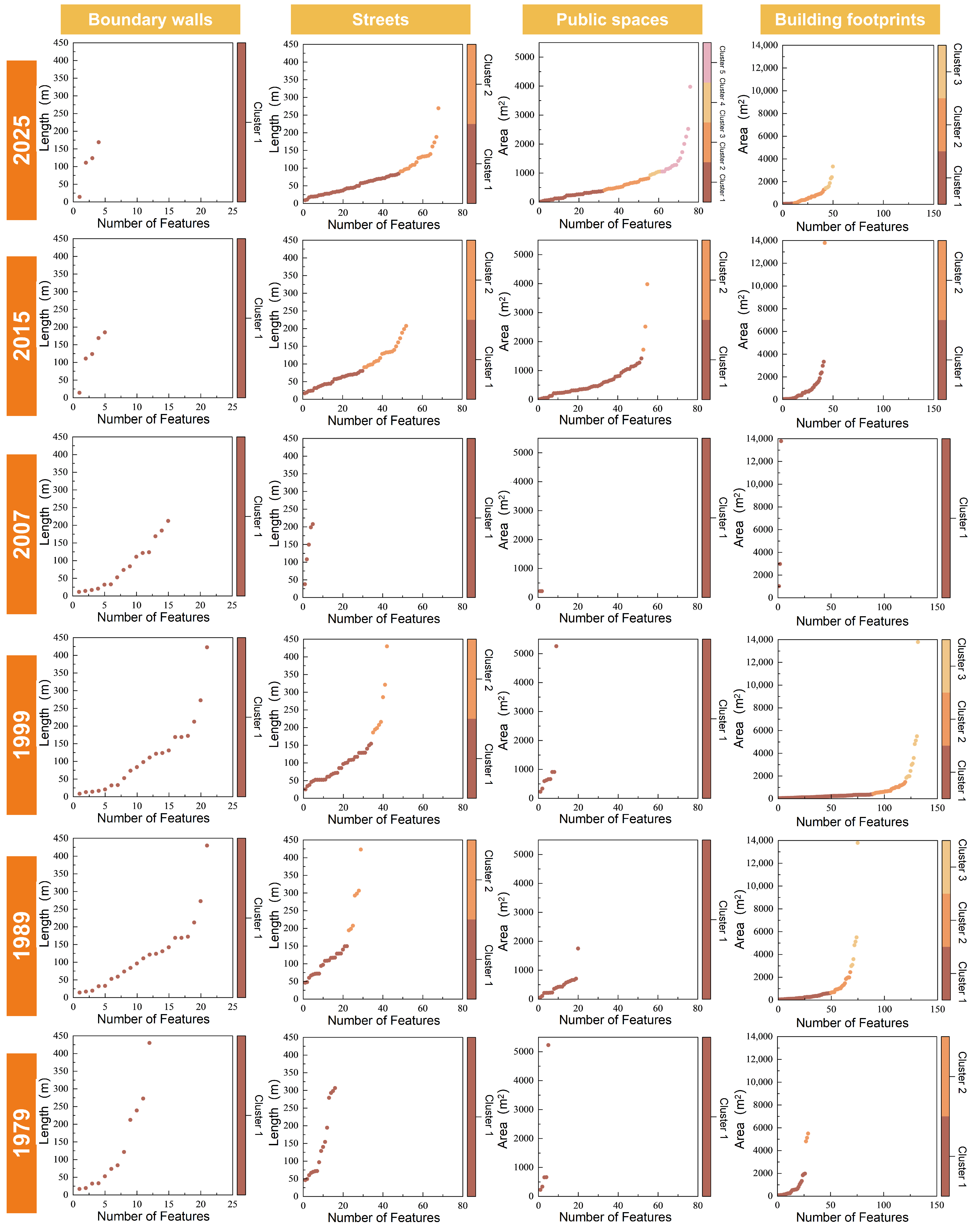
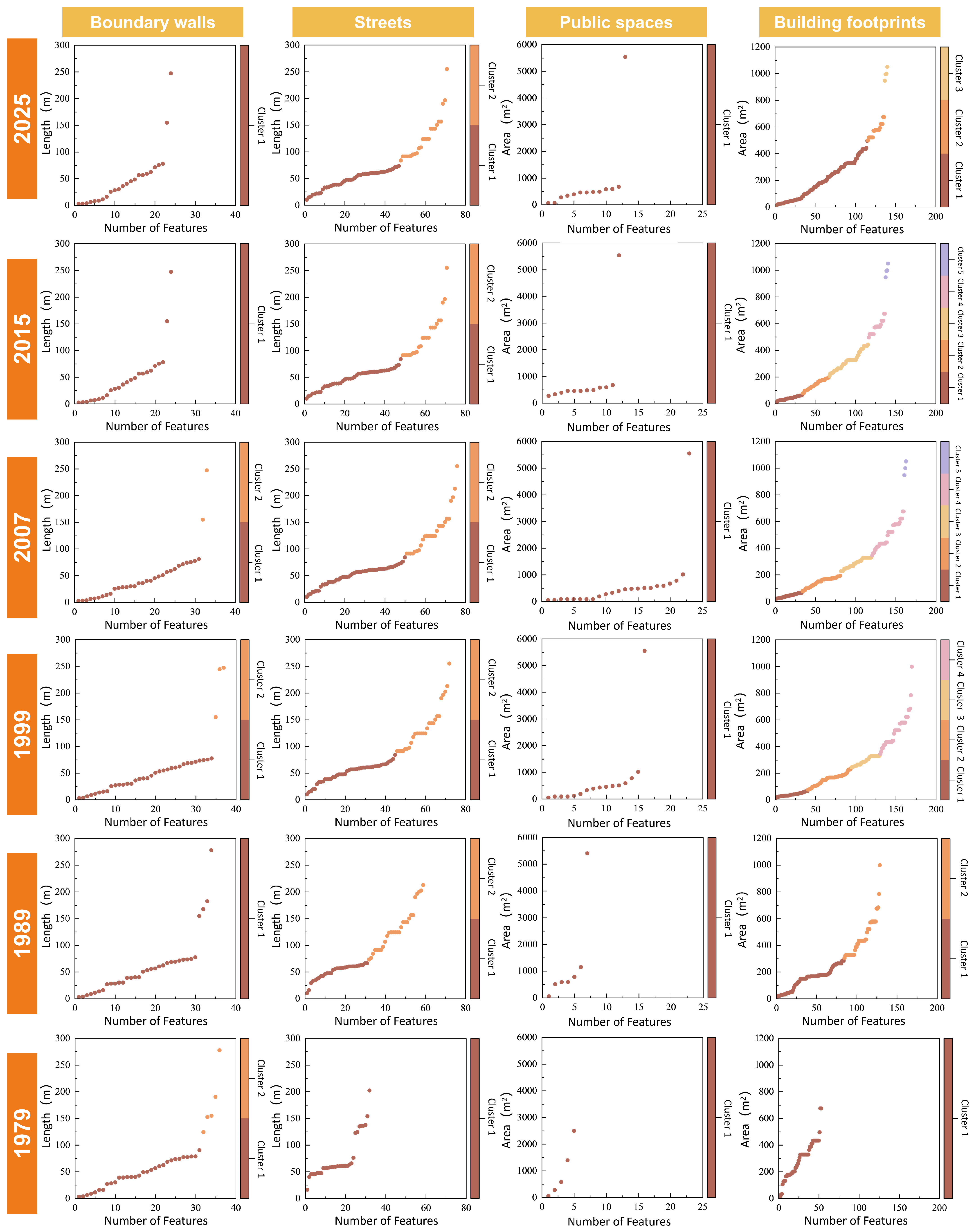
Aggregations and discontinuities of structural elements were identified using the Expectation Maximisation (EM) algorithm. At each timepoint, attribute tables containing ID, ElementType and geometric attributes were exported from ArcGIS 10.8 to WEKA 3.8.6. Clustering was conducted separately for each structural element type. Building footprints and public spaces were clustered by area, while streets and boundary walls were clustered by length. The results were linked back to ArcGIS through the Cluster field and visualised in Origin 2021 Functional elements were not clustered, but instead, were classified using the FunctionTyp field of building footprints, and the number of buildings in each category was counted. Structural clustering results and functional classification data were then integrated into ArcGIS for spatial visualisation.
(2)
Measurement of Richness, Diversity, and Evenness
To measure heterogeneity in the built environment, this study draws on measurement approaches from ecological diversity research that have also been applied in built environment studies [34,41]. In ecological research, richness, diversity and evenness are commonly used to compare the composition and distribution of functional groups within and across systems. Specifically, richness ( S ), Shannon–Wiener diversity ( H ) and Pielou’s evenness ( J ) were selected as three related but distinct indices of heterogeneity. Richness measures the number of categories, Shannon-Wiener diversity captures both category number and proportional distribution, and Pielou’s evenness measures the balance of distribution among categories [49]. When applied to the built environment, these indices therefore help explain whether heterogeneity changes are mainly associated with how many categories are present, how much each category accounts for, and how balanced the overall distribution is.
  • Richness ( S )
Richness refers to the number of categories within the system. In the structural dimension, it was measured by the number of clusters identified within each structural element type. In the functional dimension, it was measured by the number of building function types. Higher values of S indicate a greater number of categories.
b.
Diversity ( H )
The Shannon-Wiener diversity index reflects both the number of categories and their proportional distribution, and is calculated as:
H = i = 1 S p i ln p i
where P i represents the proportion of the category i in the corresponding spatial unit at the corresponding time point, and l n represents the natural logarithm. Higher values of H indicate greater diversity, reflecting higher richness and a more balanced distribution among categories.
c.
Evenness ( J )
Evenness measures the balance of category distribution. The theoretical maximum diversity is calculated as:
H m a x = ln S
The standardised evenness index is then calculated as:
J = H H m a x = H ln S
The value of J ranges from 0 and 1, with values closer to 1 indicate more balanced distribution among categories.
(3)
Assessing heterogeneity in the built environment
Heterogeneity in the built environment was assessed through structural and functional dimensions. At each selected time point and for each spatial unit, richness, diversity and evenness were calculated separately for the four structural elements. To describe overall structural heterogeneity, this study builds on Garcia’s application of ecological diversity measures to the urban built environment in which richness, diversity and evenness were averaged across different built environment elements to describe overall landscape heterogeneity. Accordingly, the resulting values were averaged to produce composite measures of structural heterogeneity across structural element types as this study aimed to capture the overall trajectory of structural heterogeneity rather than the pattern of any single element type. Building on this approach, this study further incorporated building functions as a functional dimension of built environment heterogeneity. Functional heterogeneity was assessed using the same three indices for building functions. The structural and functional results were then averaged to obtain integrated values of richness, diversity and evenness for the built environment in order to capture overall heterogeneity across both dimensions. All composite and integrated values were calculated using unweighted arithmetic means. Richness, diversity and evenness were averaged separately, first across structural element types and then between the structural and functional dimensions, to produce comparable overall values for each time point and spatial unit without imposing unsupported weights.
Although all three indices were used to characterise heterogeneity, integrated evenness ( J ) was selected as the main comparative indicator for tracing temporal changes in both spatial units across six time points. Evenness was used as the main comparative indicator because it controls for richness and reduces the effect of category number on temporal comparison. Richness and diversity were retained to indicate whether changes in heterogeneity were associated mainly with category numbers or with shifts in distribution.
(4)
Interpreting resilience capacities through heterogeneity dynamics
In this study, persistence, adaptability and transformability were used to interpret resilience capacities in the built environment rather than being treated as directly measured indicators. Their identification was based on the temporal trajectories of structural and functional heterogeneity in the factory and the residential area of SKF before and after factory bankruptcy. Persistence was understood as a condition in which heterogeneity remained within a limited range or returned to previous levels after a short-term decline, reflecting limited and largely reversible change in the built environment. Gradual and sustained change in heterogeneity within the existing system was interpreted as evidence of adaptability: increasing heterogeneity suggested strengthening adaptive capacity, indicating growing structural and functional diversity and complexity, whereas a sustained decline represented weakening adaptive capacity, reflecting progressive simplification and homogenisation of the built environment. A marked decline in heterogeneity in response to factory bankruptcy, followed by continued change along a new structural and functional trajectory, was interpreted as transformability. The adaptive cycle was then used to interpret how these capacities unfolded over time across different spatial units within SKF.

3.4.2. Qualitative Methods

The qualitative interview questions were designed to correspond to the quantitative assessment of the residential area by focusing on residents’ subjective perceptions of changes in the same built environment elements, which were quantitatively measured. Residents were also asked to describe their broader social experiences in the residential area after factory bankruptcy. After data collection was completed, all interviews were transcribed verbatim and anonymised. The transcripts were checked against the recordings before coding in NVivo 11. Qualitative analysis followed Braun & Clarke’s [50] six-stage thematic analysis. Coding was conducted iteratively and inductively to identify key themes in residents’ perceptions of physical changes and related social experiences following factory bankruptcy. These themes were then used to interpret the quantitative findings for the residential area and to explain how long-term residents perceived and experienced changes in its built environment.

3.4.3. Integrating Quantitative and Qualitative Findings

Quantitative and qualitative findings were integrated at the interpretation stage. Because interviews were only conducted in the residential area, the integration focused on relating quantitatively identified changes in the built environment of this area to residents’ subjective perceptions and related social experiences following factory bankruptcy. Qualitative findings were used to interpret the social implications of the resilience capacities identified quantitatively through heterogeneity dynamics. In this way, the integration helped explain not only how long-term residents perceived and experienced physical changes in the residential area, but also what the identified resilience capacities meant for residents’ everyday life and social life under changing institutional and socio-economic conditions. At the interpretation stage, broader institutional and governance contexts were also considered to contextualise the integrated findings, particularly the transfer of social responsibilities associated with China’s economic transformation and the gradual weakening of the danwei system. This consideration helped place the interpretation of the findings within the changing social and historical conditions that shaped industrial communities over time.

4. Results

4.1. Aggregations and Discontinuities in the Built Environment

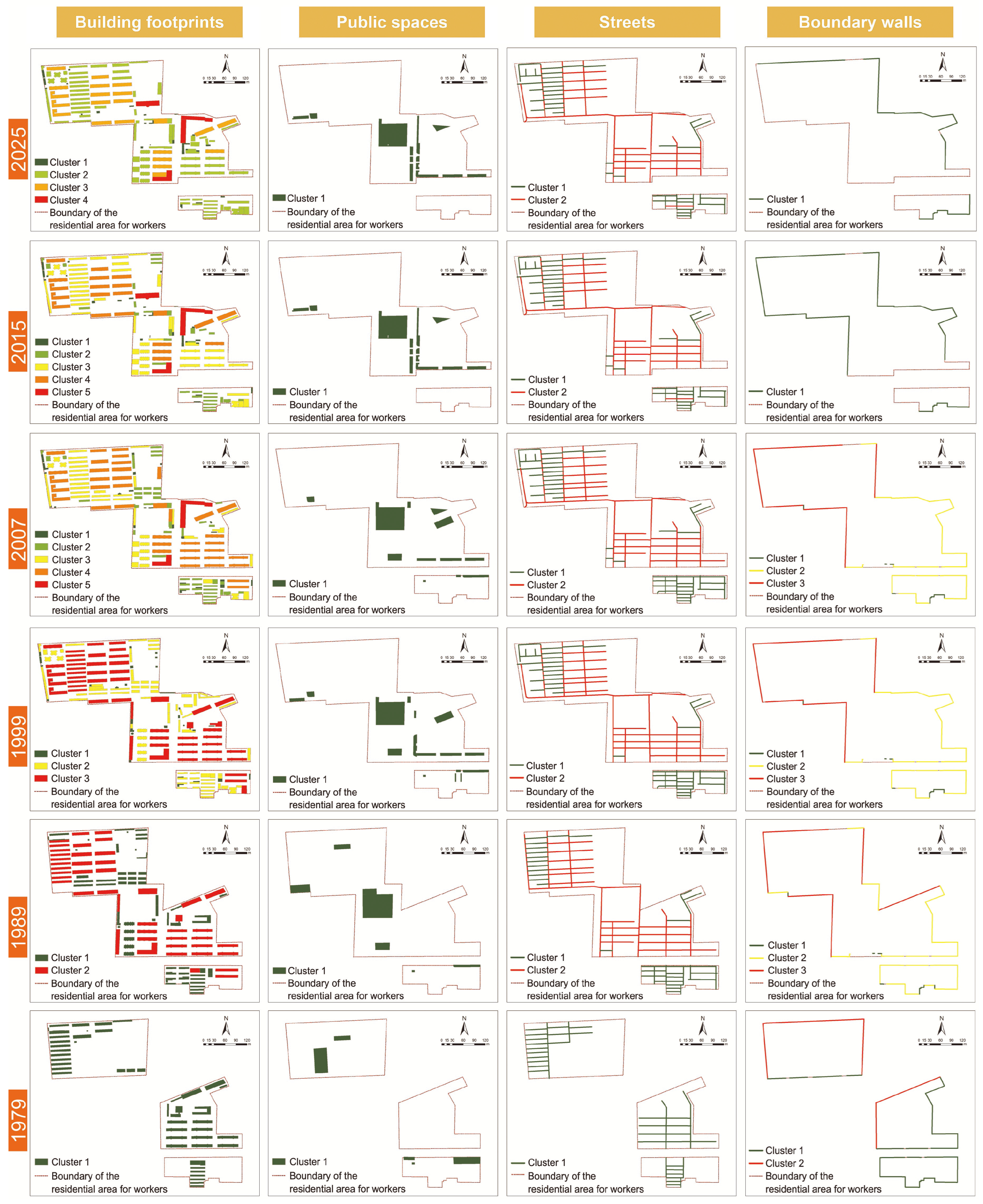
Figure 6 and Figure 7 visualise the aggregation and discontinuity patterns of four structural elements in the SKF and residential area across six time points. Within each plot, individual features are ordered by area or length, and colours indicate clusters of similarly sized features. Aggregations are reflected in concentrations of features within similar size ranges, whereas discontinuities appear as visible gaps or breaks between adjacent clusters. It shows that the numbers and locations of these clusters vary across structural elements, time periods, and the two spatial units, indicating continuous reorganisation of the built environment rather than stability. It therefore provides an initial visual basis for the subsequent quantification of heterogeneity.

4.1.1. Factory Area

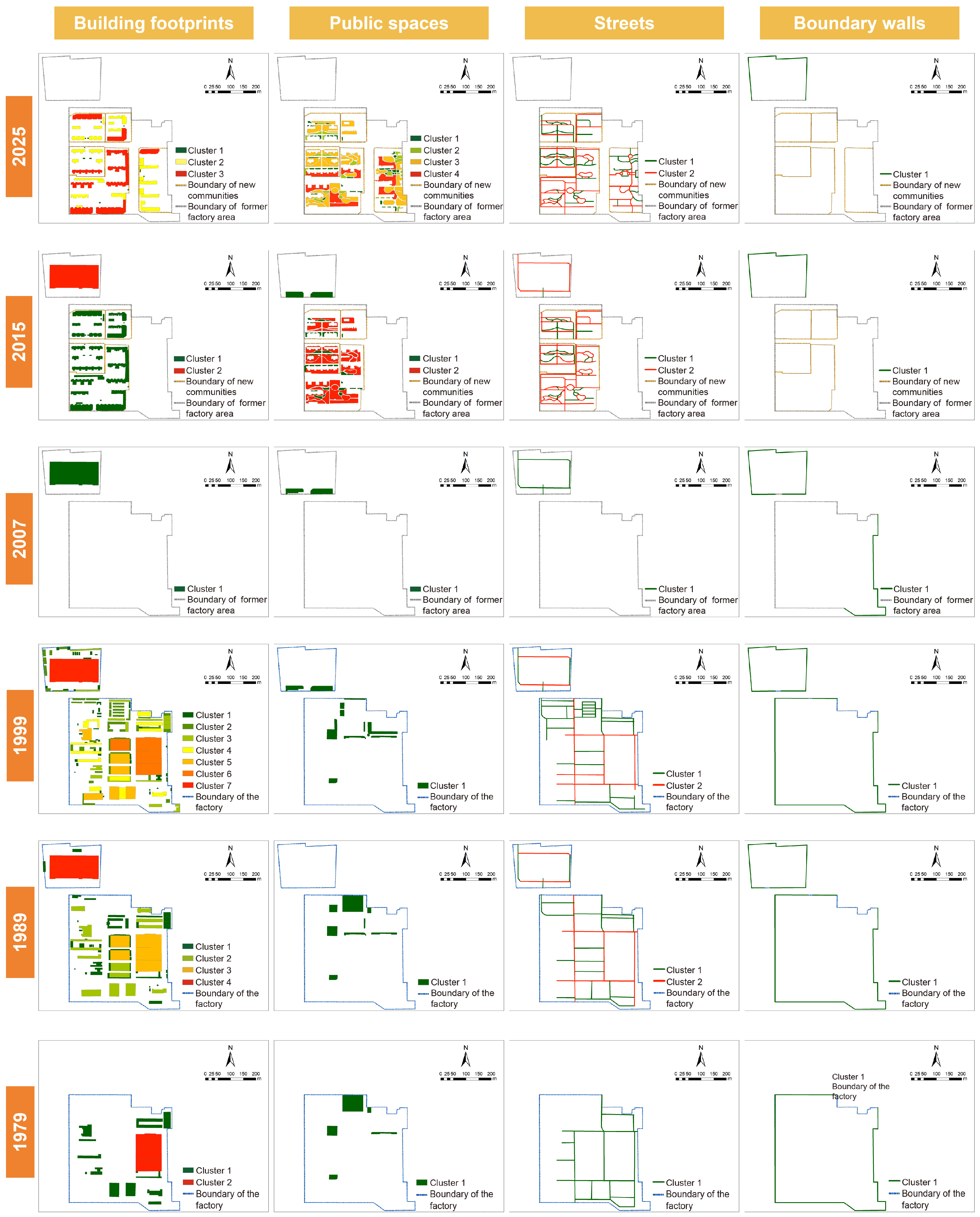
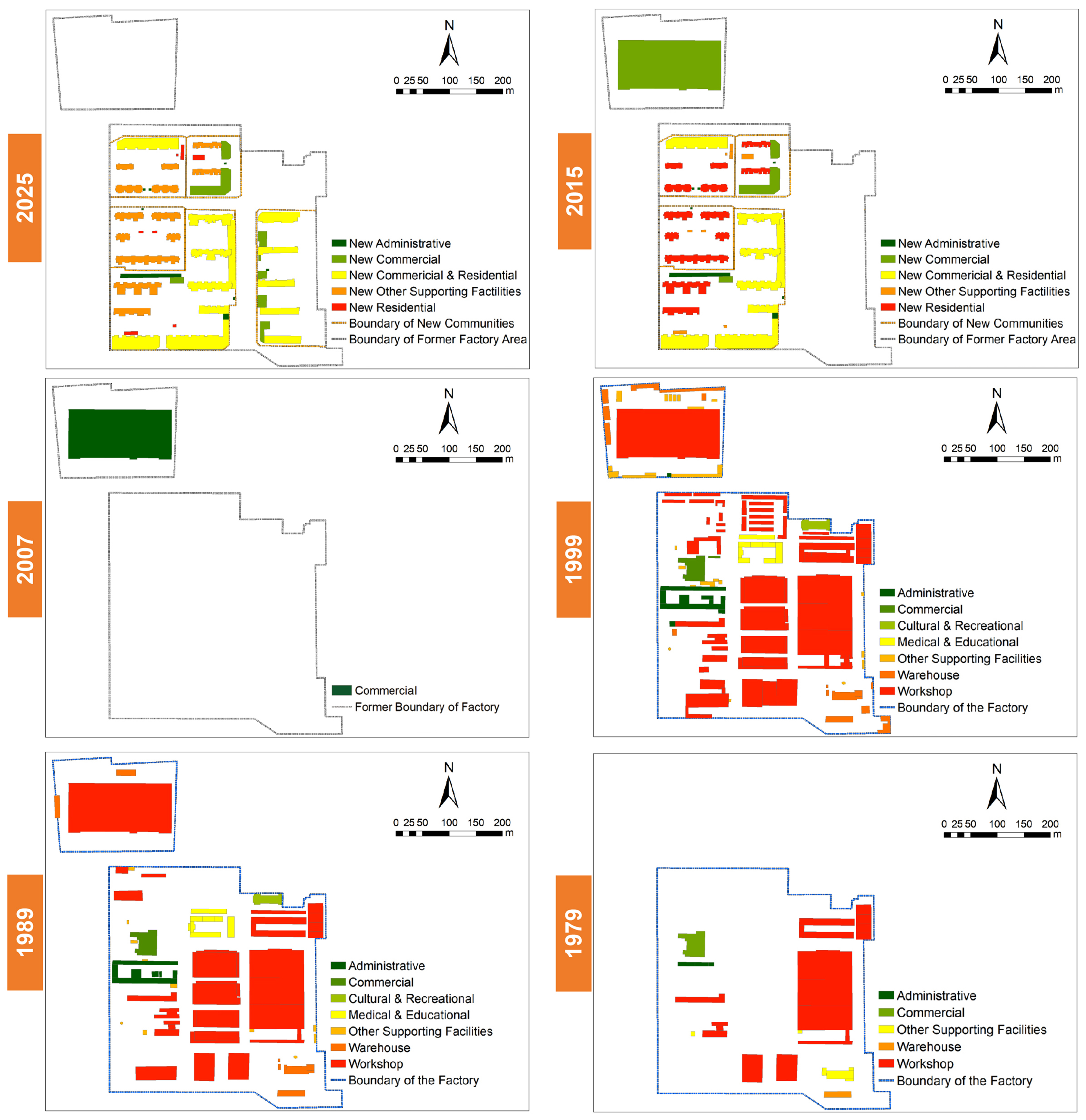
As shown in Figure 8 and Figure 9, the factory area expanded northward from 1979 to 1999, while productive buildings remained concentrated in the central and southern parts of the site and non-productive uses became more evident in the north. Public space always remained limited, and the internal street network became more compact and regular, while boundary walls expanded with the overall growth of the factory area. By 1999, a new textile workshop and supporting facilities had been developed south of the residential area, separated from the main factory area by an urban road.
Following factory bankruptcy and demolition in 2007, the industrial landscape collapsed rapidly. Only the textile workshop remained and was later converted into a local farmers’ market. By 2015, the western part of the former industrial site had been redeveloped into modern urban neighbourhoods with expanded public space and irregular internal roads. By 2025, redevelopment had covered almost the entire former factory area. With the demolition of the farmers’ market, all industrial buildings had been removed. Only a small undeveloped area remained in the northeast.

4.1.2. Residential Areas for Workers

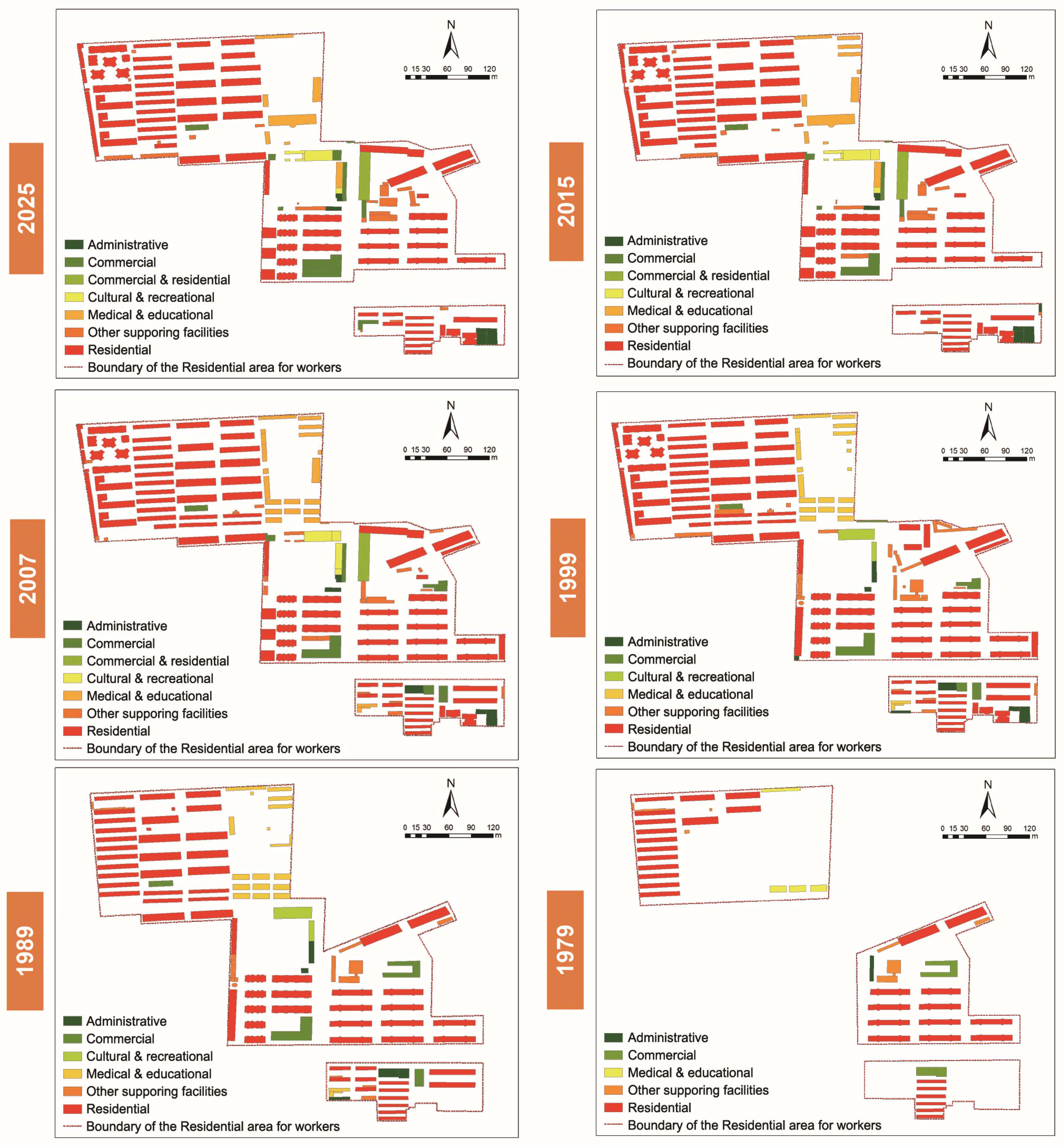
As shown in Figure 10 and Figure 11, the SKF residential area is divided into two parts by an urban road, and both were adjacent to the original factory site. Building footprints expanded from an initially dispersed pattern and gradually came to occupy most of the residential area. Service facilities were initially concentrated in the centre but later extended along the major internal streets.
With the demolition of many densely arranged bungalows and their replacement with multi-storey buildings since 1999, the internal street network became less dense, with fewer minor streets remaining. Public space remained limited throughout the period. Brick walls originally enclosed the residential area, but by 2025, most had been replaced by permeable fencing and green belts, with only limited sections remaining along the northern and eastern boundaries.

4.2. Richness, Diversity, and Evenness of the Built Environment

Table 3 summarises the richness, diversity, and evenness of structural elements across six time points in both areas. In the SKF area, building footprints had the most features and the highest richness and diversity during the factory period (1979–1999). After the factory bankruptcy in 2007, all structural indicators dropped sharply to their lowest levels and then rose again in subsequent years. By 2025, public spaces had increased the most and showed the most features as well as the highest richness and diversity, while streets had the highest evenness. Boundary walls remained low throughout, with their number of features declining markedly after 1999. In the residential area, changes were more gradual. Building footprints consistently had the most features and relatively high richness and diversity, whereas streets maintained relatively high evenness from 1989 onwards. Public spaces remained the smallest area across all six time points. Boundary walls peaked in richness, diversity, and evenness in 1989, but fell to very low levels after 2015, with their number of features continuing to decline.
Table 4 presents the richness, diversity, and evenness of building functions across six time points in both areas. In the factory area, the number of features increased during factory operation and peaked in 1999, while richness reached its highest level in 1989 and 1999. All indicators fell sharply to their lowest levels in 2007 before rebounding in 2015. In the residential area, changes were more gradual. Richness increased and remained stable after 2007, while diversity and evenness increased initially but declined by 2025.
In summary, Table 3 and Table 4 indicate that the SKF area experienced abrupt structural and functional changes until 2007, with sharp declines across all indicators, whereas changes in the residential area were comparatively gradual.

4.3. Structural and Functional Heterogeneity in the Built Environment

Table 5 shows that all indicators in the functional dimension of the factory area were generally higher than those in the structural dimension at all selected time points. This pattern disappeared in 2007, when all indicators across the structural, functional and integrated dimensions fell to their lowest values. Although all indicators rebounded by 2025, richness in both the structural and functional dimensions remained below the highest levels recorded during the factory operation period (1979–1999), whereas diversity and evenness exceeded their previous peaks.
Unlike the factory area, the residential area did not experience an abrupt change across the three dimensions (Table 6). However, the integrated dimension showed an overall decline from 2007 to 2025. Although functional richness remained stable, structural richness declined more markedly, indicating that the decline in integrated richness mainly corresponded to a reduction in the number of categories within structural elements.
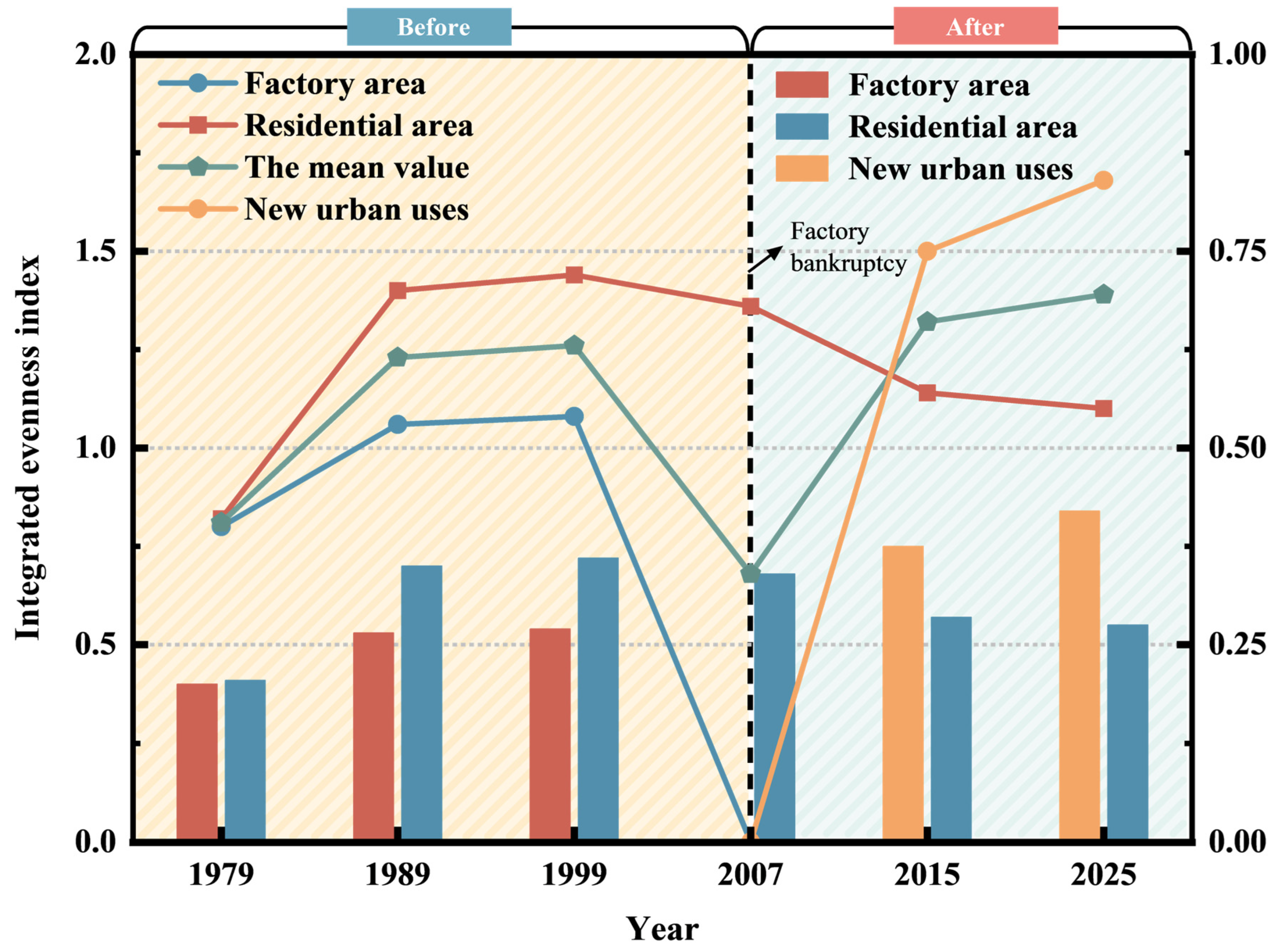
Taken together, the results for both areas show consistently higher values in the functional compared to the structural dimension across time, suggesting a stronger contribution of building functions to overall heterogeneity. Meanwhile, richness played the most important role in shaping heterogeneity rather than diversity and evenness. To further illustrate the heterogeneity dynamics in the factory and residential areas, Figure 12 visualises the trajectory of integrated evenness across the six time points, with the overall mean value for both areas shown as a reference line.
Integrated evenness remained consistently higher in the residential area than in the factory area before factory bankruptcy. It changed sharply in 2007 when the factory area’s integrated evenness fell to its lowest level, while that of the residential area showed only a limited decrease, which therefore created the greatest deviation from the mean value for both areas. However, the two areas followed contrasting trajectories since then, with integrated evenness in the former factory area rising rapidly and exceeding that of the residential area by 2015 as new urban uses emerged. However, the residential area continued to decline gradually. By 2025, the divergence between the two areas had widened further. Overall, these contrasting trends indicate different heterogeneity dynamics in the two areas before and after factory bankruptcy.

4.4. Subjective Perceptions and Social Experiences of Residents

The interview data provide partial and situated insights into how the long-term residents perceived and experienced the built environment of the SKF residential area after the factory bankruptcy in 2007. Participants generally perceived a deterioration in the built environment of the SKF residential area. Several interviewees mentioned the ageing condition of the buildings, stating that “the buildings are old and in poor condition… yet no one bothers to repair them” (A-07). Infrastructure problems were also frequently mentioned, with one resident stating that “the drainage pipes were built in the 1960s and frequently leak… while winter heating is inadequate” (A-02). Some residents further reported a decline in service functions after factory bankruptcy, noting that “many service facilities were demolished or abandoned… with few new functions added in recent years” (A-03). At the same time, some observed new commercial activity along the main internal street, where “numerous shops have opened along the street, attracting shoppers from surrounding neighbourhoods” (A-06). However, this commercial activity was described as limited and did not alter these interviewees’ negative assessment of the wider residential area, as “beyond this busy street, the residential area remains desolate and dilapidated” (A-01). Negative perceptions among the interviewees also extended to public spaces, streets and boundary walls. Public spaces were described as poorly maintained: “the lawns have been browning for ages… we lack green spaces” (A-05). Streets were criticised for poor drainage, as “after rain, severe waterlogging occurs, leaving the roads muddy and impassable” (A-07). Although some residents felt that the removal of boundary walls improved permeability and visual appearance (B-03), some also associated it with reduced safety in the absence of adequate security services and facilities: “the fencing does not look as sturdy as the brick walls; it is easy for outsiders to climb over” (A-02).
The interview narratives suggest that factory bankruptcy and the subsequent physical changes also weakened these residents’ social experiences. In terms of identity, several residents recalled that being an “SKF member” once signified a clear and recognised social status, and that “the SKF factory used to be very well known” (A-01). After bankruptcy, however, this identity became harder to sustain, as “the name of SKF is gradually being forgotten… I have had to find new work to make a living” (A-08). Neighbourhood relationships were likewise disrupted as increased mobility after factory closure eroded long-standing acquaintance networks: “many old neighbours have left, and new migrants have moved in” (A-04). Frequent residential turnover made it more difficult for stable social ties to develop, while the lack of adequate public spaces and facilities further limited everyday interaction: “there is only one square built over 40 years ago… it lacks basic facilities such as outdoor seating” (A-06). The arrival of more newcomers was also associated with a weakened sense of familiarity and security, as “most residents are strangers… our building does not even have a security door” (A-02). Place attachment, rooted in decades of living and working in SKF, was also weakened through deteriorating living conditions, the loss of factory-based identity and the erosion of long-standing neighbourhood relationships after factory closure. As one resident noted, “I used to feel proud of living and working here, but the living conditions have become more and more run-down… and my family will move away soon” (A-07). Another resident added, “after the factory bankruptcy, many residents moved away. I don’t really feel like a SKF member anymore… and this place no longer feels like where I belong” (A-05).
Although these accounts do not represent the full range of perspectives within the SKF residential area, they show how some long-term residents experienced the measured structural and functional changes as declining living conditions, weakened work-based identity, less stable neighbourhood relations and a reduced sense of belonging.

5. Discussion

5.1. Factory Area: Collapse and Transformability

The development of the SKF area can be interpreted through the four phases of Holling’s [31] adaptive cycle. During the early stage of factory operation from 1979 to 1999, sustained resource inputs and spatial expansion supported the accumulation of both productive buildings (e.g., workshops and warehouses) and non-productive facilities (e.g., administrative, commercial, and other supporting facilities). This period broadly corresponds to the exploitation phase (r), during which relatively loose spatial organisation and limited connectedness supported flexibility and a steady increase in both structural and functional heterogeneity. By 1999, when heterogeneity in the factory area reached its peak, the area appeared to be moving towards the conservation phase (K). At this stage, continued resource accumulation and increasing internal connectedness progressively fixed elements of the built environment into a more stable and efficient spatial arrangement while reducing flexibility.
The factory bankruptcy in 2007, followed by rapid demolition, marked a transition into the release phase (Ω). With the collapse of the industrial landscape, heterogeneity fell to its lowest level and the structural and functional complexity of the former industrial system broke down. This was evident in the disappearance of many production buildings and facilities and the sudden simplification of land use after demolition. As Tainter argues, collapse occurs when the costs of maintaining an existing system outweigh its benefits. In this case, collapse opened the way for renewal and the reaccumulation of complexity [51,52].
Following collapse and demolition, the site entered the reorganisation phase (α). Most of the former factory land was rapidly auctioned and redeveloped into new urban neighbourhoods with mixed functions, contributing to a rapid increase in heterogeneity. Rather than restoring the previous industrial system, this process introduced new spatial structures and functions. In this sense, redevelopment of the former factory area indicates transformability, namely the capacity of a system to shift into a new system when existing conditions make the current structure unsustainable [17,31]. The key evidence for transformability is therefore the combined pattern of collapse and reorganisation: heterogeneity declined markedly at the moment of bankruptcy and demolition, then increased again as the former factory area was redeveloped into new urban functions. The continued increase in heterogeneity after 2007 further suggests the emergence of a new exploitation phase (r) based on a different urban logic. By 2025, redevelopment of the former factory area was largely complete. Although heterogeneity continued to increase, its pace of growth had slowed, suggesting that the restructured built environment may be moving towards a new conservation phase (K).

5.2. Residential Area for Workers: Persistence but Declining Adaptability

During the early development phase from 1979 to 1989, the rapid growth of the worker population together with continued investment in housing and service facilities drove the expansion of the SKF residential area. This period corresponds to the exploitation phase (r) of the adaptive cycle, characterised by low connectivity and high flexibility. By 1999, heterogeneity had reached its peak, and the system had become more complex and internally connected. At the same time, the structure and functions of the built environment were becoming more stable, with less flexibility, indicating a shift towards the conservation phase (K).
The residential area was able to persist in response to the critical disturbance of factory bankruptcy in 2007. This persistence was supported, on the one hand, by the relatively stable built environment foundation formed through the factory’s long-term investment and construction. On the other hand, with the gradual disintegration of the danwei system under broader socio-economic transformation, social responsibilities that had previously been assumed by the factory were already being transferred to government agencies, residents’ committee and private service providers before the bankruptcy, thereby reducing the direct dependence of the residential area on continued factory operation. Although heterogeneity declined slightly, the residential area did not undergo the collapse observed in the factory area. It remained inhabited, retained its basic residential function, and showed no comparable large-scale demolition, complete functional replacement, or sharp break in its basic spatial structure like the factory area. In this sense, it exhibited persistence, that is, the capacity of a system to absorb and withstand disturbance while retaining its basic structure and functions [17,30].
However, in the absence of effective everyday governance and stable long-term institutional arrangements, heterogeneity in the built environment showed a sustained downward trend. This decline should not be understood as a direct physical consequence of factory bankruptcy alone. As discussed above, the gradual transfer of welfare, maintenance and service responsibilities from the factory to government agencies, residents’ committee and private service providers had already reduced the residential area’s direct dependence on continued factory operation before bankruptcy. This helps explain why the residential area was able to retain its basic residential function after 2007. However, this transfer did not produce an effective replacement mechanism for everyday governance, maintenance or incremental renewal. As a result, longer-term pressures, including population ageing, residential mobility and the physical ageing of the neighbourhood, were not effectively absorbed or addressed, leading to a gradual decline in adaptability. Over time, the area came to exhibit features broadly consistent with a late conservation phase (K), marked by stabilised structures and functions, declining flexibility and increasing internal rigidity. Although the area was incorporated into a local government-led shantytown redevelopment programme in 2010 because of its deteriorating physical conditions and its limited capacity to meet contemporary urban development demands, it remained stalled for a long time. Complex property rights, weak redevelopment incentives and implementation constraints prevented the programme from being translated into effective physical adjustment or renewal.
As Garcia et al. [51] suggest, the built environment often persists over long periods, and collapse may not appear as an immediate physical breakdown. Such material persistence can delay or obscure deeper institutional and social problems. In this case, the SKF residential area combined persistence with weakening adaptability. Continued occupancy and basic residential functions enabled the area to absorb the immediate disturbance of factory bankruptcy, while the sustained decline in heterogeneity, physical deterioration and limited renewal reduced its capacity to adjust to future demands. Under continued deterioration and insufficient effective adjustment, the residential area may become less able to cope with future disturbances.

5.3. Weakening Adaptability in the Built Environment and Its Negative Social Implications in the Residential Area

The quantitative results revealed a dual pattern in the SKF residential area after factory bankruptcy. On the one hand, the residential area did not experience the sudden collapse and large-scale land restructuring observed in the factory area, but continued to serve basic residential purposes. On the other hand, the continued decline in structural and functional heterogeneity indicates that this persistence was accompanied by a gradual weakening of adaptability. The interview accounts provide partial and situated evidence that helps interpret this pattern. Long-term residents’ accounts suggest that the residential area had already become less directly dependent on the continued operation of the factory before bankruptcy because the gradual breakdown of the danwei system during China’s economic transformation had transferred investment, welfare and governance responsibilities from the factory to local governments, residents’ committees and private service providers. This helps explain why factory bankruptcy did not cause the residential area, once a factory-affiliated facility, to lose its basic function as a living space. However, this transfer of responsibilities did not produce an effective replacement mechanism for maintenance, service provision or long-term renewal. As a result, the residential area continued to exist and function, but its adaptive capacity to adjust, renew and support everyday life gradually weakened.
Residents’ perceptions further illustrate the ways in which some long-term residents experienced this declining adaptability in their everyday lives. Many residents complained about the prolonged neglect of the maintenance of buildings and facilities, and the gradual loss of service functions that used to support daily life. These perceptions help interpret the quantitative decline in heterogeneity not merely as a shift in structural and functional composition, but as evidence of a cumulative reduction in the capacity of the residential area to support diverse everyday needs. Poor maintenance, declining facilities and the loss of local services meant that the residential area remained physically occupied, but became less able to support residents’ everyday activities.
The qualitative accounts also suggest social implications that could not be captured directly by the quantitative assessment. For these long-term residents, changes in social experience were mainly shaped by the wider consequences of factory bankruptcy, while the continuing deterioration of the built environment further reinforced them. Factory bankruptcy and the loss of steady work eroded an identity built through shared labour experiences and collective memories of the factory. Increased population mobility and the arrival of new migrants also made previously stable neighbourhood relationships gradually become looser. The loss of the factory also appeared to weaken these residents’ place attachment to SKF, as the area was no longer tied to the everyday routines and collective experiences through which their earlier community life had been formed. These social implications should therefore be understood as situated insights from some long-term residents that help contextualise the quantitative decline in heterogeneity, rather than as a representative assessment of all residents’ experiences within the residential area.
Overall, the integration of quantitative and qualitative findings suggests that the resilience of the residential area should not be understood simply as physical continuity after disturbance. Although the residential area continued to serve basic residential purposes, this continuity was accompanied by weakening adaptability and increasingly negative social experiences reported by the interviewed long-term residents. This highlights the social dimension of built environment resilience, showing that resilience should not only be assessed based on whether physical structures or functions persist, but should also be interpreted in relation to the deeper social implications produced by these changes under changing socio-economic and institutional conditions.
Furthermore, while the study is situated in a particular Chinese industrial community, its analytical focus can be located within broader international debates on industrial transformation, urban regeneration and resilience in the built environment. Since the 1970s, deindustrialisation and economic restructuring have produced large areas of abandoned or obsolete industrial land in many older industrial regions [53,54]. At the same time, many post-industrial communities have faced ageing housing and facilities, redevelopment pressure [55,56], population outflow and social segregation [57]. These studies suggest that post-industrial transformation concerns how existing industrial landscapes continue to exist, undergo adjustment or become integrated into urban systems, and how these processes affect everyday life and social relations. In this sense, the framework developed in this study offers a transferable analytical perspective for understanding the persistence, adaptability and transformability of the built environment in industrial communities in response to disturbance across different institutional and urban contexts.

6. Conclusions

The findings show that the two spatial units of SKF exhibited markedly different resilience capacities in response to factory bankruptcy. After the factory bankruptcy in 2007, the factory area underwent the most abrupt transformation as industrial buildings were removed and the former production site was gradually replaced by new buildings with residential, commercial and service functions. This shift towards a new spatial configuration indicates transformability. In contrast, the residential area continued to serve its basic residential function after the disturbance. Over time, however, as it gradually became an ordinary urban neighbourhood without effective governance and sufficient renewal, its adaptability weakened. Qualitative evidence further shows that residents perceived and experienced this decline in the built environment in distinctly negative ways. These findings suggest that resilience in the built environment cannot be understood solely in morphological terms, but also by whether it continues to support residents’ everyday needs and social lives.
This study makes three contributions. It shows that resilience in the built environment of industrial communities is both context-dependent and scale-dependent. It is shaped not only by the historical and institutional conditions under which industrial communities were formed, but also by the planning and governance processes that follow disturbances. At the same time, different spatial units within the same industrial community may exhibit different resilience capacities in response to the same disturbance. It also offers a more comprehensive approach, from a methodological perspective, to identify resilience capacities and interpret their social implications by combining quantitative assessment of changes in the built environment with qualitative analysis of residents’ subjective perceptions and social experiences. This analytical framework is not limited to China’s industrial communities, and can be adapted to other urban built environments experiencing sudden shocks or long-term transformation in other regions or cities. In future applications, the analytical scope, disturbance types and built environment elements should be changed according to the specific research context, while the social dimension of built environment resilience can also be further considered. In practical terms, the study suggests that improving resilience in the built environment of industrial communities after factory disruption requires differentiated interventions across spatial units while also taking residents’ everyday needs and concerns into account. For urban regeneration policy, these findings suggest that the former factory area and the residential area should not be addressed through the same redevelopment logic. While former factory areas may require land restructuring and functional replacement to support new urban uses, residential areas may need long-term maintenance, incremental renewal and governance arrangements that can sustain their continued residential function. Therefore, relevant policies should recognise the differences between spatial units within industrial communities and adopt flexible strategies according to their specific conditions, development needs and residents’ concerns.
Several limitations should be acknowledged. First, although this study recognises the role of institutional, governance and economic factors in the transformation of industrial communities, these factors are treated mainly as contextual background rather than as analytical dimensions. Future research could examine policy processes, land redevelopment and stakeholder decisions more systematically. Second, heterogeneity measurements were used as an empirical basis for interpreting changes in the built environment, but they cannot fully capture the multidimensional nature of resilience. The use of unweighted arithmetic means to calculate integrated values may not fully reflect the different roles of specific elements and functions. Future research could incorporate broader resilience metrics, such as connectivity, redundancy and modularity, and use sensitivity analysis to test alternative weighting methods. Third, the analysis was based on a single case and one main type of factory operational disturbance so the findings require further exploration through comparative studies across different industrial community types, urban contexts and disturbance scenarios. Finally, the qualitative interpretation is limited by the narrow interview sample that mainly reflects perceptions of long-term residents and may be affected by selective memory and respondent bias. Future research could strengthen this dimension by using triangulation and by including broader stakeholder perspectives, including community committees, local government actors, developers and newer residents.

Author Contributions

Y.H. was responsible for conceptualisation, methodology, investigation, data analysis and drafting the manuscript. E.J.G. and F.O. contributed to revising the manuscript and supervising the study. All authors have read and agreed to the published version of the manuscript.

Funding

This research was supported by the China Scholarship Council Program (Project ID: 202108250014).

Institutional Review Board Statement

The qualitative research of this study was approved by the University of Auckland Human Participants Ethics Committee (UAHPEC24749, approved on 23 March 2023).

Informed Consent Statement

Written informed consent was obtained from all participants involved in the qualitative interviews.

Data Availability Statement

The original contributions presented in this study are included in the article. Further enquiries can be directed to the corresponding author.

Conflicts of Interest

The authors declare no conflicts of interest.

Appendix A

  • Semi-Structured Interview
  • SECTION I—INTRODUCTION TO THE RESEARCH
  • Research Topic:
Residents’ subjective perceptions of built environment change and related social experiences in the SKF residential area following factory bankruptcy.
  • Research Aim:
To explore long-term residents’ subjective perceptions of changes in the built environment of the SKF residential area following factory bankruptcy and the related social experiences.
  • Research Focus:
The interviews were conducted with long-term residents who had worked or lived in the SKF residential area for an extended period and were familiar with its historical changes. The interviews explored two main aspects:
(1) residents’ subjective perceptions of changes in the built environment since the factory bankruptcy; and
(2) residents’ social experiences associated with these changes.
  • SECTION II—PARTICIPANT BACKGROUND INFORMATION
    • Participant code
    • Gender
    • Age range
    • Former occupation in the SKF factory
    • Approximate period of employment in the factory
    • Approximate period of residence in the residential area
  • SECTION III—SUBJECTIVE PERCEPTIONS OF CHANGES IN THE BUILT ENVIRONMENT
    • Looking back, when did you begin to notice clear changes in the SKF residential area?
    • How do you think the built environment of the residential area has changed since the factory bankruptcy?
    • How would you describe changes in the condition of the residential buildings?
    • How have building functions and everyday service facilities changed over time?
    • How have public spaces in the residential area changed?
    • How have the streets and internal roads changed?
    • Have there been any changes in walls, gates, fences, or the openness of the residential area? How do you feel about these changes?
    • Which physical changes have affected your daily life most strongly, and why?
  • SECTION IV—SOCIAL EXPERIENCES ASSOCIATED WITH THESE CHANGES
    9.
    Before its bankruptcy, what did the SKF factory mean to you?
    Prompts: work, income, welfare, status, reputation
    10.
    After the factory bankruptcy, did you still feel that you were part of SKF or belonged to the same collective life as before? Why or why not?
    11.
    Do you think factory bankruptcy changed relationships among neighbours in the residential area? If so, in what ways?
    Prompts: resident turnover, familiarity, trust, mutual support, security
    12.
    Do you think changes in the built environment after factory bankruptcy affected how neighbours interacted with one another? Why or why not?
    Prompts: public spaces, service facilities, opportunities for interaction
    13.
    After the factory bankruptcy, did you still feel that the SKF residential area was a place where you belonged in the same way as before? Why or why not?
    Prompts: memories, daily routines, family life, intention to stay
    14.
    Do you think changes in the built environment after factory bankruptcy affected your attachment to the SKF residential area? Why or why not?
    Prompts: housing condition, service facilities, living convenience, overall environment
  • SECTION V—PERCEPTIONS OF MANAGEMENT AND MAINTENANCE CHANGES
    15.
    How was the residential area managed and maintained by the SKF factory in the past? Do you think it worked well?
    16.
    After the factory bankruptcy, who became responsible for managing and maintaining the residential area, and how did these arrangements change? Do you think they worked well?
    17.
    What kinds of changes in management, maintenance, or services do you think are most needed in the future?

References

  1. Bray, D. Social Space and Governance in Urban China: The Danwei System from Origins to Reform; Stanford University Press: Stanford, CA, USA, 2005. [Google Scholar]
  2. Naughton, B. Danwei: The economic foundations of a unique institution. In The Danwei; Routledge: Abingdon, UK, 2015; pp. 169–194. [Google Scholar]
  3. Chai, Y. From socialist danwei to new danwei: A daily-life-based framework for sustainable development in urban China. Asian Geogr. 2014, 31, 183–190. [Google Scholar] [CrossRef]
  4. Bjorklund, E.M. The Danwei: Socio-Spatial Characteristics of Work Units in China’s Urban Society. Econ. Geogr. 1986, 62, 19–29. [Google Scholar] [CrossRef]
  5. Zhang, C.; Chai, Y. Un-gated and integrated work unit communities in post-socialist urban China: A case study from Beijing. Habitat Int. 2014, 43, 79–89. [Google Scholar] [CrossRef]
  6. Deng, K.; Song, F. Urban Industrial Zone Renewal and Spatial Game in China. Cities Assem. 2022, 3, 451–462. [Google Scholar] [CrossRef]
  7. He, C.; Wei, Y.D.; Xie, X. Globalization, institutional change, and industrial location: Economic transition and industrial concentration in China. Reg. Stud. 2008, 42, 923–945. [Google Scholar] [CrossRef]
  8. Gao, J.; Yuan, F. Economic transition, firm dynamics, and restructuring of manufacturing spaces in urban China: Empirical evidence from Nanjing. Prof. Geogr. 2017, 69, 504–519. [Google Scholar] [CrossRef]
  9. Lu, D. Danwei and Socialist Urbanism. In Routledge Handbook of Chinese Architecture; Routledge: Abingdon, UK, 2022; pp. 348–366. [Google Scholar]
  10. Bian, Y.; Logan, J.R.; Lu, H.; Pan, Y.; Guan, Y. Work units and housing reform in two Chinese cities. In The Danwei; Routledge: Abingdon, UK, 2015; pp. 223–250. [Google Scholar] [CrossRef]
  11. Zhang, M.; Zhang, T.; Xiao, Z.; Chai, Y. Property rights redistribution and the spatial evolution of the Chinese danwei compound: A case study in Beijing. J. Hous. Built Environ. 2021, 36, 1585–1602. [Google Scholar] [CrossRef]
  12. Ye, N.; Kita, M.; Matsubara, S.; Okyere, S.A.; Shimoda, M. Socio-Spatial changes in Danwei Neighbourhoods: A case study of the AMS Danwei compound in Hefei, China. Urban Sci. 2021, 5, 35. [Google Scholar] [CrossRef]
  13. Yue, L.; Peiling, Z. Understanding Why People Complain: Using Spatial Embeddedness to Explore Residents’ Satisfaction in China’s Danwei Neighborhood Renovation. China City Plan. Rev. 2024, 33, 51–61. [Google Scholar] [CrossRef]
  14. Li, X.; Kleinhans, R.; van Ham, M. Ambivalence in place attachment: The lived experiences of residents in danwei communities facing demolition in Shenyang, China. Hous. Stud. 2019, 34, 997–1020. [Google Scholar] [CrossRef]
  15. Liu, S.V. “Social positions”: Neighborhood transitions after danwei. In Working in China; Routledge: Abingdon, UK, 2006; pp. 38–55. [Google Scholar] [CrossRef]
  16. Holling, C.S. Resilience and stability of ecological systems. Annu. Rev. Ecol. Syst. 1973, 4, 1–23. [Google Scholar] [CrossRef]
  17. Walker, B.; Holling, C.S.; Carpenter, S.R.; Kinzig, A. Resilience, adaptability and transformability in social–ecological systems. Ecol. Soc. 2004, 9, 5. [Google Scholar] [CrossRef]
  18. Feliciotti, A. Resilience and Urban Design. Ph.D. Thesis, University of Strathclyde, Glasgow, UK, 2018. [Google Scholar]
  19. Hassler, U.; Kohler, N. Resilience in the built environment. Build. Res. Inf. 2014, 42, 119–129. [Google Scholar] [CrossRef]
  20. Roaf, S. Building resilience in the built environment. In Architecture and Resilience; Routledge: Abingdon, UK, 2018; pp. 143–157. [Google Scholar]
  21. Tähtinen, L.; Toivonen, S. Expanding horizons: A framework for developing futures-oriented resilience in the built environment. Build. Res. Inf. 2025, 53, 281–304. [Google Scholar] [CrossRef]
  22. UN-Habitat. Annual Report 2021; United Nations Human Settlements Programme: Nairobi, Kenya, 2022; pp. 240–243. Available online: https://unhabitat.org/annual-report-2021 (accessed on 1 June 2026).
  23. Dinius, O.J.A.V. Company Towns in the Americas: Landscape, Power, and Working-Class Communities; University of Georgia Press: Athens, Georgia, 2011. [Google Scholar]
  24. Jacoby, S. Urban Design and Spatialised Governmentality: Collective Forms in China. In The Socio-Spatial Design of Community and Governance: Interdisciplinary Urban Design in China; Jacoby, S., Cheng, J., Eds.; Springer: Singapore, 2020; pp. 3–15. [Google Scholar] [CrossRef]
  25. Bonino, M.; De Pieri, F. Beijing Danwei: Industrial Heritage in the Contemporary City; Jovis: Berlin, Germany, 2015. [Google Scholar]
  26. Davoudi, S.; Porter, L. Urban resilience: What does it mean in planning practice. Plan. Theory Pract. 2012, 13, 299–333. [Google Scholar] [CrossRef]
  27. Pimm, S.L. The complexity and stability of ecosystems. Nature 1984, 307, 321–326. [Google Scholar] [CrossRef]
  28. Holling, C.S. Engineering resilience versus ecological resilience. Eng. Within Ecol. Constraints 1996, 31, 32. [Google Scholar]
  29. Béné, C.; Doyen, L. From resistance to transformation: A generic metric of resilience through viability. Earth’s Future 2018, 6, 979–996. [Google Scholar] [CrossRef]
  30. Folke, C.; Carpenter, S.R.; Walker, B.; Scheffer, M.; Chapin, T.; Rockström, J. Resilience thinking: Integrating resilience, adaptability and transformability. Ecol. Soc. 2010, 15, 20. [Google Scholar] [CrossRef]
  31. Holling, C.S.; Gunderson, L.H. Resilience and Adaptive Cycles; Island Press: Washington, DC, USA, 2002; Available online: https://hdl.handle.net/10919/67621 (accessed on 1 June 2026).
  32. Holling, C.S.; Goldberg, M.A. Ecology and planning. J. Am. Inst. Plan. 1971, 37, 221–230. [Google Scholar] [CrossRef]
  33. Kropf, K. Ambiguity in the definition of built form. Urban Morphol. 2014, 18, 41–57. [Google Scholar] [CrossRef]
  34. Garcia, E.J. The Application of Ecological Resilience to Urban Landscapes. Ph.D. Thesis, Victoria University of Wellington, Wellington, New Zealand, 2013. Available online: https://openaccess.wgtn.ac.nz/articles/thesis/The_Application_of_Ecological_Resilience_to_Urban_Landscapes/17005870/1/files/31458952.pdf (accessed on 1 June 2026).
  35. Holling, C.S. Cross-scale morphology, geometry, and dynamics of ecosystems. Ecol. Monogr. 1992, 62, 447–502. [Google Scholar]
  36. Holling, C.S.; Allen, C.R. Adaptive inference for distinguishing credible from incredible patterns in nature. Ecosystems 2002, 5, 319–328. [Google Scholar] [CrossRef]
  37. Allen, C.R.; Gunderson, L.; Johnson, A. The use of discontinuities and functional groups to assess relative resilience in complex systems. Ecosystems 2005, 8, 958–966. [Google Scholar] [CrossRef]
  38. Gunderson, L.H. Ecological resilience—In theory and application. Annu. Rev. Ecol. Syst. 2000, 31, 425–439. [Google Scholar] [CrossRef]
  39. Peterson, G.; Allen, C.R.; Holling, C.S. Ecological resilience, biodiversity, and scale. Ecosystems 1998, 1, 6–18. [Google Scholar] [CrossRef]
  40. Garmestani, A.S.; Allen, C.R.; Gallagher, C.M. Power laws, discontinuities and regional city size distributions. J. Econ. Behav. Organ. 2008, 68, 209–216. [Google Scholar] [CrossRef]
  41. Garcia, E.J.; Vale, B. Unravelling Sustainability and Resilience in the Built Environment; Routledge: Abingdon, UK, 2017. [Google Scholar] [CrossRef]
  42. Ensor, J.E.; Park, S.E.; Attwood, S.; Kaminski, A.M.; Johnson, J.E. Can community-based adaptation increase resilience? Clim. Dev. 2018, 10, 134–151. [Google Scholar] [CrossRef]
  43. Pingault, N.; Martius, C. Resilience Thinking: A Review of Key Concepts; CIFOR-ICRAF: Nairobi, Kenya, 2024. [Google Scholar] [CrossRef]
  44. Norberg, J.; Wilson, J.; Walker, B.; Ostrom, E. Diversity and resilience of social-ecological systems. In Complexity Theory for a Sustainable Future; Columbia University Press: New York, NY, USA, 2008; pp. 46–80. [Google Scholar]
  45. Folke, C.; Colding, J.; Olsson, P.; Hahn, T. Interdependent social-ecological systems and adaptive governance for ecosystem services. In The Sage Handbook of Environment and Society; Sage Publications: Thousand Oaks, CA, USA, 2007; pp. 536–552. Available online: https://www.researchgate.net/profile/Thomas-Hahn-5/publication/327574540_Interdependent_Social-Ecological_Systems_and_Adaptive_Governance_for_Ecosystem_Services/links/5b97aec3a6fdcc59bf833b06/Interdependent-Social-Ecological-Systems-and-Adaptive-Governance-for-Ecosystem-Services.pdf (accessed on 1 June 2026).
  46. Szabo, P.; Meszéna, G. Spatial ecological hierarchies: Coexistence on heterogeneous landscapes via scale niche diversification. Ecosystems 2006, 9, 1009–1016. [Google Scholar] [CrossRef]
  47. Levine, N.M.; Zhang, K.; Longo, M.; Baccini, A.; Phillips, O.L.; Lewis, S.L.; Alvarez-Dávila, E.; Segalin de Andrade, A.C.; Brienen, R.J.; Erwin, T.L. Ecosystem heterogeneity determines the ecological resilience of the Amazon to climate change. Proc. Natl. Acad. Sci. USA 2016, 113, 793–797. [Google Scholar] [CrossRef]
  48. Sharifi, A.; Yamagata, Y. Resilience-oriented urban planning. In Resilience-Oriented Urban Planning: Theoretical and Empirical Insights; Springer: Berlin/Heidelberg, Germany, 2018; pp. 3–27. [Google Scholar] [CrossRef]
  49. Spellerberg, I.F.; Fedor, P.J. A tribute to Claude Shannon (1916–2001) and a plea for more rigorous use of species richness, species diversity and the ‘Shannon–Wiener’Index. Glob. Ecol. Biogeogr. 2003, 12, 177–179. [Google Scholar] [CrossRef]
  50. Braun, V.; Clarke, V. Conceptual and design thinking for thematic analysis. Qual. Psychol. 2022, 9, 3. [Google Scholar] [CrossRef]
  51. Garcia, E.; Vale, B.; Vale, R. Collapsing Gracefully: Making a Built Environment That Is Fit for the Future; Springer: Berlin/Heidelberg, Germany, 2021; Available online: https://www.academia.edu/download/112262065/bfm_978-3-030-77783-8_2F1.pdf (accessed on 1 June 2026).
  52. Middleton, G.D. Understanding Collapse: Ancient History and Modern Myths; Cambridge University Press: Cambridge, UK, 2017. [Google Scholar]
  53. Ball, R.M. Reuse potential and vacant industrial premises: Revisiting the regeneration issue in Stoke-on-Trent. J. Prop. Res. 2002, 19, 93–110. [Google Scholar] [CrossRef]
  54. Hudalah, D.; Firman, T. Beyond property: Industrial estates and post-suburban transformation in Jakarta Metropolitan Region. Cities 2012, 29, 40–48. [Google Scholar] [CrossRef]
  55. Sailer-Fliege, U. Characteristics of post-socialist urban transformation in East Central Europe. GeoJournal 1999, 49, 7–16. [Google Scholar] [CrossRef]
  56. Botcherby, P. Community, De-Industrialisation, and Post-Industrial Regeneration in a Merseyside Town: St. Helens, 1968–2018; University of Warwick: Coventry, UK, 2021. Available online: https://wrap.warwick.ac.uk/id/eprint/168798/1/WRAP_Theses_Botcherby_2021.pdf (accessed on 1 June 2026).
  57. Mah, A. Industrial Ruination, Community and Place: Landscapes and Legacies of Urban Decline; University of Toronto Press: Toronto, ON, Canada, 2012; Available online: https://wrap.warwick.ac.uk/id/eprint/67057/1/WRAP_0974301-so-160315-industrial_ruination_chapter_1_mah.pdf (accessed on 1 June 2026).
Figure 1. Spatial layout of industrial community: the factory area and the residential area.
Buildings 16 02278 g001
Figure 2. Built environment elements and functions of industrial communities.
Buildings 16 02278 g002
Figure 3. Analytical framework for assessing resilience in the built environment of industrial communities.
Buildings 16 02278 g003
Figure 4. The research flowchart.
Buildings 16 02278 g004
Figure 5. Case study area.
Buildings 16 02278 g005
Figure 6. Aggregations and discontinuities of structural elements in the factory area. Note: The vertical colour bar to the right of each plot shows the clustering categories. Each colour represents one cluster of similarly sized features, and a greater number of colour bands indicates a greater number of clusters.
Buildings 16 02278 g006
Figure 7. Aggregations and discontinuities of structural elements in the residential area. Note: Same as Figure 6.
Buildings 16 02278 g007
Figure 8. Spatial aggregations of structural elements of the factory area.
Buildings 16 02278 g008
Figure 9. Spatial distribution of building functions in the factory area.
Buildings 16 02278 g009
Figure 10. Spatial aggregations of structural elements in the residential area.
Buildings 16 02278 g010
Figure 11. Spatial distribution of building functions in the residential area.
Buildings 16 02278 g011
Figure 12. Heterogeneity dynamics in both areas as indicated by integrated evenness.
Buildings 16 02278 g012
Table 1. Definitions and system behaviours of the three resilience capacities.
Resilience CapacityDefinitionSystem Behaviour
PersistenceCapacity to absorb disturbance while maintaining key structures and functionsBuffering, maintaining continuity
AdaptabilityCapacity to adjust spatial or functional arrangements in response to change without altering the basic system identityAdjusting, learning, reorganising
TransformabilityCapacity to create a fundamentally new configuration when the existing system can no longer be sustainedThreshold crossing, reconfiguration, renewal
Table 2. Profile of interviewees from the SKF residential area.
Interviewee CodeGenderAgeFormer Employment Role at SKFFirst Year at SKFResidential Area
A1-01Female60Garment sewing worker1983No. 3, Beiwu Lane
A1-02Female69Knitting workshop worker1970No. 13, Beisan Lane
A1-03Male62Machine repair technician1981No. 5, Beier Lane
A1-04Female56Underwear workshop worker1985New Small 2-story Building, Linyi Lane
A1-05Male61Workshop administrative staff1988Building 1, Lin’er Lane
A1-06Male59Warehouse keeper1989Building 7, Lin’er Lane
A1-07Male83Equipment maintenance technician1965No. 3, Row 3, Bungalows
A1-08Female79Office administrative staff1959No. 1, Linyi Lane
Table 3. Richness, diversity, and evenness of structural elements in both areas.
YearElementFactory AreaResidential Areas for Workers
FeaturesRichnessDiversityEvennessFeaturesRichnessDiversityEvenness
2025BF503.000.990.901404.001.050.76
PS1024.001.260.91141.000.000.00
ST782.000.670.97692.001.050.93
BW51.000.000.00221.000.000.00
2015BF402.000.120.171415.001.430.89
PS712.000.690.99141.000.000.00
ST642.000.690.99692.000.640.93
BW51.000.000.00241.000.000.00
2007BF11.000.000.001635.001.440.90
PS21.000.000.00231.000.000.00
ST41.000.000.00742.000.660.95
BW161.000.000.00413.000.930.84
1999BF1347.001.490.761713.001.060.97
PS121.000.000.00161.000.000.00
ST422.000.490.70692.000.660.96
BW982.000.000.00413.000.930.84
1989BF734.001.000.571292.000.650.93
PS81.000.000.0071.000.000.00
ST292.000.550.80592.000.691.00
BW211.000.000.00403.000.940.85
1979BF292.000.330.48531.000.000.00
PS51.000.000.0051.000.000.00
ST161.000.000.00321.000.000.00
BW121.000.000.00362.000.400.58
Note: BF = Building Footprints; PS = Public Spaces; ST= Streets; BW = Boundary Walls. Features refer to the number of identified units for each element.
Table 4. Richness, diversity, and evenness of building functions in both areas.
YearFactory AreaResidential Areas for Workers
FeaturesRichnessDiversityEvennessFeaturesRichnessDiversityEvenness
2025505.001.580.981407.001.300.67
2015405.001.540.961417.001.340.69
200711.000.000.001637.001.320.68
19991347.001.380.711716.001.300.74
1989737.001.410.721296.001.270.71
1979295.001.090.68535.001.100.68
Table 5. Structural, functional, and integrated heterogeneity of the factory area.
YearStructural DimensionFunctional DimensionIntegrated Dimension
RichnessDiversityEvennessRichnessDiversityEvennessRichnessDiversityEvenness
20252.500.730.695.001.580.983.751.160.84
20151.750.370.545.001.540.963.380.960.75
20071.000.000.001.000.000.001.000.000.00
19993.000.490.377.001.380.715.000.940.54
19892.000.390.347.001.410.724.500.900.53
19791.250.080.125.001.090.683.130.590.40
Table 6. Structural, functional, and integrated heterogeneity of the residential area.
YearStructural DimensionFunctional DimensionIntegrated Dimension
RichnessDiversityEvennessRichnessDiversityEvennessRichnessDiversityEvenness
20252.000.520.427.001.300.674.500.910.55
20152.250.520.467.001.340.694.630.930.57
20072.750.760.677.001.320.684.881.040.68
19992.250.660.696.001.300.744.130.980.72
19892.000.570.706.001.270.714.000.920.70
19791.250.100.155.001.100.683.130.600.41
Disclaimer/Publisher’s Note: The statements, opinions and data contained in all publications are solely those of the individual author(s) and contributor(s) and not of MDPI and/or the editor(s). MDPI and/or the editor(s) disclaim responsibility for any injury to people or property resulting from any ideas, methods, instructions or products referred to in the content.