Resilience in the Built Environment of the Industrial Community in Response to Factory Bankruptcy: A Case Study on Shanxi Knitting Factory, Taiyuan, China


Abstract
1. Introduction
2. Literature Review
2.1. ICs and Their Built Environment
2.2. Resilience in the Built Environment
2.3. Discontinuity, Heterogeneity and Resilience
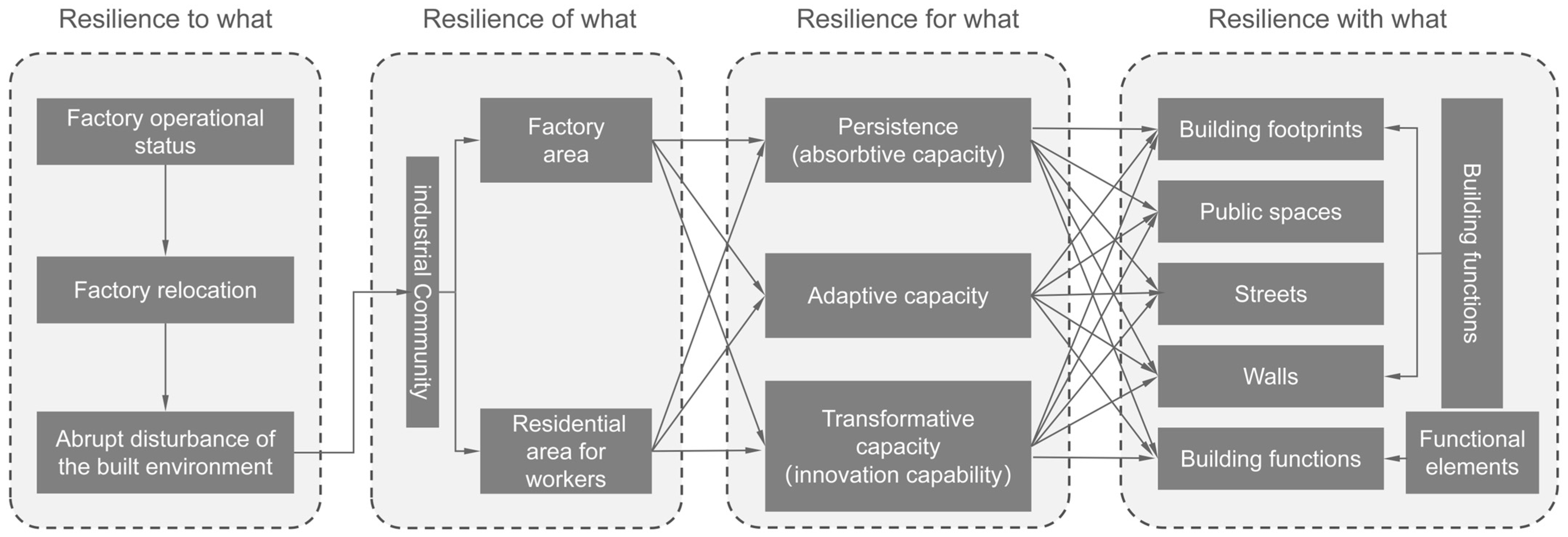
2.4. Analytical Framework
3. Materials and Methods
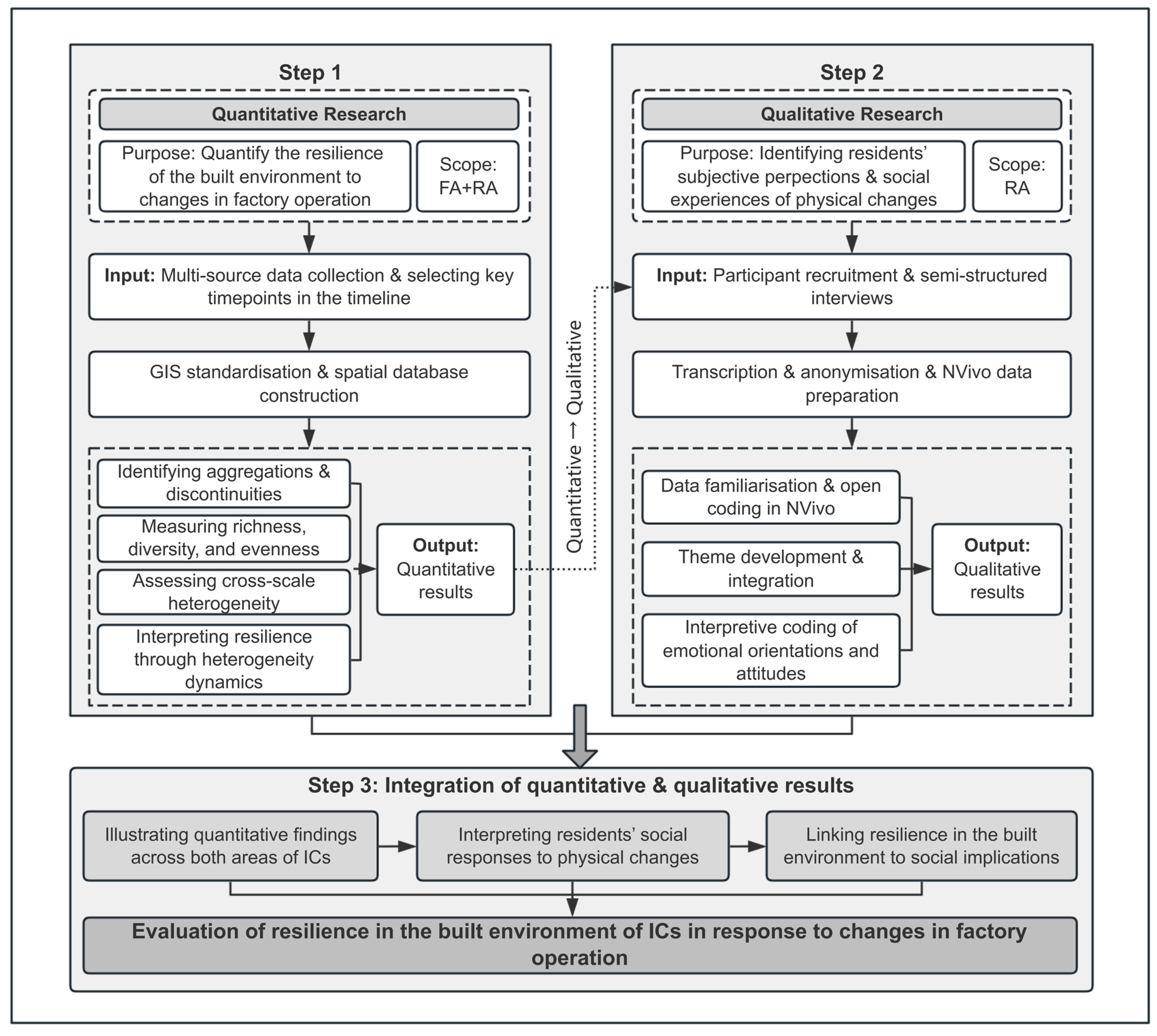
3.1. Research Design
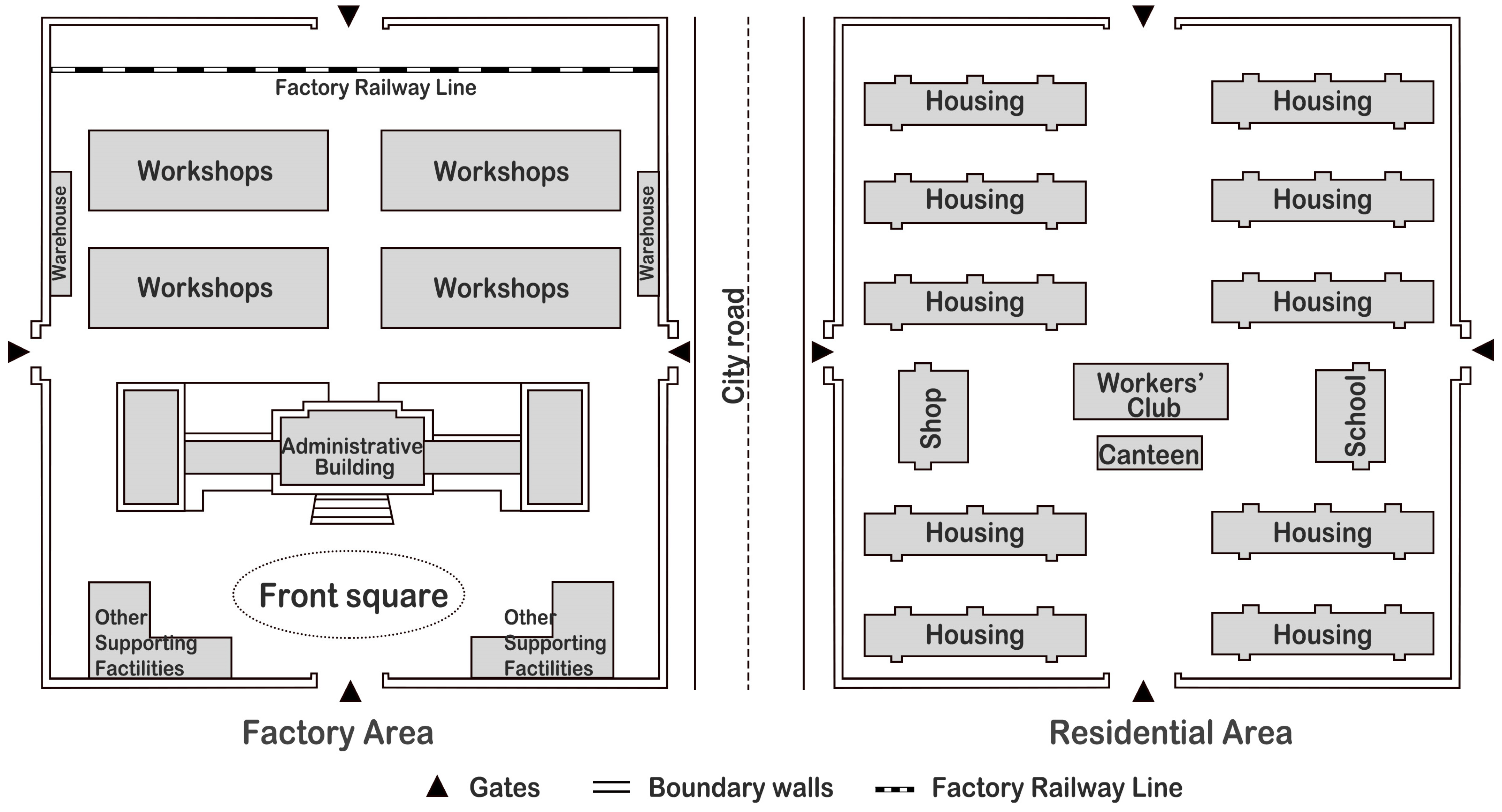
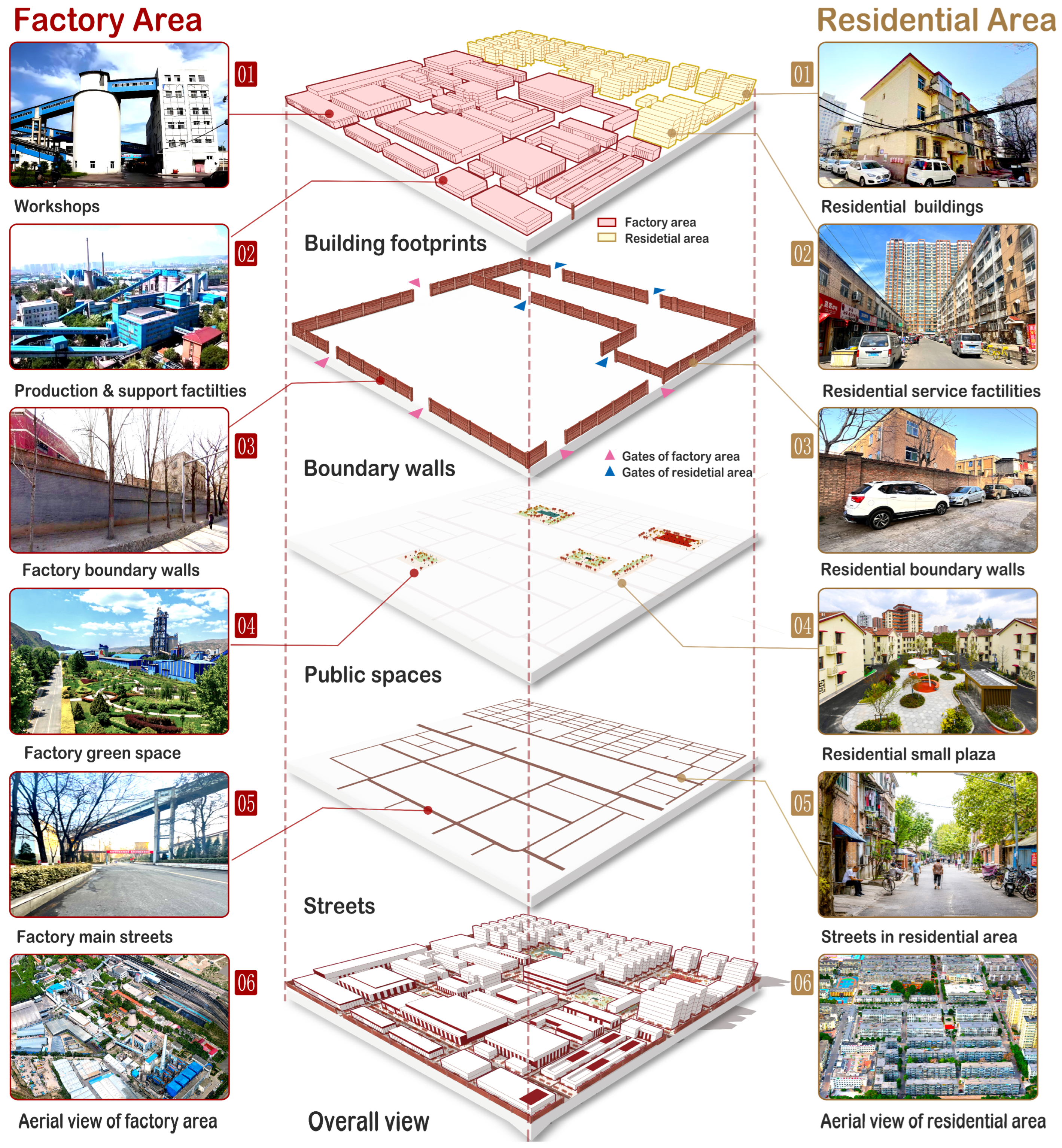
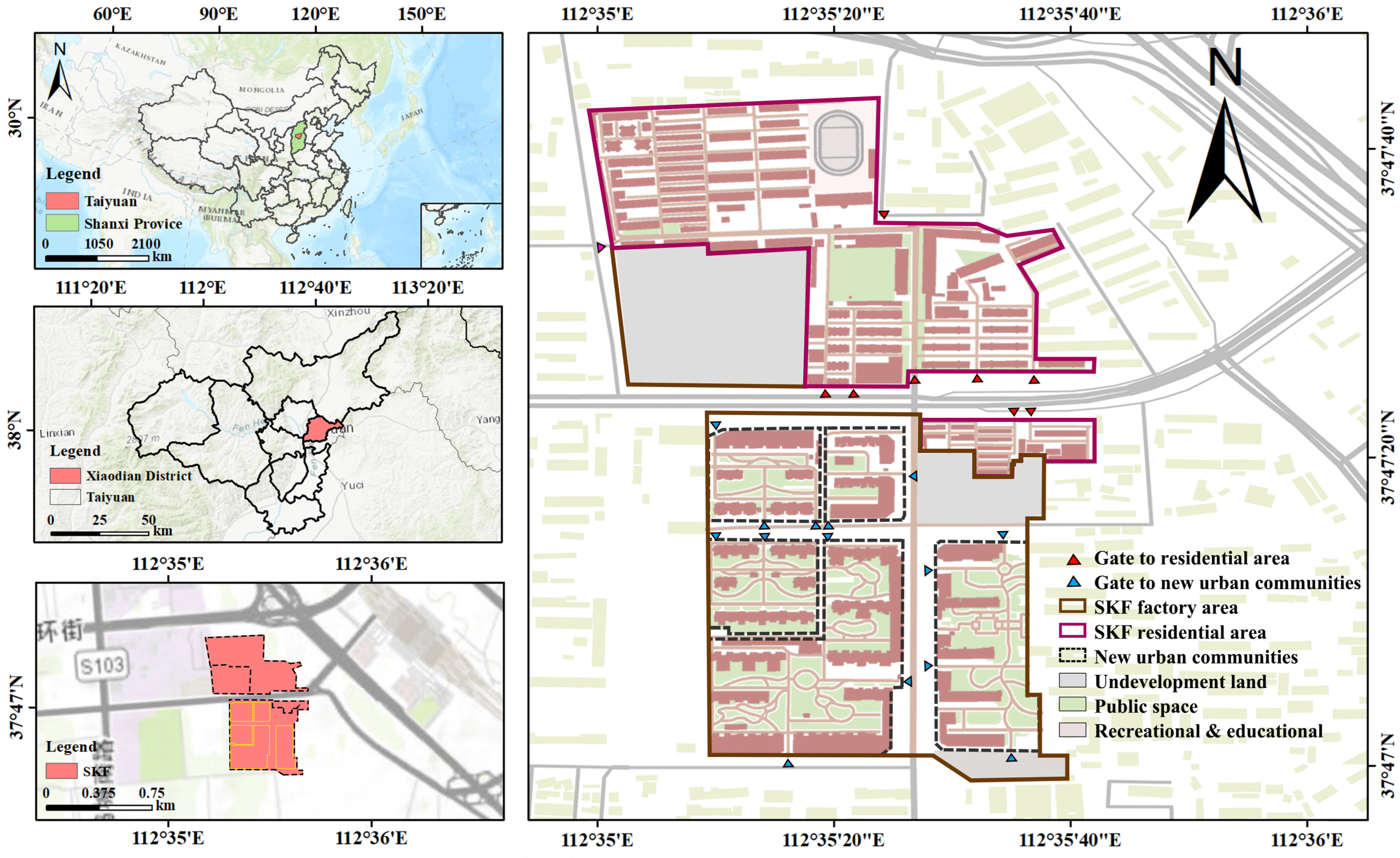
3.2. Case Study Introduction
3.3. Data Collection
3.4. Research Methods
3.4.1. Quantitative Methods
- (1)
- Identification of aggregations and discontinuities
- (2)
- Measurement of Richness, Diversity, and Evenness
- Richness
- b.
- Diversity
- c.
- Evenness
- (3)
- Assessing heterogeneity in the built environment
- (4)
- Interpreting resilience capacities through heterogeneity dynamics
3.4.2. Qualitative Methods
3.4.3. Integrating Quantitative and Qualitative Findings
4. Results
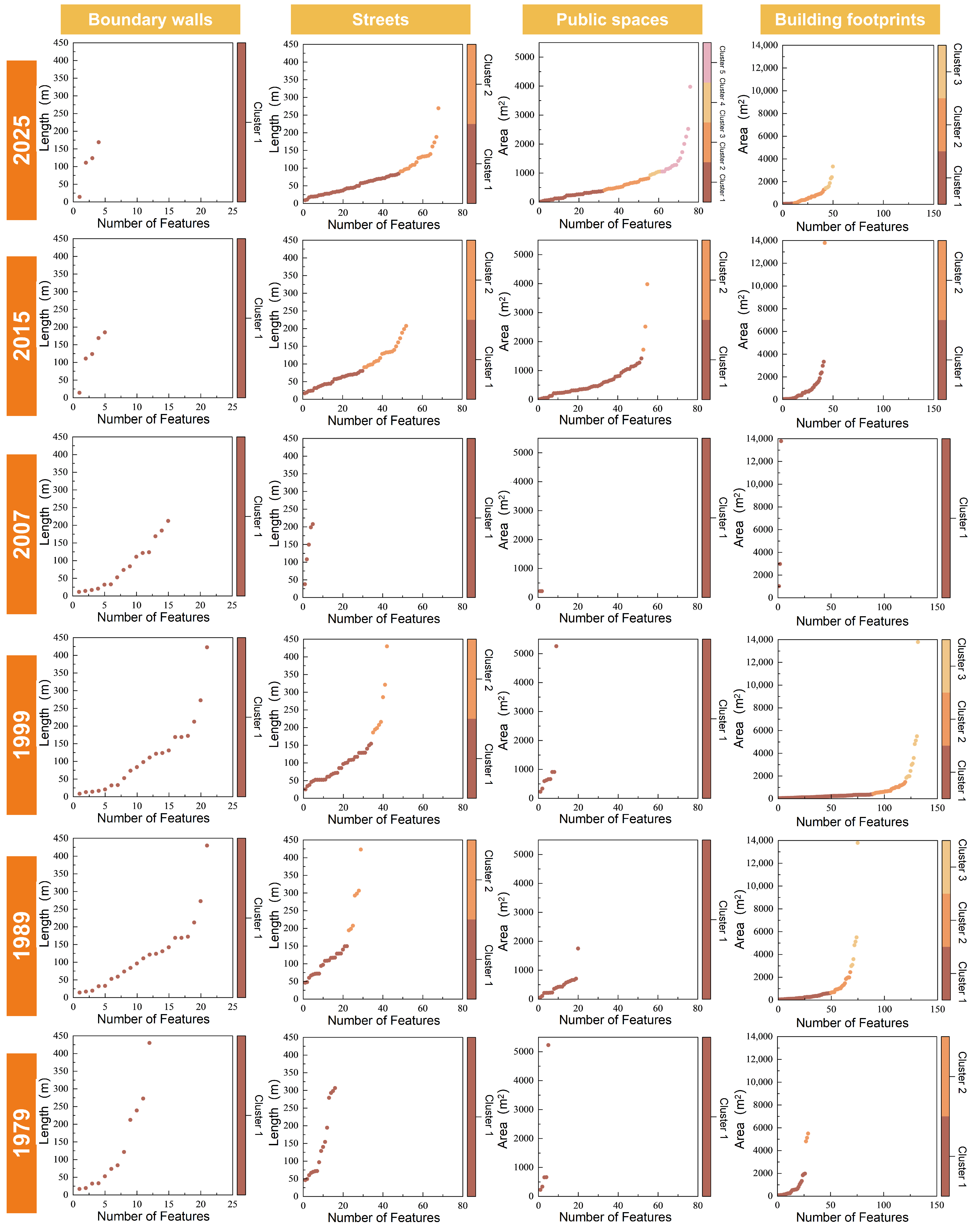
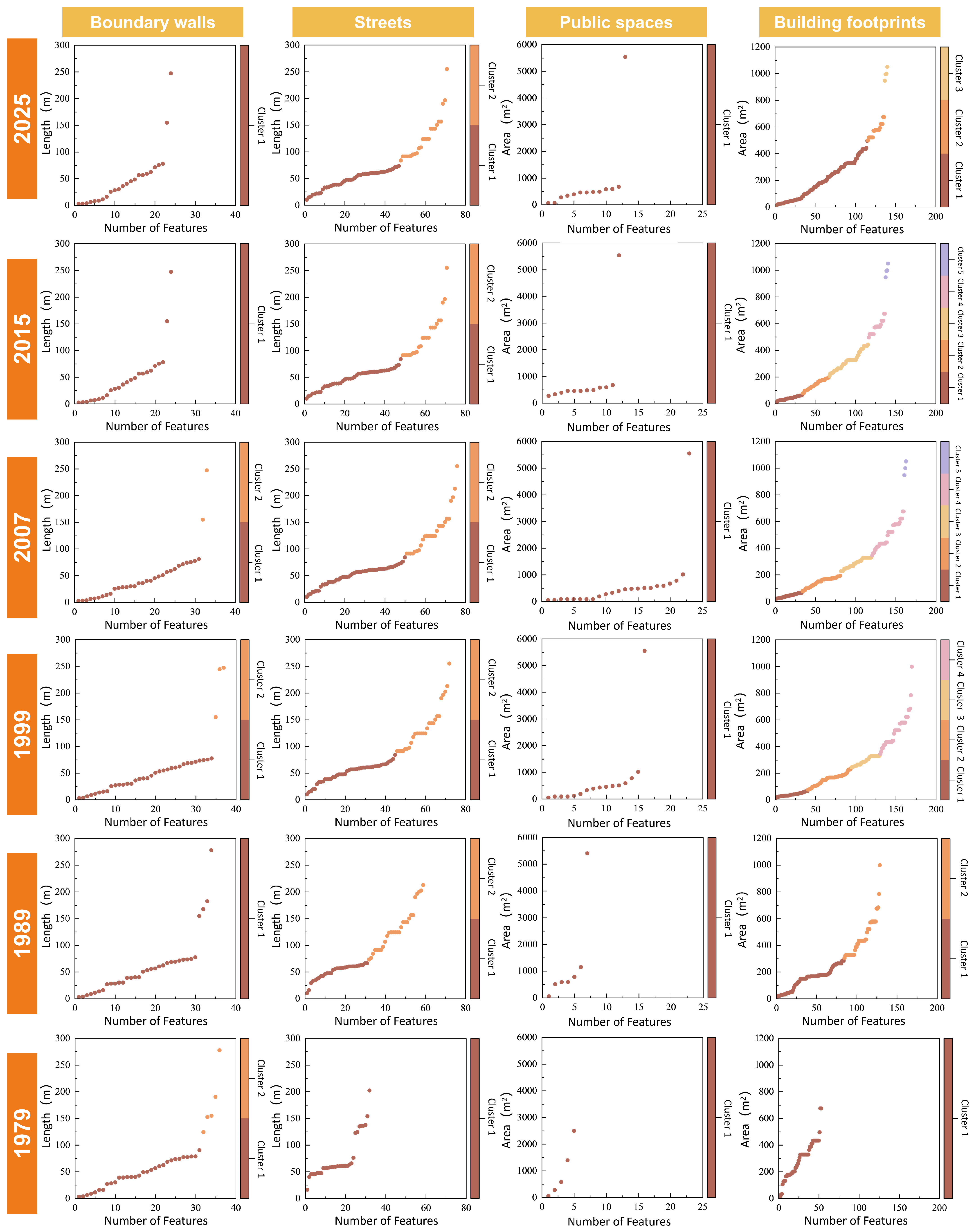
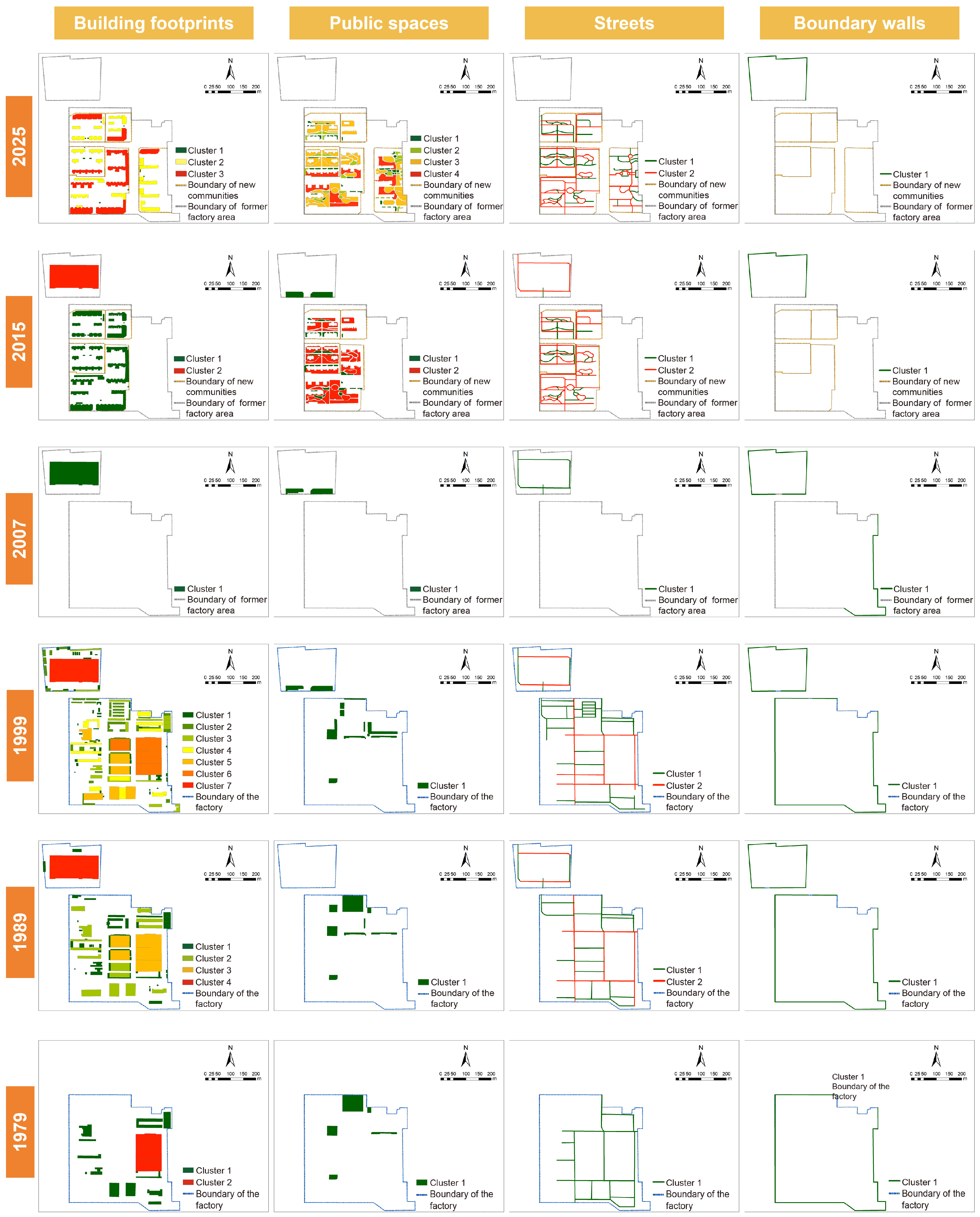
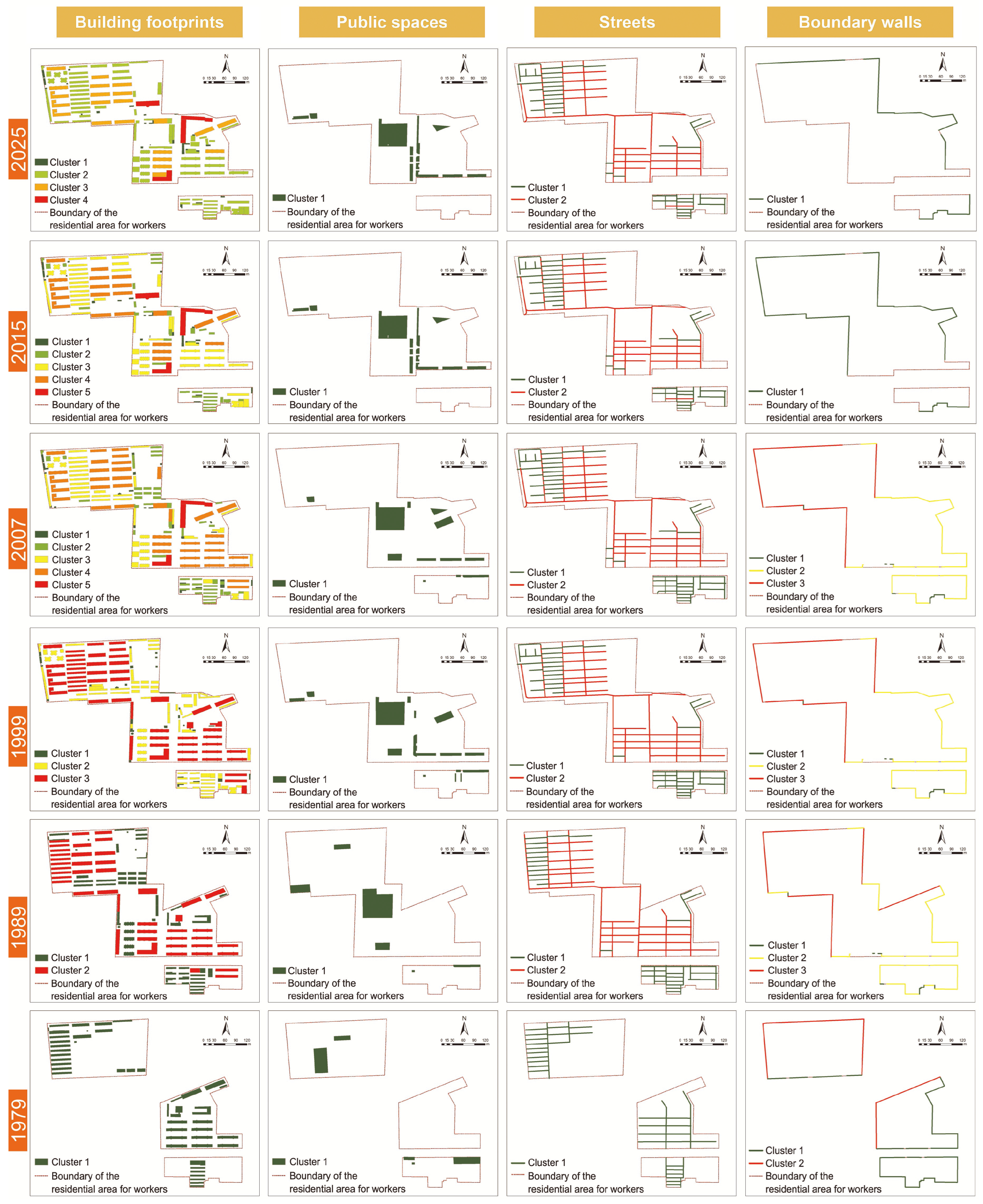
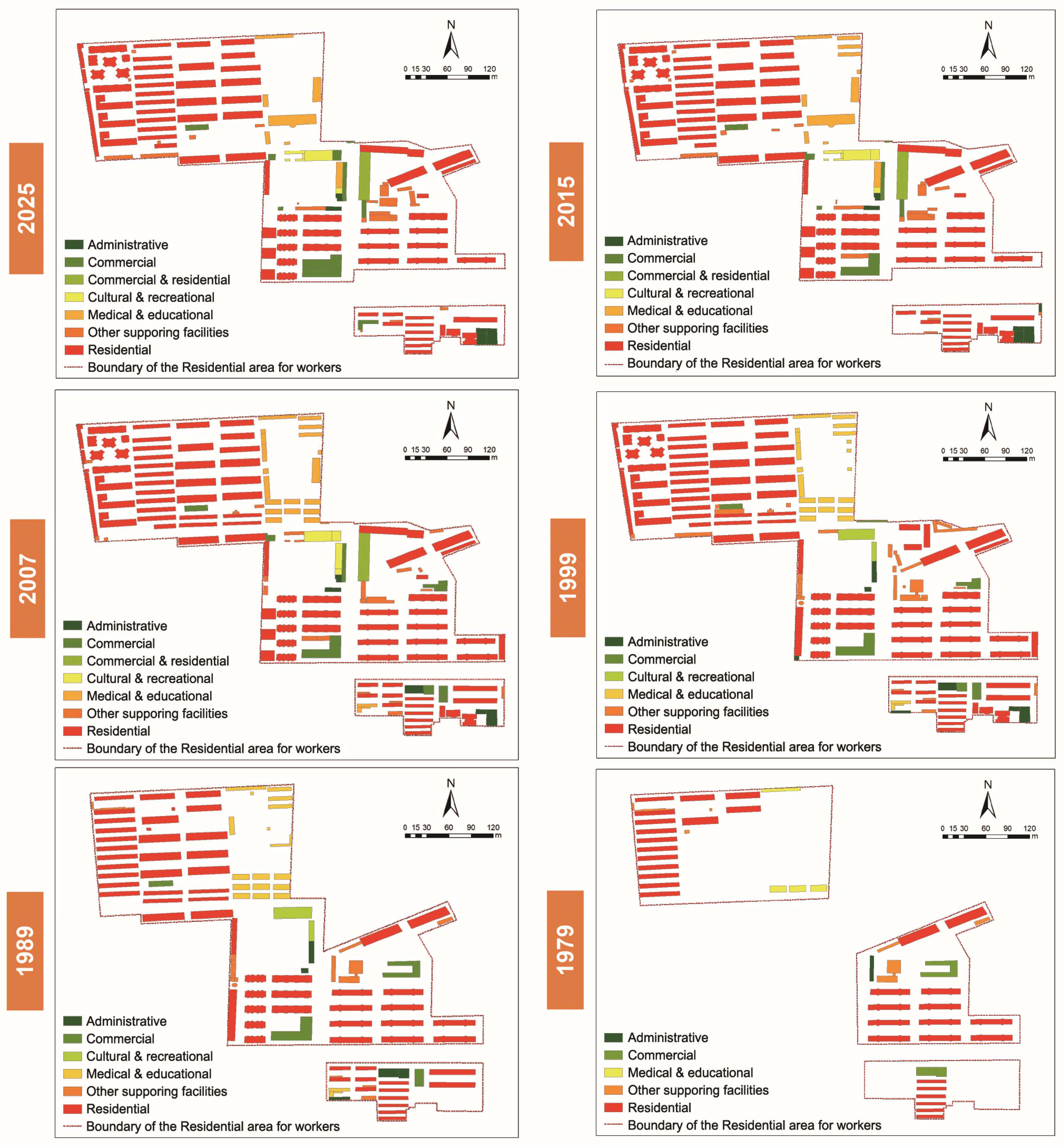
4.1. Aggregations and Discontinuities in the Built Environment
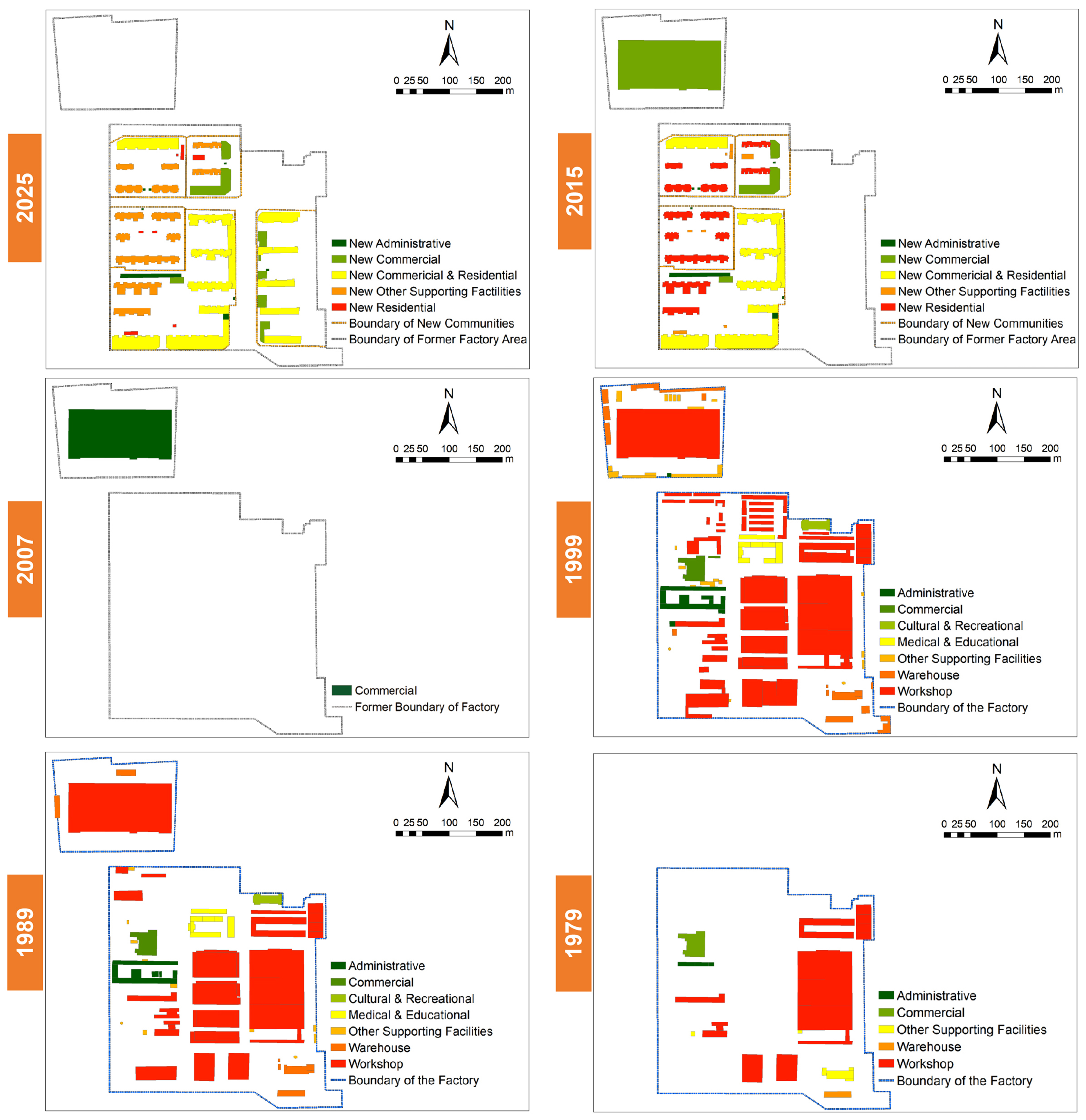
4.1.1. Factory Area
4.1.2. Residential Areas for Workers
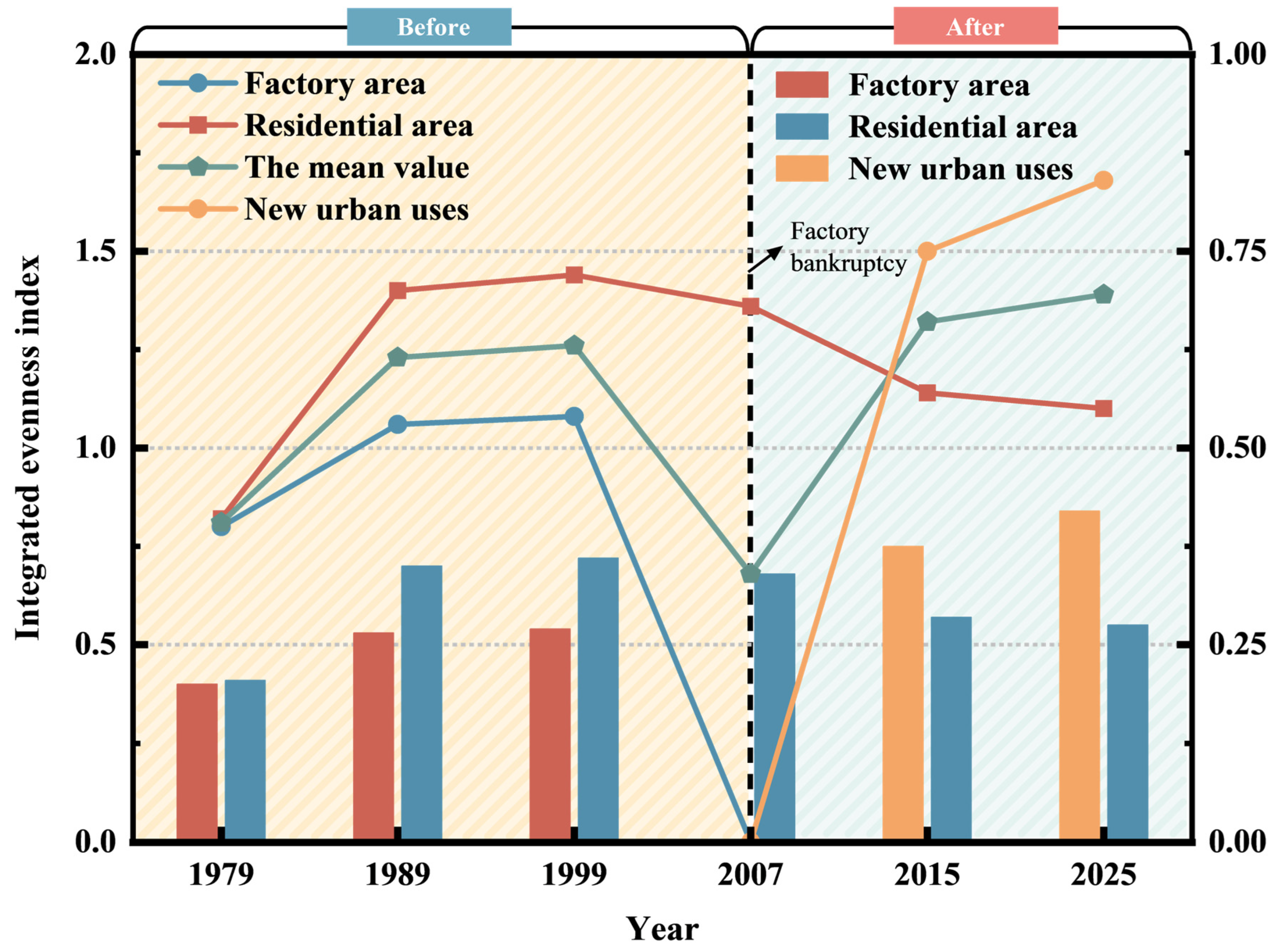
4.2. Richness, Diversity, and Evenness of the Built Environment
4.3. Structural and Functional Heterogeneity in the Built Environment
4.4. Subjective Perceptions and Social Experiences of Residents
5. Discussion
5.1. Factory Area: Collapse and Transformability
5.2. Residential Area for Workers: Persistence but Declining Adaptability
5.3. Weakening Adaptability in the Built Environment and Its Negative Social Implications in the Residential Area
6. Conclusions
Author Contributions
Funding
Institutional Review Board Statement
Informed Consent Statement
Data Availability Statement
Conflicts of Interest
Appendix A
- Semi-Structured Interview
- SECTION I—INTRODUCTION TO THE RESEARCH
- Research Topic:
- Research Aim:
- Research Focus:
- SECTION II—PARTICIPANT BACKGROUND INFORMATION
- Participant code
- Gender
- Age range
- Former occupation in the SKF factory
- Approximate period of employment in the factory
- Approximate period of residence in the residential area
- SECTION III—SUBJECTIVE PERCEPTIONS OF CHANGES IN THE BUILT ENVIRONMENT
- Looking back, when did you begin to notice clear changes in the SKF residential area?
- How do you think the built environment of the residential area has changed since the factory bankruptcy?
- How would you describe changes in the condition of the residential buildings?
- How have building functions and everyday service facilities changed over time?
- How have public spaces in the residential area changed?
- How have the streets and internal roads changed?
- Have there been any changes in walls, gates, fences, or the openness of the residential area? How do you feel about these changes?
- Which physical changes have affected your daily life most strongly, and why?
- SECTION IV—SOCIAL EXPERIENCES ASSOCIATED WITH THESE CHANGES
- 9.
- Before its bankruptcy, what did the SKF factory mean to you?Prompts: work, income, welfare, status, reputation
- 10.
- After the factory bankruptcy, did you still feel that you were part of SKF or belonged to the same collective life as before? Why or why not?
- 11.
- Do you think factory bankruptcy changed relationships among neighbours in the residential area? If so, in what ways?Prompts: resident turnover, familiarity, trust, mutual support, security
- 12.
- Do you think changes in the built environment after factory bankruptcy affected how neighbours interacted with one another? Why or why not?Prompts: public spaces, service facilities, opportunities for interaction
- 13.
- After the factory bankruptcy, did you still feel that the SKF residential area was a place where you belonged in the same way as before? Why or why not?Prompts: memories, daily routines, family life, intention to stay
- 14.
- Do you think changes in the built environment after factory bankruptcy affected your attachment to the SKF residential area? Why or why not?Prompts: housing condition, service facilities, living convenience, overall environment
- SECTION V—PERCEPTIONS OF MANAGEMENT AND MAINTENANCE CHANGES
- 15.
- How was the residential area managed and maintained by the SKF factory in the past? Do you think it worked well?
- 16.
- After the factory bankruptcy, who became responsible for managing and maintaining the residential area, and how did these arrangements change? Do you think they worked well?
- 17.
- What kinds of changes in management, maintenance, or services do you think are most needed in the future?
References
- Bray, D. Social Space and Governance in Urban China: The Danwei System from Origins to Reform; Stanford University Press: Stanford, CA, USA, 2005. [Google Scholar]
- Naughton, B. Danwei: The economic foundations of a unique institution. In The Danwei; Routledge: Abingdon, UK, 2015; pp. 169–194. [Google Scholar]
- Chai, Y. From socialist danwei to new danwei: A daily-life-based framework for sustainable development in urban China. Asian Geogr. 2014, 31, 183–190. [Google Scholar] [CrossRef]
- Bjorklund, E.M. The Danwei: Socio-Spatial Characteristics of Work Units in China’s Urban Society. Econ. Geogr. 1986, 62, 19–29. [Google Scholar] [CrossRef]
- Zhang, C.; Chai, Y. Un-gated and integrated work unit communities in post-socialist urban China: A case study from Beijing. Habitat Int. 2014, 43, 79–89. [Google Scholar] [CrossRef]
- Deng, K.; Song, F. Urban Industrial Zone Renewal and Spatial Game in China. Cities Assem. 2022, 3, 451–462. [Google Scholar] [CrossRef]
- He, C.; Wei, Y.D.; Xie, X. Globalization, institutional change, and industrial location: Economic transition and industrial concentration in China. Reg. Stud. 2008, 42, 923–945. [Google Scholar] [CrossRef]
- Gao, J.; Yuan, F. Economic transition, firm dynamics, and restructuring of manufacturing spaces in urban China: Empirical evidence from Nanjing. Prof. Geogr. 2017, 69, 504–519. [Google Scholar] [CrossRef]
- Lu, D. Danwei and Socialist Urbanism. In Routledge Handbook of Chinese Architecture; Routledge: Abingdon, UK, 2022; pp. 348–366. [Google Scholar]
- Bian, Y.; Logan, J.R.; Lu, H.; Pan, Y.; Guan, Y. Work units and housing reform in two Chinese cities. In The Danwei; Routledge: Abingdon, UK, 2015; pp. 223–250. [Google Scholar] [CrossRef]
- Zhang, M.; Zhang, T.; Xiao, Z.; Chai, Y. Property rights redistribution and the spatial evolution of the Chinese danwei compound: A case study in Beijing. J. Hous. Built Environ. 2021, 36, 1585–1602. [Google Scholar] [CrossRef]
- Ye, N.; Kita, M.; Matsubara, S.; Okyere, S.A.; Shimoda, M. Socio-Spatial changes in Danwei Neighbourhoods: A case study of the AMS Danwei compound in Hefei, China. Urban Sci. 2021, 5, 35. [Google Scholar] [CrossRef]
- Yue, L.; Peiling, Z. Understanding Why People Complain: Using Spatial Embeddedness to Explore Residents’ Satisfaction in China’s Danwei Neighborhood Renovation. China City Plan. Rev. 2024, 33, 51–61. [Google Scholar] [CrossRef]
- Li, X.; Kleinhans, R.; van Ham, M. Ambivalence in place attachment: The lived experiences of residents in danwei communities facing demolition in Shenyang, China. Hous. Stud. 2019, 34, 997–1020. [Google Scholar] [CrossRef]
- Liu, S.V. “Social positions”: Neighborhood transitions after danwei. In Working in China; Routledge: Abingdon, UK, 2006; pp. 38–55. [Google Scholar] [CrossRef]
- Holling, C.S. Resilience and stability of ecological systems. Annu. Rev. Ecol. Syst. 1973, 4, 1–23. [Google Scholar] [CrossRef]
- Walker, B.; Holling, C.S.; Carpenter, S.R.; Kinzig, A. Resilience, adaptability and transformability in social–ecological systems. Ecol. Soc. 2004, 9, 5. [Google Scholar] [CrossRef]
- Feliciotti, A. Resilience and Urban Design. Ph.D. Thesis, University of Strathclyde, Glasgow, UK, 2018. [Google Scholar]
- Hassler, U.; Kohler, N. Resilience in the built environment. Build. Res. Inf. 2014, 42, 119–129. [Google Scholar] [CrossRef]
- Roaf, S. Building resilience in the built environment. In Architecture and Resilience; Routledge: Abingdon, UK, 2018; pp. 143–157. [Google Scholar]
- Tähtinen, L.; Toivonen, S. Expanding horizons: A framework for developing futures-oriented resilience in the built environment. Build. Res. Inf. 2025, 53, 281–304. [Google Scholar] [CrossRef]
- UN-Habitat. Annual Report 2021; United Nations Human Settlements Programme: Nairobi, Kenya, 2022; pp. 240–243. Available online: https://unhabitat.org/annual-report-2021 (accessed on 1 June 2026).
- Dinius, O.J.A.V. Company Towns in the Americas: Landscape, Power, and Working-Class Communities; University of Georgia Press: Athens, Georgia, 2011. [Google Scholar]
- Jacoby, S. Urban Design and Spatialised Governmentality: Collective Forms in China. In The Socio-Spatial Design of Community and Governance: Interdisciplinary Urban Design in China; Jacoby, S., Cheng, J., Eds.; Springer: Singapore, 2020; pp. 3–15. [Google Scholar] [CrossRef]
- Bonino, M.; De Pieri, F. Beijing Danwei: Industrial Heritage in the Contemporary City; Jovis: Berlin, Germany, 2015. [Google Scholar]
- Davoudi, S.; Porter, L. Urban resilience: What does it mean in planning practice. Plan. Theory Pract. 2012, 13, 299–333. [Google Scholar] [CrossRef]
- Pimm, S.L. The complexity and stability of ecosystems. Nature 1984, 307, 321–326. [Google Scholar] [CrossRef]
- Holling, C.S. Engineering resilience versus ecological resilience. Eng. Within Ecol. Constraints 1996, 31, 32. [Google Scholar]
- Béné, C.; Doyen, L. From resistance to transformation: A generic metric of resilience through viability. Earth’s Future 2018, 6, 979–996. [Google Scholar] [CrossRef]
- Folke, C.; Carpenter, S.R.; Walker, B.; Scheffer, M.; Chapin, T.; Rockström, J. Resilience thinking: Integrating resilience, adaptability and transformability. Ecol. Soc. 2010, 15, 20. [Google Scholar] [CrossRef]
- Holling, C.S.; Gunderson, L.H. Resilience and Adaptive Cycles; Island Press: Washington, DC, USA, 2002; Available online: https://hdl.handle.net/10919/67621 (accessed on 1 June 2026).
- Holling, C.S.; Goldberg, M.A. Ecology and planning. J. Am. Inst. Plan. 1971, 37, 221–230. [Google Scholar] [CrossRef]
- Kropf, K. Ambiguity in the definition of built form. Urban Morphol. 2014, 18, 41–57. [Google Scholar] [CrossRef]
- Garcia, E.J. The Application of Ecological Resilience to Urban Landscapes. Ph.D. Thesis, Victoria University of Wellington, Wellington, New Zealand, 2013. Available online: https://openaccess.wgtn.ac.nz/articles/thesis/The_Application_of_Ecological_Resilience_to_Urban_Landscapes/17005870/1/files/31458952.pdf (accessed on 1 June 2026).
- Holling, C.S. Cross-scale morphology, geometry, and dynamics of ecosystems. Ecol. Monogr. 1992, 62, 447–502. [Google Scholar]
- Holling, C.S.; Allen, C.R. Adaptive inference for distinguishing credible from incredible patterns in nature. Ecosystems 2002, 5, 319–328. [Google Scholar] [CrossRef]
- Allen, C.R.; Gunderson, L.; Johnson, A. The use of discontinuities and functional groups to assess relative resilience in complex systems. Ecosystems 2005, 8, 958–966. [Google Scholar] [CrossRef]
- Gunderson, L.H. Ecological resilience—In theory and application. Annu. Rev. Ecol. Syst. 2000, 31, 425–439. [Google Scholar] [CrossRef]
- Peterson, G.; Allen, C.R.; Holling, C.S. Ecological resilience, biodiversity, and scale. Ecosystems 1998, 1, 6–18. [Google Scholar] [CrossRef]
- Garmestani, A.S.; Allen, C.R.; Gallagher, C.M. Power laws, discontinuities and regional city size distributions. J. Econ. Behav. Organ. 2008, 68, 209–216. [Google Scholar] [CrossRef]
- Garcia, E.J.; Vale, B. Unravelling Sustainability and Resilience in the Built Environment; Routledge: Abingdon, UK, 2017. [Google Scholar] [CrossRef]
- Ensor, J.E.; Park, S.E.; Attwood, S.; Kaminski, A.M.; Johnson, J.E. Can community-based adaptation increase resilience? Clim. Dev. 2018, 10, 134–151. [Google Scholar] [CrossRef]
- Pingault, N.; Martius, C. Resilience Thinking: A Review of Key Concepts; CIFOR-ICRAF: Nairobi, Kenya, 2024. [Google Scholar] [CrossRef]
- Norberg, J.; Wilson, J.; Walker, B.; Ostrom, E. Diversity and resilience of social-ecological systems. In Complexity Theory for a Sustainable Future; Columbia University Press: New York, NY, USA, 2008; pp. 46–80. [Google Scholar]
- Folke, C.; Colding, J.; Olsson, P.; Hahn, T. Interdependent social-ecological systems and adaptive governance for ecosystem services. In The Sage Handbook of Environment and Society; Sage Publications: Thousand Oaks, CA, USA, 2007; pp. 536–552. Available online: https://www.researchgate.net/profile/Thomas-Hahn-5/publication/327574540_Interdependent_Social-Ecological_Systems_and_Adaptive_Governance_for_Ecosystem_Services/links/5b97aec3a6fdcc59bf833b06/Interdependent-Social-Ecological-Systems-and-Adaptive-Governance-for-Ecosystem-Services.pdf (accessed on 1 June 2026).
- Szabo, P.; Meszéna, G. Spatial ecological hierarchies: Coexistence on heterogeneous landscapes via scale niche diversification. Ecosystems 2006, 9, 1009–1016. [Google Scholar] [CrossRef]
- Levine, N.M.; Zhang, K.; Longo, M.; Baccini, A.; Phillips, O.L.; Lewis, S.L.; Alvarez-Dávila, E.; Segalin de Andrade, A.C.; Brienen, R.J.; Erwin, T.L. Ecosystem heterogeneity determines the ecological resilience of the Amazon to climate change. Proc. Natl. Acad. Sci. USA 2016, 113, 793–797. [Google Scholar] [CrossRef]
- Sharifi, A.; Yamagata, Y. Resilience-oriented urban planning. In Resilience-Oriented Urban Planning: Theoretical and Empirical Insights; Springer: Berlin/Heidelberg, Germany, 2018; pp. 3–27. [Google Scholar] [CrossRef]
- Spellerberg, I.F.; Fedor, P.J. A tribute to Claude Shannon (1916–2001) and a plea for more rigorous use of species richness, species diversity and the ‘Shannon–Wiener’Index. Glob. Ecol. Biogeogr. 2003, 12, 177–179. [Google Scholar] [CrossRef]
- Braun, V.; Clarke, V. Conceptual and design thinking for thematic analysis. Qual. Psychol. 2022, 9, 3. [Google Scholar] [CrossRef]
- Garcia, E.; Vale, B.; Vale, R. Collapsing Gracefully: Making a Built Environment That Is Fit for the Future; Springer: Berlin/Heidelberg, Germany, 2021; Available online: https://www.academia.edu/download/112262065/bfm_978-3-030-77783-8_2F1.pdf (accessed on 1 June 2026).
- Middleton, G.D. Understanding Collapse: Ancient History and Modern Myths; Cambridge University Press: Cambridge, UK, 2017. [Google Scholar]
- Ball, R.M. Reuse potential and vacant industrial premises: Revisiting the regeneration issue in Stoke-on-Trent. J. Prop. Res. 2002, 19, 93–110. [Google Scholar] [CrossRef]
- Hudalah, D.; Firman, T. Beyond property: Industrial estates and post-suburban transformation in Jakarta Metropolitan Region. Cities 2012, 29, 40–48. [Google Scholar] [CrossRef]
- Sailer-Fliege, U. Characteristics of post-socialist urban transformation in East Central Europe. GeoJournal 1999, 49, 7–16. [Google Scholar] [CrossRef]
- Botcherby, P. Community, De-Industrialisation, and Post-Industrial Regeneration in a Merseyside Town: St. Helens, 1968–2018; University of Warwick: Coventry, UK, 2021. Available online: https://wrap.warwick.ac.uk/id/eprint/168798/1/WRAP_Theses_Botcherby_2021.pdf (accessed on 1 June 2026).
- Mah, A. Industrial Ruination, Community and Place: Landscapes and Legacies of Urban Decline; University of Toronto Press: Toronto, ON, Canada, 2012; Available online: https://wrap.warwick.ac.uk/id/eprint/67057/1/WRAP_0974301-so-160315-industrial_ruination_chapter_1_mah.pdf (accessed on 1 June 2026).





| Resilience Capacity | Definition | System Behaviour |
|---|---|---|
| Persistence | Capacity to absorb disturbance while maintaining key structures and functions | Buffering, maintaining continuity |
| Adaptability | Capacity to adjust spatial or functional arrangements in response to change without altering the basic system identity | Adjusting, learning, reorganising |
| Transformability | Capacity to create a fundamentally new configuration when the existing system can no longer be sustained | Threshold crossing, reconfiguration, renewal |
| Interviewee Code | Gender | Age | Former Employment Role at SKF | First Year at SKF | Residential Area |
|---|---|---|---|---|---|
| A1-01 | Female | 60 | Garment sewing worker | 1983 | No. 3, Beiwu Lane |
| A1-02 | Female | 69 | Knitting workshop worker | 1970 | No. 13, Beisan Lane |
| A1-03 | Male | 62 | Machine repair technician | 1981 | No. 5, Beier Lane |
| A1-04 | Female | 56 | Underwear workshop worker | 1985 | New Small 2-story Building, Linyi Lane |
| A1-05 | Male | 61 | Workshop administrative staff | 1988 | Building 1, Lin’er Lane |
| A1-06 | Male | 59 | Warehouse keeper | 1989 | Building 7, Lin’er Lane |
| A1-07 | Male | 83 | Equipment maintenance technician | 1965 | No. 3, Row 3, Bungalows |
| A1-08 | Female | 79 | Office administrative staff | 1959 | No. 1, Linyi Lane |
| Year | Element | Factory Area | Residential Areas for Workers | ||||||
|---|---|---|---|---|---|---|---|---|---|
| Features | Richness | Diversity | Evenness | Features | Richness | Diversity | Evenness | ||
| 2025 | BF | 50 | 3.00 | 0.99 | 0.90 | 140 | 4.00 | 1.05 | 0.76 |
| PS | 102 | 4.00 | 1.26 | 0.91 | 14 | 1.00 | 0.00 | 0.00 | |
| ST | 78 | 2.00 | 0.67 | 0.97 | 69 | 2.00 | 1.05 | 0.93 | |
| BW | 5 | 1.00 | 0.00 | 0.00 | 22 | 1.00 | 0.00 | 0.00 | |
| 2015 | BF | 40 | 2.00 | 0.12 | 0.17 | 141 | 5.00 | 1.43 | 0.89 |
| PS | 71 | 2.00 | 0.69 | 0.99 | 14 | 1.00 | 0.00 | 0.00 | |
| ST | 64 | 2.00 | 0.69 | 0.99 | 69 | 2.00 | 0.64 | 0.93 | |
| BW | 5 | 1.00 | 0.00 | 0.00 | 24 | 1.00 | 0.00 | 0.00 | |
| 2007 | BF | 1 | 1.00 | 0.00 | 0.00 | 163 | 5.00 | 1.44 | 0.90 |
| PS | 2 | 1.00 | 0.00 | 0.00 | 23 | 1.00 | 0.00 | 0.00 | |
| ST | 4 | 1.00 | 0.00 | 0.00 | 74 | 2.00 | 0.66 | 0.95 | |
| BW | 16 | 1.00 | 0.00 | 0.00 | 41 | 3.00 | 0.93 | 0.84 | |
| 1999 | BF | 134 | 7.00 | 1.49 | 0.76 | 171 | 3.00 | 1.06 | 0.97 |
| PS | 12 | 1.00 | 0.00 | 0.00 | 16 | 1.00 | 0.00 | 0.00 | |
| ST | 42 | 2.00 | 0.49 | 0.70 | 69 | 2.00 | 0.66 | 0.96 | |
| BW | 98 | 2.00 | 0.00 | 0.00 | 41 | 3.00 | 0.93 | 0.84 | |
| 1989 | BF | 73 | 4.00 | 1.00 | 0.57 | 129 | 2.00 | 0.65 | 0.93 |
| PS | 8 | 1.00 | 0.00 | 0.00 | 7 | 1.00 | 0.00 | 0.00 | |
| ST | 29 | 2.00 | 0.55 | 0.80 | 59 | 2.00 | 0.69 | 1.00 | |
| BW | 21 | 1.00 | 0.00 | 0.00 | 40 | 3.00 | 0.94 | 0.85 | |
| 1979 | BF | 29 | 2.00 | 0.33 | 0.48 | 53 | 1.00 | 0.00 | 0.00 |
| PS | 5 | 1.00 | 0.00 | 0.00 | 5 | 1.00 | 0.00 | 0.00 | |
| ST | 16 | 1.00 | 0.00 | 0.00 | 32 | 1.00 | 0.00 | 0.00 | |
| BW | 12 | 1.00 | 0.00 | 0.00 | 36 | 2.00 | 0.40 | 0.58 | |
| Year | Factory Area | Residential Areas for Workers | ||||||
|---|---|---|---|---|---|---|---|---|
| Features | Richness | Diversity | Evenness | Features | Richness | Diversity | Evenness | |
| 2025 | 50 | 5.00 | 1.58 | 0.98 | 140 | 7.00 | 1.30 | 0.67 |
| 2015 | 40 | 5.00 | 1.54 | 0.96 | 141 | 7.00 | 1.34 | 0.69 |
| 2007 | 1 | 1.00 | 0.00 | 0.00 | 163 | 7.00 | 1.32 | 0.68 |
| 1999 | 134 | 7.00 | 1.38 | 0.71 | 171 | 6.00 | 1.30 | 0.74 |
| 1989 | 73 | 7.00 | 1.41 | 0.72 | 129 | 6.00 | 1.27 | 0.71 |
| 1979 | 29 | 5.00 | 1.09 | 0.68 | 53 | 5.00 | 1.10 | 0.68 |
| Year | Structural Dimension | Functional Dimension | Integrated Dimension | ||||||
|---|---|---|---|---|---|---|---|---|---|
| Richness | Diversity | Evenness | Richness | Diversity | Evenness | Richness | Diversity | Evenness | |
| 2025 | 2.50 | 0.73 | 0.69 | 5.00 | 1.58 | 0.98 | 3.75 | 1.16 | 0.84 |
| 2015 | 1.75 | 0.37 | 0.54 | 5.00 | 1.54 | 0.96 | 3.38 | 0.96 | 0.75 |
| 2007 | 1.00 | 0.00 | 0.00 | 1.00 | 0.00 | 0.00 | 1.00 | 0.00 | 0.00 |
| 1999 | 3.00 | 0.49 | 0.37 | 7.00 | 1.38 | 0.71 | 5.00 | 0.94 | 0.54 |
| 1989 | 2.00 | 0.39 | 0.34 | 7.00 | 1.41 | 0.72 | 4.50 | 0.90 | 0.53 |
| 1979 | 1.25 | 0.08 | 0.12 | 5.00 | 1.09 | 0.68 | 3.13 | 0.59 | 0.40 |
| Year | Structural Dimension | Functional Dimension | Integrated Dimension | ||||||
|---|---|---|---|---|---|---|---|---|---|
| Richness | Diversity | Evenness | Richness | Diversity | Evenness | Richness | Diversity | Evenness | |
| 2025 | 2.00 | 0.52 | 0.42 | 7.00 | 1.30 | 0.67 | 4.50 | 0.91 | 0.55 |
| 2015 | 2.25 | 0.52 | 0.46 | 7.00 | 1.34 | 0.69 | 4.63 | 0.93 | 0.57 |
| 2007 | 2.75 | 0.76 | 0.67 | 7.00 | 1.32 | 0.68 | 4.88 | 1.04 | 0.68 |
| 1999 | 2.25 | 0.66 | 0.69 | 6.00 | 1.30 | 0.74 | 4.13 | 0.98 | 0.72 |
| 1989 | 2.00 | 0.57 | 0.70 | 6.00 | 1.27 | 0.71 | 4.00 | 0.92 | 0.70 |
| 1979 | 1.25 | 0.10 | 0.15 | 5.00 | 1.10 | 0.68 | 3.13 | 0.60 | 0.41 |
Disclaimer/Publisher’s Note: The statements, opinions and data contained in all publications are solely those of the individual author(s) and contributor(s) and not of MDPI and/or the editor(s). MDPI and/or the editor(s) disclaim responsibility for any injury to people or property resulting from any ideas, methods, instructions or products referred to in the content. |
© 2026 by the authors. Licensee MDPI, Basel, Switzerland. This article is an open access article distributed under the terms and conditions of the Creative Commons Attribution (CC BY) license.
Share and Cite
Hu, Y.; Garcia, E.J.; Oswald, F. Resilience in the Built Environment of the Industrial Community in Response to Factory Bankruptcy: A Case Study on Shanxi Knitting Factory, Taiyuan, China. Buildings 2026, 16, 2278. https://doi.org/10.3390/buildings16112278
Hu Y, Garcia EJ, Oswald F. Resilience in the Built Environment of the Industrial Community in Response to Factory Bankruptcy: A Case Study on Shanxi Knitting Factory, Taiyuan, China. Buildings. 2026; 16(11):2278. https://doi.org/10.3390/buildings16112278
Chicago/Turabian StyleHu, Ying, Emilio Jose Garcia, and Ferdinand Oswald. 2026. "Resilience in the Built Environment of the Industrial Community in Response to Factory Bankruptcy: A Case Study on Shanxi Knitting Factory, Taiyuan, China" Buildings 16, no. 11: 2278. https://doi.org/10.3390/buildings16112278
APA StyleHu, Y., Garcia, E. J., & Oswald, F. (2026). Resilience in the Built Environment of the Industrial Community in Response to Factory Bankruptcy: A Case Study on Shanxi Knitting Factory, Taiyuan, China. Buildings, 16(11), 2278. https://doi.org/10.3390/buildings16112278