1. Introduction
Benchmark learning involves identifying top performers in a field and systematically learning from them to surpass their performance. This concept has long been applied across various domains, including the building sector [
1,
2]. In architectural planning, case-based approaches are often used to guide design decisions [
3,
4], which align with the principles of benchmark learning. Therefore, this study integrates benchmark learning into architectural planning to establish a systematic framework that enhances planning strategies for street houses.
Benchmark learning has been extensively studied in civil engineering and architecture [
5], yet its application to street houses remains limited. Architects often face two critical challenges in planning: balancing conflicting objectives, often addressed through multi-objective optimization [
6,
7], and assessing planning efficiency to identify benchmarks. This study proposes a novel framework integrating multi-objective optimization with preference theory to effectively address both challenges.
Safety, economy, functionality, and aesthetics are commonly recognized as key objectives in architectural planning [
8,
9]. However, these objectives often involve inherent trade-offs. From an economic perspective, such trade-offs may arise in different forms. One common situation involves a desirable objective versus an undesirable one—for instance, improving safety may increase unit construction costs, thereby reducing economic efficiency [
10,
11]. Another situation involves trade-offs between two desirable objectives, such as functionality and aesthetics, where achieving simultaneous maximization is constrained by limited resources [
12,
13]. Balancing these conflicting objectives gives rise to a multi-objective optimization problem (MOOP). This study aims to explore solutions to both types of MOOPs. Although numerous studies have addressed multi-objective optimization in building design, these approaches primarily focus on identifying Pareto-optimal solutions and often lack mechanisms for incorporating decision-makers’ preferences into benchmarking processes. By addressing both the nature of conflicting objectives and the diversity of planning preferences, this study proposes a more adaptive and comprehensive benchmark learning approach for architectural planning.
Unlike the earlier work [
10], which focused on a two-objective framework involving safety and economy with positively sloped indifference curves, the present study extends the methodology in several significant ways. Specifically, it generalizes the framework to accommodate both positively and negatively sloped indifference curves, thereby capturing a wider range of preference structures. In addition, the number of objectives is expanded to include functionality and aesthetics, enabling the analysis of more complex architectural planning scenarios. This extension transforms the framework from a single-mode model into a dual-mode preference-based system and demonstrates its applicability to street house planning, which differs substantially from the school building context considered in the previous work.
Street houses are a common housing type in Taiwan. According to the housing survey of the Construction and Planning Agency, street houses account for approximately 49.20% of the housing stock [
14]. These low-rise buildings have suffered severe damage in major earthquakes [
15], raising public concerns about safety and economy. Meanwhile, their functionality and aesthetics often reflect the owner’s taste and social status. Owing to their cultural and structural importance, street houses have become a major focus of research, and this study concentrates on this distinctive building type.
This study integrates fuzzy sets, indifference curves, utility functions, efficient frontiers, and data envelopment analysis (DEA) to develop a comprehensive benchmark learning framework for street house planning. Fuzzy sets are applied to define architects’ preference functions, while indifference curves illustrate planning preferences under conflicting objectives. Utility functions are employed to quantify satisfaction levels, and the efficient frontier identifies optimal design cases serving as benchmarks. DEA is further used to objectively evaluate the efficiency of street houses and to construct the efficient frontier. The proposed framework is illustrated using empirical data from 627 street houses, demonstrating its effectiveness and practical applicability in architectural planning.
3. Research Methodology and Theoretical Development
From an economic perspective, multi-objective optimization problems (MOOPs) involve trade-offs between objectives, broadly categorized as (1) conflicting objectives, where improving one comes at the expense of another (e.g., safety versus cost), and (2) competing desirable objectives, where both are preferred but cannot be maximized simultaneously (e.g., functionality versus aesthetics). In this study, indifference curves represent combinations of objective values that yield equal preference levels. Accordingly, even for objectives such as cost, preference can be defined through a preference function, allowing all objectives to be consistently incorporated into the indifference curve framework. This study addresses both types of conflicts and seeks to identify suitable benchmark learning cases for street house planning.
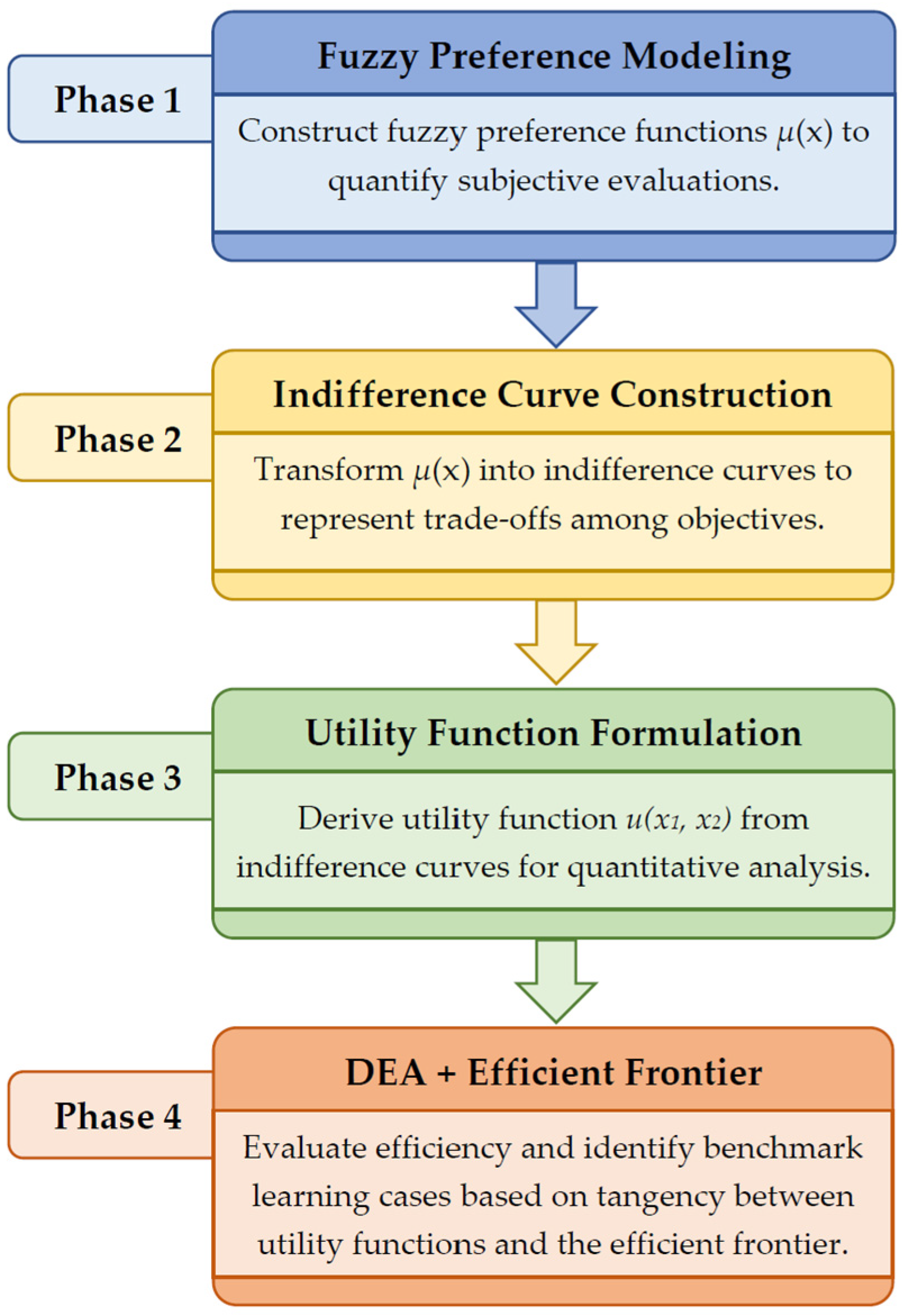
To clarify the theoretical integration of the proposed framework,
Figure 1 illustrates the logical and mathematical relationships among its key components across four sequential phases.
Phase 1: Fuzzy Preference Modelling
The derivation begins with fuzzy sets, where a membership function, μ(x), is employed to formulate a preference function. This process quantifies the architect’s subjective evaluation of an individual planning objective, transforming qualitative design intents into a quantitative mathematical domain.
Phase 2: Indifference Curve Construction
To address decision-making under conflicting objectives, these individual fuzzy preferences are mathematically translated into linear indifference curves to illustrate planning preferences. These curves represent combinations of objectives that yield equal preference levels, effectively capturing the structural trade-offs and relative importance between competing criteria.
Phase 3: Utility Function Formulation
Utility functions are subsequently employed to rigorously quantify these satisfaction levels by formalizing the previously established indifference curves. In this study, the linear indifference curves are mathematically operationalized and constructed as a linear multivariate utility function, denoted as u (x1, x2). Under this linear formulation, the indifference curves are rigorously expressed as linear contours (e.g., u (x1, x2) = k, where k is a constant utility level). By adopting this linear structure, the framework ensures a constant marginal rate of substitution (MRS) along the curves. Importantly, this mathematical formulation is highly adaptable, capable of accommodating indifference curves with either negative or positive slopes, depending strictly on the directional nature of the objectives (e.g., standard trade-offs between two beneficial criteria versus compensation between a beneficial and a cost criterion).
Phase 4: DEA + Efficient Frontier
On the performance evaluation side, Data Envelopment Analysis (DEA) is used to objectively evaluate the relative efficiency of the street houses and to mathematically construct the empirical efficient frontier. Theoretically, this frontier defines the boundary of the production possibility set, identifying the optimal design cases that act as benchmarks.
Through this integrated four-phase sequence, identifying the optimal benchmark learning case is transformed from an intuitive selection into a rigorously justified constrained optimization problem: maximizing the formulated linear utility function subject to the continuously differentiable boundary derived from the DEA-based efficient frontier. The exact optimization solution is analytically derived at the tangency point between the linear indifference contour and the frontier curve, strictly equating the constant MRS of the architect’s preference with the changing marginal rate of transformation (MRT) of the benchmark.
By integrating subjective preference representation with objective efficiency evaluation, the proposed approach provides a systematic framework to support informed decision-making in street house planning. The empirical application of this framework is based on a dataset of street house cases, which is described in detail in
Section 4.
3.1. Preference Function μ(x)
Architects often face uncertainty when planning buildings due to multiple objectives and design parameters. To address this, the study applies fuzzy numbers derived from fuzzy set theory [
48] to represent an architect’s preference for a single planning objective. A fuzzy set
A can serve as a preference function
μA(
x) if it satisfies three conditions: (1) its α-cut is a closed interval, (2) it is normal (i.e., at least one
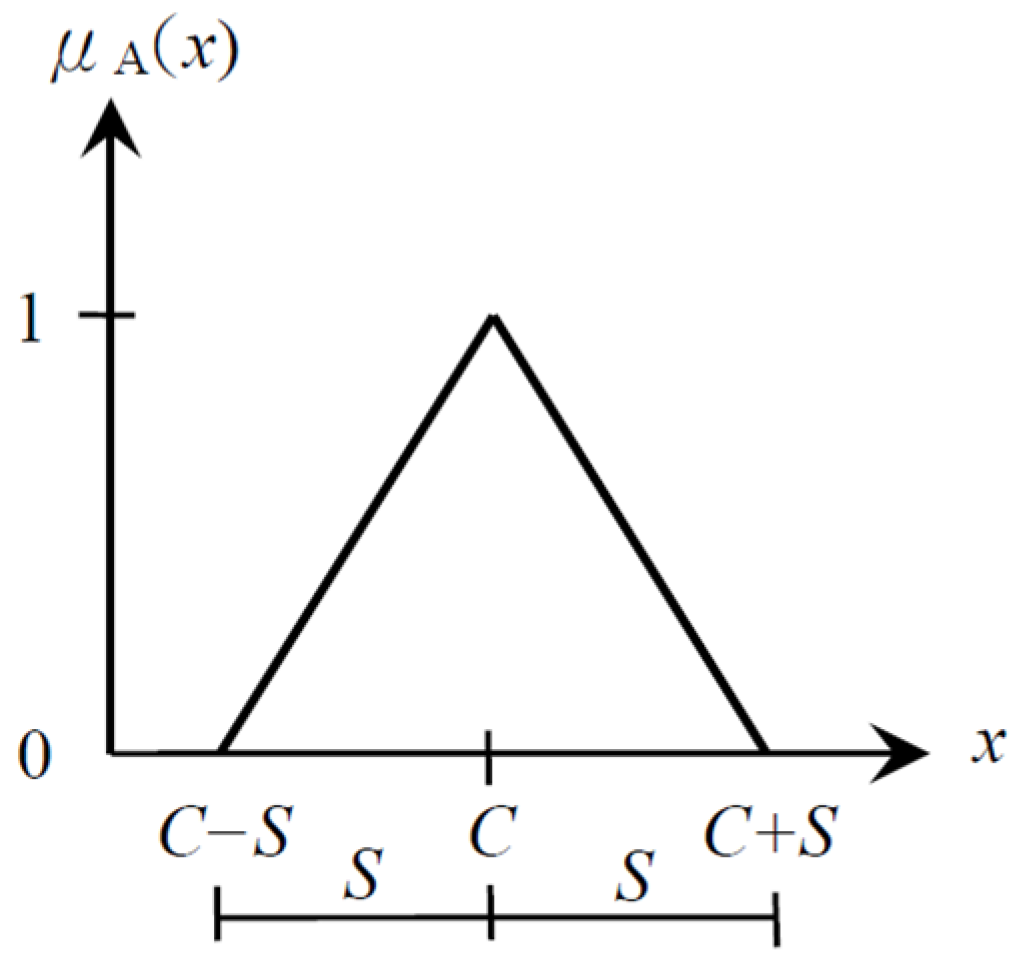
x has a membership value of 1), and (3) it is convex. In this study, the α-cut levels derived from these fuzzy sets form the basis for constructing indifference curves that represent equivalent preference levels. Within the domain of preference modelling, the triangular function remains the most prevalent type due to its intuitive parameters and computational efficiency. Specifically,
C represents the central value (most preferred), and
S indicates the spread (range of acceptable values), as illustrated in
Figure 2.
In
Figure 2,
x represents a planning objective or design parameter, and the membership function
μA(
x) denotes the architect’s preference. A
μA(
x) value of 0 indicates very low preference, while a value of 1 indicates very high preference. The spread
S reflects preference specificity: larger
S implies greater fuzziness, whereas smaller
S indicates a more defined preference. When
S = 0, the function reduces to a single value
C, representing a precise preference. The triangular preference function is expressed as Equation (1).
3.2. Indifference Curve
In economics, an indifference curve connects all consumption combinations yielding the same satisfaction level, with no observable preference difference [
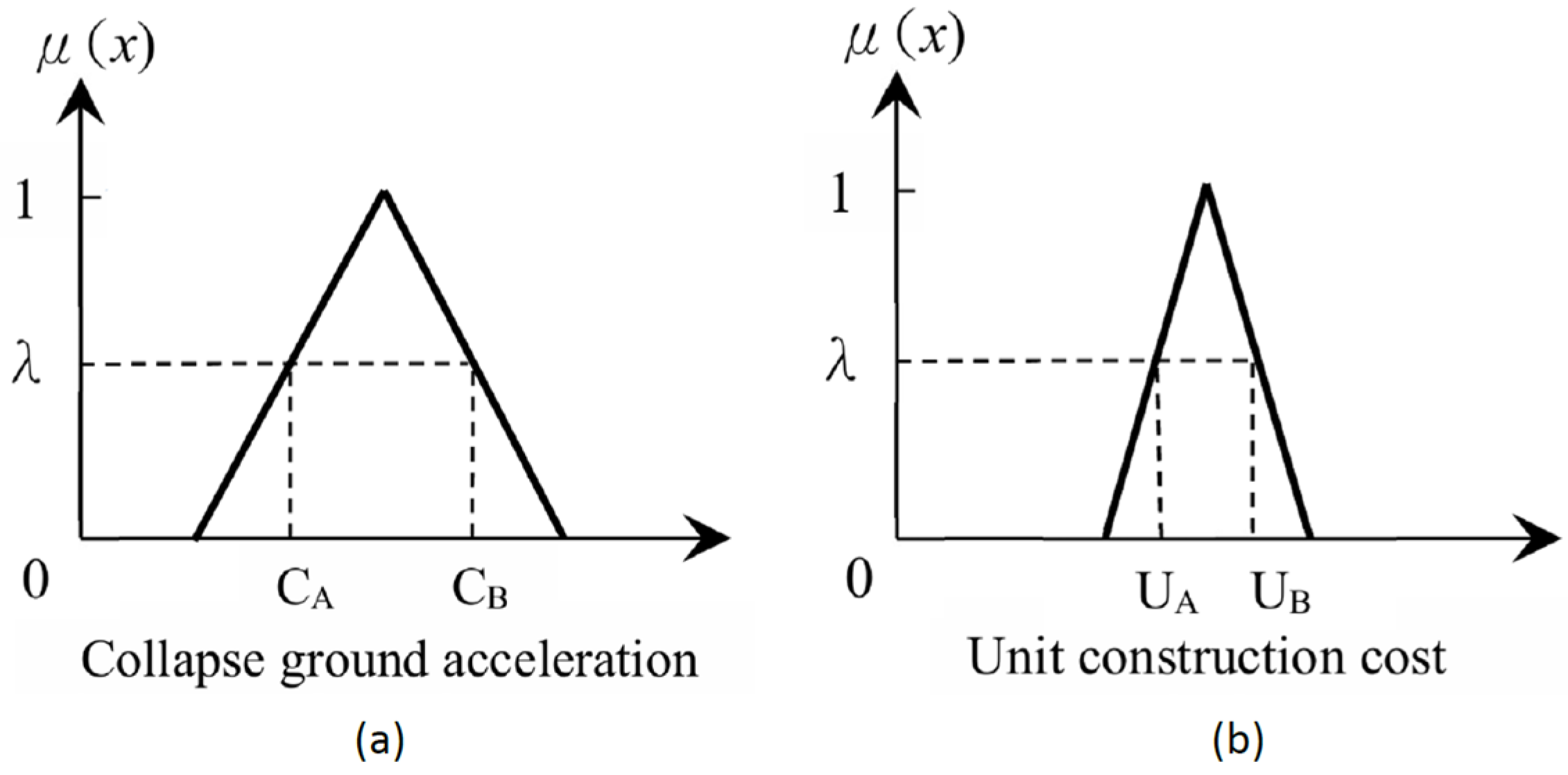
49]. Here, the preference function is applied to define indifference curves and determine preference degrees and weights. Using safety (collapse ground acceleration, C) and economy (unit construction cost, U) as examples, the triangular preference function in
Figure 3 models the architect’s preferences. A larger value of
S indicates a less specific preference. Accordingly, the higher
S value in
Figure 3a corresponds to a less specific safety preference, whereas the lower
S value in
Figure 3b corresponds to a more specific economic preference.
If the architect’s planning preference membership function value is denoted as λ (ranging from 0 to 1), two collapse ground accelerations, C
A and C
B, can be derived from
Figure 3a, reflecting consistent safety preferences. Similarly, two unit construction costs, U
A and U
B, are obtained from
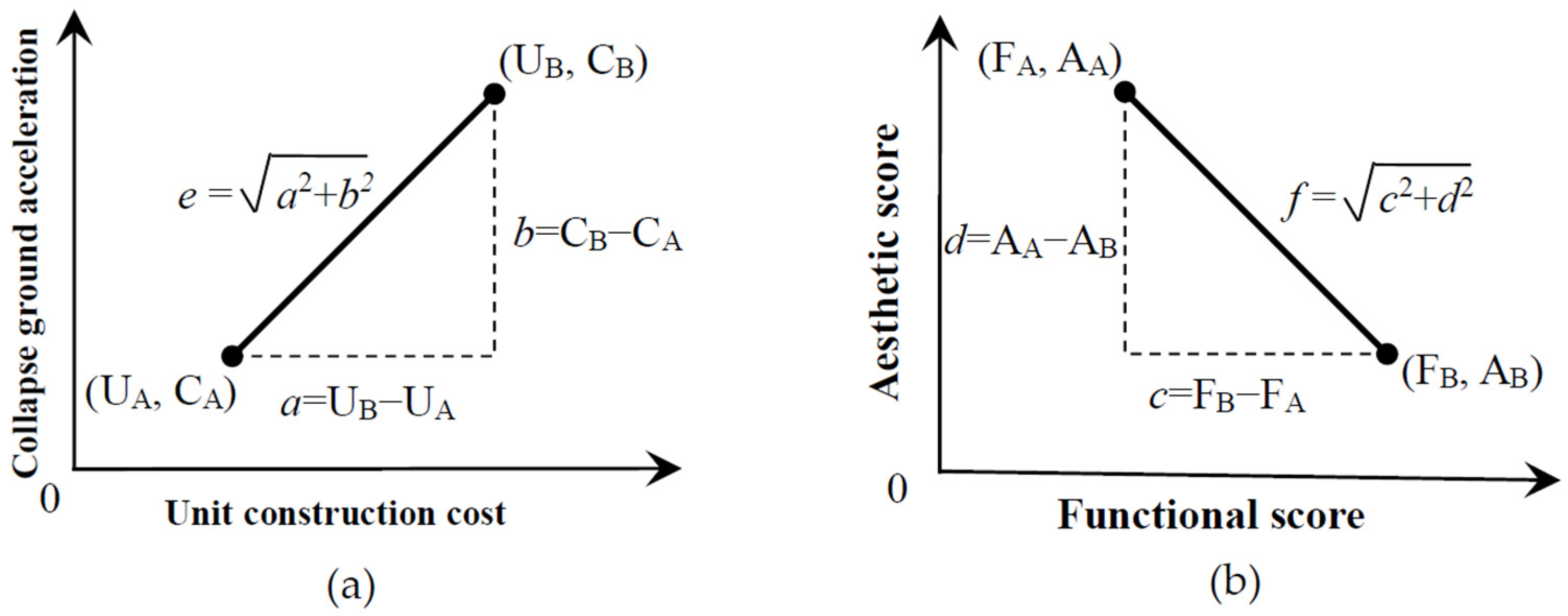
Figure 3b, representing consistent economic preferences. If the architect is equally satisfied with (U
A, C
A) and (U
B, C
B), these points lie on the same indifference curve (
Figure 4a). The horizontal distance ‘
a’, vertical distance ‘
b’, and hypotenuse ‘
e’ between them define a positively sloped curve.
In the proposed formulation, the indifference curves represent the decision-maker’s trade-off between conflicting objectives. Notably, when one axis represents an undesirable attribute (e.g., unit construction cost) and the other a desirable one (e.g., collapse ground acceleration), the indifference curve is upward-sloping (i.e., its slope is positive). This positive slope indicates that to maintain the same level of utility, any increase in cost must be offset by a corresponding improvement in structural safety.
Functionality (F) and aesthetics (A) define another type of indifference curve. In this multi-objective optimization, architects aim to maximize both objectives, but limited budgets necessitate trade-offs. As shown in
Figure 4b, increasing functionality from F
A to F
B typically reduces aesthetics from A
A to A
B. If the architect is equally satisfied with (F
A, A
A) and (F
B, A
B), these points lie on the same indifference curve. The horizontal length ‘
c’, vertical length ‘
d’, and hypotenuse ‘
f’ define the curve, which has a negative slope.
To clarify architects’ planning preferences, this study defines preference degrees and weights for two types of indifference curves: positively sloped [
50] and negatively sloped. The slope of an indifference curve, defined locally as the marginal rate of substitution (MRS), reflects the relative importance assigned by the decision-maker. For instance, the safety preference degree
Pα and economic preference degree
Pβ, corresponding to the positive slope, are determined based on the lengths
a and
b in
Figure 4a. In this study, the interval lengths are interpreted as the spread or uncertainty of the corresponding preference structures. Longer lengths indicate broader and less specific preferences, whereas shorter lengths indicate more concentrated preference tendencies. Accordingly, the preference degrees are defined as the reciprocals of these lengths (Equation (2)), such that greater preference specificity corresponds to larger preference degree values.
In Equation (2),
a and
b represent the spreads of unit construction cost and collapse ground acceleration, respectively. The smaller the spread, the higher the corresponding preference degree. As shown in
Figure 4a, when
b = 0 (i.e., C
A = C
B), the architect exhibits an extreme preference for safety, yielding a safety preference degree of
Pα = 1 according to Equation (2). Similarly, when
a = 0 (i.e., U
A = U
B), the architect exhibits an extreme preference for economy, resulting in an economic preference degree of
Pβ = 1. Therefore, Equation (2) fully reflects the architect’s planning preference degrees.
Regarding the weight assignment, the weights are assumed to reflect the relative importance of planning objectives in decision-making. Therefore, larger preference degrees correspond to larger weights, indicating stronger subjective emphasis assigned by the architect. Thus, the safety preference weight α and economic preference weight β are defined as shown in Equation (3).
Equation (3) directly translates the preference degrees derived from Equation (2) into preference weights. Consequently, under an extreme safety preference (b = 0), Pα = 1 and Pβ = 0, yielding α = 1 and β = 0. Conversely, under an extreme economic preference (a = 0), Pα = 0 and Pβ = 1, resulting in α = 0 and β = 1. Therefore, Equation (3) consistently reflects the architect’s planning preference weights.
The derivation of preference degrees and weights for functionality and aesthetics is conducted using an identical procedure. In this study, the preference degrees and preference weights are comprehensively explained in
Table 1 and
Table 2.
3.3. Architect Planning Preference Type
Preference is a subjective and difficult-to-quantify process. To interpret such preferences, this study adopts Samuelson’s [
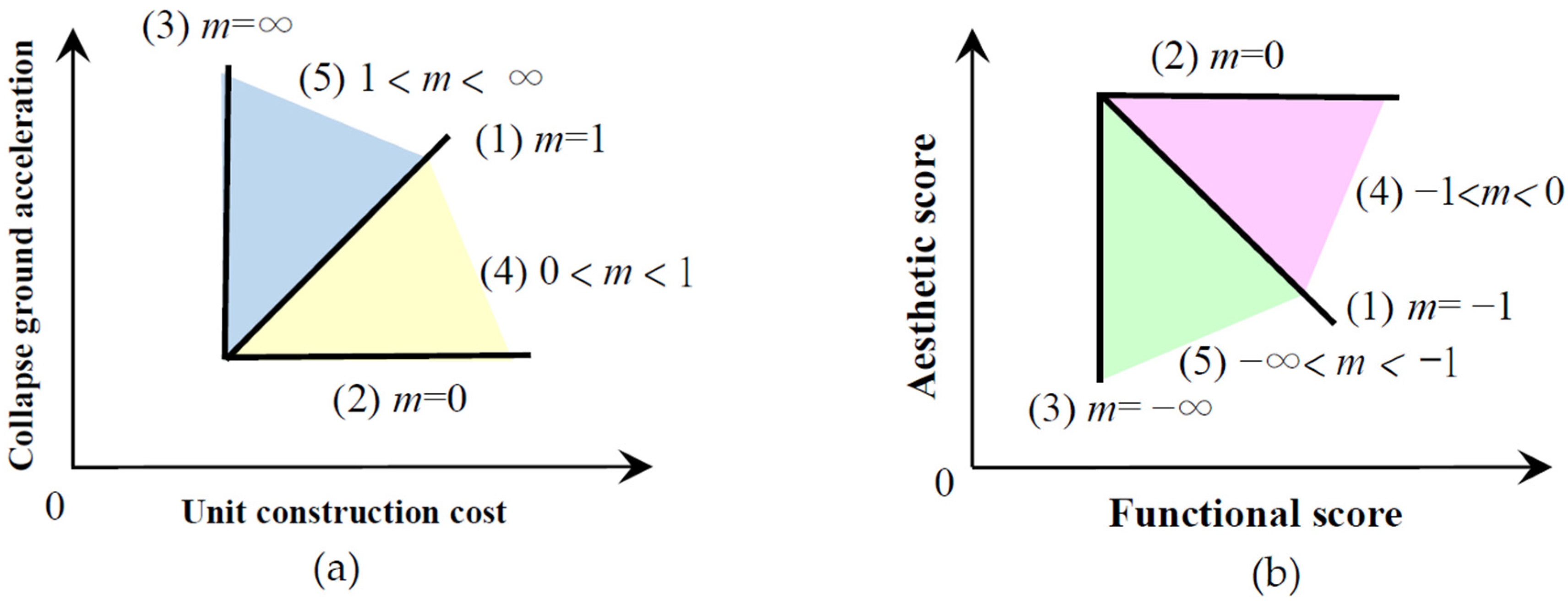
51] indifference curve theory to explain different types of architects’ planning preferences. Using the positively sloped indifference curve between safety and economy (
Figure 4a), this study interprets planning preferences through the slope
m, which reflects varying trade-offs between the two objectives. Based on this, five preference types are defined [
50]:
- (1)
Balanced preference: When m = 1, the architect values safety and economy equally; collapse ground acceleration and unit construction cost contribute equally to the decision.
- (2)
Extreme safety preference: When
m = 0 (
Figure 4a), the spread of collapse ground acceleration is
b = C
B − C
A = 0, implying C
B = C
A. The architect imposes a strict requirement on minimum collapse ground acceleration while allowing flexibility in unit construction cost.
- (3)
Extreme economy preference: When
m = ∞ (
Figure 4a), the spread of unit construction cost is
a = U
B − U
A = 0, implying U
B = U
A. The architect tightly constrains cost while tolerating variation in safety.
- (4)
Safety-oriented preference: When
m lies between 0 and 1 (light-yellow area in
Figure 5a), the preference leans toward safety—the smaller the slope, the stronger the safety preference.
- (5)
Economy-oriented preference: When
m lies between 1 and ∞ (light-blue area in
Figure 5a), the preference leans toward economy—the greater the slope, the stronger the economic preference.
Applying the same principle, five planning preference types for functionality and aesthetics (with a negative slope) can also be defined, using the slope
m of the indifference curve in
Figure 5b as an example:
- (1)
Balanced preference: m = −1.
- (2)
Extreme aesthetics preference: m = 0.
- (3)
Extreme functionality preference: m = −∞.
- (4)
Aesthetics-oriented preference:
m lies between 0 and −1 (light-purple area in
Figure 5b).
- (5)
Functionality-oriented preference:
m lies between −1 and −∞ (light-green area in
Figure 5b).
As illustrated in
Figure 5a, which presents street house planning with safety and economy as the primary objectives, the five planning preference types encompass all possible categories of architects’ preferences. In practice, however, most preferences tend to fall within the range of safety-oriented, economy-oriented, or relatively balanced preferences. Extreme preferences toward a single objective are relatively uncommon, as they may lead to impractical or unbalanced planning outcomes. A similar pattern can be observed in
Figure 5b, where extreme preferences for either functionality or aesthetics are also rarely encountered.
Figure 5.
Types of architects’ planning preferences. Different colors denote distinct preference categories: (a) safety versus economy; (b) functionality versus aesthetics.
Figure 5.
Types of architects’ planning preferences. Different colors denote distinct preference categories: (a) safety versus economy; (b) functionality versus aesthetics.
3.4. Utility Function
In the field of economics, utility functions [
52] are often used to represent the level of satisfaction of consumer preferences. If a consumer prefers combination ‘a’ to combination ‘b’, economists frequently use the utility function ‘u’ to represent this preference. This can be expressed as ‘u(a) ≻ u(b)’, which means preferences are translated into a real number ranking by the utility function.
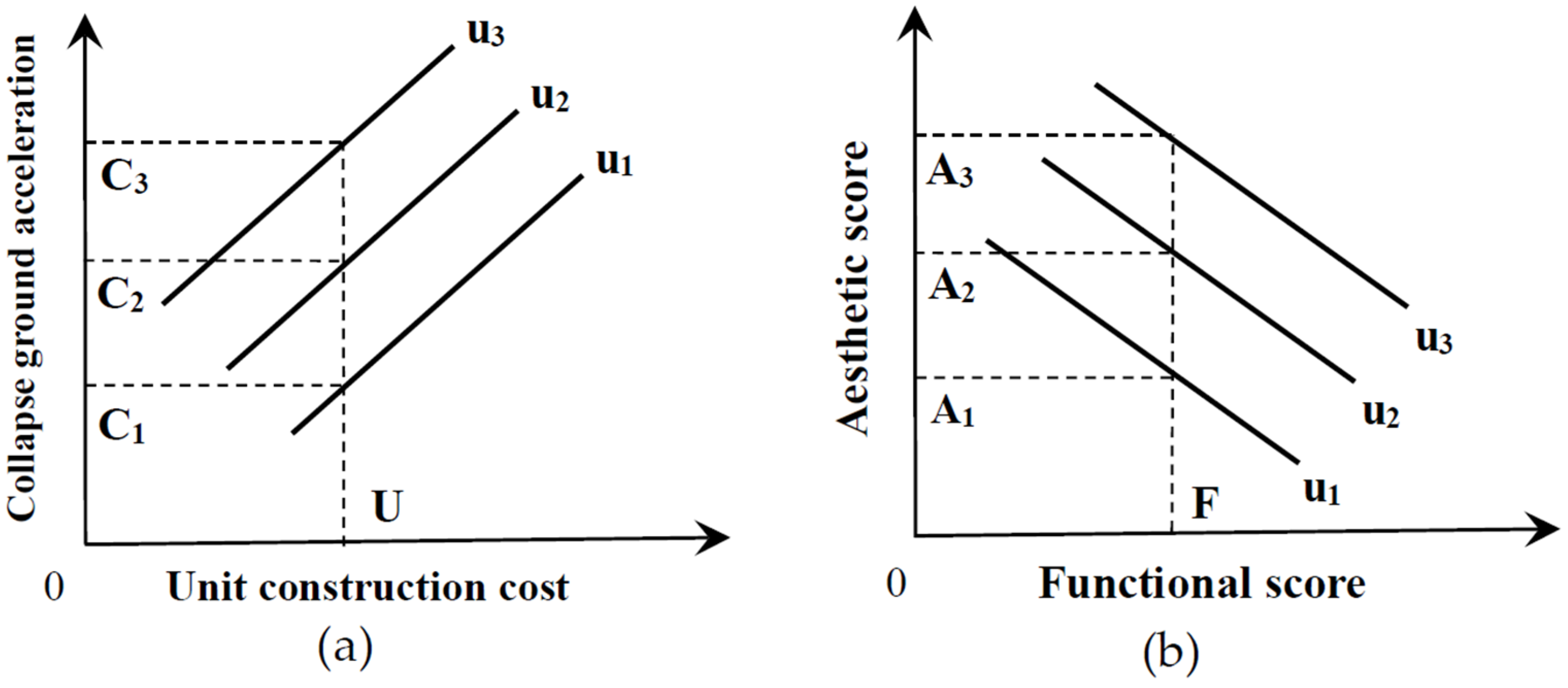
Figure 6 depicts two sets of indifference curves with the same and parallel slopes. Since their slopes are identical and the curves are parallel, these sets of indifference curves can represent utility functions, indicating that consumers have the same preferences but different degrees of satisfaction. Taking
Figure 6a as an example, the collapse ground acceleration obtained under the same unit construction cost ‘U’ is C
3 > C
2 > C
1. Since the collapse ground acceleration obtained by u
3 is the highest and u
1 is the lowest, the degree of satisfaction is u
3 > u
2 > u
1. In
Figure 6b, the aesthetic score obtained under the same functional score ‘F’ is A
3 > A
2 > A
1, so the degree of satisfaction is also u
3 > u
2 > u
1.
This study uses the concept of utility functions to interpret the degree of satisfaction of architects’ preferences when planning street houses. If the indifference curve with the highest degree of satisfaction is tangent to the efficient frontier, the architect’s benchmark learning case can be obtained.
3.5. Efficient Frontier
To enhance the efficiency of architectural planning, this study integrates efficient frontier theory [
53,
54] with the utility function concept to identify benchmark learning cases.
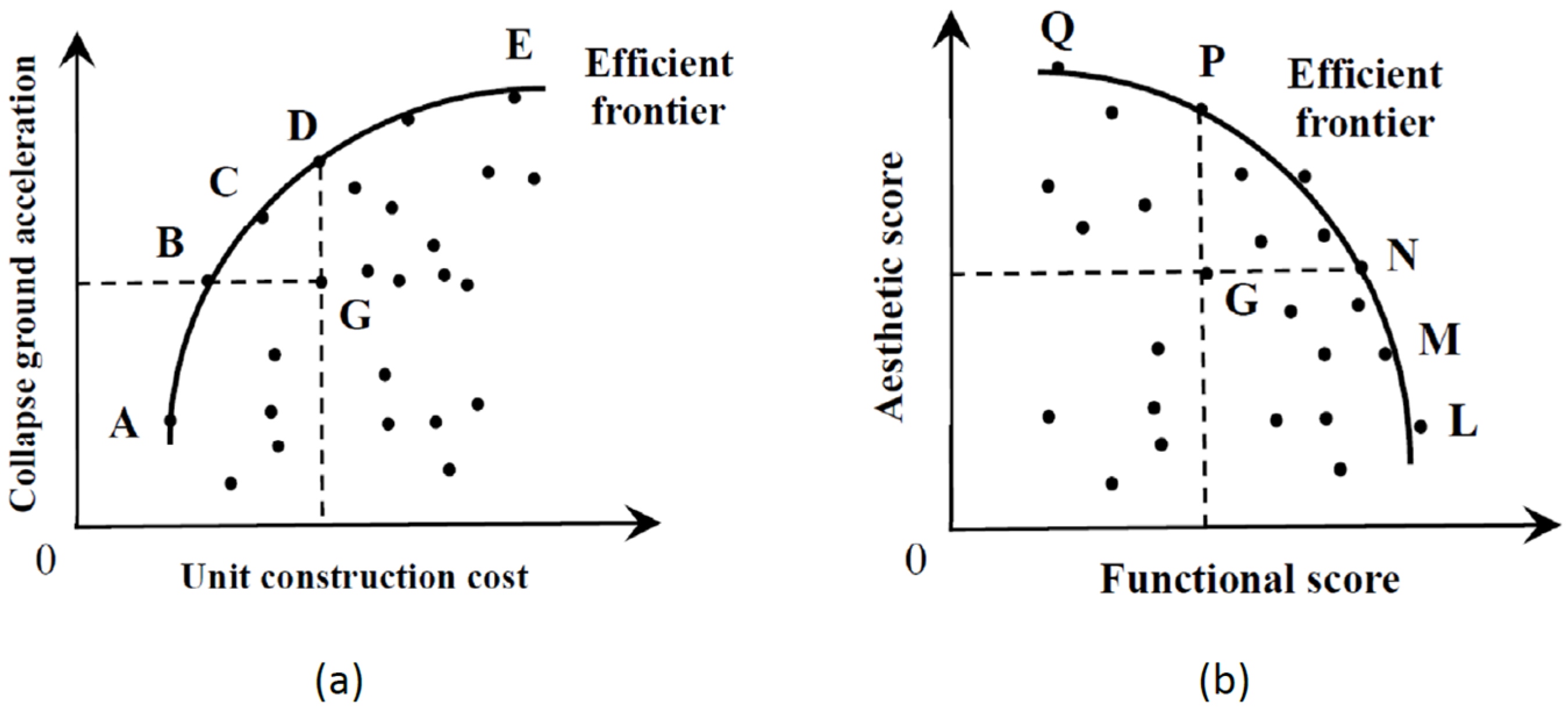
As shown in
Figure 7,
Figure 7a,b illustrate two types of efficient frontiers derived from different planning objectives. Each point represents a street house design. In
Figure 7a, which examines safety and economy, street houses D and G share the same unit construction cost, but D can withstand a higher collapse ground acceleration, making it more efficient. Similarly, B can withstand the same collapse ground acceleration as G but at a lower cost, and is therefore more efficient. By analogy, connecting all relatively efficient points forms curve AE, which represents the efficient frontier reflecting the trade-off between safety and economy.
Applying the same principle,
Figure 7b, which examines functionality and aesthetics, shows that street houses G and P share the same functional score, but P achieves a higher aesthetic score, making it more efficient. Similarly, N attains a higher functional score than G at the same aesthetic score, indicating greater efficiency. Connecting all relatively efficient points forms curve LQ, which represents the efficient frontier for functionality and aesthetics.
3.6. Data Envelopment Analysis (DEA)
Each point on the efficient frontier can be determined using Data Envelopment Analysis (DEA) [
55,
56]. For a decision-making unit (DMU) with a single input
x and a single output
y, the relative efficiency is defined as the ratio of output to input, i.e.,
y/
x. For a DMU
k with multiple inputs (
xjk,
j = 1, 2…,
m) and outputs (
yrk,
r = 1, 2…,
s), relative efficiency
hk is calculated as the weighted sum of outputs divided by the weighted sum of inputs. The relative efficiency
hk can be defined as
. This efficiency can also be computed via mathematical programming (
MP), as shown in Equations (4) and (5).
In the equations,
hk is the relative efficiency value of decision-making unit k;
ur is the virtual multiplier of the r-th output item;
vj is the virtual multiplier of the j-th input item.
This study applies DEA to define the efficient frontier for street houses. Each plan is treated as a decision-making unit (DMU), with unit construction cost (or functional score) as input and collapse ground acceleration (or aesthetic score) as output. No additional normalization was applied to the variables, as DEA is unit-invariant and does not require prior scaling of inputs and outputs. All variables were therefore maintained in their original units to preserve their physical meaning. The only exception is unit construction cost, which was adjusted to a common base year to ensure comparability across different time periods.
A foundational characteristic of standard DEA frameworks is the construction of an empirical efficient frontier as a piecewise linear boundary. While this non-parametric approach advantageously evaluates relative efficiency without assuming a prior functional form, it presents a critical limitation for post-efficiency optimization: the resulting frontier contains discrete vertices (kinks) where the geometric slope—representing the Marginal Rate of Transformation (MRT)—is mathematically discontinuous and non-differentiable.
In this study, deriving the optimal benchmark learning case necessitates solving a classic constrained optimization problem, specifically the tangency condition between the architect’s continuous utility function and the empirical efficient frontier. Resolving this via calculus fundamentally requires a continuously differentiable boundary, a condition the standard DEA piecewise frontier fails to satisfy.
To bridge this methodological gap and ensure mathematical tractability, a polynomial function is applied as a post-DEA smoothing interpolation. Methodologically, while this procedure employs polynomial fitting, it must be strictly distinguished from conventional statistical regression. It is not utilized for statistical inference, nor does it attempt to describe the central tendency of the unrefined dataset. Rather, it functions purely as a deterministic geometric approximation executed exclusively on the coordinates of the fully efficient points (efficiency score = 1.0) identified by the DEA model.
By transforming the discrete, piecewise boundary into a smooth, continuously differentiable curve, this deterministic fitting allows for the precise analytical derivation of the tangency point where the Marginal Rate of Substitution (MRS) equals the MRT. Consequently, it secures an exact optimization solution while rigorously preserving the structural integrity of the original non-parametric DEA classification.
3.7. Efficiency of Street House Planning
To compare the efficiency of street house planning based on different planning preferences, this study defines various efficiencies for evaluating street house planning, as outlined below.
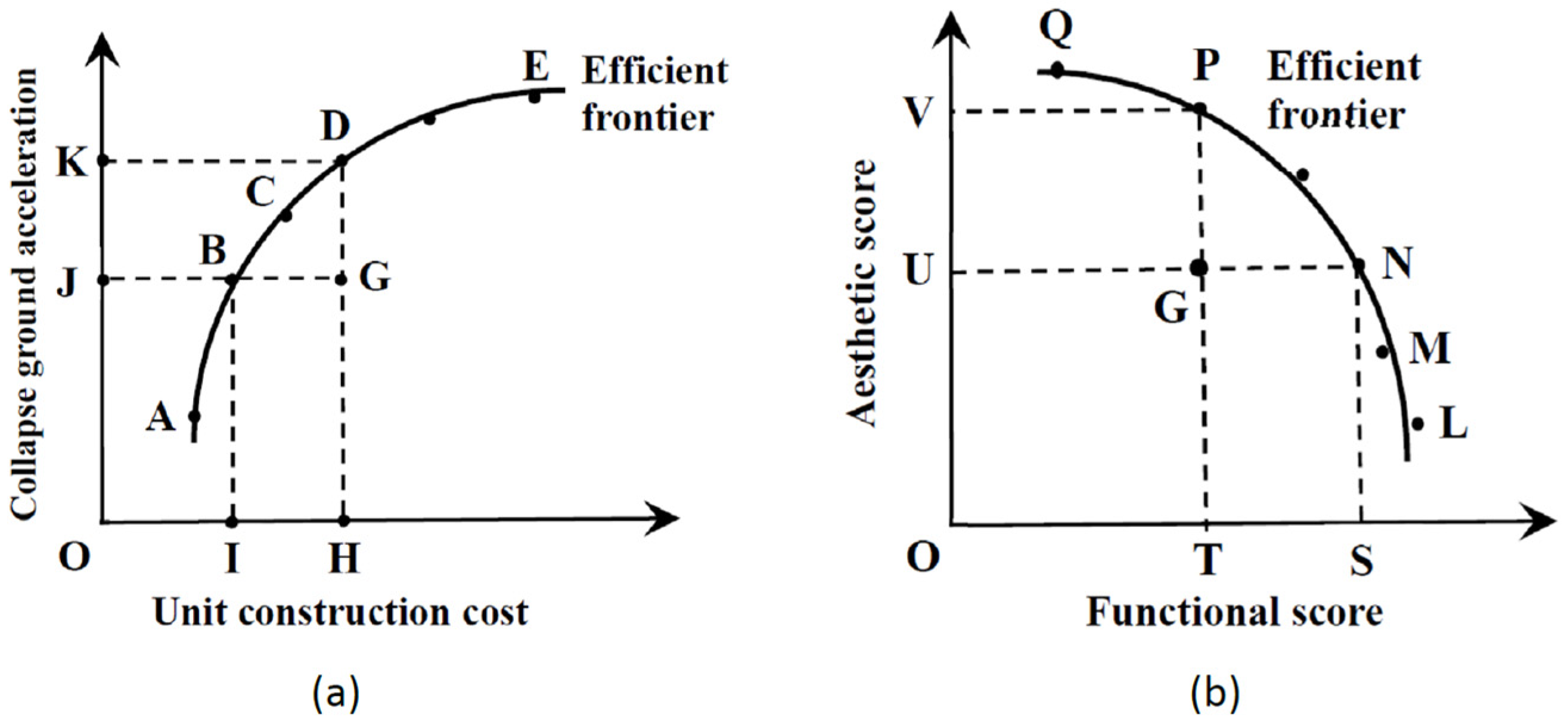
As shown in
Figure 8a, the AE curve represents the efficient frontier for safety and economy. Street house B, on the frontier, is Pareto-efficient, whereas street house G is inefficient. This inefficiency arises because, for the same collapse ground acceleration, G requires a higher unit construction cost
(or
). If the economic efficiency of B is 1, then the economic efficiency of G can be defined as
/
(or
/
). Taking street houses D (located on the efficient frontier) and G as another example in the figure, if D and G have the same unit construction cost input, but D can achieve a collapse ground acceleration output greater than G by
(or
), then D is more efficient than G. Therefore, if the safety efficiency of D is 1, the safety efficiency of G can be defined as
/
(or
/
).
Using the same principle, the LQ curve in
Figure 8b represents the efficient frontier for functionality and aesthetics. Street house N lies on the frontier and is Pareto-efficient, while G, not on the frontier, is less efficient. This is because N achieves a higher functional score
(or
) than G for the same aesthetic score. If the functional efficiency of N is 1, then the functional efficiency of G can be defined as
/
(or
/
). Taking street houses P (located on the efficient frontier) and G as another example, P and G have the same functional score, but P has a higher aesthetic score than G by
(or
). If the aesthetic efficiency of P is 1, then the aesthetic efficiency of G can be defined as
/
(or
/
).
Since architects’ planning preferences stem from subjective cognitive processes, each architect forms them differently. These preferences play a crucial role in building planning, as the determination of specific objectives or design parameter values often depends on the planner’s intent to prioritize those objectives or parameters [
57]. To address the planning preference issue,
Section 3.2 defines the safety preference weight (α) and economic preference weight (β) using indifference curves with positive slopes. To further quantify planning preferences, it also defines the aesthetic preference weight (γ) and functional preference weight (δ) using negatively sloped indifference curves. For easier evaluation of building efficiencies, this study uses street house G in
Figure 8 to define safety efficiency (
SE), economic efficiency (
EE), and positive-slope planning efficiency (
PPE), as well as aesthetic efficiency (
AE), functional efficiency (
FE), and negative-slope planning efficiency (
NPE), as shown in Equations (6)−(11).
- (1)
Positive-slope efficiencies
- (2)
Negative-slope efficiencies
For street houses not on the efficient frontier, safety and economic efficiencies are evaluated using Equations (6) and (7), while combined planning efficiency is assessed with Equation (8). Similarly, aesthetic and functional efficiencies are evaluated using Equations (9) and (10), with Equation (11) assessing combined efficiency. Equations (6), (7), (9) and (10) provide objective evaluations, whereas Equations (8) and (11) integrate subjective and objective factors. This approach reflects the dual nature of building planning—balancing subjective and objective elements—and supports the overall goal of benchmark learning in planning and design.
3.8. Benchmark Learning Under Different Planning Preferences
The practice of benchmarking typically begins by selecting a measurable or evaluative indicator for comparison with industry leaders. By understanding the gap between their enterprise and the leader, companies can systematically learn from the leader’s experience. The ultimate goal is to strive to become an industry leader, potentially surpassing the benchmark enterprise.
Optimal planning often depends on the planner’s preferences [
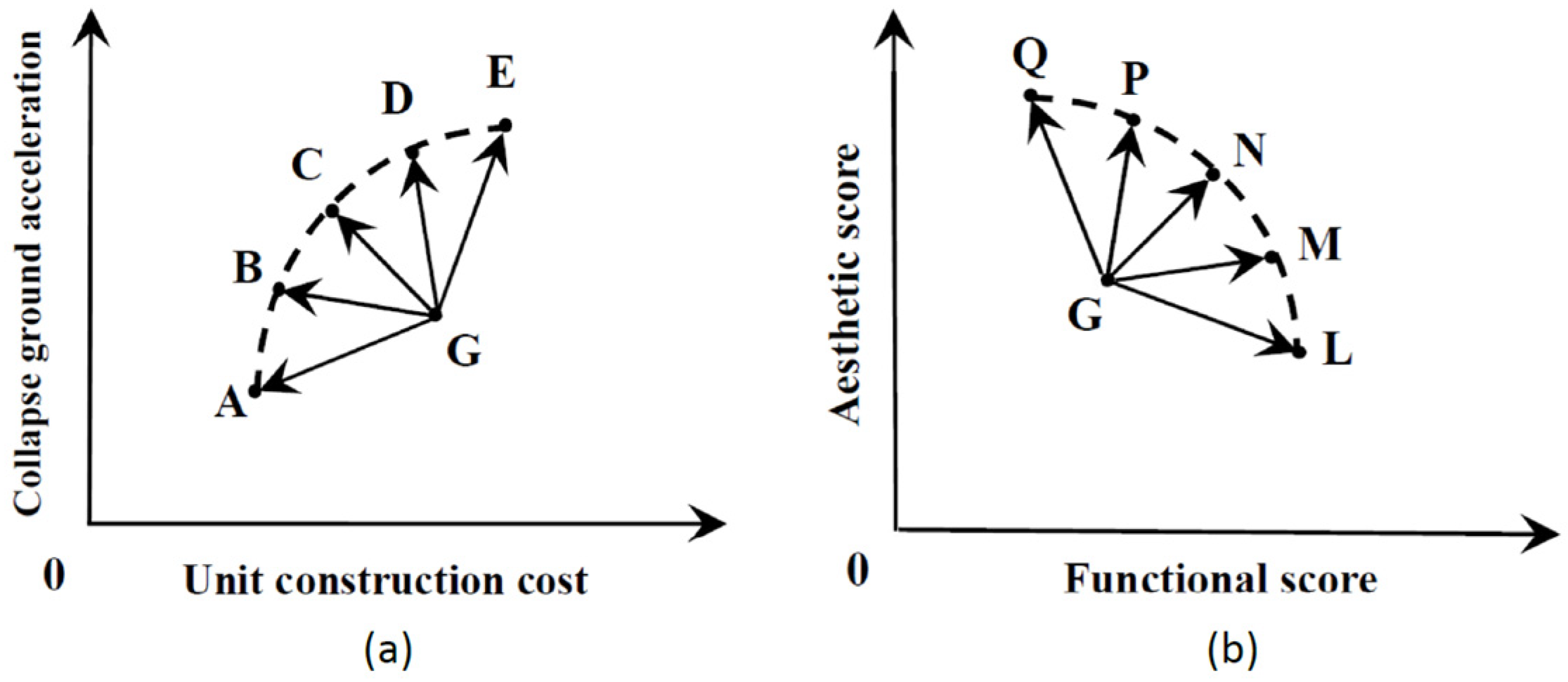
46]. If a building plan does not lie on the efficient frontier, planning preferences and utility functions can be integrated to identify benchmark learning cases for efficiency improvement. This study illustrates this using unit construction cost and collapse ground acceleration as objectives, as shown in
Figure 9a. Street houses A to E lie on the efficient frontier and serve as benchmark references for less efficient plans. Consider three representative cases on the frontier: street house A with the lowest unit construction cost, street house E with the highest collapse ground acceleration, and street house C representing a balanced planning preference, where the indifference curve with a slope of
m = 1 is tangent to the frontier. If street house G is not on the efficient frontier, it implies G’s plan is inefficient. Based on planning preferences, five potential improvement directions for G can be considered—(G→A), (G→B), …, (G→E)—with each representing a possible benchmark learning case.
The same principle can be applied to benchmark learning for functionality and aesthetics in
Figure 9b. Based on the architect’s planning preferences, five planning efficiency improvement directions can be considered for street house G—(G→L), (G→M), …, to (G→Q)—and benchmark learning cases can also be identified for each direction.
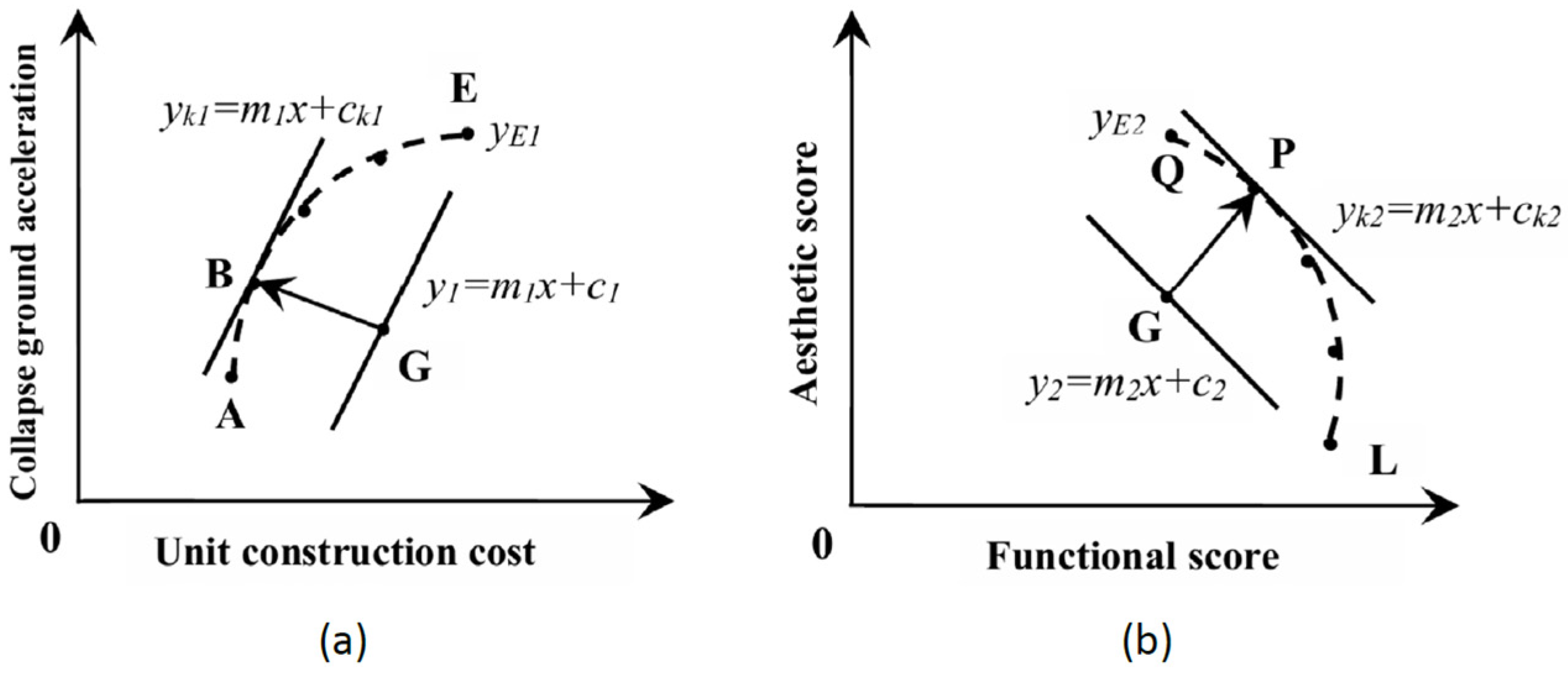
Figure 10a illustrates the solution process for street house G in terms of safety and economy. If the architect’s plan is located at point G, an indifference curve,
y1 =
m1x +
c1, can be drawn through it, where
m1 is the slope and
c1 is a constant. Because this curve is not tangent to the efficient frontier
yE1, the plan is considered inefficient. A parallel curve,
yk1 =
m1x +
ck1, tangent to the frontier, can then be identified, where
ck1 is a constant. Both curves reflect the architect’s planning preferences, but according to utility theory,
yk1 represents a higher level of satisfaction. The tangency point B on
yE1 thus serves as the benchmark learning case for safety and economy, aligned with the architect’s preferences.
The same principle applies to functionality and aesthetics, as shown in
Figure 10b. Since street house G does not lie on the efficient frontier, an indifference curve
y2 =
m2x + c2 can be drawn through G, where
m2 is the slope and
c2 is a constant. A parallel curve
yk2 =
m2x +
ck2, tangent to the efficient frontier
yE2, can then be identified. As
yk2 represents a higher level of satisfaction than
y2, the tangency point P on
yE2 serves as the benchmark learning case for functionality and aesthetics, consistent with the architect’s planning preferences.
4. Results and Discussion
This section begins with a description of the dataset used for the empirical analysis. The study is based on 627 street house cases, covering a wide range of design and performance conditions, including variations in structural safety, unit construction cost, functionality, and aesthetic evaluation. This diversity ensures that the dataset captures heterogeneous planning scenarios and provides sufficient variability for multi-objective analysis.
According to economic principles, MOOPs often involve different types of trade-offs between objectives. One common form involves conflicting objectives, where one is desirable and the other undesirable—e.g., safety (collapse ground acceleration) versus economy (unit construction cost). Another common form involves trade-offs between two desirable yet competing objectives, such as functionality and aesthetics. To illustrate the proposed methodology, a dataset of 627 street houses in Taiwan was compiled. Considering the characteristics of the planning objectives and the availability of relevant data, the cases were categorized into two groups: 375 cases addressing the safety–economy objectives and 252 cases addressing the functionality–aesthetics objectives. Accordingly, two multi-objective optimization models were developed, and benchmark learning cases were subsequently identified for each category.
Table 3 presents the descriptive statistics of the key objectives. The observed ranges and distributions indicate that the sample includes both high- and low-performing cases across different objectives, thereby enabling effective discrimination between efficient and inefficient cases in the DEA framework. Overall, the dataset is considered sufficiently representative for evaluating planning efficiency and identifying benchmark learning cases.
Table 4 summarizes the architectural characteristics of the 627 street house cases. The dataset includes diverse building conditions in terms of construction period, spatial configuration, structural layout, facade form, roof type, and structural materials, thereby covering a broad range of street house characteristics commonly observed in Taiwan. The following analysis is intended as a numerical illustration of the proposed framework rather than a formal validation.
4.1. Preference Function µ(x) Based on Fuzzy Sets
Since preference function determination is highly subjective, architects may have significantly different functions based on personal knowledge and experience. To address this, the study proposes a more objective approach—using fuzzy sets—to define architects’ preference functions, as detailed below.
4.1.1. Preference Function for Safety and Economy
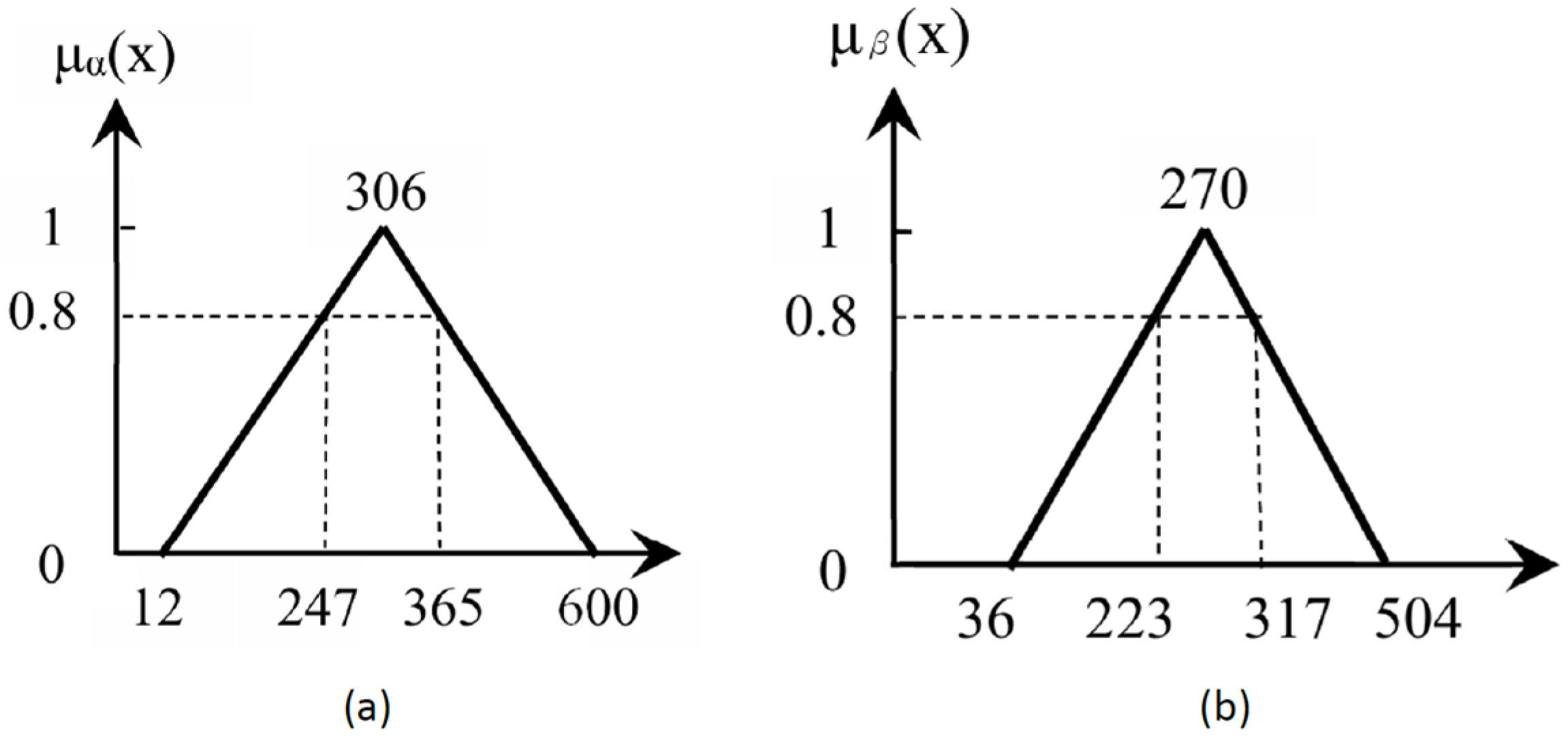
Street house safety is evaluated using collapse ground acceleration, where a higher value denotes greater seismic resistance. Based on survey data from 375 street houses, the mean collapse ground acceleration is 306 gal., with a standard deviation of 147 gal. As shown in
Table 5, assuming a triangular preference function, the preference value equals 1 at 306 gal. and decreases linearly toward 0 when the acceleration is below the mean minus two standard deviations or above the mean plus two. The architect’s safety preference function is denoted as µ
α(
x). This study also evaluates the economic aspect of street houses using unit construction cost. Unit construction cost data collected from different years were adjusted to a common base year to ensure comparability. The adjustment was carried out using a Construction Cost Index (CCI, in Taiwan), which accounts for price fluctuations and inflation over time. Specifically, the adjusted cost C
base is calculated as C
base = C
t × CCI
base/CCI
t, where C
t is the original cost in year
t, CCI
t is the Construction Cost Index for year
t, and CCI
base is the index for the selected base year. As a result, all cost values are expressed in consistent real terms. The mean unit construction cost is 270 (hundred NTD/m
2), with a standard deviation of 117 (hundred NTD/m
2). Following the same approach as the safety preference function, the preference value equals 1 at 270 (hundred NTD/m
2) and decreases linearly to 0 when the cost is below the mean minus two standard deviations or above the mean plus two. The architect’s economic preference function is denoted as µ
β(
x). Graphs and equations for µ
α(
x) and µ
β(
x) are provided in
Table 5.
4.1.2. Preference Function for Aesthetics and Functionality
Compared to safety and economic planning objectives, which are generally grounded in objective criteria, aesthetic and functional objectives tend to be more subjective and influenced by individual preferences and cultural values. To objectively assess the aesthetics and functionality of street houses, this study invited ten architects or university faculty to score (0–100) 252 collected street houses.
To systematically ensure scoring consistency among the ten evaluators across the extensive dataset of 252 cases, a rigorous pre-evaluation calibration protocol was implemented. First, standardized scoring criteria were explicitly defined using anchor examples. For instance, aesthetic scores were based on specific visual elements—such as facade harmony, solid–void contrast, material usage, and color integration—whereas functionality scores were tied to architectural characteristics like spatial layout efficiency, circulation arrangement, and functional rationality. Second, prior to the formal assessment, a pilot calibration session was conducted using a random subset of benchmark cases. During this phase, the evaluators independently assessed the selected cases and subsequently discussed any significant scoring discrepancies to align their subjective baselines and minimize cognitive bias. Only after a consensus regarding the practical interpretation of the criteria was reached did the formal evaluation of the remaining cases commence. Furthermore, to mitigate the influence of evaluator fatigue, the assessment process was divided into multiple structured sessions.
Following the completion of these structured assessments, inter-rater reliability was quantified using the Intraclass Correlation Coefficient (ICC) based on a two-way random-effects model with absolute agreement. The resulting ICC (2, k) values were 0.751 for functionality and 0.812 for aesthetics, both indicating good reliability according to established benchmarks. These results confirm a satisfactory degree of consistency among the evaluators despite the inherently subjective nature of the assessments. Because the DEA in the proposed framework primarily evaluates relative planning efficiency among the cases, this high inter-rater agreement supports the robustness and stability of the subjective evaluation results incorporated into the efficiency analysis. Consequently, despite the relatively small size of the expert panel, the strong evaluator consensus minimizes data sensitivity and enhances the validity and reproducibility of the benchmark learning outcomes.
As shown in
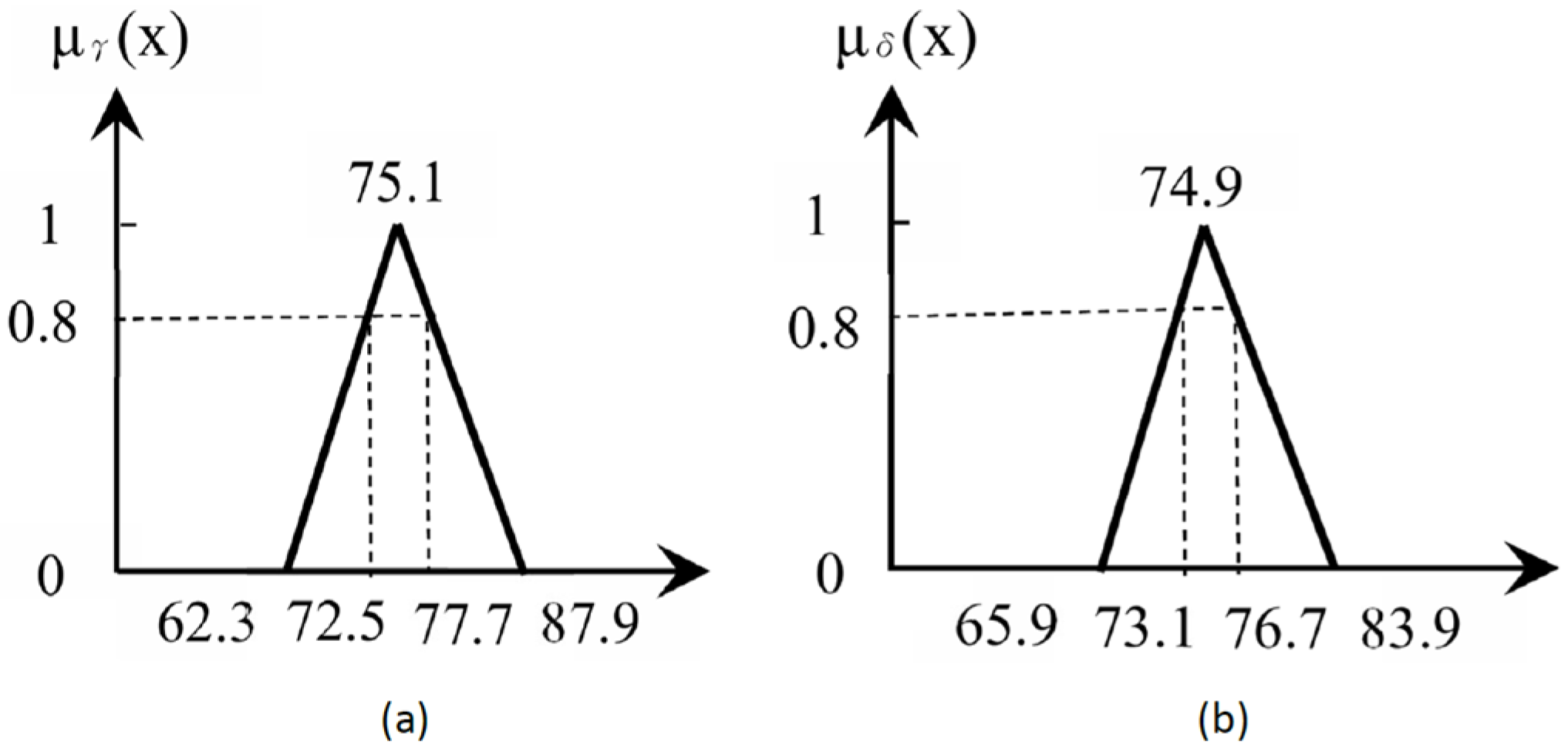
Table 6, and consistent with the safety and economy preference functions, a triangular preference function is assumed. The average aesthetic score is 75.1, with a standard deviation of 6.4. The preference value is set to 1 when the score equals 75.1. If the score is below the average minus two standard deviations or above the average plus two, the value is 0. Scores within the intermediate range vary linearly. The architect’s aesthetic preference function is denoted as µ
γ(
x). Since the average functional score is 74.9 with a standard deviation of 4.5, the preference function value is set to 1 when the score equals 74.9. If the score is below the average minus two standard deviations or above the average plus two, the value is 0. Values within the intermediate range change linearly. The architect’s functional preference function is denoted as µ
δ(x). This study also presents the graphs and equations of µ
γ(
x) and µ
δ(
x) in
Table 6.
4.2. Derivation of Planning Preferences and Weights Using Indifference Curves
4.2.1. Planning Preferences and Weights for Safety and Economy
After determining μα(x) and μβ(x), two points on the architect’s indifference curve can be derived. From this, the equation and slope of the curve are obtained to identify the architect’s planning preference type and calculate the safety preference weight (α) and economic preference weight (β).
As shown in
Figure 11a, a safety preference function value of 0.8 corresponds to collapse ground accelerations of 247 and 365 gal., indicating equivalent safety preferences under different budget levels. Similarly, in
Figure 11b, when the economic preference function value is 0.8, the associated unit construction costs (223 and 317 hundred NTD/m
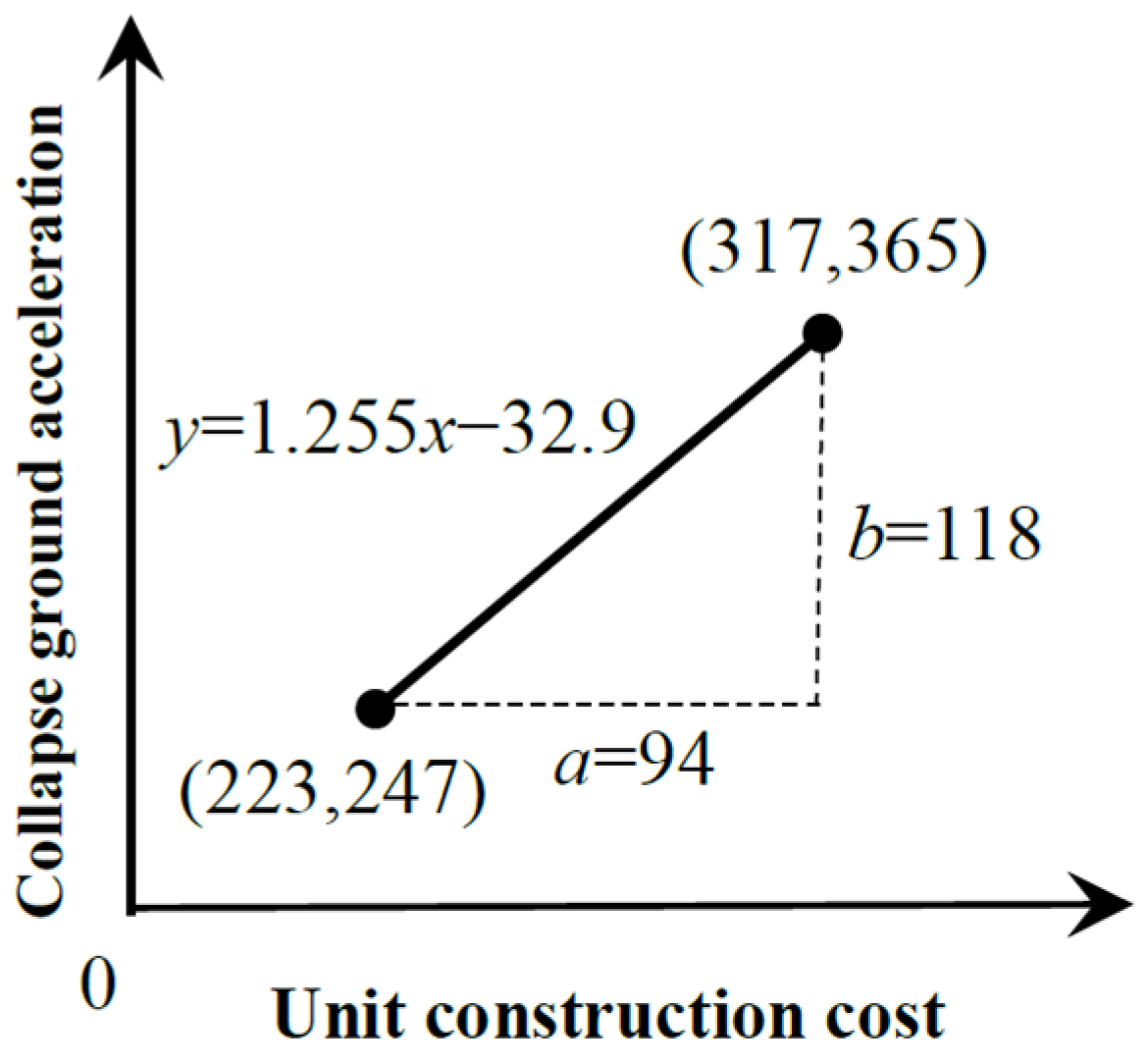
2) reflect consistent economic preferences across varying safety levels. The points (223, 247) and (317, 365) thus represent two street house plans with equal overall preference, lying on the same indifference curve. Using geometric methods, the equation of the indifference curve passing through these points is
y = 1.255
x − 32.9, as shown in
Figure 12. The slope
m = 1.255, corresponding to the preference type illustrated in
Figure 5a, can be classified as an economy-oriented preference. According to
Table 1, the safety preference weight is α = 0.44 and the economic preference weight is β = 0.56, as expressed in Equation (12).
4.2.2. Planning Preferences and Weights for Aesthetics and Functionality
Following the same approach used for safety and economy, once the preference functions μγ(x) and μδ(x) are defined, two points on the indifference curve can be determined. This enables the derivation of the indifference curve equation and its slope, helping to identify the architect’s planning preference type. Based on this, the aesthetic preference weight γ and functional preference weight δ can be calculated. The process is detailed below.
If the architect’s aesthetic and functional preference function values are both set to 0.8, as shown in
Figure 13a, then, using the μ
γ(
x) from
Table 6, the aesthetic ratings can be calculated as 72.5 and 77.7, respectively. This indicates the architect’s consistent preference for aesthetics across different street houses, while considering cost and functionality. Similarly, as shown in
Figure 13b, using the μ
δ(
x) from
Table 6, the functional ratings can be calculated as 73.1 and 76.7, respectively. This suggests that the architect also has a consistent preference for functionality across different street houses, when considering aesthetics and cost constraints.
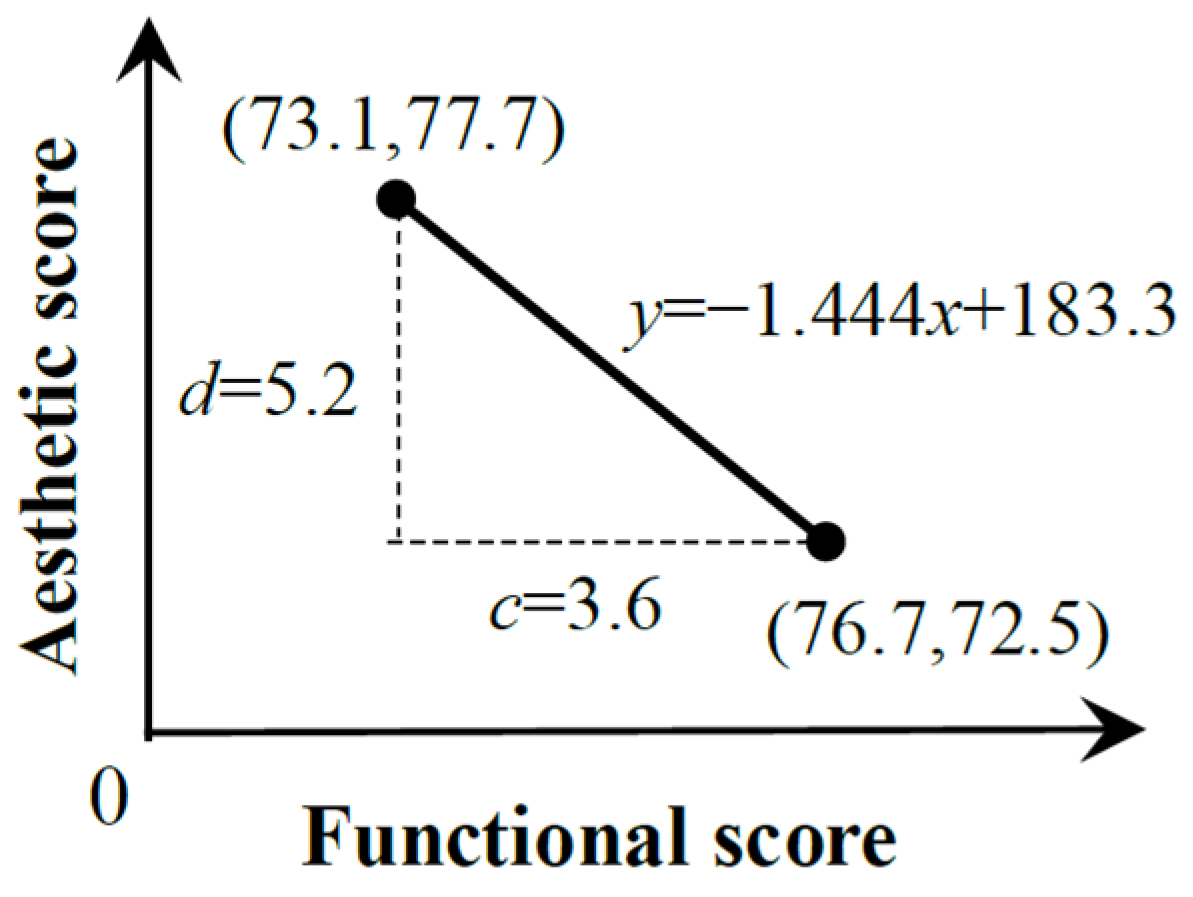
Given limited budgets, increasing functional requirements may lead to a compromise in aesthetic quality. Therefore, the pairs (73.1, 77.7) and (76.7, 72.5) represent two distinct planning scenarios that balance functionality and aesthetics. If the architect views both scenarios as equally preferable, these points lie on the same indifference curve. Using these points, the indifference curve equation can be derived as
y = −1.444
x + 183.3, as shown in
Figure 14. The slope
m = −1.444, according to the definition in
Figure 5b, indicates a functionality-oriented planning preference. Based on
Table 2, the aesthetic preference weight γ is 0.41, and the functional preference weight δ is 0.59, as shown in Equation (13).
4.3. Evaluation of Planning Satisfaction Using Utility Functions
In economics, utility functions are commonly used to represent preference satisfaction. This study adopts this concept to interpret the degree of preference satisfaction in architects’ planning.
4.3.1. Utility Function for Safety and Economy
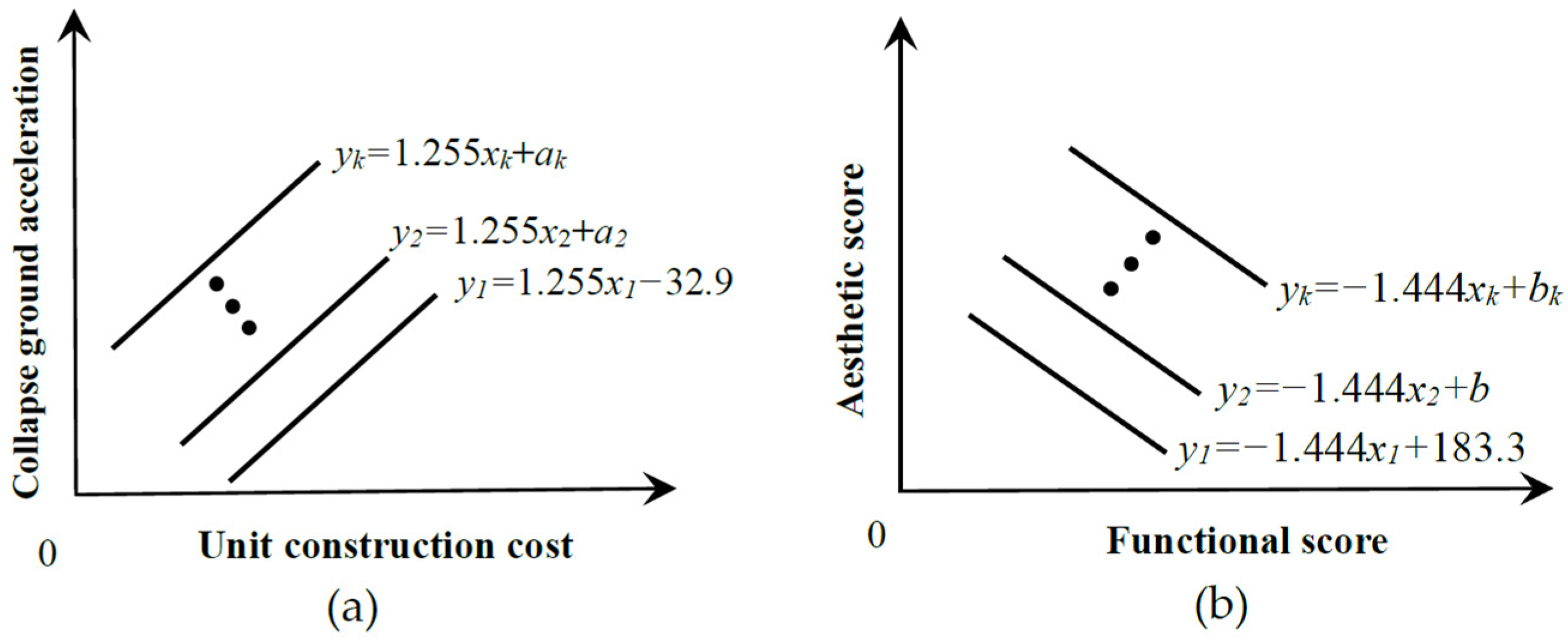
Using the positively sloped indifference curve equation
y = 1.255
x − 32.9 from
Section 4.2, a set of parallel equations can be derived as
yk = 1.255
xk +
ak (where
ak is a constant, and
k = 1, 2, 3…
n). These parallel equations (representing parallel curves in
Figure 15a), having the same slope, can serve as the utility function, representing the architect’s consistent planning preference for safety and economy but with varying degrees of satisfaction.
4.3.2. Utility Function for Aesthetics and Functionality
Following the same approach as above, a set of equations parallel to the negatively sloped indifference curve,
y = −1.444
x + 183.3, obtained in
Section 4.2, can also be derived. These equations are given by
yk = −1.444
xk +
bk (where
bk is a constant, and
k = 1, 2, 3…
n). Since these equations share the same slope and are parallel, they can also be considered as the utility function, representing the architect’s consistent planning preference for aesthetics and functionality but with different degrees of satisfaction, as illustrated in
Figure 15b.
4.4. DEA-Based Efficient Frontier Analysis of Street Houses
This study derives two sets of efficient frontiers—unit construction cost versus collapse ground acceleration and functional score versus aesthetic score—based on the principles outlined in
Section 3.5 and
Section 3.6. Each point on the frontier represents a relatively efficient street house plan. The corresponding graphs and equations are provided for architects’ reference.
4.4.1. The Efficient Frontier for Safety and Economy
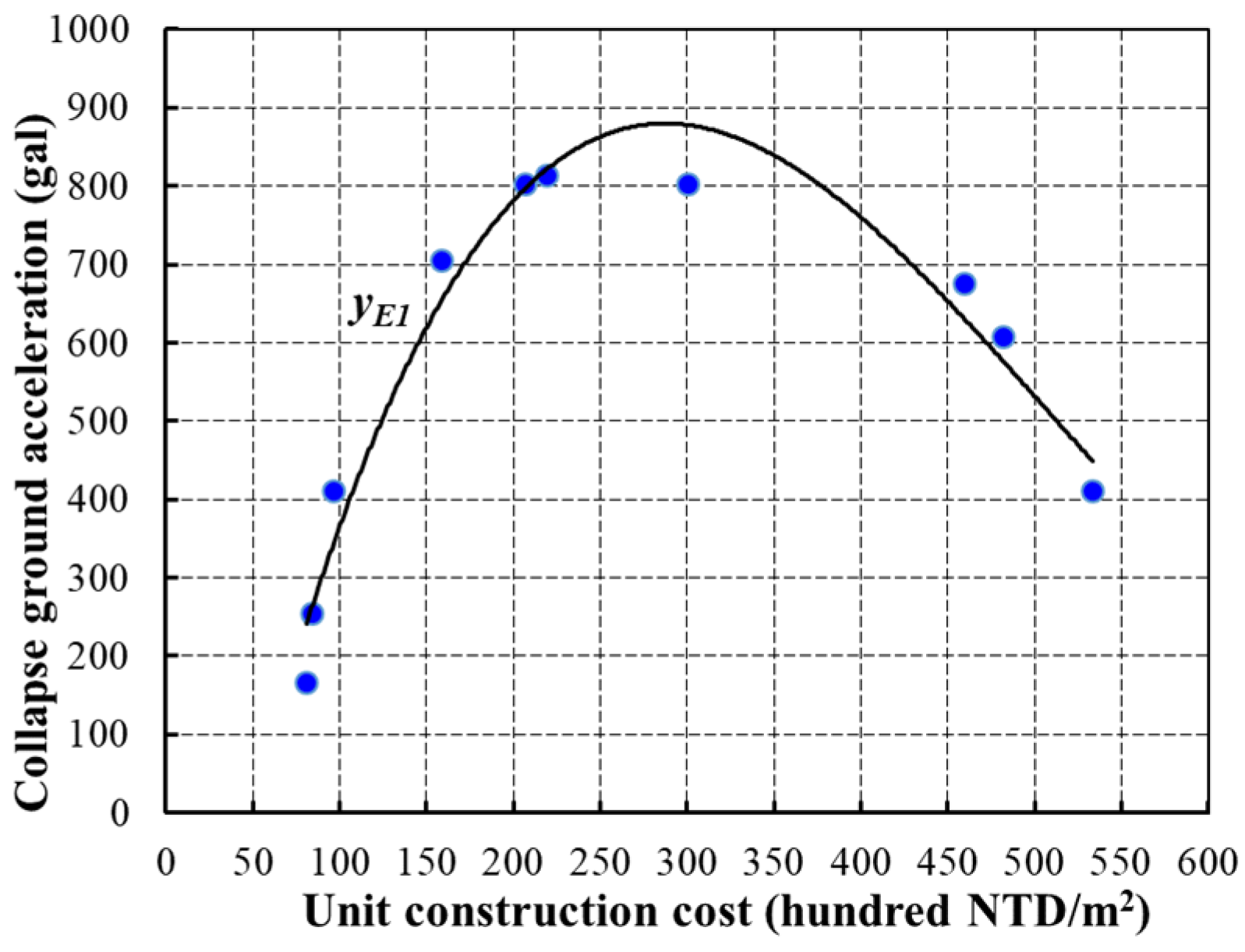
As shown in
Figure 16, unit construction cost is taken as the
x-axis and collapse ground acceleration as the
y-axis. Based on DEA principles, the efficient frontier
yE1 for 375 street houses is derived, where each point represents a relatively efficient plan within the sample. The regression equation of
yields a coefficient of determination (
R2) of 0.9557, indicating a strong correlation between the independent variable (
x) and the dependent variable (
y).
4.4.2. The Efficient Frontier for Aesthetics and Functionality
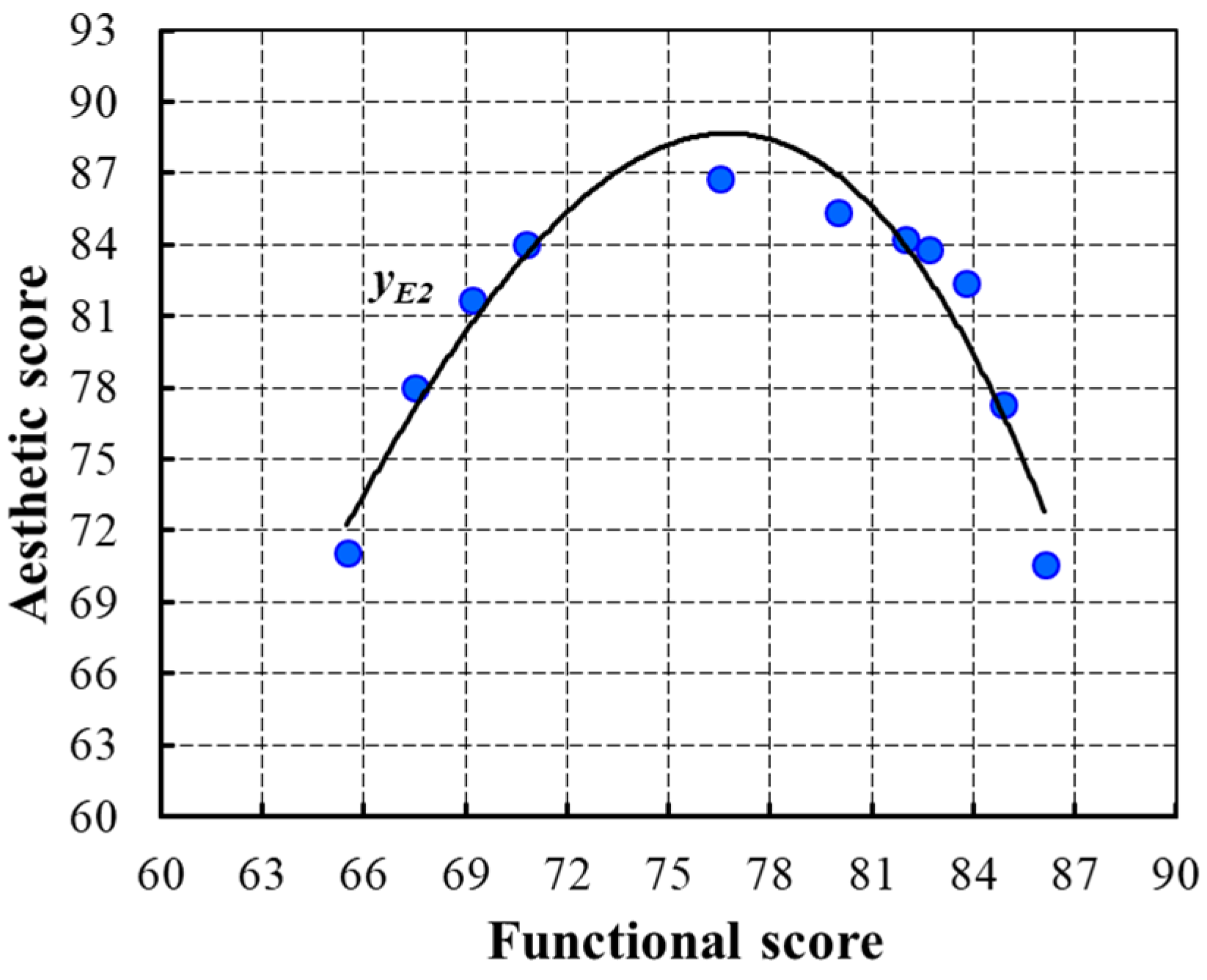
As shown in
Figure 17, the functional score is plotted on the
x-axis and the aesthetic score on the
y-axis. Based on DEA principles, the efficient frontier
yE2 for 252 street houses is derived, representing relatively efficient planning considering functionality and aesthetics. The regression equation of
is obtained accordingly, with a coefficient of determination of
, indicating a strong correlation between the independent (
x) and dependent (
y) variables.
4.5. Efficiency Evaluation of Street Houses
This study applies the methodology developed in
Section 3.7 to evaluate safety efficiency (
SE), economic efficiency (
EE), positive-slope planning efficiency (
PPE), aesthetic efficiency (
AE), functional efficiency (
FE), and negative-slope planning efficiency (
NPE), thereby providing a comprehensive assessment of the overall efficiency of street houses.
4.5.1. Planning Efficiency Assessment for Safety and Economy
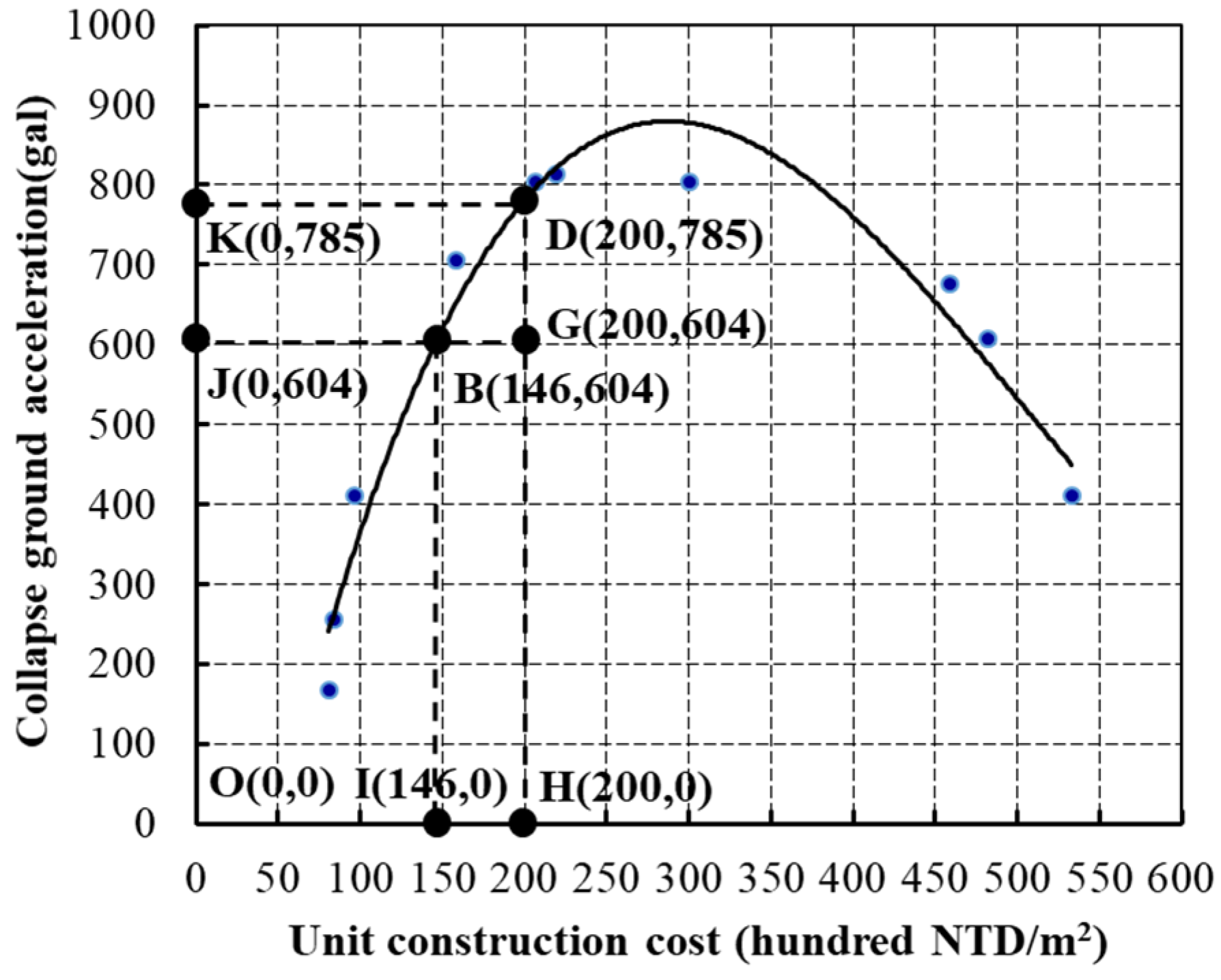
Each point on the efficient frontier represents a relatively efficient plan within the sample space. Street houses not located on this frontier can assess their planning efficiency relative to it. As shown in
Figure 18, a representative real-world case (street house G (200, 604)), located outside the efficient frontier, is selected as a worked example to illustrate the proposed framework and its practical implications. Using the safety preference weight α = 0.44 and economic preference weight β = 0.56 from
Section 4.2.1, the evaluation process is demonstrated. When the unit construction cost is 200, points D (200, 785) and H (200, 0) are obtained from the corresponding relationships. For a collapse ground acceleration of 604, points J (0, 604) and B (146, 604) are derived, while points I (146, 0) and K (0, 785) are also obtained. The
SE,
EE, and
PPE of street house G are then calculated using Equations (14)–(16).
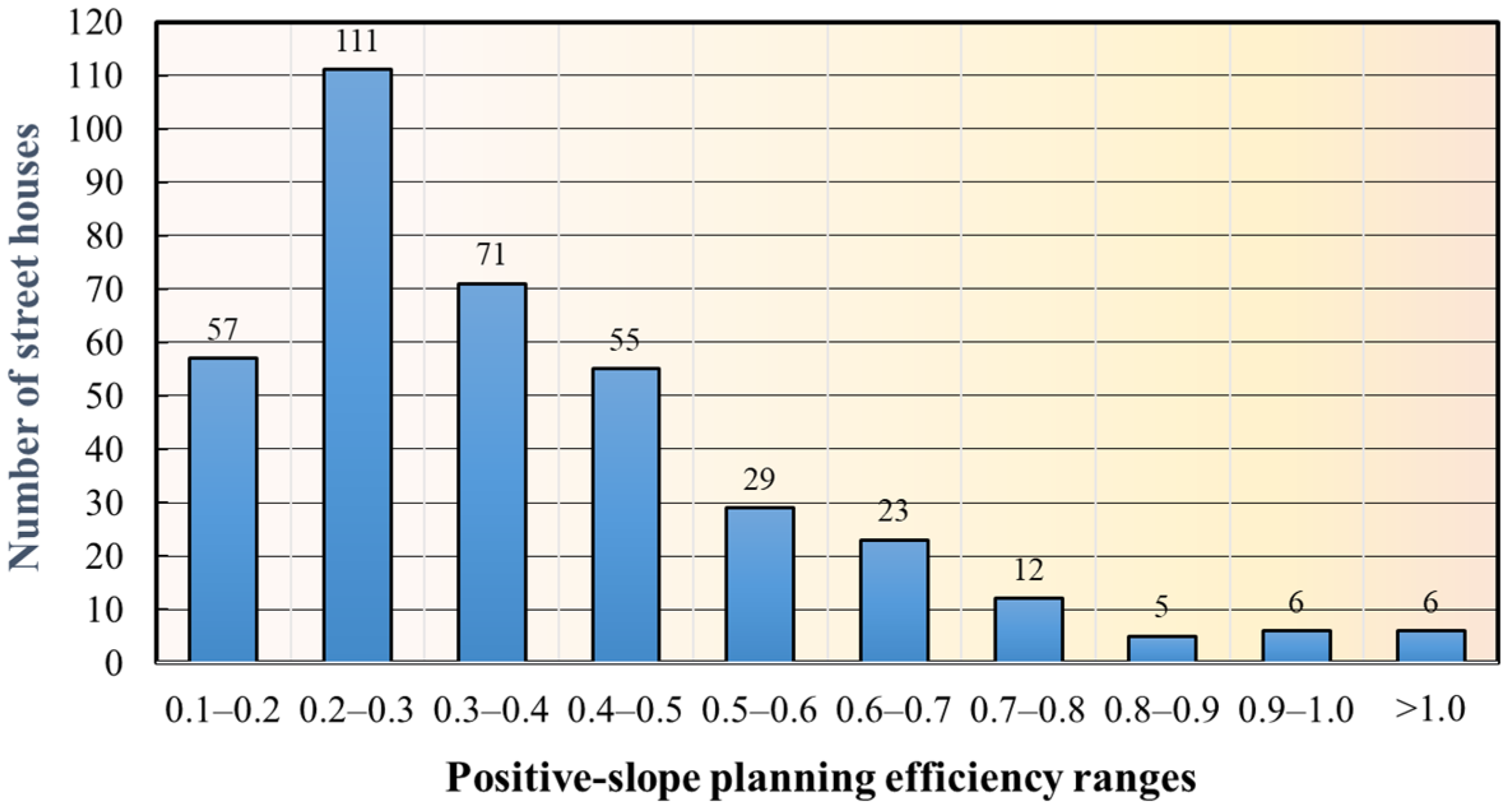
To provide a comprehensive assessment of the proposed framework, the distribution of Positive-slope Planning Efficiency (PPE) values across 375 street house cases was analyzed (λ = 0.8). The results indicate that PPE values range from 0.139 to 1.614; a few exceed unity due to polynomial approximation of the efficient frontier. With a mean of 0.420 and a median of 0.360, most cases fall below the frontier, exhibiting significant room for improvement.
As illustrated in
Figure 19, the distribution of PPE values demonstrates a clear concentration in the lower efficiency intervals, with relatively few cases approaching or exceeding unity. This indicates that only a limited number of street house designs achieve near-optimal performance, while the majority remain inefficient.
In this analysis, the parameter λ is set to 0.8. It should be noted that λ controls the spread of the preference functions, and its influence is reflected in the resulting weight configurations, which are systematically represented by predefined planning preference types. Additional analyses with λ = 0.7 and 0.9 have been conducted, confirming the robustness of this representation.
Overall, the wide distribution of efficiency values confirms that the proposed approach possesses strong discriminatory power in differentiating planning performance across cases, thereby supporting its effectiveness as an evaluation and decision-support tool.
4.5.2. Planning Efficiency Assessment for Aesthetics and Functionality
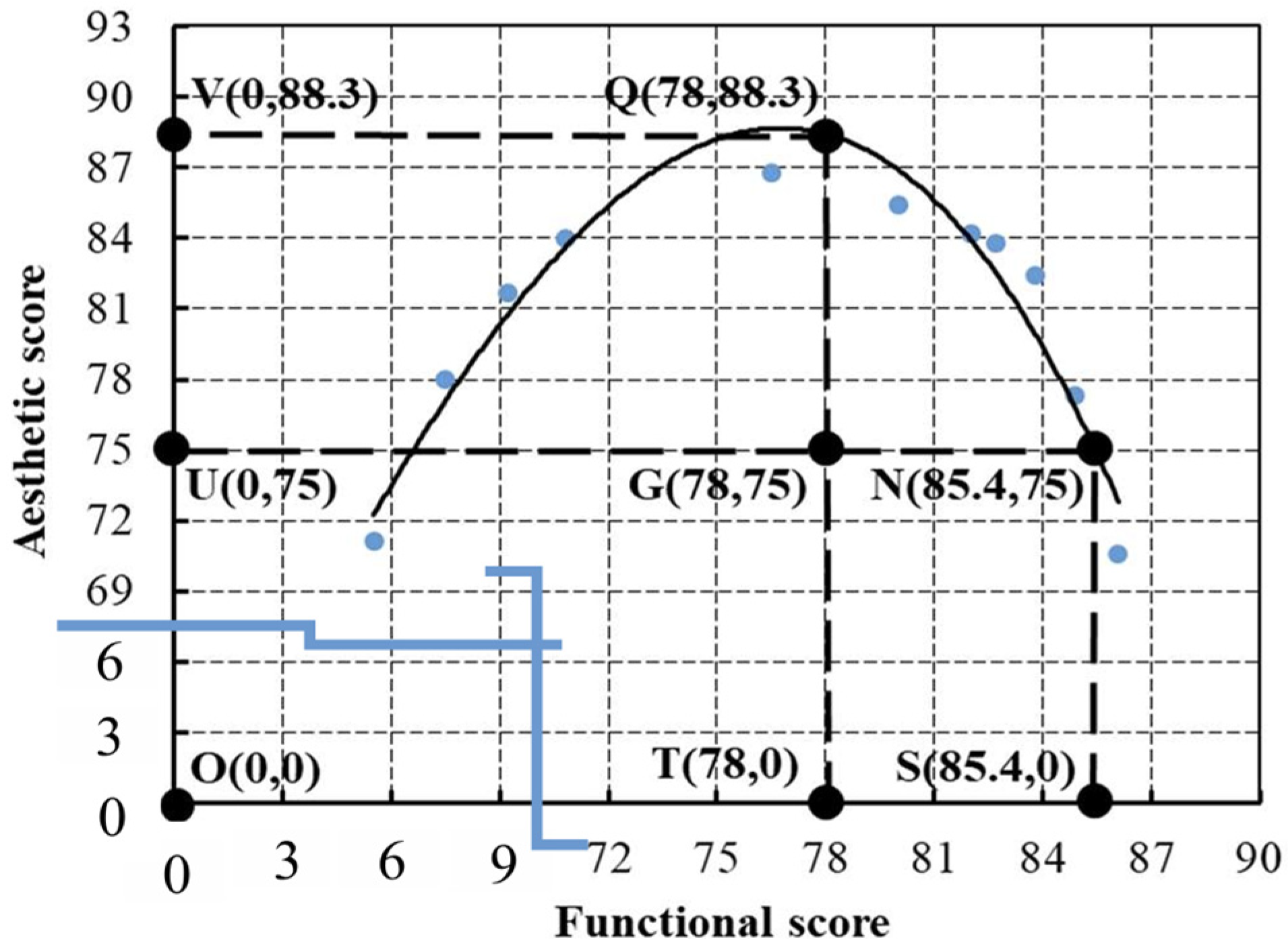
This study further applies the planning efficiency method described in
Section 3.7 to evaluate an actual case, street house G (78, 75), which lies outside the efficient frontier, as shown in
Figure 20 (not to scale and locally magnified for clarity). The aesthetic preference weight γ = 0.41 and functional preference weight δ = 0.59 from
Section 4.2.2 are adopted to illustrate the evaluation process. When the functional score is 78, points Q (78, 88.3) and T (78, 0) are obtained from the corresponding relationships; when the aesthetic score is 75, points U (0, 75) and N (85.4, 75) are obtained. Points S (85.4, 0) and V (0, 88.3) are also shown in the figure. The
AE,
FE, and
NPE of this house are then calculated using Equations (17)–(19).
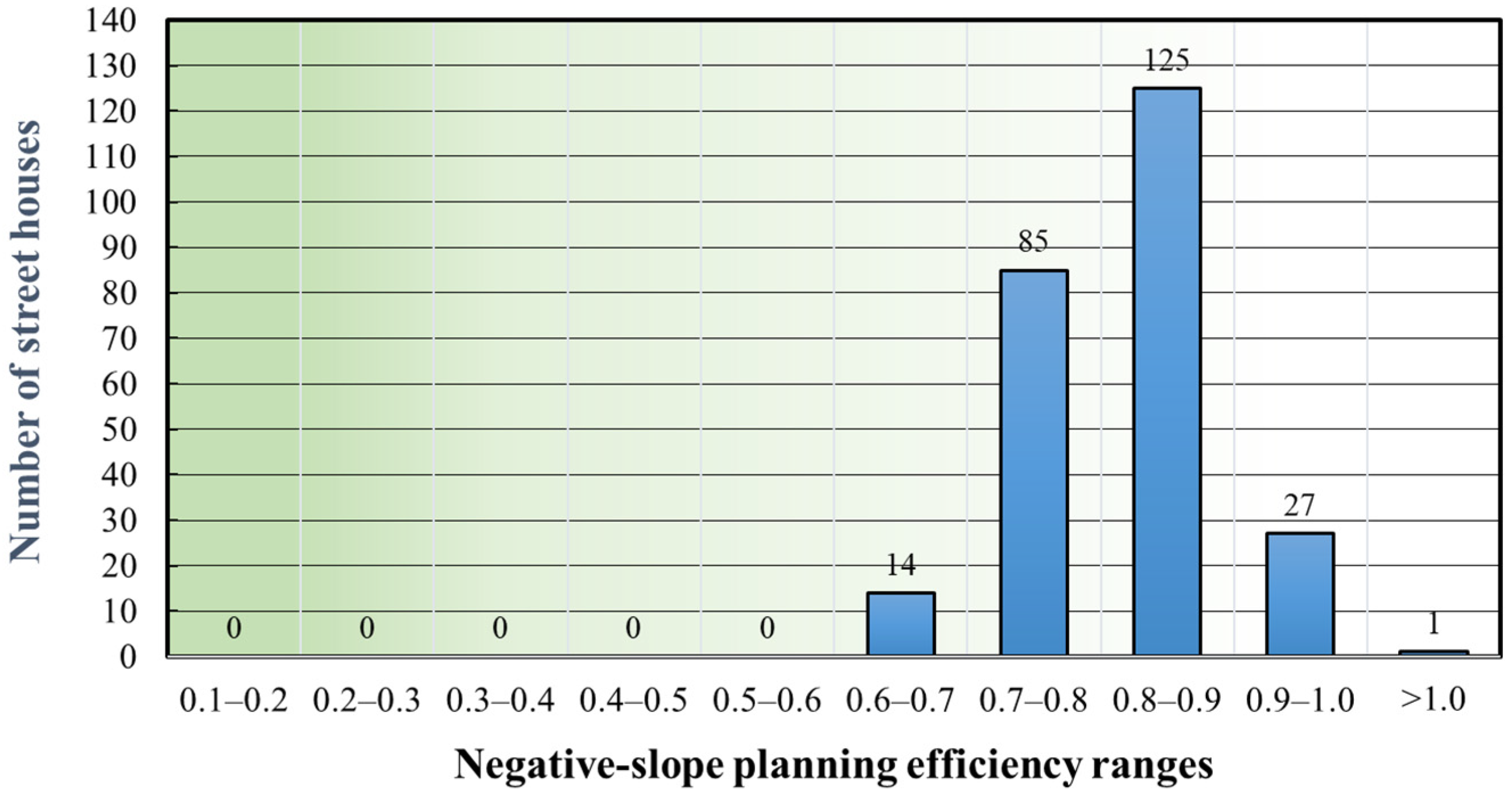
To further validate the proposed framework under a negative-slope preference configuration, the distribution of Negative-slope Planning Efficiency (NPE) values across 252 street house cases was analyzed, with λ set to 0.8. The results yield NPE values ranging from 0.656 to 1.116, with only a single case exceeding the theoretical limit of 1.0. The mean of 0.873 and median of 0.877 suggest that most cases operate in close proximity to the efficient frontier, reflecting a relatively high level of performance.
As illustrated in
Figure 21, the distribution of NPE values is concentrated within a relatively narrow range, with a large proportion of cases achieving moderately high efficiency levels. Compared to the positive-slope scenario, this reflects a more balanced trade-off between functionality and aesthetics, where fewer cases exhibit extremely low efficiency.
Overall, the distribution confirms that the proposed framework remains effective under different preference structures, and demonstrates its robustness in evaluating planning performance across multiple objective relationships.
4.6. Identification of Benchmark Learning Cases
Each point on the efficient frontier represents a relatively efficient plan, serving as a benchmark for less efficient street houses. To evaluate solutions outside the efficient frontier, two indifference curves described in
Section 4.2 are used as utility functions. The tangent points between these curves and the efficient frontier define the corresponding benchmark learning cases.
4.6.1. Benchmark Learning Cases for Safety and Economy
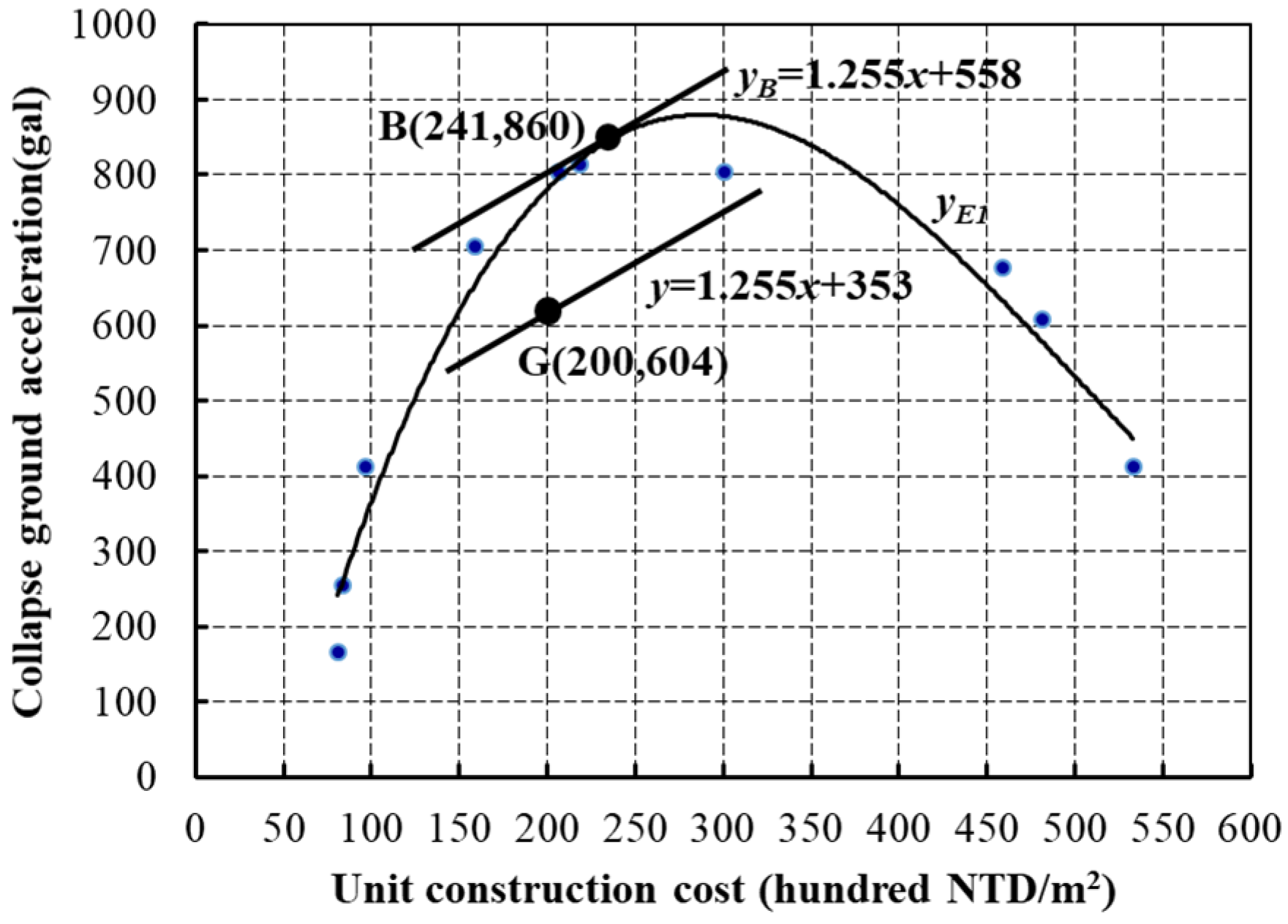
This study uses street house G (200, 604), which is not on the efficient frontier in
Figure 22, as a research case. It adopts the architect’s indifference curve equation
y = 1.255
x − 32.9 (from
Section 4.2) and generalizes it into a utility function,
y = 1.255
x +
a. Since this function passes through G (200, 604),
a = 353, giving the architect’s initial utility function
y = 1.255
x + 353. As shown in
Figure 22, this function is not tangent to the efficient frontier
, indicating an inefficient plan. According to utility theory, the architect would seek a different utility function,
yB = 1.255
x + 558, which is tangent to
yE1. The tangent point, B (241, 860), lies on the efficient frontier and represents the optimal plan aligning with both the efficient frontier and the architect’s preferences. It serves as a benchmark learning case when considering safety and economy.
4.6.2. Benchmark Learning Cases for Functionality and Aesthetics
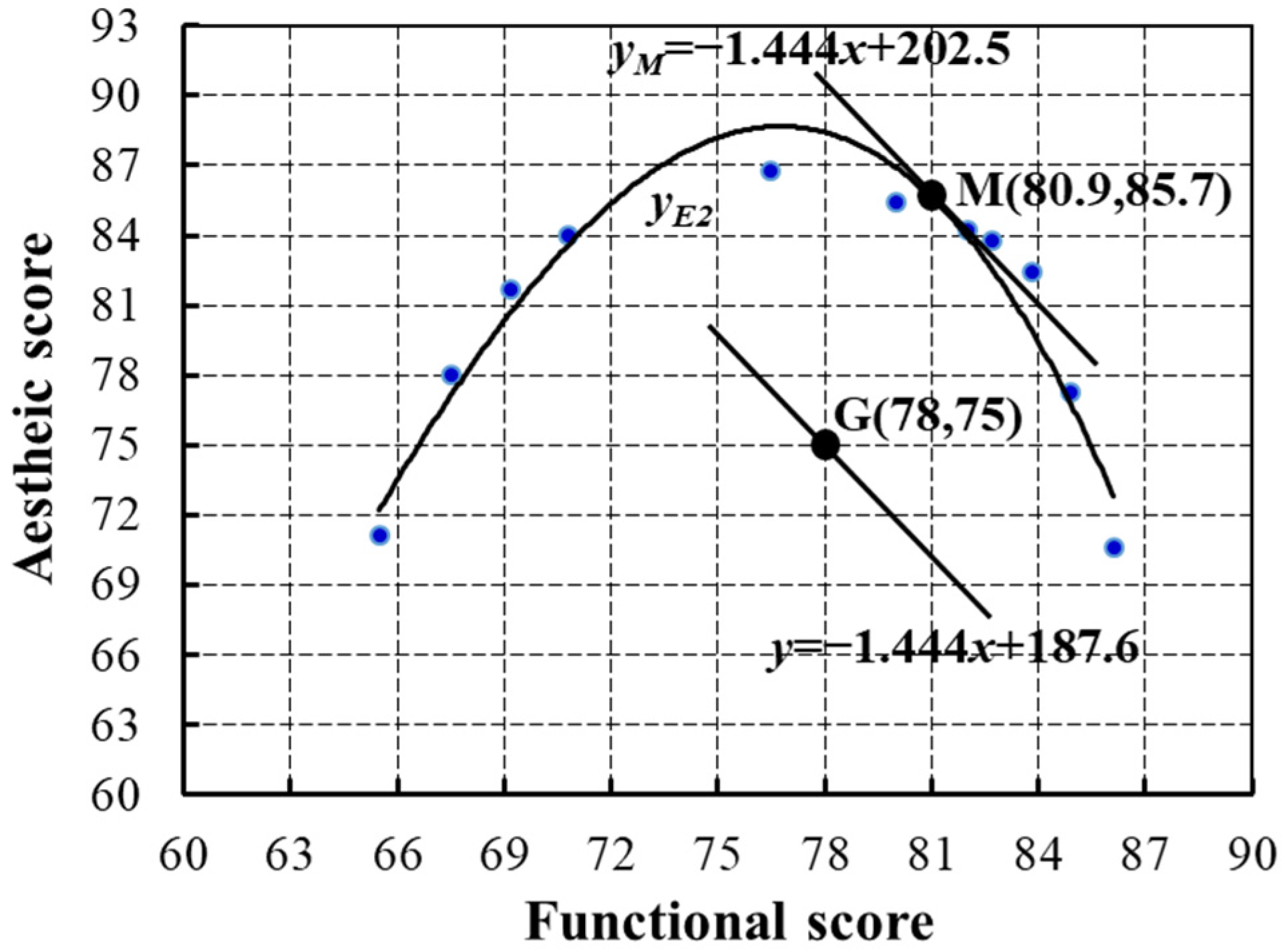
This study uses street house G (78, 75), which is not on the efficient frontier in
Figure 23, as a research case. It adopts the indifference curve
y = −1.444
x + 183.3 (from
Section 4.2) as the architect’s indifference curve (negative slope) and generalizes it into a utility function
y = −1.444
x +
b. Since this function passes through G (78, 75), b = 187.6, resulting in the architect’s initial utility function
y = −1.444
x + 187.6. As shown in
Figure 23, this function is not tangent to the efficient frontier
, indicating an inefficient plan. According to utility theory, the architect would seek another utility function,
yM = −1.444
x + 202.5, tangent to
yE2. The tangent point M (80.9, 85.7) on the frontier represents the optimal plan that aligns with both the efficient frontier and the architect’s preferences. This point serves as the benchmark learning case when considering functionality and aesthetics.
4.7. Benchmark Learning Cases Under Different Planning Preferences
Using the methodology from
Section 3.8, this study calculates benchmark learning cases for five planning preferences based on the given street house.
4.7.1. Different Benchmark Learning Cases for Safety and Economy
Following the calculation steps in
Section 4.6, street house G (200, 604) is used as an example to compute the initial and final utility functions and identify the corresponding benchmark learning cases for five planning preferences. The results are summarized in
Table 7.
Table 7 reveals significant differences in utility functions, initial and final utility functions, and benchmark learning cases across the five planning preferences. For those with an extreme safety preference, the final utility function is
yE = 892, with benchmark point E (294, 892). With a balanced preference, the final utility function is
yC =
x + 620, and the benchmark point is C (251, 871). For those with an extreme economy preference, the final utility function is
x = 80, with benchmark point A (80, 235). These results demonstrate the method’s effectiveness in addressing diverse architectural planning preferences.
4.7.2. Different Benchmark Learning Cases for Functionality and Aesthetics
Adhering to the computational procedure outlined in
Section 4.6, house G (78, 75) is taken as a representative example to evaluate the initial and final utility functions and determine the corresponding benchmark learning cases under five planning preferences. The results are presented in
Table 8.
Table 8 shows that utility functions, initial and final utility functions, and benchmark learning cases vary significantly across the five preferences. For an extreme preference for aesthetics, the final utility function is
yQ = 88.6, with benchmark point Q (76.8, 88.6). With a balanced preference, the final utility function is
yN = −
x + 166.8, and the benchmark point is N (79.7, 87.1). For an extreme preference for functionality, the final utility function is
x = 86.1, and the benchmark point is L (86.1, 72.7). These distinctions reflect how the method accommodates diverse architectural preferences in functionality and aesthetics, thereby demonstrating its applicability in preference-informed decision-making.
4.8. Discussion
The results demonstrate that the proposed framework effectively integrates subjective preference modelling with objective efficiency evaluation for multi-objective street house planning problems. By incorporating fuzzy sets, indifference curves, and utility functions, the approach captures architects’ planning preferences in a structured and quantifiable manner. At the same time, the application of Data Envelopment Analysis (DEA) enables the identification of the efficient frontier, providing an objective basis for evaluating the relative performance of different planning alternatives.
It should be noted that various forms of fuzzy preference functions, such as trapezoidal or Gaussian functions, may also be employed to represent subjective preferences. In this study, a triangular preference function is adopted due to its simplicity and interpretability, which are suitable for architectural planning applications. While alternative functional forms may affect the detailed shape of preference structures, the proposed framework is not limited to a specific function type. Future research may further explore the sensitivity of the results to different preference function specifications.
The indifference curves in this study are assumed to be linear for analytical simplicity and interpretability. This assumption facilitates the classification of preference types and the analysis of trade-offs between objectives. It should be noted that linear indifference curves represent a simplified preference structure, and more complex nonlinear forms may also be considered. While such extensions may better capture nuanced preferences, they would increase model complexity and reduce transparency. Therefore, the linear form is adopted in this study as a practical approximation. Future research may explore alternative functional forms to assess the sensitivity of the results.
A notable observation is that architectural decision-making is rarely driven by extreme preferences, but instead reflects a balance among competing objectives. This suggests that, in practice, such decision-making inherently involves trade-offs among competing objectives, such as safety versus economy and functionality versus aesthetics. By integrating indifference curves with the efficient frontier, the proposed framework enables explicit visualization of these trade-offs, thereby improving the transparency and interpretability of the decision-making process.
Furthermore, the concept of benchmark learning cases, derived from the tangent points between indifference curves and the efficient frontier, provides a meaningful reference for practitioners. For instance, the coordinate shifts identified in this study (e.g., from G (200, 604) to B (241, 860)) should be interpreted as integrated design improvements rather than literal changes. For Taiwanese street houses, the shift from G (200, 604) to B (241, 860) suggests that an approximately 20% increase in unit construction cost may yield an approximately 42% improvement in collapse ground acceleration capacity, indicating that moderate additional investment can substantially enhance seismic safety performance. From a materials perspective, enhanced safety may be achieved through the use of higher-strength or more durable materials. From a structural standpoint, this may involve enhancing seismic resistance, increasing stiffness and ductility, or optimizing load-resisting systems. From a design perspective, changes in functionality and aesthetics may reflect spatial reconfiguration, improved circulation, and facade articulation, while variations in unit construction cost indicate trade-offs among material selection, construction methods, and spatial efficiency. Therefore, these benchmark cases provide not only quantitative targets but also qualitative guidance for architectural decision-making.
Unlike conventional Pareto-based multi-objective optimization methods, which primarily focus on identifying non-dominated optimal solutions, the proposed framework emphasizes preference-oriented benchmark learning and planning interpretation. By integrating fuzzy preference functions, indifference curves, utility functions, and DEA-based efficient frontier analysis, the framework explicitly incorporates architects’ subjective preference relationships into the evaluation process. In addition, whereas Pareto-based methods often generate multiple alternative solutions requiring further decision-making procedures, the proposed framework provides benchmark learning guidance based on the tangency relationship between utility functions and the efficient frontier. Therefore, the proposed approach is intended not as a replacement for Pareto-based optimization, but as a complementary framework for preference-oriented planning evaluation and benchmark identification. To further clarify the methodological positioning of the proposed framework,
Table 9 summarizes the conceptual differences between conventional Pareto-based optimization methods and the proposed approach in terms of optimization objective, preference integration, decision-support mechanism, and planning interpretation.
Nevertheless, several limitations should be acknowledged. First, the modelling of preferences relies on predefined functional forms (e.g., fuzzy membership functions and utility functions), which may not fully capture the diversity of architects’ cognitive processes. Second, the DEA-based efficiency evaluation is sensitive to the selection of input and output variables, which may influence the resulting frontier and benchmark cases. Third, the dataset is limited to street houses in Taiwan, and the generalizability of the findings to other regions or building types requires further validation.
Future research could focus on integrating more advanced preference elicitation techniques, such as interactive or data-driven learning methods, to better capture dynamic decision-making behaviors. In addition, the proposed framework could be extended to incorporate uncertainty analysis or stochastic optimization to enhance its applicability under real-world conditions. Expanding the dataset to include diverse building types and geographical contexts would also help to further validate and generalize the proposed methodology.
5. Conclusions
Architectural design is a creative and technical process that shapes buildings and spaces to achieve multiple planning objectives. Among these, safety, economy, functionality, and aesthetics are particularly significant. However, most existing benchmarking methods focus on a single objective, a limitation that overlooks the diverse and subjective planning preferences of individual architects. Consequently, relying on a single benchmark learning case may not adequately support comprehensive decision-making in architectural design.
In street house planning, architects must balance the four key objectives outlined above. For example, prioritizing safety may reduce economic efficiency, while improvements in functionality or aesthetics are often limited by budget constraints. These trade-offs underscore the inherent complexity of multi-objective optimization in architectural design. Accordingly, there is a growing need for methods that not only address multiple objectives but also integrate architects’ planning preferences into the benchmarking process, thereby enhancing the effectiveness of benchmark learning in architectural decision-making.
To address these challenges, this study proposes a novel benchmark learning methodology that integrates multiple planning objectives with individual architect preferences. The proposed framework combines fuzzy set theory, indifference curves, utility functions, efficient frontiers, and Data Envelopment Analysis (DEA) to provide a comprehensive and systematic approach for evaluating architectural planning performance.
To illustrate the proposed methodology, the framework was applied to a dataset of 627 street houses, considering two distinct objective categories. The results show that fuzzy sets effectively capture architects’ preference functions for single objectives. For dual-objective trade-offs, indifference curves represent planning preferences and weights, allowing the classification of five distinct preference types in each category. Utility functions derived from these curves are used to evaluate the optimal satisfaction levels. Efficient frontier theory and DEA are then applied to construct frontiers for both categories, serving as benchmarks for evaluating street houses outside the frontier.
This study integrates concepts from multiple disciplines to investigate benchmark learning in architectural planning from an interdisciplinary perspective. It introduces innovative methods to address complex challenges in architectural design, extending the application of fuzzy sets, indifference curves, utility functions, efficient frontiers, and DEA. The findings provide practical guidance for architects engaged in street house planning and establish a robust methodological framework for future research on multi-objective decision-making in architectural planning.
This study proposes several directions for future research:
- (1)
Methodological Framework: This study integrates fuzzy sets, indifference curves, utility functions, efficient frontiers, and Data Envelopment Analysis (DEA) to develop a benchmark learning framework. Although fuzzy sets are the only component directly associated with artificial intelligence (AI), recent advances in AI for handling complex multi-objective problems suggest that the proposed methodology could be further extended. In particular, future research may incorporate interactive AI or data-driven learning techniques to develop more adaptive and intelligent benchmark learning models for street house planning.
- (2)
Preference Representation: Architects’ planning preferences are inherently subjective and diverse in nature, yet remain relatively underexplored in existing research. This study employs fuzzy sets to define preference functions μ(x), utilizes indifference curves to characterize preference types and derive corresponding weights, and applies utility functions to evaluate satisfaction levels. Collectively, these methods establish a structured and quantifiable framework for interpreting subjective preferences. Future research could extend this approach by incorporating uncertainty analysis or stochastic optimization techniques to develop a more comprehensive and robust model.
- (3)
Data Source and Applicability: This study is based on street house cases in Taiwan, and the empirical results may therefore reflect local architectural practices, regulatory conditions, and market environments. Accordingly, the generalizability of the findings to other regions may be subject to contextual differences. Nevertheless, the proposed framework is methodological in nature and not restricted to a specific geographical context. The integration of fuzzy preference modelling, indifference curves, utility functions, and DEA provides a general analytical structure that can be adapted to different settings with appropriate data. Future research may extend the analysis to other regions or building types to further examine the robustness and applicability of the proposed approach.