Article

Evaluating All-Age-Friendly Community Environments with Cross-Generational Interaction Potential: A Multi-Objective Assessment Based on Cases from China and Italy


1
College of Architecture and Urban Planning, Tongji University, Shanghai 200092, China
2
Department of Architecture, University of Florence, 50121 Florence, Italy
3
Shanghai Key Laboratory of Urban Renewal and Space Optimization Technology, Shanghai 200092, China
*
Author to whom correspondence should be addressed.
Buildings 2026, 16(11), 2194; https://doi.org/10.3390/buildings16112194
Submission received: 19 April 2026 / Revised: 21 May 2026 / Accepted: 26 May 2026 / Published: 29 May 2026
(This article belongs to the Special Issue Healthy Aging and Built Environment)

Abstract

Communities worldwide are increasingly required to support populations spanning multiple generations while maintaining social cohesion in the context of rapid demographic ageing and urban transformation. Although frameworks for age-friendly or inclusive environments have gained international traction, existing evaluation methods seldom integrate the environmental qualities necessary for all-age-friendliness with the spatial and social conditions that enable cross-generational interaction. This study addresses this gap by developing a dual-lens evaluation framework that quantifies both fundamental environmental attributes and the interaction potential embedded within community spaces. Grounded in field investigations, spatial analysis, expert consultation, and user surveys, the study establishes a hierarchical indicator system comprising nineteen prerequisite indicators and sixteen enhancement indicators across five dimensions: site accessibility, spatial integration, environmental comfort, safety and health, and participation and inclusion. To operationalize the framework, a combined Fuzzy Analytic Hierarchy Process and multi-objective optimization model was employed, enabling the representation of interdependencies between essential conditions and value-enhancing features. Application of the framework to 24 community cases in Shanghai and Florence reveals both shared structural patterns and distinctive cultural influences: Shanghai demonstrates strengths in walkability and health-supportive infrastructure, whereas Florence excels in natural contact and environmentally integrated spatial typologies. The findings underscore the necessity of balanced environmental performance for achieving high-quality, all-age-friendly community spaces with strong cross-generational engagement potential. The proposed framework provides a replicable and analytically rigorous tool for environmental and social impact assessment, offering guidance for planners, policymakers, and designers seeking to promote inclusive, resilient, and socially cohesive community environments.

1. Introduction

Population ageing, declining household sizes, and the restructuring of cross-generational relationships have reshaped the social and spatial dynamics of contemporary cities. As traditional forms of familial care weaken and younger generations become increasingly mobile, communities must accommodate a wider range of age groups while providing environments that sustain social connectedness [1]. These demographic trends have intensified global policy interest in all-age-friendly environments—community settings designed to support the needs of people across the life course [2]. However, environmental quality alone does not guarantee social cohesion: meaningful cross-generational interaction remains a critical yet under-examined dimension of community well-being [3]. Built environments structure opportunities for encounter, co-presence, and shared activity, influencing how different age groups perceive, access, and appropriate space [4]. Understanding how environmental attributes can simultaneously support all-age inclusiveness and cross-generational engagement is therefore essential for designing socially resilient communities.
Consequently, while existing literature provides valuable insights, a closer examination reveals three specific research gaps that limit the systematic evaluation of social sustainability in community environments. First, a conceptual gap exists regarding the physical spatial enablers of cross-generational interaction. Current research often approaches intergenerational cohesion through programmatic lenses (such as care models or organized activities), leaving the specific built-environment attributes that support spontaneous spatial engagement under-examined [5]. Second, a methodological gap persists in the mathematical evaluation frameworks. Many existing liveability and age-friendly indices employ additive, compensatory weighting systems. In practice, such models can allow high scores in aesthetic or advanced amenities to mathematically obscure deficiencies in fundamental safety or accessibility [6]. Third, an empirical gap remains in cross-contextual validation. There is a need for assessment frameworks tested across contrasting urban morphologies—such as rapidly retrofitted megacities compared to dense, historical urban contexts—that are facing similar demographic shifts.
Addressing these gaps requires an evaluative framework capable of integrating the essential environmental qualities that underpin universal usability with the spatial and social features that promote cross-generational interaction [7]. Such a framework must also capture the inherent uncertainty and multidimensionality of environmental perception while accommodating diverse cultural contexts. To meet these needs, this study adopts a dual-lens approach that combines all-age-friendly environmental criteria with cross-generational interaction potential, operationalized through a structured analytical model. Drawing on empirical data from Shanghai and Florence, the study develops a hierarchical indicator system informed by field observations, resident surveys, spatial analysis, and expert consultation.
To explicitly clarify the scope and narrative structure of this study, it is important to note that the primary objective of this paper is the evaluation and spatial optimization of all-age-friendly community environments. However, because evaluating such complex environments requires a robust analytical instrument—one that addresses the non-compensatory dynamics mentioned above—the research is structured in two interconnected phases: methodological development followed by empirical application. Specifically, Section 3 and Section 4 (Methodology and Results) focus on constructing and applying the MOO-based assessment model (the B-P-E framework). Subsequently, Section 5 (Discussion) shifts the focus back to the primary spatial objective, translating the quantitative outcomes into qualitative, actionable design strategies. This structural differentiation ensures that the methodological tool effectively serves the broader goal of environmental optimization.
Furthermore, the empirical foundation of this research stems from a collaborative joint doctoral program between Tongji University (China) and the University of Florence (Italy). This context bridges two distinct perspectives on urban regeneration: the rapid community retrofitting typical of Asian megacities and the historical micro-regeneration characteristic of Southern Europe. This dual affiliation provides a complementary comparative lens for exploring intergenerational spatial strategies across contrasting urban morphologies.

2. Theoretical and Conceptual Framework

2.1. From Age-Friendly to All-Age-Friendly Community Environments

The concept of age-friendly environments has been widely promoted in urban planning and public policy, particularly following the World Health Organization’s Age-Friendly Cities framework, which emphasizes accessibility, safety, health services, and social participation for older adults. While this framework has contributed significantly to improving living conditions for ageing populations, it has also been critiqued for its age-segmented orientation, which tends to treat older adults as a distinct and isolated group within the community. In rapidly ageing societies characterized by shrinking household sizes and increasing social fragmentation, such an approach risks overlooking the broader social relationships that sustain community cohesion [8].
In response, the concept of all-age-friendly (AAF) environments has emerged as an extension of age-friendly planning, emphasizing inclusiveness across the life course rather than focusing on a single age group [9]. All-age-friendly environments aim to accommodate diverse physical, cognitive, and social needs simultaneously, enabling shared use of space by children, adults, and older people [10]. From an environmental assessment perspective, this shift aligns closely with the principles of universal design, social equity, and vulnerability reduction, all of which are central concerns in EIA and Social Impact Assessment (SIA) [11]. Rather than prioritizing one demographic group, all-age-friendly environments emphasize adaptability, accessibility, and environmental quality as common foundations for inclusive community life.
However, inclusiveness alone does not guarantee social interaction [12]. While an all-age-friendly environment may be accessible and safe for different age groups, it does not necessarily facilitate meaningful engagement between them. This distinction highlights the need to move beyond environmental suitability toward an explicit consideration of interaction potential within community spaces.

2.2. Cross-Generational Interaction as a Spatially Mediated Process

The premise that cross-generational interaction enhances all-age-friendliness and overall livability is supported by environmental psychology and social sustainability theories. While traditional age-segmented planning often isolates demographic groups, integrating age-based spatial priorities with opportunities for generational empathy introduces cross-generational relations as a meaningful aspect of future urban spaces [13,14].
Moreover, such interactions are considered beneficial for active aging, as they provide older adults with opportunities for social participation, cognitive stimulation, and mutual support. The literature indicates that spatially mediated cross-generational interactions generate psycho-social benefits: they can reduce ageism, alleviate social isolation among older adults, and foster developmental benefits for children [15,16]. Within this paradigm, the built environment acts as a supportive facilitator, enabling the development of all-age-friendly communities that encourage social inclusion across the life course [17,18].
From a spatial perspective, the configuration of shared spaces acts as a dynamic mediator rather than a static container. By prioritizing the creation of “intergenerational contact zones,” the built environment can foster community resilience and a sense of belonging for residents of all ages [19]. Consequently, understanding and quantifying the spatial potential for cross-generational interaction provides a valuable perspective for evaluating and designing inclusive and all-age-friendly living environments.

2.3. Literature Gap and B-P-E Framework

Previous studies usually discuss environmental usability and intergenerational interaction in parallel, not in one integrated logic. Many studies identify safety, accessibility, and comfort as important factors, but they do not treat them as explicit preconditions in evaluation models. Most additive models also allow compensation across dimensions, so high scores in one aspect can mask deficits in basic conditions. This limitation reduces diagnostic clarity for real community upgrading.
This study proposes a B-P-E framework with three linked layers. B-level dimensions define the main evaluation domains: accessibility, spatial integration, environmental comfort, safety and health, and participation and inclusion. P-level indicators represent prerequisite conditions and are assessed as threshold filters. E-level indicators represent enhancement conditions and are assessed as graded performance. We define a non-compensatory relationship between P and E. In this structure, high enhancement scores cannot offset missing prerequisites.

2.4. Relevance to Environmental and Social Impact Assessment

The proposed framework directly addresses growing calls within EIA and SIA for more systematic integration of social dimensions into environmental evaluation [20]. Community environments increasingly serve as critical interfaces between physical infrastructure and social outcomes [21], particularly in ageing societies where vulnerability, accessibility, and social isolation intersect. By providing a structured approach to evaluating how built environments support all-age inclusiveness and cross-generational interaction potential, the framework extends conventional environmental assessment beyond physical impacts to encompass social and relational considerations.
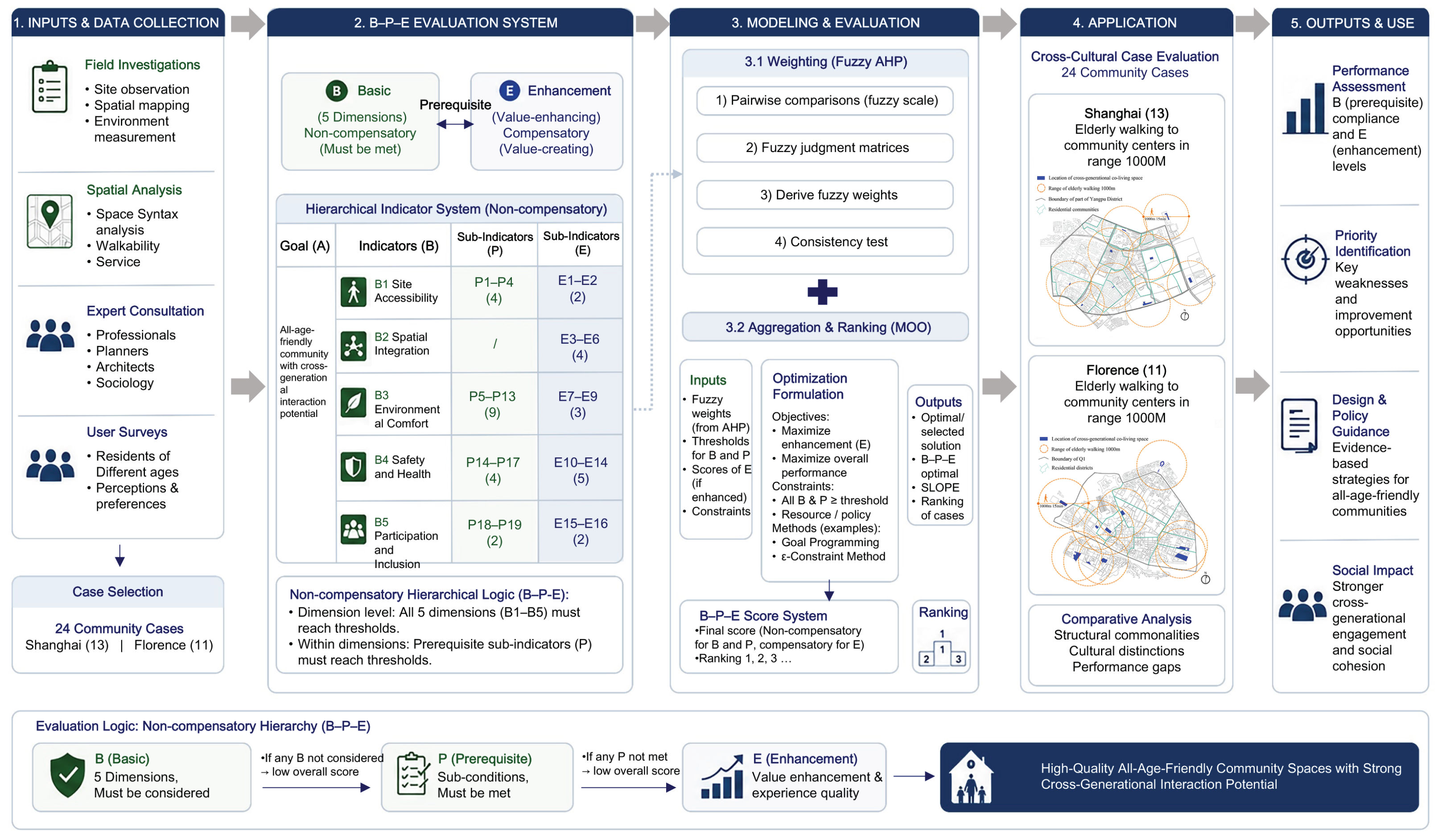
Figure 1 synthesizes the theoretical and methodological logic of this study by linking the conceptual hierarchy of all-age-friendly prerequisite conditions and cross-generational interaction potential with the B–P–E indicator structure. The framework highlights the non-compensatory dependency between layers, ensuring that enhancement features and interaction potential are contingent upon the satisfaction of foundational environmental conditions. The integration of FAHP and multi-objective optimization provides an operational mechanism for translating this hierarchical logic into a systematic evaluation model.

3. Materials and Methods

To capture the hierarchical and non-compensatory relationships inherent in community environments, this study adopts a multi-criteria evaluation approach that integrates expert judgment, empirical observation, and quantitative analysis. Accordingly, Section 3 details the research design, data collection procedures, indicator system development, and the combined Fuzzy Analytic Hierarchy Process and multi-objective optimization model used to operationalize the conceptual framework across the selected community cases in Shanghai and Florence.

3.1. Study Areas and Case Selection

Selection of Shanghai and Florence. Shanghai (China) and Florence (Italy) were selected for cross-cultural comparison based on their demographic shifts and distinct approaches to urban age-friendliness. Both cities represent significant examples of the aging phenomenon. Notably, statistical data indicate that these regions share similar elderly population structures: as of 2021, Italy’s population aged 65 and over accounted for 23.5% of its national total, with the Tuscany region (where Florence is located) reaching 25.9% [22]. Symmetrically, by the end of 2020, Shanghai’s elderly population (aged 65 and over) accounted for 25.9% of its registered population [23]. These comparable demographic indicators demonstrate that both regions have entered a super-aged society, providing a valid empirical foundation for cross-cultural comparative analysis. The rationale for comparing China with Southern Europe (Italy) rather than East Asia or Northern Europe is grounded in structural representativeness. The existing literature extensively covers East Asian models (e.g., Japan and South Korea); however, their cultural and institutional homogeneity with China limits the potential for discovering differential insights. Conversely, while age-friendly models in Northern Europe or North America are highly developed, they rely on robust state-welfare financial systems, making them challenging to replicate in different socio-economic contexts. Florence, representing the Southern European model, provides a suitable comparative lens: it shares traditional family values and neighborhood cohesion with China, yet it offers mature experience in implementing urban “micro-interventions” (micro-regeneration). While Shanghai is developing “15-min community life circles” by retrofitting modern neighborhood centers, Florence—a quintessential “walkable city”—excels at integrating inclusive co-living projects and multi-generational interaction spaces into a dense, historical urban fabric without large-scale reconstruction.
Case Definition and Selection. To prevent arbitrary generalizations, since intergenerational interaction could theoretically occur in any urban public space, this study applied a strict multi-criteria filtering process to isolate highly focused community cases. A “community case” is defined as a public building within the residential area that is most frequently utilized by residents and aligns with the mobility scales of older adults. The evaluation encompasses the comprehensive spatial sequence of these cases, including both their indoor and surrounding outdoor environments, to ensure the accuracy of spatial and accessibility indicators [24]. In Shanghai, the spatial focus was targeted at public community service typologies—such as community senior activity centers (specifically excluding specialized medical nursing or long-term care facilities for frail, non-autonomous elders) and exemplary neighborhood hubs (locally termed “Mulin” centers, signifying harmonious neighborhood relations)—situated within the nine administrative districts where the proportion of the population aged 65 and over exceeds the municipal average (specifically District Hongkou, District Huangpu, District Putuo, District Chongming, District Jing’an, District Changning, District Yangpu, District Xuhui, and District Baoshan). Symmetrically, in Florence, where the population aged 65 and over reached 26.88% by 2022, the spatial focus was directed toward Quartiere 5, which exhibits the highest total residential and elderly population densities within the survey scope. Factoring in the walking service radius of older adults (approximately 1000 m or a 30 min walk) [25], infrastructure accessibility, post-pandemic operational status, and fieldwork feasibility, 24 valid community public buildings—13 in Shanghai and 11 in Florence—were selected. Furthermore, to eliminate systemic biases arising from extreme winter or summer climate variations, European summer holiday disruptions, and seasonal fluctuations in the activity willingness and travel frequencies of seniors and children, the empirical fieldwork was strictly concentrated during the spring and autumn windows (primarily April, May, October, and November). A comprehensive summary of the surveyed cases and their geographical distributions is presented in Table 1.
Standardized Case Numbering System. To facilitate cross-cultural comparison and data processing in the subsequent Multi-Objective Optimization (MOO) model, a standardized coding system was established for the 24 cases. The nomenclature follows a three-part logic: [City Abbreviation] + [District Code] + [Sequence Number]. For the 13 Shanghai cases, the prefix “SH” is followed by a two-letter Pinyin abbreviation of the district (e.g., YP for Yangpu, HK for Hongkou) and a two-digit sequence number (e.g., SHYP01 represents the first surveyed case in Yangpu). For the 11 Florence cases, the prefix “FI” is followed by “Q” and a number representing the city’s official neighborhood administrative districts (Quartiere 1 to 5), ending with the sequence number (e.g., FIQ101 represents the first case in Quartiere 1). This logical coding framework delineates the geographical and cultural contexts of the cases, providing a transparent foundation for the quantitative assessments.

3.2. Data Collection and Indicator Development

The research initiated with the establishment of a preliminary framework of universal spatial indicators. This foundation was directly derived from our previous systematic research [26], which conducted a comprehensive statistical review of international guidelines (e.g., WHO, ISO), national planning codes in China and Italy, and relevant academic literature on general community space design. Through this prior synthesis, a core set of universal parameters spanning dimensions such as accessibility, comfort, safety, and interactivity was extracted.
Data collection followed a triangulated approach integrating qualitative and quantitative sources to ensure methodological robustness and validity [27]. Field observations documented spatial integration, environmental comfort, and activity patterns in the selected communities. These were complemented by semi-structured interviews and questionnaire surveys administered to community users to validate the practical relevance of the preliminary indicators. The qualitative interviews engaged a diverse sample of 47 participants (25 males and 22 females) across two distinct cultural contexts: Shanghai, China (n = 33), and Florence, Italy (n = 14). Furthermore, an online questionnaire survey was administered between July and August 2022, yielding 236 valid responses. The questionnaire was specifically structured to capture residents’ perceptions and social needs regarding cross-generational co-living spaces within their communities. The survey revealed that while physical facilities are necessary, residents placed a significantly higher priority on the neighborhood’s social atmosphere (75%) and indoor environmental quality (69%). Open-ended responses highlighted strong demands for flexible spatial configurations, comfortable semi-outdoor transition zones, and multi-functional areas that support health checks, sports, and parent-child interactions. This empirical feedback directly mapped onto the preliminary indicators, proving that specific environmental conditions (such as Comfort and Interactivity) play a crucial role in facilitating cross-generational engagement, thereby grounding the theoretical indicators in actual user experiences.
Crucially, to determine the specific spatial and layout indicators that promote social engagement, this study incorporated the concept of “spatial integration.” In our preceding research [28], we applied Space Syntax to quantitatively calculate the integration values of indoor community spaces across 24 cases in China and Italy, demonstrating how specific spatial types, forms, and area proportions directly influence cross-generational communication. Building upon these quantitative findings and empirical field studies, the current framework conceptualizes the community environment as a continuous spatial sequence. Because the fundamental spatial logic of accessibility and integration drives human movement and encounters regardless of architectural boundaries, the evaluative standards derived from indoor spatial syntax can be seamlessly unified with outdoor environments. This integrated perspective aligns with environmental gerontology. As older adults experience changes in mobility, their daily life-space often contracts, making the seamless transition between private indoor facilities and shared outdoor spaces highly relevant for their social participation [29,30]. From the perspective of active aging, physical or psychological barriers at these indoor-outdoor thresholds can significantly impede community access [31]. Therefore, parameters describing both domains were consolidated holistically to reflect the frictionless mobility and interaction experience required by vulnerable age groups.
To finalize the indicator system, a Delphi procedure was initiated. In the first round, an initial panel of seven experts reviewed the preliminary set of universal spatial indicators derived from the preceding data collection phases. However, the initial scoring revealed that the experts assigned uniformly high weights across most parameters. Qualitative feedback indicated that because these indicators were all considered “basic” or essential for standard community design, the initial flat structure failed to adequately differentiate between fundamental usability and the specific capacity to promote cross-generational interaction. To address this conceptual overlap, a subsequent focused discussion was held with approximately five peer experts in the field. This discussion led to a structural reorganization of the framework, shifting towards a non-compensatory logic. Consequently, the indicators were reclassified into the hierarchical B-P-E (Basic–Prerequisite–Enhancement) structure. In this framework, “Basic” dimensions (B-level) establish the universal spatial scope (e.g., general accessibility and comfort); “Prerequisite” conditions (P-level) act as mandatory filters representing baseline safety and functional requirements, evaluated via a binary scoring system (0 or 1) where observers record the absence or presence of each parameter based on actual field conditions; and “Enhancement” conditions (E-level) denote the environmental qualities functioning as social catalysts to elevate cross-generational interaction potential. The individual scores of these parameters are subsequently weighted within the overall evaluation model to determine the final assessment. The finalized evaluation framework, resulting from this logic, is presented in Table 2, with detailed descriptions of the indicators provided in Table A1.

3.3. FAHP-Based Weight Determination

To quantify the relative importance of indicators within the hierarchical structure, this study employs the Fuzzy Analytic Hierarchy Process (FAHP). FAHP is particularly suitable for environmental and social assessments because it integrates expert judgment under uncertainty and allows nuanced modelling of subjective perceptions. Ten experts with backgrounds in architecture, urban planning, gerontology, social services, and environmental psychology participated in a two-round Delphi process [32]. To mitigate cultural bias and facilitate a comparative evaluation, a balanced panel of experts was constructed, spanning a wide demographic spectrum to incorporate multi-generational professional viewpoints. The demographic profile of the panel was structured as follows:
Nationality: China (n = 5), Italy (n = 5);
Age Group: 20–39 (n = 4), 40–59 (n = 2), Over 60 (n = 4).
Building upon the structural refinement achieved in the first Delphi round (as detailed in Section 3.2), the second round was conducted to establish the complete hierarchical weight architecture of the evaluation system. For this quantitative phase, the panel was expanded to the full complement of ten experts, evenly balanced between China (n = 5) and Italy (n = 5), to conduct the final evaluation. The content of this second survey utilized the Fuzzy Analytic Hierarchy Process (FAHP) to perform pairwise comparisons at two sequential levels. First, experts evaluated the macro “Basic” dimensions (B-level) against each other to determine their relative importance in defining the overall spatial scope of cross-generational co-living environments. Second, they conducted pairwise comparisons among the micro “Enhancement” conditions (E-level) within each respective dimension to capture their specific catalytic potential for interaction. The consistency of the experts’ judgments across both hierarchical levels was subsequently verified through consistency ratio (CR) testing, completing the qualitative-quantitative triangulation and providing a mathematically rigorous foundation for the final assessment framework.
Experts evaluated each indicator through pairwise comparisons using a 1–9 Saaty scale adapted into triangular fuzzy numbers (Table 3). Fuzzy judgment matrices were constructed for each criterion layer (Table 4). The λ -max method was used to derive fuzzy weights, followed by defuzzification to obtain crisp numerical weights. Consistency ratios were calculated using Microsoft Excel (Microsoft Corp., Redmond, WA, USA) for all matrices to verify reliability; only matrices satisfying CR < 0.1 were retained [33].The resulting FAHP weights for all evaluation indicators are detailed in Table 5.

3.4. Multi-Objective Optimization Model and Calculation Steps

The assessment of cross-generational community environments is inherently a multi-objective optimization (MOO) problem. It requires optimizing multiple, sometimes conflicting objectives—such as ensuring fundamental safety (prerequisites) while maximizing social vitality (enhancements) [34,35]. Traditional additive models (e.g., simple Weighted Linear Combination) are fully compensatory, meaning a high score in aesthetic or enhancement features could mathematically mask critical failures in basic safety or accessibility [36].
To overcome this limitation, the proposed B-P-E framework is operationalized through a hybrid Multi-Objective Optimization (MOO) model utilizing a non-compensatory mathematical logic, an approach highly effective for combinatorial spatial decision-making [37]. The calculation steps to derive the final rating (as outlined in Table A2) are explicitly defined as follows:
First, within each macro-dimension ( B i ), the Prerequisite score ( S p i ) and the Enhancement score ( S e i ) are calculated as the weighted sum of their respective sub-indicators:
S p i = n = 1 k p N p n · W p n
S e i = m = 1 k e N e m · W e m
where N p n and N e m represent the empirical evaluation scores of the prerequisite and enhancement indicators, respectively; W p n and W e m denote their corresponding local FAHP weights; k p and k e represent the total number of indicators in each category. Because the prerequisite scoring parameter N p n is binary (0 or 1 based on field observations) and the sum of their local weights equals 1, S p i acts as a strict fulfillment coefficient ranging from 0 to 1.
Second, the score for each criterion layer ( S c o r e B i ) is computed by multiplying its global dimension weight ( W B i ) with both S p i and S e i :
S c o r e B i = W B i · S p i · S e i
This multiplicative aggregation constitutes the mathematical core of the non-compensatory design. The prerequisite fulfillment ( S p i ) acts as a critical filter: if basic conditions are unmet ( S p i approaches 0), the interactive potential score ( S e i ) is proportionately penalized. This mechanism mathematically prevents aesthetic or enhancement features from masking critical failures in basic safety or accessibility. For dimensions comprising solely Enhancement items (e.g., B2 Spatial Integration), the prerequisite coefficient S p i is implicitly treated as 1, yielding S c o r e B 2 = W B 2 · S e 2 .
Finally, the Total Score ( S t o t a l ) of the community environment is the direct additive sum of all individual criterion layer scores:
S t o t a l = i = 1 5 S c o r e B i
This hybrid MOO calculation process ensures that the final rating accurately reflects both the foundational livability and the cross-generational interactive potential of the evaluated space.

3.5. Statistical Validation and Reliability Framework

To establish the empirical reliability and methodological validity of the proposed evaluation system prior to full-scale analysis, a comprehensive statistical validation framework was designed. This framework comprises four sequentially executed statistical tests to verify the indicators, the weightings, the fieldwork observations, and the cross-contextual baseline, respectively.
First, the internal consistency of the multi-dimensional indicators is evaluated using Cronbach’s Alpha ( α ). This psychometric metric determines whether the items within the scale reliably measure the same underlying construct without internal contradiction, calculated based on the classical reliability formula:
α = k k 1 1 i = 1 k σ i 2 σ T 2 ,
where k represents the number of sub-criteria items, i = 1 k σ i 2 denotes the sum of the individual item variances, and σ T 2 denotes the variance of the total score aggregated across the cases.
Second, to validate the expert scoring process during the weighting phase, the Intraclass Correlation Coefficient (ICC) is introduced. Utilizing a two-way mixed, average-measures model, this metric quantifies the absolute agreement among the fixed panel of experts regarding indicator importance, ensuring the weightings are mathematically robust.
Third, to mitigate potential investigator bias during fieldwork, an inter-rater reliability test is incorporated. A stratified random sampling approach is designed to select a representative subset of cases proportional to the city sample sizes. These selected cases are independently evaluated by two trained researchers. Given the ordinal and granular nature of the primary scoring metric, a Quadratic Weighted Cohen’s Kappa ( κ w ) is utilized to assess inter-observer agreement, penalizing larger scoring discrepancies more heavily to safeguard observational objectivity.
Finally, a non-parametric Mann–Whitney U test is selected to conduct a macro baseline comparison between the final evaluation ratings of the two distinct urban contexts. This rank-based test is statistically appropriate given the relatively small city sample sizes and the potential non-normal distribution of the aggregated optimization scores, providing a statistical benchmark for the subsequent cross-contextual analysis.

4. Results

4.1. Rating Levels and Model Validation Results

Following the mathematical derivation of the final total scores ( S t o t a l ) through the non-compensatory framework, the continuous numerical results are systematically mapped onto a discrete five-tier rating system to facilitate a standardized diagnostic classification. As detailed in Table 6, the composite scores are partitioned into hierarchical evaluation intervals ranging from A1 (Excellent) to A5 (Very Poor). This rating mapping directly translates the multi-objective optimization outputs into an actionable urban diagnostic tool, providing a standardized baseline before examining the nuanced spatial characteristics of individual cases.
To demonstrate that this evaluation system and its resulting rating classifications are empirically stable and mathematically sound, the results of the four validation tests outlined in the methodology section are presented. First, a reliability analysis was conducted on the raw empirical dataset across the 24 community cases and 16 sub-criteria indicators ( k = 16 ). The empirical validation yielded a sum of item variances ( i = 1 k σ i 2 ) of 21.099638 and a total score variance ( σ T 2 ) of 65.824275. Substituting these parameters into the internal consistency equation yields:
α = 16 15 1 21.099638 65.824275 = 0.724752 0.7248 .
The resulting coefficient exceeds the widely accepted academic threshold of 0.70, indicating a satisfactory level of internal consistency and suggesting that the selected indicators reliably reflect the cross-generational spatial quality without apparent internal contradiction.
Second, the agreement among the 10 domain experts during the indicator importance rating phase was verified. The two-way mixed, average-measures model yielded a statistically significant Intraclass Correlation Coefficient (ICC) of 0.716 (95% CI: 0.492, 0.867, p < 0.001 ). This result indicates a moderate-to-good consensus among the experts, supporting the statistical validity of the subsequent FAHP weight assignments.
Third, the objectivity of the primary fieldwork observations was confirmed via the stratified random subset of 5 independently double-rated cases (three from Shanghai and two from Florence, representing ≈20.8% of the total sample). The analysis of the 80 independent rating pairs on the raw 1–10 granularity scale yielded a Quadratic Weighted Cohen’s Kappa ( κ w ) of 0.608 ( p < 0.001 ). Crucially, approximately 86.25% of the cross-rated scores fell within a minor one-point variance, suggesting that the field data possesses a reasonable level of observer independence and is resilient to investigator bias.
Finally, a baseline macro-comparison between the two urban contexts was performed. While the average score of cases in Florence (3.698) was observed to be marginally higher than that in Shanghai (3.662), a non-parametric Mann–Whitney U test indicated that this variance was not statistically significant ( U = 67.0 , Z = 0.261 , p = 0.794 > 0.05 ). This lack of a statistically significant difference is a crucial comparative finding: it quantitatively suggests that under the strict non-compensatory framework, both Shanghai’s rapid retrofitting and Florence’s historical micro-regeneration models can achieve highly comparable spatial standards. Having established this valid and balanced empirical baseline, the analysis proceeds to the detailed spatial evaluation of specific community cases within each city.

4.2. Case Evaluation Scores and Ratings

The performance of the actual sample cases was measured using two distinct scoring methods. Prerequisite items were empirically evaluated via a binary presence/absence system (1 = existing, 0 = non-existing). In contrast, the enhancement indicators were assessed by experts using a five-point Likert scale (ranging from 5 for very good to 1 for very poor). The specific evaluation sheets for these two dimensions, along with the detailed scoring breakdowns for each case, are detailed in Appendix A (see Table A3 and Table A4).The evaluation results for the 24 community cases (see Table A5 of Appendix A) in Shanghai and Florence reveal a predominance of moderate performance levels, with A3 accounting for 45.8% of cases (11/24), A4 for 41.7% (10/24), A2 for 8.3% (2/24), and A5 for 4.2% (1/24). These ratings reflect differences in environmental support for interaction potential rather than direct measures of observed cross-generational behavior. The overall mean score is 2.759, with Florence showing a slightly higher average (2.839) than Shanghai (2.691), while top-performing cases appear in both cities (FIQ501 and SHHP01). This pattern indicates that neither context consistently achieves high-end performance across all criteria, but both contain exemplars of balanced environmental quality.
The rating patterns suggest that high-performing cases are characterized not by excellence in a single dimension, but by a balanced profile across accessibility, environmental comfort, safety and health, spatial integration, and social inclusion. In contrast, mid-range cases often exhibit one or two pronounced weaknesses that diminish their overall evaluation, such as insufficient spatial integration or deficits in safety-related infrastructure. Lower-scoring cases typically exhibit widespread shortcomings across multiple criteria, confirming that deficiencies in foundational environmental qualities cannot be compensated by strengths in more experiential or interaction-oriented features. Overall, the distribution and city-level comparison align with the theoretical assumptions embedded in the evaluation model and reinforce its capacity to distinguish gradations of environmental performance across diverse socio-cultural settings.

4.3. Indicator Weight and Score Analysis

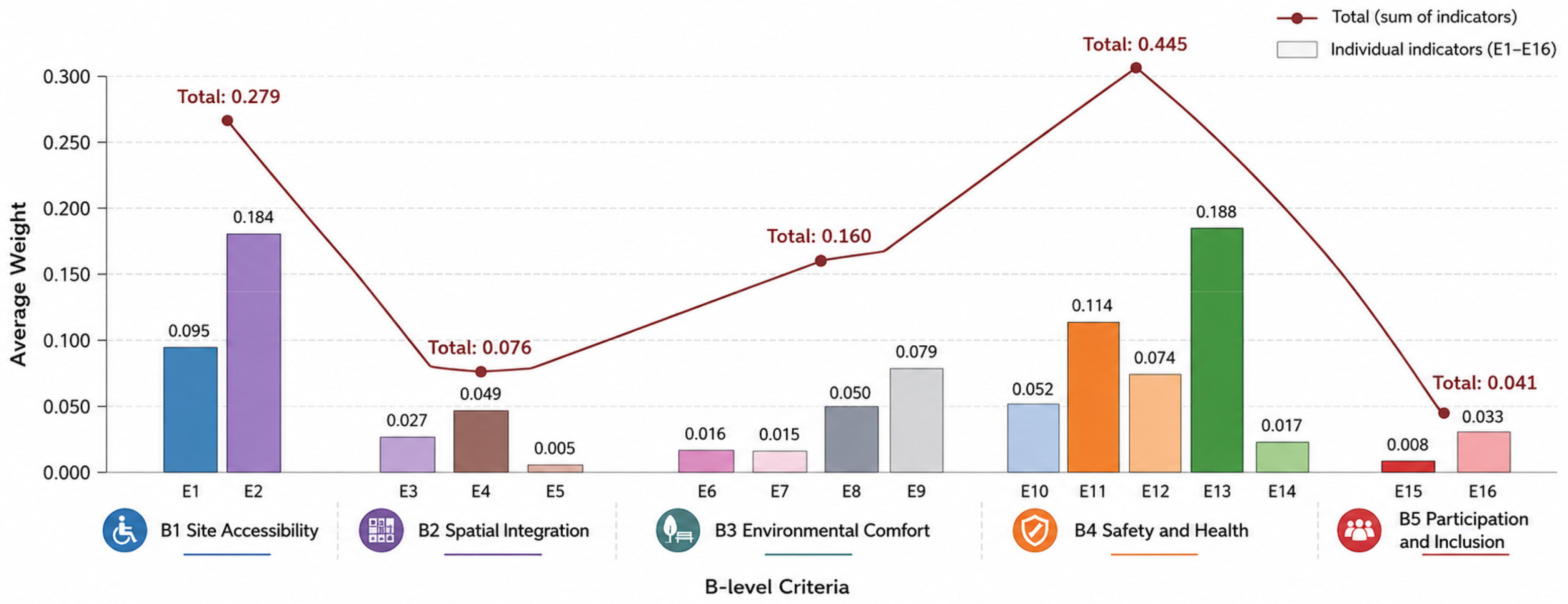
The FAHP weighting results show a clear ranking of criterion importance (see Figure 2). Safety and health have the largest weight. Accessibility and environmental comfort rank next. Spatial integration and participation/inclusion have lower weights. At the enhancement level, walkability, natural contact, and health-promotion facilities rank highest, while cultural belonging, social-network building, and spatial discreteness rank lower.
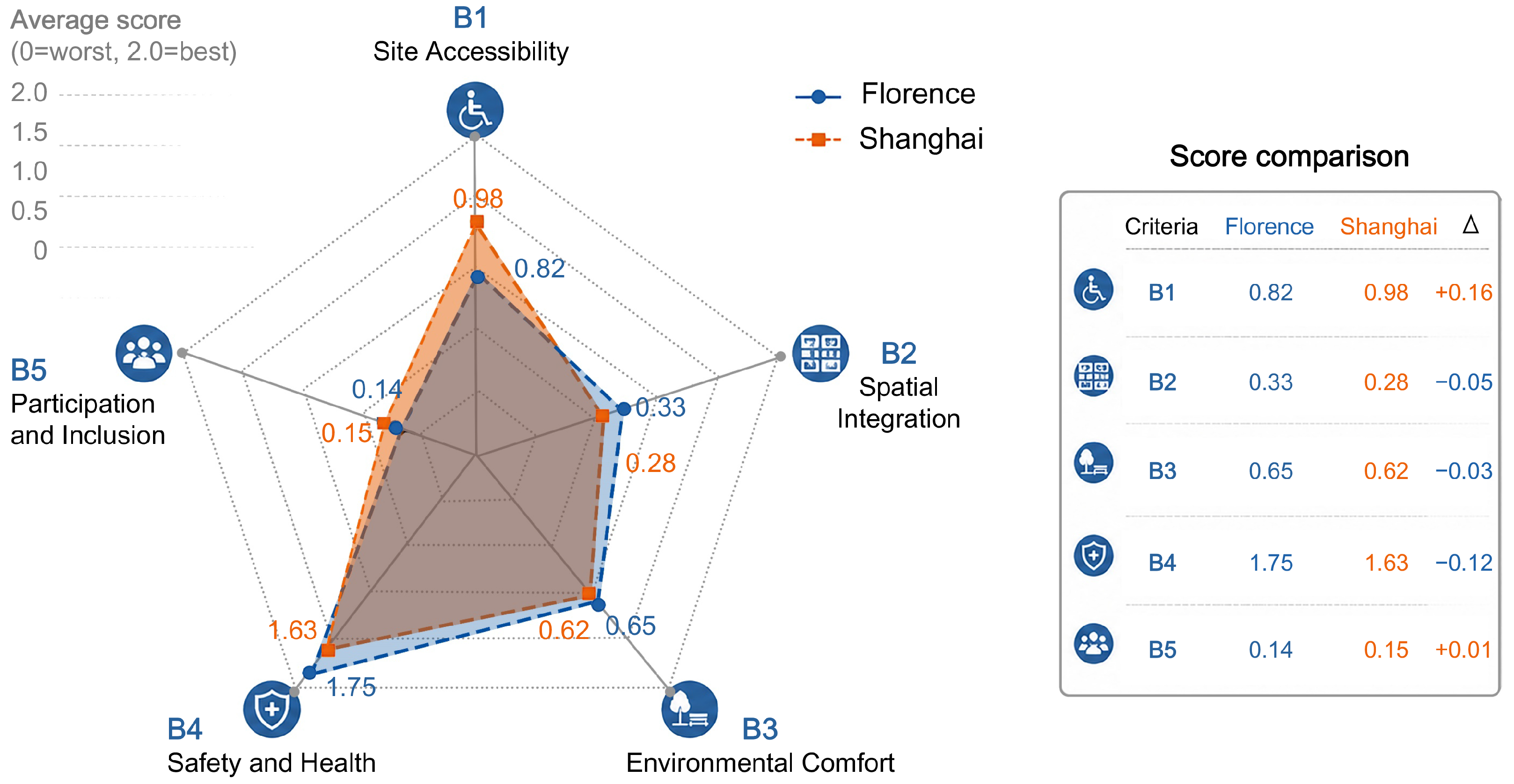
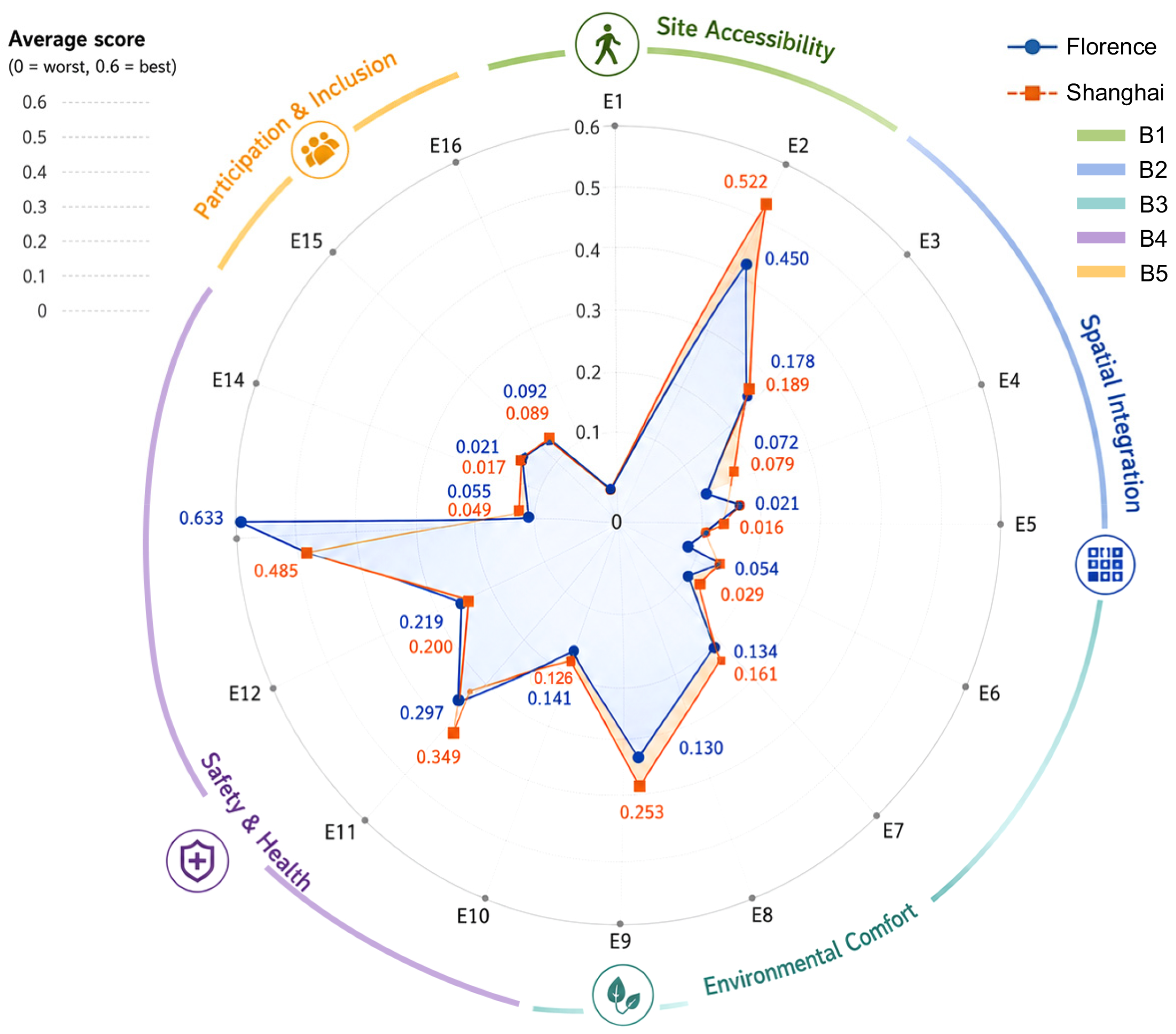
The indicator score analysis reveals distinct performance patterns between the two cities (see Figure 3 and Figure 4), shaped by their respective urban morphologies and socio-cultural contexts. Shanghai exhibits notably higher scores in walkability and health-promoting facilities, reflecting its dense urban fabric, well-developed pedestrian networks, and institutional emphasis on healthy ageing initiatives. These characteristics enhance both all-age accessibility and opportunities for incidental cross-generational encounters. Florence, meanwhile, demonstrates strong performance in natural contact, environmental integration, and daylight access. These patterns reflect the city’s extensive historical green spaces, riverside landscapes, and architectural tradition of integrating natural light and open-air environments into residential settings. Despite Florence’s global reputation for walkability, some of the sampled communities were located along major vehicular corridors, reducing functional pedestrian accessibility compared to Shanghai’s neighbourhood-embedded cases. The spatial typology and environmental comfort advantages observed in Florence highlight the contribution of urban heritage and landscape continuity to cross-generational social potential. However, Shanghai’s higher scores in health-supportive amenities and activity spaces reveal the evolving role of contemporary community infrastructure in shaping cross-generational engagement. Taken together, the score analysis underscores that while the structural dimensions of all-age-friendliness are broadly consistent across contexts, the pathways through which built environments support cross-generational potential vary significantly with local development histories and cultural priorities. These findings further validate the applicability of the dual-layer evaluation framework across culturally distinct urban settings.

5. Discussion

5.1. Theoretical and Methodological Implications

To reposition the empirical findings within the wider academic discourse, this section discusses how the evaluation framework builds upon the existing literature and offers new perspectives for future research in inclusive urban regeneration.
From a theoretical perspective, the findings highlight the hierarchical relationship between physical environments and sociological interventions. Existing studies on intergenerational communities have contributed significantly by emphasizing social programs, such as community care models and neighborhood co-creation networks [18,38]. Building upon this, our evaluation suggests that the effectiveness of these social interventions is deeply intertwined with foundational spatial conditions. If basic prerequisites like safety and accessibility are compromised, the willingness of vulnerable groups (such as seniors and children) to participate in shared spaces may be significantly reduced. For future research, this implies that sociological investigations into community inclusivity could benefit from integrating physical spatial metrics, viewing built-environment enablers and social programs as complementary rather than separate tracks [4].
Methodologically, the study provides a nuanced perspective on environmental assessment tools. Many conventional multi-criteria evaluation frameworks utilize additive weighting structures, which are highly effective for general quality assessments [6,39]. However, in the context of age-friendly design, this study demonstrates that an abundance of aesthetic or interactive enhancements might mathematically offset critical deficits in basic usability. By operationalizing a non-compensatory approach, the findings suggest that vulnerability-centered assessments should prioritize the fulfillment of fundamental spatial needs. Future assessment frameworks, particularly those used in Environmental and Social Impact Assessments (EIA/SIA), could incorporate similar hierarchical logic to ensure that advanced design features do not inadvertently mask foundational environmental limitations.
Empirically, the comparative nature of this study broadens the understanding of how diverse urban contexts respond to similar demographic shifts. Rather than focusing on a single geographical setting, comparing Shanghai and Florence illustrates that cities with profoundly different morphologies can achieve comparable levels of inclusivity through highly tailored spatial strategies. This cross-contextual observation encourages a shift in future empirical research. It suggests that researchers and urban planners could further explore how universal age-friendly goals can be adapted to various local historical and morphological constraints, moving towards a more globally transferable yet locally sensitive paradigm for community regeneration.

5.2. Impacts of Demographic Needs and Urban Morphology

Beyond the evaluation framework, it is crucial to unpack the underlying mechanisms driving these scoring patterns. The FAHP weighting results demonstrated that safety and health were consistently recognized as the most critical dimensions. This corresponds directly with the physiological characteristics of the aging population, who face higher risks related to mobility limitations, thermal discomfort, and other environmental stressors. However, the impact of these foundational elements extends beyond physical protection; they serve as psychological catalysts for social participation. Drawing on environmental gerontology, when baseline safety and accessibility are secured, the perceived environmental barriers are minimized. This reduction in environmental stress encourages vulnerable groups (including both older adults and children) to leave their private spheres and enter shared community spaces confidently. Consequently, basic physical safety acts as an objective prerequisite; without fulfilling these physiological and psychological baselines, the potential for cross-generational interaction remains largely theoretical.
Furthermore, the evaluation indicates that Shanghai and Florence achieved comparable overall scores through different spatial conditions, a phenomenon largely dictated by their distinct urban morphologies. In Florence, the compact historical blocks, narrow streets, and continuous public interfaces naturally provide opportunities for visual contact and spatial co-presence. This specific morphological grain inherently supports “passive” or spontaneous cross-generational encounters embedded within daily routines, where interactions occur organically along shared pedestrian routes. Conversely, older residential neighborhoods in Shanghai are often characterized by gated compounds and segmented circulation layouts, which can unintentionally disrupt spatial continuity between different demographic groups. In these contexts, achieving high inclusivity relies heavily on targeted retrofit interventions, such as dismantling physical boundaries and constructing centralized public nodes (e.g., community centers or shared plazas). Because interactions in these retrofitted environments often require residents to actively travel to a specific node, these spaces tend to foster more “active” or intentional social interactions.
These morphological differences objectively explain how the two cities present divergent physical pathways to reach similar age-friendly goals. This divergence highlights a critical insight for urban regeneration: there is no universal spatial template for intergenerational communities. While the fundamental demographic needs are universally shared across cultures, the spatial strategies utilized to fulfill them—and to overlay interactive enhancements—must be highly calibrated to the local urban fabric.

5.3. Limitations and Future Research Directions

Several limitations should be acknowledged when interpreting the findings. First, although the selected cases represent typical community typologies in both cities, the overall sample size remains moderate. Broader geographic replication is necessary before generalizing the framework to communities under different climatic conditions or institutional systems. Second, the current framework focuses on evaluating the physical-environmental potential for interaction, rather than measuring the actual frequency of residents’ behaviors. Actual cross-generational interactions are also influenced by social norms, activity management, and temporal factors that extend beyond spatial design.
Third, while this study established a unified evaluation baseline by utilizing a balanced cross-cultural expert panel (from China and Italy), it did not analyze the potential differences in weight assignments between the two groups of experts. Future research could conduct separate FAHP surveys for experts from different cultural backgrounds to generate and compare distinct weight matrices. For instance, analyzing whether experts from one context prioritize health facilities more while the other values natural contact could provide a deeper objective understanding of how cultural backgrounds influence spatial evaluation criteria.
These limitations clarify the current application boundaries of this study. The framework is best utilized as a diagnostic tool for comparing spatial strengths and identifying basic environmental deficits. Future studies could combine this spatial evaluation framework with longitudinal behavioral observations to further validate its practical effectiveness.

6. Conclusions and Policy Implications

6.1. Conclusions

We developed and tested a B-P-E based evaluation framework for all-age-friendly environments with cross-generational interaction potential. We integrated qualitative and quantitative evidence from Shanghai and Florence. The FAHP-MOO model captured non-compensatory relationships between prerequisite and enhancement conditions. Across 24 cases, most communities remained at moderate performance levels, and no case achieved uniformly high outcomes across all dimensions. The comparison also showed that similar evaluative dimensions can be realized through different local spatial mechanisms. These findings provide a practical diagnostic basis for inclusive community renewal.

6.2. Policy Implications

Actionable recommendations:
  • Prioritize baseline retrofits first. Upgrade barrier-free circulation, lighting, and wayfinding before adding new social programs.
  • Build daily contact infrastructure. Combine walkable loops, shaded seating, and small green pockets to increase low-threshold intergenerational encounters.
  • Integrate health-supportive services with space management. Coordinate clinics, activity rooms, and outdoor exercise spaces through shared operation schedules.
  • Use city-specific implementation packages. In Shanghai, focus on route reconnection and fine-grained renewal. In Florence, focus on heritage-compatible adaptation and pedestrian safety at vehicular interfaces.

6.3. Future Research Directions

While the findings provide strong support for the utility and transferability of the proposed evaluation framework, several areas warrant further exploration. Expanding the study to include a broader range of cities with different socio-demographic profiles and urban morphologies would allow for a more nuanced understanding of how contextual factors mediate all-age-friendliness and cross-generational potential. Future work may also benefit from integrating longitudinal or behavioural datasets—such as GPS tracking, environmental sensors, or social network analysis—to capture dynamic patterns of interaction and space use. Additionally, linking environmental attributes to psychosocial outcomes, such as perceived social support, mental well-being, and community attachment, could deepen insight into the mechanisms through which built environments facilitate cross-generational cohesion. Methodologically, adapting the framework for use in predictive or scenario-based planning tools could support proactive decision-making in EIA and SIA processes. Such enhancements would strengthen the practical utility of the framework and contribute to more inclusive, resilient, and socially sustainable community environments worldwide.

Author Contributions

Conceptualization, D.Z.; methodology, D.Z. and N.S.; software, D.Z.; validation, D.Z. and Y.Y.; formal analysis, D.Z.; investigation, D.Z.; resources, Y.Y.; data curation, D.Z. and Y.W.; writing—original draft preparation, D.Z.; writing—review and editing, D.Z.; visualization, D.Z. and Y.W.; supervision, Y.Y. and N.S.; project administration, Y.Y.; funding acquisition, Y.Y. All authors have read and agreed to the published version of the manuscript.

Funding

This research was funded by the National Natural Science Foundation of China, grant number 51878456.

Institutional Review Board Statement

Ethical review and approval were waived for this study due to no identifying personal details, images, or medical data were collected or published in this study.

Informed Consent Statement

Informed consent was obtained from all subjects involved in this study.

Data Availability Statement

The original contributions presented in this study are included in the article. Further inquiries can be directed to the corresponding author.

Acknowledgments

The authors would like to express their sincere gratitude to all individuals who contributed to and supported this research. Special thanks are extended to the anonymous expert panel for their invaluable insights during the indicator weighting phase, and to the dedicated field investigators whose diligent work ensured the quality of the primary dataset. We also deeply appreciate the cooperation and hospitality of the local community management and residents in both Shanghai and Florence during our fieldwork. Finally, we thank the anonymous reviewers for their constructive feedback, which greatly improved the quality of this manuscript.

Conflicts of Interest

The authors declare no conflicts of interest.

Abbreviations

The following abbreviations are used in this manuscript:
AAFAll-Age-Friendly
EIAEnvironmental Impact Assessment
SIASocial Impact Assessment

Appendix A

To ensure the scientific validity, comprehensiveness, and rigor of the evaluation indicator system, the selection of evaluation factors and specific indicators in this study employs a comprehensive approach based on multi-source data cross-validation. As illustrated in Table A1, the sub-indicators spanning five criterion layers—ranging from Site Accessibility (B1) to Participation and Inclusion (B5)—are systematically derived from four core methodological pathways. Specifically, a systematic Literature Review establishes foundational evaluation dimensions grounded in academic consensus and established standards; Field Observations provide primary objective data regarding physical spatial forms, facility conditions, and environmental behavioral characteristics; Interview Questionnaires capture the subjective experiences, psychological demands, and social feedback of users to ensure the indicators reflect actual needs; and Spatial Calculations utilize quantitative measurement tools (such as Space Syntax algorithms) to objectively analyze specific metrics related to spatial integration and environmental comfort. Ultimately, the table demonstrates that the proposed indicator repository is firmly built upon the integration of qualitative analysis and objective quantitative measurement, ensuring the finalized evaluation framework possesses robust theoretical support while precisely responding to both physical spatial realities and users’ authentic socio-humanistic needs.
Table A1. Sources of evaluation indicators.
Criterion Layer (B)Sub-Criterion Layer (P&E)Source
Literature
Review
Field
Observation
Interview
Questionnaire
Spatial
Calculation
B1 Site AccessibilityP1 Ease of Movement
P2 Barrier-Free Facilities
P3 Signage Information Completeness
P4 Supporting Facilities in Surrounding Area
E1 Customized Travel Plans
E2 Walkability
B2 Spatial IntegrationE3 Spatial Form
E4 Spatial Types and Locations
E5 Area Discreteness
B3 Environmental ComfortP5 Air Quality
P6 Temperature and Humidity Control
P7 Ventilation Regulation
P8 Natural Daylight
P9 Artificial Lighting
P10 Noise Control
P11 Basic Water Management
P12 Cleanliness and Maintenance
P13 Adequacy of Resting Facilities
E6 Visual Aesthetics
E7 Cultural Belonging
E8 Maximization of Natural Light
E9 Ergonomic Design
B4 Safety and HealthP14 Emergency Systems
P15 Pollution-Free Indoor Materials
P16 Privacy
P17 Plants and Greenery
E10 Intelligent Integrated Security Systems
E11 Health Promotion Programs and Facilities
E12 Mental Health Services
E13 Nature Exposure
E14 Environmental Sustainability
B5 Participation and InclusionP18 Diversity of Activities
P19 Volunteer Opportunities
E15 Formation of Social Networks
E16 Intergenerational Exchange Programs and Activities
Note: The “✓” symbol indicates that the respective indicator was identified and extracted through the corresponding data collection method.
Table A2. Evaluation model for AAF community environments with cross-generational interaction potential.
Criterion Layer BWeight W b Prerequisite Item PWeight W p Score N p Improvement Item EWeight W e Score N e Scores of Each Criterion LayerTotal ScoreRating
B1 Site Accessibility0.278P10.25 E10.093 W b 1 × ( N p n × W p n ) × ( N e n × W e n )
P20.25 E20.186
P30.25 //
P40.25 //
B2 Spatial Integration0.076///E30.026 W b 2 × ( N e n × W e n )
E40.045
E50.005
B3 Environmental Comfort0.160P50.11 E60.018 W b 3 × ( N p n × W p n ) × ( N e n × W e n )
P60.11 E70.009
P70.11 E80.049
P80.11 E90.084
P90.11 ///
P100.11 ///
P110.11 ///
P120.11 ///
P130.11 ///
B4 Safety and Health0.445P140.25 E100.051 W b 4 × ( N p n × W p n ) × ( N e n × W e n )
P150.25 E110.117
P160.25 E120.074
P170.25 E130.185
///E140.018
B5 Participation and Inclusion0.041P180.5 E150.007 W b 5 × ( N p n × W p n ) × ( N e n × W e n )
P190.5 E160.034
An empirical observation was conducted on a total of 24 sample cases in Shanghai and Florence to evaluate the prerequisite items (as shown in Table A3). Existing items are scored as 1, while non-existing items are scored as 0. Subsequently, experts were invited to evaluate 16 enhancement sub-criteria indicators under the 5 criteria layers. Based on the Likert scale, the evaluation is categorized into a five-level ordinal structure: very good, good, fair, poor, and very poor, corresponding to scores of 5, 4, 3, 2, and 1, respectively. For the specific questionnaire, please refer to Table A4. The final scores and rating levels for each case are presented in Table A5.
Table A3. Evaluation of prerequisite items for 24 sample cases in shanghai and florence (1 = present, 0 = absent).
Guideline Layer (B)Sub-Criteria (P)Qualitative and Quantitative DescriptionScore
B1 Site AccessibilityP1 Ease of MovementThe traffic organization is convenient and smooth, meets the requirements of evacuation and transportation, and avoids the influence of vehicles on the movement of people;1/0
P2 Barrier-Free FacilitiesCompliance with the basic requirements for barrier-free design, especially concerning: treatment of floor height differences (steps, ramps, elevators, no thresholds and height differences, or threshold heights and height differences between the floor inside and outside the door of ≤15 mm, and with a sloped transition), wheelchair access (net width of >0.8 m), restroom accessibility treatments, anti-slip and anti-collision measures, installation of universal accessibility signs, etc.;1/0
P3 Signage Information CompletenessThere are access guide signs, service guide signs, safety warning signs, etc. that are securely installed and located so that they can be easily viewed by the elderly and children;1/0
P4 Supporting Facilities in Surrounding AreaEasy access to healthcare support facilities (including on-site support or nearby medical facilities), transportation stops, service equipment for special groups, emergency equipment, commercial services, etc., within 1 km or 15 min walking distance of the surrounding area;1/0
B3 Environmental ComfortP5 Air QualityProvide indoor space air quality levels that ensure the health of users, discourage smoking and create a smoke-free environment;1/0
P6 Temperature and Humidity ControlProvide a thermally comfortable environment that is acceptable to most users, with indoor temperatures of not less than 18 °C in public spaces in winter and 26–28 °C in summer, and relative humidity of ≤60%. Temperature and humidity regulating equipment, such as radiators, air conditioners, electric fans, humidifiers, dehumidifiers, etc., are provided, and their performance is up to standard and safe to use;1/0
P7 Ventilation RegulationPublic activity spaces are provided with external windows with opening fans, and corridors and ancillary rooms are provided with external windows with opening fans or with mechanical exhaust ventilation;1/0
P8 Natural DaylightThe public activity spaces and public corridors have good natural lighting, and some east-west oriented rooms are equipped with effective shading measures;1/0
P9 Artificial LightingThe illuminance value of the activity area is not less than 300lx, the illumination is sufficient, uniform and glare-free, and the light source is suitable to be warm and energy-saving, and to provide visual comfort to the users through artificial lighting;1/0
P10 Noise ControlRecreational activities area ≤ 45 dB, health care area ≤ 40 dB. The public activity space can realize the motion static partition, and when several activities are carried out at the same time, the sound will not interfere with each other, and there will be no obvious echo and noise when people are talking and equipment is moving;1/0
P11 Basic Water ManagementWater intended for human contact (e.g., drinking, cooking and dishwashing, hand washing, showering, or tub bathing) shall meet a turbidity level of ≤1 NTU, FTU, or FNU, with no detectable Escherichia coli in any
100 mL sample;
1/0
P12 Cleanliness and MaintenanceThe common areas are clean, sanitary and the environment is easy to maintain;1/0
P13 Adequacy of Resting FacilitiesResting seats are installed within 150 m of the walking distance for the elderly according to suitability, and resting seats and activity facilities (such as chess and card tables) are installed along the corridors of the activity space, with the resting area in front of the public facilities measuring ≥1.5 m by 1.5 m;1/0
B4 Safety and HealthP14 Emergency SystemsClear and easy-to-use emergency procedures and features provide safety and security, non-slip paving materials, reminder signs, and emergency call-outs in case of danger to avoid accidents, falls, and more;1/0
P15 Pollution-Free Indoor MaterialThe concentration limits of indoor environmental pollutants shall meet the following: radon (Bq/m3) ≤ 150, formaldehyde (mg/m3) ≤ 0.08, ammonia (mg/m3) ≤ 0.2, benzene (mg/m3) ≤ 0.09, toluene (mg/m3) ≤ 0.2, xylene (mg/m3) ≤ 0.2, TVOC (mg/m3) ≤ 0.5;1/0
P16 PrivacySet up private and personalized spaces;1/0
P17 Plants and GreeneryIntroduce nature into the indoor and outdoor environments; trees, flowers and plants are free of highly allergenic pollen, flying hairs, flying flotsam, harmful volatiles and odor pollution; there are no plants with thorns, roots and stems that can easily be exposed to the ground in the locations where the elderly pass by, and no sprawling branches to block the passage.1/0
B5 Participation and InclusionP18 Diversity of ActivitiesMultiple types of activities for all age groups, combined with the frequency of organization of activity times for different age groups;1/0
P19 Volunteer OpportunitiesSetting up platforms or cooperating with other organizations to provide volunteer activities and services suitable for different groups of people.1/0
Table A4. Expert scoring of 16 enhancement sub-criteria indicators based on a 5-point Likert scale (5 = very good, 4 = good, 3 = fair, 2 = poor, 1 = very poor).
Guideline Layer (B)Sub-Criteria (E)Qualitative and Quantitative DescriptionScoring (5 to 1)
B1 Site AccessibilityE1 Customized Travel PlansIntegration of various forms of transportation services to provide users with tailored options, e.g., special transportation services or cooperation with local services to meet the mobility needs of seniors and children;5 4 3 2 1
E2 WalkabilityWalkable access to use sites or building spaces enhances the overall level of support for walking trips in the area;5 4 3 2 1
B2 Spatial IntegrationE3 Spatial FormPay attention to the impact of spatial forms (clustered, centralized, linear, radial) on interactivity in cross-generational symbiosis, and try to adopt appropriate spatial forms;5 4 3 2 1
E4 Spatial Types and LocationsPay attention to the impact on interactivity of the type and location of the space in which Cross-generational communication occurs, and try to choose the right type and location of space;5 4 3 2 1
E5 Area DiscretenessPay attention to the impact of the area share of Cross-generational co-living space on interaction and communication, and try to choose the appropriate area share;5 4 3 2 1
B3 Environmental ComfortE6 Visual AestheticsThe intuitive feeling of the spatial environment (paying attention to the special characteristics of the elderly and children), including the use of materials close to nature, systematic and scientific signage, stable and diverse furniture, warm and pleasant colors, and predominantly warm tones;5 4 3 2 1
E7 Cultural BelongingCommunity, local historic and cultural environment and neighborhood belonging;5 4 3 2 1
E8 Maximization of Natural LightMaximize the use of natural light to enhance the physical and mental health of users;5 4 3 2 1
E9 Ergonomic DesignFurniture, facilities and fixtures are designed with ergonomic requirements to reduce the risk of discomfort or injury;5 4 3 2 1
B4 Safety and HealthE10 Intelligent Integrated Security SystemsUse smart technology to enhance safety, such as emergency call systems, intelligent security monitoring systems, etc;5 4 3 2 1
E11 Health Promotion Programs and FacilitiesPromote physical wellness through design, monitoring and facilities such as: additional fitness centers, yoga studios and meditation areas with wearable devices and health monitoring systems;5 4 3 2 1
E12 Mental Health ServicesRaise awareness of the mental health situation of people of all ages, and provide psychiatric counseling services tailored to different groups of the population;5 4 3 2 1
E13 Nature ExposureThe healing power of nature is better utilized by incorporating more natural elements into the design of indoor and outdoor spaces, and maximizing access to nearby natural environments when possible;5 4 3 2 1
E14 Environmental SustainabilityUse of environmentally friendly materials to reduce energy consumption and minimize the environmental carbon footprint of the space;5 4 3 2 1
B5 Participation and InclusionE15 Formation of Social NetworksStatus of broadcast/publicity board/counter setup, ways to notify users, building social media networks such as WeChat Groups and Community Houses;5 4 3 2 1
E16 Intergenerational Exchange Programs and ActivitiesOrganization of activities aimed at promoting cross-generational interaction and mutual learning, e.g., teaching smart devices, caretaking, etc.5 4 3 2 1
Table A5. Evaluation scores across five dimensions and final ratings for all cases.
CasesB1 ScoreB2 ScoreB3 ScoreB4 ScoreB5 ScoreTotal ScoreRating
FIQ5011.3760.2520.5411.9600.1984.328A2
SHHP010.9070.1860.4791.9590.1983.729A2
SHPD010.9070.3290.6041.5230.1023.464A3
SHYP010.8650.2440.5461.5620.1763.393A3
FIQ4010.8370.3740.5901.3730.0953.268A3
SHYP050.6560.1590.4791.8670.0823.243A3
FIQ1030.7110.1630.5191.7530.0753.222A3
FIQ5030.7110.2940.5361.4550.2043.200A3
SHHK010.9300.1700.6891.1250.1983.112A3
FIQ5020.3810.2840.6591.5920.0772.992A3
SHHK030.8930.1750.4021.2210.1832.874A3
SHJA010.9350.1840.3971.1930.0812.790A3
FIQ2020.7950.2870.5080.8830.0962.569A3
SHBS010.3720.2170.5481.2680.0822.488A4
SHYP040.5860.3560.3701.0810.0772.470A4
FIQ3010.6560.2730.3491.0720.0752.425A4
FIQ1020.4190.1630.4591.3060.0762.423A4
FIQ1010.3810.1110.4421.3310.1312.397A4
SHYP020.8650.1710.4410.7890.0882.354A4
FIQ2010.3810.3740.4770.9950.0482.275A4
FIQ5050.3810.1660.4111.0820.0922.133A4
SHHK020.4560.2040.3270.8450.0821.913A4
SHBS020.4460.1760.3510.6470.0511.671A4
SHYP030.2880.1420.3400.6360.0711.480A5

References

  1. Chen, S.; Bao, Z.; Lou, V. Assessing the Impact of the Built Environment on Healthy Aging: A Gender-oriented Hong Kong Study. Environ. Impact Assess. Rev. 2022, 95, 106812. [Google Scholar] [CrossRef]
  2. Scharlach, A.E.; Lehning, A.J. Ageing-friendly Communities and Social Inclusion in the United States of America. Ageing Soc. 2013, 33, 110–136. [Google Scholar] [CrossRef]
  3. Yu, Y.; Jin, Y. Aging Challenges and Cities’ Countermeasures in China. In Proceedings of the 2024 7th International Conference on Universal Village (UV), Boston, MA, USA, 19–22 October 2024; pp. 1–4. [Google Scholar]
  4. Raman, S. Designing a Liveable Compact City: Physical Forms of City and Social Life in Urban Neighbourhoods. Built Environ. 2010, 36, 63–80. [Google Scholar] [CrossRef]
  5. Giarelli, G. Intergenerational Fairness and Ageing Styles in Europe: A Life-Course Approach. Soc. Sci. 2025, 15, 2. [Google Scholar] [CrossRef]
  6. Zhang, S.C.; Wang, H.; Liu, Z.; Zeng, S.; Jin, Y.; Baležentis, T. A Comprehensive Evaluation of the Community Environment Adaptability for Elderly People Based on the Improved TOPSIS. Information 2019, 10, 389. [Google Scholar] [CrossRef]
  7. Li, Z.; Li, Z.; Ma, J. Exploring Design Interventions to Enhance Intergenerational Sharing: An Importance–Performance Analysis of Public Spaces in Changsha, China. Sustainability 2024, 16, 11228. [Google Scholar] [CrossRef]
  8. Yin, B.; Wang, L.; Xu, Y.; Heng, K.C. A Study on the Spatial Perception and Inclusive Characteristics of Outdoor Activity Spaces in Residential Areas for Diverse Populations from the Perspective of All-Age Friendly Design. Buildings 2025, 15, 895. [Google Scholar] [CrossRef]
  9. Katunský, D.; Brausch, C.; Purcz, P.; Katunská, J.; Bullová, I. Requirements and Opinions of Three Groups of People to Create a Living Space Suitable for Different Life Situations. Environ. Impact Assess. Rev. 2020, 83, 106385. [Google Scholar] [CrossRef]
  10. Terpstra, J.E.; Tamura, R. Effective Social Interaction Strategies for Inclusive Settings. Early Child. Educ. J. 2008, 35, 405–411. [Google Scholar] [CrossRef]
  11. Parsons, R.E.; Mottee, L.K. Exploring Equity in Social Impact Assessment. Curr. Sociol. 2024, 72, 732–752. [Google Scholar] [CrossRef]
  12. Lipinski, E.; Stinchcombe, A.; Wilson, K. Are Age-friendly Communities Friendly for All? Perspectives from LGBTQ2S+ Communities. J. Aging Soc. Policy 2024, 36, 888–911. [Google Scholar] [CrossRef]
  13. Hagestad, G.O.; Uhlenberg, P. Should we be concerned about age segregation? Some theoretical perspectives. Res. Aging 2006, 28, 638–653. [Google Scholar] [CrossRef]
  14. Biggs, S.; Carr, A. Age- and child-friendly cities and the promise of intergenerational space. J. Soc. Work. Pract. 2015, 29, 99–112. [Google Scholar] [CrossRef]
  15. Burnes, D.; Sheppard, C.; Henderson, C.R., Jr.; Wassel, M.; Cope, R.; Barber, C.; Pillemer, K. Interventions to reduce ageism against older adults: A systematic review and meta-analysis. Am. J. Public Health 2019, 109, e1–e9. [Google Scholar] [CrossRef]
  16. Zhong, S.; Lee, C.; Foster, M.J. Intergenerational communities: A systematic literature review of intergenerational interactions and older adults’ health-related outcomes. Soc. Sci. Med. 2020, 264, 113374. [Google Scholar] [CrossRef]
  17. World Health Organization. Global Age-Friendly Cities: A Guide; World Health Organization: Geneva, Switzerland, 2007. [Google Scholar]
  18. Fang, M.L.; Sixsmith, J.; Hamilton-Pryde, A.; Rogowsky, R.; Scrutton, P.; Pengelly, R.; Woolrych, R.; Creaney, R. Co-creating Inclusive Spaces and Places: Towards an Intergenerational and Age-friendly Living Ecosystem. Front. Public Health 2023, 10, 996520. [Google Scholar] [CrossRef]
  19. Kaplan, M.; Thang, L.L.; Sanchez, M. Intergenerational Contact Zones: Place-Based Strategies for Promoting Social Inclusion and Belonging; Routledge: Abingdon, UK, 2018. [Google Scholar] [CrossRef]
  20. Davern, M.; Winterton, R.; Brasher, K.; Woolcock, G. How Can the Lived Environment Support Healthy Ageing? A Spatial Indicators Framework for the Assessment of Age-friendly Communities. Int. J. Environ. Res. Public Health 2020, 17, 7685. [Google Scholar] [CrossRef] [PubMed]
  21. Browne, G.R.; Lowe, M. Liveability as Determinant of Health: Testing a New Approach for Health Impact Assessment of Major Infrastructure. Environ. Impact Assess. Rev. 2021, 87, 106546. [Google Scholar] [CrossRef]
  22. Statista. Share of the Elderly Population in Italy as of 2021, by Region, 2022. Available online: https://www.statista.com/statistics/785104/elderly-population-in-italy/ (accessed on 18 May 2024).
  23. Shanghai Municipal Health Commission. 2020 Shanghai Elderly Population and Aging Undertakings Monitoring Statistical Information, 2021. Available online: https://wsjkw.sh.gov.cn/cmsres/78/783845a354ae4b69a6fb076f932960ac/e316f0cf068719ae4b0e46b4520001c4.pdf (accessed on 18 May 2024).
  24. McCall, G.J. Systematic field observation. Annu. Rev. Sociol. 1984, 10, 263–282. [Google Scholar] [CrossRef]
  25. Alves, F.; Cruz, S.; Ribeiro, A.; Silva, A.; Martins, J. Walkability Index for Elderly Health: A Proposal. Sustainability 2020, 12, 7360. [Google Scholar] [CrossRef]
  26. Dongqing, Z.; Setola, N.; Yi, C.; Naldi, E. Enhancing Wellbeing in Aging Communities Through Environmental Design Elements: An Integrative Review of Literature in English, Chinese and Italian. Int. J. Sustain. Dev. Res. 2023, 9, 79–88. [Google Scholar] [CrossRef]
  27. Armour, R.; Williams, B. Reliability and Validity in Quantitative and Qualitative Research. In Introducing, Designing and Conducting Research for Paramedics; Elsevier Health Sciences: Amsterdam, The Netherlands, 2022; pp. 69–72. [Google Scholar]
  28. Zhang, D.; Setola, N.; Chen, Y. Analysis of Cross-generational Co-living Space Configuration in Residential Communities—Case Study in China and Italy Based on Space Syntax. Buildings 2024, 14, 346. [Google Scholar] [CrossRef]
  29. Wahl, H.W.; Iwarsson, S.; Oswald, F. Aging well and the environment: Toward an integrative model and research agenda for the future. Gerontologist 2012, 52, 306–316. [Google Scholar] [CrossRef] [PubMed]
  30. Kerr, J.; Rosenberg, D.; Frank, L. The role of the built environment in healthy aging: Community design, physical activity, and health among older adults. J. Plan. Lit. 2012, 27, 43–60. [Google Scholar] [CrossRef]
  31. Burton, E.; Mitchell, L. Inclusive Urban Design: Streets for Life; Routledge: Abingdon, UK, 2006. [Google Scholar] [CrossRef]
  32. Hallowell, M.R.; Gambatese, J.A. Qualitative Research: Application of the Delphi Method to CEM Research. J. Constr. Eng. Manag. 2010, 136, 99–107. [Google Scholar] [CrossRef]
  33. Finan, J.S.; Hurley, W.J. The Analytic Hierarchy Process: Does Adjusting a Pairwise Comparison Matrix to Improve the Consistency Ratio Help? Comput. Oper. Res. 1997, 24, 749–755. [Google Scholar] [CrossRef]
  34. Ehrgott, M.; Köksalan, M.; Kadziński, M.; Deb, K. Fifty years of multi-objective optimization and decision-making: From mathematical programming to evolutionary computation. Eur. J. Oper. Res. 2024, 330, 1–25. [Google Scholar] [CrossRef]
  35. Sharma, S.; Kumar, V. A comprehensive review on multi-objective optimization techniques: Past, present and future. Arch. Comput. Methods Eng. 2022, 29, 5605–5633. [Google Scholar] [CrossRef]
  36. Rowley, H.V.; Peters, G.M.; Lundie, S.; Moore, S.J. Aggregating sustainability indicators: Beyond the weighted sum. J. Environ. Manag. 2012, 111, 24–33. [Google Scholar] [CrossRef]
  37. Wicki, S.; Schwaab, J.; Perhac, J.; Grêt-Regamey, A. Participatory multi-objective optimization for planning dense and green cities. J. Environ. Plan. Manag. 2021, 64, 73–94. [Google Scholar] [CrossRef]
  38. Jarrott, S.E. Where have we been and where are we going? Content analysis of evaluation research of intergenerational programs. J. Intergenerational Relatsh. 2011, 9, 37–52. [Google Scholar] [CrossRef]
  39. Steels, S. Key characteristics of age-friendly cities and communities: A review. Cities 2015, 47, 45–52. [Google Scholar] [CrossRef]
Figure 1. Conceptual framework.
Buildings 16 02194 g001
Figure 2. Composition of weights of B-level and E-level indicators.
Buildings 16 02194 g002
Figure 3. Hierarchical distribution of evaluation scores for cases in Florence and Shanghai.
Buildings 16 02194 g003
Figure 4. Radar chart of average scores of various case indicators in cases of Florence and Shanghai.
Buildings 16 02194 g004
Table 1. Distribution of observation cases in two cities.
Distribution of Shanghai CasesDistribution of Florence Cases
Buildings 16 02194 i001Buildings 16 02194 i002
Note: The dashed lines in the inline figures represent the administrative boundaries.
Table 2. Evaluation indicators for AAF community environments with cross-generational interaction potential.
Goal (A)Indicators (B)Sub-Indicators (Preconditions; P)Sub-Indicators (Enhancement; E)
Evaluation indicators for AAF community environments
with cross-generational
interaction potential
B1 Site AccessibilityP1 Ease of MovementE1 Customized Travel Plans
P2 Barrier-Free FacilitiesE2 Walkability
P3 Signage
Information Completeness
/
P4 Supporting Facilities in Surrounding Area/
B2 Spatial Integration/E3 Spatial Form
/E4 Spatial Types and Locations
/E5 Area Discreteness
B3 Environmental ComfortP5 Air QualityE6 Visual Aesthetics
P6 Temperature and
Humidity Control
E7 Cultural Belonging
P7 Ventilation RegulationE8 Maximization of Natural Light
P8 Natural DaylightE9 Ergonomic Design
P9 Artificial Lighting/
P10 Noise Control/
P11 Basic Water Management/
P12 Cleanliness and Maintenance/
P13 Adequacy of Resting Facilities/
B4 Safety and HealthP14 Emergency SystemsE10 Intelligent Integrated Security Systems
P15 Pollution-Free Indoor MaterialE11 Health Promotion Programs and Facilities
P16 PrivacyE12 Mental Health Services
P17 Plants and GreeneryE13 Nature Exposure
/E14 Environmental Sustainability
B5 Participation and InclusionP18 Diversity of ActivitiesE15 Formation of Social Networks
P19 Volunteer OpportunitiesE16 Intergenerational Exchange Programs and Activities
Table 3. Expert scores for enhancement indicators.
Objective Layer (A)Criterion Layer (B)ScoreSub-Criterion Layer (Enhancement Items; E)Score
Evaluation of
AAF community environments with cross-generational interaction potential
B1 Site Accessibility4.6E1 Customized Travel Plans3.6
E2 Walkability3.8
B2 Spatial Integration4.1E3 Spatial Form4
E4 Spatial Types and Locations4.2
E5 Area Discreteness3.2
B3 Environmental Comfort4.4E6 Visual Aesthetics3.8
E7 Cultural Belonging3.5
E8 Maximization of Natural Light4.2
E9 Ergonomic Design4.3
B4 Safety and Health4.8E10 Intelligent Integrated Security Systems3.7
E11 Health Promotion Programs and Facilities3.9
E12 Mental Health Services3.8
E13 Nature Exposure4
E14 Environmental Sustainability3.1
B5 Participation and Inclusion3.9E15 Formation of Social Networks3.2
E16 Intergenerational Exchange Programs and Activities3.8
Table 4. Judgment matrix for importance.
Criterion Layer IndicatorsB 1B 2B 3B 4B 5
B 1(1 1 1)(7/2 4 9/2)(3/2 2 5/2)(2/5 1/2 2/3)(13/2 7 15/2)
B 2(2/9 1/4 2/7)(1 1 1)(2/5 1/2 2/3)(2/13 1/6 2/11)(3/2 2 5/2)
B 3(2/5 1/2 2/3)(3/2 2 5/2)(1 1 1)(2/7 1/3 2/5)(9/2 5 11/2)
B 4(3/2 2 5/2)(11/2 6 13/2)(5/2 3 7/2)(1 1 1)(15/2 8 17/2)
B 5(2/15 1/7 2/13)(2/5 1/2 2/3)(2/11 1/5 2/9)(2/17 1/8 2/15)(1 1 1)
Weight Vector0.2780.0760.1600.4450.041
Table 5. Weight of improvement indicators.
Criterion Layer (B)WeightSub-Criterion Layer (E)Relative WeightAbsolute Weight
B1 Site Accessibility0.278E1 Customized Travel Plans0.3330.093
E2 Walkability0.6670.186
B2 Spatial Integration0.076E3 Spatial Form0.3410.026
E4 Spatial Types and Locations0.5930.045
E5 Area Discreteness0.0650.005
B3 Environmental Comfort0.160E6 Visual Aesthetics0.1140.018
E7 Cultural Belonging0.0550.009
E8 Maximization of Natural Light0.3070.049
E9 Ergonomic Design0.5240.084
B4 Safety and Health0.445E10 Intelligent Integrated Security Systems0.1150.051
E11 Health Promotion Programs and Facilities0.2630.117
E12 Mental Health Services0.1660.074
E13 Nature Exposure0.4160.185
E14 Environmental Sustainability0.0390.018
B5 Participation and Inclusion0.041E15 Formation of Social Networks0.1670.007
E16 Intergenerational Exchange Programs and Activities0.8330.034
Table 6. Evaluation criteria and grading.
Evaluation Value nCommentsGrading
n 1.5 Very poorA5
1.5 < n 2.5 PoorA4
2.5 < n 3.5 AverageA3
3.5 < n 4.5 GoodA2
n > 4.5 ExcellentA1
Disclaimer/Publisher’s Note: The statements, opinions and data contained in all publications are solely those of the individual author(s) and contributor(s) and not of MDPI and/or the editor(s). MDPI and/or the editor(s) disclaim responsibility for any injury to people or property resulting from any ideas, methods, instructions or products referred to in the content.