Systematic Review

Learning Factories 5.0 for Industry 5.0 Readiness in Sustainable Construction: A Competency-Driven Framework for Human-Centric and Sustainable Workforce Development

by
Kangxing Dong
1 and
Taofeeq Durojaye Moshood
2,*
1
School of Foreign Languages, Jiangsu University of Technology, Changzhou 213000, China
2
Built Environment Engineering, School of Future Environments, Faculty of Design and Creative Technology, Auckland University of Technology, Auckland 1142, New Zealand
*
Author to whom correspondence should be addressed.
Buildings 2026, 16(10), 2024; https://doi.org/10.3390/buildings16102024
Submission received: 13 April 2026 / Revised: 5 May 2026 / Accepted: 13 May 2026 / Published: 20 May 2026
(This article belongs to the Special Issue Digital Technologies in Construction and Built Environment)

Abstract

The transition toward Industry 5.0 in sustainable construction demands a radical reconceptualisation of workforce development, moving beyond purely technical training to embrace human-centricity, digitalisation, green competencies, and socio-cognitive resilience. Traditional vocational and higher education systems have largely failed to bridge the gap between emerging construction industry demands and the competencies possessed by current and future professionals. This systematic review investigates how Learning Factories’ 5.0 immersive, experiential, and technology-rich educational environments can address these gaps in sustainable construction contexts. Drawing on a synthesis of 71 peer-reviewed publications spanning 2015–2026 and supplemented by targeted construction-domain literature, this study pursues three objectives: (1) identifying core competencies for Industry 5.0 readiness in sustainable construction, (2) examining how Learning Factories 5.0 support the development of these competencies, and (3) proposing a competency-driven framework for integrating Learning Factories 5.0 into sustainable construction education and training. Seven transdisciplinary competency clusters are identified—Attitude toward Digitalisation, Technical–Green Proficiency, Information and Data Literacy, Digital Security, Collaborative Systems Thinking, Adaptive Problem-Solving, and Reflective Sustainability Practice—and a theoretically derived, eight-phase Construction Learning Factory 5.0 (CLF5.0) Framework is proposed as a conceptual architecture for future empirical development and institutional adaptation. The framework is presented as a generative starting point rather than a prescriptive model, and its effectiveness in diverse construction education contexts requires empirical validation through future implementation studies. Findings reveal that while Learning Factories offer transformative potential, critical barriers remain in terms of economic feasibility, faculty development, industry–academia alignment, and empirical validation. This paper contributes a construction-specific competency architecture and implementation pathway to support the industry’s transition toward a sustainable, human-centric, and Industry 5.0-aligned future.

1. Introduction

The global construction industry stands at a critical inflexion point. Accounting for approximately 39% of global energy-related carbon dioxide emissions and responsible for significant waste generation, resource depletion [1], and social inequity in project delivery, the sector faces mounting pressure to transform its operational, managerial, and educational foundations [2]. The emergence of Industry 5.0, a paradigm that transcends the automation-first ethos of Industry 4.0 by foregrounding human-centricity, sustainability, and resilience, offers both a framework and a challenge for the construction sector [3]. The challenge lies not merely in adopting new technologies but in developing the workforce competencies needed to deploy them purposefully, ethically, and sustainably [4].
Sustainable construction encompassing green building practices, circular economy principles, carbon-neutral materials, net-zero targets, digital procurement, and socially responsible project management demands professionals who can integrate deep technical expertise with systems thinking, cross-disciplinary collaboration, regulatory literacy, and adaptive leadership [5,6]. At the same time, construction remains one of the most hazardous industries globally, alongside manufacturing and transportation, with persistently high rates of work-related accidents. This safety challenge aligns directly with the United Nations 2030 Agenda for Sustainable Development, particularly SDG 8 (Decent Work and Economic Growth) and Target 8.8, which calls for the protection of labour rights and the promotion of safe and secure working environments for all workers [7,8]. However, conventional construction education, which is largely rooted in discipline-based curricula and passive pedagogical approaches, remains ill-equipped to develop these multidimensional competencies [7]. The mismatch between industry demands and educational outcomes is well documented, yet effective structural solutions remain limited [8].
Learning Factories 5.0, purpose-built, experiential educational environments that replicate real-world industrial conditions within academic settings, represent a compelling response to this challenge [9]. Pioneered in manufacturing engineering contexts, Learning Factories integrate advanced digital technologies such as digital twins, augmented reality (AR), Internet of Things (IoT) platforms, building information modelling (BIM), and collaborative robotics to create immersive, project-based, and industry-aligned learning experiences [10]. While their application in manufacturing has gained considerable momentum, their deployment in sustainable construction education remains nascent, fragmented, and under-theorised [11].
This paper seeks to address this gap through a systematic synthesis of existing Learning Factory 5.0 literature, contextualised within the specific demands of sustainable construction. Three research objectives guide the investigation:
RO1: To identify the core competencies required for Industry 5.0 readiness in sustainable construction, with emphasis on human-centricity, sustainability, digitalisation, resilience, and collaborative problem-solving.
RO2: To examine how Learning Factories 5.0 can support workforce development in sustainable construction, particularly in enhancing technical, digital, green, and socio-cognitive competencies needed for emerging construction environments.
RO3: To develop a competency-driven framework for integrating Learning Factories 5.0 into sustainable construction education and training, to strengthen Industry 5.0 readiness among current and future professionals.
The significance of this inquiry extends beyond academic contribution. As the construction industry prepares for transformative shifts driven by net-zero legislation, digitalisation mandates, and circular economy imperatives, there is an urgent need for structured, evidence-based educational frameworks that align workforce development with sectoral futures. This paper provides such a framework, grounded in rigorous international literature synthesis and applicable across diverse national construction contexts. Where Aotearoa New Zealand is referenced as an illustrative example, this reflects the authors’ institutional location and the availability of detailed contextual evidence; the framework’s architecture is designed for adaptation across global settings.

2. Background and Theoretical Framing

2.1. Industry 5.0 in the Construction Sector

Industry 5.0, as conceptualised by Breque et al. [12], represents a paradigmatic shift from the efficiency-maximisation logic of Industry 4.0 toward a tripartite framework encompassing human-centricity, sustainability, and resilience [13]. Whilst Industry 4.0 prioritised the automation of processes through cyber-physical systems, artificial intelligence, and big data, its successor paradigm repositions technology as a servant of human and societal values rather than an autonomous agent of production [14,15]. For the construction industry, this shift is particularly consequential. Construction has long been characterised by fragmented supply chains, adversarial procurement practices, high rates of material waste, and a persistent skills shortage, particularly in digital and sustainable competencies [6]. The integration of Industry 5.0 principles into construction contexts implies a wholesale rethinking of how built environment professionals are trained, how projects are designed and delivered, and how value is defined across the lifecycle of infrastructure and buildings.
The three pillars of Industry 5.0 translate directly into construction-specific imperatives: human-centricity demands that worker well-being, ergonomic design, and inclusive participation replace productivity as the primary performance metric [16], sustainability requires construction professionals to embed carbon consciousness, circular economy principles, and ecological sensitivity into every phase of project delivery; resilience calls for adaptive capacity in the face of climate change, supply chain disruption, and demographic shifts [17]. The digital transformation of construction embodied in technologies such as BIM, digital twins, smart sensors, prefabrication systems, and AI-enabled project management tools further complicates the competency landscape [18]. Professionals who possess only traditional technical skills are increasingly ill-equipped to navigate these environments. Yet educational institutions have been slow to respond, continuing to deliver curricula more aligned with Industry 2.0 realities than the Industry 5.0 future they ostensibly prepare students for [19].

2.2. Competency Development Theory for Sustainable Construction

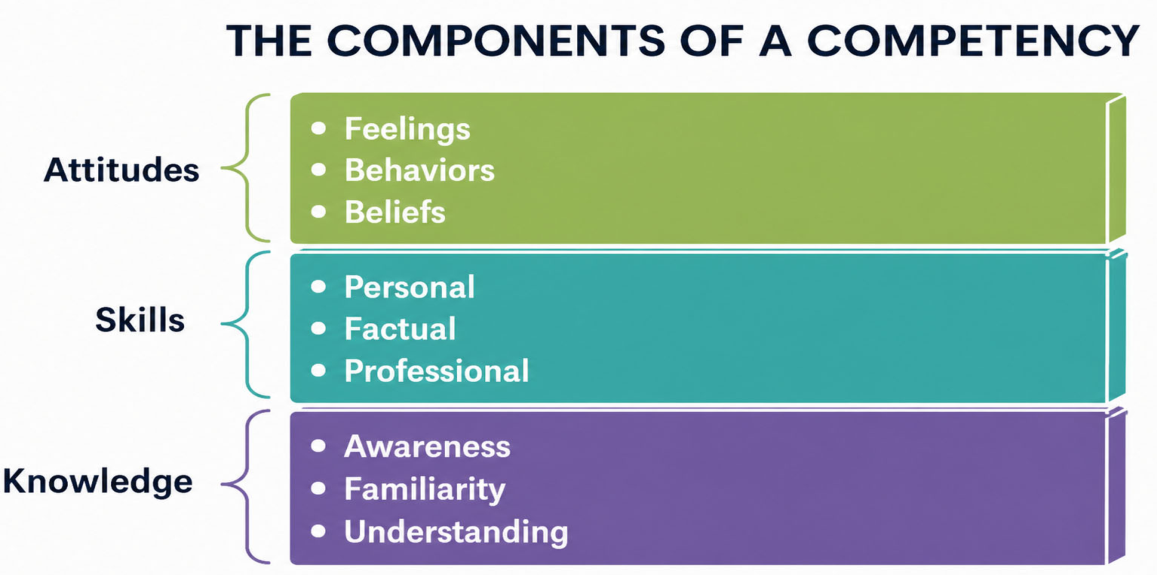
Competency, in its broadest sense, is the integrated capacity to perform effectively in specific contexts by deploying knowledge, skills, and attitudes [20]. In the context of sustainable construction and Industry 5.0, competency transcends the acquisition of discrete technical skills to encompass meta-competencies, the capacity to integrate, adapt, and ethically apply knowledge across rapidly shifting professional landscapes [5,21]. Competency development theory distinguishes between two complementary modes of learning: action-based learning, in which competencies are developed through direct engagement with authentic professional tasks, and comprehension-based learning, which involves the theoretical internalisation of concepts that can be transferred across contexts [21]. Effective construction education must facilitate fluid transitions between these modes, creating environments where students move seamlessly from theoretical frameworks to hands-on application and back again. This dual-mode imperative is particularly salient in sustainable construction, where green building standards, digital tools, and regulatory frameworks are constantly evolving [22].
Individual differences also play a critical role in competency development trajectories. Personality characteristics, particularly those captured by the Big Five model encompassing Openness, Conscientiousness, Extraversion, Agreeableness, and Neuroticism, significantly influence learning preferences, collaborative behaviours, and responses to novel or complex challenges [23,24]. In construction education contexts, where team-based project delivery is the norm, understanding these dimensions enables more effective pedagogical design and personalised learning support, particularly as students navigate the unfamiliar intersections of digital technology, sustainability science, and human-centric project practice [25].

2.3. Learning Factories as Educational Innovation

Learning Factories, in their original formulation, are purpose-built educational environments designed to replicate authentic industrial conditions within the controlled setting of a university or training institution [26]. These facilities combine advanced equipment, real production processes, and immersive pedagogical methodologies to bridge the enduring gap between academic learning and industry practice. Students engage not merely in simulation but in authentic project-based activities that mirror the complexity, ambiguity, and interdisciplinary demands of real industrial environments [27].
The evolution from Learning Factories 4.0 to Learning Factories 5.0 mirrors the broader industrial paradigm shift. Learning Factories 4.0 emphasised digital technologies, automation, cyber-physical systems, and process efficiency, preparing students to become skilled operators of smart manufacturing systems [28]. Learning Factories 5.0, by contrast, foreground the human dimension: collaborative intelligence, ethical decision-making, sustainability consciousness, and adaptive problem-solving become as central to the learning experience as technical proficiency [29,30]. In construction contexts, this evolution has profound implications. A construction-specific Learning Factory 5.0 would not merely teach BIM or structural analysis; it would embed students in holistic project scenarios that demand the simultaneous application of digital tools, sustainability analysis, stakeholder engagement, safety management, and circular economy thinking [31,32].

3. Methodology

3.1. Research Design

This study employs a systematic literature review methodology, guided by the PRISMA framework (see Table S1: PRISMA 2020 Main Checklist. https://www.mdpi.com/article/10.3390/buildings16102024/s1). The systematic review method was selected for its capacity to aggregate, synthesise, and critically evaluate dispersed bodies of evidence in a transparent, reproducible manner, which is particularly appropriate given the nascent and cross-disciplinary nature of the Learning Factories 5.0 sustainable construction nexus. The review process adhered strictly to PRISMA 2020 reporting guidelines throughout all phases of screening, data extraction, and synthesis. The review was supplemented by purposive sampling of grey literature, policy documents (including European Commission reports on Industry 5.0), and construction-specific empirical studies to ensure adequate contextualisation of findings.

3.2. Search Strategy and Selection Criteria

A systematic literature search was conducted in Scopus in 2026, targeting publications on Learning Factories, competency development, Industry 5.0, sustainable construction, and workforce education. The primary Boolean search string was: (“Learning Factory” OR “Learning Factories” OR “Teaching Factory”) AND (“competency” OR “skill” OR “workforce development”) AND (“Industry 5.0” OR “Industry 4.0” OR “sustainable construction” OR “green building” OR “circular economy” OR “net-zero”). The temporal scope was 2015–2026, capturing both the historical emergence of Learning Factories 4.0 and the more recent pivot to Industry 5.0 principles. Scopus was selected for its comprehensive coverage of engineering, built environment, and education research. This choice was driven by its strong indexing of engineering, applied sciences, and multi-disciplinary studies. Given the interdisciplinary focus of this review, Learning Factories, Industry 5.0, competency development, and sustainable construction, Scopus provides broader and more integrated retrieval than single-discipline databases such as ERIC, which is primarily oriented toward educational theory and offers limited engineering coverage. To enhance completeness, the Scopus search was supplemented with manual searches of keywords. Additional sources included targeted retrieval of Industry 5.0 and citation chaining from foundational Learning Factory studies. This combined strategy, documented in the PRISMA protocol, was employed to minimise the risk of omitting relevant literature due to limitations in database indexing.
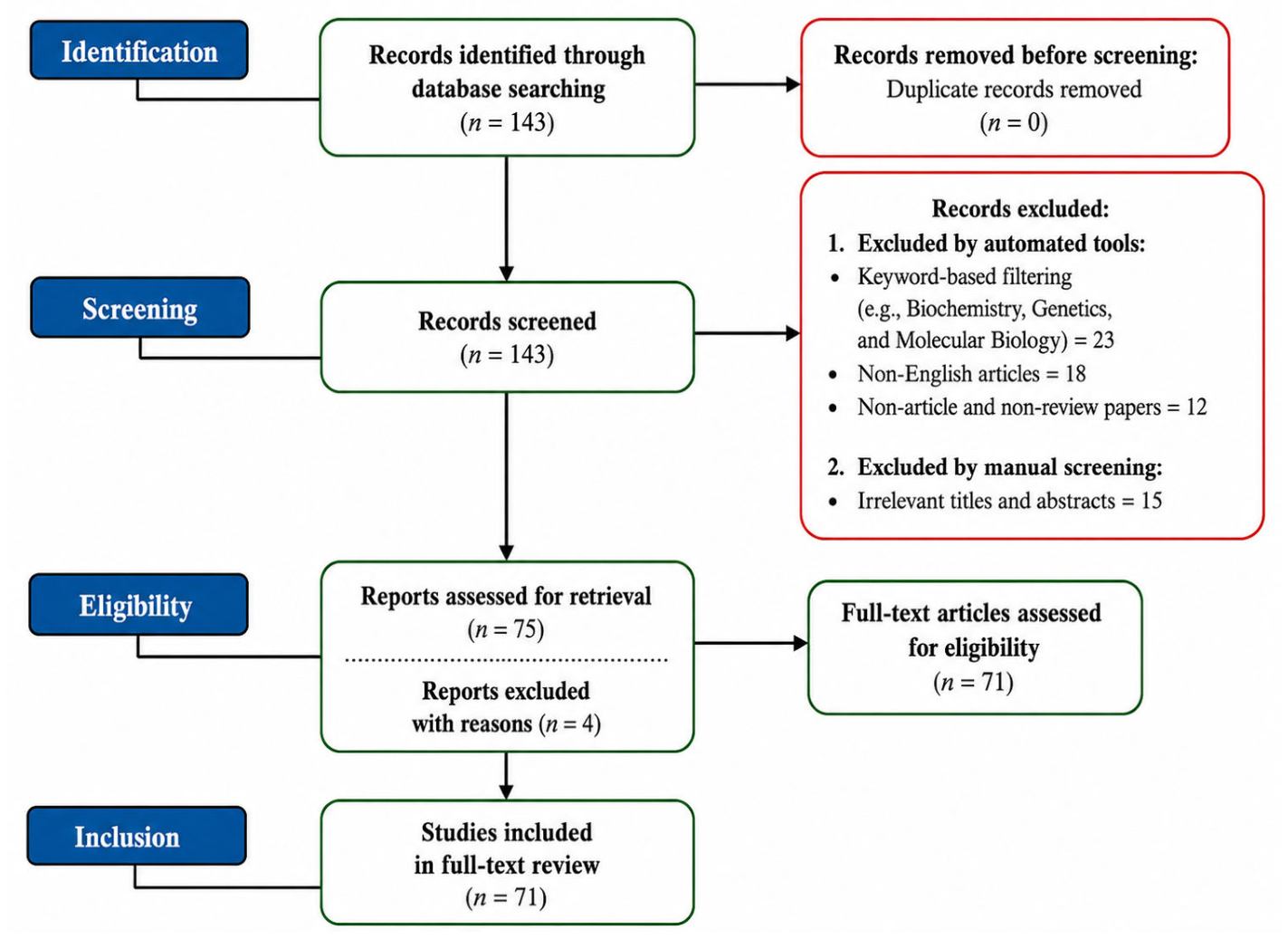
Inclusion criteria comprised: (1) peer-reviewed articles or book chapters in English; (2) explicit focus on Learning Factories, competency frameworks, or Industry 5.0 workforce development; (3) relevance to construction, built environment, engineering education, or transferable manufacturing contexts; and (4) sufficient methodological rigour as assessed through standardised quality appraisal. Exclusion criteria were non-peer-reviewed sources without demonstrable empirical or conceptual rigour, publications focused exclusively on manufacturing without transferable relevance to construction, and duplicate publications (see Figure 1).
To ensure transparency and reproducibility, the screening process was conducted in two independent stages by both authors, following a structured PRISMA approach. In Stage 1 (title and abstract screening), each author independently assessed all 143 identified records against the predefined inclusion and exclusion criteria. Inter-rater reliability was calculated using Cohen’s kappa (κ = 0.84), indicating strong agreement. Discrepancies were resolved through structured discussion, with consensus reached in all cases without the need for a third reviewer. At this stage, 68 records were excluded (including those excluded by automated filtering and manual screening), leaving 75 records for further assessment. In Stage 2 (full-text eligibility assessment), both authors independently evaluated the 75 reports retrieved for full-text review. Of these, 4 reports were excluded for the following reasons, leaving 71 full-text articles assessed for eligibility (see Table S2: Case Studies Analysed of all 71 Papers. https://www.mdpi.com/article/10.3390/buildings16102024/s1). Following quality appraisal, all 71 studies met the inclusion criteria and were retained in the final review corpus. The complete screening and selection process is illustrated in Figure 1 (PRISMA flow diagram).
The resulting knowledge structure from systematic coding provided a robust foundation for identifying research trends, uncovering underexplored domains, and synthesising fragmented insights across this multi-disciplinary field. Thematic frequency analysis (reported in Section 4.1) identified dominant research clusters, whilst qualitative content synthesis informed the development of the seven-cluster competency architecture and the CLF5.0 Framework. Findings were iteratively mapped against the three research objectives to ensure systematic alignment between evidence and conclusions.

3.3. Data Extraction

Data extraction employed a standardised protocol that captured bibliographic details, study type and methodology, paradigm alignment (Industry 4.0 vs. 5.0), identified competency domains, described technological infrastructure, pedagogical approaches, assessment methods, implementation factors, and evidence of effectiveness. Two complementary analytical techniques were applied. First, thematic frequency analysis was used to quantify the distribution of research themes across the 71 included publications, identifying dominant clusters and underexplored areas (reported in Table 1). Second, qualitative content synthesis facilitated the development of the seven competency clusters and the CLF5.0 Framework by identifying convergent patterns, theoretical alignments, and construction-relevant insights across the evidence base. No computational modelling, causal inference analysis, or automated coding tools were employed; the analytical process was interpretive and systematic, guided by the three research objectives. Thematic frequency analysis identified dominant research clusters; qualitative content synthesis facilitated the development of a competency framework. Findings were iteratively mapped against the three research objectives to ensure systematic alignment between evidence and conclusions.
Quality appraisal of the 71 included publications was conducted using a single instrument to evaluate empirical, conceptual, and mixed-methodology studies. Each publication was assessed against five quality dimensions: (1) clarity of research question and objectives; (2) appropriateness of study design to research objectives; (3) adequacy of data collection or evidence synthesis procedures; (4) rigour of analysis or argumentation; and (5) credibility and relevance of conclusions. Each dimension was scored on a three-point scale (0 = not met, 1 = partially met, 2 = fully met), yielding a maximum possible score of 10. Publications scoring below 6 were excluded on quality grounds. All 71 retained publications scored at or above this threshold, with a mean quality score of 8.2 (SD = 1.1). Quality appraisal was conducted independently by both authors.

3.4. Contextual Adaptation: From Factory Floor to Construction Site

A foundational ontological distinction must be acknowledged before the results of this review are applied to construction contexts. The Learning Factory paradigm was developed in, and has been predominantly validated within, controlled manufacturing environments: indoor facilities with stable physical conditions, repeatable production processes, contained spatial footprints, and consistent equipment inventories. Construction sites, by contrast, are characterised by spatial scale and temporality (each site is unique and eventually decommissioned), exposure to variable environmental conditions, fragmented supply chains, multi-party contractual structures, and a fundamentally non-repeatable project logic. The transfer of the Learning Factory model to construction education must therefore be understood as a contextual adaptation rather than a direct replication.
The Construction Learning Factory 5.0 (CLF5.0) environments proposed in this study do not claim to replicate a working construction site. Rather, they abstract the cognitive, collaborative, and sustainability-analytical demands of construction work into a controlled but richly contextualised project environment. The Smart Building Demonstrator described in Phase 2 of the CLF5.0 Framework functions primarily as a data environment: it provides live sensor feeds (energy, occupancy, air quality, structural health) and real-time performance information that students must interpret and act upon, replicating the information complexity and decision-making pressure of construction project management without requiring physical site conditions.
This distinction has implications for how the effectiveness of CLF5.0 environments should be evaluated. Transferability of competencies from a Learning Factory to a live construction site cannot be assumed based on within-factory performance alone; longitudinal tracking of graduates into employment contexts will be necessary to establish real-world validity. Institutional implementations of CLF5.0 should therefore complement factory-based learning with off-campus site visits, industry mentoring embedded in authentic project contexts, and structured professional practice components. These limitations are acknowledged, and empirical investigation of the factory-to-site transfer of competencies is identified as a priority for future research.

4. Results

4.1. Primary Research Themes in Learning Factory Literature

Analysis of the 71 publications revealed eight dominant research themes, as detailed in Table 1. Industry 5.0 Integration was the most prominent, appearing in 10 papers, reflecting the broader field’s pivot toward human–machine collaboration, sustainability, and resilience. Skill Development (10 papers) emerged as the second most significant theme, emphasising competency in building and workforce preparation across technical and socio-cognitive domains. Educational Methodology (7 papers) explored pedagogical foundations, including project-based learning, experiential approaches, and digital simulation. Digital Technologies (9 papers) examined the role of virtual reality, digital twins, and IoT platforms in Learning Factory design.
Furthermore, Sustainability emerged as a distinct thematic cluster (9 papers), encompassing green manufacturing, energy management, and circular economy principles. This represents a marked evolution from earlier Learning Factory literature, which seldom foregrounded sustainability as a primary educational objective. For sustainable construction applications, this convergence of sustainability and Learning Factory research is particularly significant, as it validates the premise that Learning Factories can serve as vehicles for developing green competencies alongside digital and technical skills [33,34].

4.2. Personnel Competence Development Through Learning Factories 5.0

The Fifth Industrial Revolution catalyses profound transformations in manufacturing learning cultures [35]. Learning Factories 5.0 demand educators develop instructional frameworks integrating self-directed, action-based, and hands-on learning methodologies to optimise competency development [36]. As industrial processes grow increasingly complex through real-time interconnection, professionals must navigate overlapping domains within value-added networks to complete product development cycles. This complexity necessitates cross-functional collaboration, in which individuals from diverse operational sectors interact and comprehend information beyond their specialised disciplines, creating internal and external organisational synergy [37]. This multi-disciplinary integration proves equally vital for technical institute and college students preparing for future industrial environments [38].
Six primary contextual domains where Industry 5.0 significantly impacts technical university education include: (1) production design and strategy implementation, (2) flexible construction systems, (3) intelligent construction systems integration, (4) operational excellence and maintenance protocols, (5) resource optimisation and management, and (6) network connectivity architecture and data security frameworks. Each domain represents critical knowledge areas for future technical professionals.
It should be noted that the competency evidence presented in this subsection is predominantly derived from technical university and manufacturing vocational contexts (particularly Roll & Ifenthaler [28] and Scheid [38]), with limited direct evidence from construction education settings. The applicability of these findings to sustainable construction is supported by theoretical alignment with construction competency frameworks [5,25] and by the construction sector’s documented convergence with technical–vocational workforce development challenges [6,19]. Still, empirical validation within construction-specific Learning Factory contexts remains an important avenue for future research. A distinguishing characteristic of Technical Universities’ Learning Factories 5.0 is their focus on developing subject-related technical competence (STC) across essential production technologies, including automation, electrical engineering, and mechatronics [38]. However, research indicates technical university students often lack the comprehensive competencies necessary for Industry 5.0 environments [39]. Cieslak and Valor [40] advocate incorporating broader digitisation competencies beyond discipline-specific skills to address multi-disciplinary occupational challenges. Contemporary literature offers numerous recommendations for non-subject-related transdisciplinary digital competencies that university students should develop through Learning Factories 5.0 experiences [41].
Research specifically targeting technical university educational programs remains relatively scarce. Scheid [38] identified several competencies in technical–vocational education based on higher education research, while highlighting challenges in comparing university students’ advanced competencies with technical–vocational students’ developing proficiencies [42]. A qualitative interview study conducted by Roll & Ifenthaler [43] helped address this research gap by using structured interviews with corporate instructors to identify non-subject-related competencies that technical–vocational students need for Industry 5.0 readiness. This comprehensive research yielded seven transdisciplinary digital competencies essential for Industry 5.0: (1) Attitude toward digitalization (AD), encompassing motivational, volitional, and social engagement with digital technologies in technical environments; (2) Hardware/software management proficiency (HD), emphasizing practical understanding of technological effectiveness; (3) Information literacy (IL), involving gathering, analysing, and evaluating digital information while addressing copyright considerations; (4) Digital security implementation (DS), requiring competent, conscientious behaviour adhering to commercial security standards; (5) Virtual collaboration capabilities (CL), establishing common standards for information exchange via digital platforms; (6) Integrated problem-solving approaches (PS), encompassing knowledge, skills, and methodical techniques addressing complex challenges; and (7) Self-reflection practices (RF), involving critical evaluation of personal digital actions within interconnected environments.
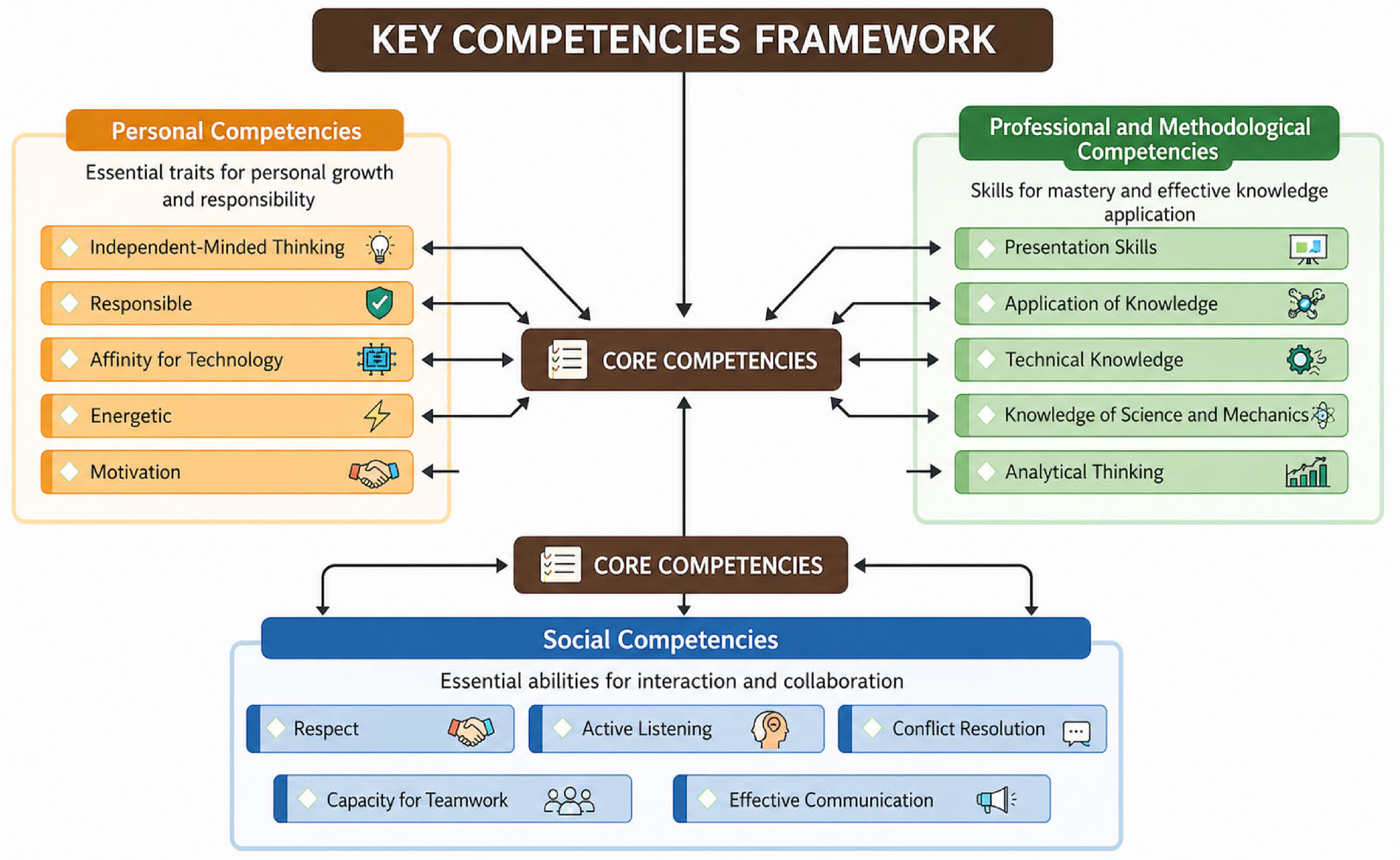
This competency framework, illustrated in Figure 2, provides a comprehensive blueprint for developing Industry 5.0-ready professionals through innovative educational approaches. By integrating these competencies into technical university curricula, educational institutions can prepare graduates with the multidimensional skill sets required for leadership in increasingly complex manufacturing environments characterised by cyber-physical systems, data-driven decision-making, and cross-functional collaboration requirements.
These interdisciplinary digital abilities should be conceptualised as multidimensional constructs that extend beyond workplace applications to encompass young people’s overall life orientation, functioning as action-oriented competence dimensions [43]. This comprehensive perspective recognises that effective digital competencies transcend traditional professional boundaries. Consequently, transdisciplinary digital competencies represent an integrated synthesis of personal willingness, developed abilities, and individual skills, enabling responsible behaviour across diverse digital environments in professional, social, and private contexts [43]. This definition acknowledges the interconnected nature of digital competencies and their applicability across all domains of contemporary life.
The anticipated development of these essential competencies will likely occur within structured didactic frameworks explicitly designed to nurture these capabilities through intentional educational interventions [44]. Such frameworks recognise that digital competence development requires thoughtful pedagogical approaches integrating theoretical understanding with practical application opportunities. Figure 3 presents a comprehensive competency model explicitly designed for technical university education, illustrating the interrelationships among various skill domains and their application contexts. This model provides educators with a structured framework for integrating digital competency development throughout technical curricula while addressing the multifaceted nature of modern professional requirements. The model emphasises developmental progression rather than static skill acquisition, recognising that digital competencies evolve through continuous engagement with increasingly complex technological environments. This dynamic approach prepares students for current workplace demands and equips them with the adaptability to navigate future technological transformations that will inevitably reshape professional landscapes. Figure 3 presents a competency model synthesised from the reviewed literature, integrating the findings of Roll and Ifenthaler [43], Scheid [38], and Cieslak and Valor [40] with construction-specific competency scholarship [5,25]. The model’s first category, Professional and Methodological Competencies, encompasses scientific understanding, presentation proficiency, technical knowledge, critical thinking, and application knowledge, which is grounded in Roll and Ifenthaler’s [43] empirically derived framework for non-subject-related digital competencies in technical–vocational contexts, extended by Scheid [38] identification of subject-related technical competence (STC) dimensions. The second category, Social and Personal Competencies, encompassing teamwork, communication, personal responsibility, and disciplinary openness, draws on the same empirical base [38,43] and aligns with the construction sector’s documented dependence on team-based project delivery [25]. Figure 3 illustrates the interrelationships between these categories and their combined contribution to Industry 5.0 readiness.
Competencies essential for success in Learning Factories 5.0 environments are organised into three fundamental categories with descending priority. The first major category, Professional and Methodological Competencies, encompasses five critical skills that form the foundation for excellence in technical education. Scientific and mechanical understanding represents a cornerstone competency, providing the essential knowledge base upon which all technical expertise is built. This includes meticulous documentation of lean manufacturing efficiency initiatives implemented within production facilities. Presentation proficiency has become increasingly vital in both academic and professional contexts, requiring individuals to effectively communicate complex information to diverse audiences in accessible, instructive formats. Students must demonstrate the ability to articulate research outcomes clearly through structured presentations.
Technical knowledge is another crucial competency, requiring students to develop a fundamental understanding of technical concepts and procedures to navigate today’s technology-driven landscape. This includes database access capabilities utilising various application interfaces. Critical thinking enables students to comprehend entire processes and analyse interactions between diverse system components. Rather than passively consuming information, analytically skilled students actively reflect on the theories, examples, and principles presented to develop a deeper understanding. Application knowledge represents the practical implementation of theoretical concepts. Success in Learning Factories 5.0 transcends mere memorisation of models and theories; learners must synthesise fundamental concepts from multiple disciplines to advance their studies. Students demonstrate this competency by applying knowledge flow analysis methodologies to Learning Factory environments. These competencies collectively represent both the professional substance of technical university curricula and the fundamental cognitive abilities required for effective engagement with Learning Factories 5.0.
In operationalising these seven competency clusters, the literature emphasises the complementary roles of social and personal competencies in enabling effective participation in the Learning Factory. Teamwork capacity, communication proficiency, personal responsibility, and openness to interdisciplinary engagement are consistently identified as enabling conditions for competency development [38,43], particularly in construction education contexts where team-based project delivery is the normative mode of learning and professional practice [25]. These social competencies are not additional to the seven transdisciplinary digital competency clusters described above; rather, they constitute the relational substrate through which those clusters are developed and expressed in authentic project environments.
Personal responsibility involves autonomous decision-making regarding tasks and methodologies, with students accepting accountability for their actions and resulting consequences. Openness to diverse disciplines, perspectives, and ideas is essential for effective group collaboration and innovative solution development in university and workplace environments. This comprehensive competency model integrates both technical and social dimensions necessary for effective functioning within Learning Factories 5.0 environments. These competencies can be systematically developed through didactic approaches commonly used in technical university settings, creating well-rounded professionals prepared to meet the complex challenges of modern industrial environments.
The competency evidence synthesised, drawn predominantly from the Roll & Ifenthaler [43] research programme within technical–vocational manufacturing contexts, provides the empirical foundation for the construction-specific competency architecture developed. The seven transdisciplinary digital competency dimensions identified by Roll and Ifenthaler, Attitude toward Digitalisation (AD), Hardware/Software Management Proficiency, Information Literacy (IL), Digital Security (DS), Virtual Collaboration (CL), Integrated Problem-Solving (PS), and Self-Reflection (RF), are directly mapped, extended, and contextualised for sustainable construction in the following section. Where manufacturing competency dimensions translate directly to construction contexts, they are retained with construction-specific elaboration. Where the distinctive demands of sustainable construction, particularly green technical proficiency and metacognitive sustainability practice, require competencies with no direct manufacturing equivalent, new clusters are introduced. This progression from manufacturing evidence to a construction-specific framework is made explicit in the correspondence mapping presented in Table 2.

4.3. Core Competencies for Industry 5.0 Readiness in Sustainable Construction

Addressing the first research objective and building directly on the manufacturing competency evidence synthesised, this section develops a construction-specific competency architecture for Industry 5.0 readiness. As shown in Table 2, the seven transdisciplinary competency clusters proposed here maintain a clear correspondence with the Roll and Ifenthaler framework: Attitude toward Digitalisation (AD), Information and Data Literacy (IDL), Digital Security and Ethical Governance (DSEG), and Adaptive Problem-Solving (APS) are directly adapted from their manufacturing equivalents, with construction-specific dimensions added. Collaborative Systems Thinking (CST) extends the Virtual Collaboration dimension to encompass the multi-stakeholder, whole-system interdependencies distinctive to construction project delivery. Two clusters, Technical–Green Proficiency (TGP) and Reflective Sustainability Practice (RSP), represent genuinely new additions to the framework, reflecting competency demands that have no equivalent in manufacturing Learning Factory research but are non-negotiable for sustainable construction professionals navigating Industry 5.0 transitions. These clusters are presented in Table 2. Unlike competency frameworks focused solely on technical proficiency, these clusters reflect the multidimensional demands of sustainable construction in an Industry 5.0 era: they encompass cognitive, behavioural, affective, and metacognitive dimensions, and they resist siloed, sequential development in favour of integrated, contextualised cultivation. Across the seven competency clusters, the strength of construction-direct evidence varies. Technical–Green Proficiency (TGP) and Collaborative Systems Thinking (CST) are most strongly grounded in construction and built environment research [5,6,25]. Attitude toward Digitalisation (AD), Information and Data Literacy (IDL), and Digital Security and Ethical Governance (DSEG) draw substantially on manufacturing and cross-sector digital competency literature [37,43,45], with transferability to construction supported by the sector’s digital transformation trajectory [18]. Adaptive Problem-Solving (APS) and Reflective Sustainability Practice (RSP) integrate competency development theory and sustainability education scholarship, both of which have established applications in construction contexts [21]. Where evidence has been transferred from adjacent domains, the authors have exercised analytical caution and acknowledge its inferential nature.
Attitude toward Digitalisation (AD) reflects construction professionals’ psychological orientation toward digital tools, platforms, and data-driven decision-making. Beyond mere technological competence, this encompasses openness to change, confidence in deploying unfamiliar tools, and critical awareness of digitisation’s social and ethical implications. In sustainable construction contexts, this includes readiness to engage with BIM, carbon calculation software, smart procurement platforms, and real-time monitoring systems [45].
Technical–Green Proficiency (TGP) integrates conventional construction technical competencies, structural analysis, materials science, project scheduling, with green construction knowledge: passive design principles, low-carbon materials assessment, embodied carbon calculation, green certification systems (e.g., Green Star, LEED, Homestar NZ), and circular economy application in construction supply chains [5]. This represents the most distinctively construction-specific competency cluster in the framework, differentiating it from its manufacturing counterparts.
Information and Data Literacy (IDL) encompass the capacity to collect, process, critically evaluate, and ethically deploy construction-related data across the building lifecycle. This includes interpreting sensor data from smart buildings, conducting lifecycle assessments, navigating environmental product declarations, and leveraging AI-generated insights in project decision-making [46].
Digital Security and Ethical Governance (DSEG) address the growing cybersecurity vulnerabilities in digitally connected construction environments, including smart building systems, connected site equipment, and cloud-based project platforms. Beyond technical security, this competency encompasses data privacy, ethical governance of AI in construction, and responsible handling of sensitive project information [37,47].
Collaborative Systems Thinking (CST) is perhaps the most distinctive Industry 5.0 competency, reflecting the construction sector’s fundamental dependence on multi-stakeholder project delivery. This cluster encompasses the capacity to collaborate across disciplinary and cultural boundaries, to understand and navigate whole-system interdependencies in built environment projects, and to maintain productive partnerships between human professionals and increasingly autonomous digital tools [48].
Adaptive Problem-Solving (APS) addresses the inherent complexity, ambiguity, and non-routine challenges of construction project environments. Sustainable construction professionals must navigate unfamiliar regulatory contexts (e.g., emerging net-zero legislation), novel material systems, and unanticipated project risks with creative, analytically rigorous, and ethically grounded responses. This competency integrates design thinking, risk assessment, and innovation capacity [30].
Reflective Sustainability Practice (RSP) is the metacognitive competency that underpins Industry 5.0’s human-centric orientation. Construction professionals must develop the capacity to systematically evaluate the environmental, social, and economic impacts of their decisions, to recognise the limitations of their own knowledge, and to maintain a continuous learning orientation in the face of rapid industrial change. This is particularly critical in sustainable construction, where the standards, technologies, and expectations defining ‘best practice’ are constantly evolving [49].
Table 2. Transdisciplinary Competency Clusters for Industry 5.0 Readiness in Sustainable Construction.
Competency ClusterCodeCore DimensionsKey Sources
Attitude toward DigitalisationADOpenness to digital tools; technological confidence; critical digital awareness[49]
Technical–Green ProficiencyTGPGreen building knowledge; low-carbon materials; circular economy; BIM; green certification[5]
Information & Data LiteracyIDLData collection and analysis; lifecycle assessment; AI-generated insight interpretation[28,46]
Digital Security & Ethical GovernanceDSEGCybersecurity; data privacy; AI ethics; responsible information management[37,47]
Collaborative Systems ThinkingCSTMulti-stakeholder collaboration; systems interdependencies; human–machine partnership[24,48]
Adaptive Problem-SolvingAPSDesign thinking; regulatory navigation; risk management; innovation under ambiguity[21,30]
Reflective Sustainability PracticeRSPMetacognition; impact evaluation; continuous learning; sustainability orientation[49,50]

4.4. Learning Factories 5.0 in Sustainable Construction Education

4.4.1. Learning Methodologies for Construction Contexts

The reviewed literature identified eight dominant learning methodologies characterising effective Learning Factory 5.0 implementations, each offering distinctive value for sustainable construction education [51]. Hands-on experiential learning provides direct engagement with real construction materials, equipment, and processes from sustainable material testing to digital site simulation, creating the tactile and contextual familiarity that abstract classroom learning cannot replicate [52]. Project-based learning organises students into interdisciplinary teams tasked with solving authentic construction challenges: designing a net-zero residential building, developing a circular economy demolition plan, or managing a BIM-integrated fit-out project for a green building client [33,53].
Competency-based learning explicitly aligns educational activities with industry-relevant outcomes, ensuring that students develop the specific competency clusters detailed above rather than accumulating knowledge without clear professional application [20]. Simulation-based learning leverages digital twin environments, VR construction site walkthroughs, and AR-assisted assembly tasks to provide safe, repeatable practice spaces for high-risk or resource-intensive construction scenarios [54,55]. Problem-based learning situates education around genuine industry challenges, such as skills shortages in green construction, retrofitting heritage buildings for improved energy performance, and managing supply chain disruptions for sustainable materials, requiring students to develop analytical and practical responses under realistic conditions of complexity.
Reflective learning, through structured journals, peer feedback, and post-project debriefs, develops the metacognitive dimension of competency identified as Reflective Sustainability Practice in the framework above [56]. Collaborative learning, facilitated through industry–academia partnerships with construction firms, green building councils, and infrastructure agencies, exposes students to real professional networks and authentic project constraints [47]. Blended learning integrates online and offline modalities, enabling flexible engagement with content and is particularly valuable for upskilling existing construction professionals who cannot commit to full-time campus-based programmes [28]. Table 3 presents the learning methodologies for Construction Learning Factories 5.0 and their alignment with competency requirements.

4.4.2. Technological Infrastructure for Construction Learning Factories 5.0

The technological dimension of Learning Factories 5.0 for sustainable construction must reflect both the digital transformation of the construction industry and the specific requirements of sustainable design, delivery, and operation. Building Information Modelling (BIM) platforms represent the foundational digital infrastructure, enabling students to engage with integrated 3D models that embed structural, environmental, energy, and lifecycle data [51]. Digital twin environments, virtual replicas of physical buildings or construction processes, provide safe, data-rich spaces for experimenting with design variables, testing construction sequences, and simulating the environmental performance of proposed solutions [55].
Augmented reality (AR) and virtual reality (VR) systems extend the experiential potential of Learning Factories beyond their physical footprint, enabling immersive site walkthroughs, interactive assembly training, and spatial visualisation of complex structural or environmental systems [57,58]. IoT sensor platforms monitoring energy consumption, indoor air quality, structural health, and occupant behaviour in smart building demonstrators provide authentic data streams for student analysis and decision-making practice [59,60]. Carbon calculation and lifecycle assessment (LCA) tools embed sustainability quantification into the learning process, enabling students to measure the environmental implications of design and material choices in real time [34].

4.4.3. Industry–Academia Partnerships

The quality of industry–academia partnerships fundamentally conditions the effectiveness of Learning Factories 5.0 in sustainable construction. Construction firms, infrastructure agencies, green building councils, materials suppliers, and regulatory bodies must be engaged not merely as guest lecturers but as co-designers of educational experiences, providers of authentic challenges, and evaluators of student work [54]. The literature documents multiple models of effective partnership: curriculum co-design workshops, student secondments to industry projects, joint R&D projects within Learning Factory environments, and shared investment in technological infrastructure [58].
For sustainable construction specifically, partnerships with organisations active in green building certification, net-zero building delivery, circular economy construction, and climate-adaptation infrastructure are particularly valuable. These organisations provide access to the most contemporary challenges and most relevant competency demands, ensuring that Learning Factory curricula remain aligned with the rapidly evolving frontier of sustainable construction practice [5]. Internationally, exemplary partnership models include the UK’s Building Research Establishment (BRE) academic network, Germany’s DGNB-linked university partnerships, and the USGBC’s LEED Faculty Fellowship programme in North America, each of which embeds green building certification standards directly into curriculum co-design. As one illustrative regional example, institutions in Aotearoa New Zealand might develop equivalent partnerships with the New Zealand Green Building Council, Kāinga Ora, and BRANZ, alongside iwi-led sustainable housing initiatives that bring indigenous environmental governance perspectives into construction education.

4.5. Implementation Factors and Barriers

Six critical implementation factors emerged from the literature synthesis, each presenting both enabling conditions and potential barriers to the development of Construction Learning Factory 5.0 (as shown in Table 4). Technological infrastructure serves as the foundational enabler: without appropriate digital platforms, physical construction demonstrators, and connected sensor systems, the immersive and authentic learning experiences central to Learning Factory 5.0 pedagogy cannot be realised [61]. Yet the capital investment required for state-of-the-art construction of Learning Factories is substantial, and resource-constrained institutions may find it prohibitive to establish comprehensive facilities from the outset [27].
The pedagogical approach is the second critical factor: the transition from lecture-based to experiential, project-based, and competency-aligned teaching requires a significant investment in faculty development. Construction academics trained primarily as researchers or former industry practitioners may lack confidence or expertise in facilitative, student-centred pedagogical methods. Institutional support for pedagogical transformation through professional development programmes, peer observation networks, and teaching quality frameworks is therefore essential [62].
The quality of Industry–Academia Partnership directly determines the relevance and authenticity of Learning Factory experiences. Partnerships require sustained engagement, clear governance structures, mutual benefit frameworks, and protection of intellectual property, all of which demand careful institutional design. The construction industry’s project-based, site-specific, and commercially sensitive operational model presents particular challenges for sustained academic partnership that do not arise to the same degree in manufacturing contexts [63].
Institutional factors, including scheduling flexibility, assessment reform, regulatory frameworks for vocational education, and organisational culture, can either enable or constrain Learning Factory integration [64]. Construction education institutions must create structural conditions that support extended project work, interdisciplinary learning, and industry-engaged assessment without compromising degree programme integrity or accreditation requirements [39,65]. Personnel Development, encompassing both faculty capability and student readiness, is a further critical factor. Economic Considerations capital investment, operational costs, and return on educational investment are perhaps the most significant practical barriers, particularly for smaller institutions and developing economy contexts [59].
Table 4. Critical Implementation Factors for Construction Learning Factories 5.0.
Implementation FactorSub-DimensionsKey Challenge for Construction ContextCited Sources
Technological InfrastructureBIM/digital twin platforms; smart sensors; VR/AR; carbon toolsHigh capital cost; rapid technology obsolescence[57,66,67]
Pedagogical ApproachProject-based learning facilitation; competency-based design; reflective practiceFaculty development; shift from lecture-based norms[32,67]
Industry–Academia PartnershipCo-curriculum design; authentic challenges; joint IP governanceSite confidentiality; commercial sensitivity in construction[47,58]
Institutional FactorsScheduling flexibility; accreditation; assessment reformRigid programme structures in professional construction degrees[39,66]
Personnel DevelopmentFaculty capability; student digital readiness; technical upskillingVariable digital literacy among construction students and staff[28,68]
Economic ConsiderationsCapital investment; operational costs; ROI demonstrationBudget constraints in resource-limited institutions[61,63]

5. The Construction Learning Factory 5.0 (CLF5.0) Framework

5.1. Framework Overview

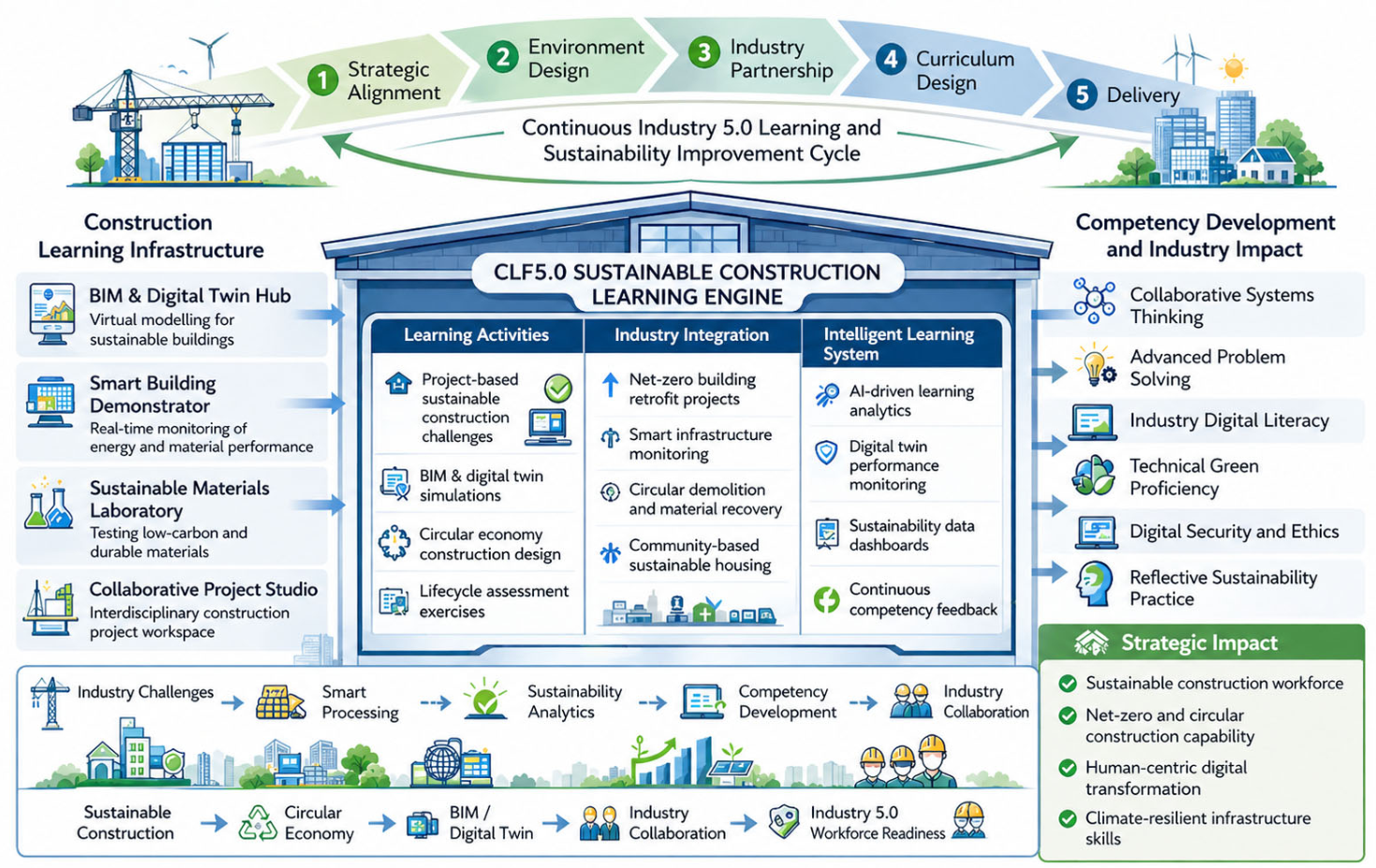
The Construction Learning Factory 5.0 (CLF5.0) Framework presented in this section (Figure 4) is a conceptually derived, evidence-informed model synthesised from the systematic review’s findings. It is not empirically validated at this stage; its effectiveness, scalability, and cross-context applicability require rigorous pilot testing. Accordingly, the framework should be understood as a theoretically grounded architecture that institutions, industry partners, and researchers can adapt, evaluate, and refine, rather than a prescriptive or definitive model. Addressing the third research objective, this section introduces the CLF5.0 Framework as a comprehensive, competency-driven approach for integrating Learning Factories 5.0 into sustainable construction education and training. The framework is structured around eight interconnected phases, anchored in seven competency clusters and informed by the key implementation factors identified in the review. It draws on competency development theory [20], the Learning Factories 5.0 Curriculum Guide [28], and the three core pillars of Industry 5.0, while being specifically contextualised for the construction sector by emerging scholarship [69].
The CLF5.0 Framework is distinguished from its manufacturing counterparts by four defining characteristics. First, it explicitly centres sustainability as a pedagogical objective rather than merely a contextual backdrop. Green competency, lifecycle thinking, and circular economy principles are embedded throughout the curriculum design rather than appended as elective modules. Second, it integrates construction-specific technological infrastructure, particularly BIM, digital twins, and smart building demonstrators alongside the generalised digital tools (IoT, AI, VR) common to manufacturing Learning Factories. Third, it is designed with the construction industry’s fragmented, project-based, and multi-stakeholder character in mind, structuring industry partnerships around project-delivery scenarios rather than replicating production processes. Fourth, it explicitly attends to the metacognitive dimension of sustainability practice, recognising that Reflective Sustainability Practice (RSP) is a non-negotiable competency for construction professionals navigating rapidly shifting regulatory, technological, and ecological contexts.

5.2. The Eight Phases of the CLF5.0 Framework

The eight phases of the CLF5.0 Framework are sequenced to reflect the evidence-based implementation logic synthesised from the reviewed literature. Phase 1 (Strategic Alignment) is informed by competency-mapping evidence, particularly the seven-cluster architecture developed by Roll and Ifenthaler [43] and extended to construction contexts [5,25]. Phase 2 (Environment Design) draws on the technological infrastructure literature, encompassing BIM, digital twins, smart building systems, and sustainable materials facilities [51,57,61]. Phase 3 (Industry Partnership Activation) operationalises the industry–academia collaboration models identified in prior studies [54,58,65]. Phase 4 (Curriculum Design and Pedagogical Scaffolding) applies the eight learning methodologies highlighted in the review [33,53,55]. Phase 5 (Delivery and Facilitation) and Phase 6 (Assessment and Competency Validation) translate competency development theory into pedagogical and evaluative practice [20,21,70]. Phases 7 (Evaluation) and 8 (Iteration) address the need for evidence generation and continuous improvement, as emphasised in the implementation factors analysis [28,71]. Each phase described below is linked to the relevant supporting literature section.
Phase 1: Strategic Alignment and Competency Mapping
The CLF5.0 process begins with a strategic alignment phase in which educational institutions, industry partners, and relevant regulatory bodies collaboratively identify the competency priorities most relevant to their specific construction context. This phase produces a customised competency map that draws on the seven CLF5.0 competency clusters, weighted according to regional industry priorities. For instance, a New Zealand institution might prioritise Collaborative Systems Thinking and Reflective Sustainability Practice given the sector’s emphasis on Treaty of Waitangi principles and climate adaptation. This illustrates how the Strategic Alignment phase accommodates indigenous governance and cultural sustainability frameworks more broadly; equivalent considerations apply in other national contexts, including Aboriginal and Torres Strait Islander Country protocols in Australia, First Nations land stewardship frameworks in Canada, and indigenous ecological knowledge systems in Pacific Island construction contexts. This phase also establishes measurable learning outcomes, selects appropriate assessment instruments, and secures institutional and industry commitments necessary for successful implementation.
Phase 2: Environment Design and Technological Integration
Phase 2 involves the physical and digital design of the Learning Factory environment. For construction contexts, this encompasses four key infrastructure elements: (1) a BIM and Digital Twin Hub, providing students with integrated modelling environments for sustainable building design and construction simulation; (2) a Smart Building Demonstrator, enabling real-time monitoring of energy, material, and environmental performance data in an instrumented building space; (3) a Sustainable Materials Laboratory, where students can test, evaluate, and compare low-carbon and circular economy materials; and (4) a Collaborative Project Studio, designed for interdisciplinary team-based project work integrating digital and physical construction workflows. AI-enhanced learning analytics tools monitor student progress and adapt instructional scaffolding to individual competency development trajectories.
Phase 3: Industry Partnership Activation
Phase 3 activates the industry partnerships essential to Learning Factory authenticity. Construction firms, infrastructure clients, green building certification bodies, sustainability consultancies, and iwi (indigenous community organisations) are engaged as co-educators, challenge providers, and evaluators. Industry partners contribute authentic project briefs, for example, a net-zero retrofit of a commercial building, a sustainable residential development for a specific community context, or a circular economy demolition and materials recovery plan that form the basis for student project activities throughout the programme. Partnership governance structures, intellectual property agreements, and mutual benefit frameworks are established in this phase.
Phase 4: Curriculum Design and Pedagogical Scaffolding
Phase 4 designs the detailed curriculum structure, maps learning activities to competency clusters, selects appropriate pedagogical methodologies from the eight identified in Section 4.4.1, and establishes the assessment framework. Table 5 presents a sample curriculum structure for a 14-week introductory CLF5.0 module, illustrating how competency development can be progressively scaffolded across a single semester. It is important to note that this module represents an entry-level exposure to the CLF5.0 environment, not a comprehensive competency development programme. Weeks 3–4 are designed as digital tool orientation phases, introducing students to BIM, carbon calculation, and digital twin environments, rather than as platforms for achieving proficiency, which requires sustained engagement across multiple semesters. Full development of all seven competency clusters to professional standard is envisioned as the outcome of a multi-semester or multi-year programme of CLF5.0 engagement, of which this 14-week module constitutes one component.
Phase 5: Delivery and Facilitation
Phase 5 involves active delivery of the CLF5.0 curriculum through facilitated learning experiences. Faculty members serve not as knowledge transmitters but as learning architects and process facilitators, guiding students through authentic construction challenges while providing targeted theoretical input and formative feedback. Industry mentors contribute their real-world expertise through structured engagement at key project milestones. The learning environment is deliberately designed to induce the productive uncertainty characteristic of authentic project construction work, challenging students to mobilise multiple competency clusters simultaneously rather than applying knowledge in compartmentalised sequences.
Phase 6: Assessment and Competency Validation
Assessment in the CLF5.0 Framework is multi-modal, continuous, and aligned with the seven competency clusters. Formative assessments embedded within project milestones, peer evaluations, and reflective journals provide ongoing feedback that guides real-time competency development. Summative assessments measure competency achievement against predetermined industry-relevant benchmarks, utilising instruments including practical skills demonstrations, digital portfolio submissions, industry expert evaluations, and peer assessment. The Big Five personality framework may be employed as a supplementary tool for understanding individual competency development trajectories, informing personalised learning support rather than high-stakes evaluation [23,70].
Phase 7: Evaluation and Evidence Generation
Phase 7 systematically evaluates CLF5.0 programme effectiveness across multiple dimensions: student competency development, industry partner satisfaction, faculty pedagogical confidence, and institutional learning outcomes. Pre–post competency assessments measure learning gains; longitudinal tracking of graduates into employment provides evidence of real-world impact; industry partner feedback informs curriculum relevance; and economic analyses establish the return on educational investment. This phase directly addresses the evidence gap identified in the literature, where claims of Learning Factory effectiveness have far outpaced empirical validation [28,71].
Phase 8: Iteration and Systemic Improvement
The CLF5.0 Framework closes with an iterative improvement cycle, through which evaluation insights inform refinements to all preceding phases. This cyclical structure acknowledges the dynamic nature of sustainable construction industry demands, where emerging technologies, evolving regulatory frameworks, and shifting market conditions continuously redefine the competencies required for industry readiness. Regular curriculum review processes, informed by industry partner input, graduate feedback, and sector intelligence, ensure the CLF5.0 environment remains at the forefront of sustainable construction practice rather than lagging.

6. Discussion

The synthesis of 71 publications across the Learning Factory 5.0, Industry 5.0, and sustainable construction literatures reveals four principal theoretical contributions to the intersecting fields of construction education, Learning Factory research, and Industry 5.0 workforce development theory. First, this study extends the Learning Factory 5.0 paradigm previously confined predominantly to manufacturing engineering contexts into the sustainable construction domain, establishing a conceptually coherent and theoretically grounded framework for construction-specific application. Importantly, this extension is conceptual in nature: whilst the framework draws on synthesised evidence from 71 peer-reviewed publications, it has not yet been empirically tested in construction education settings. Its contribution lies in providing a structured, theoretically informed starting point for such testing, rather than in demonstrating proven effectiveness. By demonstrating that the core principles of Learning Factory 5.0 pedagogy are transferable to construction education, this study opens a new strand of inquiry with significant practical implications for a sector facing acute workforce transformation demands.
Second, the seven-cluster competency architecture proposed here advances existing competency frameworks for construction education by integrating sustainability as a fundamental dimension of professional competence rather than an add-on specialism. The inclusion of Reflective Sustainability Practice (RSP) as a distinct competency cluster is particularly significant: it positions metacognitive capacity and sustainability consciousness as Industry 5.0 imperatives rather than optional personal attributes, challenging construction education institutions to make these dimensions central to their pedagogical ambitions [32,50].
Third, the CLF5.0 Framework contributes a construction-specific implementation model that addresses the sector’s distinctive structural characteristics, its project-based nature, multi-stakeholder complexity, regulatory diversity, and commercial confidentiality concerns, which generic Learning Factory frameworks developed in manufacturing contexts do not adequately address. This specificity is important for practical uptake: educational institutions and industry partners need frameworks that account for the realities of their sector, not generic templates that require extensive adaptation before they can be meaningfully applied.
Fourth, the study’s systematic analysis of implementation factors and barriers provides a more granular understanding of the conditions required for successful CLF5.0 deployment than the existing literature. By mapping implementation factors against construction-specific challenges, including industry partnership governance, digital literacy variability among students and faculty, and the economic feasibility of smart building demonstrators, the study equips decision-makers with actionable intelligence rather than aspirational rhetoric.

6.1. Practical Implications

6.1.1. For Educational Institutions

Universities and polytechnics offering construction, built environment, and civil engineering programmes should regard the CLF5.0 Framework as both an aspirational model and a modular implementation guide. Institutions need not establish fully equipped Construction Learning Factories immediately; rather, a phased approach beginning with curriculum redesign around competency clusters, establishing one or two industry partnerships, and piloting BIM and digital twin capabilities allows institutions to build capacity incrementally while generating early evidence of effectiveness. Faculty development programmes should prioritise facilitative pedagogy, sustainability integration, and proficiency with digital tools, recognising that these capabilities are as foundational to CLF5.0 success as physical infrastructure [39,62].

6.1.2. For Industry Partners

Construction firms, infrastructure clients, and green building organisations should view Learning Factory partnerships not as philanthropic activities but as strategic investments in talent development. By co-designing authentic challenges, mentoring student teams, and providing real-time feedback on project proposals, industry partners help shape the competency profiles of their future workforce while gaining access to fresh perspectives on sustainability challenges and digital innovation [11]. The CLF5.0 Framework’s explicit governance structures for industry–academia partnerships provide the institutional scaffolding needed to sustain these relationships and make them mutually beneficial over time [58].

6.1.3. For Policymakers

Government bodies and professional associations overseeing construction education and workforce development should consider how regulatory frameworks, funding mechanisms, and accreditation standards can enable rather than constrain CLF5.0 adoption. Targeted funding for Learning Factory infrastructure, recognition of industry-engaged assessment within accreditation frameworks, and incentives for construction firms to participate in educational partnerships would significantly accelerate the sector’s readiness for Industry 5.0. In New Zealand, alignment between the CLF5.0 Framework and initiatives such as the Infrastructure Commission’s workforce strategy, the Tertiary Education Commission’s vocational pathways, and the New Zealand Green Building Council’s green skills agenda would strengthen both the policy case and the implementation pathway for CLF5.0 adoption.

6.2. Limitations

A primary limitation of this study relates to the composition of its evidence base. Of the 71 included publications, only 19 (26%) originate from construction or built environment research; the majority derive from manufacturing engineering, technical–vocational education, and cross-sector Learning Factory literature. Whilst the transferability of these findings to sustainable construction is theoretically supported and analytically justified throughout the manuscript, readers should note that a substantial proportion of the competency evidence, particularly for Attitude toward Digitalisation, Information and Data Literacy, and Digital Security clusters, is inferentially transferred from non-construction contexts rather than derived from direct construction studies. This limitation underscores the need to empirically validate the CLF5.0 Framework in actual construction education settings, as called for in Section 6.3.
A second limitation relates to the single-database search strategy. Although the Scopus search was supplemented by manual and grey literature retrieval, excluding Web of Science, ERIC, and construction-specific databases such as the ASCE Library, this may have led to the omission of relevant studies, particularly in educational research and North American construction contexts. Future systematic reviews extending this work should employ a multi-database strategy to enhance coverage and minimise selection bias.
A third and critical limitation is the absence of empirical validation of the CLF5.0 Framework itself. The eight-phase framework is derived from a systematic synthesis of the literature but has not been subjected to expert review, Delphi validation, or pilot implementation. Its phase structure, competency weightings, and implementation sequencing therefore reflect the authors’ analytical judgement rather than demonstrated effectiveness. This is a significant constraint on the strength of claims about the framework’s practical utility. Researchers and practitioners considering adopting the CLF5.0 Framework should treat it as a hypothesis to be tested rather than a model to be implemented uncritically. Delphi validation with construction education academics and industry practitioners, followed by a structured pilot implementation with pre- and post-competency assessment, is the minimum evidence standard required before the framework can be recommended with confidence.
Fourth, the inherent heterogeneity of the global construction sector across scales, regulatory contexts, climate zones, cultural contexts, and economic development statuses means that a single framework cannot capture all relevant contingencies. The CLF5.0 Framework is best regarded as a flexible architecture requiring contextual adaptation rather than a prescriptive blueprint. Finally, the study does not address the temporal dynamics of competency development: the literature provides limited longitudinal evidence on how Learning Factory experiences translate into sustained competency application across construction careers.

6.3. Future Research Directions

This study’s findings point to several priority directions for future research. Empirical validation of the CLF5.0 Framework through pilot implementation studies in construction education institutions should be an immediate priority, employing pre–post competency assessments, longitudinal graduate tracking, and rigorous cost-effectiveness analyses. Comparative studies examining the relative effectiveness of CLF5.0 approaches versus conventional construction education would generate the evidence base that the field currently lacks. Research exploring the scalability of CLF5.0 in resource-constrained settings, including vocational education institutions, developing economies, and small-scale training providers, would extend the framework’s practical applicability.
Investigation of the specific role of personality factors (particularly the Big Five dimensions) in mediating CLF5.0 learning outcomes would advance the personalisation agenda identified in the literature, which has not yet been rigorously explored. Research on integrating indigenous knowledge systems, including Māori environmental management principles, into the CLF5.0 curriculum design in the New Zealand context would address important dimensions of cultural sustainability and community partnership that the current framework acknowledges but does not fully develop. Finally, longitudinal studies tracking the career trajectories of CLF5.0 graduates, particularly their contributions to sustainable construction outcomes at the project and sector levels, would provide the strongest possible evidence for the framework’s transformative potential.

7. Conclusions

The imperative to transform construction workforce development in alignment with Industry 5.0 principles is both urgent and profound. The sustainable construction sector requires professionals who are not merely technically competent, but also able to integrate digital fluency, sustainability consciousness, collaborative intelligence, adaptive problem-solving, and metacognitive capacity in service of a built environment that is carbon-neutral, circular, resilient, and genuinely human-centric. This paper has argued that Learning Factories 5.0, when deliberately designed, contextually grounded, and rigorously implemented, represent a transformative educational infrastructure for achieving this ambition.
Through a systematic synthesis of 71 peer-reviewed publications and targeted engagement with the construction-specific literature, this study has identified seven transdisciplinary competency clusters essential for Industry 5.0 readiness in sustainable construction, examined how Learning Factory 5.0 methodologies and technologies can support the development of these competencies, and proposed the Construction Learning Factory 5.0 (CLF5.0) Framework an eight-phase, competency-driven implementation model tailored to the distinctive structural, cultural, and sustainability imperatives of the construction sector. The CLF5.0 Framework is offered not as a completed solution but as a generative starting point: a conceptual architecture that institutions, industry partners, and policymakers can adapt, test, refine, and build upon as they collectively advance the construction sector’s Industry 5.0 readiness. The road ahead will require sustained investment, institutional courage, cross-sector partnership, and rigorous empirical inquiry. But it is a road whose destination, a sustainable, human-centric, digitally confident, and globally competitive construction workforce, is worth every step of the journey.
For practitioners seeking to adopt the findings of this study, the following recommendations are offered. First, construction education institutions should begin CLF5.0 adoption through curriculum redesign rather than infrastructure investment: restructuring existing modules around the seven competency clusters and project-based assessment methods requires no capital expenditure but substantially improves Industry 5.0 alignment. Second, industry partners, construction firms, green building organisations, and infrastructure agencies should formalise their engagement with universities through co-curricular design agreements and the provision of authentic project briefs, recognising this as a strategic investment in pipeline talent rather than philanthropic activity. Third, policymakers and professional associations should review accreditation frameworks to permit industry-engaged, competency-evidenced assessment to be equivalent to traditional examinations, removing the regulatory barriers that currently constrain CLF5.0 adoption in professionally accredited construction degrees. Fourth, institutions piloting CLF5.0 modules should prioritise embedding pre–post competency assessment instruments from the outset, ensuring that the evidence base for Learning Factory effectiveness in construction contexts is systematically built from the first implementation cohort. Fifth, researchers building on this study should prioritise Delphi validation of the CLF5.0 Framework and longitudinal graduate tracking as the two most urgent empirical contributions needed to move the field from conceptual promise to demonstrated impact.

Supplementary Materials

The following supporting information can be downloaded at https://www.mdpi.com/article/10.3390/buildings16102024/s1, Table S1: PRISMA 2020 Main Checklist [72], Table S2: Case Studies Analysed of all 71 Papers.

Author Contributions

Conceptualisation, K.D.; methodology, K.D.; software, validation, formal analysis, data curation, T.D.M.; investigation, K.D.; writing—original draft preparation, T.D.M.; writing—review and editing, visualisation, K.D. All authors have read and agreed to the published version of the manuscript.

Funding

This research received no external funding.

Data Availability Statement

No new data were created or analysed in this study. Data sharing does not apply to this article.

Conflicts of Interest

The authors declare no conflicts of interest.

References

  1. Mostafaei, H.; Rostampour, M.A.; Chamasemani, N.F.; Wu, C. An In-depth exploration of carbon footprint analysis in the construction sector with emphasis on the dam industry. In Carbon Footprint Assessments: Case Studies & Best Practices; Springer: Berlin/Heidelberg, Germany, 2024; pp. 45–80. [Google Scholar] [CrossRef]
  2. Thanissery, V.V. A Sustainable Approach for the Reduction of Carbon Dioxide Emissions in the Latvian Construction Industry. Master’s Thesis, Riga Technical University, Riga, Latvia, 2023. [Google Scholar]
  3. Yadav, D.; Yadav, S. Industry 5.0 and Digital Transformation: The Convergence of Humanity and Technology. In Metaverse Dynamics: Exploring the Intersection of Technology, Business Transformation, and User Experience; Emerald Publishing Limited: Leeds, UK, 2026. [Google Scholar]
  4. Bongomin, O.; Nzila, C.; Mwasiagi, J.I.; Maube, O. Machine Learning for Predictive Modeling of Co-gasification: A Step Toward Industry 4.0 in Biomass Waste Valorization. In Measurement, Automation, and Control in Artificial Intelligence and Machine Learning; Springer: Berlin/Heidelberg, Germany, 2025; pp. 113–141. [Google Scholar]
  5. Kipper, L.M.; Iepsen, S.; Forno, A.J.D.; Frozza, R.; Furstenau, L.; Agnes, J.; Cossul, D. Scientific mapping to identify competencies required by industry 4.0. Technol. Soc. 2021, 64, 101454. [Google Scholar] [CrossRef]
  6. Ahmad, M.H.; Moshood, T.D.; Nawanir, G. The influence of Industrial Revolution 4.0 in the implementation of the learning factory at the University of Malaysia Pahang. J. Appl. Res. High. Educ. 2024, 16, 89–103. [Google Scholar] [CrossRef]
  7. Yang, J. Beyond experience: Reshaping the academic essence of teaching reform in engineering education. Eng. Educ. Rev. 2026, 4, 1–3. [Google Scholar] [CrossRef]
  8. Carreiro, E.; Maccari, E.A.; Scafuto, I.C.; Serra, F. Bridging theory and practice: An experiential learning framework for project management education and professional development. Educ. Train. 2026, 68, 501–524. [Google Scholar] [CrossRef]
  9. Wong, K.K.-K. Future Proof Leadership: Human Centered Strategy for the Industry 5.0 Era; ESA Pub: Washington, DC, USA, 2026. [Google Scholar]
  10. Aida, V.-B.; Antón, V.-P.; Vilar-Martínez, J.; Fernández-Caramés, T.M.; Fraga-Lamas, P. A Mixed Reality Tool with Automatic Speech Recognition for 3D CAD Based Visualization and Automatic Dimension Generation in the Industry 5.0 Shipyard. Multimodal Technol. Interact. 2026, 10, 13. [Google Scholar] [CrossRef]
  11. Quinn, W.; Ahearn, A.; Buckley, K.; Casotti, A.; Ozturk, C. A Learning Factory Implementation with Industry, Teaching and Research Perspectives. Procedia Comput. Sci. 2025, 253, 1093–1102. [Google Scholar] [CrossRef]
  12. Breque, M.; De Nul, L.; Petridis, A. Industry 5.0: Towards a Sustainable, Human-Centric and Resilient European Industry; Directorate General for Research and Innovation (DG RTD) of the European Commission: Brussels, Belgium, 2021. [Google Scholar]
  13. Schröder, A.J.; Cuypers, M.; Götting, A. From Industry 4.0 to Industry 5.0: The triple transition digital, green and social. In Industry 4.0 and the Road to Sustainable Steelmaking in Europe: Recasting the Future; Springer International Publishing: Cham, Switzerland, 2024; pp. 35–51. [Google Scholar]
  14. Bongomin, O. Positioning Industrial Engineering in the Era of Industry 4.0, 5.0, and Beyond: Pathways to Innovation and Sustainability. 2025. Available online: https://ssrn.com/abstract=5096401 (accessed on 12 November 2025).
  15. Nguyen, L.H.; Tran, K.D.; Zeng, X.; Tran, K.P. Human-Centered Edge Artificial Intelligence for Smart Factory Applications in Industry 5.0: A Review and Perspective. In Artificial Intelligence for Safety and Reliability Engineering: Methods, Applications, and Challenges; Springer: Cham, Switzerland, 2024; pp. 79–100. [Google Scholar]
  16. Akhavan, M.; Alivirdi, M.; Jamalpour, A.; Kheradranjbar, M.; Mafi, A.; Jamalpour, R.; Ravanshadnia, M. Impact of industry 5.0 on the construction industry (Construction 5.0): Systematic literature review and bibliometric analysis. Buildings 2025, 15, 1491. [Google Scholar] [CrossRef]
  17. Nanduri, S.K.; Delhi, V.S.K. Foundations for Construction 5.0: A Review-based Taxonomy for Construction Worker Action Understanding. J. Inf. Technol. Constr. 2025, 30, 924–962. [Google Scholar] [CrossRef]
  18. Fraga-Lamas, P.; Fernández-Caramés, T.M.; da Cruz, A.M.R.; Lopes, S.I. An overview of blockchain for Industry 5.0: Towards human-centric, sustainable and resilient applications. IEEE Access 2024, 12, 116162–116201. [Google Scholar] [CrossRef]
  19. Pinto, R.; Žilka, M.; Zanoli, T.; Kolesnikov, M.V.; Gonçalves, G. Enabling professionals for industry 5.0: The self-made programme. Procedia Comput. Sci. 2024, 232, 2911–2920. [Google Scholar] [CrossRef]
  20. Wahjusaputri, S.; Bunyamin, B. Development of Teaching Factory Competency-Based for Vocational Secondary Education in Central Java, Indonesia. Int. J. Eval. Res. Educ. 2022, 11, 353–360. [Google Scholar] [CrossRef]
  21. Bauernhansl, T.; Tzempetonidou, M.; Rossmeissl, T.; Groß, E.; Siegert, J. Requirements for designing a cyber-physical system for competence development. Procedia Manuf. 2018, 23, 201–206. [Google Scholar] [CrossRef]
  22. Oyewo, F.O.; Oyewo, J.F. Enhancing Student-Centred Learning Approaches in the Built Environment: Bridging Theory and Practice. In Proceedings of the Global Forum for Sustainable Built Environment Conference, Johannesburg, South Africa, 4–5 September 2025; pp. 1497–1506. [Google Scholar]
  23. Shaninah, F.S.E.; Noor, M.H.M. The impact of big five personality trait in predicting student academic performance. J. Appl. Res. High. Educ. 2024, 16, 523–539. [Google Scholar] [CrossRef]
  24. Mohammed, N.; Kamalanabhan, T. Tacit knowledge sharing and creative performance: A transformative learning perspective. Dev. Learn. Organ. Int. J. 2022, 36, 5–8. [Google Scholar] [CrossRef]
  25. Yap, J.B.H.; Shavarebi, K. Enhancing project delivery performances in construction through experiential learning and personal constructs: Competency development. Int. J. Constr. Manag. 2022, 22, 436–452. [Google Scholar] [CrossRef]
  26. Abele, E.; Metternich, J.; Tisch, M.; Kreß, A. Overview on Learning Factory Topics. In Learning Factories: Featuring New Concepts, Guidelines, Worldwide Best-Practice Examples; Springer: Berlin/Heidelberg, Germany, 2024; pp. 287–325. [Google Scholar]
  27. Abele, E.; Chryssolouris, G.; Sihn, W.; Metternich, J.; ElMaraghy, H.; Seliger, G.; Sivard, G.; ElMaraghy, W.; Hummel, V.; Tisch, M.; et al. Learning factories for future oriented research and education in manufacturing. CIRP Ann. 2017, 66, 803–826. [Google Scholar] [CrossRef]
  28. Roll, M.; Ifenthaler, D. Learning Factories 4.0 in technical vocational schools: Can they foster competence development? Empir. Res. Vocat. Educ. Train. 2021, 13, 20. [Google Scholar] [CrossRef]
  29. Cimini, C.; Lagorio, A.; Romero, D.; Gaiardelli, P.; Tortorella, G. On job profiles enlargement and enrichment when lean and industry 4.0 paradigms meet. Int. J. Ind. Eng. Manag. 2024, 15, 338–347. [Google Scholar] [CrossRef]
  30. Papacharalampopoulos, A.; Stavropoulos, P.; Ziarsolo, U.; Karagianni, O.M. Teaching Learning Factories 5.0: Shaping Training, Skilling and Reskilling for the Future. In Proceedings of the International Association for the Management of Technology Conference, Porto, Portugal, 8–11 July 2024; pp. 159–167. [Google Scholar]
  31. Taha, M.F.; Mao, H.; Zhang, Z.; Elmasry, G.; Awad, M.A.; Abdalla, A.; Mousa, S.; Elwakeel, A.E.; Elsherbiny, O. Emerging technologies for precision crop management towards agriculture 5.0: A comprehensive overview. Agriculture 2025, 15, 582. [Google Scholar] [CrossRef]
  32. Pittich, D.; Tenberg, R.; Lensing, K. Learning factories for complex competence acquisition. Eur. J. Eng. Educ. 2020, 45, 196–213. [Google Scholar] [CrossRef]
  33. Dungus, M.I.A. Industry 5.0: Exploring the Role of Human-Centric Design in Transformative Learning Factories. Master’s Thesis, Politecnico di Milano, Milan, Italy, 2022. [Google Scholar]
  34. Zarte, M.; Pechmann, A. Implementing an energy management system in a learning factory—A project-based learning approach. Procedia Manuf. 2020, 45, 72–77. [Google Scholar] [CrossRef]
  35. Belinski, R.; Peixe, A.M.; Frederico, G.F.; Garza-Reyes, J.A. Organizational learning and Industry 4.0: Findings from a systematic literature review and research agenda. Benchmarking Int. J. 2020, 27, 2435–2457. [Google Scholar] [CrossRef]
  36. Posselt, G.; Böhme, S.; Aymans, S.; Herrmann, C.; Kauffeld, S. Intelligent learning management by means of multi-sensory feedback. Procedia CIRP 2016, 54, 77–82. [Google Scholar] [CrossRef]
  37. Liboni, L.B.; Cezarino, L.O.; Jabbour, C.J.C.; Oliveira, B.; Stefanelli, N.O. Smart industry and the pathways to HRM 4.0: Implications for SCM. Supply Chain Manag. Int. J. 2019, 24, 124–146. [Google Scholar] [CrossRef]
  38. Scheid, R. Learning factories in vocational schools: Challenges for designing and implementing learning factories at vocational schools. In Digital Workplace Learning: Bridging Formal and Informal Learning with Digital Technologies; Springer: Berlin/Heidelberg, Germany, 2018; pp. 271–289. [Google Scholar]
  39. Francalanza, E.; Vella, P.; Rauch, E.; Amza, C.; Lundgren, M.; Putnik, G. An Innovative higher education institution training toolbox to effectively address industry 4.0 skills gap and mismatches. In Proceedings of the International Symposium on Industrial Engineering and Automation, Bozen-Bolzano, Italy, 21–22 June 2022; pp. 298–305. [Google Scholar]
  40. Cieslak, V.; Valor, C. Moving beyond conventional resistance and resistors: An integrative review of employee resistance to digital transformation. Cogent Bus. Manag. 2025, 12, 2442550. [Google Scholar] [CrossRef]
  41. Enke, J.; Oberc, H.; Riemann, T.; Schuhmacher, J.; Hummel, V.; Kuhlenkötter, B.; Metternich, J.; Prinz, C. Cooperation between learning factories: Approach and example. Procedia Manuf. 2020, 45, 222–227. [Google Scholar] [CrossRef]
  42. Löhr-Zeidler, B.; Hörner, R.; Heer, J. Handlungsempfehlungen Industrie 4.0–Umsetzungshilfen für Lehrerinnen und Lehrer der beruflichen Schulen. berufsbildung. Z. Theor. Praxisverknüpfung 2016, 159, 11–14. [Google Scholar]
  43. Roll, M.J.J.; Ifenthaler, D. The Impact of Learning Factories on Multi-disciplinary Digital Competencies. In Vocational Education and Training in the Age of Digitization: Challenges and Opportunities; Wuttke, E., Seifried, J., Niegemann, H.M., Eds.; Verlag Barbara Budrich: Leverkusen, Germany, 2020; Volume 4, p. 23. [Google Scholar]
  44. González-Pérez, L.I.; Ramírez-Montoya, M.S. Components of Education 4.0 in 21st century skills frameworks: Systematic review. Sustainability 2022, 14, 1493. [Google Scholar] [CrossRef]
  45. Fernández-Caramés, T.M.; Fraga-Lamas, P. Forging the industrial metaverse for industry 5.0: Where extended reality, iiot, opportunistic edge computing, and digital twins meet. IEEE Access 2024, 12, 95778–95819. [Google Scholar] [CrossRef]
  46. Hlihel, F.B.; Chater, Y.; Boumane, A. Developing a competency model for maintenance 4.0 stakeholders. Int. J. Qual. Reliab. Manag. 2024, 41, 1519–1549. [Google Scholar] [CrossRef]
  47. Enke, J.; Glass, R.; Kreß, A.; Hambach, J.; Tisch, M.; Metternich, J. Industrie 4.0–Competencies for a modern production system: A curriculum for Learning Factories. Procedia Manuf. 2018, 23, 267–272. [Google Scholar] [CrossRef]
  48. Toncian, V.; Florea, A.; David, A.; Morariu, D.; Cretulescu, R. Leveraging collaboration for industry 5.0: Needs, strategies and future directions. In Proceedings of the Working Conference on Virtual Enterprises, Albi, France, 28–30 October 2024; pp. 319–335. [Google Scholar]
  49. Stepanenko, V.; Kashevnik, A. Competence management systems in organisations: A literature review. In Proceedings of the 2017 20th Conference of Open Innovations Association (FRUCT), Saint-Petersburg, Russia, 3–7 April 2017; pp. 427–433. [Google Scholar]
  50. Pittich, D.; Tenberg, R. Development of competences as an integration process that is alternating in the learning venue-current considerations. J. Tech. Educ. 2013, 1, 1–14. [Google Scholar] [CrossRef]
  51. Narkhede, G.B.; Pasi, B.N.; Rajhans, N.; Kulkarni, A. Industry 5.0 and sustainable manufacturing: A systematic literature review. Benchmarking Int. J. 2025, 32, 608–635. [Google Scholar] [CrossRef]
  52. Quinn, W.; Cionca, V.; Witheephanich, K.; Ozturk, C. A learning factory framework: Challenges and solutions for an Irish University. IFAC-PapersOnLine 2022, 55, 631–636. [Google Scholar] [CrossRef]
  53. Lagorio, A.; Cimini, C. Towards 5.0 skills acquisition for students in industrial engineering: The role of learning factories. Procedia Comput. Sci. 2024, 232, 317–326. [Google Scholar] [CrossRef]
  54. Rosenberg, N.; Stern, S. Why Was Rate and Direction So Important? In The Rate and Direction of Inventive Activity Revisited; University of Chicago Press: Chicago, IL, USA, 2012; pp. 27–34. [Google Scholar]
  55. Szántó, N.; Monek, G.D.; Fischer, S. Development of an immersive, digital twin-supported smart reconfigurable educational platform for manufacturing training: A proof of concept. J. Eng. Manag. Syst. Eng. 2024, 3, 199–209. [Google Scholar] [CrossRef]
  56. Gyulai, T.; Viharos, Z.J.; Kása, F.; Wolf, P. Upskilling SME Workforce by Learning Factories. 2023. Available online: https://ssrn.com/abstract=4469802 (accessed on 22 December 2025).
  57. Siatras, V.; Athanasopoulou, L.; Alexopoulos, K.; Stavropoulos, P.; Mourtzis, D. Applying the Teaching Factory Paradigm and Augmented Reality Technology for Operator Training in Assembly Operations. 2021. Available online: https://ssrn.com/abstract=3859475 (accessed on 12 October 2025).
  58. Bondinuba, F.K.; Bondinuba, C.K.; Opoku, A.; Owusu-Manu, D.; Mittal, M. Determinants of small and medium construction firms’ financial performance. In Proceedings of the Second International Conference in Mechanical and Energy Technology: ICMET 2021, Greater Noida, India, 28–29 October 2021; pp. 485–502. [Google Scholar]
  59. Vojtko, T.; Vargová, A.; Gulan, M.; Juhás, M. An IoT Learning Factory Demonstrator of Remote Diagnostics Using Low-Cost Didactic Devices. In Proceedings of the Conference on Learning Factories, Enschede, The Netherlands, 17–19 April 2024; pp. 28–36. [Google Scholar]
  60. Kumar, R.; Patil, O.; Nath, K.; Sangwan, K.S.; Kumar, R. A machine vision-based cyber-physical production system for energy efficiency and enhanced teaching-learning using a learning factory. Procedia CIRP 2021, 98, 424–429. [Google Scholar] [CrossRef]
  61. Hentsch, M.; Kuhn, C.; Künster, N.; Dorka, F.; Palm, D. Concept for a low-cost implementation of automatic cycle time measurements in learning factories. In Proceedings of the Conference on Learning Factories, Enschede, The Netherlands, 17–19 April 2024; pp. 329–336. [Google Scholar]
  62. Wawak, S.; Domingues, J.P.T.; Sampaio, P. Quality 4.0 in higher education: Reinventing academic-industry-government collaboration during disruptive times. TQM J. 2024, 36, 1569–1590. [Google Scholar] [CrossRef]
  63. Louw, L.; Walker, M. Design and implementation of a low cost RFID track and trace system in a learning factory. Procedia Manuf. 2018, 23, 255–260. [Google Scholar] [CrossRef]
  64. Caves, K.M.; Baumann, S.; Renold, U. Getting there from here: A literature review on vocational education and training reform implementation. J. Vocat. Educ. Train. 2021, 73, 95–126. [Google Scholar] [CrossRef]
  65. Tvenge, N.; Ogorodnyk, O. Development of evaluation tools for learning factories in manufacturing education. Procedia Manuf. 2018, 23, 33–38. [Google Scholar] [CrossRef]
  66. Rosen, R.; von Wichert, G.; Lo, G.; Bettenhausen, K.D. About the importance of autonomy and digital twins for the future of manufacturing. IFAC-PapersOnLine 2015, 48, 567–572. [Google Scholar] [CrossRef]
  67. Dong, K.; Moshood, T.D. Digital Twins Across the Asset Lifecycle: Technical, Organisational, Economic, and Regulatory Challenges. Buildings 2026, 16, 1084. [Google Scholar] [CrossRef]
  68. Decius, J.; Schaper, N. The Competence Management Tool (CMT)—A new instrument to manage competences in small and medium-sized manufacturing enterprises. Procedia Manuf. 2017, 9, 376–383. [Google Scholar] [CrossRef]
  69. Vieira, E.L. Engineering education in industry 5.0: Competency development and learning environment strategies—A systematic review. Asean J. Eng. Educ. 2024, 8, 10–18. [Google Scholar] [CrossRef]
  70. Stidham, H.; Summers, J.; Shuffler, M. Using the five factor model to study personality convergence on student engineering design teams. In DS 92: Proceedings of the DESIGN 2018 15th International Design Conference; The Design Society: Glasgow, UK, 2018; pp. 2145–2154. [Google Scholar]
  71. Pinto, R.; Pinheiro, J.; Gonçalves, G.; Ribeiro, A. Towards industry 5.0: A capacitation approach for upskilling and technology transfer. In Proceedings of the International Symposium on Distributed Computing and Artificial Intelligence, Guimarães, Portugal, 12–14 July 2023; pp. 342–351. [Google Scholar]
  72. Page, M.J.; McKenzie, J.E.; Bossuyt, P.M.; Boutron, I.; Hoffmann, T.C.; Mulrow, C.D.; Tetzlaff, J.M.; Akl, E.A.; Brennan, S.E.; Chou, R.; et al. The PRISMA 2020 statement: An updated guideline for reporting systematic reviews. BMJ 2021, 372, n71. [Google Scholar] [CrossRef]
Figure 1. Overview of PRISMA Protocol Framework.
Buildings 16 02024 g001
Figure 2. The Components of Competencies in Industry 5.0.
Buildings 16 02024 g002
Figure 3. Competency Model.
Buildings 16 02024 g003
Figure 4. CLF5.0 Framework for Sustainable Construction and Industry 5.0 Workforce Development.
Buildings 16 02024 g004
Table 1. Primary Research Themes in Learning Factory 5.0 Literature.
ThemeFrequencyKey Focus Areas
Industry 5.0 Integration10 papersHuman-centricity, AI, resilience, sustainability
Skill Development10 papersCompetency building, workforce preparation, upskilling
Educational Methodology7 papersProject-based learning, experiential approaches
Digital Technologies9 papersDigital twins, VR, BIM, IoT, simulation platforms
Learning Factory Design11 papersInfrastructure, modular systems, layout design
Collaboration & Partnership8 papersIndustry–academia cooperation, SME support
Sustainability9 papersGreen manufacturing, energy efficiency, circular economy
Assessment & Evaluation7 papersCompetency assessment, outcome measurement
Table 3. Learning Methodologies for Construction Learning Factories 5.0 and Competency Alignment.
Learning MethodologyDescriptionPrimary Competencies DevelopedConstruction Application Example
Hands-on ExperientialDirect engagement with real equipment and materialsTGP, ADSustainable material testing; passive design prototyping
Project-Based Learning Team-based authentic construction challengesCST, APS, RSPNet-zero building design; circular economy demolition plan
Competency-Based LearningIndustry-aligned outcome focusAll clustersGreen certification preparation; digital project delivery
Simulation-Based LearningDigital twin and VR/AR construction environmentsAD, IDL, DSEGBIM-integrated site simulation; safety scenario training
Problem-Based LearningReal industry challenges requiring structured responsesAPS, IDL, CSTGreen supply chain disruption; retrofit energy modelling
Reflective LearningJournals, peer feedback, post-project debriefsRSP, CSTSustainability impact reflection; team performance review
Collaborative LearningIndustry–academia partnerships; multi-disciplinary teamsCST, APSConstruction firm partnerships; green building council projects
Blended LearningOnline-offline integration for flexible accessAD, IDLContinuing professional development for practitioners
Table 5. Sample CLF5.0 Curriculum Structure (14-Week Module).
WeekPhaseLearning ActivitiesCompetencies DevelopedAssessment Methods
1–2OrientationIndustry 5.0 and sustainable construction context; CLF5.0 induction; team formation; competency self-assessmentAD, RSPBaseline competency survey; team contracts
3–4Technical FoundationsBIM platform training; carbon calculation tools; sustainable materials overview; digital twin introductionTGP, IDL, ADSkills demonstrations; digital badges
5–7Integrated Project Phase 1Industry challenge briefing; virtual prototyping in BIM/digital twin; sustainability analysis; stakeholder mappingCST, APS, IDLProject proposals, peer evaluations, and a sustainability report
8–9Mid-Point ReviewCross-team presentations; industry partner feedback; iterative design refinement; reflective journalsRSP, CSTFormative presentations; industry evaluations
10–12Integrated Project Phase 2Full-scale implementation; smart building monitoring; lifecycle assessment; circular economy costingTGP, DSEG, APSPerformance metrics; LCA reports; data analysis
13–14Culmination & ReflectionFinal project presentations to industry panel; portfolio development; competency self-assessment; sustainability impact statementRSP, AD, CSTFinal presentations, competency portfolios, and impact statement
Note: This 14-week structure represents an introductory semester module within a larger CLF5.0 programme. Learning activities in Weeks 3–4 are designed for digital tool orientation and foundational familiarity, not competency mastery. Full proficiency in BIM, digital twin analysis, lifecycle assessment, and circular economy application requires sustained development across multiple programme components. Educators implementing this module should adjust the scope of activities and assessment expectations to match their students’ prior digital experience.
Disclaimer/Publisher’s Note: The statements, opinions and data contained in all publications are solely those of the individual author(s) and contributor(s) and not of MDPI and/or the editor(s). MDPI and/or the editor(s) disclaim responsibility for any injury to people or property resulting from any ideas, methods, instructions or products referred to in the content.