1. Introduction
With the rapid development of digital technologies, augmented reality (AR) has gradually become an important technological approach for the presentation and dissemination of cultural heritage [
1]. Compared with traditional text-based displays or purely virtual presentation methods, AR technology can overlay digital information onto real spatial environments, enabling users to access cultural content within authentic physical settings. This capability provides a more intuitive and interactive form of cultural heritage presentation and public engagement [
2]. In recent years, AR technology has been widely applied in museum guidance systems, historical site interpretation, and urban cultural tourism. It has gradually become an important research direction in digital cultural heritage studies [
3].
However, in the context of cultural communication in historic architectural districts, traditional digital guidance methods still exhibit several limitations [
4]. On the one hand, most digital guide systems primarily rely on text, images, or audio narration for information presentation, resulting in relatively passive user participation and limited ability to stimulate the public’s interest in exploration [
5]. On the other hand, although many AR-based guide applications can overlay digital information within physical spaces, their content presentation often focuses mainly on information display, lacking systematic interactive design and narrative structure. This limitation reduces the continuity of the user experience and restricts the level of user engagement [
6]. Therefore, integrating AR technology with more participatory experiential models to enhance the interactivity and attractiveness of cultural communication in historic architectural districts has become an important issue in current digital cultural heritage research.
In related studies, scholars have increasingly explored the application of gamification design and immersive experiences in cultural communication [
7]. Research has shown that gamification mechanisms can enhance user engagement through tasks, rewards, and interactive feedback, thereby promoting the understanding and retention of cultural information [
8]. Meanwhile, narrative structures are also considered an important factor in enhancing users’ sense of immersion and situational engagement in digital experience design [
9]. By embedding cultural content into story contexts and exploratory tasks, users can gradually acquire cultural information through interactive participation, thereby forming a more engaging cultural experience. However, most existing studies focus primarily on interactive exhibitions in museums or virtual environments [
10]. Systematic research on AR-based narrative interactive experiences within historic architectural districts—an open cultural space—remains relatively limited, particularly in terms of design methodologies and empirical evaluation that integrate real spatial environments.
Based on this context, this study focuses on historic architectural districts and proposes a design method for a narrative-based AR cultural exploration game. The historic Hubu Mountain architectural district in Xuzhou is selected as the case study for practical implementation. First, grounded theory is employed to systematically analyze the cultural resources of the historic district and extract key cultural narrative elements. Based on these elements, a design framework for a narrative AR cultural exploration game is constructed. Subsequently, a mobile AR interactive system is developed using the Unity 2022.3 LTS and Vuforia Engine 10. A controlled experiment is then conducted in the real historic district environment to evaluate the effectiveness of this interactive experience model in terms of cultural cognition, immersive experience, and dissemination intention.
The main contributions of this study are threefold. First, from a design research perspective, this study proposes a cultural exploration experience model for historic architectural districts that integrates narrative structures with AR technology. Second, by combining cultural resource analysis, interactive design, and system development, an AR cultural exploration game system is developed for real historic spatial environments. Third, through a controlled experimental method, the cultural communication effectiveness of this interactive experience model is empirically evaluated, providing new design insights and research references for the application of AR technology in the cultural dissemination of historic architectural districts.
To further examine the effectiveness of narrative AR games in the cultural communication of historic architectural districts, this study conducts an empirical evaluation through a controlled experiment. Specifically, the study addresses the following research questions:
RQ1: Can a narrative AR cultural exploration game improve participants’ cognitive understanding of cultural information in historic architectural districts?
RQ2: Can a narrative AR interactive experience enhance users’ immersive experience during exploration in historic architectural districts?
RQ3: Can a narrative AR game increase users’ intention to disseminate cultural heritage information?
3. Research Methodology
3.1. Overall Research Framework
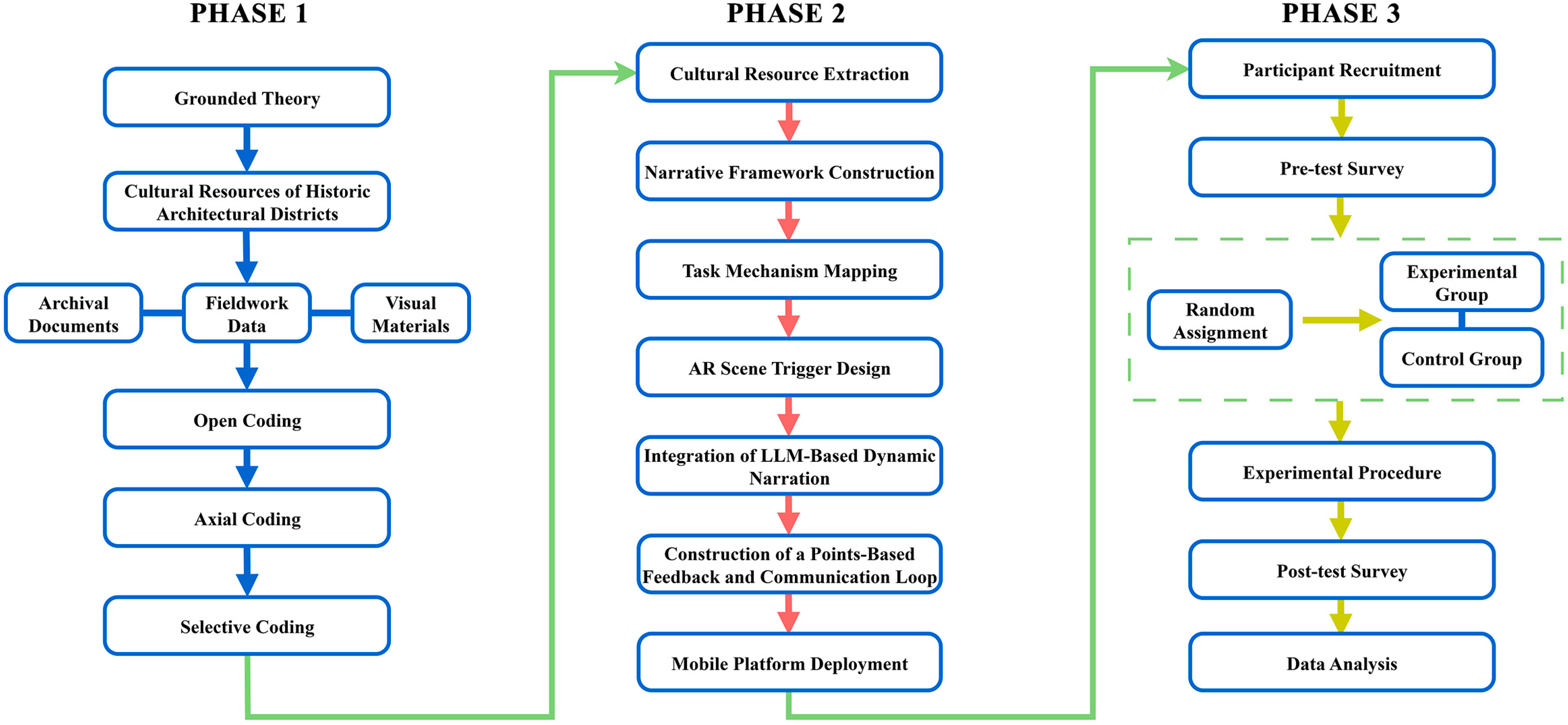
This study aims to investigate the effectiveness of narrative augmented reality (AR) games in the cultural communication of historic architectural districts. To achieve this objective, a comprehensive research framework was established, consisting of cultural resource analysis, AR narrative interactive experience design, and experimental validation. The overall research process includes three main stages: cultural content extraction, narrative AR interactive experience design, and experimental verification.
In the first stage, grounded theory was employed to systematically analyze the cultural resources of the historic architectural district. Textual analysis was conducted on historical documents, local chronicles, and related cultural materials. In addition, visual cultural information obtained through field investigations was incorporated into the dataset. The collected data were analyzed through the three-stage coding procedure of grounded theory, including open coding, axial coding, and selective coding. Through this process, key cultural elements related to the district’s history, architectural culture, and historical figures were identified, providing the cultural content foundation for subsequent interactive experience design.
In the second stage, the extracted cultural narrative elements were transformed into interactive tasks and game scenarios to construct a narrative AR cultural exploration game. Multiple cultural interaction nodes were established within the spatial environment of the historic district, where cultural stories, historical events, and architectural spaces were integrated into a task-driven exploration mechanism. Through this design, users could gradually obtain historical and cultural information within the real environment by engaging in interactive activities such as AR scanning, clue collection, and cultural quizzes. In terms of technical implementation, a mobile AR interactive system was developed using Unity 2022.3 LTS (Unity Technologies, San Francisco, CA, USA), with Vuforia Engine 10 (PTC Inc., Boston, MA, USA) integrated to achieve image recognition and virtual information overlay.
In the third stage, to evaluate the effectiveness of the proposed approach, an empirical study was conducted using a randomized controlled experimental design. A total of 80 participants were recruited and randomly assigned to an experimental group and a control group. Participants in the experimental group experienced the narrative AR cultural exploration game through mobile devices, while those in the control group explored the same cultural content through a traditional historic district guide approach. After the experiment, participants’ cultural cognition, immersive experience, and dissemination intention were measured through a cultural knowledge test and questionnaire scales. Independent-samples
t-tests and paired-samples
t-tests were employed to statistically analyze the experimental data. In addition, for the pretest–posttest cultural knowledge scores, a mixed ANOVA was conducted with Time (pre-test vs. post-test) as the within-subject factor and Group (experimental vs. control) as the between-subject factor in order to examine whether the magnitude of improvement differed significantly between the two groups. The overall research process is illustrated in
Figure 1.
3.2. Cultural Content Extraction Through Grounded Theory
To extract cultural content suitable for the design of a narrative AR game, this study applied grounded theory to a multi-source dataset collected from the Hubu Mountain historic architectural district, including archival documents, local chronicles, field investigation records, and visual image materials. Using NVivo 15, the materials were analyzed through open, axial, and selective coding. This process enabled the identification of recurring cultural elements related to architectural space, historical memory, everyday social life, and folk belief. To ensure the robustness of the coding framework, additional samples were used for a theoretical saturation check, and the results confirmed that no substantially new categories emerged.
The coding results were ultimately consolidated into four cultural dimensions: architectural spatial culture, historical narrative culture, social life culture, and folk belief culture. Rather than treating these categories as an independent qualitative research outcome, this study used them as a design-oriented content framework for the subsequent development of the narrative AR game. Specifically, the extracted cultural dimensions were translated into narrative nodes, task themes, and interaction scenarios within the historic district, thereby establishing a direct link between cultural content analysis and interactive experience design. Detailed coding examples and
Supplementary Materials are provided in the
Supplementary Materials.
4. Game Design
4.1. Design Objectives
The Hubu Mountain Cultural Treasure Hunt AR Game developed in this study is not intended as a purely entertainment-oriented digital game. Instead, it is designed as a narrative-driven, task-based, and context-integrated augmented reality learning experience tailored for cultural heritage communication in historic architectural districts. The core objective of the system is to transform the dispersed elements of architectural spaces, historical narratives, social life, and folk cultural clues within the Hubu Mountain architectural district into an interactive narrative process that users can participate in, perceive, and track. In this way, the game aims to enhance the depth of cultural understanding, exploration motivation, and dissemination engagement among the public within real spatial environments.
Compared with traditional heritage district exploration methods—such as text-based explanation boards, static guide maps, or linear audio narration—this study emphasizes the establishment of a continuous interaction mechanism linking cultural space, narrative events, interactive tasks, and feedback incentives within real environments. Based on this objective, the game adopts a treasure-hunt narrative structure as its overall organizational logic. Architectural nodes within the historic district are transformed into story progression points, cultural knowledge is converted into task clues, and spatial movement becomes a narrative advancement mechanism. Through this design, players gradually complete a cognitive transition during their walking exploration—from “seeing the architecture” to “understanding the culture,” and ultimately to “actively disseminating cultural knowledge.”
From the perspective of the overall design process, the development of the Hubu Mountain Cultural Treasure Hunt AR Game is not merely a technological implementation process. Rather, it represents a systematic design process that integrates cultural content analysis, narrative structure construction, interactive task mapping, AR spatial anchoring, intelligent explanation integration, and reward–dissemination feedback mechanisms. The design process can be summarized into six sequential stages.
The first stage involves cultural resource extraction, in which architectural spaces, cultural objects, and narrative units suitable for interactive experiences are identified within the Hubu Mountain architectural district.
The second stage focuses on constructing the narrative storyline. Centered on the former residence of Cui Tao, a narrative chain is developed that expands from individual historical memory to the broader cultural context of the district.
The third stage involves task mechanism mapping, in which narrative content is translated into specific interactive tasks such as photographing, recognition, question answering, clue collection, and content unlocking.
The fourth stage concerns AR scene triggering design. Through GPS positioning, spatial anchors, and interface overlays, correspondences between real-world locations and virtual prompts are established.
The fifth stage integrates dynamic explanations supported by large language models (LLMs), enhancing the system’s ability to respond to user questions, accommodate differences in prior knowledge, and provide personalized narrative explanations.
The sixth stage constructs a feedback and dissemination loop through points, rewards, and sharing mechanisms. Instant rewards, staged achievements, and social sharing functions are used to encourage sustained participation and promote the dissemination of cultural knowledge.
In terms of prototype selection, to ensure the representativeness of the research sample, the clarity of spatial hierarchy, and the controllability of design implementation, the system selected the former residence of Cui Tao within the Hubu Mountain architectural district as the primary narrative prototype. Based on this node, a district-level treasure-hunt experience prototype was developed by extending the interactive exploration experience to the surrounding spatial environment.
4.2. Narrative Structure Design
Representative architectural nodes were selected in this study, including the former residence of Cui Tao, traditional courtyard spaces, district alleyways, and ancestral halls as public cultural spaces. These spatial nodes not only possess clearly identifiable cultural themes but also exhibit good accessibility and visibility, making them suitable as AR task trigger points. At the same time, historical information related to Cui Tao’s life, family ethics, culture during the Ming and Qing dynasties, traditional street life, and clan beliefs was compiled from local chronicles, historical documents, and cultural records of the district. These materials were reorganized into cultural units suitable for narrative expression.
Based on this process, eight architectural nodes within the Hubu Mountain historic architectural district were mapped and transformed into game narrative nodes. The corresponding relationships between narrative nodes and cultural content are presented in
Table 1.
In the node design, interaction types were selected according to the communicative nature of the cultural content. Visually salient architectural information was matched with recognition-, observation-, or photo-based interaction, whereas more abstract cultural meanings—such as ritual order, clan belief, and symbolic interpretation—were matched with question–answer-based interaction. The interaction logic of Node N6 deserves additional explanation. Unlike nodes centered mainly on visually identifiable architectural features, the ancestral hall space primarily conveys intangible cultural meanings related to clan ethics, ritual order, and belief practices. Therefore, this node adopted an LLM-supported question–answer interaction rather than a purely recognition-based interaction. The purpose was to help users interpret the cultural meaning of the ancestral hall beyond its physical form and to support the communication of abstract heritage content that requires explanation and guided understanding.
In terms of narrative structure, this study adopts a composite organizational model consisting of a main storyline, branch tasks, and node unlocking mechanisms. Information within historic architectural districts is often complex. If large amounts of architectural history, personal narratives, and folk cultural information are presented to users at the initial stage, it may easily result in information overload and decreased engagement. By releasing content in stages through spatial nodes and task-based progression, the system reduces the initial cognitive burden and encourages users to continue exploration through the short-term sense of achievement generated by task completion.
This composite narrative structure not only maintains the continuity of the gameplay experience but also gradually releases cultural information in a way that reduces users’ cognitive load. As a result, players can progressively develop a comprehensive understanding of the cultural characteristics of the historic district during the exploration process. From a conceptual perspective, this mechanism can be summarized as follows: task completion serves as the condition for narrative state transitions, spatial movement functions as the medium for storyline progression, and cultural information is provided as one of the reward elements.
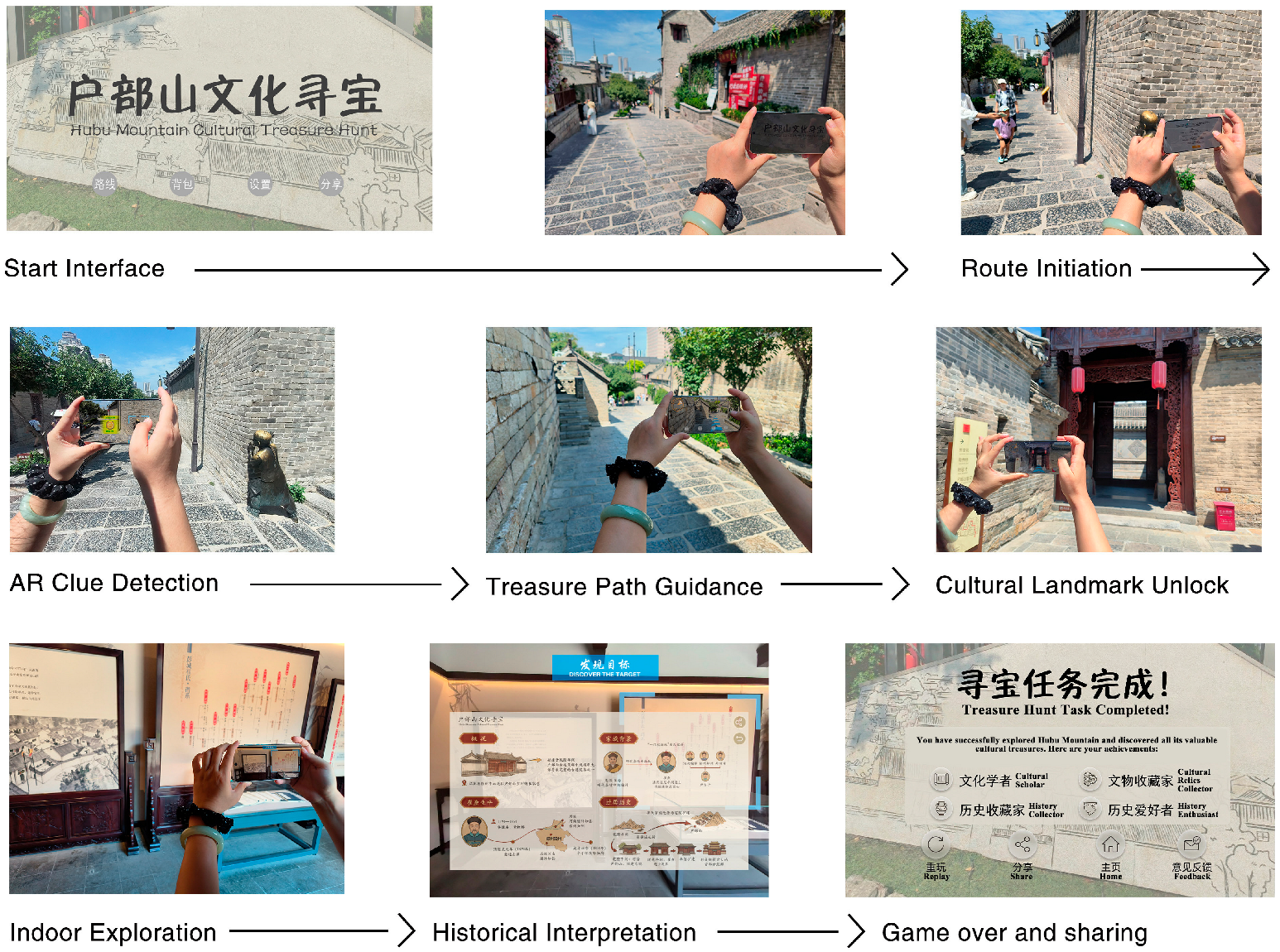
Specifically, at the beginning of the game, players enter the Hubu Mountain district through AR navigation and receive introductory information about the historic district background. Subsequently, players arrive at the former residence of Cui Tao, where scanning architectural markers triggers narrative content related to historical figures. As the game progresses, players gradually encounter cultural content associated with family ethics culture, architectural traditions, and everyday life within the district. After completing multiple task nodes, the system summarizes the cultural clues collected by the player and generates an exploration achievement report. The overall “cultural treasure hunt” exploration process in the Hubu Mountain historic architectural district is illustrated in
Figure 2.
4.3. Task Mechanism Design
To enhance the gamified experience, multiple task mechanisms were designed at different narrative nodes, including spatial exploration tasks, architectural recognition tasks, knowledge quiz tasks, and cultural clue collection tasks. These tasks collectively form the core interaction rules of the system and determine the depth of user participation within the cultural environment. The design objectives and interaction modes of different task types are presented in
Table 2.
In terms of execution logic, the task system adopted a semi-linear progression rather than a fully free-triggered structure. The overall exploration process followed the main narrative sequence of the eight cultural nodes, and the completion of the required task at the current node served as the condition for unlocking the next node. In this sense, users were guided through the district in an ordered progression, although limited local exploration and interaction within each node remained possible.
The handling of task failure was designed to support continuity rather than punishment. If users failed to complete a recognition task, gave an incorrect answer, or missed a clue-collection step, the system did not terminate the experience or delete previously completed progress. Instead, it returned feedback prompts and allowed the task to be retried. However, the next main-story node was not unlocked until the required task at the current node had been successfully completed. This design ensured both narrative coherence and procedural consistency during the experimental intervention.
4.4. AR Interactive System Architecture and Technical Implementation
4.4.1. System Architecture
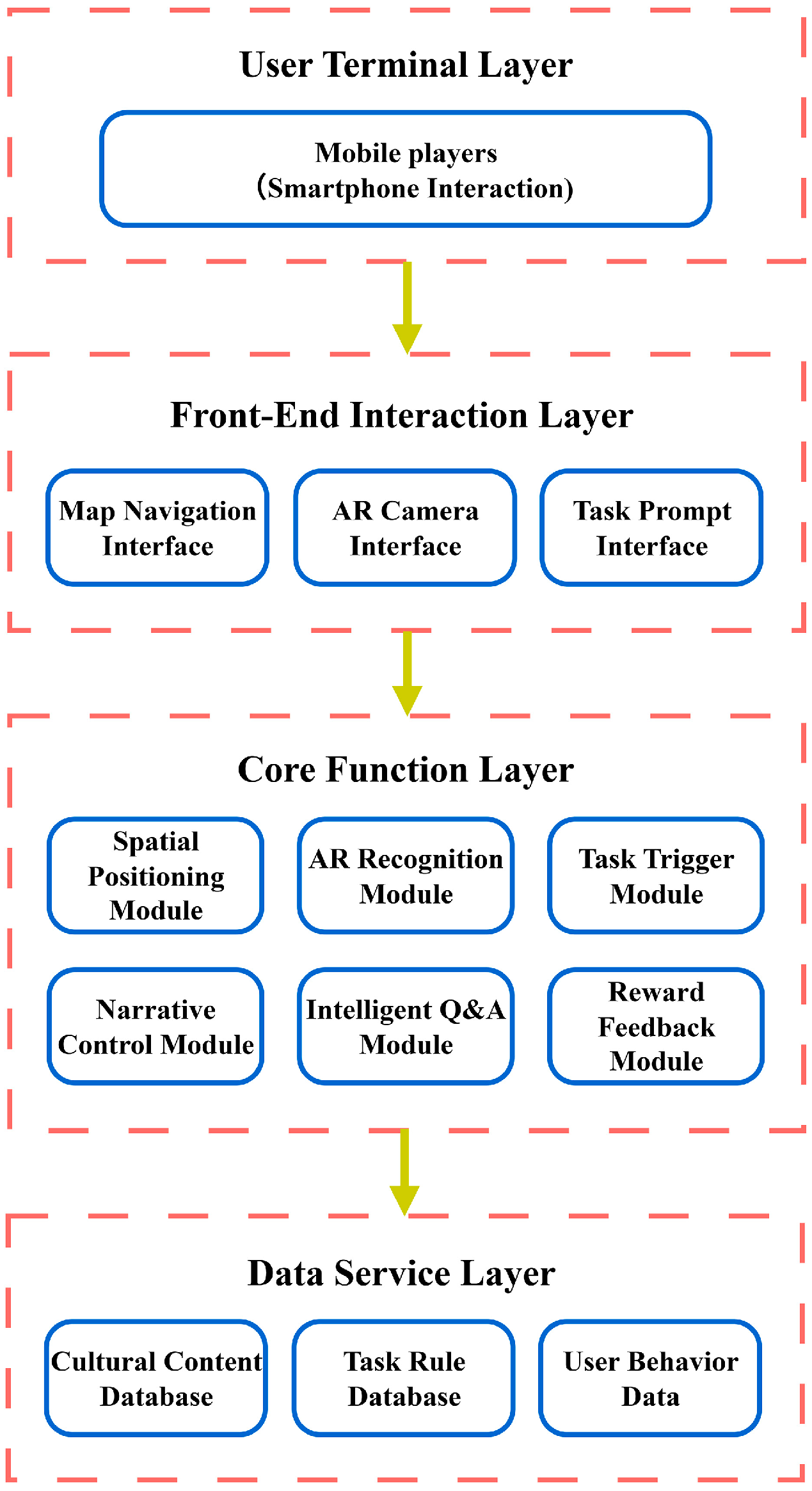
This study developed a mobile-based AR interactive system that integrates spatial positioning technologies, augmented reality recognition technologies, and cloud-based data services to enable the integration and presentation of virtual information within real architectural environments. The system was developed using the Unity engine as the core development platform and integrates the Vuforia Engine SDK for augmented reality recognition and scene overlay. Through this system, users can participate in the narrative AR cultural exploration game within the real environment of the historic architectural district using mobile devices.
From a structural perspective, the system mainly consists of four layers: the user terminal layer, the front-end interaction layer, the core functional layer, and the data service layer. The overall system architecture is illustrated in
Figure 3.
The user terminal layer refers to the mobile devices used by players. Through these devices, users access the game system and participate in cultural exploration tasks.
The front-end interaction layer is responsible for interface presentation and user interaction. It includes the map navigation interface, AR camera interface, and task prompt interface, which present virtual guidance information to players and receive user inputs.
The core functional layer performs the main logical processing of the system. It includes several functional modules: a spatial positioning module, an AR recognition module, a task triggering module, a narrative control module, an intelligent question–answering module, and a reward feedback module. Specifically, the spatial positioning module determines whether the user has entered a designated task area; the AR recognition module identifies architectural nodes and triggers AR content; the task triggering module initiates interactive tasks; the narrative control module manages the progression of the main storyline and task sequences; the intelligent question–answering module supports cultural knowledge inquiries; and the reward feedback module enhances user engagement through points and achievement mechanisms.
The data service layer is responsible for managing the databases required for system operation, including the cultural content database, task rule database, and user behavior data. This layer provides data support for the game system and records users’ interaction processes throughout the exploration experience.
4.4.2. AR Spatial Triggering Mechanism
To ensure that virtual information can be accurately overlaid onto real architectural environments, this study designed a multi-level AR spatial triggering mechanism. The system employs multiple technologies—including GPS positioning, spatial anchors, and image recognition—to trigger scenes at different levels, thereby ensuring spatial stability and coherent interaction logic during users’ exploration of the historic architectural district.
Specifically, GPS positioning is primarily used to determine whether the user has entered the designated district area. Once the user enters the specified region, the system triggers the initial task prompt and activates the narrative sequence. After entering the designated area, the corresponding exploration tasks are activated, guiding players into the cultural exploration scenario.
Spatial anchor technology is applied to key cultural nodes. By binding virtual markers to specific architectural locations within the real environment, virtual information can be stably overlaid onto physical buildings, enabling accurate alignment between virtual content and the physical spatial environment.
At a more detailed interaction level, the system uses image recognition technology to identify architectural plaques, decorative details, or cultural markers and then triggers corresponding cultural information displays and interactive tasks. For example, when users scan the architectural sign at the entrance of the former residence of Cui Tao, the system automatically recognizes the target and activates narrative content related to the historical figure.
In addition, the system incorporates behavioral triggering mechanisms and intelligent question–answer triggering mechanisms to support interactive behaviors such as photographing, tapping, and clue collection, as well as the generation of cultural quiz tasks. The technical logic of the AR scene triggering mechanism is shown in
Table 3.
4.4.3. Engineering Implementation
In terms of technical implementation, the system primarily employs the Image Target recognition technology of the Vuforia Engine to identify architectural nodes [
35]. During the early stage of system development, the research team conducted multiple field investigations in the Hubu Mountain historic architectural district. Images of representative architectural markers, decorative details, and cultural signage within the district were systematically collected. From these materials, images with strong visual feature characteristics were selected as AR recognition resources. Subsequently, recognition targets were established in the Vuforia database so that the system could automatically recognize the corresponding architectural nodes and trigger augmented reality content when users scan them.
Once recognition is successful, the system retrieves the corresponding cultural information resources, including historical narratives, architectural descriptions, and interactive task prompts. In this way, virtual information can be integrated and presented within the real architectural environment.
During system development, optimization measures were implemented to improve operational performance on mobile devices. First, in terms of image recognition resources, the size of each recognition image was controlled within 1.5 MB, and each target was ensured to achieve a recognition rating of at least three stars in the Vuforia Target Manager to improve recognition stability. Second, regarding three-dimensional resource processing, the polygon count of models was reduced, and texture resources were compressed to decrease the performance requirements of AR content. These optimizations allow the system to maintain relatively smooth performance even on mid- and low-end mobile devices.
In terms of interaction implementation, task triggering is achieved through a combination of GPS positioning and AR recognition. GPS positioning determines whether the user has entered the historic district and activates the corresponding task sequence. When users approach specific architectural nodes, AR scanning recognition triggers the corresponding cultural interactive tasks, such as historical narrative presentations, architectural knowledge quizzes, and cultural clue collection. In this way, an exploration experience with a narrative structure is formed.
Through the above system architecture and engineering implementation, this study constructed an AR interactive system capable of operating within a real historic architectural environment. Using mobile devices, users can engage in cultural exploration, interactive tasks, and knowledge learning processes, thereby enabling the digital presentation and immersive dissemination of cultural information related to historic architecture.
4.5. LLM-Driven Dynamic Narrative and Personalized Feedback Design
Compared with conventional rule-based guidance systems, an important extension of this study lies in the introduction of a large language model (LLM) to support node-level cultural explanation, adaptive question generation, and personalized feedback within the narrative AR experience. In the present system, the Doubao large language model, accessed through the Volcano Engine API, was used as the language-generation module. However, the LLM was not designed as an open-ended historical knowledge source; rather, it functioned as a constrained explanatory layer embedded in the narrative triggering system.
From a design perspective, the integration of the LLM was not intended merely to make the system appear more intelligent. Instead, it was introduced to address two common limitations of traditional cultural heritage guide systems. First, cultural content in conventional guide systems is often highly scripted, meaning that all users receive the same explanations, which limits adaptability. Second, interactions between user inquiries and system responses are typically minimal, which makes it difficult to support deeper cognitive exploration. To address these limitations while preserving the controllability of the experimental context, the LLM was embedded only in the node-level explanatory and question-guidance layer, rather than in the overall game logic layer. Thus, the core task structure, node sequence, reward mechanism, and exploration process remained predefined by the researchers, while the LLM was used only to provide limited adaptive support within each node.
The LLM component was grounded in a closed and verified cultural content set prepared in advance by the research team. The source materials included local chronicles, the Houbu Mountain Historic Cultural District Protection Plan, field-investigation records, visual image archives, and the verified cultural narrative units extracted during the grounded-theory stage. For each interaction node, the system supplied the model with a node-specific cultural content block containing only verified heritage information. In this way, the LLM did not retrieve information freely from unrestricted general knowledge but instead reorganized and rephrased only the cultural content that had already been curated and validated within the study.
The prompt design followed a structured three-part logic. First, a fixed system instruction defined the model’s role as a cultural heritage explanation assistant for the Houbu Mountain historic architectural district. Second, a node-specific content block provided the verified historical and cultural information relevant to the current location. Third, an output constraint block specified the response type, language style, and length. For example, the model could be instructed either to generate a short cultural explanation suitable for general visitors or to produce a multiple-choice cultural question with four options based strictly on the supplied content. The model was explicitly instructed not to introduce any historical claims, dates, character information, or architectural facts beyond the provided heritage materials.
In quiz-based tasks, the LLM was used to generate questions with modest variation in wording and difficulty according to the thematic content of the node and the player’s current progress. For example, when players first entered the Cui Tao Residence, the system tended to generate relatively simple and fact-based questions. After several exploration nodes had been completed, the model could generate more interpretive questions that encouraged participants to connect architectural space, historical memory, and social life. Importantly, these variations were still constrained by the same verified content base and did not involve the creation of new factual materials.
In narrative presentation mode, the LLM was used to transform fixed historical materials into more readable and audience-adaptive explanatory segments. Depending on the interaction context, the system could adjust the wording style to better suit general tourists, younger users, or culturally interested visitors. In this way, cultural content was no longer delivered only as a one-way block of static information, but as part of a more adaptive communication process. Nevertheless, the adaptive function remained bound to language style, explanatory emphasis, and question phrasing, rather than to the generation of new heritage knowledge.
To reduce the risk of hallucination, several safeguards were implemented. First, the model operated only on a closed cultural knowledge base prepared by the researchers. Second, the prompt explicitly required the model to avoid generating any information not contained in the supplied node-level materials. Third, when the requested information was not available in the current heritage dataset, the model was instructed to return a conservative fallback response indicating that the information was unavailable rather than inventing an answer. Fourth, the node-level explanatory texts and question templates used in the deployed prototype were manually reviewed and iteratively refined before field implementation. Therefore, the Doubao component in this study should be understood as a bounded heritage explanation and question-generation layer grounded in verified cultural content, rather than as an autonomous generator of new historical facts.
5. Experimental Design
Participants were recruited through an open call to take part in the experiment. The sample mainly consisted of students from local universities and members of the general public interested in historic cultural districts. To ensure the reliability of the experiment, all participants were required to be at least 18 years old, have basic smartphone operation skills, and have no prior systematic experience with the AR game developed in this study. A total of 80 participants were recruited for the formal experiment. Overall demographic characteristics of the participant sample are reported in
Table 4. To clarify sample adequacy, a sensitivity-based power consideration was added for the experimental stage. With α = 0.05, a two-tailed independent-groups comparison, and 40 participants per group (N = 80), the study had approximately 80% power to detect an effect of about d = 0.63 or larger, which is within the medium-to-large range commonly considered meaningful in behavioral and design-intervention research. This indicates that the sample size was adequate for detecting practically relevant between-group differences in the present field experiment. All participants voluntarily took part in the study, signed informed consent forms before the experiment, and all personal information was anonymized to ensure privacy and data security.
Before the experiment, all participants completed a pre-test consisting of demographic information, prior AR experience, and Cultural Knowledge Test A, which was used to assess baseline cognitive understanding of cultural content related to the Hubu Mountain historic architectural district. To reduce memory effects, two parallel versions of the cultural knowledge test (Test A and Test B) were used for the pre-test and post-test, respectively. The two versions were designed to be equivalent in terms of the number of questions, knowledge coverage, and difficulty level, and were reviewed by five experts in cultural heritage and architectural history.
After the pre-test, participants were randomly assigned to either the experimental group or the control group, with 40 participants in each group. Baseline comparability between the two groups was subsequently examined through pre-test knowledge scores, demographic characteristics, and prior AR experience. During the experimental phase, the experimental group experienced the narrative AR treasure-hunt game on mobile devices and completed tasks such as AR recognition, clue collection, cultural quizzes, and narrative unlocking within the real historic district environment. The control group explored the same cultural content through a traditional district guide approach based on text–image materials and linear browsing. To ensure comparability, both groups received essentially identical cultural content, and the exploration route, number of cultural nodes, and duration of the experience were controlled. The experimental procedure was completed within a controlled time window of approximately 30 min per participant. Participants used researcher-prepared smartphones. All sessions were conducted under on-site supervision by the research team to ensure consistent instructions, timing, and route completion.
This study focused on three outcome variables: cultural cognition, immersive experience, and dissemination intention. Cultural cognition was measured through the pre-test and post-test knowledge tests. Each test consisted of 10 multiple-choice questions covering architectural history, historical figures, traditional social life, and the spatial structure of the Hubu Mountain district. Although the specific items differed between the two tests, both maintained comparable difficulty and knowledge coverage. Each correct answer was scored as 1 point, resulting in a total score range of 0–10. Immersive experience and dissemination intention were measured using questionnaire scales adapted from Hamari et al. (2016) and Han et al. (2018) [
36,
37]. The immersive experience scale assessed users’ concentration, contextual engagement, and experiential involvement during exploration, whereas the dissemination intention scale measured participants’ willingness to recommend, share, or participate again in similar cultural activities. All questionnaire items were measured on a five-point Likert scale.
For data analysis, descriptive statistics were first conducted, followed by reliability tests for the immersive experience and dissemination intention scales using Cronbach’s α. Independent-samples t-tests were used to compare differences between the experimental and control groups in cultural cognition, immersive experience, and dissemination intention. In addition, paired-samples t-tests were conducted separately within each group to examine pre-test and post-test changes in cultural cognition. To further test whether the magnitude of cultural knowledge improvement differed between groups, a mixed ANOVA was conducted with Time (pre-test vs. post-test) as the within-subject factor and Group (experimental vs. control) as the between-subject factor. Cohen’s d was calculated to assess the effect size. All statistical analyses were performed using IBM SPSS Statistics 27.
6. Results
6.1. Analysis of Cultural Knowledge Pre-Test and Post-Test
In terms of demographic characteristics, participants were between 18 and 35 years old, with a mean age of 24.6 years. Among them, 38 participants were male (47.5%), and 42 were female (52.5%). University students accounted for 58 participants (72.5%) of the sample. Regarding AR usage experience, 66.2% of participants reported having used AR-related applications previously. However, most participants had not experienced AR-based interactive guidance within historic architectural districts prior to the experiment.
Before the formal experiment began, an independent-samples
t-test was conducted to compare the pre-test cultural knowledge scores between the experimental group and the control group. As shown in
Table 5, there was no significant difference in pre-test scores between the experimental group (M = 3.88, SD = 1.91) and the control group (M = 4.35, SD = 2.08), t (78) = −1.063,
p = 0.291, Cohen’s d = 0.238. This result indicates that the two groups exhibited good baseline comparability before the experiment.
After completing the experimental experience, an independent-samples
t-test was conducted to compare the post-test cultural cognition scores of the experimental and control groups in order to evaluate the effect of the narrative AR game on improving cultural cognition related to historic architectural districts. As shown in
Table 6, the experimental group obtained significantly higher scores in the cultural knowledge test (M = 6.13, SD = 2.40) than the control group (M = 4.85, SD = 2.24). The independent-samples
t-test results indicate a significant difference between the two groups, t (78) = 2.459,
p = 0.016. In terms of effect size, Cohen’s d = 0.550, indicating a moderate effect size. This result suggests that, compared with traditional district guidance methods, the narrative AR cultural exploration game can effectively enhance participants’ understanding and retention of cultural information related to historic architectural districts, thereby demonstrating greater effectiveness in cultural communication.
To further examine changes before and after the experiment, paired-samples
t-tests were conducted separately for the experimental group and the control group. As shown in
Table 7, participants in the experimental group showed a significant improvement in cultural knowledge scores after experiencing the narrative AR game (pre-test: M = 3.88, SD = 1.91; post-test: M = 6.13, SD = 2.40), with a highly significant difference, t (39) = −6.560,
p < 0.001, Cohen’s d = 1.04, indicating a large effect size for the intervention.
By comparison, participants in the control group also demonstrated an increase in cultural knowledge scores after experiencing the traditional district guidance approach (pre-test: M = 4.35, SD = 2.08; post-test: M = 4.85, SD = 2.24), and the difference was statistically significant, t (39) = −2.912, p = 0.006. However, the magnitude of improvement was relatively smaller. These findings support the effectiveness of the overall narrative AR intervention package, rather than isolating the effect of narrative structure or AR presentation alone.
To further examine whether the magnitude of improvement differed between groups, a mixed ANOVA was conducted on cultural knowledge scores, with Time (pre-test vs. post-test) as the within-subject factor and Group (experimental vs. control) as the between-subject factor. The results showed a significant main effect of Time, indicating that participants’ cultural knowledge scores increased overall from pre-test to post-test. More importantly, the Time × Group interaction was significant, F(1, 78) ≈ 20.8, p < 0.001, partial η2 ≈ 0.21, suggesting that the improvement in cultural knowledge was significantly greater in the experimental group than in the control group. Specifically, the experimental group’s mean score increased from 3.88 at pre-test to 6.13 at post-test, whereas the control group’s mean score increased from 4.35 to 4.85. These results indicate that, although both groups showed learning gains after the intervention, the narrative AR game produced a substantially greater improvement in cultural cognition than the traditional guide condition.
6.2. Analysis of Immersive Experience
To evaluate participants’ experiential perceptions during the cultural exploration process, immersive experience was measured using a questionnaire scale. The immersive experience scale consisted of four items, which were designed to assess users’ levels of concentration, situational engagement, and experiential involvement during interactive exploration. The specific questionnaire items are provided in the
Supplementary Materials. All items were measured using a five-point Likert scale, where 1 indicates “strongly disagree” and 5 indicates “strongly agree.”
A reliability analysis was first conducted for the scale. The results show that the Cronbach’s α coefficient was 0.763, indicating good internal consistency and suggesting that the scale was suitable for subsequent statistical analysis.
An independent-samples
t-test was then conducted to compare the immersive experience scores between the experimental group and the control group. As shown in
Table 8, the experimental group obtained a higher mean immersive experience score (M = 3.30, SD = 0.76) than the control group (M = 2.97, SD = 0.99). However, the independent-samples
t-test indicated that the difference between the two groups did not reach the conventional level of statistical significance, t (78) = 1.683,
p = 0.096. The effect size analysis showed Cohen’s d = 0.376, suggesting a small-to-moderate effect size.
Overall, the experimental group obtained a higher mean immersive experience score than the control group, indicating a possible improvement trend. However, because the difference did not reach statistical significance, this result should not be interpreted as confirmed evidence that the narrative AR condition enhanced immersion. Rather, the finding suggests only that the experimental condition showed a higher immersion tendency under the present design, while the magnitude of the difference remained limited. One possible explanation is that the experimental session was relatively short, and participants were still in the early stage of adapting to AR-based interaction. Therefore, any interpretation of immersion-related effects should be made cautiously.
6.3. Analysis of Dissemination Intention
To further evaluate the impact of the narrative AR game on cultural communication in historic architectural districts, this study analyzed the dissemination intention of participants in both the experimental and control groups. Dissemination intention refers to participants’ tendency to recommend, share, or participate again in similar cultural experience activities after completing the cultural exploration experience.
Before conducting the main analysis, a reliability test was performed on the dissemination intention scale. The results indicate that the Cronbach’s α coefficient was 0.900, suggesting a high level of internal consistency and confirming that the scale can effectively reflect participants’ levels of dissemination intention.
Subsequently, an independent-samples
t-test was conducted to compare the dissemination intention scores between the experimental group and the control group. The results are presented in
Table 9. The experimental group obtained a higher mean dissemination intention score (M = 3.81, SD = 0.77) than the control group (M = 3.02, SD = 1.03). The independent-samples
t-test results indicate a significant difference between the two groups, t (78) = 3.870,
p < 0.001.
In terms of effect size, Cohen’s d = 0.865, indicating a large effect size. This result suggests that, compared with the traditional district guide condition, the integrated narrative AR cultural exploration condition significantly enhanced participants’ willingness to recommend or share the cultural experience.
These findings indicate that the experimental condition showed stronger dissemination potential than the conventional guide condition. However, because immersive experience did not differ significantly between groups in the present study, this result should not be interpreted as direct evidence that immersion itself caused the increase in dissemination intention. Rather, the observed difference is more appropriately understood as the outcome of the overall intervention package, while the specific mechanisms underlying this effect require further investigation.
7. Discussion
7.1. Discussion of Research Findings
This study systematically evaluated the effectiveness of a narrative augmented reality (AR) game in the cultural communication of historic architectural districts through a randomized controlled experimental design. The experimental results indicate that, compared with traditional district guidance approaches, the narrative AR cultural exploration game demonstrated significant advantages in improving participants’ cultural cognition and dissemination intention. In terms of immersive experience, although the experimental group showed higher scores than the control group, the difference did not reach statistical significance. To further interpret these findings, the results are discussed below in relation to the research questions (RQ1–RQ3) proposed in the Introduction.
Regarding RQ1: whether the narrative AR cultural exploration game can enhance participants’ cultural cognition, the findings of this study provide clear supporting evidence. The experimental group obtained significantly higher scores in the post-test cultural knowledge assessment than the control group. In addition, paired-samples tests showed a significant improvement between the pre-test and post-test scores within the experimental group. These results indicate that the narrative AR interactive experience can effectively promote users’ understanding and memory of cultural information related to historic architectural districts. Unlike traditional guidance approaches that mainly rely on text-based reading or passive browsing, the narrative AR game adopts a task-driven exploration mechanism, allowing users to actively search for cultural clues, complete interactive tasks, and gradually unlock historical narratives within a real spatial environment. This task-oriented interaction mode enhances learning engagement and enables cultural information to be understood and retained more deeply through contextualized experiences. Therefore, the findings suggest that interactive designs combining augmented reality technology with narrative structures can improve cultural learning outcomes in heritage spaces to a certain extent.
Regarding RQ2: whether narrative AR interactive experiences can enhance users’ immersive experience, the results show that the experimental group reported higher immersive experience scores than the control group, although the difference did not reach statistical significance. This result suggests that the narrative AR game enhanced participants’ experiential engagement and situational involvement to some degree, but the magnitude of improvement remained limited. One possible explanation is that the experimental session was relatively short, and participants mainly focused on completing exploration tasks and understanding cultural information within the limited time available. As a result, users were still in the early stages of adapting to the AR interactive system. In addition, some participants lacked prior experience using AR technology within real historic district environments. Consequently, their attention had to be distributed among operating the device, observing the physical environment, and completing interactive tasks, which may have influenced the overall immersive experience. Furthermore, historic architectural districts themselves possess strong spatial authenticity and environmental attractiveness. When exploring cultural heritage in such authentic environments, traditional guidance methods may also provide a certain level of environmental engagement, thereby reducing the difference between the two experience modes. Future studies could enhance immersive effects by extending interaction time, optimizing interaction mechanisms, or incorporating richer multimedia narrative content into AR experiences.
Regarding RQ3, the results indicate that participants in the experimental group exhibited significantly higher dissemination intention than those in the control group, with a relatively large effect size. This finding suggests that the integrated narrative AR cultural exploration condition was more effective than the conventional guide condition in encouraging users’ willingness to recommend or share the cultural experience. However, the present study did not directly test the causal mechanism linking immersion to dissemination intention, and the between-group difference in immersive experience did not reach statistical significance. Therefore, the higher dissemination intention observed in the experimental group should not be interpreted as direct evidence that immersion itself was the driving factor. Instead, this result is more cautiously understood as reflecting the overall effect of the bundled intervention, which combined narrative sequencing, AR interaction, task progression, and feedback design. Possible explanatory pathways may be informed by the prior literature, but they were not established by the present analysis.
Beyond the three overall outcome variables, the findings may also be interpreted in relation to the four cultural dimensions extracted through grounded theory: architectural space, historical narrative, social life, and folk belief. Although the present study did not statistically test these four dimensions as separate dependent variables, the design logic of the intervention suggests that different types of cultural content were likely communicated through different strengths of the narrative AR system.
Architectural-space content was most directly supported by on-site spatial recognition, visual alignment, and embodied exploration, because such content is closely tied to the physical environment of the historic district. Historical-narrative content was more effectively embedded in the sequential treasure-hunt storyline, where users encountered cultural information in a temporally connected form rather than as isolated facts. Social-life content was conveyed through task progression and contextual interpretation of everyday scenes, helping users connect commercial activity, daily life, and public interaction within the district. By contrast, folk-belief content, such as ancestral-hall ritual meaning and clan practices, was relatively abstract and required more explanation-oriented interaction to support understanding beyond what could be perceived visually. In this sense, the dissemination potential of the narrative AR experience may not have been uniform across cultural content types, but instead depended on the communicative nature of each cultural dimension.
However, these interpretations remain design-based rather than statistically verified, because the present experiment did not measure the four cultural dimensions as separate outcome variables. Future research may further examine whether different categories of cultural genes respond differently to specific AR interaction strategies.
Overall, by integrating real spatial environments, augmented reality technologies, and narrative game mechanisms, this approach can overcome some limitations of traditional guidance models that rely primarily on static information presentation. Cultural content can thus be more effectively understood and disseminated through interactive exploration processes. These findings provide useful insights for exploring new models of cultural presentation and public participation in historic cultural districts in the digital era.
7.2. Research Contributions
From the perspective of integrating design research with empirical evaluation, this study systematically investigated the application of a narrative AR game in the cultural communication of historic architectural districts, contributing to both theoretical development and practical implementation.
At the theoretical level, this study integrates narrative design, augmented reality technology, and cultural communication in historic architectural districts, proposing a narrative-structure-based AR cultural exploration experience model. Previous studies on the digital presentation of cultural heritage have largely focused on information visualization or virtual exhibitions. In contrast, the present study introduces gamified narrative mechanisms to present cultural information in a task-driven format. This approach provides a new perspective for research on immersive cultural communication within historic cultural spaces.
At the methodological level, this research establishes a systematic research pathway that progresses from cultural resource analysis to interactive experience design and, finally, to empirical evaluation. Through the application of grounded theory, the cultural content of the historic architectural district was systematically analyzed, and key cultural narrative elements were extracted. These elements were then translated into game tasks and interaction mechanisms, forming the design framework of a narrative AR cultural exploration game. Based on this framework, the study further conducted a randomized controlled experiment to empirically evaluate the cultural communication effectiveness of the proposed design model. This approach provides a verifiable methodological framework for future research on digital cultural heritage experiences.
At the practical level, the results indicate that the integrated narrative AR cultural exploration condition can effectively enhance participants’ cultural knowledge and dissemination intention relative to a conventional guide condition. However, the evidence for immersive experience should be interpreted more cautiously, as the between-group difference did not reach statistical significance in the present study.
Overall, by integrating cultural narratives, augmented reality technology, and gamified interaction mechanisms, the present findings should be interpreted as evidence for the effectiveness of an integrated narrative AR cultural exploration package that combined narrative sequencing, AR interaction, task progression, and feedback design. Because these components were bundled in the experimental condition, the study does not isolate the independent contribution of narrative structure, AR presentation, or gamification as separate causal factors.
7.3. Research Limitations
Although this study verified the effectiveness of the narrative AR game in the cultural communication of historic architectural districts through a controlled experiment, several limitations remain and should be addressed in future research.
First, the sample size of this study was relatively limited. The participants mainly consisted of university students and members of the public who were interested in historic cultural districts, resulting in a relatively concentrated sample structure. This may have affected the generalizability of the findings to some extent. Future studies could expand the sample size and include participants from a wider range of age groups and cultural backgrounds in order to further verify the stability and general applicability of the results.
Second, the experimental duration was relatively short. Participants completed the cultural exploration tasks within a limited time frame, which may have influenced the statistical significance of the immersive experience results. Future research could extend the duration of the experience or design multi-stage interactive tasks in order to further examine the effects of AR interactive experiences on long-term cultural learning outcomes.
Third, the experimental setting was limited to a single historic architectural district. Different cultural heritage spaces vary in architectural structure, cultural content, and spatial scale, which may influence the effectiveness of AR-based experiences in practical applications. Therefore, future research could conduct comparative studies across different types of historic cultural districts or heritage sites to further examine the applicability of narrative AR games in diverse cultural environments.
In addition, a limitation should be acknowledged regarding the psychometric reporting of the two cultural knowledge forms. Although the revised manuscript now provides the full items, answer key, scoring rule, and item-to-domain mapping in the
Supplementary File, the archived dataset available during revision retained only form-level total-score outputs rather than the original item-level response matrix. Consequently, a formal item-level reliability coefficient, such as KR-20, could not be retrospectively reconstructed. The score-level association between the two form scores is therefore reported only as supplementary evidence and should not be interpreted as a substitute for a formal reliability estimate. Future research should preserve item-level response data so that parallel knowledge forms can be evaluated more comprehensively in psychometric terms.
Another limitation is that the experimental condition was implemented as a bundled intervention combining narrative sequencing, AR interaction, task progression, and feedback mechanisms. Although this integrated design reflects realistic heritage experience scenarios, it does not allow the independent contribution of each component to be causally separated. Therefore, the findings should be interpreted as evidence for the effectiveness of the overall narrative AR exploration package rather than for narrative AR alone.
Finally, another limitation concerns the interpretation of the relationship between immersive experience and dissemination intention. Although the experimental group showed a higher immersion score than the control group, this difference was not statistically significant. Therefore, the present study does not establish immersion as a confirmed causal mechanism underlying dissemination intention. Future research should test this relationship more directly, for example, through mediation analysis or larger-sample designs with stronger power for detecting differences in immersion.
This study evaluated the effectiveness of the AR interactive experience primarily from three dimensions: cultural cognition, immersive experience, and dissemination intention. However, other aspects—such as user behavioral data, long-term cultural memory, and actual cultural dissemination behavior—remain to be explored. Future research could incorporate behavioral data analysis or longitudinal studies to more comprehensively assess the long-term impact of AR interactive experiences on cultural communication.
7.4. Implications for Architectural Heritage Appreciation
Beyond the three empirical outcome variables, the significance of this study for Buildings lies in its contribution to public appreciation of historic architectural environments. The proposed narrative AR system did not function merely as a game detached from the built environment. Rather, it was embedded in the real spatial fabric of the Hubu Mountain historic architectural district and guided users to engage directly with traditional courtyards, alleys, ancestral halls, architectural gateways, and decorative details in situ. In this sense, the intervention supported not only general cultural communication but also a more accessible mode of architectural heritage interpretation grounded in actual building space.
From the perspective of architectural appreciation, the findings suggest that the narrative AR condition helped participants move from passive viewing to active recognition of the cultural meanings embedded in architectural form and spatial organization. The significant improvement in cultural cognition indicates that participants were better able to understand architectural space together with its associated historical and social meanings after the intervention. This is particularly important in historic architectural districts, where the public often encounters buildings as visual scenery without fully understanding their spatial logic, cultural symbolism, or relationship to everyday life. By linking architectural nodes to narrative tasks and on-site interaction, the system encouraged users to observe the district as a structured cultural environment rather than as a set of isolated buildings.
The contribution of the present study to architectural heritage communication can also be interpreted through the four cultural dimensions identified earlier in the manuscript. Architectural-space content was most directly tied to the perception of real building form, spatial sequence, and decorative detail. Historical-narrative content helped connect architecture with remembered persons and events. Social-life content enabled users to understand how streets, residences, and public areas historically functioned as lived spaces. Folk-belief content, especially in relation to ancestral halls and ritual order, further extended architectural appreciation from material form to symbolic and social meaning. Taken together, these layers suggest that public appreciation of traditional architecture is not limited to recognizing construction form alone, but also involves understanding how buildings operate as carriers of memory, everyday practice, and cultural order.
At the same time, the present study should not be interpreted as directly measuring appreciation of traditional construction materials or building techniques as separate variables. Its contribution is instead to demonstrate a digital interpretation pathway through which the public may more actively engage with historic architecture in real environments. In this respect, the narrative AR approach offers methodological value for Buildings by showing how digital interaction can support the interpretation, communication, and public understanding of historic architectural districts. Future research may build on this approach by incorporating more explicit interpretations of structural systems, materiality, and traditional construction knowledge in order to deepen architectural appreciation further.
8. Conclusions
This study examined the application potential of an integrated narrative augmented reality (AR) exploration condition for digital heritage interpretation in historic architectural districts. By combining cultural resource analysis, narrative structure design, and AR interactive technologies, the study developed a narrative AR cultural exploration system for the Hubu Mountain historic architectural district and evaluated its effectiveness through a controlled experiment in a real built environment.
The results indicate that, compared with a conventional text–image guide condition, the narrative AR exploration condition showed clear advantages in improving participants’ cultural cognition. The experimental group achieved significantly higher post-test cultural knowledge scores than the control group and also showed a greater pre–post improvement. These findings suggest that the integrated intervention was more effective in supporting participants’ understanding and retention of cultural information associated with the historic architectural district. In particular, by linking architectural nodes, cultural clues, and task-based exploration within the real environment, the system encouraged participants to move beyond passive viewing and toward a more active understanding of the district as a meaningful cultural and architectural space.
The results also show that the experimental group exhibited significantly higher dissemination intention than the control group. This suggests that the integrated narrative AR condition had stronger potential than the conventional guide condition in encouraging users to recommend, share, or further communicate the heritage experience. However, because the between-group difference in immersive experience did not reach statistical significance, this result should not be interpreted as direct evidence that immersion itself caused the increase in dissemination intention. Rather, it is more appropriately understood as reflecting the overall effect of the bundled intervention, which combined narrative sequencing, AR interaction, task progression, and feedback design.
In terms of immersive experience, although the experimental group obtained a higher mean score than the control group, the difference did not reach statistical significance. This suggests only a possible improving trend rather than confirmed evidence of enhanced immersion. Future studies may further examine whether longer interaction duration, more refined interaction design, or more differentiated user groups could produce stronger effects in this dimension.
Beyond the three empirical outcomes, the contribution of this study to Buildings lies in its implications for public appreciation of historic architectural environments. The proposed system was not designed as a game detached from the built environment; rather, it was embedded in the real spatial fabric of the Hubu Mountain historic architectural district and guided users to engage directly with courtyards, alleys, ancestral halls, architectural gateways, and decorative details in situ. In this sense, the study contributes not only to cultural communication in a general sense but also to a more accessible mode of architectural heritage interpretation that helps the public recognize traditional spatial organization, architectural symbolism, and the lived cultural meanings embedded in historic district space.
Overall, this study proposes and empirically evaluates a digital interpretation approach that integrates narrative design, AR interaction, and cultural-content translation within a real historic architectural district. The findings provide design insights for interactive heritage communication and suggest that AR-based narrative exploration can serve as a useful public-engagement pathway for enhancing understanding and appreciation of historic architectural environments. At the same time, the study does not isolate the independent contribution of narrative structure, AR presentation, or gamification as separate causal factors, and it does not directly measure appreciation of traditional construction materials or methods. These aspects should be explored more explicitly in future research.