Article

Characterization of Low-Frequency Broadband Vibration Damping with an ABH-TMD Vibrator Based on the Acoustic Black Hole Principle

School of Mechanics and Civil Engineering, China University of Mining and Technology, Xuzhou 221116, China
*
Author to whom correspondence should be addressed.
Buildings 2026, 16(1), 61; https://doi.org/10.3390/buildings16010061
Submission received: 17 November 2025 / Revised: 3 December 2025 / Accepted: 15 December 2025 / Published: 23 December 2025
(This article belongs to the Section Building Structures)

Abstract

The utilization of tuned mass dampers (TMDs) is subject to numerous restrictions. In general, the control performance of a TMD is limited by the ratio of the mass block to the effective mass of the main structure (mass ratio). These dampers also require precise tuning to the required target frequency to absorb the host structure’s vibrational energy. Due to their unique geometric gradient forms, acoustic black hole (ABH) structures can slow the propagation speed of bending waves and concentrate them at the apex, thereby significantly enhancing the suppression of broadband vibration. In this paper, we combine the above two methods to form a single novel device named ABH-TMD. Firstly, a mechanical model of the proposed device is established. The bending-wave control equation is derived, followed by a numerical analysis and experimental tests for further verification. Secondly, a series of numerical simulations are conducted. The response of the controlled beam is determined based on time histories and the frequency domain. Lastly, parameter analysis is carried out to investigate the control’s effectiveness. Based on the numerical and experimental results, we conclude that the proposed ABH-TMD can successfully concentrate elastic waves, thereby surpassing the traditional TMD under broadband frequency conditions.

1. Introduction

Tuned mass dampers (TMDs) have found widespread application as a form of passive control technology. Structural vibration control technology has experienced rapid development in recent years, with extensive applications across multiple disciplines and fields. This technology is broadly categorized into four types: active control, passive control, semi-active control, and hybrid control. Passive control systems, requiring no external energy supply and lacking complex control algorithms, exhibit highly robust performance [1]. In super-large structures, constrained by structural dimensions and relatively extended service lifespans, challenges arise in maintaining and replacing vibration reduction measures [2], which are vital in ensuring such structures’ stable operation over extended periods. Compared to other control methods, passive control offers greater simplicity and stability, along with more straightforward maintenance [3]. Passive control measures primarily comprise tuned mass dampers, energy-dissipating dampers, and vibration isolation measures [4]. Tuned mass dampers achieve uniformity with main structures’ natural frequency through tuning. During vibration, the mass block’s inertial force generates countermotion; meanwhile, the damper’s damping elements absorb and dissipate the structure’s vibrational energy [5]. This effectively controls vibrations, enhances structural safety and occupant comfort, and is widely applied in large bridges and super high-rise buildings.
However, the numerous limitations of traditional TMDs have attracted extensive research attention. Such devices are highly dependent on accurate frequency tuning. When the natural frequency of the main structure is altered by external forces, the damping effectiveness of a tuned mass damper significantly decreases. Moreover, traditional tuned mass dampers are typically optimized for only a single frequency or a very narrow frequency band. Under complex excitation involving multiple primary frequency components, their damping effectiveness is therefore limited. In practical applications, achieving effective vibration control typically requires the mass of tuned mass dampers to reach 0.5% to 2% of the primary structure’s modal mass. For large structures, this translates to potentially adding hundreds or even thousands of tons of additional load, while also imposing stringent requirements on installation space. Numerous scholars have conducted extensive research to address these challenges. Installing multiple tuned mass dampers on the main structure and coordinating them to form a multi-damped system can effectively broaden their effective frequency range [6]. Srinivasan configured two distinct tuned mass dampers—one undamped, tuned to match the structure’s natural frequency to absorb vibrations, and the other damped—enhancing the system-damping and energy dissipation capacity [7]. Snowdan achieved improved performance by connecting tuned mass dampers of varying masses in parallel [8].
Seeking to tackle the current limitations posed by traditional tuned mass dampers, we propose a modified tuned mass damper with an acoustic black hole structure. As a concept analogous to black holes in astrophysics, acoustic black holes have recently attracted the attention of scholars across disciplines. Mironov pioneered this discovery; by cutting thin plate structures to vary their thickness based on a power-law function, elastic waves entering the thin plate could be concentrated at the structure’s tip [9]. Theoretically, these elastic waves cannot escape the tip and do not exhibit reflection phenomena [10]. Furthermore, Clarke and Popper extended the theory of acoustic black holes to the two-dimensional realm, applying it simultaneously along two directions [11]. This theory demonstrated the ability of acoustic black hole structures to absorb and concentrate sound waves on a macroscopic scale. Researchers have been keen to explore its excellent broadband vibration-damping performance when applied to vibration-reducing devices [12]. Conlon arranged multiple two-dimensional acoustic black holes in a periodic pattern and investigated the vibrational characteristics of multi-acoustic black hole structures [13]. Aklouche determined the cutoff frequency for two-dimensional acoustic black holes and analyzed the scattering process of sound waves within the structure [14]. EI-Ouahabi enhanced the vibration suppression of acoustic black holes by incorporating sound-absorbing materials at the tip of one-dimensional acoustic black hole structures, providing energy dissipation capabilities [15]. Based on the Lagrange variational principle, Tang established a semi-analytical model for acoustic black holes and determined the damping layers’ pattern of influence on structural vibration responses [16]. Deng and Wang established dynamic models for acoustic black hole structures using Gaussian functions and the Rayleigh–Ritz method, respectively [17]. Georgiev established a wave transfer matrix based on Euler–Bernoulli beam theory, thereby obtaining the reflection coefficient [18]. Many scholars have attempted to combine acoustic black holes with other structures to enhance their vibration suppression. For instance, Cheer integrated acoustic black holes with active control techniques, achieving broadband vibration suppression in the low-frequency range [19]. Zhang combined micro-perforated plates with truncated acoustic black hole structures, realizing quasi-perfect sound absorption in the low-frequency range and obtaining a flat absorption curve [20]. Based on this, Liang introduced a coiled cavity to further broaden the effective frequency range [21]. Yu designed truncated acoustic black holes incorporating porous materials to enhance low-frequency vibration-damping performance [22]. Existing research has focused on enhancing TMDs’ performance by arranging them in varying configurations or introducing novel structures. However, the required computational complexity and difficulty in fabricating these structural forms have, to some extent, diminished the robustness of TMDs.
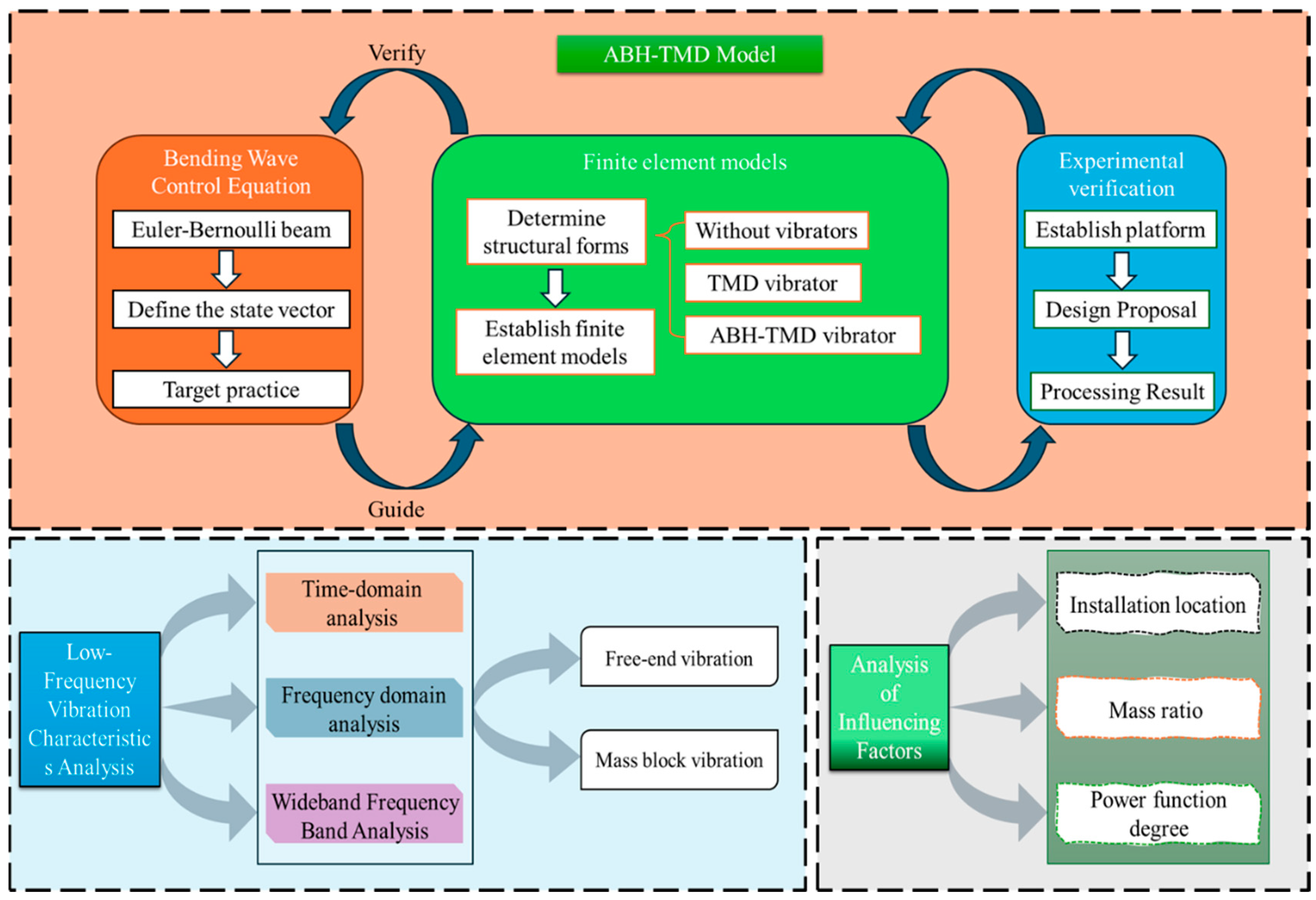
Inspired by the above research, we seek to address the narrow frequency bandwidth and stringent operating conditions of tuned mass dampers by introducing an acoustic black hole structure. The acoustic black hole-tuned mass damper (ABH-TMD) is designed to leverage the broadband characteristics of the acoustic black hole structure, concentrating elastic waves into the damper’s vibrator to enhance the structure’s vibration-damping capability. The ABH-TMD is analyzed using finite element software (Abaqus/CAE 2023) and validated through vibration testing. The research implementation path and the structure of this paper are shown in Figure 1.

2. ABH-TMD Model and Verification Methodology

This chapter establishes a theoretical model of the ABH-TMD and derives its control equations to evaluate its feasibility for vibration suppression. Furthermore, based on these equations, a corresponding finite element model is constructed for subsequent dynamic analysis, followed by experimental validation of its accuracy.

2.1. One-Dimensional ABH Structure Bending-Wave Control Equation

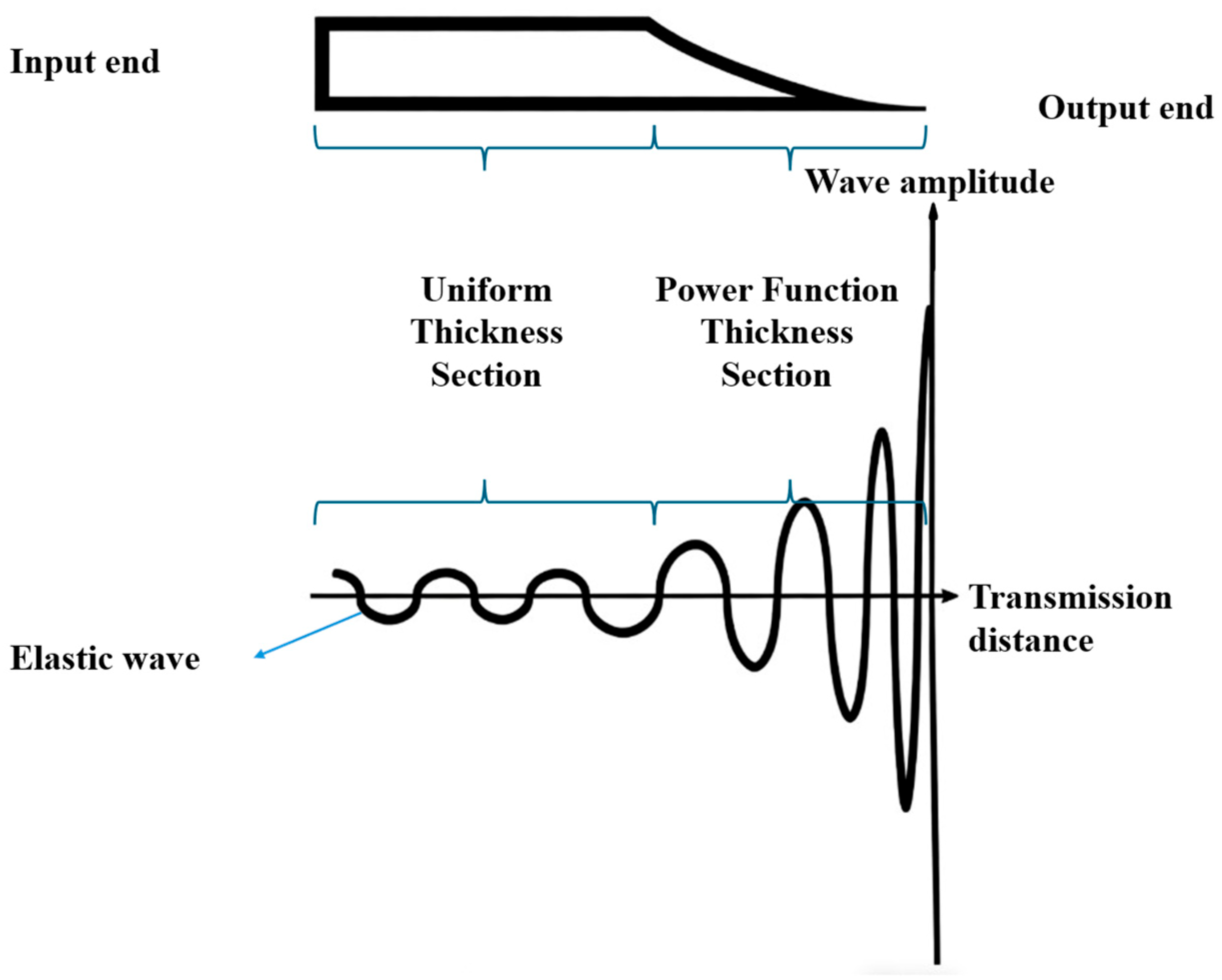
Acoustic black holes resemble the concept of black holes in astrophysics. Elastic plates of varying thickness gradually decreasing to zero (elastic wedges) can support a variety of unusual effects for flexural waves as they propagate towards the sharp edges of such structures and are reflected back [23]. By specifically designing the thickness profile of a structure or altering its material properties, the wave propagation speed gradually decreases as thickness diminishes, while the regional wave number progressively increases with thickness. Under ideal conditions—where the structure exhibits total internal reflection at its boundaries and the plate thickness gradually diminishes to zero—elastic waves will concentrate along the thickness direction at the zero-thickness point, achieving zero reflection along the length. This principle is illustrated in Figure 2.
According to Euler–Bernoulli beam theory, for a one-dimensional beam, the dispersion relationship between the circular frequency ( ω ) and the wave number ( k ) of bending waves is
ω = c B k 2
where c B is the bending-wave velocity constant, which depends solely on the beam’s material and geometric properties.
c B = E p l h x 2 12 ρ ( 1 υ 2 )
Therein, E p l represents Young’s modulus, ρ is the material density, υ signifies Poisson’s ratio, and h x indicates the local thickness of the beam.
For a one-dimensional thin plate, under the assumption of small deformation and plane stress, the displacement equation of vibration, A x = ( x , y , t ) , is an equality concerning x (the coordinate in the propagation direction), y (the coordinate in the perpendicular direction), and t (time). Herein, the governing equation for bending waves is
ρ h x 2 A t 2 D x 2 A = 0
Here, D x = E h 3 / 12 1 v 2 represents the bending stiffness, and 2 A = 2 w / x 2 + 2 w / y 2 denotes the Laplace operator. Separating the spatial and temporal variables yields
A x , y , t = ϕ x , y T t
The above equation, when substituted back into the wave-number equation, yields where ϕ x , y represents the spatial distribution of the vibration, and T t denotes the temporal distribution.
ρ h x ϕ x , y 2 T t t 2 T t D x 2 ϕ x , y = 0
Separating the temporal distribution from the spatial distribution yields
1 T t 2 T t t 2 = 1 ρ h x ϕ x , y D x 2 ϕ x , y = ω 2
The time component is decomposed into the harmonic oscillation equation, T ( t ) = e i ω t . The spatial component equation is
1 ρ h x ϕ x , y D x 2 ϕ x , y = ω 2
Considering that the lower-order terms are sufficient to describe the motion state at any point in the structure, the errors in vibration amplitude caused by higher-order terms are small enough to be negligible. The ABH-TMD structure designed in this paper must be used within a material’s elastic phase. We thus disregard its plastic deformation phase, and it is assumed that all materials comply with Hooke’s law. In neglecting higher-order derivative terms in the equation and assuming that the material is homogeneous, it can be derived that
4 ϕ ( x , y ) = k 4 ϕ ( x , y )
Phase definition is the cumulative phase shift as a wave propagates through the plate material.
φ ( x , y ) = 0 x k ( x ) d x
When n 2 , the cumulative phase approaches infinity, preventing the wave from escaping the thinnest part of the structure and eliminating reflection. When sound propagates through a wedge-shaped structure whose thickness varies according to a power function with an exponent greater than two, when the thickness approaches zero, the local acoustic number becomes infinitely large. Macroscopically, the sound waves can be thought to be concentrated and focused on the tip of the wedge plate, unable to escape. The vibration amplitude approaches infinity, and in the direction of energy propagation, the elastic wave energy becomes concentrated in the zero-thickness segment of the power-function-defined wedge plate.

2.2. One-Dimensional ABH-TMD Structure Bending-Wave Control Equation

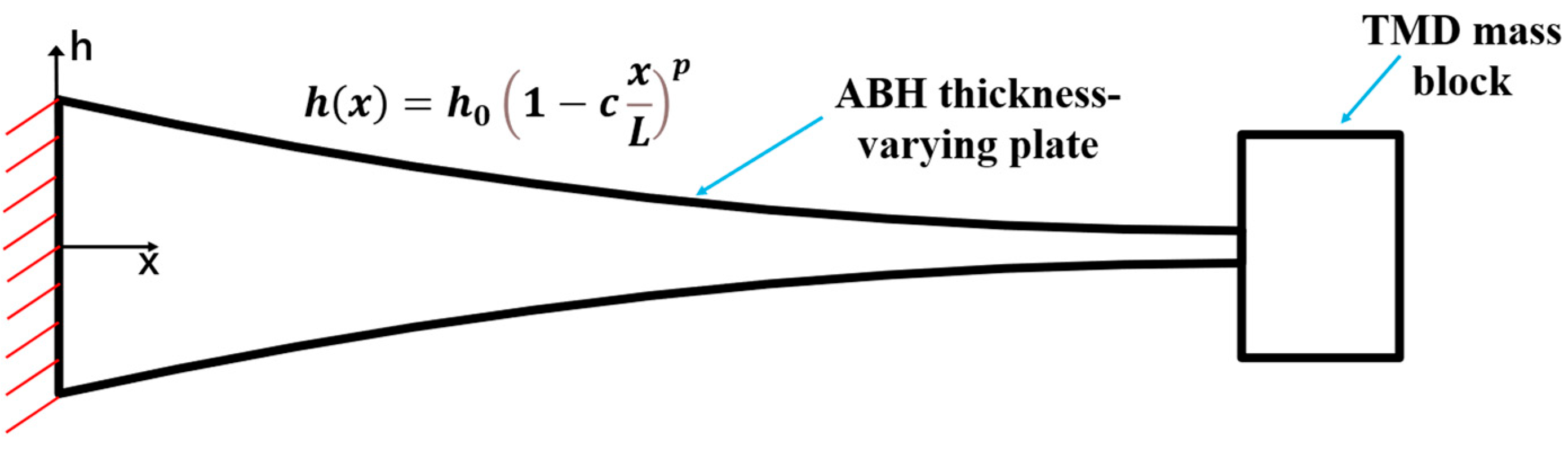
For the proposed ABH-TMD structure in this paper, the configuration involves placing an additional TMD mass block at the tip of the ABH varying-thickness plate. Let the extension direction of ABH thickness variation be x , where x = 0 represents the fixed end (maximum thickness). The fixed-end thickness is 2 h 0 . The free end at x = L has a thickness of h L and connects to the TMD mass block on its right side. The thickness variation equation is
h ( x ) = h 0 1 c x L p
In this formula, p ( p > 0 ) denotes the order of the power function, which, in practice, corresponds to the steepness of the trend in cross-sectional thickness variation. A higher value indicates a more pronounced change in thickness. Here, c = 1 h L h 0 1 / p , such that h ( L ) = h 0 ( 1 c ) p = h L . The one-dimensional ABH-TMD structure is illustrated in Figure 3.
The cross-sectional area and moment of inertia of the fixed end of the beam are
A 0 = b h 0 = b h 0
I ( 0 ) = b h ( 0 ) 3 12 = b h 0 3 12
For the ABH varying-thickness plate with a rectangular cross-section and constant width, the cross-sectional area and moment of inertia at any point ( x ) along the model are
A ( x ) = A 0 f ( x ) p
I ( x ) = I 0 f ( x ) 3 p
Here, f ( x ) = 1 c x L . Assuming that excitation is applied from the fixed end of the structure, it exists in the form of a harmonic vibration, where the displacement equation is w ( x , t ) = W ( x ) e i ω t .
According to the Euler–Bernoulli beam bending vibration equation,
2 x 2 E I ( x ) 2 w x 2 + ρ A ( x ) 2 w t 2 = 0
We substitute the section’s moment of inertia and cross-sectional area into the equation
E b h 0 3 12 2 x 2 f ( x ) 3 p 2 W x 2 + ρ b h 0 f ( x ) p ( ω 2 W ) = 0
Dividing both sides of the equation by E b h 0 3 / 12 yields
2 x 2 f ( x ) 3 p W ( x ) 12 ρ ω 2 E h 0 2 f ( x ) p W ( x ) = 0
We set λ such that λ 4 = 12 ρ ω 2 E h 0 2 ; then, the controlling equation is
d 2 d x 2 f ( x ) 3 p W ( x ) λ 4 f ( x ) p W ( x ) = 0
The equation is a fourth-order ordinary differential equation (ODE) with variable coefficients. In most cases, ODEs do not possess analytical solutions and require numerical methods for computation, including the Runge–Kutta method, the shooting method, and the finite difference method. The Runge–Kutta method uses known initial conditions and integrates from the starting point. In the context of ODEs, it is primarily used for solving initial value problems and cannot directly handle boundary value problems, making it unsuitable for this model’s requirements. The finite difference method approximates the differential equation as a system of algebraic equations on a discrete grid, making it suitable for solving complex boundary conditions. However, it requires large systems of equations, complex programming, and high computational power. Therefore, this paper employs the shooting method to solve the ODE, transforming the boundary value problem into an initial value problem. By adjusting the initial estimation to satisfy the terminal boundary conditions, it requires minimal computational resources and features an intuitive programming process. However, it is highly sensitive to the initial value estimation.
We set boundary conditions and solve the fourth-order ODE using the target method, followed by the application of harmonic excitation at the fixed end, with the remaining boundary conditions as follows:
At the fixed end ( x = L ),
W ( 0 ) = w 0 , W ( 0 ) = 0
where w 0 is the amplitude of the input excitation. At the point of connection with the mass block ( x = L ), disregarding the gravitational effect on the entire structure, it can be derived that
W ( L ) = 0
Moreover, the shear forces at the connection surface are in equilibrium, meaning that the shear force V ( L ) in the beam section equals the inertia force of the mass block:
V ( L ) = M b l o c k ω 2 W ( L )
E I 0 f ( L ) 3 p W ( L ) = M b l o c k ω 2 W ( L )
In the equation, M b l o c k represents the mass of the block, considering only translational coupling while neglecting rotational inertia.
W ( L ) = M b l o c k ω 2 E I 0 f ( L ) 3 p W ( L )
We define the displacement transfer function as H ( ω ) , expressing the relationship between the input and output displacement in the frequency domain:
H ( ω ) = F ( out ) F ( in )
H ( ω ) = W ( L ) W ( 0 ) = w L w 0 = | H ( ω ) | e i ϕ ( ω )
F ( out ) is a Fourier transform of the output signal; F ( in ) is a Fourier transform of the input signal. Here, | H ( ω ) | represents the ratio of the output and input amplitudes, while ϕ ( ω ) denotes the phase delay of the output relative to the input.
The velocity transfer function H v ( ω ) is identical to the displacement transfer function because the excitation load is harmonic, and the velocity v ( x ) = i ω W ( x ) .
H v ( ω ) = V ( L ) V ( 0 ) = i ω W ( L ) i ω W ( 0 ) = H d ( ω )
We define the form of a first-order system in preparation for the target practice method. The state vector is defined:
y ( x ) = [ y 1 , y 2 , y 3 , y 4 ] T = W W f 3 p W d d x [ f 3 p W ]
The bending moment and shear force at any point in the structure are
M = E I ( x ) W = E I 0 y 3
V d d x M = E I 0 y 4
Through derivation from the definition, the following is obtained:
y 1 = y 2 , y 2 = y 3 f 3 p , y 3 = y 4
From the governing equations, it can be derived that
d d x y 4 = λ 4 f p y 1
It can be inferred that
y 4 = λ 4 f ( x ) p y 1
From the boundary conditions, it can be observed that
y 1 0 = w 0
y ( 0 ) = 0
From W ( L ) = 0 , we can obtain
y 3 L = 0
y 4 L = M ω 2 E I 0 f ( L ) 3 p y 1 L
The unknown boundary conditions are y 3 0 and y 4 0 , which are treated as target parameters s 1 and s 2 .
y 3 ( 0 ) = s 1 , y 4 ( 0 ) = s 2
The initial conditions are y ( 0 ) = [ w 0 , 0 , s 1 , s 2 ] T .
Numerical integration of the state equation for ω from 0 to L results in y 1 ( L ) , y 3 ( L ) , y 4 ( L ) .
We set boundary conditions at the end of the structure:
F 1 s 1 , s 2 = y 3 L = 0
F 2 ( s 1 , s 2 ) = y 4 ( L ) + M ω 2 E I 0 f ( L ) 3 p y 1 ( L ) = 0
Newton’s method is used to adjust s 1 and s 2 until F 1 = F 2 = 0 . Once converged, y 1 ( L ) becomes W ( L ) , and it can be calculated as follows:
H ( ω ) = y 1 ( L ) w 0
The formula proposed above is validated by comparing the calculated and simulated results. We assume a beam length of L = 1   m , rectangular cross-section width of b = 0.02   m , and thickness variation of h 0 = 0.02   m ,   h L = 0.005   m . The chosen material is steel with E = 200   G P a ,   ρ = 7800   k g / m 3 . The mass of the end mass block is M = 4.0   k g . The base excitation w 0 = 1 ; H ( f ) = | W ( L ) / w 0 | . With p = 3 selected, modeling was performed using the COMSOL (6.2) finite element simulation software. A point mass was applied at the free end of the ABH beam. The longitudinal displacement component at x = L was chosen as the output. H ( f ) was calculated and compared with the simulation results. The results are shown in Table 1 below.
Close agreement between the displacement transfer results obtained using finite element simulation software and those of the method described in this paper is observable in Table 1 at different frequencies; errors are less than 2% in each case—within a reasonable range. Possible causes of such error include the limited minimum precision achievable in numerical calculations and the influence of mesh size and mesh quality on the results of finite element simulations.

2.3. Finite Element Model Simulation and Validation

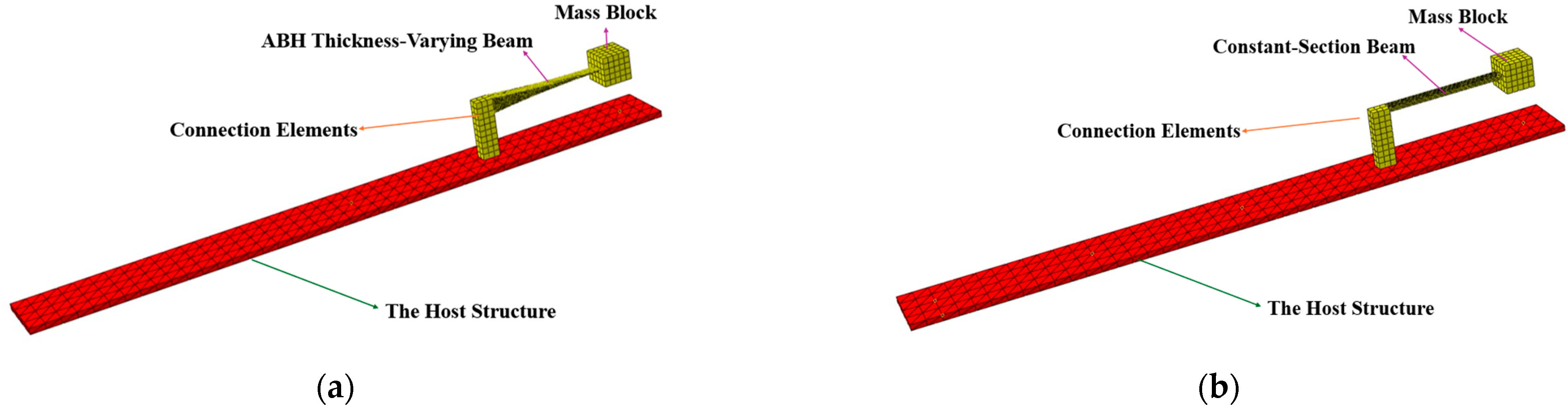
Based on the proposed vibration control scheme, in this section, we establish a finite element model to analyze its vibration suppression capability. The model is divided into three components: the host structure, connecting elements, and the vibrator. The host structure’s model adopts a cantilever beam structure, with the coordinate axes defined as follows: the x-axis is the beam length, the y-axis is the height, and the z-axis is the width. To evaluate the effectiveness of the vibration control scheme for the ABH-TMD, this section details two distinct vibrator models—an ABH varying-thickness beam composite model and a constant-section beam composite model—as shown in Figure 4.
The finite element method was applied to validate the computational modeling of the ABH-TMD vibrator model. A three-dimensional vibration model was established in Abaqus/CAE(2023) software, comprising three components: the vibrating host structure, connecting elements, and the vibrator model. The vibrator model consists of a beam and a TMD mass block.
For the concrete model setup, the host structure was modeled using 7075 aluminums with dimensions of 1.1 m × 0.1 m × 0.01 m. Considering the material’s width-to-thickness ratio of 10:1 and length-to-thickness ratio of 110:1, the influence of thin-shell theory on results cannot be ignored. Beam elements in Abaqus neglect the effect of width on calculations, leading to significant discrepancies between the simulation results and the actual values. Therefore, a solid element with dimensions of 1.1 m × 0.1 m × 0.01 m is used for simulation in the finite element model. Material properties conform to 7075Al’s national standard density (2820 k g · m 3 ), Young’s modulus (71 G P a ), and Poisson’s ratio (0.33). The model was meshed using second-order tetrahedral elements. Boundary conditions specified a fixed constraint on the left end surface of the host structure.
The natural frequency of the secondary vibration system must be tuned to match the vibrations being suppressed. The inhibition range considered in this paper is close to the natural frequency of the host structure. When the external excitation frequency approaches the natural frequency of the host structure, resonance occurs, causing the vibration amplitude of the host structure to peak. This frequency is the primary control target. Furthermore, tuning the secondary system’s natural frequency close to the host structure’s natural frequency induces a dynamic damping effect. The original single resonance peak of the host structure splits into two new resonance peaks with slightly different frequencies. Between these two new peaks, the amplitude corresponding to the original resonance frequency approaches zero. To more effectively judge the effectiveness of the vibration control scheme for the ABH-TMD, the natural frequencies of the vibrator and the host structure must be analogous. Therefore, the first three natural frequencies of the host structure are solved.
The calculation formula is given in Equation (41), where f n denotes the nth natural frequency of the host structure, β n represents the nth modal characteristic value of the host structure (cantilever beam), I is the sectional moment of inertia, L is the length of the host structure, and μ is the surface mass of the host structure, defined as μ = A · ρ (where ρ is the density).
f n = ( β n ) 2 2 π E I μ L 4
β 1 = 1.875 , β 2 = 4.694 , β 3 = 7.855
Finite element analysis was employed to calculate the modal forms and frequency magnitudes; the results are presented in Table 2.
The mode shapes are illustrated in Figure 5a–c.
The first-order frequency error (calculated using the frequency difference ratio formula) is 0.89%, the second-order error is 0.98%, and the third-order error is 1.13%—all within the permissible error range.
In TMD measures, the natural frequency of the secondary vibrating structure (vibrator) must be close to that of the host structure to achieve dynamic damping effects and reduce the vibration amplitude in the target frequency band. Therefore, when configuring the vibrators, the first-order natural frequencies of both the ABH-TMD and TMD were established akin to that of the host structure.
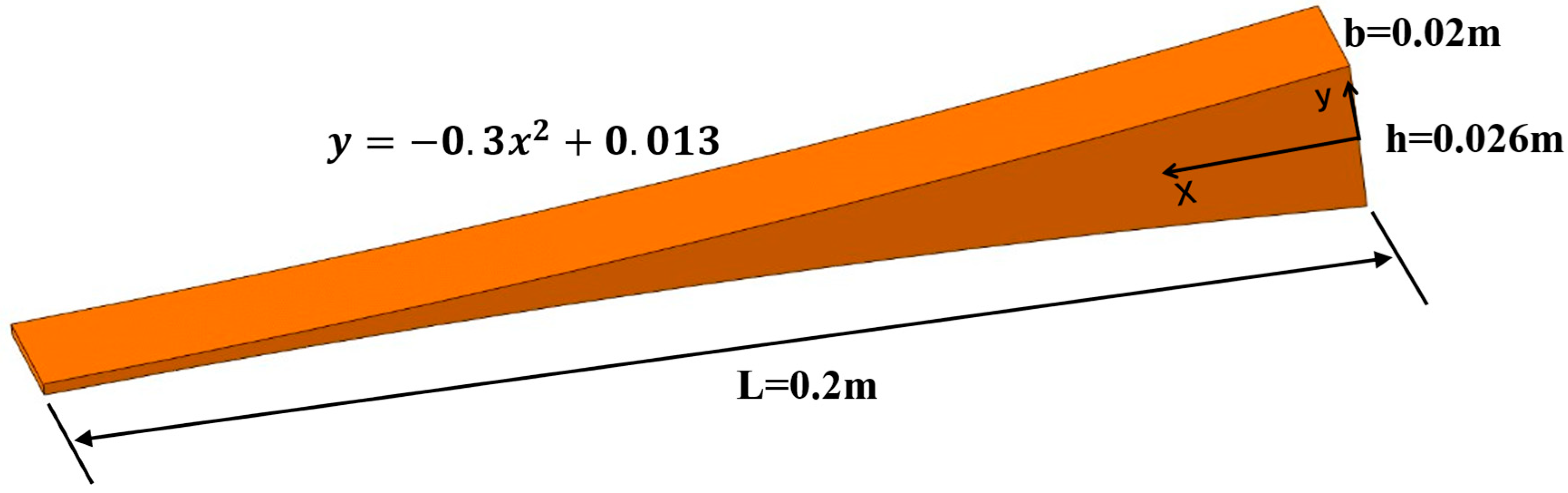
The geometric shape of the connector is a rectangular prism with dimensions of 0.03 m × 0.02 m × 0.1 m. The first natural frequency of the host structure is known to be 6.76 Hz. The ABH varying-thickness-beam composite-model vibrator is divided into two portions: the ABH varying-thickness beam and the mass block. The cross-section of the former is a quadrilateral with two curved edges, which are symmetrical about the central axis, and their functional expressions are given in Equation (43) as a variation of Formula 10. After determining the order (p) of the varying-thickness beam, the primary consideration is the magnitude of its first natural frequency, which must be similar to that of the host structure. The length of the varying-thickness beam is designed to be consistent with that of a beam with a uniform cross-section. The ideal ABH structure requires a thickness approaching zero, but the actual cutoff thickness cannot be zero. When this value is too large, reflections occur at the cutoff plane, leading to a decrease in the ABH’s wave-gathering capability and a reduction in the energy density introduced into the tip mass. However, excessively thin cutoff thicknesses may cause shear failure at the tip, and practical manufacturing precision is inherently limited. In order to meet material strength requirements, we select the minimum precision cutoff thickness feasible for actual fabrication. The varying-thickness beam’s width is 0.02 m, with a beam length of 0.2 m. The mass block dimensions are 0.05 m × 0.05 m × 0.05 m. The first-order natural frequency of the resulting ABH-TMD vibrator is 6.74 Hz. Due to the absence of functional curve expression in ABAQUS (Abaqus/CAE 2023) finite element software, the curve was approximated using twenty equal-distance linear segments. Simulating curves with continuous line segments can cause distortion in finite element models. In this paper, we employ linear interpolation, where a curve is approximated by twenty-line segments. An average length change of 1 cm corresponds to a thickness change of 0.17 cm. Within the reasonable range of linear interpolation, the structural thickness changes uniformly without abrupt variations, eliminating the risk of stress concentration caused by interpolation. A three-dimensional diagram of the ABH varying-thickness beam is shown in Figure 6.
y = 0.3 x 2 + 0.013
The composite model of the constant-section-beam vibrator consists of a constant-section beam and a mass block. It has a rectangular cross-section of 0.2 m × 0.0065 m, with a width of 0.02 m. The mass block has dimensions of 0.05 m × 0.05 m × 0.05 m. The first natural frequency is 6.75 Hz.
The host structure is formed from 7075AL. Both vibrator models and the connecting components are simulated using epoxy resin. The material properties are listed in Table 3. The Young modulus of the resin material determines the stiffness of the variable-section beam, while its density determines the mass ratio of the ABH-TMD. Poisson’s ratio must be set such that the shear forces at the tip remain within the material’s tolerance range. The precision of grid partitioning primarily considers simulation fidelity, ensuring at least three grid cells within a single wavelength for simulation while simultaneously satisfying a minimum edge length of at least two grid cells. To ensure solution accuracy and reduce computation time, different meshing approaches are applied to various model components. The controlled body primarily undergoes bending deformation. Considering its thinness, first-order linear elements may exhibit shear locking under bending loads. Second-order tetrahedral elements are therefore employed, with a size of 0.1 times the minimum dimension. To minimize computational effort, linear hexahedral elements are used for connecting members and mass blocks. The varying-thickness and constant-section beams serve as primary comparison components, primarily experiencing minor bending deformation. Linear non-conforming hexahedral elements are employed, with element size referenced to the beam’s minimum cross-sectional dimension. The size is set to 0.02 times the minimum cross-sectional dimension to ensure accurate calculation of bending-wave energy. The frequency range considered in this paper centers around the first natural frequency of the structure. Both the main body and ABH-TMD exhibit minor bending deformation with sinusoidal excitation as the input load. Thus, structural damping is employed. For aluminum, this is set to 0.001, while that for resin is set to 0.005. The model is fixed at the left end of the main body. Gravitational acceleration of 9.8 m / s 2 is applied. A harmonic surface force with an amplitude of 10,000 P a is applied to the free-end surface, directed along the y-axis.

2.4. Experimental Verification

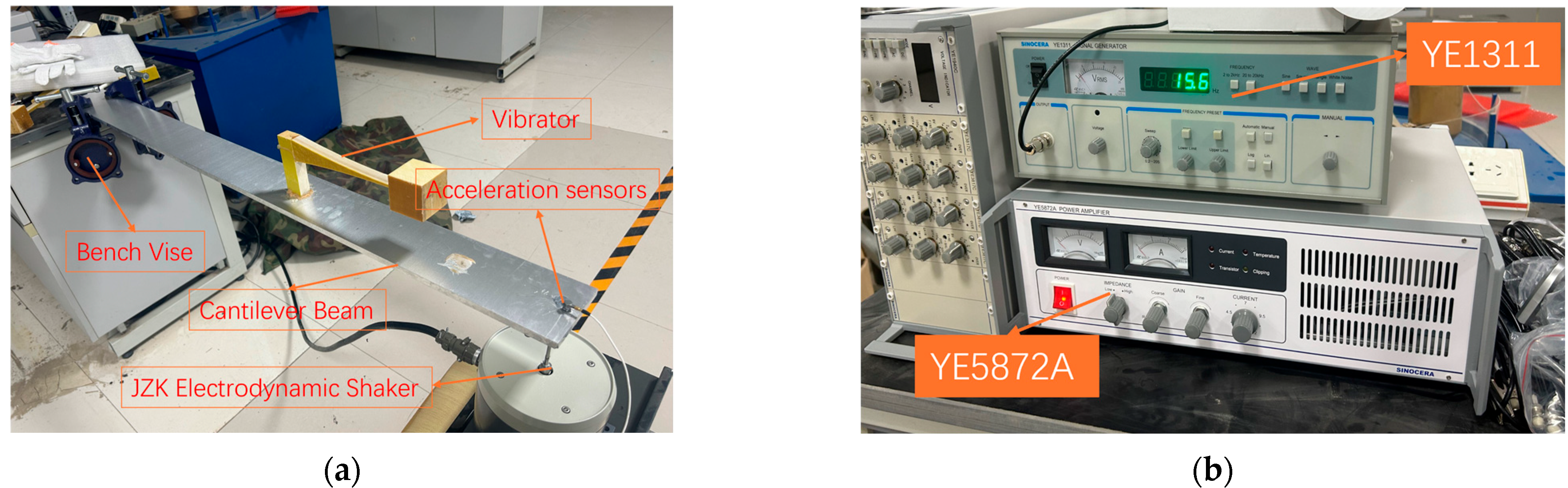
To validate the feasibility and accuracy of the aforementioned model, experimental verification was conducted. For the main experimental section, three distinct model configurations were established: a cantilever beam without control measures, a cantilever beam incorporating a TMD vibrator, and a cantilever beam incorporating an ABH-TMD vibrator. The cantilever beams and all components were configured according to Section 2.3. The cantilever beams were secured using vise clamps, and the TMD and ABH-TMD vibrators were bonded to the main structure using AB adhesive. For the experimental excitation load, a YE1311 signal generator (Sinocera Piezotronics INC., Beijing, China) was used to establish the excitation form and frequency, transmitting electrical signals to the YE5872A power amplifier (Sinocera Piezotronics INC.), which adjusted the amplitude of the input vibration excitation. The YE5872A was connected to a JZK electric vibrator (Sinocera Piezotronics INC.), whose piston rod was fixed to the bottom of the cantilever beam’s free end. The input1 excitation was a sinusoidal function with an amplitude of 1 mm and a frequency range of 2 Hz to 14 Hz. The signal acquisition system employed a Picoscope 2124 eight-channel PC-based digital oscilloscope (Pico Technology Ltd., St. Neots, UK) to transmit collected data to a PC. An accelerometer probe with a sensitivity of 10 mV/g was positioned at the top surface of the cantilever beam’s free end to capture voltage signals. The experimental setup is illustrated in Figure 7.
The acceleration amplitude at the free end of the cantilever beam was measured using the Picoscope (7.2.10). The amplitude data is in the form of a voltage signal, which must be converted into acceleration values. The conversion formula is as follows:
A c c e l e r a t i o n = V o l t a g e A c c e l e r m e t e r   S e n s i t i c i t y
To avoid measurement errors caused by acceleration accuracy, sensor sensitivity was determined by averaging the five sets of experimental results. Simultaneously, to prevent clamping conditions from influencing results, the vise was adjusted to its tightest setting before each experiment.
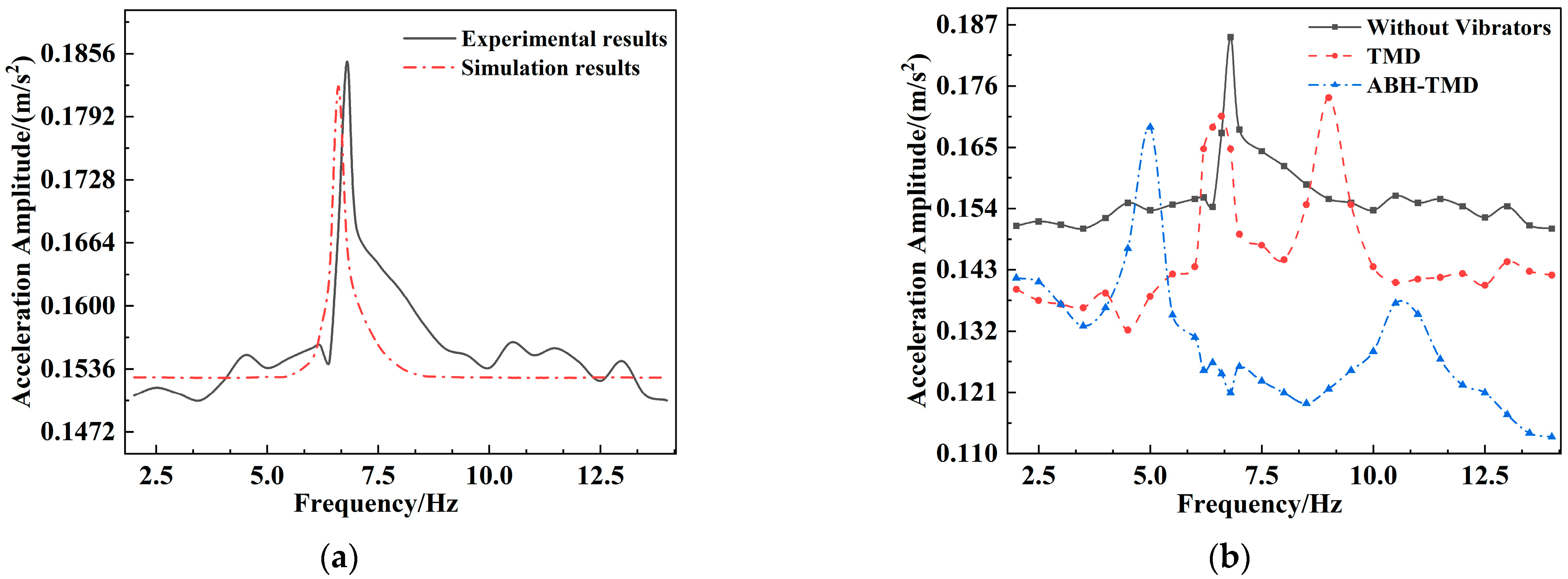
The measured voltage signal is converted into acceleration at the free end of the cantilever beam, with the acceleration amplitude shown in Figure 8.
The y-axis in Figure 8 represents the amplitude of acceleration displacement after the cantilever beam stabilizes, while the x-axis denotes the magnitude of the input excitation frequency. As shown in Figure 8a, the software simulation results are generally consistent with the experimental results, indicating that the finite element simulation is essentially accurate. Without any control measures, the free-end acceleration of the cantilever beam reaches a peak of 0.1848 m/s2 at a frequency of 6.8 Hz. After installing the TMD and ABH-TMD vibrators, the resonance peak of the cantilever beam clearly splits into two distinct peaks. Under TMD control, these appeared at 0.1706 m/s2 and 0.1739 m/s2, while under ABH-TMD control, they occurred at 0.1686 m/s2 and 0.1370 m/s2, representing a 48.6% improvement in vibration suppression compared to TMD alone. Under TMD control, the two split peaks of the cantilever beam appeared at 6.6 Hz and 9.0 Hz. Under ABH-TMD control, they appeared at 5.0 Hz and 10.5 Hz, widening the vibration suppression bandwidth by 129.2%.
η = μ A μ T μ T × 100 %
μ = A 0 A A 0
I = w A w T w T × 100 %
In the formula, μ denotes the structural vibration reduction rate, η denotes the vibration reduction enhancement rate, A denotes the maximum displacement amplitude, I denotes the frequency band widening rate, and w denotes the frequency bandwidth.
The experimental results show that the ABH variable-section rod can concentrate and absorb elastic waves input into the main body, focusing them onto the TMD mass block. This transfers and concentrates the vibration energy of the main body into the TMD mass block, broadening the TMD’s effective frequency band while significantly enhancing its vibration suppression performance in the low-frequency range.


3. Low-Frequency Dynamic Characteristic Analysis of Composite Beam Models and Verification

3.1. Time-Domain Analysis of Composite Beam Models

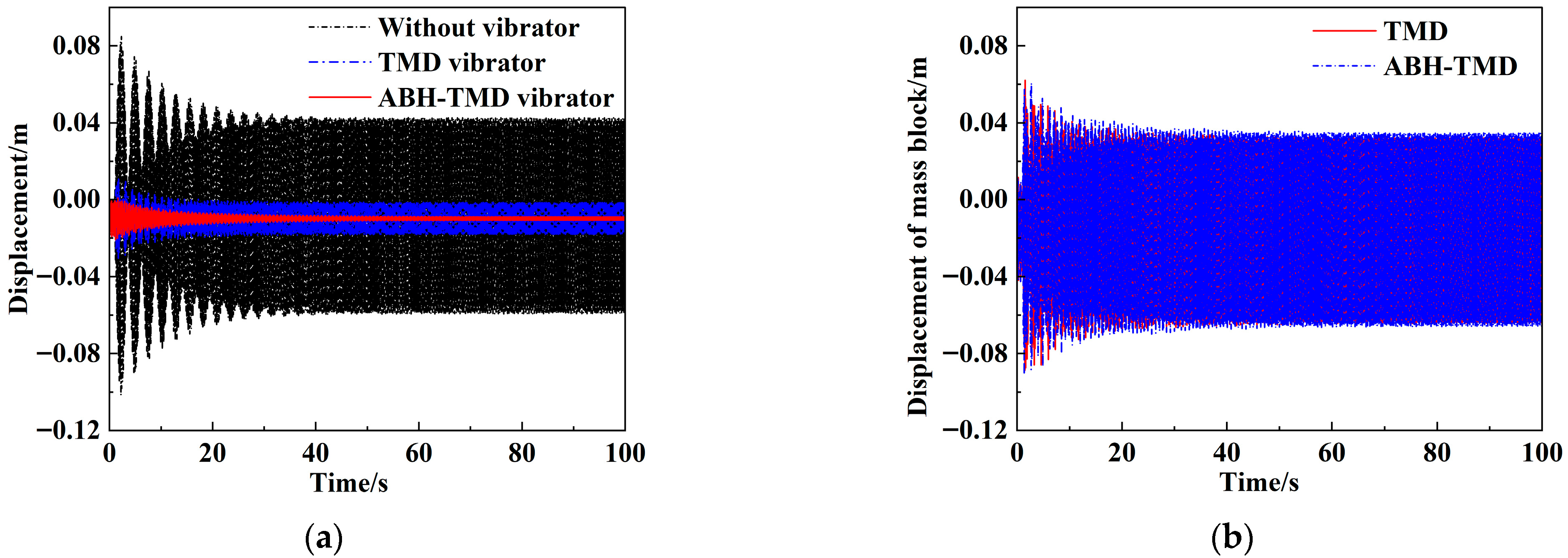
We set the connector and vibrator 0.3 m from the free end of the main body (measured from the center of the connector’s bottom surface to the upper surface of the free end). Next, we perform data calculations on the model’s stress state, including static analysis. The external excitation frequency is set to 6.76 Hz. Considering the influence of gravity on the structure, loading begins at the second moment to ensure that gravitational loading does not affect the external excitation input. The displacement along the y-axis at the lower-right vertex of the free-end surface is extracted as the output result, as shown in Figure 9 below.
The host structure without control measures exhibits two distinct envelope surfaces. As it vibrates due to external excitation, the vibration amplitude gradually increases over time to a maximum value, forming an envelope surface from zero to the maximum. Simultaneously, the external force directly acts upon the output surface, causing the free cross-section to undergo forced vibration. This vibration progressively reduces the difference from the body’s own vibrations as they increase, forming an envelope curve that gradually decreases from its maximum value to a stable state.
As shown in Figure 9a, the system response gradually reaches equilibrium with sustained vibration input. After equilibration, the free-end displacement and amplitude of the host structure incorporating the ABH-TMD vibrator exhibit significant reduction compared to the host structure with TMD vibrators alone. The free-end displacement without control measures is 0.0426 m; under TMD vibrator control it is only 0.0132 m, and under ABH-TMD vibrator control it is even lower at 0.0043 m. Compared to the uncontrolled structure, the ABH-TMD vibrator structure achieves an 89.91% reduction in resonance peak suppression, whereas the TMD vibrator structure achieves an 69.01% reduction.
The primary cause of this phenomenon is the addition of vibrators to the vibrating body. When the natural frequencies of the body and vibrator are close, dynamic damping occurs within the external excitation frequency range corresponding to the host structure’s natural frequency. The secondary system generates vibrations out of phase with the host structure, and the vibrator’s inertial forces are transmitted back to the host structure, suppressing its forced vibrations. Compared to constant-section beam, the variable cross-section design of the ABH beam exhibits wave-absorption and -focusing properties. Elastic waves propagating from the host structure to the fixed end of the beam and connection component gradually decelerate as the beam’s thickness decreases, increasing the local wave number. Waves entering the mass block from its connection with the beam are output as fewer reflected waves returning to the host structure compared to the constant-section beam. Consequently, more energy is transferred to the mass block.
We extract the displacement along the y-axis at the lower-right vertex of the unconstrained surface of the mass block as the output result, as shown in Figure 9b. Once the system reaches equilibrium, the displacement of the mass block in the structure with ABH-TMD is significantly greater than that in the structure with TMD. This means that upon reaching equilibrium, the mass block in the ABH-TMD possesses more energy, generating a larger inertial force against the host structure. Consequently, the stable vibration amplitude of the host structure with ABH-TMD is reduced, enhancing the vibration suppression capability of the ABH-TMD structure.

3.2. Frequency Response Analysis of Composite Beam Models

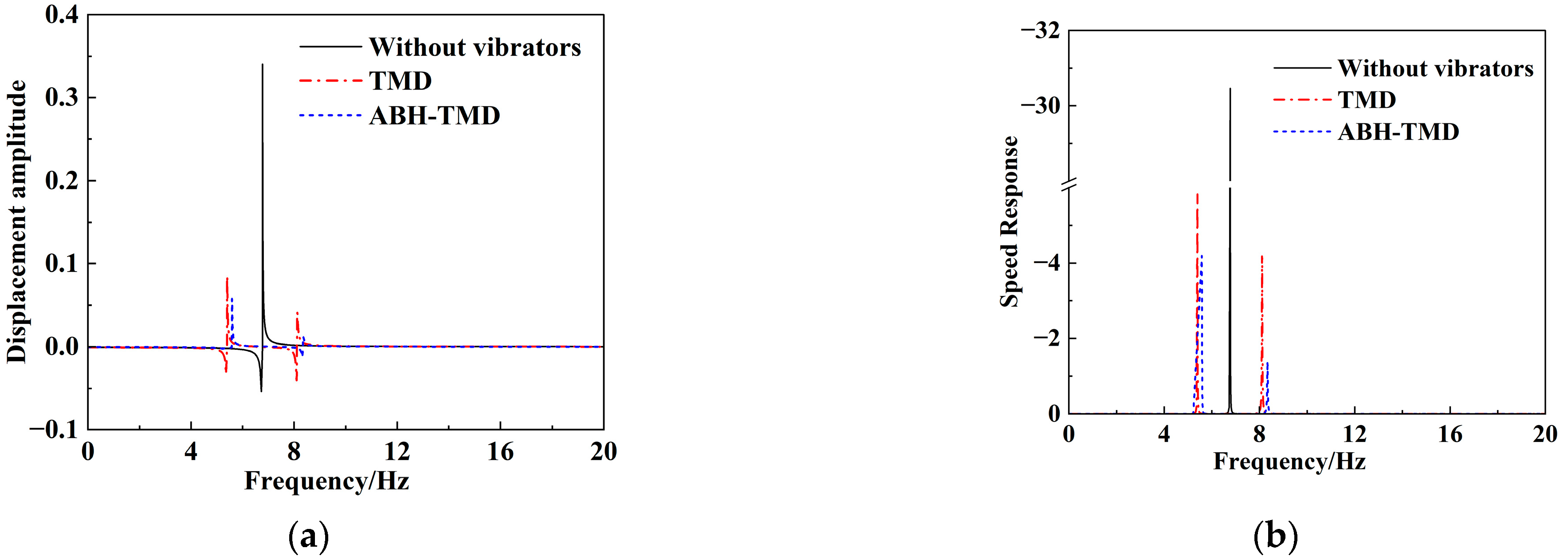
Under the influence of the secondary vibration system, the host structure exhibits a dynamic damping effect, causing the peak of the first natural frequency to split into two peaks. To investigate the superiority of the ABH-TMD vibrator over traditional TMD vibrators in vibration suppression, this study adopts the Abaqus (Abaqus/CAE 2023) finite element software to perform a frequency sweep analysis on an uncontrolled model, an ABH varying-thickness-beam composite model, and a constant-section beam model. The analysis investigates the vibration response patterns of each model within the 20 Hz frequency band near the first natural frequency of the main body. The connector and vibrator are positioned 0.3 m from the free end of the main body, subjected to a harmonic force of 1000 Pa applied along the y-axis. For all three models, the y-direction displacement at the lower corner node of the main body’s free-end surface was selected as the response output. Its relationship with frequency is shown in Figure 10a.
The horizontal axis represents the input frequency, while the vertical axis shows the maximum y-direction displacement response at the test point. The frequency response diagram reveals that under the control of both the TMD and ABH-TMD vibrators, the host structure exhibits typical dynamic damping effects. The original single peak at 6.76 Hz splits into two distinct peaks. The vibration amplitude of the host structure without vibrators reached 0.340. Under TMD control, the two peaks measured 0.084 and 0.038, while under ABH-TMD control, the peaks reached 0.058 and 0.012. The TMD vibrator reduced the maximum vibration amplitude of the host structure by 75.29%, while the ABH-TMD vibrator reduced it by 82.94%.
According to Figure 10b, the y-axis velocity response at the observation point also exhibits a typical dynamic vibration absorption effect, where the single peak splits into two peaks. Without vibrators, the peak velocity reached 30.47. Under TMD-controlled vibration, peak velocities were 5.83 and 4.18, while ABH-TMD-controlled vibration yielded peak velocities of 4.2 and 1.38. The maximum velocities therefore decreased by 80.87% and 86.28%, respectively.
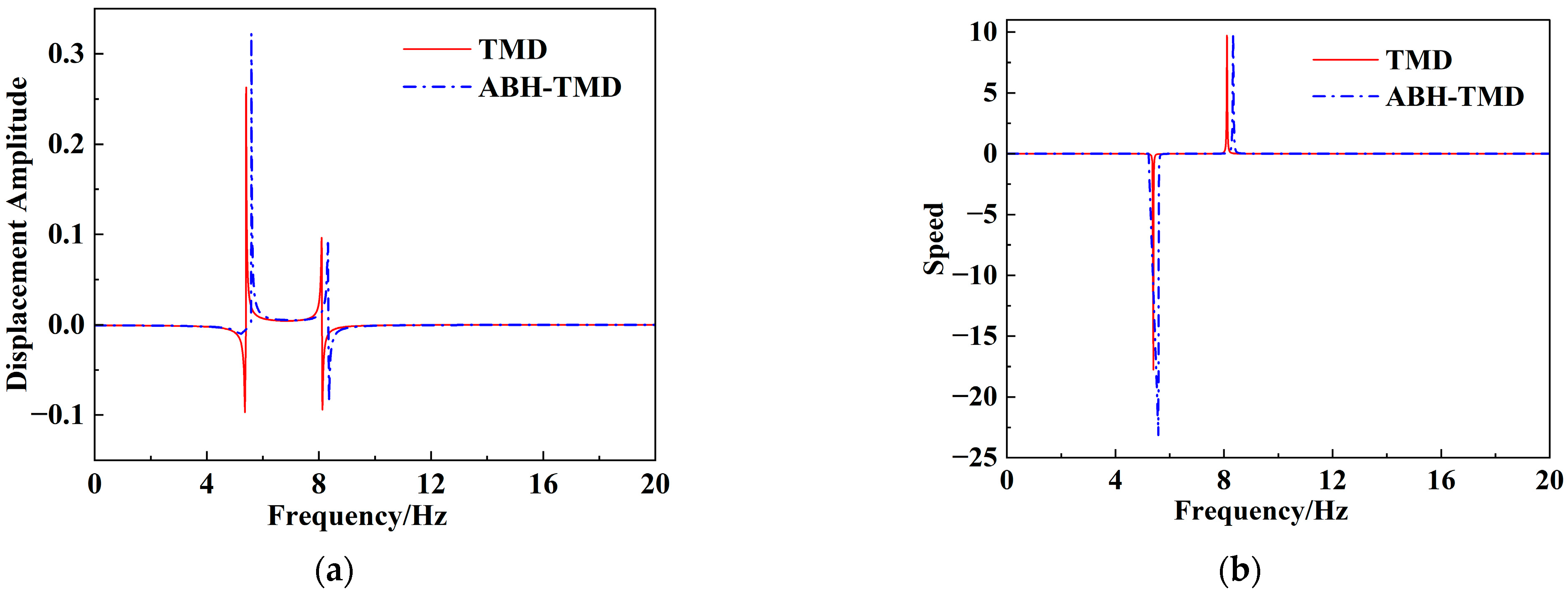
As shown in Figure 11a,b, the lower corner of the free-end surface of the mass block in the vibrator structure was selected as the output point. Simulations were performed to obtain the variations in the y-axis displacement and velocity with frequency at the output point. The figure reveals that the maximum displacement amplitude of the main body under ABH-TMD vibrator control exceeds that under TMD vibrator control by 22.83%, while the velocity is 30.22% higher. This demonstrates that the mass block in the ABH-TMD vibrator contains more energy. The primary reason for this phenomenon is that the thickness of the ABH varying-thickness beam decreases based on a power-law function, causing elastic waves to input from the main body into the secondary vibration system to be concentrated at the thin end of the ABH varying- thickness beam before being transmitted into the mass block. Furthermore, the smaller connection surface between the connecting beam and the mass block reduces the waves reflected to the main body by the vibrator, resulting in greater energy concentration within the mass block and consequently reduced energy in the host structure.
In comparison, near the first-order natural frequency, the ABH-TMD vibrator demonstrates superior vibration suppression, significantly controlling the amplitude of the main body’s vibrations. The ABH’s wave-absorption and -focusing capabilities not only effectively divert the main body’s energy but also concentrate it, thereby reducing the reflection and diffusion of fluctuations in the secondary vibration system.
Based on the vibration mode shapes of the two models as Figure 12 and Figure 13, the energy in the ABH varying-thickness beam model appears concentrated within the mass block, whereas the energy in the constant-section beam composite model is relatively dispersed. Due to the unique geometric structure of the acoustic black hole, as the structural thickness continuously decreases, the wavelength shortens and the local wave number increases. Elastic waves are progressively decelerated and focused during propagation, ultimately channeling and concentrating energy into the mass block, preventing its escape and thereby enhancing the oscillator’s ability to suppress the main vibration.

3.3. A Wide-Band Control Analysis of Composite Beam Models at Low Frequency

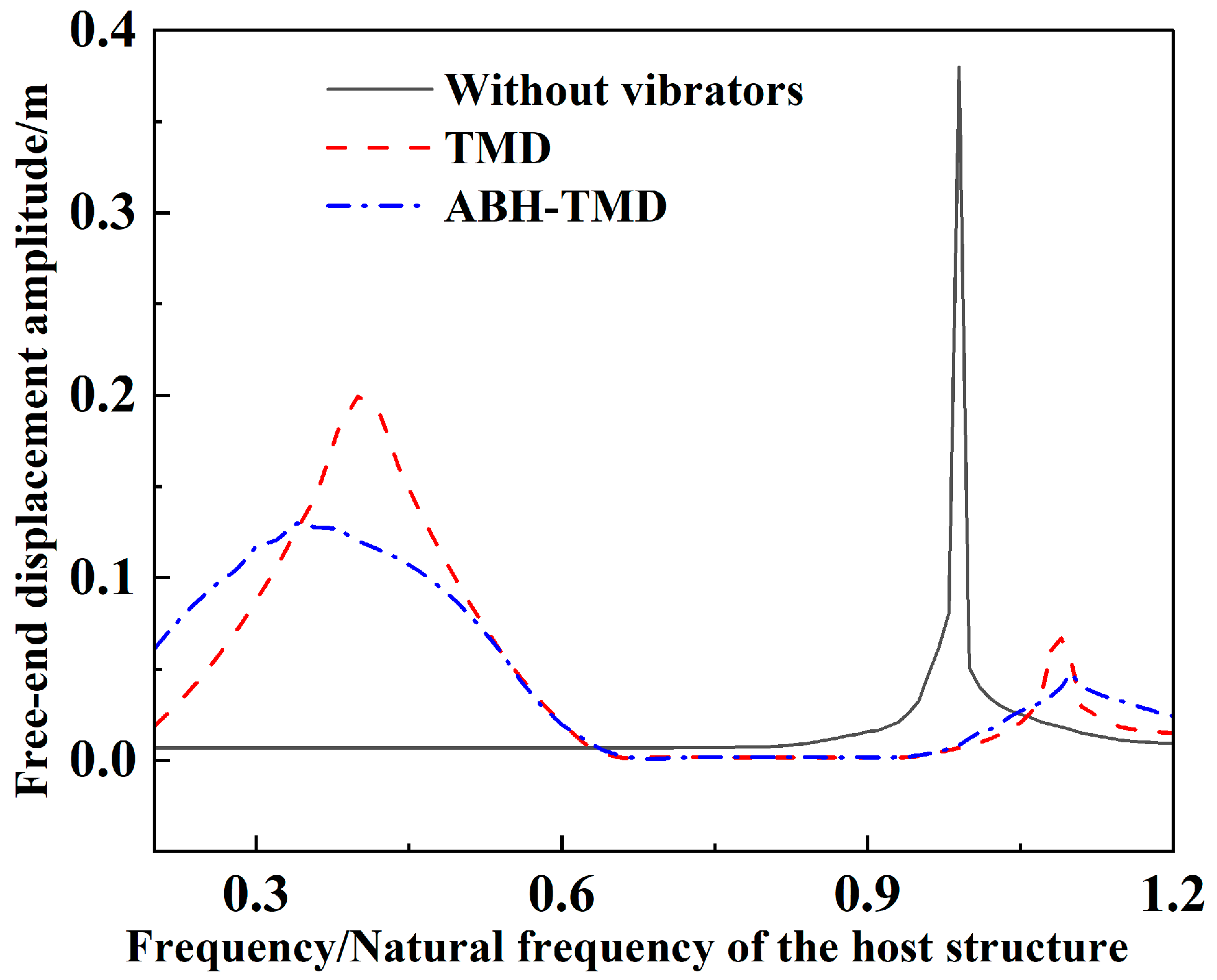
The ABH structure can concentrate elastic waves input from the wider side at the tip, focusing energy into the mass block of the TMD. Traditional TMD vibrators are limited by their sensitivity to vibration frequency tuning, only achieving vibration suppression within a narrow frequency band. In contrast, the wave-gathering effect of ABHs is not constrained by input frequency, enabling a broader operational frequency band for the TMD. To investigate the contribution of the wave-absorbing and -focusing capabilities of the ABH structure to the broadband vibration suppression of the ABH-TMD, three different models were subjected to broadband excitation. The input frequency range spanned 20% to 120% of the first natural frequency of the vibrating body. The connector and vibrator were positioned 0.3 m from the free end of the body. The displacement amplitude response at different frequencies was determined as half the difference between the maximum and minimum y-axis displacements at the free-end surface.
As shown in Figure 14, under the control of TMD and ABH-TMD vibrators, the host structure exhibits distinct dynamic damping characteristics. Specifically, the resonance peak corresponding to the first natural frequency splits into two peaks on either side. Without control measures, the vibrating body exhibits a maximum displacement amplitude of 0.38 m during resonance. Under TMD control conditions, the displacement amplitude peaks at 0.199 m and 0.067 m, while under ABH-TMD control, it peaks at 0.129 m and 0.048 m. The vibration suppression effect improved by 38.9% with the ABH-TMD damper compared to the TMD damper. Within the effective frequency band, the frequencies at which the two peaks appeared under TMD damper control were 40% and 109% of the first natural frequency of the vibrating body. Under ABH-TMD damper control, these frequencies were 36% and 110%, widening the effective frequency band for vibration suppression by 30%.
The wave-absorbing capability of ABHs significantly enhances the vibration suppression performance of TMDs, further reducing peak values under dynamic vibration-damping effects. Regarding the bandwidth of suppression, the ABH structure compensates for the limitation that TMDs only function effectively within narrow frequency bands. This improves the robustness of TMDs, reduces their dependence on tuning, and lowers their sensitivity to input frequencies.

4. Analysis of Factors Affecting Vibration Suppression Effectiveness

4.1. Analysis of the Influence of Vibrator Placement on Control Effectiveness

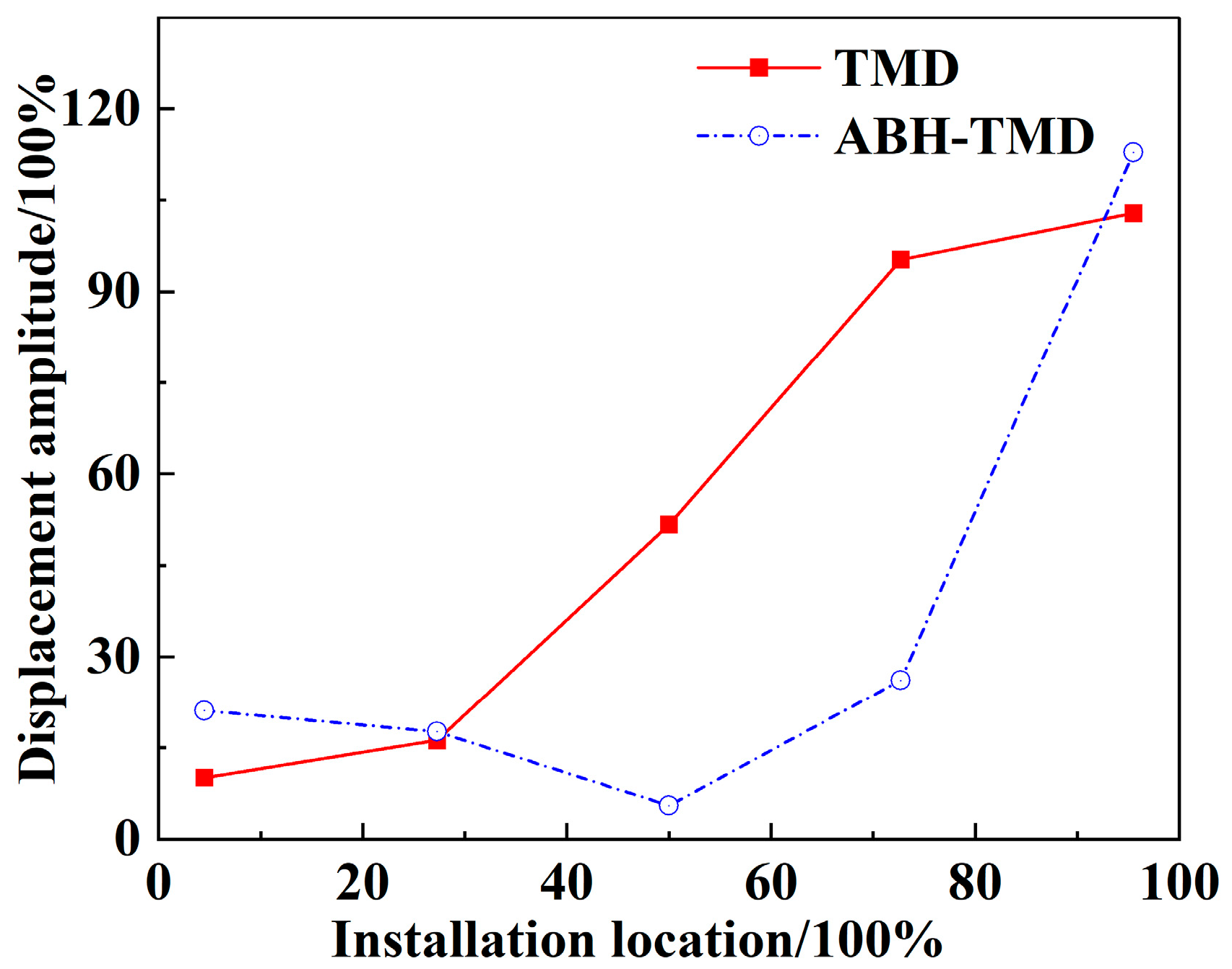
A comparative analysis is conducted on the arrangement positions of the ABH-TMD and TMD vibrator structures in order to further analyze the vibration-damping mechanism of the former and investigate its characteristics in the context of the acoustic black hole effect and the dynamic vibration absorption principle. Without altering the dimensions, materials, or other parameters of the host body, vibrator, or connecting components, the distance between the vibrator arrangement position and the free end of the host body was modified. The resulting vibration response of the host body under vibrator control is shown in Figure 15.
The figure shows the free-end displacement curves under TMD and ABH-TMD control; here, the x variable is the ratio of the distance between the center of the connector’s lower surface and the free end to the total length. To directly observe the relationship between the vibrator placement position and the vibration suppression effect, the results were dimensionless. The y-axis value is the ratio of the free-end displacement amplitude to that of the host structure under no control measures. This directly shows the control effect of the host structure’s vibration with different vibrators.
As shown in Figure 15, when the vibrator is installed near the 100% position—that is, at the fixed end of the main cantilever beam—both types of vibrators have an adverse effect on control efficiency. When positioned elsewhere, both the TMD vibrator and ABH-TMD effectively control the vibration amplitude of the host structure. Under TMD control, vibration suppression diminishes progressively as the installation point approaches the fixed end. Furthermore, the control effectiveness of TMD structures varies significantly with placement, indicating that their dynamic vibration absorption is highly position dependent. This implies stricter placement requirements for practical engineering applications. Conversely, under ABH-TMD control, the vibration suppression efficiency remains largely consistent across different mounting positions, with optimal control achieved at the 50% point (midpoint of the main body). This suggests that the ABH varying-thickness beam structure effectively harnesses its wave-absorbing and -focusing properties, concentrating elastic waves intensely onto the mass block. Consequently, this approach broadens the effective placement range of the TMD, compensating for its vulnerability to installation location constraints. This enhancement improves the system’s robustness while reducing installation requirements.
The optimal placement of a TMD is closely related to the modal shape of the target mode. The core principle is to position the TMD at the point within the modal shape where displacement (amplitude) is greatest. Conversely, nodal points (where displacement is zero) must be strictly avoided, as TMDs cannot be effectively excited. In practical design, the installation position depends on the vibrational modes, ensuring optimal control performance.

4.2. Analysis of the Influence of the Mass Ratio of Vibrators

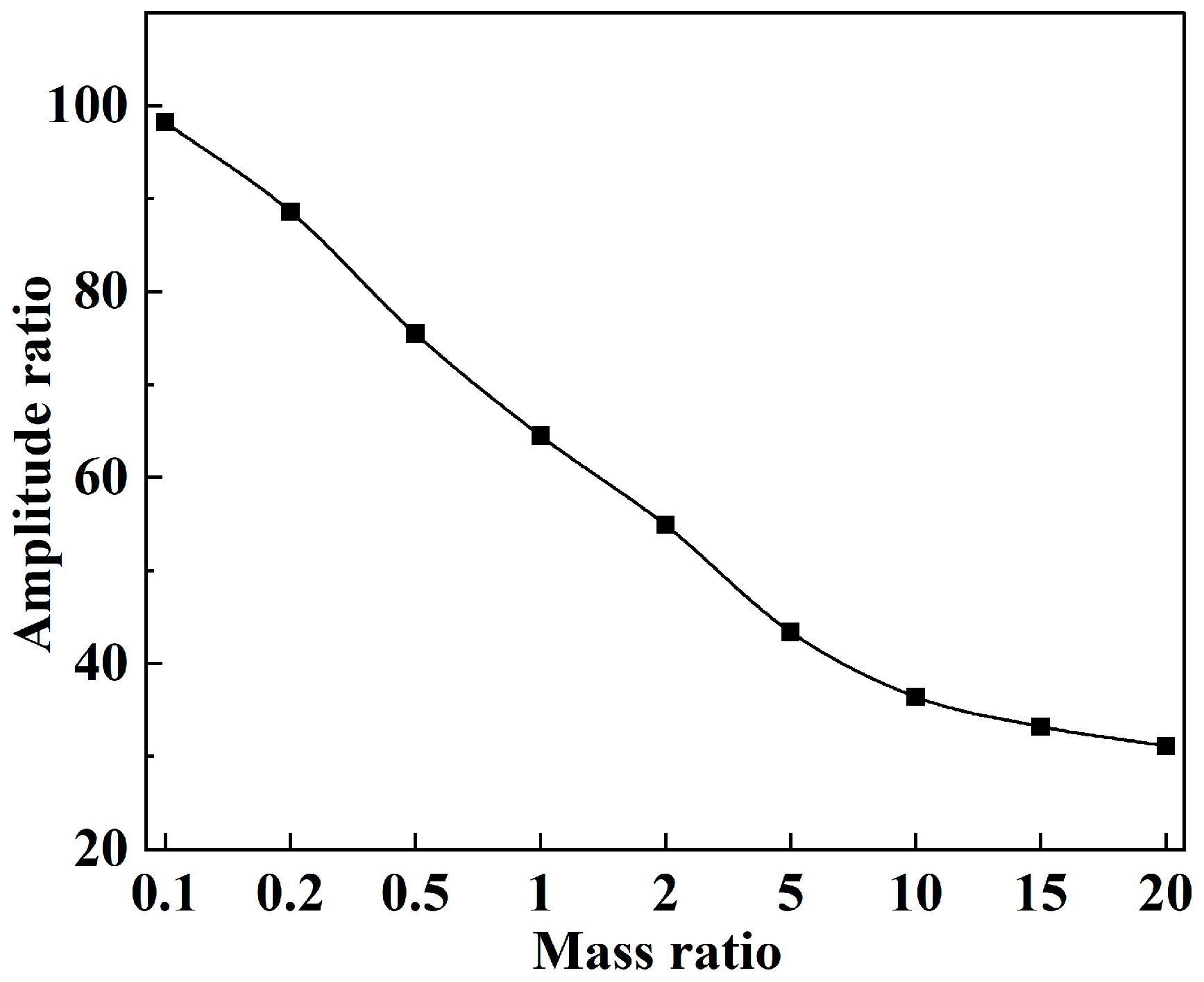
In traditional TMDs, the mass ratio of the TMD to the total structure is crucial for both vibration suppression efficiency and practical application. Determining the mass ratio guides the tuning process by specifying the optimal tuning frequency for the secondary vibration system. Additionally, it defines the minimum required damping ratio for the secondary system. Therefore, we ought to analyze the influence of the ABH-TMD mass ratio on its vibration suppression efficiency.
Different-sized vibrating bodies were configured to possess varying masses, all fabricated from the 7075-aluminum alloy and designed as cantilever beams. The dimensions and material of the ABH-TMD vibrator remained constant, with all units positioned at the midpoint of the cantilever beam’s upper surface. This arrangement facilitated an investigation into the effects of varying ABH-TMD structural configurations and mounting locations. External excitation involves applying a harmonic surface force load at the free end of the body, the magnitude of which is 1000 Pa, with the vector plane perpendicular to the cantilever beam’s length. The load frequency ranges from 0 to 20 Hz, and the maximum displacement frequency response at the free end of the body is output, as shown in Figure 16.
The y-axis coordinates in the figure represent the ratio of the host structure’s free-end frequency response displacement amplitude under ABH-TMD control to that under no control. The x-axis coordinates represent the mass ratio of the ABH-TMD vibrator to the entire structure. The figure shows that as the mass ratio increases, the amplitude ratio gradually decreases. The displacement amplitude ratio of the main body’s free end under ABH-TMD control progressively diminishes compared to that without control, indicating enhanced vibration suppression by the ABH-TMD vibrator. The primary consideration is that increasing the mass ratio of the ABH-TMD vibrator enhances the inertial force of the secondary system during main body vibration. This provides a greater counterforce to the main body, effectively suppressing its vibration. However, in practical applications, the mass ratio of the secondary vibration system cannot be continuously increased due to installation limitations and cost considerations. In bridge engineering, the quality ratio threshold ranges from 0.5% to 5%. Once the mass ratio reaches 5%, the improvement in vibration control effectiveness resulting from further increases in the mass ratio diminishes progressively. A higher mass ratio not only increases manufacturing costs but also leads to higher operational and maintenance expenses, while posing greater challenges for equipment installation. Therefore, it is recommended to set the mass ratio to around 5% in engineering applications.

4.3. Analysis of the Influence of the Order of the ABH Power Function

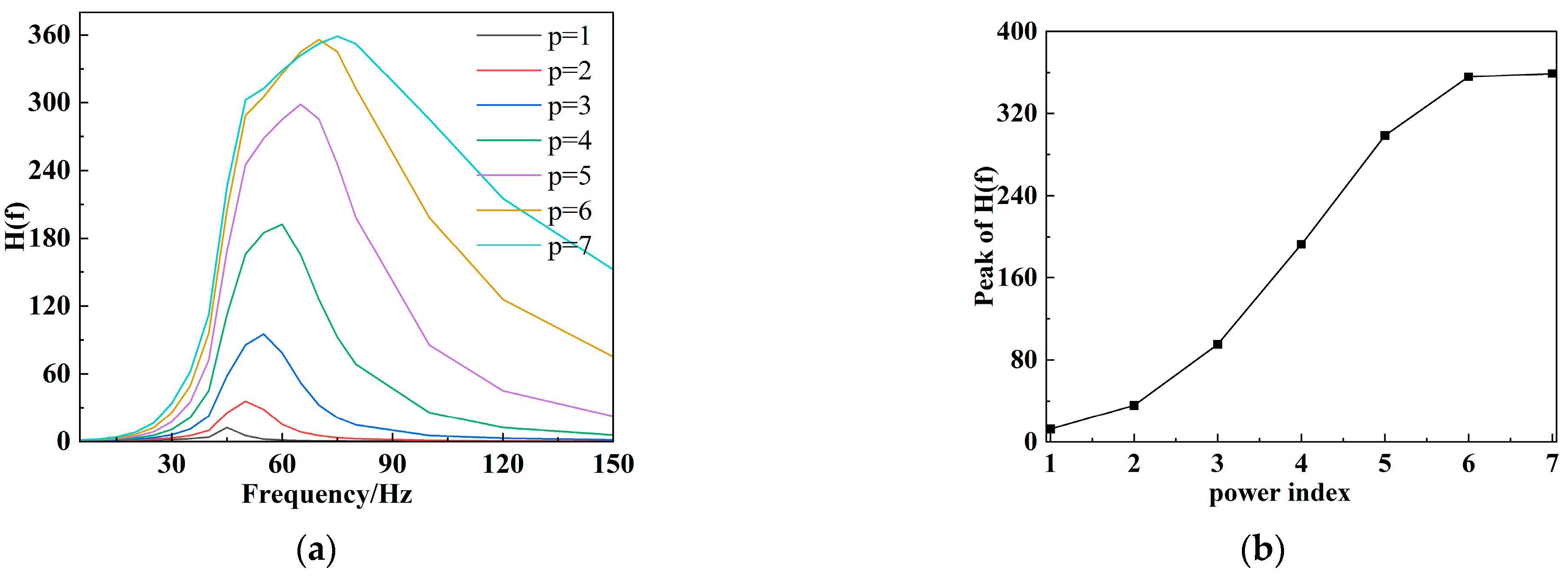
After employing the mathematical analysis methods proposed in Section 2 of this article to calculate the magnitude of the displacement transfer function, the input frequency ranged from 5 Hz to 150 Hz in 5 Hz increments, while the power function order (p) varied from the first to seventh order. The results are shown in Figure 17.
As shown in Figure 17a, when the power index exceeds 2, H ( f ) appears greater than 1.0, indicating that the displacement response of the mass block substantially exceeds the input at the fixed end. Energy entering the ABH-TMD structure is markedly transferred and concentrated within the mass block. It can be concluded that the ABH beam, with its thickness decreasing according to a power function, possesses the ability to transfer and concentrate elastic waves. This enables a greater concentration of input energy within the mass block upon entering the ABH-TMD structure, thereby amplifying the vibration control capability of the TMD structure. Moreover, as the power function exponent increases, the effective frequency range of the ABH-TMD structure broadens significantly. The wave-absorption and -concentration capabilities of the ABH variable-section plate effectively compensate for the narrow frequency range that limits TMDs, substantially enhancing the vibration control performance.
The correlation between the maximum H ( f ) and p is shown in Figure 17b above. H ( f ) increases continuously as the power index (p) rises, indicating a continuous improvement in the structure’s wave-gathering capability. Input energy is increasingly concentrated in the mass block at the tip of the ABH, and the overall vibration suppression capability of the ABH-TMD system is significantly enhanced as the power index increases.
Therefore, after thoroughly evaluating the material strength at the connection between the ABH varying-thickness beam and the TMD mass block, a configuration combining the former with the largest possible power function exponent should be applied to obtain a superior wave absorption capacity for the ABH, thereby enhancing the vibration-damping capability of the ABH-TMD system and broadening the frequency range of its vibration suppression effect.

5. Conclusions

In this paper, we proposed a novel oscillator, ABH-TMD, integrating acoustic black hole structures with TMDs. We not only derived vibration control equations, but also analyzed the vibration control characteristics using finite element simulation methods. Subsequent investigations into factors influencing vibration suppression effects concluded that acoustic black hole structures can effectively broaden the frequency band of TMD vibration suppression while enhancing suppression performance in the low-frequency range. The main conclusions are as follows:

(1) Acoustic black hole structures leverage their wave-absorbing and -focusing properties to converge elastic waves from the vibrating structure toward their apex. This focuses the energy from the vibrating structure into the mass block of the TMD, thereby concentrating the energy in the mass block and suppressing the vibration of the main structure. Compared to previous vibration-damping structures utilizing ABH, ABH-TMD not only exhibits superior robustness, enabling it to function effectively over extended periods in complex environments, but also demonstrates significantly enhanced performance in controlling multimodal vibrations at low frequencies.
(2) The absorptive and wave-focusing properties of acoustic black hole structures remain unaffected by the frequency of the excitation load. Under low-frequency loading conditions, acoustic black holes effectively broaden the frequency range of TMD vibration suppression by concentrating elastic waves and transferring them into the mass block.
(3) Installing the ABH-TMD at the midpoint of a cantilever beam yields the most effective vibration suppression. As the mass ratio increases, the vibration suppression capability of the ABH-TMD also improves progressively.

Author Contributions

Conceptualization, Z.L.; methodology, Z.L.; software, Z.L. and H.M.; validation, Z.L. and P.Z.; formal analysis, Z.L. and C.M.; supervision, P.Z. and C.M.; writing—original draft preparation, Z.L.; writing—review and editing, P.Z. All authors have read and agreed to the published version of the manuscript.

Funding

This research was funded by Jiangsu Province Innovation and Entrepreneurship Doctoral Program 2022, the National Natural Science Foundation of China (grant no.: 51808175), and the China Postdoctoral Science Foundation (grant no.: 2020T130154).

Data Availability Statement

The original contributions presented in this study are included in the article. Further inquiries can be directed to the corresponding author.

Conflicts of Interest

The authors declare no conflicts of interest.

References

  1. Luan, G.; Liu, P.; Ning, D.; Liu, G.; Du, H. Semi-active vibration control of seat suspension equipped with a variable equivalent inertance-variable damping device. Machines 2023, 11, 284. [Google Scholar] [CrossRef]
  2. Zhang, X.; Zhu, J.; Nie, J.; Gene Liao, Y.; Lu, X. Analysis of inertance and damping double-skyhook control strategies for a semi-active device combining an adjustable inerter and damper. Struct. Control Health Monit. 2022, 29, e3040. [Google Scholar] [CrossRef]
  3. Chen, J.; Zhao, Y.; Cong, O.; He, M. Vibration control using double-response damper and site measurements on wind turbine. Struct. Control Health Monit. 2018, 25, e2200. [Google Scholar] [CrossRef]
  4. Murtagh, P.J.; Ghosh, A.; Basu, B.; Broderick, B.M. Passive control of wind turbine vibrations including blade/tower interaction and rotationally sampled turbulence. Wind. Energy 2008, 11, 305–317. [Google Scholar] [CrossRef]
  5. Biglari, H.; Fakhari, V. Edgewise vibration reduction of small size wind turbine blades using shunt damping. J. Vib. Control 2020, 26, 186–199. [Google Scholar] [CrossRef]
  6. Yonezawa, H.; Yonezawa, A.; Kajiwara, I. Active vibration control with a combination of virtual controlled object-based model-free design and fuzzy sliding mode technique. J. Vib. Eng. Technol. 2025, 13, 154. [Google Scholar] [CrossRef]
  7. Srinivasan, A.V. Analysis of parallel damped dynamic vibration absorbers. J. Eng. Ind. 1969, 91, 282–287. [Google Scholar] [CrossRef]
  8. Snowdon, J.C.; Jones, D.I.G. Vibration and shock in damped mechanical systems. J. Appl. Mech. 1969, 36, 383. [Google Scholar] [CrossRef]
  9. Mironov, M.A.; Pislyakov, V.V. One-dimensional acoustic waves in retarding structures with propagation velocity tending to zero. Acoust. Phys. 2002, 48, 347–352. [Google Scholar] [CrossRef]
  10. Liu, Z.; Dai, J. Random vibration of one-dimensional acoustic black hole beam. In Nonlinear Dynamics and Complexity; Pinto, C.M.A., Ed.; Nonlinear Systems and Complexity; Springer International Publishing: Cham, Switzerland, 2022; Volume 36, pp. 259–300. ISBN 978-3-031-06631-3. [Google Scholar]
  11. Popper, A.N.; Clarke, N.L. The auditory system of the goldfish (carassius auratus): Effects of intense acoustic stimulation. Comp. Biochem. Physiol. A 1976, 53, 11–18. [Google Scholar] [CrossRef]
  12. Zhang, L.; Kerschen, G.; Cheng, L. Nonlinear features and energy transfer in an acoustic black hole beam through intentional electromechanical coupling. Mech. Syst. Signal Process. 2022, 177, 109244. [Google Scholar] [CrossRef]
  13. Zhou, T.; Cheng, L. Planar swirl-shaped acoustic black hole absorbers for multi-directional vibration suppression. J. Sound Vib. 2022, 516, 116500. [Google Scholar] [CrossRef]
  14. Aklouche, O.; Pelat, A.; Maugeais, S.; Gautier, F. Scattering of flexural waves by a pit of quadratic profile inserted in an infinite thin plate. J. Sound Vib. 2016, 375, 38–52. [Google Scholar] [CrossRef]
  15. Ouahabi, A.; Krylov, V.; O’Boy, D. Investigation of the acoustic black hole termination for sound waves propagating in cylindrical waveguides. In Proceedings of the Inter-Noise and Noise-Con Congress and Conference Proceedings, San Francisco, CA, USA, 9–12 August 2015; Institute of Noise Control Engineering: Wakefield, MA, USA, 2015. [Google Scholar]
  16. Tang, L.; Cheng, L.; Ji, H.; Qiu, J. Characterization of acoustic black hole effect using a one-dimensional fully-coupled and wavelet-decomposed semi-analytical model. J. Sound Vib. 2016, 374, 172–184. [Google Scholar] [CrossRef]
  17. Wang, Y.; Du, J.; Cheng, L. Power flow and structural intensity analyses of acoustic black hole beams. Mech. Syst. Signal Process. 2019, 131, 538–553. [Google Scholar] [CrossRef]
  18. Georgiev, V.B.; Cuenca, J.; Gautier, F.; Simon, L.; Krylov, V.V. Damping of structural vibrations in beams and elliptical plates using the acoustic black hole effect. J. Sound Vib. 2011, 330, 2497–2508. [Google Scholar] [CrossRef]
  19. Cheer, J.; Hook, K.; Daley, S. Active feedforward control of flexural waves in an acoustic black hole terminated beam. Smart Mater. Struct. 2021, 30, 035003. [Google Scholar] [CrossRef]
  20. Zhang, X.; Cheng, L. Broadband and low frequency sound absorption by sonic black holes with micro-perforated boundaries. J. Sound Vib. 2021, 512, 116401. [Google Scholar] [CrossRef]
  21. Liang, X.; Liang, H.; Chu, J.; Wang, W.; Li, N.; Yang, Z.; Zhou, G.; Gao, N.; Hu, C.; Zhou, Z. A modified sonic black hole structure for improving and broadening sound absorption. Appl. Acoust. 2023, 210, 109440. [Google Scholar] [CrossRef]
  22. Yu, X.; Mi, Y.; Zhai, W.; Cheng, L. Principles of progressive slow-sound and critical coupling condition in broadband sonic black hole absorber. J. Acoust. Soc. Am. 2023, 154, 2988–3003. [Google Scholar] [CrossRef] [PubMed]
  23. Krylov, V.V.; Tilman, F.J.B.S. Acoustic ‘black holes’ for flexural waves as effective vibration dampers. J. Sound Vib. 2004, 274, 605–619. [Google Scholar] [CrossRef]
Figure 1. The structure of this study.
Buildings 16 00061 g001
Figure 2. Schematic diagram of ABH principle.
Buildings 16 00061 g002
Figure 3. Schematic diagram of the ABH-TMD structure.
Buildings 16 00061 g003
Figure 4. Beam composite models: (a) ABH beam; (b) constant-section beam.
Buildings 16 00061 g004
Figure 5. Modal shapes of host structure; (a) first-order modal; (b) second-order modal; (c) third-order modal.
Buildings 16 00061 g005
Figure 6. Three-dimensional diagram of ABH varying-thickness beam.
Buildings 16 00061 g006
Figure 7. Experimental system diagram: (a) experimental subject; (b) incentive system.
Buildings 16 00061 g007
Figure 8. Free-end acceleration amplitude diagrams: (a) acceleration comparison chart of the host structure without vibrators; (b) acceleration response diagrams under different control measures.
Buildings 16 00061 g008
Figure 9. Displacement response diagrams: (a) free end; (b) mass block.
Buildings 16 00061 g009
Figure 10. Free-end response diagrams: (a) displacement response; (b) speed response.
Buildings 16 00061 g010
Figure 11. Mass block response diagrams: (a) displacement; (b) speed.
Buildings 16 00061 g011
Figure 12. Vibration response diagram of constant-section beam composite model.
Buildings 16 00061 g012
Figure 13. Vibration response diagram of ABH varying-thickness beam composite model.
Buildings 16 00061 g013
Figure 14. Frequency diagram of host structure steady-state displacement amplitude.
Buildings 16 00061 g014
Figure 15. Installation position response diagram.
Buildings 16 00061 g015
Figure 16. Influence of mass ratio on amplitude for ABH-TMD vibrators.
Buildings 16 00061 g016
Figure 17. Frequency response transfer function diagrams: (a) frequency; (b) transmission rate index.
Buildings 16 00061 g017
Table 1. H ( f ) comparison table.
Frequency/Hz Numerical   Computation   H ( f ) Finite Element Simulation H(f)Error/%
51.061.060
101.221.220
151.551.531.29
202.152.140.47
253.453.450
306.056.070.33
3511.211.210.09
4022.822.80
4558.258.210.02
5085.685.660.07
5595.295.40.21
6078.578.460.05
6552.152.10
7032.532.530.09
7521.221.220.09
8014.814.840.27
1005.255.30.95
1202.852.881.05
1501.451.471.38
Table 2. Natural frequency modes of aluminum plate.
Natural Frequency OrderNatural Frequency of Finite Element Simulation (Hz)Natural Frequency of Calculation (Hz)Mode Shapes
First order6.766.70First-order bend
Second order42.4142.00One wave belly
Third order118.93117.60Two wave bellies
Table 3. Material properties.
Material7075ALEpoxy Resin
Young’s Modulus/Pa 7.1 × 10 10 2.45 × 10 9
Density/ k g · m 3 28201200
Poisson’s ratio0.330.41
Disclaimer/Publisher’s Note: The statements, opinions and data contained in all publications are solely those of the individual author(s) and contributor(s) and not of MDPI and/or the editor(s). MDPI and/or the editor(s) disclaim responsibility for any injury to people or property resulting from any ideas, methods, instructions or products referred to in the content.