Integration of Machine Learning Models and Tiering Technique in Predicting the Compressive Strength of FRP-Strengthened Circular Concrete Columns

 , , ,
, , ,
Abstract
1. Introduction
2. Prediction Models
2.1. Machine Learning Models
2.1.1. Artificial Neural Networks
2.1.2. Support Vector Machine for Regression
2.1.3. Linear Regression
2.1.4. Classification and Regression Tree (CART)
2.1.5. M5P Model
2.1.6. M5Rules Models
2.1.7. Random Forest Model
2.1.8. Random Tree Model
2.2. Design-Oriented Strength Models
3. Experimental Database
3.1. Data Collections
3.2. Pearson’s Correlation Analysis
4. Results and Discussions
4.1. Statistical Metrics
4.2. Cross-Validation
4.3. The Prediction Accuracy of the Models
4.3.1. Design-Oriented Strength Models Versus Single ML Models
4.3.2. The Prediction Accuracy of the Single ML Models Incorporated the Tiering Technique
5. Concluding Remarks
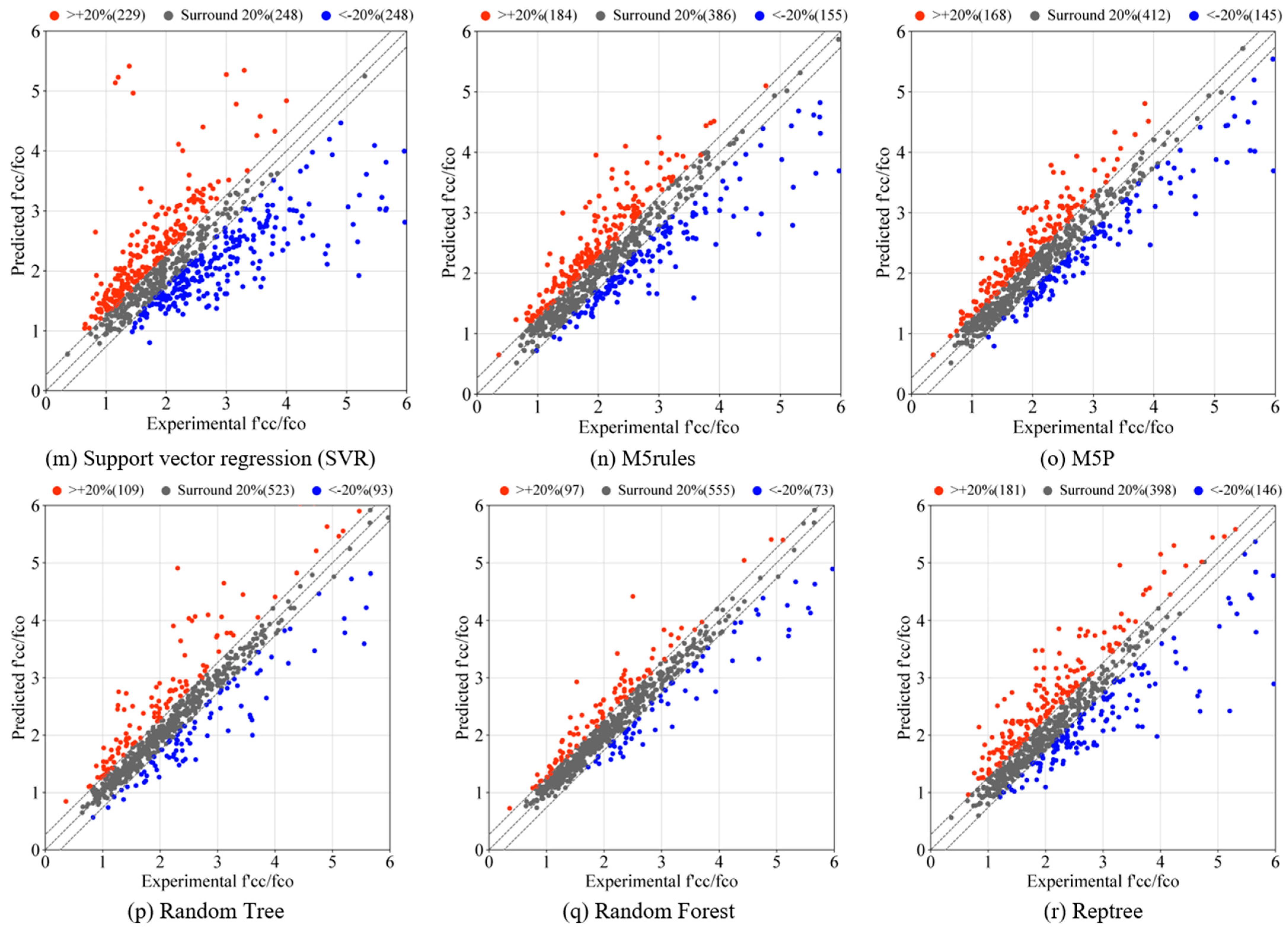
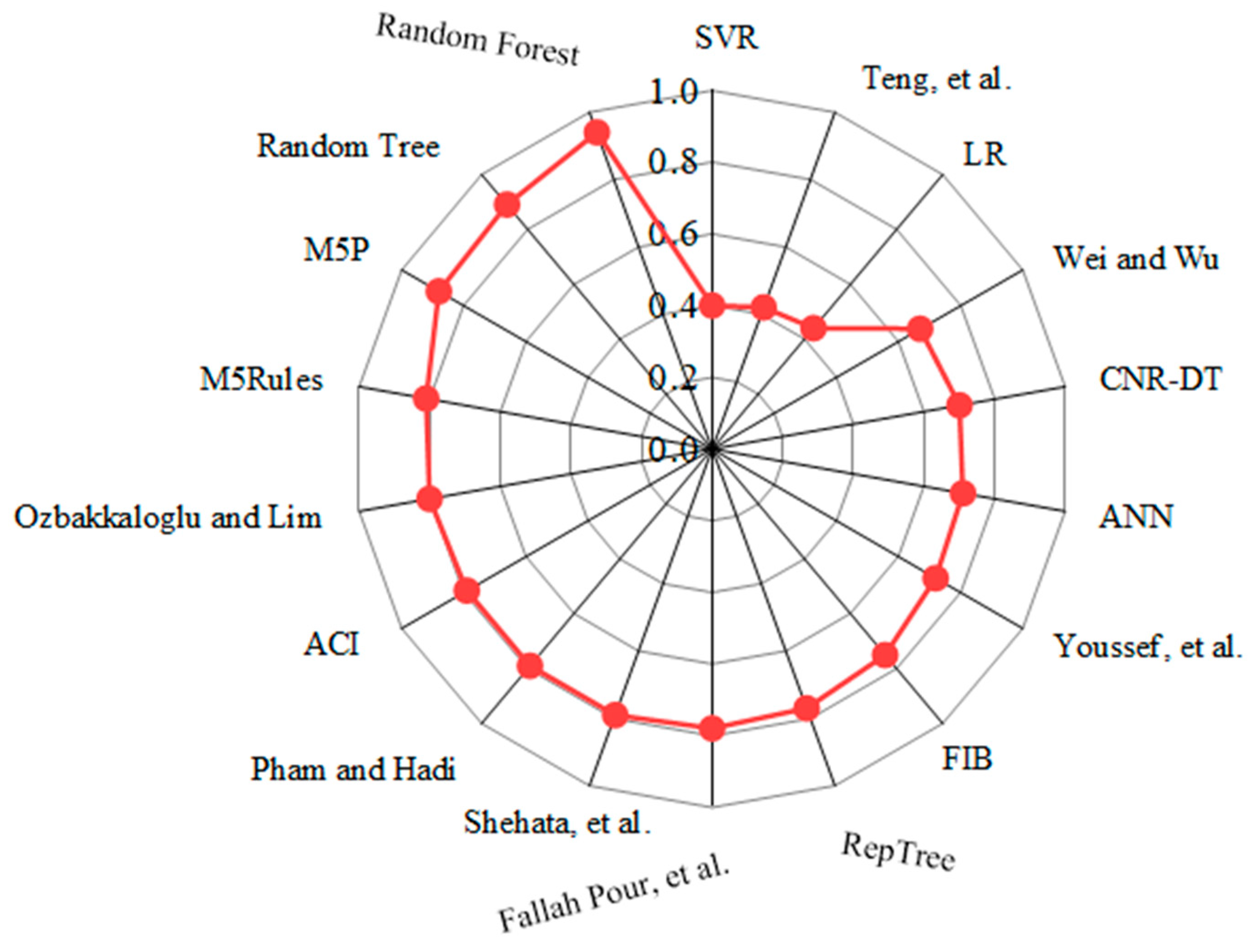
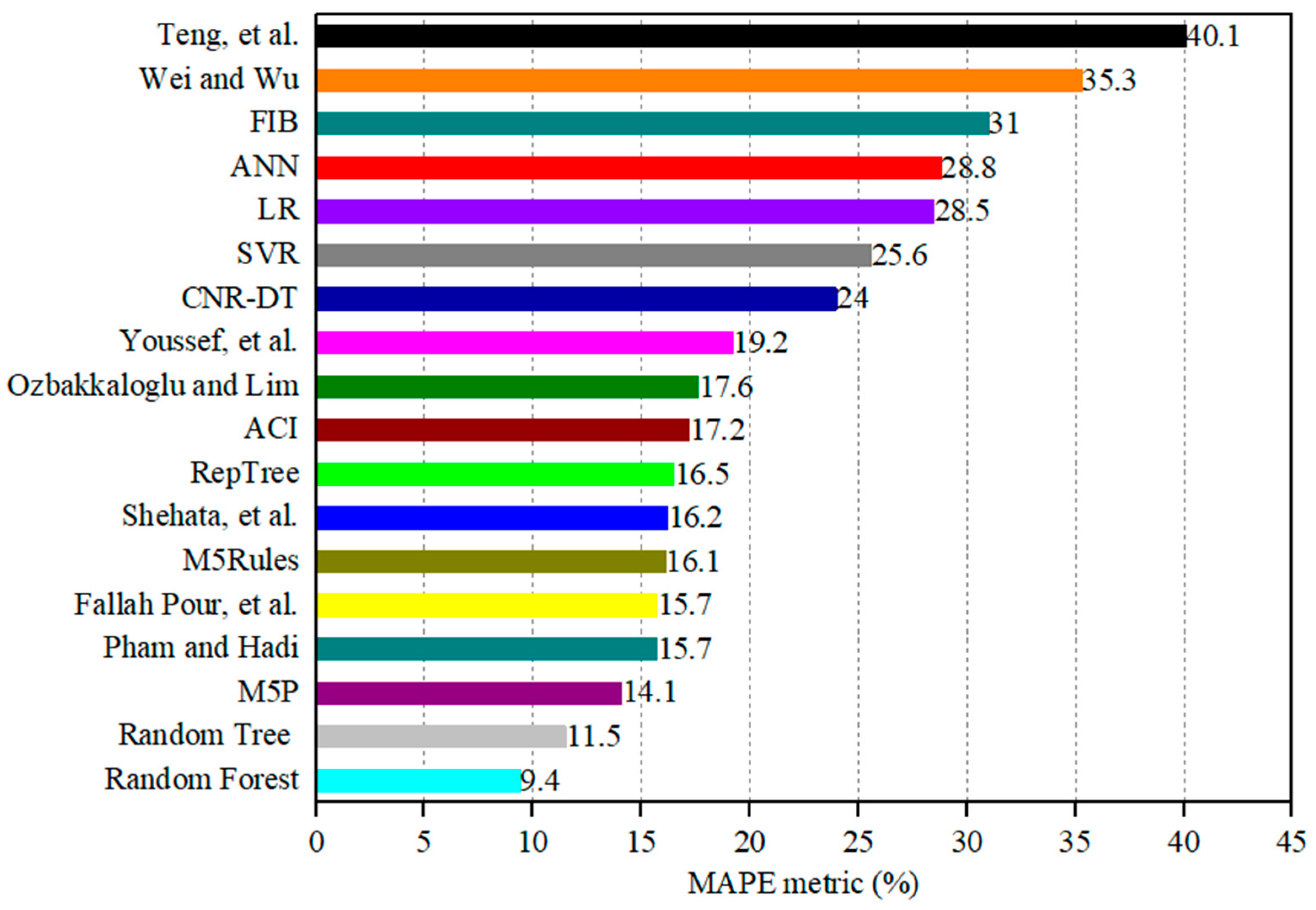
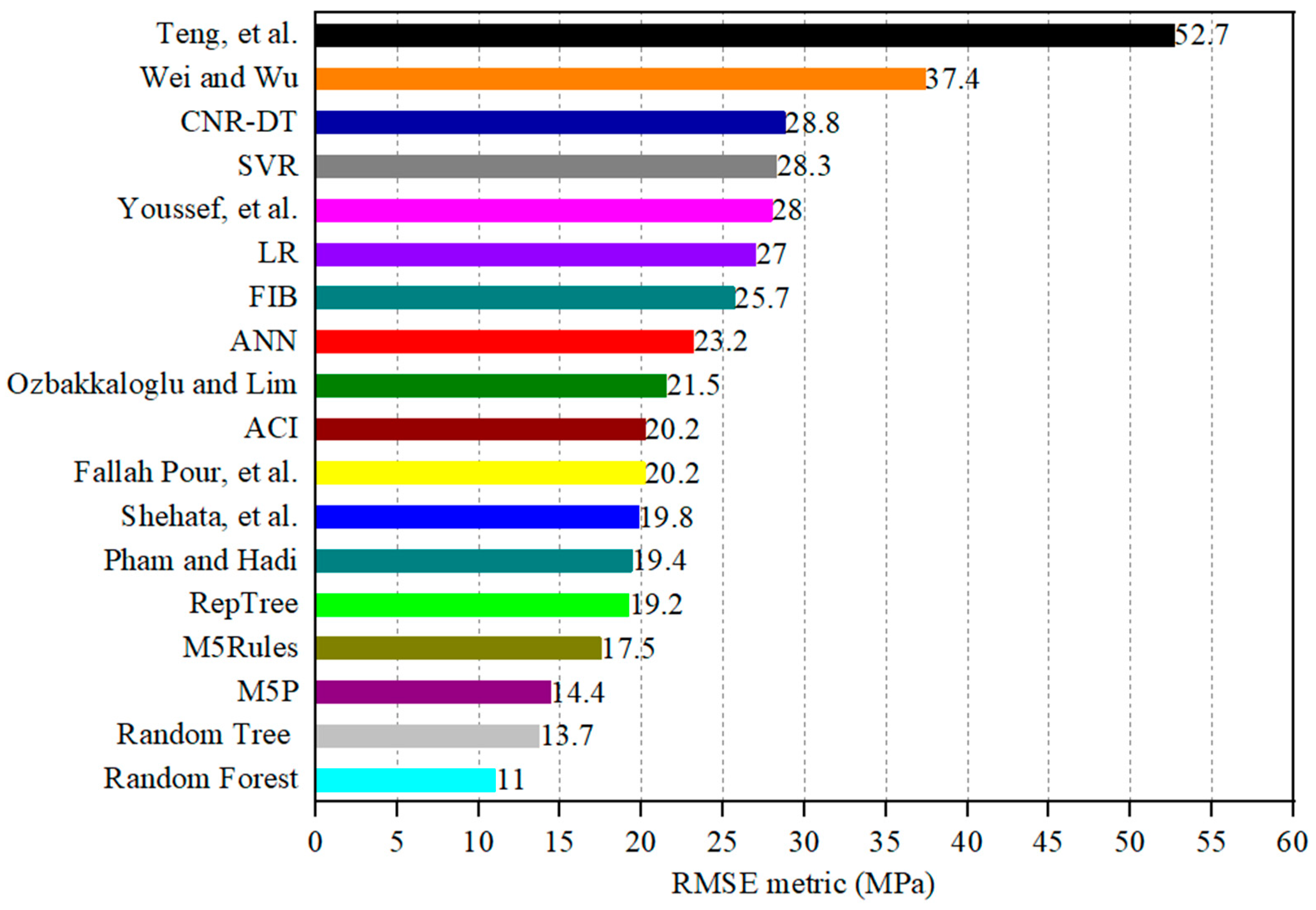
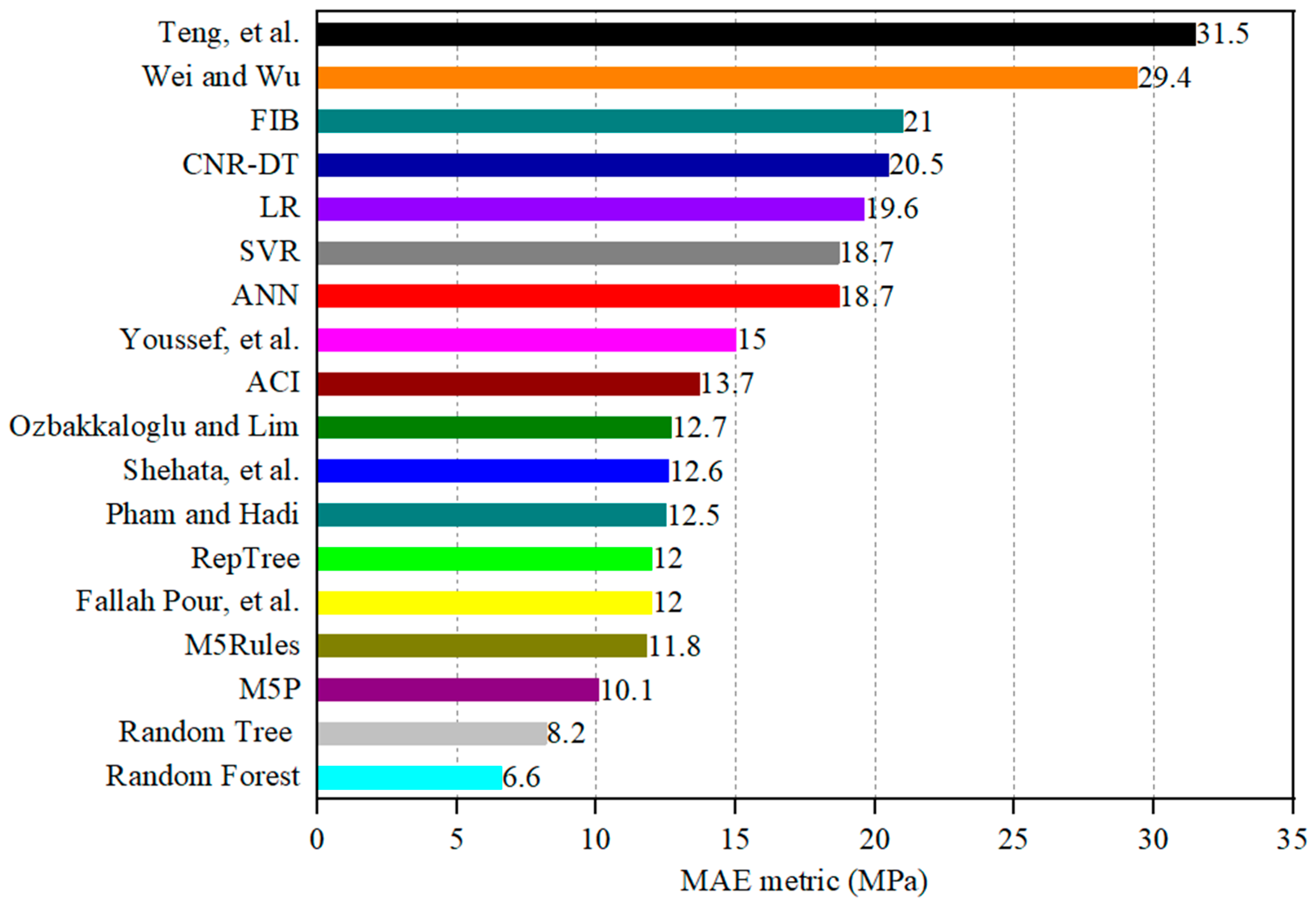
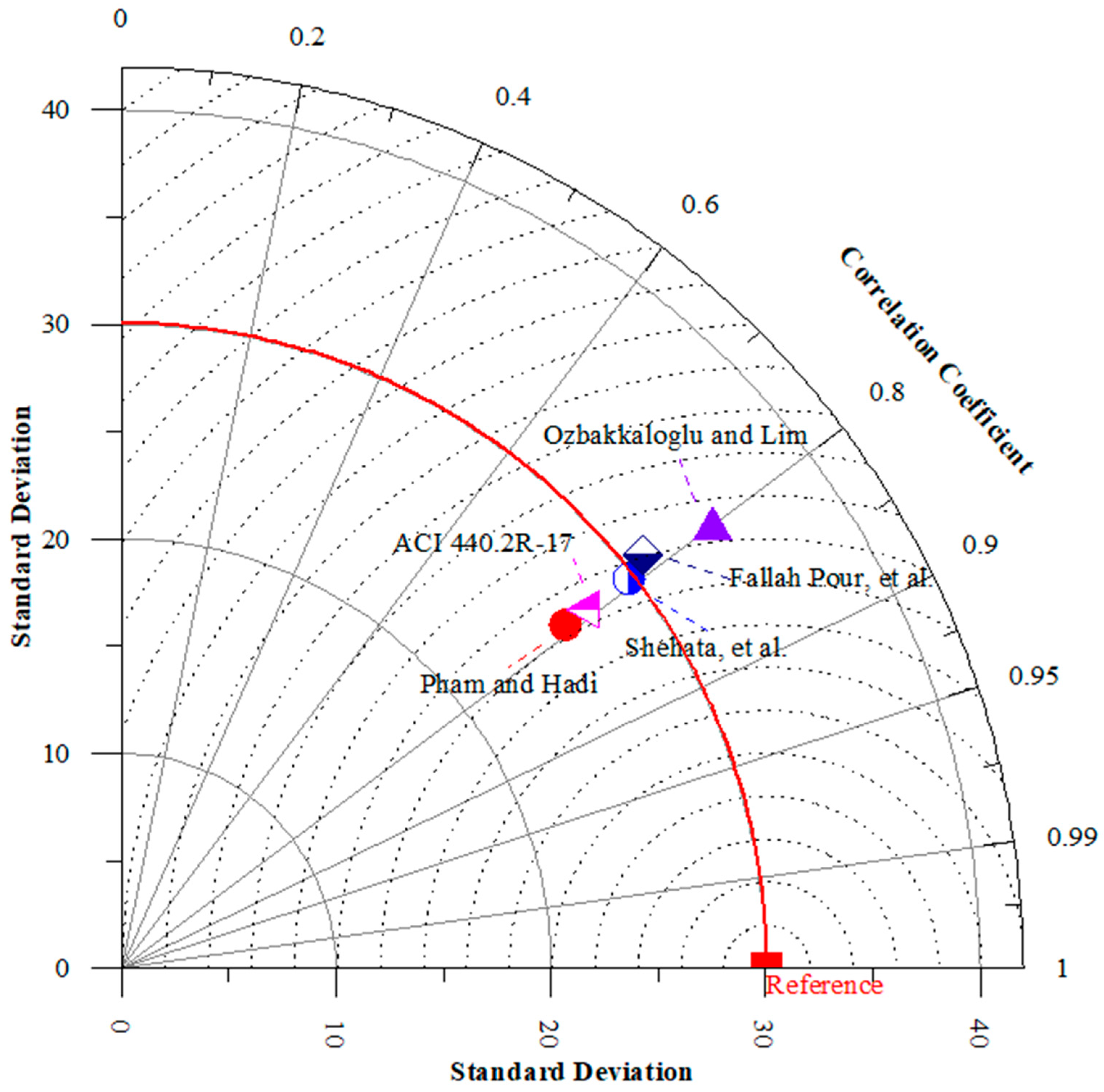
- Among selected design-oriented strength models, the most accurate strength model was obtained by the Shehata et al. [57] model and followed by Fallah Pour et al. [61], while among three design codes for the FRP-strengthened concrete structure, the ACI 440.2R-17 [18] model yielded the highest prediction accuracy and the CNR-DT 200/2004 [20] model provided the lowest prediction accuracy in predicting the compressive strength of FRP-SCC columns. For the ML models, the best performance models for the compressive strength of FRP-SCC columns were the random forest and random tree models.
- The best single ML models were the random forest, random tree, and M5P, which outperformed the best design-oriented strength model in predicting the compressive strength of FRP-SCC columns. The prediction accuracy of the random forest model was 19.0%, 42.0%, 44.4%, and 47.6% higher than that of the best design-oriented strength models by using , , and metrics, respectively. The improvement in predicting the compressive strength of FRP-SCC columns of the random forest model compared to the best design-oriented strength model was 12.7%, 29.0%, 30.8%, and 34.9% by using , , and metrics, respectively. These enhancements of the M5P model compared to the Shehata et al. [57] model were 11.4%, 0.6%, 11.6%, and 6.34%, respectively, by using , , and metrics.
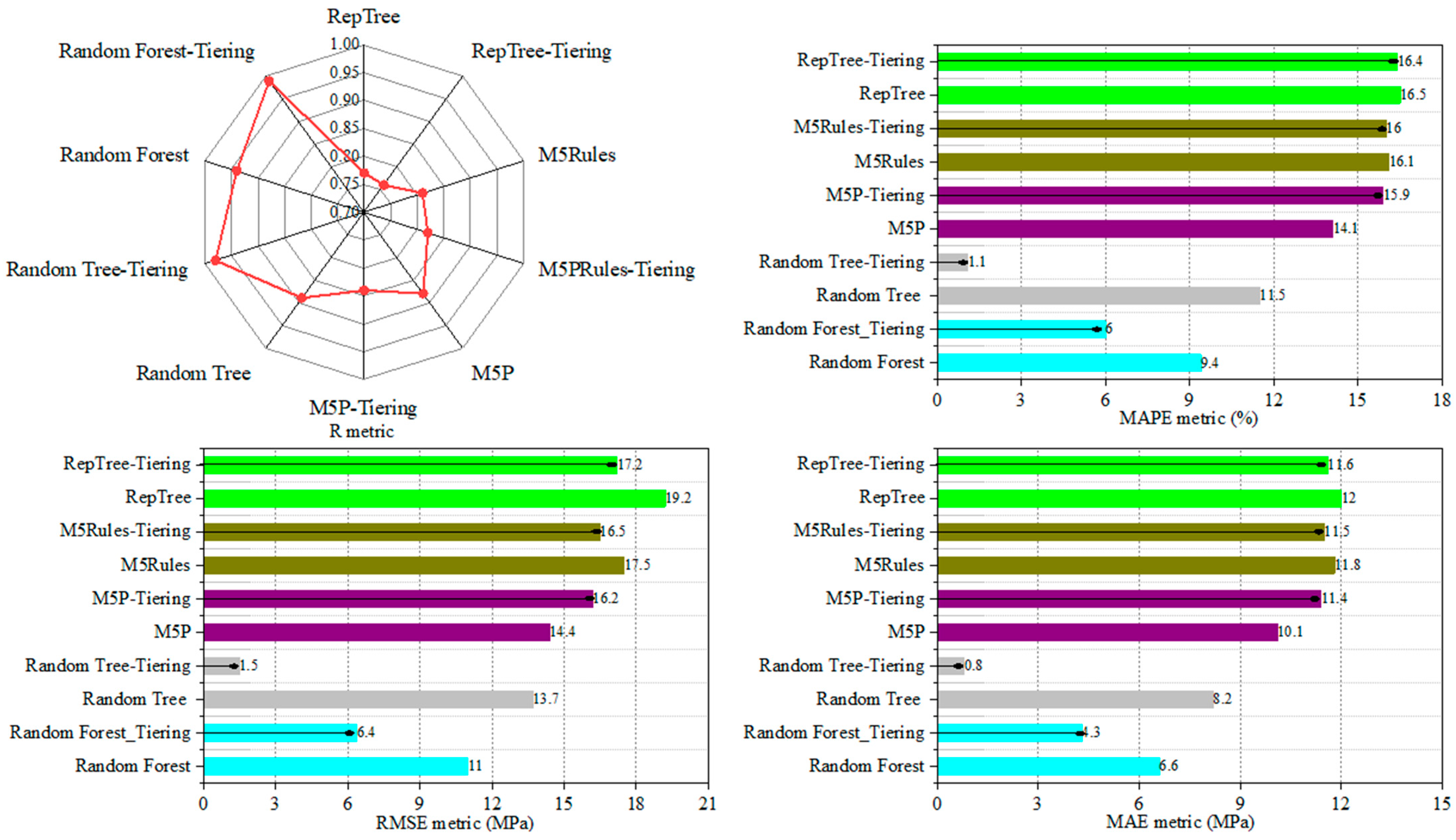
- The incorporation of the tiering technique into the ML model significantly improved the performance of the ML models in predicting the compressive strength of FRP-SCC columns. By applying the tiering technique, the prediction accuracy of the random forest model was improved by 5.3%, 36.2%, 41.8%, and 34.9% corresponding to , , and metrics, respectively. The improvement in the prediction accuracy of the random tree model due to the incorporation of the tiering technique was 11.2%, 90.4%, 89.1%, and 90.2% corresponding to , , and metrics, respectively.
- Compared to the best design code for the FRP-strengthened concrete structure, ACI 440.2R-17 [18], the improvement of the RF and RT models incorporating the tiering technique was 25.3% for the metric; 93.6% and 65.1%, respectively, for the metric; 92.6% and 68.3% for the metric; and 94.1% and 68.6% for the matric.
- The effectiveness of integrating the tiering technique with ML models was limited to predicting the compressive strength of FRP-SCC columns based on the 725 test results used in this study. Therefore, further investigations into the effectiveness of combining the tiering technique with ML models for predicting the ultimate conditions of FRP-SCC columns are needed. Additionally, the effectiveness of this combination should be evaluated using a larger dataset of the compressive strength of FRP-SCC columns.
Supplementary Materials
Author Contributions
Funding
Data Availability Statement
Acknowledgments
Conflicts of Interest
References
- Lu, S.; Wang, J.; Yang, J.; Wang, L. Eccentric compression behavior of partially CFRP wrapped seawater sea-sand concrete columns reinforced with epoxy-coated rebars. Eng. Struct. 2024, 314, 118296. [Google Scholar] [CrossRef]
- Neupane, R.P.; Imjai, T.; Garcia, R.; Chua, Y.S.; Chaudhary, S. Performance of eccentrically loaded low-strength RC columns confined with posttensioned metal straps: An experimental and numerical investigation. Struct. Concr. 2024, 25, 3583–3599. [Google Scholar] [CrossRef]
- Khalel, H.H.Z.; Khan, M.; Starr, A.; Sadawi, N.; Mohamed, O.A.; Khalil, A.; Esaker, M. Parametric study for optimizing fiber-reinforced concrete properties. Struct. Concr. 2025, 26, 88–110. [Google Scholar] [CrossRef]
- Ye, Y.-Y.; Liang, S.-D.; Feng, P.; Zeng, J.-J. Recyclable LRS FRP composites for engineering structures: Current status and future opportunities. Compos. Part B Eng. 2021, 212, 108689. [Google Scholar] [CrossRef]
- Alkhattabi, L.; Ali, A.H.; Mohamed, H.M.; Gouda, A. Strain Behavior of Short Concrete Columns Reinforced with GFRP Spirals. Buildings 2024, 14, 2180. [Google Scholar] [CrossRef]
- Liang, J.; Wang, Y.; Wang, C.; Yang, Y. Eccentric compression behavior of CFRP partially confined partially encased concrete columns. Structures 2025, 80, 109930. [Google Scholar] [CrossRef]
- Yang, J.; Wang, J.; Wang, Z. Axial compressive behavior of partially CFRP confined seawater sea-sand concrete in circular columns–Part II: A new analysis-oriented model. Compos. Struct. 2020, 246, 112368. [Google Scholar] [CrossRef]
- Lim, J.C.; Ozbakkaloglu, T. Unified stress-strain model for FRP and actively confined normal-strength and high-strength concrete. J. Compos. Constr. 2015, 19, 04014072. [Google Scholar] [CrossRef]
- Yang, J.; Lu, S.; Zeng, J.-J.; Wang, J.; Wang, Z. Durability of CFRP-confined seawater sea-sand concrete (SSC) columns under wet-dry cycles in seawater environment. Eng. Struct. 2023, 282, 115774. [Google Scholar] [CrossRef]
- Mai, A.D.; Phan, H.N.; Truong, Q.C.; Nguyen, C.L.; Nguyen, Q.T. A Comparative Investigation on Axial and Flexural Performance of Circularized Square RC Columns with Discontinuous and Continuous CFRP Confinement. Buildings 2025, 15, 1228. [Google Scholar] [CrossRef]
- Ozbakkaloglu, T.; Lim, J.C.; Vincent, T. FRP-confined concrete in circular sections: Review and assessment of stress-strain models. Eng. Struct. 2013, 49, 1068–1088. [Google Scholar] [CrossRef]
- Liao, J.; Zeng, J.-J.; Gong, Q.-M.; Quach, W.-M.; Gao, W.-Y.; Zhang, L. Design-oriented stress-strain model for FRP-confined ultra-high performance concrete (UHPC). Constr. Build. Mater. 2022, 318, 126200. [Google Scholar] [CrossRef]
- Cao, Y.G.; Wu, Y.F.; Li, X.Q. Unified model for evaluating ultimate strain of FRP confined concrete based on energy method. Constr. Build. Mater. 2016, 103, 23–35. [Google Scholar] [CrossRef]
- Mai, A.D.; Sheikh, M.N.; Hadi, M.N.S. Strain model for discretely FRP confined concrete based on energy balance principle. Eng. Struct. 2021, 241, 112489. [Google Scholar] [CrossRef]
- Li, Y.-F.; Chen, B.-Y.; Syu, J.-Y.; Ramanathan, G.K.; Lee, W.-H.; Huang, C.-H.; Lok, M.-H. A Constitutive Model for Circular and Square Cross-Section Concrete Confined with Aramid FRP Laminates. Buildings 2023, 13, 2895. [Google Scholar] [CrossRef]
- Lam, L.; Teng, J.G. Design-oriented stress–strain model for FRP-confined concrete. Constr. Build. Mater. 2003, 17, 471–489. [Google Scholar] [CrossRef]
- Liao, J.; Zeng, J.-J.; Jiang, C.; Li, J.-X.; Yuan, J.-S. Stress-strain behavior and design-oriented model for FRP spiral strip-confined concrete. Compos. Struct. 2022, 293, 115747. [Google Scholar] [CrossRef]
- ACI 440.2R-17; ACI (American Concrete Institute). Guide for the Design and Construction of Externally Bonded FRP Systems for Strengthening Concrete Structures. ACI: Farmington Hills, MI, USA, 2017.
- FIB (The International Federation for Structure Concrete). Externally Bonded FRP Reinforcement for RC Structures; FIB: Lausanne, Switzerland, 2001. [Google Scholar]
- CNR-DT 200 R1/2013; CNR-DT (Italian National Research Coucil). Guide for the Design and Construction of Externally Bonded FRP Systems for Strengthening Existing Sructures. CNR: Rome, Italy, 2013.
- Ozbakkaloglu, T.; Lim, J.C. Axial compressive behavior of FRP-confined concrete: Experimental test database and a new design-oriented model. Compos. Part B Eng. 2013, 55, 607–634. [Google Scholar] [CrossRef]
- Richart, F.E.; Brandtzæg, A.; Brown, R.L. A Study of the Failure of Concrete Under Combined Compressive Stresses; Station, E.E., Ed.; University of Illinois Bulletin University of Illinois at Urbana Champaign, University of Illinois at Urbana Champaign: Chicago, IL, USA, 1928. [Google Scholar]
- Teng, J.G.; Jiang, T.; Lam, L.; Luo, Y.Z. Refinement of a design-oriented stress-strain model for FRP-confined concrete. J. Compos. Constr. 2009, 13, 269–278. [Google Scholar] [CrossRef]
- Vincent, T.; Ozbakkaloglu, T. Influence of fiber orientation and specimen end condition on axial compressive behavior of FRP-confined concrete. Constr. Build. Mater. 2013, 47, 814–826. [Google Scholar] [CrossRef]
- Bisby, L.A.; Take, W.A. Strain localisations in FRP-confined concrete: New insights. Proc. Inst. Civ. Eng. Struct. Build. 2009, 162, 301–309. [Google Scholar] [CrossRef]
- Harries, K.A.; Carey, S.A. Shape and “gap” effects on the behavior of variably confined concrete. Cem. Concr. Res. 2003, 33, 881–890. [Google Scholar] [CrossRef]
- Smith, S.T.; Kim, S.J.; Zhang, H. Behavior and Effectiveness of FRP Wrap in the Confinement of Large Concrete Cylinders. J. Compos. Constr. 2010, 14, 573–582. [Google Scholar] [CrossRef]
- Yalçın, S.E. Estimation of CO2 Emissions in Transportation Systems Using Artificial Neural Networks, Machine Learning, and Deep Learning: A Comprehensive Approach. Systems 2025, 13, 194. [Google Scholar] [CrossRef]
- Wu, G.; Zhao, Y.; Ma, W.; Liu, H.; Dong, S.; Zhang, Y. A new method for predicting carbon emissions of paver during construction of asphalt pavement layer based on deep learning and MOVES-NONROAD model. Measurement 2025, 255, 118049. [Google Scholar] [CrossRef]
- Gao, W. The Application of Machine Learning in Geotechnical Engineering. Appl. Sci. 2024, 14, 4712. [Google Scholar] [CrossRef]
- Zhang, W.; Gu, X.; Hong, L.; Han, L.; Wang, L. Comprehensive review of machine learning in geotechnical reliability analysis: Algorithms, applications and further challenges. Appl. Soft Comput. 2023, 136, 110066. [Google Scholar] [CrossRef]
- Fakharian, P.; Bazrgary, R.; Ghorbani, A.; Tavakoli, D.; Nouri, Y. Compressive Strength Prediction of Green Concrete with Recycled Glass-Fiber-Reinforced Polymers Using a Machine Learning Approach. Polymers 2025, 17, 2731. [Google Scholar] [CrossRef] [PubMed]
- Pham, A.-D.; Ngo, N.-T.; Nguyen, Q.-T.; Truong, N.-S. Hybrid machine learning for predicting strength of sustainable concrete. Soft Comput. 2020, 24, 14965–14980. [Google Scholar] [CrossRef]
- Nouri, Y.; Ghanizadeh, A.R.; Jahanshahi, F.S.; Fakharian, P. Data-driven prediction of axial compression capacity of GFRP-reinforced concrete column using soft computing methods. J. Build. Eng. 2025, 101, 111831. [Google Scholar] [CrossRef]
- Shang, L.; Isleem, H.F.; Alsaadawi, M.M. Deep learning-based modelling of polyvinyl chloride tube-confined concrete columns under different load eccentricities. Eng. Appl. Artif. Intell. 2025, 145, 110217. [Google Scholar] [CrossRef]
- Pham, T.M.; Hadi, M.N.S. Predicting stress and strain of FRP-confined square/rectangular columns using artificial neural networks. J. Compos. Constr. 2014, 18, 04014019. [Google Scholar] [CrossRef]
- Calò, M.; Ruggieri, S.; Buitrago, M.; Nettis, A.; Adam, J.M.; Uva, G. An ML-based framework for predicting prestressing force reduction in reinforced concrete box-girder bridges with unbonded tendons. Eng. Struct. 2025, 325, 119400. [Google Scholar] [CrossRef]
- Liu, K.; Dai, Z.; Zhang, R.; Zheng, J.; Zhu, J.; Yang, X. Prediction of the sulfate resistance for recycled aggregate concrete based on ensemble learning algorithms. Constr. Build. Mater. 2022, 317, 125917. [Google Scholar] [CrossRef]
- Moodi, Y.; Mousavi, S.R.; Ghavidel, A.; Sohrabi, M.R.; Rashki, M. Using Response Surface Methodology and providing a modified model using whale algorithm for estimating the compressive strength of columns confined with FRP sheets. Constr. Build. Mater. 2018, 183, 163–170. [Google Scholar] [CrossRef]
- Cevik, A.; Guzelbey, I.H. Neural network modeling of strength enhancement for CFRP confined concrete cylinders. Build. Environ. 2008, 43, 751–763. [Google Scholar] [CrossRef]
- Jalal, M.; Ramezanianpour, A.A. Strength enhancement modeling of concrete cylinders confined with CFRP composites using artificial neural networks. Compos. Part B Eng. 2012, 43, 2990–3000. [Google Scholar] [CrossRef]
- Naderpour, H.; Kheyroddin, A.; Amiri, G.G. Prediction of FRP-confined compressive strength of concrete using artificial neural networks. Compos. Struct. 2010, 92, 2817–2829. [Google Scholar] [CrossRef]
- Elsanadedy, H.M.; Al-Salloum, Y.A.; Abbas, H.; Alsayed, S.H. Prediction of strength parameters of FRP-confined concrete. Compos. Part B Eng. 2012, 43, 228–239. [Google Scholar] [CrossRef]
- Tao, H.; Ali, Z.H.; Mukhtar, F.; Al Zand, A.W.; Marhoon, H.A.; Goliatt, L.; Yaseen, Z.M. Coupled extreme gradient boosting algorithm with artificial intelligence models for predicting compressive strength of fiber reinforced polymer–confined concrete. Eng. Appl. Artif. Intell. 2024, 134, 108674. [Google Scholar] [CrossRef]
- Cevik, A.; Göğüş, M.T.; Güzelbey, İ.H.; Filiz, H. Soft computing based formulation for strength enhancement of CFRP confined concrete cylinders. Adv. Eng. Softw. 2010, 41, 527–536. [Google Scholar] [CrossRef]
- Cevik, A. Modeling strength enhancement of FRP confined concrete cylinders using soft computing. Expert Syst. Appl. 2011, 38, 5662–5673. [Google Scholar] [CrossRef]
- Lim, J.C.; Karakus, M.; Ozbakkaloglu, T. Evaluation of ultimate conditions of FRP-confined concrete columns using genetic programming. Comput. Struct. 2016, 162, 28–37. [Google Scholar] [CrossRef]
- Mansouri, I.; Ozbakkaloglu, T.; Kisi, O.; Xie, T. Predicting behavior of FRP-confined concrete using neuro fuzzy, neural network, multivariate adaptive regression splines and M5 model tree techniques. Mater. Struct. 2016, 49, 4319–4334. [Google Scholar] [CrossRef]
- Mozumder, R.A.; Roy, B.; Laskar, A.I. Support Vector Regression Approach to Predict the Strength of FRP Confined Concrete. Arab. J. Sci. Eng. 2017, 42, 1129–1146. [Google Scholar] [CrossRef]
- Keshtegar, B.; Ozbakkaloglu, T.; Gholampour, A. Modeling the behavior of FRP-confined concrete using dynamic harmony search algorithm. Eng. Comput. 2017, 33, 415–430. [Google Scholar] [CrossRef]
- Yu, Y.; Hu, T. Machine Learning Based Compressive Strength Prediction Model for CFRP-confined Columns. KSCE J. Civ. Eng. 2024, 28, 315–327. [Google Scholar] [CrossRef]
- Zeng, S.; Wang, X.; Hua, L.; Altayeb, M.; Wu, Z.; Niu, F. Prediction of compressive strength of FRP-confined concrete using machine learning: A novel synthetic data driven framework. J. Build. Eng. 2024, 94, 109918. [Google Scholar] [CrossRef]
- Vapnik, V.N. The Nature of Statistical Learning Theory; Springer: New York, NY, USA, 1995. [Google Scholar]
- Breiman, L.; Friedman, J.; Olshen, R.A.; Stone, C.J. Classification and Regression Trees; Chapman and Hall/CRC: New York, NY, USA, 1984. [Google Scholar]
- Richart, F.E.; Brandtzæg, A.; Brown, R.L. The Failure of Plain and Spirally Reinforced Concrete in Compression; Station, E.E., Ed.; University of Illinois Bulletin University of Illinois at Urbana Champaign, University of Illinois at Urbana Champaign: Chicago, IL, USA, 1929. [Google Scholar]
- Fardis, M.N.; Khalili, H. Concrete Encased in Fiberglass-Reinforced Plastic. ACI J. 1981, 78, 440–446. [Google Scholar]
- Shehata, I.A.E.M.; Carneiro, L.A.V.; Shehata, L.C.D. Strength of short concrete columns confined with CFRP sheets. Mater. Struct. 2002, 34, 50–58. [Google Scholar] [CrossRef]
- Pham, T.M.; Hadi, M.N.S. Confinement model for FRP confined normal-and high-strength concrete circular columns. Constr. Build. Mater. 2014, 69, 83–90. [Google Scholar] [CrossRef]
- Wei, Y.-Y.; Wu, Y.-F. Unified stress–strain model of concrete for FRP-confined columns. Constr. Build. Mater. 2012, 26, 381–392. [Google Scholar] [CrossRef]
- Youssef, M.N.; Feng, M.Q.; Mosallam, A.S. Stress–strain model for concrete confined by FRP composites. Compos. Part B Eng. 2007, 38, 614–628. [Google Scholar] [CrossRef]
- Pour, A.F.; Ozbakkaloglu, T.; Vincent, T. Simplified design-oriented axial stress-strain model for FRP-confined normal- and high-strength concrete. Eng. Struct. 2018, 175, 501–516. [Google Scholar] [CrossRef]
- Aire, C.; Gettu, R.; Casas, J.R.; Marques, S.; Marques, D. Concrete laterally confined with fibre-reinforced polymers (FRP): Experimental study and theoretical model. Mater. Constr. 2010, 60, 19–31. [Google Scholar] [CrossRef]
- Akogbe, R.-K.; Wu, Z.-M.; Liang, M.D. Size Effect of Axial Compressive Strength of CFRP Confined Concrete Cylinders. Int. J. Concr. Struct. Mater. 2011, 5, 49–55. [Google Scholar] [CrossRef]
- Al-Salloum, M.; Siddiqui, N. Compressive strength prediction model for FRPconfined concrete. In Proceedings of the 9th International Symposium on Fiber Reinforced Polymer (FRP) Reinforcement for Concrete structures, Sydney, Australia, 13–15 July 2009. [Google Scholar]
- Benzaid, R.; Mesbah, H.; Chikh, N.E. FRP-confined Concrete Cylinders: Axial Compression Experiments and Strength Model. J. Reinf. Plast. Compost. 2010, 29, 2469–2488. [Google Scholar] [CrossRef]
- Berthet, J.F.; Ferrier, E.; Hamelin, P. Compressive behavior of concrete externally confined by composite jackets. Part A: Experimental study. Constr. Build. Mater. 2005, 19, 223–232. [Google Scholar] [CrossRef]
- Bisby, L.A.; Take, W.A.; Cabe, A.M. Quantifying strain variation FRP confined using digital image correlation: Proof-of-concept and initial results. In Proceedings of the First Asia-Pacific Conference on FRP in Structures, Hong Kong, China, 12–14 December 2007. [Google Scholar]
- Bisby, L.A.; Chen, J.F.; Li, S.Q.; Stratford, T.J.; Cueva, N.; Crossling, K. Strengthening fire-damaged concrete by confinement with fibre-reinforced polymer wraps. Eng. Struct. 2011, 33, 3381–3391. [Google Scholar] [CrossRef]
- Campione, G.; Miraglia, N.; Scibilia, N. Comprehensive Behaviour Of R.C. Members Strengthened with Carbon Fiber Reinforced Plastic Layers; Earthquake Resistant Engineering Structures III; WIT Press: Billerica MA, USA, 2001; pp. 397–406. [Google Scholar]
- Shawn, A.C.; Kent, A.H. Axial Behavior and Modeling of Confined Small-, Medium-, and Large-Scale Circular Sections with Carbon Fiber-Reinforced Polymer Jackets. ACI Struct. J. 2005, 102, 596–604. [Google Scholar]
- Cui, C.; Sheikh, S.A. Experimental Study of Normal- and High-Strength Concrete Confined with Fiber-Reinforced Polymers. J. Compos. Constr. 2010, 14, 553–561. [Google Scholar] [CrossRef]
- Demers, M.; Neale, K.W. Strengthening of concrete columns with unidirectional composite sheets. In Proceedings of the 3rd International Conference on Short and Medium Span Bridges Engineering, Montreal, QC, Canada, 8–11 August 1994. [Google Scholar]
- Elsanadedy, H.M.; Al-Salloum, Y.A.; Alsayed, S.H.; Iqbal, R.A. Experimental and numerical investigation of size effects in FRP-wrapped concrete columns. Constr. Build. Mater. 2012, 29, 56–72. [Google Scholar] [CrossRef]
- Erdil, B.; Akyuz, U.; Yaman, I.O. Mechanical behavior of CFRP confined low strength concretes subjected to simultaneous heating–cooling cycles and sustained loading. Mater. Struct. 2012, 45, 223–233. [Google Scholar] [CrossRef]
- Evans, J.; Kocman, M.; Kretschmer, T. Hybrid FRP Confined Concrete Columns, School of Civil, Environmental and Mining Engineering; University of Adelaide: Adelaide, Australia, 2008. [Google Scholar]
- Green, M.F.; Bisby, L.A.; Fam, A.Z.; Kodur, V.K.R. FRP confined concrete columns: Behaviour under extreme conditions. Cem. Concr. Compos. 2006, 28, 928–937. [Google Scholar] [CrossRef]
- Harmon, T.G.; Slattery, K.T. Advanced composite confinement of concrete. In Proceedings of the 1st International Conference on Advanced Composite Materials in Bridges and Structures, Montreal, QC, Canada, 10–13 August 1992. [Google Scholar]
- Harries, K.A.; Kharel, G. Behavior and modeling of concrete subject to variable confining pressure. ACI Mater. J. 2002, 99, 180–189. [Google Scholar] [CrossRef] [PubMed]
- Hosotani, M.; Kawashima, K.; Hoshikuma, J. A Model for Confinement Effect for Concrete Cylinders Confined by Carbon Fiber Sheets; Workshop on Earthquake Engineering Frontiers in Transportation Facilities: Buffalo, NY, USA, 1997. [Google Scholar]
- Howie, I.; Karbhari, V. Effect of Materials Architecture on Strengthening Efficiency of Composite Wraps for Deteriorating Columns in the North-East. In Proceedings of the 3rd Materials Engineering Conference, San Diego, CA, USA, 13–16 November 1994. [Google Scholar]
- Ilki, A.; Kumbasar, N.; Koc, V. Strength and deformability of low strength concrete confined by carbon fiber composite sheets. In Proceedings of the ASCE 15th Engineering Mechanics Conference, New York, NY, USA, 2–5 June 2002. [Google Scholar]
- Ilki, A.; Kumbasar, N.; Koc, V. Low Strength Concrete Members Externally Confined with FRP Sheets. Struct. Eng. Mech. 2004, 18, 167–194. [Google Scholar] [CrossRef]
- Issa, C. The effect of elevated temperatures on CFRP wrapped concrete cylinders. In Proceedings of the International Symposium on Fibre-Reinforced Polymer Reinforcement for Concrete Structures, Patras, Greece, 16–18 July 2007; pp. 298–299. [Google Scholar]
- Issa, C.; Karam, G.N. Compressive strength of concrete cylinders with variable widths CFRP wraps. In Proceedings of the 4th International Conference on Advanced Composite Materials in Bridges and Structures, ACMBS-IV, Calgary, AB, Canada, 20–23 July 2007; pp. 298–299. [Google Scholar]
- Karabinis, A.I.; Rousakis, T.C. Concrete confined by FRP material: A plasticity approach. Eng. Struct. 2002, 24, 923–932. [Google Scholar] [CrossRef]
- Karam, G.; Tabbara, M. Corner effects in CFRP-wrapped square columns. Mag. Concr. Res. 2004, 56, 461–464. [Google Scholar] [CrossRef]
- Karantzikis, M.; Catherine, G.P.; Costas, P.A.; Thanasis, C.T. Experimental Investigation of Nonconventional Confinement for Concrete Using FRP. J. Compos. Constr. 2005, 9, 480–487. [Google Scholar] [CrossRef]
- Kono, S.; Inazumi, M.; Kaku, T. Evaluation of confining effects of CFRP sheets on reinforced concrete members. In Proceedings of the Second International Conference on Composites in Infrastructure, Tucson, AZ, USA, 5–7 January 1998; pp. 343–355. [Google Scholar]
- Lee, J.Y.; Yi, C.K.; Jeong, H.S.; Kim, S.W.; Kim, J.K. Compressive Response of Concrete Confined with Steel Spirals and FRP Composites. J. Compos. Mater. 2010, 44, 481–504. [Google Scholar] [CrossRef]
- Liang, M.; Wu, Z.-M.; Ueda, T.; Zheng, J.-J.; Akogbe, R. Experiment and modeling on axial behavior of carbon fiber reinforced polymer confined concrete cylinders with different sizes. J. Reinf. Plast. Compost. 2012, 31, 389–403. [Google Scholar] [CrossRef]
- Lin, C.-T.; Li, Y.-F. An effective peak stress formula for concrete confined with carbon fiber reinforced plastics. Can. J. Civ. Eng. 2003, 30, 882–889. [Google Scholar] [CrossRef]
- Lin, H.J.; Liao, C.I. Compressive strength of reinforced concrete column confined by composite material. Compos. Struct. 2004, 65, 239–250. [Google Scholar] [CrossRef]
- Mandal, S.; Hoskin, A.; Fam, A.; Nanni, A. Influence of concrete strength on confinement effectiveness of fiber-reinforced polymer circular jackets. ACI Struct. J. 2006, 103, 305–306. [Google Scholar]
- Micelli, F.; Myers, J.; Murthy, S. Effect of environmental cycles on concrete cylinders confined with FRP. In Proceedings of the International Conference: Composites in constructions, Porto, Portugal, 10–12 October 2001; pp. 317–322. [Google Scholar]
- Miyauchi, K. Estimation of Strengthening Effects with Carbon Fiber Sheet for Concrete Column. In Proceedings of the 3rd International Symposium on non-Metallic (FRP) Reinforcement for Concrete Structures, Sapporo, Japan, 14–16 October 1997. [Google Scholar]
- Miyauchi, K.; Inoue, S.; Kuroda, T.; Kobayashi, A. Strengthening effects of concrete column with carbon fiber sheet. Trans. Jpn. Concr. Inst. 1999, 21, 143–150. [Google Scholar]
- Modarelli, R.; Micelli, F.; Manni, O. FRP-Confinement of Hollow Concrete Cylinders and Prisms; ACI Symposium Publication: Farmington Hills, MI, USA, 2005; p. 230. [Google Scholar]
- Ongpeng, J. Retrofitting RC Circular Columns Using CFRP Sheets as Confinement; Symposium on Infrastructure Development and the Environment: Quezon, Philippines, 2006. [Google Scholar]
- Owen, L.M. Stress-Strain Behavior of Concrete Confined by Carbon Fiber Jacketing. Ph.D. Thesis, Department of Civil and Environmental Engineering, University of Washington, Seattle, WA, USA, 1998. [Google Scholar]
- Picher, F.; Rochette, P.; Labossiere, P. Confinement of concrete cylinders with CFRP. In Proceedings of the ICCI’96 the First International Conference on Composites in Infrastructures, Tucson, Arizona, 15–17 January 1996. [Google Scholar]
- Piekarczyk, J.; Piekarczyk, W.; Blazewicz, S. Compression strength of concrete cylinders reinforced with carbon fiber laminate. Constr. Build. Mater. 2011, 25, 2365–2369. [Google Scholar] [CrossRef]
- Pon, T.H.; Li, Y.F.; Shih, B.J.; Han, M.S.; Chu, G.D.; Chiu, Y.J.; Lin, J.C.; Cheng, Y.S. Experiments of Scale Effects on the Strength of FRP Reinforced Concrete. In Proceedings of the 4th National Conference on Structural Engineering, Taipei, Taiwan, 25–26 September 1998; pp. 2133–2140. [Google Scholar]
- Rochette, P.; Labossière, P. Axial testing of rectangular column models confined with composites. J. Compos. Constr. 2000, 4, 129–136. [Google Scholar] [CrossRef]
- Saenz, N.; Pantelides, C.P. Short and Medium Term Durability Evaluation of FRP-Confined Circular Concrete. J. Compos. Constr. 2006, 10, 244–253. [Google Scholar] [CrossRef]
- Rousakis, T.; You, C.-S.; De Lorenzis, L.; Tamuvzs, V.; Tepfers, R. Concrete cylinders confined by CFRP sheets subjected to cyclic axial compressive load. In Proceedings of the 6h Internacional Symposium on Fiber Reinforced Polymer Reinforced for Reinforced Concrete Structures, Singapore, 8–10 July 2003; pp. 571–580. [Google Scholar]
- Santarosa, D.; Filho, A.C.; Beber, A.J.; Campagnolo, J.L. Concrete Columns Confined with CFRP Sheets. In Proceedings of the International Conference on FRP Composites in Civil Engineering, Hong Kong, China, 12–15 December 2001. [Google Scholar]
- Shahawy, M.; Mirmiran, A.; Beitelman, T. Tests and modeling of carbon-wrapped concrete columns. Compos. Part B Eng. 2000, 31, 471–480. [Google Scholar] [CrossRef]
- Song, X.; Gu, X.; Li, Y.; Chen, T.; Zhang, W. Mechanical Behavior of FRP-Strengthened Concrete Columns Subjected to Concentric and Eccentric Compression Loading. J. Compos. Constr. 2013, 17, 336–346. [Google Scholar] [CrossRef]
- Stanton, J.F.; Owen, L.M. The Influence of Concrete Strength and Confinement Type on the Response of FRP-Confined Concrete Cylinders; ACI Symposium Publication: Farmington Hills, MI, USA, 2006; Volume 238, pp. 347–362. [Google Scholar]
- Mirmiran, A.; Shahawy, H.; Samaan, M.; Echary, H.E.; Mastrapa, J.C.; Pico, O. Effect of Column Parameters on FRP-Confined Concrete. J. Compos. Constr. 1998, 2, 175–185. [Google Scholar] [CrossRef]
- Mastrapa, J.C. Effect of Construction Bond on Confinement with Fiber Composites; University of Central Florida: Prlando, FL, USA, 1997. [Google Scholar]
- Matthys, L.T.S.; Audenaert, K. Tests on Axially Loaded Concrete Columns Confined by Fiber Reinforced Polymer Sheet Wrapping; ACI Symposium Publication: Farmington Hills, MI, USA, 1999; p. 188. [Google Scholar]
- Xiao, Y.; Wu, H. Compressive behavior of concrete confined by carbon fiber composite jackets. J. Mater. Civ. Eng. 2000, 12, 139–146. [Google Scholar] [CrossRef]
- Lam, L.; Teng, J. Ultimate Condition of Fiber Reinforced Polymer-Confined Concrete. J. Compos. Constr. 2004, 8, 539–548. [Google Scholar] [CrossRef]
- Wu, Y.-F.; Jiang, J.-F. Effective strain of FRP for confined circular concrete columns. Compos. Struct. 2013, 95, 479–491. [Google Scholar] [CrossRef]
- Valdmanis, V.; De Lorenzis, L.; Rousakis, T.; Tepfers, R. Behaviour and capacity of CFRP-confined concrete cylinders subjected to monotonic and cyclic axial compressive load. Struct. Concr. 2007, 8, 187–200. [Google Scholar] [CrossRef]
- Watanabe, H.N.K.; Honda, Y.; Toyoshima, M.; Iso, M.; Hujimaki, T.; Kaneto, M.; Shirai, N. Confinement Effect of FRP Sheet on Strength and Ductility of Concrete Cylinders under Uniaxial Compression “Jointly Warked”, Non-metallic (FRP) reinforcement for concrete structures. In Proceedings of the Third International Symposium, Sapporo, Japan, 14–16 October 1997; pp. 233–240. [Google Scholar]
- Wu, G.; Lü, Z.T.; Wu, Z.S. Strength and ductility of concrete cylinders confined with FRP composites. Constr. Build. Mater. 2006, 20, 134–148. [Google Scholar] [CrossRef]
- Jiang, T.; Teng, J.G. Analysis-oriented stress–strain models for FRP–confined concrete. Eng. Struct. 2007, 29, 2968–2986. [Google Scholar] [CrossRef]
- Wang, L.-M.; Wu, Y.-F. Effect of corner radius on the performance of CFRP-confined square concrete columns: Test. Eng. Struct. 2008, 30, 493–505. [Google Scholar] [CrossRef]
- Wong, Y.L.; Yu, T.; Teng, J.G.; Dong, S.L. Behavior of FRP-confined concrete in annular section columns. Compos. Part B Eng. 2008, 39, 451–466. [Google Scholar] [CrossRef]
- Wu, G.; Wu, Z.S.; Lu, Z.T.; Ando, Y.B. Structural Performance of Concrete Confined with Hybrid FRP Composites. J. Reinf. Plast. Compost. 2008, 27, 1323–1348. [Google Scholar] [CrossRef]
- Lin, H.-J.; Chen, C.-T. Strength of Concrete Cylinder Confined by Composite Materials. J. Reinf. Plast. Compost. 2001, 20, 1577–1600. [Google Scholar] [CrossRef]
- Ozbakkaloglu, T.; Akin, E. Behavior of FRP-Confined Normal-and High-Strength Concrete under Cyclic Axial Compression. J. Compos. Constr. 2012, 16, 451–463. [Google Scholar] [CrossRef]
- Dai, J.-G.; Bai, Y.-L.; Teng, J.G. Behavior and Modeling of Concrete Confined with FRP Composites of Large Deformability. J. Compos. Constr. 2011, 15, 963–973. [Google Scholar] [CrossRef]
- Abdollahi, B.; Bakhshi, M.; Motavalli, M.; Shekarchi, M. Experimental modeling of GFRP confined concrete cylinders subjected to axial loads. In Proceedings of the 8th International Symposium on Fiber Reinforced Polymer Reinforcement for Reinforced Concrete Structures, Patras, Greece, 16–18 July 2007. [Google Scholar]
- Ahmad, S.H.; Khaloot, A.R.; Irshaid, A. Behaviour of concrete spirally confined by fibreglass filaments. Mag. Concr. Res. 1991, 43, 143–148. [Google Scholar] [CrossRef]
- Bullo, S. Experimental study of the effects of the ultimate strain of fiber reinforced plastic jackets on the behavior of confined concrete. In Proceedings of the International Conference Composites in Constructions, Cosenza, Italy, 16–19 September 2003. [Google Scholar]
- Comert, M.; Goksu, C.; Ilki, A. Towards a tailored stress–strain behavior for FRP confined low strength concrete. In Proceedings of the 9th International Symposium on Fiber Reinforced Polymer (FRP) Reinforcement for Concrete structures, Sydney, Australia, 13–15 July 2009. [Google Scholar]
- Nanni, A.; Bradford, N.M. FRP jacketed concrete under uniaxial compression. Constr. Build. Mater. 1995, 9, 115–124. [Google Scholar] [CrossRef]
- Rousakis, T.; Tepfers, R. Experimental investigation of concrete cylinders confined by carbon FRP sheets, under monotonic and cyclic axial compressive load. Res. Rep. 2001, 44, 87. [Google Scholar]
- Shao, Y.; Zhu, Z.; Mirmiran, A. Cyclic modeling of FRP-confined concrete with improved ductility. Cem. Concr. Compos. 2006, 28, 959–968. [Google Scholar] [CrossRef]
- Silva, M.A.; Rodrigues, C.C. Size and Relative Stiffness Effects on Compressive Failure of Concrete Columns Wrapped with Glass FRP. J. Mater. Civ. Eng. 2006, 18, 334–342. [Google Scholar] [CrossRef]
- Suter, R.; Pinzelli, R. Confinement of concrete columns with FRP sheets. In Proceedings of the 5th International Conference on Fibre-Reinforced Plastics for Reinforced Concrete Structures, Cambridge, UK, 16–18 July 2001. [Google Scholar]
- Tamuzs, V.; Valdmanis, V.; Tepfers, R.; Gylltoft, K. Stability analysis of CFRP-wrapped concrete columns strengthened with external longitudinal CFRP sheets. Mech. Compos. Mater. 2008, 44, 199–208. [Google Scholar] [CrossRef]
- Teng, J.G.; Yu, T.; Wong, Y.L.; Dong, S.L. Hybrid FRP-concrete-steel tubular columns: Concept and behavior. Constr. Build. Mater. 2007, 21, 846–854. [Google Scholar] [CrossRef]
- Thériault, M.; Neale, K.W.; Claude, S. Fiber-Reinforced Polymer-Confined Circular Concrete Columns: Investigation of Size and Slenderness Effects. J. Compos. Constr. 2004, 8, 323–331. [Google Scholar] [CrossRef]
- Vincent, T.; Ozbakkaloglu, T. Influence of concrete strength and confinement method on axial compressive behavior of FRP confined high- and ultra high-strength concrete. Compos. Part B Eng. 2013, 50, 413–428. [Google Scholar] [CrossRef]
- Wang, Y.F.; Wu, H.L. Size effect of concrete short columns confined with aramid FRP jackets. J. Compos. Constr. 2011, 15, 535–544. [Google Scholar] [CrossRef]
- Wu, Y.-F.; Jiang, C. Effect of load eccentricity on the stress–strain relationship of FRP-confined concrete columns. Compos. Struct. 2013, 98, 228–241. [Google Scholar] [CrossRef]
- Yan, Z.; Pantelides, C.P. Fiber-reinforced polymer jacketed and shape-modified compression members: II–Model. ACI Struct. J. 2006, 103, 894–903. [Google Scholar]
- Zhang, S.; Ye, L.; Mai, Y.-W. A Study on Polymer Composite Strengthening Systems for Concrete Columns. Appl. Compos. Mater. 2000, 7, 125–138. [Google Scholar] [CrossRef]
- Kohavi, R. A study of cross-validation and bootstrap for accuracy estimation and model selection. In Proceedings of the 14th International Joint Conference on Artificial Intelligence, Morgan Kaufmann, Montreal, QC, Canada, 20–25 August 1995; pp. 1137–1143. [Google Scholar]



| No. | Reference | Compressive Strength Formulation |
|---|---|---|
| 1 | ACI 440.2R-17 [18] | |
| 2 | FIB Bulletin 14 [19] | |
| 3 | CNR-DT 200 R1/2013 [20] | |
| 4 | Shehata et al. [57] | |
| 5 | Youssef et al. [60] | |
| 6 | Teng et al. [23] | |
| 7 | Wei and Wu [59] | |
| 8 | Ozbakkaloglu and Lim [21] | |
| 9 | Pham and Hadi [58] | |
| 10 | Fallah Pour et al. [61] |
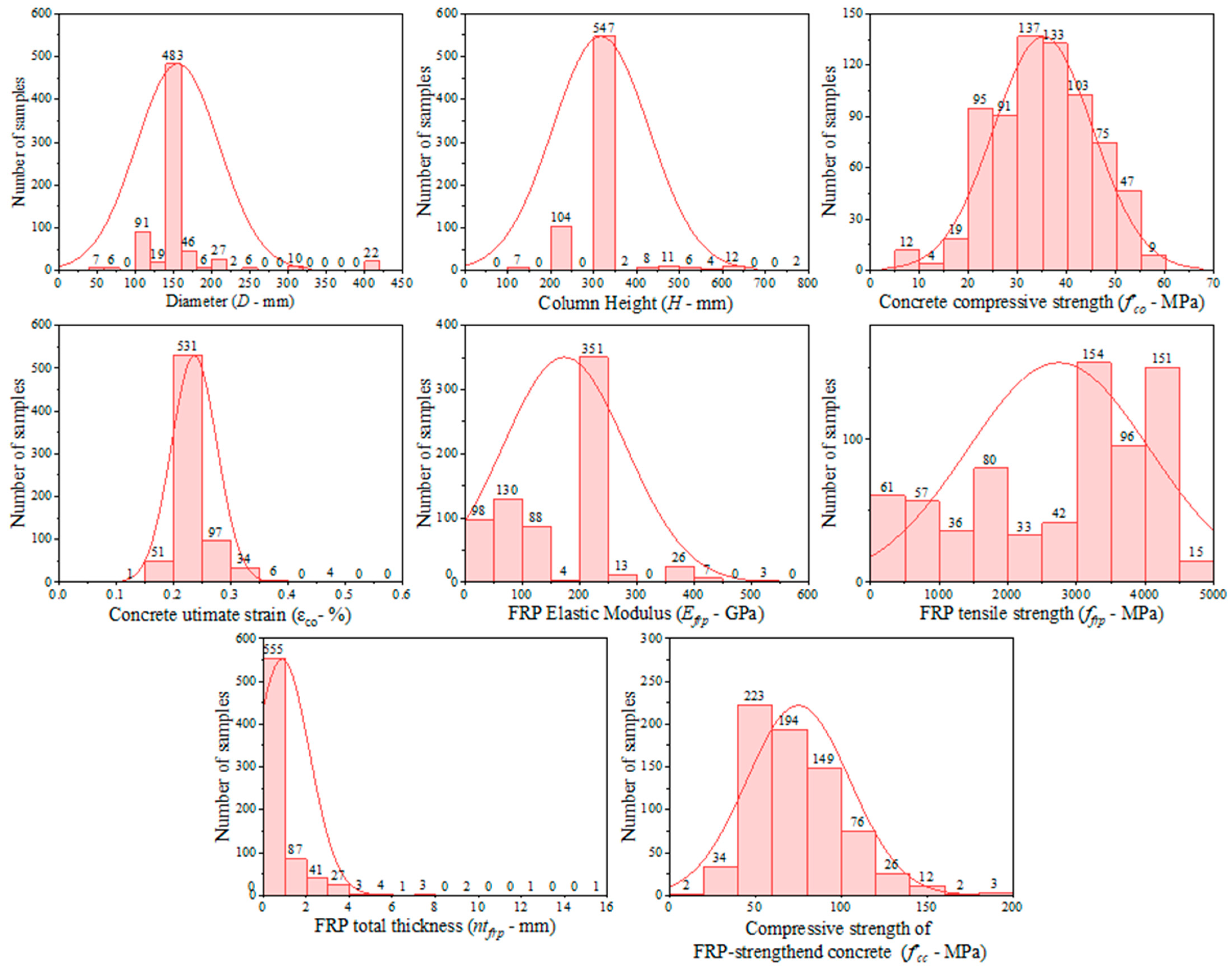
| Parameters | Symbol | Unit | Min | Max | Mean | Std. |
|---|---|---|---|---|---|---|
| Column diameter | mm | 50.0 | 406.4 | 155.8 | 54.48 | |
| Column height | mm | 100.0 | 812.8 | 316.8 | 112.66 | |
| Concrete compressive strength | MPa | 6.20 | 55.2 | 35.1 | 10.12 | |
| Ultimate concrete strain | (%) | 0.14 | 0.63 | 0.236 | 0.04 | |
| FRP elastic modulus | GPa | 4.9 | 640.0 | 173.0 | 107.61 | |
| FRP tensile strength | MPa | 75.0 | 4510 | 2745.8 | 1326.80 | |
| FRP total thickness | (mm) | 0.057 | 15.0 | 0.842 | 1.284 | |
| Compressive strength of FRP-SCC column | (MPa) | 17.8 | 275.9 | 74.7 | 30.07 |
| No. | Model | Number of Data Points | Metrics | |||
|---|---|---|---|---|---|---|
(%) | (MPa) | (MPa) | ||||
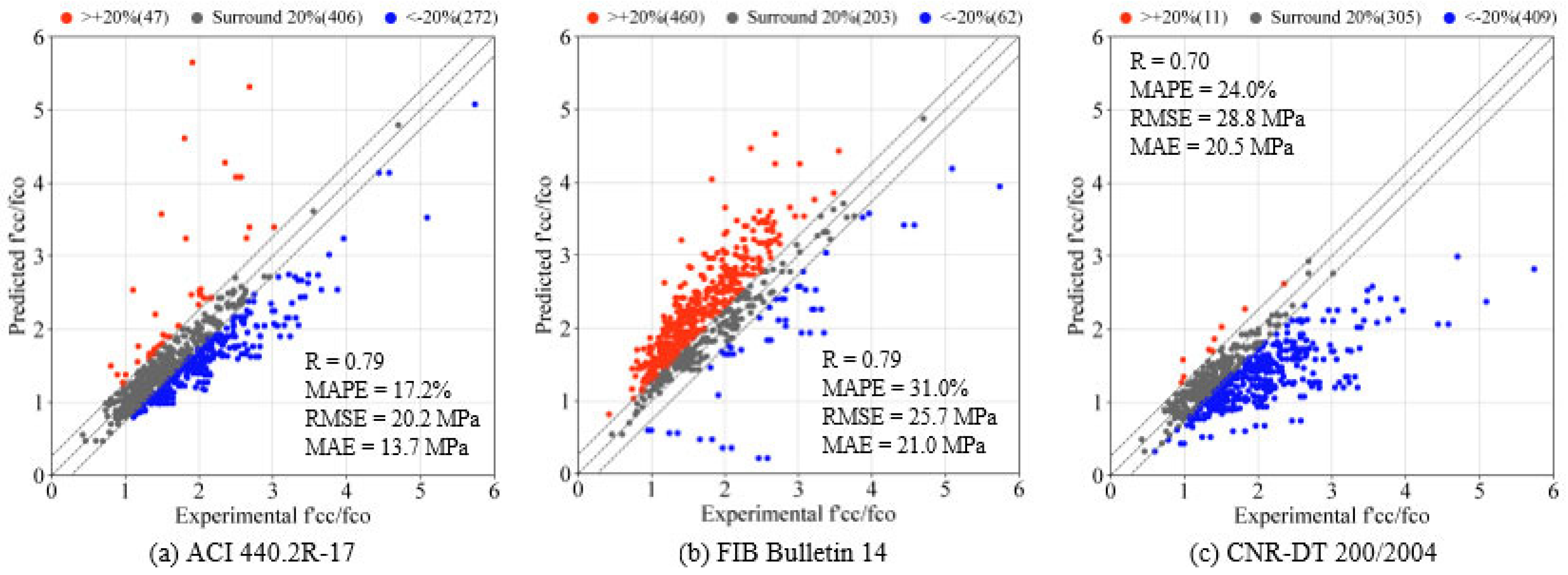
| 1 | ACI 440.2R-17 [18] | 725 | 0.79 | 17.2 | 20.2 | 13.7 |
| 2 | FIB Bulletin 14 [19] | 725 | 0.75 | 31.0 | 25.7 | 21.0 |
| 3 | CNR-DT 200/2004 [20] | 725 | 0.70 | 24.0 | 28.8 | 20.5 |
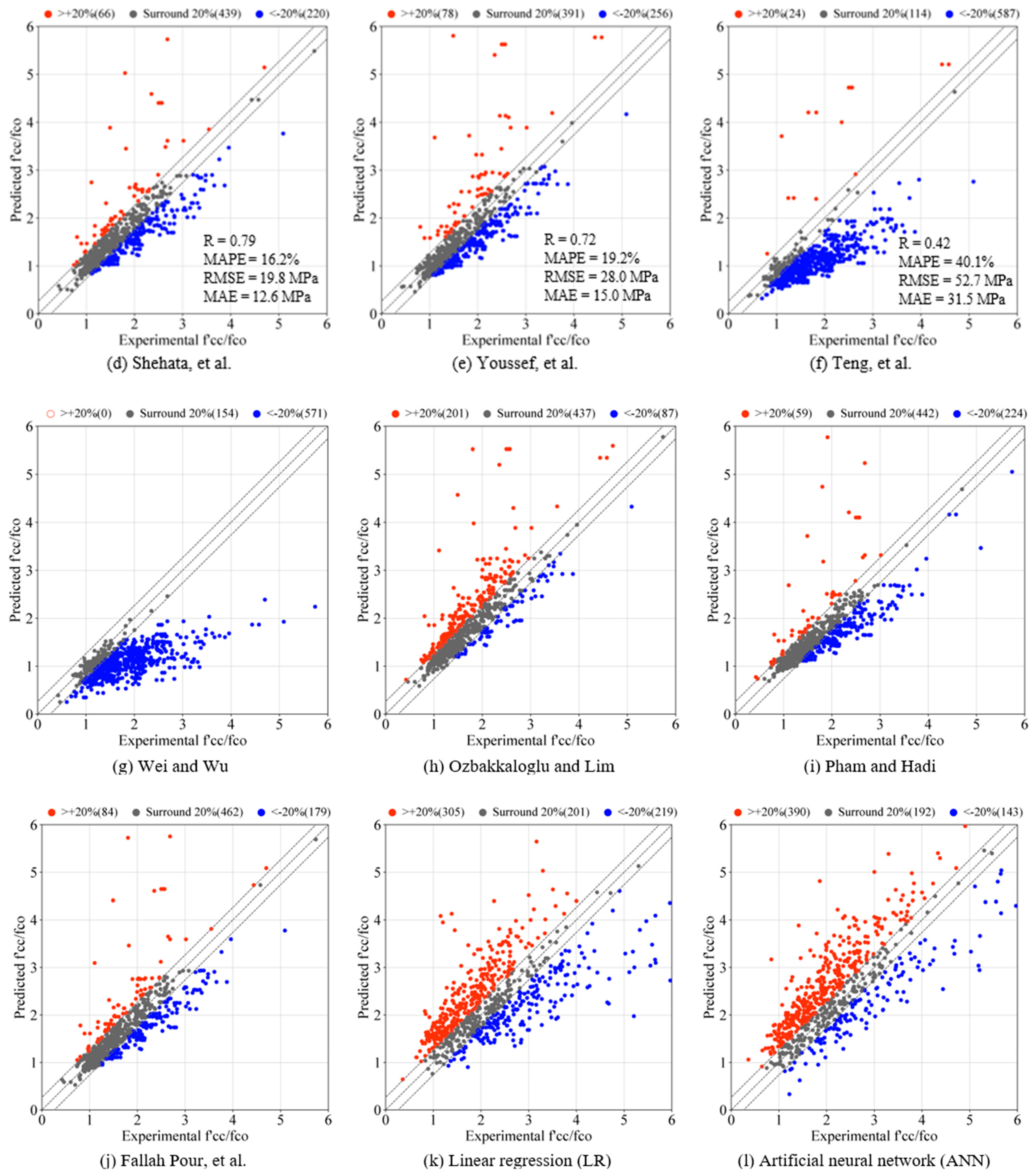
| 4 | Shehata et al. [57] | 725 | 0.79 | 16.2 | 19.8 | 12.6 |
| 5 | Youssef et al. [60] | 725 | 0.72 | 19.2 | 28.0 | 15.0 |
| 6 | Teng et al. [23] | 725 | 0.42 | 40.1 | 52.7 | 31.5 |
| 7 | Wei and Wu [59] | 725 | 0.67 | 35.3 | 37.4 | 29.4 |
| 8 | Ozbakkaloglu and Lim [21] | 725 | 0.80 | 17.6 | 21.5 | 12.7 |
| 9 | Pham and Hadi [58] | 725 | 0.79 | 15.7 | 19.4 | 12.5 |
| 10 | Fallah Pour et al. [61] | 725 | 0.78 | 15.7 | 20.2 | 12.0 |
| 11 | Linear regression model | 725 | 0.44 | 28.5 | 27.0 | 19.6 |
| 12 | ANN model | 725 | 0.71 | 28.8 | 23.2 | 18.7 |
| 13 | SVR model | 725 | 0.40 | 25.6 | 28.3 | 18.7 |
| 14 | M5Rules model | 725 | 0.81 | 16.1 | 17.5 | 11.8 |
| 15 | M5Rules-Tiering model | 725 | 0.82 | 16.0 | 16.5 | 11.5 |
| 16 | M5P model | 725 | 0.88 | 14.1 | 14.4 | 10.1 |
| 17 | M5P-Tiering model | 725 | 0.84 | 15.9 | 16.2 | 11.4 |
| 18 | Random tree model | 725 | 0.89 | 11.5 | 13.7 | 8.2 |
| 19 | Random Tree-Tiering model | 725 | 0.99 | 1.1 | 1.5 | 0.8 |
| 20 | Random forest model | 725 | 0.94 | 9.4 | 11.0 | 6.6 |
| 21 | Random Forest-Tiering model | 725 | 0.99 | 6.0 | 6.4 | 4.3 |
| 22 | RepTree model | 725 | 0.77 | 16.5 | 19.2 | 12.0 |
| 23 | RepTree-Tiering model | 725 | 0.76 | 16.4 | 17.2 | 11.6 |
Disclaimer/Publisher’s Note: The statements, opinions and data contained in all publications are solely those of the individual author(s) and contributor(s) and not of MDPI and/or the editor(s). MDPI and/or the editor(s) disclaim responsibility for any injury to people or property resulting from any ideas, methods, instructions or products referred to in the content. |
© 2026 by the authors. Licensee MDPI, Basel, Switzerland. This article is an open access article distributed under the terms and conditions of the Creative Commons Attribution (CC BY) license.
Share and Cite
Pham, A.D.; Truong, Q.C.; Nguyen, Q.T.; Nguyen, C.L.; Nguyen, T.T.N.; Mai, A.D. Integration of Machine Learning Models and Tiering Technique in Predicting the Compressive Strength of FRP-Strengthened Circular Concrete Columns. Buildings 2026, 16, 204. https://doi.org/10.3390/buildings16010204
Pham AD, Truong QC, Nguyen QT, Nguyen CL, Nguyen TTN, Mai AD. Integration of Machine Learning Models and Tiering Technique in Predicting the Compressive Strength of FRP-Strengthened Circular Concrete Columns. Buildings. 2026; 16(1):204. https://doi.org/10.3390/buildings16010204
Chicago/Turabian StylePham, Anh Duc, Quynh Chau Truong, Quang Trung Nguyen, Cong Luyen Nguyen, Thi Thao Nguyen Nguyen, and Anh Duc Mai. 2026. "Integration of Machine Learning Models and Tiering Technique in Predicting the Compressive Strength of FRP-Strengthened Circular Concrete Columns" Buildings 16, no. 1: 204. https://doi.org/10.3390/buildings16010204
APA StylePham, A. D., Truong, Q. C., Nguyen, Q. T., Nguyen, C. L., Nguyen, T. T. N., & Mai, A. D. (2026). Integration of Machine Learning Models and Tiering Technique in Predicting the Compressive Strength of FRP-Strengthened Circular Concrete Columns. Buildings, 16(1), 204. https://doi.org/10.3390/buildings16010204