1. Introduction and Literature Review
The pricing of buildings focused on cost estimation permeates all phases of a building’s life cycle, i.e., from design through construction, operation, renovation, and potential demolition [
1]. It is an increasingly demanding and sophisticated discipline, considering the dynamic market environment and the integration of new technologies into the construction industry. However, this does not change the fact that each investor or contracting company in construction wants to have full control over their costs so that they can plan and meet their goals. In general, the construction sector is one of the industries where costs are the most difficult issue to predict, due to the large number of factors that affect them and the uniqueness of a given building’s production (buildings, structures, etc.) [
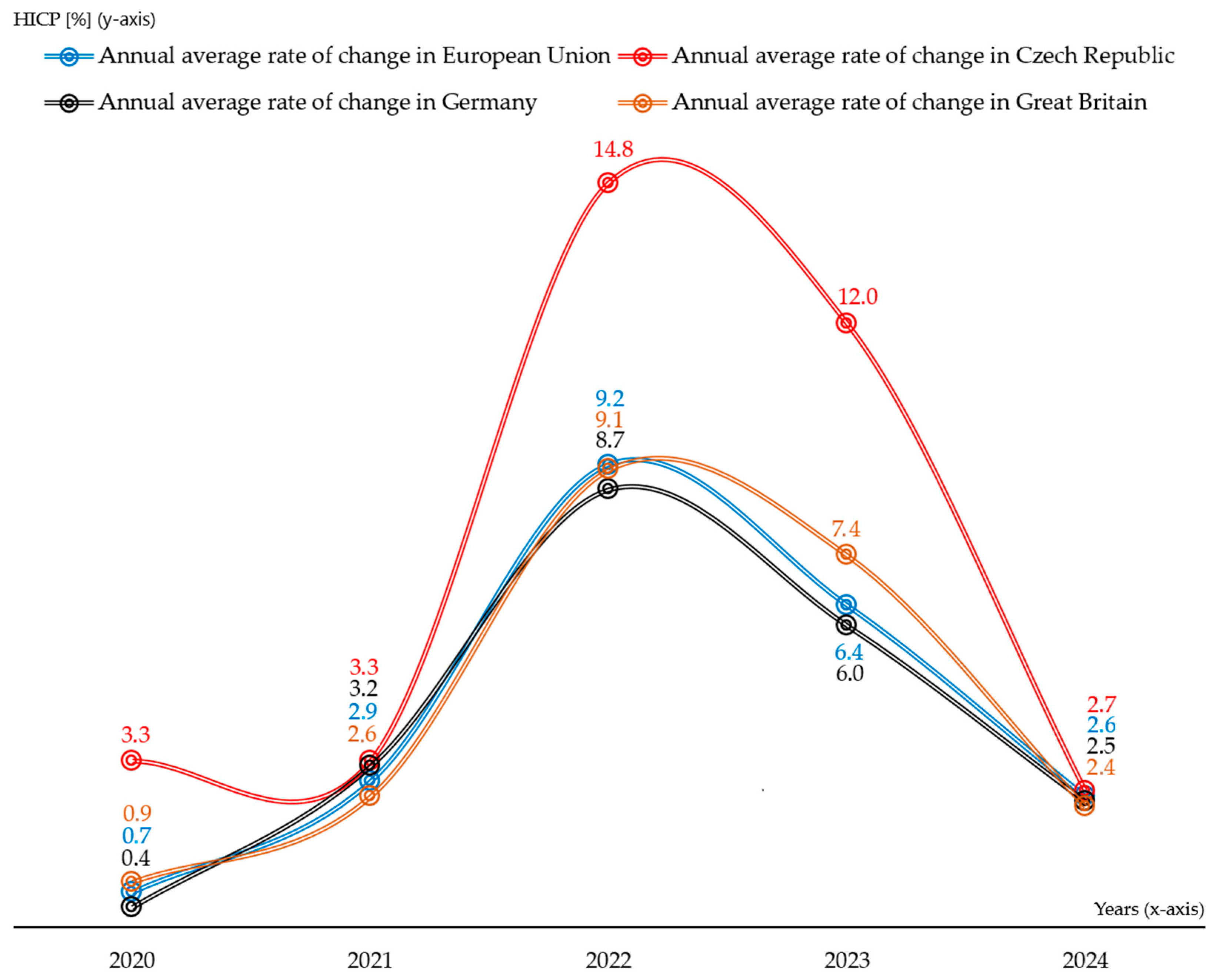
2]. For example, the monitoring and forecasting of development trends in key construction commodities has become quite difficult in recent years, whether due to the COVID-19 Pandemic or the return of war to part of the European continent. These events had a negative impact, particularly on inflation and the availability of materials, technology, and labour. The consequences are evident over time, e.g., in the Harmonized Index of Consumer Prices (HICP) compiled by the Statistical Office of the European Union (Eurostat).
Figure 1 shows the values of this index since 2020 for the European Union and selected countries. The health crisis caused by the COVID-19 Pandemic in 2020–2022 and the ongoing armed conflict in Ukraine since 2022 have led to a significant growth in the inflation rate. At the end of 2022, the average inflation rate in EU countries reached 9.2% [
3]. However, since 2023, there has been a gradual decline to the current value of 2.6% (the latest available value from 2024) [
3]. At the same time, materials and technologies focused on lower energy consumption or sustainability are increasingly affecting pricing issues, for which the necessary databases on acquisition, maintenance, and operating costs are still lacking [
4].
Like every sphere of activity, not only in industry, the building sector is undergoing a period of digitalization. The primary goal of digitalization undoubtedly aims at enhanced efficiency of selected processes and thereby achieving significant economic benefits. Within the conservative environment in the building industry, quick adoption and subsequent use of these modern methods can bring an undeniable competitive advantage [
5]. For this reason, this article focuses on the possibilities of applying the Building Information Management (BIM) method, specifically in relation to the preparation of cost estimates in the design phase of buildings on the European continent. Although the BIM area is not an entirely new concept [
6], the authors of this article focus on its current use in various approaches offered by the market environment for real construction projects.
1.1. Building Information Management
The BIM method probably represents the most significant technological boom in the construction industry in recent years and continues to be an innovative way of working with information and data, which in many countries still lacks the necessary legislative support and established standards [
7]. The BIM model representing the appearance of a building is a key factor for compiling a cost estimate. One of the essential requirements for the BIM model itself is the method of structuring graphic and non-graphic data and information (so-called attributes or properties), where the classification system and data standard in relation to the relevant pricing systems (cost databases of items for works, structures, and materials), which significantly affect the quality and method of cost estimation in individual countries, are of paramount importance [
8]. The classification provides a type of identifier for individual elements, enabling the targeted linking of the BIM model elements to the items in the pricing system [
9]. It often happens that the quantity surveyor must laboriously modify the data obtained from the BIM model using various algorithms and rules in order to transfer these data to specific items in the pricing system when creating cost estimates. The classification should significantly help to automate this process [
10]. The European classification systems suitable for use not only in BIM models based on international standards (especially ISO 19650 [
11]) include, for example, the Construction Classification International (CCI) and the Uniclass 2015 system [
12]. These classification systems are generally comprehensive in nature, using mutually independent tables (known as facets) to classify building components, built spaces, construction complexes, and higher-level complexes according to their purpose of use or functional category [
13]. The classification must comply with the applied data standard, which serves as a “cookbook” for the BIM model creators. It unambiguously defines which structures and works should have their graphical representation (element) in the BIM model, including the relevant attributes and graphic details. There are several data standards on the market, and they usually differ in terms of local customs and the end use of the data and information. Unfortunately, in many cases, there is no targeted link to pricing systems, which is why the authors of this article recommend the abovementioned classification system. The most well-known globally used open data standard for the exchange of information on buildings is the product by the buildingSMART organization called Industry Foundation Classes (IFC), which was also applied by the authors of this article [
14]. Another area mentioned is the graphical interpretation of elements. This issue is often associated with the Level of Development (LOD) method, which specifies the graphic detail of structures and works for different phases of building construction [
15]. From the perspective of compiling the relevant quantities of an element, this detail is essential in order for the outcome to correspond either to the system of calculating quantities in relation to the selected pricing system or to local customs.
As a rule, digitally advanced countries are constantly working on these standards and will continue to do so in the long term [
16]. The greatest “pressure” in this area of interest is probably on the use of BIM models to generate 2D drawings, which play a key role in building permit processes, on their use without supporting 2D documentation, e.g., in the building implementation phase, and, finally, on the use of BIM models for building management and maintenance.
1.2. Automation Possibilities for Working with BIM Models
In general, there are several approaches to obtaining data and information from a BIM model in conjunction with related professional software, suitable not only for cost estimation, but also, e.g., for Life Cycle Cost (LCC) or Life Cycle Assessment (LCA) calculations. De facto, there are three different levels of automation at a basic level. The first is zero interconnection, where data and information are “manually” transcribed from the BIM model to the relevant professional software. Next, semi-automation (representing probably the most widespread current solution) consists of data and information from the BIM model being exported to a spreadsheet format or another open format (e.g., XML) or transferred to the cloud and then imported (transferred) into professional software. The ultimate goal is the full automation of data and information transfer [
17]. This full automation requires absolute interconnection of data structures between the communicating entities (i.e., a BIM model and professional software), which is usually performed by a program add-on (so-called “data bridge”). In this context, the Application Programming Interface (API) technology is often mentioned, describing the interface of the respective software solutions for subsequent interaction [
18]. The authors of this article believe that this fully automated state, regardless of the technology used, will become commonly available for real-world everyday use in the areas studied in the medium term, approximately five years from now. However, more advanced digital technologies for working with data based on Business Intelligence are already being gradually applied in construction activities to create reports, analyses, and various other views of data, enabling sophisticated evaluation, for example, to compare costs from the design phase and final costs after construction. The future involvement of artificial intelligence (AI), as an ideal technology for working with various data inputs and adapting them to outputs, specifications, or standards [
19], is a matter of course. This article summarizes the current possibilities based on commercially available solutions and therefore does not consider various AI-based tools that are still in the pilot phase.
1.3. Cost Estimate
Cost estimates in the design phase of buildings are usually based on the application of corporate cost databases of investors and contractors or on pricing systems developed by engineering pricing companies [
20]. These companies compile a pricing system based on the information and data obtained from cooperating construction companies, developers, and building material manufacturers, etc., updating their outputs at regular intervals (e.g., twice a year or even monthly). However, the cost estimates obtained from these pricing systems are only indicative, usually for the investor in the design phase [
21]. However, more accurate cost estimates will naturally be achieved by individual bidding departments of implementing companies, which work with their contractors in real time. The cost estimate itself is usually represented in the form of a budget, which is typically structured according to the rules of relevant local standards and customs [
22]. In the context of the application of BIM models to determine cost estimates, these pricing systems are important “players” in increasing work efficiency through targeted automation. Thanks to a comprehensive and unambiguously defined format of items within a pricing system, it is easier to “search for” potential further links to the classification and data standard. In the case of corporate pricing databases, differences are usually associated with a specific company. Therefore, this article applies long-term, systematically maintained, and publicly available pricing systems from the Czech Republic (CR), Germany (DE), and the United Kingdom (UK). The authors of this article have selected these pricing systems from different parts of Europe primarily for their diversity and to facilitate the understanding of the presented outputs across the academic community.
In general, there are several scientific publications dealing with limitations in various parts of Europe, America, and Asia that hinder further development of issues related to BIM and pricing of buildings [
23,
24,
25]. One example is a publication by an Italian university, which lists three main reasons for the slow implementation of BIM at the national level. These are the lack of standards from the institutions responsible for the public sector, low demand for BIM models from investor organizations, and the high price of these “BIM services” [
26]. It can be said that a similar situation exists elsewhere in Europe. However, according to the authors of the article, this situation, where the construction sector is not the only one unable to cope with emerging trends, should not be used as an argument in professional discussions accompanying this digitization topic. On the other hand, there are not many professional articles presenting facts proving an increase in efficiency when applying the BIM method in relation to the pricing of buildings. One exception is research from Auburn University, where researchers report up to three times the time savings when using a BIM model for apartment buildings, compared to the traditional method of calculating the quantities of structures and compiling cost estimate items “manually” [
27]. The reported threefold time savings are very high and are associated with a certain degree of freedom in compiling construction budgets in the United States. However, even if the time savings were only half as much, this would still represent a significant shift in work efficiency (i.e., the goal of digitization) going forward.
1.4. Summary of Literature Review and Definition of Research Problems
Based on the literature review, several scientific issues emerged, which the authors address in this article. The professional focus is on the current use of BIM models in cost estimation for the design phase of apartment buildings constructed using various structural designs. Specifically, this article responds to the following questions:
What methods are used for working with data in relation to BIM models and cost estimates?
How labour-intensive (time-consuming) is it to compile a cost estimate using a BIM model?
What percentage of the total construction costs can be obtained through the BIM model?
What is the difference in prices in the construction industry between the Czech Republic, Germany, and the United Kingdom?
The authors conclude the introductory chapter by stating that, in their opinion, compared to other industrial sectors (e.g., mechanical engineering or electrical engineering), the construction industry is less active in its efforts to work with information and data in a modern and sophisticated manner (and not only when introducing new approaches to the cost estimation of buildings). Therefore, the authors believe that the findings of this article will contribute to further development of these issues and serve as a stimulus for further research.
2. Materials and Methods
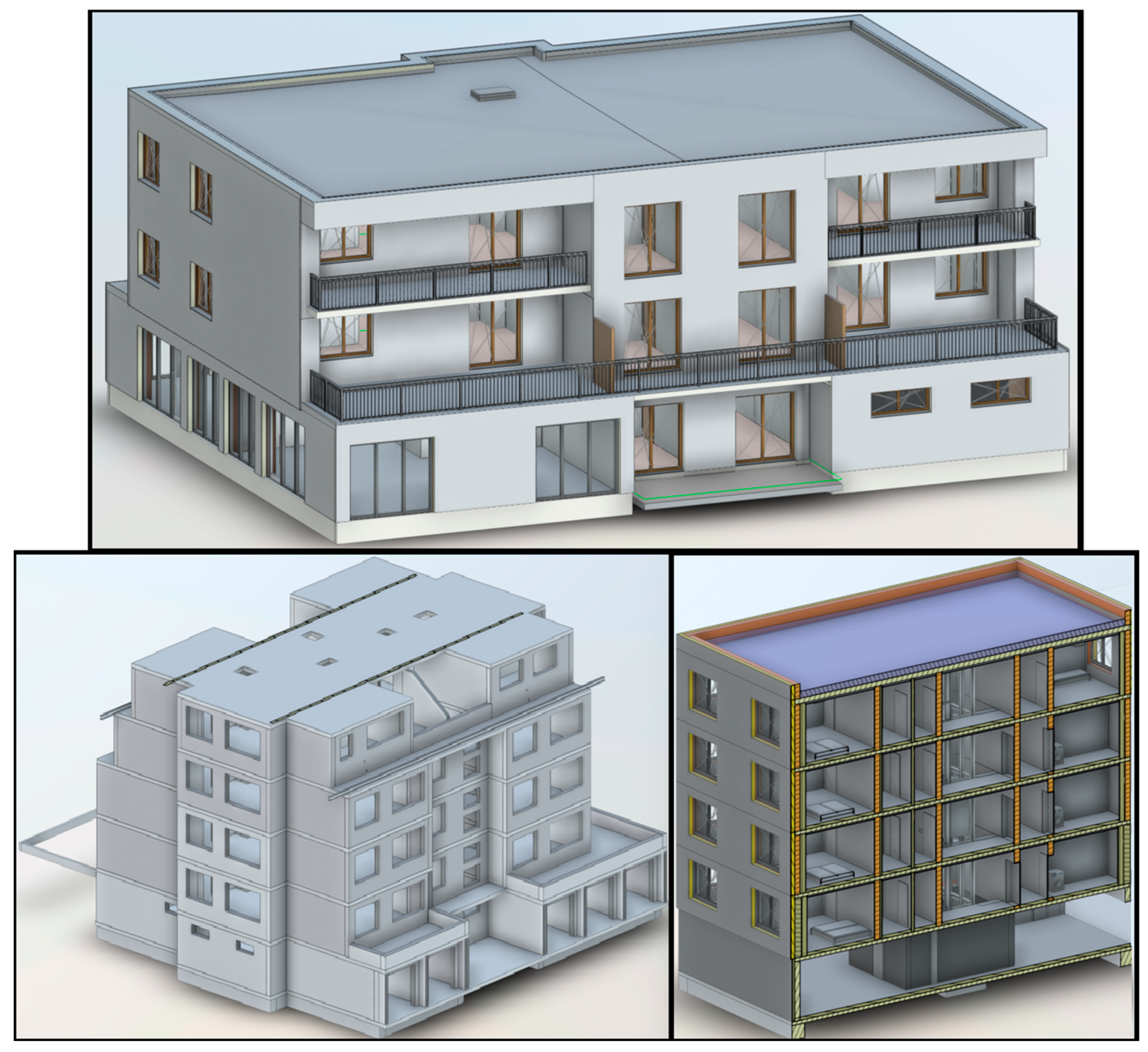
The BIM model was applied to compile cost estimates for three apartment buildings in their design phase at the level of documentation for the building permit process. The methods associated with “extracting” the BIM model are based on a previous literature review and a survey of engineering companies in the market environment. The methods themselves are based on varying degrees of using accompanying software tools or plug-ins. The investigated BIM models were uniformly compiled using the IFC version 4 standard with element modelling details at the LOD 300 level, supplemented by the CCI classification system. The native environment where BIM model data and information were created was the Autodesk Revit software (SW) version 2024.
Figure 2, below, shows the BIM models in question in the native SW. To estimate costs, pricing systems at the current price level for the second half of 2025 were used. These were the Czech URS version II/2025 [
28]; the German Baupreislexikon version from July 2025, Berlin [
29]; and the British Spon’s Architects’ and Builders’ Price Book version 2025 [
30].
The attributes according to IFC are applied to individual elements, primarily related to the identification, location, and material characteristics of structures and works. The basic reference BIM model (the so-called control model) selected is the structural design solution and the coordinate system based on it, including the reference point, which is combined with other professional models, divided into the following:
Building design solution (including building structures except for the structural part);
Sanitary engineering (water supply, sewerage, sanitary fixtures);
Heating;
Electrical installation (low-voltage, high-voltage);
Ventilation systems.
The actual method of work leading to the solution of the defined scientific problems is divided into several steps. The first step is to compile the specifications for the designers (creators) of BIM models. A basic overview of the requirements for modelling is provided above (i.e., IFC 4, CCI, and LOD 300), complemented by the use of software add-ons (plug-ins) in relation to the pricing of buildings (for more details, see
Section 2.3). Another important background material is, of course, the project documentation in the traditional 2D format for the apartment buildings in question, which the Faculty of Civil Engineering of the Czech Technical University in Prague has obtained from its commercial partners. The second step is to select BIM model designers through a public tender. Their outputs are later used for scientific and educational purposes without any problems with ownership and copyright. The quality of BIM models is subsequently checked by the faculty representatives and, once approved, they can be used to provide the outputs of the article.
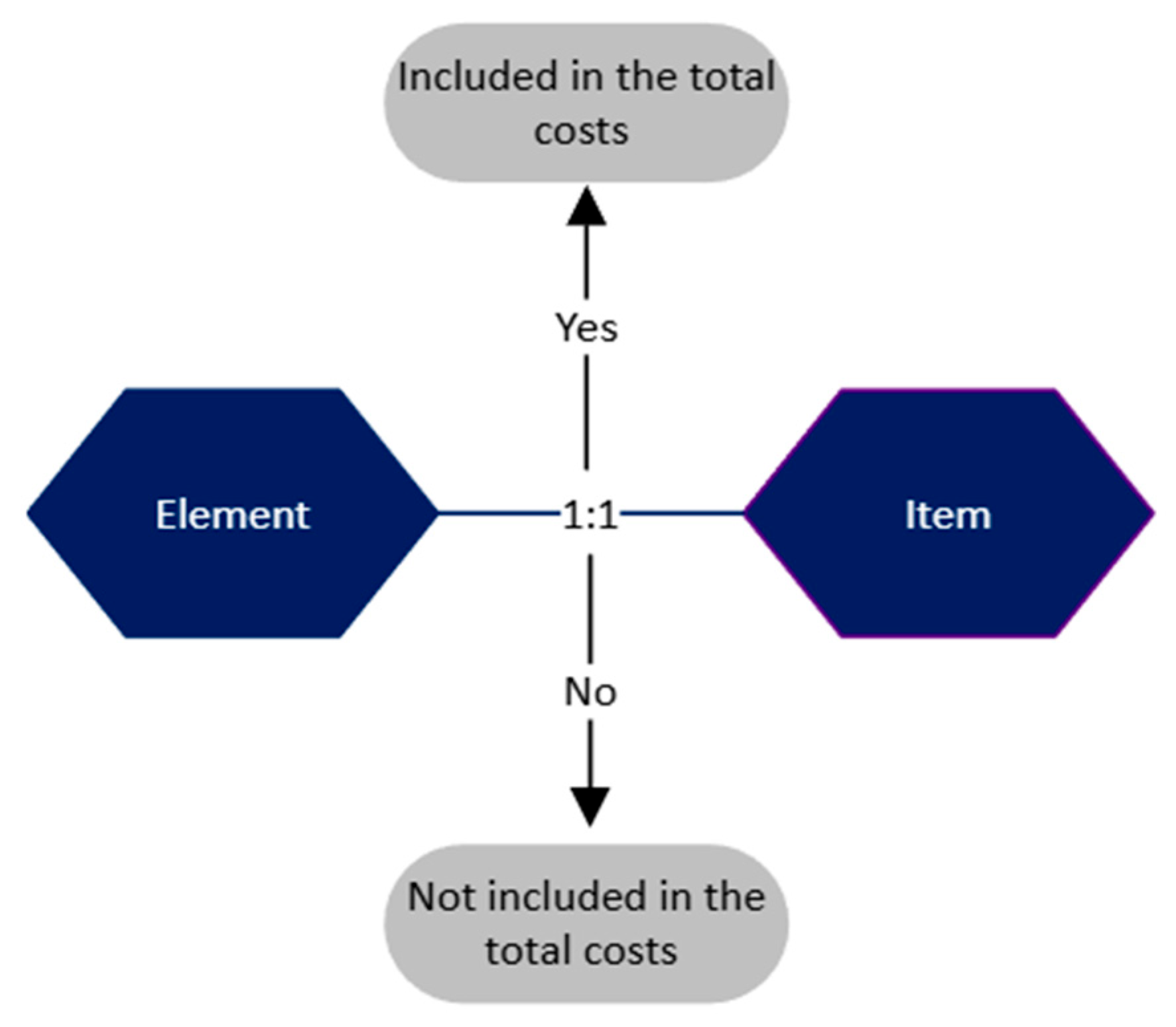
To formulate the conclusions of this article concerning the evaluation of the usability of the BIM model for cost estimation using pricing systems, the potential linking of an element with an item of the selected pricing system, including the transfer of the relevant quantity, is crucial. The evaluation principle is based on whether a 1:1 link (element–item) is feasible. If so, then the cost for that item is included in the total costs that can be obtained from the BIM model (e.g., using the methods for working with data and information from the BIM model described in
Section 2.2). Otherwise, if an element of the BIM model does not find its equivalent in an item in the pricing system, or the pricing system requires greater detail, the relevant cost cannot be included in the evaluation. A typical example is monolithic structures, where, according to the URS pricing system, the concrete structure, reinforcement, formwork, and supporting structures must be reported separately. Thus, only the modelled concrete structure is included in the evaluation of eligible costs (not reinforcement, formwork, and supporting structures, which usually do not have a graphical representation in the BIM model). The principle of incorporating costs into the evaluation is illustrated in
Figure 3.
The results of eligible costs are interpreted using a percentage expression of the total estimated costs, split into the relevant apartment buildings, cost groups, and pricing systems.
2.1. Parameters of Apartment Buildings
The selected apartment buildings represent current construction trends, including the construction technology and provision of heating, water heating, electrical installations, and forced air exchange systems. These are buildings with no or one underground storey (used for garages and cellars) and several above-ground storeys (used for apartments and common areas). The first building has a load-bearing structure made of wooden frames filled with sandwich insulation panels (hereinafter referred to as a “Wooden Building”). The second building has a monolithic concrete skeleton (hereinafter referred to as a “Monolith”). The last apartment building has a load-bearing structural system made of ceramic blocks (hereinafter referred to as a “Brickwork Building”). A supplementary basic overview is provided below in
Table 1.
The equipment of the apartments is of a similar standard across all apartment buildings, i.e., the plaster, fixtures and fittings, filling of openings (windows and doors), and flooring. The differences are mainly in the professional technologies used. Additional information on the amount of data and information included in BIM models is shown in
Table 2.
As can be seen from
Table 2, BIM models (focused on the structural and building design solutions), regardless of their different volume sizes and construction technologies used, have approximately the same number of element types and attributes (numerical differences of at most one-quarter). At the same time, it can be determined that, on average, each element has 19 assigned attributes (many attributes are repeated across elements, e.g., identification and location). However, there are significant differences in the number of elements, where volume plays a key role (across systems). On average, there are 0.8 elements per 1 m
3 of built-up space, or 2.4 per 1 m
2 of gross floor area.
2.2. Overview of Applied Methods for Data and Information Transfer from the BIM Model
The authors of this article apply four approaches for transferring data and information from the BIM model to the pricing software to compile cost estimates.
2.2.1. Pricing of Buildings Using a Spreadsheet Program
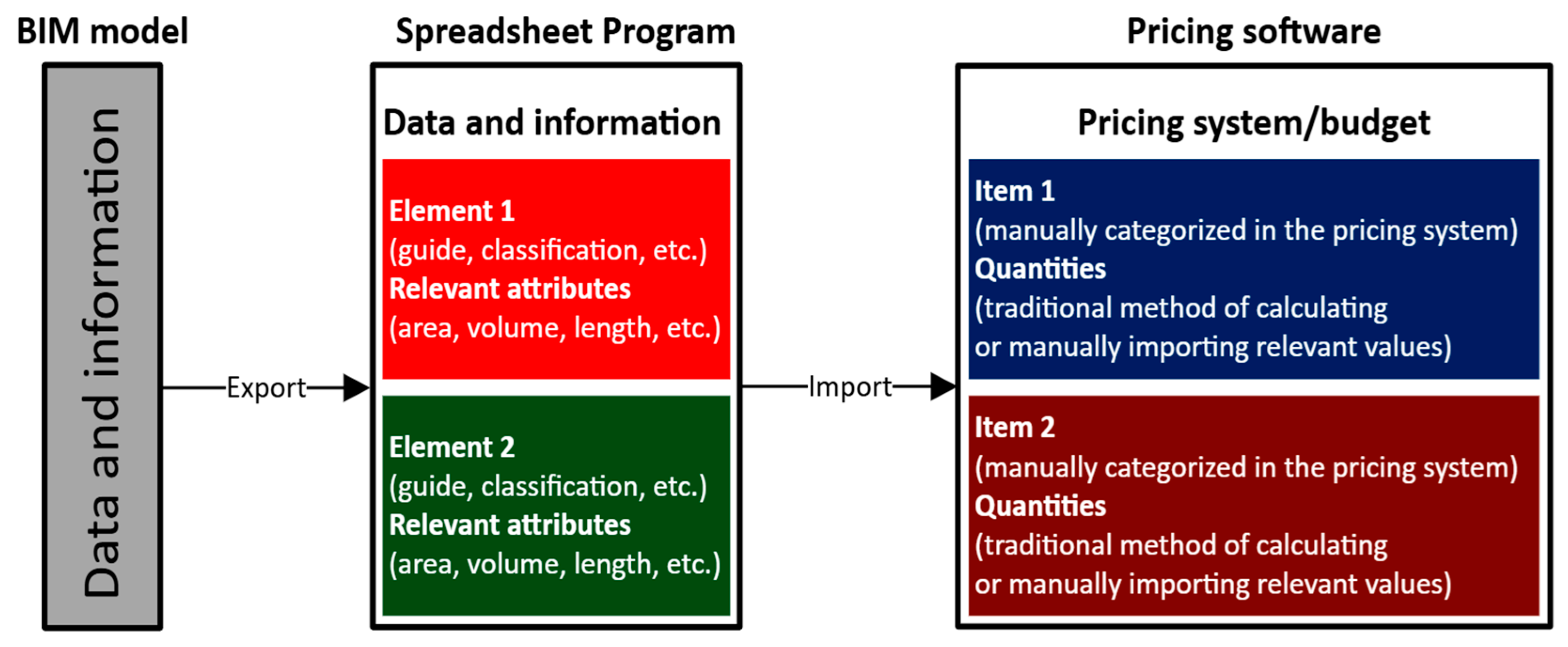
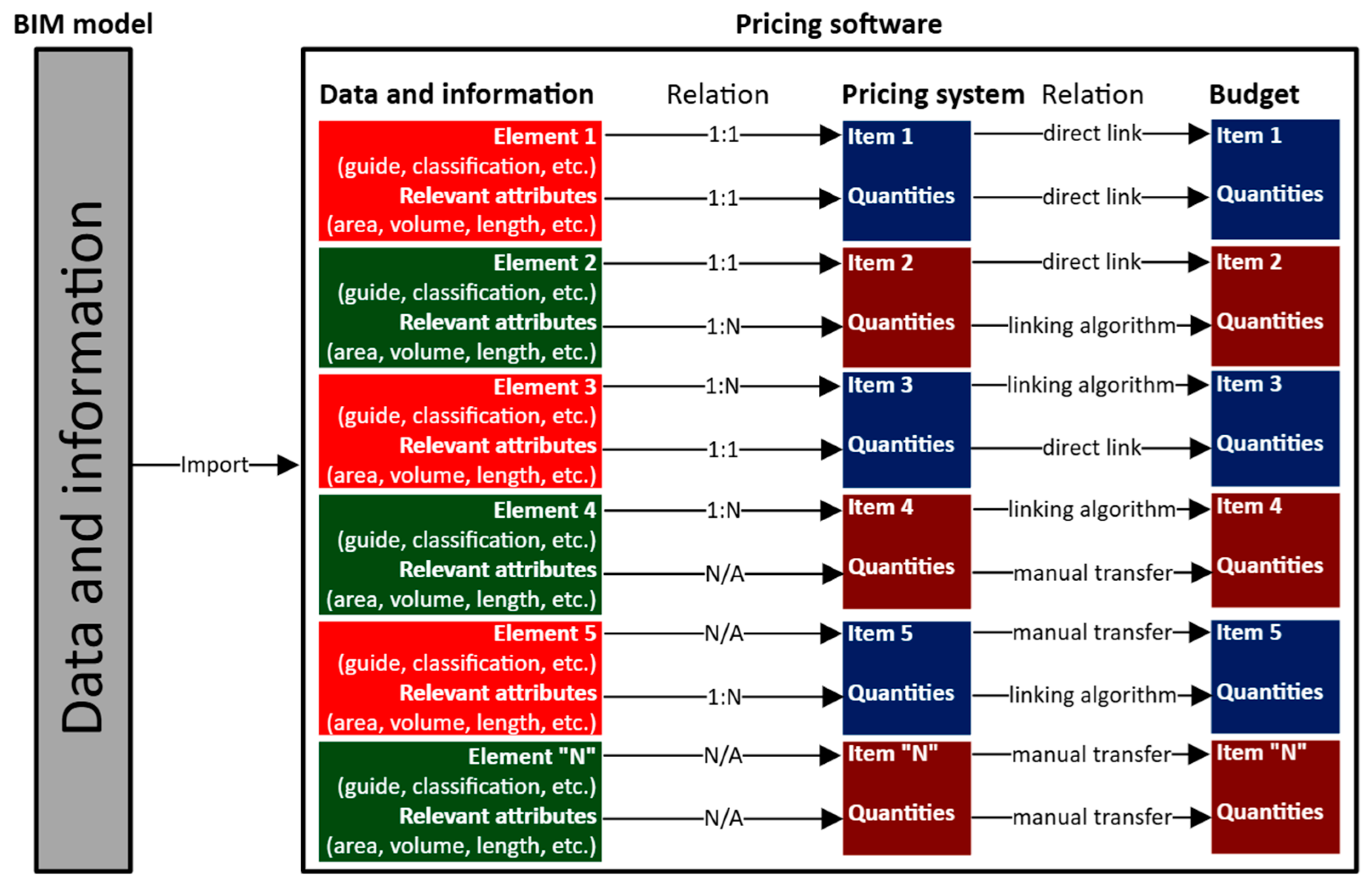
The method of pricing buildings using a spreadsheet program is currently one of the most used workflows because it does not require sophisticated software solutions. It uses outputs from the BIM model combined with the export of many individual elements (structures, materials, etc.), including their relevant attributes, into a spreadsheet format. After the necessary adjustments to the spreadsheet file (deleting excess rows and units of measurement, enabling column filtering, etc.), the data and information are imported into the pricing software, usually at the level of bills of quantities, with a link for clear identification of each element (guide or classification) with the relevant item in the pricing system. This process is illustrated graphically in
Figure 4.
A significant disadvantage of this method is that it involves many manual steps, which prolong the entire process of construction cost estimation. For this reason, many quantity surveyors try to create various import templates at the level of links and algorithms between the elements and items in the pricing systems, for example, using the classification mentioned above. On the other hand, the advantage of this solution is its versatility and independence from specific software tools. At the same time, the cost estimator usually has the option of choosing between a BIM model processed in a design program with native data and information or using the IFC format, which can be handled by a wide range of software solutions on the market.
2.2.2. Pricing Software with IFC Support
The second frequently used option is to load the BIM model in IFC format directly into the pricing program, where the quantity surveyor sets the rules and algorithms for the correct transfer of data and information to the items of the pricing system and bills of quantities. This process is illustrated graphically in
Figure 5, where the selected commercial solution is applied.
The advantage of this process is that if the BIM model creators have the same specifications in the form of a data standard (e.g., defined by IFC 2 × 3 or 4 options) and strictly adhere to its rules, then after the initial setup of rules and algorithms, the user can compile a so-called import template that can be applied to future construction projects. This leads to a significantly more efficient way of estimating costs. However, creating templates is time-consuming, and if the designer (model creator) does not adhere to the prescribed specifications, the import templates must be updated for each new building.
2.2.3. Pricing of Buildings in Design Software
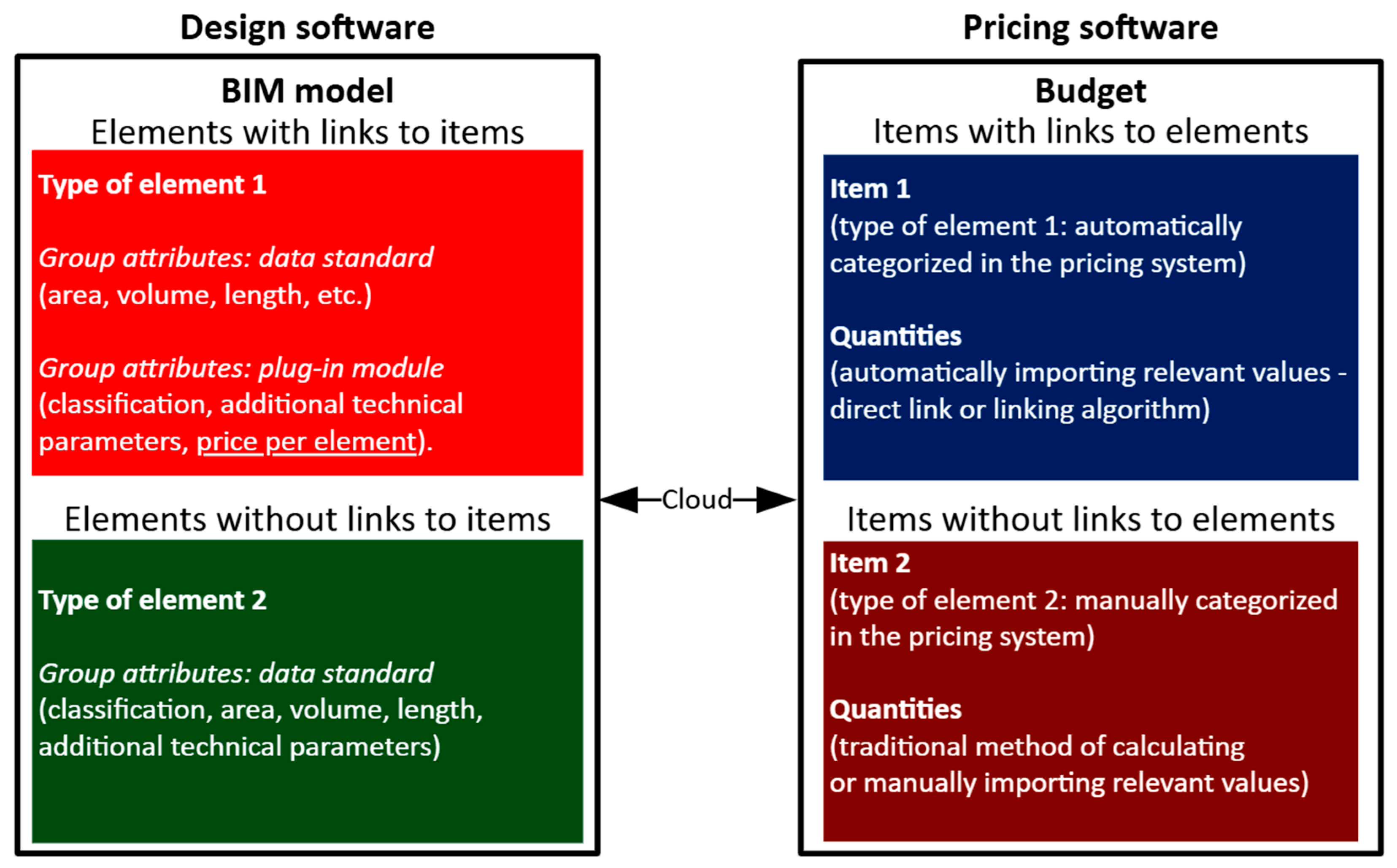
Another method is based on a plug-in module that allows items in the pricing system to be linked directly to elements in the design software. The BIM model creator must first classify the elements according to the relevant classification system and add non-graphic information so that a match with the relevant item in the pricing system can be found via the plug-in. The data from the design software are then transferred by the plug-in to the pricing software, which usually operates in a cloud environment. After loading the items and bills of quantities into the pricing software, the quantity surveyor adds non-demountable building structures and works (e.g., boreholes, landfill fees, etc.) to complete the cost estimate. This can be seen in
Figure 6, where the selected commercial solution is applied.
This proposed method of work has an additional advantage of complementing the detail of the used specifications to compile the BIM model with the data needed for the pricing of a building. On the other hand, filling in the necessary information is time-consuming for the model creator and, therefore, discouraging for a certain group of users. However, if the quantity surveyor or designer adapts to this method of work and, if necessary, supplements their construction libraries with the relevant non-graphic information, it is a very effective method of estimating costs.
2.2.4. Pricing of Buildings Using a Design/Construction Library
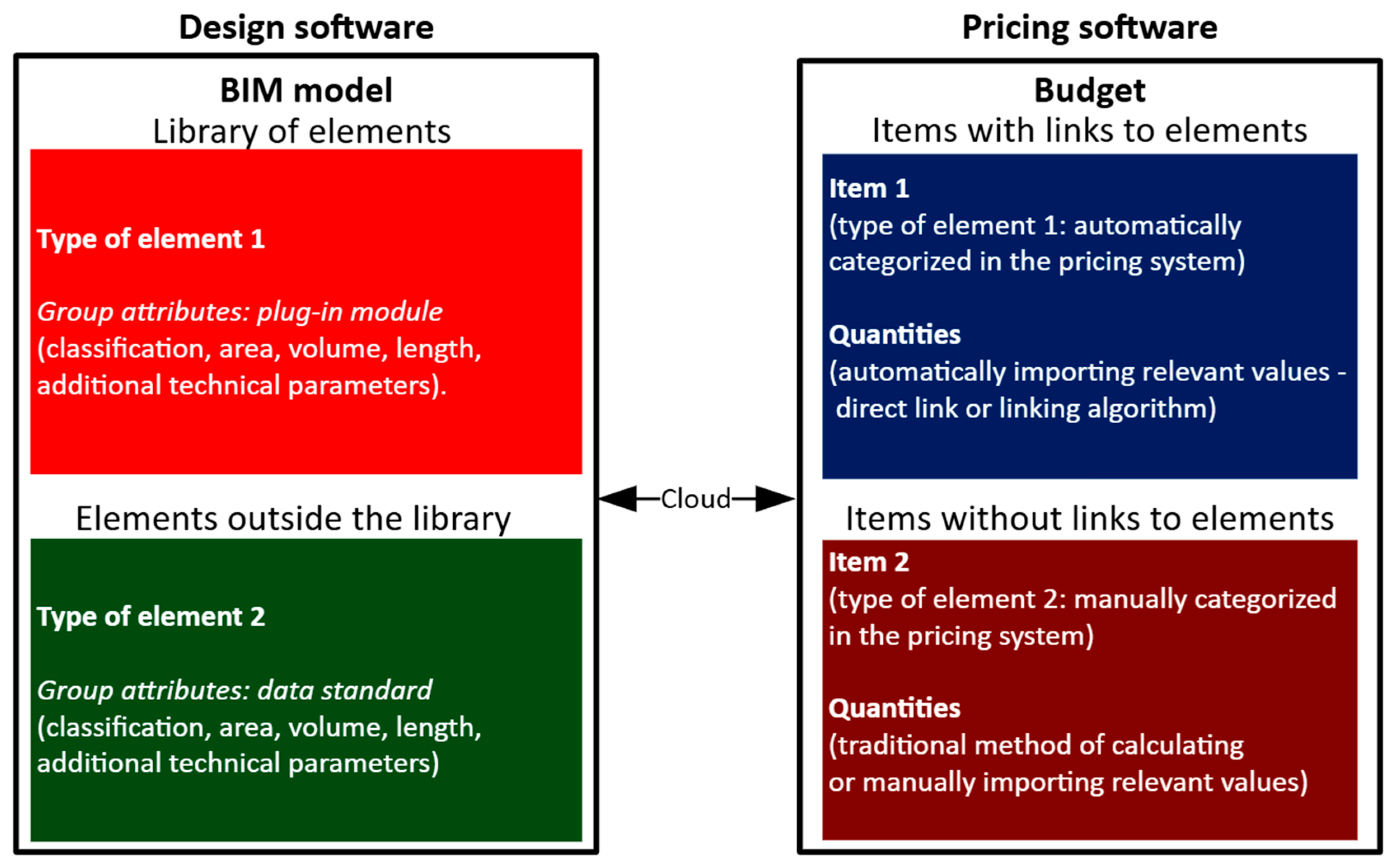
The last presented option is also based on a plug-in for design software, with the difference that the plug-in functions as a library of elements that the BIM model creator applies when modelling elements. After completing the entire BIM model or a part of it, the quantity surveyor/designer usually exports it in an IFC format to a cloud environment, which serves as an intermediary between individual software tools. After loading the BIM model into the cloud, as in the previous case (
Section 2.2.3), the data and information are transferred to the pricing software. Thanks to the use of library elements, the cost estimate is automatically compiled in the item structure of the respective pricing system, including the bill of quantities. This process is illustrated graphically in
Figure 7, where the selected commercial solution is applied.
As can be seen from the above description, the library is a key element. It must be sufficiently large to enable the assembly of the entire building or at least a greater part of it. At the same time, it must provide the BIM model creator with a certain degree of flexibility, for example, when modelling new elements with regard to the specific characteristics of the building while maintaining the required functionality (i.e., linking an element to a specific item in the pricing system), especially in the case of composite structures (e.g., floors, facades, etc.). In addition, the benefit of cloud connectivity is that, once the cost estimate has been completed in the pricing software, the BIM model can be displayed retrospectively in this environment, including the relevant prices. The disadvantage of this solution is the limited availability of structures in the library and, for selected structures and works, the inability to apply algorithms for SW calculations of quantities. This is typical of protective structures, scaffoldings, etc., where it is difficult to find a universal calculation formula. However, if the creator of the BIM model repeatedly uses similar structural solutions, this method of work is also very attractive in terms of efficiency.
2.3. Applied Cost Groups
The authors of this article have used pricing systems with a coherent system working on a long-term basis that allow for cost estimation. To be able to interpret and compare the presented outputs, cost groups are applied while respecting national customs and standards at a similar level of detail. The tables below (
Table 3,
Table 4 and
Table 5) briefly present the cost groups used for this article. In the second group (level), only the parts relevant to the construction of an apartment building are usually listed. According to the authors, the accompanying theory below is important for ensuring the context of the information presented in the article.
Table 3 shows two cost groups according to the Classification of Building Structures and Works (TSKP), which are used in the Czech URS pricing system. The TSKP structure classifies buildings according to the type of work and structure and does not group them according to their location, as is common in other countries of the European Union. For example, load-bearing walls and their surface finishes (plaster, paint) are divided into three groups (3 Vertical structures; 6 Surface working, floors, and installation of infills; and 78 Finishing works).
Two cost groups corresponding to the DIN 276:2018-12 (DIN 276) German standard are included in
Table 4 (second level of detail branched only for the parts 300 Building—building structures and 400 Building—building services). The DIN 276 standard interprets the outputs from the Baupreislexikon pricing system (LEXIKON), which itself classifies construction works and structures according to STLB-Bau in accordance with this standard. Unlike TSKP, DIN 276 groups individual structures and works according to functional units in relation to the building in question. This makes it much easier to separate the costs of selected structural units. For example, exterior masonry, including surface finishes, is classified in a single cost group, 330 Exterior masonry.
The cost groups (Group Elements) according to New Rules of Measurement Volume 2 (NRM2) from the Royal Institution of Chartered Surveyors (RICS) are commonly used in the United Kingdom.
Table 5 again shows two groups that represent the cost estimate structure (second level of detail branched only for the parts 1 Substructure; 2 Superstructure; 3 Internal finishes; 4 Fittings, furnishings and equipment; and 5 Services). The pricing system applied using NRM2 is the Spon’s Architects’ and Builders’ Price Book (SPON’S). NRM2 combines the costs of specific structures and works, similar to DIN 276, into one or two groups with minor differences. For example, the entire above-ground monolithic skeleton is part of group 2 Superstructure, but non-load-bearing elements (plaster, paint) are included in group 3 Internal finishes.
3. Results
The results of this research have been consecutively arranged as answers to the questions that arose from the literature review addressing the identified scientific problems (
Section 1.4). The authors of this article state that this is a very time-consuming case study involving several steps of working with various software tools and linking theoretical knowledge of the problems addressed. Nevertheless, the outputs presented provide a realistic picture of the use of modern technologies in the design of apartment buildings from the perspective of the scientific discipline of cost estimation.
The presented outputs solely include the cost estimates of the construction of the apartment buildings themselves, excluding the costs of ancillary structures (e.g., paved areas, water and sewer connections), land, construction site equipment, security, etc. The prices from individual pricing systems are converted to the common currency, the euro, at the European Central Bank exchange rate valid on 30 October 2025. Specifically, the following exchange rates are used: 1 EUR = 24.338 CZK and 1 GBP = 0.88070 EUR.
3.1. Summary of Methods Used for Cost Estimation
The possibilities for linking the BIM model and cost estimates are described in
Section 2.2. In this part, the authors of this article further complement the abovementioned chapter based on their experience.
The first method involves the transfer of data and information by exporting them from the BIM model to a spreadsheet program and subsequently importing them into the pricing software. The spreadsheet allows the obtained outputs to be systematically grouped according to individual structural elements, providing a clean environment for subsequent manipulation and analytic processes. This method is a universal solution independent of the specific design software and formats used (IFC or native), while also allowing for flexible editing and transformations of the outputs from the BIM model. However, the disadvantages are the numerous manual operations required, increased time consumption, and a higher risk of errors due to human intervention. Another method is to directly load the BIM model (IFC format) into the pricing software. The functionality of the software in question usually helps with setting the rules and templates for importing the data and information into specific items and quantities. Unfortunately, these import options are often limited if the item in the pricing system cannot be linked to the relevant representative in the BIM model, i.e., the corresponding element. In such cases, the work or structure must be manually entered into the budget as an item. In general, after some initial effort, this approach is an effective solution, especially if the settings can be transferred to other construction projects with minimal adjustments. The third method is to connect a plug-in for pricing in the design software, which provides immediate feedback on the cost estimate for the respective element. At the same time, it guides the designer on what non-graphic information the quantity surveyor needs for their work. Despite this, this method is more labour-intensive, as the additional information often exceeds the requirements of the data standard. In addition, many unmodelled structures or works must be subsequently added in the pricing software. Also, with this method, the settings for each type of element (in the case of the Atudesk Revit software, these are structures and works grouped according to Family–Type) must be linked to the requirements of the pricing system. The last described method is the use of design or construction libraries in design software, which leads to an almost complete linking between the items in the pricing system and the data and information from the BIM model. The creation of libraries linked to a selected pricing system is very laborious. Work efficiency is again conditional on adhering to a uniform specification system in more than one construction project and minimizing unique (new) structural compositions.
The first two methods mentioned, i.e., Pricing of Buildings Using a Spreadsheet Program and Pricing Software with IFC Support, can usually be used by the quantity surveyor independently after receiving the BIM models, without the assistance of their creator. At the same time, the quantity surveyor’s presence is not necessary during the actual designing (modelling) process. To apply the last-mentioned methods, i.e., Pricing of Buildings in Design Software and Pricing of Buildings Using a Design/Construction Library, the authors of this article needed to considerably assist the BIM model creators (especially in compiling the required parameters for new library elements) with linking elements to items, including determining the algorithms for calculating quantities. Therefore, without the knowledge of the relevant pricing systems, the design (modelling) using these methods cannot be performed. This professional activity of the authors is included in the evaluation of the overall labour intensity of the methods.
It should be emphasized that, apart from the method of Pricing of Buildings Using a Spreadsheet Program, the remaining three approaches are characterized by a direct linkage between elements of the BIM model and items within the pricing system. The differences among these methods lie mainly in the extent of integration, the timing of the connection, and the degree of automation achieved, rather than in fundamentally distinct conceptual strategies for associating design and cost data.
3.2. Labour Intensity of Compiling Cost Estimates from BIM Models
The conclusions regarding the labour intensity of individual options for working with data and information from the BIM model for compiling cost estimates are shown in
Table 6. Apart from the working method itself, labour intensity is affected by pricing systems and construction technologies. It should also be noted that the displayed values (
Table 6) represent the time required based on the actual work of the authors of this article, reflecting their many years of experience in this field.
The most effective working method for preparing a one-time cost estimate from BIM models is the Pricing of Buildings in Design Software method, regardless of the pricing system. This approach is closest to the traditional method of estimating construction costs from 2D documentation and does not use advanced automation features. In contrast, the most laborious method is the Pricing of Buildings Using a Design/Construction Library, which, along with the other methods (except for the first one), is affected by research limitations due to its non-replicability in other projects. For this most time-consuming method and the method of Pricing of Buildings in Design Software, the times needed to link the library elements or compile relevant parameters for the items in the pricing system, including supporting algorithms for calculating quantities, performed by the quantity surveyor (authors of this article) during its (element’s) creation, are also shown in brackets for each value. For example, out of a total of 121 h, 55 h were spent on the described linking. According to the authors of this article, these are relevant time data that must be included in the labour intensity assessment, because without this activity, these methods could not function to their fullest potential.
At the same time, the times shown across all methods include the labour involved in completing the cost estimate to 100% after the method has exhausted its possibilities (performed entirely “manually” by additional calculations). For example, this includes the costs of moving materials, follow-up, or various preparatory works and structures.
Table 6 also shows that the entirely “manual” method based on the traditional reading of quantities from 2D documentation (on average 139 h) is approximately 65% more time-consuming than the method of Pricing of Buildings Using a Spreadsheet Program (on average 84 h). Equivalently, the Pricing of Buildings Using a Spreadsheet Program method requires about 42% less time compared to the “manual” method. Even in the case of one-time use of the most labour-intensive method, i.e., Pricing of Buildings Using a Design/Construction Library (on average 130 h), the traditional method is still about 7% more labour-intensive. Both percentages are associated with outputs according to URS, as the most time-consuming option for the pricing system.
When determining labour intensity, minor differences in the approach of pricing systems to the pricing of buildings were also apparent (see
Section 3.4 for details). According to the measured values presented in
Table 6, these different approaches have an average time impact of up to 15% across the construction technologies and methods used.
3.3. Cost Estimates Achieved from the BIM Model
The cost estimate value obtained based on the data and information from the BIM model is expressed as a percentage that can be obtained from the model according to the pricing system used. Here, 100% of the costs represent the result of traditional pricing. The selected approach to pricing is described in the introduction to
Section 2, including a graphical representation (
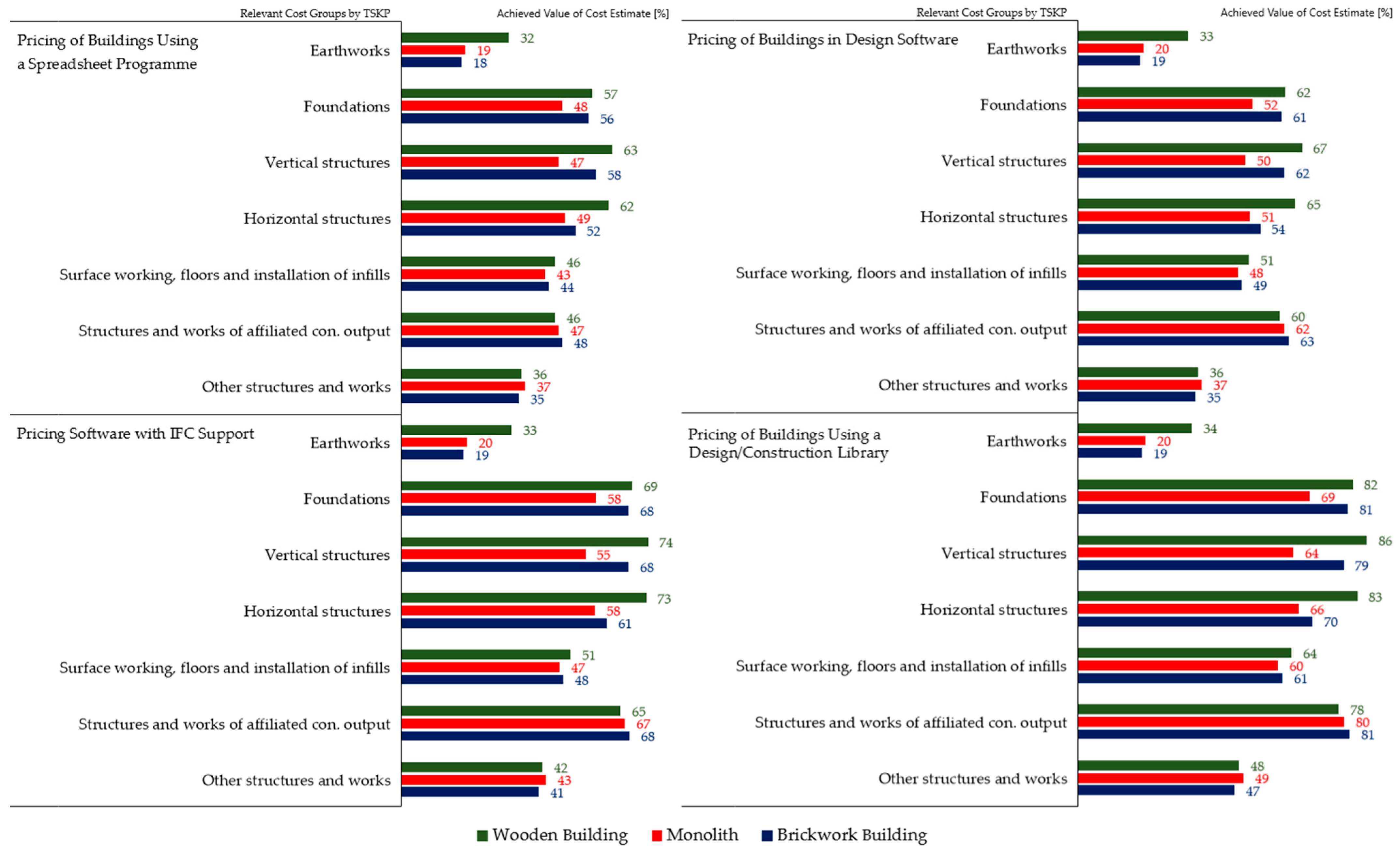
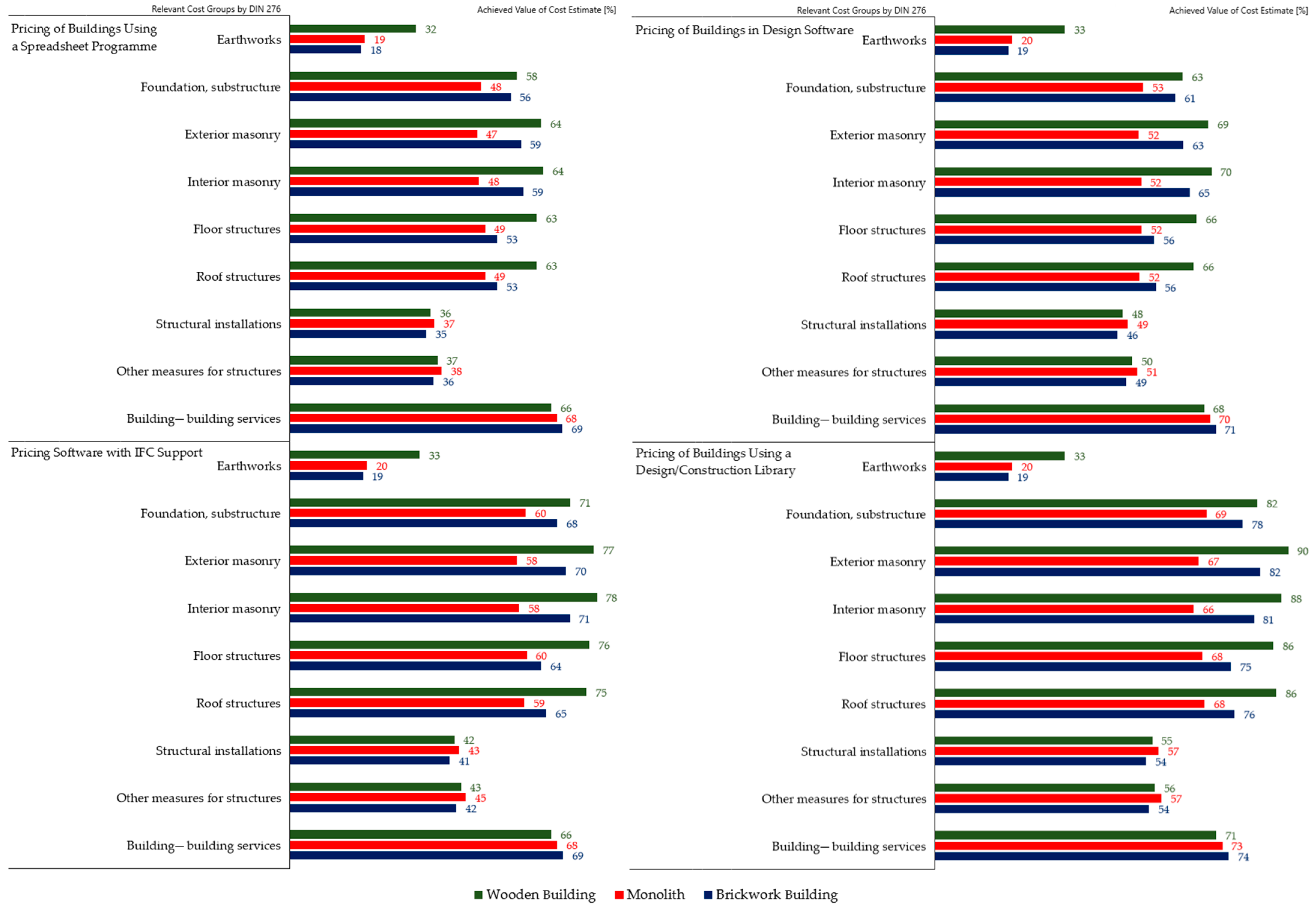
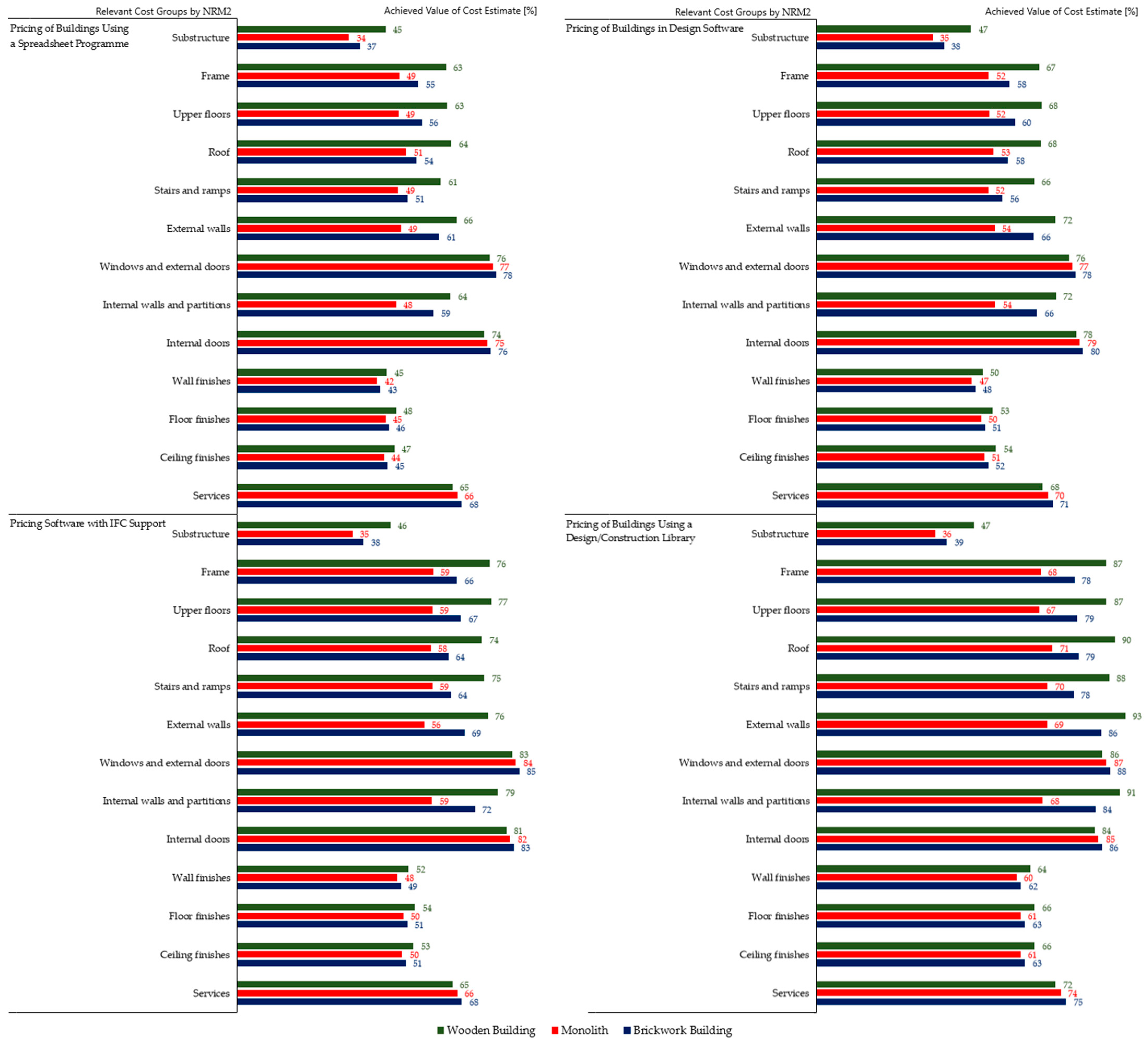
Figure 3). The evaluation, therefore, includes elements that can be linked to items in the pricing system. The results themselves are presented graphically in
Figure 8,
Figure 9 and
Figure 10, where the relevant cost groups (second level of detail, except for technologies and systems that are at the first level of detail: TSKP, 7 Structures and works of affiliated construction output; DIN 276, 400 Building—building services; and NRM2, 5 Services) are classified according to the construction technology and method of working with data and information used.
From the values in
Figure 8, it follows that in TSKP using the URS pricing system, the cost-significant groups 2 Foundations, 3 Vertical structures, and 4 Horizontal structures are detectable in the range of 47–83% when working with BIM model outputs. Conversely, the least detectable groups are 1 Earthworks and 9 Other structures and works, for which many structures and activities lack relevant elements in the BIM model. Professional works are grouped under 7 Structures and works of affiliated construction output, where the URS pricing system divides them into at least two items: execution (assembly) and building materials. These items often have different units of measurement and may be supplemented by various surcharges reflecting labour intensity or construction technology. Therefore, this group, 7, achieves much better results with the Pricing Software with IFC Support and Pricing of Buildings Using a Design/Construction Library methods, which also work with these related items when creating import rules or library elements.
Figure 9 shows the cost groups according to DIN 276, which reveal almost uniform cost estimate values (within 8%) for 330 External, 340 Internal masonry, 350 Floor, and 360 Roof structures across all methods. This shows that there is a variety of modelled structures and works in these groups in the BIM model. Professional works (400 Building—building services) also show good results. Unlike URS LEXIKON, assembly and material are combined into one item, which better corresponds to the outputs from the BIM model across the methods used. Earthworks in the construction pit group 310 again remain a weak link.
The outputs from
Figure 10 show balanced groups within 10% of the NRM2 cost estimate for 2.1 Frame, 2.2 Upper floors, 2.3 Roof, 2.4 Stairs and ramps, 2.5 External, and 2.7 Internal walls. The groups 2.6 Windows and external doors and 2.8 Internal doors, which contain point elements (windows, doors), have a significantly higher share. Professional works in the 5 Services section show reasonable results (like SPON’S, LEXIKON also works with service provision). The lack of earthworks in the BIM model reduces the achieved value of the 1.1 Substructure group, despite the fact that it includes modelled foundation structures.
3.4. Differences in Cost Estimates Between Pricing Systems
The last examined point is the difference between the pricing systems used. The authors have decided to assess this difference from two perspectives. The first is the detail of the items contained in the pricing databases, where it can be said that they are very similar, except for the professional works and the abundance of surcharges listed in the URS pricing system. All three pricing systems subdivide structures and works into detailed items regarding the technology, materials, and work procedures used, including the relevant unit of measurement to which the costs relate, accompanied by instructions on how to calculate the quantities. In the second perspective of costs of building structures and works, the pricing databases differ significantly.
Table 7 below presents these differences in cost estimates in a tabular format.
As shown in
Table 7, the highest cost estimate was achieved using the SPON’S pricing system, regardless of the construction technology used. The cost indicator further illustrates the cost differences in the built-up area. It is evident that the construction technology of the Wooden Building is the most expensive in the Czech Republic compared to its western neighbours. On the contrary, the Brickwork Building construction option is the cheapest in all cases.
3.5. Summarization of Results
To summarize the results achieved, the most efficient (in terms of time) method of working with data and information from BIM models that have different data specifications (i.e., suitable for one-time use) appears to be the Pricing of Buildings Using a Spreadsheet Program. This method can achieve cost estimates ranging from 50 to 65% of the total costs, always depending on the applied pricing system. In contrast, for long-term cooperation with BIM model creators, based on uniform specifications, the most advantageous method appears to be the Pricing of Buildings Using a Design/Construction Library, which allows 69 to 85% of the total costs to be achieved. The differences in pricing according to construction technology were only evident in the case of the Wooden Building, which, thanks to its “dry” production and a higher degree of prefabrication, achieved a better rating (by up to 17%) compared to the other variants.
Table 8, below, summarizes individual methods of working with the data and information, considering the overall estimated costs in percentages, which can be determined based on the BIM model with a distinction between the construction technology and the pricing system used.
The least represented cost groups in all BIM models are excavation works, which were usually not modelled. In contrast, the most prominent are usually end elements such as windows, doors, sanitary ware, prefabricated structures, or brick walls. In the case of monolithic concrete structures or assemblies (e.g., floors or perimeter walls), it is often not possible to link an element from the BIM model to a single item in the pricing system. There is usually a 1:N link (see the example of the Monolith according to URS in the previous text), where better results are achieved only by the Pricing Software with IFC Support and Pricing of Buildings Using a Design/Construction Library methods. Furthermore, BIM models are not yet able to cope with auxiliary structures such as scaffoldings, safety nets, or boreholes, which usually do not have their “supporting” element in the BIM model that would allow them to be linked to the relevant items. Therefore, achieving a 100% cost estimate based on the data from the BIM model is still a long way off. However, in selected cases, the data and information obtained reach almost 90%.
Labour intensity, as another output of the article, compares the time demands of individual methods for weighted cost estimation. Apart from the methods themselves, the key component appears to be the detail of the pricing systems at the level of building structures and works items. The German LEXIKON is evaluated as the most time-efficient pricing system for transferring data and information from the BIM model to items. This is primarily due to its ability to combine building structures and works into a single item and then into one group according to DIN 276. For the final interpretation of the outputs listed in
Table 6, the average of the values entered for individual methods is used, not considering the pricing system and technology of construction. The fastest method of working with data and information from the BIM model is assigned a coefficient of 1.0 (Pricing of Buildings Using a Spreadsheet Program). The other methods are subsequently assigned the following coefficients: Pricing Software with IFC Support—1.21 (i.e., it is 21% more labour-intensive); Pricing of Buildings in Design Software—1.47; and Pricing of Buildings Using a Design/Construction Library—1.56.
Finally, there are differences in pricing systems in individual countries. The lowest cost estimates are achieved in the Czech Republic, regardless of construction technology, where the average values are 30% lower than in Great Britain and 24% lower than in Germany.
4. Conclusions
This article focuses on the current topic of using data from BIM models to estimate costs in the design phase of three apartment buildings with different construction technologies based on various methods available in practice for working with data. These selected buildings and technologies are representative of many projects involving similar types of buildings and, in the authors’ view, reflect typical building archetypes across European Union countries. While each of the three countries has its own preferences for residential housing (such as common apartment layouts and construction methods), the analysed apartment buildings clearly fall within these categories. Therefore, according to the authors, the requirement for widespread use of the reported outputs is clearly met.
The digitalization of the selected construction sector is an obvious choice, as it de facto involves working with two databases (BIM model and pricing system). In addition, the “manual” creation of bills of quantities and searching for relevant items in pricing software applications is extremely labour-intensive, as anyone who has gone through this process can certainly confirm. According to the authors of this article, who have been addressing this topic for a long time, the “extraction” of data from BIM models for making cost estimates is improving, primarily due to the development of various software add-ons and the stabilization of specifications (data standards and classification) in the construction markets. The outputs of the article are related to apartment buildings with a built-up space of 3600 to 5300 m3, as selected representatives of the current situation on the construction market, with estimated costs ranging from EUR 1.8 to 2.5 million according to the URS pricing system in the Czech Republic.
The most efficient method for one-time use when compiling a cost estimate from the BIM model is the Pricing of Buildings Using a Spreadsheet Program. The actual compilation of the cost estimate took the least time, e.g., 69 h for the Wooden Building, and the “extractability” of data from the BIM model was around 65% of the total costs in the LEXIKON pricing system. On the other hand, the most time-consuming method is to determine the weighted estimate using the Pricing of Buildings Using a Design/Construction Library method. For example, it takes 151 h for the Monolith project, where high BIM model “extractability” is achieved, i.e., 69% of total costs when using the URS pricing system. This method has the greatest potential to raise long-term efficiency, provided that the construction technologies used and the specifications for the BIM model are standardized. At the same time, any method applied for working with the BIM model was more time-efficient than the fully “manual” traditional method, which took 118 h for the smallest apartment building (Wooden Building) using the SPON’S pricing system, i.e., 71% more time compared to the method of Pricing of Buildings Using a Spreadsheet Program, which took 69 h. Equivalently, the Pricing of Buildings Using a Spreadsheet Program method requires about 42% less time than the “manual” method. The overall increase in efficiency when using the BIM model is conditioned on the abovementioned standardization, especially at the level of the data standards used, classifications, LODs (according to the authors, the graphic level 300 applied in the article is sufficient for cost estimation), construction technology processes, and adjustments to pricing systems at the level of items representing the priced structures and works (especially for URS), so that the items better correspond to the capabilities of design programs from multinational corporations, which generally do not correspond to local pricing practices.
The differences between the selected pricing systems from the three countries are certainly seen in prices and, in selected cases, also in the detail of the items. The lowest cost estimates were achieved when applying the URS pricing system from the Czech Republic, where the total cost estimate for the most common construction method of apartment buildings in Central Europe, i.e., the Monolith building, was EUR 2.5 million. On the contrary, the highest cost estimate for the Monolith is from Great Britain using the SPON’S pricing system, with a value of EUR 3.7 million, i.e., 48% more than in the Czech Republic. In Germany, the cost estimate for the Monolith building was EUR 3.4 million according to the LEXIKON pricing system, which is 36% higher than in the Czech Republic and 8% lower than in Great Britain. At the same time, the Wooden Building was the most expensive in the Czech Republic, compared to the other countries, probably due to the lack of tradition and unresolved support in national legislation. The cheapest option across all countries was the Brickwork Building. The inclusion of items used in relation to structures and works is quite similar in the respective pricing systems, including a sufficient number of items in the constantly developing sector of wooden buildings. The exceptions are surcharges, assemblies, and materials, for which the URS pricing system has separate items, which do not contribute to the applicability of the data and information from the BIM model. The German LEXIKON was evaluated as the most efficient pricing system for the investigated issues, achieving the lowest labour intensity and highest values when “extracting” the BIM model itself (just ahead of British SPON’S).
Compared to the literature review in the Introduction, the outputs of this article present specific, broadly applicable, current possibilities. Based on their research and long-term interest in the subject, the authors see the scientific novelty of the published article, namely in the following points:
Identification and application of methods for working with data and information from BIM models for cost estimation purposes;
Setting limits for the use of BIM models for cost estimation;
Specific quantification of the cost estimate values that can be obtained from the BIM model;
Specific quantification of labour intensity when compiling cost estimates from BIM models;
Recommendations for higher “extractability” of data and information from the BIM model for cost estimation;
Comparison of the pricing systems and cost groups used in the Czech Republic, Germany, and Great Britain.
As stated in the literature review, there are few articles that address the application of individual methods for cost estimation from a BIM model with this level of precision. Typically, the Pricing of Buildings Using a Spreadsheet Program method is applied, and cost estimation for building construction ranges from 50% to 70% across various pricing systems [
38,
39,
40]. These values correspond to the conclusions presented in this article. Higher cost estimates using this method (Pricing of Buildings Using a Spreadsheet Program) are likely only when significant emphasis is placed on cost estimation during the modelling process itself. This is very time-consuming and not entirely common in construction practice.
The authors see potential limitations to their presented outputs, particularly in the selection of the data standard, construction technologies, pricing systems, methods for working with data from BIM models, and the execution of the study by only one working group. There are certainly other possibilities and combinations of the above areas that could increase work efficiency, such as the AI-based tools mentioned in the Introduction, which undeniably represent the future, or the upcoming research of the authors of this article. Nevertheless, they have selected what is currently widely available on the international market and has already found widespread use in today’s practice. At the same time, the findings presented regarding the quality of BIM models, the methods used for cost estimation, and pricing systems are sufficiently general for application across various construction sectors.