Systematic Review

Integrating LCA with BIM-Based Technologies in the Building Construction Context: A Review

by
Paola Maria Albanese
,
Cristina Baglivo
* and
Paolo Maria Congedo
Department of Engineering for Innovation, University of Salento, 73100 Lecce, Italy
*
Author to whom correspondence should be addressed.
Buildings 2026, 16(1), 168; https://doi.org/10.3390/buildings16010168 (registering DOI)
Submission received: 9 September 2025 / Revised: 9 December 2025 / Accepted: 23 December 2025 / Published: 30 December 2025
(This article belongs to the Section Construction Management, and Computers & Digitization)

Abstract

In a context in which the construction sector is significantly contributing to environmental degradation, LCA (Life Cycle Assessment) is a fundamental tool for analyzing the impact of materials and processes. This systematic literature review highlights the potential of integrating Building Information Modeling (BIM) with LCA to encourage sustainable practices in the construction sector. To this end, a systematic search was conducted in the Scopus and Web of Science (WoS) databases and, after a rigorous selection process, 65 peer-reviewed studies were chosen from an initial pool of 817 records for final analysis. The quantitative analysis of the 65 studies revealed a well-defined technological landscape, demonstrating that BIM–LCA integration can enhance decision-making. The main findings reveal that Autodesk Revit is the prevailing BIM authoring tool, used in 77% of the cases analyzed, establishing itself as the de facto standard for sustainability assessments. Regarding environmental data, the Ecoinvent database was the most cited Life Cycle Inventory (LCI) source, employed in 32% of the selected articles. This review highlights critical issues that hinder its adoption, including interoperability problems with software, a lack of standardized data, and high implementation costs. It is therefore necessary to overcome these barriers to fully exploit this approach and contribute to global sustainability goals, such as reducing CO2 emissions and waste in the construction sector.

1. Introduction

The construction sector plays a key role in sustainable development. Although it is one of the main causes of environmental pollution, it offers extraordinary opportunities for change and innovation [1,2]. In the European Union (EU), buildings account for 40% of the total final energy consumption and emit 36% of the total greenhouse gases (GHGs) [3], making the built environment one of the principal contributors to climate change [4]. In particular, the construction sector, as a whole, is responsible for approximately 50% of the total energy consumed on an annual basis and generates more than one-third of the EU waste [5]; among these, over 50% of the waste generated can be attributed to end-of-life (EOL) operations, predominantly related to demolition activities [6]. Even though the quantity of waste generated is considerable, only approximately 30% of construction materials are successfully recycled or reused [7].
In this context, Life Cycle Assessment (LCA) has emerged as a great tool for evaluating and reducing the environmental impact of buildings [8]. Defined by the International Organization for Standardization (ISO) in its ISO 14044 guidelines [9], LCA provides a systematic approach to assessing the environmental impacts of a product, system, or service throughout its life cycle [6]. This involves the extraction of raw materials, their processing, the manufacture of building components, the construction of the building, the utilization of the building, and its ultimate disposal [10], thus providing a valuable opportunity to perform a comprehensive assessment of the trade-offs and to enhance the decision-making procedures concerning sustainability [11,12]. LCA can identify the critical points in the life cycle, enabling the implementation of effective mitigation actions at the optimal time [13].
The significance of LCA can be appreciated when examining the construction and demolition waste (CDW) generated from end-of-life actions [4]. The reuse of construction materials from demolition presents a significant challenge [14], considering that the effective management of construction and demolition waste is fundamental to reduce its environmental impact [15]. Even though recycling presents numerous benefits, the rate at which construction materials are recycled remains low [16]. One of the key reasons for this is the complexity of sorting and processing mixed demolition waste [17]. Improving this procedure could significantly reduce the industry’s dependency on primary resources and its overall environmental footprint, encouraging a more circular approach to material use [18].
It is therefore possible to achieve significant results in terms of global sustainability initiatives, particularly in the area of energy efficiency, by focusing on the impact of the construction sector [10,19]. The housing sector is responsible for over half of the total energy consumed within the building sector and, in this context, the implementation of energy-efficient construction methodologies has the potential to result in a considerable reduction in energy consumption [20]. Projections indicate that this could reach up to 50% for new buildings and approximately 30% for renovation projects: prioritizing energy efficiency will result in a reduction of greenhouse gas emissions, while simultaneously reducing the operating costs for building owners and contributing to the broader objective of climate resilience [21].
In spite of the evident advantages, integrating sustainability concepts into construction projects remains a challenge, particularly during the initial design phases [22]. Even though the decisions made during these initial stages can influence the environmental and economic outcomes of a project, the incorporation of environmental considerations at these initial stages is frequently problematic because of a lack of data, tools, and expertise in this field. To address this issue, several calculation methods have been developed to assess the environmental and economic impacts of buildings throughout their life cycle, and LCA has become a key element in sustainable design, equipping architects, engineers, and decision-makers with the essential data to assess different design options and to choose those that minimize environmental impact [23,24].
Since sustainability is becoming more important for the Architecture, Engineering, Construction, and Operation (AECO) industry, the interest in using a holistic, integrated approach is growing [25]: the built environment calls for a comprehensive rethinking of building design, construction, use, and eventual demolition to create a real sustainable development [26,27,28]. This can be realized thanks to the adoption of a life cycle perspective that considers not only the operational phase of buildings but the impacts associated with their entire lifespan [29,30], thus trying to reach the level of sustainability set out in global climate goals [31].
The combination of LCA and BIM is an effective approach for promoting sustainable construction practices [32,33], facilitating the automatic acquisition and analysis of environmental data, including material specifications and energy performance [34,35]; in this way, it reduces the necessity for manual data entry and accelerates assessments, thereby providing stakeholders with the information they require to make decisions at an earlier stage of the design process [36,37]. The integration of BIM and LCA, though useful, presents certain challenges to its adoption [38], such as the high cost of the software, the complexity of the workflows, and the lack of region-specific databases [39]. For ongoing research and development of BIM-based tools, the objective is to address these limitations by improving usability, automating calculations, and creating more precise datasets [2,40]. Through the integration of BIM and LCA, a more thorough analysis of a building environmental performance is made possible, thanks to the fact that operational energy requirements are reduced as a result of the implementation of improved systems [41]. Moreover, the inclusion of energy into a BIM–LCA structure allows for a more comprehensive evaluation of the impacts associated with this energy [42].
Even though the potentials of integrating BIM and LCA are widely recognized, a systematic understanding of recent advancements, dominant methodologies, and persistent barriers is still needed for accelerating its adoption, defining the objective of this paper. A systematic literature review that synthesizes the most recent state of the art was conducted in order to provide a structured overview by identifying the primary workflows, quantifying key trends, and mapping the challenges to the integration of BIM and LCA in practice.
The analysis was guided by the following research questions (Q)
-
Q1. Overcoming traditional limitations: How does the combination between BIM and LCA address the shortcomings of conventional, fragmented approaches to sustainability assessment in the construction sector?
-
Q2. Supporting decision-making: What are the mechanisms and applications through which an integrated BIM–LCA process facilitates more informed and sustainable decisions during the design, construction, and operational phases of buildings?
-
Q3. Necessary future improvements: What are the critical technological, methodological, and data-related improvements needed to fully realize the potential of an integrated BIM–LCA process?
This review is different from previous work, such as Refs. [1,2], because it provides three key contributions. First, it offers a rigorous and quantitative synthesis of the most recent literature, giving an overview of the current trends, moving beyond qualitative discussion, in order to quantify the prevalence of specific tools. In this way, this study identifies Autodesk Revit as the de facto standard in 77% of the analyzed cases and Ecoinvent as the leading LCI database (32%). Second, it creates a map of the dominant technological workflows identifying five distinct categories—from manual BoQ exports to automated API integrations—and defines critical methodological gaps, such as the prevalent focus on cradle-to-gate assessments. Third, it presents a structured framework that connects the benefits, practical applications, and future research needs, serving as a strategic guide for academics and practitioners and for future research. As such, this paper provides an updated, evidence-based snapshot of the field’s current state and trajectory, offering a practical analysis for both academics and practitioners.

Background

LCA is one of the most important approaches in the assessment of the environmental effects of buildings and their components, starting from the construction phase and up to their deconstruction [5,43]. As acknowledged in academic circles, LCA provides a holistic picture of energy utilization, material intake, and emissions which proves advantageous to sustainable construction by decreasing energy requirements and increasing resource efficiency [44]. Through an assessment of the environmental impacts, LCA helps the AECO industry to make more informed decisions on matters pertaining to design and material selection that decreases energy and waste [45]. For instance, LCA supports energy-efficient retrofitting by recommending sustainable materials and design measures that reduce future energy consumption [46].
The methodological framework for LCA is fundamentally rooted in a robust set of international standards that ensure a systematic and transparent evaluation of environmental impacts. The foundational principles and overarching framework are established by ISO 14040:2006 [47], while ISO 14044:2006 [9] provides the detailed requirements and guidelines, collectively forming the cornerstone for conducting any credible LCA study. Within the built environment sector, this framework is specifically tailored and applied through a hierarchy of standards. At the building level, UNI EN 15978-1 [48] specifies the calculation methodology for assessing the environmental performance of new and existing buildings. This building-level assessment is, in turn, underpinned by data from construction products, for which Environmental Product Declarations (EPDs) are generated. The core rules for these EPDs are harmonized by standards such as UNI EN 15804 [49], which provides the Product Category Rules (PCR) for European construction products, and ISO 21930:2017 [50], which ensures global consistency. Collectively, this ecosystem of interconnected standards provides a multi-scalar and rigorous methodology for the quantification and reporting of environmental impacts, from individual products to entire building systems.
Nevertheless, there are some difficulties in the implementation of LCA in the construction sector, especially regarding large facilities, as data collection, inventorying, and interpretation may be time-consuming and rather difficult [51]. BIM has been suggested to be used to facilitate LCA processes [43,52] because it is an information resource and enables the direct derivation of information regarding material, energy, and life cycle properties, thus saving time and effort for environmental assessments [53,54].
BIM represents a paradigm shift in the AECO industry, allowing for a move beyond traditional 2D drafting to an integrated and data-centric methodology [55]. BIM, a process centered on an information-rich, object-oriented digital model that serves as a shared knowledge resource for all project stakeholders, allows for the creation and management of digital representations of the physical and functional characteristics of built assets [36]. Unlike conventional CAD, objects within a BIM model contain geometric data along with a rich set of attributes and relational information, such as material properties, costs, and scheduling data [1], facilitating interdisciplinary collaboration on a single, coherent model. In this way, BIM enables more informed decision-making, enhances efficiency, reduces errors, and improves project outcomes throughout the entire asset life cycle [53]. A distinction introduced by the ISO 19650 series of standards lies in the transition from the Level of Development (LOD) to the Level of Information Need (LOIN) [55,56]. On the one hand, LOD, historically derived from a prescriptive, ‘supply-side’ (or ‘push’) approach, defines the degree of geometric and informational detail intrinsic to a model element; on the other hand, LOIN adopts a ‘demand-driven’ approach [29]. The latter does not prescribe the content of the information deliverable itself but rather defines the minimum requirement for information—encompassing geometric, alphanumeric, and documentary aspects—necessary to satisfy a specific purpose, to support a decision-making process, or to enable a particular project activity. This paradigm shift is crucial, as it moves the focus from the production of potentially superfluous data to the generation of ‘fit-for-purpose’ information, thereby mitigating the risks of overproduction and ensuring that each information deliverable is directly aligned with the explicit needs of stakeholders at a specific stage of the asset’s life cycle.
The integration of BIM and LCA is most useful for evaluating both the embodied and the operational energy in buildings [57]. Originally, the energetic parameters of buildings were concentrated on its operation energy, such as heating, cooling, and illumination [58,59]. However, with improved energy efficiency, the focus has turned to embodied energy, which includes energy used in the manufacturing of materials, transporting them, and construction [44]. Integrating BIM with LCA provides accurate information for both embodied and operational energy, making it easy to understand the environmental impact of a building [8,30,60].
The dynamic nature of sustainable construction has also made BIM and LCA especially valuable as a synergistic method that offers more precise and earlier sustainability evaluations and contributes to the industry’s shift toward low-carbon design and the utilization of resources [1,61,62].

2. Materials and Methods

This paper undertook a systematic literature review (SLR) to assess the application of LCA in building construction through BIM technologies. A comprehensive search was performed on the Scopus and Web of Science (WoS) databases. The search was conducted from 1 July 2025 until 3 October 2025, covering all publications available up to that date. This systematic literature review was conducted following the Preferred Reporting Items for Systematic Reviews and Meta-Analyses (PRISMA) 2020 guidelines [63]. A comprehensive search was performed on the Scopus and Web of Science (WoS) databases. The following search string was applied to the title, abstract, and keyword fields:
(TITLE-ABS-KEY(“Building Information Model*” OR “BIM”) AND TITLE-ABS-KEY(“Life Cycle Assessment” OR “LCA”) AND TITLE-ABS-KEY(build* OR construction OR architecture OR AECO))
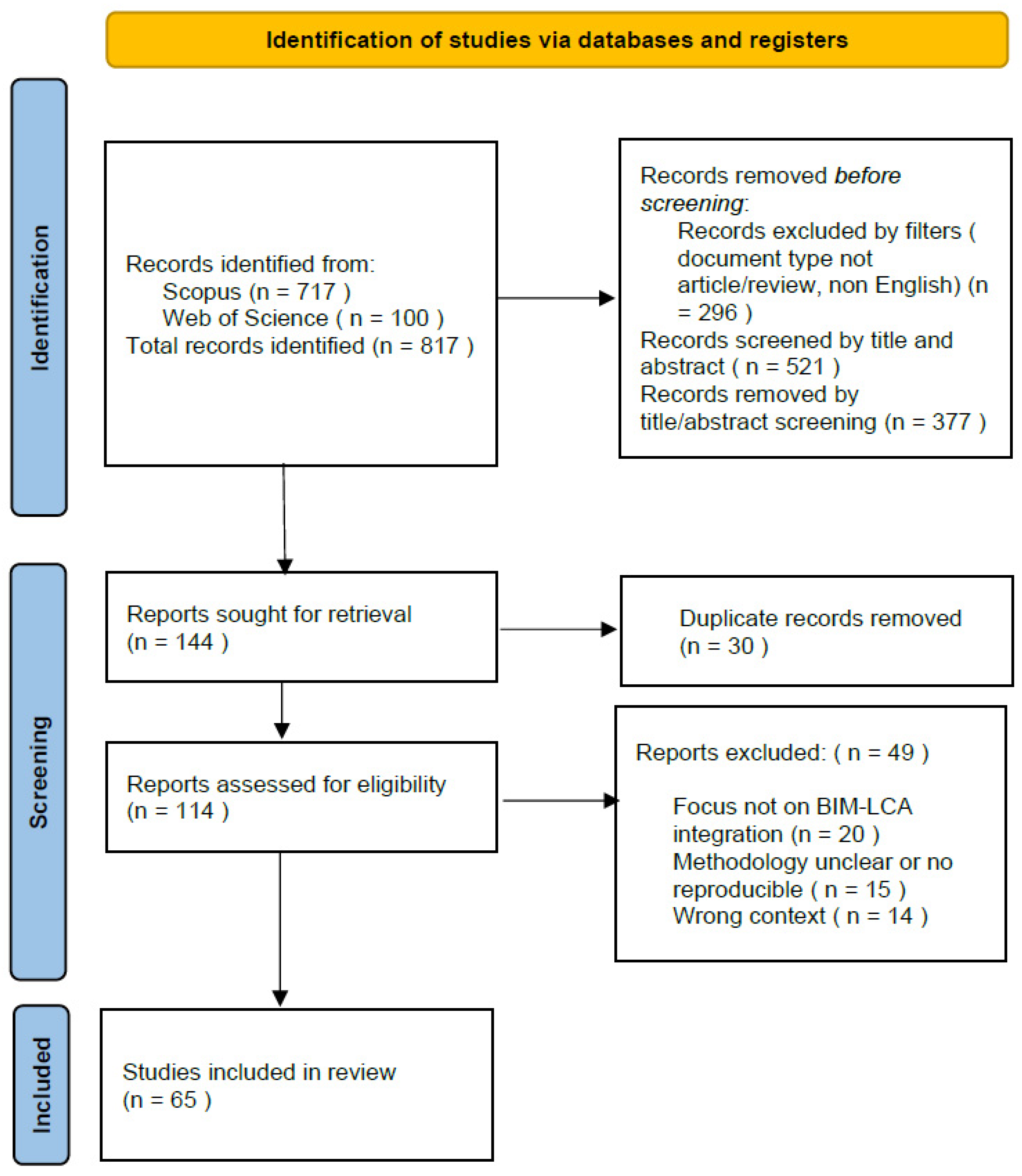
The initial search yielded 817 records (717 from Scopus and 100 from WoS). The results were filtered to include only peer-reviewed journal articles and reviews published in English. After the automatic removal of duplicates by the reference manager Zotero (v. 6.0), a manual cross-check was performed to identify and to remove any remaining duplicates that were missed by the software. Through the two-step process, a robust deduplication is ensured, giving as a result a pool of 521 unique records for screening (430 from Scopus and 91 from WoS).
The screening process was conducted in two stages. First, titles and abstracts of the 521 records were reviewed, leading to the exclusion of 377 records that were clearly out of scope. The remaining 144 potentially relevant articles were then retrieved. After a final manual check, 30 additional duplicate records were removed. The remaining 114 full-text articles were assessed for eligibility. Based on the inclusion and exclusion criteria of Table 1, 49 articles were excluded during the full-text review because they did not show a direct focus on BIM–LCA integration, or they presented an unclear or non-reproducible methodology, or they were relevant to a context outside the building sector.
Through this selection process the final corpus was defined and it considers 65 studies included in this review. The workflow is detailed in the PRISMA 2020 flow diagram in Figure 1.

2.1. Data Extraction and Synthesis

Following the final selection, data from the 65 included studies were systematically extracted and organized into a comparative matrix. The extracted data points were aligned with this review’s research questions and included the following:
-
Bibliographic information (author, year).
-
Geographical context (country/region).
-
Software and technologies used (BIM platforms, LCA tools).
-
Integration approach (e.g., manual, plugin-based).
-
Key findings, reported benefits, and identified barriers.
A quantitative synthesis was performed to identify the trends and frequencies within the dataset. This involved counting the occurrences of the most commonly used software and the prevalent integration workflows. The results of this synthesis were used to construct an evidence-based overview of the current state of the art. The complete table of all the paper analyzed can be found in Supplementary Materials.

2.2. Analysis

The extracted data were then subjected to a quantitative synthesis to identify the dominant trends. A frequency analysis was conducted for key technological categories (BIM software and LCA databases). To ensure the analysis focused on the most significant trends, only terms with a frequency of occurrence greater than three were tabulated and analyzed. This provided the basis to map the state of the art and to answer the research questions. Moreover, an analysis of the author-provided keywords from the 65 articles was conducted.

2.3. Discussion

In this section, the findings are presented and discussed, giving an insight into the benefits of integrating LCA and BIM technologies. The discussion was structured around the research questions and identified the gaps in the current research. Furthermore, this review defined the prospects for research and technological development for future studies.

3. Analysis

Considering the BIM software and data formats used across the 65 reviewed studies, Autodesk stands out as the most used suite of products. The frequency of BIM software and data formats used in the 65 reviewed studies is presented in Table 2, filtered to exclude those appearing in less than 3 studies in order to highlight the most significant trends and to ensure analytical relevance. Given the sample size of 65 studies, items appearing three times or fewer represent less than 5% of the total corpus, so excluding software which appears less than three times allows the analysis to remove the statistical noise generated by one-off case studies. As shown in the table, Revit is the primary authoring tool, cited in 50 studies (approximately 77%), confirming it as the industry and research standard for BIM creation in the context of sustainability assessments.
The Industry Foundation Classes (IFC) format is the second most frequently mentioned term, appearing in 28 studies (43%); so, while a proprietary tool (Revit) is used for model creation, the open-standard IFC format is the most cited pathway to transfer BIM data to external LCA tools. On the one hand, the field relies on a closed-ecosystem leader for authoring and, on the other hand, it uses an open-standard format for data exchange.
The presence of Dynamo, a visual programming tool for Revit mentioned in nine studies (14%), suggests a growing trend towards creating custom scripts and automating workflows, in particular for non-standard data extraction or parametric analysis within the Revit environment. Other Autodesk tools, like Green Building Studio and the now-discontinued Ecotect (both with four mentions), also appear, solidifying the brand’s strong foothold.
By contrast, alternative authoring tools, like ArchiCAD, are present but significantly less common, cited in only 12 studies (18%). Formats like gbXML, primarily used for energy analysis, are mentioned in seven studies (11%), indicating that some BIM–LCA workflows are closely linked to building energy modeling (BEM).
The frequency of LCA databases and tools in the 65 reviewed studies presented in Table 3 highlights that the landscape of LCA databases and tools is more fragmented than the BIM software environment, though clear leaders emerge. In Table 3, as well as in Table 2, the databases and tools listed are those cited more than three times. The Ecoinvent database is the most cited data source, mentioned in 21 studies (32%), establishing it as the most trusted and widely used LCI (Life Cycle Inventory) database in academic research for its qualities.
One Click LCA, which is a commercial software tool that integrates with BIM platforms, is the second most common database with 10 mentions (15%). Its presence, along with Tally (mentioned four times), which is another Revit-integrated tool, highlights the trend to move towards streamlined, plugin-based solutions that simplify the BIM-to-LCA process for practitioners and researchers.
The term EPD (Environmental Product Declaration) appears in eight studies (12%). This highlights the tendency to prefer manufacturer-specific, standardized data rather than generic database entries, thus improving the accuracy of LCA results.
There is also a strong presence of regionally-focused databases, such as Athena (seven mentions), which is prevalent in North American studies, the ICE database (six mentions) from the UK, and Ökobaudat (six mentions) from Germany. This shows that the geographical context can influence the choice of database, because the availability of relevant, regionalized data can improve the quality of the study. Another database, mentioned four times, is GaBi, a major commercial database and software suite.
Analyzing the keywords from the 65 reviewed articles reveals a hierarchy of the core concepts and research priorities of this field. The most important topic is unequivocally the integration of “Building Information Modeling (BIM)” and “Life Cycle Assessment (LCA)”, which are the most frequently occurring terms among the keywords, thus forming the central technological and methodological axis of the research.
Other highly frequent keywords, such as “Sustainability”, “Environmental Impact”, and “Carbon Footprint”, constitute the primary objectives driving this integration. As a matter of fact, through these terms, it is evident that the main goal of the research is to measure, manage, and mitigate the environmental burdens of buildings, with an emphasis on greenhouse gas emissions.
The frequent appearance of “Life Cycle Costing (LCC)” highlights the trend towards integrated analyses that balance environmental performance with economic viability, thus broadening the assessment scope beyond purely environmental metrics and moving towards a holistic, triple-bottom-line assessment, a direction further supported by keywords like “Sustainable Development”. Terms such as “Social Sustainability” are present in a small quantity suggesting that, while the social pillar is acknowledged, it remains a less-developed area of inquiry compared to the environmental and economic dimensions, thus representing a potential research gap.
Specific keywords like “Waste Management” can be used to identify practical application domains where the BIM–LCA combination is being used to address industry challenges. In summary, through the keyword analysis it is confirmed that the research field is centered on the technological integration of BIM and LCA, driven by the need for environmental impact reduction, and is progressively expanding to include economic and, to a lesser extent, social sustainability factors.

4. Results and Discussions

In this section, the results of the analysis are presented, revealing the key themes identified and providing a basis for evaluating the current state of research in relation to the established objectives.
First of all, it is important to say that, beyond the frequency of software adoption, a cross-analysis of the reviewed literature reveals a trade-off between workflow efficiency and the reliability of environmental results. The comparison between commercial plug-ins and manual or open-source workflows highlights a dichotomy, demonstrated by Ref. [15], while conventional approaches based on a manual bill of quantities (BoQ) extraction remain the most accurate in terms of data granularity, they are resource-intensive; on the other hand, automated plug-in approaches (e.g., using Tally or One Click LCA within Revit) are faster in development and calculation time but can produce untrustworthy BoQ results if the underlying model geometry is not perfectly defined. This finding is validated by Ref. [59], which compared direct integration methods (Athena) against manual export workflows (SimaPro), concluding that, while direct integration streamlines the process, manual workflows allow for more detailed, albeit error-prone, adjustments.
The use of Autodesk Revit, identified in 77% of the reviewed studies, highlights a significant reliance on proprietary ecosystems, and this dominance becomes problematic when workflows shift to OpenBIM standards, as the conversion to Industry Foundation Classes (IFC) frequently results in data degradation. Ref. [61] provided quantitative evidence of this issue, identifying twenty specific gaps within the current IFC scheme that obstruct the automated integration of environmental data. In this way, practitioners are often forced to rely on manual shortcuts, which introduce uncertainty into the assessment. While Ref. [64] demonstrated that it is technically feasible to link 94.5% of BIM objects to LCA datasets using IFC, achieving this level of accuracy requires a standardization of object attributes that is rarely implemented in standard industry practice.
The reliability of BIM–LCA workflows is determined less by the choice of software and more by the selection and quality of the underlying LCI databases, and Ref. [65] quantified this impact, demonstrating that uncertainties regarding data availability and quality alone can trigger variations in global warming potential (GWP) ranging from 2% to 43%. This variability is particularly evident during early design stages; Ref. [41] highlighted that the reliance on placeholder materials can result in an overestimation of embodied carbon by a factor of two compared to the final as-built status. Consequently, achieving reliable results depends on the implementation of workflows that utilize region-specific databases and actively manage dynamic uncertainty.

4.1. Q1. Overcoming Traditional Limitations: How Does the Combination Between BIM and LCA Address the Shortcomings of Conventional, Fragmented Approaches to Sustainability Assessment in the Construction Sector?

The integration between BIM and LCA establishes a structured, data-centric digital workflow [32], addressing the shortcomings of conventional, fragmented approaches to sustainability assessment. Moreover, integrated workflows drastically reduce the manual effort required for data mapping, as highlighted by Ref. [64]. It was demonstrated that using OpenBIM and IFC allowed 94.5% of BIM objects to be automatically linked with LCA datasets, and this contributed to reduce the fragmentation issue. Similarly, Ref. [15] confirmed that, while manual BoQ extraction offers high accuracy, the automated plug-in approach is empirically the fastest in development and calculation time; this transformed LCA from a retrospective audit to a real-time design tool.
The literature analysis provides evidence that traditional methods are obstructed by process inefficiencies, as documented by Refs. [6,15], because they are prone to significant variations due to data quality and human interpretation. Ref. [65] quantified that uncertainties in construction projects can cause 2% to 43% variations in global warming potential (GWP) results, and BIM–LCA integration can mitigate this by centralizing data, as highlighted by Ref. [66], which developed a framework to automate the analysis and to reduce the errors inherent in manual sustainability assessments.
Studies like Ref. [31] present BIM–LCA integration as a solution to these challenges by creating a structured, data-centric workflow, thus overcoming the limitations of manual processes by automating the extraction of material quantities and simplifying data input, enhancing both the efficiency and accuracy of the assessment [40,57]. The integration of LCA with a centralized BIM model is a way to reduce the risks of data fragmentation by creating a consistent flow of information, ensuring that environmental evaluations are based on reliable and current design parameters [65]. This facilitates the integration of life cycle thinking into the early design stages [60], converting LCA from a static, post-design validation exercise into a dynamic, iterative decision-support tool [35]. In this way, stakeholders can quantitatively compare design alternatives and optimize environmental performance in early design stages, when modifications are most feasible and impactful.
The ability to perform LCA in early design stages leads to tangible carbon reductions; Ref. [27] reported that using machine learning-assisted BIM–LCA tools achieved a 25% reduction in the carbon footprint during the design phase. Furthermore, Ref. [25] utilized multi-objective optimization within BIM to achieve a 53.48% reduction in operational energy and a 66.23% reduction in demolition energy compared to initial design options.

4.2. Q2. Supporting Decision-Making: What Are the Mechanisms and Applications Through Which an Integrated BIM–LCA Process Facilitates More Informed and Sustainable Decisions During the Design, Construction, and Operational Phases of Buildings?

The integration between BIM and LCA processes facilitates more informed and sustainable decisions thanks to the creation of a direct, often automated, link between a digital representation of the building (the BIM model) and its calculated environmental performance [39]. The literature shows a series of technical mechanisms—ranging from manual data exports to fully integrated plugins and APIs—that provides quantitative feedback on design choices [38,66], allowing stakeholders to compare alternatives, to optimize designs, and to select pathways with a measurably lower environmental impact [34].
The mechanisms for integrating BIM and LCA can be categorized into several dominant approaches, enabling different decision-making applications, according to the literature review, as follows:
  • BoQ/BoM Export (The Foundational Approach) [58]: the export of a bill of quantities (BoQ) or bill of materials (BoM) from a BIM model (e.g., from Revit or Tekla Structures) into a spreadsheet format, like Excel, is the most commonly mentioned mechanism; through this approach it is possible to obtain a list of materials that can be then manually or semi-automatically imported into an LCA tool (e.g., OpenLCA, SimaPro) [15,46,67].
    This method primarily supports material selection decisions [8] and, by providing accurate quantities, it allows for a comparison of the total embodied carbon of different material options (e.g., comparing a concrete structure vs. a timber one).
  • Plugin-Based Integration (The Streamlined Approach) [68]: commercial plugins that operate directly within the BIM-authoring environment are used by a significant number of studies [44]; as a matter of fact, tools like One Click LCA, Tally, and DesignLCA for Revit and ArchiCAD are repeatedly cited.
    In this way, decision-making is accelerated by offering real-time or near-real-time feedback, a key benefit highlighted by Ref. [26]; as a matter of fact, as soon as a designer modifies an element in the BIM model, the plugin instantly recalculates the environmental impact, enabling rapid design iterations and optimization [24]. This is effective when evaluating complex assemblies and comparing multiple design scenarios rapidly.
  • Visual Programming and Custom Scripts (The Automated and Parametric Approach) [69]: the use of Visual Programming Languages (VPL) (for example Dynamo for Revit) is very common [18]. The creation of custom scripts (often in Python) to define bespoke, automated workflows allow for a link to BIM model data from external databases (e.g., Swiss KBOB) or LCA tools [13,41].
    In this way, multi-objective optimization is granted [5,62], allowing designers to go beyond simple A/B comparisons and to explore hundreds of design permutations (e.g., varying window sizes, insulation thicknesses) in order to find solutions that balance environmental impact with other parameters, like cost [29,70].
  • IFC-Based Workflows (The OpenBIM Approach): to achieve interoperability between different software vendors, it is common to use the Industry Foundation Classes (IFC) format [71]. To achieve this, the workflow typically involves exporting the BIM model as an IFC file and then importing it into a third-party LCA tool. More advanced applications extend the IFC schema with user-defined property sets to embed EPD data directly [64].
    With this vendor-neutral approach, decisions are not locked into a single software ecosystem [19], facilitating collaboration among different teams using different tools and supporting decisions that require open-standard data exchange, for example in large or publicly funded projects.
  • API Connections and Object-Embedded Data (The Dynamic and Integrated Approach): using application programming interfaces (APIs) to create a dynamic, bi-directional link between BIM and LCA data [14,18] represents the most advanced mechanisms that can be realized, including LCA information (e.g., from EPDs) directly into BIM objects or by using a common data environment (CDE) like BIM 360 to manage the data flow [30].
    This enables a dynamic LCA that allows for the support of the most sophisticated decision-making, where updates are automatic and the environmental data becomes a property of the digital twin. This is important for whole life carbon assessments and for maintaining an accurate environmental baseline throughout the construction and operational phases [72].
The evidence strongly demonstrates a wide variety of technical mechanisms for linking BIM and LCA [22], with a clear trend moving from manual exports towards more automated and integrated plug-in/API solutions. The decision-making support is most robustly documented for the early design and material selection phases [61]. A clear gap remains in detailing how these mechanisms are used to support decisions during the on-site construction phase (e.g., procurement, waste management) and the long-term operational phase (e.g., retrofitting, facility management) [4,16].

4.3. Q3. Necessary Future Improvements: What Are the Critical Technological, Methodological, and Data-Related Improvements Needed to Fully Realize the Potential of an Integrated BIM–LCA Process?

The analyzed articles present an evident consensus on the critical improvements needed to advance BIM–LCA integration from a specialized academic effort to a mainstream industry use [45]. While the potential is well-established, the full realization depends on significant progress in three interconnected areas: Data and Standardization, Technology and Interoperability, and Methodology and Scope Expansion, as highlighted below.
Critical improvements needed:
  • Data and standardization: As stated in the research of Ref. [73], the quality, accessibility, and standardization of the underlying environmental data is the area considered to be the most in need of improvement. The literature calls for the following:
    Standardized and digital data formats: A change in the paradigm, moving away from static, PDF-based EPDs towards machine-readable, digital formats is fundamental, as highlighted by Refs. [11,61]. There is a strong need to integrate LCA data into official schemas like IFC and to develop interconnected data dictionaries and governance systems in order to ensure semantic consistency [43].
    Development of comprehensive and regionalized databases: There is a strong demand for expanding LCI databases to include more bio-based, recycled, and innovative materials [42,58]. Furthermore, researchers consistently highlight the necessity of developing and maintaining localized databases that reflect regional materials, construction practices, and energy grids to improve the accuracy and relevance of assessments [37,74].
    Clearer information requirements (LOD/LOIN): Future work must focus on developing clear standards for Level of Development (LOD) or Level of Information Need (LOIN) specifically for sustainability assessments [75]. This includes defining which environmental data is required at different design stages to ensure models are “LCA-ready” [76].
  • Technology and interoperability (the enabling layer): The second major theme revolves around improving the software tools and the connection between them [10]. The key technological needs are as follows:
    • Improved automation and bi-directional exchange: The current dependence on manual or semi-automated workflows (e.g., BoQ export) is a major problem. The literature promotes flawless, automated data exchange, preferably through robust APIs that allow a real-time, bi-directional data flow between BIM and LCA tools, which ensure that design changes are instantly reflected in the environmental assessment [54].
    • Improved and user-friendly tools: More advanced, yet user-friendly, BIM-integrated plugins and tools are needed [2] in order to simplify the assessment process for non-specialists (e.g., architects), to automate material mapping, and to integrate powerful visualization features (e.g., using VR) to make results more intuitive and actionable.
    • Integration of AI and machine learning: A significant and emerging direction is the application of AI [27]. Researchers suggest using machine learning for predictive LCA, improving material classification, optimizing designs through multi-objective algorithms (MOO), and even developing custom large language models (LLMs) to better understand architectural context.
  • Methodology and scope expansion (the application layer): Finally, the literature points to the need to broaden the scope and sophistication of the assessment methodologies themselves. The main directions are as follows:
    • Expansion to a full life cycle and holistic sustainability: Many studies acknowledge their limited scope (e.g., excluding maintenance or end-of-life phases) [22]. There is a strong push to integrate all life cycle modules (A–D) for a comprehensive “Whole Life Carbon” assessment [12]. Furthermore, a critical future direction is the robust integration of life cycle costing (LCC) and, most challengingly, a social life cycle assessment (S-LCA) to move towards a true triple-bottom-line evaluation that includes occupant well-being and community impacts [1,7,24,77,78].
    • Focus on circular economy and renovation [3]: Future research must more effectively integrate circular economy (CE) principles, such as design for disassembly, reusability, and material passports [28]. Concurrently, there is a critical need to shift focus from new builds to the renovation and retrofitting of existing buildings, comparing deep renovation against demolition and reconstruction strategies.
    • Validation and real-world application [57,79]: Numerous papers have highlighted the necessity of validating their proposed frameworks on a wider range of real-world projects, across different geographical contexts and building typologies.
There is a powerful consensus across the reviewed literature regarding these areas for improvement. While the problems of interoperability and data quality are universally acknowledged, the most significant emerging research gap appears to be the development of scalable solutions that integrate AI-driven optimization, circular economy principles, a holistic (environmental, economic, and social) assessment framework, and applying them to the critical challenge of building retrofitting.

5. Conclusions

This systematic literature review provides a data-driven synthesis of the current state of BIM–LCA integration in the construction sector. A quantitative analysis of 65 peer-reviewed articles reveals a well-defined technological landscape. Autodesk Revit emerges as the de facto standard for BIM authoring, appearing in 77% (50 studies) of the analyzed cases, while the open-standard IFC format is the most common pathway for interoperability (43%, 28 studies). The Ecoinvent database appears to be the most used Life Cycle Inventory source, cited in 32% (21 studies) of the articles analyzed.
This review mapped the evolution of integration workflows, from foundational manual exports to advanced API connections, confirming that the predominant application remains the quantification of environmental impacts, with a focus on embodied carbon. However, the growing inclusion of LCC indicates a promising shift towards a more holistic evaluation framework.
Despite this progress, the full potential of BIM–LCA integration remains constrained by significant challenges, as shown by the research. A critical area is data and standardization, where it is fundamental to move from static EPDs to machine-readable formats; moreover, the development of comprehensive, regionalized LCI databases is needed. Future work should also focus on flawless, bi-directional data exchange via robust APIs and the creation of user-friendly, intelligent tools, potentially leveraging AI. Moreover, the methodology and scope must be expanded to encompass the entire building life cycle, to robustly integrate social and economic pillars, and to shift focus to the circular economy and the retrofitting of existing buildings.
In conclusion, while the foundations for BIM–LCA integration are established, it is fundamental to overcome the barriers highlighted. This review provides a roadmap to guide the research and development required to improve this integration, making it a first step for the built environment to contribute to global decarbonization and sustainable development goals.
As a systematic review of the academic literature, this study presents a key limitation: the findings—particularly regarding software and workflow prevalence—reflect the state of the published research, thus determining that this study may not be a one-to-one representation of the wider professional landscape, where adoption can be influenced by various factors that are not always captured in academic studies. The difference between academic trends and industry practice can be considered to be a valuable area for future research, including large-scale industry surveys and ethnographic case studies, to expand the findings presented here.

Supplementary Materials

The following supporting information can be downloaded at: https://www.mdpi.com/article/10.3390/buildings16010168/s1, complete table of all the paper analyzed.

Author Contributions

Conceptualization, P.M.A., C.B. and P.M.C.; methodology, P.M.A.; validation, C.B. and P.M.C.; formal analysis, P.M.A., C.B. and P.M.C.; investigation, P.M.A., C.B. and P.M.C.; resources, P.M.A., C.B. and P.M.C.; data curation, P.M.A.; writing—original draft preparation, P.M.A.; writing—review and editing, P.M.A., C.B. and P.M.C.; visualization, P.M.A., C.B. and P.M.C.; supervision, C.B. and P.M.C.; project administration, C.B. and P.M.C. All authors have read and agreed to the published version of the manuscript.

Funding

This research received no external funding.

Data Availability Statement

The original contributions presented in this study are included in the article/Supplementary Material. Further inquiries can be directed to the corresponding author.

Conflicts of Interest

The authors declare no conflicts of interest.

References

  1. Abanda, F.H.; Balu, B.; Adukpo, S.E.; Akintola, A. Decoding ISO 19650 Through Process Modelling for Information Management and Stakeholder Communication in BIM. Buildings 2025, 15, 431. [Google Scholar] [CrossRef]
  2. Abdelaal, F.; Guo, B. Stakeholders’ perspectives on BIM and LCA for green buildings. J. Build. Eng. 2022, 48, 103931. [Google Scholar] [CrossRef]
  3. Abdelaal, M.; Seif, S.; El-Tafesh, M.; Bahnas, N.; Elserafy, M.; Bakhoum, E. Sustainable assessment of concrete structures using BIM-LCA-AHP integrated approach. Environ. Dev. Sustain. 2024, 26, 25669–25688. [Google Scholar] [CrossRef]
  4. Abouhamad, M.; Abu-Hamd, M. Life Cycle Assessment Framework for Embodied Environmental Impacts of Building Construction Systems. Sustainability 2021, 13, 461. [Google Scholar] [CrossRef]
  5. Ahmad, D.M.; Gáspár, L.; Bencze, Z.; Maya, R.A. A Risk-Informed BIM-LCSA Framework for Lifecycle Sustainability Optimization of Bridge Infrastructure. Buildings 2025, 15, 2853. [Google Scholar] [CrossRef]
  6. Akinade, O.; Oyedele, L.; Bilal, M.; Ajayi, S.; Owolabi, H.; Alaka, H.; Bello, S. Waste minimisation through deconstruction: A BIM based Deconstructability Assessment Score (BIM-DAS). Resour. Conserv. Recycl. 2015, 105, 167–176. [Google Scholar] [CrossRef]
  7. Alwan, Z.; Nawarathna, A.; Ayman, R.; Zhu, M.; ElGhazi, Y. Framework for parametric assessment of operational and embodied energy impacts utilising BIM. J. Build. Eng. 2021, 42, 102768. [Google Scholar] [CrossRef]
  8. Aragón, A.; Spudys, P.; Pupeikis, D.; Nieto, Ó.; García-Alberti, M. Bridging Interoperability Gaps Between LCA and BIM: Analysis of Limitations for the Integration of EPD Data in IFC. Buildings 2025, 15, 2760. [Google Scholar] [CrossRef]
  9. Asare, K.A.B.; Ruikar, K.D.; Zanni, M.; Soetanto, R. BIM-based LCA and energy analysis for optimised sustainable building design in Ghana. SN Appl. Sci. 2020, 2, 1855. [Google Scholar] [CrossRef]
  10. Asgari, S.; Haghir, S.; Noorzai, E. Reducing energy consumption in operation and demolition phases by integrating multi-objective optimization with LCA and BIM. Energy Effic. 2023, 16, 1855. [Google Scholar] [CrossRef]
  11. Asgari, S.; Noorzai, E. Improving the effectiveness and interaction between building information modeling and life cycle assessment. Archit. Eng. Des. Manag. 2023, 19, 22–38. [Google Scholar] [CrossRef]
  12. Atik, S.; Aparisi, T.; Raslan, R. Mind the gap: Facilitating early design stage building life cycle assessment through a co-production approach. J. Clean. Prod. 2024, 464, 142803. [Google Scholar] [CrossRef]
  13. Barbini, A.; Malacarne, G.; Romagnoli, K.; Massari, G.A.; Matt, D.T. Integration of life cycle data in a BIM object library to support green and digital public procurements. Int. J. Sustain. Dev. Plan. 2020, 15, 983–990. [Google Scholar] [CrossRef]
  14. Berges-Alvarez, I.; Martínez-Rocamora, A.; Marrero, M. A Systematic Review of BIM-Based Life Cycle Sustainability Assessment for Buildings. Sustainability 2024, 16, 11070. [Google Scholar] [CrossRef]
  15. Boje, C.; Hahn Menacho, Á.J.; Marvuglia, A.; Benetto, E.; Kubicki, S.; Schaubroeck, T.; Gutiérrez, T. A framework using BIM and digital twins in facilitating LCSA for buildings. J. Build. Eng. 2023, 76, 107232. [Google Scholar] [CrossRef]
  16. Bragadin, M.A.; Guardigli, L.; Calistri, M.; Ferrante, A. Demolishing or Renovating? Life Cycle Analysis in the Design Process for Building Renovation: The ProGETonE Case. Sustainability 2023, 15, 8614. [Google Scholar] [CrossRef]
  17. Carvalho, J.; Alecrim, I.; Bragança, L.; Mateus, R. Integrating BIM-Based LCA and Building Sustainability Assessment. Sustainability 2020, 12, 7468. [Google Scholar] [CrossRef]
  18. Carvalho, J.; Villaschi, F.; Bragança, L. Assessing Life Cycle Environmental and Economic Impacts of Building Construction Solutions with BIM. Sustainability 2021, 13, 8914. [Google Scholar] [CrossRef]
  19. Cavalliere, C.; Habert, G.; Dell’Osso, G.; Hollberg, A. Continuous BIM-based assessment of embodied environmental impacts throughout the design process. J. Clean. Prod. 2019, 211, 941–952. [Google Scholar] [CrossRef]
  20. Chen, Z.; Chen, L.; Zhou, X.; Huang, L.; Sandanayake, M.; Yap, P. Recent Technological Advancements in BIM and LCA Integration for Sustainable Construction: A Review. Sustainability 2024, 16, 1340. [Google Scholar] [CrossRef]
  21. Crippa, J.; Boeing, L.; Caparelli, A.; da Costa, M.; Scheer, S.; Araujo, A.; Bem, D. A BIM-LCA integration technique to embodied carbon estimation applied on wall systems in Brazil. Built Environ. Proj. Asset Manag. 2018, 8, 491–503. [Google Scholar] [CrossRef]
  22. Dervishaj, A.; Gudmundsson, K. From LCA to circular design: A comparative study of digital tools for the built environment. Resour. Conserv. Recycl. 2024, 200, 107291. [Google Scholar] [CrossRef]
  23. Ding, Y.; Guo, Z.-Z.; Zhou, S.-X.; Wei, Y.-Q.; She, A.-M.; Dong, J.-L. Research on carbon emissions during the construction process of prefabricated buildings based on BIM and LCA. J. Asian Archit. Build. Eng. 2024, 24, 1426–1438. [Google Scholar] [CrossRef]
  24. Fernández Rodríguez, J.F.; Picardo, A.; Aguilar-Planet, T.; Martín-Mariscal, A.; Peralta, E. Data Transfer Reliability from Building Information Modeling (BIM) to Life Cycle Assessment (LCA)—A Comparative Case Study of an Industrial Warehouse. Sustainability 2025, 17, 1685. [Google Scholar] [CrossRef]
  25. Forth, K.; Hollberg, A.; Borrmann, A. BIM4EarlyLCA: An interactive visualization approach for early design support based on uncertain LCA results using open BIM. Dev. Built Environ. 2023, 16, 100263. [Google Scholar] [CrossRef]
  26. Gan, J.; Li, K.; Li, X.; Mok, E.; Ho, P.; Law, J.; Lau, J.; Kwok, R.; Yau, R. Parametric BIM-Based Lifecycle Performance Prediction and Optimisation for Residential Buildings Using Alternative Materials and Designs. Buildings 2023, 13, 904. [Google Scholar] [CrossRef]
  27. Gao, H.; Wang, D.; Du, X.; Zhao, Z. An LCA-BIM integrated model for carbon-emission calculation of prefabricated buildings. Renew. Sustain. Energy Rev. 2024, 203, 114775. [Google Scholar] [CrossRef]
  28. Ge, S.; Zhang, X.; Zhang, X. Integration of BIM and LCA: A system to predict and optimise embodied carbon for prefabricated buildings. HKIE Trans. Hong Kong Inst. Eng. 2023, 30, 44–55. [Google Scholar] [CrossRef]
  29. Hollberg, A.; Genova, G.; Habert, G. Evaluation of BIM-based LCA results for building design. Autom. Constr. 2020, 109, 102972. [Google Scholar] [CrossRef]
  30. Horn, R.; Ebertshäuser, S.; Di Bari, R.; Jorgji, O.; Traunspurger, R.; von Both, P. The BIM2LCA Approach: An Industry Foundation Classes (IFC)-Based Interface to Integrate Life Cycle Assessment in Integral Planning. Sustainability 2020, 12, 6558. [Google Scholar] [CrossRef]
  31. ISO 14040:2006; Environmental Management—Life Cycle Assessment—Principles and Framework. International Organization for Standardization: Geneva, Switzerland, 2006; p. 14040.
  32. ISO 14044:2006; Environmental Management—Life Cycle Assessment—Requirements and Guidelines. International Organization for Standardization: Geneva, Switzerland, 2006.
  33. ISO 19650-1:2018; Organization and Digitization of Information about Buildings and Civil Engineering Works, Including Building Information Modelling (BIM)—Information Management Using Building Information Modelling. International Organization for Standardization: Geneva, Switzerland, 2018.
  34. ISO 21930:2017(en); Sustainability in Buildings and Civil Engineering Works—Core Rules for Environmental Product Declarations of Construction Products and Services. International Organization for Standardization: Geneva, Switzerland, 2017.
  35. Jafari, M.; Khoshand, A.; Sadeghi, N.; Mirzanagh, P.A. A comparative LCA of external wall assemblies in context of Iranian market: Considering embodied and operational energy through BIM application. Environ. Sci. Pollut. Res. 2024, 31, 7364–7379. [Google Scholar] [CrossRef] [PubMed]
  36. Jalaei, F.; Zoghi, M.; Khoshand, A. Life cycle environmental impact assessment to manage and optimize construction waste using Building Information Modeling (BIM). Int. J. Constr. Manag. 2021, 21, 784–801. [Google Scholar] [CrossRef]
  37. Jrade, A.; Jalaei, F.; Zhang, J.; Eirdmousa, S.; Jalaei, F. Potential Integration of Bridge Information Modeling and Life Cycle Assessment/Life Cycle Costing Tools for Infrastructure Projects within Construction 4.0: A Review. Sustainability 2023, 15, 15049. [Google Scholar] [CrossRef]
  38. Kamari, A.; Kotula, B.; Schultz, C. A BIM-based LCA tool for sustainable building design during the early design stage. Smart Sustain. Built Environ. 2022, 11, 217–244. [Google Scholar] [CrossRef]
  39. Klumbyte, E.; Georgali, P.; Spudys, P.; Giama, E.; Morkunaite, L.; Pupeikis, D.; Jurelionis, A.; Fokaides, P. Enhancing whole building life cycle assessment through building information modelling: Principles and best practices. Energy Build. 2023, 296, 113401. [Google Scholar] [CrossRef]
  40. Kumar, D.; Maurya, K.K.; Mandal, S.K.; Halder, N.; Mir, B.A.; Nurdiawati, A.; Al-Ghamdi, S.G. A Whole-Life Carbon Assessment of a Single-Family House in North India Using BIM-LCA Integration. Buildings 2025, 15, 2195. [Google Scholar] [CrossRef]
  41. Lee, S.; Tae, S.; Roh, S.; Kim, T. Green Template for Life Cycle Assessment of Buildings Based on Building Information Modeling: Focus on Embodied Environmental Impact. Sustainability 2015, 7, 16498–16512. [Google Scholar] [CrossRef]
  42. Li, Q.; Yang, W.; Kohler, N.; Yang, L.; Li, J.; Sun, Z.; Yu, H.; Liu, L.; Ren, J. A BIM-LCA Approach for the Whole Design Process of Green Buildings in the Chinese Context. Sustainability 2023, 15, 3629. [Google Scholar] [CrossRef]
  43. Li, Y.; Feng, H. Comprehensive spatial LCA framework for urban scale net zero energy buildings in Canada using GIS and BIM. Appl. Energy 2025, 388, 125649. [Google Scholar] [CrossRef]
  44. Llatas, C.; Quiñones, R.; Bizcocho, N. Environmental Impact Assessment of Construction Waste Recycling versus Disposal Scenarios Using an LCA-BIM Tool during the Design Stage. Recycling 2022, 7, 82. [Google Scholar] [CrossRef]
  45. Lu, K.; Deng, X.; Jiang, X.; Cheng, B.; Tam, V.W.Y. A Review On Life Cycle Cost Analysis Of Buildings Based On Building Information Modeling. J. Civ. Eng. Manag. 2023, 29, 268–288. [Google Scholar] [CrossRef]
  46. Lu, K.; Jiang, X.; Yu, J.; Tam, V.W.Y.; Skitmore, M. Integration of life cycle assessment and life cycle cost using building information modeling: A critical review. J. Clean. Prod. 2021, 285, 125438. [Google Scholar] [CrossRef]
  47. Marrero, M.; Wojtasiewicz, M.; Martínez-Rocamora, A.; Solís-Guzmán, J.; Alba-Rodríguez, M. BIM-LCA Integration for the Environmental Impact Assessment of the Urbanization Process. Sustainability 2020, 12, 4196. [Google Scholar] [CrossRef]
  48. Marzouk, M.; Thabet, R. A BIM-Based Tool for Assessing Sustainability in Buildings Using the Green Pyramid Rating System. Buildings 2023, 13, 1274. [Google Scholar] [CrossRef]
  49. Masoumi-Hajiagha, A.; Heravi, G. A BIM-Based Framework for Life Cycle Assessment of High-Performance Envelopes. Iranian J. Sci. Technol.—Trans. Civ. Eng. 2025, 1–15. [Google Scholar] [CrossRef]
  50. Mazur 2025, Ł.; Olenchuk, A. Life Cycle Assessment and Building Information Modeling Integrated Approach: Carbon Footprint of Masonry and Timber-Frame Constructions in Single-Family Houses. Sustainability 2023, 15, 15486. [Google Scholar] [CrossRef]
  51. McNeil-Ayuk, N.; Jrade, A. Integrating Building Information Modeling and Life Cycle Assessment to Enhance the Decisions Related to Selecting Construction Methods at the Conceptual Design Stage of Buildings. Sustainability 2025, 17, 2877. [Google Scholar] [CrossRef]
  52. Morsi, D.; Ismaeel, W.; Ehab, A.; Othman, A. BIM-based life cycle assessment for different structural system scenarios of a residential building. Ain Shams Eng. J. 2022, 13, 101802. [Google Scholar] [CrossRef]
  53. Najjar, M.; Figueiredo, K.; Palumbo, M.; Haddad, A. Integration of BIM and LCA: Evaluating the environmental impacts of building materials at an early stage of designing a typical office building. J. Build. Eng. 2017, 14, 115–126. [Google Scholar] [CrossRef]
  54. Namaki, P.; Vegesna, B.; Bigdellou, S.; Chen, R.; Chen, Q. An Integrated Building Information Modeling and Life-Cycle Assessment Approach to Facilitate Design Decisions on Sustainable Building Projects in Canada. Sustainability 2024, 16, 4718. [Google Scholar] [CrossRef]
  55. Naneva, A.; Bonanomi, M.; Hollberg, A.; Habert, G.; Hall, D. Integrated BIM-Based LCA for the Entire Building Process Using an Existing Structure for Cost Estimation in the Swiss Context. Sustainability 2020, 12, 3748. [Google Scholar] [CrossRef]
  56. Obrecht, T.; Röck, M.; Hoxha, E.; Passer, A. BIM and LCA Integration: A Systematic Literature Review. Sustainability 2020, 12, 5534. [Google Scholar] [CrossRef]
  57. Onososen, A.; Musonda, I. Barriers to BIM-Based Life Cycle Sustainability Assessment for Buildings: An Interpretive Structural Modelling Approach. Buildings 2022, 12, 324. [Google Scholar] [CrossRef]
  58. Onososen, A.; Musonda, I.; Tjebane, M. Drivers of BIM-Based Life Cycle Sustainability Assessment of Buildings: An Interpretive Structural Modelling Approach. Sustainability 2022, 14, 11052. [Google Scholar] [CrossRef]
  59. Osorio-Gomez, C.C.; Alzate-Buitrago, A.; Amariles-Lopez, C.C.; Aristizabal, D.; Mancilla-Rico, E.A. Interaction of Life Cycle Assessment (LCA) and BIM in a Construction Project to Reduce the Environmental Footprint. Civ. Eng. J. 2025, 11, 120–130. [Google Scholar] [CrossRef]
  60. Palumbo, E.; Soust-Verdaguer, B.; Llatas, C.; Traverso, M. How to Obtain Accurate Environmental Impacts at Early Design Stages in BIM When Using Environmental Product Declaration. A Method to Support Decision-Making. Sustainability 2020, 12, 6927. [Google Scholar] [CrossRef]
  61. Parece, S.; Resende, R.; Rato, V. A BIM-based tool for embodied carbon assessment using a Construction Classification System. Dev. Built Environ. 2024, 19, 100467. [Google Scholar] [CrossRef]
  62. Parece, S.; Resende, R.; Rato, V. Stakeholder perspectives on BIM–LCA integration in building design: Adoption, challenges, and future directions. Build. Environ. 2025, 284, 113434. [Google Scholar] [CrossRef]
  63. Page, M.J.; McKenzie, J.E.; Bossuyt, P.M.; Boutron, I.; Hoffmann, T.C.; Mulrow, C.D.; Shamseer, L.; Tetzlaff, J.M.; Akl, E.A.; Brennan, S.E.; et al. The PRISMA 2020 statement: An updated guideline for reporting systematic reviews. BMJ 2021, 372, n71. [Google Scholar] [CrossRef]
  64. Ploszaj-Mazurek, M.; Rynska, E. Artificial Intelligence and Digital Tools for Assisting Low-Carbon Architectural Design: Merging the Use of Machine Learning, Large Language Models, and Building Information Modeling for Life Cycle Assessment Tool Development. Energies 2024, 17, 2997. [Google Scholar] [CrossRef]
  65. Safari, K.; AzariJafari, H. Challenges and opportunities for integrating BIM and LCA: Methodological choices and framework development. Sustain. Cities Soc. 2021, 67, 102728. [Google Scholar] [CrossRef]
  66. Safari, K.; Ghandehariun, S. An integrative BIM-based life cycle assessment framework to address uncertainties: A mixed-methods study under real construction project context. Int. J. Constr. Manag. 2025, 1–22. [Google Scholar] [CrossRef]
  67. Shin 2025, Y.-S.; Cho, K. BIM application to select appropriate design alternative with consideration of LCA and LCCA. Math. Probl. Eng. 2015, 2015, 281640. [Google Scholar] [CrossRef]
  68. Sistos-Sescosse, G.; Atuahene, B.T.; Ajulo, O.; Adams, I. Examining the Decision Criteria for BIM–LCA: A Case Study. Constr. Econ. Build. 2025, 25, 203–220. [Google Scholar] [CrossRef]
  69. Siverio Lima, M.S.S.; Duarte, S.; Exenberger, H.; Fröch, G.; Flora, M. Integrating BIM-LCA to Enhance Sustainability Assessments of Constructions. Sustainability 2024, 16, 1172. [Google Scholar] [CrossRef]
  70. Soust-Verdaguer, B.; Llatas, C.; García-Martínez, A. Critical review of bim-based LCA method to buildings. Energy Build. 2017, 136, 110–120. [Google Scholar] [CrossRef]
  71. Strelets, K.; Zaborova, D.; Kokaya, D.; Petrochenko, M.; Melekhin, E. Building Information Modeling (BIM)-Based Building Life Cycle Assessment (LCA) Using Industry Foundation Classes (IFC) File Format. Sustainability 2025, 17, 2848. [Google Scholar] [CrossRef]
  72. Theissen, S.; Höper, J.; Drzymalla, J.; Wimmer, R.; Markova, S.; Meins-Becker, A.; Lambertz, M. Using Open BIM and IFC to Enable a Comprehensive Consideration of Building Services within a Whole-Building LCA. Sustainability 2020, 12, 5644. [Google Scholar] [CrossRef]
  73. UNI EN 15804:2019; Sustainability of Construction—Environmental Product Declarations—Framework Rules for Development by Product Category. Ente Italiano di Normazione (UNI): Milan, Italy, 2019.
  74. UNI EN 15978-1; Sustainability of Construction Works—Methodology for the Assessment of Performance of Buildings. Ente Italiano di Normazione (UNI): Milan, Italy, 2024.
  75. Veselka, J.; Nehasilová, M.; Dvoráková, K.; Ryklová, P.; Volf, M.; Ruzicka, J.; Lupísek, A. Recommendations for Developing a BIM for the Purpose of LCA in Green Building Certifications. Sustainability 2020, 12, 6151. [Google Scholar] [CrossRef]
  76. Xu, J.; Teng, Y.; Pan, W.; Zhang, Y. BIM-integrated LCA to automate embodied carbon assessment of prefabricated buildings. J. Clean. Prod. 2022, 374, 133894. [Google Scholar] [CrossRef]
  77. Xue, K.; Hossain, M.; Liu, M.; Ma, M.; Zhang, Y.; Hu, M.; Chen, X.; Cao, G. BIM Integrated LCA for Promoting Circular Economy towards Sustainable Construction: An Analytical Review. Sustainability 2021, 13, 1310. [Google Scholar] [CrossRef]
  78. Zheng, B.; Hussain, M.; Yang, Y.; Chan, A.; Chi, H. Trade-offs between accuracy and efficiency in BIM-LCA integration. Eng. Constr. Archit. Manag. 2025, 32, 237–258. [Google Scholar] [CrossRef]
  79. Zubair, M.U.; Ali, M.; Khan, M.A.; Khan, A.; Hassan, M.U.; Tanoli, W.A. BIM- and GIS-Based Life-Cycle-Assessment Framework for Enhancing Eco Efficiency and Sustainability in the Construction Sector. Buildings 2024, 14, 360. [Google Scholar] [CrossRef]
Figure 1. PRISMA 2020 flow chart.
Buildings 16 00168 g001
Table 1. Inclusion and exclusion criteria.
CriteriaInclusionExclusion
Document typeJournal articles and literature reviews.Conference papers, book chapters, theses, reports.
LanguageEnglish.All other languages.
FocusMust directly address the integration, workflow, or challenges of combining BIM and LCA in the building context.Studies where BIM or LCA are mentioned but are not the core focus; studies on another context.
ContentMust present a clear methodology, case study, or conceptual framework.Opinion pieces, editorials, studies with insufficient methodological detail.
Table 2. Frequency of BIM software and data formats used in the 65 reviewed studies.
BIM Software UsedNumber of Studies
Revit50
IFC28
ArchiCAD12
Dynamo9
gbXML7
Green Building Studio4
Ecotect4
Table 3. Frequency of LCA databases and tools in the 65 reviewed studies.
LCA DatabaseNumber of Studies
Ecoinvent21
OneClickLCA10
EPD8
Athena7
ICE6
ÖKOBAUDAT6
Tally4
GaBi4
Disclaimer/Publisher’s Note: The statements, opinions and data contained in all publications are solely those of the individual author(s) and contributor(s) and not of MDPI and/or the editor(s). MDPI and/or the editor(s) disclaim responsibility for any injury to people or property resulting from any ideas, methods, instructions or products referred to in the content.