
Integrating LCA with BIM-Based Technologies in the Building Construction Context: A Review




Abstract
1. Introduction
- -
- Q1. Overcoming traditional limitations: How does the combination between BIM and LCA address the shortcomings of conventional, fragmented approaches to sustainability assessment in the construction sector?
- -
- Q2. Supporting decision-making: What are the mechanisms and applications through which an integrated BIM–LCA process facilitates more informed and sustainable decisions during the design, construction, and operational phases of buildings?
- -
- Q3. Necessary future improvements: What are the critical technological, methodological, and data-related improvements needed to fully realize the potential of an integrated BIM–LCA process?
Background
2. Materials and Methods
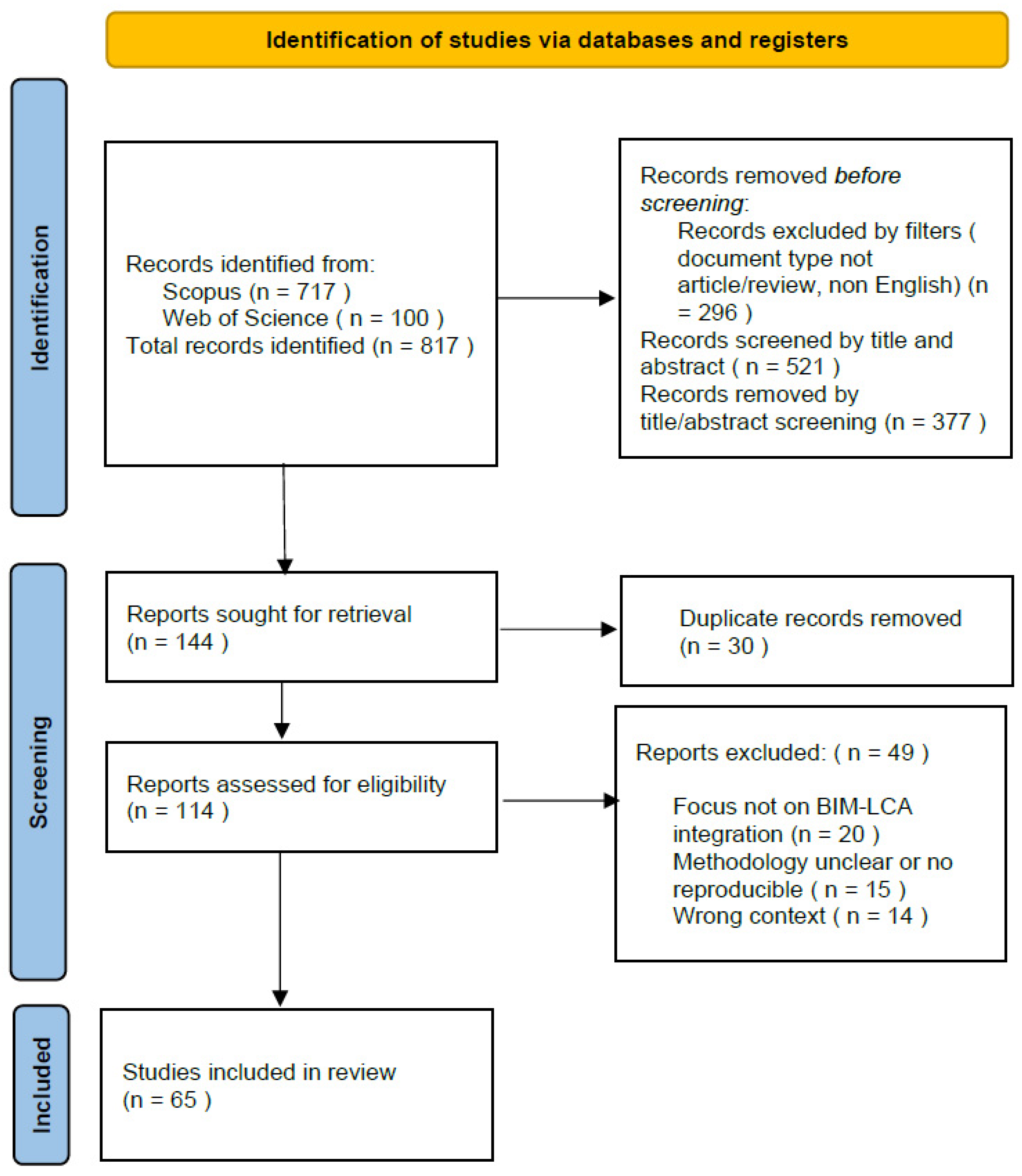
(TITLE-ABS-KEY(“Building Information Model*” OR “BIM”) AND TITLE-ABS-KEY(“Life Cycle Assessment” OR “LCA”) AND TITLE-ABS-KEY(build* OR construction OR architecture OR AECO))
2.1. Data Extraction and Synthesis
- -
- Bibliographic information (author, year).
- -
- Geographical context (country/region).
- -
- Software and technologies used (BIM platforms, LCA tools).
- -
- Integration approach (e.g., manual, plugin-based).
- -
- Key findings, reported benefits, and identified barriers.
2.2. Analysis
2.3. Discussion
3. Analysis
4. Results and Discussions
4.1. Q1. Overcoming Traditional Limitations: How Does the Combination Between BIM and LCA Address the Shortcomings of Conventional, Fragmented Approaches to Sustainability Assessment in the Construction Sector?
4.2. Q2. Supporting Decision-Making: What Are the Mechanisms and Applications Through Which an Integrated BIM–LCA Process Facilitates More Informed and Sustainable Decisions During the Design, Construction, and Operational Phases of Buildings?
- BoQ/BoM Export (The Foundational Approach) [58]: the export of a bill of quantities (BoQ) or bill of materials (BoM) from a BIM model (e.g., from Revit or Tekla Structures) into a spreadsheet format, like Excel, is the most commonly mentioned mechanism; through this approach it is possible to obtain a list of materials that can be then manually or semi-automatically imported into an LCA tool (e.g., OpenLCA, SimaPro) [15,46,67].This method primarily supports material selection decisions [8] and, by providing accurate quantities, it allows for a comparison of the total embodied carbon of different material options (e.g., comparing a concrete structure vs. a timber one).
- Plugin-Based Integration (The Streamlined Approach) [68]: commercial plugins that operate directly within the BIM-authoring environment are used by a significant number of studies [44]; as a matter of fact, tools like One Click LCA, Tally, and DesignLCA for Revit and ArchiCAD are repeatedly cited.In this way, decision-making is accelerated by offering real-time or near-real-time feedback, a key benefit highlighted by Ref. [26]; as a matter of fact, as soon as a designer modifies an element in the BIM model, the plugin instantly recalculates the environmental impact, enabling rapid design iterations and optimization [24]. This is effective when evaluating complex assemblies and comparing multiple design scenarios rapidly.
- Visual Programming and Custom Scripts (The Automated and Parametric Approach) [69]: the use of Visual Programming Languages (VPL) (for example Dynamo for Revit) is very common [18]. The creation of custom scripts (often in Python) to define bespoke, automated workflows allow for a link to BIM model data from external databases (e.g., Swiss KBOB) or LCA tools [13,41].In this way, multi-objective optimization is granted [5,62], allowing designers to go beyond simple A/B comparisons and to explore hundreds of design permutations (e.g., varying window sizes, insulation thicknesses) in order to find solutions that balance environmental impact with other parameters, like cost [29,70].
- IFC-Based Workflows (The OpenBIM Approach): to achieve interoperability between different software vendors, it is common to use the Industry Foundation Classes (IFC) format [71]. To achieve this, the workflow typically involves exporting the BIM model as an IFC file and then importing it into a third-party LCA tool. More advanced applications extend the IFC schema with user-defined property sets to embed EPD data directly [64].With this vendor-neutral approach, decisions are not locked into a single software ecosystem [19], facilitating collaboration among different teams using different tools and supporting decisions that require open-standard data exchange, for example in large or publicly funded projects.
- API Connections and Object-Embedded Data (The Dynamic and Integrated Approach): using application programming interfaces (APIs) to create a dynamic, bi-directional link between BIM and LCA data [14,18] represents the most advanced mechanisms that can be realized, including LCA information (e.g., from EPDs) directly into BIM objects or by using a common data environment (CDE) like BIM 360 to manage the data flow [30].This enables a dynamic LCA that allows for the support of the most sophisticated decision-making, where updates are automatic and the environmental data becomes a property of the digital twin. This is important for whole life carbon assessments and for maintaining an accurate environmental baseline throughout the construction and operational phases [72].
4.3. Q3. Necessary Future Improvements: What Are the Critical Technological, Methodological, and Data-Related Improvements Needed to Fully Realize the Potential of an Integrated BIM–LCA Process?
- Data and standardization: As stated in the research of Ref. [73], the quality, accessibility, and standardization of the underlying environmental data is the area considered to be the most in need of improvement. The literature calls for the following:
- ○
- Standardized and digital data formats: A change in the paradigm, moving away from static, PDF-based EPDs towards machine-readable, digital formats is fundamental, as highlighted by Refs. [11,61]. There is a strong need to integrate LCA data into official schemas like IFC and to develop interconnected data dictionaries and governance systems in order to ensure semantic consistency [43].
- ○
- Development of comprehensive and regionalized databases: There is a strong demand for expanding LCI databases to include more bio-based, recycled, and innovative materials [42,58]. Furthermore, researchers consistently highlight the necessity of developing and maintaining localized databases that reflect regional materials, construction practices, and energy grids to improve the accuracy and relevance of assessments [37,74].
- ○
- Clearer information requirements (LOD/LOIN): Future work must focus on developing clear standards for Level of Development (LOD) or Level of Information Need (LOIN) specifically for sustainability assessments [75]. This includes defining which environmental data is required at different design stages to ensure models are “LCA-ready” [76].
- Technology and interoperability (the enabling layer): The second major theme revolves around improving the software tools and the connection between them [10]. The key technological needs are as follows:
- Improved automation and bi-directional exchange: The current dependence on manual or semi-automated workflows (e.g., BoQ export) is a major problem. The literature promotes flawless, automated data exchange, preferably through robust APIs that allow a real-time, bi-directional data flow between BIM and LCA tools, which ensure that design changes are instantly reflected in the environmental assessment [54].
- Improved and user-friendly tools: More advanced, yet user-friendly, BIM-integrated plugins and tools are needed [2] in order to simplify the assessment process for non-specialists (e.g., architects), to automate material mapping, and to integrate powerful visualization features (e.g., using VR) to make results more intuitive and actionable.
- Integration of AI and machine learning: A significant and emerging direction is the application of AI [27]. Researchers suggest using machine learning for predictive LCA, improving material classification, optimizing designs through multi-objective algorithms (MOO), and even developing custom large language models (LLMs) to better understand architectural context.
- Methodology and scope expansion (the application layer): Finally, the literature points to the need to broaden the scope and sophistication of the assessment methodologies themselves. The main directions are as follows:
- Expansion to a full life cycle and holistic sustainability: Many studies acknowledge their limited scope (e.g., excluding maintenance or end-of-life phases) [22]. There is a strong push to integrate all life cycle modules (A–D) for a comprehensive “Whole Life Carbon” assessment [12]. Furthermore, a critical future direction is the robust integration of life cycle costing (LCC) and, most challengingly, a social life cycle assessment (S-LCA) to move towards a true triple-bottom-line evaluation that includes occupant well-being and community impacts [1,7,24,77,78].
- Focus on circular economy and renovation [3]: Future research must more effectively integrate circular economy (CE) principles, such as design for disassembly, reusability, and material passports [28]. Concurrently, there is a critical need to shift focus from new builds to the renovation and retrofitting of existing buildings, comparing deep renovation against demolition and reconstruction strategies.
5. Conclusions
Supplementary Materials
Author Contributions
Funding
Data Availability Statement
Conflicts of Interest
References
- Abanda, F.H.; Balu, B.; Adukpo, S.E.; Akintola, A. Decoding ISO 19650 Through Process Modelling for Information Management and Stakeholder Communication in BIM. Buildings 2025, 15, 431. [Google Scholar] [CrossRef]
- Abdelaal, F.; Guo, B. Stakeholders’ perspectives on BIM and LCA for green buildings. J. Build. Eng. 2022, 48, 103931. [Google Scholar] [CrossRef]
- Abdelaal, M.; Seif, S.; El-Tafesh, M.; Bahnas, N.; Elserafy, M.; Bakhoum, E. Sustainable assessment of concrete structures using BIM-LCA-AHP integrated approach. Environ. Dev. Sustain. 2024, 26, 25669–25688. [Google Scholar] [CrossRef]
- Abouhamad, M.; Abu-Hamd, M. Life Cycle Assessment Framework for Embodied Environmental Impacts of Building Construction Systems. Sustainability 2021, 13, 461. [Google Scholar] [CrossRef]
- Ahmad, D.M.; Gáspár, L.; Bencze, Z.; Maya, R.A. A Risk-Informed BIM-LCSA Framework for Lifecycle Sustainability Optimization of Bridge Infrastructure. Buildings 2025, 15, 2853. [Google Scholar] [CrossRef]
- Akinade, O.; Oyedele, L.; Bilal, M.; Ajayi, S.; Owolabi, H.; Alaka, H.; Bello, S. Waste minimisation through deconstruction: A BIM based Deconstructability Assessment Score (BIM-DAS). Resour. Conserv. Recycl. 2015, 105, 167–176. [Google Scholar] [CrossRef]
- Alwan, Z.; Nawarathna, A.; Ayman, R.; Zhu, M.; ElGhazi, Y. Framework for parametric assessment of operational and embodied energy impacts utilising BIM. J. Build. Eng. 2021, 42, 102768. [Google Scholar] [CrossRef]
- Aragón, A.; Spudys, P.; Pupeikis, D.; Nieto, Ó.; García-Alberti, M. Bridging Interoperability Gaps Between LCA and BIM: Analysis of Limitations for the Integration of EPD Data in IFC. Buildings 2025, 15, 2760. [Google Scholar] [CrossRef]
- Asare, K.A.B.; Ruikar, K.D.; Zanni, M.; Soetanto, R. BIM-based LCA and energy analysis for optimised sustainable building design in Ghana. SN Appl. Sci. 2020, 2, 1855. [Google Scholar] [CrossRef]
- Asgari, S.; Haghir, S.; Noorzai, E. Reducing energy consumption in operation and demolition phases by integrating multi-objective optimization with LCA and BIM. Energy Effic. 2023, 16, 1855. [Google Scholar] [CrossRef]
- Asgari, S.; Noorzai, E. Improving the effectiveness and interaction between building information modeling and life cycle assessment. Archit. Eng. Des. Manag. 2023, 19, 22–38. [Google Scholar] [CrossRef]
- Atik, S.; Aparisi, T.; Raslan, R. Mind the gap: Facilitating early design stage building life cycle assessment through a co-production approach. J. Clean. Prod. 2024, 464, 142803. [Google Scholar] [CrossRef]
- Barbini, A.; Malacarne, G.; Romagnoli, K.; Massari, G.A.; Matt, D.T. Integration of life cycle data in a BIM object library to support green and digital public procurements. Int. J. Sustain. Dev. Plan. 2020, 15, 983–990. [Google Scholar] [CrossRef]
- Berges-Alvarez, I.; Martínez-Rocamora, A.; Marrero, M. A Systematic Review of BIM-Based Life Cycle Sustainability Assessment for Buildings. Sustainability 2024, 16, 11070. [Google Scholar] [CrossRef]
- Boje, C.; Hahn Menacho, Á.J.; Marvuglia, A.; Benetto, E.; Kubicki, S.; Schaubroeck, T.; Gutiérrez, T. A framework using BIM and digital twins in facilitating LCSA for buildings. J. Build. Eng. 2023, 76, 107232. [Google Scholar] [CrossRef]
- Bragadin, M.A.; Guardigli, L.; Calistri, M.; Ferrante, A. Demolishing or Renovating? Life Cycle Analysis in the Design Process for Building Renovation: The ProGETonE Case. Sustainability 2023, 15, 8614. [Google Scholar] [CrossRef]
- Carvalho, J.; Alecrim, I.; Bragança, L.; Mateus, R. Integrating BIM-Based LCA and Building Sustainability Assessment. Sustainability 2020, 12, 7468. [Google Scholar] [CrossRef]
- Carvalho, J.; Villaschi, F.; Bragança, L. Assessing Life Cycle Environmental and Economic Impacts of Building Construction Solutions with BIM. Sustainability 2021, 13, 8914. [Google Scholar] [CrossRef]
- Cavalliere, C.; Habert, G.; Dell’Osso, G.; Hollberg, A. Continuous BIM-based assessment of embodied environmental impacts throughout the design process. J. Clean. Prod. 2019, 211, 941–952. [Google Scholar] [CrossRef]
- Chen, Z.; Chen, L.; Zhou, X.; Huang, L.; Sandanayake, M.; Yap, P. Recent Technological Advancements in BIM and LCA Integration for Sustainable Construction: A Review. Sustainability 2024, 16, 1340. [Google Scholar] [CrossRef]
- Crippa, J.; Boeing, L.; Caparelli, A.; da Costa, M.; Scheer, S.; Araujo, A.; Bem, D. A BIM-LCA integration technique to embodied carbon estimation applied on wall systems in Brazil. Built Environ. Proj. Asset Manag. 2018, 8, 491–503. [Google Scholar] [CrossRef]
- Dervishaj, A.; Gudmundsson, K. From LCA to circular design: A comparative study of digital tools for the built environment. Resour. Conserv. Recycl. 2024, 200, 107291. [Google Scholar] [CrossRef]
- Ding, Y.; Guo, Z.-Z.; Zhou, S.-X.; Wei, Y.-Q.; She, A.-M.; Dong, J.-L. Research on carbon emissions during the construction process of prefabricated buildings based on BIM and LCA. J. Asian Archit. Build. Eng. 2024, 24, 1426–1438. [Google Scholar] [CrossRef]
- Fernández Rodríguez, J.F.; Picardo, A.; Aguilar-Planet, T.; Martín-Mariscal, A.; Peralta, E. Data Transfer Reliability from Building Information Modeling (BIM) to Life Cycle Assessment (LCA)—A Comparative Case Study of an Industrial Warehouse. Sustainability 2025, 17, 1685. [Google Scholar] [CrossRef]
- Forth, K.; Hollberg, A.; Borrmann, A. BIM4EarlyLCA: An interactive visualization approach for early design support based on uncertain LCA results using open BIM. Dev. Built Environ. 2023, 16, 100263. [Google Scholar] [CrossRef]
- Gan, J.; Li, K.; Li, X.; Mok, E.; Ho, P.; Law, J.; Lau, J.; Kwok, R.; Yau, R. Parametric BIM-Based Lifecycle Performance Prediction and Optimisation for Residential Buildings Using Alternative Materials and Designs. Buildings 2023, 13, 904. [Google Scholar] [CrossRef]
- Gao, H.; Wang, D.; Du, X.; Zhao, Z. An LCA-BIM integrated model for carbon-emission calculation of prefabricated buildings. Renew. Sustain. Energy Rev. 2024, 203, 114775. [Google Scholar] [CrossRef]
- Ge, S.; Zhang, X.; Zhang, X. Integration of BIM and LCA: A system to predict and optimise embodied carbon for prefabricated buildings. HKIE Trans. Hong Kong Inst. Eng. 2023, 30, 44–55. [Google Scholar] [CrossRef]
- Hollberg, A.; Genova, G.; Habert, G. Evaluation of BIM-based LCA results for building design. Autom. Constr. 2020, 109, 102972. [Google Scholar] [CrossRef]
- Horn, R.; Ebertshäuser, S.; Di Bari, R.; Jorgji, O.; Traunspurger, R.; von Both, P. The BIM2LCA Approach: An Industry Foundation Classes (IFC)-Based Interface to Integrate Life Cycle Assessment in Integral Planning. Sustainability 2020, 12, 6558. [Google Scholar] [CrossRef]
- ISO 14040:2006; Environmental Management—Life Cycle Assessment—Principles and Framework. International Organization for Standardization: Geneva, Switzerland, 2006; p. 14040.
- ISO 14044:2006; Environmental Management—Life Cycle Assessment—Requirements and Guidelines. International Organization for Standardization: Geneva, Switzerland, 2006.
- ISO 19650-1:2018; Organization and Digitization of Information about Buildings and Civil Engineering Works, Including Building Information Modelling (BIM)—Information Management Using Building Information Modelling. International Organization for Standardization: Geneva, Switzerland, 2018.
- ISO 21930:2017(en); Sustainability in Buildings and Civil Engineering Works—Core Rules for Environmental Product Declarations of Construction Products and Services. International Organization for Standardization: Geneva, Switzerland, 2017.
- Jafari, M.; Khoshand, A.; Sadeghi, N.; Mirzanagh, P.A. A comparative LCA of external wall assemblies in context of Iranian market: Considering embodied and operational energy through BIM application. Environ. Sci. Pollut. Res. 2024, 31, 7364–7379. [Google Scholar] [CrossRef] [PubMed]
- Jalaei, F.; Zoghi, M.; Khoshand, A. Life cycle environmental impact assessment to manage and optimize construction waste using Building Information Modeling (BIM). Int. J. Constr. Manag. 2021, 21, 784–801. [Google Scholar] [CrossRef]
- Jrade, A.; Jalaei, F.; Zhang, J.; Eirdmousa, S.; Jalaei, F. Potential Integration of Bridge Information Modeling and Life Cycle Assessment/Life Cycle Costing Tools for Infrastructure Projects within Construction 4.0: A Review. Sustainability 2023, 15, 15049. [Google Scholar] [CrossRef]
- Kamari, A.; Kotula, B.; Schultz, C. A BIM-based LCA tool for sustainable building design during the early design stage. Smart Sustain. Built Environ. 2022, 11, 217–244. [Google Scholar] [CrossRef]
- Klumbyte, E.; Georgali, P.; Spudys, P.; Giama, E.; Morkunaite, L.; Pupeikis, D.; Jurelionis, A.; Fokaides, P. Enhancing whole building life cycle assessment through building information modelling: Principles and best practices. Energy Build. 2023, 296, 113401. [Google Scholar] [CrossRef]
- Kumar, D.; Maurya, K.K.; Mandal, S.K.; Halder, N.; Mir, B.A.; Nurdiawati, A.; Al-Ghamdi, S.G. A Whole-Life Carbon Assessment of a Single-Family House in North India Using BIM-LCA Integration. Buildings 2025, 15, 2195. [Google Scholar] [CrossRef]
- Lee, S.; Tae, S.; Roh, S.; Kim, T. Green Template for Life Cycle Assessment of Buildings Based on Building Information Modeling: Focus on Embodied Environmental Impact. Sustainability 2015, 7, 16498–16512. [Google Scholar] [CrossRef]
- Li, Q.; Yang, W.; Kohler, N.; Yang, L.; Li, J.; Sun, Z.; Yu, H.; Liu, L.; Ren, J. A BIM-LCA Approach for the Whole Design Process of Green Buildings in the Chinese Context. Sustainability 2023, 15, 3629. [Google Scholar] [CrossRef]
- Li, Y.; Feng, H. Comprehensive spatial LCA framework for urban scale net zero energy buildings in Canada using GIS and BIM. Appl. Energy 2025, 388, 125649. [Google Scholar] [CrossRef]
- Llatas, C.; Quiñones, R.; Bizcocho, N. Environmental Impact Assessment of Construction Waste Recycling versus Disposal Scenarios Using an LCA-BIM Tool during the Design Stage. Recycling 2022, 7, 82. [Google Scholar] [CrossRef]
- Lu, K.; Deng, X.; Jiang, X.; Cheng, B.; Tam, V.W.Y. A Review On Life Cycle Cost Analysis Of Buildings Based On Building Information Modeling. J. Civ. Eng. Manag. 2023, 29, 268–288. [Google Scholar] [CrossRef]
- Lu, K.; Jiang, X.; Yu, J.; Tam, V.W.Y.; Skitmore, M. Integration of life cycle assessment and life cycle cost using building information modeling: A critical review. J. Clean. Prod. 2021, 285, 125438. [Google Scholar] [CrossRef]
- Marrero, M.; Wojtasiewicz, M.; Martínez-Rocamora, A.; Solís-Guzmán, J.; Alba-Rodríguez, M. BIM-LCA Integration for the Environmental Impact Assessment of the Urbanization Process. Sustainability 2020, 12, 4196. [Google Scholar] [CrossRef]
- Marzouk, M.; Thabet, R. A BIM-Based Tool for Assessing Sustainability in Buildings Using the Green Pyramid Rating System. Buildings 2023, 13, 1274. [Google Scholar] [CrossRef]
- Masoumi-Hajiagha, A.; Heravi, G. A BIM-Based Framework for Life Cycle Assessment of High-Performance Envelopes. Iranian J. Sci. Technol.—Trans. Civ. Eng. 2025, 1–15. [Google Scholar] [CrossRef]
- Mazur 2025, Ł.; Olenchuk, A. Life Cycle Assessment and Building Information Modeling Integrated Approach: Carbon Footprint of Masonry and Timber-Frame Constructions in Single-Family Houses. Sustainability 2023, 15, 15486. [Google Scholar] [CrossRef]
- McNeil-Ayuk, N.; Jrade, A. Integrating Building Information Modeling and Life Cycle Assessment to Enhance the Decisions Related to Selecting Construction Methods at the Conceptual Design Stage of Buildings. Sustainability 2025, 17, 2877. [Google Scholar] [CrossRef]
- Morsi, D.; Ismaeel, W.; Ehab, A.; Othman, A. BIM-based life cycle assessment for different structural system scenarios of a residential building. Ain Shams Eng. J. 2022, 13, 101802. [Google Scholar] [CrossRef]
- Najjar, M.; Figueiredo, K.; Palumbo, M.; Haddad, A. Integration of BIM and LCA: Evaluating the environmental impacts of building materials at an early stage of designing a typical office building. J. Build. Eng. 2017, 14, 115–126. [Google Scholar] [CrossRef]
- Namaki, P.; Vegesna, B.; Bigdellou, S.; Chen, R.; Chen, Q. An Integrated Building Information Modeling and Life-Cycle Assessment Approach to Facilitate Design Decisions on Sustainable Building Projects in Canada. Sustainability 2024, 16, 4718. [Google Scholar] [CrossRef]
- Naneva, A.; Bonanomi, M.; Hollberg, A.; Habert, G.; Hall, D. Integrated BIM-Based LCA for the Entire Building Process Using an Existing Structure for Cost Estimation in the Swiss Context. Sustainability 2020, 12, 3748. [Google Scholar] [CrossRef]
- Obrecht, T.; Röck, M.; Hoxha, E.; Passer, A. BIM and LCA Integration: A Systematic Literature Review. Sustainability 2020, 12, 5534. [Google Scholar] [CrossRef]
- Onososen, A.; Musonda, I. Barriers to BIM-Based Life Cycle Sustainability Assessment for Buildings: An Interpretive Structural Modelling Approach. Buildings 2022, 12, 324. [Google Scholar] [CrossRef]
- Onososen, A.; Musonda, I.; Tjebane, M. Drivers of BIM-Based Life Cycle Sustainability Assessment of Buildings: An Interpretive Structural Modelling Approach. Sustainability 2022, 14, 11052. [Google Scholar] [CrossRef]
- Osorio-Gomez, C.C.; Alzate-Buitrago, A.; Amariles-Lopez, C.C.; Aristizabal, D.; Mancilla-Rico, E.A. Interaction of Life Cycle Assessment (LCA) and BIM in a Construction Project to Reduce the Environmental Footprint. Civ. Eng. J. 2025, 11, 120–130. [Google Scholar] [CrossRef]
- Palumbo, E.; Soust-Verdaguer, B.; Llatas, C.; Traverso, M. How to Obtain Accurate Environmental Impacts at Early Design Stages in BIM When Using Environmental Product Declaration. A Method to Support Decision-Making. Sustainability 2020, 12, 6927. [Google Scholar] [CrossRef]
- Parece, S.; Resende, R.; Rato, V. A BIM-based tool for embodied carbon assessment using a Construction Classification System. Dev. Built Environ. 2024, 19, 100467. [Google Scholar] [CrossRef]
- Parece, S.; Resende, R.; Rato, V. Stakeholder perspectives on BIM–LCA integration in building design: Adoption, challenges, and future directions. Build. Environ. 2025, 284, 113434. [Google Scholar] [CrossRef]
- Page, M.J.; McKenzie, J.E.; Bossuyt, P.M.; Boutron, I.; Hoffmann, T.C.; Mulrow, C.D.; Shamseer, L.; Tetzlaff, J.M.; Akl, E.A.; Brennan, S.E.; et al. The PRISMA 2020 statement: An updated guideline for reporting systematic reviews. BMJ 2021, 372, n71. [Google Scholar] [CrossRef]
- Ploszaj-Mazurek, M.; Rynska, E. Artificial Intelligence and Digital Tools for Assisting Low-Carbon Architectural Design: Merging the Use of Machine Learning, Large Language Models, and Building Information Modeling for Life Cycle Assessment Tool Development. Energies 2024, 17, 2997. [Google Scholar] [CrossRef]
- Safari, K.; AzariJafari, H. Challenges and opportunities for integrating BIM and LCA: Methodological choices and framework development. Sustain. Cities Soc. 2021, 67, 102728. [Google Scholar] [CrossRef]
- Safari, K.; Ghandehariun, S. An integrative BIM-based life cycle assessment framework to address uncertainties: A mixed-methods study under real construction project context. Int. J. Constr. Manag. 2025, 1–22. [Google Scholar] [CrossRef]
- Shin 2025, Y.-S.; Cho, K. BIM application to select appropriate design alternative with consideration of LCA and LCCA. Math. Probl. Eng. 2015, 2015, 281640. [Google Scholar] [CrossRef]
- Sistos-Sescosse, G.; Atuahene, B.T.; Ajulo, O.; Adams, I. Examining the Decision Criteria for BIM–LCA: A Case Study. Constr. Econ. Build. 2025, 25, 203–220. [Google Scholar] [CrossRef]
- Siverio Lima, M.S.S.; Duarte, S.; Exenberger, H.; Fröch, G.; Flora, M. Integrating BIM-LCA to Enhance Sustainability Assessments of Constructions. Sustainability 2024, 16, 1172. [Google Scholar] [CrossRef]
- Soust-Verdaguer, B.; Llatas, C.; García-Martínez, A. Critical review of bim-based LCA method to buildings. Energy Build. 2017, 136, 110–120. [Google Scholar] [CrossRef]
- Strelets, K.; Zaborova, D.; Kokaya, D.; Petrochenko, M.; Melekhin, E. Building Information Modeling (BIM)-Based Building Life Cycle Assessment (LCA) Using Industry Foundation Classes (IFC) File Format. Sustainability 2025, 17, 2848. [Google Scholar] [CrossRef]
- Theissen, S.; Höper, J.; Drzymalla, J.; Wimmer, R.; Markova, S.; Meins-Becker, A.; Lambertz, M. Using Open BIM and IFC to Enable a Comprehensive Consideration of Building Services within a Whole-Building LCA. Sustainability 2020, 12, 5644. [Google Scholar] [CrossRef]
- UNI EN 15804:2019; Sustainability of Construction—Environmental Product Declarations—Framework Rules for Development by Product Category. Ente Italiano di Normazione (UNI): Milan, Italy, 2019.
- UNI EN 15978-1; Sustainability of Construction Works—Methodology for the Assessment of Performance of Buildings. Ente Italiano di Normazione (UNI): Milan, Italy, 2024.
- Veselka, J.; Nehasilová, M.; Dvoráková, K.; Ryklová, P.; Volf, M.; Ruzicka, J.; Lupísek, A. Recommendations for Developing a BIM for the Purpose of LCA in Green Building Certifications. Sustainability 2020, 12, 6151. [Google Scholar] [CrossRef]
- Xu, J.; Teng, Y.; Pan, W.; Zhang, Y. BIM-integrated LCA to automate embodied carbon assessment of prefabricated buildings. J. Clean. Prod. 2022, 374, 133894. [Google Scholar] [CrossRef]
- Xue, K.; Hossain, M.; Liu, M.; Ma, M.; Zhang, Y.; Hu, M.; Chen, X.; Cao, G. BIM Integrated LCA for Promoting Circular Economy towards Sustainable Construction: An Analytical Review. Sustainability 2021, 13, 1310. [Google Scholar] [CrossRef]
- Zheng, B.; Hussain, M.; Yang, Y.; Chan, A.; Chi, H. Trade-offs between accuracy and efficiency in BIM-LCA integration. Eng. Constr. Archit. Manag. 2025, 32, 237–258. [Google Scholar] [CrossRef]
- Zubair, M.U.; Ali, M.; Khan, M.A.; Khan, A.; Hassan, M.U.; Tanoli, W.A. BIM- and GIS-Based Life-Cycle-Assessment Framework for Enhancing Eco Efficiency and Sustainability in the Construction Sector. Buildings 2024, 14, 360. [Google Scholar] [CrossRef]


| Criteria | Inclusion | Exclusion |
|---|---|---|
| Document type | Journal articles and literature reviews. | Conference papers, book chapters, theses, reports. |
| Language | English. | All other languages. |
| Focus | Must directly address the integration, workflow, or challenges of combining BIM and LCA in the building context. | Studies where BIM or LCA are mentioned but are not the core focus; studies on another context. |
| Content | Must present a clear methodology, case study, or conceptual framework. | Opinion pieces, editorials, studies with insufficient methodological detail. |
| BIM Software Used | Number of Studies |
|---|---|
| Revit | 50 |
| IFC | 28 |
| ArchiCAD | 12 |
| Dynamo | 9 |
| gbXML | 7 |
| Green Building Studio | 4 |
| Ecotect | 4 |
| LCA Database | Number of Studies |
|---|---|
| Ecoinvent | 21 |
| OneClickLCA | 10 |
| EPD | 8 |
| Athena | 7 |
| ICE | 6 |
| ÖKOBAUDAT | 6 |
| Tally | 4 |
| GaBi | 4 |
Disclaimer/Publisher’s Note: The statements, opinions and data contained in all publications are solely those of the individual author(s) and contributor(s) and not of MDPI and/or the editor(s). MDPI and/or the editor(s) disclaim responsibility for any injury to people or property resulting from any ideas, methods, instructions or products referred to in the content. |
© 2025 by the authors. Licensee MDPI, Basel, Switzerland. This article is an open access article distributed under the terms and conditions of the Creative Commons Attribution (CC BY) license.
Share and Cite
Albanese, P.M.; Baglivo, C.; Congedo, P.M. Integrating LCA with BIM-Based Technologies in the Building Construction Context: A Review. Buildings 2026, 16, 168. https://doi.org/10.3390/buildings16010168
Albanese PM, Baglivo C, Congedo PM. Integrating LCA with BIM-Based Technologies in the Building Construction Context: A Review. Buildings. 2026; 16(1):168. https://doi.org/10.3390/buildings16010168
Chicago/Turabian StyleAlbanese, Paola Maria, Cristina Baglivo, and Paolo Maria Congedo. 2026. "Integrating LCA with BIM-Based Technologies in the Building Construction Context: A Review" Buildings 16, no. 1: 168. https://doi.org/10.3390/buildings16010168
APA StyleAlbanese, P. M., Baglivo, C., & Congedo, P. M. (2026). Integrating LCA with BIM-Based Technologies in the Building Construction Context: A Review. Buildings, 16(1), 168. https://doi.org/10.3390/buildings16010168