Article

Research on the Optimization Design of Large-Diameter Silo Foundation Piles Based on an Automatic Grouping Genetic Algorithm


1
School of Civil Engineering and Transportation, North China University of Water Resources and Electric Power, Zhengzhou 450045, China
2
Collaborative Innovation Center for Efficient Utilization of Water Resources in Yellow River Basin, North China University of Water Resources and Electric Power, Zhengzhou 450046, China
*
Author to whom correspondence should be addressed.
Buildings 2026, 16(1), 160; https://doi.org/10.3390/buildings16010160 (registering DOI)
Submission received: 22 November 2025 / Revised: 19 December 2025 / Accepted: 23 December 2025 / Published: 29 December 2025
(This article belongs to the Special Issue New Reinforcement Technologies Applied in Slope and Foundation)

Abstract

Pile foundations are extensively employed in large-diameter silos owing to their superior stability. However, conventional equal-stiffness designs often require thicker pile caps and higher reinforcement ratios, leading to increased construction costs. It promotes the study of this paper, which optimized the design of pile foundations for large-diameter silos to reduce construction costs. A three-dimensional (3D) finite element (FE) numerical model, incorporating superstructure–foundation–soil interaction, was developed using ANSYS to analyze the effects of pile cap thickness (PCT), pile length (PL), and pile diameter (PD) on maximum differential settlement (MDS). Sensitivity analysis quantified the influence of each parameter. Additionally, improvements to the automatic grouping genetic algorithm (AGGA) were proposed and implemented in Matlab to enhance design optimization. Results show that PCT has the greatest impact on MDS, followed by PL and PD. Optimal ranges are 1.7–2.3 m for PCT, 11.8–19.3 m for PL, and 0.6–1.2 m for PD. Using long-slender piles instead of short-thick piles reduces concrete consumption by 39.16% and decreases MDS by 73.5%, effectively mitigating secondary internal forces in the superstructure and pile cap. This approach enhances structural safety and overall system stability, offering a cost-effective solution for large-diameter silo foundations.

1. Introduction

Large-diameter silos have become the preferred solution for bulk material storage owing to their compact footprint, high storage efficiency, automated operation, and environmental advantages [1,2,3,4,5]. In the construction of these large industrial facilities, foundation selection is crucial. Pile foundations offer notable advantages under heavy structural loading and complex subsurface conditions, including high bearing capacity, effective settlement control, and good adaptability to mechanized construction [6,7,8,9,10,11].
Traditional pile foundation design generally assumes an absolutely rigid foundation system by increasing pile cap thickness, based on the large elastic modulus contrast between concrete structures and surrounding soil [11,12,13]. This approach typically adopts uniform pile configurations with identical length, diameter, and spacing. However, such designs often result in non-uniform settlement patterns, characterized by larger central settlement than peripheral settlement, forming a typical dish-shaped settlement profile. This settlement mode induces additional secondary stresses in the pile cap and superstructure and leads to an increase in pile cap thickness (PCT) [14]. Moreover, excessive pile cap thickness significantly increases concrete consumption and construction cost, while uniform pile arrangements fail to fully exploit the load-bearing potential of the pile–soil system. These limitations highlight the need for more efficient pile foundation design strategies that balance settlement control and material utilization [15,16].
Extensive research on pile foundations has been conducted through theoretical analysis of bearing mechanisms [17,18,19,20], experimental studies on load transfer behavior [21,22,23,24,25], and numerical simulations of soil–structure interaction [26,27,28]. Building on these foundations, optimization techniques—particularly genetic algorithms (GA) and particle swarm optimization (PSO)—have been introduced to improve pile foundation performance. Existing studies demonstrate that optimization-based designs can improve bearing capacity and reduce construction cost compared with conventional designs [20,22]. However, most current optimization approaches primarily target economic objectives and often result in stiffness-equalized pile layouts, which still exhibit dish-shaped settlement patterns. The resulting differential settlement can significantly amplify secondary stresses in pile caps, requiring further increases in PCT and partially offsetting the intended cost savings [29,30].
To overcome these shortcomings, variable stiffness design concepts have been increasingly adopted. The Chinese code JGJ 94 [9] recommends differentiated pile configurations for large-diameter silos, typically employing stronger outer piles than inner piles to reduce differential settlement. Practical design strategies include adjusting pile length and spacing between central and peripheral zones to achieve a more uniform distribution of pile–top reactions [31,32]. While such approaches can effectively reduce differential settlement, they may lead to increased load concentration in edge and corner piles. Therefore, variable stiffness design requires a comprehensive evaluation of load redistribution among all piles rather than focusing solely on settlement uniformity [33,34,35]. Recent studies further combine variable stiffness concepts with finite element (FE) analysis to optimize pile layouts, including long–short pile combinations and regional stiffness adjustment [26,34,36,37,38,39,40]. These methods demonstrate improved settlement control and material efficiency; however, they generally rely on repeated FE modeling and comparative analysis. This process is time-consuming and may fail to identify globally optimal solutions, especially when multiple discrete design variables and complex constraints are involved [41,42].
With the rapid development of intelligent optimization algorithms, automatic optimization strategies that explicitly consider multiple constraints have gained increasing attention. Adaptive genetic algorithms (AGGA) have shown promise in addressing pile foundation optimization problems involving discrete variables and nonlinear constraints. Nevertheless, conventional AGGA formulations often apply identical crossover and mutation probabilities to all individuals, which can slow convergence and reduce search efficiency. Recent improvements focus on hybrid algorithm frameworks and refined genetic operators to enhance convergence stability and optimization performance [43,44,45,46].
Despite these advances, a clear research gap remains: existing studies rarely integrate variable stiffness pile layout, pile cap thickness, pile geometry, and cost minimization into a unified optimization framework that is both computationally efficient and practically applicable to large-diameter silos. To address this gap, this study proposes an integrated optimization approach that combines finite element analysis with an improved AGGA for the optimal design of pile foundations in large-diameter silos. Taking a coal storage silo as a case study, the effects of key design parameters—including pile cap thickness (PCT), pile length (PL), pile diameter (PD), and pile layout—are systematically evaluated. A mathematical optimization model is developed to minimize concrete consumption while satisfying constraints related to bearing capacity, pile strength, punching shear, pile cap shear, and settlement. The proposed method enables coordinated optimization of topology, geometry, and dimensions, providing a clear and efficient design framework for cost-effective and settlement-controlled pile foundations in similar engineering applications.

2. Sensitivity Analysis of Silo Pile Foundation

2.1. Test Specimen Description

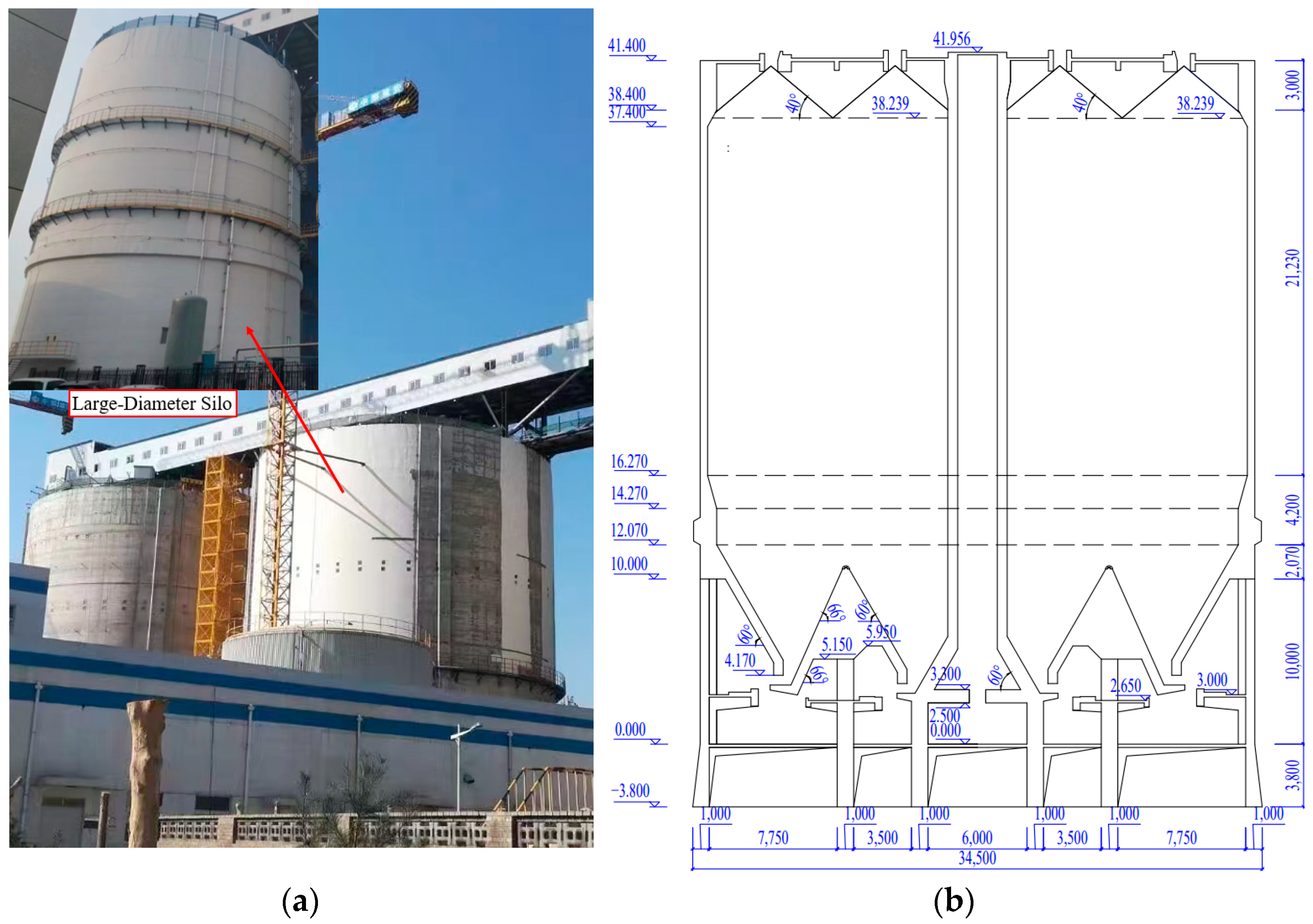
The project involved the construction of a new coal storage silo at a thermal power plant. Each silo had a diameter of 33.60 m, a total height of 41.95 m, and a storage capacity of 25,000 t. Figure 1 illustrates the external elevation of the silo and a sectional view of the superstructure. The silo was supported by a pile foundation comprising drilled and grouted piles. The foundation was embedded to a depth of 6.3 m, with a PCT of 2.5 m. Beneath the pile cap, 178 bored piles, each with a diameter of 1.0 m, were uniformly distributed.
Based on the site geotechnical investigation report and the Engineering Geology Handbook [47], the physical properties of the soil beneath the pile cap was determined, and the minimum PL was calculated to be 13.3 m, as shown in Table 1. The superstructure of the silo (including the silo wall, cylinder wall, silo roof, and central column), as well as the coal conveyor corridor, were constructed using C40 concrete, while the silo pile foundation was made of C30 concrete, reinforced with HRBE400 rebars. Table 2 shows the mechanical properties of the different grades of concrete and rebar. This research focuses on anthracite coal as a storage material. Through systematic and rigorous experimentation, the following key physical parameters have been determined: the bulk density is 10.9 kN·m−3, the internal friction angle is 31.69°, the friction coefficient is 0.6, and the angle of repose is 40°.

2.2. Numerical Model

2.2.1. Element Type and Material Constitutive Model

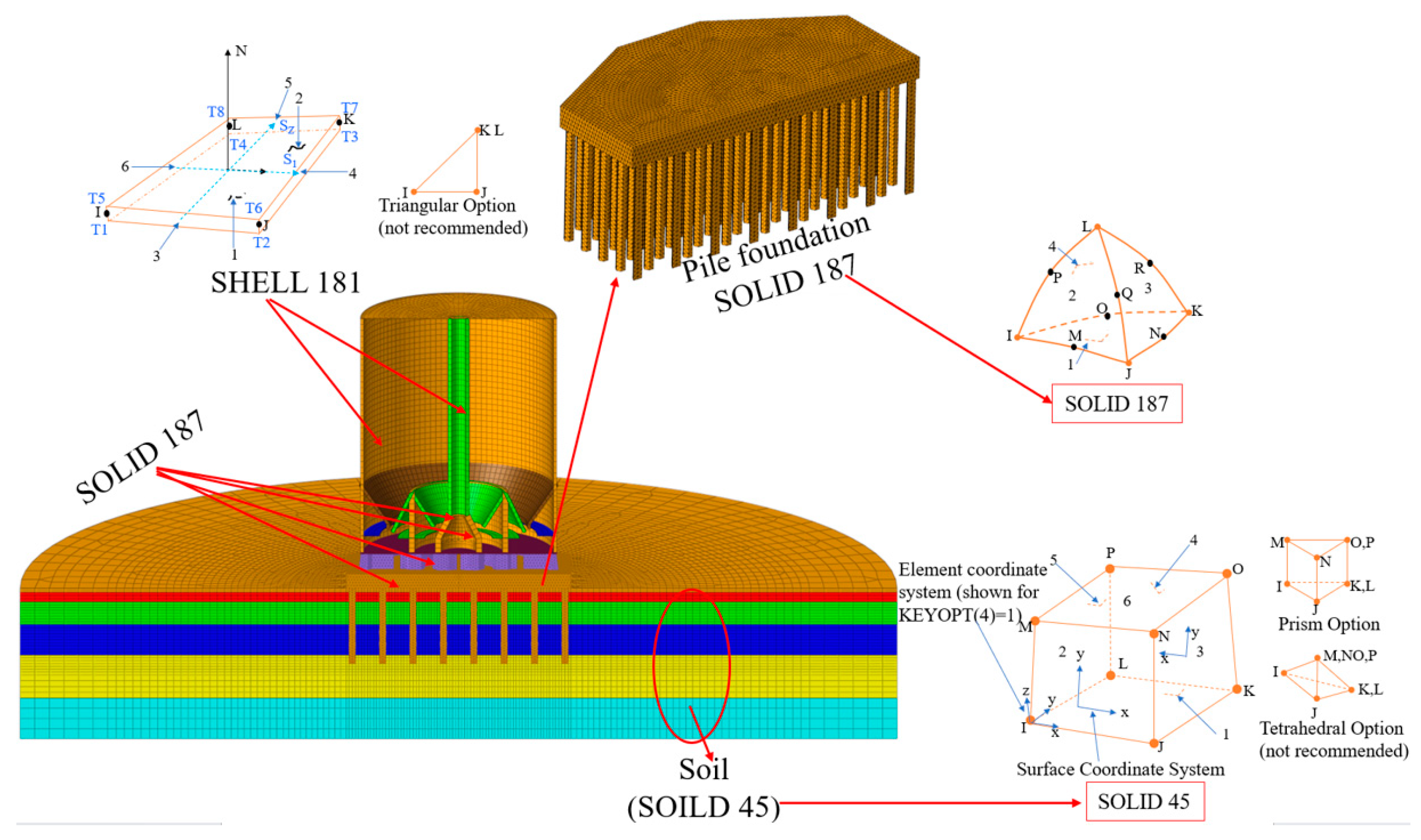
A 3D FE model of the superstructure–foundation–soil interaction was developed using ANSYS 2021. Given that the height of the silo walls and central columns in the superstructure was significantly greater than their thickness, shell elements were employed for the simulation. The coal stored within the silo was modeled using mass elements. The pile foundation and the coal transport corridor beneath the silo were modeled using solid elements. The soil was modeled using solid elements. Concrete was modeled using a linear elastic approach, without accounting for its nonlinear behavior. For the silo’s pile foundation, the effects of reinforcing bars were disregarded, treating it as plain concrete. The superstructure and corridor were modeled with an equivalent elastic modulus. The equivalent elastic modulus for reinforced concrete was calculated using Equation (1).
E R ¯ = E c ( 1 + ρ E s E c E c )
where E R ¯ is the converted elastic modulus of reinforced concrete; Ec is the elastic modulus of concrete; Es is the elastic modulus of rebar; and ρ is the rebar ratio. The reinforcement ratio was taken as 1.2% for C30 concrete elements and 1.5% for C40 concrete elements.
The base soil was modeled using an ideal elastic-plastic model, governed by the Drucker-Prager yield criterion in conjunction with a non-associated flow rule [48]. This criterion necessitates three key parameters: the internal friction angle, cohesion, and dilation angle. The internal friction angle and cohesion were determined through detailed field geological surveys and engineering geology manuals, while the dilation angle was assumed to be half of the internal friction angle [49]. The specific parameters for the Drucker-Prager yield criterion are provided in Table 3.

2.2.2. Mesh Size and Boundary Conditions

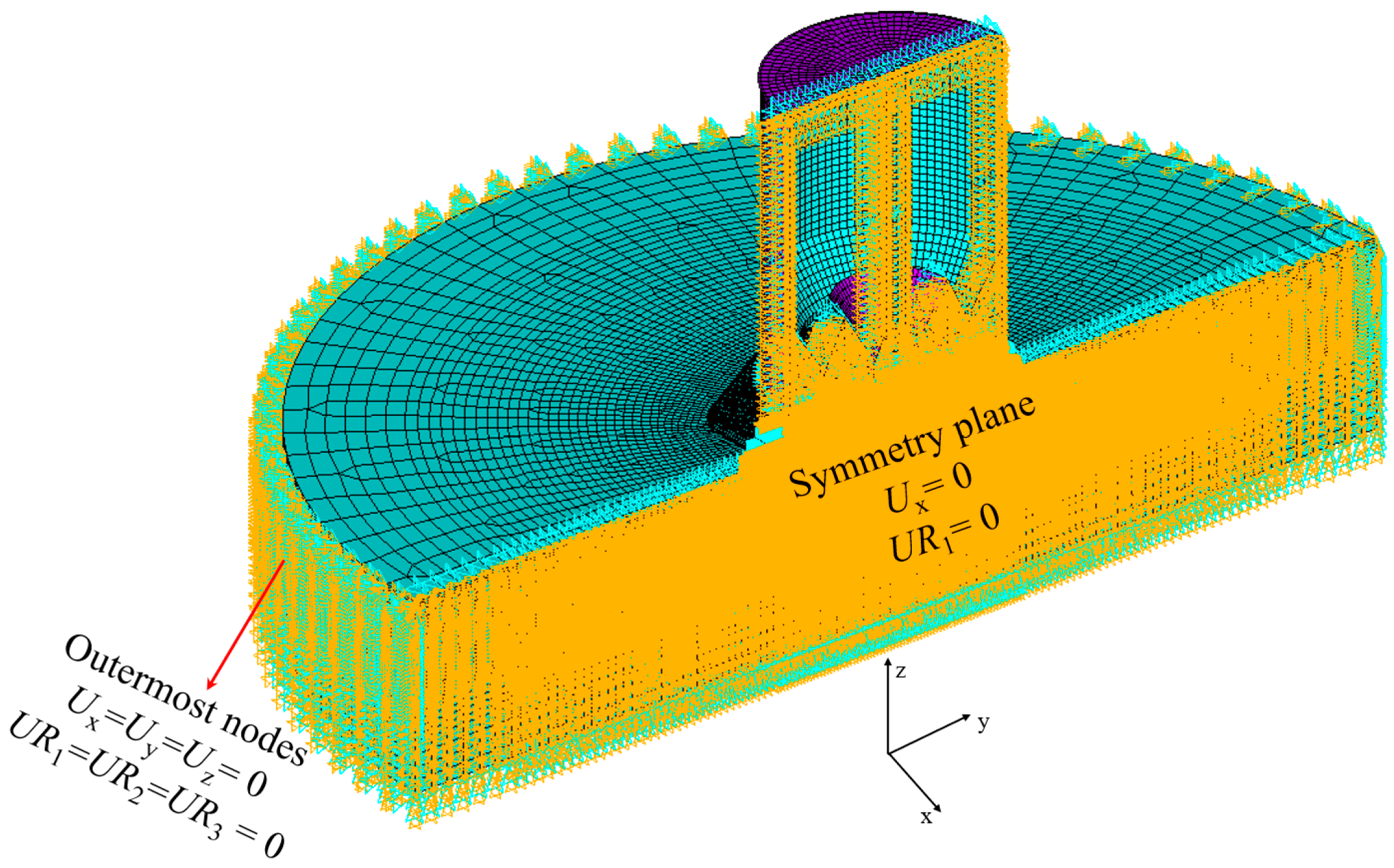
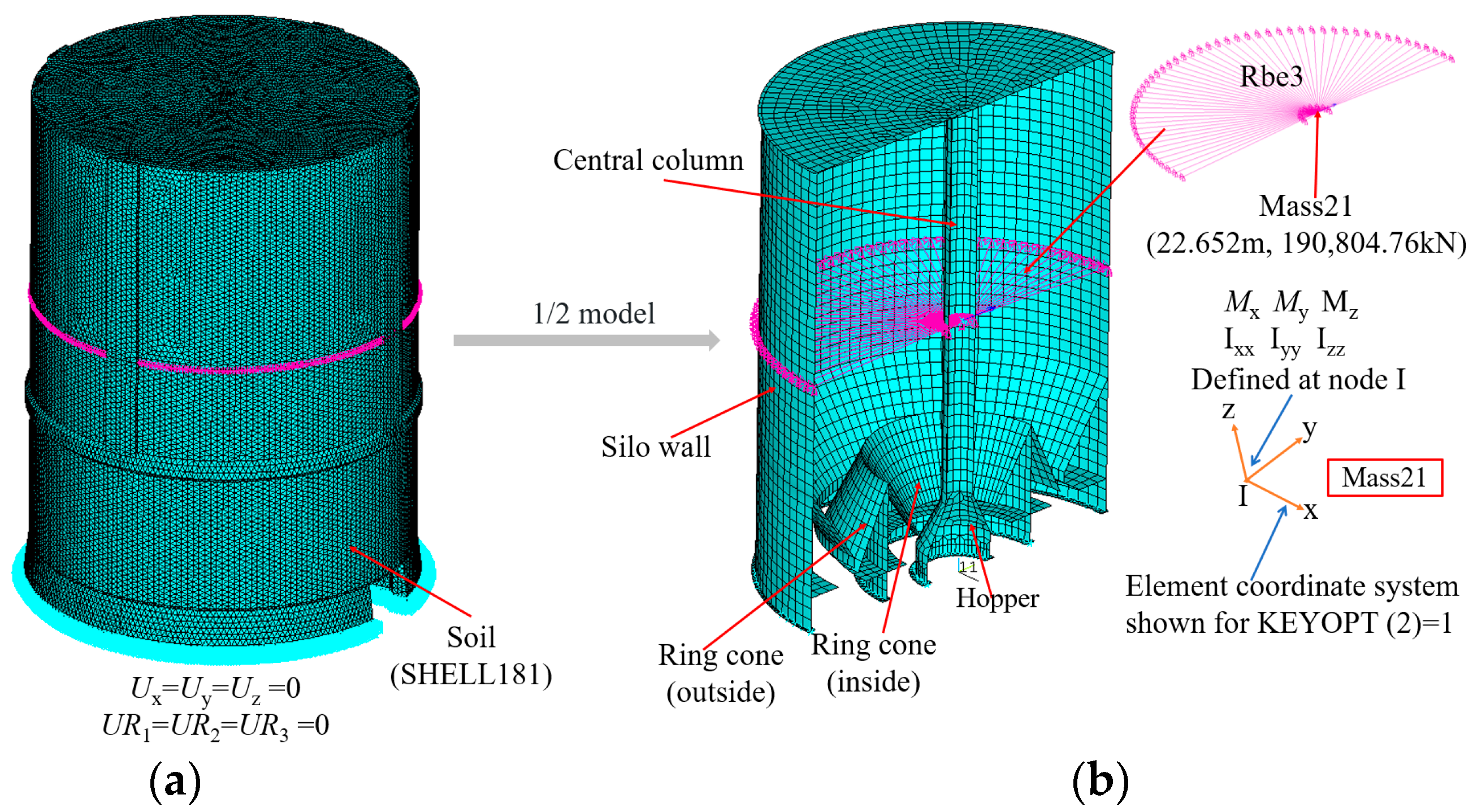
Since the silo considered in this study is axisymmetric, a half finite element model was established to improve computational efficiency, as illustrated in Figure 2. The soil domain was defined following Saint-Venant’s principle, with the horizontal extent set to approximately four times the silo diameter and centered on the foundation. In the vertical direction, the computational domain extended downward from the pile cap base to a depth of twice the pile length (PL). The silo superstructure was idealized using shell elements, while the pile–cap–soil system was modeled with three-dimensional solid elements. A refined mesh was adopted in regions near the foundation to capture stress and deformation gradients, whereas a gradually coarser mesh was used with increasing distance from the structure to reduce computational demand. Symmetry boundary conditions were applied along the symmetry plane to restrict displacement and rotation normal to the plane. The lateral boundaries of the soil domain and the bottom surface were fully constrained, while the ground surface was treated as a free boundary. The applied boundary conditions are illustrated in Figure 3.

2.2.3. Contact and Loading

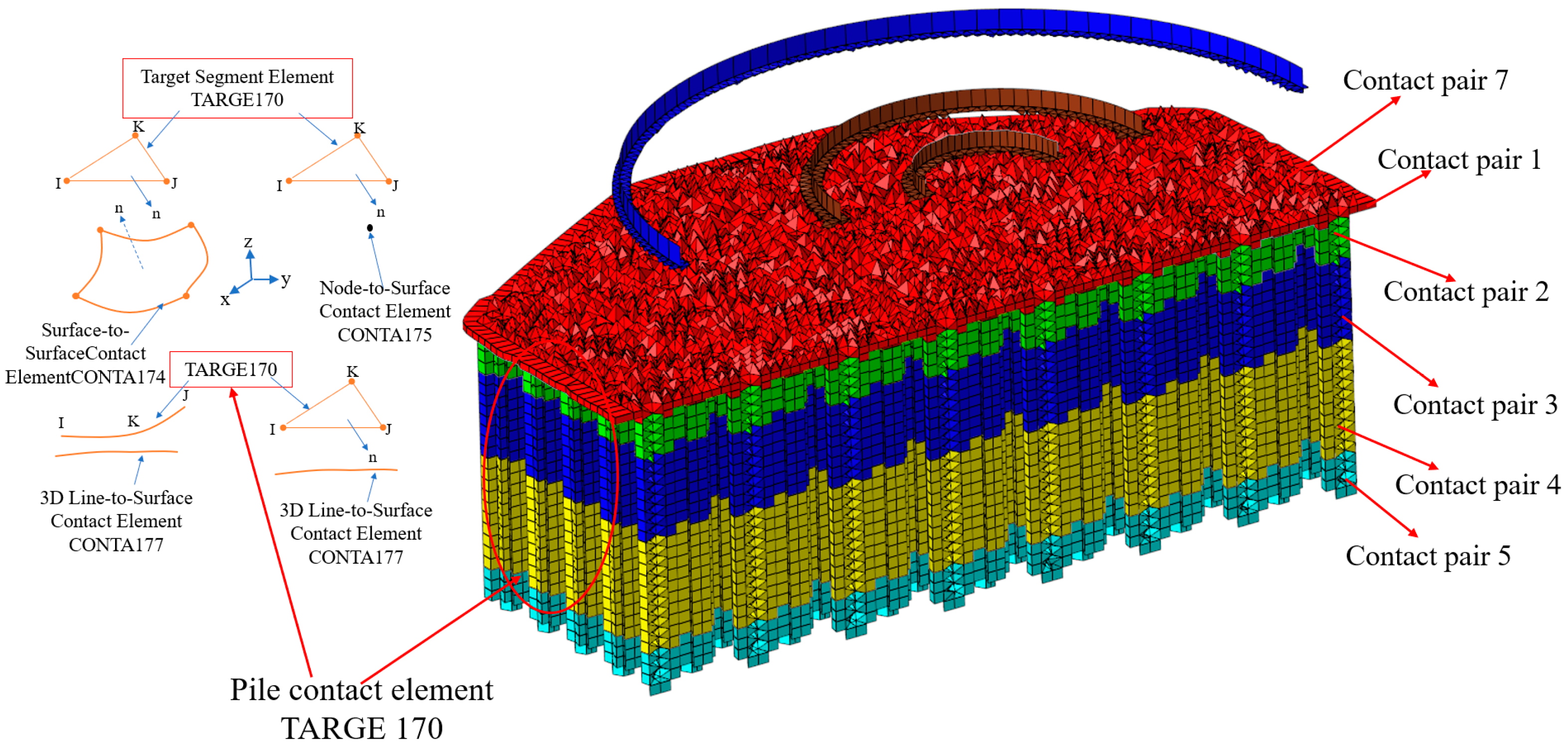
The interaction between the cast-in-place piles and the surrounding soil was modeled using a surface-to-surface contact formulation, with the pile surface defined as the target surface due to its higher stiffness. Contact pairs were generated according to the stratification of the soil layers, and automatic contact generation was employed to ensure modeling consistency. In addition, contact between the pile cap base and the underlying soil surface was explicitly defined. The adopted contact parameters are summarized in Table 4, and the contact configuration is illustrated in Figure 4. In the reference model, the pile tip was embedded within soil layer ⑤, and therefore did not interact with the deepest contact pair, which was reserved for subsequent parametric analyses involving variations in PL. Standard contact behavior with Coulomb friction was adopted to represent realistic pile–soil interaction, with the frictional resistance governed by Equation (2). The friction coefficient was determined from the internal friction angle of the soil, while the cohesion was taken as 0.8 times the soil cohesion [50]. Energy dissipation within the stored material was neglected, and the silo contents were assumed to be rigidly connected to the silo wall and the central column.
τ l i m = μ P + b
| τ |   { τ l i m , τ l i m }
where τlim is the ultimate shear stress, τ is the equivalent shear stress, P is the normal contact pressure, b is the contact cohesion, τmax is the maximum contact frictional force, and μ is the pile–soil friction coefficient.
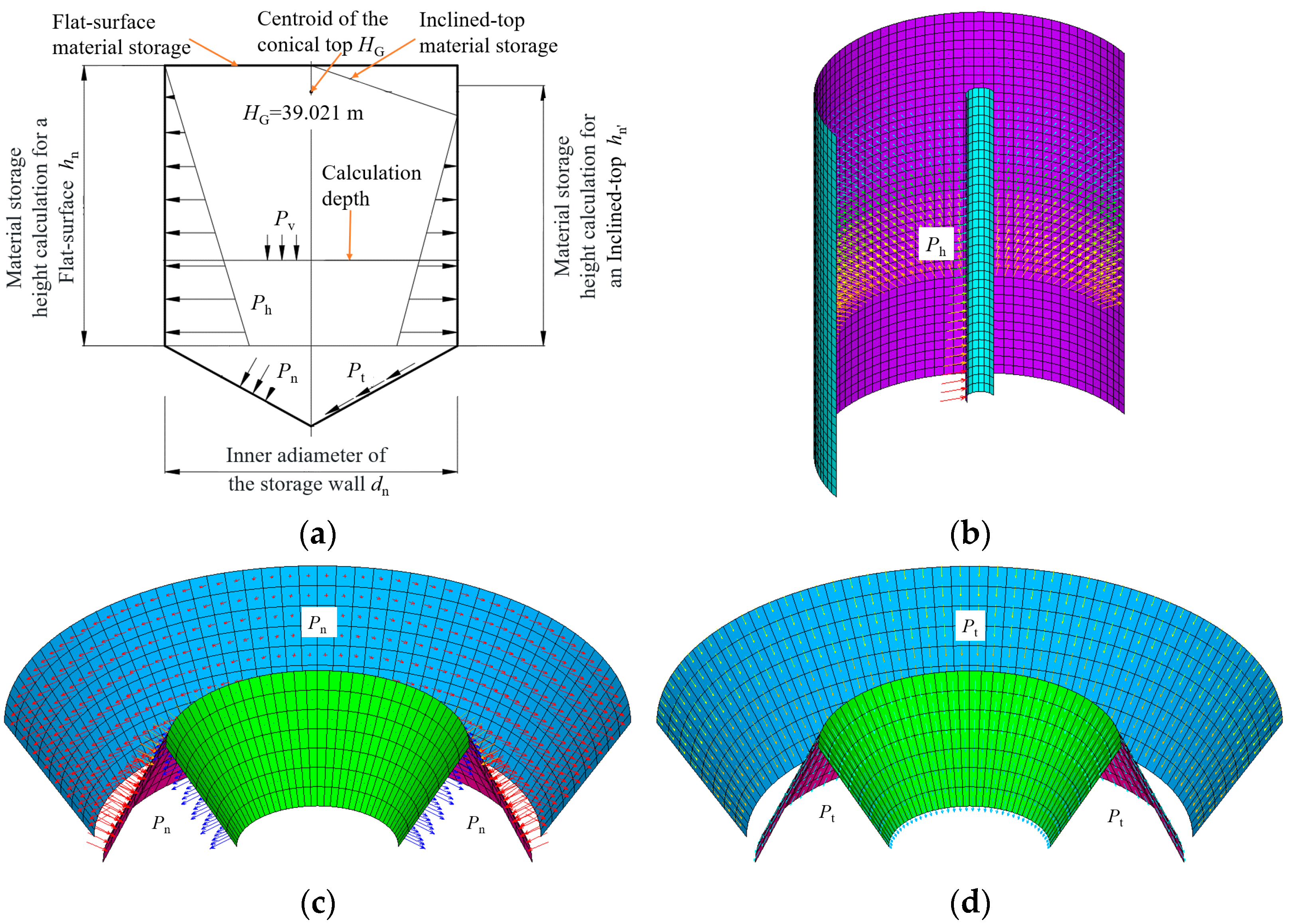
Figure 5a illustrates the numerical model, which accounts for the silo superstructure self-weight, storage material pressure, and horizontal seismic actions [52]. Seismic-induced bending moments were found to be negligible compared with axial and lateral loads and were therefore excluded from the foundation optimization. The structural self-weight was automatically considered through material property assignment in the FE model. The storage material pressure was determined in accordance with the Chinese code GB 50077 [53,54], and the resulting pressures acting on different silo components are summarized in Table 5. Equivalent nodal loads were applied to represent the normal pressures on the silo wall and central column, while distributed pressures on the inclined hopper walls and conical section were applied using surface-based load representations. The spatial distribution of storage material pressures is shown in Figure 5b–d.
The FE model was employed to simulate the stress state of a fully loaded silo subjected to rare seismic excitation. Previous studies have shown that the natural frequency accounting for soil–structure interaction deviates only slightly from that obtained under a rigid foundation assumption [55]. Accordingly, a rigid foundation was assumed in the modal analysis, and the silo base was fully constrained.
The energy dissipation of the stored material was neglected, and the stored material was assumed to be rigidly connected to the silo wall and the central column, as shown in Figure 6a. Based on numerical simulation and modal analysis, the first ten natural frequencies of the fully loaded silo were obtained, ranging from 2.982 Hz to 9.520 Hz, with detailed values provided for reference. For rare seismic conditions, the seismic influence coefficient curve was defined in accordance with current design standards, adopting a damping ratio of 0.05 and a design basic seismic acceleration of 0.1 g. The maximum horizontal seismic influence coefficient and characteristic period were taken as 0.5 and 0.4 s, respectively, while the fundamental structural period was 0.335 s. The horizontal seismic action was evaluated using the base shear method [56] and applied as an equivalent static load of 190,804.76 kN at the combined center of gravity of the silo and stored material, located at the geometric center of the silo at an elevation of 22.652 m. To apply the seismic load, an equivalent mass point was defined at the combined center of gravity and connected to the silo structure through flexible constraint elements, and the horizontal seismic load was subsequently imposed at this location, as illustrated in Figure 6b.

2.2.4. Finite Element Verification

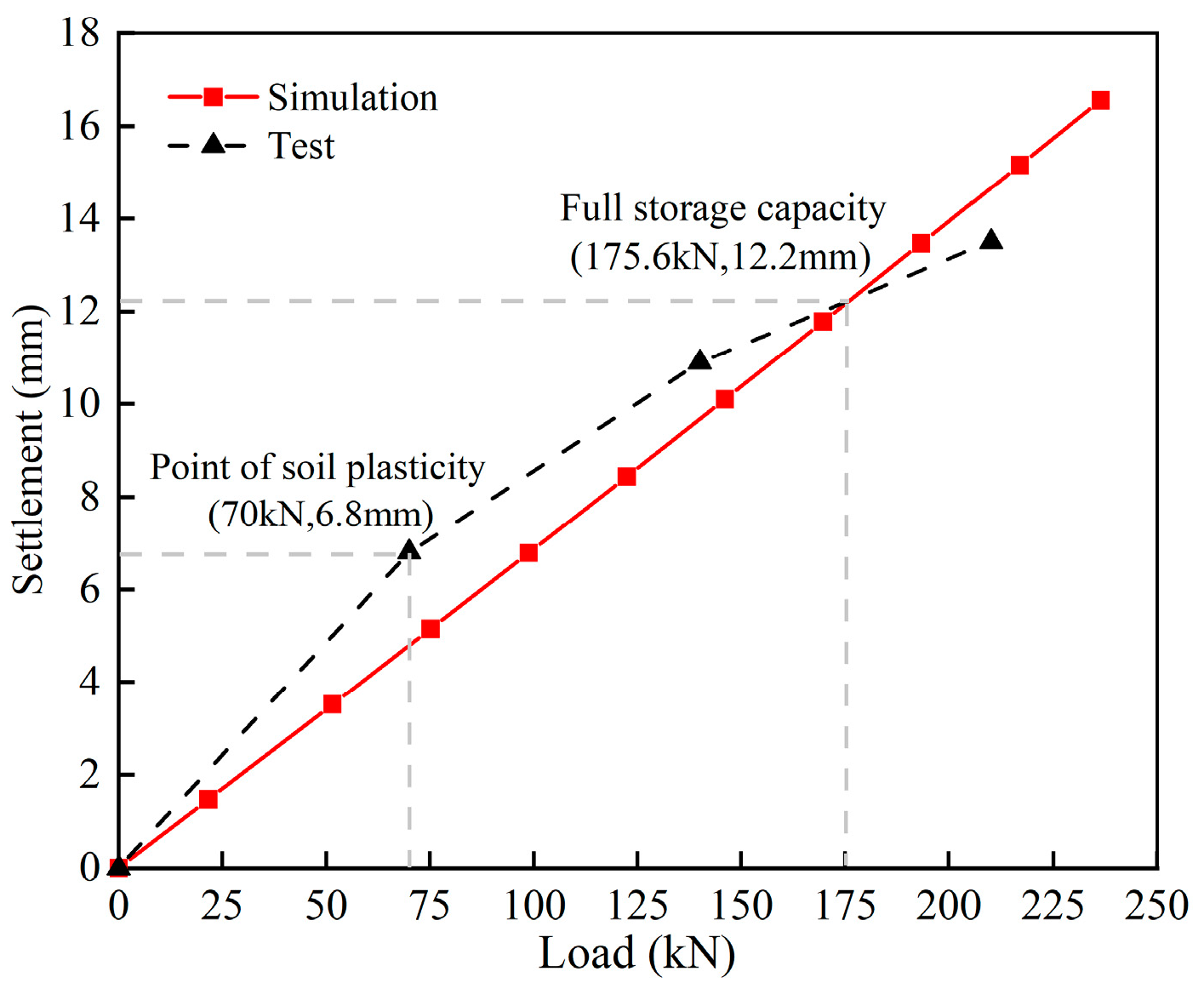
According to the China codes [52,57], a combined analysis was performed considering the structural self-weight, storage material pressure, and horizontal seismic loads, leading to the three load cases detailed in Table 6. Figure 7 illustrates a comparison between the measured and simulated values of the central settlement on the upper surface of the pile cap. Initially, the measured values of storage material were slightly higher than the simulated values. As the load increased, the simulated values exhibited a linear rise, whereas the measured values demonstrated a gradual deceleration in growth. At full storage capacity, the measured and simulated values converged to a similar level. This behavior can be attributed to the following: during the early stages, the soil primarily behaves elastically, leading to a linear relationship between load and deformation. As the load intensifies, a significant portion of the soil transitions to a plastic state. Although the soil continues to support the load, the rate of deformation slows down. In the later stages of loading, the idealized assumptions of the numerical simulation result in greater soil deformation compared to actual measurements. Despite the observed discrepancies between measured and simulated values, the differences were not of an order of magnitude. Therefore, it can be concluded that the numerical simulation results were reasonably accurate.

2.3. Sensitivity Analysis of Pile Foundation

2.3.1. Sensitivity Analysis Model

To facilitate the comparison of sensitivities among factors with varying properties and units, the system characteristics and factors were initially nondimensionalized. Subsequently, a dimensionally consistent parameter sensitivity function was defined, as presented in Equation (4) [58,59].
S k ( a k ) = | Δ P | P | Δ a k | a k = | Δ P Δ a k | | a k P |                                                                       ( k = 1 , 2 , , n )
where ak is the k-th sensitivity factor; Sk is the sensitivity of factor ak; P is the system property; |ΔP|/P is the relative change rate of the system characteristic; |Δak|/ak is the relative change rate of a certain factor.
When |Δak|/ak was small, Sk (ak) can be approximated by the expression shown in Equation (5).
S k ( a k ) = | d f ( a k ) d a k | | a k P |                                                                       ( k = 1 , 2 , , n )
For complex systems where numerical methods were used to represent the relationship between system characteristics and influencing factors, a substantial amount of data was necessary to achieve accurate fitting. Consequently, a modified multi-factor sensitivity analysis method [59] was utilized, with the expression provided in Equation (6).
S k ( a k ) = | 1 m 1 i = 1 m 1 ( P k i P k i + 1 a k i a k i + 1 a k i + 1 P k i + 1 ) |                                     ( i = 1 , 2 , , m 1 ; k = 1 , 2 , , n )
where m is the number of values taken by each influencing factor ak; a k i is the (i)-th value of influencing factor ak; p k i is the system characteristic corresponding to the influencing factor a k i .

2.3.2. Parameter Design and Analysis

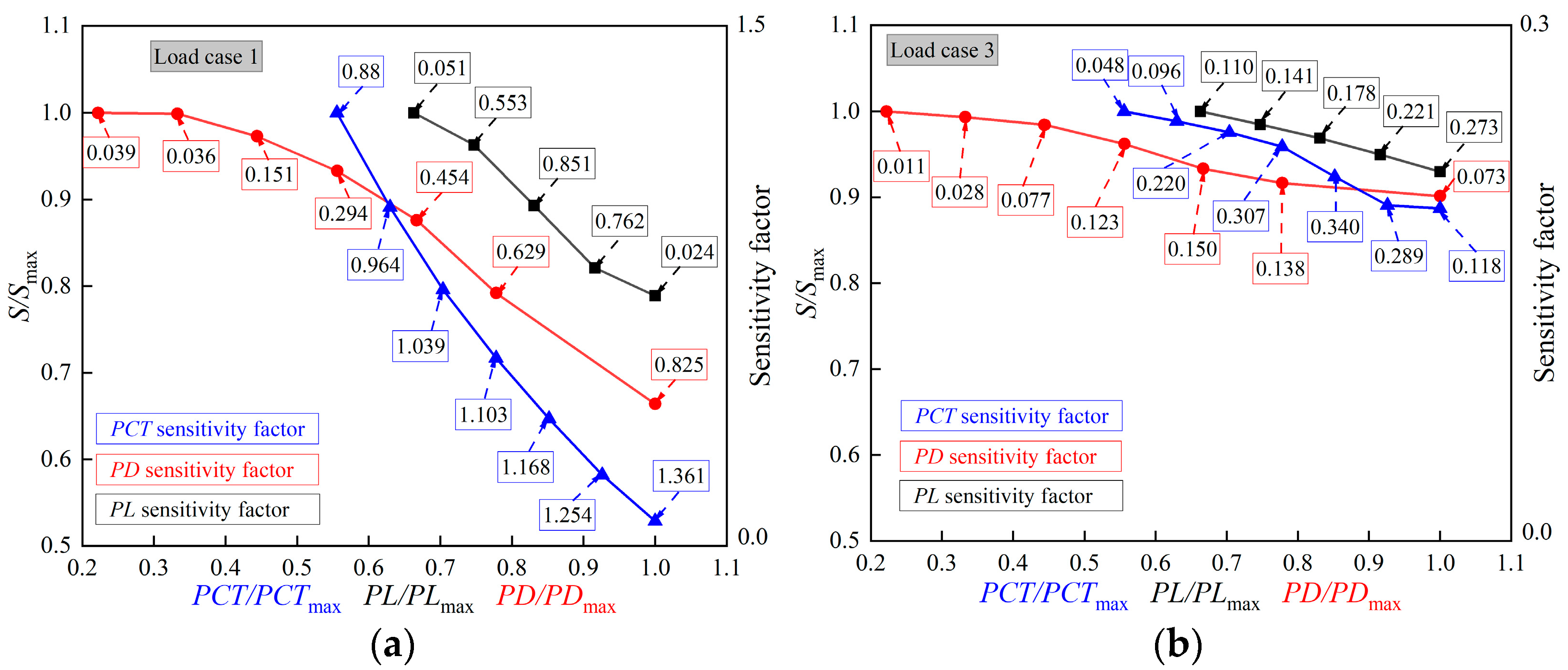
Based on the dual control theory [11] and considering the engineering geological characteristics, settlement was identified as the primary controlling factor, with the MDS of the foundation serving as the key indicator for sensitivity analysis. Sensitivity analyses were performed on the PCT, PL, and PD to evaluate the influence of individual parameter variations on the deformation behavior of the foundation. Each parameter was examined under seven different scenarios, as outlined in Table 7, and the corresponding sensitivity analyses are graphically depicted in Figure 8.
The calculation results clearly demonstrate that the MDS of the pile cap exhibits a decreasing trend, with PL being the most influential factor, leading to significant changes in the order of magnitude of the settlement. Under load case 1, the MDS of the pile cap decreased by 4.555 mm, 1.388 mm, and 2.285 mm with variations in PCT, PL, and PD, respectively. Under load case 3, the MDS decreased by 8.930 mm, 5.019 mm, and 7.230 mm for the same parameters. To effectively control the MDS of the pile cap, the inflection point theory [60] was employed to define the value ranges for PCT, PL, and PD, which were determined as 1.7 m to 2.3 m, 11.8 m to 14.8 m, and 0.6 m to 1.2 m, respectively. Among these parameters, the MDS was most sensitive to changes in PCT, followed by PD, with the least sensitivity observed for variations in PL.

3. Optimization of Silo Pile Foundation

3.1. Improvement of Genetic Algorithm

The operational procedure of the AGGA closely paralleled that of the Standard Genetic Algorithm (SGA). However, during the optimization process, AGGA was prone to issues such as oscillations in the later stages, which hindered convergence, as well as premature convergence. Therefore, improvements to the AGGA were necessary to address these challenges. This project involved optimizing discrete variables. Unlike continuous variable optimization problems, which offer an infinite number of solutions, the solution space for discrete variables was relatively smaller, thus reducing the demand on the algorithm’s local search capability. Consequently, this paper focused on refining the AGGA at a micro level. Intuitively, the improvements aim to prevent the population from becoming too similar, allowing the algorithm to explore a wider range of solutions and avoid getting trapped in suboptimal areas. By emphasizing individual differences and actively maintaining population diversity, the AGGA balances exploration and exploitation, thereby enhancing both accuracy and stability during the optimization process. The optimization of the silo foundation aimed to minimize construction costs, with its fitness function defined in Equation (7).
F ( x i ) = f m a x p ( f ( x i ) + p e n a l ( x i ) )
where F(xi) is the fitness function; f(xi) is the objective function; penal(xi) is the penalty function; f m a x p is the maximum value of the objective function and penalty function among all individuals of the population.
Due to the simplicity of the penalty function form, using a fixed penalty coefficient for different individuals yields poor results. Previous research proposed incorporating the penalty function into the population’s average objective function, resulting in the Lemonge penalty function [61,62]. This method reduces the significant disparity between the penalty function and the objective function, mitigating some of the traditional penalty function’s limitations. In addition, the Lemonge penalty function overcomes several shortcomings of ordinary penalty functions and offers the following advantages: it provides adaptive penalization; it eliminates the need to specify penalty parameters manually; and it can automatically determine the corresponding weight by evaluating the degree to which a constraint is violated. However, the Lemonge penalty function has a notable drawback: it imposes excessively harsh penalties on individuals that slightly violate constraints, which can lead to their elimination from consideration. To overcome this limitation, this paper proposes an enhancement by integrating an exponential function into the Lemonge penalty function, as outlined in Equations (8)–(11).
p e n a l ( x i ) = f ( x ) γ { E X P [ j = 1 r α j β j ] 1 }
α j = v ¯ j j = 1 r v ¯ j
β j = v j ( x i ) i = 1 n v j ( x i )
f ( x ) = 1 n i = 1 n f ( x i )
where p e n a l ( x i ) is the new penalty function; f ( x ) is the average value of the objective function of all individuals in the population; γ is the penalty coefficient, vj (xi) is the violation degree of the (i)-th individual to the (j)-th constraint in the population; αj is the ratio of the average violation degree of the (j)-th constraint in the current population to the sum of the average violation degree of the constraint; βj is the ratio of the violation degree of the (j)-th individual to the (j)-th constraint in the population to the sum of the violation degree of all contemporary individuals to the (j)-th constraint.
To emphasize the distinctions between the fitness functions for feasible and infeasible solutions, the fitness function was assessed under various cases. The revised fitness functions are presented in Equations (12) and (13).
F ( x i ) = { f max p f ( x i ) ,                                                   g j ( x i ) 0 f max p f ¯ ( x i ) p e n a l ( x i ) ,     g j ( x i ) > 0
f ¯ ( x i ) = { f ( x i ) , f ( x i ) > f ( x ) f ( x ) , else
where f ¯ ( x i ) is the objective function value adjusted for infeasible solutions.
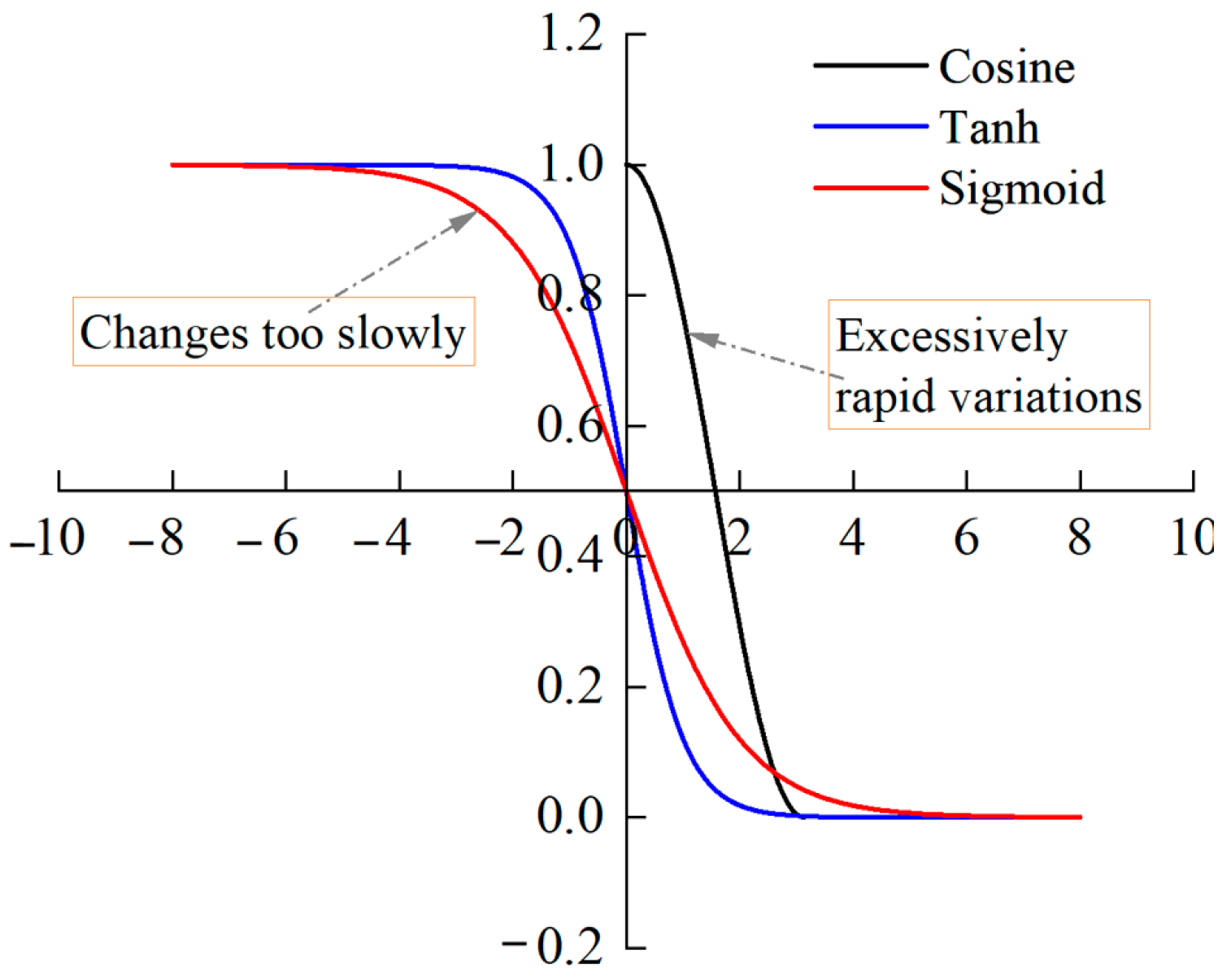
An additional enhancement for silo foundation optimization involves refining the genetic operators. By integrating the hyperbolic tangent function, these operators are dynamically adjusted in response to variations in fitness values within the specified range, while ensuring numerical continuity. Specifically, when an individual’s fitness value is lower than the population’s average fitness, the genetic operator is assigned its maximum value to promote exploration. This adjustment mechanism is detailed in Equations (14)–(16). Figure 9 illustrates a comparative analysis of three representative nonlinear functions—namely the hyperbolic tangent function, cosine function, and sigmoid function—within the same value range. These functions are commonly used in algorithmic testing and collectively reflect typical optimization scenarios, including cases with only a global optimum, cases where global and local optima coexist with a clear distinction, and cases where the difference between global and local optima is relatively small. From the perspective of the rate of change, the cosine function exhibits excessively rapid variations, which fail to accurately capture the fitness differences among individuals. In contrast, the sigmoid function changes too slowly, which hampers the effective preservation of superior individuals and the timely elimination of inferior ones. By comparison, the hyperbolic tangent function adopted in this study exhibits a moderate rate of change that lies between those of the cosine and sigmoid functions. This balanced behavior enables a better trade-off between population evolution and stability, thereby enhancing the algorithm’s search capability and robustness in complex optimization problems and aligning more closely with the principles of natural evolution.
P c = { p c , m a x p c , m i n 2 × e k e k e k + e k + p c , m a x + p c , m i n 2       , f f avg p c , m a x                                                                                                                     , f < f avg
P m = { p c , m a x p c , m i n 2 × e k e k e k + e k + p c , m a x + p c , m i n 2             , f f avg p m , m a x                                                                                                                       , f < f avg
k = f a v g + f m a x 2 f ( f max f ) ( f f avg )
where Pc and Pm represent the individual crossover probability and mutation probability, respectively; Pc,min, Pc,max, Pm,min and Pm,max denote the preset maximum and minimum crossover probabilities and maximum and minimum mutation probabilities, respectively; f , f a v g , and f m a x represent the fitness function value of an individual, the average fitness of the current population, and the maximum fitness of the current population, respectively; K is the genetic regulation factor.
This study assesses the performance of the SGA, the AGGA, and the IAGGA proposed in this work, using three well-established nonlinear and multimodal benchmark functions: the Sphere function, the Ackley function, and the Rastrigin function. To ensure the comparability and consistency of the results, the variable range in all tests was uniformly set to [−2, 2]. In the testing process, the population size was set to 50. The dimensions of the test functions were set to 20, 40, and 60, with corresponding iteration counts set to 1000, 2000, and 3000. In genetic algorithm parameter settings, the SGA typically used fixed values for crossover probability (Pc = 0.8) and mutation probability (Pm = 0.08). In contrast, the AGGA and the IAGGA employed varying strategies. For AGGA, the crossover probability ranged between a maximum of (Pc,max = 0.8) and a minimum of (Pc,min = 0.2), while the mutation probability ranged between (Pm,max = 0.01) and (Pm,min = 0.005). Table 8 provides the test results for each test function, each independently executed 10 times across the different algorithms.
According to the data presented in Table 8, the IAGGA achieved the closest average optimal fitness to the theoretical optimal solution across all test functions. Additionally, IAGGA exhibited the smallest variance in optimal fitness, underscoring its superior optimization accuracy, stability, and robustness compared to the other two algorithms. Despite the challenges all algorithms encountered as the complexity of test functions increased, IAGGA consistently maintained relatively high accuracy and stability under these cases. Therefore, it can be concluded that the application of IAGGA to the optimization of the silo pile foundation, as proposed in this study, was well-supported, and its performance surpassed that of both the SGA and the AGGA.

3.2. Calculation Diagram

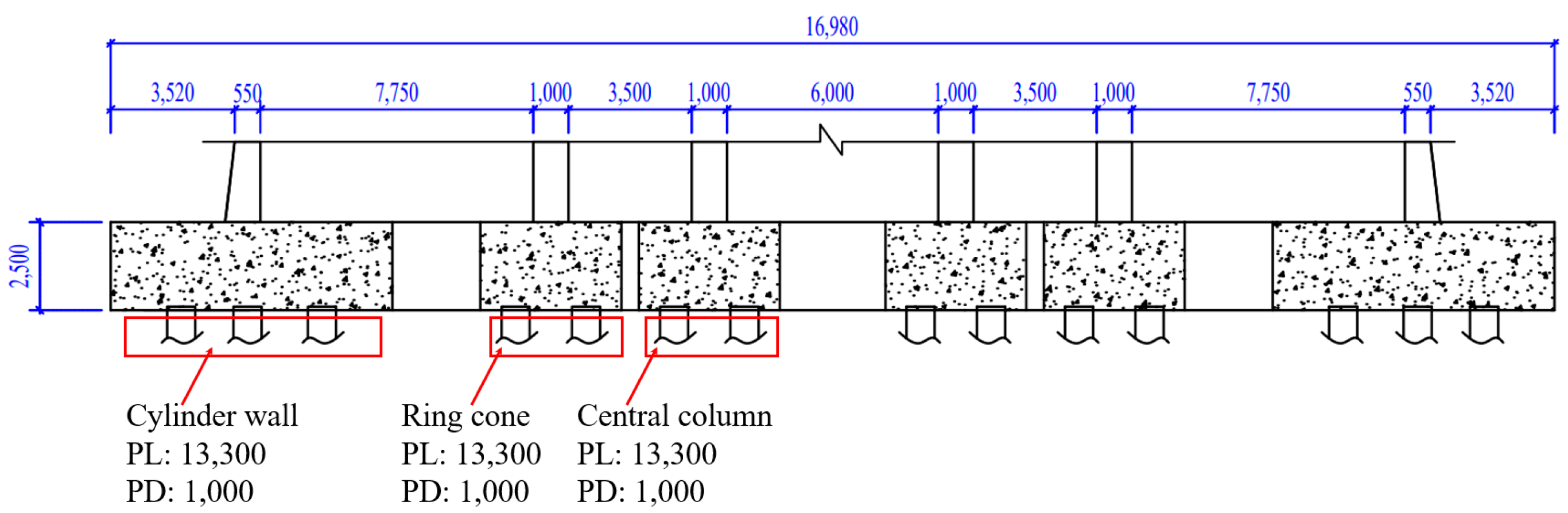
To ensure the feasibility of the algorithm, similar engineering projects were referenced for the design of the silo pile foundation. A simplified calculation diagram of the silo pile foundation is provided in Figure 10. The design disregards the openings and structural details of the coal transport gallery, treating the cylinder wall, ring cone, and central column as independent units for separate calculation. In non-seismic regions, the symmetrical nature of the silo structure and its applied loads generally allows the influence of bending moments to be neglected. Instead, the design focuses solely on the maximum axial force transmitted from the cylinder wall, ring cone, and central column to the top of the pile cap. During the design of silo pile foundations in accordance with the principle of axial compression, a comprehensive and systematic analysis of the maximum vertical axial forces within key components was meticulously carried out utilizing ANSYS software. Specifically, under Load Case 1, the vertical axial force of the central column was precisely determined to be 22,372 kN, whereas the annular cone and the cylindrical wall manifested forces of 140,044 kN and 214,668 kN, respectively. Under Load Case 2, the vertical axial force of the central column escalated to 25,328 kN, with the annular cone and cylindrical wall exhibiting forces of 164,864 kN and 246,536 kN, respectively.

3.3. Optimization Model

3.3.1. Modularization of Pile Foundation

The large-diameter silo pile foundation consists of two parts: the pile cap and the pile group. To ensure the independence of variables, the pile cap thickness (PCT), pile length (PL), pile diameter (PD), and pile layout were selected as optimization factors. Specifically, the pile cap thickness ranges from 1.7 m to 2.3 m, with an increment of 0.1 m; the pile length ranges from 11.8 m to 19.3 m, with an increment of 0.5 m; and the pile diameter ranges from 0.6 m to 1.2 m, with an increment of 0.1 m. Among these factors, PCT, PL, and PD are related to structural dimension optimization, whereas pile layout pertains to arrangement optimization. To integrate the optimization of both dimensions and arrangements, modularization was adopted, allowing for consistent handling of these distinct design variables. Specifically, the silo pile foundation is divided into several regions, each defined as a module in which PCT, PL, PD, and pile arrangement are uniform. Owing to the symmetry of structural geometry and loading conditions, different modules often exhibit similar mechanical and structural characteristics; accordingly, similar modules can be grouped into a module package and represented by a unified design variable, thereby reducing the number of design variables and improving optimization efficiency. According to the China code JGJ 94 [9], shear wall structures require that piles be concentrated beneath the shear walls. Consequently, the cylinder wall, ring cone, central column, and their respective foundations were each categorized into distinct modules. Due to the inherent differences among these modules, further consolidation was impractical, leading to the establishment of three separate modules. Each module is characterized by attributes such as PCT, PL, PD, and pile layout, with these characteristics remaining consistent within each module. Based on the structural geometry and load symmetry, foundation modules with similar characteristics can be grouped into packages. Each package comprises modules with identical PCT, PL, PD, and consistent pile layouts. Define the (i)-th module as the (i)-th design variable, denoted by xi = PCTi, PLi, PDi, layouti.
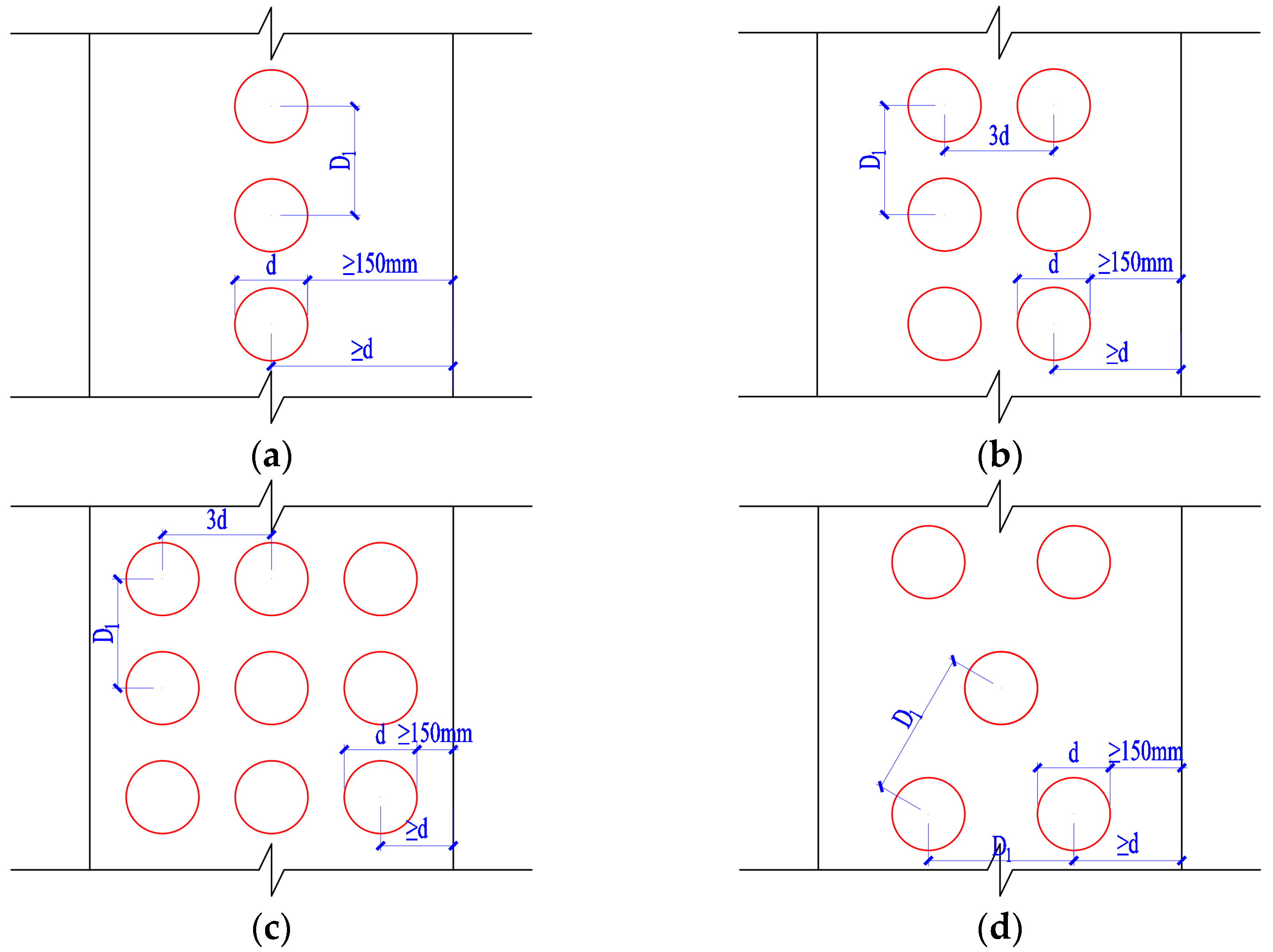
To mitigate the detrimental impact of pile-to-pile interactions on the foundation and to ensure the applicability of the pile group settlement formula, the spacing between piles relative to their diameter should adhere to the range 3 d ≤ D ≤ 6 d [9]. Given the constraints on the pile cap size, the radial pile spacing was directly set to 3 d. Based on the specified pile layout and PD, the minimum pile cap size can be determined. To ensure safety, the maximum PCT is adopted uniformly. Consequently, four distinct pile foundation layouts are illustrated in Figure 11. This modular approach integrates considerations of PCT, PL, PD, and pile layout, thereby achieving a coordinated optimization of pile foundation dimensions and configuration.

3.3.2. Optimization Model of Pile Foundation

To ensure structural safety while minimizing foundation costs, the objective can be effectively addressed by controlling concrete usage. This involves optimizing the design through separate calculations of the concrete volumes needed for the pile cap and the pile group. Accordingly, a modular approach is employed to formulate a mathematical model for pile foundation optimization, as detailed below:
Find
x = ( x 1 , x 2 , , x s ) T = { { c 1 , l 1 , d 1 , l a y o u t 1 } , , { c s , l s , d s , l a y o u t s } }
Minimize
V = i s n i p i π d i 2 l i 4 + i s A i c i
Subject to [9,10,52,63]
g 1 ( x ) = N k i R i 0                 i = 1 , 2 , , s
g 2 ( x ) = N i ψ c f c A p s i 0     i = 1 , 2 , , s
g 3 ( x ) = s i [ s ] 0     i = 1 , 2 , , s
g 4 ( x ) = s ¯ i [ s ¯ ] 0     i = 1 , 2 , , s
g 5 ( x ) = F l i F c i 0       i = 1 , 2 , , s
g 6 ( x ) = V i V r i 0       i = 1 , 2 , , s
g 8 ( x ) = c 1 + 2 c 2 + c 3 2 R
i = 2 n H ( x i ) + 1 C u , H ( x i ) = { 0 ,                   x i { x 1 , x i 1 } 1 ,                                                         o t h e r s
The optimization objective was to minimize the overall volume (V) of the pile foundation. Where s is the total number of design variables; c is the PCT; l is the PL; d is the PD; pi is the number of modules within the module package corresponding to the (i)-th design variable; and Ai is the area of the pile cap associated with the (i)-th design variable. The following constraints are incorporated: the vertical bearing capacity of the pile foundation (Equation (19)), the concrete strength of the pile body (Equation (20)), the maximum deformation of the foundation (Equation (21)), the maximum settlement verification of the foundation (Equation (22)), the punching shear of the pile cap (Equation (23)), and the shear resistance of the pile cap (Equation (24)). Since the dimensions of the pile cap in each module were determined by randomly generated radial pile spacing and piling patterns, discrepancies in pile cap dimensions between different modules may result in geometric conflicts. Consequently, geometric constraints, as shown in Equation (25), were necessary.
In Equations (19) and (20), Nki and Ni represent the vertical loads acting at the pile cap under the standard and basic combinations of load effects, respectively. R denotes the characteristic value of the vertical bearing capacity of the foundation pile, calculated by the China code JGJ 94 [7]. ψc is the pile construction method factor, which is set to 0.9 for the bored cast-in-place piles in this project. fc and Apsi represent the design value of the axial compressive strength of the pile concrete and the cross-sectional area of a single pile, respectively. In Equations (21) and (22), [s] represents the allowable settlement value for the silo foundation, which is set to 200 mm; si represents the calculated settlement value at the center of each module. [ s ¯ i ] represents the upper limit of the tilt rate for the silo foundation, which is set to 0.004; s ¯ represents the calculated tilt rate between different modules. In Equations (23) and (24), Fci represents the design value of the punching force acting on the punching failure cone under the basic combination of load effects; Vri represents the design value of the maximum shear force at the inclined section, not accounting for the self-weight of the pile cap and the upper soil. In Equation (25), c1, c2, c3 represent the cylinder wall, the ring cone, and the PCT, respectively. R represents the distance from the center of the silo wall to the center of the central column, which is set to 13.25 m. Equation (26) represents the grouping constraint condition, where Cu is the upper limit for grouping.

3.3.3. Optimization Process of Pile Foundation

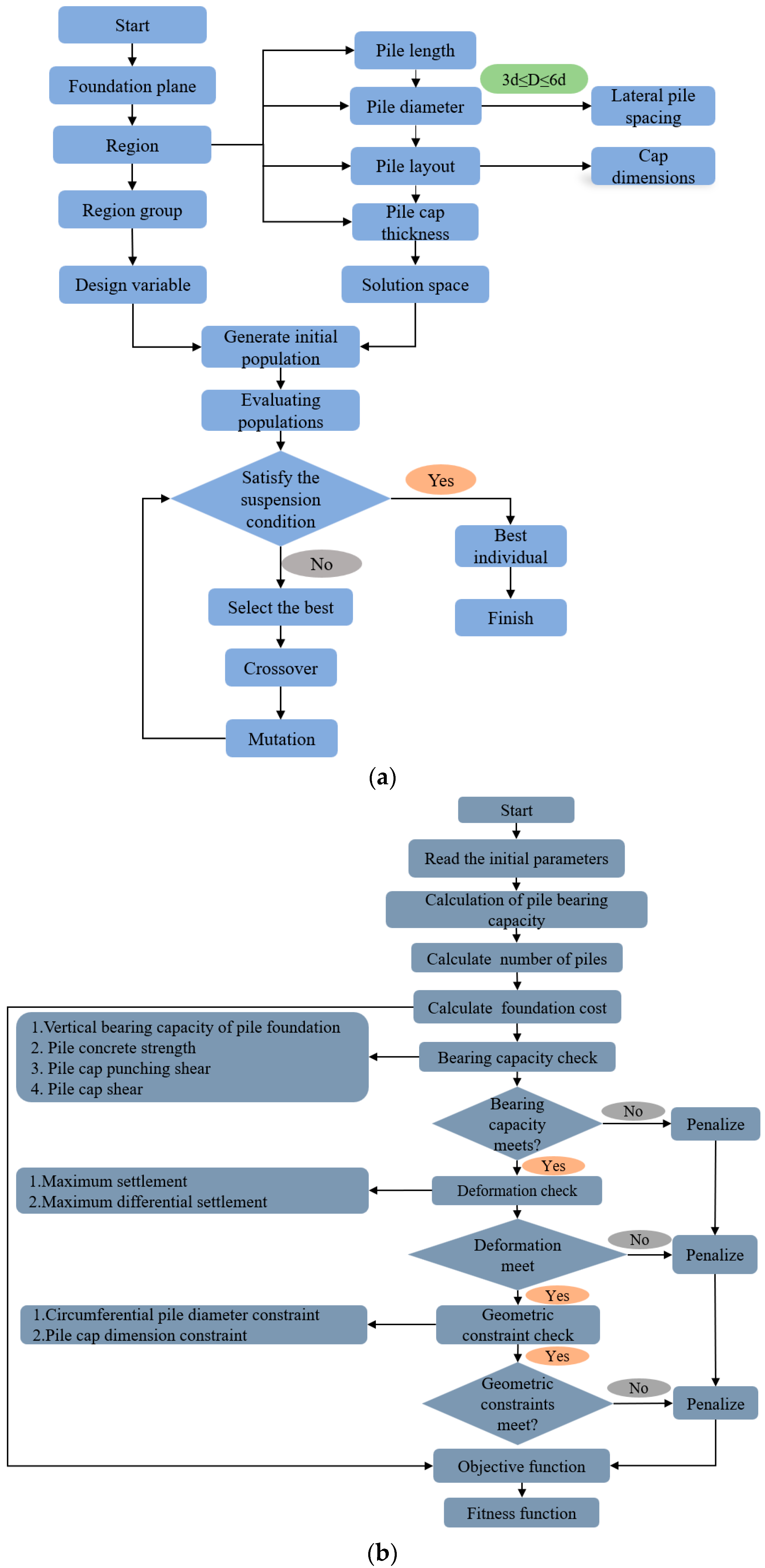
Before commencing the optimization process, the solution space was rigorously defined through the systematic permutation and combination of design variable values. The AGGA was initialized with the following parameters: a population size of 100, a maximum of 1000 generations, and a chromosome length of 39. The crossover probability was set within the range of 0.2 to 0.8, while the mutation probability was confined to a range of 0.005 to 0.01.
The optimization design program GA, PILE was developed using MATLAB 2021b, comprising a main function (main) and several subfunctions (cal, objvalue) for objective value calculation. The main function was responsible for generating the initial population, performing iterative optimization, and outputting the optimal individual, as illustrated in the flowchart in Figure 12a. The subfunctions calculated the foundation cost and verified various constraints of the pile foundation, including bearing capacity, settlement, and punching shear. Additionally, a fitness function using a penalty method that determined the fitness value of each individual. These fitness values were then used to select individuals for subsequent iterations, as shown in the flowchart in Figure 12b.

3.4. Optimization Results and Analysis

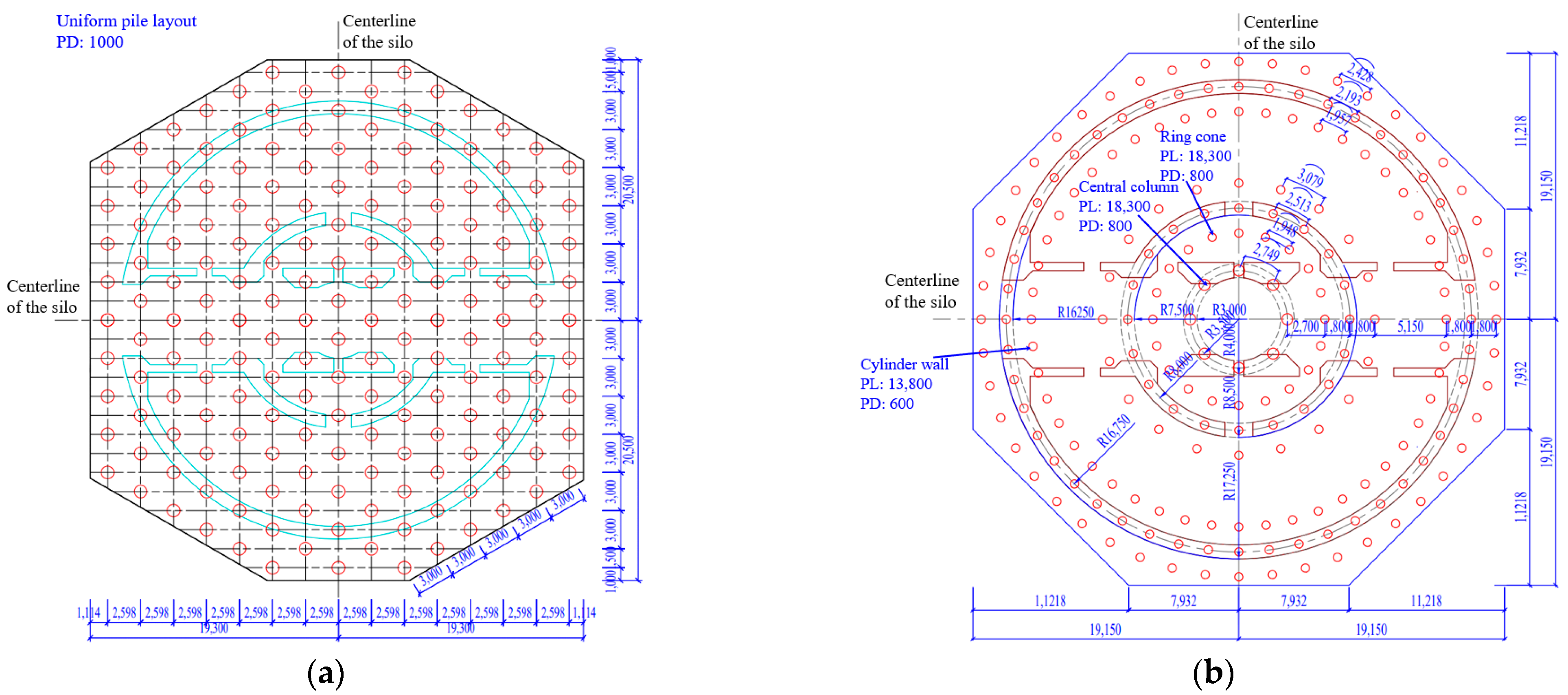
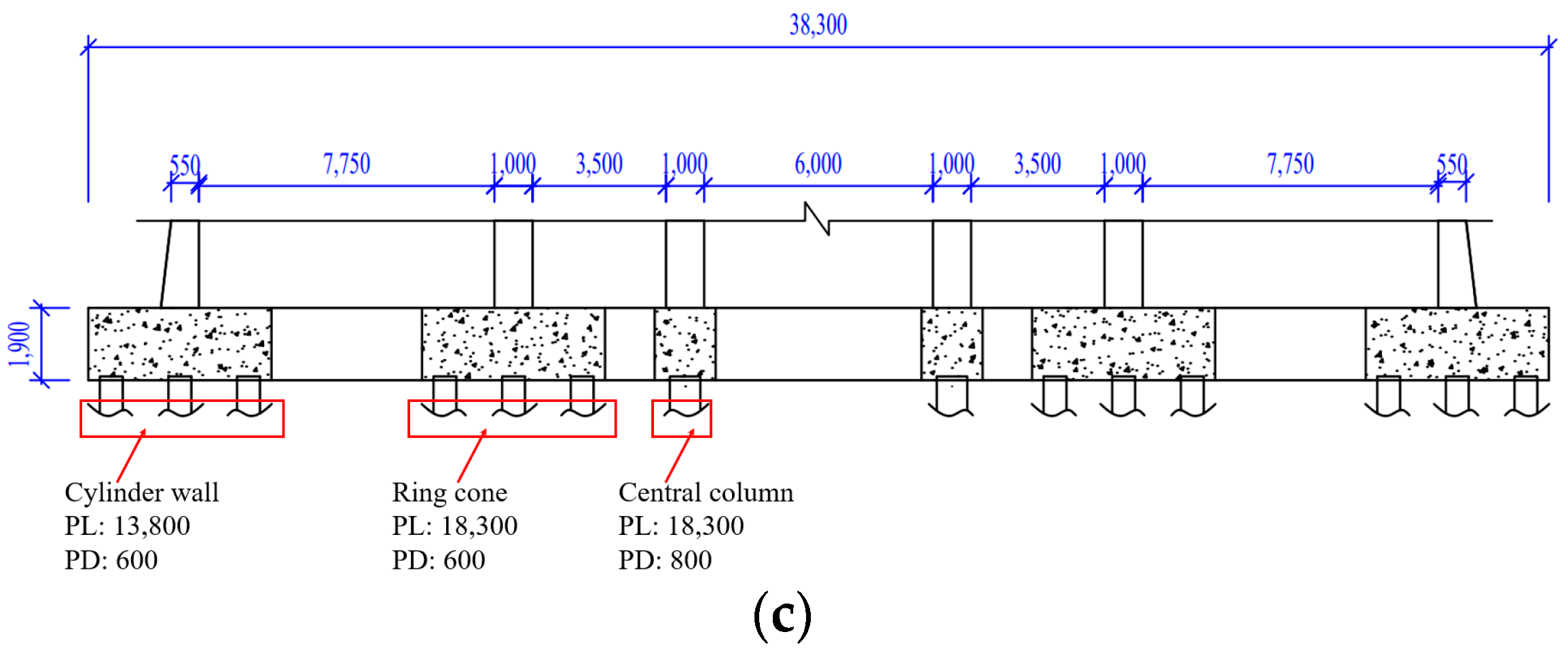
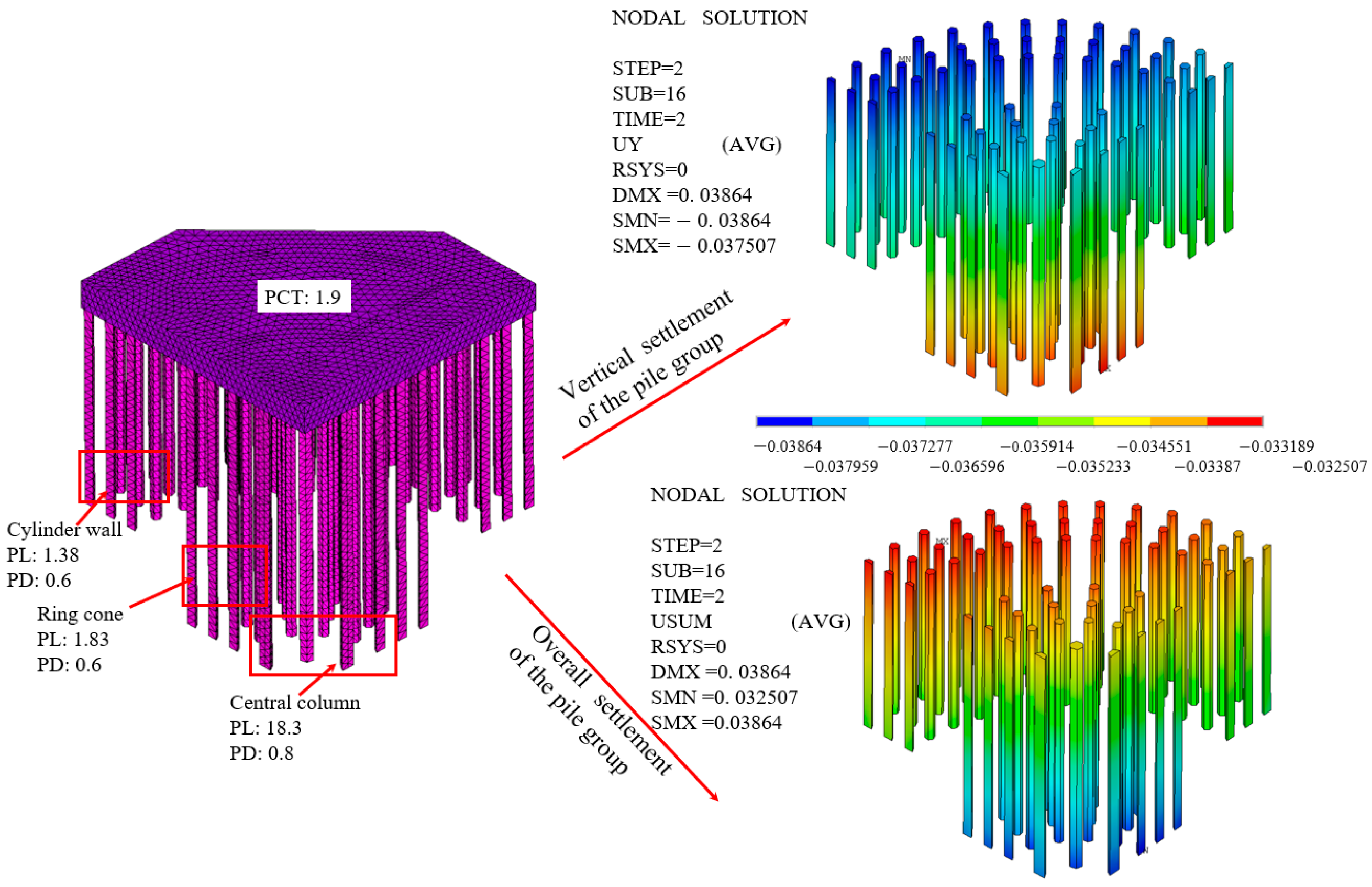
To ensure uniformity during construction, the height of the pile cap was standardized, with its thickness set to the maximum value obtained from the three module calculations, which was 1.9 m. The optimization outcomes of the pile foundation design variables are depicted in Figure 13. The corresponding derived variables, calculated on the basis of these design variables, are presented in Table 9. Compared to the original design, the optimized design demonstrated clear improvements in several aspects. The PCT was reduced by 0.6 m, while the total number of piles increased by 34. Pile lengths (PL) were adjusted: the central body and ring cone piles increased by 5 m, and PL beneath the cylinder wall increased by 0.5 m. Diameters of pile groups were reduced by 0.2 m under the central body and 0.4 m under the ring cone and cylinder walls. Based on these calculated pile numbers and layout, the actual number of piles was further adjusted to ensure uniform distribution within each calculation module.
The optimized design replaces the original short, thick piles with longer, slender ones, adopting a “strong inside, weak outside” variable stiffness configuration, resulting in a more rational and efficient structural system. This adjustment improves load distribution and overall structural functionality, enhances seismic performance due to the gradual stiffness transition from the central body to the outer perimeter, and achieves more efficient use of materials through reduced pile diameters despite the slight increase in total pile number. However, the modifications may slightly increase construction workload and schedule due to changes in pile length and diameter, and this trade-off between structural efficiency and construction feasibility should be considered in practical applications. Overall, the application of the variable-stiffness design concept and the automatic grouping genetic algorithm demonstrates an effective strategy to reduce concrete consumption and optimize pile group layout, providing a reference for similar silo foundation projects.
Through design optimization, Figure 14 shows the optimized pile foundation. Table 10 demonstrates the reduction in concrete usage before and after optimization. Post-optimization, the concrete consumption for pile groups and pile caps decreased by 971 m3 and 1086 m3, respectively. Additionally, the concrete volume for the pile foundation was reduced from 5253 m3 to 3196 m3, resulting in a savings of 2057 m3, which represented a 60.84% reduction from the original volume. This optimization yielded significant results. Compared to short-thick piles, the use of long-slender piles notably decreased concrete consumption. Furthermore, reducing the thickness of the pile cap proves to be an effective method for minimizing concrete usage. Therefore, prioritizing long-slender piles, while ensuring that structural deformation and bearing capacity meet design requirements, was a viable strategy to significantly lower concrete consumption, thereby reducing foundation material costs.
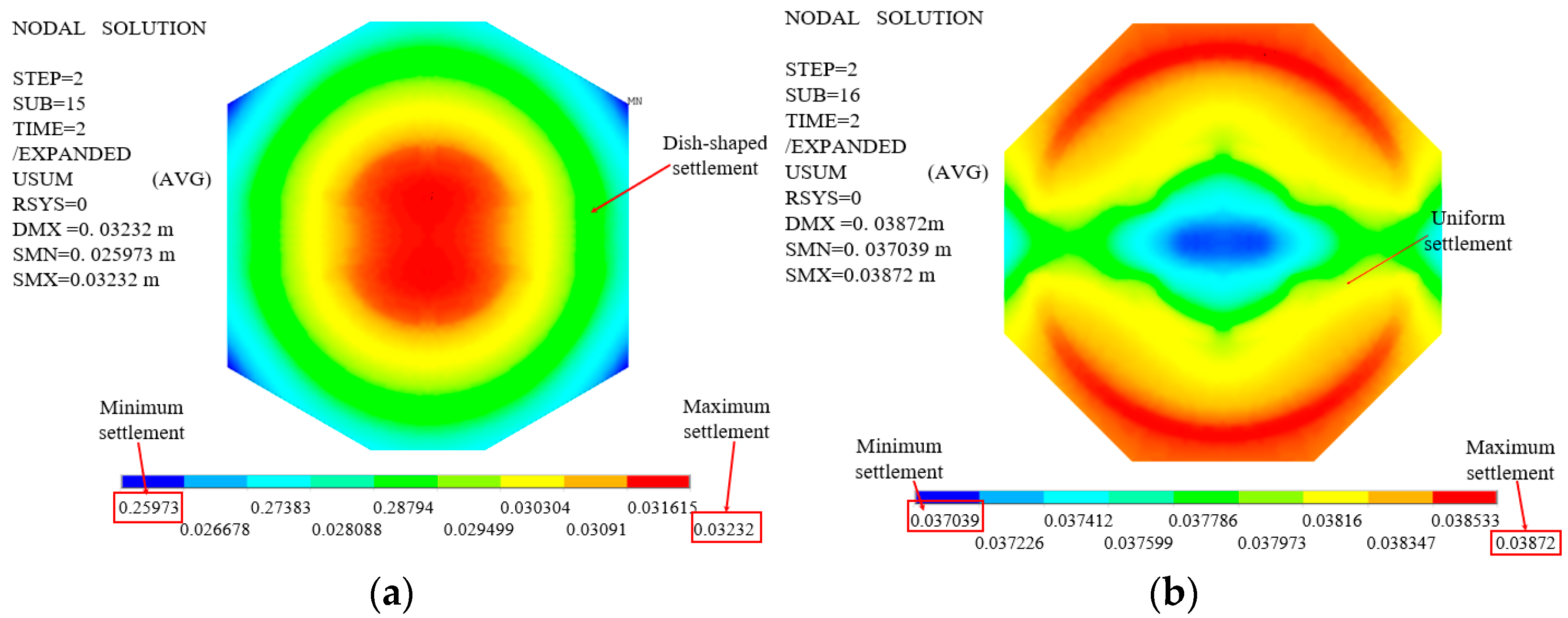
Based on the analysis of the settlement behavior of the pile cap before and after optimization, as shown in Figure 15, the original design exhibited a maximum settlement of 32.320 mm, a minimum settlement of 25.973 mm, and a differential settlement of 6.347 mm. After optimization, these values were adjusted to 38.720 mm, 37.039 mm, and 1.681 mm, respectively. Although the overall settlement increased slightly after optimization, the differential settlement was significantly reduced from 6.347 mm to 1.681 mm. This substantial reduction in differential settlement indicates that the optimization measures effectively improved the uniformity of the pile cap settlement. In the original design, the pile cap displayed a typical dish-shaped settlement pattern, characterized by more pronounced settlement at the center and reduced settlement around the edges. Following optimization, the settlement distribution became more uniform, with a significant reduction in differential settlement. Therefore, the optimized design adopted a “strong inside, weak outside” pile layout strategy, which effectively mitigated differential settlement, reduced secondary internal forces, and enhanced the overall structural safety.

4. Conclusions and Discussion

(1)
During the production and operation of silos, the finite element (FE) simulation results demonstrate strong agreement with the actual measurement data, confirming the validity and reliability of the established numerical model. This model serves as a robust tool for further investigation into the effects of pile length (PL), pile diameter (PD), and pile cap thickness (PCT) on the maximum displacement of the structure (MDS) within the pile cap. It provides a solid theoretical foundation for optimizing the design of silo foundations.
(2)
To enhance the convergence and mutation effects of the automatic grouping genetic algorithm (AGGA), a power function was introduced to modify the adaptive penalty function, specifically the Lemonge function. Additionally, a novel genetic operator was constructed using the hyperbolic tangent function, whose rate of change lies between that of the cosine and Sigmoid functions. These improvements significantly enhance the algorithm’s global optimization capability and robustness, leading to superior performance in solving complex optimization problems.
(3)
Based on the results of the sensitivity analysis, the MDS within the pile cap exhibits a progressively decreasing sensitivity to variations in PL, PD, and PCT. This study further establishes the optimal ranges for key pile foundation parameters: PCT between 1.7 and 2.3 m, PL ranging from 11.8 to 19.3 m, and PD from 0.6 to 1.2 m. These findings provide valuable guidance for design optimization, contributing to improved structural safety and cost efficiency in practical engineering applications.
(4)
By introducing the improved AGGA and replacing short, thick piles with long, slender ones, the total volume of foundation concrete was reduced by 39.16% compared to the original design, effectively lowering construction costs. Additionally, the adoption of a variable stiffness piling strategy—stronger internally and weaker externally—reduced the MDS by 4.665 mm. This approach significantly improves the foundation’s deformation resistance and load-bearing performance, ensuring better structural stability under operational conditions.
The current study assumes homogeneous soil properties and linear elastic behavior in the finite element model, without considering non-uniform soil stratigraphy, long-term settlement, or dynamic loading, which may affect foundation performance in practice. The findings indicate that variable-stiffness pile foundations combined with AGGA-based optimization can effectively reduce construction costs and improve structural stability, with the identified optimal ranges of PL, PD, and PCT applicable to similar large-scale silo projects for efficient material use and controlled differential settlement. Future research should address nonlinear soil behavior, long-term settlement, dynamic loads, and explore alternative optimization algorithms and multi-objective frameworks to further enhance foundation design performance and adaptability to complex engineering conditions.

Author Contributions

Conceptualization, L.D.; Methodology, Y.Y., L.D., P.Z. and Z.C.; Software, Y.Y., X.L. (Xubang Liu) and Z.C.; Formal analysis, Y.Y. and X.L. (Xubang Liu); Investigation, Y.Y., L.D. and P.Z.; Resources, X.L. (Xiaoke Li); Data curation, L.D. and X.L. (Xiaoke Li); Writing—original draft, Y.Y.; Writing—review & editing, L.D., P.Z. and X.L. (Xubang Liu); Visualization, Y.Y.; Supervision, L.D.; Project administration, Y.Y. and P.Z.; Funding acquisition, Y.Y. and P.Z. All authors have read and agreed to the published version of the manuscript.

Funding

This work is supported by the Science and Technology Innovation Team of Eco-building Material and Structural Engineering at the University of Henan Province, China (grant number 13IRTSTHN002), and the University–industry Collaboration Project of Henan Province, China (grant number 201800630).

Data Availability Statement

The data presented in this study are available on request from the corresponding author.

Conflicts of Interest

The authors declare no conflicts of interest.

References

  1. Goodey, R.J.; Brown, C.J. The influence of the base boundary condition in modelling filling of a metal silo. Comput. Struct. 2004, 82, 567–579. [Google Scholar] [CrossRef]
  2. Mehretehran, A.M.; Maleki, S. 3D buckling assessment of cylindrical steel silos of uniform thickness under seismic action. Thin-Walled Struct. 2018, 131, 654–667. [Google Scholar] [CrossRef]
  3. Demir, A.D.; Livaoglu, R. SSI effects on seismic response of RC flat-bottom circular silos. Structures 2023, 57, 105296. [Google Scholar] [CrossRef]
  4. Mehretehran, A.M.; Maleki, S. Axial buckling of imperfect cylindrical steel silos with isotropic walls under stored solids loads: FE analyses versus Eurocode provisions. Eng. Fail. Anal. 2022, 137, 106282. [Google Scholar] [CrossRef]
  5. Jing, H.; Chen, H.; Yang, J.; Li, P. Shaking table tests on a small-scale steel cylindrical silo model in different filling conditions. Structures 2022, 37, 698–708. [Google Scholar] [CrossRef]
  6. Gao, W.; Mei, G.; Zhou, T.; Zheng, J.; Li, Y.; Gong, W.; Sun, H.; Wang, T. Innovation and development of foundation technology. China Civ. Eng. J. 2020, 53, 97–121. [Google Scholar]
  7. Sun, Z.; Wang, Q.; Min, R.; Duan, Q. Sensitivity analysis of influencing factors of pile foundation stability based on field experiment. Structures 2023, 54, 14–22. [Google Scholar] [CrossRef]
  8. Hoang, L.T.; Xiong, X.; Matsumoto, T. Effect of pile arrangement on long-term settlement and load distribution in piled raft foundation models supported by jacked-in piles in saturated clay. Soils Found. 2024, 64, 101426. [Google Scholar] [CrossRef]
  9. JGJ 94-2008; Technical Code for Building Pile Foundations. China Architecture and Building Press: Beijing, China, 2008.
  10. Poulos, H.G. Piled raft foundations: Design and applications. Geotechnique 2001, 51, 95–113. [Google Scholar] [CrossRef]
  11. Gong, X.; Chen, M. Some issues on the optimum design for a piled raft foundation. China Civ. Eng. J. 2001, 4, 107–110. [Google Scholar]
  12. Jeong, S.; Park, J.; Chang, D. An approximate numerical analysis of rafts and piled-rafts foundation. Comput. Geotech. 2024, 168, 106108. [Google Scholar] [CrossRef]
  13. Jansseune, A.; Corte, W.D.; Belis, J. Elasto-plastic failure of locally supported silos with U-shaped longitudinal stiffeners. Eng. Fail. Anal. 2016, 70, 122–140. [Google Scholar] [CrossRef]
  14. Yang, M.; Yang, H.; Wang, W. Design philosophy and settlement analysis of the composite long-short pile foundations. China Civ. Eng. J. 2005, 12, 103–108. [Google Scholar]
  15. Wang, X.; Zeng, X.; Yang, X.; Li, J. Seismic response of offshore wind turbine with hybrid monopile foundation based on centrifuge modelling. Appl. Energy 2019, 235, 1335–1350. [Google Scholar] [CrossRef]
  16. Guo, Y.; Wang, H.; Lian, J. Review of integrated installation technologies for offshore wind turbines: Current progress and future development trends. Energy Conv. Manag. 2022, 255, 115319. [Google Scholar] [CrossRef]
  17. Randolph, M.F.; Wroth, C.P. An analysis of the vertical deformation of pile groups. Geotechnique 1979, 29, 423–439. [Google Scholar] [CrossRef]
  18. Shen, W.Y.; Chow, Y.K.; Yong, K.Y. A variational approach for vertical deformation analysis of pile group. Int. J. Numer. Anal. Methods Geomech. 1997, 21, 741–752. [Google Scholar] [CrossRef]
  19. Kim, K.N.; Lee, S.H.; Kim, K.S.; Chung, C.K.; Kim, M.M.; Lee, H.S. Optimal pile arrangement for minimizing differential settlements in piled raft foundations. Comput. Geotech. 2001, 28, 235–253. [Google Scholar] [CrossRef]
  20. Leung, Y.F.; Klar, A.; Soga, K. Theoretical study on pile length optimization of pile groups and piled rafts. J. Geotech. Geoenviron. Eng. 2010, 136, 319–330. [Google Scholar] [CrossRef]
  21. Qiao, Z.; Zai, J.; Huang, G. Optimization design method of composite pile foundation for controlling differential settlement. Chin. J. Undergr. Space Eng. 2006, 2, 818–821+827. [Google Scholar]
  22. Leung, Y.F.; Klar, A.; Soga, K.; Hoult, N.A. Superstructure-foundation interaction in multi-objective pile group optimization considering settlement response. Can. Geotech. J. 2017, 54, 1408–1420. [Google Scholar] [CrossRef]
  23. Ghalesari, A.T.; Choobbasti, A.J. Numerical analysis of settlement and bearing behaviour of piled raft in Babol clay. Eur. J. Environ. Civ. Eng. 2018, 22, 978–1003. [Google Scholar] [CrossRef]
  24. Samanta, M.; Bhowmik, R. 3D numerical analysis of piled raft foundation in stone column improved soft soil. Int. J. Geotech. Eng. 2019, 13, 474–483. [Google Scholar] [CrossRef]
  25. Lin, Z.; Dai, Z. Calculation of interaction coefficient method for group pile settlement by single pile load test. Chin. J. Geotech. Eng. 2016, 38, 155–162. [Google Scholar]
  26. Zhang, W.; Chi, L.; Gao, W.; Liu, J. Experimental study on deformation behavior of piled raft foundation. J. Build. Struct. 2010, 31, 94–102. [Google Scholar]
  27. Liu, J.; Huang, Q.; Li, H.; Gao, W. Deformation behavior and settlement calculation of pile group under vertical load. Chin. J. Geotech. Eng. 1995, 17, 1–13. [Google Scholar]
  28. Qiu, R.; Liu, J.; Gao, W.; Qiu, M. Large scale model test study on settlement characteristics of long pile group foundation. Chin. J. Geotech. Eng. 2015, 48, 85–95. [Google Scholar]
  29. Wang, C.; Zeng, C.; Liu, W. Optimal design method for pile foundation based on chaotic particle swarm algorithm. Build. Struct. 2016, 46, 76–81. [Google Scholar]
  30. Novák, L. On distribution-based global sensitivity analysis by polynomial chaos expansion. Comput. Struct. 2022, 267, 106808. [Google Scholar] [CrossRef]
  31. Zhao, M.; Yi, P.; Zhang, Y.; Yang, M. The design and calculation method of pile-column bridge pier foundation in high and steep slope. Eng. Mech. 2013, 30, 106–111. [Google Scholar]
  32. Zhu, X.; Yang, M.; Yang, H.; Li, F. Study on bearing behaviors and model tests of composite pile foundation with long and short piles. Chin. J. Geotech. Eng. 2007, 29, 580–586. [Google Scholar]
  33. Gong, X.; Chen, Z. Discussion on some key issues related to foundation engineering. Build. Struct. 2021, 51, 1–4+49. [Google Scholar]
  34. Zhu, Y.; Yang, X.; Ma, T.; Li, A. Bearing behavior and optimization design of large-diameter long pile foundation in loess subsoil. Chin. J. Rock Mech. Eng. 2017, 36, 1012–1023. [Google Scholar]
  35. Ma, T.; Zhu, Y.; Ren, Y.; Li, Y. Bearing capacity and displacement characteristics of long-short composite piles in loess areas. Chin. J. Geotech. Eng. 2018, 40, 259–265. [Google Scholar]
  36. Wang, T. Bearing capacity behaviors of subsoil underoptimal design mode of pile foundation stiffness to reduce differential settlement. Chin. J. Geotech. Eng. 2011, 33, 1014–1021. [Google Scholar]
  37. Wang, T. Bearing capacity of piles in optimized design of pile foundation stiffness to reduce differential settlement. Chin. J. Geotech. Eng. 2015, 37, 641–649. [Google Scholar]
  38. El-Garhy, B.; Galil, A.A.; Youssef, A.F.; Raia, M.A. Behavior of raft on settlement reducing piles: Experimental model study. J. Rock Mech. Geotech. Eng. 2013, 5, 389–399. [Google Scholar] [CrossRef]
  39. Wang, B.; Chen, M.; Tang, Z.; Yuan, Z. Finite element analysis of huge coal silo foundation. Rock Soil Mech. 2010, 31, 1983–1988. [Google Scholar]
  40. Han, X.; Chen, X.; Huang, D. Variable stiffness leveling of piled raft foundation based on topology optimization method. J. Huazhong Univ. Sci. Technol. 2020, 48, 24–29. [Google Scholar]
  41. Chanda, D.; Saha, S.; Haldar, S. Behaviour of piled raft foundation in sand subjected to combined VMH loading. Ocean Eng. 2020, 216, 107596. [Google Scholar] [CrossRef]
  42. Xie, Y.; Chi, S.; Zhou, X. Research on optimization design method of large-scale pile-raft foundation in complex environment. Rock Soil Mech. 2019, 40, 486–493. [Google Scholar]
  43. Momeni, E.; Nazir, R.; Armaghani, D.J.; Maizir, H. Prediction of pile bearing capacity using a hybrid genetic algorithm-based ANN. Measurement 2014, 57, 122–131. [Google Scholar] [CrossRef]
  44. Shin, J.; Park, S. Optimum retrofit strategy of FRP column jacketing system for non-ductile RC building frames using artificial neural network and genetic algorithm hybrid approach. J. Build. Eng. 2022, 57, 104919. [Google Scholar] [CrossRef]
  45. Xu, J.; Zhu, H. Coevolutionary Genetic Algorithm of Cloud Workflow Scheduling Based on Adaptive Penalty Function. Comput. Sci. 2018, 45, 105–112. [Google Scholar]
  46. Barbosa, H.J.C.; Lemonge, A.C.C.; Borges, C.C.H. A genetic algorithm encoding for cardinality constraints and automatic variable linking in structural optimization. Eng. Struct. 2008, 30, 3708–3723. [Google Scholar] [CrossRef]
  47. Engineering Geology Handbook Editorial Committee. Engineering Geology Handbook; China Architecture and Building Press: Beijing, China, 2018. [Google Scholar]
  48. Chen, Z.; Li, X.K.; Yang, Y.B.; Zhao, S.B.; Fu, Z.Q. Experimental and numerical investigation of the effect of temperature patterns on behavior of large scale silo. Eng. Fail. Anal. 2018, 91, 543–553. [Google Scholar] [CrossRef]
  49. Kong, W.; Rui, Y.; Dong, B. Determination of dilatancy angle for geomaterials under non-associated flow rule. Rock Soil Mech. 2009, 30, 3278–3282. [Google Scholar]
  50. Chen, Y.; Xu, D. FLAC/Flac3D Fundamentals and Engineering Applications; China Water and Power Press: Beijing, China, 2013. [Google Scholar]
  51. Pucker, T.; Bienen, B.; Henke, S. CPT based prediction of foundation penetration in siliceous sand. Appl. Ocean Res. 2013, 41, 9–18. [Google Scholar] [CrossRef]
  52. Selby, A.R.; Arta, M.R. Three-dimensional finite element analysis of pile groups under lateral loading. Comput. Struct. 1991, 40, 1329–1336. [Google Scholar] [CrossRef]
  53. GB 50077-2017; Standard for Design of Reinforced Concrete Silos. China Planning Press: Beijing, China, 2017.
  54. Ooi, J.Y.; Rotter, J.M. Wall pressures in squat steel silos from simple finite element analysis. Comput. Struct. 1990, 37, 361–374. [Google Scholar] [CrossRef]
  55. Chao, S.; Zhao, X.; Zhang, B.; Jiang, W.; Kong, J.; Xiao, J.; Yuan, J. Study of computation of load on pile top of piled raft foundation for superhigh buildings. Rock Soil Mech. 2011, 32, 1138–1142. [Google Scholar]
  56. GB 50191-2012; Code for Seismic Design of Special Structures. China Planning Press: Beijing, China, 2012.
  57. GB 50009-2012; Load Code for the Design of Building Structures. China Architecture and Building Press: Beijing, China, 2012.
  58. Zhang, G.; Zhu, W. Parameter Sensitivity Analysis and Optimizing for Test Programs. Rock Soil Mech. 1993, 14, 51–58. [Google Scholar]
  59. Fang, J.; Lu, S.; Wang, K.; Tang, J.; Yao, Z. Sensitivity Analysis of Springback to Material Parameters in High Strength 21-6-9 Stainless Steel Tube NC Bending. J. Xi’an Jiaotong Univ. 2015, 49, 136–142. [Google Scholar]
  60. Tai, Q.; Zhang, D.; Fang, Q.; Qi, J.; Li, A.; Huang, J. Determination of advance supports in tunnel construction under unfavourable rock conditions. Chin. J. Rock Mech. Eng. 2016, 35, 109–118. [Google Scholar]
  61. Lemonge, A.C.C.; Barbosa, H.J.C. An adaptive penalty scheme for genetic algorithms in structural optimization. Int. J. Numer. Methods Eng. 2004, 59, 703–736. [Google Scholar] [CrossRef]
  62. Barbosa, H.J.C.; Lemonge, A.C.C. A new adaptive penalty scheme for genetic algorithms. Inf. Sci. 2003, 156, 215–251. [Google Scholar] [CrossRef]
  63. GB 50007-2011; Code for Design of Building Foundation. China Architecture and Building Press: Beijing, China, 2011.
Figure 1. Silo structure. (a) Facade (b) Cross-section (Elevations are in meters; Dimensions are in millimeters).
Buildings 16 00160 g001
Figure 2. FE model of silo structure (1/2 model).
Buildings 16 00160 g002
Figure 3. Boundary conditions.
Buildings 16 00160 g003
Figure 4. Basic contact model.
Buildings 16 00160 g004
Figure 5. Silo loading. (a) Schematic diagram for silo storage pressure calculation. (b) Normal pressure on the cylinder wall. (c) Normal pressure on the bucket wall and ring cone. (d) Tangential pressure on the bucket wall and ring cone.
Buildings 16 00160 g005
Figure 6. Constraints and horizontal seismic load. (a) Constraints. (b) Horizontal seismic load.
Buildings 16 00160 g006
Figure 7. Central settlement of pile cap.
Buildings 16 00160 g007
Figure 8. Sensitivity analysis. (a) Load case 1. (b) Load case 3.
Buildings 16 00160 g008
Figure 9. Comparison of functions.
Buildings 16 00160 g009
Figure 10. Calculation diagram of the pile foundation (Unit: mm).
Buildings 16 00160 g010
Figure 11. Pile foundation layouts (Unit: mm). (a) Layout 1 (b) Layout 2 (c) Layout 3 (d) Layout 4.
Buildings 16 00160 g011
Figure 12. Function process. (a) Main function. (b) Subfunction.
Buildings 16 00160 g012
Figure 13. Optimized layout of the silo pile (Unit: mm). (a) Original (b) Optimized (c) Pile position cross-section.
Buildings 16 00160 g013aBuildings 16 00160 g013b
Figure 14. Optimized pile foundation (1/4 model) (Unit: m).
Buildings 16 00160 g014
Figure 15. Settlement of the pile cap before and after optimization (Unit: m). (a) Original (b) Optimized.
Buildings 16 00160 g015
Table 1. Physical properties of soil.
Soil Layer
TypeLoess silty soilLoess silty clayCrushed stoneLoess silty clayStrongly weathered andesiteMid-weathered andesite
Thickness (m)0.701.704.005.407.50Not debunked
Unit weight (kN·m−3)19.6018.9019.6019.5022.5026.50
Standard value of ultimate shaft resistance (kPa)60.0075.00150.0080.00200.00240.00
Standard ultimate bearing capacity (kPa)////20002200.00
Poisson ratio0.300.280.250.280.350.20
Modulus of compression (MPa)7.655.7340.327.8762.0029,444.00
Standard value of internal friction angle (°)12.8011.7010.9021.0013.5055.00
Table 2. Mechanical properties of concrete and rebar.
MaterialsStandard Value (MPa)Design Value (MPa)Poisson RatioUnit Weight (kN·m−3)Young’s Modulus (MPa)
C40 Concrete26.819.10.224.032,500
C30 Concrete20.114.30.224.030,000
HRBE400 Rebar400.0360.00.378.5200,000
Table 3. Drucker-Prager model parameters.
Soil Layer
TypeLoess silty soilLoess silty clayCrushed stoneLoess silty clayStrongly weathered andesiteMid-weathered andesite
Young’s modulus (MPa)22.9517.19121.0023.61186.0088,333.0
Poisson ratio0.300.280.250.280.350.2
Standard value of internal friction angle (°)12.8011.7010.9021.0013.5055.0
Cohesion standard value (kPa)13.3017.8016.1025.00100.001500.0
Dilation angle (°)6.405.855.4510.506.7527.5
Table 4. Contact pair parameters.
Contact PairsContact SurfaceTarget SurfaceCoefficient of Friction [51]Cohesion (kPa)Ultimate Shaft Resistance (kPa)
1Silo ①pile0.11710.6460.00
2Silo ②0.10914.2475.00
3Silo ③0.17912.88150.00
4Silo ④0.16020.0080.00
5Silo ⑤0.18280.00200.00
6Silo ⑥0.1351200.00240.00
7① surfacePile cap bottom surface0.11710.6460.00
Table 5. Storage material pressure of silo.
ComponentsRelative Height
(m)
Horizontal Pressure Ph
(kPa)
Vertical Pressure Pv
(kPa)
Normal Pressure Pn
(kPa)
Tangential Pressure Pt
(kPa)
Silo wall38.2390.000///
12.07091.419///
Central column38.2390.000///
6.518110.252///
Hopper12.070/293.766142.00687.619
5.090/369.757178.784110.311
Ring cone (inside)10.611/309.669149.69392.362
4.532/375.930181.724112.125
Ring cone (outside)10.611/309.669131.65679.257
3.58/386.307164.23898.871
Table 6. Load combination.
Load CombinationFactorStructural WeightStorage Material PressureHorizontal Seismic Load
Standard
(Load case 1)
Partial1.01.0
Combination1.00.9
Basic
(Load case 2)
Partial1.21.3
Combination1.00.9
Seismic
(Load case 3)
Partial1.21.31.3
Combination1.00.91.0
Table 7. Calculation cases.
Calculation CasesParameter Values (m)
Case 1 (c)1.5, 1.7, 1.9, 2.1, 2.3, 2.5, 2.7
Case 2 (l) 10.3, 11.8, 13.3, 14.8, 16.3, 17.8, 19.3
Case 3 (d) 0.4, 0.6, 0.8, 1.0, 1.2, 1.4, 1.8
Note: c is the PCT; l is the PL; d is the PD.
Table 8. Test results for the test functions.
Test FunctionsDimensionNumber of IterationsAverage Optimal Fitness of SGAAverage Optimal Fitness of AGGAAverage Optimal Fitness of IAGGAOptimal Fitness Squared Difference in SGAOptimal Fitness Squared Difference in AGGAOptimal Fitness Squared Difference in IAGGA
Sphere2010004.81 × 10−77.74 × 10−97.21 × 10−102.60 × 10−81.94 × 10−92.73 × 10⁻¹⁰
4020006.48 × 10−65.03 × 10−82.58 × 10−84.33 × 10−76.32 × 10−99.27 × 10⁻⁹
6030007.97 × 10−54.82 × 10−63.75 × 10−75.23 × 10−66.98 × 10−78.48 × 10⁻⁸
Ackley2010006.83 × 10−43.29 × 10−61.90 × 10−64.67 × 10−51.69 × 10−64.33 × 10⁻⁷
4020008.05 × 10−48.34 × 10−51.58 × 10−57.39 × 10−56.82 × 10−66.72 × 10⁻⁷
6030005.89 × 10−37.84 × 10−45.45 × 10−46.38 × 10−48.76 × 10−51.90 × 10⁻⁶
Rastrgin2010003.26 × 10−38.12 × 10−52.86 × 10−87.31 × 10−43.89 × 10−68.78 × 10⁻⁷
4020002.43 × 10005.24 × 10−34.53 × 10−68.78 × 10−26.03 × 10−44.23 × 10−7
6030004.67 × 10006.28 × 10−17.46 × 10−37.39 × 10−19.78 × 10−26.92 × 10−4
Table 9. Indirect variable value of pile foundation.
ModuleCalculated Number of PilesAdopted Number of PilesRadial Pile Spacing (m)Outer Circumferential Pile Spacing
(m)
Middle Circumferential Pile Spacing (m)Inner Circumferential Pile Spacing (m)Pile Cap Outer Radius
(m)
Pile Cap Inner Radius
(m)
Cylinder wall1341441.8002.4282.1931.95719.15014.350
Ring cone58601.8003.0792.5131.94810.4005.600
Central column782.7494.3002.700
Table 10. Reduction in concrete usage before and after optimization.
ModulePile Group Concrete Volume (m3)Pile Cap Concrete Volume (m3)Total Concrete Volume (m3)
OriginalOptimizedOriginalOptimizedOriginalOptimized
Cylinder wall5233395230952533196
Ring cone300
Central column64
Total volume18588873395230952533196
Disclaimer/Publisher’s Note: The statements, opinions and data contained in all publications are solely those of the individual author(s) and contributor(s) and not of MDPI and/or the editor(s). MDPI and/or the editor(s) disclaim responsibility for any injury to people or property resulting from any ideas, methods, instructions or products referred to in the content.