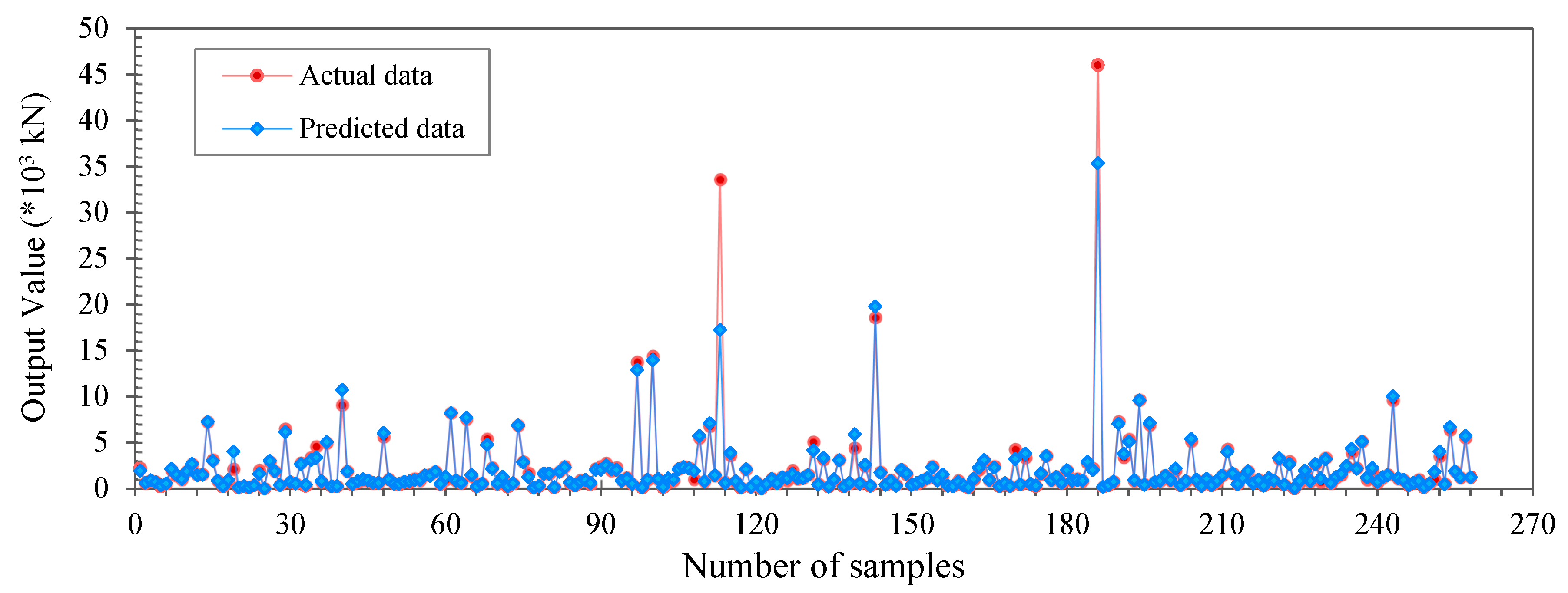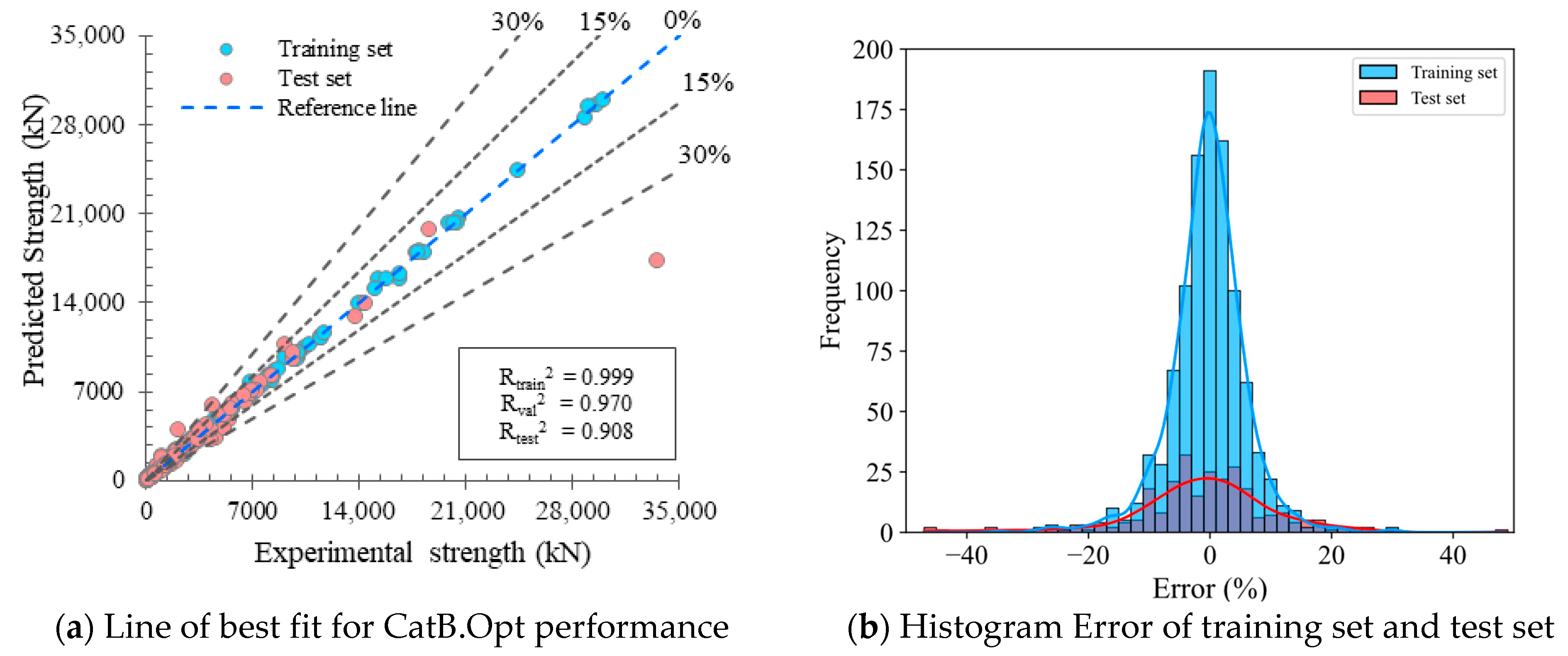

Enhancing Circular CFST Columns Under Axial Load Compressive Strength Prediction and Inverse Design Using a Machine Learning Approach





Abstract
1. Introduction
- (1)
- Limited integration of concentric and eccentrically applied axial loading within a unified predictive model.
- (2)
- Scarce investigation into inverse prediction approaches for determining feasible CFST design parameters to achieve a specified axial capacity.
- (3)
- The absence of systematic benchmarking frameworks comparing ML-based models with widely adopted code-based expressions.
- (4)
- A lack of robust validation strategies, such as repeated Monte Carlo simulations to evaluate predictive stability and uncertainty.
- Development of a harmonised 1287 test database for circular CFST columns covering concentric and eccentric axial loading.
- A CatB-based predictive model providing both forward and inverse prediction capabilities for axial capacity and design parameters.
- A systematic benchmark comparing the ML model to existing code-based analytical expressions.
- Monte Carlo-based robustness evaluation to quantify prediction stability across randomized train-test configurations.
- Development of a web-based application enabling direct engineering use of the proposed predictive framework.
2. Research Methodology
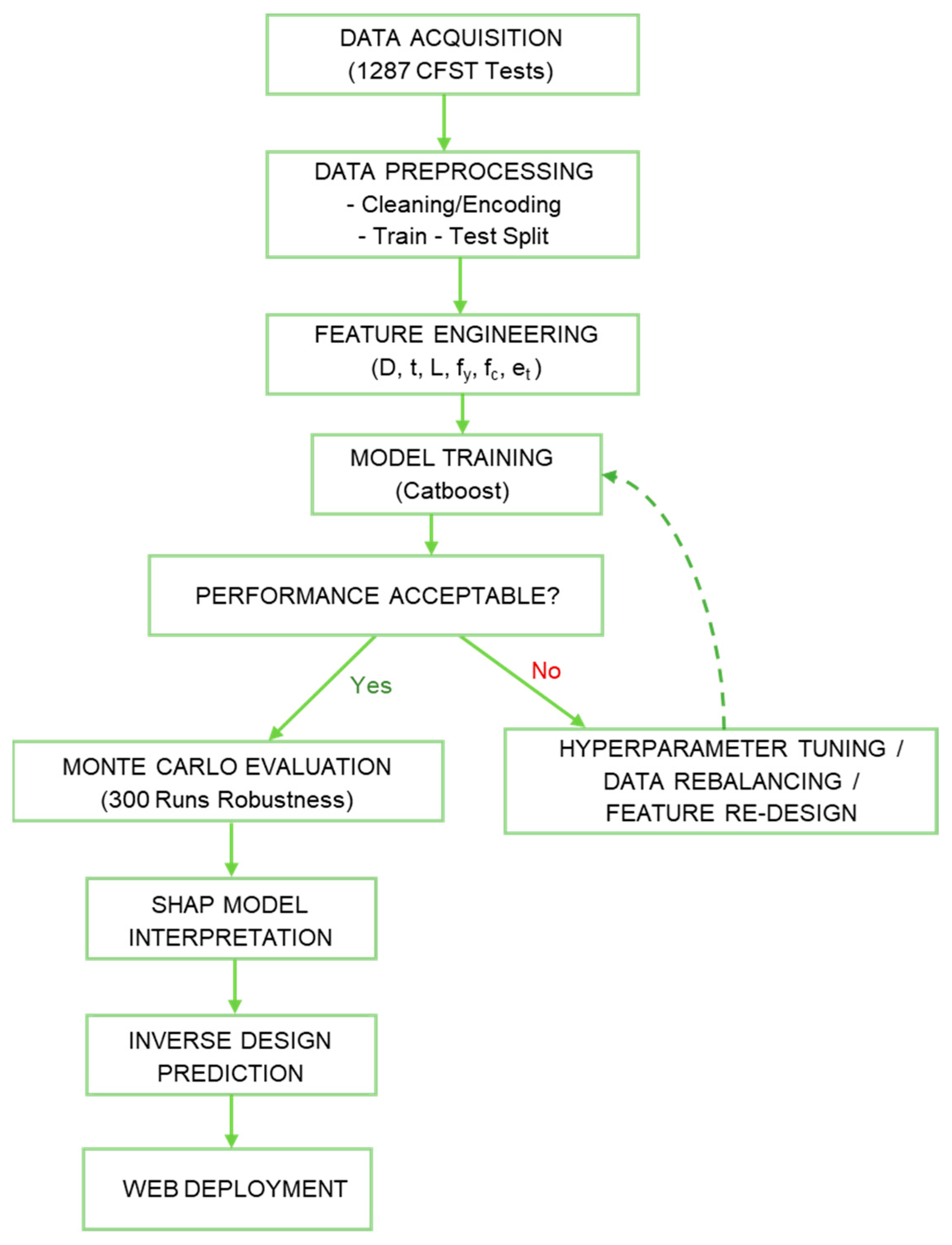
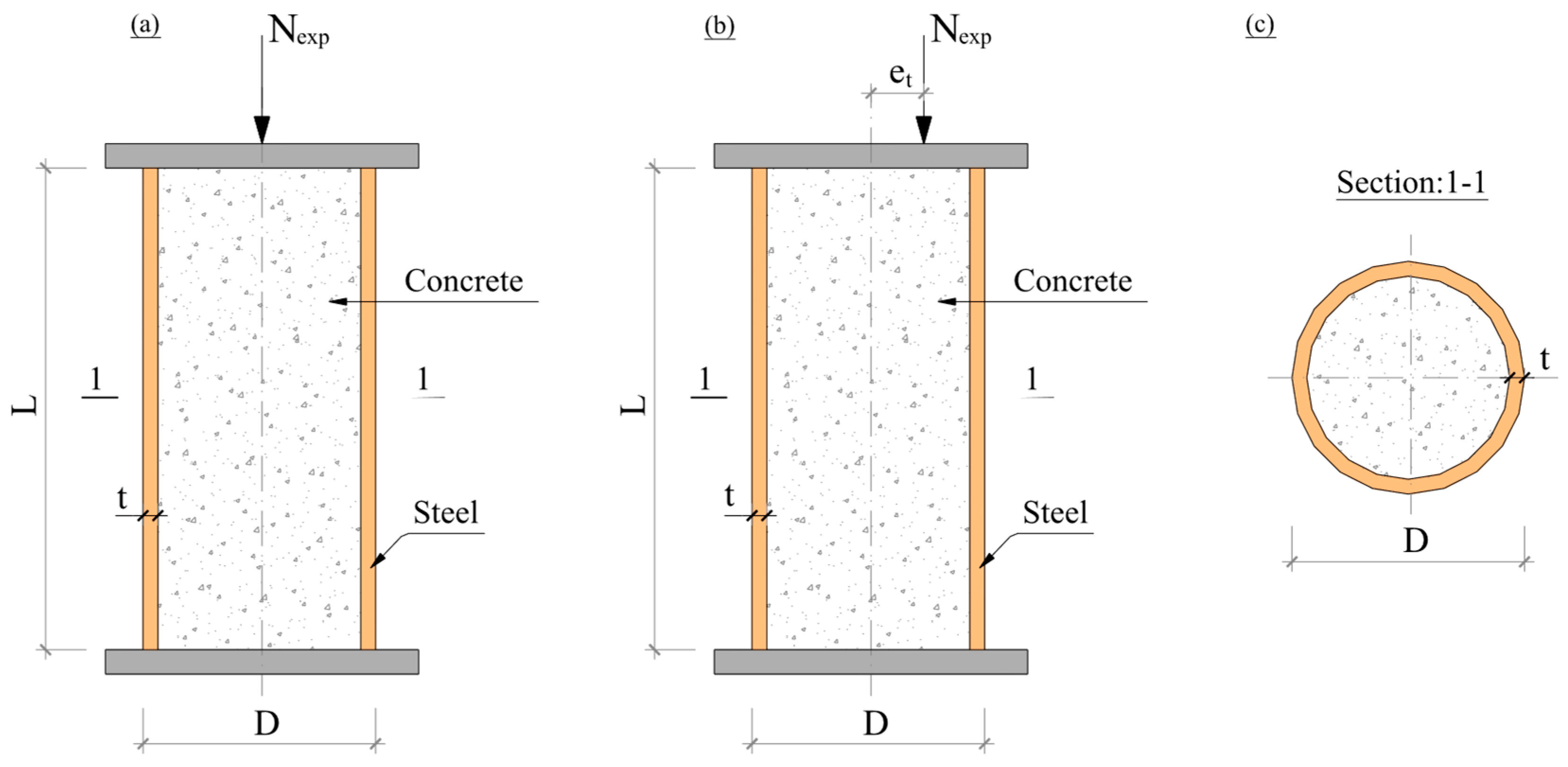
- Data Collection: This phase involved compiling a comprehensive dataset of 1287 samples of concrete-filled steel tube (CFST) columns, encompassing centrally and eccentrically loaded columns.
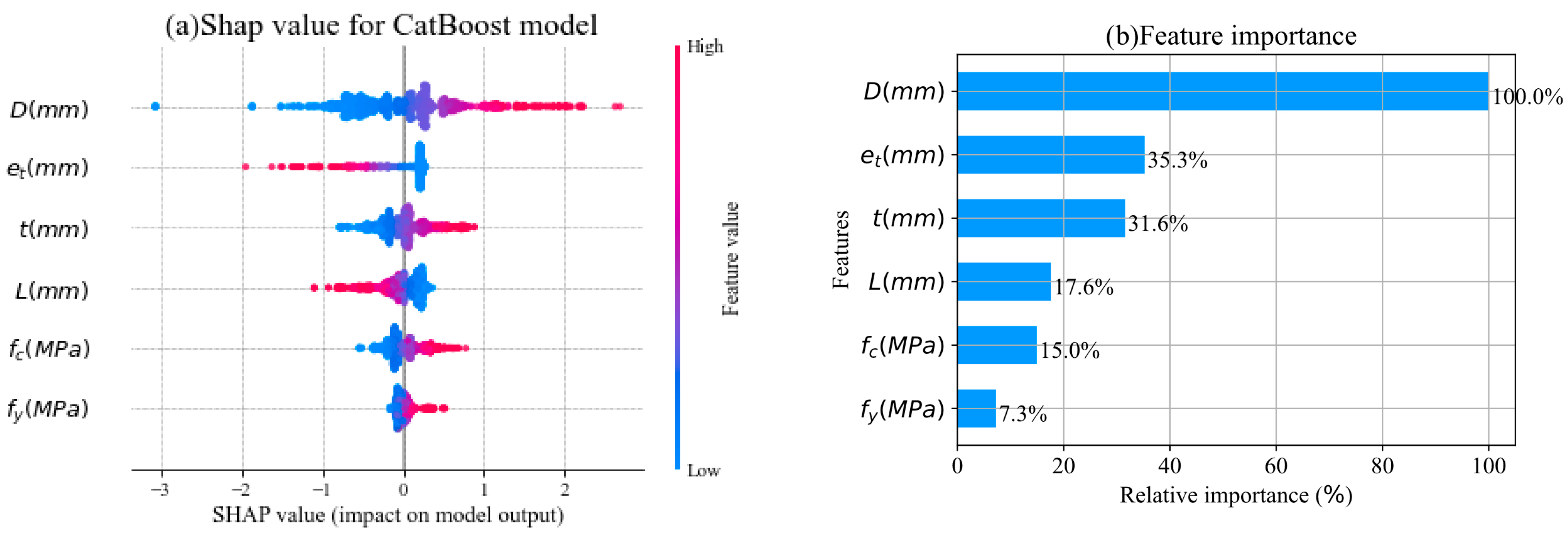
- Initial Model Evaluation and Explanation: Utilising the CatBoost model, optimal parameters were identified via the Gaussian Process (GP) optimisation method across 200 iterations. Concurrently, an analysis of SHAP (Shapley Additive exPlanations) values was conducted to examine the impact and significance of input variables on the predicted outcomes.
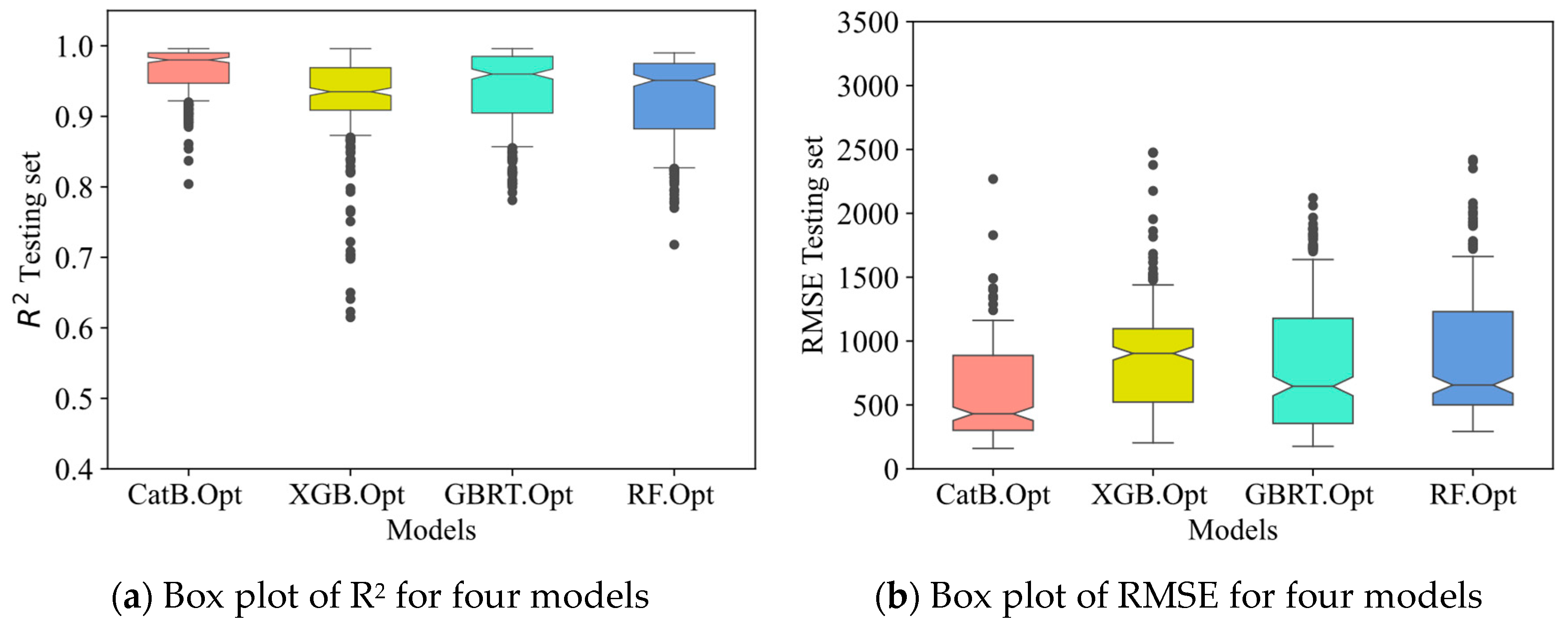
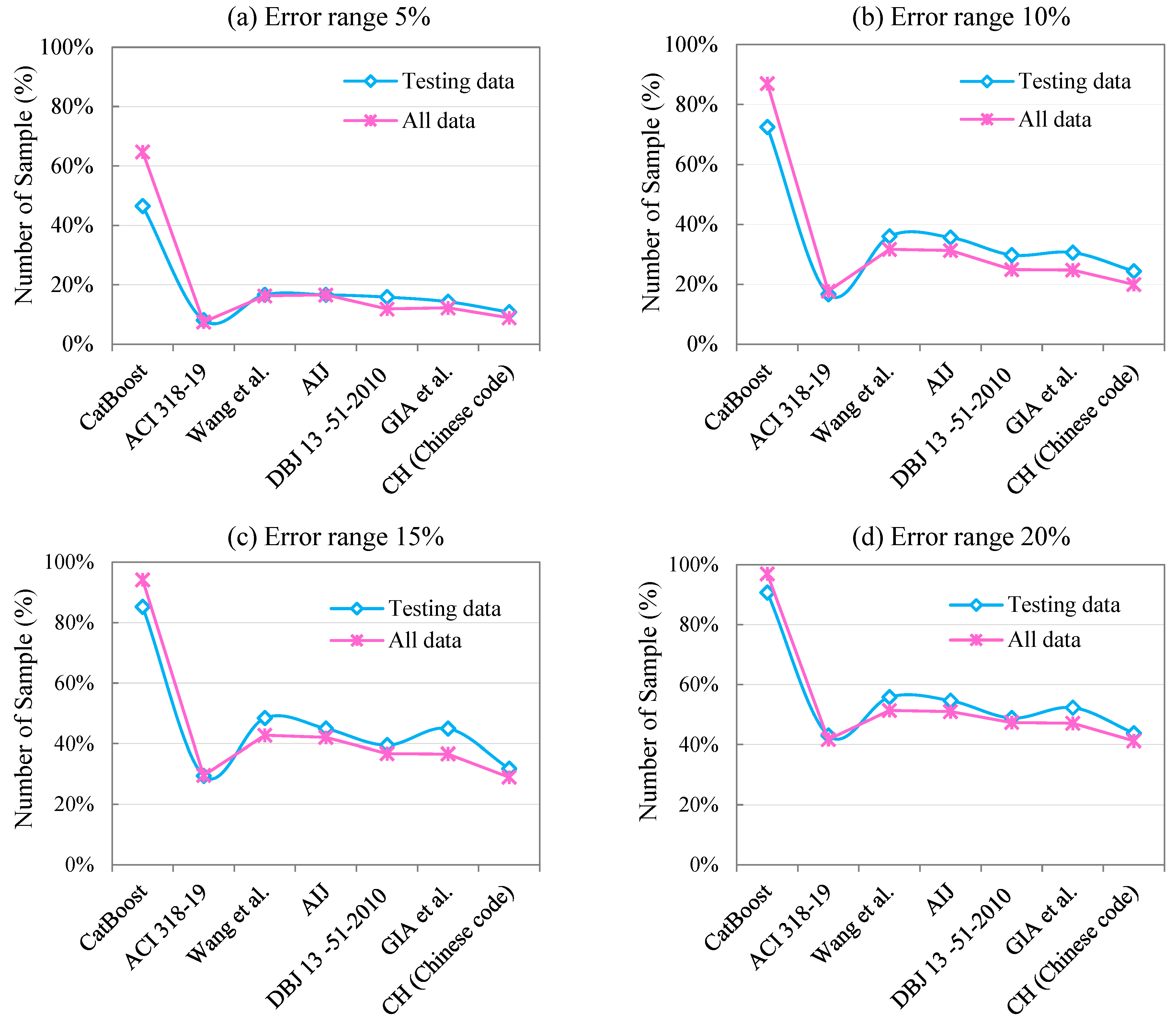
- Comparative Analysis: The predictive performance of the CatBoost model was benchmarked against other machine learning models and compared with standard and existing regulatory models to validate its reliability and effectiveness.
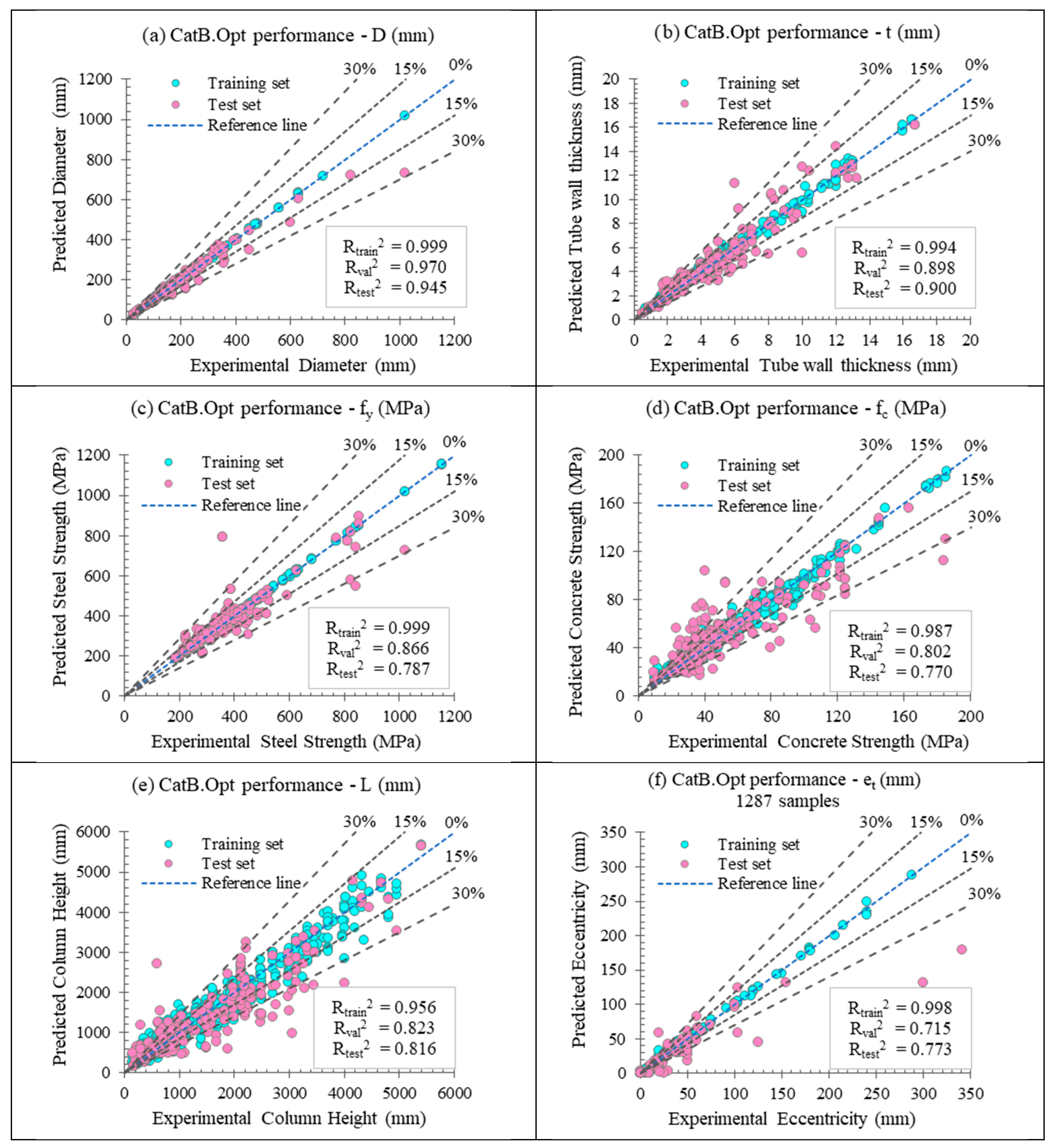
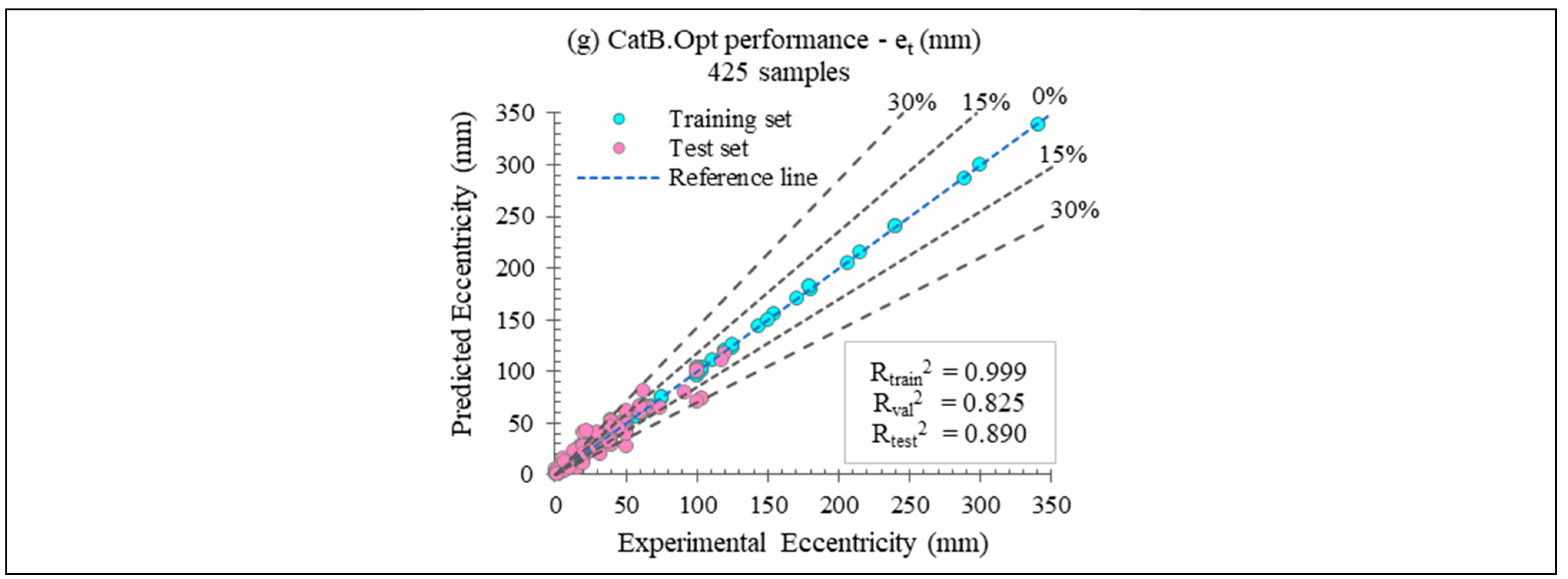
- Inverse design: Both the CatBoost model and conventional regulatory models were employed to predict the design parameters of CFST columns inversely, showcasing the model’s application in practical engineering contexts.
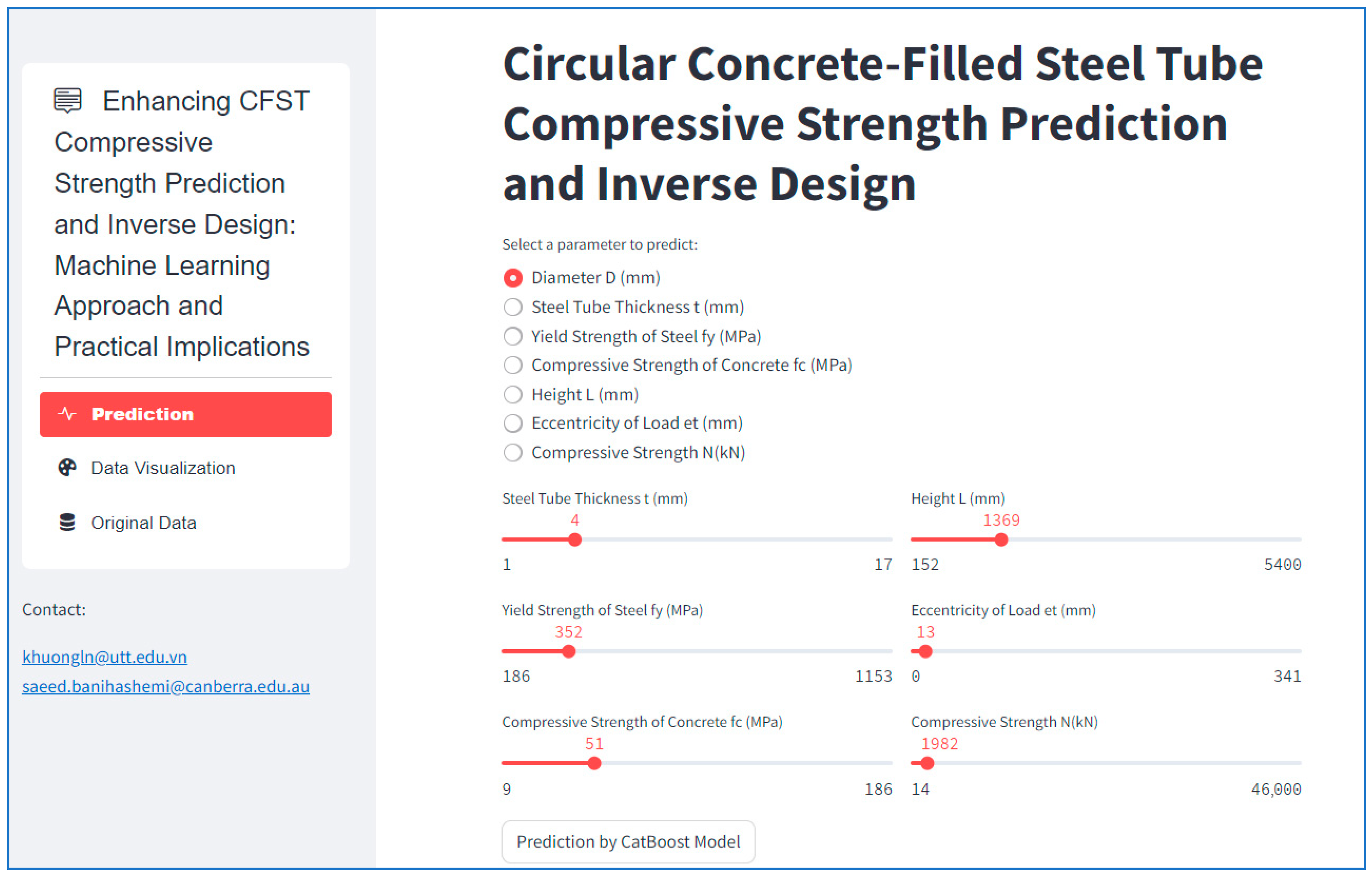
- Finally, this study involves integrating the developed model into a user-friendly web application.
2.1. Data Collection and Processing
2.2. Machine Learning Approach
2.2.1. Models Overview
2.2.2. Model Evaluation
2.2.3. Hyperparameters Tuning
2.3. Design Codes for CFST Compressive Strength Prediction
3. Models Evaluations
3.1. Fine-Tuned CatBoost Model Performances
3.2. Performance Comparison: CatBoost vs. Other ML Models
3.3. Performance Comparison: CatBoost vs. Analytical Models
4. Inverse Prediction of Design Parameters of CFST Columns
- Diameter: D = 325 mm
- Tube thickness: t = 8.5 mm
- D/t = 325/8.5 = 38.2 (within typical limits for circular CFST)
- L/D = 3000/325 = 9.2 (intermediate slenderness, acceptable)
- Nu,ACI = 0.85 × 40 × π (325 − 2 × 8.5)2/4 + 345 × π [(325)2 − (325−2 × 8.5)2]/4
- Nu,ACI = 0.85 × 40 × 74,506 + 345 × 8445 = 2533 + 2914 = 5447 kN
- Round D to standard pipe size: D = 323.9 mm (NPS 12)
- Select standard wall thickness: t = 8.38 mm (Schedule 40)
- Apply appropriate resistance factors per governing code
5. Practical Implications
- Design Optimisation: Engineers can leverage this tool in the early stages of design to swiftly assess the compressive strength of diverse CFST configurations, facilitating the optimisation of dimensions and materials for enhanced performance and cost-efficiency.
- Educational Tool: Enabling students to explore the effects of various parameters on the strength of CFST columns and to witness firsthand the application of machine learning in civil engineering contexts.
6. Conclusions
Author Contributions
Funding
Data Availability Statement
Conflicts of Interest
References
- Han, L.; Li, W.; Bjorhovde, R. Developments and advanced applications of concrete-filled steel tubular (CFST) structures: Members. J. Constr. Steel Res. 2014, 100, 211–228. [Google Scholar] [CrossRef]
- Ding, F.-X.; Wang, W.; Liu, X.-M.; Wang, L.; Sun, Y. Mechanical behavior of outer square inner circular concrete-filled dual steel tubular stub columns. Steel Compos. Struct. 2021, 38, 305–317. [Google Scholar]
- Samarakkody, D.I.; Thambiratnam, D.P.; Chan, T.H.; Moragaspitiya, P.H. Differential axial shortening and its effects in high rise buildings with composite concrete filled tube columns. Constr. Build. Mater. 2017, 143, 659–672. [Google Scholar] [CrossRef]
- Lyu, F.; Goto, Y.; Kawanishi, N.; Xu, Y. Three-dimensional numerical model for seismic analysis of bridge systems with multiple thin-walled partially concrete- filled steel tubular columns. J. Struct. Eng. 2020, 146, 04019164. [Google Scholar] [CrossRef]
- Goto, Y.; Ebisawa, T.; Lu, X. Local buckling restraining behavior of thin-walled circular CFT columns under seismic loads. J. Struct. Eng. 2014, 140, 04013105. [Google Scholar] [CrossRef]
- Lu, D.R.; Wang, W.J.; Ding, F.X.; Liu, X.M.; Fang, C.J. The impact ofstirrupson the composite action of concrete-filled steel tubular stub columns under axial loading. Structures 2021, 30, 786–802. [Google Scholar] [CrossRef]
- Ahmad, A.; Cotsovos, D.M.; Lagaros, N.D. Assessing the Reliability of RC Code Predictions Through the Use of Artificial Neural Networks; CONFAB: Charlotte, NC, USA, 2015. [Google Scholar]
- Ghumman, A.R.; Pasha, G.A.; Shafiquzzaman, M.; Ahmad, A.; Ahmed, A.; Khan, R.A.; Farooq, R. Simulation of quantity and quality of Saq aquifer using artificial intelligence and hydraulic models. Adv. Civ. Eng. 2022, 2022, 5910989. [Google Scholar] [CrossRef]
- Afaq Ahmad, A.A.; Arshid, U.; Elchalakani, M.; Abed, F. Prediction of Columns with GFRP Bars Through Artificial Neural Network and ABAQUS; Elsevier: Amsterdam, The Netherlands, 2022; pp. 247–255. [Google Scholar]
- Ahmed, C.F.; Cheema, A.; Qayyum, W.; Ehtisham, R.; Ahmad, A. Detection of Pavement Cracks of UET Taxila Using Pre-Trained Model Resnet 50; CNN: New York, NY, USA, 2022; pp. 5–6. [Google Scholar]
- Wahab, S.; Mahmoudabadi, N.S.; Waqas, S.; Herl, N.; Iqbal, M.; Alam, K.; Ahmad, A. Comparative Analysis of Shear Strength Prediction Models for Reinforced Concrete Slab-Column Connections. Adv. Civ. Eng. 2024, 2024, 1784088. [Google Scholar] [CrossRef]
- Ding, F.; Liu, Y.; Lyu, F.; Lu, D.; Chen, J. Cyclic loading tests of stirrup cage confined concrete-filled steel tube columns under high axial pressure. Eng. Struct. 2020, 221, 111048. [Google Scholar] [CrossRef]
- Furlong, R.W. Strength of steel-encased concrete beam columns. J. Struct. Div. 1967, 93, 113–124. [Google Scholar] [CrossRef]
- Gardner, N.J.; Jacobson, E.R. Structural behavior of concrete filled steel tubes. J. Proc. 1967, 64, 404–413. [Google Scholar]
- Knowles, R.B.; Park, R. Strength of concrete filled steel columns. J. Struct. Div. 1969, 95, 2565–2587. [Google Scholar] [CrossRef]
- Ge, H.; Usami, T. Strength of concrete-filled thin-walled steel boX columns: Experiment. J. Struct. Eng. 1992, 118, 3036–3054. [Google Scholar] [CrossRef]
- Roeder, C.W.; Cameron, B.; Brown, C.B. Composite action in concrete filled tubes. J. Struct. Eng. 1999, 125, 477–484. [Google Scholar] [CrossRef]
- Sakino, K.; Nakahara, H.; Morino, S.; Nishiyama, I. Behavior of centrally loaded concrete-filled steel-tube short columns. J. Struct. Eng. 2004, 130, 180–188. [Google Scholar] [CrossRef]
- Perea, T.; Leon, R.T.; Hajjar, J.F.; Denavit, M.D. Full-scale tests of slender concrete-filled tubes: Axial behavior. J. Struct. Eng. 2013, 139, 1249–1262. [Google Scholar] [CrossRef]
- Wang, W.; Ma, H.; Li, Z.; Tang, Z. Size effect in circular concrete-filled steel tubes with different diameter-to-thickness ratios under axial compression. Eng. Struct. 2017, 151, 554–567. [Google Scholar] [CrossRef]
- Zhu, J.; Chan, T.M. EXperimental investigation on octagonal concrete filled steel stub columns under uniaxial compression. J. Constr. Steel Res. 2018, 147, 457–467. [Google Scholar] [CrossRef]
- Ahmad, A.; Kotsovos, G.; Cotsovos, D.M.; Lagaros, N.D. Assessing the Load Carrying Capacity of RC Members Through the Use of Artificial Neural Networks. In Proceedings of the HSTAM International Congress on Mechanics, Athens, Greece, 27–30 May 2016. [Google Scholar]
- Arshid, M.U.; Shabbir, F.; Hussain, J.; Elahi, A.; Ahmed, A.; Tahir, I.K. Assessment of variation in soil parameters, for design of lightly loaded structural foundations. Life Sci. J. 2013, 10, 217–220. [Google Scholar]
- Ahmad, A.; Arshid, M.U.; Mahmood, T.; Ahmad, N.; Waheed, A.; Safdar, S.S. Knowledge-Based Prediction of Load-Carrying Capacity of RC Flat Slab through Neural Network and FEM. Math. Probl. Eng. 2021, 2021, 18. [Google Scholar] [CrossRef]
- Al-Sayegh, A.T.; Mahmoudabadi, N.S.; Behbehani, L.J.; Saghir, S.; Ahmad, A. Estimating the axial strain of circular short columns confined with CFRP under centric compressive static load using ANN and GRA techniques. Heliyon 2024, 10, e34146. [Google Scholar] [CrossRef]
- Lu, Z.; Zhao, Y. Suggested empirical models for the axial capacity of circular CFT stub columns. J. Constr. Steel Res. 2010, 66, 850–862. [Google Scholar] [CrossRef]
- EN 1994-1-1; Eurocode4. Design of Composite Steel and Concrete Structures, Part 1. 1, General Rules and Rules for Buildings. European Committee for Standardization, British Standards Institution: Brussels, Belgium, 2004.
- BS5400-5; Steel, Concrete and Composite Bridges. Code of Practice for Design of Composite Bridges. British Standards Institute (BSI): London, UK, 2005.
- AISC 360-16; Specification for Structural Steel Buildings. American Institute of Steel Construction’s: Chicago, IL, USA, 2016.
- GB 50936; Technical Code for Concrete-Filled Steel Tubular Structures. China National Standards: Beijing, China, 2014.
- Architectural Institute of Japan (AIJ). Recommendations for Design and Construction of Concrete Filled Steel Tubular Structures; Architectural Institute of Japan (AIJ): Tokyo, Japan, 1997. [Google Scholar]
- AS/NZS 2327; Composite Structures—Composite Steel-Concrete Construction in Buildings. Standards Australia: Sydney, Australia, 2017.
- Azmee, N.M.; Shafiq, N. Ultra-high performance concrete: From fundamental to applications. Case Stud. Constr. Mater. 2018, 9, e00197. [Google Scholar] [CrossRef]
- Liew, J.Y.R.; Xiong, M.; Xiong, D. Design of concrete filled tubular beam-columns with high strength steel and concrete. Structures 2016, 8, 213–226. [Google Scholar] [CrossRef]
- Uy, B. Concrete-filled fabricated steel box columns for multistorey buildings: Behaviour and design. Prog. Struct. Mat. Eng. 1998, 1, 150–158. [Google Scholar] [CrossRef]
- Thai, H.-T.; Uy, B.; Khan, M.; Tao, Z.; Mashiri, F. Numerical modelling of concrete-filled steel box columns incorporating high strength materials. J. Constr. Steel Res. 2014, 102, 256–265. [Google Scholar] [CrossRef]
- Shabbir, F.; Bahrami, A.; Ahmad, I.; Shakouri Mahmoudabadi, N.; Iqbal, M.; Ahmad, A.; Özkılıç, Y.O. Experimental and numerical investigation of construction defects in reinforced concrete corbels. Buildings 2023, 13, 2247. [Google Scholar] [CrossRef]
- Reich, Y. Machine learning techniques for civil engineering problems. Comput.-Aided Civ. Infrastruct. Eng. 1997, 12, 295–310. [Google Scholar] [CrossRef]
- Melhem, H.G.; Nagaraja, S. Machine learning and its application to civil engineering systems. Civil Eng. Syst. 1996, 13, 259–279. [Google Scholar] [CrossRef]
- Huang, Y.; Li, J.; Fu, J. Review on application of artificial intelligence in civil engineering. Comput. Model. Eng. Sci. 2019, 121, 845–875. [Google Scholar] [CrossRef]
- Lee, S.; Ha, J.; Zokhirova, M.; Moon, H.; Lee, J. Background information of deep learning for structural engineering. Arch. Comput. Methods Eng. 2018, 25, 121–129. [Google Scholar] [CrossRef]
- Lee, S.; Kim, H.; Lieu, Q.X.; Lee, J. CNN-based image recognition for topology optimization. Knowl.-Based Syst. 2020, 198, 105887. [Google Scholar] [CrossRef]
- Truong, T.T.; Lee, S.; Lee, J. An artificial neural network-differential evolution approach for optimization of bidirectional functionally graded beams. Compos. Struct. 2020, 233, 111517. [Google Scholar] [CrossRef]
- Lee, S.; Zokhirova, M.; Nguyen, T.T.; Lee, J. Effect of hyper-parameters on deep learning networks in structural engineering. In Proceedings of the International Conference on Advances in Computational Mechanics (ACOME), Phu Quoc Island, Vietnam, 2–4 August 2017; pp. 537–544. [Google Scholar]
- Nguyen, T.N.; Lee, S.; Nguyen-Xuan, H.; Lee, J. A novel analysis-prediction approach for geometrically nonlinear problems using group method of data handling. Comput. Methods Appl. Mech. Eng. 2019, 354, 506–526. [Google Scholar] [CrossRef]
- Salehi, H.; Burgueno, R. Emerging artificial intelligence methods in structural engineering. Eng. Struct. 2018, 171, 170–189. [Google Scholar] [CrossRef]
- Ghumman, A.R.; Jamaan, M.; Ahmad, A.; Shafiquzzaman, M.; Haider, H.; Al Salamah, I.S.; Ghazaw, Y.M. Simulation of pan-evaporation using penman and hamon equations and artificial intelligence techniques. Water 2021, 13, 793. [Google Scholar] [CrossRef]
- Ullah, M.; Mir, J.; Husain, S.S.; Shahid, M.L.U.R.; Ahmad, A. Concrete forensic analysis using deep learning-based coarse aggregate segmentation. Autom. Constr. 2024, 162, 105372. [Google Scholar] [CrossRef]
- Rana Ehtisham, W.Q.; Camp, C.V.; Plevris, V.; Mir, J.; Khan, Q.U.Z.; Ahmad, A. Classification of defects in wooden structures using pre-trained models of convolutional neural network. Case Stud. Constr. Mater. 2023, 19, e02530. [Google Scholar] [CrossRef]
- Qayyum, W.; Ehtisham, R.; Bahrami, A.; Mir, J.; Khan, Q.U.Z.; Ahmad, A.; Özkılıç, Y.O. Predicting Characteristics of Cracks in Concrete Structure using Convolutional Neural Network and Image Processing. Front. Mater. 2023, 10, 1210543. [Google Scholar] [CrossRef]
- Tran, V.-L.; Thai, D.-K.; Kim, S.-E. A new empirical formula for prediction of the axial compression capacity of CCFT columns. Steel Compos. Struct. 2019, 33, 181–194. [Google Scholar]
- Naderpour, H.; Kheyroddin, A.; Amiri, G.G. Prediction of FRP-confined compressive strength of concrete using artificial neural networks. Compos. Struct. 2010, 92, 2817–2829. [Google Scholar] [CrossRef]
- Lyu, F.; Fan, X.; Ding, F.; Chen, Z. Prediction of the axial compressive strength of circular concrete-filled steel tube columns using sine cosine algorithm-support vector regression. Compos. Struct. 2021, 273, 114282. [Google Scholar] [CrossRef]
- Vu, Q.-V.; Truong, V.-H.; Thai, H.-T. Machine learning-based prediction of CFST columns using gradient tree boosting algorithm. Compos. Struct. 2021, 259, 113505. [Google Scholar] [CrossRef]
- Mirza, S.; Lacroix, E.A. Comparative strength analyses of concrete-encased steel composite columns. J. Struct. Eng. 2004, 130, 1941–1953. [Google Scholar] [CrossRef]
- L’Hermite, R. Idées actuelles sur la technologie du béton. In La Documentation Technique du Batiment et des Travaux Publics; 1955. [Google Scholar]
- Rashid, M.; Mansur, M.; Paramasivam, P. Correlations between mechanical properties of high-strength concrete. J. Mater. Civil. Eng. 2002, 14, 230–238. [Google Scholar] [CrossRef]
- Dorogush, A.V.; Ershov, V.; Gulin, A. CatBoost: Gradient boosting with categorical features support. arXiv 2018, arXiv:1810.11363. [Google Scholar] [CrossRef]
- Chen, T.; Guestrin, C. XGBoost: A Scalable Tree Boosting System. In Proceedings of the 22nd ACM SIGKDD International Conference on Knowledge Discovery and Data Mining (KDD ’16), San Francisco, CA, USA, 13–17 August 2016; Association for Computing Machinery: New York, NY, USA, 2016; pp. 785–794. [Google Scholar] [CrossRef]
- Friedman, J.H. Greedy Function Approximation: A Gradient Boosting Machine. Ann. Stat. 2001, 29, 1189–1232. [Google Scholar] [CrossRef]
- Breiman, L. Random Forests. Mach. Learn. 2001, 45, 5–32. [Google Scholar] [CrossRef]
- Snoek, J.; Larochelle, H.; Adams, R.P. Practical Bayesian Optimization of Machine Learning Algorithms. arXiv 2012, arXiv:1206.2944. [Google Scholar] [CrossRef]
- Frazier, P.I. A Tutorial on Bayesian Optimization. arXiv 2018, arXiv:1807.02811. [Google Scholar] [CrossRef]
- Le Nguyen, K.; Thi Trinh, H.; Nguyen, T.T.; Nguyen, H.D. Comparative study on the performance of different machine learning techniques to predict the shear strength of RC deep beams: Model selection and industry implications. Expert Syst. Appl. 2023, 230, 120649. [Google Scholar] [CrossRef]
- Le Nguyen, K.; Trinh, H.T.; Banihashemi, S.; Pham, T.M. Machine learning approaches for lateral strength estimation in squat shear walls: A comparative study and practical implications. Expert Syst. Appl. 2024, 239, 122458. [Google Scholar] [CrossRef]
- Nguyen, K.L.; Do, T.T.; Nguyen, G.H.; Ahmad, A. Low-Code Application and Practical Implications of Common Machine Learning Models for Predicting Punching Shear Strength of Concrete Reinforced Slabs. Adv. Civ. Eng. 2023, 2023, e8853122. [Google Scholar] [CrossRef]
- ACI 318.19; Building Code Requirements for Structural Concrete and Commentary. ACI Committee 318. American Concrete Institute: Farmington Hills, MI, USA, 2022.
- Che, Y.; Wang, Q.L.; Shao, Y.B. Compressive performances of the concrete filled circular CFRP-steel tube (C-CFRP-CFST). Adv. Steel Constr. 2012, 8, 331–358. [Google Scholar]
- Liu, X.G.; Tao, M.X.; Fan, J.S.; Hajjar, J.F. Comparative study of design procedures for CFST-to-steel girder panel zone shear strength. J. Constr. Steel Res. 2014, 94, 114–121. [Google Scholar] [CrossRef]
- Liao, F.Y.; Han, L.H.; He, S.H. Behavior of CFST short column and beam with initial concrete imperfection: Experiments. J. Constr. Steel Res. 2011, 67, 1922–1935. [Google Scholar] [CrossRef]
- Giakoumelis, G.; Lam, D. AXial capacity of circular concrete-filled tube columns. J. Constr. Steel Res. 2004, 60, 1049–1068. [Google Scholar] [CrossRef]
- GB50936-2014; Code for Design of Concrete Filled Steel Tubular Sturtures. Ministry of Housing and Urban-Rural Construction of the People’s Republic of China: Beijing, China, 2014.



| Features | Unit | Min. | Q25 | Q50 | Q75 | Max. | Mean | Standard Deviation | Direction |
|---|---|---|---|---|---|---|---|---|---|
| D | mm | 25.40 | 108.00 | 140.00 | 168.33 | 1020.00 | 160.44 | 89.49 | Input |
| t | mm | 0.52 | 2.96 | 4.20 | 5.00 | 16.72 | 4.48 | 2.52 | Input |
| fy | MPa | 185.70 | 286.27 | 327.34 | 396.55 | 1153.00 | 351.55 | 109.80 | Input |
| fc | MPa | 9.17 | 33.04 | 41.00 | 58.50 | 186.00 | 51.25 | 29.50 | Input |
| L | mm | 152.35 | 500.00 | 1000.00 | 2000.00 | 5400.00 | 1368.70 | 1063.44 | Input |
| et | mm | 0.00 | 0.00 | 0.00 | 15.81 | 340.91 | 13.30 | 31.58 | Input |
| Nexp | kN | 14.41 | 588.80 | 1022.00 | 1917.50 | 46,000.00 | 1981.88 | 3403.34 | Output |
| Design Models | Design Formulas | |
|---|---|---|
| ACI 318-19 [67] | Ac and As stand for the cross-sectional area of infilled concrete and steel tube fy is yield strength of steel fc is compressive strength of concrete | (8) |
| Wang et al. [68] | (9) | |
| AIJ [31] | (10) | |
| DBJ 13-51-2010 (Han) [70] | Asc is the total area of the CFST column cross-section | (11) |
| Gia et al. [71] | (12) | |
| CH (Chinese code) [72] | (13) |
| Model | Parameters |
|---|---|
| CatBoost | iterations = 796, depth = 3, learning_rate = 0.1344, random_strength = 10, bagging_temperature = 0.4188, loss_function = Tweedie: variance_power = 1.5, l2_leaf_reg = 39, random_state = 42 |
| Model | Parameters |
|---|---|
| XGB | n_estimators = 276, max_depth = 3, learning_rate = 0.839, booster = dart, gamma = 8.243, reg_lambda = 4, random_state = 42 |
| GBRT | loss = huber, learning_rate = 0.0878, max_depth = 5, min_samples_leaf = 3, min_samples_split = 44, n_estimators = 904, subsample = 0.5239, random_state = 42 |
| RF | bootstrap = False, max_depth = 100, max_features = sqrt, min_samples_leaf = 1, min_samples_split = 2, n_estimators = 1000, random_state = 42 |
| Min | Max | Mean | Std. | Min | Max | Mean | Std. | |
|---|---|---|---|---|---|---|---|---|
| Scores | CatBoost.Opt | Gradien Boosting.Opt | ||||||
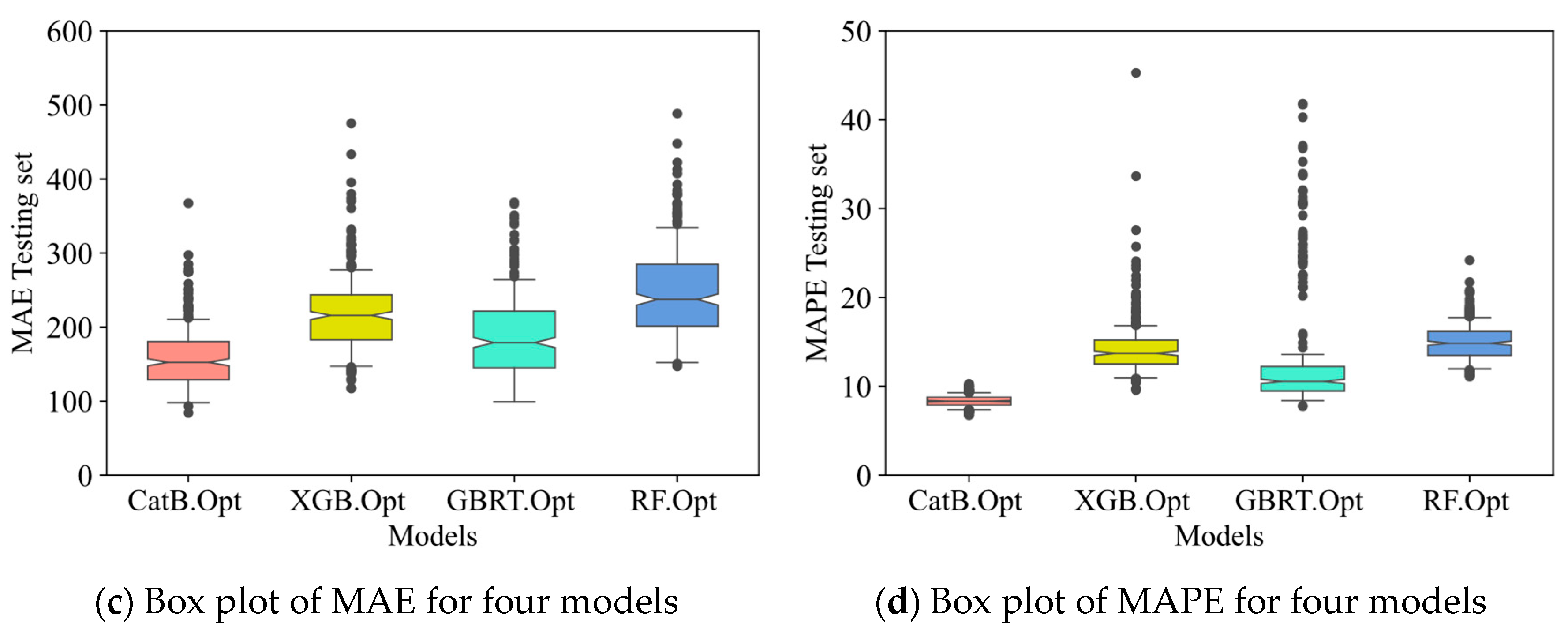
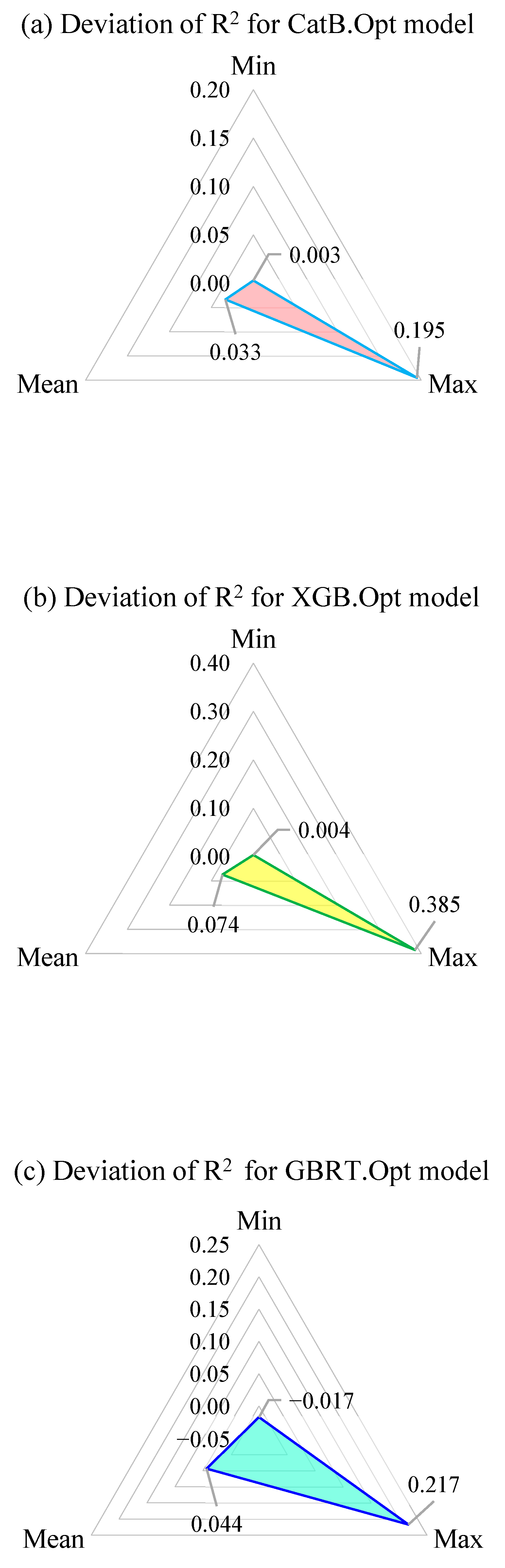
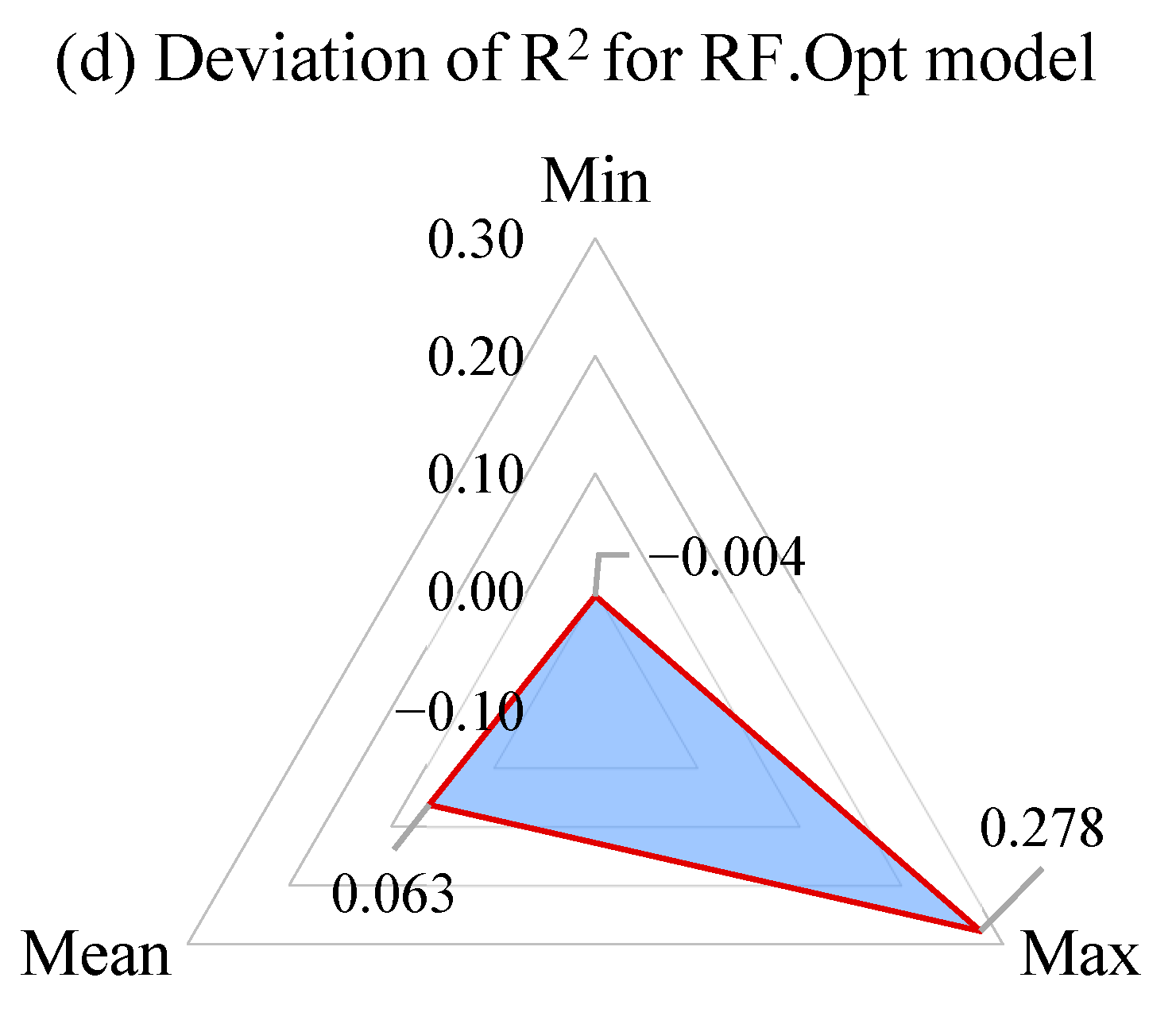
| R2test | 0.804 | 0.996 | 0.966 | 0.032 | 0.781 | 0.996 | 0.940 | 0.053 |
| RMSEtest | 159.88 | 2268.49 | 588.78 | 347.33 | 176.58 | 2120.38 | 784.266 | 486.82 |
| MAEtest | 84.21 | 367.36 | 158.53 | 38.65 | 99.24 | 368.51 | 187.15 | 54.39 |
| MAPEtest | 6.75 | 10.03 | 8.36 | 0.65 | 7.76 | 53.31 | 13.66 | 7.81 |
| XGBoost.Opt | Random Forest.Opt | |||||||
| R2test | 0.615 | 0.996 | 0.926 | 0.063 | 0.718 | 0.990 | 0.925 | 0.058 |
| RMSEtest | 204.07 | 2476.83 | 861.84 | 404.56 | 292.6 | 2420.89 | 887.92 | 492.92 |
| MAEtest | 117.24 | 475.09 | 218.20 | 52.09 | 147.19 | 488.17 | 246.23 | 60.17 |
| MAPEtest | 9.58 | 45.28 | 14.32 | 3.34 | 11.11 | 24.19 | 15.02 | 2.04 |
| Index | Models on All Data | ||||||
|---|---|---|---|---|---|---|---|
| CatBoost | ACI 318-19 | Wang et al. [68] | AIJ | DBJ 13-51-2010 (Han) | GIA et al. [71] | CH (Chinese Code) | |
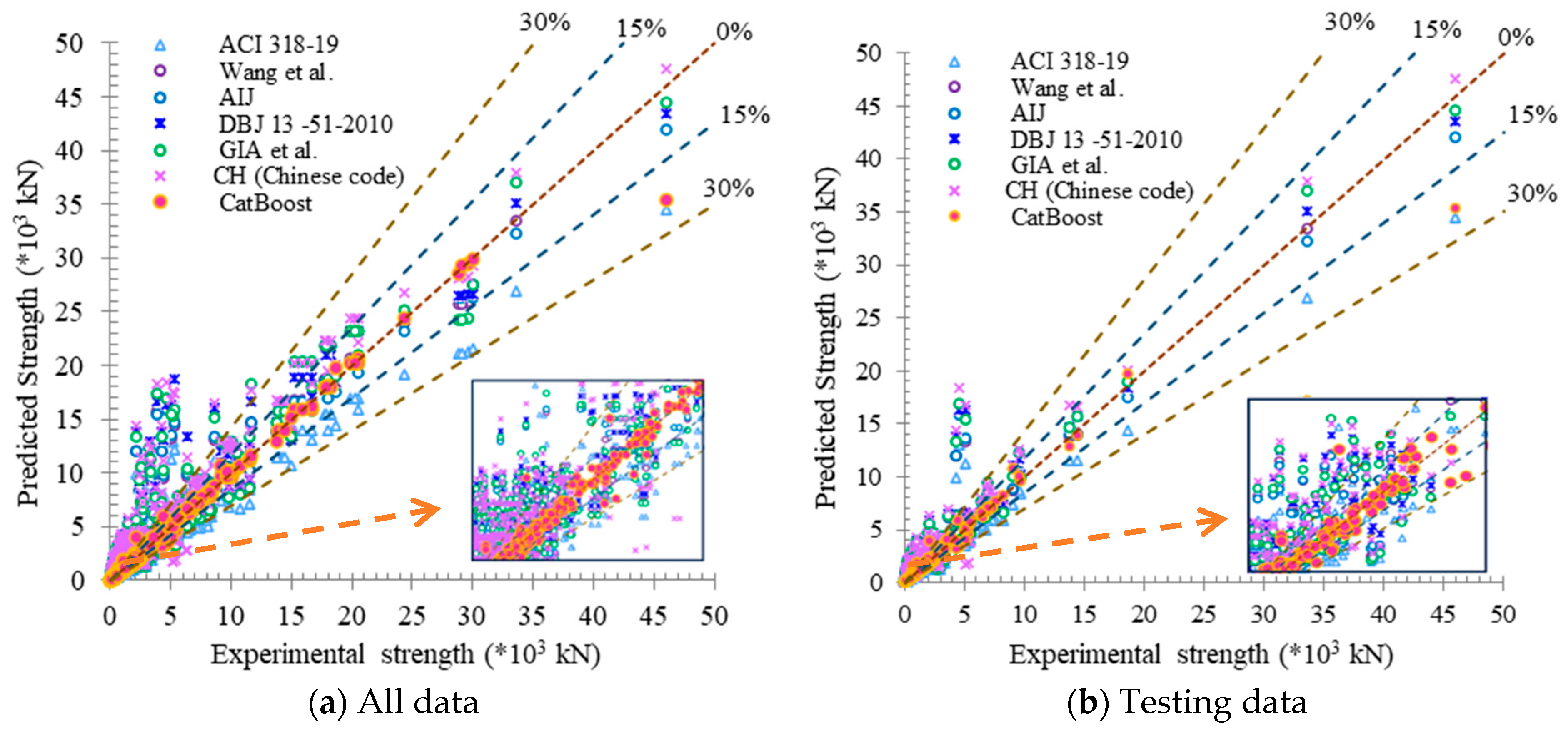
| R2 | 0.999 | 0.878 | 0.877 | 0.879 | 0.822 | 0.831 | 0.788 |
| RMSE (kN) | 118.10 | 1689.68 | 1691.43 | 1679.41 | 2038.41 | 1986.92 | 2220.82 |
| The ratio of the predicted and the tested value | |||||||
| Mean | 1.00 | 1.36 | 1.68 | 1.67 | 1.82 | 1.71 | 1.85 |
| Std. | 0.05 | 0.96 | 1.26 | 1.25 | 1.29 | 1.22 | 1.34 |
| COV (%) | 5.43 | 70.47 | 75.06 | 74.42 | 70.89 | 71.26 | 72.45 |
| R2 | Compressive Strength | D | t | L | fy | fc | et 425-BC | et 1287 Samples |
|---|---|---|---|---|---|---|---|---|
| Training set | 0.999 | 0.999 | 0.994 | 0.956 | 0.999 | 0.987 | 0.999 | 0.998 |
| Validation set | 0.970 | 0.970 | 0.898 | 0.823 | 0.866 | 0.802 | 0.825 | 0.715 |
| Test set | 0.908 | 0.945 | 0.900 | 0.816 | 0.787 | 0.770 | 0.890 | 0.773 |
| Index | CatBoost (Test Set) | ACI 318-19 (All Data) | AIJ (All Data) | GIA (All Data) |
|---|---|---|---|---|
| R2 of Diameter | 0.945 | 0.705 | 0.711 | 0.712 |
| R2 of Tube thickness | 0.900 | −3.566 | −2.320 | −11.37 |
| R2 of Column height | 0.816 | - | - | - |
| R2 of Steel strength | 0.787 | −22.61 | −26.66 | −69.08 |
| R2 of Concrete strength | 0.770 | −2.024 | −1.812 | −0.904 |
| R2 of Eccentricity | 0.890 | - | - | - |
Disclaimer/Publisher’s Note: The statements, opinions and data contained in all publications are solely those of the individual author(s) and contributor(s) and not of MDPI and/or the editor(s). MDPI and/or the editor(s) disclaim responsibility for any injury to people or property resulting from any ideas, methods, instructions or products referred to in the content. |
© 2025 by the authors. Licensee MDPI, Basel, Switzerland. This article is an open access article distributed under the terms and conditions of the Creative Commons Attribution (CC BY) license.
Share and Cite
Trinh, H.T.; Le Nguyen, K.; Banihashemi, S.; Ahmad, A. Enhancing Circular CFST Columns Under Axial Load Compressive Strength Prediction and Inverse Design Using a Machine Learning Approach. Buildings 2026, 16, 150. https://doi.org/10.3390/buildings16010150
Trinh HT, Le Nguyen K, Banihashemi S, Ahmad A. Enhancing Circular CFST Columns Under Axial Load Compressive Strength Prediction and Inverse Design Using a Machine Learning Approach. Buildings. 2026; 16(1):150. https://doi.org/10.3390/buildings16010150
Chicago/Turabian StyleTrinh, Hoa Thi, Khuong Le Nguyen, Saeed Banihashemi, and Afaq Ahmad. 2026. "Enhancing Circular CFST Columns Under Axial Load Compressive Strength Prediction and Inverse Design Using a Machine Learning Approach" Buildings 16, no. 1: 150. https://doi.org/10.3390/buildings16010150
APA StyleTrinh, H. T., Le Nguyen, K., Banihashemi, S., & Ahmad, A. (2026). Enhancing Circular CFST Columns Under Axial Load Compressive Strength Prediction and Inverse Design Using a Machine Learning Approach. Buildings, 16(1), 150. https://doi.org/10.3390/buildings16010150