Measuring Safety Culture Maturity in Indonesian Construction Projects Across Design and Construction Phases
 , and
, and
Abstract
1. Introduction
2. Literature Review
2.1. Safety Culture in Construction
2.2. Safety Culture Maturity Models
2.3. Standards and Frameworks
3. Methodology
4. Result
4.1. Categories and Sub-Categories
4.2. Safety Culture Maturity Assessment
5. Discussions
6. Conclusions
Author Contributions
Funding
Institutional Review Board Statement
Informed Consent Statement
Data Availability Statement
Conflicts of Interest
Appendix A. Pilot Survey

| No. | Category | Sub-Category | Q: Is this Sub-Category Relevant and Clearly Defined for Assessing Design-Phase Safety Culture Maturity? (Y/N) | Comments | |
|---|---|---|---|---|---|
| 1 | Competence and Personnel of Designers | D1 | Knowledge, Experience, and Skills of Designers [29] | ||
| No. | Category | Sub-Category | Q: Is this Sub-Category Relevant and Clearly Defined for Assessing Construction-Phase Safety Culture Maturity? (Y/N) | Comments | |
|---|---|---|---|---|---|
| 1 | Competence and Personnel of Designers | K1 | Knowledge, Experience, and Skills of Designers [29] | ||
Appendix B. Final Survey
Appendix B.1. Questionnaire for Design Phase
- o
- Basic: Designers possess very limited technical knowledge and skills; safety is almost never considered in design, with no relevant professional experience.
- o
- Reactive: Designers seek safety knowledge and skills only after incidents or problems; experience is acquired reactively, not as core competency.
- o
- Compliant: Designers meet minimum standards and include safety to satisfy regulatory requirements, but not in a deep or innovative manner.
- o
- Proactive: Designers proactively update and enhance safety knowledge, skills, and professional experience; safety is a primary consideration from the outset of design.
- o
- Resilient: Designers exemplify mastery in safety-related knowledge, skills, and experience; safety is integrated into every design aspect and knowledge is actively shared with the team.
Appendix B.2. Questionnaire for Construction Phase
- o
- Basic: National K4 occupational safety regulation is not applied; workers and management are unaware of or ignore K4 at the construction site.
- o
- Reactive: Standards are applied only when inspections occur or after an accident; compliance is temporary and inconsistent.
- o
- Compliant: K4 standards are implemented to the minimum required level with standard reporting and documentation, yet field application is sometimes a mere formality.
- o
- Proactive: K4 standards are not only met but integrated into all aspects of project execution; the entire team actively ensures routine compliance.
- o
- Resilient: Adherence to K4 has become part of the work culture; continuous innovation and improvement aim to reach and exceed the prescribed standards.
References
- Suraji, A.; Arman, U.D. No failure no accident in man-made disasters in construction. In Proceedings of the E3S Web of Conferences, Padang, Indonesia, 29–30 September 2023; EDP Sciences: Les Ulis, France, 2023. [Google Scholar] [CrossRef]
- Machfudiyanto, R.A.; Latief, Y.; Suraji, A. Integration of Structure, Conduct, Performance Interrelation of Institutional Policy and Safety Culture in Construction Industry. J. Eng. Sci. Technol. 2022, 17, 3433–3446. [Google Scholar]
- Choudhry, R.M.; Fang, D.; Mohamed, S. Developing a Model of Construction Safety Culture. J. Manag. Eng. 2007, 23, 207–212. [Google Scholar] [CrossRef]
- Machfudiyanto, R.A.; Latief, Y.; Sagita, L.; Suraji, A. Identification of institutional safety factors affecting safety culture in construction sector in Indonesia. In Proceedings of the IOP Conference Series: Earth and Environmental Science, Moscow, Russia, 10 March 2020; Institute of Physics Publishing: Bristol, UK, 2020. [Google Scholar] [CrossRef]
- Suraji, A. The Construction Sector of Indonesia. In Proceedings of the 19th Asia Construct Conference, Jakarta, Indonesia, 14–15 November 2013; Asia Construct: Jakarta, Indonesia, 2013. [Google Scholar]
- Suraji, A.; Duff, A.R.; Peckitt, S.J. Development of Causal Model of Construction Accident Causation. J. Constr. Eng. Manag. 2001, 127, 337–344. [Google Scholar] [CrossRef]
- Endroyo, B.; Suraji, A.; Besari, M.S. Model of the Maturity of Pre-construction Safety Planning. In Procedia Engineering; Elsevier: Amsterdam, The Netherlands, 2017; Volume 171, pp. 413–418. [Google Scholar] [CrossRef]
- Szymberski, R. Construction project safety planning. TAPPI J. 1997, 80, 69–74. [Google Scholar]
- Lestari, F.; Sunindijo, R.Y.; Loosemore, M.; Kusminanti, Y.; Widanarko, B. A Safety Climate Framework for Improving Health and Safety in the Indonesian Construction Industry. Int. J. Environ. Res. Public Health 2020, 17, 7462. [Google Scholar] [CrossRef]
- Kadir, A.; Lestari, F.; Sunindijo, R.Y.; Erwandi, D.; Kusminanti, Y.; Modjo, R.; Widanarko, B.; Ramadhan, N.A. Safety Climate in the Indonesian Construction Industry: Strengths, Weaknesses and Influential Demographic Characteristics. Buildings 2022, 12, 639. [Google Scholar] [CrossRef]
- Adzivor, E.; Emuze, F.; Ahiabu, M.; Kusedzi, M. Scaling up a Positive Safety Culture among Construction Small and Medium-Sized Enterprises in Ghana. Int. J. Environ. Res. Public Health 2024, 21, 817. [Google Scholar] [CrossRef]
- Williams, J.; Fugar, F.; Adinyira, E. Assessment of Health and Safety Culture Maturity in the Construction Industry in Developing Economies: A Case of Ghanaian Construction Industry. J. Eng. Des. Technol. 2019, 18, 865–881. [Google Scholar] [CrossRef]
- Al-Kasasbeh, M.; Abudayyeh, O.; Olimat, H.; Liu, H.; Al Mamlook, R.; Alfoul, B.A. A Robust Construction Safety Performance Evaluation Framework for Workers’ Compensation Insurance: A Proposed Alternative to EMR. Buildings 2021, 11, 434. [Google Scholar] [CrossRef]
- Indrayana, D.V.; Pribadi, K.S.; Marzuki, P.F.; Iridiastadi, H. Safety Leadership and Performance in Indonesia’s Construction Sector: The Role of Project Owners’ Maturity. Int. J. Saf. Secur. Eng. 2023, 13, 635–646. [Google Scholar] [CrossRef]
- Guldenmund, F.W. The Nature of Safety Culture: A Review of Theory and Research. Saf. Sci. 2000, 34, 215–257. [Google Scholar] [CrossRef]
- Hudson, P. Safety management and safety culture: The long, hard and winding road. In Occupational Health & Safety Management Systems: Proceedings of the First National Conference; Pearse, W., Gallagher, C., Bluff, L., Eds.; Crown Content: Melbourne, Australia, 2001; pp. 3–32. [Google Scholar]
- Hale, A.R. Safety Management in Production. Hum. Factors Ergon. Manuf. 2003, 13, 185–201. [Google Scholar] [CrossRef]
- Hudson, P. Applying the Lessons of High Risk Industries to Health Care. Qual. Saf. Health Care 2003, 12, i7–i12. [Google Scholar] [CrossRef]
- Foster, P.; Hoult, S. The safety journey: Using a Safety Maturity Model for Safety Planning and Assurance in the UK Coal Mining Industry. Minerals 2013, 3, 59–72. [Google Scholar] [CrossRef]
- Pashya, C.R.; Machfudiyanto, R.A.; Suraji, A. Fostering a Total Construction Safety Culture to Enhance Safety Performance in Indonesia’s New Capital City Establishment. Int. J. Saf. Secur. Eng. 2024, 14, 241–247. [Google Scholar] [CrossRef]
- Golabchi, H.; Pereira, E.; Lefsrud, L.; Mohamed, Y. Proposal of a safety maturity framework in construction: Implementing leading indicators for proactive safety management. J. Saf. Sustain. 2025, 2, 207–221. [Google Scholar] [CrossRef]
- Chan, E. A multi-level safety culture maturity model for (new) building projects in Hong Kong. HKIE Trans. Hong Kong Inst. Eng. 2023, 30, 95–105. [Google Scholar] [CrossRef]
- Trinh, M.T.; Feng, Y. A Maturity Model for Resilient Safety Culture Development in Construction Companies. Buildings 2022, 12, 733. [Google Scholar] [CrossRef]
- ISO 21500; Project, Programme and Portfolio Management-Context and Concepts. ISO: Geneva, Switzerland, 2021.
- Project Management Institute. Construction Extension to the PMBOK® Guide, 2nd ed.; Project Management Institute: Newtown Square, PA, USA, 2000. [Google Scholar]
- Wendler, R. The Maturity of Maturity Model Research: A Systematic Mapping Study. Inf. Softw. Technol. 2012, 54, 1317–1339. [Google Scholar] [CrossRef]
- Santoso, J.; Latief, Y.; Machfudiyanto, R.A. Building a Safety Culture in the Construction Sector: A model to assess the safety maturity of a company. In Proceedings of the International Conference on Industrial Engineering and Operations Management, Bandung, Indonesia, 6–8 March 2018. [Google Scholar]
- Mulyasari, W.; Ciptomulyono, U.; Sudiarno, A. A Critical Review of Safety Culture Maturity Model Tools. In Proceedings of the 2023 IEEE International Conference on Industrial Engineering and Engineering Management, IEEM 2023, Singapore, 18–21 December 2023; Institute of Electrical and Electronics Engineers Inc.: New York, NY, USA, 2023; pp. 1083–1087. [Google Scholar] [CrossRef]
- Ibrahim, C.K.I.C.; Belayutham, S.; Mohammad, M.Z.; Ismail, S. Development of a Conceptual Designer’s Knowledge, Skills, and Experience Index for Prevention through Design Practice in Construction. J. Constr. Eng. Manag. 2022, 148, 04021199. [Google Scholar] [CrossRef]
- Undang-undang (UU) Nomor 2 Tahun 2017; Tentang Jasa Konstruksi; Jakarta, Indonesia. 2017. Available online: https://peraturan.bpk.go.id/Details/37637/uu-no-2-tahun-2017 (accessed on 15 November 2025).
- Ministry of PUPR. Regulation of the Minister of Public Works and Housing of the Republic of Indonesia Number 10 of 2021 on Guidelines for Construction Safety Management Systems; Ministry of PUPR: Jakarta, Indonesia, 2021. [Google Scholar]
- Afzal, M.; Shafiq, M.T. Evaluating 4D-BIM and VR for Effective Safety Communication and Training: A case Study of Multilingual Construction Job-Site Crew. Buildings 2021, 11, 319. [Google Scholar] [CrossRef]
- Carvalho, K.M.P.; Picchi, F.; Camarini, G.; Chamon, E.M.Q.O. Benefits in the Implementation of Safety, Health, Environmental and Quality Integrated System. Int. J. Eng. Technol. 2015, 7, 333–338. [Google Scholar] [CrossRef]
- Santos, G.; Mendes, F.; Barbosa, J. Certification and Integration of Management Systems: The Experience of Portuguese Small and Medium Enterprises. J. Clean. Prod. 2011, 19, 1965–1974. [Google Scholar] [CrossRef]
- Sun, P.; Tayeh, B.A.; Alaloul, W.S.; Aisheh, Y.I.A.; Frijah, M.M. The Role of Client in Fostering Construction Safety During the Planning and Design Stages. J. Asian Archit. Build. Eng. 2025, 24, 1659–1671. [Google Scholar] [CrossRef]
- Wu, C.; Fang, D.; Li, N. Roles of Owners’ Leadership in Construction Safety: The Case of High-Speed Railway Construction Projects in China. Int. J. Proj. Manag. 2015, 33, 1665–1679. [Google Scholar] [CrossRef]
- Yiu, N.S.N.; Chan, D.W.M.; Sze, N.N.; Shan, M.; Chan, A.P.C. Implementation of Safety Management System for Improving Construction Safety Performance: A Structural Equation Modelling Approach. Buildings 2019, 9, 89. [Google Scholar] [CrossRef]
- Yiu, N.S.N.; Chan, D.W.M.; Shan, M.; Sze, N.N. Implementation of Safety Management System in Managing Construction Projects: Benefits and Obstacles. Saf. Sci. 2019, 117, 23–32. [Google Scholar] [CrossRef]
- Chen, X.; Qiao, W. A hybrid STAMP-fuzzy DEMATEL-ISM Approach for Analyzing the Factors Influencing Building Collapse Accidents in China. Sci. Rep. 2023, 13, 19745. [Google Scholar] [CrossRef]
- ISO 45001:2018; Occupational Health and Safety Management Systems—Requirements with Guidance for Use. ISO: Geneva, Switzerland, 2018.
- Apriyati, R.; Latief, Y. Knowledge Base Integration Management System Quality, Safety and Environmental to Improve Organizational Performance in Construction Company. In Proceedings of the IOP Conference Series: Materials Science and Engineering, Ho Chi Minh City, Vietnam, 20–22 December 2020; IOP Publishing Ltd.: Bristol, UK, 2020. [Google Scholar] [CrossRef]
- Sari, T.R.; Machfudiyanto, R.A.; Riantini, L.S. Conceptual Framework of Safety Leadership Relationship to Safety Culture in Increasing Safety Performance of Construction Projects. Indones. J. Multidisiplinary Sci. 2022, 1, 1037–1050. [Google Scholar] [CrossRef]
- Hamidi, N.; Omidvari, M.; Meftahi, M. The Effect of Integrated Management System on Safety and Productivity Indices: Case Study; Iranian Cement Industries. Saf. Sci. 2012, 50, 1180–1189. [Google Scholar] [CrossRef]
- Zeng, S.X.; Lou, G.X.; Tam, V.W.Y. Integration of Management Systems: The Views of Contractors. Arch. Sci. Rev. 2006, 49, 229–235. [Google Scholar] [CrossRef]
- Haddad, A.N.; Morgado, C.R.V.; De Souza, D.I. A Case Study on the Integration of Safety, Environmental and Quality Management Systems. In Proceedings of the Industrial Engineering Research Conference, Nashville, TN, USA, 19–23 May 2007; pp. 1190–1195. [Google Scholar]
- Moumen, M.; El Aoufir, H. Quality, Safety and Environment Management Systems (QSE): Analysis of Empirical Studies on Integrated Management Systems (IMS). J. Decis. Syst. 2017, 26, 207–228. [Google Scholar] [CrossRef]


| Maturity Level | Description |
|---|---|
| Basic/Pathological | Workers perceive safety as a burden. The company prioritizes business operations and does not yet recognize safety as an integral part of the organization. This represents the lowest safety maturity level. |
| Reactive | At this level, the organization begins to take safety seriously but only responds after incidents occur. Actions are reactive rather than preventive. |
| Compliant/Planned | Safety is driven by management systems, often with extensive data collection. However, the primary focus on safety is still controlled by management decisions rather than being genuinely embraced by the workforce. |
| Proactive | Unexpected events are seen as opportunities to improve performance. Worker involvement increases, shifting behavioral initiatives from a top-down approach to a bottom-up approach, where employees actively contribute to safety improvements. |
| Resilient/Generative | Active participation exists at all organizational levels. Safety is regarded as a core business value. The organization demonstrates a chronic unease that prevents complacency and continuously drives improvement. This represents the highest level of safety maturity. |
| No. | Category | Sub-Category | Description | Basic | Reactive | Compliant | Proactive | Resilient | |
|---|---|---|---|---|---|---|---|---|---|
| 1 | Competence and Personnel of the Designers | D1 | Knowledge, Experience, and Skills of Designers [29] | Designers possess technical knowledge, practical skills, and professional experience in integrating safety considerations during the design phase. | Designers possess very limited technical knowledge and skills; safety is seldom considered in design, and they lack relevant professional experience. | Designers seek safety knowledge and skills only after incidents or problems; experience is acquired reactively, not as a core competency. | Designers meet minimum standards and include safety to satisfy regulatory requirements, but not in a deep or innovative manner. | Designers proactively update and enhance safety knowledge, skills, and professional experience; safety is a primary consideration from the outset of design. | Designers exemplify mastery in safety-related knowledge, skills, and experience; safety is integrated into every design aspect, and knowledge is actively shared with the team. |
| D2 | Attitudes and Mindset of Designers [29] | Designers demonstrate commitment and a safety-oriented mindset, particularly in making design decisions. | No commitment to safety; focuses on technical output and cost while neglecting risk. | Commitment appears only when directed by superiors or after incidents; thinking remains problem-driven and reactive. | Mindset and commitment conform to existing standards/procedures, mainly to fulfill formal obligations. | Designers consistently prioritize safety, even without external pressure; safety impacts are always considered in design decisions. | The safety mindset and commitment are deeply embedded in the individual and team cultures, and safety is the top priority in all design decisions. | ||
| 2 | Regulatory Environment | D3 | Regulations [30] | Existence of government and organizational regulations as the legal and operational foundation for safety implementation in the design phase. | There is no compliance with safety regulations; they are not understood or are ignored in the design. | Regulations receive attention only after incidents or external/legal demands; compliance is reactive. | Regulations are followed to the minimum required level as formality, with no effort to deepen or improve implementation. | Regulations serve as the primary reference in every design process; active efforts are made to understand, implement, and socialize them. | Regulations are internalized as organizational culture; best practices and innovations are adopted to exceed standards, with periodic evaluation to keep pace with new requirements. |
| D4 | Guidelines and Codes [31] | Availability of structured standards and industry codes of practice that guide design safety implementation. | No industry guidelines or codes are used; design proceeds without clear safety standards. | Guidelines/codes are consulted only when problems arise; application is sporadic and unstructured. | Guidelines and codes are applied to minimum standards but are not embedded in routine design practice. | All design processes refer to relevant guidelines/codes; the team routinely seeks the latest standards and ensures that their implementation is understood. | Guidelines/codes are a benchmark of work culture; the organization proactively helps develop new standards and benchmarks against best practices. | ||
| D4’ | Regulatory Requirements for Professional Engineer Accountability | The necessity of a professional licensing system for designers, supported by professional codes of ethics and binding sanction mechanisms, as a form of accountability for negligence in prioritizing safety during the design phase. | There is no clear licensing system or mechanism for professional accountability; codes of ethics and sanctions are not applied. | Licensing and codes of ethics receive attention only after violations have occurred; sanctions are applied only when cases arise. | Licensing, codes of ethics, and sanctions exist and are executed to meet legal/professional obligations, but they are not part of work culture. | Planners actively ensure professional licensure, an understanding of codes of ethics, and compliance with accountability mechanisms; routine socialization and training are provided. | Licensing, ethics, and sanctions are internalized as a professional culture; each engineer feels fully responsible for safety, and the organization helps advance professional standards nationally and internationally. | ||
| 3 | Tools and Resources | D5 | Tools and Technology [32] | Availability of tools and technologies that support designers in identifying and reducing safety risks throughout the design process. | No dedicated tools/technology to support the identification and reduction in safety risks; processes are entirely manual. | Tools/technology are used only after incidents or in urgent cases and are not integrated into routine design. | Safety tools/technology exist and are used to minimum standards but are not optimally leveraged in all design processes. | Tools/technology are actively and integrally used from the outset to detect and reduce risks, with ongoing evaluation for improvement. | The organization pioneers the adoption of state-of-the-art safety tools/technology; upgrades are periodic and involve the entire design team. |
| D6 | Knowledge Transfer and Training [9] | Structured training programs and knowledge-sharing mechanisms to improve stakeholders’ awareness and competence in safety practices. | No training or knowledge sharing on safety; understanding is very low. | Training/knowledge-sharing occurs only after incidents or upon special request. | Safety training and knowledge sharing are routine per regulation but remain formalistic and shallow. | Programs are proactively designed and involve all stakeholders; effectiveness is evaluated periodically. | Training and knowledge transfer are part of organizational culture; members continuously and systematically share safety experience and knowledge. | ||
| 4 | Design for Safety Methods | D7 | Risk Management [23] | Systematic assessment and risk mitigation during the design phase. | No formal risk assessment or mitigation; safety risks are ignored in the design. | Risk assessment/mitigation occurs only after problems/incidents; it is not systematic and reactive. | Risk assessment/mitigation follows standard procedures and regulations but is not proactive across all design stages. | Risk assessment/mitigation is comprehensive and planned from the outset, with periodic evaluation to anticipate emerging risks. | Risk management is part of organizational culture; innovations in risk identification and mitigation are continually developed and involve the entire design team. |
| D8 | Integration of Quality and Safety [33] | Integration of safety principles into quality management systems to ensure that safety objectives are considered at all stages of the design process. | No effort is made to integrate safety into the quality management system; quality and safety are run separately. | Integration is undertaken only upon client/regulatory request or after incidents. | Safety principles are integrated into quality management to achieve minimum standards/policies but not comprehensively. | Safety and quality are consistently integrated throughout the design process, with active monitoring and evaluation. | Safety is integral to the quality management system; continuous learning and innovation keep quality and safety at the highest level. | ||
| D9 | Environmental Management Planning [34] | Comprehensive environmental planning, including traffic management, to support safe and sustainable design implementation. | No environmental or traffic plan addressing design safety. | Plans are drafted only after problems/complaints have been resolved; implementation is temporary or partial. | Plans are prepared per requirements, but execution is suboptimal and largely for compliance. | Plans are comprehensive, anticipate risks from the outset, and are routinely evaluated for improvement. | Integrated traffic and environmental plans are standard best practices that are continually updated with new technology and stakeholder input. | ||
| D9’ | Evaluation and Audit Methods | Existence of evaluation or audit mechanisms that assess the completeness of safety documentation and its practical implementation. | No evaluation/audit of safety implementation; checks, if any, are purely documentary (or absent). | Evaluation/audits are triggered by problems and limited to document compliance, not field implementation. | Evaluations/audits are conducted periodically per regulation but focus on documentation rather than effectiveness. | Evaluations/audits focus on field effectiveness; results are used for continuous improvement. | Evaluation and audit are part of organizational culture; every audit yields learning and innovation for system-wide enhancement. | ||
| 5 | Contracts and Costs | D10 | Contractual Aspects and Responsibilities [14] | The contractual provisions and responsibilities of all stakeholders to integrate safety into the design. | Contracts do not assign stakeholder responsibilities for safety in design; contract documents ignore safety. | Contract adjustments for safety only occur after incidents or external demands; responsibilities are set post-event. | Contract provisions exist to minimum standards, but their application is formalistic and not consistently followed by all stakeholders. | Contracts clearly assign each stakeholder’s responsibility for safety in design; provisions are socialized and jointly monitored. | All stakeholders understand, accept, and internalize safety responsibilities; there is strong collaboration in implementation and ongoing evaluation. |
| D11 | Financial Considerations [9] | Budget allocation for the implementation of design safety measures. | No dedicated budget for safety in design; safety is often sacrificed due to funding limits. | Safety funds are provided only after incidents or demands are met; they are not planned from project initiation. | Safety budgets are included to meet minimum regulatory/standard requirements but are not proportional to actual needs. | Safety budgets are prioritized and carefully planned, with periodic evaluation to ensure sufficiency at each design stage. | Safety budgeting is a top, sustained priority—adaptive, flexible, and fully supported by all stakeholders. | ||
| D11’ | Time Considerations | Adequate planning time allocation to ensure proper implementation of safety in design. | No time allocated for safety planning; processes are rushed without considering risk. | Additional time is granted only when obstacles arise during execution, not planned from the outset. | Time for safety is scheduled per standards but used ineffectively or only to meet formal requirements. | Time for safety is strategically and adequately allocated, with routine evaluation to ensure effective implementation at each design stage. | Time allocation for safety is part of the work culture; sufficient time for innovation and development is always available and adaptively accommodated to project needs. | ||
| D11” | Competent Construction Safety Personnel | Designated safety-competent personnel from each stakeholder to review and ensure the implementation of safety in design. | No designated safety-competent personnel; safety reviews are never conducted by qualified experts. | Safety personnel are involved only after incidents or by external request; no routine scheduling is required. | Qualified safety personnel from key stakeholders are formally tasked to review, but involvement is largely administrative. | All stakeholders actively involve competent safety personnel in every review process, with good communication and coordination. | Cross-stakeholder collaboration with highly competent personnel is routine; safety personnel act as strategic partners in design innovation and evaluation. | ||
| 6 | Influence of Owners/Clients | D12 | Client Commitment [35] | Project owners demonstrate commitment to safety by encouraging designers to adopt and implement safety principles from the outset of design. | The project owner shows no commitment to safety; no resources are provided for safety in design. | Commitment appears only under external pressure, incidents, or requests from others; resources are limited and incidental. | Owners provide resources to meet minimum standards, mainly to meet contractual/regulatory obligations. | Owners actively encourage safety from the outset of design, provide adequate resources, and are involved in oversight. | Safety commitment is embedded in all owner policies and actions; resources are consistently optimal with innovative and continuous efforts to raise standards. |
| D13 | Client Leadership [14,36] | Strong client leadership from clients fosters a project culture where safety becomes a core value. | The client shows no leadership on safety; it is not a decision-making priority. | Safety leadership appears only after problems/accidents or external demands; it is inconsistent and reactive. | The client states that safety is a project value, but actions remain at minimum standards and are not inspirational for the entire team. | The client consistently demonstrates leadership that fosters a safety culture, providing direction, recognition, and corrective action. | Client leadership sets a model for all stakeholders; safety culture is a core value that is maintained and elevated in every project aspect. | ||
| 7 | Stakeholder Involvement and Collaboration | D14 | Collaboration [7] | Effective collaboration among stakeholders facilitates shared understanding and responsibility in implementing safety in design. | No stakeholder collaboration; each party works in isolation regarding safety. | Collaboration occurs only after problems occur; routine shared understanding and responsibility are absent. | Collaboration follows standard forums but is not integrated into day-to-day project work. | Collaboration is active and structured; stakeholders routinely share information, experience, and safety responsibility across all design stages. | Collaboration is part of organizational culture; all stakeholders actively implement and innovate in safety and sustain collective responsibility. |
| D15 | Communication [9] | Open and continuous communication ensures that safety issues are effectively identified and addressed. | No safety communication among parties; safety information is never discussed formally or informally. | Safety communication occurs only after problems/incidents occur; messages are one-way and limited. | Safety communication is scheduled (e.g., toolbox meetings) but remains formal and not fully open/responsive. | Communication is two-way, open, and routine; safety issues are quickly identified and resolved through effective information flow. | Safety communication is cultural; individuals feel comfortable and encouraged to continuously raise, discuss, and co-solve all safety issues. | ||
| No. | Category | Sub-Category | Description | Basic | Reactive | Compliant | Proactive | Resilient | |
|---|---|---|---|---|---|---|---|---|---|
| 1 | Safety Compliance and Standards | K1 | K4 Standards [9,10,31] | Implementation of national occupational safety regulations (K4) as the legal basis and standard for applying workplace safety at construction sites. | National K4 occupational safety regulation is not applied; workers and management are unaware of or ignore K4 at construction site. | Standards are only applied when inspections occur or after an accident; compliance is temporary and inconsistent. | K4 standards are implemented to the minimum required level with standard reporting and documentation; however, field application is sometimes a mere formality. | K4 standards are not only met but integrated into all aspects of project execution; the entire team actively ensures routine compliance. | Adherence to K4 has become part of the work culture; continuous innovation and improvement aim to reach and exceed the prescribed standards. |
| K2 | Monitoring and Inspection Standards [23,37] | Regular monitoring and inspection of safety procedures to ensure compliance and detect deviations. | No routine monitoring or inspection; safety procedures are never checked or evaluated. | Monitoring and inspection occur only after accidents or complaints have occurred; corrective actions are temporary. | Monitoring and inspection are conducted routinely per regulation but focus more on administrative completeness than on field effectiveness. | Routine monitoring and inspection are comprehensive and target field effectiveness; findings are immediately acted upon for continuous improvement. | Monitoring and inspection are part of the organizational culture; all team members actively participate in evaluation and improvement and encourage learning from every finding. | ||
| 2 | Organizational Governance and Commitment | K3 | Contract and Financing Review [14,31] | Existence of formal instruments that stipulate responsibilities, budget allocation, adequate resources, and control mechanisms to ensure safety throughout project execution. | No contract or financing review considers safety; responsibilities, costs, and resources for safety are ignored. | Safety-related contract and financing reviews occur only after incidents or external demands; implementation is inconsistent. | Formal review instruments exist per minimum standards, but implementation remains administrative or a formality. | Reviews are structured and involve all stakeholders, with routine safety resource allocation monitoring. | Reviews are embedded in organizational culture; ongoing evaluation and innovation optimize responsibilities, costs, and safety resources. |
| K4 | Accountability [6,24] | Clear role definition, fostering a culture of shared responsibility for safety, supported by organizational mechanisms that ensure that each individual effectively carries out their responsibilities. | Safety roles and responsibilities are not defined; the accountability culture is very weak or absent. | Safety roles and responsibilities are emphasized only after violations or incidents; mutual stewardship is still very limited. | Roles and responsibilities are formally defined per regulation, but implementation is suboptimal, and the culture of accountability is not strong. | Accountability is actively practiced at all levels, with periodic evaluation, supported by the organization and mutual reminders. | Accountability has become a core organizational value; mutual care and responsibility for safety are ingrained across individuals and groups. | ||
| K5 | Leadership and Commitment [10,14,36] | Active commitment and exemplary leadership from project leaders in prioritizing safety. | Project leaders demonstrate no commitment or leadership in safety; safety is not a management priority. | Leadership commitment appears only after problems or incidents occur; responses are sporadic. | Leaders demonstrate commitment to existing standards/procedures, largely to meet regulatory demands rather than internal motivation. | Project leaders actively model and direct safety prioritization and directly oversee implementation. | Leadership and commitment inspire the entire team; safety is consistently treated as a core value in all policies and actions. | ||
| K5’ | Reward and Punishment | Implementation of a reward system for positive safety behavior, and sanction mechanisms (including financial penalties) for individuals or parties failing to fulfill their safety responsibilities. | No reward or sanction system related to safety behavior; violations or achievements are neither recognized nor followed up. | Rewards and sanctions are provided only after significant (positive/negative) events and are typically incidental. | A formal reward-and-punishment system exists but is not yet effective in driving broad behavioral changes. | Transparent and consistent implementation of rewards and sanctions contributes to positive behavior change in safety. | The system is internalized as part of organizational culture; all members support and maintain its effectiveness to ensure safe and sustainable behavior. | ||
| 3 | Safety Information Management | K6 | Safety Planning [7,38] | Comprehensive and holistic planning covering the identification and mitigation of potential risks as the foundation of safety implementation. | No safety planning; risks are not systematically identified or mitigated. | Safety planning occurs only because of external demands or after incidents; planning is not comprehensive. | Safety planning follows minimum standards/procedures but does not fully consider all potential risks. | Safety planning is structured and comprehensive, identifying and mitigating risks at every execution stage. | Safety planning is embedded in organizational culture, continuously updated through learning and innovation and serves as the foundation for all execution processes. |
| K7 | Safety Reporting [9] | To record all conditions, including analysis, documentation of safety incidents, and follow-up actions for continuous improvement, open and easily accessible safety reporting systems. | No safety reporting system; safety events or conditions are not documented. | Reports are prepared only when accidents/incidents occur; reporting is incidental. | A reporting system exists and follows procedures but does not yet enable openness, easy access, or in-depth analysis. | Reporting is open and easily accessible and is routinely used to record and analyze all safety aspects, thereby supporting rapid decision-making. | Reporting has become cultural; the whole team actively reports, analyzes, and follows up findings for continuous improvement. | ||
| K8 | Data Utilization [32] | Safety data analysis for trend identification, risk prediction, and decision-making process enhancement. | Safety data are neither collected nor analyzed and decisions are not data-driven. | Data are used after incidents to identify causes, but not routinely for prediction or improvement. | Safety data are routinely collected and analyzed per standards, yet they are not fully used for trend identification or strategic decision-making. | Comprehensive data analysis detects trends, predicts risks, and supports system improvement. | Safety data underpin all decisions; analytical innovation is continuously developed and learning from data is integrated into the safety management system. | ||
| K9 | Safety Audit [19,24] | Periodic evaluation of safety systems and practices to support continuous improvement. | No safety audits; implementation is never systematically evaluated. | Audits are conducted only after problems or external requests; follow-up is usually inconsistent. | Audits are conducted periodically per regulation, focusing more on administrative compliance than on field effectiveness. | Comprehensive and periodic audits are used to improve systems and field implementation. | Audits are a learning and innovation process; findings are always followed up for continuous improvement and systemic enhancement. | ||
| K10 | Accident Investigation [39] | Systematic investigation of workplace accidents as a basis for learning and future prevention. | No investigation of occupational accidents; incidents are ignored without follow-up. | Investigations are conducted only after major incidents; causal analysis is usually superficial and unsystematic. | Investigations follow standard procedures; however, learning and follow-up are often limited to administrative aspects. | In-depth and systematic investigations are conducted to identify root causes; results are used for tangible improvements in the field. | Investigation is part of organizational culture; lessons from every incident are disseminated and applied to prevent recurrences. | ||
| 4 | Operational Safety Management | K11 | Document Control [24] | Safety document management to ensure availability, up-to-date information, and easy field access when needed. | Safety documents are unavailable, unmanaged, or difficult to access on-site when needed. | Safety documents are prepared only upon request during inspections, audits, or incidents; not managed routinely. | Although safety documents are available and managed per standards, updates and accessibility remain limited to certain situations. | Document control is proactive, continuously updated, and easily accessible to all parties in the field when needed. | Document control is an established work culture; documents are always up-to-date, accessible, and used effectively to support site safety. |
| K12 | Equipment Control [24,38] | Inspection, maintenance, and use of safe work equipment to prevent accidents. | Work equipment is never inspected or maintained, and its often use deviates from procedures, increasing the risk of accidents. | Inspection and maintenance are performed only after breakdowns or accidents; there is no routine maintenance schedule. | Inspection and maintenance follow a standard schedule; however, not all equipment types are covered or fully documented. | All equipment is routinely and systematically inspected, maintained, and used to ensure safety, with consistent reporting and follow-up. | Equipment control is embedded in the work culture; continuous innovation and improvement are pursued, and all parties actively help keep equipment safe. | ||
| K13 | Material Management [38] | Safe and efficient handling, storage, and distribution of construction materials. | Materials are handled and stored haphazardly, without regard for safety and efficiency. | Material management is corrected only after accidents, damage, or warnings; standard procedures are not yet in place. | Materials are managed according to standard procedures but not yet optimally; minor violations persist in practice. | Procedures for handling, storage, and distribution are well implemented and continually evaluated for improvement. | Material management is part of the organizational culture; the team is committed to safety and efficiency and continually innovates. | ||
| K14 | Worksite Conditions [9] | Arrangement of work areas, access, lighting, and overall physical environment to ensure workplace safety. | The work environment is disorganized, with poor access and lighting; physical conditions pose hazards to workers. | Site arrangement occurs only after accidents, warnings, or complaints; no routine monitoring is performed. | Site arrangement, access, and lighting meet minimum standards but are not consistently maintained. | Comprehensive and continuous site arrangement, with routine monitoring and immediate correction of deficiencies. | Safe and comfortable site conditions are the norm; any change is promptly addressed, and workers actively help maintain the work environment. | ||
| K14’ | Hazardous and Non-Hazardous Waste Management [33] | Hazardous (B3) and non-hazardous waste are managed in accordance with procedures to prevent occupational hazards, environmental contamination, and to support worker health at construction sites. | No waste management; hazardous (B3) and nonhazardous waste are disposed of carelessly without regard for safety and environmental impacts. | Waste handling is performed only after warnings, accidents, or environmental incidents; procedures are inconsistently applied. | Hazardous and non-hazardous waste are managed per standard procedures, but oversight and evaluation are suboptimal. | Waste management is systematic, with routine monitoring and reporting to prevent exposure and contamination. | Waste management is internalized as part of work culture; continuous innovation and system enhancement ensure maximal safety and environmental protection. | ||
| 5 | Safety Capacity Building and Innovation | K15 | Safety Digitalization [32] | Digital technologies (software, dashboards, BIM, IoT) are utilized to plan, monitor, measure, and report safety conditions. | Digital technology is not used in safety processes; activities are entirely manual and conventional. | Digital technologies are used only after incidents or when external parties require them and are not integrated into daily work processes. | Digital tools are used for certain safety aspects (e.g., reporting or monitoring) but are not fully integrated or optimized. | Digital technologies are integrated with planning, training, monitoring, and reporting, with routine evaluation and development. | The organization pioneers safety digitalization; systems are fully integrated, and all workers actively use technology to sustain the safety culture. |
| K16 | Training [9,32] | Implementation of structured training and orientation programs to improve safety awareness, skills, and responsibility of all workers. | No safety training or orientation programs; workers have minimal safety knowledge and skills. | Training/orientation is conducted only after accidents or on special request; it is not continuous and remains unstructured. | Safety training and orientation are routinely delivered per standards, but more as a compliance activity than a comprehensive competency development. | Training and orientation are continuous, with regularly updated materials; all workers are encouraged to actively participate and apply lessons learned. | Training and orientation are cultural norms; workers share knowledge, skills, and experiences, and continuous innovation is pursued to strengthen competence. | ||
| No. | Experts/Respondents | Position/Job Title | Institution | Years of Experience | Education Background |
|---|---|---|---|---|---|
| 1 | E1 | Senior Staff HSM | Adhi Karya Limited | 15–20 years | Master’s degree |
| 2 | E2 | Desainer Infrastructure | Stadia Limited | >25 years | Master’s degree |
| 3 | E3 | VP HSSE | Hutama Karya (Persero) Limited | >25 years | Master’s degree |
| 4 | E4 | SVP QHSE | PT Nindya Karya | >25 years | Bachelor’s degree |
| 5 | E5 | Expert QHSSE | Hutama Karya (Persero) Limited | >25 years | Master’s degree |
| 6 | E6 | Head of Road and Bridge Development Division | National Roads and Bridges Agency Jakarta-Banten/West Java | 20–25 years | Master’s degree |
| 7 | E7 | Road and Bridge Management Officer—Junior Expert | National Roads and Bridges Agency Jakarta-Banten/West Java | 10–15 years | Master’s degree |
| 8 | E8 | SVP Departemen QHSSE | Brantas Abipraya Limited | 20–25 years | Master’s degree |
| 9 | E9 | Lecturer | PLN Institute of Technology | >25 years | Doctoral degree |
| 10 | E10 | HSE supervisor | Adhi Karya Limited | 10–15 years | Master’s degree |
| 11 | E11 | Intermediate Expert in Construction Services Supervision (Functional Position) | Ministry of Public Works | 15–20 years | Doctoral degree |
| 12 | E12 | Design Consultant | Virama Karya Limited | >25 years | Bachelor’s degree |
| Sub-Category | Basic | Reactive | Compliant | Proactive | Resilient |
|---|---|---|---|---|---|
| Knowledge, Experience, and Skills of Planners | 8.3% | 25.0% | 50.0% | 16.7% | - |
| Attitudes and Mindsets of Planners | 16.7% | 16.7% | 33.3% | 33.3% | - |
| Regulations | 8.3% | 8.3% | 16.7% | 66.7% | - |
| Guidelines and Codes of Practice | - | 8.3% | 66.7% | 25.0% | - |
| Regulatory Requirements for Professional Engineer Accountability | - | 16.7% | 33.3% | 41.7% | 8.3% |
| Tools and Technology | 16.7% | 8.3% | 33.3% | 41.7% | - |
| Knowledge Transfer and Training | 8.3% | 16.7% | 33.3% | 33.3% | 8.3% |
| Risk Management | 16.7% | 8.3% | 41.7% | 25.0% | 8.3% |
| Integration of Quality and Safety | 8.3% | 16.7% | 33.3% | 41.7% | - |
| Environmental Management Planning | 8.3% | 16.7% | 25.0% | 50.0% | - |
| Evaluation Methods and Audit Implementation | 8.3% | 25.0% | 25.0% | 41.7% | - |
| Contractual and Liability | 8.3% | 16.7% | 50.0% | 25.0% | - |
| Financial Considerations | 8.3% | 8.3% | 41.7% | 41.7% | - |
| Time Considerations | 16.7% | 8.3% | 50.0% | 16.7% | 8.3% |
| Competency of Construction Safety Personnel | 8.3% | 8.3% | 50.0% | 33.3% | - |
| Client Commitment | - | 25.0% | 25.0% | 41.7% | 8.3% |
| Client Leadership | 8.3% | 8.3% | 41.7% | 25.0% | 16.7% |
| Collaboration | - | 25.0% | 41.7% | 33.3% | - |
| Communication | - | 25.0% | 41.7% | 25.0% | 8.3% |
| Sub-Category | Basic | Reactive | Compliant | Proactive | Resilient |
|---|---|---|---|---|---|
| Occupational Safety Standards | - | 8.3% | 50.0% | 33.3% | 8.3% |
| Monitoring and Inspection Standards | - | 8.3% | 50.0% | 33.3% | 8.3% |
| Contract and Financial Review | - | 16.7% | 41.7% | 33.3% | 8.3% |
| Accountability | 8.3% | 16.7% | 41.7% | 25.0% | 8.3% |
| Leadership and Commitment | - | 16.7% | 25.0% | 50.0% | 8.3% |
| Reward and Punishment Mechanisms | - | 33.3% | 25.0% | 33.3% | 8.3% |
| Safety Planning | - | 16.7% | 33.3% | 41.7% | 8.3% |
| Safety Reporting | - | 8.3% | 41.7% | 16.7% | 33.3% |
| Data Utilization | 8.3% | 8.3% | 41.7% | 25.0% | 16.7% |
| Safety Audits | - | 16.7% | 8.3% | 50.0% | 25.0% |
| Accident Investigation | - | 16.7% | 16.7% | 58.3% | 8.3% |
| Document Control | - | 8.3% | 33.3% | 50.0% | 8.3% |
| Equipment Control | - | 16.7% | 25.0% | 50.0% | 8.3% |
| Material Management | - | 16.7% | 41.7% | 33.3% | 8.3% |
| Workplace Conditions | - | 16.7% | 50.0% | 33.3% | - |
| Hazardous and Non-Hazardous Waste Management | - | 33.3% | 33.3% | 33.3% | - |
| Safety Digitalization | 16.7% | 8.3% | 41.7% | 33.3% | - |
| Training | 8.3% | 16.7% | 41.7% | 25.0% | 8.3% |
| Sub-Category | Measured Value | |
|---|---|---|
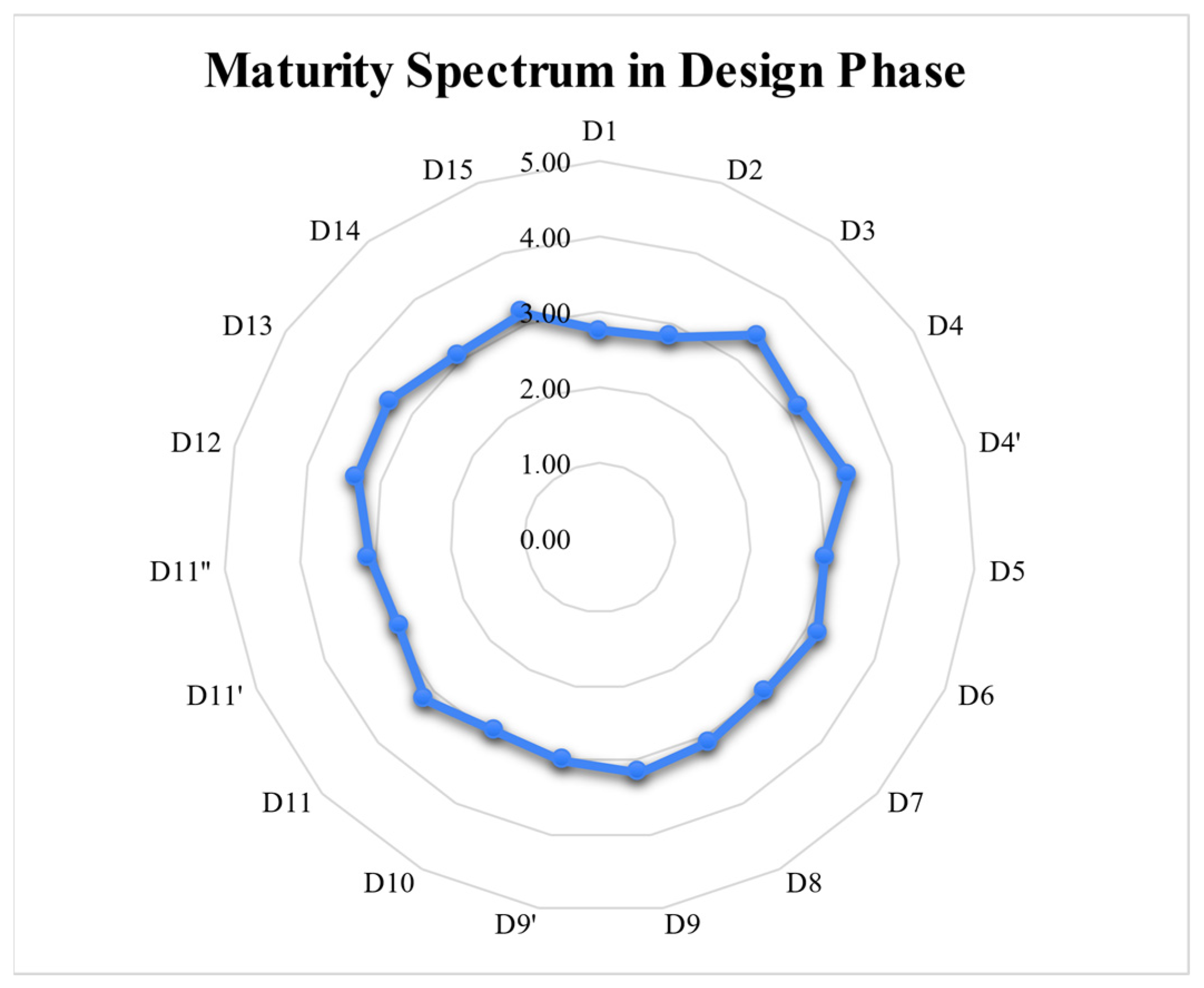
| D1 | Knowledge, Experience, and Skills of Planners | 2.75 |
| D2 | Attitudes and Mindsets of Planners | 2.83 |
| D3 | Regulations | 3.42 |
| D4 | Guidelines and Codes of Practice | 3.17 |
| D4’ | Regulatory Requirements for Professional Engineer Accountability | 3.42 |
| D5 | Tools and Technology | 3.00 |
| D6 | Knowledge Transfer and Training | 3.17 |
| D7 | Risk Management | 3.00 |
| D8 | Integration of Quality and Safety | 3.08 |
| D9 | Environmental Management Planning | 3.17 |
| D9’ | Evaluation Methods and Audit Implementation | 3.00 |
| D10 | Contractual and Liability | 2.92 |
| D11 | Financial Considerations | 3.17 |
| D11’ | Time Considerations | 2.92 |
| D11’’ | Competency of Construction Safety Personnel | 3.08 |
| D12 | Client Commitment | 3.33 |
| D13 | Client Leadership | 3.33 |
| D14 | Collaboration | 3.08 |
| D15 | Communication | 3.17 |
| Sub-Category | Measured Value | |
|---|---|---|
| K1 | Occupational Safety Standards | 3.42 |
| K2 | Monitoring and Inspection Standards | 3.42 |
| K3 | Contract and Financial Review | 3.33 |
| K4 | Accountability | 3.08 |
| K5 | Leadership and Commitment | 3.50 |
| K5’ | Reward and Punishment Mechanisms | 3.17 |
| K6 | Safety Planning | 3.42 |
| K7 | Safety Reporting | 3.75 |
| K8 | Data Utilization | 3.33 |
| K9 | Safety Audits | 3.83 |
| K10 | Accident Investigation | 3.58 |
| K11 | Document Control | 3.58 |
| K12 | Equipment Control | 3.50 |
| K13 | Material Management | 3.33 |
| K14 | Workplace Conditions | 3.17 |
| K14’ | Hazardous and Non-Hazardous Waste Management | 3.00 |
| K15 | Safety Digitalization | 2.92 |
| K16 | Training | 3.08 |
| Sub-Category | Improvement Needs | Actions | Outcome Indicators | Responsible Party |
|---|---|---|---|---|
| Knowledge, Experience, and Skills of Planners (D1) |
|
|
| Government, employers, and professional certification bodies |
| Attitudes and Mindsets of Planners (D2) |
|
|
| Government, employers, and professional associations |
| Contractual and Liability (D10) |
|
|
| Government, employers, legal, and professional associations |
| Time Considerations (D11’) |
|
|
| Employers/ owners, design consultants, and professional associations |
| Safety Digitalization (K15) |
|
|
| Government, safety committee, employers, contractors and educational institutions |
Disclaimer/Publisher’s Note: The statements, opinions and data contained in all publications are solely those of the individual author(s) and contributor(s) and not of MDPI and/or the editor(s). MDPI and/or the editor(s) disclaim responsibility for any injury to people or property resulting from any ideas, methods, instructions or products referred to in the content. |
© 2025 by the authors. Licensee MDPI, Basel, Switzerland. This article is an open access article distributed under the terms and conditions of the Creative Commons Attribution (CC BY) license.
Share and Cite
Machfudiyanto, R.A.; Suraji, A.; Handayani, T.N.; Tuasikal, M.Y.A.; Machfudiyanto, M.A.R. Measuring Safety Culture Maturity in Indonesian Construction Projects Across Design and Construction Phases. Buildings 2026, 16, 124. https://doi.org/10.3390/buildings16010124
Machfudiyanto RA, Suraji A, Handayani TN, Tuasikal MYA, Machfudiyanto MAR. Measuring Safety Culture Maturity in Indonesian Construction Projects Across Design and Construction Phases. Buildings. 2026; 16(1):124. https://doi.org/10.3390/buildings16010124
Chicago/Turabian StyleMachfudiyanto, Rossy Armyn, Akhmad Suraji, Tantri Nastiti Handayani, Muhammad Yahya Alfandi Tuasikal, and Muhammad Allan Romeo Machfudiyanto. 2026. "Measuring Safety Culture Maturity in Indonesian Construction Projects Across Design and Construction Phases" Buildings 16, no. 1: 124. https://doi.org/10.3390/buildings16010124
APA StyleMachfudiyanto, R. A., Suraji, A., Handayani, T. N., Tuasikal, M. Y. A., & Machfudiyanto, M. A. R. (2026). Measuring Safety Culture Maturity in Indonesian Construction Projects Across Design and Construction Phases. Buildings, 16(1), 124. https://doi.org/10.3390/buildings16010124