Article

Parameter Sensitivity Analysis and Optimization Design of Shield Lateral Shifting Launching Technology Based on Orthogonal Analysis Method


1
School of Civil Engineering, Xi’an University of Architecture and Technology, Xi’an 710055, China
2
Guangzhou Metro Design & Research Institute Co., Ltd., Guangzhou 510010, China
3
China Railway Seventh Bureau Group Co., Ltd., Zhengzhou 450016, China
*
Authors to whom correspondence should be addressed.
Buildings 2026, 16(1), 105; https://doi.org/10.3390/buildings16010105
Submission received: 18 September 2025 / Revised: 17 December 2025 / Accepted: 23 December 2025 / Published: 25 December 2025

Abstract

As an emerging construction method, the lateral launching technique for shield tunneling can ensure launching safety while significantly reducing disturbances to urban traffic. However, the influence of its design parameters on construction stability and economic performance has not yet been systematically investigated, thereby limiting its broader application in complex urban environments. To address this gap, this study proposes a comprehensive analytical framework integrating field monitoring, numerical modeling, orthogonal experiments, and regression-based optimization. Relying on a shield lateral launching project in a central urban district of Guangzhou, a systematic investigation is conducted. Field monitoring data are used to verify the reliability of the three-dimensional finite element model, confirming that deformations of both the retaining structures and the surrounding ground remain within a stable and controllable range. On this basis, the orthogonal experimental method is, for the first time, introduced into the parameter sensitivity analysis of the shield lateral launching technique. The analysis reveals the influence ranking of support parameters on surface settlement. Key parameters are then selected for optimization design according to the sensitivity order, followed by a comprehensive evaluation of deformation control effectiveness and economic performance of the optimized scheme. The results show that the deformation of both the retaining structures and the ground during construction remains below the control limits, indicating good structural stability. Among the supporting parameters, the sensitivity coefficients from high to low are the diaphragm wall thickness HW, the grouting reinforcement range HG, the initial support thickness of the lateral-shifting tunnel H1, the initial support thickness of the advance launching tunnel H2, and the elastic modulus of the diaphragm wall EW. Based on the sensitivity ranking, the highly sensitive parameters are selected for optimization, and the optimal parameter combination is determined to be a diaphragm wall thickness of 1000 mm, a grouting reinforcement range of 1600 mm, and an initial support thickness of 100 mm for the lateral-shifting tunnel. This combination meets the safety requirements for surface settlement while effectively reducing material consumption and improving economic performance. The study provides technical and theoretical references for shield launching under complex conditions.

1. Introduction

The rapid development of urban rail transit systems has not only alleviated severe traffic congestion in major Chinese cities and improved national infrastructure networks [1,2,3,4] but has also stimulated technological advancements in large-scale tunneling projects constructed under diverse and complex geological conditions. In particular, metro tunnel construction technologies—represented by shield tunneling—have witnessed significant progress. Owing to its high construction safety, strong adaptability to various ground conditions, and minimal environmental disturbance, shield tunneling has been widely applied in underground construction projects [5,6]. Generally, the shield tunneling process comprises three main stages: launching, tunneling, and arriving/receiving [7]. Substantial research efforts have been devoted to issues arising during shield tunneling. On the one hand, scholars have investigated the mechanical and deformation responses of various special ground conditions during shield construction, including upper-soft–lower-hard strata [8,9,10], water-rich sandy–gravel layers [11,12,13,14], and collapsible loess formations [15,16]. On the other hand, from the perspective of controlling environmental disturbance induced by shield tunneling across potential risk sources, studies have examined the disturbance patterns during shield passage in different directions beneath existing pile foundations [17,18], important pipelines [19,20,21], and existing tunnels [22].
Although research on shield tunneling technologies has become highly comprehensive, it is undeniable that shield launching, as the initial and fundamental stage of the tunneling process, plays a crucial role in ensuring construction success. Improper control during launching may lead to ground collapse, shield attitude deviation, face instability, and damage to adjacent structures—issues that directly affect the smooth execution of the project. Currently, the mainstream shield launching techniques include segmented launching and integral launching [23,24], both of which typically rely on dedicated shafts constructed at station ends or along the alignment to facilitate shield departure. However, these traditional methods require large construction footprints and long durations, often resulting in significant traffic disruption—an issue particularly pronounced in densely developed urban centers.
In response to the above challenges, the lateral shield launching technique has gradually attracted increasing attention from tunnel engineers. This method involves excavating a temporary shaft on the side of an existing roadway, constructing a horizontal passage beneath the road through the shaft, and then transporting the shield machine into the underground space via this passage to initiate tunneling. The key advantage of the lateral launching technique lies in its ability to avoid occupying major urban roads, thereby eliminating the need for large-scale traffic diversion and significantly reducing the impact of construction on surface transportation. Compared with traditional launching methods that rely on a longitudinal support system at the headwall, the lateral launching approach redistributes loads laterally through the horizontal passage. This transformation not only reduces the direct disturbance to the surrounding soil at the excavation face but also lowers the risk of face collapse induced by headwall instability. Consequently, lateral launching demonstrates greater adaptability and controllability in risk mitigation [25].
Building on these developments, an increasing number of researchers have focused on the lateral shield launching technique. A review of domestic and international literature shows that some scholars have concentrated on the face stability and ground deformation responses during lateral launching. For example, Shusheng Lv [26] employed an equivalent refined modeling approach to analyze the deformation characteristics of the excavation face in the launching stage. Ming Huang [27] developed a multi-block failure model of the excavation face during shield launching using theoretical calculations and applied the proposed model to two engineering cases, demonstrating its feasibility.
Another group of scholars has investigated soil reinforcement techniques for the shield launching head during lateral launching. Among these methods, artificial ground freezing [28,29,30] and grouting [31,32] are the two most commonly used reinforcement approaches. The freezing method establishes vertical or horizontal freezing pipes around the launching head and uses artificial refrigeration to convert pore water or fissure water into ice, thereby cementing loose or fractured soil and rock into a high-strength, highly continuous frozen curtain [33,34]. The grouting method involves injecting fluid and cementitious grout into soil pores or rock fissures under pressure. Through permeation, fracturing, or compaction mechanisms, the grout diffuses and fills voids and subsequently gels and solidifies, binding loose soil particles into an integrated mass or directly filling rock fissures [32,35,36]. The freezing method is recognized for its nearly absolute reliability in water sealing and its high-strength, uniformly distributed reinforcement effect, making it a rigid and effective measure for extreme hydrogeological conditions. In contrast, the grouting method offers exceptional flexibility, economic efficiency, and rapid construction performance, giving it significant advantages in suitable ground conditions.
A further body of research has summarized the engineering applications of lateral shield launching. Xin Jiangwei [37] analyzed the causes of water and sand inrush disasters in shield launching shafts and proposed technical measures to mitigate such hazards during shield launching. Guowei Ma [38] proposed a lateral launching scheme for a curved twin cross-passage tunnel using a transverse diaphragm method. A series of field tests, theoretical analyses, and numerical simulations were performed to obtain the displacement characteristics of the ground and underground structures, followed by an economic comparison between the traditional and proposed schemes. Cai Zhiyong et al. [39] used BIM technology to simulate the shield machine’s lateral movement within a mined cross passage and selected feasible solutions from 150 alternatives, determining a reasonable path for the shield machine to turn and enter the mainline tunnel via the cross passage. Through optimized spatial layout and rational planning, the safety of shield relocation was ensured. Zhao Zeyu [40] innovatively adopted an irregular steel casing for lateral launching in constrained urban spaces and compensated for uneven cutting during launching through the installation of shaped extension steel rings and internal filler. Tong Hailong [41], based on the Changchun Metro Line 1 Project, summarized the application of lateral translation and launching technologies. Gao Han [42], drawing on a practical lateral launching project in a site-constrained section of the Guangzhou Metro, conducted a systematic study of construction schemes, procedures, and three key technologies: underground space structures for launching, shield machine translation and assembly, and zero-resistance ring launching.
Although research on the lateral shield launching technique has made notable progress, existing studies primarily focus on head reinforcement schemes and construction procedure summaries. However, sensitivity analysis of construction parameters and parameter optimization based on sensitivity patterns remain insufficient. The rational selection of construction parameters directly affects ground stability during launching, the safety of retaining structures, and construction efficiency, thereby limiting the wider application and promotion of this technique.
As a representative multi-factor sensitivity analysis method, the orthogonal analysis approach [43,44,45] has been widely used for parameter evaluation and optimization in underground engineering. For instance, Qi Wang [46] conducted an orthogonal experiment to evaluate the fault-crossing resistance of segmental linings and quantitatively assess tunnel damage. Bo Wu [47] applied orthogonal design and range analysis to rank eleven influencing factors of karst tunnel construction according to their sensitivity levels and determined the optimal combination of factors based on the sensitivity results. Zhao Baoyun [48] designed a three-factor, four-level model for the foundation reinforcement scheme of the Wuzhen Railway Bridge using the principles of orthogonal experiments. By integrating numerical simulation results with direct orthogonal analysis and variance analysis, the optimal reinforcement scheme was obtained. Ju Haiyan [49] used orthogonal testing to identify the influence patterns of five key factors—SMW pile insertion ratio, spacing of inserted steel sections, steel section type, cement-soil pile diameter, and prestress level of steel supports—on deformation of adjacent tunnels during deep excavation.
Based on a shield tunneling project of a metro line in Guangzhou, this study systematically describes the construction procedure of the shield lateral-shifting launching method, analyzes the deformation patterns of the retaining structures and surrounding ground through field monitoring, and verifies the reliability of the finite element model. On this basis, an orthogonal experimental design is introduced to rank the sensitivity of key parameters that influence construction stability, thereby clarifying the degree to which each parameter affects surface settlement. Subsequently, optimization is carried out for the highly sensitive parameters, and a rational parameter combination that balances deformation control and economic performance is proposed. This research aims to systematically address the unclear parameter sensitivity and insufficient design basis in shield lateral-shifting launching and to provide theoretical support and technical reference for the application and promotion of this technique in complex urban environments.

2. Project Overview

2.1. Project Location

The shield lateral shifting launching construction site lies west of Chepi Road, beneath Zhongshan Avenue, and within the adjacent southern land parcel, in a complex, densely populated setting with a dense concentration of underground utilities. To the south lies a single-story steel-structure shopping center, to the north are Zhongshan Avenue as an urban arterial and residential communities, to the west is a BRT station, and the spatial relationship between the project site and its surroundings is shown in Figure 1.

2.2. Geological Conditions

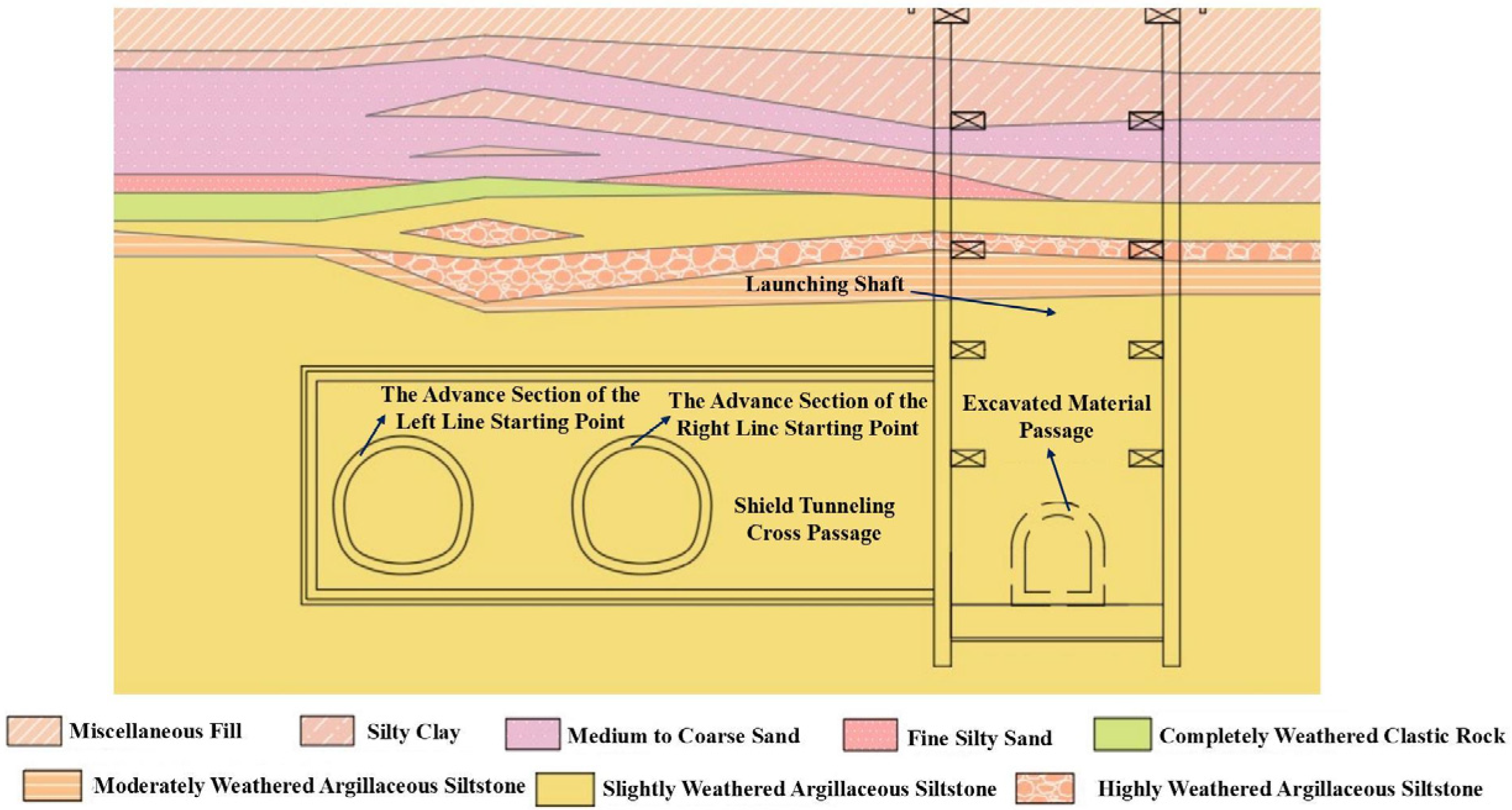
The shield launching structure is situated on the alluvial plain of the Pearl River Delta, where the terrain is flat and the ground elevation is approximately 9.7 m. Within the construction site area, the geological profile chiefly comprises the following strata: (1) Miscellaneous Fill; (2) Silty Clay; (3) Medium to Coarse Sand; (4) Highly Weathered Argillaceous Siltstone; (5) Moderately Weathered Argillaceous Siltstone; (6) Slightly Weathered Argillaceous Siltstone. Figure 2 presents the geological profile of the shield launching structure.

2.3. Design Overview and Construction Sequence

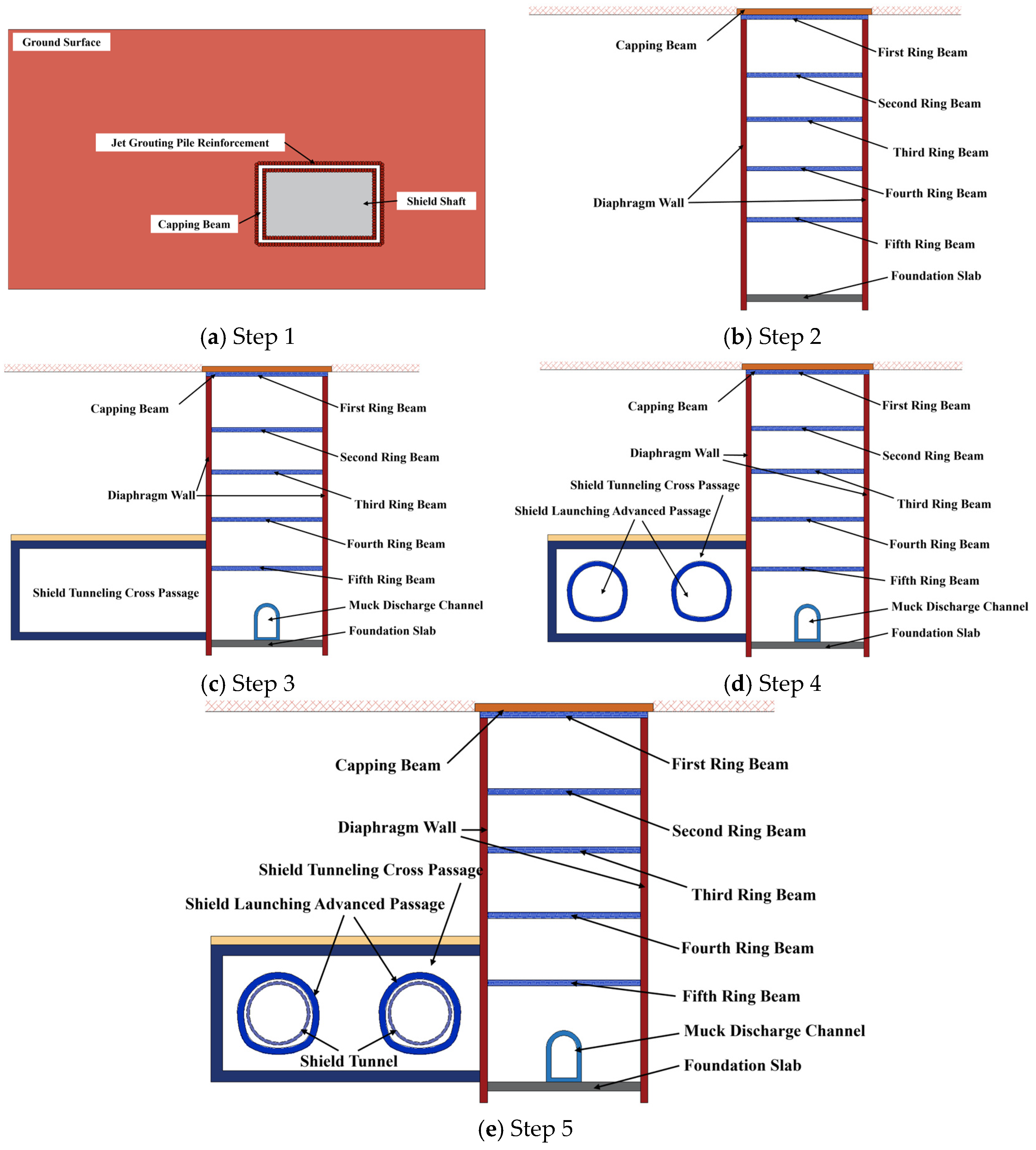
The overall configuration of the shield launching structure is shown in Figure 3, and its construction process is divided into six steps:
Step 1: To improve the stability of the trench walls in the sandy stratum, composite reinforcement with high-pressure jet grouting piles is adopted. The pile diameter is designed at 300 mm with an inter-pile overlap of 200 mm, forming a continuous impervious curtain.
Step 2: The launching shaft for shield assembly and lateral-shift launching is constructed using an open-cut sequential method. It provides a clear internal plan of 16.5 × 12.5 m and an excavation depth of 38 m. Given the complex surroundings, to strictly control excavation deformation, a 1200 mm thick diaphragm wall is adopted as the retaining system, supplemented by five levels of 1500 × 2000 mm reinforced concrete ring frame beam supports.
Step 3: Upon completion of the shaft construction, the lateral transfer passage is constructed. The passage is 37.5 m long with a rectangular cross-section 12.5 m wide and 4.5 m high, excavated in stages using the CRD method to control ground surface settlement. Initial support consists of 300 mm thick C25 shotcrete sealing the face and perimeter. The secondary lining is a 600 mm thick reinforced concrete structure.
Step 4: To secure adequate space for integral shield launching, the advanced starting sections of the left and right lines are mined 65 m and 54 m, respectively, by underground excavation using a bench staged excavation method; the tunnel has a circular clear internal diameter of 6.9 m with 300 mm thick steel-fiber-reinforced shotcrete as the initial support and a 300 mm thick cast-in-place reinforced concrete secondary lining.
Step 5: After installing the launching base, the launching base, tail shield, middle shield, front shield and cutterhead assembly are sequentially hoisted and positioned, and a hydraulic synchronous jacking system translates the entire shield to the preset portal points of the left and right line advance sections; once precisely positioned, the whole shield is jacked to the end of the launching section, a no-load trial run is performed, and shield tunnelling begins upon confirmation that system parameters comply with requirements.
For subsequent analysis of monitoring results, the shield lateral translation launching process is simplified into four stages: Steps 1 and 2 form Stage 1 (launch shaft construction); Step 3 forms Stage 2 (underground excavation of the lateral transfer passage and mucking passage); Step 4 forms Stage 3 (underground excavation of the advance section for launching); and Step 5 forms Stage 4 (shield launching).

2.4. Overview of Research Methods

To systematically analyze the influence of support parameters on ground deformation during the lateral launching of a shield tunnel and to achieve parameter optimization, this study adopts an integrated research framework of “field monitoring → numerical modeling → orthogonal experiment → regression-based optimization.” Based on an actual project of the Guangzhou Metro, this approach verifies the credibility of the numerical model using monitoring data, identifies key parameters efficiently through orthogonal testing, and finally performs optimization using regression models, ensuring a clear research structure and reliable conclusions. The methods used at each stage are summarized as follows:
(1)
Field monitoring and data analysis
Monitoring points were arranged in accordance with the Technical Code for Monitoring of Urban Rail Transit Engineering (GB 50911–2013) [50]. Systematic monitoring was conducted for surface settlement, diaphragm wall displacement, and crown settlement throughout the construction process. The monitoring data were used not only to evaluate structural stability during construction but also to provide real evidence for validating the numerical model.
(2)
Numerical model development and orthogonal experiment analysis
A three-dimensional finite element model for the lateral launching process was constructed based on the geological conditions and structural design. The soil was modeled using the modified Mohr–Coulomb constitutive model, and structural elements were assigned material properties consistent with the actual project. The reliability of the model was verified through comparison with field monitoring data. On this basis, five key parameters—diaphragm wall thickness, diaphragm wall elastic modulus, grouting reinforcement range, initial support thickness of the lateral launching channel, and initial support thickness of the advanced launching channel—were selected to design an orthogonal test with five factors and five levels. Limited simulation runs were conducted to obtain surface settlement responses under different parameter combinations. Range analysis and ANOVA were applied to quantitatively evaluate the sensitivity and significance of each parameter.
(3)
Regression analysis and parameter optimization
For the highly sensitive parameters identified from the orthogonal experiment, regression models were developed to describe the relationship between surface settlement and each parameter. The best-fitting model was selected to quantify these relationships. Under the requirement of meeting the settlement control standard, material-saving objectives and relevant design specifications were used to determine the feasible range of each parameter. Multiple candidate optimized schemes were then generated and evaluated through numerical simulations in terms of deformation control and economic performance. The final optimal parameter combination was selected based on a balance between safety and cost-effectiveness.

3. Field Monitoring

3.1. Monitoring Point Layout

According to the design requirements and with reference to the code Technical Code for Monitoring of Urban Rail Transit Engineering [50] (GB50911-2013), the control criteria for ground surface settlement, tunnel crown displacement, and launch shaft diaphragm wall lateral displacement are shown in Table 1; the cumulative ground surface settlement limit is 30 mm, the cumulative lateral deformation of the diaphragm wall is limited to 30 mm, and the tunnel crown settlement limit is 30 mm.
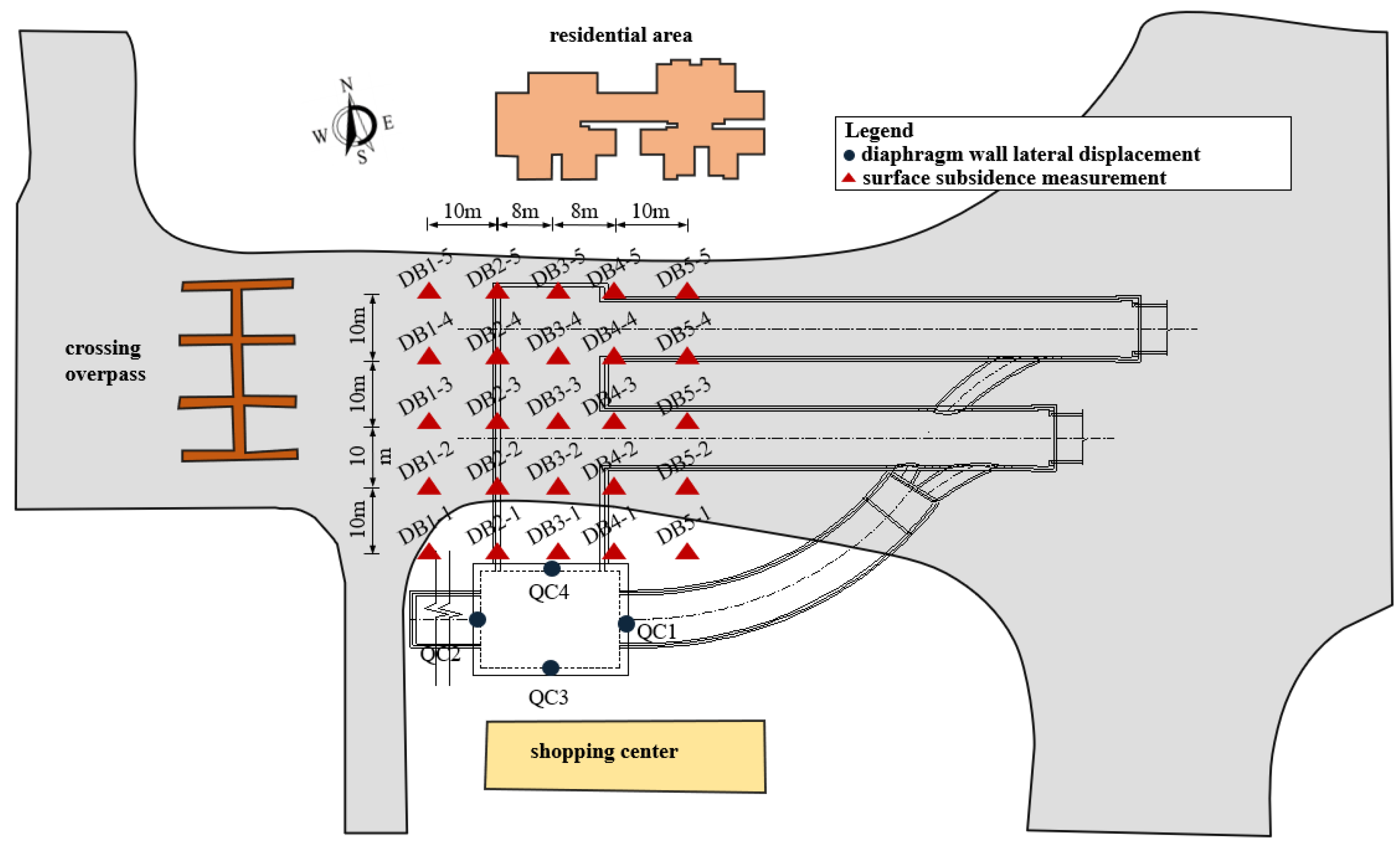
Considering the construction influence zone, the arrangement of ground surface settlement monitoring points and diaphragm wall lateral displacement monitoring points is shown in Figure 4, where the ground surface settlement points are designated DB1–DB5 forming 5 monitoring sections each with 5 points, and the diaphragm wall lateral displacement points are designated QC1–QC4, each positioned at the mid-span of a respective side of the diaphragm wall with their precise locations and spacing shown in Figure 4.
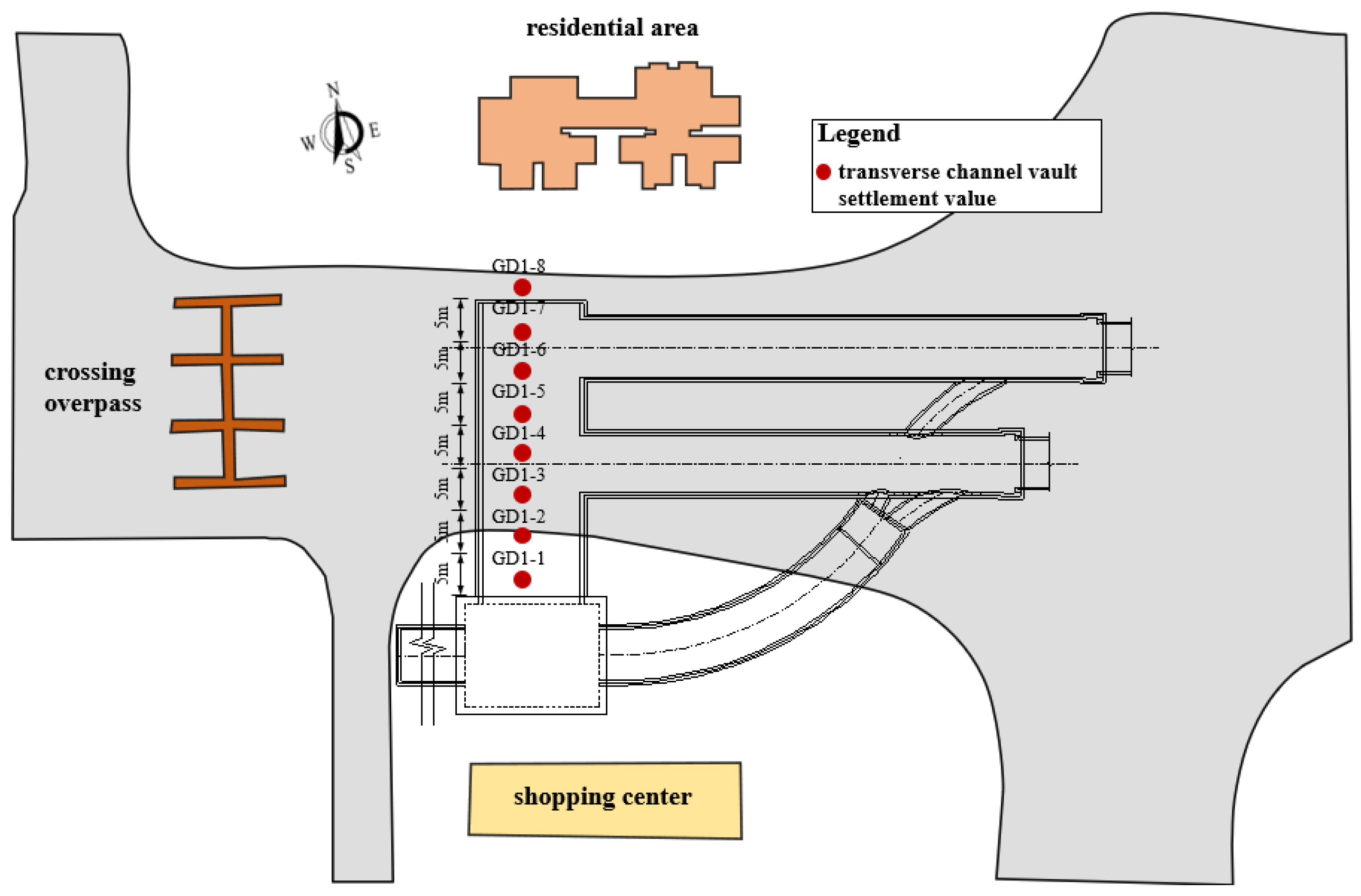
Given that during the shield lateral translation launching process the lateral transfer passage exhibits greater settlement than other structures [42], the crown settlement monitoring in this study is therefore focused on the shield lateral transfer passage structure, with the crown settlement monitoring points arranged along the top of the lateral transfer passage and their locations and spacing shown in Figure 5.

3.2. Analysis of Monitoring Results

3.2.1. Analysis of Measured Ground Surface Settlement

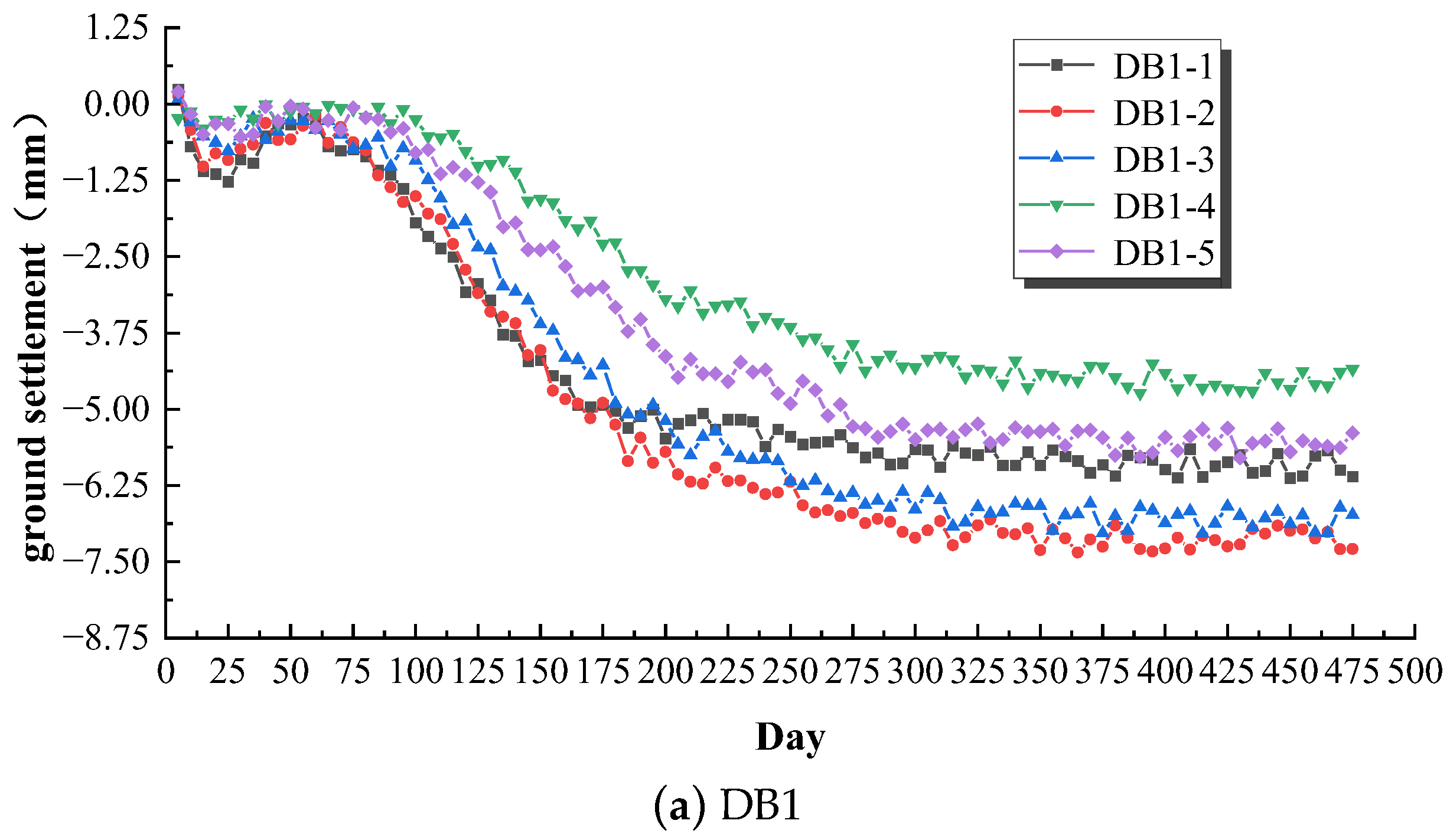
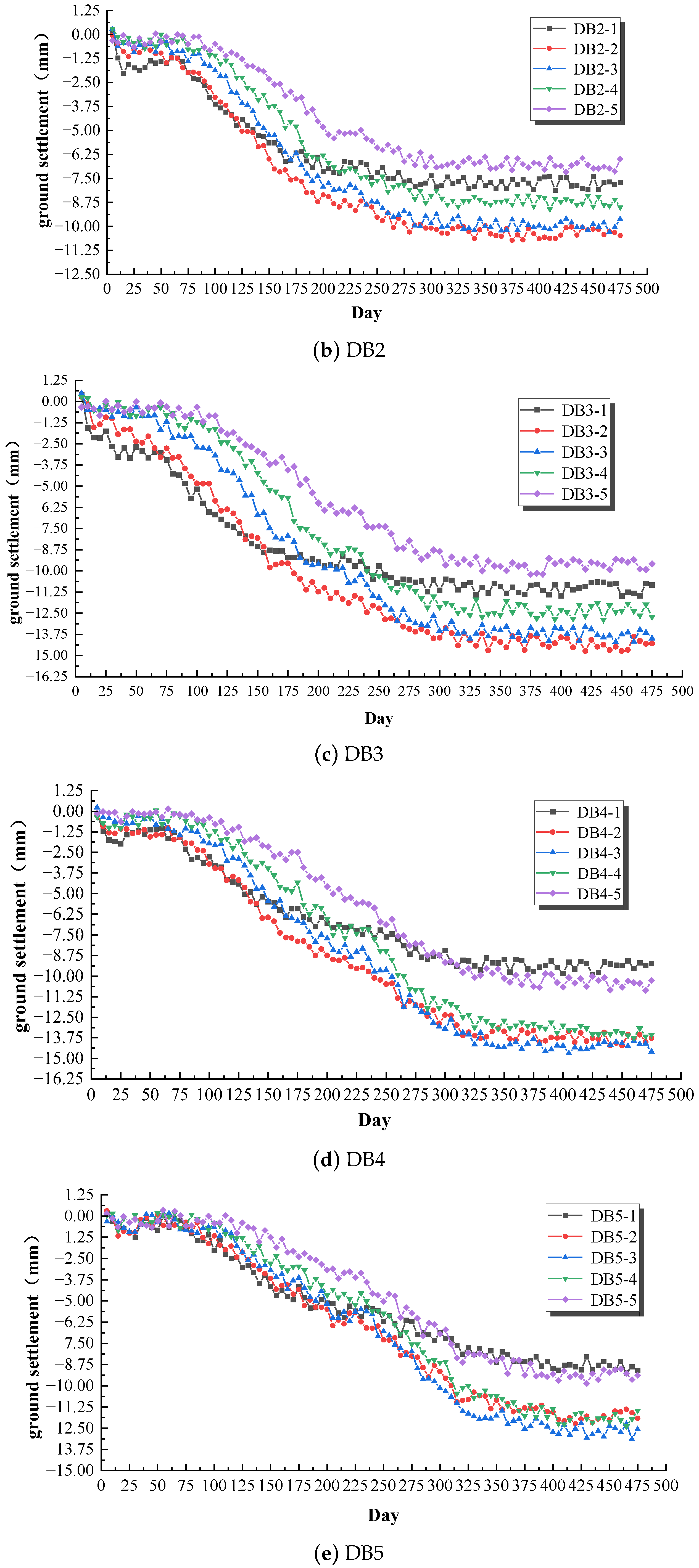
On-site monitoring of ground surface settlement was conducted, and the construction period ground surface settlement time-history curve is plotted in Figure 6. As shown in Figure 6, ground surface settlement kept increasing with construction progress and only began to level off as the works were nearing completion. During the launch shaft construction stage, settlement rose gradually to 1.25–3.75 mm with a relatively mild rate of increase. Upon entering the second stage, construction of the lateral transfer passage and the muck removal passage, the settlement rate exhibited pronounced fluctuations, with the maximum incremental settlement reaching 7.51 mm. In the third stage, during construction of the advance (fore) section of the launch passage, the rate of increase in ground surface settlement further diminished, the maximum additional settlement being only 4.17 mm. Finally, in the fourth (shield launching) stage, the settlement value remained essentially stable with the maximum settlement reaching 15.08 mm.

3.2.2. Diaphragm Wall Deformation Analysis

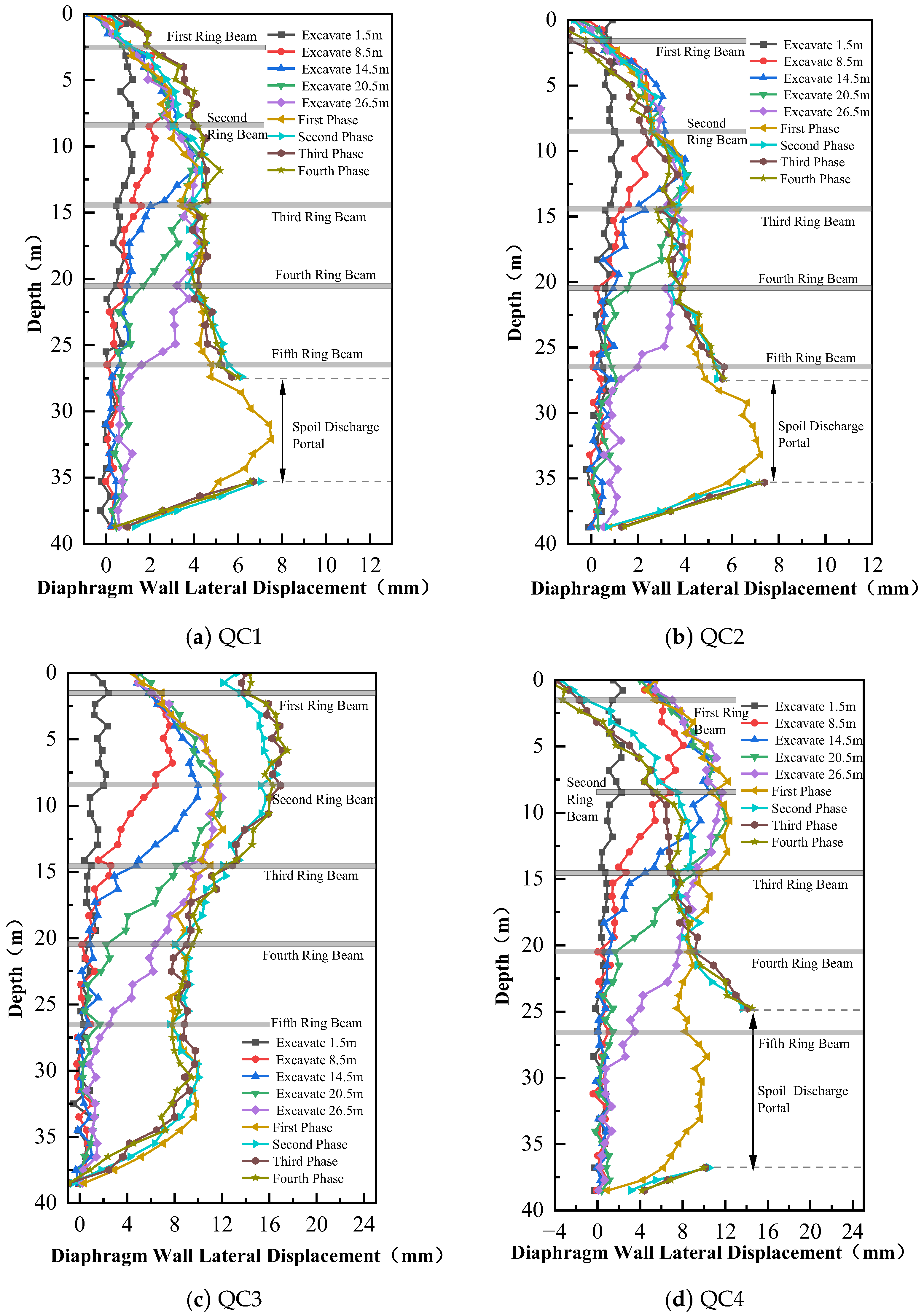
Figure 7 illustrates the evolution of diaphragm wall lateral displacement of the foundation pit as construction progresses. Based on the curves for monitoring points QC1 and QC2, the diaphragm wall lateral displacement exhibits a typical trough-shaped distribution at this location. As the shaft excavation advanced, lateral displacement kept increasing while the point of maximum displacement migrated progressively deeper before stabilizing beneath the fifth-level ring frame beam, with the maximum displacement reaching 7.51 mm. It is noted that during the first stage, the central monitoring point failed because of portal demolition operations, resulting in missing data for that stage. Upon entering the second stage, the maximum lateral displacement position shifted to the upper and lower edges of the opening, and the lateral displacement at QC1 and QC2 increased by 1.21 mm and 2.54 mm, respectively. During the third stage of construction, the maximum displacement at these two monitoring points increased only slightly, with the increment being less than 1 mm.
Analysis of the curves for monitoring points QC3 and QC4 shows that at QC3 the lateral displacement profile is double-trough shaped, with the maximum displacement occurring near the wall crest, whereas at QC4 the maximum displacement is located in the upper part of the opening. This disparity is chiefly attributable to the non-uniform surrounding earth pressure distribution induced by the combination of open-cut shaft excavation and mined lateral transfer passage excavation, whereby construction disturbance markedly altered the soil support conditions and produced more pronounced diaphragm wall lateral displacement at this location, particularly the conspicuous movement in the upper part of the opening. It should also be noted that during construction, the portal demolition for the lateral transfer passage damaged the opening segment of the fifth ring frame beam and thereby weakened its supporting capacity. This manifested in the QC4 data as a sharp surge of lateral displacement in the upper opening region, seriously undermining the stability of the foundation pit retaining system and markedly elevating the risk of structural deformation.

3.2.3. Tunnel Crown Settlement

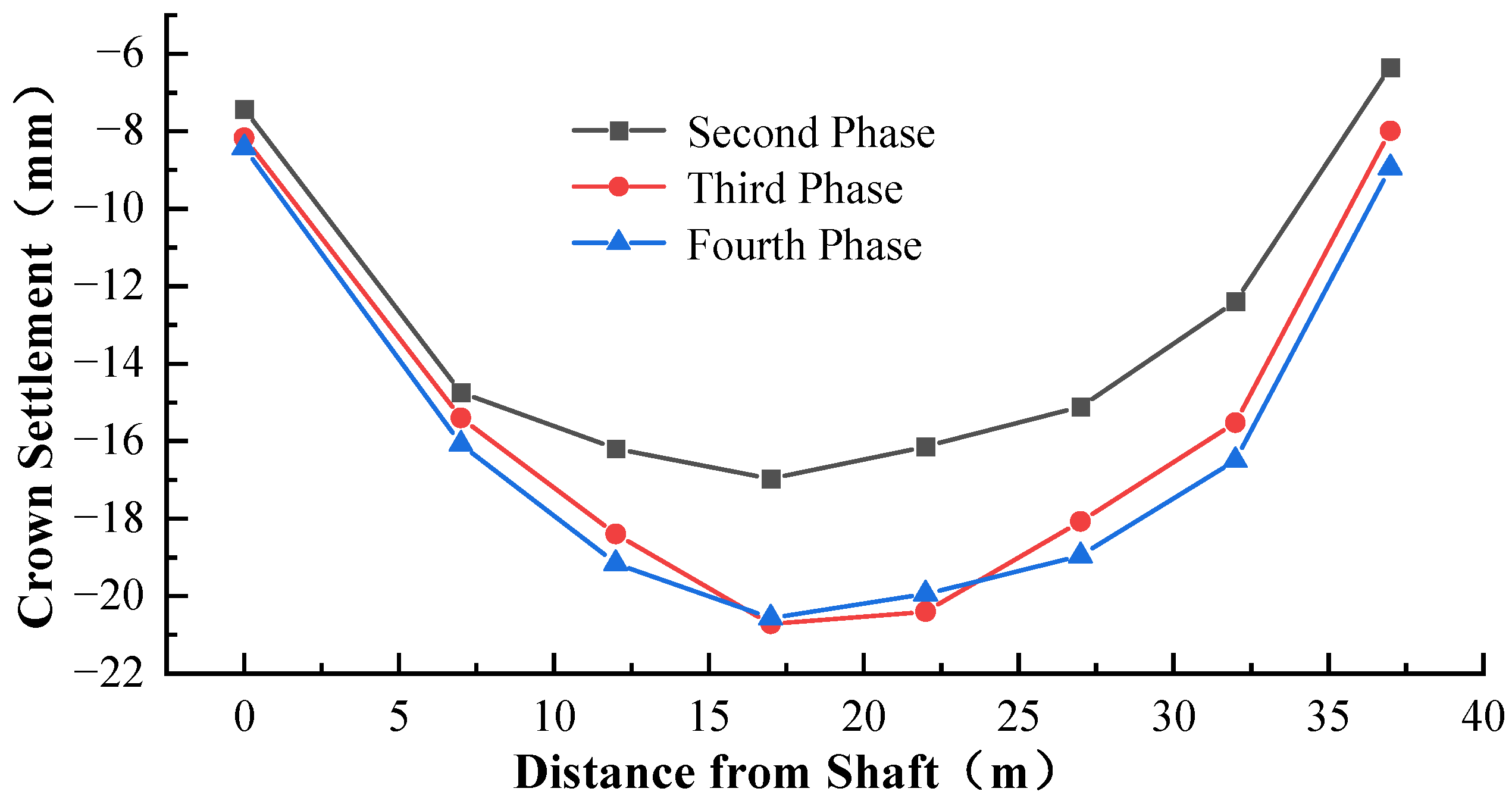
Figure 8 depicts the crown settlement deformation patterns for the second, third, and fourth stages. As shown in Figure 8, upon completion of the lateral transfer passage excavation in the second stage, the crown settlement of its initial support assumed a typical parabolic profile with the maximum settlement occurring at section GD1-4 and the longitudinal mid-span of the passage, reaching 16.97 mm. After the launching advance section was completed in the third stage, the settlement profile of the lateral transfer passage’s initial support changed markedly. The launching advance section construction increased crown settlement at the passage’s mid-span by 3.59 mm, whereas the changes at both ends were comparatively minor. This resulted from repeated stratum disturbance by the launching advance section works together with pressure transmitted from the crown of its initial support, producing a pronounced increase in initial support settlement at the mid-span, near the intersection of the two tunnels. In the fourth stage, the shield launching exerted a relatively minor influence on the lateral transfer passage, and crown settlement changes were insignificant. Field monitoring indicated that during the lateral transfer shield launching, the cumulative ground surface settlement, diaphragm wall lateral displacement, and crown settlement all remained below their specified limits, demonstrating that the tunnel structures stayed in a stable condition throughout construction.

4. Numerical Model Development and Verification

4.1. Numerical Simulation

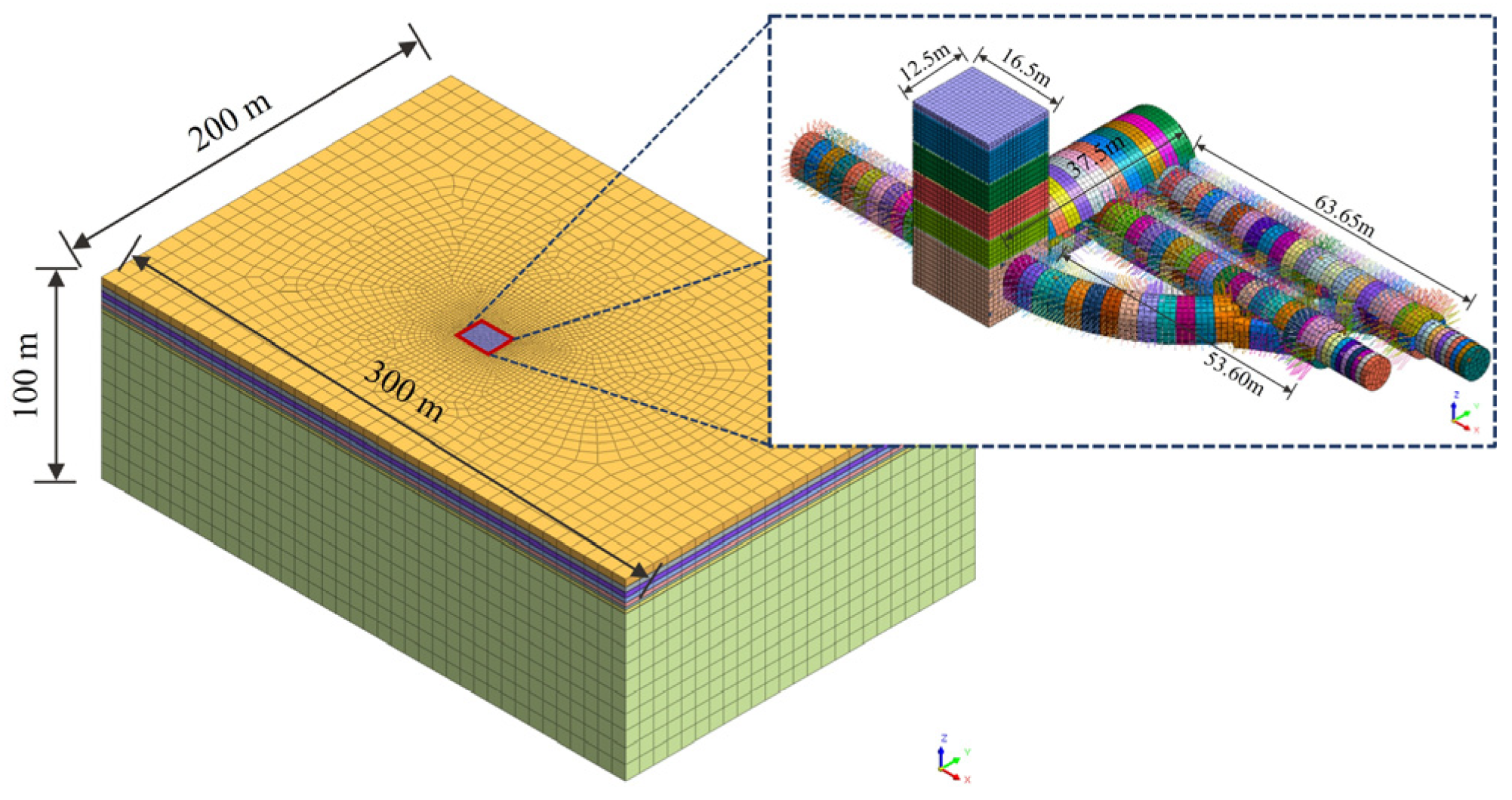
This paper establishes a three-dimensional numerical model using a finite element analysis approach to investigate the response patterns of the ground and tunnel structures during the lateral transfer shield launching process. Considering the influence of boundary effects in the numerical model, the model dimensions are 300 (length) × 200 (width) × 100 (depth), and Figure 9 presents the overall model for the lateral transfer shield launching together with the dimensions of each structure. The model constraints are a free top surface, a consolidated bottom surface, and lateral boundaries constrained in the normal direction.

4.2. Material Parameters and Constitutive Models

In view of the problem that the Mohr–Coulomb (M-C) model, in simulating tunnel soil excavation, simply takes the rebound modulus and compression modulus as equal to the elastic modulus [51], thus causing inaccuracy in the simulation results, the soil layers in this model adopt the Modified Mohr–Coulomb model (Modified M-C), this constitutive model, by using similar yield surfaces, an elliptical cap constitutive form, and a rounded-corner treatment in the deviatoric plane, optimizes the shortcomings of the original model and improves the fit between the numerical simulation and the actual situation. According to the results of the on-site geological investigation and laboratory soil tests, the specific parameters are shown in Table 2.
The selection of material parameters and constitutive models for the tunnel structures is shown in Table 3, and it should be noted that given the relatively large excavation cross-sectional area of the pilot tunnel of the lateral transfer passage which renders it weak in self-stability and highly susceptible to disturbance, small-diameter pipe foregrouting was employed to reinforce the surrounding ground prior to excavation, but since the foregrouting operation itself is not the focus of this study, the step is represented by increasing the internal friction angle and cohesion of the soil within the grouted reinforcement zone by 30% over their original values [52].

4.3. Verification of Numerical Simulation

4.3.1. Ground Settlement

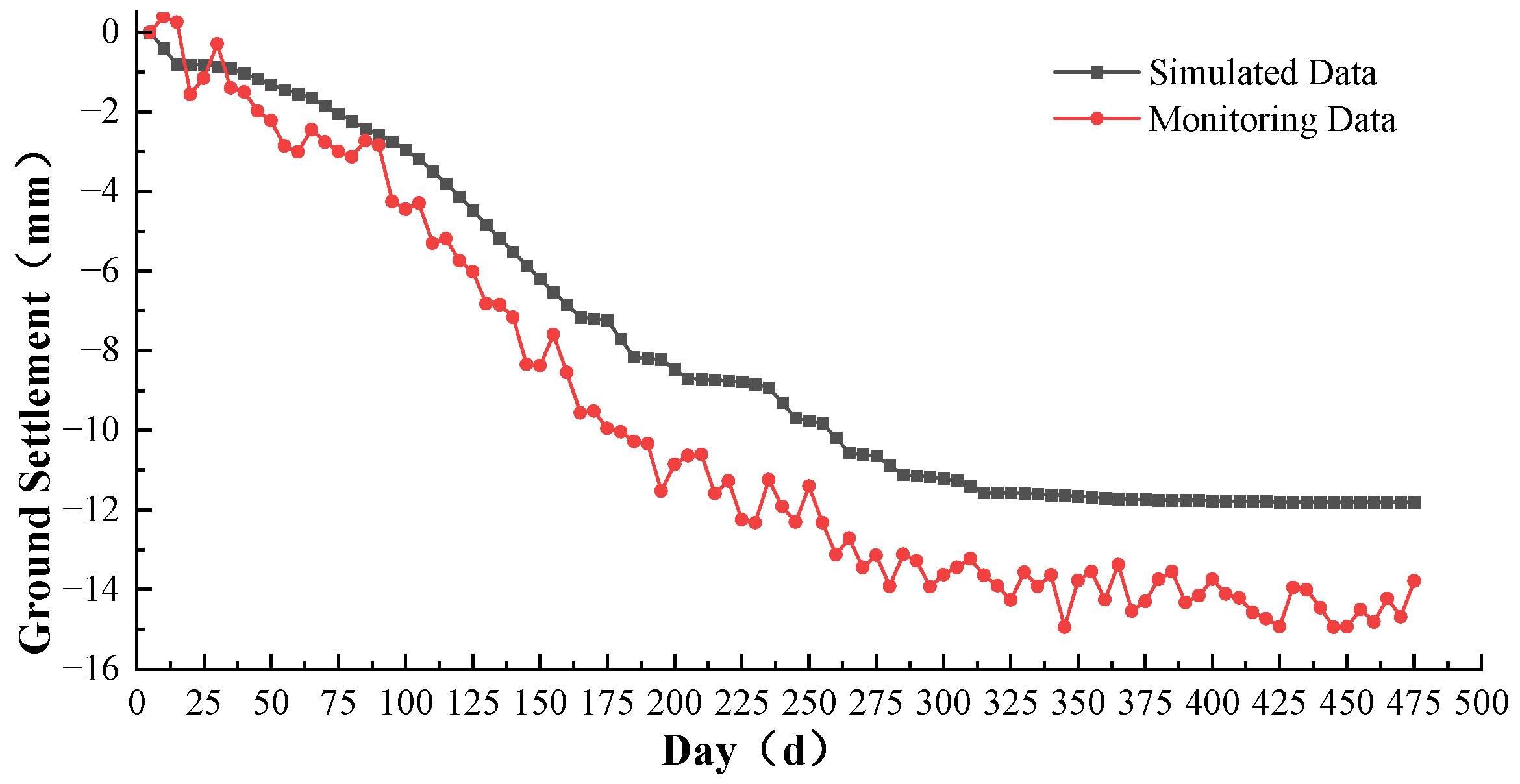
Based on the comparison of the time history curves in Figure 10, it can be observed that the overall variation trend of surface settlement during the entire construction process is consistent. The second construction stage contributes the largest proportion of the total settlement, followed by the first stage, which is consistent with the previous analysis. In addition, the figure shows that the maximum surface settlement obtained from numerical simulation is slightly smaller than that measured on site. This discrepancy is mainly attributed to two factors. First, all monitoring points are located on major urban traffic roads and are therefore affected by multiple external factors, including traffic loads and blasting-induced excavation in the underlying rock layers. Second, the influence of groundwater was not considered in the numerical simulation. In actual construction, dewatering operations have a dual effect on surface settlement: on the one hand, they may cause partial loss of soil and water, resulting in localized settlement; on the other hand, dewatering accelerates the consolidation of the soil. As a result, the maximum settlement obtained from numerical simulation tends to be slightly smaller than the field-monitored value. However, the comparison between the simulation results and monitoring data indicates that, despite the exclusion of groundwater effects, the two exhibit good consistency in deformation patterns, and the maximum settlement deviation remains within a controllable range. This suggests that although groundwater is theoretically one of the influencing factors, under the specific conditions of this project, its impact on the overall settlement trend and the conclusions of the parameter sensitivity analysis is not significant [53,54].

4.3.2. Diaphragm Wall Settlement

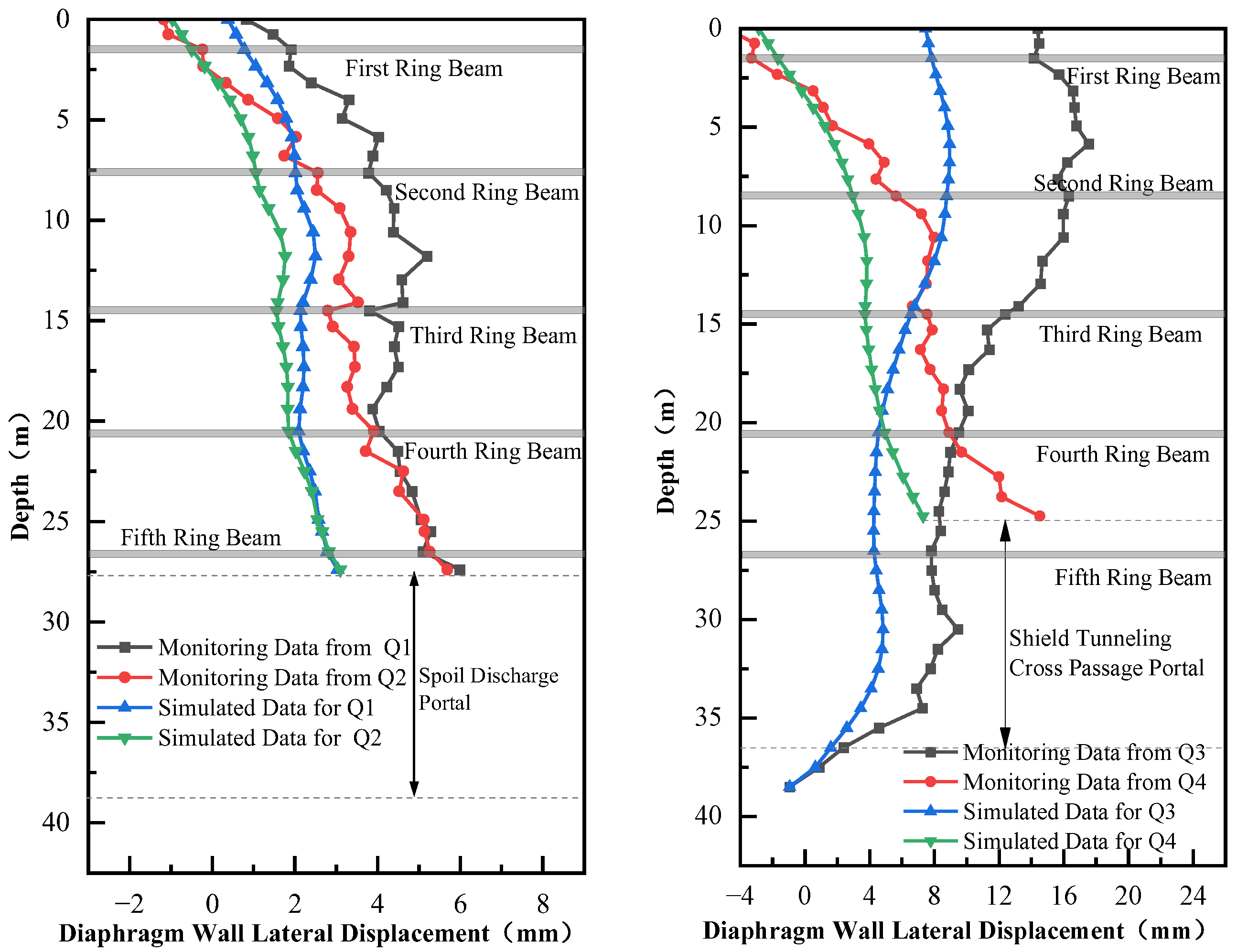
Figure 11 presents the comparison between monitored and simulated lateral displacements of the diaphragm wall, with points Q1 and Q2 positioned at the mid-span of the shaft wall’s short side and points Q3 and Q4 at the mid-span of the long side. Although the monitored values are slightly larger than the simulated ones, the deformation profiles of the two curves are essentially consistent. The discrepancy mainly stems from simplifications of the stratigraphy and parameter assignments that do not fully replicate in situ conditions, together with the inherent limitations of numerical simulation. For instance, the simulation did not incorporate several real construction influences, including groundwater, adjacent structures, pedestrian loads, and vehicular traffic. Moreover, potential occurrences of over-excavation, under-excavation, or construction stoppages in the field cannot be fully anticipated in the model, further contributing to the slightly greater monitored lateral displacement relative to the simulated values.

4.3.3. Tunnel Crown Deformation

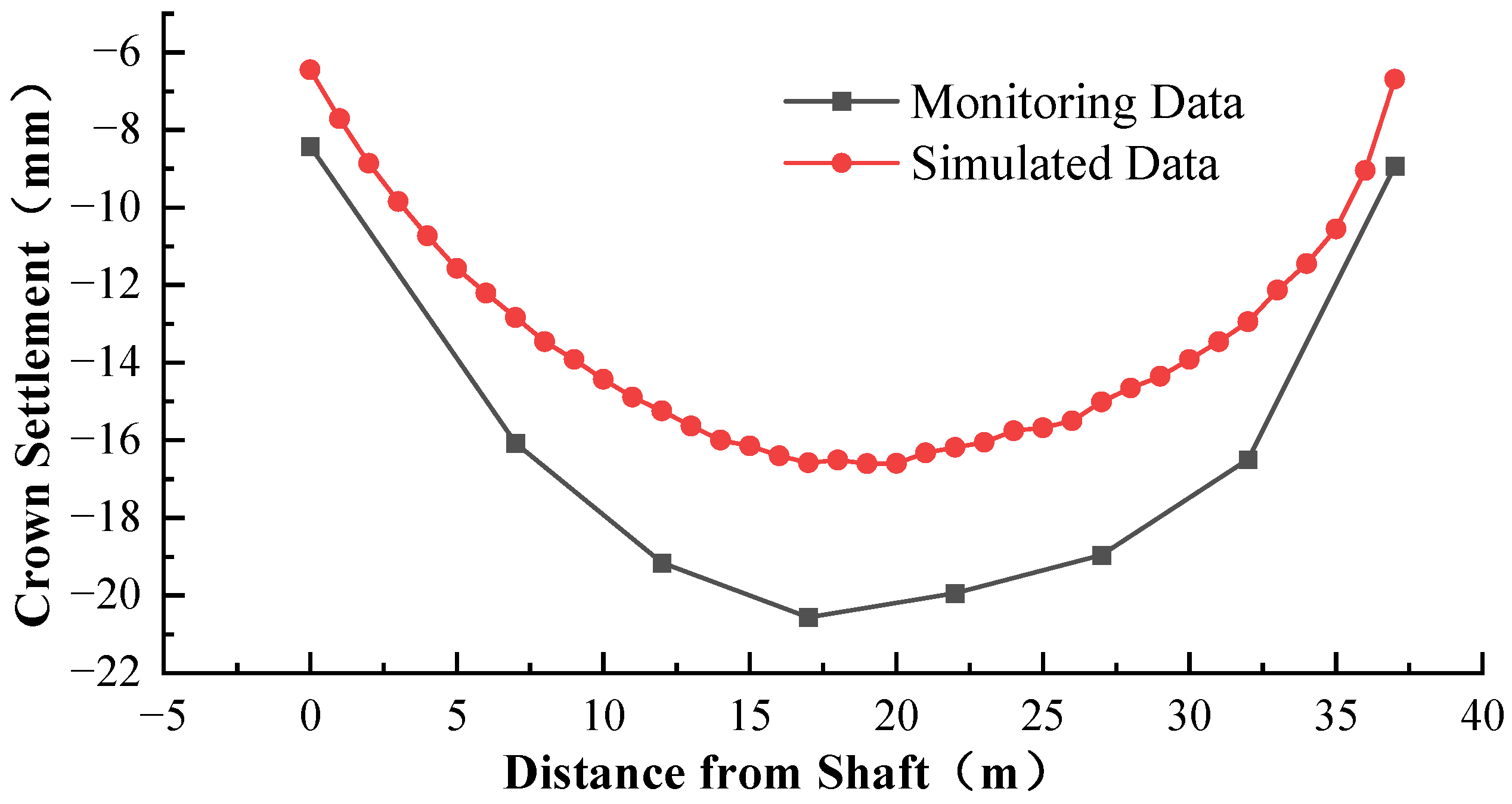
Figure 12 shows that the monitored crown settlement of the transverse passage is slightly larger than the simulated value, yet the deformation profiles of the two curves are consistent. The causes of this discrepancy are identical to the foregoing explanation and are therefore not reiterated here.

5. Parameter Sensitivity Analysis Based on Orthogonal Design Method

5.1. Influencing Factors and Level Design

Existing studies [55,56] indicate that the thickness and elastic modulus of the diaphragm wall, as well as the initial support, are important factors influencing ground deformation during tunnel excavation. Therefore, among the relevant parameters for the shield lateral-shifting launching construction, this study selects five parameters for sensitivity analysis: diaphragm wall thickness (HW), diaphragm wall elastic modulus (EW), grouting reinforcement range (HG), initial support thickness of the lateral-shifting passage (H1), and initial support thickness of the advance launching passage (H2). A five-factor, five-level orthogonal test is adopted, and the orthogonal array L25(55) is determined, as shown in Table 4. The thickness levels of the diaphragm wall are selected based on the common values of 600 mm, 800 mm, 1000 mm, and 1200 mm specified in the Technical Code for Retaining and Protection of Building Foundation Excavations (JGJ 120-2012), and extended to 480–1200 mm to cover a reasonable range from thin to thick walls. The grouting reinforcement range is determined with reference to similar engineering projects, where values typically fall within 400–2000 mm. The initial support thickness is determined according to the thickness limits of 50–300 mm for shotcrete support specified in the Technical Code for Ground Anchor and Shotcrete Support Engineering (GB 50086-2015), combined with practical constructability considerations. The elastic modulus levels are set based on the typical modulus values corresponding to C30–C50 concrete commonly used in engineering practice. These level settings not only cover the commonly used ranges in practical engineering but also take into account potential extreme conditions, ensuring the engineering representativeness and rationality of the orthogonal test results.
This study takes surface settlement as the response indicator and parameter sensitivity ranking as the primary objective. The main effects of the parameters generally dominate, whereas the influence of interactions on the final ranking results is relatively limited. Considering that the objective of this research is to identify key influencing parameters rather than to establish a highly accurate predictive model, the use of an orthogonal design that does not consider interactions is fully reasonable and appropriate for engineering applications. Therefore, interactions between factors are ignored in the orthogonal test design of this study.

5.2. Test Calculation Results and Analysis

5.2.1. Summary of Orthogonal Test Results

In the sensitivity analysis of how variations in each support parameter level affect the maximum ground surface settlement, each scenario configured in Table 4 was numerically simulated sequentially, and the results were consolidated, as presented in Table 5.

5.2.2. Analysis of Test Results and Parameter Sensitivity Evaluation

(1)
Range analysis
A range analysis was performed on the maximum ground surface settlement results for each support-parameter level in the orthogonal test, as presented in Table 6.
Table 5 shows that regarding the effects of excavation and support parameters on ground surface settlement, the optimal factor levels are diaphragm wall thickness of 1200 mm, diaphragm wall elastic modulus of 40,950 MPa, grouting reinforcement extent of 2000 mm, transverse passage primary support thickness of 300 mm, and advanced launching passage primary support thickness of 290 mm, under which the maximum surface settlement attains its minimum and the disturbance induced in the ground by the shield lateral transverse relocation launching operation is weakest; moreover, range analysis of the evaluation metric across factor levels indicates that among the selected parameters, the diaphragm wall thickness exerts the greatest influence on surface settlement, whereas the advanced launching passage primary support thickness exerts the least.
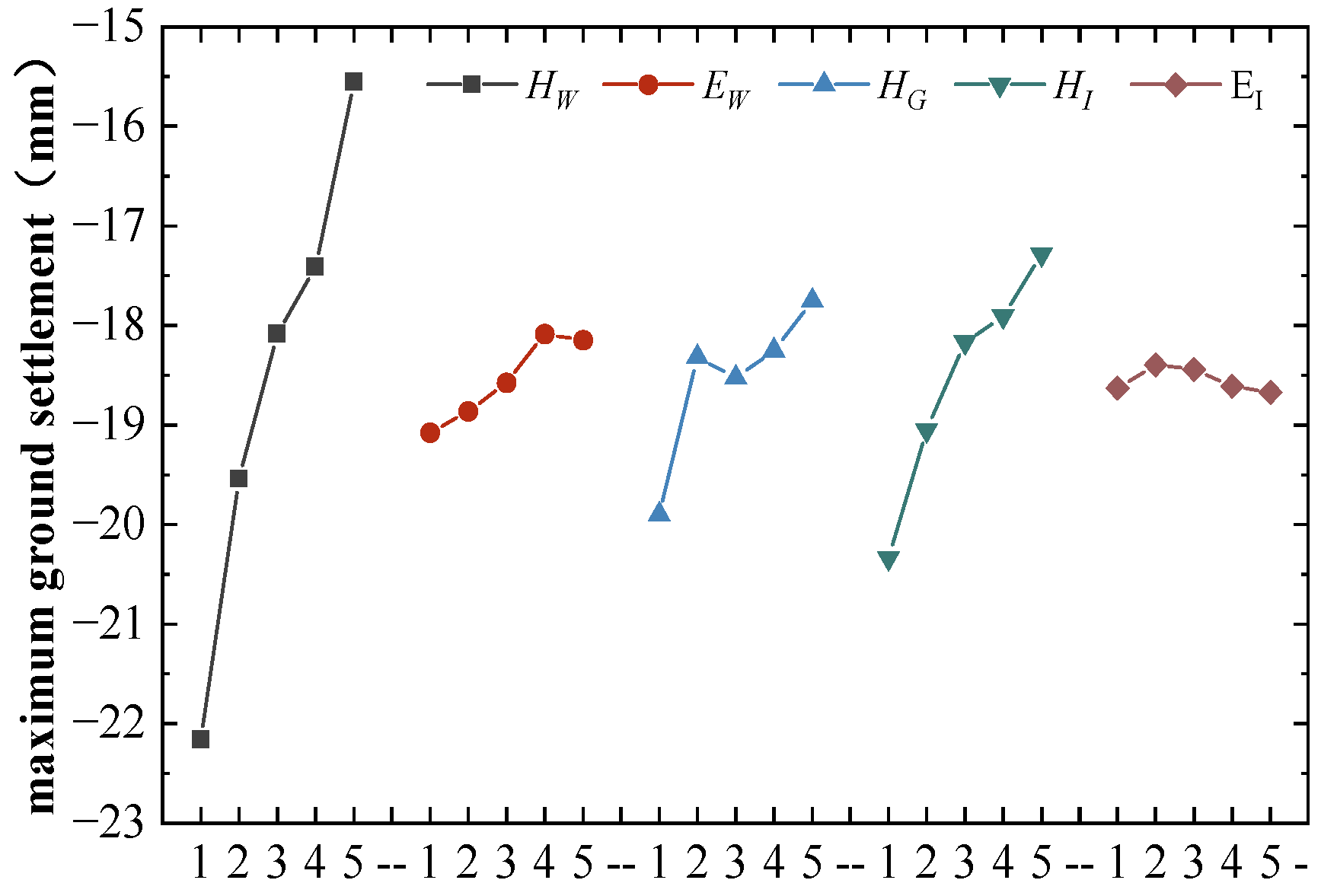
The range analysis shows that when the level of any test factor varies, the evaluation metric correspondingly changes. To visualize more directly the influence of the test factors on the evaluation metric, the factor level is taken as the abscissa and the evaluation metric as the ordinate, and effect curves of each factor level on ground surface settlement were plotted, as shown in Figure 13.
Analysis of the effect curves in Figure 13 shows that diaphragm wall thickness exerts the most pronounced influence on ground surface settlement; as this thickness increases its capacity to resist deformation of the surrounding soil strengthens, thereby markedly reducing ground surface settlement, whereas the elastic modulus of the transverse passage primary support exhibits relatively low sensitivity with respect to ground surface settlement, a conclusion consistent with the preceding range analysis.
(2)
Analysis of Variance
Although range analysis is straightforward to apply in practice, it cannot identify the sources of experimental error; to remedy this limitation, the Analysis of Variance was additionally employed, and the summarized ANOVA results based on the test outcomes are presented in Table 7.
(3)
Parameter Sensitivity Analysis
To assess how sensitive ground surface settlement is to support parameters during shield lateral migration launching, the concept of sensitivity is invoked and, in evaluating the assessment index, the sensitivity coefficient μ S R is computed to quantify the extent to which variations in each factor affect this index, with the specific calculation formula provided in Equation (1) and the consolidated results presented in Table 8.
μ S R = f ( x + Δ ) f ( x ) f ( x ) × 100 % Δ x × 100 %
In the formula, f(x) is the output value of the assessment index corresponding to the standard factor level; f(x + Δ ) is the output value of the assessment index corresponding to the changed factor level; x and x + Δ respectively represent the standard and perturbed factor levels.
Among the support parameters, the diaphragm wall thickness has the greatest influence on surface settlement, with a sensitivity coefficient of 0.627. This is followed by the grouting reinforcement range. In contrast, the sensitivity of the elastic modulus of the initial support in the lateral launching channel is relatively low, at only 0.031. Likewise, the diaphragm wall elastic modulus and the initial support thickness of the advanced launching channel show limited sensitivity, indicating that once the required material strength is met, further increases in these parameters contribute little to settlement control.
Based on the above analysis, together with the engineering significance of each parameter, the diaphragm wall thickness, grouting reinforcement range, and initial support thickness of the lateral launching channel are identified as the key sensitive parameters affecting the lateral launching of the shield tunnel. Among them, diaphragm wall thickness is the core parameter governing excavation stability and ground deformation. Increasing the wall thickness directly enhances the bending stiffness and overall stability of the retaining structure, effectively reducing lateral displacement and vertical settlement of the surrounding soil during excavation. In this study, the diaphragm wall serves as the primary retaining structure, and its thickness exhibits the highest sensitivity with respect to surface settlement, indicating that optimizing the diaphragm wall design is the most critical measure for controlling ground deformation during lateral launching. The grouting reinforcement range improves the mechanical properties of the soil around the launching area, enhances its self-supporting capacity and bearing strength, and reduces soil loosening and settlement caused by excavation. Expanding the reinforcement range forms a more continuous and stable strengthened zone, effectively limiting soil loss and stress release, and plays an important role in controlling settlement in shallow ground layers. Meanwhile, the initial support thickness of the lateral launching channel directly affects the stiffness and bearing capacity of the temporary support system. Increasing its thickness improves the immediate support to the surrounding soil at the excavation face and reduces deformation accumulation during construction. This effect is especially significant for large-span underground openings such as the lateral launching channel, where the stiffness of the initial support has a pronounced influence on controlling crown settlement and surface deformation [57,58].

6. Parameter Optimization Design Based on Parameter Regression Analysis

As the project prioritizes safety, the support parameter design is relatively conservative, and consequently the actual ground surface settlement is well below the monitoring control threshold. To enhance construction economy, after comparing how sensitive ground surface settlement is to different support parameters and concurrently considering the rationality of parameter optimization, those support parameters exhibiting higher sensitivity of influence on ground surface settlement are selected as the primary targets for optimization.

6.1. Regression Analysis of Ground Surface Settlement and Optimization Parameters

Regression analysis is an effective statistical method that quantitatively characterizes the relationship between the dependent variable and the independent variables. To investigate in greater depth the numerical relationship between ground surface settlement and each optimization parameter, linear, quadratic, and exponential curve models are employed for regression fitting. The R2 value serves as the metric for the degree of curve fitting, and the closer it is to 1, the higher the fitting accuracy. By iteratively testing and refining different models until identifying the fitted curve with the highest R2 value, the relationship between ground surface settlement and each optimization parameter is captured with maximal accuracy.
(1) Regression analysis of the influence exerted by diaphragm wall thickness on ground surface settlement
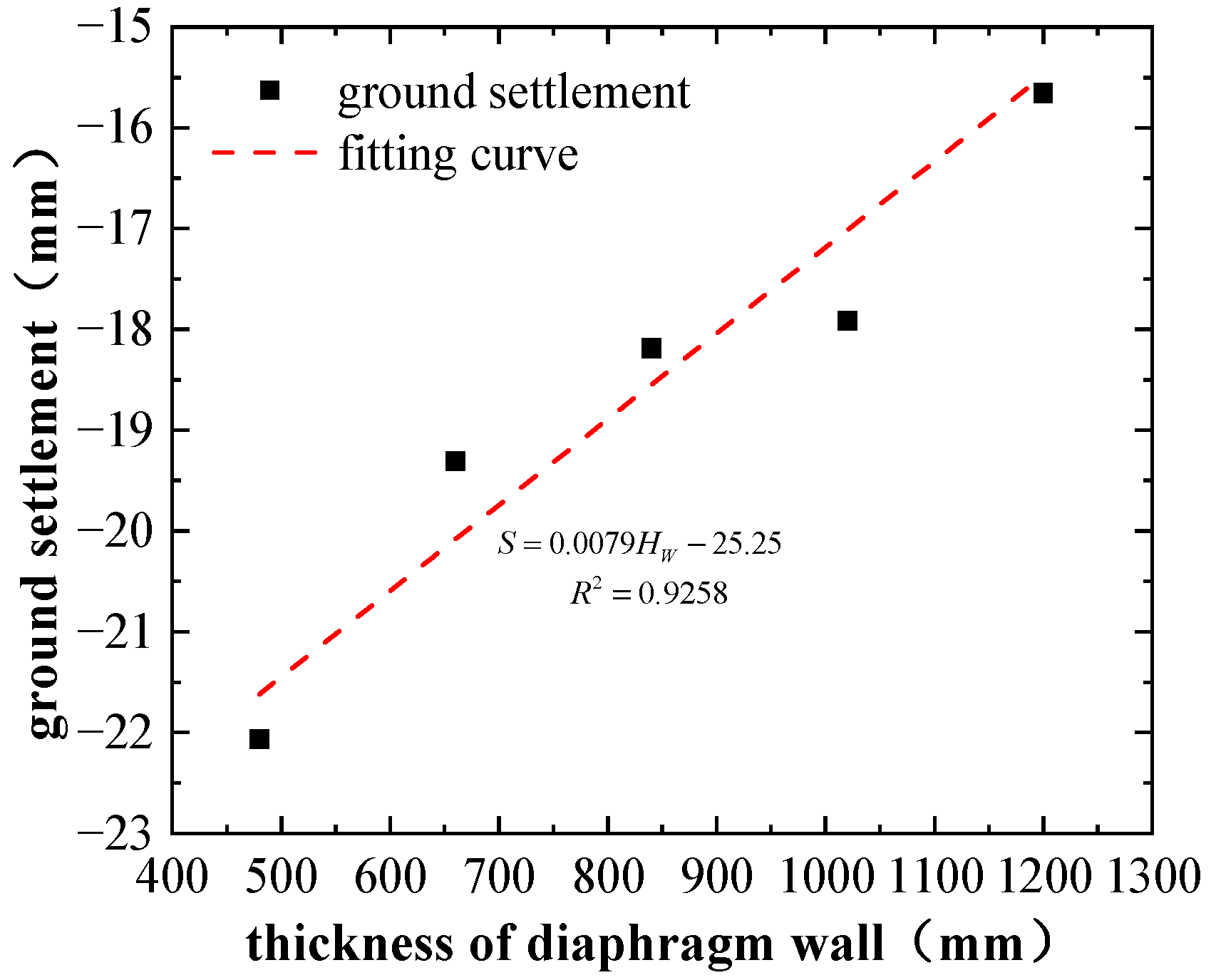
Figure 14 shows that as the diaphragm wall thickness increases, the ground surface settlement gradually decreases, and this decreasing trend exhibits a linear relationship with the increase in diaphragm wall thickness; as shown in Equation (2), a linear model was used to fit the relationship between ground surface settlement and diaphragm wall thickness, and the coefficient of determination R2 reaches 0.9258, indicating a high goodness of fit.
S = 0.0079 H W 25.25 R 2 = 0.9258
S denotes the ground surface settlement and HW denotes the diaphragm wall thickness.
(2) Regression analysis of the influence of the grouting reinforcement range on ground surface settlement
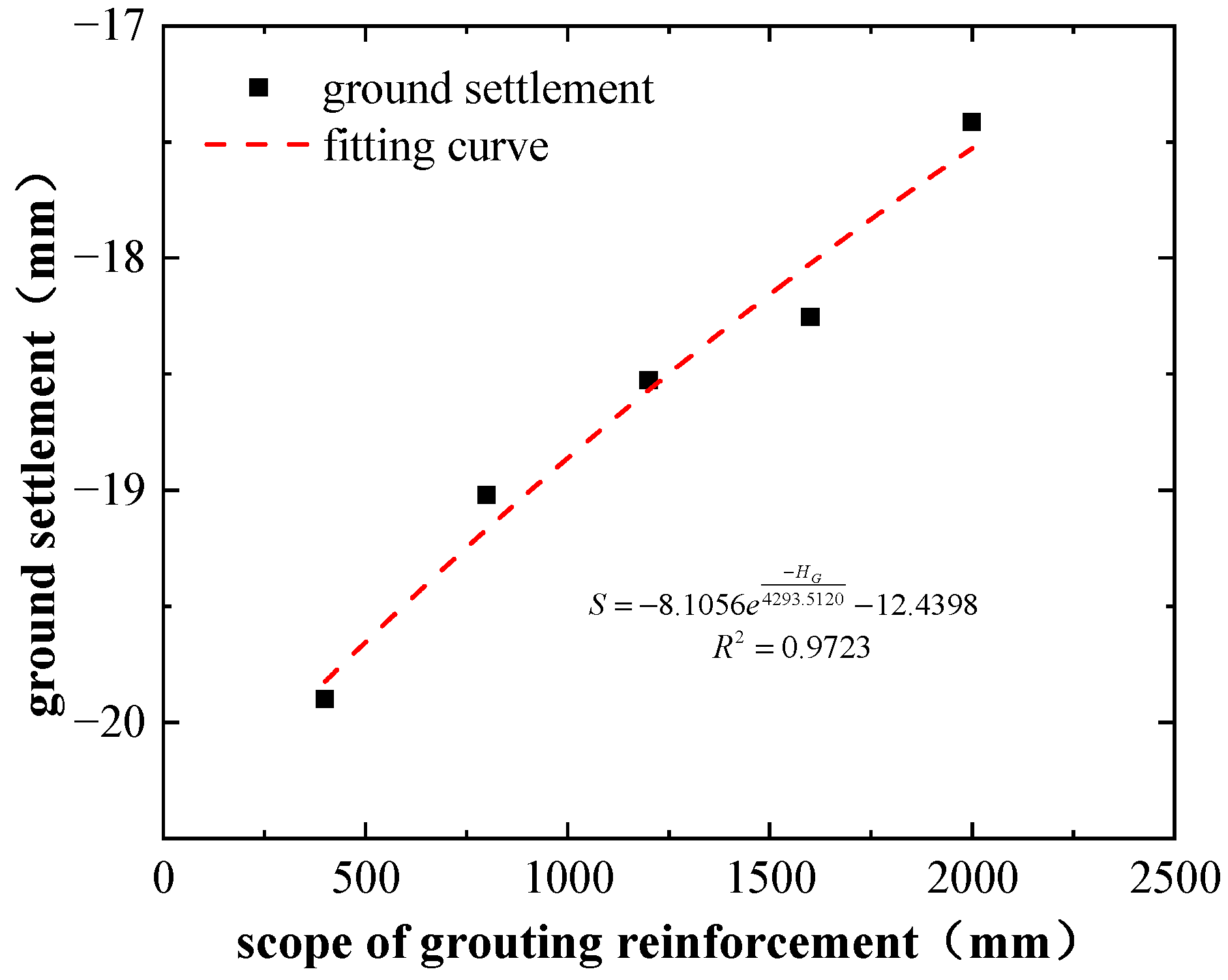
Figure 15 shows that as the grouting reinforcement range increases, the ground surface settlement gradually decreases; as shown in Equation (3), an exponential model can satisfactorily fit the relationship between ground surface settlement and the grouting reinforcement range in this project, and the coefficient of determination R2 reaches 0.9723, indicating a high goodness of fit.
S = 8.1056 e H G / 4293.5120 12.4398 R 2 = 0.9723
S denotes the ground surface settlement and HG denotes the grouting reinforcement range.
(3) Regression analysis of the influence of the cross-passage initial support thickness on ground surface settlement
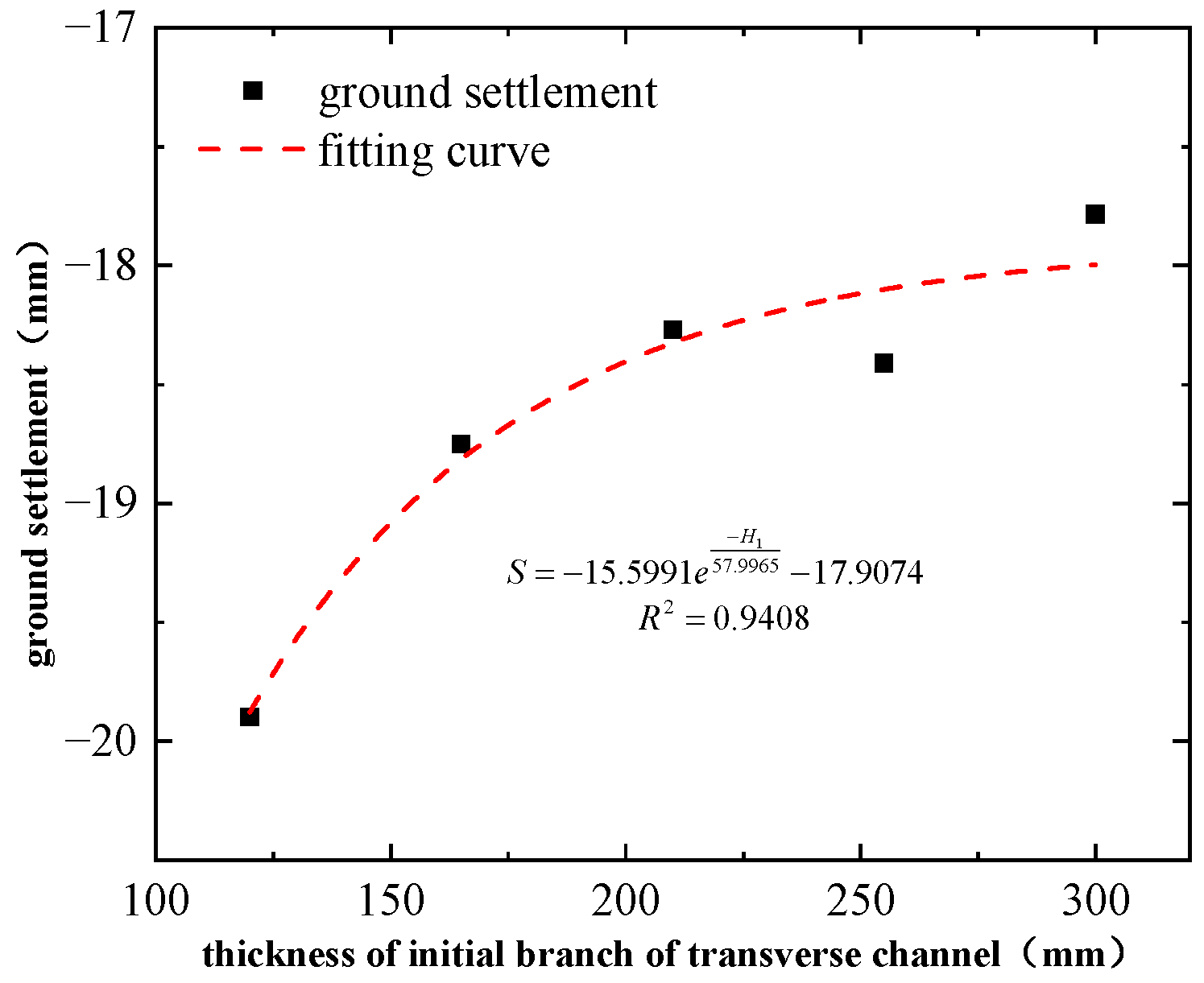
Figure 16 shows that as the cross-passage initial support thickness increases, the ground surface settlement gradually decreases, but this decreasing trend progressively slows; as shown in Equation (4), an exponential model provides the best fit for the relationship between ground surface settlement and the cross-passage initial support thickness in this project, with the coefficient of determination R2 reaching 0.9408.
S = 15.5991 e H 1 / 57.9965 17.9074 R 2 = 0.9408
S denotes the ground surface settlement and H1 denotes the thickness of the initial branch of the transverse channel.

6.2. Design of the Optimization Scheme

Eighty percent of the ground surface settlement control value, namely 24.0 mm, is taken as the warning value for ground surface settlement, and 75% and 90% of this warning value, namely 18.0 mm and 21.6 mm, are, respectively, set as the target values for ground surface settlement control; based on the curve-fitting formulas between ground surface settlement and the optimization parameters, the optimization parameter values corresponding to these two target settlement values are calculated and then comprehensively analyzed to determine the final optimized parameter values (Table 9).
Through calculation, two optimized values of the thickness of the diaphragm wall were determined as 1000 mm and 500 mm, two optimized values of the scope of grouting reinforcement were 1600 mm and 550 mm, and two optimized values of the thickness of the initial branch of the transverse channel were 200 mm and 100 mm.
Additionally, referring to the provisions of the Technical Code for Building Foundation Excavation Support [59] (JGJ 120-2012) that the wall thickness of the diaphragm wall should be selected according to the specifications of the trench cutter as 600 mm, 800 mm, 1000 mm, or 1200 mm, the thickness of diaphragm wall was therefore set at 600 mm and 1000 mm.
Referring to the provisions of the Technical Code for Ground Anchor and Shotcrete Support Engineering [60] (GB 50086-2015) that the design thickness of shotcrete for underground engineering shall not be less than 50 mm and should not exceed 300 mm, after comprehensively considering the calculation results and the code requirements, the thickness of the initial branch of the transverse channel was ultimately set at 200 mm and 100 mm.
Based on the two values determined for each optimization parameter above, all combinations of these parameters were exhaustively arranged, and eight different proposed optimized schemes were ultimately identified. The proposed optimized schemes are shown in Table 10.

6.3. Comparison of Deformation Control Schemes for the Optimization

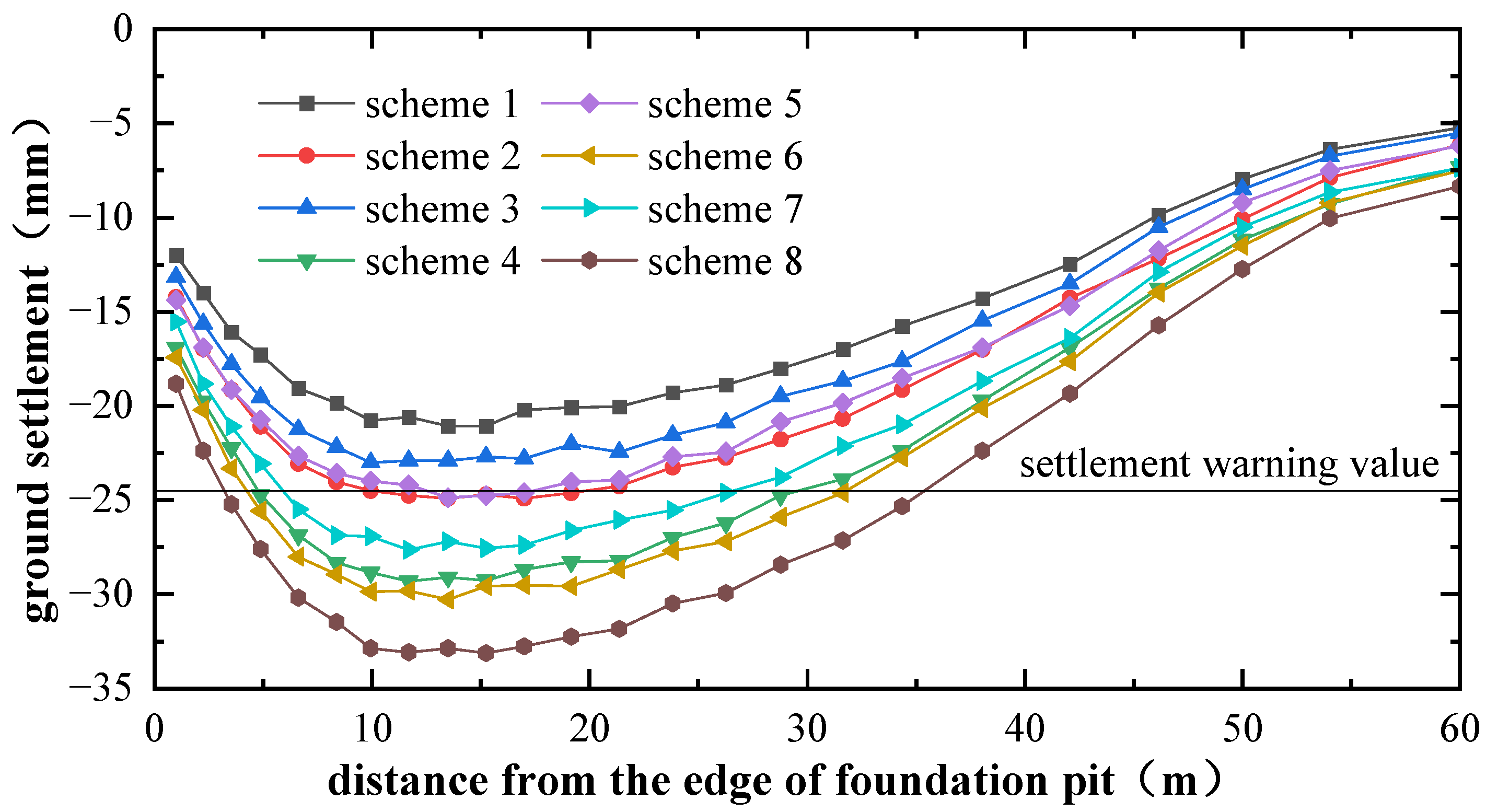
Under the premise of adjusting only the optimization parameters in Table 8, all the proposed optimized schemes were analyzed by numerical simulation, obtaining the calculated ground settlement above the starting shaft and the axis of the transverse channel for each scheme, and the ground settlement curves of each proposed optimized scheme were plotted as shown in Figure 17.
According to the figure, for these eight proposed optimized schemes, the ground settlement exhibits the same variation trend with increasing distance from the diaphragm wall. In each scheme, the maximum ground settlement appears at a position about 15 m from the diaphragm wall, with the maximum ground settlement ranging between 20.89 mm and 33.06 mm, and the overall settlement distribution is relatively uniform.
By comparing the maximum ground settlement of each optimization scheme with the ground settlement warning value, it was found that in two proposed optimization schemes the maximum ground settlement was lower than the warning value, in two schemes it was equal to the warning value, and in four schemes it was greater than the warning value. Therefore, the six schemes whose maximum ground settlement was equal to or greater than the warning value were first excluded, and the optimal scheme was selected from the remaining Scheme 1 and Scheme 3. The maximum ground settlement of Scheme 1 was 20.89 mm, equivalent to 87.04% of the warning value; the maximum ground settlement of Scheme 3 was 22.85 mm, accounting for 95.20% of the warning value. However, compared with Scheme 1, Scheme 3 has a smaller thickness of the initial support of the transverse channel and is more economical. Thus, Scheme 3, namely a diaphragm wall thickness of 1000 mm, scope of grouting reinforcement of 1600 mm, and thickness of the initial support of the transverse channel of 100 mm, was selected as the final optimization scheme.

6.4. Comprehensive Evaluation of the Optimized Scheme

(1) Evaluation of control effect
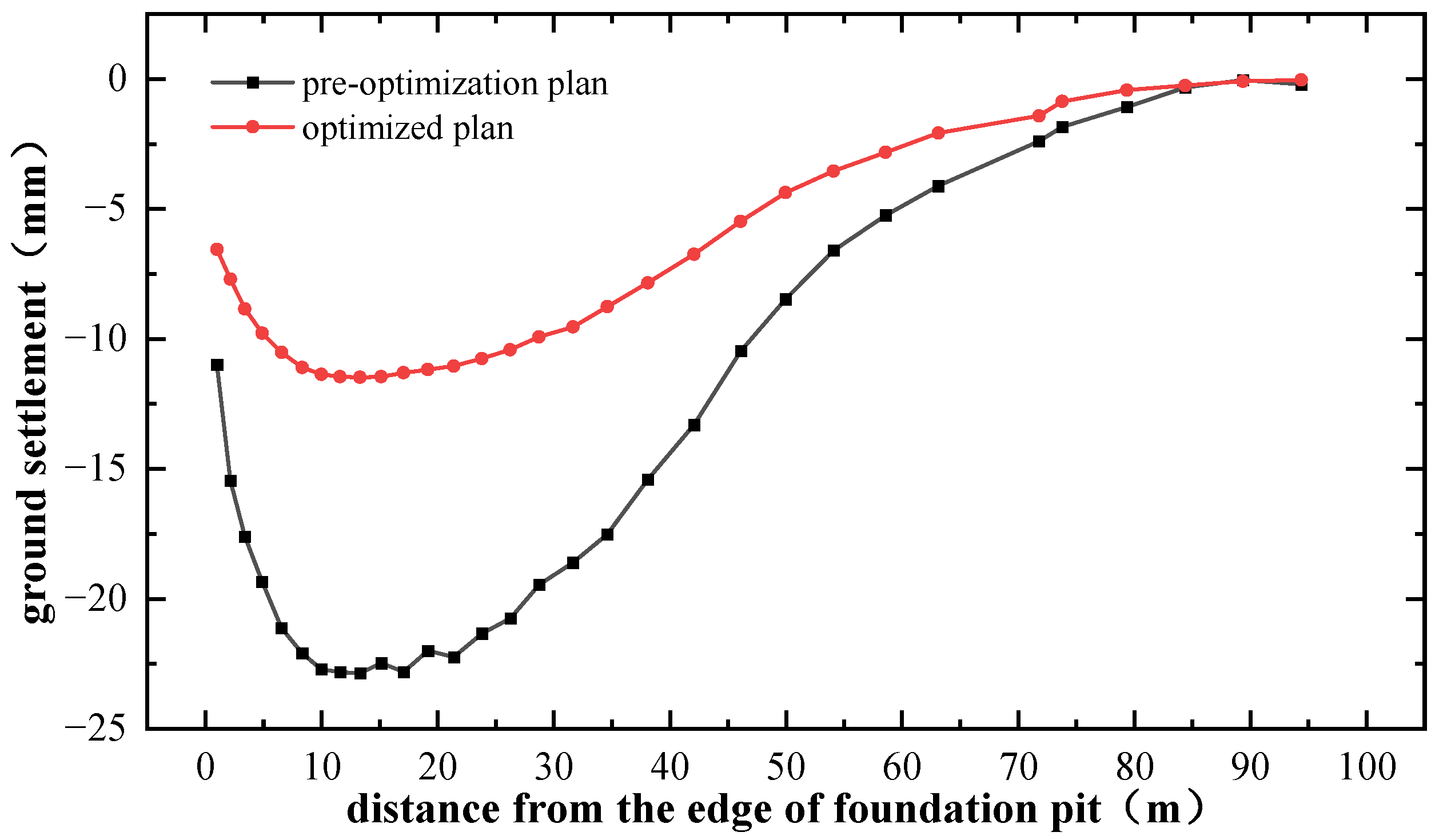
Figure 18 presents a comparison of the ground settlement induced by the schemes before and after optimization. As shown, both settlement curves exhibit a trough-shaped profile, with the maximum ground settlement occurring at a position 10–20 m from the diaphragm wall. However, in the optimized scheme, the groove formed near the diaphragm wall is more pronounced, indicating that after the reduction in support parameters, the ground settlement in this area increased significantly; the maximum settlement rose from 11.48 mm to 22.85 mm, an increase of 99.04%. Nevertheless, this value still remains within 76.17% of the safety standard (control limit), thus ensuring the safety and reliability of the optimized scheme in terms of ground deformation control.
(2) Economic evaluation
In the optimization design process of the background project, while ensuring that structural deformation is kept within an acceptable range, the cost-effectiveness of the project is also a key consideration. Based on the data in Table 11, a detailed comparison was made between the schemes before and after the adjustment of construction parameters regarding the material usage of the three key support components: diaphragm wall, grouting reinforcement, and initial support, in order to evaluate the economic benefits of the optimization measures.
Analysis of the data in Table 9 shows that, compared with the pre-optimization scheme: for the diaphragm wall thickness, the optimized scheme achieved a 16.67% saving in materials; for the grouting reinforcement extent, it saved 20.00% of materials; and for the initial support thickness of the transverse lateral channel, the material saving reached 66.67%. This demonstrates that, while meeting the surface settlement control standards, rational adjustment of construction parameters can greatly reduce material consumption and markedly enhance project economy. Therefore, from a cost–benefit perspective, the optimization of the shield lateral shifting launching construction parameters carried out in this study is reasonable and effective.

7. Conclusions

(1) Through a combined approach of field monitoring and numerical simulation, it is confirmed that the deformations of both the retaining structures and the surrounding ground during the entire shield lateral-shifting launching process remain within the safety limits. This verifies the applicability and stability of the construction method in complex urban environments and lays the foundation for subsequent parameter analysis.
(2) Using orthogonal tests, the key parameters of shield lateral-shifting launching were ranked in terms of sensitivity. The results indicate that the sensitivity coefficients, from highest to lowest, are diaphragm wall thickness, grouting reinforcement range, initial support thickness of the lateral-shifting passage, initial support thickness of the advance launching passage, and diaphragm wall elastic modulus.
(3) Optimization was performed for the highly sensitive parameters, and the optimal combination was determined as a diaphragm wall thickness of 1000 mm, a grouting reinforcement range of 1600 mm, and an initial support thickness of 100 mm for the lateral-shifting passage. This optimized scheme keeps the surface settlement within 76.17% of the safety limit while achieving significant reductions in material consumption—16.67% for the diaphragm wall, 20.00% for grouting materials, and 66.67% for initial support materials—thus achieving a balance between safety and economic efficiency.
Based on the above investigations, this study systematically examined the sensitivity of support parameters to ground surface settlement during shield lateral-shifting launching by integrating orthogonal experimental design with numerical simulations, and subsequently proposed an optimized design scheme. The results are of significance to both engineering practice and theoretical research. From an engineering perspective, the sensitivity-based parameter optimization approach proposed herein provides a practical basis for selecting support parameters for shield lateral-shifting launching under complex urban conditions. By prioritizing the control of highly sensitive parameters while avoiding the overdesign of parameters with low sensitivity, construction efficiency can be improved and material consumption reduced while maintaining controllable deformation. From a theoretical perspective, this study applies the orthogonal experimental method to the sensitivity analysis of parameters associated with shield lateral-shifting launching, establishing a quantitative framework for evaluating the relative importance of different support parameters. This contributes to a deeper understanding of the deformation control mechanisms during the launching stage. In practical engineering applications, key parameters can be dynamically adjusted by combining standardized parameter ranges with field monitoring data, and staged sensitivity analyses can be adopted to enhance the stability and consistency of the evaluation results, thereby reducing uncertainties induced by stratigraphic variability and construction disturbances. Nevertheless, it should be acknowledged that parameter interactions were not considered in the orthogonal experimental design, and thus, the coupled effects between parameters, such as diaphragm wall stiffness and grouting reinforcement range, were not fully captured. In addition, certain simplifications were adopted in the numerical model to ensure computational efficiency, which may have weakened the realistic response to local stiffness variations. Furthermore, the influence of groundwater level fluctuations on settlement was not systematically considered, limiting the applicability of the model under complex hydrogeological conditions. Therefore, future studies will focus on response surface analyses that incorporate parameter interactions, the adoption of more refined solid elements or shell–solid coupled models, and the development of fluid–solid coupling numerical models to quantitatively evaluate groundwater effects, thereby improving the accuracy and reliability of parameter design and control for shield lateral-shifting launching technology.

Author Contributions

Software, X.T.; Formal analysis, Y.R.; Resources, L.L.; Writing—original draft, X.K.; Supervision, T.C.; Project administration, H.Y. All authors have read and agreed to the published version of the manuscript.

Funding

The research described in this paper was financially supported by the National Natural Science Foundation of China (Grant No 52178302), the Key R & D Projects in Shaanxi Province (No. 2020SF-373) and the Key R & D Projects in Shaanxi Province (No. 2024SF-YBXM-650).

Data Availability Statement

The original contributions presented in this study are included in the article. Further inquiries can be directed to the corresponding authors.

Conflicts of Interest

Authors Lingwei Lu and Yanmei Ruan were employed by the company Guangzhou Metro Design & Research Institute Co., Ltd. Authors Tong Chen and Huiru Yu were employed by the company China Railway Seventh Bureau Group Co., Ltd. The remaining authors declare that the research was conducted in the absence of any commercial or financial relationships that could be construed as a potential conflict of interest.

References

  1. Zhou, D.; Mei, Y.; Ke, X.; Liu, Z.; Xu, W. Study on the Structural Behavior and Reinforcement Design of Openings in Subway Station Floor Slabs. J. Build. Eng. 2024, 98, 110994. [Google Scholar] [CrossRef]
  2. Jin, D.; Yuan, D.; Li, X.; Zheng, H. Analysis of the Settlement of an Existing Tunnel Induced by Shield Tunneling Underneath. Tunn. Undergr. Space Technol. 2018, 81, 209–220. [Google Scholar] [CrossRef]
  3. Wang, X.; Chen, C. Vibration Table Test of Prefabricated L-Shaped Column Concrete Structure. Buildings 2025, 15, 2329. [Google Scholar] [CrossRef]
  4. Luo, H.; Li, L.; Chen, K. Parametric Modeling for Detailed Typesetting and Deviation Correction in Shield Tunneling Construction. Autom. Constr. 2022, 134, 104052. [Google Scholar] [CrossRef]
  5. Zhou, D.; Mei, Y.; Ke, X.; Liu, Z.; Xu, W. Experimental Study on Large-Scale Subway Station Model Considering Adjustable Water and Soil Pressure. Undergr. Space 2025, 25, 262–280. [Google Scholar] [CrossRef]
  6. Wang, X.; Wang, B.; Yuan, Y.; Yang, T.; Dong, G.; Shi, C. Study on the Effect of EICP Combined with Nano-SiO2 and Soil Stabilizer on Improving Loess Surface Strength. Buildings 2025, 15, 1998. [Google Scholar] [CrossRef]
  7. Liao, S.-M.; Liu, J.-H.; Wang, R.-L.; Li, Z.-M. Shield Tunneling and Environment Protection in Shanghai Soft Ground. Tunn. Undergr. Space Technol. 2009, 24, 454–465. [Google Scholar] [CrossRef]
  8. Dou, Z.; Chen, T.; Song, Q.; Ren, D.; Wang, J. Analysis of the Influence of Stratum Parameters on Ground Settlement during Shield Construction in Composite Strata. Mod. Tunn. Technol. 2024, 61, 404–414. [Google Scholar]
  9. Jia, B.-X.; Gao, Z. Investigating Surface Deformation Caused by Excavation of Curved Shield in Upper Soft and Lower Hard Soil. Front. Earth Sci. 2022, 10, 844969. [Google Scholar] [CrossRef]
  10. Zhang, J.; Liang, Y.; Feng, T. Investigation of the Cause of Shield-Driven Tunnel Instability in Soil with a Soft Upper Layer and Hard Lower Layer. Eng. Fail. Anal. 2020, 118, 104832. [Google Scholar] [CrossRef]
  11. Xu, P.; Huang, Z. Influencing Factors and Sensitivity Analysis of Shield Construction in Water-Bearing Sand–Pebble Stratum. J. Eng. Geol. 2024, 32, 1787–1797. [Google Scholar]
  12. Ye, F.; Qin, N.; Gao, X.; Quan, X.; Qin, X.; Dai, B. Shield Equipment Optimization and Construction Control Technology in Water-Rich and Sandy Cobble Stratum: A Case Study of the First Yellow River Metro Tunnel Undercrossing. Adv. Civ. Eng. 2019, 2019, 8358013. [Google Scholar] [CrossRef]
  13. Wei, Y.; Yang, Y.; Tao, M.; Wang, D.; Jie, Y. Earth Pressure Balance Shield Tunneling in Sandy Gravel Deposits: A Case Study of Application of Soil Conditioning. Bull. Eng. Geol. Environ. 2020, 79, 5013–5030. [Google Scholar] [CrossRef]
  14. Ding, Y.; Huang, C.; Ma, S.; Hong, K.; Xu, Q.; Yan, M. Measurement and Analysis of Surface Settlement Caused by Construction of Quasi-Rectangular Shield Tunnel in Rich Water-Sand Stratum. Sci. Rep. 2024, 14, 24497. [Google Scholar] [CrossRef]
  15. Weng, X.; Sun, Y.; Zhang, Y.; Niu, H.; Liu, X.; Dong, Y. Physical Modeling of Wetting-Induced Collapse of Shield Tunneling in Loess Strata. Tunn. Undergr. Space Technol. 2019, 90, 208–219. [Google Scholar] [CrossRef]
  16. Mei, Y.; Zhang, X.; Zhang, S.; Wang, R.; Yang, T.; Zhang, Y. Experimental Study on Shield Tunneling Control in Full Section Water-Rich Sand Layer of Collapsible Loess. Geofluids 2022, 2022, 9125283. [Google Scholar] [CrossRef]
  17. Li, Z.; Chen, Z.; Wang, L.; Zeng, Z.; Gu, D. Numerical Simulation and Analysis of the Pile Underpinning Technology Used in Shield Tunnel Crossings on Bridge Pile Foundations. Undergr. Space 2021, 6, 396–408. [Google Scholar] [CrossRef]
  18. He, C.; Wei, J.; Liang, H.; Chen, Z.; Ding, W.; Li, B. Structural Behavior Analysis for Existing Pile Foundations Considering the Effects of Shield Tunnel Construction. Buildings 2025, 15, 3263. [Google Scholar] [CrossRef]
  19. Zhuang, X. Settlement Analysis and Prediction of Existing Pipelines Induced by Shield Underpass Construction. Mech. Q. 2024, 45, 239–247. [Google Scholar]
  20. Liu, X.; Jiang, A.; Fang, Q.; Wan, Y.; Li, J.; Guo, X. Spatiotemporal Deformation of Existing Pipeline Due to New Shield Tunnelling Parallel beneath Considering Construction Process. Appl. Sci. 2022, 12, 500. [Google Scholar] [CrossRef]
  21. Ma, S.; Hong, K.; Zhang, Y.; Cao, M.; Zhang, B.; Zhang, H. Deformation Analysis of Large-Section Quasi-Rectangular Shield Construction on Existing Underground Pipelines and Power Tunnel. Sci. Rep. 2025, 15, 31390. [Google Scholar] [CrossRef]
  22. Liang, R.; Xia, T.; Hong, Y.; Yu, F. Effects of Above-Crossing Tunnelling on the Existing Shield Tunnels. Tunn. Undergr. Space Technol. 2016, 58, 159–176. [Google Scholar] [CrossRef]
  23. Shi, Q.; Ping, Y.; Ting, Z.; He, D. Vertical Freezing Reinforcement and Monitoring in Site for Tunnel Shield-Launching End in Soft Soil Stratum. J. Nanjing For. Univ. 2015, 39, 125. [Google Scholar]
  24. Wu, B.; Cai, H.; Cheng, H. Vertical Ground-Freezing Reinforcement Technology for Metro Shield Tunnel Portals. Railw. Stand. Des. 2011, 68, 80–84. [Google Scholar]
  25. Nguyen, X.L.; Wu, L.; Nguyen, K.T.; Bui, Q.A.; Nguen, H.H.; Luu, H.P. Research on Launching Technology of Shield Tunnel in Ho Chi Minh Metro Line 1. Arch. Civ. Eng. 2021, 67, 387–401. [Google Scholar] [CrossRef]
  26. Lv, S.; Liu, W.; Zhai, S.; Chen, P. Influence of Water Inrush from Excavation Surface on the Stress and Deformation of Tunnel-Forming Structure at the Launching-Arrival Stage of Subway Shield. Adv. Civ. Eng. 2019, 2019, 6989730. [Google Scholar] [CrossRef]
  27. Huang, M.; Lu, Y.; Zhen, J.; Lan, X.; Xu, C.; Yu, W. Analysis of Face Stability at the Launch Stage of Shield or TBM Tunnelling Using a Concrete Box in Complex Urban Environments. Tunn. Undergr. Space Technol. 2023, 135, 105067. [Google Scholar] [CrossRef]
  28. Yang, Z.-S.; Peng, F.-L.; Qiao, Y.-K.; Hu, Y.-Y. A New Cryogenic Sealing Process for the Launch and Reception of a Tunnel Shield. Tunn. Undergr. Space Technol. 2019, 85, 406–417. [Google Scholar] [CrossRef]
  29. Jhang, J.-Y.; Wu, C.; Kao, C. Case Studies on Ground Freezing in Taipei. 2009. Available online: https://api.semanticscholar.org/CorpusID:130418267 (accessed on 12 October 2025).
  30. Guo, B.; He, H.; Meng, X.; Ren, H.; Zuo, L.; Li, J.; Dai, B.; Zhao, C. Numerical Investigation of End Reinforcement Technology for Super-Large-Diameter Shield Tunnels and Online Prediction Using Machine Learning. Int. J. Multiscale Comput. Eng. 2025, 23, 49–68. [Google Scholar] [CrossRef]
  31. Ding, W.; Huang, X.; Dai, Z.; Wang, C.; Wang, Z.; Yu, W. Analysis of the Collapse Mechanism and Stabilization Optimization of the Composite Stratum at the Boundary Between Prereinforced and Unreinforced Areas Near a Shield Launching Area. Int. J. Geomech. 2023, 23, 5023002. [Google Scholar] [CrossRef]
  32. Hu, J.; Jiang, B.; Wei, H.; Wang, X. Applications of New Reinforcement Methods in City Tunnels for Shield Launching and Arriving. In Civil, Architecture and Environmental Engineering; CRC Press: Boca Raton, FL, USA, 2017; p. 6. [Google Scholar]
  33. Hu, J.; Jiang, B.S.; Zeng, H.; Chen, Y.N.; Zhu, Y.Y. Temperature Field Numerical Analysis of Different Freeze Pipe Spacing of Vertical Frozen Soil Wall Reinforcement at Shield Shaft. Appl. Mech. Mater. 2014, 580–583, 738–741. [Google Scholar]
  34. Hu, J.; Liu, Y.; Wei, H.; Yao, K.; Wang, W. Finite-Element Analysis of Heat Transfer of Horizontal Ground-Freezing Method in Shield-Driven Tunneling. Int. J. Geomech. 2017, 17, 04017080. [Google Scholar] [CrossRef]
  35. Hu, J.; Liu, W.; Pan, Y.; Zeng, H. Site Measurement and Study of Vertical Freezing Wall Temperatures of a Large-Diameter Shield Tunnel. Adv. Civ. Eng. 2019, 2019, 8231458. [Google Scholar] [CrossRef]
  36. Yin, Q.-F. Numerical Analysis on Reinforcement Range of a Closed Steel Sleeve against Collapse. Adv. Civ. Eng. 2021, 2021, 5593657. [Google Scholar] [CrossRef]
  37. Wei, X.J.; Wei, G.; Hong, J. Study of Analytical Solution on Starting Shaft Disaster in Shield Launching. Adv. Mater. Res. 2011, 261–263, 1475–1479. [Google Scholar]
  38. Ma, G.; Zheng, H.; Li, P. Displacement Characteristics for a “π” Shaped Double Cross-Duct Excavated by Cross Diaphragm (CRD) Method. Tunn. Undergr. Space Technol. 2018, 77, 204–215. [Google Scholar] [CrossRef]
  39. Cai, Z.; Wu, H.; Zheng, A. Shield Machine Lateral Transfer Technology in Metro Cross-Passages Based on BIM. Railw. Constr. 2021, 61, 74–77. [Google Scholar]
  40. Zhao, Z. Shield Lateral Launching Technology and Mechanical Characteristics of Special-Shaped Steel Sleeve in Narrow Urban Space. Master’s Thesis, Beijing Jiaotong University, Beijing, China, 2025. [Google Scholar]
  41. Tong, H. Shield Lateral Transfer and Launching (Receiving) Construction Technology. Railw. Constr. Technol. 2020, 32, 122–126. [Google Scholar]
  42. Gao, H. Study on Shield Lateral Launching Technology under Site Constraints. Constr. Saf. 2024, 39, 42–47. [Google Scholar]
  43. Li, X.; Zhang, H.; Bai, Y.; Zhang, X. Factor Analysis and Numerical Simulation of Rock Breaking Efficiency of TBM Deep Rock Mass Based on Orthogonal Design. J. Cent. South Univ. 2022, 29, 1345–1362. [Google Scholar] [CrossRef]
  44. Zhang, K.; Su, J.; Liu, Z.; Chen, H.; Zhang, Q.; Sun, S. Sensitivity Analysis and Experimental Verification of Bolt Support Parameters Based on Orthogonal Experiment. Shock Vib. 2020, 2020, 8844282. [Google Scholar] [CrossRef]
  45. Zou, B.; Xu, Z.; Wang, J.; Luo, Z.; Hu, L. Numerical Investigation on Influential Factors for Quality of Smooth Blasting in Rock Tunnels. Adv. Civ. Eng. 2020, 2020, 9854313. [Google Scholar] [CrossRef]
  46. Wang, Q.; Chen, Y.; Wang, S.; Geng, P.; Li, P.; Shen, H.; Deng, L. Parametric Study of Tunnel Fault Resistance Using Numerical Modeling and Orthogonal Experiment for Segmental Lining Design. Soil Dyn. Earthq. Eng. 2025, 198, 109599. [Google Scholar] [CrossRef]
  47. Wu, B.; Sun, W.; Meng, G. Sensitivity Analysis of Influencing Factors of Karst Tunnel Construction Based on Orthogonal Tests and a Random Forest Algorithm. Appl. Sci. 2024, 14, 2079. [Google Scholar] [CrossRef]
  48. Zhao, B.; Wang, X.; Zhang, C.; Li, W.; Abbassi, R.; Chen, K. Structural Integrity Assessment of Shield Tunnel Crossing of a Railway Bridge Using Orthogonal Experimental Design. Eng. Fail. Anal. 2020, 114, 104594. [Google Scholar] [CrossRef]
  49. Ju, H.; Liu, X.; Zhou, Y.; Wan, L.; Liu, Y. Back Analysis and Optimization of SMW Pile Parameters Based on Orthogonal Numerical Tests. Mod. Tunn. Technol. 2022, 59, 136–143. [Google Scholar] [CrossRef]
  50. GB 50911-2013; Code for Monitoring of Urban Rail Transit Engineering. MOHURD: Beijing, China, 2014.
  51. Hu, J.; Sun, L.; Cui, H.; Gao, P. Numerical Analysis of Deep Excavation Deformation Based on Modified Mohr–Coulomb Model. Sci. Technol. Eng. 2021, 21, 7717–7723. [Google Scholar]
  52. Wu, B.; Liu, Q.; Yang, D.; Wang, Y.; Su, W. Study on Stability of Grouting Reinforcement for Highway Soil Slopes. J. Highw. Transp. Res. Dev. 2021, 38, 45–51, 87. [Google Scholar]
  53. Xue, Y.; Zhang, X.; Li, S.; Qiu, D.; Su, M.; Li, L.; Li, Z.; Tao, Y. Analysis of Factors Influencing Tunnel Deformation in Loess Deposits by Data Mining: A Deformation Prediction Model. Eng. Geol. 2018, 232, 94–103. [Google Scholar] [CrossRef]
  54. Fang, Q.; Wang, G.; Yu, F.; Du, J. Analytical Algorithm for Longitudinal Deformation Profile of a Deep Tunnel. J. Rock Mech. Geotech. Eng. 2021, 13, 845–854. [Google Scholar] [CrossRef]
  55. Wang, J.; Liu, S. Sensitivity Analysis and Optimization of Diaphragm Wall Support Parameters for Deep Excavations in Soft Soil. Chin. J. Undergr. Space Eng. 2015, 11, 666–673. [Google Scholar]
  56. Gao, W.; Wang, L.; Zhang, H.; Zhang, L.; Zhao, W.; Hou, F. Contribution Analysis of Advanced Reinforcement and Initial Support to Ground Settlement Control in Shallow-Buried Tunnels. J. Railw. Sci. Eng. 2021, 18, 720–727. [Google Scholar]
  57. Kavvadas, M.J. Monitoring Ground Deformation in Tunnelling: Current Practice in Transportation Tunnels. Eng. Geol. 2005, 79, 93–113. [Google Scholar] [CrossRef]
  58. Yu, W.; Wang, B.; Zi, X.; Guo, X.; Wang, Z. Effect of Prestressed Anchorage System on Mechanical Behavior of Squeezed Soft Rock in Large-Deformation Tunnel. Tunn. Undergr. Space Technol. 2023, 131, 104782. [Google Scholar] [CrossRef]
  59. JGJ 120-99; Technical Code for Building Foundation Pit Support. China Academy of Building Research: Beijing, China, 1999.
  60. GB 50086-2015; Technical Specification for Rock and Soil Anchors and Shotcrete Support Engineering. Ministry of Housing and Urban-Rural Development of the People’s Republic of China: Beijing, China, 2015.
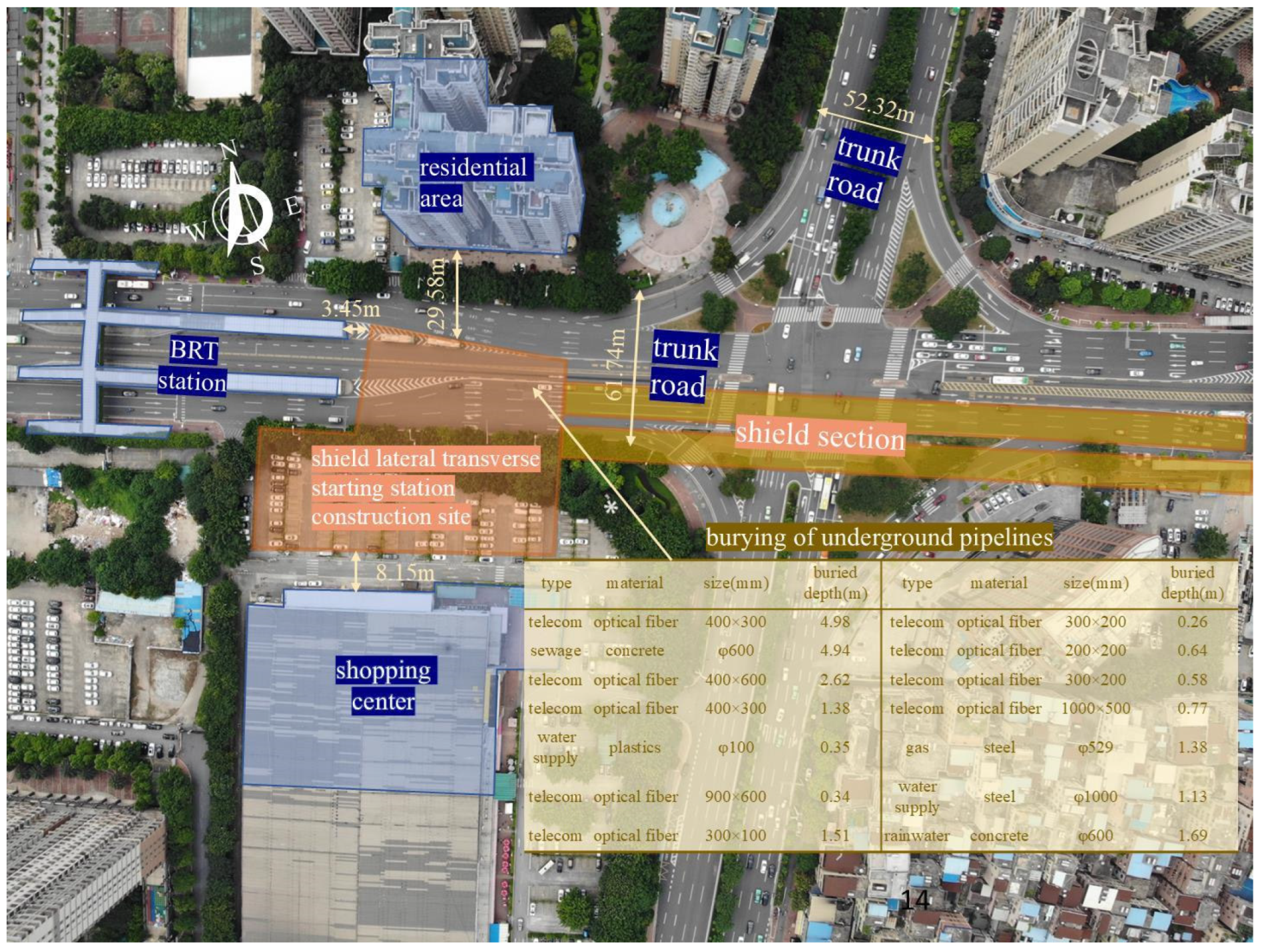
Figure 1. General layout plan of the background project.
Buildings 16 00105 g001
Figure 2. Geological profile at the shield launching structure.
Buildings 16 00105 g002
Figure 3. Construction sequence diagram of shield lateral shifting launch.
Buildings 16 00105 g003
Figure 4. Layout of monitoring points for diaphragm wall lateral displacement and ground surface settlement.
Buildings 16 00105 g004
Figure 5. Layout of crown settlement monitoring points.
Buildings 16 00105 g005
Figure 6. Time history curves of ground surface settlement.
Buildings 16 00105 g006aBuildings 16 00105 g006b
Figure 7. Diaphragm wall lateral displacement at each stage.
Buildings 16 00105 g007
Figure 8. Vault settlement of the lateral shifting channel at each stage.
Buildings 16 00105 g008
Figure 9. 3D finite element model of the launching structure.
Buildings 16 00105 g009
Figure 10. Comparison between monitored and simulated time history ground surface settlement.
Buildings 16 00105 g010
Figure 11. Comparison between monitored and simulated diaphragm wall lateral displacement.
Buildings 16 00105 g011
Figure 12. Comparison between monitored and simulated vault settlement of the lateral shifting channel.
Buildings 16 00105 g012
Figure 13. Main effect plots.
Buildings 16 00105 g013
Figure 14. S-HW fitting curve.
Buildings 16 00105 g014
Figure 15. S-HG fitting curve.
Buildings 16 00105 g015
Figure 16. S-H1 fitting curve.
Buildings 16 00105 g016
Figure 17. Ground surface settlement curves of candidate optimization schemes.
Buildings 16 00105 g017
Figure 18. Comparison of ground settlement induced before and after optimization.
Buildings 16 00105 g018
Table 1. Monitoring and measurement items.
ProjectFrequencyInstrumentsCumulative Settlement Value (mm)Change Rate (mm/d)
ground settlement1 times/daylevel instrument303
diaphragm wall lateral displacement1 time/2 daysconvergence gauge302
Tunnel crown settlement2 times/daytotal station303
Table 2. Physical and mechanical parameters of materials.
Soil Layer NamePoisson Ratio/νSeverity/γ
(kN·m−3)
Internal Friction Angle/φ(°)Cohesion/c
(kPa)
E 50 r e f
(MPa)
E o d e r e f
(MPa)
E u r r e f
(MPa)
Miscellaneous Fill0.3017.881014.514.543.5
Silty Clay0.3518.9112020.120.160.3
Medium to Coarse Sand0.2519.130025.225.275.6
Highly Weathered Argillaceous Siltstone0.2520.33040134.2134.2402.6
Moderately Weathered Argillaceous Siltstone0.2223.73560242.5242.5727.5
Slightly Weathered Argillaceous Siltstone0.2026.14080305.8305.8917.4
Table 3. Structural element model parameters.
ProjectSize (mm)Elastic Modulus/ES
(MPa)
Poisson Ratio/νSeverity/γ
(kN·m−3)
Constitutive Model
diaphragm wall120031,5000.2024.0slab
ring frame beam3000 × 1500
2500 × 1500
31,5000.2024.0beam
grouting reinforcement soil2000600.2822.0modified Mohr–Coulomb model
anchorsφ223000.307.85embedded truss structure
initial support30028,0000.2024.0slab
secondary lining60031,5000.2024.0solid
shield segment30050,0000.2024.0solid
Table 4. Experimental factors and level values.
Orthogonal LevelsDiaphragm Wall Thickness/HW
(mm)
Elastic Modulus of Diaphragm Wall/EW
(MPa)
The Scope of Grouting Reinforcement of the Transverse Channel/HG
(mm)
The Thickness of the Initial Branch of the Transverse Channel/H1
(mm)
Thickness of Initial Branch of Advanced Starting Channel/H2
(mm)
148022,050400120110
266026,775800165150
384031,5001200210200
4102036,2251600255250
5120040,9502000300290
Table 5. Orthogonal test schemes and results.
TestDiaphragm Wall Thickness/HW
(mm)
Elastic Modulus of Diaphragm Wall/EW
(MPa)
The Scope of Grouting Reinforcement of the Transverse Channel/HG
(mm)
The Thickness of the Initial Branch of the Transverse Channel/H1
(mm)
Thickness of Initial Branch of Advanced Starting Channel/H2
(mm)
Maximum Ground Settlement (mm)
test 148022,050400120110−26.14
test 248026,775800165150−22.07
test 348031,5001200210200−21.80
test 448036,2251600255250−21.13
test 548040,9502000300290−20.66
test 666022,050800210110−19.36
test 766026,7751200255150−19.55
test 866031,5001600300200−17.56
test 966036,2252000120250−19.35
test 1066040,950400165290−21.19
test 1184022,0501200300110−17.48
test 1284026,7751600120150−19.62
test 1384031,5002000165200−18.11
test 1484036,225400210250−18.19
test 1584040,950800255290−17.02
test 16102022,0501600165110−18.39
test 17102026,7752000210150−17.94
test 18102031,500400255200−17.84
test 19102036,225800300250−17.58
test 20102040,9501200120290−18.31
test 21120022,0502000255110−15.01
test 22120026,775400300150−16.14
test 23120031,500800120200−17.57
test 24120036,2251200165250−15.49
test 25120040,9501600210290−14.56
Table 6. Range analysis.
Factors K 1 ¯ K 2 ¯ K 3 ¯ K 4 ¯ K 5 ¯ R
diaphragm wall thickness−22.360−19.402−18.084−18.012−15.7546.606
elastic modulus of diaphragm wall−19.276−19.064−18.576−18.348−18.3480.928
the scope of grouting reinforcement of the transverse channel−19.900−18.720−18.526−18.252−18.2141.686
the thickness of the initial branch of the transverse channel−20.198−19.050−18.370−18.110−17.8842.314
thickness of initial branch of advanced starting channel−18.830−18.260−19.040−18.610−18.8720.780
Table 7. Analysis of variance.
FactorsSum of Partial Variance Square
/S
Degree of Freedom
/f
Mean Square
/V
FPFSignificant Degree
diaphragm wall thickness117.088429.27237.3900.0023
elastic modulus of the diaphragm wall3.62540.9061.1580.4450
the scope of grouting reinforcement of the transverse channel9.52542.3813.0420.1531
the thickness of the initial branch of the transverse channel17.43444.3595.5670.0622
thickness of initial branch of advanced starting channel1.80640.4520.5770.6960
Error3.13140.783
the critical value of F distributionF0.01(4,4) = 16.00   F0.05(4,4) = 6.39    F0.1(4,4) = 4.11
Table 8. Parameter sensitivity evaluation.
IndexDiaphragm Wall ThicknessElastic Modulus of Diaphragm WallThe Scope of Grouting Reinforcement of the Transverse ChannelThe Thickness of the Initial Branch of the Transverse ChannelThickness of Initial Branch of Advanced Starting Channel
sensitivity parameters0.6270.0870.2480.2410.031
Table 9. Optimized parameter values.
Control Index75% × Warning ValueValue 190% × Warning ValueValue 2
diaphragm wall thickness (mm)917.72950462.02500
the scope of grouting reinforcement (mm)1618.311600525.15550
the thickness of the initial branch of the transverse channel (mm)208.3920085.60100
Table 10. Design of candidate optimization schemes.
Pre-Optimization Scheme12345678
diaphragm wall thickness (mm)1000100010001000600600600600
the scope of grouting reinforcement (mm)1600550160055016005501600550
the thickness of the initial branch of the transverse channel (mm)200200100100200200100100
Table 11. Comparison of project material consumption.
Support ParametersDiaphragm Wall Thickness (mm)The Scope of Grouting Reinforcement (mm)The Thickness of the Initial Branch of the Transverse Channel (mm)
pre-optimization plan12002000300
optimized plan10001600100
material savings percentage16.67%20.00%66.67%
Disclaimer/Publisher’s Note: The statements, opinions and data contained in all publications are solely those of the individual author(s) and contributor(s) and not of MDPI and/or the editor(s). MDPI and/or the editor(s) disclaim responsibility for any injury to people or property resulting from any ideas, methods, instructions or products referred to in the content.