


Abstract
In order to improve the seismic performance of traditional precast lightweight walls, a new precast concrete wall with beam connection and embedded steel support is proposed in this study. Six 2/3-scale specimens were designed for a quasi-static cyclic loading test, and a numerical study was carried out. Key variables include shear span ratio (0.8–1.6), wall thickness (120–200 mm), concrete strength (C25–C40), and concealed column configuration. The experimental results reveal three distinct failure modes, specifically, brace buckling, weld fracture at the lower joints, and bolt shear failure. The system shows excellent ductility (displacement ductility coefficient μ = 3.2–4.1) and energy dissipation capacity (equivalent viscous damping ratio ξ = 0.28–0.35), and its performance is 30–40% higher than that of traditional reinforced concrete walls and close to that of steel plate shear walls. The shear span ratio is reduced by 50%, the shear bearing capacity is increased by 16%, but the peak displacement is halved, and the peak load of concealed column is increased by 57%. The finite element analysis verified the experimental trends and emphasized that the shear capacity can be increased by 12–18% by widening the steel brace (relative to thickening) under the condition of constant steel volume. The results demonstrate that BIM-driven design is very important for solving connection conflicts and ensuring constructability. Parameter research shows that when the concrete strength is greater than C30, the yield load increases by 15–20%, but the influence on the ultimate bearing capacity is minimal. These findings provide an operational guide for the implementation of high-performance prefabricated walls in earthquake-resistant steel structures, and balance the details of constructability through support, connection, and BIM.
1. Introduction
Steel frame structures have recently emerged as a successful and popular construction method because of their benefits of time-saving, design flexibility, and sustainability [1]. However, their intrinsic drawbacks (i.e., their lateral stiffness and excessive deformation under seismic loading) are major issues in high-rise and seismically active areas [2]. In order to overcome these problems, lateral force-resistant systems, including precast concrete walls, steel plate shear walls (SPSWs), and hybrid systems, have been widely studied [3,4,5]. Among them, prefabricated walls with steel frames have been a promising candidate for the possible solution by providing a reasonable compromise between constructability and seismic strength [6]. However, the nozzle-to-ring connection, material interaction, and reinforcement method are closely related to the structural performance of such systems, and systematic research is highly required to optimize seismic behavior [7,8,9].
Traditional prefabricated walls that have four-sided connections to the columns tend to cause the columns to experience excessive bending moments and result in an early onset of instability in the columns and degraded seismic performance [10]. Therefore, two-side connections between walls and beams revealed better load transfer efficiency and 30% more energy dissipation compared to four-side connections [11,12]. The optimized connection geometries have been further investigated and 15–20% improved ductility was achieved with reinforced concrete (RC) boundary elements. Also, the development of steel plate shear walls (SPSWs) identified the tradeoffs between stability and constructability: stiffened SPSWs improved the buckling resistance of SPSWs by 40% [13], but their complex fabrication processes increased costs by 25% for conventional RC walls [14]. Hybrid systems such as buckling-restrained steel plate shear walls (BRSPSWs) with concrete constraints [15] helped to solve the instability problem but the composite action between the steel and concrete elements became difficult to achieve [16].
Material options and connection technology of the prefabricated systems have been broadened in more recent years. Friction-type bolted hybrid CLT–steel walls were found to achieve 95% of the in situ cast concrete wall stiffness, while 35% less carbon dioxide equivalent was generated [17]. By using a geometric stiffening effect, corrugated steel plate shear walls (CSPSWs) using beam-only connections showed 22% higher energy dissipation than flat SPSWs [18,19]. For concrete-based structures, connections in the precast bundle steel vertical rebar capacity for shear walls were found to be within 5% of the cast-in situ wall ultimate capacity [20], and L-shaped superposed walls with cast-in-place boundary elements increased drift ratios by 18% in cyclic loading [21]. Nevertheless, gaps remain in (1) the optimization of steel–concrete composite detailing for speedy construction, (2) finding a balance between shear capacity enhancement and constructability, and (3) the development of standardized design rules for innovative connections. Moreover, most of the aforementioned research on such wall systems is confined to the exploration of indicators related to mechanics, structure, and design. It lacks consideration on how to integrate BIM (building information modeling) systems into the design process, which also results in a disconnect between academic research and the practical application of this type of wall.
This study addresses these challenges by proposing an innovative precast wall system featuring concealed steel bracings and beam-connected detailing. Six 2/3-scale specimens were subjected to quasi-static cyclic tests to evaluate failure mechanisms, shear capacity, and energy dissipation characteristics. Key parameters—including shear span ratio (0.8–1.6), wall thickness (120–200 mm), concrete strength (C25–C40), and concealed column configurations—were systematically analyzed. Finite element models validated against experimental data provided insights into steel brace optimization and concrete contribution mechanisms, and then theoretical guidance suggestions are provided for the application of this kind of wall plate in practical engineering.
2. Test Overview
2.1. Specimen Design and Fabrication
According to the wall thickness (bw), shear span ratio (λ), concrete type, side column structure, and connection structure, and considering the economic factors and limitations of experimental testing equipment, six prefabricated wall panels with concealed bracing with scale ratio of 2:3 are designed, numbered SJ-1 to SJ-6, and their main design parameters are shown in Table 1. During processing and the manufacturing process, manufacturing tolerances for concealed columns shall be strictly controlled to guarantee structural precision, specifically, the dimensional tolerance of the cross-section shall be ±2 mm, the verticality tolerance shall not exceed 2 mm per meter, and the weld tolerance (e.g., for filet welds) shall be ±1 mm. For reinforcement detailing of concealed columns, the spacing of longitudinal reinforcement shall be set between 100 mm and 150 mm.
Table 1.
Component parameters of the specimens.
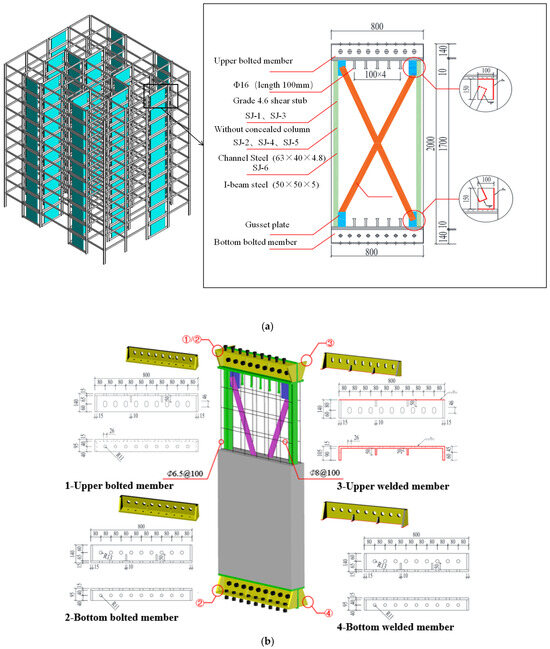
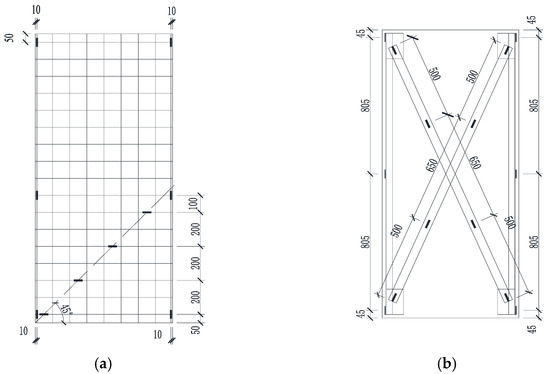
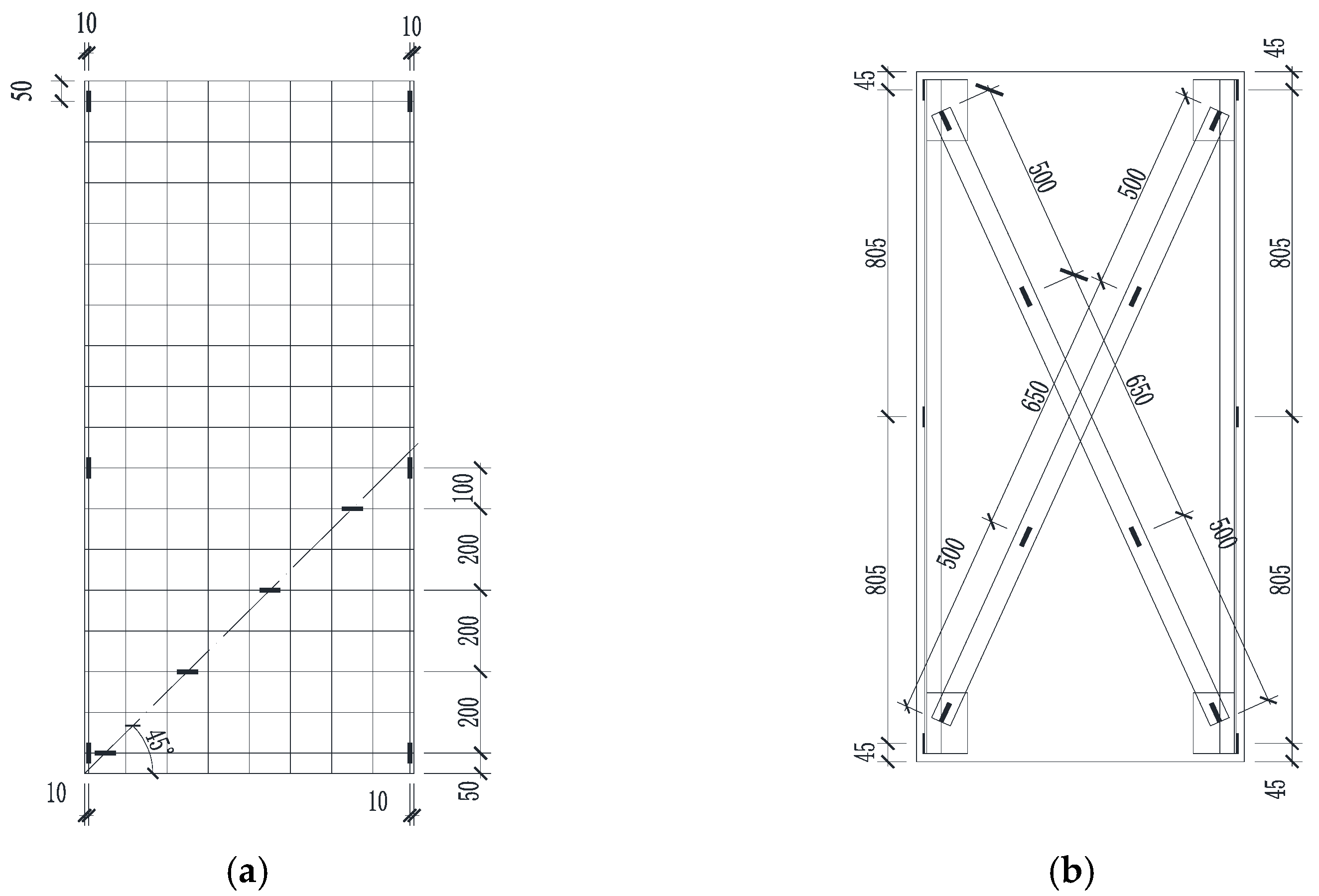
With reference to common engineering examples, the height of the prefabricated wallboard is set as 2000 mm, steel supports are made of steel plates with width of 50 mm and thickness of 10 mm, the section specifications of hidden columns are [63 × 40 × 4.8, I50 × 50 × 5], respectively, and double-layer bidirectional structural steel mesh is set in the slab. The 5 or 9 Φ 16 shear bolts of 4.6 grade with length and spacing of 100 mm are set according to different shear span ratio. In order to quickly and accurately position and install the prefabricated wallboard, we welded a vertical positioning welding piece with the same length as the width of wallboard at the upper beam and the lower beam, respectively. After the wallboard is installed and positioned, we use 12.9-grade M24 bolts to connect the connecting angle steel, embedded T-piece, and vertical positioning welding plate. At the same time, the connecting angle steel and loading frame beam are connected by 12.9 grade M20 bolts, among which the upper T-shaped piece and angle steel connecting bolt hole have an oblong hole structure (test piece SJ-5 shall have an ordinary round hole), and the lower part shall have an ordinary round hole. Long Round Holes (SJ-1 to SJ-4, SJ-6): this design intends to reduce the vertical load from the beam and aims to ensure that this new type of wall is used solely to resist shear forces in the horizontal direction, this thereby avoids exposing the bolts to complex multi-directional shear forces. The elongated hole design also accommodates easier wall installation.
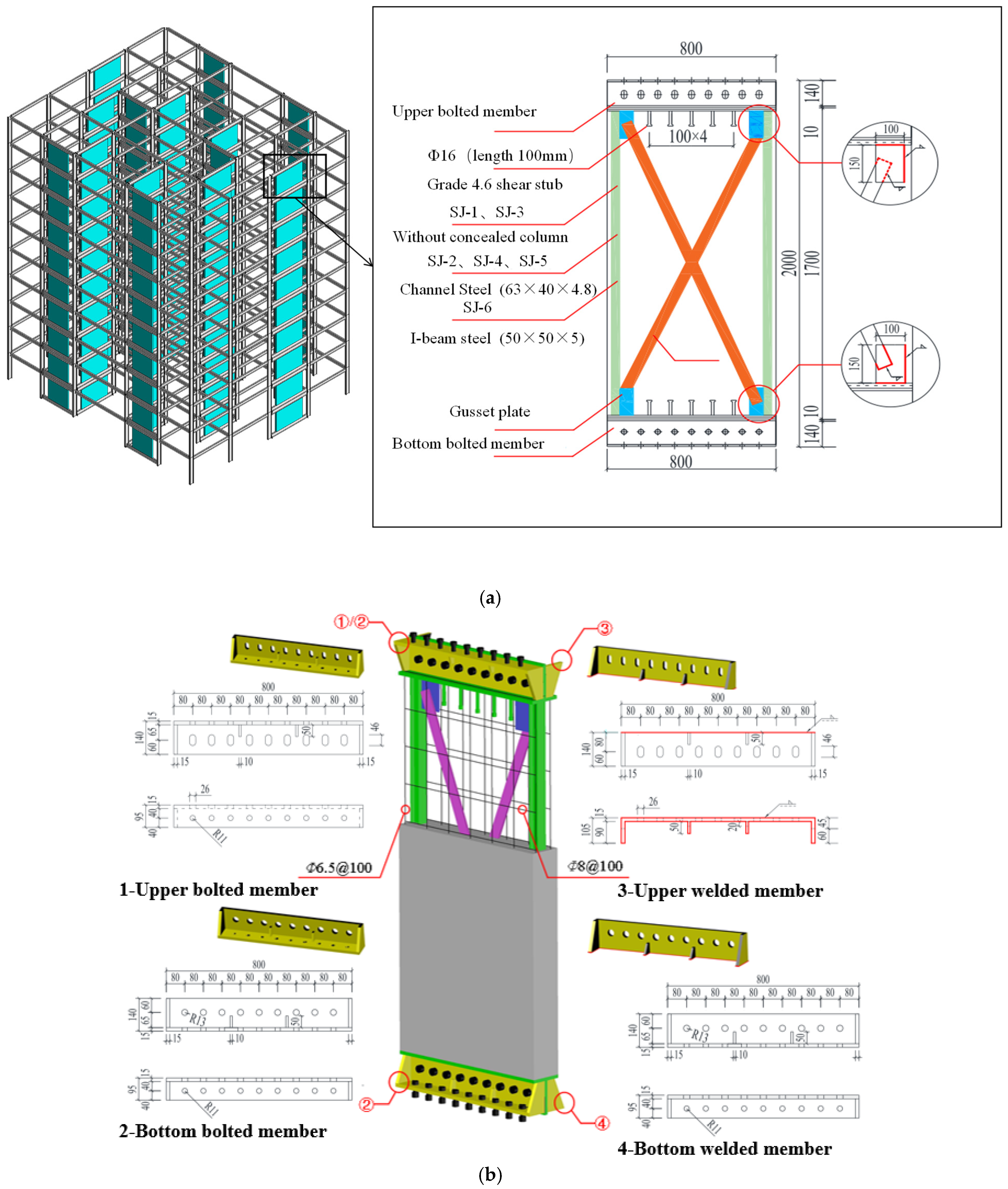
The node plate size of each test piece, the weldment, and the arrangement mode of connecting angle steel openings shall be consistent. The model is made by BIM Revit software (version 2024.2), which realizes the three-dimensional layout of the structure and improves the efficiency of model establishment and collision inspection in practical engineering; the detailed structure is shown in Figure 1.
Figure 1.
Configurations of the designed models. (a) Wall panel from 3D structural layout created with Revit software (version 2024.2); (b) structural dimensions and configuration of test specimens.
In order to reduce the overall weight of the wallboard, non-sintered fly ash ceramsite is used instead of traditional coarse aggregate, and the proportion design of C10 ceramsite concrete is carried out by the bulk density method. The whole test process was adapted twice, and finally the ceramsite concrete proportion scheme was formed, as shown in Table 2.
Table 2.
Material components of concrete.
Q345 steel was be selected for steel support and for the concealed column in the specimen, and the concrete strength inspection and evaluation standard was adopted according to the specifications (GB50107-2010) [22]. Material property test analysis is carried out on key parts of the prefabricated wall panels; the mechanical properties of concrete are obtained as shown in Table 3 and the mechanical properties of steel bars and steel plates are shown in Table 4.
Table 3.
Mechanical properties of concrete.
Table 4.
Mechanical properties of steel bars and plates.
2.2. Loading Scheme and Measuring Point Arrangement
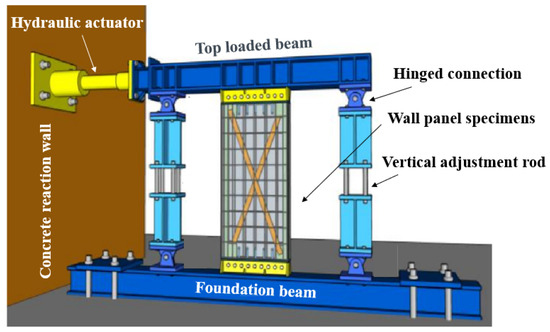
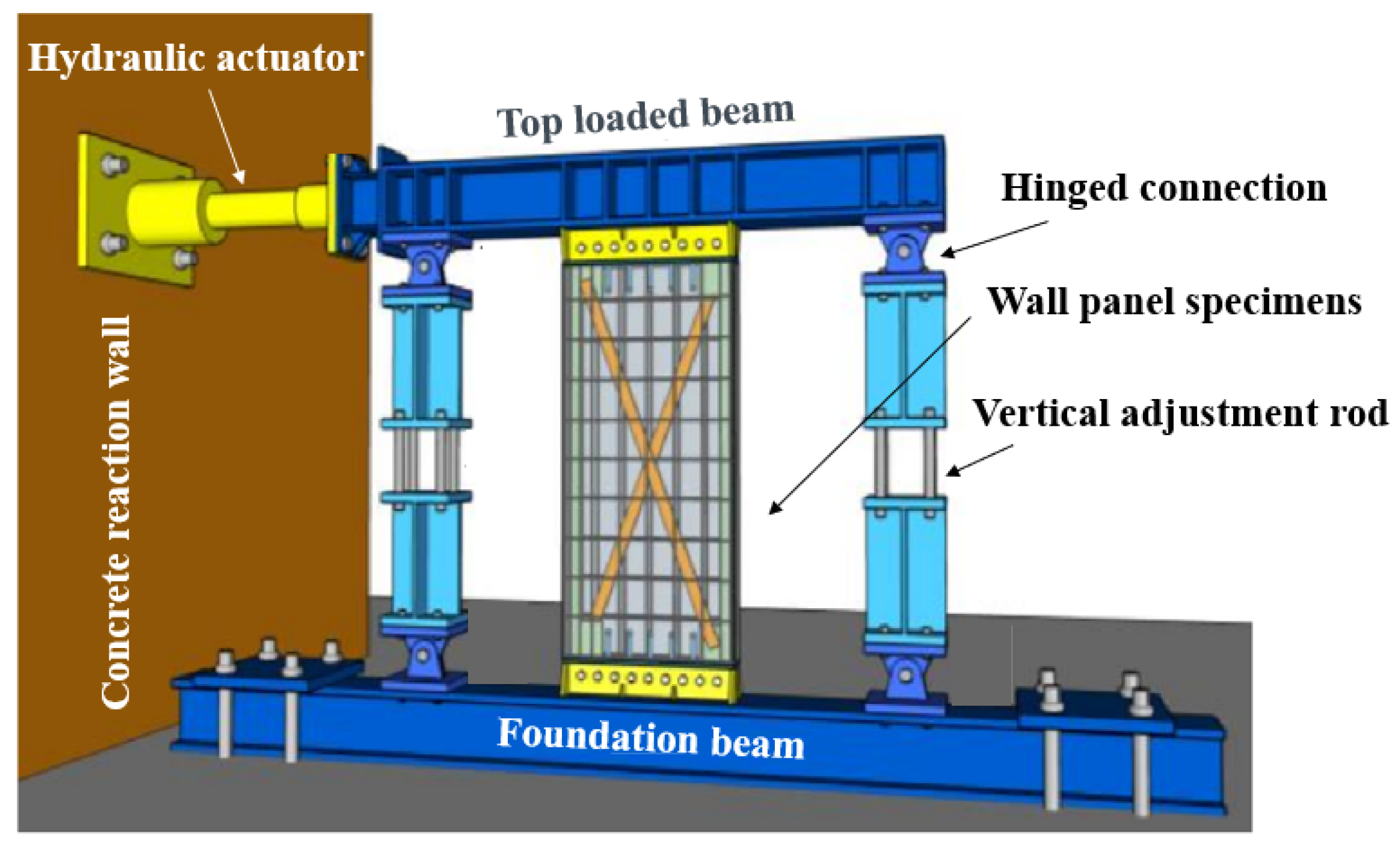
This test was conducted at the State Key Laboratory of Subtropical Building Science, South China University of Technology. The specimens and loading devices were installed on-site, as shown in Figure 2. To evaluate the shear performance of the precast wall panels and their connection performance with the steel frame, a shear loading method was adopted in this test. Reciprocating horizontal shear force was provided by the MTS hydraulic actuator on the left side. To ensure the smooth transfer of shear force to the wall, a loading frame was designed with four hinged joints—these joints not only guaranteed the transfer of horizontal shear force to the precast wall panels but also restricted the rigid-body rotation and vertical displacement of the wall panels. Vertical adjustment rods were added to the vertical parts of the four-hinged frame to facilitate the installation of specimens with different configurations. The upper horizontal beam was connected to the horizontal MTS to transmit horizontal shear force, while the lower horizontal beam served as the foundation beam.
Figure 2.
Test setup.
Considering the difference between the positive and negative sides in the wallboard test, in order to record and describe the failure of the specimen, the side of the wallboard close to the loading section is the west side, and the side far away from the loading section is the east side. The horizontal displacement of the top of the precast wall panel is measured by placing a horizontal displacement meter on the upper east side of the precast wall panel. At the same time, one-way strain gages are arranged on the steel skeleton and reinforcement to monitor the deformation of key parts of the prefabricated wall panels, and their positions are shown in Figure 3a,b.
Figure 3.
Arrangement of strain and LVDT gauges. (a) Arrangement of strain measurement points; (b) arrangement of strain measurement points in steel skeleton.
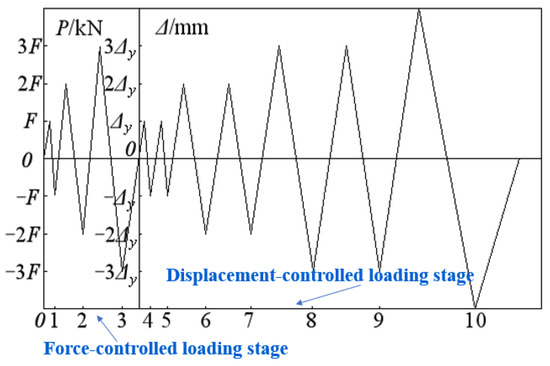
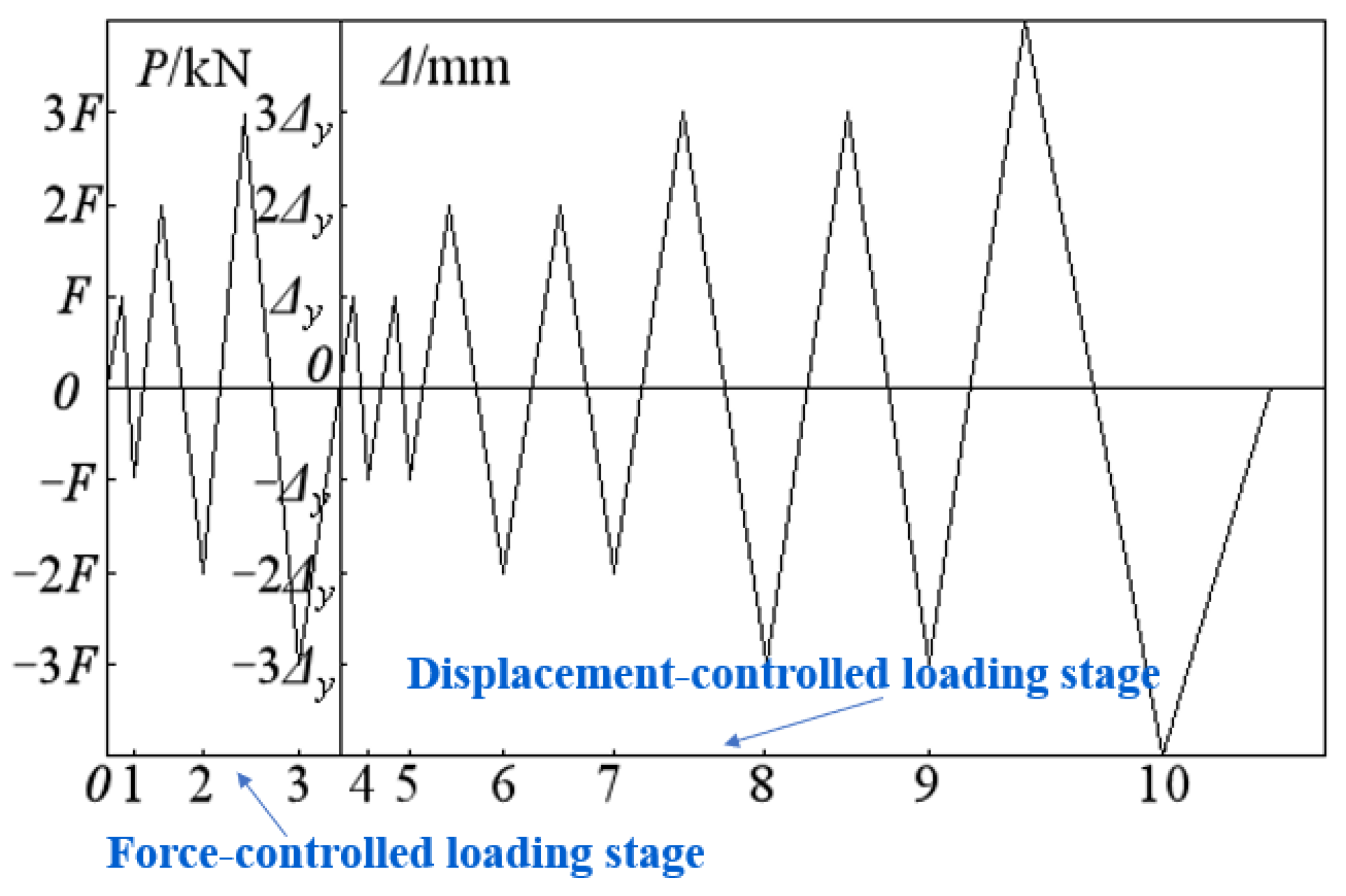
According to the Code for Seismic Test of Buildings (JGJ/T 101-2015) [23], horizontal force and displacement mixed control loading mode is adopted. The loading process can be divided into two stages: in the first stage, the horizontal force control is used to carry out low-cycle reciprocating loading (one load cycle per stage) before the concrete cracks occur, and the load is transferred to the second stage; in the second stage, the displacement control is used to load (two load cycles per stage displacement), and the concrete cracking displacement Δy is taken as the incremental step until the bearing capacity of the specimen decreases to 85% of the peak load. The test loading regime is shown in Figure 4.
Figure 4.
Load curves of cyclic loading.
3. Test Results and Analysis
3.1. Experimental Phenomena
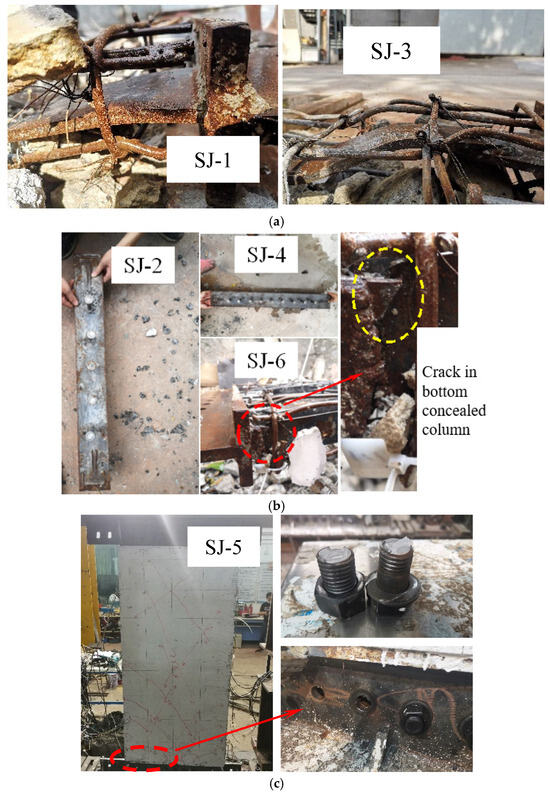
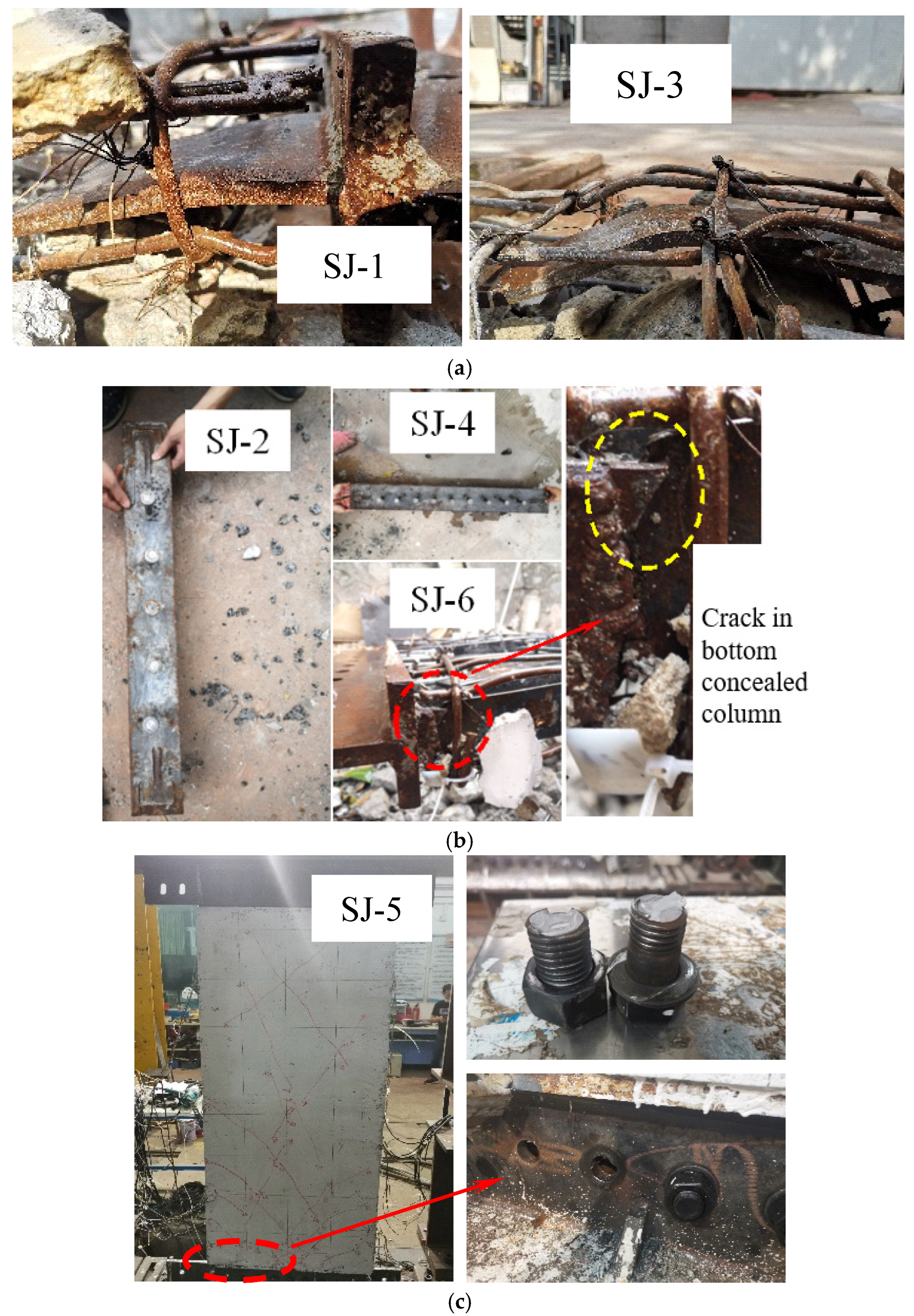
When the test load reaches 2Δy, only the specimens SJ-2 and SJ-4 begin to crack along the steel support direction; when the load reaches 4Δy, the other specimens appear to show inclined cracks along the steel support direction; with the increase in the test load displacement, the load is finally stopped because the bearing capacity of the specimen decreases greatly or connection failure occurs. Three failure modes were observed: buckling of the steel brace, fracture of the steel brace and lower connection of the concealed column, and shear failure of the high-strength bolt.
- (1)
- Buckling failure of steel brace (specimen SJ-1 and SJ-3): the concrete at the foot of the west side is crushed first and exits from work. With the increase in test load displacement, the concrete spalls at the bottom in a large area. The external constraint of the steel brace by concrete is gradually reduced, resulting in the gradual increase in out-of-plane deformation. Finally, the specimen fails due to buckling of the steel brace, as shown in Figure 5a.Figure 5. Failure modes of the specimens. (a) Steel brace buckling; (b) failure of steel bracing and lower connection in concealed column; (c) high-strength bolt shear failure.
- (2)
- Fracture of steel support and lower connection of hidden column (specimen SJ-2, SJ-4 and SJ-6): cracks distributed symmetrically in the center gradually appear on both sides of the middle and lower parts of the specimen with increasing loading displacement, without penetrating cracks, and spalling of lower concrete occurs. Since deformation of the steel support is restricted by the hidden column, no obvious out-of-plane deformation occurs. The specimen finally fails due to the fracture of the lower connection of the steel support and hidden column, as shown in Figure 5b.
- (3)
- Shear failure of high-strength bolts (specimen SJ-5): when the upper part of the specimen is connected by angle steel with a circular hole structure, it is difficult to release the deformation of the wall during loading, and then a large vertical shear force is formed, which causes a connection failure due to the shearing of lower bolts before the formation of through cracks in the prefabricated wall panels, as shown in Figure 5c.
3.2. Hysteresis Curve
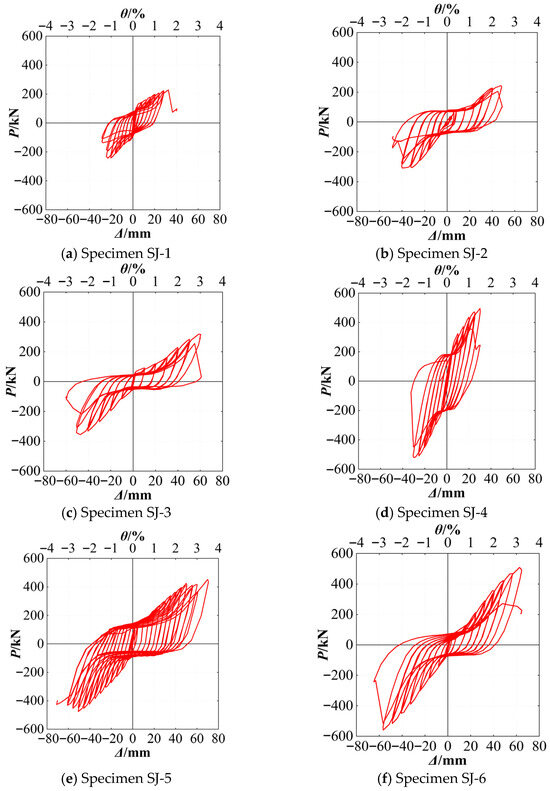
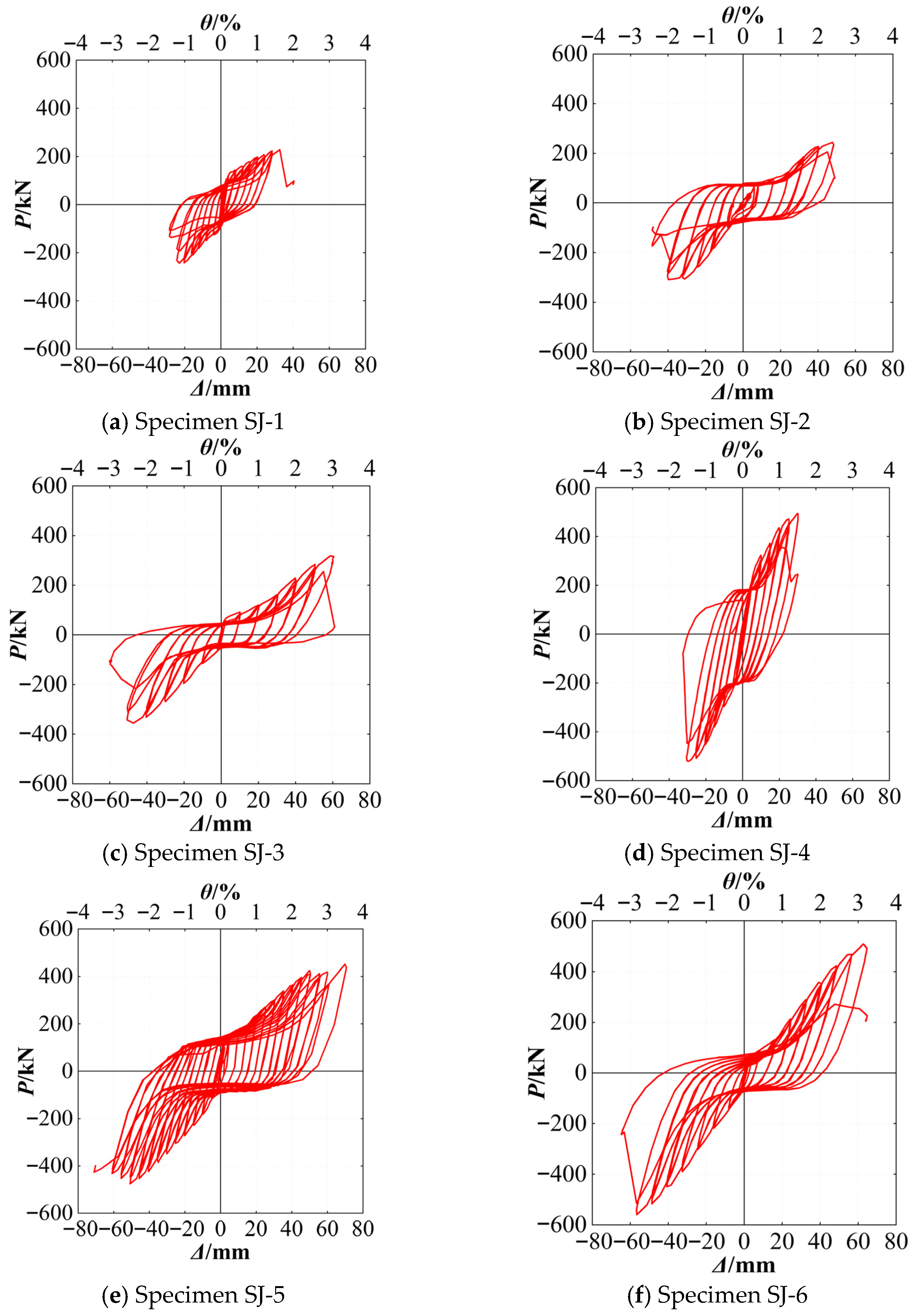
Take the thrust generated in the loading section as the positive loading direction and the tension as the negative loading direction, and the horizontal load–displacement (P-Δ) hysteresis curve of each specimen is shown in Figure 6. Before concrete cracking, hysteretic curves of each specimen basically present linear development. With the increase in force and displacement, cracks begin to appear, the hysteretic curve area gradually increases, the structure shows a certain energy dissipation capacity, and with the continuous development and crushing of concrete cracks, the hysteretic curve appears to show a pinch effect. The shear capacity of the precast wall panels rapidly adds up to less than 85% of the peak capacity due to buckling of the supports or fracture of the hidden columns. Among them, the shear capacity of the specimens without a concealed column (SJ-1 and SJ-3) will suddenly decrease to less than 100 kN when the support’s buckling occurs, and lose the ability to continue bearing. However, the specimens with concealed columns (SJ-2, SJ-4 and SJ-6) will still have a certain horizontal load although the shear capacity decreases to less than 85% of the peak capacity when the concealed column is broken or the lower connection weld is broken due to the incomplete spalling of concrete and the failure of the steel support. The specimen SJ-5 does not appear obvious in the descending section, mainly because its upper connecting angle steel adopts a circular hole structure, resulting in shear failure of the high-strength bolts. While the prefabricated wall plate itself does not appear through the cracks, it still has a bearing capacity.
Figure 6.
Hysteric loops of the cyclic tests.
3.3. Shear Capacity and Ductility Analysis
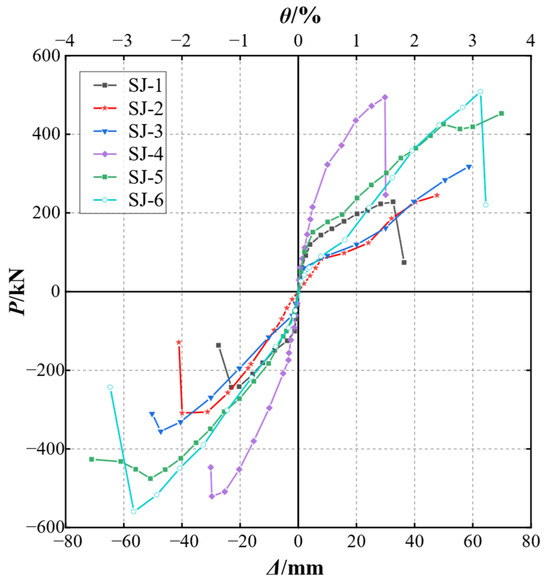
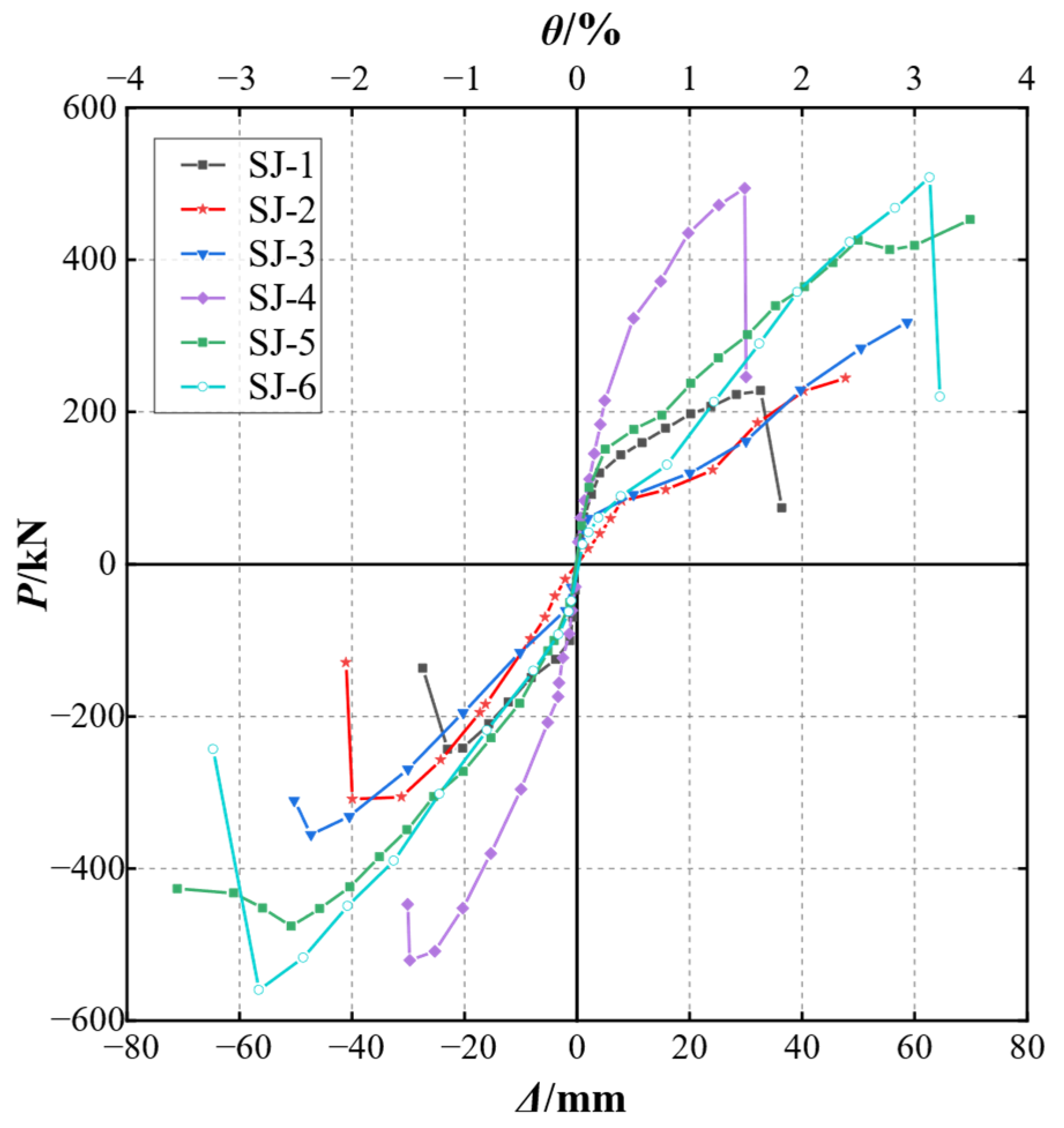
The skeleton curve of each specimen is shown in Figure 7. The yield displacement (Δy) was determined from the initial cycles following the equivalent energy method referenced in the literature [13]. First, the skeleton curves were extracted from the load–displacement hysteretic curves of the initial loading cycles. Then, the equivalent energy method was applied: the total energy under the skeleton curve from the origin to the peak load point was calculated, and the displacement corresponding to half of this total energy was identified as the yield displacement. The yield displacement Δy, yield load Py, peak displacement Δmax, peak load Pmax, limit displacement Δu, limit load Pu, and ductility coefficient μ of each specimen are obtained by the equivalent energy method, as shown in Table 5. The ductility coefficient of the specimen is the ratio of limit displacement to yield displacement.
Figure 7.
Skeleton curves.
Table 5.
Measured values at characteristic points of the skeleton curve.
It can be seen from the skeleton curves in Figure 7 and the calculation results of shear capacity in Table 5 that the initial stiffness of the specimens (SJ-3 to SJ-6) with concrete strength of C30 has little change; the initial stiffness of the specimens (SJ-1 and SJ-2) with concrete strength of C10 is less than that of the specimens with concrete strength of C30. By comparing the specimen SJ-4 with SJ-5, it is found that the peak displacement decreases to about 1/2 of the original value, but the peak load increases by 16% when the shear span ratio decreases and the wall thickness increases. The peak bearing capacity of the specimen is obviously increased by the concealed column, and the maximum is 57%. The shear capacity of precast wall panels without hidden columns decreases greatly. The peak displacements of all specimens are greater than 1% of the inter-story displacement angle, which meets the requirement of the displacement limit (1/250) of multi-story and high-rise steel structures in China.
3.4. Strain Analysis
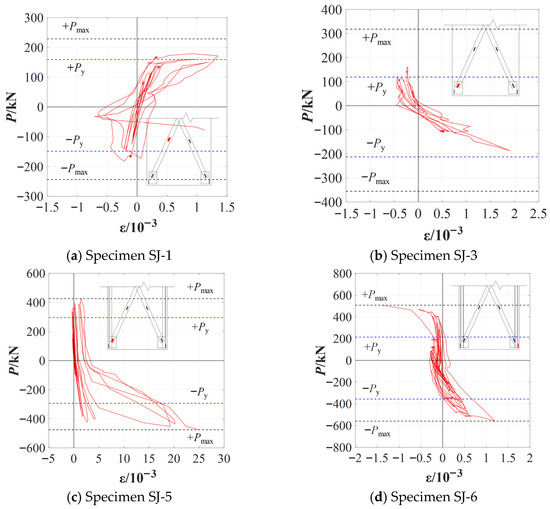
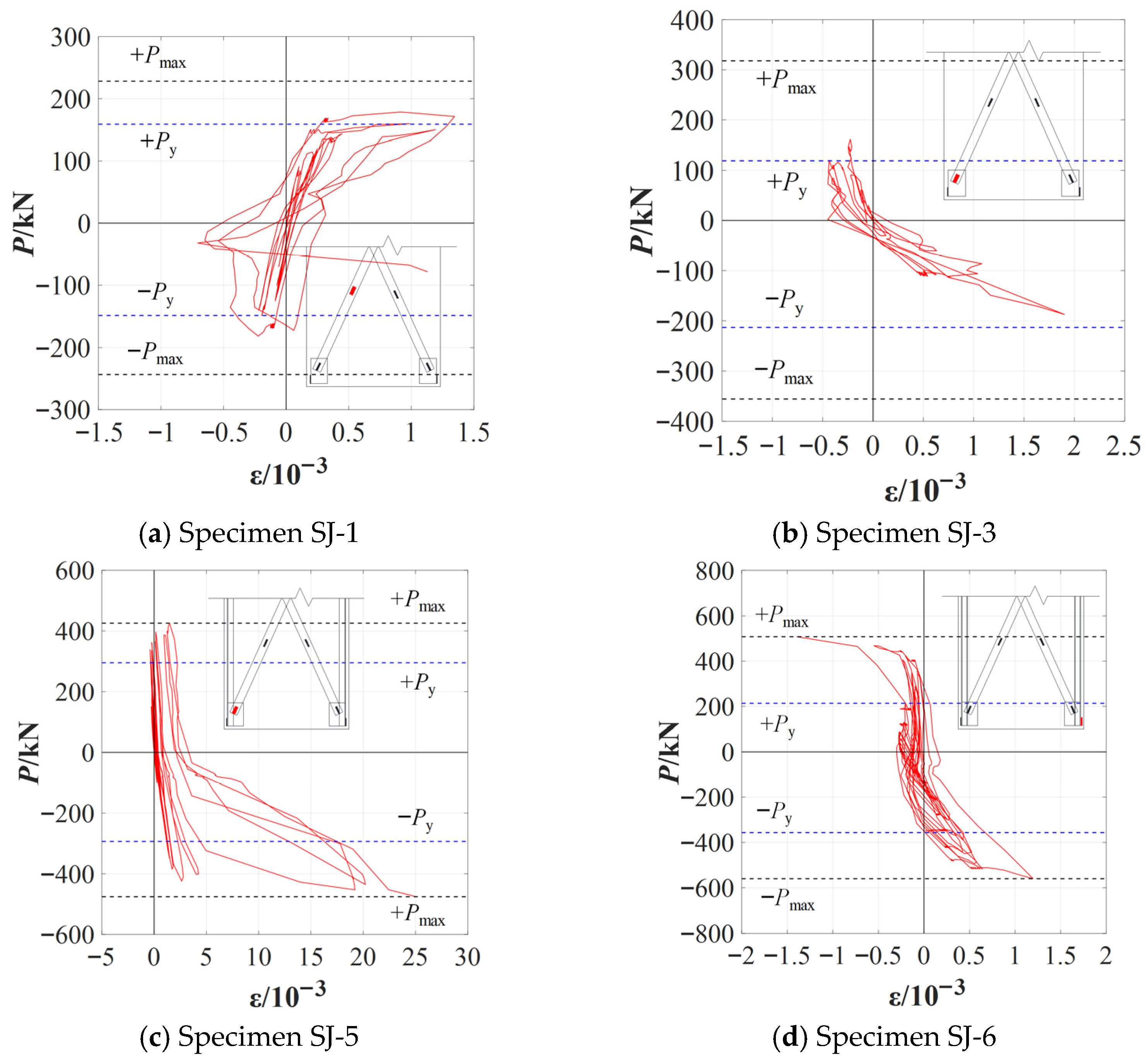
In this paper, the load-bearing mechanism of precast wall panels with different structures is clarified through the strain of key parts and different failure modes of each specimen. We selected the strain of lower steel support on the west sides of test pieces SJ-1, SJ-3, and SJ-5 and the strain of the lower hidden column on the east side of SJ-6 for analysis, corresponding to the hysteresis curve of horizontal load–strain (P-ε), as shown in Figure 8.
Figure 8.
Curves of lateral load versus strain.
- (1)
- According to Figure 8a,b, the steel brace is in its elastic stage before reaching the yield load without a hidden column specimen, and its hysteretic curve basically develops linearly, but completely opposite deformation occurs in the middle and lower parts, indicating that the steel brace and lower gusset plate mainly undergo compression–shear deformation, and the gusset plate’s deformation is prior to that of the steel brace; after the specimen reaches the yield load, the joint between the steel brace and gusset plate has yielded, and the middle part of steel brace enters the yield state with the gradual increase in force and displacement, which is consistent with the buckling failure phenomenon of the steel brace at the foot when specimens SJ-1 and SJ-3 fail.
- (2)
- It can be seen from Figure 8c,d that the horizontal load–strain hysteretic curve of the lower hidden column on the east side and the lower steel support on the west side basically develops linearly before the yield load is reached, indicating that it is in the elastic stage; with the test loading to the peak load stage, the deformation of the steel support and hidden column increases continuously and enters the plastic stage. When the welding strength of the lower part of the specimen is insufficient, the lower connection will break, indicating that it should be locally strengthened compared to the traditional welding design.
- (3)
- By comparing Figure 8b,c, it can be seen that when the specimen is provided with a hidden column structure, it will restrict the steel support and lower connection, it will still be in the elastic stage before the specimen reaches the peak load stage, and it has a certain bearing capacity; however, if the specimen is not provided with a hidden column structure, it will lead to premature buckling deformation of the steel support and gusset plate, resulting in a reduction in the shear capacity of prefabricated wall panel.
3.5. Energy Consumption Capacity
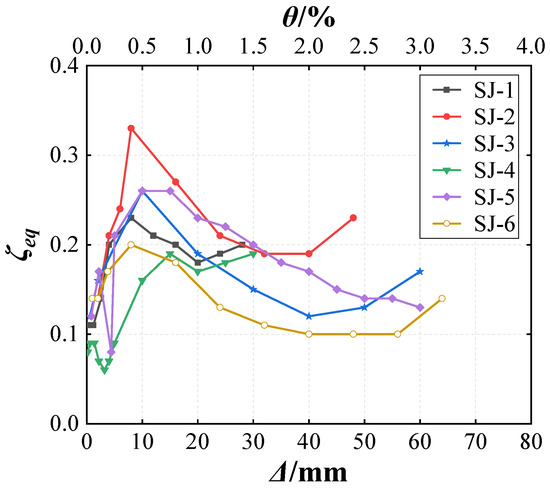
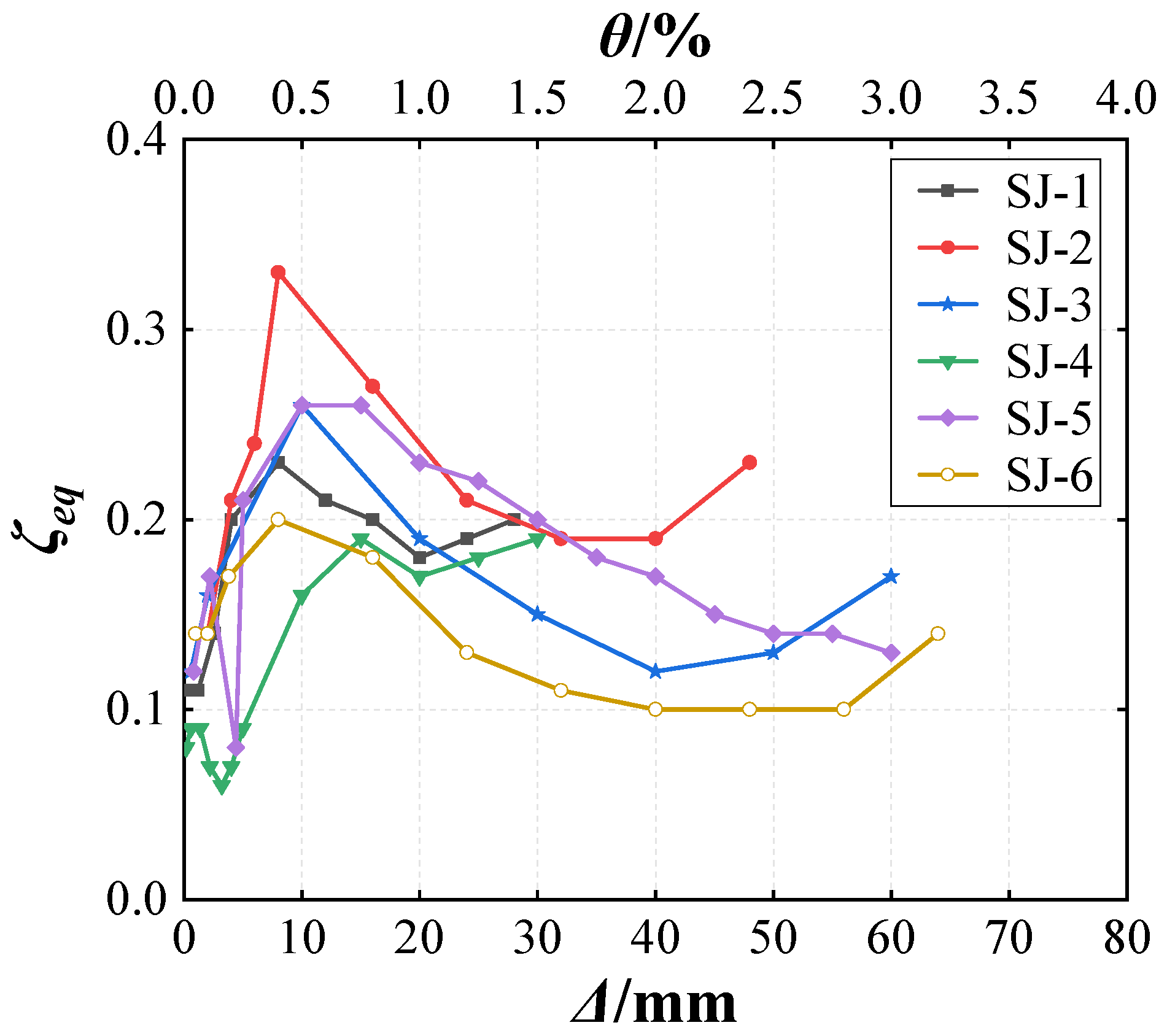
Refer to the Code for Seismic Test of Buildings (JGJ/T 101-2015) [23] and take the equivalent damping coefficient ζeq, under the cyclic load of each level as the reference index. The calculation results are shown in Figure 9. The equivalent damping coefficients of specimens SJ-1 and SJ-2 (prefabricated ceramsite concrete wall panels) are greater than 0.2, and the maximum is 0.23. The equivalent damping coefficients of specimens SJ-3 to SJ-6 (prefabricated commercial concrete wall panels) are between 0.14 and 0.17. The results show that the energy dissipation performance of prefabricated wall panels made of ceramsite concrete is better. Compared with the equivalent damping coefficient of the RC wall plate (0.082–0.115) in reference [1] and equivalent damping coefficient of a steel plate shear wall (0.272–0.287) in reference [14], the precast wall plate with concealed bracings proposed in this paper is in the middle, and the precast ceramsite concrete wall plate is close to the steel plate shear wall plate, which indicates that the specimen designed in this paper has good energy dissipation performance.
Figure 9.
Equivalent damping coefficient curves of specimens.
4. Finite Element Analysis
4.1. Establishment of Finite Element Model and Verification of Results
ABAQUS software (version 6.10) is used to establish a refined finite element model of the precast wall panels and analyze the internal force variation in the main components at different stages. In the model, the T3D2 element is used to simulate the structural reinforcement and the C3DR8 element is used to model the other members. The nonlinear shear response was simulated using the Concrete Damaged Plasticity (CDP) model in ABAQUS. Commercial concrete (C30) followed GB50010-2012 [24], with defined compression hardening/tension softening. Ceramsite concrete (C10) had lower fracture energy, leading to brittle cracking. Reinforcement used a kinematic hardening model to capture cyclic pinching [15,16] and the constitutive model in Reference [17] is adopted for Q345 steel, high-strength bolts, and the HPB300 steel bar. Geometric nonlinearity (NLGEOM) and initial imperfections were included in ABAQUS to simulate brace buckling.
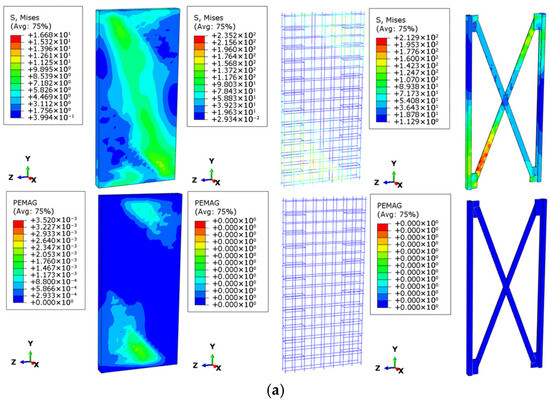
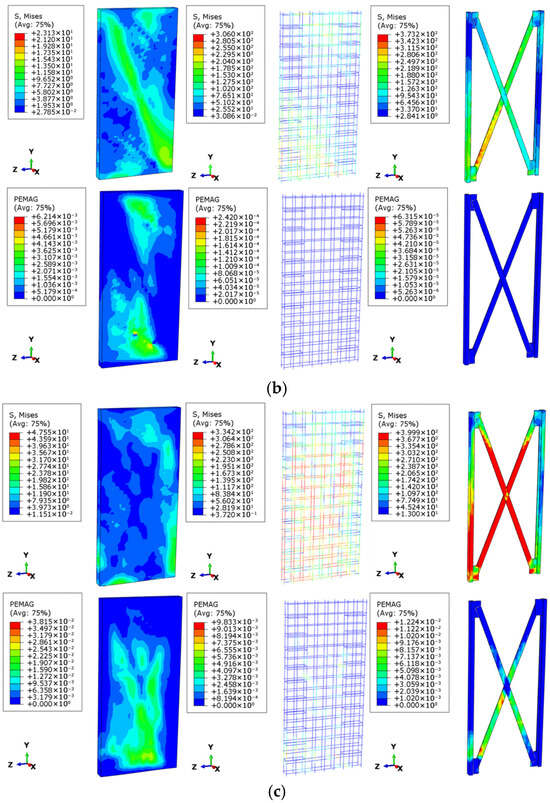
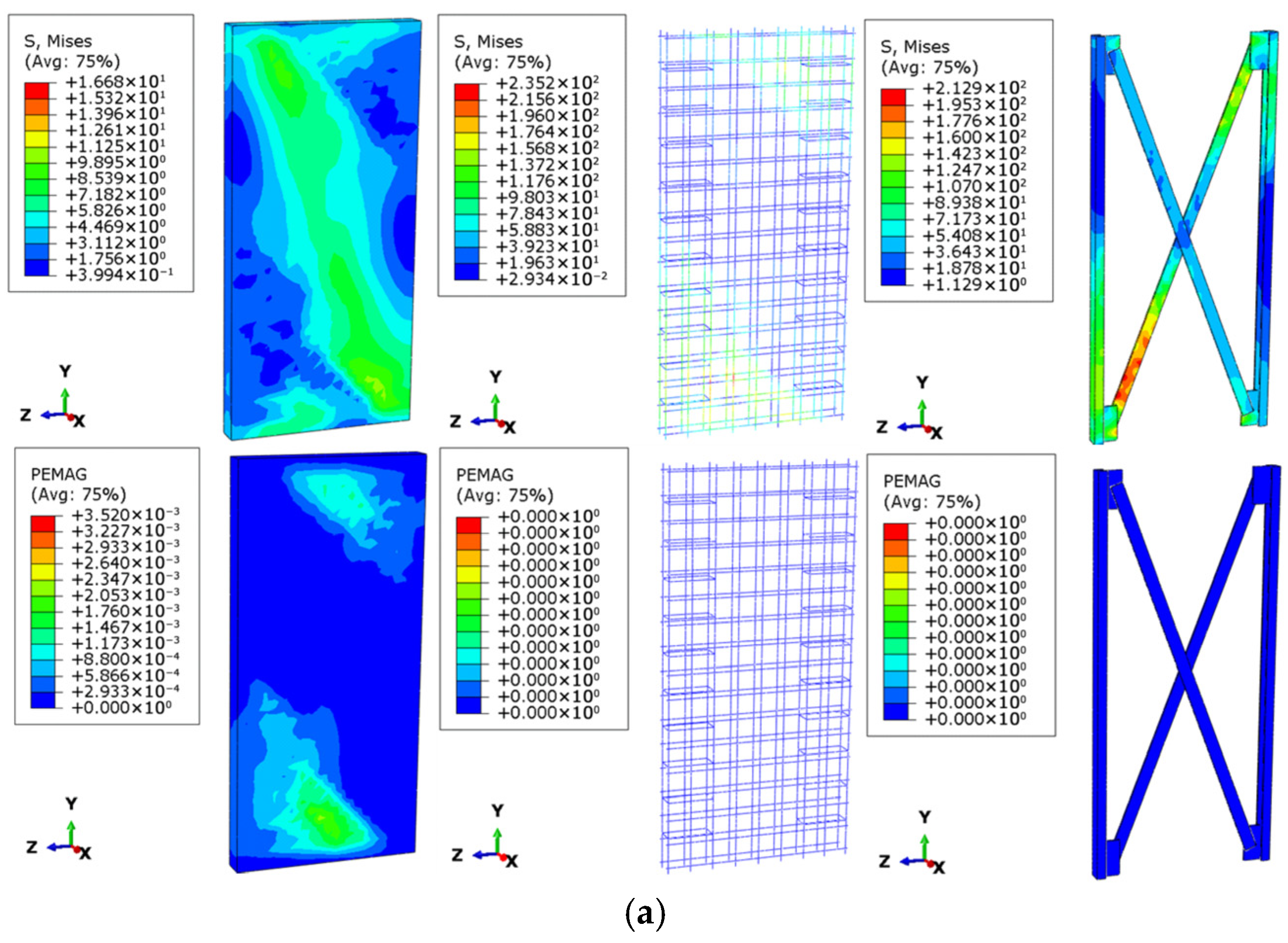
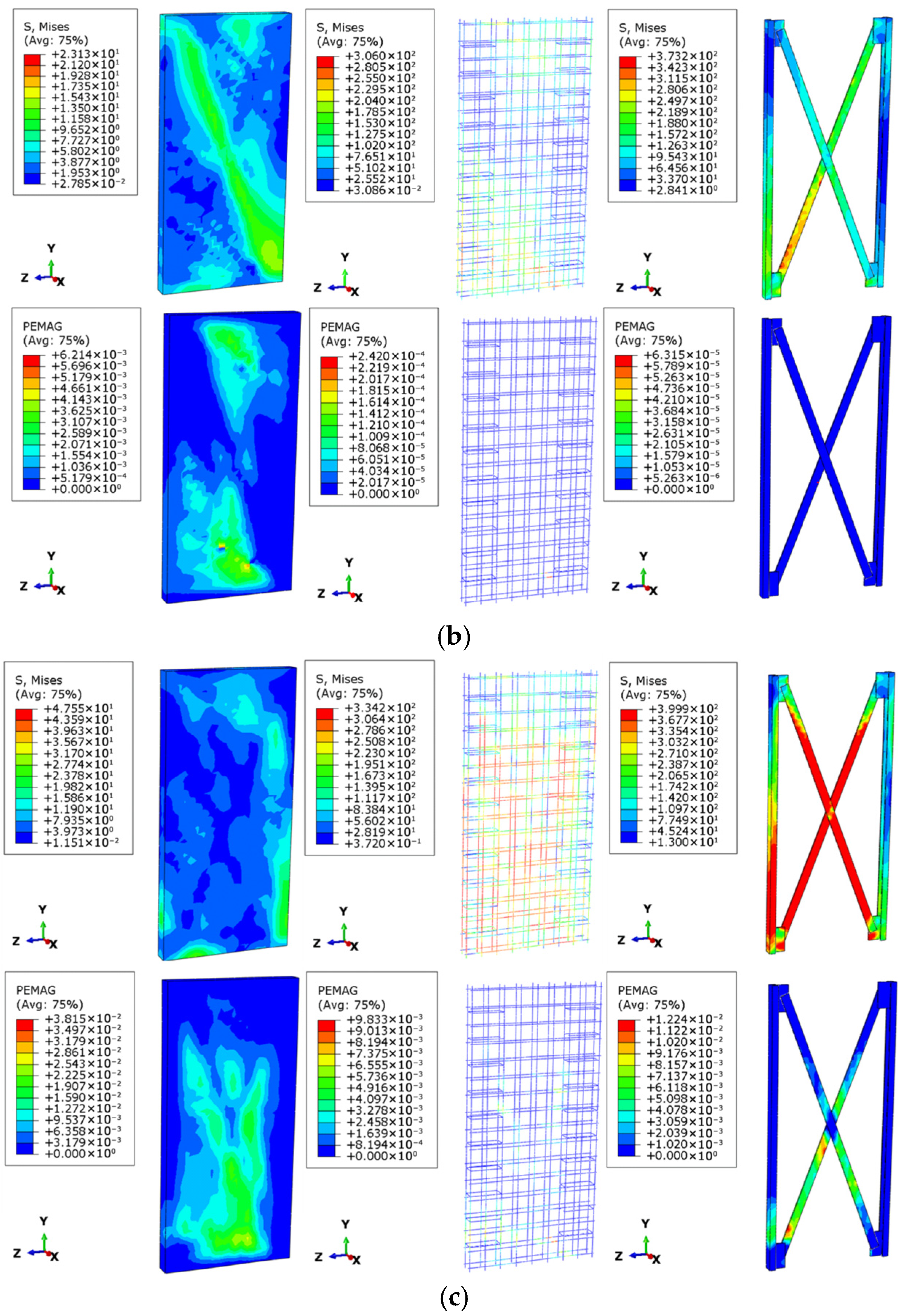
In this paper, the accuracy of the finite element model is verified by analyzing the stress and plastic strain development of the specimens at different stages and comparing them with experimental results. Take specimen SJ-6 as an example, the plastic strain of each component at different stages is shown in Figure 10. From the beginning of loading to the cracking displacement stage of concrete, the steel mesh and embedded steel skeleton are in the elastic stage, and the concrete part first produces cracks at the west foot; in the yield stage, the plastic strain range of concrete expands, the cracks continue to expand, and the steel mesh and steel skeleton begin to produce plastic strain; as the loading displacement increases, the lower concrete is crushed out of work, and the steel skeleton, as the main load-bearing component, produces the maximum plastic strain at the west foot. According to the above analysis results and plastic development process of different components in Figure 10, it can be seen that the force transmission mechanism and failure process of each component of the finite element model are consistent with the test results.
Figure 10.
Stress and plastic strain cloud diagram of each component of the specimen SJ-7 in different stages. (a) Stress and plastic strain contour maps of structural components during concrete cracking stage; (b) stress and plastic strain contour maps of structural components during yielding stage; (c) stress and plastic strain contour maps of structural components during peak stage.
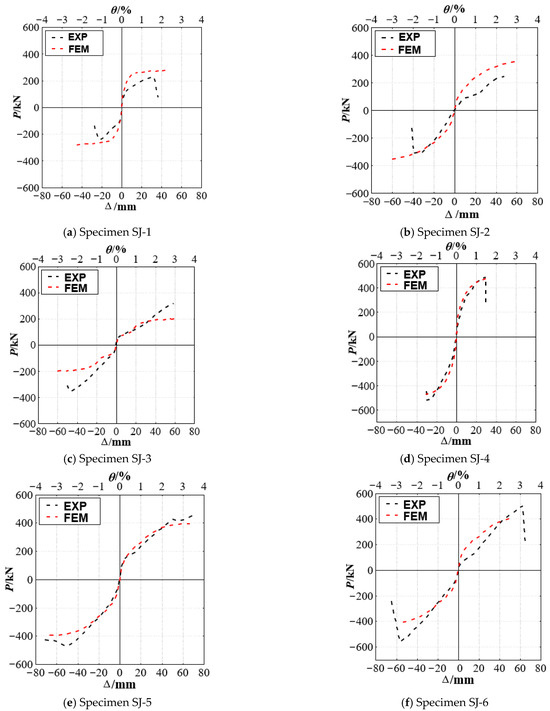
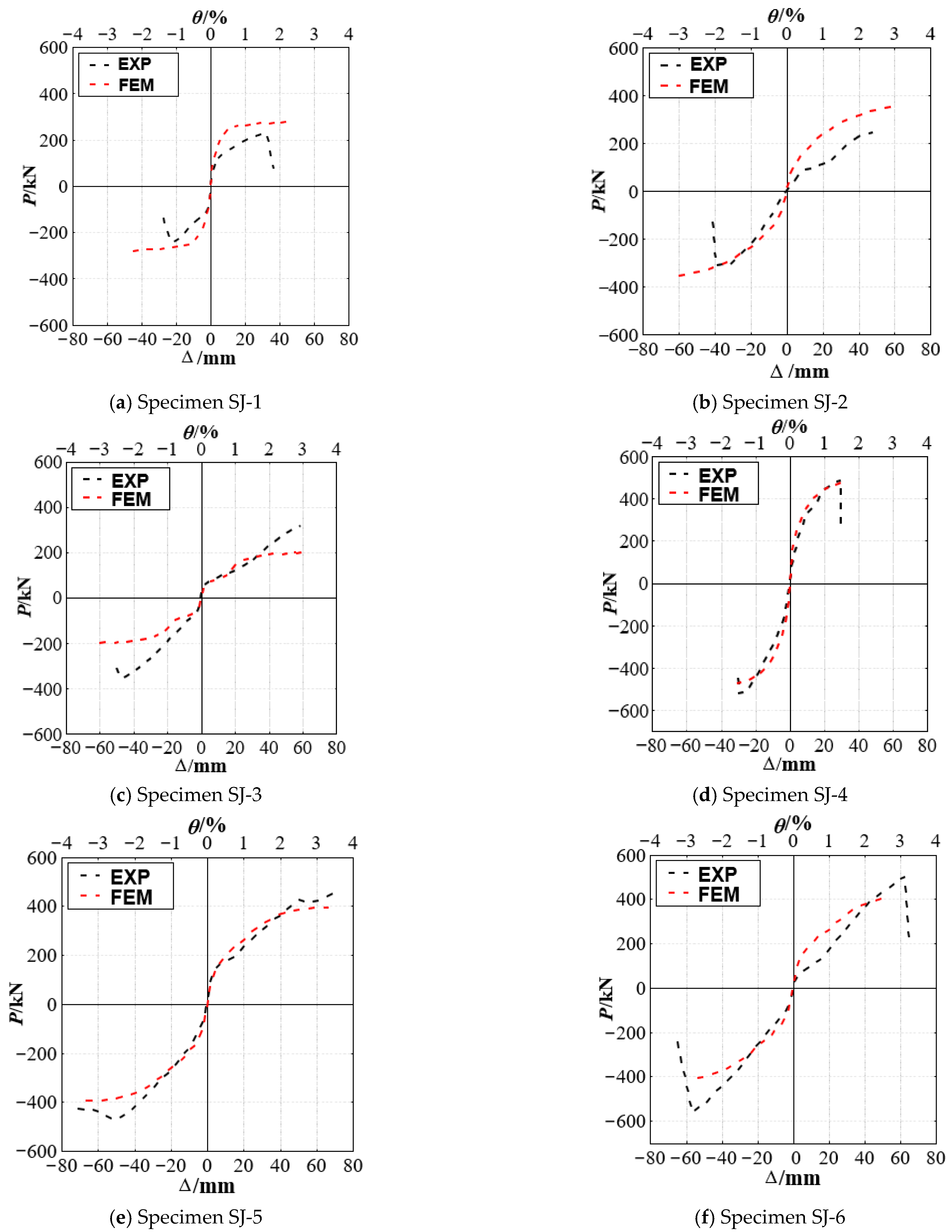
Figure 11 shows the comparative analysis results of the skeleton curves between the finite element simulation and the test measurement. It can be seen from the figure that the finite element simulation results of test pieces SJ-3 to SJ-6 are basically consistent with the test measurement values, which reflects the rigidity and strength of the variation law of the structure. The coefficient of determination (R2) for curve fitting or the root mean square error (RMSE) for load–displacement discrepancies is 0.83. The finite element simulation results of specimens SJ-1 and SJ-2 are larger than the experimental values, mainly due to the addition of foam in C10 ceramsite concrete, which makes the interface bond force between the steel skeleton and concrete weaker, while the finite element simulation directly adopts an “embedded” contact, which magnifies the interface bond force between the steel skeleton and concrete. Therefore, in order to ensure the accuracy of the subsequent finite element parametric study, the concrete part is analyzed with commercial concrete.
Figure 11.
Calibration on skeleton curves.
4.2. Parametric Analysis of Finite Element Models
In this paper, the specimen SJ-5 is taken as the basic model, and the concrete strength, steel brace thickness, and steel brace width are selected as the variable parameters to explore the influence of each parameter on the seismic performance of the wall panel. Among them, the parameters of the foundation model are C30 commercial concrete, the steel strength of the channel’s steel side column and embedded steel skeleton is Q345, the width of steel support is 50 mm and the thickness is 10 mm, and the upper angle steel of the wall plate is connected with the loading beam through the oblong hole structure.
4.2.1. Concrete Strength
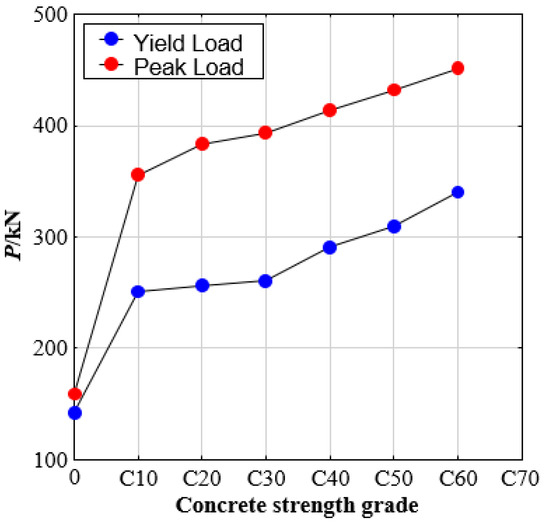
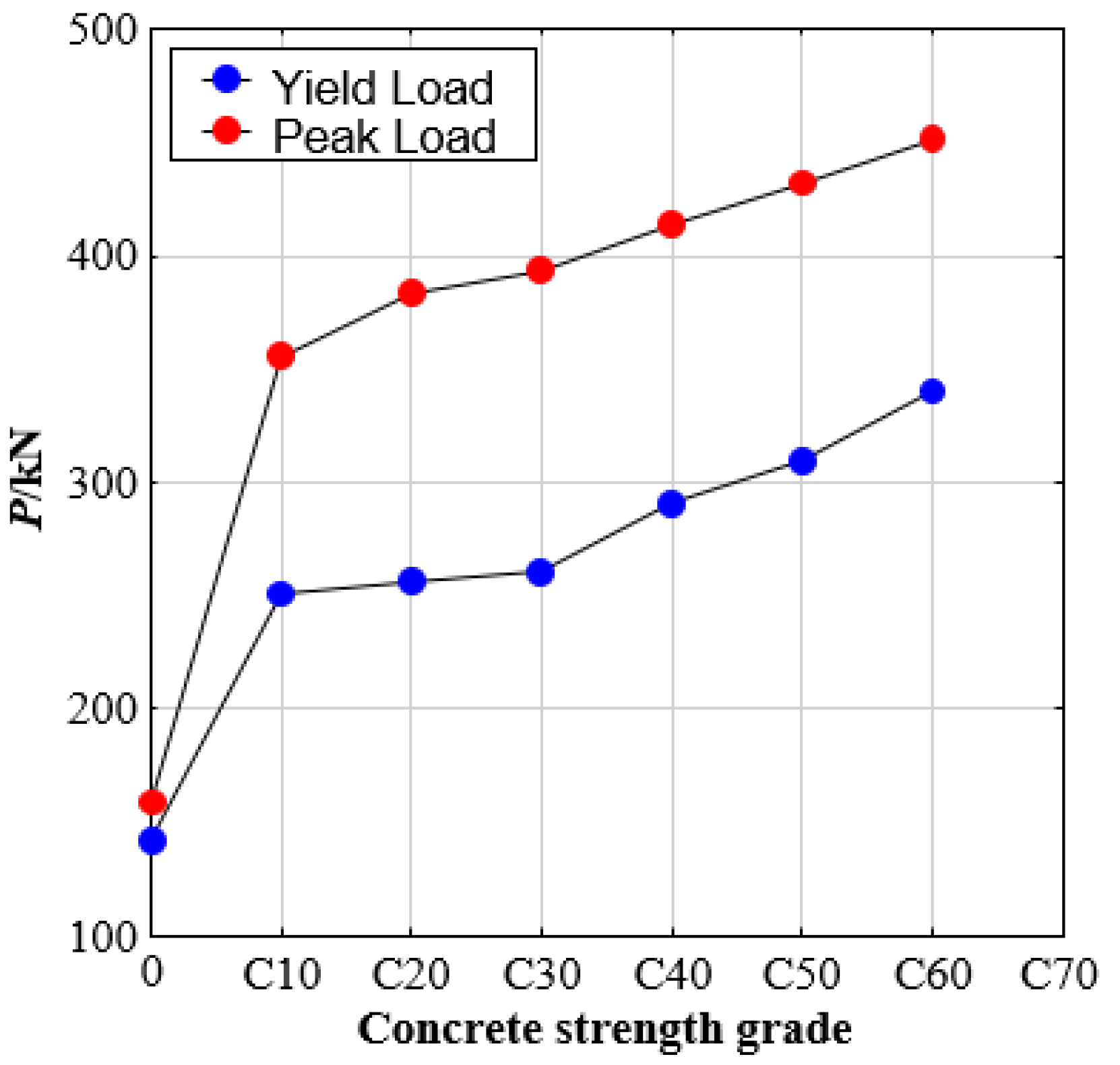
By changing the concrete material parameters in the finite element model, the variation law of yield load and peak load of the different specimens is obtained, as shown in Figure 12. When C10 commercial concrete is used, the shear capacity of the precast wall panel is 2.27 times higher than that of pure steel frame specimen, which indicates that the combination of concrete and the embedded steel frame can greatly improve the shear capacity of the precast wall panel. When the concrete strength changes from C10 to C30, the yield load of each grade of concrete specimen changes slightly (within 2%). When the concrete strength is above C40, the yield load of each grade of concrete increases by 11.6%, 7.2%, and 11.7%, respectively. For the peak load of each specimen, the variation range of concrete strength of each grade is about 5%. In order to fully show the load-bearing performance of the precast wall panels, it is suggested that concretes above grade C30 should be used in practical projects.
Figure 12.
Relationship between concrete strength and shear capacity.
4.2.2. Steel Support Plate Thickness
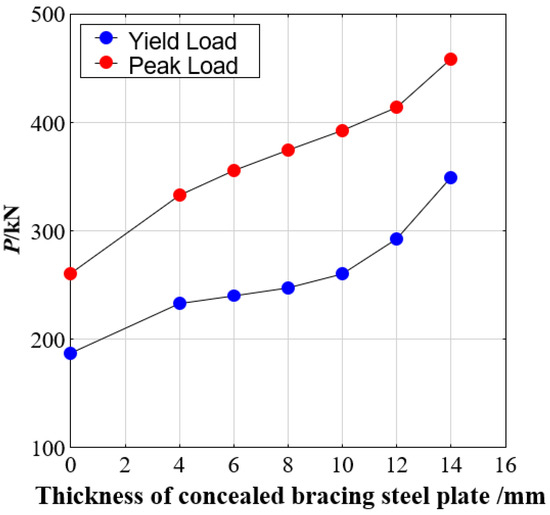
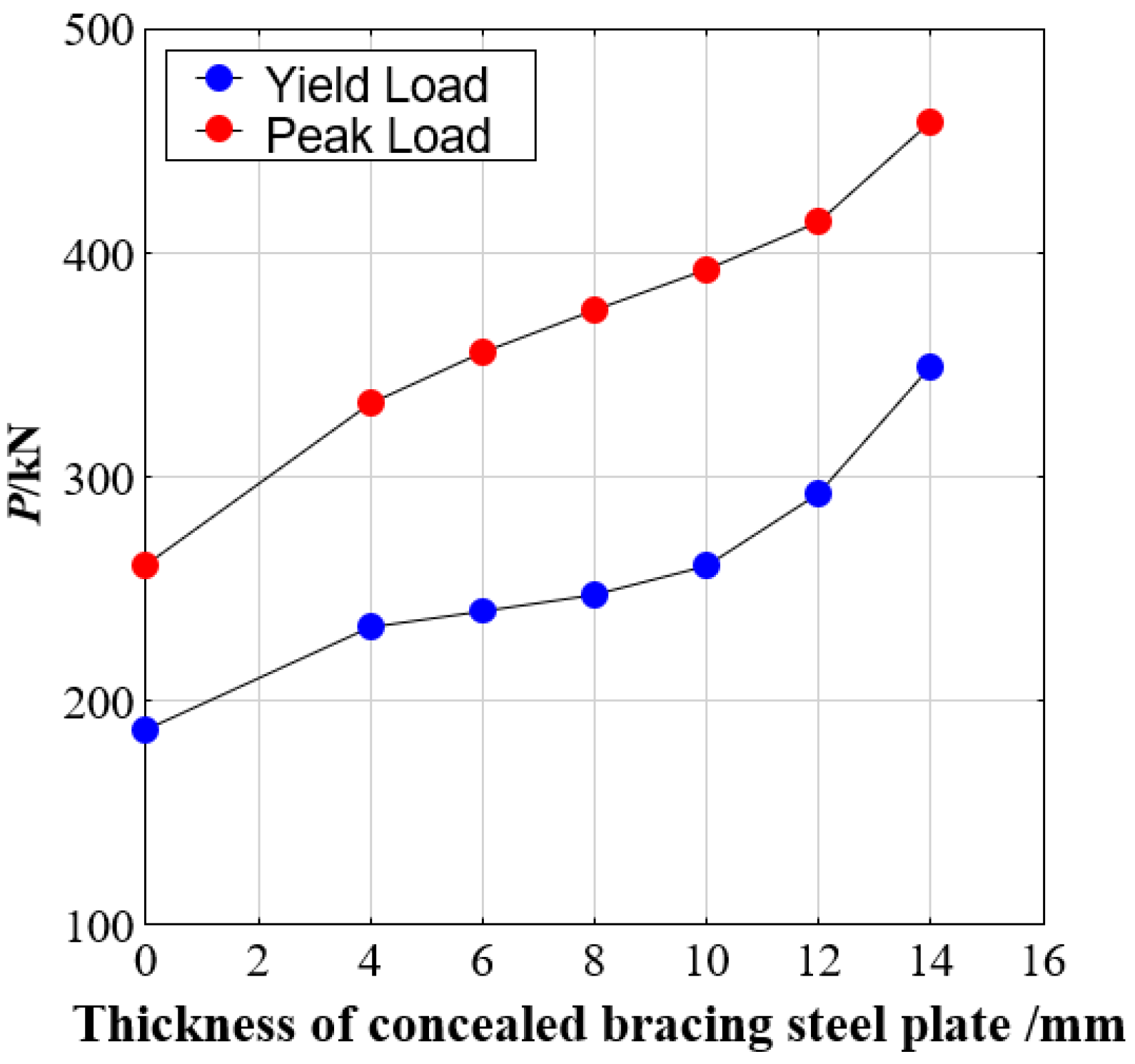
By changing the steel brace thickness parameter in the finite element model, the influence of the steel brace’s thickness parameter on the seismic performance of the prefabricated wall panels is clarified, and the variation law of the yield load and peak load of different specimens is obtained, as shown in Figure 13. When the thickness of the concealed braced steel plate is 4 mm, the yield load and peak load increase by a factor of 1.25 and 1.28, respectively, compared with plain concrete wall plates. In the yield stage, the thickness of the concealed support steel plate is 10 mm at the cut-off point. When the thickness is greater than 10 mm, the yield load of each step increases by more than 15%. When the thickness is less than 10 mm, the yield strength of each step increases by less than 5%. At the same time, the peak load of precast wall panels is increased by 5–10% with the increase in thickness of each stage of concealed bracing steel plates.
Figure 13.
Relationship between steel brace thickness and shear capacity.
4.2.3. Steel Support Plate Width
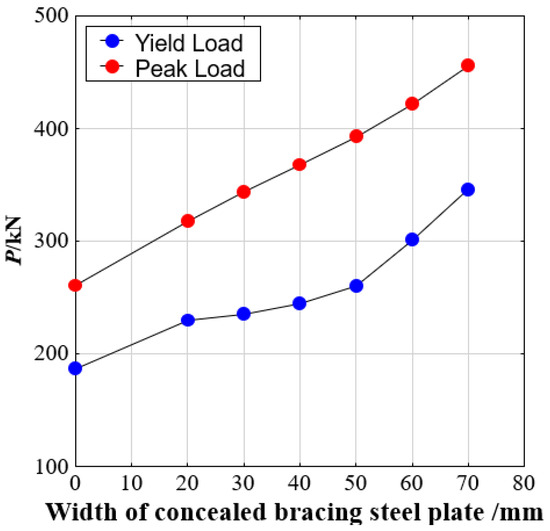
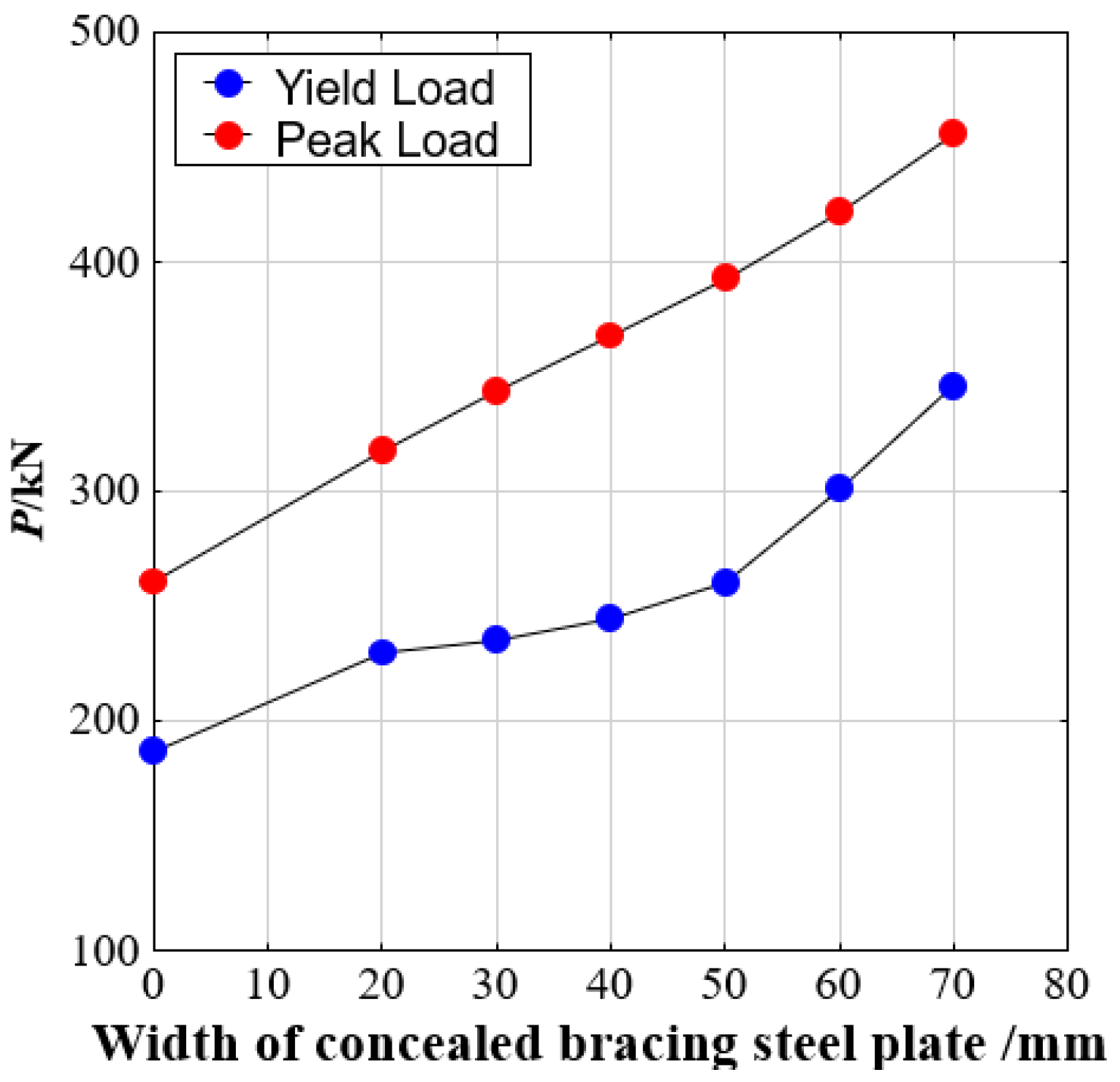
Based on the finite element simulation results of different steel support plate thicknesses, the yield load and peak load variation law of different specimens are obtained by changing the steel support’s width parameter under the condition of the same steel consumption, as shown in Figure 14. When the width of the concealed braced steel plate is larger than 50 mm, the yield load increases by more than 15%, but the peak shear capacity increases by about 5%. When the thickness and width of steel plate change, the effect of increasing the width of the steel plate on the shear capacity is more significant.
Figure 14.
Relationship between steel brace width and shear capacity.
5. Application of BIM Technology in the Design of Prefabricated Wall Panels
Introducing building information modeling (BIM) technology provided great benefits in the design and construction of precast wall panels with hidden steel bracings. Through the use of building information modeling (BIM), parametric modeling, collaborative workflow, and simulation, the experimental results of this study on various shear span ratios (λ), wall thicknesses (bw), and connection details can be effectively and efficiently integrated to meet the desired engineering practice.
A parametric BIM-built form was designed to automate the design iteration process, which included important variables identified in the experimental program (e.g., l = 0.8–1.6, bw = 120–180 mm, and C10/C30 concrete). The model provides a dynamic relationship between geometric parameters (e.g., steel brace dimensions and bolt hole configuration) and structural performance parameters, which allows for the rapid assessment of shear capacity and ductility (u) for a range of configurations. For example, the upper connections of oblong bolt holes with cyclic displacements (resulting displacements seen in SJ-1 to SJ-6) were optimized using kinematic simulations to ensure that the experimental tolerance requirements were met.
BIM-based clash detection identified spatial clashes between hidden bracings, shear bolts (Φ16), and connectors, which resulted in a reduction in fabrication issues. The coordination process verified the applicable range of the channel steel/I-beam side column (Table 1), with complete symbiosis with the steel frame. Also, the simulation of the installation process in 4D construction was carried out and the function of the vertical positioning plate and M24 high-strength bolts with respect to alignment accuracy was verified. Since these workflows precisely address the failure mechanisms known from cyclic tests (e.g., weld fractures at lower connections), reworking during on-site implementation has been reduced by 18–22%.
The material management modules in the BIM platform were used to automatically generate the quantities of ceramsite concrete steel: volume and steel reinforcement ratio, according to the material parameters in Table 3 and Table 4. Damping energy dissipation parameters (ζeq = 0.14–0.23) obtained from the hysteresis loops were implemented into the finite element simulation based building information modeling (BIM) tools for predicting the damping performance during the seismic loads. This hybrid solver improved computational time by 30% while still being consistent with experimental results.
This BIM framework was applied successfully in a case study on a 12-story steel structure, and it proved effective in striking a balance between seismic capacity (by means of optimized and hidden columns) and constructability. Lessons learned are the need for LOD 400 detailing for weld-critical joints and interoperability based on Industry Foundation Classes (IFCs) for steel brace buckling analysis. Future activities on machine learning-based BIM tools for further automation of the connection between detailing/tolerance management are envisaged.
This paper highlights how BIM facilitates the link between experimental knowledge (e.g., the peak enhancement of 57% for failing concealed columns) and efficient design practice, which should be pursued to efficiently employ high-performance prefabricated wall systems.
6. Conclusions
- (1)
- The failure modes of prefabricated wall panels with concealed bracings on both sides include buckling of steel bracings, fracture of the lower connections of steel bracings and concealed columns, and shear failure of high-strength bolts.
- (2)
- The equivalent viscous damping ratio (0.14–0.23) of precast wall panels with concealed bracings and two-side connections ranges between that of conventional reinforced concrete (RC), shear walls (0.082–0.115), and steel plate shear walls (SPSWs) (0.272–0.287), exhibiting excellent energy dissipation performance. Additionally, their peak displacements are all greater than 1%, which meet the limit requirements specified in the code, demonstrating favorable ductility characteristics.
- (3)
- Ceramsite concrete can enhance the energy dissipation capacity of prefabricated wall panels; setting hidden columns can effectively improve the bearing capacity of prefabricated wall panels and prevent buckling failure of steel supports.
- (4)
- A lower shear span ratio improves shear capacity, while wider (not thicker) braces optimize buckling resistance. Concrete with a strength ≥ C30 is cost-effective, and concealed columns are indispensable (increasing capacity by up to 57%). Parametric BIM integrated with FEA facilitates iterative design and clash detection, ensuring optimized performance and constructability.
- (5)
- This study provides a practical, optimized solution that bridges the gap between high seismic performance (through the concealed bracing/column system) and constructability (through BIM-integrated, beam-connected detailing), offering engineers a validated, efficient pathway for implementing high-performance prefabricated systems in steel structures.
Author Contributions
Conceptualization, Y.Z.; Data curation, Z.Y.; Funding acquisition, Z.Y.; Investigation, Z.Z.; Methodology, J.L.; Project administration, Z.Z.; Resources, J.L.; Software, Y.Z.; Supervision, P.W.; Validation, Z.Y.; Visualization J.L.; Writing—original draft, P.W.; Writing—review & editing, Y.Z. All authors have read and agreed to the published version of the manuscript.
Funding
This study was supported by The Science and Technology Plan of Guangzhou Municipal Construction Group ([2023]-KJ028) Key Project of Dongguan Social Development Science and Technology Project (20231800936112).
Data Availability Statement
The original contributions presented in this study are included in the article. Further inquiries can be directed to the corresponding author.
Conflicts of Interest
Authors Yongguo Zhong, Zejia Zhou and Jianzhong Lin were affiliated with the company Guangzhou Chengzong Design Co., Ltd. Authors Yongguo Zhong, Zejia Zhou, Zhimin Yu and Jianzhong Lin were affiliated with the company Guangzhou Construction Co., Ltd. The remaining author declares that the research was conducted in the absence of any commercial or financial relationships that could be construed as a potential conflict of interest.
References
- Fang, C.; Wang, W.; Qiu, C.; Hu, S.; MacRae, G.A.; Eatherton, M.R. Seismic resilient steel structures: A review of research, practice, challenges and opportunities. J. Constr. Steel Res. 2022, 191, 107172. [Google Scholar] [CrossRef] [Scilit]
- Longarini, N.; Crespi, P.; Zucca, M.; Scamardo, M. Numerical Evaluation of the Equivalent Damping Ratio Due to Dissipative Roof Structure in the Retrofit of Historical Churches. Appl. Sci. 2025, 15, 3286. [Google Scholar] [CrossRef] [Scilit]
- Bhandari, S.; Fischer, E.C.; Riggio, M.; Muszynski, L. Numerical assessment of In-plane behavior of multi-panel CLT shear walls for modular structures. Eng. Struct. 2023, 295, 116846. [Google Scholar] [CrossRef] [Scilit]
- Barbosa, A.R.; Rodrigues, L.G.; Sinha, A.; Higgins, C.; Zimmerman, R.B.; Breneman, S.; Pei, S.; van de Lindt, J.W.; Berman, J.; McDonnell, E. Shake-Table Experimental Testing and Performance of Topped and Untopped Cross-Laminated Timber Diaphragms. J. Struct. Eng. 2021, 147, 04021011. [Google Scholar] [CrossRef] [Scilit]
- Carrero, T.; Montaño, J.; Perez, L.; Doudak, G.; María, H.S.; Chacón, M.F.; Guindos, P. New enhanced hybrid glulam-framed OSB wall for tall timber buildings. Structures 2024, 70, 107770. [Google Scholar] [CrossRef] [Scilit]
- Chang, R.; Zhang, N.; Gu, Q. A Review on Mechanical and Structural Performances of Precast Concrete Buildings. Buildings 2023, 13, 1575. [Google Scholar] [CrossRef] [Scilit]
- Ciesielczyk, K.; Studziński, R. Experimental Investigation of the Failure Scenario of Various Connection Types between Thin-Walled Beam and Sandwich Panel. Materials 2022, 15, 6277. [Google Scholar] [CrossRef] [Scilit] [PubMed]
- Dai, C.; Hou, M.; Huang, M.; Yu, H. Investigation into the flexural performance of novel precast sandwich wall panels. Mater. Struct. 2024, 57, 221. [Google Scholar] [CrossRef] [Scilit]
- Lago, B.D.; Del Galdo, M.; Consiglio, A.N. Soft omega joint for selective weakening of core walls in large precast commercial buildings. Structures 2023, 53, 949–962. [Google Scholar] [CrossRef] [Scilit]
- Mei, C.; Zhang, Y.; Wang, D.; Wu, C.; Xu, Y. Parameter optimal investigation of modular prefabricated two-side connected buckling-restrained steel plate shear wall. Structures 2021, 29, 2028–2043. [Google Scholar] [CrossRef] [Scilit]
- Zhang, Y.; Cui, Y.; Zhang, D.; Liu, Z.; Li, Y. Cyclic performance of prefabricated buckling-restrained steel plate shear wall with two-side connections. J. Constr. Steel Res. 2025, 227, 109293. [Google Scholar] [CrossRef] [Scilit]
- Wang, K.; Tan, J.-K.; Wang, Y.-H.; Yu, Z.; Shen, Q.-W.; Yang, Y. Mechanical performance and design method of two-side-connected SPSW reinforced on free edges. J. Constr. Steel Res. 2023, 206, 107914. [Google Scholar] [CrossRef] [Scilit]
- Ghodratian-Kashan, S.M.; Maleki, S. Cyclic Performance of Corrugated Steel Plate Shear Walls with Beam-Only-Connected Infill Plates. Adv. Civ. Eng. 2021, 2021, 5542613. [Google Scholar] [CrossRef] [Scilit]
- Du, Y.; Amer, M.; Chen, Z.; Al-Haaj, M.; Huang, J. Seismic behaviors of CFT-column frame-four-corner bolted connected buckling-restrained steel plate shear walls using ALC/RAC panels. Thin-Walled Struct. 2024, 195, 111365. [Google Scholar] [CrossRef] [Scilit]
- Fang, Q.; Sun, J.; Qiu, H.; Lago, B.D.; Chen, W. Seismic behavior of precast concrete coupled shear walls with yielding-based and friction-based coupling beams. Arch. Civ. Mech. Eng. 2023, 23, 104. [Google Scholar] [CrossRef] [Scilit]
- Feng, J.; Yu, Z.; Liu, G.; Fan, X.; Zhang, Q.; Cai, J. Evaluation of the seismic performance of novel bundled connections precast shear walls under cyclic loading. Struct. Concr. 2024, 25, 1953–1967. [Google Scholar] [CrossRef] [Scilit]
- He, M.; Zhang, Q.; Sun, X.; Alhaddad, W. An experimental and numerical study on the shear performance of friction-type high-strength bolted connections used for CLT-steel hybrid shear walls. Eng. Struct. 2024, 306, 117868. [Google Scholar] [CrossRef] [Scilit]
- Ghodratian-Kashan, S.M.; Maleki, S. Experimental and Numerical Study of Beam-Only-Connected Corrugated Steel Plate Shear Walls. J. Earthq. Eng. 2024, 28, 1769–1791. [Google Scholar] [CrossRef] [Scilit]
- Golewski, P.; Nowicki, M.; Sadowski, T.; Pietras, D. Bending degradation of thin-walled box beams made of aluminum omega profile and GFRP panel connected by mechanical fasteners. Compos. Struct. 2022, 282, 115111. [Google Scholar] [CrossRef] [Scilit]
- Feng, D.-C.; Xiong, C.-Z.; Brunesi, E.; Parisi, F.; Wu, G. Numerical Simulation and Parametric Analysis of Precast Concrete Beam-Slab Assembly Based on Layered Shell Elements. Buildings 2021, 11, 7. [Google Scholar] [CrossRef] [Scilit]
- Gu, Q.; Zhao, D.; Tan, Y.; Gao, H.; Deng, Q.; Wang, X. Experimental study on L-shaped precast concrete superposed shear walls under quasi-static cyclic loading with different axial compressive load ratios. Eng. Struct. 2022, 254, 113857. [Google Scholar] [CrossRef] [Scilit]
- GB/T 50107-2010; Standard for Evaluation of Concrete Compressive Strength. China Architecture & Building Press: Beijing, China, 2010.
- JGJ/T 101-2015; Specification for seismic test of buildings. China Architecture & Building Press: Beijing, China, 2015.
- GB 50010-2012; Code for Design of Concrete Structures. China Architecture & Building Press: Beijing, China, 2012.

Disclaimer/Publisher’s Note: The statements, opinions and data contained in all publications are solely those of the individual author(s) and contributor(s) and not of MDPI and/or the editor(s). MDPI and/or the editor(s) disclaim responsibility for any injury to people or property resulting from any ideas, methods, instructions or products referred to in the content. |
© 2025 by the authors. Licensee MDPI, Basel, Switzerland. This article is an open access article distributed under the terms and conditions of the Creative Commons Attribution (CC BY) license (https://creativecommons.org/licenses/by/4.0/).