Article

Seismic Fragility Analysis of Pile-Supported Wharves Subjected to Bi-Directional Ground Motions

1
School of Architecture and Civil Engineering, Liaocheng University, Liaocheng 252000, China
2
Shenxian Yellow River Bureau, Shenxian, Liaocheng 252400, China
*
Author to whom correspondence should be addressed.
Buildings 2025, 15(24), 4548; https://doi.org/10.3390/buildings15244548
Submission received: 5 November 2025 / Revised: 12 December 2025 / Accepted: 13 December 2025 / Published: 16 December 2025
(This article belongs to the Section Building Structures)

Abstract

The purpose of this study is to determine the effect of the angle of seismic incidence on the fragility of regular pile-supported wharves. The investigation is performed by selecting the displacement demand at the deck level of critical piles located at the segment ends as the engineering demand parameter, in accordance with the current seismic design practices. Then, probabilistic seismic demand analyses are conducted on nine pile-supported wharf structures with 80 pairs of bi-directional earthquake ground motion records to determine the optimal probabilistic seismic demand models. During demand analyses, both the accurate procedure for addressing the effect of bi-directional earthquake loading and the correspondingly simplified procedures in current design practices are included. Thus, seismic fragility curves of wharves are developed with respect to both the optimal intensity measure (IM) and incident angles. The results highlight that the directivity of ground motion excitation may have a minor impact on the fragility of wharves subjected to bi-directional ground motions. Consequently, probabilistic seismic demand analyses can be performed by simultaneously applying bi-directional ground motions only along the principal axes of the wharves. Meanwhile, the resultant displacement demand under simultaneous seismic excitation can be approximately determined by combining the displacement demand resulting from 100% of the loading in one direction with the corresponding displacement demand from 30% of the loading in the perpendicular direction. This simplified procedure for demand analyses can also yield satisfactory results in fragility analysis.

1. Introduction

Significant damages to port facilities from recent earthquakes in Haiti, Japan, and Türkiye have starkly illustrated that strong earthquakes can severely influence port facilities such as pile-supported wharves [1,2,3]. For instance, the 2010 Haiti earthquake likely damaged the South Pier of Port de Port-au-Prince due to the directionality of the seismic waves [1]. During the 2011 Great Tohoku Earthquake in Japan, the kinematic loading from soil-pile interaction was significantly influenced by sloping embankment configurations [2]. Similarly, the spalling of cover concrete in the deck soffit around plumb piles was caused by the kinematic loading during a 2023 earthquake in Türkiye [3]. The destruction of wharf structures can have an adverse impact on the local economic activity and post-earthquake recovery. Hence, there is an emerging need to evaluate the seismic risk of a wharf, which enables the designers or owners to find the vulnerability of wharf structures and explore retrofit strategies to enhance the seismic performance of wharves. The vulnerability of the structures can be effectively assessed using seismic fragility curves. By employing information about the seismic capacity and demand of a wharf structure, these curves provide the conditional probability that the structure will exceed a prescribed damage limit state at a given intensity measure (IM) [4]. Demand and capacity can be described by a probabilistic seismic demand model (PSDM) and capacity estimates, respectively. If the damage state is defined by one or more engineering demand parameter (EDP), the PSDM can be characterized by the EDP-IM relationship.
Probabilistic seismic demand analysis is usually performed by using nonlinear dynamic finite element simulations under large suites of ground motions. Owing to the general uniformity and symmetry along the longitudinal axis of regular marginal wharves, only a typical strip or transverse section is utilized to generate the finite element model for ease of modeling. Thus, the wharf is only loaded in the transverse direction during seismic demand analysis, and the seismic response is usually calculated by the nonlinear static demand analysis method or nonlinear time history analysis method. It is generally true that the time history analysis method is time-consuming but more accurate than the static analysis method. Chiou et al. [5] constructed the three-dimensional numerical model of a pile-supported wharf, and used the nonlinear static demand analysis method to develop the seismic fragility curves with loading only in the transverse direction. Similarly, Yang et al. [6] utilized nonlinear time-history analyses to develop fragility curves of a vertical-pile-supported wharf based on a two-dimensional numerical model. Other studies [7,8,9,10,11] have also investigated the seismic fragility of pile-supported wharves (examining factors such as soil-pile interaction, soil permeability, and corrosion) exclusively through 2D modeling and transverse earthquake loading. It is evident, therefore, that prior studies have largely neglected the effects of bi-directional ground motions.
Actually, the seismic shaking of wharf structures during an earthquake occurs simultaneously in both the mutually perpendicular horizontal principal directions [12]. Simultaneous loading of ground motions along the two orthogonal principal directions of a wharf can have a significant impact on seismic demands [13]. For instance, the torsional effect of a wharf, due to the eccentricity between the center of rigidity and gravity, occurs when the wharf is loaded in the longitudinal direction. Therefore, effects of simultaneous seismic excitation in orthogonal horizontal directions should be considered in the probabilistic seismic demand analysis. In current seismic design practice, the orthogonal components of the horizontal ground motion have been assumed to act on the longitudinal and transverse axes of wharves [14,15]. However, existing studies have indicated that the direction of seismic excitation significantly affects the seismic response of wharves [16,17]. It is demonstrated that applying bi-directional ground motions only along the principal axes of bridges, buildings, or underground structures underestimates the seismic fragilities when compared to those obtained at other angles of incidence [18,19,20,21,22,23,24,25]. However, to the knowledge of the authors, there are few studies related to the seismic excitation direction effect on the fragility assessment of wharf structures. Therefore, it is of great value to investigate such effects on fragility of common, regular wharves with the accurate demand analysis method. Furthermore, the current seismic design codes provide two simplified methods to address orthogonal loading and the torsional effects caused by bi-directional ground motions. The first method determines the seismic response by combining 100% and 30% of the response obtained for two orthogonal horizontal ground motions [14]. The second method calculates the total displacement demand by multiplying the transverse displacement demand with a dynamic magnification factor (DMF) [15]. Consequently, there is a need to evaluate the applicability and rationality of these two methods in the fragility analysis of wharves.
Given the significance of bi-directional ground motions in the seismic fragility assessment of pile-supported wharves and limitations of the current research regarding this issue, the fragility of regular wharves is comprehensively evaluated with identification of the effect of seismic excitation orientation. Three-dimensional numerical models of vertical-pile-supported wharves with various aspect ratios (length to width) and eccentricities were established. The aspect ratios ranged from 1.5 to 4.0, and the eccentricity ratios (eccentricity to width) ranged from 0.25 to 0.35. Probabilistic seismic demand analyses were then conducted with a set of 80 bi-directional ground motion pairs and various angles of incidence, resulting in the determination of the optimal intensity measure (IM). Subsequently, fragility curves for multi-angle seismic excitation and multi-damage states were generated and compared with those for the single-angle excitation and multi-damage states. Thus, the vulnerability sensitivity to seismic excitation can be quantified. Finally, the fragility curves were developed based on the aforementioned simplified demand analysis methods, and were compared with those for the multi-angle seismic excitation and multi-damage state to validate the rationality and applicability of these methods.

2. Probabilistic Seismic Demand Analyses of Wharves

2.1. Probabilistic Seismic Demand Model

A PSDM can express the conditional probability that a wharf or wharf component (i.e., pile sections, pile-deck connections, shear keys) experiences a certain level of demand (D) for a given earthquake intensity measure (IM) level. It is proposed that a lognormal distribution can represent the conditional seismic demands [26,27,28]. In this study, the probability is also conditioned on incident angle θ, which can be expressed as follows:
P D d I M , θ = 1 Φ ln d θ ln μ D , θ β D IM , θ
where Φ is the standard normal cumulative distribution function, μ D , θ is the median value of the seismic demand in terms of an IM and a given angle of excitation θ, and β D IM , θ is the logarithmic standard deviation of the demand conditioned on the selected IM and angle θ. Moreover, a power function can be utilized to express the relationship between μ D , θ and IM [20]:
μ D , θ = a I M b
By performing a linear regression of the logarithms of the seismic response and IM, the PSDM can be established as follows:
ln μ D , θ = b ln I M + ln a
in which b and a are regression coefficients.
The data for the regression analysis are obtained by conducting nonlinear time history analyses of wharf models with a suit of n ground motions. The demands di are then plotted against IM to determine a and b, as well as the deviation β D IM , θ , which can be estimated by the following equation:
β D IM , θ = i = 1 n ln d i , θ ln μ D , θ 2 n 2
where d i , θ is the ith realization of the demand determined from the nonlinear time history analysis under an excitation angle of θ.
The seismic demand D is generally measured through the specific EDP. Given that current seismic design codes adopt a displacement-based method and specify the maximum deck-level displacement as the demand [15], this study selects displacement as the as EDP.

2.2. Ground Motion Selection and Excitation Orientation

2.2.1. Ground Motion Selection

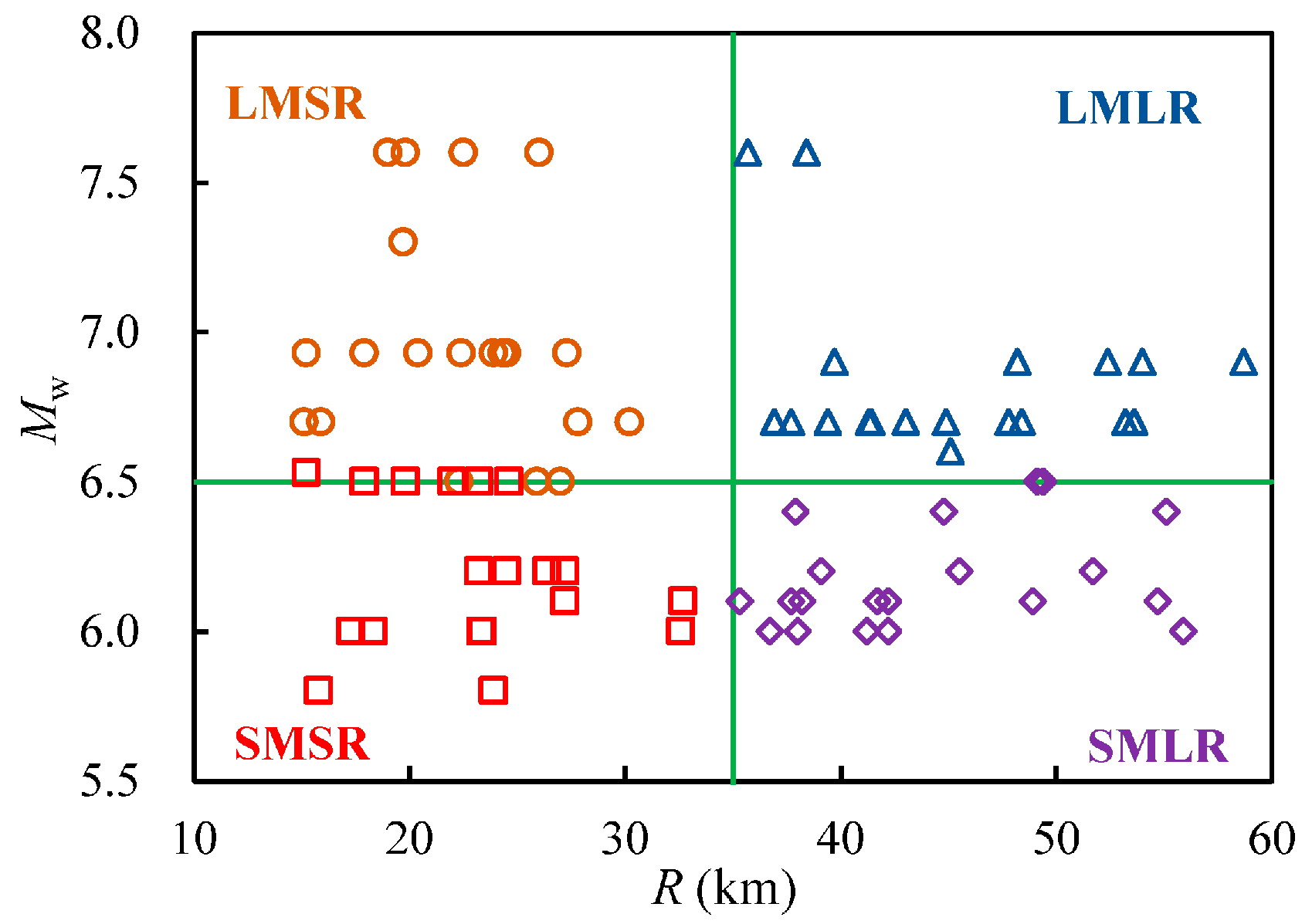
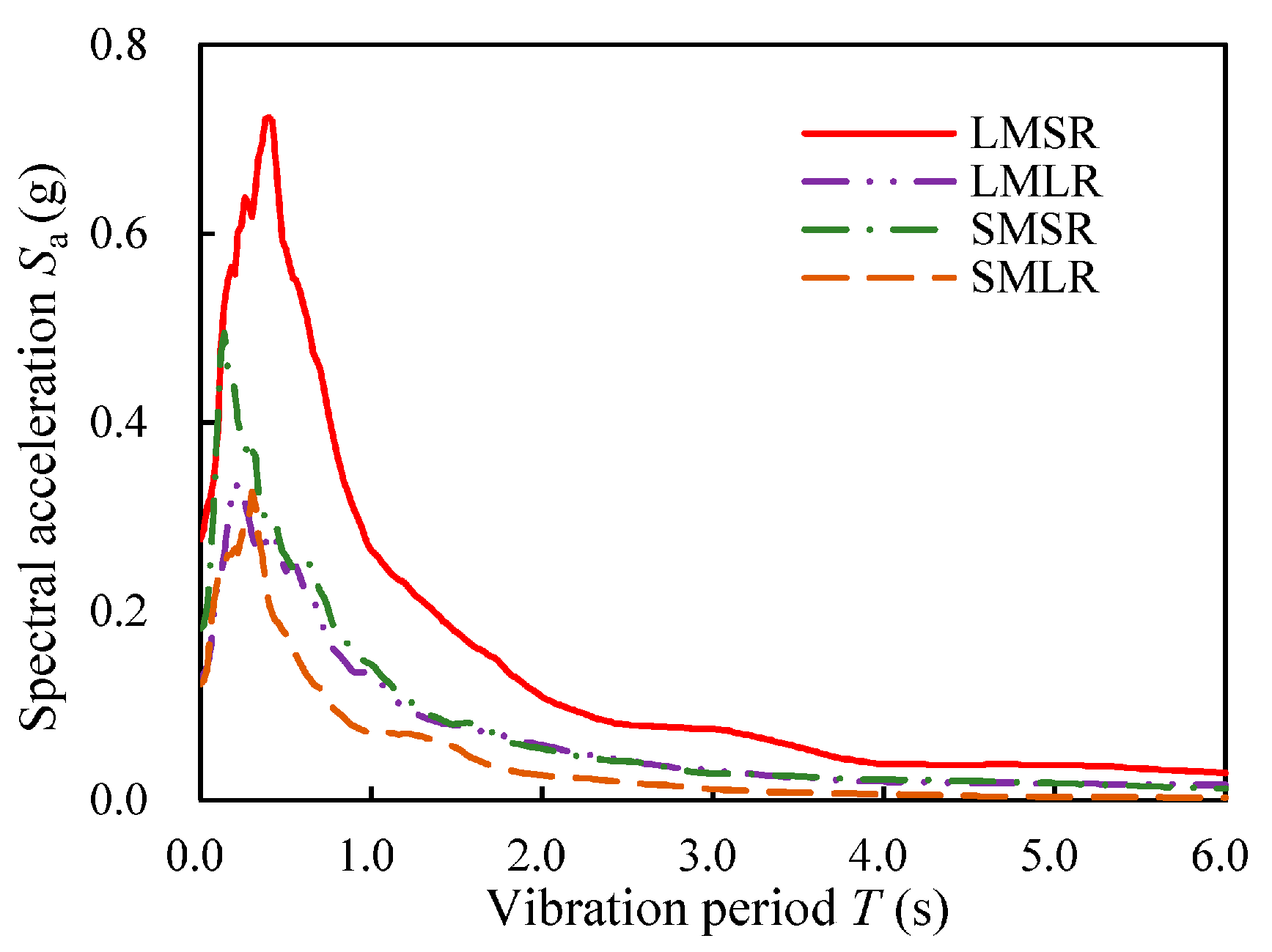
Generating PSDMs for the displacement demands of a wharf requires the selection of representative ground motions as the inputs for time-history analysis. The selection procedure from Shome and Cornell [29] is adopted in the study, which defines a set of domains of anticipated earthquakes in terms of the moment magnitude (Mw) and distance of the rupture zone from the site of interest (R). Following the procedure, four equally sized magnitude-distance (M-R) bins were generated with a total number of 80 ground motions, and selected from the Next-Generation Attenuation of Ground Motions database [30]. The characteristics of the selected motions are briefly described in Table 1 due to the limited space of the paper, and the M-R relation for the four selected bins is plotted in Figure 1. Moreover, for the two components of a bi-directional ground motion, the one with the larger peak ground acceleration (PGA) is generally denoted as the major component, and the other one is labeled as the minor component in this study. Figure 2 shows the median spectral acceleration (for 5% viscous damping) of the major components of the ground motions from each bin.

2.2.2. Seismic Intensity Measures

The PSDM, as defined in Equation (1), is conditioned on a single seismic intensity measure (IM), which therefore has a significant impact on the model. Selection of an optimal IM for generating the PSDM of a wharf has been the topic of several references [4,31]. Unlike previous studies that consider earthquake loading only in the transverse direction for the selection of IM, this study determines optimal IMs for generating PSDMs under simultaneous bi-directional seismic excitation. For optimal IM selection, hazard computability is a key consideration. Consequently, only commonly used peak and spectral acceleration measures (listed in Table 2) are evaluated, excluding less common IMs such as the Arias Intensity and cumulative absolute velocity [27]. Since the three-dimensional models of wharves and two orthogonal components of ground motion are utilized in this study, the intensity measure used in fragility analysis is taken as the square root of the sum of the squares (SRSS) of the IM values from the two components of each ground motion.

2.2.3. Seismic Excitation Orientation

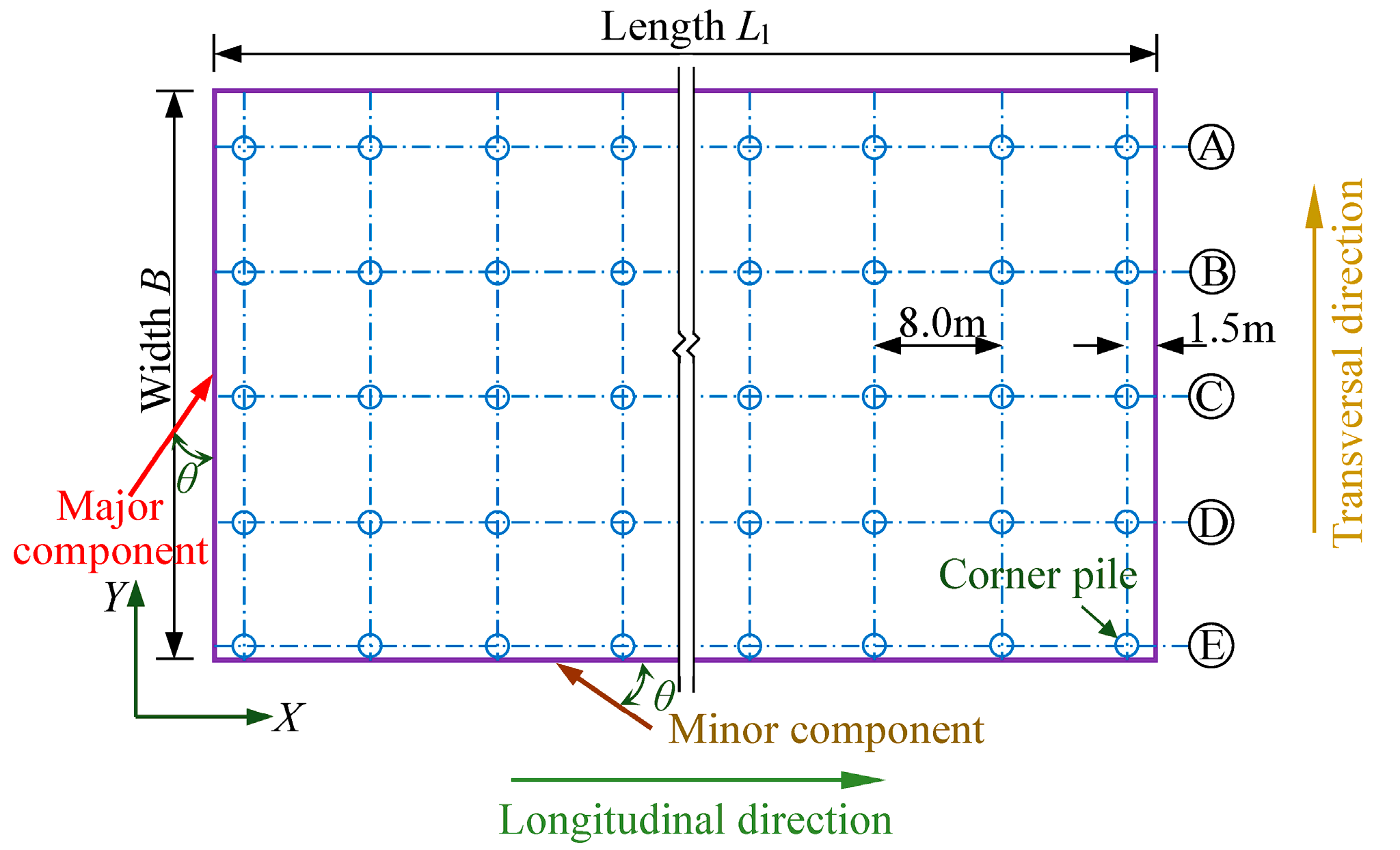
To evaluate the impact of excitation orientation on the seismic fragility of regular wharves, the two horizontal components of the selected motions were simultaneously applied along the longitudinal and transversal direction of a wharf. Then, the components were gradually rotated counterclockwise by an angle θ relative to the transversal direction, as shown in Figure 3. Due to the symmetry along the longitudinal axis of a wharf, analyses were performed at increasing 15 ° increments for 0 < θ < 180°.

2.3. Description of the Wharf and Modeling

2.3.1. Overview of the Wharf Example

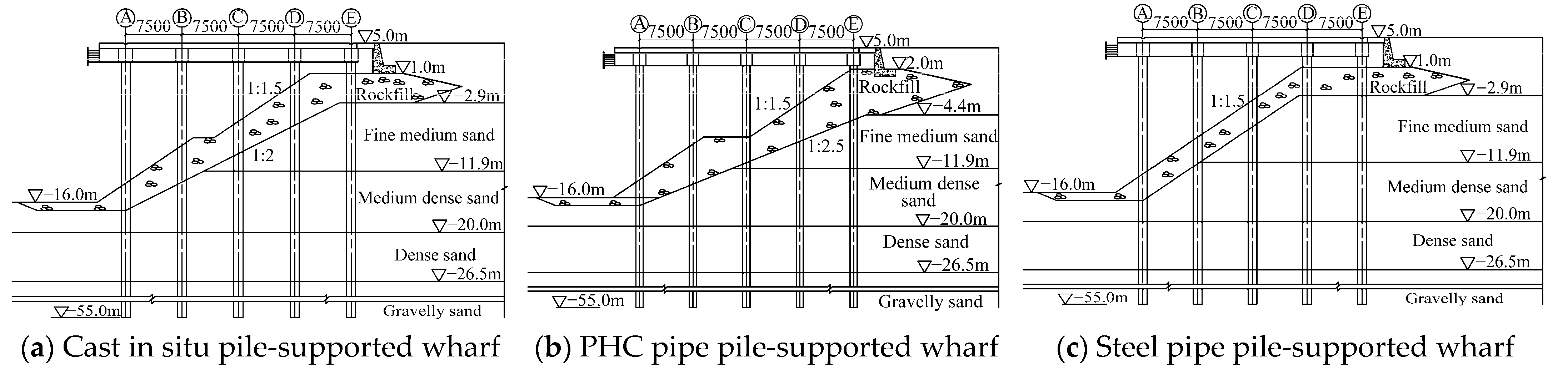
A vertical-pile-supported wharf with the most common configuration in China was selected as the case to be investigated. The selected wharf has a width B of 34.4 m and a bent spacing of 8.0 m. The transversal beams have a width of 2.5 m, and the longitudinal beams all have a width of 1.5 m, except for the crane beam, which is 1.6 m wide. The seismic response of wharf structures can be quite complicated and is expected to be significantly influenced by the structure geometry and underlying soil conditions. It is known that the eccentricity e between the center of mass, center of rigidity, and wharf aspect ratio (length to width) are of great significance for the torsional effects induced by the bi-directional ground motion [17]. Thus, the wharf was then designed to be supported on various pile types and dike slopes, as shown in Figure 4. The information of pile sections is summarized in Table 3. Furthermore, properties of soils in the dike are summarized in Table 4. Meanwhile, three wharf segment lengths Ll were used for the analyses, i.e., 51 m, 91 m, and 131 m. Since the linked-wharf interaction generally reduces the torsional effects [13], only an individual unit segment (plan view in Figure 3) was modeled. This resulted in a total of nine combinations for the considered sections and unit lengths.
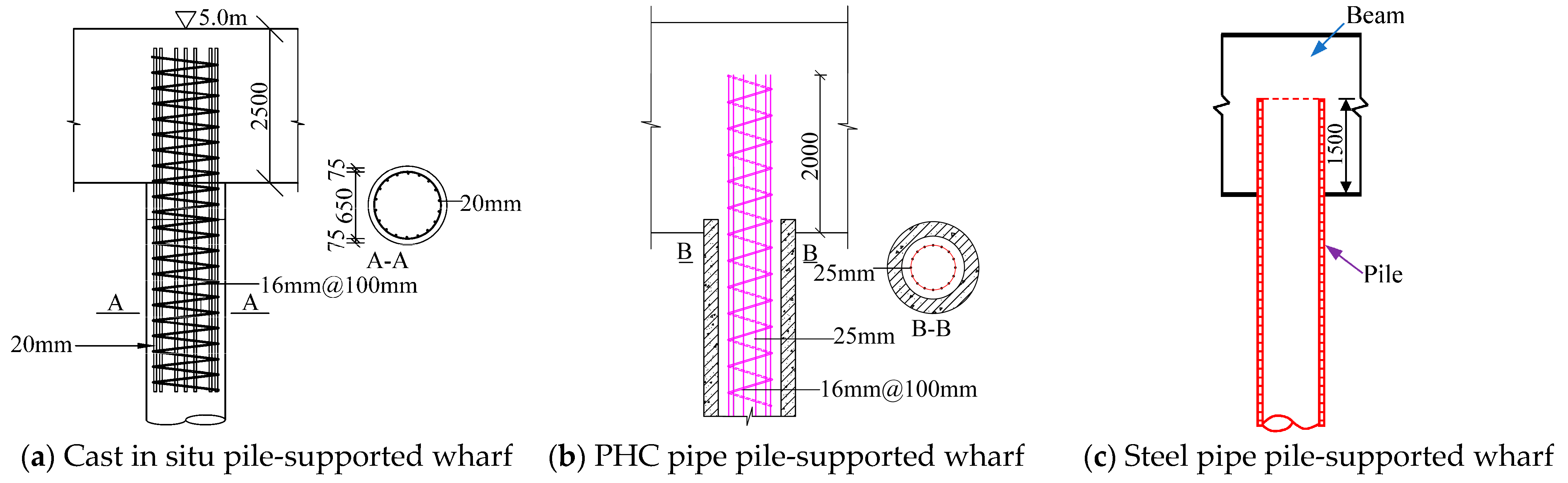
Experience from past earthquakes has indicated that the connection between the pile and wharf deck is a major source of damage during an earthquake. For a well-designed wharf structure subjected to lateral loading (inertial loading), the formation of plastic hinges is expected to occur in the pile-deck connection. Thus, the structural limit-states of wharf structures are defined in terms of material strain at the connection in current design codes. Design codes prescribe a wide range of pile-to-wharf connection types. This study focuses on three common categories used in China, as illustrated in Figure 5. It can be seen that the connection of the steel pipe pile is realized by embedding the pile into the cap beam, and the pile is not concrete-filled over its entire length. In contrast, the PHC pile connection utilizes a 2 m-long concrete plug below the beam, which is reinforced with 16 HRB400 steel bars (25 mm diameter).

2.3.2. Modeling of the Wharf

Based on the beam on nonlinear Winkler foundation method, the detailed numerical models of the aforementioned nine wharves were established using SAP2000. Given the high rigidity of the beam-slab system, all beams were modeled as rigid elements. The soil-pile interaction was represented by soil springs constructed by p-y curves, and the pile group effect was ignored for simplicity and the relatively large pile spacing. The curves from API [32] were used to develop the force-deformation relationships of springs. The hysteretic characteristic of springs was modeled by the Kinematic model in SAP2000. To ensure adequate precision in modeling the pile behavior, the first soil spring was located 15 cm below the dike surface, following the provision in the literature [14], then springs were spaced at 30 cm to the depth of 3 m. Below that, the spacing was increased to 60 cm. In order to model the pile plasticity, the distributed plastic hinges [33] were assigned to locations where plasticity may develop during earthquake loading. The hinge length was determined by the spacing of hinges to address the effect of location variability of maximum moment induced by soil-pile interaction. To account for the variation in axial force during loading, pile hinges were modeled using the fiber hinge element in SAP2000. During modeling, the stress–strain curves for both unconfined and confined concrete were developed by Mander’s model [34], and the strain-hardening formula from literature [35] was employed to generate the stress–strain curve for reinforcing steel and structural steel. Previous studies have found that the contribution of uncertainty in material properties is negligible compared to the effect of ground motions on the overall fragility assessment [36]. Given that the primary aim of this study is to address the uncertainties associated with ground motions (as outlined earlier), uncertainties in material properties were not considered in the wharf modeling. This simplification was adopted to achieve a reasonable reduction in simulation and computational effort. Furthermore, the influence of cranes was also excluded from this study.

2.4. Demand Analysis Procedure

For the nine different pile-supported wharf structures described earlier, nonlinear time-history analyses were conducted for all ground motions to determine the displacement demands of corner piles. In fact, 8640 analyses (9 wharf structures × 80 records × 12 angles of incidence θ) were carried out. For each analysis, the total displacement demand d i , θ at a certain angle θ and record i can be determined as follows:
d i , θ = max j d X j , i , θ 2 + d Y j , i , θ 2
where d X j , i , θ cm and d Y j , i , θ cm are the X-axis and Y-axis displacement demands of the corner pile at the deck level at time step j, a certain angle θ, and record i, respectively. The calculation of displacement demand is performed for both of the two landside corner piles, but only the larger calculated value is utilized to generate a probabilistic seismic demand model.

2.5. Optimal Intensity Measure Selection

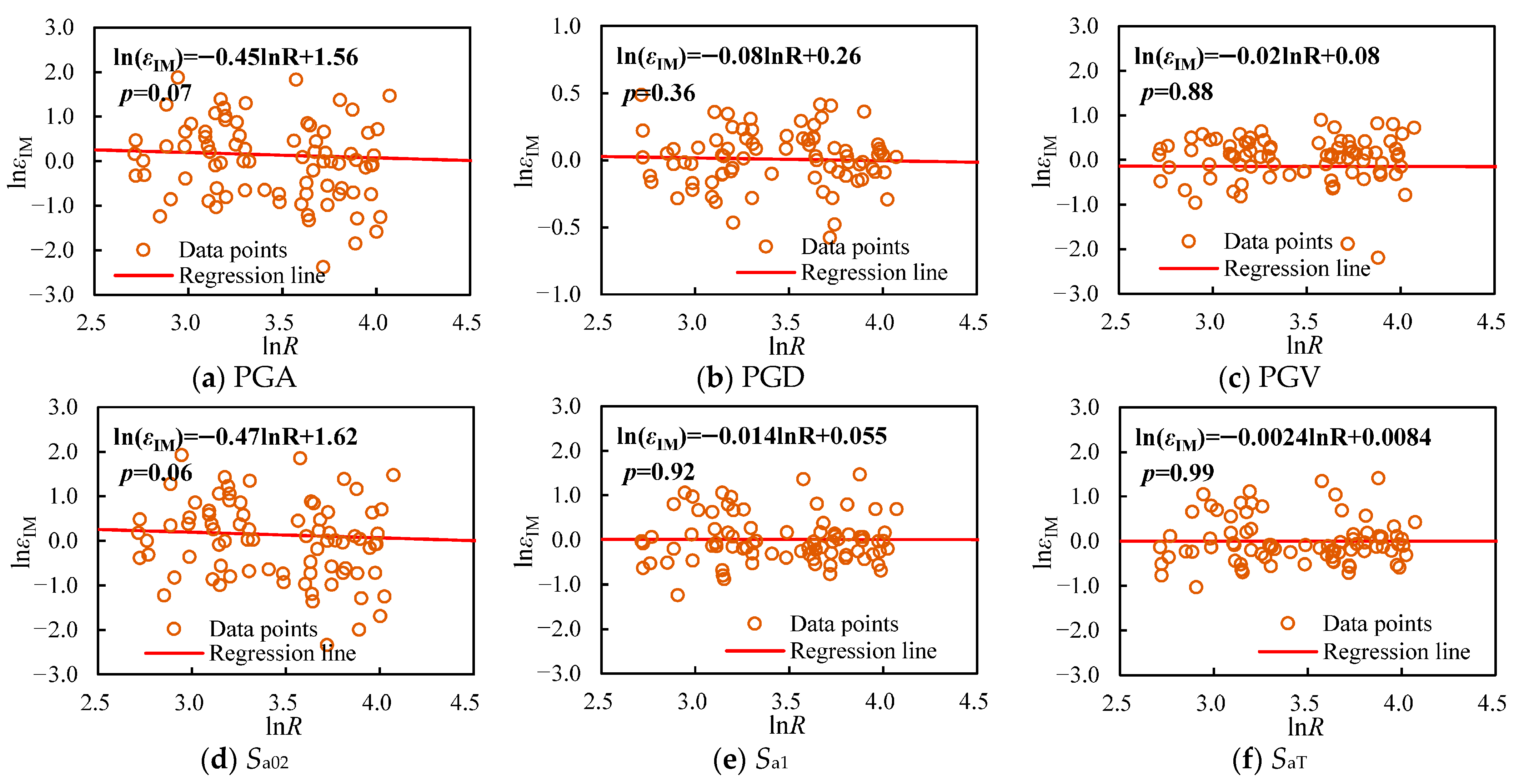
Selection criteria such as efficiency, practicality, proficiency, and sufficiency [27] are included in the selection process. For efficiency, a lower value of β D IM indicates an efficient IM. Practicality is a measure of the dependence of the demand upon the IM level, and the slope b in Equation (3) is a good indicator of this dependence. A lower value of b implies a less practical IM. Then, proficiency is a composite measure of efficiency and practicality. A modified dispersion ζ, which is defined as ζ = β D IM / b , is a measure of proficiency. A lower value of ζ indicates a more proficient IM. A sufficient IM is statistically independent of ground motion characteristics, such as the magnitude (Mw) and distance of the rupture zone from the site of interest (R). The sufficiency of an IM can be evaluated by conducting a regression analysis on the residuals ln ε IM from the PSDM with respect to Mw or R. A larger p-value for the regression is indicative of a sufficient IM. In addition to the above properties, this study also considers the coefficient of determination R2 as an important quality. A higher value of R2 (closer to unity) represents the goodness of the linear fit in the lognormal space, which strongly validates the fundamental power law assumption of Equation (2).
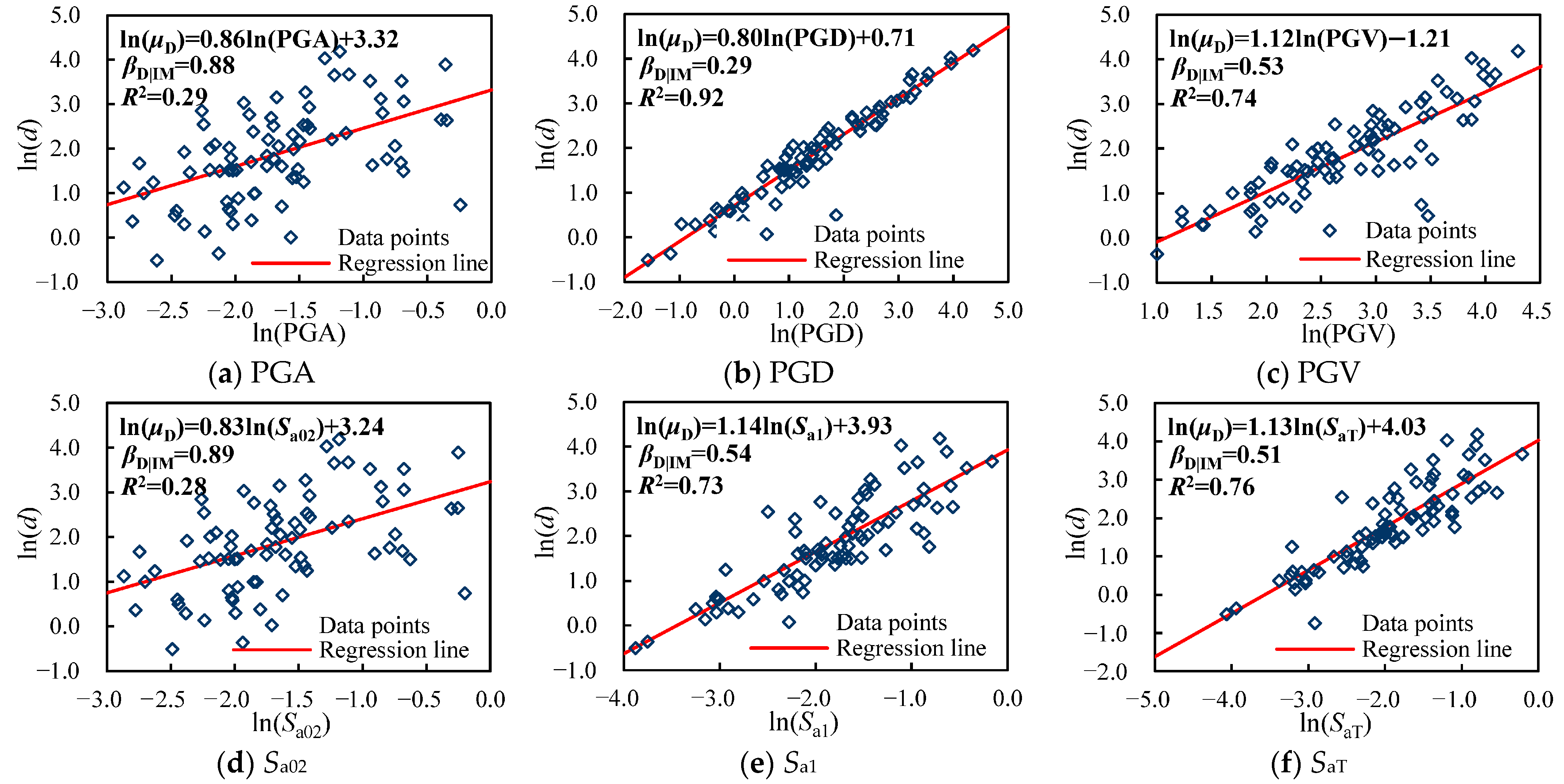
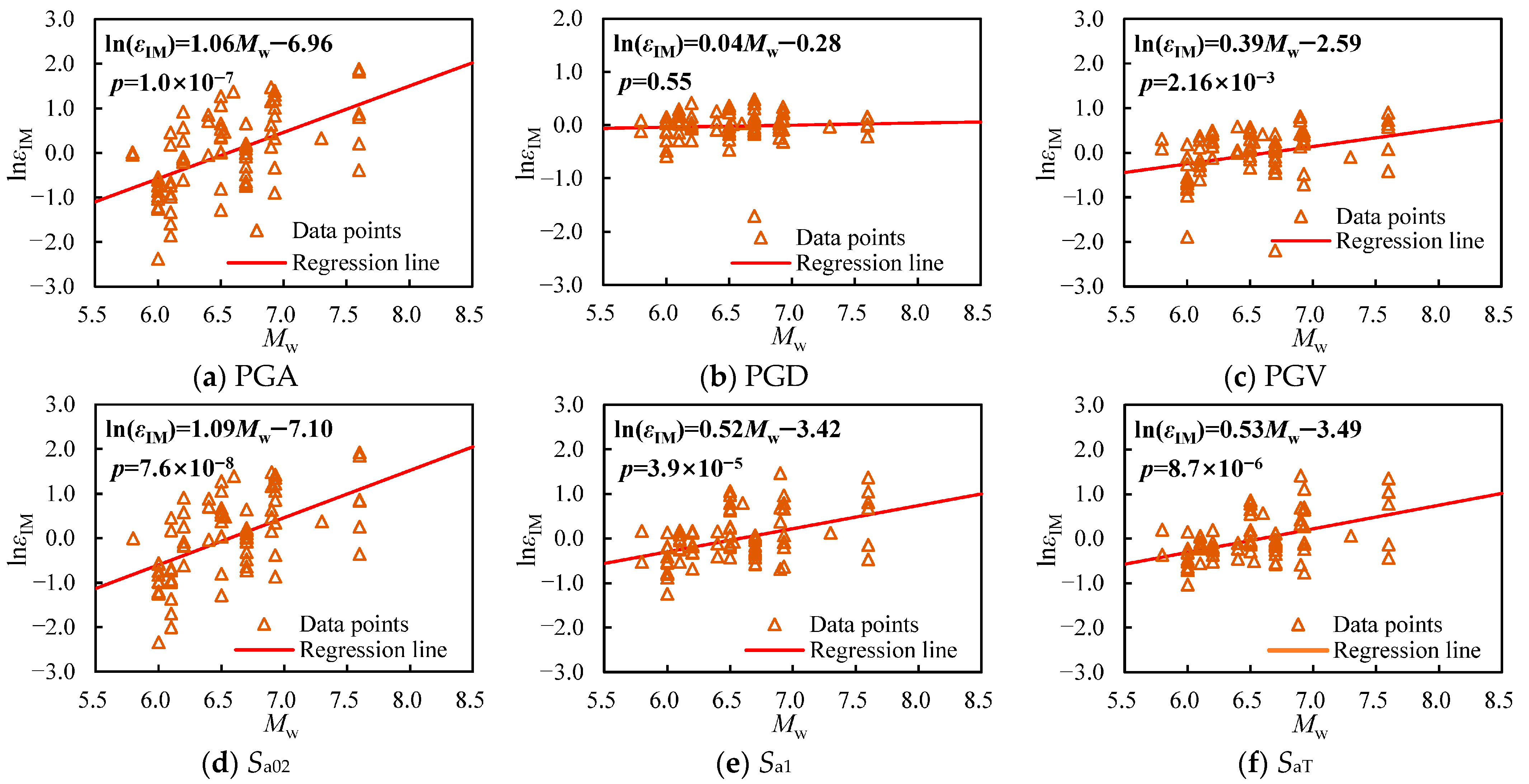
Figure 6 shows the PSDMs for displacement demand, plotted as a function of the intensity measures PGA, PGD, PGV, Sa02, Sa1, and SaT, respectively. Given the limited space in this paper, the results are presented only for the cast in situ pile-supported wharf with Ll = 51 m and θ = 0°. Notably, the regression fit for PGD exhibits a markedly higher degree of linearity relative to the other intensity measures considered. To identify the optimal intensity measure (IM), the sufficiency of all candidates with respect to magnitude (Mw) and rupture distance (R) is evaluated in Figure 7 and Figure 8, respectively. The p-value for PGD is almost the largest in both Figure 7 and Figure 8, indicating that PGD is a much more sufficient IM for generating the PSDM. Then, the optimal IM is obtained by comparing the aforementioned characteristics of IM candidates in Table 2 for all analyzed incident angles.
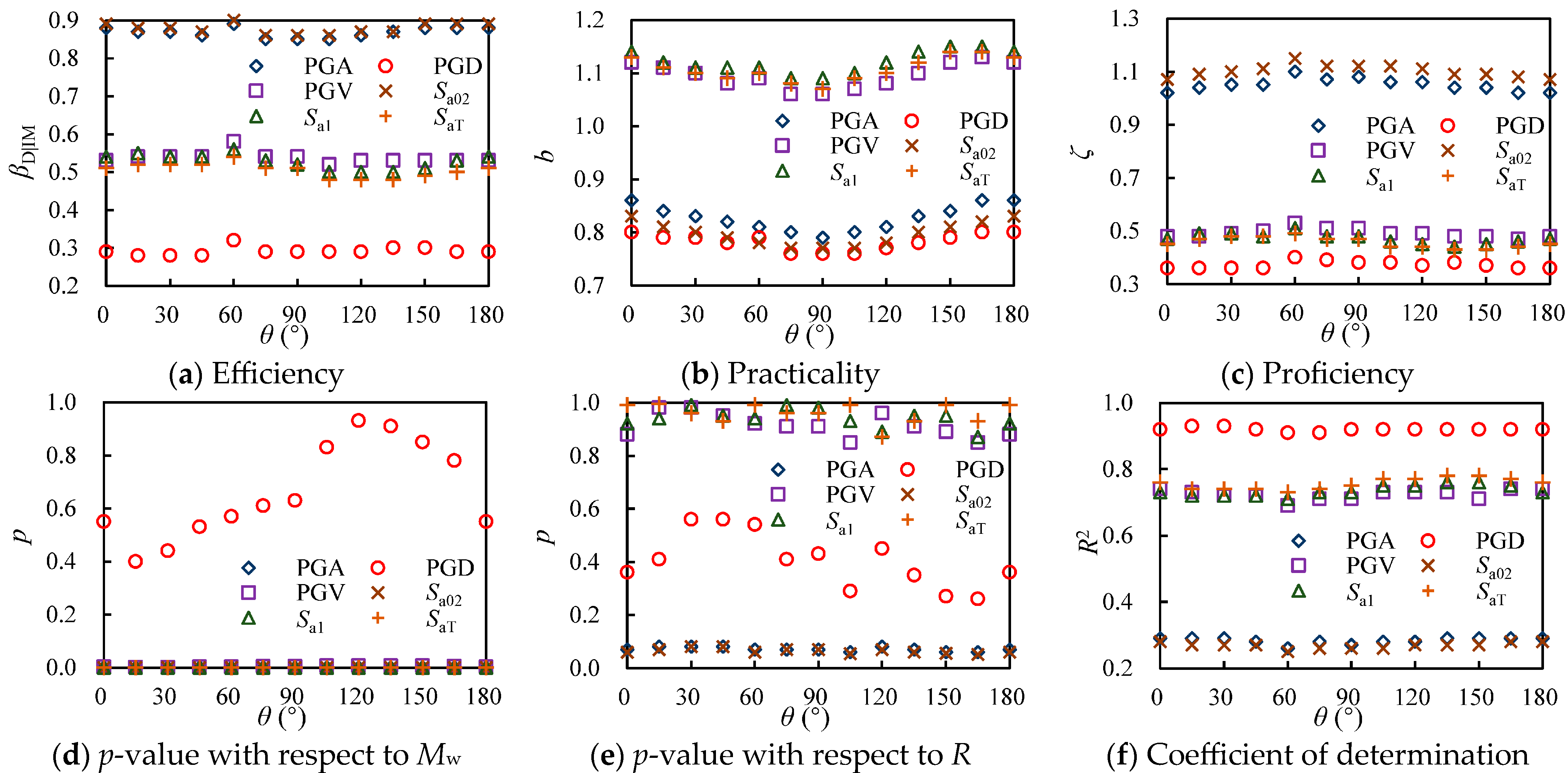
Figure 9 presents a comparison of the efficiency, practicality, proficiency, and sufficiency results of a cast in situ pile-supported wharf with Ll = 51 m for various incident angles. For other wharves with different pile types and segment lengths, the tendency of the results are in line with Figure 9. It is found that the values of β D IM , b, ζ, and R2 are only slightly influenced by the incident angle, which implies that seismic excitation orientation has a negligible effect on the optimal intensity measure selection. Based on the values of β D IM , PGD is the most efficient one in the six intensity measures, while PGA and Sa1 produce the worst efficiency. Using the practicality measure b, PGD exhibits the poorest practicality. However, PGD has a decided advantage in proficiency and linear correlation, as indicated in Figure 9c,f. For the p-value with respect to magnitude Mw in Figure 9d, only the values of PGD are greater than 0.05, which indicates that the other intensity measures are all insufficient. Therefore, the PGA and Sa1 are evidently less appropriate for determining the demand model of a wharf under bi-directional ground motion, which is not consistent with the conclusion of seismic excitation in the transversal direction of a wharf obtained by Amirabadi et al. [31]. Although the PGV, SaT, and Sa1 are more practical than PGD, it tends to stand out as the most efficient, proficient, and sufficient IM for the considered wharf models. Consequently, PGD is expected to be the optimal IM, followed by PGV and SaT. In addition, although PGA is a commonly used IM in the fragility analysis of a wharf, the comparison results reveal that PGA is probably not the best option for a wharf under bi-directional ground motion.

2.6. Probabilistic Seismic Demand Models

By using PGD as the IM, the PSDMs for all considered incident angles and wharf models are developed from 8640 time-history analyses according to Equation (3). Table 5, Table 6 and Table 7 present the median and dispersion estimates for all incident angles, as well as the coefficient of determination.
It is shown that the values of R2 are in the range of 0.88–0.93 (near 1), and those of β D IM generally vary from 0.28 to 0.36, which validates the applicability of PGD as the optimal intensity measure. It is evidently seen that the incident angle has little effect on β D IM . Furthermore, the median estimates ln μ D , θ are also not significantly influenced by the incident angle, but are dependent on the segment lengths (i.e., aspect ratio) to some extent. It is clear that a two-dimensional numerical model of a wharf cannot capture the effect of wharf aspect ratio.

3. Determination of Displacement Capacity

3.1. Definition of Damage Limit States

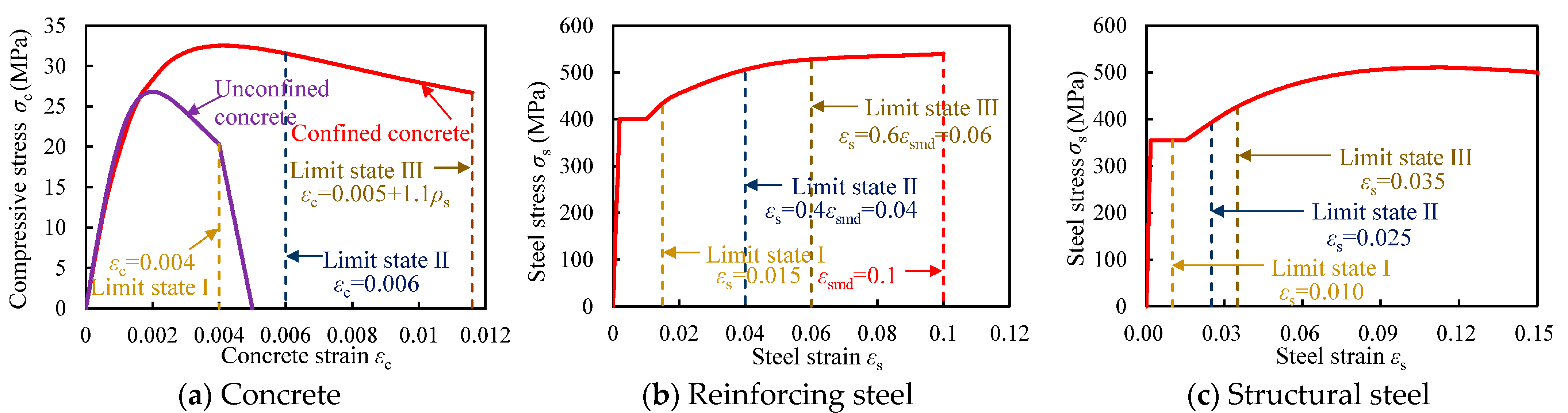
To be consistent with the seismic design codes [14,15], the three damage limit states are defined in terms of the strain limits of pile materials in the plastic hinge zones as shown in Table 8, in which εc is the concrete compression strain, εsmd is the strain at maximum stress of dowel reinforcement and is taken as 0.1 for this study, εs is the steel tensile strain of dowel reinforcement or structural steel, εcu is ultimate concrete compression strain, and ρs is the volumetric ratio of confining steel. The strain limits of different limit states are illustrated by the stress–strain curves in Figure 10.

3.2. Pushover Analysis

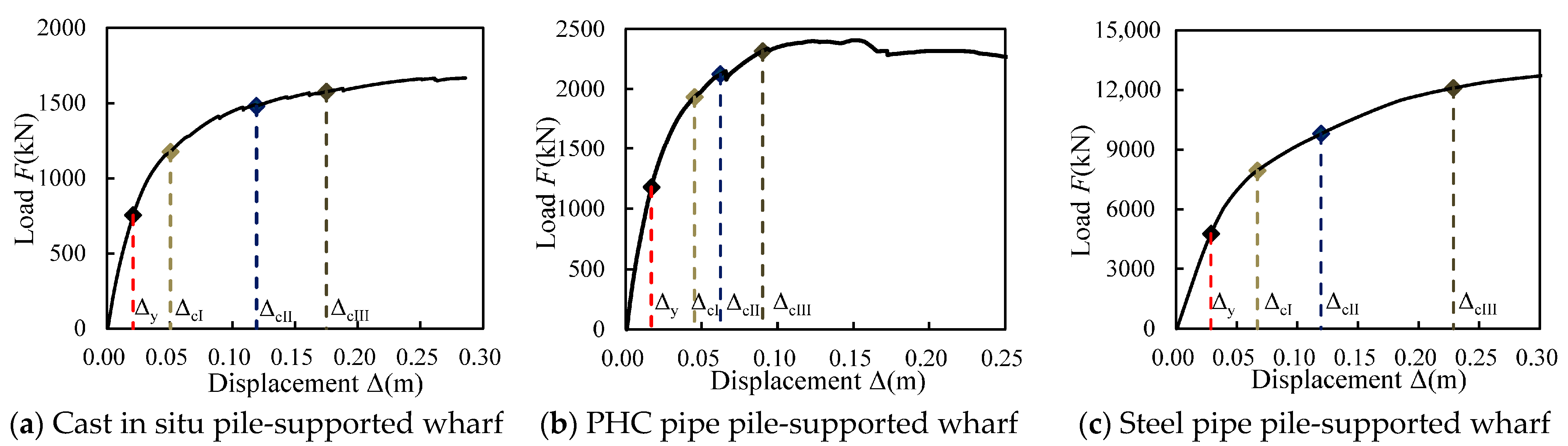
The determination of displacement capacity is accomplished by two-dimensional nonlinear static pushover analysis, during which the material strains in the hinge zones are monitored. Once the strain attains the limit value in Table 8, the displacement capacity is obtained. The pushover curves of the aforementioned three wharf sections are plotted in Figure 11, in which the displacements for three limit states are presented; i.e., ΔcI, ΔcII, and ΔcIII are displacements for limit states I, II, and III, respectively. The derived displacements are also summarized in Table 9. Then, the above displacement capacity for each damage limit state is considered as the median of capacity μ C of the corresponding limit state.

4. Fragility Curves Considering the Effect of Excitation Orientation

4.1. Fragility Curve for the Given Incident Angle

After determining the PSDM and capacity of each limit state, the fragility function for a single incident angle can be expressed as Equation (6) by assuming that the displacement capacity also follows a lognormal distribution, in which βC is the uncertainty associated with capacity and is taken as 0.3 in this study by following the literature [37].
P C < D I M , θ i = 1 Φ ln μ C ln μ D , θ β C 2 + β D IM , θ 2
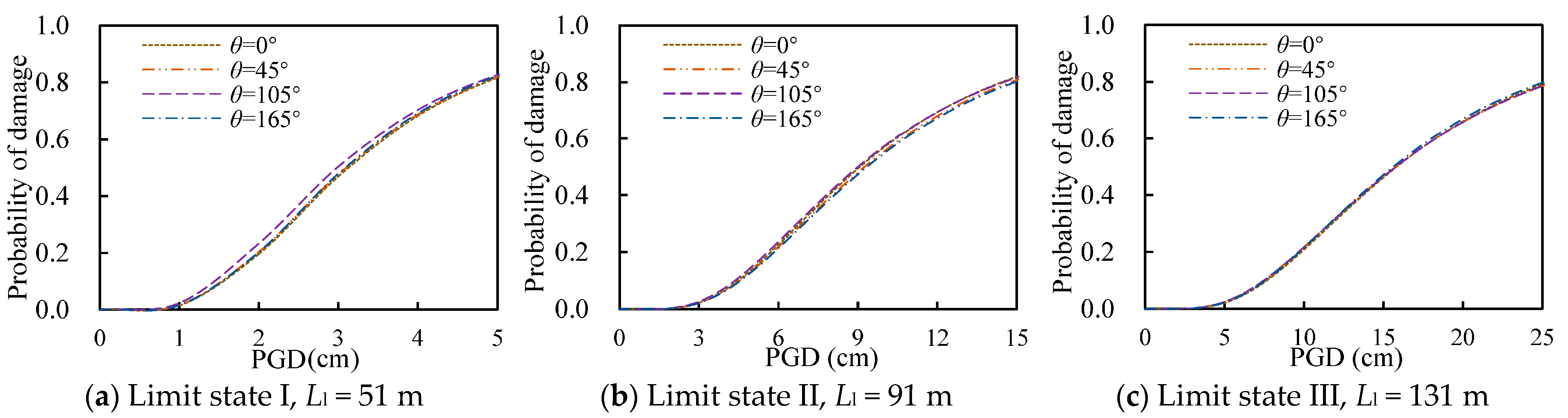
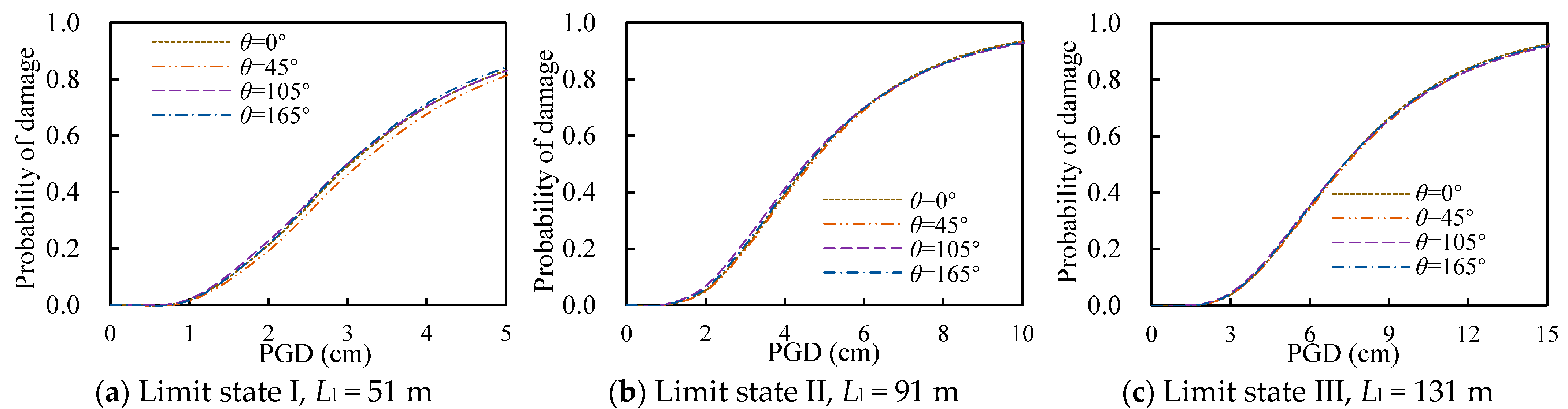
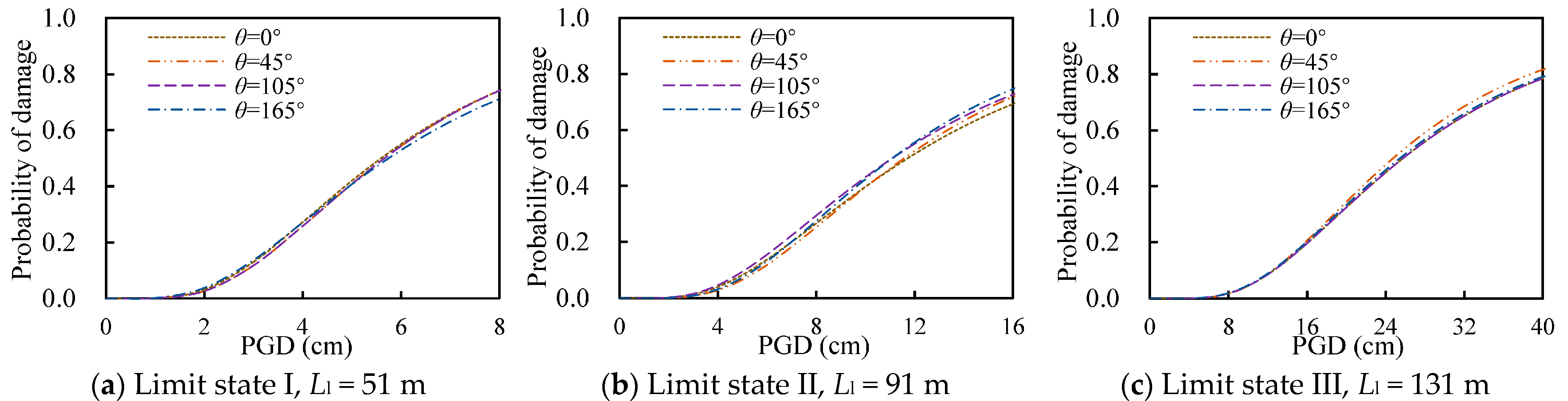
Then, fragility curves for each seismic incident angle and limit state are constructed by using Equation (6), as shown in Figure 12, Figure 13 and Figure 14. Given the limited space of the paper, only the curves for several cases and angles are presented. It is shown that the direction of excitation affects the fragility to some extent, and the influence decreases with the increase in wharf segment length (i.e., aspect ratio). Different wharves exhibit different levels of dependence on excitation orientation, which can be attributed to the effect of eccentricity e between the center of mass and rigidity. In general, the incident angle has a relatively slight influence on the seismic fragility for the considered wharf models in this study. Therefore, it can be concluded that the fragility of a regular wharf under bi-directional ground motion is not sensitive to the excitation orientation.

4.2. Fragility Curve Considering Multiple Incident Angles

After evaluating the seismic fragility for each examined incident angle, the fragility considering multiple incident angles can be determined by the following formula:
P M C < D I M = i = 1 N p i θ i P C < D I M , θ i i = 1 N p i θ i
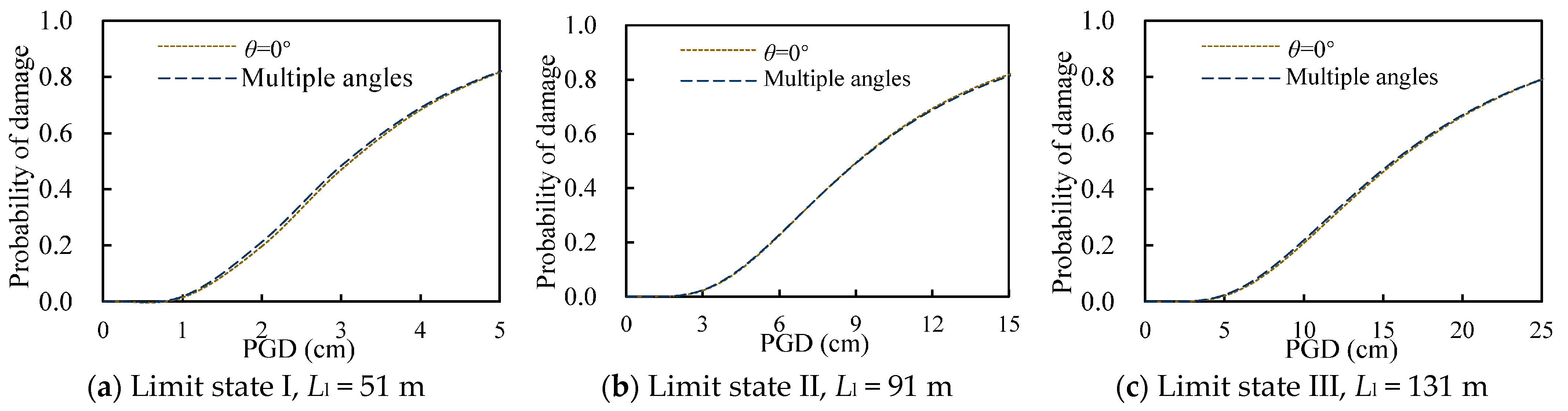
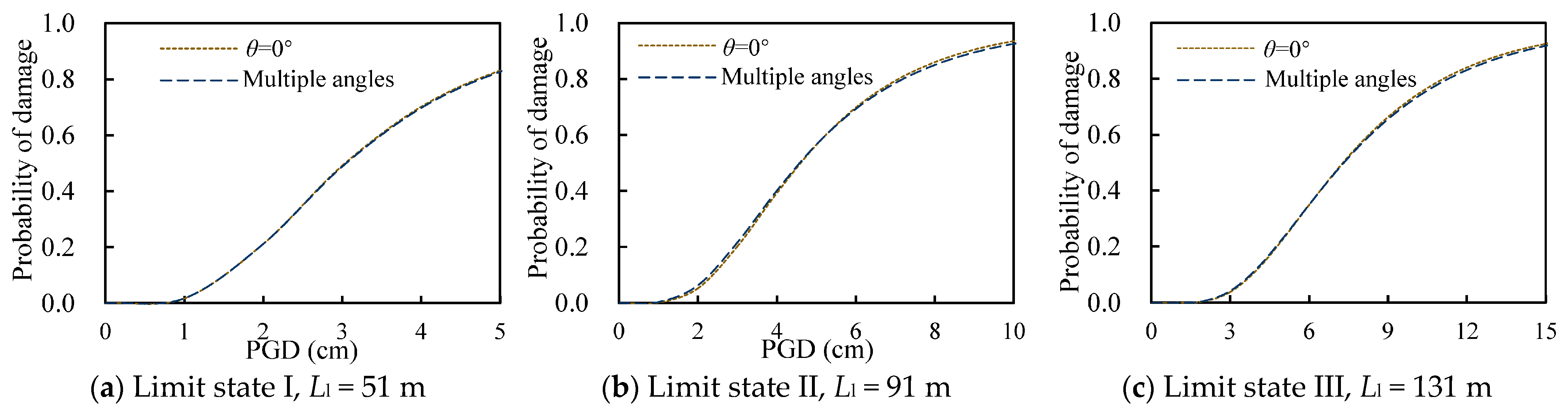
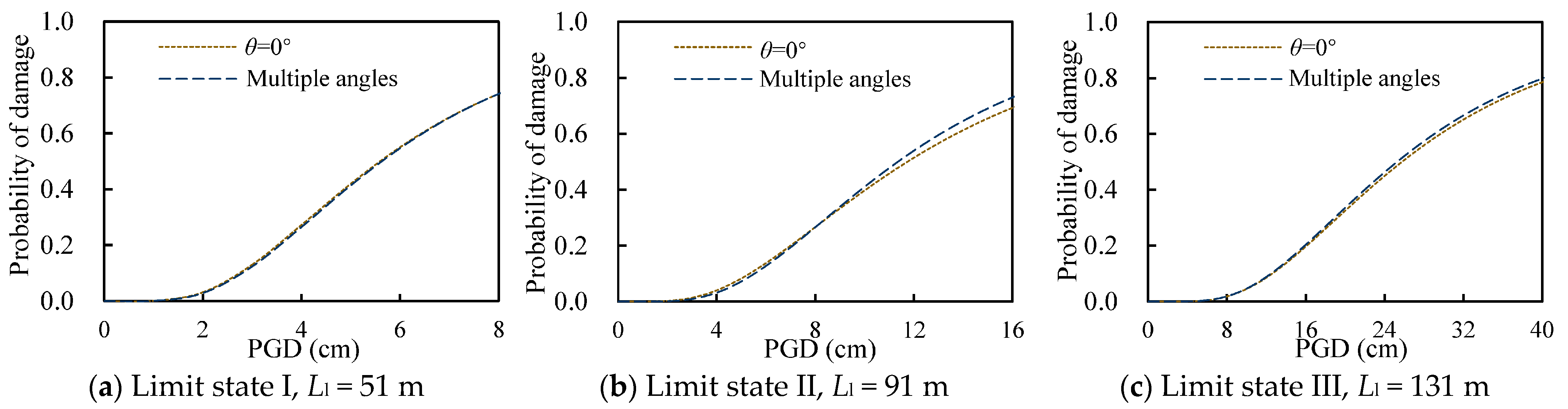
where pi(θi) is the probability of occurrence for the incident angle θi, and N is the total number of considered incident angles. Considering the absence of a predetermined specific seismic scenario for the incident angle, the angle is assumed to follow a uniform distribution. For the 13 examined angles in this study, pi(θi) is equal to 1/13. The fragility curves considering multiple incident angles for all wharf models and limit states are presented in Figure 15, Figure 16 and Figure 17. The fragility curve for the incident angle θ = 0° (i.e., excitation along longitudinal and transversal axes of a wharf) is also plotted in these figures for comparison.
As shown in Figure 15, Figure 16 and Figure 17, there is a minor difference between fragility curves developed from a single angle (θ = 0°) and multiple angles. In other words, the effect of the uncertainty associated with the excitation orientation on the fragility of the wharf is negligible. Consequently, the fragility under bidirectional ground motions can be adequately assessed by applying simultaneous seismic excitations along the two orthogonal horizontal axes of the wharf structure.

5. Comparison of Simplified Demand Analysis Methods for Developing Fragility Curves

5.1. Simplified Demand Analysis Methods for Addressing Bi-Directional Ground Motion in Codes

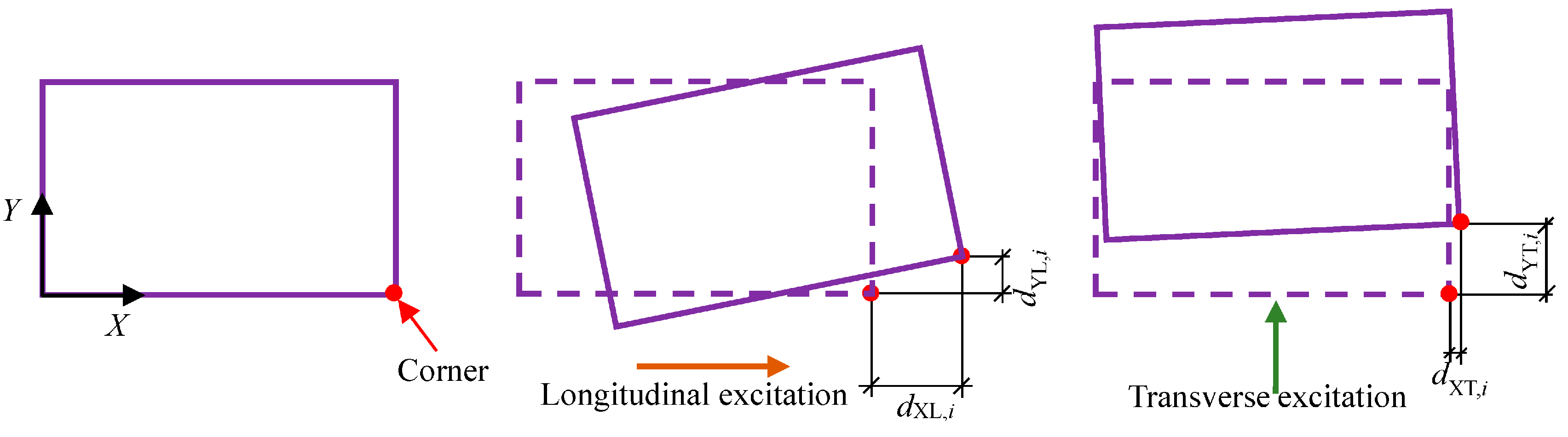
As discussed before, simultaneous seismic excitation in the principal axes of the wharf is adequate to evaluate the fragility under bi-directional ground motions, which can be implemented by Equation (6) without considering the effect of incident angle θ. It is evident that the nonlinear time-history analysis of a wharf with simultaneous excitation is computationally expensive for probabilistic seismic demand analysis. For regular wharves, the current seismic design codes recommend two simplified methods for addressing both orthogonal loading and the torsional effect from bi-directional ground motion [14,15]. The first simplified method, denoted as Method A in this study, independently analyzes the displacement demands of each horizontal ground motion component and then combines them to obtain the total displacement demand di for record i. The so-called percentage combination rule is utilized in current codes. As illustrated in Figure 18, the two horizontal components of a ground motion shall be applied separately along two orthogonal principal axes (longitudinal and transverse). The total displacement demand shall be determined by the maximum of the following two loading cases. In case 1, the displacement demand resulting from 100% of the longitudinal loading is combined with the corresponding displacement demand from 30% of the transverse loading as follows:
d X 1 , i = d XL , i + 0.3 d XT , i
d Y 1 , i = d YL , i + 0.3 d YT , i
in which d XL , i and d YL , i denote X-axis and Y-axis displacement demands due to structure excitation in the longitudinal direction for record i, respectively, and d XT , i and d YT , i denote X-axis and Y-axis displacement demands due to excitation in the transverse direction, respectively. In case 2, the displacement demand resulting from 100% of the transverse loading is combined with the corresponding displacement demand from 30% of the longitudinal loading as follows:
d X 2 , i = 0.3 d XL , i + d XT , i
d Y 2 , i = 0.3 d YL , i + d YT , i
where d X 1 , i and d X 2 , i are the combined X-axis displacement demands from motions in the transverse and longitudinal directions of case 1 and case 2 for record i, respectively; d Y 1 , i and d Y 2 , i are the combined Y-axis displacement demands of case 1 and case 2, respectively. Then, the total displacement demand di can be obtained as follows:
d i = max d X 1 , i 2 + d Y 1 , i 2 or d X 2 , i 2 + d Y 2 , i 2
The other simplified method, denoted as Method B in this study, determines the total displacement demand by magnifying the transverse displacement demand dt,i with a dynamic magnification factor (DMF), as expressed in Equation (13). The transverse displacement demand dt,i is obtained by applying the major component of record i along the transverse direction of the wharf. For wharves with an aspect ratio (length to width) greater than 3, DMF can be calculated by Equation (14) from ASCE/COPRI 61-14 [15]. It is obvious that the equation is just suitable for the wharf models with Ll = 131 m (Ll/B = 3.8) in this study. For models with Ll = 51 m or Ll = 91 m, the generally applicable equation from literature [17] is adopted to determine DMF, as presented in Equation (15). In current design codes, transverse displacement demand dt,i is usually determined through the nonlinear static demand analysis, which is performed by the substitute structure method. Readers are referred to ASCE/COPRI 61-14 [15] for more information about this method. Previous studies have evaluated this method by comparing its results with nonlinear time-history analysis (NTHA). Goel [38] has concluded that the method is biased toward overpredicting displacement demand for short-period systems and underpredicting displacement demand for long-period systems. Furthermore, Smith-Pardo et al. [39] concluded that the substitute structure method with DMF provides close estimates of displacement demand by comparison with NTHA results. Given these differing findings in the literature, it is valuable to validate the applicability and accuracy of the substitute structure method (with DMF) specifically for seismic fragility analysis under bi-directional ground motions.
d i = d t , i × DMF
DMF = 1 + 0.3 1 + 20 e / L l 2
DMF = 1.3 + 4 e / B L l / B 1 4 e / B 2 2 + L l / B 2

5.2. Optimal Intensity Measure Selection for Simplified Demand Analysis Methods

Selection criteria such as efficiency, practicality, proficiency, and sufficiency are also adopted to obtain the optimal intensity measure. Table 10 and Table 11 list the values of βD|IM, b, ζ, and R2 for Methods A and B, respectively. As indicated in Table 10, PGD tends to be the most efficient and proficient IM, followed by PGV, SaT, and Sa1. Using the practicality parameter b, PGD appears to be the least appropriate IM. PGA and Sa02 tend to have similar levels of efficiency, practicality, and proficiency. This trend aligns with the findings in Section 2.5, validating the preferable applicability of Method A. On the contrary, it is evident from Table 11 that PGD is not the optimal IM for Method B. For CIS and PHC pile-supported wharves, the SaT tends to be the most efficient, practical, and proficient IM, followed by Sa1, PGD, and PGV. However, PGD is the most optimal for the steel pile-supported wharf. Thus, the optimal IM for Method B is inconsistent with that for nonlinear time history analysis under bi-directional ground motion, which suggests that Method B is not a suitable alternative. This discrepancy can be attributed to the use of nonlinear static demand analysis and an empirically derived DMF in Method B, while Method A still utilizes nonlinear time history analysis. Nonetheless, PGD is still used for Method B to generate the following probabilistic seismic demand models of all wharf models, which facilitates the comparison of fragility curves derived from Method A and Method B. By comparing the values of βD|IM for PGD, it can be seen that there is a significant difference between Method A and Method B.
After selecting the optimal IM with efficiency, practicality, and proficiency, the p-values are still used to assess the sufficiency. Table 12, Table 13, Table 14 and Table 15 present the p-values obtained from Methods A and B for all wharf models. As indicated in Table 12, PGD tends to be the most sufficient IM across all six ground motion measures for Method A, whereas the other IMs show conditional dependence on magnitude M. However, Sa1 is the most sufficient in Table 13, followed by SaT, PGV, and PGD. All IMs are conditionally independent on distance R for each of the six measures with p-values ranging from 0.03 to 0.99. A similar trend is also found in Table 14 and Table 15 for Method B. In summary, PGD can be deemed as the optimal IM for Method A, but it is not the best choice for Method B.

5.3. Probabilistic Seismic Demand Models Generated from Simplified Demand Analysis Methods

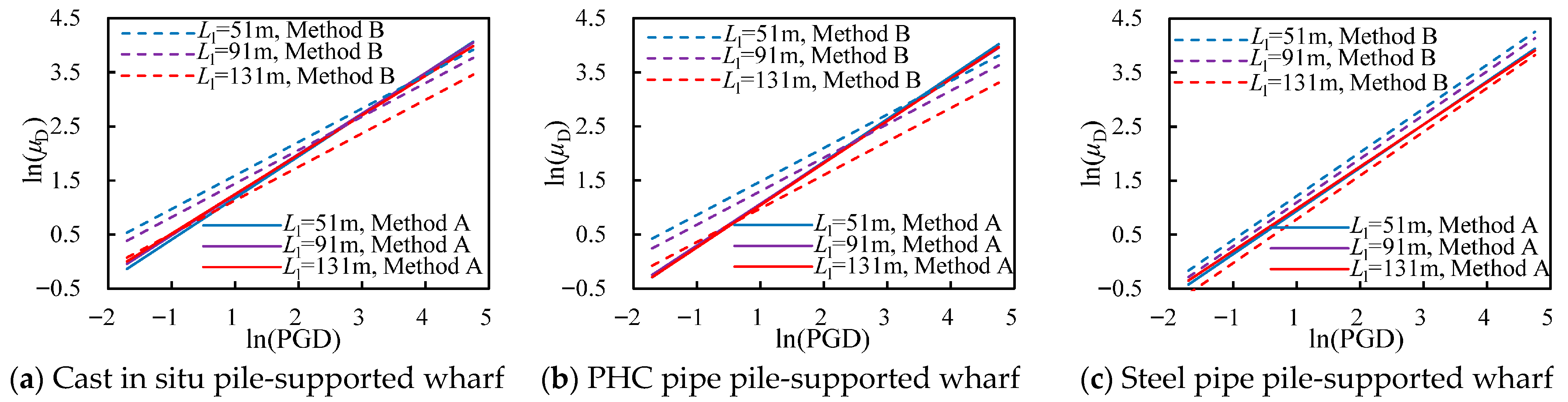
By using PGD as the IM, the PSDMs for all the examined wharf models are generated from the results of Methods A and B according to Equation (3). Table 16 presents the median estimates for these two methods. The comparison of PSDMs between Methods A and B is illustrated in Figure 19. It can be seen that the difference between the PSDMs from Methods A and B is not significant for most cases.
Moreover, it is clearly seen that the aspect ratio has little effect on the PSDMs derived from Method A, but has an obvious influence on those from Method B, since the DMF used in Method B is expressed as the function of aspect ratio. However, Table 5, Table 6 and Table 7 suggest that the aspect ratio does not have a relatively high impact on PSDMs for the examined wharves in this study. In this regard, Method A is preferable to Method B.

5.4. Comparison of Fragility Curves Derived from Simplified Demand Analysis Methods

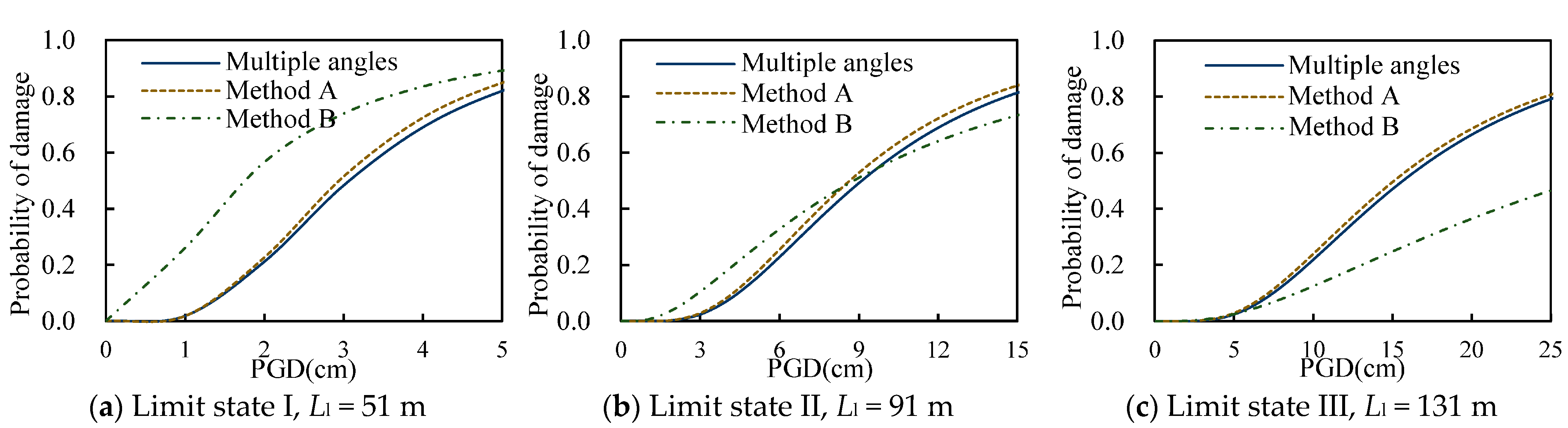
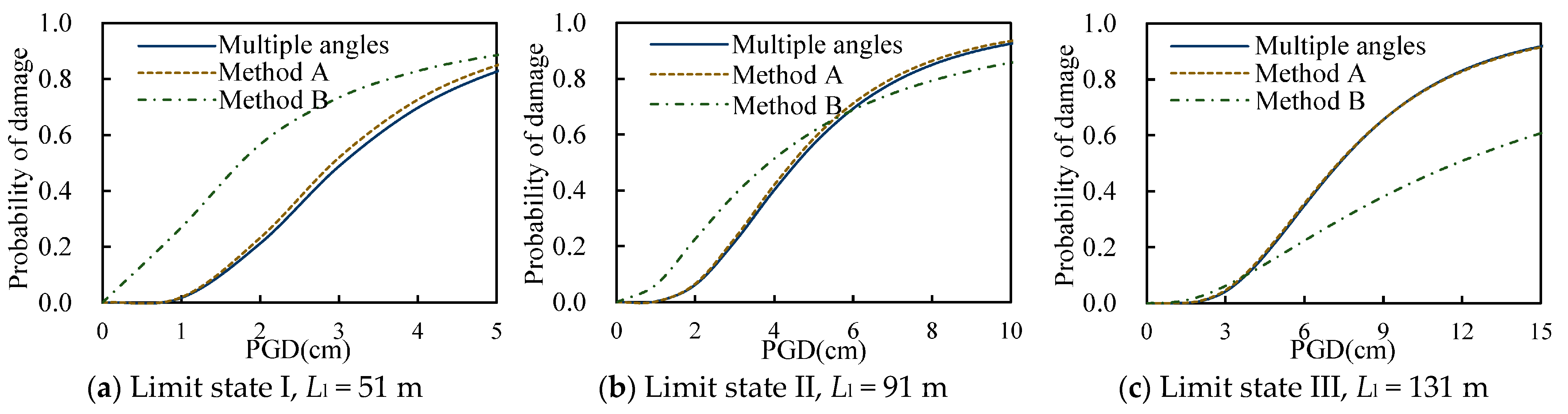
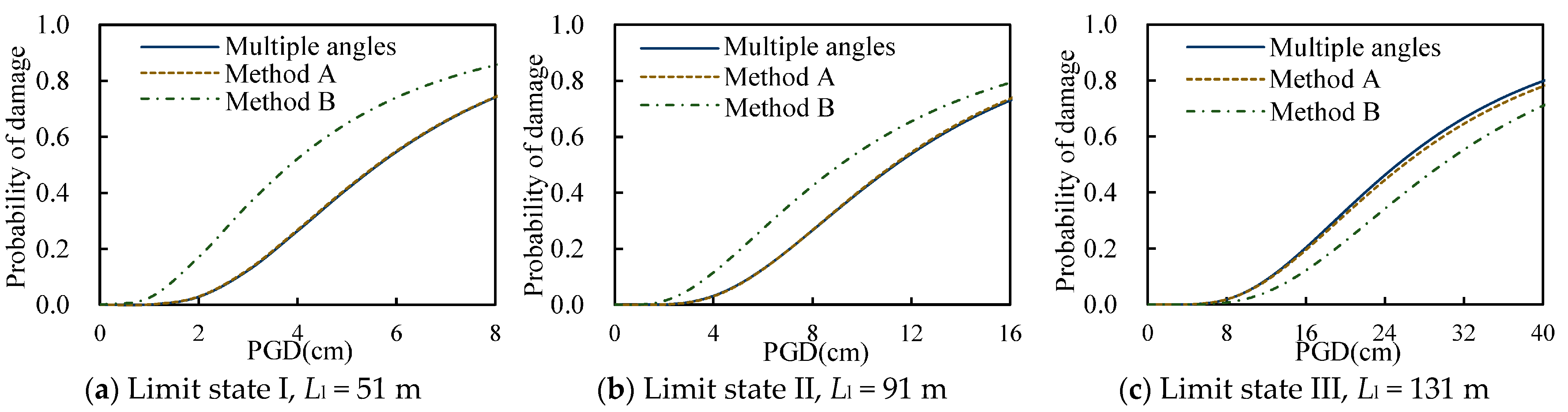
After comparing the PSDMs from Methods A and B, the corresponding fragility curves can be determined by Equation (6) without consideration of the incident angle. Figure 20, Figure 21 and Figure 22 present the fragility curves developed from Methods A and B, as well as the curves considering multiple incident angles for comparison. It is observed that there is a negligible difference between the fragility curves from Method A and multiple angles. Although the difference between PSDMs from Methods A and B is not significant, the difference in their fragility curves is huge, which can be attributed to the large dispersion of demand results from Method B. Therefore, the applicability and accuracy of Method A are verified, which can be a preferable alternative to the nonlinear time history analysis under bi-directional ground motion with simultaneous seismic excitation. On the contrary, the curves from Method B differ significantly from those based on multiple angles, which negates its applicability for fragility analysis under bidirectional excitation. Moreover, Method B may underestimate the fragility in certain cases. Consequently, despite its simplicity, Method B is not suitable for the fragility assessment of regular wharves under bi-directional ground motion.

6. Discussion

All preceding analyses are based on the examined wharf models in Section 2.3. Thus, it is essential to delineate their key structural characteristics, namely the aspect ratio Ll/B and the eccentricity ratio e/B. As mentioned before, the values of Ll/B are 1.5, 2.6, and 3.8 for the three segment lengths considered in this study, respectively. Furthermore, the eccentricity e between the center of mass and center of rigidity is determined as 10.66 m for the CIS pile-supported wharf based on the transverse initial elastic stiffness, which is the slope of the line that starts from the pushover curve origin point to the point of the first plastic hinge formed in a pile, as shown in Figure 11 (i.e., yield displacement Δy). Then, the values of eccentricity for PHC and steel wharves are calculated as 12.11 and 9.38 m, respectively. Thus, the eccentricity ratios of these wharf models are approximately in the range of 0.25 to 0.35, while the aspect ratios are in the range of 1.5 to 4.0. As indicated in Figure 3, the wharf models are all uniform and symmetric along the longitudinal axis. The conclusions of this study are therefore applicable specifically to wharves with this regular configuration. For irregular wharf structures, such as those exemplified in Figure 23, comprehensive nonlinear time-history analysis shall still be required to develop fragility curves by considering the effects of simultaneous seismic excitation and incident angles.

7. Conclusions

This study investigates the effect of seismic excitation directionality on the seismic fragility of regular pile-supported wharves, with case-study structures featuring aspect ratios (length to width) of 1.5 to 4.0 and eccentricity ratios of 0.25 to 0.35. The investigation is performed at a system level by using displacement demand as the engineering demand parameter. The selection of an optimal intensity measure for the probabilistic seismic demand model of the wharf under bi-directional ground motion is conducted by considering the influence of incident angles. Then, seismic fragilities are determined for both a single angle and multiple angles of incidence of ground motion to evaluate the sensitivity of fragility to the incident angle. Finally, the applicability and accuracy of common simplified demand analysis methods prescribed in current seismic design codes for addressing bi-directional ground motions are evaluated by comparing their derived fragility curves against the benchmark results from the multiple-angle analysis. The main conclusions drawn in this study are summarized as follows:
1. The incident angle of the bi-directional ground motion has a negligible influence on the selection of an optimal intensity measure. PGD and PGV are generally superior to spectral acceleration IMs, such as Sa02, Sa1, and SaT. The PGA that is commonly used in fragility analysis performs the worst among all examined IMs. Consequently, PGD is selected as the optimal IM based on its superior performance in terms of efficiency, proficiency, and sufficiency.
2. For the regular wharves supported by circular piles, the angle of seismic incidence has a minor influence on the PSDMs, resulting in the negligible difference between fragility curves derived for a single incident angle and multiple angles. This indicates that the system-level seismic fragility of such wharves is not sensitive to the direction of seismic excitation. These findings justify the use of simplified fragility analysis procedures that do not require the explicit consideration of incident angles for bidirectional ground motions. In order to further refine and validate these simplified methods, it is of great value to investigate the applicability of different approaches to derive the fragility function of a wharf in the future study, such as dynamic structural analysis [40].
3. When performing a seismic fragility assessment of the regular wharf, the percentage combination rule prescribed in current design codes for the two components of bi-directional ground motion can produce satisfactory results. These results are in good agreement with those determined from a more rigorous multiple-incident-angle analysis. However, the nonlinear static demand analysis with the code-specified dynamic magnification factor (DMF) may significantly underestimate the fragility. Therefore, this method is not recommended for fragility analysis under bidirectional seismic excitation. It is pointed out that these conclusions are derived from the case study structures in this study and cannot be applied to component-level fragility and irregular wharves. Furthermore, the contribution of uncertainty in material properties is also not included in the fragility analysis for this study.

Author Contributions

Conceptualization, methodology, writing—review and editing, S.G.; formal analysis, W.C., Z.F. and Y.F. All authors have read and agreed to the published version of the manuscript.

Funding

This research was funded by the project ZR2024ME140 supported by Shandong Provincial Natural Science Foundation.

Data Availability Statement

The original contributions presented in this study are included in the article. Further inquiries can be directed to the corresponding author.

Conflicts of Interest

Author Zeyu Feng was employed by Shenxian Yellow River Bureau. The remaining authors declare that the research was conducted in the absence of any commercial or financial relationships that could be construed as a potential conflict of interest.

References

  1. Werner, S.; McCullough, N.; Bruin, W.; Augustine, A.; Rix, G.; Crowder, B.; Tomblin, J. Seismic performance of Port de Port-au-Prince during the Haiti earthquake and post-earthquake restoration of cargo throughput. Earthq. Spectra 2011, 27 (Suppl. 1), 387–410. [Google Scholar] [CrossRef]
  2. Percher, M.; Bruin, W.; Dickenson, S.; Eskijian, M.; Oritatsu, Y.; Rudolph, R.W. Performance of port and harbor structures impacted by the March 11, 2011 great Tohoku earthquake & tsunami. In Proceedings of the 13th Triannual International Conference on Ports 2013, Seattle, WA, USA, 25–28 August 2013. [Google Scholar]
  3. Richards, T.; Percher, M.; Ospina, C.E.; Gur, T.; Galbraith, J.A.; Oniz6, D.; Jaradat, O.; Rahmani, A. Marine structure field reconnaissance observations in southeast Türkiye impacted by the February 2023 earthquakes. In Proceedings of the 25th Triannual International Conference on Ports 2025, Providence, RI, USA, 1–4 June 2025. [Google Scholar]
  4. Shafieezadeh, A. Seismic Vulnerability Assessment of Wharf Structures. Ph.D. Thesis, Georgia Institute of Technology, Atlanta, GA, USA, 2011. [Google Scholar]
  5. Chiou, J.S.; Chiang, C.H.; Yang, H.H.; Hsu, S.Y. Developing fragility curves for a pile-supported wharf. Soil Dyn. Earthq. Eng. 2011, 31, 830–840. [Google Scholar] [CrossRef]
  6. Yang, C.S.W.; DesRoches, R.; Rix, G. Numerical fragility analysis of vertical-pile-supported wharves in the western United States. J. Earthq. Eng. 2012, 16, 579–594. [Google Scholar] [CrossRef]
  7. Thomopoulos, C.; Lai, C.G. Preliminary definition of fragility curves for pile-supported wharves. J. Earthq. Eng. 2012, 16 (Suppl. 1), 83–106. [Google Scholar] [CrossRef]
  8. Heidary-Torkamani, H.; Bargi, K.; Amirabadi, R. Fragility curves derivation for a pile-supported wharf. Int. J. Marit. Technol. 2013, 1, 1–10. [Google Scholar]
  9. Su, L.; Wan, H.P.; Dong, Y.; Frangopold, D.M.; Ling, X.Z. Seismic fragility assessment of large-scale pile-supported wharf structures considering soil-pile interaction. Eng. Struct. 2019, 186, 270–281. [Google Scholar] [CrossRef]
  10. Su, L.; Wan, H.P.; Bi, K.; Li, Y.; Lu, T.C.; Ling, X.Z.; Elgamal, A. Seismic fragility analysis of pile-supported wharves with the influence of soil permeability. Soil Dyn. Earthq. Eng. 2019, 122, 211–227. [Google Scholar] [CrossRef]
  11. Zhao, X.; Liao, X.; Hu, Z.; Li, X.; Nie, Y.; Liu, J.; Xu, Y. Seismic fragility analysis of steel pipe pile wharves with random pitting corrosion. Buildings 2023, 13, 2619. [Google Scholar] [CrossRef]
  12. Dutta, S.C.; Saha, R.; Haldar, S. Inelastic seismic behavior of soil–pile raft–structure system under bi-directional ground motion. Soil Dyn. Earthq. Eng. 2014, 67, 133–157. [Google Scholar] [CrossRef]
  13. Benzoni, G.; Priestley, M.J.N. Seismic response of linked marginal wharf segments. J. Earthq. Eng. 2003, 7, 513–539. [Google Scholar] [CrossRef]
  14. Port of Long Beach (POLB). Wharf Design Criteria, Version 5.0; Port of Long Beach: Long Beach, CA, USA, 2021.
  15. American Society of Civil Engineers (ASCE). Seismic Design of Piers and Wharves, ASCE/COPRI 61-14; American Society of Civil Engineers: Reston, VA, USA, 2014. [Google Scholar]
  16. Blandon, C.A. Seismic Analysis and Design of Pile Supported Wharves. Ph.D. Thesis, Università Degli Studi di Pavia, Pavia, Italy, 2008. [Google Scholar]
  17. Gao, S.F.; Gong, T.X.; Feng, Y.F. Dynamic magnification factor of pile-supported wharf under horizontally bi-directional ground motion. J. Earthq. Eng. 2021, 25, 139–161. [Google Scholar] [CrossRef]
  18. Feng, R.W.; Wang, X.W.; Yuan, W.C.; Yu, J.Y. Impact of seismic excitation direction on the fragility analysis of horizontally curved concrete bridges. Bull. Earthq. Eng. 2018, 16, 4705–4733. [Google Scholar] [CrossRef]
  19. Shan, D.; Qu, F.; Deng, X. Seismic fragility analysis of irregular bridges with non-circular tall piers considering ground motion directionality. Bull. Earthq. Eng. 2020, 18, 1723–1753. [Google Scholar] [CrossRef]
  20. Taskari, O.; Sextos, A. Multi-angle, multi-damage fragility curves for seismic assessment of bridges. Soil Dyn. Earthq. Eng. 2015, 44, 2281–2301. [Google Scholar] [CrossRef]
  21. Skoulidou, D.; Romão, X.; Franchin, P. How is collapse risk of RC buildings affected by the angle of seismic incidence? Earthq. Eng. Struct. Dyn. 2019, 48, 1575–1594. [Google Scholar] [CrossRef]
  22. Shen, Y.Y.; El Naggar, M.H.; Zhang, D.M.; Huang, Z.K.; Du, X.L. Scalar- and vector-valued seismic fragility assessment of segmental shield tunnel lining in liquefiable soil deposits. Tunn. Undergr. Sp. Tech. 2025, 155, 106171. [Google Scholar] [CrossRef]
  23. Dolati, S.S.K.; Matamoros, A.; Ghannoum, W. Recommendations for nonlinear finite element analyses of reinforced concrete columns under seismic loading up to collapse. ACI Symp. Publ. 2023, 358, 230–250. [Google Scholar]
  24. Selmy, Y.M.; Ehab, F.E.S. Nonlinear finite-element analysis of circular GFRP-RC columns subjected to reversed cyclic loading including torsion. Structures 2025, 71, 107819. [Google Scholar] [CrossRef]
  25. Shargh, G.B.; Barati, R. Probabilistic assessment of ground motion rotation impact on seismic performance of structures. Eng. Struct. 2023, 292, 116383. [Google Scholar] [CrossRef]
  26. Cornell, C.A.; Jalayer, F.; Hamburger, R.O.; Foutch, D.A. Probabilistic basis for the 2000 SAC Federal Emergency Management Agency steel moment frame guidelines. J. Struct. Eng. 2002, 128, 526–533. [Google Scholar] [CrossRef]
  27. Padgett, J.E.; Nielson, B.G.; Desroches, R. Selection of optimal intensity measures in probabilistic seismic demand models of highway bridge portfolios. Earthq. Eng. Struct. Dyn. 2008, 37, 711–725. [Google Scholar] [CrossRef]
  28. Shen, Y.Y.; El Naggar, M.H.; Zhang, D.M.; Huang, Z.K.; Du, X.L. Optimal intensity measure for seismic performance assessment of shield tunnels in liquefiable and non-liquefiable soils. Undergr. Sp. 2025, 21, 149–163. [Google Scholar] [CrossRef]
  29. Shome, N.; Cornell, C.A. Probabilistic Seismic Demand Analysis of Nonlinear Structures; Reliability of Marine Structures Report No. RMS-35; Stanford University: Stanford, CA, USA, 1999. [Google Scholar]
  30. Chiou, B.; Darragh, R.; Gregor, N.; Silva, W. NGA project strong-motion database. Earthq. Spec. 2008, 24, 23–44. [Google Scholar] [CrossRef]
  31. Amirabadi, R.; Bargi, K.; Dolatshahi Piroz, M.; Heidary Torkamani, H.; Mccullough, N. Determination of optimal probabilistic seismic demand models for pile-supported wharves. Struct. Infra. Eng. 2014, 10, 1119–1145. [Google Scholar] [CrossRef]
  32. American Petroleum Institute (API). Recommended Practice for Planning, Designing and Constructing Fixed Offshore Platforms-Working Stress Design, API Recommended Practice 2A-WSD (RP 2A-WSD); American Petroleum Institute: Washington, DC, USA, 2000. [Google Scholar]
  33. Chiou, J.S.; Yang, H.H.; Chen, C.H. Plastic hinge setting for nonlinear pushover analysis of pile foundations. In Proceedings of the 14th World Conference of Earthquake Engineering, Beijing, China, 12–17 October 2008. [Google Scholar]
  34. Mander, J.B.; Priestley, M.J.N.; Park, R. Theoretical stress-strain model for confined concrete. J. Struct. Eng. 1988, 114, 1804–1826. [Google Scholar] [CrossRef]
  35. California Department of Transportation. Seismic Design Specifications of Steel Bridges; California Department of Transportation: Sacramento, CA, USA, 2016. [Google Scholar]
  36. Ellingwood, B.R.; Celik, O.C.; Kinali, K. Fragility assessment of building structural systems in Mid-America. Earthq. Eng. Struct. Dyn. 2007, 36, 1935–1952. [Google Scholar] [CrossRef]
  37. Wen, Y.K.; Ellingwood, B.R.; Bracci, J.M. Vulnerability Functions; Mid-America Earthquake Center, University of Illinois: Champaign, IL, USA, 2004. [Google Scholar]
  38. Goel, R.K. Evaluation of a substitute structure method to estimate seismic displacement demand in piers and wharves. Earthq. Spec. 2018, 34, 759–772. [Google Scholar] [CrossRef]
  39. Smith-Pardo, J.P.; Reyes, J.C.; Sandoval, J.D.; Hassan, W.M. Evaluation of ASCE 61-14 NSPs for the estimation of seismic demands in marginal wharves. Struct. Eng. Mech. 2019, 69, 95–104. [Google Scholar]
  40. Baker, J.W. Efficient analytical fragility function fitting using dynamic structural analysis. Earthq. Spec. 2015, 31, 579–599. [Google Scholar] [CrossRef]
Figure 1. Relation of Mw-R for the selected motions.
Buildings 15 04548 g001
Figure 2. Median spectral acceleration response of major components for each bin.
Buildings 15 04548 g002
Figure 3. Illustration of the seismic excitation orientation.
Buildings 15 04548 g003
Figure 4. Transverse section of wharf segments (unit: mm).
Buildings 15 04548 g004
Figure 5. Pile-beam connection details (unit: mm).
Buildings 15 04548 g005
Figure 6. Probabilistic seismic demand models of a cast in situ pile-supported wharf.
Buildings 15 04548 g006
Figure 7. Sufficiency of intensity measures with respect to Mw.
Buildings 15 04548 g007
Figure 8. Sufficiency of intensity measures with respect to R.
Buildings 15 04548 g008
Figure 9. Comparison of efficiency, practicality, proficiency, and sufficiency results.
Buildings 15 04548 g009
Figure 10. Material strain limits of different damage limit states.
Buildings 15 04548 g010
Figure 11. Pushover curves of wharves.
Buildings 15 04548 g011
Figure 12. Fragility curves of CIS pile-supported wharves at different limit states for given angle θ.
Buildings 15 04548 g012
Figure 13. Fragility curves of PHC pile-supported wharves at different limit states for given angle θ.
Buildings 15 04548 g013
Figure 14. Fragility curves of steel pile-supported wharves at different limit states for given angle θ.
Buildings 15 04548 g014
Figure 15. Fragility curves derived from a single angle (θ = 0°) and multiple angles for CIS pile-supported wharves.
Buildings 15 04548 g015
Figure 16. Fragility curves derived from a single angle (θ = 0°) and multiple angles for PHC pile-supported wharves.
Buildings 15 04548 g016
Figure 17. Fragility curves derived from a single angle (θ = 0°) and multiple angles for steel pile-supported wharves.
Buildings 15 04548 g017
Figure 18. Wharf deformation due to longitudinal and transverse excitations.
Buildings 15 04548 g018
Figure 19. Comparison of PSDMs generated from Methods A and B.
Buildings 15 04548 g019
Figure 20. Fragility curves derived from Methods A and B for CIS pile-supported wharves.
Buildings 15 04548 g020
Figure 21. Fragility curves derived from Methods A and B for PHC pile-supported wharves.
Buildings 15 04548 g021
Figure 22. Fragility curves derived from Methods A and B for steel pile-supported wharves.
Buildings 15 04548 g022
Figure 23. Wharf planar configurations. (a) Regular wharf; (b) irregular wharf with partial dike; (c) irregular wharf with different adjacent rigidity; and (d) irregular wharf with angle point.
Buildings 15 04548 g023
Table 1. Characteristics of ground motions.
BinMwRNumber of Motions
I-SMSR (Small magnitude and small distance)5.8 < Mw <6.5 13 km< R < 30 km20
II-LMSR (Large magnitude and small distance)6.5 < Mw < 7.013 km< R < 30 km20
III-SMLR (Small magnitude and large distance)5.8 < Mw < 6.530 km< R < 60 km20
IV-LMLR (Large magnitude and large distance)6.5 < Mw < 7.030 km< R < 60 km20
Table 2. Intensity measures considered in this study.
Intensity MeasureDescriptionUnits
PGA Peak ground accelerationg
PGDPeak ground displacementcm
PGVPeak ground velocitycm/s
Sa02Spectral acceleration at 0.2 sg
Sa1Spectral acceleration at 1.0 sg
SaTSpectral acceleration at natural periodg
Table 3. Specifications for piles.
Pile TypeDiameter (m)Section Information
Cast in situ (CIS) pile0.8The pile is circular and is cast by concrete with Chinese grade C40, the compressive strength of which is taken as 26.8 MPa. The pile section is reinforced by 18 HRB400 bars with a diameter of 20 mm. The transverse reinforcement is provided by the HPB 300 bars with a diameter of 16 mm at a pitch of 100 mm. The yield strengths of Chinese grade HRB400 and HPB300 are 400 MPa and 300 MPa, respectively.
Prestressed high-strength concrete (PHC) pipe pile1.0C80 concrete, which has a compressive strength of 50.2 MPa, is utilized for the PHC pile. The section is reinforced by 32 prestressing tendons with a diameter of 9 mm, whose maximum tensile strength is 1420 MPa. The thickness of the pile is 130 mm. The spacing of HPB300 confining the steel along the pile axis is 80 mm.
Steel pipe pile1.2Q345, which is a Chinese-grade material with a yield strength of 345 MPa, is utilized as structural steel for the pipe pile. The thickness of the pile is 22 mm.
Table 4. Soil properties for the wharf case study.
Soil Unitφ (°)Effective Soil Weight (kN/m3)
Fine medium sand32.19.2
Medium dense sand34.010.0
Dense sand36.010.5
Gravelly sand38.211.1
Table 5. Probabilistic seismic demand models for cast in situ pile-supported wharves.
Angle θLl = 51 mLl = 91 mLl = 131 m
PSDMβD|IMR2PSDMβD|IMR2PSDMβD|IMR2
0.80ln(PGD) + 0.710.290.920.77ln(PGD) + 0.780.300.910.75ln(PGD) + 0.790.300.91
15°0.79ln(PGD) + 0.710.280.930.76ln(PGD) + 0.780.300.910.75ln(PGD) + 0.790.310.91
30°0.79ln(PGD) + 0.720.280.930.75ln(PGD) + 0.800.290.910.75ln(PGD) + 0.800.310.90
45°0.78ln(PGD) + 0.740.280.920.75ln(PGD) + 0.810.290.910.74ln(PGD) + 0.820.310.90
60°0.79ln(PGD) + 0.720.320.910.75ln(PGD) + 0.820.300.910.74ln(PGD) + 0.830.310.90
75°0.76ln(PGD) + 0.770.290.910.75ln(PGD) + 0.820.310.910.74ln(PGD) + 0.830.310.90
90°0.76ln(PGD) + 0.780.290.920.75ln(PGD) + 0.810.320.900.74ln(PGD) + 0.820.310.90
105°0.76ln(PGD) + 0.790.290.920.75ln(PGD) + 0.830.300.910.74ln(PGD) + 0.820.310.90
120°0.77ln(PGD) + 0.790.290.920.76ln(PGD) + 0.830.300.910.74ln(PGD) + 0.830.310.90
135°0.78ln(PGD) + 0.770.300.920.76ln(PGD) + 0.820.300.910.75ln(PGD) + 0.820.300.91
150°0.79ln(PGD) + 0.740.300.920.77ln(PGD) + 0.800.300.910.76ln(PGD) + 0.780.330.90
165°0.80ln(PGD) + 0.720.290.920.76ln(PGD) + 0.780.300.910.75ln(PGD) + 0.800.300.91
Table 6. Probabilistic seismic demand models for PHC pipe pile-supported wharves.
Angle θLl = 51 mLl = 91 mLl = 131 m
PSDMβD|IMR2PSDMβD|IMR2PSDMβD|IMR2
0.80ln(PGD) + 0.620.29 0.93 0.80ln(PGD) + 0.610.28 0.93 0.82ln(PGD) + 0.570.28 0.93
15°0.80ln(PGD) + 0.600.29 0.92 0.81ln(PGD) + 0.600.28 0.93 0.82ln(PGD) + 0.570.28 0.93
30°0.80ln(PGD) + 0.600.29 0.92 0.81ln(PGD) + 0.600.28 0.93 0.81ln(PGD) + 0.580.28 0.93
45°0.80ln(PGD) + 0.590.29 0.92 0.80ln(PGD) + 0.600.28 0.93 0.81ln(PGD) + 0.580.28 0.93
60°0.80ln(PGD) + 0.590.29 0.92 0.80ln(PGD) + 0.610.28 0.93 0.80ln(PGD) + 0.590.28 0.93
75°0.80ln(PGD) + 0.610.30 0.92 0.74ln(PGD) + 0.660.45 0.88 0.80ln(PGD) + 0.600.29 0.92
90°0.80ln(PGD) + 0.610.30 0.92 0.79ln(PGD) + 0.640.30 0.91 0.80ln(PGD) + 0.610.29 0.92
105°0.80ln(PGD) + 0.630.31 0.91 0.79ln(PGD) + 0.640.31 0.91 0.80ln(PGD) + 0.610.29 0.92
120°0.80ln(PGD) + 0.640.31 0.91 0.79ln(PGD) + 0.650.31 0.91 0.80ln(PGD) + 0.610.29 0.93
135°0.79ln(PGD) + 0.650.29 0.92 0.79ln(PGD) + 0.650.31 0.91 0.83ln(PGD) + 0.550.35 0.90
150°0.79ln(PGD) + 0.650.29 0.92 0.79ln(PGD) + 0.650.29 0.92 0.81ln(PGD) + 0.590.29 0.92
165°0.80ln(PGD) + 0.630.28 0.93 0.79ln(PGD) + 0.630.29 0.93 0.82ln(PGD) + 0.570.29 0.92
Table 7. Probabilistic seismic demand models for steel pipe pile-supported wharves.
Angle θLl = 51 mLl = 91 mLl = 131 m
PSDMβD|IMR2PSDMβD|IMR2PSDMβD|IMR2
0.82ln(PGD) + 0.490.34 0.90 0.80ln(PGD) + 0.510.39 0.87 0.80ln(PGD) + 0.530.33 0.90
15°0.82ln(PGD) + 0.490.34 0.90 0.81ln(PGD) + 0.510.32 0.91 0.81ln(PGD) + 0.530.33 0.91
30°0.82ln(PGD) + 0.480.33 0.91 0.81ln(PGD) + 0.510.31 0.92 0.80ln(PGD) + 0.530.32 0.91
45°0.82ln(PGD) + 0.480.32 0.91 0.80ln(PGD) + 0.520.33 0.90 0.81ln(PGD) + 0.530.31 0.91
60°0.82ln(PGD) + 0.490.31 0.92 0.81ln(PGD) + 0.510.31 0.92 0.81ln(PGD) + 0.520.31 0.91
75°0.82ln(PGD) + 0.480.31 0.92 0.81ln(PGD) + 0.520.31 0.91 0.81ln(PGD) + 0.520.31 0.91
90°0.82ln(PGD) + 0.490.32 0.91 0.81ln(PGD) + 0.520.32 0.91 0.81ln(PGD) + 0.530.32 0.91
105°0.82ln(PGD) + 0.480.32 0.91 0.81ln(PGD) + 0.530.39 0.91 0.80ln(PGD) + 0.530.33 0.90
120°0.83ln(PGD) + 0.480.32 0.91 0.81ln(PGD) + 0.530.33 0.90 0.80ln(PGD) + 0.540.34 0.90
135°0.82ln(PGD) + 0.480.32 0.91 0.80ln(PGD) + 0.540.33 0.90 0.80ln(PGD) + 0.550.33 0.90
150°0.83ln(PGD) + 0.470.34 0.90 0.80ln(PGD) + 0.540.33 0.90 0.80ln(PGD) + 0.550.33 0.90
165°0.79ln(PGD) + 0.520.36 0.89 0.81ln(PGD) + 0.530.33 0.90 0.80ln(PGD) + 0.540.33 0.90
Table 8. Limit states for this study.
Damage Limit StatesLimit State ILimit State IILimit State III
DescriptionThe structure exhibits a near-elastic response with minor or no residual deformation. The serviceability of the structure is not interrupted after earthquake.The structure suffers limited inelastic deformations. The loss of serviceability is no more than several months.The structure continues to support gravity loads. The egress is not prevented.
Concrete compression strain limits for CIS and PHC pile ε c 0.004 ε c 0.006 ε c ε cu = 0.005 + 1.1 ρ s
Steel tensile strain limits for
CIS and PHC pile
ε s 0.015 ε s 0.4 ε smd ε s 0.6 ε smd
Steel tensile strain limits for
steel pipe pile
ε s 0.010 ε s 0.025 ε s 0.035
Table 9. Displacement capacities of different limit states (unit: cm).
Wharf TypeLimit State ILimit State IILimit State III
CIS pile-supported wharf5.0611.9317.50
PHC pile-supported wharf4.526.249.02
Steel pipe pile-supported wharf6.7011.9522.87
Table 10. Values of βD|IM, b, ζ, and R2 for Method A.
Wharf TypeIML1 = 51 mL1 = 91 mL1 = 131 m
βD|IMR2bζβD|IMR2bζβD|IMR2bζ
CIS pile-supported wharfPGA0.84 0.31 0.85 0.99 0.83 0.29 0.80 1.04 0.82 0.28 0.78 1.05
PGD0.26 0.93 0.77 0.34 0.29 0.91 0.75 0.39 0.30 0.90 0.73 0.42
PGV0.50 0.75 1.10 0.46 0.52 0.72 1.05 0.49 0.53 0.70 1.02 0.52
Sa020.85 0.29 0.82 1.04 0.84 0.27 0.77 1.09 0.83 0.26 0.75 1.11
Sa10.49 0.77 1.13 0.43 0.48 0.76 1.09 0.44 0.49 0.75 1.07 0.45
SaT0.47 0.78 1.11 0.43 0.46 0.78 1.08 0.43 0.47 0.77 1.06 0.44
PHC pile-supported wharfPGA0.81 0.38 0.96 0.84 0.80 0.38 0.95 0.84 0.81 0.38 0.96 0.84
PGD0.28 0.93 0.79 0.36 0.28 0.92 0.77 0.37 0.28 0.92 0.78 0.36
PGV0.45 0.81 1.16 0.39 0.45 0.81 1.14 0.39 0.45 0.81 1.16 0.39
Sa020.82 0.36 0.93 0.88 0.81 0.36 0.92 0.88 0.82 0.36 0.93 0.88
Sa10.50 0.77 1.15 0.43 0.48 0.78 1.14 0.42 0.49 0.77 1.15 0.43
SaT0.50 0.77 1.12 0.44 0.48 0.77 1.11 0.43 0.49 0.77 1.12 0.44
Steel pile-supported wharfPGA0.80 0.43 1.05 0.76 0.77 0.44 1.04 0.74 0.78 0.43 1.03 0.75
PGD0.31 0.91 0.80 0.39 0.31 0.91 0.78 0.40 0.32 0.90 0.78 0.41
PGV0.44 0.82 1.20 0.37 0.43 0.83 1.18 0.36 0.44 0.82 1.17 0.37
Sa020.81 0.41 1.01 0.80 0.79 0.42 1.00 0.79 0.79 0.42 1.00 0.79
Sa10.56 0.72 1.14 0.49 0.56 0.71 1.11 0.50 0.57 0.70 1.16 0.49
SaT0.57 0.71 1.10 0.51 0.56 0.70 1.07 0.52 0.56 0.70 1.07 0.53
Table 11. Values of βD|IM, b, ζ, and R2 for Method B.
Wharf TypeIML1 = 51 mL1 = 91 mL1 = 131 m
βD|IMR2bζβD|IMR2bζβD|IMR2bζ
CIS pile-supported wharfPGA0.77 0.29 0.75 1.03 0.77 0.29 0.75 1.03 0.77 0.29 0.75 1.03
PGD0.44 0.77 0.62 0.71 0.44 0.77 0.62 0.72 0.44 0.77 0.62 0.72
PGV0.48 0.72 0.95 0.51 0.48 0.72 0.95 0.51 0.48 0.72 0.95 0.51
Sa020.78 0.28 0.72 1.09 0.78 0.29 0.72 1.09 0.78 0.28 0.72 1.09
Sa10.37 0.84 1.03 0.36 0.37 0.84 1.03 0.35 0.37 0.84 1.03 0.36
SaT0.27 0.91 1.05 0.26 0.27 0.91 1.05 0.26 0.27 0.91 1.05 0.26
PHC pile-supported wharfPGA0.74 0.37 0.85 0.87 0.74 0.37 0.85 0.87 0.74 0.37 0.85 0.87
PGD0.46 0.76 0.62 0.74 0.46 0.76 0.62 0.74 0.46 0.76 0.62 0.74
PGV0.45 0.77 0.99 0.45 0.45 0.77 0.99 0.45 0.45 0.77 0.99 0.45
Sa020.75 0.35 0.82 0.91 0.75 0.35 0.82 0.91 0.75 0.35 0.82 0.91
Sa10.41 0.80 1.02 0.40 0.41 0.81 1.02 0.40 0.41 0.81 1.02 0.40
SaT0.41 0.81 1.02 0.40 0.41 0.81 1.02 0.40 0.41 0.81 1.02 0.40
Steel pile-supported wharfPGA0.93 0.35 1.02 0.91 0.93 0.35 1.02 0.91 0.93 0.35 1.02 0.91
PGD0.47 0.84 0.81 0.58 0.47 0.84 0.81 0.58 0.47 0.84 0.81 0.58
PGV0.60 0.73 1.20 0.50 0.60 0.73 1.20 0.50 0.60 0.73 1.20 0.50
Sa020.94 0.33 0.99 0.95 0.94 0.33 0.99 0.95 0.94 0.33 0.99 0.95
Sa10.77 0.55 1.04 0.74 0.77 0.55 1.04 0.74 0.77 0.55 1.04 0.74
SaT0.79 0.54 1.02 0.77 0.79 0.54 1.02 0.77 0.79 0.54 1.02 0.77
Table 12. Comparison of the sufficiency results with respect to Mw from Method A.
IMCIS Pile-Supported WharfPHC Pile-Supported WharfSteel Pile-Supported Wharf
L1 = 51 mL1 = 91 mL1 = 131 mL1 = 51 mL1 = 91 mL1 = 131 mL1 = 51 mL1 = 91 mL1 = 131 m
PGA4.1 × 10−73.3 × 10−73.1 × 10−75.1 × 10−76.0 × 10−76.8 × 10−71.4 × 10−61.4 × 10−61.1 × 10−6
PGD0.910.890.660.940.930.990.840.900.95
PGV7.95 × 10−36.35 × 10−35.47 × 10−39.2 × 10−30.010.0120.020.020.02
Sa022.9 × 10−72.3 × 10−72.1 × 10−73.7 × 10−74.4 × 10−75.2 × 10−76.8 × 10−78.3 × 10−78.5 × 10−7
Sa11.3 × 10−41.0 × 10−41.2 × 10−41.6 × 10−41.5 × 10−42.0 × 10−44.8 × 10−45.6 × 10−42.5 × 10−3
SaT3.9 × 10−54.0 × 10−54.5 × 10−54.9 × 10−55.9 × 10−57.6 × 10−51.9 × 10−41.9 × 10−41.8 × 10−4
Table 13. Comparison of the sufficiency results with respect to R from Method A.
IMCIS Pile-Supported WharfPHC Pile-Supported WharfSteel Pile-Supported Wharf
L1 = 51 mL1 = 91 mL1 = 131 mL1 = 51 mL1 = 91 mL1 = 131 mL1 = 51 mL1 = 91 mL1 = 131 m
PGA0.0540.060.070.0490.060.060.090.090.09
PGD0.100.270.330.020.030.030.0520.0530.07
PGV0.720.800.810.590.640.750.800.850.77
Sa020.0480.0520.060.0450.0540.0550.070.080.09
Sa10.830.930.9970.500.610.610.480.470.65
SaT0.830.980.9490.470.560.570.430.420.43
Table 14. Comparison of the sufficiency results with respect to Mw from Method B.
IMCIS Pile-Supported WharfPHC Pile-Supported WharfSteel Pile-Supported Wharf
L1 = 51 mL1 = 91 mL1 = 131 mL1 = 51 mL1 = 91 mL1 = 131 mL1 = 51 mL1 = 91 mL1 = 131 m
PGA4.8 × 10−54.5 × 10−54.5 × 10−52.4 × 10−52.4 × 10−52.4 × 10−58.1 × 10−58.1 × 10−57.9 × 10−5
PGD0.930.920.930.710.720.720.440.440.43
PGV0.240.240.240.180.180.180.300.300.30
Sa023.4 × 10−53.5 × 10−53.5 × 10−51.9 × 10−51.9 × 10−51.9 × 10−56.8 × 10−56.8 × 10−56.8 × 10−5
Sa10.110.110.590.040.040.040.020.020.02
SaT0.010.370.0140.010.010.010.010.010.01
Table 15. Comparison of the sufficiency results with respect to R from Method B.
IMCIS Pile-Supported WharfPHC Pile-Supported WharfSteel Pile-Supported Wharf
L1 = 51 mL1 = 91 mL1 = 131 mL1 = 51 mL1 = 91 mL1 = 131 mL1 = 51 mL1 = 91 mL1 = 131 m
PGA0.0560.060.0590.110.110.110.140.140.15
PGD0.080.080.080.080.080.080.200.200.20
PGV0.390.380.390.5910.510.510.640.640.64
Sa020.0490.0480.0490.090.090.090.130.130.13
Sa10.880.890.880.810.810.810.360.360.36
SaT0.490.490.500.990.990.990.230.230.23
Table 16. Probabilistic seismic demand models generated from Methods A and B.
MethodSegment LengthCIS Pile-Supported WharfPHC Pile-Supported WharfSteel Pile-Supported Wharf
Method AL1 = 51 m0.77ln(PGD) + 0.790.79ln(PGD) + 0.660.80ln(PGD) + 0.54
L1 = 91 m0.75ln(PGD) + 0.860.77ln(PGD) + 0.680.78ln(PGD) + 0.59
L1 = 131 m0.73ln(PGD) + 0.880.78ln(PGD) + 0.650.78ln(PGD) + 0.59
Method BL1 = 51 m0.62ln(PGD) + 1.280.62ln(PGD) + 1.170.81ln(PGD) + 0.81
L1 = 91 m0.62ln(PGD) + 1.130.62ln(PGD) + 0.990.81ln(PGD) + 0.69
L1 = 131 m0.62ln(PGD) + 0.820.62ln(PGD) + 0.670.81ln(PGD) + 0.38
Disclaimer/Publisher’s Note: The statements, opinions and data contained in all publications are solely those of the individual author(s) and contributor(s) and not of MDPI and/or the editor(s). MDPI and/or the editor(s) disclaim responsibility for any injury to people or property resulting from any ideas, methods, instructions or products referred to in the content.