
Article

Model Modeling the Spatiotemporal Vitality of a Historic Urban Area: The CatBoost-SHAP Analysis of Built Environment Effects in Kaifeng

School of Human Settlements, North China University of Water Resources and Electric Power, Zhengzhou 450046, China
*
Author to whom correspondence should be addressed.
Buildings 2025, 15(24), 4499; https://doi.org/10.3390/buildings15244499
Submission received: 23 October 2025 / Revised: 27 November 2025 / Accepted: 9 December 2025 / Published: 12 December 2025
(This article belongs to the Special Issue Sustainable Urban Development and Real Estate Analysis)

Abstract

Analyzing the spatial patterns of vitality in historic urban areas and their influencing elements is essential for improving the vitality of historic and cultural cities and fostering sustainable urban development. This research investigated the historic urban area of Kaifeng City. Employing Baidu Huiyan population location data, it assessed the spatial distribution of vitality on weekdays and weekends. A built environment indicator system was developed using multi-source data, and the CatBoost-SHAP model was applied to examine the nonlinear relationship between the built environment and the vitality of a historic urban area, along with the interactions among different factors. The study systematically explored the spatiotemporal dynamics of vitality and the influence mechanisms of the built environment. The results showed the following: (1) The vitality of Kaifeng’s historic urban area demonstrated significant spatiotemporal heterogeneity, exhibiting an “inner-hot, outer-cold” spatial pattern. Overall vitality levels were higher on weekends than on weekdays, with a progressive decline from morning to night. (2) Built environment factors dynamically influenced vitality across time periods. The impacts of POIM and BD shifted markedly, indicating temporal variations in vitality-driving mechanisms. (3) Synergistic interactions among built environment factors exerted nonlinear effects on urban vitality. Within reasonable threshold ranges, BSD, POID, and BD promoted vitality but exhibited diminishing marginal returns under high-density conditions. Notably, BSD played a core moderating role in multi-factor interactions. These findings reveal the complex and dynamic relationship between the built environment and historic urban vitality. They indicate that spatial governance should prioritize the synergistic integration of transportation, functions, ecology, and culture to achieve dual improvements in urban vitality and environmental quality, thereby providing important theoretical support and practical guidance for planning and spatial optimization in historic urban areas.

1. Introduction

As important components of the urban spatial structure and core bearers of historical context, the preservation and regeneration of historic urban areas are not only essential for cultural heritage continuity but also crucial pathways for achieving high-quality and sustainable urban development [1]. In the global urbanization process, historic urban areas have suffered many issues, including population loss, spatial disorder, functional deterioration, and homogenization of character [2,3]. Historic urban areas, such as living organisms, undergo conservation and renewal initiatives largely targeted at adapting to contemporary forms and regaining vitality. However, historic urban areas suffer issues of dwindling vitality and uneven development [4]. Specifically, an excessive emphasis on maintaining physical places while overlooking the connection between historic urban areas and their surrounding environs can lead to stagnation, resulting in a loss of vitality. On the other side, unsustainable tourism development creates enormous challenges to the preservation and management of historical heritage [5]. Concerns over deteriorating vitality or imbalances in historic urban areas have attracted extensive attention [6,7]. Revitalizing historic urban areas plays a critical role in maintaining cultural heritage, strengthening local economies, improving citizens’ quality of life, and establishing better communities [8,9,10]. Therefore, striking a balance between preservation and development—achieving a harmonious coexistence between the traditional culture and living functions of historic urban areas and the demands of modern urban life—has became a focal point for both academic circles and planning practitioners worldwide.
Urban vitality, as a crucial measure for determining the quality of urban development and spatial attractiveness, represents the intensity, frequency, and diversity of human activities within urban environments [11]. For historic urban areas, vitality involves not only people’s everyday activities but also various behaviors such as tourism, consumerism, and cultural experiences, which makes its development approaches more complex. Therefore, thoroughly identifying the spatiotemporal patterns and key drivers of vitality in historic urban areas and implementing scientific interventions to balance the continuity of historical context with contemporary functional adaptation holds significant importance for optimizing the spatial structure of these areas and promoting both cultural heritage preservation and economic revitalization.
This study employed the historic urban area of Kaifeng City, Henan Province, China, as an empirical case. By adopting 100 m × 100 m grid units, it highlighted more clearly the spatiotemporal changes in historic urban area vitality between weekdays and weekends. Furthermore, the CatBoost-SHAP model was applied to study the influence mechanisms of the built environment on the spatiotemporal heterogeneity of vitality in the historic urban area. The study aims to: (1) reveal the spatial distribution characteristics and temporal variation patterns of vitality in Kaifeng’s historic urban area across weekdays and weekends. (2) Examine the differential effects of the built environment in influencing vitality across different time periods within the historic district. (3) Conduct an in-depth analysis of the nonlinear effects, threshold effects, and interactive mechanisms of built environment factors on vitality in the historic urban area across weekdays and weekends.
The remainder of this paper is organized as follows: Section 2 reviews the relevant literature and highlights the contributions of this study. Section 3 introduces the research data and methodology, including the study area, data sources, built environment factor indicators, and the building of the vitality analysis model. Section 4 presents the analysis results. Section 5 analyzes the factors contributing to spatiotemporal heterogeneity in the vitality of Kaifeng’s historic urban area, addressing nonlinear mechanisms, threshold characteristics, and interactions of the built environment on its vitality, while proposing various planning implications. Section 6 summarizes the main findings of this study and discusses its limitations and directions for future research.

2. The Literature Review

2.1. Historic Urban Areas Vitality and Measurement Methods

The concept of urban vitality was first introduced by Jane Jacobs [11] in 1961. Human interactions, particularly pedestrian activity, constitute the diversity of urban life and represent the primary manifestation of urban vitality. Kevin Lynch [12] defines vitality as the degree to which ecological and human needs are supported. Montgomery [13] notes that vibrant urban areas should be open spaces with high-density human activity. The introduction of the vitality concept shifts urban research from the physical space itself to resident activities, studying urban vitality from a human-centered perspective [5]. Building on this theoretical foundation, scholars have increasingly examined how vitality manifests in historic urban areas, which possess unique spatial structures and cultural value. The historic urban area exhibits distinct vitality characteristics compared to modern cities due to its high-density, fine-grained street networks; mixed-use block structures; spatially concentrated cultural heritage; and unique temporal rhythms blending tourism and cultural experiences [4].
Quantifying the intensity of human activity is key to measuring the vitality of historic urban areas. Early studies primarily relied on traditional methods such as field observations [14], telephone surveys [15], questionnaires [16], and equipping research subjects with location devices [17] to gather crowd activity data. However, these conventional approaches often required substantial manpower and resources, had limited coverage, and lacked spatial continuity. With the advent of the big data era, leveraging multi-source urban data to explore urban vitality characteristics and underlying patterns has become mainstream. Emerging multi-source data—such as mobile signaling data [18,19,20], social media check-in data [21,22], location-based service (LBS) data [23,24], nighttime light data [25,26], Points of Interest (POI) [27,28], and Global Positioning System (GPS) data [29,30]—provide previously inaccessible insights for studying urban vitality. However, these datasets also carry limitations: mobile signaling data faces stringent privacy regulations in its collection and use [31], nighttime light data suffers from limited spatial resolution and cannot capture fluctuations across different time periods throughout the day [24], and POI data lacks temporal information, limiting the ability to capture dynamic urban vitality [32,33]. In contrast, location-based service (LBS) data, such as Baidu Huiyan Population Location Data, offers advantages including high spatio-temporal resolution, comprehensive coverage, and strong continuity. It can reflect population distribution in real time across different time periods, providing reliable data support for quantifying the dynamic vitality of the historic urban area [34,35].
Despite ongoing research advancements, current studies on the vitality of historic urban areas still face certain limitations. There is insufficient attention to the unique “residential-tourism” dual-driver mechanism characteristic of historic urban areas, coupled with a lack of in-depth research on how the built environment influences human activities across different temporal scales [36,37]. Therefore, this paper combines high-spatiotemporal resolution dynamic data with interpretable machine learning models to conduct a multi-temporal analysis of the nonlinear influence mechanisms of the built environment on the vitality of the historic urban area, aiming to address these research gaps.

2.2. Relationship Between Built Environment and Historic Urban Areas Vitality

Extensive research demonstrates that the built environment fundamentally shapes human activities, thereby influencing urban vitality. Jacobs [11] emphasizes the interplay between human behavior and living spaces, identifying key factors that fostered urban vitality, mixed-use development, small block sizes, the coexistence of historic and modern architecture, and dense, diverse populations. Kevin Lynch [12] further elaborates on how a city’s form, function, and social fabric influence its vitality. Following empirical studies of public spaces, Gehl [38] identifies functional diversity, pedestrian-friendly transportation, and open public spaces as factors affecting urban vitality. Katz et al. [39] argue that compactness, walkability, functional diversity, and quality natural environments are crucial to urban vitality. Montgomery [13] emphasizes that a detailed urban fabric, unobstructed street connections, appropriate building density, and functional diversity are key factors in determining urban vitality.
The built environment, distinct from the natural environment, is a composite of physical and social spaces formed through human planning and construction activities such as land use, urban design, and transportation systems [40]. Urban morphologists contend that the built environment not only shapes a city’s spatial layout but also influences human life and activities [41]. Understanding how the built environment impacts the vitality of historic urban areas and developing adaptive and resilient urban planning strategies were crucial for sustainable urban development. Existing research and practice widely acknowledge that a favorable urban environment stimulates interpersonal interactions and activities. Studies confirm that density (e.g., population, functional, building density) [15,42,43], accessibility (e.g., public transportation, street networks) [16,44], diversity (e.g., functional mix, land use) [45,46], urban form [47,48], urban landscape (e.g., water features, green spaces) [19], and amenities (e.g., commercial, recreational, and dining services) [6,49] they are all closely associated with urban vitality. These studies have laid the groundwork for examining the built environment’s impact on urban vitality from a human activity perspective and provide a crucial theoretical foundation for further exploring the relationship between the vitality of historic urban areas and the built environment [7].
However, research on the impact of the built environment on the vitality of historic urban areas remains insufficient. On one hand, current studies primarily focus on micro-spatial scales such as blocks and streets, with limited research on the vitality of historic urban areas at the overall scale [50]. On the other hand, the selection of built environment factors lacks research on the unique historical and cultural elements specific to historic urban areas, making it difficult to reveal their distinctive vitality characteristics within their unique spatial and cultural contexts. As a quintessential Chinese traditional layout historical city, Kaifeng’s historic urban area features fine-grained alley patterns, multifunctional mixed-use, and concentrated cultural heritage. Based on this context, this study takes Kaifeng’s historic urban area as its research subject. It constructs a built environment indicator system integrating historical and cultural dimensions, aiming to explore the role of the built environment in historic urban area vitality from a holistic scale and higher-precision perspective, thereby addressing the shortcomings of existing research.

2.3. Methods for Analyzing Built Environment and Historic Urban Areas Vitality

Previous studies on the relationship between urban vitality and the built environment largely relied on traditional linear regression models such as GWR, MGWR, and GTWR [51,52,53], which typically assumed linear relationships or predefined patterns between variables and were susceptible to multicollinearity among indicators. Historic urban areas exhibit complex spatial structures, high functional diversity, and significant heterogeneity in vitality distribution. Traditional models struggle to fully reveal the intricate pathways through which diverse built environment factors influence vitality.
In recent years, machine learning techniques have been widely applied in urban vitality research due to their ability to identify nonlinear relationships and high-dimensional interaction effects among variables [54]. Related studies indicate that machine learning methods such as Random Forest, GBDT, and XGBoost significantly outperform traditional regression methods in investigating the complex mechanisms linking the built environment and urban vitality [6,55,56]. As an improved algorithm over traditional Gradient Boosting Decision Trees (GBDT), the CatBoost model effectively handles categorical variables and missing values through techniques such as frequency encoding, Bayesian smoothing, and Ordered Boosting, thereby reducing overfitting risks and enhancing model accuracy [57]. Although CatBoost has been applied in fields such as short-term weather forecasting, short-term electricity demand prediction, and flood risk forecasting, its applicability in studying the vitality of historic urban areas remains unexplored [58,59,60].
With the widespread application of machine learning, the issue of interpretability has gradually gained prominence. Current machine learning interpretation techniques are primarily categorized into global and local methods. Wang et al. [61] employed GBDT to investigate the complex interactions between the built environment and urban vitality in central Guangzhou, utilizing a global approach to assess the impact of individual variables on model accuracy. In contrast, SHAP technology enables local explanations for each sample, revealing the positive or negative contribution of each feature to the prediction outcome, thereby providing more granular insights into the underlying mechanisms than global explanations [62,63]. Wang et al. [64] employed a GBDT–SHAP model to investigate the nonlinear relationship between weekend urban vitality and the built environment in Wuhan, revealing significant nonlinear effects and threshold phenomena in the built environment’s influence on urban vitality. This highlights the complexity of marginal effects and underlying mechanisms.
The revelation of nonlinear relationships, threshold effects, and variable interactions holds significant importance for understanding under what conditions and in what ways different built environment factors influence urban vitality. It also provides practical references for the refined planning, design, and management of the built environment [65,66]. Based on this, this paper introduces the CatBoost-SHAP model to systematically reveal the nonlinear effects, threshold characteristics, and interaction mechanisms among variables of built environment characteristics on the vitality of the historic urban area, while proposing various planning implications.

3. Data and Methods

3.1. Study Area and Spatial Units

Kaifeng is one of China’s first batch of National Historical and Cultural Cities, recognized as the “Ancient Capital of the Eight Dynasties,” with a history of nearly 4100 years as both a city and a capital. This study focused on Kaifeng’s historic urban area, comprising three areas: the Ming and Qing dynasty city walls, the Republican-era South Gate district, and the Fan Tower—Yuwangtai historical zone. The geographical scope extends from Donghuancheng Road—Gongyuan Road in the East to Xihuan Road—Daqing Road in the West, from the Longhai Railway in the South to Dongjing Avenue in the North, covering a total area of roughly 22.62 square kilometers (Figure 1). Within this area, the approximately 13-square-kilometer core zone encircled by ancient city walls preserves the sequential evolution of urban sites dating back to the Tang Dynasty. It contains a wealth of traditional streets and alleys, historic buildings, and cultural sites, forming a traditional urban form with high historical continuity and spatial integrity. This core zone serves as the concentrated display area for Kaifeng’s cultural heritage.
Given the compact spatial texture and delicate scale of Kaifeng’s historic urban area, street spacing generally ranges between 10 and 30 m. Considering the 160 m spatial accuracy of Baidu Huiyan population location data, this study employed a 100 m × 100 m regular grid as the spatial analysis unit. The study area was divided into 3504 analytical grids. This grid scale was chosen to effectively capture the intricate spatial structure of the historic urban area while aligning with the spatial resolution of population location data, providing a suitable spatial unit for subsequent built environment indicator calculations and vitality measurement analyses.

3.2. Research Framework

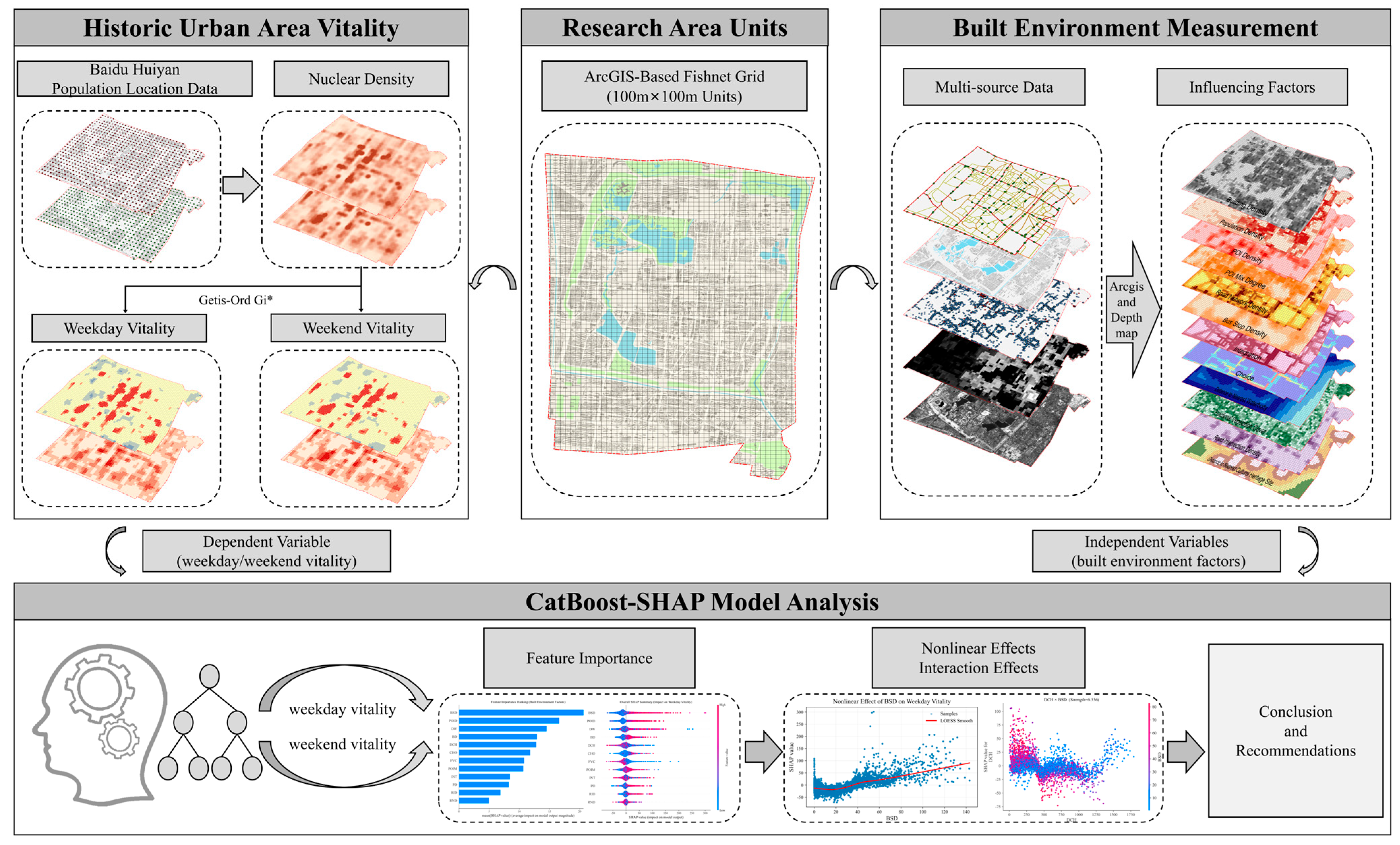
A methodological framework was established to investigate the nonlinear and synergistic impacts of various built environment factors on the vitality of the historic urban area. As shown in Figure 2, this framework unfolded in four stages, (1) Crowd vitality in the historic urban area during weekday and weekend was characterized using Baidu Huiyan population location data; (2) Twelve built environment factors were collected from multiple data sources and were used as independent variables in the model; (3) The relationship between these built environment factors and the vitality of the historic urban area was analyzed using the CatBoost model; (4) The trained CatBoost model was interpreted through the SHAP (Shapley Additive Explanations) method to gain deeper insights into how built environment factors influence historic urban vitality across different time periods.

3.3. Data Sources and Processing

A multi-source database was constructed, comprising population dynamics data, POI data, bus stop data, road and transportation infrastructure data, building and water system data, remote sensing imagery data, and historical and cultural heritage data. All data underwent preprocessing and were uniformly projected into the WGS 1984 Web Mercator Auxiliary Sphere coordinate system. Through reprojection, resampling, and spatial overlay, the data were aligned to a regular 100 m × 100 m grid cell format to facilitate spatial built environment factor extraction and subsequent machine learning model analysis.
Dynamic vitality data were sourced from Baidu Huiyan Population Location Data, covering 168 h from 2 to 8 September 2024. Raw point-format heatmap data underwent kernel density analysis to generate hourly continuous rasters, which were then remapped to 100 m grids to construct the vitality database.
Built environment data included the following categories: POIs, road networks, road intersections, bus stops, building outlines, water systems, and population raster data. POI data underwent cleaning and classification before being aggregated at the grid level to calculate POI density and functional diversity indices. Road, bus stop, and water system data underwent topological verification and image correction before being converted into metrics such as road density, intersection density, bus stop density, and nearest water body distance. Building outline data were used to calculate building density. The 100 m resolution population raster underwent reprojection for population density calculations.
Natural environment data derived from Sentinel-2 Level-2A multispectral imagery were used to generate grid-scale fractional vegetation cover (FVC). Historical and cultural heritage data were sourced from Kaifeng City’s cultural heritage preservation catalog, and their coordinates were extracted and reprojected to calculate cultural heritage accessibility metrics. Data sources, acquisition dates, original spatial resolutions, data types, and preprocessing methods are summarized in Table 1.

3.4. Research Methods

3.4.1. Vitality Assessment of the Historic Urban Area

This study utilized Baidu Huiyan population location data to quantify crowd activity intensity in the historic urban area across different time periods. Baidu Huiyan generates “population heat values” based on location information collected when users are stationary or move slowly. The data have explicit latitude/longitude coordinates and timestamp attributes, enabling continuous reflection of urban population spatial distribution. The study selected Baidu Huiyan data spanning 7 days (Monday to Sunday) from 2 to 8 September 2024, covering the time interval 8:00–23:00, totaling 112 h. The data were provided in the format “Longitude_Latitude_Population Heat Value,” with hourly intervals and units in “people.” These data were imported into ArcGIS as hourly CSV files. Following unified coordinate calibration and projection conversion, the point data for each hour underwent the following processing workflow:
(1)
Hourly kernel density estimation (KDE): KDE was applied to hourly population heatmap data to generate spatially continuous raster population density surfaces. KDE smoothed heatmap values and reflected the spatial distribution intensity of population activity, serving as the mainstream technical approach for dynamic vitality measurement.
(2)
Raster-to-point conversion and spatial association with 100 m grids: To unify the scale of vitality analysis, hourly KDE raster results were converted to point features via raster-to-point operations, with each pixel’s density value stored as an attribute field. The point data were spatially joined with a pre-constructed 100 m × 100 m regular grid, assigning each raster pixel’s density value to its corresponding grid cell. This yielded hourly vitality values for each grid cell within the historic urban area.
(3)
Construction of multi-temporal average vitality levels: To reflect the temporal rhythms of daily life, tourism activities, and consumption behaviors in the historic urban area, this study divided the hourly vitality data from 8:00 to 23:00 daily into four typical periods: morning (8:00–12:00), afternoon (13:00–18:00), evening (19:00–23:00), and all-day (8:00–23:00). The vitality value for each spatial unit was then averaged across each time period, as shown in Equation (1):
V t , i = 1 n t h t K h , i
where K h , i represented the KDE vitality value for the grid i at hour h , V t , i denoted the average vitality value for the period t , and n t indicated the number of hours within the period.
(4)
Weekday and weekend vitality sample processing: After hourly per-grid vitality values were calculated, all grid vitality data from 2 to 8 September 2024 were treated as independent samples for the model. Given that weekday (Monday to Friday) exhibited consistent urban vitality rhythms, while weekends (Saturday and Sunday) shared similar leisure and tourism characteristics, this study separately integrated the grid vitality data from the five weekdays and the two weekend days into two independent sample sets. Specifically, for each typical time period (e.g., 8:00–12:00 in the morning), the sample sizes for weekday and weekend were defined in Equations (2) and (3), respectively.
N w e e k d a y = 5 × 3504 = 17,520
N w e e k e n d = 2 × 3504 = 7008
Each sample corresponded to a combination of “grid–hour–activity value.” This approach preserved natural inter-day variability while substantially increasing the model’s training sample size. It enhanced the CatBoost model’s stability and generalization capabilities when learning complex nonlinear relationships. Compared to simply averaging weekday and weekend, retaining daily and hourly observations reduced interference from random factors—such as weather, crowd fluctuations, and short-term events—on model fitting. This yielded more reliable estimates of the relationship between the built environment and vitality levels.
Based on the average hourly vitality throughout different time periods, spatial autocorrelation analysis was applied to explore the distribution patterns of vitality in the historic urban area, as well as the statistical correlations of these patterns, including global and local autocorrelation. Global spatial autocorrelation represents the overall trend in the distribution of spatial objects within the studied area, while local spatial autocorrelation highlights the local peculiarities of such distributions. Moran’s I index was selected as the statistic for global autocorrelation, as demonstrated in Equation (4). The G* statistic (Getis-Ord G*) serves as the local autocorrelation statistic, as stated in Equation (5):
Moran s   I = n i = 1 n j = 1 n w ij X i X ¯ X j X ¯ W i = 1 n X i X ¯ 2
G i * = j = 1 n W ij x j x ¯ j = 1 n W ij S n j = 1 n W ij 2 j = 1 n W ij 2 n 1
where X i and X j represent the vitality values of spatial units i and j , respectively; w ij denotes the spatial weight between units i and j ; n is the total number of spatial units; X ¯ is the average vitality value across all units; S is the sample standard deviation of vitality values; and W is the aggregation of spatial weights. Moran’s I index ranges from −1 to 1. Positive values indicate spatial clustering of vitality, negative values indicate spatial dispersion, and values near to 0 indicate random spatial distribution of vitality. The G i * statistic is standardized to provide the z score, which indicates whether the spatial unit i is a statistically significant hotspot (high-value cluster) or coldspot (low-value cluster).

3.4.2. Measurement of Built Environment Indicators

Based on the “5D” indicator system proposed by Ewing et al. [67] and relevant studies on urban built environment indicators [68,69], six dimensions were established: density, functional diversity, transportation accessibility, spatial accessibility, spatial environment, and historical and cultural context. These encompass 12 built environment variables (Table 2). To ensure statistical independence and theoretical representativeness of the indicators, a multi-stage variable screening process was employed: First, variance inflation factor (VIF) tests were used to control multicollinearity (all variables had VIF < 5) [70]; second, the Boruta algorithm (100 iterations, 500 random forests) was applied to assess the robustness of variable importance [71,72], confirming that all variables exhibited non-redundant significance. From both theoretical and empirical perspectives, all 12 built environment indicators were retained to ensure the integrity and interpretability of the analytical framework.

3.4.3. CatBoost Model

CatBoost is an effective machine learning technique based on the gradient-boosted decision tree architecture, capable of capturing complex nonlinear interactions between variables [73]. It boasts outstanding automatic feature processing capabilities and powerful nonlinear fitting abilities, avoiding the need for substantial preprocessing and thus conserving crucial information [74]. CatBoost is renowned for its high accuracy and robustness, generally surpassing other models such as RF and XGBoost in numerous benchmark tests [75]. The computational procedure comprises four steps:
(1) Model initialization: The initial prediction is a constant value that minimizes the loss function L ( y ,   y ^ ) , as shown in Equation (6):
F 0 x   =   argmin c i = 1 n L y i ,   c
(2) Additive model: The model is built in stages, where each stage adds a new tree h m x to the existing model. At this stage, the prediction was updated by adding a weak learner (decision tree), as shown in Equation (7):
F m x = F m 1 x + η h m x
(3) Gradient calculation: At each step, the residuals (negative gradients) are calculated based on the current model’s predictions, as shown in Equation (8):
r i m = L ( y i , F m 1 ( x i ) ) F m 1 ( x i )
The new tree was trained to minimize the residual errors.
(4) Prediction: The final prediction is the sum of the initial prediction and the contributions from all the trees, as shown in Equation (9):
y ^ = F M x = F 0 x + m = 1 M η h m x
where M was the total number of trees, and F M x was the final prediction.

3.4.4. Optuna Hyperparameter Tuning and Model Performance Comparison

To comprehensively evaluate the complex nonlinear relationship between built environment factors and historic urban area vitality, and to enhance the model’s generalization capability in unseen scenarios, this study constructed three ensemble learning models—Random Forest (RF), XGBoost, and CatBoost. These models were applied to predict vitality on weekdays and weekends, respectively. All models employed an 8:2 split ratio for training and testing datasets, and their robustness was assessed using 5-fold cross-validation. This approach helped mitigate overfitting risks and enhanced the universality of the results [76].
To avoid the subjectivity and limitations of manual parameter tuning, this study employed the Optuna automated hyperparameter optimization framework to systematically tune three model types. Optuna leverages Bayesian optimization (TPE algorithm) to efficiently explore the hyperparameter space through intelligent sampling. It jointly optimizes key parameters including iterations, learning_rate, depth, and l2_leaf_reg, with the objective function to maximize R2 under 5-fold cross-validation [77,78]. An early stopping mechanism was incorporated to prevent overfitting, and performance stability was validated through repeated experiments using multiple random seeds [79].
To quantify the optimization effect, we compared the model performance under default parameter configurations with that after Optuna tuning (Table 3). Results showed that after Optuna optimization, all models exhibited significantly improved R2 values, along with markedly reduced RMSE and MAE. CatBoost demonstrated the best performance across R2, RMSE, and MAE, indicating its distinct advantage in capturing the complex nonlinear relationship between the built environment and historic urban area vitality. Therefore, the CatBoost model optimized by Optuna was ultimately selected as the core analytical model for this study. Combined with the SHAP method, it enabled variable interpretation and analysis of the underlying influence mechanisms.

3.4.5. SHAP Explainable Method

This paper introduced the SHAP approach as an interpretability tool for CatBoost model [80]. Drawing from Shapley value theory in game theory, SHAP quantifies the marginal contribution of each built environment characteristic across multiple forecast outcomes, enabling feature-level analysis. By traversing all possible feature combinations, it calculates the average marginal contribution of each variable across different subsets, ensuring a fair quantification of variable contributions. The calculation is given by:
SHAP ij = S { x 1 , x 2 , , x n } { x j } S ! n S 1 ! n × f S { x j } f S
where SHAP ij denotes the S H A P value of feature j for the i sample in the historic urban area; j represents a built environment indicator; S indicates the feature subset of the model, comprising all possible permutations and combinations of built environment indicators, excluding X j ; n   =   12 . In the prediction model for the vitality of the historic urban area, contribution-based analysis enabled feature-level interpretation—that is, examining how each factor influenced the predicted vitality outcomes—thereby further enhancing the interpretability of the CatBoost model. To deeply reveal the synergistic mechanisms among built environment factors and their combined impact on urban vitality, this study adopted the Shapley interaction value proposed by Lundberg et al. [81] as an extension of the SHAP (Shapley Additive Explanations) framework. This approach enabled the pairwise quantification of interaction effects within the CatBoost model, achieving both model consistency and local accuracy within a game-theoretic framework.

4. Results

4.1. Dynamic Spatio-Temporal Characteristics of the Historic Urban Area

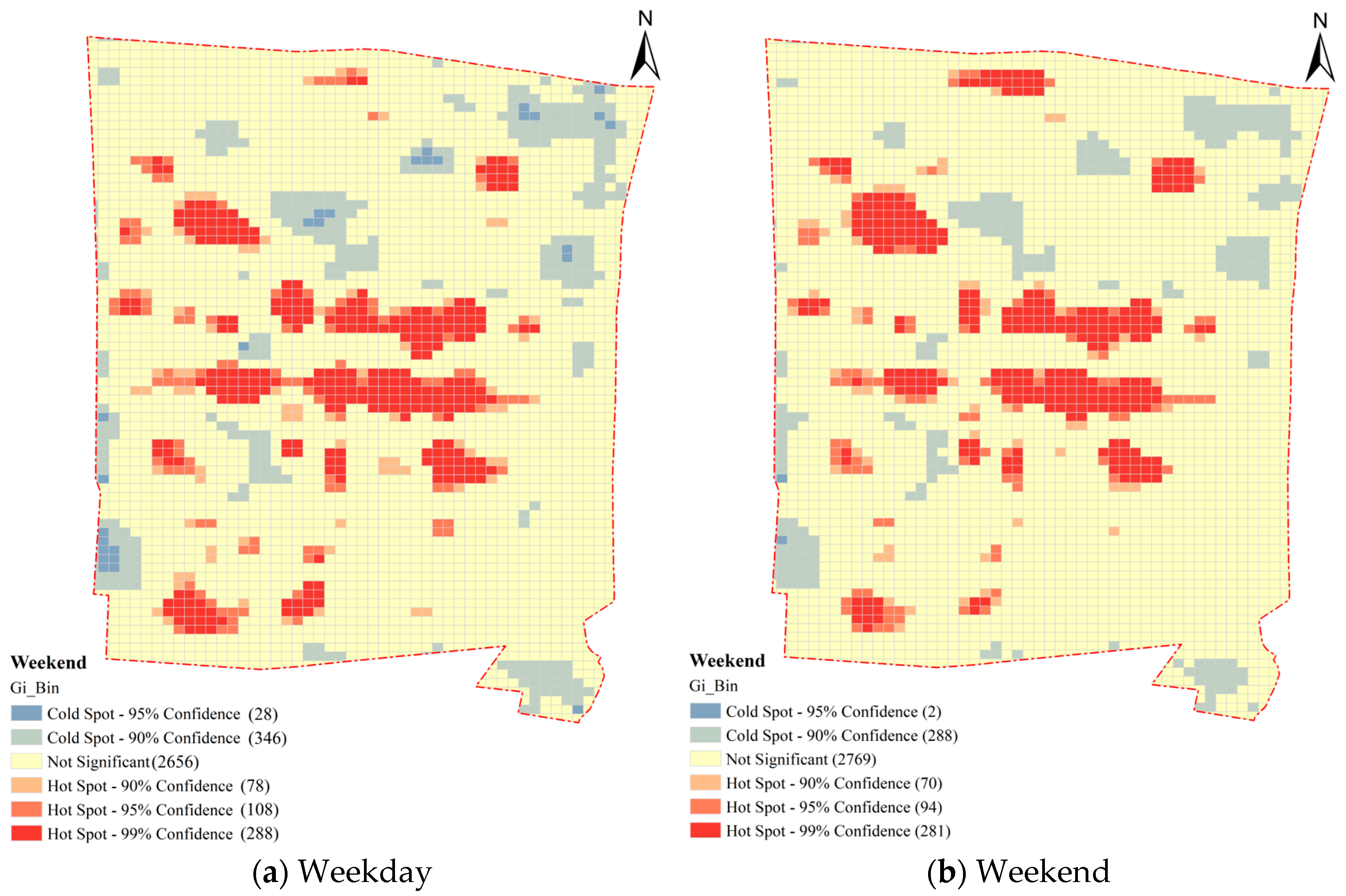
From the perspective of the all-day average period, the spatial autocorrelation of vitality in the historic urban area was examined using the global Moran’s I index. Results suggested that Moran’s I indices for the average hourly vitality of Kaifeng’s historic urban area were 0.803 on weekdays and 0.809 on weekends. The corresponding normalized Z-values were 66.443 and 66.979, both of which passed the significance test (p < 0.001). This revealed substantial spatial clustering of vitality on both weekdays and weekends. Hotspot/coldspot analysis of average hourly vitality across the entire day (Figure 3) revealed strong spatial consistency in the distribution of high- and low-vitality zones, which collectively formed a “core-hot, periphery-cold” spatial pattern. Compared to weekdays, the number of coldspots and hotspots decreased by 84 and 29, respectively, on weekends, indicating reduced spatial heterogeneity.
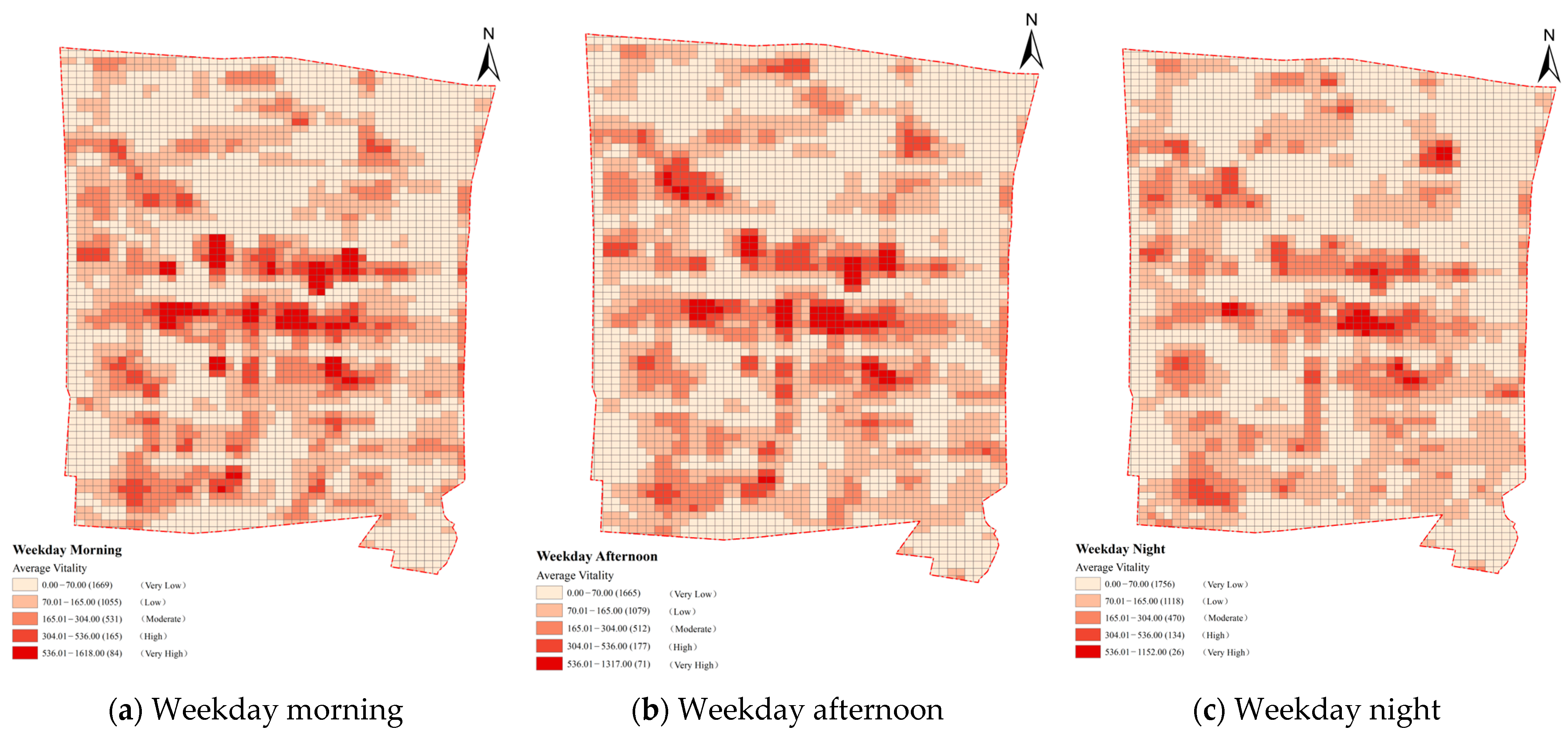
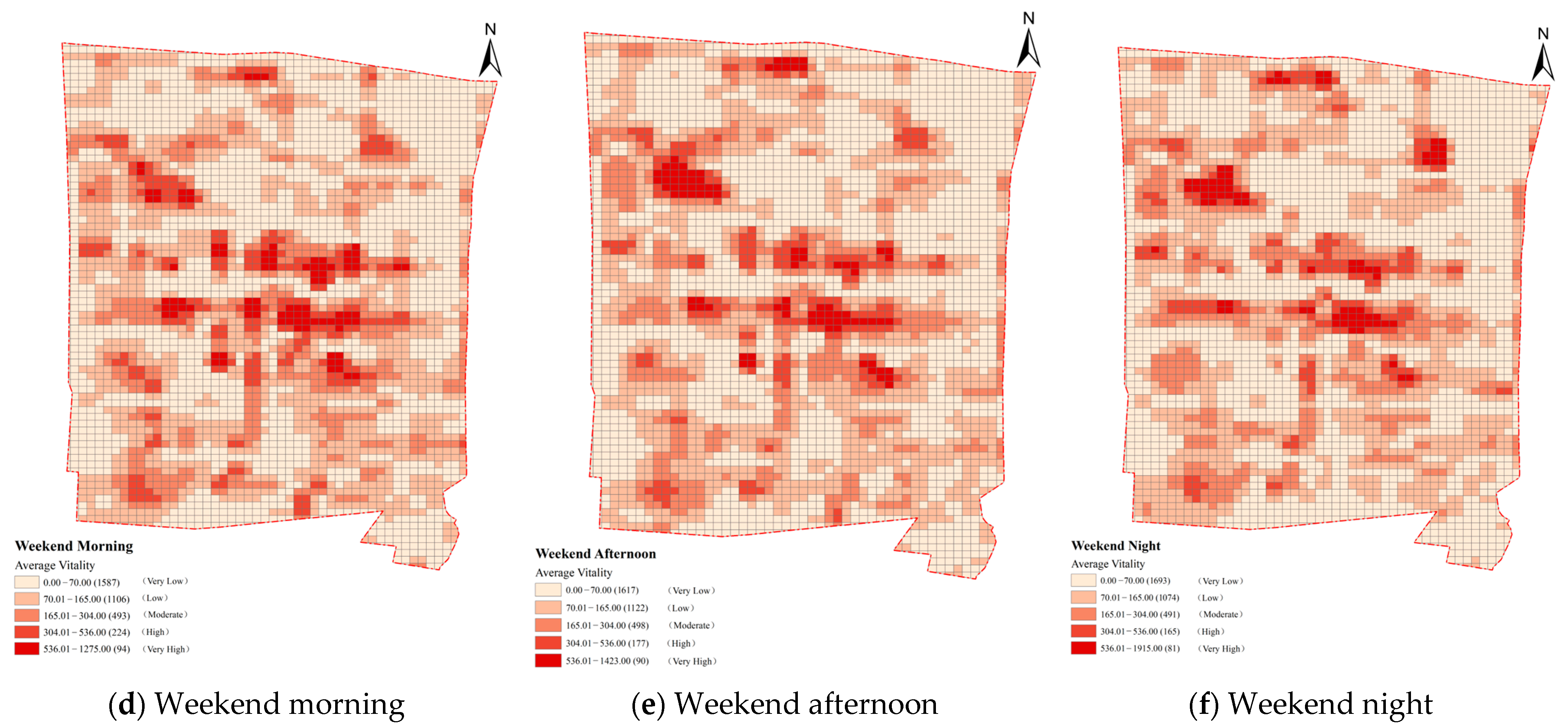
Across different time periods, both high-vitality and very high-vitality units were more prevalent on weekends than on weekdays. Urban vitality on both weekdays and weekends exhibited a progressive decline from morning to night (Figure 4). On weekdays, the number of units with high vitality levels was 249 in the morning, 248 in the afternoon, and 160 at night. On the weekend, the corresponding figures were 318, 267 and 246, respectively. Weekend vitality peaks exceeded those on weekdays, with a smaller decline during the late-night period, reflecting higher sustained vitality. This indicated greater intensity and longer duration of urban vitality on the weekend.

4.2. The Impacts of the Built Environment on the Vitality of the Historic Urban Area

4.2.1. Feature Importance of Built Environment Factors Across Different Time Periods

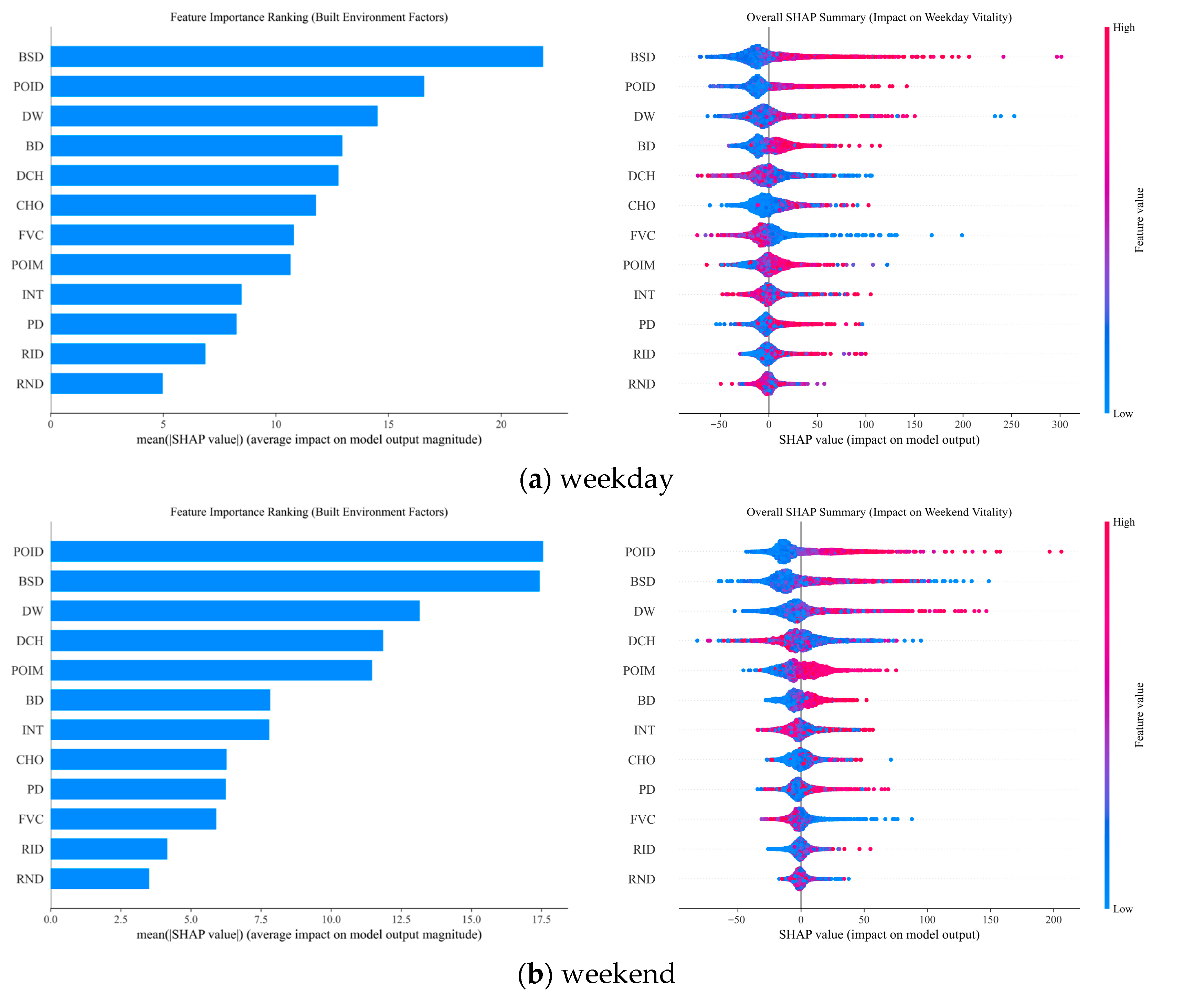
Figure 5 illustrates the feature importance and ranking of 12 built environment factors affecting average hourly vitality throughout the day on weekdays and weekends. Each scatter point in the plot represented the contribution of a built environment factor to the prediction outcome for a specific sample (SHAP value), with vertically stacked points indicating the number of samples sharing the same SHAP value. Results indicated that BSD, POID, DW, and DCH consistently ranked among the top factors influencing activity levels on both weekdays and weekends, establishing them as primary determinants. The rankings of other variables exhibited notable differences between weekdays and weekends.
Regarding date-specific variations: BD’s importance declined from 4th place on weekdays to 6th place on weekends; DCH and POIM rose from 5th to 4th and from 8th to 5th, respectively, on weekends. CHO dropped from 6th to 8th, while INT climbed from 9th to 7th. FVC fell from 7th on weekdays to 10th on weekends. PD, RID, and RND remained at the bottom on both dates. Table 4 further displayed relative importance rankings across different time periods (morning, afternoon, night, and all-day). POID, BSD, DW, and DCH consistently ranked within the top five across most periods. POIM showed significantly increased importance during the afternoon and night periods. BD ranked higher at night than in the morning and afternoon, while FVC showed a gradual decline from morning to night on weekday PD, RID, and RND remained at the bottom across all time periods.

4.2.2. Nonlinear Effects of the Built Environment on the Vitality of the Historic Urban Area

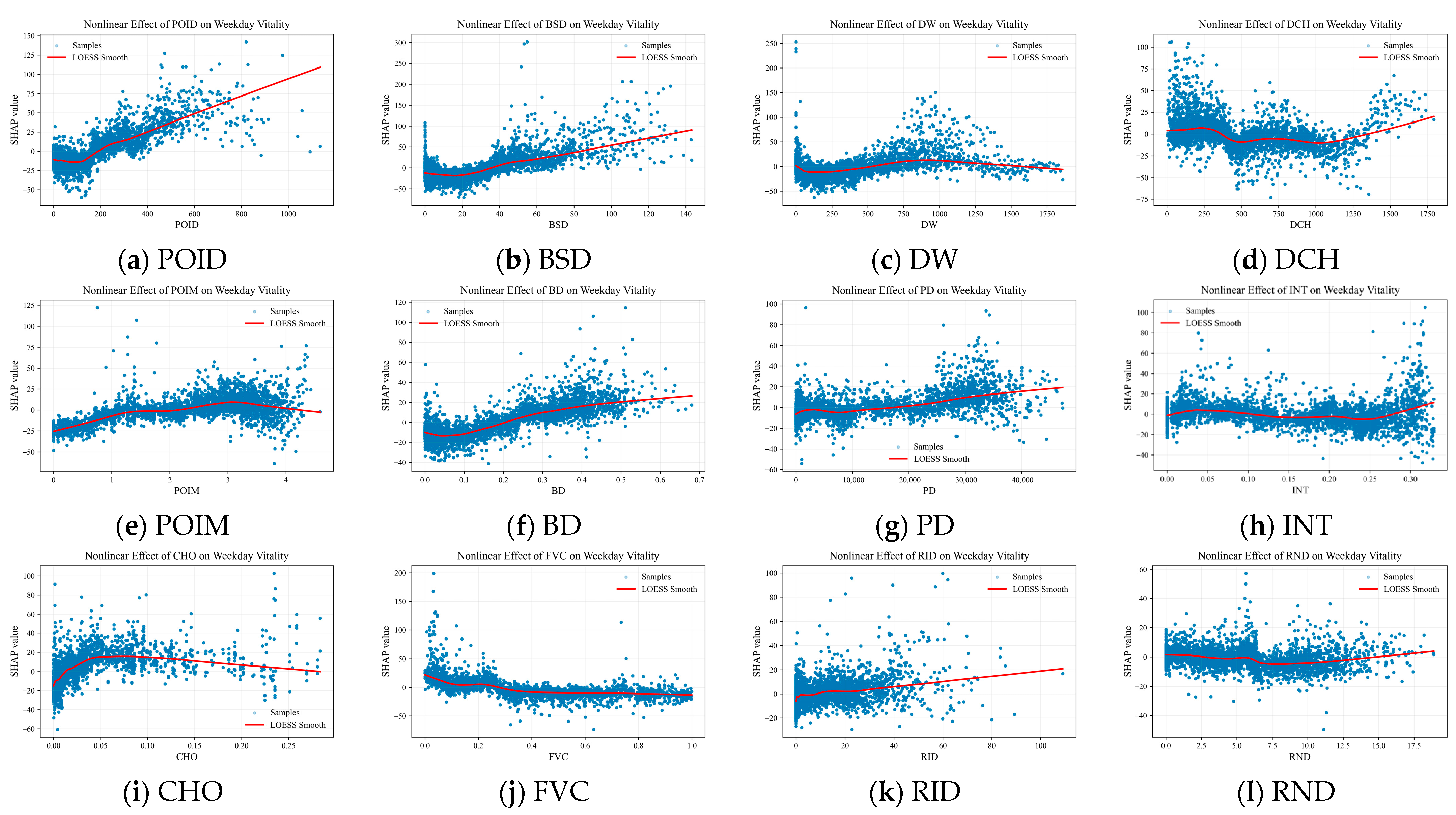
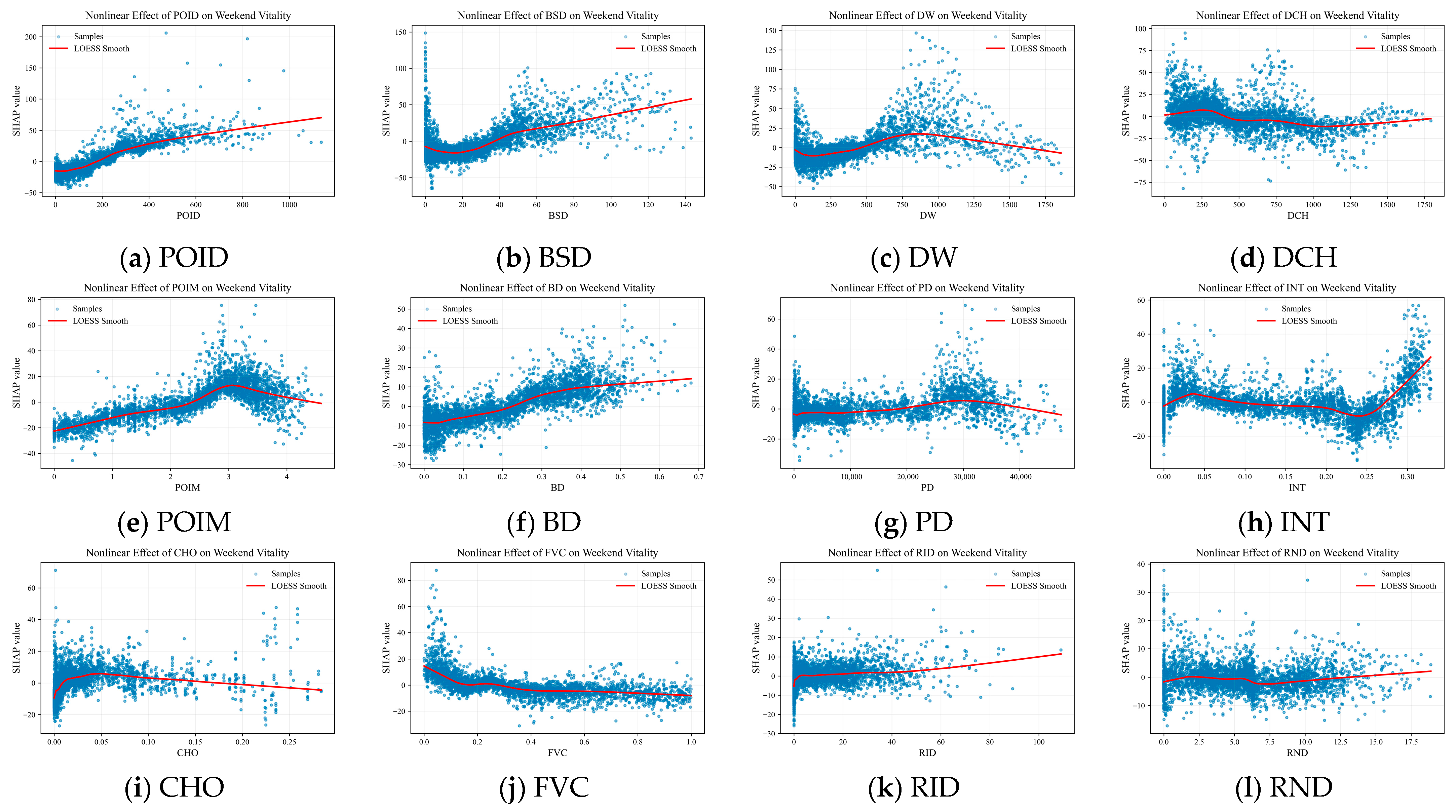
To delve deeper into the mechanisms by which the built environment influences the vitality of historic urban areas, this study employed the SHAP interpretation method to generate SHAP value distribution maps that illustrated the impact of various built environment factors on historic urban area vitality (Figure 6 and Figure 7). Each point in the figure represented a sample unit, and the trend of the LOESS curve allowed for the intuitive identification of nonlinear patterns, critical thresholds, and variations in the strength of influence across different variables. Modeling each built environment factor during weekdays and weekends revealed similar nonlinear characteristics and threshold effects. Therefore, focusing solely on the average hourly vitality across the entire day for both weekday and weekend, this study prioritized discussion of the factors with the most significant impact on vitality.
All built environment factors exhibited significant nonlinear relationships and threshold effects on both weekday and weekend, indicating that the vitality of historic urban areas did not result from a simple linear accumulation but rather involved critical points and marginal effects under varying conditions.
Within the functional diversity and density dimensions, POID exerted a suppressing effect on vitality at low levels, shifting to a positive influence once exceeding approximately 180 units per square kilometer; POIM achieved its maximum positive effect within the 2.5–3 range, after which marginal effects gradually diminish.
Density-related factors exhibited typical segmented effects; PD had a negative impact at low densities but rapidly shifted to a promotional role beyond approximately 20,000 people/km2; BD showed suppression below 0.2, turned positive between 0.2 and 0.4, and stabilized at high values.
Transportation and spatial accessibility factors exhibited multiple thresholds; BSD showed a pronounced positive effect above approximately 35 units/km2; RID promoted vitality above roughly 20 intersections/km2, while RND exhibited a negative effect around 7.5 km/km2. INT transitioned from inhibitory to promotional between approximately 0.25–0.3; CHO turned positive beyond roughly 0.01 and peaks near 0.05.
Within the spatial environment and historical-cultural dimensions, DW’s positive effect was primarily concentrated within the 500–1500 m accessibility range; FVC exhibited a weak negative impact beyond approximately 0.2; DCH contributed most strongly within a 400 m radius, with its influence gradually diminishing beyond this distance.

4.2.3. Interaction Effects of the Built Environment on the Vitality of the Historic Urban Area

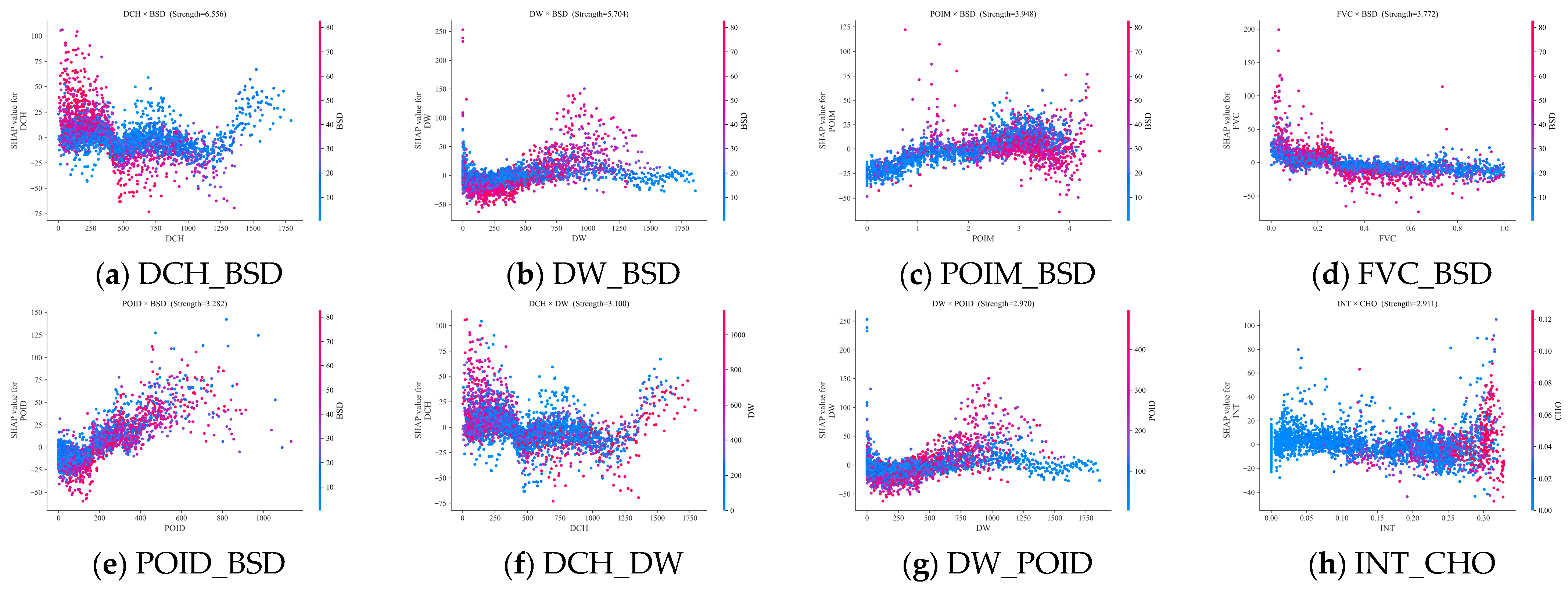
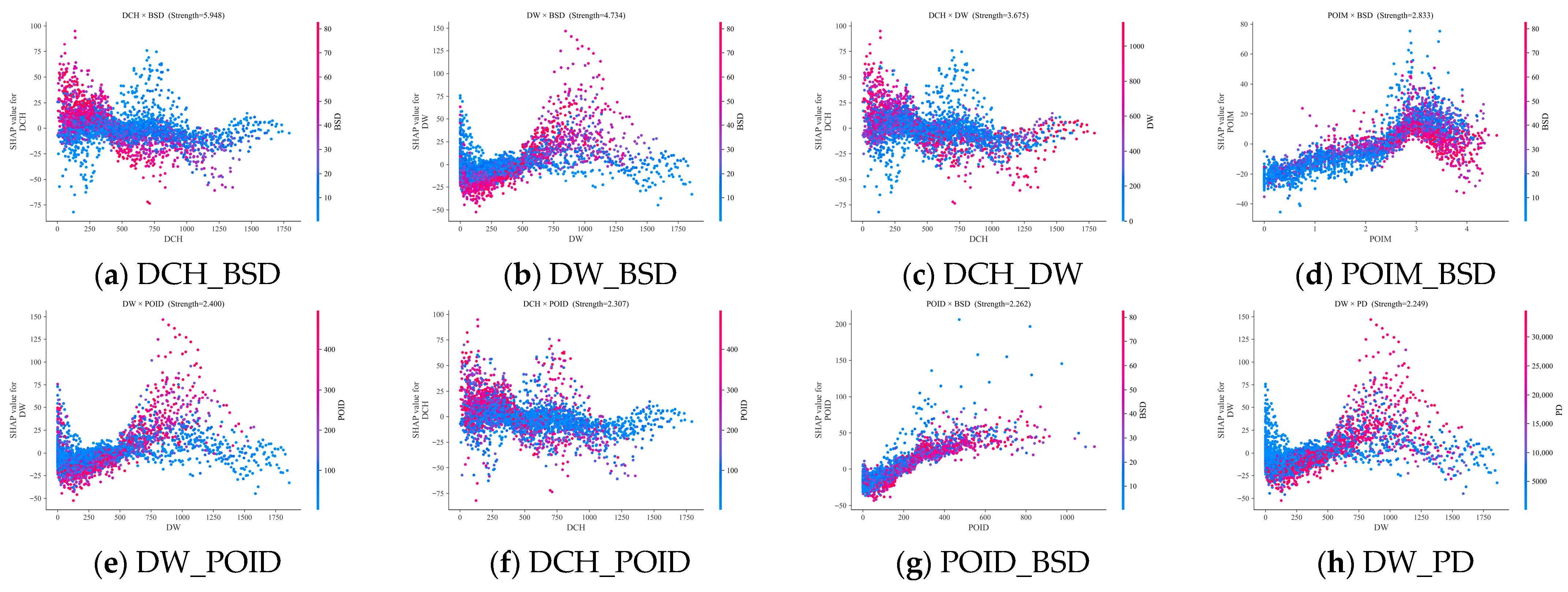
To further elucidate the synergistic mechanisms among built environment factors, this study employed SHAP interaction values to analyze variable interactions under average activity levels during weekdays and weekends. The top eight variable pairs ranked by interaction strength were visualized (Figure 8 and Figure 9). SHAP interaction plots color-map interaction variable values, enabling clear identification of main effect trends across different interaction levels.
BSD emerged as one of the most significant interaction factors. Among the top eight interaction pairs for both weekday and weekend, BSD exhibited significant interactions with DCH, DW, POIM, and POID. When DCH was less than 500 m, high BSD amplified the positive effect of DCH. Conversely, when DCH exceeded 500 m, high BSD mitigated this effect, with this trend being more pronounced during the weekend. When DW was less than 500 m, high BSD amplified the negative impact of water proximity; within the 500–1500 m range, high BSD enhanced the positive effect of water bodies. When POIM exceeded 3, BSD and POIM exhibited a negative interaction. When POID was below 200 points/km2, high BSD intensified the negative effect of POID. Figure 8d shows that on weekdays, when FVC was below approximately 0.3, high BSD amplified FVC’s positive impact on vitality; however, when FVC exceeded approximately 0.3, high BSD magnified FVC’s inhibitory effect on vitality.
DW also exhibited critical interactions. A distinct distance-segmented effect with DCH was observed, when DCH was less than 500 m, medium-to-long-distance DW enhanced attractiveness; when DCH exceeded 500 m, the positive effect of short-distance DW became stronger. The interaction with POID exhibited a “negative at short distances, positive at long distances” pattern; high POID intensifies DW’s negative effect when DW was less than 500 m, while amplifying its positive influence at greater distances. The interaction with PD mirrored POID’s behavior, showing directional shifts across different distance ranges. Several network structure-function interactions also stood out. For instance, on weekdays, CHO exhibited synergistic enhancement effects when INT was around 0.3. On weekends, POID significantly enhanced cultural attractiveness within a 500 m radius of DCH.

5. Discussion

5.1. Characteristics of the Vitality of the Historic Urban Area Across Multiple Time Scales

5.1.1. Spatial Patterns of Vitality in the Historic Urban Area

From a spatial perspective, high-activity zones within the historic urban area demonstrated a “dual corridor + multiple nodes” pattern on both weekdays and weekends. The two high-activity corridors ran from Ximen Street to Dong Street and from Shengfu West Street to Gulou Street. These districts concentrate a substantial number of commercial and service facilities, public service amenities, and historical and cultural sites, providing critical support for population activities and urban functions while generating spatially concentrated corridors of vitality.
Famous historical and cultural attractions such as Qingming Riverside Landscape Garden, Wansui Mountain Martial Arts City, Kaifeng Prefecture, West Gate Tower, and Bao Gong Temple constitute various focal points of high activity. Functioning as core zones for experiencing the Northern Song Dynasty culture. These sites possess high tourism appeal, drawing large numbers of tourists and local inhabitants on weekends and holidays, and thus serve key nodes in the distribution of vitality.
Meanwhile, areas such as the intersection of Longting North Road and the Northern section of Inner Ring East Road, the intersection of Jinyao Road and Xiguan North Street, Jiangnan Dizhou International Plaza, and the intersection of Wuyi Road and Weidu Road primarily form daily consumption-oriented vitality clusters due to their rich commercial amenities.
In contrast, peripheral portions of the historic urban area often exhibit poorer vitality. Cold places such as the Iron Pagoda Park, Sunshine Lake, Longting Park, Baogong Lake, and Yuwangtai Park suffer from single-function attractions, inefficient space usage, low transportation accessibility, and inadequate infrastructure maintenance. For instance, beyond the main pagoda, the Iron Pagoda Scenic Area has only minor attractions without in-depth development, resulting in brief visitor stays. Yuwangtai Park, albeit containing historical and cultural importance, suffers from its remote position and aging buildings; Sunshine Lake remains neglected and hence lacks vitality.

5.1.2. Temporal Dynamics of Vitality in the Historic Urban Area

From a temporal perspective, the historic urban area demonstrated clear rhythmic changes in vitality between weekdays and weekends. Overall, average hourly vitality levels on weekends were often higher than on weekdays, with smoother variations marked by increased persistence and delayed peaks. This mostly arises from both out-of-town tourists and local residents having more free time on weekends, leading to focused releases of cultural tourism, leisure consumption, and nighttime entertainment activities that extend the city’s peak vitality times.
In contrast, daily urban vitality follows a “commuter-driven” temporal pattern, with activity maxima concentrating in the morning and afternoon, swiftly dropping at night. This pattern is tightly related to residents’ commute routes and is further influenced by the commercial services offered in certain locations, generating a daily vitality structure driven by both commuting and consumption.
Specifically, places such as the Provincial Government West Street to Gulou Street corridor, Ximen Street to Dongda Street corridor, and Jiangnan Dizhou International Plaza demonstrated a typical “morning high-afternoon high-evening low” pattern on weekdays. These zones serve not only as key commuting corridors but also concentrate considerable commercial, eating, and everyday service facilities. Consequently, they establish consistent daily consumption-driven vitality above commuter flows, constituting classic “mixed-use residential-commercial + commercial-supported” vitality clusters.
Qingming Riverside Landscape Garden and Wansui Mountain Martial Arts City exhibited a “low morning—peak afternoon—low evening” tendency, with energy peaking in the afternoon. This reflects their tourism-driven nature, heavily impacted by group excursions and out-of-town tourists. The intersection of Longting North Road and the Northern stretch of Inner Ring East Road showed heightened nighttime activity, related to night market stalls and community-based consumption, forming a “localized nighttime vitality point during non-peak hours.”
On the weekend, urban vitality was sustained at widespread high levels. Areas such as West Provincial Government Street to Gulou Street and Jiangnan Dizhou International Plaza maintained significant activity over the weekend, suggesting robust commercial and leisure appeal beyond commuting demands. Qingming Riverside Landscape Garden and Wansui Mountain Martial Arts City saw dramatically heightened activity from afternoon into night, demonstrating the increased effect of cultural and tourism resources on non-working days, extending the overall vitality of the historic urban area into evening hours.

5.2. Analysis of the Impacts of the Built Environment on the Vitality of the Historic Urban Area

5.2.1. Interpreting the Feature Importance of Built Environment Factors

The feature significance analysis in this study reveals that BSD, POID, DW, and DCH consistently rank among the top factors across different periods and time slots. This indicates that the vitality of historic districts is collectively underpinned by a multi-dimensional system comprising “transport accessibility—functional density—spatial environment—historical and cultural resources.” This combined mechanism embodies the stable vitality structure formed in historic districts characterized by high density, functional complexity, and concentrated cultural resources, aligning closely with the integrated driving forces proposed in existing research [68,82].
The sustained importance of BSD indicates that public transportation plays a foundational role in the vitality of historic districts. Within spatial environments featuring narrow streets and alleys with limited motor vehicle access, public transit assumes the primary function of cross-district connectivity, thereby consistently supporting access and mobility for both daily and leisure activities. Higher BSD reduces inter-area mobility costs, increasing the probability of people entering, lingering, and consuming—a finding validated by empirical studies in cities such as Shenzhen and Chongqing [32,83].
As a core indicator of functional supply intensity, POID exhibits strong explanatory power across all time scales, indicating that human activity clustering fundamentally depends on the distribution of destination functions such as commerce, dining, and public services. During afternoon and nighttime hours, POIDs’ importance further increases, aligning with existing research concluding that “functional density directly drives crowd activity during peak periods” [84]. In contrast, POIM exhibits more pronounced time sensitivity, rising significantly in the afternoon and evening. This indicates that functional diversity better attracts purposeful, longer-stay leisure and consumption activities, consistent with findings that multifunctional spaces enhance nighttime economic vitality [82].
DW and DCH maintain stable importance throughout the day and across different time periods, indicating that water bodies possess enduring appeal as environmental and landscape resources, reflecting the long-term attraction of ecological landscape resources and historical-cultural resources [85]. The stability of DW suggests that the esthetic and recreational value of water bodies positively influences various activity types. The sustained importance of DCH indicates that cultural heritage districts serve not only as primary tourist destinations but also as vital venues for local residents’ leisure, socializing, and experiential activities, demonstrating universal appeal across temporal dimensions. In contrast, FVCs importance declines over time, with notably weaker explanatory power during nighttime and weekends. This reflects that green spaces primarily support routine, commuter-oriented activities while offering limited direct drive for leisure tourism and the nighttime economy [86].
BD exhibits pronounced temporal variations; its importance rises on weekdays, more effectively reflecting the carrying capacity of work-residence spaces; it increases again at night, indicating that high-density built areas provide more continuous street interfaces and consumption nodes, facilitating nighttime pedestrian aggregation. However, its overall importance declines on weekends, suggesting that leisure and tourism behaviors rely more on cultural resources and functional density than on building form itself—consistent with findings by Wei et al. [5].
CHO and INT exhibit opposite ranking shifts: INT rises while CHO falls on weekends. This indicates that leisure activities rely more on overall network connectivity to reach cultural and functional cores, with localized path choices becoming less influential. In other words, destination-oriented leisure travel depends more on network structure than path details—highly consistent with Li et al.’s [87] findings on the differing impacts of weekday vs. weekend street networks on spatial vitality.
PD, RID, and RND consistently rank at the bottom across all time periods. The high density, narrow road network, and relatively homogeneous spatial characteristics of historic districts limit the marginal impact of these structural variables at the hourly scale, rendering their explanatory power weaker than functional, cultural, and accessibility factors. Yang et al.’s [88] A study on Chongqing neighborhood vitality found RID to have a significant influence on overall vitality, while RND ranked lower—partially consistent with our findings. This indicates that the impact of road structure factors is highly dependent on urban spatial form and scale context. In high-density historic districts, their influence on vitality is more easily overshadowed by functional configuration and transportation accessibility.

5.2.2. Interpreting Nonlinear and Threshold Effects of Built Environment Factors

The SHAP nonlinear analysis in this study reveals that the vitality of historic districts does not result from the linear aggregation of built environment factors. Instead, it exhibits distinct critical thresholds, inflection points, and marginal effect variations across different variable intervals. This characteristic reflects the typical “threshold-type” spatial-behavioral response pattern exhibited by historic districts under conditions of high density, functional complexity, and cultural resource concentration. This phenomenon also aligns closely with the existing literature on the nonlinear patterns of urban vitality [86,89].
Functional factors exhibit a minimum functional density threshold and an optimal mix interval. Both POID and POIM exhibit pronounced threshold characteristics, indicating that higher functional density and mix levels do not necessarily yield greater benefits; instead, they are most effective for enhancing vitality within specific ranges. Research shows that when POID falls below a certain level, areas struggle to generate sufficient consumption and dwell demand, suppressing vitality. Beyond a critical threshold, positive effects rapidly intensify and stabilize [90]. Furthermore, within the optimal mix range, POIM significantly promotes activity diversity and dwell time. However, excessive mixing may lead to functional overlap and increased complexity, thereby weakening overall vitality performance. Li et al. [89], in a comparative study of Haikou, Nanning, and Guangzhou, similarly noted that enhancing urban vitality requires an “optimal functional mix” range rather than unlimited enhancement, further validating the findings of this study.
Density factors exhibit a structural pattern of “low-density suppression—medium-density promotion—over-density convergence.” Both BD and PD demonstrate segmented density effects in their nonlinear trends: At low densities, insufficient spatial carrying capacity hinders sustained vitality formation; at medium density, spatial interactions between functions and populations reach peak activity, yielding the most significant vitality gains; at high density, marginal benefits begin to diminish, potentially undermining the experience due to factors such as crowding and increased spatial pressure. This pattern aligns with conclusions drawn by Wei et al. [5] in their study of Chaozhou Old Town’s vitality, they indicate that high-density environments do not inherently guarantee greater vitality. The critical factor lies in maintaining population and building density within a moderate range.
Multiple threshold effects exist in transportation and spatial accessibility factors. The nonlinear trends of BSD, RID, RND, CHO, and INT indicate that street network structure exerts a significant segmented influence on crowd travel behavior. BSD transitions to a significant positive effect beyond approximately 35 units/km2, indicating that enhanced public transport accessibility substantially promotes population inflow and inter-district mobility once a critical threshold is surpassed. This aligns with Wu et al.’s [83] conclusion that “high BSD promotes vitality in weekday commuting and weekend leisure mobility.” The directional effects of RID, RND, CHO, and INT vary across zones. Accessibility factors do not exhibit a “higher is better” relationship with vitality; instead, they produce distinctly different behavioral effects across zones, necessitating a balance between street network density and connectivity [91,92].
Spatial environment and historical-cultural factors exhibit “optimal distance zones.” Both DW and DCH demonstrate distance sensitivity where “excessive proximity or distance detracts from vitality,” while FVC inhibits vitality beyond a certain threshold. This indicates ecological landscapes and cultural resources achieve optimal effects only when positioned “accessible yet not overly proximate.” Excessive proximity may restrict activity space or lead to redundant experiences, while excessive distance diminishes attractiveness. Excessive green coverage may weaken street interface vitality, reducing visibility and social interaction intensity. These findings collectively point to the “golden distance zone” characteristic in resource distribution within historic districts, emphasizing that ecological and cultural resources must be allocated within an optimal distance range to maximize spatial vitality [69,88].
Nonlinear and threshold analyses reveal the complex response mechanisms of historic district vitality to the built environment. Different elements exhibit asymmetric and phased effects across varying value ranges, underscoring that planning interventions should prioritize “interval optimization” rather than “overall increase.”

5.2.3. Interpreting the Interactive Mechanisms of Built Environment Factors

SHAP interaction analysis indicates that the vitality of historic districts is not driven by a single independent factor, but rather shaped by the combined effects of transportation accessibility, functional density, ecological resources, and historical and cultural resources under different threshold conditions [83,92]. Among these, BSD, DW, and POID form the core interactive hub, constituting a key “coupled network” that influences the vitality of historic districts. This network exhibits significant enhancement effects, offsetting effects, and threshold reconstruction characteristics.
BSD exhibits the strongest regulatory capacity, indicating that public transportation accessibility significantly amplifies or attenuates the direction and intensity of other factors’ impact on vitality—consistent with findings by Wu et al. [83]. Specifically, the appeal of historical and cultural heritage heavily depends on transit density: high BSD enhances attraction at short distances but may induce a “detour effect” at longer distances, diminishing the appeal of such resources. This mechanism becomes more pronounced during weekend destination-oriented activities. Areas adjacent to water bodies may form void interfaces due to insufficient supporting functions; high BSD further accelerates detours. However, when water bodies are within suitable recreational distances, high BSD enhances accessibility, thereby increasing dwell time [92]. High-functionality mixed-use areas with high transport accessibility may experience flow disruption, spatial crowding, or reduced dwell time, which diminishes their vitality contributions. This suggests avoiding excessive concentration of transport facilities in high-mix-use zones. In functionally underdeveloped areas, transit convenience accelerates population flow toward more functionally rich zones, further draining local vitality—consistent with Ling et al.’s [72] findings on the interaction between subway accessibility and POI density. Under moderate greening conditions, high transit density improves green space accessibility and usage rates. However, in areas with excessive vegetation coverage and insufficient functionality, enhanced transportation accessibility intensifies the transit effect, thereby reducing dwell time [90].
DW exhibits complementary and threshold-enhancing effects across multiple variable pairs, reflecting spatial synergies between watercourse landscapes and cultural, functional, and population density. Water accessibility and historical-cultural resource accessibility demonstrate complementary effects, with synergistic advantages dependent on matched distance intervals. This aligns with Yang et al.’s [88] findings on the interaction between cultural and park accessibility. Interactions with POID and PD indicate water bodies should maintain moderate spatial distance from high-functionality/high-population-density areas. Proximity to water in dense environments may reduce vitality due to crowding pressures or usage conflicts. However, within reasonable distances, functionality and population density can synergize with water bodies to create overlapping attractions. In Chongqing, high road density was found to enhance the vitality of neighborhoods near water bodies [88].
Historical and cultural resources rely on functional amenities to amplify their destination magnetism. Higher functional density facilitates cultural experiences by supporting dwell time demands, particularly during peak tourism periods such as weekends. Local path selection and overall connectivity exhibit synergistic effects, jointly enhancing commuting efficiency [87]. Overall, the vitality of historic districts is shaped by the coupling, complementarity, and offsetting effects of multidimensional built environment factors under varying threshold conditions. Interactions among these factors exhibit distinct directional differences and strong interval sensitivity, driven by a comprehensive system integrating transportation, functionality, environment, and culture [93].

5.3. Planning Implications

The findings of this study provide clear direction for the sustainable renewal of historic districts. At the spatial structure level, emphasis should be placed on strengthening the “dual corridors + multiple nodes” framework. By enhancing walkability, public transit accessibility, and street interface quality, the round-the-clock support role of the two high-vitality corridors—West Gate Street–East Street and Provincial Government West Street–Drum Tower Street—can be further consolidated. Core cultural attractions such as Qingming Riverside Garden and Wansui Mountain Martial Arts City exhibit significant vitality peaks from afternoon into the night. To amplify their spillover effects and extend nocturnal activity, transportation connections should be strengthened, pedestrian network continuity enhanced, and integrated cultural-commercial operations promoted. For underutilized peripheral areas, attention must be given to supplementing residential and experiential functions, improving accessibility, and boosting daily usage through small-scale public space activation strategies.
Functional configuration must prioritize the synergistic balance of “moderate functional density” and “reasonable functional diversity.” Nonlinear thresholds for POID and POIM indicate that planning should ensure residential and cultural zones possess essential service facilities while avoiding congestion and behavioral conflicts caused by excessive mixing. Interaction results between functional density and cultural resources further indicate that cultural attractions require matching commercial and public services within a 500 m radius to extend visitor dwell time, stimulate local consumption, and foster integrated cultural-tourism development.
Transportation systems should establish multi-tiered, high-coverage public transit networks with rational distribution. The key moderating role of BSD underscores accessibility’s critical support for vitality. Bus coverage for commercial streets and cultural clusters should be enhanced to improve accessibility, while avoiding excessive concentration of traffic nodes in high-mix areas. The threshold effect of street network connectivity indicates that micro-renewal measures should optimize street permeability, enhancing local path flexibility while ensuring overall integration.
The spatial layout of ecological and historical-cultural resources must adhere to the principle of “distance sensitivity.” Research indicates that water bodies and historical-cultural resources exert optimal influence on surrounding vitality within specific proximity zones. Planning should maintain reasonable spatial separation between high-density functional areas and these scarce resources. This approach helps maximize their attractiveness and environmental benefits while mitigating spatial crowding and diminished experiences caused by excessive proximity.

6. Conclusions

This study explored the historic urban area of Kaifeng, utilizing Baidu Huiyan population location data and multi-source built environment data. Employing the CatBoost-SHAP model system, it explores the spatiotemporal characteristics of vitality during weekdays and weekends in the historic urban area, together with the nonlinear influence mechanisms of the built environment. Key findings are as follows:
(1) The vitality of Kaifeng’s historic urban area demonstrates great spatiotemporal heterogeneity, typified by an overall “hot interior, cold periphery” spatial pattern and rhythmic changes between weekdays and weekends. Spatially, high-vitality zones constitute a “dual corridor + multiple nodes” pattern, predominantly centered along the district’s main commercial thoroughfares, core commercial areas, and cultural tourism locations. Conversely, low-vitality zones generally cluster at the urban periphery, in functionally monotonous areas, and in sites with poor accessibility. Temporally, weekdays demonstrate a pattern of “high in the morning, high in the afternoon, low in the evening,” driven mostly by transportation, office activities, and daily consumption. Weekend vitality levels are generally higher than those on weekdays, showing a more persistent high-activity state, particularly with a trend of extended vitality into the night.
(2) The impact of built environment factors on the vitality of historic districts exhibits dynamic variations across different time periods, reflecting the time-sensitive nature of vitality-driving mechanisms. Throughout all time periods, BSD, POID, POIM, DW, and DCH remain significant contributing factors. The influence of POIM gradually increases during the afternoon and nighttime hours, while BD becomes significantly more important during weekday nights. FVC shows reduced influence at night. The varying contributions of certain built environment factors to historic urban area vitality across different time periods indicate that strategies to enhance urban vitality must account for temporal differences between day and night, as well as weekday and weekend.
(3) Significant nonlinear relationships, threshold effects, and interactions exist between the built environment and the vitality of historic urban areas, reflecting the complex coupling characteristics of urban spatial systems. The study found that factors such as BSD, POID, and BD promote urban vitality within reasonable threshold ranges, but exhibit diminishing marginal returns under high-density overlays. Interaction analysis of built environment factors reveals BSD as the strongest interactive variable. It can enhance the vitality of nearby historical and cultural resources while potentially triggering spatial conflicts and functional overlap risks in areas with a high functional mix. The synergistic relationship of FVC and BSD further indicates that spatial governance in historic urban areas should prioritize coordinated allocation of “transportation-function-ecology-culture” to achieve dual enhancement of vitality and environmental quality.
The findings enrich empirical research on the vitality of historic districts, revealing the significant dynamic and rhythmic characteristics exhibited by Kaifeng’s historic district across different time scales and elucidating the differentiated mechanisms of built environment factors during weekdays, weekends, and varying time periods, providing a basis for dynamically optimizing spatial resource allocation, promoting functional integration, and advancing refined governance. However, several aspects warrant further refinement. First, as this study is based on a single-case analysis of Kaifeng’s historic district, the generalizability of its conclusions requires further validation across other types of historic districts. Future research could explore the universality and regional variations in these findings using a broader sample of cities with diverse urban structural characteristics. Second, the vitality data covered a relatively short timeframe, encompassing only one week of temporal variation, and thus failed to fully reflect the rhythmic patterns of activity during special periods such as holidays and peak tourist seasons. Subsequent studies could incorporate longer time series to reveal more comprehensive dynamic mechanisms of vitality. Additionally, this study relied on dynamic population density as an indicator of regional vitality, lacking a multidimensional analysis of vitality. Future research should integrate vitality factors across economic, social, and cultural dimensions to achieve a more comprehensive understanding of multidimensional urban vitality analysis—not only in historic districts but also in broader urban contexts.

Author Contributions

Conceptualization, J.Z. and Y.S.; methodology, J.Z.; software, Y.S.; validation, J.Z. and Y.S.; formal analysis, Y.S.; investigation, Y.S.; resources, J.Z.; data curation, Y.S.; writing—original draft preparation, J.Z. and Y.S.; writing—review and editing, J.Z. and Y.S.; visualization, Y.S.; supervision, J.Z.; project administration, J.Z.; funding acquisition, J.Z. All authors have read and agreed to the published version of the manuscript.

Funding

This research was funded by the Henan Provincial Education Science Planning Project, “Research on Personalized Education Pathways in Undergraduate Institutions Based on Generative AI” [2025YB0083]; the Henan Provincial Social Science Association Annual Research Project, “Research on Practical Models and Optimization Pathways for ‘Smart Governance’ in Henan’s Digital Villages” [SKL-2025-185]; and the Henan Science and Technology Think Tank Research Project, “Study on the Current Status of Ecological Conservation and High-Quality Development in the Yellow River Basin of Henan” [HNKJZK-2025-12A].

Data Availability Statement

The data that support the findings of this study are available from the corresponding author, Yaxin Shen, upon reasonable request.

Acknowledgments

This research was supported by the Field Observation Station for Eco-Hydrological Processes in the Lower Yellow River Floodplain, Ministry of Water Resources. We are grateful for their data support and research facilities.

Conflicts of Interest

The authors declare no conflicts of interest.

References

  1. Xu, J.; Wang, J.; Zuo, X.; Han, X. Spatial Quality Optimization Analysis of Streets in Historical Urban Areas Based on Street View Perception and Multisource Data. J. Urban Plan. Dev. 2024, 150, 05024036. [Google Scholar] [CrossRef]
  2. Yang, Z.; Pan, Y. Are cities losing their vitality? Exploring human capital in Chinese cities. Habitat Int. 2020, 96, 102104. [Google Scholar] [CrossRef]
  3. Williams, S.; Xu, W.; Tan, S.B.; Foster, M.J.; Chen, C. Ghost cities of China: Identifying urban vacancy through social media data. Cities 2019, 94, 275–285. [Google Scholar] [CrossRef]
  4. Wang, J. Problems and solutions in the protection of historical urban areas. Front. Archit. Res. 2012, 1, 40–43. [Google Scholar] [CrossRef]
  5. Wei, H.; Wang, G. Investigating the Spatiotemporal Pattern between Street Vitality in Historic Cities and Built Environments Using Multisource Data in Chaozhou, China. J. Urban Plan. Dev. 2024, 150, 05024027. [Google Scholar] [CrossRef]
  6. Huang, X.; Gong, P.; Wang, S.; White, M.; Zhang, B. Machine Learning Modeling of Vitality Characteristics in Historical Preservation Zones with Multi-Source Data. Buildings 2022, 12, 1978. [Google Scholar] [CrossRef]
  7. Yu, B.; Sun, J.; Wang, Z.; Jin, S. Influencing Factors of Street Vitality in Historic Districts Based on Multisource Data: Evidence from China. ISPRS Int. J. Geo-Inf. 2024, 13, 277. [Google Scholar] [CrossRef]
  8. Tweed, C.; Sutherland, M. Built cultural heritage and sustainable urban development. Landsc. Urban Plan. 2007, 83, 62–69. [Google Scholar] [CrossRef]
  9. El-Basha, M.S. Urban interventions in historic districts as an approach to upgrade the local communities. HBRC J. 2021, 17, 329–364. [Google Scholar] [CrossRef]
  10. Zeng, Z.; Wang, X. Will World Cultural Heritage Sites Boost Economic Growth? Evidence from Chinese Cities. Sustainability 2023, 15, 8375. [Google Scholar] [CrossRef]
  11. Jacobs, J. Dark Age Ahead: Author of the Death and Life of Great American Cities; Vintage: Toronto, ON, Canada, 2010. [Google Scholar]
  12. Lynch, K. Good City Form; MIT Press: Cambridge, MA, USA, 1984. [Google Scholar]
  13. Montgomery, J. Making a city: Urbanity, vitality and urban design. J. Urban Des. 1998, 3, 93–116. [Google Scholar] [CrossRef]
  14. Sung, H.-G.; Go, D.-H.; Choi, C.G. Evidence of Jacobs’s street life in the great Seoul city: Identifying the association of physical environment with walking activity on streets. Cities 2013, 35, 164–173. [Google Scholar] [CrossRef]
  15. Sung, H.; Lee, S. Residential built environment and walking activity: Empirical evidence of Jane Jacobs’ urban vitality. Transp. Res. Part D Transp. Environ. 2015, 41, 318–329. [Google Scholar] [CrossRef]
  16. Wu, J.; Ta, N.; Song, Y.; Lin, J.; Chai, Y. Urban form breeds neighborhood vibrancy: A case study using a GPS-based activity survey in suburban Beijing. Cities 2018, 74, 100–108. [Google Scholar] [CrossRef]
  17. Lunecke, M.G.H.; Mora, R. The layered city: Pedestrian networks in downtown Santiago and their impact on urban vitality. J. Urban Des. 2018, 23, 336–353. [Google Scholar]
  18. Tang, L.; Lin, Y.; Li, S.; Li, S.; Li, J.; Ren, F.; Wu, C. Exploring the influence of urban form on urban vibrancy in shenzhen based on mobile phone data. Sustainability 2018, 10, 4565. [Google Scholar] [CrossRef]
  19. Meng, Y.; Xing, H. Exploring the relationship between landscape characteristics and urban vibrancy: A case study using morphology and review data. Cities 2019, 95, 102389. [Google Scholar] [CrossRef]
  20. Wu, C.; Ye, X.; Ren, F.; Du, Q. Check-in behaviour and spatio-temporal vibrancy: An exploratory analysis in Shenzhen, China. Cities 2018, 77, 104–116. [Google Scholar]
  21. Lu, S.; Huang, Y.; Shi, C.; Yang, X. Exploring the associations between urban form and neighborhood vibrancy: A case study of Chengdu, China. ISPRS Int. J. Geo-Inf. 2019, 8, 165. [Google Scholar]
  22. Dong, X.; Lian, Y. A review of social media-based public opinion analyses: Challenges and recommendations. Technol. Soc. 2021, 67, 101724. [Google Scholar] [CrossRef]
  23. Jin, X.; Long, Y.; Sun, W.; Lu, Y.; Yang, X.; Tang, J. Evaluating cities’ vitality and identifying ghost cities in China with emerging geographical data. Cities 2017, 63, 98–109. [Google Scholar] [CrossRef]
  24. Zhang, Z.; Xiao, Y.; Luo, X.; Zhou, M. Urban human activity density spatiotemporal variations and the relationship with geographical factors: An exploratory Baidu heatmaps-based analysis of Wuhan, China. Growth Change 2020, 51, 505–529. [Google Scholar] [CrossRef]
  25. Zhang, J.; Liu, X.; Tan, X.; Jia, T.; Senousi, A.M.; Huang, J.; Yin, L.; Zhang, F. Nighttime vitality and its relationship to urban diversity: An exploratory analysis in Shenzhen, China. IEEE J. Sel. Top. Appl. Earth Obs. Remote Sens. 2021, 15, 309–322. [Google Scholar] [CrossRef]
  26. Lan, F.; Gong, X.; Da, H.; Wen, H. How do population inflow and social infrastructure affect urban vitality? Evidence from 35 large-and medium-sized cities in China. Cities 2020, 100, 102454. [Google Scholar] [CrossRef]
  27. Yue, H.; Zhu, X. Exploring the relationship between urban vitality and street centrality based on social network review data in Wuhan, China. Sustainability 2019, 11, 4356. [Google Scholar] [CrossRef]
  28. Xia, C.; Yeh, A.G.-O.; Zhang, A. Analyzing spatial relationships between urban land use intensity and urban vitality at street block level: A case study of five Chinese megacities. Landsc. Urban Plan. 2020, 193, 103669. [Google Scholar] [CrossRef]
  29. Zeng, P.; Wei, M.; Liu, X. Investigating the spatiotemporal dynamics of urban vitality using bicycle-sharing data. Sustainability 2020, 12, 1714. [Google Scholar] [CrossRef]
  30. Li, Q.; Cui, C.; Liu, F.; Wu, Q.; Run, Y.; Han, Z. Multidimensional urban vitality on streets: Spatial patterns and influence factor identification using multisource urban data. ISPRS Int. J. Geo-Inf. 2021, 11, 2. [Google Scholar] [CrossRef]
  31. Calabrese, F.; Diao, M.; Di Lorenzo, G.; Ferreira, J.; Ratti, C. Understanding individual mobility patterns from urban sensing data: A mobile phone trace example. Transp. Res. Part C Emerg. Technol. 2013, 26, 301–313. [Google Scholar] [CrossRef]
  32. Sheng, J.H.; He, Y.Q.; Lu, T.; Wang, F.; Huang, Y.J.; Leng, B.R.; Zhang, X.; Chen, Y.Q. Unveiling urban vitality and its interactions in mountainous cities: A human behaviour perspective on community-level dynamics. Cities 2025, 159, 13. [Google Scholar] [CrossRef]
  33. Li, Z.T.; Zhao, G.W. Revealing the Spatio-Temporal Heterogeneity of the Association between the Built Environment and Urban Vitality in Shenzhen. ISPRS Int. J. Geo-Inf. 2023, 12, 433. [Google Scholar] [CrossRef]
  34. Che, L.; Deng, Y.; Guo, S.D. Association between park vitality and commercial vitality: A case study in Chengdu. J. Asian Archit. Build. Eng. 2025, 24, 3127–3143. [Google Scholar] [CrossRef]
  35. Yang, J.W.; Cao, J.; Zhou, Y.F. Elaborating non-linear associations and synergies of subway access and land uses with urban vitality in Shenzhen. Transp. Res. Part A Policy Pract. 2021, 144, 74–88. [Google Scholar] [CrossRef]
  36. Fu, J.M.; Tang, Y.F.; Zeng, Y.K.; Feng, L.Y.; Wu, Z.G. Sustainable Historic Districts: Vitality Analysis and Optimization Based on Space Syntax. Buildings 2025, 15, 657. [Google Scholar] [CrossRef]
  37. Zhang, L.M.; Zhang, R.X.; Yin, B. The impact of the built-up environment of streets on pedestrian activities in the historical area. Alex. Eng. J. 2021, 60, 285–300. [Google Scholar] [CrossRef]
  38. Gehl, J. Life Between Buildings; Island Press: Washington, DC, USA, 2011. [Google Scholar]
  39. Katz, P. The New Urbanism: Toward an Architecture of Community; McGraw-Hill: Columbus, OH, USA, 1994. [Google Scholar]
  40. Cao, X.; Mokhtarian, P.L.; Handy, S.L. Do changes in neighborhood characteristics lead to changes in travel behavior? A structural equations modeling approach. Transportation 2007, 34, 535–556. [Google Scholar] [CrossRef]
  41. Racine, F. Developments in urban design practice in Montreal: A morphological perspective. Urban Morphol. 2016, 20, 122–137. [Google Scholar] [CrossRef]
  42. Yue, Y.; Zhuang, Y.; Yeh, A.G.; Xie, J.-Y.; Ma, C.-L.; Li, Q.-Q. Measurements of POI-based mixed use and their relationships with neighbourhood vibrancy. Int. J. Geogr. Inf. Sci. 2017, 31, 658–675. [Google Scholar] [CrossRef]
  43. Huang, B.; Zhou, Y.; Li, Z.; Song, Y.; Cai, J.; Tu, W. Evaluating and characterizing urban vibrancy using spatial big data: Shanghai as a case study. Environ. Plan. B Urban Anal. City Sci. 2020, 47, 1543–1559. [Google Scholar] [CrossRef]
  44. Ye, Y.; Li, D.; Liu, X. How block density and typology affect urban vitality: An exploratory analysis in Shenzhen, China. Urban Geogr. 2018, 39, 631–652. [Google Scholar] [CrossRef]
  45. Zhang, Y.; Yang, C.; Qi, L. Study on the assessment of street vitality and influencing factors in the historic district—A case study of Shichahai historic district. Chin. Landsc. Arch. 2019, 35, 106–111. [Google Scholar]
  46. Wu, W.; Niu, X. Influence of built environment on urban vitality: Case study of Shanghai using mobile phone location data. J. Urban Plan. Dev. 2019, 145, 04019007. [Google Scholar] [CrossRef]
  47. Li, X.; Li, Y.; Jia, T.; Zhou, L.; Hijazi, I.H. The six dimensions of built environment on urban vitality: Fusion evidence from multi-source data. Cities 2022, 121, 103482. [Google Scholar] [CrossRef]
  48. Zhang, A.; Li, W.; Wu, J.; Lin, J.; Chu, J.; Xia, C. How can the urban landscape affect urban vitality at the street block level? A case study of 15 metropolises in China. Environ. Plan. B Urban Anal. City Sci. 2021, 48, 1245–1262. [Google Scholar] [CrossRef]
  49. Wang, Y.; Wang, Y.; Liu, Z.; Liu, C. Research on Spatial Characteristics and Influencing Factors of Urban Vitality at Multiple Scales Based on Multi-Source Data: A Case Study of Qingdao. Appl. Sci. 2025, 15, 8767. [Google Scholar] [CrossRef]
  50. Zou, H.; Liu, R.; Cheng, W.; Lei, J.; Ge, J. The Association between Street Built Environment and Street Vitality Based on Quantitative Analysis in Historic Areas: A Case Study of Wuhan, China. Sustainability 2023, 15, 1732. [Google Scholar] [CrossRef]
  51. Chen, Y.; Yu, B.; Shu, B.; Yang, L.; Wang, R. Exploring the spatiotemporal patterns and correlates of urban vitality: Temporal and spatial heterogeneity. Sustain. Cities Soc. 2023, 91, 104440. [Google Scholar] [CrossRef]
  52. Li, M.; Pan, J. Assessment of influence mechanisms of built environment on street vitality using multisource spatial data: A case study in Qingdao, China. Sustainability 2023, 15, 1518. [Google Scholar] [CrossRef]
  53. Wangbao, L. Spatial impact of the built environment on street vitality: A case study of the Tianhe District, Guangzhou. Front. Environ. Sci. 2022, 10, 966562. [Google Scholar] [CrossRef]
  54. Xiao, L.; Lo, S.; Liu, J.; Zhou, J.; Li, Q. Nonlinear and synergistic effects of TOD on urban vibrancy: Applying local explanations for gradient boosting decision tree. Sustain. Cities Soc. 2021, 72, 103063. [Google Scholar] [CrossRef]
  55. Dong, W.; Cao, X.; Wu, X.; Dong, Y. Examining pedestrian satisfaction in gated and open communities: An integration of gradient boosting decision trees and impact-asymmetry analysis. Landsc. Urban Plan. 2019, 185, 246–257. [Google Scholar] [CrossRef]
  56. Liu, J.; Wang, B.; Xiao, L. Non-linear associations between built environment and active travel for working and shopping: An extreme gradient boosting approach. J. Transp. Geogr. 2021, 92, 103034. [Google Scholar] [CrossRef]
  57. Wu, J.; Chen, X.; Li, R.; Wang, A.; Huang, S.; Li, Q.; Qi, H.; Liu, M.; Cheng, H.; Wang, Z. A novel framework for high resolution air quality index prediction with interpretable artificial intelligence and uncertainties estimation. J. Environ. Manag. 2024, 357, 120785. [Google Scholar] [CrossRef]
  58. Huang, G.; Wu, L.; Ma, X.; Zhang, W.; Fan, J.; Yu, X.; Zeng, W.; Zhou, H. Evaluation of CatBoost method for prediction of reference evapotranspiration in humid regions. J. Hydrol. 2019, 574, 1029–1041. [Google Scholar] [CrossRef]
  59. Zhang, L.; Chen, Y.; Yan, Z. Predicting the short-term electricity demand based on the weather variables using a hybrid CatBoost-PPSO model. J. Build. Eng. 2023, 71, 106432. [Google Scholar] [CrossRef]
  60. Wei, Q.; Zhang, H.J.; Chen, Y.Q.; Xie, Y.F.; Yin, H.L.; Xu, Z.X. City scale urban flooding risk assessment using multi-source data and machine learning approach. J. Hydrol. 2025, 651, 132626. [Google Scholar] [CrossRef]
  61. Wang, C.; Wang, B.; Wang, Q.; Lei, Y. Nonlinear associations between urban vitality and built environment factors and threshold effects: A case study of central Guangzhou City. Prog. Geogr. 2023, 42, 79–88. [Google Scholar] [CrossRef]
  62. Lundberg, S.M.; Erion, G.; Chen, H.; DeGrave, A.; Prutkin, J.M.; Nair, B.; Katz, R.; Himmelfarb, J.; Bansal, N.; Lee, S.-I. From local explanations to global understanding with explainable AI for trees. Nat. Mach. Intell. 2020, 2, 56–67. [Google Scholar] [CrossRef] [PubMed]
  63. Luo, Y.; Liu, Y.; Tong, Z.; Wang, N.; Rao, L. Capturing gender-age thresholds disparities in built environment factors affecting injurious traffic crashes. Travel Behav. Soc. 2023, 30, 21–37. [Google Scholar] [CrossRef]
  64. Wang, Z.; Liu, Y.; Luo, X.; Tong, Z.; An, R. Nonlinear relationship between urban vitality and the built environment based on multi-source data: A case study of the main urban area of Wuhan City at the weekend. Prog. Geogr. 2023, 42, 716–729. [Google Scholar] [CrossRef]
  65. Xiao, L.; Lo, S.; Zhou, J.; Liu, J.; Yang, L. Predicting vibrancy of metro station areas considering spatial relationships through graph convolutional neural networks: The case of Shenzhen, China. Environ. Plan. B Urban Anal. City Sci. 2021, 48, 2363–2384. [Google Scholar] [CrossRef]
  66. Zhaomin, T.; Rui, A.; Yaolin, L. Impact of the built environment on residents’ commuting mode choices: A case study of urban village in Wuhan City. Prog. Geogr. 2021, 40, 2048–2060. [Google Scholar] [CrossRef]
  67. Ewing, R.; Cervero, R. Travel and the built environment: A meta-analysis. J. Am. Plan. Assoc. 2010, 76, 265–294. [Google Scholar] [CrossRef]
  68. Ling, Z.X.; Zheng, X.H.; Chen, Y.B.; Qian, Q.L.; Zheng, Z.H.; Meng, X.X.; Kuang, J.Y.; Chen, J.Y.; Yang, N.; Shi, X.H. The Nonlinear Relationship and Synergistic Effects between Built Environment and Urban Vitality at the Neighborhood Scale: A Case Study of Guangzhou’s Central Urban Area. Remote Sens. 2024, 16, 2826. [Google Scholar] [CrossRef]
  69. Jin, A.B.; Ge, Y.Y.; Zhang, S.Y. Spatial Characteristics of Multidimensional Urban Vitality and Its Impact Mechanisms by the Built Environment. Land 2024, 13, 991. [Google Scholar] [CrossRef]
  70. Kim, J.H. Multicollinearity and misleading statistical results. Korean J. Anesthesiol. 2019, 72, 558–569. [Google Scholar] [CrossRef] [PubMed]
  71. Kursa, M.B.; Rudnicki, W.R. Feature Selection with the Boruta Package. J. Stat. Softw. 2010, 36, 1–13. [Google Scholar] [CrossRef]
  72. Speiser, J.L.; Miller, M.E.; Tooze, J.; Ip, E. A comparison of random forest variable selection methods for classification prediction modeling. Expert Syst. Appl. 2019, 134, 93–101. [Google Scholar] [CrossRef]
  73. Lyu, H.-M.; Yin, Z.-Y. Flood susceptibility prediction using tree-based machine learning models in the GBA. Sustain. Cities Soc. 2023, 97, 104744. [Google Scholar] [CrossRef]
  74. Prokhorenkova, L.; Gusev, G.; Vorobev, A.; Dorogush, A.V.; Gulin, A. CatBoost: Unbiased boosting with categorical features. In Proceedings of the 32nd International Conference on Neural Information Processing Systems, Montreal, QC, Canada, 3–8 December 2018; Volume 31. [Google Scholar]
  75. Zhang, Y.; Zhao, Z.; Zheng, J. CatBoost: A new approach for estimating daily reference crop evapotranspiration in arid and semi-arid regions of Northern China. J. Hydrol. 2020, 588, 125087. [Google Scholar] [CrossRef]
  76. Asgarkhani, N.; Kazemi, F.; Jankowski, R.; Formisano, A. Dynamic ensemble-learning model for seismic risk assessment of masonry infilled steel structures incorporating soil-foundation-structure interaction. Reliab. Eng. Syst. Saf. 2026, 267, 111839. [Google Scholar] [CrossRef]
  77. Nam, K.; Lee, Y.; Lee, S.; Kim, S.; Zhang, S. Explainable Artificial Intelligence (XAI) for Flood Susceptibility Assessment in Seoul: Leveraging Evolutionary and Bayesian AutoML Optimization. Remote Sens. 2025, 17, 2244. [Google Scholar] [CrossRef]
  78. Chen, Y.X.; Kadkhodaei, M.H.; Zhou, J. Development of the Optuna-NGBoost-SHAP model for estimating ground settlement during tunnel excavation. Undergr. Space 2025, 24, 60–78. [Google Scholar] [CrossRef]
  79. Stanev, R.; Tanev, T.; Efthymiou, V.; Charalambous, C. Modeling of Battery Storage of Photovoltaic Power Plants Using Machine Learning Methods. Energies 2025, 18, 3210. [Google Scholar] [CrossRef]
  80. Chen, H.; Lundberg, S.M.; Lee, S.I. Explaining a series of models by propagating Shapley values. Nat. Commun. 2022, 13, 15. [Google Scholar] [CrossRef] [PubMed]
  81. Lundberg, S.M.; Lee, S.-I. A unified approach to interpreting model predictions. In Proceedings of the 31st International Conference on Neural Information Processing Systems, Long Beach, CA, USA, 4–9 December 2017; Volume 30. [Google Scholar]
  82. Liu, Z.; Wang, F.; Dang, A.R. Creating Engines of Prosperity: Spatiotemporal Patterns and Factors Driving Urban Vitality in 36 Key Chinese Cities. Big Data 2022, 10, 528–546. [Google Scholar] [CrossRef] [PubMed]
  83. Wu, Y.W.; Xie, C.X.; Zhang, A.P.; Zhao, T.H.; Cao, J.Z. Spatiotemporal Analysis of Urban Vitality and Its Drivers from a Human Mobility Perspective. ISPRS Int. J. Geo-Inf. 2025, 14, 167. [Google Scholar] [CrossRef]
  84. Shen, Q.; Li, X.; Tan, X.; Ma, Z.; Wei, Y. Spatial and Temporal Pattern Characteristics and Influence Mechanisms of Urban Vitality: A Qualitative Empirical Study of Changchun City, China. J. Urban Plan. Dev. 2025, 151, 05025019. [Google Scholar] [CrossRef]
  85. Zhang, S.; Lu, J.; Guo, R.; Yang, Y. Exploring the Relationship Between Visual Perception of the Urban Riverfront Core Landscape Area and the Vitality of Riverfront Road: A Case Study of Guangzhou. Land 2024, 13, 2142. [Google Scholar] [CrossRef]
  86. Lee, S.; Cho, N. Nonlinear and interaction effects of multi-dimensional street-level built environment features on urban vitality in Seoul. Cities 2025, 165, 106145. [Google Scholar] [CrossRef]
  87. Li, X.; Qian, Y.S.; Zeng, J.W.; Wei, X.T.; Guang, X.P. The Influence of Strip-City Street Network Structure on Spatial Vitality: Case Studies in Lanzhou, China. Land 2021, 10, 1107. [Google Scholar] [CrossRef]
  88. Yang, J.; Wang, E. Exploring the Nonlinear Impacts of Built Environment on Urban Vitality from a Spatiotemporal Perspective at the Block Scale in Chongqing. ISPRS Int. J. Geo-Inf. 2025, 14, 225. [Google Scholar] [CrossRef]
  89. Li, J.; Lin, S.; Kong, N.; Ke, Y.; Zeng, J.; Chen, J. Nonlinear and Synergistic Effects of Built Environment Indicators on Street Vitality: A Case Study of Humid and Hot Urban Cities. Sustainability 2024, 16, 1731. [Google Scholar] [CrossRef]
  90. Zheng, Y.; Ye, R.H.; Hong, X.J.; Tao, Y.M.; Li, Z.R. What Factors Revitalize the Street Vitality of Old Cities? A Case Study in Nanjing, China. ISPRS Int. J. Geo-Inf. 2024, 13, 282. [Google Scholar] [CrossRef]
  91. Wang, Z.; Xu, W.; Liu, Y.; Liu, B.; Zhu, L. Urban vitality transfer: Analysis of 50 factors based on 24-h weekday activity in Nanjing. Front. Archit. Res. 2025, 14, 1249–1273. [Google Scholar] [CrossRef]
  92. Liu, W.H.; Yang, Z.; Gui, C.; Li, G.; Xu, H.Y. Investigating the Nonlinear Relationship Between the Built Environment and Urban Vitality Based on Multi-Source Data and Interpretable Machine Learning. Buildings 2025, 15, 1414. [Google Scholar] [CrossRef]
  93. Deng, H.J.; Liu, K.; Feng, J.L. Understanding the impact of modifiable areal unit problem on urban vitality and its built environment factors. Geo-Spat. Inf. Sci. 2025, 28, 455–471. [Google Scholar] [CrossRef]
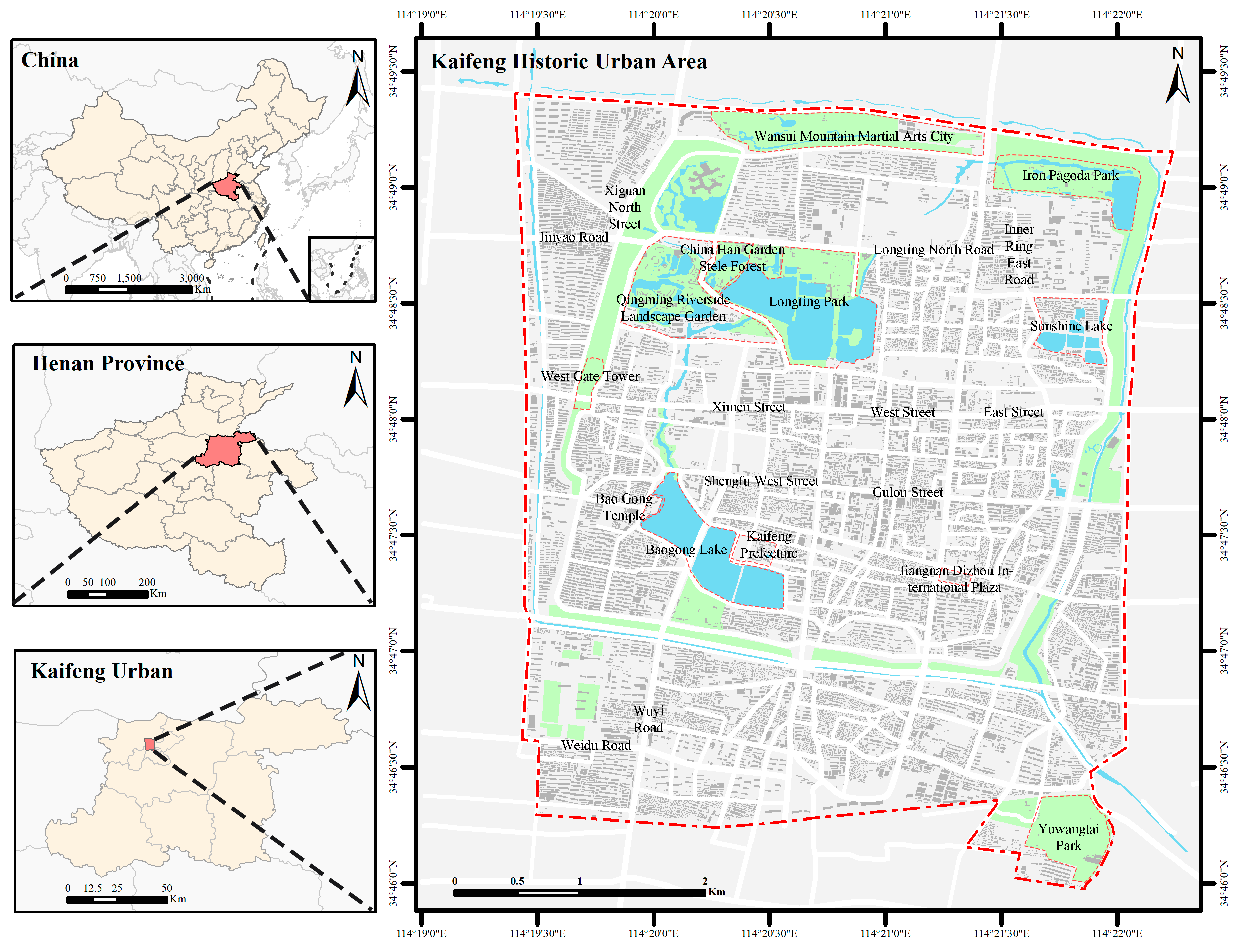
Figure 1. Study Area.
Buildings 15 04499 g001
Figure 2. Schematic Representation of the Research Framework.
Buildings 15 04499 g002
Figure 3. Analysis of average vitality hotspot/coldspot on weekdays and weekends.
Buildings 15 04499 g003
Figure 4. Vitality changes across different time periods.
Buildings 15 04499 g004aBuildings 15 04499 g004b
Figure 5. Relative importance, ranking, and contribution based on the SHAP Model.
Buildings 15 04499 g005
Figure 6. The impact of built environment factors on weekday vitality.
Buildings 15 04499 g006
Figure 7. The impact of built environment factors on weekend vitality.
Buildings 15 04499 g007
Figure 8. The top eight strongest interactions among built environment factors based on SHAP for weekdays.
Buildings 15 04499 g008
Figure 9. The top eight strongest interactions among built environment factors based on SHAP for the weekend.
Buildings 15 04499 g009
Table 1. Summary of data sources and processing steps.
DataSourceAcquisition PeriodOriginal Spatial Resolution/TypePreprocessing Method
Baidu Huiyan Population Location Datahttps://huiyan.baidu.com
(accessed on 15 September 2024)
2 September to 8 September 2024Approximately 160 m Accuracy/Point DataThrough coordinate projection, hourly data underwent kernel density analysis. The resulting raster was converted to points and spatially aggregated onto a 100 m grid, generating hourly vitality values for each grid cell.
POI Datahttps://www.91weitu.com
(accessed on 3 December 2024)
December 2024Point DataAfter being deduplicated, cleaned, and reclassified into 17 categories, the data were spatially aggregated onto a 100 m grid to calculate POI density and functional diversity indices.
Bus Stop Datahttps://www.91weitu.com (accessed on 3 December 2024)December 2024Point DataAfter being topologically corrected, the Bus Stop Data were used to perform density analysis. The resulting raster was converted to points and spatially joined to a 100 m grid to obtain bus stop density.
Building Datahttps://zenodo.org/records/8174931 (accessed on 20 October 2024)October
2024
Area DataAfter topological cleanup and verification against high-resolution imagery, spatial intersection with a 100 m grid was performed. Building footprint areas within each grid cell were then calculated to derive building density.
Road Network Datahttps://www.91weitu.com (accessed on 15 October 2024)October
2024
Line DataAfter topological correction and image-based adjustment, line density and point density analyses were performed on roads and road intersections. The raster results were converted to points and then linked to the 100 m grid to calculate road network density and road intersection density. Spatial syntax metrics were extracted.
Water System Datahttps://www.91weitu.com
(accessed on 3 December 2024)
December 2024Area DataAfter topographic correction and image-based adjustment, the distance from each grid center point to the nearest water body was calculated.
Population Datahttps://figshare.com/s/d9dd5f9bb1a7f4fd3734 (accessed on 20 December 2024)December 2024100 m Accuracy/Raster DataAfter reprojection and cropping to the study area, the population raster could be used directly for calculating population density.
Sentinel-2 Satellite
Imagery Data
https://dataspace.copernicus.eu (accessed on 15 October 2024)October
2024
10 m Accuracy/Multispectral RasterAfter band 4 (red) and band 8 (near-infrared) were extracted using ENVI 5.6.3 and processed into TIFF format, the data were imported into ArcGIS 10.8.1 to calculate NDVI. FVC was then computed based on a 100 m grid.
Historical and Cultural Heritage Datahttp://zrzyhghj.kaifeng.gov.cn/kfszrzyhghjwz/cyjzj/pc/content/content_1795302456640720896.html, http://www.gis9.com (accessed on 14 September 2024)September 2024Point DataKaifeng’s cultural heritage sites, immovable cultural relics, and historic buildings were integrated. Latitude and longitude coordinates were obtained using Xomap_Excel software (http://www.gis9.com, accessed on 14 September 2024), imported into ArcGIS for coordinate projection, and used to calculate the distance from each grid center point to the nearest cultural heritage site.
Table 2. Built Environment Indicators Description.
DimensionInfluencing FactorsSymbolVariable ExplanationVIF
WeekdayWeekend
DensityBuilding Density (%)BDBuilding Footprint Area per Unit/Total Area per Unit1.3091.308
Population Density
(persons/km2)
PDTotal Population per Unit/Total Area per Unit1.5641.554
Functional diversityPOI Density
(points/km2)
POIDNumber of POIs per unit/Total area per unit1.8031.803
POI Mix DegreePOIMPOI Information Entropy Within the Unit1.8711.876
Transportation AccessibilityRoad Network Density
(km/km2)
RNDRoad Length Within the Unit/Total Area of the Unit3.2883.260
Road Intersection Density (intersections/km2)RIDNumber of road intersections inside the unit/Total area of the unit2.4242.421
Bus Stop Density
(stops/km2)
BSDNumber of bus stops within the unit/Total area of the unit1.3781.373
Spatial AccessibilityIntegrationINTAverage street integration within the unit2.5652.534
ChoiceCHOStreet selectivity within the unit1.5031.490
Space EnvironmentDistance to Waterbody (m)DWThe shortest distance between the unit’s center point to the water body1.1601.160
Fractional Vegetation Cover (%)FVCAverage Normalized Difference Vegetation Index (NDVI) within the unit1.1661.162
History
and Culture
Distance to Cultural Heritage Site (m)DCHThe shortest distance from the unit’s center point to the historical and cultural heritage site1.1841.177
Table 3. Comparison of model performance between weekdays and weekends.
PeriodModelR2RMSEMAEBest Parameters
DefaultOptuna-TunedDefaultOptuna-TunedDefaultOptuna-Tuned
WeekdayRandom Forest0.94650.947629.54329.23717.27217.135n_estimators = 823, max_depth = 30, min_samples_split = 2, min_samples_leaf = 1,
max_features = sqrt
XGBoost0.93320.948733.00228.91221.73516.701n_estimators = 771, max_depth = 8, learning_rate = 0.08, subsample = 0.992, colsample_bytree = 0.924, reg_lambda = 5.644, reg_alpha = 1.427
CatBoost0.89560.948841.24528.88528.625116.674Iterations = 797, learning_rate = 0.225, depth = 8, l2_leaf_reg = 3.299, random_strength = 1.621, bagging_temperature = 0.639, border_count = 183
WeekendRandom Forest0.84660.856136.63535.48523.42922.761n_estimators = 562, max_depth = 27, min_samples_split = 2, min_samples_leaf = 1,
max_features = log2
XGBoost0.86260.889334.66831.12522.34318.926n_estimators = 1245, max_depth = 9, learning_rate = 0.027, subsample = 0.62, colsample_bytree = 0.911, reg_lambda = 9.251, reg_alpha = 0.512
CatBoost0.8310.891638.44930.78827.07618.368Iterations = 1829, learning_rate = 0.088, depth = 9, l2_leaf_reg = 8.898, random_strength = 1.537, bagging_temperature = 0.275, border_count = 154
Table 4. Ranking of the relative importance of built environment factors across different time periods.
DimensionInfluencing
Factors
WeekdayWeekend
MorningAfternoonEveningAll DayMorningAfternoonEveningAll Day
DensityBD54347666
PD9781010999
Functional diversityPOID22121111
POIM86585435
Transportation AccessibilityRND1212121212121212
RID1111111111111111
BSD11212222
Spatial AccessibilityINT1010996887
CHO78768778
Space EnvironmentDW33433343
FVC691079101010
History
and Culture
DCH45654554
Disclaimer/Publisher’s Note: The statements, opinions and data contained in all publications are solely those of the individual author(s) and contributor(s) and not of MDPI and/or the editor(s). MDPI and/or the editor(s) disclaim responsibility for any injury to people or property resulting from any ideas, methods, instructions or products referred to in the content.