Differential Settlement in Historic Masonry Towers: The Case of the Murcia Cathedral Bell Tower


Abstract
1. Introduction
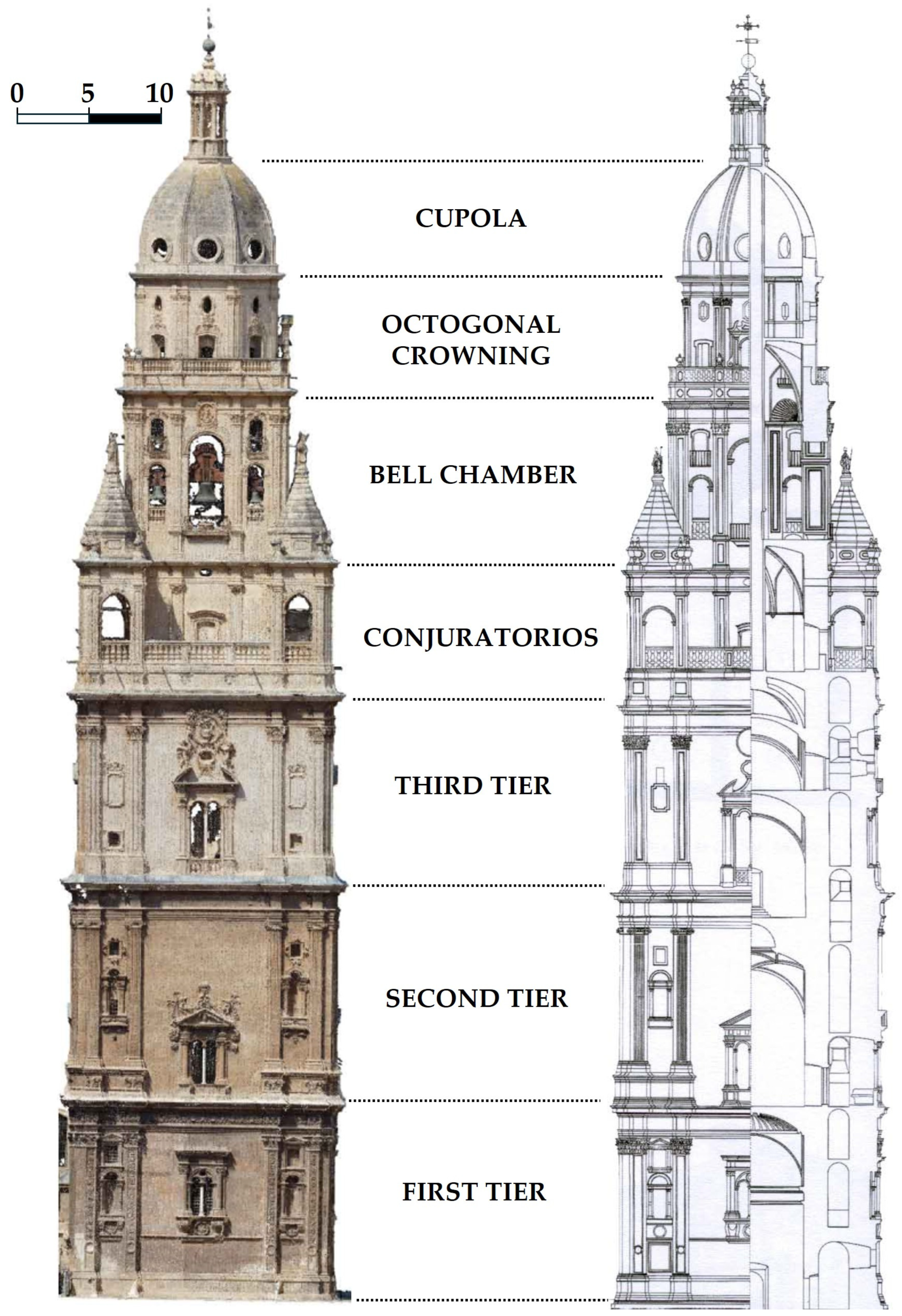
- characterises the geometry and construction sequence of the tower;
- evaluates the geotechnical properties of the underlying alluvial deposits;
- applies classical analytical modelling to estimate stresses, settlements, and stability; and
- interprets the tower’s present inclination in light of its historical load redistribution.
2. Objectives
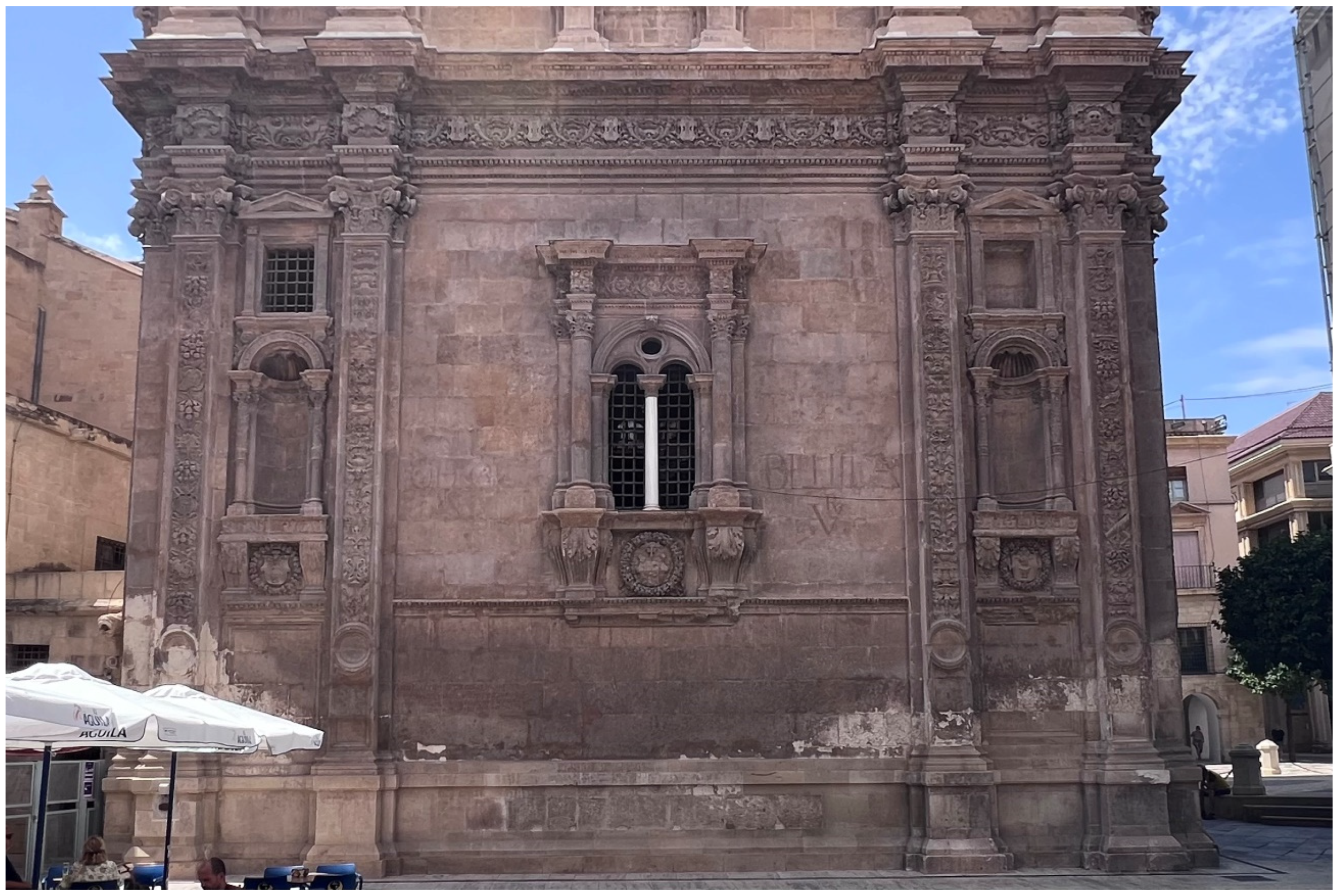
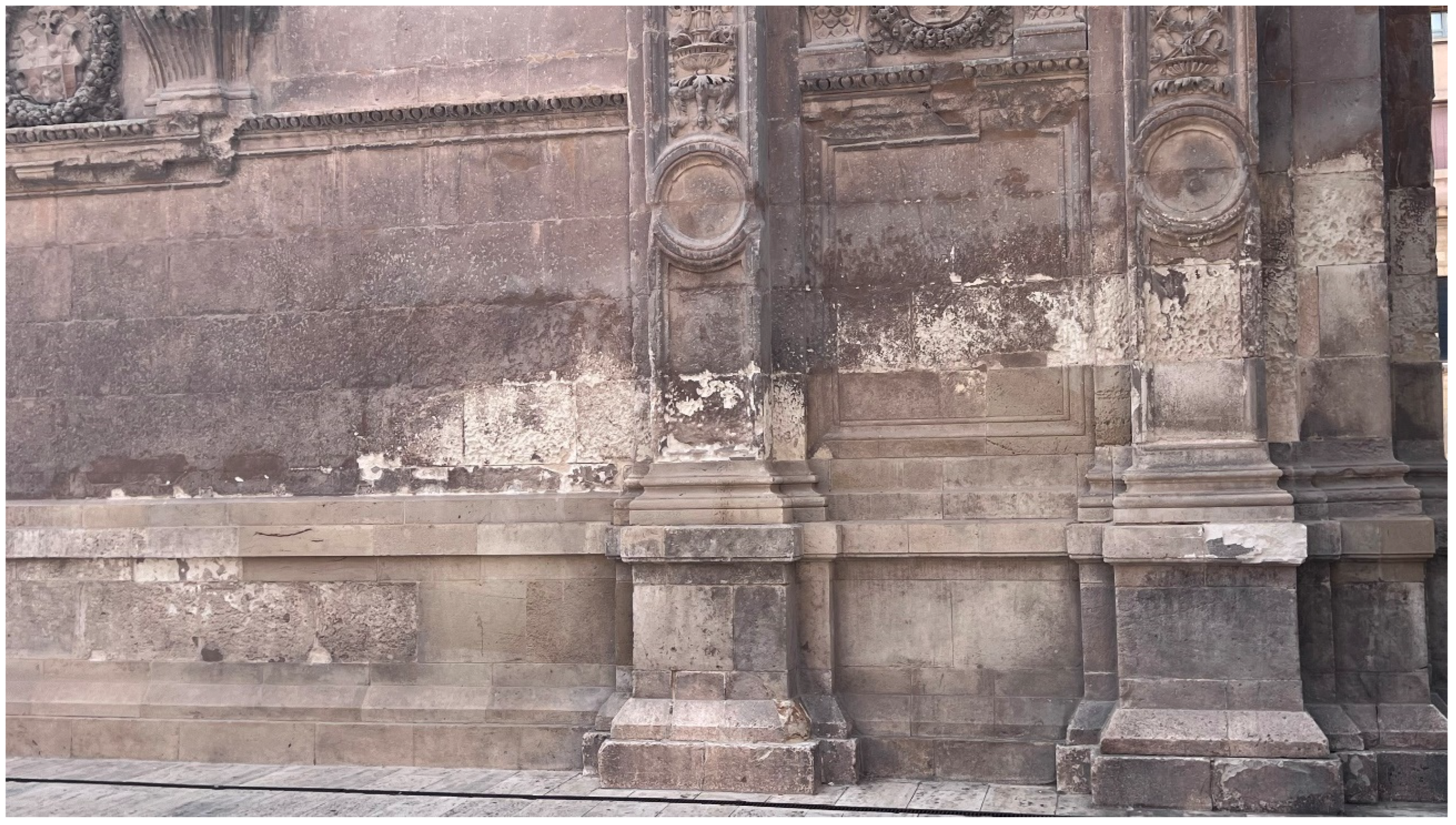
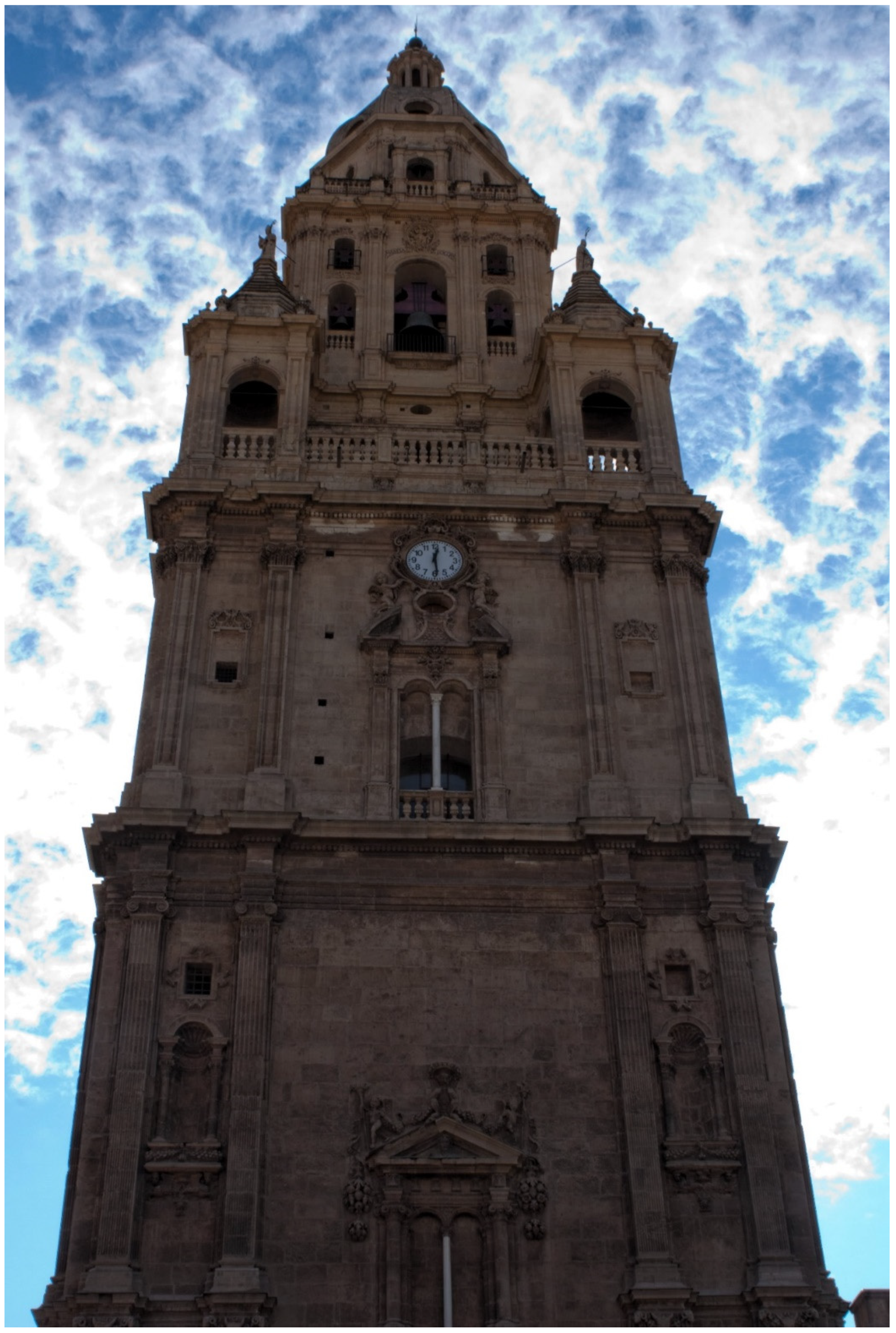
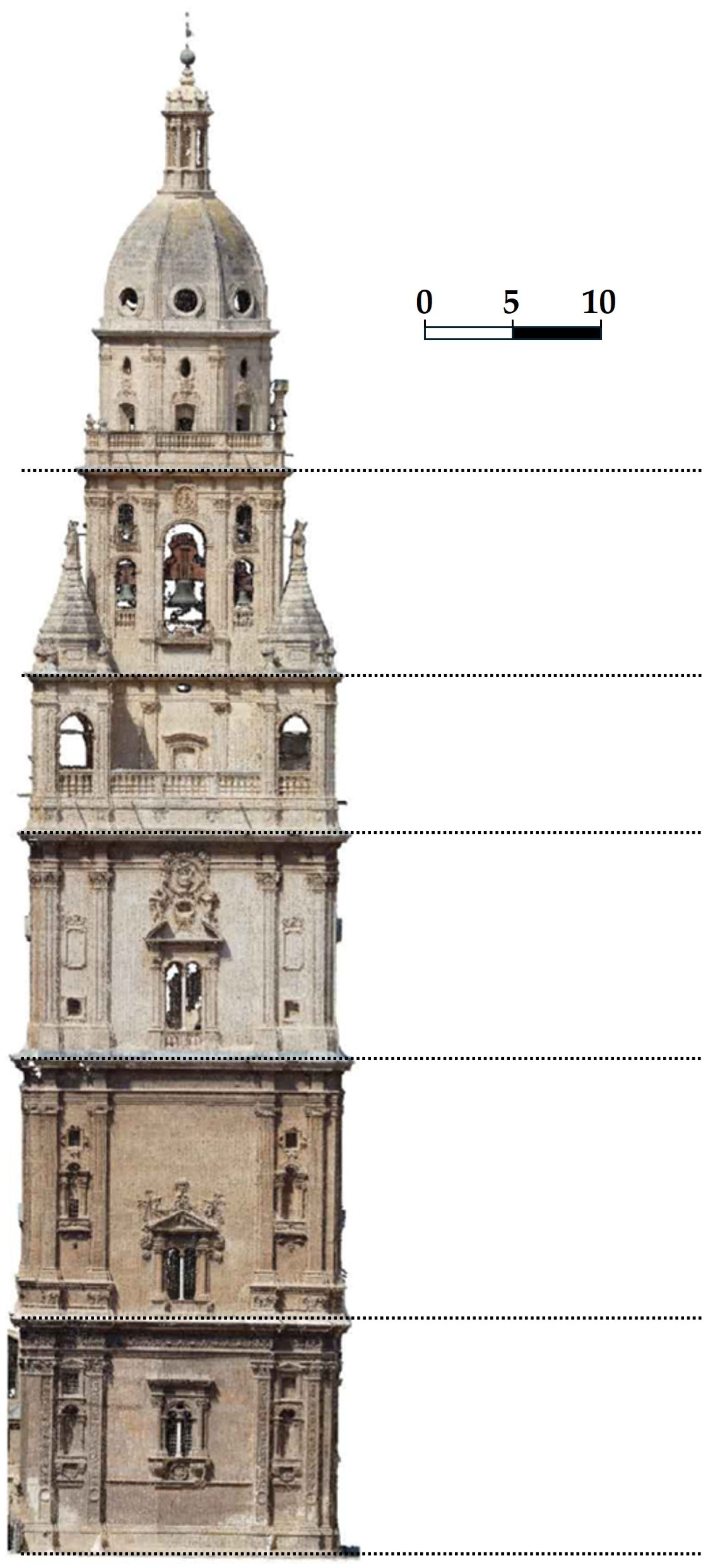
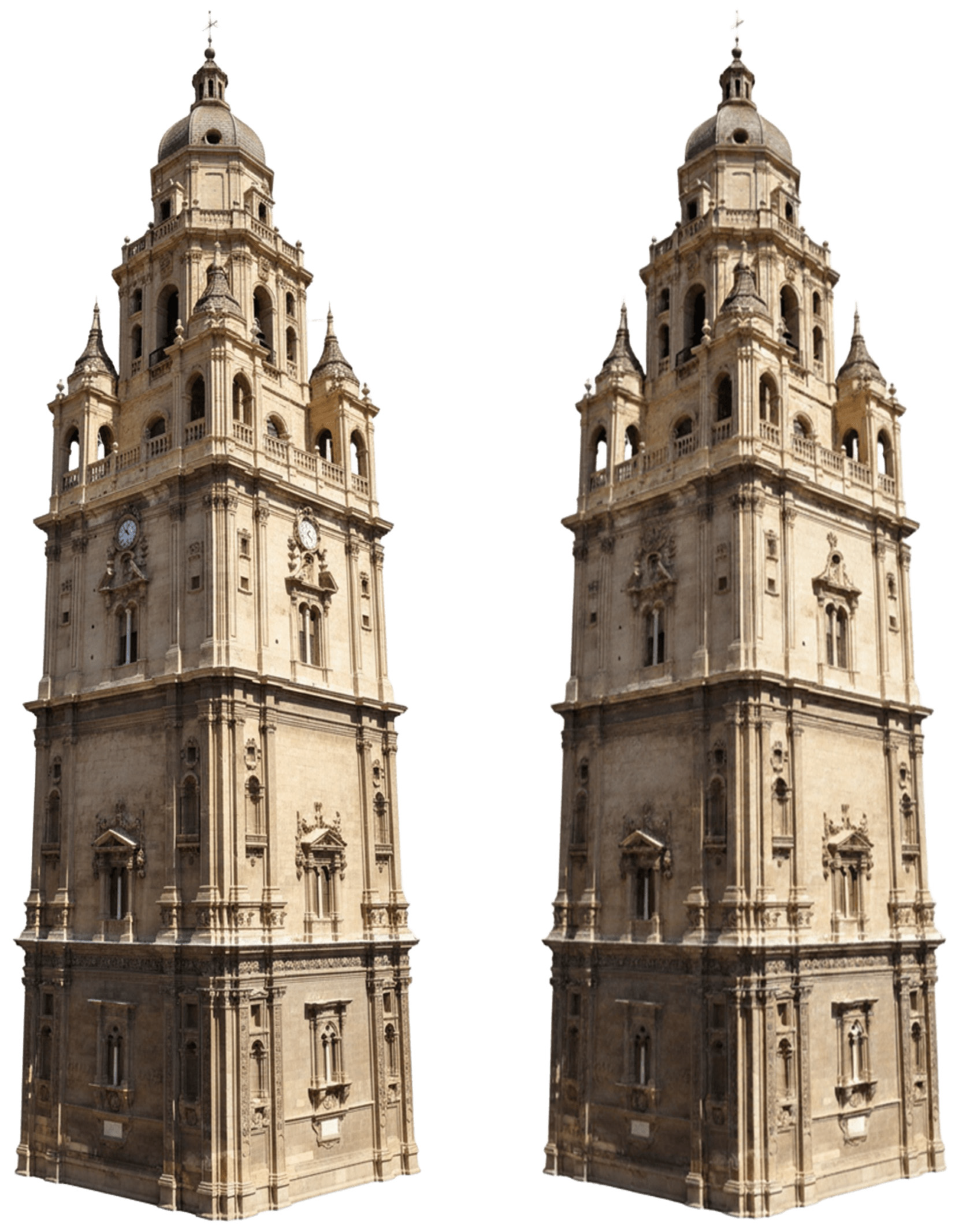
- To document and interpret the architectural configuration and stylistic evolution of the three principal construction phases of the tower—Renaissance, Late Renaissance, and Baroque—identifying the functional and symbolic logic that guided each stage.
- To characterize the subsoil beneath the tower, integrating available geological, geotechnical, and hydrogeological data (from IGME maps and piezometric records) in order to assess its bearing capacity, its long-term consolidation behaviour, and its influence on the overall stability of the structure.
- To analyse the structural configuration of the tower by applying the classical principles of masonry mechanics (Heyman) and elastic column theory (Euler), adapting these models to the specific case of a double-wall system composed of calcareous ashlar, lime mortar, and rubble infill, to estimate compressive and tensile stresses under current conditions.
- To evaluate the historical causes of the observed inclination, by comparing construction records with settlement data and calculated stresses, and by analysing the corrective measures implemented by José López in the eighteenth century to rebalance the structure.
- To determine the current state of stability of the tower and its safety margin against crushing, overturning, and foundation failure, taking into account both gravitational loads and seismic actions documented during major historical earthquakes (1755, 1829, and 2011).
- To interpret the geotechnical and structural behaviour not only from an engineering standpoint but also from a cultural perspective, understanding the deformation of the tower as an expression of equilibrium between matter and time, between gravity and grace, between technique and history.
3. Methodology
- historical analysis of archival records, construction documents and early descriptions of the tower;
- geometric analysis of the elevations using contemporary survey data to identify deviations from verticality;
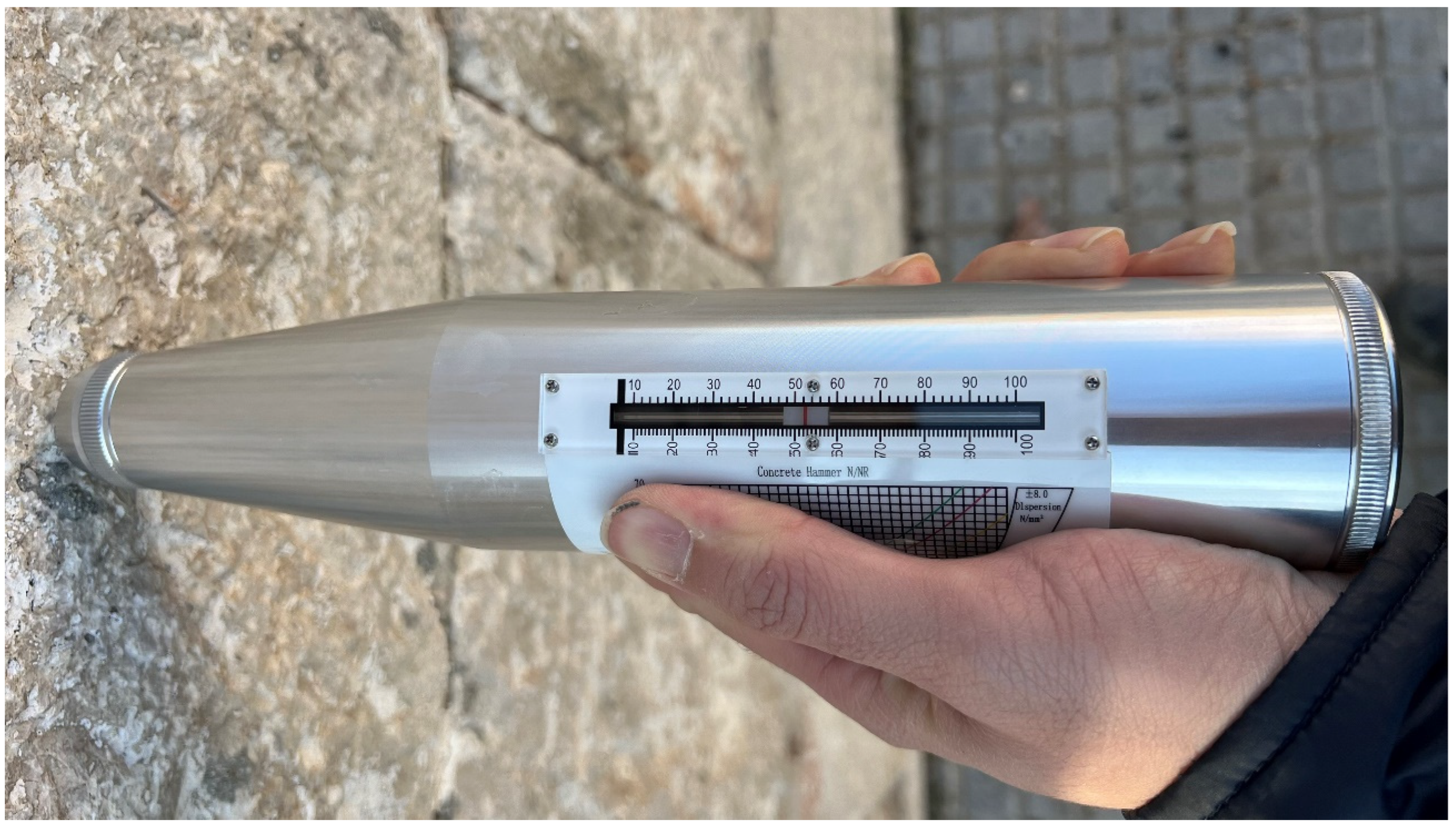
- non-destructive testing using rebound-hammer measurements (Votoer Resiliometer Rebound Hammer, Votoer, Shenzhen, China) to verify limestone uniformity and detect superficial weathering;
- classical analytical mechanics, including Heyman’s limit theory, elastic column behaviour and composite-wall modelling, to determine compressive stresses, stiffness and stability margins;
- geotechnical analysis incorporating borehole data, stratigraphic interpretation and bearing-capacity calculations based on IGME datasets.
4. Architectural Analysis of the Tower
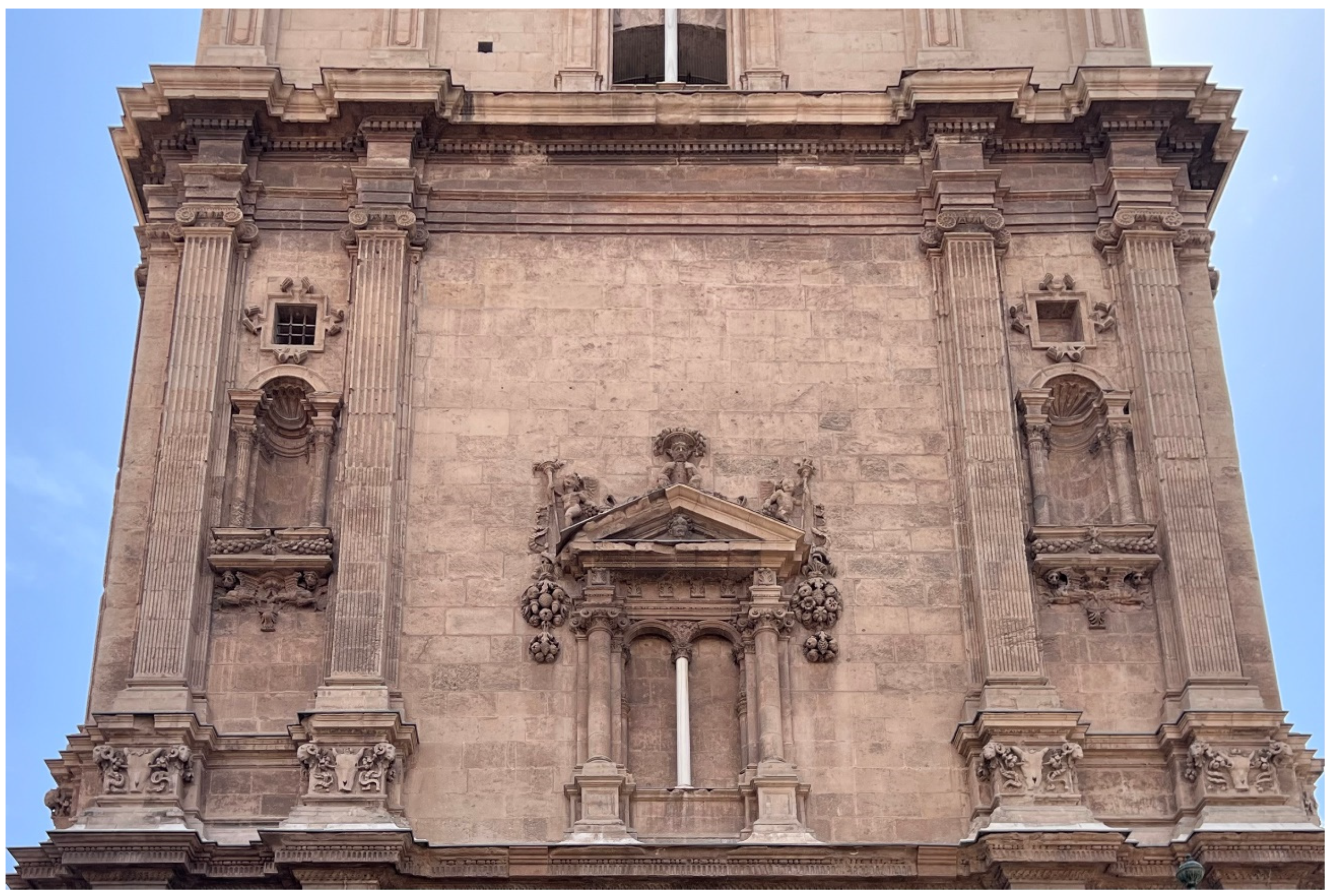
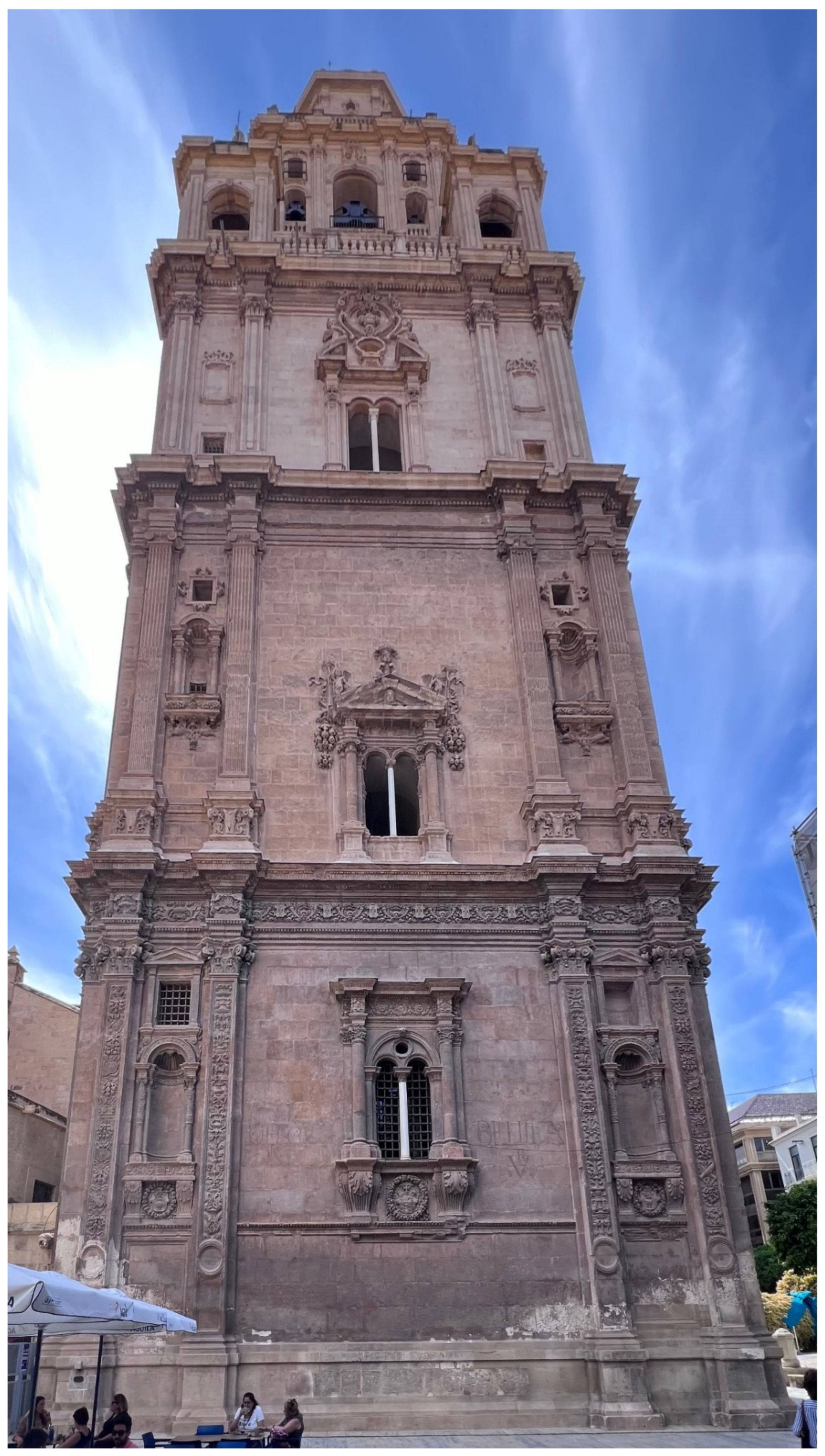
4.1. First Tier
4.2. Second Tier
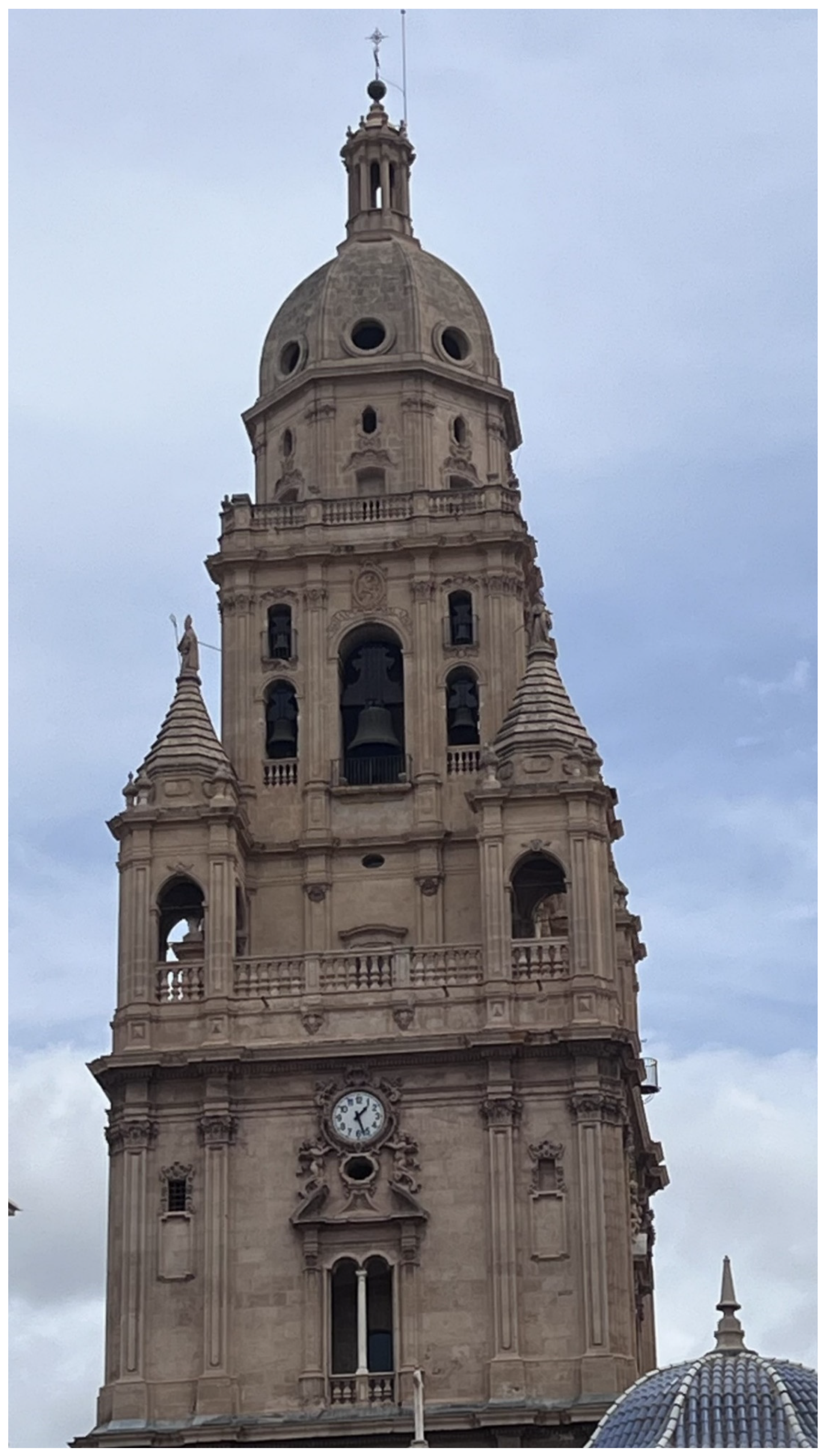
4.3. Third Tier and Crowning
5. Subsoil Analysis Beneath the Tower
5.1. Geological and Geomorphological Context
5.2. Stratigraphy and Mechanical Properties
- Urban fill (1–3 m), medium-to-low density.
- Silty–clayey deposits (10–15 m), low stiffness and high compressibility.
- Sandy gravels (>12 m), representing the ancient riverbed.
- Miocene marls at greater depth, of significantly higher rigidity.
5.3. Hydrogeological Conditions
5.4. Foundation Geometry and Results from Boreholes
- Footing dimensions: 19.64 × 19.64 m
- Footing thickness: 4.70 m
- Foundation base depth: −5.60 to −5.90 m
- Material: conglomerate of lime mortar and limestone rubble
- Soil parameters:
- ▪
- cohesion c = 29.42 kN/m2
- ▪
- friction angle φ = 10°
- ▪
- dry unit weight γ = 16.18 kN/m3
- ▪
- groundwater level: −3.80 to −4.10 m
5.5. Excavation Stability
5.6. Settlement Mechanisms
- Low permeability → slow dissipation of pore pressure
- High compressibility → progressive reduction in void ratio
- Layer heterogeneity → differential rather than uniform settlement
- Groundwater oscillations → episodic settlement accumulation
5.7. Implications for the Tower’s Structural Behaviour
6. Structural Analysis of the Tower
6.1. Structural Configuration and Preliminary Hypotheses
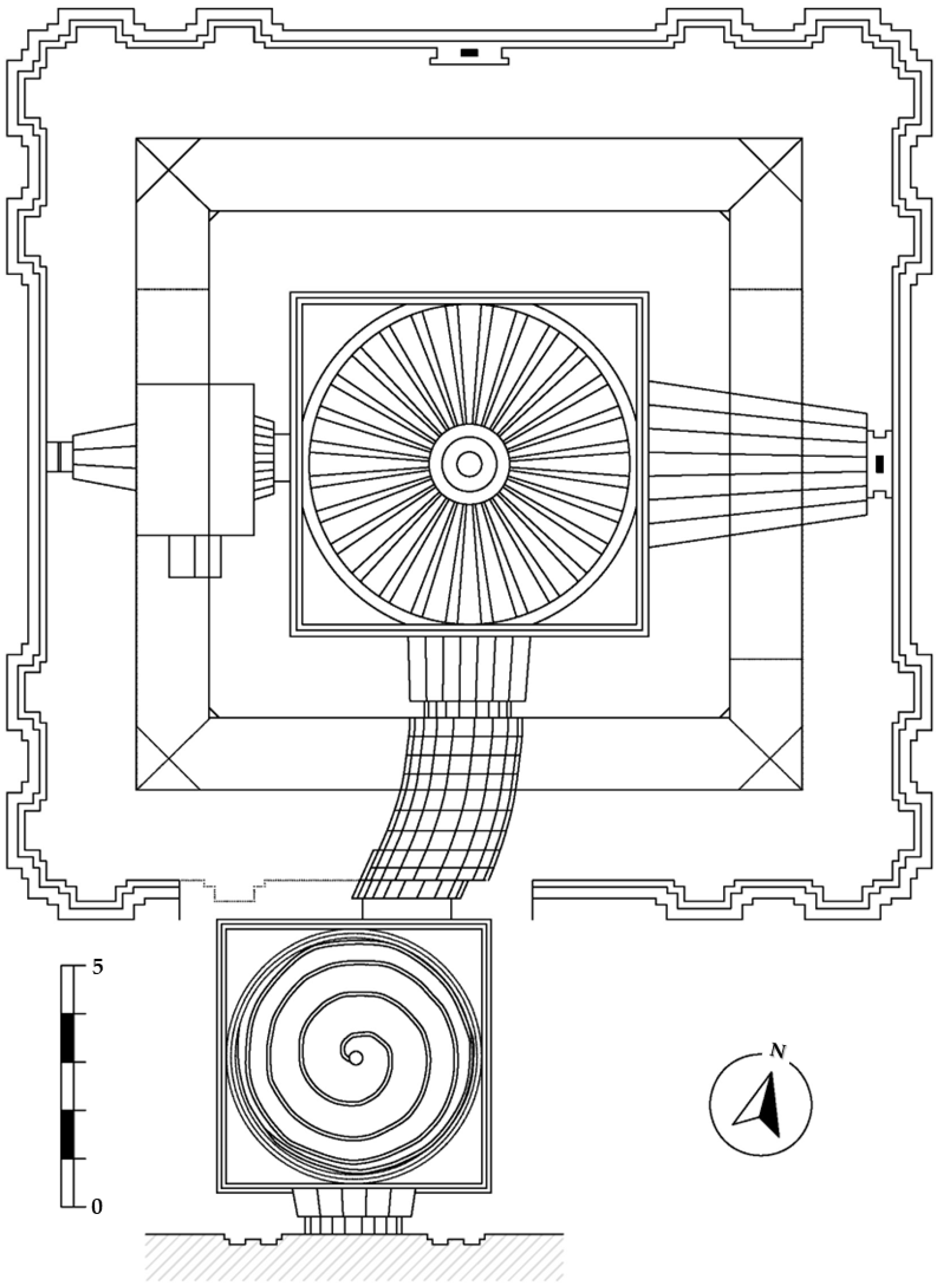
- two concentric ashlar tubes,
- separated by a central lime–rubble core,
- without continuous through-stones,
- behaving as mechanically semi-independent shells.
- Although no excavations have been performed in the lower section of the tower, sufficient indirect evidence allows us to infer that the walls are formed by two parallel ashlar faces with a central core of rubble bound with lime mortar. This configuration is supported by three independent observations: the different heights of the ashlar blocks on the inner and outer faces, incompatible with bonded leaves;
- Documentary evidence of systematic lime-and-rubble acquisition during the works directed by Jerónimo Quijano (1545–1569);
- The texture of the putlog holes in the third tier reveals rubble fill rather than ashlar.
- elastic behaviour is used only to estimate vertical deformability;
- stresses correspond to average compressive stresses in homogeneous blocks;
- the interaction between soil and structure is evaluated separately (Section 6);
- only gravitational loads are considered in the present section.
6.2. Equivalent Modulus and Euler Upper-Bound Analysis
- e1: height of the ashlar blocks in the outer leaves
- e2: height of the mortar joints
- E1: elastic modulus of the limestone masonry
- E2: elastic modulus of the lime mortar (considered equivalent to that of the internal rubble fill)
- l1: combined thickness of both ashlar leaves
- l3: thickness of the central lime–rubble core
6.3. Non-Destructive Characterisation of the Limestone
- verify the uniformity of the material,
- detect superficial weathering,
- confirm the absence of localised anomalies.
6.4. Compressive Behaviour of the Masonry
6.5. Behaviour of the Concentric Structural Tubes
- Outer tube stress: 0.74 N/mm2 (735.50 kN/m2)
- Inner tube stress: 1.02 N/mm2 (1019.89 kN/m2)
6.6. The Helical Staircase as an Independent Load-Bearing System
- diagonal arches: 165 kN
- axial arches: 115 kN
6.7. Structural Performance Under Historical Earthquakes
6.8. Technical Conclusion
- the tower is not overstressed under gravitational loads;
- the tube-in-tube configuration provides redundancy and stability;
- elastic shortening is negligible relative to geotechnical settlement;
- Euler confirms a vast reserve of compressive capacity;
- the esclerómetro validates material homogeneity;
- the helical staircase behaves independently and safely;
- no structural mechanism explains the inclination.
7. Settlement of the Tower
I campanili deno essere in prima ben fondati. E se fondo non si trovasse, sopra pali e banconi [si debbe] fondare. Dia essere il fondo al meno piè quindici sopra [debería decir, infra] delle terra, e di poi seguire le mura con debita grosezza. E gli spazi dell′altezza dall′uno sfinestrato all′altro piè vinti, più o manco sicondo la qualità d′esso, con le volte sicondo richiede. E gli ultimi sfinestrati le spazi più larghi dove le campane vanno, acciò che le voci occupate non sieno, et alla superficie l′ultima volta con corridoio e parapetto intorno, e in esso la cimasa pirami dale o altra forma cor ornate scolture son da fare... E possasi fare ditti campanili di più varie forme: tondi, facciati, quadrati e graduati con bellissimi ornamenti di ricinte cornici, membri, colonne, tabernacoli e altre scolture sicondo la degnità de tempi.[2]
- Cohesion: c = 29.42 kN/m3
- Internal friction angle: φ = 10°
- Dry unit weight: γ = 16.18 kN/m3
- Soil type: soft clay up to 12 m depth; gravels and sands below that horizon
- Groundwater level: n’ = −3.80 m relative to current grade; n = −4.10 m relative to the reference level (±0.00) at the step of the Portada de la Cruz, north façade
- Foundation dimensions: a × b = 19.64 × 19.64 m
- Mean footing thickness: z = 4.70 m
- Average depth of foundation base: p’ = −5.60 m from pavement; p = −5.90 m from reference level
- Material composition: lime mortar and limestone rubble conglomerate
- Self-weight of the tower: P = 165,000 kN ± 10%
- Weight of the foundation: Q = 35,000 kN ± 5%
- Total load:
- higher lateral friction on the eastern side, adjacent to precompressed soils producing greater active thrust;
- eighteenth-century compensations, shifting the centre of gravity first westwards (thickening the third tier’s west wall), then eastwards (extending the bell chamber), and enlarging the west terrace.
- uniform subsidence of the footing, and
- differential deformation of the edges.
- deformation of stable cornices (ante-sacristy eaves);
- level differences between current pavement and sacristy.
- At the base: Hᵢ = 27.56 kN/m2;
- At the top: Hs = 20.01 kN/m2.
8. Conclusions
- The architectural sequence conditioned the tower’s mechanical behaviour. The Renaissance first and second tiers, built between 1521 and 1555, already exhibited measurable settlement and a slight eastward tilt, prompting the suspension of works. When construction resumed in 1765, José López introduced deliberate geometric corrections: increasing wall thickness on one side and reducing the external dimensions of the third tier. These compensations altered the load path and allowed the elevation to be re-centred, enabling completion of the bell tower, the conjuratorios and the Neoclassical dome by 1793. This historical sequence is essential for understanding the current distribution of stresses and deformations.
- Second, the structural behaviour of the tower is stable and robust. The double-tube configuration—consisting of two concentric ashlar shells with a lime-rubble core—provides redundancy and limits bending effects induced by settlement. Analytical calculations confirm that working stresses in both tubes remain far below the compressive strength of the limestone, even when considering reduced values for weathered material. Euler’s critical load, used solely as an upper-bound reference, exceeds the tower’s working load by more than an order of magnitude. The helical staircase behaves as an independent load-bearing structure, and the tower’s performance during major regional earthquakes corroborates the absence of structural vulnerability.
- Third, the settlement pattern is governed by the geotechnical properties of the Vega del Segura. The tower stands on up to 15 m of compressible Quaternary silts and clays with low bearing capacity and a historically high groundwater table. Borehole data and geotechnical mapping indicate that long-term consolidation, together with episodic piezometric fluctuations, produced both uniform settlement (≈32 cm) and corner-specific deformations. The present 56 cm differential between the northeast and northwest corners is consistent with this behaviour. Analytical estimation of bearing capacity demonstrates that the tower’s load approaches the theoretical resistance of the soil, strongly suggesting the historical use of a wooden pile foundation—consistent with Renaissance treatises and the documented practices employed in other parts of the cathedral.
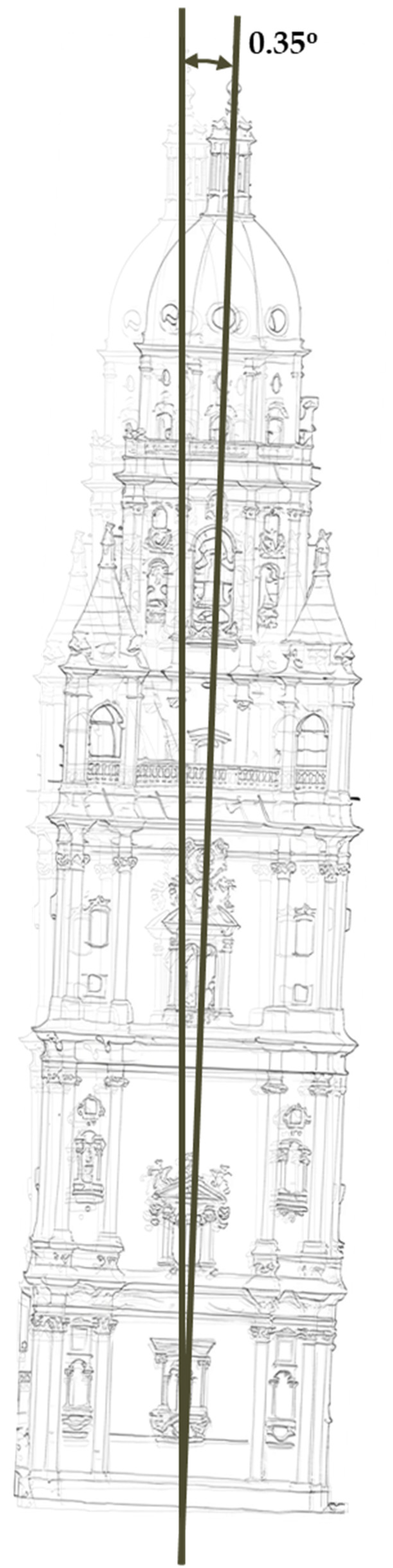
- Fourth, the differential settlements observed today reflect both geological and historical causes. Sixteenth-century deformations led to the first construction halt; eighteenth-century works introduced compensatory eccentricities; and subsequent loading of upper tiers partially reversed earlier movements. The slightly curved elevation visible in the north and east façades records this sequence and provides an interpretable trace of construction decisions made to counteract settlement.
- Finally, the long-term behaviour of the tower requires continued monitoring. The gradual lowering of the groundwater table—due to urbanisation, the disappearance of traditional irrigation channels and the canalisation of the Segura River—may influence both the compressibility of the clayey subsoil and the durability of any buried wooden piles. Installing buried piezometric sensors and performing inclined core drillings would provide essential data for ensuring the structure’s long-term stability.
Funding
Data Availability Statement
Conflicts of Interest
References
- García, E.M. La torre de la Catedral de Murcia. Representaciones en pintura y fotografía. Imafronte 2024, 31, 204–223. [Google Scholar] [CrossRef]
- Martini, F.d.G. Trattato di Architettura Civile e Militare di Francesco; Tipografia Chirio e Mina: Torino, Italy, 1841; Available online: https://archive.org/details/gri_33125011099633 (accessed on 1 December 2025).
- Heyman, J. The stone skeleton. Int. J. Solids Struct. 1966, 2, 249–279. [Google Scholar] [CrossRef]
- Elizalde, R.R. Structural Analysis of ‘La Giralda’, Bell Tower of the Seville Cathedral. J. Eng. Appl. Sci. Technol. 2023, 5, 1–14. [Google Scholar] [CrossRef]
- Botí, A.V. La piedra caliza de la catedral de Murcia. Loggia Arquit. Restauración 1997, 2, 81. [Google Scholar] [CrossRef][Green Version]
- Esbert, R.M.; Grossi, C.M.; Valdeón, L.; Ordaz, J.; Alonso, F.J.; Marcos, R.M. Estudios de laboratorio sobre la conservación de la piedra de la Catedral de Murcia = Laboratory studies for stone conservation at the Cathedral of Murcia. Mater. Construcción 1990, 40, 5–15. [Google Scholar] [CrossRef][Green Version]
- Calvo López, J.M.; Alonso Rodríguez, M.Á.; Rabasa Díaz, E.; López Mozo, A. Cantería Renacentista en la Catedral de Murcia. 2005. Available online: https://repositorio.upct.es/entities/publication/f4ce8c4b-0fb6-4a4b-b741-d7440fdd098c (accessed on 1 December 2025).
- Instituto Geológico y Minero de España. Mapa Geológico de España, Escala 1:50.000 (Hoja 934–Murcia). Mapa Geológico de España; Instituto Geológico y Minero de España: Madrid, Spain, 1995. [Google Scholar]
- Instituto Geológico y Minero de España; Dirección General de Minas. Mapa Geotécnico General. Murcia. Hoja 7-10/79; Instituto Geológico y Minero de España, Dirección General de Minas: Madrid, Spain, 1977. [Google Scholar]
- Instituto Geológico y Minero de España. Mapa Geotécnico General de España, Escala 1:200.000 (Hoja 79–Murcia). Mapa Geotécnico General de España; Instituto Geológico y Minero de España: Madrid, Spain, 1977. [Google Scholar]
- Instituto Geológico y Minero de España. Mapa Geotécnico y de Riesgos Geológicos 25k y 5k—Mapa de la Ciudad de Murcia. Mapa Geotécnico y de Riesgos Geológicos; Instituto Geológico y Minero de España: Madrid, Spain, 1984. [Google Scholar]
- Carretero, N.J.V.; de Justo Alpanés, J.L. La Subsidencia en Murcia: Implicaciones y Consecuencias en la Edificación. 2002. Available online: https://www.carm.es/web/pagina?IDCONTENIDO=9795&IDTIPO=246&RASTRO=c2255$m36284,36305 (accessed on 1 December 2025).
- de Justo Alpañés, J.L.; Carretero, N.J.V.; de Justo Moscardó, E. Subsidencia en suelos saturados y parcialmente saturados. Aplicación al caso de Murcia. Rev. Digit. Cedex 2003, 132, 103–108. [Google Scholar]
- Botí, A.V. La Torre de la Catedral de Murcia: De la teoría a los resultados. Murgetana 1993, 87, 5–18. Available online: https://www.cervantesvirtual.com/obra/la-torre-de-la-catedral-de-murcia-de-la-teoria-a-los-resultados--0/ (accessed on 1 December 2025).
- De la Peña Velasco, C. ‘Mejor conclusión de una obra perfecta’: La torre de la Catedral de Murcia. Sarmental. Estud. Hist. Arte Patrim. 2022, 1, 203–220. [Google Scholar] [CrossRef]
- Boothby, T.E.; Coronelli, D. The Stone Skeleton: A Reappraisal. Heritage 2024, 7, 2265–2276. [Google Scholar] [CrossRef]
- Gaitán, J.C.M.; Acosta, A.G. Identificación de útiles de cantería a través de las trazas y marcas de cantero en el primer cuerpo de la catedral de Murcia. In Proceedings of the Actas del Séptimo Congreso Nacional de Historia de la Construcción, Santiago de Compostela, Spain, 26–29 October 2011; pp. 937–946. Available online: https://upct.portalcientifico.es//documentos/61ce988ac3865c0408aeefa1 (accessed on 1 December 2025).
- Martínez-Segura, M.A.; García-Nieto, M.C.; Navarro, M.; Vásconez-Maza, M.D.; Oda, Y.; García-Jerez, A.; Enomoto, T. Seismic characterisation of the subsoil under a historic building: Cathedral Church of Saint Mary in Murcia case study. Eng. Geol. 2024, 335, 107529. [Google Scholar] [CrossRef]
- García-Nieto, M.C.; Martínez-Segura, M.A.; Navarro, M.; Valverde-Palacios, I.; Martínez-Pagán, P. A Geophysical Investigation in Which 3D Electrical Resistivity Tomography and Ground-Penetrating Radar Are Used to Determine Singularities in the Foundations of the Protected Historic Tower of Murcia Cathedral (Spain). Remote Sens. 2024, 16, 4117. [Google Scholar] [CrossRef]
- García, M.J.V. El cardenal Belluga y la Catedral de Murcia: Su aportación financiera desde Italia. Cart. Rev. Estud. Investig. 2003, 19, 405–424. Available online: https://dialnet.unirioja.es/descarga/articulo/761790.pdf (accessed on 1 December 2025).
- Albaladejo, E.H. Dibujo de la torre de la Catedral de Murcia. In Huellas. Catedral de Murcia. Exposición 2002; Caja de Ahorros de Murcia: Murcia, Spain, 2002; pp. 279–281. ISBN 84-95726-08-4. [Google Scholar]
- Oterino, B.B.; Medina, A.R.; Escribano, J.M.G.; Murphy, P. El terremoto de Lorca (2011) en el contexto de la peligrosidad y el riesgo sísmico en Murcia. Física Tierra 2013, 24, 255–287. [Google Scholar] [CrossRef]
- Scaglia, G.; di Giorgio Martini, F.; Maltese, C.; Degrassi, L.M. Trattati di architettura ingegneria e arte militare. Art Bull. 1970, 52, 439. [Google Scholar] [CrossRef]
- Elizalde, R.R. Analysis of the Tower of Hercules, the World’s Oldest Extant Lighthouse. Buildings 2023, 13, 219. [Google Scholar] [CrossRef]
- Lafarga, A.J.M.-G. Mecánica de las Estructuras Antiguas. O Cuando las Estructuras no se Calculaban; MUNILLALERIA: Madrid, Spain, 2011. [Google Scholar]
- Reti, L.; di Giorgio Martini, F. Francesco di Giorgio Martini’s Treatise on Engineering and Its Plagiarists. Technol. Cult. 1963, 4, 287. [Google Scholar] [CrossRef]
- Solares, J.M.M. El Terremoto de Lisboa de 1 de noviembre de 1755. Física Tierra 2017, 29, 47–60. [Google Scholar] [CrossRef]
- Solares, J.M.M. Los Efectos en España del Terremoto de Lisboa (1 de Noviembre de 1755); Dirección General del Instituto Geográfico Nacional: Madrid, Spain, 2001; Available online: https://www.ign.es/web/resources/sismologia/publicaciones/EfectosEspanaterremotoLisboa.pdf (accessed on 1 December 2025).
- Silva, P.G.; Elez, J.; Giner-Robles, J.L.; Pérez-López, R.; Roquero, E.; Rodríguez-Pascua, M.A.; Bardají, T.; Martínez-Graña, A.M. Análisis geológico del terremoto de Torrevieja de 1829 (Alicante, SE España). In Proceedings of the XV Reunión Nacional Cuaternario, Bilbao, Spain, 1–5 July 2019; pp. 434–437. Available online: https://www.ehu.eus/documents/9074919/0/Libro-Resumenes-XV-Reunion-Cuaternario.pdf/000bb564-c1b4-e348-dc6b-781c05c7e341 (accessed on 1 December 2025).
- Millon, H. The architectural theory of francesco di giorgio. Art Bull. 1958, 40, 257–261. [Google Scholar] [CrossRef]
- Dechert, M.S.A. The Military Architecture of Francesco di Giorgio in Southern Italy. J. Soc. Archit. Hist. 1990, 49, 161–180. [Google Scholar] [CrossRef]
- Shehu, R. Static and Seismic Safety of the Inclined Tower of Portogruaro: A Preliminary Numerical Approach. Buildings 2024, 14, 2611. [Google Scholar] [CrossRef]
- Milani, G.; Shehu, R.; Valente, M. Seismic vulnerability of leaning masonry towers located in Emilia-Romagna region, Italy: FE analyses of four case studies. AIP Conf. Proc. 2016, 1790, 130002. [Google Scholar] [CrossRef]








| Unit | Approximate Thickness | Composition | Mechanical Properties | Allowable Bearing Pressure (qadm) |
|---|---|---|---|---|
| Urban fill | 1–3 m | Heterogeneous materials, medium-to-low density (N = 10–30) | E ≈ 25–50 MPa | ≤122.58 kN/m2 |
| Silty–clayey deposits | 10–15 m | CL–ML sediments with sandy lenses and fine gravels | E = 4–12 MPa; compressible | 58.84 kN/m2 |
| Sandy gravels | >12 m | Coarse alluvial stratum of ancient riverbed | E > 50 MPa | ≥196.13 kN/m2 |
Disclaimer/Publisher’s Note: The statements, opinions and data contained in all publications are solely those of the individual author(s) and contributor(s) and not of MDPI and/or the editor(s). MDPI and/or the editor(s) disclaim responsibility for any injury to people or property resulting from any ideas, methods, instructions or products referred to in the content. |
© 2025 by the author. Licensee MDPI, Basel, Switzerland. This article is an open access article distributed under the terms and conditions of the Creative Commons Attribution (CC BY) license (https://creativecommons.org/licenses/by/4.0/).
Share and Cite
Elizalde, R.R. Differential Settlement in Historic Masonry Towers: The Case of the Murcia Cathedral Bell Tower. Buildings 2025, 15, 4461. https://doi.org/10.3390/buildings15244461
Elizalde RR. Differential Settlement in Historic Masonry Towers: The Case of the Murcia Cathedral Bell Tower. Buildings. 2025; 15(24):4461. https://doi.org/10.3390/buildings15244461
Chicago/Turabian StyleElizalde, Rubén Rodríguez. 2025. "Differential Settlement in Historic Masonry Towers: The Case of the Murcia Cathedral Bell Tower" Buildings 15, no. 24: 4461. https://doi.org/10.3390/buildings15244461
APA StyleElizalde, R. R. (2025). Differential Settlement in Historic Masonry Towers: The Case of the Murcia Cathedral Bell Tower. Buildings, 15(24), 4461. https://doi.org/10.3390/buildings15244461