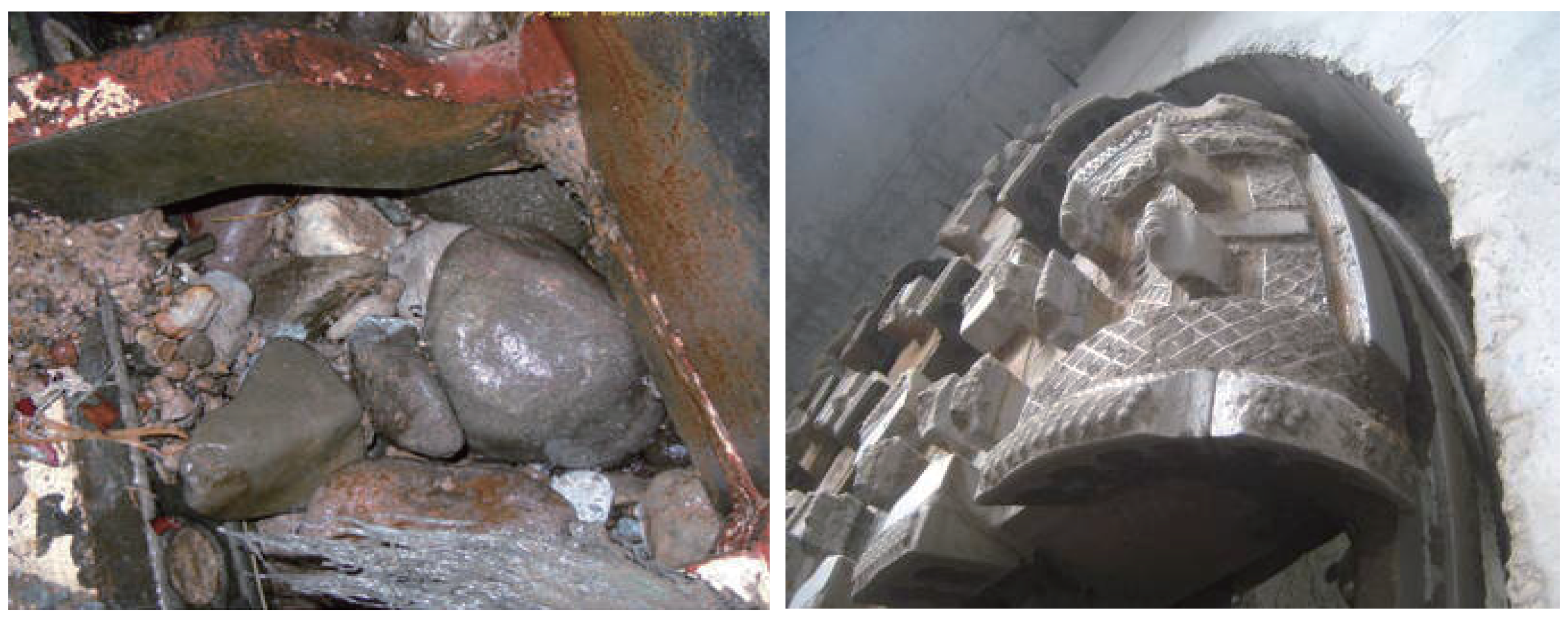


Optimization and Field Validation of Soil Conditioning Scheme for EPB Shield Tunneling in Cobble–Boulder Stratum: Case Study on Beijing Metro Line 16
Abstract
1. Introduction
2. Tunneling Conditions
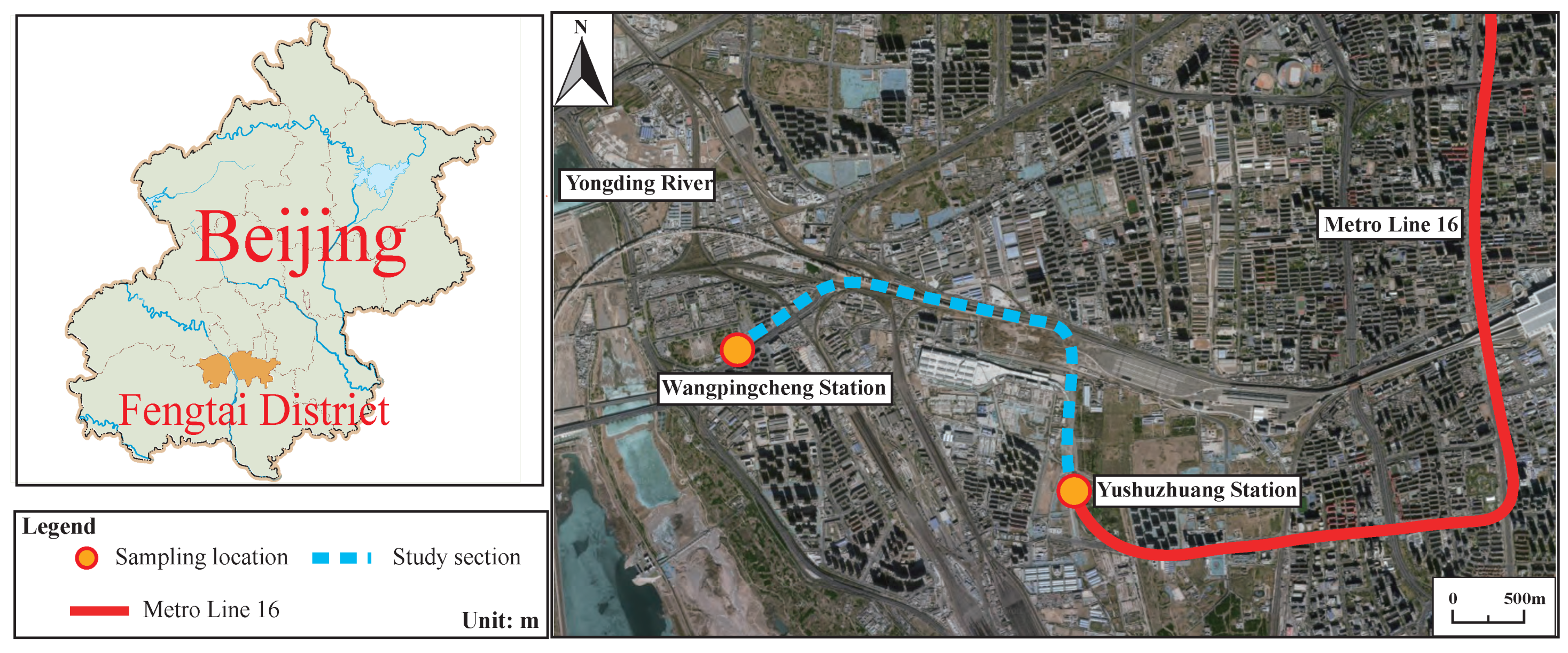
2.1. Overview
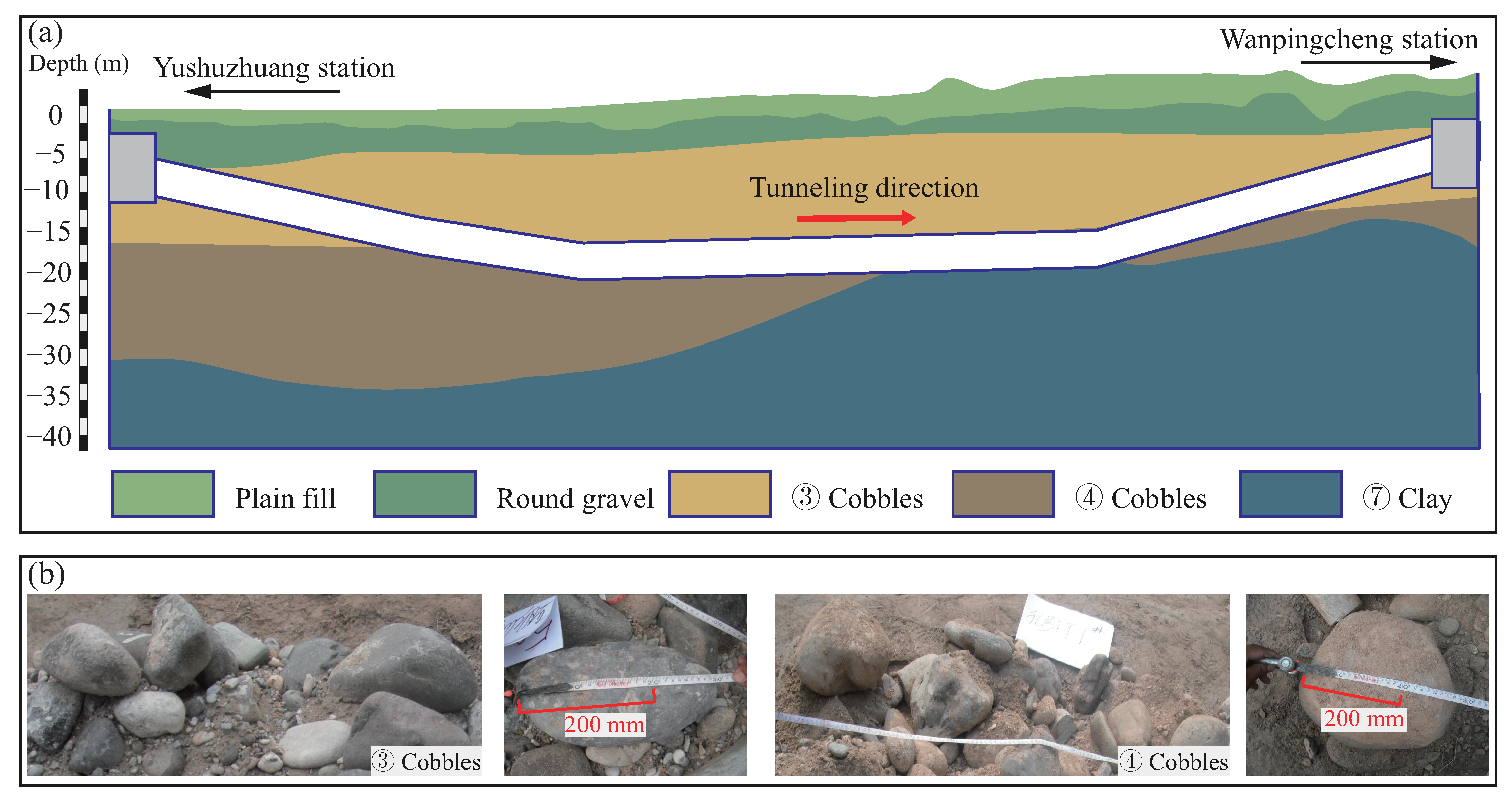
2.2. Geology
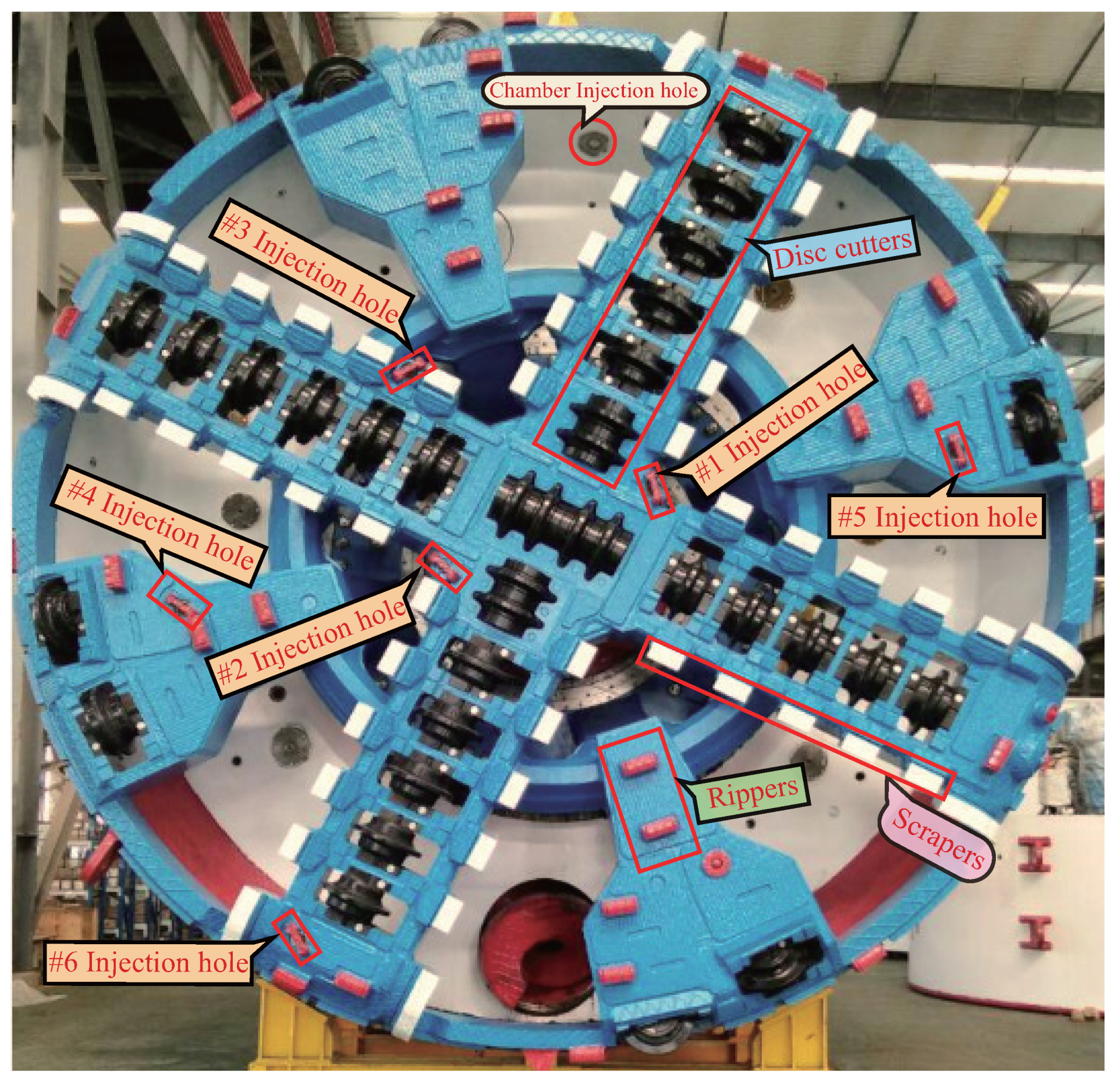
2.3. EPBS Tunneling Equipment
3. Laboratory Tests to Determine Soil Conditioning Scheme
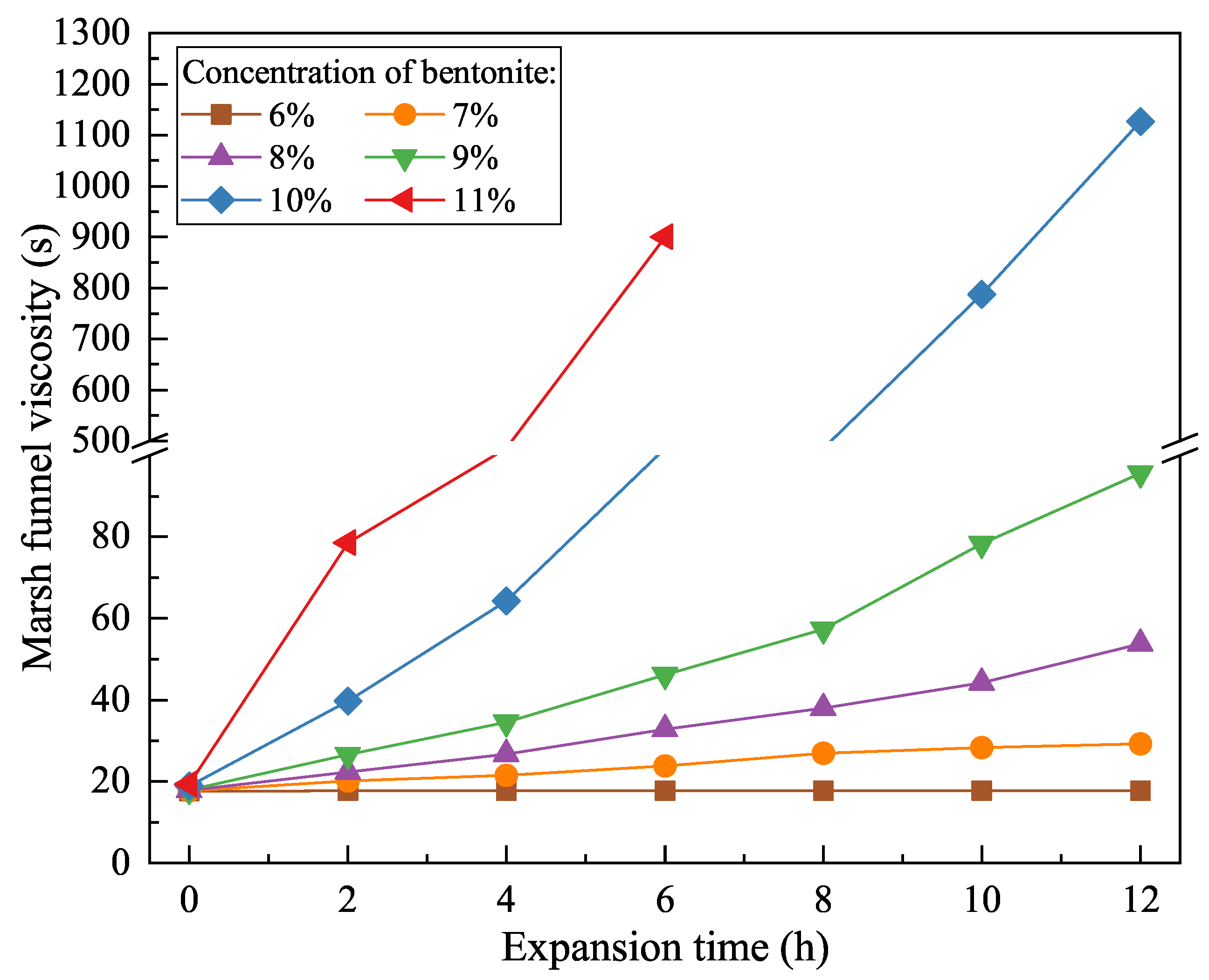
3.1. Bentonite Slurry Concentration
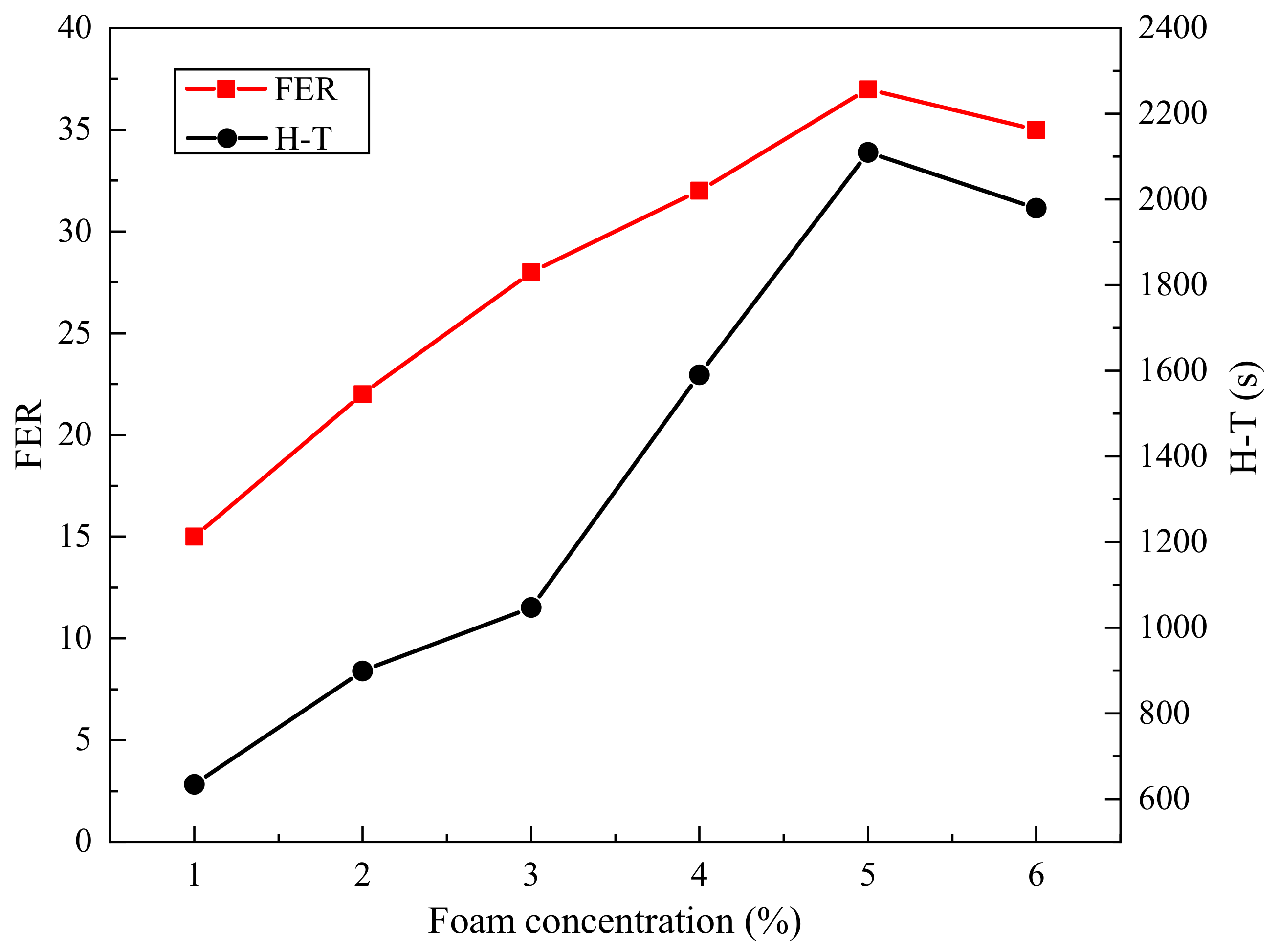
3.2. Foam Properties
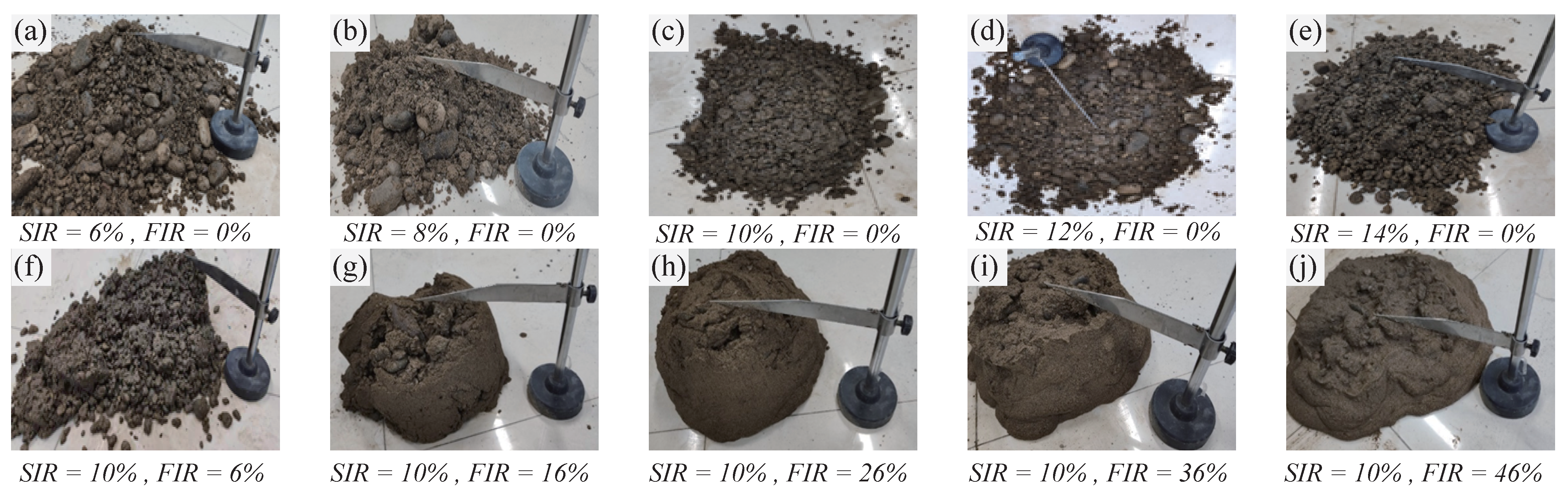
3.3. Muck Slump Test
3.4. Results of Laboratory Tests
4. Field Testing
4.1. Test Sections and Soil Conditioning Schemes
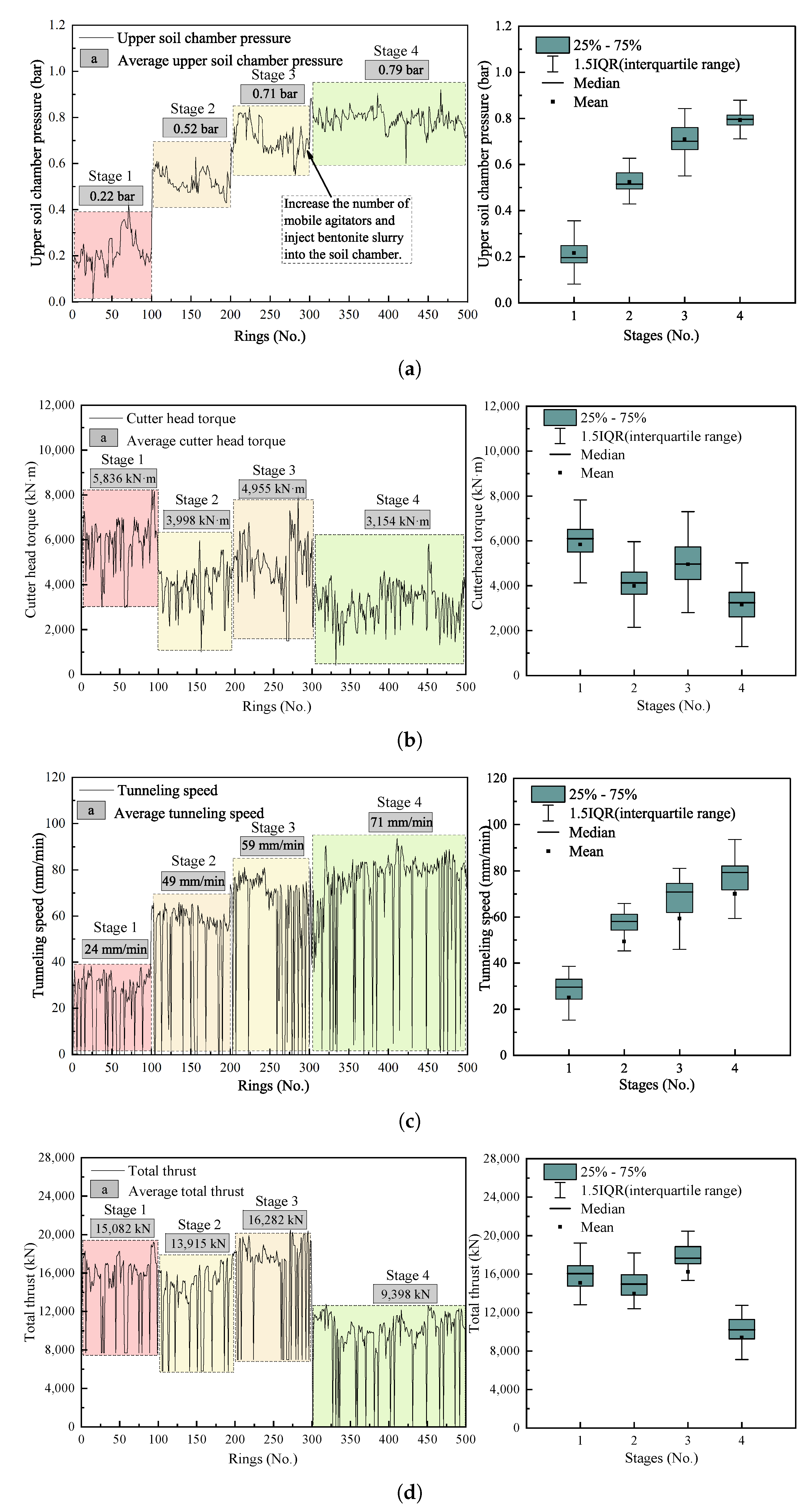
4.2. Analysis of Soil Conditioning Effects
4.2.1. Stage 1 (Rings 1–100)
4.2.2. Stage 2 (Rings 101–200)
4.2.3. Stage 3 (Rings 201–300)
4.2.4. Stage 4 (Rings 301–500)
4.3. Correlation Between Soil Conditioning Factors and Tunneling Parameters
5. Discussion
6. Conclusions
- 1.
- The soil chamber pressure, cutterhead torque, tunneling speed, and total thrust parameters can provide feedback on the effect of soil conditioning schemes in real time, offering a more practical and effective approach than laboratory testing.
- 2.
- The field test conducted in this study provided a well-adapted and practically tested soil conditioning scheme according to the geological conditions of the strata at the project site. In this scheme, a 34.6% FIR with 9% foam was injected into the soil in front of the cutterhead, and a 13% SIR with 5% bentonite was injected into the soil chamber with excellent results in terms of the four evaluated tunneling parameters. This result provides a technical reference for the development of soil conditioning schemes when constructing EPBS tunnels in similar strata.
- 3.
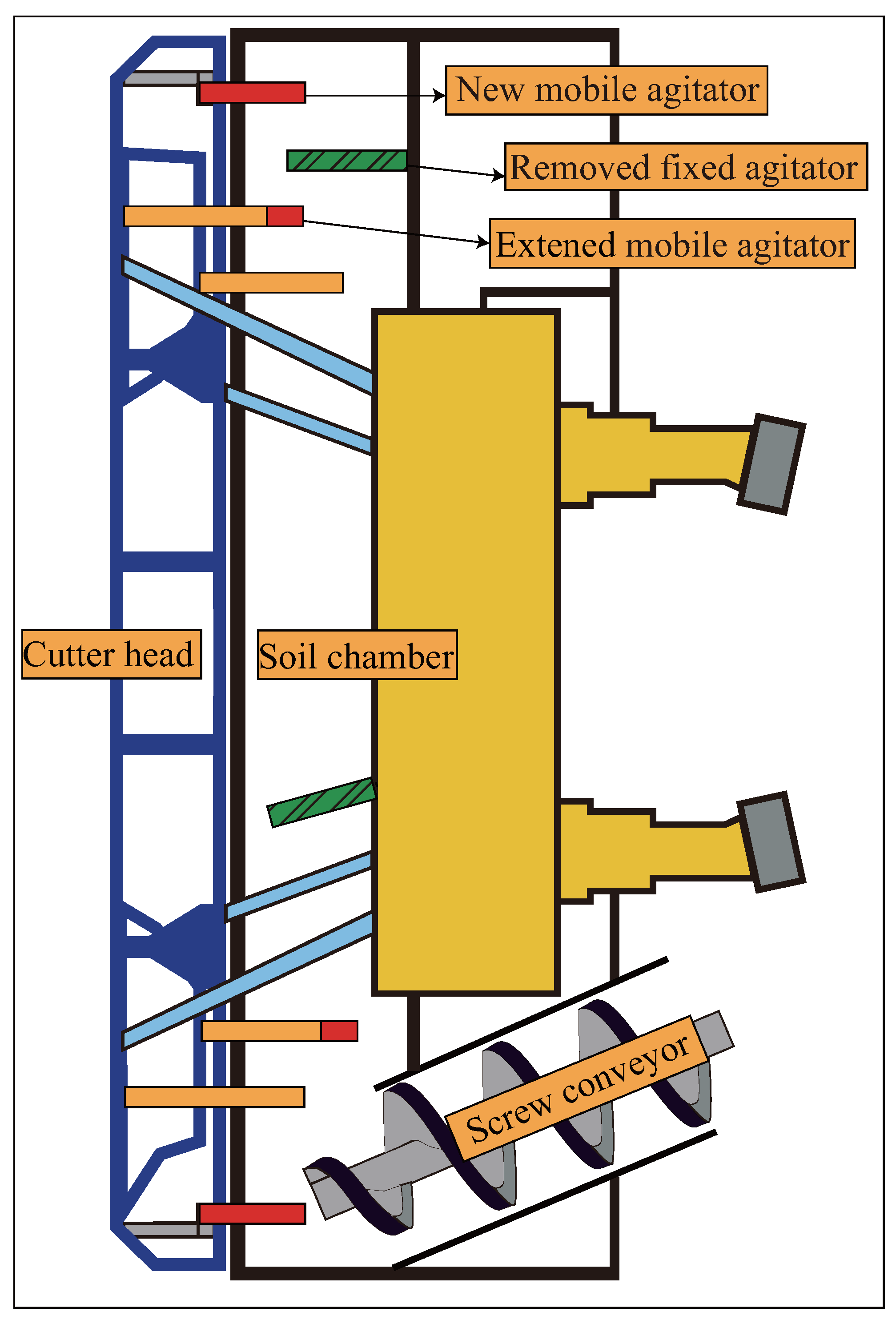
- Given the same soil conditioning agent injection ratios, optimizing the shield mixing system increased the pressure in the upper soil chamber by 11.3%, decreased the torque on the cutterhead by 36.9%, and decreased the total thrust by 42.3%. Thus, improving the mixing capacity of the soil chamber can effectively improve the effects of soil conditioning.
- 4.
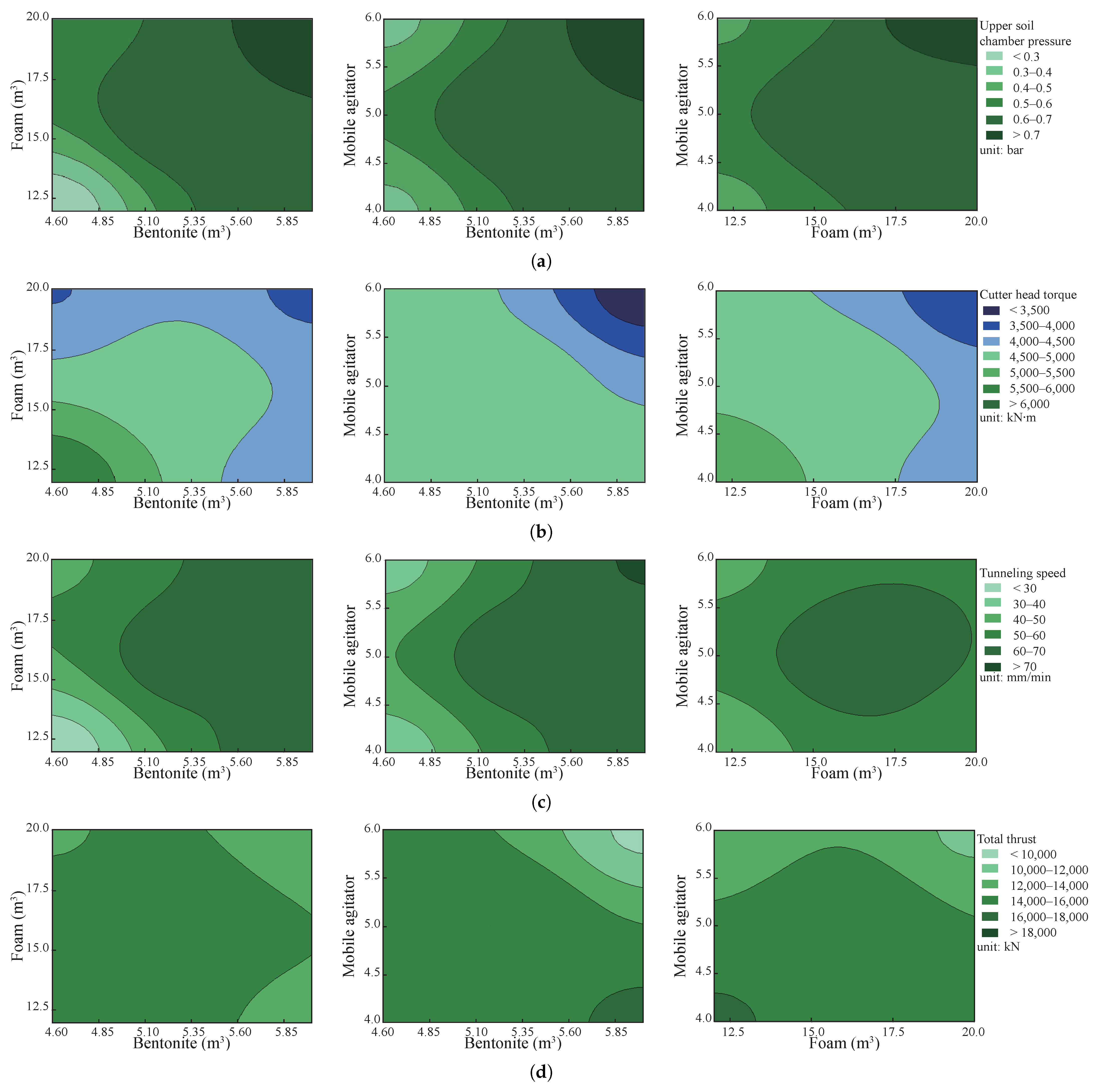
- The correlations between the three considered soil conditioning factors (bentonite slurry injection, foam injection, and number of mobile agitators) and the four tunneling parameters (upper soil chamber pressure, cutterhead torque, tunneling speed, and total thrust) were analyzed using an FFD to derive their quantitative relationships. These relationships, presented in the form of contours, provide a reference for determining the dosages of soil conditioning agents during EPBS tunneling in similar strata.
Author Contributions
Funding
Data Availability Statement
Acknowledgments
Conflicts of Interest
References
- Yang, Z.; Shao, X.; Zhang, Z.; Feng, J.; Han, H.; Yang, X.; Jiang, Y. Engineering geological characteristics of boulders in underground: A case study from the Yu-Wan Section of Beijing Metro Line 16. Bull. Eng. Geol. Environ. 2022, 81, 402. [Google Scholar] [CrossRef]
- Wang, S.; Wang, B.; Zheng, X.; Zhan, Y. Calculation of foam injection ratio and regulation method of muck compressibility under shield soil chamber pressure conditions. Case Stud. Constr. Mater. 2024, 21, e03577. [Google Scholar] [CrossRef]
- Nong, X.; Bai, W.; Chen, J.; Zhang, L. Factorial Experiments of Soil Conditioning for Earth Pressure Balance Shield Tunnelling in Water-Rich Gravel Sand and Conditioning Effects’ Prediction Based on Particle Swarm Optimization–Relevance Vector Machine Algorithm. Buildings 2024, 14, 2800. [Google Scholar] [CrossRef]
- Lu, Y.; Huang, M.; Huang, P.; Xu, C.; Wang, Y.; Hu, Y. Soil conditioning for EPB shield tunneling in coastal silty clay strata: Laboratory research and field application. Int. J. Geomech. 2024, 24, 04023289. [Google Scholar] [CrossRef]
- Ren, H.; Chen, J.; Wang, H.; He, Y.; Fang, X.; Wang, L. Analysis of the Temporal and Spatial Evolution Behavior of Earth Pressure in the Shield Chamber and the Ground Settlement Behavior During Shield Tunneling in Water-Rich Sand Layers. Buildings 2025, 15, 2935. [Google Scholar] [CrossRef]
- Wei, Y.; Yang, Y.; Qiu, T. Effects of soil conditioning on tool wear for earth pressure balance shield tunneling in sandy gravel based on laboratory test. J. Test. Eval. 2021, 49, 2692–2706. [Google Scholar] [CrossRef]
- Peila, D.; Oggeri, C.; Vinai, R. Screw conveyor device for laboratory tests on conditioned soil for EPB tunneling operations. J. Geotech. Geoenvironmental Eng. 2007, 133, 1622–1625. [Google Scholar] [CrossRef]
- Peila, D. Soil conditioning for EPB shield tunnelling. KSCE J. Civ. Eng. 2014, 18, 831–836. [Google Scholar] [CrossRef]
- Xu, G.; Fang, Y.; Wang, Y.; Dou, L.; Deng, R.; Geng, F. Experimental Investigation of the Effects of Aperture Ratio, Chamber Pressure and Soil Conditioning on the Clogging Behavior of EPB Shields. KSCE J. Civ. Eng. 2023, 27, 4508–4519. [Google Scholar] [CrossRef]
- Wang, S.; Zhu, H.; Liu, P.; Qu, T. Soil slaking under the effect of dispersants: Characteristics and mechanism. Environ. Earth Sci. 2024, 83, 397. [Google Scholar] [CrossRef]
- Huang, M.; Lin, C.; Lu, Y.; Wang, C.; Yan, S.; Cai, G. Simple characterization of compression–adhesion behavior of foam–conditioned soil in EPB shield tunneling. Tunn. Undergr. Space Technol. 2026, 167, 107056. [Google Scholar] [CrossRef]
- Lee, H.; Oh, J.; Shin, Y.J.; Won, J. Laboratory investigation on excavation performance of foam-conditioned weathered granite soil for EPB shield tunnelling. KSCE J. Civ. Eng. 2023, 27, 5460–5469. [Google Scholar] [CrossRef]
- Lee, H.; Kim, D.; Shin, D.; Oh, J.; Choi, H. Effect of foam conditioning on performance of EPB shield tunnelling through laboratory excavation test. Transp. Geotech. 2022, 32, 100692. [Google Scholar] [CrossRef]
- Wan, Z.; Li, S.; Yuan, C.; Zhao, S.; Wang, M.; Lu, Q.; Hou, W. Soil conditioning for EPB shield tunneling in silty clay and weathered mudstone. Int. J. Geomech. 2021, 21, 06021020. [Google Scholar] [CrossRef]
- Sebastiani, D.; Spagnoli, G.; Amici, M.; Mangifesta, S. Geotechnical characterization of natural clays for the prediction of clogging risk for TBM. Environ. Earth Sci. 2022, 81, 500. [Google Scholar] [CrossRef]
- Ling, F.; Wang, S.; Zheng, X.; Zhong, J.; Chen, Y. A novel calculation model for the permeability coefficient of soils conditioned with foam and bentonite slurry. KSCE J. Civ. Eng. 2024, 28, 2053–2065. [Google Scholar] [CrossRef]
- Li, S.; Wan, Z.; Zhao, S.; Ma, P.; Wang, M.; Xiong, B. Soil conditioning tests on sandy soil for earth pressure balance shield tunneling and field applications. Tunn. Undergr. Space Technol. 2022, 120, 104271. [Google Scholar] [CrossRef]
- Wan, Z.; Li, S.; Hao, S.; Zhao, S.; Wang, Z. Microscopic Experiments and Numerical Simulation of Foam-Conditioned Soil for Earth Pressure Balance Shield Tunneling in Water-Rich Sandy Stratum. Int. J. Geomech. 2025, 25, 04024311. [Google Scholar] [CrossRef]
- Yang, Z.; Yang, X.; Ding, Y.; Jiang, Y.; Qi, W.; Sun, Z.; Shao, X. Characteristics of conditioned sand for EPB shield and its influence on cutterhead torque. Acta Geotech. 2022, 17, 5813–5828. [Google Scholar] [CrossRef]
- Yang, Z.; Yang, X.; Ding, Y.; Jiang, Y.; Shao, X.; Qi, W.; Liu, N. Effect of Soil Conditioning on Saturated Sand Layers in EPB Shields: A Microstructural Analysis Based on CT Scanning and SEM. Arab. J. Sci. Eng. 2022, 47, 12387–12397. [Google Scholar] [CrossRef]
- Carigi, A.; Luciani, A.; Todaro, C.; Martinelli, D.; Peila, D. Influence of conditioning on the behaviour of alluvial soils with cobbles. Tunn. Undergr. Space Technol. 2020, 96, 103225. [Google Scholar] [CrossRef]
- Barzegari, G.; Uromeihy, A.; Zhao, J. EPB tunneling challenges in bouldery ground: A new experience on the Tabriz metro line 1, Iran. Bull. Eng. Geol. Environ. 2014, 73, 429–440. [Google Scholar] [CrossRef]
- Zumsteg, R.; Langmaack, L. Mechanized tunneling in soft soils: Choice of excavation mode and application of soil-conditioning additives in glacial deposits. Engineering 2017, 3, 863–870. [Google Scholar] [CrossRef]
- Zhang, S.; He, S.; Zhu, Z.; Li, C. Research on soil conditioning for earth pressure balance shield tunneling in Lanzhou sandy pebble strata with rich water. Rock Soil Mech. 2017, 38, 279–286. [Google Scholar] [CrossRef]
- Jiang, H.; Gong, Q.; Du, X. Experimental study on soil conditioning in cobble layer by use of earth pressure balanced machine. Chin. J. Geotech. Eng. 2013, 35, 284–292. [Google Scholar]
- Zhang, R.; Gong, Q.; Zhou, S.; Zhong, Y. Soil Conditioning Tests for Earth Pressure Balance Shield Applications in Sandy Cobble Strata. J. Tongji Univ. 2019, 47, 673. [Google Scholar] [CrossRef]
- Zhen, Z.; Ge, X.; Zhang, J. Soil conditioning tests on sandy and cobbly soil for shield tunneling. KSCE J. Civ. Eng. 2021, 25, 1229–1238. [Google Scholar] [CrossRef]
- Wang, S.; Liu, P.; Gong, Z.; Yang, P. Auxiliary air pressure balance mode for EPB shield tunneling in water-rich gravelly sand strata: Feasibility and soil conditioning. Case Stud. Constr. Mater. 2022, 16, e00799. [Google Scholar] [CrossRef]
- Huang, S.; Wang, S.; Xu, C.; Shi, Y.; Ye, F. Effect of grain gradation on the permeability characteristics of coarse-grained soil conditioned with foam for EPB shield tunneling. KSCE J. Civ. Eng. 2019, 23, 4662–4674. [Google Scholar] [CrossRef]
- Wang, S.; Zhan, Y.; Qu, T.; Qiu, T.; Wang, H. Effect of Gradation on Undrained Compressibility of Foam-Conditioned Coarse-Grained Soils. Int. J. Geomech. 2023, 23, 04023089. [Google Scholar] [CrossRef]
- Wei, Y.; Wang, D.; Li, J.; Jie, Y. Effects of soil conditioning on characteristics of a clay-sand-gravel mixed soil based on laboratory test. Appl. Sci.s 2020, 10, 3300. [Google Scholar] [CrossRef]
- Yao, Q.; Ji, C.; He, C.; Zhou, S. A hybrid experiment/theory method for soil conditioning in sandy cobble strata with large cobbles and boulders. Bull. Eng. Geol. Environ. 2021, 80, 8189–8209. [Google Scholar] [CrossRef]
- Djeran Maigre, I.; Dubujet, P.; Vogel, T.M. Variation over time of excavated soil properties treated with surfactants. Environ. Earth Sci. 2018, 77, 67. [Google Scholar] [CrossRef]



| Test Number | Soil Conditioning Agent Volumetric Injection Ratio | Slump (cm) | Flow Plasticity | |
|---|---|---|---|---|
| SIR (%) | FIR (%) | |||
| 1 | 6 | 15.6 | Loose and poor | |
| 2 | 8 | 13.4 | Poor | |
| 3 | 10 | / | 11.7 | Good |
| 4 | 12 | 8.8 | Medium | |
| 5 | 14 | 8 | Muck water precipitation | |
| 6 | 6 | 11.8 | Poor | |
| 7 | 16 | 13.5 | Poor | |
| 8 | 10 | 26 | 17.5 | Good |
| 9 | 36 | 18.6 | Good: muck began to precipitate water | |
| 10 | 46 | 19.8 | Muck water precipitation | |
| Test Stage | Length (Rings) | Number of Mobile Agitators | Bentonite Injection Volume | Foam Injection Volume | Upper Soil Chamber Pressure | Average Cutterhead Torque | Average Tunneling Speed | Average Total Thrust |
|---|---|---|---|---|---|---|---|---|
| 1 | 100 | 4 | 4.6 m3/rings | 12 m3/rings | 0.22 bar | 5800 kN·m | 24 mm/min | 15,000 kN |
| 2 | 100 | 4 | 9 m3/rings | 20 m3/rings | 0.5 bar | 3998 kN·m | 49 mm/min | 13,915 kN |
| 3 | 100 | 4 | 6 m3/rings | 16 m3/rings | 0.7 bar | 4995 kN·m | 59 mm/min | 16,282 kN |
| 4 | 200 | 6 | 6 m3/rings | 16 m3/rings | 0.8 bar | 3154 kN·m | 71 mm/min | 9398 kN |
| Operational Sequence | Bentonite Slurry Volume (m3) | Foam Volume (m3) | Number of Mobile Agitators * | Upper Soil Chamber Pressure (bar) | Cutterhead Torque (kN·m) | Tunneling Speed (mm/min) | Total Thrust (kN) |
|---|---|---|---|---|---|---|---|
| 1 | 6 | 12 | 4 | 0.71 | 4955 | 69 | 16,282 |
| 2 | 4.6 | 20 | 6 | 0.52 | 3998 | 49 | 13,915 |
| 3 | 5.3 | 16 | 5 | 0.74 | 5025 | 62 | 18,762 |
| 4 | 4.6 | 12 | 6 | 0.22 | 5836 | 24 | 15,082 |
| 5 | 6 | 12 | 4 | 0.74 | 4722 | 59 | 17,620 |
| 6 | 6 | 20 | 6 | 0.79 | 3154 | 71 | 9398 |
| 7 | 4.6 | 20 | 4 | 0.55 | 4027 | 47 | 14,015 |
| 8 | 5.3 | 16 | 5 | 0.69 | 4725 | 67 | 15,994 |
| 9 | 6 | 20 | 4 | 0.72 | 4625 | 68 | 15,823 |
| 10 | 4.6 | 12 | 4 | 0.21 | 6020 | 22 | 15,432 |
| 11 | 4.6 | 20 | 4 | 0.53 | 3888 | 49 | 13,765 |
| 12 | 6 | 12 | 6 | 0.74 | 3244 | 70 | 9574 |
| 13 | 5.3 | 16 | 5 | 0.72 | 4877 | 69 | 15,342 |
| 14 | 6 | 12 | 6 | 0.77 | 3241 | 72 | 9798 |
| 15 | 5.3 | 16 | 5 | 0.71 | 4799 | 69 | 15,300 |
| 16 | 6 | 20 | 4 | 0.72 | 4625 | 68 | 15,823 |
| 17 | 4.6 | 12 | 4 | 0.21 | 6020 | 22 | 15,432 |
| 18 | 4.6 | 12 | 6 | 0.22 | 5836 | 24 | 15,082 |
| 19 | 6 | 20 | 6 | 0.79 | 3154 | 71 | 9398 |
| 20 | 5.3 | 16 | 5 | 0.72 | 4800 | 69 | 15,322 |
| 21 | 4.6 | 20 | 6 | 0.52 | 3998 | 49 | 13,915 |
Disclaimer/Publisher’s Note: The statements, opinions and data contained in all publications are solely those of the individual author(s) and contributor(s) and not of MDPI and/or the editor(s). MDPI and/or the editor(s) disclaim responsibility for any injury to people or property resulting from any ideas, methods, instructions or products referred to in the content. |
© 2025 by the authors. Licensee MDPI, Basel, Switzerland. This article is an open access article distributed under the terms and conditions of the Creative Commons Attribution (CC BY) license (https://creativecommons.org/licenses/by/4.0/).
Share and Cite
Yang, Z.; Shao, X.; Liu, Z.; Bai, Z.; Jiang, Y. Optimization and Field Validation of Soil Conditioning Scheme for EPB Shield Tunneling in Cobble–Boulder Stratum: Case Study on Beijing Metro Line 16. Buildings 2025, 15, 4429. https://doi.org/10.3390/buildings15244429
Yang Z, Shao X, Liu Z, Bai Z, Jiang Y. Optimization and Field Validation of Soil Conditioning Scheme for EPB Shield Tunneling in Cobble–Boulder Stratum: Case Study on Beijing Metro Line 16. Buildings. 2025; 15(24):4429. https://doi.org/10.3390/buildings15244429
Chicago/Turabian StyleYang, Zhiyong, Xiaokang Shao, Zhe Liu, Zhiqiang Bai, and Yusheng Jiang. 2025. "Optimization and Field Validation of Soil Conditioning Scheme for EPB Shield Tunneling in Cobble–Boulder Stratum: Case Study on Beijing Metro Line 16" Buildings 15, no. 24: 4429. https://doi.org/10.3390/buildings15244429
APA StyleYang, Z., Shao, X., Liu, Z., Bai, Z., & Jiang, Y. (2025). Optimization and Field Validation of Soil Conditioning Scheme for EPB Shield Tunneling in Cobble–Boulder Stratum: Case Study on Beijing Metro Line 16. Buildings, 15(24), 4429. https://doi.org/10.3390/buildings15244429