Article

A Method for Extracting Indoor Structural Landmarks Based on Indoor Fire Protection Plan Images of Buildings


1
School of Internet of Things, Nanjing University of Posts and Telecommunications, Nanjing 210023, China
2
Smart Health Big Data Analysis and Location Services Engineering Research Center of Jiangsu Province, Nanjing University of Posts and Telecommunications, Nanjing 210023, China
3
Key Lab of Virtual Geographic Environment, Nanjing Normal University, Ministry of Education, Nanjing 210023, China
4
School of Communications and Information Engineering, Nanjing University of Posts and Telecommunications, Nanjing 210023, China
5
Jiangsu Key Laboratory of Intelligent Information Processing and Communication Technology, Nanjing 210023, China
*
Author to whom correspondence should be addressed.
Buildings 2025, 15(24), 4411; https://doi.org/10.3390/buildings15244411 (registering DOI)
Submission received: 13 October 2025 / Revised: 27 November 2025 / Accepted: 3 December 2025 / Published: 6 December 2025
(This article belongs to the Section Building Structures)

Abstract

Indoor landmarks play a crucial role in the process of indoor positioning and route planning for pedestrians or unmanned devices. Indoor structural landmarks, a type of indoor landmarks, can provide rich steering and semantic descriptions for indoor navigation services. However, most traditional indoor landmark extraction methods rely on indoor points of interest and indoor vector map data. These methods face the problem of difficult acquisition of indoor data and overlook the exploration of indoor structural landmarks. Therefore, this paper innovatively proposes a method for extracting indoor structural landmarks based on the commonly available indoor fire protection plan images. First, the HSV model is employed to eliminate noise from the original image, and vector data of indoor components is obtained using the constructed Canny operator. Subsequently, the visibility is calculated based on the grids of indoor space segmentation. Finally, the identification and extraction of indoor structural landmarks are achieved through grid visibility classification, directional clustering analysis, and spatial proximity verification. This approach opens up new ideas for indoor landmark extraction methods. The experimental results show that the method proposed in this paper can effectively extract indoor structural landmarks, the extraction accuracy of indoor structural landmarks reaches over 90%, verifying the feasibility of using indoor fire protection plan data for landmark extraction and expanding the data sources for indoor landmark extraction.

1. Introduction

Research shows that 80–90% of people’s time is spent indoors, but as buildings become more complex, path guidance in unfamiliar indoor spaces becomes more difficult [1,2]. Indoor landmarks have significant recognizability and can help people or unmanned aerial vehicles (UAVs) determine direction and position in unfamiliar indoor environments [3,4], providing a good anchor for indoor positioning and route planning [5,6,7]. Indoor structural landmarks are a type of indoor landmark that can provide more turning and directional information for indoor guidance services [8,9,10]. It is an objective description of the internal spatial structure of a building, expressing the form and location distribution of ‘empty’ space. Extracting structural landmark information from fire protection plans provides location assistance for emergency responders, building managers, or digital twin systems. In landmark-based wayfinding, determining the most salient landmark from several candidates at decision points is challenging [11,12].
Currently, indoor landmark extraction mainly uses a variety of evaluation indicators to construct a salience model [13,14,15]. This method can effectively evaluate existing indoor POIs (points of interest) and classify them into different levels, thereby selecting the required landmarks. However, most previous methods are based on the analysis of constructed indoor road networks and POI data. This requires a lot of basic data from indoor maps during landmark extraction, which places high demands on data sources. At the same time, although structural indicators such as accessibility and location importance have been analyzed in the model of salience evaluation, there is a lack of people’s visual perception of indoor spatial structure types. Previous research has neglected people’s visual discrimination of indoor spatial structure types, failing to accurately express the role of indoor spatial structure in landmark selection [5,6]. Therefore, it is difficult to achieve automated extraction of indoor structural landmarks. Due to the relatively small amount of existing indoor map basic data, its surveying process is labor-intensive and time-consuming [16]; it is not practical to extract large-scale building indoor landmarks based on POI data. Current research advances in indoor structural landmark extraction still present two core gaps: First, indoor fire protection plans are easily accessible and contain abundant information on indoor elements and spatial layout, yet relevant studies on extracting indoor structural landmarks based on such drawings remain unreported. Second, there is an essential difference in extraction logic between indoor structural landmarks and traditional elements (e.g., walls, doors, and windows). Walls, doors, and windows are depicted by explicit visual symbols in drawings, enabling efficient recognition and extraction via existing technologies such as pattern matching and deep learning. In contrast, indoor structural landmarks are essentially “blank areas” enclosed by physical elements, with no explicit symbolic annotations in floor plans, rendering traditional extraction methods completely ineffective.
In light of these limitations, this study uses fire protection plans that are easily accessible on each floor of the building and applies image processing techniques to quickly extract vector spatial data from indoor maps. This expands the map-based data sources for landmark extraction. At the same time, due to the spatial structure perception ability of space syntax visibility theory, this study combines structural landmark recognition in indoor spaces with space syntax visibility theory to enhance people’s ability to grasp important structural landmark locations during visual navigation in indoor spaces, thereby reducing the possibility of getting lost during complex environmental navigation. Using the advantages of visibility theory, taking spatial visibility as a condition for selecting landmarks in indoor space structure can achieve automated extraction of landmarks in indoor space structure.
The remainder of this paper is organized as follows. Section 2 introduces related work about extraction of indoor landmarks. Section 3 details the automatic extraction step of indoor structural landmarks based on visibility perception. The experimental design and result analysis are introduced in Section 4. Finally, Section 5 summarizes the findings of this study.

2. Related Work

2.1. Indoor Plan Image Analysis

As a crucial data source in the fields of smart buildings, emergency management, and spatial planning, indoor floor plan analysis has been extensively applied in key areas such as 3D building model based on 2D drawings, Building Information Modeling (BIM) reconstruction, indoor navigation, and emergency evacuation. In 3D building modeling, structural parsing and semantic extraction of 2D floor plans enable the rapid generation of 3D models containing core elements such as walls, rooms, doors, and windows [17,18]. For BIM reconstruction, greater emphasis is placed on information integrity and relevance, integrating geometric data from floor plans with semantic data including equipment attributes and material information [19]. Indoor navigation and evacuation applications focus on mining spatial topological relationships, and by combining real-time environmental data, they provide precise support for pedestrian navigation and path planning in emergency situations [20,21,22].
Regarding the fundamental task of extracting walls and rooms from indoor floor plans, early research primarily relied on rule-based image processing methods. These approaches implement wall contour extraction and room segmentation through standardized workflows, including geometric feature thresholding, edge detection operators (e.g., Canny operator), and Hough transform [17,18]. For instance, color filtering and clustering techniques separate walls from backgrounds, line continuity rules filter valid wall lines, and closed-region detection identifies room boundaries [20]. Some studies further enhance segmentation robustness under noise or data loss by incorporating wall centerline detection, missing wall inference, and graph-cut optimization [23]. Their key advantages lie in clear principles and high computational efficiency, making them suitable for well-structured CAD floor plans with minimal noise. However, they lack robustness against noise interference, line breaks, and geometric distortions in hand-drawn or scanned drawings, failing to adapt to diverse drawing styles and complex spatial layouts [24,25].
For the numerous symbols widely present in indoor thematic floor plans (e.g., fire hydrants, fire extinguishers, emergency exit signs, and fire alarms in fire safety applications), extraction technologies have gradually shifted toward machine learning-driven intelligent methods in recent years, becoming a research focus [19,20]. With the breakthrough of deep learning in computer vision, models based on object detection and semantic segmentation have been widely applied to symbol extraction tasks. Faster R-CNN combines a Region Proposal Network (RPN) with a backbone network to achieve accurate localization and classification of 56 types of emergency symbols; aided by synthetic datasets, it significantly improves recognition rates for rare symbols [20,21]. Key point R-CNN addresses the localization challenge of symbols connected to their actual positions via auxiliary lines through key point annotation and detection, achieving a mean average precision of 0.73 in fire equipment symbol extraction [19]. YOLO series models leverage efficient end-to-end detection capabilities to not only rapidly crop valid regions from floor plans but also directly enable precise recognition of specific symbols, with detection performance optimized by adjusting confidence thresholds [24,26].
Additionally, to address the problem of imbalanced symbol samples, researchers have constructed large-scale synthetic datasets by cropping original images and superimposing synthetic symbols, effectively enhancing model performance in recognizing low-frequency symbols [20,27]. These machine learning methods automatically learn visual features of symbols, freeing themselves from reliance on manual rules and significantly improving the accuracy and generalization ability of symbol extraction in complex scenarios. They thus lay a solid foundation for subsequent applications such as BIM model enrichment and emergency management decision-making [19,28].

2.2. Indoor Landmark Extraction

Landmarks can help pedestrians understand the relative spatial relationship between environment and themselves, and are important spatial reference in orientation [8]. Therefore, in the process of indoor navigation research, the extraction method of indoor landmarks and the selection of evaluation models are particularly important.
Most indoor landmark extraction and selection methods use landmark saliency models or scoring rules to find suitable landmarks from existing POIs or potential landmark point sets [29,30]. The evaluation indicators include spatial saliency, visual saliency, subjective saliency, etc. Part of the research work involves evaluating and selecting landmark parameters from different perspectives, in order to continuously expand and optimize the saliency model. Following former studies, Lyu et al. addressed the salience from visual, semantic, and structural attractiveness to form a computational indoor landmark extraction method [31]. Hu et al. pointed out that linear models are not always able to establish an accurate quantitative relationship between the attributes of a landmark and its perceived salience, and propose training a non-linear salience model by means of genetic programming [11]. Dong et al. explored the impacts of two important factors, namely the visual salience and semantic salience of landmarks, on an individual’s visual attention during the wayfinding process [32].
Another group of scholars pays more attention to the impact of different types of landmarks on indoor navigation and guidance, expanding the range of landmark candidate points [33,34,35,36]. Fellner et al. developed a category-based approach to generate landmark-based route instructions for indoor navigation [37]. Abdelnasser et al. utilize distinctive locations within indoor environments as landmarks, which exhibit unique signal signatures on one or more mobile sensors [38]. Zhu et al. took steady indoor objects as a landmark sequence and matched the continuously detected landmarks with the topological map according to their order of occurrence in the videos to achieve indoor localization [39]. Nguyen-Huu et al. defined the three kinds of landmarks, WiFi, turning, and stairs landmarks, and proposed detection methods for each landmark for indoor pedestrian localization [40]. Zhou et al. proposed a familiarity-dependent computational method for selecting suitable landmarks for communicating with familiar and unfamiliar users in indoor environments [41]. Zhou et al. designed a landmark hierarchy containing three levels by adjusting the size and highlight of landmark expression, which should contribute to enhancing indoor spatial knowledge [42]. Dubey et al. proposed a computational framework to identify indoor landmarks that is based on a hierarchical multi-criteria decision model and grounded in theories of spatial cognition and human information processing [43].
Despite the significant contribution of these studies to the extraction and evaluation of indoor landmarks in both indoor and outdoor environments, they have overlooked the recognition of indoor spatial structure landmarks by pedestrians’ visual range. Meanwhile, previous research has focused more on how to filter indoor landmarks from existing interest point datasets, and the extraction of indoor landmarks relies on indoor basic POIs and underlying vector data. There is a problem of difficulty in obtaining indoor map data sources. Due to the easy accessibility of the building fire protection plan images on each floor inside the building, this study aim to extract indoor structural landmarks based on the fire protection plan images.

3. Approach

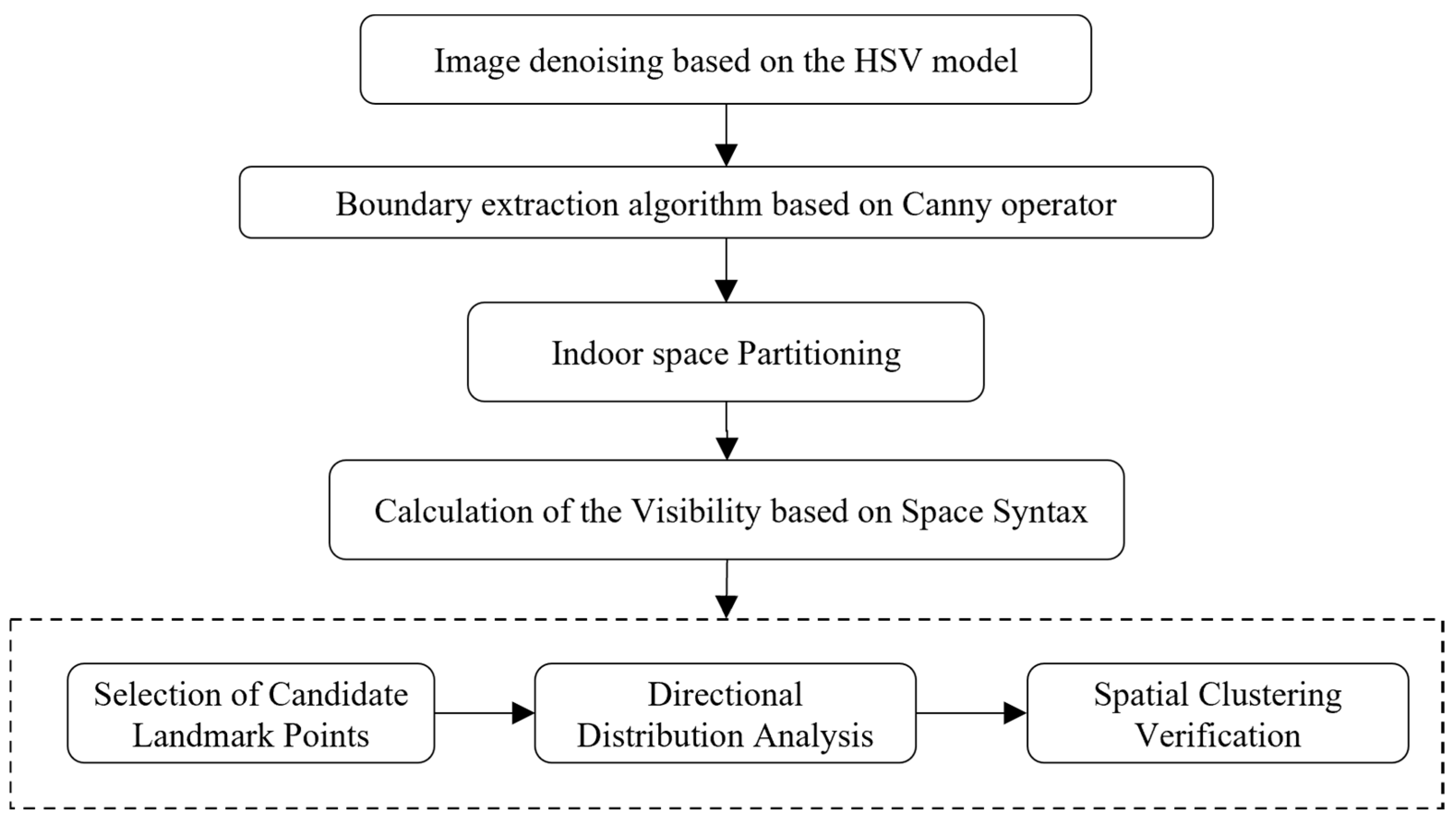
The overall design concept of the algorithm in this article is as follows: firstly, combined with artificial intelligence large model tools, extracting vector data of building walls based on indoor fire protection plans, then using spatial syntax to calculate the visibility of indoor spaces, and finally identifying and extracting indoor structural landmarks. Figure 1 shows the flowchart outlining all of the approaches.

3.1. Extraction of Building Wall Lines Based on Indoor Fire Protection Plan Images

This section mainly explores how to extract key wall vector data from the architectural indoor fire protection plan to support subsequent spatial syntax analysis and the extraction of indoor structural landmarks. In the process of using the HSV model to remove the interference of non-critical elements in fire protection plan, AI large models are combined to intelligently distinguish different colors. Subsequently, an efficient and accurate wall information extraction method based on the Canny operator is constructed. And finally, an SHP file containing wall vector data is obtained.

3.1.1. Indoor Fire Protection Plan Denoising Based on the HSV Model

The indoor fire protection plan of buildings contains a large amount of information about the layout of indoor functional spaces and the locations of structural landmarks. Since indoor spaces are enclosed by physical components such as walls, we first need to extract the wall components in indoor fire protection plan images. However, fire protection plans often contain a large number of elements that are irrelevant to indoor spaces and components. These elements not only fail to assist in the discrimination of indoor landmarks but may also obstruct the line of sight during the visual analysis process. Therefore, the preliminary image denoising and redundant data removal operations for these elements are particularly important. Domain-specific symbols (sprinklers, fire hydrants, and alarm control panels) can serve as indoor landmarks, which differs from this study’s focus on extracting indoor structural landmarks from indoor spaces. These domain-specific symbols are explicitly represented by special icons in floor plans, whereas indoor structural landmarks are implicit and not visually displayed through symbols on the plans. Since the recognition and extraction of domain-specific symbols are not within the scope of this study, we have filtered them out during the process of extracting structural landmarks.
During the design of indoor fire protection plans, the line color of walls is generally black, while other parts use high-contrast colors. To deal with the wide variety of drawing styles found in real world fire protection plans, deep learning large models are leveraged, such as Doubao. First, intelligent color identification is performed on different elements in the floor plan to distinguish between wall lines and noise. Subsequently, the color parameters of the noise are determined. Finally, the wall detection algorithm is executed based on the aforementioned preprocessed data. The HSV model decomposes colors into hue, saturation, and value, which has the advantage of being closer to human color perception and is suitable for color recognition and segmentation. Therefore, denoising processing is performed on the image based on the HSV color space.
The steps for image denoising are as follows: First, read the indoor fire protection image file and convert the image from the BGR color space to the HSV color space. Define the range of noise in the HSV space, create a mask for the noise in the image, and mark the colored areas that need to be removed. Then, create an n × n kernel and perform morphological operations on the mask to remove noise and fill holes. Use the mask to replace the colored parts of the original image with white or other background colors to reduce interference with subsequent analysis. Finally, display the processed image selected as white in this paper, wait for a key press to close the displayed image, and save the processed image. Algorithm 1 shows the pseudo-code implementation of this process.
Algorithm 1 A denoising algorithm based on an HSV model
input: Indoor fire protection plan image for buildings
output: Indoor floor plan after noise removal
1: img = read (fire protection plan image);
2: hsv = cvtColor(img, COLOR_BGR2HSV);
3: lower_red = array ([0, 70, 50]);
4: upper_red = array ([10, 255, 255]);
5: mask = inRange(hsv, lower_red, upper_red);
6: kernel = getStructuringElement (MORPH_ELLIPSE, (n, n);
7: mask = morphologyEx (mask, MORPH_OPEN, kernel);
8: mask = morphologyEx (mask, MORPH_CLOSE, kernel);
9: if mask > 0 then
      img = [255, 255, 255];
10: write(“result.jpg”, img);
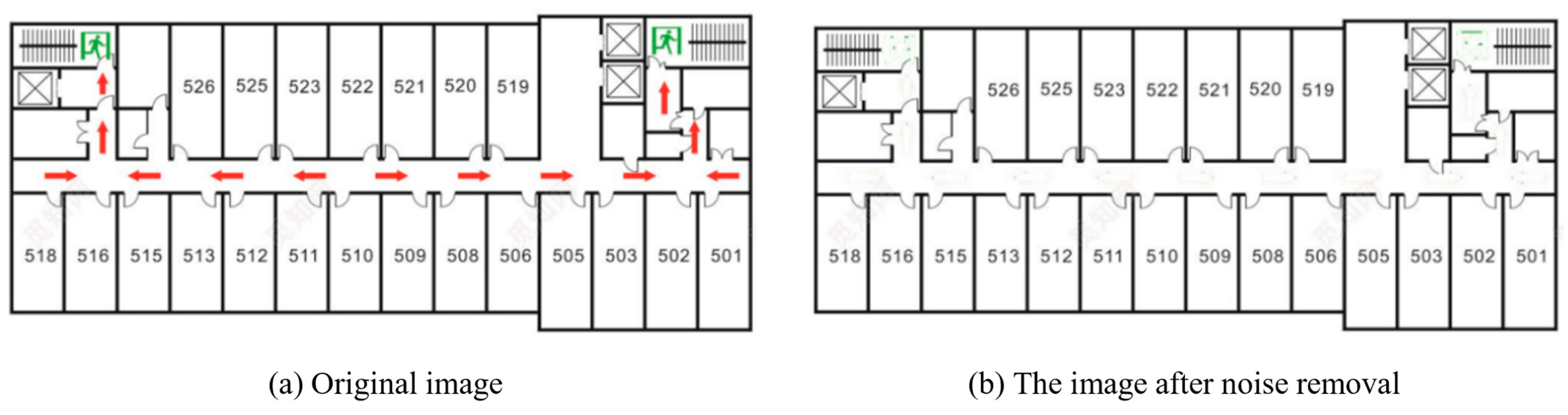
Figure 2 shows the comparison effect between the original image and the denoised image. Through the image denoising method based on the HSV model, the color noise interference in the image can be effectively removed while preserving the integrity of the wall data (Figure 2b), providing high-quality basic data for the subsequent visibility analysis.

3.1.2. Extraction of Vector Lines of Interior Walls in Buildings

Since the goal of this study is to extract indoor structural landmarks, after image denoising, the information of indoor wall lines needs to be focused on, and the markings inside other rooms should temporarily be ignored. In this paper, to extract the line information of the walls, the Canny operator is selected as the edge detection method. This method determines which edges are the real boundary lines for enclosing and dividing rooms, and requires further setting of two thresholds: a high threshold and a low threshold. Edges above the high threshold are identified as “real edges”, while those below the low threshold are suppressed. Edges between the two thresholds are considered edges if they are connected to “real edges”, otherwise they are suppressed (as shown in Equation (1)).
C a n n y ( x , y ) = Strong if   M ( x , y ) M H Weak if   M ( x , y ) < M L Non edge otherwise
Among them, M H is the high threshold of the gradient intensity, M L is the low threshold of the gradient intensity, and Strong, Weak, and Non−edge represent strong edges, weak edges, and non-edges, respectively. The real edges are determined through hysteresis thresholding. All possible edges (that is, strong edges and weak edges connected to strong edges) are marked as real wall lines, and all the remaining edges are suppressed.
Image binarization is a process of converting an indoor image into an image with only two colors (usually black and white). This treatment can improve the accuracy and efficiency of Canny edge detection. Image binarization can simplify the image information, and reduce unnecessary noise and interference, thus making the detection of wall lines more accurate and efficient. Before performing the binarization process, the image can be first converted into a grayscale image according to Formula (2):
I g r a y = 0.299 × I R + 0.587 × I G + 0.114 × I B
where I g r a y represents the pixel value after grayscale conversion, and I R , I G , and I B are the pixel values of the corresponding pixels in the original image on the red, green, and blue channels, respectively. Set a threshold and perform binarization processing on the grayscale image. Finally, set two thresholds to conduct Canny edge detection on the binarized image. The thresholds can be adjusted, and the lower the thresholds, the more lines can be extracted.
The specific algorithm process is as follows: Read the denoised image and convert it into a grayscale image. Then, perform binarization processing on the grayscale image and set a threshold to simplify the image information and reduce noise interference. Use the Canny operator for edge detection and set two thresholds (a high threshold and a low threshold) to extract the wall lines in the image. Algorithm 2 is the pseudocode implementation of this method.
Algorithm 2 A boundary extraction algorithm based on Canny operator
input: Indoor floor plan after noise removal
output: Edge extraction line image
1:img_gray = read(path, 0);
2: binary_img = threshold
      img_gray, thresh=127, maxval=255,
      type = THRESH_BINARY);
show(“Binary Image”, binary_img);
3: edges = Canny(binary_img, low_threshold = 50,
       high_threshold = 150);
show(“Edge Detection”, edges);
4: imwrite(“edges_result.jpg”, edges);
5: N = edges.count;
6:while N ≠ 0
// At least two points are required to form a line
if nodes.count > 2 then
   new LineString;
  N = N − 1;
7: Save as a Shapefile;
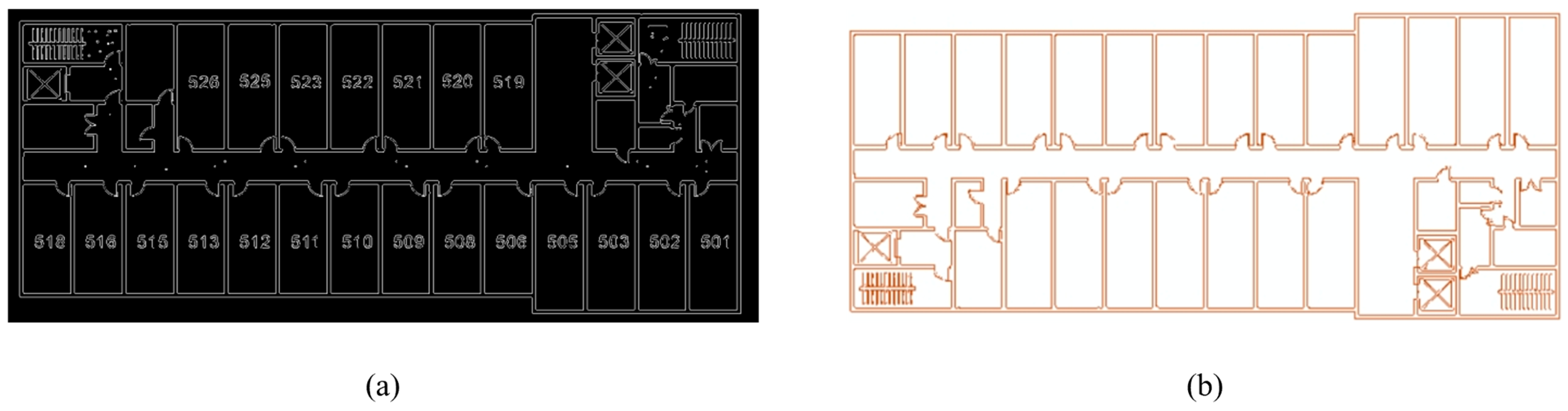
Figure 3a shows the edge detection results based on the Canny operator. Through the above methods, the wall lines can be accurately extracted in the fire protection plan, providing high-quality basic data for subsequent indoor navigation analysis.
Since the JPG format image obtained after image processing cannot be directly used for subsequent visibility calculation and landmark recognition processing, it is necessary to convert the information, such as the wall lines detected through edge detection, into the vector shapefile format. Shapefile is a commonly used file format in remote sensing and geographic information systems, used to store geospatial vector data. In this paper, combined with the edge detection method in image processing technology, OpenCV and geopandas tools are used to automatically vectorize the wall lines and generate Shp files. Figure 3b shows the result of extracting vector wall lines into an Shp file.

3.2. Calculation of Indoor Space Visibility Based on Space Syntax

The visibility analysis in space syntax is an analytical method that transforms complex spatial vector data into intuitive raster data, thereby analyzing the visible range or proportion of the indoor space. It helps us perceive the spatial layout patterns and architectural structural features behind the indoor space data. In order to enhance the understanding of indoor structural landmarks, in this subsection, it will quantify the visibility of the indoor space. The method of regular grid division will be adopted to divide the indoor plane data into a series of small cells, and calculate the visibility of each cell. Visibility refers to the range and degree to which other areas can be seen from a specific observation point or location. By calculating the visibility of each cell, the visibility distribution map of the indoor space can be obtained. Using visibility analysis to present the structural characteristics of the indoor space, and then identify the positions of key landmarks, so as to better recognize and extract the landmarks.
Therefore, this method starts with the visibility analysis. By abstracting the indoor plane data into individual small cells, it calculates the visibility of each cell. Then, based on the calculated visibility values, it divides the all grid cells into different levels, which represent different visibility grades. This graphical representation can help us identify the positions of key landmarks and the relative relationships among them. In addition, through the methods described in this section, it will be able to more accurately identify and extract the indoor structural landmarks in the indoor environment, and use visibility analysis to enhance the semantic understanding of the indoor environment. This will provide important data support for subsequent applications such as indoor navigation and path planning.

3.2.1. Indoor Space Partitioning Based on Regular Grids

In visibility analysis, the indicator for evaluating the model is visibility, which is also known as the field of view or visual field. It is a measurement that describes how much of other areas can be seen from a specific observation point or location. In spatial analysis, visibility is an important indicator because it can help us understand and quantify the openness and connectivity of a space. In the application of landmark recognition, visibility analysis can not only help us intuitively identify and locate key landmarks in the indoor environment, but also reveal the spatial relationships between these landmarks, providing us with a more comprehensive understanding of the indoor space.
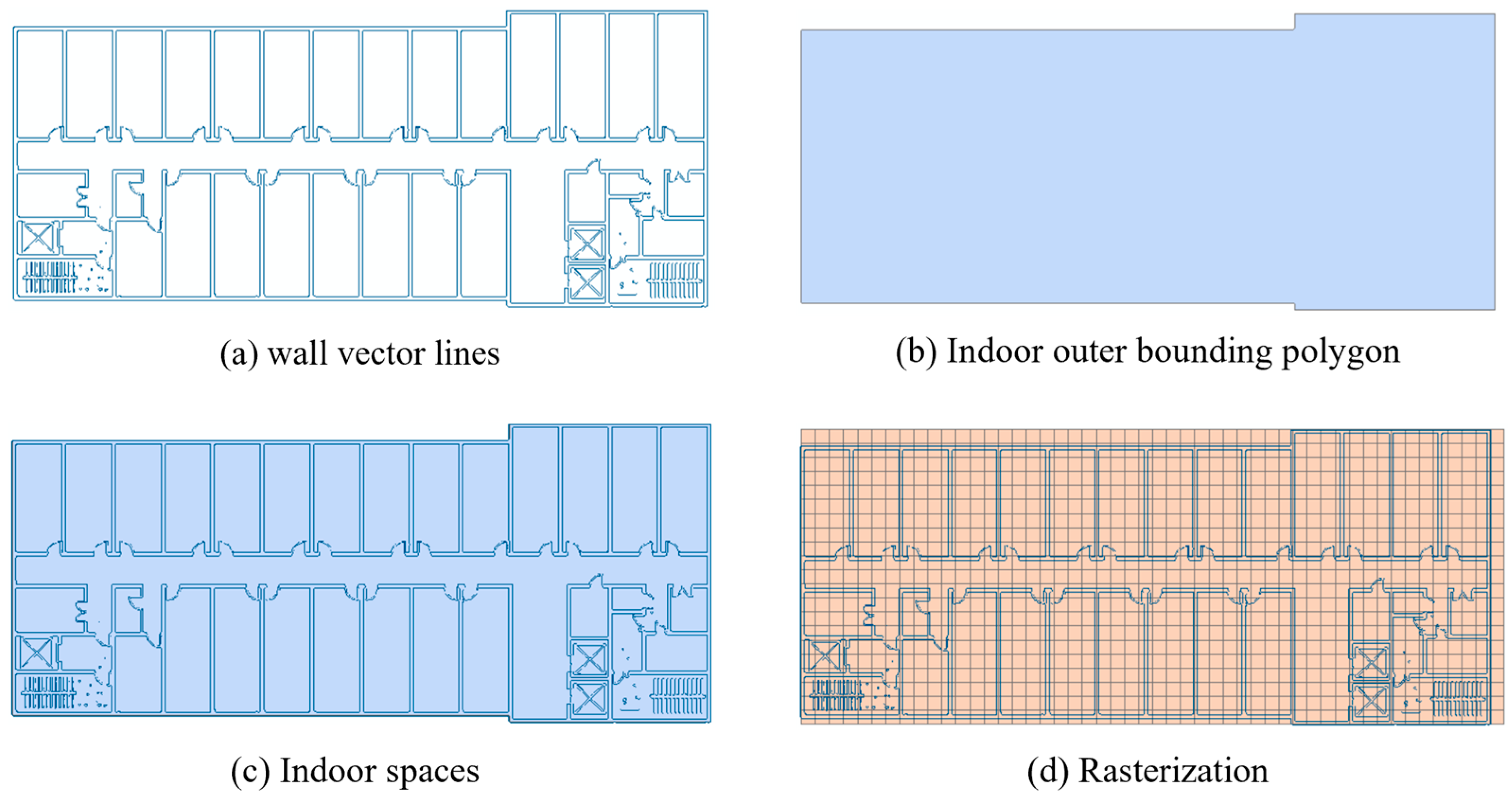
The wall components in the indoor environment play the most crucial role in the division of the indoor space. The wall components can be abstracted into line segments in a coordinate system, which are used as physical constraints in the positioning algorithm. As shown in Figure 4a, using the indoor wall component line data obtained in the previous section as a constraint, during the process of calculating the visibility, it can be directly abstracted as an obstacle to the line of sight. Then, the largest outer bounding polygon enclosed by the wall lines is converted into a polygon layer (Figure 4b). The specific idea is as follows: First, find all the contours in Figure 4a, and then by calculating the area of each contour in turn, only retain the indoor polygon with the largest area, that is, obtain the largest contour of the entire indoor space. Finally, convert this contour into a polygon feature. As shown in Figure 4c,d, after completing the conversion of the polygon layer, we need to divide the indoor space with regular cells to generate a dense grid layer, where each cell represents an area of the indoor space. By setting a threshold for the grid area, incomplete grids can be removed. At the geometric level, the calculation of visibility can be understood as determining whether there is a relationship such as occlusion between two grid units.

3.2.2. Calculation of the Visibility of the Indoor Space Grid

We will use the visibility analysis function in spatial analysis to calculate the visibility of each cell. The main principle of visibility calculation is as follows: First, traverse the central point of each cell and the corresponding grid area, and then connect the cell with the central points of all other cells. If the connecting line passes through the wall line, it is determined that there is no line of sight; on the contrary, there is a line of sight between them. Then the calculation formula for the visibility of this grid is as follows:
v i s i b i l i t y = c e l l V i s b l e A r e a s u m A r e a × 100 %
Among them, cellVisbleArea is the sum of the areas of the grids that have a line of sight with this cell, and sumArea is the total area of all cells in this indoor space. Traverse all the cells one by one until the visibility of all cells is calculated. Through the above steps, the visibility distribution of the indoor space can be obtained, thus providing a basis for the subsequent identification and extraction of spatial structure landmarks.
The main implementation steps are as follows: Create a set of cell center points and a set of cell visibility degrees; traverse the grid layer, find all the cell center points as observation points, and calculate the total area; for each cell center point, calculate its visibility degree with all other cell center points. If the line of sight between two cell center points does not intersect with the wall layer, then these two cells are visible, and update their visibility degrees and the areas of the visible cells; traverse the grid layer, for each cell, calculate its visibility degree, and update its visibility value in the attribute table. Algorithm 3 shows the pseudocode implementation of this method.
Algorithm 3 The visibility calculation method
input: The indoor space grid
output: cells containing the attribute table of visibility values
1: N = cells.count; cellVisbleArea = 0; i = j = 0;
2: for each c[i] in cells do
3:  for each c[j] in cells do
4:    create connecting line form c[i] to c[j];
5:      if line cross wall then
       cellVisbleArea = cellVisbleArea + c[j].area;
6: visibility = cellVisbleArea/sumArea × 100;
7: c[i].attribute = visibility;

3.3. Recognition and Extraction of Indoor Structural Landmarks

After obtaining the visibility distribution map, the grids will be classified according to the magnitude of the visibility values. By setting different visibility thresholds, divide the indoor space into visible areas of different levels. The key cell points in these areas will be regarded as potential landmarks. Next, further extract and confirm these landmarks based on the grid visibility. Through the grid-based visibility calculation and classification, the key landmarks are identified quickly and accurately in the indoor space. This not only reduces the labor cost and time consumption but also improves the accuracy and reliability of landmark identification.

3.3.1. Types of Indoor Structural Landmarks

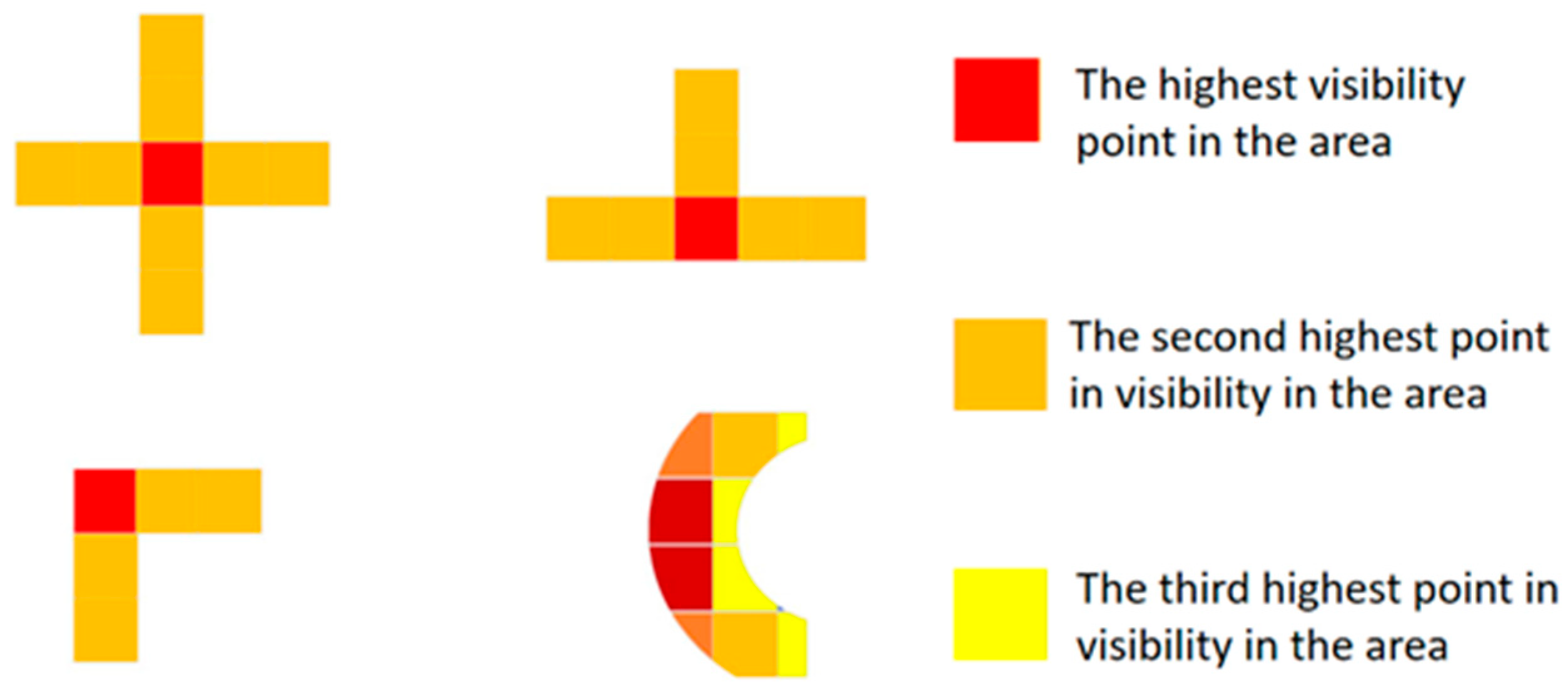
The internal structure of an ordinary room is relatively simple. Therefore, this study mainly focuses on the research of extracting indoor structural landmarks of indoor navigable paths, that is, corridors. The indoor structural landmarks of corridors are mainly classified into four categories by us (Figure 5), which are four types of intersections: cross-shaped intersections, T-shaped intersections, right-angle intersections, and curved intersections. The centers of these four types of landmarks are all at the locations with the highest visibility level in the corridor, while the surrounding areas have a visibility level one grade lower.
In Figure 5, a simple summary of the indoor landmarks is made and introduces the landmarks using a simple indoor grid map. In the figure, the visibility of the grids is represented by the shade of color. The darker the color, the higher the visibility. Obviously, at the center of the cross-shaped intersection, a broader view can be obtained, that is, the visibility of this cell point is the highest. Similarly, the visibility of the grid at the center of the convex intersection is the highest. The visibility of the grid at the corner of the right-angle intersection is the highest. And the visibility of the grid on the outer circle of the curved part of the curved intersection is the highest. Therefore, the center of the indoor space landmark can be obtained by traversing to find the location with the highest visibility in the navigation road network.

3.3.2. Structural Landmark Recognition Based on Visibility and Spatial Geometric Features

After the visibility calculation is completed, it will classify the grids according to different levels of visibility. Cells with higher visibility represent the locations of key landmarks, while cells with lower visibility may be located at the edges of the indoor space or in areas with severe obstructions. This study proposes a method for identifying indoor structural landmarks applicable to indoor spatial data. Through the visibility screening of grid units, directional clustering analysis, and spatial proximity verification, the automatic identification of indoor structural landmarks such as T-shaped and cross-shaped ones can be achieved. The algorithm process is as follows:
(1)
Data Preprocessing and Initial Selection of Candidate Points
First, read the indoor grid data containing geometric shapes and visibility attributes extracted in the previous section, and extract the centroid coordinates and visibility values of each grid unit. the Natural Breaks Classification is adopted to select the visibility threshold. This method automatically delineates category boundaries based on the inherent distribution characteristics and patterns of grid visibility data itself. Mathematically, it is grounded in the statistical principles of minimizing within-class variance and maximizing between-class variance, thus avoiding the subjectivity of manual grouping.
Assume that the visibility grid data points are divided into k categories. The optimal classification must satisfy the following objective function:
V = i = 1 k x = X i x x ¯ i 2
where X i represents the i category of dataset, and x ¯ i denotes the mean value of this category. Through iterative calculations, this method continuously adjusts the breakpoints until the sum of within-class variances (V) is minimized. The boundary value of the group is selected with higher visibility as the threshold for screening structural landmarks. Screen the nodes with visibility higher than the threshold as candidate points, mark them as potential indoor structural landmarks, reduce the subsequent computational workload, and focus on the highly significant areas.
(2)
Directional Distribution Analysis and Structural Verification
Taking each candidate point as the center, use the KDTree to search for the adjacent units within the grid adjacent area of the candidate point, and calculate the polar coordinate angles of the adjacent units relative to the central point. Cluster the angles through the DBSCAN algorithm to extract the effective branch directions. If the number of effective branches obtained from the clustering is greater than or equal to 2, then calculate the minimum included angle of the main branch directions; if the average included angle is greater than the set angular tolerance and the maximum included angle is less than 180°, then determine that the candidate point has the multi-branch structural characteristics of an intersection.
(3)
Spatial Clustering Verification and Landmark Marking
Perform spatial proximity clustering (DBSCAN) on the candidate points that have passed the structural verification, remove adjacent duplicate points, and retain the cells with the highest visibility as the representative of the final structural landmark. Mark the cells according to the number of branches.
It should be noted that before the clustering analysis, it is necessary to first perform a Boolean subtraction on the surface layer of the indoor space using the indoor wall lines, restricting the scope of the clustering analysis to each indoor area only. Therefore, even if there is a large difference in visibility between indoor spaces separated by a wall, they will not affect each other during the clustering analysis. However, the indoor wall lines obtained from the above steps are generally in the form of a line layer, and a line layer cannot directly perform spatial geometric operations with a surface layer. Moreover, due to the discontinuous lines, the wall lines converted through program recognition may have the phenomenon of multiple line overlaps in many places. Therefore, the buffer generation method is used to directly generate the buffer zone of the wall lines, and perform a Boolean subtraction between this buffer zone and the surface layer of the indoor space. In this way, the indoor visibility grid layer divided according to different rooms can be obtained.
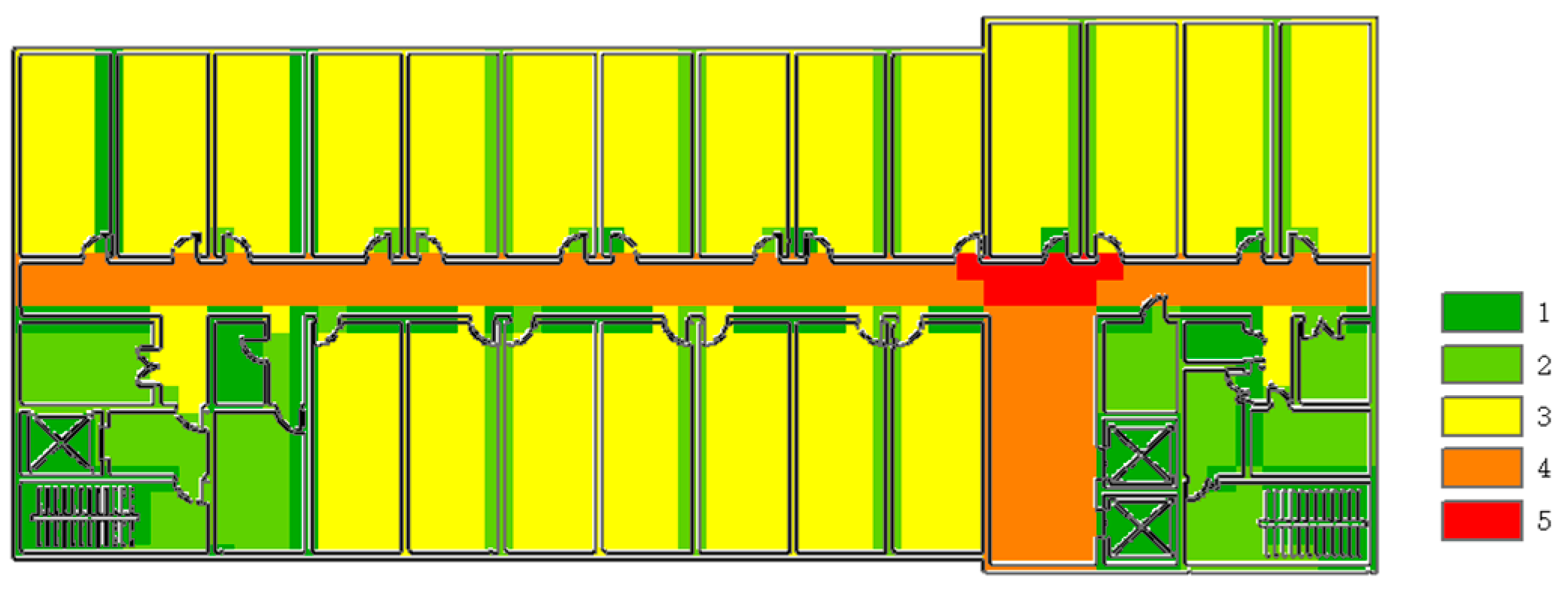
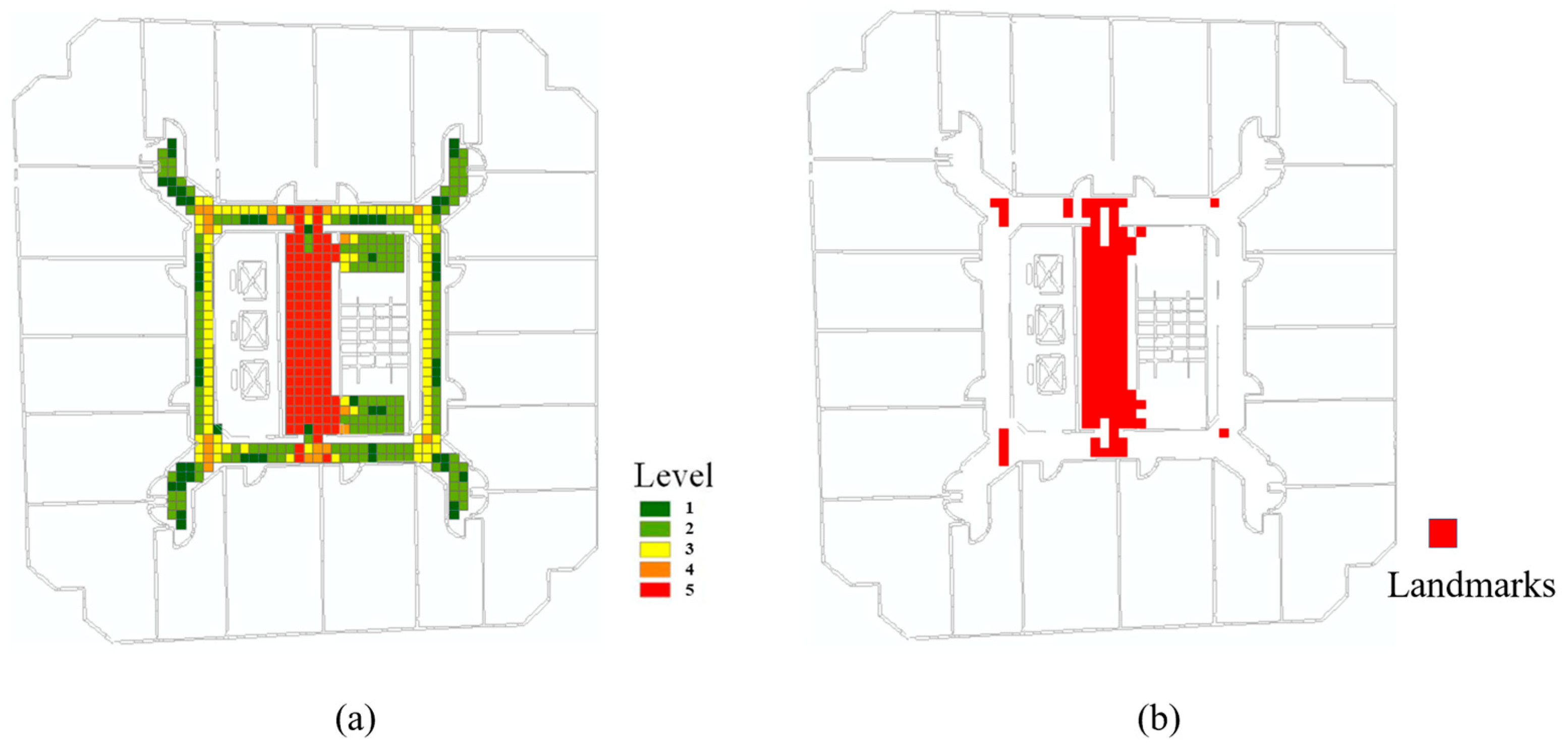
In Figure 6, different colors represent different visibility levels. The redder the area, the higher the visibility level, and the higher the level of mutual visibility between the corresponding cells in this area and other cells. In the above figure, it can be clearly concluded that the red area is a structural landmark of a T-shaped intersection. Through visibility analysis, we can clearly see the distribution of cells at different visibility levels and the spatial relationships among them. This helps us better understand the structure and characteristics of the indoor space and provides basic data support for subsequent landmark applications.

3.3.3. Geometric Extraction of Indoor Landmarks

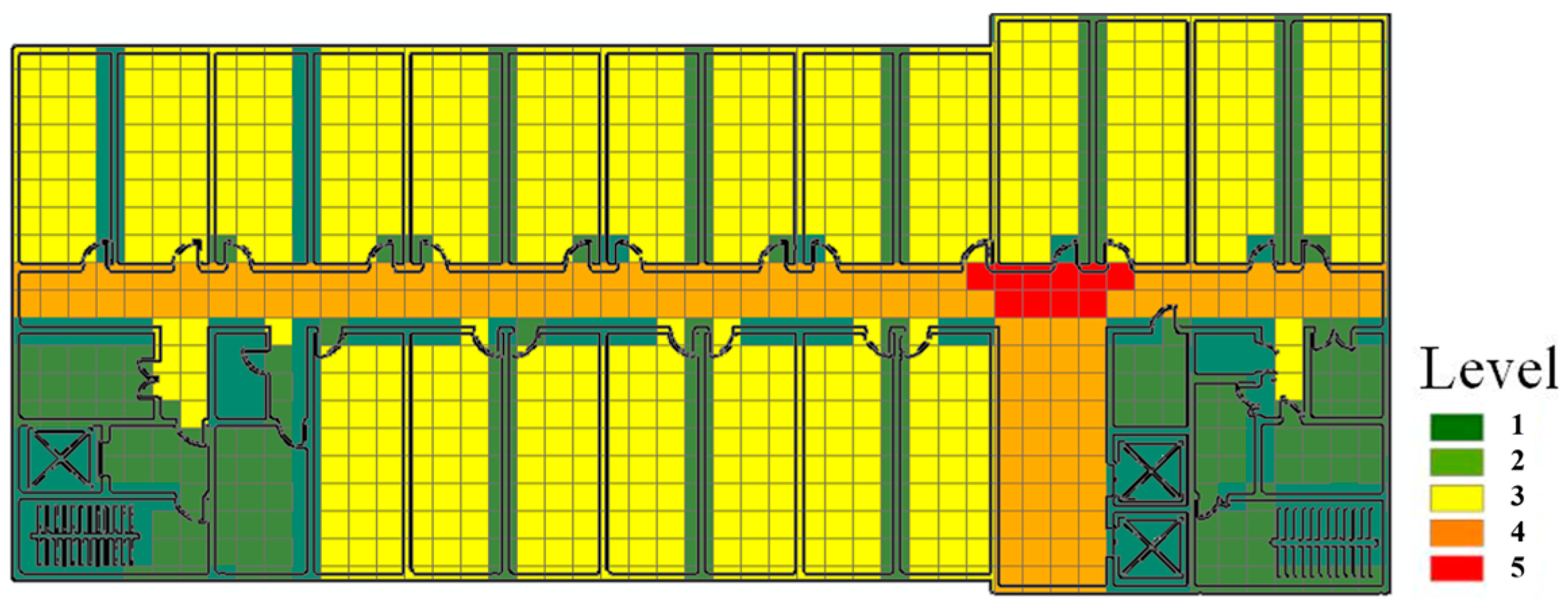
After obtaining the results of the clustering analysis, we also need to merge the cells that have the same visibility level and are marked as landmarks. Cells with the same visibility level are, in principle, located within the same indoor space structure. By means of GIS spatial adjacency analysis, the adjacent cells of each cell can be identified, and cells sharing a common edge with the same visibility level are merged (Figure 7). At this point, the objects are no longer individual cells, but several planar elements. Each planar element geometrically represents an independent indoor space area and has a different visibility level.
Figure 7 shows the indoor space divided by building components, as well as the indoor space after the visibility calculation. After obtaining the indoor space map with visibility values, the corridor layer is traversed and planar elements with relatively high visibility values are identified, thereby obtaining the landmarks of the indoor corridor space.

4. Case Studies

4.1. Experimental Data

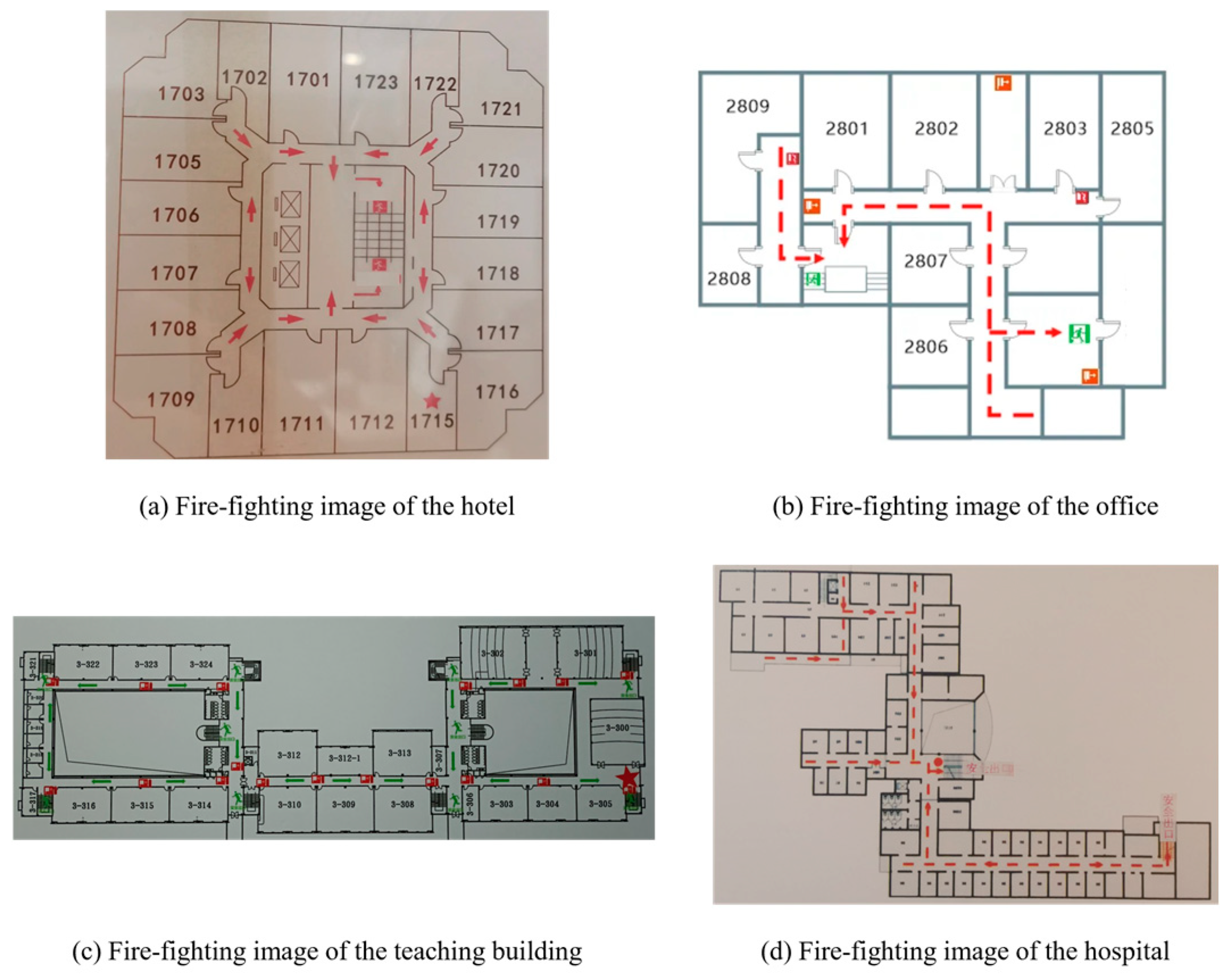
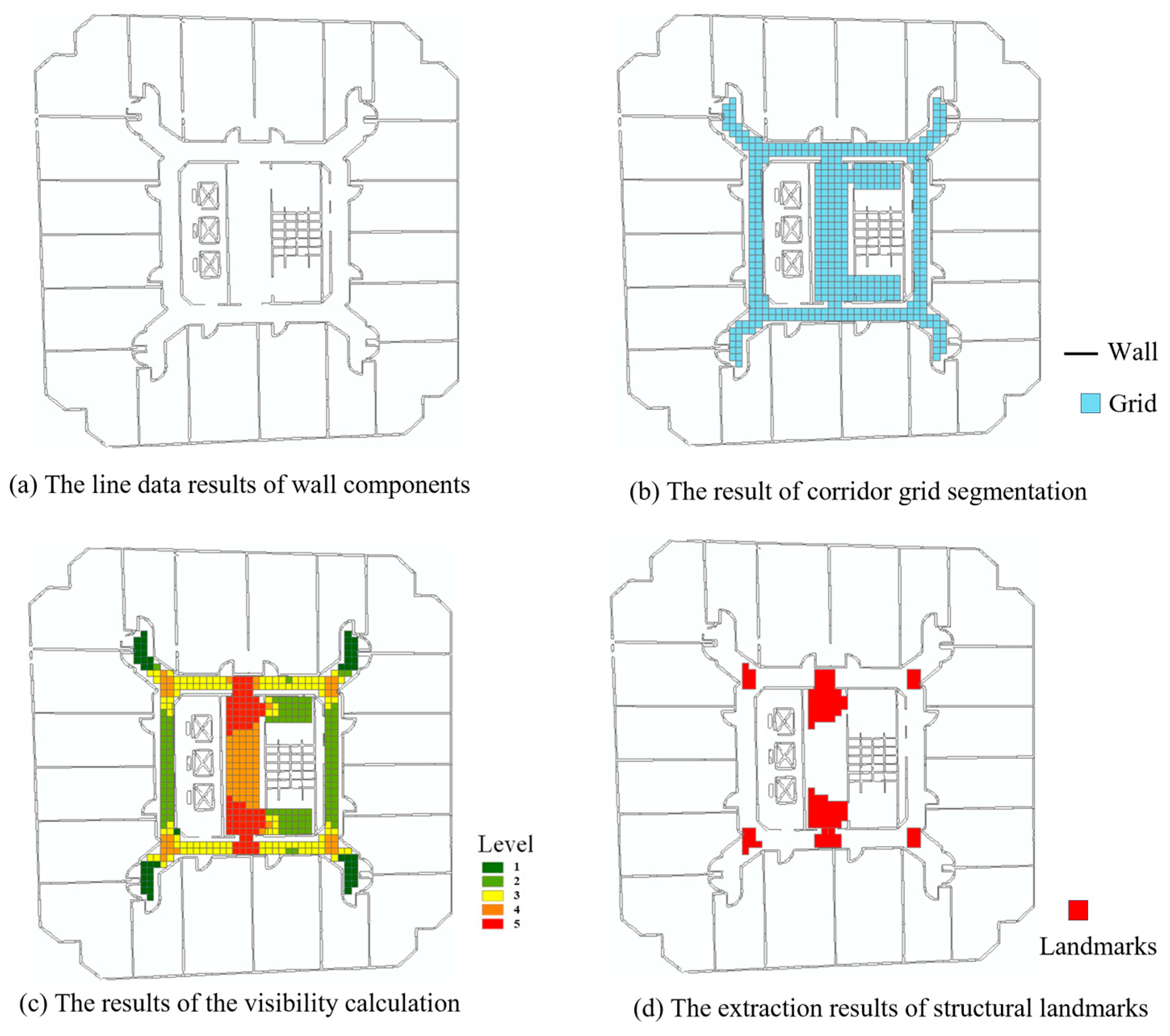
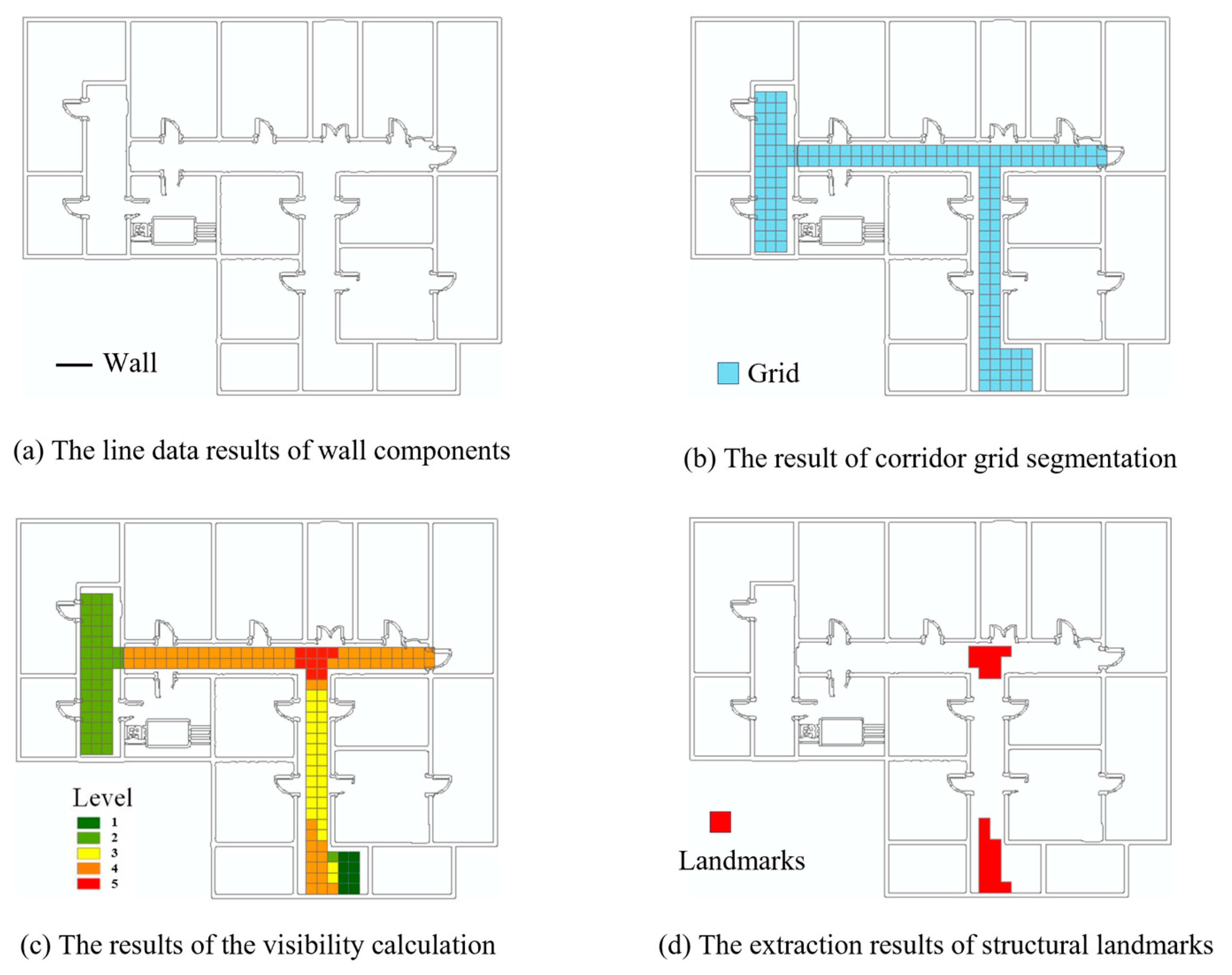
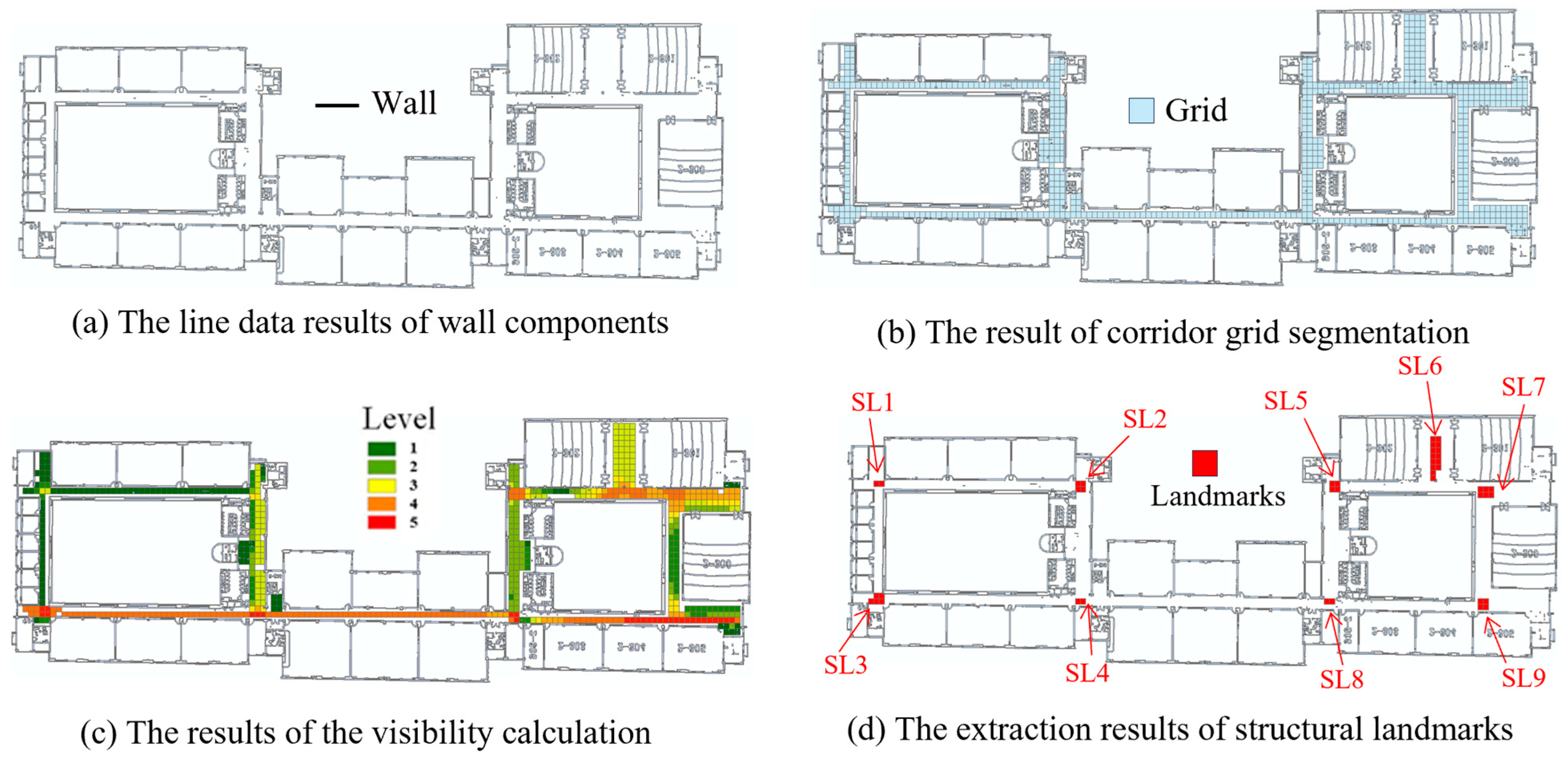
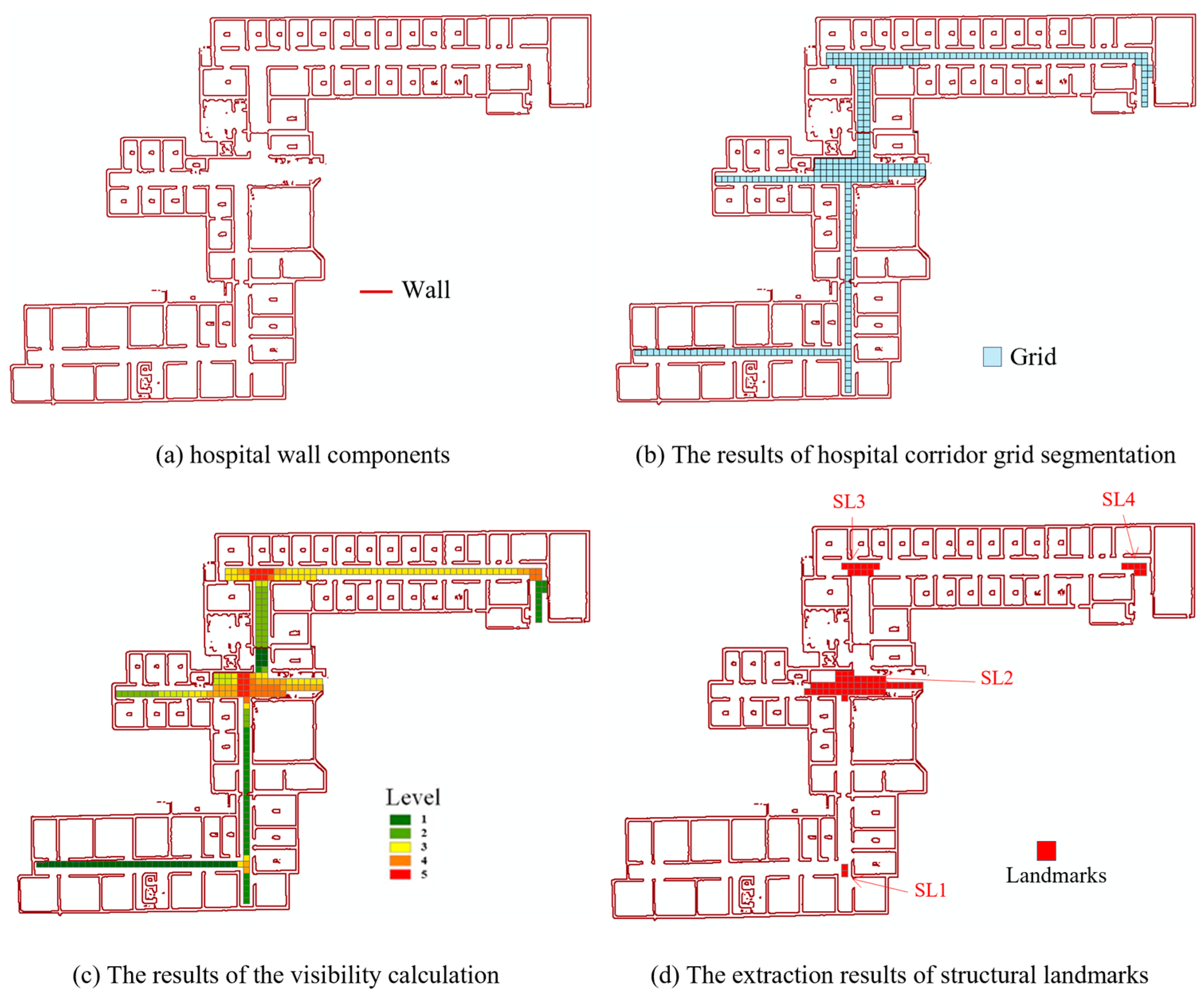
As shown in Figure 8, relatively complex indoor fire protection plans are selected as experimental data to verify the effectiveness of the method proposed in this paper. The floor plans of multiple buildings are tested and we selected four floor plans with relatively significant style differences from them. Among them, Figure 8a,b are the hotel and office building, Figure 8c,d are the fire protection plans of a teaching building and a hospital, respectively, and the images were all captured using a common mobile phone camera. The selected data all contain complex corridor structure surfaces, including crossroads, L-shaped intersections, and T-shaped intersections.

4.2. Experimental Results

Through the method proposed in this paper, Figure 9 and Figure 10 show the process and results of extracting indoor structural landmarks of the simple building.
Figure 9a and Figure 10a are the extraction results of the wall lines based on the edge detection of the Canny operator, in which the relevant data are included. Figure 9b and Figure 10b are the result of the grid division of the corridor space. The calculation results of the visibility are shown in Figure 9c and Figure 10c, from which it can be seen that at the positions of the indoor structural landmarks of the corridor, the visibility of the cells has obvious changes. Figure 9d and Figure 10d show the regions where the finally extracted landmarks are located.
Figure 11 shows the process and results of extracting indoor structural landmarks of the teaching building.
Table 1 statistically analyzes the number of grid cells, average visibility, and maximum visibility of each structural landmark grid on a single floor of the teaching building. Among them, the average visibility of SL4 is the highest, reaching 34.88%, while the average visibility of SL1 is the lowest, at 12.11%. The maximum visibility value is also found in the grid of the SL4 landmark. This is because the landmark SL4 is located at the center of the long corridor, providing a better view from its position. In contrast, the corridor where the SL1 landmark is located is relatively short, resulting in a lower average visibility.
Figure 12 shows the process and results of extracting the indoor structural landmarks of a single floor in the hospital. In sub-Figure 12a marked in red, there are segmented components that divide the entire corridor into two sub-corridors. Therefore, grid division is conducted and the visibility is calculated for the two sub-corridors, respectively, as shown in Figure 12c. Figure 12d shows the finally extracted structural landmark of the corridor.
Table 2 statistically analyzes the number of grid cells, average visibility, and maximum visibility of each structural landmark grid on a single floor of the hospital. Among them, the average visibility of SL2 is as high as 54.92%, while the average visibility of SL4 is the lowest, at 36.38%. The landmark with the largest number of grid cells is SL2, and its maximum visibility value reaches 76.64%. This is because the landmark SL2 is located at the center of the wide corridor, allowing for the observation of most areas of the entire corridor. In contrast, the corridor where the SL4 landmark is located is relatively short, resulting in a lower maximum visibility, which is only 37.99%.

4.3. Detection Accuracy Results and Comparative Study

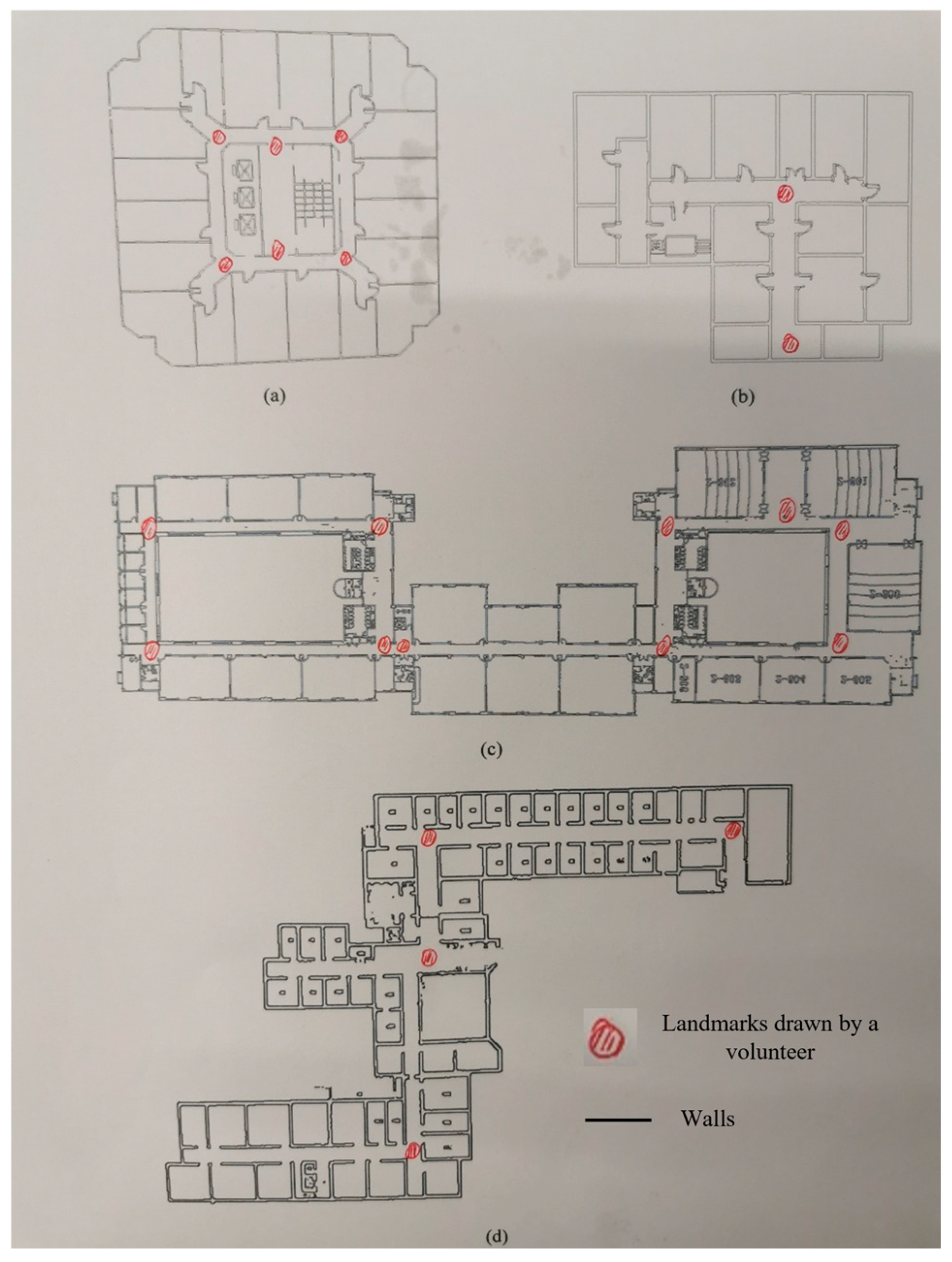
To verify the effectiveness of the method proposed in this study, a simple human subject experiment is designed and conducted with reference to the method presented by Yang and Worboys [44]. Twenty volunteers who had no prior knowledge of the target building were recruited for the experiment, and they were asked to complete an exploratory wayfinding task inside the building. After the task, the volunteers were instructed to mark the specific locations of structural landmarks on the fire-fighting floor plan. Figure 13 presents the labeled sketch of one volunteer, where the locations of structural landmarks are marked with red circles.
Table 3 compares the sketches (drawn by volunteers) with the structural landmarks automatically generated by our method. Specifically, the structural landmarks extracted from the fire-fighting floor plans of Buildings a, b, and c were compared with those annotated by volunteers in terms of landmark quantity and relative spatial position. The results showed that the detection accuracy rates were all 100%, which fully verifies the reliability and accuracy of the proposed method in the task of landmark extraction from such fire-fighting floor plans of buildings. For the floor plan of Building c, the landmark detection accuracy was 90%. This is mainly because most volunteers identified the SL4 landmark as two separate landmarks, while our method integrated it into a single landmark.
Figure 14 presents the visibility calculation results and landmark extraction results without the special processing of integrating fire protection diagrams. As shown in Figure 14a, the indoor space visibility calculation results are affected by noise such as arrows, leading to reduced visibility values for occluded grids. Figure 14b indicates that the extraction accuracy of spatial structure landmarks is relatively low, and the landmark positions are offset due to the influence of occlusion noise.

4.4. The Visibility Change Curves Under Different Navigation Routes

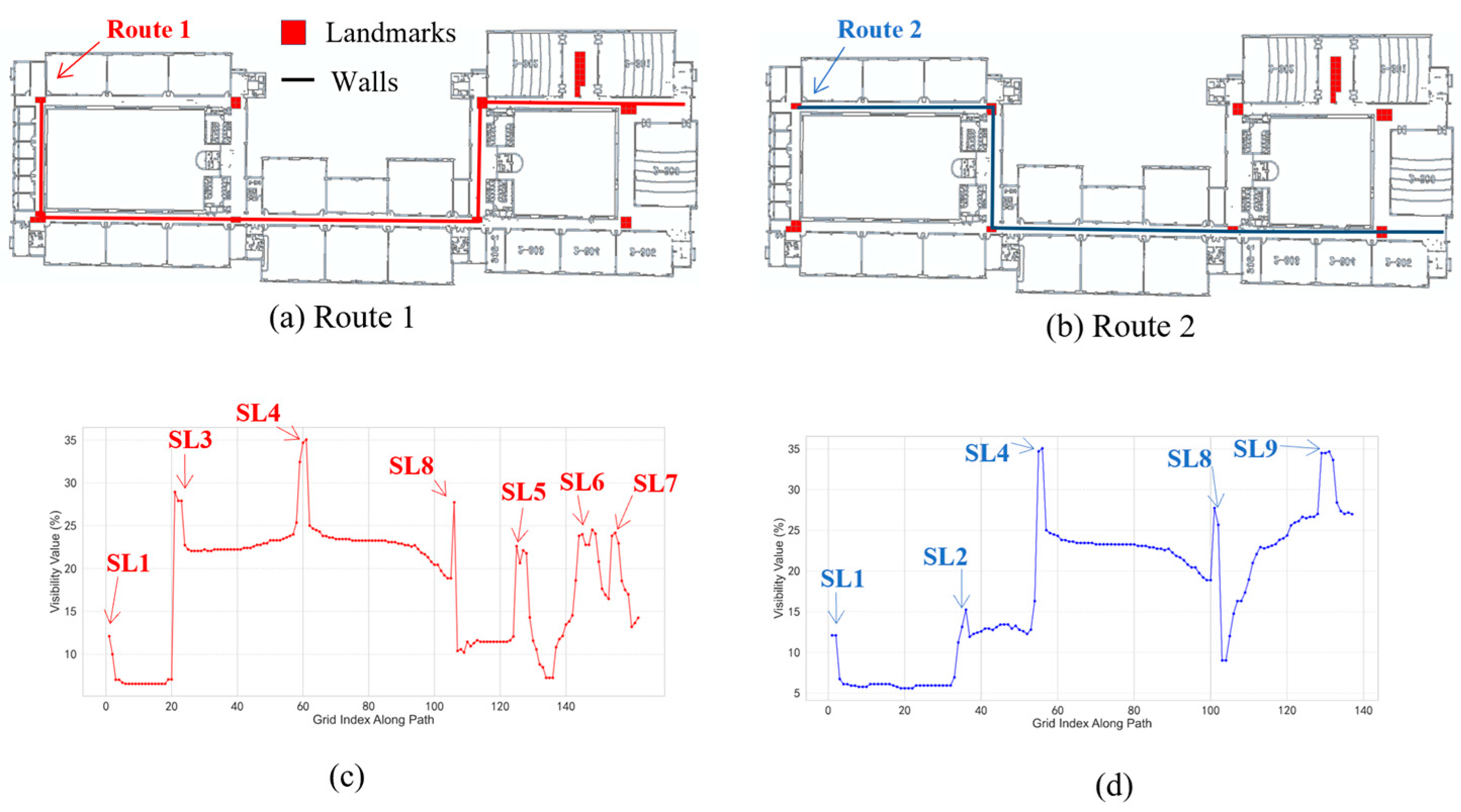
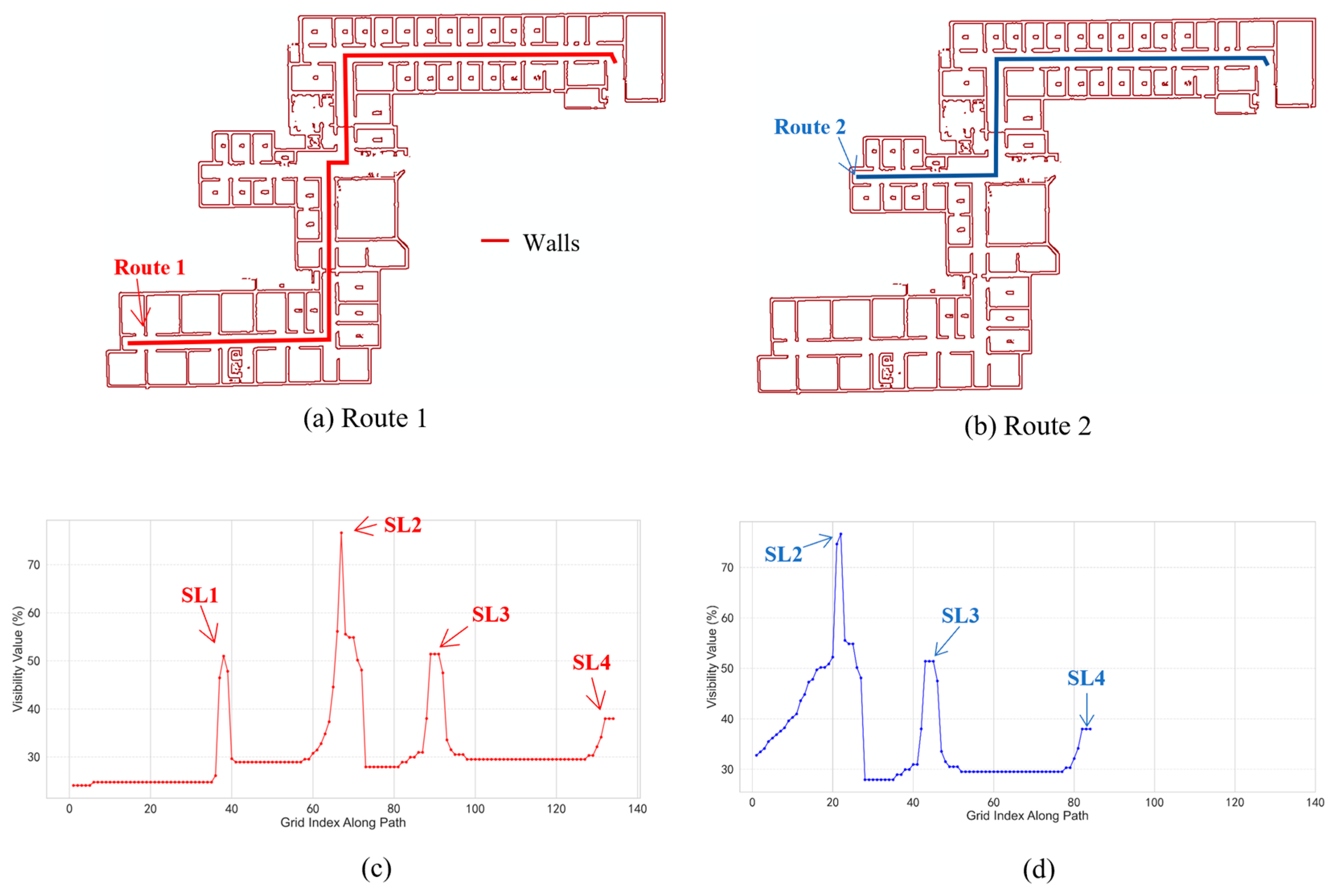
In order to clearly demonstrate the relationship between the indoor visibility analysis and the indoor structural landmarks, two paths have been planned for each piece of data, as shown in Figure 15 and Figure 16. Among them, Route 1 is shown in Figure 15a, and the position indicated by the arrow is the starting point of the route. Figure 15b shows the path of Route 2. In the curve graph, the abscissa represents the number of grid units passed by the path, and the ordinate represents the visibility of the grid units. As shown in Figure 15c,d, the vertical axis is related to the value of visibility and the horizontal axis is the grid index passed by the route. The visibility curves of the paths are presented. From the visibility curves, it can be seen that at the positions of the landmarks extracted by the method in this paper, the visibility of the grid units has a relatively obvious increase.
The shorter the straight corridor, the smaller the average visibility value, such as from landmark SL1 to landmark SL3 in Figure 15c; the longer the length of the straight corridor, the higher the average visibility value, such as from landmark SL4 to SL8 in Figure 15d. At the same time, it can be found that although the long corridor has a high overall visibility, there is no fluctuation in visibility at the positions that do not pass through the indoor structural landmarks, such as the section area from SL4 to SL8.
Figure 16a,b present the visibility curves of the two paths in the hospital. The change in the visibility curve of Route 1 is shown in sub-Figure 16c. This path passes through four indoor structural landmarks, namely SL1, SL2, SL3, and SL4. Sub-Figure 16d shows the curve of the visibility changes in the grids passed by the path of Route 2. This path passes through three indoor structural landmarks, namely SL2, SL3, and SL4.

4.5. Comparative Analysis of Different Grid Sizes

In the calculation of visibility, the selection of grids is not only related to the accuracy of the visibility values, but also directly affects the calculation efficiency and resource utilization. If the grids are too large, although the calculation speed can be increased, it may lead to a decrease in the sensitivity of the visibility values, and the actual visibility situation of the space cannot be accurately reflected. Conversely, if the grids are too small, although the accuracy of the visibility values can be improved, it will significantly increase the amount of calculation, resulting in a substantial decrease in the calculation speed, and may even cause a waste of calculation resources.
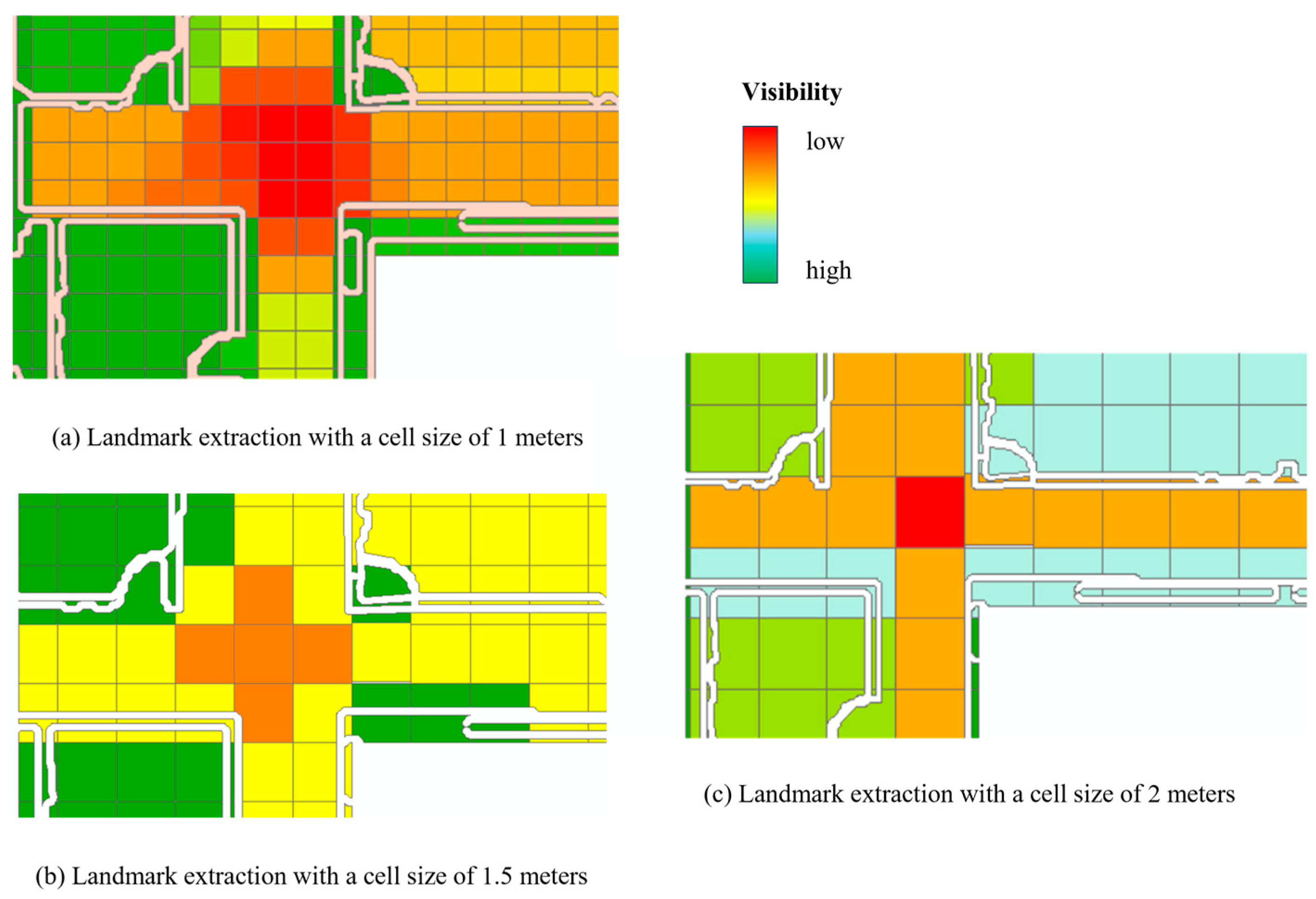
Figure 17 is an excerpt from the landmark extraction results of the teaching building case presented in Figure 10. Excerpted from the cross-intersection region in Figure 10a, it demonstrates landmark extraction results under different grid sizes. Figure 17 originates from a comparative experiment conducted at the teaching building of Nanjing University of Posts and Telecommunications, where indoor space was divided using 1 m grids, 1.5 m grids, and 2 m grids, respectively, for visibility analysis.
We compared the landmark extraction results under three different grid cell sizes, namely a 1.5 m grid, a 1 m grid, and a 2 m grid. Among them, the 1.5 m grid cell was set according to half of the width of the narrowest corridor in the experiment. Figure 17 shows the visibility grids of a cross-shaped intersection landmark under three different grid cell sizes. It can be seen that as the grid size decreases, the number of grids increases, and the position of the indoor structural landmarks becomes more accurate. However, the cost is that the number of grids to be calculated increases, and the time required for visibility calculation also increases further, which may lead to a waste of resources.
In Figure 17a, the red color represents the indoor landmarks. The transition between these landmarks and other indoor spaces is smoother, and the calculation of the indoor visibility is more accurate. In Figure 17b, the landmarks are still represented by the orange color, which has a strong contrast with other areas. The transition of the visibility between the landmarks and other indoor spaces is not smooth. Figure 17b sacrifices a certain degree of position accuracy for the sake of efficiency, under the grid size of this magnitude, the landmarks calculated based on the visibility still conform to the actual situation. Figure 17c shows the extraction results under a 2 m grid. It can be seen that although the calculated visibility landmarks have some overlap with those in Figure 17a,b, the position of the geometric center of the landmark is far from the center of the intersection, resulting in a low accuracy of the geometric results of the landmark, and it cannot be truly used for the extraction of visibility landmarks.
Through the above analysis, it found that when the grid size is set to half of the width of the narrowest corridor in the floor plan, it is possible to optimize the calculation efficiency while ensuring the accuracy of the geometric position of the landmarks. This setting not only avoids the decrease in the sensitivity of the visibility values caused by an overly large grid size but also reduces the computational burden brought about by an overly small grid size. In practical applications, fine adjustments also need to be made to the grid size according to the specific spatial layout and visibility requirements. For example, in areas with a more complex spatial layout or higher visibility requirements, the grid size can be appropriately reduced to improve the accuracy of the visibility values; while in areas with a simpler spatial layout or lower visibility requirements, the grid size can be appropriately increased to improve the calculation efficiency.

4.6. Calculation Efficiency

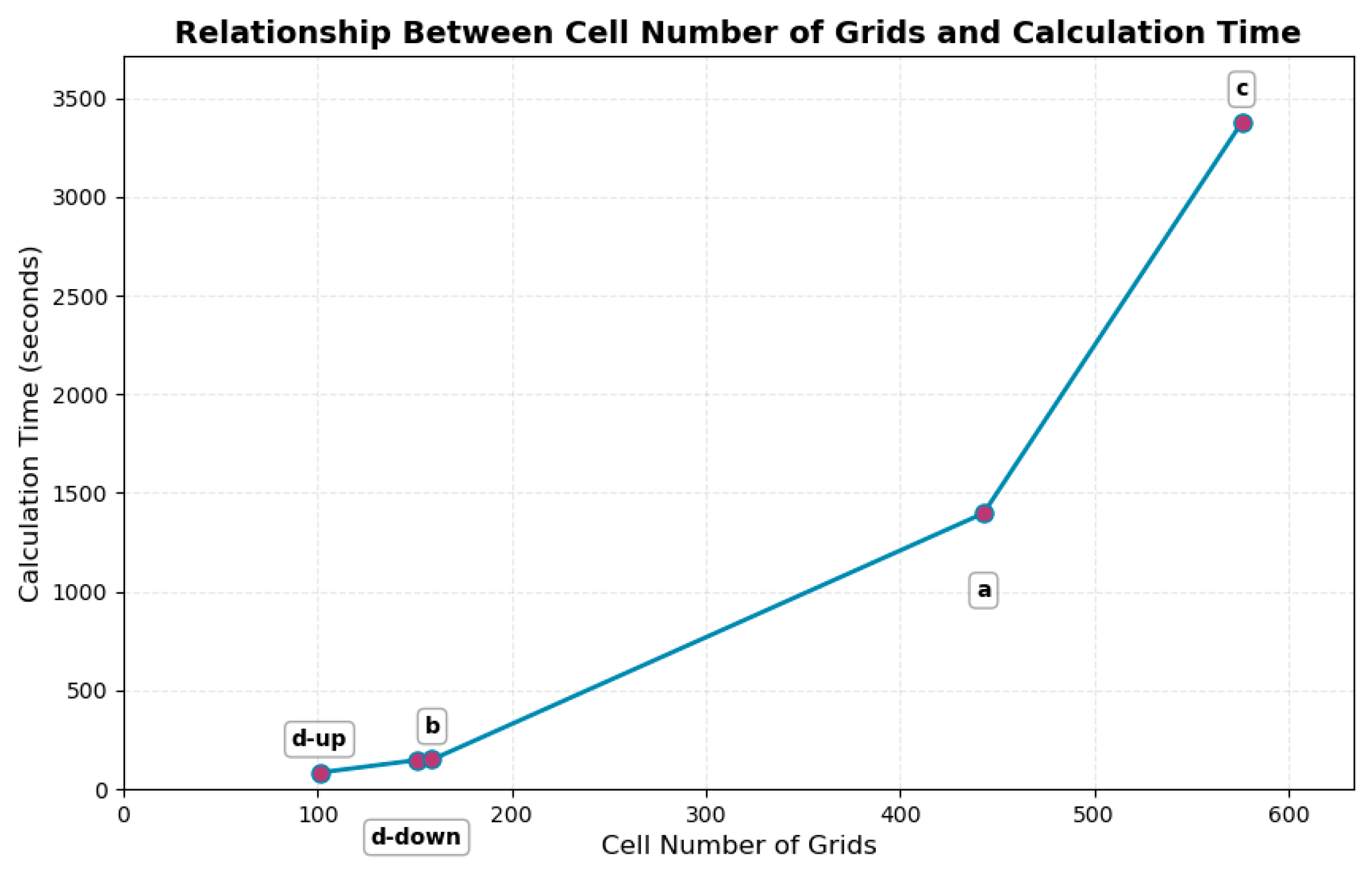
The time complexity of the algorithm for extracting indoor structural landmarks in this paper is O(n2). Experiments were conducted on a laptop computer with a processor model of Intel(R) Core(TM) i9-13900HX (2.20 GHz) and 16.0 GB of RAM. Table 4 shows the time consumption of extracting indoor structural landmarks, from which it can be clearly observed that the number of grid units in the upper sub-corridor of Building d is the smallest, with 101 units, and the running time is only 83 s; the cell number of grid in Building c is 576, and the corresponding running time is also the longest, reaching 3377 s.
Figure 18 presents the relationship between the number of building grid units and the computation time. It can clearly be seen that as the number of grid units increases, the running time of the program shows a significant upward trend.

5. Conclusions

This study takes readily accessible indoor fire protection plans as raw data and proposes an automatic extraction algorithm for indoor structural landmarks based on visibility perception. It fills the research gap in the extraction of indoor spatial structural landmarks based on indoor fire protection plans. Overall, the proposed method accurately detects and extracts indoor navigable structural landmarks in most scenarios, demonstrating high reliability and applicability. The key innovations are summarized as follows:
(1) This research utilizes fire protection plans as the data source, significantly streamlining the data acquisition process and reducing the dependence of landmark extraction on indoor high-precision map data, thereby lowering the technical threshold and costs associated with indoor landmark extraction. Through the application of fire protection plans, not only does it reduce the complexity of data collection, but it also expands the applicability of landmark extraction experiments, providing robust data support for future indoor navigation field research.
(2) In the indoor structural landmark extraction process, the study integrates visibility calculation methods from space syntax with traditional complex image processing techniques. By avoiding extensive foundational computations, this approach substantially reduces the computational costs of landmark extraction, rendering the entire process more intuitive and accessible. The method not only accurately identifies and extracts indoor navigable structural landmarks but also effectively incorporates visibility relationships between landmarks, significantly enhancing the accuracy and practical utility of landmark extraction.
This study has achieved promising results in the extraction of indoor navigable structural landmarks, yet several areas warrant further investigation and refinement in future research. Although the fire protection plan data used in this paper offers accessibility, the landmark extraction results are affected by varied plan formats, scales, and image quality, which may lead to limitations in terms of extraction accuracy and timeliness. In future, studies can extend to full 3D, integrating BIM and indoor navigation. And integrating other data sources such as 3D indoor models, laser scanning data, and so on can be considered to enhance the accuracy and currency of landmark extraction. In addition, we can explore more advanced wall-extraction techniques based on deep-learning approaches and validate their approach on a larger, more varied set of floor plans. Additionally, when the proposed algorithm is applied to complex indoor environments with numerous occlusions, the accuracy of structural landmark extraction decreases. Therefore, future work may also focus on optimizing the algorithm to improve its adaptability and robustness in complex scenarios. The current research primarily focuses on the extraction of indoor structural landmarks, without delving into the integration of these indoor structural landmarks with other types of landmarks or their application in indoor UAV navigation systems. In subsequent studies, combining the landmark extraction algorithm with indoor UAV navigation algorithms to construct a complete indoor navigation system will provide methodological support for addressing more complex indoor environmental applications.

Author Contributions

Conceptualization, Y.P. and J.Z.; methodology, Y.P. and H.X.; software, Y.P.; formal analysis, Y.P.; resources, H.X. and L.M.; writing—original draft preparation, Y.P., H.X., and J.Z.; writing—review and editing, Y.P. and L.M.; visualization, Y.P. All authors have read and agreed to the published version of the manuscript.

Funding

This research was funded by the National Natural Science Foundation of China (Grant No. 42401516) and the Opening Foundation of Ministry of Education of Key Lab of Virtual Geographic Environment (Grant No. 2020VGE02), and sponsored by Natural Science Research Start-up Foundation of Recruiting Talents of Nanjing University of Posts and Telecommunications (Grant No. NY221031). This research was also Supported by the Anhui International Joint Research Center for Ancient Architecture Intellisencing and Multi-Dimensional Modeling (No. GJZZX2024KF04).

Data Availability Statement

The data presented in this study are available on request from the corresponding author.

Conflicts of Interest

The authors declare no conflicts of interest.

References

  1. Chen, J.; Clarke, K.C. Indoor cartography. Cartogr. Geogr. Inf. Sci. 2020, 47, 95–109. [Google Scholar] [CrossRef]
  2. Zhou, J.; Haoyu, Y.; Jie, S.; Zhu, L. Indoor navigation map design based on spatial complexity. Cartogr. Geogr. Inf. Sci. 2025, 52, 69–81. [Google Scholar] [CrossRef]
  3. Magnago, V.; Palopoli, L.; Passerone, R.; Fontanelli, D.; Macii, D. Effective Landmark Placement for Robot Indoor Localization with Position Uncertainty Constraints. IEEE Trans. Instrum. Meas. 2019, 68, 4443–4455. [Google Scholar] [CrossRef]
  4. Gu, F.; Kealy, A.; Khoshelham, K.; Shang, J. Efficient and Accurate Indoor Localization Using Landmark Graphs. Int. Arch. Photogramm. Remote Sens. Spatial Inf. Sci. 2016, 41, 509–514. [Google Scholar] [CrossRef]
  5. Jang, B.; Kim, H.; Kim, J.w. Survey of Landmark-based Indoor Positioning Technologies. Inf. Fusion 2023, 89, 166–188. [Google Scholar] [CrossRef]
  6. Gu, F.; Valaee, S.; Khoshelham, K.; Shang, J.; Zhang, R. Landmark Graph-Based Indoor Localization. IEEE Internet Things J. 2020, 7, 8343–8355. [Google Scholar] [CrossRef]
  7. Zhou, B.; Li, Q.; Mao, Q.; Tu, W.; Zhang, X.; Chen, L. ALIMC: Activity Landmark-Based Indoor Mapping via Crowdsourcing. IEEE Trans. Intell. Transp. Syst. 2015, 16, 2774–2785. [Google Scholar] [CrossRef]
  8. Fang, H.; Xin, S.; Zhang, Y.; Wang, Z.; Zhu, J. Assessing the Influence of Landmarks and Paths on the Navigational Efficiency and the Cognitive Load of Indoor Maps. ISPRS Int. J. Geo-Inf. 2020, 9, 82. [Google Scholar] [CrossRef]
  9. Liu, B.; Linfang, D.; Meng, L. Spatial knowledge acquisition with virtual semantic landmarks in mixed reality-based indoor navigation. Cartogr. Geogr. Inf. Sci. 2021, 48, 305–319. [Google Scholar] [CrossRef]
  10. Liu, T.; Zhang, X.; Zhang, H.; Tahir, N.; Fang, Z. A Structure Landmark-Based Radio Signal Mapping Approach for Sustainable Indoor Localization. Sustainability 2021, 13, 1183. [Google Scholar] [CrossRef]
  11. Hu, X.; Lei, D.; Jianga, S.; Hongchao, F.; Tessio, N.; Alexey, N.; Zipf, A. Data-driven approach to learning salience models of indoor landmarks by using genetic programming. Int. J. Digit. Earth 2020, 13, 1230–1257. [Google Scholar] [CrossRef]
  12. Marciniak, J.B.; Wiktorzak, B. Automatic Generation of Guidance for Indoor Navigation at Metro Stations. Appl. Sci. 2024, 14, 10252. [Google Scholar] [CrossRef]
  13. Wang, C.; Chen, Y.; Zheng, S.; Yuan, Y.; Wang, S. Research on Generating an Indoor Landmark Salience Model for Self-Location and Spatial Orientation from Eye-Tracking Data. ISPRS Int. J. Geo-Inf. 2020, 9, 97. [Google Scholar] [CrossRef]
  14. Donabauer, G.; Ludwig, B. Testing Landmark Salience Prediction in Indoor Environments Based on Visual Information; Center for Spatial Studies, UC Santa Barbara: Santa Barbara, CA, USA, 2021. [Google Scholar] [CrossRef]
  15. Li, C.; Guo, H.; Yin, M.; Zhou, X.; Zhang, X.; Ji, Q. A Systematic Review of Factors Influencing Signage Salience in Indoor Environments. Sustainability 2023, 15, 13658. [Google Scholar] [CrossRef]
  16. Zhou, B.; Ma, W.; Li, Q.; El-Sheimy, N.; Mao, Q.; Li, Y.; Gu, F.; Huang, L.; Zhu, J. Crowdsourcing-based indoor mapping using smartphones: A survey. ISPRS J. Photogramm. Remote Sens. 2021, 177, 131–146. [Google Scholar] [CrossRef]
  17. Gimenez, L.; Robert, S.; Suard, F.; Zreik, K. Automatic reconstruction of 3D building models from scanned 2D floor plans. Autom. Constr. 2016, 63, 48–56. [Google Scholar] [CrossRef]
  18. Yin, X.; Wonka, P.; Razdan, A. Generating 3D building models from architectural drawings: A survey. IEEE Comput. Graph. Appl. 2009, 29, 20–30. [Google Scholar] [CrossRef]
  19. Schönfelder, P.; Aziz, A.; Bosché, F.; König, M. Enriching BIM models with fire safety equipment using keypoint-based symbol detection in escape plans. Autom. Constr. 2024, 162, 105382. [Google Scholar] [CrossRef]
  20. Hassaan, M.; Ott, P.A.; Dugstad, A.K.; Torres, M.A.V.; Borrmann, A. Emergency Floor Plan Digitization Using Machine Learning. Sensors 2023, 23, 8344. [Google Scholar] [CrossRef]
  21. Wang, C.; Luo, J.; Zhang, C.; Liu, X. A Dynamic Escape Route Planning Method for Indoor Multi-floor Buildings Based on Real-time Fire Situation Awareness. In Proceedings of the 2020 IEEE 26th International Conference on Parallel and Distributed Systems (ICPADS), Hong Kong, 2–4 December 2020; pp. 222–229. [Google Scholar]
  22. Wu, X.; Zhang, X.; Jiang, Y.; Huang, X.; Huang, G.G.; Usmani, A. An intelligent tunnel firefighting system and small-scale demonstration. Tunn. Undergr. Space Technol. 2022, 120, 104301. [Google Scholar] [CrossRef]
  23. Dodge, S.; Xu, J.; Stenger, B. Parsing floor plan images. In Proceedings of the 15th IAPR International Conference on Machine Vision Applications (MVA), Nagoya, Japan, 8–12 May 2017; pp. 358–361. [Google Scholar]
  24. Lv, X.; Zhao, S.; Yu, X.; Zhao, B. Residential floor plan recognition and reconstruction. In Proceedings of the 2021 IEEE/CVF Conference on Computer Vision and Pattern Recognition (CVPR), Nashville, TN, USA, 20–25 June 2021; pp. 16712–16721. [Google Scholar]
  25. Hakert, A.; Schönfelder, P. Informed Machine Learning Methods for Instance Segmentation of Architectural Floor Plans. Forum Bauinformatik 2022, 33, 395–403. [Google Scholar]
  26. Wang, C.-Y.; Bochkovskiy, A.; Liao, H.-Y.M. YOLOv7: Trainable Bag-of-Freebies Sets New State-of-the-Art for Real-Time Object Detectors. In Proceedings of the 2023 IEEE/CVF Conference on Computer Vision and Pattern Recognition (CVPR), Vancouver, BC, Canada, 20–22 June 2023; pp. 7464–7475. [Google Scholar]
  27. Mishra, S.; Hashmi, K.A.; Pagani, A.; Liwicki, M.; Stricker, D.; Afzal, M.Z. Towards Robust Object Detection in Floor Plan Images: A Data Augmentation Approach. Appl. Sci. 2021, 11, 11174. [Google Scholar] [CrossRef]
  28. Zhang, T.; Wang, Z.; Zeng, Y.; Wu, X.; Huang, X.; Xiao, F. Building Artificial-Intelligence Digital Fire (AID-Fire) System: A Real-scale Demonstration. J. Build. Eng. 2022, 51, 104264. [Google Scholar] [CrossRef]
  29. Zhu, L.; Švedová, H.; Shen, J.; Stachoň, Z.; Shi, J.; Snopková, D.; Li, X. An instance-based scoring system for indoor landmark salience evaluation. Geografie 2019, 124, 103–131. [Google Scholar] [CrossRef]
  30. Zhou, Z.; Robert, W.; Cheng, F.; Stephan, W.; Huang, H. Indoor landmark selection for route communication: The influence of route-givers’ social roles and receivers’ familiarity with the environment. Spat. Cogn. Comput. 2021, 21, 257–289. [Google Scholar] [CrossRef]
  31. Lyu, H.; Yu, Z.; Meng, L. A Computational Method for Indoor Landmark Extraction. In Progress in Location-Based Services 2014; Gartner, G., Huang, H., Eds.; Springer International Publishing: Cham, Switzerland, 2015; pp. 45–59. [Google Scholar]
  32. Dong, W.; Tong, Q.; Hua, L.; Yu, L.; Liu, J. Comparing the roles of landmark visual salience and semantic salience in visual guidance during indoor wayfinding. Cartogr. Geogr. Inf. Sci. 2020, 47, 229–243. [Google Scholar] [CrossRef]
  33. Gangaputra, R. Indoor Landmark and Indoor Wayfinding: The Indoor Landmark Identification Issue. Master’s Thesis, Technical University of Munich, Munich, Germany, 2017. [Google Scholar]
  34. Wang, Y.; Fan, H.; Chen, R.; Li, H.; Wang, L.; Zhao, K.; Du, W. Positioning Locality Using Cognitive Directions Based on Indoor Landmark Reference System. Sensors 2018, 18, 1049. [Google Scholar] [CrossRef]
  35. Ludwig, B.; Donabauer, G.; Ramsauer, D.; al Subari, K. URWalking: Indoor Navigation for Research and Daily Use. Künstliche Intell. 2023, 37, 83–90. [Google Scholar] [CrossRef]
  36. Arabsheibani, R.; Haunert, J.-H.; Winter, S.; Tomko, M. Strategic allocation of landmarks to reduce uncertainty in indoor navigation. Comput. Environ. Urban Syst. 2024, 114, 102198. [Google Scholar] [CrossRef]
  37. Fellner, I.; Huang, H.; Gartner, G. “Turn Left after the WC, and Use the Lift to Go to the 2nd Floor”—Generation of Landmark-Based Route Instructions for Indoor Navigation. ISPRS Int. J. Geo-Inf. 2017, 6, 183. [Google Scholar]
  38. Abdelnasser, H.; Mohamed, R.; Elgohary, A.; Alzantot, M.F.; Wang, H.; Sen, S.; Choudhury, R.R.; Youssef, M. SemanticSLAM: Using Environment Landmarks for Unsupervised Indoor Localization. IEEE Trans. Mob. Comput. 2016, 15, 1770–1782. [Google Scholar] [CrossRef]
  39. Zhu, J.; Li, Q.; Cao, R.; Sun, K.; Liu, T.; Garibaldi, J.M.; Li, Q.; Liu, B.; Qiu, G. Indoor Topological Localization Using a Visual Landmark Sequence. Remote Sens. 2019, 11, 73. [Google Scholar] [CrossRef]
  40. Nguyen-Huu, K.; Lee, S.-W. A Multi-Floor Indoor Pedestrian Localization Method Using Landmarks Detection for Different Holding Styles. Mob. Inf. Syst. 2021, 2021, 6617417. [Google Scholar] [CrossRef]
  41. Zhou, Z.; Robert, W.; Huang, H. Familiarity-dependent computational modelling of indoor landmark selection for route communication: A ranking approach. Int. J. Geogr. Inf. Sci. 2022, 36, 514–546. [Google Scholar] [CrossRef]
  42. Zhou, J.; Weibel, R.; Fu, C.; Zhou, Z.; Zhu, L.; Shen, J. Enhancing indoor spatial knowledge through navigation map design with landmark hierarchy. In Proceedings of the 18th International Conference on Location Based Services, Ghent, Belgium, 20–22 November 2023; p. 19. [Google Scholar]
  43. Dubey, R.K.; Sohn, S.S.; Thrash, T.; Hoelscher, C.; Kapadia, M. Identifying Indoor Navigation Landmarks Using a Hierarchical Multi-Criteria Decision Framework. In Proceedings of the 12th ACM SIGGRAPH Conference on Motion, Interaction and Games, Newcastle upon Tyne, UK, 28–30 October 2019; p. 15. [Google Scholar]
  44. Yang, L.; Worboys, M. Generation of navigation graphs for indoor space. Int. J. Geogr. Inf. Sci. 2015, 29, 1737–1756. [Google Scholar] [CrossRef]
Figure 1. Flowchart outlining all of the approaches.
Buildings 15 04411 g001
Figure 2. Comparison before and after noise removal of the fire protection plan.
Buildings 15 04411 g002
Figure 3. The extraction result of vector wall lines. (a) The line results extracted by edge detection based on the Canny operator. (b) The result of converting the wall lines into the vector Shapefile format.
Buildings 15 04411 g003
Figure 4. Rasterization of the indoor space.
Buildings 15 04411 g004
Figure 5. Typical indoor structural landmarks of indoor corridor space.
Buildings 15 04411 g005
Figure 6. Results of landmark recognition.
Buildings 15 04411 g006
Figure 7. The result of grid merging classified according to visibility value.
Buildings 15 04411 g007
Figure 8. The collected original fire protection plan images data.
Buildings 15 04411 g008
Figure 9. The process and results of extracting indoor structural landmarks of the hotel building.
Buildings 15 04411 g009
Figure 10. The process and results of extracting indoor structural landmarks of the office building.
Buildings 15 04411 g010
Figure 11. The process and results of extracting indoor structural landmarks of the teaching building.
Buildings 15 04411 g011
Figure 12. The process and results of extracting indoor structural landmarks of the hospital building.
Buildings 15 04411 g012
Figure 13. A labeled sketch of structural landmarks drawn by a volunteer.
Buildings 15 04411 g013
Figure 14. The results of extracting indoor structural landmarks without fire-plan-specific handling. (a) The results of the visibility calculation result without fire-plan-specific handling. (b) The extraction result without fire-plan-specific handling.
Buildings 15 04411 g014
Figure 15. The landmarks passed by the routes in the teaching building and the curve of visibility changes. (c) The visibility change curve of the grids passed by Route 1. (d) The visibility change curve of the grids passed by Route 2.
Buildings 15 04411 g015
Figure 16. The landmarks passed by the routes in the hospital and the curve of visibility changes. (c) The visibility change curve of the grids passed by Route 1. (d) The visibility change curve of the grids passed by Route 2.
Buildings 15 04411 g016
Figure 17. Comparison of landmark extraction results under different grid cell sizes.
Buildings 15 04411 g017
Figure 18. The relationship between cell number of grids and calculation time.
Buildings 15 04411 g018
Table 1. The visibility and the number of cells of the indoor structural landmarks in the teaching building.
Lamark IDThe Number of CellsAve (%)Max (%)
SL1212.1112.11
SL2413.3315.26
SL3527.3329.13
SL4234.8835.06
SL5422.0622.28
SL61423.6724.86
SL7623.6624.94
SL8228.4429.14
SL9425.5534.50
Table 2. The visibility of the hospital landmarks and the number of cells.
Lamark IDThe Number of CellsAve (%)Max (%)
SL1251.0051.00
SL24354.9276.64
SL31045.6951.43
SL4636.3837.99
Table 3. The detection accuracy of landmarks.
Building IDSL Number of Our MethodLabeled SL NumberDetection Accuracy
a66100%
b66100%
c91090%
d44100%
Table 4. The time spent extracting landmarks.
Building IDCell Number of GridsTime (s)
a4431397
b159149
c5763377
d-up10183
d-down151146
Disclaimer/Publisher’s Note: The statements, opinions and data contained in all publications are solely those of the individual author(s) and contributor(s) and not of MDPI and/or the editor(s). MDPI and/or the editor(s) disclaim responsibility for any injury to people or property resulting from any ideas, methods, instructions or products referred to in the content.