Article

Multi-Faceted Analysis of Green Building Certification to Expand Green Buildings in South Korea

Department of Building Energy Research, Korea Institute of Civil Engineering and Building Technology, Goyang-si 10223, Gyeonggi-Do, Republic of Korea
Buildings 2025, 15(23), 4332; https://doi.org/10.3390/buildings15234332
Submission received: 25 August 2025 / Revised: 21 November 2025 / Accepted: 26 November 2025 / Published: 28 November 2025
(This article belongs to the Topic Sustainable Building Development and Promotion)

Abstract

Many countries have green building certification systems to rate a green building. They have played a pivotal role in promoting the adoption of green buildings. South Korea has also launched its green building certification, known as the Green Standard for Energy and Environmental Design (G-SEED), to promote sustainable development. However international information and understanding of Korea’s green building certification were insufficient, and no technical assessments related to G-SEED have been conducted. Therefore, to address this knowledge gap, this study aimed to analyze the situation of G-SEED-certified buildings in South Korea and the limitations of G-SEED. In this paper, we focused on the certification status, regional distribution, types of certified buildings, and technical content of G-SEED. Additionally, we analyzed green building technologies applied to 48 sample buildings certified in 2020. Several proposals were formulated to promote the adoption of green buildings. All large cities and provinces in Korea have G-SEED-certified buildings, indicating that green building awareness is increasing. However, the number of green buildings remains less than the overall building stock. The government should revise the certification criteria and implement measures to disseminate green building technologies. Our findings will promote the development of green buildings and contribute to the sustainable development of the construction industry.

1. Introduction

Green buildings are defined as structures that enhance sustainability and environmental performance throughout their life cycle [1]. Green buildings have been rapidly constructed on a large scale worldwide. Green building certification has played a pivotal role in promoting the adoption of green buildings [1,2,3]. Consequently, green building certification has become a significant policy tool for reducing building energy consumption and greenhouse gas (GHG) emissions [4]. Since the late 1990s, countries worldwide have developed their own green building certification systems to evaluate green buildings. Prominent examples include the Leadership in Energy and Environmental Design (LEED) in the United States, the Building Research Establishment’s Environmental Assessment Method (BREEAM) in the UK, Green Star in Australia, Deutsche Gesellschaft fur Nachhaltiges Bauen in Germany, the Comprehensive Assessment System for Building Environmental Efficiency (CASBEE) in Japan, the Green Building Label (GBL) in China, and Green Mark in Singapore [2,3]. South Korea has also introduced its green building certification system, known as the Green Standard for Energy and Environmental Design (G-SEED) [5,6,7]. Table 1 shows the comparison of the main features of green building certification of other countries and G-SEED. Since most of the certification items of G-SEED are benchmarked by LEED and BREAM, the specialized field category, scheme of system, and evaluation method are similar. G-SEED has modified certification items to conform to Korean laws and standards within similar certification categories. Unlike LEED and BREAM, G-SEED has not yet expanded into an international green building certification system. However, cases of G-SEED-certified buildings are being made in Kenya and Vietnam.
In Korea, the green building certification system was first introduced for apartments in 2002. Subsequently, with the enactment of Korea’s “Green Buildings Construction Support Act” in 2012, which came into force in 2013, G-SEED was expanded to cover all types of buildings [8]. The Korean government aims to achieve its greenhouse gas reduction targets through the widespread adoption of green buildings as outlined in its master plan for green buildings [9,10]. G-SEED evaluates green buildings or the eco-friendliness of buildings, aiming to create a comfortable indoor environment while reducing energy and resource consumption throughout the entire construction process. It also addresses pollutant emissions and environmental impacts [11]. This green building certification has existed in Korea for two decades. The 20th anniversary of G-SEED was celebrated at the “2022 Green Building Festival” organized by Korean Ministry of Land, Infrastructure and Transport (MOLIT), where the ministry announced plans for a comprehensive revision of the G-SEED certification criteria [12]. Furthermore, the 2022 annual report [13] underscored the need to improve G-SEED to prepare for the next 20 years.
Over the years, several studies on green buildings have been conducted in Korea. In some of these studies, G-SEED was compared with internationally implemented certification systems, such as LEED [14] and BREEAM [15]. The biggest characteristics of G-SEED are that it started with apartment houses and expanded to commercial buildings, and that it is a system operated by the government by the law from 2013. G-SEED is a well-balanced assessment tool in environment and energy saving compared to other certification schemes. However, this tool has limitations in not being able to evaluate the target buildings in all aspects of sustainability.
Other studies on G-SEED certification acquisition and its evaluation results can be found as follows. Several studies present G-SEED-certified cases of residential buildings and present information on the characteristics and application techniques of the certification items [16,17,18]. The G-SEED certification acquisition case shows that the building’s energy performance is the most important item among the certification items for evaluation [19,20]. Additionally, there have been several studies focused on improving the evaluation categories of G-SEED by type of building [21,22] and detailed certification items for ecology [23], energy performance [24,25], indoor environment [26] and noise environment [27]. However, an overview of Korea’s green building certification is lacking, and no technical assessments related to G-SEED have been conducted. In this respect, this study differs from previous studies in that it summarizes the results of G-SEED certification operation over the past 20 years, addresses issues with certification status, and analyzes the characteristics of green building technologies applied to G-SEED certification.
Therefore, to address this knowledge gap, this study aimed to analyze the situation of G-SEED-certified buildings in South Korea and the limitations of G-SEED. This study analyzed the technical characteristics of G-SEED-certified buildings. Based on this analysis, several proposals to promote the development and dissemination of green buildings, as well as possible revisions to the G-SEED certification system, are presented here.
The original contributions of this study are as follows:
  • This study provides detailed information about South Korea’s independent green building certification system, G-SEED, which is not well known in other contemporary studies. No study has attempted to address the technical characteristics of G-SEED certification and the status of certified buildings for 20 years. Therefore, this study provides a comprehensive assessment of green buildings and green building rating systems. This paper provides accurate information and characteristics on green building certification in Korea, one of the developing countries, in understanding the international trend of green building certification. It provides academic assistance to international researchers’ research on the technology and certification of green buildings.
  • By analyzing the status of G-SEED-certified buildings, this study revealed the weaknesses of the green building certification system. To address these weaknesses, this study provided valuable suggestions for revising G-SEED. These proposals would provide meaningful insights to stakeholders or decision-makers operating green building certification systems in other countries.
  • The results of the analysis of the application of green building technologies in actual certification projects allow readers of this paper to understand the technical level of green building. It also provides architects, building engineers, and building owners with information on how green buildings can be implemented.

Methods

The evaluation of green buildings plays an important role in ensuring that buildings have eco-friendliness and sustainability. Many countries have green building certification systems for this reason. Therefore, the spread of green buildings is affected by whether the green building certification system is operating well and how the certification evaluation is conducted. From this point of view, this study has the following research questions.
Because G-SEED as green building certification has been implemented for 20 years, this study finds out how much green buildings have spread through the number of buildings certified annually, trend over time, certified buildings in regions and comparison with building stock. This study analyzes green building technologies applied to buildings by certification items of G-SEED and finds what is the characteristics of applied technologies. From the results of this study, we would like to reveal the strengths and limitations of G-SEED and suggest what can be done to improve G-SEED to spread green buildings.
This study collected data on building projects that obtained G-SEED certification from 2004 to 2022 in the G-SEED certification management system [28] operated by MOLIT. The temporal range of the study was from 2004 to 2022 to capture the certification work from the initial stage of the G-SEED scheme to the latest. The spatial scope is G-SEED-certified buildings for the entire region, including cities and local governments in Korea. The projects to be analyzed are completed buildings in which the history of certification is confirmed and exist in Korea. The number of collected building projects is 8200.
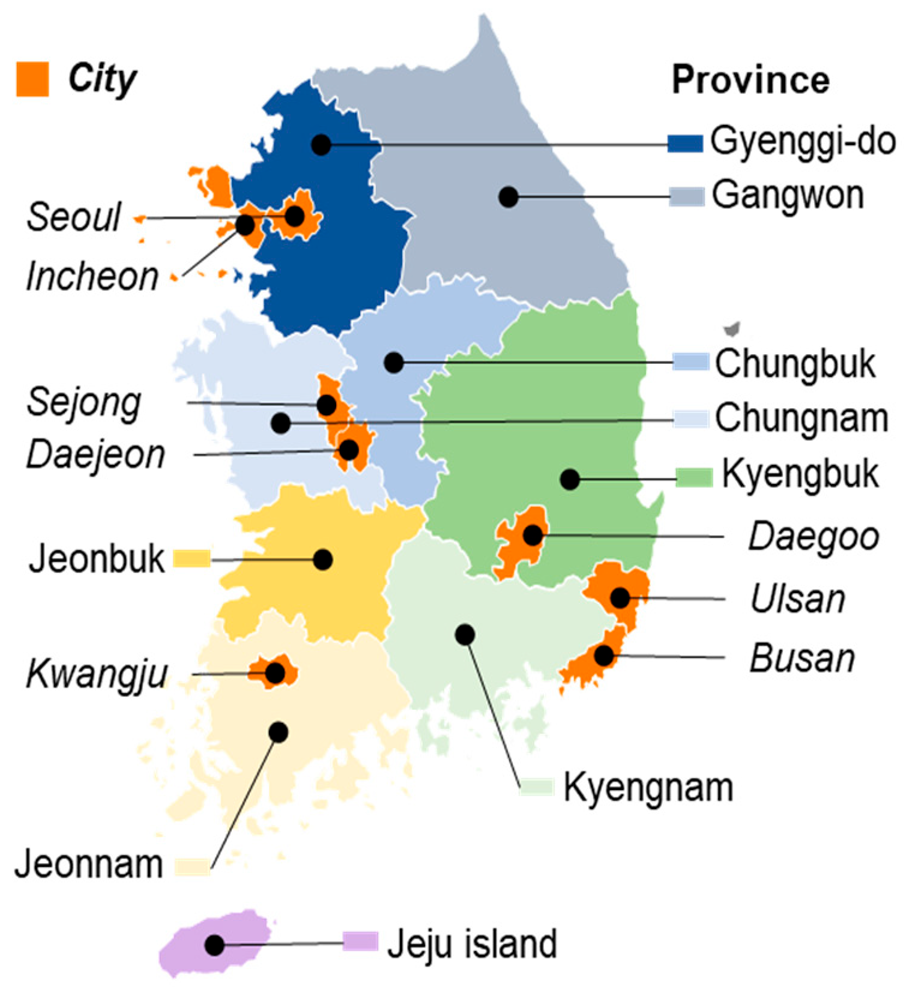
The analysis items of the data are the number of buildings certified by year, certification level, climate zone, distribution of cities and provinces, type of building, and owner of the building. The climate zone was divided into central, southern, and Jeju island, and the region was divided into 8 cities including Seoul and 9 local provinces. The types of buildings are largely divided into residential buildings, non-residential buildings, and complex buildings, while residential buildings are classified into apartments, detached houses, and conventional houses, and non-residential buildings are classified into office, educational, accommodation, retail, and others. For analysis, descriptive statistics analysis method was used. Among G-SEED-certified buildings in 2020, 48 sample building projects were selected. Detailed certification results of these sample buildings were collected and investigated. In addition, the technologies applied to the certification field category and certification scores were analyzed from design documents and field surveys. Figure 1 shows the research framework for the collection, classification, and analysis of data for this study.

2. South Korea’s Green Building Certification System, G-SEED

2.1. Operation and Certificate of Green Buildings

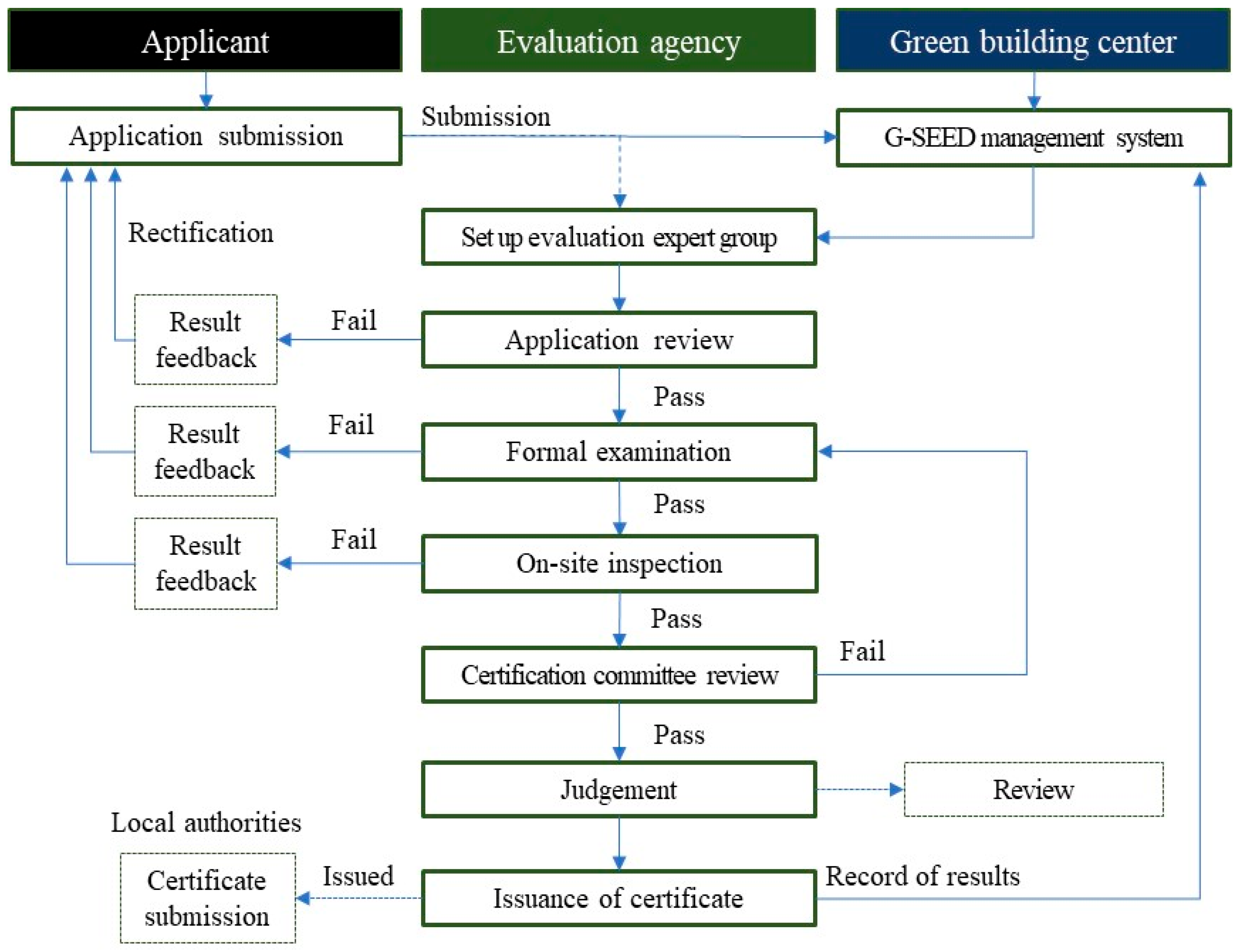
In Korea, green buildings or eco-friendly buildings are distinguished from conventional buildings through the G-SEED certification. MOLIT and the Ministry of Environment (MOE) are responsible for the operation and management of G-SEED. Under their authority, a unified evaluation standard for assessing the environmental performance of buildings and awarding green building certification was introduced in Korea. The Korean government laid the foundation for designating the National Green Building Center to promote the widespread adoption of green buildings. The National Green Building Center serves as the administrative body for G-SEED and performs various support functions, including revising G-SEED’s certification assessment criteria, managing evaluation agencies, operating the certification management system, and promoting G-SEED [13]. Accredited evaluation agencies designated by the Korean government assess and certify target buildings in accordance with G-SEED’s certification criteria. As of 2023, there are nine evaluation agencies nationwide responsible for G-SEED evaluations. Building owners are eligible to apply for G-SEED certification. The evaluation and certification process primarily include the certification application, evaluation, judgment, and certificate issuance stages, as illustrated in Figure 2.
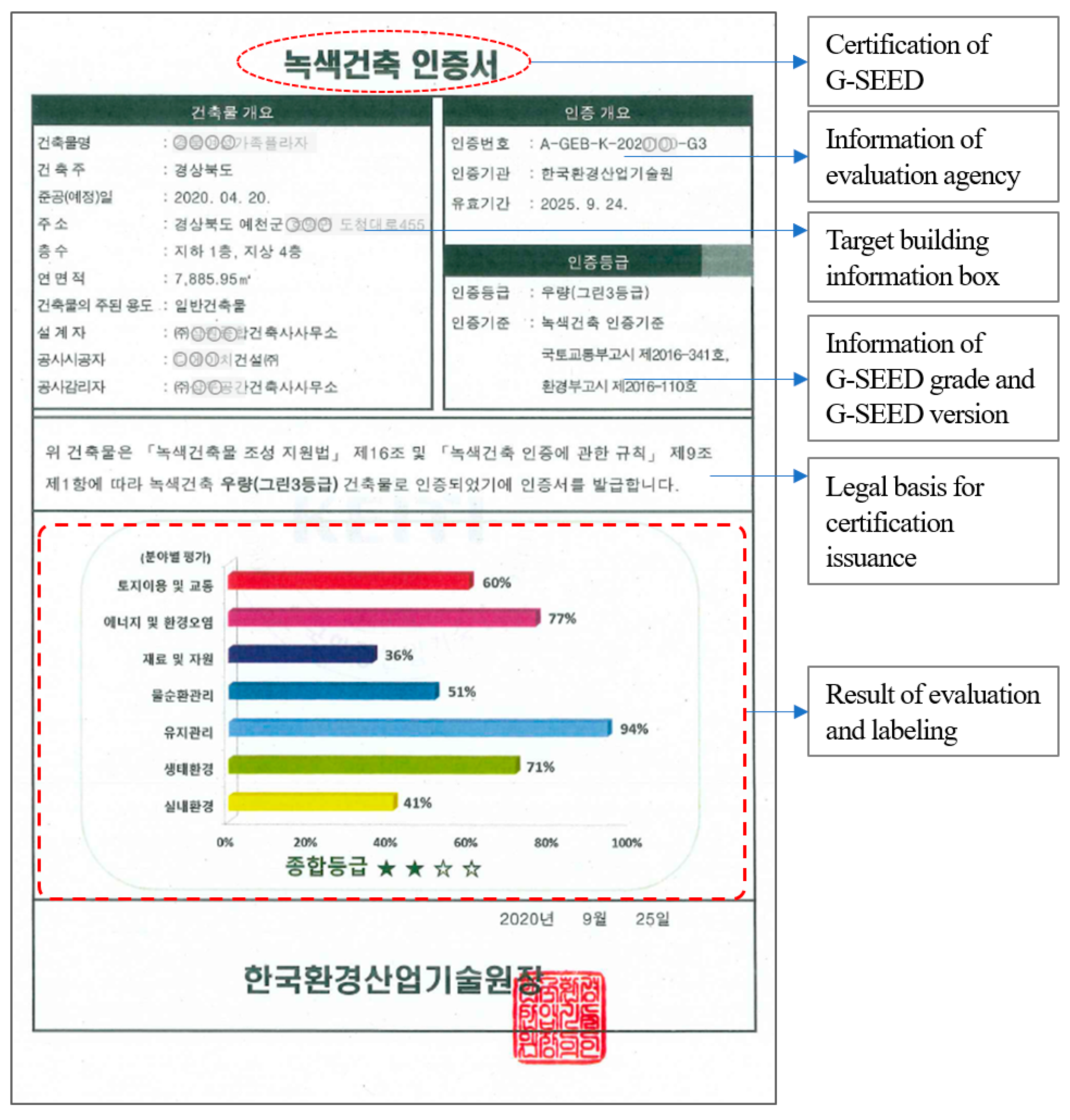
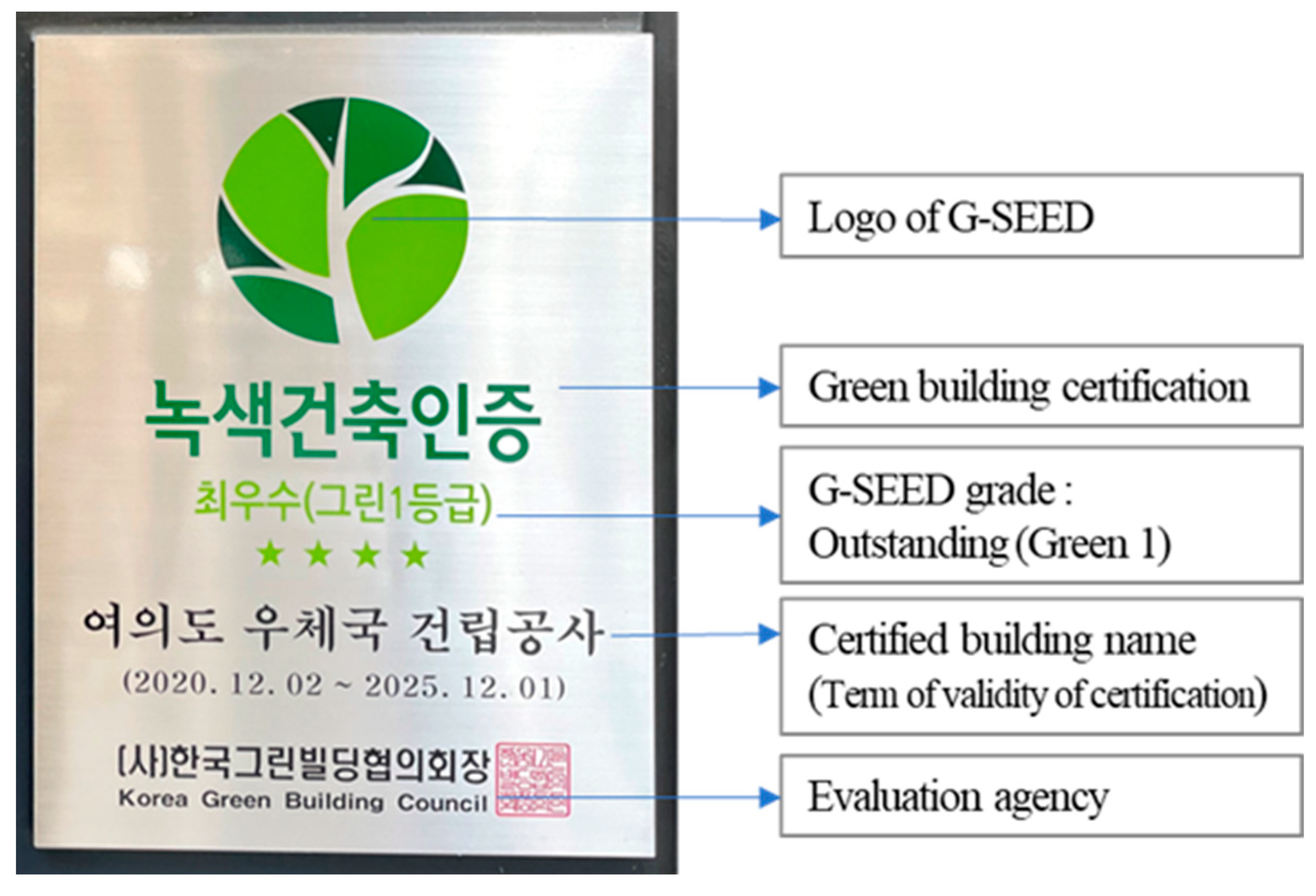
The evaluation agencies issue the applicant a certificate, as shown in Figure 3, according to the certification process. The certification results are uploaded along with a copy of the certificate and recorded in the G-SEED certification management system [28]. The building owner shall provide the issued certificate to the local authorities if necessary and place a plaque displaying the certificate grade, along with the G-SEED logo, at the entrance of the certified building (Figure 4).
The G-SEED certification process for green buildings is divided into two stages: pre-certification and main certification. In the first stage, the contents of the planning documents from the design stage prior to building construction are evaluated. The main certification process is carried out for completed building projects. The main certification process involves evaluating and issuance of certifications based on design documents and on-site inspections carried out after the construction of the building. In the G-SEED system, buildings are classified into two main groups: residential and non-residential. Residential buildings include detached houses, conventional houses, and apartments. Non-residential buildings include offices, educational facilities, residential accommodations, retail spaces, and other types. The certification process is the same for residential buildings and non-residential buildings.

2.2. Green Building Rating Tool of G-SEED

G-SEED has seven field categories: “land use and transportation,” “energy and pollution,” “materials and resources,” “water management,” “maintenance,” “ecological environment,” and “indoor environment quality”. Each field category includes detailed certification items designed to evaluate the environmental performance of a building. The evaluation criteria, methods, and scores for these detailed certification items are outlined in the Standards for Green Building Certification [11], a governing regulation in South Korea. Detailed certification items and their corresponding points for each field category as of 2023 are presented in Table 2.
G-SEED encompasses 40 detailed certification items for residential buildings and 38 items for non-residential buildings, categorized into seven specific fields. Among these, 28 cases (68%) involve a single certification item with corresponding certification criteria. The level of each certification criterion is classified into four grades, and the score for the certification item is awarded differently depending on the grade. The other certification items incorporate two or more certification criteria, and the score depends on the number of certification criteria met. Notably, G-SEED and BREEAM share similarities in terms of certification items, certification criteria, and scoring methods [15]. In Table 2, n/a means that the detailed certification item is not evaluated. In other words, the detailed item for “TAB & commissioning” is not evaluated in residential building (RB). “Pedestrian network in building complex” certification item relates to the walking space within the building site and is difficult to evaluate in non-residential buildings (NRB). For this reason, non-residential buildings do not have this certification item.
G-SEED certification includes four grades, each marked with green stars to indicate the certification grade. The highest grade, Green 1, is denoted by four stars (★★★★). Green 2 is represented by three stars (★★★), Green 3 by two stars (★★), and Green 4 by one star (★) (Figure 3). The G-SEED grade is determined based on the total score, which combines the final scores from seven field categories. For residential buildings, Green 1 (outstanding level) is awarded for scores of 74 points or higher, Green 2 (excellent level) for 66–73 points, Green 3 (very good level) for 58–65 points, and Green 4 (good level) for 50–57 points. In the case of non-residential buildings, Green 1 (outstanding level) is granted for a score of 80 points or more, Green 2 (excellent level) for 70–79 points, Green 3 (very good level) for 60–69 points, and Green 4 (good level) for 50–59 points.

3. Results: G-SEED Certification Situation

3.1. G-SEED Certification by Year and Certificate Grade

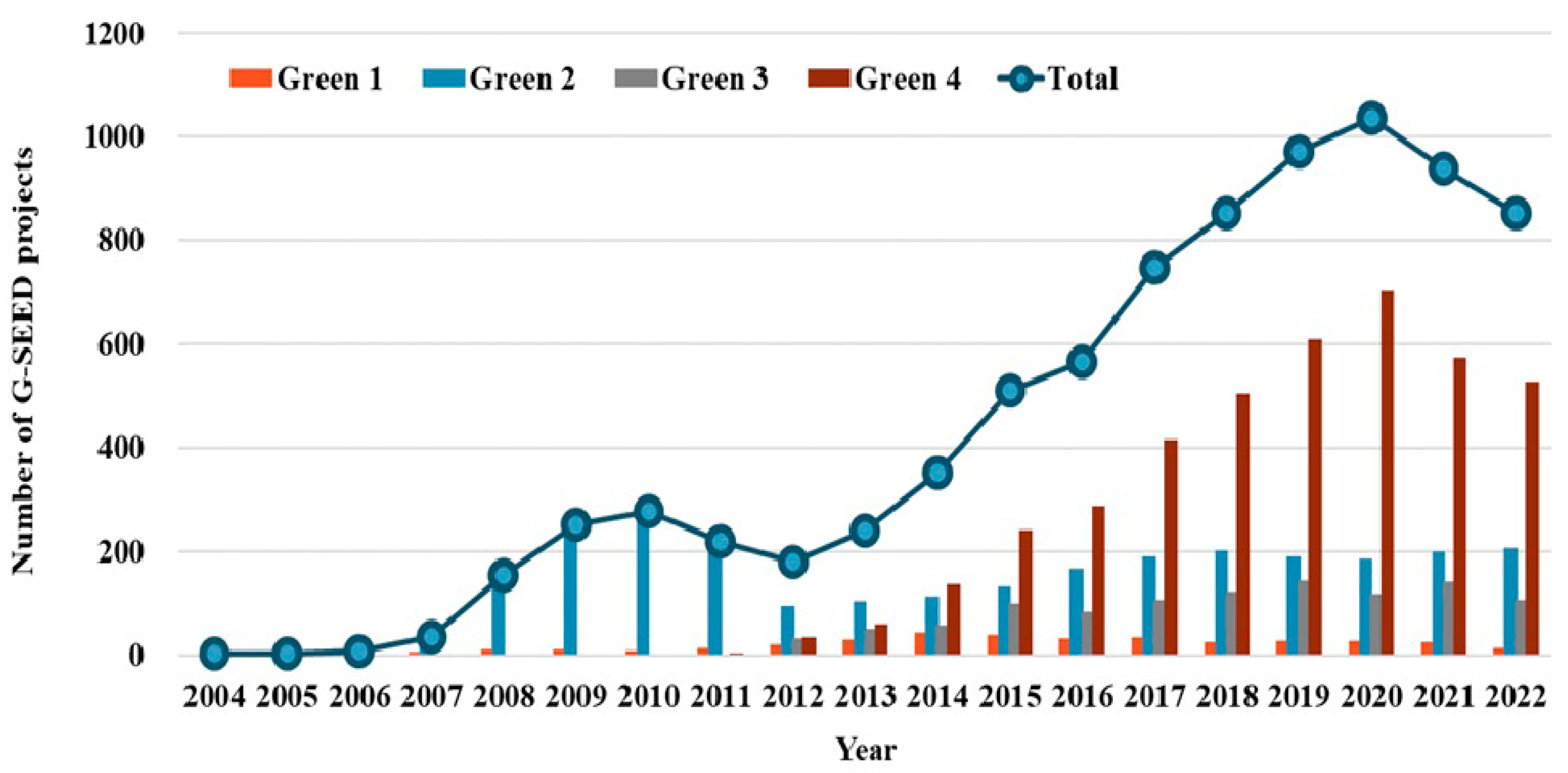
G-SEED certification has been implemented for 20 years, with the number of construction projects receiving G-SEED certification significantly increasing each year. Preliminary certification was first provided to apartment designs in 2002, and G-SEED was first awarded in 2004 to three completed buildings. Since the certification of office buildings began in 2003, all buildings that received certification in 2004 were apartments. In 2010, a total of 278 buildings received the certification, followed by 510 buildings in 2015, 1036 buildings in 2020, and 853 buildings in 2022. By 2022, a total of 12 buildings that underwent green remodeling received certifications [29]. The cumulative number of G-SEED-certified buildings reached 8200 by 2022. Table 3 shows the number of certified buildings per year. Figure 5 shows the number of certified buildings according to certificate grade per year.
All projects certified up to 2010 achieved Green 2 and Green 1 grades, with no instances of Green 3 and Green 4 grades. Subsequently, the number of certified buildings fell between 2010 and 2013. This decline can be attributed to the renaming of the certification to G-SEED and its major overhaul. Afterward, the numbers continued to rise. The number of certified buildings decreased in 2021 and 2022 as construction projects were delayed or suspended due to the impact of the COVID-19 pandemic.
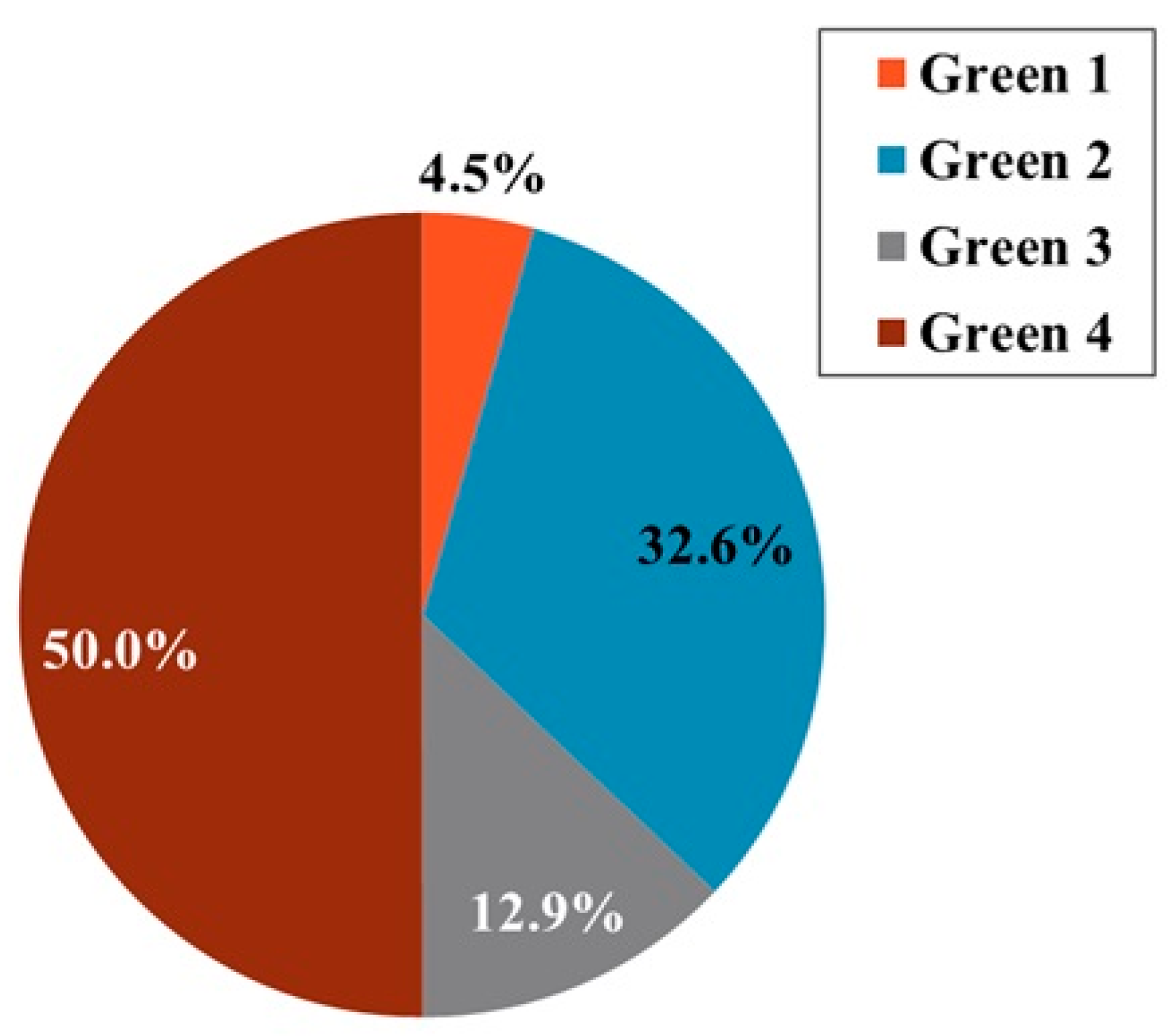
The number of G-SEED buildings certified with the Green 1 grade was 365 (4.5%), followed by 2676 (32.6%) for the Green 2 grade, 1057 (12.9%) for the Green 3 grade, and 4102 (50.0%) for the Green 4 grade (Figure 6). The Korean government and local authorities have made it mandatory for public buildings to have Green 2 grade or higher drawn based on standards for green building certification [11]. For this reason, the number of buildings with Green 2 grade certification was large in the early stages of implementation of G-SEED.

3.2. G-SEED Certification by Region

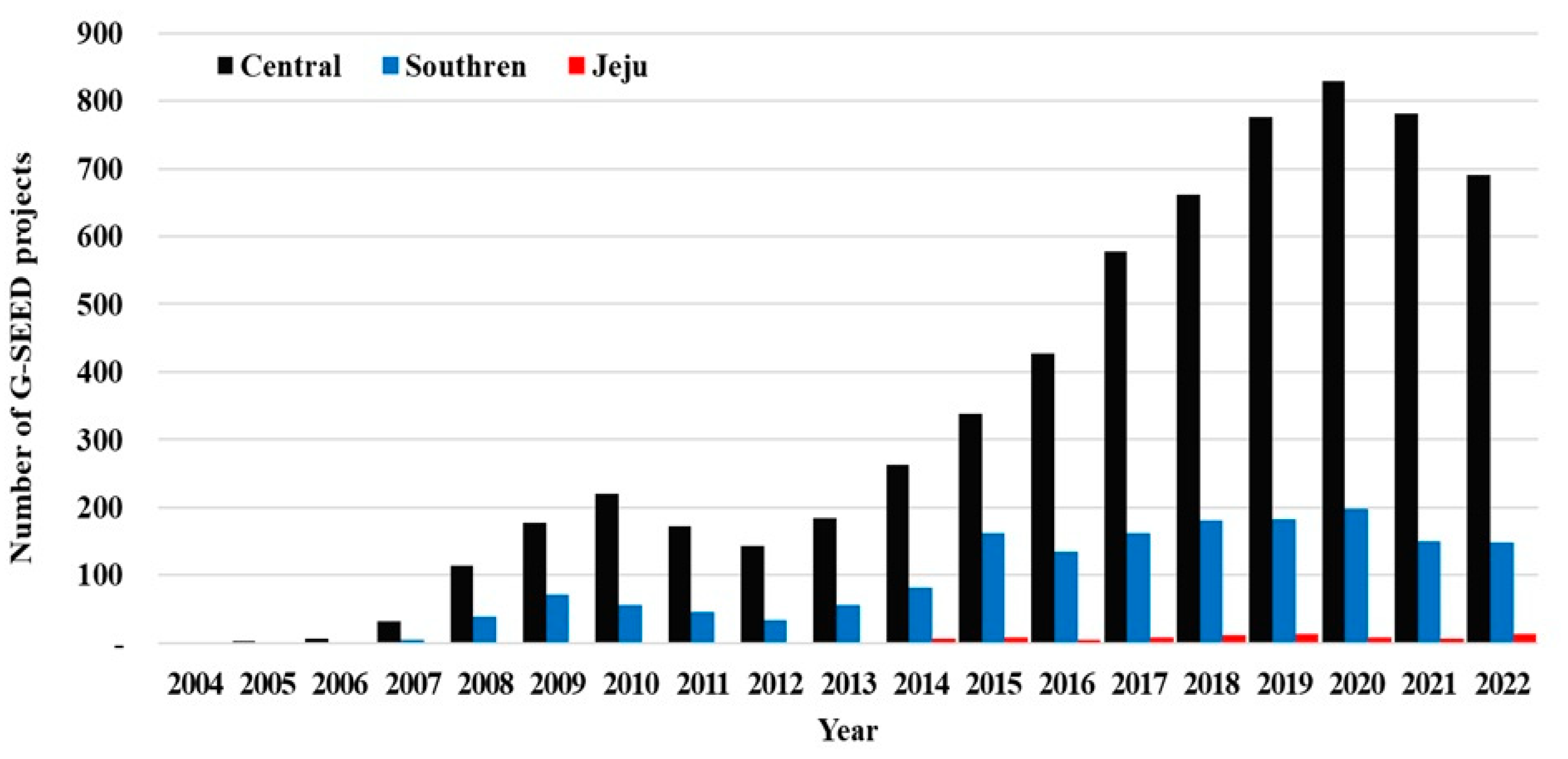
Building Energy Saving Design Standards [30] differ according to three regions based on Korea’s climate zones. Figure 7 shows the number of G-SEED-certified buildings categorized by region. The annual variation in these data are similar to the trends observed in Figure 5. Notably, the total number of G-SEED-certified buildings in South Korea is 8199. The central region, home to approximately 60.2% of Korea’s population, had the highest number of certified buildings (6400 (78.1%)). The number of certified buildings was 1712 (20.9%) in the southern region and 87 in Jeju Island. The temperature change between seasons is clear in the central region, and the annual intersection is also very large at 28 °C. The southern region has warm, rainy climate characteristics. Jeju is in the southernmost part of the Korean Peninsula and is heavily influenced by the warm and humid ocean because 55.3% of Jeju Island’s total area is coastal. In this study, the number of G-SEED-certified buildings was classified by three regions according to climate, but it is difficult to clarify how the climate in these areas affects certification. However, in the case of Jeju Island, small buildings are mainly being built due to the unique climatic characteristics of Jeju, and the number of certified buildings were low because these small buildings were not subject to green building certification.
In 2022, the Vietnam-Korea Institute of Science and Technology building, a new construction in Vietnam, received Green 2 grade. This building is considered the first overseas building to receive G-SEED certification. The building that achieved G-SEED certification in Vietnam was excluded from Figure 7 and Figure 8 because it is located abroad and was evaluated using separate G-SEED certification criteria for Vietnam.
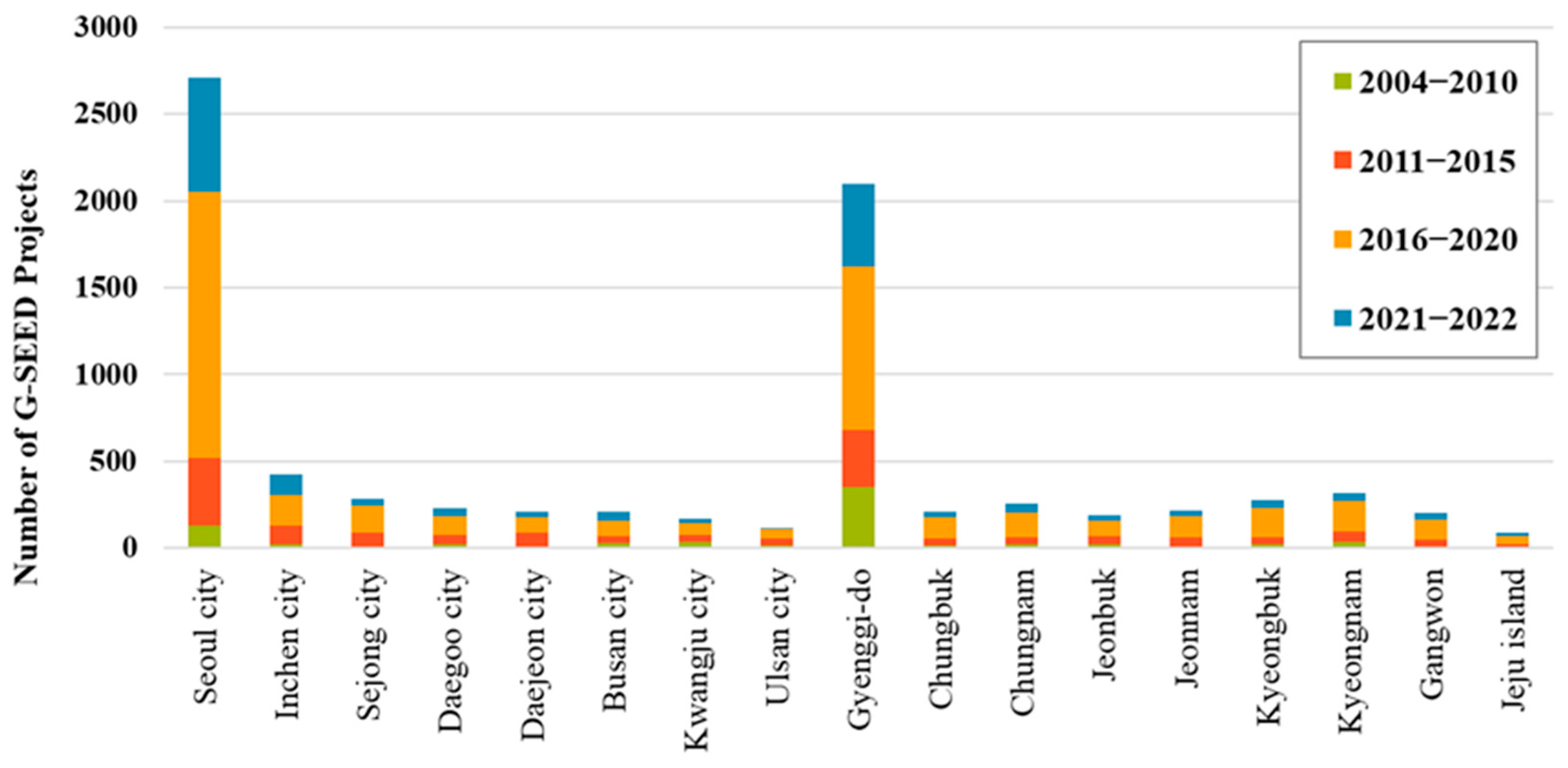
As shown in Figure 8, G-SEED-certified buildings are distributed across all cities and provinces in Korea. Jeju Island has the lowest number (87) of certified buildings. Conversely, Seoul has the highest number (2711) of G-SEED-certified buildings. It is noteworthy that the first certified apartment buildings were built in Seoul in 2004. Incheon has the second largest number (424) of certified buildings. Among local governments, Gyeonggi-do stands out with 2098 certified buildings. On average, other local governments report 239 certified buildings each. Comparing the number of certified buildings, major cities account for 4343 buildings, while local governments have 3856 buildings, making the former approximately 6% larger. The number of green buildings constructed in the central region, covering Seoul and Gyeonggi-do, is 4809, representing approximately 58.6% of all G-SEED-certified buildings. Sejong, a newly founded city in 2012, began constructing certified buildings the same year and has recently introduced green buildings; it now has the third largest number (282) of green buildings among cities. The high number of green building certificates in Seoul and Gyeonggi-do compared to other regions was influenced by the relatively high population density, economic development level, and this province’s ordinance to build green buildings. These observations indicate that G-SEED has been spread to all regions of Korea, and awareness regarding green buildings has increased.

3.3. G-SEED Certification by Building Use Type

Table 4 provides a breakdown of annual G-SEED-certified buildings by building use type, classified into residential buildings (detached houses, conventional houses, and apartments), non-residential buildings (office, educational, accommodation, retail, and other buildings), and complex buildings combining residential and non-residential uses within a single facility. Among certified buildings, residential buildings (2716 projects) account for 33.1%, non-residential buildings (4790 projects) make up 58.4%, and complex buildings (692 projects) account for 8.4%. The number of certified non-residential buildings is significantly high. The breakdown by building use type follows a similar trend to the total number of certified buildings shown in Figure 4. Among the certified residential buildings, apartments (2373 projects) hold the largest share (87.4%). Among the certified non-residential buildings, other buildings (1896 projects) had the largest share (39.6%), followed by educational buildings (1491 projects (31.1%), and office buildings (1167 projects (24.4%)). Conversely, over 20 years of G-SEED implementation, only 210 accommodation facilities and 28 retail facilities received certification, as shown in Table 4. This indicates a small number of certified buildings in these two use categories. The number of certified detached houses among residential buildings is very small, with only six cases.
It is possible to review the ratio of G-SEED-certified buildings to the annual new construction volume and then identify the construction level of green buildings to the annual construction volume. For this, Table 5 shows the number of buildings approved for construction in Korea for annual construction with data obtained from government statistics [31]. From Table 4 and Table 5 the number of G-SEED-certified buildings is very low compared to the quantity built every year, and we can find a rate of 0.5% after 2019. The analysis related to this will be further covered in the next Section 4.1.

4. Limitations of G-SEED

4.1. Regional Distribution and Gap Between City and Province

South Korea has regions with eight major cities and nine provinces, including Jeju Island. This study examined the number of G-SEED-certified buildings in these regions. Table 6 contains the results of the analysis on the number of buildings, G-SEED-certified buildings, and the ratio of certified buildings by region in South Korea. According to statistics on Korea’s overall building status [31], there were 7,354,340 buildings in Korea in 2022. Excluding buildings not subjected to G-SEED, such as warehouses, livestock houses, and factories, the number is approximately 6,148,470 buildings. Therefore, G-SEED-certified buildings account for 0.13% of all buildings in South Korea. Among the major cities, Sejong, Seoul, and Incheon have a high proportion of certified buildings. Among the provinces, Gyonggi-do has the highest number of certified buildings. When comparing the proportion of certified buildings, large cities have approximately twice the proportion of certified buildings compared to provinces. It was found that there is a gap between the number of certified buildings in cities and provinces and the overall construction of green buildings.
The number of buildings constructed after the implementation of G-SEED is approximately 1,789,800. Based on this number, G-SEED-certified buildings account for 0.46% of this total. Given that green buildings represent approximately 0.5% of buildings constructed after the introduction of G-SEED, it is clear that despite the importance of green buildings, their adoption has not reached a significant scale. This shows the weaknesses of the G-SEED green building certification system. The reality of the construction market is that only a small number of buildings are being built as green buildings despite efforts made by the Korean government.
Most G-SEED-certified buildings were constructed between 2016 and 2020 in all regions. Despite the challenges posed by the COVID-19 pandemic, efforts have been made to construct a significant number of green buildings in 2021 and 2022.

4.2. Private and Public Buildings

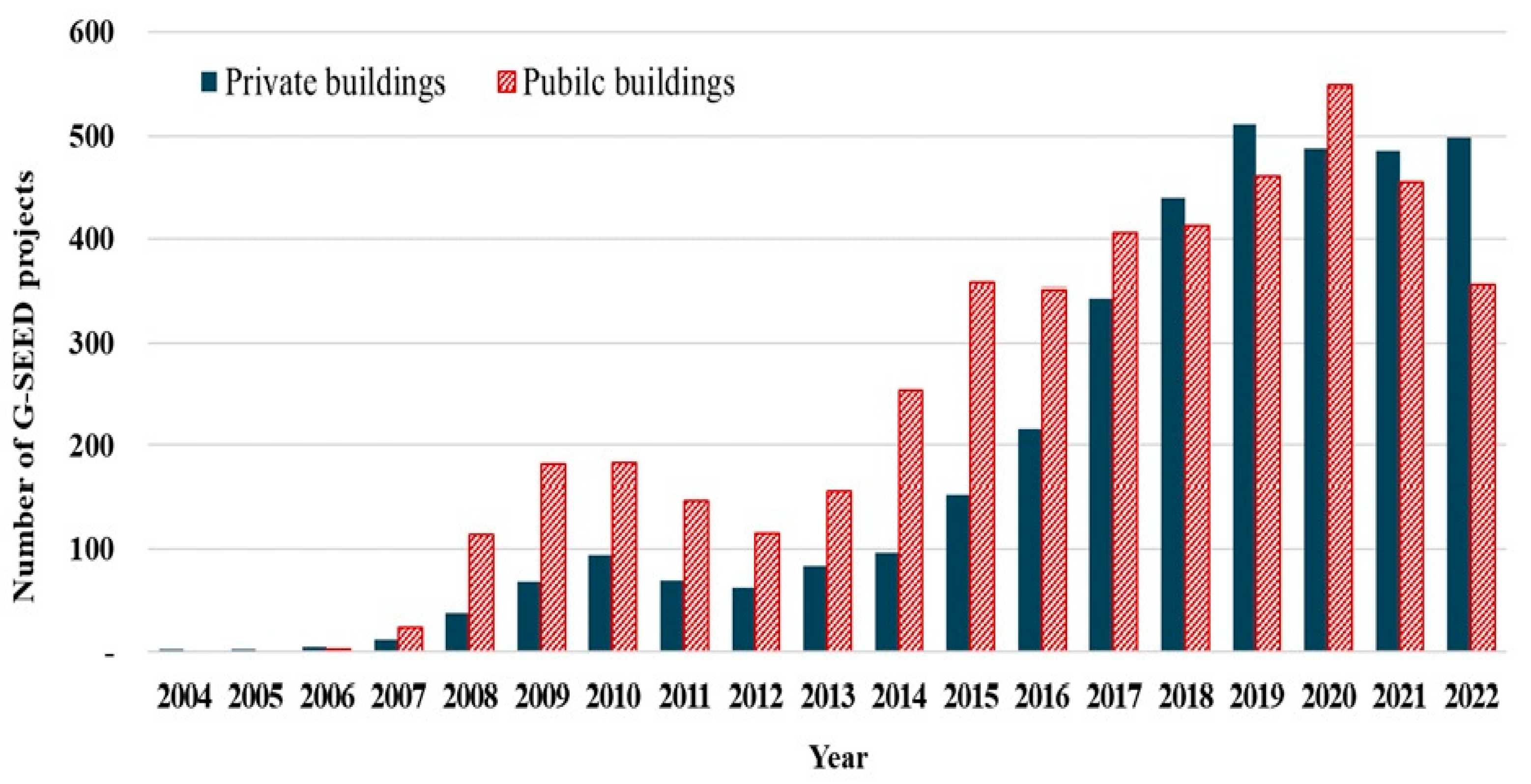
Buildings owned or managed by public agencies are classified as public buildings, while all other buildings are categorized as private buildings for this analysis. The analysis of results is depicted in Figure 9. Among the G-SEED-certified buildings, 4527 (55.2%) are public buildings, and 3673 (44.8%) are private buildings. These numbers provide convincing evidence that the number of certified public buildings exceeds that of certified private buildings. All three buildings certified in 2024, the first year, and the three buildings certified in 2005, the second year, were private buildings. However, from 2007 to 2015, the number of certified public buildings was more than twice that of certified private buildings each year. This shows that G-SEED initially functioned as a certification system supported by public projects. This trend still appears to remain, indicating that G-SEED is moving under the leadership of the government.
Only after 2018, when G-SEED has been in operation for more than 15 years, will the number of certified private buildings be higher than the number of certified public buildings. This reflects the growing awareness and acceptance of green buildings in the private building market, but it is still insufficient.

5. Technical Characteristics of G-SEED-Certified Buildings

5.1. Sample for Analysis

Certification items of G-SEED evaluate the extent to which the building complies with green building technologies and how effectively eco-friendly design elements have been integrated into the building.
This study analyzed the certification results for a set of 48 sample buildings certified in 2020. These basic data were collected through the G-SEED certification management system. As can be seen from Section 3, including Table 3, 2020 is the year with the highest number of G-SEED-certified buildings. Therefore, a sample building for this study was selected among the buildings certified in 2020. Sample buildings were selected in consideration of region, climate conditions, building type, and G-SEED grade to become a meaningful sample design. Above all, it should be possible to collect data on sample buildings. In this study, a building that can collect data such as design documents, information on application technology, and G-SEED certificates and conduct field surveys was selected as a sample building. This study conducted the collection of these documents and data with the help of evaluation agencies of G-SEED. Among the regions specified in Figure 8 and Table 6, 20 and 17 samples were selected from Seoul and Gyeonggi, respectively, which have the highest number of certifications. Six buildings located in local provinces and five other buildings located in other cities were included in the sample. The regions of Korea are classified into the central, southern, and Jeju according to climate conditions as shown in Figure 7. 40 buildings were selected as sample buildings in the central region including Seoul, Gyeonggi-do, and Incheon, and 8 buildings in the southern region. However, in Jeju, where 87 G-SEED-certified buildings are located, sample buildings could not be selected because it was difficult to obtain detailed data on buildings and conduct field surveys. Among the sample buildings, three buildings received Green 1 grade, six buildings received Green 2 grade, 11 buildings received Green 3 grade, and 28 buildings received Green 4 grade (Refer to Table 7). These sample buildings were chosen to represent the certification grade, building type and regional location of the building. The green building technologies applied to the sample buildings are listed in Table 7.

5.2. Results by Field Category of G-SEED

5.2.1. Land Use and Transportation

The criteria for land use certification items of G-SEED cover various aspects, including preserving the ecological value of the site, the ratio of underground structures, building height and shape to ensure neighboring buildings’ access to sunlight, the provision of bicycle-related facilities, and the accessibility to public transport.
The assessment of underground space development considers the structural technology for underground structures, the installation facilities (e.g., machine rooms, septic tanks, and water tanks), and measures to protect groundwater. Because underground areas often harbor diverse ecosystems and serve as conduits for vital resources such as groundwater, excessive development of underground space can degrade the environment and deplete valuable resources. However, in densely populated large cities, the development of underground spaces is essential. Because of this, buildings built in cities are difficult to point high in this certification item and the proportion of buildings with relevant technologies is not high.
Assessing public transportation usage includes determining the proximity of easily accessible public transportation, such as buses, subways, and trains, to the target building. All certified sample buildings had access to at least one form of public transportation, as shown in Table 8. Measuring public transportation does not directly reflect the buildings’ performance; rather, location becomes an important factor. Using public transportation offers notable benefits, including reductions in fossil fuel consumption, atmospheric particulate matter (PM), and pollutants. Therefore, it is essential to consider access to public transportation when planning a building project.

5.2.2. Energy and Pollution

Building energy efficiency is considered important in many green building certification systems. Energy performance in G-SEED is the most important evaluation item among the detailed certification items [14,24]. As depicted in Table 2, energy performance carries a weight of 12 points, which is higher than other detailed certification items. To achieve a high certificate grade, a high score in energy performance is required. G-SEED evaluates energy performance using two methods. The first method is the energy performance index (EPI), which is based on the Building Energy Conservation Code (BECC) [30]. For EPI, architecture, equipment, electricity, and renewable energy technologies are evaluated, with scores assigned according to the specifications of each design element without building energy simulations. It further evaluates whether the requisite conditions are met using a comprehensive checklist. The other method is based on the building energy efficiency rating (BEER) [32]. In Korea, BEER is categorized into ratings ranging from 1+++ to 7 based on the annual primary energy consumption of a target building. To achieve high BEER ratings, buildings must incorporate highly insulating envelopes and high-efficiency equipment into their construction and design [32,33].
All sample buildings in this study achieved high energy performance scores. Among the sampled residential buildings, only one met the EPI score requirements, whereas the remaining samples received their scores through BEER ratings. G-SEED-certified buildings with Green 1, Green 2, and Green 3 grades received BEER ratings of 1 and 1+. In the non-residential building sample, two buildings met the energy performance criteria based on the EPI score, whereas other buildings derived their scores from BEER ratings 1+ or higher.
Testing, adjusting, and balancing (TAB) and commissioning processes for heating, ventilation, and air-conditioning (HVAC) systems are exclusively evaluated in non-residential buildings. These evaluations are procedures for verifying and adjusting whether a building is functioning in accordance with the performance requirements of the building design, including adjustments that affect building performance and efficiency. Approximately 15.4% of the sample buildings performed TAB or adjusted buildings through TAB and commissioning.
Building energy monitoring is a crucial practice that involves tracking the consumption of individual energy sources, such as electricity, gas, and oil, or measuring the consumption of individual energy sources, such as cooling, heating, hot water supply, lighting, ventilation, electric heating, and pumps. In residential buildings, approximately 72% of sample buildings monitor the consumption of each energy source and communicate this information to occupants and building managers for effective management of the building’s energy consumption. For non-residential buildings, 42% have implemented energy monitoring and management systems. Green 1 grade buildings were found to have comprehensive energy management systems, which, in addition to monitoring energy consumption, also include functions for analyzing building energy consumption and controlling HVAC equipment.
Daylight sensors and high-efficiency lighting, such as LEDs, are evaluated as detailed certification items in office, educational, and retail buildings. Remarkably, 30% of the sample buildings had energy-efficient lighting designed for an illuminance ranging from 5.07 to 9.0 W/m2. However, G-SEED does not evaluate residential buildings for the use of high-efficiency lighting.
The use of district heating systems is effective in reducing GHG emissions and air pollution, primarily owing to their superior energy efficiency compared to other heating methods. The Korean government has made efforts to expand district heating in buildings. The residential district heating penetration rate was 17.6% in 2018, with a target of reaching 20.9% by 2023 [34]. Among the certified sample buildings, 50% of residential buildings and 20% of non-residential buildings used district heating as an energy source.
In South Korea, buildings offering an outside view are preferred. Curtain wall systems have a higher window-to-wall ratio (WWR) compared to other envelope structures due to the large area of glass. High WWR can lead to increased internal heat loss in winter and increased cooling load in summer, as solar heat enters interior spaces through windows. To counter these effects, adjustable sun shading systems that effectively block solar heat from entering through windows have gained popularity. In a building model with a WWR of 45%, the installation of external blinds can reduce cooling energy requirements by 3.5% [35]. The Korean government also recommends installing external shading, as outlined in the BECC.

5.2.3. Materials and Resources

Sustainable materials and green building materials play an important role in reducing building energy consumption and embodied GHG emissions [36]. Green building materials also contribute to improving the quality of the indoor environment. These materials include ecological materials, recycled materials, certified eco-friendly materials, low-carbon materials, and materials with reduced harmful substances. As indicated in Table 8, all certified sample buildings used environmental product declaration (EPD) materials, recycled materials, and eco-labeled materials. Residential buildings used more green building materials than non-residential buildings.
The environmental impacts of buildings can be reduced by using EPD materials for major building materials. This is because EPD materials undergo a thorough evaluation and quantification of environmental impacts during the production, usage, and disposal phases through a life cycle assessment (LCA) process. For the sample buildings, five to seven EPD materials were used for major elements such as structures, exterior walls, roofs, and floors. The certification grants a minimum score of 0.8 points when incorporating seven or more recycled materials and a maximum score of 2 points when using 25 or more recycled materials. Korea’s MOE certifies eco-label materials through the eco-labeling certification mark [37]. G-SEED evaluates the use of building materials bearing these eco-labels, considering the quantity of such materials used during construction.

5.2.4. Water Management

The assessment of water management is closely linked to the proportion of permeable surfaces within the external site area. This ratio bears significance in evaluating external factors such as rainwater management and groundwater protection. The external property area is calculated by subtracting the natural ground area from the total property area. G-SEED provides a score when the proportion of permeable pavement exceeds 50%. Pavements are considered permeable if the thickness of the pavement layer and the filling exceeds 20 cm, or if the thickness of the vegetation layer exceeds 20 cm in the case of planting.
Efforts to save water in buildings are widespread in green buildings. G-SEED allocates points when water-saving faucets or toilets are used throughout the building, with scores determined based on annual water savings compared to annual water consumption. Installing water consumption monitoring devices reduces unnecessary water consumption and promotes efficient management by making water supply in the region available to users and managers through meters. In residential buildings, water consumption monitoring devices must measure all household water consumption in real-time. In non-residential buildings, water consumption monitoring devices must measure the water consumption of the entire building based on the usage and the management area. Additionally, eco-labeled products are required for all water consumption monitoring devices.

5.2.5. Maintenance

Effective building maintenance is paramount to conserving energy and resources. In G-SEED’s maintenance field, the evaluation focuses on whether methods of operation and management of the applied technologies are presented to users and managers, rather than on the technical aspects of green buildings. Basic requisites include inspection manuals for as-built drawings and detailed equipment, as well as equipment and product usage manuals. All sample buildings have scored successfully in this category because there are enough manuals and catalogs available for products and equipment.

5.2.6. Ecological Environment

Technologies for securing planting spaces within buildings include various aspects such as areas on natural ground, permeable pavements with plants, and the greening of roofs and exterior walls. Building roofs serve as preferred locations for greenery. Plantings also extend to the exterior walls and surrounding landscaping of buildings. Plantings can be introduced in building construction projects to reduce cooling/heating energy consumption, respond to climate change, and absorb carbon. However, roofs have multiple functions, serving as recreational spaces, hosting renewable energy sources (e.g., PV and solar thermal systems), external lighting, and promotional signboards. This limits the available planting space on roofs, increasing the demand for vertical planting on exterior walls. For non-residential buildings where securing external planting space is challenging, the focus shifts to integrating ecological functions into the building interior.

5.2.7. Indoor Quality Environment

In 2021, the annual average PM (PM10) concentration in Korea was 36 µg/m3, more than twice the recommended limit of 15 µg/m3 set by the World Health Organization (WHO) [38]. Growing concerns over PM pollution and yellow dust have heightened the demand for improved ventilation systems in buildings. Furthermore, the emergence of infectious diseases, such as COVID-19, also highlights the importance of ventilation. Technologies that meet this demand include operable windows and mechanical ventilation systems with heat recovery capabilities. The evaluation criteria for natural ventilation are based on the ratio of the opening area of windows to the floor area. A score is awarded if the ratio exceeds 8% for residential buildings and 2% for non-residential buildings. Waste heat recovery systems are suitable for residential buildings in winter when there is a significant temperature difference between indoor and outdoor environments, aligning with the BECC recommendations [30]. Ventilation systems with heat recovery for residential buildings were used in all households in the sample buildings. However, in non-residential buildings, using waste heat recovery systems in mechanical ventilation systems can be relatively difficult due to the prevalence of central air conditioning systems.
Giving residents the ability to control indoor temperatures using automatic temperature controllers increases comfort and saves energy on heating and cooling. Residential buildings are evaluated based on the installation of an automatic temperature controller connected to the heating system. The percentage of the total area that can be adjusted for heating and cooling by installing temperature sensors in each room or zone is assessed for non-residential buildings. The evaluation includes whether occupants can control the indoor environment, including ventilation volume and lighting, as well as the indoor temperature of the workspace. The area where individual control is possible must not exceed 20 m2 to score points on G-SEED. The noise environment is only assessed in residential buildings. The evaluation includes factors such as the impact of sound insulation performance on the floor, sound insulation performance between households, outdoor noise insulation performance, and sound insulation in the bathroom [27].

6. Recommendations and Discussion

This study analyzed the status of G-SEED, a Korean green building certification system that has been implemented for over 20 years with the aim of promoting green buildings. We also analyzed the technical aspects based on certified buildings. Based on these analyses, several proposals are presented for the promotion of green buildings:

6.1. Strengthening Awareness for Green Buildings

New buildings have predominantly achieved the Green 4 grade, followed by Green 2, Green 3, and Green 1 grades. Numerous public buildings have obtained the Green 2 grade, as it is a requirement during construction. Future policies and incentives should be designed to ensure buildings receive higher grades when they receive G-SEED certification. Following this, the Korean government must encourage the construction market to build more buildings with lower energy consumption and GHG emissions, as well as higher environmental performance.
The benefits of green buildings, such as sustainability, energy saving, environmental protection, improving comfort, and increasing building value, are not well known. Various measures should be taken to raise awareness of green buildings among designers, owners, and users of buildings. An appropriately established set grade of green building certification can provide green buildings with reliability and a quantitative index of performance.

6.2. Need to Revise Certification Criteria of G-SEED

The central area of the Korean Peninsula is the most important region for G-SEED certifications. The cities and provinces with the largest number of certified buildings are Seoul and Gyeonggi-do. Both Seoul and Gyeonggi-do belong to the central region. As shown in Table 6 and Figure 8, all major cities and local governments in Korea have G-SEED-certified buildings. However, the number of certified buildings remains relatively small compared to the entire building stock. To foster more interest, increased promotion and marketing of G-SEED, as well as the popularization of green buildings, are required. The Korean government should consider incorporating regional characteristics or contents into G-SEED certification criteria.
Among residential buildings, apartments have received the most certifications, whereas educational and office buildings have received the most certifications among non-residential buildings. Many buildings were constructed with spaces for different uses, contributing to the overall increase in G-SEED-certified buildings. However, the number of G-SEED-certified detached houses, accommodation facilities, and retail buildings is very small. For future revisions of G-SEED, the Korean government should carefully consider whether the certification items and evaluation criteria for accommodation facilities, retail, and detached houses are appropriate. Moreover, to further promote green buildings, the government should consider providing separate incentives and cost-optimized technologies to generate interest in green buildings within these specific building use categories.

6.3. Recommendations for the Application of Green Building Technology

Among the green building technologies applied to G-SEED-certified buildings, the use of public transportation, energy efficiency, green building materials, water-saving equipment, heat recovery ventilation systems, and automatic indoor temperature controllers was consistent across all sample buildings in this study. Building energy efficiency, particularly, proves to be the most critical evaluation item. This is due to the need to achieve high energy performance scores with many points awarded in order to obtain higher certificate grades. Technologies such as high-insulation envelopes, high-efficiency equipment, high-efficiency lighting, and renewable energy systems have been used to improve building energy efficiency and help reduce energy consumption. When selecting technologies to be used for a green building, these technologies should be able to reduce the actual energy consumption of buildings and contribute to the sustainable development of green buildings, and not just be selected for a high certification grade. Green buildings should maintain the original technical functions of the applied technologies during the operational stage of buildings. Therefore, it is necessary to highlight the certification items for the energy monitoring and management system so that the impacts of the use of these technologies can be examined in the operation stage of the building.
Certification items focusing on the use of green building materials are also important evaluation items. All sample buildings used EPD materials, recycled materials, and eco-labeled materials. Since the number of green building materials used in a building is an evaluation criterion in G-SEED, there are limitations in evaluating environmental performance as well as embodied energy and GHG according to the construction materials used in the building. Other green building certification systems, such as LEED, BREEAM, and CASBEE, have evaluated GHG emissions linked to construction materials by incorporating LCA criteria since 2009. Consequently, it has been suggested that G-SEED should also include evaluation criteria for the GHG emissions of key construction materials [39]. As the significance of sustainable construction materials increases in green buildings, the inclusion of LCA criteria becomes imperative for certification systems.
The technologies applied to green buildings include the seven field categories of G-SEED. Consequently, certain technologies have found limited application. Future revisions of G-SEED should consider a broader range of technologies for green building implementation in certification evaluation items. A potential solution could be to assess the complexity of technologies and the excellence of their performance, assigning weights to different evaluation indicators.

6.4. Limitations in This Study and Future Research

In the initial stages of collecting data for the study, we faced significant challenges. As the results of this study show, the number of G-SEED-certified buildings has steadily grown, reaching 8200 by 2022. In 2012, the scope of certification was expanded to all buildings and the number of certified buildings increased significantly. Data before 2012 were insufficient and giddy, making it difficult to obtain the necessary documents and data. In addition, it took a lot of time to organize a lot of data on 8200 projects collectively. This study tried to secure data as much as possible with the cooperation of the G-SEED evaluation agencies and the Korean government (MOLIT), and insufficient data was obtained through physical inspections such as actual building visits. This study also collaborated with MOLIT and the Green Building Center to produce a data management plan for the certified buildings.
Since the analysis of the technical content of Section 5 is based on 48 limited sample buildings, more sufficient sample buildings are required to present more generalized analysis results in the future research. Although these are limited sample buildings, meaningful results could be derived in this study because sample buildings for all grades of G-SEED were secured and sample buildings for residential and non-residential buildings were secured and used for this research.
In the future, research is needed to systematically compare G-SEED with well-known green building certificates such as LEED, BREEAM, CASBEE, Green Mark, and Green Star. It is necessary to identify the similarities, differences, strengths and weaknesses of these certifications. This future research will lead us to explore the direction of improvement so that green building certification can fully evaluate building projects in all aspects of sustainability. Like a review study [40] on the use of artificial intelligence in engineering, in future studies, we can use artificial intelligence model to analyze many engineering data of certification items in the certification system. These future studies can further improve the performance of green building and the quantitative performance evaluation of certification items in the certification system through predictive and data-driven approaches.

7. Conclusions

The assessment and rating of green buildings or sustainable construction is a global concern in both developed and developing countries [41]. As buildings demand high energy and resource consumption, green buildings are highlighted as a key strategy to reduce GHG emissions.
  • Detailed certification items of green building certification systems evaluate aspects of building planning and technologies essential for achieving green buildings’ performance standards. This study reviewed G-SEED and analyzed the limitations of G-SEED and the technical characteristics of G-SEED-certified buildings. Following these reviews and analyses, this paper presented proposals for expanding green buildings and revising the G-SEED certification system. These proposals provide meaningful insights for decision-makers operating green building certification systems in other countries.
  • Based on sample buildings, this study provided technology list used to evaluate G-SEED-certified buildings as green buildings. The most commonly adopted technical features included the use of public transportation (such as buses and bicycles), energy efficiency technologies, eco-friendly materials, water-saving appliances, operational manuals, and ventilation systems with heat recovery and air temperature control. This paper could help architects, building owners, and researchers in gaining a comprehensive understanding of G-SEED. Readers can understand the technical level of green buildings through this study.
  • Among the buildings certified in South Korea from 2004 to 2022, 50% received a Green 4 grade, the highest proportion. In order to increase the sustainability of the project and achieve GHG emission reduction, it is necessary to design buildings that aim for Green 2 grade or higher. For public buildings, it is mandatory to obtain Green 2 grade certification through G-SEED evaluation [11]. On the other hand, private buildings are voluntarily certified. For this reason, in order to strengthen the role of G-SEED in promoting green buildings in the private real estate market, the Korean government and the managing authority of the certification system should continuously improve G-SEED. Various measures, such as incentives and tax exemptions, should be continuously proposed to accelerate green building in private construction companies.
Green buildings are considered key enablers of sustainable cities and society, and the green building certification system has played a significant role in their development. Green buildings should be continuously promoted globally, and more research on these topics should be conducted in the future.

Funding

This research was funded by The Ministry of Land, Infrastructure and Transport of Korea, grant number RS-2020-KA-157909 and Korea Institute of Civil Engineering and Building Technology, grant number 20250224-001.

Data Availability Statement

The data presented in this study are available on request from the corresponding author. The data are not publicly available due to privacy issues.

Conflicts of Interest

The author declares no conflicts of interest.

Abbreviations

The following abbreviations are used in this manuscript:
BECCBuilding Energy Conservation Code
BEERBuilding Energy Efficiency Rating
BREEAMBuilding Research Establishment’s Environmental Assessment Method
EPDEnvironmental Product Declaration
EPIEnergy performance Index
G-SEEDGreen Standard for Energy and Environmental Design
GHGGreenhouse Gas
HVACHeating, Ventilation, and Air-conditioning System
LCALife Cycle Assessment
LEEDLeadership in Energy and Environmental Design
NRBNon- Residential buildings
MOEKorean Ministry of Environment
MOLITKorean Ministry of Land, Infrastructure and Transport
PMParticulate Matter
RBResidential buildings
TABTesting, Adjusting, and Balancing

References

  1. Wen, B.; Musa, S.N.; Onn, C.C.; Ramesh, S.; Liang, L.; Wang, W.; Ma, K. The role and contribution of green buildings on sustainable development goals. Build. Environ. 2020, 185, 107091. [Google Scholar] [CrossRef]
  2. Li, Y.; Chen, X.; Wang, X.; Xu, Y.; Chen, P.H. A review of studies on green building assessment methods by comparative analysis. Energy Build. 2017, 146, 152–159. [Google Scholar] [CrossRef]
  3. Shan, M.; Hwang, B.G. Green building rating systems: Global reviews of practices and research efforts. Sustain. Cities Soc. 2018, 39, 172–180. [Google Scholar] [CrossRef]
  4. Shi, Q.; Yan, Y.; Zuo, J.; Yu, T. Objective conflicts in green buildings projects: A critical analysis. Build. Environ. 2016, 96, 107–117. [Google Scholar] [CrossRef]
  5. Amiri, A.; Emami, N.; Ottelin, J.; Sorvari, J.; Marteinsson, B.; Heinonen, J.; Junnila, S. Embodied emissions of buildings–A forgotten factor in green building certificates. Energy Build. 2021, 241, 110962. [Google Scholar] [CrossRef]
  6. Kim, M. The early case for stabilization and sustainability of Korean G-SEED based on collaborative governance: A theoretical review. Buildings 2023, 13, 2631. [Google Scholar] [CrossRef]
  7. Mok, S.S.; Cho, D.W.; Park, A.R. A comparative study on office building criteria between G-SEED and LEED. KIEAE J. 2014, 14, 59–66. [Google Scholar] [CrossRef][Green Version]
  8. Ministry of Land, Infrastructure and Transport (MOLIT). Green Buildings Consstruction Support Act; Last Revision, Act No. 11365; MOLIT: Sejong, Republic of Korea, 2012.
  9. Ministry of Land, Infrastructure and Transport (MOLIT). The First Master Plan for Green Building Policy; MOLIT: Sejong, Republic of Korea, 2014.
  10. Ministry of Land, Infrastructure and Transport (MOLIT). The 2nd Master Plan for Green Building Policy (from 2019 to 2023); MOLIT: Sejong, Republic of Korea, 2019.
  11. Ministry of Land, Infrastructure and Transport (MOLIT). Standards for Green Building Certification; Korean Government Notice No. 2021–278; MOLIT: Sejong, Republic of Korea, 2021.
  12. Home Page for Korea Green Building Festival. Korean. Available online: https://www.greenbuildingfestival.or.kr (accessed on 4 October 2024).
  13. Korea Institute of Civil Engineering and Building Technology (KICT). 2022 G-SEED Annual Report; KICT: Goyang-si, Republic of Korea, 2022. [Google Scholar]
  14. Jeong, J.; Hong, T.; Ji, C.; Kim, J.; Lee, M.; Jeong, K. Development of an evaluation process for green and non-green buildings focused on energy performance of G-SEED and LEED. Build. Environ. 2016, 105, 172–184. [Google Scholar] [CrossRef]
  15. Kim, K.; Koo, S.; Cho, D.; Chae, C. An Improvements of G-SEED standards by comparing with BREEAM in UK. J. Archit. Inst. Korea 2018, 34, 67–76. [Google Scholar] [CrossRef]
  16. Bae, C.; Choi, D. Comparative analysis of certification characteristics and score ratings of multi-unit dwellings based on preliminary and main G-SEED certifications. J. Korean Inst. Archit. Sustain. Environ. Build. Syst. 2020, 14, 803–816. [Google Scholar] [CrossRef]
  17. Bae, S.; Song, O. A study on the actual condition and the effect of Korean green building certification criteria—Based on apartment houses. J. Archit. Inst. Korea 2010, 26, 61–70. [Google Scholar]
  18. Yun, Y.S.; Jang, D.H. Analysis of certification results and items of G-SEED Multi-residential buildings. J. Korean Sol. Energy Soc. 2022, 42, 115–125. [Google Scholar] [CrossRef]
  19. Jeong, Y.S.; Yun, Y. Analysis of evaluation results of energy-related certification items by building use in green building certification (G-SEED). J. Korean Sol. Energy Soc. 2023, 43, 99–112. [Google Scholar] [CrossRef]
  20. Jung, J.D.; Choi, Y.A. An analysis of assessment indicators and certificated cases by green building program. J. Archit. Inst. Korea 2006, 22, 27–36. [Google Scholar]
  21. Pylon, H.; Choi, D. Development of an environmental assessment method for multi-unit residential estates. J. Archit. Inst. Korea 2001, 17, 129–136. [Google Scholar]
  22. Yu, S.; Cho, D. A study on the development of category and items of environmental assessment method of office building. J. Archit. Inst. Korea 2003, 19, 193–202. [Google Scholar]
  23. Jang, D. Proposal of improvement plan for ecological area ratio through analysis of operation status in green building certification (G-SEED). KIEAE J. 2021, 21, 11–16. [Google Scholar] [CrossRef]
  24. Kim, K.H.; Chae, C.U.; Cho, D. Development of an assessment method for energy performance of residential buildings using G-SEED in South Korea. J. Asian Archit. Build. Eng. 2022, 21, 133–144. [Google Scholar] [CrossRef]
  25. Seong, S.T.; Chang, K.D.; Myung, I.; Lee, S.H. Impact of energy performance sector on assessing green building certification: Comparison of energy performance evaluation with other sectors. KIEAE J. 2018, 18, 57–64. [Google Scholar] [CrossRef]
  26. Myung, I.; Yoon, H. The analysis of evaluation items on the indoor environment performance field in G-SEED. J. Archit. Inst. Korea 2023, 39, 217–224. [Google Scholar] [CrossRef]
  27. Yang, K. A study on the analysis of obtaining grades and improvement in the sound environment performance field in green building certification. Trans. Korean Soc. Noise Vib. Eng. 2020, 30, 659–672. [Google Scholar] [CrossRef]
  28. Korea Institute of Civil Engineering and Building Technology (KICT). Green Building Certification Management System. Available online: https://www.gseed.or.kr (accessed on 4 October 2024).
  29. Seo, S.; Yun, Y.; Park, J. Appeal to the spread of green building on existing building sector by G-SEED certification status and standards proposal. J. Korean Sol. Energy Soc. 2022, 42, 69–76. [Google Scholar] [CrossRef]
  30. Ministry of Land, Infrastructure and Transport (MOLIT). The Building Energy Saving Design Standards for Buildings; Korean Government: Sejong, Republic of Korea, 2022.
  31. Statistics Korea, & Korean Statistical Information Service. Available online: https://kosis.kr/index/index.do (accessed on 11 November 2025).
  32. Ministry of Land, Infrastructure and Transport (MOLIT). Standards for Building Energy Efficiency Certification and Zero Energy Building Certification; MOLIT: Sejong, Republic of Korea, 2018.
  33. Park, D.J.; Yu, K.H.; Yoon, Y.S.; Kim, K.H.; Kim, S.S. Analysis of a building energy efficiency certification system in Korea. Sustainability 2015, 7, 16086–16107. [Google Scholar] [CrossRef]
  34. Lee, S.Y.; Kim, J.H.; Yoo, S.H. Estimating the demand function for residential heat through district heating system using time series data. J. Energy Eng. 2022, 31, 15–22. [Google Scholar] [CrossRef]
  35. Kang, S.M.; Lee, T.K.; Kim, J.U. A study on simulation for decreasing energy demand according to window-to-wall ratio and installation blind system in building. J. Korean Inst. Archit. Sustain. Environ. Build. Syst. 2018, 12, 531–542. [Google Scholar] [CrossRef]
  36. Tsai, W.T.; Tsai, C.H. Interactive analysis of green building materials promotion with relevance to energy consumption and greenhouse gas emissions from Taiwan’s building sector. Energy Build. 2022, 261, 111959. [Google Scholar] [CrossRef]
  37. Korea Eco-Label Portal. Available online: https://ecosq.or.kr/websquare.do#w2xPath=/cm/main/eco/index_ece.xml (accessed on 13 September 2024).
  38. National Institute of Environment Research. Annual Report of Air Quality in Korea 2021, National Statistical Approval No. 106003; National Institute of Environment Research: Incheon, Republic of Korea, 2022. [Google Scholar]
  39. Roh, S.; Tae, S.; Shin, S. Development of building materials embodied greenhouse gases assessment criteria and system (BEGAS) in the newly revised Korea green building certification system (G-SEED). Renew. Sustain. Energy Rev. 2014, 35, 410–421. [Google Scholar] [CrossRef]
  40. Sarfarazi, S.; Mascolo, I.; Modano, M.; Guarracino, F. Application of artificial intelligence to support design and analysis of steel structures. Metals 2025, 15, 408. [Google Scholar] [CrossRef]
  41. Doan, D.T.; Ghaffarianhoseini, A.; Naismith, N.; Zhang, T.; Ghaffarianhoseini, A.; Tookey, J. A critical comparison of green building rating systems. Build. Environ. 2017, 123, 243–260. [Google Scholar] [CrossRef]
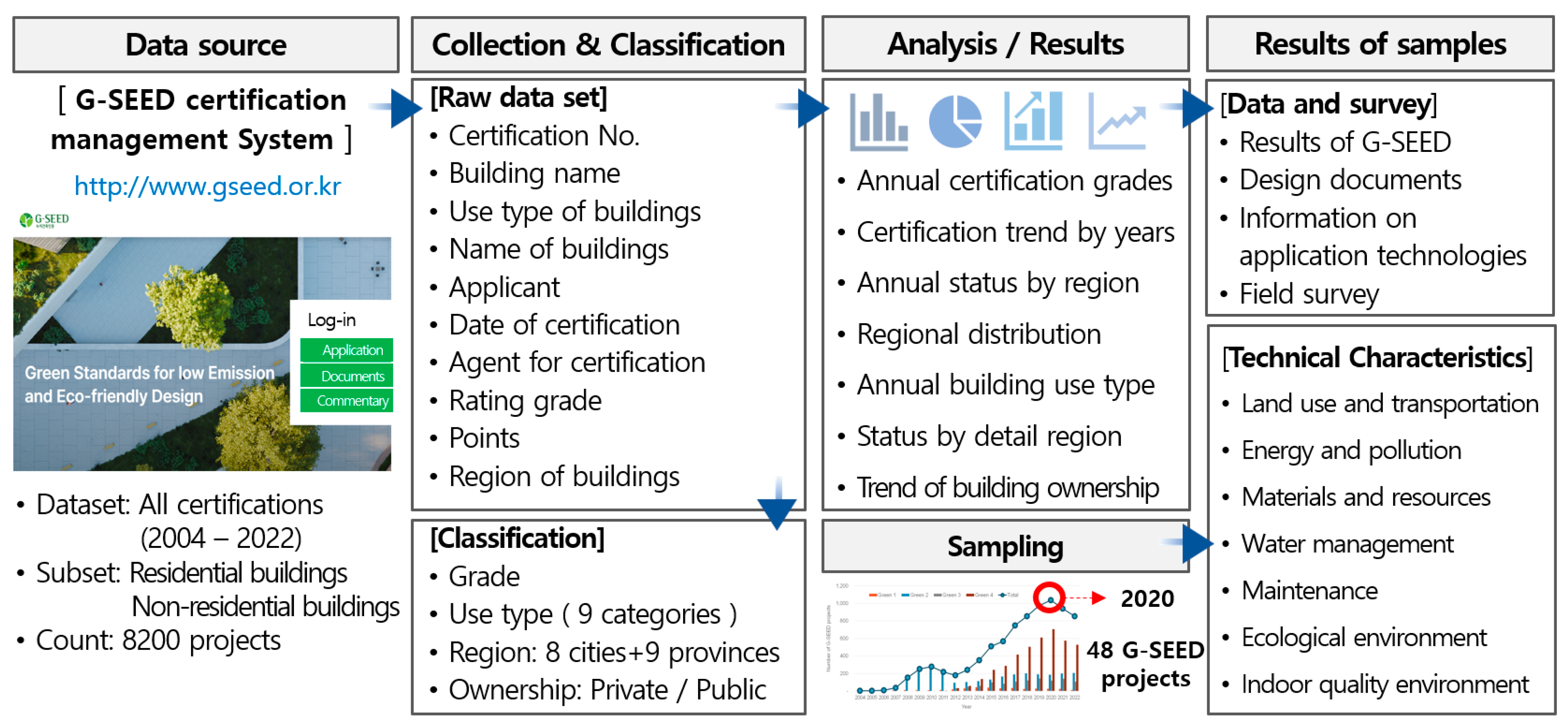
Figure 1. Framework and process of this study.
Buildings 15 04332 g001
Figure 2. Evaluation and certification process for G-SEED.
Buildings 15 04332 g002
Figure 3. Example of green building certificate by G-SEED.
Buildings 15 04332 g003
Figure 4. Example of a plaque displaying G-SEED grade.
Buildings 15 04332 g004
Figure 5. Annual number of certified buildings according to G-SEED grade.
Buildings 15 04332 g005
Figure 6. G-SEED grade distribution among certified buildings.
Buildings 15 04332 g006
Figure 7. Number of annual certified buildings according to province in South Korea.
Buildings 15 04332 g007
Figure 8. Distribution of G-SEED-certified buildings categorized by city and province.
Buildings 15 04332 g008
Figure 9. Number of annual G-SEED-certified buildings categorized by building ownership.
Buildings 15 04332 g009
Table 1. Comparison of main features of LEED, BREEAM, CASBEE, GBL and G-SEED.
LEEDBREEAMCASBEEGBLG-SEED
CountryUSAUKJapanChinaKorea
OrganizationUSGBCBREJSBCMOHURDKICT
Fist version19981990200420062002
Last versionLEED v5NC v720142020 v4.12016-v7
Main categoriesLocation & transportation
Sustainable sites
Water efficiency
Energy & atmosphere
Material & resources
Indoor environment quality
Regional priority
Innovation
Management
Health & wellbeing
Energy
Transport
Water
Material
Waste
Land use & ecology
Pollutions
Innovation
Indoor environment
Quality of service
On-site environment energy
Resources & materials
Off-site environment
Land saving & ambient environment
Energy saving & energy utilization
Water saving
Material saving &resource utilization
Indoor environment quality
Operation & management
Land use and transportation
Energy & pollution
Materials & resource
Water management
Maintenance
Ecological environment
Indoor quality environment
Rating levelLEED certified
Silver
Gold
Platinum
Pass
Good
Very good
Excellent
Outstanding
Poor
Slightly poor
Good
Very good
Superior
One-star
Two-star
Three-star
Green 4
Green 3
Green 2
Green 1
Flexibility160 countries78 countries1 country1 country3 countries
Table 2. Certification items for the field categories included in the G-SEED 2016 version.
Field CategoryCertification ItemsPoints (Score)
RB 2NRB 3
Land use and transportationEcological value of existing land site22
Too much underground development is discouraged. 33
Minimization of earthwork cutting22
Measures to impede the right to sunlight22
Pedestrian network in building complex2n/a
Accessibility of public transportation22
Appropriateness of road and parking lot for bicycle22
Proximity to amenities1n/a
Energy and pollutionEnergy performance1212
TAB 1 & commissioningn/a2
Energy monitoring and supporting device22
Lighting energy savingn/a4
Use of renewable energy33
Low-carbon energy source technology11
Prohibition of the use of specific materials to protect the ozone layer23
Plan for solar radiation control to reduce energy use for coolingn/a2
Materials and ResourcesUse of EPD44
Use of low-carbon materials22
Use of recycled materials22
Use of hazardous substance reduction materials 22
Ratio of applied green building materials44
Installation of storage facility for recyclable resources11
Water managementRainwater management55
Use of rainwater and groundwater runoff44
Use of water-saving equipment33
Water usage monitoring22
MaintenanceEnvironmental management plan for the construction site22
Providing operation and management documents22
Providing user manuals 2n/a
Providing information on G-SEED certification33
Ecological environmentArtificial green network2n/a
Green area ratio of natural ground44
Ecological area ratio106
Making biotope44
Indoor quality environmentLow-emission products of indoor air pollutants63
Natural ventilation performance22
Ventilation performance in household unit2n/a
Design of air ventsn/a2
Installation of automatic temperature control device12
Measures for comfortable indoor environmental control systemn/a2
Sound insulation performance of lightweight impact2n/a
Sound insulation performance of heavyweight impact2n/a
Sound insulation performance of boundary walls between households2n/a
Indoor and outdoor noise from traffic22
Noise of water supply and drainage in toilet2n/a
Creating an exclusive resting space in the buildingn/a1
1 TAB, testing, adjusting, and balancing; 2 RB, residential building; 3 NRB, non-residential building.
Table 3. Number of annual G-SEED-certified buildings according to G-SEED grade.
G-SEED Grade2004200520062007200820092010201120122013201420152016201720182019202020212022
Green 1122611109121929433931352428262513
Green 22163014224126920295103113131166190202191186200206
Green 3 3250589883107122143118140106
Green 4 43359137242287416505610706575528
Total338361532512782181792413515105677488539721036940853
Table 4. Number of annual G-SEED-certified buildings categorized by building use type.
Building Type2004200520062007200820092010201120122013201420152016201720182019202020212022
Residential31413498310271444988100127218322385377316364
(Apartment) 1413498310271444987100127206284306295250299
(Detached house) 100202001
(Conventional house) 103877826664
Non-residential01422104166171140130177238362384458452487560523413
(Office) 131710193332324873927510698114141133140
(Educational) 15911421341018188881471261118479967542
(Accommodation) 3323021029263627342387
(Retail) 22311222002422
(Other) 116386592155205243258296305222
Complex building 1 1 25751525785672791009910176
Table 5. Number of annual building permit to build for residential and non-residential building in Korea.
Building Type2004200520062007200820092010201120122013201420152016201720182019202020212022
Residential (X 1000)45.937.853.273.576.472.981.899.198.993.6101.9124.8130.5116.498.674.472.682.970.9
Non-residential (X 1000)43.940.557.872.071.863.877.680.377.877.578.685.486.981.481.876.080.393.786.3
Table 6. Number of buildings and G-SEED-certified buildings categorized by city and province.
RegionProjectsLocationNo. of Certified BuildingsNo. of BuildingsRatio of Certified Buildings (%)Location on the Map of South Korea
City4343Seoul2711574,4380.47Buildings 15 04332 i001
Incheon424192,1700.22
Sejong28227,4921.03
Daegoo227217,0350.1
Daejeon212123,0370.17
Busan206321,8140.06
Kwangju166127,0590.13
Ulsan115112,3120.1
Province3856Gyenggi-do2098980,5530.21
Chungbuk212323,3080.07
Chungnam257442,2070.06
Jeonbuk191367,4160.05
Jeonnam216545,0550.04
Kyeongbuk274666,1080.04
Kyeongnam317610,5790.05
Gangwon204368,6330.06
Jeju island87149,2520.06
(No. of total)8199(Total)81996,148,4680.13
Table 7. Number of sampling by G-SEED-certified buildings categorized by building type.
Building TypeSumGrade
Green 1Green 2Green 3Green 4
Total48361128
Residential building1812411
Non-residential building2624515
Complex building40022
Table 8. Applicable technologies and their application proportion in certified sample buildings.
Field CategoryApplicable Technology in Certification ItemsApplication Proportion/Average Point
RB (a/b)NRB (a/b)
Land use and transportationUnderground space development36.7%/1.320%/1.2
Use public transportation100%/1.35100%/0.8
Energy and pollutionSimulation for energy efficiency certificate100%/9.2100%/11.6
TAB or commissioningn/a15.4%/0.7
Energy metering and energy management72%/0.8642%/0.98
Energy-efficient lighting and daylight sensorn/a31%/3.6
Renewable energy system33%/1.961.5%/2.6
Cogeneration system, district heating & cooling50%/0.620%/0.6
Adjustable sun shadingn/a6.3%/0.8
Materials and ResourcesEPD material100%/2.9100%/2.4
Recycled material100%/1.4100%/0.8
Eco-label material100%/1.2100%/0.8
Water managementPermeable pavement16%/0.610%/0.8
Water saving appliance100%/395%/3
Water sub-metering100%/1.6100%/1.6
MaintenanceManual of user or operating equipment100%/2100%/2
Ecological environmentPlanting in buildings and land28.6%/4.521.4%/5.3
Indoor quality environmentNatural ventilation100%/1.660%/1.2
Heat recovery ventilation100%/210%/0.4
Control of air temperature100%/0.8100%/0.8
Control of indoor environmental (including temperature, ventilation, airflow, and lighting)n/a10%/1.2
Sound insulation & noise control96.2%/3.2n/a
TAB, testing, adjusting, and balancing; RB, residential building; NRB, non-residential building; a/b represents the status of applicable technologies, where “a” stands for application proportion (%) and “b” represents the average points in certification items.
Disclaimer/Publisher’s Note: The statements, opinions and data contained in all publications are solely those of the individual author(s) and contributor(s) and not of MDPI and/or the editor(s). MDPI and/or the editor(s) disclaim responsibility for any injury to people or property resulting from any ideas, methods, instructions or products referred to in the content.