



Multi-Faceted Analysis of Green Building Certification to Expand Green Buildings in South Korea

Abstract
1. Introduction
- This study provides detailed information about South Korea’s independent green building certification system, G-SEED, which is not well known in other contemporary studies. No study has attempted to address the technical characteristics of G-SEED certification and the status of certified buildings for 20 years. Therefore, this study provides a comprehensive assessment of green buildings and green building rating systems. This paper provides accurate information and characteristics on green building certification in Korea, one of the developing countries, in understanding the international trend of green building certification. It provides academic assistance to international researchers’ research on the technology and certification of green buildings.
- By analyzing the status of G-SEED-certified buildings, this study revealed the weaknesses of the green building certification system. To address these weaknesses, this study provided valuable suggestions for revising G-SEED. These proposals would provide meaningful insights to stakeholders or decision-makers operating green building certification systems in other countries.
- The results of the analysis of the application of green building technologies in actual certification projects allow readers of this paper to understand the technical level of green building. It also provides architects, building engineers, and building owners with information on how green buildings can be implemented.
Methods
2. South Korea’s Green Building Certification System, G-SEED
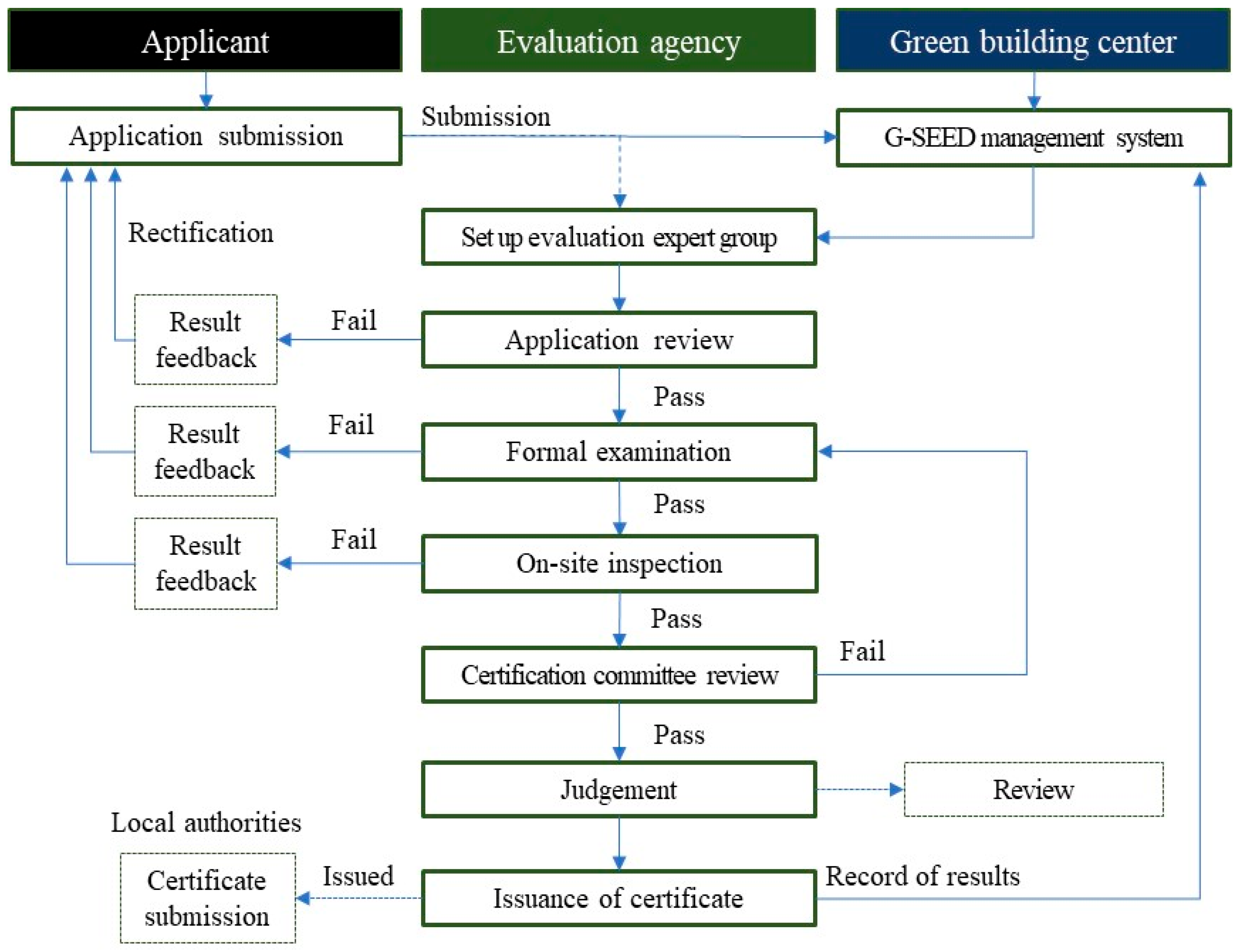
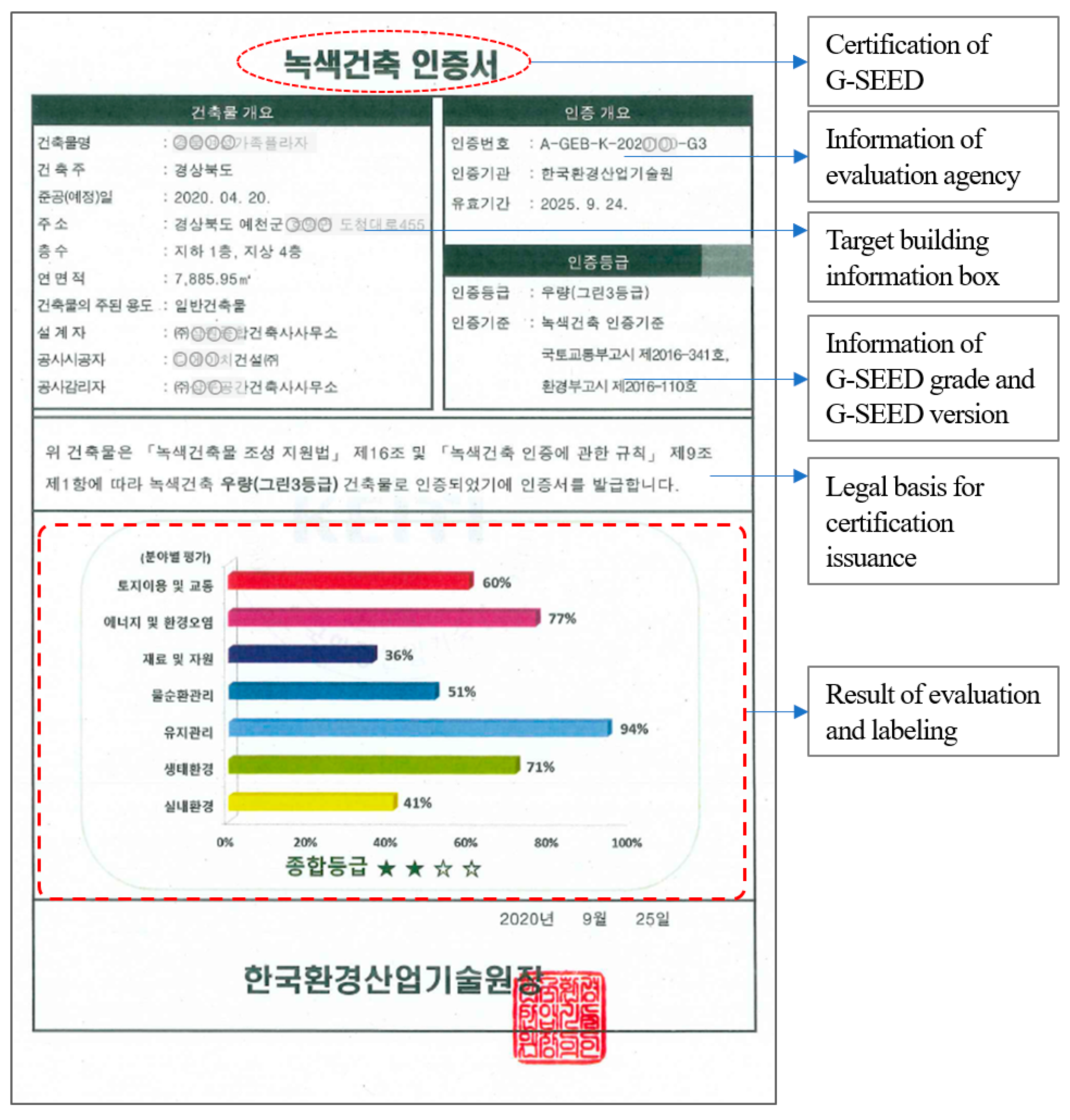
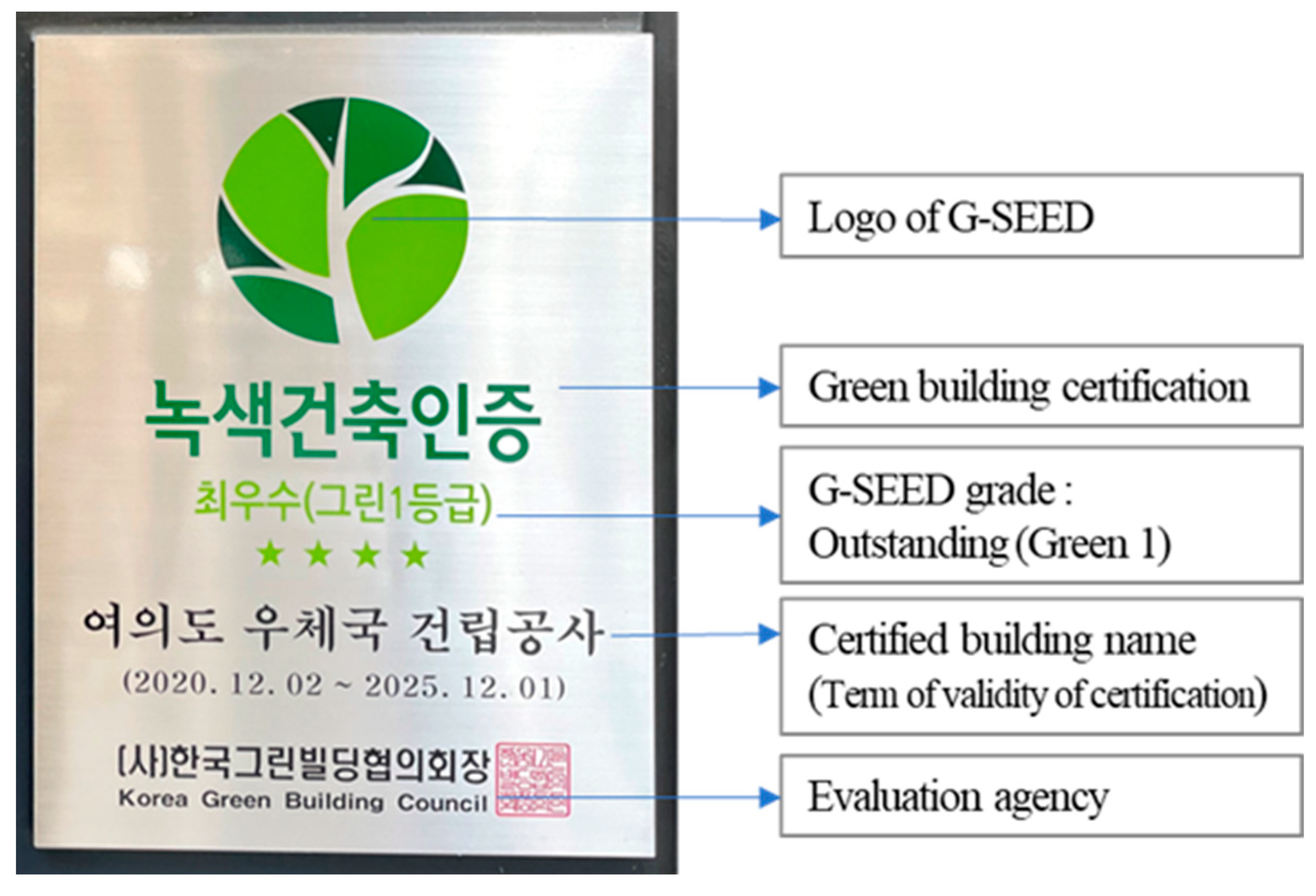
2.1. Operation and Certificate of Green Buildings
2.2. Green Building Rating Tool of G-SEED
3. Results: G-SEED Certification Situation
3.1. G-SEED Certification by Year and Certificate Grade
3.2. G-SEED Certification by Region
3.3. G-SEED Certification by Building Use Type
4. Limitations of G-SEED
4.1. Regional Distribution and Gap Between City and Province
4.2. Private and Public Buildings
5. Technical Characteristics of G-SEED-Certified Buildings
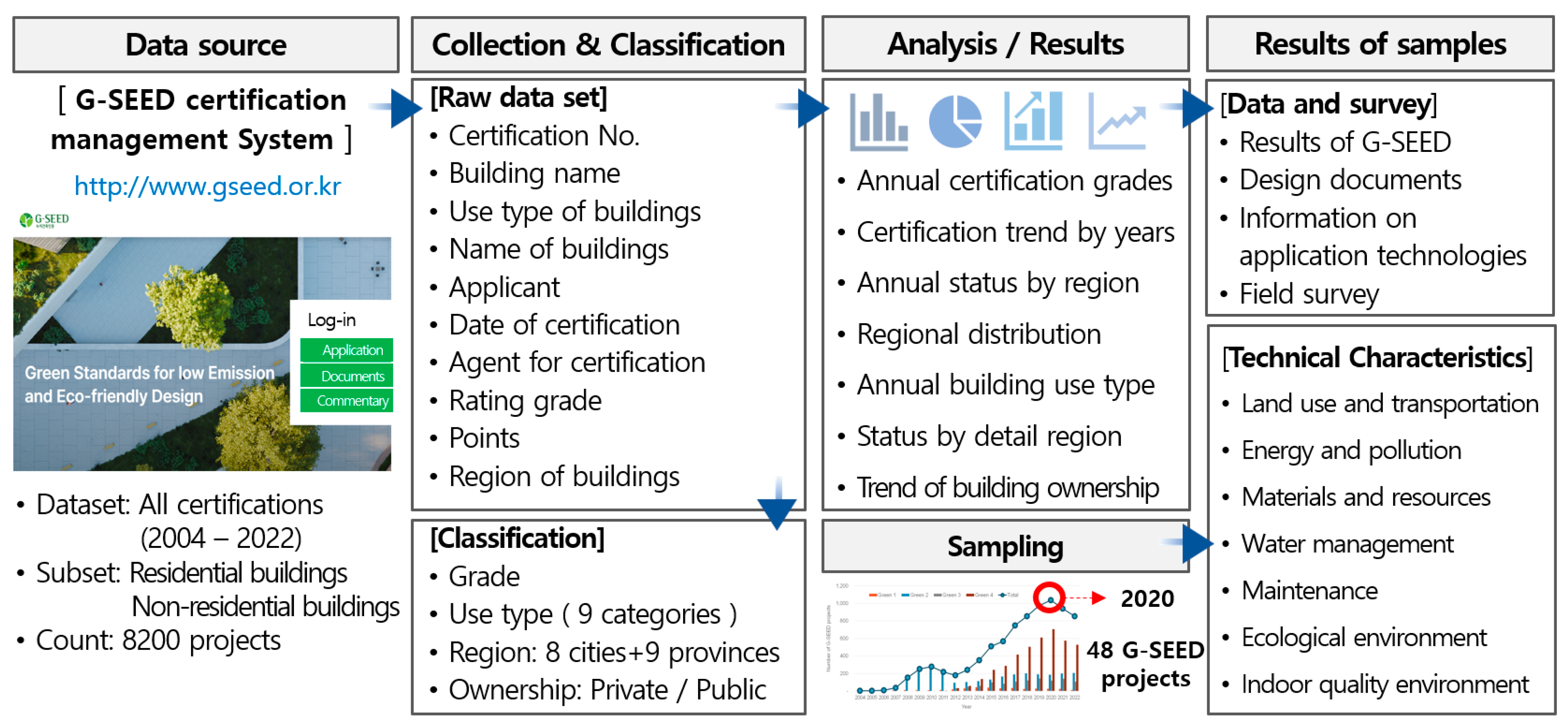
5.1. Sample for Analysis
5.2. Results by Field Category of G-SEED
5.2.1. Land Use and Transportation
5.2.2. Energy and Pollution
5.2.3. Materials and Resources
5.2.4. Water Management
5.2.5. Maintenance
5.2.6. Ecological Environment
5.2.7. Indoor Quality Environment
6. Recommendations and Discussion
6.1. Strengthening Awareness for Green Buildings
6.2. Need to Revise Certification Criteria of G-SEED
6.3. Recommendations for the Application of Green Building Technology
6.4. Limitations in This Study and Future Research
7. Conclusions
- Detailed certification items of green building certification systems evaluate aspects of building planning and technologies essential for achieving green buildings’ performance standards. This study reviewed G-SEED and analyzed the limitations of G-SEED and the technical characteristics of G-SEED-certified buildings. Following these reviews and analyses, this paper presented proposals for expanding green buildings and revising the G-SEED certification system. These proposals provide meaningful insights for decision-makers operating green building certification systems in other countries.
- Based on sample buildings, this study provided technology list used to evaluate G-SEED-certified buildings as green buildings. The most commonly adopted technical features included the use of public transportation (such as buses and bicycles), energy efficiency technologies, eco-friendly materials, water-saving appliances, operational manuals, and ventilation systems with heat recovery and air temperature control. This paper could help architects, building owners, and researchers in gaining a comprehensive understanding of G-SEED. Readers can understand the technical level of green buildings through this study.
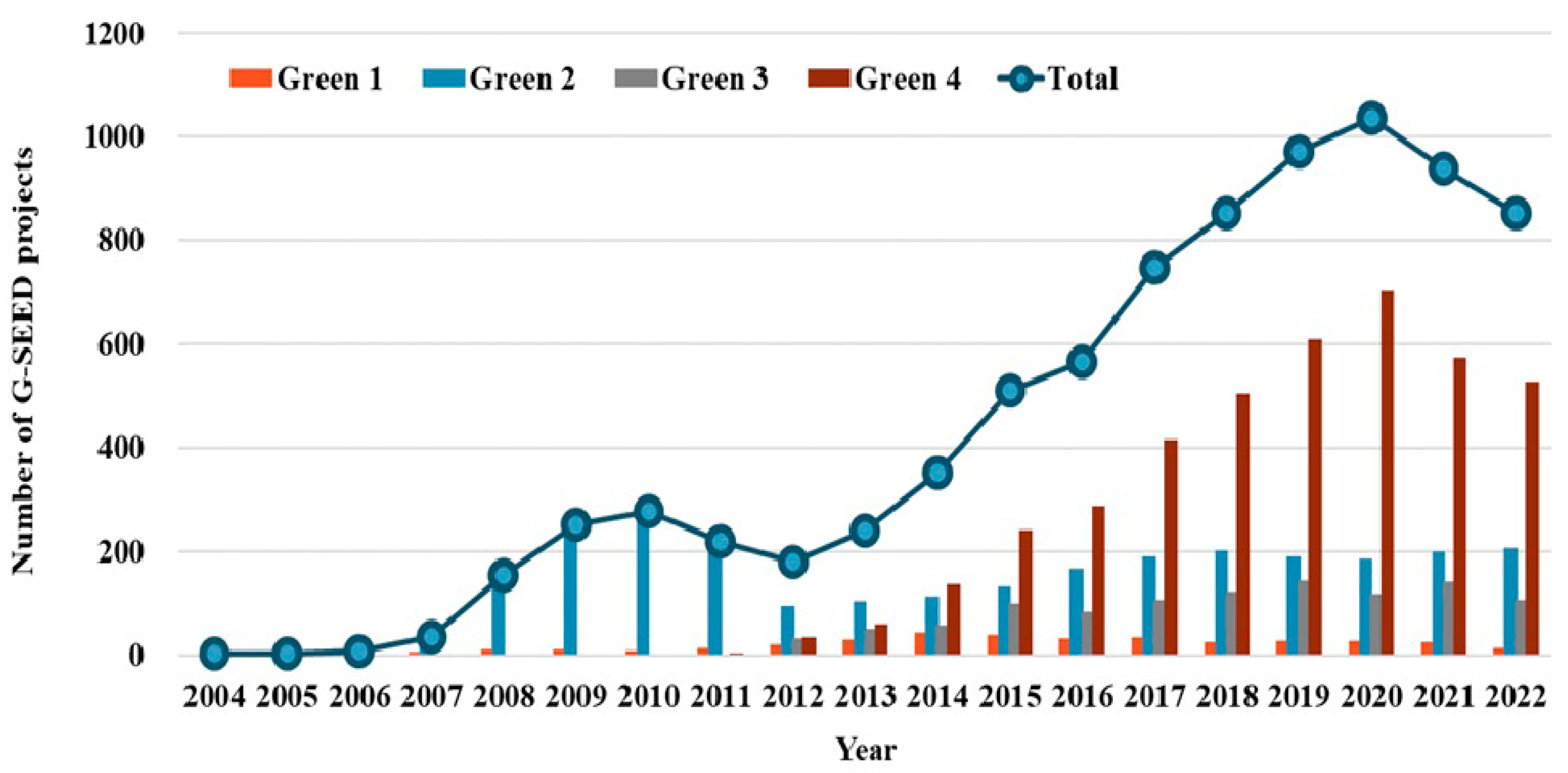
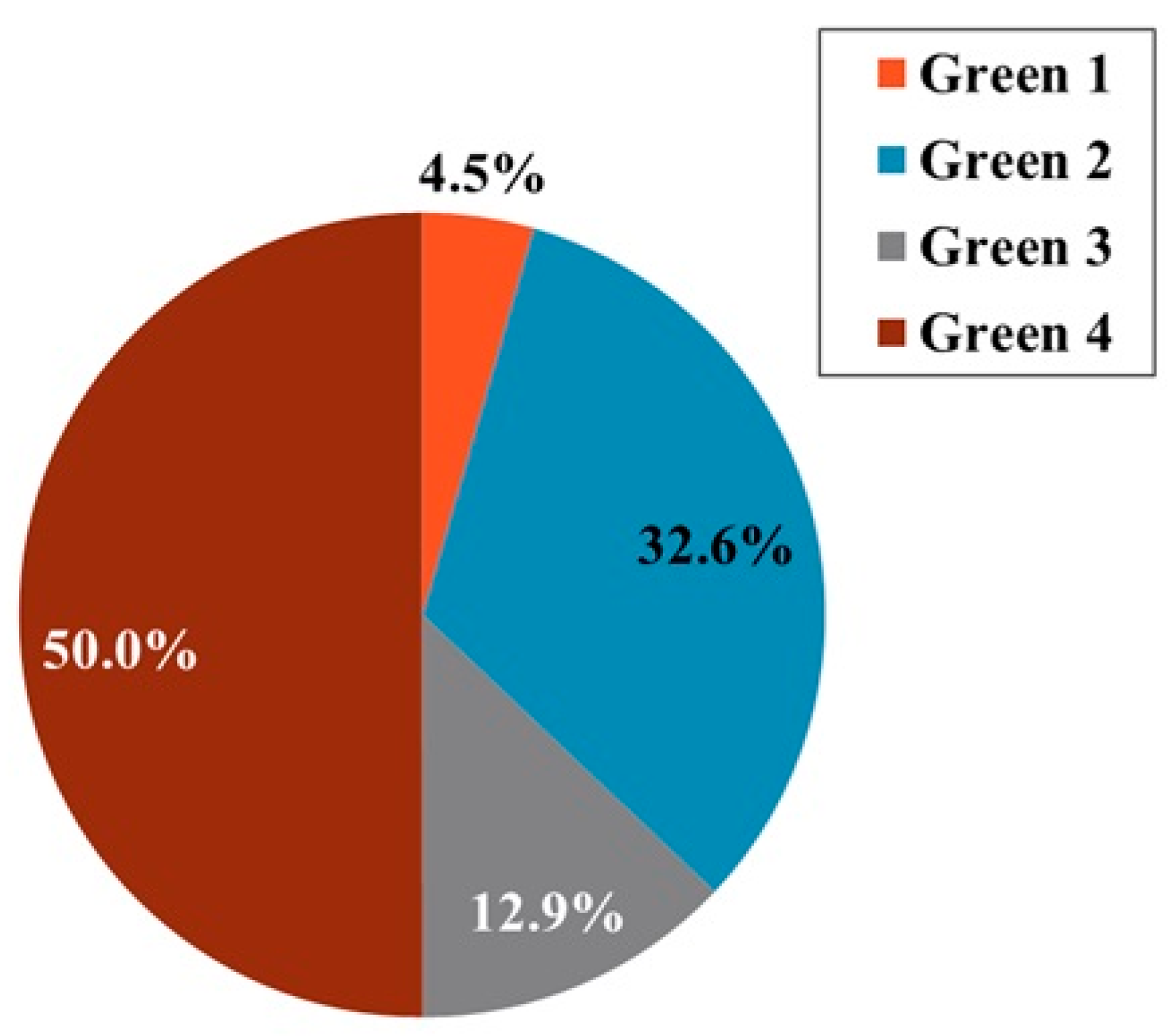
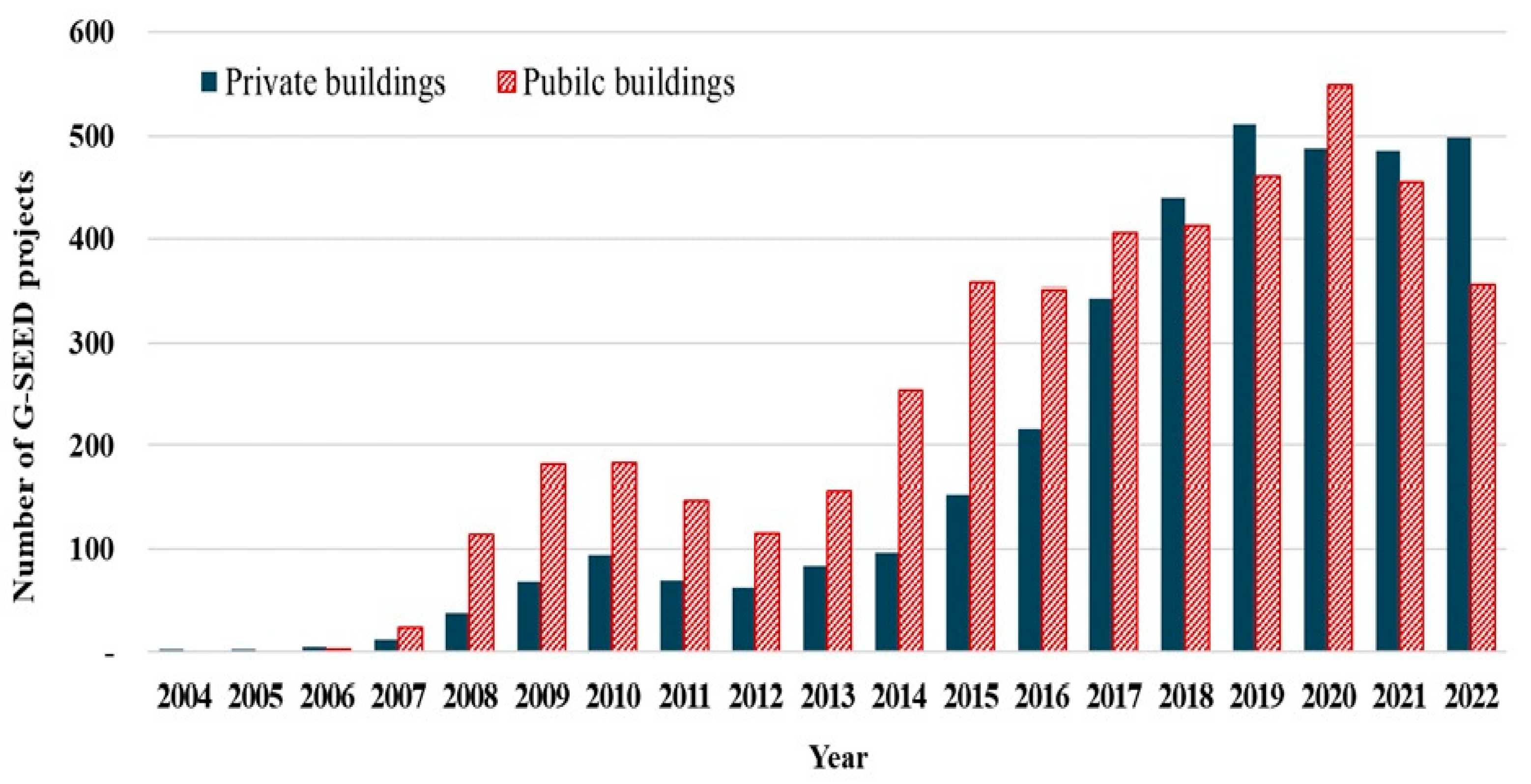
- Among the buildings certified in South Korea from 2004 to 2022, 50% received a Green 4 grade, the highest proportion. In order to increase the sustainability of the project and achieve GHG emission reduction, it is necessary to design buildings that aim for Green 2 grade or higher. For public buildings, it is mandatory to obtain Green 2 grade certification through G-SEED evaluation [11]. On the other hand, private buildings are voluntarily certified. For this reason, in order to strengthen the role of G-SEED in promoting green buildings in the private real estate market, the Korean government and the managing authority of the certification system should continuously improve G-SEED. Various measures, such as incentives and tax exemptions, should be continuously proposed to accelerate green building in private construction companies.
Funding
Data Availability Statement
Conflicts of Interest
Abbreviations
| BECC | Building Energy Conservation Code |
| BEER | Building Energy Efficiency Rating |
| BREEAM | Building Research Establishment’s Environmental Assessment Method |
| EPD | Environmental Product Declaration |
| EPI | Energy performance Index |
| G-SEED | Green Standard for Energy and Environmental Design |
| GHG | Greenhouse Gas |
| HVAC | Heating, Ventilation, and Air-conditioning System |
| LCA | Life Cycle Assessment |
| LEED | Leadership in Energy and Environmental Design |
| NRB | Non- Residential buildings |
| MOE | Korean Ministry of Environment |
| MOLIT | Korean Ministry of Land, Infrastructure and Transport |
| PM | Particulate Matter |
| RB | Residential buildings |
| TAB | Testing, Adjusting, and Balancing |
References
- Wen, B.; Musa, S.N.; Onn, C.C.; Ramesh, S.; Liang, L.; Wang, W.; Ma, K. The role and contribution of green buildings on sustainable development goals. Build. Environ. 2020, 185, 107091. [Google Scholar] [CrossRef]
- Li, Y.; Chen, X.; Wang, X.; Xu, Y.; Chen, P.H. A review of studies on green building assessment methods by comparative analysis. Energy Build. 2017, 146, 152–159. [Google Scholar] [CrossRef]
- Shan, M.; Hwang, B.G. Green building rating systems: Global reviews of practices and research efforts. Sustain. Cities Soc. 2018, 39, 172–180. [Google Scholar] [CrossRef]
- Shi, Q.; Yan, Y.; Zuo, J.; Yu, T. Objective conflicts in green buildings projects: A critical analysis. Build. Environ. 2016, 96, 107–117. [Google Scholar] [CrossRef]
- Amiri, A.; Emami, N.; Ottelin, J.; Sorvari, J.; Marteinsson, B.; Heinonen, J.; Junnila, S. Embodied emissions of buildings–A forgotten factor in green building certificates. Energy Build. 2021, 241, 110962. [Google Scholar] [CrossRef]
- Kim, M. The early case for stabilization and sustainability of Korean G-SEED based on collaborative governance: A theoretical review. Buildings 2023, 13, 2631. [Google Scholar] [CrossRef]
- Mok, S.S.; Cho, D.W.; Park, A.R. A comparative study on office building criteria between G-SEED and LEED. KIEAE J. 2014, 14, 59–66. [Google Scholar] [CrossRef][Green Version]
- Ministry of Land, Infrastructure and Transport (MOLIT). Green Buildings Consstruction Support Act; Last Revision, Act No. 11365; MOLIT: Sejong, Republic of Korea, 2012.
- Ministry of Land, Infrastructure and Transport (MOLIT). The First Master Plan for Green Building Policy; MOLIT: Sejong, Republic of Korea, 2014.
- Ministry of Land, Infrastructure and Transport (MOLIT). The 2nd Master Plan for Green Building Policy (from 2019 to 2023); MOLIT: Sejong, Republic of Korea, 2019.
- Ministry of Land, Infrastructure and Transport (MOLIT). Standards for Green Building Certification; Korean Government Notice No. 2021–278; MOLIT: Sejong, Republic of Korea, 2021.
- Home Page for Korea Green Building Festival. Korean. Available online: https://www.greenbuildingfestival.or.kr (accessed on 4 October 2024).
- Korea Institute of Civil Engineering and Building Technology (KICT). 2022 G-SEED Annual Report; KICT: Goyang-si, Republic of Korea, 2022. [Google Scholar]
- Jeong, J.; Hong, T.; Ji, C.; Kim, J.; Lee, M.; Jeong, K. Development of an evaluation process for green and non-green buildings focused on energy performance of G-SEED and LEED. Build. Environ. 2016, 105, 172–184. [Google Scholar] [CrossRef]
- Kim, K.; Koo, S.; Cho, D.; Chae, C. An Improvements of G-SEED standards by comparing with BREEAM in UK. J. Archit. Inst. Korea 2018, 34, 67–76. [Google Scholar] [CrossRef]
- Bae, C.; Choi, D. Comparative analysis of certification characteristics and score ratings of multi-unit dwellings based on preliminary and main G-SEED certifications. J. Korean Inst. Archit. Sustain. Environ. Build. Syst. 2020, 14, 803–816. [Google Scholar] [CrossRef]
- Bae, S.; Song, O. A study on the actual condition and the effect of Korean green building certification criteria—Based on apartment houses. J. Archit. Inst. Korea 2010, 26, 61–70. [Google Scholar]
- Yun, Y.S.; Jang, D.H. Analysis of certification results and items of G-SEED Multi-residential buildings. J. Korean Sol. Energy Soc. 2022, 42, 115–125. [Google Scholar] [CrossRef]
- Jeong, Y.S.; Yun, Y. Analysis of evaluation results of energy-related certification items by building use in green building certification (G-SEED). J. Korean Sol. Energy Soc. 2023, 43, 99–112. [Google Scholar] [CrossRef]
- Jung, J.D.; Choi, Y.A. An analysis of assessment indicators and certificated cases by green building program. J. Archit. Inst. Korea 2006, 22, 27–36. [Google Scholar]
- Pylon, H.; Choi, D. Development of an environmental assessment method for multi-unit residential estates. J. Archit. Inst. Korea 2001, 17, 129–136. [Google Scholar]
- Yu, S.; Cho, D. A study on the development of category and items of environmental assessment method of office building. J. Archit. Inst. Korea 2003, 19, 193–202. [Google Scholar]
- Jang, D. Proposal of improvement plan for ecological area ratio through analysis of operation status in green building certification (G-SEED). KIEAE J. 2021, 21, 11–16. [Google Scholar] [CrossRef]
- Kim, K.H.; Chae, C.U.; Cho, D. Development of an assessment method for energy performance of residential buildings using G-SEED in South Korea. J. Asian Archit. Build. Eng. 2022, 21, 133–144. [Google Scholar] [CrossRef]
- Seong, S.T.; Chang, K.D.; Myung, I.; Lee, S.H. Impact of energy performance sector on assessing green building certification: Comparison of energy performance evaluation with other sectors. KIEAE J. 2018, 18, 57–64. [Google Scholar] [CrossRef]
- Myung, I.; Yoon, H. The analysis of evaluation items on the indoor environment performance field in G-SEED. J. Archit. Inst. Korea 2023, 39, 217–224. [Google Scholar] [CrossRef]
- Yang, K. A study on the analysis of obtaining grades and improvement in the sound environment performance field in green building certification. Trans. Korean Soc. Noise Vib. Eng. 2020, 30, 659–672. [Google Scholar] [CrossRef]
- Korea Institute of Civil Engineering and Building Technology (KICT). Green Building Certification Management System. Available online: https://www.gseed.or.kr (accessed on 4 October 2024).
- Seo, S.; Yun, Y.; Park, J. Appeal to the spread of green building on existing building sector by G-SEED certification status and standards proposal. J. Korean Sol. Energy Soc. 2022, 42, 69–76. [Google Scholar] [CrossRef]
- Ministry of Land, Infrastructure and Transport (MOLIT). The Building Energy Saving Design Standards for Buildings; Korean Government: Sejong, Republic of Korea, 2022.
- Statistics Korea, & Korean Statistical Information Service. Available online: https://kosis.kr/index/index.do (accessed on 11 November 2025).
- Ministry of Land, Infrastructure and Transport (MOLIT). Standards for Building Energy Efficiency Certification and Zero Energy Building Certification; MOLIT: Sejong, Republic of Korea, 2018.
- Park, D.J.; Yu, K.H.; Yoon, Y.S.; Kim, K.H.; Kim, S.S. Analysis of a building energy efficiency certification system in Korea. Sustainability 2015, 7, 16086–16107. [Google Scholar] [CrossRef]
- Lee, S.Y.; Kim, J.H.; Yoo, S.H. Estimating the demand function for residential heat through district heating system using time series data. J. Energy Eng. 2022, 31, 15–22. [Google Scholar] [CrossRef]
- Kang, S.M.; Lee, T.K.; Kim, J.U. A study on simulation for decreasing energy demand according to window-to-wall ratio and installation blind system in building. J. Korean Inst. Archit. Sustain. Environ. Build. Syst. 2018, 12, 531–542. [Google Scholar] [CrossRef]
- Tsai, W.T.; Tsai, C.H. Interactive analysis of green building materials promotion with relevance to energy consumption and greenhouse gas emissions from Taiwan’s building sector. Energy Build. 2022, 261, 111959. [Google Scholar] [CrossRef]
- Korea Eco-Label Portal. Available online: https://ecosq.or.kr/websquare.do#w2xPath=/cm/main/eco/index_ece.xml (accessed on 13 September 2024).
- National Institute of Environment Research. Annual Report of Air Quality in Korea 2021, National Statistical Approval No. 106003; National Institute of Environment Research: Incheon, Republic of Korea, 2022. [Google Scholar]
- Roh, S.; Tae, S.; Shin, S. Development of building materials embodied greenhouse gases assessment criteria and system (BEGAS) in the newly revised Korea green building certification system (G-SEED). Renew. Sustain. Energy Rev. 2014, 35, 410–421. [Google Scholar] [CrossRef]
- Sarfarazi, S.; Mascolo, I.; Modano, M.; Guarracino, F. Application of artificial intelligence to support design and analysis of steel structures. Metals 2025, 15, 408. [Google Scholar] [CrossRef]
- Doan, D.T.; Ghaffarianhoseini, A.; Naismith, N.; Zhang, T.; Ghaffarianhoseini, A.; Tookey, J. A critical comparison of green building rating systems. Build. Environ. 2017, 123, 243–260. [Google Scholar] [CrossRef]

| LEED | BREEAM | CASBEE | GBL | G-SEED | |
|---|---|---|---|---|---|
| Country | USA | UK | Japan | China | Korea |
| Organization | USGBC | BRE | JSBC | MOHURD | KICT |
| Fist version | 1998 | 1990 | 2004 | 2006 | 2002 |
| Last version | LEED v5 | NC v7 | 2014 | 2020 v4.1 | 2016-v7 |
| Main categories | Location & transportation Sustainable sites Water efficiency Energy & atmosphere Material & resources Indoor environment quality Regional priority Innovation | Management Health & wellbeing Energy Transport Water Material Waste Land use & ecology Pollutions Innovation | Indoor environment Quality of service On-site environment energy Resources & materials Off-site environment | Land saving & ambient environment Energy saving & energy utilization Water saving Material saving &resource utilization Indoor environment quality Operation & management | Land use and transportation Energy & pollution Materials & resource Water management Maintenance Ecological environment Indoor quality environment |
| Rating level | LEED certified Silver Gold Platinum | Pass Good Very good Excellent Outstanding | Poor Slightly poor Good Very good Superior | One-star Two-star Three-star | Green 4 Green 3 Green 2 Green 1 |
| Flexibility | 160 countries | 78 countries | 1 country | 1 country | 3 countries |
| Field Category | Certification Items | Points (Score) | |
|---|---|---|---|
| RB 2 | NRB 3 | ||
| Land use and transportation | Ecological value of existing land site | 2 | 2 |
| Too much underground development is discouraged. | 3 | 3 | |
| Minimization of earthwork cutting | 2 | 2 | |
| Measures to impede the right to sunlight | 2 | 2 | |
| Pedestrian network in building complex | 2 | n/a | |
| Accessibility of public transportation | 2 | 2 | |
| Appropriateness of road and parking lot for bicycle | 2 | 2 | |
| Proximity to amenities | 1 | n/a | |
| Energy and pollution | Energy performance | 12 | 12 |
| TAB 1 & commissioning | n/a | 2 | |
| Energy monitoring and supporting device | 2 | 2 | |
| Lighting energy saving | n/a | 4 | |
| Use of renewable energy | 3 | 3 | |
| Low-carbon energy source technology | 1 | 1 | |
| Prohibition of the use of specific materials to protect the ozone layer | 2 | 3 | |
| Plan for solar radiation control to reduce energy use for cooling | n/a | 2 | |
| Materials and Resources | Use of EPD | 4 | 4 |
| Use of low-carbon materials | 2 | 2 | |
| Use of recycled materials | 2 | 2 | |
| Use of hazardous substance reduction materials | 2 | 2 | |
| Ratio of applied green building materials | 4 | 4 | |
| Installation of storage facility for recyclable resources | 1 | 1 | |
| Water management | Rainwater management | 5 | 5 |
| Use of rainwater and groundwater runoff | 4 | 4 | |
| Use of water-saving equipment | 3 | 3 | |
| Water usage monitoring | 2 | 2 | |
| Maintenance | Environmental management plan for the construction site | 2 | 2 |
| Providing operation and management documents | 2 | 2 | |
| Providing user manuals | 2 | n/a | |
| Providing information on G-SEED certification | 3 | 3 | |
| Ecological environment | Artificial green network | 2 | n/a |
| Green area ratio of natural ground | 4 | 4 | |
| Ecological area ratio | 10 | 6 | |
| Making biotope | 4 | 4 | |
| Indoor quality environment | Low-emission products of indoor air pollutants | 6 | 3 |
| Natural ventilation performance | 2 | 2 | |
| Ventilation performance in household unit | 2 | n/a | |
| Design of air vents | n/a | 2 | |
| Installation of automatic temperature control device | 1 | 2 | |
| Measures for comfortable indoor environmental control system | n/a | 2 | |
| Sound insulation performance of lightweight impact | 2 | n/a | |
| Sound insulation performance of heavyweight impact | 2 | n/a | |
| Sound insulation performance of boundary walls between households | 2 | n/a | |
| Indoor and outdoor noise from traffic | 2 | 2 | |
| Noise of water supply and drainage in toilet | 2 | n/a | |
| Creating an exclusive resting space in the building | n/a | 1 | |
| G-SEED Grade | 2004 | 2005 | 2006 | 2007 | 2008 | 2009 | 2010 | 2011 | 2012 | 2013 | 2014 | 2015 | 2016 | 2017 | 2018 | 2019 | 2020 | 2021 | 2022 |
|---|---|---|---|---|---|---|---|---|---|---|---|---|---|---|---|---|---|---|---|
| Green 1 | 1 | 2 | 2 | 6 | 11 | 10 | 9 | 12 | 19 | 29 | 43 | 39 | 31 | 35 | 24 | 28 | 26 | 25 | 13 |
| Green 2 | 2 | 1 | 6 | 30 | 142 | 241 | 269 | 202 | 95 | 103 | 113 | 131 | 166 | 190 | 202 | 191 | 186 | 200 | 206 |
| Green 3 | 32 | 50 | 58 | 98 | 83 | 107 | 122 | 143 | 118 | 140 | 106 | ||||||||
| Green 4 | 4 | 33 | 59 | 137 | 242 | 287 | 416 | 505 | 610 | 706 | 575 | 528 | |||||||
| Total | 3 | 3 | 8 | 36 | 153 | 251 | 278 | 218 | 179 | 241 | 351 | 510 | 567 | 748 | 853 | 972 | 1036 | 940 | 853 |
| Building Type | 2004 | 2005 | 2006 | 2007 | 2008 | 2009 | 2010 | 2011 | 2012 | 2013 | 2014 | 2015 | 2016 | 2017 | 2018 | 2019 | 2020 | 2021 | 2022 |
|---|---|---|---|---|---|---|---|---|---|---|---|---|---|---|---|---|---|---|---|
| Residential | 3 | 1 | 4 | 13 | 49 | 83 | 102 | 71 | 44 | 49 | 88 | 100 | 127 | 218 | 322 | 385 | 377 | 316 | 364 |
| (Apartment) | 1 | 4 | 13 | 49 | 83 | 102 | 71 | 44 | 49 | 87 | 100 | 127 | 206 | 284 | 306 | 295 | 250 | 299 | |
| (Detached house) | 1 | 0 | 0 | 2 | 0 | 2 | 0 | 0 | 1 | ||||||||||
| (Conventional house) | 10 | 38 | 77 | 82 | 66 | 64 | |||||||||||||
| Non-residential | 0 | 1 | 4 | 22 | 104 | 166 | 171 | 140 | 130 | 177 | 238 | 362 | 384 | 458 | 452 | 487 | 560 | 523 | 413 |
| (Office) | 1 | 3 | 17 | 10 | 19 | 33 | 32 | 32 | 48 | 73 | 92 | 75 | 106 | 98 | 114 | 141 | 133 | 140 | |
| (Educational) | 1 | 5 | 91 | 142 | 134 | 101 | 81 | 88 | 88 | 147 | 126 | 111 | 84 | 79 | 96 | 75 | 42 | ||
| (Accommodation) | 3 | 3 | 2 | 3 | 0 | 2 | 10 | 29 | 26 | 36 | 27 | 34 | 23 | 8 | 7 | ||||
| (Retail) | 2 | 2 | 3 | 1 | 1 | 2 | 2 | 2 | 0 | 0 | 2 | 4 | 2 | 2 | |||||
| (Other) | 1 | 16 | 38 | 65 | 92 | 155 | 205 | 243 | 258 | 296 | 305 | 222 | |||||||
| Complex building | 1 | 1 | 2 | 5 | 7 | 5 | 15 | 25 | 78 | 56 | 72 | 79 | 100 | 99 | 101 | 76 |
| Building Type | 2004 | 2005 | 2006 | 2007 | 2008 | 2009 | 2010 | 2011 | 2012 | 2013 | 2014 | 2015 | 2016 | 2017 | 2018 | 2019 | 2020 | 2021 | 2022 |
|---|---|---|---|---|---|---|---|---|---|---|---|---|---|---|---|---|---|---|---|
| Residential (X 1000) | 45.9 | 37.8 | 53.2 | 73.5 | 76.4 | 72.9 | 81.8 | 99.1 | 98.9 | 93.6 | 101.9 | 124.8 | 130.5 | 116.4 | 98.6 | 74.4 | 72.6 | 82.9 | 70.9 |
| Non-residential (X 1000) | 43.9 | 40.5 | 57.8 | 72.0 | 71.8 | 63.8 | 77.6 | 80.3 | 77.8 | 77.5 | 78.6 | 85.4 | 86.9 | 81.4 | 81.8 | 76.0 | 80.3 | 93.7 | 86.3 |
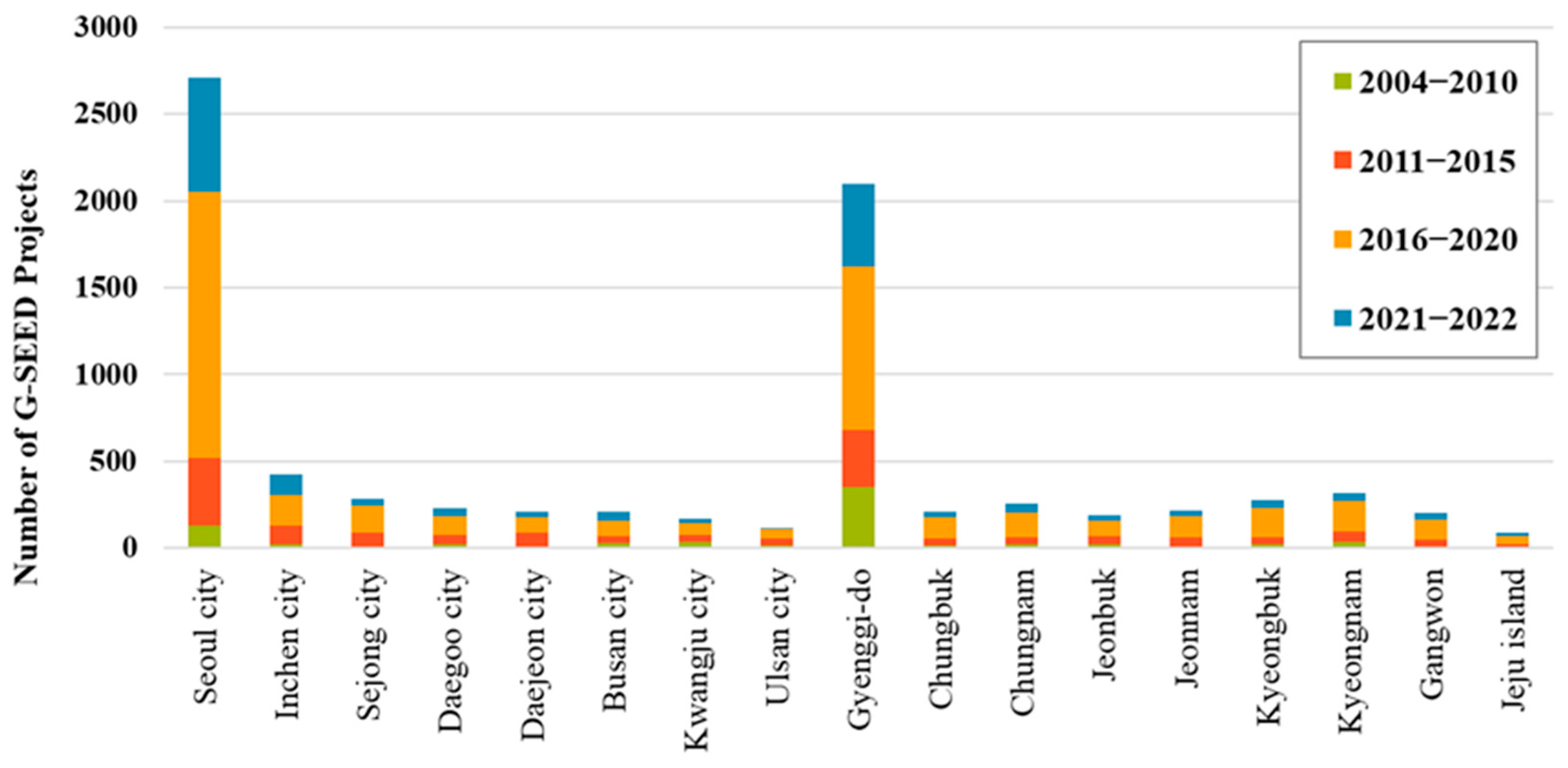
| Region | Projects | Location | No. of Certified Buildings | No. of Buildings | Ratio of Certified Buildings (%) | Location on the Map of South Korea |
|---|---|---|---|---|---|---|
| City | 4343 | Seoul | 2711 | 574,438 | 0.47 |  |
| Incheon | 424 | 192,170 | 0.22 | |||
| Sejong | 282 | 27,492 | 1.03 | |||
| Daegoo | 227 | 217,035 | 0.1 | |||
| Daejeon | 212 | 123,037 | 0.17 | |||
| Busan | 206 | 321,814 | 0.06 | |||
| Kwangju | 166 | 127,059 | 0.13 | |||
| Ulsan | 115 | 112,312 | 0.1 | |||
| Province | 3856 | Gyenggi-do | 2098 | 980,553 | 0.21 | |
| Chungbuk | 212 | 323,308 | 0.07 | |||
| Chungnam | 257 | 442,207 | 0.06 | |||
| Jeonbuk | 191 | 367,416 | 0.05 | |||
| Jeonnam | 216 | 545,055 | 0.04 | |||
| Kyeongbuk | 274 | 666,108 | 0.04 | |||
| Kyeongnam | 317 | 610,579 | 0.05 | |||
| Gangwon | 204 | 368,633 | 0.06 | |||
| Jeju island | 87 | 149,252 | 0.06 | |||
| (No. of total) | 8199 | (Total) | 8199 | 6,148,468 | 0.13 |
| Building Type | Sum | Grade | |||
|---|---|---|---|---|---|
| Green 1 | Green 2 | Green 3 | Green 4 | ||
| Total | 48 | 3 | 6 | 11 | 28 |
| Residential building | 18 | 1 | 2 | 4 | 11 |
| Non-residential building | 26 | 2 | 4 | 5 | 15 |
| Complex building | 4 | 0 | 0 | 2 | 2 |
| Field Category | Applicable Technology in Certification Items | Application Proportion/Average Point | |
|---|---|---|---|
| RB (a/b) | NRB (a/b) | ||
| Land use and transportation | Underground space development | 36.7%/1.3 | 20%/1.2 |
| Use public transportation | 100%/1.35 | 100%/0.8 | |
| Energy and pollution | Simulation for energy efficiency certificate | 100%/9.2 | 100%/11.6 |
| TAB or commissioning | n/a | 15.4%/0.7 | |
| Energy metering and energy management | 72%/0.86 | 42%/0.98 | |
| Energy-efficient lighting and daylight sensor | n/a | 31%/3.6 | |
| Renewable energy system | 33%/1.9 | 61.5%/2.6 | |
| Cogeneration system, district heating & cooling | 50%/0.6 | 20%/0.6 | |
| Adjustable sun shading | n/a | 6.3%/0.8 | |
| Materials and Resources | EPD material | 100%/2.9 | 100%/2.4 |
| Recycled material | 100%/1.4 | 100%/0.8 | |
| Eco-label material | 100%/1.2 | 100%/0.8 | |
| Water management | Permeable pavement | 16%/0.6 | 10%/0.8 |
| Water saving appliance | 100%/3 | 95%/3 | |
| Water sub-metering | 100%/1.6 | 100%/1.6 | |
| Maintenance | Manual of user or operating equipment | 100%/2 | 100%/2 |
| Ecological environment | Planting in buildings and land | 28.6%/4.5 | 21.4%/5.3 |
| Indoor quality environment | Natural ventilation | 100%/1.6 | 60%/1.2 |
| Heat recovery ventilation | 100%/2 | 10%/0.4 | |
| Control of air temperature | 100%/0.8 | 100%/0.8 | |
| Control of indoor environmental (including temperature, ventilation, airflow, and lighting) | n/a | 10%/1.2 | |
| Sound insulation & noise control | 96.2%/3.2 | n/a | |
Disclaimer/Publisher’s Note: The statements, opinions and data contained in all publications are solely those of the individual author(s) and contributor(s) and not of MDPI and/or the editor(s). MDPI and/or the editor(s) disclaim responsibility for any injury to people or property resulting from any ideas, methods, instructions or products referred to in the content. |
© 2025 by the author. Licensee MDPI, Basel, Switzerland. This article is an open access article distributed under the terms and conditions of the Creative Commons Attribution (CC BY) license (https://creativecommons.org/licenses/by/4.0/).
Share and Cite
Jeong, Y.-S. Multi-Faceted Analysis of Green Building Certification to Expand Green Buildings in South Korea. Buildings 2025, 15, 4332. https://doi.org/10.3390/buildings15234332
Jeong Y-S. Multi-Faceted Analysis of Green Building Certification to Expand Green Buildings in South Korea. Buildings. 2025; 15(23):4332. https://doi.org/10.3390/buildings15234332
Chicago/Turabian StyleJeong, Young-Sun. 2025. "Multi-Faceted Analysis of Green Building Certification to Expand Green Buildings in South Korea" Buildings 15, no. 23: 4332. https://doi.org/10.3390/buildings15234332
APA StyleJeong, Y.-S. (2025). Multi-Faceted Analysis of Green Building Certification to Expand Green Buildings in South Korea. Buildings, 15(23), 4332. https://doi.org/10.3390/buildings15234332

