Article

Analyzing Strategies for Promoting the Adoption of Construction Robots: A DEMATEL–ISM–FBN Approach

School of Transportation and Civil Engineering, Nantong University, Nantong 226019, China
*
Author to whom correspondence should be addressed.
Buildings 2025, 15(23), 4306; https://doi.org/10.3390/buildings15234306
Submission received: 24 September 2025 / Revised: 21 November 2025 / Accepted: 26 November 2025 / Published: 27 November 2025
(This article belongs to the Special Issue Automation and Intelligence in the Construction Industry)

Abstract

Construction robots (CRs) are regarded as a promising solution to improve productivity, safety, and labor efficiency in the construction industry, yet their adoption remains limited. Although several studies have attempted to identify promotion strategies for CR adoption, few have explored the dynamic interdependencies among them. Using China as a case study, this research develops a hybrid framework integrating DEMATEL, Interpretive Structural Modeling (ISM), and a Fuzzy Bayesian Network (FBN) to examine the causal mechanisms, structural hierarchies, and dynamic sensitivities of strategies for promoting CR adoption. The results identify two strategies as the most influential, which exert broad effects on other strategies. ISM results indicate that three strategies, which are all financial related, serve as underlying causes that fundamentally support the overall CR adoption pathway. Furthermore, both DEMATEL and FBN analyses highlight that establishing standardized systems for CRs covering functionality, performance, and safety and improving CR compatibility with other intelligent construction technologies are the most critical strategies, as they achieved the highest integrated scores across sensitivity and importance dimensions, indicating their pivotal role in driving system-wide improvements. The findings provide valuable insights for policymakers and industry practitioners to better understand and implement multidimensional strategies to improve robot adoption in the construction industry.

1. Introduction

The construction industry encompasses a wide range of activities, including building construction, civil engineering, and infrastructure development, which is characterized by labor-intensive, site-based, and highly fragmented production processes [1]. It plays a fundamental role in the global economy, which serves as a key engine of economic growth [2,3]. However, over the past few decades, the industry has struggled with stagnation in productivity growth [4]. The global annual labor productivity growth rate in construction is less than 1%, significantly lower than the global economy’s average of approximately 2.8% [5]. Meanwhile, as a major contributor to the global economy and a key provider of employment opportunities, the construction sector is also facing a worldwide shortage of skilled labor [6]. For instance, a report from the Associated General Contractors of America revealed that 94% of construction enterprises are struggling to fill key craft positions, highlighting the severity of the labor shortage [7]. To address these challenges, it is critical to adopt advanced technologies that can enhance productivity and improve overall project performance in the construction industry. In recent years, digital construction technologies such as Building Information Modeling (BIM), artificial intelligence, and digital twins have been increasingly adopted to improve project coordination and information management. While these tools significantly enhance decision-making and planning efficiency, they mainly operate in the virtual domain and therefore exert limited influence on the physical execution of construction tasks, which still depends heavily on human labor. In comparison, construction robots (CRs), which are defined as machines capable of autonomously or semi-autonomously executing construction tasks based on pre-defined programming, have emerged as a promising solution to overcome the limitations of traditional project delivery methods [8,9]. Empirical evidence suggests that CRs can markedly enhance operational efficiency and reduce project delivery time, with reported improvements in productivity ranging from 20% to 40% and reductions in labor intensity of up to 50% in pilot implementations across various trades [10,11]. Additionally, robotic systems can mitigate safety risks by relieving workers from dangerous tasks [12]. For instance, Brosque and Fischer [13] evaluated ten on-site CRs across twelve projects and revealed that these robots reduced repetitive site work by up to 90%, decreased time spent on hazardous tasks by an average of 72%, and improved work accuracy by 55%, resulting in an overall 50% reduction in rework. With continued advances in intelligent computing [14] and physics-informed modeling [15], CRs have achieved remarkable improvements in operational efficiency, precision, and safety, laying a robust technological foundation for their large-scale application in construction.
Despite the benefits of CRs, their adoption in the construction industry remains relatively low compared to sectors such as automotive and electronics manufacturing [12]. To facilitate CR adoption in construction, an increasing amount of research has emerged, which focused on two main perspectives, namely barriers and enablers influencing adoption, and the strategies designed to facilitate it. For instance, Oke et al. [16] identified financial barriers as the most critical, highlighting that the high capital investment required for robotic systems poses a major challenge, particularly for Small- and Medium-sized Enterprises (SMEs) with limited financial capacity. Bademosi and Issa [17] highlighted technological barriers, noting that the immaturity of robotic technologies and the need for frequent maintenance impede the widespread adoption of robots in the construction industry. Furthermore, Kaasinen et al. [18] underscored workforce-related barriers, indicating insufficient training opportunities and resistance from workers due to fear of job displacement as critical obstacles to the successful deployment of CRs. In contrast, several enabling factors have also been recognized. For example, Park et al. [19] identified top management support as the most influential determinant in facilitating CR adoption. Moreover, Pan et al. [20] highlighted that integrating robotics with modern construction methods, particularly by increasing the use of prefabricated components, can significantly improve the feasibility and effectiveness of on-site robot deployment.
On the other hand, to address the barriers hindering CR adoption, numerous strategies have been proposed in existing studies. For instance, to overcome technical limitations faced by the Hong Kong construction industry, Law et al. [21] emphasized the need to strengthen collaboration among contractors, local universities, and government agencies to share development costs and address challenges related to technical maturity. Pan and Pan [22] added that promoting modular and standardized building components can enhance CR compatibility across diverse construction scenarios. To address financial constraints, Yang et al. [23] highlighted the importance of government funding, especially in supporting SMEs. Delgado et al. [12] further noted that industry–academia collaboration can effectively alleviate the financial burden on construction enterprises adopting CRs in European countries. Regarding workforce-related barriers encountered by the United States construction industry, Pradhananga et al. [24] proposed targeted training programs to improve workforce capacity, addressing skill gaps in robot integration. However, the effectiveness of these strategies remains underexplored due to a lack of empirical research. In practice, governments have also introduced various strategies to promote CR adoption. For instance, Japan’s New Robot Strategy actively promoted the internationalization of CR-related technologies and industries [25]. In China, CRs have been integrated into several national-level smart construction pilot programs, and provinces such as Jiangsu and Guangdong have established dedicated funding schemes to encourage their on-site application [26]. Despite the extensive efforts made worldwide, the relative importance of these strategies remains underexplored, making it difficult to prioritize actions and allocate resources effectively. Moreover, it has been consistently noted across international studies that existing strategies are often developed and implemented in isolation, without considering their causal relationships, hierarchical structures, or dynamic interactions. This fragmented approach undermines strategic coherence and limits their overall effectiveness. As Chen et al. [27] noted, China has yet to establish a well-coordinated, multi-tiered policy system to support the adoption of emerging technologies, highlighting the need for an integrated, evidence-based strategic framework.
To address this knowledge gap, using China as a case study, this research employed an integrated approach to comprehensively examine the dynamic and hierarchical relationships among strategies for promoting the adoption of CRs. First, key strategies were identified through a critical literature review, analysis of policy documents, and expert judgment. Second, Decision-making Trial and Evaluation Laboratory (DEMATEL) was employed to assess the influencing degree, influenced degree, centrality, and causal relationships among these strategies, thereby classifying them into cause and effect groups. Third, Interpretive Structural Modeling (ISM) was employed to construct a hierarchical structure based on the DEMATEL results, which clarified the interrelationships among the strategies and provided a structural foundation for subsequent modeling. Third, a Fuzzy Bayesian Network (FBN) was developed through mapping the hierarchical structure into a probabilistic framework, with expert judgment translated into prior and conditional probabilities using fuzzy sets and noisy-OR models. The FBN model enabled quantification of inter-strategy relationships and dynamic inference, thereby allowing evaluation of how changes in these strategies affect CR adoption under different scenarios. This comprehensive approach enhances the depth of analysis of robot-adopted strategies, going beyond previous studies that only identified potential strategies. The research findings provide valuable insights for the Chinese government, enterprises, and their counterparts in countries with similar industrial environments to promote robot adoption in the construction industry.

2. Literature Review

2.1. Application of Construction Robots in the Construction Industry

Construction robots, as key enablers of automation in the construction industry, have a relatively shorter history compared to industrial robots [8]. Robotic technology for construction was first proposed in the 1970s, with practical application efforts beginning in the early 1980s [28]. Since then, researchers gradually began exploring various applications of robots in construction. For example, Slocum and Schena [29] developed an early vision-guided bricklaying robot capable of identifying and placing bricks along predefined paths using visual sensors and motion control. Pritschow et al. [30] designed an automated masonry system that integrated robotic arms and control software to perform block positioning and stacking tasks, demonstrating the potential of robotics for repetitive on-site operations.
In recent years, the fast development of digital and intelligent technologies has resulted in significant expansion in research on various types of CRs and their deployment across different project stages. For instance, Mirjan et al. [31] developed a multi-drone system capable of autonomously weaving a rope bridge, demonstrating the potential of aerial robots in on-site component assembly. Through advanced algorithms and sensor integration, modern CRs can be precisely controlled to perform complex tasks autonomously, which has proven to significantly enhance overall project performance [8]. Illustrative cases include ICON’s Vulcan 3D printing system, which can construct the core structure of a 2000 ft2 (approximately 186 m2) single-story house within 7–10 days using only two operators, thereby substantially reducing both manual labor requirements and construction time compared to conventional methods [32]. In Australia, Fastbrick Robotics’ Hadrian X automated bricklaying robot achieves millimeter-level precision and can construct entire exterior walls directly from digital models, greatly improving both the efficiency and consistency of masonry work [33]. In China, CRs have achieved scaled deployment in specialized domains such as prefabricated component handling [34], curtain wall cleaning [35], and concrete pouring [36], leading to notable reductions in labor dependency and improvements in construction efficiency. However, despite these efforts, the adoption of robots in construction continues to lag behind other industries. As Wang et al. [37] noted, only 55% of the global construction industry has integrated robots, a rate considerably lower than that achieved in the automotive (84%) and manufacturing (79%) industries. Thus, it is imperative to improve the integration and utilization of robotic technology in the construction industry.

2.2. Promotion Strategies for the Adoption of Construction Robots

To promote the adoption of CRs, researchers have also proposed strategies aimed at reducing implementation barriers and facilitating technology integration. Delgado et al. [12] suggested that the high initial costs of construction robotics pose a significant challenge for SMEs, highlighting the need for financial support mechanisms to stimulate enterprise-driven Research and Development (R&D). Yang et al. [23] indicated the importance of interdisciplinary talent development, particularly the integration of robotics, construction engineering, and project management in enhancing the industry’s absorptive capacity for automation technologies. From a technical systems perspective, Pan and Pan [38] found that the compatibility between CRs and existing intelligent construction technologies such as Building Information Modeling and sensor networks significantly influences contractors’ adoption decisions. In addition, Pan and Pan [22] underscored the need for developing task-specific robots tailored for various construction scenarios, including production, installation, and maintenance, as a key strategy for improving field applicability and deployment effectiveness. Pradhananga et al. [24] further added that tailoring robotic applications to specific site tasks not only improves task efficiency but also increases acceptance among end-users. Moreover, Huang et al. [4] and Pan and Pan [18] highlighted that promoting standardized production of building components could help reduce variability in on-site conditions, thereby enhancing the operational efficiency of CRs.
Based on a comprehensive review of the extant literature, sixteen strategies (in Table 1) for promoting the adoption of CRs have been identified. However, most of these strategies remain conceptual, with limited empirical research validating their effectiveness in real-world contexts. Furthermore, existing studies often examine these strategies in isolation, failing to explore their potential interactions. This fragmented approach may overlook important synergies among the strategies and result in inefficient resource allocation, ultimately diminishing the overall effectiveness of the strategies. Therefore, it is essential to investigate the interrelationships among these strategies, which can provide insights into how they can be effectively integrated to facilitate the broader adoption of CRs.

3. Research Methodology

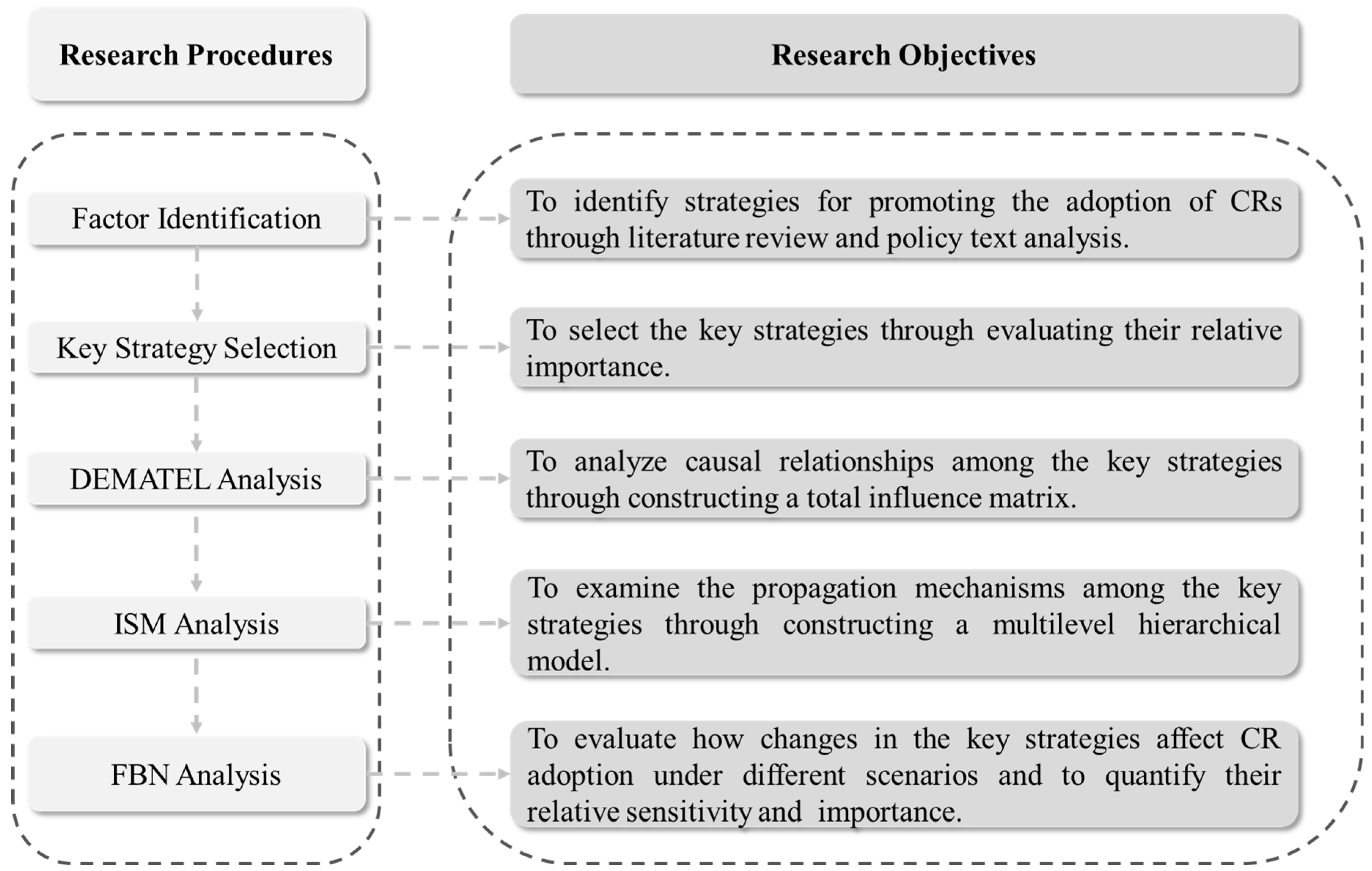
To comprehensively examine the dynamic and hierarchical relationships among key strategies for promoting the adoption of CRs, this study adopts an integrated methodological framework combining qualitative identification with quantitative analysis. Unlike traditional approaches, such as standalone statistical analyses or simple multi-criteria decision-making methods, which often treat influencing factors as independent and static, the proposed DEMATEL-ISM-FBN framework explicitly captures the interdependent, hierarchical, and dynamic nature of adoption strategies. As shown in Figure 1, the process involves five main stages: (1) identifying thirty-four initial strategies through literature review and policy text analysis via Python 3.12 and VOSviewer 1.6.20.0; (2) selecting key strategies based on expert survey results using the Relative Importance Index (RII); (3) analyzing causal relationships among key strategies using the DEMATEL method; (4) constructing a hierarchical structure using the ISM method; and (5) quantifying inter-strategy influence and realizing dynamic inference through developing a FBN. This integration follows a coherent analytical logic: DEMATEL provides the causal foundation, ISM translates these causal links into an interpretable structural hierarchy that clarifies how strategies are interrelated across levels, and FBN extends this static hierarchy into a dynamic and probabilistic model capable of simulating how changes in one strategy propagate through the system. Together, these methods create a systematic pathway from qualitative identification to dynamic, evidence-based strategic reasoning. This integrated methodological approach has been successfully employed in prior studies, such as for examining the interrelationships among housing infrastructure resilience factors against flood hazards [39] and for exploring schedule risk factors in prefabricated building projects [40].

3.1. Decision-Making Trial and Evaluation Laboratory

The DEMATEL method has been widely recognized as an efficient approach for visualizing complex causal relationships among evaluated factors through using matrices or directed graphs [41]. It quantifies the extent to which each factor influences and is influenced by others, thereby facilitating the identification of cause-effect links and offering clear insights for decision-makers [42]. In the construction domain, DEMATEL has been increasingly applied to analyze interdependencies among barriers and factors. For example, Zhang [43] applied a Grey-DEMATEL approach to reveal the causal structure of obstacles to deploying intelligent robots in construction projects, while Feldmann et al. [44] used a fuzzy DEMATEL model to identify and prioritize the interrelated barriers affecting modular construction adoption from a developer perspective. In this study, the DEMATEL method is employed to capture and quantify the causal relationships among key strategies that promote the adoption of CRs. It identifies both the strength and direction of influence among strategies, clarifying which act as primary drivers and which are mainly affected. The results provide a quantitative foundation for constructing the subsequent multi-level hierarchical model using the ISM method, thereby ensuring that the hierarchical structure is grounded in a clear and empirically derived causal network. According to the principles of DEMATEL, the following procedures are involved.
First, domain experts are invited to perform pairwise ratings of the direct influence of factor i on factor j using a 0–4 scale (0 = no influence, 1 = low influence, 2 = medium influence, 3 = high influence, and 4 = very high influence). Each expert completes an n × n judgment matrix, where the diagonal elements are fixed to zero, reflecting that a factor does not directly influence itself. The individual judgment matrices are then aggregated to obtain the direct-influence matrix A = a i j n × n , as shown in Equation (1).
A = 0 a 1 n a n 1 0 = a i j n × n , a i i = 0
where a i j is calculated as the mean of expert judgements according to Equation (2).
a i j = 1 l k = 1 l a i j k , i , j = 1 , 2 , 3 , , n
where a i j k represents the judgment of interviewee k ( k = ( 1 , 2 , 3 , , l ) on the degree to which factor i affects factor j .
Subsequently, to eliminate scale effects and ensure comparability and convergence in subsequent calculations, the direct matrix A is normalized to obtain the normalized direct influence matrix Y = y i j , as shown in Equations (3) and (4):
Y = A s
s = m a x 1 i n j = 1 n a i j
where s   is the maximum row sum of A , ensuring that all y i j 0,1 .
This normalization step makes the data dimensionless and guarantees that the iterative calculation of total influences converges. The total influence matrix is then captured using Equations (5) and (6):
T = Y + Y 2 + Y 3 + + Y k = Y I Y 1
T = t i j n n i , j = 1 , 2 , 3 , , n
where I is the identity matrix, and t i j represents the comprehensive influence of factor i on factor j , incorporating both direct influences and all indirect effects.
Finally, the influence degree D i , affected degree C i , centrality M i , and causality R i of each factor can be calculated from the total influence matrix T , according to Equations (7)–(10). The influence degree D i is the sum of each row in the total influence matrix T , reflecting the overall influence exerted by a factor on the others. The affected degree C i is the sum of each column in the matrix, reflecting the total influence received by a factor from others. The centrality M i , defined as D i   +   C i , indicates the importance of a factor in the system, with higher values corresponding to greater significance. The causality R i , defined as D i     C i , reveals the influence of a factor on the total system. A positive R i suggests that the factor exerts a stronger influence on others and thus functions as a cause factor, whereas a negative R i indicates that the factor is primarily influenced by others, categorizing it as a result factor.
D i = j = 1 n t i j , i = 1 , 2 , 3 , , n
C i = j = 1 n t j i , i = 1 , 2 , 3 , , n
M i = D i + C i
R i = D i C i

3.2. Interpretative Structural Modeling Method

The ISM method, proposed by Warfield [45], is used to construct hierarchical models of influential factors within complex systems. The basic principle of ISM is to decompose a complex system into several subsystems (elements) using the practical experience and knowledge of experts, thereby simplifying the complexity of the system [46]. For instance, Kim et al. [47] applied an ISM–MICMAC (Matrix of Cross-Impact Multiplications Applied to a Classification) framework to identify and prioritize critical barriers to the adoption of robots in the construction phase, decomposing the complex barrier system into hierarchical subsystems and clarifying driving and dependent relationships among them. In this study, ISM builds upon the causal relationships identified through DEMATEL and transforms them into an interpretable hierarchical structure that reveals how different strategies interconnect across multiple levels [48]. Through this process, ISM clarifies the direction of influence and the logical hierarchy among strategies. This hierarchy spans from foundational and enabling strategies that provide essential conditions, to integrative ones that coordinate stakeholders, and finally to outcome-oriented strategies that directly improve CR adoption. This hierarchical modeling allows the subsequent analysis to capture the transmission paths and systemic interactions among strategies in a structured and transparent manner.
ISM is fundamentally designed to reveal the hierarchical and causal structures within complex systems. Although traditionally applied to identify barriers, critical factors, or risks, its core logic, which is the recognition of interdependence and directional influence, remains equally valid for analyzing strategies. In this context, the lower levels of an ISM hierarchy represent foundational or enabling strategies that establish the necessary conditions for higher-level strategies to take effect. This hierarchical interpretation clarifies how different strategies interact and collectively contribute to system performance. Recent studies have extended the use of ISM to policy and strategic analysis. For instance, Li et al. [49] employed an ISM–MICMAC approach to model interrelations among energy-efficiency policies in the manufacturing sector, demonstrating that ISM can effectively capture multi-level strategic linkages and causal pathways. Similarly, Mahaur and Peter [50] applied the ISM–MICMAC approach to develop a structured model of climate-change mitigation strategies in India, identifying key initiatives and their interconnections to strengthen coordination and enhance sustainable development outcomes.
In this study, ISM is applied as a structural tool to distinguish between foundational, integrative, and outcome-oriented strategies for promoting CR adoption. The lower levels represent enabling or prerequisite strategies. The middle levels include integrative strategies that translate these foundations into coordinated mechanisms or collaborative frameworks across stakeholders. The upper levels consist of implementation-oriented strategies that directly drive observable improvements in CR utilization. This hierarchical interpretation reflects a progression from enabling conditions to coordinated mechanisms and ultimately to measurable outcomes, emphasizing that the effectiveness of each strategy depends on its interaction with others within the overall system. The procedure involves the following steps.
To build an ISM diagram of influencing factors, a reachability matrix K is required, which is derived from the overall influence matrix G . The overall influence matrix G is calculated by adding the identity matrix I to the total influence matrix T , as shown in Equation (11):
G = T + I
This step ensures that each factor is considered self-reachable, with all diagonal entries in G equal to 1. The reachability matrix K is then obtained by applying an appropriate threshold value λ to binarize the elements of G : if g i j λ , then k i j = 1 ; otherwise k i j = 0 . In this study, λ is determined based on the mean and standard deviation of all elements in the total influence matrix T , following the approach of Costa et al. [51].
Based on the reachability matrix K , two subsets are constructed for each influencing factor f i : the reachability set R i , which includes all factors reachable from f i , and the antecedent set S i , which consists of all factors that can reach f i . Specifically, R i is defined as the set of factors corresponding to the entries with a value of 1 in row i of matrix K , while S i is derived from the entries with a value of 1 in column i of matrix K . The common set C i is defined as the intersection of these two sets. The corresponding equations are shown below:
R i = f i f i f i F , K i j = 1 , i , j = 1 , 2 , 3 , , n
S i = f j f j f j F , K j i = 1 , i , j = 1 , 2 , 3 , , n
C i = R i S i , i = 1 , 2 , 3 , , n
where F = f j 1 n , ( j = 1 , 2 , 3 , , n ) is the entire set of factors.
If a factor satisfies the condition R i = C i , it is considered to be at the highest level in the current iteration, as it does not influence any other factor outside of its own reach. All such factors are assigned to the current hierarchical level and then removed from the matrix K by eliminating the corresponding rows and columns. This procedure is repeated iteratively on the reduced matrix until all factors are assigned to specific hierarchical levels.

3.3. A Fuzzy Bayesian Network

3.3.1. Fuzzy Sets

In Bayesian Network (BN) modeling, quantifying prior and conditional probabilities remains challenging, particularly when empirical data are limited and variables involve subjective judgments or uncertainty. To address this issue, this study incorporates fuzzy set theory to systematically transform the linguistic expressions of experts into fuzzy numbers. Among various types of fuzzy numbers, triangular fuzzy numbers are widely used for their simple structure and computational efficiency [52]. Therefore, this study adopts triangular fuzzy numbers to represent event probabilities, with their membership function defined in Equation (15).
μ A x = 0                     x < a x a m a , a x m b x b m ,   m x b 0                   x > b
where a m b with a , m , and b   denote the lower, medium and upper bounds of triangular fuzzy number, respectively.
Following the approaches of Chen and Qiao [53] and Abdullah et al. [54], qualitative linguistic terms were converted into fuzzy numbers to quantify expert judgements. The conversion employed a standard five-level scale, where “Very Low (VL)” was defined as (0, 0, 0.25), “Low (L)” as (0, 0.25, 0.5), “Medium (M)” as (0.25, 0.5, 0.75), “High (H)” as (0.5, 0.75, 1), and “Very High (VH)” as (0.75, 1, 1). Specifically, this scale was used to define fuzzy probability intervals, enabling a systematic parameterization of the Bayesian network under uncertainty. In this study, an expert questionnaire was designed using the five linguistic terms, and triangular fuzzy numbers were applied to estimate the occurrence probabilities of the identified key strategies for promoting the adoption of CRs.

3.3.2. A Bayesian Network

A Bayesian network is a graphical probabilistic model based on Bayesian inference, represented by a directed acyclic graph that encodes conditional dependencies among variables. Under a causal interpretation, an arc X  → Y indicates a causal influence from X to Y. The structure comprises nodes and directed edges, together with prior probabilities and Conditional Probability Tables (CPTs). Root nodes (variables without parents) are specified by prior probabilities obtained from data or expert elicitation, whereas non-root nodes are parameterized by CPTs that condition on the joint states of their parents. In this study, the BN builds upon the structural hierarchy derived from ISM and extends it into a dynamic probabilistic framework that captures uncertainty and allows inference across changing conditions. By updating probabilities as new evidence or scenario inputs are introduced, the BN functions as a dynamic model capable of simulating how variations in one strategy probabilistically propagate through the system. This enables forward and backward inference to explore how variations in one strategy may probabilistically influence others, thereby complementing the deterministic causal structure established by DEMATEL and ISM. In the construction sector, similar BN based frameworks have been successfully applied to analyze safety and project risks, such as safety risk assessment in construction projects [55] and catenary construction risk assessment [56], which demonstrates the suitability of Bayesian networks for modeling complex causal mechanisms under uncertainty. Leveraging this structure, a BN enables the construction of a joint probability distribution over a set of variables   X = ( X 1 , X 2 , X 3 , X n ) , as shown in Equation (16):
P X = P X 1 , X 2 , X 3 , X n = i = 1 n P X i P a X i
In the above equation, P a X i denotes the set of parent nodes of the variable X i   in the network, and P X i P a X i   represents the conditional probability of X i given the joint state of its parent variables. Based on Bayes’ theorem, BN supports both forward and backward inference. Forward inference refers to reasoning from cause to effect, that is, calculating the prior probability of a child node using Equation (17), when the prior probabilities of its parent nodes are known. Backward inference, on the other hand, is applied when new observational evidence is introduced for a variable (such as E ). In this case, the probability distributions of related nodes are updated accordingly, and the posterior probability of the target variable is derived using Equation (18), enabling reasoning from effect to cause.
P X i = X j , j i P X
P X E = P X , E P E = P X , E X P X , E
In this study, the prior probabilities of strategy occurrence were derived through questionnaire surveys combined with fuzzy logic. Specifically, for a given expert H k ( k = 1 , 2 , 3 , , n , where n denotes the total number of experts), the rating assigned to a strategy was converted into a corresponding triangular fuzzy number, P i k = ( a i k , m i k , b i k ) , as described in Section 3.3.1. Based on Equation (19), the arithmetic mean fuzzy number was calculated and subsequently defuzzified using the center of area method. The defuzzification process strictly followed the procedure specified in Equation (20), ensuring an exact transformation of triangular fuzzy numbers. The resulting values were then determined as the prior probability distribution for the root nodes within the research framework.
P i = p i 1 P i 2 P i 3 P i n n = a i , m i , n i , b i
P i = a i + m i + b i 3
In BN modeling, the conditional probability distribution of a child node must be specified according to all possible combinations of its parent nodes’ states. When the number of parent nodes is large, enumerating these probability combinations becomes computationally intensive. To simplify this process, a combination of expert knowledge with noisy-OR gate models can be employed, which reduces the evaluation burden on experts and improves computational efficiency [57].
Consider a child node B   with n   binary parents ( A 1 , A 2 , , A i , , A n ) , each in a state of either “yes” (occurrence) or “no” (non-occurrence). For any parent   A i , let P ( B A i ) , represent the probability that B occurs given that   A i occurs and all other parents do not. It is expressed as the following:
P B A i = P B A i , A ¯ j i , i 1 , n
where A ¯ j i indicates that all other parent nodes except A i are in the non-occurrence state.
Based on the noisy-OR model, the conditional probability of the child node B can be calculated using Equation (22).
B A = 1 A i A ( 1 P B A i
In this study, the impact sensitivity of strategies for promoting CR adoption was evaluated through analyzing the range of variation ( R o v ) between prior and posterior probabilities. The sensitivity of each strategy was quantitatively determined according to Equation (23).
R o v A i = ξ A i ς A i ς A i
where ς ( A i ) and ξ A i   denote the prior and posterior probabilities of   A i , respectively.

4. Application of the Proposed Methodology

4.1. Identification of Key Strategies

A dual-method approach, combining literature review and policy text analysis, was employed to identify a comprehensive set of strategies for promoting the adoption of CRs. Sixteen strategies were first extracted through a critical review of relevant literature, as detailed in the literature review section. For example, several studies identified maintenance and repair challenges, such as the lack of skilled operators and the high technical complexity of robotic systems, as key barriers to CR utilization [4,17]. In response to this, corresponding strategies were extracted from the literature, including providing comprehensive training programs to enhance workers’ technical competences, which can improve the reliability of maintenance operations and reduce system downtime [4,24]. To further enrich and expand the strategies beyond those discussed in academic research, policy text analysis was subsequently conducted. Thirty-four policy documents issued by central or local governments in China after 2020 were collected and analyzed using computational text analysis. Following the procedure outlined by Dai et al. [58], the policy texts were processed with Python 3.12 and VOSviewer 1.6.20.0 to extract key terms and thematic clusters. This analysis yielded an additional eighteen strategies that are underexplored in academic research.
To ensure conceptual clarity and eliminate potential policy redundancy, the initially identified strategies were validated through an expert evaluation process prior to quantitative analysis. Policy redundancy can undermine the effectiveness of complex policy systems by reducing implementation efficiency and strategic clarity [59]. It may also cause resource waste and stakeholder confusion due to overlapping responsibilities or duplicated initiatives [60]. Therefore, expert validation was conducted to ensure that each strategy was clearly defined, conceptually distinct, and non-overlapping with others. The experts were purposively selected from contractors, clients, universities/CR R&D enterprises, and consulting enterprises, all of which should possess over 10-year experience in CRs. To guide their evaluation, three explicit criteria were provided: (i) Functional overlap—two strategies employ similar instruments to address the same problem for the same target group; (ii) Hierarchical containment—one strategy essentially represents a sub-item or implementation pathway of another; and (iii) Conceptual ambiguity—a strategy simultaneously incorporates multiple policy intentions that lack clear conceptual boundaries. Based on these criteria, each expert independently reviewed and compared all candidate strategies and, where necessary, recommended merging, splitting, or rephrasing them to enhance precision and avoid duplication. For example, an initial broad strategy that conflated “developing technical standards for CRs” with “embedding those standards into supervisory practice” was identified during expert validation. This strategy was subsequently split into two distinct strategies: establishing standardized systems for CRs covering functionality, performance, and safety (GS1) and incorporating CR construction standards into government oversight systems to guarantee quality and performance (GS10). Through this validation process, thirty-four conceptually distinct strategies for promoting CR adoption were identified. They were subsequently categorized into Government-related Strategies (GS) and Enterprise-related Strategies (ES) following the framework of Huang et al. [4], as presented in Table 1.
Subsequently, to ensure analytical focus and practical relevance, the Relative Importance Index (RII) was employed to prioritize the identified strategies. This quantitative ranking provided an objective basis for identifying those with the highest perceived significance and implementation potential. Prioritization through RII enabled subsequent analyses to concentrate on the most influential strategies, thereby improving the interpretability and practical applicability of the results. RII has been widely used in construction management studies to rank variables based on their perceived significance [61]. In this study, experts rated each of the thirty-four validated strategies on a five-point Likert scale (from “1 = very low importance” to “5 = very high importance”), and RII values were calculated using Equation (24):
R I I = W A × N
where W is the score assigned by each expert, A is the maximum possible score, and N is the number of respondents.
RII values were calculated for all thirty-four strategies based on expert survey data. To determine which strategies should be prioritized, a threshold of RII ≥ 0.80 was applied, following Adanu et al. [62], who employed the same criterion to classify highly important factors in a construction safety study. As a result, eleven strategies exceeding this threshold were selected as the core set for the subsequent DEMATEL-ISM-FBN analysis. Table 1 presents the sources and corresponding RII values of all thirty-four strategies.
Table 1. Sources and RII values for each strategy.
CodeStrategiesLiterature SourcesPolicy Text AnalysisRII
Industry/Government-Related Strategies
GS1Establishing standardized systems for CRs covering functionality, performance, and safety 0.826
GS2Developing systematic guidelines to promote and facilitate CR utilization[23,24]0.768
GS3Promoting multi-level government collaboration to support CR utilization 0.789
GS4Encouraging universities to offer CR-related degree programs and courses 0.792
GS5Prioritizing land allocation for CR industrial hubs and pilot projects 0.777
GS6Developing interconnected industrial clusters to improve the business ecosystem for CRs 0.811
GS7Launching pilot CR projects to demonstrate their practical benefits and feasibility[22]0.791
GS8Giving priority to CR-adopting enterprises in industry awards and certifications 0.745
GS9Offering competitive bidding advantages to enterprises utilizing CRs 0.717
GS10Incorporating CR construction standards into government oversight systems to guarantee quality and performance 0.711
GS11Enhancing funding support for enterprises involved in CR R&D[12,23]0.802
GS12Prioritizing credit support for enterprises engaged in independent CR development 0.800
GS13Offering tax incentives to stakeholders procuring CRs 0.834
GS14Offering R&D tax credits to stakeholders developing CR technologies 0.828
GS15Encouraging construction enterprises to utilize CRs through leasing mechanisms 0.785
GS16Promoting CR advantages and benefits among industry stakeholders 0.762
GS17Establishing a CR technical committee to provide best practices and evaluate field performance 0.772
Enterprise-related strategies
ES1Accelerating interdisciplinary talent cultivation for CRs[23,24,63]0.800
ES2Providing comprehensive training programs to enhance workers’ technical competencies[4,24,64]0.787
ES3Enhancing the management’s support for the utilization of CRs[38] 0.792
ES4Creating an innovation-driven environment within enterprises to accelerate CR development[24] 0.751
ES5Increasing enterprise investment for CR R&D[4,24] 0.770
ES6Redesigning business structures and organizational workflows to adapt to CR utilization[4,63] 0.762
ES7Facilitating joint development of CRs between construction and CR R&D enterprises[21,38,63]0.779
ES8Facilitating cross-industry collaboration between construction enterprises and other industries for resource sharing 0.768
ES9Enhancing cooperation among construction enterprises, academia, and research institutes to advance CR technologies[12,23]0.787
ES10Enhancing international R&D cooperation in CRs to promote global technology sharing[22,23] 0.685
ES11Promoting integrated application of CRs with other smart construction technologies[23]0.764
ES12Improving CR compatibility with other intelligent construction technologies[4,38]0.819
ES13Implementing rigorous pre-delivery quality inspections for CRs 0.779
ES14Developing task-specific CRs for production, construction, and maintenance scenarios[22,24]0.817
ES15Expanding CR product series to meet potential application scenarios 0.740
ES16Promoting standardized production of building components to enhance CR operational efficiency[4,22]0.823
ES17Facilitating the application of CR R&D outcomes in real-world construction practice 0.834
Note: “√” means that the strategy was identified in the policy text analysis. Strategies with bold RII values denote key strategies.

4.2. DEMATEL Analysis

After identifying the key strategies, this study employed the DEMATEL method to examine the interaction mechanisms among the strategies and categorize them into cause and effect groups. Following the standard procedure of DEMATEL, a pairwise comparison questionnaire was designed based on the identified key strategies. Five authoritative experts from the construction industry were invited to assess the interrelationships among these strategies. Table 2 presents the background information of the experts, including their educational levels, organization types, years of experience, and familiarity with CRs. The experts were drawn from four types of organizations (contractors, clients, universities/CR R&D enterprises, and consulting enterprises), each had over 10 years of professional experience, and possessed a good level of knowledge regarding CRs, ensuring the validity and representativeness of their evaluations. Their evaluations were conducted using a five-point Likert scale to quantify the influence of one strategy on another. Based on the collected scores, a direct influence matrix was constructed according to Equations (1) and (2), as shown in Table 3.
Although the number of experts may appear limited, a panel size of five is consistent with established practice in DEMATEL–ISM–BN studies. For instance, Ma et al. [52] employed five experts to analyze the interrelationships of contributory factors to maritime transport accidents of dangerous goods, and Zhong and Zhang [40] also invited five experts in their DEMATEL–ISM–BN study on schedule risks of prefabricated building projects. These works demonstrated that when participants possess extensive domain knowledge and represent diverse professional backgrounds, a small but high-quality expert panel can yield reliable and convergent judgments. In this study, the five selected experts each have more than ten years of experience and collectively represent four distinct organizational types, ensuring the robustness and credibility of the evaluation results.
Subsequently, the direct influence matrix was normalized using Equations (3) and (4), after which a total influence matrix was derived using Equations (5) and (6). This matrix captures both direct and indirect effects among the strategies, thereby providing essential input for the subsequent development of the ISM [52]. Based on the total influence matrix, the influencing degree, influenced degree, centrality, and causality of each strategy were calculated using Equations (7)–(10). The corresponding results are presented in Table 4.
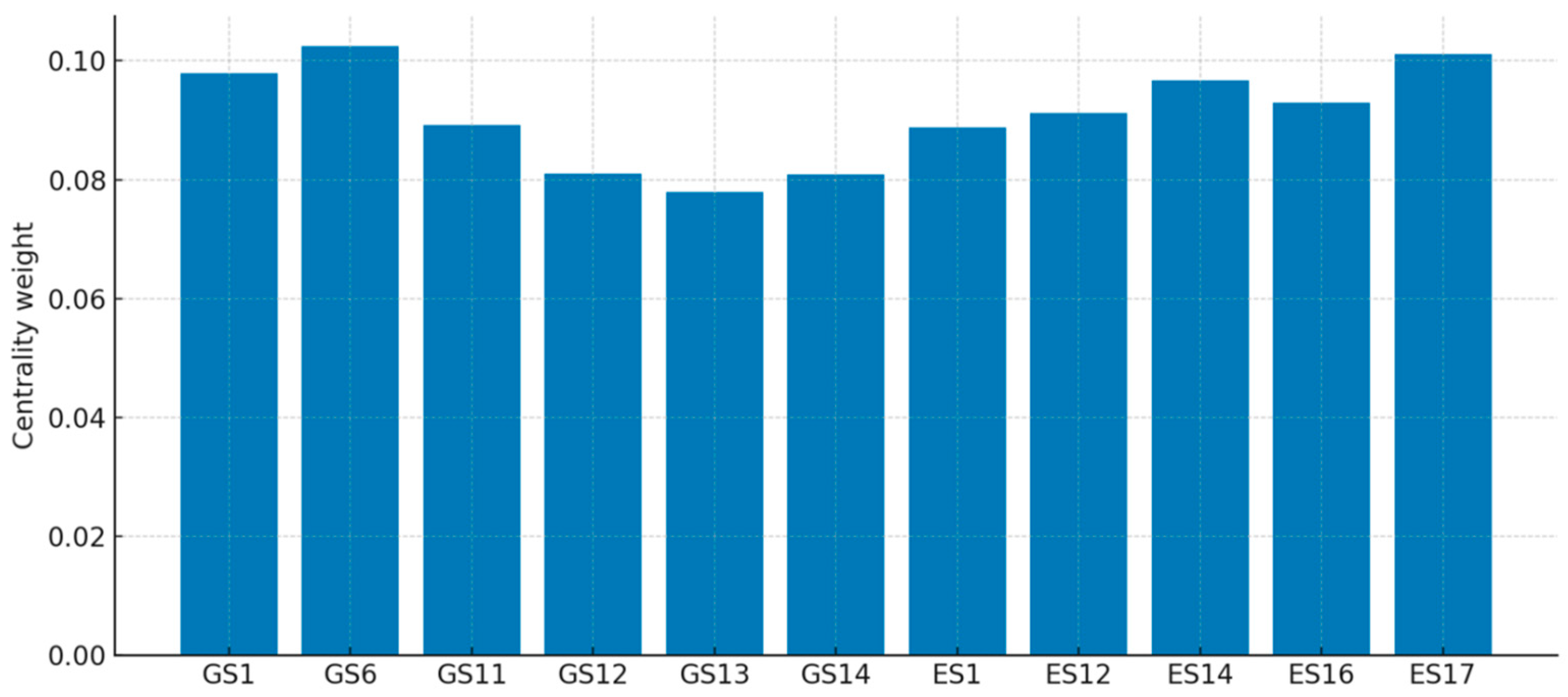
Based on the calculation results in Table 4, the strategies were ranked according to the influencing degree, influenced degree, centrality, and causality. In terms of the influencing degree, GS6 ranks highest, followed by GS11, GS14, GS13. This indicates that these strategies exert stronger outward effects and are more likely to drive other strategies. In contrast, ES14, ES17, GS1, and ES12 have the highest scores for the influenced degree, suggesting that they are more susceptible to changes initiated by other strategies. To facilitate direct comparison of the relative importance of the strategies, the centrality indicators in Table 4 were normalized into a weight distribution, following the approach of Ma et al. [52]. As shown in Figure 2, GS6, ES17, GS1, ES14, and ES16 rank as the top five influential strategies (10.25%, 10.11%, 9.79%, 9.68%, and 9.29%, respectively), occupying central positions in the system and exerting broad effects on other strategies.
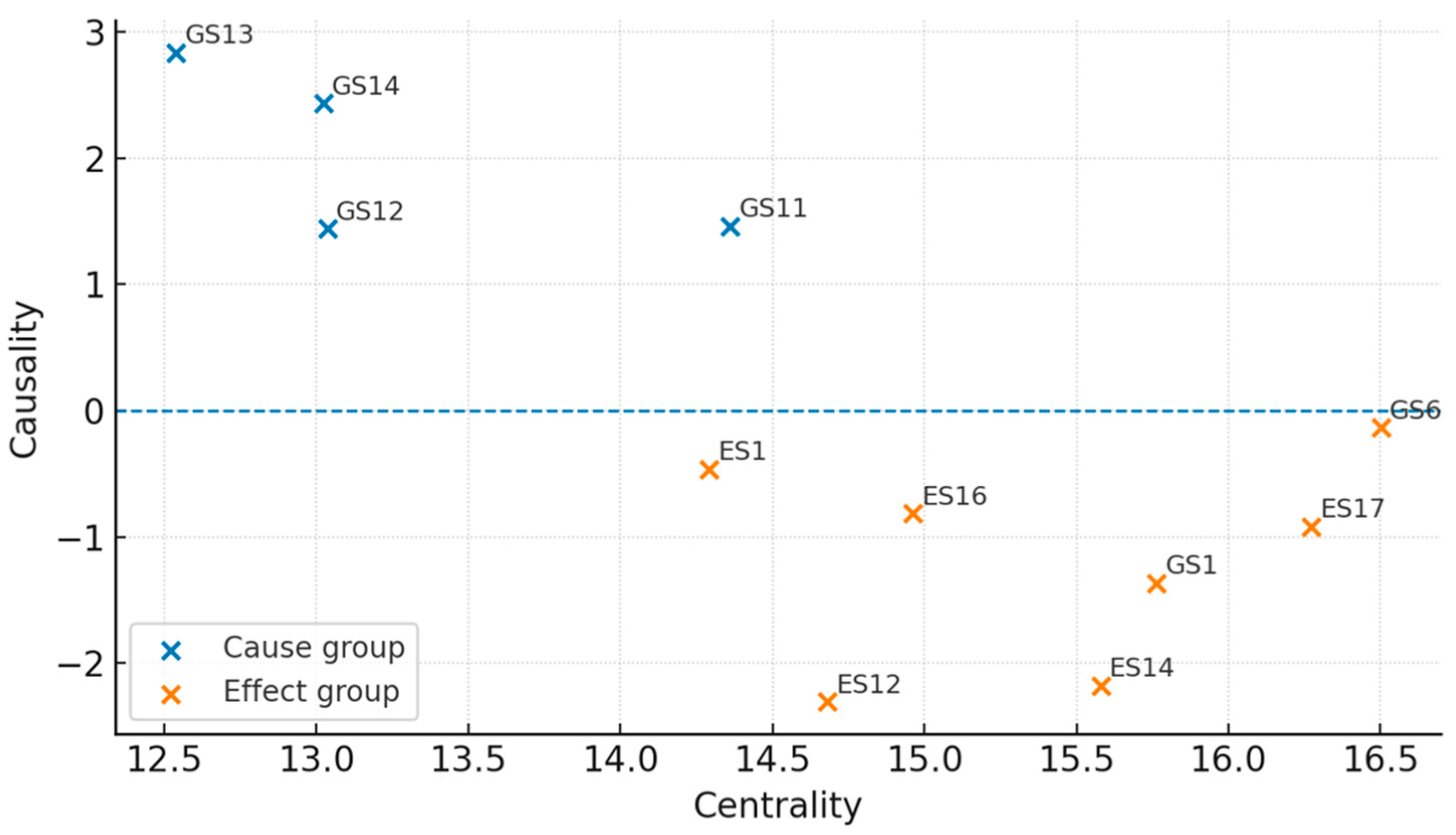
Building on Table 4, a causal diagram was further constructed (see Figure 3), which presents a visual representation of the importance and causal interrelations among the identified strategies, offering valuable guidance for advancing the adoption of CRs. Partitioning the strategies by the sign of the causality index ( r i c j ) results in two groups: the cause group consisting of GS11, GS12, GS13 and GS14, and the effect group consisting of GS1, GS6, ES1, ES12, ES14, ES16 and ES17. Within the cause group, GS13 and GS14 exhibit the strongest driving effects on other strategies, with causality degrees of 2.8367 and 2.4345. In the effect group, ES12 and ES14 show the most negative causality degrees (−2.3056 and −2.1779), followed by GS1, ES17, and ES16, indicating that they are highly susceptible to the influence of other strategies.

4.3. ISM Analysis

Building on the comprehensive influence matrix T established in DEMATEL, the overall influence matrix G was created using Equation (11). The mean and standard deviation of the elements in G were α = 0.665 and β = 0.140 , respectively. Accordingly, the threshold was set to λ = 0.805 . Applying this threshold yielded the reachability matrix K (Appendix A, Table A1). Based on K and following Equations (12) and (14), the reachability set R i ( f i ) , the antecedent set S i ( f i ) , and the common C i were derived for each strategy f i . As presented in Table 5, R i ( f i ) denotes the set of strategies with entries equal to 1 in the i -th row of K , that is, the strategies reachable from f i . Correspondingly, S i ( f i ) denotes the set of strategies with entries equal to 1 in the i -th column of K , that is, the strategies that can reach f i . The common C i = R i S i was used to determine hierarchical levels. According to the criterion R i = C i , the set of strategies was decomposed iteratively to construct the hierarchical structure model.
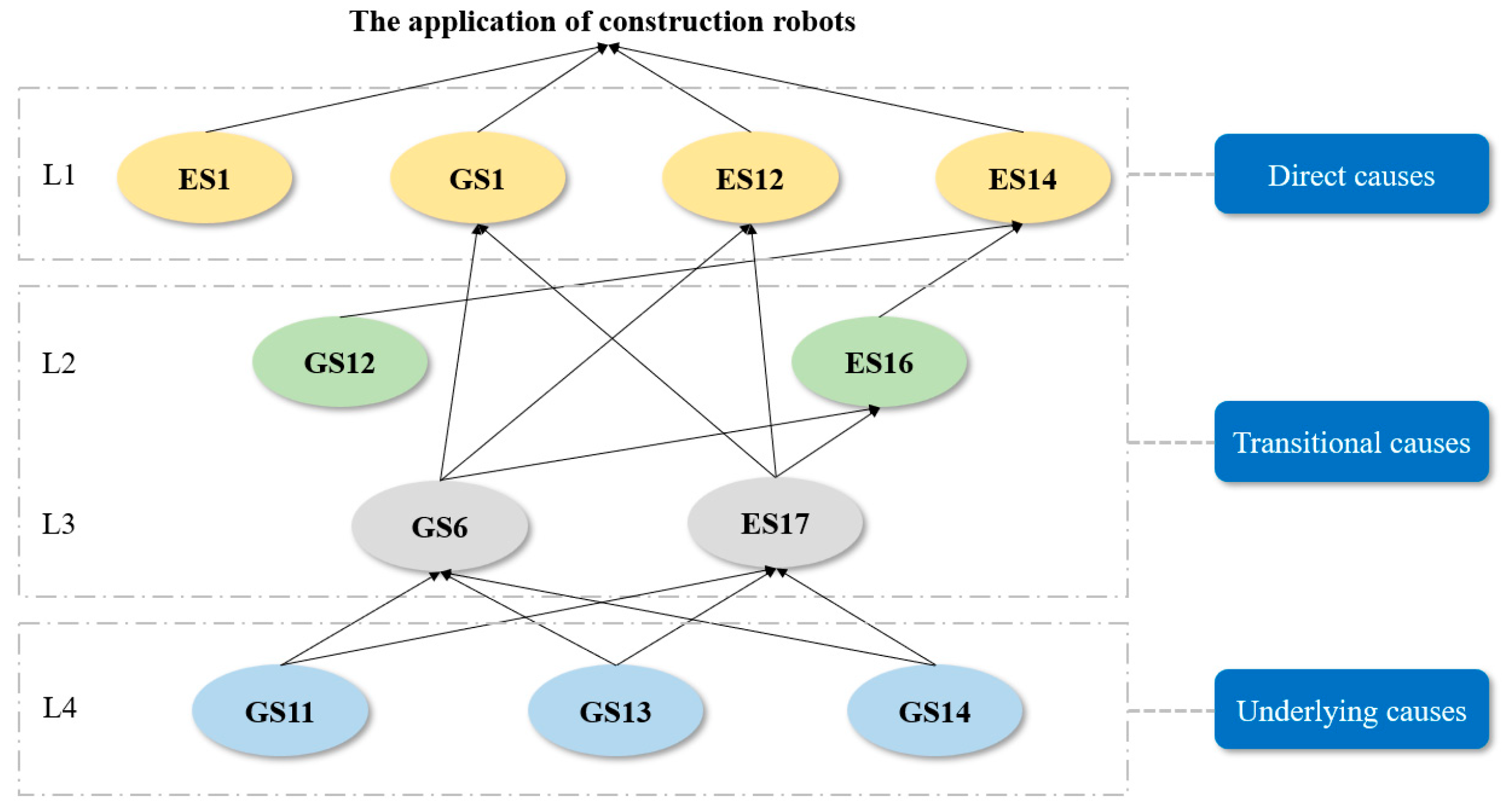
The specific links were determined from the reachability set and antecedent set listed in Table 5. Taking the strategy ES16 as an example, its reachability set shows that apart from itself, ES16 can reach ES14, and its antecedent set indicates that ES16 is reachable from GS6, GS11, GS13, GS14, and ES17. Consequently, ES16 points to ES14, and GS6, GS11, GS13, GS14, and ES17 point to ES16. Moreover, because GS6 and ES17 are themselves reachable from GS11, GS13, and GS14, the final outgoing connection for ES16 is ES16  → ES14, and the final incoming connections are represented by the chains GS11 → GS6 → ES16, GS13 → GS6 → ES16, GS14 → GS6 → ES16, GS11 → ES17 → ES16, GS13 → ES17 → ES16, and GS14 → ES17 → ES16. On this basis, a multi-level hierarchical structure of the identified strategies was constructed (see Figure 4), which visualizes the level assignments and interaction pathways. Notably, the antecedent sets of GS11, GS12, GS13, GS14, and ES1 contain only themselves, indicating that these strategies do not receive incoming links from other levels in the hierarchy.
As shown in Figure 4, the strategies for promoting the adoption of CRs can be categorized into four levels, namely L1, L2, L3, and L4, corresponding to direct causes, transitional causes, and underlying causes. L1 is the direct-cause tier and comprises four strategies: establishing standardized systems for CRs covering functionality, performance, and safety (GS1), accelerating interdisciplinary talent cultivation for CRs (ES1), improving CR compatibility with other intelligent construction technologies (ES12) and developing task-specific CRs for production, construction, and maintenance scenarios (ES14). L2 and L3 constitute the transitional-cause tiers and together include four strategies: prioritizing credit support for enterprises engaged in independent CR development (GS12), promoting standardized production of building components to enhance CR operational efficiency (ES16), developing interconnected industrial clusters to improve the business ecosystem for CRs (GS6) and facilitating the application of CR R&D outcomes in real-world construction practice (ES17). L4 represents the underlying-cause tier and contains three strategies: enhancing funding support for enterprises involved in CR R&D (GS11), offering tax incentives to stakeholders procuring CRs (GS13) and offering R&D tax credits to stakeholders developing CR technologies (GS14).

4.4. FBN Analysis

4.4.1. Model Validation and Inference Results

Guided by the ISM results, a BN was constructed to model the strategies that promote the adoption of CRs. When mapping the ISM structure (Figure 4) to the BN, Level 4 strategies (GS11, GS13 and GS14), and the strategies with no incoming connections (GS12 and ES1) were designated as root nodes. Strategies in the transitional cause layers (L2 to L3) with both incoming and outgoing connections (GS6, ES17 and ES16) were classified as intermediate nodes, while strategies in the direct cause layer (L1) that are not roots (GS1, ES12 and ES14) were classified as leaf nodes. To quantify each strategy’s contribution to CR adoption, an FBN was employed, and a target node Y representing the probability of actual adoption of CRs was assigned. All nodes were defined as binary variables with “Yes” denoting that the strategy exerts an effect on adoption and “No” denoting no effect. The directed links in the BN were consistent with the causal layering obtained from the ISM results. The final network structure was instantiated in GeNIe for graphical modeling.
Five domain experts were consulted to parameterize the network. First, using the linguistic scale described in Section 3.3.1, they rated the root nodes, and these ratings were converted into numerical prior probabilities. The corresponding values are summarized in Table 6, where column 7 reports the results calculated with Equations (19) and (20). Subsequently, the experts assessed the influence strength of each parent node on its child nodes, and these evaluations were synthesized into CPTs, as presented in Table 7. To derive the conditional probabilities of the child strategies, a noisy-OR gate model was applied, together with the expert assessments, and the CPTs were derived through Equations (21) and (22). For clarity, Table 8 provides a worked example for ES17, a child strategy with three parents (GS11, GS13 and GS14), illustrating the stepwise derivation of its CPT. This systematic workflow ensures that parameter estimation in the BN is both accurate and interpretable.
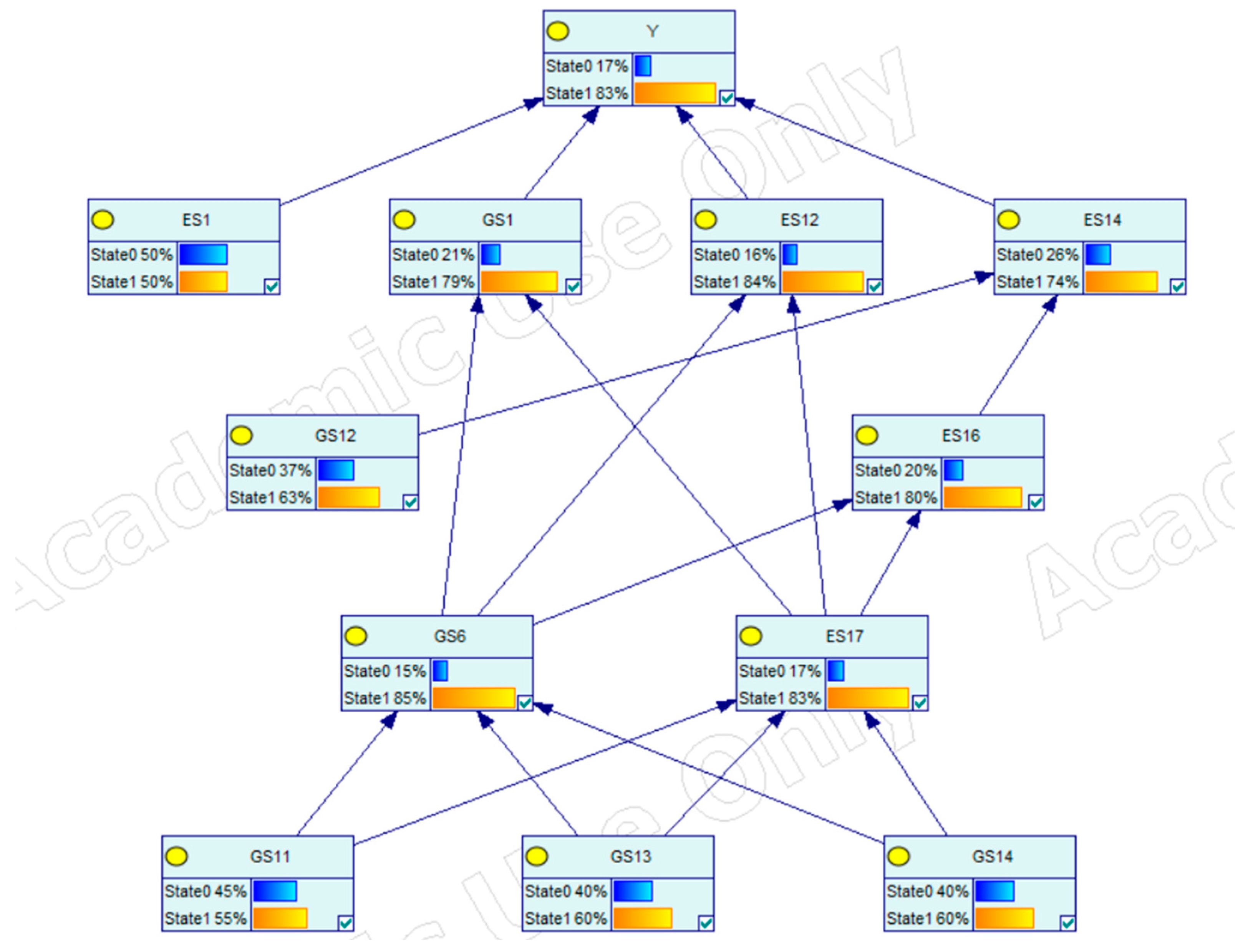
After importing all prior probabilities and CPTs into GeNIe, forward inference was first conducted on the established BN. As shown in Figure 5, the posterior probability of CR adoption (Y = 1) is 83%, indicating that the identified strategies have high potential to promote the adoption of CRs in the construction industry. Furthermore, the forward inference framework allows the model to estimate CR adoption probabilities under different strategic scenarios. Given the extensive number of nodes in the model, the scenario analysis in this study focused on the root nodes. The posterior results for the assumed root-node evidence are presented in Table 9. The findings indicate that setting a root node to the “Yes” state increases the probability of CR adoption relative to its prior value, whereas setting it to “No” leads to a reduction. Moreover, simultaneous activation of multiple root nodes (GS11, GS12, GS13, GS14 and ES1) increases the probability of CR adoption from 83% to 92%. This outcome aligns with practical experience and provides indirect validation of the BN’s effectiveness in evaluating adoption strategies for CRs.
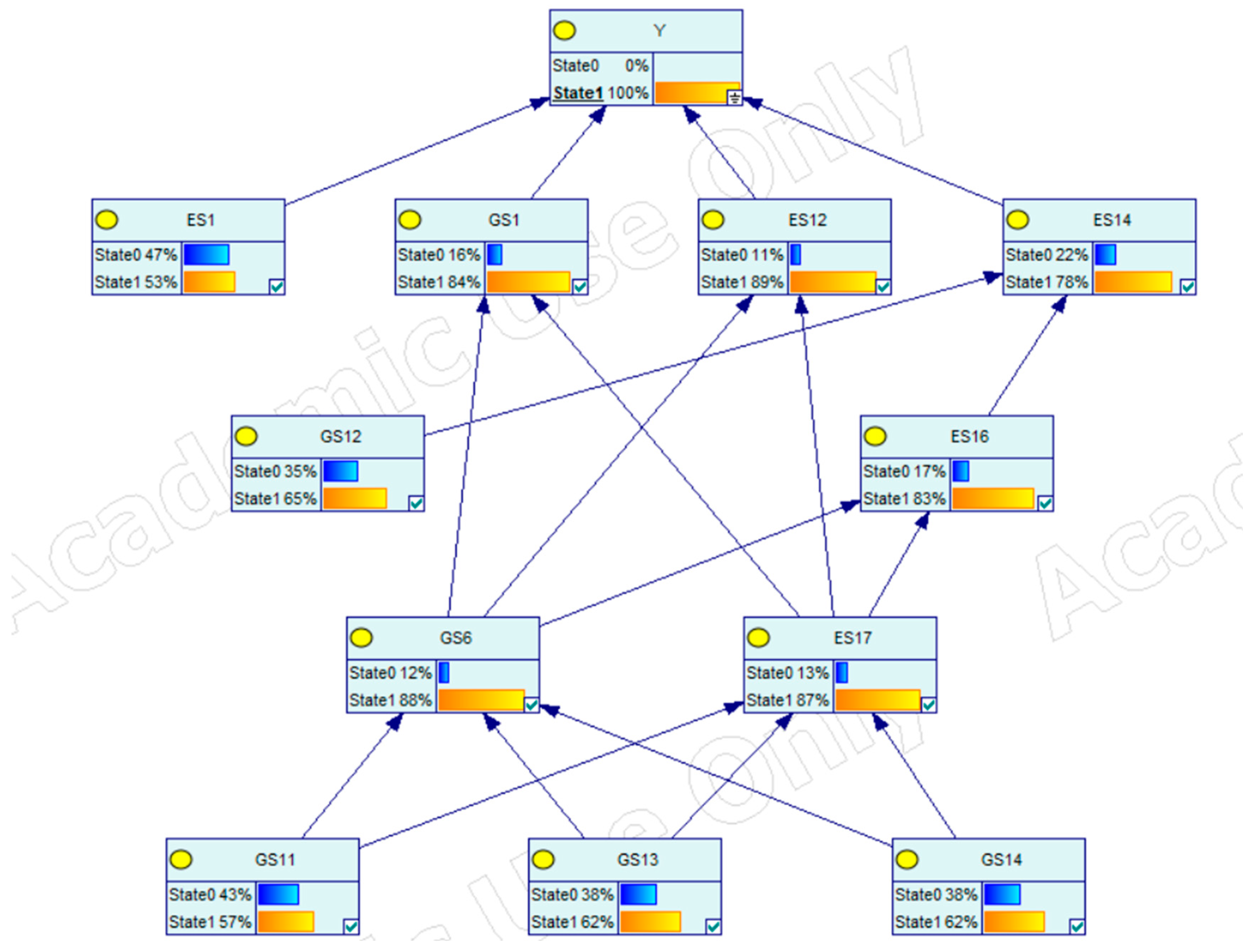
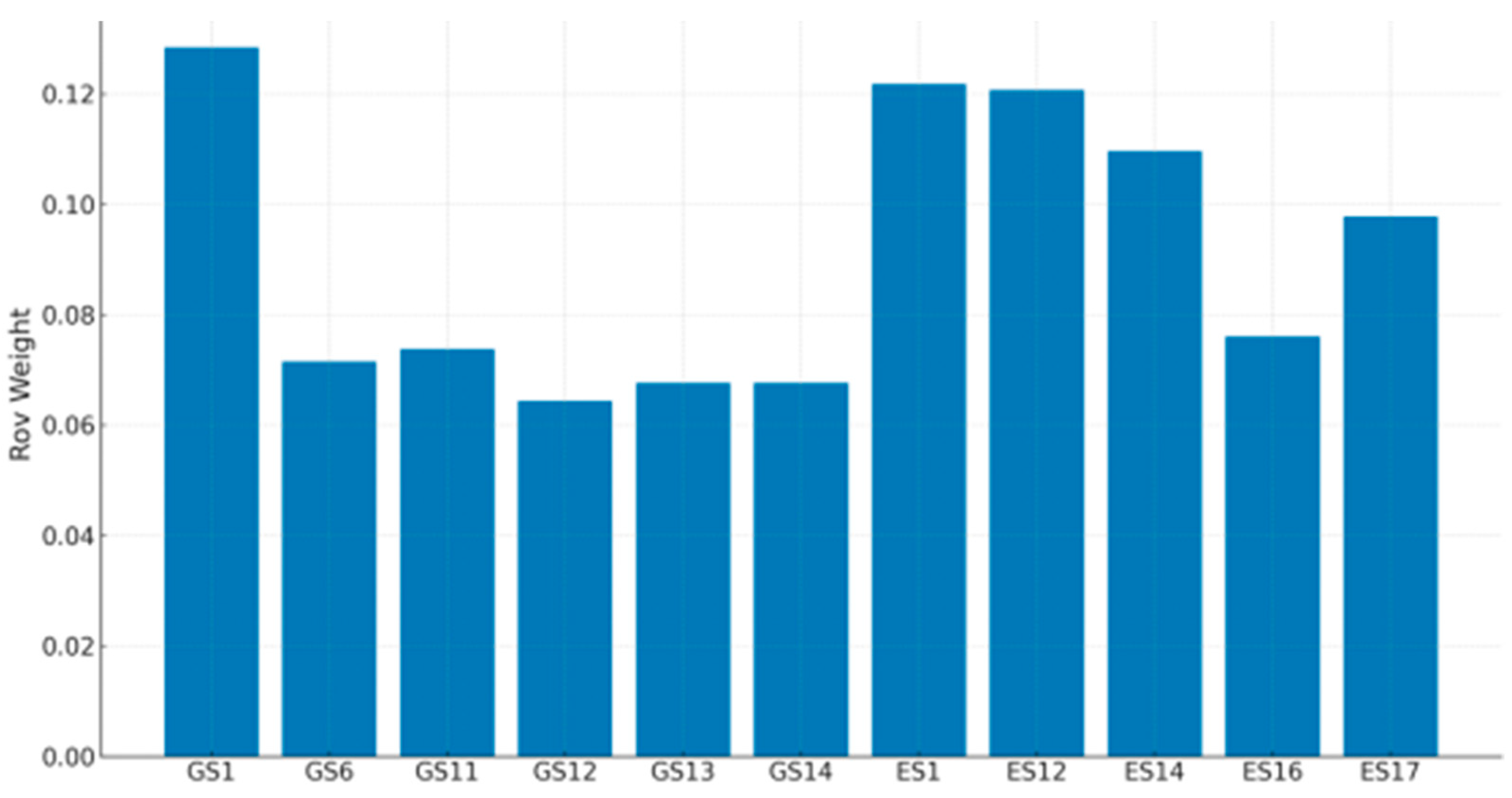
Leveraging the capacity of BN for backward inference, the model was conditioned on the hypothetical scenario of full adoption of CRs, and the posterior probabilities of all nodes were subsequently updated. As shown in Figure 6, these posterior results differ from the forward-inference baseline in Figure 5: the probability distributions of several strategies shift substantially, whereas others remain comparatively stable. To systematically identify the strategies most sensitive to CR adoption, the R o v for each factor was calculated using Equation (23). The normalized R o v values, interpreted as indicators of sensitivity, are presented in Figure 7.
As presented in Figure 7, five strategies emerge as the most sensitive. The highest R o v is observed for establishing standardized systems for CRs covering functionality, performance, and safety (GS1), indicating that improvements in GS1 would trigger substantial changes across the system and markedly promote CR adoption outcomes. This is followed by accelerating interdisciplinary talent cultivation for CRs (ES1), improving CR compatibility with other intelligent construction technologies (ES12), developing task-specific CRs for production, construction, and maintenance scenarios (ES14), and facilitating the application of CR R&D outcomes in real-world construction practice (ES17). Prioritizing these strategies is expected to generate the greatest effectiveness for accelerating the adoption of CRs.

4.4.2. Sensitivity-Importance Matrix Analysis

Recognizing that “importance” and “sensitivity” are independent yet complementary dimensions, this study follows the approach of Ma et al. [52], who proposed a sensitivity–importance (SI) index in the context of hazardous-goods maritime risk, inspired by the multiplicative risk-index paradigm [65,66]. Accordingly, the SI for the i-th strategy is defined as:
S I i = S i     I i
where I i   and S i denote the importance weight and sensitivity weight of the i-th strategy, respectively.
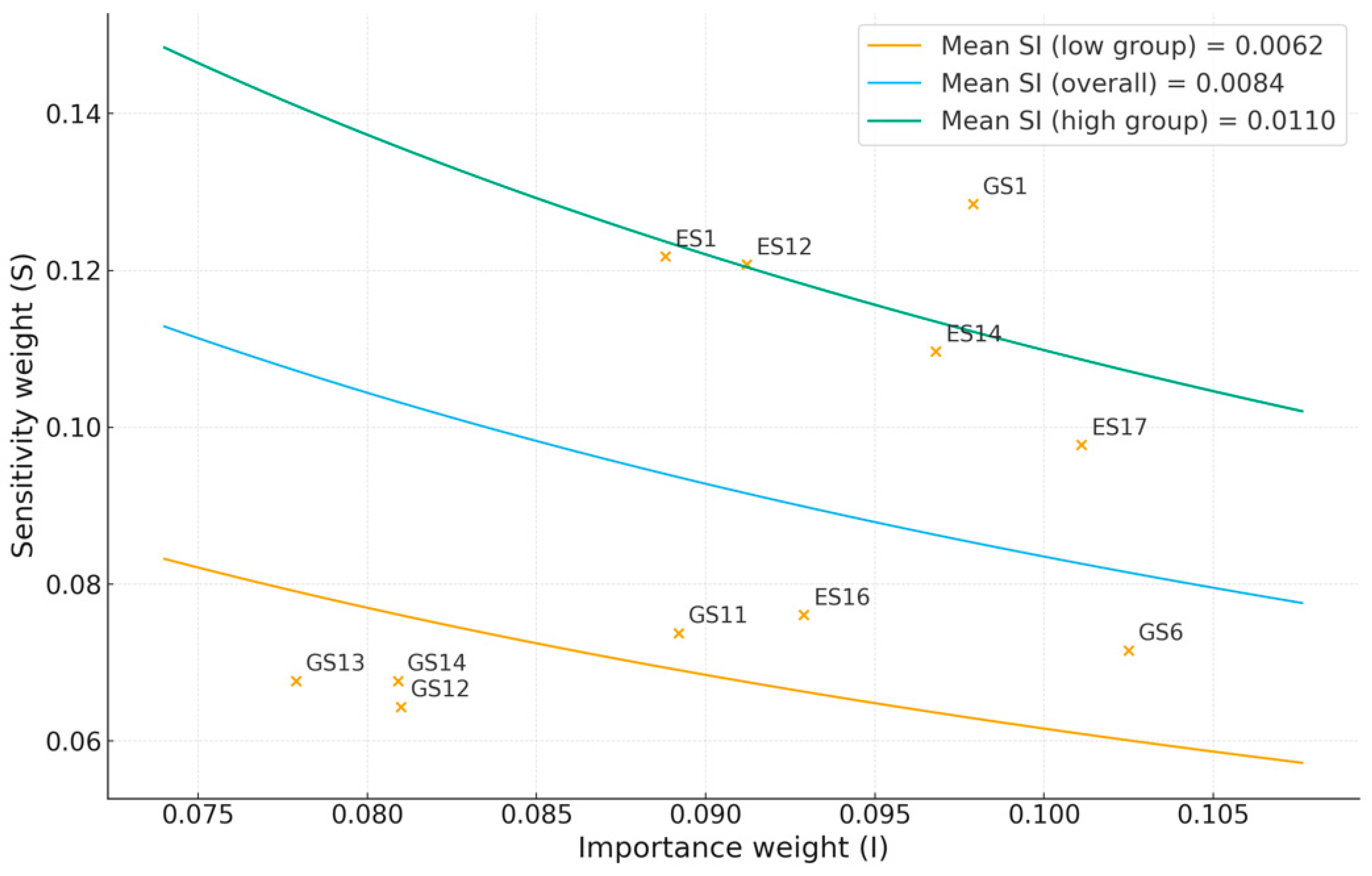
Using the importance weights in Figure 2 and the sensitivity weights in Figure 7, each strategy’s sensitivity and importance indices were calculated through Equation (25) and the results are summarized in Table 10. On this basis, an SI matrix was constructed (see Figure 8), with importance on the x-axis and sensitivity on the y-axis. As shown in Figure 8, the plane is partitioned by three iso-SI contour lines. The blue line denotes the mean SI of all strategies (0.84%), splitting them into two subsets. For the subsets with SI > 0.84%, which comprise five strategies (GS1, ES1, ES12, ES14 and ES17), their average SI (1.10%) defines the green line. Conversely, the yellow line represents the mean SI (0.62%) of the SI < 0.84% subset.
According to the results, establishing standardized systems for CRs covering functionality, performance, and safety (GS1) exhibits the highest SI (1.26%), followed by improving CR compatibility with other intelligent construction technologies (ES12, SI = 1.11%). Both strategies exhibit relatively high importance and sensitivity, underscoring their critical role within the system. Although accelerating interdisciplinary talent cultivation for CRs (ES1) ranks lower in importance, its high sensitivity makes it a critical driver for CR adoption. In contrast, developing interconnected industrial clusters to improve the business ecosystem for CRs (GS6) displays higher importance but lower sensitivity, suggesting its role as a foundational strategy whose effect is more structural and long term. Therefore, the SI matrix provides a systematic basis for prioritizing strategies with the greatest effectiveness in promoting CR adoption.

5. Discussion

The research results highlight two strategies as particularly influential: developing interconnected industrial clusters to improve the business ecosystem for CRs (GS6) and facilitating the application of CR R&D outcomes in real-world construction practice (ES17), with normalized importance weights of 10.25% and 10.11%, respectively. The broad impacts of GS6 are consistent with previous studies indicating that robot adoption tends to emerge within geographic clusters, where spillover of knowledge, technical know-how, and innovations significantly reduce adoption barriers [67,68]. Nevertheless, the construction industry is fragmented, project-based, and characterized by geographically dispersed stakeholders, which inhibits the formation of such clusters [69]. Given these constraints, the implementation of GS6 requires moving from policy advocacy to coordinated, practice-oriented mechanisms that link actors across regions and project boundaries. Targeted policy interventions should focus on cultivating collaborative regional ecosystems where enterprises, research institutions, and service providers can co-locate and jointly advance CR technologies. Governments can act as the key enabler by establishing construction robotics innovation zones and demonstration bases that integrate fiscal incentives, shared laboratories, and cross-project pilot programs to enhance knowledge spillovers and accelerate diffusion [70,71]. Industry associations should play a bridging role by developing cluster-level service platforms for standardization, certification, and workforce training, thereby reducing coordination costs and promoting interoperability within clusters. Meanwhile, enterprises and universities can jointly engage in application-oriented R&D and pilot construction projects to close the gap between innovation and implementation, transforming clusters into dynamic hubs of continuous technological upgrading [72].
Moreover, the high influence of ES17 further reflects the current gap between technological development and practical application of CRs in the Chinese construction sector. As emphasized by Delgado et al. [12], a lack of on-site validation and unclear business cases are core barriers to CR adoption. In line with this, the present results indicate that research commercialization (ES17) functions as a pivotal feedback mechanism that links technological innovation with field implementation. When R&D outputs are applied in real projects, they generate empirical evidence of performance, elevate technical readiness, and strengthen the surrounding innovation ecosystem [13]. Furthermore, applying R&D outcomes in practice can increase financial investment, facilitate the purchase or leasing of robotic systems, and foster broader market acceptance through tangible proof of its utilization. Therefore, it is imperative to prioritize pilot and demonstration projects in real construction environments to validate technical feasibility, build stakeholder confidence, and establish compelling business cases for the broader implementation of CRs [73].
The ISM analysis further identifies three underlying causes that fundamentally support the overall CR adoption pathway: enhancing funding support for enterprises engaged in CR R&D (GS11), offering tax incentives to stakeholders procuring CRs (GS13), and offering R&D tax credits to stakeholders developing CR technologies (GS14). These strategies are all fiscal in nature, suggesting that financial incentives are fundamental in promoting the adoption of CRs in China. Through improving enterprises’ financial stability and risk tolerance, such strategies promote sustained investment in innovation, pilot projects, and collaboration across sectors. As a result, government funding and tax relief create a more favorable business environment and enable the effective implementation of integrative strategies, such as industrial clustering and research commercialization [74]. Continued financial support can also facilitate practical application of CRs and improve their functionality, performance, safety, and compatibility with other intelligent construction technologies. It contributes to the standardization of building components and supports the development of task-specific CRs for production, construction, and maintenance scenarios. This interpretation is consistent with prior research which identifies high upfront costs and investment risks as primary barriers [17,22], while extending these findings by explaining their systemic role within the CR adoption pathway. Therefore, fiscal strategies should be regarded not merely as short-term financial relief but as structural mechanisms that shape a sustainable innovation environment by linking economic feasibility with organizational readiness and technological advancement. Nevertheless, these fiscal strategies require substantial public and private investment, which may constrain their short-term feasibility, particularly for small and medium-sized enterprises with limited capital capacity [12]. Phased implementation and targeted subsidies are recommended to balance short-term feasibility with long-term structural effectiveness, ensuring that foundational fiscal instruments can continue to support higher-level integrative and outcome-oriented strategies in a coherent and sustainable manner.
In addition, establishing standardized systems for CRs covering functionality, performance, and safety (GS1) and improving CR compatibility with other intelligent construction technologies (ES12) emerge as strategies with both high importance and sensitivity. A high sensitivity score indicates that these strategies can generate rapid and substantial effects once implemented, making them particularly suitable as short-term policy priorities. This finding underscores the critical role of technical standardization in promoting the adoption of CRs. The absence of unified standards creates tangible barriers for key stakeholders seeking to adopt robots in construction. For example, manufacturers and suppliers may incur higher R&D costs for non-standardized products and face challenges exacerbated by market fragmentation, while contractors may encounter operational inefficiencies and complex integration issues on site, all of which can ultimately impede the broader promotion of CRs. These constraints collectively slow down technology diffusion and reduce the economic attractiveness of CR adoption. The findings resonate with Huang et al. [4], who identified the absence of common standards as a principal bottleneck to CR adoption. Turk [75] further emphasized that formal standards help align stakeholders around shared requirements, reduce transaction costs, and provide harmonized technical specifications that foster interoperability. Similarly, empirical evidence from Pan and Pan [38] suggested that compatibility of CRs with other technologies remains a key concern among users, stemming from the inherent project-specificity of construction, which complicates CR deployment in practice. The present findings extend this body of work by providing quantitative evidence that technical alignment not only mitigates direct integration challenges but also serves as an early-stage catalyst for coordinated improvements across the overall CR adoption system. Therefore, policymakers should prioritize the development of unified technical standards and interoperability protocols as an immediate and effective pathway to lower adoption barriers, harmonize market requirements, and accelerate the tangible adoption of CRs within the broader intelligent construction ecosystem.
To further validate these analytical findings, several representative cases of CR implementation in China were examined. These cases collectively demonstrate that successful CR adoption depends not on isolated technological advances but on the synergistic interaction of fiscal support, industrial clustering, standardization, and technological compatibility. These are precisely the mechanisms identified in the proposed framework. A prominent illustration is the Xiong’an Guomao Center Project in Hebei Province, where a suite of construction robots, including those for concrete leveling, plastering, and surface-finishing systems, were deployed collaboratively on site. The project received remarkable efficiency, with average floor flatness deviations below 5 mm and operational productivity exceeding 400 m2 per hour on average. These outcomes were facilitated by the Three-Year Action Plan for Promoting the Robotics Industry (2024–2026) and the Policies to Support Robot Industry Development issued by the Xiong’an New Area government. These initiatives provided targeted financial subsidies and project-based funding, corresponding to GS11, GS13, and GS14. Complementary strategies promoting innovation clusters and research commercialization (GS6, ES17) further strengthened the ecosystem, jointly reducing market entry barriers and accelerating coordinated multi-robot operations, thereby validating the causal linkages revealed by the DEMATEL–ISM–BN analysis.
Similar dynamics can be observed in Shenzhen Talent Housing Group’s Sand Lake affordable housing project, one of the first large-scale CR applications in public housing. The project integrated eighteen robotic systems across multiple trades, supported by municipal programs such as the Smart Construction Pilot City Implementation Plan and the Construction Robot Application Scenario List. These initiatives established technical and data standards for CR deployment, aligning with GS1 and ES12, and served as practical instruments to operationalize standardization and interoperability. Shenzhen’s parallel efforts to cultivate industrial clusters and demonstration projects (GS6, ES17) further illustrate how a coherent policy framework can enable scalable CR integration.
Together, these cases empirically reinforce the model proposed in this study. Across regions and project types, a consistent multi-level pathway emerges: fiscal incentives and financial support (GS11, GS13, GS14) serve as foundational enablers, stimulating industrial clustering and research commercialization (GS6, ES17), which subsequently reinforce technical standardization and interoperability (GS1, ES12), leading to effective large-scale deployment of task-specific robots (ES14). This convergence of evidence validates the modeled causal relationships and underscores the importance of coordinated policy, organizational, and technological interventions in accelerating CR adoption.

6. Conclusions

Construction robots have proven to offer valuable benefits for enhancing productivity, improving safety, and mitigating labor shortages in the construction industry. Despite this, the adoption of robots in construction remains relatively limited compared to other sectors. While previous studies have predominantly focused on identifying determinants of CR adoption and subsequently proposing strategies, limited attention has been given to the dynamic interdependencies among these strategies and their comparative effectiveness. To address this knowledge gap, this study employs a hybrid framework that integrates DEMATEL, ISM, and FBN to clarify the causal relationships among the strategies, reveal their hierarchical relationships, and simulate their dynamic effects on the adoption of CRs under different scenarios. The following main findings were obtained.
First, developing interconnected industrial clusters to improve the business ecosystem for CRs (GS6) and facilitating the application of CR R&D outcomes in real-world construction practice (ES17) are identified as the most influential strategies, occupying the most central positions in promoting CR adoption and exerting broad effects on other strategies. Second, three financial-related strategies, namely enhancing funding support for enterprises involved in CR R&D (GS11), offering tax incentives to stakeholders procuring CRs (GS13), and offering R&D tax credits to stakeholders developing CR technologies (GS14), are recognized as the underlying causes for CR adoption, which can fundamentally support the overall adoption pathway. Third, sensitivity-importance analysis reveals that establishing standardized systems for CRs covering functionality, performance, and safety (GS1) and improving CR compatibility with other intelligent construction technologies (ES12) achieved the highest integrated scores across the two dimensions. This highlights them as the most critical strategies, and their implementation can generate significant short-term improvements in CR adoption outcomes while also producing broad long-term impacts on the entire system.
The findings reported in this study have significant implications. Theoretically, this research extends existing literature on technology adoption by developing a multi-level structural model that integrates causal mapping, hierarchical structuring, and probabilistic reasoning. This approach not only clarifies the dynamic interactions among strategies but also introduces a combined importance-sensitivity perspective to assess their relative effectiveness. Practically, the findings highlight strategy priorities that can accelerate CR adoption, including industrial clustering, on-site application of R&D outcomes, fiscal support, and the establishment of standards and compatibility frameworks. These insights offer actionable guidance for governments and enterprises seeking to foster large-scale adoption of CRs. Specifically, policymakers are advised to develop interconnected industrial clusters by establishing specialized innovation parks or hubs that co-locate R&D facilities, manufacturers, and construction firms. It is also essential to implement a combination of direct funding support for SMEs engaged in CR R&D, tax incentives for construction companies that procure CRs, and R&D tax credits for technology developers. Furthermore, accelerating the establishment and enforcement of standardized systems for CRs, covering functionality, performance, and safety, should be prioritized as a foundational policy measure.
There are several limitations in this research that require future exploration. First, although the expert panel possesses substantial domain expertise, the sample size was relatively limited. Future research should therefore expand the panel to include more diverse and cross-disciplinary experts to further enhance the robustness and generalizability of the findings. Second, the research was conducted in Jiangsu Province and Shanghai, regions where CR application is relatively advanced, and all participating experts were based in China. Consequently, the findings primarily reflect the characteristics of the Chinese construction industry and may not fully capture regional or international variability. Nevertheless, the mechanisms and strategic pathways identified in this study remain conceptually transferable, offering valuable insights for other countries undergoing similar technological transitions. Future research is recommended to extend the analysis to other provinces with different levels of technological maturity and include international experts to validate and refine the framework across diverse socio-economic and policy environments. Third, the study focused on strategic-level factors, while micro-level behavioral aspects, such as worker attitudes, organizational culture, and training readiness, were not explicitly examined. Incorporating these dimensions in future studies could pro-vide a more comprehensive understanding of the factors shaping CR adoption.


Author Contributions

Conceptualization, Investigation, and Writing—original draft, L.Z.; Data curation and Writing—original draft, J.D.; Conceptualization and Supervision, M.C.; Writing—review & editing, Q.X.; Supervision, Writing—review & editing, J.W. All authors have read and agreed to the published version of the manuscript.

Funding

This research was funded by “Postgraduate Research & Practice Innovation Program of Jiangsu Province KYCX243631”.

Data Availability Statement

The data presented in this study are available on request from the corresponding author due to privacy.

Acknowledgments

The authors sincerely thank the participating experts for sharing their valuable knowledge and insights.

Conflicts of Interest

The authors declare no conflicts of interest.

Abbreviations

The following abbreviations are used in this manuscript:
CRsConstruction robots
SMEssmall- and medium-sized enterprises
DEMATELDecision-making Trial and Evaluation Laboratory
ISMInterpretive Structural Modeling
FBNFuzzy Bayesian Network
R&Dresearch and development
RIIRelative Importance Index
MICMACMatrix of Cross-Impact Multiplications Applied to a Classification
BNBayesian network
CPTsConditional Probability Tables
Rovrange of variation
GSgovernment-related strategies
ESenterprise-related strategies
SIsensitivity–importance

Appendix A

Table A1. Reachability matrix.
GS1GS6GS11GS12GS13GS14ES1ES12ES14ES16ES17
GS110000000000
GS611000001111
GS1111100001111
GS1200010000100
GS1311001001111
GS1411000101111
ES100000010000
ES1200000001000
ES1400000000100
ES1600000000110
ES1711000001111

References

  1. Goodarzizad, P.; Mohammadi Golafshani, E.; Arashpour, M. Predicting the construction labour productivity using artificialneural network and grasshopper optimisation algorithm. Int. J. Constr. Manag. 2023, 23, 763–779. [Google Scholar]
  2. Musarat, M.A.; Alaloul, W.S.; Rostam, N.A.Q.A.; Khan, A.M. Substitution of workforce with robotics in the construction industry: A wise or witless approach. J. Open Innov. Technol. Mark. Complex. 2024, 10, 100420. [Google Scholar] [CrossRef]
  3. Assaad, R.; El-adaway, I.H. Impact of dynamic workforce and workplace variables on the productivity of the construction industry: New gross construction productivity indicator. J. Manag. Eng. 2021, 37, 04020092. [Google Scholar] [CrossRef]
  4. Huang, Z.; Mao, C.; Wang, J.; Sadick, A.M. Understanding the key takeaway of construction robots towards construction automation. Eng. Constr. Archit. Manag. 2021, 29, 3664–3688. [Google Scholar] [CrossRef]
  5. Xu, Z.; Feng, Z.; Babaeian Jelodar, M.; Guo, B.H.W. Augmented reality applications in construction productivity: A systematic literature review. Adv. Eng. Inform. 2024, 62, 102798. [Google Scholar] [CrossRef]
  6. Johari, S.; Jha, K.N. Challenges of attracting construction workers to skill development and training programmes. Eng. Constr. Archit. Manag. 2019, 27, 321–340. [Google Scholar] [CrossRef]
  7. Freedonia Group. New Research Reveals Depth of Construction Labor Shortages, 2023. Available online: https://www.freedoniagroup.com/blog/new-research-reveals-depth-of-construction-labor-shortages (accessed on 3 July 2025).
  8. Fu, S.; Yang, D.; Mei, Z.; Zheng, W. Progress in construction robot path-planning algorithms: Review. Appl. Sci. 2025, 15, 1165. [Google Scholar] [CrossRef]
  9. Waqar, A.; Othman, I.; Saad, N.; Azab, M.; Khan, A.M. BIM in green building: Enhancing sustainability in the small construction project. Clean. Environ. Syst. 2023, 11, 100149. [Google Scholar] [CrossRef]
  10. Equipment World. Tybot Robot Performs Tedious Job of Tying Rebar on Bridge Decks, 2017. Available online: https://www.equipmentworld.com/roadbuilding/video/14968366/tybot-robot-performs-tedious-job-of-tying-rebar-on-bridge-decks (accessed on 4 November 2025).
  11. ConstructConnect Daily Commercial News. Productivity a Major Issue in Pushing Rebar Automation, 2019. Available online: https://canada.constructconnect.com/dcn/news/labour/2019/09/productivity-a-major-issue-in-pushing-rebar-automation (accessed on 4 November 2025).
  12. Delgado, J.M.D.; Oyedele, L.; Ajayi, A.; Akanbi, L.; Akinade, O.; Bilal, M.; Owolabi, H. Robotics and automated systems in construction: Understanding industry-specific challenges for adoption. J. Build. Eng. 2019, 26, 100868. [Google Scholar] [CrossRef]
  13. Brosque, C.; Fischer, M. Safety, quality, schedule, and cost impacts of ten construction robots. Constr. Robot. 2022, 6, 163–186. [Google Scholar] [CrossRef]
  14. Zhang, L.; Cheng, L.; Li, H.; Gao, J.; Yu, C.; Domel, R.; Yang, Y.; Tang, S.Q.; Liu, W.K. Hierarchical deep-learning neural networks: Finite elements and beyond. Comput. Mech. 2021, 67, 207–230. [Google Scholar] [CrossRef]
  15. Xu, Z.; Wang, H.; Xing, C.; Tao, T.; Mao, J.; Liu, Y. Physics guided wavelet convolutional neural network for wind-induced vibration modeling with application to structural dynamic reliability analysis. Eng. Struct. 2023, 297, 117027. [Google Scholar] [CrossRef]
  16. Oke, A.E.; Kineber, A.F.; Albukhari, I.; Dada, A.J. Modeling the robotics implementation barriers for construction projects in developing countries. Int. J. Build. Pathol. Adapt. 2024, 42, 386–409. [Google Scholar] [CrossRef]
  17. Bademosi, F.; Issa, R.R.A. Factors influencing adoption and integration of construction robotics and automation technology in the US. J. Constr. Eng. Manag. 2021, 147, 04021075. [Google Scholar] [CrossRef]
  18. Kaasinen, E.; Schmalfuß, F.; Özturk, C.; Aromaa, S.; Boubekeur, M.; Heilala, J.; Heikkilä, P.; Kuula, T.; Liinasuo, M.; Mach, S.; et al. Empowering and engaging industrial workers with operator 4.0 solutions. Comput. Ind. Eng. 2020, 139, 105678. [Google Scholar] [CrossRef]
  19. Park, S.; Yu, H.; Menassa, C.C.; Kamat, V.R. A comprehensive evaluation of factors influencing acceptance of robotic assistants in field construction work. J. Manag. Eng. 2023, 39, 04023010. [Google Scholar] [CrossRef]
  20. Pan, M.; Linner, T.; Pan, W.; Cheng, H.; Bock, T. Influencing factors of the future utilisation of construction robots for buildings: A Hong Kong perspective. J. Build. Eng. 2020, 30, 101220. [Google Scholar] [CrossRef]
  21. Law, K.K.; Chang, S.; Siu, M.F.F. Factors influencing adoption of construction robotics in Hong Kong’s industry: A multistakeholder perspective. J. Manag. Eng. 2022, 38, 04021096. [Google Scholar] [CrossRef]
  22. Pan, M.; Pan, W. Stakeholder perceptions of the future application of construction robots for buildings in a dialectical system framework. J. Manag. Eng. 2020, 36, 04020080. [Google Scholar] [CrossRef]
  23. Yang, Y.; Pan, M.; Pan, W. ‘Co-evolution through interaction’of innovative building technologies: The case of modular integrated construction and robotics. Autom. Constr. 2019, 107, 102932. [Google Scholar] [CrossRef]
  24. Pradhananga, P.; ElZomor, M.; Santi Kasabdji, G. Identifying the challenges to adopting robotics in the US construction industry. J. Constr. Eng. Manag. 2021, 147, 05021003. [Google Scholar] [CrossRef]
  25. Shimpo, F. The principal Japanese AI and robot law, strategy and research toward establishing basic principles. J. Law Inf. Syst. 2018, 3, 44–65. [Google Scholar]
  26. Yu, J.; Shi, Q.; Wang, J. Policy analysis of smart construction pilot cities policies in China based on policy tools. Smart Constr. 2024, 1, 1–17. [Google Scholar] [CrossRef]
  27. Chen, J.; Huang, M.; Liu, R. Textual analysis of intelligent construction policies from the perspective of policy instruments in Fujian province, China. Buildings 2025, 15, 1306. [Google Scholar] [CrossRef]
  28. Cheng, B.; Deng, L. Vision detection and path planning of mobile robots for rebar binding. J. Field Robot. 2024, 41, 1864–1886. [Google Scholar] [CrossRef]
  29. Slocum, A.; Schena, B. Blockbot: A robot to automate construction of cement block walls. Robot. Auton. Syst. 1988, 4, 111–129. [Google Scholar] [CrossRef]
  30. Pritschow, G.; Dalacker, M.; Kurz, J.; Gaenssle, M. Technological aspects in the development of a mobile bricklaying robot. Autom. Constr. 1996, 5, 3–13. [Google Scholar] [CrossRef]
  31. Mirjan, A.; Augugliaro, F.; D’Andrea, R.; Gramazio, F.; Kohler, M. Building a Bridge with Flying Robots; Springer International Publishing: Cham, Switzerland, 2016; pp. 34–47. [Google Scholar]
  32. Bluebeam. 3D-Printed Homes: ICON’s Construction Workflow, 2025. Available online: https://blog.bluebeam.com/3d-printed-homes-icon-construction-workflow/ (accessed on 10 August 2025).
  33. Mazzetto, S.; Hosamo, H.H.; Al-Atroush, M.E. How programmable construction can shape the future of sustainable building in Italy. Sustainability 2025, 17, 1839. [Google Scholar] [CrossRef]
  34. Li, Y.; Chen, L.; Chen, M.; Qian, X. Integrating spatial cognition and SLAM for improved performance of autonomous material handling robots in dynamic stockyard environments. Ind. Robot. Int. J. Robot. Res. Appl. 2025, 52, 491–499. [Google Scholar] [CrossRef]
  35. Li, Z.; Xu, Q.; Tam, L.M. A survey on techniques and applications of window-cleaning robots. IEEE Access 2021, 9, 111518–111532. [Google Scholar] [CrossRef]
  36. Zhao, S.; Wang, Q.; Fang, X.; Liang, W.; Cao, Y.; Zhao, C.; Li, L.; Liu, C.; Wang, K. Application and development of autonomous robots in concrete construction: Challenges and opportunities. Drones 2022, 6, 424. [Google Scholar] [CrossRef]
  37. Wang, T.; Mao, C.; Sun, B.; Li, Z. Genealogy of construction robotics. Autom. Constr. 2024, 166, 105607. [Google Scholar] [CrossRef]
  38. Pan, M.; Pan, W. Understanding the determinants of construction robot adoption: Perspective of building contractors. J. Constr. Eng. Manag. 2020, 146, 04020040. [Google Scholar] [CrossRef]
  39. Sen, M.K.; Dutta, S.; Kabir, G.; Pujari, N.N.; Laskar, S.A. An integrated approach for modelling and quantifying housing infrastructure resilience against flood hazard. J. Clean. Prod. 2021, 288, 125526. [Google Scholar] [CrossRef]
  40. Zhong, C.; Zhang, S. Schedule risk analysis of prefabricated building projects based on DEMATEL-ISM and Bayesian Networks. Buildings 2025, 15, 508. [Google Scholar] [CrossRef]
  41. Yazdi, M.; Khan, F.; Abbassi, R.; Rusli, R. Improved DEMATEL methodology for effective safety management decision-making. Saf. Sci. 2020, 127, 104705. [Google Scholar] [CrossRef]
  42. Du, Y.W.; Zhou, W. New improved DEMATEL method based on both subjective experience and objective data. Eng. Appl. Artif. Intell. 2019, 83, 57–71. [Google Scholar] [CrossRef]
  43. Zhang, J. Analyzing Cause and Effect Relationships of Obstacles to Applying Intelligent Robots in Construction Projects based on Grey-DEMATEL. In Proceedings of the 2023 9th International Conference on Industrial and Business Engineering, Beijing, China, 22–24 September 2023; pp. 260–266. [Google Scholar]
  44. Feldmann, F.G.; Birkel, H.; Hartmann, E. Exploring barriers towards modular construction–A developer perspective using fuzzy DEMATEL. J. Clean. Prod. 2022, 367, 133023. [Google Scholar] [CrossRef]
  45. Warfield, J.N. Developing subsystem matrices in structural modeling. IEEE Trans. Syst. Man Cybern. 1974, SMC-4, 74–80. [Google Scholar] [CrossRef]
  46. Mathiyazhagan, K.; Govindan, K.; NoorulHaq, A.; Geng, Y. An ISM approach for the barrier analysis in implementing green supply chain management. J. Clean. Prod. 2013, 47, 283–297. [Google Scholar] [CrossRef]
  47. Kim, J.; Lee, S.; Jung, S. Identification and Prioritization of Critical Barriers to the Adoption of Robots in the Construction Phase with Interpretive Structural Modeling (ISM) and MICMAC Analysis. Buildings 2025, 15, 3770. [Google Scholar] [CrossRef]
  48. Warfield, J.N. Developing interconnection matrices in structural modeling. IEEE Trans. Syst. Man Cybern. 1974, SMC-4, 81–87. [Google Scholar] [CrossRef]
  49. Li, Y.; Badulescu, A.; Badulescu, D. Modeling and Analyzing Critical Policies for Improving Energy Efficiency in Manufacturing Sector: An Interpretive Structural Modeling (ISM) Approach. Energies 2025, 18, 893. [Google Scholar] [CrossRef]
  50. Mahaur, C.; Peter, S. Analyzing Strategies for Climate Change Mitigation: An ISM MICMAC Approach with a Focus on Sustainable Development. E3S Web Conf. 2025, 621, 03021. [Google Scholar] [CrossRef]
  51. Costa, F.; Denis Granja, A.; Fregola, A.; Picchi, F.; Portioli Staudacher, A. Understanding relative importance of barriers to improving the customer–supplier relationship within construction supply chains using DEMATEL technique. J. Manag. Eng. 2019, 35, 04019002. [Google Scholar] [CrossRef]
  52. Ma, L.; Ma, X.; Lan, H.; Liu, Y.; Deng, W. A methodology to assess the interrelationships between contributory factors to maritime transport accidents of dangerous goods in China. Ocean. Eng. 2022, 266, 112769. [Google Scholar] [CrossRef]
  53. Chen, X.; Qiao, W. A hybrid STAMP-fuzzy DEMATEL-ISM approach for analyzing the factors influencing building collapse accidents in China. Sci. Rep. 2023, 13, 19745. [Google Scholar] [CrossRef]
  54. Abdullah, F.M.; Al-Ahmari, A.M.; Anwar, S. Exploring key decisive factors in manufacturing strategies in the adoption of Industry 4.0 by using the fuzzy DEMATEL method. Processes 2022, 10, 987. [Google Scholar] [CrossRef]
  55. Zhang, L.; Wu, X.; Skibniewski, M.J.; Zhong, J.; Lu, Y. Bayesian-network-based safety risk analysis in construction projects. Reliab. Eng. Syst. Saf. 2014, 131, 29–39. [Google Scholar] [CrossRef]
  56. Chen, Y.; Li, X.; Wang, J.; Liu, M.; Cai, C.; Shi, Y. Research on the application of fuzzy Bayesian Network in risk assessment of catenary construction. Mathematics 2023, 11, 1719. [Google Scholar] [CrossRef]
  57. Yu, J.; Wu, S.; Yu, Y.; Chen, H.; Fan, H.; Liu, J.; Ge, S. Process system failure evaluation method based on a Noisy-OR gate intuitionistic fuzzy Bayesian network in an uncertain environment. Process Saf. Environ. Prot. 2021, 150, 281–297. [Google Scholar]
  58. Dai, Y.; Xu, L.; Zhang, X.; Fu, Y.; Dong, W. Promoting sustainable development: A study of China’s bicycle sharing industry policies based on text analysis. Res. Transp. Bus. Manag. 2024, 52, 101085. [Google Scholar] [CrossRef]
  59. Greenpeace. Summing up: The Need for a Policy Package Rather than Isolated Strategies. 2019. Available online: https://www.greenpeace.org/static/planet4-bulgaria-stateless/2019/03/940833c0-940833c0-summing_up.pdf (accessed on 23 July 2025).
  60. Number Analytics. Mastering Policy Redundancy: A Guide to Optimal Policy Selection, 2025. Available online: https://www.numberanalytics.com/blog/mastering-policy-redundancy (accessed on 23 July 2025).
  61. Kuo, C.P.; Vo, D.H. Causes of delays occurring in linear projects-A survey of prestressed concrete sheet pile retaining wall constructions in Taiwan. Slovak J. Civ. Eng. 2025, 33, 11–25. [Google Scholar] [CrossRef]
  62. Adanu, S.K.; Boakye, M.K.; Gbedemah, S.F.; Nyatuame, M. Perceptions of environmental and health effects of quarry activities at Klefe in the Ho municipality of the volta region. GeoHealth 2025, 9, e2024GH001168. [Google Scholar] [CrossRef] [PubMed]
  63. Cai, S.; Ma, Z.; Skibniewski, M.J.; Guo, J. Construction automation and robotics: From one-offs to follow-ups based on practices of Chinese construction companies. J. Constr. Eng. Manag. 2020, 146, 05020013. [Google Scholar] [CrossRef]
  64. Vora, C.; Aryal, A.; Willoughby, S.; Wang, C. Investigating stakeholder perception and developing a decision framework for robot adoption in construction. J. Constr. Eng. Manag. 2024, 150, 04024012. [Google Scholar] [CrossRef]
  65. Hsu, W.K.K.; Huang, S.H.S.; Tseng, W.J. Evaluating the risk of operational safety for dangerous goods in airfreights–A revised risk matrix based on fuzzy AHP. Transp. Res. Part D Transp. Environ. 2016, 48, 235–247. [Google Scholar] [CrossRef]
  66. Cox, L.A. What’s wrong with risk matrices? Risk Anal. 2008, 28, 497–512. [Google Scholar]
  67. Brynjolfsson, E.; Buffington, C.; Goldschlag, N.; Li, J.F.; Miranda, J.; Seamans, R. Robot hubs: The skewed distribution of robots in US manufacturing. AEA Pap. Proc. 2023, 113, 215–218. [Google Scholar] [CrossRef]
  68. Xu, Y.; Li, X.; Tao, C.; Zhou, X. Connected knowledge spillovers, technological cluster innovation and efficient industrial structure. J. Innov. Knowl. 2022, 7, 100195. [Google Scholar] [CrossRef]
  69. Samuelson, O.; Stehn, L. Digital transformation in construction—A review. J. Inf. Technol. Constr. 2023, 28, 385–404. [Google Scholar] [CrossRef]
  70. Guo, B.; Hu, J.; Guo, X. Can the industrial transformation and upgrading demonstration zones policy improve urban green technology innovation? An empirical test based on old industrial cities and resource-based cities in China. Front. Environ. Sci. 2025, 12, 1505177. [Google Scholar] [CrossRef]
  71. Suzhou Municipal People’s Government. Construction Robot Industrial Park in Suzhou Intelligent Construction Industry Base Commences, 2024. Available online: https://www.suzhou.gov.cn/szsrmzf/szyw/202405/3d67b2a22fd74ecda218c3a4cd447df0.shtml (accessed on 5 September 2025).
  72. Liu, Y.; Alias, A.H.; Haron, N.A.; Bakar, N.A.; Wang, H. Robotics in the construction sector: Trends, advances, and challenges. J. Intell. Robot. Syst. 2024, 110, 72. [Google Scholar] [CrossRef]
  73. Regona, M.; Yigitcanlar, T.; Xia, B.; Li, R.Y.M. Opportunities and adoption challenges of AI in the construction industry: A PRISMA review. J. Open Innov. Technol. Mark. Complex. 2022, 8, 45. [Google Scholar] [CrossRef]
  74. Zhang, J.; Li, L. Intelligent construction technology adoption driving strategy in China: A tripartite evolutionary game analysis. J. Environ. Public Health 2022, 2022, 9372443. [Google Scholar] [CrossRef]
  75. Turk, Ž. Interoperability in construction—Mission impossible? Dev. Built Environ. 2020, 4, 100018. [Google Scholar] [CrossRef]
Figure 1. Research methodology workflow: the DEMATEL-ISM-FBN approach.
Buildings 15 04306 g001
Figure 2. Importance degree of each strategy.
Buildings 15 04306 g002
Figure 3. Cause-effect relation diagram of strategies.
Buildings 15 04306 g003
Figure 4. Multi-level hierarchy of strategies.
Buildings 15 04306 g004
Figure 5. Forward analysis results of the BN model.
Buildings 15 04306 g005
Figure 6. Backward analysis results of the BN model.
Buildings 15 04306 g006
Figure 7. Sensitivity degree of each strategy.
Buildings 15 04306 g007
Figure 8. Sensitivity-Importance matrix for identified strategies.
Buildings 15 04306 g008
Table 2. Demographics of the experts.
ExpertEducation BackgroundOrganization TypesYears of ExperienceFamiliarity with CRs
Expert 1UndergraduateContractor11–15 yearsGood knowledge
Expert 2UndergraduateClient16–20 yearsGood knowledge
Expert 3UndergraduateClient11–15 yearsGood knowledge
Expert 4Postgraduates and aboveUniversity/CR R&D enterpriseOver 20 yearsExtensive knowledge
Expert 5UndergraduateConsulting enterprise11–15 yearsGood knowledge
Table 3. Direct influence matrix.
GS1GS6GS11GS12GS13GS14ES1ES12ES14ES16ES17
GS1031.821.61.82.63.833.22.4
GS63.402.632.42.63.42.83.43.22
GS113.2202.82.42.43.62.83.42.62.6
GS123.22.23.201.61.63.22.63.222.4
GS132.6332.2022.43.62.23.22.6
GS142.83.42.82.21.602.82.62.82.23.6
ES133.41.61.41.21.4033.42.43.2
ES122.62.61.61.21.21.21.602.833.4
ES142.62.821.61.41.61.82.402.84
ES163.231.81.61.21.4233.603.8
ES173.43.62.421.822.63.23.22.60
Table 4. Influencing degree, influenced degree, centrality, and causality of strategies.
CodeInfluencing DegreeInfluenced DegreeCentralityCausality
GS17.19918.564315.7634−1.3652
GS68.18418.316416.5005−0.1323
GS117.91066.449114.35971.4615
GS127.23785.798113.03591.4397
GS137.68724.850512.53772.8367
GS147.72795.293413.02132.4345
ES16.91477.377314.292−0.4626
ES126.1878.492614.6796−2.3056
ES146.70058.878415.5789−2.1779
ES167.07427.886514.9607−0.8123
ES177.67748.593916.2713−0.9165
Table 5. Reachability set, antecedent set, and common set of the strategies.
Code Reachability   Set   R i Antecedent   Set   S i Common   Set   C i R i   =   C i
GS1GS1GS1, GS6, GS11,
GS13, GS14, ES17
GS1GS1
GS6GS1, GS6, ES12, ES14, ES16, ES17GS6, GS11, GS13, GS14, ES17GS6, ES17Not
GS11GS1, GS6, GS11, ES12, ES14, ES16, ES17GS11GS11Not
GS12GS12, ES14GS12GS12Not
GS13GS1, GS6, GS13, ES12, ES14, ES16, ES17GS13GS13Not
GS14GS1, GS6, GS14, ES12, ES14, ES16, ES17GS14GS14Not
ES1ES1ES1ES1ES1
ES12ES12GS6, GS11, GS13, GS14, ES12, ES17ES12ES12
ES14ES14GS6, GS11, GS12,
GS13, GS14, ES14, ES16, ES17
ES14ES14
ES16ES14, ES16GS6, GS11, GS13, GS14, ES16, ES17ES16Not
ES17GS1, GS6, ES12, ES14, ES16, ES17GS6, GS11, GS13, GS14, ES17GS6, ES17Not
Table 6. Expert judgements on the occurrence possibility of root nodes.
Root nodesE1E2E3E4E5Prior Probability
GS11MLMHH0.550
GS12VHLMHH0.633
GS13HLMHH0.600
GS14HLMHH0.600
ES5HLMVLVH0.500
Note: L = Low; M = Medium; H = High; VL = Very Low; VH = Very High.
Table 7. Expert judgements on the influence degree of parent nodes to child nodes.
Child NodeParent NodeE1E2E3E4E5
GS1GS6HHHLVH
ES17VHLHMVH
GS6GS11VHVHHVHH
GS13VHHHMVH
GS14VHHHMVH
ES12GS6HHHMVH
ES17VHMVHVHH
ES14GS12MHVHVHH
ES16VHLMVHVH
ES16GS6HVHLMVH
ES17VHMVHVHL
ES17GS11HVHHVHVH
GS13MVHHVHVH
GS14MMHMVH
YGS1MHMVLVH
ES1HVLMVLVH
ES12MVHMVLM
ES14HLMVLVH
Table 8. Calculation process for conditional probability table of the node ES17.
Expert Judgment
E S 17 G S 11 HVHHVHVH
E S 17 G S 13 MVHHVHVH
E S 17 G S 14 MMHMVH
Aggregated triangular fuzzy numbers based on Equation (19)
E S 17 G S 11 ( 0.65 ,   0.9 ,   1 )
E S 17 G S 13 ( 0.6 ,   0.85 ,   0.95 )
E S 17 G S 14 ( 0.4 ,   0.65 ,   0.85 )
Defuzzification values based on Equation (20)
P E S 17 G S 11 = 0.8500                                                             P E S 17 G S 13 = 0.8000                                                             P E S 17 G S 14 = 0.6333
probability values by Noisy-OR gate model
P E S 17 G S 11 , G S 13 = 1 1 P E S 17 G S 11 × 1 P E S 17 G S 13 = 0.9700
P E S 17 G S 11 , G S 14 = 1 1 P E S 17 G S 11 × 1 P E S 17 G S 14 = 0.9450
P E S 17 G S 13 , G S 14 = 1 1 P E S 17 G S 13 × 1 P E S 17 G S 14 = 0.9267
P E S 17 G S 11 , G S 13 , G S 14
         = 1 1 P E S 17 G S 11 1 P E S 17 G S 13
         1 P E S 17 G S 14 = 0.9267
Conditional probability table for the child node ES17
P E S 17 G S 11 , G S 13 ¯ , G S 14 ¯ = 0.8500                                                                 P E S 17 G S 11 , G S 13 , G S 14 ¯ = 0.9700
P E S 17 G S 11 ¯ , G S 13 , G S 14 ¯ = 0.8000                                                             P E S 17 G S 11 , G S 13 ¯ , G S 14 = 0.9450
P E S 17 G S 11 ¯ , G S 13 ¯ , G S 14 = 0.6333                                                             P E S 17 G S 11 ¯ , G S 13 , G S 14 = 0.9267
P E S 17 G S 11 ¯ , G S 13 ¯ , G S 14 ¯ = 0.0733                                                             P E S 17 G S 11 , G S 13 , G S 14 = 0.9267
Table 9. Probability of construction robot adoption.
Probability TypesFactual EvidenceProbability/%
A priori probability-83%
P G S 11 = 1 = 1 87%
P G S 12 = 1 = 1 85%
P G S 13 = 1 = 1 86%
P G S 14 = 1 = 1 86%
P E S 1 = 1 = 1 88%
A posteriori probability P G S 11 = 0 = 1 79%
P G S 11 = 1 = 1
P G S 12 = 1 = 1
P G S 13 = 1 = 1
P G S 14 = 1 = 1
P E S 1 = 1 = 1
92%
Table 10. Sensitivity and importance indices for each strategy.
StrategySensitivity WeightImportance WeightSensitivity × Importance (SI)
GS10.12850.09790.0126
GS60.07160.10250.0073
GS110.07380.08920.0066
GS120.06440.08100.0052
GS130.06770.07790.0053
GS140.06770.08090.0055
ES10.12180.08880.0108
ES120.12080.09120.0110
ES140.10970.09680.0106
ES160.07610.09290.0071
ES170.09780.10110.0099
Disclaimer/Publisher’s Note: The statements, opinions and data contained in all publications are solely those of the individual author(s) and contributor(s) and not of MDPI and/or the editor(s). MDPI and/or the editor(s) disclaim responsibility for any injury to people or property resulting from any ideas, methods, instructions or products referred to in the content.