Bridging Territoriality and Sense of Community in University Lounges: A Mixed Reality Simulation Study


Abstract
1. Introduction
1.1. Background and Aims
1.2. Perceived Territorial Characteristics
1.3. Sense of Community
1.4. Spatial Perception, Affordances, and Adaptive Evidence-Based Design
1.5. Mixed-Reality Simulation Technology
2. Materials and Methods
2.1. Hypotheses
- H1 (between-design differences): The three lounge designs—(A) baseline, (B) A + virtual spatial partition, and (C) B + virtual identity cues—produce significantly different mean scores for PTC and SOC.
- H2 (within-design associations): Within each design, PTC is positively correlated with SOC.
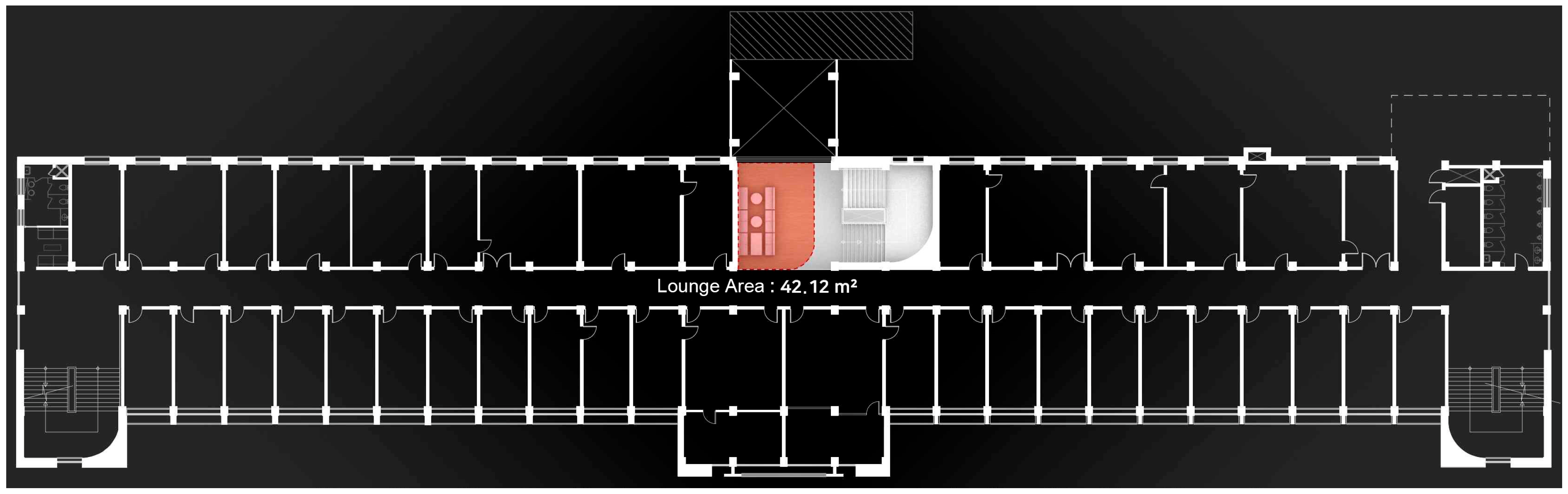
2.2. Setting
- Design A: The lounge in its existing state.
- Design B: The lounge with partially open partition furniture that delineates territory while retaining outward visibility to corridors and stairwells.
- Design C: The partitioned lounge supplemented with identity-cue objects that support awareness of the group and social interaction (e.g., institutional and departmental logos, community blackboards, self-adhesive notes, posters, and students’ architectural models).
2.3. Participants
2.4. Variables and Measurement Instruments
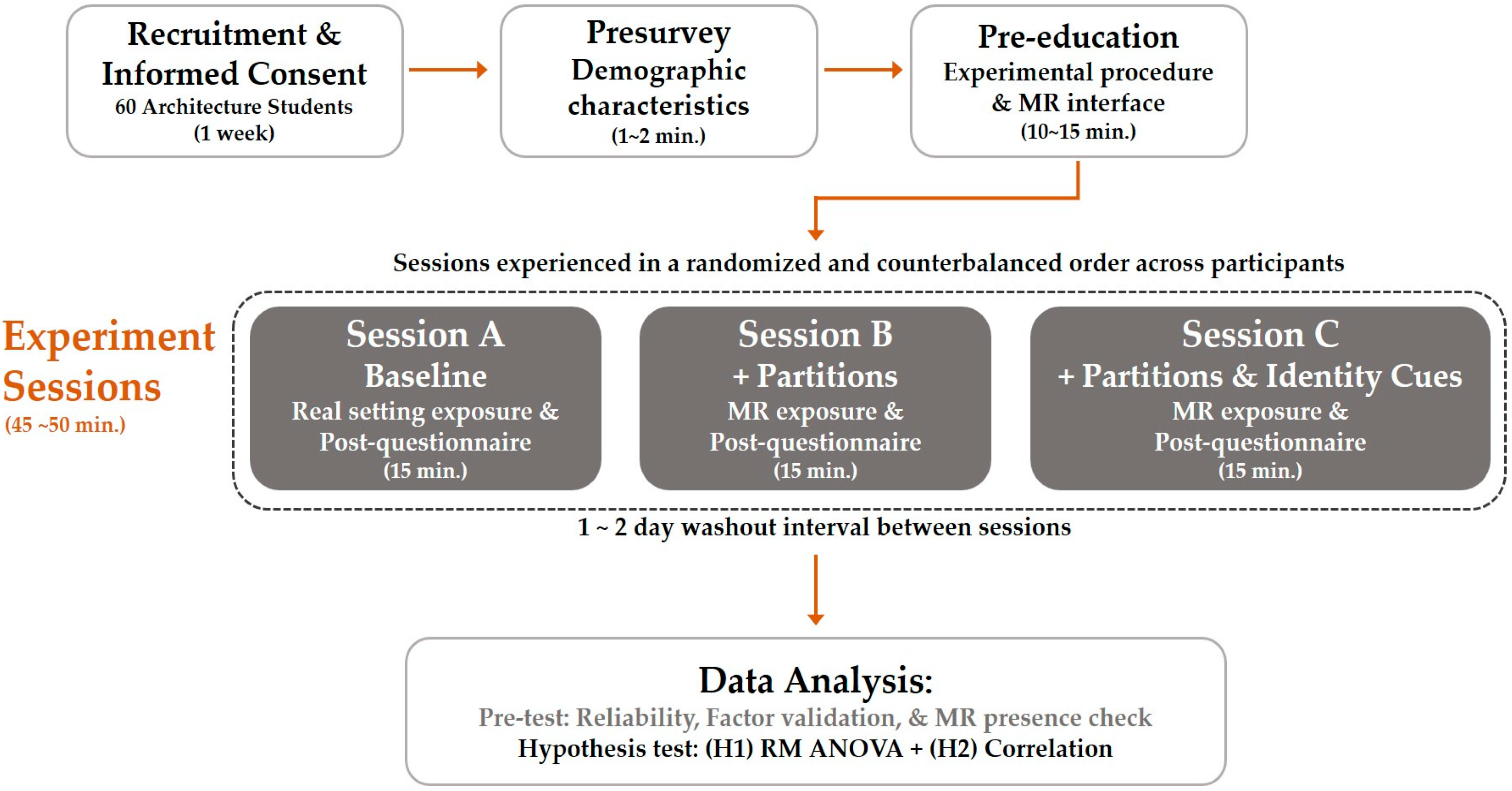
2.5. Experimental Procedure
2.6. Analysis Methods
2.7. Mixed Reality Platform Check
3. Results
3.1. Group Differences in Perceived Territorial Characteristics and Sense of Community
3.2. Correlation of Perceived Territorial Characteristics and Sense of Community Measures
4. Discussion
4.1. Between-Design Differences
4.1.1. H1 for PTC
4.1.2. H1 for SOC
4.2. Within-Design Associations
H2 for PTC–SOC Correlations
5. Conclusions
Author Contributions
Funding
Institutional Review Board Statement
Informed Consent Statement
Data Availability Statement
Acknowledgments
Conflicts of Interest
Appendix A

| Discipline | Core Focus | Key Mechanism | Scholars | Link to This Study |
|---|---|---|---|---|
| Environmental psychology | Regulation of interpersonal space, privacy, and ownership | Control of access, personalization, and defense of territory | [23,24,25,26] | Partitions link to territorial control and legibility |
| Human geography | Socio-spatial organization of boundaries and identity | Spatial classification, boundary communication, and symbolic representation | [27,28,29,30,31] | Partitions/Identity markers link to boundary clarity and signaling |
| Environmental sociology | Collective meaning and group identity | Social construction of belonging and group identity via shared places | [170,174] | Identity markers link to symbolic social meaning |
| Dimension | Factor | F | df1 | df2 | p | ηp2 | |
|---|---|---|---|---|---|---|---|
| PTC | Spatial comfort | Education status | 0.817 | 2 | 116 | 0.444 | 0.014 |
| MR proficiency | 0.704 | 4 | 114 | 0.591 | 0.024 | ||
| Lounge use experience | 1.322 | 2 | 116 | 0.271 | 0.022 | ||
| Openness | Education status | 1.052 | 2 | 116 | 0.353 | 0.018 | |
| MR proficiency | 0.760 | 4 | 114 | 0.553 | 0.026 | ||
| Lounge use experience | 0.466 | 2 | 116 | 0.629 | 0.008 | ||
| Territorial control | Education status | 0.134 | 2 | 116 | 0.874 | 0.002 | |
| MR proficiency | 1.480 | 4 | 114 | 0.213 | 0.049 | ||
| Lounge use experience | 0.436 | 2 | 116 | 0.648 | 0.007 | ||
| Symbolic identity | Education status | 0.821 | 2 | 116 | 0.443 | 0.014 | |
| MR proficiency | 0.361 | 4 | 114 | 0.836 | 0.013 | ||
| Lounge use experience | 0.079 | 2 | 116 | 0.924 | 0.001 | ||
| SOC | Need fulfillment | Education status | 1.367 | 2 | 116 | 0.259 | 0.023 |
| MR proficiency | 0.406 | 4 | 114 | 0.804 | 0.014 | ||
| Lounge use experience | 1.436 | 2 | 116 | 0.242 | 0.024 | ||
| Membership | Education status | 1.100 | 2 | 116 | 0.336 | 0.019 | |
| MR proficiency | 1.768 | 4 | 114 | 0.140 | 0.058 | ||
| Lounge use experience | 1.097 | 2 | 116 | 0.337 | 0.019 | ||
| Influence | Education status | 0.515 | 2 | 116 | 0.599 | 0.009 | |
| MR proficiency | 1.098 | 4 | 114 | 0.361 | 0.037 | ||
| Lounge use experience | 0.787 | 2 | 116 | 0.458 | 0.013 | ||
| Emotional connection | Education status | 1.307 | 2 | 116 | 0.275 | 0.022 | |
| MR proficiency | 0.291 | 4 | 114 | 0.883 | 0.010 | ||
| Lounge use experience | 1.368 | 2 | 116 | 0.259 | 0.023 |
| PTC | Variables | Scholars | |
|---|---|---|---|
| Spatial comfort | SC1 | This space feels comfortable to use. | [159] |
| SC2 | The colors in this space are harmonious. | ||
| SC3 | The decorative elements in this space are harmonious. | ||
| SC4 | The size of this space is appropriate for its use. | ||
| Openness | O1 | This space is easily accessible from other areas. | [159] |
| O2 | I feel no reluctance to use this space | ||
| O3 | This space seems open to anyone. | ||
| O4 | This space feels open. | ||
| Territorial control | TC1 | I feel that my group can influence what happens in this space. | [57,160,161] |
| TC2 | I feel that this space is our territory. | ||
| TC3 | I can set or negotiate how this space is used with others. | ||
| TC4 | I can make a positive impact on what happens in this space. | ||
| TC5 | I can manage interactions in this space when needed. | ||
| Symbolic identity | SI1 | I can recognize what this space stands for. | [57,160,161] |
| SI2 | This space is distinct from other spaces. | ||
| SI3 | This space has symbolic elements. | ||
| SI4 | The symbols in this space influence how I feel about it. | ||
| SI5 | I can express my identity in this space. | ||
| SOC | Variables | Scholars | |
| Need fulfillment | NF1 | My essential needs are met in this lounge community. | [75] |
| NF2 | I value the same things as other lounge users. | ||
| NF3 | This lounge community effectively meets the needs of its members. | ||
| NF4 | I am happy to be part of this lounge community. | ||
| NF5 | When I have a problem, I can talk to members of this lounge community. | ||
| NF6 | People in this lounge community share similar needs, priorities, and goals. | ||
| Membership | M1 | I trust people in this lounge community. | [75] |
| M2 | I know most of the regular users of this lounge. | ||
| M3 | Most regular users of this lounge are familiar with me. | ||
| M4 | This lounge community has recognizable symbols (e.g., displays, logos, memos). | ||
| M5 | I invest time and effort to be part of this lounge community. | ||
| M6 | Being part of this lounge community is part of my identity. | ||
| Influence | I1 | It is important to me to feel that I belong in this lounge community. | [75] |
| I2 | This lounge community can influence other groups on campus. | ||
| I3 | I care about how this lounge community thinks of me. | ||
| I4 | This lounge community influences me. | ||
| I5 | When a problem arises, members of this lounge community work together to solve. | ||
| I6 | This lounge community has good leaders or coordinators. | ||
| Emotional connection | EC1 | Being part of this lounge community is important to me. | [75] |
| EC2 | I enjoy being with members of this lounge community. | ||
| EC3 | I want to remain part of this lounge community for a longer period. | ||
| EC4 | Members of this lounge community share meaningful events or experiences. | ||
| EC5 | I feel hopeful about the future of this lounge community. | ||
| EC6 | Members of this lounge community care about one another. | ||
| Dimension | Items Retained | Design | Eigenvalue | Variance (%) | KMO | Bartlett’s Test (χ2, df) | p | Cronbach’s α | |
|---|---|---|---|---|---|---|---|---|---|
| PTC | Spatial comfort | SC1,2,3 | A | 1.794 | 59.786 | 0.652 | 24.914 (df = 3) | <0.001 *** | 0.660 |
| B | 2.028 | 67.600 | 0.678 | 43.625 (df = 3) | <0.001 *** | 0.751 | |||
| C | 2.304 | 76.816 | 0.703 | 77.142 (df = 3) | <0.001 *** | 0.847 | |||
| Openness | O1,2,3,4 | A | 2.251 | 56.269 | 0.624 | 61.099 (df = 6) | <0.001 *** | 0.735 | |
| B | 2.456 | 61.411 | 0.743 | 70.29 (df = 6) | <0.001 *** | 0.785 | |||
| C | 2.267 | 56.681 | 0.633 | 77.928 (df = 6) | <0.001 *** | 0.738 | |||
| Territorial control | TC1,2,4,5 | A | 2.280 | 57.010 | 0.715 | 52.860 (df = 6) | <0.001 *** | 0.735 | |
| B | 2.286 | 57.149 | 0.682 | 62.595 (df = 6) | <0.001 *** | 0.742 | |||
| C | 2.495 | 62.384 | 0.795 | 66.302 (df = 6) | <0.001 *** | 0.792 | |||
| Symbolic identity | SI2,3 4 | A | 1.520 | 50.678 | 0.608 | 10.655 (df = 3) | 0.014 * | 0.508 | |
| B | 1.732 | 57.725 | 0.624 | 22.113 (df = 3) | <0.001 *** | 0.630 | |||
| C | 1.674 | 55.784 | 0.614 | 18.927 (df = 3) | <0.001 *** | 0.576 | |||
| SOC | Need fulfillment | NF1,2,3,4,5,6 | A | 3.300 | 54.994 | 0.746 | 151.036 (df = 15) | <0.001 *** | 0.832 |
| B | 3.947 | 65.779 | 0.815 | 216.834 (df = 15) | <0.001 *** | 0.893 | |||
| C | 3.632 | 60.533 | 0.825 | 619.508 (df = 15) | <0.001 *** | 0.860 | |||
| Membership | M1,2,3,5,6 | A | 3.064 | 61.275 | 0.598 | 186.688 (df = 10) | <0.001 *** | 0.839 | |
| B | 3.008 | 60.161 | 0.668 | 158.083 (df = 10) | <0.001 *** | 0.832 | |||
| C | 2.952 | 59.037 | 0.689 | 154.703 (df = 10) | <0.001 *** | 0.825 | |||
| Influence | I1,2,3,4,5 | A | 2.858 | 57.166 | 0.779 | 99.468 (df = 10) | <0.001 *** | 0.810 | |
| B | 3.185 | 63.704 | 0.812 | 137.029 (df = 10) | <0.001 *** | 0.855 | |||
| C | 3.179 | 63.583 | 0.799 | 128.178 (df = 10) | <0.001 *** | 0.853 | |||
| Emotional connection | EC1,2,3,4,5,6 | A | 3.819 | 63.647 | 0.845 | 181.124 (df = 15) | <0.001 *** | 0.882 | |
| B | 3.999 | 66.645 | 0.857 | 207.865 (df = 15) | <0.001 *** | 0.898 | |||
| C | 3.722 | 62.037 | 0.795 | 179.581 (df = 15) | <0.001 *** | 0.875 |
| Item | Design B | Design C | Mean Diff (C-B) | t (df = 59) | p | ηp2 | |||
|---|---|---|---|---|---|---|---|---|---|
| Mean | SD | Mean | SD | ||||||
| 1 | Presence of being in the lounge | 5.20 | 1.07 | 5.35 | 1.02 | 0.15 | 0.98 | 0.333 | 0.016 |
| 2 | Sense of psychological presence | 5.28 | 0.92 | 5.47 | 1.10 | 0.18 | 1.06 | 0.296 | 0.019 |
| 3 | Resolution/display quality | 5.02 | 1.08 | 5.08 | 0.91 | 0.07 | 0.41 | 0.684 | 0.003 |
| 4 | Realistic materials/lighting | 4.57 | 1.23 | 4.67 | 1.07 | 0.10 | 0.57 | 0.568 | 0.006 |
| 5 | Perceived realism of 3D space | 5.52 | 1.13 | 5.63 | 1.18 | 0.12 | 0.67 | 0.507 | 0.008 |
| 6 | Interaction with objects | 5.03 | 1.04 | 4.90 | 1.02 | −0.13 | −0.77 | 0.442 | 0.010 |
| 7 | Autonomous experience | 5.57 | 1.06 | 5.47 | 1.07 | −0.10 | −0.62 | 0.536 | 0.007 |
| 8 | Interface usability | 5.23 | 0.91 | 5.17 | 1.03 | −0.07 | −0.39 | 0.696 | 0.003 |
| 9 | Equipment comfort | 5.30 | 1.09 | 5.33 | 1.02 | 0.03 | 0.21 | 0.831 | 0.001 |
| Dimension | Design B | Design C | |||||
|---|---|---|---|---|---|---|---|
| r | p | Cohen’s d | r | p | Cohen’s d | ||
| PTC | Overall PTC | — (ns) | — | — | 0.355 | 0.005 ** | 0.759 |
| Territorial control | — (ns) | — | — | 0.346 | 0.007 ** | 0.738 | |
| Symbolic identity | 0.286 | 0.027 * | 0.597 | 0.349 | 0.006 ** | 0.745 | |
| SOC | Overall SOC | 0.274 | 0.034 * | 0.570 | 0.316 | 0.014 * | 0.666 |
| Need fulfillment | 0.267 | 0.039 * | 0.554 | 0.276 | 0.033 * | 0.574 | |
| Membership | 0.308 | 0.017 * | 0.647 | 0.309 | 0.016 * | 0.650 | |
| Influence | 0.301 | 0.019 * | 0.631 | 0.275 | 0.033 * | 0.572 | |
| Emotional connection | — (ns) | — | — | 0.284 | 0.028 * | 0.592 | |
| Pair (Between PTC and SOC) | r | p | Cohen’s d | |
|---|---|---|---|---|
| Design A | Overall PTC—Influence | 0.310 | <0.05 | 0.653 |
| Design B | Symbolic identity—Membership | 0.266 | <0.05 | 0.553 |
| Design C | Overall PTC—Membership | 0.266 | <0.05 | 0.553 |
| Spatial comfort—Need fulfillment | 0.259 | <0.05 | 0.537 | |
| Spatial comfort—Membership | 0.303 | <0.05 | 0.635 | |
| Territorial control—Overall SOC | 0.287 | <0.05 | 0.599 | |
| Territorial control—Need fulfillment | 0.280 | <0.05 | 0.583 | |
| Territorial control—Membership | 0.271 | <0.05 | 0.564 | |
| Territorial control—Influence | 0.293 | <0.05 | 0.613 | |
| Symbolic identity—Membership | 0.265 | <0.05 | 0.551 |
References
- Barrett, P.; Davies, F.; Zhang, Y.; Barrett, L. The impact of classroom design on pupils’ learning: Final results of a holistic, multi–level analysis. Build. Environ. 2015, 89, 118–133. [Google Scholar] [CrossRef]
- Nja, C.O.; Anari, M.I.; Erim, C.M.; Idiege, K.J.; Ilhami, A.; Ukah, J.U.; Eneyo, O.E.; Uwe, U.E.; Cornelius-Ukpepi, B.U. Learning space, students’ collaboration, educational outcomes, and interest: Exploring the physical, social and psychological mediators. Heliyon 2023, 9, e15456. [Google Scholar] [CrossRef]
- Samani, S.A. The influence of light on student’s learning performance in learning environments: A knowledge internalization perspective. J. World Acad. Sci. Eng. Technol. 2011, 81, 540–547. [Google Scholar]
- Mealings, K. The effect of classroom acoustic treatment on listening, learning, and well–being: A scoping review. Acoust. Aust. 2023, 51, 279–291. [Google Scholar] [CrossRef]
- Charousaei, M.; Faizi, M.; Khakzand, M. The impact of the visual layout of university open space on students’ behavior and satisfaction level: The case of Iran University of Science and Technology. Smart Sustain. Built Environ. 2025, 14, 992–1016. [Google Scholar] [CrossRef]
- Abdullah, F.; Yaman, M.; Sanusi, A.N.Z.; Asif, N.; Salim, F. Significant design values for outdoor learning environment in higher learning institutions. J. Archit. Plan. Constr. Manag. 2021, 11, 91–99. [Google Scholar] [CrossRef]
- Goldhaber, A.B.; Khuan, H.; Allysa, R. Impact of ICT integration on quality of education among secondary schools in USA. J. Educ. 2021, 4, 53–61. [Google Scholar] [CrossRef]
- Temple, P. Learning spaces in higher education: An under–researched topic. Lond. Rev. Educ. 2008, 6, 229–241. [Google Scholar] [CrossRef]
- Dugdale, S. Space strategies for the new learning landscape. Educ. Rev. 2009, 44, 50–52. [Google Scholar]
- Cox, A.M. Space and embodiment in informal learning. High. Educ. 2018, 75, 1077–1090. [Google Scholar] [CrossRef]
- Detyna, M.; Ogunbase, A.; Briffa, H. A socio–material approach to investigating classrooms: Student engagement in an innovative learning environment. Learn. Environ. Res. 2025, 28, 473–502. [Google Scholar] [CrossRef]
- Harrop, D.; Turpin, B. A study exploring learners’ informal learning space behaviors, attitudes, and preferences. New Rev. Acad. Librariansh. 2013, 19, 58–77. [Google Scholar] [CrossRef]
- Crook, C.; Mitchell, G. Ambience in social learning: Student engagement with new designs for learning spaces. Camb. J. Educ. 2012, 42, 121–139. [Google Scholar] [CrossRef]
- Matthews, K.E.; Andrews, V.; Adams, P. Social learning spaces and student engagement. High. Educ. Res. Dev. 2011, 30, 105–120. [Google Scholar] [CrossRef]
- Wu, X.; Kou, Z.; Oldfield, P.; Heath, T.; Borsi, K. Informal learning spaces in higher education: Student preferences and activities. Buildings 2021, 11, 252. [Google Scholar] [CrossRef]
- Morieson, L.; Murray, G.; Wilson, R.; Clarke, B.; Lukas, K. Belonging in space: Informal learning spaces and the student experience. J. Learn. Spaces 2018, 7, 12–22. [Google Scholar]
- Manca, S.; Cerina, V.; Tobia, V.; Sacchi, S.; Fornara, F. The effect of school design on users’ responses: A systematic review (2008–2017). Sustainability 2020, 12, 3453. [Google Scholar] [CrossRef]
- Geister, S.; Keser Schenberger, F.; Çetinkaya–Yıldız, E.; Apaydın, S. The Role of Informal Learning Spaces in Promoting Social Integration and Wellbeing in Higher Education. Front. Educ. 2025, 10, 1637874. [Google Scholar] [CrossRef]
- Berman, N. A critical examination of informal learning spaces. High. Educ. Res. Dev. 2020, 39, 127–140. [Google Scholar] [CrossRef]
- APPA Thought Leaders Series 2012. Campus Space…An Asset and a Burden. APPA Leadership in Educational Facilities. Available online: https://share.google/UyTs70cMC3u8OC856 (accessed on 30 August 2025).
- Friedman, J.Z.; Worden, E.A. Creating interdisciplinary space on campus: Lessons from US area studies centers. High. Educ. Res. Dev. 2016, 35, 129–141. [Google Scholar] [CrossRef]
- Painter, S.; Fournier, J.; Grape, C.; Grummon, P.; Morelli, J.; Whitmer, S.; Cevetello, J. Research on Learning Space Design: Present State, Future Directions. Society of College and University Planning. 2013. Available online: https://share.google/JuPixi0N0pBRm0FZ8 (accessed on 27 August 2025).
- Altman, I. The Environment and Social Behavior: Privacy, Personal Space, Territory, and Crowding; Brooks/Cole Publishing Company: Monterey, CA, USA, 1975. [Google Scholar]
- Brown, B.B. Territoriality. In Handbook of Environmental Psychology; Stokols, D., Altman, I., Eds.; Wiley: New York, NY, USA, 1987; Volume 2, pp. 505–531. [Google Scholar]
- Taylor, R.B. Human Territorial Functioning: An Empirical, Evolutionary Perspective on Individual and Small Group Territorial Cognitions, Behaviors, and Consequences; Stokols, D., Altman, I., Eds.; Cambridge University Press: New York, NY, USA, 1988. [Google Scholar]
- Brown, G.; Lawrence, T.B.; Robinson, S.L. Territoriality in organizations. Acad. Manag. Rev. 2005, 30, 577–594. [Google Scholar] [CrossRef]
- Sack, R.D. Human territoriality: A theory. Ann. Assoc. Am. Geogr. 1983, 73, 55–74. [Google Scholar] [CrossRef]
- Sack, R.D. Human Territoriality: Its Theory and History; Stokols, D., Altman, I., Eds.; Cambridge University Press: New York, NY, USA, 1986. [Google Scholar]
- Paasi, A. Boundaries as social processes: Territoriality in the world of flows. Geopolitics 1998, 3, 69–88. [Google Scholar] [CrossRef]
- Paasi, A. Europe as a social process and discourse: Considerations of place, boundaries and identity. Eur. Urban Reg. Stud. 2001, 8, 7–28. [Google Scholar] [CrossRef]
- Paasi, A. Region and place: Regional identity in question. Prog. Hum. Geogr. 2003, 27, 475–485. [Google Scholar] [CrossRef]
- Gibson, J.J. The Ecological Approach to Visual Perception; Houghton Mifflin: Boston, MA, USA, 1979. [Google Scholar]
- Heft, H. Affordances and the body: An intentional analysis of Gibson’s ecological approach to visual perception. Ecol. Psychol. 1989, 1, 123–153. [Google Scholar] [CrossRef]
- Haworth Research. Affordances: Behaviors Encouraged by Desirable, High-Performance Work Environments; Haworth Inc.: Holland, MI, USA, 2024; Available online: https://www.haworth.com/content/dam/digital/north-american-assets/knowledge-and-research/affordances/Affordances_White-Paper.pdf (accessed on 15 October 2025).
- Michaels, C.F.; Carello, C. Direct Perception; Prentice-Hall: Englewood Cliffs, NJ, USA, 1981. [Google Scholar]
- Warren, W.H., Jr. Perceiving affordances: Visual guidance of stair climbing. J. Exp. Psychol. Hum. Percept. Perform. 1984, 10, 683–703. [Google Scholar] [CrossRef]
- Lavdas, A.A.; Salingaros, N.A. Architectural beauty: Developing a measurable and objective scale. Challenges 2022, 13, 56. [Google Scholar] [CrossRef]
- Lavdas, A.A.; Sussman, A. Applications of biometrics in architectural and environmental design. In Environmental Neuroscience; Springer: Cham, Switzerland, 2024; pp. 227–254. [Google Scholar]
- Higuera-Trujillo, J.L.; Llinares, C.; Macagno, E. The cognitive–emotional design and study of architectural space: A scoping review of neuroarchitecture and its precursor approaches. Sensors 2021, 21, 2193. [Google Scholar] [CrossRef]
- Wang, S.; de Oliveira, G.S.; Djebbara, Z.; Gramann, K. The embodiment of architectural experience: A methodological perspective on neuro-architecture. Front. Hum. Neurosci. 2022, 16, 833528. [Google Scholar] [CrossRef]
- Lee, M.A. Analysis of changes in the spatial characteristics of student hub spaces on university campuses—Focused on text mining techniques. J. Korea Inst. Spat. Des. 2025, 20, 819–832. [Google Scholar]
- Eom, S.C.; Lee, S.Y. State of study spaces for use of intermediate space in university campus. J. Korean Inst. Inter. Des. 2022, 31, 55–62. [Google Scholar] [CrossRef]
- Kim, J.S.; Jang, Y.E. The mediating effect of social belonging in the relationship between trust and life satisfaction among generation z university students. Stud. Humanit. Soc. Sci. 2025, 7, 1027–1040. [Google Scholar] [CrossRef]
- Jeong, Y.M.; Kim, T.R. The effects of college students’ sense of community on psychological well-being: The mediating effect of emotional intelligence. J. Converg. Cult. Technol. 2024, 10, 313–319. [Google Scholar]
- Choi, Y.H.; Sung, M.J. Students’ experience of a university and its influence on student–university relationships. Korean J. Advert. 2015, 16, 103–136. [Google Scholar] [CrossRef] [PubMed]
- Milgram, P.; Kishino, F. A taxonomy of mixed reality visual displays. IEICE Trans. Inf. Syst. 1994, 77, 1321–1329. [Google Scholar]
- Johnson–Glenberg, M.C. Immersive VR and education: Embodied design principles that include gesture and hand controls. Front. Robot. AI 2018, 5, 375272. [Google Scholar] [CrossRef]
- John, B.; Kurian, J.C.; Fitzgerald, R.; Goh, D.H.L. Students’ learning experience in a mixed reality environment: Drivers and barriers. Commun. Assoc. Inf. Syst. 2022, 50, 510–535. [Google Scholar] [CrossRef]
- Slater, M.; Wilbur, S. A framework for immersive virtual environments (FIVE): Speculations on the role of presence in virtual environments. Presence Teleoperators Virtual Environ. 1997, 6, 603–616. [Google Scholar] [CrossRef]
- Schuemie, M.J.; Van Der Straaten, P.; Krijn, M.; Van Der Mast, C.A. Research on presence in VR: A survey. Cyberpsychol. Behav. 2001, 4, 183–201. [Google Scholar] [CrossRef] [PubMed]
- Slater, M. Place illusion and plausibility can lead to realistic behaviour in immersive virtual environments. Philos. Trans. R. Soc. B Biol. Sci. 2009, 364, 3549–3557. [Google Scholar] [CrossRef]
- Rincon, E.; Rodriguez–Guidonet, I.; Andrade–Pino, P.; Monfort–Vinuesa, C. Mixed reality in undergraduate mental health education: A systematic review. Electronics 2023, 12, 1019. [Google Scholar] [CrossRef]
- Gerup, J.; Soerensen, C.B.; Dieckmann, P. Augmented reality and mixed reality for healthcare education beyond surgery: An integrative review. Int. J. Med. Educ. 2020, 11, 1–18. [Google Scholar] [CrossRef]
- Kim, W. A Study on the Relationship Between the Design of University Public Lounges and the Sense of Community—Focused on Mixed Reality (MR) Simulation. Master’s Thesis, Inha University, Incheon, Republic of Korea, February 2023. [Google Scholar]
- Kim, W.; Cho, M. Exploring Perceived Territoriality and Community Belongingness in University Lounge Design: A Mixed Reality Simulation Study. In Proceedings of the 14th International Symposium on Architectural Interchanges in Asia (ISAIA 2024), Kyoto University, Kyoto, Japan, 10–12 September 2024. [Google Scholar]
- Harris, P.B.; Brown, B.B. The home and identity display: Interpreting resident territoriality from home exteriors. J. Environ. Psychol. 1996, 16, 187–203. [Google Scholar] [CrossRef]
- Brown, G. Claiming a corner at work: Measuring employee territoriality in their workspaces. J. Environ. Psychol. 2009, 29, 44–52. [Google Scholar] [CrossRef]
- Haber, G.M. Territorial invasion in the classroom: Invadee response. Environ. Behav. 1980, 12, 17–31. [Google Scholar] [CrossRef]
- Kaya, N.; Burgess, B. Territoriality: Seat preferences in different types of classroom arrangements. Environ. Behav. 2007, 39, 859–876. [Google Scholar] [CrossRef]
- Chung, Y.M. User’s Perceptions of Territoriality in Residence Hall Rooms. Ph.D. Thesis, University of Minnesota, Minneapolis, MN, USA, January 2000. [Google Scholar]
- Khajehzadeh, I.; Vale, B. Shared student residential space: A post occupancy evaluation. J. Facil. Manag. 2016, 14, 102–124. [Google Scholar] [CrossRef]
- Abu–Ghazzeh, T.M. Communicating behavioral research to campus design: Factors affecting the perception and use of outdoor spaces at the University of Jordan. Environ. Behav. 1999, 31, 764–804. [Google Scholar] [CrossRef]
- O’Neill, M. Limitless learning creating adaptable environments to support a changing campus. Plann. High. Educ. 2013, 42, 11–27. [Google Scholar]
- McMillan, D.W.; Chavis, D.M. Sense of community: A definition and theory. J. Community Psychol. 1986, 14, 6–23. [Google Scholar] [CrossRef]
- Chipuer, H.M.; Pretty, G.M. A review of the sense of community index: Current uses, factor structure, reliability, and further development. J. Community Psychol. 1999, 27, 643–658. [Google Scholar] [CrossRef]
- Long, D.A.; Perkins, D.D. Confirmatory factor analysis of the sense of community index and development of a brief SCI. J. Community Psychol. 2003, 31, 279–296. [Google Scholar] [CrossRef]
- Obst, P.L.; White, K.M. Revisiting the sense of community index: A confirmatory factor analysis. J. Community Psychol. 2004, 32, 691–705. [Google Scholar] [CrossRef]
- Peterson, N.A.; Speer, P.W.; McMillan, D.W. Validation of a brief sense of community scale: Confirmation of the principal theory of sense of community. J. Community Psychol. 2008, 36, 61–73. [Google Scholar] [CrossRef]
- Peterson, N.; Speer, P.W.; Peterson, C.H.; Powell, K.G.; Treitler, P.; Wang, Y. Importance of auxiliary theories in research on university-community partnerships: The example of psychological sense of community. Collab. J. Community Based Res. Pract. 2017, 1, 5. [Google Scholar] [CrossRef]
- Loomis, C.; Wright, C. How many factors does the sense of community index assess? J. Community Psychol. 2018, 46, 383–396. [Google Scholar] [CrossRef]
- Cope, M.R.; Ward, C.; Jackson, J.E.; Muirbrook, K.A.; Andre, A.N. Taking another look at the sense of community index: Six confirmatory factor analyses. J. Community Psychol. 2020, 48, 1410–1423. [Google Scholar] [CrossRef]
- Chavis, D.M.; Hogge, J.H.; McMillan, D.W.; Wandersman, A. Sense of community through Brunswik’s lens: A first look. J. Community Psychol. 1986, 14, 24–40. [Google Scholar] [CrossRef]
- Chavis, D.M.; Pretty, G.M.H. Sense of community: Advances in measurement and application. J. Community Psychol. 1999, 27, 635–642. [Google Scholar] [CrossRef]
- Flaherty, J.; Zwick, R.R.; Bouchey, H.A. Revisiting the sense of community index: A confirmatory factor analysis and invariance test. J. Community Psychol. 2014, 42, 947–963. [Google Scholar] [CrossRef]
- Chavis, D.M.; Lee, K.S.; Acosta, J.D. The sense of community (SCI) revised: The reliability and validity of the SCI–2. In Proceedings of the 2nd International Community Psychology Conference, Lisboa, Portugal, 4–6 June 2008. [Google Scholar]
- Prezza, M.; Pacilli, M.G.; Barbaranelli, C.; Zampatti, E. The MTSOCS: A multidimensional sense of community scale for local communities. J. Community Psychol. 2009, 37, 305–326. [Google Scholar] [CrossRef]
- Park, H.; Lee, S. The influence of sense of school community on Korean students’ life satisfaction and comparison of sense of community for students’ gender and high school specialties. J. Res. Tech. Careers 2019, 3, 49. [Google Scholar] [CrossRef]
- Richard, M.C.; Lavoie, É.; Watters, B. Validation of the French-language version of the sense of community index-2. SAGE Open 2023, 13, 21582440231180131. [Google Scholar] [CrossRef]
- McClannon, T.W.; Cheney, A.W.; Bolt, L.L.; Terry, K.P. Predicting sense of presence and sense of community in immersive online learning environments. Online Learn. 2018, 22, 141–159. [Google Scholar] [CrossRef]
- Mannarini, T.; Rochira, A.; Talò, C. Negative psychological sense of community: Development of a measure and theoretical implications. J. Community Psychol. 2014, 42, 673–688. [Google Scholar] [CrossRef]
- Boyd, N.M.; Liu, X.; Horissian, K. Impact of community experiences on student retention perceptions and satisfaction in higher education. J. Coll. Stud. Retent. Res. Theory Pract. 2022, 24, 337–365. [Google Scholar] [CrossRef]
- Mendoza, P.; Suarez, J.D.; Bustamante, E. Sense of community in student retention at a tertiary technical institution in Bogotá: An ecological approach. Community Coll. Rev. 2016, 44, 286–314. [Google Scholar] [CrossRef]
- Andrade, M.S.; Miller, R.M.; McArthur, D.; Ogden, M. The impact of learning on student persistence in higher education. J. Coll. Stud. Retent. Res. Theory Pract. 2022, 24, 316–336. [Google Scholar] [CrossRef]
- Shouse, R. Academic press, sense of community, and student achievement. In Redesigning American Education; Section 4; Coleman, J., Schneider, B., Plank, S., Schiller, K., Wang, H., Eds.; Westview Press: Boulder, CO, USA, 2018; pp. 60–86. [Google Scholar]
- Wiseman, R.L.; Gonzales, S.M.; Salyer, K. A cross-cultural analysis of students’ sense of community, degree of involvement, and educational benefits. Intercult. Commun. Stud. 2004, 13, 173–189. [Google Scholar]
- Zhang, H.; Abbott, N.; Waldeck, D.; Holliman, A. Social interaction, sense of belonging, psychological well–being: A study of Chinese international students in UK higher education. Front. Educ. 2025, 10, 1677348. [Google Scholar] [CrossRef]
- Henry, S.K. Extending Our Understanding of Social Belonging: College Students’ Use of Technology, Psychosocial Well-Being, and Sense of Community in University Life. Ph.D. Thesis, University of San Diego, San Diego, CA, USA, May 2010. [Google Scholar]
- Noel–Elkins, A.; Forrester, S.; Elkins, D. Examining the relationship between students’ perceived sense of campus community and satisfaction with school life. Coll. Stud. Aff. J. 2019, 37, 28–38. [Google Scholar] [CrossRef]
- Drouin, M.A. The relationship between students’ perceived sense of community and satisfaction, achievement, and retention in an online course. Q. Rev. Distance Educ. 2008, 9, 267–284. [Google Scholar]
- Wong, W.H.; Chapman, E. Student satisfaction and interaction in higher education. High. Educ. 2023, 85, 957–978. [Google Scholar] [CrossRef] [PubMed]
- Strayhorn, T.L. College Students’ Sense of Belonging: A Key to Educational Success for All Students, 2nd ed.; Routledge: New York, NY, USA, 2018. [Google Scholar]
- Tholen, R.; Wouters, E.; Ponnet, K.; de Bruyn, S.; Van Hal, G. Academic stress, anxiety, and depression among Flemish first-year students: The mediating role of sense of belonging. J. Coll. Stud. Dev. 2022, 63, 200–217. [Google Scholar] [CrossRef]
- Masika, R.; Jones, J. Building student belonging and engagement: Insights into higher education students’ experiences of participating and learning together. Teach. High. Educ. 2016, 21, 138–150. [Google Scholar] [CrossRef]
- Vora, R.S.; Kinney, M.N. Connectedness, sense of community, and academic satisfaction in a novel community campus medical education model. Acad. Med. 2014, 89, 182–187. [Google Scholar] [CrossRef] [PubMed]
- Hausmann, L.R.; Ye, F.; Schofield, J.W.; Woods, R.L. Sense of belonging and persistence in White and African American first-year students. Res. High. Educ. 2009, 50, 649–669. [Google Scholar] [CrossRef]
- Mulrooney, H.M.; Kelly, A.F. The university campus and a sense of belonging: What do students think? New Dir. Teach. Nat. Sci. 2020, 15, 3590. [Google Scholar] [CrossRef]
- Negm, H.; Taha, D.; Saadallah, M. The Effect of the Physical Environment on Social Interaction: The Case of Educational Campuses. In SHAPING URBAN CHANGE–Livable City Regions for the 21st Century, Proceedings of the REAL CORP 2020, 25th International Conference on Urban Development, Regional Planning and Information Society, Aachen, Germany, 15–18 September 2020; CORP–Competence Center of Urban and Regional Planning: Vienna, Austria, 2020. [Google Scholar]
- Lee, S.Y.; Lee, M. Characteristics of campus space for interdisciplinary convergence education: Focused on case study of design colleges. J. Korean Inst. Inter. Des. 2021, 30, 56–66. [Google Scholar] [CrossRef]
- Jeon, J. A study on the liberal arts education system and major free choice system of domestic national and public universities. Soc. Cult. Conv. 2023, 45, 153–173. [Google Scholar]
- Nelson, C. Affiliation and change. In Affiliations: Identity in Academic Culture; Di Leo, J.R., Ed.; University of Nebraska Press: Lincoln, NE, USA, 2003; pp. 209–225. [Google Scholar]
- Wefald, A.J.; Ramirez, J.M. Exploring liminal and dominant spaces in interdisciplinary programs: Fostering community as through relationship-focused practices and collective leadership. J. Leadersh. Stud. 2024, 18, 59–66. [Google Scholar] [CrossRef]
- Rietveld, E.; Kiverstein, J. A rich landscape of affordances. Ecol. Psychol. 2014, 26, 325–352. [Google Scholar] [CrossRef]
- Warren, W.H., Jr.; Whang, S. Visual guidance of walking through apertures: Body-scaled information for affordances. Exp. Psychol. Hum. Percept. Perform. 1987, 13, 371–383. [Google Scholar] [CrossRef]
- Franchak, J.M.; Adolph, K.E. Affordances as probabilistic functions: Implications for development, perception, and decisions for action. Ecol. Psychol. 2014, 26, 109–124. [Google Scholar] [CrossRef]
- Djebbara, Z.; Fich, L.B.; Petrini, L.; Gramann, K. Sensorimotor brain dynamics reflect architectural affordances. Proc. Natl. Acad. Sci. USA 2019, 116, 14769–14777. [Google Scholar] [CrossRef] [PubMed]
- Djebbara, Z.; Fich, L.B.; Gramann, K. The brain dynamics of architectural affordances during transition. Sci. Rep. 2021, 11, 82504. [Google Scholar] [CrossRef] [PubMed]
- Bærentzen, J.; Frisvad, J.; Singh, K. Signifier-based immersive and interactive 3D modeling. In Proceedings of the SIGGRAPH Asia 2019 Posters, Brisbane, Australia, 17–20 November 2019; ACM: New York, NY, USA, 2019; pp. 1–5. [Google Scholar]
- Vartanian, O.; Navarrete, G.; Chatterjee, A.; Fich, L.B.; Leder, H.; Nadal, M.; Rostrup, N.; Skov, M.; Corradi, G. Impact of contour on aesthetic judgments and approach–avoidance decisions in architecture. Proc. Natl. Acad. Sci. USA 2013, 110 (Suppl. S2), S10446–S10453. [Google Scholar] [CrossRef]
- Vartanian, O.; Navarrete, G.; Chatterjee, A.; Fich, L.B.; Leder, H.; Nadal, M.; Rostrup, N.; Skov, M. Preference for openness in architectural design: Evidence from behavioral and fMRI studies. Front. Hum. Neurosci. 2015, 9, 151. [Google Scholar]
- Fich, L.B.; Jönsson, P.; Kirkegaard, P.H.; Wallergård, M.; Garde, A.H.; Hansen, Å. Can architectural design alter the stress response? J. Environ. Psychol. 2014, 38, 31–40. [Google Scholar]
- Shemesh, A.; Leisman, G.; Bar, M.; Grobman, Y.J. A neurocognitive study of the emotional impact of geometrical criteria of architectural space. Archit. Sci. Rev. 2021, 64, 394–407. [Google Scholar] [CrossRef]
- Coburn, A.; Vartanian, O.; Kenett, Y.N.; Nadal, M.; Hartung, F.; Hayn-Leichsenring, G.; Navarrete, G.; González-Mora, J.L.; Chatterjee, A. Psychological and neural responses to architectural interiors. Cortex 2020, 126, 217–241. [Google Scholar] [CrossRef]
- Gramann, K.; Jung, T.-P.; Ferris, D.P.; Lin, C.-T.; Makeig, S.; Gwin, J.T. Toward a new cognitive Neurosci.: Mobile brain/body imaging and the future of real-world Neurosci. NeuroImage 2021, 224, 117479. [Google Scholar]
- Pektaş, Ş.T. A scientometric analysis and review of spatial cognition studies within the framework of Neurosci. and architecture. Archit. Sci. Rev. 2021, 64, 374–382. [Google Scholar] [CrossRef]
- Taherysayah, F.; Westermann, C.; Liang, H.N. Learning from Neurosci.: Integrating users in design processes using brain imaging tools and virtual reality. Intell. Build. Int. 2025, 17, 13–27. [Google Scholar] [CrossRef]
- Dehan, J.I.A.; Li, W.; Wang, X.; Xia, G.; Yu, L. Color matters: Investigating stress recovery in VR-simulated interior environments using fNIRS and anxiety measures. Build. Environ. 2025, 285, 113609. [Google Scholar]
- Wang, X.; Schnabel, M.A. (Eds.) Mixed Reality in Architecture, Design, and Construction; Springer: Berlin/Heidelberg, Germany, 2008. [Google Scholar]
- Alexander, C.; Ishikawa, S.; Silverstein, M. A Pattern Language: Towns, Buildings, Construction; Oxford University Press: New York, NY, USA, 1977. [Google Scholar]
- Stamps, A.E. Effects of permeability on perceived enclosure and spaciousness. Environ. Behav. 2010, 42, 864–886. [Google Scholar] [CrossRef]
- Kim, J.; de Dear, R. Workspace satisfaction: The privacy–communication trade-off in open-plan offices. J. Environ. Psychol. 2013, 36, 18–26. [Google Scholar] [CrossRef]
- Bernstein, E.S.; Turban, S. The impact of the ‘open’ workspace on human collaboration. Philos. Trans. R. Soc. B 2018, 373, 20170239. [Google Scholar] [CrossRef]
- Yıldırım, K.; Güneş, E.; Yılmaz, G.P. The effects of workstation partition heights on employees’ perceptions in open-plan offices. J. Corp. Real Estate 2019, 21, 148–166. [Google Scholar] [CrossRef]
- Roo, J.S.; Hachet, M. One Reality: Augmenting How the Physical World is Experienced by Combining Multiple Mixed Reality Modalities. In Proceedings of the UIST 2017 30th ACM Symposium on User Interface Software and Technology, Quebec City, QC, Canada, 22–25 October 2017. [Google Scholar]
- Milgram, P.; Colquhoun, H. A Taxonomy of Real and Virtual World Display Integration. In Mixed Reality Merging Real and Virtual Worlds; Ohta, Y., Tamura, H., Eds.; Springer: Tokyo, Japan, 1999; pp. 1–26. [Google Scholar]
- Pérez–Muñoz, S.; Castaño Calle, R.; Morales Campo, P.T.; Rodríguez–Cayetano, A. A systematic review of the use and effect of virtual reality, augmented reality and mixed reality in physical education. Information 2024, 15, 582. [Google Scholar] [CrossRef]
- Long, J.W.; Masters, B.; Sajjadi, P.; Simons, C.; Masterson, T.D. The development of an immersive mixed-reality application to improve the ecological validity of eating and sensory behavior research. Front. Nutr. 2023, 10, 1170311. [Google Scholar] [CrossRef]
- Lee, C.; Rincon, G.A.; Meyer, G.; Höllerer, T.; Bowman, D.A. The effects of visual realism on search tasks in mixed reality simulation. IEEE Trans. Vis. Comput. Graph. 2013, 19, 547–556. [Google Scholar] [CrossRef]
- Shin, M.; Sibuea, R.; Lee, H. A comparative study examining the effects of mixed and virtual reality on plausibility illusion and emotional states. J. Media Psychol. 2024, 36, 281–290. [Google Scholar] [CrossRef]
- Microsoft Corporation. Microsoft HoloLens 2; Microsoft: Redmond, WA, USA, 2019–2025. Available online: https://learn.microsoft.com/ (accessed on 30 November 2022).
- Prabhakaran, B.; Guo, H.J. Hololens 2 Technical Evaluation As Mixed Reality Guide. In Proceedings of the International Conference on Human-Computer Interaction, Washington, DC, USA, 29 June–4 July 2024; Springer Nature: Cham, Switzerland, 2024; pp. 145–165. [Google Scholar]
- Palumbo, A. Microsoft HoloLens 2 in medical and healthcare context: State of the art and future prospects. Sensors 2022, 22, 7709. [Google Scholar] [CrossRef] [PubMed]
- Guajardo–Cuéllar, A.; Corona–Echauri, R.; Meza–Flores, R.A.; Vázquez, C.R.; Rodríguez–Arreola, A.; Navarro–Gutiérrez, M. Mixed reality laboratory for teaching control concepts: Design, validation, and implementation. Educ. Sci. 2025, 15, 883. [Google Scholar] [CrossRef]
- Huang, Y. Evaluating mixed reality technology for architectural design and construction layout. J. Civ. Eng. Constr. Technol. 2020, 11, 1–12. [Google Scholar] [CrossRef]
- Banjar, A.; Campbell, A.G. Work–in–Progress—Design of Mixed Reality Educational Applications Using Enhanced ARCS+ G Model for Motivation. In Proceedings of the 2022 8th International Conference of the Immersive Learning Research Network (iLRN), Vienna, Austria, 30 May–4 June 2022; pp. 1–3. [Google Scholar] [CrossRef]
- Banjar, A.; Xu, X.; Iqbal, M.Z.; Campbell, A. A systematic review of the experimental studies on the effectiveness of mixed reality in higher education between 2017 and 2021. Comput. Educ. X Real. 2023, 3, 100034. [Google Scholar] [CrossRef]
- Hauze, S.; Marshall, J. Validation of The Instructional Materials Motivation Survey: Measuring Student Motivation to Learn Via Mixed Reality Nursing Education Simulation. In Proceedings of the E-Learn: World Conference on E-Learning in Corporate, Government, Healthcare, and Higher Education, Las Vegas, NV, USA, 15 October 2018; pp. 576–586. [Google Scholar]
- Hasanzadeh, S.; Polys, N.F.; De La Garza, J.M. Presence, mixed reality, and risk-taking behavior: A study in safety interventions. IEEE Trans. Vis. Comput. Graph. 2020, 26, 2115–2125. [Google Scholar] [CrossRef]
- Eng, K.; Mintz, M.; Delbrück, T.; Douglas, R.J.; Whatley, A.M.; Manzolli, J.; Verschure, P.F.J. An investigation of collective human behavior in large-scale mixed reality spaces. Presence Teleoperators Virtual Environ. 2006, 15, 403–418. [Google Scholar] [CrossRef]
- Bhavadharini, B.; Monica, V.; Anbarasan, R.; Mahendran, R. Virtual, augmented, and mixed reality as a versatile tool in food consumer behavior evaluation: Recent advances in aroma, taste, and texture incorporation. Compr. Rev. Food Sci. Food Saf. 2023, 22, 4925–4956. [Google Scholar] [CrossRef]
- Minsky, M. Telepresence. Omni 1980, 2, 45–52. Available online: http://web.media.mit.edu/minsky/papers/Telepresence.html (accessed on 30 August 2025).
- Skarbez, R.; Brooks, F.P., Jr.; Whitton, M.C. A survey of presence and related concepts. ACM Comput. Surv. 2017, 50, 1–39. [Google Scholar] [CrossRef]
- Skarbez, R.; Brooks, F.P., Jr.; Whitton, M.C. Immersion and Coherence in a Stressful Virtual Environment. In Proceedings of the 24th ACM Symposium on Virtual Reality Software and Technology, Tokyo, Japan, 28 November–1 December 2018; pp. 1–11. [Google Scholar]
- Wienrich, C.; Komma, P.; Vogt, S.; Latoschik, M.E. Spatial presence in mixed realities–considerations about the concept, measures, design, and experiments. Front. Virtual Real. 2021, 2, 694315. [Google Scholar] [CrossRef]
- Lombard, M.; Ditton, T. At the heart of it all: The concept of presence. J. Comput. Mediat. Commun. 1997, 3, JCMC321. [Google Scholar] [CrossRef]
- Slater, M.; Lotto, B.; Arnold, M.M.; Sanchez–Vives, M.V. How we experience immersive virtual environments: The concept of presence and its measurement. An. Psicol. 2009, 40, 193–210. [Google Scholar]
- Witmer, B.G.; Singer, M.J. Measuring presence in virtual environments: A presence questionnaire. Presence Teleoperators Virtual Environ. 1998, 7, 225–240. [Google Scholar] [CrossRef]
- Schubert, T.W.; Friedmann, F.; Regenbrecht, H.T. Decomposing the Sense of Presence: Factor Analytic Insights. In Proceedings of the 2nd International Workshop on Presence, Colchester, UK, 6–7 April 1999. [Google Scholar]
- Lessiter, J.; Freeman, J.; Keogh, E.; Davidoff, J. Development of a New Cross-media Presence Questionnaire: The ITC-sense of Presence Inventory. In Proceedings of the Presence, Delft, The Netherlands, 27–28 March 2000. [Google Scholar]
- Slater, M.; Usoh, M.; Steed, A. Depth of presence in virtual Environments. Presence Teleoperators Virtual Environ. 1994, 3, 130–144. [Google Scholar] [CrossRef]
- Usoh, M.; Catena, E.; Arman, S.; Slater, M. Using presence questionnaires in reality. Presence Teleoperators Virtual Environ. 2000, 9, 497–503. [Google Scholar] [CrossRef]
- Tran, T.Q.; Langlotz, T.; Regenbrecht, H. A Survey on Measuring Presence in Mixed Reality. In Proceedings of the 2024 CHI Conference on Human Factors in Computing Systems, Honolulu, HI, USA, 11–16 May 2024; pp. 1–38. [Google Scholar]
- Chandio, Y.; Interrante, V.; Anwar, F.M. Tap into reality: Understanding the impact of interactions on presence and reaction time in mixed reality. IEEE Trans. Vis. Comput. Graph. 2025, 31, 2567–2667. [Google Scholar] [CrossRef]
- Unity Technologies. Unity, Version 2022.2.10f1; Unity Technologies: San Francisco, CA, USA, 2022. Available online: https://unity.com (accessed on 1 November 2022).
- Lee, H.; Je, S.; Kim, R. Partitioning open–plan workspaces via augmented reality. Pers. Ubiquit. Comput. 2022, 26, 609–624. [Google Scholar] [CrossRef]
- Ouedraogo, I.; Nguyen, H.; Bourdot, P. Where to draw the line: Physical space partitioning and view privacy in AR-based co-located collaboration for immersive analytics. In Proceedings of the 2024 ACM Symposium on Spatial User Interaction, Trier, Germany, 7–8 October 2024. [Google Scholar]
- Banks, J.; Bowman, N.D. Symbolism, purpose, identity, relation, emotion: Unpacking the SPIREs of sense of place across digital and physical spaces. Poetics 2024, 105, 101916. [Google Scholar] [CrossRef]
- Relph, E. Spirit of place and sense of place in virtual realities. Techné Res. Philos. Technol. 2007, 10, 17–25. [Google Scholar] [CrossRef]
- Turner, P.; Turner, S. Place, sense of place, and presence. Presence Teleoperators Virtual Environ. 2006, 15, 204–217. [Google Scholar] [CrossRef]
- Park, S.C.; Cho, J.I.; Choi, H.J.; Noh, G.C.; Chung, T.H.; Park, H.W.; Go, I.R. Development of Design Quality Indicator for the Korean Educational Buildings; Korean Education Development Institute: Seoul, Republic of Korea, 2011. [Google Scholar]
- Abu–Obeid, N.N.; Ibrahim, A.F. The effect of dormitory type and room view on the perception of privacy and territoriality by female residents. Archit. Sci. Rev. 2002, 45, 231–241. [Google Scholar] [CrossRef]
- Abu–Obeid, N.; Al–Homoud, M. Sense of privacy and territoriality as a function of spatial layout in university public spaces. Archit. Sci. Rev. 2000, 43, 211–220. [Google Scholar] [CrossRef]
- Westermeier, F.; Brübach, L.; Latoschik, M.E.; Wienrich, C. Exploring plausibility and presence in mixed reality experiences. IEEE Trans. Vis. Comput. Graph. 2023, 29, 2680–2689. [Google Scholar] [CrossRef]
- Chandio, Y.; Bashir, N.; Interrante, V.; Anwar, F.M. Investigating the correlation between presence and reaction time in mixed reality. IEEE Trans. Vis. Comput. Graph. 2024, 30, 5976–5992. [Google Scholar] [CrossRef] [PubMed]
- Chandio, Y.; Interrante, V.; Anwar, F.M. Reaction time as a proxy for presence in mixed reality with distraction. IEEE Trans. Vis. Comput. Graph. 2025, 31, 3140–3150. [Google Scholar] [CrossRef]
- Schwind, V.; Knierim, P.; Haas, N.; Henze, N. Using presence questionnaires in virtual reality. In Proceedings of the 2019 CHI Conference on Human Factors in Computing Systems, Glasgow, Scotland, UK 4–9 May 2019; pp. 1–12. [Google Scholar]
- Costa, M. Territorial behavior in public settings. Environ. Behav. 2012, 44, 713–721. [Google Scholar] [CrossRef]
- İmamoğlu, Ç.; Gürel, M.Ö. “Good fences make good neighbors”: Territorial dividers increase user satisfaction and efficiency in library study spaces. J. Acad. Librariansh. 2016, 42, 65–73. [Google Scholar] [CrossRef]
- Karimifard, L.; Tabatabaei Malazi, F. Physical factors influencing place identity in higher education environments (case study: Islamic Azad University South Tehran Branch). Space Ontol. Int. J. 2017, 6, 55–68. [Google Scholar]
- Killeen, J.P.; Evans, G.W.; Danko, S. The role of permanent student artwork in students’ sense of ownership in an elementary school. Environ. Behav. 2003, 35, 250–263. [Google Scholar] [CrossRef]
- Gasparini, A. Community and territorial belonging. Comp. Sociol. 2010, 9, 433–462. [Google Scholar] [CrossRef]
- Kim, W.P. Effects of crime prevention through environmental design on the formation of sense of community through social interaction among students in a university campus. Crime Prev. Community Saf. 2018, 9, 281–298. [Google Scholar] [CrossRef]
- Reilly, A. Familiar Faces and Comfortable Spaces: The Role of the College Union in Fostering Sense of Belonging on a College Campus. Ph.D. Thesis, West Chester University, West Chester, PA, USA, May 2023. Available online: https://digitalcommons.wcupa.edu/all_doctoral/194 (accessed on 17 September 2025).
- Askarizad, R.; Rezaei Liapee, S.; Mohajer, M. The role of sense of belonging to the architectural symbolic elements on promoting social participation in students within educational settings. Space Ontol. Int. J. 2021, 10, 1–18. [Google Scholar]
- Lewicka, M. On the varieties of people’s relationships with places: Hummon’s typology revisited. Environ. Behav. 2011, 43, 676–709. [Google Scholar] [CrossRef]
- Samura, M. Understanding campus spaces to improve student belonging. About Campus 2018, 23, 19–23. [Google Scholar] [CrossRef]
- Al–Homoud, M.; Abu–Obeid, N. University outdoor spatial layout effect on perception of students’ interaction and group seclusion. J. Archit. Plan. Res. 2003, 20, 221–233. [Google Scholar]
- Stedman, R.C. Is it really just a social construction? The contribution of the physical environment to sense of place. Soc. Nat. Resour. 2003, 16, 671–685. [Google Scholar] [CrossRef]
- Topilla, L. Art, murals, and student engagement in the transformation of educational environments. Archit. Image Stud. 2025, 6, 158–171. [Google Scholar]
- Greenbaum, P.E.; Greenbaum, S.D. Territorial personalization: Group identity and social interaction in a Slavic–American neighborhood. Environ. Behav. 1981, 13, 574–589. [Google Scholar] [CrossRef]
- Mehaffy, M.W.; Salingaros, N.A.; Lavdas, A.A. The “modern” campus: Case study in (Un) Sustainable urbanism. Sustainability 2023, 15, 16427. [Google Scholar] [CrossRef]
- Papadopoulos, T.; Evangelidis, K.; Kaskalis, T.H.; Evangelidis, G.; Sylaiou, S. Interactions in augmented and mixed reality: An overview. Appl. Sci. 2021, 11, 8752. [Google Scholar] [CrossRef]
- Latochik, M.E.; Wienrich, C. Congruence and plausibility, not presence: Pivotal conditions for XR experiences and effects, a novel approach. Front. Virtual Real. 2022, 3, 694433. [Google Scholar] [CrossRef]
- Wagner, I.; Broll, W.; Jacucci, G.; Kuutii, K.; McCall, R.; Morrison, A.; Schmalstieg, D.; Terrin, J.J. On the role of presence in mixed reality. Presence Teleoperators Virtual Environ. 2009, 18, 249–276. [Google Scholar] [CrossRef]


| Independent Variables | Design A | Design B | Design C |
|---|---|---|---|
| Lounge image |  |  |  |
| Spatial partitions | Not included | Included | Included |
| Identity cues | Not included | Not included | Included |
| Category | Items | Frequency (n) | Percentage (%) |
|---|---|---|---|
| Sex | Male | 36 | 60.0 |
| Female | 24 | 40.0 | |
| Age group | 10s | 0 | 0.0 |
| 20s | 60 | 100.0 | |
| Education status | Bachelor’s | 48 | 80.0 |
| Master’s | 12 | 20.0 | |
| Academic major | Architecture | 60 | 100.0 |
| MR proficiency level | None | 24 | 40.0 |
| Low | 23 | 38.3 | |
| Moderate | 13 | 21.7 | |
| High | 0 | 0 | |
| Vision condition | Normal | 49 | 81.7 |
| Corrected | 11 | 18.3 | |
| Mental health disorder | No | 60 | 100.0 |
| Stress-related condition | No | 60 | 100.0 |
| Cardiovascular condition | No | 60 | 100.0 |
| Brain injury | No | 60 | 100.0 |
| Endocrine disorder | No | 60 | 100.0 |
| Lounge use experience | Never | 0 | 0 |
| Rarely | 56 | 93.3 | |
| Occasionally (minor use) | 4 | 6.7 |
| Measure | Mauchly’s W | p | Greenhouse–Geisser ε | Huynh–Feldt ε | SS | df | MS | F | p | ηp2 | Pairwise (Bonferroni) |
|---|---|---|---|---|---|---|---|---|---|---|---|
| Overall PTC | 0.577 | 0.000 *** | 0.703 | 0.714 | 40.63 | 1.41 | 28.92 | 126.69 | 0.000 *** | 0.682 | A < B < C |
| Spatial comfort | 0.638 | 0.000 *** | 0.734 | 0.748 | 66.49 | 1.50 | 44.43 | 91.10 | 0.000 *** | 0.607 | A < B < C |
| Openness | 0.861 | 0.013 * | 0.878 | 0.902 | 0.62 | 1.81 | 0.34 | 1.20 | 0.301 | 0.020 | – (ns) |
| Territorial control | 0.866 | 0.015 * | 0.882 | 0.907 | 90.61 | 1.81 | 49.95 | 118.09 | 0.000 *** | 0.667 | A < B < C |
| Symbolic identity | 0.725 | 0.000 *** | 0.784 | 0.802 | 102.05 | 1.60 | 63.64 | 137.24 | 0.000 *** | 0.699 | A < B < C |
| Overall SOC | 0.853 | 0.010 * | 0.872 | 0.896 | 2.07 | 1.79 | 1.16 | 22.87 | 0.000 *** | 0.279 | A = B < C |
| Need fulfillment | 0.969 | 0.403 | 0.970 | 1.000 | 2.82 | 2.00 | 1.41 | 12.45 | 0.000 *** | 0.174 | A = B < C |
| Membership | 0.902 | 0.051 | 0.911 | 0.939 | 1.92 | 2.00 | 0.96 | 14.44 | 0.000 *** | 0.197 | A = B < C |
| Influence | 0.496 | 0.000 *** | 0.665 | 0.675 | 1.40 | 1.33 | 1.05 | 10.18 | 0.001 ** | 0.147 | A = B < C |
| Emotional connection | 0.833 | 0.005 ** | 0.857 | 0.880 | 2.15 | 1.76 | 1.22 | 16.33 | 0.000 *** | 0.217 | A = B < C |
| Design A | 1 | 2 | 3 | 4 | 5 | 6 | 7 | 8 | 9 | 10 |
|---|---|---|---|---|---|---|---|---|---|---|
| 1 | — | |||||||||
| 2 | 0.596 ** | — | ||||||||
| 3 | 0.531 ** | 0.127 | — | |||||||
| 4 | 0.780 ** | 0.380 ** | 0.096 | — | ||||||
| 5 | 0.621 ** | 0.110 | 0.047 | 0.452 ** | — | |||||
| 6 | 0.213 | 0.100 | 0.065 | 0.172 | 0.207 | — | ||||
| 7 | 0.110 | 0.055 | 0.080 | 0.070 | 0.072 | 0.849 ** | — | |||
| 8 | 0.193 | 0.011 | 0.030 | 0.196 | 0.243 | 0.892 ** | 0.694 ** | — | ||
| 9 | 0.310 * | 0.179 | 0.077 | 0.251 | 0.253 | 0.827 ** | 0.519 ** | 0.688 ** | — | |
| 10 | 0.146 | 0.103 | 0.041 | 0.102 | 0.133 | 0.926 ** | 0.746 ** | 0.754 ** | 0.708 ** | — |
| Design B | 1 | 2 | 3 | 4 | 5 | 6 | 7 | 8 | 9 | 10 |
| 1 | — | |||||||||
| 2 | 0.825 ** | — | ||||||||
| 3 | 0.675 ** | 0.533 ** | — | |||||||
| 4 | 0.794 ** | 0.455 ** | 0.284 * | — | ||||||
| 5 | 0.750 ** | 0.653 ** | 0.177 | 0.571 ** | — | |||||
| 6 | 0.156 | 0.080 | 0.050 | 0.203 | 0.164 | — | ||||
| 7 | 0.173 | 0.116 | 0.064 | 0.220 | 0.151 | 0.913 ** | — | |||
| 8 | 0.221 | 0.195 | 0.042 | 0.243 | 0.266 * | 0.908 ** | 0.779 ** | — | ||
| 9 | 0.098 | 0.016 | 0.005 | 0.175 | 0.133 | 0.896 ** | 0.732 ** | 0.798 ** | — | |
| 10 | 0.083 | 0.008 | 0.069 | 0.110 | 0.058 | 0.906 ** | 0.810 ** | 0.724 ** | 0.721 ** | — |
| Design C | 1 | 2 | 3 | 4 | 5 | 6 | 7 | 8 | 9 | 10 |
| 1 | — | |||||||||
| 2 | 0.841 ** | — | ||||||||
| 3 | 0.685 ** | 0.399 ** | — | |||||||
| 4 | 0.906 ** | 0.729 ** | 0.420 ** | — | ||||||
| 5 | 0.808 ** | 0.701 ** | 0.251 | 0.784 ** | — | |||||
| 6 | 0.250 | 0.252 | 0.015 | 0.287 * | 0.219 | — | ||||
| 7 | 0.249 | 0.259 * | 0.061 | 0.280 * | 0.161 | 0.891 ** | — | |||
| 8 | 0.266 * | 0.303 * | 0.006 | 0.271 * | 0.265 * | 0.928 ** | 0.781 ** | — | ||
| 9 | 0.234 | 0.145 | 0.016 | 0.293 * | 0.248 | 0.874 ** | 0.641 ** | 0.815 ** | — | |
| 10 | 0.168 | 0.202 | 0.026 | 0.209 | 0.141 | 0.927 ** | 0.784 ** | 0.784 ** | 0.754 ** | — |
Disclaimer/Publisher’s Note: The statements, opinions and data contained in all publications are solely those of the individual author(s) and contributor(s) and not of MDPI and/or the editor(s). MDPI and/or the editor(s) disclaim responsibility for any injury to people or property resulting from any ideas, methods, instructions or products referred to in the content. |
© 2025 by the authors. Licensee MDPI, Basel, Switzerland. This article is an open access article distributed under the terms and conditions of the Creative Commons Attribution (CC BY) license (https://creativecommons.org/licenses/by/4.0/).
Share and Cite
Kim, W.; Cho, M. Bridging Territoriality and Sense of Community in University Lounges: A Mixed Reality Simulation Study. Buildings 2025, 15, 4211. https://doi.org/10.3390/buildings15234211
Kim W, Cho M. Bridging Territoriality and Sense of Community in University Lounges: A Mixed Reality Simulation Study. Buildings. 2025; 15(23):4211. https://doi.org/10.3390/buildings15234211
Chicago/Turabian StyleKim, Wontae, and Minjung Cho. 2025. "Bridging Territoriality and Sense of Community in University Lounges: A Mixed Reality Simulation Study" Buildings 15, no. 23: 4211. https://doi.org/10.3390/buildings15234211
APA StyleKim, W., & Cho, M. (2025). Bridging Territoriality and Sense of Community in University Lounges: A Mixed Reality Simulation Study. Buildings, 15(23), 4211. https://doi.org/10.3390/buildings15234211