
Combustion Performance of Commonly Used Softwood Species Glulam in Timber Structures

Abstract
1. Introduction
2. Materials and Methods
2.1. Materials
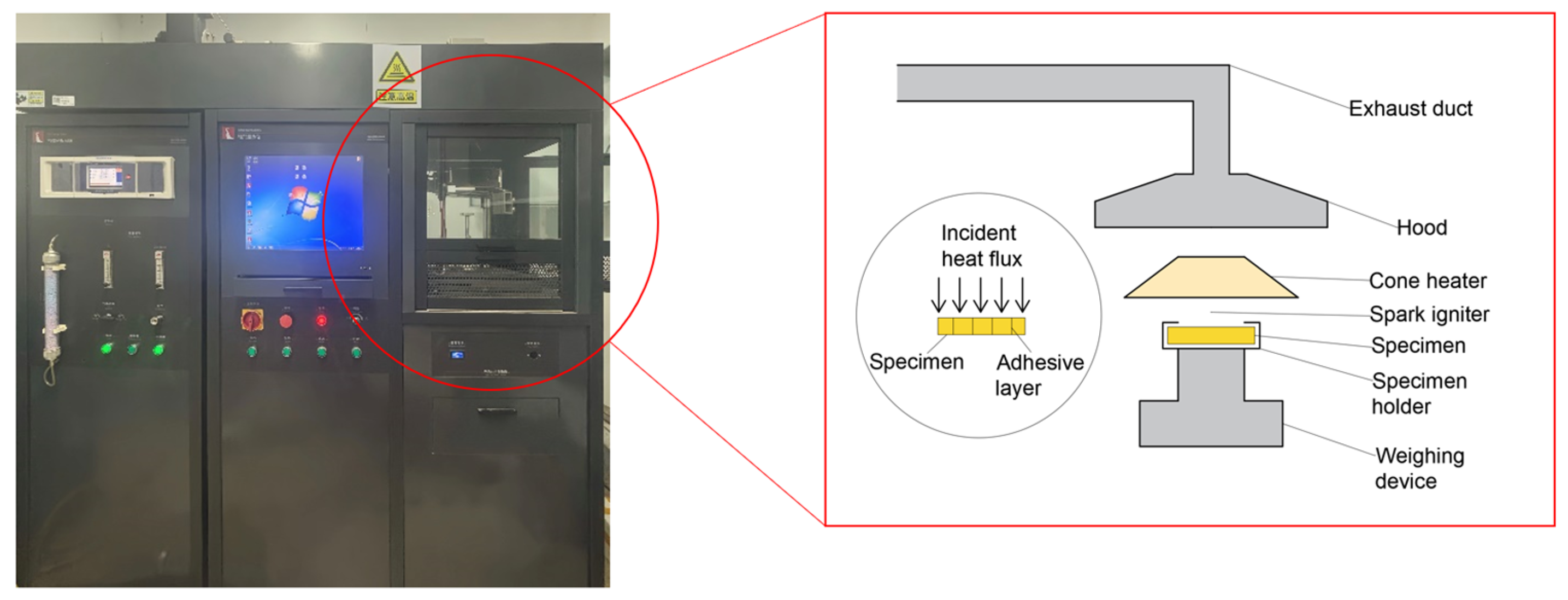
2.2. Methods
3. Result and Discussion
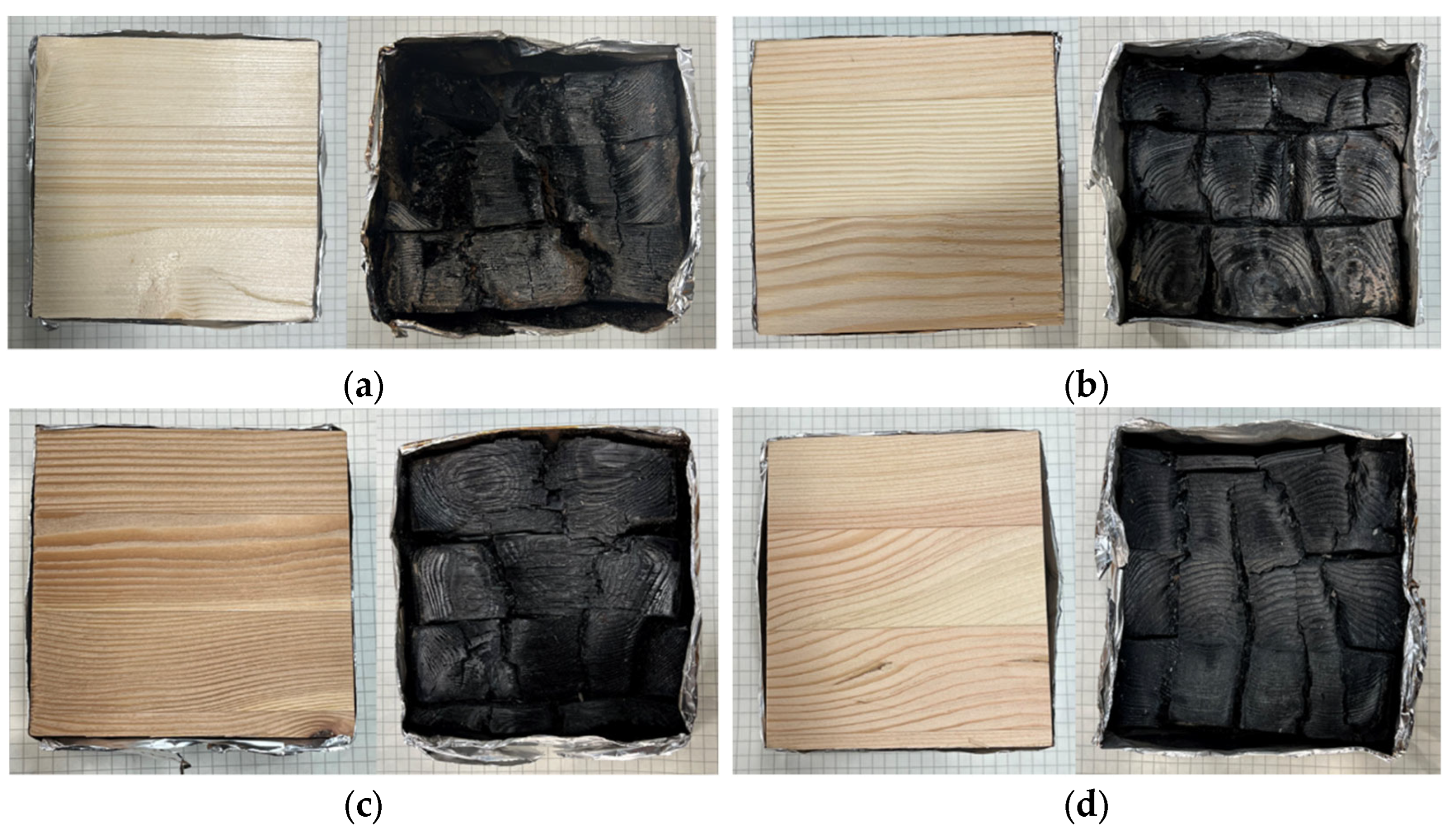
3.1. Failure Mode
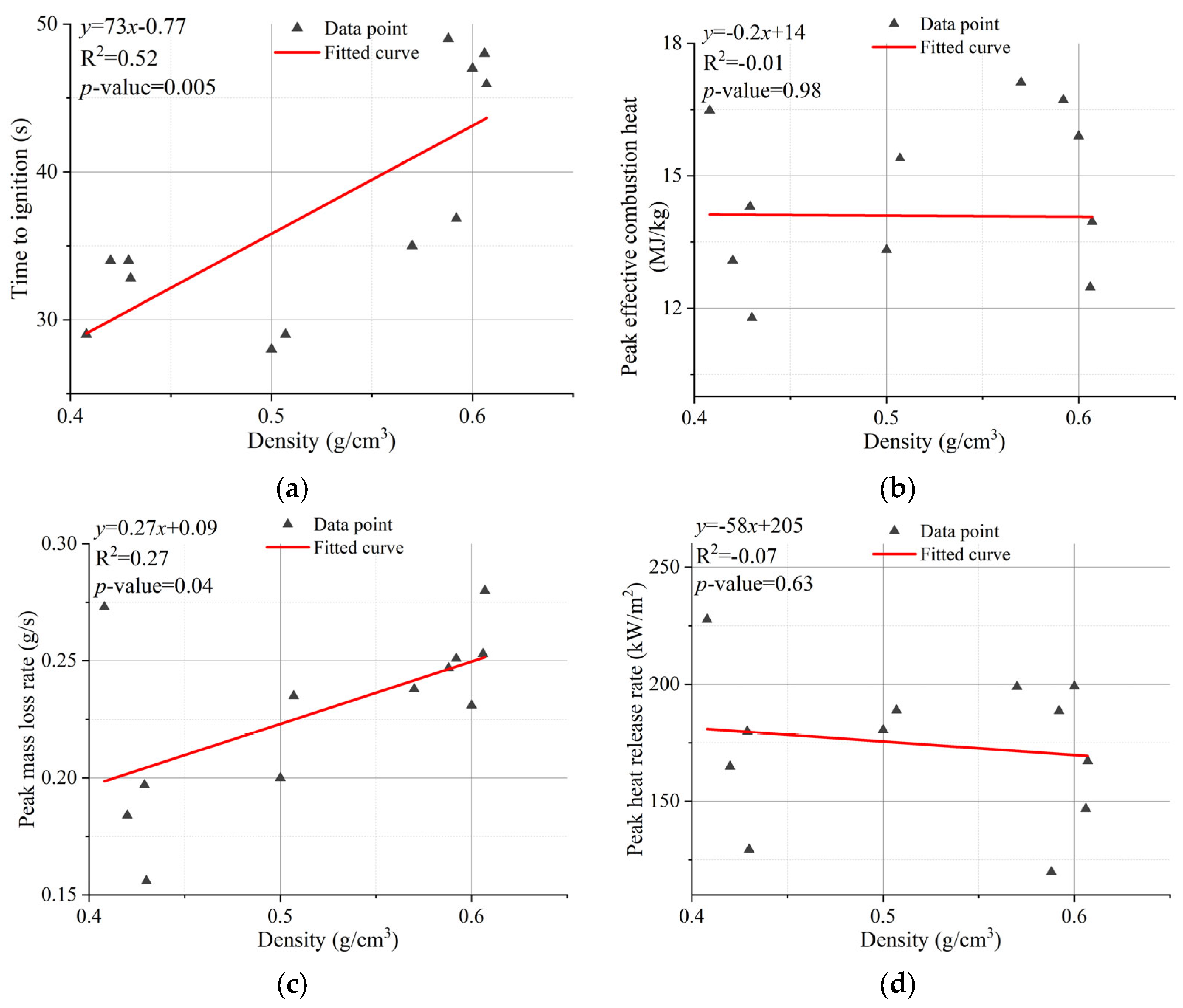
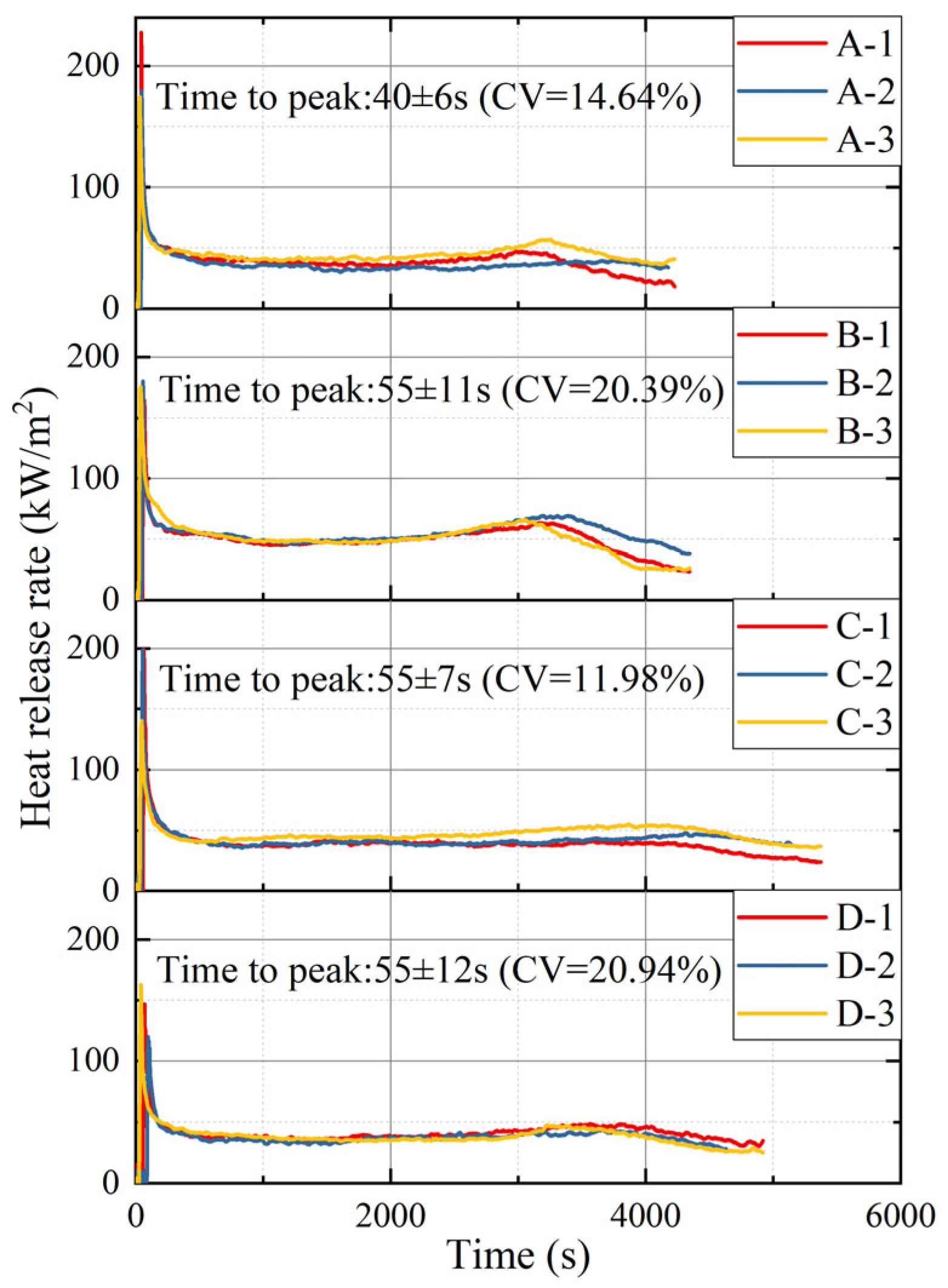
3.2. Combustion Properties
4. Conclusions
Author Contributions
Funding
Data Availability Statement
Conflicts of Interest
References
- Hawkins, W.; Cooper, S.; Allen, S.; Roynon, J.; Ibell, T. Embodied carbon assessment using a dynamic climate model: Case-study comparison of a concrete, steel and timber building structure. Structures 2021, 33, 90–98. [Google Scholar] [CrossRef]
- Wang, Z.; Yin, T. Cross-laminated timber: A review on its characteristics and an introduction to Chinese practices. In Engineered Wood Products for Construction; Gong, M., Ed.; IntechOpen: London, UK, 2021. [Google Scholar] [CrossRef]
- Bartlett, A.I.; Hadden, R.M.; Bisby, L.A. A review of factors affecting the burning behaviour of wood for application to tall timber construction. Fire Technol. 2019, 55, 1–49. [Google Scholar] [CrossRef]
- Baysal, E.; Altinok, M.; Colak, M.; Ozaki, S.K.; Toker, H. Fire resistance of Douglas fir (Pseudotsuga menzieesi) treated with borates and natural extractives. Bioresour. Technol. 2007, 98, 1101–1105. [Google Scholar] [CrossRef] [PubMed]
- Martinka, J.; Mózer, V.; Hroncová, E.; Ladomerský, J. Influence of spruce wood form on ignition activation energy. Wood Res. 2015, 60, 815–822. [Google Scholar]
- Zachar, M.; Čabalová, I.; Kačíková, D.; Jurczyková, T. Effect of natural aging on oak wood fire resistance. Polymers 2021, 13, 2059. [Google Scholar] [CrossRef] [PubMed]
- Jing, C.; Renner, J.S.; Xu, Q. Research on the Fire performance of aged and modern wood. In Proceedings of the 10th International Conference on Wood & Fire Safety (WFS), Strbske Pleso, Slovakia, 12–15 May 2024. [Google Scholar] [CrossRef]
- Terzi, E.; Kartal, S.N.; White, R.H.; Shinoda, K.; Imamura, Y. Fire performance and decay resistance of solid wood and plywood treated with quaternary ammonia compounds and common fire retardants. Eur. J. Wood Wood Prod. 2011, 69, 41–51. [Google Scholar] [CrossRef]
- Yue, K.; Wu, J.; Xu, L.; Tang, Z.; Chen, Z.; Liu, W.; Wang, L. Use impregnation and densification to improve mechanical properties and combustion performance of Chinese fir. Constr. Build. Mater. 2020, 214, 118101. [Google Scholar] [CrossRef]
- Bezabeh, M.A.; Gairola, A.; Bitsuamlak, G.T.; Popovski, M.; Tesfamariam, S. Structural performance of multi-story mass-timber buildings under tornadolike wind field. Eng. Struct. 2018, 177, 519–539. [Google Scholar] [CrossRef]
- Yin, T.; Wang, Y.; Sun, C.; Wang, Z.; Reynolds, T.P. Laterally loaded behaviour of connections in timber-timber composite (TTC) floor system: An experimental and analytical investigation. Eng. Struct. 2025, 342, 120937. [Google Scholar] [CrossRef]
- Yang, T.H.; Wang, S.Y.; Tsai, M.J.; Lin, C.Y. The charring depth and charring rate of glued laminated timber after a standard fire exposure test. Build. Environ. 2009, 44, 231–236. [Google Scholar] [CrossRef]
- Tsai, K.; Carradine, D.; Moss, P.; Buchanan, A. Charring rates for double beams made from laminated veneer lumber (LVL). Fire Mater. 2013, 37, 58–74. [Google Scholar] [CrossRef]
- Kucíková, L.; Janda, T.; Sýkora, J.; Šejnoha, M.; Marseglia, G. Experimental and numerical investigation of the response of GLT beams exposed to fire. Constr. Build. Mater. 2021, 299, 123846. [Google Scholar] [CrossRef]
- Suzuki, J.I.; Mizukami, T.; Naruse, T.; Araki, Y. Fire resistance of timber panel structures under standard fire exposure. Fire Technol. 2016, 52, 1015–1034. [Google Scholar] [CrossRef]
- Li, X.; Yue, K.; Zhu, L.; Lv, C.; Wu, J.; Wu, P.; Sun, K. Relationships between wood properties and fire performance of glulam columns made from six wood species commonly used in China. Case Stud. Therm. Eng. 2024, 54, 104029. [Google Scholar] [CrossRef]
- ISO 5660-1:2015; Reaction-to-Fire Tests—Heat Release, Smoke Production and Mass Loss Rate; Part 1: Heat Release Rate (Cone Calorimeter Method) and Smoke Production Rate (Dynamic Measurement). International Organization for Standardization: Geneva, Switzerland, 2015.
- Dagenais, C. Investigation of fire performance of CLT manufactured with thin laminates. FPInnovations Proj. 2016, 301010618, 58. [Google Scholar]
- Muszyński, L.; Gupta, R.; Hong, S.h.; Osborn, N.; Pickett, B. Fire resistance of unprotected cross-laminated timber (CLT) floor assemblies produced in the USA. Fire Saf. J. 2019, 107, 126–136. [Google Scholar] [CrossRef]
- Machová, D.; Oberle, A.; Zárybnická, L.; Dohnal, J.; Šeda, V.; Dömény, J.; Čermák, P. Surface characteristics of one-sided charred beech wood. Polymers 2021, 13, 1551. [Google Scholar] [CrossRef] [PubMed]
- Chen, Y.; Qi, Y. Comparative study on combustion properties of species wood in timber construction. J. For. Eng. 2016, 1, 51–57. [Google Scholar] [CrossRef]
- Zhang, H.; Qi, H.Y.; Lu, Z.A.; You, C.F.; Xu, X.C. Investigation on releasing mechanism of CO2 and CO in bench-scale fire smoke. J. Eng. Thermophys. 2004, 25, 534–536. [Google Scholar]



| Group | Wood Species | Density (g/cm3) | Moisture Content (%) | Replication |
|---|---|---|---|---|
| A | Spruce (Picea asperata) | 0.448 (5.33) | 10.331 (2.94) | 3 |
| B | Mongolian Scots pine (Pinus sylvestris var. mongolica) | 0.450 (6.06) | 10.534 (4.31) | |
| C | Douglas fir (Pseudotsuga menziesii) | 0.594 (4.69) | 10.432 (2.06) | |
| D | Larch (Larix gmelinii) | 0.604 (5.14) | 10.034 (2.58) |
| Species | Time to Ignition (s) | Peak Effective Combustion Heat (MJ/kg) | Peak Mass Loss Rate (g/s) | Peak Heat Release Rate (kW/m2) |
|---|---|---|---|---|
| Spruce | 30.61 ± 2.36 (7.69) | 15.39 ± 0.89 (5.77) | 0.24 ± 0.03 (13.2) | 198.67 ± 20.74 (10.43) |
| Mongolian Scots pine | 31.62 ± 2.59 (8.20) | 12.73 ± 0.68 (5.30) | 0.18 ± 0.02 (10.10) | 158.23 ± 21.34 (13.49) |
| Douglas fir | 39.62 ± 5.27 (13.31) | 16.58 ± 0.51 (3.06) | 0.24 ± 0.01 (3.45) | 195.57 ± 4.90 (2.51) |
| Larch | 47.64 ± 1.28 (5.69) | 11.68 ± 2.26 (19.33) | 0.26 ± 0.01 (5.52) | 144.60 ± 19.43 (13.43) |
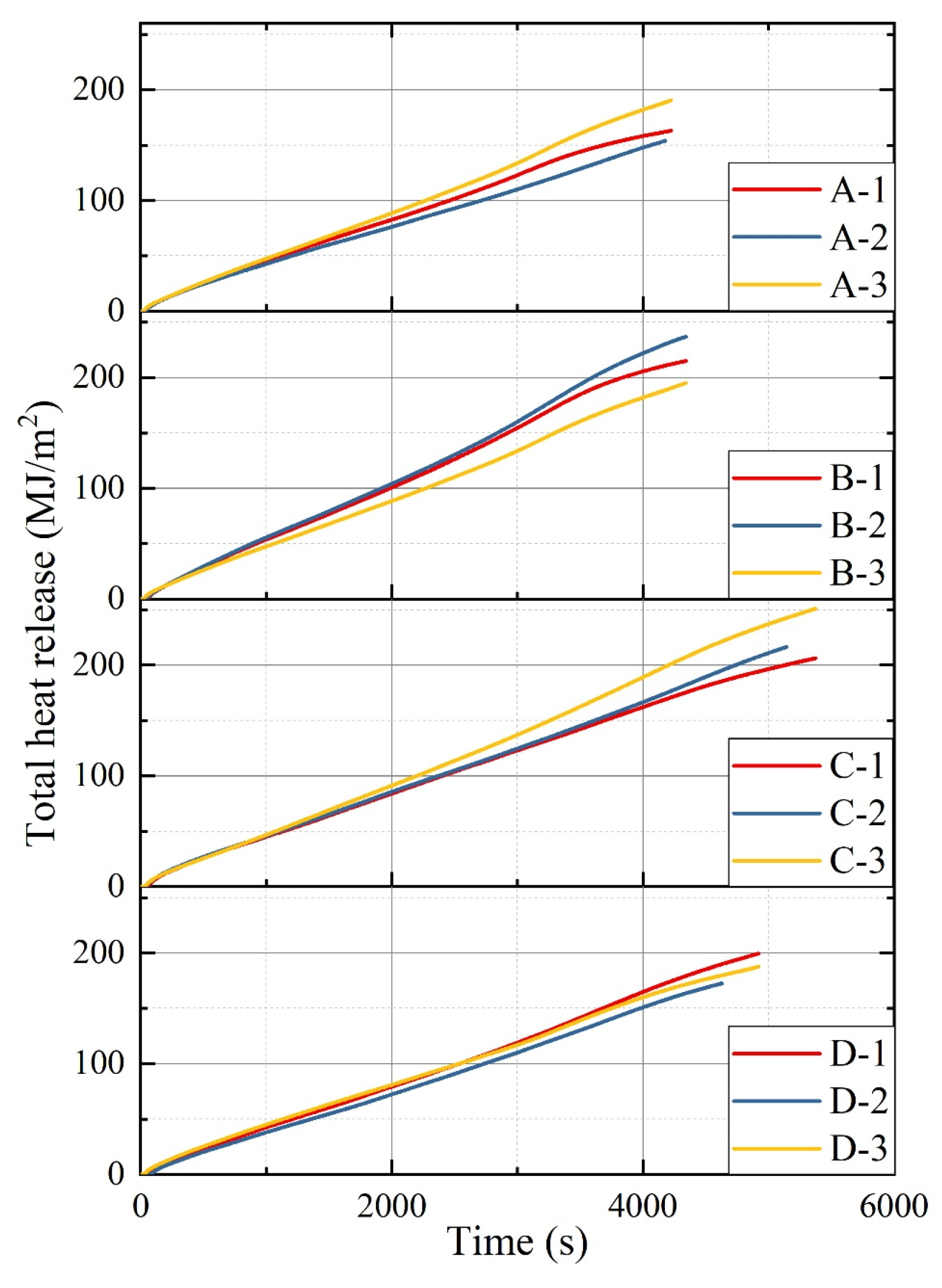
| Group | 600 s (MJ/m2) | 1800 s (MJ/m2) | 3000 s (MJ/m2) | 4200 s (MJ/m2) | ||||
|---|---|---|---|---|---|---|---|---|
| Mean ± SD | 95%CI | Mean ± SD | 95%CI | Mean ± SD | 95%CI | Mean ± SD | 95%CI | |
| A (Spruce) | 29.58 ± 1.14 | 29.58 ± 2.84 | 75.19 ± 5.34 | 75.19 ± 13.26 | 122.23 ± 11.91 | 122.23 ± 29.58 | 168.65 ± 18.33 | 168.65 ± 45.54 |
| B (Mongolian Scots pine) | 33.24 ± 2.23 | 33.24 ± 5.55 | 88.41 ± 7.17 | 88.41 ± 17.80 | 149.44 ± 14.25 | 149.44 ± 35.38 | 210.75 ± 21.05 | 210.75 ± 52.25 |
| C (Douglas fir) | 30.15 ± 0.67 | 30.15 ± 1.66 | 78.59 ± 3.23 | 78.59 ± 8.00 | 128.30 ± 7.58 | 128.30 ± 18.81 | 181.73 ± 15.83 | 181.73 ± 39.30 |
| D (Larch) | 26.76 ± 2.88 | 26.76 ± 7.14 | 70.14 ± 4.52 | 70.14 ± 11.23 | 115.23 ± 5.51 | 115.23 ± 13.67 | 166.37 ± 7.53 | 166.37 ± 18.68 |
| Group | Specific Smoke Area (SSA) (m2/m2) | Mean SEA (m2/kg) | Peak SEA (m2/kg) | Total Smoke Production (TSP) (m2) |
|---|---|---|---|---|
| A (Spruce) | 153.70 ± 157.50 | 6.88 ± 7.76 | 99.18 ± 0.39 | 1.26 ± 1.48 |
| B (Mongolian Scots pine) | 316.46 ± 235.09 | 12.12 ± 9.09 | 99.69 ± 0.23 | 2.78 ± 2.07 |
| C (Douglas fir) | 275.50 ± 115.76 | 23.55 ± 22.97 | 99.86 ± 0.11 | 6.40 ± 6.10 |
| D (Larch) | 251.62 ± 158.51 | 8.19 ± 8.33 | 99.53 ± 0.40 | 2.21 ± 1.39 |
| Group | Initial Mass (g) | Residue Mass (g) | Mass Loss (g) | Mean Mass Loss Rate (g/s) | Mass Loss Percentage (95%CI) (%) |
|---|---|---|---|---|---|
| A (Spruce) | 188.43 ± 11.17 | 36.58 ± 9.95 | 151.85 ± 1.44 | 0.03 ± 0.00 | 80.75 ± 10.23 |
| B (Mongolian Scots pine) | 216.51 ± 5.67 | 36.55 ± 4.36 | 179.95 ± 2.15 | 0.04 ± 0.00 | 83.14 ± 4.04 |
| C (Douglas fir) | 279.74 ± 15.17 | 89.05 ± 12.37 | 190.69 ± 3.83 | 0.04 ± 0.00 | 68.26 ± 6.64 |
| D (Larch) | 230.05 ± 13.19 | 61.18 ± 9.64 | 168.87 ± 3.57 | 0.04 ± 0.00 | 73.51 ± 6.68 |
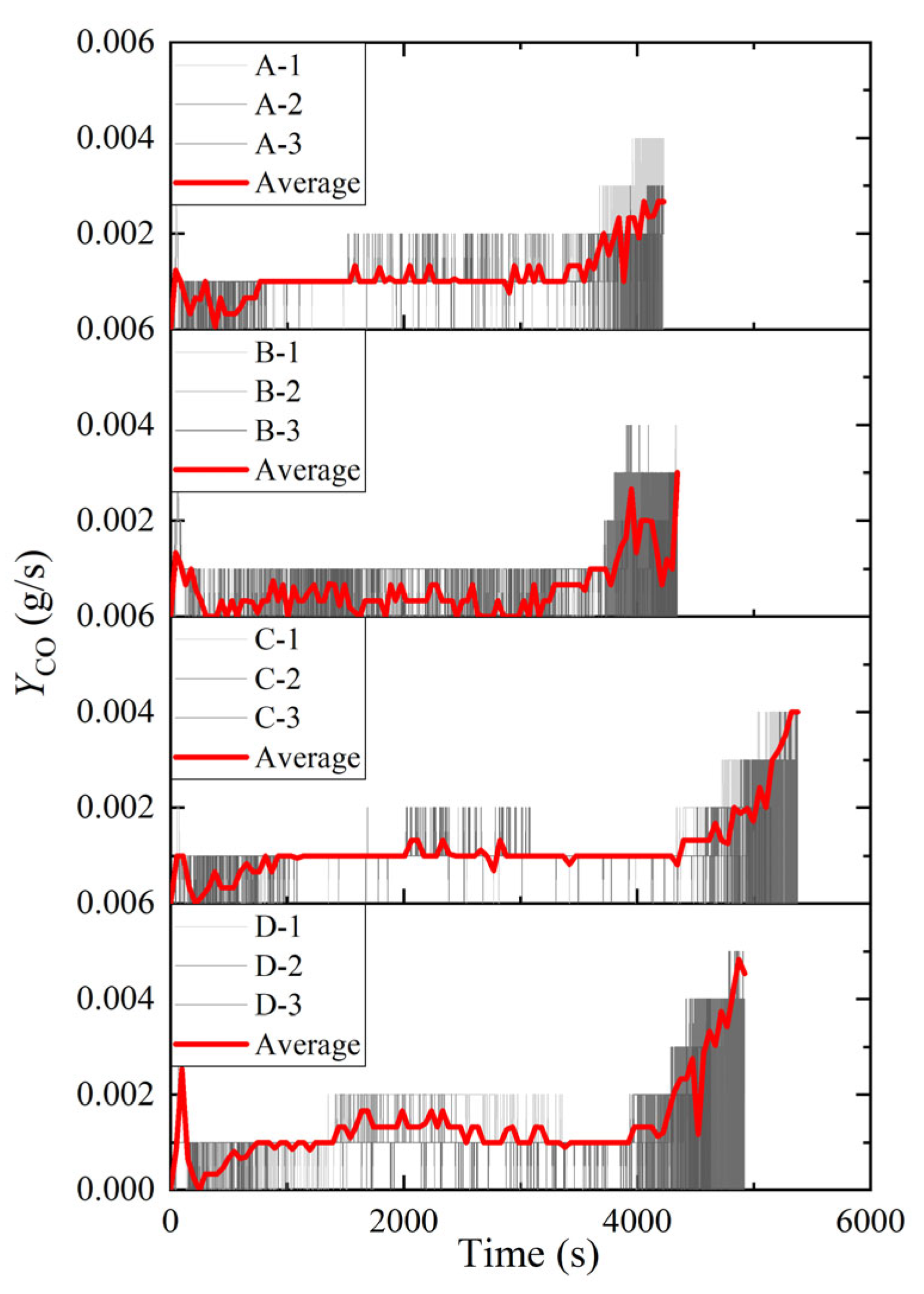
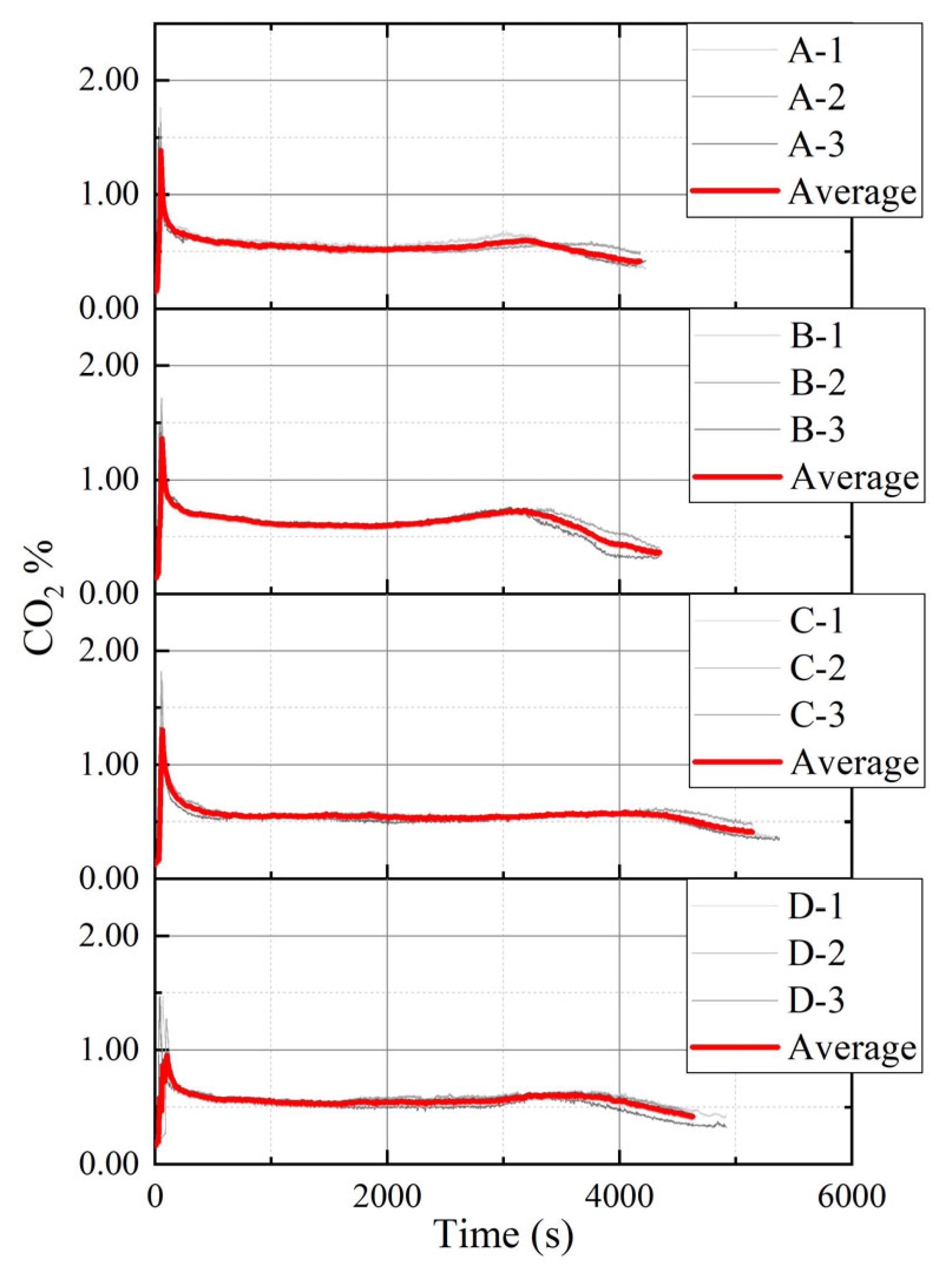
| Group | CO (kg/kg) | CO2 (kg/kg) |
|---|---|---|
| A (Spruce) | 0.04 ± 0.00 | 3.89 ± 0.11 |
| B (Mongolian Scots pine) | 0.02 ± 0.00 | 4.10 ± 0.17 |
| C (Douglas fir) | 0.03 ± 0.00 | 3.66 ± 0.08 |
| D (Larch) | 0.03 ± 0.00 | 3.71 ± 0.04 |
Disclaimer/Publisher’s Note: The statements, opinions and data contained in all publications are solely those of the individual author(s) and contributor(s) and not of MDPI and/or the editor(s). MDPI and/or the editor(s) disclaim responsibility for any injury to people or property resulting from any ideas, methods, instructions or products referred to in the content. |
© 2025 by the authors. Licensee MDPI, Basel, Switzerland. This article is an open access article distributed under the terms and conditions of the Creative Commons Attribution (CC BY) license (https://creativecommons.org/licenses/by/4.0/).
Share and Cite
Zhang, Y.; Xue, S.; Yin, T.; Dai, J.; Duan, Y.; Zhu, D. Combustion Performance of Commonly Used Softwood Species Glulam in Timber Structures. Buildings 2025, 15, 4093. https://doi.org/10.3390/buildings15224093
Zhang Y, Xue S, Yin T, Dai J, Duan Y, Zhu D. Combustion Performance of Commonly Used Softwood Species Glulam in Timber Structures. Buildings. 2025; 15(22):4093. https://doi.org/10.3390/buildings15224093
Chicago/Turabian StyleZhang, Yinglu, Siyu Xue, Tianxiao Yin, Jun Dai, Yanjun Duan, and Dan Zhu. 2025. "Combustion Performance of Commonly Used Softwood Species Glulam in Timber Structures" Buildings 15, no. 22: 4093. https://doi.org/10.3390/buildings15224093
APA StyleZhang, Y., Xue, S., Yin, T., Dai, J., Duan, Y., & Zhu, D. (2025). Combustion Performance of Commonly Used Softwood Species Glulam in Timber Structures. Buildings, 15(22), 4093. https://doi.org/10.3390/buildings15224093