Thermal Adaptive Behavior-Recognition Model with Cross-Modal Knowledge Distillation


Abstract
1. Introduction
- (1)
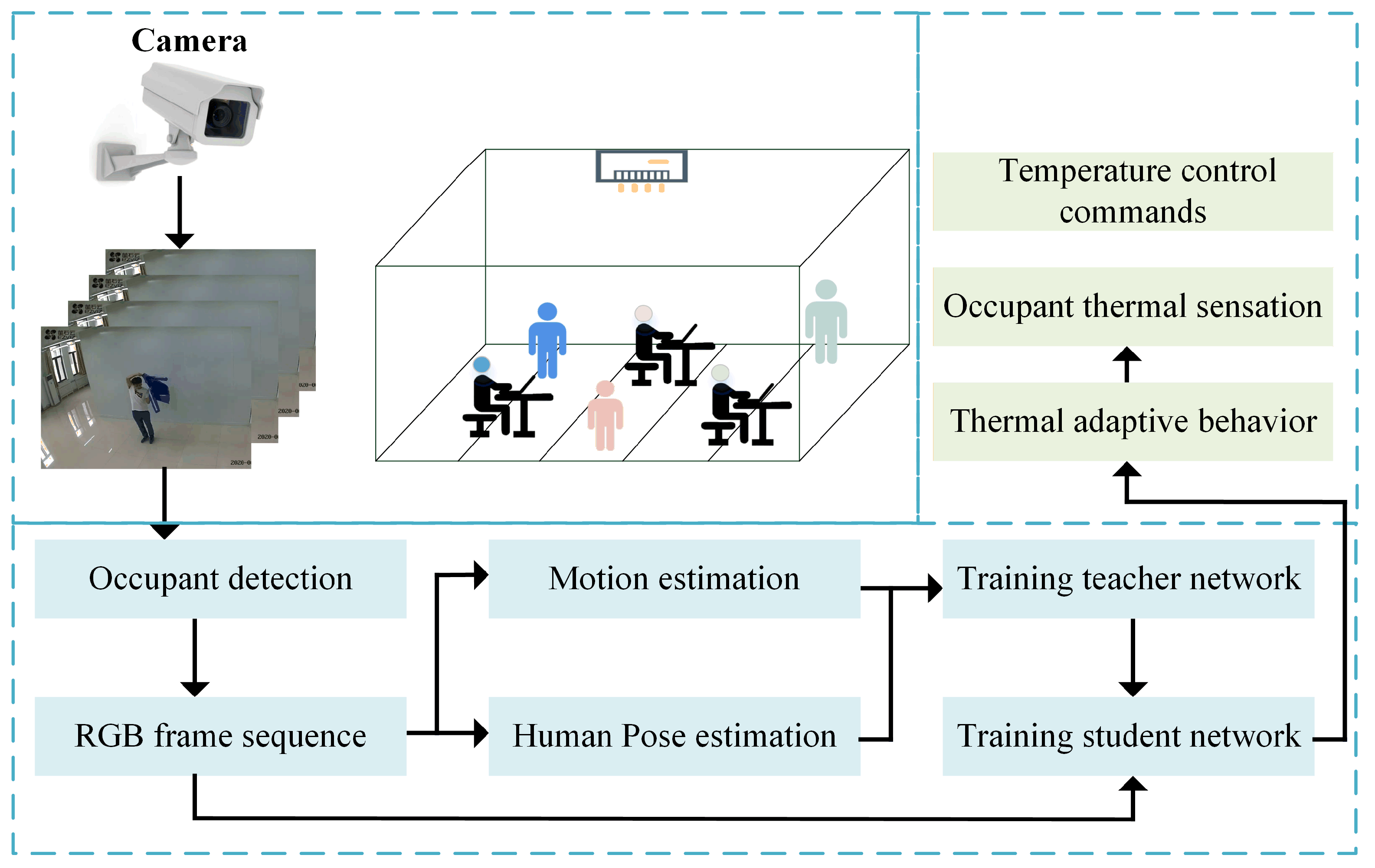
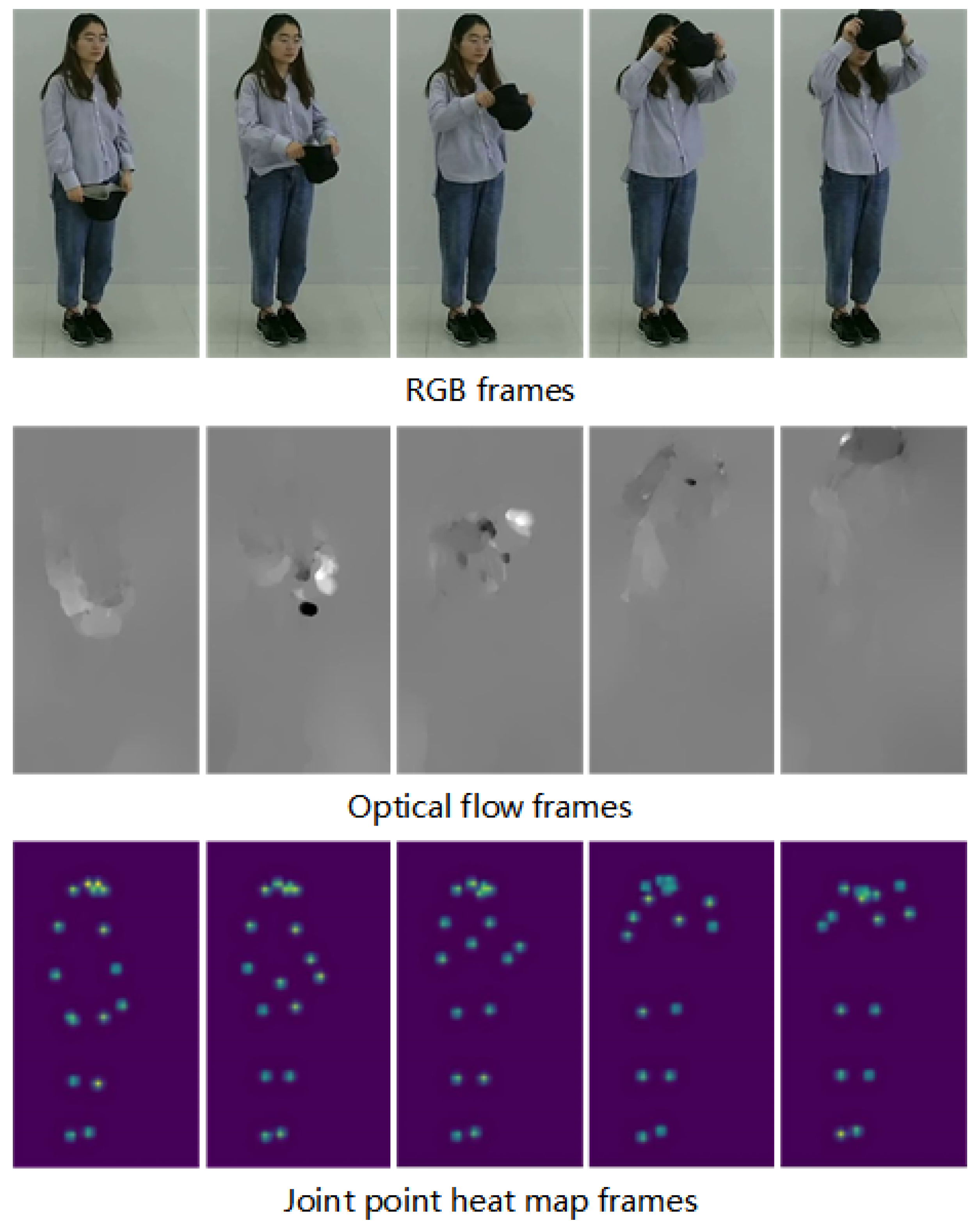
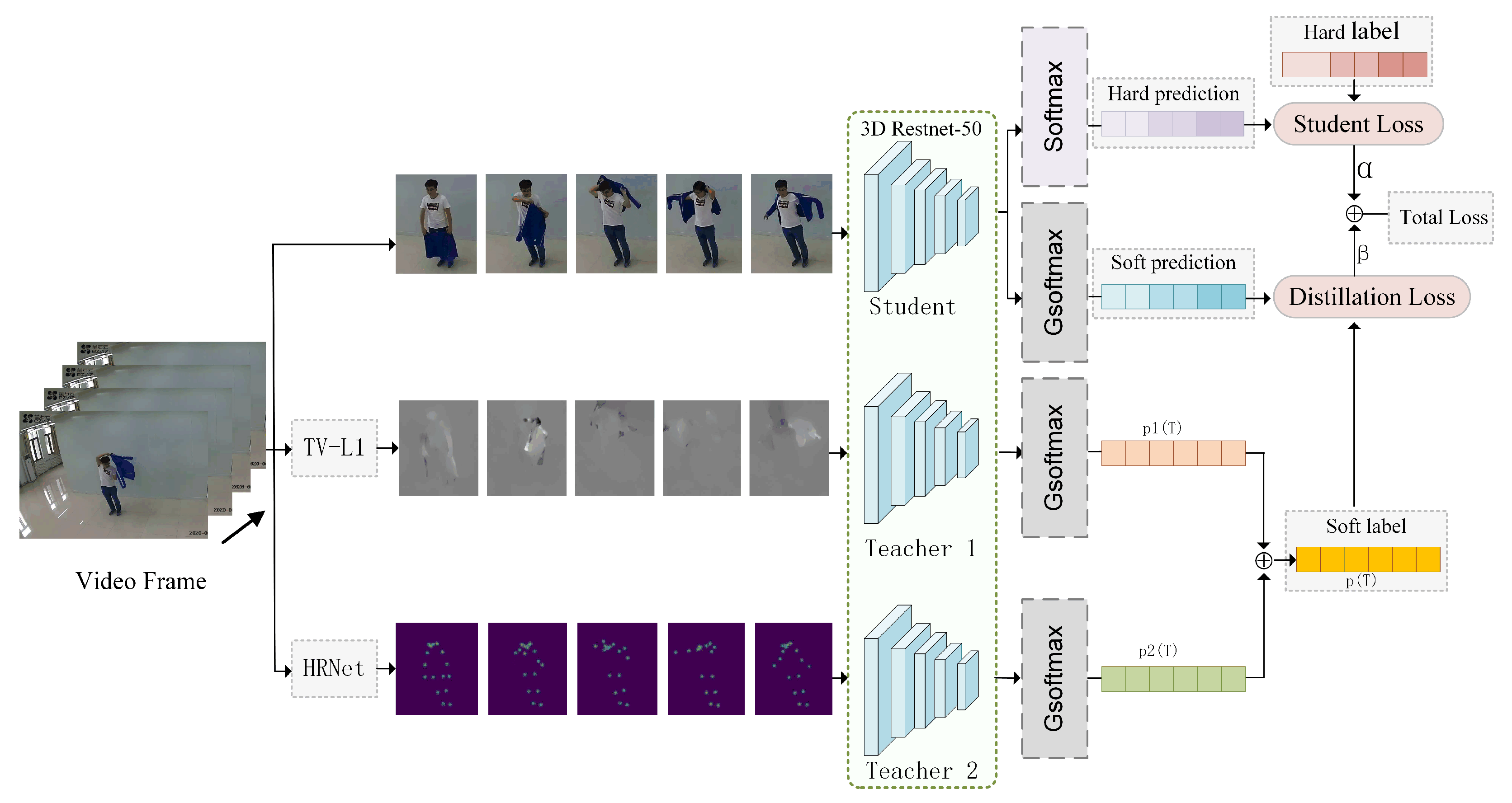
- The image sequence with optical flow information and the node heat map sequence with skeleton information were used as the inputs for the teacher model; the RGB image sequence was used as the input for the student model; the output distillation loss was established between the output of the teacher model and that of the student model; and a thermal adaptive behavior-recognition model based on cross-modal knowledge distillation was constructed. By transferring the optical flow information and joint information from the teacher model to the student model, the student model can not only extract dynamic behavior features from the RGN image sequence, but it can also learn the optical flow and bone information transferred from the teacher model, thus improving the student model’s recognition performance.
- (2)
- The traditional distillation loss function usually only focuses on the prediction probability of the target class; in other words, it ensures that the output of the student model is consistent with that of the teacher model in the same class when predicting. However, in addition to target categories, the relationship between non-target categories is a crucial type of implicit knowledge. These inter-class relationships involve similarities and differences between different classes, and the teacher model may have learned these complex relationships. In this study, the loss function of distillation was decoupled and a dynamic thermal adaptation behavior-recognition model based on the knowledge distillation of the feature space and output space was constructed. In this model, the student model can fully learn from the advanced features of the teacher model and dynamically adjust the prediction probability of the target and non-target classes.
- (3)
- The thermal adaptive behavior-recognition model proposed in this study was tested on realistic surveillance video data, and the proposed model was compared to existing methods from three aspects: the recognition accuracy, the operation time, and the model complexity. The experimental results show that, although the recognition accuracy decreased in some cases, the proposed method demonstrated more advantages in terms of the thermal adaptive behavior inference time. The number of parameters was also significantly reduced. This provides an effective option for the embedded development of the algorithm and the deployment of indoor terminals in buildings.
2. Related Work
2.1. Thermal Adaptation Behavior-Recognition Algorithm
2.2. Basic Theory of Cross-Modal Learning
2.3. Knowledge Distillation Mechanism
3. System Description
3.1. Data
3.1.1. Optical Flow Estimation
3.1.2. Human Pose Estimate
3.2. Model Training
3.2.1. Cross-Modal Knowledge Distillation
3.2.2. Decoupling Distillation Loss Function
4. Results
4.1. Experimental Setup and Implementation
4.2. Experimental Results and Analysis
4.3. Ablation Experiment
5. Conclusions
Author Contributions
Funding
Institutional Review Board Statement
Informed Consent Statement
Data Availability Statement
Acknowledgments
Conflicts of Interest
References
- Yang, Z.; Ghahramani, A.; Becerik-Gerber, B. Building occupancy diversity and HVAC (heating, ventilation, and air conditioning) system energy efficiency. Energy 2016, 109, 641–649. [Google Scholar] [CrossRef]
- Allen, J.G.; Macomber, J.D. Healthy Buildings: How Indoor Spaces Drive Performance and Productivity; Harvard University Press: Cambridge, MA, USA, 2020. [Google Scholar]
- van Marken Lichtenbelt, W.; Hanssen, M.; Pallubinsky, H.; Kingma, B.; Schellen, L. Healthy excursions outside the thermal comfort zone. Build. Res. Inf. 2017, 45, 819–827. [Google Scholar] [CrossRef]
- Lima, F.; Ferreira, P.; Leal, V. A review of the relation between household indoor temperature and health outcomes. Energies 2020, 13, 2881. [Google Scholar] [CrossRef]
- Wang, Y.; Wang, Z.; Zhang, N.; Ji, W.; Zhu, Y.; Cao, B. Field studies on thermal comfort in China over the past 30 years. Build. Environ. 2024, 269, 112449. [Google Scholar] [CrossRef]
- Zhang, H.; Arens, E.; Huizenga, C.; Han, T. Thermal sensation and comfort models for non-uniform and transient environments: Part I: Local sensation of individual body parts. Build. Environ. 2010, 45, 380–388. [Google Scholar] [CrossRef]
- Nicol, F.; Humphreys, M.; Roaf, S. Adaptive Thermal Comfort: Principles and Practice; Routledge: London, UK, 2012. [Google Scholar]
- Zagreus, L.; Huizenga, C.; Arens, E.; Lehrer, D. Listening to the occupants: A Web-based indoor environmental quality survey. Indoor Air 2004, 14, 65–74. [Google Scholar] [CrossRef]
- Sanguinetti, A.; Pritoni, M.; Salmon, K.; Meier, A.; Morejohn, J. Upscaling participatory thermal sensing: Lessons from an interdisciplinary case study at University of California for improving campus efficiency and comfort. Energy Res. Soc. Sci. 2017, 32, 44–54. [Google Scholar] [CrossRef]
- Chaudhuri, T.; Soh, Y.C.; Li, H.; Xie, L. Machine learning driven personal comfort prediction by wearable sensing of pulse rate and skin temperature. Build. Environ. 2020, 170, 106615. [Google Scholar] [CrossRef]
- Wang, X.; Li, D.; Menassa, C.C.; Kamat, V.R. Investigating the effect of indoor thermal environment on occupants’ mental workload and task performance using electroencephalogram. Build. Environ. 2019, 158, 120–132. [Google Scholar] [CrossRef]
- Wu, M.; Li, H.; Qi, H. Using electroencephalogram to continuously discriminate feelings of personal thermal comfort between uncomfortably hot and comfortable environments. Indoor Air 2020, 30, 534–543. [Google Scholar] [CrossRef]
- Li, H.; Liu, Y.; Wu, H.; Lin, B.; Lei, L.; He, J. Thermal preference prediction through infrared thermography technology: Recognizing adaptive behaviors. Build. Environ. 2024, 262, 111829. [Google Scholar] [CrossRef]
- Zheng, P.; Wang, C.; Liu, Y.; Lin, B.; Wu, H.; Huang, Y.; Zhou, X. Thermal adaptive behavior and thermal comfort for occupants in multi-person offices with air-conditioning systems. Build. Environ. 2022, 207, 108432. [Google Scholar] [CrossRef]
- Ghahramani, A.; Castro, G.; Becerik-Gerber, B.; Yu, X. Infrared thermography of human face for monitoring thermoregulation performance and estimating personal thermal comfort. Build. Environ. 2016, 109, 1–11. [Google Scholar] [CrossRef]
- Li, W.; Zhang, J.; Zhao, T.; Liang, R. Experimental research of online monitoring and evaluation method of human thermal sensation in different active states based on wristband device. Energy Build. 2018, 173, 613–622. [Google Scholar] [CrossRef]
- Fan, C.; He, W.; Liao, L. Real-time machine learning-based recognition of human thermal comfort-related activities using inertial measurement unit data. Energy Build. 2023, 294, 113216. [Google Scholar] [CrossRef]
- Wang, X.; Qiao, Y.; Wu, N.; Li, Z.; Qu, T. On optimization of thermal sensation satisfaction rate and energy efficiency of public rooms: A case study. J. Clean. Prod. 2018, 176, 990–998. [Google Scholar] [CrossRef]
- Yang, B.; Li, X.; Hou, Y.; Meier, A.; Cheng, X.; Choi, J.H.; Wang, F.; Wang, H.; Wagner, A.; Yan, D.; et al. Non-invasive (non-contact) measurements of human thermal physiology signals and thermal comfort/discomfort poses-A review. Energy Build. 2020, 224, 110261. [Google Scholar] [CrossRef]
- Yu, L.; Qin, S.; Zhang, M.; Shen, C.; Jiang, T.; Guan, X. A review of deep reinforcement learning for smart building energy management. IEEE Internet Things J. 2021, 8, 12046–12063. [Google Scholar] [CrossRef]
- Elhanashi, A.; Dini, P.; Saponara, S.; Zheng, Q. Integration of deep learning into the iot: A survey of techniques and challenges for real-world applications. Electronics 2023, 12, 4925. [Google Scholar] [CrossRef]
- Jin, R.; Xu, P.; Gu, J.; Xiao, T.; Li, C.; Wang, H. Review of optimization control methods for HVAC systems in Demand Response (DR): Transition from model-driven to model-free approaches and challenges. Build. Environ. 2025, 280, 113045. [Google Scholar] [CrossRef]
- Burzo, M.; Wicaksono, C.; Abouelenien, M.; Perez-Rosas, V.; Mihalcea, R.; Tao, Y. Multimodal sensing of thermal discomfort for adaptive energy saving in buildings. In Proceedings of the iiSBE Net Zero Built Environment 2014 Symposium, Gainesville, FL, USA, 6–7 March 2014. [Google Scholar]
- Ranjan, J.; Scott, J. ThermalSense: Determining dynamic thermal comfort preferences using thermographic imaging. In Proceedings of the 2016 ACM International Joint Conference on Pervasive and Ubiquitous Computing, Heidelberg, Germany, 12–16 September 2016; pp. 1212–1222. [Google Scholar]
- Cosma, A.C.; Simha, R. Using the contrast within a single face heat map to assess personal thermal comfort. Build. Environ. 2019, 160, 106163. [Google Scholar] [CrossRef]
- Cosma, A.C.; Simha, R. Machine learning method for real-time non-invasive prediction of individual thermal preference in transient conditions. Build. Environ. 2019, 148, 372–383. [Google Scholar] [CrossRef]
- Cheng, X.; Yang, B.; Hedman, A.; Olofsson, T.; Li, H.; Van Gool, L. NIDL: A pilot study of contactless measurement of skin temperature for intelligent building. Energy Build. 2019, 198, 340–352. [Google Scholar] [CrossRef]
- Jung, W.; Jazizadeh, F. Vision-based thermal comfort quantification for HVAC control. Build. Environ. 2018, 142, 513–523. [Google Scholar] [CrossRef]
- Kim, S.; Park, C.S. Quantification of aleatoric and epistemic uncertainty in Data-Driven occupant behavior model for building performance simulation. Energy Build. 2025, 340, 115818. [Google Scholar] [CrossRef]
- Ji, Y.; Zhao, M.; Tian, W.; Wang, X.; Xie, J.; Liu, J. Research on the feature of thermal environment and auxiliary behavior of air-conditioning in buildings with substandard central heating. Energy Build. 2025, 341, 115827. [Google Scholar] [CrossRef]
- Yan, H.; Pan, Y.; Dong, M.; Zhang, H.; Li, J.; Zhao, S. Energy efficiency and comfort: Analysis of thermal responses and behaviors of residents with high and low air conditioning dependency. Energy Build. 2025, 338, 115695. [Google Scholar] [CrossRef]
- Yu, M.; Tang, Z.; Tao, Y.; Ma, L.; Liu, Z.; Dai, L.; Zhou, H.; Liu, M.; Li, Z. Thermal comfort prediction in multi-occupant spaces based on facial temperature and human attributes identification. Build. Environ. 2024, 262, 111772. [Google Scholar] [CrossRef]
- Cen, C.; Tan, E.; Valliappan, S.; Ang, E.; Chen, Z.; Wong, N.H. Students’ thermal comfort and cognitive performance in tropical climates: A comparative study. Energy Build. 2025, 341, 115817. [Google Scholar] [CrossRef]
- Zhao, Y.; Genovese, P.V.; Li, Z. Intelligent Thermal Comfort Controlling System for Buildings Based on IoT and AI. Future Internet 2020, 12, 30. [Google Scholar] [CrossRef]
- Li, Y.; Liu, J.; Wang, L. Lightweight Network Research Based on Deep Learning: A Review. In Proceedings of the 2018 37th Chinese Control Conference (CCC), Wuhan, China, 25–27 July 2018; pp. 9021–9026. [Google Scholar] [CrossRef]
- Howard, A.G.; Zhu, M.; Chen, B.; Kalenichenko, D.; Wang, W.; Weyand, T.; Andreetto, M.; Adam, H. MobileNets: Efficient Convolutional Neural Networks for Mobile Vision Applications. arXiv 2017, arXiv:1704.04861. [Google Scholar] [CrossRef]
- Zhang, X.; Zhou, X.; Lin, M.; Sun, J. ShuffleNet: An Extremely Efficient Convolutional Neural Network for Mobile Devices. In Proceedings of the 2018 IEEE Conference on Computer Vision and Pattern Recognition, CVPR 2018, Salt Lake City, UT, USA, 18–22 June 2018; pp. 6848–6856. [Google Scholar] [CrossRef]
- Blalock, D.W.; Ortiz, J.J.G.; Frankle, J.; Guttag, J.V. What is the State of Neural Network Pruning? In Proceedings of the Third Conference on Machine Learning and Systems, MLSys 2020, Austin, TX, USA, 2–4 March 2020; Dhillon, I.S., Papailiopoulos, D.S., Sze, V., Eds.; 2020. Available online: https://arxiv.org/abs/2003.03033 (accessed on 9 October 2025).
- Romero, A.; Ballas, N.; Kahou, S.E.; Chassang, A.; Gatta, C.; Bengio, Y. FitNets: Hints for Thin Deep Nets. In Proceedings of the 3rd International Conference on Learning Representations, ICLR 2015, San Diego, CA, USA, 7–9 May 2015; Conference Track Proceedings. Bengio, Y., LeCun, Y., Eds.; 2015. [Google Scholar]
- Wang, J.; Bian, C.; Zhou, X.; Lyu, F.; Niu, Z.; Feng, W. Online Knowledge Distillation for Efficient Action Recognition. In Proceedings of the 2022 IEEE 2nd International Conference on Computer Communication and Artificial Intelligence (CCAI), Beijing, China, 6–8 May 2022; pp. 177–181. [Google Scholar] [CrossRef]
- Wang, Y.; Wang, Y.; Duan, W.; Zheng, Y.; Duan, P. Joint measurement of thermal discomfort by occupant pose, motion and appearance in indoor surveillance videos for building energy saving. J. Circuits Syst. Comput. 2024, 33, 2450051. [Google Scholar] [CrossRef]
- Yan, S.; Xiong, Y.; Lin, D. Spatial temporal graph convolutional networks for skeleton-based action recognition. In Proceedings of the AAAI Conference on Artificial Intelligence, New Orleans, LA, USA, 2–7 February 2018; Volume 32. [Google Scholar]
- Alkhulaifi, A.; Alsahli, F.; Ahmad, I. Knowledge distillation in deep learning and its applications. PeerJ Comput. Sci. 2021, 7, e474. [Google Scholar] [CrossRef]
- Wang, Q.; Zhan, L.; Thompson, P.M.; Zhou, J. Multimodal Learning with Incomplete Modalities by Knowledge Distillation. In Proceedings of the KDD ’20: The 26th ACM SIGKDD Conference on Knowledge Discovery and Data Mining, Virtual Event, CA, USA, 23–27 August 2020; Gupta, R., Liu, Y., Tang, J., Prakash, B.A., Eds.; ACM: New York, NY, USA, 2020; pp. 1828–1838. [Google Scholar] [CrossRef]
- Wu, W.; Wang, X.; Luo, H.; Wang, J.; Yang, Y.; Ouyang, W. Bidirectional Cross-Modal Knowledge Exploration for Video Recognition with Pre-trained Vision-Language Models. In Proceedings of the IEEE/CVF Conference on Computer Vision and Pattern Recognition, CVPR 2023, Vancouver, BC, Canada, 17–24 June 2023; pp. 6620–6630. [Google Scholar] [CrossRef]
- Zolfaghari, M.; Zhu, Y.; Gehler, P.V.; Brox, T. CrossCLR: Cross-modal Contrastive Learning For Multi-modal Video Representations. In Proceedings of the 2021 IEEE/CVF International Conference on Computer Vision, ICCV 2021, Montreal, QC, Canada, 10–17 October 2021; pp. 1430–1439. [Google Scholar] [CrossRef]
- Chen, G.; Choi, W.; Yu, X.; Han, T.X.; Chandraker, M. Learning Efficient Object Detection Models with Knowledge Distillation. In Proceedings of the Advances in Neural Information Processing Systems 30: Annual Conference on Neural Information Processing Systems 2017, Long Beach, CA, USA, 4–9 December 2017; Guyon, I., von Luxburg, U., Bengio, S., Wallach, H.M., Fergus, R., Vishwanathan, S.V.N., Garnett, R., Eds.; NeurIPS: Long Beach, CA, USA; 2017; pp. 742–751. [Google Scholar]
- Liu, Y.; Xiong, H.; Zhang, J.; He, Z.; Wu, H.; Wang, H.; Zong, C. End-to-End Speech Translation with Knowledge Distillation. In Proceedings of the 20th Annual Conference of the International Speech Communication Association, Interspeech 2019, Graz, Austria, 15–19 September 2019; Kubin, G., Kacic, Z., Eds.; ISCA: Fort-de-France, France, 2019; pp. 1128–1132. [Google Scholar] [CrossRef]
- Liu, Y.; Sheng, L.; Shao, J.; Yan, J.; Xiang, S.; Pan, C. Multi-Label Image Classification via Knowledge Distillation from Weakly-Supervised Detection. In Proceedings of the 2018 ACM Multimedia Conference on Multimedia Conference, MM 2018, Seoul, Republic of Korea, 22–26 October 2018; Boll, S., Lee, K.M., Luo, J., Zhu, W., Byun, H., Chen, C.W., Lienhart, R., Mei, T., Eds.; ACM: New York, NY, USA, 2018; pp. 700–708. [Google Scholar] [CrossRef]
- Xu, K.; Rui, L.; Li, Y.; Gu, L. Feature Normalized Knowledge Distillation for Image Classification. In Proceedings of the Computer Vision-ECCV 2020-16th European Conference, Glasgow, UK, 23–28 August 2020; Proceedings, Part XXV. Vedaldi, A., Bischof, H., Brox, T., Frahm, J., Eds.; Lecture Notes in Computer Science. Springer: Cham, Switzerland, 2020; Volume 12370, pp. 664–680. [Google Scholar] [CrossRef]
- Hinton, G.E.; Vinyals, O.; Dean, J. Distilling the Knowledge in a Neural Network. arXiv 2015, arXiv:1503.02531. [Google Scholar] [CrossRef]
- Gou, J.; Yu, B.; Maybank, S.J.; Tao, D. Knowledge Distillation: A Survey. Int. J. Comput. Vis. 2021, 129, 1789–1819. [Google Scholar] [CrossRef]
- Zhang, F.; Zhu, X.; Ye, M. Fast Human Pose Estimation. In Proceedings of the IEEE Conference on Computer Vision and Pattern Recognition, CVPR 2019, Long Beach, CA, USA, 16–20 June 2019; pp. 3517–3526. [Google Scholar] [CrossRef]
- Liu, Y.; Chen, K.; Liu, C.; Qin, Z.; Luo, Z.; Wang, J. Structured Knowledge Distillation for Semantic Segmentation. In Proceedings of the IEEE Conference on Computer Vision and Pattern Recognition, CVPR 2019, Long Beach, CA, USA, 16–20 June 2019; pp. 2604–2613. [Google Scholar] [CrossRef]
- Peng, B.; Jin, X.; Li, D.; Zhou, S.; Wu, Y.; Liu, J.; Zhang, Z.; Liu, Y. Correlation Congruence for Knowledge Distillation. In Proceedings of the 2019 IEEE/CVF International Conference on Computer Vision, ICCV 2019, Seoul, Republic of Korea, 27 October–2 November 2019; pp. 5006–5015. [Google Scholar] [CrossRef]
- Kang, J.; Gwak, J. Ensemble Learning of Lightweight Deep Learning Models Using Knowledge Distillation for Image Classification. Mathematics 2020, 8, 1652. [Google Scholar] [CrossRef]
- Dai, R.; Das, S.; Brémond, F. Learning an Augmented RGB Representation with Cross-Modal Knowledge Distillation for Action Detection. In Proceedings of the 2021 IEEE/CVF International Conference on Computer Vision, ICCV 2021, Montreal, QC, Canada, 10–17 October 2021; pp. 13033–13044. [Google Scholar] [CrossRef]
- Rahmani, H.; Mian, A.S. Learning a non-linear knowledge transfer model for cross-view action recognition. In Proceedings of the IEEE Conference on Computer Vision and Pattern Recognition, CVPR 2015, Boston, MA, USA, 7–12 June 2015; pp. 2458–2466. [Google Scholar] [CrossRef]
- Allen-Zhu, Z.; Li, Y. Towards Understanding Ensemble, Knowledge Distillation and Self-Distillation in Deep Learning. arXiv 2020, arXiv:2012.09816. [Google Scholar]
- Duan, W.; Wang, Y.; Li, J.; Zheng, Y.; Duan, P. Real-time surveillance-video-based personalized thermal comfort recognition. Energy Build. 2021, 244, 110989. [Google Scholar] [CrossRef]
- Zach, C.; Pock, T.; Bischof, H. A duality based approach for realtime tv-l 1 optical flow. In Proceedings of the Joint Pattern Recognition Symposium, Heidelberg, Germany, 12–14 September 2007; Springer: Berlin/Heidelberg, Germany, 2007; pp. 214–223. [Google Scholar]
- Fu, D.; Wu, W. High-resolution representation learning for human pose estimation based on transformer. J. Phys. Conf. Ser. 2022, 2189, 012023. [Google Scholar] [CrossRef]
- Lin, T.Y.; Maire, M.; Belongie, S.; Hays, J.; Perona, P.; Ramanan, D.; Dollár, P.; Zitnick, C.L. Microsoft coco: Common objects in context. In Proceedings of the European Conference on Computer Vision, Zurich, Switzerland, 6–12 September 2014; Springer: Cham, Switzerland, 2014; pp. 740–755. [Google Scholar]
- Zhao, B.; Cui, Q.; Song, R.; Qiu, Y.; Liang, J. Decoupled Knowledge Distillation. In Proceedings of the IEEE/CVF Conference on Computer Vision and Pattern Recognition, CVPR 2022, New Orleans, LA, USA, 18–24 June 2022; pp. 11943–11952. [Google Scholar] [CrossRef]



| Equipment Number | Collecting Equipment | Angle | Height (m) | Distance (m) |
|---|---|---|---|---|
| C001 | Kinect V2 | +45° | 1.6 | 3.0 |
| C002 | Kinect V2 | 0° | 1.8 | 2.0 |
| C003 | Kinect V2 | −45° | 2.0 | 2.7 |
| C004 | EZVIZ C3W | 45° | 2.3 | 3.1 |
| C005 | EZVIZ C3W | 0° | 2.6 | 2.2 |
| C006 | EZVIZ C3W | −45° | 2.9 | 2.8 |
| C007 | Q8S | +45° | 3.2 | 3.0 |
| C008 | Q8S | 0° | 3.2 | 3.0 |
| C009 | Q8S | −45° | 3.2 | 3.0 |
| Method | Index | Test |
|---|---|---|
| Two-Stream | Top-1 | 71.04 |
| Wang et al. [41] | Top-1 | 96.39 |
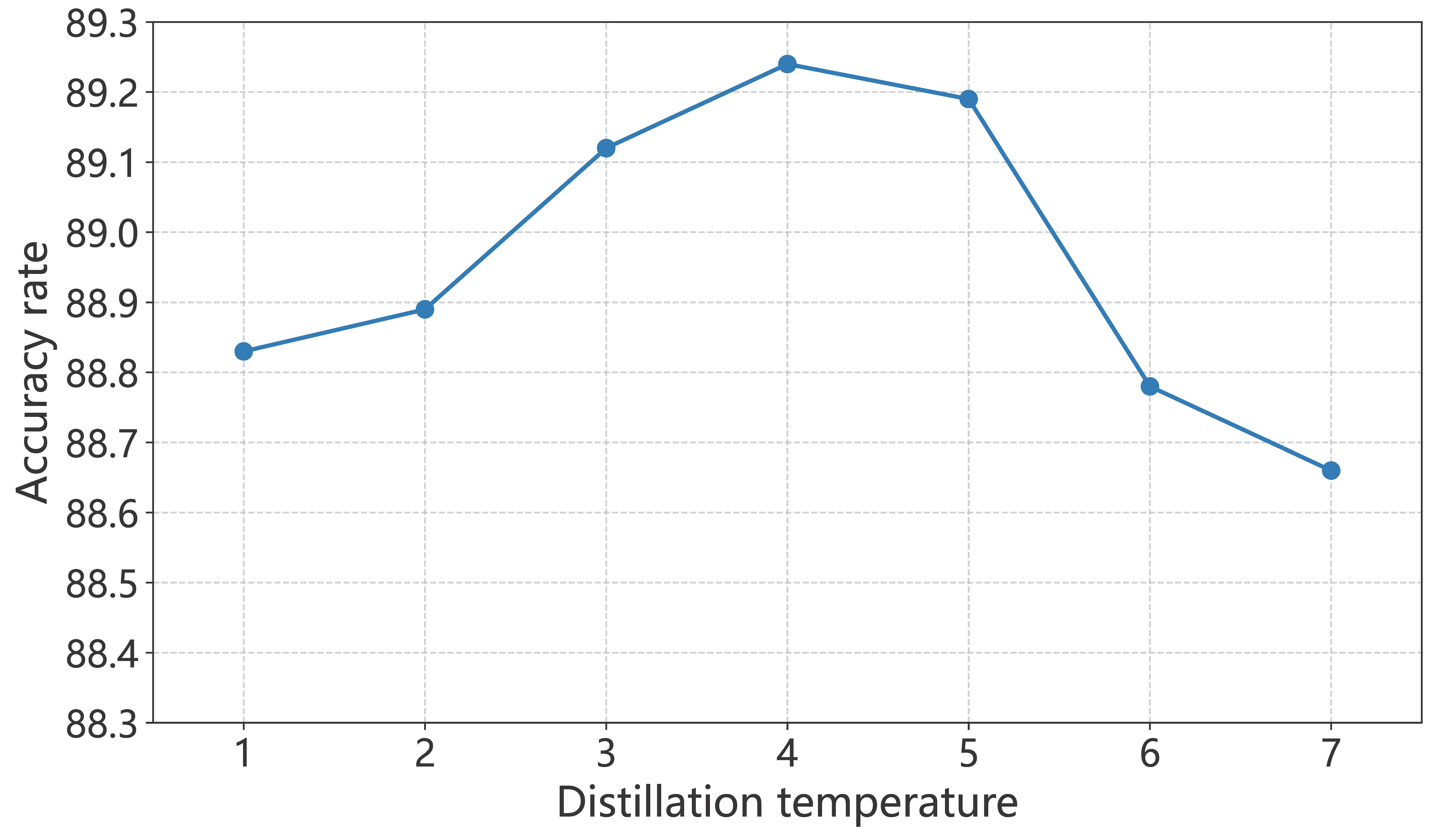
| Ours | Top-1 | 89.24 |
| Method | Input Size | Frames | Parameters | GFLOPs |
|---|---|---|---|---|
| Wang et al. [41] | 32 | 101.22 | 121.74 | |
| Ours | 32 | 33.74 | 40.58 |
| Action | Duan et al. [60] | Wang et al. [41] | Ours |
|---|---|---|---|
| Fan oneself with an object | 89.91 | 98.15 | 92.59 |
| Fan oneself with hands | 82.41 | 94.44 | 87.04 |
| Fan oneself with one’s shirt | 85.98 | 85.98 | 83.18 |
| Roll up sleeves | 92.52 | 99.07 | 92.52 |
| Wipe perspiration | 67.59 | 96.30 | 94.44 |
| Head scratching | 78.50 | 96.26 | 89.72 |
| Take off a jacket | 95.37 | 99.07 | 84.26 |
| Take off a hat/cap | 95.33 | 99.07 | 84.11 |
| Action | Duan et al. [60] | Wang et al. [41] | Ours |
|---|---|---|---|
| Sneeze/cough | 94.44 | 98.15 | 82.41 |
| Stamp one’s feet | 82.41 | 99.07 | 96.30 |
| Rub one’s hands | 85.98 | 96.26 | 89.72 |
| Blow into one’s hands | 95.33 | 98.13 | 85.98 |
| Cross one’s arms | 89.81 | 91.67 | 87.96 |
| Narrowed shoulders | 68.22 | 96.26 | 94.39 |
| Put on a jacket | 94.39 | 97.20 | 93.46 |
| Put on a hat/cap | 95.37 | 97.22 | 89.81 |
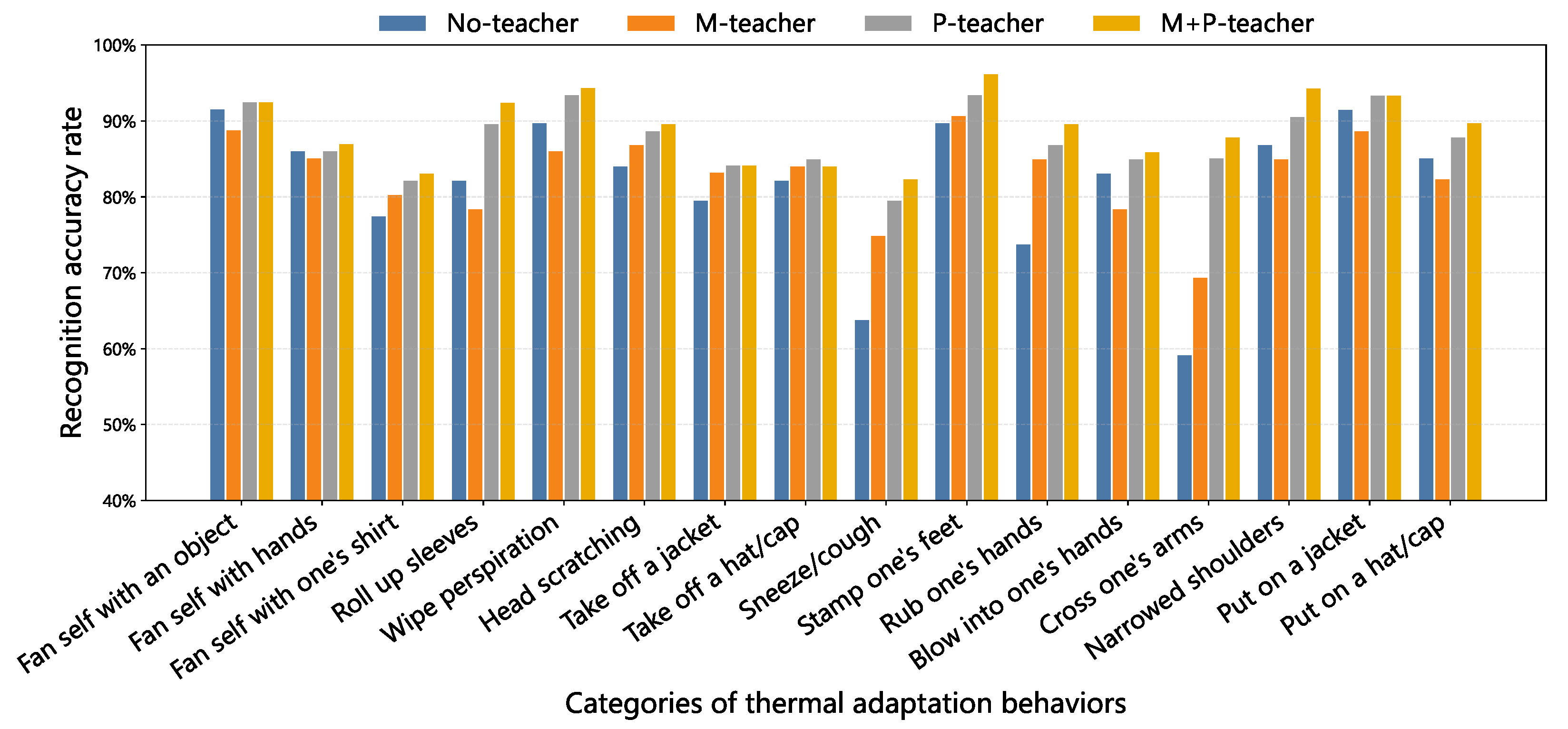
| No Teacher | Teacher M | Teacher P | Teacher M + P | |
|---|---|---|---|---|
| Accuracy | 81.68 | 85.58 | 87.73 | 89.24 |
Disclaimer/Publisher’s Note: The statements, opinions and data contained in all publications are solely those of the individual author(s) and contributor(s) and not of MDPI and/or the editor(s). MDPI and/or the editor(s) disclaim responsibility for any injury to people or property resulting from any ideas, methods, instructions or products referred to in the content. |
© 2025 by the authors. Licensee MDPI, Basel, Switzerland. This article is an open access article distributed under the terms and conditions of the Creative Commons Attribution (CC BY) license (https://creativecommons.org/licenses/by/4.0/).
Share and Cite
Duan, W.; Yuan, W.; Shen, D.; Liu, X.; Wang, Y. Thermal Adaptive Behavior-Recognition Model with Cross-Modal Knowledge Distillation. Buildings 2025, 15, 4071. https://doi.org/10.3390/buildings15224071
Duan W, Yuan W, Shen D, Liu X, Wang Y. Thermal Adaptive Behavior-Recognition Model with Cross-Modal Knowledge Distillation. Buildings. 2025; 15(22):4071. https://doi.org/10.3390/buildings15224071
Chicago/Turabian StyleDuan, Wenjun, Weihua Yuan, Dongdong Shen, Xuya Liu, and Yu Wang. 2025. "Thermal Adaptive Behavior-Recognition Model with Cross-Modal Knowledge Distillation" Buildings 15, no. 22: 4071. https://doi.org/10.3390/buildings15224071
APA StyleDuan, W., Yuan, W., Shen, D., Liu, X., & Wang, Y. (2025). Thermal Adaptive Behavior-Recognition Model with Cross-Modal Knowledge Distillation. Buildings, 15(22), 4071. https://doi.org/10.3390/buildings15224071