Article

Assessing Drivers, Barriers and Policy Interventions for Implementing Digitalization in the Construction Industry of Pakistan


by
Waqas Arshad Tanoli
Department of Civil and Environmental Engineering, College of Engineering, King Faisal University, Al-Ahsa 31982, Saudi Arabia
Buildings 2025, 15(15), 2798; https://doi.org/10.3390/buildings15152798
Submission received: 26 June 2025 / Revised: 25 July 2025 / Accepted: 5 August 2025 / Published: 7 August 2025
(This article belongs to the Section Construction Management, and Computers & Digitization)

Abstract

Digitalization is rapidly reshaping the global construction industry; however, its adoption in developing countries, such as Pakistan, remains limited and uneven. Hence, this study investigates and evaluates the current status of digital technology integration in Pakistan’s construction industry, with a primary focus on key tools, implementation challenges, and necessary policy interventions. Using a three-phase mixed-method approach involving a literature review, expert interviews, and a nationwide survey, this research identifies Building Information Modeling, Geographic Information Systems, and E-Procurement as essential technologies with strong potential to improve transparency, efficiency, and collaboration. However, adoption is hindered by a lack of awareness, limited technical expertise, and the absence of a cohesive national policy. This study also highlights that the private sector shows greater readiness compared to the public sector; however, systemic barriers persist across both sectors. Based on stakeholder insights, a three-part policy strategy was also proposed. This includes establishing a national regulatory framework, investing in capacity-building programs, and providing financial or institutional incentives to encourage the adoption of these measures. The findings emphasize that digitalization is not just a technical upgrade; it represents a pathway to improved governance and more efficient infrastructure delivery. With timely and coordinated policy action, the construction industry in Pakistan can align itself with global innovation trends and move toward a more sustainable and digitally empowered future.

1. Introduction

In recent years, digital technologies have become central to the evolution of industries worldwide. They are reshaping how organizations operate, plan, and deliver outcomes. A clear distinction has emerged between digitization, the conversion of analogue data into digital form, and digitalization, which involves the broader use of digital tools to transform processes and create value. The latter reflects a more profound organizational shift, not just technical upgrades, influencing communication, planning, and delivery methods [1,2]. The construction industry, traditionally conservative in adopting innovation, is now under increasing pressure to embrace digitalization. The need to stay efficient, transparent, and competitive in a rapidly changing environment has never been more critical [3,4,5].
Globally, technologies such as Building Information Modeling (BIM), Geographic Information Systems (GISs), Digital Twins, and E-Procurement platforms are being adopted to improve lifecycle project management. These tools help reduce delays, optimize costs, and support data-driven decision-making [6,7,8,9]. These digital tools contributed to reducing project delays, optimizing costs, and supporting data-driven decisions. Various developed countries have demonstrated how national policies and digital roadmaps can accelerate the adoption of such technologies across public and private infrastructure projects [10,11]. However, in developing economies, digital adoption remains inconsistent and limited, particularly within public sector organizations [12].
In Pakistan, digitalization in the construction industry remains in its formative stages. While some private firms and donor-funded projects have adopted digital practices, the public sector lags significantly. Several interrelated challenges obstruct progress, including the high upfront cost of digital infrastructure, limited awareness and training, insufficient regulatory support, and persistent reliance on conventional practices [13]. These are compounded by deep-rooted institutional resistance to change, fragmented communication between stakeholders, and bureaucratic hurdles that stifle innovation [14,15]. The scarcity of skilled professionals capable of managing digital systems further limits the capacity for sustained digital transformation, particularly in large-scale government-led infrastructure initiatives [16].
Despite these limitations, the strategic importance of digitalization for Pakistan’s construction industry cannot be overstated. Digital tools offer significant potential to enhance project oversight, increase transparency, reduce corruption, and improve the efficient allocation of resources. With growing infrastructure needs and increasing public investment, the timing is critical for building digital capacity. However, there remains a lack of empirical research exploring the specific barriers and enablers that influence digital adoption in Pakistan’s public construction sector. Without such understanding, policymakers are left with vague or generalized recommendations that do not reflect the contextual realities of the industry.
This study aims to fill a significant gap by offering a thorough assessment of the digitalization landscape in Pakistan’s public construction sector. Using a mixed-methods approach that combines a literature review, expert interviews, and stakeholder surveys, this research identifies the main drivers, barriers, and areas for policy action. Its unique contribution lies in examining these dynamics within a developing country context, where institutional frameworks for digital adoption are still in development. Digital transformation in construction is a global issue, but much of the existing research is based on high-income, digitally mature economies. In contrast, this study highlights Pakistan as a case study, providing localized insights influenced by regulatory fragmentation, workforce challenges, and limited digital infrastructure. By integrating qualitative and quantitative findings, this study not only enriches the literature on digitalization in construction in emerging economies but also provides policy guidance tailored to Pakistan’s specific conditions. The recommendations aim to support strategic planning, capacity building, and broader stakeholder collaboration, providing insights that may also benefit other countries undergoing similar digital transitions.

2. Literature Review

The construction sector plays a crucial role in driving economic growth, creating jobs, and fostering national development [17]. Beyond its financial contribution, it also has a significant impact on the environment, particularly in terms of carbon emissions, waste generation, and energy consumption. It influences both societal well-being and ecological sustainability [18]. Zubair et al. (2024) proposed a BIM and GIS-based framework to assess lifecycle sustainability, showcasing how digital integration supports eco-efficiency in construction [19].
Although a key driver of any economy, the construction industry faces several challenges in this area, including competitiveness, affordability, resource allocation, energy efficiency, and productivity. Over the last two decades, even in the European Union (EU), where the construction industry contributes to nearly 9% of the GDP and accounts for over 18 million jobs, the growth rate of this sector has slowed significantly [20]. To address these challenges, digital technologies are being increasingly recognized as game-changers. However, the construction sector remains one of the least digitized industries globally [21]. There is a growing consensus that digital integration is essential for improving performance, sustainability, and competitiveness.

2.1. Digitalization in the Construction Industry

Digitalization has become a critical driver of performance improvement across global industries, including construction. In contrast to digitization, which refers to the conversion of physical processes into digital form, digitalization involves a broader transformation of organizational activities through the integration of digital technologies. This shift supports enhanced collaboration, improved resource utilization, and increased transparency across the entire project life cycle [22].
In the construction industry, digitalization extends from initial planning and design to construction, operation, and maintenance stages. Tools such as BIM, Internet of Things (IoT), and cloud-based platforms are being increasingly employed to improve project efficiency, cost effectiveness, and decision-making processes [23,24]. BIM plays a pivotal role in 3D visualization, clash detection, and data sharing among stakeholders, thereby fostering interdisciplinary collaboration [25,26,27]. However, despite its benefits, the construction industry still ranks among the least digitalized industries globally.
Construction Industry (CI) 4.0, a subset of Industry 4.0, integrates innovative technologies into the built environment, including robotics, automation, and data analytics. Its adoption enables enhanced quality control, material optimization, and real-time project tracking [28]. Nonetheless, widespread implementation remains limited due to fragmented supply chains, high capital costs, and resistance to change [29].

2.2. Drivers and Challenges in Digitalization

The pursuit of increased productivity drives the digital transformation of the construction industry, leading to better risk management and improved project delivery timelines. According to Aghimien et al. (2020), drivers in the Architecture, Engineering, and Construction (AEC) industry include enhanced communication, document quality, response time, and project accuracy [30]. Similarly, Eadie et al. (2013) observed that digital procurement systems in the United Kingdom (UK) enabled faster service delivery, lower transaction costs, and more straightforward task archiving [31]. Although digitalization has greatly enhanced overall construction efficiency, significant hurdles persist that impede the seamless integration of these innovations. These obstacles can be categorized as technological, financial, organizational, procedural, legislative, and psychological [32,33]. Potential technological barriers may include a scarcity of essential hardware, such as computers, a deficiency of knowledge and skills related to digital tools, and inadequate training programs [32]. From a financial perspective, obstacles could arise from insufficient design fees to support digital initiatives, the cost of digital tools and setup, the unavailability of a budget for training or competitive salaries, and the financial strain of transitioning to a new system or format [32]. Organizational challenges to digitalization in construction have been recognized as a lack of effective leadership or enthusiasm towards digital progress, an insufficiency of skilled personnel to implement digital strategies, and a shortage of collaborative efforts [33]. Process-related barriers in construction digitalization could be caused by insufficient early involvement of contractors, low performance of digital tools or software, computer processing speed, limited software capability in managing complex geometries, and the interoperability of 3D models and software across multiple sources [34].

2.3. Status of Digitalization in the Construction Industry of Pakistan

In Pakistan, the deployment and application of digitalization are slow-moving due to numerous technological and policy obstacles resulting from internal and external factors. Inadequate access to high-speed internet and a lack of digital literacy are significant barriers to adopting digital transformation, particularly in the construction industry [35]. The key areas in which digitalization is making an impact are the financial sector, the health sector, and the education sector [36]. In the construction industry, several innovations have been adopted, especially in the area of project management. Construction companies are increasingly employing digital project management tools to manage their projects more efficiently, simplifying communication, planning, and resource allocation. Despite the constant strive for more digitalization on the national level, there are still many challenges to its adoption in the construction industry in Pakistan, especially the lack of skilled workers, familiarization with digital tools, cost effectiveness, lack of awareness among industry professionals about the implementation of digitalization, and, more importantly, the lag in policy intervention on a national level [37].

3. Methodology

To explore the state of digitalization in Pakistan’s construction industry, this study employed a three-stage mixed-method research approach. The design was shaped by the complex, decentralized nature of the construction industry in Pakistan, where data on digital practices is fragmented and region-specific. Recognizing these challenges, the research method was structured to ensure both depth and diversity in the insights gathered.

3.1. Three-Phase Research Design

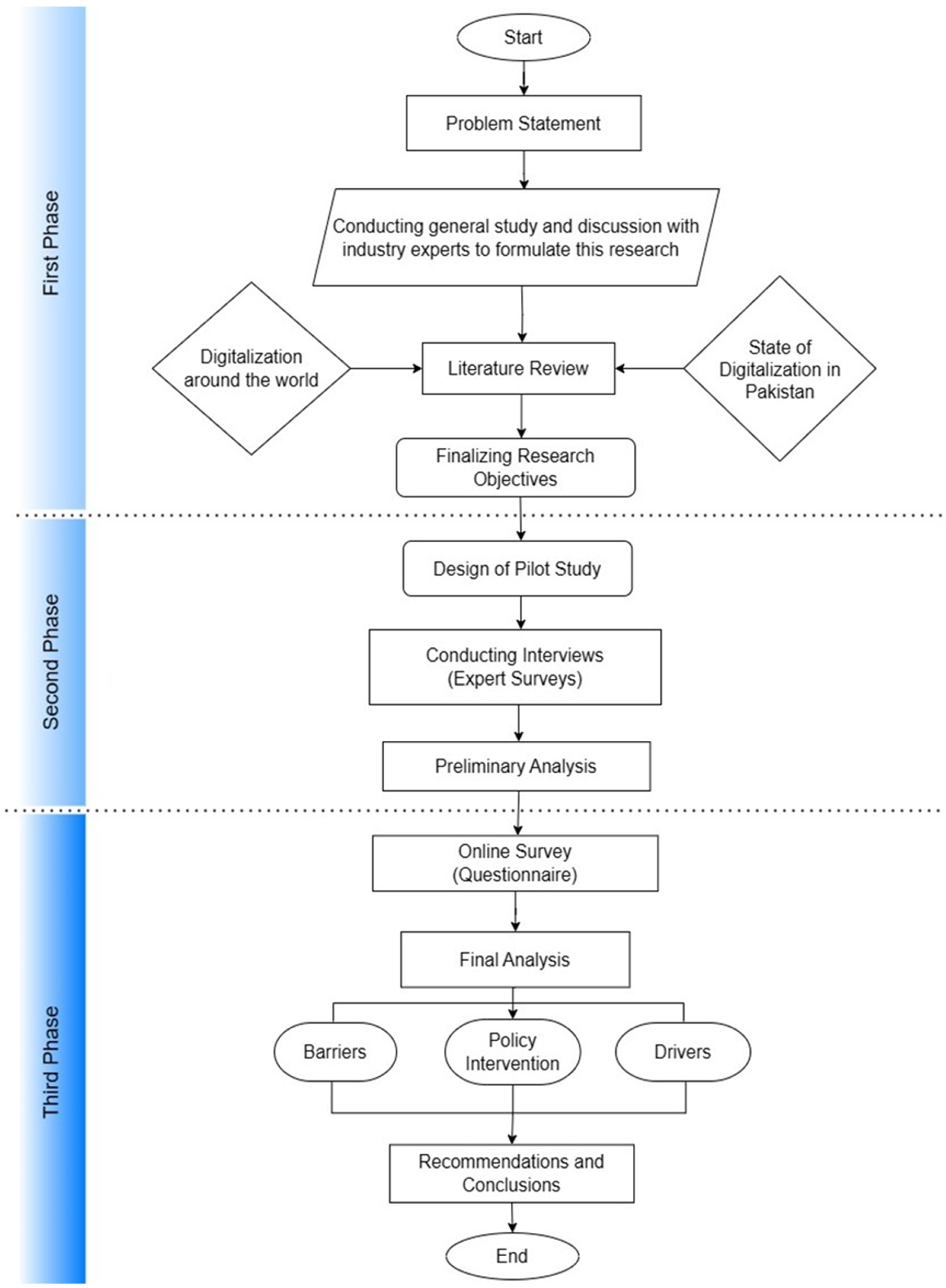
This research was designed in three interconnected phases: a review of the existing literature, expert interviews, and a nationwide questionnaire survey. Details can be found in Appendix A and Appendix B. This step-by-step structure enabled a gradual deepening of understanding, starting from what has been studied globally and locally to gathering on-the-ground expert insights, and finally capturing a broader industry perspective through a survey. The stepwise methodology is illustrated in Figure 1.

3.1.1. Literature Review and Desktop Research

The initial phase involved an extensive review of the academic and industry literature, both global and local. Given the limited studies specifically focused on Pakistan, this review leaned on international examples to help frame this study’s direction. The literature review not only mapped out current technologies and trends but also helped identify potential challenges and policy gaps that shaped the subsequent phases of the research.

3.1.2. Expert Interviews (Pilot Study)

To ground this study in local realities, semi-structured interviews were conducted with experts from across Pakistan’s regions, including all four provinces, the federal territory, and two administrative units. The aim was to capture a balanced mix of perspectives from both the public and private sectors. Experts were asked about their views on the technologies currently in use, the trends they see emerging, the key obstacles to adoption, and the types of policy support they believe are needed. A purposive sampling approach was used to select interviewees who had direct experience with or exposure to digital technologies in construction, such as BIM, IoT, or E-Procurement. Experts were selected from a diverse range of public sector organizations, consultancy firms, academia, and technology providers to ensure a broad spectrum of viewpoints. Although the number of interviews was limited, the responses were considered sufficient once consistent themes began to emerge across participants. The semi-structured interview questions used during these sessions are provided in Appendix A for transparency and reference. These interviews played a crucial role in refining the themes and priorities for the survey stage. The structure of the interviews was informed by earlier research, such as that of Sial et al. (2013), and the respondents were chosen based on their professional experience and influence in the construction sector [38].

3.1.3. Questionnaire Survey

Insights from the expert interviews guided the development of a detailed questionnaire. The goal was to hear directly from a broader range of stakeholders about their experiences and expectations around digitalization. The survey covered ten key technologies identified during the pilot study, including E-Procurement, E-Registration, IoT, Drones, BIM, Laser Scanning, Virtual and Augmented Reality, Artificial Intelligence, Energy Management Systems, GIS, and Cloud-based Data Management. While this study included Cloud-based Data Management tools, it did not specifically evaluate Document Management Systems (DMSs) as a standalone category. Since DMSs play a key role in managing construction workflows and digital documentation, future studies could benefit from a more detailed exploration of their adoption and implementation challenges.
The respondents were asked to assess the current usage of these technologies, the challenges they face, the benefits they expect, and the types of policy support they believe would be helpful. There is no national database of construction stakeholders in Pakistan, which is why the survey was distributed randomly to obtain beneficial information from all the construction-associated practitioners. In this way, a total of 218 valid responses were collected, representing a diverse range of professionals, including government officials, contractors, consultants, and academics. The survey was distributed randomly through professional networks, industry associations, and academic forums to ensure maximum diversity and sector-wide participation from all segments of the construction industry. This method was adopted to capture a wide range of opinions without introducing sectoral bias.

3.1.4. Respondent Demographics

The survey drew a diverse group of participants, as stated in Table 1. It can be observed that most respondents held bachelor’s or master’s degrees, with some holding PhDs. Their experience in the field ranged from a few years to decades, and they worked at different levels of management, i.e., junior, mid-level, and senior. The group included professionals from the public sector, private companies, academia, and industry associations, ensuring that the responses reflected multiple perspectives and responsibilities within the construction industry.

3.2. Statistical Analysis

Once the survey data was collected, it was analyzed using the Statistical Package for the Social Sciences (SPSS version 22) software. Several statistical methods were used to ensure accuracy and depth in interpretation, such as the Relative Importance Index (RII) to rank key themes like barriers, drivers, and policy needs, Reliability analysis (Cronbach’s Alpha) to test the consistency of the questionnaire and Normality testing (Shapiro–Wilk) to determine whether the dataset followed a normal distribution, guiding the choice of further statistical tests.

3.2.1. Relative Important Index (RII)

The RII method helped prioritize the different elements based on their significance. It used the following formula:
R I I = W A N = 5 n 5 + 4 n 4 + 3 n 3 + 2 n 2 + 1 n 1 5 N
where:
W = the weight assigned to every risk (by the response to the questionnaire survey).
A = maximum weight.
N is the total number of respondents who filled out the questionnaire [39].
RII has been applied to the collected data, and it has been ranked accordingly, with values ranging between 0 and 1. The variable with the maximum RII value has been ranked as 1, indicating it is the most important.

3.2.2. Normality Testing

Before proceeding with further statistical testing, a Shapiro–Wilk test was used to verify whether the data followed a normal distribution. In most cases, the significance value was below 0.05, indicating non-normality. As a result, non-parametric tests were applied where necessary [40].

3.2.3. Reliability Testing

To ensure the internal consistency of the questionnaire, Cronbach’s Alpha was used. A threshold value of 0.70 was considered acceptable, with values above 0.90 indicating excellent reliability [41,42].

4. Results

To understand the current state of digitalization in Pakistan’s construction industry, a structured survey-based study was conducted. The target respondents included professionals from both the public and private sectors, as well as academics. This section provides an overview of how the data was collected, analyzed, and interpreted, with a focus on patterns of technology usage, perceived importance, implementation challenges, and suggested policy measures.

4.1. Survey Implementation and Statistical Validation

4.1.1. Usage of Digital Technologies by Sector

The respondents rated the level of digital technology adoption in both public and private sector organizations. The reliability coefficient (Cronbach’s Alpha) for this section was 0.622. The Wilcoxon test result (Z = −4.123, p = 0.000) confirmed that the private sector demonstrates significantly higher levels of digital technology adoption compared to the public sector.

4.1.2. Current Use of Technologies

The participants were asked about the extent to which ten digital technologies are currently in use within their organizations. As shown in Table 2, GIS emerged as the most commonly adopted tool, followed by E-Procurement and BIM. The internal consistency of this section was high (Cronbach’s Alpha = 0.867).

4.1.3. Importance of Technologies for Future Use

In assessing future priorities as shown in Table 3, BIM stood out as the most critical digital technology for upcoming projects, with GIS and E-Procurement following close behind. Virtual and augmented reality ranked lowest in terms of future relevance. The internal reliability score was strong (Cronbach’s Alpha = 0.967).

4.2. Key Drivers for Digitalization

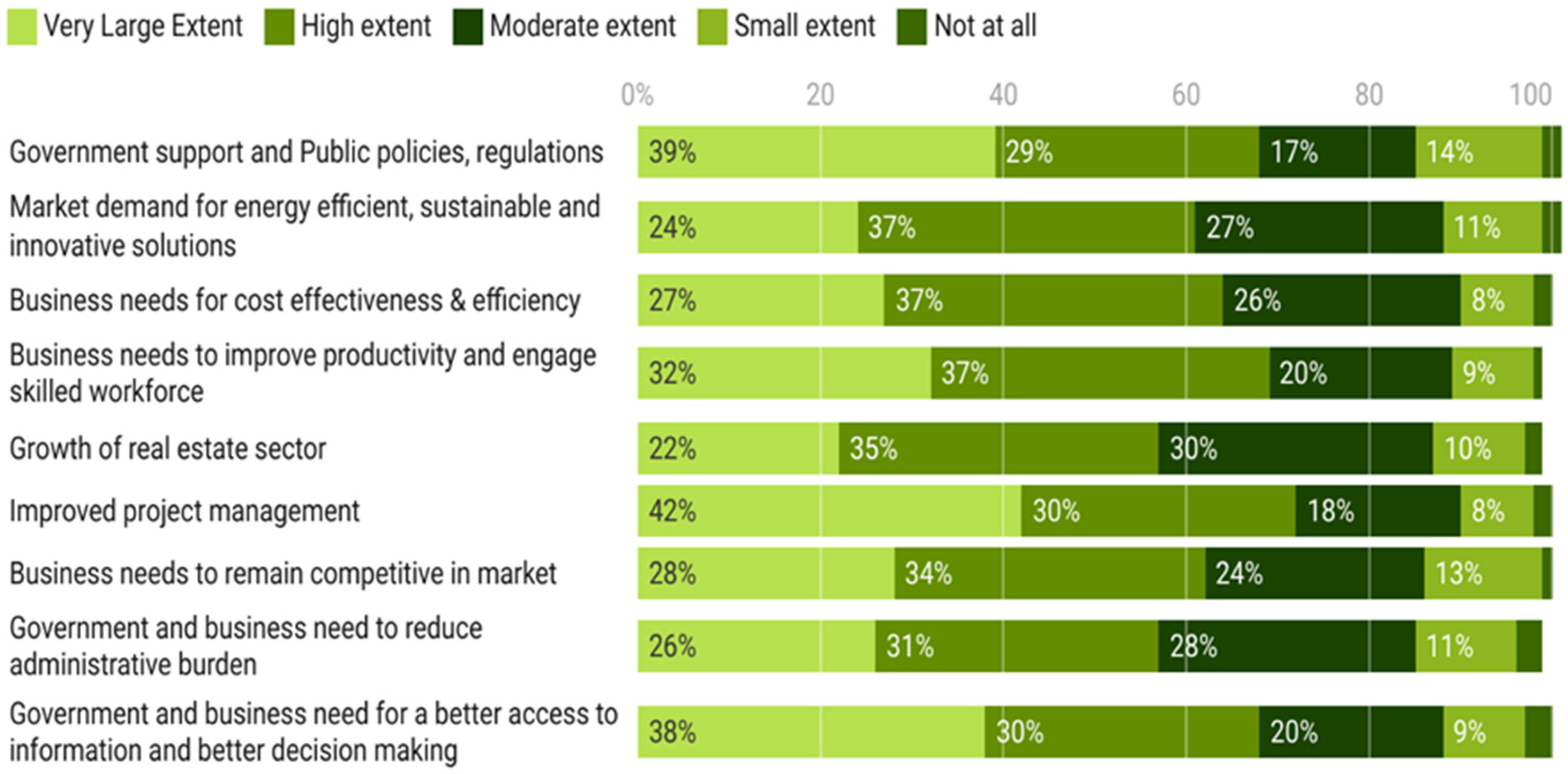
This section captures stakeholders’ perspectives on the key factors that can encourage digital adoption. As shown in Figure 2, project management improvements, better information access, and government support policies were identified as the primary motivators. The drivers were consistent and well aligned, as reflected by a reliability score of 0.924.

4.3. Importance of Digitalization Across Construction Phases

The respondents rated the role of digitalization in different construction stages. Unsurprisingly, the design phase was perceived as the most digitally driven, while the demolition phase was seen as having the least perceived benefit. Further details can be seen in Table 4. This section showed strong internal consistency (Cronbach’s Alpha = 0.914).

4.4. Barriers to Digitalization

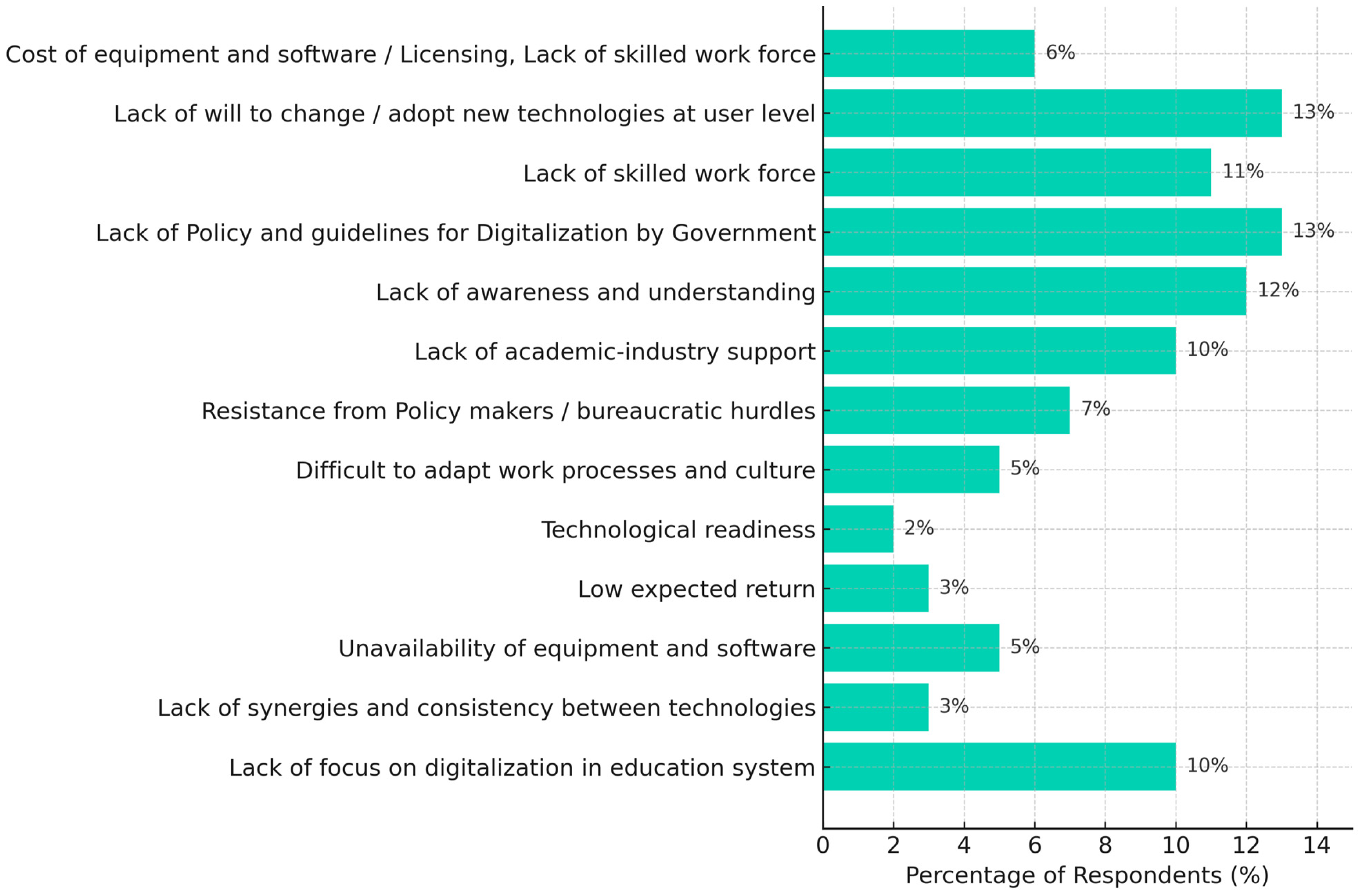
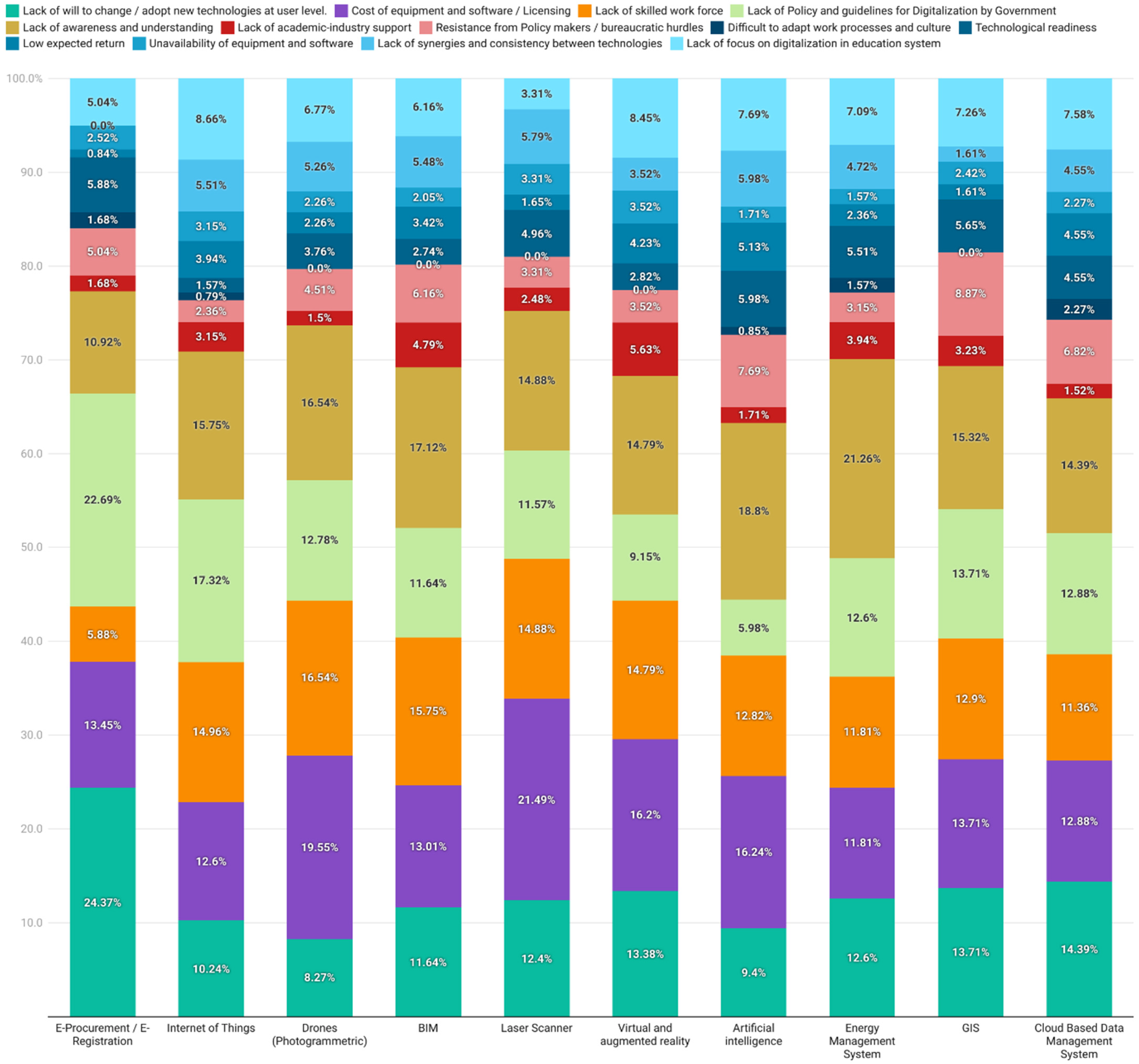
The main barriers to adopting digital tools in construction were evaluated both generally and with regard to specific technologies. The top challenge reported was user-level resistance to change. The data revealed critical insights into how and where these barriers manifest. Figure 3 presents the overall barriers to digitalization in the construction industry of Pakistan. However, Figure 4 presents the barriers associated with the specific selected technologies.

4.5. Public Policy Intervention

The challenges related to digital technologies were identified, which led to the question of “what’s next?” Therefore, public policy interventions are the next desired step. This section is further divided into three parts. The first step is to analyze which of the digital technologies needs the policymaker’s attention. The second part involves identifying the overall policy interventions required for digitalization, and, subsequently, understanding the digital technology and the desired public policy interventions for that specific technology. To encourage the uptake of digital technology, the respondents shared their opinions on the types of policy support that could make the most significant difference.

4.5.1. Priority Technologies for Policy Focus

Ten different technologies used in the construction industry were presented to the survey participants, as shown in Table 5. This is essential because it helps determine which technologies should receive the most immediate focus for implementing digitalization in the construction industry. Among the technologies identified, BIM was overwhelmingly highlighted as the top priority for future government support, followed by GIS and AI. This section also achieved a high reliability score (Cronbach’s Alpha = 0.919).

4.5.2. General Policy Measures

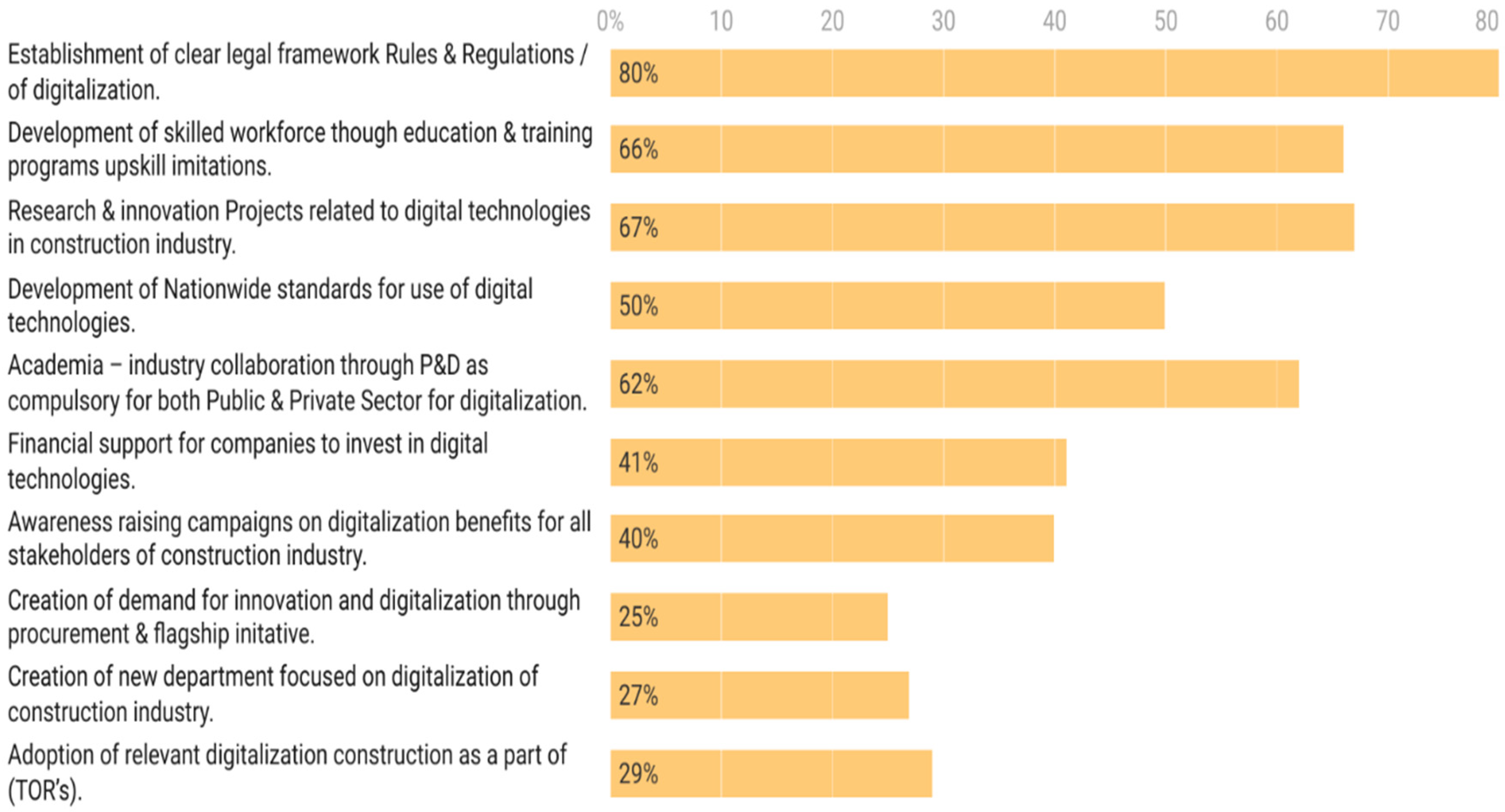
The respondents were invited to select from a list of proposed policy actions, the details of which are presented in Figure 5. The creation of a national legal and regulatory framework for digital construction technologies emerged as the most popular recommendation.

4.5.3. Policy Needs for Specific Technologies

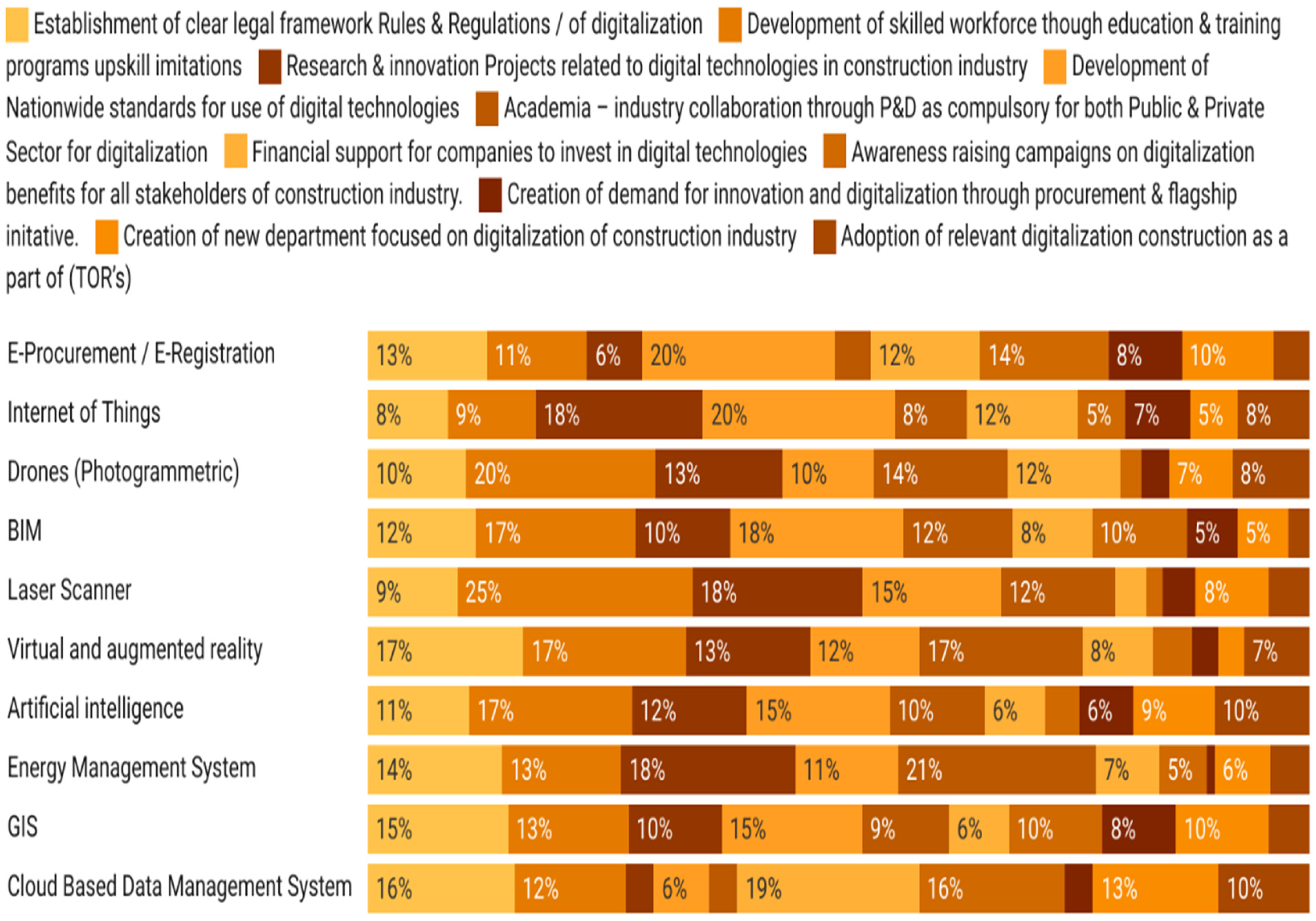
The overall interventions required for the digitalization of the construction industry are compiled; however, it is also essential to know if the ten digital technologies presented in the questionnaire survey have specific required/desired interventions that would make certain technologies easier to implement in the future. The public policy intervention versus digital technology is presented in Figure 6. Finally, the survey examined specific policy needs associated with each of the ten technologies under study, providing a practical framework for targeted intervention.

5. Discussion

This section presents a detailed interpretation of the findings derived from the nationwide questionnaire survey conducted for this study. It discusses the existing technology usage, identifies critical digitalization gaps across project phases, highlights key barriers and drivers, and examines policy-level interventions required for a successful digital transformation in Pakistan’s construction industry.

5.1. Assessing Technology Gaps in Construction Industry Digitalization

Survey data on current technology use revealed that GIS is commonly adopted in urban planning and public works but is still underutilized in terms of spatial decision-making and integration [43]. E-Procurement and E-Registration ranked second, mainly driven by initiatives from bodies such as the Pakistan Engineering Council (PEC) and various provincial procurement authorities. These technologies are recognized for improving transparency and accountability in project bidding and contractor registration. BIM was identified as the third most adopted technology. Although it is highly valued for its potential in collaborative design and construction management, BIM’s use is primarily confined to large-scale infrastructure projects. The barriers identified for BIM adoption include a lack of awareness, high software costs, and limited training opportunities. Technologies such as IoT and cloud-based data systems, although recognized in global construction practices, remain relatively underutilized in Pakistan due to infrastructure limitations, cybersecurity concerns, and a lack of legal frameworks for data governance [44]. Drones, energy management systems, and VR/AR were found to be the least adopted technologies.

5.2. Digitalization Needs Across Construction Phases

The respondents consistently emphasized the need for digitalization in the early stages of construction, particularly during the design and planning phases. These phases rely heavily on data modeling, design precision, and documentation, making them ideal for integrating tools such as BIM, CAD, and simulation software. The monitoring and control phase was also identified as highly dependent on digital tools. Technologies such as drones and project management software help track timelines, resources, and quality control, improving real-time decision-making. Conversely, the demolition phase was ranked as the least in need of digitalization, given its relatively manual and less process-driven nature.

5.3. Barriers to Digitalization in the Construction Industry

Among the 13 predefined barriers, 4 stood out as critical: a lack of will to change at the user level, an inadequately skilled workforce, the absence of policy guidelines, and limited awareness and understanding. The survey responses indicated that digital resistance is prevalent among users and stakeholders across both public and private sectors. Many organizations still rely on traditional construction workflows and exhibit hesitance in adopting unfamiliar technologies. The lack of supportive public policies further compounds these challenges. Stakeholders from academia and industry both cite the absence of coherent national policy frameworks as a significant bottleneck [45].

5.4. Public Policy Interventions for Digitalization

The participants highlighted the urgent need for structured policy measures. The top recommendation was the establishment of a clear legal and regulatory framework to guide digital transformation in the construction industry. This should be followed by: investment in research and innovation for digital technologies, development of skilled human capital through training and education programs, academia–industry partnerships mandated by planning authorities, and nationwide standards for digital practices and interoperability [43]. These policy interventions aim to formalize digital transformation, ensure its continuity, and promote inclusive participation from both large firms and smaller contractors.

5.5. Barriers by Individual Technology Type

Each digital tool faces distinct challenges in adoption. E-Procurement, while moderately adopted, suffers primarily from user-level reluctance. The IoT struggles due to the absence of guiding policies, while high upfront costs and regulatory complications hinder the adoption of drones. BIM stands out as the most promising yet underutilized technology. The respondents cited lack of awareness, inadequate training, and high costs as their primary barriers. Similarly, AI, laser scanning, and energy management tools are limited by financial and technical hurdles, including software availability and workforce readiness. GISs, though more commonly used, still face issues related to cost, policy gaps, and user inertia. Cloud-based systems, on the other hand, face challenges in awareness, cybersecurity readiness, and stakeholder buy-in.

5.6. Central Concept Through Frameworks

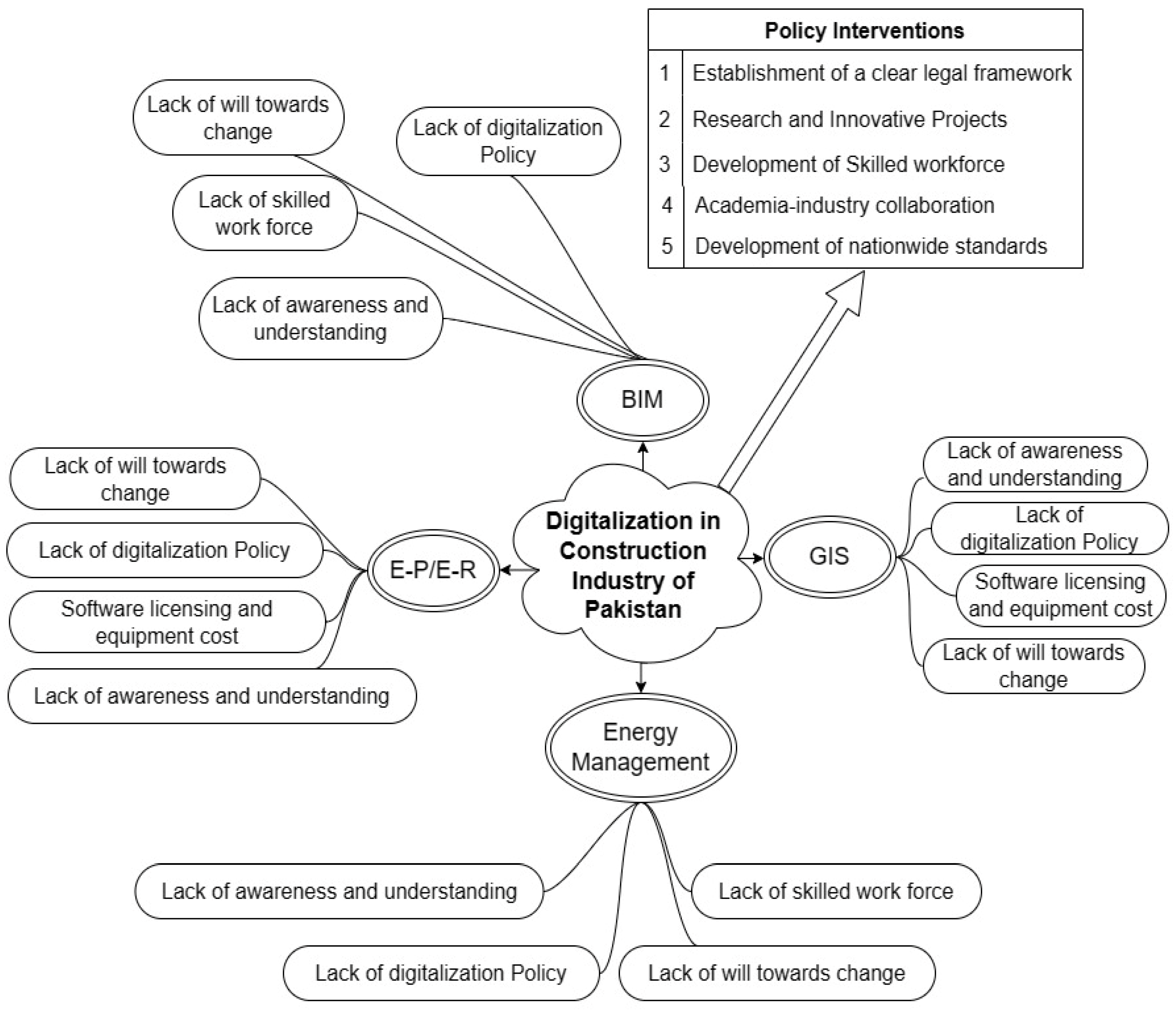
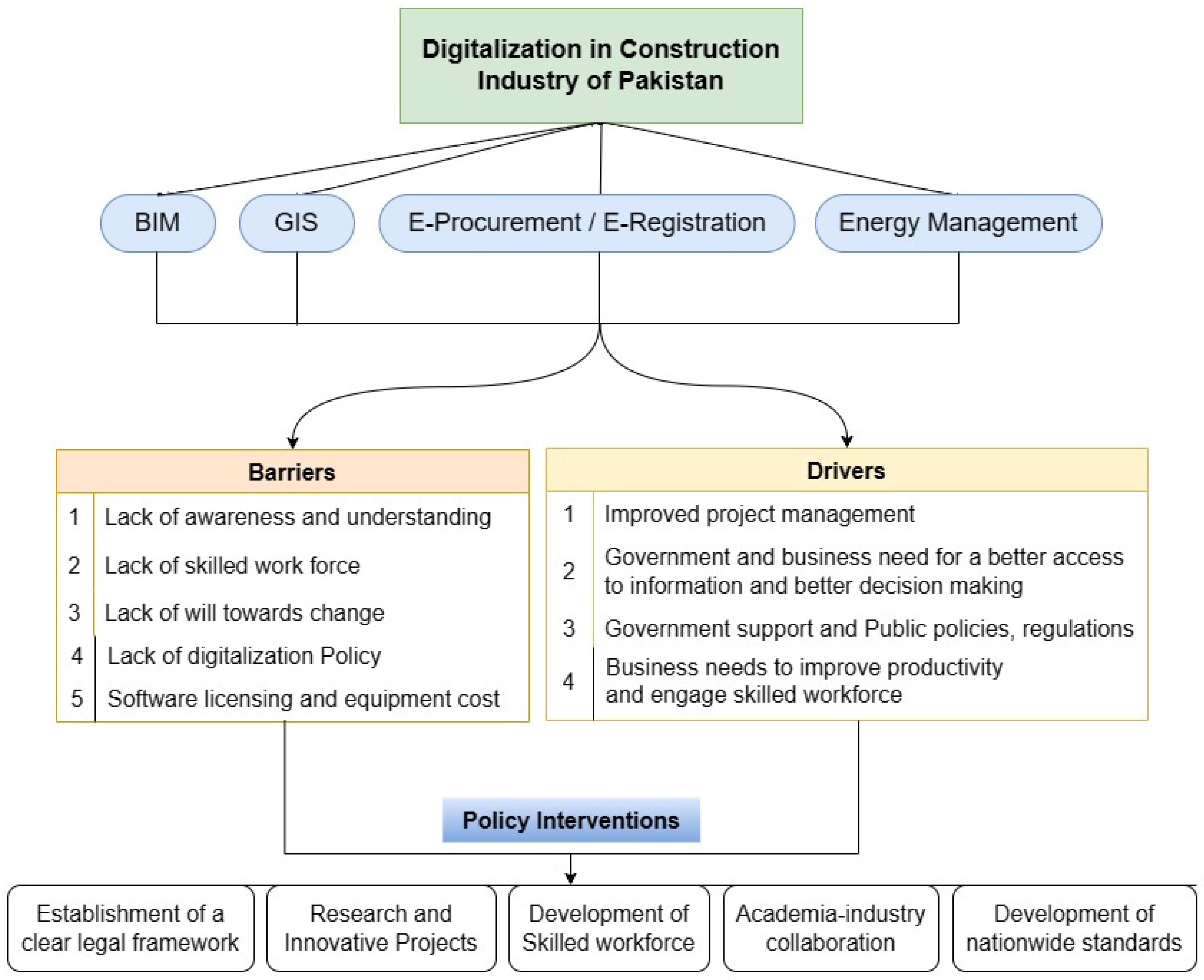
The central concept, as presented in Figure 7 and Figure 8, pertains to the digitalization of the construction industry in Pakistan, focusing on specific technological elements: BIM, E-Procurement/E-Registration, GIS, and Energy Management. These digital tools are driven by factors such as the enhancement of project management, a demand from businesses and the government for improved access to information and decision-making, supportive public policies and regulations, and the need to augment productivity and employ a skilled workforce. Simultaneously, various barriers exist, including user reluctance to change and adopt new technologies, a scarcity of skilled workforce, the absence of a comprehensive government policy framework for digitalization, and a general lack of awareness and understanding. To overcome these barriers and bolster the drivers, the suggested policy interventions include the formulation of definitive legal rules and regulations for digitalization, implementation of research and innovation projects on digital technologies in the construction sector, development of a skilled workforce via targeted education and training initiatives, mandatory partnerships between academia and industry in planning and development for both public and private sectors to promote digitalization, and the establishment of nationwide standards for the utilization of digital technologies.
To make these broad interventions truly actionable, finer-grained measures are required. First, the legal and regulatory landscape must clearly define who owns and safeguards project data, insist on open-format deliverables, set baseline cybersecurity thresholds, and align the Public Procurement Regularity Authority (PPRA) and PEC procurement rules with e-submittals and digital signatures. Second, targeted research and innovation funding, such as from the Higher Education Commission (HEC) of Pakistan or PEC co-sponsoring “living-lab” pilots on BIM-based permitting, IoT site monitoring, and AI-driven cost control, can seed locally adapted solutions rather than imported ones. Third, a national digital construction competency framework should deliver micro-credentials and CPD modules for site staff, surveyors, and inspectors, with TVET-led “train-the-trainer” schemes and online platforms allowing for rapid scale-up. Fourth, genuine academia–industry linkages can be fostered by requiring large public projects to partner with at least one domestic university for research and development, internships, and staff exchanges, thereby ensuring knowledge flows in both directions. Finally, fast-tracking the adoption of international standards, such as ISO 19650 for information management and IFC openBIM schemas, will help ensure interoperability across the entire supply chain. Digitalization in Pakistan’s construction industry is not hindered by a lack of potential, but rather by institutional inertia, fragmented planning, and capacity issues. With informed, targeted policy support and stakeholder collaboration, the sector can transition into a digitally enabled ecosystem in alignment with global standards.

6. Conclusions

This study examined the digitalization of Pakistan’s construction industry, identifying key technologies, adoption barriers, and policy needs. The findings reveal that while tools such as BIM, GIS, and E-Procurement are gaining traction, progress remains uneven due to limited awareness, a lack of skilled personnel, and inadequate policy frameworks. However, their use remains inconsistent and largely dependent on individual organizational efforts rather than systemic support. Among the technologies explored, BIM stood out as the most valued yet underutilized tool. The participants across the sector repeatedly emphasized the need for targeted policy measures, enhanced training, and increased awareness to ensure the effective implementation of these initiatives. It became evident that while the private sector is somewhat prepared to embrace digital tools, the public sector still faces a significant capacity gap.
A three-phased strategy is proposed: establishing a regulatory framework, running awareness campaigns, and offering financial or institutional support. Strengthening academia–industry collaboration and investing in innovation will further catalyze digital adoption. Ultimately, digital transformation in construction is not only a technological shift but also a governance imperative, offering improved transparency through real-time data sharing, progress tracking, and clearer lines of communication, as well as resource efficiency and service delivery. With strategic leadership and inclusive implementation, Pakistan can pave the way for a modern, future-ready construction sector.

6.1. Recommendations

Based on the findings of this study, several key actions are suggested to support the ongoing digital shift, as follows.
  • First, there is a strong need for clear and updated regulations that recognize digital documents, data ownership, cybersecurity, and standard formats for information exchange.
  • Second, research bodies and government agencies should jointly fund pilot initiatives such as smart permitting using BIM or remote site monitoring with IoT to test ideas before scaling them up.
  • Third, training and skill development require urgent attention. Programs should be tailored for various roles in the industry, supported through vocational training centers, online platforms, and short certification courses.
  • Fourth, stronger ties between universities and the construction industry are necessary. Universities should be engaged as active partners in real-world projects, contributing through research, internships, and technical support.
  • Lastly, adopting globally recognized standards like ISO 19650 and openBIM formats will help ensure that tools and data are compatible across platforms and projects.

6.2. Implications

6.2.1. Theoretical Implications

This research offers a meaningful addition to the body of knowledge on construction digitalization by presenting insights from a developing country context that is often underrepresented in the existing literature. Unlike studies conducted in more advanced economies, this work reflects the realities of a setting where digital transformation is still in its early stages, and where challenges such as institutional fragmentation, limited digital literacy, and unclear regulatory support are more pronounced. These findings suggest that widely used theoretical models may not fully capture the conditions in such environments. To improve their relevance, future research could consider adapting these frameworks to include local factors that influence adoption, such as government capacity, industry awareness, and workforce preparedness. In doing so, this study lays the groundwork for building more inclusive theories that account for the distinct pathways and constraints faced by emerging economies.

6.2.2. Practical Implications

For policymakers and industry practitioners in Pakistan and similar contexts, the findings provide actionable insights on prioritizing capacity building, standardization, and institutional coordination. The identified drivers and barriers serve as a diagnostic tool for public agencies, construction firms, and academic institutions looking to align digital strategies with local realities. The policy recommendations, grounded in local infrastructure and governance structures, aim to ensure practical feasibility and sector-wide impact.

6.3. Limitations of This Study

This study was designed to capture broad patterns and priorities related to digitalization in the construction sector. As such, it focused on ranking technologies, identifying key barriers, and highlighting drivers through descriptive analysis. It did not explore in-depth relationships between variables, nor did it utilize advanced statistical methods, such as regression or path analysis. Future research could build on this work by using those techniques to explore how different factors interact or influence one another.
Moreover, although efforts were made to reach professionals from across the sector, the random distribution of the survey may result in some subgroups being underrepresented. Further studies with more stratified sampling may offer a clearer picture.

Funding

This work was supported by the Deanship of Scientific Research, Vice Presidency for Graduate Studies and Scientific Research, King Faisal University, Saudi Arabia (Grant No. KFU252810).

Institutional Review Board Statement

Ethical review and approval were waived. I would like to clarify that the study involved a general survey distributed to professionals in the construction industry of Pakistan. No personal, medical, or sensitive identifying information was collected from participants. The survey was completely voluntary, and all respondents were informed about the purpose of the research, their right to not participate or withdraw at any time, and that their responses would remain anonymous and confidential. No vulnerable populations or minors were involved in this research. Given the minimal-risk nature of the study, and in line with standard practices for non-invasive survey-based research, no formal ethics committee approval or signed consent forms were obtained. However, informed consent was implied by participants’ voluntary completion of the survey after reading the introductory information.

Informed Consent Statement

Participation in the survey was voluntary, and informed consent was obtained from all respondents. The study did not involve any personal identifiers or interventions and was conducted following ethical standards for survey research.

Data Availability Statement

The dataset used/or analyzed during the current study is available from the corresponding author upon reasonable request.

Acknowledgments

This work was supported by the Deanship of Scientific Research, Vice Presidency for Graduate Studies and Scientific Research, King Faisal University, Saudi Arabia (Grant No. KFU252810). The author gratefully acknowledges Zhang Nan (Tsinghua University) and Fazli Wahab for their unwavering guidance and support throughout this research.

Conflicts of Interest

The author declares that there are no conflicts of interest.

Appendix A. Field Expert Interview Survey

Table A1. Public sector representative questionnaire.
  • Introduction
Please introduce yourself shortly
Name:
Experience: # of years, Area of expertise
Work Experience Region in Pakistan:
Qualification:
Email:
  • What is your experience with digitalization in the construction sector?
2.
Adoption by Public Sector
This research focuses on various technologies in construction industry of Pakistan. Following are few technologies which are making their way in Pakistan: E-registration (for contractor, consultants), E-Procurement, Internet of Things, Drones, BIM, Virtual reality and augmented reality, Artificial intelligence, GIS, Projects Digital Database (for record keeping purpose).
  • Please indicate any other technology in context of Pakistan which is not listed above.
  • Which ones you think are the most spread throughout Pakistan? Why?
  • What are the ones you think will spread most in the near future?
  • In which region are these technologies mainly spread? (Islamabad, Khyber Pakhtunkhwa, Punjab, Sindh, Balochistan, AJK and Gilgit Baltistan)
3.
Trends in Construction Industry
  • What do you think that the public sector as a client/owner is demanding for use of digital technologies construction projects?
  • Do you think that most of public office holders have sufficient awareness regarding benefits of digitalization and are educated in terms of how to use them?
4.
Barriers in digitalization
  • Please list the main barriers to the digitalization of the construction sector of Pakistan? (e.g., Cost of software, lack of skill resources etc.)
  • Are there any barriers which are more relevant for certain digital technologies (as per part 2)
5.
Drivers
  • What are the key drivers to digitalization of construction sector in Pakistan? (e.g., public policy, government and business need etc.)
  • Are there any drivers which are more relevant for certain digital technologies (as per part 2)
6.
Support to digitalization
  • In your knowledge what are/were the most and the least relevant government initiatives supporting digitalization in the construction sector that you have seen (Regulations, Financial incentives, national digital platforms etc.)? Why?
7.
Recommendations
  • What would recommend the public sector/government(federal or provincial) should do to support the digitalization of the construction industry? (regulations, awareness etc.)
  • To get the maximum impact/outcome of digitalization which areas in construction value chain requires public policy intervention?
8.
Conclusion
  • Would you recommend any reports or study your organizations (or another one) has published on the topic?
Table A2. Private sector representative questionnaire.
  • Introduction
Please introduce yourself shortly
Name:
Experience: # of years, Area of expertise
Work Experience Region in Pakistan:
Qualification:
Email:
  • What is your experience with digitalization in the construction sector?
2.
Adoption by Private Sector
This research focuses on various technologies in construction industry of Pakistan. Following are few technologies which are making their way in Pakistan: Internet of Things, Drones, BIM, Virtual reality and augmented reality, Artificial intelligence, GIS, Projects Digital Database (for record).
  • Please indicate any other technology in context of Pakistan which is not listed above.
  • Which ones you think are the most spread throughout Pakistan? Why?
  • What are the ones you think will spread most in the near future?
  • In which region are these technologies mostly spread? (Islamabad, Khyber Pakhtunkhwa, Punjab, Sindh, Balochistan, AJK and Gilgit Baltistan)
3.
Trends in Construction Industry
In your experience while interacting with other construction firms in the marker
  • What are the main trends in terms of attitude/adoption of digital technologies that we need to consider for the research? Why is that?
What about your interaction with clients from the public and private sector:
  • is there any change in terms of their demands for digital technologies? Do you think that clients have sufficient awareness regarding benefits and use digital technologies?
4.
Barriers in digitalization
  • Please list the main barriers to the digitalization of the construction sector of Pakistan? (e.g., Cost of software, lack of skill resources etc.)
  • Are there any barriers which are more relevant for certain digital technologies (as per part 2)
5.
Drivers
  • What are the key drivers to digitalization of construction sector in Pakistan? (e.g., public policy, government and business need etc.)
  • Are there any drivers which are more relevant for certain digital technologies (as per part 2)
6.
Support to digitalization
  • In your knowledge what are/were the most and the least relevant government initiatives supporting digitalization in the construction sector that you have seen (regulations, Financial incentives, national digital platforms etc.)? Why?
7.
Recommendations
  • What would recommend the public sector/government(federal or provincial) should do to support the digitalization of the construction industry? (regulations, awareness etc.)
  • To get the maximum impact/outcome of digitalization which areas in construction value chain requires public policy intervention?
8.
Conclusion
  • Would you recommend any reports or study your organizations (or another one) has published on the topic?

Appendix B. Survey on Digitalization in the Construction Sector of Pakistan

Thank you for participating in this survey
This survey is a component of ongoing study on “Digitalization in the Construction Industry of Pakistan and necessary Policy interventions”.
The confidentially and anonymity of participants enshrined in research codes and ethics. The information provided by you in this survey will be used only for research purpose and will remain confidential. Only anonymous data will be published without any participant’s information.
The survey shouldn’t take more than 15 min to complete the required information.
Your kind contribution in this regard is appreciated.
Use of Computer to fill the survey is recommended.
Following are the definitions of various technologies mentioned in this form.
Definitions:
E-Registration/E-Procurement: E-registration is registration of contractors and consultants through online process, while e-procurement is related with procurement of goods, works and services through digital technologies which eliminates manual business processes and promotes information sharing.
Internet of Things: The Internet of things (IoT) describes the network of physical objects—which are embedded with sensors, software, and other technologies for the purpose of connecting and exchanging data with other devices and systems over the Internet.
Drones: An unmanned aerial vehicle (UAV) usually used for photogrammetric surveys in construction industry.
BIM: Building information modeling (BIM) is a process supported by various tools and technologies involving the generation and management of digital representations of physical and functional characteristics of places.
Virtual and Augmented Reality: Virtual Reality (VR) is a simulated experience that can be similar to or completely different from the real world. Augmented reality (AR) is an interactive experience of a real-world environment where the objects that reside in the real world are enhanced by computer-generated perceptual information.
Artificial intelligence: simulation of human intelligence processes through machines and computer systems. This process may include visual perception, speech recognition, decision-making, and translation between languages.
GIS: A Geographic Information System (GIS) is a computer system that analyzes and displays geographically referenced information. It uses data that is attached to a unique location.
Cloud Based Data Management System: It is a way to manage data across cloud platforms, either with or without on-premises storage, it is useful for long-term project data storage and backup.
Respondent’s Personal Information
_______________________________________________________________________________________________________________________________
Name
_______________________________________________________________________________________________________________________________
Email
_______________________________________________________________________________________________________________________________
  • Please indicate in what capacity you will answer the following survey
    Public authority/Representative
    Contractor
    Consultant
    Industry association
    Academia
    Other…
2.
Construction Industry Experience
(1–5) Years
(6–10) Years
(11–15) Years
More than 15 Years
3.
Highest Degree obtained
Bachelor
Masters
PhD
Other…
4.
Level of Management
Top Level (Administrative/Managerial)
Middle Level
Lower Level (Supervisory/Operative)
5.
Number of Projects completed?
______________________
6.
Please indicate which region of Pakistan you will refer to when providing your assessment of the state of digitalization
Islamabad
Khyber Pakhtunkhwa
Punjab
Sindh
Balochistan
AJK and Gilgit Baltistan
Digitalization Status in Construction Industry of Pakistan
7.
Rate the following technologies according to their current use in the construction sector of your region
TechnologyNot used at allSmall extentModerately usedLarge extentExtensively used
E-Procurement/E-Registration
Internet of Things
Drones (Photogrammetric)
BIM
Laser Scanner
Virtual and augmented reality
Artificial intelligence
Energy Management System
GIS
Cloud Based Data Management System
8.
Do you think the following digital technologies in order of their importance and application in the construction industry of Pakistan are desirable?
TechnologyStrongly DisagreeDisagreeNeutralAgreeStrongly Agree
E-Procurement/E-Registration
Internet of Things
Drones (Photogrammetric)
BIM
Laser Scanner
Virtual and augmented reality
Artificial intelligence
Energy Management System
GIS
Cloud Based Data Management System
9.
How the information about public sector construction projects is usually accessible?
Government/public sector websites
Through Print media
Through private websites
By visiting concerned office
Usually not accessible
10.
To what extent are the digital construction technologies available in your re-gion used by the private sector?
Not at all
small extent
moderately extent
High extent
Extensively used
11.
To what extent are the digital construction technologies available in your re-gion used by the public sector?
Not at all
small extent
moderately extent
High extent
Extensively used
Drivers in the Construction Industry of Pakistan
12.
To what extent are the following drivers important for taking up digital technologies and tools in the construction sector of Pakistan?
DriverNot at allSmall extentModerate extentHigh extentVery large extent
Government support and Public policies, regulations
Market demand for energy efficient, sustainable and innovative solutions
Business needs for cost effectiveness & efficiency
Business needs to improve productivity and engage skilled workforce
Growth of real estate sector
Improved project management
Business needs to remain competitive in market
Government and business need to reduce administrative burden
Government and business need for a better access to information and better decision making
13.
Are there other drivers that were not included in the table above? If so, how do they affect the adoption of digital technologies in the construction sector? (Open text question)
_______________________________________________________________________________________________________________________________
Barriers in Adoption of Digitalization in Construction Industry of Pakistan
14.
In your opinion what are the main barriers to the adoption of digitalization in the Construction industry of Pakistan? (Please select only 6 options)
Lack of will to change/adopt new technologies at user level.
Cost of equipment and software/Licensing
Lack of skilled work force
Lack of Policy and guidelines for Digitalization by Government
Lack of awareness and understanding
Lack of academic-industry support
Resistance from Policy makers/bureaucratic hurdles
Difficult to adapt work processes and culture
Technological readiness
Low expected return
Unavailability of equipment and software
Lack of synergies and consistency between technologies
Lack of focus on digitalization in education system
15.
What do you think are the main challenges for increasing the use of different digital technologies and tools in the construction industry of Pakistan?
Barrier/TechnologyIoTDronesBIMLaser ScannerVR & ARAIEnergy Management SystemGISCloud Based Data Management SystemE-Procurement/E-Reg
Cost of equipment and software/Licensing, Lack of skilled workforce
Lack of will to change/adopt new technologies at user level
Lack of skilled workforce
Lack of Policy and guidelines for Digitalization by Government
Lack of awareness and understanding
Lack of academic-industry support
Resistance from Policy makers/bureaucratic hurdles
Difficult to adapt work processes and culture
Technological readiness
Low expected return
Unavailability of equipment and software
Lack of synergies and consistency between technologies
Lack of focus on digitalization in education system
16.
Are there other barriers that were not included in the question above? If so, how do they affect the adoption of digital technologies in the construction sector? (open text question)
_______________________________________________________________________________________________________________________________
Public Policy Intervention
17.
Do you see the need for a Public policy intervention to support the digitalization of the construction sector?
Yes
No
18.
If the answer to the previous question is No please explain
_______________________________________________________________________________________________________________________________
19.
Which of the following public policy intervention in your opinion is more relevant for the Digitalization of the construction industry? (please select only 5 options)
Establishment of clear legal framework Rules & Regulations/of digitalization.
Development of skilled workforce though education & training programs upskill imitations.
Research & innovation Projects related to digital technologies in construction industry.
Development of Nationwide standards for use of digital technologies.
Academia—industry collaboration through P&D as compulsory for both Public & Private Sector for digitalization.
Financial support for companies to invest in digital technologies.
Awareness raising campaigns on digitalization benefits for all stakeholders of construction industry.
Creation of demand for innovation and digitalization through procurement & flagship initiative.
Creation of new department focused on digitalization of construction industry.
Adoption of relevant digitalization construction as a part of (TOR’s).
20.
What type of public policy intervention would you think is the most relevant?
21.
Are there other types of support that were not included in the question above? If so, what would they be and how would they affect the adoption of digital technologies in the construction sector? (open text question)
IoTDronesBIMLaser ScannerVR & ARAIEnergy Management SystemGISCloud Based Data Management SystemE-Procurement/E-Reg
Establishment of innovation departments
Development of research-focused construction firms
Academic collaboration and partnerships
Financial support for adoption of digital technologies
Awareness and training programs for digital tools
Creation of new job roles focused on digitalization
Allocation of resources in construction projects for digitalization
Creation of standards and digital requirements in TORs
Nation-wide digital education curriculum inclusion
Governmental incentives and policy frameworks
Stakeholder collaboration to manage digital transitions
Increased investment to support digital adoption
_______________________________________________________________________________________________________________________________
22.
What phase of construction is the most important to achieve digitalization the construction industry of Pakistan? (rank in order of importance)
Construction PhaseNot
Important
Slightly
Important
Moderately
Important
ImportantVery Important
Planning, PC-I, estimation & Approval phase
Procurement
Design phase (Urban, architectural and engineering)
Execution phase
Monitoring and control
Operation and maintenance
Renovation, refurbishment
Demolition
23.
On which technologies and tools should public policies be focused? (rank in order of importance)
TechnologyNot ImportantSlightly ImportantModerately ImportantImportantVery Important
E-Procurement/E-Registration
Internet of Things
Drones (Photogrammetric)
BIM
Laser Scanner
Virtual and augmented reality
Artificial intelligence
Energy Management System
GIS
Cloud Based Data Management System
24.
Can we contact you to follow up on your responses?
Yes
No

References

  1. Mergel, I.; Edelmann, N.; Haug, N. Defining digital transformation: Results from expert interviews. Gov. Inf. Q. 2019, 36, 101385. [Google Scholar] [CrossRef]
  2. Reis, J.; Amorim, M.; Melão, N.; Matos, P. Digital transformation: A literature review and guidelines for future research. In Trends and Advances in Information Systems and Technologies; Springer: Cham, Switzerland, 2018; Volume 475, pp. 411–421. [Google Scholar] [CrossRef]
  3. Chen, X.; Chang-Richards, A.; Ling, F.Y.Y.; Yiu, T.W.; Pelosi, A.; Yang, N. Developing a readiness model and a self-assessment tool for adopting digital technologies in construction organizations. Build. Res. Inf. 2023, 51, 241–256. [Google Scholar] [CrossRef]
  4. Wernicke, B.; Stehn, L.; Sezer, A.A.; Thunberg, M. Introduction of a digital maturity assessment framework for construction site operations. Int. J. Constr. Manag. 2023, 23, 898–908. [Google Scholar] [CrossRef]
  5. Naji, K.K.; Gunduz, M.; Alhenzab, F.H.; Al-Hababi, H.; Al-Qahtani, A.H. A systematic review of the digital transformation of the building construction industry. IEEE Access 2024, 12, 31461–31487. [Google Scholar] [CrossRef]
  6. Wang, K. Mapping the global knowledge landscape of digital transformation in the AEC industry: A scientometric analysis. Eng. Constr. Archit. Manag. 2024. [Google Scholar] [CrossRef]
  7. Yang, J.; Shen, G.Q.; Drew, D.S.; Ho, M. Critical success factors for stakeholder management: Construction practitioners’ perspectives. J. Constr. Eng. Manag. 2010, 136, 778–786. [Google Scholar] [CrossRef]
  8. Alaloul, W.S.; Liew, M.S.; Zawawi, N.A.W.A.; Kennedy, I.B. Industrial Revolution 4.0 in the construction industry: Challenges and opportunities for stakeholders. Ain Shams Eng. J. 2020, 11, 225–230. [Google Scholar] [CrossRef]
  9. Sharafat, A.; Khan, M.S.; Latif, K.; Tanoli, W.A.; Park, W.; Seo, J. BIM-GIS-Based Integrated Framework for Underground Utility Management System for Earthwork Operations. Appl. Sci. 2021, 11, 5721. [Google Scholar] [CrossRef]
  10. Tereshko, E.; Romanovich, M.; Rudskaya, I. Readiness of regions for digitalization of the construction complex. J. Open Innov. Technol. Mark. Complex. 2021, 7, 2. [Google Scholar] [CrossRef]
  11. Alnaser, A.A.; Hassan Ali, A.; Elmousalami, H.H.; Elyamany, A.; Gouda Mohamed, A. Assessment framework for BIM-digital twin readiness in the construction industry. Buildings 2024, 14, 268. [Google Scholar] [CrossRef]
  12. Musarat, M.A.; Alaloul, W.S.; Zainuddin, S.M.B.; Qureshi, A.H.; Maqsoom, A. Digitalization in Malaysian construction industry: Awareness, challenges and opportunities. Results Eng. 2024, 21, 102013. [Google Scholar] [CrossRef]
  13. Dauda, J.A.; Chavan, N.N.; Saka, A.B.; Ajayi, S.O.; Oyegoke, A.S. An appraisal of barriers to digitalisation of construction industry in developing countries: Perspective from India. Int. J. Constr. Manag. 2025, 25, 770–782. [Google Scholar] [CrossRef]
  14. Al-Mohammad, M.S.; Haron, A.T.; Maya, R.; Rahman, R.A. Optimal government strategies for BIM implementation in low-income economies: A case study in Syria. J. Archit. Eng. 2024, 30, 05024005. [Google Scholar] [CrossRef]
  15. Rahimian, A.; Ahmed, R.R.; Fazeli, A.; Aghdam, E.; Kumar Singh, A.; Naji, M.; Mohandes, S.R.; Antwi-Afari, M.F.; Zayed, T. Examining the Barriers to the Adoption of IoT-Based Technologies in Green Buildings. J. Constr. Eng. Manag. 2025, 151, 04024211. [Google Scholar] [CrossRef]
  16. Musarat, M.A.; Irfan, M.; Alaloul, W.S.; Maqsoom, A.; Ghufran, M. A review on the way forward in construction through industrial revolution 5.0. Sustainability 2023, 15, 13862. [Google Scholar] [CrossRef]
  17. Ngowi, A.B.; Pienaar, E.; Talukhaba, A.; Mbachu, J. The globalisation of the construction industry—A review. Build. Environ. 2005, 40, 135–141. [Google Scholar] [CrossRef]
  18. Musarat, M.A.; Alaloul, W.S.; Qureshi, A.H.; Ghufran, M. Construction Waste to Energy, Technologies, Economics, and Challenges. Encycl. Renew. Energy Sustain. Environ. 2024, 4, 51–60. [Google Scholar]
  19. Zubair, M.U.; Ali, M.; Khan, M.A.; Khan, A.; Hassan, M.U.; Tanoli, W.A. BIM-and GIS-based life-cycle-assessment framework for enhancing eco efficiency and sustainability in the construction sector. Buildings 2024, 14, 360. [Google Scholar] [CrossRef]
  20. European Construction Sector Observatory. Digitalisation in the Construction Sector. Analytical Report. 2021. Available online: https://ec.europa.eu/docsroom/documents/45547 (accessed on 1 March 2025).
  21. Baldini, G.; Barboni, M.; Bono, F.; Delipetrev, B.; Duch Brown, N.; Fernandez Macias, E.; Gkoumas, K.; Joossens, E.; Kalpaka, A.; Nepelski, D. Digital Transformation in Transport, Construction, Energy, Government and Public Administration. 2019. Available online: https://eprints.ugd.edu.mk/28046/ (accessed on 1 March 2025).
  22. Parviainen, P.; Tihinen, M.; Kääriäinen, J.; Teppola, S. Tackling the digitalization challenge: How to benefit from digitalization in practice. Int. J. Inf. Syst. Proj. Manag. 2017, 5, 63–77. [Google Scholar] [CrossRef]
  23. Succar, B.; Kassem, M. Macro-BIM adoption: Conceptual structures. Autom. Constr. 2015, 57, 64–79. [Google Scholar] [CrossRef]
  24. Ghaffarianhoseini, A.; Tookey, J.; Ghaffarianhoseini, A.; Naismith, N.; Azhar, S.; Efimova, O.; Raahemifar, K. Building Information Modelling (BIM) uptake: Clear benefits, understanding its implementation, risks and challenges. Renew. Sustain. Energy Rev. 2017, 75, 1046–1053. [Google Scholar] [CrossRef]
  25. Azhar, S. Building information modeling (BIM): Trends, benefits, risks, and challenges for the AEC industry. Leadersh. Manag. Eng. 2011, 11, 241–252. [Google Scholar] [CrossRef]
  26. Raza, H.; Park, S.-I.; Lee, S.S.; Tanoli, W.A.; Seo, J. 3D Earthwork BIM Design Process for a Road Project. J. KIBIM 2017, 7, 8–15. [Google Scholar] [CrossRef]
  27. Lee, S.S.; Kim, K.T.; Tanoli, W.A.; Seo, J.W. Flexible 3D model partitioning system for nD-based BIM implementation of alignment-based civil infrastructure. J. Manag. Eng. 2020, 36, 04019037. [Google Scholar] [CrossRef]
  28. Musarat, M.A.; Irfan, M.; Ghufran, M.; Alaloul, W.S. Innovation in PMBOK Through Industrial Revolution 4.0: An Automated Solution for the Construction Industry; CRC Press: Boca Raton, FL, USA, 2024. [Google Scholar]
  29. Oesterreich, T.D.; Teuteberg, F. Understanding the implications of digitisation and automation in the context of Industry 4.0: A triangulation approach and elements of a research agenda for the construction industry. Comput. Ind. 2016, 83, 121–139. [Google Scholar] [CrossRef]
  30. Aghimien, D.O.; Aigbavboa, C.O.; Oke, A.E. Critical success factors for digital partnering of construction organisations–a Delphi study. Eng. Constr. Archit. Manag. 2020, 27, 3171–3188. [Google Scholar] [CrossRef]
  31. Eadie, R.; Perera, S.; Heaney, G.; Carlisle, J. Drivers and barriers to public sector e-procurement within Northern Ireland’s construction industry. J. Inf. Technol. Constr. 2007, 12, 103–120. [Google Scholar]
  32. Ramilo, R.; Embi, M.R.B. Critical analysis of key determinants and barriers to digital innovation adoption among architectural organizations. Front. Archit. Res. 2014, 3, 431–451. [Google Scholar] [CrossRef]
  33. Aghimien, D.; Aigbavboa, C.; Oke, A.; Thwala, W. Construction Digitalisation: A Capability Maturity Model for Construction Organisations; Routledge: Oxfordshire, UK, 2021. [Google Scholar] [CrossRef]
  34. Lasarte, N.; Elguezabal, P.; Sagarna, M.; Leon, I.; Otaduy, J.P. Challenges for digitalisation in building renovation to enhance the efficiency of the process: A spanish case study. Sustainability 2021, 13, 12139. [Google Scholar] [CrossRef]
  35. Nawi, M.N.M.; Tufail, M.M.B.; Saidin, Z.H.; Shakeel, M.; Mohamed, O. Challenges and Opportunity in Digital Transformation of Construction industry: A Role of Industry 4.0. Cent. Asia Cauc. 2021, 22, 412–422. [Google Scholar]
  36. Yusuf, S.O.; Musa, A.M.; Diugwu, I.A.; Adindu, C.C.; Afeez, B. A Systematic Literature Review Approach on the Role of Digitalization in Construction Infrastructure and Sustainable City Development in Developing Countries; ZEMCH Network: Mexico City, Mexico, 2022. [Google Scholar]
  37. Qazi, M.U.; Asim, M.; Manzoor, S. Internal and external causes of delay in project management & construction industry of Pakistan. Psychol. Educ. 2021, 58, 8736–8746. [Google Scholar]
  38. Sial, A.; Usman, M.K.; Zufiqar, S.; Satti, A.M.; Khursheed, I. Why do public sector organizations fail in implementation of strategic plan in Pakistan. Public Policy Adm. J. 2013, 3, 33–41. [Google Scholar]
  39. Vasishta, N.; Chandra, D.S.; Asadi, S.S. Analysis of risk assessment in construction of highway projects using relative importance index method. Int. J. Mech. Eng. Technol. 2018, 9, 1–6. [Google Scholar]
  40. Chantarangsi, W.; Liu, W.; Bretz, F.; Kiatsupaibul, S.; Hayter, A.J. Normal probability plots with confidence for the residuals in linear regression. Commun. Stat.-Simul. Comput. 2018, 47, 367–379. [Google Scholar] [CrossRef]
  41. Heale, R.; Twycross, A. Validity and reliability in quantitative studies. Evid.-Based Nurs. 2015, 18, 66–67. [Google Scholar] [CrossRef]
  42. Santos, J.R.A. Cronbach’s alpha: A tool for assessing the reliability of scales. J. Ext. 1999, 37, 15. [Google Scholar]
  43. Asfandyar, M.; Bazai, N.A.; Chen, H.; Habib, M.; Iqbal, J.; Baig, M.A.; Hasan, M. Enhancing Sustainable Flood Resilience and Energy Efficiency in Residential Structures: Integrating Hydrological Data, BIM, and GIS in Quetta, Pakistan. Sustainability 2025, 17, 2496. [Google Scholar] [CrossRef]
  44. Siddiqui, F.H.; Abdekhodaee, A.; Thaheem, M.J. Transforming the Construction Industry of Pakistan to Industry 4.0: What Do We Have and Need? In Australasian Universities Building Education Association Conference; Springer: Singapore, 2023; pp. 183–194. [Google Scholar]
  45. Farooq, U.; Rehman, S.K.U.; Javed, M.F.; Jameel, M.; Aslam, F.; Alyousef, R. Investigating BIM implementation barriers and issues in Pakistan using ISM approach. Appl. Sci. 2020, 10, 7250. [Google Scholar] [CrossRef]
Figure 1. Three-phase methodology.
Buildings 15 02798 g001
Figure 2. Importance of drivers for digitalization in construction.
Buildings 15 02798 g002
Figure 3. Overall barriers to digitalization in the construction industry of Pakistan.
Buildings 15 02798 g003
Figure 4. Barriers associated with specific technologies.
Buildings 15 02798 g004
Figure 5. Public policy interventions for digitalization.
Buildings 15 02798 g005
Figure 6. Public policy interventions vs. digital technology.
Buildings 15 02798 g006
Figure 7. Digital technologies in construction, barriers vs. policy interventions.
Buildings 15 02798 g007
Figure 8. Mind map: digitalization of the construction industry in Pakistan.
Buildings 15 02798 g008
Table 1. Research demographic.
General InformationNumberPercentage
Education Levels
Bachelor’s Degree (B.Sc)8237.6%
Master’s Degree (M.Sc)10749.1%
Doctorate Degree (Ph.D.)2913.3%
Years of Experience
Less than 59041.3%
From 5 to less than 105625.7%
From 10 to less than 154219.3%
15 or more3013.8%
Level of Management
Lower Level5022.9%
Middle Level10347.3%
Top Level6529.8%
Industry Belonging
Public Authority/Representative5223.9%
Contractor4219.3%
Consultant5223.9%
Industry Association219.6%
Academia5123.4%
Table 2. Ranking based on the use of technology.
Use of TechnologySum of ScoreA × NRIIRanking
GIS62010500.5901
E-Procurement/E-Registration55310500.5272
BIM52610500.5013
Internet of Things47610500.4534
Cloud-Based Data Management System46210500.445
Drones (Photogrammetric)45310500.4316
Energy Management System45210500.4307
Laser Scanner43110500.4108
Artificial Intelligence38110500.3639
Virtual and Augmented Reality37210500.35410
Table 3. Ranking based on the importance of technology.
Importance of TechnologySum of ScoreA × NRIIRanking
BIM90610500.8631
GIS89210500.8502
E-Procurement/E-Registration88310500.8413
Energy Management System87210500.8304
Cloud-Based Data Management System85610500.8155
Drones (Photogrammetric)84710500.8076
Internet of Things83710500.7977
Artificial Intelligence82210500.7838
Laser Scanner82110500.7829
Virtual and Augmented Reality80410500.76610
Table 4. Ranking of construction phase importance in digitalization of the construction industry.
Construction PhaseSum of ScoreA × NRIIRanking
Design phase (urban, architectural, and engineering)91610500.8721st
Monitoring and control88710500.8452nd
Planning, PC-I, estimation, and approval phase86010500.8193rd
Execution phase84510500.8054th
Procurement84010500.85th
Operation and maintenance82410500.7856th
Renovation, refurbishment78010500.7437th
Demolition70410500.678th
Table 5. Priority technologies for policy intervention.
Policy Focused on TechnologySum of ScoreA × NRIIRanking
BIM90410500.8611
Energy Management System86910500.8282
E-Procurement/E-Registration85710500.8163
GIS84410500.8044
Cloud-Based Data Management System82710500.7885
Artificial Intelligence81210500.7736
Drones (Photogrammetric)76810500.7317
Internet of Things76510500.7298
Virtual and Augmented Reality74910500.7139
Laser Scanner73610500.70110
Disclaimer/Publisher’s Note: The statements, opinions and data contained in all publications are solely those of the individual author(s) and contributor(s) and not of MDPI and/or the editor(s). MDPI and/or the editor(s) disclaim responsibility for any injury to people or property resulting from any ideas, methods, instructions or products referred to in the content.