The Effect of Soundscape on Sense of Place for Residential Historical and Cultural Areas: A Case Study of Taiyuan, China

Abstract
1. Introduction
2. Materials and Methods
2.1. Site Selections
2.2. Questionnaire and Interview Design
2.3. Field Survey and Data Collection
2.3.1. Field Survey
2.3.2. Questionnaire Data Collection
2.4. Data Analysis
3. Results
3.1. Acoustic Environment Measurement Results
3.2. Questionnaire Reliability Analysis and Validity Analysis
3.2.1. Reliability Analysis
3.2.2. Validity Analysis
3.3. Descriptive Statistics of Soundscape Perception, Personal Evaluation, and Residents’ Sense of Place
3.3.1. Descriptive Statistics of Residents’ Soundscape Perception Assessment
3.3.2. Descriptive Statistics of Personal Evaluation
3.3.3. Level of Sense of Place
3.4. Correlation Analysis of Soundscape Perception, Personal Evaluation, and Sense of Place
3.5. Structural Equation Model of Soundscape Perception and Sense of Place
3.5.1. Exploratory Factor Analysis
- For the EFA of soundscape preference:
- For the EFA of soundscape perception frequency:
- For the EFA of personal evaluations:
3.5.2. Confirmatory Factor Analysis
3.5.3. Establishment of Structural Equation Model
3.5.4. Structural Equation Model Results
3.6. Qualitative Analysis and Results
3.6.1. Open Coding
3.6.2. Axial Coding
3.6.3. Selective Coding and Theoretical Saturation Testing
4. Discussion
4.1. Factors Influencing Residents’ Place Attachment in Residential Historical and Cultural Areas
4.2. Factors Influencing Residents’ Place Identity in Residential Historical and Cultural Areas
4.3. The Mechanism of the Impact of Residential Historical and Cultural Areas’ Soundscape on Residents’ Sense of Place
4.4. Comprehensive Discussion
5. Conclusions
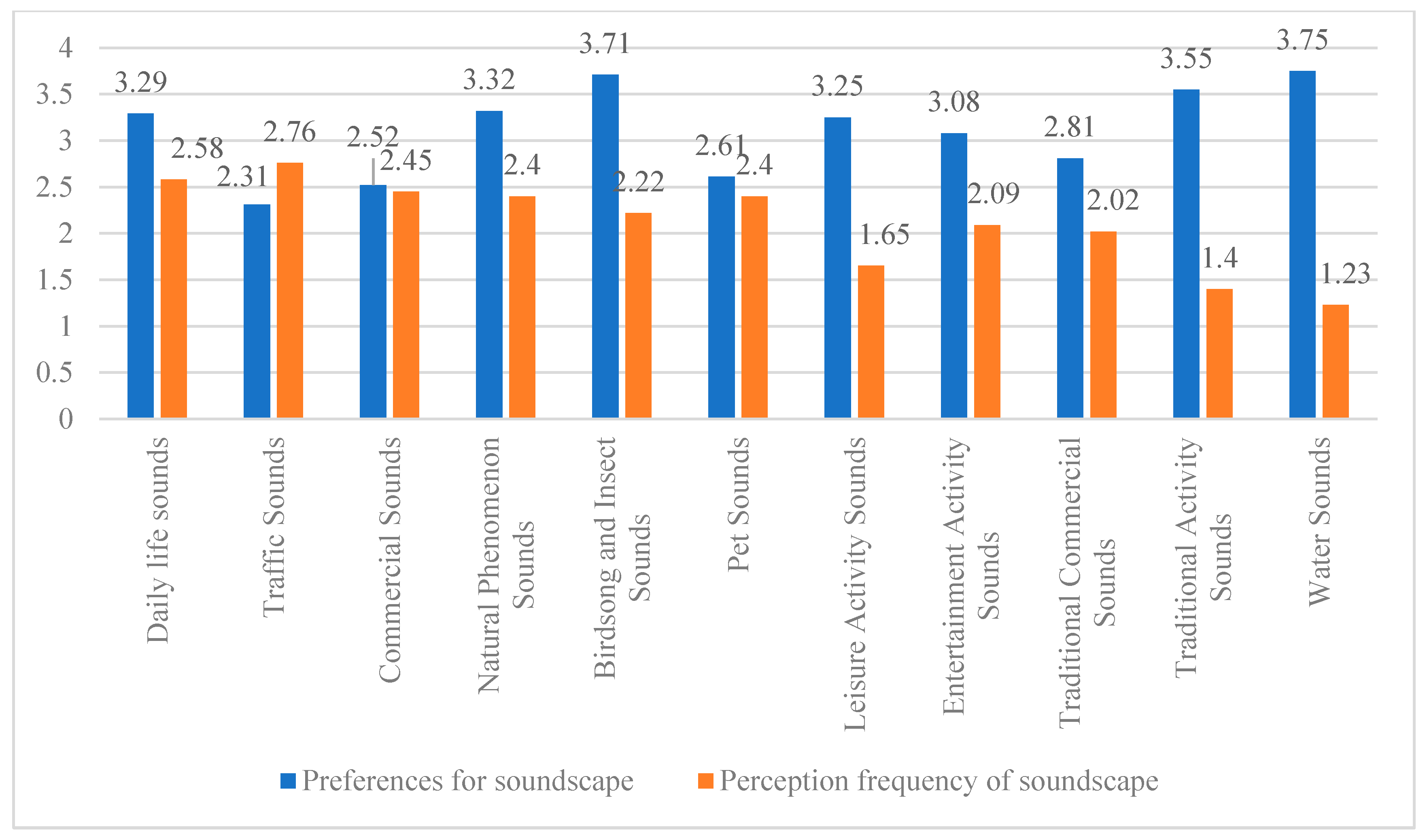
- The soundwalk method revealed that among the 11 sound sources, traffic noise and commercial broadcast noise exceeded standard limits at certain measurement points. Simultaneously, residents’ subjective preferences for traffic noise were the lowest, despite its highest perception frequency. In the “human–sound–place” system’s perspective, the disadvantaged status of natural sounds and traditional sounds in the overall soundscape composition of historical districts should be elevated. It is necessary to conduct soundscape optimization design based on the research conclusions of soundscape preferences to enhance residents’ evaluation of historical and cultural areas;
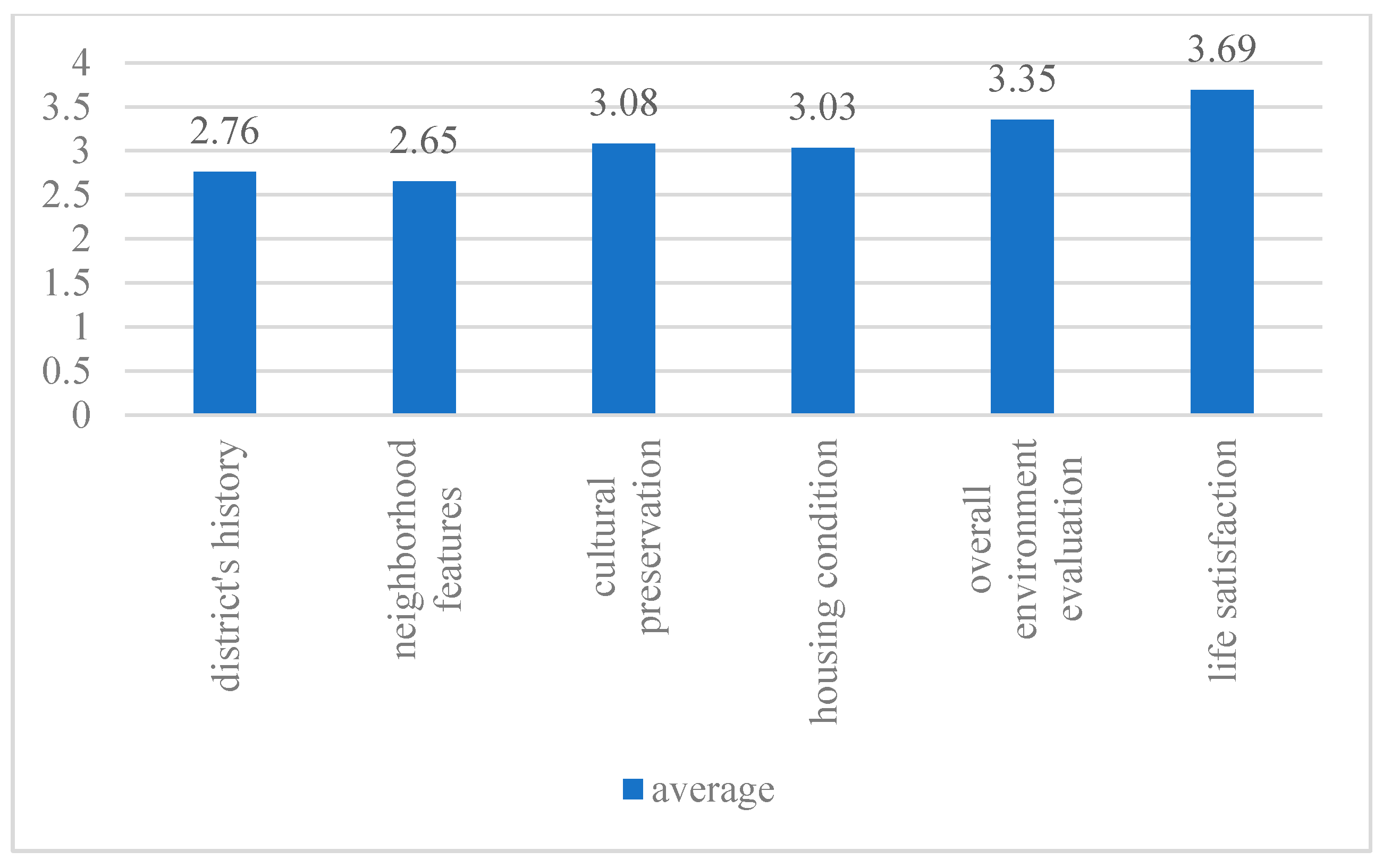
- Regarding individual evaluations, residents exhibited an overall low level of historical understanding of their neighborhoods. Evaluations of the degree of neighborhood features and cultural preservation were also not high, failing to reach satisfactory levels. Structural equation model results indicated that both residential environment evaluations and neighborhood evaluations had a significant and positive impact on place attachment and place identity. In terms of place attachment, the influence of residential environment evaluations was greater than that of neighborhood evaluations. Conversely, neighborhood evaluations had a stronger impact on place identity compared to residential environment evaluations. To enhance residents’ sense of place, it is necessary to strengthen public participation and community governance to promote the sustainable development of the community. The optimization methods of soundscapes should consider both the protection of the district soundscapes and the emotional and cultural needs of residents;
- Residents’ sense of place can be influenced by various types of soundscapes. Concerning soundscape elements, residents’ subjective evaluations showed that the average preferences for various activity sounds and natural sounds were higher than their perception frequencies. The impact of soundscape preferences on the sense of place was evident: the preferences for special activity sounds (leisure activity sounds, entertainment activity sounds, traditional commercial sounds, and traditional activity sounds) were positively related to place attachment and place identity. The impact of soundscape perception frequencies on the sense of place was observed in the significantly positive relationship between the soundscape perception frequency with a moderate discrepancy between current and expected sounds (daily life sounds, birdsong and insect sounds, entertainment activity sounds, and natural phenomenon sounds) and place attachment. Conversely, the soundscape perception frequency with minimal discrepancy between current and expected sounds (commercial sounds, traditional commercial sounds, traffic sounds, and pet sounds) were negatively related to place attachment and place identity;
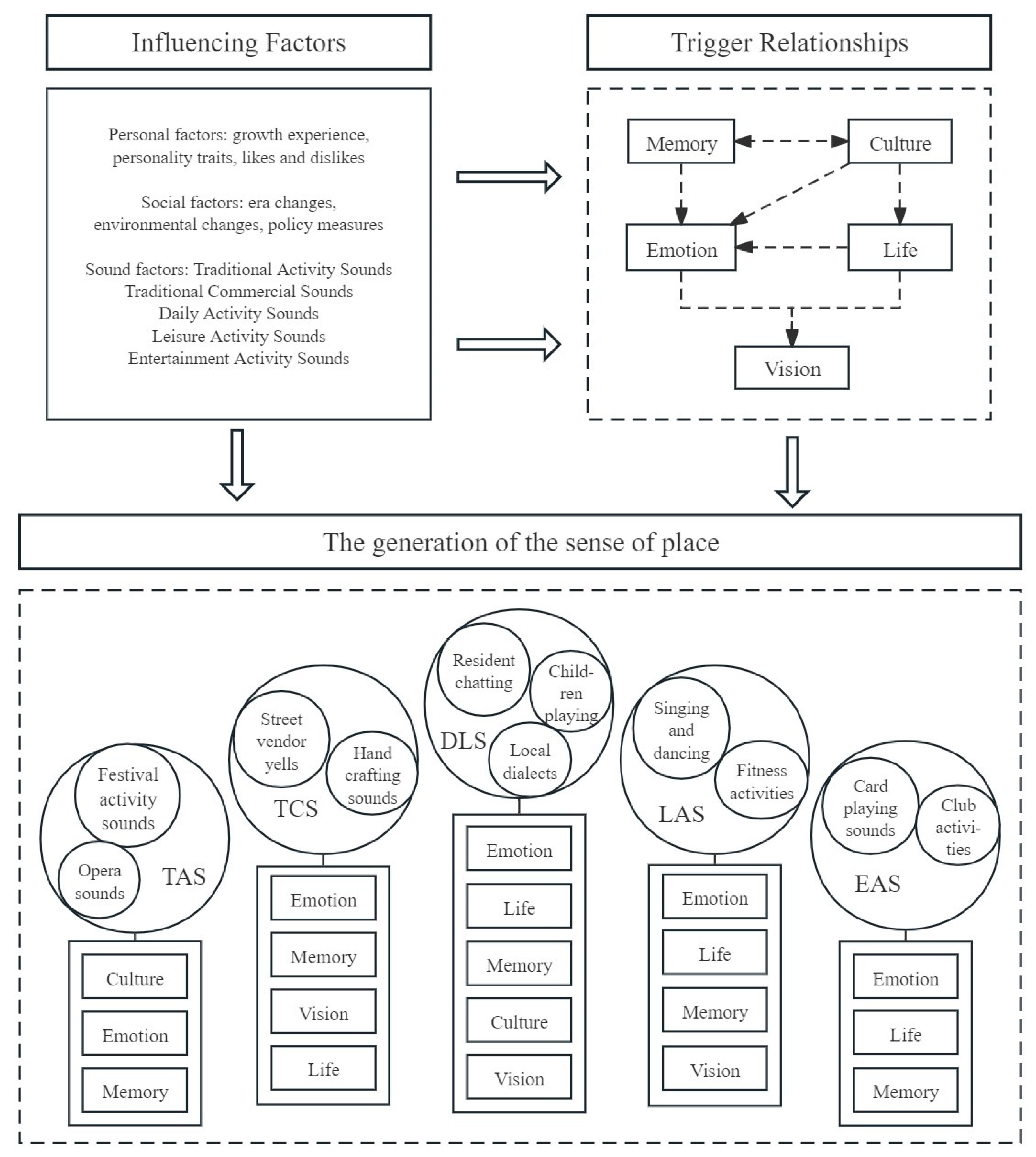
- Complementing and cross-validating with quantitative data, the five main soundscapes have another perspective of influence on residents’ sense of place from a qualitative angle. Traditional activity sounds such as festival activity sounds and traditional commercial sounds like street vendors’ yells and craft-making sounds effectively enhanced residents’ sense of place by triggering memories, embodying culture, and connecting emotions. Daily life sounds like residents chatting and children playing maintained residents’ living conditions and created visions. The integration of local dialects triggered residents’ sense of place from emotional and cultural perspectives. Leisure activity sounds such as singing, dancing, and fitness activities, as well as entertainment activity sounds like club activities and playing board games or chess, mainly triggered residents’ sense of place from life and emotional connection perspectives;
- The grounded theory research revealed that the sense of place emerged in residents from five dimensions: memory, emotion, life, culture, and vision. The most triggered aspect of soundscapes was emotion, followed by memory and life. The triggering mechanisms for the sense of place could be summarized into five paths: triggering memories; connecting emotions; linking life; embodying culture; and creating visions.
Author Contributions
Funding
Data Availability Statement
Conflicts of Interest
Appendix A
Interview
- How do you feel about the overall physical environment in this area?
- How important is sound in your life?
- Can you still remember the sound environment in the residence and in the neighborhood?
- What was your experience in your previous residence?/If you had the opportunity to remove your home, would you want to?
- What has changed since you have moved in?/What are the reasons for wanting or not wanting to do so?
- What environmental conditions (including sounds) are the most difficult for you to part with?
- Can you still remember a residence in which the sound experience was especially important? If yes, what was/were the sound(s)? Why and how did this/they affect you?
- Are there sounds that you like very little or not at all?
- Do you have hobbies or leisure time activities which expose you to a high level and/or extended periods of sound? If so, what are they and how long/high is your exposure to sound?
- What kind of sounds are you aware of in this environment?
- What is pleasant/unpleasant about these sounds?
- What kind of emotions do you experience when hearing these sounds?
- Are there sounds which you cannot identify?
- Are there sounds which stimulate or support you during certain activities and moods?
- Are there sounds which you appreciate to divert your attention from a given activity?
- What actions for improving sound conditions do you expect from:
- —
- your landlord;
- —
- your neighbors;
- —
- the municipal authorities;
- —
- the government.
References
- Jayantha, W.M.; Yung, E.H.K. Effect of Revitalisation of Historic Buildings on Retail Shop Values in Urban Renewal: An Empirical Analysis. Sustainability 2018, 10, 1418. [Google Scholar] [CrossRef] [Scilit]
- Zhong, X.; Leung, H.H. Exploring Participatory Microregeneration as Sustainable Renewal of Built Heritage Community: Two Case Studies in Shanghai. Sustainability 2019, 11, 1617. [Google Scholar] [CrossRef] [Scilit]
- Zhang, F.; Zhou, B.; Liu, L.; Liu, Y.; Fung, H.H.; Lin, H.; Ratti, C. Measuring human perceptions of a large-scale urban region using machine learning. Landsc. Urban Plan. 2018, 180, 148–160. [Google Scholar] [CrossRef] [Scilit]
- Zhao, Y.; Liu, J.; Zheng, Y. Preservation and Renewal: A Study on Visual Evaluation of Urban Historical and Cultural Street Landscape in Quanzhou. Sustainability 2022, 14, 8775. [Google Scholar] [CrossRef] [Scilit]
- Zhao, W.; Rui, Q.; Zhu, X.; Xu, H. Effect of Soundscape on Place Attachment for Historical Blocks: A Case Study of Harbin, China. Buildings 2023, 13, 607. [Google Scholar] [CrossRef] [Scilit]
- ISO 12913-1:2014; Acoustics—Soundscape—Part 1: Definition and Conceptual Framework. International Organization for Standardization: Geneva, Switzerland, 2014.
- Ye, J.; Chen, L.Y.; Zheng, Y.S. Effect of an Artificial Sound-Based Index on the Perception of Historical Block Environments. Buildings 2023, 13, 2372. [Google Scholar] [CrossRef] [Scilit]
- Grenni, S.; Soini, K.; Horlings, L.G. The inner dimension of sustainability transformation: How sense of place and values can support sustainable place-shaping. Sustain. Sci. 2020, 15, 411–422. [Google Scholar] [CrossRef] [Scilit]
- Chapin, F.S.; Knapp, C.N. Sense of place: A process for identifying and negotiating potentially contested visions of sustainability. Environ. Sci. Policy 2015, 53, 38–46. [Google Scholar] [CrossRef] [Scilit]
- Stedman, R.; Beckley, T.; Wallace, S.; Ambard, M. A Picture and 1000 Words: Using Resident-Employed Photography to Understand Attachment to High Amenity Places. J. Leis. Res. 2004, 36, 580–606. [Google Scholar] [CrossRef] [Scilit]
- Hidalgo, M.C.; HernÁNdez, B. Place Attachment: Conceptual and Empirical Questions. J. Environ. Psychol. 2001, 21, 273–281. [Google Scholar] [CrossRef] [Scilit]
- Amundsen, H. Place attachment as a driver of adaptation in coastal communities in Northern Norway. Local Environ. 2015, 20, 257–276. [Google Scholar] [CrossRef] [Scilit]
- Proshansky, H.M. The City and Self-Identity. Environ. Behav. 1978, 10, 147–169. [Google Scholar] [CrossRef] [Scilit]
- Peng, J.; Strijker, D.; Wu, Q. Place Identity: How Far Have We Come in Exploring Its Meanings? Front. Psychol. 2020, 11, 294. [Google Scholar] [CrossRef] [Scilit] [PubMed]
- Wu, Y.; Li, N.; Wang, X.Z.; Cui, J.; Chen, Y.L.; Wu, Y.H.; Yamamoto, H. Experimental investigation on mechanical behavior and particle crushing of calcareous sand retrieved from South China Sea. Eng. Geol. 2021, 280, 105932. [Google Scholar] [CrossRef] [Scilit]
- Soufiane, B.; Ahmad Nia, H. Modelling the energy demand of a residential building using an artificial neural network (ANN) approach. J. Salut. Archit. 2023, 2, 104–112. [Google Scholar] [CrossRef] [Scilit] [PubMed]
- Amen, M.A.; Afara, A.; Nia, H.A. Exploring the Link between Street Layout Centrality and Walkability for Sustainable Tourism in Historical Urban Areas. Urban Sci. 2023, 7, 67. [Google Scholar] [CrossRef] [Scilit]
- Aletta, F.; Kang, J.; Axelsson, Ö. Soundscape descriptors and a conceptual framework for developing predictive soundscape models. Landsc. Urban Plan. 2016, 149, 65–74. [Google Scholar] [CrossRef] [Scilit]
- Leus, M.; Herssens, J. The Soundscapes of Antwerp: A Study on the Acoustic Genius Loci. Energy Procedia 2015, 78, 25–30. [Google Scholar] [CrossRef] [Scilit]
- Ge, J.; Guo, M.; Yue, M. Soundscape of the West Lake Scenic Area with profound cultural background—a case study of Evening Bell Ringing in Jingci Temple, China. J. Zhejiang Univ. SCIENCE A 2013, 14, 219–229. [Google Scholar] [CrossRef] [Scilit]
- Zhao, Z.; Wang, Y.; Hou, Y. Residents’ Spatial Perceptions of Urban Gardens Based on Soundscape and Landscape Differences. Sustainability 2020, 12, 6809. [Google Scholar] [CrossRef] [Scilit]
- Masullo, M.; Ozcevik Bilen, A.; Toma, R.A.; Akin Guler, G.; Maffei, L. The Restorativeness of Outdoor Historical Sites in Urban Areas: Physical and Perceptual Correlations. Sustainability 2021, 13, 5603. [Google Scholar] [CrossRef] [Scilit]
- Pérez-Martínez, G.; Torija, A.J.; Ruiz, D.P. Soundscape assessment of a monumental place: A methodology based on the perception of dominant sounds. Landsc. Urban Plan. 2018, 169, 12–21. [Google Scholar] [CrossRef] [Scilit]
- Masullo, M.; Castanò, F.; Toma, R.A.; Maffei, L. Historical Cloisters and Courtyards as Quiet Areas. Sustainability 2020, 12, 2887. [Google Scholar] [CrossRef] [Scilit]
- Zhou, Z.; Kang, J.; Jin, H. Factors that influence soundscapes in historical areas. Noise Control Eng. J. 2014, 62, 60–68. [Google Scholar] [CrossRef] [Scilit]
- Liu, J.; Yang, L.; Xiong, Y.; Yang, Y. Effects of soundscape perception on visiting experience in a renovated historical block. Build. Environ. 2019, 165, 106375. [Google Scholar] [CrossRef] [Scilit]
- Alvarsson, J.J.; Wiens, S.; Nilsson, M.E. Stress Recovery during Exposure to Nature Sound and Environmental Noise. Int. J. Environ. Res. Public Health 2010, 7, 1036–1046. [Google Scholar] [CrossRef] [Scilit] [PubMed]
- Kanyepe, J. The Nexus between Residential Density, Travel Behavior and Traffic Congestion in Developing Metropolitans: A Case Study of Harare, Zimbabwe. J. Contemp. Urban Aff. 2023, 7, 103–117. [Google Scholar] [CrossRef] [Scilit]
- Afolabi, S.A.; Adedire, M.F. Adaptive Strategies Used in Urban Houses to Overheating: A Systematic Review. J. Contemp. Urban Aff. 2023, 7, 106–126. [Google Scholar] [CrossRef] [Scilit]
- Cao, J.; Kang, J. A Perceptual Structure of Soundscapes in Urban Public Spaces Using Semantic Coding Based on the Grounded Theory. Int. J. Environ. Res. Public Health 2023, 20, 2932. [Google Scholar] [CrossRef] [Scilit]
- Jiang, L.; Bristow, A.; Kang, J.; Aletta, F.; Thomas, R.; Notley, H.; Thomas, A.; Nellthorp, J. Ten questions concerning soundscape valuation. Build. Environ. 2022, 219, 109231. [Google Scholar] [CrossRef] [Scilit]
- Kang, J.; Aletta, F.; Gjestland, T.T.; Brown, L.A.; Botteldooren, D.; Schulte-Fortkamp, B.; Lercher, P.; van Kamp, I.; Genuit, K.; Fiebig, A.; et al. Ten questions on the soundscapes of the built environment. Build. Environ. 2016, 108, 284–294. [Google Scholar] [CrossRef] [Scilit]
- Luo, P.; Miao, Y.; Zhao, J. Effects of auditory-visual combinations on students’ perceived safety of urban green spaces during the evening. Urban For. Urban Green. 2021, 58, 126904. [Google Scholar] [CrossRef] [Scilit]
- Lengen, C. The effects of colours, shapes and boundaries of landscapes on perception, emotion and mentalising processes promoting health and well-being. Health Place 2015, 35, 166–177. [Google Scholar] [CrossRef] [Scilit] [PubMed]
- Chang, J.; Lin, Z.; Vojnovic, I.; Qi, J.; Wu, R.; Xie, D. Social environments still matter: The role of physical and social environments in place attachment in a transitional city, Guangzhou, China. Landsc. Urban Plan. 2023, 232, 104680. [Google Scholar] [CrossRef] [Scilit]
- Kaymaz, I.L.; Cüre, C.T.; Baki, E. Perceived Soundscape of Urban Historical Places: A Case Study of Hamamönü, Ankara. Procedia Eng. 2016, 161, 1920–1925. [Google Scholar] [CrossRef] [Scilit]
- Zhang, J.; Li, Q. Research on the Complex Mechanism of Placeness, Sense of Place, and Satisfaction of Historical and Cultural Blocks in Beijing’s Old City Based on Structural Equation Model. Complexity 2021, 2021, 6673158. [Google Scholar] [CrossRef] [Scilit]
- Masterson, V.A.; Stedman, R.C.; Enqvist, J.; Tengö, M.; Giusti, M.; Wahl, D.; Svedin, U. The contribution of sense of place to social-ecological systems research: A review and research agenda. Ecol. Soc. 2017, 22, 639–652. [Google Scholar] [CrossRef] [Scilit]
- Strauss, J.C.A. Basics of Qualitative Research: Techniques and Procedures for Developing Grounded Theory; SAGE Publications, Inc.: Thousand Oaks, CA, USA, 2015; p. 413. [Google Scholar]
- ISO-TS 12913-2:2018; Acoustics—Soundscape—Part 2: Data Collection and Reporting Requirements. International Organization for Standardization: Geneva, Switzerland, 2018.
- ISO 1996-1; Acoustics—Description, Measurement and Assessment of Environmental Noise—Part 1: Basic Quantities and Assessment Procedures. International Organization for Standardization: Geneva, Switzerland, 2016.
- Watson, D.; Clark, L.A.; Tellegen, A. Development and validation of brief measures of positive and negative affect: The PANAS scales. J. Personal. Soc. Psychol. 1988, 54, 1063–1070. [Google Scholar] [CrossRef] [PubMed]
- Wu, Y.; Cui, J.; Huang, J.S.; Zhang, W.; Yoshimoto, N.; Wen, L.W. Correlation of Critical State Strength Properties with Particle Shape and Surface Fractal Dimension of Clinker Ash. Int. J. Geomech. 2021, 21, 04021071. [Google Scholar] [CrossRef] [Scilit]
- Chesnokova, O.; Taylor, J.E.; Gregory, I.N.; Purves, R.S. Hearing the silence: Finding the middle ground in the spatial humanities? Extracting and comparing perceived silence and tranquillity in the English Lake District. Int. J. Geogr. Inf. Sci. 2019, 33, 2430–2454. [Google Scholar] [CrossRef] [Scilit]
- Zahnow, R. Place type or place function: What matters for place attachment? Am. J. Community Psychol. 2023, 1–15. [Google Scholar] [CrossRef] [Scilit]
- Gautam, V.; Bhalla, S. Why residents exhibit environmentally responsible behavior? J. Clean. Prod. 2023, 427, 139253. [Google Scholar] [CrossRef] [Scilit]
- Urban, J.; Máca, V. Linking traffic noise, noise annoyance and life satisfaction: A case study. Int. J. Environ. Res. Public Health 2013, 10, 1895–1915. [Google Scholar] [CrossRef] [Scilit] [PubMed]
- Zhu, X.; Chiou, S.-C. A study on the sustainable development of historic district landscapes based on place attachment among tourists: A case study of Taiping old street, Taiwan. Sustainability 2022, 14, 11755. [Google Scholar] [CrossRef] [Scilit]
- Irani, M.; Aghdam, S.R.; Ghasemzadeh, B. Investigating the link between place attachment, civic engagement, and pro-environmental behaviors. Environ. Dev. 2023, 47, 100897. [Google Scholar] [CrossRef] [Scilit]
- Mao, Y.; Peng, C.; Liang, Y.; Yuan, G.; Ma, J.; Bonaiuto, M. The relationship between perceived residential environment quality (PREQ) and community identity: Flow and social capital as mediators. Soc. Indic. Res. 2022, 163, 771–797. [Google Scholar] [CrossRef] [Scilit]
- Gobster, P.H.; Kruger, L.E.; Schultz, C.L.; Henderson, J.R. Key Characteristics of Forest Therapy Trails: A Guided, Integrative Approach. Forests 2023, 14, 186. [Google Scholar] [CrossRef] [Scilit]
- Escolà-Gascón, Á.; Dagnall, N.; Denovan, A.; Maria Alsina-Pagès, R.; Freixes, M. Evidence of environmental urban design parameters that increase and reduce sense of place in Barcelona (Spain). Landsc. Urban Plan. 2023, 235, 104740. [Google Scholar] [CrossRef] [Scilit]
- Scaglione, A.; Mendola, D. Measuring the perceived value of rural tourism: A field survey in the western Sicilian agritourism sector. Qual. Quant. 2017, 51, 745–763. [Google Scholar] [CrossRef] [Scilit]
- Xu, L.; Shi, L.; Wang, X.; Wan, Y.; Fan, Z. Can tourists become disciples? The formation and mechanism of place conversion in traditional Chinese villages. Front. Psychol. 2023, 14, 1301127. [Google Scholar] [CrossRef] [Scilit]
- Lengen, C.; Kistemann, T. Sense of place and place identity: Review of neuroscientific evidence. Health Place 2012, 18, 1162–1171. [Google Scholar] [CrossRef] [Scilit] [PubMed]
- Giraudo, R.F. Heteroglossic heritage and the first-place of the Kalahari. Int. J. Herit. Stud. 2018, 24, 128–141. [Google Scholar] [CrossRef] [Scilit]
- Shi, L.; Ma, J.Y.; Ann, C.O. Exploring the Effect of Tour Guide Cultural Interpretation on Tourists’ Loyalty in the Context of the Southern Journey by Emperor Qianlong. Sustainability 2023, 15, 1585. [Google Scholar] [CrossRef] [Scilit]
- Wei, H.; Zhou, M.; Kang, S.; Zhang, J. Sense of Place of Heritage Conservation Districts under the Tourist Gaze—Case of the Shichahai Heritage Conservation District. Sustainability 2022, 14, 10384. [Google Scholar] [CrossRef] [Scilit]



| Code | Place Attachment | Code | Place Identity |
|---|---|---|---|
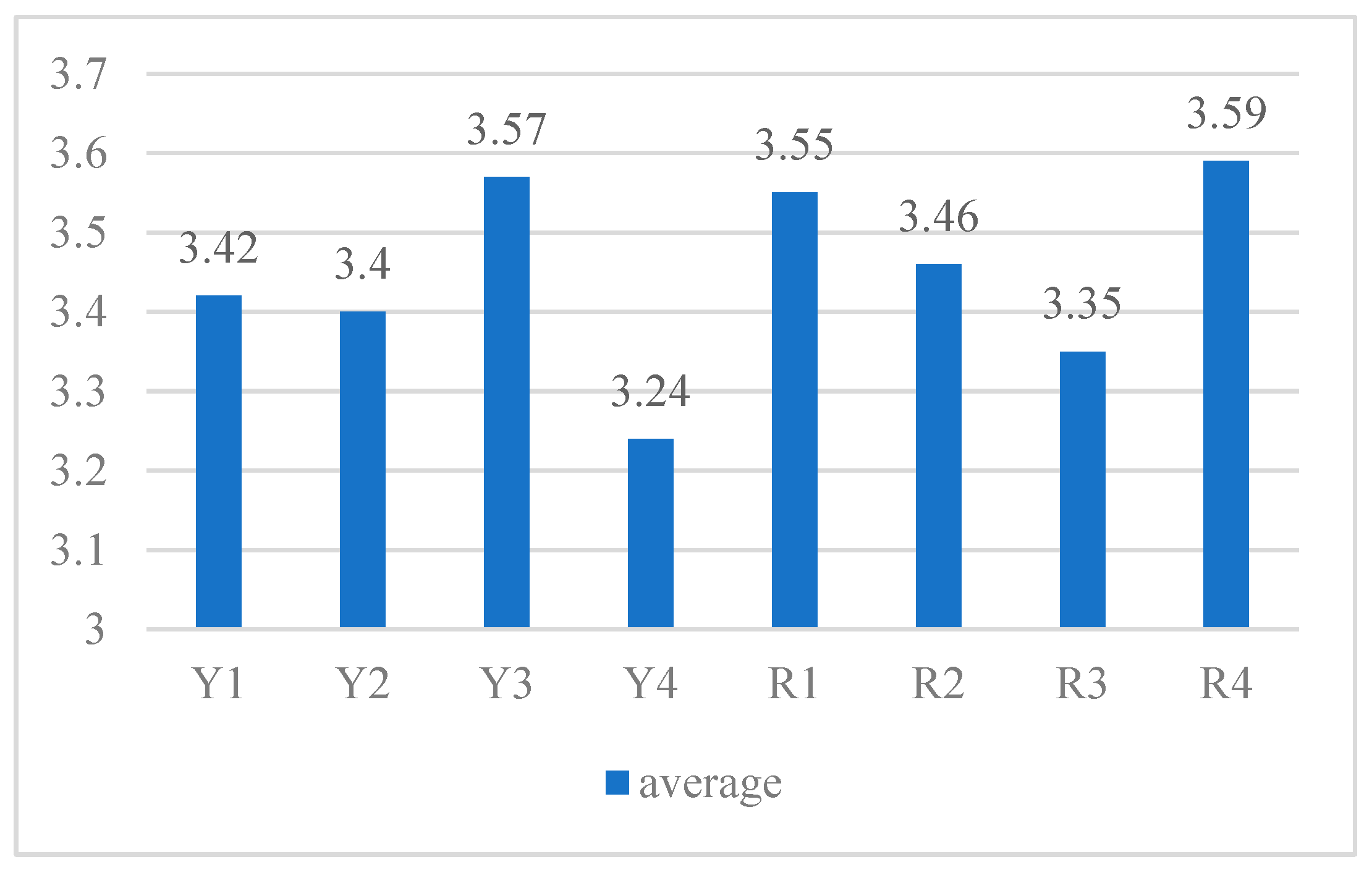
| Y1 | The feeling I get here is unmatched by other places | R1 | I am concerned about the development and preservation here |
| Y2 | I am willing to live here for a long time | R2 | This place means a lot to me |
| Y3 | Living here makes me happy | R3 | This place is very special to me |
| Y4 | I take pride in living here | R4 | This place is a part of me |
| Category | Sound Source | |
|---|---|---|
| Sounds of technology | Traffic Sounds (TS) | Car Horns and Engine Noises |
| Commercial Sounds (CS) | Shop Loudspeaker Sounds | |
| Sounds of nature | Natural Phenomenon Sounds (NPS) | Wind Sounds, Rustling Leaves, Rain Sounds, and Thunder Sounds |
| Birdsong and Insect Sounds (BIS) | Birdsong and Insect Chirping | |
| Water Sounds (WS) | Flowing Water Sounds and Fountain Sounds | |
| Pet Sounds (PS) | Dog Barking | |
| Sounds of human beings | Leisure Activity Sounds (LAS) | Square Dancing Music, Singing, and Instrumental Sounds |
| Entertainment Activity Sounds (EAS) | Chess Playing Sounds and Card Playing Sounds | |
| Traditional Commercial Sounds (TCS) | Street Vendor yells and Handcrafting Sounds | |
| Traditional Activity Sounds (TAS) | Traditional Opera Sounds and Twisting Yangko Sounds | |
| Daily Life Sounds (DLS) | Conversations and Children’s Play | |
| Projects | Questionnaire Participants | Interview Participants | |||
|---|---|---|---|---|---|
| Gender | female | 193 | 54.5% | 43 | 53.1% |
| male | 161 | 45.5% | 38 | 47.0% | |
| Age | >65 | 120 | 33.9% | 23 | 28.4% |
| 45–65 | 150 | 42.4% | 34 | 42.0% | |
| 18–44 | 71 | 20.0% | 18 | 22.2% | |
| <18 | 13 | 3.7% | 6 | 7.4% | |
| Status | native residents | 262 | 74.0% | 70 | 86.4% |
| tenants | 92 | 26.0% | 11 | 13.6% | |
| Length of residence (year) | >20 | 176 | 49.7% | 42 | 51.9% |
| 10–20 | 58 | 16.4% | 16 | 19.8% | |
| 5–10 | 48 | 13.6% | 12 | 14.8% | |
| 1–5 | 42 | 11.9% | 9 | 11.0% | |
| ≤1 | 30 | 8.4% | 2 | 2.5% | |
| Equivalent Continuous A-Weighted Sound Level on Non-Working Days (dB(A)) | Equivalent Continuous A-Weighted Sound Level on Working Days (dB(A)) | |||||
|---|---|---|---|---|---|---|
| Max | Min | Avg | Max | Min | Avg | |
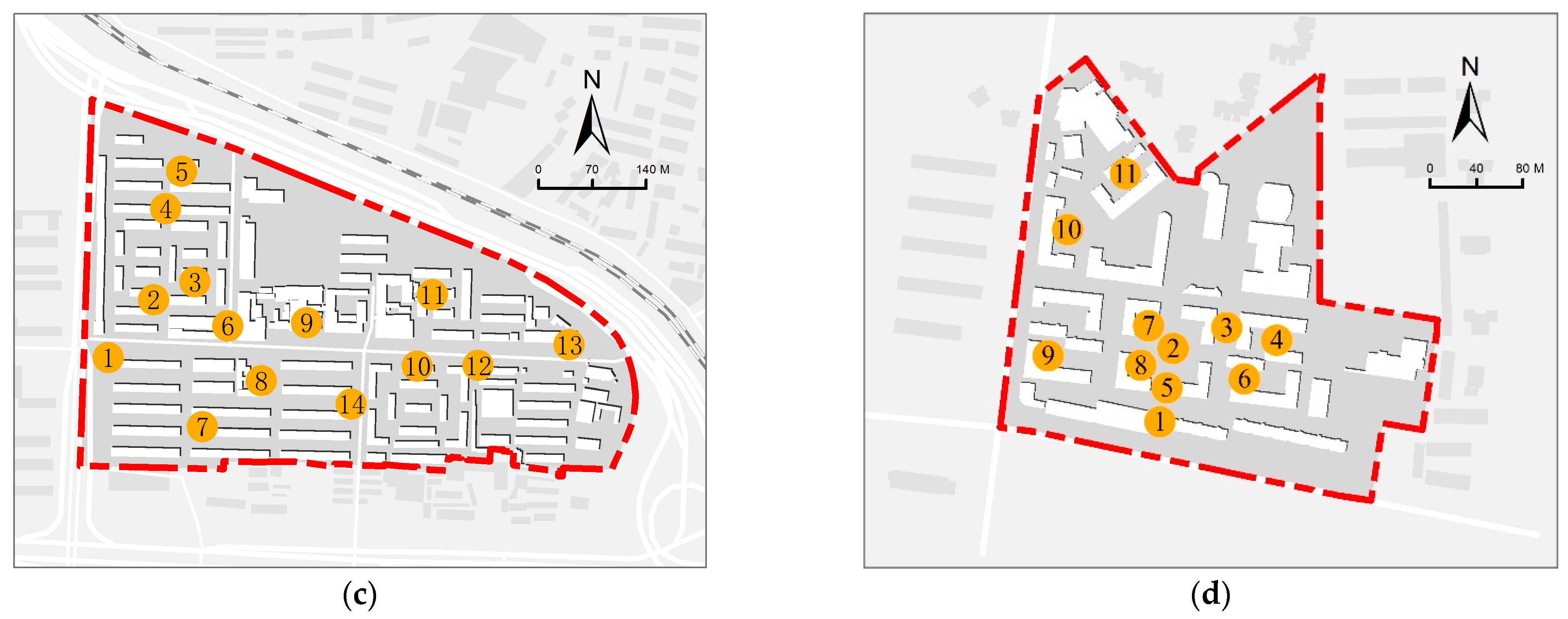
| Nanhuamen District | 64.4 | 54.1 | 59.3 | 70.3 | 49.6 | 58.2 |
| Dongsandao Lane | 59.6 | 51.7 | 55.3 | 62 | 49.9 | 53.6 |
| Taiyuan Mining Machinery Factory Dormitory | 73.8 | 51.6 | 57.9 | 65.6 | 44.0 | 55.5 |
| Taiyuan Soviet Experts’ Building | 70.1 | 46.4 | 55.4 | 72.5 | 42.5 | 53.0 |
| Cronbach’s Alpha Coefficient | Number of Items | |
|---|---|---|
| Soundscape Preference | 0.716 | 11 |
| Soundscape Perception Frequency | 0.731 | 11 |
| Personal Evaluation | 0.610 | 7 |
| Place Attachment | 0.829 | 4 |
| Place Identity | 0.805 | 4 |
| Variable | Soundscape Preference | Soundscape Perception Frequency | Personal Evaluation | Sense of Place | Overall Test | |
|---|---|---|---|---|---|---|
| Kaiser–Meyer–Olkin measure of sampling adequacy | 0.742 | 0.732 | 0.716 | 0.874 | 0.778 | |
| Bartlett’s Sphericity Test | Approximate Chi-Square | 516.162 | 737.476 | 448.752 | 1123.05 | 3718.09 |
| Degrees of Freedom | 55 | 55 | 21 | 28 | 666 | |
| Significance | 0.000 | 0.000 | 0.000 | 0.000 | 0.000 | |
| Soundscape Preference | Soundscape Perception Frequency | Personal Evaluation | |
|---|---|---|---|
| Place Attachment | Daily life Sounds (0.157 **) Commercial Sounds (0.144 *) Leisure Activity Sounds (0.174 **) Traditional Commercial Sounds (0.241 **) Traditional Activity Sounds (0.157 **) | Daily life Sounds (0.175 **) Leisure Activity Sounds (0.115 *) Entertainment Activity Sounds (0.227 **) Traditional Activity Sounds (0.187 **) | Level of Historical Understanding (0.204 **) Level of Neighborhood Features (0.267 **) Level of Cultural Preservation (0.316 **) Housing Condition Evaluation (0.257 **) Overall Environment Evaluation (0.318 **) Life Satisfaction (0.401 **) Acoustic Environment Evaluation (0.232 **) |
| Place Identity | Leisure Activity Sounds (0.156 **) Traditional Commercial Sounds (0.128 **) Traditional Activity Sounds (0.125 *) | Daily life Sounds (0.123 *) | Level of Historical Understanding (0.418 **) Level of Neighborhood Features (0.294 **) Level of Cultural Preservation (0.221 **) Overall Environment Evaluation (0.114 *) Life Satisfaction (0.217 **) |
| Component | |||
|---|---|---|---|
| 1 | 2 | 3 | |
| P-DLS | 0.319 | 0.484 | 0.186 |
| P-TS | −0.073 | 0.759 | −0.026 |
| P-CS | 0.215 | 0.706 | 0.024 |
| P-NPS | 0.032 | 0.182 | 0.676 |
| P-BIS | 0.058 | 0.162 | 0.76 |
| P-PS | −0.017 | 0.454 | 0.312 |
| P-LAS | 0.767 | 0.08 | −0.134 |
| P-EAS | 0.632 | 0.171 | 0.065 |
| P-TCS | 0.494 | 0.397 | 0.221 |
| P-TAS | 0.661 | −0.082 | 0.357 |
| P-WS | 0.439 | −0.205 | 0.573 |
| Eigenvalues | 2.023 | 1.334 | 1.186 |
| Variance explained | 20.367% | 18.499% | 17.403% |
| Cumulative explained variance | 20.367% | 38.866% | 56.269% |
| Component | |||
|---|---|---|---|
| 1 | 2 | 3 | |
| F-DLS | 0.059 | 0.675 | 0.049 |
| F-TS | −0.17 | 0.292 | 0.544 |
| F-CS | 0.061 | 0.175 | 0.763 |
| F-NPS | 0.249 | 0.582 | 0.055 |
| F-BIS | 0.168 | 0.632 | 0.173 |
| F-PS | −0.008 | 0.185 | 0.573 |
| F-LAS | 0.69 | 0.186 | 0.154 |
| F-EAS | 0.328 | 0.589 | 0.054 |
| F-TCS | 0.194 | −0.013 | 0.772 |
| F-TAS | 0.86 | 0.109 | 0.005 |
| F-WS | 0.855 | 0.138 | 0.074 |
| Eigenvalues | 2.313 | 1.515 | 1.394 |
| Variance explained | 25.636% | 17.882% | 15.082% |
| Cumulative explained variance | 25.636% | 43.518% | 58.6% |
| Component | ||
|---|---|---|
| 1 | 2 | |
| E-HC | 0.782 | −0.038 |
| E-OE | 0.834 | −0.038 |
| E-LS | 0.753 | 0.017 |
| E-AE | 0.617 | 0.163 |
| E-LHU | −0.236 | 0.637 |
| E-LNF | 0.085 | 0.84 |
| E-LCP | 0.395 | 0.632 |
| Eigenvalues | 2.442 | 1.571 |
| Variance explained | 35.343% | 21.994% |
| Cumulative explained variance | 35.343% | 57.337% |
| Latent Variable | Observed Variables | Std. Factor Loading | AVE | CR | MSV | ASV |
|---|---|---|---|---|---|---|
| Preference 1 | P-LAS | 0.602 | 0.513 | 0.807 | 0.345 | 0.246 |
| P-EAS | 0.783 | |||||
| P-TCS | 0.781 | |||||
| P-TAS | 0.693 | |||||
| Preference 2 | P-DLS | 0.604 | 0.507 | 0.801 | 0.425 | 0.302 |
| P-TS | 0.622 | |||||
| P-CS | 0.844 | |||||
| P-PS | 0.755 | |||||
| Preference 3 | P-NPS | 0.737 | 0.596 | 0.813 | 0.306 | 0.195 |
| P-BIS | 0.669 | |||||
| P-WS | 0.885 | |||||
| Frequency 1 | F-LAS | 0.503 | 0.554 | 0.780 | 0.476 | 0.283 |
| F-TAS | 0.824 | |||||
| F-WS | 0.855 | |||||
| Frequency 2 | F-DLS | 0.635 | 0.597 | 0.853 | 0.426 | 0.221 |
| F-NPS | 0.856 | |||||
| F-BIS | 0.674 | |||||
| F-EAS | 0.893 | |||||
| Frequency 3 | F-CS | 0.812 | 0.527 | 0.815 | 0.368 | 0.194 |
| F-PS | 0.624 | |||||
| F-TS | 0.762 | |||||
| F-TCS | 0.701 | |||||
| Evaluation 1 | E-HC | 0.721 | 0.587 | 0.850 | 0.468 | 0.216 |
| E-OE | 0.758 | |||||
| E-LS | 0.692 | |||||
| E-AE | 0.884 | |||||
| Evaluation 2 | E-LHU | 0.650 | 0.424 | 0.687 | 0.258 | 0.097 |
| E-LNF | 0.612 | |||||
| E-LNF | 0.688 | |||||
| Place attachment | Y1 | 0.584 | 0.557 | 0.832 | 0.452 | 0.306 |
| Y2 | 0.755 | |||||
| Y3 | 0.842 | |||||
| Y4 | 0.784 | |||||
| Place Identity | R1 | 0.551 | 0.543 | 0.822 | 0.472 | 0.275 |
| R2 | 0.848 | |||||
| R3 | 0.821 | |||||
| R4 | 0.690 |
| Indicator | Reference Standard | Result |
|---|---|---|
| CMIN/DF | Excellent: 1–3, Good: 3–5 | 1.934 |
| RMSEA | Excellent: <0.05, Good: <0.08 | 0.054 |
| GFI | Excellent: >0.9 | 0.801 |
| TLI | Excellent: >0.9 | 0.806 |
| CFI | Excellent: >0.9 | 0.830 |
| Indicator | Reference Standard | Result |
|---|---|---|
| CMIN/DF | Excellent: 1–3, Good: 3–5 | 1.504 |
| RMSEA | Excellent: <0.05, Good: <0.08 | 0.040 |
| GFI | Excellent: >0.9 | 0.912 |
| TLI | Excellent: >0.9 | 0.900 |
| CFI | Excellent: >0.9 | 0.909 |
| Path | Estimate | C.R. | P | |||
|---|---|---|---|---|---|---|
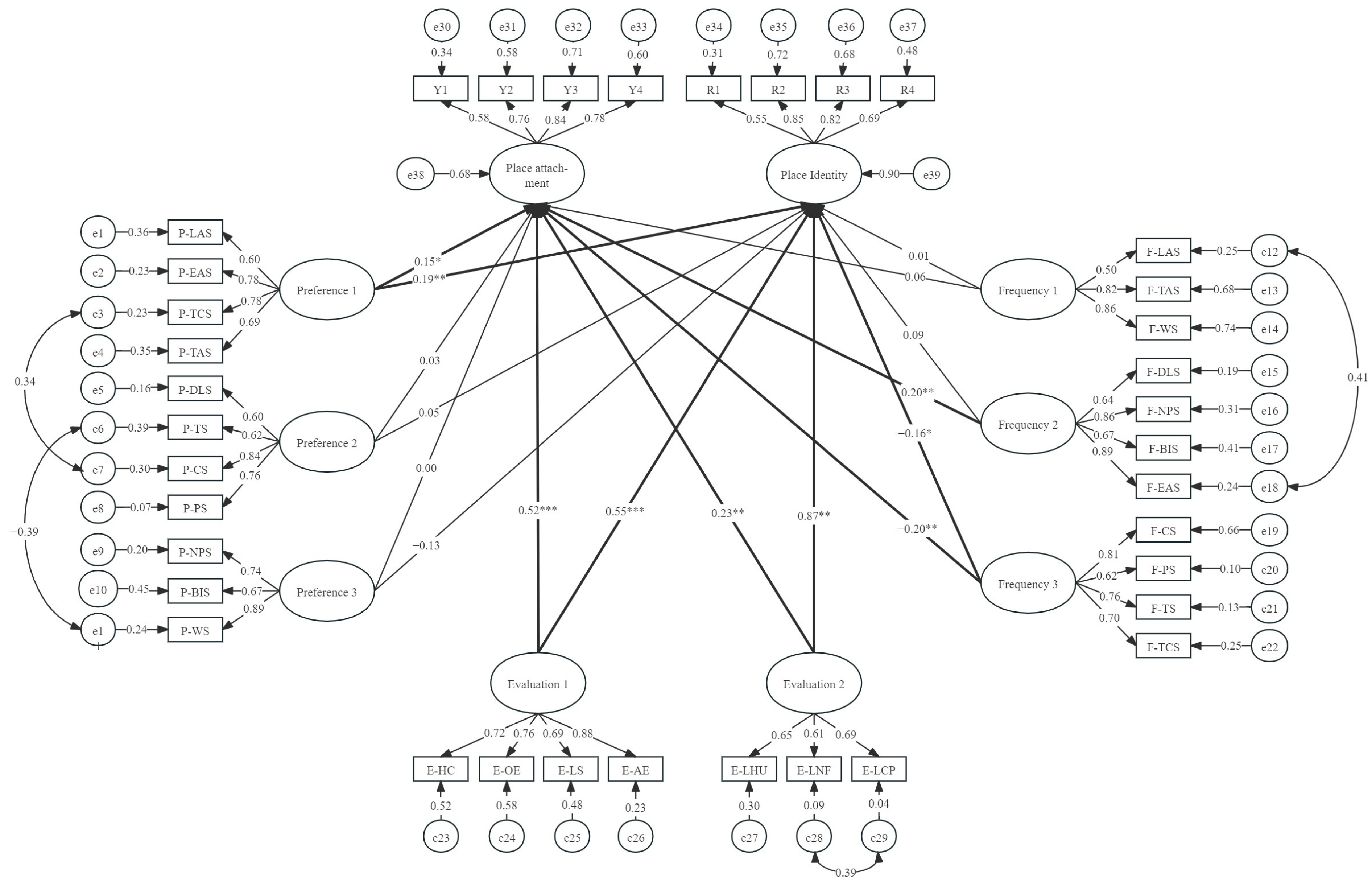
| HA1 | Place Attachment |  | Preference 1 | 0.155 | 2.334 | 0.02 |
| HA2 | Place Identity |  | Preference 1 | 0.189 | 2.738 | 0.006 |
| HB3 | Place Attachment |  | Frequency 2 | 0.203 | 2.931 | 0.003 |
| HB5 | Place Attachment |  | Frequency 3 | −0.204 | −3.117 | 0.002 |
| HB6 | Place Identity |  | Frequency 3 | −0.158 | −2.474 | 0.013 |
| HC1 | Place Attachment |  | Evaluation 1 | 0.515 | 5.609 | <0.001 |
| HC2 | Place Identity |  | Evaluation 1 | 0.227 | 3.453 | <0.001 |
| HC3 | Place Attachment |  | Evaluation 2 | 0.555 | 2.826 | 0.005 |
| HC4 | Place Identity |  | Evaluation 2 | 0.873 | 2.803 | 0.005 |
| Code | Original Statement | Conceptualization | Categorization |
|---|---|---|---|
| A1-05 | Hearing the traditional singing reminds me of the festive activities organized in the 1980s. | Traditional activities memories | Memories of scenes |
| B1-23 | Picking up my child from school and seeing the street vendors shouting, selling candied hawthorns, brings back memories of our lively childhood. | Memories of life scenes | Memories of scenes |
| B1-15 | Hearing the pigeons outside the window makes me feel immersed in it, giving a sense of familiarity with my hometown. | Familiarity with hometown | Belonging |
| A2-07 | Back when the factory celebrated the Chinese New Year, they would hang various kinds of lights. Since that part moved away, it’s not as lively as before. | Desolate environment | Negative emotions |
| B2-12 | The sound environment here is quite good, much better than before. Isn’t there some exercise equipment? Listening to the sound of exercise makes me feel happy. | Feeling satisfied | Happiness |
| B2-26 | The conversation among elderly people can make me feel the atmosphere of my hometown. | Human relationships | Emotional connection |
| B2-30 | Sometimes when I come out and hear the sound of someone cooking, with the smell of them, this is the atmosphere of our community. | Cooking and buying groceries | Lifestyle |
| C1-06 | Just coming out for a chat and enjoying the sun can make me feel the atmosphere of my hometown. | Leisurely life | Lifestyle |
| A2-03 | So at that time, the company integrated cultures from various places, incorporating dialects. The sound here is a fusion of dialects, it’s the local language. | Company culture, dialect | Regional culture |
| D1-08 | If there are more plants and bird sounds here, the environment will be better. These sounds can enhance my feelings for this place. | Hope for a better environment | Imagining a vision |
| Main Axis Coding | Open Coding | Reference Points | |
|---|---|---|---|
| Subcategories | Conceptualization | Mark Points | |
| Memory | Memory of Scenes | Memory of traditional activities, Memory of production life scenes, Memory of leisure scenes, and Memory of entertainment scenes | 80 |
| Memory of Relationships | Memory of old friends | 9 | |
| Historical Memory | Memory of neighborhood historical events | 25 | |
| Emotion | Negative Emotions | Insufficient preservation, Excessive changes, Pessimism and disappointment, Harsh environment, Desolate environment, Thin human relationships, Dissatisfaction with the current situation, and Aversion to noise | 167 |
| Positive Emotions | Bustling and lively, Good environment, Serene and peaceful, High quality, Happy and satisfied, Joyful and cheerful, and Proud | 217 | |
| Emotional Connection | Unique, Sense of belonging, Nostalgia, Social interactions, and Familiar habits | 113 | |
| Life | Daily Labor | Housework, Cooking, and Grocery shopping | 8 |
| Lifestyle | Work survival, Leisurely life, and Entertainment | 101 | |
| Culture | Regional Culture | Folk customs and Factory culture | 60 |
| Historical Culture | Cultural relics and Historical sites | 13 | |
| Cultural Fusion | Fusion from all areas | 5 | |
| Vision | Vision and Imagination | Environmental imagination | 15 |
| Main Axis Coding | Memory | Emotion | Life | Culture | Vision | Total |
|---|---|---|---|---|---|---|
| Traditional Activity Sounds | 39 | 43 | 2 | 50 | 0 | 134 |
| Traditional Commercial Sounds | 8 | 50 | 0 | 1 | 5 | 64 |
| Pet Sounds | 0 | 33 | 0 | 0 | 0 | 33 |
| Traffic Sounds | 0 | 35 | 0 | 0 | 0 | 35 |
| Birdsong and Insect Sounds | 1 | 29 | 1 | 0 | 0 | 31 |
| Daily life Sounds | 11 | 61 | 13 | 6 | 6 | 97 |
| Commercial Sounds | 1 | 36 | 2 | 0 | 0 | 39 |
| Water Sounds | 0 | 2 | 0 | 0 | 0 | 2 |
| Leisure Activity Sounds | 6 | 52 | 40 | 0 | 4 | 102 |
| Entertainment Activity Sounds | 10 | 35 | 26 | 1 | 0 | 72 |
| Natural Phenomena Sounds | 1 | 28 | 0 | 0 | 0 | 29 |
| Total | 77 | 404 | 84 | 58 | 15 | 638 |
| Soundscape | Specific Sounds |
|---|---|
| Traditional Activity Sounds | New Year’s Twisted Yangko Dance, Dragon Boat Racing, Drumming and Gongs, Stilt Walking, Firecrackers, Opera Singing, Lantern Hanging, Club Performances during the Spring Festival, and Fireworks Evening; |
| Traditional Commercial Sounds | Street Vendor yells, Fruit Stalls, Vegetable Stalls, Scrap Collection yells, Collecting Old Furniture, Collecting Appliances, Sharpening Chef’s Knife, Candy Sellers, Snack Sellers, Fermented Rice Wine Sellers, Artisanal Craftsmanship, and Coal Ball Sellers; |
| Daily life Sounds | Daily Chatter, Coal Burning Sounds, School Opening, Cooking and Chopping Sounds, Children Playing Sounds, Friends Drinking, Chats on the Street, Mud Brickmaking, Exercise Sounds, Diverse Sounds of Bungalows, Monotonous Sounds of High-rises, Shanxi Dialect, Fusion of Various Dialects, Factory Singing Competitions, Cultural Events, and Neighborhood Committee Loudspeaker Sounds; |
| Leisure Activity Sounds | Badminton, Park Activity Sounds, Walking, Singing and Dancing, Brisk Walking, Tai Chi Practice, Square Dancing, Fitness Exercise, Jianzi Kicking, Playing Erhu, and Playing the Violin; |
| Entertainment Activity Sounds | Factory Club Entertainment, Playing Mahjong, Playing Poker, Chess, Watching Movies, Chess Room Activities, Factory Football Matches, Basketball Matches, and Glass Marbles Games; |
Disclaimer/Publisher’s Note: The statements, opinions and data contained in all publications are solely those of the individual author(s) and contributor(s) and not of MDPI and/or the editor(s). MDPI and/or the editor(s) disclaim responsibility for any injury to people or property resulting from any ideas, methods, instructions or products referred to in the content. |
© 2024 by the authors. Licensee MDPI, Basel, Switzerland. This article is an open access article distributed under the terms and conditions of the Creative Commons Attribution (CC BY) license (https://creativecommons.org/licenses/by/4.0/).
Share and Cite
Chen, Z.; Jin, M.; Zuo, Y.; Ding, P.; Shi, X. The Effect of Soundscape on Sense of Place for Residential Historical and Cultural Areas: A Case Study of Taiyuan, China. Buildings 2024, 14, 1394. https://doi.org/10.3390/buildings14051394
Chen Z, Jin M, Zuo Y, Ding P, Shi X. The Effect of Soundscape on Sense of Place for Residential Historical and Cultural Areas: A Case Study of Taiyuan, China. Buildings. 2024; 14(5):1394. https://doi.org/10.3390/buildings14051394
Chicago/Turabian StyleChen, Zichu, Meijun Jin, Yuanyuan Zuo, Peng Ding, and Xiaofeng Shi. 2024. "The Effect of Soundscape on Sense of Place for Residential Historical and Cultural Areas: A Case Study of Taiyuan, China" Buildings 14, no. 5: 1394. https://doi.org/10.3390/buildings14051394
APA StyleChen, Z., Jin, M., Zuo, Y., Ding, P., & Shi, X. (2024). The Effect of Soundscape on Sense of Place for Residential Historical and Cultural Areas: A Case Study of Taiyuan, China. Buildings, 14(5), 1394. https://doi.org/10.3390/buildings14051394