Article

Exploring the Limitations of Pedestrian Route Directness: A Correlation between Sensitivity and Radius Variability


1
Civil Infrastructure and Environmental Engineering Department, College of Engineering, Khalifa University of Science and Technology, Abu Dhabi P.O. Box 127788, United Arab Emirates
2
Architectural Engineering Department, College of Engineering, United Arab Emirates University, Alain P.O. Box 15551, United Arab Emirates
3
Faculty of Engineering, Northwestern College, Orange City, IA 51041, USA
*
Authors to whom correspondence should be addressed.
Buildings 2023, 13(10), 2612; https://doi.org/10.3390/buildings13102612

Submission received: 31 August 2023 / Revised: 27 September 2023 / Accepted: 30 September 2023 / Published: 17 October 2023

Abstract

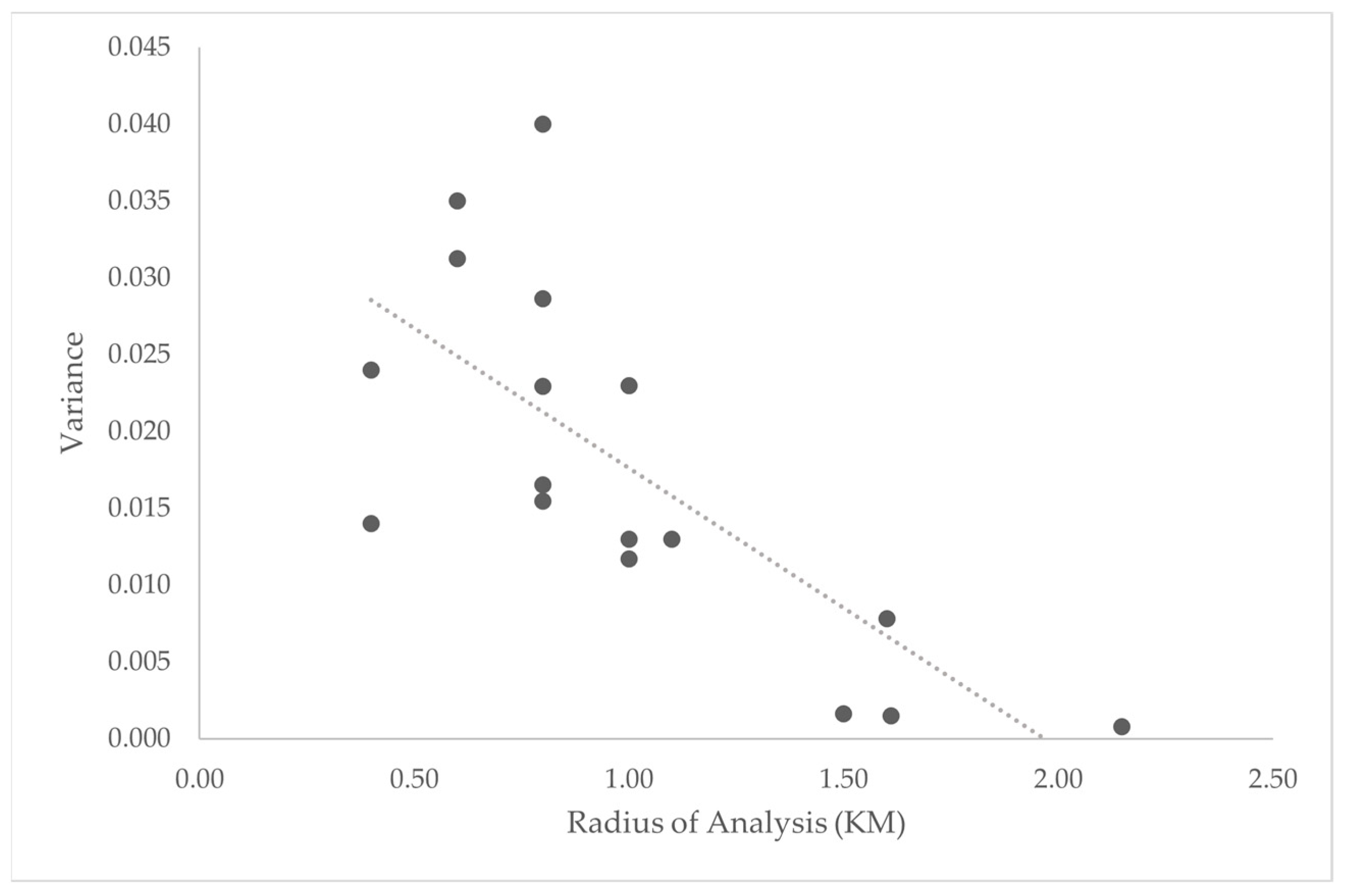
Amid the growing emphasis on the environmental and health benefits of walking, enhanced network connectivity emerges as a significant determinant in promoting pedestrian activity, as proven by scholars statistically and theoretically. Recent academic endeavors have introduced metrics such as pedestrian route directness (PRD) to measure connectivity, which maps the directness of routes between critical origins and destinations of the urban layout. However, there have been concerns from scholars about the limitations of PRD in theory, especially its sensitivity to larger radii of analysis. Addressing this theoretical inconsistency, this paper employs Pearson’s correlation and linear regression analysis to explore the correlation between the radius of analysis and variance of results, the significance of this correlation for subsequent research, and the geographical context’s influence on metric selection. The findings have revealed an r-value of −0.82, suggesting a strong and negative correlation. Moreover, the p-value of 0.0003 demonstrates the significance of the correlation and the rejection of the null hypothesis. These results bridge the gap between theoretical discussions and empirical analysis, revealing that, as the analysis radius expands, the sensitivity of results diminishes. The findings of this study hold significant implications for policy development and regulation of PRD, offering crucial insights that particularly advance the field of street connectivity.
Keywords: spatial analysis; pedestrian route directness; regression analysis; street connectivity spatial analysis; pedestrian route directness; regression analysis; street connectivity