An Automatic Process for the Application of Building Permits
 , , and
Abstract
1. Introduction
2. Related Work
2.1. Geographic Information System
2.2. Approval Processes and Legal Frameworks
2.3. Model Checking
2.4. Open Problems
3. Methodology: Approval Process
- City of Vienna (MA41).
- City of Graz.
- City of Linz.
- Land Surveying Office Lower Austria.
- Land Surveying Office Burgenland.
- Land Surveying Office Upper Austria.
- Land Surveying Office Salzburg.
- Land Surveying Office Styria.
- Land Surveying Office Tyrol.
- Land Surveying Office Vorarlberg.
- Land Surveying Office Carinthia.
- Building Department Lower Austria.
- Building Department Burgenland.
- Building Department Graz/Styria.
3.1. Data Sources
- Site plan and views.
- Land register excerpt.
- Cadastral map.
- Dedications.
- Height levels.
- Adjacent property information.
- Infrastructure and interfaces.
- Requirements and legal (especially local) regulations,e.g., protection of historical monuments.
- ….
- Textual information: E.g., the addresses of adjacent property owners to obtain any necessary consents.
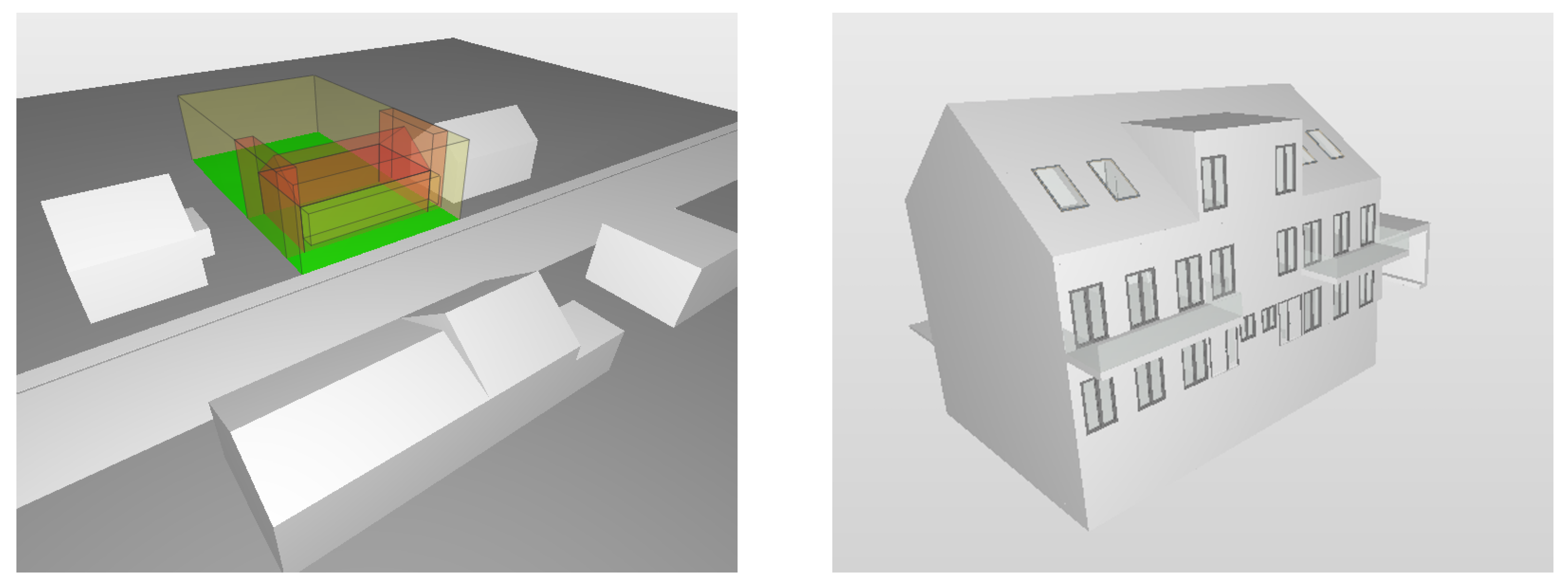
- Geometric/geographical information: The GIS model of the construction site should be the basis for geometric geographic information. In particular, all constraints that can be represented by a geometric reference (e.g., the maximum building height by a correspondingly high hull geometry) should be included in the model.
- Complex information: Constraints that cannot be represented by simple geometric objects, or that have no geometric representation at all, should be checked automatically; the validation routines should be executed in a way to reduce the workload of the authorities and to offer short development cycles with rapid feedback.
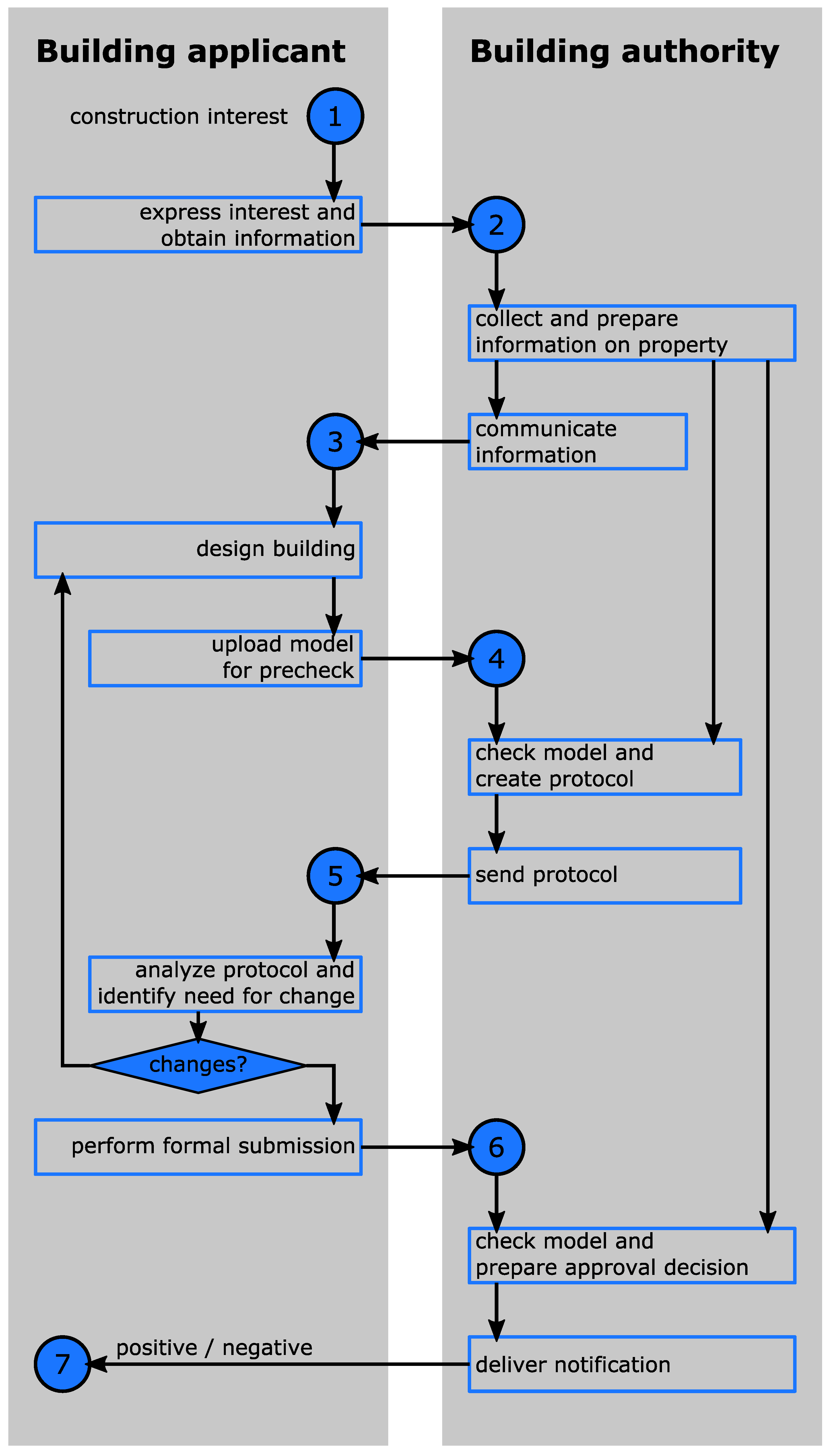
- In the first step, the building applicant expresses the construction interest to the building authority.
- The authority then begins to gather all the necessary and useful information and sends the resulting requirements model to the building applicant automatically.
- This requirement model is the planning basis and serves as the first sketch and the first draft. All sketches, drafts, designs, and plans are called candidate models.
- A candidate model can be prechecked at the building authority automatically and without obligation. The pretest corresponds to the final assessment and serves to provide quick feedback.
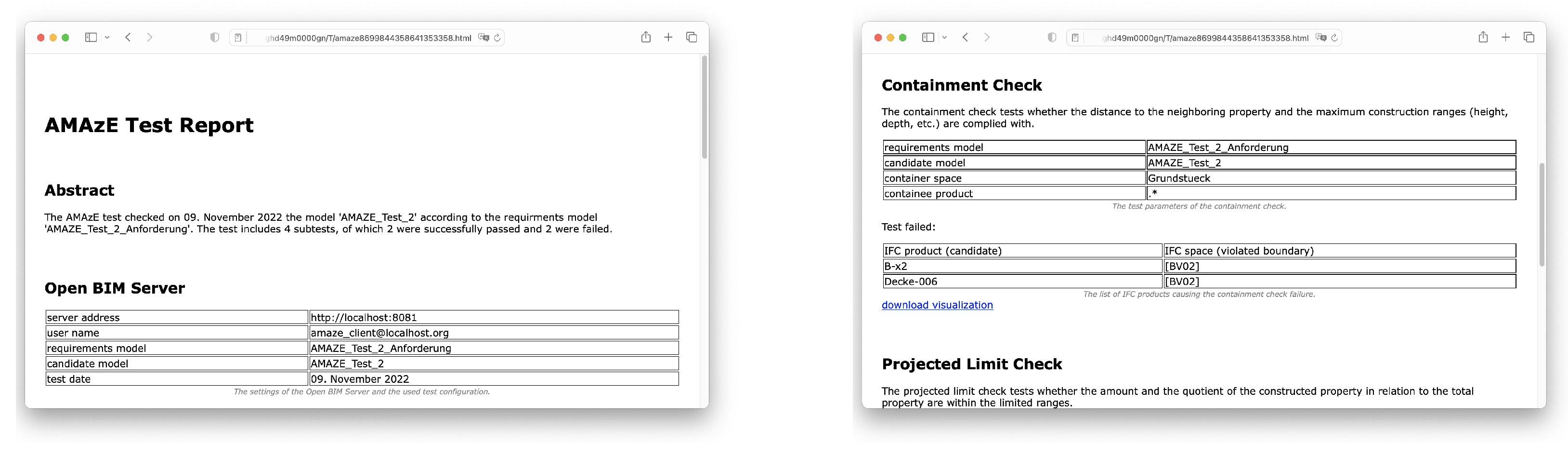
- Rule conformities and rule violations of a candidate model are documented and communicated to the building applicant as a protocol.
- Any necessary changes will result in a design loop or lead to a final submission.
- In the ideal case, this process should be fully automated.
3.2. Requirement Model and Candidate Model
4. Algorithms
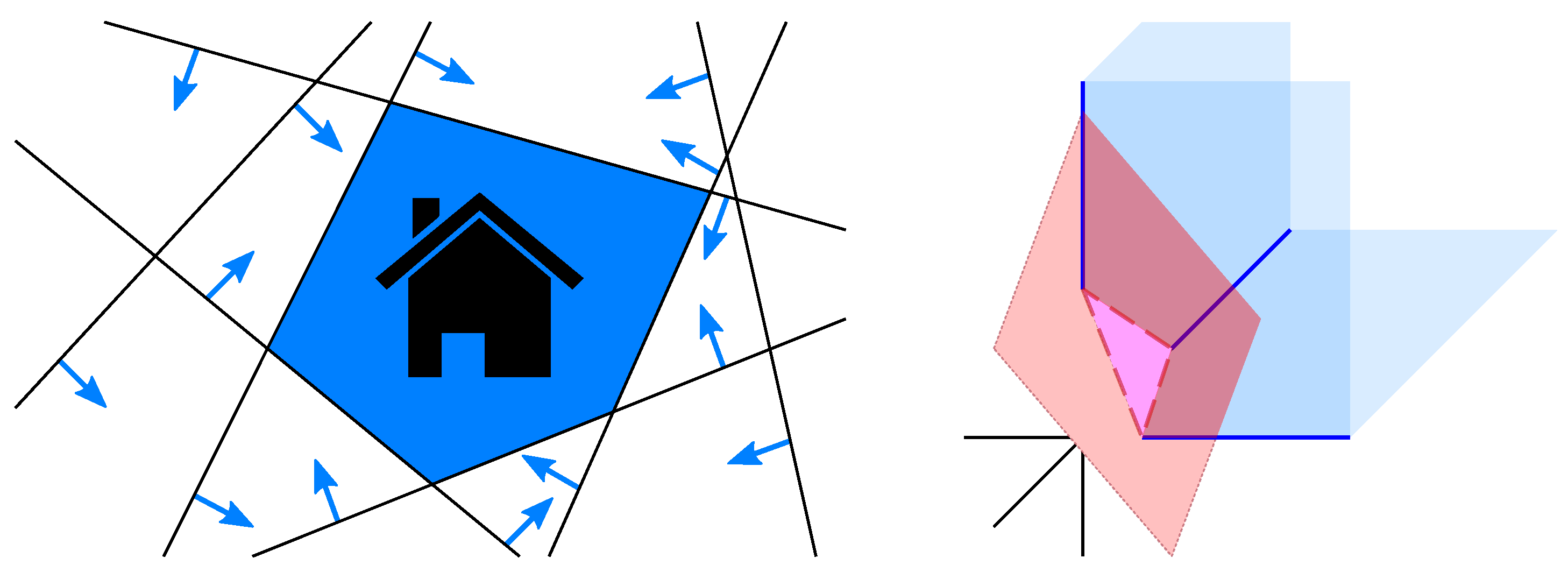
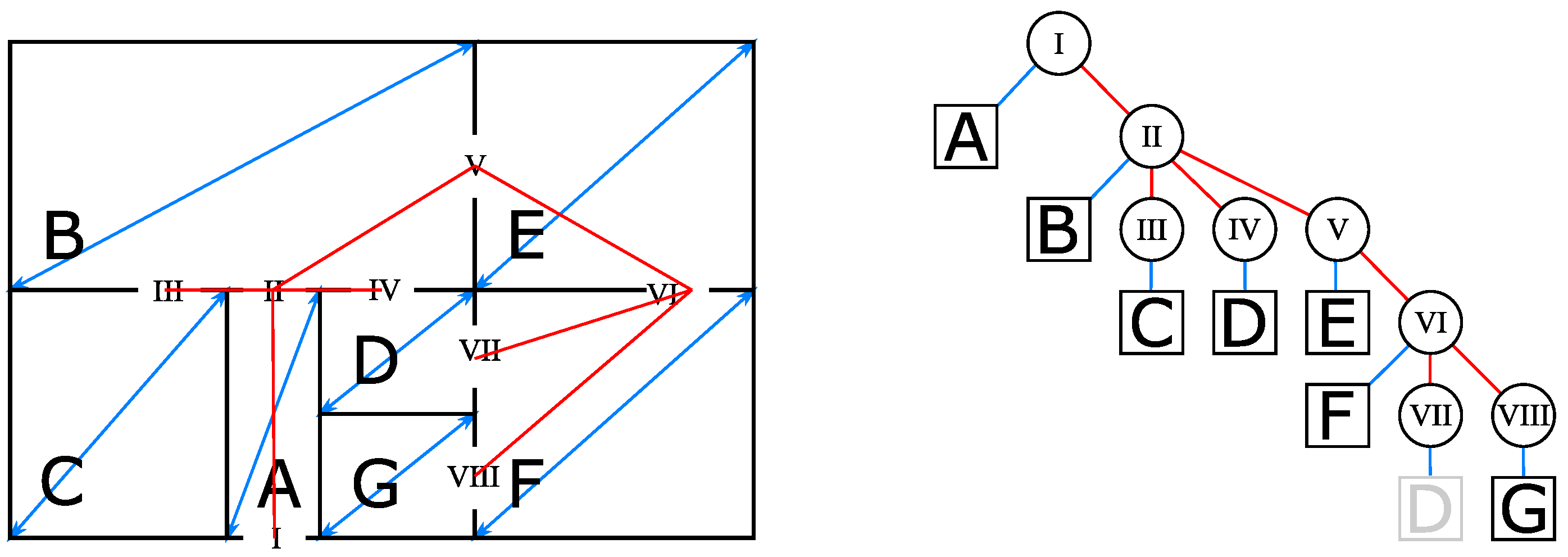
4.1. Containment Check
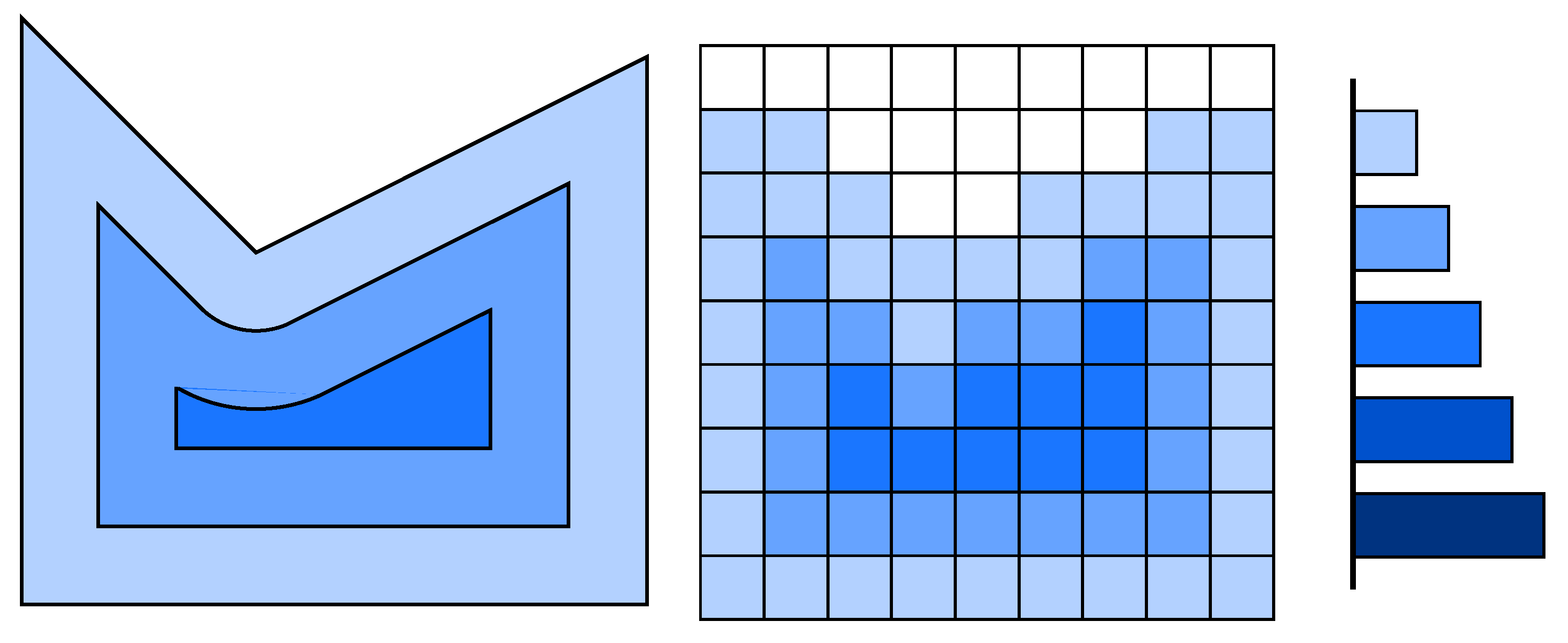
4.2. Projected Limit Check
4.3. Roof Gradient Check
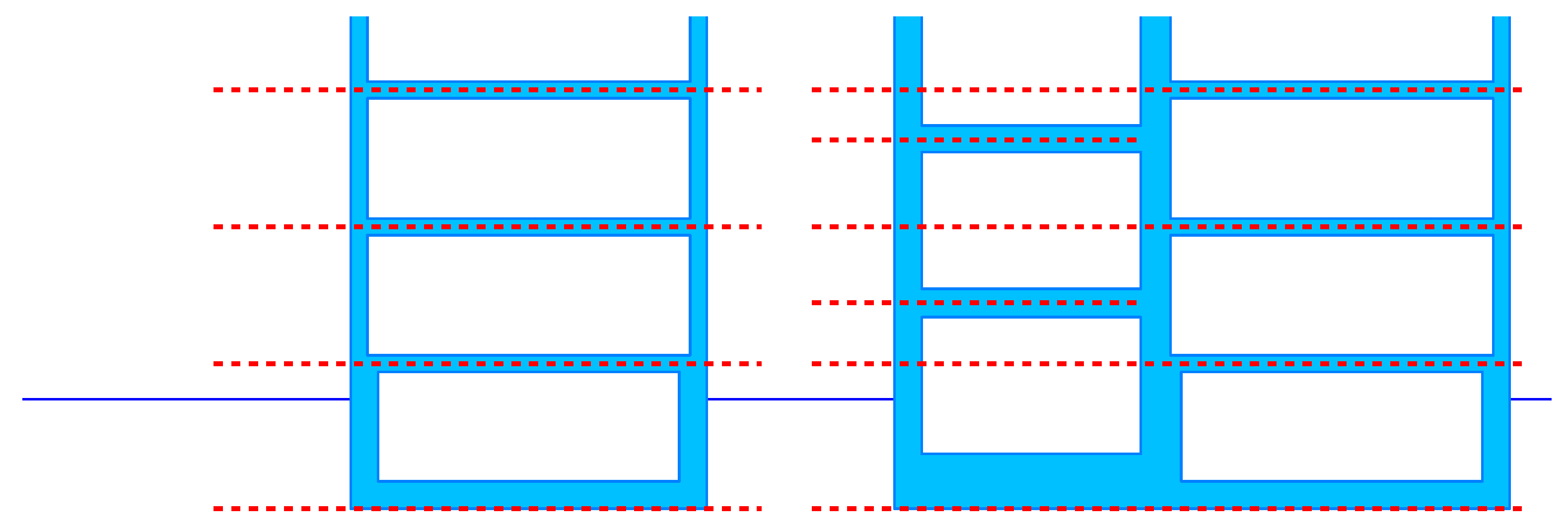
4.4. Maximum Number of Floors Check
4.5. Exposure Quotient Check
4.6. Designation Check
4.7. Escape Route Check
4.8. Noise Emission Check
5. Results
- Semantic annotation:
- This class includes tests that verify the presence of necessary semantic markup in the IFC data. The “designation check” is a representative of this class.
- Threshold inspection:
- Many tests only check a single value or the fulfillment of a simple scalar inequality. This class is represented by the tests’ “maximum number of floors check” and “exposure quotient check”.
- Geometric checks:
- The geometric tests are divided into three classes. The first class performs direct geometric tests; two other geometric classes perform indirect tests on simplified or derived geometries. A representative of a direct geometric test is the “containment check”.
- Geometric simplification:
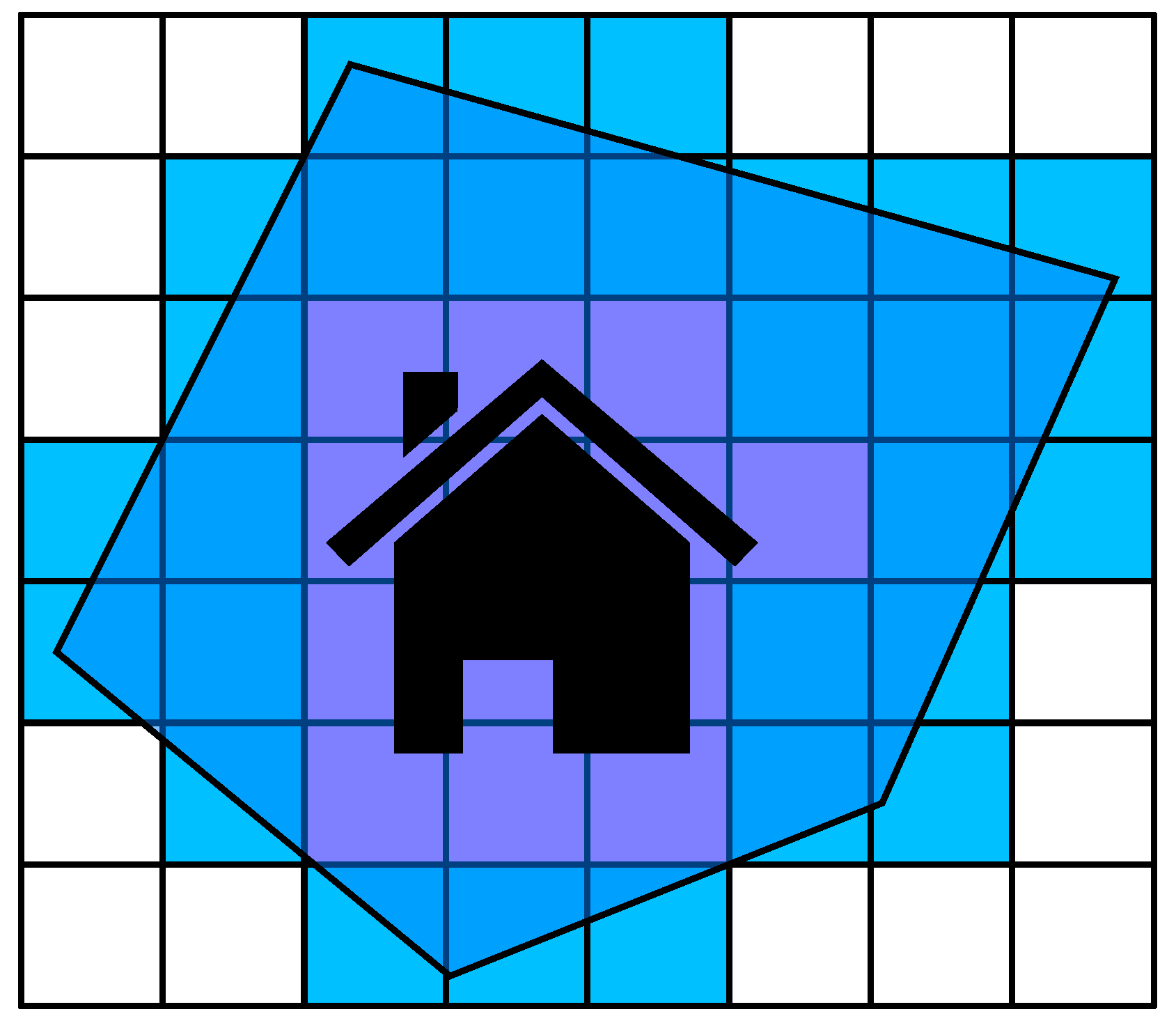
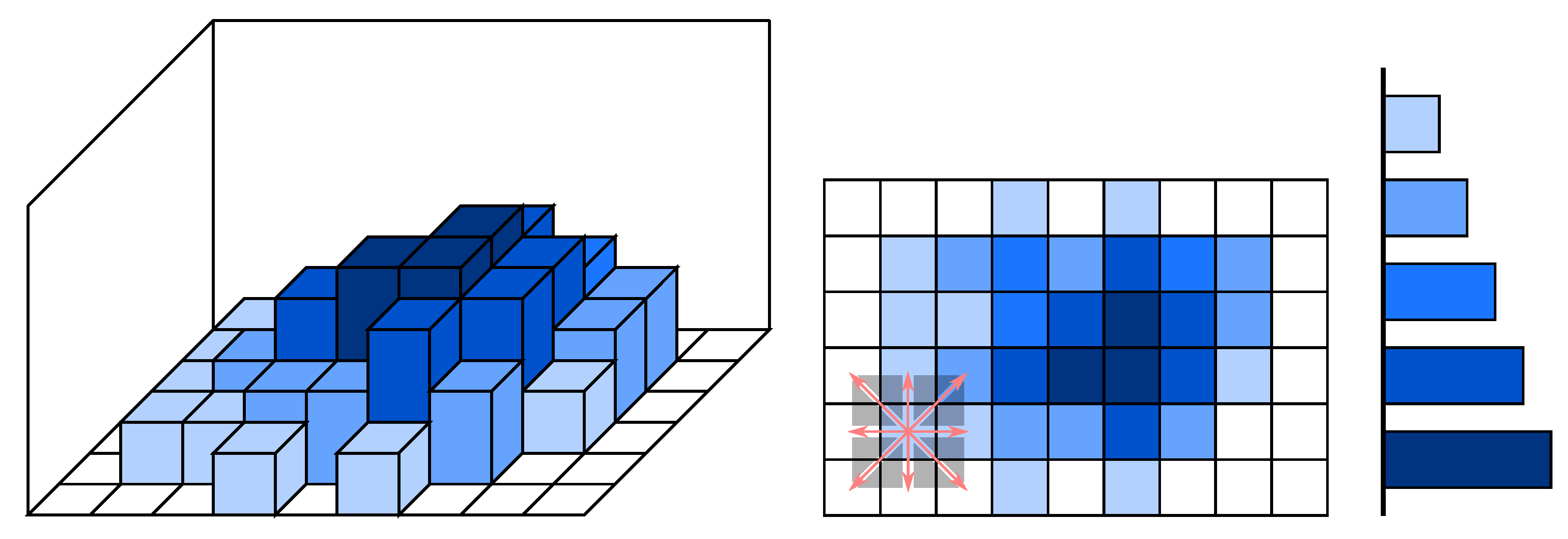
- Two representatives of an indirect geometric test are the “projected limit check” and the “roof gradient check”. In both cases, the geometry in the IFC is first simplified (transformed to a block structure using cell grid algorithms) before a geometric test is performed. The errors introduced by the simplification are limited (by the choice of the cell size), and the advantages of the simple, numerically stable implementation outweigh minor inaccuracies (whose size is known).
- Geometric derivation:
- The last class includes derived (and additionally simplified, if necessary) geometries. Two representatives of this class are the “escape route check” and the “noise emission check” test. In both cases, new structures are derived from the initial geometry: the “escape route check” derives a discrete graph structure representing the layout from the continuous room geometry; the “noise emission check” deduces the (simplified) annulus structure of the building.
6. Discussion
- The containment check works perfectly. Only if the test fails and finds geometry that is outside the intended containment, troubleshooting may be difficult. Large models, where not all assemblies and parts are named in a meaningful way, pose a problem for a meaningful error message, which makes troubleshooting more difficult.
- The projected limit check works and the used grid approach is numerically stable and robust. Only the choice of the grid cell size results in inaccuracies, which may lead to wrong test results in borderline cases.
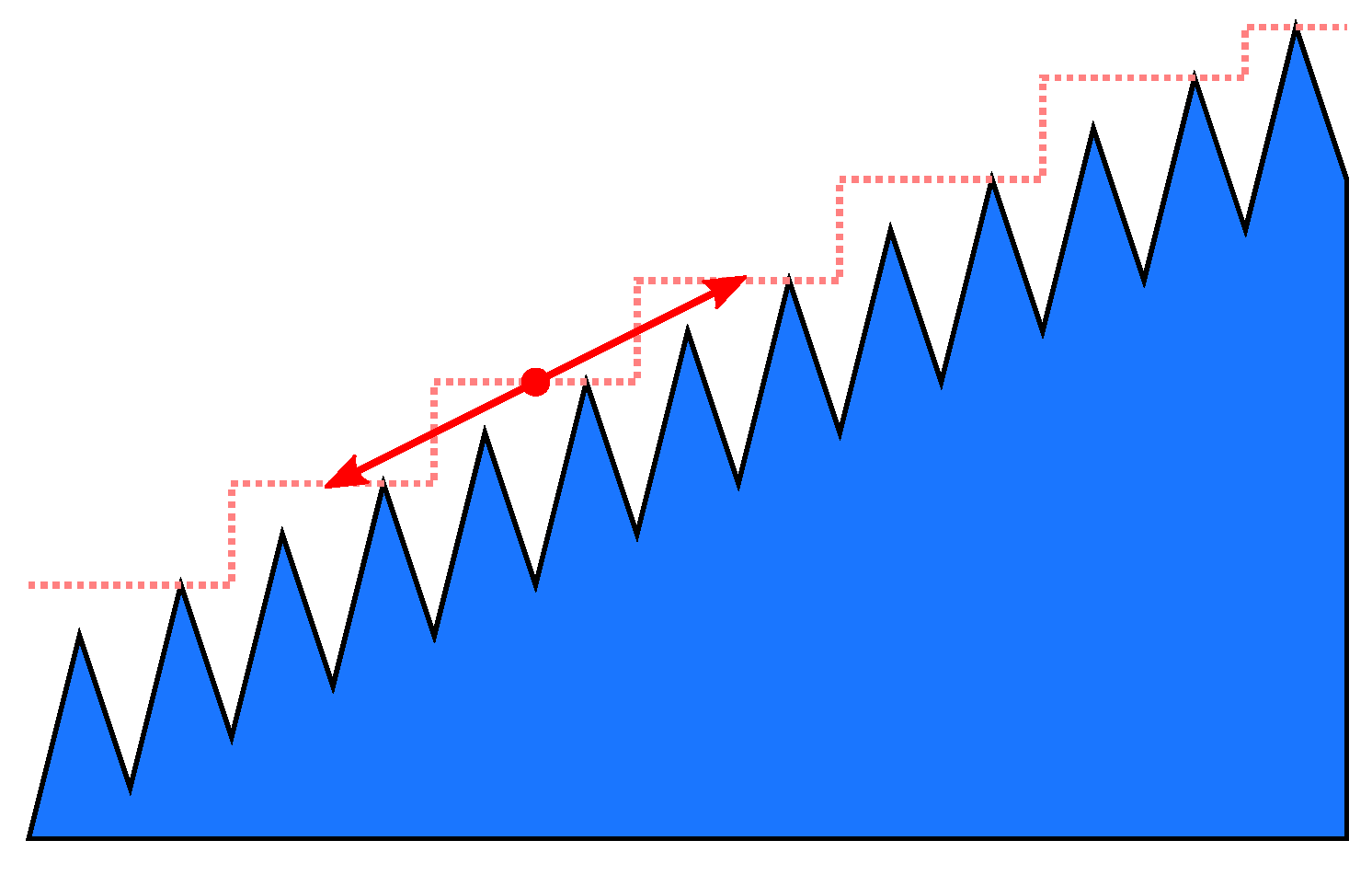
- The roof gradient check suffers from the same problem. The grid approach can be interpreted signal-wise as a low-pass filter, so that “high-frequency geometry” may not be considered comprehensively or completely. From the application user’s point of view, especially the nontrivial consequences of cell size selection are not always obvious and pose a problem.
- The maximum numbers of floors check works flawlessly.
- The exposure quotient check is an implementation of the simple procedure currently in use. For historical reasons, this does not use the possibilities of modern data processing. Shadowing effects in cities due to neighboring buildings or in the countryside due to mountains are not taken into account in this test, although corresponding data exist.
- The designation check works without problems or limitations.
- The escape route check uses simple geometric estimates (the path length through a room is approximated by the room diagonal, etc.), which, as with the cell grid algorithms, can lead to numerical inaccuracies and thus incorrect results in borderline cases.
- The noise emission check needs further evaluation with real-world data, as the indication of noise sources in the IFC data is often not marked.
7. Conclusions
Author Contributions
Funding
Informed Consent Statement
Data Availability Statement
Conflicts of Interest
References
- Hofstadler, C.; Motzko, C. (Eds.) Agile Digitalisierung im Baubetrieb (Engl.: Agile Digitization in the Construction Industry); Springer: Berlin/Heidelberg, Germany, 2021. [Google Scholar]
- Berbner, R.; Elsholz, C.; Schüch, L.; Hoffmann, S.M. (Eds.) Digitalisierung, Nachhaltigkeit und Corona in der Bauindustrie (Engl.: Digitalization, Sustainability and Corona in the Construction Industry); Pricewaterhouse Coopers GmbH: Frankfurt am Main, Germany, 2021. [Google Scholar]
- Borrmann, A.; König, M.; Koch, C.; Beetz, J. Building Information Modeling: Why? What? How? Build. Inf. Model. 2018, 1, 6–25. [Google Scholar]
- Köhler, K. Open versus Closed BIM—Different Planning Approaches and their Importance for the Planning Process of Municipalities. PEFnet 2019, 23, 69–71. [Google Scholar]
- Battisti, K.; Dörn, M.; Eichler, C.; Scherret, J.; Ullrich, T. Digital Planning, Construction Submission and Approval Processes in Austria. Proc. Int. Acad. Conf. Places Technol. 2020, 7, 208–214. [Google Scholar]
- Maliene, V.; Grigonis, V.; Palevičius, V.; Griffiths, S. Geographic information system: Old principles with new capabilities. Urban Des. Int. 2011, 16, 1–6. [Google Scholar] [CrossRef] [Scilit]
- Arroyo Ohori, K.; Diakité, A.; Krijnen, T.; Ledoux, H.; Stoter, J. Processing BIM and GIS models in practice: Experiences and recommendations from a GeoBIM project in the Netherlands. Int. J. Geo-Inf. 2018, 7, 311. [Google Scholar] [CrossRef] [Scilit]
- Jaud, S.; Donaubauer, A.; Heunecke, O.; Borrmann, A. Georeferencing in the context of building information modelling. Autom. Constr. 2020, 118, 1–21. [Google Scholar] [CrossRef] [Scilit]
- Salheb, N.; Arroyo Ohori, K.; Stoter, J. Automatic conversion of CityGML to IFC. Int. Arch. Photogramm. Remote Sens. Spat. Inf. Sci. 2020, 44, 127–134. [Google Scholar] [CrossRef] [Scilit]
- Biljecki, F.; Lim, J.; Crawford, J.; Moraru, D.; Tauscher, H.; Konde, A.; Adouane, K.; Lawrence, S.; Janssen, P.; Stouffs, R. Extending CityGML for IFC-sourced 3D city models. Autom. Constr. 2021, 121, 1–14. [Google Scholar] [CrossRef] [Scilit]
- Kalantari, M.; Olsen, M.J. Nexus of BIM and GIS: Integrating building and geospatial data. J. Spat. Sci. 2020, 65, 191–192. [Google Scholar] [CrossRef] [Scilit]
- Zhu, J.; Wright, G.; Wang, J.; Wang, X. A Critical Review of the Integration of Geographic Information System and Building Information Modelling at the Data Level. ISPRS Int. J. Geo-Inf. 2018, 7, 66. [Google Scholar] [CrossRef] [Scilit]
- Hjelseth, E. Converting performance based regulations into computable rules in BIM based model checking software. EWork EBusiness Archit. Eng. Constr. 2012, 4, 461–470. [Google Scholar]
- Liu, Y.; van Nederveen, S.; Hertogh, M. Government’s perspective on BIM and Sustainability in transport infrastructure in Europe and China. Life-Cycle Civ. Eng. 2016, 5, 570–577. [Google Scholar]
- Cheng, J.C.P.; Lu, Q. A review of the efforts and roles of the public sector for BIMadoption worldwide. J. Inf. Technol. Constr. 2015, 20, 442–478. [Google Scholar]
- Edirisinghe, R.; London, K. Comparative Analysis of International and National Level BIM Standardization Efforts and BIM adoption. IT Constr. 2015, 32, 149–158. [Google Scholar]
- Mustaffa, N.E.; Salleh, R.M.; Ariffin, H.L.B.T. Experiences of Building Information Modelling (BIM) adoption in various countries. Res. Innov. Inf. Syst. 2017, 5, 1–7. [Google Scholar]
- Ho, S.; Rajabifard, A.; Stoter, J.; Kalantari, M. Legal barriers to 3D cadastre implementation: What is the issue? Land Use Policy 2013, 35, 379–387. [Google Scholar] [CrossRef] [Scilit]
- Parviainen, P.; Tihinen, M.; Kääriäinen, J.; Teppola, S. Tackling the digitalization challenge: How to benefit from digitalization in practice. Int. J. Inf. Syst. Proj. Manag. 2017, 5, 63–77. [Google Scholar] [CrossRef] [Scilit]
- Belanger, F.; Carter, L. Digitizing Government Interactions with Constituents: An Historical Review of E-Government Research in Information Systems. J. Assoc. Inf. Syst. 2012, 13, 363–394. [Google Scholar] [CrossRef] [Scilit]
- Pfeifer, M.; Kraushaar, M.; Lintz, H. Der digitale Bauantrag (engl. the digital building application). Dtsch. Bau Z. DBZ 2020, 1, 25. [Google Scholar]
- Chognard, S.; Dubois, A.; Benmansour, Y.; Torri, E.; Domer, B. Digital Construction Permit: A Round Trip Between GIS and IFC. Adv. Comput. Strateg. Eng. 2018, 10864, 287–306. [Google Scholar]
- Rajabifard, A.; Atazadeh, B.; Kalantari, M. BIM and Urban Land Administration; CRC Press: Boca Raton, FL, USA, 2019. [Google Scholar]
- Ullah, K.; Witt, E.; Lill, I. The BIM-Based Building Permit Process: Factors Affecting Adoption. Buildings 2022, 12, 45. [Google Scholar] [CrossRef] [Scilit]
- Plazza, D.; Röck, M.; Malacarne, G.; Passer, A.; Marcher, C.; Matt, D.T. BIM for public authorities: Basic research for the standardized implementation of BIM in the building permit process. Earth Environ. Sci. 2019, 323, 012102. [Google Scholar] [CrossRef] [Scilit]
- Lee, H.; Lee, J.; Park, S.; Kim, I. Translating building legislation into a computer-executable format for evaluating building permit requirements. Autom. Constr. 2016, 71, 49–61. [Google Scholar] [CrossRef] [Scilit]
- Beach, T.H.; Rezgui, Y. Semantic encoding of construction regulations. Linked Data Archit. Constr. 2018, 6, 52–61. [Google Scholar]
- Ponnewitz, J.; Schneider, S. Stand der Forschung zu BIM-basierten Baugenehmigungsprozessen. Forum Bauinformatik 2019, 31, 33–40. [Google Scholar]
- Solihin, W.; Dimyadi, J.; Lee, Y.; Eastman, C.; Amor, R. Simplified schema queries for supporting BIM-based rule-checking applications. Autom. Constr. 2020, 117, 1–17. [Google Scholar] [CrossRef] [Scilit]
- Zhou, Y.; Yang, Y.; Yang, J.B. Barriers to BIM implementation strategies in China. ISPRS Int. J. Geo-Inf. 2019, 26, 554–574. [Google Scholar] [CrossRef] [Scilit]
- Jingkuang, L.; Shiv, G. Quality Control of a Complex Lean Construction Project Based on KanBIM Technology. Eurasia J. Math. Sci. Technol. Educ. 2017, 13, 5905–5919. [Google Scholar]
- Berndt, R.; Tuemmler, C.; Kehl, C.; Aehnelt, M.; Grasser, T.; Franek, A.; Ullrich, T. Open Problems in 3D Model and Data Management. Int. Jt. Conf. Comput. Vis. Comput. Graph. Theory Appl. (VISIGRAPP) 2020, 15, 347–354. [Google Scholar]
- Clayton, M.; Fudge, P.; Thompson, J. Automated plan review for building code compliance using BIM. Intell. Comput. Eng. 2013, 20, 1–10. [Google Scholar]
- Choi, J.; Kim, I. Development of rule-based building code compliance checking system for BIM-based quality improvement. Information 2017, 20, 2929–2936. [Google Scholar]
- Sun, H.; Kim, I. Automated Checking System for Modular BIM Objects. J. Civ. Eng. Manag. 2022, 28, 554–563. [Google Scholar] [CrossRef] [Scilit]
- Eastman, C.; Lee, J.; Jeong, Y.; Lee, J. Automatic rule-based checking of building designs. Autom. Constr. 2009, 18, 1011–1033. [Google Scholar] [CrossRef] [Scilit]
- Noardo, F.; Malacarne, G.; Mastrolembo Ventura, S.; Tagliabue, L.C.; Ciribini, A.L.C.; Ellul, C.; Guler, D.; Harrie, L.; Senger, L.; Waha, A.; et al. Integrating expertises and ambitions for data-driven digital building permits—The EUnet4DBP. Int. Arch. Photogramm. Remote Sens. Spat. Inf. Sci. 2020, 44, 103–110. [Google Scholar] [CrossRef] [Scilit]
- Harun, A.N.; Samad, S.A.; Nawi, M.N.M.; Haron, N.A. Existing Practices of Building Information Modeling Implementation in the Public Sector. Int. J. Supply Chain Manag. 2016, 5, 166–177. [Google Scholar]
- Malsane, S.M. The Application of Automated Rule Checking to Existing UK Building Regulations Using BIM Technologies; University of Northumbria at Newcastle, United Kingdom; ProQuest Dissertations Publishing: Ann Arbor, MI, USA, 2015. [Google Scholar]
- Kim, I.; Choi, J.; Teo, E.A.L.; Sun, H. Development of K-BIM e-Submission prototypical system for the openBIM-based building permit framework. J. Civ. Eng. Manag. 2020, 26, 744–756. [Google Scholar] [CrossRef] [Scilit]
- Noardo, F.; Wu, T.; Ohori, A.; Krijnen, T.; Stoter, J. IFC models for semi-automating common planning checks for building permits. Autom. Constr. 2022, 134, 1–18. [Google Scholar] [CrossRef] [Scilit]
- Schranz, C.; Urban, H.; Gerger, A. Potentials of Augmented Reality in a BIM-based Building Submission Process. J. Inf. Technol. Constr. 2021, 26, 441–457. [Google Scholar] [CrossRef] [Scilit]
- Narayanaswamy, H. BIM-Based Automated Design Checking for Building Permit in the Light-Frame Building Industry; University of Alberta: Edmonton, AB, Canada, 2019. [Google Scholar]
- Fauth, J.; Soibelman, L. Conceptual Framework for Building Permit Process Modeling: Lessons Learned from a Comparison between Germany and the United States regarding the As-Is Building Permit Processes. Buildings 2022, 12, 638. [Google Scholar] [CrossRef] [Scilit]
- Beach, T.H.; Hippolyte, J.L.; Rezgui, Y. Towards the adoption of automated regulatory compliance checking in the built environment. Autom. Constr. 2020, 118, 1011–1033. [Google Scholar] [CrossRef] [Scilit]
- Hjelseth, E. Public BIM-based model checking solutions: Lessons learned from Singapore and Norway. Build. Inf. Model. Des. Constr. Oper. Trans. Built Environ. 2015, 149, 421–436. [Google Scholar]
- Massimo-Kaiser, I.; Exenberger, H.; Hruschka, S.; Heil, F.; Flora, M. Streamlining Tunnelling Projects through BIM. Sustainability 2022, 14, 11433. [Google Scholar] [CrossRef] [Scilit]
- Yazicioglu, Z. Multi-stakeholder involvement in construction and challenges of BIM implementation. EWork EBusiness Archit. Eng. Constr. 2021, 13, 551–557. [Google Scholar]
- Fauth, J. Building permit process modeling. EWork EBusiness Archit. Eng. Constr. 2021, 13, 42–50. [Google Scholar]
- Altintas, Y.D.; Ilal, M.E. Loose coupling of GIS and BIM data models for automated compliance checking against zoning codes. Autom. Constr. 2021, 128, 103743. [Google Scholar] [CrossRef] [Scilit]
- Hoffmann, A.; Shi, M.; Wagner, A.; Thiele, C.D.; Huyeng, T.J.; Rüppel, U.; Sprenger, W. Evaluating SPARQL-based model checking: Potentials and limitations. EWork EBusiness Archit. Eng. Constr. 2021, 13, 83–90. [Google Scholar]
- Javed, O.; Javed, A.; Ali, Y.; Adil, M. Application of ICT and BIM in the implementation of Building Byelaws. Sustain. Resil. 2020, 2, 1–3. [Google Scholar]
- Möser, M. Engineering Acoustics—An Introduction to Noise Control; Springer: Berlin/Heidelberg, Germany, 2009. [Google Scholar]
- Barequet, G.; Goryachev, A. Offset polygon and annulus placement problems. Comput. Geom. 2014, 47, 407–434. [Google Scholar] [CrossRef] [Scilit]
- Schmitd Villaschi, F.; Carvalho, J.P.; Braganca, L. BIM-Based Method for the Verification of Building Code Compliance. Appl. Syst. Innov. 2022, 5, 64. [Google Scholar] [CrossRef] [Scilit]
- Turk, Z.; Klinc, R. Potentials of Blockchain Technology for Construction Management. Procedia Eng. 2017, 196, 638–645. [Google Scholar] [CrossRef] [Scilit]
- Nanayakkara, S.; Perera, S.; Bandara, D.; Weerasuriya, T.; Ayoub, J. Blockchain technology and its potential for the construction industry. Australas. Univ. Build. Educ. Assoc. 2019, 42, 662–672. [Google Scholar]
- Mathews, M.; Robles, D.; Bowe, B. BIM+Blockchain: A Solution to the Trust Problem in Collaboration? In Proceedings of the CITA BIM Gathering 2017, Dublin, Ireland, 23–24 November 2017; pp. 1–10. [Google Scholar]
- Mason, J. Intelligent Contracts and the Construction Industry. J. Leg. Aff. Disput. Resolut. Eng. Constr. 2017, 9, 04517012. [Google Scholar] [CrossRef] [Scilit]


Disclaimer/Publisher’s Note: The statements, opinions and data contained in all publications are solely those of the individual author(s) and contributor(s) and not of MDPI and/or the editor(s). MDPI and/or the editor(s) disclaim responsibility for any injury to people or property resulting from any ideas, methods, instructions or products referred to in the content. |
© 2022 by the authors. Licensee MDPI, Basel, Switzerland. This article is an open access article distributed under the terms and conditions of the Creative Commons Attribution (CC BY) license (https://creativecommons.org/licenses/by/4.0/).
Share and Cite
Battisti, K.; Dörn, M.; Eggeling, E.; Eichler, C.; Loës, J.M.; Scherret, J.; Tsoggerel, Z.; Ullrich, T. An Automatic Process for the Application of Building Permits. Buildings 2023, 13, 78. https://doi.org/10.3390/buildings13010078
Battisti K, Dörn M, Eggeling E, Eichler C, Loës JM, Scherret J, Tsoggerel Z, Ullrich T. An Automatic Process for the Application of Building Permits. Buildings. 2023; 13(1):78. https://doi.org/10.3390/buildings13010078
Chicago/Turabian StyleBattisti, Kurt, Markus Dörn, Eva Eggeling, Christoph Eichler, Jan Morten Loës, Jacqueline Scherret, Zolbayasakh Tsoggerel, and Torsten Ullrich. 2023. "An Automatic Process for the Application of Building Permits" Buildings 13, no. 1: 78. https://doi.org/10.3390/buildings13010078
APA StyleBattisti, K., Dörn, M., Eggeling, E., Eichler, C., Loës, J. M., Scherret, J., Tsoggerel, Z., & Ullrich, T. (2023). An Automatic Process for the Application of Building Permits. Buildings, 13(1), 78. https://doi.org/10.3390/buildings13010078