Communication

Apparent Destruction Architectural Design for the Sustainability of Building Skins

by
Magdalena Celadyn
1,* and
Waclaw Celadyn
2
1
Faculty of Interior Design, Academy of Fine Arts in Krakow, 31-157 Kraków, Poland
2
Faculty of Architecture, Cracow Technical University, 30-155 Kraków, Poland
*
Author to whom correspondence should be addressed.
Buildings 2022, 12(8), 1220; https://doi.org/10.3390/buildings12081220

Submission received: 26 June 2022 / Revised: 18 July 2022 / Accepted: 11 August 2022 / Published: 12 August 2022
(This article belongs to the Special Issue Architecture: Integration of Art and Engineering)

Abstract

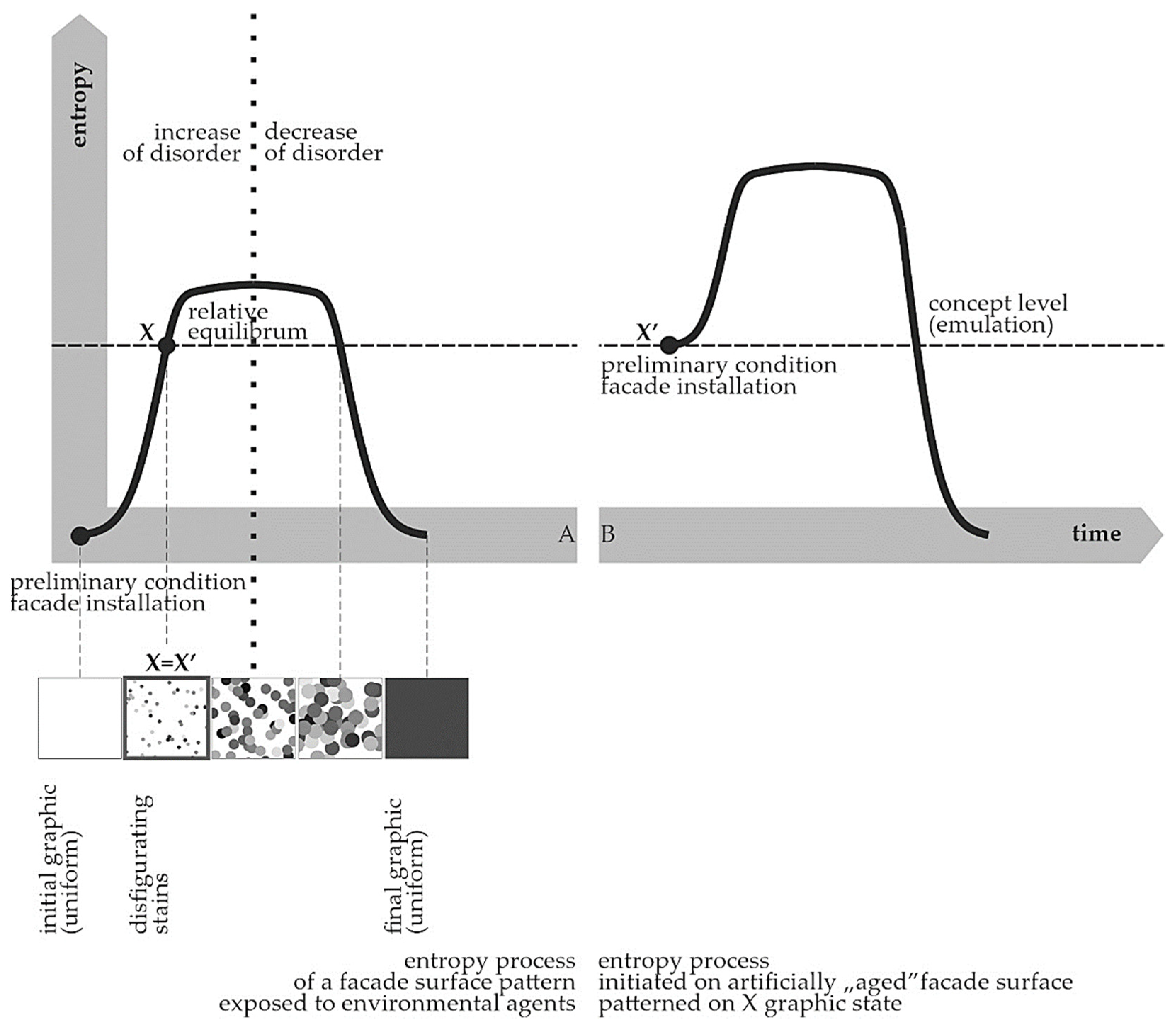
Technical durability and aesthetical longevity of building skins are among the fundamental demands of sustainable architecture in terms of building fabric’s physical changes due to deterioration. This concept paper presents a design concept intended to fill the existing gap related to the limited durability of buildings and non-existing design methods for its effective extension. The study concentrates on the anticipation and assimilation of disintegration processes occurring in time into the architectural design methodology to promote the design techniques focused on the visual expression of the coexistence of nature and the artificial in the function of time. This study investigates the building’s enclosure as an active boundary through which the building’s interaction with the natural environment occurs, as well as a regulator of the building’s energy performance and a factor conditioning their durability. The consideration of formal and esthetical deconstruction in architectural design is followed by the analyses of some relevant examples of completed buildings and cultural determinants underlying this issue. The proposed Apparent Destruction Architectural Design (ADAD) concept addresses the time-dependency of the building skins’ physical properties manifested by the deterioration, destruction and re-figuration of the building’s fabric. This design concept offers a solution to the disturbing problem of architecture’s impermanence enhances the issue of sustainability of the building’s fabric in time, becomes a means to search for the unconventional comprehension and vision of architecture, as well as to reframe the architectural design toward its compliance with sustainability postulates through the aesthetic concept.
Keywords: architectural design; apparent destruction; entropy; technical durability; aesthetical longevity architectural design; apparent destruction; entropy; technical durability; aesthetical longevity