1. Introduction
The Egyptian government is making significant efforts to execute many construction megaprojects to meet Egypt’s Strategic Growth Strategy 2030 goals. Economically, the construction industry significantly increases countries’ gross domestic products (GDP), provides new employment opportunities, provides fixed capital assets and infrastructure to most countries, and allows other industrial sectors to flourish [
1]. Construction projects are rarely completed on schedule or within budget, and reworking is frequently required to meet customers’ needs [
2].
Lean is a management system proven to be effective in the manufacturing sector, especially in the automotive industry. The Japanese manufacturing industry pioneered the lean manufacturing system, particularly the Toyota Production System (TPS) [
3]. Recently, the Lean approach has gained popularity in the construction industry as an efficient method of project management to decrease waste and increase customer value. Lean Construction (L.C.) aims to add value to the client by eliminating waste and utilizing project management tools to facilitate collaboration as part of a comprehensive and systematic strategy for ongoing improvement [
4]. L.C.’s five principles are as follows: Value, Pull, Value Stream Mapping, Flow, and Seeking Perfection [
5]. Just in Time (JIT), The Last Planner System, Daily Huddle Meetings, Amplified Visualization, the 5s Process, First Run Studies, Standardization, Fail-Safe for Quality, and The Five Why’s are the L.C. techniques and tools that are mainly fitted for use in construction projects [
4,
5]. “The goal of lean is to achieve a balanced utilization of materials, resources, and people. It is not about stripping everything down to the bare essentials and wringing more value from what’s left; it’s about decreasing costs, eliminating waste, and delivering projects on time.” [
6].
Other researchers have identified eight waste sources in construction that are widely accepted: Waiting, Transportation, Over-Processing, Motion, Defects, Over-Production, Inventory, and Skills Misuse [
7,
8,
9]. Lean construction makes a great effort to engage suppliers in project planning and execution to reduce variability. As confirmed by system engineering, suppliers must be involved in order to supply materials on schedule, at the lowest possible cost, and with the highest possible value for the client [
10]. The lean concept aims to (1) provide customers with precisely what they want and (2) accomplish this aim without wasting resources by focusing on client value. The critical part involves stakeholders gaining knowledge that can be applied to future initiatives to avoid repeating mistakes [
11]. According to Babalola et al. [
12], lean approaches can increase construction productivity and deliver a sustainable built environment.
Even though existing works provide insight into various lean tools and techniques and their potential benefits in construction, some authors have observed a lack of understanding of the number of existing lean construction tools and practices and their specific applications in building and infrastructure projects [
13].
In order to overcome these obstacles, it is critical to identify the variables that significantly drive management to implement lean construction effectively [
14]. These factors are known as “drivers,” and they can encourage managers, companies, and decision-makers to adopt the lean approach. Despite the critical significance of drivers in the successful adoption of the construction industry and adaptation to lean construction, few research articles have identified and grouped these drivers for lean construction success. Additionally, in the context of lean construction, insufficient effort has been applied to primarily focus on building a technique to rank the significant drivers and recognize the significant drivers. Due to a lack of identification of the drivers affecting lean construction’s successful implementation, organizations have been unable to identify activities that should be enhanced, where these activities should be directed, or the effort required to achieve the best outcome [
15]. In Egypt, prior research performed in 2014 revealed that 58 percent of the respondents used lean principles in their projects without realizing it and knowing that it is called Lean [
16].
Therefore, this study aims to fill the gap by rating, grouping, and highlighting the main drivers that play a role in effective lean construction adoption. This study uses the Multi-Criteria Decision Making (MCDM) technique to achieve its objectives. The Weighted-Sum Model (WSM) was chosen as an MCDM technique to arrange these projects in the application of these drivers and then determine the requirements for applying lean management in construction projects. The SIMOS method was used in this study to rate and determine all essential drivers of lean construction deployment and calculate the weight of all the drivers, which can efficiently mitigate the effects of specific human drivers and obtain driver values through seven project instances in Egypt and rank them using the weighted sum model (WSM) to determine the requirements for implementing lean construction in each project based on the application of these drivers. Therefore, (WSM) is highly significant for determining each project’s needs and knowing the status of drivers.
In brief, the purpose of the research was to observe phenomena, gather data, evaluate data, and draw conclusions regarding lean drivers before implementing lean.
The weighted sum model (WSM) is a basic, simple, and one of the most efficient approaches used in MCDM techniques [
17]. The weighted-sum model represents the decision maker’s preferences in a linear function [
18]. In this method, the score of an alternative is equal to the weighted sum of its assessment ratings, where the weights are the importance weights associated with each attribute. Subjective weight approaches such as the survey method, Analytic Hierarchy Method (AHP), Delphi method, and others are used to evaluate the weights of indices, which can result in differences in index weights due to subjective variables [
19]. Understanding why the Weighted-Sum Model (WSM) is favored over other ranking systems such as the Analytic Hierarchy Process (AHP) is critical. Using AHP, for example, requires the creation of several pairwise matrices (decision matrices) for every cluster/family of available drivers, in addition to the significant clusters [
20].
The paper is structured as follows:
Section 2 describes the research methodology,
Section 3 discusses the selection of key drivers for successful lean construction and their actual values in case study projects,
Section 4 presents sensitivity analysis, and
Section 5 summarizes the conclusions.
2. Materials and Methods
According to the Business Dictionary, a “driver” is a circumstance, resource, process, or choice critical to a company’s ongoing performance and growth. Understanding key drivers can help to successfully implement lean construction by encouraging managers, employees, stakeholders, and others involved in construction projects. Despite the importance of drivers in the construction sector for the implementation and adaptation of lean construction, there are not enough research studies that identify the critical drivers for successful and long-term lean construction implementation. Furthermore, a few studies have focused on lean construction to identify a technique to rank the significant drivers and comprehend the key factors. Consequently, this research aims to identify and rate the critical drivers of lean construction deployment in five clusters (value, reduce variability, flow variability, pull, and continuous improvement) and present a new methodology for identifying the essential drivers for long-term lean construction implementation. In this regard, this research provides a Multi-Criteria Decision Making (MCDM) model of critical drivers that can aid in successfully adapting and implementing lean construction in Egypt with the adoption of a sustainable approach.
Two research questions were developed to guide this study:
RQ1. What are the key drivers and their ranking for the effective implementation of lean construction in construction projects?
RQ2. Based on the application of these drivers, what are the strengths and requirements for implementing lean construction in case study projects?
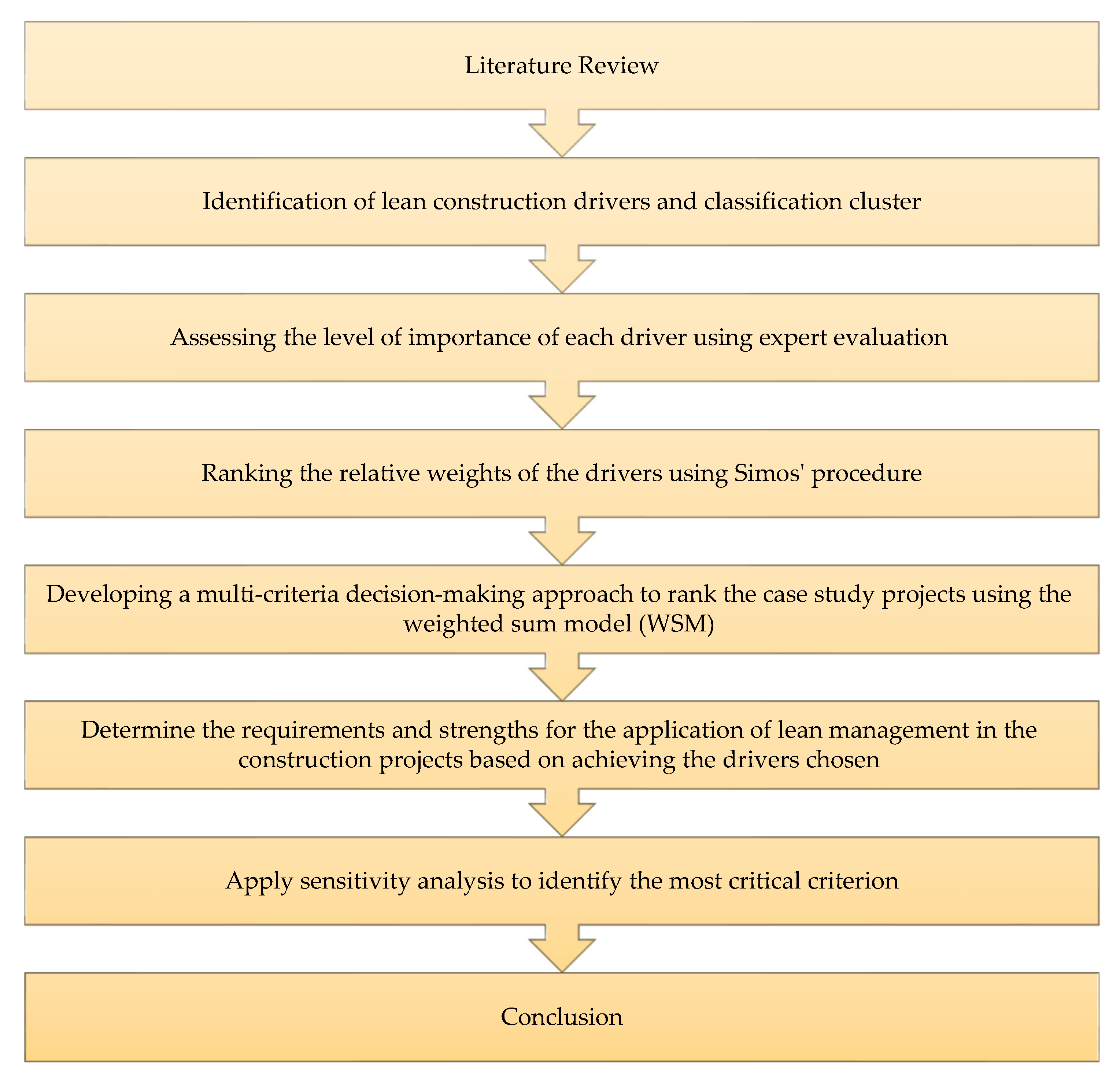
The methodology adopted in the research work, as shown in
Figure 1, takes into account the following: (i) a review of the literature on lean drivers; (ii) identification of key drivers and grouping a shortlist of the most important drivers for successful lean construction implementation; (iii) assessing the level of importance of each driver using the evaluation of 7 experts and ranking the relative weights of the drivers using Simos’ procedure; (iv) development of a multi-criteria decision-making approach to rank the case study projects using the weighted sum model (WSM), and then determine the requirements and strengths for the application of lean management in the construction projects based on achieving the drivers chosen; and (v) apply sensitivity analysis to identify the most critical criterion and to examine the sensitivity of the driver, which influences the decision-making process.
In conclusion, there is a need to identify the drivers that aid the adoption of lean construction in the construction industry. Following that, a technique for rating drivers must be introduced, followed by the identification of essential drivers. Other research can use the proposed method in this study to identify significant barriers or drivers based on their country, a specific project, or other situations. It can also be used in other fields of science to rank elements of effective and sustainable implementation strategies. Managers, decision-makers, and policymakers can use the identified main drivers from several dimensions to focus on the most important ones. These main drivers may provide them with the information to choose the appropriate plan for the sustainable implementation of lean construction.
3. Selecting Key Drivers for Successful Lean Construction and Their Application in Case Study Projects
3.1. Identification of the Drivers
Ogunbiyi et al. [
21] introduced 31 drivers and classified them into three categories in her thesis on applying lean in sustainable building projects in the United Kingdom: economic, social, and environmental. Ametepey et al. [
22] proposed 17 drivers for applying lean construction implementation in the building industry in South Africa and ranked them through a mean index; nonetheless, the study did not categorize drivers. According to the study’s findings, continuous improvement enhances communication and quality, making it the most significant driver in South Africa. Gandhi et al. [
23] grouped 15 integrated lean-green manufacturing drivers for Indian manufacturing SMEs into internal, economic and market, policy, and social drivers, with each group representing a subset of one facet of sustainability. The findings demonstrated that India’s most critical drivers for effective lean-green manufacturing adoption were current legislation, technological advancements, and top management commitment.
Sangwan et al. [
24] identified the factors that influenced the adoption of lean management in the Indian ceramics industry. They presented 20 important drivers and categorized them into internal, external, and policy groups. Babalola et al. [
12] also illustrated that the last planner system and just-in-time were the top two most implemented lean strategies and that the deployment of lean methods in the construction industry resulted in around 20 different economic, social, and environmental benefits.
The present study conducted a comprehensive search on the drivers. In addition, a preliminary list was compiled from research investigations and discussions with specialists in the construction sector. The identified drivers were discussed with many experts from the construction field. Based on the industry’s needs and the experts’ expectations, the drivers were reduced to 18. In addition, other unstructured interviews were conducted, but none directly addressed the initial driver list. The list includes 18 drivers that belong to five clusters: value, reduced variability, flow variability, pull, and continuous improvement, as shown in
Table 1.
3.2. Calculation of Drivers’ Weights
After Simos’ procedure considered the 18-driver list, a procedure for determining the importance of drivers was carried out. Each driver’s relative importance is critical in determining its weight. Simos suggested a technique that allows any decision-maker to consider and explain how they want to organize the many drivers in a given situation [
41]. The main idea behind this approach is to assign a “playing card” to each particular condition. For some reason, the person performing must manage the cards to rank them, inserting the white ones and explaining the procedure’s goal [
42,
43].
Since the research topic is new, it necessitated the involvement of experts in this field. With tremendous difficulty, we contacted seven specialists in this sector. Seven specialists were interviewed, including three project managers, two academics, and two on-site managers with more than ten years of expertise and at least two years of experience in lean construction projects. With respect to the number of participants for determining the importance of drivers, it is suggested that less than ten would be appropriate [
44]. Additionally, the deployment of an ANP-Fuzzy comprehensive evaluation model to measure lean construction management performance in China was evaluated by seven experts [
45].
The relative weights of the drivers were calculated using Simos’ approach in two phases.
- (1)
As displayed in
Table 2, seven senior engineers conducted the interviews individually. They were asked to rank the drivers in each cluster in order of importance, starting with the least important (score = 1) and progressing to the most significant (score = 5). They were also instructed to rank the main clusters in a similar order. The respondents’ R1, R2, R3, R4, R5, R6, and R7 denote the opinions of professionals. Data on the relative weight of the driver were collected through expert meetings. This outcome was generated by averaging each criterion in the questionnaire by calculating the average relative relevance. According to the average column, the assorting operation was performed using Simos’ algorithm for every cluster, starting with the least important and progressing to the most significant.
Equation (1) shows that the average column’s values are used to rank drivers and clusters in the Simos’ rank column. The first rank, rank 1, is given to a driver with a low average relative weight in a cluster. The second, rank 2, is assigned to a driver with a higher average relative weight than rank 1, and so on. Drivers with the same average relative weight will take the same rank.
where (MS) is the mean score given to each research variable by the experts and ranges from 1 to 5 when 1 is very low and 5 is very high;
f is the frequency of responses to each rating (1–5) for research variable; and
N is the total number of experts.
Table 3 presents the statistical data for the various distributions chosen for each criterion. To see if the fitted distributions were statistically sound, statistical tests such as the Shapiro–Wilk (S–W) and Kolmogorov–Smirnov (K–S) tests were used.
- (2)
Table 4 displays the relative normalized weights and global weights for all drivers. To calculate each driver’s weight, relative importance is required.
Table 4 demonstrates how to calculate the normalized weight by dividing the non-normalized weight of the driver, subset, and cluster by the total sum of Simos’ rank for the cluster that obtains this driver. Weight allocation drivers are consequently necessary because they will be used with a ranking algorithm [
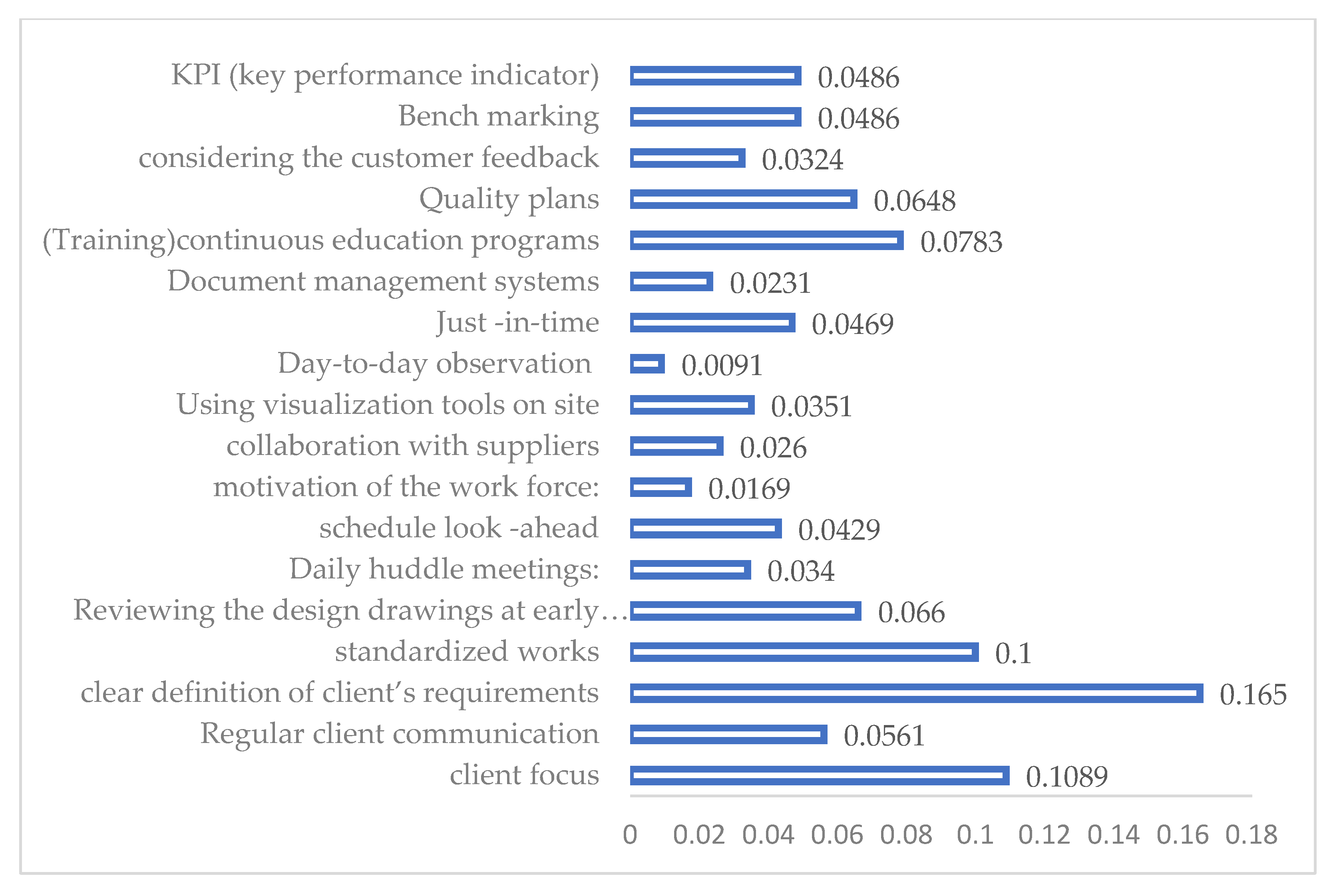
46]; the first stage after obtaining the final list of the main driver is to obtain the normalized weights of each criterion to obtain the global weights for each driver. The normalized weight of each driver multiplied by the normalized weight of the main cluster that includes this driver yields the global weight of each driver, as shown in Equation (2). The total global weight of eighteen drivers is nearest to one, as depicted in
Figure 2. The model rank was calculated using the mean values from the questionnaire survey [
47,
48].
where,
GW = the global weight of a factor.
= the relative weight of the factor.
= the relative weight of the cluster that includes this factor.
Since there are multiple families/clusters, the calculated weights must be transformed from local weights within each cluster to global weights across all clusters’ drivers; they are already considered global, with the exception of the main cluster’s local weights.
3.3. Driver Grade Scales and Model Development
A driver grading system and practical scales (scores) were designed, as depicted in
Table 5. The proposed grading system for drivers is a simple, generic, and adaptable concept. Moreover, it combines the Simos technique with the weighted scoring factors model. The driver grading system aids in the development of a lean implementation assessment model. Based on the applicability range of these drivers, the strengths and requirements for adopting lean construction in case study projects are outlined.
Five experts were interviewed in order to evaluate this system. The system assigns five grades to each driver. The driver’s grades were assigned a numerical value (a score) ranging from one to five. The lowest contribution of the factor’s grade in the lean implementation was assigned a value (score) of one. A value (score) of five was assigned for the most significant contribution of the factor’s grade in lean implementation. The goal of each driver is maximization because if we use it perfectly, we can achieve full-scale lean with all of these drivers.
3.4. Obtaining Values of Drivers
Several interviews were conducted, in addition to visits to construction projects of different types for a well-known construction company to add actual measures and values to the driver’s list. The paper includes seven project cases in Egypt: a new hospital, power station building renovation, a new factory, a road extension project, a new residential compound, a company office building, and a new solar power plant construction. The details of the projects are displayed in
Table 6.
Table 7 displays more information about the case studies and the actual values/measures for the list of factors. The selected seven construction companies and interview candidates who had worked on those projects were contacted and provided an overview of what the research entailed and the intent. The selected individuals were interviewed in person or over the phone. Interviews were conducted to facilitate real-world measures and values to the driver’s list.
As previously stated, all drivers were based on grades from 1 to 5. Consequently, their definitions are relatively descriptive, and thus they were assigned grades for a numerical assessment to be possible.
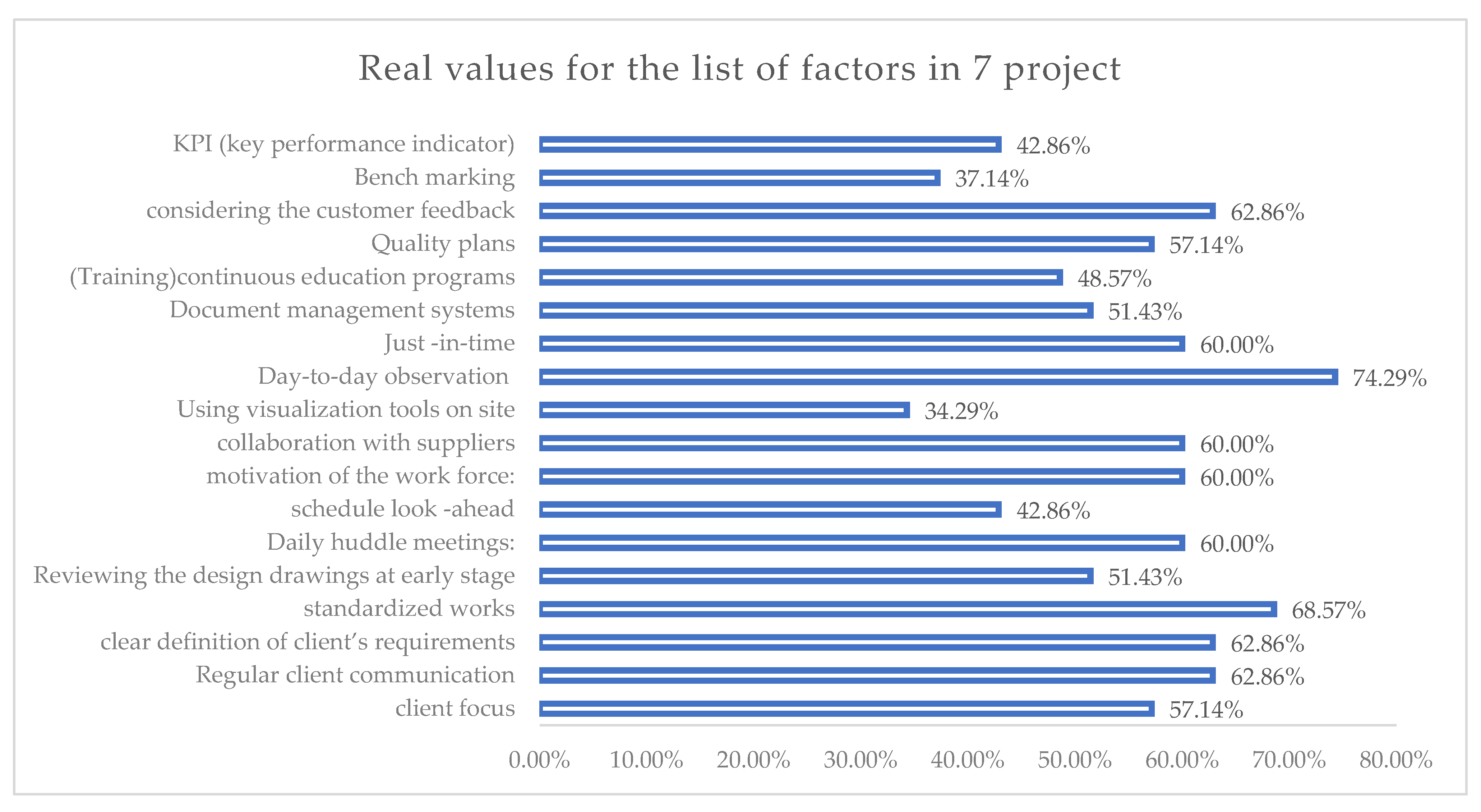
As demonstrated in
Figure 3, the most often used factors in the case studies calculated by Equation (3) were day-to-day observation, standardized work, a clear definition of the client’s requirements, and just-in-time delivery. According to the case studies, more than 60% of the lean drivers are implemented in Egypt. This finding is in line with a study conducted in 2021 related to the adoption and knowledge level, which revealed that the adoption level of lean tools in Egypt was 74.7% [
49].
where,
Percent % = the percentage of applying this driver,
X = the actual real scores/values of driver,
N = the number of case study projects, and 5 = the maximum grade scale.
3.5. Ranking of Case Studies Based on the Application of Lean Techniques
Table 7 shows a matrix with a column labeled “Types of Projects.” It was necessary to ascertain which lean driver applied to which project type.
After going over some key points in the decision matrix and alternative evaluations, the procedure for determining should proceed. The Weighted-Sum Model (WSM) approach can be used for this. The initial step was to create a decision matrix based on real-world data of the selected driver against the different alternatives (case study projects).
Second, all of the numbers were normalized to equal one (
Table 8), i.e., normalization can be completed in relation to the most significant value among a set of values (column) or concerning the total of a set of values (column). It is also worth noting that the raw data containing the criteria’s units were replaced with the weights of each criterion.
Third, the normalized figures were multiplied by the weights assigned to the drivers to produce a weighted normalized matrix by applying Equation (4). The final preferences and option ranking were derived by applying the Weighted-Sum Model (WSM) approach to the values in
Table 8. It should be noted that it is better when the value of a driver increases.
where,
WN = the weighted normalized of the driver.
N = the normalized driver.
GW = the Global weight of a driver.
In order to respect the nature of rising and decreasing driver preferences, the summation of increasing driver preferences was calculated separately from the summation of decreasing driver preferences for each alternative.
As shown in Equation (5), the preference of increasing driver was calculated by the summation of every weighted normalized row for every project.
Nevertheless, all the lean drivers that we mentioned have potential to rise. The difference (net) between the two summations determines the ultimate preferences of alternatives, as shown in
Table 9.
AWSM is the multi criteria score of case study project, N is the number of decision criteria, aij is the actual value of the ith alternative in terms of the jth criterion, and wj is the weight of the jth criterion. The corresponding aij values and the relative weights are assumed.
The goal of each driver is maximization since we can reach full-scale lean with all of them if we employ them perfectly, which means that as the supplied grade progresses to grade five, the alternative becomes more preferred. The decreasing procedure is undesirable with any type of driver selected due to the nature of the drivers, so their values in
Table 9 were considered to be zero.
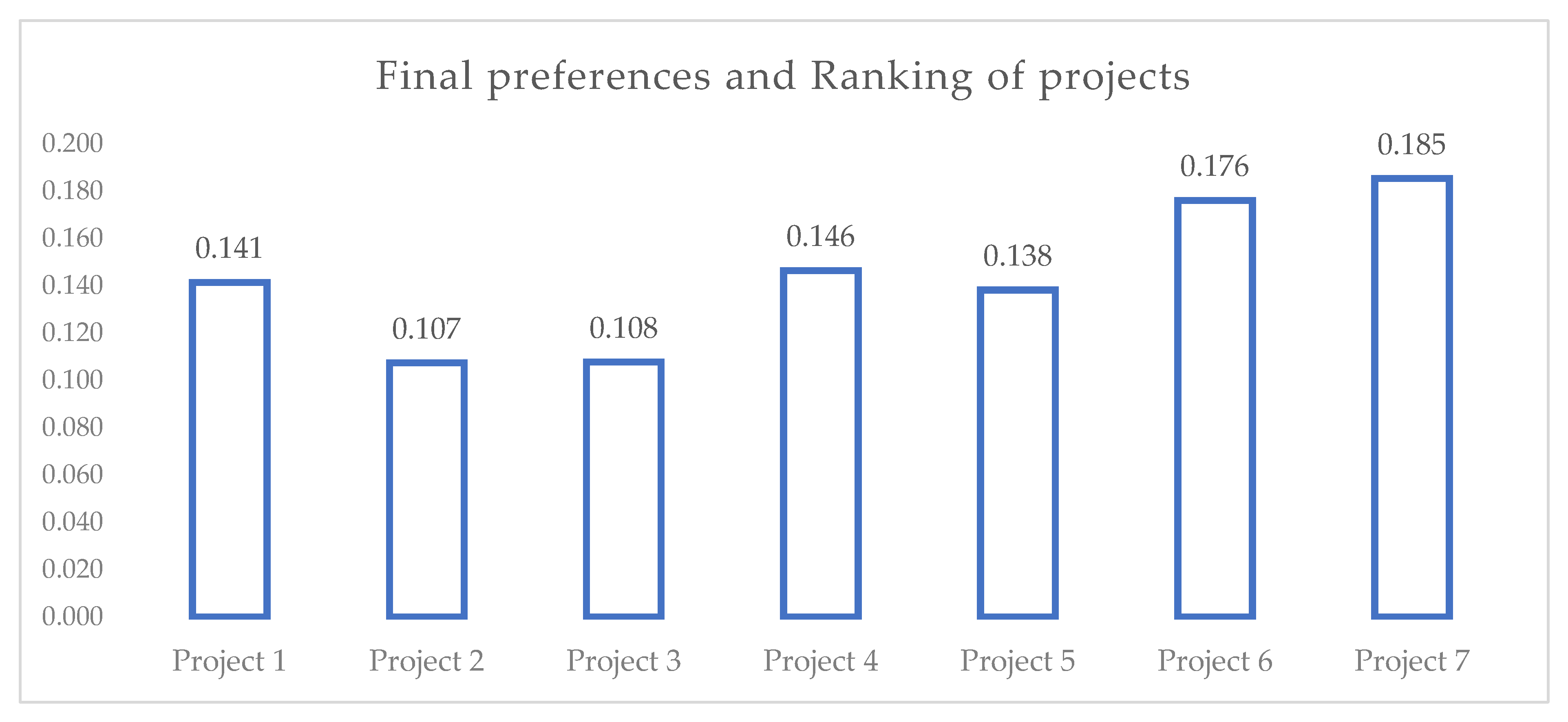
According to
Table 9, Project 7 was the most appropriate (preferred) of the construction projects, as demonstrated in
Figure 4.
3.6. Case Studies (Finding, Analysis, and Discussion)
This study used case studies to determine how well lean construction has been adopted in the construction industry and to assess how well it has adapted it. The projects implemented the primary lean tools such as day-to-day observation, considering the customer feedback, and just-in-time, but they were less focused on understanding lean concepts and principles. On-the-job subcontractors were unfamiliar with theoretical lean concepts.
According to
Table 9, projects 6 and 7 successfully implemented most lean concepts in the project and adequately implemented them. Projects 1, 4, and 5 also utilized most of these concepts in projects 6 and 7 but were less effective overall. However, the researcher found that these projects were also good lean implementation sites especially compared to other projects in general. Projects 6 and 7 obtained a high score for their lean implementation. They focused on the narrow, lean application because observations and interviews showed that this project successfully implemented the last planner and created a good work environment to reinforce client focus and caring for standardized work and Quality plans. Projects 2 and 3 were the poorest in terms of lean implementation projects. Their major problem was caused by the culture of implementing a new approach which is complex and slow, and difficult to qualify and assign subcontractors to a project if they had little background in lean construction.
The project participants in all case studies mainly emphasized the strengths, and the requirements for implementing lean construction were also covered.
Perceptive Strengths:
Lean construction has the advantage of requiring substantial documentation, as well as providing historical data to qualify subcontractors for future lean projects and providing quick and easy feedback to review failure reasons;
Communication and cooperation among project participants are the most significant advantages of lean implementation;
In order to apply lean, it is necessary to predict incoming work and make it simple to manage the entire project, and in relation unanticipated problems, lean advocates planning everything ahead of schedule and monitoring for potential issues.
Perceptive Requirements:
The requirements for successful lean implementation are:
Increasing upper-level management’s oversight of subcontractor planning and performance, as well as the designer’s involvement in the project;
Continuous training program;
Lean construction must be fully implemented through education and a contract.
4. Results and Analysis of Sensitivity Test
Numerous attempts have been made to investigate the sensitivity of the drivers that govern the decision-making process. The sensitivity analysis reveals the most critical criterion that could impact the decision-making process [
50]. For analysis, it is critical to keep track of how alternatives behave, which can be accomplished by tracking changes in the weights of the criteria, and their impact on the ranking of alternatives [
20].
The most important criterion will be presented first. As previously stated, the most important factor is the (clear definition of client’s requirements). The most important criterion is not always the most critical criterion. In other words, the highest weight does not always imply the most important thing. The term “critical” refers to the lowest change that could be made to a criterion in order to affect the ranking of alternatives. There are two definitions for the term “lowest change.” The smallest change can be defined in two ways: first, in absolute terms, and second, in relative terms [
51]. As a result, there are four different meanings to consider: Absolute-Any (A.A.), Absolute-Top (A.T.), Percent-Any (P.A.), and Percent-Top (P.T.).
The goal of the Absolute-Any (A.A.) problem is to determine the smallest absolute change that causes any two options to rank in reverse order. The goal of the Absolute-Top (A.T.) problem is to determine the smallest absolute change which influences the rank of the best candidate. The relative change can more accurately reflect the sensitive degree of measures. The Percent-Any (P.A.) problem is to identify the smallest relative change that makes the ranking position of any two alternatives change, while the Percent-Top (P.T.) problem is to find the smallest relative change which influences the rank of the best alternative.
Let
δk,i,j (1≤
i <
j ≤
M and
N ≥
k ≥ 1) denote the minimum absolute change in the current weight
Wk of criterion
Ck such that the ranking of alternatives
Ai and
Aj will be reversed, while
δ*k,i,j expresses changes in relative terms [
51]. Absolute and relative changes in the weights of sub-criteria have been computed by applying Equations (6) or (7) and (8):
As a result, “
p” represents the final preference of alternatives, where “
a” is a criterion-specific measure in the decision matrix that corresponds to a particular alternative.
Table 8 and
Table 9 can be used to calculate
, for example:
for example:
It works the same way as before for all possible combinations of driver and alternative pairs, as demonstrated in
Table 10 and
Table 11.
As shown in Equation (9),the following condition should be satisfied for the values to be feasible [
51].
From
Table 10 and
Table 11, we obtained the absolute and relative change of each weight value. The positive value of a change means a decrease in the original measure, while the negative value means an increase in that measure. Zero denotes that two alternatives have equal ranking scores. A relative change is infeasible when this value cannot meet a restraint marked as N/F.
5. Conclusions
All possible pairs were compared. We only chose the findings of a few common projects due to space constraints, and all comparisons of projects with all non-feasible values while using the preceding Equation (9) for drivers were excluded.
5.1. Processing the Most Critical Criterion (Absolute Terms)
Looking for the smallest absolute value of
throughout the entire
Table 10, it was shown to be equal to (∣0.003∣), which indicates that the most critical criterion of the Absolute Any (A.A.) was schedule look-ahead. It is worth noting that, based on the weights of the criterion, a clear definition of the client’s requirements was the most important criterion and not schedule look-ahead; however, in this case, a clear definition of the client’s requirements was not the most critical criterion. To find the lowest relative value of all columns related to alternative p7, find the absolute Top (AT) critical criterion. The minimum value (∣−0.66∣) ((Training) continuous education programs) was the corresponding criterion to the value.
5.2. Processing the Most Critical Criterion (Relative Terms)
To find the Percent Any (P.A.) critical condition, look for the smallest relative value in
Table 11. This minimum value was (∣−0.76∣), corresponding to criterion V1. Therefore, the P.A. critical criterion clearly defined the client focus.
Look for the least relative value of all columns related to alternative p7 to find the crucial criterion of the Percent Top (P.T.). (i.e., the best alternative) in
Table 11. The minimum such percentage (∣−845.41∣) corresponded to criterion C14; therefore, the P.T. critical criterion was (Training) continuous education programs.
The findings contribute to the advancement of theory in LC implementation because one of the themes addressed by this body of knowledge consisted of identifying drivers that can increase the chances of the success of LC implementation.
Managers might be motivated by the drivers of lean construction implementation to adapt and apply lean construction successfully. However, previous lean construction studies have not appropriately focused on and tried to highlight all significant drivers or proposed an approach for determining and ranking the major drivers of lean construction’s successful and long-term adoption because of its capacity to provide a checklist of significant factors and a framework of key drivers for efficient lean construction adoption.
The following conclusions are based on the findings: First, at least 18 different key drivers were identified, ranked, and categorized into five major clusters: value, reduced variability, flow variability, pull, and continuous improvement. Clear definition of the client’s requirements, client focus, and standardized works were the most global weights among the drivers. Second, as shown in the case studies, more than 60% of the lean drivers are implemented in Egypt. Day-to-day observation, standardized works, a clear definition of the client’s requirements, and just-in-time delivery were the most often used drivers in projects. Third, the sensitivity analysis demonstrated that the most critical criterion of the Absolute Any (A.A.) was schedule look-ahead. The Absolute Top (A.T.) most critical criterion was (Training) continuous education programs. The Percent Any (P.A.) critical criterion clearly defined client focus, whereas the critical criterion Percentage Top (P.T.) was continuous education programs (training).
Furthermore, field researchers may benefit from this research. Furthermore, these findings may assist decision-makers in focusing on the most critical drivers of lean construction adoption in the construction industry. Understanding these issues will aid the government and decision-makers in determining the best plan for increasing the Egyptian construction industry’s efficiency and productivity.
The main limitation of this study is that the analysis using Simos’ and WSM to select key drivers for lean implementation involved the participation of experts from Egypt, and it is known that the construction sector has regional variations [
52].
The other limitation is the study’s scale survey; the case studies gave only seven unique examples of lean construction that contributed to obtaining real values for key drivers.
Using MCDMS methodologies such as Interpretive Structure Modeling (ISM), future research may identify and analyze the interactions and interrelationships among the primary drivers revealed in this study. A future extension may develop a framework that considers the complicated interactions between significant drivers.