

You are currently viewing a new version of our website. To view the old version click .
Buildings
  • Article
  • Open Access

29 January 2022

Potential Application of BIM in RFI in Building Projects
,
,
,
and
1
School of Civil Engineering, Pontificia Universidad Católica de Valparaíso, Av. Brasil 2147, Valparaíso 2340000, Chile
2
International Centre for Numerical Methods in Engineering (CIMNE), C/Gram Capitán S/N UPC Cambus Nord, Edifici C1, 080034 Barcelona, Spain
3
School of Civil Engineering, Universitat Politècnica de Catalunya, Carrer de Jordi Girona 1, 080034 Barcelona, Spain
4
Rene Lagos Engineers, Magdalena 140, Las Condes, Santiago 7550000, Chile
This article belongs to the Collection Construction Management – Future Innovations, Methods, Techniques and Technologies

Abstract

Requests for information (RFIs) are frequently used by the architecture, engineering, construction, and operation (AECO) industry to resolve doubts and inaccuracies and to request complimentary information. However, they can be inefficient due to the lag between issuance and response, generating delays and cost overruns. The building information modeling (BIM) methodology allows for the integration of information by using virtual models and facilitating the control and management of RFIs; however, the full potential of BIM is not being exploited. Therefore, this work aims to analyze the RFIs of 17 high-rise building projects in conjunction with the application of BIM for their mitigation. To achieve this, categories of RFI categories were identified, the issuance and response process was analyzed, the building projects’ RFIs were classified, the most frequent problems were identified, the BIM uses that would allow for a reactive or preventive action were identified, and, finally, the potential benefits of BIM use for the reduction of RFIs were analyzed. The research showed that the correct use of BIM applications focusing on RFIs allows for an effective information review, generating preventive or reactive management of problems. Thus, it is possible to identify the recurrent causes of RFIs and those specialties issuing the most RFIs, with the objective of mitigating RFI submission in construction projects.

1. Introduction

For years, the architecture, engineering, construction, and operation (AECO) industry has faced problems related to quality, efficiency, the extension of deadlines, and cost overruns [1]. In response, the building information modeling (BIM) collaborative work methodology with technological or virtual support emerged, rethinking the traditional approach involving individual fragmented work. This new methodology focuses on managing project information and exchanging it among the different actors involved throughout a project’s life cycle, providing greater total control of costs, efficiency, and sustainability of the infrastructure, while simplifying the work for all of those involved [2].
BIM is responsible for integrating the disciplines involved in projects, unifying their specialized information and allowing them to design, build, and operate an infrastructure [2]. BIM has undergone significant development in the building industry due to the potential to create virtual representations, that is, three-dimensional models that combine geometry with information and intelligence [3], thus enabling the extraction of different types of information, which facilitates project planning and management [4].
This methodology has grown over the years and is now categorized as a “current expression of digital innovation” throughout the AECO industry [2], even becoming the central element for construction 4.0, when it comes to improving processes, time, and decision-making [5]. The different uses of BIM have been gradually implemented in the AECO industry through advances in technology that have revolutionized design and building, and are considered the future of construction worldwide [6].
The application of BIM to the design stage entails coordination through the use of BIM models, resulting in the reduction of failures and omissions during execution due to errors or inconsistencies in the design. Thus, BIM methodology plays a fundamental role in the design context and has the potential to completely transform the AECO industry, facilitating the identification of potential problems in early stages prior to project execution [7]. BIM can be used to visualize, coordinate, and ultimately improve the work and productivity of the entire industry [8]. However, the AECO industry currently uses the BIM methodology in a rudimentary and unstandardized way, missing out on the full potential of its benefits [9]. Similarly, there is little evidence of the impact of applying BIM early in the construction process.
This research aimed to analyze the potential application of BIM methodology in a preventive and reactive way to reduce and manage RFIs during the construction phase of building projects. To achieve this purpose, a methodology was developed to classify the information requirements issued, establish RFI issuance and response diagrams, identify the most frequent problems, and define preventive and reactive actions based on the primary BIM uses. To validate the proposed methodology, 17 high-rise building projects, all originating in Chile, were studied independently.

2. Materials and Methods

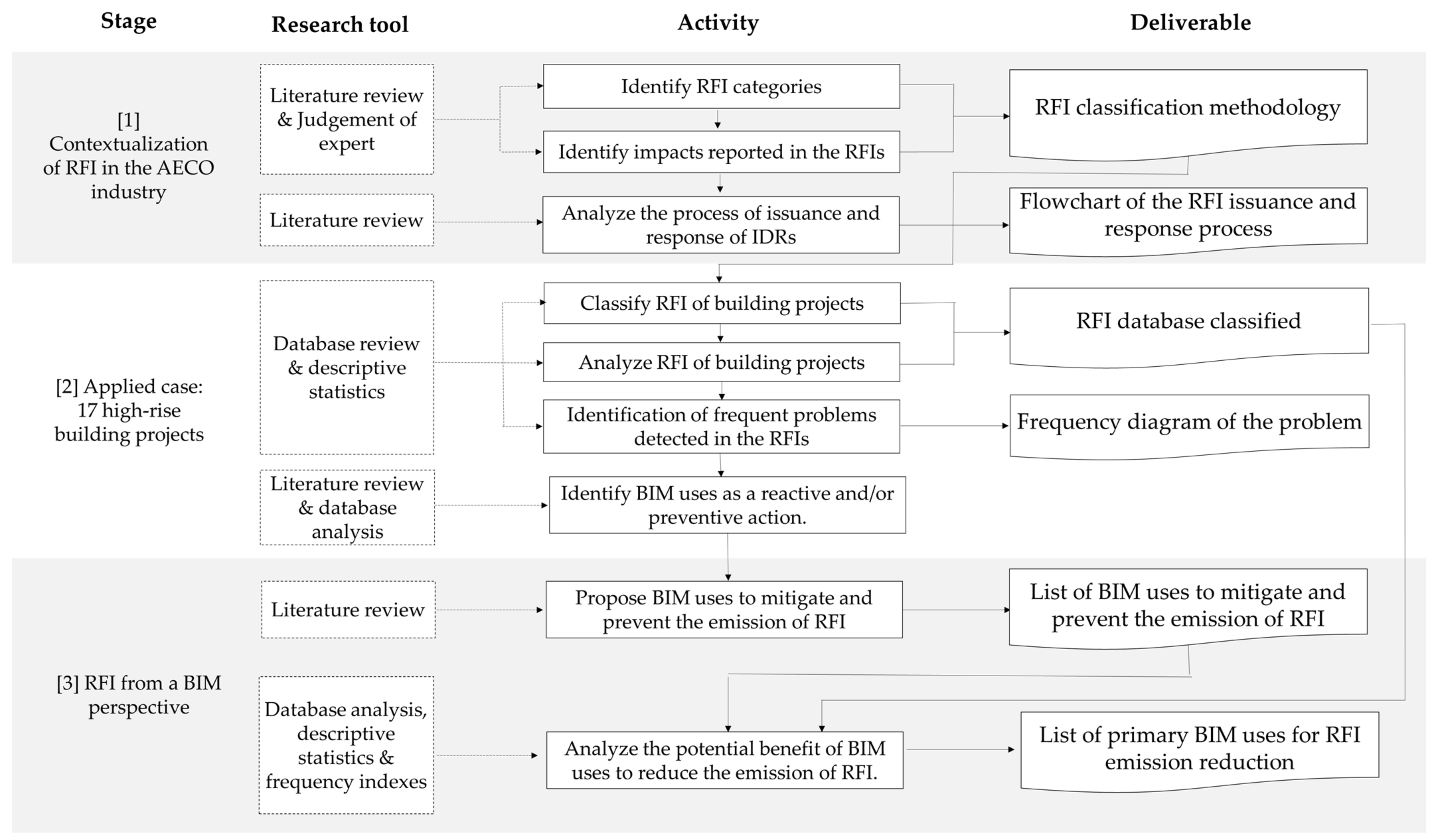
In order to achieve the objectives of this study, a three-stage research methodology was adopted: (1) contextualization of RFIs in the AECO industry, (2) an applied case comprising 17 high-rise building projects, and (3) RFI from a BIM perspective. Figure 1 specifies the research tools, activities, and deliverables and describes the procedure in each stage.
Figure 1. Flowchart—research methodology.

2.1. Stage 1: Contextualization of RFIs in the AECO Industry

A review of the literature was carried out to identify possible categories and impacts of the RFIs, analyzing the issuance processes in-depth up to their response. For this purpose, the categorization outlined by authors P. A. Tilley, A. Wyatt, and S. Mohamed in the document “Indicators of Design and Documentation Deficiency” was adopted as the basis for this research.
This stage mainly defines the information request process from issuance to receipt, with the sender initiating, drafting, sending, and waiting for the receiver to obtain the request, and the receiver then processing, analyzing, and, if necessary, requesting additional information.
A second review of the literature was carried out by using the search platforms ScienceDirect, ResearchGate, Academia.edu, and Scopus to analyze the process of issuing and responding to RFIs. This search gave rise to a standardized model for the classification of RFIs according to four causal types, each based on the reason for their issuance. Through this first step, it was possible to identify the most recurrent problems during construction work and to analyze the deficiencies within the process up to the mitigation or prevention of the problems through adequate management of the information. This was validated through the expert judgment of professionals currently working in the industry.

2.2. Stage 2: RFI Case Applied to 17 Projects

To locate participants for the study, all construction companies participating in the BIM Forum Chile initiative were invited to provide individualized RFIs for two or three projects executed in 2018 and 2019. The study focused on building projects, since most of the construction companies participating in BIM Forum Chile execute this type of project. Ten companies initially agreed to participate in the research, submitting a total of 23 projects, six of which were discarded for not including sufficient information related to RFIs. The RFIs issued in the remaining 17 projects, which focused on high-rise buildings, were analyzed in terms of the following categories: (1) type of construction, (2) square meters built, (3) number of levels, and (4) number of subway levels. The classification was carried out on a project-by-project and RFI basis. Table 1 describes the projects studied.
Table 1. Description of the sample of projects (own elaboration).
As indicated in Table 1, 15 of the projects are housing projects; on average, these have 16 floors, two subway floors, and 17,500 m2 built, and they are located between the Metropolitan and Valparaíso regions in Chile. Regarding the size of the companies, most are classified as large companies, while two are classified as medium-sized companies, with both being in charge of developing housing projects.
In addition, given the need to quantify and evaluate the impact of the RFIs within the different projects, a scale of negative impact on certain project objectives is proposed. Moreover, based on the database of RFIs already classified, we sought to identify the most recurrent problems in projects through descriptive statistics. For this purpose, representative elements were selected through a random sampling that considers specific categories to be different from each other, stratified according to interest characteristics.
The groups are based on the homogeneity of a particular characteristic, in this case, the stratum used in each project; with this approach, representation is ensured in the sample. In this sense, each stratum is independent, and simple random or stratified sampling can be applied within each one, thus selecting specific elements that are part of the sample. For this study, simple random sampling was applied to each of the 17 projects to obtain a problem frequency diagram.

2.3. Stage 3: RFI from a BIM Perspective

A review of the literature was conducted by using the search engines ScienceDirect and ResearchGate by searching for “BIM uses” between 1997 and 2020. We started with an analysis of the 25 BIM uses, and, based on the validation performed by an expert judgment, 14 of the uses investigated were deemed suitable for this research, giving rise to the concept of “primary BIM uses”.
The primary BIM uses were categorized based on the RFI issuer’s position, which could be either preventive or reactive. For this purpose, a list of primary BIM uses was made. Then descriptive statistics were applied to manage and organize the information, and frequency indexes were used to count the quantities handled. It is worth mentioning that the minimum information required to classify the RFIs is a description of the reason for consultation of the RFI issued.

3. Background

3.1. Performance Indicators

The AECO industry has different types of indicators to measure performance, each with characteristics and functions that vary according to the stage of the project. Among the most commonly used are key performance indicators (KPIs), key result indicators (KPOs), and indicators associated with a perception measure (PerM) [10]. Table 2 and Table 3 present indicators for the design phase; they were adapted from Reference [11].
Table 2. Performance indicators in the design phase. Adapted from Reference [11].
Table 3. Performance indicators in the construction and operation phases. Adapted from Reference [11].
According to Table 2, there is a common and frequently used indicator in building projects during the design, construction, and operation stages, namely the request for information (RFI). This indicator is one of the main mechanisms in the construction process involving written communication; it is carried out between the various stakeholders within a project and is an indispensable element because no single stakeholder has all the information, experience, and knowledge necessary to solve the range of problems related to the design and construction of a building [12].
In addition, Table 3 shows the performance indicators for the construction/operation phase, as adapted from Reference [11].

3.2. RFI Issuance Process

The issuance of an RFI is a formal written procedure initiated by the contractor or subcontractor in which errors, queries, or clarifications on issues related to the design, construction, and other contract documents are reported [13]. This process is generally used to formally obtain the clarification of information necessary to allow construction to proceed [14] efficiently and without delay; however, processing these requirements can be time-consuming and costly for the project [15].
While the RFI process is generally inefficient, due to non-value-added delays (latencies) in obtaining the necessary information that sometimes make it impossible to obtain the necessary information from the issuer [14], the RFI remains the most widely used tool within the AECO industry to ensure that project progress is not interrupted. In general, the information-request process can be complex, and the time to resolution is difficult to follow and can vary significantly within the same project [16]. Effective RFI management can help minimize the impact of RFIs on projects [17]. For example, the benchmarking and alert system could help project managers proactively monitor RFIs to reduce their frequency and minimize their impact [13,18].
Importantly, all information requirements have both similarities and differences; for example, they all have the same objective: to seek a solution for or clarification of a certain doubt or discrepancy on site. The differences, by contrast, lie in their nature: the number of people or specialties involved, their impact on the project objectives, or even the urgency of the requirement. Regarding urgency, it can be difficult to determine the duration of the issuance and response process, as the time elapsed from issuance to a proper response may vary considerably from one RFI to another [16].
Information and management are used extensively during the RFI classification process; however, little attention has been paid to quantifying important project objectives, such as schedule and cost compliance, and the direct economics could be improved by improving the aspects that directly involve these objectives. It is anticipated that indirect savings could also be greater, as the effective communication of project information contributes significantly to minimizing workflow disruption. In addition, the process of generating RFI’s is inherently dynamic, so multiple delays are generated in the completion of individual tasks. The time spent on each task depends on the human resources available, the urgency of the task, and the number of elements raised by the RFI, among many other factors [16].
Based on the above discussion, an additional classification of the RFIs generated is necessary, since it is not enough to understand the reasons that they are generated. It is also important to understand their impact on the different project objectives. One way to evaluate these impacts is through risk analysis, either from a qualitative or quantitative point of view. Although risks are different for each project, it is known that risk is an event or uncertain condition that, if it occurs, will have a positive or negative effect (opportunity or threat) on the project’s objectives, such as scope, schedule, cost, and quality [19].

3.3. RFI from a BIM Perspective

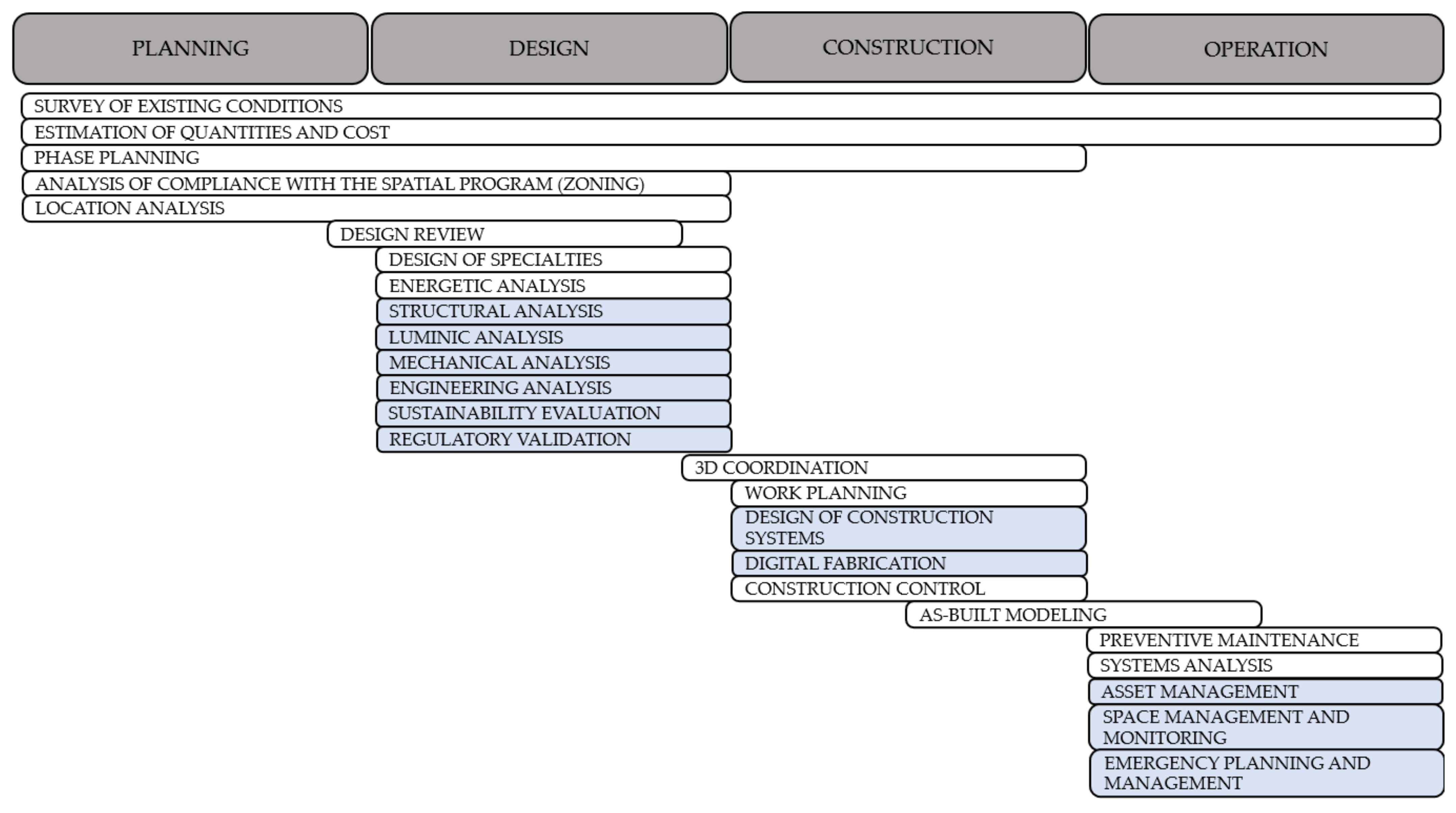
Most of the benefits resulting from BIM come from energy efficiency analysis, installation and maintenance, reduced labor and information requirements, and interference detection [20]. Therefore, the uses of BIM can be applied to the entire project’s life cycle; different applications are found every day and are defined as “methods of applying BIM during the life cycle of a building or infrastructure to achieve one or more specific objectives” [21]. Figure 2 presents the BIM uses by project phase for each life-cycle stage.
Figure 2. BIM uses. Adapted from Reference [21].
The description of scopes, applications, and potential use of the primary BIM uses obtained from the twenty-five BIM uses are presented in Table 4, adapted from Reference [2].
Table 4. BIM primary uses—application phase.
In summary, in any project, performance is evaluated through metrics such as KPIs, KPOs, and perception measures [10]. Usually, these indicators focus on the outcome and typically measure performance metrics associated with the achievement of budget, schedule, scope, and quality of the project [19]. However, several metrics focus on evaluating the different processes of the project that, in the end, will be causal variables of the outcome metrics Several studies have proposed the use and analysis of RFIs to understand the various problems generated during the life cycle of a construction project [11,13,18] Complementarily, the implementation of BIM in the construction industry is no longer a wish, but a reality. While several studies have demonstrated the benefits of using BIM in construction projects, it is complex to evaluate the impact of BIM on the outcome metrics of a project [22,23,24,25,26]. Therefore, it is important to evaluate the potential application of BIM to the RFIs of building projects, as these allow for an understanding of the problems generated during the projects’ life cycles, including information clarifications and identification of conflicts, among others.

4. Results and Discussion

4.1. RFI Classification Methodology

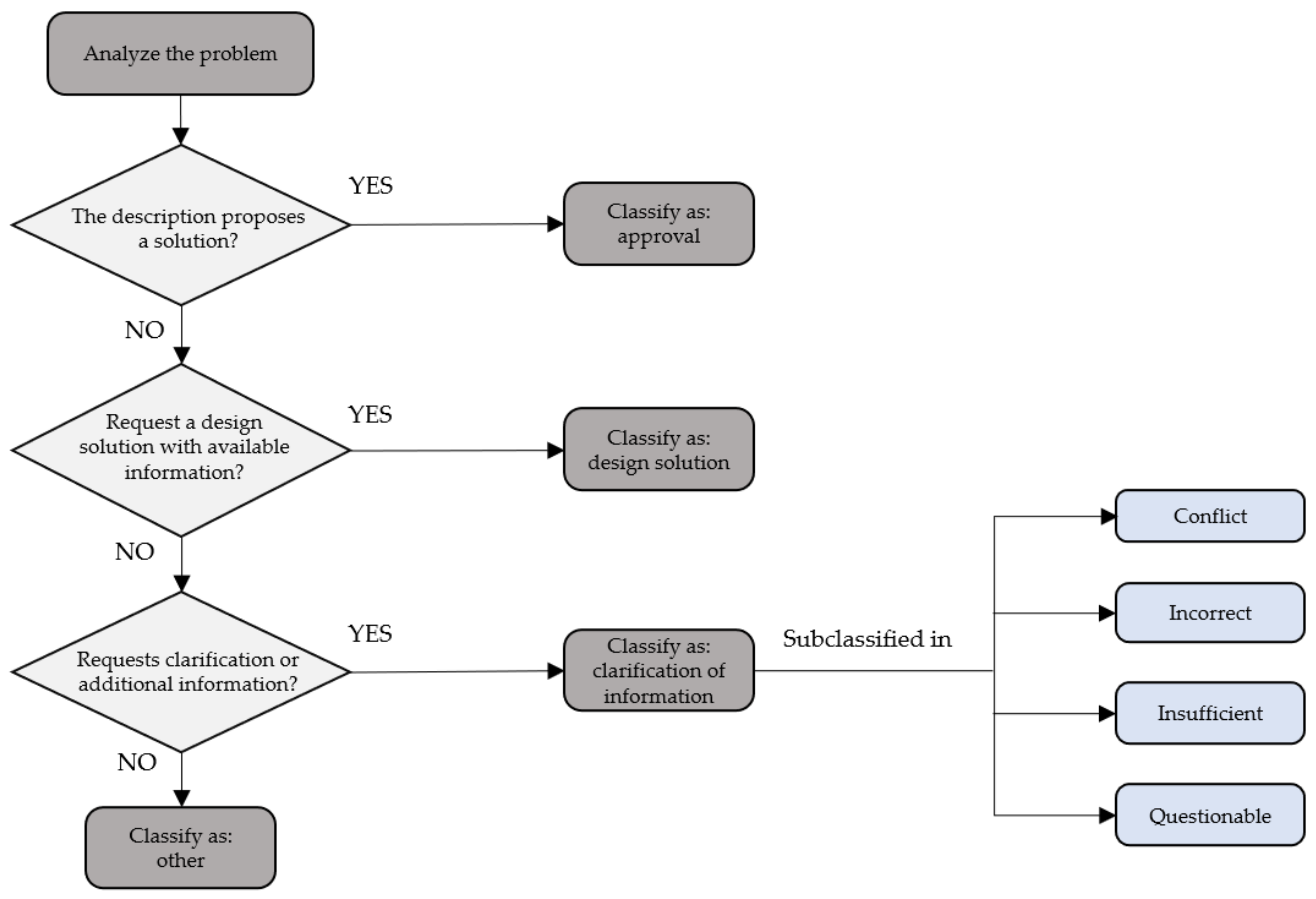
A classification system for RFIs is proposed according to the type of conflict the RFI seeks to resolve. Table 5 describes the four types of RFIs: (1) alternative design solutions, (2) approvals, (3) clarifications of information, and (4) others.
Table 5. Classification by type of RFI. Adapted from Reference [14].
Based on the classification described above, a subclassification is made based on the “information clarification” RFI type, since this category represents the most common cause for issuing an RFI, as well as the longest response time (Table 6) [32].
Table 6. Subclassification by cause of the information clarifications RFI type. Adapted from Reference [14].
Figure 3 presents the flow that the data analysis methodology should follow based on Table 5 and Table 6 (optional, only if required) to illustrate how the classification process is developed and to introduce the different questions that should be asked to carry out the analysis and subsequent classification of the different RFIs. This initial categorization should be carried out by the person issuing the RFI, since this person knows exactly why the query is being made.
Figure 3. RFI analysis flowchart—methodology (authors’ own elaboration).
By way of example, Table 7 presents situations with their respective RFI classifications and causes according to the content of the query.
Table 7. Example situations.
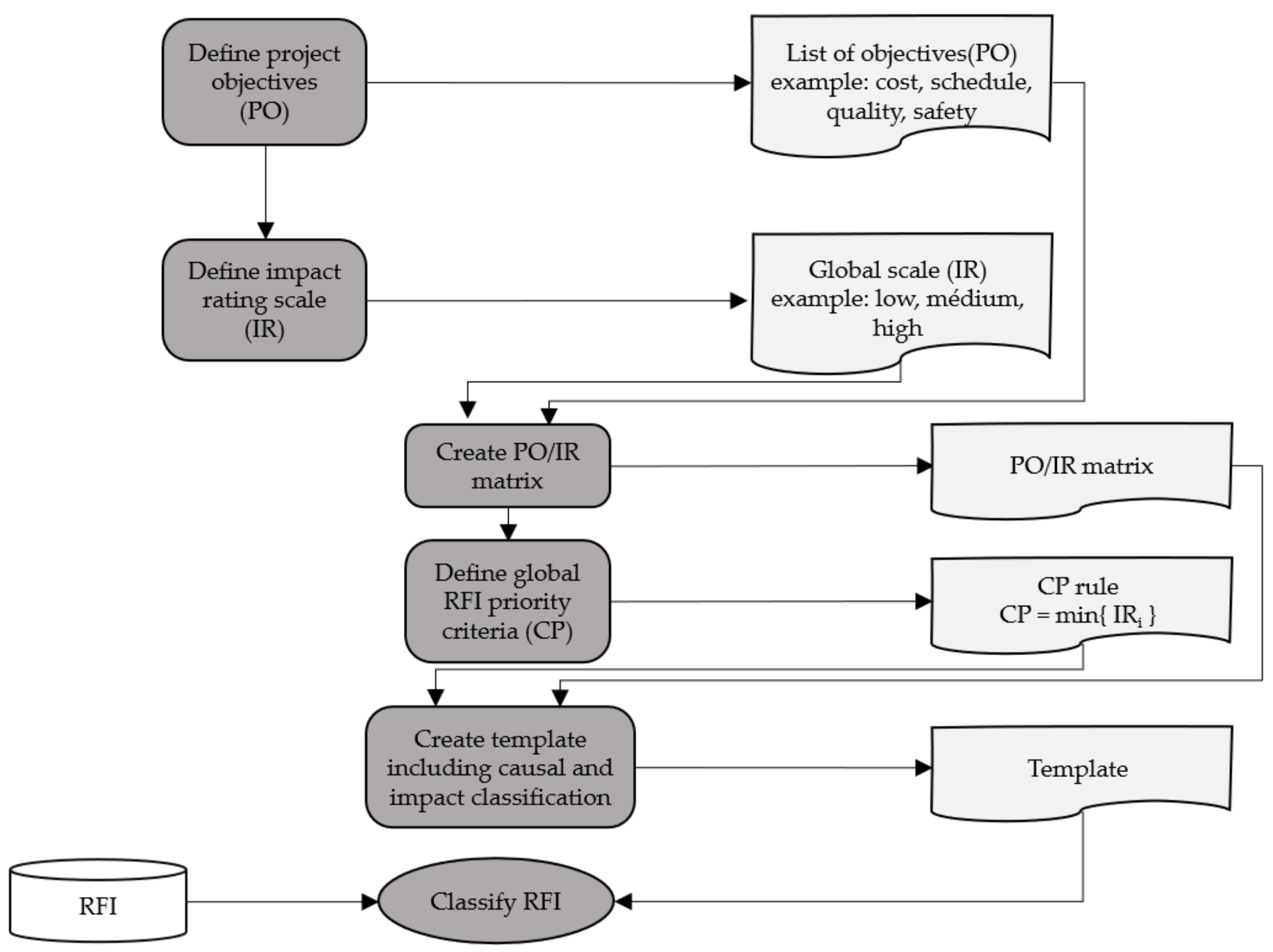
To assess the impact of an RFI within a project, the most important objectives that constrain the project (PO) must first be clearly defined. These objectives are generally the components of the triple constraint: cost, schedule, and scope [33]. Table 8 defines the conditions for the main project objectives on a scale of the negative impact of an RFI.
Table 8. Conditions defined for the scales of negative impact of a risk on the main project objectives.
Next, the impact classification (CI) scale is defined. It is broken down into different levels, which are directly related to the degree of detail required for the project’s risk-management process. For a more detailed approach to risk, the scale usually includes five levels, and for simple processes, there are usually three.
With this scale, it is possible to create an impact matrix showing the impact of the different RFIs on the defined project objectives (PO–CI), as shown in Table 8, in order to evaluate the project’s health status and thus define the global priority criteria (CP) of the RFI defined by some rule, or by the use of a survey type tool, which uses several criteria to assess the project’s health status comprehensively. Some of the criteria of interest are team satisfaction, schedule deviation, compliance with acceptance criteria, problem documentation, and budget deviation.
The research uses the criterion CP = min {CIi}. Once the matrix (OP–CI) and the CP rule are defined, a template is prepared that includes the causal classification and the classification of the impact on the project’s objectives in order to classify the compilation of RFIs of the different projects.
Then a second classification of the potential impacts of each of the RFIs on the project is made according to the methodology shown in Figure 4 and Table 8, which provide examples of the impact on certain project objectives. This second and final step should be carried out only by the RFI recipient, since this is the person who knows how much impact the information presented in the consultation will have and whether there is a way to mitigate it.
Figure 4. Methodology flowchart for project impact classification.

4.2. RFI Issuance and Response Process

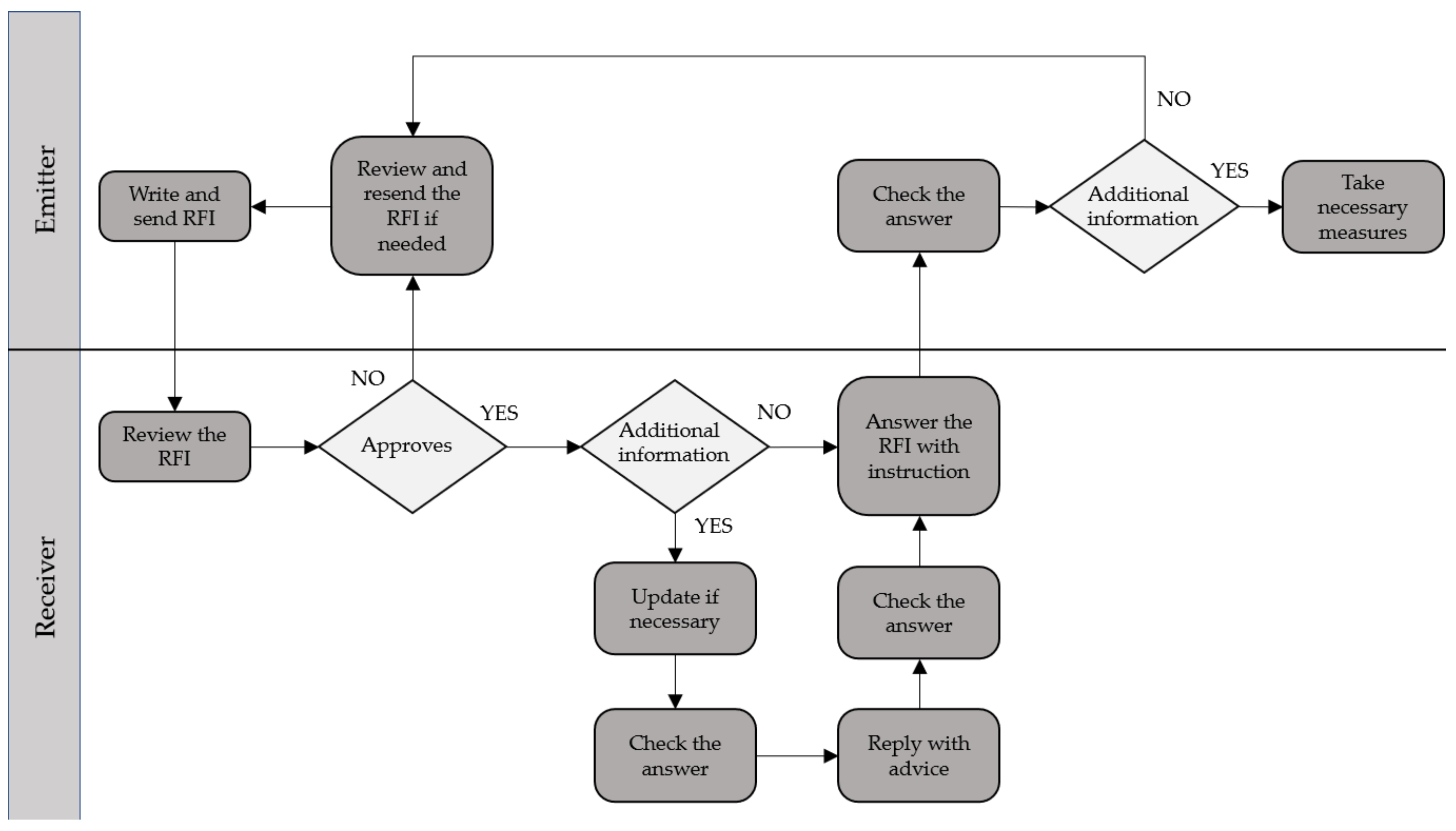
The flow generated by the issuance of an RFI is generally as follows: the sender drafts and sends the query to a project member in charge of providing instructions on the issue being queried, and then the receiver reviews the RFI and, if necessary, requests additional information from the requester before providing a response or instructions. However, the receiver may initiate a separate communication sub-stream to gather comments and, at the same time, request additional information from other members of the project team, depending on the discipline to which the request for information relates. Thus, a request for information may involve many project team members and may take time to resolve, and this, in turn, may be detrimental to project objectives.
When a response to an RFI is not satisfactory—that is, the response still contains insufficient information or only responds to part of the request, or it results in a different or expanded request—the sender or requester may issue another RFI to obtain the missing information. For example, when the recipient of the RFI requests additional information from the sender, according to the classification methodology, this RFI would be of the “clarification of information” type, and its cause would be “insufficient”. On the other hand, when the response to the request is not satisfactory, the RFI is considered an “alternative design request”, because, based on the available information, a different option to the one proposed in the response is requested. The last category is “approval”, where immediately after the receiver reviews the request, he or she is in a position to accept or reject the change proposed in the RFI. Figure 5 shows the above-described process as a flow diagram.
Figure 5. Flowchart of the RFI issuance and response process.

4.3. Analysis of RFIs Associated with Building Projects

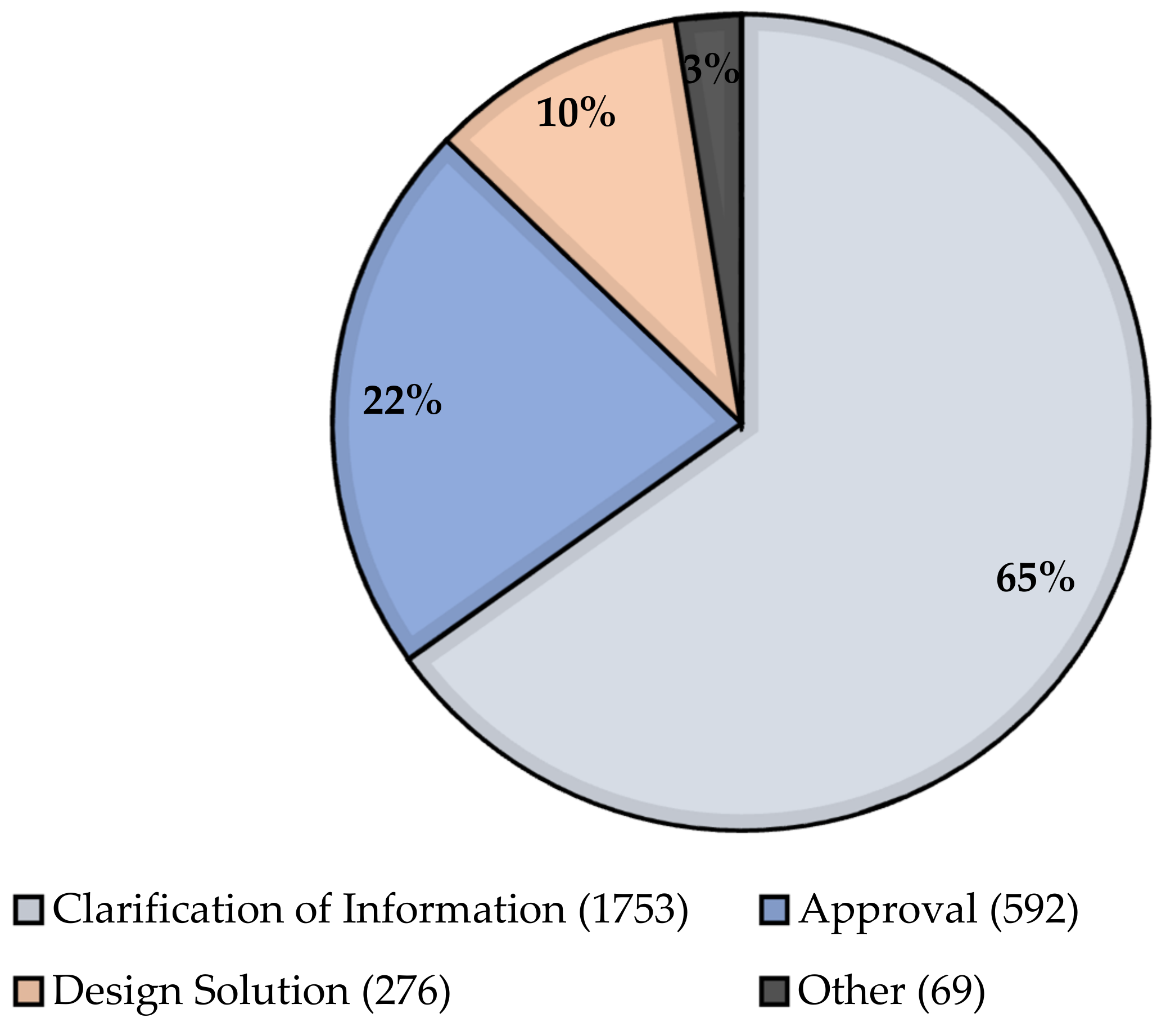
The 17 projects studied included a total of 2690 RFIs issued, with a simple average of 158 RFIs per project. When classifying the RFIs according to the proposed system, the most recurrent type of RFI issued is “clarification of information”, reaching a total of 1753 cases, followed by “approval” with 572 and “alternative design solution” with 276, and, in last place, “other”. Figure 6 shows the percentages associated with each type of RFI mentioned above.
Figure 6. RFI-type distribution based on a sample of 17 projects.
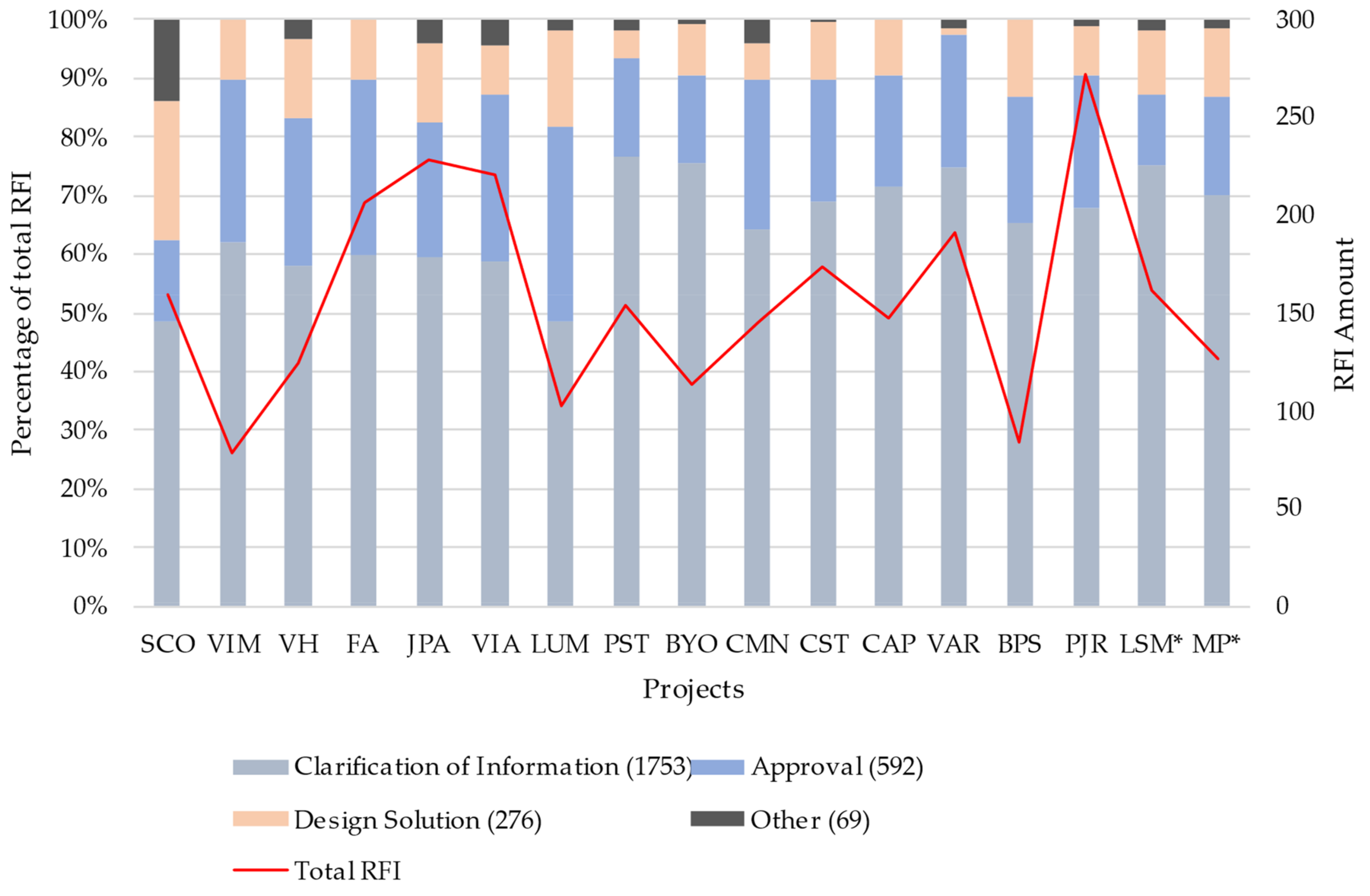
In addition, Figure 7 shows the distribution of the RFIs among the 17 projects and their proposed classification.
Figure 7. Percentage chart by type of RFI.
It is important to mention that the projects with an asterisk (*) after their acronyms, namely LSM and MP, claim to have used BIM, but no information is available regarding how it was applied. Moreover, when analyzing the RFIs issued by these projects, no great difference can be observed in the number issued; indeed, they are within the average. In addition, no information is provided regarding the level of BIM used, so different scenarios can be inferred, for example, that the methodology has been used only by some specialties; that it has not been applied to the project from start to finish, but rather only at a particular stage; or that the methodology in question has been used incorrectly. All the projects are analyzed under the assumption that the BIM level used is basic, incipient, or almost null.
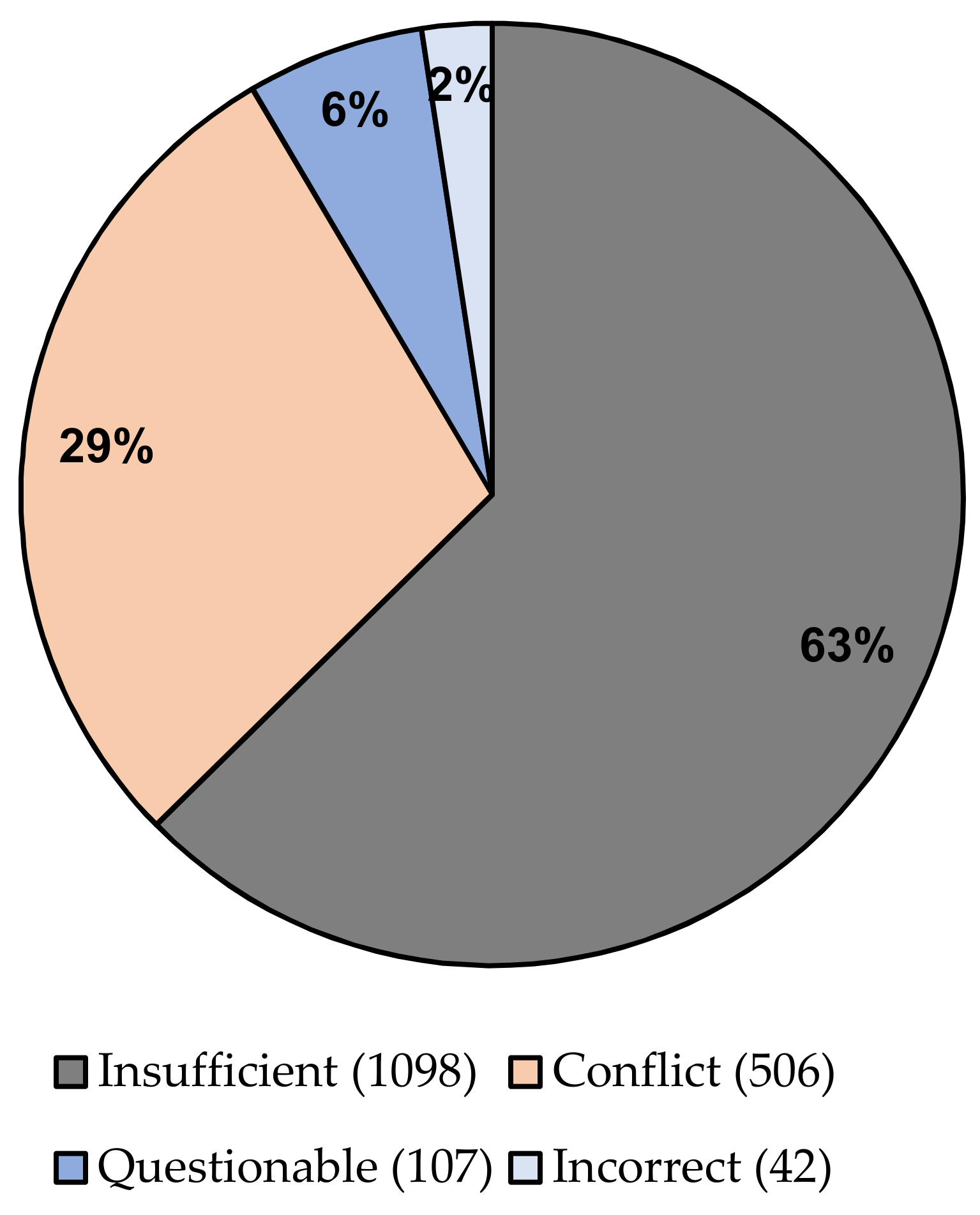
On the other hand, when classifying RFIs of the information clarification type, the cause with the highest percentage is “insufficient”, with a total of 1098 issued, followed by “conflict” at 506, “questionable information” at 107, and finally “incorrect” with 42 RFIs issued. This is illustrated in Figure 8, which shows the percentages associated with all the RFI causes previously classified as “clarification of information”.
Figure 8. Percentage graph by cause of RFI of the information clarification type.
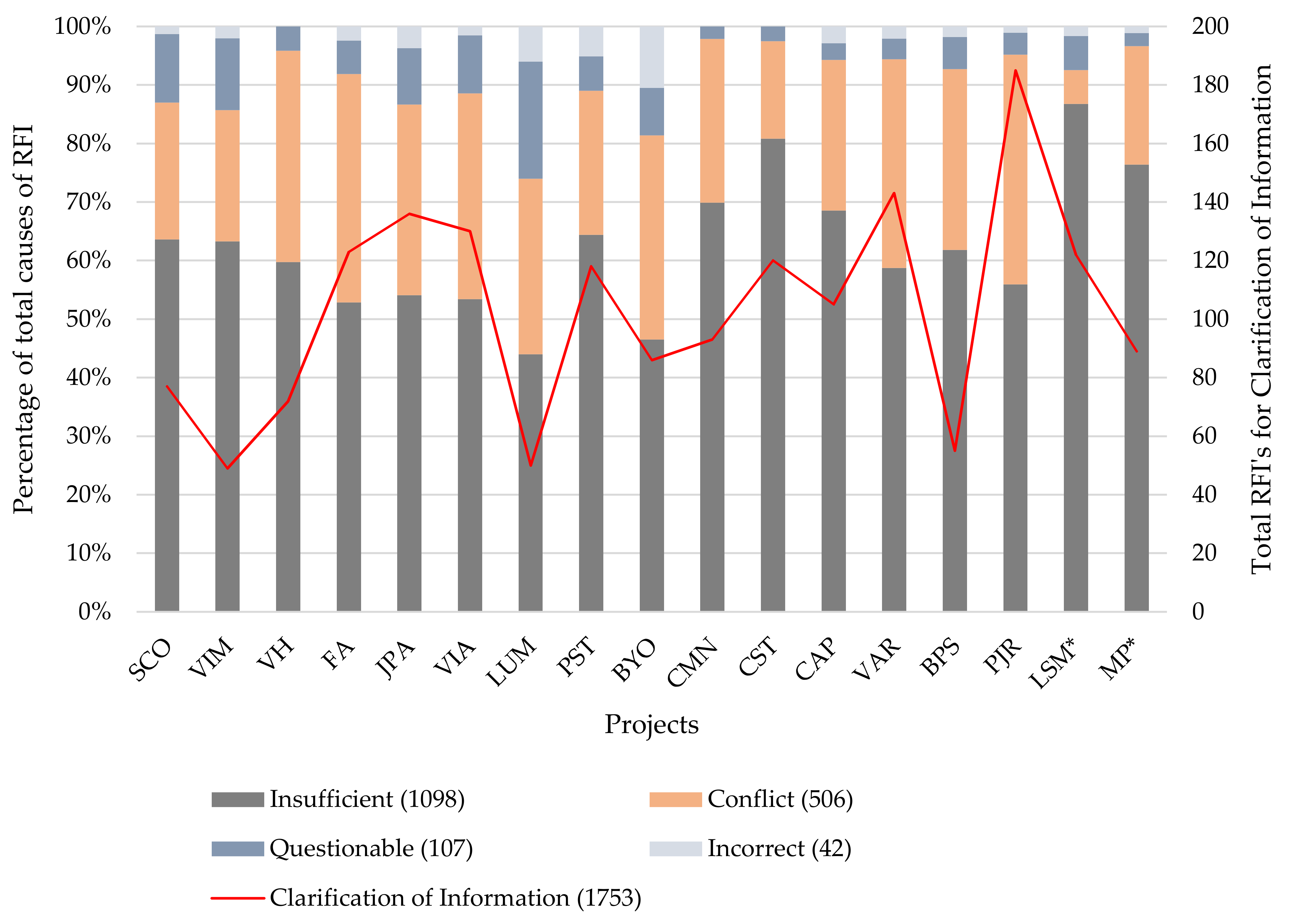
Figure 9 complements the preceding graph and provides information on those RFIs issued and classified as “clarification of information” for each of the 17 projects; the predominant cause is “insufficient information”.
Figure 9. Percentage by cause of information clarification-type RFIs.
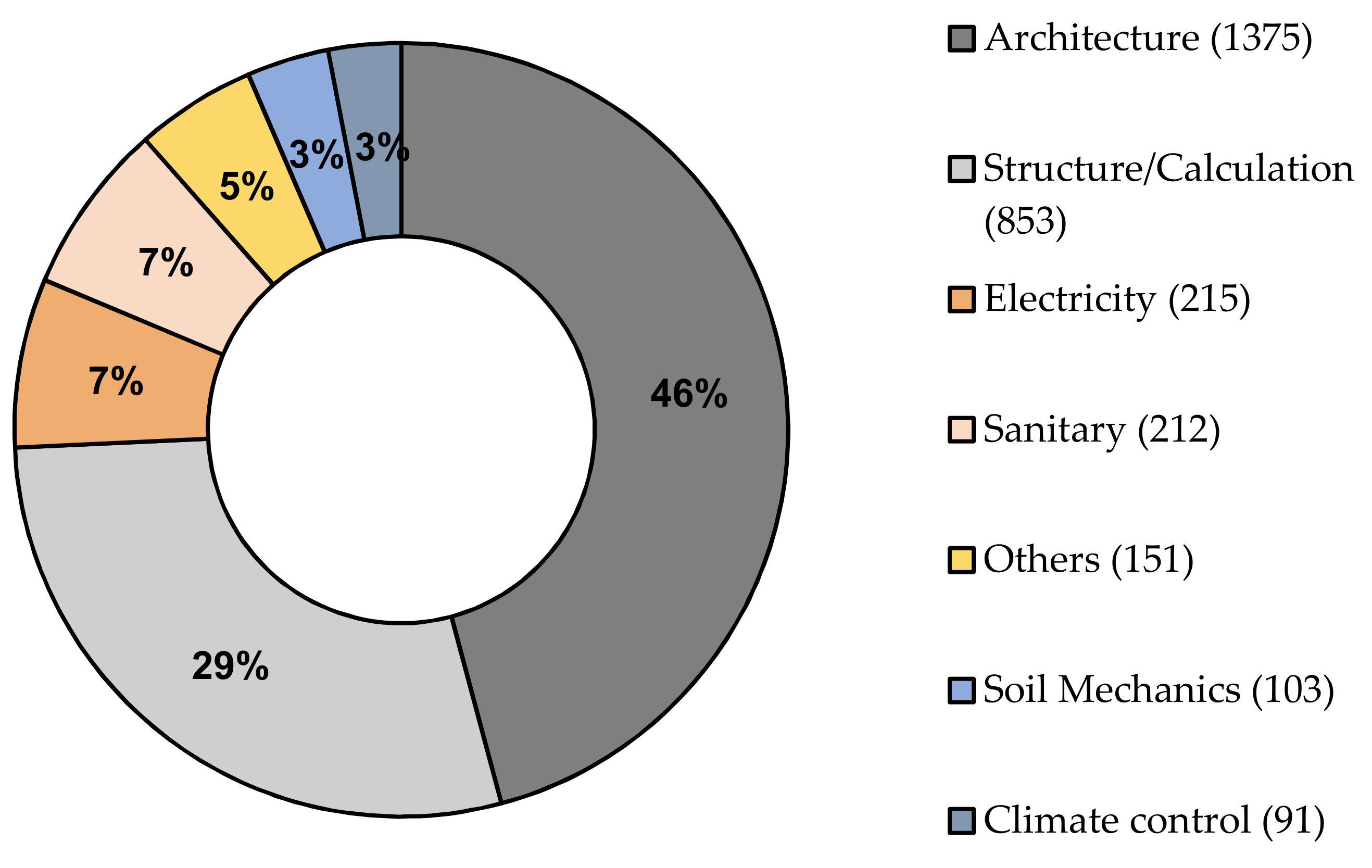
Regarding the information associated with the specialties involved, it is important to note that some RFIs are directed to more than one specialty; for example, two, three, or more specialties may be involved in a conflict, resulting in the issuance of RFIs by the company in charge. Thus, Figure 10 identifies the number of RFIs issued by specialty; in decreasing order, these are architecture, structure/calculation, electricity, sanitary, soil mechanics, and air-conditioning.
Figure 10. Graph of the number of RFIs by specialty.
In addition, to analyze the recurrent reasons for the issuance of RFIs, a selection of representative elements was made through random sampling. The benefit of using stratified random sampling is that it tends to reduce the sampling error for a given sample size; in addition, proportional allocation is used to follow the weight or size of the sample in each stratum. In this case, all the projects studied had a different number of RFIs, so the distribution was determined according to those numbers.
To do this, through simple random sampling with 95% confidence and a 5% margin of error, a sample of 337 RFIs was obtained to be analyzed. Using the quotient between the sample and the total number of RFIs, we obtained a factor of approximately 0.126. This factor was then multiplied by the total number of RFIs for each project, so that the sample was representative for each of the projects studied.
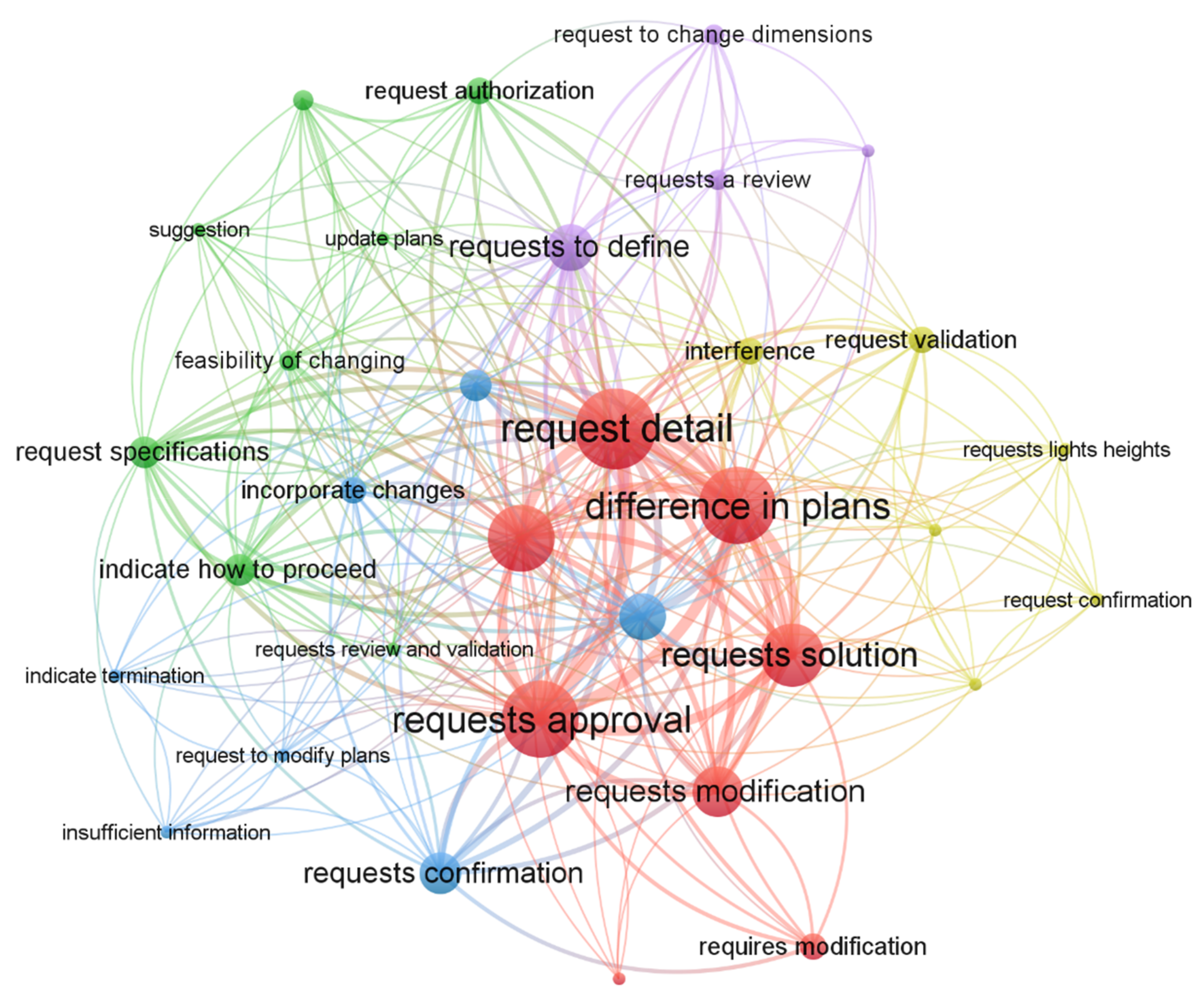
Figure 11 shows the co-occurrence diagram represented by nodes and edges, containing information on the most recurrent problems mentioned in the RFIs of the 17 projects. The nodes describe the problem or reason for issuing the information request, and the size of the node indicates the frequency or number of times the situation is repeated; therefore, the problems displayed in the largest nodes represent the most frequent problems. By contrast, the problems displayed in smaller and more distant nodes are those that are mentioned less frequently in the sample.
Figure 11. Diagram of co-occurrence of problems.
In Figure 11, it is evident that mainly details are requested; in other words, there is insufficient information in the design documentation. Among the details mentioned are lack of dimensions, no indication of materials, no specified location of particular elements, no specified densities, no indication of elevations, and lack of specifications. Secondly, there are requests for validation or approval. Solutions or modifications are often proposed in the construction phase, and the requester is awaiting authorization to make the change. It is important to note that there are many repeated items; for example, within a node labeled validation or approval, there may also be problems associated with execution permits, suggestions, or confirmations. However, the overall problem is the same.

4.4. Reactive or Preventive BIM Uses

When planning projects correctly, one of the most important steps is to define the overall objectives, which can be based on project performance, for example, and include elements such as reducing the duration of the schedule, achieving greater productivity in the field, increasing quality, or reducing the cost of change orders [33]. These objectives are especially important because, once they are defined, both from the project and team points of view, it is possible to determine the specific uses of BIM in the project. Each use must be associated with one or more processes within the project’s life cycle.
In the analysis of the different project RFIs mentioned above, the main BIM uses were identified and then classified into preventive uses (associated with the design stage) and reactive uses (associated with the construction stage) according to their application. Table 9 shows these classifications for this research, which only considered the uses up to the construction phase.
Table 9. Classification of BIM uses (in the planning, design, and construction stages) as preventive or reactive approaches.
The survey of existing conditions BIM use is classified as preventive because it is carried out in the early stages, such as the planning and design phases. According to Penn State College of Engineering, this practice aids in future modeling and 3D coordination. On the other hand, it is classified as reactive in that it can be used for both pre- and post-disaster planning and documentation [33].
The estimation of quantities and costs use is also classified as preventive, since it is present in the initial phase and is a critical activity for any construction project [34]. Moreover, it is much more beneficial when used in the design stages, as it allows estimators to focus on higher value-added activities in estimating, such as identification of construction assemblies, price generation, and risk factoring, which are essential for high-quality estimating [33].
Phase planning, or 4D modeling, is classified as a preventive use, due to its multiple benefits in the planning stage of a construction project, according to Mohamad Kassem, Trevor Brogden, and Nashwan Dawood, such as improving safety, efficiency in communication [35], management of construction process activities [36], and uncertainty in the planning process [37]. In addition, it is claimed that it can also be used to test proposed construction activities in a virtual environment, which can enable accurate site safety planning by providing a platform to identify potential hazards and modalities to test potential solutions to mitigate risks in the pre-construction stage.
Spatial program compliance analysis is classified as a purely preventative use because it efficiently and accurately assesses design performance relative to spatial requirements. No information is available to indicate that it can be used reactively; however, this possibility cannot be ruled out.
Location analysis is classified as a preventive use due to its application to the pre-construction stage, such as the planning and design phases. In these initial phases, the amount of detailed data needed, especially information for existing data modeling and site analysis, must be sufficient to ensure that there are no significant risks. All information for the entire project must be collected before work can begin on any particular element, such as design. Therefore, it is important to understand the site analysis to better understand the decisions made and diagnose the area’s real situation [38].
In their Project Execution Planning Guide, Penn State defines the BIM use of specialty design as “a process in which 3D software is used to develop a building information model based on criteria that are important to the translation of the building design”; thus, it is defined as both a preventive and reactive use. Preventively, it is used when evaluating the effectiveness of the design in meeting building program criteria and project needs; in parallel, it acts reactively when used to improve the health, safety, and welfare of the project and to deliver instant feedback on compliance with program requirements, needs, and aesthetics of the building or space [21]. Design review is a reactive use because it finds design errors in modeled objects and makes corrections [39].
Engineering analysis merges structural, light, mechanical, and other engineering analyses [40]. The Computer Integrated Construction Research Group defines BIM engineering analysis as a process for determining the most effective engineering method by using intelligent tools, design specifications, and information from construction models [33], and this can be interpreted as a preventive use in the planning and design phase. It is also used in a reactive way to generate models that help eliminate design errors and shorten the time needed for any modifications [41].
Three-dimensional coordination is defined as an iterative process aimed at comparing different 3D models in order to reduce problems and conflicts. Research has shown the benefits of 3D coordination, whose main objective is to eliminate conflicts prior to the construction or installation of projects, making it a preventive use [42]. It is also used to check and detect problems, implying that it can also be classified as reactive.
Site planning is a preventive use because of its efficiency in generating site-use layouts for temporary facilities, assembly areas, and material deliveries for all construction phases, and in identifying potential critical space and time conflicts. On the other hand, it is a reactive use in that it can easily update site organization and space usage as construction progresses [33].
Work control is classified as a preventive use because this process uses an information model to design facility assemblies or to automate the control of equipment movement and location. The information model is used to create detailed control points to aid in the layout of assemblies. Its potential value is to decrease design errors by linking the model to real-world coordinates, to increase efficiency and productivity by decreasing the time spent on field surveying, and to reduce rework because control points are received directly from the model [33].
As-built modeling delivers a model with each project property placed in a centralized database, and this can help the facilities department find information more easily. The model can also include links to submittals, operations and maintenance, and warranty information that can help maintain the building throughout its life cycle and be used to generate cost and schedule impacts for maintenance and renovation projects. In general, an as-built model can optimize the management of facilities, especially their maintenance. An accurate model containing the project’s scope and the facility requirements can help the owner immensely in managing and maintaining the building [43]. Given the above, as-built modeling is classified as a purely reactive use.

4.5. Analysis of the Potential Benefit of BIM Uses for the Mitigation of RFI

Based on the previous section, most of the primary BIM uses can be applied preventively to problems, except for “as-built modeling”, which is considered a reactive use, due to the phase in which it is located and the information it delivers from the model for the maintenance of completed buildings.
The three most frequent uses which reduce the number of RFIs issued are, in decreasing order, specialty design, 3D coordination, and engineering analysis. Table 10 classifies the 2690 RFIs issued in the 17 projects analyzed by BIM use, thus providing a visualization of the number of RFIs of each type that could have been prevented by each BIM use. For example, 3D coordination could have prevented 49 RFIs associated with an alternative design solution, 385 RFIs associated with information clarification, and another four RFIs without prior classification.
Table 10. Number of times BIM is applied preemptively to resolve such an RFI.
The difference between preventive uses and reactive uses is that the latter can be applied to all RFIs; that is, any type of query can be solved. However, not all RFIs can be prevented; for example, certain situations might make it impossible to act before the problem occurs. Table 11 presents those RFIs that allow reactive use, namely design review, engineering analysis, and specialty design.
Table 11. Number of times BIM is applied reactively to solve that type of RFI.
Early collaboration is crucial if the final design is to be free of unforeseen events. Through BIM and 3D coordination, a project’s complications can be greatly diminished. The practice of collision detection has progressively moved from an on-site (reactive) activity to a pre-construction (proactive) design-phase activity. The need for precision in today’s marketplace makes collision detection a powerful tool in design coordination; this has even led researchers to quantify the economic benefits of collision detection, thus encouraging the development of better coordination among industry professionals. Along with the above, various studies indicate that isolated work was the main cause of the high incidence of collisions related to BIM systems, so proper coordination leads to a considerable reduction in RFIs issued for information clarification.
The benefits of using 3D coordination in a preventive way include an evident reduction in the number of RFIs issued; a decrease in coordination time between MEP specialties; and a decrease in the time spent waiting for information, a problem which pushes back deadlines and leads to project cost overruns. At the same time, it is also clear that it is not beneficial to use only some BIM applications preventively. Rather, all the applications must be used preventively, so as to avoid high costs and schedule outputs within the project. Applying BIM applications correctly also helps to visualize the different expectations and needs of a project in a fully collaborative way before carrying out the construction. Continuing the analysis, certain types of RFIs can be solved in a preventive manner; if the BIM use that prevents an RFI is applied correctly, the RFI does not need to be issued. By contrast, some types of RFIs are more difficult to foresee, but applying certain BIM uses can solve the issue more efficiently.
Specialty design goes hand in hand with 3D coordination, so it is of vital importance to identify the workflows within the design and coordination process in order to determine the stages in which the joint work of the different specialists should be developed and to obtain better results. Ideally, the specialty design process should be completely standardized by using the BIM methodology and coordination. In addition, the correct application of the BIM to design review would help to improve spatial and architectural decision-making, leading to a better project result through a decrease in the number of RFIs issued for alternative design solutions, clarification of information, and even approval, since many times this last type of RFI is issued for reasons such as “the execution cannot be carried out as planned”. However, another alternative, which requires approval, involves using the design review in order to approve or deny such a request for the development of the project.
The complexity of a project can affect the time taken for the issuance of and response to the RFI. For example, a larger project, such as an airport, highway, or even a shopping mall, has a much larger infrastructure than other projects. A large project’s organization can also be more complex, thus leading to longer-than-average response times. Increased complexity can also be seen as a positive factor, because, although the response time could be longer, the effectiveness and management of that response could be greater due to the involvement of large specialized teams, whose responses to requirements would be better developed in order not to delay the project.
Finally, as a general analysis of the number of RFIs issued, it can be seen that, in this study, the projects with the highest number of RFIs are not necessarily the largest projects with the largest built areas; thus, it follows that the size of the project does not necessarily influence the number of RFIs issued. However, other studies have indicated that the size of a project can be a driver of RFIs. On the other hand, the impact generated by the RFIs clearly depends on the project size, since the impact an RFI has on the objectives becomes less direct the larger the size of the project is.

5. Discussion

The productivity problems of the construction industry are well-known. Generally, this conclusion is reached by analyzing the macro indicators of the sector that are associated with budget, schedule, scope, and quality, among others [11,18]. Although these indicators are conclusive, they are not sufficient to understand the problems in the projects that have triggered a delay in the schedule or a deviation from the scope, for example [23,24,25].
In this sense, the FRIs contain a great deal of information that can be useful for these purposes. They reflect problems regarding requests for information to resolve inaccuracies, conflicts, repair errors, and others. Thus, evaluating the application of BIM in RFIs means incorporating a recognized methodology with wide-ranging benefits to understand and improve a process that contains and manages the problems of a project. The potential is great, in the sense that the benefits of BIM uses (whose advantages are recognized by the industry) are focused directly on the detail of the day-to-day issues of a project (problems that may arise even after the application of general BIM to the project in the design or construction planning stages).
Of the 17 projects studied and by classifying the RFIs according to the system proposed in this research, we see that the most recurrent type of RFI is “clarification of information” (65%), followed by “approval” (22%), then by “alternative design solution” (10%), and finally by “other” (3%). This trend is in line with typical general construction problems, where information exchanges are generally used to clarify project details that have not been correctly considered in the designs or for incomplete technical specifications [44,45,46,47]. The other items also come from information exchanges aimed at approving decisions for changes made during the construction process that were not foreseen in the planning or design stages or for changes in the project.
From the point of view of the specialties that interact, the massive presence of architecture is aligned with the architect’s role in the projects. He is generally the one who coordinates the project and is in charge of the members’ interactions. The structural engineer follows this and, to a lesser extent, follows the rest of the specialties. This distribution is also logical from the percentage of each specialty’s project in charge of.
However, when studying the incorporation of BIM uses in the management of RFIs, two types of uses have been classified (Table 9): preventive BIM uses (design stage) and reactive BIM uses (construction stage). Thus, according to the types of problems identified in the RFIs, the BIM will serve to anticipate these problems (preventive) and avoid their occurrence (or reduce the problem) or may help to react in a better way in the construction stage (when the problem could not be avoided).
Although the benefits of applying BIM to the design and construction processes have been widely studied from its potential [22,23,24,25,26], there is not as much background information on the real effect on each of the project’s problems. Therefore, analyzing the impact of BIM on each of these problems means analyzing the detail of a construction project and delving into the day-to-day problems of the construction site. It does not aim only to improve productivity in general or to avoid rework (available problem items), but rather to study the impact of each project’s pain (problem). In this way, BIM applications can be more precise and improve the project’s processes and real and specific problems.

6. Conclusions

RFIs symbolize representative and formal errors during the construction stage, so we must aim to reduce their impact and costs to obtain results that meet projects’ expected productivity levels. The definition of the most important and, at the same time, limiting objectives of a project in its early stages can help to foresee the impact of the RFIs generated in the project.
The above analysis affirms that relating the BIM uses to the RFIs issued contributes to a lower number of errors; however, their correct application must be determined. The proposed checklist associated with BIM uses allows for an accurate review of the construction information, and, in this way, the information is clearly organized regarding response requirements, the importance of the responsibilities associated with the required speed of a solution, and the impacts it would have on the baseline of the project. This process can be improved by the use of technologies that allow for a faster and more efficient review process.
Based on the classification methodology presented and the analysis performed, it is possible to make a projection to identify where to focus a project’s resources and to maintain control over the most critical items. Additionally, the proposed classification of BIM uses according to their preventive or reactive character allows for recordkeeping at the appropriate time, thereby managing the project’s most influential risks. Moreover, this also makes it possible to increase the probability and impact of positive events and therefore decrease the probability and impact of negative events to optimize the project’s chance of success through the impact assessment of the different RFIs issued. In summary, protecting the project and its objectives from negative impacts through a reactive and preventive approach with the support of different tools allows for mitigating uncertainty and turning threats into opportunities.
This paper presents a challenge for the AECO industry, and it describes how the treatment of RFIs is transformed into a cycle of continuous improvement and permanent learning. Achieving such a virtuous circle will require implementing project policies (such as those promoted by quality management systems, for instance) that seek to correct errors as they appear and to avoid repeating them through corrective actions and non-conformities, for example. This knowledge and learning must be shared among project stakeholders so that the improvement is systemic and not limited to a single actor.
Future studies should create a more complex classification system, which identifies the causes and possible causes of RFI submissions by using a greater breakdown of the classification already carried out, aimed at decreasing the cumulative impact that may affect productivity. However, reducing the number of RFIs, as well as response time, is complex, since it is not a standard process and depends on each company, the type of project (public or private), the nature of the project (building, mining, industrial, etc.), and other factors, significantly influencing the project’s management. For this reason, the correct classification of the diverse requirements allows for the identification of the most recurrent specialties and causes related to RFIs. In this research, the specialties of architecture and structure were identified as the most critical due to the number of requests they issued for lack of information or contradicting information.
Among the limitations of this study, regarding the impact on the key objectives, it is not possible to perform a more complete analysis of what can be generated by the RFIs, since the various projects provided different types of information. For example, only some of the projects indicate the impact in terms of cost or time (and this is indicated in binary form); in others, these factors are quantified, but not for the entire sample, so it is not possible to go deeper into the impact caused. Although a table with various ranges is proposed as an example, this is not standard; rather, it is subject to variations from one project to another, either in terms of deadlines, size, costs, or the scale to be used, which depend on these objectives.
For future lines of research, it is proposed to address issues related to the impact generated through comparisons between two or more similar projects, taking as a premise their main differences, but looking for their similarities, highlighting their common weaknesses or occurrence of errors, and allowing for the generation of continuous improvement processes through the BIM methodology and BIM uses associated with RFIs in a preventive or reactive way.

Author Contributions

Conceptualization, R.F.H., M.N. and F.M.; methodology, R.F.H. and F.M.; software, F.M.; validation, F.M.-L.R. and E.A.; formal analysis, F.M.; writing—original draft preparation, F.M.; writing—review and editing, R.F.H., E.A. and F.M.-L.R.; visualization, F.M., M.N. and F.M.-L.R.; supervision, M.N., E.A., R.F.H. and F.M.-L.R. All authors have read and agreed to the published version of the manuscript.

Funding

The APC was paid by Pontificia Universidad Católica de Valparaíso. This research was funded by CONICYT grant number CONICYT-PCHA/InternationalDoctorate/2019-72200306 for funding the graduate research of Muñoz-La Rivera.

Institutional Review Board Statement

Not applicable.

Data Availability Statement

Not applicable.

Acknowledgments

The authors wish to thank the TIMS space (Technology, Innovation, Management, and Innovation) of the School of Civil Engineering of the Pontificia Universidad Católica de Valparaíso (Chile), where part of the research was carried out. Also, we thank to BIMForum Chile and the company who participated in this research and share the data of their projects.

Conflicts of Interest

The authors declare no conflict of interest.

References

  1. Saldías, R. Estimación de los Beneficios de Realizar una Coordinación Digital de Proyectos con Tecnologías BIM; Universidad de Chile: Santiago, Chile, 2010. [Google Scholar]
  2. PlanBIM. Estándar BIM para Proyectos Públicos; Planbim Corfo: Santiago, Chile, 2019. [Google Scholar]
  3. Monteiro, A.; Poças Martins, J. BIM Modeling for Contractors—Improving; CIV W078: Beirut, Lebanon, 2012; pp. 17–19. [Google Scholar]
  4. BIMnD. Mediciones y Presupuestos del Edificio Virtual Desarrollado en BIM; BIMnD: Granada, Spain, 2018. [Google Scholar]
  5. Sawhney, A.; Riley, M.; Irizarry, J. Construction 4.0: An Innovation Platform for the Built Environment, 2020th ed.; Sawhney, A., Riley, M., Irizarry, J., Eds.; Routledge: New York, NY, USA, 2020; Volume 53, ISBN 9788578110796. [Google Scholar]
  6. Madera21. BIM: La Metodología que da mas Eficiencia a las Construcciones; Madera21: Santiago, Chile, 2017. [Google Scholar]
  7. Araya, F. State of the art of the use of BIM for resolution of claims in construction projects. Rev. Ing. Constr. 2019, 34, 299–306. [Google Scholar] [CrossRef]
  8. Latorre Uriz, A.; Sanz, C.; Sánchez, B. Aplicación de un modelo Lean-BIM para la mejora de la productividad en redacción de proyectos de edificación. Inf. Constr. 2019, 71, e313. [Google Scholar] [CrossRef]
  9. PMG. Business Improvement Proyecto Diagnóstico de Formación de Capital Humano en BIM; PMG: Santiago, Chile, 2018; p. 139. [Google Scholar]
  10. Radujković, M.; Vukomanović, M.; Dunović, I.B. Application of key performance indicators in South—Eastern European Construction. J. Civ. Eng. Manag. 2011, 3730, 521–530. [Google Scholar] [CrossRef]
  11. Herrera, R.F.; Mourgues, C.; Alarcon, L.F.; Pellicer, E. Assessing Design Process Performance of Construction Projects. In Proceedings of the CIB World Building Congress 2019, Hong Kong, China, 17–21 June 2019; pp. 1–10. [Google Scholar]
  12. Anumba, C.J.; Baugh, C.; Khalfan, M. Organisational structures to support concurrent engineering in construction. Ind. Manag. Data Syst. 2002, 102, 260–270. [Google Scholar] [CrossRef]
  13. Hanna, A.S.; Tadt, E.J.; Whited, G.C. Request for Information: Benchmarks and Metrics for Major Highway Projects. J. Civ. Eng. Manag. 2012, 138, 1347–1352. [Google Scholar] [CrossRef]
  14. Tilley, P.A.; Wyatt, A.; Mohamed, S. Indicators of Design and Documentation Deficiency. In Proceedings of the IGLC-5, Fifth Annual Conference of the International Group for Lean Construction, Gold Coast, Australia, 16–17 July 1997; pp. 137–148. [Google Scholar]
  15. Love, P.E.D.; Zhou, J.; Sing, C.; Kim, J. Assessing the impact of RFIs in electrical and instrumentation. J. Enfineering Des. 2014, 25, 177–193. [Google Scholar]
  16. Mohamed, S.; Tilley, P.A.; Tucker, S. Quantifying the Time and Costo Associated with the Request for Infomation (RFI) Process in Construction. Int. J. Constr. Inf. Technol. 1999, 7, 35–50. [Google Scholar]
  17. Shim, E.; Carter, B.; Kim, S. Request for Information (RFI) Management: A Case Study. In Proceedings of the 52nd ASC Annual International Conference Proceedings, Provo, UT, USA, 13–16 April 2016. [Google Scholar]
  18. Dinsmore, R.C. Investigating the Impact of the Request for Information Process in Construction. Bachelor’s Thesis, University of Southern Queensland, Queensland, Australia, 2013. [Google Scholar]
  19. Project Management Institute (PMI). A Guide to the Project Management Body of Knowledge PMBOK GUIDE, 6th ed.; PMI: Newtown Square, PA, USA, 2017; ISBN 9781628253825. [Google Scholar]
  20. Wilkins, C.; Kiviniemi, A. Engineering-centric BIM. ASHRAE J. 2008, 50, 44–48. [Google Scholar]
  21. Kreider, R.G.; Messner, J.I. The Uses of BIM: Classifying and Selecting BIM Uses; Penn State University: State College, PA, USA, 2013. [Google Scholar]
  22. Arayici, Y. Towards building information modelling for existing structures. Struct. Surv. 2008, 26, 210–222. [Google Scholar] [CrossRef]
  23. Lee, Y.S.; Kim, J.J. A Cost-Based Interior Design Decision Support System for Large-Scale Housing Projects. IntechOpen 2010, 2, 64. [Google Scholar] [CrossRef]
  24. Jongeling, R.; Kim, J.; Fischer, M.; Mourgues, C.; Olofsson, T. Automation in Construction Quantitative analysis of work flow, temporary structure usage, and productivity using 4D models. Autom. Constr. 2008, 17, 780–791. [Google Scholar] [CrossRef]
  25. Khanzode, A.; Fischer, M.; Reed, D. Benefits and Lessons Learned of Implementing Building Virtual Design and Construction (VDC) Technologies for Coordination of Mechanical, Electrical and Plumbings (MEP) Systems on a Large Healthcare Project. J. Inf. Technol. Constr. 2008, 13, 324–342. [Google Scholar]
  26. Tardif, M.; BIM: Reaching Forward, Reaching Back. AIArchitect This Week. 2008. Available online: https://info.aia.org/aiarchitect/thisweek08/0321/0321rc_face.htm (accessed on 31 December 2021).
  27. Majumdar, T.; Fischer, M.A.; Schwegler, B.R. Conceptual Design Review with a Virtual Reality Mock-Up Model. In Proceedings of the Joint International Conference on Computing and Decision Making in Civil and Building Engineering, Montréal, QC, Canada, 14–16 June 2006; pp. 2902–2911. [Google Scholar]
  28. Chau, K.W.; Anson, M.; Zhang, J.P. Four-Dimensional Visualization of Construction Scheduling and Site Utilization. J. Constr. Eng. Manag. 2004, 130, 598–606. [Google Scholar] [CrossRef]
  29. TEKLA International. TEKLA Corporation and Trimble to Improve Construction Field Layout Using Building Information Modeling; Trimble: Sunnyvale, CA, USA, 2008. [Google Scholar]
  30. Woo, J.; Wilsmann, J.; Kang, D. Use of As-Built Building Information Modeling; ASCE: Banff, AB, Canada, 2010; ISBN 978-0-7844-1109-4. [Google Scholar]
  31. Campbell, D.A. Building information modeling: The Web3D application for AEC. In Proceedings of the Twelfth International Conference on 3D Web Technology, Perugia, Italy, 15–18 April 2007; pp. 173–176. [Google Scholar]
  32. Freire, J.; Alarcón, L.F. Achieving Lean Design Process: Improvement Methodology. J. Constr. Eng. Manag. 2002, 128, 248–256. [Google Scholar] [CrossRef]
  33. Messner, J.; Anumba, C.; Dubler, C.; Goodman, S.; Kasprzak, C.; Kreider, R.; Leicht, R.; Saluja, C.; Zikic, N. BIM Project Execution Planning Guide—Version 2.2. Build. Alliance 2011, 1–135. [Google Scholar] [CrossRef]
  34. Zhiliang, M.; Zhenhua, W.; Wu, S.; Zhe, L. Application and extension of the IFC standard in construction cost estimating for tendering in China. Autom. Constr. 2011, 20, 196–204. [Google Scholar] [CrossRef]
  35. Kassem, M.; Brogden, T.; Dawood, N. BIM and 4D planning: A holistic study of the barriers and drivers to widespread adoption. J. Constr. Eng. Proj. Manag. 2012, 2, 1–10. [Google Scholar] [CrossRef][Green Version]
  36. Barnes, P.; Davies, N. BIM in Principle and in Practice, 2nd ed.; ICE Publishing: London, UK, 2015. [Google Scholar]
  37. Gledson, B.J.; Greenwood, D.J. Surveying the extent and use of 4D BIM in the UK. J. Inf. Technol. Constr. ITcon 2016, 21, 57–71. [Google Scholar]
  38. Nisa Lau, S.E.; Zakaria, R.; Aminudin, E.; Saar, C.C.; Yusof, A.; Hafifi Che Wahid, C.M.F. A Review of Application Building Information Modeling (BIM) during Pre-Construction Stage: Retrospective and Future Directions. IOP Conf. Ser. Earth Environ. Sci. 2018, 143, 012050. [Google Scholar] [CrossRef]
  39. Oh, M.; Lee, J.; Hong, S.W.; Jeong, Y. Integrated system for BIM-based collaborative design. Autom. Constr. 2015, 58, 196–206. [Google Scholar] [CrossRef]
  40. Jung, N.; Lee, G. Automated classification of building information modeling (BIM) case studies by BIM use based on natural language processing (NLP) and unsupervised learning. Adv. Eng. Inform. 2019, 41, 100917. [Google Scholar] [CrossRef]
  41. Alwisy, A.; Al-Husseing, M.; Al-Jibouri, S.H. BIM Approach for Automated Drafting and Design for Modular Construction Manufacturing. In Proceedings of the International Conference on Computing in Civil Engineering, Clearwater Beach, FL, USA, 17–20 June 2012. [Google Scholar]
  42. Kubicki, S.; Guerriero, A.; Schwartz, L.; Daher, E.; Idris, B. Assessment of synchronous interactive devices for BIM project coordination: Prospective ergonomics approach. Autom. Constr. 2019, 101, 160–178. [Google Scholar] [CrossRef]
  43. Hergunsel, M.F. Benefits of Building Information Modeling for Construction Managers and BIM Based Scheduling. Master’s Thesis, Worcester Polytechnic Institute, Worcester, MA, USA, 2011. [Google Scholar]
  44. Kelly, D.; Ilozor, B. Performance outcome assessment of the integrated project delivery (IPD) method for commercial construction projects in USA. Int. J. Constr. Manag. 2020, 1–9. [Google Scholar] [CrossRef]
  45. Das, M.; Tao, X.; Liu, Y.; Cheng, J.C.P. A blockchain-based integrated document management framework for construction applications. Autom. Constr. 2022, 133, 104001. [Google Scholar] [CrossRef]
  46. Vahabi, A.; Nasirzadeh, F.; Mills, A. Impact of project briefing clarity on construction project performance. Int. J. Constr. Manag. 2020, 1–13. [Google Scholar] [CrossRef]
  47. Kim, J.J.; Petrov, A.L.; Lim, J.; Kim, S. Comparing Cost Performance of Project Delivery Methods Using Quantifiable RFIs: Cases in California Heavy Civil Construction Projects. Int. J. Civ. Eng. 2021, 1–13. [Google Scholar] [CrossRef]
Publisher’s Note: MDPI stays neutral with regard to jurisdictional claims in published maps and institutional affiliations.

Article Metrics

Citations

Article Access Statistics

Multiple requests from the same IP address are counted as one view.