Microstructure-Informed Prediction of Transformation Products in C-Mn and C-Mn-Nb Steels for Data-Driven Process-Window Design

 , , ,
, , , 
Abstract
1. Introduction
2. Materials, Experimental Design, and Microstructure Quantification
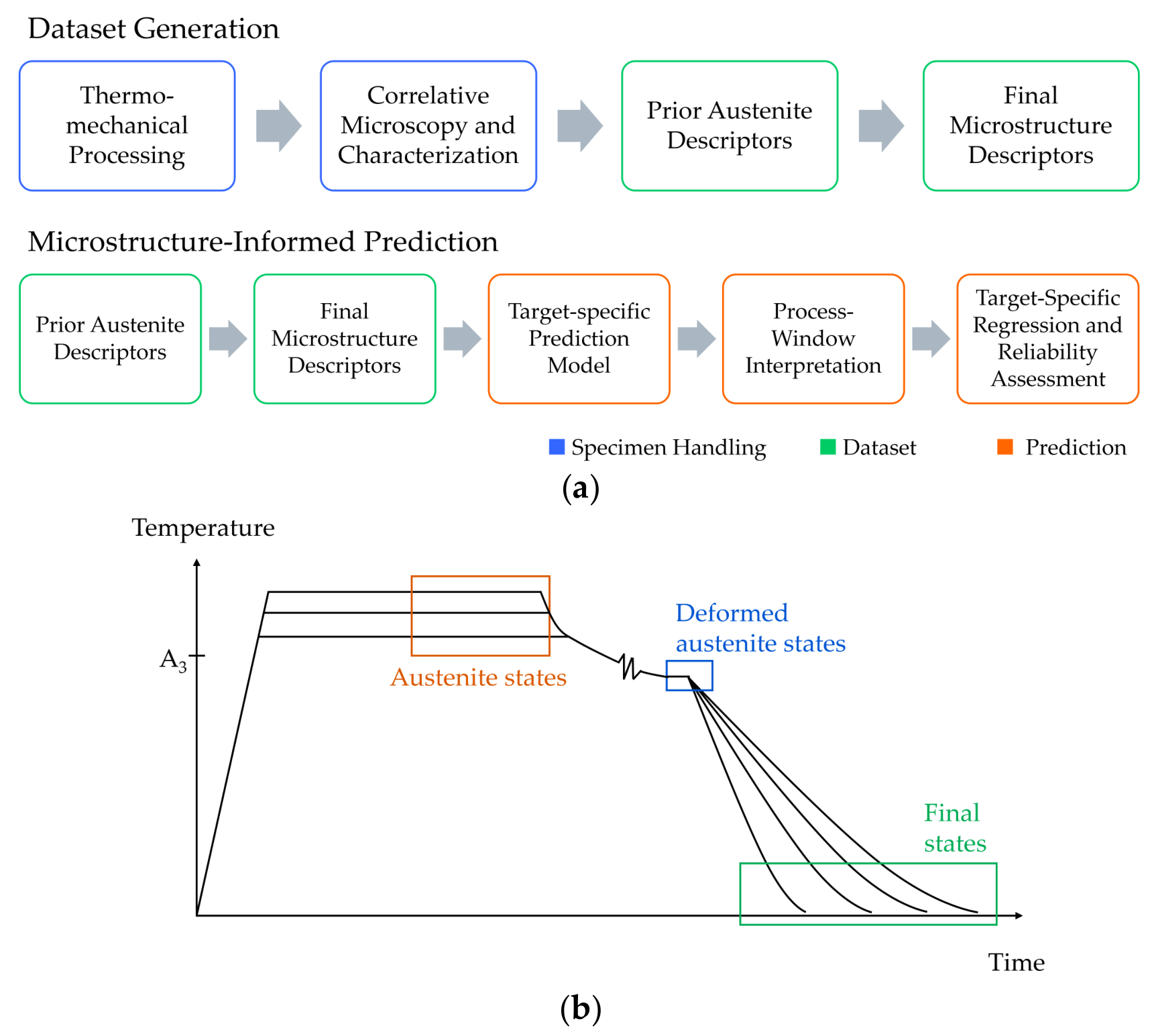
2.1. Materials and Thermomechanical Simulation
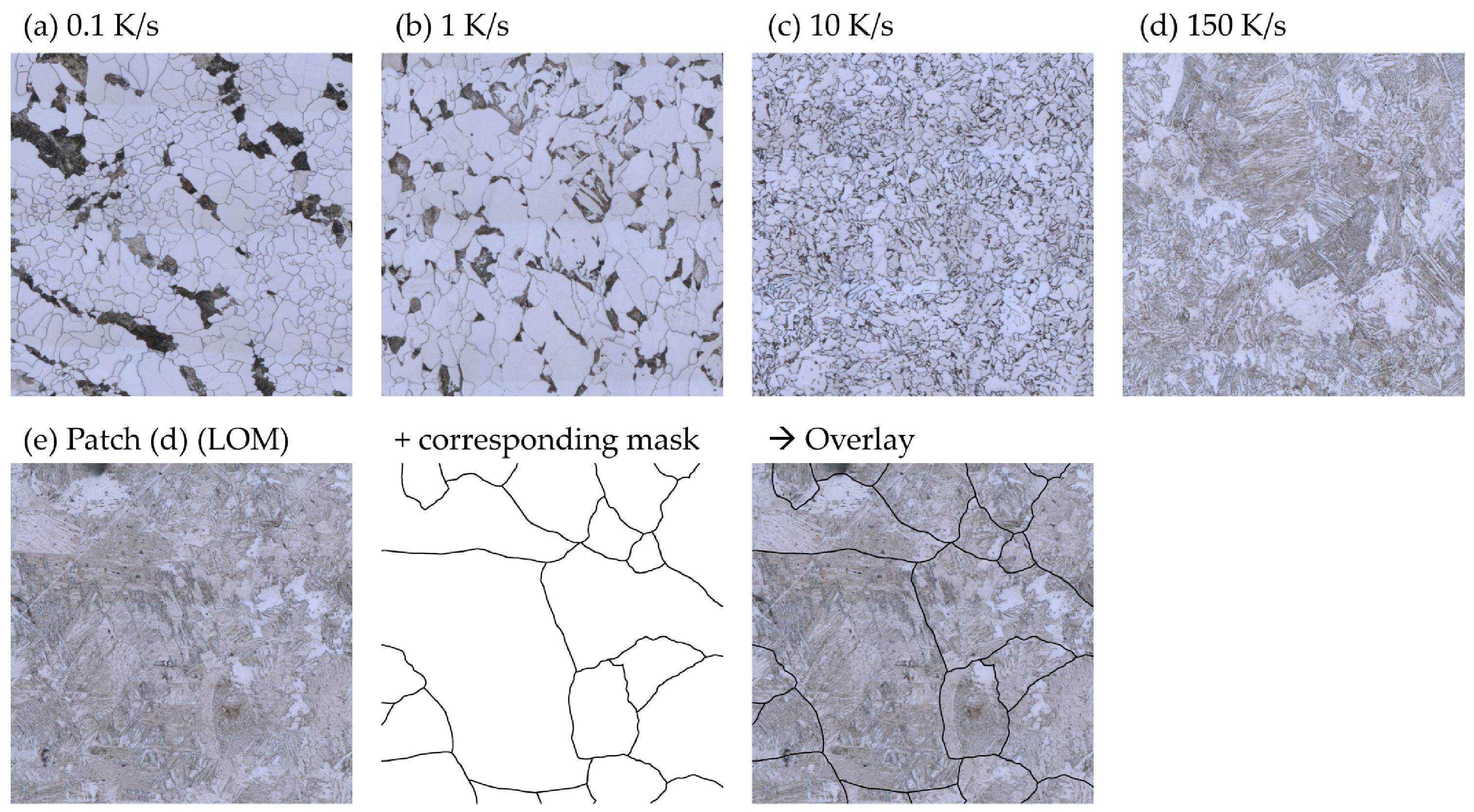
2.2. Correlative Microscopy Workflow
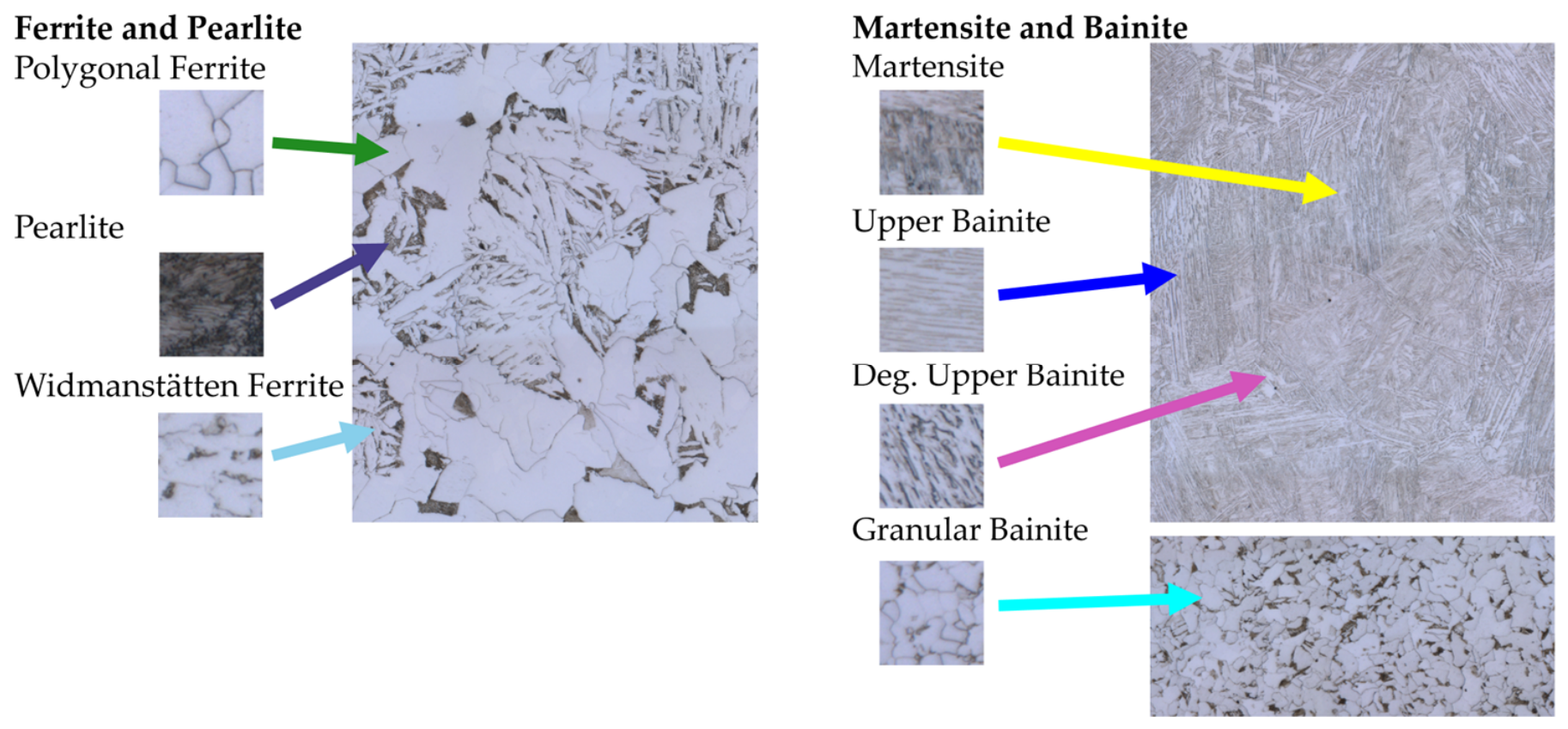
2.3. Definition of Transformation Products and Microstructural Targets
2.4. Phase Segmentation and Morphology Quantification
2.5. Descriptor Definition and Feature Selection
2.6. Dataset Disclosure Under Confidentiality Constraints
2.7. Dataset Structure and Target Complexity
3. Data-Driven Modeling and Validation Strategy
3.1. Prediction Tasks and Model Hierarchy
3.2. Model Families, Baseline Comparison, Evaluation Metrics, Reliability Classes
- Quantitative: High R2, low normalized RMSE, and clear improvement over the baseline. These targets are considered usable for process-window interpretation within the investigated domain.
- Semi-quantitative: Moderate model performance combined with physically meaningful trends. These targets are interpreted as trend indicators rather than precise quantitative predictions.
- Diagnostic only: Low or negative R2, limited baseline improvement, sparse occurrence, or strong target imbalance. These targets are not considered quantitatively predictable with the present dataset but are retained to identify the limits of the framework and guide future targeted experiments.
3.3. Controlled Synthetic Data and Target Consolidation
3.4. Feature Importance and Physical Consistency
4. Baseline Physical Trends and Sanity Checks
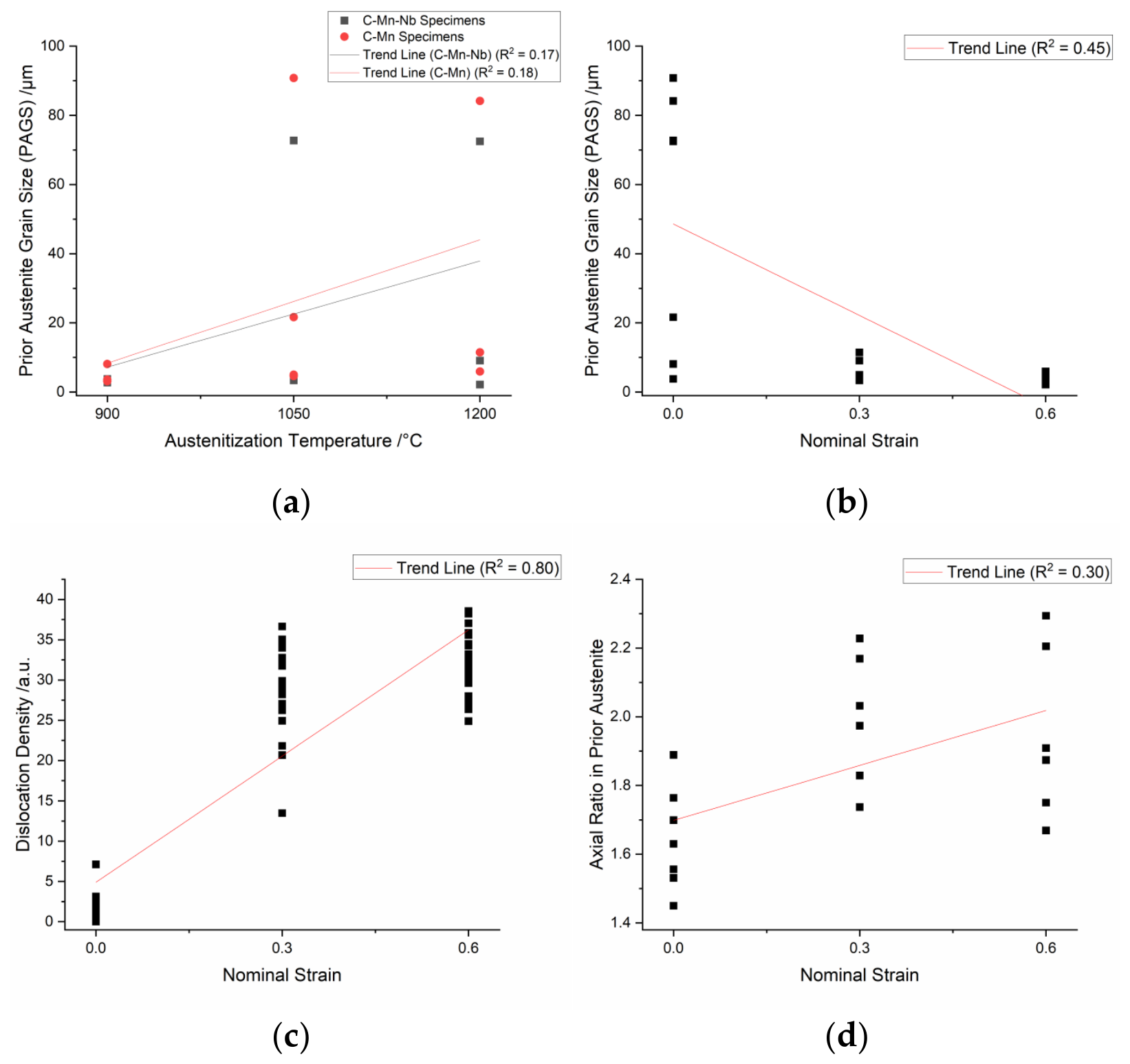
4.1. Process Parameters and Prior Austenite State
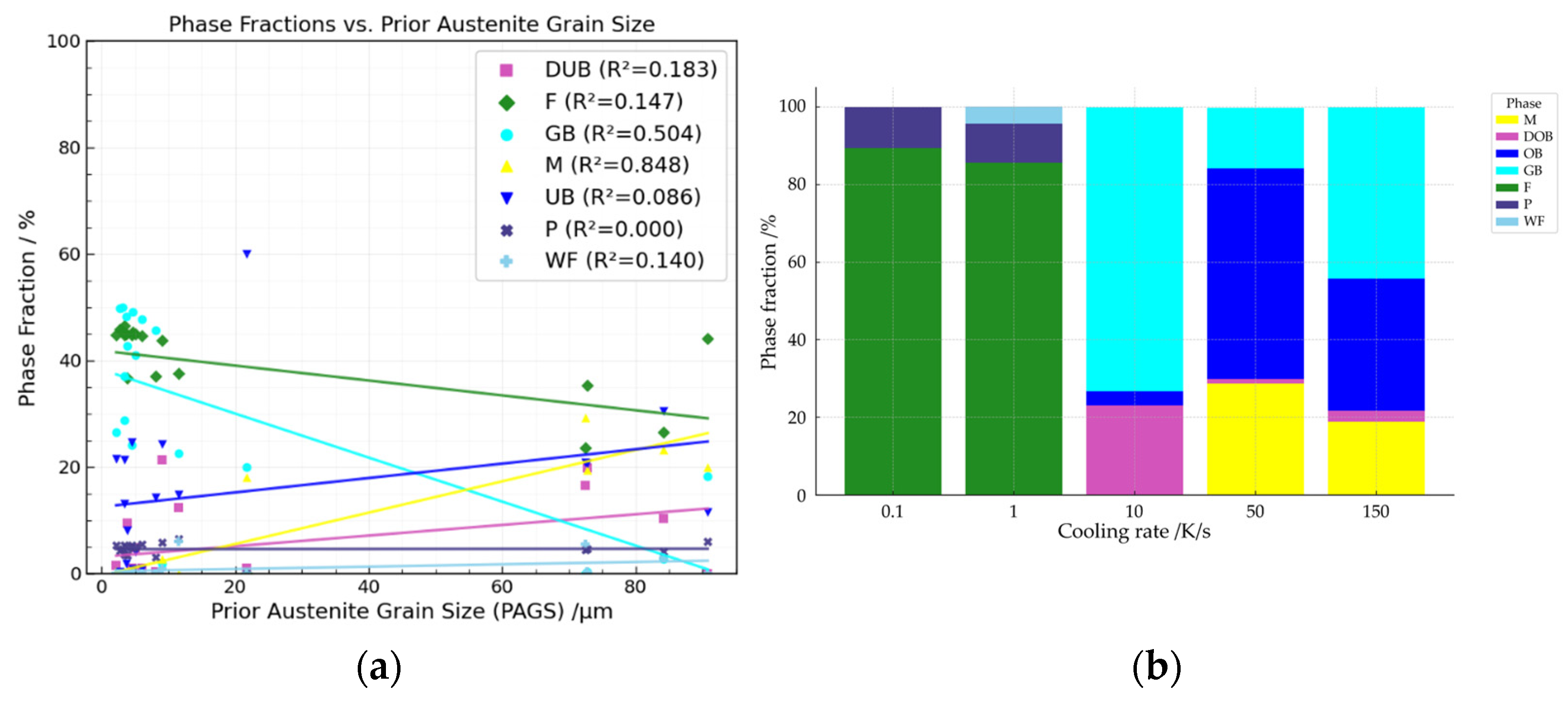
4.2. Prior Austenite Descriptors, Cooling Rate, and Transformation Products
5. Microstructure-Informed Prediction Performance
5.1. Model Performance and Target Reliability
5.2. Representative Parity Plots and Transformation-Regime Dependence
5.3. Effect of Controlled Augmentation and Bainite Target Consolidation
5.4. Feature Importance and Physical Consistency
5.5. Interpretation of Weak and Diagnostic Targets
6. Design Implications, Limitations, and Future Development
7. Conclusions
Author Contributions
Funding
Data Availability Statement
Acknowledgments
Conflicts of Interest
Abbreviations
| C | Carbon |
| Mn | Manganese |
| Nb | Niobium |
| PAGS | Prior austenite grain size |
| LOM | Light optical microscopy |
| SEM | Scanning electron microscopy |
| EBSD | Electron backscatter diffraction |
| ML | Machine learning |
| ROI | Region of interest |
| F | Ferrite |
| P | Pearlite |
| WF | Widmanstätten ferrite |
| M | Martensite |
| UB | Upper bainite |
| DUB | Degenerated upper bainite |
| GB | Granular bainite |
| MFPL | Mean free path length |
| R2 | Coefficient of determination |
| RMSE | Root mean square error |
| MRMR | Minimum redundancy maximum relevance |
| SHAP | SHapley Additive exPlanations |
| SVR | Support vector regression |
| HistGB | Histogram-based gradient boosting |
| CNN | Convolutional neural network |
| TTT | Time–temperature–transformation |
| CCT | Continuous cooling transformation |
Appendix A. Morphological Feature Selection

| Descriptor | Category | Description |
|---|---|---|
| Equivalent Diameter Area | Size | Diameter of a circle with equivalent area |
| Area | Size | Total pixel area of the segmented unit |
| Area Convex | Size | Area of the convex hull |
| Area Filled | Size | Area with internal holes filled |
| Axis Major Length | Size | Major axis length of the fitted ellipse |
| Axis Minor Length | Size | Minor axis length of the fitted ellipse |
| Perimeter | Size | Boundary length |
| Convex Perimeter | Size | Perimeter of the convex hull |
| Max Feret | Size | Maximum caliper distance across the unit |
| Solidity | Shape | Ratio of area to convex area |
| Eccentricity | Shape | Eccentricity of the fitted ellipse |
| Orientation | Shape | Angle of the major axis relative to the image frame |
| Axial Ratio | Shape | Ratio of major to minor axis length |
| Roundness | Shape | Closeness of shape to circle |
| Roundness Crofton | Shape | Roundness computed from the Crofton perimeter |
| Specific Interface | Distribution | Total scaled area of all objects divided by phase area |
| Mean Free Path Length | Distribution | Mean intercept length between pearlite colonies (ferritic–pearlitic only) |
| Connectivity | Distribution | Reciprocal normalized area per unit area |
| Object Density | Distribution | Number of phase objects per area |
| Total Particles | Distribution | Number of segmented units per analyzed area |
| Cluster | Descriptors in Cluster (Pair-Wise R2 ≥ 0.7) | Retained | Rationale |
|---|---|---|---|
| Size | Equivalent Diameter Area Area Area Convex Area Filled Axis Major Length Axis Minor Length Perimeter Convex Perimeter Max Feret | Equivalent Diameter Area | Single physically intuitive size descriptor; all describe same underlying quantity with near-collinear behavior across both transformation regimes. Retained descriptor is the one most frequently top-ranked by MRMR/F-test across responses. |
| Shape | Solidity Roundness Roundness Crofton | Roundness Crofton (at selection stage) | Measures co-vary closely; Crofton roundness more numerically stable definition on pixelated boundaries. Dropped at mode-evaluation stage. |
| Shape/elongation | Axial Ratio Eccentricity Orientation | Axial Ratio | Direct ratio of fitted-ellipse axes more interpretable for grain-shape analysis. |
| Distribution | Mean Free Path Length Connectivity Object Density Specific Interface Total Particles | Mean Free Path Length | Mean free path length retained to describe pearlite; others dropped due to high correlation with other descriptors. |
References
- Krauss, G. (Ed.) Steels: Processing, Structure, and Performance, 2nd ed.; ASM International: Materials Park, OH, USA, 2015; ISBN 978-1-62708-084-2. [Google Scholar]
- Bhadeshia, H.K.D.H.; Edmonds, D.V. The Mechanism of Bainite Formation in Steels. Acta Metall. 1980, 28, 1265–1273. [Google Scholar] [CrossRef] [Scilit]
- Mohrbacher, H.; Yang, J.-R.; Chen, Y.-W.; Rehrl, J.; Hebesberger, T. Metallurgical Effects of Niobium in Dual Phase Steel. Metals 2020, 10, 504. [Google Scholar] [CrossRef] [Scilit]
- Bargel, H.-J.; Hilbrans, H.; Hübner, K.-H.; Krüger, O.; Schulze, G. Werkstoffkunde, 9th ed.; Bargel, H.-J., Schulze, G., Eds.; VDI-Buch; Springer: Berlin/Heidelberg, Germany, 2005; ISBN 978-3-540-26107-0. [Google Scholar]
- Kawulok, P.; Podolinský, P.; Kajzar, P.; Schindler, I.; Kawulok, R.; Ševčák, V.; Opěla, P. The Influence of Deformation and Austenitization Temperature on the Kinetics of Phase Transformations During Cooling of High-Carbon Steel. Arch. Metall. Mater. 2018, 63, 1743–1748. [Google Scholar] [CrossRef] [Scilit]
- Bengochea, R.; López, B.; Gutierrez, I. Microstructural Evolution during the Austenite-to-Ferrite Transformation from Deformed Austenite. Metall. Mater. Trans. A 1998, 29, 417–426. [Google Scholar] [CrossRef] [Scilit]
- Oliveira, A. MicroSim Bars® e Phastransim®: Ferramentas para Otimização de Ligas, da Austenita até a Temperatura Final Ambiente, Microestrutura e Propriedades para aços de Baixo Nióbio. In 58° Seminário de Laminação, Conformação de Metais e Produtos; ABM: São Paulo, Brazil, 2023; Volume 58, pp. 255–268. [Google Scholar] [CrossRef] [Scilit]
- Cao, Y.; Zhang, C.; Tang, S.; Wu, S.; Zhou, X.; Cao, G.; Luo, D.; Wang, H.; Hedström, P.; Liu, Z. Machine Learning to Predict Phase Transformation Products and Their Morphologies—Application in Design of Lean High Strength Steel. Mater. Des. 2025, 258, 114642. [Google Scholar] [CrossRef] [Scilit]
- van Bohemen, S.M.C.; Sietsma, J. Kinetics of Martensite Formation in Plain Carbon Steels: Critical Assessment of Possible Influence of Austenite Grain Boundaries and Autocatalysis. Mater. Sci. Technol. 2014, 30, 1024–1033. [Google Scholar] [CrossRef] [Scilit]
- Dai, M.; Demirel, M.F.; Liang, Y.; Hu, J.-M. Graph Neural Networks for an Accurate and Interpretable Prediction of the Properties of Polycrystalline Materials. npj Comput. Mater. 2021, 7, 103. [Google Scholar] [CrossRef] [Scilit]
- Chandan, A.K.; Bansal, G.K.; Kundu, J.; Chakraborty, J.; Chowdhury, S.G. Effect of Prior Austenite Grain Size on the Evolution of Microstructure and Mechanical Properties of an Intercritically Annealed Medium Manganese Steel. Mater. Sci. Eng. A 2019, 768, 138458. [Google Scholar] [CrossRef] [Scilit]
- Denis, S.; Gautier, E.; Simon, A.; Beck, G. Stress–Phase-Transformation Interactions—Basic Principles, Modelling, and Calculation of Internal Stresses. Mater. Sci. Technol. 1985, 1, 805–814. [Google Scholar] [CrossRef]
- Essadiqi, E.; Jonas, J.J. Effect of Deformation on the Austenite-to-Ferrite Transformation in a Plain Carbon and Two Microalloyed Steels. Metall. Trans. A 1988, 19, 417–426. [Google Scholar] [CrossRef] [Scilit]
- Taylor, J.W. Dislocation Dynamics and Dynamic Yielding. J. Appl. Phys. 1965, 36, 3146–3150. [Google Scholar] [CrossRef] [Scilit]
- Bhadeshia, H.K.D.H. Bainite in Steels: Transformations, Microstructure and Properties, 2nd ed.; Book/The Institute of Materials; IOM Communications: London, UK, 2001; ISBN 978-1-86125-112-1. [Google Scholar]
- Deardo, A.J. Niobium in Modern Steels. Int. Mater. Rev. 2003, 48, 371–402. [Google Scholar] [CrossRef] [Scilit]
- Sun, L.; Liu, X.; Xu, X.; Lei, S.; Li, H.; Zhai, Q. Review on Niobium Application in Microalloyed Steel. J. Iron Steel Res. Int. 2022, 29, 1513–1525. [Google Scholar] [CrossRef] [Scilit]
- Zhang, D.; Terasaki, H.; Komizo, Y. In Situ Observation of the Formation of Intragranular Acicular Ferrite at Non-Metallic Inclusions in C–Mn Steel. Acta Mater. 2010, 58, 1369–1378. [Google Scholar] [CrossRef] [Scilit]
- Ando, T.; Bhamidimarri, S.P.; Brending, N.; Colin-York, H.; Collinson, L.; De Jonge, N.; de Pablo, P.J.; Debroye, E.; Eggeling, C.; Franck, C.; et al. The 2018 Correlative Microscopy Techniques Roadmap. J. Phys. D Appl. Phys. 2018, 51, 443001. [Google Scholar] [CrossRef] [Scilit] [PubMed]
- Britz, D.; Webel, J.; Gola, J.; Mücklich, F. A Correlative Approach to Capture and Quantify Substructures by Means of Image Registration. Pract. Metallogr. 2017, 54, 685–696. [Google Scholar] [CrossRef] [Scilit]
- Müller, M.; Stiefel, M.; Bachmann, B.-I.; Britz, D.; Mücklich, F. Overview: Machine Learning for Segmentation and Classification of Complex Steel Microstructures. Metals 2024, 14, 553. [Google Scholar] [CrossRef] [Scilit]
- Bachmann, B.-I.; Müller, M.; Britz, D.; Durmaz, A.R.; Ackermann, M.; Shchyglo, O.; Staudt, T.; Mücklich, F. Efficient Reconstruction of Prior Austenite Grains in Steel from Etched Light Optical Micrographs Using Deep Learning and Annotations from Correlative Microscopy. Front. Mater. 2022, 9, 1033505. [Google Scholar] [CrossRef] [Scilit]
- Bachmann, B.-I.; Müller, M.; Stiefel, M.; Britz, D.; Staudt, T.; Mücklich, F. Efficient Phase Segmentation of Light-Optical Microscopy Images of Highly Complex Microstructures Using a Correlative Approach in Combination with Deep Learning Techniques. Metals 2024, 14, 1051. [Google Scholar] [CrossRef] [Scilit]
- Laub, M.; Bachmann, B.-I.; Detemple, E.; Scherff, F.; Staudt, T.; Müller, M.; Britz, D.; Mücklich, F.; Motz, C. Determination of Grain Size Distribution of Prior Austenite Grains through a Combination of a Modified Contrasting Method and Machine Learning. Pract. Metallogr. 2023, 60, 4–36. [Google Scholar] [CrossRef] [Scilit]
- Himanen, L.; Geurts, A.; Foster, A.S.; Rinke, P. Data-Driven Materials Science: Status, Challenges, and Perspectives. Adv. Sci. 2019, 6, 1900808. [Google Scholar] [CrossRef] [Scilit] [PubMed]
- Holm, E.A.; Cohn, R.; Gao, N.; Kitahara, A.R.; Matson, T.P.; Lei, B.; Yarasi, S.R. Overview: Computer Vision and Machine Learning for Microstructural Characterization and Analysis. Metall. Mater. Trans. A 2020, 51, 5985–5999. [Google Scholar] [CrossRef] [Scilit]
- Acar, P. Machine Learning Approach for Identification of Microstructure–Process Linkages. AIAA J. 2019, 57, 3608–3614. [Google Scholar] [CrossRef] [Scilit]
- Hawkins, D.M. The Problem of Overfitting. J. Chem. Inf. Comput. Sci. 2004, 44, 1–12. [Google Scholar] [CrossRef] [Scilit] [PubMed]
- Ying, X. An Overview of Overfitting and Its Solutions. J. Phys. Conf. Ser. 2019, 1168, 022022. [Google Scholar] [CrossRef] [Scilit]
- Holm, E.A. In Defense of the Black Box. Science 2019, 364, 26–27. [Google Scholar] [CrossRef] [Scilit] [PubMed]
- Wilkinson, M.D.; Dumontier, M.; Aalbersberg, I.J.; Appleton, G.; Axton, M.; Baak, A.; Blomberg, N.; Boiten, J.-W.; da Silva Santos, L.B.; Bourne, P.E.; et al. The FAIR Guiding Principles for Scientific Data Management and Stewardship. Sci. Data 2016, 3, 160018. [Google Scholar] [CrossRef] [Scilit] [PubMed]
- Scheffler, M.; Aeschlimann, M.; Albrecht, M.; Bereau, T.; Bungartz, H.-J.; Felser, C.; Greiner, M.; Groß, A.; Koch, C.T.; Kremer, K.; et al. FAIR Data Enabling New Horizons for Materials Research. Nature 2022, 604, 635–642. [Google Scholar] [CrossRef] [Scilit] [PubMed]
- Zajac, S.; Schwinn, V.; Tacke, K.H. Characterisation and Quantification of Complex Bainitic Microstructures in High and Ultra-High Strength Linepipe Steels. Mater. Sci. Forum 2005, 500–501, 387–394. [Google Scholar] [CrossRef] [Scilit]
- da Silva de Souza, S.; Moreira, P.S.; de Faria, G.L. Austenitizing Temperature and Cooling Rate Effects on the Martensitic Transformation in a Microalloyed-Steel. Mater. Res. 2020, 23, e20190570. [Google Scholar] [CrossRef] [Scilit]
- Tian, J.; Xu, G.; Jiang, Z.; Yuan, Q.; Chen, G.; Hu, H. Effect of Austenisation Temperature on Bainite Transformation below Martensite Starting Temperature. Mater. Sci. Technol. 2019, 35, 1539–1550. [Google Scholar] [CrossRef] [Scilit]
- Bodnar, R.L.; Hansen, S.S. Effects of Austenite Grain Size and Cooling Rate on Widmanstätten Ferrite Formation in Low-Alloy Steels. Metall. Mater. Trans. A 1994, 25, 665–675. [Google Scholar] [CrossRef] [Scilit]
- Kuzucu, V.; Aksoy, M.; Korkut, M.H.; Yildirim, M.M. The Effect of Niobium on the Microstructure of Ferritic Stainless Steel. Mater. Sci. Eng. A 1997, 230, 75–80. [Google Scholar] [CrossRef] [Scilit]
- Bachmann, B.-I.; Müller, M.; Britz, D.; Staudt, T.; Mücklich, F. Reproducible Quantification of the Microstructure of Complex Quenched and Quenched and Tempered Steels Using Modern Methods of Machine Learning. Metals 2023, 13, 1395. [Google Scholar] [CrossRef] [Scilit]
- Schindelin, J.; Arganda-Carreras, I.; Frise, E.; Kaynig, V.; Longair, M.; Pietzsch, T.; Preibisch, S.; Rueden, C.; Saalfeld, S.; Schmid, B.; et al. Fiji: An Open-Source Platform for Biological-Image Analysis. Nat. Methods 2012, 9, 676–682. [Google Scholar] [CrossRef] [Scilit]
- Azimi, S.M.; Britz, D.; Engstler, M.; Fritz, M.; Mücklich, F. Advanced Steel Microstructural Classification by Deep Learning Methods. Sci. Rep. 2018, 8, 2128. [Google Scholar] [CrossRef] [Scilit] [PubMed]
- Chollet, F. Xception: Deep Learning with Depthwise Separable Convolutions. In Proceedings of the 2017 IEEE Conference on Computer Vision and Pattern Recognition (CVPR), Honolulu, HI, USA, 21–26 July 2017. [Google Scholar]
- Van Der Walt, S.; Schönberger, J.L.; Nunez-Iglesias, J.; Boulogne, F.; Warner, J.D.; Yager, N.; Gouillart, E.; Yu, T. Scikit-Image: Image Processing in Python. PeerJ 2014, 2, e453. [Google Scholar] [CrossRef] [Scilit] [PubMed]
- Peng, H.; Long, F.; Ding, C. Feature Selection Based on Mutual Information: Criteria of Max-Dependency, Max-Relevance, and Min-Redundancy. IEEE Trans. Pattern Anal. Mach. Intell. 2005, 27, 1226–1238. [Google Scholar] [CrossRef] [Scilit] [PubMed]
- Niessen, F.; Nyyssönen, T.; Gazder, A.A.; Hielscher, R. Parent Grain Reconstruction from Partially or Fully Transformed Microstructures in MTEX. J. Appl. Crystallogr. 2022, 55, 180–194. [Google Scholar] [CrossRef] [Scilit] [PubMed]
- Bachmann, F.; Hielscher, R.; Schaeben, H. Texture Analysis with MTEX—Free and Open Source Software Toolbox. Solid State Phenom. 2010, 160, 63–68. [Google Scholar] [CrossRef] [Scilit]
- Laub, M. Beschreibung der Gefügeentwicklung in der Grobblecherzeugung Mithilfe von Statistisch Modellierten und Thermodynamisch Simulierten Mikrostrukturen. Doctoral Dissertation, Universität des Saarlandes, Saarbrücken, Germany, 2025. [Google Scholar]
- Seki, I.; Nagata, K. Lattice Constant of Iron and Austenite Including Its Supersaturation Phase of Carbon. ISIJ Int. 2005, 45, 1789–1794. [Google Scholar] [CrossRef] [Scilit]
- Pedregosa, F.; Varoquaux, G.; Gramfort, A.; Michel, V.; Thirion, B.; Grisel, O.; Blondel, M.; Prettenhofer, P.; Weiss, R.; Dubourg, V.; et al. Scikit-Learn: Machine Learning in Python. J. Mach. Learn. Res. 2011, 12, 2825–2830. [Google Scholar]
- Drucker, H.; Burges, C.J.C.; Kaufman, L.; Smola, A.J.; Vapnik, V. Support Vector Regression Machines. In Advances in Neural Information Processing Systems; Morgan Kaufmann Publishers: San Mateo, CA, USA, 1997; pp. 779–784. [Google Scholar]
- Breiman, L. Random Forests. Mach. Learn. 2001, 45, 5–32. [Google Scholar] [CrossRef] [Scilit]
- Geurts, P.; Ernst, D.; Wehenkel, L. Extremely Randomized Trees. Mach. Learn. 2006, 63, 3–42. [Google Scholar] [CrossRef] [Scilit]
- Chen, T.; Guestrin, C. XGBoost: A Scalable Tree Boosting System. In Proceedings of the 22nd ACM SIGKDD International Conference on Knowledge Discovery and Data Mining, San Francisco, CA, USA, 13–17 August 2016; pp. 785–794. [Google Scholar]
- HistGradientBoostingRegressor. Available online: https://scikit-learn.org/stable/modules/generated/sklearn.ensemble.HistGradientBoostingRegressor.html#sklearn.ensemble.HistGradientBoostingRegressor.staged_predict (accessed on 3 November 2025).
- Dorogush, A.V.; Ershov, V.; Gulin, A. CatBoost: Gradient Boosting with Categorical Features Support. arXiv 2018, arXiv:1810.11363. [Google Scholar]
- Ke, G.; Meng, Q.; Finley, T.; Wang, T.; Chen, W.; Ma, W.; Ye, Q.; Liu, T.-Y. LightGBM: A Highly Efficient Gradient Boosting Decision Tree. In Proceedings of the 31st International Conference on Neural Information Processing Systems; Curran Associates Inc.: Red Hook, NY, USA, 2017; pp. 3149–3157. [Google Scholar]
- Lundberg, S.M.; Lee, S.-I. A Unified Approach to Interpreting Model Predictions. arXiv 2017, arXiv:1705.07874. [Google Scholar]
- Guo, Z.; Liu, X.; Pan, Z.; Zhou, Y.; Zhong, Z.; Yan, Z. Data Augmentation and Data Mining towards Microstructure and Property Relationship for Composites. Eng. Comput. 2023, 40, 1617–1632. [Google Scholar] [CrossRef] [Scilit]
- Maharana, K.; Mondal, S.; Nemade, B. A Review: Data Pre-Processing and Data Augmentation Techniques. Glob. Transit. Proc. 2022, 3, 91–99. [Google Scholar] [CrossRef] [Scilit]
- Mumuni, A.; Mumuni, F. Data Augmentation: A Comprehensive Survey of Modern Approaches. Array 2022, 16, 100258. [Google Scholar] [CrossRef] [Scilit]
- Hidalgo, J.; Santofimia, M.J. Effect of Prior Austenite Grain Size Refinement by Thermal Cycling on the Microstructural Features of As-Quenched Lath Martensite. Metall. Mater. Trans. A 2016, 47, 5288–5301. [Google Scholar] [CrossRef] [Scilit]
- Bengochea, R.; López, B.; Gutierrez, I. Influence of the Prior Austenite Microstructure on the Transformation Products Obtained for C-Mn-Nb Steels after Continuous Cooling. ISIJ Int. 1999, 39, 583–591. [Google Scholar] [CrossRef] [Scilit]
- Schemmann, L.; Zaefferer, S.; Raabe, D.; Friedel, F.; Mattissen, D. Alloying Effects on Microstructure Formation of Dual Phase Steels. Acta Mater. 2015, 95, 386–398. [Google Scholar] [CrossRef] [Scilit]
- Shipway, P.H.; Bhadeshia, H.K.D.H. The Mechanical Stabilisation of Widmanstätten Ferrite. Mater. Sci. Eng. A 1997, 223, 179–185. [Google Scholar] [CrossRef] [Scilit]




| Experimental Factor | Levels or Range | Purpose |
|---|---|---|
| Steel variant | C-Mn, C-Mn-Nb | Modify PAGS and final size descriptor |
| Austenitization temperature | 900 °C, 1050 °C, 1200 °C | Modify PAGS |
| High-temperature deformation | 0%, 30%, 60% nominal strain | Vary austenite morphology and deformation-related defect state |
| Cooling rate | 0.1 K/s, 1 K/s, 10 K/s, 50 K/s, 150 K/s | Access ferritic–pearlitic, bainitic, and martensitic transformation regimes |
| Number of specimens | 80 | Experimental dataset for statistical analysis and model evaluation |
| Microstructure Regime | Target Classes | Image Basis | Segmentation/ Quantification Route | Manual Correction | Outputs |
|---|---|---|---|---|---|
| Ferritic–pearlitic | F, P | LOM + SEM + EBSD overlay | Pixel-wise segmentation [23,40] | Yes | F, P fractions; F morphology; P descriptors |
| Ferritic–pearlitic | WF | LOM + SEM + EBSD overlay | Manual segmentation | Yes | WF fraction |
| Bainitic–martensitic | M, UB, DUB, GB | Registered EBSD + LOM + SEM stack | Patch-wise CNN + sliding-window classification [23,38] | No (beyond 90% threshold) | M, UB, DUB, GB fractions; island/packet morphology |
| All regimes | Morphology | Grain boundary masks | Scikit-image descriptor extraction [42] | Regime dependent | Size, shape, axial ratio, MFPL, selected descriptors |
| Variable | Type | Unit | Source/Determination | Role in Model |
|---|---|---|---|---|
| PAGS | Input descriptor | µm | Morphology analysis of boundary masks | Austenite grain-size state before cooling |
| Prior austenite axial ratio | Input descriptor | – | Morphology analysis of boundary masks | Austenite grain elongation or deformation state |
| Dislocation density | Input descriptor | m−2 | Estimated from friction-corrected flow stress using Taylor relation | Effective descriptor of deformation-induced defect state |
| Cooling rate | Input descriptor | K/s | Gleeble thermomechanical simulation | Cooling condition and transformation regime |
| Polygonal ferrite, F | Prediction target | area % | Phase segmentation | Final transformation product |
| Pearlite, P | Prediction target | area % | Phase segmentation | Final transformation product |
| Widmanstätten ferrite, WF | Prediction target | area % | Manual/supported segmentation | Final transformation product |
| Martensite, M | Prediction target | area % | Patch-wise classification | Final transformation product |
| Upper bainite, UB | Prediction target | area % | Patch-wise classification | Final transformation product |
| Degenerated upper bainite, DUB | Prediction target | area % | Patch-wise classification | Final transformation product |
| Granular bainite, GB | Prediction target | area % | Patch-wise classification | Final transformation product |
| Final microstructural size descriptor | Prediction target | µm | Morphology analysis of boundary masks | Size of ferrite grains or boundary-delimited units, depending on regime |
| Final axial ratio | Prediction target | – | Morphology analysis of boundary masks | Shape descriptor of final microstructural units |
| Pearlite MFPL | Prediction target | µm | Pearlite colony analysis | Ferritic–pearlitic morphology descriptor |
| Vickers hardness, HV0.1 | Prediction target | HV0.1 | Hardness measurement | Selected mechanical response |
| Dataset Subset/Factor | Number of Specimens | Purpose in Model Evaluation |
|---|---|---|
| Full dataset | 80 | Global model evaluation across all transformation regimes |
| C-Mn variant | 40 | Steel-variant comparison |
| C-Mn-Nb variant | 40 | Assessment of Nb-containing variant through microstructural descriptors |
| 0.1 K/s cooling rate | 18 | Slow-cooling ferritic–pearlitic regime |
| 1 K/s cooling rate | 18 | Slow/intermediate ferritic–pearlitic or mixed regime |
| 10 K/s cooling rate | 18 | Bainitic transformation regime |
| 50 K/s cooling rate | 6 | High-cooling-rate bainitic/martensitic regime |
| 150 K/s cooling rate | 20 | High-cooling-rate bainitic/martensitic regime |
| Ferrite–pearlite-dominated specimens | 36 | Well-sampled transformation-regime group |
| Bainitic–martensitic-dominated specimens | 44 | High-complexity transformation-regime group |
| UB/DUB nonzero specimens | 37 | Assessment of bainitic subclass availability |
| Component | Implementation/Role |
|---|---|
| Baseline model | Dummy regressor predicting the central tendency of the training data |
| Linear model | Linear regression used as a low-complexity reference |
| Kernel-based model | Support vector regression (SVR), evaluated with feature standardization |
| Tree-based ensemble models | Random Forest and ExtraTrees |
| Gradient-boosting models | XGBoost, histogram-based gradient boosting, CatBoost, and LightGBM |
| Data split | Train test split with 25% held out for testing, repeated for six random splits |
| Cross-validation | 5-fold cross-validation on the training subset |
| Scaling | Standardization applied to scale-sensitive models; not required for tree-based models |
| Target handling | Target-specific regression models selected separately for each output |
| Model selection criterion | Best cross-validated performance per target (RMSE, R2) |
| Final evaluation | Test-set performance reported for each target (RMSE, R2) |
| Interpretation | Performance interpreted according to defined target hierarchy (3.1) |
| Output Descriptor | Predictor | Rank | F-Test Score | Interpretation |
|---|---|---|---|---|
| PAGS | Deformation | 1 | 32.41 | Strongest effect: Grain refinement with strain |
| Austenitization temperature | 2 | 8.39 | Moderate effect: Grain growth with temperature | |
| Steel variant (Nb) | 3 | 0.74 | Weaker effect, but measurable within investigated material | |
| Dislocation density | Deformation | 1 | 25.09 | Strongest effect: Expected from deformation response |
| Austenitization temperature | 2 | 0.85 | Weaker effect but expected: Temperature as variable in calculation (see Section 2.5) | |
| Prior austenite axial ratio | Deformation | 1 | 22.62 | Strongest effect: Grain elongation after deformation |
| Austenitization temperature | 2 | 1.80 | Comparatively weak effect, may be linked to PAGS and phase morphology | |
| Steel variant (Nb) | 3 | 1.20 | Comparatively weak effect, may be linked to PAGS |
| Target | Best Model | Best R2 | R2 Mean and Error | Best RMSE | RMSE Mean and Error | Reliability Class |
|---|---|---|---|---|---|---|
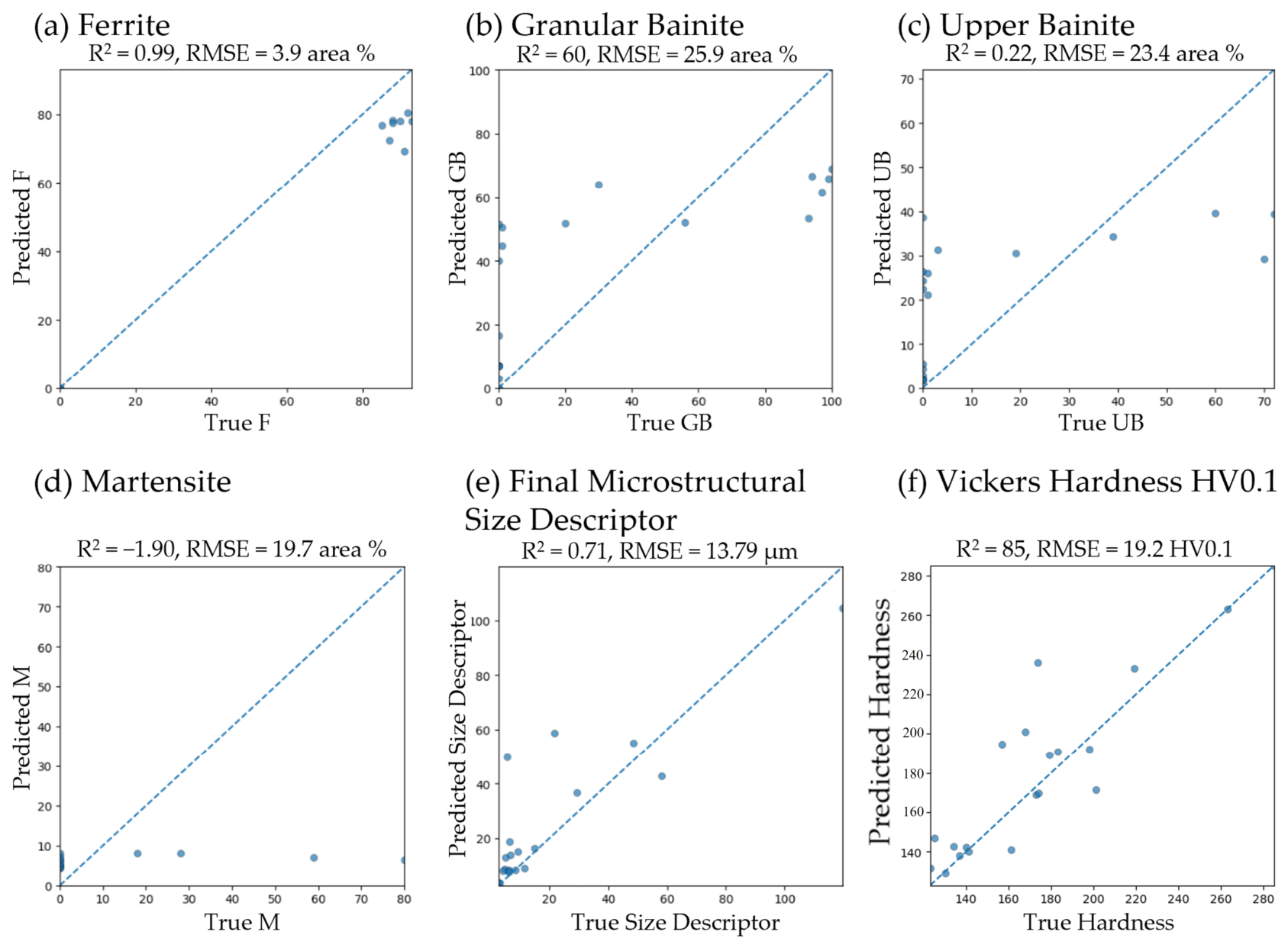
| F/area % | RandomForest | 0.99 | 0.99 ± 0.00 | 3.9 | 4.1 ± 0.4 | Quantitative |
| P/area % | RandomForest | 0.89 | 0.88 ± 0.01 | 1.7 | 1.8 ± 0.1 | Quantitative |
| MFPL/µm | HistGB | 0.91 | 0.91 ± 0.00 | 0.14 | 0.14 ± 0.00 | Quantitative |
| Hardness/HV0.1 | ExtraTrees | 0.85 | 0.80 ± 0.05 | 19 | 20 ± 1 | Quantitative |
| Final size descriptor/µm | CatBoost | 0.71 | 0.64 ± 0.07 | 13.79 | 15.07 ± 1.5 | Quantitative |
| GB/area % | HistGB | 0.60 | 0.61 ± 0.03 | 25.9 | 24.3 ± 1.1 | Semi-quantitative |
| DUB/area % | RandomForest | 0.45 | 0.02 ± 0.27 | 13.7 | 15.9 ± 2.2 | Semi-quantitative |
| UB/area % | HistGB | 0.22 | 0.24 ± 0.07 | 23.4 | 22.9 ± 0.7 | Diagnostic |
| Axial ratio | RandomForest | 0.28 | 0.26 ± 0.06 | 0.20 | 0.21 ± 0.01 | Diagnostic |
| M/area % | Dummy | −1.90 | −1.89 ± 2.03 | 19.7 | 13.7 ± 3.9 | Diagnostic |
| WF/area % | SVR | −0.11 | 0.00 ± 3.51 | 3.4 | 3.5 ± 0.3 | Diagnostic |
| Target | Experimental Only | +50% Synthetic | +100% Synthetic | +200% Synthetic | Interpretation |
|---|---|---|---|---|---|
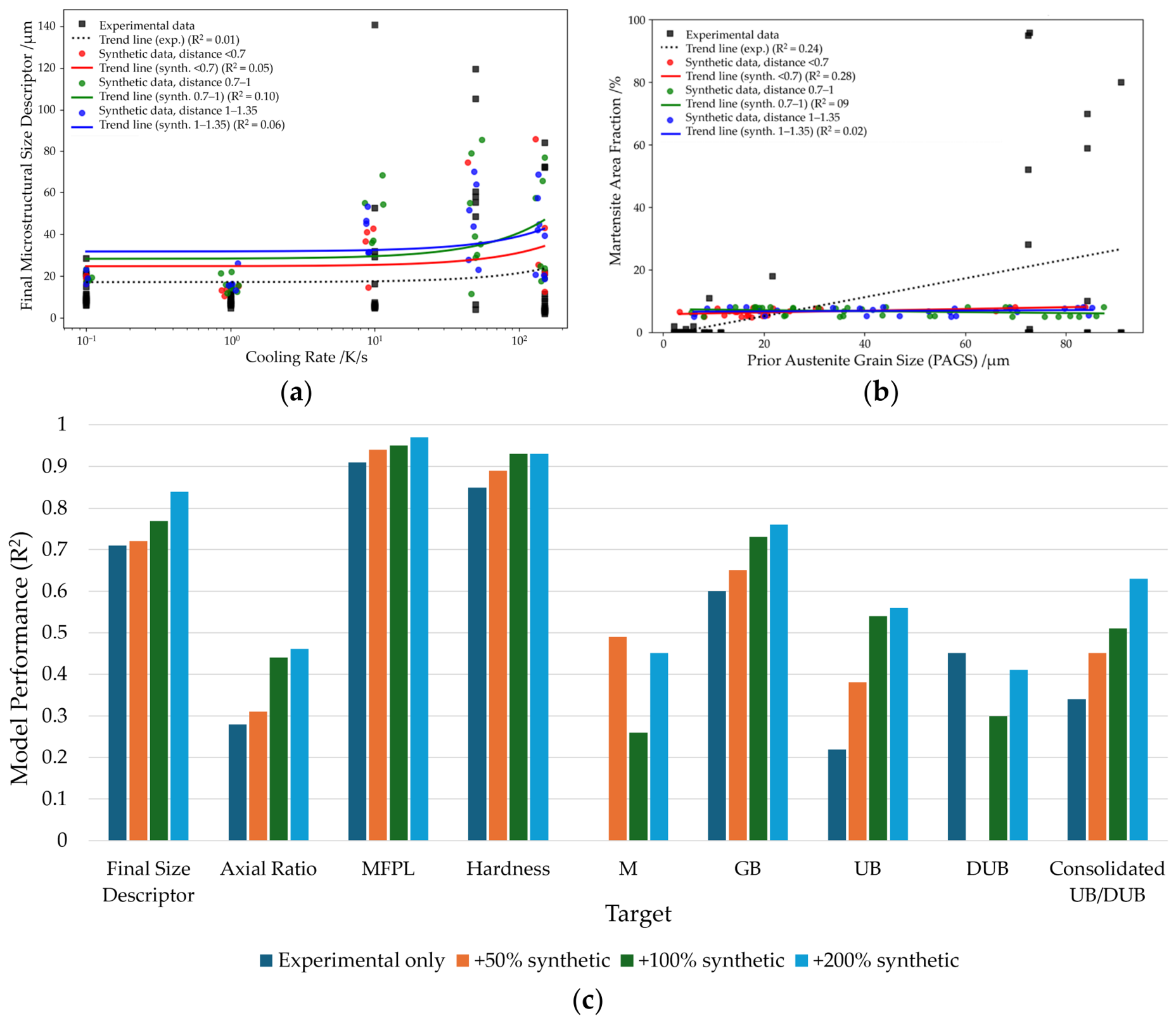
| Ferrite R2 | 0.99 | 0.99 | 0.99 | 0.99 | Stable |
| Pearlite R2 | 0.89 | 0.93 | 0.95 | 0.96 | Increased |
| Final size descriptor R2 | 0.71 | 0.72 | 0.77 | 0.84 | Increased |
| Pearlite MFPL R2 | 0.91 | 0.94 | 0.95 | 0.97 | Increased |
| Hardness R2 | 0.85 | 0.89 | 0.93 | 0.93 | Increased then stable |
| GB R2 | 0.60 | 0.65 | 0.73 | 0.76 | Increased |
| UB R2 | 0.22 | 0.38 | 0.54 | 0.56 | Increased but limited |
| DUB R2 | 0.45 | 0.00 | 0.30 | 0.41 | Unstable and limited |
| Consolidated UB/DUB R2 | 0.34 | 0.45 | 0.51 | 0.63 | Consolidation effect Increased but limited |
| Axial ratio R2 | 0.28 | 0.31 | 0.44 | 0.46 | Increased but limited |
| Martensite R2 | −1.90 | 0.49 | 0.26 | 0.45 | Unstable and limited |
| WF R2 | −0.11 | 0.20 | 0.06 | 0.33 | Unstable and limited |
Disclaimer/Publisher’s Note: The statements, opinions and data contained in all publications are solely those of the individual author(s) and contributor(s) and not of MDPI and/or the editor(s). MDPI and/or the editor(s) disclaim responsibility for any injury to people or property resulting from any ideas, methods, instructions or products referred to in the content. |
© 2026 by the authors. Licensee MDPI, Basel, Switzerland. This article is an open access article distributed under the terms and conditions of the Creative Commons Attribution (CC BY) license.
Share and Cite
Stiefel, M.; Bachmann, B.-I.; Müller, M.; Britz, D.; Weikert-Müller, M.; Staudt, T.; Mücklich, F. Microstructure-Informed Prediction of Transformation Products in C-Mn and C-Mn-Nb Steels for Data-Driven Process-Window Design. Metals 2026, 16, 1047. https://doi.org/10.3390/met16091047
Stiefel M, Bachmann B-I, Müller M, Britz D, Weikert-Müller M, Staudt T, Mücklich F. Microstructure-Informed Prediction of Transformation Products in C-Mn and C-Mn-Nb Steels for Data-Driven Process-Window Design. Metals. 2026; 16(9):1047. https://doi.org/10.3390/met16091047
Chicago/Turabian StyleStiefel, Marie, Björn-Ivo Bachmann, Martin Müller, Dominik Britz, Miriam Weikert-Müller, Thorsten Staudt, and Frank Mücklich. 2026. "Microstructure-Informed Prediction of Transformation Products in C-Mn and C-Mn-Nb Steels for Data-Driven Process-Window Design" Metals 16, no. 9: 1047. https://doi.org/10.3390/met16091047
APA StyleStiefel, M., Bachmann, B.-I., Müller, M., Britz, D., Weikert-Müller, M., Staudt, T., & Mücklich, F. (2026). Microstructure-Informed Prediction of Transformation Products in C-Mn and C-Mn-Nb Steels for Data-Driven Process-Window Design. Metals, 16(9), 1047. https://doi.org/10.3390/met16091047