1. Introduction
The processing of titanium-bearing secondary raw materials is becoming increasingly important as industry seeks to reduce dependence on primary ores and improve the use of existing metallurgical residues. One such material is tionite, a solid residue generated in the sulfate route of titanium dioxide production. Although it is often treated as a waste stream, tionite can still contain valuable titanium phases and therefore represents a potential secondary titanium resource. Previous studies have shown that titanium can be recovered from tionite through alkaline hydrothermal conversion followed by washing and sulfuric acid leaching, confirming the technical potential of this material for further valorization [
1]. However, hydrometallurgical processing of such residues inevitably produces acidic liquid streams containing dissolved metals and residual acid, which must be treated before discharge or possible reuse within the process.
Acidic wastewater from titanium-bearing materials is especially challenging because it may contain a complex mixture of dissolved elements, including Fe, Al, Ti, Mn, Cu, Pb, Cr, Li, and B. Similar problems are observed in the sulfate process for titanium dioxide production, where large amounts of waste acid and acid wastewater are generated and where recovery or treatment of sulfuric acid and dissolved metals remains an important technological and environmental issue [
2,
3]. Conventional methods for treating metal-containing acidic wastewaters include neutralization, chemical precipitation, ion exchange, membrane separation, electrochemical processes, and solvent extraction [
4]. Although these methods can be effective, they may require high reagent consumption, generate secondary sludge, or involve relatively expensive equipment and process control. For this reason, adsorption using low-cost materials has remained an attractive option, especially as a preliminary or polishing treatment step for complex industrial effluents [
4,
5].
Earlier reviews have shown that low-cost adsorbents, such as clays, zeolites, fly ash, red mud, agricultural residues, and other waste-derived materials, can remove selected heavy metals from aqueous solutions with competitive performance compared with more expensive commercial adsorbents [
5]. The efficiency of adsorption depends strongly on the chemical composition and structure of the adsorbent, solution pH, contact time, sorbent dosage, initial metal concentration, and the presence of competing ions [
4,
5,
6]. These factors become even more important in strongly acidic media, where adsorption can be accompanied by dissolution of the adsorbent itself, hydrolysis of dissolved species, or precipitation reactions.
Fly ash has been widely investigated as a low-cost adsorbent for wastewater treatment because of its aluminosilicate matrix, variable calcium content, and the presence of iron and aluminum oxides. These components may provide active sites for ion exchange, surface complexation, and, in some cases, precipitation-assisted removal of dissolved metals. Several studies have confirmed the potential of raw or modified fly ash for the removal of Pb, Cu, Ni, Zn, Mn, Fe, Al, and other metal ions from aqueous solutions and acid mine drainage [
6,
7,
8]. However, its performance can vary significantly depending on ash composition, alkalinity, particle structure, and the acidity of the treated solution. In acidic effluents, fly ash may act both as a sorbent and as a reactive material, but partial dissolution of aluminosilicate and oxide phases can also occur.
Bentonite is another well-known adsorbent used for the removal of metal ions from water and wastewater. Its adsorption behavior is mainly related to the presence of smectite minerals, particularly montmorillonite, which has a layered structure, high specific surface area, swelling ability, and exchangeable interlayer cations. These properties allow bentonite to retain metal ions through ion exchange, electrostatic attraction, and surface complexation [
9,
10]. Bentonite and montmorillonite-based materials have been successfully studied for the adsorption of Pb, Cu, Cd, Zn, Ni, Cr, and other contaminants from aqueous media [
9,
10,
11]. Compared with many industrial by-products, bentonite is often more stable and predictable as an adsorbent, although its ability to neutralize strongly acidic wastewater is limited.
Red mud and red-mud-derived materials are also highly relevant for wastewater treatment. Red mud is a major by-product of the Bayer process for alumina production and is produced in very large quantities worldwide. Its disposal is difficult because of high alkalinity, fine particle size, and the presence of metal oxides and trace elements. At the same time, these characteristics make red mud a potentially useful secondary raw material and environmental adsorbent. The literature shows that raw, activated, neutralized, and thermally treated red mud can remove metals, metalloids, phosphates, fluorides, dyes, phenols, and other pollutants from water and wastewater [
12,
13,
14]. The adsorption properties of red mud are mainly associated with Fe-, Al-, Ca-, and Ti-bearing phases, which can participate in surface complexation, electrostatic interactions, and precipitation reactions.
Recent studies have extended this concept from raw red mud to red-mud-derived slags produced during metallurgical reduction processes. This is important because reduction changes the mineralogical composition, alkalinity, surface chemistry, and leaching behavior of the material. Previous research demonstrated that slag derived from hydrogen plasma reduction of red mud can be used as a low-cost adsorbent for phosphate removal from aqueous solutions. Under acidic conditions, phosphate removal efficiency of approximately 90% was achieved, indicating that H
2-reduced red mud slag has significant potential as an adsorbent and that hydrogen-based metallurgical residues can be further valorized in environmental applications [
15]. In addition, red mud utilization has been reviewed as a broader circular-economy route, including construction applications, metal recovery, wastewater treatment, soil remediation, and other environmental uses [
13].
Despite the growing number of studies on low-cost adsorbents, most published works focus on synthetic single-metal solutions or relatively simple aqueous systems. Much less attention has been given to real acidic wastewater generated during the hydrometallurgical processing of titanium-bearing secondary materials. Such wastewater is more complex because several dissolved metals are present simultaneously, while the low pH can strongly influence both adsorption efficiency and adsorbent stability. Therefore, comparative studies using real process wastewater are necessary to understand which materials are suitable for practical treatment and which limitations must be addressed before scale-up.
Previous studies confirm that fly ash, bentonite, and red-mud-based materials can remove selected metal ions from aqueous solutions, mainly through ion exchange, surface complexation, electrostatic interaction, and precipitation-assisted mechanisms. Modified fly ash has been successfully applied for the treatment of acid mine drainage containing Fe, Al, Pb, Mn, Ni, and Zn, showing that fly ash-based materials can be suitable for acidic multi-metal systems. Bentonite and activated bentonite have also shown high affinity toward Pb(II) and Cu(II), especially due to exchangeable cations, surface hydroxyl groups, and negatively charged clay surfaces. Red mud and red-mud-derived materials are widely reported as promising adsorbents because of their Fe-, Al-, Ca-, and Ti-bearing phases. However, most available studies focus on synthetic single-metal solutions, modified adsorbents, or acid mine drainage, while real acidic wastewater generated during tionite processing remains insufficiently investigated. Therefore, the present study provides a comparative evaluation of these adsorbents under realistic acidic process-wastewater conditions [
16,
17,
18].
To avoid ambiguity, the waste stream investigated in this work is defined as acidic wastewater obtained after sulfuric acid leaching of reduced tionite and subsequent washing of the solid residue. The solid precursor, tionite, originates from the sulfate route of TiO2 production, whereas the liquid stream treated in this study was generated during the EUROTITAN processing route. Therefore, this wastewater differs from conventional acidic effluents directly produced during TiO2 hydrolysis in the industrial sulfate process.
In this study, acidic wastewater generated during sulfuric acid leaching of reduced tionite within the EUROTITAN process, a circular hydrometallurgical–metallurgical route developed for titanium recovery from secondary raw materials [
19], was treated using three low-cost adsorbents: fly ash, bentonite, and red mud slag. The influence of sorbent type, contact time, and sorbent dosage on the removal of selected dissolved species was systematically evaluated. The novelty of this work lies in the comparative treatment of real acidic tionite-leaching wastewater using both conventional low-cost adsorbents and a red-mud-derived slag generated within the same circular processing framework. In this way, the study connects wastewater purification with waste valorization and contributes to the development of more sustainable treatment routes for acidic metallurgical effluents.
2. Materials and Methods
The generated wastewater originated from sulfuric acid leaching of reduced tionite and subsequent washing of the solid residue with distilled water.
The results presented in
Table 1 indicate a highly acidic effluent (pH = 1.51), confirming the presence of residual sulfuric acid after leaching. Iron (205.54 ppm) and aluminum (83.71 ppm) are the dominant dissolved species, which is consistent with the mineralogical composition of reduced tionite and the partial dissolution of Fe- and Al-bearing phases under acidic conditions. Titanium concentration is relatively low (12.41 ppm), suggesting limited solubility of Ti species in sulfuric acid under the applied leaching parameters. Trace elements such as Mn (8.80 ppm), Pb (2.84 ppm), Cu (3.18 ppm), Cr (1.34 ppm), Li (2.04 ppm), and B (11.19 ppm) were also detected, reflecting minor phase dissolution and possible impurity release during leaching.
Overall, the composition confirms that the wastewater is metal-rich and strongly acidic, requiring neutralization and selective precipitation or advanced treatment prior to discharge or reuse within the EUROTITAN process flowsheet.
Three low-cost materials were evaluated as potential adsorbents for wastewater treatment within the EUROTITAN framework: fly ash, and red mud slag (RMS), and natural clay-bentonite. Fly ash was selected due to its aluminosilicate composition and developed high specific surface structure, which can promote metal adsorption through ion exchange and surface complexation. Bentonite, a clay material rich in montmorillonite, was included because of its high specific surface area and swelling capacity, providing active sites for cation retention. Red mud slag (RMS), obtained after thermal treatment of bauxite residue, was investigated due to its high content of Fe-, Al-, and Ti-based oxides, which are known to exhibit strong affinity toward dissolved metal species under acidic conditions.
2.2. Bentonite
Bentonite is a naturally occurring clay material, predominantly composed of smectite minerals (most commonly montmorillonite). Its key characteristic is a layered structure with a high specific surface area and the ability to swell in the presence of water. This swelling behavior, combined with a permanent negative surface charge, makes bentonite highly effective for adsorption processes. In aqueous systems, cations can be exchanged within the interlayer space, while surface hydroxyl groups can participate in complexation reactions. Because of these properties, bentonite is widely used for the removal of heavy metals, dyes, and other contaminants from wastewater.
The chemical composition of the bentonite (
Table 3) used in this study, determined by XRF analysis, is presented in the table above. The results indicate that silica (SiO
2) is the dominant component, accounting for approximately 61 wt.%, which is typical for aluminosilicate clays. Aluminum oxide (Al
2O
3) is the second major constituent (14.59 wt.%), confirming the aluminosilicate framework structure of the material. The relatively high loss on ignition (L.O.I., 13.2 wt.%) reflects the presence of structurally bound water and hydroxyl groups, which are characteristic of clay minerals.
Minor oxides such as MgO (2.22 wt.%), Na2O (2.04 wt.%), CaO (0.77 wt.%), and K2O (0.76 wt.%) represent exchangeable cations located within the interlayer structure of bentonite. These cations play a crucial role in adsorption, as they can be replaced by metal ions from solution through ion-exchange mechanisms. Presence of Fe2O3 (4.04 wt.%) suggests that iron is incorporated within the clay structure or as minor oxide phases, which may further contribute to adsorption through surface complexation.
Trace components such as TiO2, SO2, and Cl are present in small amounts and have a limited direct impact on adsorption performance. Overall, the composition confirms that the material is a typical aluminosilicate bentonite with moderate cation exchange capacity and significant potential for interaction with dissolved species.
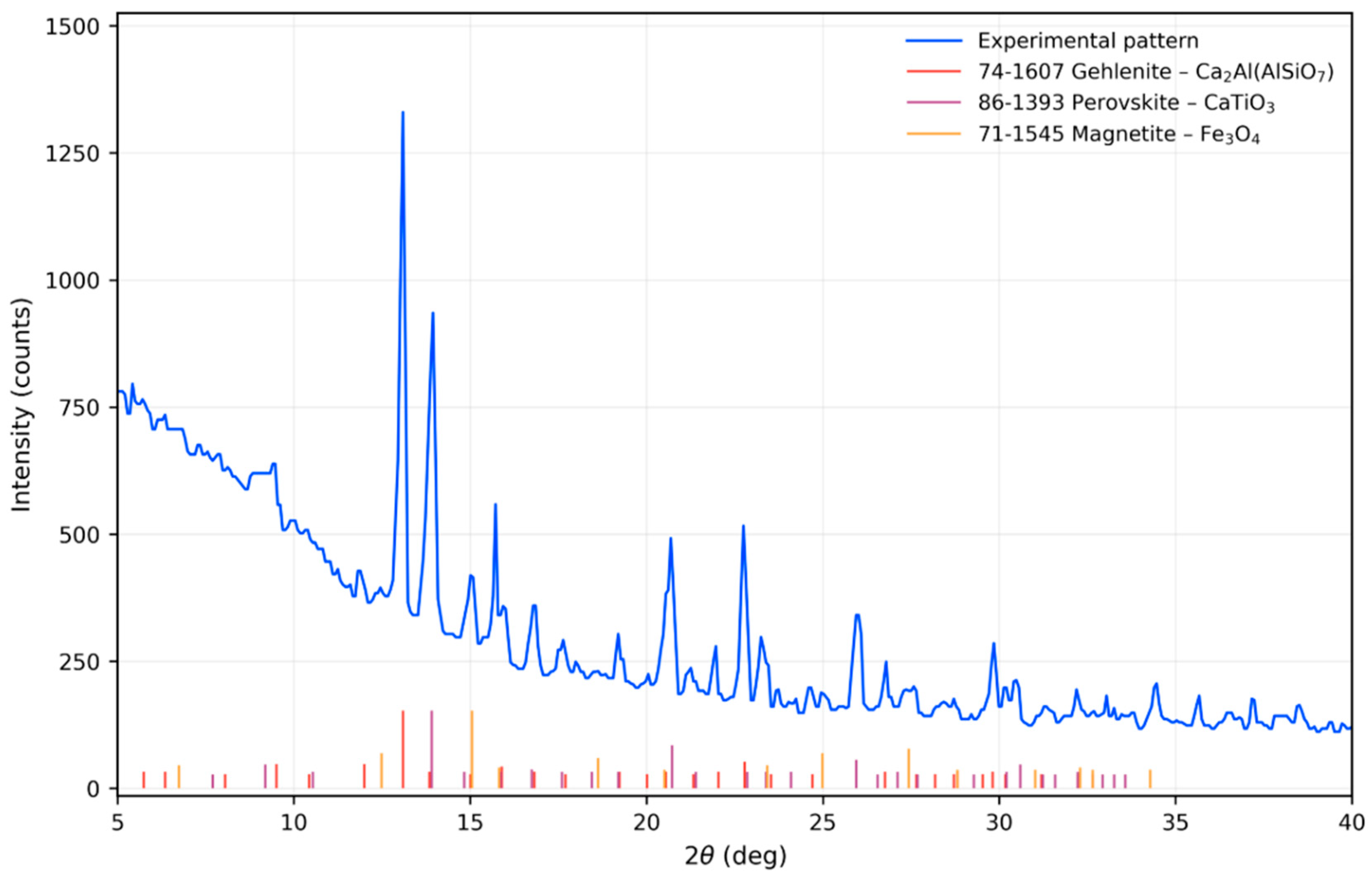
The XRD pattern of the bentonite sample indicates a complex mineral assemblage rather than a single pure clay phase. Reflections assigned to aluminosilicate phases and minor Fe–Ti-bearing phases were observed. However, the amorphous and poorly crystalline clay fraction was not quantified because no internal standard or full quantitative Rietveld refinement was applied. Therefore, the XRD results are discussed qualitatively. Considering the low CaO content determined by XRF, the previously assigned high relative abundance of anorthite should be treated with caution and was not used for quantitative interpretation. The relatively high LOI is attributed mainly to physically adsorbed water, interlayer water, and structural hydroxyl groups typical of clay minerals, rather than to anorthite. The adsorption behavior of bentonite is therefore primarily related to its clay fraction, exchangeable cations, and surface hydroxyl groups, while crystalline accessory phases may contribute only partially.
The XRD pattern (
Figure 2) confirms that the bentonite sample contains a complex mineral assemblage with aluminosilicate phases and minor Fe–Ti-bearing accessory phases. Because the amorphous and poorly crystalline clay fraction was not quantified by internal-standard XRD or full Rietveld refinement, the phase composition is discussed only qualitatively. The adsorption behavior is therefore mainly attributed to the clay fraction, exchangeable cations, and surface hydroxyl groups, while crystalline accessory phases may contribute only partially.
In comparison to red mud slag, which is dominated by calcium-rich phases formed at high temperature, bentonite retains a hydrated, layered structure. This structural difference is essential, as bentonite primarily interacts with contaminants through ion exchange and surface adsorption, whereas RMS behavior is more strongly governed by its mineral phases and surface chemistry developed during thermal processing.
2.3. Fly Ash
Fly ash is a fine particulate material generated during the combustion of coal, consisting primarily of amorphous and crystalline aluminosilicate phases. Due to its relatively high surface area and the presence of reactive oxides, fly ash is widely investigated as a low-cost adsorbent for wastewater treatment. Its adsorption behavior is governed by a combination of surface complexation, ion exchange, and, in some cases, precipitation reactions, particularly in systems containing calcium.
The chemical composition of the fly ash (
Table 4) used in this study, determined by XRF analysis, is presented in the table above. The results show that silica (SiO
2) is the dominant component (44.21 wt.%), followed by aluminum oxide (Al
2O
3, 19.06 wt.%) and calcium oxide (CaO, 20.98 wt.%). This composition indicates a typical aluminosilicate matrix with a relatively high calcium content, which can significantly influence its reactivity in aqueous systems.
The presence of Fe2O3 (8.56 wt.%) suggests that iron oxides are also an important component, potentially contributing to adsorption through surface complexation mechanisms. Minor oxides such as MgO (2.33 wt.%), SO3 (1.78 wt.%), and K2O (1.55 wt.%) are present in smaller amounts but may still affect the overall surface chemistry and interaction with dissolved species.
The relatively high CaO content is particularly relevant, as it can promote precipitation reactions and pH increase in aqueous systems, enhancing the removal of certain metal ions. At the same time, the aluminosilicate framework provides active sites for adsorption and ion exchange. Overall, this composition suggests that fly ash can act as a multifunctional material, combining adsorption and chemical precipitation mechanisms in wastewater treatment processes.
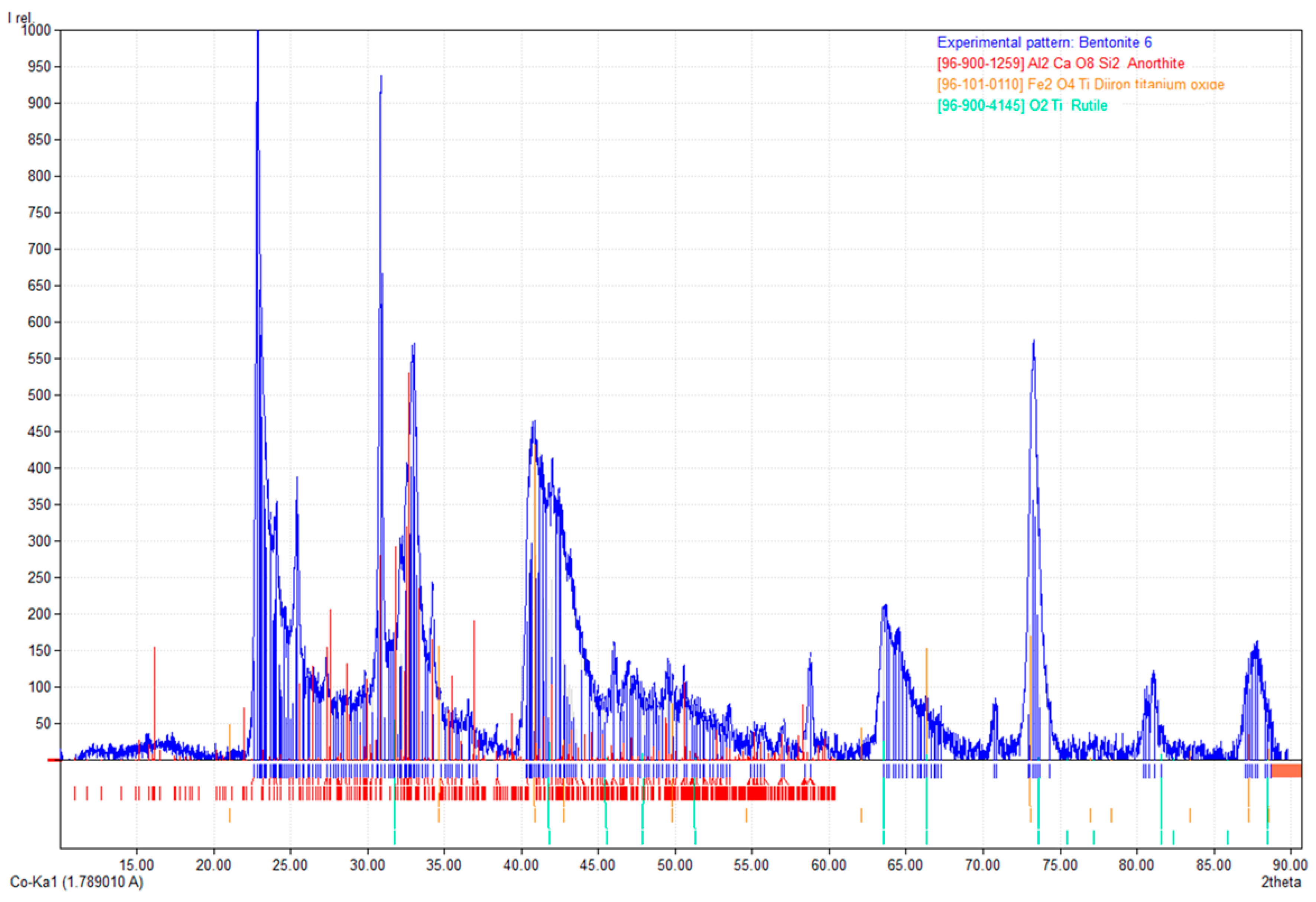
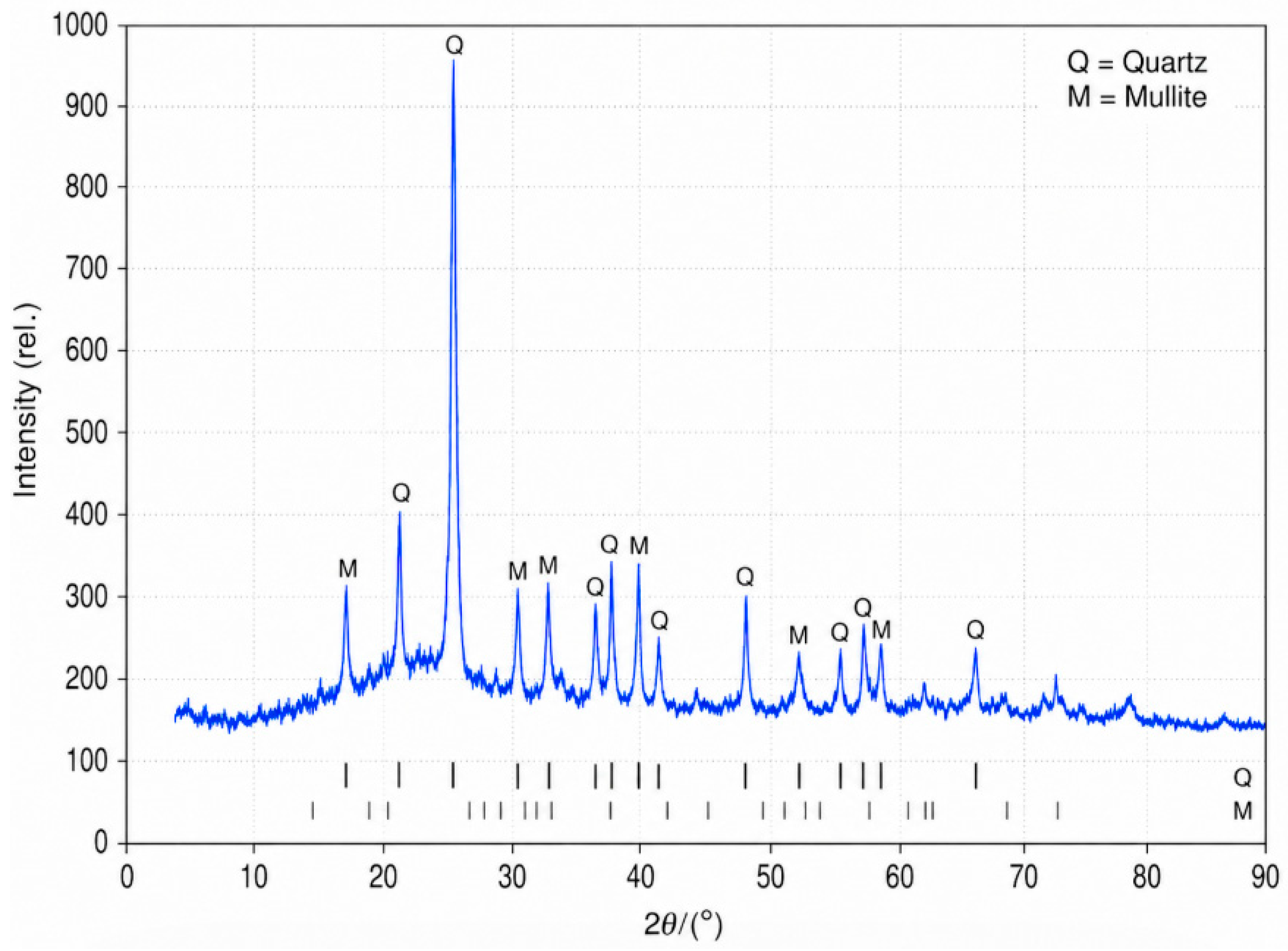
The XRD pattern of the fly ash sample (
Figure 3) shows the presence of two main crystalline phases: quartz (SiO
2) and mullite (Al
6Si
2O
13). The most intense diffraction peak is assigned to quartz, which confirms that crystalline silica is the dominant identifiable mineral phase in the fly ash. Quartz is commonly present in fly ash as a thermally stable mineral that remains largely unchanged during coal combustion.
Mullite is also clearly identified through several characteristic peaks. Its presence is typical for fly ash because mullite forms during high-temperature transformation of aluminosilicate minerals originally present in coal. The coexistence of quartz and mullite indicates that the fly ash contains a significant inorganic aluminosilicate fraction with relatively stable crystalline phases.
Besides the sharp crystalline peaks, the diffractogram also shows a raised and irregular background, especially in the lower and middle 2θ region. This is characteristic of an amorphous aluminosilicate glass phase, which is usually one of the most important components of fly ash. The amorphous phase is significant because it strongly influences the pozzolanic activity and reactivity of fly ash in cementitious or adsorption-related applications.
The amorphous fraction was not quantified in this study because no internal standard or quantitative Rietveld refinement was applied. Based on the XRD background and XRF composition, the amorphous component can be assigned mainly to an aluminosilicate glass phase containing Si, Al, Ca, and minor Fe/Mg species. However, its exact proportion and composition require additional quantitative XRD or complementary methods and are therefore not reported here.
In comparison to bentonite, which relies mainly on its layered structure and cation exchange capacity, fly ash exhibits a more heterogeneous behavior due to its mixed amorphous-crystalline structure and higher calcium content. This makes its performance strongly dependent on solution chemistry, especially pH and ionic composition.
Titanium concentration in the liquid samples was determined spectrophotometrically and expressed as TiO2 equivalent (Shimadzu UV-1800 Shimadzu Corporation, Kyoto, Japan). The analysis was performed by measuring absorbance at the characteristic wavelength of the Ti complex formed during the spectrophotometric procedure. Calibration curves were prepared using standard titanium solutions, and all measurements were conducted against appropriate reagent blanks to ensure accuracy and reproducibility.
The concentrations of Al, B, Cr, Cu, Fe, Li, Mn, and Pb were quantified using an inductively coupled plasma optical emission spectrometer (ICP-OES, Agilent Technologies 5100, Victoria, Australia). Prior to analysis, samples were filtered when necessary and diluted to fall within the linear calibration range. Multi-element standard solutions were used for calibration, and quality control was maintained through repeated measurements and standard verification.
Solid materials (raw adsorbents and post-treatment residues) were analyzed by X-ray diffraction (XRD) to identify crystalline phases.
This combined analytical approach ensured comprehensive monitoring of both the aqueous phase and solid adsorbents throughout the purification process.
4. Results and Discussion
The removal of dissolved species from strongly acidic tionite-leaching wastewater cannot be interpreted only as simple adsorption. Due to the low initial pH and the complex multi-element composition of the wastewater, several simultaneous processes may occur, including surface adsorption, ion exchange, surface complexation, partial neutralization, hydrolysis or precipitation of metal species, and partial dissolution of the adsorbent matrix. Therefore, the removal efficiencies reported in this study represent net removal from the liquid phase and reflect the balance between adsorption/precipitation and possible release of elements from the sorbent itself.
This section presents a systematic evaluation of the adsorption performance of fly ash, bentonite, and red mud slag (RMS) for the treatment of acidic wastewater generated during sulfuric acid leaching of reduced tionite within the EUROTITAN process. The discussion focuses on the influence of contact time, sorbent dosage, and sorbent type on the removal efficiency of dissolved metal species, as well as on the corresponding changes observed in the solid phase after treatment.
The graphical presentation focuses on Ti, Fe, Cu, and Pb because these elements are the most relevant indicators of treatment performance in the investigated wastewater. Fe and Ti were selected due to their importance in the tionite-processing route, while Cu and Pb were selected due to their environmental relevance and high removal response. The remaining elements, B, Cr, Li, and Mn, together with the final pH values, are presented in tabular form to provide the complete dataset without overloading the figures.
The removal efficiencies of B, Cr, Li, and Mn, together with the final pH values after sorption, are presented in tabular form to ensure completeness of the dataset while maintaining readability of the main figures. All removal results are expressed as percentage removal efficiency relative to the initial concentration in the untreated wastewater.
For full transparency and reproducibility, a comprehensive
Supplementary Tables S1–S3 provides the complete dataset, including initial and final concentrations of all analyzed elements expressed in ppm.
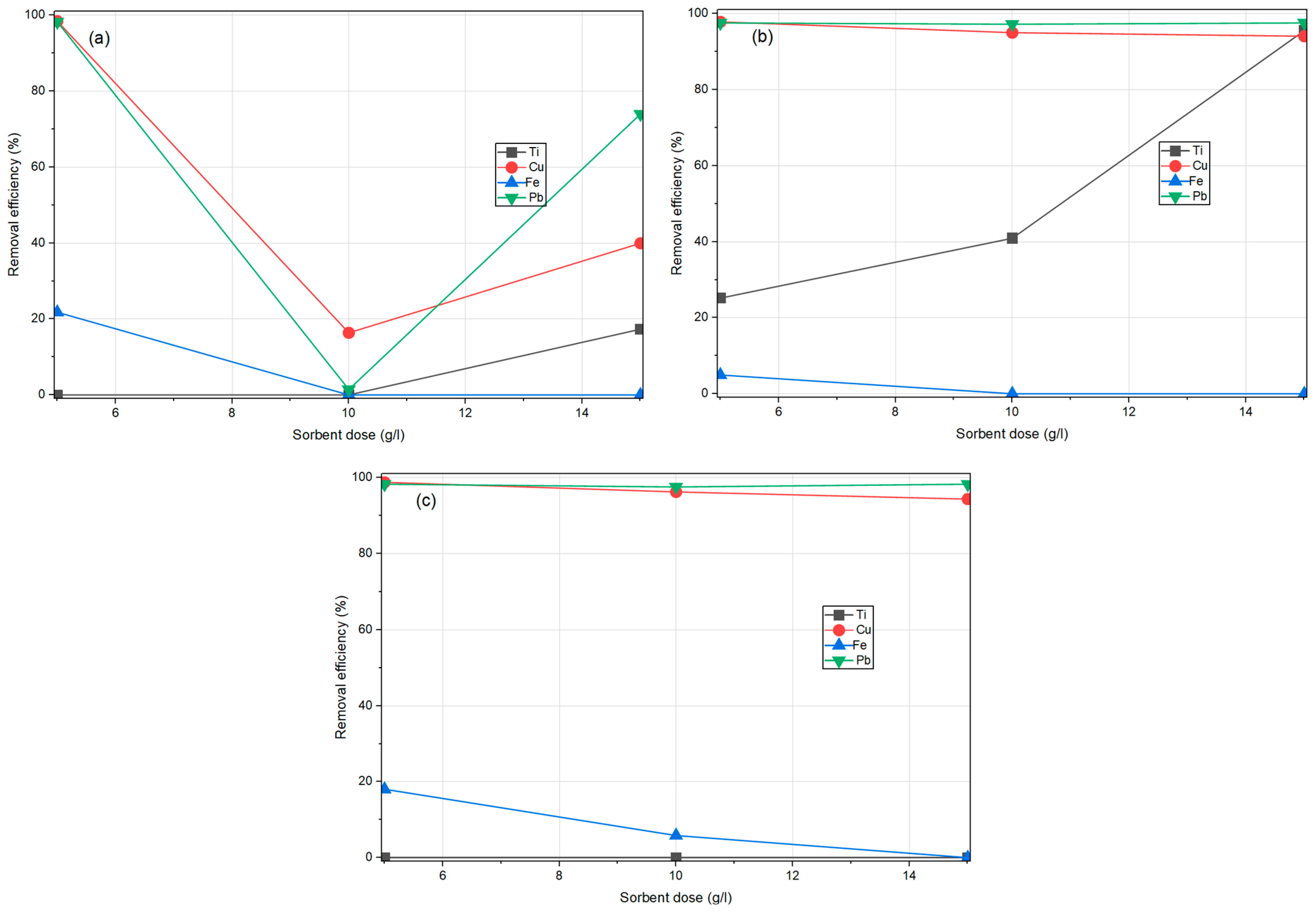
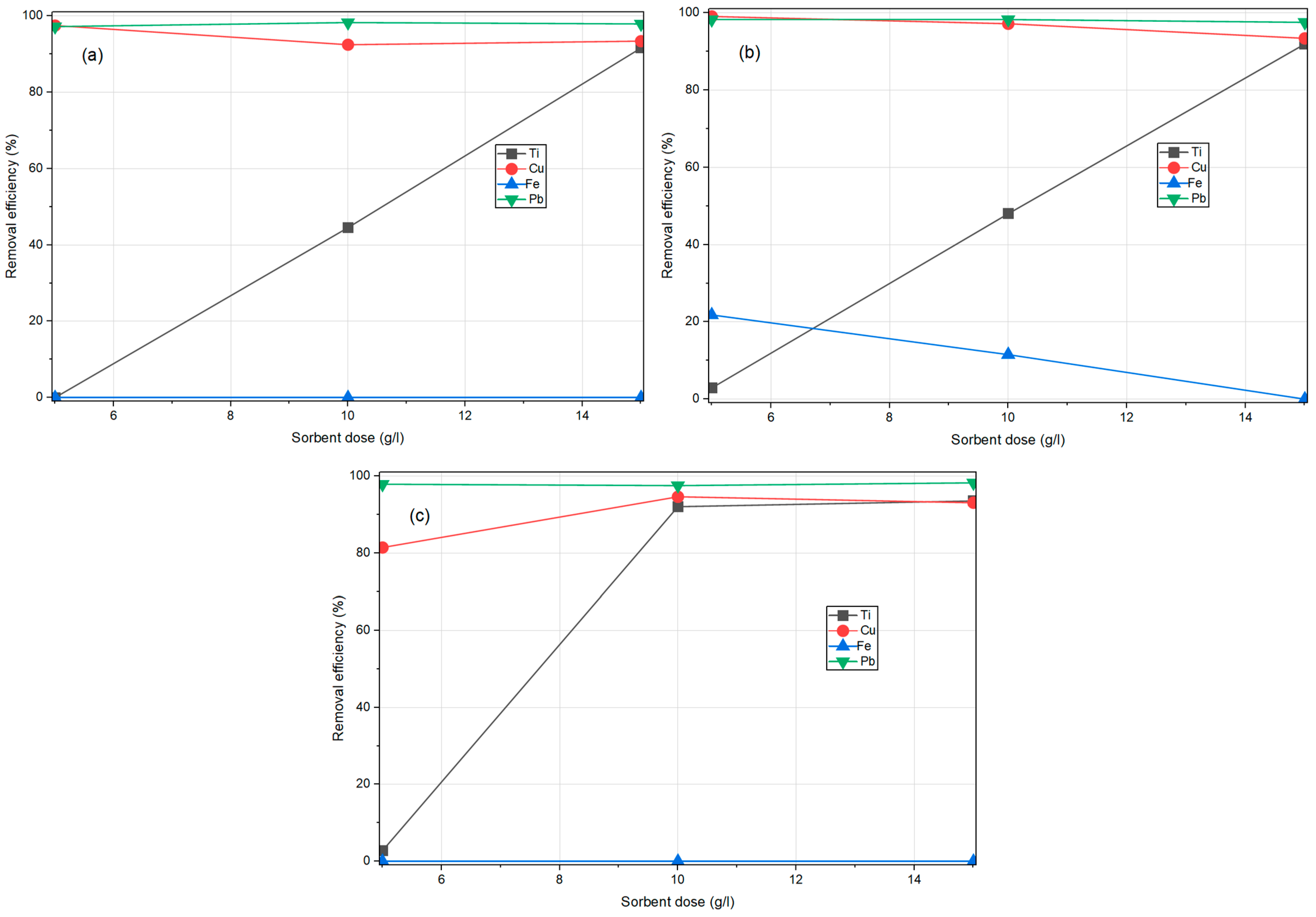
The results are presented separately for each adsorbent. For each material, the removal efficiencies are plotted as a function of sorbent dosage, while the three subfigures correspond to contact times of 4, 12, and 24 h. This format allows a more direct comparison between the experimental parameters and the observed removal behavior.
4.1. Adsorption of Heavy Metals Using Fly Ash as Adsorbent
The first set of experiments (Nos. 1–9) evaluates the performance of fly ash as an adsorbent under varying contact times (4, 12, and 24 h) and sorbent dosages (5, 10, and 15 g/L). This subsection presents the removal efficiencies of selected metals (Ti, Cu, Fe, Pb), while complementary data for B, Cr, Li, Mn, and post-treatment pH are summarized in
Table 6 and
Supplementary Table S1.
From
Figure 4, it can be seen that fly ash performance depended on both contact time and sorbent dosage. At 4 h, shown in
Figure 4a, the removal behavior was not uniform. Cu and Pb showed high removal at the lowest sorbent dosage, but their removal decreased at the intermediate dosage. At the highest dosage, Pb removal increased again, while Cu removal only partially recovered. Ti removal was low at lower dosages and increased only at the highest dosage, whereas Fe removal remained limited.
After 12 h of contact,
Figure 4b shows a more stable behavior for Cu and Pb, with high removal efficiencies across all tested dosages. Ti removal also increased with increasing fly ash dosage, reaching its highest value at the highest dose. In contrast, Fe removal remained low and decreased to nearly zero at higher dosages, indicating that fly ash was not effective for Fe removal under these acidic conditions.
At 24 h, shown in
Figure 4c, Cu and Pb removal remained high and relatively stable over the investigated dosage range. However, Ti and Fe removal were low, with values close to or equal to 0% under some conditions. This indicates that prolonged contact did not improve the retention of these elements when fly ash was used.
Overall, fly ash showed good potential for Cu and Pb removal, while Ti removal was strongly dependent on the applied dosage and contact time. Fe removal was generally poor. The results also show that removal efficiency was not always proportional to sorbent dosage, which suggests that fly ash behavior in acidic wastewater is affected by both adsorption and partial dissolution of its reactive components.
A removal efficiency of 0% means that no net removal was achieved, because the final concentration was equal to or higher than the initial concentration. This is consistent with the increase in aluminum concentration after treatment, presented in
Supplementary Table S1, and confirms that partial dissolution of the fly ash matrix occurred in the acidic wastewater.
Table 6 further shows very high removal efficiencies for boron in most experiments, except for experiments 2 and 3 (higher dosages at 4 h), where no effective removal was observed. Chromium removal remains consistently low, indicating weak interaction with fly ash under these conditions. Manganese removal is also limited, while lithium follows a trend similar to boron, with high efficiencies in selected experiments but reduced or negative performance at higher dosages (experiments 5 and 6).
The final pH values show that fly ash had a limited and condition-dependent neutralizing effect. The highest pH was obtained at 12 h and 15 g/L, while lower values were observed under most other conditions. This indicates that pH change was not controlled only by sorbent dosage, but also by contact time and partial dissolution of reactive fly ash components.
Overall, the results demonstrate that fly ash exhibits selective adsorption behavior, with strong affinity toward Pb, Cu, and B, moderate and condition-dependent removal of Ti, and limited effectiveness for Fe, Cr, and Mn in highly acidic wastewater generated within the EUROTITAN process.
4.2. Adsorption of Heavy Metals Using Bentonite as Adsorbent
The second set of experiments (Nos. 10–18) evaluates bentonite as an adsorbent under identical operational conditions (4, 12, and 24 h; 5, 10, and 15 g/L), allowing direct comparison with fly ash performance. In this case, aluminum was also included in the graphical representation due to its significant concentration in the initial wastewater and its interaction with clay-based materials.
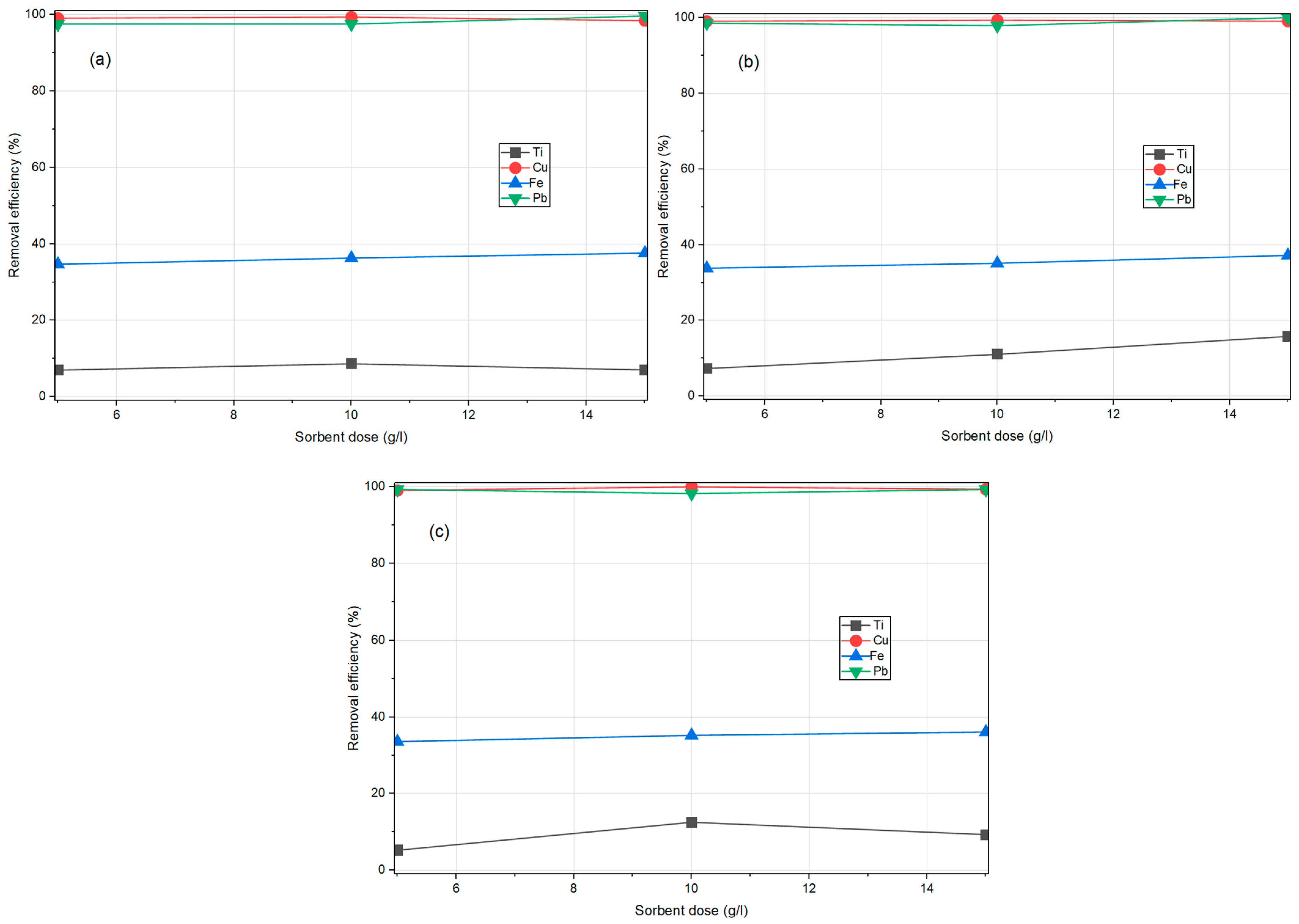
From
Figure 5, it can be observed that bentonite showed very stable and efficient removal of Cu and Pb under all tested conditions. Their removal efficiencies were close to 100% at 4, 12, and 24 h, with only minor changes as the sorbent dosage increased. This indicates that near-complete removal of Cu and Pb was already achieved at the lowest tested dosage, so further dosage increase had only a limited additional effect.
Titanium removal remained low throughout the experiments. At all contact times, Ti removal was below 20% and changed only slightly with increasing sorbent dosage. This shows that bentonite was not effective for Ti removal under the investigated acidic conditions.
Fe showed moderate removal efficiencies compared with Cu and Pb. Fe removal remained relatively stable, generally around 35–40%, with only small changes depending on contact time and dosage.
Overall, bentonite demonstrated the most consistent performance among the tested materials. It was highly effective for Cu and Pb removal, while Ti removal remained limited. Fe was only partially removed under the tested acidic conditions. Therefore, bentonite can be considered suitable for Cu and Pb removal from acidic wastewater, but less effective for Ti and only moderately effective for Fe.
Table 7 further demonstrates highly consistent behavior for boron and lithium, with removal efficiencies close to 100% in all experiments. Chromium removal is moderate but significantly lower than B and Li, while manganese shows the lowest efficiency among the analyzed elements.
The pH values after sorption remain within a narrow range (1.43–1.59), indicating that bentonite does not significantly neutralize the acidic wastewater. This suggests that metal removal is primarily governed by surface adsorption and ion exchange rather than precipitation induced by pH increase.
Overall, bentonite demonstrates highly stable and reproducible performance across the tested conditions, particularly for Pb, Cu, B, and Li, while showing limited efficiency for Ti and moderate affinity toward Fe, and Cr under the tested acidic conditions.
4.3. Adsorption of Heavy Metals Using RMS as Adsorbent
The third series of experiments (Nos. 19–27) investigates the adsorption performance of red mud slag (RMS) under the same operational conditions, enabling direct comparison with fly ash and bentonite. Aluminum is not included in the graphical presentation due to its elevated concentration after treatment, which is attributed to partial leaching from the RMS (see
Supplementary Table S3).
From
Figure 6, it can be observed that RMS showed very high and stable Pb removal under all tested conditions. Pb removal was close to complete at 4, 12, and 24 h, with only minor changes as sorbent dosage increased. This indicates that RMS was highly effective for Pb removal even at the lowest tested dosage.
Copper removal was also high in most experiments. At 4 h and 12 h, Cu removal remained above 90% across the tested dosage range. At 24 h, Cu removal was lower at the lowest dosage but increased again at higher dosages. This shows that RMS was generally effective for Cu removal, although its performance was slightly more affected by contact time and sorbent dosage than Pb removal.
Titanium removal showed the strongest dependence on sorbent dosage. At the lowest RMS dosage, Ti removal was very low. However, removal increased clearly with increasing dosage and reached high values at the highest sorbent dosage for all contact times. This indicates that higher RMS loading was important for efficient Ti removal from acidic wastewater.
Fe removal remained low in most experiments. This can be explained by the composition of RMS, which contains Fe-bearing phases that may partially dissolve under acidic conditions. Therefore, the apparent Fe removal was limited, even when adsorption or retention of Fe may have occurred.
Overall, RMS demonstrated excellent performance for Pb removal and very good performance for Cu removal. Ti removal was strongly dosage-dependent and became efficient only at higher RMS dosages. In contrast, RMS was not effective for Fe removal under the investigated acidic conditions. Therefore, RMS can be considered a promising adsorbent for Pb, Cu, and Ti removal, but not for Fe removal from this type of wastewater.
Table 8 shows that boron removal remains high under most conditions. Lithium demonstrates variable behavior: very good removal at 12 h with lower dosage (experiment 22), limited removal at short contact time, and reduced performance at prolonged contact or higher dosages. Chromium removal improves with increasing dosage and time, reaching a maximum of approximately 50% at 24 h and 15 g/L (experiment 27), although overall efficiency remains moderate. Manganese removal is generally low, with measurable removal (~20%) only at 12 h and lower dosage, indicating limited affinity of RMS toward Mn under the tested acidic conditions.
The different behavior of the three adsorbents can be directly related to their chemical and mineralogical composition. Fly ash contains a mixed aluminosilicate matrix with relatively high CaO and Fe2O3 contents, which can promote partial neutralization, precipitation-assisted removal, and surface complexation. However, under strongly acidic conditions, the same reactive phases may partially dissolve, explaining the release of Al and the unstable removal behavior of some elements. Bentonite is dominated by aluminosilicate clay phases with exchangeable cations and surface hydroxyl groups. Its limited effect on pH suggests that Pb, Cu, B, and Li removal is mainly governed by ion exchange and surface adsorption rather than precipitation. RMS contains Ca-, Fe-, Al-, and Ti-bearing phases formed during high-temperature red mud processing. These phases provide reactive surfaces for Pb and Cu retention, but partial dissolution of Fe- and Al-bearing phases under acidic conditions limits the net removal of Fe and Al. Therefore, adsorbent composition controls not only adsorption efficiency but also material stability in acidic wastewater.
Overall, RMS demonstrates strong performance for Pb and Cu, time- and dosage-dependent behavior for Ti, and moderate to low efficiency for Fe, Cr, Mn, and Li in highly acidic wastewater generated within the EUROTITAN process.
The results indicate that low-cost adsorbents can contribute to the partial purification of acidic tionite-leaching wastewater, particularly for Pb, Cu, B, and Li removal. However, due to the very low initial pH and the incomplete removal of Fe, Al, Ti, Cr, and Mn under some conditions, adsorption should not be considered as a complete stand-alone treatment process. Instead, these materials are more suitable as a preliminary treatment or polishing step within a broader wastewater-treatment scheme that may include neutralization, precipitation, filtration, and final pH adjustment before discharge or reuse. The obtained results are generally consistent with previous studies reporting the applicability of low-cost aluminosilicate, clay, and red-mud-based adsorbents for the removal of metal ions from aqueous systems.
Author Contributions
Conceptualization, D.K., M.P. and S.S.; methodology, D.K., J.V. and N.V.; software, M.P.; validation, D.K., J.V., N.V., B.F. and M.P.; formal analysis, J.V. and N.V.; investigation, D.K., J.V. and N.V.; resources, M.P., S.S., R.F., B.F. and V.D.; data curation, D.K.; writing—original draft preparation, D.K.; writing—review and editing, M.P., S.S., J.V., N.V., R.F. and V.D.; visualization, D.K.; supervision, M.P., B.F. and S.S.; project administration, M.P. and S.S.; funding acquisition, S.S. and B.F. All authors have read and agreed to the published version of the manuscript.
Funding
This research was funded by the European Commission, grant number 101135077 (EURO-TITAN).
Data Availability Statement
Data are contained within the article.
Conflicts of Interest
Authors Radislav Filipović, and Vladimir Damjanović were employed by the company Nova Alumina Ltd. The remaining authors declare that the research was conducted in the absence of any commercial or financial relationships that could be construed as a potential conflict of interest.
References
- Meng, F.; Xue, T.; Liu, Y.; Wang, W.; Qi, T. Treatment of Tionite Residue from Titanium Oxide Industry for Recovery of TiO2 and Removal of Silica. Hydrometallurgy 2016, 161, 112–116. [Google Scholar] [CrossRef] [Scilit]
- Abdelgalil, M.S.; El-Barawy, K.; Ge, Y.; Xia, L. The Recovery of TiO2 from Ilmenite Ore by Ammonium Sulfate Roasting–Leaching Process. Processes 2023, 11, 2570. [Google Scholar] [CrossRef] [Scilit]
- Han, F.; Wang, M.; Liu, W.; Song, W. Recovery of Sulfuric Acid and Iron from Titanium Dioxide Waste Acid by Membrane Electrolysis Combined with Selective Electrodialysis. Sep. Purif. Technol. 2024, 344, 127199. [Google Scholar] [CrossRef] [Scilit]
- Fu, F.; Wang, Q. Removal of Heavy Metal Ions from Wastewaters: A Review. J. Environ. Manag. 2011, 92, 407–418. [Google Scholar] [CrossRef] [Scilit] [PubMed]
- Babel, S.; Kurniawan, T.A. Low-Cost Adsorbents for Heavy Metals Uptake from Contaminated Water: A Review. J. Hazard. Mater. 2003, 97, 219–243. [Google Scholar] [CrossRef] [Scilit] [PubMed]
- Jadaa, W. Wastewater Treatment Utilizing Industrial Waste Fly Ash as a Low-Cost Adsorbent for Heavy Metal Removal: Literature Review. Clean. Technol. 2024, 6, 221–279. [Google Scholar] [CrossRef] [Scilit]
- Sahoo, P.K.; Tripathy, S.; Panigrahi, M.K.; Equeenuddin, S.M. Evaluation of the Use of an Alkali Modified Fly Ash as a Potential Adsorbent for the Removal of Metals from Acid Mine Drainage. Appl. Water Sci. 2013, 3, 567–576. [Google Scholar] [CrossRef] [Scilit]
- Cetin, S.; Pehlivan, E. The Use of Fly Ash as a Low Cost, Environmentally Friendly Alternative to Activated Carbon for the Removal of Heavy Metals from Aqueous Solutions. Colloids Surf. A Physicochem. Eng. Asp. 2007, 298, 83–87. [Google Scholar] [CrossRef] [Scilit]
- Uddin, M.K. A Review on the Adsorption of Heavy Metals by Clay Minerals, with Special Focus on the Past Decade. Chem. Eng. J. 2017, 308, 438–462. [Google Scholar] [CrossRef] [Scilit]
- Bhattacharyya, K.G.; Gupta, S. Sen Adsorption of a Few Heavy Metals on Natural and Modified Kaolinite and Montmorillonite: A Review. Adv. Colloid Interface Sci. 2008, 140, 114–131. [Google Scholar] [CrossRef] [Scilit] [PubMed]
- Arabmofrad, S.; Lazzara, G.; Miller, R.; Jafari, S.M. Surface Modification of Bentonite and Montmorillonite as Novel Nano-Adsorbents for the Removal of Phenols, Heavy Metals and Drug Residues. Adv. Colloid Interface Sci. 2024, 334, 103334. [Google Scholar] [CrossRef] [Scilit] [PubMed]
- Bhatnagar, A.; Vilar, V.J.P.; Botelho, C.M.S.; Boaventura, R.A.R. A Review of the Use of Red Mud as Adsorbent for the Removal of Toxic Pollutants from Water and Wastewater. Environ. Technol. 2011, 32, 231–249. [Google Scholar] [CrossRef] [Scilit] [PubMed]
- Vuković, J.; Perušić, M.; Stopić, S.; Kostić, D.; Smiljanić, S.; Filipović, R.; Damjanović, V. A Review of the Red Mud Utilization Possibilities. Ovidius Univ. Ann. Chem. 2024, 35, 165–173. [Google Scholar] [CrossRef] [Scilit]
- Vuković, J.; Smiljanić, S.N.; Kostić, D.; Stopić, S.; Perušić, M.; Vasiljević, N. A Preliminary Assessment of the Use of Red Mud Slag for Phosphate Sorption from Aqueous Solutions. Eng. Proc. 2025, 99, 5. [Google Scholar] [CrossRef] [Scilit]
- Kostić, D.; Vuković, J.; Vasiljević, N.; Perušić, M.; Stopić, S.; Teresa, M.; Baca, B.; Smiljanić, S.; Filipović, R.; Damjanović, V. Phosphate Removal from Aqueous Solutions Using Slag Derived from Hydrogen Plasma Reduction of Red Mud. Ovidius Univ. Ann. Chem. 2026, 37, 24–29. [Google Scholar] [CrossRef] [Scilit]
- Pawar, R.R.; Lalhmunsiama; Bajaj, H.C.; Lee, S.-M. Activated Bentonite as a Low-Cost Adsorbent for the Removal of Cu(II) and Pb(II) from Aqueous Solutions: Batch and Column Studies. J. Ind. Eng. Chem. 2016, 34, 213–223. [Google Scholar] [CrossRef] [Scilit]
- Bourliva, A.; Michailidis, K.; Sikalidis, C.; Filippidis, A.; Betsiou, M. Adsorption of Cd(II), Cu(II), Ni(II) and Pb(II) onto Natural Bentonite: Study in Mono- and Multi-Metal Systems. Environ. Earth Sci. 2015, 73, 5435–5444. [Google Scholar] [CrossRef] [Scilit]
- Rajković, M.; Jelić, I.; Janković, M.; Antonijević, D.; Šljivić-Ivanović, M. Red Mud as an Adsorbent for Hazardous Metal Ions: Trends in Utilization. Toxics 2025, 13, 107. [Google Scholar] [CrossRef] [Scilit] [PubMed]
- Decarbonized Titanium Recovery from Aluminium and Titanium Production Residues. 2024. Available online: https://cordis.europa.eu/project/id/101135077 (accessed on 1 June 2026).
- Stopic, S.; Kostić, D.; Schneider, R.; Sievers, M.; Wegmann, F.; Emil Kaya, E.; Perušić, M.; Friedrich, B. Recovery of Titanium from Red Mud Using Carbothermic Reduction and High Pressure Leaching of the Slag in an Autoclave. Minerals 2024, 14, 1151. [Google Scholar] [CrossRef] [Scilit]
| Disclaimer/Publisher’s Note: The statements, opinions and data contained in all publications are solely those of the individual author(s) and contributor(s) and not of MDPI and/or the editor(s). MDPI and/or the editor(s) disclaim responsibility for any injury to people or property resulting from any ideas, methods, instructions or products referred to in the content. |





 ,
,