Research on the Phase Transition Mechanisms and Consolidation Behavior of High-Titanium Vanadium–Titanium Pellets

Abstract
1. Introduction
2. Experimental Materials and Methods
2.1. Raw Materials
2.2. Experimental Design and Methods
2.2.1. Experimental Scheme
2.2.2. Experimental Methods
- (1)
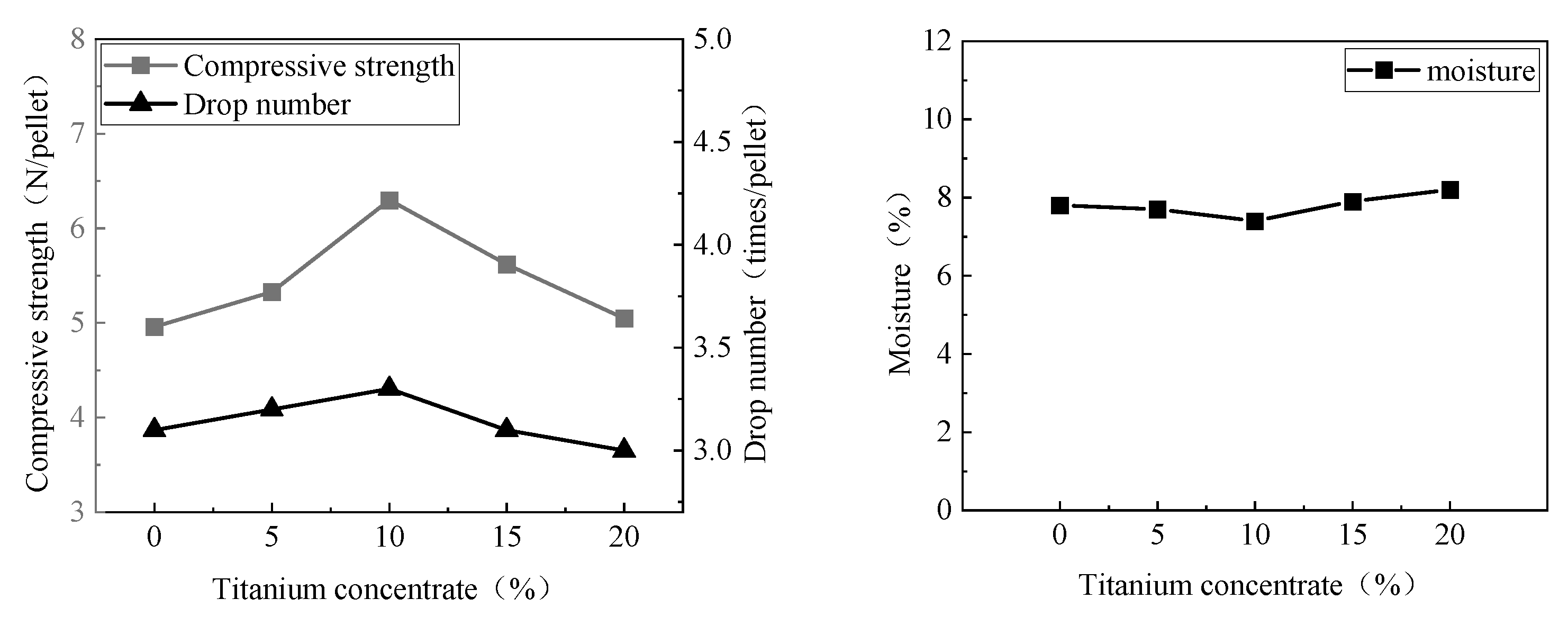
- Green pellet compressive strength: Ten green pellets with a size of 10–12.5 mm were selected randomly, and their compressive strength was measured using an electronic single-pellet compressive-strength tester. The load borne by each pellet was recorded in real time, and the average value was calculated.
- (2)
- Green pellet drop number: Ten green pellets with a size of 10–12.5 mm were selected randomly and dropped freely from a height of 500 mm onto a steel plate. The number of drops sustained before fracture was recorded for each pellet, and the arithmetic mean was taken as the drop number.
- (3)
- Moisture content of green pellets: A representative sample of freshly prepared green pellets was weighed and the initial mass was recorded as m0. The sample was then dried in an oven (Shanghai Yiheng Scientific Instruments Co., Ltd., Shanghai, China) at 125 °C for 2 h. After drying, the mass was recorded as mt. The moisture content of the green pellets was calculated according to Equation (1):
3. Results and Discussion
3.1. Effect of Titanium Concentrate Addition on the Green Pellet Properties
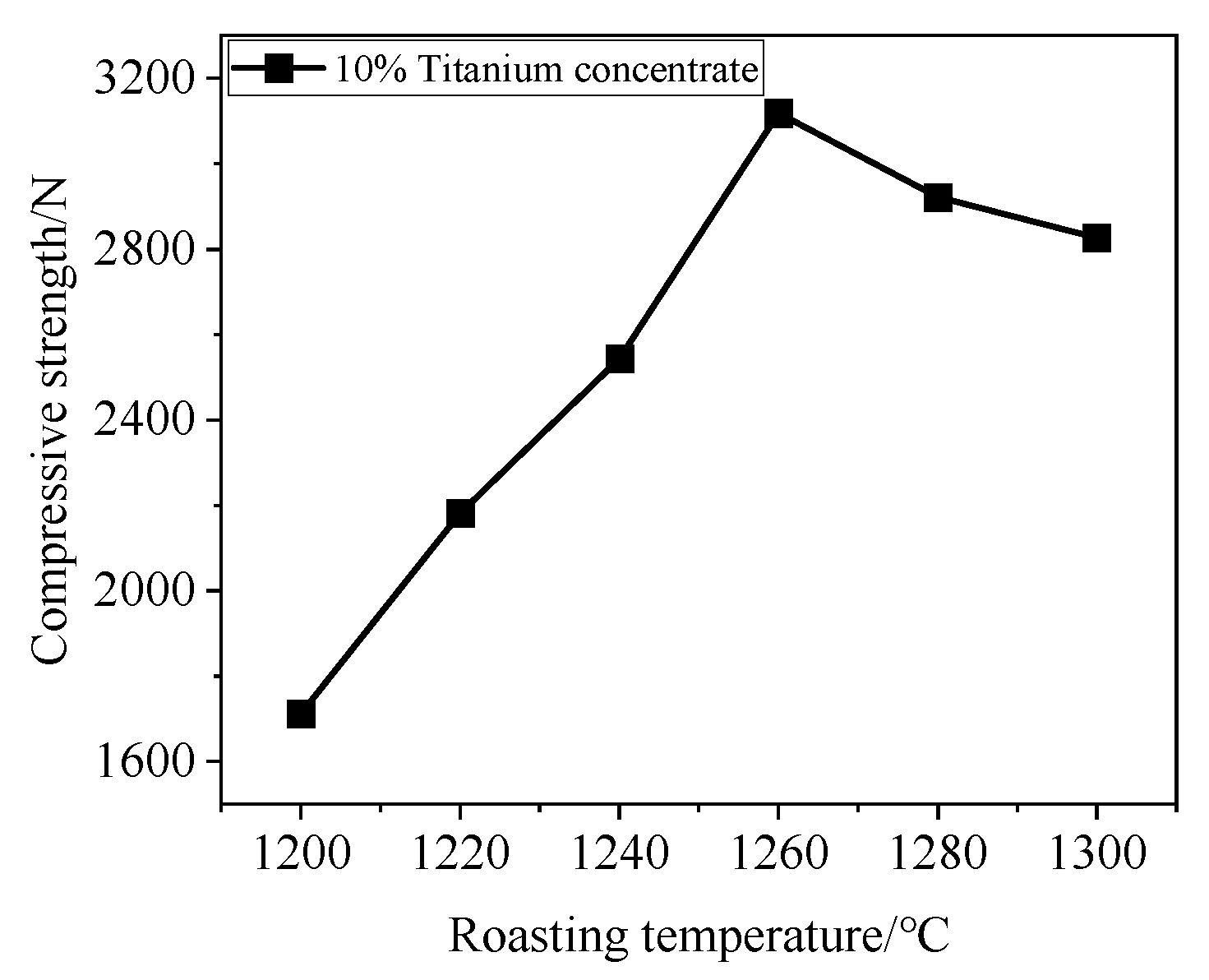
3.2. Effect of Roasting Temperature on the Compressive Strength of High-Titanium Vanadium–Titanium Pellets
3.3. Effect of Titanium Concentrate Content on the Compressive Strength of High-Titanium Vanadium–Titanium Pellets at Different Roasting Temperatures
3.4. XRD Analysis
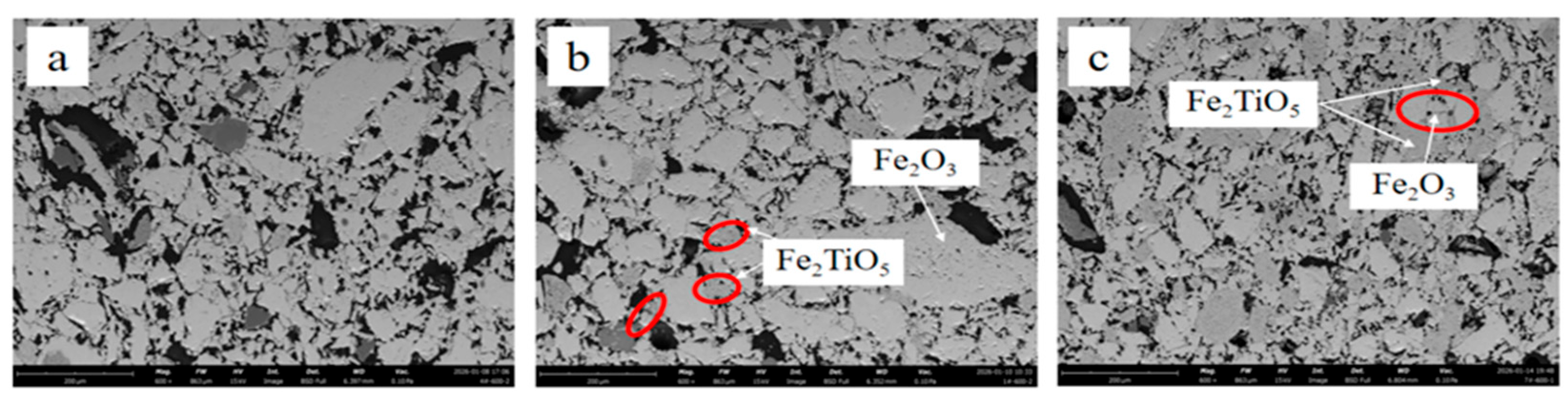
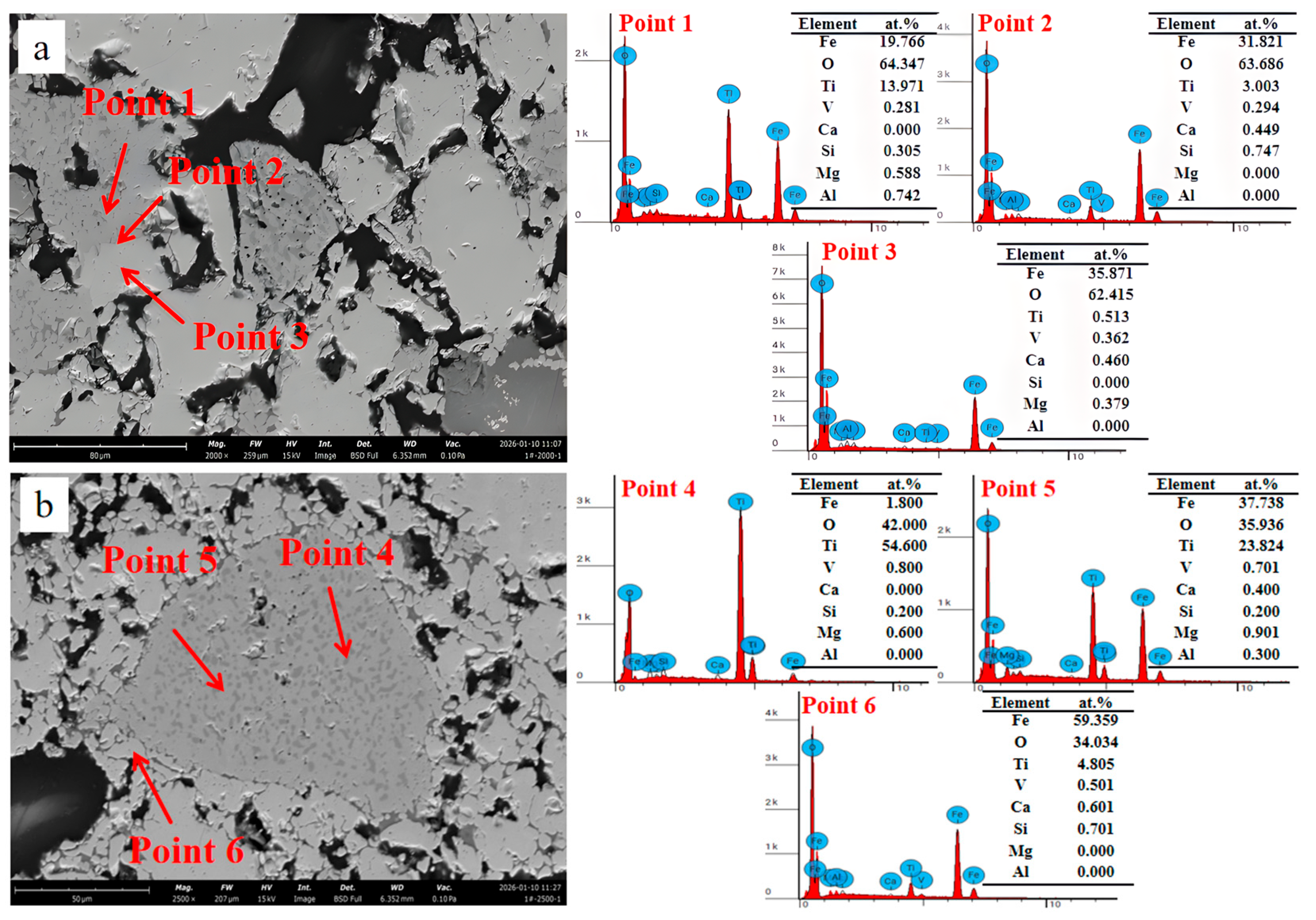
3.5. SEM-EDS Analysis
4. Conclusions
- (1)
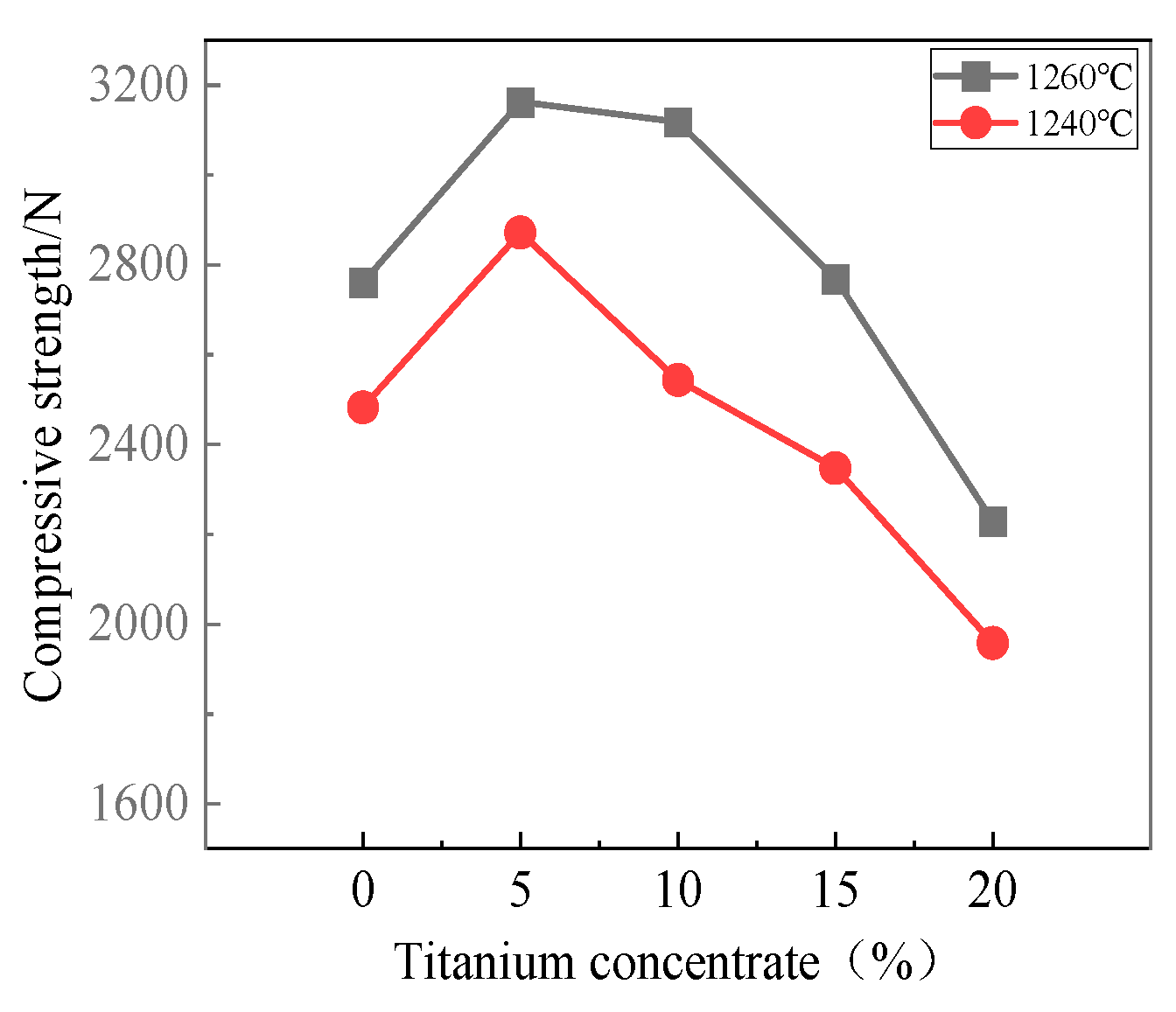
- The appropriate roasting temperature range for high-titanium vanadium–titanium pellets to satisfy the gas-based shaft furnace strength requirement (≥2500 N) is 1240–1260 °C.
- (2)
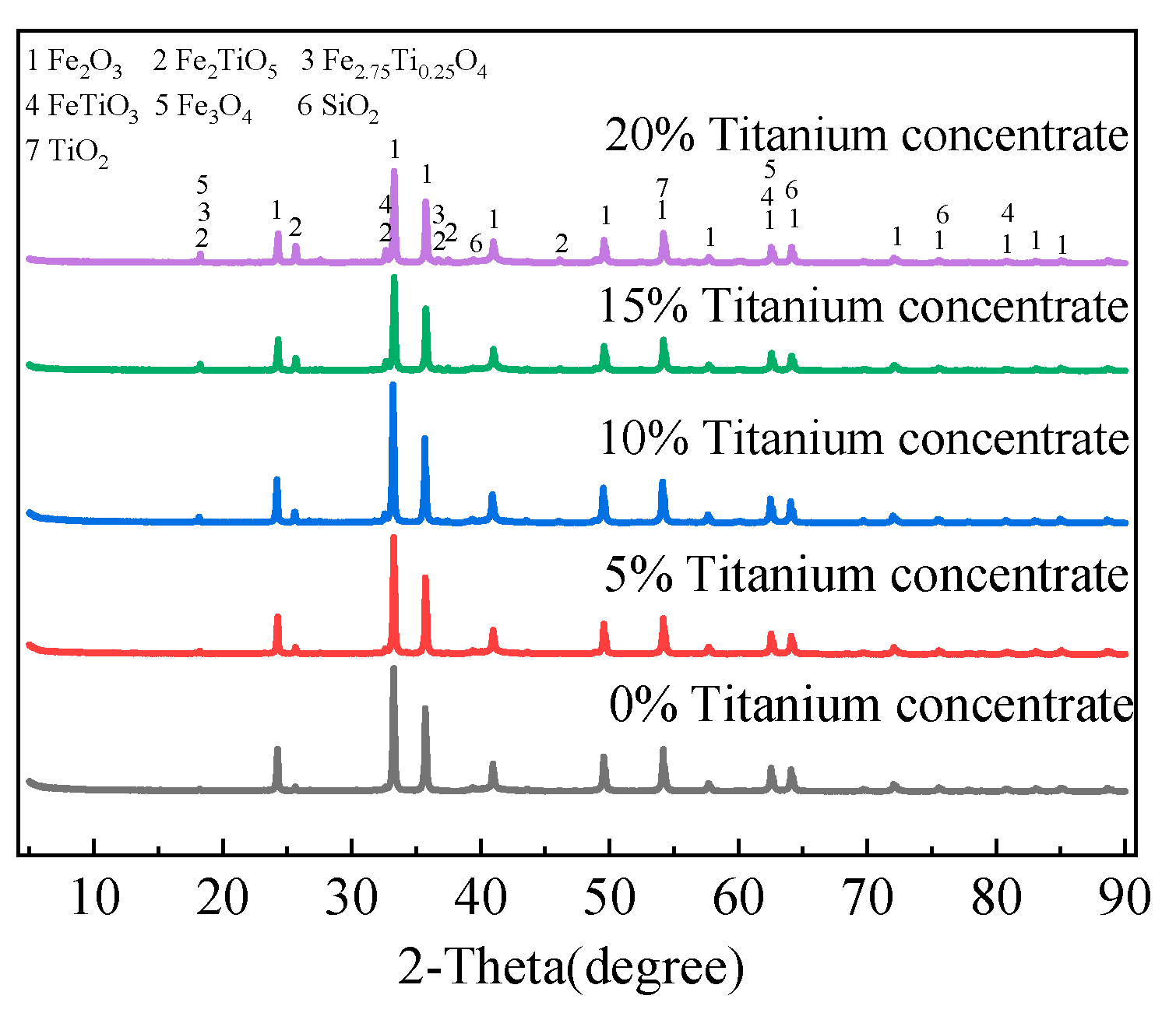
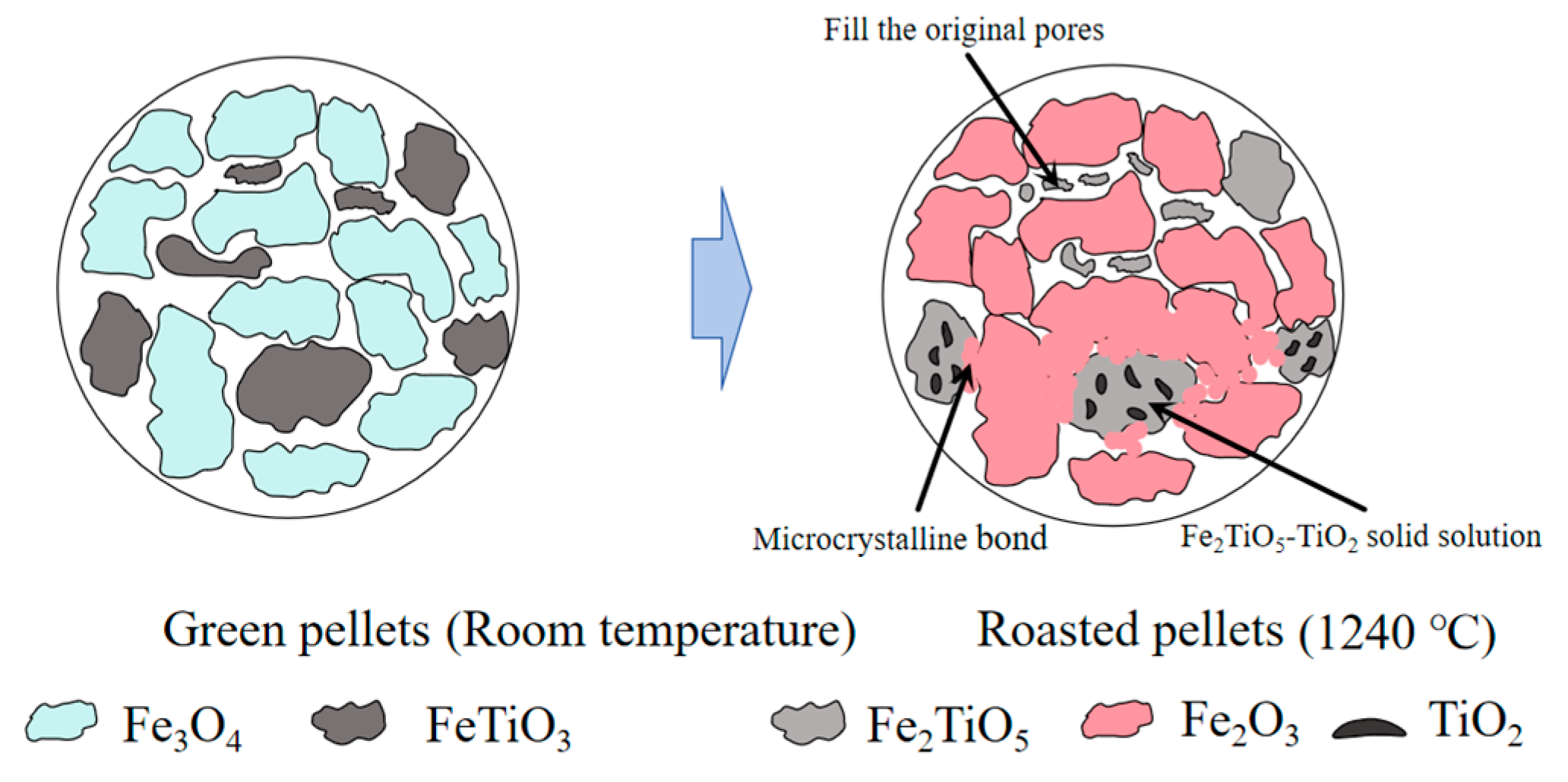
- Within the roasting temperature range of 1240–1260 °C, the compressive strength of pellets first increases and then decreases with increasing titanium concentrate addition up to 20%, and reaches the optimum value at 5%. Because it promotes the formation of pseudobrookite, which not only fills pores as fine pellets crystals but also forms crystal-bridge bonding with hematite, thereby improving structural compactness. However, when the addition is 10% and the roasting temperature is 1240 °C, the compressive strength still reaches 2543.30 N, which satisfies the process requirement. Considering both titanium utilization and pellet quality, the titanium concentrate addition should not exceed 10%.
- (3)
- The consolidation of high-titanium vanadium–titanium pellets is governed primarily by hematite recrystallization and is supplemented by bonding associated with the newly formed Fe2TiO5-TiO2 solid solution.
Author Contributions
Funding
Data Availability Statement
Conflicts of Interest
References
- Chanfreau, N.; Poquillon, D.; Stark, A.; Maawad, E.; Mareau, C.; Dehmas, M. Phase transformation of the Ti-5553 titanium alloy subjected to rapid heating. J. Mater. Sci. 2022, 57, 5620–5633. [Google Scholar] [CrossRef] [Scilit]
- Zhang, R.; Hou, Y.L.; Fan, G.Q.; Huang, D.; Ding, X.; Dang, J. Gas-based reduction and carbonization of titanium minerals in titanium-bearing blast furnace slag: A combined thermodynamic, experimental and DFT study. Int. J. Hydrogen Energy 2022, 47, 7586–7599. [Google Scholar] [CrossRef] [Scilit]
- Li, Y.; Wang, Z.; Guo, Z.; Kou, M.; Zhang, G. Effects of Na2CO3 on the carbothermic reduction and magnetic separation of ilmenite concentrate. Miner. Eng. 2024, 205, 108488–108500. [Google Scholar] [CrossRef] [Scilit]
- Chen, F.R.; Lv, W.; Zhou, G.W.; Liu, Z.L.; Chu, M.S.; Lv, X.W. Effects of H2, CO, and a gas mixture on the reduction process of raw and pre-oxidized ilmenite concentrate powders. Int. J. Hydrogen Energy 2024, 55, 502–511. [Google Scholar] [CrossRef] [Scilit]
- Lv, W.; Bai, C.G.; Lv, X.W.; Hu, K.; Lv, X.M.; Xiang, J.Y.; Song, B. Carbothermic reduction of ilmenite concentrate in semi-molten state by adding sodium sulfate. Powder Technol. 2018, 340, 354–361. [Google Scholar] [CrossRef] [Scilit]
- Lv, W.; Lv, X.W.; Xiang, J.Y.; Hu, K.; Zhao, S.Q.; Dong, J.; Ham, K.X.; Song, B. Effect of preoxidation on the reduction of ilmenite concentrate powder by hydrogen. Int. J. Hydrogen Energy 2019, 44, 4031–4040. [Google Scholar] [CrossRef] [Scilit]
- Lv, X.D.; Chen, D.; Xin, Y.T.; Lv, W.; Dong, J.; Lv, X.W. Isothermal kinetics of carbothermic reduction of ilmenite concentrate with the addition of sodium carbonate. Powder Technol. 2021, 392, 14–22. [Google Scholar] [CrossRef] [Scilit]
- Middlemas, S.; Fang, Z.Z.; Fan, P. Life cycle assessment comparison of emerging and traditional Titanium dioxide manufacturing processes. J. Clean. Prod. 2015, 89, 137–147. [Google Scholar] [CrossRef] [Scilit]
- Zhu, L.G.; Kong, L.X.; Yang, B.; Xu, B.Q. Production of low-oxygen titanium powder by thermochemical and electrochemical processes: Current state and perspectives. J. Mater. Res. Technol. 2025, 36, 1522–1535. [Google Scholar] [CrossRef] [Scilit]
- Nie, W.L.; Wen, S.M.; Liu, D.W.; Hu, T.; Zhang, L.B. Innovative application of two-stage sulfuric acid leaching for efficient recovery of Ti from titanium-bearing electric furnace slag. J. Environ. Chem. Eng. 2023, 11, 109174–109193. [Google Scholar] [CrossRef] [Scilit]
- Maldybayev, G.; Korabayev, A.; Sharipov, R.; Al Azzam, K.M.; Negim, E.-S.; Baigenzhenov, O.; Alimzhanova, A.; Panigrahi, M.; Shayakhmetova, R. Processing of titanium-containing ores for the production of titanium products: A comprehensive review. Heliyon 2024, 10, 24966–24979. [Google Scholar] [CrossRef] [Scilit]
- Feng, Q.; Lv, M.; Mao, L.; Duan, B.; Yang, Y.; Chen, G.; Lu, X.; Li, C. Research Progress of Titanium Sponge Production: A Review. Metals 2023, 13, 408. [Google Scholar] [CrossRef] [Scilit]
- Nayak, D.; Ray, N.; Dash, N.; Rath, S.S.; Biswal, S.K. Reduction behaviour of Odisha Sands Complex, India ilmenite-coke composite pellets. J. Cent. South Univ. 2020, 27, 1678–1690. [Google Scholar] [CrossRef] [Scilit]
- Ghadi, A.Z.; Radfar, N.; Valipour, M.S.; Sohn, H.Y. A Review on the Modeling of Direct Reduction of Iron Oxides in Gas-Based Shaft Furnaces. Steel Res. Int. 2023, 94, 2200742–2200760. [Google Scholar] [CrossRef] [Scilit]
- Tang, J.; Chu, M.-S.; Li, F.; Feng, C.; Liu, Z.-G.; Zhou, Y.-S. Development and progress on hydrogen metallurgy. Int. J. Miner. Metall. Mater. 2020, 27, 713–723. [Google Scholar] [CrossRef] [Scilit]
- Yang, L.Z.; Feng, Z.; Hu, H.; Wei, G.S.; Xue, B.T.; Guo, Y.F.; Jiang, T. A review on production and application of direct reduced iron in gas-based shaft furnace-electric arc furnace route. J. Iron Steel Res. Int. 2025, 32, 485–518. [Google Scholar] [CrossRef] [Scilit]
- Tang, J.; Chu, M.; Feng, C.; Li, F.; Tang, Y.; Liu, Z. Coupled Effect of Valuable Components in High-Chromium Vanadium-bearing Titanomagnetite during Oxidization Roasting. ISIJ Int. 2016, 56, 1342–1351. [Google Scholar] [CrossRef] [Scilit]
- Tang, W.D.; Yang, S.T.; Xue, X.X. Effect of V2O5 Addition on Oxidation Induration and Swelling Behavior of Chromium-Bearing Vanadium Titanomagnetite Pellets with Simulated Coke Oven Gas Injection into Blast Furnace. ISIJ Int. 2019, 59, 988–997. [Google Scholar] [CrossRef] [Scilit]
- Tang, W.D.; Yang, S.T.; Cheng, G.J.; Gao, Z.X.; Xue, X.X. Effect of MgO in Sinter and Primary-Slag on Smelting Mechanism of Chromium-Bearing Vanadium Titanomagnetite. Steel Res. Int. 2018, 89, 1800226–1800236. [Google Scholar] [CrossRef] [Scilit]
- Feng, J.E.; Tang, J.; Wang, X.A.; Chu, M.S.; Zhao, Z.C.; Liu, Z.G.; Li, L.J. Effect of TiO2 during Oxidation Roasting Process of Pellet: Kinetic Mechanism and Microstructure. Steel Res. Int. 2024, 95, 2300435–2300447. [Google Scholar]
- Tang, J.; Chu, M.-S.; Feng, C.; Li, F.; Liu, Z.-G. Phases transition and consolidation mechanism of high chromium vanadiumtitanium magnetite pellet by oxidation process. High Temp. Mater. Process. 2016, 35, 729–738. [Google Scholar] [CrossRef] [Scilit]
- Guo, Y.F.; Liu, K.; Chen, F.; Wang, S.; Yang, L.Z.; Li, D.Y.; Zheng, Y. Effect of high-pressure grinding rolls pretreatment on the preparation of vanadium-titanium magnetite pellets. J. Mater. Res. Technol.-JMR T 2023, 23, 2479–2490. [Google Scholar] [CrossRef] [Scilit]
- Lv, H.; Gan, M.; Wen, X.; Ji, Z.; Fan, X.; Li, S.; Li, J.; Wang, S.; Wang, X.; Xie, L. Promoting low-temperature consolidation of vanadium titano-magnetite pellets by high-pressure grinding roll: Mechanism of mechanical activation. J. Mater. Res. Technol. 2024, 30, 2435–2445. [Google Scholar] [CrossRef] [Scilit]
- Gan, M.; Ji, Z.Y.; Fan, X.H.; Lv, W.; Zheng, R.Y.; Chen, X.L.; Liu, S.; Jiang, T. Preparing high-strength titanium pellets for ironmaking as furnace protector: Optimum route for ilmenite oxidation and consolidation. Powder Technol. 2018, 333, 385–393. [Google Scholar] [CrossRef] [Scilit]
- GB/T 14201-1993; Iron Ore Pellets—Determination of Crushing Strength. State Bureau of Technical Supervision: Beijing, China, 1993.





| Type | TFe | SiO2 | CaO | MgO | Al2O3 | TiO2 | V2O5 |
|---|---|---|---|---|---|---|---|
| Titanium concentrate powder | 33.82 | 4.31 | 1.34 | 1.86 | 1.74 | 43.95 | 0.20 |
| Vanadium–titanium powder | 62.48 | 4.18 | 1.00 | 0.52 | 0.92 | 6.04 | 0.63 |
| Xuanhua powder | 68.76 | 2.48 | 0.28 | 0.34 | 0.78 | 0.76 | 0.05 |
| Titanium concentrate powder | 80.0 |
| Vanadium–titanium powder | 82.8 |
| Xuanhua powder | 88.4 |
| Mt (%) | CV (mL/15 mg) | <0.074 mm (%) | SC (mL·g−1) | MC (%) | MB (g·(100 g)−1) |
|---|---|---|---|---|---|
| 62.25 | 372.50 | 96.75 | 15.50 | 13.80 | 28.55 |
| Component | 0% | 5% | 10% | 15% | 20% |
|---|---|---|---|---|---|
| Titanium concentrate | 0.0 | 5.0 | 10.0 | 15.0 | 20.0 |
| Vanadium–titanium powder | 50.0 | 45.0 | 40.0 | 35.0 | 30.0 |
| Xuanhua Powder | 50.0 | 50.0 | 50.0 | 50.0 | 50.0 |
| Bentonite | 1.0 | 1.0 | 1.0 | 1.0 | 1.0 |
Disclaimer/Publisher’s Note: The statements, opinions and data contained in all publications are solely those of the individual author(s) and contributor(s) and not of MDPI and/or the editor(s). MDPI and/or the editor(s) disclaim responsibility for any injury to people or property resulting from any ideas, methods, instructions or products referred to in the content. |
© 2026 by the authors. Licensee MDPI, Basel, Switzerland. This article is an open access article distributed under the terms and conditions of the Creative Commons Attribution (CC BY) license.
Share and Cite
Shang, Z.; Tian, T.; Zhang, Y.; Deng, Y. Research on the Phase Transition Mechanisms and Consolidation Behavior of High-Titanium Vanadium–Titanium Pellets. Metals 2026, 16, 777. https://doi.org/10.3390/met16070777
Shang Z, Tian T, Zhang Y, Deng Y. Research on the Phase Transition Mechanisms and Consolidation Behavior of High-Titanium Vanadium–Titanium Pellets. Metals. 2026; 16(7):777. https://doi.org/10.3390/met16070777
Chicago/Turabian StyleShang, Zhanao, Tielei Tian, Yuzhu Zhang, and Yong Deng. 2026. "Research on the Phase Transition Mechanisms and Consolidation Behavior of High-Titanium Vanadium–Titanium Pellets" Metals 16, no. 7: 777. https://doi.org/10.3390/met16070777
APA StyleShang, Z., Tian, T., Zhang, Y., & Deng, Y. (2026). Research on the Phase Transition Mechanisms and Consolidation Behavior of High-Titanium Vanadium–Titanium Pellets. Metals, 16(7), 777. https://doi.org/10.3390/met16070777