Phase Evolution and Deuterium Storage Properties of TiVNbZrCr High-Entropy Alloy: A Temperature-Resolved Synchrotron X-Ray Diffraction Study †

 , , , ,
Abstract
1. Introduction
2. Materials and Methods
2.1. Alloy Design
Hydrogen Affinity
2.2. Alloy Preparation
2.3. Density and Chemical Characterization
2.4. Deuterium Absorption Measurements
- Approximately 5.078 g of powder alloy was placed into the reaction chamber of the magnetic suspension balance. The system was then sealed and evacuated to a rotary pump vacuum < 0.02 bar (2 kPa).
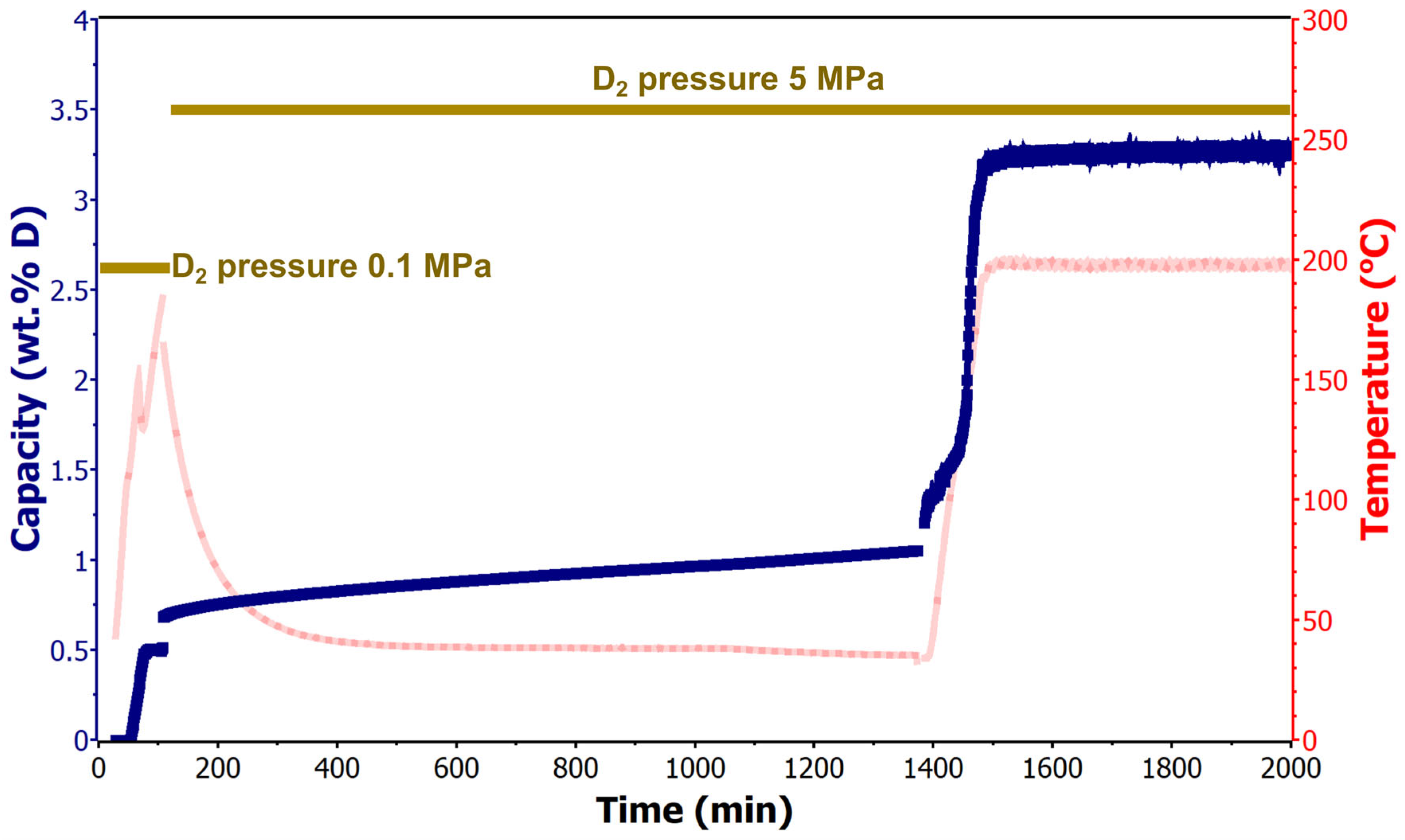
- The alloy was activated by exposure to high-purity D2 gas (99.89%, Linde GmbH, Pullach, Germany) of pressure 0.1 MPa and heated to 200 °C for 2 h.
- In the next step, the D2 pressure was increased to 5 MPa (50 bar), and the sample was cooled down to room temperature. The cooling and stabilization process lasted approximately 1200 min (20 h). During this stage, the mass increase in the sample caused by D2 absorption was continuously monitored.
- The deuterium absorption capacity of the sample was subsequently measured at a constant D2 pressure of 5 MPa (50 bar) during heating up to 200 °C, where a rapid increase in sample mass was observed. The sample was kept under deuterium until the absorption curve reached a stable plateau. The absorbed deuterium content was calculated from the mass increase after buoyancy correction and expressed both as wt.% D and as the deuterium-to-metal atomic ratio D/M.
2.5. Synchrotron X-Ray Diffraction
2.6. Thermal Desorption Analysis
3. Results and Discussion
3.1. Alloy Classification, Composition and Deuterium Affinity
3.2. Deuterium Absorption Behavior
3.3. Phase Constitution Before and After Deuteration
3.4. Thermal Desorption and Structural Transformation Sequence
3.5. Phase-Transformation Pathway and Deuterium Storage Mechanism in TiVNbZrCr
4. Conclusions
- •
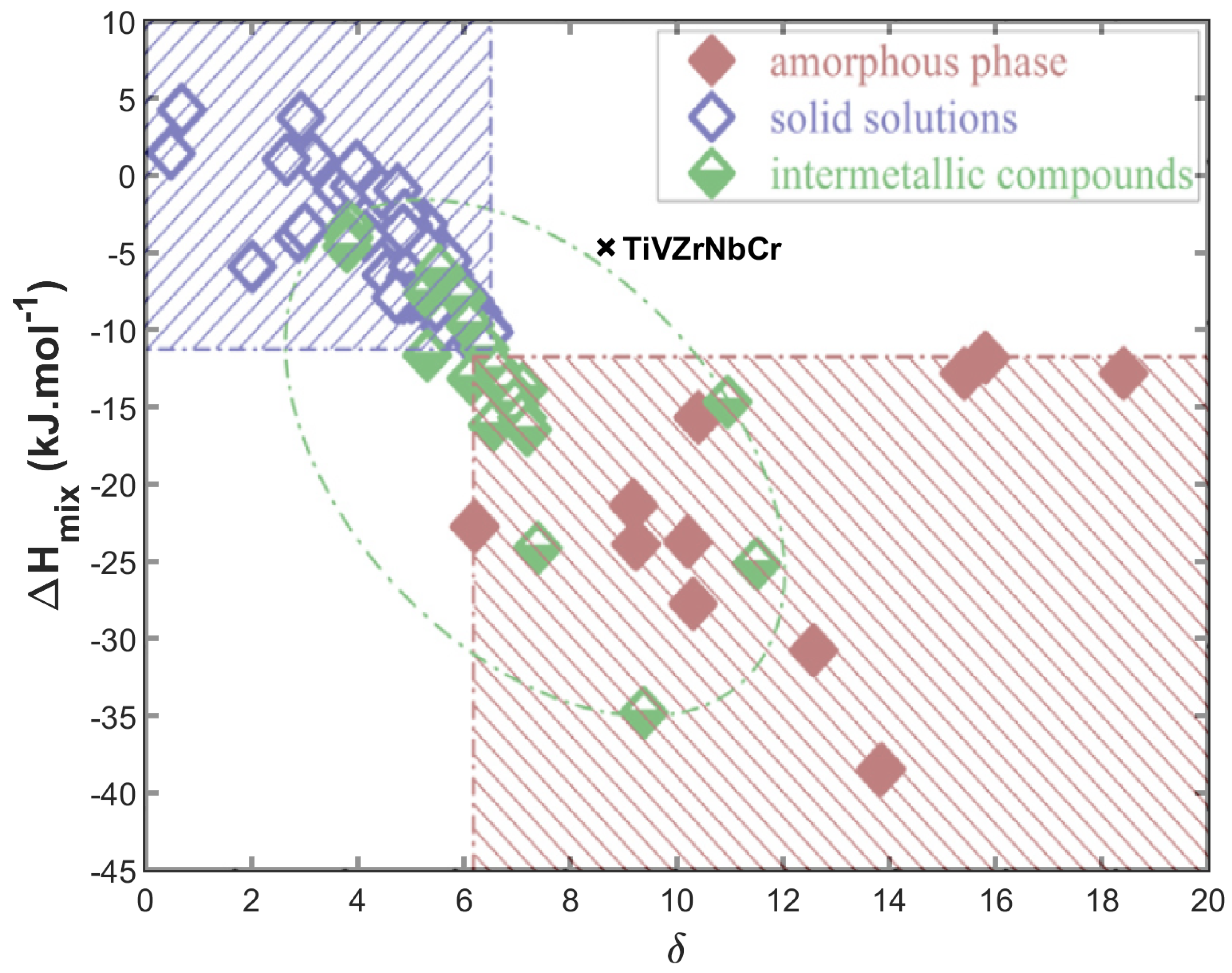
- The prepared TiVNbZrCr alloy exhibits an experimentally determined composition of Ti17V19Zr19Nb22Cr23, close to the nominal equiatomic composition, and a measured density of 6.59 g.cm−3. The calculated alloy-design parameters indicate that TiVNbZrCr should not be interpreted as a simple single-phase bcc high-entropy solid solution. Instead, it behaves as a compositionally complex intermetallic alloy. The calculated hydrogen-affinity descriptors confirm a strong thermodynamic tendency toward deuterium uptake and deuteride formation, mainly due to the presence of Ti, V, Nb and Zr.
- •
- Gravimetric absorption measurements showed that the alloy absorbs deuterium slowly at room temperature under 5 MPa D2, reaching approximately 1.0 wt.% D after about 1200 min. During subsequent heating to 200 °C under the same pressure, the deuterium uptake increased rapidly to 3.28 wt.% D, corresponding to D/M = 1.1. Because deuterium has approximately twice the atomic mass of hydrogen, the gravimetric capacity expressed as wt.% D cannot be directly compared with wt.% H values reported in hydrogen-storage literature. Therefore, the isotope-independent D/M ratio is also reported. The value D/M = 1.1 corresponds to the same atomic occupancy as H/M = 1.1 and is therefore the appropriate parameter for comparison with hydrogen absorption data.
- •
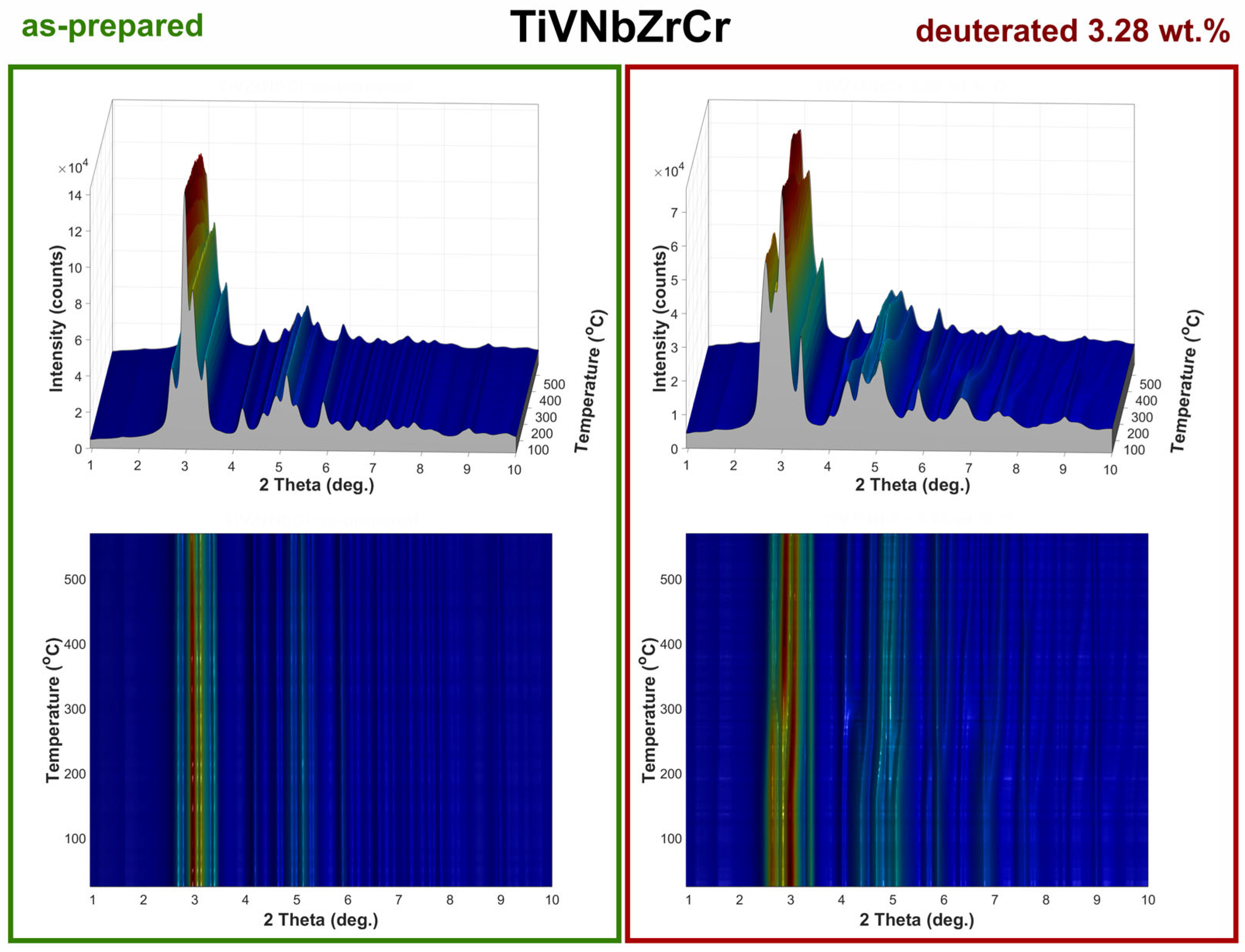
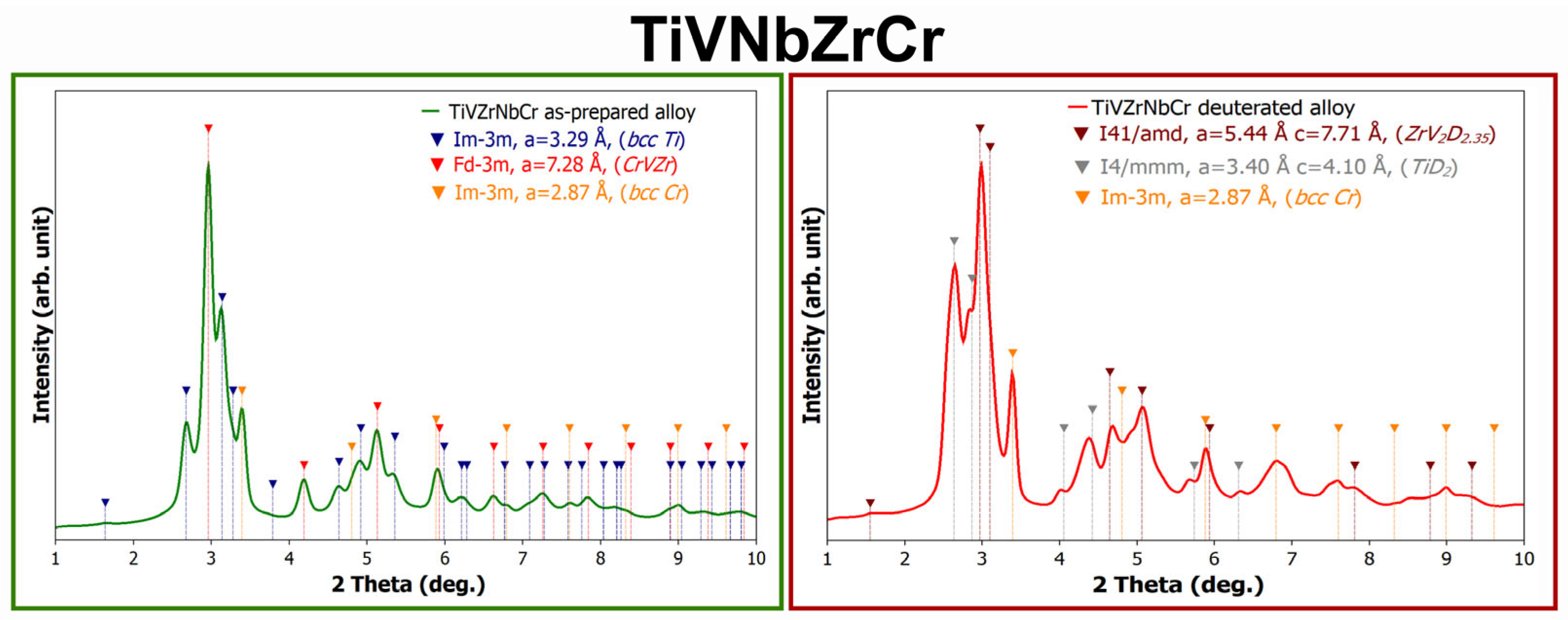
- Synchrotron X-ray diffraction confirmed that the as-prepared alloy is multiphase, containing a bcc Ti-rich phase, an Fd-3m CrVZr-type intermetallic phase and a bcc Cr-rich phase. After deuteration, the diffraction pattern changed substantially, and the newly appearing reflections could be indexed using tetragonal deuteride reference structures corresponding to ZrV2D2.35 and TiD2.
- •
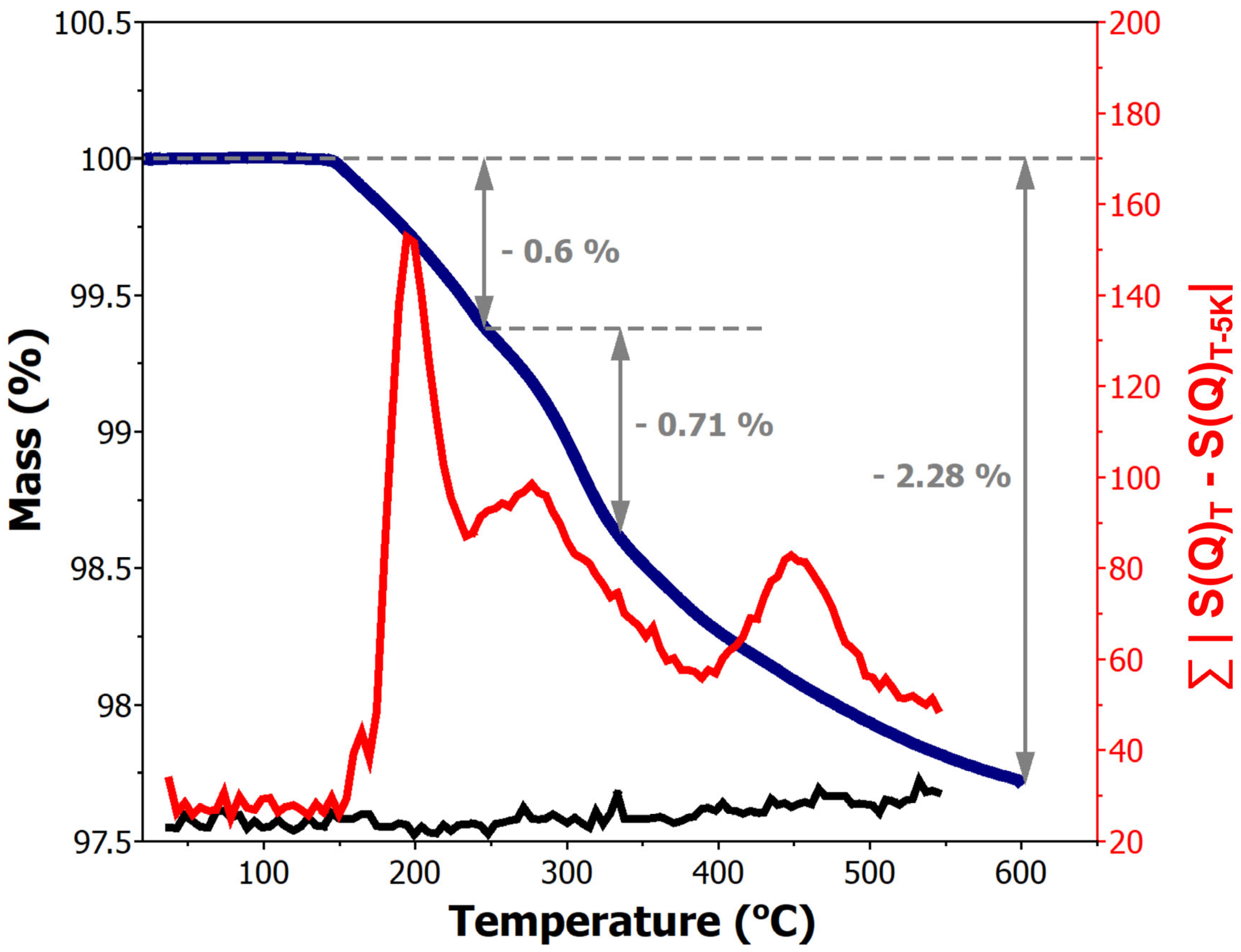
- Thermal desorption analysis showed a total mass loss of 2.28 wt.% D up to 600 °C. Deuterium release occurred in three partially overlapping regions: approximately 0.60 wt.% D below about 250 °C, an additional 0.71 wt.% D between about 250 and 350 °C, and the remaining fraction gradually up to 600 °C. The correlation between TGA and the structural-change parameter derived from synchrotron data shows that deuterium release is accompanied by structural rearrangements and decomposition of deuteride phases rather than by simple thermal desorption from a uniform solid solution.
Author Contributions
Funding
Data Availability Statement
Conflicts of Interest
References
- Jena, P. Materials for Hydrogen Storage: Past, Present, and Future. J. Phys. Chem. Lett. 2011, 2, 206–211. [Google Scholar] [CrossRef] [Scilit]
- Sakintuna, B.; Lamari-Darkrim, F.; Hirscher, M. Metal Hydride Materials for Solid Hydrogen Storage: A Review. Int. J. Hydrogen Energy 2007, 32, 1121–1140. [Google Scholar] [CrossRef] [Scilit]
- Yartys, V.A.; Lototskyy, M.V.; Akiba, E.; Albert, R.; Antonov, V.E.; Ares, J.R.; Baricco, M.; Bourgeois, N.; Buckley, C.E.; Bellosta von Colbe, J.M.; et al. Magnesium Based Materials for Hydrogen Based Energy Storage: Past, Present and Future. Int. J. Hydrogen Energy 2019, 44, 7809–7859. [Google Scholar] [CrossRef] [Scilit]
- Marques, F.; Balcerzak, M.; Winkelmann, F.; Zepon, G.; Felderhoff, M. Review and Outlook on High-Entropy Alloys for Hydrogen Storage. Energy Environ. Sci. 2021, 14, 5191–5227. [Google Scholar] [CrossRef] [Scilit]
- Miracle, D.B.; Senkov, O.N. A Critical Review of High Entropy Alloys and Related Concepts. Acta Mater. 2016, 122, 448–511. [Google Scholar] [CrossRef] [Scilit]
- Sahlberg, M.; Karlsson, D.; Zlotea, C.; Jansson, U. Superior Hydrogen Storage in High Entropy Alloys. Sci. Rep. 2016, 6, 36770. [Google Scholar] [CrossRef] [Scilit]
- Ek, G.; Nygård, M.M.; Pavan, A.F.; Montero, J.; Henry, P.F.; Sørby, M.H.; Witman, M.; Stavila, V.; Zlotea, C.; Hauback, B.C.; et al. Elucidating the Effects of the Composition on Hydrogen Sorption in TiVZrNbHf-Based High-Entropy Alloys. Inorg. Chem. 2020, 60, 1124–1132. [Google Scholar] [CrossRef] [Scilit]
- Montero, J.; Zlotea, C.; Ek, G.; Crivello, J.C.; Laversenne, L.; Sahlberg, M. TiVZrNb Multi-Principal-Element Alloy: Synthesis Optimization, Structural, and Hydrogen Sorption Properties. Molecules 2019, 24, 2799. [Google Scholar] [CrossRef] [Scilit] [PubMed]
- Nygård, M.M.; Fjellvåg, Ø.S.; Sørby, M.H.; Sakaki, K.; Ikeda, K.; Armstrong, J.; Vajeeston, P.; Sławiński, W.A.; Kim, H.; Machida, A.; et al. The Average and Local Structure of TiVCrNbDx (X=0,2.2,8) from Total Scattering and Neutron Spectroscopy. Acta Mater. 2021, 205, 116496. [Google Scholar] [CrossRef] [Scilit]
- Silva, B.H.; Zlotea, C.; Vaughan, G.; Champion, Y.; Botta, W.J.; Zepon, G. Hydrogen Absorption/Desorption Reactions of the (TiVNb)85Cr15 Multicomponent Alloy. J. Alloys Compd. 2022, 901, 163620. [Google Scholar] [CrossRef] [Scilit]
- Wu, C.; Gong, Y.; Liu, C.; Li, X.; Gizer, G.; Pistidda, C.; Körmann, F.; Ma, Y.; Neugebauer, J.; Raabe, D. Hydrogen Accommodation and Its Role in Lattice Symmetry in a TiNbZr Medium-Entropy Alloy. Acta Mater. 2025, 288, 120852. [Google Scholar] [CrossRef] [Scilit]
- Cheng, B.; Li, Y.; Li, X.; Ke, H.; Wang, L.; Cao, T.; Wan, D.; Wang, B.; Xue, Y. Solid-State Hydrogen Storage Properties of Ti–V–Nb–Cr High-Entropy Alloys and the Associated Effects of Transitional Metals (M = Mn, Fe, Ni). Acta Metall. Sin. 2023, 36, 1113–1122. [Google Scholar] [CrossRef] [Scilit]
- Bouzidi, A.; Laversenne, L.; Nassif, V.; Elkaim, E.; Zlotea, C. Hydrogen Storage Properties of a New Ti-V-Cr-Zr-Nb High Entropy Alloy. Hydrogen 2022, 3, 270–284. [Google Scholar] [CrossRef] [Scilit]
- Guo, S. Phase Selection Rules for Cast High Entropy Alloys: An Overview. Mater. Sci. Technol. 2015, 31, 1223–1230. [Google Scholar] [CrossRef] [Scilit]
- Floriano, R.; Zepon, G.; Edalati, K.; Fontana, G.L.B.G.; Mohammadi, A.; Ma, Z.; Li, H.W.; Contieri, R.J. Hydrogen Storage in TiZrNbFeNi High Entropy Alloys, Designed by Thermodynamic Calculations. Int. J. Hydrogen Energy 2020, 45, 33759–33770. [Google Scholar] [CrossRef] [Scilit]
- Kušnírová, K.; Varcholová, D.; Molčanová, Z.; Ballóková, B.; Möllmer, J.; Jasminská, N.; Lazár, M.; Brestovič, T.; Podobová, M.; Džunda, R.; et al. Multicomponent Metal Alloys Tested for Hydrogen Storage. In Proceedings of the 31st International Conference on Metallurgy and Materials, METAL 2022, Brno, Czech Republic, 18–19 May 2022. [Google Scholar]
- Takeuchi, A.; Inoue, A. Classification of Bulk Metallic Glasses by Atomic Size Difference, Heat of Mixing and Period of Constituent Elements and Its Application to Characterization of the Main Alloying Element. Mater. Trans. 2005, 46, 2817–2829. [Google Scholar] [CrossRef] [Scilit]
- Keith, A.; Zlotea, C.; Szilágyi, P.Á. Perspective of Interstitial Hydrides of High-Entropy Alloys for Vehicular Hydrogen Storage. Int. J. Hydrogen Energy 2024, 52, 531–546. [Google Scholar] [CrossRef] [Scilit]
- Griessen, R.; Riesterer, T. Heat of Formation Models. In Hydrogen in Intermetallic Compounds; Springer: Berlin/Heidelberg, Germany, 1988; pp. 219–284. [Google Scholar] [CrossRef] [Scilit]
- Moellmer, J.; Moeller, A.; Dreisbach, F.; Glaeser, R.; Staudt, R. High Pressure Adsorption of Hydrogen, Nitrogen, Carbon Dioxide and Methane on the Metal–Organic Framework HKUST-1. Microporous Mesoporous Mater. 2011, 138, 140–148. [Google Scholar] [CrossRef] [Scilit]
- Skinner, L.B.; Benmore, C.J.; Parise, J.B. Area Detector Corrections for High Quality Synchrotron X-Ray Structure Factor Measurements. Nucl. Instrum. Methods Phys. Res. A 2012, 662, 61–70. [Google Scholar] [CrossRef] [Scilit]
- Hammersley, A.P. FIT2D: A Multi-Purpose Data Reduction, Analysis and Visualization Program. Appl. Crystallogr. 2016, 49, 646–652. [Google Scholar] [CrossRef] [Scilit]
- Faber, T.E.; Ziman, J.M. A Theory of the Electrical Properties of Liquid Metals. Philos. Mag. 1965, 11, 153–173. [Google Scholar] [CrossRef] [Scilit]
- Match!—Phase Analysis Using Powder Diffraction. Available online: https://www.crystalimpact.com/match/Default.htm (accessed on 19 May 2026).
- Graulis, S.; Chateigner, D.; Downs, R.T.; Yokochi, A.F.T.; Quirós, M.; Lutterotti, L.; Manakova, E.; Butkus, J.; Moeck, P.; Le Bail, A. Crystallography Open Database—An Open-Access Collection of Crystal Structures. J. Appl. Crystallogr. 2009, 42, 726. [Google Scholar] [CrossRef] [Scilit] [PubMed]




| Sample (EDX Composition) [at.%] | Phase | Density [g·cm−3] | Absorbed D [wt.%] (D/M) | Desorbed D [wt.%] | ΔHmix [kJ·mol−1] | Δ [%] | VEC | ΔH∞ [kJ·mol−1] | ΔHf [kJ·mol−1] |
|---|---|---|---|---|---|---|---|---|---|
| TiVNbZrCr (Ti17V19Nb22Zr19Cr23) | IM | 6.59 | 3.28 (1.1) | 2.28 | −4.99 | 8.8 | 4.8 | −28.8 | −48.4 |
Disclaimer/Publisher’s Note: The statements, opinions and data contained in all publications are solely those of the individual author(s) and contributor(s) and not of MDPI and/or the editor(s). MDPI and/or the editor(s) disclaim responsibility for any injury to people or property resulting from any ideas, methods, instructions or products referred to in the content. |
© 2026 by the authors. Licensee MDPI, Basel, Switzerland. This article is an open access article distributed under the terms and conditions of the Creative Commons Attribution (CC BY) license.
Share and Cite
Saksl, K.; Kušnírová, K.; Oroszová, L.; Nigutová, K.; Kubaško, J.; Möllmer, J.; Lange, M.; Podobová, M. Phase Evolution and Deuterium Storage Properties of TiVNbZrCr High-Entropy Alloy: A Temperature-Resolved Synchrotron X-Ray Diffraction Study. Metals 2026, 16, 664. https://doi.org/10.3390/met16060664
Saksl K, Kušnírová K, Oroszová L, Nigutová K, Kubaško J, Möllmer J, Lange M, Podobová M. Phase Evolution and Deuterium Storage Properties of TiVNbZrCr High-Entropy Alloy: A Temperature-Resolved Synchrotron X-Ray Diffraction Study. Metals. 2026; 16(6):664. https://doi.org/10.3390/met16060664
Chicago/Turabian StyleSaksl, Karel, Katarína Kušnírová, Lenka Oroszová, Katarína Nigutová, Jakub Kubaško, Jens Möllmer, Marcus Lange, and Mária Podobová. 2026. "Phase Evolution and Deuterium Storage Properties of TiVNbZrCr High-Entropy Alloy: A Temperature-Resolved Synchrotron X-Ray Diffraction Study" Metals 16, no. 6: 664. https://doi.org/10.3390/met16060664
APA StyleSaksl, K., Kušnírová, K., Oroszová, L., Nigutová, K., Kubaško, J., Möllmer, J., Lange, M., & Podobová, M. (2026). Phase Evolution and Deuterium Storage Properties of TiVNbZrCr High-Entropy Alloy: A Temperature-Resolved Synchrotron X-Ray Diffraction Study. Metals, 16(6), 664. https://doi.org/10.3390/met16060664