Article

Effect of Internal Reinforcing on Impact Axial Collapse Behavior of Hat-Shaped Tubular Structure


by
Gusmao Robbinson Noviano
1,
Minoru Yamashita
2,* and
Makoto Nikawa
2
1
Graduate School of Engineering, Gifu University, 1-1 Yanagido, Gifu 501-1193, Japan
2
Department of Mechanical Engineering, Gifu University, 1-1 Yanagido, Gifu 501-1193, Japan
*
Author to whom correspondence should be addressed.
Metals 2026, 16(6), 655; https://doi.org/10.3390/met16060655 (registering DOI)
Submission received: 8 May 2026 / Revised: 10 June 2026 / Accepted: 12 June 2026 / Published: 14 June 2026
(This article belongs to the Section Structural Integrity of Metals)

Abstract

A hollow steel structure with a hat cross-section was axially compressed under impact or quasistatic conditions. The hat height and hat width were 40 mm. The thickness was 0.6, 0.8, and 1.0 mm. The effect of the reinforcing member attached to the main structure on the collapse behavior was experimentally investigated. The formation of buckling lobes was observed, and the energy absorption performance was evaluated. The addition of the internal reinforcing member achieved increased compressive force, exhibiting a stepped force variation. This step became more pronounced as the wall thickness increased, and it was larger under impact conditions. When the height of the reinforcing member was 20 mm, or the hollow shape is square, a higher crush strength was achieved, with a very regular collapse pattern. To explain the increase in compressive force by using the reinforcing member, the deformation energy was calculated by considering the deformed shapes and the mechanical properties of the material. The calculated increase ratio of 3.18 was comparable with the experimental result of 3.54. The strain measurement at the hat top of the structure during the initial compression revealed that the damage, where the strain level is greater than 0.003, was successfully delayed at the reinforced section in the partially reinforced structure.

1. Introduction

The increasing emphasis on vehicle safety has led the automotive and aerospace industries to develop lightweight energy-absorbing structures that can effectively mitigate crash forces. The energy absorption behavior of tubular hollow structures is critical in various applications, especially in the automotive body, where these structures serve as vital crashworthy components—for example, crash boxes and bumpers—to absorb kinetic energy during collision events [1,2,3,4]. This is primarily achieved through the progressive, controlled plastic deformation of thin-walled structural members, where the wall thickness is very small compared to their overall width or diameter [5,6,7], limiting the deceleration of a vehicle and minimizing passenger injury [8].
From a mechanical standpoint, the energy absorbed during progressive crushing, which is irreversible deformation, can be interpreted as plastic work, which is defined as the integration of stress over strain within the deforming material volume. This concept has been widely adopted in the analysis of thin-walled structures, where the absorbed energy is if often approximated using a simplified formulation involving the flow stress, effective plastic strain, and volume of material participating in deformation. Furthermore, the folding process of thin-walled tubes has been analyzed through local plastic deformation and a progressive folding mechanism, which are closely related to the collapse behavior of the tubular wall [9,10].
The axial crushing behavior of thin-walled structures has been an intensive area of research. A series of studies explored the optimization of geometry and material properties to enhance the performance of tubular structures. Investigations into various polygonal cross-sections revealed that the energy absorption and mean crush force increased with the number of corners [11,12,13]. This effect was particularly pronounced in thinner-walled sections. Among the many cross-sectional profiles studied, the hat-shaped hollow structure is a prevalent choice in vehicle body architecture due to its favorable stiffness and ease of manufacturing, which often involves spot-welding several sheets together [14,15]. Studies have confirmed that the crushing response of these structures is complex, revealing that typical dynamic loading conditions found in real-world impacts lead to a substantial increase in deformation force compared with quasistatic (low-speed) conditions, a difference attributed to the positive strain-rate sensitivity of the materials and inertia effect [16]. The material’s strain-rate sensitivity directly influences its flow stress at high loading rates, which is a crucial factor for mild steel [17] and for high-strength steel used in modern vehicles [18,19,20]. In pursuit of further maximizing crashworthiness, researchers have explored various enhancement strategies, including the use of multi-cell designs reinforced by secondary ribs, where the secondary ribs, inspired by leaf veins [21], achieved improvements in specific energy absorption up to 59% and mean crush force up to 35.2% compared with their enribbed counterpart. Additionally, the integration of filler materials, such as aluminum foam-filled steel tubes [22,23,24,25], is another established technique used to stabilize the collapse mode and further increase energy dissipation within the thin-walled structure. A combination of circular and square tubes under axial loading was investigated [26], showing that this combined bitubular design outperforms monotubal designs in energy absorption. Other studies also show that using multi-cell enforcement attached to the apex of square tubes enhances energy absorption compared with a design without enforcement. The designed hybrid material hat-shaped tube with strengthened corner structures demonstrates larger specific energy absorption compared with a conventional hat-shaped tube made from a single material [27].
These studies confirmed that modifying the internal structure is a powerful optimization strategy. Nevertheless, they predominantly strengthened the structure along the entire axial length, making it difficult to maintain a consistent level of compressive force throughout the entire crush process. In particular, in impact scenarios, the structure’s resistance to further deformation reduces as the effective cross-sectional area and moment of inertia change. Furthermore, excessive axial stiffening might lead to an inefficient instability of thin-walled structures [28].
In this study, a mild steel tubular structure (overall length: 200 mm, wall thickness: 0.6, 0.8, 1.0 mm) with a hat-shaped cross-section (hat height and hat width: 40 mm, overall width: 80 mm) was axially compressed under impact (10 m/s) or quasistatic (approximately 1 mm/s) conditions. An additional reinforcing member was partially attached to increase the compressive force at the desired portion. This type of structure has not been investigated. The dimensions of the reinforcing member and wall thickness (i.e., sheet thickness) were varied to perform a systematic investigation. The objective was to show the effect of reinforcement configuration on the crush strength and deformation behavior under axial crushing. A simplified calculation for estimating the increase in compressive force by reinforcing the component was also carried out to explain the experimental result semi-theoretically. This calculation was combined with experimental data and observations, and this estimation method has not been tested. However, it has high practical potential and could be used in real-world situations where reinforcing components are used. Furthermore, strain variation on the structural surface immediately after the onset of collapse was caried out to examine the damaged zone or state of the structural material.

2. Materials and Methods

2.1. Test Structures

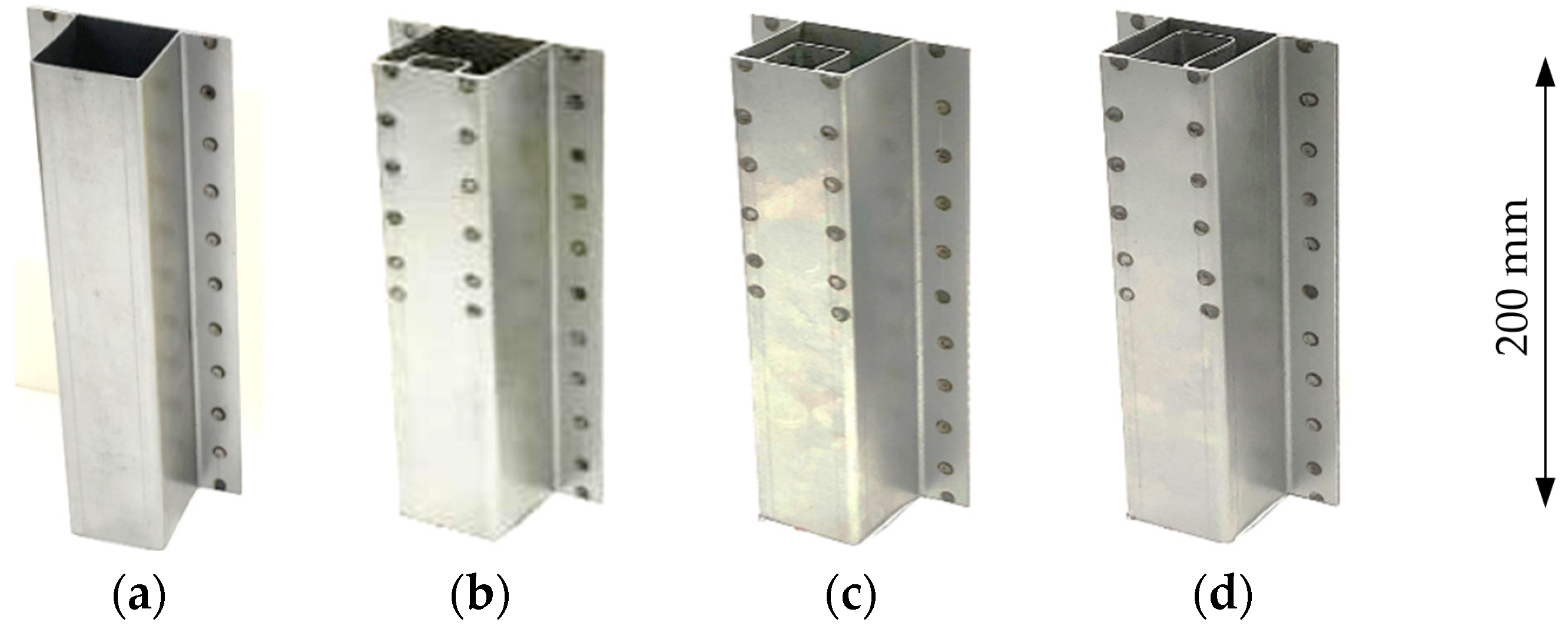
Figure 1 shows the schematics of the hat-shaped tubular structures made from mild steel sheets. The hat members were fabricated with a V-bending operation, where the inner corner radius was 1 mm. A flat sheet was spot-welded at the flanges of the hat part. The axial length of the structure was 200 mm, and the hat width and height were 40 mm. An internal reinforcing member with a hat-shaped cross-section was also spot-welded to the outer hat top to partially increase the allowable collapse force. The axial length of the reinforcing member was 100 mm, and the hat height h was 10, 20, or 30 mm. The spot-welding pitch was 20 mm, though it was 16 mm at the end of the reinforcing member. The wall thickness t was 0.6, 0.8, or 1.0 mm, which was the nominal thickness of the sheet metal. Parametric experiments were performed for all combinations of the thickness and hat height of the reinforcing member. When considering the effect of the plate thickness, it is desirable that the mechanical properties of the materials are uniform. The mechanical properties of the mild steel sheets, which were obtained using quasistatic uniaxial tensile tests, are listed in Table 1. Tensile tests were performed at angles of 0°, 45°, and 90° relative to the rolling direction. The values given are averages, and they are similar for each sheet thickness. Figure 2 shows the photographs of the STD and PR structures, where the structures have been turned upside down so that the internal reinforcing members are visible.

2.2. Strain Measurement Setup

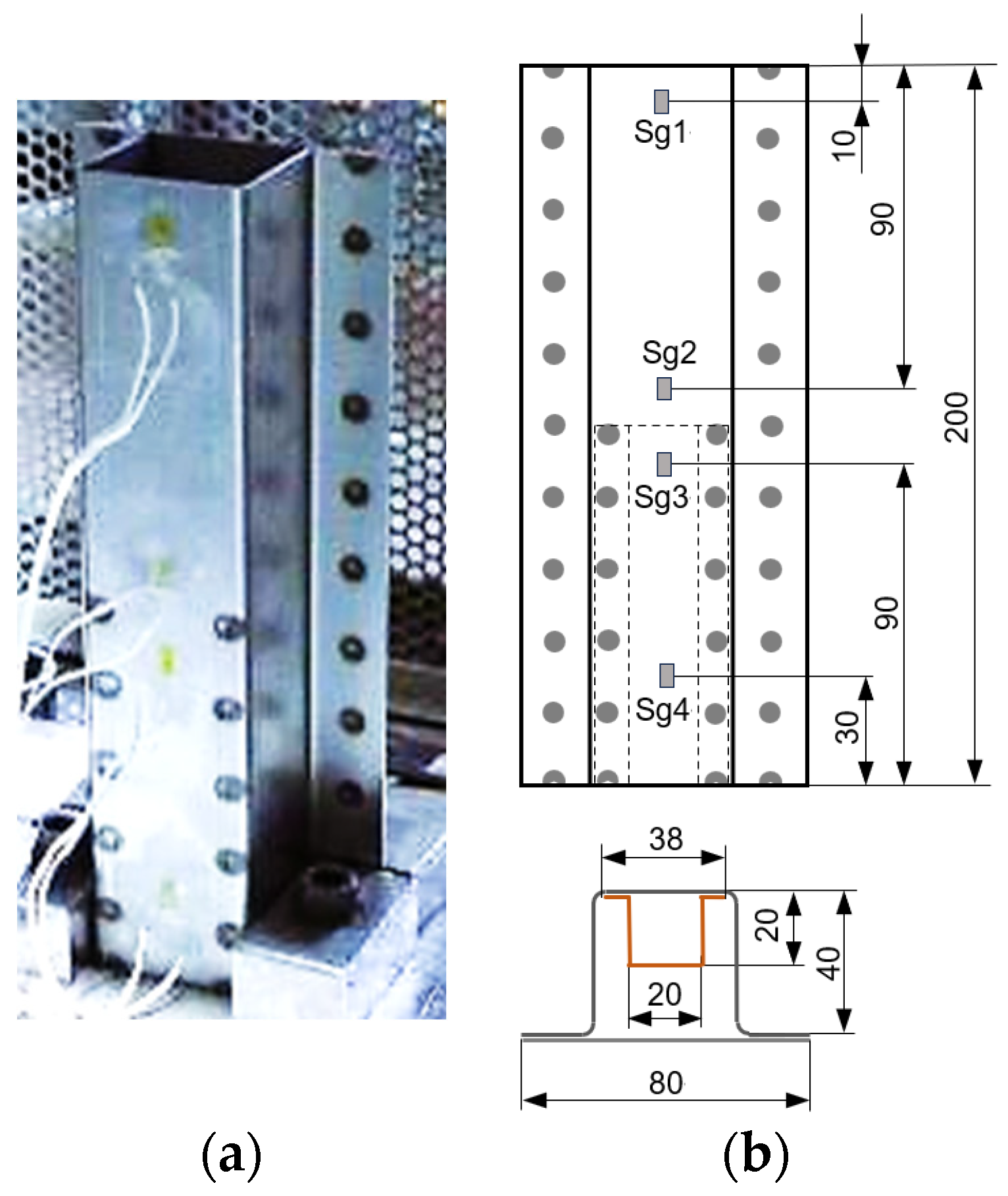
To evaluate the deformation state in the early stage of collapse deformation, four high-elongation foil strain gages (Kyowa Electronic Instruments, KFEL-2-120-C1, (Tokyo, Japan)) were attached to the top of the hat part of the PR structure (Figure 3). Identical strain gauge positioning was applied to the STD structure to enable direct comparison of the deformation at the corresponding location. The strain signals were acquired and recorded through bridge boxes (Kyowa Electronic Instruments, DBT-120A-1), signal conditioners (Kyowa Electronic Instruments, CDV-900A, frequency response range: DC to 500 kHz) and digital storage oscilloscopes (Pico Technology, Model A4224, (St Neots, UK)) connected to a PC. The compressive stroke and force were also captured, which were synchronized with the strain signals. The sampling interval was set to 1 µs.

2.3. Experimental Method of Axial Compression Test

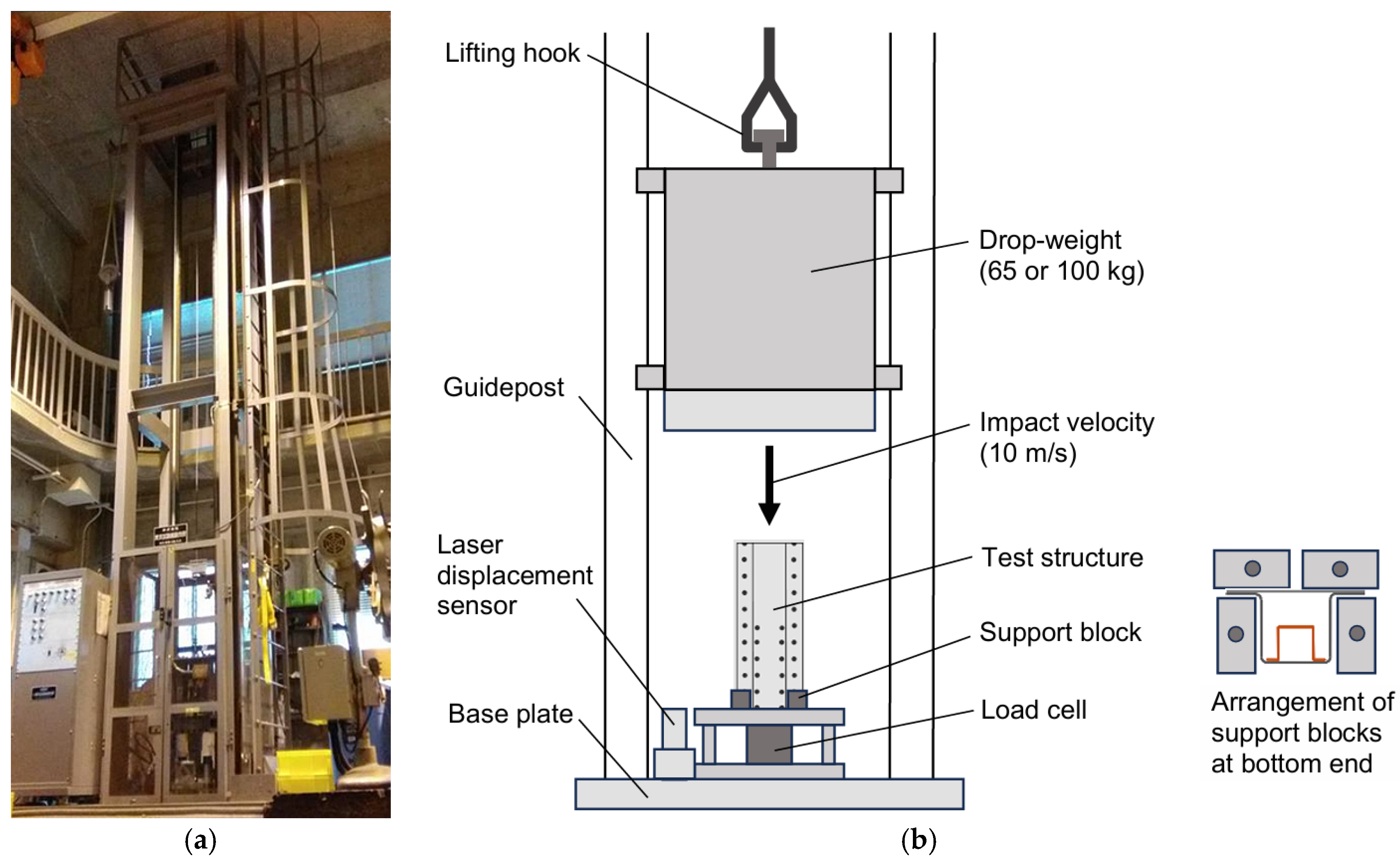
The impact experiment was caried out using the drop-weight impact testing apparatus illustrated in Figure 4. A drop-weight of 65 kg was employed for the structures with 0.6 to 0.8 mm sheet thicknesses, while 100 kg was used for the 1.0 mm sheet thickness to ensure a sufficient stroke to evaluate the mean crush force. This is because, for the same compression stroke, structures with thicker walls require more energy, and a sufficient stroke was ensured to evaluate the average compressive force. The strain-rate effect is significant only when its order of magnitude changes. The drop-weight velocity decreases rapidly at the very end of deformation because kinetic energy is proportional to the square of velocity. Therefore, since the compression speed is nearly constant except in the final stage, the effect of thickness can be discussed in this impact experiment. The structure was supported with four blocks at the bottom end, as illustrated below. The impact velocity was 10 m/s. A hand-made load cell with four semiconductor strain gages (Kyowa Electronic Instruments, KSN6-350-E4, gage factor: approximately −100) was mounted between two thick plates, and the top plate was slightly movable vertically. The load cell was connected to a similar signal conditioner (Kyowa Electronic Instruments, CDV-900A, frequency response range: DC to 500 kHz). A high-response laser displacement sensor (SUNX, HL-C1C-WL, sampling interval: 100 µs, (Kasugai City, Aichi, Japan)) was used to sense the compressive stroke. A similar oscilloscope was used to record the force and stroke data. A high-speed video camera (Keyence VW9000, (Osaka, Japan)) was used to observe the deformation.
For comparison, a compression test was also carried out under quasistatic conditions using a hydraulic universal testing machine. The compression speed was approximately 1 mm/s.

3. Results and Discussion

3.1. Deformation Patterns

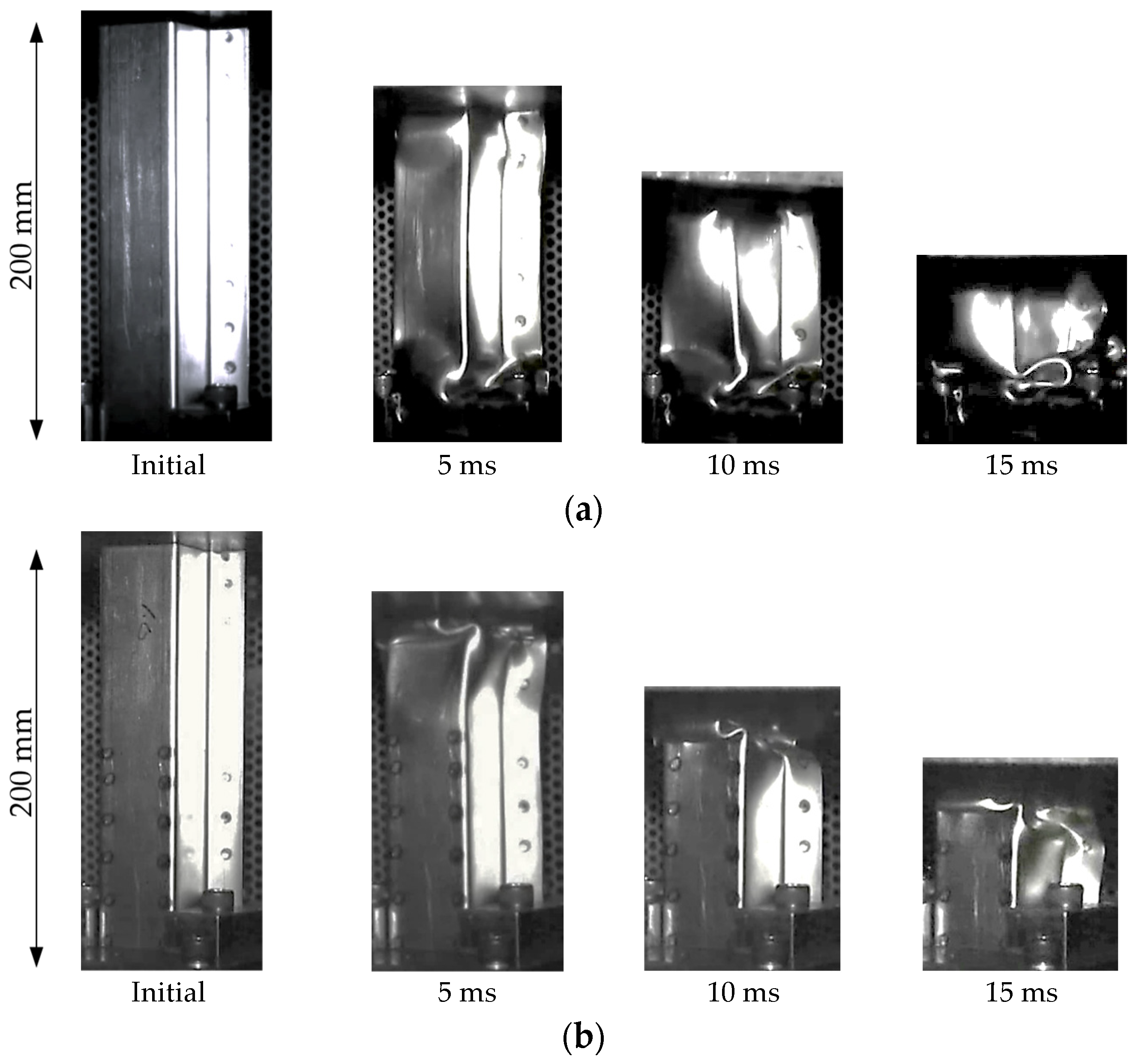
Figure 5 shows examples of deformation patterns captured with a high-speed video camera in the impact tests. Although part of the structure was obscured by a drop-weight due to camera positioning constraints, the buckling initiation point was identified. As will be shown later, all structures exhibit multiple buckling lobes in the axial compression. In the STD structure, two lobes arise at the bottom and top ends. The location of the buckling lobe initiation is not the impact end because the plastic wave speed is much slower than the speed of the drop-weight. In this speed range, the location of first appearing lobe is affected by slight changes in the geometry, dimensions, and other inhomogeneities of the test structure. In the PR-h20 structure, plastic deformation occurs first in the unreinforced portion (this deformation is defined as stage I), followed approximately 10 ms later by deformation in the reinforced portion (similarly defined as stage II). The irregularity in multiple lobes of the PR-h20 structure is smaller than that in the STD structure. This is because the unreinforced portion, which has the same cross-sectional shape as the standard structure, is shorter, resulting in fewer degrees of freedom for plastic deformation.
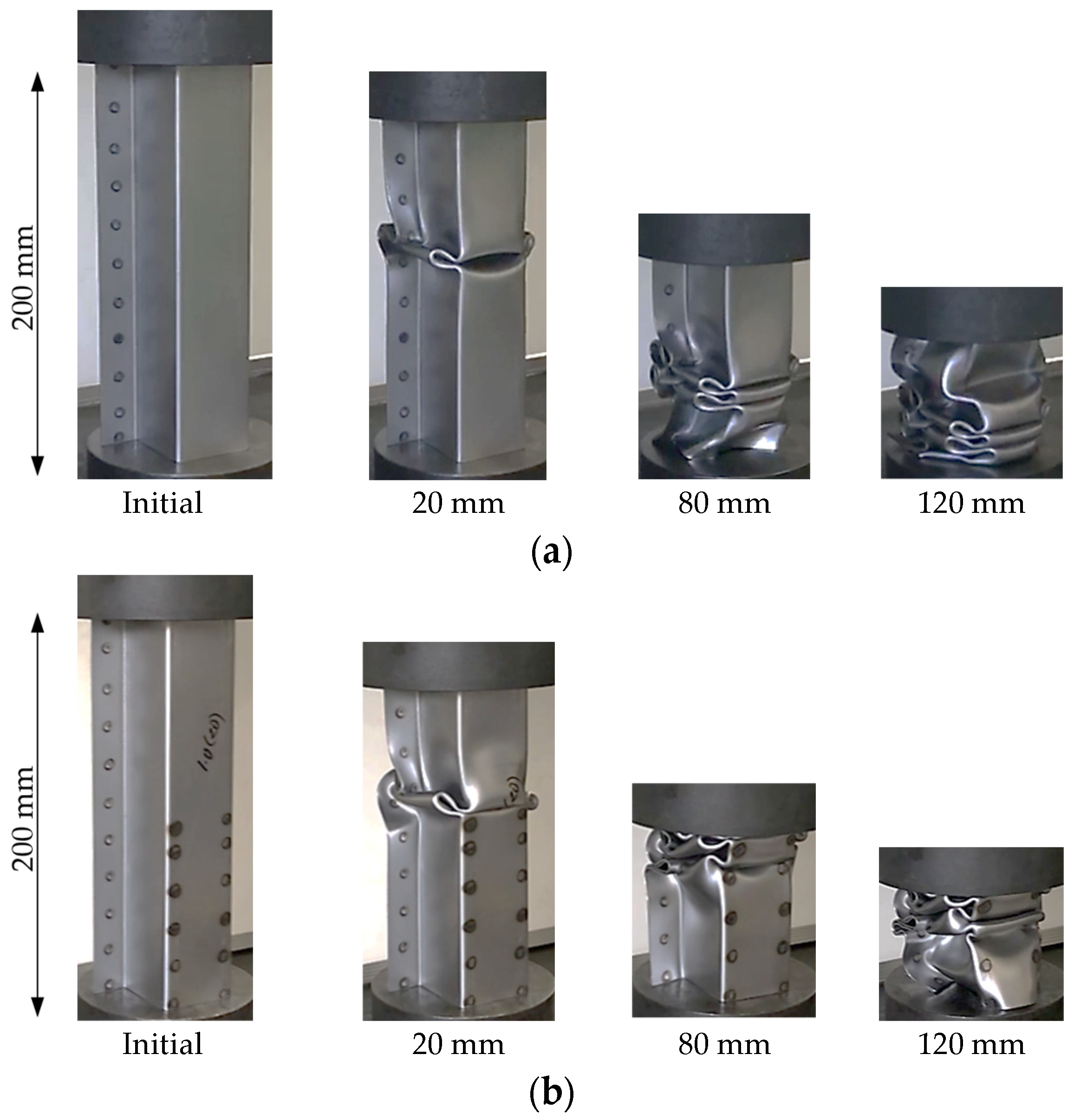
For the quasistatic test, examples of deformation patterns are shown in Figure 6. In the STD structure, different from the impact test, the lobe occurs from a single location. The pattern is more regular compared with that in the impact test. Lobe irregularity occurs due to slippage at the bottom end, but it is limited at the final stage of deformation. As for the PR-h20 structure, plastic deformation occurs at the part where the cross-sectional profile and the stiffness vary. This is probably because stress concentration occurs at points where the stiffness of the structure changes abruptly. Deformation stage II occurs after stage I, and this deformation sequence is common for other PR structures.
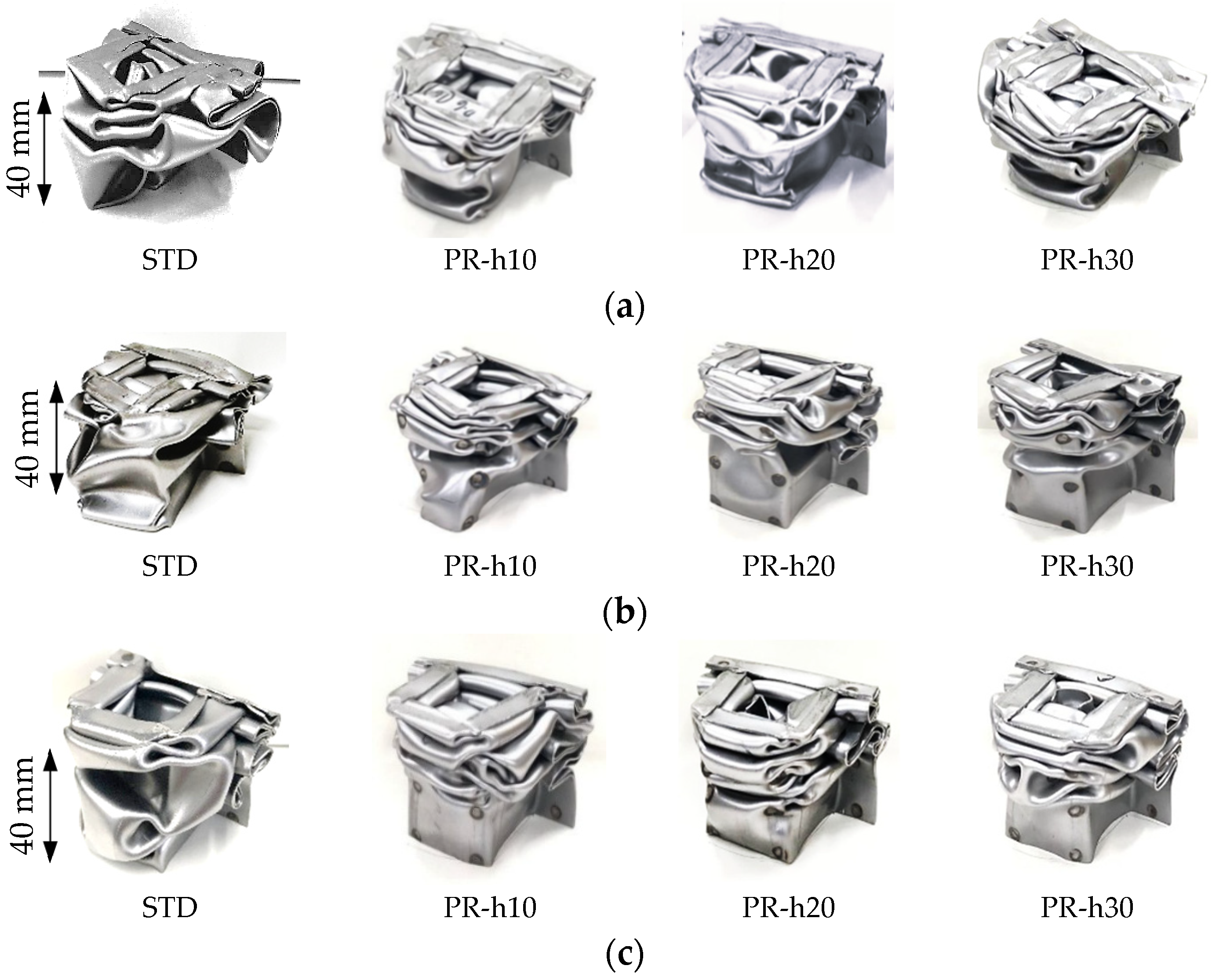
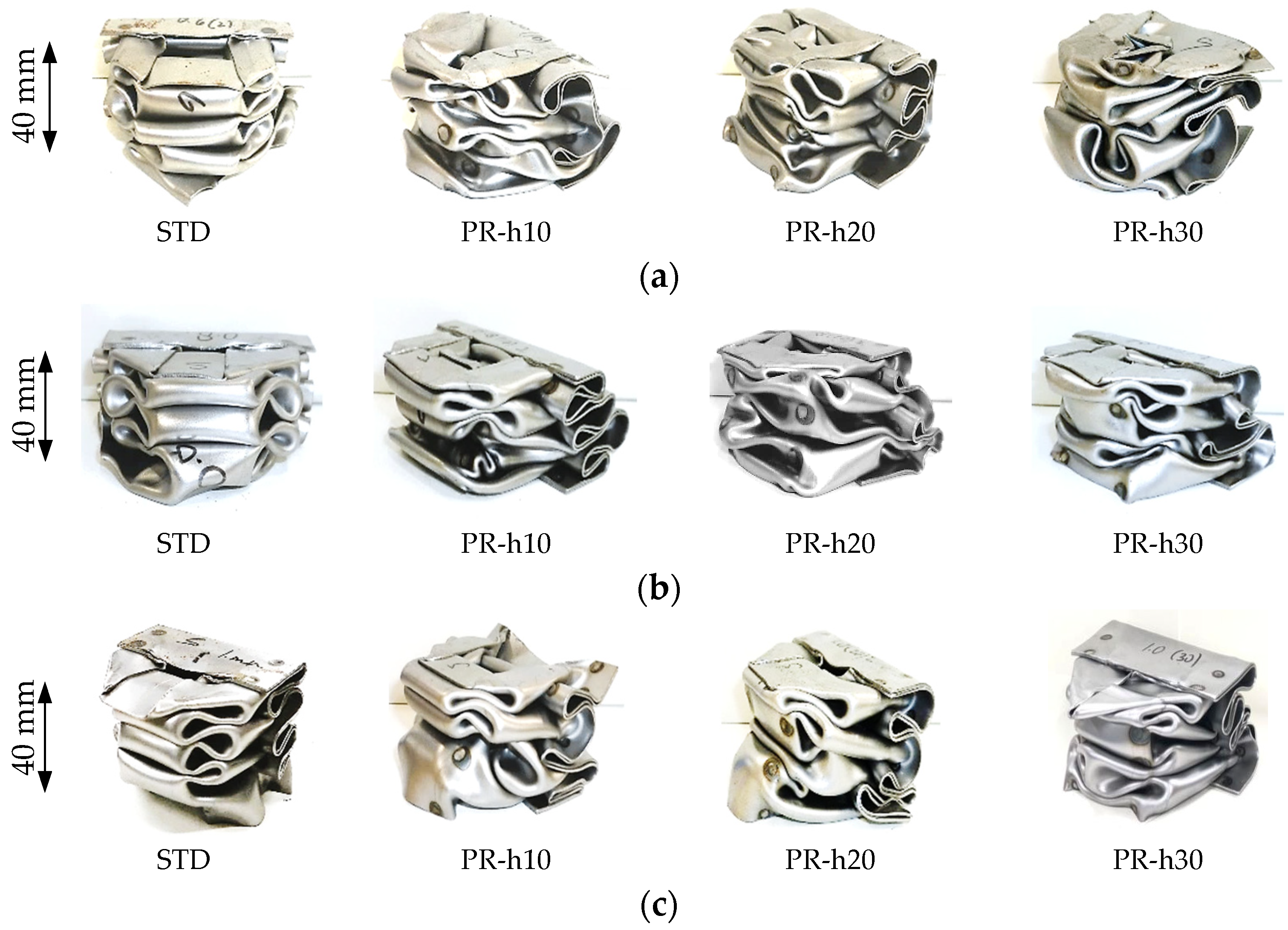
Figure 7 shows the final deformation patterns of the structures for the impact compression test. This type of collapse deformation is due to plastic instability, and its occurrence is significantly influenced by imperfections of the material strength, structural dimensions and alignments. Hence, the differences in deformation patterns arise from slight changes in experimental conditions, such as dimensions and geometries. The compression test was repeated twice under the same experimental conditions.
The lower part of the test structure was not compressed because it was supported by four blocks. The structures with a wall thickness of 0.6 mm exhibit material densification, in which a rapid increase is observed in the compressive load, as mentioned below. For the STD structure, the folding patterns seem irregular for each wall thickness. For the reinforced structures with 0.8 and 1 mm wall thicknesses, the irregularity is drastically decreased, though it is somewhat decreased in the structures with a wall thickness of 0.6 mm. This agrees with [12], which has reported that a thinner initial wall thickness tends to produce a more irregular collapse pattern, which is attributed to the accelerating decrease in bending resistance as the wall thickness decreases. PR structures have a cross-section with varying stiffness at the longitudinal center. Typically, if the axial length is long, the point where the stiffness changes, such as the boundary between unreinforced and reinforced sections, is prone to global or Euler-type buckling. However, global buckling does not occur in all cases. Across all wall thicknesses, the final deformation patterns of the PR-h20 structure are more regular than those of the PR-h10 and PR-h30 structures.
The final deformation patterns in the quasistatic test are shown in Figure 8. The structure was compressed until densification occurred. For the standard structure, the pattern is more regular in comparison with that from the impact test, while the reinforced structures promote a complex formation of the folding lobes.
The effect of the reinforcing component’s hat height on the deformation pattern is similar. However, the deformation patterns are more irregular compared with those under impact conditions. A diamond deformation mode appears at the top of the hat part for PR-h30 structures in Figure 7c and Figure 8c, which is often observed in the collapse of a thin-walled circular tube [12].
From the difference in folding lobes of the PR structure between quasistatic and impact tests explained above, we can state that the reinforcing member is more effective in the impact compression for the collapse mechanism’s improvement.

3.2. Relationship Between Compressive Force and Stroke

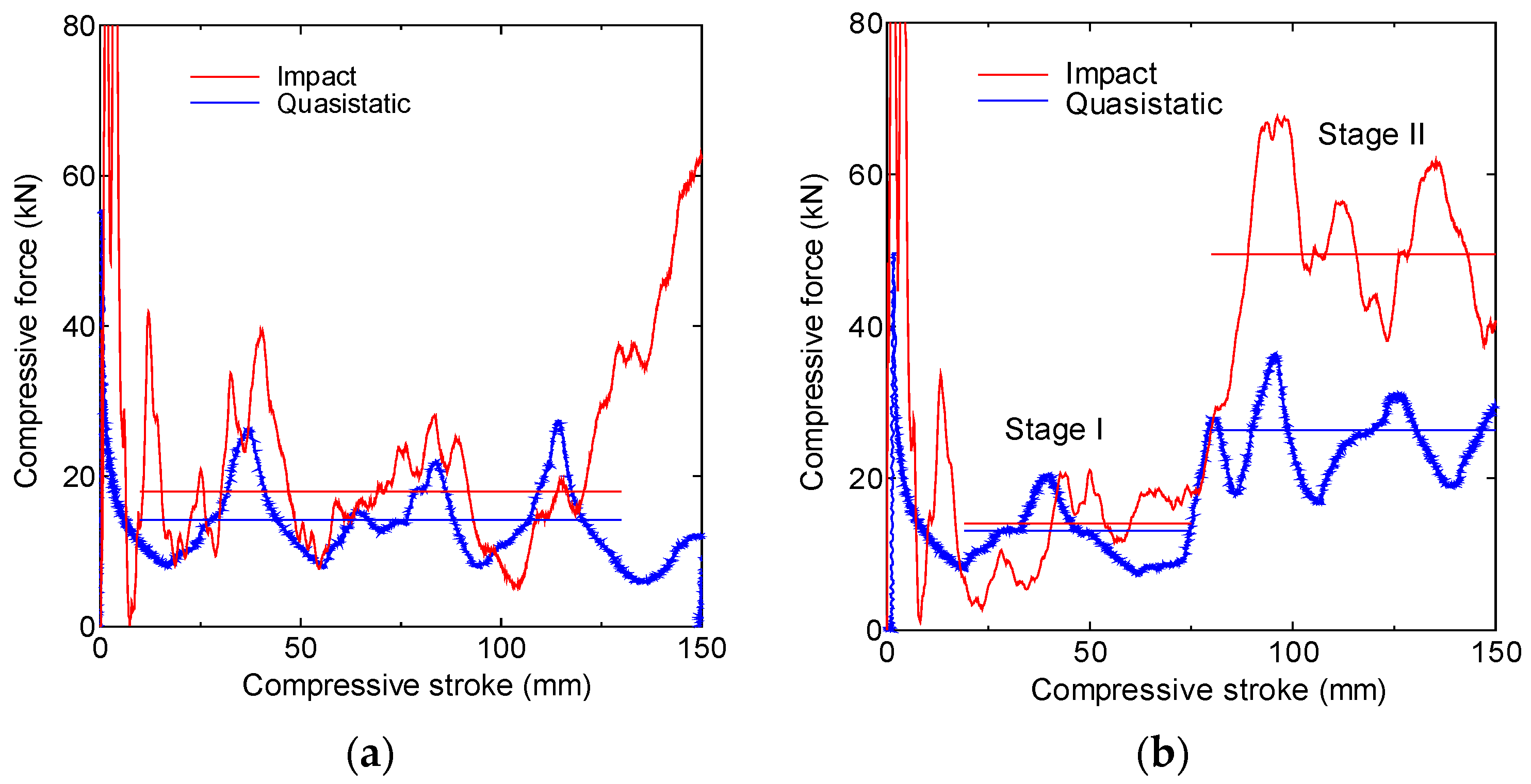
Examples of compressive force–stroke curves under impact and quasistatic conditions are shown in Figure 9 for the STD and PR-h20 structures. The initial peak force in the impact test is very large, reaching approximately 180 kN, although this is not shown in the figure. Furthermore, the impact compressive force exhibits a significantly large amplitude during initial impact, and short-period waves with small amplitude are superimposed onto larger waves. These phenomena are unavoidable and are probably due to the repeated separation and contact motion between the load cell ends and the thick plates because the plate is subjected to impulsive loading.
After the initial deformation, the average value of such an oscillatory force is meaningful in representing the average crush force. In the diagram, the average force is shown as a straight line, and its length represents the range over which the average was taken. Differences in the force–stroke relationship and average value are observed between the quasistatic and impact tests due to the positive strain-rate sensitivity of the material [29,30]. This is more remarkable in stage II of the PR-h20 structure. This may be due to the small lobe radius in the reinforcing member causing large strains, resulting in a higher strain rate. As for the force in the STD structure impact test, it increases very rapidly in the latter compressive stroke. This could be due to irregularity in the deformation pattern (Figure 7b).
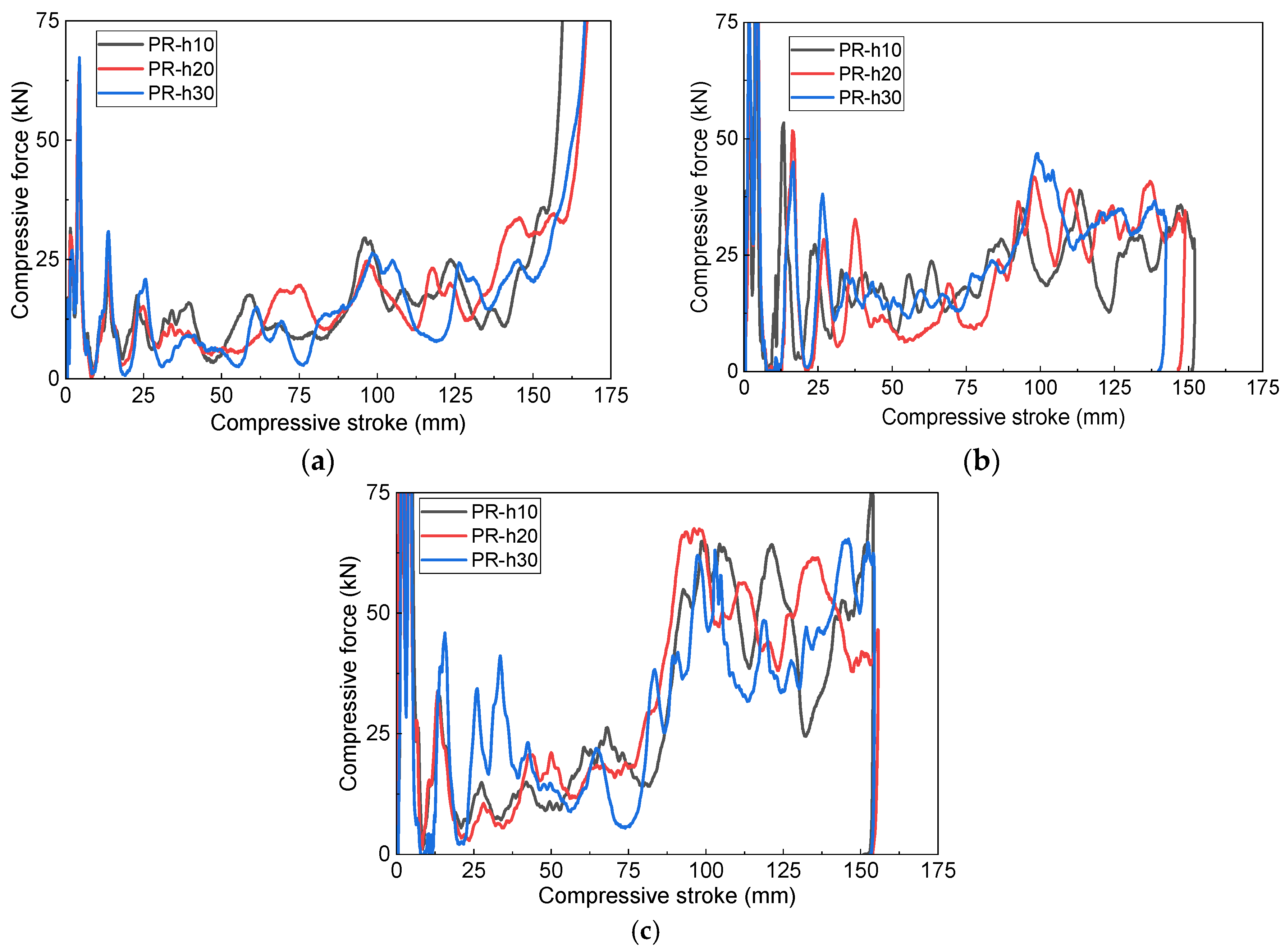
Examples of force–stroke relationships under impact conditions are shown in Figure 10 for PR structures, where very large impulsive forces are observed in all cases, though the sharp peaks exceed the upper limit of the vertical axis for the 0.8 and 1.0 mm wall thicknesses. This is due to the impulsive loading of the drop-weight and is not avoidable, as mentioned. This phenomenon continues and converges after 25 mm of the stroke, or for approximately 2.5 ms.
When the stroke exceeds approximately 75 mm, the plastic deformation reaches the reinforced section; hence, the force begins to increase. This is because, even when the reinforced length is 100 mm, the effect of the reinforcement on the compressive force appears after a compression stroke of the same length as the difference in the unreinforced length and thickness of the buckling lobes formed in stage I.
The velocity reduction calculated from the experimental time–displacement data is minor, remaining below approximately 15% up to a stroke of 75 mm. This small variation is insufficient to induce noticeable strain-rate or inertial effects, confirming that the higher compressive force for t = 1.0 mm is dictated by the increased wall thickness rather than differences in drop-weight mass or input energy.
A step in compressive force is observed during collapse. This step becomes more pronounced as the wall thickness increases, but the effect of the internal hat height h on the force is unclear due to fluctuating force waveforms. The next section evaluates the crush strength of the structure in terms of its energy absorption performance.
However, it is noteworthy that a dual-action impact absorption mechanism is realized without causing global bending at the cross-sectional change point or the longitudinal center of the structure. Furthermore, the transition from stages I to II is relatively smooth, as shown by a lack of sharp peak force. This is because, once a buckling lobe is formed, the wall is not compressed under uniaxial stress state.
For the 0.6 mm sheet thickness, there is a rapid rise in force after approximately 150 mm of stroke due to the densification phase, where the structure is fully crushed. This is because the energy supplied by the drop-weight is greater than the energy consumed in the generation of folding lobes.

3.3. Crush Strength of the Standard and Partially Reinforced Structures

To qualitatively validate the energy absorption performance of the structures, crush strength σ c is commonly used, which is an index of the performance per unit structural mass. From the compressive force–stroke curve, the mean crush force (MCF) and the crush strength σ c are obtained using the following:
M C F = 1 S 2 S 1 S 1 S 2 F i S d S
and
σ c = M C F A ,
where A is the structure’s cross-sectional area, F i is the compressive force sensed by the load cell, and S 1 and S 2 are the start and end strokes of the deformation. For the PR structure, the ranges of stages I and II are determined for points other than the initial peak, the transition stroke from stages I to II, and the stroke during material densification.
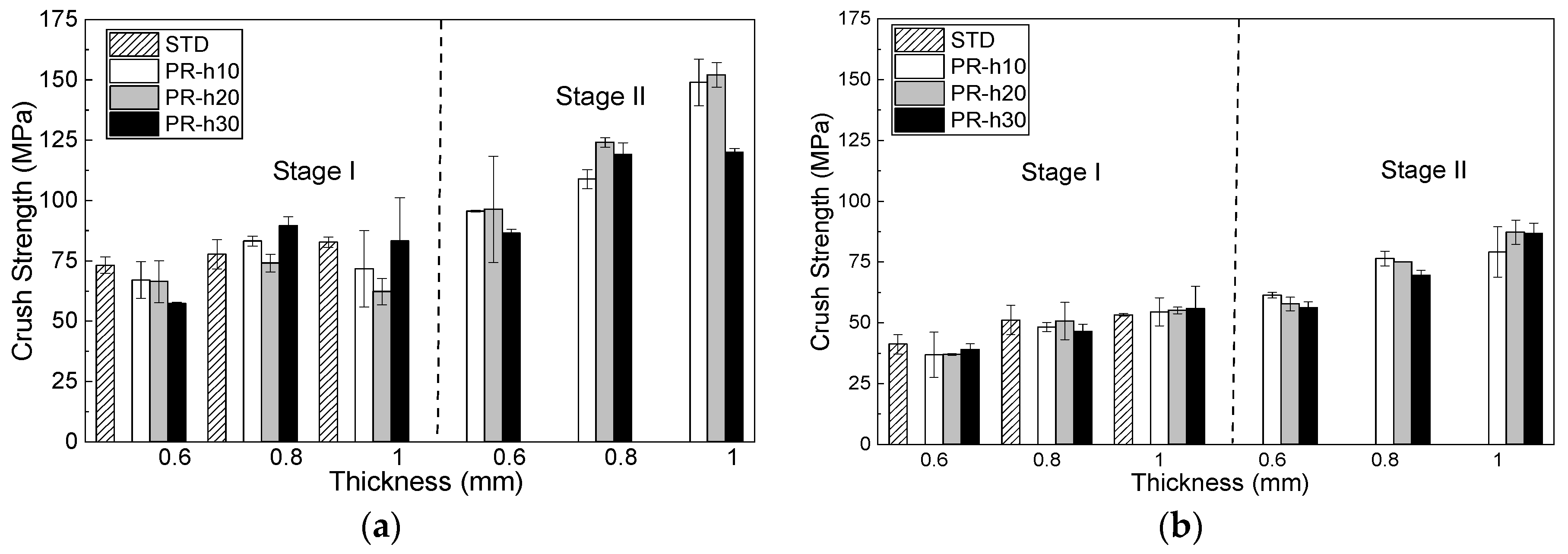
Figure 11 summarizes the crush strength values of stages I and II in PR structures for the impact and quasistatic tests. For comparison, the crush strength values of STD structures are also shown. Each compression test was performed twice under identical conditions. The bar graphs show the average values, with the larger and smaller data shown as I-shaped bars.
Regarding the reinforcing effect on crush strength under impact conditions, the PR-h20 structure outperforms PR-h10 and PR-h30 structures across all wall thicknesses. Furthermore, it exhibits more regular deformation patterns than both PR-h10 and PR-h30 structures under impact conditions, as mentioned above. Conversely, under quasistatic conditions, the crush strengths of PR-h10, PR-h20, and PR-h30 are comparable, showing no distinct trend.
In all structures, the crush strength under impact conditions is approximately 1.5 times higher than that under quasistatic conditions. Here, the strain-rate order in the formation of buckling lobes is roughly estimated. The effective strain of a buckling lobe is approximately 0.2, as described in the next section. The time to generate one lobe was obtained from the lobe length (~20 mm) and the drop-weight velocity (10 m/s), and thus it was determined to be (0.02/10) = 0.002 s. Therefore, the order of the strain rate was determined to be 100/s. The effect of the strain rate does not vary much if its order is similar.
In general, strain-rate sensitivity can vary depending on plastic strain, loading directions, and temperature. At elevated temperatures, dynamic strain aging can occur. As for the strain-rate effect of mild steel at room temperature, when the strain-rate changes from 0.003/s to 100/s, the increase ratios are 47% and 34% at true strains of 0.1 and 0.2, respectively [29]. The increase in yield stress is approximately 40% [30]. Although the authors did not perform high-speed tensile tests on the material used here, the enhanced crush strength can be interpreted as the combined result of strain-rate sensitivity and inertia-related effects.
The effect of wall thickness t on the crush strength was calculated. For the PR-h10, PR-h20, and PR-h30 structures in the impact tests, the crush strength values of deformation stage II are proportional to t0.85, t0.89, and t0.66, respectively; it is t0.24 for the standard structure. On the other hand, in the quasistatic tests, it is t0.58 for the STD structure, while the effects are t0.30, t0.84, and t0.79 for the PR-h10, PR-h20, and PR-h30 structures. In case of PR-h10, lower hat height results in a slender geometry for the reinforced member. This and the greater wall thickness may promote bending buckling mode, thereby limiting the load increase. Generally, the effect of the wall thickness on the crush strength in stage II is far greater than in STD structures.

3.4. Semi-Theoretical Calculation to Explain Enhanced Force by Reinforcing Member

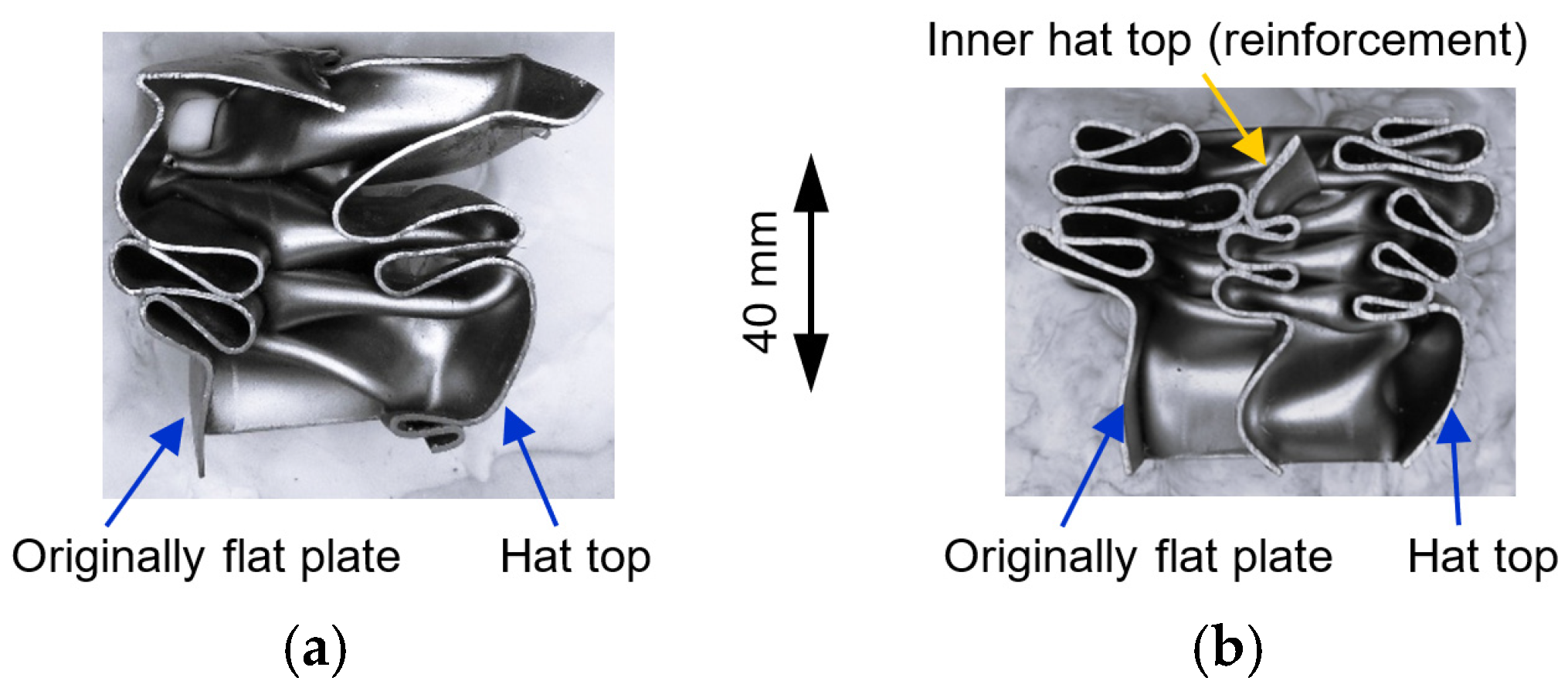
To explain the increase ratio in compressive force by the reinforcing member semi-theoretically, a simplified force estimation calculation was performed. The energy method was chosen for calculation. This method is widely used to estimate the average processing forces in metal forming such as extrusion, bending, and deep drawing, and the calculation is also straightforward. The PR-h20 structure compressed under impact was chosen for the calculation because it has the most regular deformation pattern. The compressed STD structure under impact was also examined. They were cut in the middle section to observe the plastic deformation with buckling lobes (Figure 12). Multiple lobes were observed at the flange, hat top, and inner hat top portions. In the STD structure, the generation of buckling lobes of the hat part was in harmony with the originally flat part. On the other hand, in the PR-h20 structure, the folding lobes of the outer hat top conformed to those of the inner hat part, in which the number of buckling lobes was increased to about double that of the originally flat part. This may be due to the deformation constraint imposed by the presence of spot welds at the hat top, leading to synchronized lobe formation at the outer and inner hat tops via the preferable mutual interaction. Increases in the number of folding lobes and a reduced bending radius promote the formation of additional plastic hinges per unit of axial length, thereby enhancing the plastic energy dissipation.
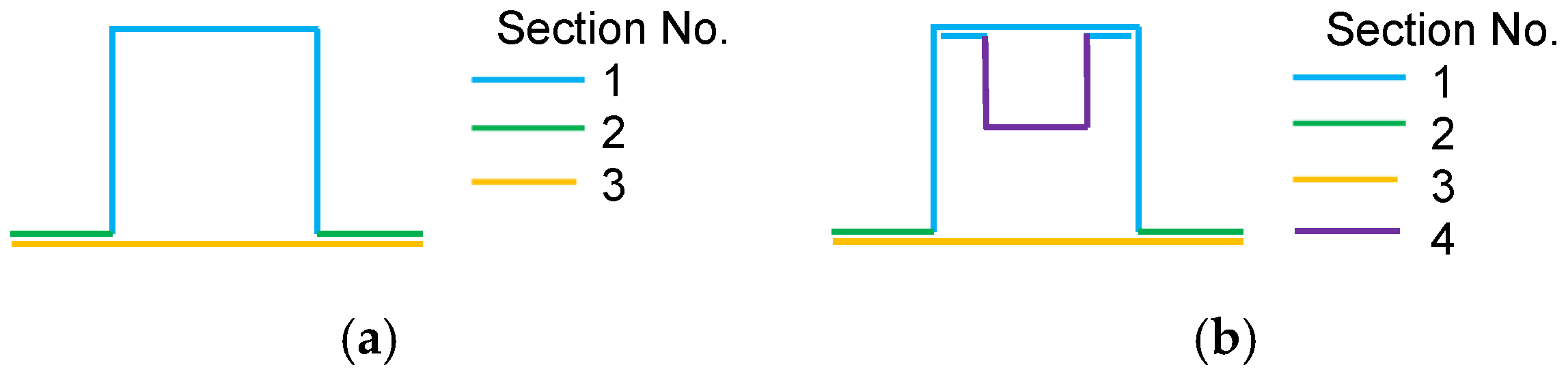
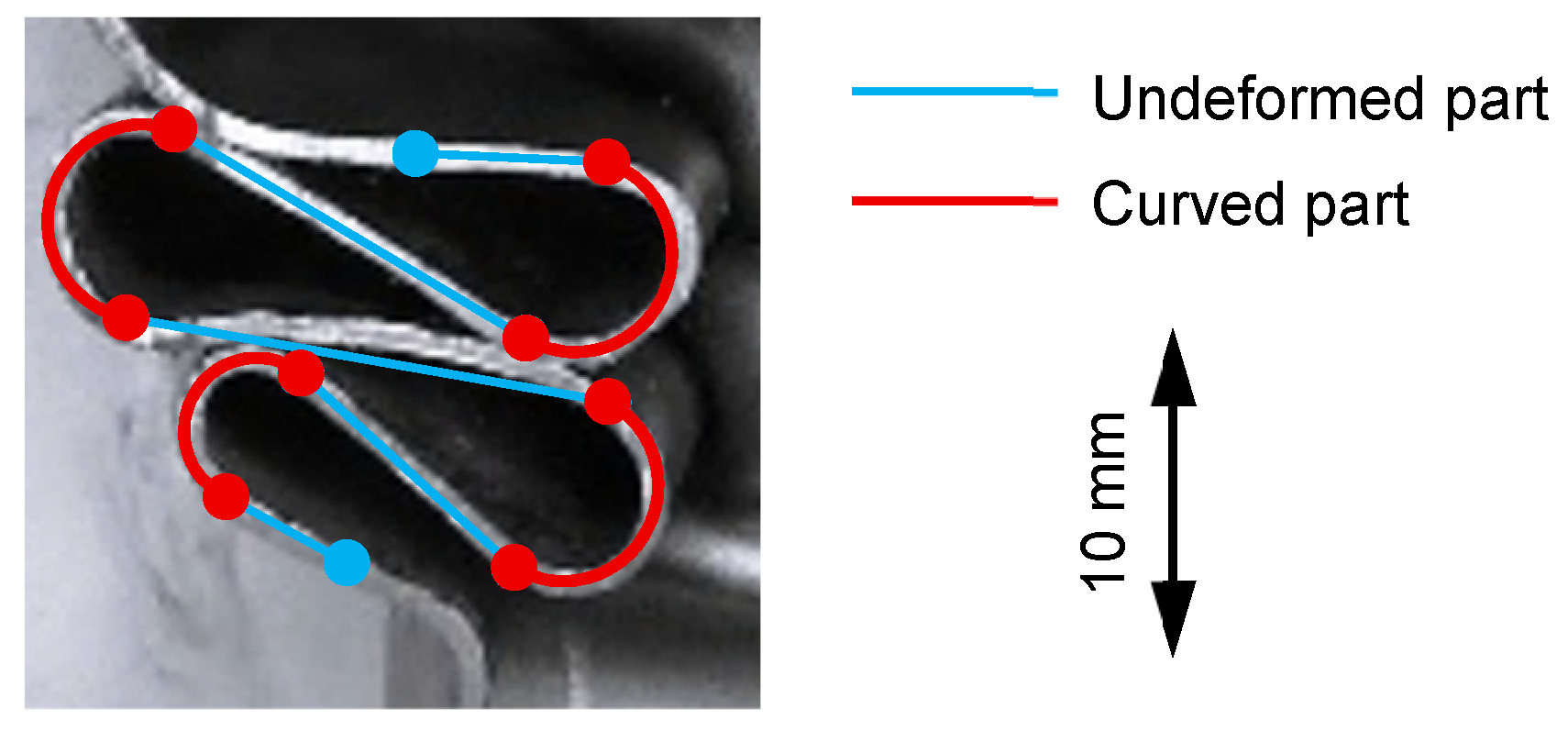
First, cross-sections of the unreinforced and reinforced sections of the PR-h20 structure were divided into three and four sections, respectively (Figure 13). The unreinforced cross-section is the same as that of the STD structure, as mentioned above. For convenience, the material is distinguished by a curved part and an undeformed part (Figure 14). The average radius was determined from the semicircles in the curved sections. The ratio of the volume of the plastically deformed region to the total volume could be determined using the arc length of the semicircles and the length of the straight sections. The radius of the spot-welded double wall part was assumed to be the same as the radius in the middle cut cross-section. Note that the deformation at the corners involves a movable plastic hinge, but, to simplify the calculation, this aspect was ignored, and all deformations were reduced to plane strain bending deformation. Furthermore, the curved part was assumed to be semicircular. The calculation provides a simplified energetic interpretation of the observed force increase.
The bending strain ε b was calculated from the average radius R m at the neutral plane and the thickness t:
ε b = l n ( 1 + t / 2 R m )
The effective strain ε ¯ was calculated by considering the bending under plane strain conditions as follows:
ε ¯ = ( 2 / 3 ) ε b
Next, the plastic energy per unit volume was obtained by multiplying the average yield stress during bending deformation. Using the plastic property of the material as listed in Table 1, the average yield stress Y ¯ was determined:
Y ¯ = 1 ε ¯ 0 ε ¯ σ ¯ d ε ¯ = c ε ¯ n 1 + n
Energy consumption was obtained by multiplying it by the deformed volume. Hence, the deformation energy E was calculated for the deformed volume V:
E = Y ¯ ε ¯ V
The measured and calculated results are shown in Table 2 and Table 3. From the calculated plastic energies in stage I and stage II, for the unreinforced and reinforced sections in the PR-h20 structure, the increase ratio of compressive force by the reinforcing member was determined. The calculated ratio was 19,089L/8265L = 2.31. On the other hand, based on the average of two identical experiments, the increase ratio for the impact test is 49.5 kN/14.0 kN = 3.54, which is the ratio of the compressive force in stage I to the compressive force in stage II of the PR-h20 structure. The calculated value is underestimated by 34.7%; this is because, in stage II, the greater compressive force induces further deformation in the crushed region, thereby reducing the bending radius of the unreinforced section.
When stage II of the PR-h20 structure is compared with the STD structure, the ratio is 19,089L/5995L = 3.18, which is close to the experimental value of 3.54. Although this prediction calculation method is simple, it can make predictions with reasonable accuracy.

3.5. Strain Measurement During Early Stage of Impact Deformation

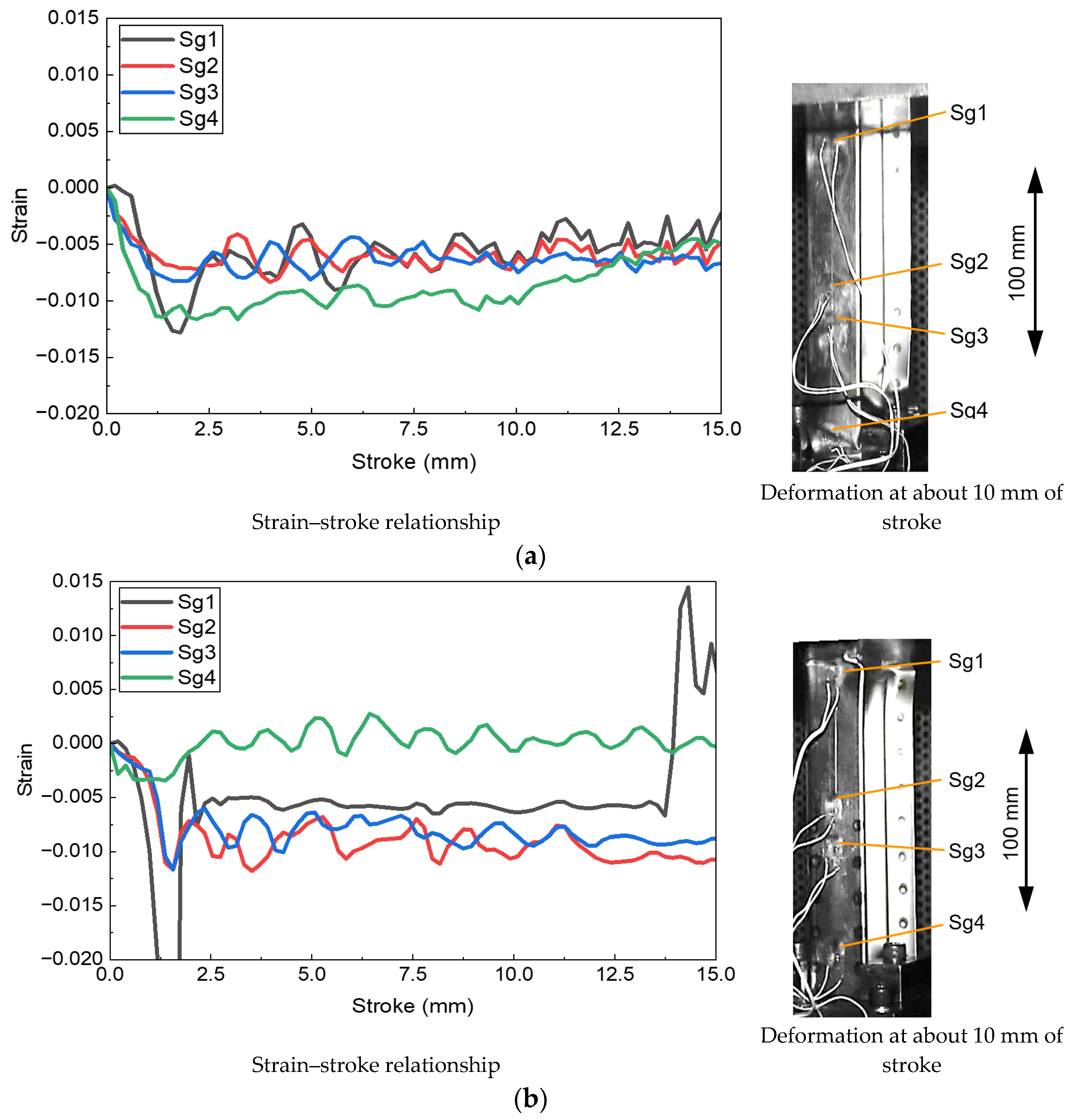
It is worthwhile to examine the difference in deformation states for the STD and PR-h20 structures. Strain measurement was performed using four high-elongation-type strain gages (Figure 15). The attachment positions of the strain gages are already shown in Figure 3. As the decrease in the drop-weight velocity is very small during the initial deformation, the end of the horizontal axis corresponds to approximately 1.5 ms, which is a very short time.
These measurement results show only one example for each structure. As the deformation pattern will naturally change with even slight variations in experimental conditions, the result will change accordingly. The objective here is to show the damage area in the initial stages of plastic collapse deformation when a reinforcing member is added.
In the STD structure, at the beginning of compression, all strain values decrease rapidly, which corresponds to the initial peak force (Figure 9 and Figure 10). The absolute value of the strain is at least 0.007, which far exceeds the elastic limit strain. Hence, the structure is in a plastic state or damaged for the entire length. The strain gages Sg1, Sg2, and Sg3 indicate recovery of the strain at a stroke length of about 2.5 mm, and Sg4 remains at a decreased strain value, indicating a slow recovery. This aspect indicates that plastic deformation is recovered by bending, in which the first buckling lobe is generated close to Sg4 in the photograph at approximately 10 mm of stroke.
In the PR-h20 structure, at the start of deformation, Sg1 shows a very rapid and significant decrease, followed by a rapid recovery. The peak is approximately −0.07, though it is not fully displayed. This is due to the compression with bending, and the buckling lobe initiates near the region of Sg1. This implies that bending and unbending take place. The amplitude of Sg1 from about 2.5 to 13.5 ms is smaller than that of the others. This is because the material near Sg1 undergoes plastic deformation, resulting in a non-flat shape; in other words, the stiffness at this part is greater than that of the flat part.
The level of Sg2 and Sg3 is −0.012 immediately after the onset of deformation, and the material is in a plastic state there. On the other hand, Sg4 indicates −0.003 as the peak compressive strain, and the value increases, showing a periodic vibration with an amplitude less than 0.003. Consequently, during the early stage of collapse, the representative strain response suggests that large plastic deformation was delayed near the reinforced section.

4. Conclusions

Impact axial compression experiments using partially reinforced tubular structures with a hat-shaped cross-section were performed under impact or quasistatic conditions. The material was a mild steel sheet with a thickness of 0.6, 0.8, or 1 mm. An additional reinforcing member with a different hat-shaped cross-section was attached to the inner part of the structure. The effect of the reinforcing member on the crush strength and deformation behavior was systematically investigated. For comparison, quasistatic tests were also performed.
  • The reinforcing member successfully enhanced the compressive force of the structure, exhibiting the stepped force variation regarding impact and quasistatic compressions. This effect becomes more pronounced as the wall thickness increases, but the effect of the internal hat height on the force is unclear due to significant fluctuations in the force waveforms. A dual-action impact absorption mechanism is realized without causing global bending.
  • The reinforcing member’s effect is more pronounced under impact conditions. From the deformation pattern, the collapse behavior is improved by promoting regular folding lobes and increasing the number of buckling lobes. In particular, the number becomes about double, affecting the deformation pattern at the outer hat top part of the structure.
  • Regarding energy absorption performance under impact conditions, the crush strength of the PR-h20 structure outperforms that of the PR-h10 and PR-h30 structures across all wall thicknesses. Furthermore, the PR-h20 structure exhibits more regular deformation patterns than both counterparts. Conversely, under quasistatic conditions, the crush strengths of all three structures are comparable, showing no distinct trend. The deformation patterns are irregular compared with those under impact conditions.
  • To explain the increase in compressive force by adding a reinforcing member, a force estimation calculation was performed by considering the plastic deformation with folding lobes. The estimated increase ratio showed a reasonable agreement with the experimental result.
  • The longitudinal strain at the structure’s hat top was measured during initial compression. The result showed that, in the partially reinforced structure, the large plastic deformation was delayed at the reinforced section, though the structure without a reinforcing member entered a plastic state for the entire structure.

Author Contributions

Conceptualization, G.R.N., M.Y. and M.N.; methodology, G.R.N. and M.Y.; investigation, G.R.N., M.Y. and M.N.; writing—review and editing, G.R.N. and M.Y.; validation, M.N. All authors have read and agreed to the published version of the manuscript.

Funding

This research received no external funding.

Data Availability Statement

The original contributions presented in this study are included in the article. Further inquiries can be directed to the corresponding author.

Conflicts of Interest

The authors declare no conflicts of interest.

References

  1. Baroutaji, A.; Sajjia, M.; Olabi, A.G. On the crashworthiness performance of thin-walled energy absorbers: Recent advances and future developments. Thin-Walled Struct. 2017, 118, 137–163. [Google Scholar] [CrossRef]
  2. Zahran, M.S.; Xue, P.; Esa, M.S.; Abdelwahab, M.M. A novel tailor-made technique for enhancing the crashworthiness by multi-stage tubular square tubes. Thin-Walled Struct. 2018, 122, 64–82. [Google Scholar] [CrossRef]
  3. Tesfaye, F.A.; Ali, A.N.; Fenta, E.W. Crashworthiness Optimization of Closed Cell–Sandwiched Aluminum Foam Crash Box Using FE and ANN Modeling. Eng. Rep. 2025, 7, e70353. [Google Scholar] [CrossRef]
  4. Saber, A.; Amer, A.M.; Shehata, A.I.; El-Gamal, H.A.; Abd_Eslam, A. Recent Developments in Additively Manufactured Crash Boxes: Geometric Design Innovations, Material Behavior, and Manufacturing Techniques. Appl. Sci. 2025, 15, 7080. [Google Scholar] [CrossRef]
  5. Abramowicz, W.; Jones, N. Dynamic axial crushing of square tubes. Int. J. Impact Eng. 1984, 1, 179–208. [Google Scholar] [CrossRef]
  6. Tarigopula, V.; Langseth, M.; Hopperstad, O.S.; Clausen, A.H. Axial crushing of thin-walled high-strength steel sections. Int. J. Impact Eng. 2006, 32, 847–882. [Google Scholar] [CrossRef]
  7. Deng, Z.; Liu, M.; Zhang, Z.; Feng, J. Crash-worthiness Design with a New Optimization Criterion for Multilevel Thin-Walled Structures. Coatings 2025, 15, 1058. [Google Scholar] [CrossRef]
  8. Abramowicz, W. Thin-walled structures as impact energy absorbers. Thin-Walled Struct. 2003, 41, 91–107. [Google Scholar] [CrossRef]
  9. Singace, A.A.; Elsobky, H.; Reddy, T.Y. On the eccentricity factor in the progressive crushing of tubes. Int. J. Solids Struct. 1995, 32, 3589–3602. [Google Scholar] [CrossRef]
  10. Wierzbicki, T.; Abramowicz, W. On the crushing mechanics of thin-walled structures. J. Appl. Mech. 1983, 50, 727–734. [Google Scholar] [CrossRef]
  11. Zhang, J.Y.; Lu, B.; Zheng, D.; Li, Z. Experimental and numerical study on energy absorption performance of CFRP/aluminum hybrid square tubes under axial loading. Thin-Walled Struct. 2020, 155, 106948. [Google Scholar] [CrossRef]
  12. Yamashita, M.; Gotoh, M.; Sawairi, Y. Axial crush of hollow cylindrical structures with various polygonal cross-sections: Numerical simulation and experiment. J. Mater. Process. Technol. 2003, 140, 59–64. [Google Scholar] [CrossRef]
  13. Zhang, J.; Xie, S.; Zho, H.; Li, T.; Li, Y. Study and optimization of energy absorption characteristics of a new concave polygon tube. Structures 2023, 53, 1030–1045. [Google Scholar] [CrossRef]
  14. Schneider, F.; Jones, N. Influence of spot-weld failure on crushing of thin-walled structural sections. Int. J. Mech. Sci. 2003, 45, 2061–2081. [Google Scholar] [CrossRef]
  15. White, M.D.; Jones, N.; Abramowicz, W. A theoretical analysis for the quasi-static axial crushing of top-hat and double-hat thin-walled sections. Int. J. Mech. Sci. 1999, 41, 209–233. [Google Scholar] [CrossRef]
  16. Yamashita, M.; Kenmotsu, H.; Hattori, T. Dynamic axial compression of aluminum hollow tubes with hat cross-section and buckling initiator using inertia force during impact. Thin-Walled Struct. 2012, 50, 37–44. [Google Scholar] [CrossRef]
  17. Zhou, Z.; Wang, Y.; Zhai, X.; Zhou, H. Compressive mechanical behaviors of Q235B steel over a wide range of temperatures and strain rates. Int. J. Impact Eng. 2025, 18, 105222. [Google Scholar] [CrossRef]
  18. Uenishi, A.; Yoshida, H.; Yonemura, S.; Hiwatashi, S.; Hirose, S.; Suzuki, N. High strain rate properties of high strength steel sheets. Int. J. Autom. Eng. 2009, 2, 109–113. [Google Scholar] [CrossRef] [PubMed]
  19. Uenishi, A.; Teodosiu, C. Constitutive modelling of the high strain rate behavior of interstitial-free steel. Int. J. Plast. 2004, 20, 915–936. [Google Scholar] [CrossRef]
  20. Gao, S.; Yu, X.; Li, Q.; Sun, Y.; Hao, Z.; Gu, D. Research on dynamic deformation behavior and constitutive relationship of hot forming high strength steel. J. Mater. Res. Technol. 2024, 28, 1694–1712. [Google Scholar] [CrossRef]
  21. Hu, J.; Xu, P.; Fan, Z.; Li, Y.; Tan, X. Axial compression response of multi-cell tube reinforced by parallel leaf veins inspired secondary ribs. Thin-Walled Struct. 2023, 185, 110557. [Google Scholar] [CrossRef]
  22. Wang, Z.; Shao, J. Study on Quasi-static axial compression performance and energy absorption of aluminum foam-filled steel tubes. Materials 2023, 16, 4485. [Google Scholar] [CrossRef] [PubMed]
  23. Santosa, S.P.; Wierzbicki, T.; Hanssen, A.G.; Langseth, M. Experimental and numerical studies of foam-filled sections. Int. J. Impact Eng. 2000, 24, 509–534. [Google Scholar] [CrossRef]
  24. Yan, S.; Jiang, Y.; Deng, Y.; Cai, Y. Energy absorption characteristics of aluminum foam-filled corrugated tube under axial compression loading. Thin-Wallet Struct. 2024, 193, 111333. [Google Scholar] [CrossRef]
  25. Zhang, W.; Xu, J.; Yu, T.X. Dynamic behaviors of bio-inspired structures: Design, mechanisms, and models. Eng. Struct. 2022, 265, 114490. [Google Scholar] [CrossRef]
  26. Rahi, A. Controlling energy absorption capacity of combined bitubular tubes under axial loading. Thin-Walled Struct. 2018, 123, 222–231. [Google Scholar] [CrossRef]
  27. Du, Z.; Duan, L.; Cheng, A.; Wei, B.; Zhang, G. Theoretical prediction and analysis of hybrid material hat-shaped tubes with strengthened corner structures under quasi-static axial loading. Eng. Struct. 2021, 230, 111699. [Google Scholar] [CrossRef]
  28. Jones, N. Energy-absorbing effectiveness factor. Int. J. Impact Eng. 2010, 37, 754–765. [Google Scholar] [CrossRef]
  29. Kim, S.B.; Huh, H. Tensile properties of sheet metals at intermediate strain rates with pre-strain. Steel Res. Int. 2015, 86, 1298–1311. [Google Scholar] [CrossRef]
  30. Huh, H.; Lim, J.H.; Park, S.H. High speed tensile test of steel sheets for the stress-strain curve at the intermediate strain rate. Int. J. Autom. Technol. 2009, 10, 195–204. [Google Scholar] [CrossRef]
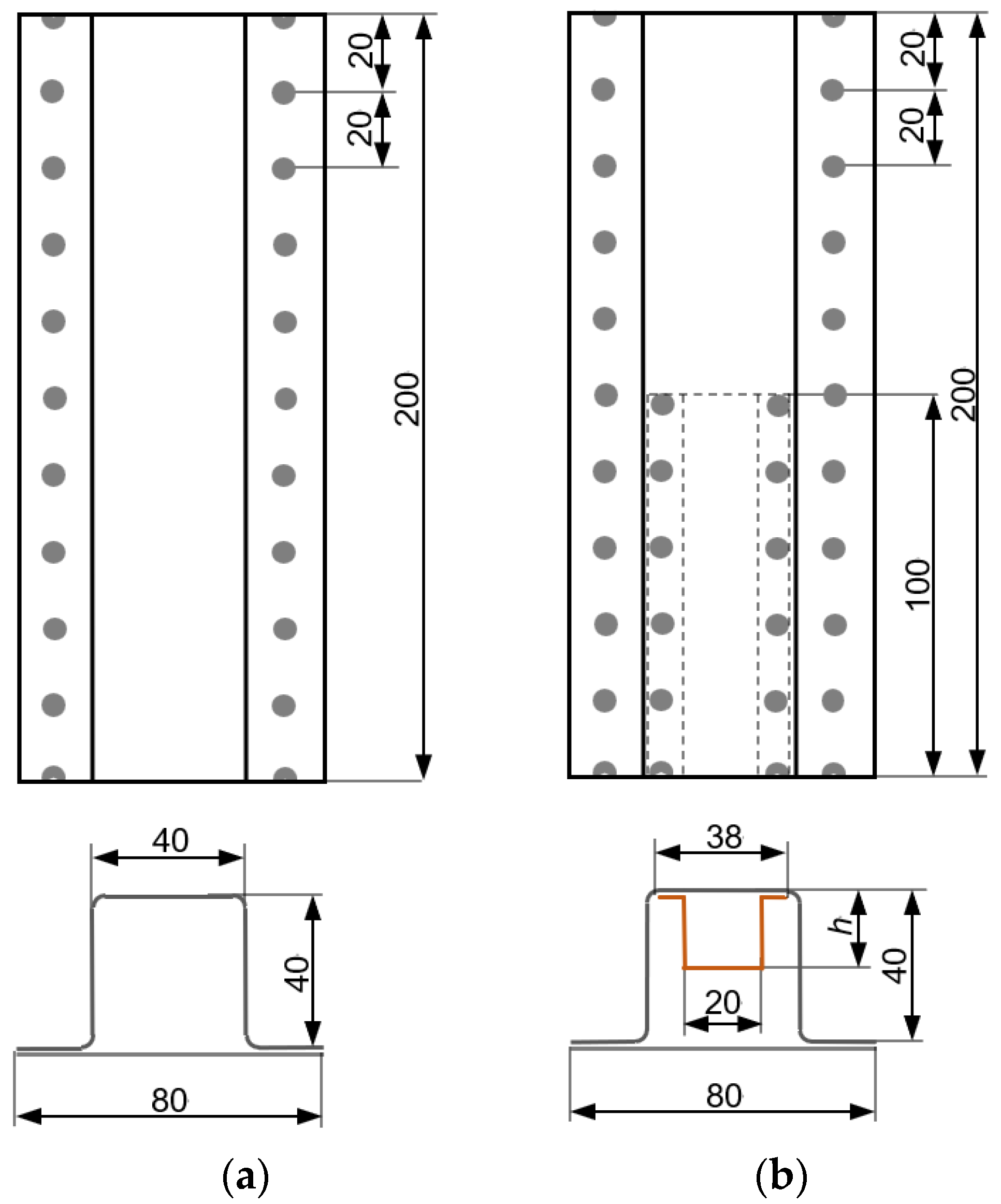
Figure 1. Detailed dimensions of standard and partially reinforced structures (all dimensions are in mm): (a) standard structure (STD); (b) partially reinforced structure (PR).
Metals 16 00655 g001
Figure 2. Standard structure and partially reinforced structures with inner hat-shaped part (wall thickness t: 1 mm): (a) STD; (b) PR-h10 (inner hat height: 10 mm); (c) PR-h20 (20 mm); (d) PR-h30 (30 mm). Images are given upside down to show internal reinforcing members.
Metals 16 00655 g002
Figure 3. Locations of strain gages Sg1~4 at structural wall (all dimensions are in mm): (a) PR-h20 structure with strain gages; (b) measurement positions.
Metals 16 00655 g003
Figure 4. Drop-weight impact testing: (a) testing apparatus; (b) illustration of testing part.
Metals 16 00655 g004
Figure 5. Examples of progressive deformation patterns in impact testing: (a) STD; (b) PR-h20.
Metals 16 00655 g005
Figure 6. Examples of progressive deformation patterns in quasistatic tests: (a) STD; (b) PR-h20.
Metals 16 00655 g006
Figure 7. Examples of compressed structures in impact compressions: (a) t: 0.6 mm; (b) t: 0.8 mm; (c) t: 1.0 mm.
Metals 16 00655 g007
Figure 8. Examples of compressed structures in quasistatic compression: (a) t: 0.6 mm; (b) t: 0.8 mm; (c) t: 1.0 mm.
Metals 16 00655 g008
Figure 9. Compressive force–stroke relationship: (a) STD (t: 1 mm); (b) PR-h20 (t: 1 mm).
Metals 16 00655 g009
Figure 10. Compressive force–stroke relationships of partially reinforced structures for different inner hat height h in impact test: (a) t: 0.6 mm; (b) t: 0.8 mm; (c) t: 1.0 mm.
Metals 16 00655 g010
Figure 11. Summary of crush strength values at stages I and II for PR structures: (a) impact test; (b) quasistatic test.
Metals 16 00655 g011
Figure 12. Cross-sections of deformed structures in impact test: (a) STD; (b) PR-h20.
Metals 16 00655 g012
Figure 13. Divisions in cross-sections of structure PR-h20: (a) unreinforced part; (b) reinforced part.
Metals 16 00655 g013
Figure 14. Illustration of curved part and undeformed part.
Metals 16 00655 g014
Figure 15. Variation in measured strains for initial deformations: (a) STD; (b) PR-h20.
Metals 16 00655 g015
Table 1. Mechanical properties of mild steel sheets in quasistatic tensile tests.
Thickness (mm)c (MPa)nUltimate Tensile Strength (MPa)Total Elongation (%)
0.6576.50.211340.239.5
0.8565.80.205336.839.7
1.0537.00.184331.337.3
Plastic property: σ = c ε n .
Table 2. Energy consumption in folding lobe formation of PR-h20 structure (t: 1 mm).
Stage IStage II
Section no.1231234
Mean radius (mm)2.752.552.552.002.1672.1672.08
Mean bending strain0.1670.1790.1790.2230.2080.2080.215
Effective strain0.1930.2070.2070.2570.240.240.248
Average yield stress (MPa)397402402418413413415
Volume ratio0.5850.4420.4420.7680.5850.5850.662
Length in cross-section (mm)1204080140408060
Deformed volume for axial length L (mm3)70.2L17.7L35.4L108L23.4L46.8L39.7L
Energy for axial length L (mJ)4539L1242L2484L9753L1960L3920L3456L
Total energy for axial length L (mJ)8265L19,089L
Table 3. Energy consumption in folding lobe formation of STD structure (t: 1 mm).
STD
Section no.123
Mean radius (mm)3.53.133.13
Mean bending strain0.1340.1480.148
Effective strain0.1550.1710.171
Average yield stress (MPa)322328328
Volume ratio0.4550.4860.486
Length in cross-section (mm)1204080
Deformed volume for axial length L (mm3)54.6L19.4L38.9L
Energy for axial length L (mJ)2725L1088L2182L
Total energy for axial length L (mJ)5995L
Disclaimer/Publisher’s Note: The statements, opinions and data contained in all publications are solely those of the individual author(s) and contributor(s) and not of MDPI and/or the editor(s). MDPI and/or the editor(s) disclaim responsibility for any injury to people or property resulting from any ideas, methods, instructions or products referred to in the content.