Article

FC Layer-Induced Soft Landing Effect and Mechanical Regulation in FC/Pd/Mg/FC Multilayer Thin Films: Interfacial Microstructure Evolution and Hydrogen-Cycling Behavior

1
School of Mechanical and Power Engineering, Tianjin Renai College, Tianjin 301636, China
2
Tianjin Key Laboratory of Equipment Design and Manufacturing Technology, Tianjin Renai College, Tianjin 301636, China
3
State Key Laboratory of Engine, Tianjin University, Tianjin 300072, China
4
National Engineering Research Center of Light Alloy Net Forming, State Key Laboratory of Metal Matrix Composites, Shanghai Jiao Tong University, Shanghai 200240, China
*
Authors to whom correspondence should be addressed.
Metals 2026, 16(6), 652; https://doi.org/10.3390/met16060652 (registering DOI)
Submission received: 17 May 2026 / Revised: 10 June 2026 / Accepted: 12 June 2026 / Published: 14 June 2026

Abstract

Fluorocarbon (FC)/Pd/Mg multilayer thin films have attracted considerable attention as hydrogen-responsive optical materials. However, their performance is strongly limited by interfacial instability and structural degradation during deposition and hydrogen cycling. In this study, Pt/FC/Pd/Mg multilayer thin films were obtained during focused ion beam (FIB) sample preparation, and transmission electron microscopy (TEM) was employed to investigate the FC layer–mediated interfacial effects. The results reveal that Pt deposition on FC leads to the formation of a confined nanocrystalline interfacial region accompanied by a reduced apparent FC thickness and the development of a Pt–FC intermixing zone. This behavior indicates that the FC layer functions as a “soft landing” medium, dissipating kinetic energy and modifying nucleation and growth behavior. Motivated by this finding, the mechanical properties of FC films and their influence on hydrogen-cycling performance in FC/Pd/Mg/FC structures are further examined. The hardness of FC layers can be tuned from 3.03 MPa to 42.8 MPa by adjusting sputtering parameters. Hydrogen-cycling experiments reveal a strong and non-monotonic dependence on FC mechanical properties. When the FC buffer layer is relatively hard, the initial hydrogenation kinetics are improved; however, prolonged cycling leads to poor adhesion and interfacial degradation. In contrast, when the FC buffer layer is soft, hydrogenation kinetics degrade rapidly during cycling, while long-term interfacial adhesion and structural integrity are significantly improved. These results demonstrate a dual and competing role of FC layers in governing hydrogen transport and mechanical stability, highlighting a critical trade-off for the design of durable hydrogen-responsive multilayer thin films.

1. Introduction

Magnesium-based thin films and Pd-catalyzed Mg multilayer systems have attracted extensive attention due to their high hydrogen storage capacity [1] and reversible Mg ↔ MgH2 phase transformation, which leads to pronounced optical switching behavior [2,3,4,5]. These materials are promising for smart windows, hydrogen sensors, and switchable optical devices [6,7]. However, their practical hydrogenation performance is strongly influenced by interfacial structure and microstructural stability [8,9]. The large volume mismatch of approximately 30–35% between Mg and MgH2 during hydrogen absorption and desorption induces significant interfacial stress accumulation [10,11,12,13], which directly affects hydrogen diffusion pathways and hydrogenation kinetics.
To address these issues, interface engineering strategies, including catalytic layer optimization, buffer layer introduction, and stress regulation, have been widely explored [14,15,16]. Among these approaches, fluorocarbon (FC) polymer layers have emerged as promising interfacial materials due to their chemical inertness, flexibility, and low surface energy [17]. As a fluorine-containing organic functional material [18], fluorocarbon (FC) films have been widely used in hydrophobic coatings due to their low surface free energy [19]. Nevertheless, the role of FC layers in regulating atomic deposition behavior and hydrogen transport remains unclear. In particular, whether FC layers act as passive protective coatings or active functional interfaces influencing hydrogenation kinetics has not been fully clarified.
During focused ion beam (FIB) preparation of FC/Pd/Mg multilayer specimens, an unusual interfacial phenomenon was observed: Pt deposited on FC forms refined nanocrystalline structures, accompanied by an apparent reduction in FC layer thickness [10]. This suggests that the FC layer acts as an interfacial energy-dissipation medium, inducing a soft-landing effect during deposition. This observation suggests that FC may act as a soft-landing interfacial layer during metal deposition.
Motivated by this observation, this work systematically investigates FC-mediated interfacial effects during deposition, the mechanical properties of FC films, and their influence on hydrogenation performance in FC/Pd/Mg multilayers.

2. Experimental Procedure

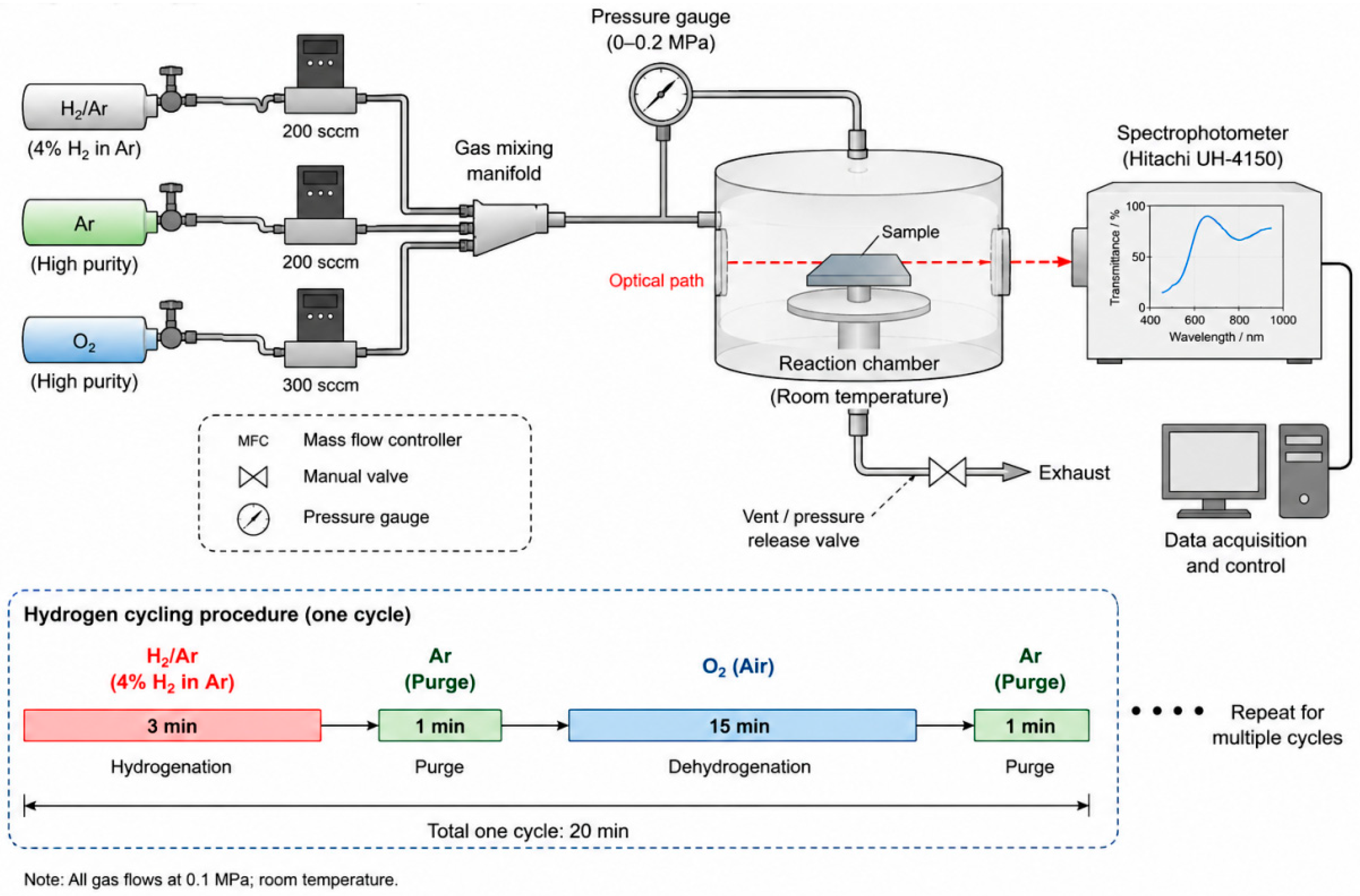
The base pressure of the sputtering chamber was ~7.1 × 10⁻⁴ Pa. Prior to deposition, all targets were pre-sputtered for 10 min to remove surface contamination. FC polymer layers, 30 nm thick, and with different hardness values, were first deposited under different conditions. Pd/Mg composite films were prepared using a Denton Explore-14 magnetron sputtering system (Moorestown, NJ, USA). A 70 nm Mg layer was then sputtered under 40 W direct current (DC), followed by in situ deposition of a 5 nm Pd layer via radio frequency (RF) with different sputtering powers. DC magnetron sputtering was used for Mg deposition due to its stable metallic conductivity, while RF sputtering was employed for Pd to ensure stable plasma generation under noble metal target conditions. The Pd layer is crucial for protecting Mg from oxidation and promoting hydrogen absorption. To prevent the Pd/Mg films from contacting condensed water, a 30 nm FC polymer layer was finally deposited. Hydrogenation of the FC/Pd/Mg films was investigated by exposing them to a flowing mixture of 4% H2 in Ar gas (200 sccm at 0.1 MPa), and the dehydrogenation process was conducted under air (300 sccm at 0.1 MPa) at room temperature (Figure 1). The hydrogenation switching time was defined as the time required for the optical transmittance (or reflectance) to reach 90% of the total change between fully hydrogenated and dehydrogenated states. The thickness of each thin film was measured by a KLATencor P7 profilometer (Milpitas, CA, USA). Optical properties were detected with a Hitachi UH-4150 spectrophotometer (Tokyo, Japan). The microstructures of the samples were analyzed using a Talos F200X transmission electron microscope (TEM) (Thermo Fisher Scientific, Waltham, MA, USA) operated at 200 kV. TEM cross-sections were prepared by applying a focused ion beam (FIB, GAIA3 GMU Model 2016) system (TESCAN, Brno, Czech Republic) to the films fabricated on thermal silicon oxide substrates.

3. Results and Discussion

3.1. FC-Mediated Soft Landing Effect During Pt Deposition

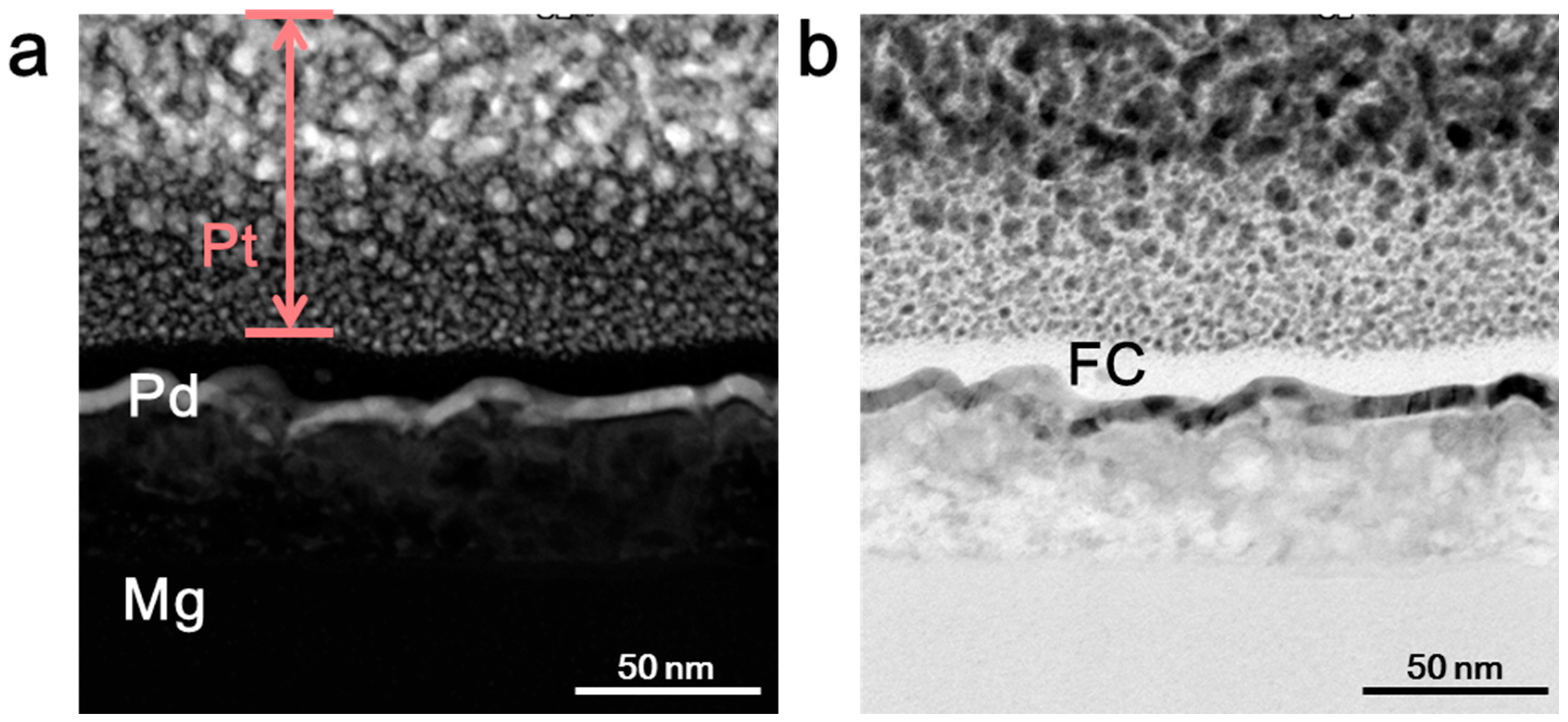
TEM analysis of Pt/FC/Pd/Mg multilayers (Figure 2) reveals that the FC layer thickness is reduced to approximately 12 nm (vs. nominal 30 nm), while a ~50 nm Pt-FC interfacial transition zone is formed. Within this region, Pt exhibits a pronounced grain size gradient: ultrafine nanocrystals form near the FC interface, while grain coarsening occurs away from the interface. This indicates that FC strongly modifies Pt nucleation and growth kinetics.
Furthermore, HAADF-TEM and bright-field TEM observations reveal a nanocrystalline gradient structure extending across the transition zone. Such a confined nanocrystalline region is consistent with the proposed soft-landing effect, in which the polymeric FC layer dissipates the kinetic energy of incoming Pd species, suppresses grain coalescence, and promotes spatially confined nucleation. Although the present microstructural observations clearly demonstrate the existence of interfacial intermixing and nanocrystalline confinement, further spectroscopic characterization is required to clarify the chemical nature of the intermixed region.
Since all multilayers were fabricated with identical thicknesses, the present discussion focuses on the influence of FC mechanical properties. Therefore, the observed differences in hydrogen-cycling behavior are primarily attributed to variations in FC mechanical properties rather than thickness effects.

3.2. Mechanical Tunability of FC Films

The mechanical properties of FC layers were controlled by adjusting sputtering parameters (Table 1). The hardness varies significantly from 3.03 MPa to 42.8 MPa. The observed hardness variation can be understood from the plasma polymerization behavior of fluorocarbon films. According to the structure zone model and plasma-polymer growth theory, lower working pressure and higher sputtering power increase the kinetic energy of arriving species, promoting film densification and cross-linking, whereas higher pressure favors porous structures with increased free volume. As a result, significant differences in film compactness and mechanical hardness are generated. Similar relationships between deposition conditions, cross-linking density, and mechanical properties have been reported for plasma-polymerized fluorocarbon films [19,20].
This mechanical tunability provides a basis for optimizing FC layers as functional hydrogenation buffer layers.

3.3. Hydrogenation Behavior of FC/Pd/Mg Multilayers

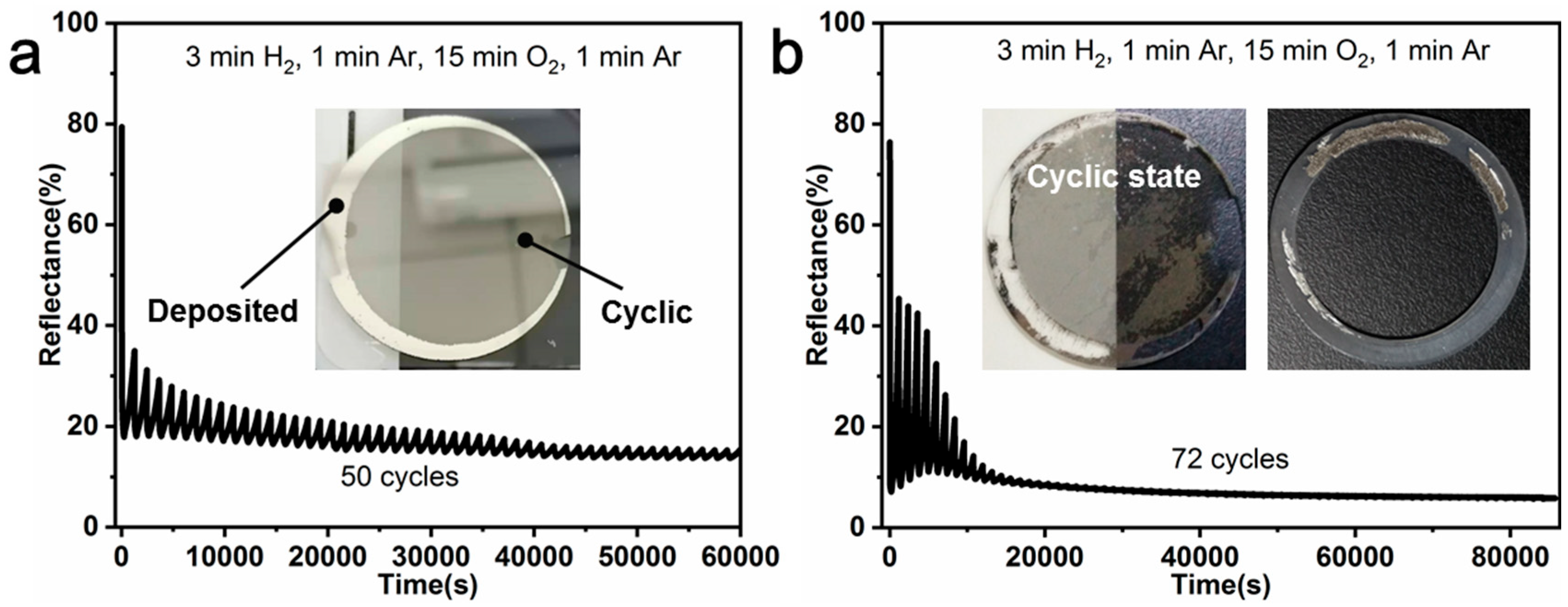
FC/Pd/Mg multilayers exhibit progressive degradation of hydrogenation performance during repeated hydrogen absorption–desorption processes. After approximately 50 cycles, the films lose reversible optical switching capability (Figure 3a).
This deterioration is primarily attributed to accumulated interfacial stress induced by repeated Mg ↔ MgH2 phase transformation, which alters hydrogen diffusion pathways and reduces effective hydrogen transport efficiency.

3.4. Effect of FC Mechanical Properties on Hydrogenation Performance

To clarify the role of FC mechanical properties in hydrogenation behavior, FC/Pd/Mg/FC sandwich structures with different FC hardness were systematically evaluated.
A non-monotonic dependence of hydrogenation performance on FC hardness is observed:
(i) Hard FC buffer layer (Process 1)
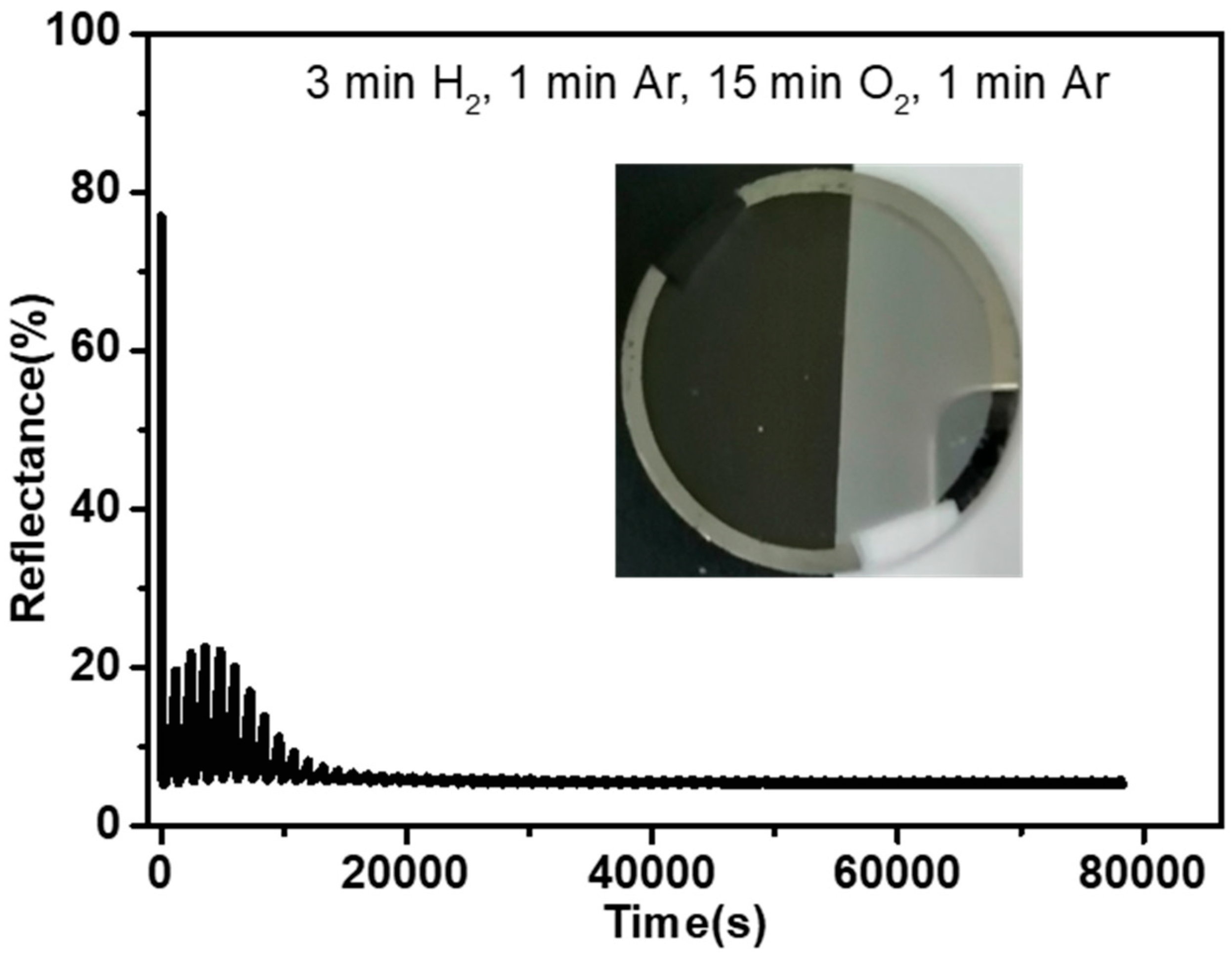
When the FC buffer layer is relatively hard: initial hydrogenation kinetics are significantly improved for FC/Pd/Mg/FC (Figure 3b). However, interfacial adhesion deteriorates after repeated hydrogen insertion/extraction. This behavior indicates that a relatively rigid FC layer cannot provide sufficient strain accommodation, leading to stress concentration at the interface during hydrogen-induced volume expansion, which ultimately results in film delamination. In addition, degradation during cycling is observed, which is attributed not only to interfacial stress accumulation but also to hydrogen diffusion pathway reconstruction caused by repeated phase transformation. The FC layer acts simultaneously as: (i) a mechanical strain buffer, and (ii) a diffusion barrier whose effectiveness depends strongly on its modulus.
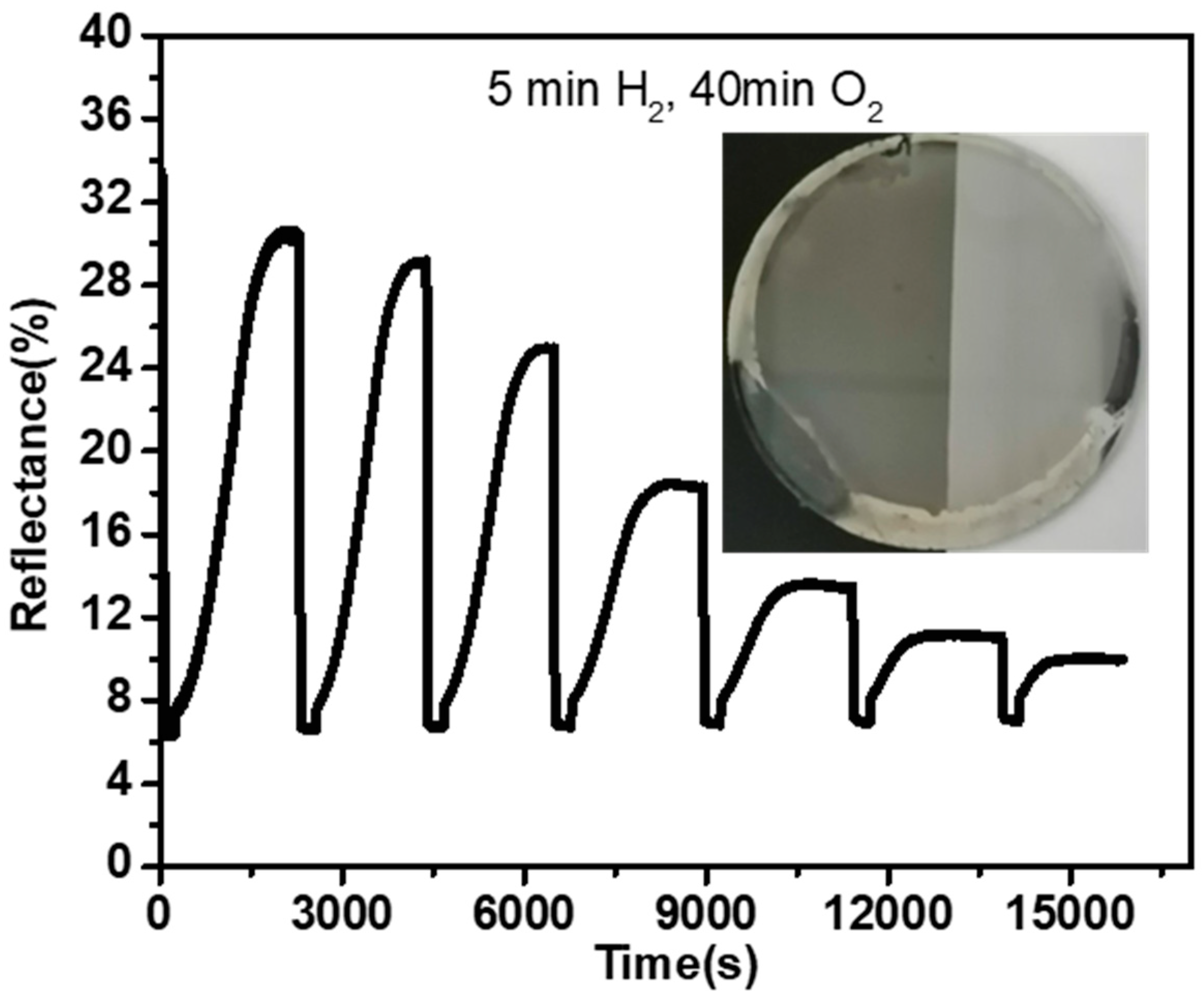
Under sufficiently long hydrogenation and dehydrogenation durations, the full hydrogenation behavior of the FC/Pd/Mg/FC (Process 1) thin films is presented in Figure 4. With increasing cycle number, the hydrogenation performance gradually deteriorates. At the fourth cycle, the optical modulation range during hydrogenation decreases to approximately half of its initial value. By the seventh cycle, the hydrogenation performance has severely degraded, and the optical contrast between the hydrogenated and dehydrogenated states is reduced to approximately 4%.
The observed delamination and morphological degradation after cycling provide direct evidence that FC mechanical properties strongly influence interfacial stability under hydrogen-induced stress. Although quantitative adhesion measurements were not performed in the present work, the cycling-induced failure behavior clearly reveals the different mechanical responses of FC layers with varying hardness.
(ii) Soft FC buffer layer (Process 3)
When the FC buffer layer is relatively soft: hydrogenation kinetics of the FC/Pd/Mg/FC film (Figure 5) decrease rapidly during operation. However, interfacial adhesion and structural integrity are markedly improved. In this case, the compliant FC layer effectively accommodates Mg/MgH2 volume expansion and suppresses crack formation and delamination. Nevertheless, excessive softness introduces increased diffusion resistance for hydrogen transport, thereby reducing hydrogenation efficiency.
The observed non-monotonic dependence of hydrogenation performance on FC hardness suggests that the FC layer simultaneously influences hydrogen transport and mechanical stress evolution. For relatively hard FC layers, the compact structure and reduced free volume may facilitate the formation of stable hydrogen diffusion pathways during the initial hydrogenation stage. However, the limited deformability of the FC layer leads to stress accumulation at the interface during repeated Mg ↔ MgH2 phase transformations, resulting in interfacial degradation and progressive loss of hydrogenation performance. In contrast, softer FC layers can effectively dissipate hydrogen-induced stress and suppress crack formation or delamination. Nevertheless, their increased free volume and lower structural compactness may introduce additional resistance to hydrogen transport, leading to slower hydrogenation kinetics. Therefore, the hydrogen-cycling behavior is governed by a balance between hydrogen diffusion efficiency and mechanical stress accommodation. Although quantitative diffusion coefficients were not measured in the present work, the observed cycling trends strongly suggest that FC mechanical properties play a critical role in regulating the competition between these two processes.

3.5. Mechanism: Trade-Off Between Mechanical Accommodation and Hydrogen Transport

The FC layer plays multiple roles in the multilayer system:
(1) During deposition: soft landing layer promoting nanocrystalline refinement;
(2) During hydrogenation: mechanical buffer layer regulating stress evolution;
(3) During operation: diffusion-modulating layer affecting hydrogen transport kinetics.
Importantly, its effect is strongly dependent on mechanical hardness:
(1) Hard FC → faster initial hydrogenation but poor interfacial stability under hydrogen-induced stress;
(2) Soft FC → improved interfacial integrity but reduced hydrogen transport efficiency.
These results reveal a trade-off between hydrogen transport efficiency and interfacial mechanical accommodation, suggesting that FC layers with intermediate hardness may provide an optimal balance between hydrogenation kinetics and structural stability. For applications requiring rapid optical switching, relatively hard FC layers may be preferred, whereas softer FC layers may be more suitable for applications emphasizing long-term structural reliability. Therefore, FC mechanical tunability offers an effective strategy for tailoring the performance of hydrogen-responsive multilayer films according to specific operational requirements.

4. Future Perspectives and Potential Applications

The present work demonstrates that FC interlayers simultaneously influence deposition-induced interfacial evolution and hydrogen-cycling behavior in FC/Pd/Mg/FC multilayer films. Future studies should focus on establishing quantitative correlations between FC mechanical properties and hydrogen transport kinetics through advanced experimental and modeling approaches. In addition, spectroscopic characterization techniques, such as XPS depth profiling, EDS mapping, and EELS analysis, are required to further clarify the chemical nature of the FC–Pd interfacial region and the mechanism underlying the observed soft-landing effect.
The applicability of the FC-mediated interfacial regulation mechanism to multilayer systems with different layer thicknesses and catalytic metals also warrants further investigation. Furthermore, extended hydrogen-cycling experiments will be valuable for evaluating long-term device reliability under practical operating conditions.
These efforts will contribute to a deeper understanding of the relationship between interfacial structure, mechanical properties, and hydrogen transport, providing guidance for the design of durable hydrogen-responsive multilayer materials.

5. Conclusions

In this work, the interfacial effects of FC layers in FC/Pd/Mg/FC multilayer thin films were investigated through microstructural characterization and hydrogen-cycling experiments.
(1) Cross-sectional TEM observations revealed that deposition on the FC layer resulted in the formation of an intermixed transition region accompanied by nanocrystalline refinement. The reduced apparent FC thickness and the confined nanocrystalline structure indicate that the FC layer acts as a soft-landing medium that modifies the nucleation and growth behavior of deposited metal species.
(2) By adjusting sputtering parameters, the hardness of FC films could be tuned from 3.03 MPa to 42.8 MPa, providing a controllable means of regulating the mechanical properties of the FC interlayer.
(3) Hydrogen-cycling experiments demonstrated that FC mechanical properties significantly influence hydrogenation behavior and interfacial stability. Hard FC layers facilitated faster initial hydrogenation but exhibited pronounced interfacial degradation during cycling, whereas soft FC layers improved structural integrity but reduced hydrogen transport efficiency.
(4) The observed hydrogen-cycling behavior reflects a competition between hydrogen transport and mechanical stress accommodation within the investigated FC/Pd/Mg multilayer system. The mechanical properties of the FC layer therefore represent an important parameter for regulating hydrogenation performance and interfacial degradation.
Overall, the results demonstrate that FC layers simultaneously influence deposition-induced interfacial evolution and hydrogen-cycling behavior in FC/Pd/Mg multilayer films.

Author Contributions

Conceptualization, N.D., G.P. and Y.Y.; methodology, N.D.; validation, N.D., D.W. and J.C.; formal analysis, N.D., D.W., G.P., Y.Y., Y.H., J.C. and L.P.; investigation, N.D., G.P., Y.Y., Y.H., J.C. and L.P.; resources, N.D., G.P., Y.H. and L.P.; visualization, N.D., D.W., G.P., Y.Y. and J.C.; supervision, N.D.; writing—original draft preparation, N.D., D.W., G.P., Y.Y., Y.H., J.C. and L.P.; writing—review and editing, N.D., D.W., G.P., Y.Y., Y.H., J.C. and L.P. All authors have read and agreed to the published version of the manuscript.

Funding

This research received no external funding.

Data Availability Statement

The original contributions presented in this study are included in the article. Further inquiries can be directed to the corresponding authors.

Conflicts of Interest

The authors declare no conflict of interest.

References

  1. Allendorf, M.D.; Stavila, V.; Snider, J.L.; Witman, M.; Bowden, M.E.; Brooks, K.; Tran, B.L.; Autrey, T. Challenges to developing materials for the transport and storage of hydrogen. Nat. Chem. 2022, 14, 1214–1223. [Google Scholar] [CrossRef] [PubMed]
  2. Jain, I.P.; Lal, C.; Jain, A. Hydrogen storage in Mg: A most promising material. Int. J. Hydrogen Energy 2010, 35, 5133–5144. [Google Scholar] [CrossRef]
  3. Zaluska, A.; Zaluski, L.; Ström–Olsen, J.O. Nanocrystalline magnesium for hydrogen storage. J. Alloys Compd. 1999, 288, 217–225. [Google Scholar] [CrossRef]
  4. Wang, T.; Tang, L.; Zhang, Y.; Hong, Z.; Liu, G.; Li, Z.; Chen, J.; Peng, L.; Ding, W. Interaction between hydrogen and magnesium films: From hydrogenochromism to applications. ACS Appl. Mater. Interfaces 2025, 17, 8794–8820. [Google Scholar] [CrossRef] [PubMed]
  5. Krishnan, G.; Korneychuk, S.; Bannenberg, L.J.; Schreuders, H.; Jinschek, J.; Dam, B. Unraveling Real-Time Dynamics in Mg-to-MgH2 Phase Transformation Using In Situ Electron Microscopy. J. Phys. Chem. Lett. 2025, 16, 5473–5479. [Google Scholar] [CrossRef] [PubMed]
  6. Liu, Y.; Chen, J.; Peng, L.; Han, J.; Deng, N.; Ding, W.; Chen, W. Improved optical properties of switchable mirrors based on Pd/Mg-TiO2 films fabricated by magnetron sputtering. Mater. Des. 2018, 144, 256–262. [Google Scholar] [CrossRef]
  7. Deng, N.; Yang, W.; Wang, D.; Yu, Y.; He, Y.; Chen, J.; Peng, L. Optimizing hydrogenation and optical switching performances of FC/Pd/Mg films via vacuum annealing: A Hall-Petch relationship perspective on Mg layer intermediate-temperature recovery. J. Magnes. Alloys 2026, 102067. [Google Scholar] [CrossRef]
  8. Moens, F.; Schramm, I.C.; Konstantinidis, S.; Depla, D. On the microstructure of magnesium thin films deposited by magnetron sputtering. Thin Solid Film. 2019, 689, 137501. [Google Scholar] [CrossRef]
  9. Bannenberg, L.J.; García-Martínez, F.; Lömker, P.; Engel, R.Y.; Schlueter, C.; Schreuders, H.; Navarathna, A.; Ratcliff, L.E.; Regoutz, A. Influence of Hydrogen-Incorporation on the Bulk Electronic Structure and Chemical Bonding in Palladium. Adv. Sci. 2026, 13, e22098. [Google Scholar] [CrossRef] [PubMed]
  10. Deng, N.; Chen, J.; Peng, L.; Li, F.; Wu, J.; Chen, Y.; Ding, W. Hydrogen-induced optical properties of FC/Pd/Mg films: Roles of grain size and grain boundary. J. Magnes. Alloys 2023, 11, 1970–1980. [Google Scholar] [CrossRef]
  11. Hála, M.; Čapek, J.; Zabeida, O.; Klemberg-Sapieha, J.E.; Martinu, L. Pulse management in high power pulsed magnetron sputtering of niobium. Surf. Coat. Technol. 2012, 206, 4186–4193. [Google Scholar] [CrossRef]
  12. Jung, H.; Cho, S.; Lee, W. A catalytic effect on hydrogen absorption kinetics in Pd/Ti/Mg/Ti multilayer thin films. J. Alloys Compd. 2015, 635, 203–206. [Google Scholar] [CrossRef]
  13. Palmisano, V.; Filippi, M.; Baldi, A.; Slaman, M.; Schreuders, H.; Dam, B. An optical hydrogen sensor based on a Pd-capped Mg thin film wedge. Int. J. Hydrogen Energy 2010, 35, 12574–12578. [Google Scholar] [CrossRef]
  14. Ye, S.Y.; Chan, S.L.I.; Ouyang, L.Z.; Zhu, M. Hydrogen storage and structure variation in Mg/Pd multi-layer film. J. Alloys Compd. 2010, 504, 493–497. [Google Scholar] [CrossRef]
  15. Bannenberg, L.J.; Boshuizen, B.; Ardy Nugroho, F.A.; Schreuders, H. Hydrogenation Kinetics of Metal Hydride Catalytic Layers. ACS Appl. Mater. Interfaces 2021, 13, 52530–52541. [Google Scholar] [CrossRef] [PubMed]
  16. Abejón, D.; Prieto, P.; Kim, J.K.; Redondo-Cubero, A.; Crespillo, M.L.; Leardini, F.; Ferrer, I.J.; García, G.; Ares, J.R. Isothermal hydrogen absorption process of Pd-capped Mg films traced by ion beam techniques and optical methods. J. Magnes. Alloys 2024, 12, 3675–3684. [Google Scholar] [CrossRef]
  17. Liu, Y.; Chen, J.; Peng, L.; Deng, N.; Ding, W. Fabrication and optical property improvement of gasochromic switchable mirror based on Pd/MgNb2O5 thin film. Int. J. Hydrogen Energy 2019, 44, 15205–15217. [Google Scholar] [CrossRef]
  18. Kim, J.; Kim, H.; Kim, S.H.; Park, C.E. (Poly(3,4-ethylenedioxythiophene):Polystyrene Sulfonate):Polytetrafluoroethylene for Use in High-Performance and Stable Bottom-Contact Organic Field-Effect Transistors. J. Phys. Chem. C 2016, 120, 956–962. [Google Scholar] [CrossRef]
  19. Cai, L.; Liu, A.; Yuan, Y.; Dai, L.; Li, Z. Self-assembled perfluoroalkylsilane films on silicon substrates for hydrophobic coatings. Prog. Org. Coat. 2017, 102, 247–258. [Google Scholar] [CrossRef]
  20. Thornton, J.A. High Rate Thick Film Growth. Annu. Rev. Mater. Res. 1977, 7, 239–260. [Google Scholar] [CrossRef]
Figure 1. Hydrogen-cycling performance test system.
Metals 16 00652 g001
Figure 2. Schematic illustration of the Pt/FC/Pd/Mg multilayer structure. (a) High-angle annular dark-field (HAADF) image; (b) bright-field (BF) image.
Metals 16 00652 g002
Figure 3. Cycling performance of the films. (a) Cycling behavior and post-cycling optical morphology of FC/Pd/Mg films; (b) cycling behavior and post-cycling optical morphology of FC/Pd/Mg/FC (process 1) films.
Metals 16 00652 g003
Figure 4. Cyclic hydrogenation behavior of FC/Pd/Mg/FC (Process 1) multilayer films. The inset shows the optical state after dehydrogenation following cycling.
Metals 16 00652 g004
Figure 5. Incomplete cyclic hydrogenation behavior of FC/Pd/Mg/FC (Process 3) multilayer films. The inset shows the optical state after dehydrogenation following cycling.
Metals 16 00652 g005
Table 1. Deposition parameters of FC films with different processing conditions.
ProcessPressure (mTorr)Gas Flow (sccm)Power (W)Deposition Rate (nm/s)Hardness (MPa)
No.
125348001.342.8
2251004000.8459.07
350344000.1843.03
4501008002.1386.01
Disclaimer/Publisher’s Note: The statements, opinions and data contained in all publications are solely those of the individual author(s) and contributor(s) and not of MDPI and/or the editor(s). MDPI and/or the editor(s) disclaim responsibility for any injury to people or property resulting from any ideas, methods, instructions or products referred to in the content.