The Influence of Cerium on Inclusions, Microstructure, and Mechanical Properties of Industrial BT700L Steel

 , and
, and
Abstract
1. Introduction
2. Materials and Methods
2.1. Experimental Process
2.2. Characterization
3. Results and Discussion
3.1. Influence of Ce on Inclusions
3.2. Influence of Ce on the Microstructure
3.3. Influence of Ce on the Mechanical Properties
4. Conclusions
- (1)
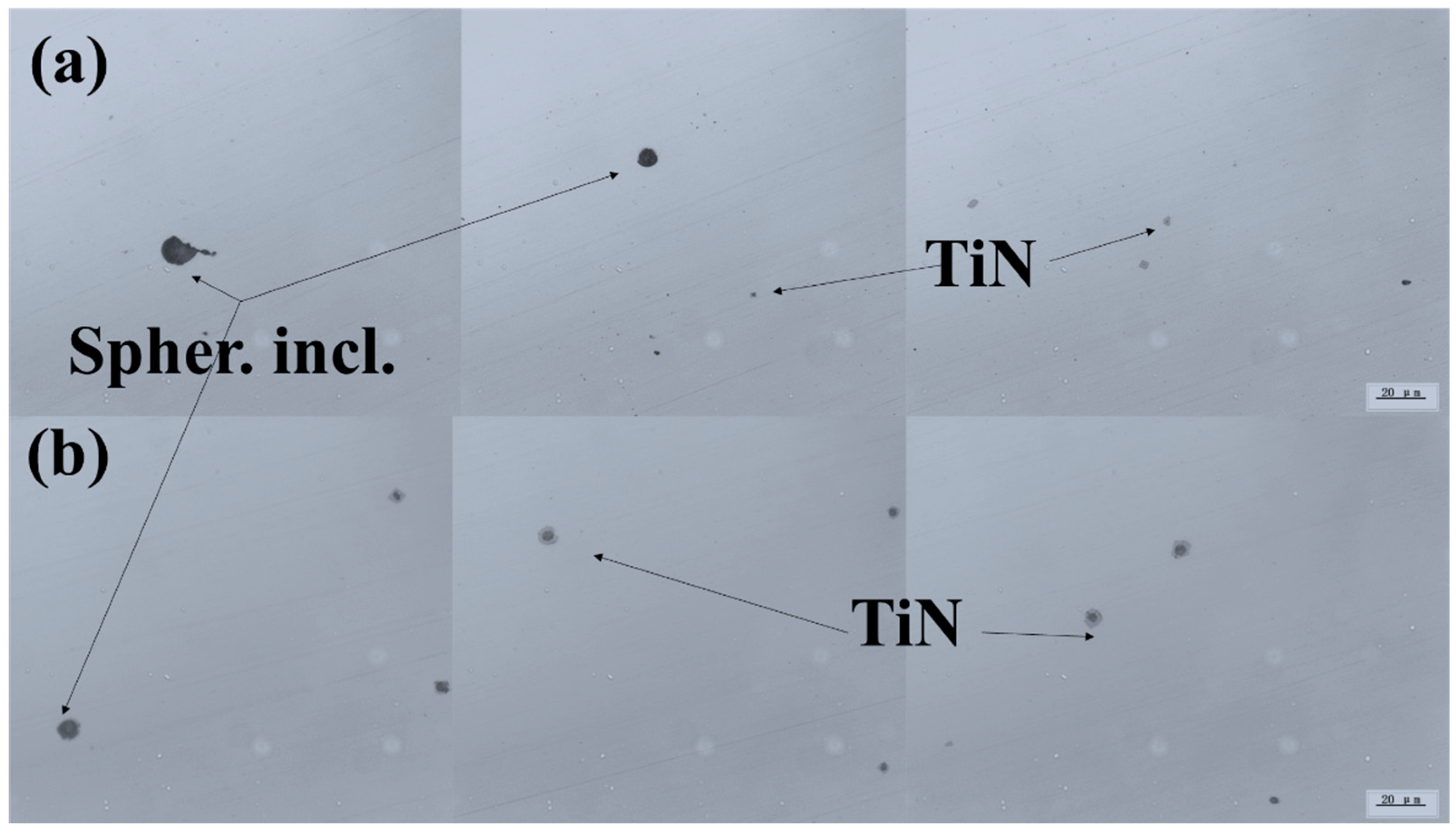
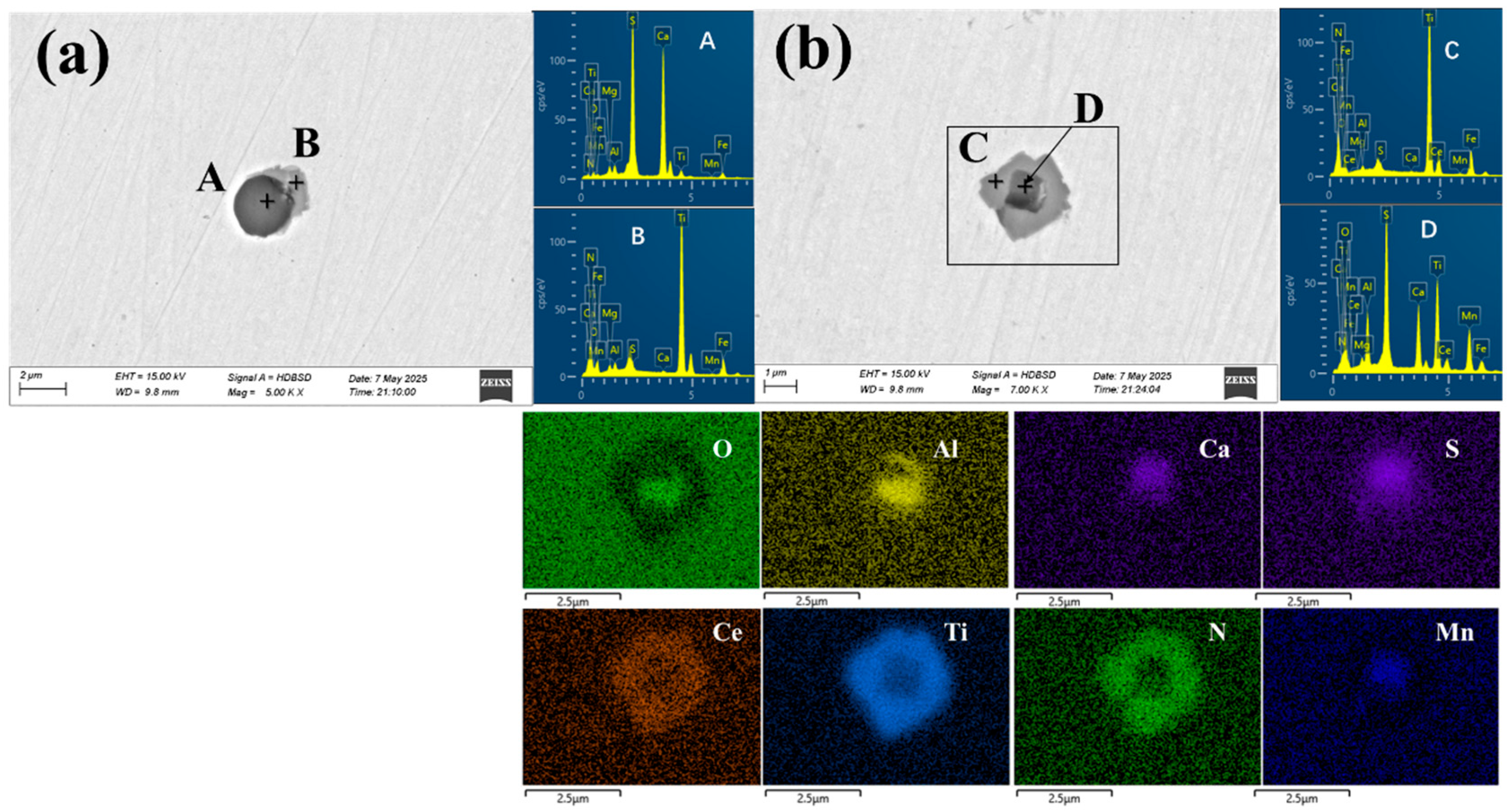
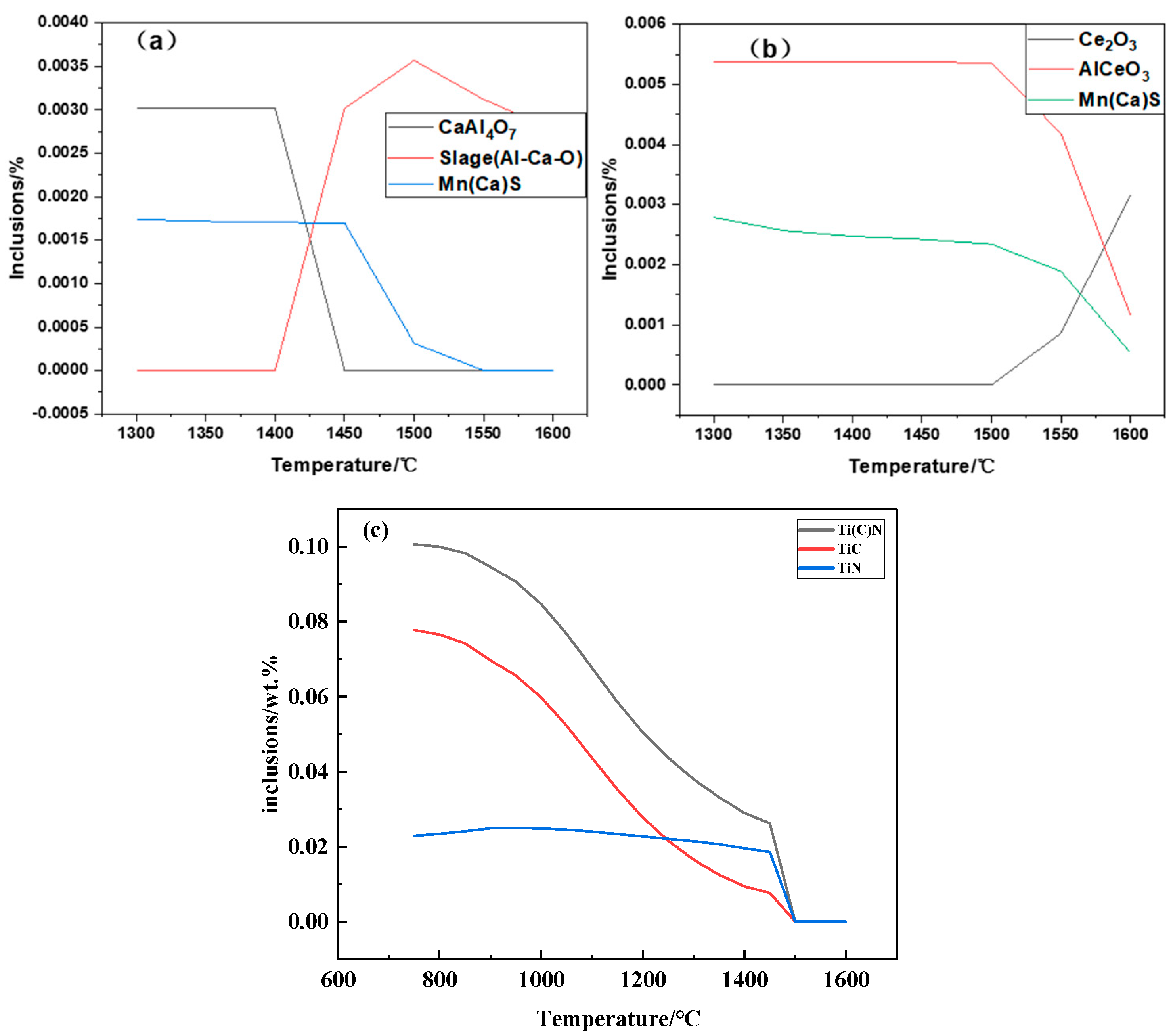
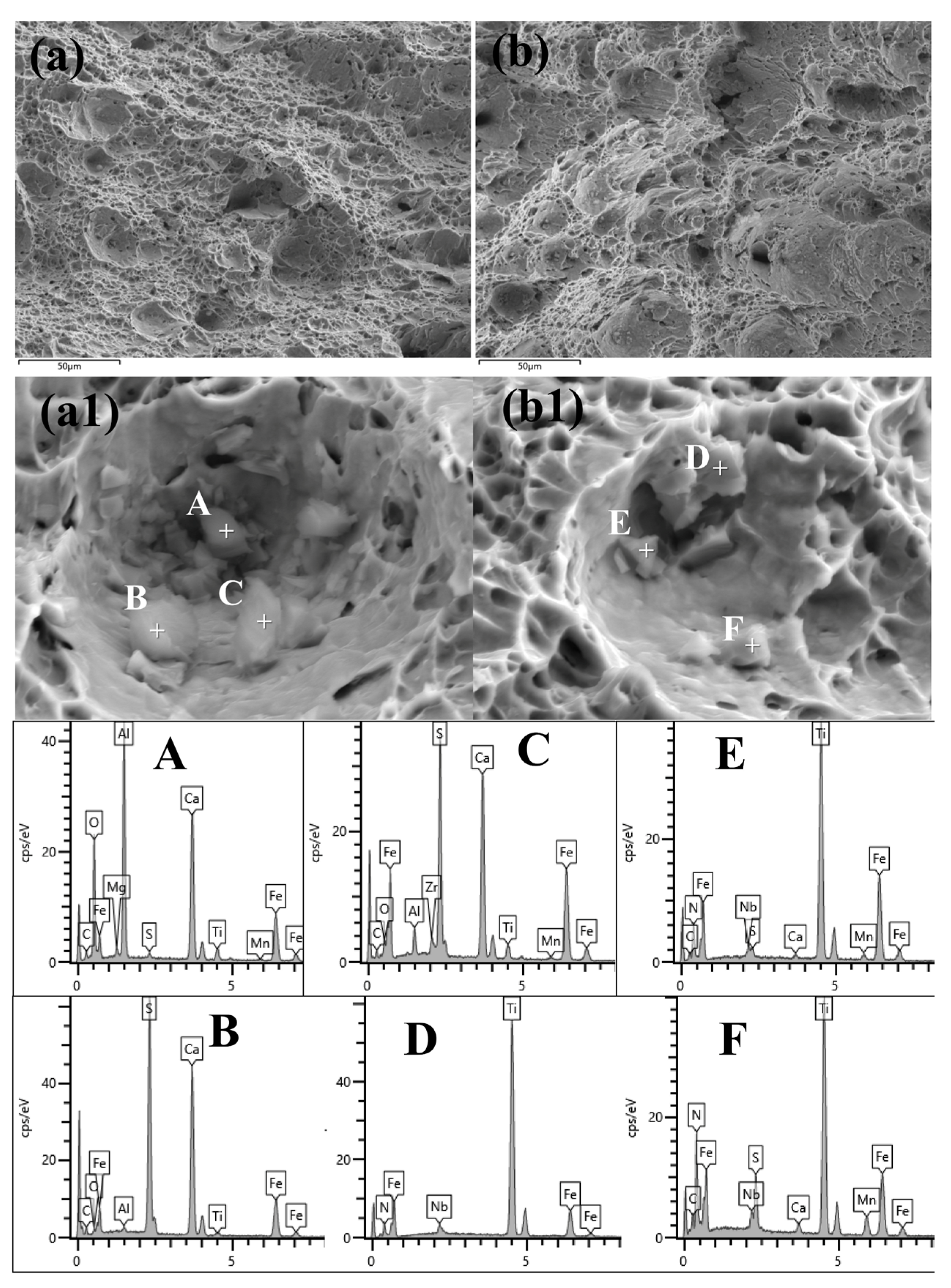
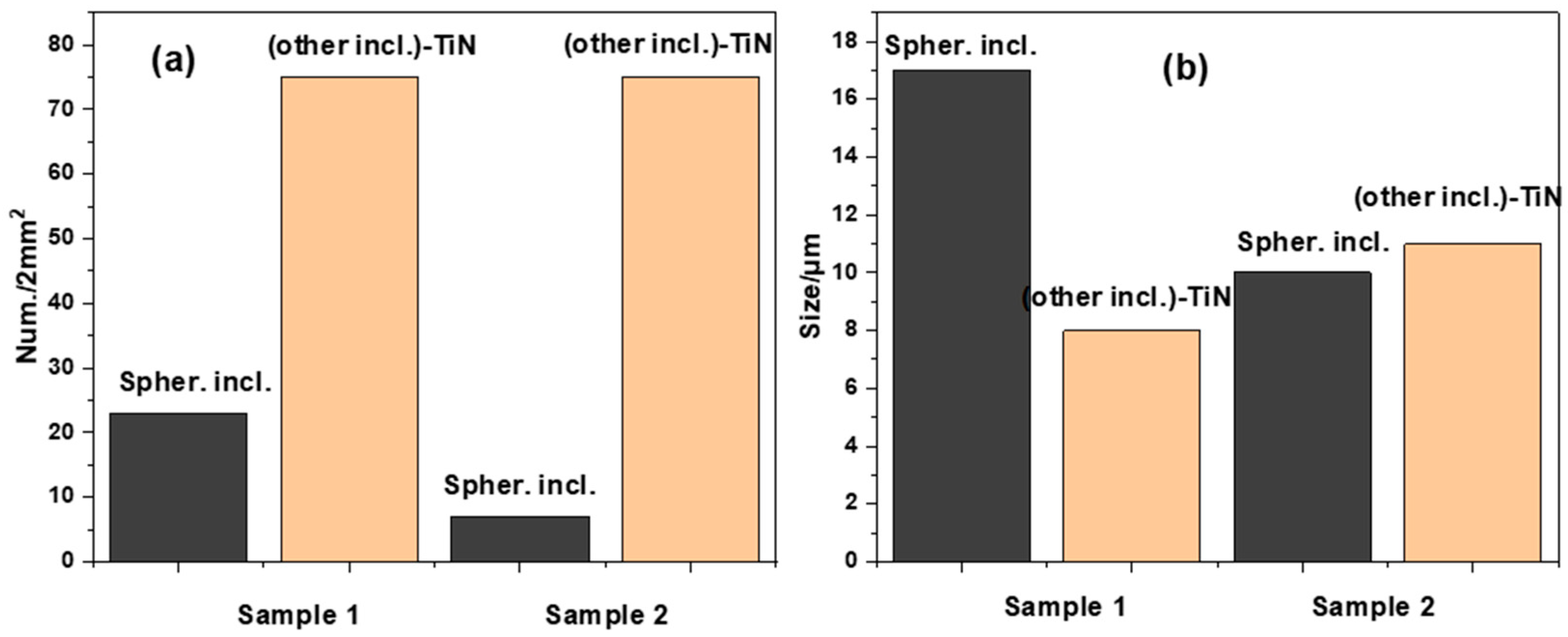
- The addition of cerium significantly altered the types, morphology, and distribution of inclusions in BT700L steel. In the sample without Ce (Sample 1), two types of inclusions were primarily present: spherical Al-Mg-Ca-O-S composite inclusions (average size of 17 μm) and small, dispersed square Ti(C)N inclusions (average size of 8 μm). After the addition of 0.0035% Ce (Sample 2), the number of spherical composite inclusions decreased by about 70%, and their average size was refined to 10 μm. The number of square Ti(C)N inclusions remained roughly the same, but the average size increased to 11 μm, and a composite structure formed, with AlCeO3-Ca(Mn)S as the core and a Ce-containing Ti(C)N shell on the outside.
- (2)
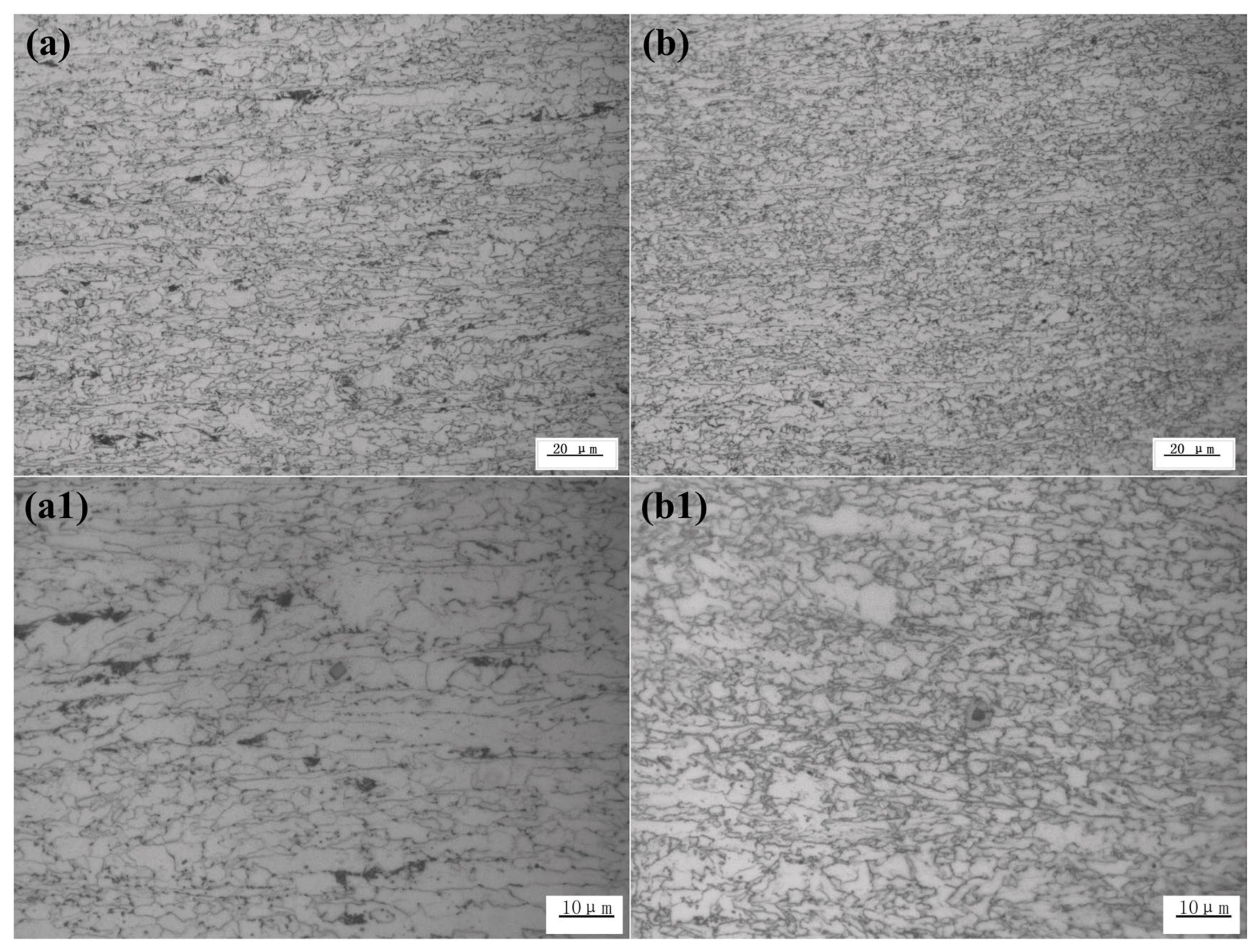
- Two-dimensional misfit degree calculations showed that Ce2O3 inclusions had a misfit degree of 4.00% with α-Fe and 6.28% with γ-Fe, both lower than the critical value for effective heterogeneous nucleation (12%), indicating that these inclusions could effectively promote heterogeneous nucleation of ferrite and facilitate grain refinement. The misfit degree between AlCeO3 and α-Fe was higher (14.93%), but the composite AlCeO3-TiN inclusions, due to the low misfit degree between TiN and α-Fe (4.41%), still contributed to grain refinement. Microscopic observations confirmed that the addition of Ce led to the disappearance of the original banded structure and significant grain refinement.
- (3)
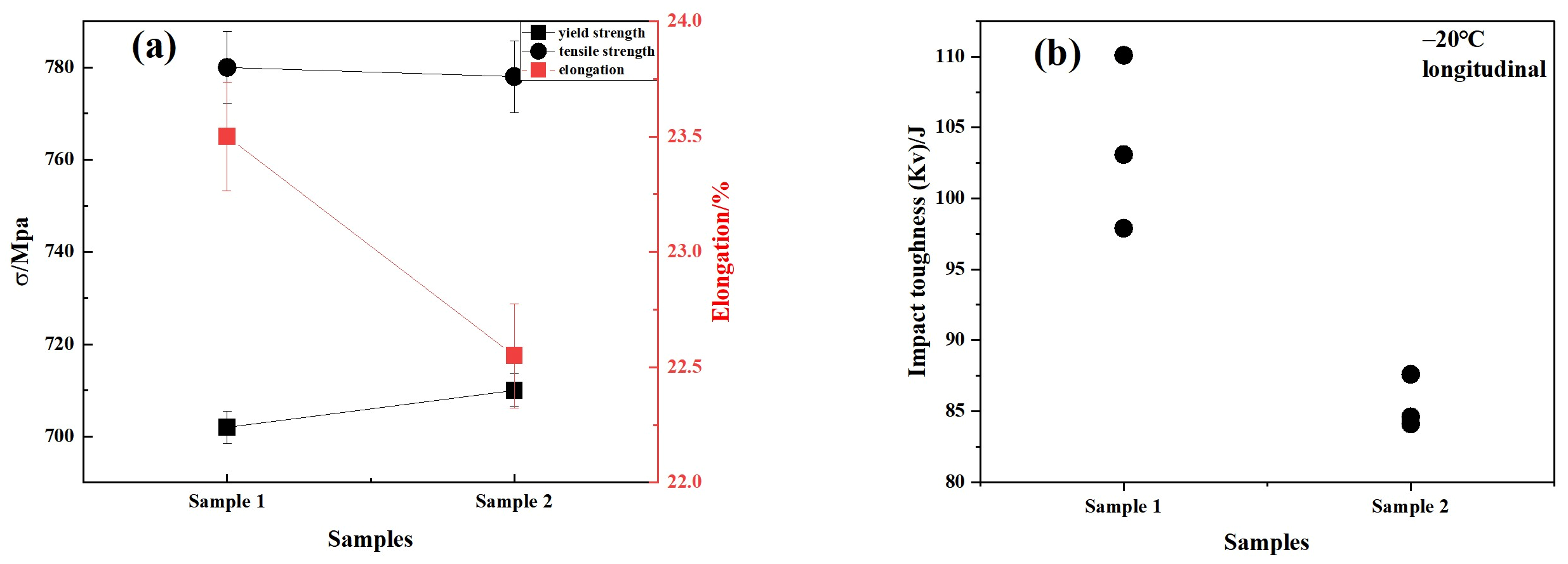
- Mechanical property testing showed that the addition of cerium had a minor effect on the tensile properties of BT700L steel. Yield strength increased slightly, while tensile strength and elongation remained mostly unchanged. However, the low-temperature impact toughness decreased by about 22%, indicating a negative effect on impact toughness.
- (4)
- Ce exhibits a dual effect in Ti-bearing high-strength steel. On the beneficial side, Ce refines oxide inclusions (reducing the size of spherical inclusions from 17 μm to 10 μm) and promotes grain refinement through heterogeneous nucleation on Ce2O3. On the detrimental side, Ce induces coarsening of angular Ti(C)N inclusions (from 8 μm to 11 μm). The size increase and angular morphology of Ti(C)N are more critical to toughness than the beneficial effects of grain refinement or oxide inclusion refinement, because large (>10 μm), angular TiN inclusions act as preferential stress concentration points under low-temperature impact loading, promoting early microcrack initiation and unstable crack propagation.
Author Contributions
Funding
Data Availability Statement
Conflicts of Interest
References
- Li, M.; Wu, H.; Sun, Y. Effect of the inclusion features on mechanical properties of steel. Ironmak. Steelmak. 2022, 49, 405–411. [Google Scholar] [CrossRef]
- Dekkers, R.; Blanpain, B.; Wollants, P.; Haers, F.; Vercruyssen, C.; Gommers, B. Non-metallic inclusions in aluminium killed steels. Ironmak. Steelmak. 2003, 29, 437–444. [Google Scholar] [CrossRef]
- Zhao, D.; Li, H.; Cui, Y.; Yang, J. Control of Inclusion Composition in Calcium Treated Aluminum Killed Steels. ISIJ Int. 2016, 56, 1181–1187. [Google Scholar] [CrossRef]
- Yang, L.; Li, Y.; Xue, Z.L.; Cheng, C.G. Influence of Ti(C,N) precipitates on austenite growth of micro-alloyed steel during continuous casting. China Foundry 2017, 14, 421–428. [Google Scholar] [CrossRef]
- Hao, J.; Wang, C.; Duan, H.; Yan, Z.; Yuan, G.; Wang, G. TiN-containing high-heat-input welding steels: Optimizing Ti/N ratio and precipitation temperature for enhanced low-temperature impact toughness in coarse-grained heat-affected zones. J. Mater. Res. Technol. 2025, 36, 9641–9651. [Google Scholar] [CrossRef]
- Liu, T.; Chen, D.; He, W.; Long, M.; Gui, L.; Duan, H.; Cao, J. Study on the formation and control of tin inclusion in mushy zone for high Ti microalloyed steel. In Proceedings of the TMS Annual Meeting & Exhibition; Springer: Berlin/Heidelberg, Germany, 2018; pp. 605–615. [Google Scholar] [CrossRef]
- Wu, X.; Zuo, X.; Zhao, W.; Wang, Z. Mechanism of TiN Fracture During the Tensile Process of NM500 Wear-Resistant Steel. Acta Metall. Sin. 2020, 56, 129–136. [Google Scholar] [CrossRef]
- Yan, W.; Shan, Y.; Yang, K. Effect of TiN inclusions on the impact toughness of low-carbon microalloyed steels. Metall. Mater. Trans. A 2006, 37, 2147–2158. [Google Scholar] [CrossRef]
- Liu, S.; Yang, F.; Liu, L.; Wang, J.; Peng, J.; Zhang, F.; An, S. Effects of rare earth Ce on TiN inclusion modifications in 20CrMnTi steel under deoxygenation conditions of Si–Ca–Ba alloy. J. Mater. Res. Technol. 2024, 30, 223–230. [Google Scholar] [CrossRef]
- He, F.; Peng, J.; Zhang, F.; Wang, Y.; Chang, H. Experimental and first-principles calculation of TiN growth mechanism on CeAlO3 surface in steel. J. Iron Steel Res. Int. 2024, 31, 452–463. [Google Scholar] [CrossRef]
- Zhang, X.; Xu, Y.; Yang, C.; Song, X.; Zhi, J.; An, S. Effect of Ce addition on inclusions, microstructure and impact toughness in Ti-bearing low-carbon Al-killed steel. J. Mater. Res. Technol. 2025, 37, 4631–4638. [Google Scholar] [CrossRef]
- Zhang, Y.; Peng, J.; Zhang, F.; Chang, H.; Liu, L.; Yu, X. Effect of rare earth cerium on precipitation of TiC and Ti(C, N) in titanium microalloyed steel. J. Iron Steel Res. Int. 2022, 34, 1160–1168. [Google Scholar] [CrossRef]
- Zhang, X.; Zhi, J.; Song, X.; Diao, W.; Lu, B.; An, S. Influence of cerium on impact toughness, tensile properties and inclusion of industrial Al-killed steel Q355B. J. Mater. Res. Technol. 2024, 32, 1118–1126. [Google Scholar] [CrossRef]
- Zhang, X.; Zhi, J.; Song, X.; Li, Z.; An, S. Mechanism of cerium-based inclusion formation and influence on impact toughness in industrial Al-killed steel. Ironmak. Steelmak. 2024, 51, 33–42. [Google Scholar] [CrossRef]
- Bramfitt, B.L. Planar lattice disregistry theory and its application on heterogistry nuclei of metal. Met. Trans. 1970, 1, 1987–1995. [Google Scholar] [CrossRef]
- Yong, Q. Secondary Phases in Steels; Metallurgical Industry Press: Beijing, China, 2006. [Google Scholar]
- Yan, W.; Shan, Y.; Yang, K. Influence of TiN inclusions on the cleavage fracture behavior of low-carbon microalloyed steels. Metall. Mater. Trans. A 2007, 38, 1211–1222. [Google Scholar] [CrossRef]
- Fairchild, D.P.; Howden, D.G.; Clark, W.A.T. Cleavage Initiation in Ti Microalloyed Steels; ASM International: Materials Park, OH, USA, 1995; p. 310. [Google Scholar]
- Zhu, Y.; Lu, Y.M.; Huang, C.W.; Liang, Y.L. The effect of TiN inclusions on the fracture mechanism of 20CrMnTi steel with lath martensite. Mater. Res. Express 2020, 7, 16. [Google Scholar] [CrossRef]
- León-García Orlando, O.; Petrov, R.; Kestens, L.A.I. Void initiation at TiN precipitates in IF steels during tensile deformation. Mater. Sci. Eng. A 2010, 527, 4202–4209. [Google Scholar] [CrossRef]
- Gui, L.; Long, M.; Zhang, H.; Chen, D.; Liu, S.; Wang, Q.; Duan, H. Study on the precipitation and coarsening of TiN inclusions in Ti-microalloyed steel by a modified coupling model. J. Mater. Res. Technol. 2020, 9, 5499–5514. [Google Scholar] [CrossRef]
- Shu, Q.; Visuri, V.V.; Alatarvas, T.; Fabritius, T. A Kinetic Model for Precipitation of TiN Inclusions from Both Homogeneous and Heterogeneous Nucleation During Solidification of Steel. Metall. Matefromrans. B 2022, 53, 2321–2333. [Google Scholar] [CrossRef]
- Wang, J. Study on the Effect and Mechanism of Rare Earth Ce on the Modification of TiN Inclusions in 20CrMnTi Gear Steel. Master’s Thesis, Inner Mongolia University of Science and Technology, Baotou, China, 2023. [Google Scholar]
- GB/T 6394-2017; Determination of Average Grain Size of Metal. Standardization Administration of China: Beijing, China, 2017.
- Liu, T.; Long, M.; Chen, D.; Duan, H.; Gui, L.; Yu, S.; Cao, J.; Chen, H.; Fan, H. Effect of coarse TiN inclusions and microstructure on impact toughness fluctuation in Ti micro-alloyed steel. J. Iron Steel Res. Int. 2018, 25, 1043–1053. [Google Scholar] [CrossRef]




| Sample Number | C | Si | Mn | P | S | Al | Ti | Ca | Ce | T.O | N |
|---|---|---|---|---|---|---|---|---|---|---|---|
| 1# | 0.07 | 0.07 | 1.66 | 0.012 | 0.001 | 0.037 | 0.080 | 0.0014 | 0 | 0.0013 | 0.0042 |
| 2# | 0.07 | 0.06 | 1.68 | 0.011 | 0.002 | 0.038 | 0.081 | 0.0012 | 0.0035 | 0.0012 | 0.0041 |
| Inclusion | Crystallographic System | Lattice Constant/nm | Source from | ||
|---|---|---|---|---|---|
| a | b | c | ICDD-PDF-2009 | ||
| TiN | cube | 0.3975 | PDF-card: 00-038-1420 | ||
| Ce2O3 | hexagonal | 0.3891 | 0.6063 | PDF-Card: 00-023-1048 | |
| CeAlO3 | cube | 0.3807 | PDF-Card: 00-055-0890 | ||
| α-Fe | cube | 0.2866 | PDF-Card: 00-006-0696 | ||
| γ-Fe | cube | 0.3578 * [16] | |||
| Case | [hkl]s | [hkl]n | d[hkl]s/nm | d[hkl]n/nm | θ1/° | d[hkl]s·cosθ1/nm | δ |
|---|---|---|---|---|---|---|---|
| (001)TiN//(001) α-Fe | [110] α-Fe | [010] TiN | 0.4052 | 0.424 | 0 | 0.4052 | 4.41% |
| [1-10] α-Fe | [100] TiN | 0.4052 | 0.424 | 0 | 0.4052 | ||
| [100] α-Fe | [110] TiN | 0.2866 | 0.299 | 0 | 0.2866 | ||
| (001)TiN//(001) γ-Fe | [010] γ-Fe | [010] TiN | 0.3578 | 0.424 | 0 | 0.3578 | 15.61% |
| [100] γ-Fe | [100] TiN | 0.3578 | 0.424 | 0 | 0.3578 | ||
| [110] γ-Fe | [110] TiN | 0.5059 | 0.5995 | 0 | 0.5059 | ||
| (0001) Ce2O3//(111) α-Fe | [110] α-Fe | [1210] Ce2O3 | 0.4053 | 0.3891 | 0 | 0.3891 | 4.00% |
| [121] α-Fe | [1100] Ce2O3 | 0.7020 | 0.6739 | 0 | 0.6739 | ||
| [011] α-Fe | [2110] Ce2O3 | 0.4053 | 0.3891 | 0 | 0.3891 | ||
| (0001) Ce2O3//(111) γ-Fe | [100] γ-Fe | [1210] Ce2O3 | 0.3578 | 0.3891 | 15 | 0.3758 | 6.28% |
| [011] γ-Fe | [1100] Ce2O3 | 0.6197 | 0.6739 | 0 | 0.6739 | ||
| [001] γ-Fe | [2110] Ce2O3 | 0.3578 | 0.3891 | 15 | 0.3758 | ||
| (111) CeAlO3//(100) α-Fe | [010] α-Fe | [110] CeAlO3 | 0.2866 | 0.2687 | 15 | 0.2768 | 14.93% |
| [011] α-Fe | [121] CeAlO3 | 0.4053 | 0.2687 | 0 | 0.4053 | ||
| [001] α-Fe | [011] CeAlO3 | 0.2866 | 0.2687 | 15 | 0.2768 |
Disclaimer/Publisher’s Note: The statements, opinions and data contained in all publications are solely those of the individual author(s) and contributor(s) and not of MDPI and/or the editor(s). MDPI and/or the editor(s) disclaim responsibility for any injury to people or property resulting from any ideas, methods, instructions or products referred to in the content. |
© 2026 by the authors. Licensee MDPI, Basel, Switzerland. This article is an open access article distributed under the terms and conditions of the Creative Commons Attribution (CC BY) license.
Share and Cite
Shi, C.; Zhang, X.; Yang, C.; He, J.; Liu, P.; Yang, J. The Influence of Cerium on Inclusions, Microstructure, and Mechanical Properties of Industrial BT700L Steel. Metals 2026, 16, 646. https://doi.org/10.3390/met16060646
Shi C, Zhang X, Yang C, He J, Liu P, Yang J. The Influence of Cerium on Inclusions, Microstructure, and Mechanical Properties of Industrial BT700L Steel. Metals. 2026; 16(6):646. https://doi.org/10.3390/met16060646
Chicago/Turabian StyleShi, Chao, Xiaofeng Zhang, Changqiao Yang, Jianzhong He, Peng Liu, and Jichun Yang. 2026. "The Influence of Cerium on Inclusions, Microstructure, and Mechanical Properties of Industrial BT700L Steel" Metals 16, no. 6: 646. https://doi.org/10.3390/met16060646
APA StyleShi, C., Zhang, X., Yang, C., He, J., Liu, P., & Yang, J. (2026). The Influence of Cerium on Inclusions, Microstructure, and Mechanical Properties of Industrial BT700L Steel. Metals, 16(6), 646. https://doi.org/10.3390/met16060646